US11213741B2 - Board game - Google Patents
Board game Download PDFInfo
- Publication number
- US11213741B2 US11213741B2 US15/816,710 US201715816710A US11213741B2 US 11213741 B2 US11213741 B2 US 11213741B2 US 201715816710 A US201715816710 A US 201715816710A US 11213741 B2 US11213741 B2 US 11213741B2
- Authority
- US
- United States
- Prior art keywords
- tiles
- numbered
- playing
- game
- player
- Prior art date
- Legal status (The legal status is an assumption and is not a legal conclusion. Google has not performed a legal analysis and makes no representation as to the accuracy of the status listed.)
- Active, expires
Links
Images




Classifications
-
- A—HUMAN NECESSITIES
- A63—SPORTS; GAMES; AMUSEMENTS
- A63F—CARD, BOARD, OR ROULETTE GAMES; INDOOR GAMES USING SMALL MOVING PLAYING BODIES; VIDEO GAMES; GAMES NOT OTHERWISE PROVIDED FOR
- A63F3/00—Board games; Raffle games
- A63F3/04—Geographical or like games ; Educational games
- A63F3/0415—Number games
-
- A—HUMAN NECESSITIES
- A63—SPORTS; GAMES; AMUSEMENTS
- A63F—CARD, BOARD, OR ROULETTE GAMES; INDOOR GAMES USING SMALL MOVING PLAYING BODIES; VIDEO GAMES; GAMES NOT OTHERWISE PROVIDED FOR
- A63F11/00—Game accessories of general use, e.g. score counters, boxes
- A63F11/0074—Game concepts, rules or strategies
-
- A—HUMAN NECESSITIES
- A63—SPORTS; GAMES; AMUSEMENTS
- A63F—CARD, BOARD, OR ROULETTE GAMES; INDOOR GAMES USING SMALL MOVING PLAYING BODIES; VIDEO GAMES; GAMES NOT OTHERWISE PROVIDED FOR
- A63F3/00—Board games; Raffle games
- A63F2003/00996—Board games available as video games
-
- A—HUMAN NECESSITIES
- A63—SPORTS; GAMES; AMUSEMENTS
- A63F—CARD, BOARD, OR ROULETTE GAMES; INDOOR GAMES USING SMALL MOVING PLAYING BODIES; VIDEO GAMES; GAMES NOT OTHERWISE PROVIDED FOR
- A63F3/00—Board games; Raffle games
- A63F3/04—Geographical or like games ; Educational games
- A63F3/0415—Number games
- A63F2003/0418—Number games with a grid, e.g. 'Sudoku'-type games
-
- A—HUMAN NECESSITIES
- A63—SPORTS; GAMES; AMUSEMENTS
- A63F—CARD, BOARD, OR ROULETTE GAMES; INDOOR GAMES USING SMALL MOVING PLAYING BODIES; VIDEO GAMES; GAMES NOT OTHERWISE PROVIDED FOR
- A63F11/00—Game accessories of general use, e.g. score counters, boxes
- A63F11/0074—Game concepts, rules or strategies
- A63F2011/0079—Game concepts, rules or strategies keeping something hidden or invisible
-
- A—HUMAN NECESSITIES
- A63—SPORTS; GAMES; AMUSEMENTS
- A63F—CARD, BOARD, OR ROULETTE GAMES; INDOOR GAMES USING SMALL MOVING PLAYING BODIES; VIDEO GAMES; GAMES NOT OTHERWISE PROVIDED FOR
- A63F11/00—Game accessories of general use, e.g. score counters, boxes
- A63F11/0074—Game concepts, rules or strategies
- A63F2011/0086—Rules
Definitions
- the present invention relates to a board game; in particular, a mathematics-based board game; and more particularly to a mathematics-based board game where players are awarded points for placing numbered game tiles on the game board to make a predetermined value.
- Tile sequencing games are known in the art.
- a popular and well-known the sequencing game is SCRABBLE where players arrange lettered tiles to form words. This concept has been extended to mathematics-based the sequencing games where players arrange tiles to perform specific operations or to add up to a specified number or multiple of that number.
- these games use a standardized, fixed game board with randomness created solely through players drawing random tiles during game play.
- the board game may comprise a game board arranged as a grid of a plurality of playing squares.
- the plurality of playing squares may include a first set of playing squares having a first indicia, a second set of playing squares having a second indicia, and a third set of playing squares having a third indicia.
- a first set of numbered tiles may have the first indicia
- a second set of numbered tiles may have the second indicia
- a third set of numbered tiles may have the third indicia.
- the method may comprise: A) placing a respective number of numbered tiles from the first set of numbered tiles on each playing square in the first set of playing squares; B) placing a respective number of numbered tiles from the second set of numbered tiles on each playing square in the second set of playing squares; C) placing the third set of numbered tiles in a draw pool; D) each of the at least two players removing a predetermined number of numbered tiles from the draw pool to form respective player pools; E) performing a series of successive player turns where each of the at least two players sequentially takes a turn, wherein the player taking a current turn either: i) passes on the current turn to a next successive player, wherein the next successive player is one of the at least two players, or ii) plays the current turn by: a) selecting one or more numbered tiles from the player pool of the player taking the current turn; and either: i) placing the selected one or more numbered tiles on the game board adjacent to at least one of the first set, the second set, or the third set of numbered
- the end of game event occurs when the draw pool is empty of numbered tiles of the third set of numbered tiles and one of the at least two players has placed all of the numbered tiles in their respective player pool on the game board. Determining a winner is based on the player having the highest total of awarded points following the end of the game event.
- the plurality of playing squares further includes a bonus set of playing squares having a bonus indicia, wherein the method further comprises awarding points if the selected one or more numbered tiles placed on the game board in the current turn is located on at least one of the bonus set of playing squares.
- the game board may further include a fourth set of playing squares having a fourth indicia, and wherein the board game further includes a fourth set of numbered tiles having the fourth indicia.
- the method may further comprise: placing a number of respective numbered tiles from the fourth set numbered tiles on each playing square in the fourth set of playing squares before the step of performing a series of successive player turns.
- one or more of the numbered tiles in the first set, the second set, the third set, and the fourth set of numbered tiles may further include an image of a ten frame thereon.
- Each of the numbered may include an image of an integer, a decimal, a fraction or combinations thereof.
- the present invention may provide for a board game comprising a game board arranged as a grid of a plurality of playing squares, wherein the plurality of playing squares includes a first set of playing squares having a first indicia, a second set of playing squares having a second indicia, and a third set of playing squares having a third indicia.
- the board game may further include: a first set of numbered tiles having the first indicia, wherein at least one of the first set of numbered tiles are configured to be placed in the first set of playing squares; a second set of numbered tiles having the second indicia, wherein at least one of the second set of numbered tiles are configured to be placed in the second set of playing squares; and a third set of numbered tiles having the third indicia, wherein the third set of numbered tiles are configured to be placed in a draw pool, wherein a predetermined number of the third set of numbered tiles are configured to be selectively removed from the draw pool and placed in two or more player pools.
- the third set of numbered tiles in the player pools are configured to be selectively placed on the third set of playing squares adjacent to at least one of the first set, the second set, or the third set of numbered tiles already placed on the game board in at least one of a straight vertical line or a straight horizontal line including at least one of the first set, the second set, or the third set of numbered tiles already placed on the game board.
- the placed one or more numbered tiles are configured to create one or more linear sequences so that a sum of the numbers on the numbered tiles within each of the one or more linear sequences equals a predetermined value.
- FIG. 1 is a top plan view of an exemplary game board suitable for use within a method of playing a board game in accordance with an aspect of the present invention
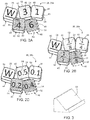
- FIG. 2A is perspective view of an exemplary game tiles that may be used in conjunction with the board game shown in FIG. 1 in one game scenario;
- FIG. 2B is perspective view of other exemplary game tiles that may be used in conjunction with the board game shown in FIG. 1 in another game scenario;
- FIG. 2C is perspective view of other exemplary game tiles that may be used in conjunction with the board game shown in FIG. 1 in yet another game scenario;
- FIG. 3 is a perspective view of an optional the rack configured to receive one or more of the game tiles shown in FIG. 2 before the game tiles are placed on the game board;
- FIG. 4 is a flow chart of an exemplary method of playing a board in accordance with an aspect of the present invention.
- FIG. 5 is top plan view of the game board shown in FIG. 1 , with an exemplary arrangement of pre-placed game tiles on respective playing squares in accordance with the method of playing a board game of the present invention
- FIG. 6 is a top plan view of the game board shown in FIG. 4 at the completion of the exemplary game.
- FIG. 7 is a schematic of an exemplary electronic board game that is configured to implement a method of playing a board game using a computing device in accordance with an aspect of the present invention.
- the exemplary board game system may include a game board 10 arranged as a grid of a plurality of individual playing squares 12 .
- Each square 12 may be one square within a horizontal row of squares 14 and a vertical column of squares 16 .
- a first set 18 of playing squares 12 may include a first indicia 20 while a second set 22 of playing squares 12 may include a second indicia 24 .
- a third set 26 of all remaining squares 12 may include a third indicia 28 .
- an optional fourth set 30 of certain playing squares 12 may include a fourth indicia 32 .
- a certain subset 34 of squares 12 may also include a bonus indicia 36 denoting each square 12 within the subset 34 as a bonus square, as will be discussed in greater detail below.
- the indicia discussed herein may take any form including, but not limited to, a symbol (e.g., cross-hatch lines, diagonal lines, dots, etc.), text, number, and/or color.
- the exemplary board game system may include various sets of numbered tiles 38 , wherein each tile 38 may be proportioned to substantially fill the delineated space that defines a single square 12 . That is, each tile 38 may be defined by a perimeter that is equal to or slightly less than the perimeter of square 12 such that each tile 38 may be positioned within square 12 without overlapping any adjacent square(s).
- one game scenario may comprise numbered tiles 38 a including a first set 40 of numbered tiles 38 a including first indicia 20 , a second set 42 of numbered tiles 38 a including second indicia 24 , and a third set 44 of numbered tiles 38 a including third indicia 28 .
- another game scenario may comprise an optional fourth set 46 of numbered tiles 38 a including fourth indicia 32 .
- Each of the numbered tiles 38 a within the first set, second set, third set and fourth sets 40 , 42 , 44 , 46 may include an image of an integer 48 as seen in FIG. 2A .
- the integers 48 depicted on the respective tiles may all be different (i.e., there are no integers within a respective set that are duplicated), all the same (i.e., all of the integers within a respective set are the same), mixed where there are many different integers each being used once, and/or mixed where there are many different integers and at least one of the integers are duplicated at least once (i.e., there are many different integers used in a respective set, wherein there is more than one of the same integer(s) provided (for example, there may be three two's, two three's, and two four's in a respective set)).
- one or more of the numbered tiles 38 a within the first set, second set, third set and fourth sets 40 , 42 , 44 , 46 may optionally include an image of a ten frame 50 .
- each of the numbered tiles 38 b within the first set, second set, third set and fourth set 40 , 42 , 44 , 46 may include an image of a fraction 52 .
- each of the numbered tiles 38 c within the first set, second set, third set and fourth set 40 , 42 , 44 , 46 may include an image of a decimal 54 .
- a subset of third set 44 of the plurality of numbered tiles 38 may include a wildcard indicator 56 , such as but not limited to the letter “W”, whereby tile 38 having wildcard indicator 56 may be designated by a player to have any selected value that may not change during the course of the game, as will be discussed in greater detail below.
- the exemplary board game system may include a plurality of optional tiles racks 58 whereby each player may arrange his or her tiles 38 on a respective tile rack 58 .
- Each respective tile rack 58 may assist a player in organizing the tiles 38 while also minimizing chances for opposing players to improperly view those tiles 38 before they are played on game board 10 .
- tile racks 58 may not be used and players may, instead, place their respective tiles face-up such that all players may view the tiles held by every other player. Accordingly, this alternative aspect of the invention may impart a further strategic element as a player is not only playing his or her own tiles, but anticipating plays made by the other players during their respective turns, as will be discussed in greater detail below.
- an exemplary method 100 of setting up and playing a game including two or more players will now be described using numbered tiles 38 a that include an image of integer 48 thereon; however, it should be understood that method 100 may also be used in conjunction with numbered tiles 38 b or 38 c .
- method 100 may generally include setting up game board 10 by: a) placing numbered tiles 60 from first set 40 of the plurality of numbered tiles 38 a on each respective playing square of first set 18 of playing squares 12 at step 110 , wherein indicia 20 on the respective numbered tiles 60 and each respective playing square 12 from first set 18 correspond with one another; b) placing numbered tiles 62 from second set 22 of the plurality of numbered tiles 38 a on each respective playing square of second set 22 of playing squares 12 at step 112 , wherein indicia 24 on the respective numbered tiles 62 and each respective playing square 12 from second set 22 correspond with one another; and c) placing third set 44 of numbered tiles 38 a in a draw pool adjacent to game board 10 at step 114 .
- each of the two or more players may then remove a predetermined number of third set 44 of numbered tiles 38 a from the draw pool to form respective player pools.
- each player pool may be placed on a respective tile rack 58 for each player or placed face-up (integer 48 , fraction 52 , decimal 54 , wildcard indicator 56 displayed) in front of each respective player, such as on the table top surface.
- face-up integer 48 , fraction 52 , decimal 54 , wildcard indicator 56 displayed
- each player's tiles may only be viewed by those tile's owners with all other player's tiles obscured or all player's tiles may displayed for each player to view (see FIG.
- the players may then perform a series of successive player turns, wherein each of the two or more players sequentially takes a turn at step 118 .
- a respective player may either pass their turn to a next successive player at step 120 , or play a turn by selecting one or more tiles from their respective player pool at step 122 and either: i) place the selected one or more tiles in the draw pool at step 124 ; or ii) place the selected one or more tiles on game board 10 adjacent to at least one of first set 40 and/or second set 42 and/or third set 44 of numbered tiles 38 a that are already placed on game board 10 at step 126 to form a straight vertical or horizontal line.
- step 128 if the player elects to return selected tiles to the draw pool at step 124 , then the player may take from the draw pool a number of replacement tiles equal to the number of selected one or more tiles played from their player pool at step 124 .
- the player electing to return and swap tiles may incur a penalty for each tile thus swapped by deducting a point value. At this point, the player's turn ends and the next successive player may then proceed with their respective turn.
- the player may then, at step 134 , take from the draw pool a number of replacement tiles equal to the number of selected one or more tiles played from their player pool at step 126 . At this point, the player's turn ends and the next successive play may then proceed with their turn.
- the player determines if there are any remaining tiles within his or her player pool at step 136 . If the player has remaining tiles in their player pool (Y), the player's turn ends and the next successive player may then proceed with their turn. However, if the player no longer has any tiles (N), this will trigger an end of game event and a winner may be determined at step 138 , wherein the player having the highest total number of awarded points is the winner.
- game board 10 may further include fourth set 30 of certain playing squares 12 and fourth set 46 of numbered tiles 38 a , which both include fourth indicia 32 .
- method 100 may further include an additional step 140 whereby a respective numbered tile 64 from fourth set 46 of numbered tiles 38 a may be placed on each respective playing square of fourth set 30 of certain playing squares 12 .
- Step 140 may be conducted prior to step 118 wherein the players perform a series of successive player turns, or alternatively, prior to each player removing a predetermined number of third set 44 of numbered tiles 38 a from the draw pool to form respective player pools at step 116 .
- one example of a method of playing a board game in accordance with an aspect of the present invention requires each player to make one or more linear sequences of numbered tiles, wherein the numbers on the tiles sum to a predetermined value—the integer “10”.
- Each player may use up to five tiles per turn and place one to five tiles in a single straight vertical or horizontal line or orientation.
- a player may then earn ten (10) points for each sum of “10” made in a linear sequence.
- ten (10) points may be awarded to the player taking the current turn for each linear sequence created during the current turn.
- three (3) points may additionally be awarded to the player for each tile played during the turn.
- Certain bonus squares 34 may also be utilized by players so as to receive ten (10) bonus points when completing a turn when a tile is placed on a bonus square. Moreover, if a player is able to play all five (5) tiles in a single turn, that player may be awarded a further bonus of thirty (30) points.
- game board 10 is first set up to include placement of numbered tiles 60 , 62 and 64 from first and second sets 40 , 42 , (and optionally) fourth set 46 .
- each of tiles 60 , 62 and 64 in first, second and fourth sets 40 , 42 , 44 may be placed numbered-side down with a single tile picked randomly and placed number-side up on a respective square 18 , 22 , 30 using corresponding indicia. Random tiles 60 , 62 and 64 are picked until all of squares 18 , 22 , 30 are occupied by a respective tile 60 , 62 , 64 .
- Each tile 63 of third set 44 is placed numbered-side down in a draw pile adjacent game board 10 .
- game board 10 is set up and the game is ready to be played.
- each player draws five (5) tiles 63 from the draw pool to create a respective player pool.
- the players may draw tiles 63 or otherwise select a player to go first, with each successive player then taking a turn in order, as described above.
- FIG. 6 shows game board 10 as set up in FIG. 5 following a number of successive turns.
- two turns are generally indicated by arrows 150 , 152 .
- a player has placed tiles 44 a (numbered 3), 44 b (numbered 5) and 44 c (numbered 2) such that tile 44 b intersects fourth set tile 46 a (numbered 5).
- Tile 44 d is also placed on bonus square 34 b (compare FIG. 5 ) thus yielding a bonus 10 awarded points for the turn total awarded points of 39. Note that whenever third set 44 of numbered tiles 38 a are placed touching another tile, the resulting vertical or horizontal sum must equal “10”, otherwise the tile placement is invalid and must be removed from the game board.
- a player may choose to trade tiles or pass their respective turn. For example, a player may choose to trade tiles by selecting, such as up to three (3), tiles from their respective player pool and return these tiles to the draw pool. The player may then draw an equal number of tiles and place these tiles within their player pool for use in subsequent turns. A trading player may be assessed a penalty of minus 3 ( ⁇ 3) points for each tile traded. Alternatively, a player may choose to pass their turn whereby the player maintains their player pool for subsequent turns. A passing player may not be assessed any penalty for this action.
- a subset of third set 44 of the plurality of numbered tiles 38 may include wildcard indicator 56 , such as but not limited to the letter “W”, whereby a tile from third set 44 having wildcard indicator 56 may be designated by the player to have any selected value.
- wildcard indicator 56 such as but not limited to the letter “W”
- the game may end, for example, when: 1) all tiles 44 have been drawn from the draw pile and one player has placed all of their tiles 44 on game board 10 ; or 2) all players have tiles 44 remaining within their respective player pool but are unable to play a tile on game board 10 .
- a player if a player is able to play all tiles after the draw pool is empty, that player may be awarded a bonus of three (3) points for each unplayed tile within the other players' respective player pools.
- the winner of the game may be the player having the highest cumulative total of awarded points at the end of the game.
- numbered tiles are arranged to sum to a predetermined value of “10”
- game playing methods employing numbered tiles bearing fractions, decimals or positive and negative integers may be directed to creating sums of “1” or “0”.
- a method may employ numbered tiles bearing integers that are multiples of “5” (such as “5”, “10”, “20”, etc.) such that players may make sums of “100”, “200” or any other player-identified sum.
- a method may employ number tiles ranging from, for instance, “ ⁇ 9” to “+9”, whereby each player is required to make a sum equal to the number on the first numbered tile that player selects from the draw pool at the beginning of the game and after each player turn for that respective player. For example, if the first players selects a “+6” first and a second player selects a “ ⁇ 2” first, the first player will be required to make at least one sum of “6” while the second player will be required to make at least one sum of “ ⁇ 2”. Each respective sum may be awarded a predetermined number of points, such as “10”. Upon replacement of the played tiles (i.e., step 128 or step 134 described above), each player will then be required to make at least one sum equal to the number shown on the first replacement tile so selected.
- game board 10 and tiles 38 may be physical objects.
- the board game may be a computer-based system 200 wherein game board 10 and tiles 38 may be digitally represented and manipulated on any suitable computing device, such as but not limited to a smart phone 202 , tablet computer 204 , laptop computer 206 , desktop computer 208 , and the like.
- such computing device may include a display 210 for displaying game board 10 and tiles 38 , and one or more suitable peripheral user input devices, such as a mouse 212 , keyboard 214 , stylus 216 or touch screen input controller 218 so as to, for instance, select and manipulate tiles 38 during play.
- the board game may be provided in a networked environment (e.g., Internet), wherein the method is in the form of computer readable instructions that are stored a server 220 and/or within the memory of computing device 202 , 204 , 206 , 208 .
- server 220 may include an artificial intelligence module 226 including computer readable instructions configured to simulate a human player playing a game.
- one or more players may play a game including one or more computer-based “players” executing the artificial intelligence algorithm.
Landscapes
- Engineering & Computer Science (AREA)
- Multimedia (AREA)
- Physics & Mathematics (AREA)
- Algebra (AREA)
- General Physics & Mathematics (AREA)
- Mathematical Analysis (AREA)
- Pure & Applied Mathematics (AREA)
- Educational Technology (AREA)
- Processing Or Creating Images (AREA)
- Slot Machines And Peripheral Devices (AREA)
- Toys (AREA)
Abstract
Description
Claims (6)
Priority Applications (2)
| Application Number | Priority Date | Filing Date | Title |
|---|---|---|---|
| US15/816,710 US11213741B2 (en) | 2016-12-07 | 2017-11-17 | Board game |
| US17/566,110 US20220118350A1 (en) | 2016-12-07 | 2021-12-30 | Board game |
Applications Claiming Priority (2)
| Application Number | Priority Date | Filing Date | Title |
|---|---|---|---|
| US201662431035P | 2016-12-07 | 2016-12-07 | |
| US15/816,710 US11213741B2 (en) | 2016-12-07 | 2017-11-17 | Board game |
Related Child Applications (1)
| Application Number | Title | Priority Date | Filing Date |
|---|---|---|---|
| US17/566,110 Continuation US20220118350A1 (en) | 2016-12-07 | 2021-12-30 | Board game |
Publications (2)
| Publication Number | Publication Date |
|---|---|
| US20180154248A1 US20180154248A1 (en) | 2018-06-07 |
| US11213741B2 true US11213741B2 (en) | 2022-01-04 |
Family
ID=62240321
Family Applications (2)
| Application Number | Title | Priority Date | Filing Date |
|---|---|---|---|
| US15/816,710 Active 2038-08-10 US11213741B2 (en) | 2016-12-07 | 2017-11-17 | Board game |
| US17/566,110 Abandoned US20220118350A1 (en) | 2016-12-07 | 2021-12-30 | Board game |
Family Applications After (1)
| Application Number | Title | Priority Date | Filing Date |
|---|---|---|---|
| US17/566,110 Abandoned US20220118350A1 (en) | 2016-12-07 | 2021-12-30 | Board game |
Country Status (1)
| Country | Link |
|---|---|
| US (2) | US11213741B2 (en) |
Cited By (1)
| Publication number | Priority date | Publication date | Assignee | Title |
|---|---|---|---|---|
| US20230143911A1 (en) * | 2021-11-08 | 2023-05-11 | Cassandra Oh | Math strategy game |
Families Citing this family (3)
| Publication number | Priority date | Publication date | Assignee | Title |
|---|---|---|---|---|
| US11745089B2 (en) * | 2021-02-12 | 2023-09-05 | Pratima Patil | Apparatus for a board game |
| US12128304B2 (en) * | 2022-06-29 | 2024-10-29 | Superplay Ltd | Altering computer game tiles having multiple matchable ends |
| US11857882B1 (en) * | 2022-06-29 | 2024-01-02 | Superplay Ltd | Altering computer game tiles having multiple matchable ends |
Citations (21)
| Publication number | Priority date | Publication date | Assignee | Title |
|---|---|---|---|---|
| US2320832A (en) * | 1938-12-29 | 1943-06-01 | Maximon | Educational game |
| US2750193A (en) * | 1952-11-14 | 1956-06-12 | George F Wales | Game apparatus |
| US2752158A (en) * | 1954-06-11 | 1956-06-26 | Brunot James | Game apparatus |
| US3396972A (en) * | 1966-01-10 | 1968-08-13 | James A. Smith | Word construction game apparatus having numerical scoring feature |
| US3460835A (en) | 1966-08-22 | 1969-08-12 | David E Crans | Apparatus for playing a mathematical board game |
| US3844568A (en) * | 1973-04-13 | 1974-10-29 | E Armstrong | Game apparatus |
| US3904207A (en) * | 1973-04-19 | 1975-09-09 | Edward Maurice Gold | Word game |
| US4243225A (en) * | 1977-12-09 | 1981-01-06 | Levinrad Maxim D | Board games |
| US4283058A (en) * | 1978-04-12 | 1981-08-11 | Eugene A. A. E. de Cadier | Sequence arranging board game |
| US4565374A (en) * | 1983-07-11 | 1986-01-21 | Pak Kyong H | Mathematical board game apparatus |
| US5314190A (en) | 1991-08-16 | 1994-05-24 | Lyons Malcolm J | Mathematical game |
| CH684243A5 (en) | 1990-02-19 | 1994-08-15 | Andre Marmy | Game having tokens provided with symbols and value information. |
| US5338203A (en) * | 1993-04-01 | 1994-08-16 | Rheams William N | Educational aid for mathematics |
| US5893718A (en) | 1997-05-19 | 1999-04-13 | O'donnell; Gary | Mathematical board game |
| US6508468B1 (en) | 2001-09-07 | 2003-01-21 | Kevin F. Challice | Tile sequencing game assembly |
| US20060043677A1 (en) * | 2004-08-31 | 2006-03-02 | Mcelvaney Claudia J | Game apparatus and method |
| US20070063437A1 (en) * | 2005-09-19 | 2007-03-22 | The Upper Deck Company | Word-forming game |
| WO2007056965A2 (en) | 2005-11-18 | 2007-05-24 | Zdenek Cap | A mathematical teaching aid on the basis of a table board game and a method of performing calculation operations on this aid |
| US20080252008A1 (en) | 2007-04-16 | 2008-10-16 | Joel Harden | Method of playing a mathematical game |
| US8251367B2 (en) * | 2007-09-14 | 2012-08-28 | Mattel, Inc. | Board and board game with timing features |
| US20160296835A1 (en) * | 2015-04-08 | 2016-10-13 | Robert Felder Cunningham | Arithmetic board game |
Family Cites Families (4)
| Publication number | Priority date | Publication date | Assignee | Title |
|---|---|---|---|---|
| ZA777420B (en) * | 1977-12-13 | 1979-03-28 | M Levinrad | Improvements in and relating to board games |
| US4350342A (en) * | 1980-04-21 | 1982-09-21 | Barulich Thomas J | Word game apparatus |
| US5026071A (en) * | 1990-03-05 | 1991-06-25 | Miraglia Jr Humbert G | Word game |
| US9597581B2 (en) * | 2010-07-22 | 2017-03-21 | Warifu, LLC | Board game |
-
2017
- 2017-11-17 US US15/816,710 patent/US11213741B2/en active Active
-
2021
- 2021-12-30 US US17/566,110 patent/US20220118350A1/en not_active Abandoned
Patent Citations (21)
| Publication number | Priority date | Publication date | Assignee | Title |
|---|---|---|---|---|
| US2320832A (en) * | 1938-12-29 | 1943-06-01 | Maximon | Educational game |
| US2750193A (en) * | 1952-11-14 | 1956-06-12 | George F Wales | Game apparatus |
| US2752158A (en) * | 1954-06-11 | 1956-06-26 | Brunot James | Game apparatus |
| US3396972A (en) * | 1966-01-10 | 1968-08-13 | James A. Smith | Word construction game apparatus having numerical scoring feature |
| US3460835A (en) | 1966-08-22 | 1969-08-12 | David E Crans | Apparatus for playing a mathematical board game |
| US3844568A (en) * | 1973-04-13 | 1974-10-29 | E Armstrong | Game apparatus |
| US3904207A (en) * | 1973-04-19 | 1975-09-09 | Edward Maurice Gold | Word game |
| US4243225A (en) * | 1977-12-09 | 1981-01-06 | Levinrad Maxim D | Board games |
| US4283058A (en) * | 1978-04-12 | 1981-08-11 | Eugene A. A. E. de Cadier | Sequence arranging board game |
| US4565374A (en) * | 1983-07-11 | 1986-01-21 | Pak Kyong H | Mathematical board game apparatus |
| CH684243A5 (en) | 1990-02-19 | 1994-08-15 | Andre Marmy | Game having tokens provided with symbols and value information. |
| US5314190A (en) | 1991-08-16 | 1994-05-24 | Lyons Malcolm J | Mathematical game |
| US5338203A (en) * | 1993-04-01 | 1994-08-16 | Rheams William N | Educational aid for mathematics |
| US5893718A (en) | 1997-05-19 | 1999-04-13 | O'donnell; Gary | Mathematical board game |
| US6508468B1 (en) | 2001-09-07 | 2003-01-21 | Kevin F. Challice | Tile sequencing game assembly |
| US20060043677A1 (en) * | 2004-08-31 | 2006-03-02 | Mcelvaney Claudia J | Game apparatus and method |
| US20070063437A1 (en) * | 2005-09-19 | 2007-03-22 | The Upper Deck Company | Word-forming game |
| WO2007056965A2 (en) | 2005-11-18 | 2007-05-24 | Zdenek Cap | A mathematical teaching aid on the basis of a table board game and a method of performing calculation operations on this aid |
| US20080252008A1 (en) | 2007-04-16 | 2008-10-16 | Joel Harden | Method of playing a mathematical game |
| US8251367B2 (en) * | 2007-09-14 | 2012-08-28 | Mattel, Inc. | Board and board game with timing features |
| US20160296835A1 (en) * | 2015-04-08 | 2016-10-13 | Robert Felder Cunningham | Arithmetic board game |
Non-Patent Citations (1)
| Title |
|---|
| Mathable (2 pages). * |
Cited By (1)
| Publication number | Priority date | Publication date | Assignee | Title |
|---|---|---|---|---|
| US20230143911A1 (en) * | 2021-11-08 | 2023-05-11 | Cassandra Oh | Math strategy game |
Also Published As
| Publication number | Publication date |
|---|---|
| US20180154248A1 (en) | 2018-06-07 |
| US20220118350A1 (en) | 2022-04-21 |
Similar Documents
| Publication | Publication Date | Title |
|---|---|---|
| US20220118350A1 (en) | Board game | |
| US9764222B2 (en) | System and method for calculating values in tile games | |
| US9895601B1 (en) | Word game and method of play | |
| US20100093444A1 (en) | Gaming System and Method for Sudoku-Based Game | |
| US20210197092A1 (en) | Crosswords game and method | |
| US20120223479A1 (en) | Strategy Game | |
| US8851476B2 (en) | Strategy game | |
| RU2017114127A (en) | TIPS SUPPORT SYSTEM AND TIPS SUPPORT METHOD FOR GAMES WITH A TWO PLAYERS | |
| US20160332068A1 (en) | Electronic game wordbuster | |
| WO2012037252A1 (en) | Multi-player game | |
| Hentzel | Triangular puzzle peg | |
| US20150031424A1 (en) | Strategy game with two- or three-dimensional matrix and discs or balls and method of playing thereof | |
| US10220299B2 (en) | Training systems and methods | |
| US20180154249A1 (en) | Crossword and Anagram Game and Method of Playing Such a Game | |
| US9327184B2 (en) | Apparatus and method of manipulating numeric panels | |
| US10576361B1 (en) | Card game and method of playing | |
| US20250065218A1 (en) | Word game with player-driven letter rearrangement | |
| US8419517B2 (en) | Method of playing a game and computerized system for playing the game | |
| US20250018274A1 (en) | Memory Card Game | |
| US20250018278A1 (en) | Mathematical colored-numbered puzzle board game | |
| US9283470B2 (en) | Two party puzzle game | |
| US20180104571A1 (en) | Board game apparatus | |
| US20210299551A1 (en) | Pattern Building and Matching Card Game | |
| US20100301563A1 (en) | Comparative trivia game | |
| WO2008138073A1 (en) | Word game |
Legal Events
| Date | Code | Title | Description |
|---|---|---|---|
| FEPP | Fee payment procedure |
Free format text: ENTITY STATUS SET TO UNDISCOUNTED (ORIGINAL EVENT CODE: BIG.); ENTITY STATUS OF PATENT OWNER: MICROENTITY |
|
| AS | Assignment |
Owner name: QT3.14 LLC, NEW YORK Free format text: ASSIGNMENT OF ASSIGNORS INTEREST;ASSIGNOR:DUPREY, BECKY;REEL/FRAME:044495/0544 Effective date: 20171120 |
|
| FEPP | Fee payment procedure |
Free format text: ENTITY STATUS SET TO MICRO (ORIGINAL EVENT CODE: MICR); ENTITY STATUS OF PATENT OWNER: MICROENTITY |
|
| STPP | Information on status: patent application and granting procedure in general |
Free format text: DOCKETED NEW CASE - READY FOR EXAMINATION |
|
| STPP | Information on status: patent application and granting procedure in general |
Free format text: NON FINAL ACTION MAILED |
|
| STPP | Information on status: patent application and granting procedure in general |
Free format text: RESPONSE TO NON-FINAL OFFICE ACTION ENTERED AND FORWARDED TO EXAMINER |
|
| STPP | Information on status: patent application and granting procedure in general |
Free format text: FINAL REJECTION MAILED |
|
| STCV | Information on status: appeal procedure |
Free format text: NOTICE OF APPEAL FILED |
|
| STCV | Information on status: appeal procedure |
Free format text: APPEAL BRIEF (OR SUPPLEMENTAL BRIEF) ENTERED AND FORWARDED TO EXAMINER |
|
| STCV | Information on status: appeal procedure |
Free format text: EXAMINER'S ANSWER TO APPEAL BRIEF MAILED |
|
| STCV | Information on status: appeal procedure |
Free format text: ON APPEAL -- AWAITING DECISION BY THE BOARD OF APPEALS |
|
| STCV | Information on status: appeal procedure |
Free format text: BOARD OF APPEALS DECISION RENDERED |
|
| STPP | Information on status: patent application and granting procedure in general |
Free format text: NOTICE OF ALLOWANCE MAILED -- APPLICATION RECEIVED IN OFFICE OF PUBLICATIONS |
|
| STPP | Information on status: patent application and granting procedure in general |
Free format text: PUBLICATIONS -- ISSUE FEE PAYMENT VERIFIED |
|
| STCF | Information on status: patent grant |
Free format text: PATENTED CASE |
|
| MAFP | Maintenance fee payment |
Free format text: PAYMENT OF MAINTENANCE FEE, 4TH YEAR, MICRO ENTITY (ORIGINAL EVENT CODE: M3551); ENTITY STATUS OF PATENT OWNER: MICROENTITY Year of fee payment: 4 |