US11192858B2 - Diamine-based compound and organic light-emitting device including the same - Google Patents
Diamine-based compound and organic light-emitting device including the same Download PDFInfo
- Publication number
- US11192858B2 US11192858B2 US16/208,555 US201816208555A US11192858B2 US 11192858 B2 US11192858 B2 US 11192858B2 US 201816208555 A US201816208555 A US 201816208555A US 11192858 B2 US11192858 B2 US 11192858B2
- Authority
- US
- United States
- Prior art keywords
- group
- substituted
- unsubstituted
- diamine
- based compound
- Prior art date
- Legal status (The legal status is an assumption and is not a legal conclusion. Google has not performed a legal analysis and makes no representation as to the accuracy of the status listed.)
- Active, expires
Links
- 0 c1ccc(*2C(c(cc3)ccc3-c(cc3)cc4c3c(-c3cc(-c5ccccc5)cc(-c5ccccc5)c3)c(cccc3)c3c4-c3cc(-c4ccccc4)cc(-c4ccccc4)c3)=Nc3ccccc23)cc1 Chemical compound c1ccc(*2C(c(cc3)ccc3-c(cc3)cc4c3c(-c3cc(-c5ccccc5)cc(-c5ccccc5)c3)c(cccc3)c3c4-c3cc(-c4ccccc4)cc(-c4ccccc4)c3)=Nc3ccccc23)cc1 0.000 description 35
- TXVPFVGTOHLMIY-UHFFFAOYSA-N CCN1C2=C(C(N(C3=CC=CC=C3)C3=CC4=C(C=C3)C(C3=CC=CC=C3)(C3=CC=CC=C3)C3=C4C=CC=C3)=CC(N(C3=CC=CC=C3)C3=CC4=C(C=C3)C3=C(C=CC=C3)C4(C3=CC=CC=C3)C3=CC=CC=C3)=C2)C2=C/C=C/C=C\21.CCN1C2=C(C(N(C3=CC=CC=C3)C3=CC4=C(C=C3)C3(C5=CC=CC=C5C5=C3C=CC=C5)C3=C4C=CC=C3)=CC(N(C3=CC=CC=C3)C3=CC4=C(C=C3)C3=C(C=CC=C3)C43C4=CC=CC=C4C4=C3C=CC=C4)=C2)C2=C/C=C/C=C\21.CCN1C2=CC=CC=C2C2=C1C=C(N(C1=CC=CC=C1)/C1=C/C=C\C3=C1C1=C(C=CC=C1)O3)C=C2N(C1=CC=CC=C1)C1=C\C=C/C2=C\1C1=C(C=CC=C1)O2 Chemical compound CCN1C2=C(C(N(C3=CC=CC=C3)C3=CC4=C(C=C3)C(C3=CC=CC=C3)(C3=CC=CC=C3)C3=C4C=CC=C3)=CC(N(C3=CC=CC=C3)C3=CC4=C(C=C3)C3=C(C=CC=C3)C4(C3=CC=CC=C3)C3=CC=CC=C3)=C2)C2=C/C=C/C=C\21.CCN1C2=C(C(N(C3=CC=CC=C3)C3=CC4=C(C=C3)C3(C5=CC=CC=C5C5=C3C=CC=C5)C3=C4C=CC=C3)=CC(N(C3=CC=CC=C3)C3=CC4=C(C=C3)C3=C(C=CC=C3)C43C4=CC=CC=C4C4=C3C=CC=C4)=C2)C2=C/C=C/C=C\21.CCN1C2=CC=CC=C2C2=C1C=C(N(C1=CC=CC=C1)/C1=C/C=C\C3=C1C1=C(C=CC=C1)O3)C=C2N(C1=CC=CC=C1)C1=C\C=C/C2=C\1C1=C(C=CC=C1)O2 TXVPFVGTOHLMIY-UHFFFAOYSA-N 0.000 description 2
- JWEIHSOKCFSIOH-UHFFFAOYSA-N CCN1C2=CC=CC=C2C2=C1C=C(N(C1=CC=CC=C1)C1=CC3=C(C=C1)C1=C(C=CC=C1)C3(C)C)C=C2N(C1=CC=CC=C1)C1=CC2=C(C=C1)C(C)(C)C1=C2C=CC=C1.CCN1C2=CC=CC=C2C2=C1C=C(N(C1=CC=CC=C1)C1=CC3=C(C=C1)C1=C(C=CC=C1)O3)C=C2N(C1=CC=CC=C1)C1=CC2=C(C=C1)OC1=C2C=CC=C1.CCN1C2=CC=CC=C2C2=C1C=C(N(C1=CC=CC=C1)C1=CC=C(C3=CC=CC=C3)C=C1)C=C2N(C1=CC=CC=C1)C1=CC=C(C2=CC=CC=C2)C=C1.CCN1C2=CC=CC=C2C2=C1C=C(N(C1=CC=CC=C1)C1=CC=CC=C1)C=C2N(C1=CC=CC=C1)C1=CC=CC=C1 Chemical compound CCN1C2=CC=CC=C2C2=C1C=C(N(C1=CC=CC=C1)C1=CC3=C(C=C1)C1=C(C=CC=C1)C3(C)C)C=C2N(C1=CC=CC=C1)C1=CC2=C(C=C1)C(C)(C)C1=C2C=CC=C1.CCN1C2=CC=CC=C2C2=C1C=C(N(C1=CC=CC=C1)C1=CC3=C(C=C1)C1=C(C=CC=C1)O3)C=C2N(C1=CC=CC=C1)C1=CC2=C(C=C1)OC1=C2C=CC=C1.CCN1C2=CC=CC=C2C2=C1C=C(N(C1=CC=CC=C1)C1=CC=C(C3=CC=CC=C3)C=C1)C=C2N(C1=CC=CC=C1)C1=CC=C(C2=CC=CC=C2)C=C1.CCN1C2=CC=CC=C2C2=C1C=C(N(C1=CC=CC=C1)C1=CC=CC=C1)C=C2N(C1=CC=CC=C1)C1=CC=CC=C1 JWEIHSOKCFSIOH-UHFFFAOYSA-N 0.000 description 2
- CJOPLLNBPFIICA-UHFFFAOYSA-N CN1C2=C(C(N(C3=CC=CC=C3)C3=C/C4=C(\C=C/3)C(C3=CC=CC=C3)(C3=CC=CC=C3)C3=C4C=CC=C3)=CC(N(C3=CC=CC=C3)C3=CC4=C(C=C3)C3=C(C=CC=C3)C4(C3=CC=CC=C3)C3=CC=CC=C3)=C2)C2=C/C=C/C=C\21.CN1C2=C(C(N(C3=CC=CC=C3)C3=C/C4=C(\C=C/3)C3(C5=CC=CC=C5C5=C3C=CC=C5)C3=C4C=CC=C3)=CC(N(C3=CC=CC=C3)C3=CC4=C(C=C3)C3=C(C=CC=C3)C43C4=CC=CC=C4C4=C3C=CC=C4)=C2)C2=C/C=C/C=C\21.CN1C2=CC=CC=C2C2=C1C=C(N(C1=CC=CC=C1)C1=C\C=C/C3=C\1C1=C(C=CC=C1)O3)C=C2N(C1=CC=CC=C1)C1=C\C=C/C2=C\1C1=C(C=CC=C1)O2 Chemical compound CN1C2=C(C(N(C3=CC=CC=C3)C3=C/C4=C(\C=C/3)C(C3=CC=CC=C3)(C3=CC=CC=C3)C3=C4C=CC=C3)=CC(N(C3=CC=CC=C3)C3=CC4=C(C=C3)C3=C(C=CC=C3)C4(C3=CC=CC=C3)C3=CC=CC=C3)=C2)C2=C/C=C/C=C\21.CN1C2=C(C(N(C3=CC=CC=C3)C3=C/C4=C(\C=C/3)C3(C5=CC=CC=C5C5=C3C=CC=C5)C3=C4C=CC=C3)=CC(N(C3=CC=CC=C3)C3=CC4=C(C=C3)C3=C(C=CC=C3)C43C4=CC=CC=C4C4=C3C=CC=C4)=C2)C2=C/C=C/C=C\21.CN1C2=CC=CC=C2C2=C1C=C(N(C1=CC=CC=C1)C1=C\C=C/C3=C\1C1=C(C=CC=C1)O3)C=C2N(C1=CC=CC=C1)C1=C\C=C/C2=C\1C1=C(C=CC=C1)O2 CJOPLLNBPFIICA-UHFFFAOYSA-N 0.000 description 2
- BJDZFOFMLCTDOF-UHFFFAOYSA-N CN1C2=CC=CC=C2C2=C1C=C(N(C1=CC=CC=C1)C1=CC3=C(C=C1)C1=C(C=CC=C1)C3(C)C)C=C2N(C1=CC=CC=C1)C1=CC2=C(C=C1)C(C)(C)C1=C2C=CC=C1.CN1C2=CC=CC=C2C2=C1C=C(N(C1=CC=CC=C1)C1=CC3=C(C=C1)C1=C(C=CC=C1)O3)C=C2N(C1=CC=CC=C1)C1=CC2=C(C=C1)OC1=C2C=CC=C1.CN1C2=CC=CC=C2C2=C1C=C(N(C1=CC=CC=C1)C1=CC=C(C3=CC=CC=C3)C=C1)C=C2N(C1=CC=CC=C1)C1=CC=C(C2=CC=CC=C2)C=C1.CN1C2=CC=CC=C2C2=C1C=C(N(C1=CC=CC=C1)C1=CC=CC=C1)C=C2N(C1=CC=CC=C1)C1=CC=CC=C1 Chemical compound CN1C2=CC=CC=C2C2=C1C=C(N(C1=CC=CC=C1)C1=CC3=C(C=C1)C1=C(C=CC=C1)C3(C)C)C=C2N(C1=CC=CC=C1)C1=CC2=C(C=C1)C(C)(C)C1=C2C=CC=C1.CN1C2=CC=CC=C2C2=C1C=C(N(C1=CC=CC=C1)C1=CC3=C(C=C1)C1=C(C=CC=C1)O3)C=C2N(C1=CC=CC=C1)C1=CC2=C(C=C1)OC1=C2C=CC=C1.CN1C2=CC=CC=C2C2=C1C=C(N(C1=CC=CC=C1)C1=CC=C(C3=CC=CC=C3)C=C1)C=C2N(C1=CC=CC=C1)C1=CC=C(C2=CC=CC=C2)C=C1.CN1C2=CC=CC=C2C2=C1C=C(N(C1=CC=CC=C1)C1=CC=CC=C1)C=C2N(C1=CC=CC=C1)C1=CC=CC=C1 BJDZFOFMLCTDOF-UHFFFAOYSA-N 0.000 description 2
- COLXINIAVLWAEW-DJKVNEOUSA-N BN=P.C.C.C.C1=CC=C(N(C2=CC3=C(C=C2)C2=C(C=C(N(C4=CC=CC=C4)C4=C5C=CC=CC5=CC=C4)C=C2)C32C3=CC=CC=C3C3=C2C=CC=C3)C2=C3C=CC=CC3=CC=C2)C=C1.C1=CC=C(N(C2=CC=C(C3=CC=C(N(C4=CC=CC=C4)C4=C5C=CC=CC5=CC=C4)C=C3)C=C2)C2=CC=CC3=C2C=CC=C3)C=C1.C1=CC=C(N(C2=CC=C(C3=CC=C(N(C4=CC=CC=C4)C4=CC5=C(C=CC=C5)C=C4)C=C3)C=C2)C2=CC3=C(C=CC=C3)C=C2)C=C1.CC1=CC(N(C2=CC=CC=C2)C2=CC3=C(C=C2)C2=C(C=C(N(C4=CC=CC=C4)C4=CC=CC(C)=C4)C=C2)C32C3=CC=CC=C3C3=C2C=CC=C3)=CC=C1.CC1=CC=CC(N(C2=CC=CC=C2)C2=CC=C(C3=CC=C(N(C4=CC=CC=C4)C4=CC=CC(C)=C4)C=C3)C=C2)=C1.[2H]P[3H] Chemical compound BN=P.C.C.C.C1=CC=C(N(C2=CC3=C(C=C2)C2=C(C=C(N(C4=CC=CC=C4)C4=C5C=CC=CC5=CC=C4)C=C2)C32C3=CC=CC=C3C3=C2C=CC=C3)C2=C3C=CC=CC3=CC=C2)C=C1.C1=CC=C(N(C2=CC=C(C3=CC=C(N(C4=CC=CC=C4)C4=C5C=CC=CC5=CC=C4)C=C3)C=C2)C2=CC=CC3=C2C=CC=C3)C=C1.C1=CC=C(N(C2=CC=C(C3=CC=C(N(C4=CC=CC=C4)C4=CC5=C(C=CC=C5)C=C4)C=C3)C=C2)C2=CC3=C(C=CC=C3)C=C2)C=C1.CC1=CC(N(C2=CC=CC=C2)C2=CC3=C(C=C2)C2=C(C=C(N(C4=CC=CC=C4)C4=CC=CC(C)=C4)C=C2)C32C3=CC=CC=C3C3=C2C=CC=C3)=CC=C1.CC1=CC=CC(N(C2=CC=CC=C2)C2=CC=C(C3=CC=C(N(C4=CC=CC=C4)C4=CC=CC(C)=C4)C=C3)C=C2)=C1.[2H]P[3H] COLXINIAVLWAEW-DJKVNEOUSA-N 0.000 description 1
- SNCGAWCUZWGCPD-UHFFFAOYSA-N BN=P.C1=CC=C(N(C2=CC=C(C3=CC=C(N(C4=CC=CC=C4)C4=C5C=CC=CC5=CC=C4)C=C3)C=C2)C2=CC=CC3=C2C=CC=C3)C=C1 Chemical compound BN=P.C1=CC=C(N(C2=CC=C(C3=CC=C(N(C4=CC=CC=C4)C4=C5C=CC=CC5=CC=C4)C=C3)C=C2)C2=CC=CC3=C2C=CC=C3)C=C1 SNCGAWCUZWGCPD-UHFFFAOYSA-N 0.000 description 1
- ZQJFCQHZDPGJPY-UHFFFAOYSA-N BrC1=C/C2=C(C3=CC=CC=C3C2)/C(Br)=C\1.BrC1=CC=C(I)C(Br)=C1.CN1C2=CC=CC=C2C2=C1/C=C(Br)\C=C/2Br.CN1C2=CC=CC=C2C2=C1C=C(N(C1=CC=CC=C1)C1=CC=C(C3=CC=CC=C3)C=C1)C=C2N(C1=CC=CC=C1)C1=CC=C(C2=CC=CC=C2)C=C1.O=[N+]([O-])C1=CC=CC=C1B(O)O.O=[N+]([O-])C1=CC=CC=C1C1=CC=C(Br)C=C1Br.[H]N(C1=CC=CC=C1)C1=CC=C(C2=CC=CC=C2)C=C1 Chemical compound BrC1=C/C2=C(C3=CC=CC=C3C2)/C(Br)=C\1.BrC1=CC=C(I)C(Br)=C1.CN1C2=CC=CC=C2C2=C1/C=C(Br)\C=C/2Br.CN1C2=CC=CC=C2C2=C1C=C(N(C1=CC=CC=C1)C1=CC=C(C3=CC=CC=C3)C=C1)C=C2N(C1=CC=CC=C1)C1=CC=C(C2=CC=CC=C2)C=C1.O=[N+]([O-])C1=CC=CC=C1B(O)O.O=[N+]([O-])C1=CC=CC=C1C1=CC=C(Br)C=C1Br.[H]N(C1=CC=CC=C1)C1=CC=C(C2=CC=CC=C2)C=C1 ZQJFCQHZDPGJPY-UHFFFAOYSA-N 0.000 description 1
- LCHAEFTUWMEQAW-UHFFFAOYSA-N BrC1=C/C2=C(C3=CC=CC=C3C2)/C(Br)=C\1.CCN1C2=CC=CC=C2C2=C1/C=C(Br)\C=C/2Br.CCN1C2=CC=CC=C2C2=C1C=C(N(C1=CC=CC=C1)C1=CC=CC=C1)C=C2N(C1=CC=CC=C1)C1=CC=CC=C1.[H]N(C1=CC=CC=C1)C1=CC=CC=C1 Chemical compound BrC1=C/C2=C(C3=CC=CC=C3C2)/C(Br)=C\1.CCN1C2=CC=CC=C2C2=C1/C=C(Br)\C=C/2Br.CCN1C2=CC=CC=C2C2=C1C=C(N(C1=CC=CC=C1)C1=CC=CC=C1)C=C2N(C1=CC=CC=C1)C1=CC=CC=C1.[H]N(C1=CC=CC=C1)C1=CC=CC=C1 LCHAEFTUWMEQAW-UHFFFAOYSA-N 0.000 description 1
- PPSQUHFZUFDZTH-AJDUEALZSA-K C.C.C1=CC=N2[Ir]C3=C(C=CC=C3)C2=C1.CC1=CC(C)=O[Ir@@]2(O1)C1=C(C=C3C(=C1)C1=C(C=CC=C1)C3(C)C)C1=C3C=CC=CC3=CC=N12.CC1=CC(C)=O[Ir@@]2(O1)C1=C(C=CC=C1)C1=CC=CC=N12.FC1=CC2=C(C3=CC=CC=N3[Ir]2)C(F)=N1.O=C1O[Ir@@]2(C3=C(C(F)=CC(F)=C3)C3=CC=CC=N32)N2=CC=CC=C12.[C-]#[N+]C1=C(F)C2=C(C=C1F)[Ir]N1=CC=C(C)C=C21 Chemical compound C.C.C1=CC=N2[Ir]C3=C(C=CC=C3)C2=C1.CC1=CC(C)=O[Ir@@]2(O1)C1=C(C=C3C(=C1)C1=C(C=CC=C1)C3(C)C)C1=C3C=CC=CC3=CC=N12.CC1=CC(C)=O[Ir@@]2(O1)C1=C(C=CC=C1)C1=CC=CC=N12.FC1=CC2=C(C3=CC=CC=N3[Ir]2)C(F)=N1.O=C1O[Ir@@]2(C3=C(C(F)=CC(F)=C3)C3=CC=CC=N32)N2=CC=CC=C12.[C-]#[N+]C1=C(F)C2=C(C=C1F)[Ir]N1=CC=C(C)C=C21 PPSQUHFZUFDZTH-AJDUEALZSA-K 0.000 description 1
- ICFGQUXDIZNCIF-DHYIGNKFSA-N C.C1=CC=C(C(=CC2=CC=C(C3=CC=C(C=C(C4=CC=CC=C4)C4=CC=CC=C4)C=C3)C=C2)C2=CC=CC=C2)C=C1.C1=CC=C(N(C2=CC=CC=C2)C2=CC=C(/C=C/C3=CC=C(C4=CC=C(/C=C/C5=CC=C(N(C6=CC=CC=C6)C6=CC=CC=C6)C=C5)C=C4)C=C3)C=C2)C=C1.CC(C)(C)C1=CC2=CC(C(C)(C)C)=CC3=C2C(=C1)C1=C2\C3=CC(C(C)(C)C)=C\C2=C\C(C(C)(C)C)=C\1.CC1(C)CCN2CCC(C)(C)C3=C2C1=CC1=C3OC(=O)C(/C2=N/C3=C(C=CC=C3)S2)=C1.CCN(CC)C1=CC2=C(C=C1)C=C(/C1=N/C3=C(C=CC=C3)S1)C(=O)O2.[2H]P([V])[BiH2].[C-]#[N+]/C(C#N)=C1/C=C(/C=C/C2=CC3=C4C(=C2)C(C)(C)CCN4CCC3(C)C)OC(C(C)(C)C)=C1.[C-]#[N+]/C(C#N)=C1/C=C(C)OC(/C=C/C2=CC3=C4C(=C2)CCCN4CCC3)=C1 Chemical compound C.C1=CC=C(C(=CC2=CC=C(C3=CC=C(C=C(C4=CC=CC=C4)C4=CC=CC=C4)C=C3)C=C2)C2=CC=CC=C2)C=C1.C1=CC=C(N(C2=CC=CC=C2)C2=CC=C(/C=C/C3=CC=C(C4=CC=C(/C=C/C5=CC=C(N(C6=CC=CC=C6)C6=CC=CC=C6)C=C5)C=C4)C=C3)C=C2)C=C1.CC(C)(C)C1=CC2=CC(C(C)(C)C)=CC3=C2C(=C1)C1=C2\C3=CC(C(C)(C)C)=C\C2=C\C(C(C)(C)C)=C\1.CC1(C)CCN2CCC(C)(C)C3=C2C1=CC1=C3OC(=O)C(/C2=N/C3=C(C=CC=C3)S2)=C1.CCN(CC)C1=CC2=C(C=C1)C=C(/C1=N/C3=C(C=CC=C3)S1)C(=O)O2.[2H]P([V])[BiH2].[C-]#[N+]/C(C#N)=C1/C=C(/C=C/C2=CC3=C4C(=C2)C(C)(C)CCN4CCC3(C)C)OC(C(C)(C)C)=C1.[C-]#[N+]/C(C#N)=C1/C=C(C)OC(/C=C/C2=CC3=C4C(=C2)CCCN4CCC3)=C1 ICFGQUXDIZNCIF-DHYIGNKFSA-N 0.000 description 1
- WTVUXRDSHHSGLJ-UHFFFAOYSA-N C1=CC(C2=C3SC4=C(C=CC=C4)C3=CC=C2)=CC(C2=CC3=C(C=C2)C2=C(C=CC=C2)C2=C3C=CC=C2)=C1.C1=CC2=C(C=C1)C1=CC(C3=CC4=C(C=C3)C3=C(C=CC=C3)C3=C4C=CC=C3)=CC=C1O2.C1=CC=C(C2=CC(C3=CC4=C(C=C3)C3=C(C=C(C5=CC=CC=C5)C=C3)C3=C4C=CC=C3)=CC=C2)C=C1.C1=CC=C(C2=NC(C3=CC=CC=C3)=NC(C3=CC(C4=CC5=C(C=C4)C4=C(C=CC=C4)C4=C5C=CC=C4)=CC=C3)=N2)C=C1.CC1(C)C2=CC(C3=CC=CC4=C(C5=CC=C(C6=CC7=C(C=CC=C7)C7=C6C=CC=C7)C=C5)C=CC=C34)=CC=C2C2=C1C=CC=C2 Chemical compound C1=CC(C2=C3SC4=C(C=CC=C4)C3=CC=C2)=CC(C2=CC3=C(C=C2)C2=C(C=CC=C2)C2=C3C=CC=C2)=C1.C1=CC2=C(C=C1)C1=CC(C3=CC4=C(C=C3)C3=C(C=CC=C3)C3=C4C=CC=C3)=CC=C1O2.C1=CC=C(C2=CC(C3=CC4=C(C=C3)C3=C(C=C(C5=CC=CC=C5)C=C3)C3=C4C=CC=C3)=CC=C2)C=C1.C1=CC=C(C2=NC(C3=CC=CC=C3)=NC(C3=CC(C4=CC5=C(C=C4)C4=C(C=CC=C4)C4=C5C=CC=C4)=CC=C3)=N2)C=C1.CC1(C)C2=CC(C3=CC=CC4=C(C5=CC=C(C6=CC7=C(C=CC=C7)C7=C6C=CC=C7)C=C5)C=CC=C34)=CC=C2C2=C1C=CC=C2 WTVUXRDSHHSGLJ-UHFFFAOYSA-N 0.000 description 1
- CZKJCUBXHXMNBQ-UHFFFAOYSA-N C1=CC(C2=CC(C3=CC=CC(N4C5=C(C=CC=C5)C5=C4C=CC=C5)=C3)=CN=C2)=CC(N2C3=C(C=CC=C3)C3=C2C=CC=C3)=C1.C1=CC=C(C2=NC(C3=CC=CC=C3)=NC(C3=CC(N4C5=C(C=CC=C5)C5=C4C=CC=C5)=CC(N4C5=C(C=CC=C5)C5=C4/C=C\C=C/5)=C3)=N2)C=C1.C1=CC=C(C2=NC(C3=CC=CC=C3)=NC(N3C4=C(C=C(C5=C/C=C6C(=C/5)\C5=C(C=CC=C5)N\6C5=CC=CC=C5)C=C4)C4=C3/C=C\C=C/4)=N2)C=C1.C1=CC=C(N2C3=C(C=C(C4=C/C=C5C(=C/4)\C4=C(C=CC=C4)N\5C4=CC=CC=C4)C=C3)C3=C2/C=C\C=C/3)C=C1 Chemical compound C1=CC(C2=CC(C3=CC=CC(N4C5=C(C=CC=C5)C5=C4C=CC=C5)=C3)=CN=C2)=CC(N2C3=C(C=CC=C3)C3=C2C=CC=C3)=C1.C1=CC=C(C2=NC(C3=CC=CC=C3)=NC(C3=CC(N4C5=C(C=CC=C5)C5=C4C=CC=C5)=CC(N4C5=C(C=CC=C5)C5=C4/C=C\C=C/5)=C3)=N2)C=C1.C1=CC=C(C2=NC(C3=CC=CC=C3)=NC(N3C4=C(C=C(C5=C/C=C6C(=C/5)\C5=C(C=CC=C5)N\6C5=CC=CC=C5)C=C4)C4=C3/C=C\C=C/4)=N2)C=C1.C1=CC=C(N2C3=C(C=C(C4=C/C=C5C(=C/4)\C4=C(C=CC=C4)N\5C4=CC=CC=C4)C=C3)C3=C2/C=C\C=C/3)C=C1 CZKJCUBXHXMNBQ-UHFFFAOYSA-N 0.000 description 1
- OPKRWJGXDMZRET-UHFFFAOYSA-N C1=CC2=C(C=C1)C(C1=CC=C(C3=NC(C4=CC5=C(C=CC=C5)C5=C4C=CC=C5)=CC(C4=CC5=C(C=CC=C5)C5=C4C=CC=C5)=N3)C=C1)=NC=C2.C1=CC2=CC(C3=CC=C(C4=NC(C5=CC=C(C6=CC7=C(C=CC=C7)C7=C6C=CC=C7)C=C5)=CC(C5=CC6=C(C=CC=C6)C6=C5C=CC=C6)=N4)C=C3)=CN=C2C=C1.C1=CN=C(C2=CC=C(C3=NC(C4=CC5=C(C=CC=C5)C5=C4C=CC=C5)=CC(C4=CC5=C(C=CC=C5)C5=C4C=CC=C5)=N3)C=C2)C=C1 Chemical compound C1=CC2=C(C=C1)C(C1=CC=C(C3=NC(C4=CC5=C(C=CC=C5)C5=C4C=CC=C5)=CC(C4=CC5=C(C=CC=C5)C5=C4C=CC=C5)=N3)C=C1)=NC=C2.C1=CC2=CC(C3=CC=C(C4=NC(C5=CC=C(C6=CC7=C(C=CC=C7)C7=C6C=CC=C7)C=C5)=CC(C5=CC6=C(C=CC=C6)C6=C5C=CC=C6)=N4)C=C3)=CN=C2C=C1.C1=CN=C(C2=CC=C(C3=NC(C4=CC5=C(C=CC=C5)C5=C4C=CC=C5)=CC(C4=CC5=C(C=CC=C5)C5=C4C=CC=C5)=N3)C=C2)C=C1 OPKRWJGXDMZRET-UHFFFAOYSA-N 0.000 description 1
- XAMCPWHMBWCALO-MJISJASGSA-N C1=CC2=C(C=C1)C=C(C1=C3C=CC=CC3=C(C3=CC=CC4=C3SC3=C4C=CC=C3)C3=C1C=CC=C3)C=C2.C1=CC=C(C2=C3C=CC=CC3=C(C3=CC4=C(C=C3)C3=C(C=CC=C3)C4(C3=CC=CC=C3)C3=CC=CC=C3)C3=C2C=CC=C3)C=C1.C1=CC=C(C2=C3C=CC=CC3=C(C3=CC=C(N4C5=C(C=CC=C5)C5=C4C=CC=C5)C=C3)C3=C2C=CC=C3)C=C1.C1=CC=C(C2=C3C=CC=CC3=C(C3=CC=CC4=C3OC3=C4C=CC=C3)C3=C2C=CC=C3)C=C1.[2H]C1=C([2H])C2=C(C([2H])=C1[2H])C(C1=C3C=CC=CC3=C3C=CC=CC3=C1)=C1C=CC=CC1=C2C1=CC=CC=C1 Chemical compound C1=CC2=C(C=C1)C=C(C1=C3C=CC=CC3=C(C3=CC=CC4=C3SC3=C4C=CC=C3)C3=C1C=CC=C3)C=C2.C1=CC=C(C2=C3C=CC=CC3=C(C3=CC4=C(C=C3)C3=C(C=CC=C3)C4(C3=CC=CC=C3)C3=CC=CC=C3)C3=C2C=CC=C3)C=C1.C1=CC=C(C2=C3C=CC=CC3=C(C3=CC=C(N4C5=C(C=CC=C5)C5=C4C=CC=C5)C=C3)C3=C2C=CC=C3)C=C1.C1=CC=C(C2=C3C=CC=CC3=C(C3=CC=CC4=C3OC3=C4C=CC=C3)C3=C2C=CC=C3)C=C1.[2H]C1=C([2H])C2=C(C([2H])=C1[2H])C(C1=C3C=CC=CC3=C3C=CC=CC3=C1)=C1C=CC=CC1=C2C1=CC=CC=C1 XAMCPWHMBWCALO-MJISJASGSA-N 0.000 description 1
- FFZJEWRQORLPFF-UHFFFAOYSA-N C1=CC2=C(C=C1)C=C(C1=NC(C3=CC=C(C4=CC=CC5=C4N=CC=C5)C=C3)=NC(C3=CC4=C(C=CC=C4)C=C3)=N1)C=C2.C1=CC2=CC(C3=CC=C(C4=NC(C5=CC6=C(C=CC=C6)C6=C5C=CC=C6)=NC(C5=CC6=C(C=CC=C6)C6=C5C=CC=C6)=N4)C=C3)=CN=C2C=C1.C1=CC=C(C2=CC=C(C3=NC(C4=CC=C(C5=C6N=CC=CC6=CC=C5)C=C4)=NC(C4=CC=C(C5=CC=CC6=C5N=CC=C6)C=C4)=N3)C=C2)C=C1 Chemical compound C1=CC2=C(C=C1)C=C(C1=NC(C3=CC=C(C4=CC=CC5=C4N=CC=C5)C=C3)=NC(C3=CC4=C(C=CC=C4)C=C3)=N1)C=C2.C1=CC2=CC(C3=CC=C(C4=NC(C5=CC6=C(C=CC=C6)C6=C5C=CC=C6)=NC(C5=CC6=C(C=CC=C6)C6=C5C=CC=C6)=N4)C=C3)=CN=C2C=C1.C1=CC=C(C2=CC=C(C3=NC(C4=CC=C(C5=C6N=CC=CC6=CC=C5)C=C4)=NC(C4=CC=C(C5=CC=CC6=C5N=CC=C6)C=C4)=N3)C=C2)C=C1 FFZJEWRQORLPFF-UHFFFAOYSA-N 0.000 description 1
- YFXZFPIXOJHING-UHFFFAOYSA-N C1=CC2=C(C=C1)N(C1=CC3=C(C=C1)C1=C(C=CC=C1)N3C1=CC=C(C3=CC=C(N4C5=C(C=CC=C5)C5=C4C=C(N4C6=C(C=CC=C6)C6=C4C=CC=C6)C=C5)C=C3)C=C1)C1=C2C=CC=C1.C1=CC=C(C2=CC=C(N(C3=CC=C(C4=CC=C(N(C5=CC=C(C6=CC=CC=C6)C=C5)C5=CC6=C(C=C5)N(C5=CC=CC=C5)C5=C6C=CC=C5)C=C4)C=C3)C3=CC=C4C(=C3)C3=C(C=CC=C3)N4C3=CC=CC=C3)C=C2)C=C1.C1=CC=C(N(C2=CC=C(C3=CC=C(N(C4=CC=CC=C4)C4=CC5=C(C=C4)C4=C(C=CC=C4)N5C4=CC=CC=C4)C=C3)C=C2)C2=CC=C3C(=C2)N(C2=CC=CC=C2)C2=C3C=CC=C2)C=C1.C1=CC=C(N2C3=CC=C(N(C4=CC=C(C5=CC=C(N(C6=CC7=C(C=C6)N(C6=CC=CC=C6)C6=C7C=CC=C6)C6=CC=CC7=C6C=CC=C7)C=C5)C=C4)C4=C5C=CC=CC5=CC=C4)C=C3C3=C2C=CC=C3)C=C1 Chemical compound C1=CC2=C(C=C1)N(C1=CC3=C(C=C1)C1=C(C=CC=C1)N3C1=CC=C(C3=CC=C(N4C5=C(C=CC=C5)C5=C4C=C(N4C6=C(C=CC=C6)C6=C4C=CC=C6)C=C5)C=C3)C=C1)C1=C2C=CC=C1.C1=CC=C(C2=CC=C(N(C3=CC=C(C4=CC=C(N(C5=CC=C(C6=CC=CC=C6)C=C5)C5=CC6=C(C=C5)N(C5=CC=CC=C5)C5=C6C=CC=C5)C=C4)C=C3)C3=CC=C4C(=C3)C3=C(C=CC=C3)N4C3=CC=CC=C3)C=C2)C=C1.C1=CC=C(N(C2=CC=C(C3=CC=C(N(C4=CC=CC=C4)C4=CC5=C(C=C4)C4=C(C=CC=C4)N5C4=CC=CC=C4)C=C3)C=C2)C2=CC=C3C(=C2)N(C2=CC=CC=C2)C2=C3C=CC=C2)C=C1.C1=CC=C(N2C3=CC=C(N(C4=CC=C(C5=CC=C(N(C6=CC7=C(C=C6)N(C6=CC=CC=C6)C6=C7C=CC=C6)C6=CC=CC7=C6C=CC=C7)C=C5)C=C4)C4=C5C=CC=CC5=CC=C4)C=C3C3=C2C=CC=C3)C=C1 YFXZFPIXOJHING-UHFFFAOYSA-N 0.000 description 1
- FIOMBVCIJHKEKP-UVHQKMQGSA-N C1=CC2=C3C(=C1)C1=N4C(=CC=C1)OC1=N5C(=CC=C1)C1=C(C(=CC=C1)O2)[Pt]354.C1=CC=C(N2C3=CC4=CC=CC5=N4[Pt@]4(N3C3=C2C=CC=C3)N2C3=C(C=CC=C3)N(C3=CC=CC=C3)/C2=C/C2=N4C5=CC=C2)C=C1.C1=CC=C(N2C3=CC=CC4=C3[Pt]3(C5=C2C=CC=C5C2=N3C=CS2)N2=C4SC=C2)C=C1.C1=CC=C(N2C3=CC=CC4=N3[Pt]3(C5=CC=CC=C54)C4=C(C=CC=C4)C4=CC=CC2=N43)C=C1.CC1=NN2C(=C1)C1=CC=CC=N1[Pt]21N2N=C(C)C=C2C2=N1C=CC=C2 Chemical compound C1=CC2=C3C(=C1)C1=N4C(=CC=C1)OC1=N5C(=CC=C1)C1=C(C(=CC=C1)O2)[Pt]354.C1=CC=C(N2C3=CC4=CC=CC5=N4[Pt@]4(N3C3=C2C=CC=C3)N2C3=C(C=CC=C3)N(C3=CC=CC=C3)/C2=C/C2=N4C5=CC=C2)C=C1.C1=CC=C(N2C3=CC=CC4=C3[Pt]3(C5=C2C=CC=C5C2=N3C=CS2)N2=C4SC=C2)C=C1.C1=CC=C(N2C3=CC=CC4=N3[Pt]3(C5=CC=CC=C54)C4=C(C=CC=C4)C4=CC=CC2=N43)C=C1.CC1=NN2C(=C1)C1=CC=CC=N1[Pt]21N2N=C(C)C=C2C2=N1C=CC=C2 FIOMBVCIJHKEKP-UVHQKMQGSA-N 0.000 description 1
- FRGPQKXWSHJYFK-UHFFFAOYSA-H C1=CC2=C3C(=C1)O[Al]14(OC5=CC=CC6=C5N1=CC=C6)(OC1=CC=CC5=C1N4=CC=C5)N3=CC=C2.C1=CC=C(C2=NN=C(C3=CC=CC=C3)N2C2=CC=CC3=C2C=CC=C3)C=C1.CC(C)(C)C1=CC=C(C2=NN=C(C3=CC=C(C4=CC=CC=C4)C=C3)N2C2=CC=CC=C2)C=C1.CC1=N2C3=C(C=CC=C3O[AlH]23(OC2=CC=C(C4=CC=CC=C4)C=C2)O/C2=C/C=C\C4=C2N3=C(C)C=C4)C=C1 Chemical compound C1=CC2=C3C(=C1)O[Al]14(OC5=CC=CC6=C5N1=CC=C6)(OC1=CC=CC5=C1N4=CC=C5)N3=CC=C2.C1=CC=C(C2=NN=C(C3=CC=CC=C3)N2C2=CC=CC3=C2C=CC=C3)C=C1.CC(C)(C)C1=CC=C(C2=NN=C(C3=CC=C(C4=CC=CC=C4)C=C3)N2C2=CC=CC=C2)C=C1.CC1=N2C3=C(C=CC=C3O[AlH]23(OC2=CC=C(C4=CC=CC=C4)C=C2)O/C2=C/C=C\C4=C2N3=C(C)C=C4)C=C1 FRGPQKXWSHJYFK-UHFFFAOYSA-H 0.000 description 1
- WFKKZLFMRZDDPC-UHFFFAOYSA-N C1=CC2=CC(C3=C4C=CC=CC4=C(C4=C5C=CC=CC5=CC=C4)C4=C3C=CC=C4)=C3C=CC=CC3=C2C=C1.C1=CC2=CC(C3=C4C=CC=CC4=C(C4=CC5=C(C=CC=C5)C=C4)C4=C3C=CC=C4)=C3C=CC=CC3=C2C=C1.C1=CC2=CC=CC(C3=C4C=CC=CC4=C(C4=C5C=CC=CC5=CC=C4)C4=C3C=CC=C4)=C2C=C1.C1=CC2=CC=CC(C3=C4C=CC=CC4=C(C4=CC5=C(C=CC=C5)C=C4)C4=C3C=CC=C4)=C2C=C1.C1=CC=C(C2=C3C=CC=CC3=C(C3=C4/C=C\C5=CC=CC6=C5C4=C(C=C6)C=C3)C3=C2C=CC=C3)C=C1 Chemical compound C1=CC2=CC(C3=C4C=CC=CC4=C(C4=C5C=CC=CC5=CC=C4)C4=C3C=CC=C4)=C3C=CC=CC3=C2C=C1.C1=CC2=CC(C3=C4C=CC=CC4=C(C4=CC5=C(C=CC=C5)C=C4)C4=C3C=CC=C4)=C3C=CC=CC3=C2C=C1.C1=CC2=CC=CC(C3=C4C=CC=CC4=C(C4=C5C=CC=CC5=CC=C4)C4=C3C=CC=C4)=C2C=C1.C1=CC2=CC=CC(C3=C4C=CC=CC4=C(C4=CC5=C(C=CC=C5)C=C4)C4=C3C=CC=C4)=C2C=C1.C1=CC=C(C2=C3C=CC=CC3=C(C3=C4/C=C\C5=CC=CC6=C5C4=C(C=C6)C=C3)C3=C2C=CC=C3)C=C1 WFKKZLFMRZDDPC-UHFFFAOYSA-N 0.000 description 1
- YIHZHNGJDDYMAU-UHFFFAOYSA-L C1=CC2=CC3=C(C=C2C=C1)C1=N(C2=C(C=CC=C2)S1)[Be]1(OC2=CC4=C(C=CC=C4)C=C2C2=N1C1=C(C=CC=C1)S2)O3.C1=CC=C(C2=NC(C3=CC=CC=C3)=NC(C3=CC4=C(C=C3)C3=C(/C=C\C=C/3)C43C4=C(C=CC=C4)C4=C3C=CC=C4)=N2)C=C1.CC1=CC=C(C2(C3=C/C4=C(\C=C/3)N(C3=CC=CC=C3)C3=C4C=CC=C3)C3=C(C=C(C#N)C=C3)C3=C2/C=C\C=C/3)C=C1 Chemical compound C1=CC2=CC3=C(C=C2C=C1)C1=N(C2=C(C=CC=C2)S1)[Be]1(OC2=CC4=C(C=CC=C4)C=C2C2=N1C1=C(C=CC=C1)S2)O3.C1=CC=C(C2=NC(C3=CC=CC=C3)=NC(C3=CC4=C(C=C3)C3=C(/C=C\C=C/3)C43C4=C(C=CC=C4)C4=C3C=CC=C4)=N2)C=C1.CC1=CC=C(C2(C3=C/C4=C(\C=C/3)N(C3=CC=CC=C3)C3=C4C=CC=C3)C3=C(C=C(C#N)C=C3)C3=C2/C=C\C=C/3)C=C1 YIHZHNGJDDYMAU-UHFFFAOYSA-L 0.000 description 1
- DRBLYTLFXYFGCW-UHFFFAOYSA-N C1=CC2=CC=C(C3=C4C=CC(C5=C6C=CC=CC6=CC=C5)=CC4=C(C4=CC=C(C5=C6C=CC=CC6=CC=C5)C=C4)C4=C3C=CC=C4)C=C2C=C1.C1=CC=C(C2=C3C=C(C4=CC=C5C=CC=CC5=C4)C=CC3=C(C3=CC=C4C(=C3)C=CC3=C4C=CC=C3)C3=C2C=CC=C3)C=C1.C1=CC=C(C2=CC=C(C3=C4C=C(C5=CC=CC=C5)C=CC4=C(C4=CC=CC=C4)C4=C3C=CC=C4)C=C2)C=C1.CC1(C)C2=CC(C3=CC4=C(C5=CC=C6C=CC=CC6=C5)C5=C(C=CC=C5)C(C5=CC=C6C=CC=CC6=C5)=C4C=C3)=CC=C2C2=C1C=CC=C2 Chemical compound C1=CC2=CC=C(C3=C4C=CC(C5=C6C=CC=CC6=CC=C5)=CC4=C(C4=CC=C(C5=C6C=CC=CC6=CC=C5)C=C4)C4=C3C=CC=C4)C=C2C=C1.C1=CC=C(C2=C3C=C(C4=CC=C5C=CC=CC5=C4)C=CC3=C(C3=CC=C4C(=C3)C=CC3=C4C=CC=C3)C3=C2C=CC=C3)C=C1.C1=CC=C(C2=CC=C(C3=C4C=C(C5=CC=CC=C5)C=CC4=C(C4=CC=CC=C4)C4=C3C=CC=C4)C=C2)C=C1.CC1(C)C2=CC(C3=CC4=C(C5=CC=C6C=CC=CC6=C5)C5=C(C=CC=C5)C(C5=CC=C6C=CC=CC6=C5)=C4C=C3)=CC=C2C2=C1C=CC=C2 DRBLYTLFXYFGCW-UHFFFAOYSA-N 0.000 description 1
- NXWPTWCXBSWNQZ-UHFFFAOYSA-N C1=CC2=CC=CC(C3=C4C=CC=CC4=C(C4=C5/C=C\C6=CC=CC7=C6C5=C(C=C7)C=C4)C4=C3C=CC=C4)=C2C=C1.C1=CC=C(C2=C3C=CC=CC3=C(C3=C4C=CC=CC4=C(C4=C5C=CC=CC5=CC=C4)C4=C3C=CC=C4)C=C2)C=C1.C1=CC=C(C2=C3C=CC=CC3=C(C3=C4C=CC=CC4=C(C4=CC5=C(C=CC=C5)C=C4)C=C3)C3=C2C=CC=C3)C=C1.C1=CC=C(C2=C3C=CC=CC3=C(C3=C4C=CC=CC4=C(C4=CC=CC=C4)C4=C3C=CC=C4)C=C2)C=C1.C1=CC=C(C2=C3C=CC=CC3=C(C3=CC=C(C4=C5C=CC=CC5=CC=C4)C=C3)C3=C2C=CC=C3)C=C1 Chemical compound C1=CC2=CC=CC(C3=C4C=CC=CC4=C(C4=C5/C=C\C6=CC=CC7=C6C5=C(C=C7)C=C4)C4=C3C=CC=C4)=C2C=C1.C1=CC=C(C2=C3C=CC=CC3=C(C3=C4C=CC=CC4=C(C4=C5C=CC=CC5=CC=C4)C4=C3C=CC=C4)C=C2)C=C1.C1=CC=C(C2=C3C=CC=CC3=C(C3=C4C=CC=CC4=C(C4=CC5=C(C=CC=C5)C=C4)C=C3)C3=C2C=CC=C3)C=C1.C1=CC=C(C2=C3C=CC=CC3=C(C3=C4C=CC=CC4=C(C4=CC=CC=C4)C4=C3C=CC=C4)C=C2)C=C1.C1=CC=C(C2=C3C=CC=CC3=C(C3=CC=C(C4=C5C=CC=CC5=CC=C4)C=C3)C3=C2C=CC=C3)C=C1 NXWPTWCXBSWNQZ-UHFFFAOYSA-N 0.000 description 1
- DAVKWMRURDAKAN-BKHYTALUSA-N C1=CC2=CC=CC(C3=C4C=CC=CC4=C(C4=CC=C5C=CC(C6=CC7=C(C=CC=C7)C=C6)=CC5=C4)C4=C3C=CC=C4)=C2C=C1.C1=CC=C(C2=CC(C3=CC=CC=C3)=CC(C3=C4C=CC=CC4=C(C4=C5C=CC=CC5=CC=C4)C4=C3C=CC=C4)=C2)C=C1.C1=CC=C(C2=CC=CC(C3=C4C=CC=CC4=C(C4=CC5=C(C=CC=C5)C=C4)C4=C3C=CC=C4)=C2)C=C1.CC1=CC(C)=CC(C2=CC=C(C3=C4C=CC=CC4=C(C4=CC=CC5=C4C=CC=C5)C4=C3C=CC=C4)C=C2)=C1.[2H]C1=C([2H])C([2H])=C(C2=C3C=CC=CC3=C(C3=CC=C(C4=C5C=CC=CC5=CC=C4)C=C3)C3=C2C=CC=C3)C([2H])=C1[2H] Chemical compound C1=CC2=CC=CC(C3=C4C=CC=CC4=C(C4=CC=C5C=CC(C6=CC7=C(C=CC=C7)C=C6)=CC5=C4)C4=C3C=CC=C4)=C2C=C1.C1=CC=C(C2=CC(C3=CC=CC=C3)=CC(C3=C4C=CC=CC4=C(C4=C5C=CC=CC5=CC=C4)C4=C3C=CC=C4)=C2)C=C1.C1=CC=C(C2=CC=CC(C3=C4C=CC=CC4=C(C4=CC5=C(C=CC=C5)C=C4)C4=C3C=CC=C4)=C2)C=C1.CC1=CC(C)=CC(C2=CC=C(C3=C4C=CC=CC4=C(C4=CC=CC5=C4C=CC=C5)C4=C3C=CC=C4)C=C2)=C1.[2H]C1=C([2H])C([2H])=C(C2=C3C=CC=CC3=C(C3=CC=C(C4=C5C=CC=CC5=CC=C4)C=C3)C3=C2C=CC=C3)C([2H])=C1[2H] DAVKWMRURDAKAN-BKHYTALUSA-N 0.000 description 1
- ZFAVNPXIKDMRDW-UHFFFAOYSA-N C1=CC2=CC=CC(C3=CC(C4=CC5=C(C=CC=C5)C=C4)=C4C=CC5=C6C(=CC=C5C5=CC7=C(C=CC=C7)C=C5)/C=C\C3=C46)=C2C=C1.C1=CC2=CC=CC(C3=CC=C4C=CC5=C6C(=CC=C5C5=CC7=C(C=CC=C7)C=C5)/C=C\C3=C46)=C2C=C1.C1=CC=C(C2=CC=C3/C=C\C4=C5C(=C(C6=CC7=C(C=CC=C7)C=C6)C=C4C4=CC=CC=C4)C=CC2=C35)C=C1 Chemical compound C1=CC2=CC=CC(C3=CC(C4=CC5=C(C=CC=C5)C=C4)=C4C=CC5=C6C(=CC=C5C5=CC7=C(C=CC=C7)C=C5)/C=C\C3=C46)=C2C=C1.C1=CC2=CC=CC(C3=CC=C4C=CC5=C6C(=CC=C5C5=CC7=C(C=CC=C7)C=C5)/C=C\C3=C46)=C2C=C1.C1=CC=C(C2=CC=C3/C=C\C4=C5C(=C(C6=CC7=C(C=CC=C7)C=C6)C=C4C4=CC=CC=C4)C=CC2=C35)C=C1 ZFAVNPXIKDMRDW-UHFFFAOYSA-N 0.000 description 1
- IFCOOMIUINAIGV-UHFFFAOYSA-N C1=CC2=CC=CC(C3=CC=C(C4=CC=C5C=CC6=C7C(=CC=C6C6=CC8=C(C=CC=C8)C=C6)/C=C\C4=C57)C=C3)=C2C=C1.C1=CC2=CC=CC(C3=CC=C(C4=CC=C5C=CC6=C7C(=CC=C6C6=CC=C(C8=CC9=C(C=CC=C9)C=C8)C=C6)/C=C\C4=C57)C=C3)=C2C=C1.C1=CC=C(C2=NC(C3=CC=CC=C3)=NC(C3=CC=CC(N4C5=C(C=CC=C5)C5=C4/C=C\C=C/5)=C3)=N2)C=C1.CC1(C)C2=CC(C3=CC=C4/C=C\C5=C6C(=CC=C5)C=CC3=C46)=CC=C2C2=C1C=C(C1=C3C=CC=CC3=CC=C1)C=C2 Chemical compound C1=CC2=CC=CC(C3=CC=C(C4=CC=C5C=CC6=C7C(=CC=C6C6=CC8=C(C=CC=C8)C=C6)/C=C\C4=C57)C=C3)=C2C=C1.C1=CC2=CC=CC(C3=CC=C(C4=CC=C5C=CC6=C7C(=CC=C6C6=CC=C(C8=CC9=C(C=CC=C9)C=C8)C=C6)/C=C\C4=C57)C=C3)=C2C=C1.C1=CC=C(C2=NC(C3=CC=CC=C3)=NC(C3=CC=CC(N4C5=C(C=CC=C5)C5=C4/C=C\C=C/5)=C3)=N2)C=C1.CC1(C)C2=CC(C3=CC=C4/C=C\C5=C6C(=CC=C5)C=CC3=C46)=CC=C2C2=C1C=C(C1=C3C=CC=CC3=CC=C1)C=C2 IFCOOMIUINAIGV-UHFFFAOYSA-N 0.000 description 1
- NGHLWNIIACWKMH-SVKMXIKHSA-J C1=CC2=CC=CC3=C2N(=C1)[Al]12(O3)(OC3=C4C(=CC=C3)C=CC=N41)OC1=C3C(=CC=C1)/C=C\C=N/32.C1=CC=C(N(C2=CC=C(N(C3=CC=C(N(C4=CC=CC=C4)C4=CC=C5C=CC=CC5=C4)C=C3)C3=CC=C(N(C4=CC=CC=C4)C4=CC=C5C=CC=CC5=C4)C=C3)C=C2)C2=CC=C3C=CC=CC3=C2)C=C1.C1=CC=C(N(C2=CC=CC=C2)C2=CC=C(/C=C/C3=CC=C(C4=CC=C(/C=C/C5=CC=C(N(C6=CC=CC=C6)C6=CC=CC=C6)C=C5)C=C4)C=C3)C=C2)C=C1.C1=CC=C2C(=C1)C(C1=CC3=C(C=CC=C3)C=C1)=C1C=CC=CC1=C2C1=CC2=C(C=CC=C2)C=C1.[Li]1OC2=C3C(=CC=C2)C=CC=N13.[Li]C Chemical compound C1=CC2=CC=CC3=C2N(=C1)[Al]12(O3)(OC3=C4C(=CC=C3)C=CC=N41)OC1=C3C(=CC=C1)/C=C\C=N/32.C1=CC=C(N(C2=CC=C(N(C3=CC=C(N(C4=CC=CC=C4)C4=CC=C5C=CC=CC5=C4)C=C3)C3=CC=C(N(C4=CC=CC=C4)C4=CC=C5C=CC=CC5=C4)C=C3)C=C2)C2=CC=C3C=CC=CC3=C2)C=C1.C1=CC=C(N(C2=CC=CC=C2)C2=CC=C(/C=C/C3=CC=C(C4=CC=C(/C=C/C5=CC=C(N(C6=CC=CC=C6)C6=CC=CC=C6)C=C5)C=C4)C=C3)C=C2)C=C1.C1=CC=C2C(=C1)C(C1=CC3=C(C=CC=C3)C=C1)=C1C=CC=CC1=C2C1=CC2=C(C=CC=C2)C=C1.[Li]1OC2=C3C(=CC=C2)C=CC=N13.[Li]C NGHLWNIIACWKMH-SVKMXIKHSA-J 0.000 description 1
- UQSRTFUITKYJRX-OMXYYWGLSA-J C1=CC2=CC=N3[Ir]C4=C(C=CC=C4)C3=C2C=C1.C1=CC=C2C(=C1)O[Pt@]13OC4=C(C=CC=C4)C4=CC=CC(=N41)C1=CC=CC2=N13.CC1=CC(C)=O[Ir@@]2(O1)C1=C(C=CC=C1)C1=C3C=CC=CC3=CC=N12.CC1=CC(C)=O[Ir@@]2(O1)C1=C(C=CC=C1)C1=CC=C3C(C)=CC=CC3=N12.CC1=CC=CC2=N3[Ir]C4=C(C=CC=C4)C3=CC=C12.CC1=NN2C(=N1)C1=N(C=CC=C1)[Os]2(C=O)C=O Chemical compound C1=CC2=CC=N3[Ir]C4=C(C=CC=C4)C3=C2C=C1.C1=CC=C2C(=C1)O[Pt@]13OC4=C(C=CC=C4)C4=CC=CC(=N41)C1=CC=CC2=N13.CC1=CC(C)=O[Ir@@]2(O1)C1=C(C=CC=C1)C1=C3C=CC=CC3=CC=N12.CC1=CC(C)=O[Ir@@]2(O1)C1=C(C=CC=C1)C1=CC=C3C(C)=CC=CC3=N12.CC1=CC=CC2=N3[Ir]C4=C(C=CC=C4)C3=CC=C12.CC1=NN2C(=N1)C1=N(C=CC=C1)[Os]2(C=O)C=O UQSRTFUITKYJRX-OMXYYWGLSA-J 0.000 description 1
- NIQPTHHTKGOEKT-UHFFFAOYSA-N C1=CC=C(C(C2=CC=CC=C2)/C2=C/C(N(C3=CC=CC=C3)C3=CC=CC=C3)=C\C3=C2C2=C(C=CC=C2)N3C2=CC(N(C3=CC=CC=C3)C3=CC=CC=C3)=CC(N3C4=CC=CC=C4C4=C3C=CC=C4)=C2)C=C1 Chemical compound C1=CC=C(C(C2=CC=CC=C2)/C2=C/C(N(C3=CC=CC=C3)C3=CC=CC=C3)=C\C3=C2C2=C(C=CC=C2)N3C2=CC(N(C3=CC=CC=C3)C3=CC=CC=C3)=CC(N3C4=CC=CC=C4C4=C3C=CC=C4)=C2)C=C1 NIQPTHHTKGOEKT-UHFFFAOYSA-N 0.000 description 1
- SZHKTMKJOMSNDJ-UHFFFAOYSA-N C1=CC=C(C2=C3C=CC(C4=CC=C(/C5=N/C6=C(C=CC=C6)N5C5=CC=CC=C5)C=C4)=CC3=C(C3=CC=CC=C3)C3=CC=CC=C32)C=C1.C1=CC=C(C2=CC=CC=C2C2=C3C=CC(C4=CC=C(/C5=N/C6=C(C=CC=C6)N5C5=CC=CC=C5)C=C4)=CC3=C(C3=CC=CC=C3C3=CC=CC=C3)C3=CC=CC=C32)C=C1.C1=CC=C(N2C3=C(C=CC=C3)/N=C\2C2=CC=C(C3=CC4=C(C5=CC=CC6=C5C=CC=C6)C5=CC=CC=C5C(C5=CC=CC6=C5C=CC=C6)=C4C=C3)C=C2)C=C1 Chemical compound C1=CC=C(C2=C3C=CC(C4=CC=C(/C5=N/C6=C(C=CC=C6)N5C5=CC=CC=C5)C=C4)=CC3=C(C3=CC=CC=C3)C3=CC=CC=C32)C=C1.C1=CC=C(C2=CC=CC=C2C2=C3C=CC(C4=CC=C(/C5=N/C6=C(C=CC=C6)N5C5=CC=CC=C5)C=C4)=CC3=C(C3=CC=CC=C3C3=CC=CC=C3)C3=CC=CC=C32)C=C1.C1=CC=C(N2C3=C(C=CC=C3)/N=C\2C2=CC=C(C3=CC4=C(C5=CC=CC6=C5C=CC=C6)C5=CC=CC=C5C(C5=CC=CC6=C5C=CC=C6)=C4C=C3)C=C2)C=C1 SZHKTMKJOMSNDJ-UHFFFAOYSA-N 0.000 description 1
- KDNAJFBZKXPBFJ-UHFFFAOYSA-N C1=CC=C(C2=C3C=CC=CC3=C(C3=CC4=C(C=CC=C4)C=C3)C3=CC=CC=C32)C=C1.C1=CC=C(C2=C3C=CC=CC3=C(C3=CC=C(C4=C5C=CC=CC5=CC=C4)C=C3)C3=CC=CC=C32)C=C1.C1=CC=C2C(=C1)C(C1=CC=C(C3=CN=CC=C3)C=C1)=C1C=CC=CC1=C2C1=CC=C2C=CC=CC2=C1 Chemical compound C1=CC=C(C2=C3C=CC=CC3=C(C3=CC4=C(C=CC=C4)C=C3)C3=CC=CC=C32)C=C1.C1=CC=C(C2=C3C=CC=CC3=C(C3=CC=C(C4=C5C=CC=CC5=CC=C4)C=C3)C3=CC=CC=C32)C=C1.C1=CC=C2C(=C1)C(C1=CC=C(C3=CN=CC=C3)C=C1)=C1C=CC=CC1=C2C1=CC=C2C=CC=CC2=C1 KDNAJFBZKXPBFJ-UHFFFAOYSA-N 0.000 description 1
- YEONADNNPJBRTB-UHFFFAOYSA-N C1=CC=C(C2=CC(C3=CC=CC=C3)=CC(C3=C4C=CC(C5=CC=C(/C6=N/C7=C(C=CC=C7)N6C6=CC=CC=C6)C=C5)=CC4=C(C4=CC(C5=CC=CC=C5)=CC(C5=CC=CC=C5)=C4)C4=CC=CC=C43)=C2)C=C1.C1=CC=C(C2=CC(C3=CC=CC=C3)=CC(C3=CC4=C(C5=CC=C(C6=NC=CC=C6)C=C5)C5=CC=CC=C5C(C5=CC=C(C6=CC=CC=N6)C=C5)=C4C=C3)=C2)C=C1.C1=CC=C(C2=CC(C3=CC=CC=C3)=CC(C3=CC4=C(C5=CC=CC(C6=CC=CC=N6)=C5)C5=CC=CC=C5C(C5=CC(C6=NC=CC=C6)=CC=C5)=C4C=C3)=C2)C=C1 Chemical compound C1=CC=C(C2=CC(C3=CC=CC=C3)=CC(C3=C4C=CC(C5=CC=C(/C6=N/C7=C(C=CC=C7)N6C6=CC=CC=C6)C=C5)=CC4=C(C4=CC(C5=CC=CC=C5)=CC(C5=CC=CC=C5)=C4)C4=CC=CC=C43)=C2)C=C1.C1=CC=C(C2=CC(C3=CC=CC=C3)=CC(C3=CC4=C(C5=CC=C(C6=NC=CC=C6)C=C5)C5=CC=CC=C5C(C5=CC=C(C6=CC=CC=N6)C=C5)=C4C=C3)=C2)C=C1.C1=CC=C(C2=CC(C3=CC=CC=C3)=CC(C3=CC4=C(C5=CC=CC(C6=CC=CC=N6)=C5)C5=CC=CC=C5C(C5=CC(C6=NC=CC=C6)=CC=C5)=C4C=C3)=C2)C=C1 YEONADNNPJBRTB-UHFFFAOYSA-N 0.000 description 1
- OFQCEAONOVYVIZ-UHFFFAOYSA-N C1=CC=C(C2=CC(C3=CC=CC=C3)=CC(C3=NC(C4=CC(C5=NC=CC=C5)=CC=C4)=NC(C4=CC=CC(C5=CC=CC=N5)=C4)=N3)=C2)C=C1.C1=CC=C(C2=CC=C(C3=CC(C4=C/C5=C(\C=C/4)C4=C(C=CC=C4)C54C5=C(C=CC=C5)C5=C4C=CC=C5)=NC(C4=CC5=C(C=CC=C5)C=C4)=N3)C=C2)C=C1.CC1(C)C2=CC(C3=CC=C(C4=NC(C5=CC=CC=C5)=NC(C5=CC=C(C6=CC=C7C(=C6)C(C)(C)C6=C7C=CC=C6)C=C5)=N4)C=C3)=CC=C2C2=C1C=CC=C2 Chemical compound C1=CC=C(C2=CC(C3=CC=CC=C3)=CC(C3=NC(C4=CC(C5=NC=CC=C5)=CC=C4)=NC(C4=CC=CC(C5=CC=CC=N5)=C4)=N3)=C2)C=C1.C1=CC=C(C2=CC=C(C3=CC(C4=C/C5=C(\C=C/4)C4=C(C=CC=C4)C54C5=C(C=CC=C5)C5=C4C=CC=C5)=NC(C4=CC5=C(C=CC=C5)C=C4)=N3)C=C2)C=C1.CC1(C)C2=CC(C3=CC=C(C4=NC(C5=CC=CC=C5)=NC(C5=CC=C(C6=CC=C7C(=C6)C(C)(C)C6=C7C=CC=C6)C=C5)=N4)C=C3)=CC=C2C2=C1C=CC=C2 OFQCEAONOVYVIZ-UHFFFAOYSA-N 0.000 description 1
- IWKGRGGPUMMLDY-UHFFFAOYSA-N C1=CC=C(C2=CC(C3=CC=CC=C3)=CC(N3C4=C(C5=C3/C=C\C=C/5)C3=C(C=C4)C4=C(C=CC=C4)O3)=C2)C=C1.C1=CC=C(C2=CC=CC(N3C4=C(C=CC=C4)C4=C\C(C5=CC6=C(C=C5)N(C5=NC7=C(C=CC=C7)C(C7=CC=CC=C7)=N5)C5=C6/C=C\C=C/5)=C/C=C\43)=C2)C=C1.CC1(C)C2=CC3=C(C=C2C2=C1C=CC=C2)N(C1=CC=C(C2=CC(C4=CC=CC=C4)=NC(C4=CC=CC=C4)=N2)C=C1)C1=C3C=CC=C1 Chemical compound C1=CC=C(C2=CC(C3=CC=CC=C3)=CC(N3C4=C(C5=C3/C=C\C=C/5)C3=C(C=C4)C4=C(C=CC=C4)O3)=C2)C=C1.C1=CC=C(C2=CC=CC(N3C4=C(C=CC=C4)C4=C\C(C5=CC6=C(C=C5)N(C5=NC7=C(C=CC=C7)C(C7=CC=CC=C7)=N5)C5=C6/C=C\C=C/5)=C/C=C\43)=C2)C=C1.CC1(C)C2=CC3=C(C=C2C2=C1C=CC=C2)N(C1=CC=C(C2=CC(C4=CC=CC=C4)=NC(C4=CC=CC=C4)=N2)C=C1)C1=C3C=CC=C1 IWKGRGGPUMMLDY-UHFFFAOYSA-N 0.000 description 1
- HRYSYFXXLSTFKV-UHFFFAOYSA-N C1=CC=C(C2=CC(C3=CC=CC=C3)=NC(N3C4=C(/C=C\C=C/4)C4=C3C3=C(C=C4)C4=C(C=CC=C4)S3)=C2)C=C1.C1=CC=C(C2=NC(C3=CC=CC=C3)=NC(N3C4=C(/C=C\C=C/4)C4=C3C3=C(C5=C4C=CC=C5)C4=C(C=CC=C4)N3C3=CC=CC=C3)=N2)C=C1.C1=CC=C(C2=NC(N3C4=C(C5=C(C=CC=C5)/C=C\4)C4=C3C3=C(C=C4)C4=C(C=CC=C4)N3C3=CC=CC=C3)=NC3=C2C=CC=C3)C=C1.C1=CC=C2C(=C1)C=C(C1=CC=CC(C3=CC=C4C=C(C5=CC=C6C=CC=CC6=C5)C=CC4=C3)=C1)C1=C2C=CC=C1 Chemical compound C1=CC=C(C2=CC(C3=CC=CC=C3)=NC(N3C4=C(/C=C\C=C/4)C4=C3C3=C(C=C4)C4=C(C=CC=C4)S3)=C2)C=C1.C1=CC=C(C2=NC(C3=CC=CC=C3)=NC(N3C4=C(/C=C\C=C/4)C4=C3C3=C(C5=C4C=CC=C5)C4=C(C=CC=C4)N3C3=CC=CC=C3)=N2)C=C1.C1=CC=C(C2=NC(N3C4=C(C5=C(C=CC=C5)/C=C\4)C4=C3C3=C(C=C4)C4=C(C=CC=C4)N3C3=CC=CC=C3)=NC3=C2C=CC=C3)C=C1.C1=CC=C2C(=C1)C=C(C1=CC=CC(C3=CC=C4C=C(C5=CC=C6C=CC=CC6=C5)C=CC4=C3)=C1)C1=C2C=CC=C1 HRYSYFXXLSTFKV-UHFFFAOYSA-N 0.000 description 1
- FXSWWOYYSRHGOR-UHFFFAOYSA-N C1=CC=C(C2=CC3=C(C4=CC=C(N5C(C6=CC=CC=C6)=NC6=C5C=CC=C6)C=C4)C4=CC=CC=C4C(C4=CC=CC=C4)=C3C=C2)C=C1.C1=CC=C(C2=NC3=C(C=CC=C3)N2C2=CC=C(C3=C4C=CC=CC4=C(C4=CC5=C(C=CC=C5)C=C4)C4=CC=CC=C43)C=C2)C=C1.CC1=NC2=C(C=C(C3=CC=C(C4=C5C=CC=CC5=C(C5=CC=CC=C5)C5=CC=CC=C54)C=C3)C=C2)N1C1=CC=CC=C1 Chemical compound C1=CC=C(C2=CC3=C(C4=CC=C(N5C(C6=CC=CC=C6)=NC6=C5C=CC=C6)C=C4)C4=CC=CC=C4C(C4=CC=CC=C4)=C3C=C2)C=C1.C1=CC=C(C2=NC3=C(C=CC=C3)N2C2=CC=C(C3=C4C=CC=CC4=C(C4=CC5=C(C=CC=C5)C=C4)C4=CC=CC=C43)C=C2)C=C1.CC1=NC2=C(C=C(C3=CC=C(C4=C5C=CC=CC5=C(C5=CC=CC=C5)C5=CC=CC=C54)C=C3)C=C2)N1C1=CC=CC=C1 FXSWWOYYSRHGOR-UHFFFAOYSA-N 0.000 description 1
- KZOGYKRCCAHGKX-UHFFFAOYSA-N C1=CC=C(C2=CC3=C(C4=CC=CC(C5=CC=NC=C5)=C4)C4=CC=CC=C4C(C4=CC(C5=CC=NC=C5)=CC=C4)=C3C=C2)C=C1.C1=CC=C(C2=CC3=C(C4=CN=C(C5=NC=CC=C5)C=C4)C4=CC=CC=C4C(C4=CC=C(C5=CC=CC=N5)N=C4)=C3C=C2)C=C1.C1=CC=C(N2C3=C(C=CC=C3)/N=C\2C2=CC=C(C3=CC4=C(C5=CC6=C(C=CC=C6)C=C5)C5=CC=CC=C5C(C5=CC6=C(C=CC=C6)C=C5)=C4C=C3)C=C2)C=C1 Chemical compound C1=CC=C(C2=CC3=C(C4=CC=CC(C5=CC=NC=C5)=C4)C4=CC=CC=C4C(C4=CC(C5=CC=NC=C5)=CC=C4)=C3C=C2)C=C1.C1=CC=C(C2=CC3=C(C4=CN=C(C5=NC=CC=C5)C=C4)C4=CC=CC=C4C(C4=CC=C(C5=CC=CC=N5)N=C4)=C3C=C2)C=C1.C1=CC=C(N2C3=C(C=CC=C3)/N=C\2C2=CC=C(C3=CC4=C(C5=CC6=C(C=CC=C6)C=C5)C5=CC=CC=C5C(C5=CC6=C(C=CC=C6)C=C5)=C4C=C3)C=C2)C=C1 KZOGYKRCCAHGKX-UHFFFAOYSA-N 0.000 description 1
- PWOPHSATDJOHCY-UHFFFAOYSA-N C1=CC=C(C2=CC=C(C3=C4C=CC(/C5=N/C6=C(C=CC=C6)N5C5=CC=CC=C5)=CC4=C(C4=CC=CC=C4)C4=CC=CC=C43)C=C2)C=C1.C1=CC=C(C2=NC3=C(C=CC=C3)N2C2=CC=C(C3=CC4=C(C5=CC=CC=C5)C5=CC=CC=C5C(C5=CC6=C(C=CC=C6)C=C5)=C4C=C3)C=C2)C=C1.CC1=CC2=C(C3=CC=C(N4C(C5=CC=CC=C5)=NC5=C4C=CC=C5)C=C3)C3=CC=CC=C3C(C3=CC=CC=C3)=C2C=C1 Chemical compound C1=CC=C(C2=CC=C(C3=C4C=CC(/C5=N/C6=C(C=CC=C6)N5C5=CC=CC=C5)=CC4=C(C4=CC=CC=C4)C4=CC=CC=C43)C=C2)C=C1.C1=CC=C(C2=NC3=C(C=CC=C3)N2C2=CC=C(C3=CC4=C(C5=CC=CC=C5)C5=CC=CC=C5C(C5=CC6=C(C=CC=C6)C=C5)=C4C=C3)C=C2)C=C1.CC1=CC2=C(C3=CC=C(N4C(C5=CC=CC=C5)=NC5=C4C=CC=C5)C=C3)C3=CC=CC=C3C(C3=CC=CC=C3)=C2C=C1 PWOPHSATDJOHCY-UHFFFAOYSA-N 0.000 description 1
- YGRZVTFQWOAEGK-UHFFFAOYSA-N C1=CC=C(C2=CC=C(C3=C4C=CC(C5=C6C=CC=CC6=CC=C5)=CC4=C(C4=CC=C(C5=NC=CC=C5)C=C4)C4=CC=CC=C43)C=C2)N=C1.C1=CC=C(N2C3=C(C=CC=C3)/N=C\2C2=CC3=C(C4=CC5=C(C=CC=C5)C=C4)C4=CC=CC=C4C(C4=CC5=C(C=CC=C5)C=C4)=C3C=C2)C=C1.C1=CC=C2C(=C1)C(C1=CC=C3C=CC=CC3=C1)=C1C=CC(C3=CC=C(C4=CC5=C(C=CC=C5)N=C4)N=C3)=CC1=C2C1=CC=C2C=CC=CC2=C1 Chemical compound C1=CC=C(C2=CC=C(C3=C4C=CC(C5=C6C=CC=CC6=CC=C5)=CC4=C(C4=CC=C(C5=NC=CC=C5)C=C4)C4=CC=CC=C43)C=C2)N=C1.C1=CC=C(N2C3=C(C=CC=C3)/N=C\2C2=CC3=C(C4=CC5=C(C=CC=C5)C=C4)C4=CC=CC=C4C(C4=CC5=C(C=CC=C5)C=C4)=C3C=C2)C=C1.C1=CC=C2C(=C1)C(C1=CC=C3C=CC=CC3=C1)=C1C=CC(C3=CC=C(C4=CC5=C(C=CC=C5)N=C4)N=C3)=CC1=C2C1=CC=C2C=CC=CC2=C1 YGRZVTFQWOAEGK-UHFFFAOYSA-N 0.000 description 1
- QYJXFPRFCLVCSH-UHFFFAOYSA-N C1=CC=C(C2=CC=C(C3=CC(C4=CC(C5=CC=CC=C5)=NC(C5=CC=CC=C5)=C4)=CC(C4=C5/C=C\C=C/C5=C5C=CC=CC5=C4)=C3)N=C2)C=C1.C1=CC=C(C2=CC=C3C(=C2)N=C(C2=CC=C4C=CC=CC4=C2)C=C3C2=CC=C(C3=CC=CC4=C3N=CC=C4)C=C2)C=C1.C1=CN=C2C(=C1)C=CC1=C2N=C(C2=CC3=C(C=C2)C=CC(C2=N/C4=C(C=CC5=C4N=CC=C5)/C=C\2)=C3)C=C1 Chemical compound C1=CC=C(C2=CC=C(C3=CC(C4=CC(C5=CC=CC=C5)=NC(C5=CC=CC=C5)=C4)=CC(C4=C5/C=C\C=C/C5=C5C=CC=CC5=C4)=C3)N=C2)C=C1.C1=CC=C(C2=CC=C3C(=C2)N=C(C2=CC=C4C=CC=CC4=C2)C=C3C2=CC=C(C3=CC=CC4=C3N=CC=C4)C=C2)C=C1.C1=CN=C2C(=C1)C=CC1=C2N=C(C2=CC3=C(C=C2)C=CC(C2=N/C4=C(C=CC5=C4N=CC=C5)/C=C\2)=C3)C=C1 QYJXFPRFCLVCSH-UHFFFAOYSA-N 0.000 description 1
- UBERNRGEXRNWFW-UHFFFAOYSA-N C1=CC=C(C2=CC=C(C3=CC(C4=CC=C(C5=NC=CC=C5)C=C4)=NC(C4=CC(C5=CC=CC6=C5C=CC=C6)=CC(C5=CC=CC6=C5C=CC=C6)=C4)=N3)C=C2)N=C1.C1=CC=C(C2=CC=NC(C3=CC(C4=CC(C5=CC=CC=C5)=NC(C5=CC=CC=C5)=C4)=CC(C4=NC=CC(C5=CC=CC=C5)=C4)=C3)=C2)C=C1.C1=CC=C(C2=CN=C(C3=CC(C4=CC=CC=N4)=CC(C4=CC(C5=CC=CC=C5)=NC(C5=CC=CC=C5)=C4)=C3)C=C2)C=C1 Chemical compound C1=CC=C(C2=CC=C(C3=CC(C4=CC=C(C5=NC=CC=C5)C=C4)=NC(C4=CC(C5=CC=CC6=C5C=CC=C6)=CC(C5=CC=CC6=C5C=CC=C6)=C4)=N3)C=C2)N=C1.C1=CC=C(C2=CC=NC(C3=CC(C4=CC(C5=CC=CC=C5)=NC(C5=CC=CC=C5)=C4)=CC(C4=NC=CC(C5=CC=CC=C5)=C4)=C3)=C2)C=C1.C1=CC=C(C2=CN=C(C3=CC(C4=CC=CC=N4)=CC(C4=CC(C5=CC=CC=C5)=NC(C5=CC=CC=C5)=C4)=C3)C=C2)C=C1 UBERNRGEXRNWFW-UHFFFAOYSA-N 0.000 description 1
- SSZCLVVRVLVZGN-UHFFFAOYSA-N C1=CC=C(C2=CC=C(C3=CC=C(C4=CC=C5C(=C4)C4=CC=C(N(C6=CC=CC=C6)C6=CC=CC=C6)C=C4N5C4=CC=CC=C4)C=C3)C=C2)C=C1.C1=CC=C(C2=CC=C(C3=CC=C(N(C4=CC=CC=C4)C4=CC=C5C6=CC=CC=C6N(C6=CC=C(C7=CC=CC=C7)C=C6)C5=C4)C=C3)C=C2)C=C1.C1=CC=C(C2=CC=C(C3=CC=C(N4C5=CC=CC=C5C5=CC=C(N(C6=CC=CC=C6)C6=CC=C(C7=CC=CC=C7)C=C6)C=C54)C=C3)C=C2)C=C1.C1=CC=C(C2=CC=CC(N(C3=CC=C(C4=CC=CC5=C4OC4=C5C=CC=C4)C=C3)C3=CC=C(C4=C5OC6=C(C=CC=C6)C5=CC=C4)C=C3)=C2)C=C1 Chemical compound C1=CC=C(C2=CC=C(C3=CC=C(C4=CC=C5C(=C4)C4=CC=C(N(C6=CC=CC=C6)C6=CC=CC=C6)C=C4N5C4=CC=CC=C4)C=C3)C=C2)C=C1.C1=CC=C(C2=CC=C(C3=CC=C(N(C4=CC=CC=C4)C4=CC=C5C6=CC=CC=C6N(C6=CC=C(C7=CC=CC=C7)C=C6)C5=C4)C=C3)C=C2)C=C1.C1=CC=C(C2=CC=C(C3=CC=C(N4C5=CC=CC=C5C5=CC=C(N(C6=CC=CC=C6)C6=CC=C(C7=CC=CC=C7)C=C6)C=C54)C=C3)C=C2)C=C1.C1=CC=C(C2=CC=CC(N(C3=CC=C(C4=CC=CC5=C4OC4=C5C=CC=C4)C=C3)C3=CC=C(C4=C5OC6=C(C=CC=C6)C5=CC=C4)C=C3)=C2)C=C1 SSZCLVVRVLVZGN-UHFFFAOYSA-N 0.000 description 1
- ALJDVVHNOUTENU-UHFFFAOYSA-N C1=CC=C(C2=CC=C(N(C3=CC=C(C4=CC5=C(C=C4)N(C4=CC=CC=C4)C4=C5/C=C\C=C/4)C=C3)C3=CC=C4C(=C3)C(C3=CC=CC=C3)(C3=CC=CC=C3)C3=C4C=CC=C3)C=C2)C=C1.C1=CC=C(C2=CC=C(N(C3=CC=C(C4=CC5=C(C=C4)N(C4=CC=CC=C4)C4=C5/C=C\C=C/4)C=C3)C3=CC=C4C(=C3)C3(C5=C4C=CC=C5)C4=C(C=CC=C4)C4=C3C=CC=C4)C=C2)C=C1.C1=CC=C(N(C2=CC=C(C3=CC4=C(C=C3)N(C3=CC=CC=C3)C3=C4/C=C\C=C/3)C=C2)C2=CC=C3C(=C2)C(C2=CC=CC=C2)(C2=CC=CC=C2)C2=C3C=CC=C2)C=C1.C1=CC=C(N2C3=C(C=C(C4=CC=C(N(C5=CC=C6C(=C5)C(C5=CC=CC=C5)(C5=CC=CC=C5)C5=C6C=CC=C5)C5=C/C=C6/C7=C(C=CC=C7)O/C6=C\5)C=C4)C=C3)C3=C2/C=C\C=C/3)C=C1 Chemical compound C1=CC=C(C2=CC=C(N(C3=CC=C(C4=CC5=C(C=C4)N(C4=CC=CC=C4)C4=C5/C=C\C=C/4)C=C3)C3=CC=C4C(=C3)C(C3=CC=CC=C3)(C3=CC=CC=C3)C3=C4C=CC=C3)C=C2)C=C1.C1=CC=C(C2=CC=C(N(C3=CC=C(C4=CC5=C(C=C4)N(C4=CC=CC=C4)C4=C5/C=C\C=C/4)C=C3)C3=CC=C4C(=C3)C3(C5=C4C=CC=C5)C4=C(C=CC=C4)C4=C3C=CC=C4)C=C2)C=C1.C1=CC=C(N(C2=CC=C(C3=CC4=C(C=C3)N(C3=CC=CC=C3)C3=C4/C=C\C=C/3)C=C2)C2=CC=C3C(=C2)C(C2=CC=CC=C2)(C2=CC=CC=C2)C2=C3C=CC=C2)C=C1.C1=CC=C(N2C3=C(C=C(C4=CC=C(N(C5=CC=C6C(=C5)C(C5=CC=CC=C5)(C5=CC=CC=C5)C5=C6C=CC=C5)C5=C/C=C6/C7=C(C=CC=C7)O/C6=C\5)C=C4)C=C3)C3=C2/C=C\C=C/3)C=C1 ALJDVVHNOUTENU-UHFFFAOYSA-N 0.000 description 1
- ZKSKZARKCFVOPM-UHFFFAOYSA-N C1=CC=C(C2=CC=C(N(C3=CC=C(C4=CC=C(C5=CC=CC6=C5OC5=C6C=CC=C5)C=C4)C=C3)C3=CC=C(C4=CC=C(C5=C6OC7=C(C=CC=C7)C6=CC=C5)C=C4)C=C3)C=C2)C=C1.C1=CC=C(C2=CC=C(N(C3=CC=C(C4=CC=C5OC6=C(C=CC=C6)C5=C4)C=C3)C3=CC=C(C4=CC5=C(C=C4)SC4=C5C=CC=C4)C=C3)C=C2)C=C1.C1=CC=C(C2=CC=C(N(C3=CC=C(C4=CC=CC5=C4OC4=C5C=CC=C4)C=C3)C3=CC=C(C4=C5OC6=C(C=CC=C6)C5=CC=C4)C=C3)C=C2)C=C1 Chemical compound C1=CC=C(C2=CC=C(N(C3=CC=C(C4=CC=C(C5=CC=CC6=C5OC5=C6C=CC=C5)C=C4)C=C3)C3=CC=C(C4=CC=C(C5=C6OC7=C(C=CC=C7)C6=CC=C5)C=C4)C=C3)C=C2)C=C1.C1=CC=C(C2=CC=C(N(C3=CC=C(C4=CC=C5OC6=C(C=CC=C6)C5=C4)C=C3)C3=CC=C(C4=CC5=C(C=C4)SC4=C5C=CC=C4)C=C3)C=C2)C=C1.C1=CC=C(C2=CC=C(N(C3=CC=C(C4=CC=CC5=C4OC4=C5C=CC=C4)C=C3)C3=CC=C(C4=C5OC6=C(C=CC=C6)C5=CC=C4)C=C3)C=C2)C=C1 ZKSKZARKCFVOPM-UHFFFAOYSA-N 0.000 description 1
- JNDIJQDOQUHTDA-UHFFFAOYSA-N C1=CC=C(C2=CC=C(N(C3=CC=C(C4=CC=CC=C4)C=C3)C3=CC=C(C4=CC=C(N(C5=CC=C(C6=CC=CC=C6)C=C5)C5=CC=C(C6=CC=CC=C6)C=C5)C=C4)C=C3)C=C2)C=C1.C1=CC=C(C2=CC=CC(N(C3=CC=C(C4=CC=C(N(C5=CC=CC(C6=CC=CC=C6)=C5)C5=CC6=C(C=C5)N(C5=CC=CC=C5)C5=C6C=CC=C5)C=C4)C=C3)C3=CC=C4C(=C3)C3=C(C=CC=C3)N4C3=CC=CC=C3)=C2)C=C1.C1=CC=C(N(C2=CC=CC=C2)C2=CC=C(C3=CC=C(C4=CC=C(N(C5=CC=CC=C5)C5=CC=CC=C5)C=C4)C=C3)C=C2)C=C1.C1=CC=C(N(C2=CC=CC=C2)C2=CC=C(C3=CC=C(N(C4=CC=CC=C4)C4=CC=CC=C4)C=C3)C=C2)C=C1.FC1=CC=C(N(C2=CC=C(C3=CC=C(N(C4=CC=C(F)C=C4)C4=CC5=C(C=C4)N(C4=CC=CC=C4)C4=C5C=CC=C4)C=C3)C=C2)C2=CC=C3C(=C2)C2=C(C=CC=C2)N3C2=CC=CC=C2)C=C1 Chemical compound C1=CC=C(C2=CC=C(N(C3=CC=C(C4=CC=CC=C4)C=C3)C3=CC=C(C4=CC=C(N(C5=CC=C(C6=CC=CC=C6)C=C5)C5=CC=C(C6=CC=CC=C6)C=C5)C=C4)C=C3)C=C2)C=C1.C1=CC=C(C2=CC=CC(N(C3=CC=C(C4=CC=C(N(C5=CC=CC(C6=CC=CC=C6)=C5)C5=CC6=C(C=C5)N(C5=CC=CC=C5)C5=C6C=CC=C5)C=C4)C=C3)C3=CC=C4C(=C3)C3=C(C=CC=C3)N4C3=CC=CC=C3)=C2)C=C1.C1=CC=C(N(C2=CC=CC=C2)C2=CC=C(C3=CC=C(C4=CC=C(N(C5=CC=CC=C5)C5=CC=CC=C5)C=C4)C=C3)C=C2)C=C1.C1=CC=C(N(C2=CC=CC=C2)C2=CC=C(C3=CC=C(N(C4=CC=CC=C4)C4=CC=CC=C4)C=C3)C=C2)C=C1.FC1=CC=C(N(C2=CC=C(C3=CC=C(N(C4=CC=C(F)C=C4)C4=CC5=C(C=C4)N(C4=CC=CC=C4)C4=C5C=CC=C4)C=C3)C=C2)C2=CC=C3C(=C2)C2=C(C=CC=C2)N3C2=CC=CC=C2)C=C1 JNDIJQDOQUHTDA-UHFFFAOYSA-N 0.000 description 1
- KGLSWYJQWVLUNF-UHFFFAOYSA-N C1=CC=C(C2=CC=C(N(C3=CC=C(C4=CC=CC=C4)C=C3)C3=CC=C(C4=CC=C(N(C5=CC=C(C6=CC=CC=C6)C=C5)C5=CC=C6C(=C5)N(C5=CC=CC=C5)C5=C6C=CC=C5)C=C4)C=C3)C=C2)C=C1.C1=CC=C(C2=CC=C(N(C3=CC=C(C4=CC=CC=C4)C=C3)C3=CC=C4C(=C3)C3(C5=C4C=CC=C5)C4=C(C=CC=C4)C4=C3C=CC=C4)C=C2)C=C1.C1=CC=C(C2=CC=CC3=C2OC2=C3C=CC=C2N(C2=CC=C(C3=CC=C4C(=C3)C3(C5=C4C=CC=C5)C4=C(C=CC=C4)C4=C3C=CC=C4)C=C2)C2=CC=C3C=CC=CC3=C2)C=C1.CC1=CC=C(C2=CC=C(N(C3=CC=C4C(=C3)C(C)(C)C3=C4C=CC=C3)C3=CC=C4C(=C3)C3(C5=C4C=CC=C5)C4=C(C=CC=C4)C4=C3C=CC=C4)C=C2)C=C1 Chemical compound C1=CC=C(C2=CC=C(N(C3=CC=C(C4=CC=CC=C4)C=C3)C3=CC=C(C4=CC=C(N(C5=CC=C(C6=CC=CC=C6)C=C5)C5=CC=C6C(=C5)N(C5=CC=CC=C5)C5=C6C=CC=C5)C=C4)C=C3)C=C2)C=C1.C1=CC=C(C2=CC=C(N(C3=CC=C(C4=CC=CC=C4)C=C3)C3=CC=C4C(=C3)C3(C5=C4C=CC=C5)C4=C(C=CC=C4)C4=C3C=CC=C4)C=C2)C=C1.C1=CC=C(C2=CC=CC3=C2OC2=C3C=CC=C2N(C2=CC=C(C3=CC=C4C(=C3)C3(C5=C4C=CC=C5)C4=C(C=CC=C4)C4=C3C=CC=C4)C=C2)C2=CC=C3C=CC=CC3=C2)C=C1.CC1=CC=C(C2=CC=C(N(C3=CC=C4C(=C3)C(C)(C)C3=C4C=CC=C3)C3=CC=C4C(=C3)C3(C5=C4C=CC=C5)C4=C(C=CC=C4)C4=C3C=CC=C4)C=C2)C=C1 KGLSWYJQWVLUNF-UHFFFAOYSA-N 0.000 description 1
- FYRFRSSFSKOPMI-UHFFFAOYSA-N C1=CC=C(C2=CC=C(N(C3=CC=C(C4=CC=CC=C4)C=C3)C3=CC=C(C4=CC=C(N5C6=C(C=CC=C6)C6=C5C=CC=C6)C=C4)C=C3)C=C2)C=C1.C1=CC=C(C2=CC=C(N(C3=CC=CC=C3)C3=CC=C(C4=CC=C(N5C6=C(C=CC=C6)C6=C5C=CC=C6)C=C4)C=C3)C=C2)C=C1.CC1(C)C2=CC(C3=CC=C(N(C4=CC=C(C5=CC=C(C6=CC=CC=C6)C=C5)C=C4)C4=CC=C(C5=CC=C6C(=C5)C(C)(C)C5=C6C=CC=C5)C=C4)C=C3)=CC=C2C2=C1C=CC=C2.CC1(C)C2=CC(N(C3=CC=CC=C3)C3=CC=C(C4=CC=CC=C4)C=C3)=CC=C2C2=CC=C(N3C4=C(C=CC=C4)C4=C3C=CC=C4)C=C21 Chemical compound C1=CC=C(C2=CC=C(N(C3=CC=C(C4=CC=CC=C4)C=C3)C3=CC=C(C4=CC=C(N5C6=C(C=CC=C6)C6=C5C=CC=C6)C=C4)C=C3)C=C2)C=C1.C1=CC=C(C2=CC=C(N(C3=CC=CC=C3)C3=CC=C(C4=CC=C(N5C6=C(C=CC=C6)C6=C5C=CC=C6)C=C4)C=C3)C=C2)C=C1.CC1(C)C2=CC(C3=CC=C(N(C4=CC=C(C5=CC=C(C6=CC=CC=C6)C=C5)C=C4)C4=CC=C(C5=CC=C6C(=C5)C(C)(C)C5=C6C=CC=C5)C=C4)C=C3)=CC=C2C2=C1C=CC=C2.CC1(C)C2=CC(N(C3=CC=CC=C3)C3=CC=C(C4=CC=CC=C4)C=C3)=CC=C2C2=CC=C(N3C4=C(C=CC=C4)C4=C3C=CC=C4)C=C21 FYRFRSSFSKOPMI-UHFFFAOYSA-N 0.000 description 1
- JRJKPMVYJCVURF-UHFFFAOYSA-N C1=CC=C(C2=CC=C(N(C3=CC=CC=C3)C3=CC4=C(C5=CC=CC=C5N4C4=CC5=C(C=C4)OC4=C5C=CC=C4)C(N(C4=CC=CC=C4)C4=CC=C(C5=CC=CC=C5)C=C4)=C3)C=C2)C=C1.C1=CC=C(N(C2=CC=C3C(=C2)OC2=CC=CC=C23)C2=CC3=C(C4=CC=CC=C4N3C3=CC4=C(C=C3)OC3=C4C=CC=C3)C(N(C3=CC=CC=C3)C3=CC=C4C(=C3)OC3=CC=CC=C34)=C2)C=C1.CC1(C)C2=CC=CC=C2C2=CC=C(N(C3=CC=CC=C3)C3=CC4=C(C5=CC=CC=C5N4C4=CC5=C(C=C4)OC4=C5C=CC=C4)C(N(C4=CC=CC=C4)C4=CC=C5C6=CC=CC=C6C(C)(C)C5=C4)=C3)C=C21 Chemical compound C1=CC=C(C2=CC=C(N(C3=CC=CC=C3)C3=CC4=C(C5=CC=CC=C5N4C4=CC5=C(C=C4)OC4=C5C=CC=C4)C(N(C4=CC=CC=C4)C4=CC=C(C5=CC=CC=C5)C=C4)=C3)C=C2)C=C1.C1=CC=C(N(C2=CC=C3C(=C2)OC2=CC=CC=C23)C2=CC3=C(C4=CC=CC=C4N3C3=CC4=C(C=C3)OC3=C4C=CC=C3)C(N(C3=CC=CC=C3)C3=CC=C4C(=C3)OC3=CC=CC=C34)=C2)C=C1.CC1(C)C2=CC=CC=C2C2=CC=C(N(C3=CC=CC=C3)C3=CC4=C(C5=CC=CC=C5N4C4=CC5=C(C=C4)OC4=C5C=CC=C4)C(N(C4=CC=CC=C4)C4=CC=C5C6=CC=CC=C6C(C)(C)C5=C4)=C3)C=C21 JRJKPMVYJCVURF-UHFFFAOYSA-N 0.000 description 1
- GWNXBUYVJPUAOS-UHFFFAOYSA-N C1=CC=C(C2=CC=C(N(C3=CC=CC=C3)C3=CC4=C(C5=CC=CC=C5N4C4=CC=C(C5=CC=CC=C5)C=C4)C(N(C4=CC=CC=C4)C4=CC=C(C5=CC=CC=C5)C=C4)=C3)C=C2)C=C1.C1=CC=C(C2=CC=C(N3C4=CC=CC=C4C4=C3C=C(N(C3=CC=CC=C3)C3=CC=CC=C3)C=C4N(C3=CC=CC=C3)C3=CC=CC=C3)C=C2)C=C1.C1=CC=C(N(C2=CC3=C(C4=CC=CC=C4N3C3=CC4=C(C=C3)OC3=C4C=CC=C3)C(N(C3=CC=CC=C3)C3=C\C=C/C4=C\3C3=C(C=CC=C3)O4)=C2)C2=C\C=C/C3=C\2C2=C(C=CC=C2)O3)C=C1 Chemical compound C1=CC=C(C2=CC=C(N(C3=CC=CC=C3)C3=CC4=C(C5=CC=CC=C5N4C4=CC=C(C5=CC=CC=C5)C=C4)C(N(C4=CC=CC=C4)C4=CC=C(C5=CC=CC=C5)C=C4)=C3)C=C2)C=C1.C1=CC=C(C2=CC=C(N3C4=CC=CC=C4C4=C3C=C(N(C3=CC=CC=C3)C3=CC=CC=C3)C=C4N(C3=CC=CC=C3)C3=CC=CC=C3)C=C2)C=C1.C1=CC=C(N(C2=CC3=C(C4=CC=CC=C4N3C3=CC4=C(C=C3)OC3=C4C=CC=C3)C(N(C3=CC=CC=C3)C3=C\C=C/C4=C\3C3=C(C=CC=C3)O4)=C2)C2=C\C=C/C3=C\2C2=C(C=CC=C2)O3)C=C1 GWNXBUYVJPUAOS-UHFFFAOYSA-N 0.000 description 1
- QDUBVYBOFOSQQM-UHFFFAOYSA-N C1=CC=C(C2=CC=C(N(C3=CC=CC=C3)C3=CC4=C(C5=CC=CC=C5N4C4=CC=CC=C4)C(N(C4=CC=CC=C4)C4=CC=C(C5=CC=CC=C5)C=C4)=C3)C=C2)C=C1.C1=CC=C(C2=CC=C(N3C4=C(C(N(C5=CC=CC=C5)C5=CC6=C(C=C5)C5(C7=CC=CC=C7C7=C5C=CC=C7)C5=C6C=CC=C5)=CC(N(C5=CC=CC=C5)C5=CC6=C(C=C5)C5=C(C=CC=C5)C65C6=CC=CC=C6C6=C5C=CC=C6)=C4)C4=C/C=C/C=C\43)C=C2)C=C1.CC1(C)C2=C(C=CC=C2)C2=C1C=CC(N(C1=CC=CC=C1)C1=CC(N(C3=CC=CC=C3)C3=CC4=C(C=C3)C3=C(C=CC=C3)C4(C)C)=CC3=C1C1=CC=CC=C1N3C1=CC=CC=C1)=C2 Chemical compound C1=CC=C(C2=CC=C(N(C3=CC=CC=C3)C3=CC4=C(C5=CC=CC=C5N4C4=CC=CC=C4)C(N(C4=CC=CC=C4)C4=CC=C(C5=CC=CC=C5)C=C4)=C3)C=C2)C=C1.C1=CC=C(C2=CC=C(N3C4=C(C(N(C5=CC=CC=C5)C5=CC6=C(C=C5)C5(C7=CC=CC=C7C7=C5C=CC=C7)C5=C6C=CC=C5)=CC(N(C5=CC=CC=C5)C5=CC6=C(C=C5)C5=C(C=CC=C5)C65C6=CC=CC=C6C6=C5C=CC=C6)=C4)C4=C/C=C/C=C\43)C=C2)C=C1.CC1(C)C2=C(C=CC=C2)C2=C1C=CC(N(C1=CC=CC=C1)C1=CC(N(C3=CC=CC=C3)C3=CC4=C(C=C3)C3=C(C=CC=C3)C4(C)C)=CC3=C1C1=CC=CC=C1N3C1=CC=CC=C1)=C2 QDUBVYBOFOSQQM-UHFFFAOYSA-N 0.000 description 1
- ADRACWNXZDZXDH-UHFFFAOYSA-N C1=CC=C(C2=CC=C(N3C4=C(C(N(C5=CC=CC=C5)C5=C/C6=C(\C=C/5)C(C5=CC=CC=C5)(C5=CC=CC=C5)C5=C6C=CC=C5)=CC(N(C5=CC=CC=C5)C5=CC6=C(C=C5)C5=C(C=CC=C5)C6(C5=CC=CC=C5)C5=CC=CC=C5)=C4)C4=C/C=C/C=C\43)C=C2)C=C1.C1=CC=C(C2=CC=C(N3C4=CC=CC=C4C4=C3C=C(N(C3=CC=CC=C3)C3=C\C=C/C5=C\3C3=C(C=CC=C3)O5)C=C4N(C3=CC=CC=C3)C3=C\C=C/C4=C\3C3=C(C=CC=C3)O4)C=C2)C=C1 Chemical compound C1=CC=C(C2=CC=C(N3C4=C(C(N(C5=CC=CC=C5)C5=C/C6=C(\C=C/5)C(C5=CC=CC=C5)(C5=CC=CC=C5)C5=C6C=CC=C5)=CC(N(C5=CC=CC=C5)C5=CC6=C(C=C5)C5=C(C=CC=C5)C6(C5=CC=CC=C5)C5=CC=CC=C5)=C4)C4=C/C=C/C=C\43)C=C2)C=C1.C1=CC=C(C2=CC=C(N3C4=CC=CC=C4C4=C3C=C(N(C3=CC=CC=C3)C3=C\C=C/C5=C\3C3=C(C=CC=C3)O5)C=C4N(C3=CC=CC=C3)C3=C\C=C/C4=C\3C3=C(C=CC=C3)O4)C=C2)C=C1 ADRACWNXZDZXDH-UHFFFAOYSA-N 0.000 description 1
- AHSDAHFMVJEBAC-UHFFFAOYSA-N C1=CC=C(C2=CC=C(N3C4=CC=CC=C4C4=C3C=C(N(C3=CC=CC=C3)C3=CC5=C(C=C3)C3=C(C=CC=C3)O5)C=C4N(C3=CC=CC=C3)C3=CC4=C(C=C3)OC3=C4C=CC=C3)C=C2)C=C1.CC1(C)C2=C(C=CC=C2)C2=C1C=CC(N(C1=CC=CC=C1)C1=CC(N(C3=CC=CC=C3)C3=CC4=C(C=C3)C3=C(C=CC=C3)C4(C)C)=CC3=C1C1=CC=CC=C1N3C1=CC=C(C3=CC=CC=C3)C=C1)=C2 Chemical compound C1=CC=C(C2=CC=C(N3C4=CC=CC=C4C4=C3C=C(N(C3=CC=CC=C3)C3=CC5=C(C=C3)C3=C(C=CC=C3)O5)C=C4N(C3=CC=CC=C3)C3=CC4=C(C=C3)OC3=C4C=CC=C3)C=C2)C=C1.CC1(C)C2=C(C=CC=C2)C2=C1C=CC(N(C1=CC=CC=C1)C1=CC(N(C3=CC=CC=C3)C3=CC4=C(C=C3)C3=C(C=CC=C3)C4(C)C)=CC3=C1C1=CC=CC=C1N3C1=CC=C(C3=CC=CC=C3)C=C1)=C2 AHSDAHFMVJEBAC-UHFFFAOYSA-N 0.000 description 1
- UTNCUBKFJSANJH-UHFFFAOYSA-N C1=CC=C(C2=CC=C3/C=C\C4=C5C(=C(C6=CC=CC7=C6C=CC=C7)C=C4C4=CC=CC=C4)C=CC2=C35)C=C1.CC1(C)C2=CC3=C(C4=CC5=C(C=CC=C5)C=C4)C4=CC=CC=C4C(C4=CC5=C(C=CC=C5)C=C4)=C3C=C2C2=C1C=C(C1=CC=C3C=CC=CC3=C1)C=C2.CC1(C)C2=CC3=C(C4=CC5=C(C=CC=C5)C=C4)C4=CC=CC=C4C(C4=CC5=C(C=CC=C5)C=C4)=C3C=C2C2=C1C=CC=C2 Chemical compound C1=CC=C(C2=CC=C3/C=C\C4=C5C(=C(C6=CC=CC7=C6C=CC=C7)C=C4C4=CC=CC=C4)C=CC2=C35)C=C1.CC1(C)C2=CC3=C(C4=CC5=C(C=CC=C5)C=C4)C4=CC=CC=C4C(C4=CC5=C(C=CC=C5)C=C4)=C3C=C2C2=C1C=C(C1=CC=C3C=CC=CC3=C1)C=C2.CC1(C)C2=CC3=C(C4=CC5=C(C=CC=C5)C=C4)C4=CC=CC=C4C(C4=CC5=C(C=CC=C5)C=C4)=C3C=C2C2=C1C=CC=C2 UTNCUBKFJSANJH-UHFFFAOYSA-N 0.000 description 1
- XEJBHBLPPHMCPG-UHFFFAOYSA-N C1=CC=C(N(C2=CC3=C(C(N(C4=CC=CC=C4)C4=C/C5=C(\C=C/4)C(C4=CC=CC=C4)(C4=CC=CC=C4)C4=C5C=CC=C4)=C2)C2=C/C=C/C=C\2N3C2=CC=CC=C2)C2=CC3=C(C=C2)C2=C(C=CC=C2)C3(C2=CC=CC=C2)C2=CC=CC=C2)C=C1.C1=CC=C(N(C2=CC3=C(C=C2)C2=C(C=CC=C2)O3)C2=CC3=C(C4=CC=CC=C4N3C3=CC=CC=C3)C(N(C3=CC=CC=C3)C3=CC4=C(C=C3)OC3=C4C=CC=C3)=C2)C=C1.C1=CC=C(N(C2=CC=CC3=C2C2=C(C=CC=C2)O3)C2=CC(N(C3=CC=CC=C3)C3=C\C=C/C4=C\3C3=C(C=CC=C3)O4)=CC3=C2C2=CC=CC=C2N3C2=CC=CC=C2)C=C1 Chemical compound C1=CC=C(N(C2=CC3=C(C(N(C4=CC=CC=C4)C4=C/C5=C(\C=C/4)C(C4=CC=CC=C4)(C4=CC=CC=C4)C4=C5C=CC=C4)=C2)C2=C/C=C/C=C\2N3C2=CC=CC=C2)C2=CC3=C(C=C2)C2=C(C=CC=C2)C3(C2=CC=CC=C2)C2=CC=CC=C2)C=C1.C1=CC=C(N(C2=CC3=C(C=C2)C2=C(C=CC=C2)O3)C2=CC3=C(C4=CC=CC=C4N3C3=CC=CC=C3)C(N(C3=CC=CC=C3)C3=CC4=C(C=C3)OC3=C4C=CC=C3)=C2)C=C1.C1=CC=C(N(C2=CC=CC3=C2C2=C(C=CC=C2)O3)C2=CC(N(C3=CC=CC=C3)C3=C\C=C/C4=C\3C3=C(C=CC=C3)O4)=CC3=C2C2=CC=CC=C2N3C2=CC=CC=C2)C=C1 XEJBHBLPPHMCPG-UHFFFAOYSA-N 0.000 description 1
- WIIWJHBBUFFFIJ-UHFFFAOYSA-N C1=CC=C(N(C2=CC3=C(C(N(C4=CC=CC=C4)C4=C/C5=C(\C=C/4)C4(C6=CC=CC=C6C6=C4C=CC=C6)C4=C5C=CC=C4)=C2)C2=C\C=C/C=C\2N3C2=CC=CC=C2)C2=CC3=C(C=C2)C2=C(C=CC=C2)C32C3=CC=CC=C3C3=C2C=CC=C3)C=C1.FC1=CC=C(N2C3=CC=CC=C3C3=C2C=C(N(C2=CC=CC=C2)C2=CC=C(C4=CC=CC=C4)C=C2)C=C3N(C2=CC=CC=C2)C2=CC=C(C3=CC=CC=C3)C=C2)C=C1.FC1=CC=C(N2C3=CC=CC=C3C3=C2C=C(N(C2=CC=CC=C2)C2=CC=CC=C2)C=C3N(C2=CC=CC=C2)C2=CC=CC=C2)C=C1 Chemical compound C1=CC=C(N(C2=CC3=C(C(N(C4=CC=CC=C4)C4=C/C5=C(\C=C/4)C4(C6=CC=CC=C6C6=C4C=CC=C6)C4=C5C=CC=C4)=C2)C2=C\C=C/C=C\2N3C2=CC=CC=C2)C2=CC3=C(C=C2)C2=C(C=CC=C2)C32C3=CC=CC=C3C3=C2C=CC=C3)C=C1.FC1=CC=C(N2C3=CC=CC=C3C3=C2C=C(N(C2=CC=CC=C2)C2=CC=C(C4=CC=CC=C4)C=C2)C=C3N(C2=CC=CC=C2)C2=CC=C(C3=CC=CC=C3)C=C2)C=C1.FC1=CC=C(N2C3=CC=CC=C3C3=C2C=C(N(C2=CC=CC=C2)C2=CC=CC=C2)C=C3N(C2=CC=CC=C2)C2=CC=CC=C2)C=C1 WIIWJHBBUFFFIJ-UHFFFAOYSA-N 0.000 description 1
- PUFNWHBCMIMTIH-UHFFFAOYSA-N C1=CC=C(N(C2=CC3=C(C=C2)C2=C(/C=C\C=C/2)N3C2=CC=CC=C2)C2=CC3=C(C=C2)C2=C(C=CC=C2)C3(C2=CC=CC=C2)C2=CC=CC=C2)C=C1 Chemical compound C1=CC=C(N(C2=CC3=C(C=C2)C2=C(/C=C\C=C/2)N3C2=CC=CC=C2)C2=CC3=C(C=C2)C2=C(C=CC=C2)C3(C2=CC=CC=C2)C2=CC=CC=C2)C=C1 PUFNWHBCMIMTIH-UHFFFAOYSA-N 0.000 description 1
- PTWLPHQKKXMGEZ-UHFFFAOYSA-N C1=CC=C(N(C2=CC3=C(C=C2)SC2=C3C=CC=C2)C2=CC3=C(C=C(N(C4=CC=CC=C4)C4=CC5=C(C=C4)SC4=C5C=CC=C4)C4=C3C=CC=C4)C3=C2C=CC=C3)C=C1.C1=CC=C(N(C2=CC=CC=C2)C2=C3C=CC=CC3=C(N(C3=CC=CC=C3)C3=CC=CC=C3)C3=C2C=CC=C3)C=C1.CC(C)C1=CC=C(N(C2=CC3=C(C=C(N(C4=CC=C(C(C)C)C=C4)C4=C5OC6=C(C=CC=C6)C5=CC=C4)C4=C3C=CC=C4)C3=C2C=CC=C3)C2=C3OC4=C(C=CC=C4)C3=CC=C2)C=C1.CC1=CC2=C(C=C1)OC1=C2C=C(N(C2=CC=CC=C2)C2=CC3=C(C=C(N(C4=CC=CC=C4)C4=CC5=C(C=C4)OC4=C5C=C(C)C=C4)C4=C3C=CC=C4)C3=C2C=CC=C3)C=C1.CC1=CC=C(N(C2=CC=CC=C2)C2=CC3=C(C=C(N(C4=CC=CC=C4)C4=CC=C(C)C=C4)C4=C3C=CC=C4)C3=C2C=CC=C3)C=C1.CC1=CC=CC(N(C2=CC=CC(C)=C2)C2=C3C=CC=CC3=C(N(C3=CC=CC(C)=C3)C3=CC(C)=CC=C3)C3=CC=CC=C32)=C1 Chemical compound C1=CC=C(N(C2=CC3=C(C=C2)SC2=C3C=CC=C2)C2=CC3=C(C=C(N(C4=CC=CC=C4)C4=CC5=C(C=C4)SC4=C5C=CC=C4)C4=C3C=CC=C4)C3=C2C=CC=C3)C=C1.C1=CC=C(N(C2=CC=CC=C2)C2=C3C=CC=CC3=C(N(C3=CC=CC=C3)C3=CC=CC=C3)C3=C2C=CC=C3)C=C1.CC(C)C1=CC=C(N(C2=CC3=C(C=C(N(C4=CC=C(C(C)C)C=C4)C4=C5OC6=C(C=CC=C6)C5=CC=C4)C4=C3C=CC=C4)C3=C2C=CC=C3)C2=C3OC4=C(C=CC=C4)C3=CC=C2)C=C1.CC1=CC2=C(C=C1)OC1=C2C=C(N(C2=CC=CC=C2)C2=CC3=C(C=C(N(C4=CC=CC=C4)C4=CC5=C(C=C4)OC4=C5C=C(C)C=C4)C4=C3C=CC=C4)C3=C2C=CC=C3)C=C1.CC1=CC=C(N(C2=CC=CC=C2)C2=CC3=C(C=C(N(C4=CC=CC=C4)C4=CC=C(C)C=C4)C4=C3C=CC=C4)C3=C2C=CC=C3)C=C1.CC1=CC=CC(N(C2=CC=CC(C)=C2)C2=C3C=CC=CC3=C(N(C3=CC=CC(C)=C3)C3=CC(C)=CC=C3)C3=CC=CC=C32)=C1 PTWLPHQKKXMGEZ-UHFFFAOYSA-N 0.000 description 1
- DCEPNPNAMKRRLR-UHFFFAOYSA-N C1=CC=C(N(C2=CC=C(C3=CC=C(N(C4=CC=CC=C4)C4=CC5=C(C=C4)N(C4=CC=CC=C4)C4=C5C=CC=C4)C=C3)C=C2)C2=CC=C3C(=C2)C2=C(C=CC=C2)N3C2=CC=CC=C2)C=C1.CC1=CC=C(N(C2=CC=C(C3=CC=C(N(C4=CC=C(C)C=C4)C4=CC5=C(C=C4)N(C4=CC=CC=C4)C4=C5C=CC=C4)C=C3)C=C2)C2=CC=C3C(=C2)C2=C(C=CC=C2)N3C2=CC=CC=C2)C=C1.FC1=CC=C(N2C3=CC=C(N(C4=CC=CC=C4)C4=CC=C(C5=CC=C(N(C6=CC=CC=C6)C6=CC7=C(C=C6)N(C6=CC=C(F)C=C6)C6=C7C=CC=C6)C=C5)C=C4)C=C3C3=C2C=CC=C3)C=C1.[C-]#[N+]C1=CC=C(N(C2=CC=C(C3=CC=C(N(C4=CC=C(C#N)C=C4)C4=CC5=C(C=C4)N(C4=CC=CC=C4)C4=C5C=CC=C4)C=C3)C=C2)C2=CC=C3C(=C2)C2=C(C=CC=C2)N3C2=CC=CC=C2)C=C1 Chemical compound C1=CC=C(N(C2=CC=C(C3=CC=C(N(C4=CC=CC=C4)C4=CC5=C(C=C4)N(C4=CC=CC=C4)C4=C5C=CC=C4)C=C3)C=C2)C2=CC=C3C(=C2)C2=C(C=CC=C2)N3C2=CC=CC=C2)C=C1.CC1=CC=C(N(C2=CC=C(C3=CC=C(N(C4=CC=C(C)C=C4)C4=CC5=C(C=C4)N(C4=CC=CC=C4)C4=C5C=CC=C4)C=C3)C=C2)C2=CC=C3C(=C2)C2=C(C=CC=C2)N3C2=CC=CC=C2)C=C1.FC1=CC=C(N2C3=CC=C(N(C4=CC=CC=C4)C4=CC=C(C5=CC=C(N(C6=CC=CC=C6)C6=CC7=C(C=C6)N(C6=CC=C(F)C=C6)C6=C7C=CC=C6)C=C5)C=C4)C=C3C3=C2C=CC=C3)C=C1.[C-]#[N+]C1=CC=C(N(C2=CC=C(C3=CC=C(N(C4=CC=C(C#N)C=C4)C4=CC5=C(C=C4)N(C4=CC=CC=C4)C4=C5C=CC=C4)C=C3)C=C2)C2=CC=C3C(=C2)C2=C(C=CC=C2)N3C2=CC=CC=C2)C=C1 DCEPNPNAMKRRLR-UHFFFAOYSA-N 0.000 description 1
- IINSJTHPQNCGOQ-UHFFFAOYSA-N C1=CC=C(N(C2=CC=C3/C=C\C4=C(N(C5=CC=CC=C5)C5=CC=CC6=C5OC5=C6C=CC=C5)C=CC5=C4C3=C2C=C5)C2=CC=CC3=C2OC2=C3C=CC=C2)C=C1.C1=CC=C(N(C2=CC=C3/C=C\C4=C(N(C5=CC=CC=C5)C5=CC=CC6=C5SC5=C6C=CC=C5)C=CC5=C4C3=C2C=C5)C2=CC=CC3=C2SC2=C3C=CC=C2)C=C1.N#CC1=CC(C2=CC=CC=C2)=CC=C1N(C1=CC=CC=N1)C1=CC=C2/C=C\C3=C(N(C4=CC=CC=N4)C4=CC=C(C5=CC=CC=C5)C=C4C#N)C=CC4=C3C2=C1C=C4 Chemical compound C1=CC=C(N(C2=CC=C3/C=C\C4=C(N(C5=CC=CC=C5)C5=CC=CC6=C5OC5=C6C=CC=C5)C=CC5=C4C3=C2C=C5)C2=CC=CC3=C2OC2=C3C=CC=C2)C=C1.C1=CC=C(N(C2=CC=C3/C=C\C4=C(N(C5=CC=CC=C5)C5=CC=CC6=C5SC5=C6C=CC=C5)C=CC5=C4C3=C2C=C5)C2=CC=CC3=C2SC2=C3C=CC=C2)C=C1.N#CC1=CC(C2=CC=CC=C2)=CC=C1N(C1=CC=CC=N1)C1=CC=C2/C=C\C3=C(N(C4=CC=CC=N4)C4=CC=C(C5=CC=CC=C5)C=C4C#N)C=CC4=C3C2=C1C=C4 IINSJTHPQNCGOQ-UHFFFAOYSA-N 0.000 description 1
- ZICOAMBQJIZZMU-UHFFFAOYSA-N C1=CC=C(N(C2=CC=CC=C2)C2=CC3=C(C(N(C4=CC=CC=C4)C4=CC=CC=C4)=C2)C2=C(/C=C\C=C/2)N3C2=CC=CC=C2)C=C1 Chemical compound C1=CC=C(N(C2=CC=CC=C2)C2=CC3=C(C(N(C4=CC=CC=C4)C4=CC=CC=C4)=C2)C2=C(/C=C\C=C/2)N3C2=CC=CC=C2)C=C1 ZICOAMBQJIZZMU-UHFFFAOYSA-N 0.000 description 1
- HIGMDONYEGGPPI-UHFFFAOYSA-N C1=CC=C(N(C2=CC=CC=C2)C2=CC3=C(C(N(C4=CC=CC=C4)C4=CC=CC=C4)=C2)N(C2=CC=CC=C2)C2=C3/C=C\C=C/2)C=C1 Chemical compound C1=CC=C(N(C2=CC=CC=C2)C2=CC3=C(C(N(C4=CC=CC=C4)C4=CC=CC=C4)=C2)N(C2=CC=CC=C2)C2=C3/C=C\C=C/2)C=C1 HIGMDONYEGGPPI-UHFFFAOYSA-N 0.000 description 1
- UZZVEDCEDIWJKB-UHFFFAOYSA-N C1=CC=C(N(C2=CC=CC=C2)C2=CC3=C(C4=CC=CC=C4N3C3=CC4=C(C=C3)OC3=C4C=CC=C3)C(N(C3=CC=CC=C3)C3=CC=CC=C3)=C2)C=C1.C1=CC=C2C(=C1)CC1=C2C=CC=C1.FC1=CC=C(N2C3=C(C(N(C4=CC=CC=C4)C4=CC5=C(C=C4)C(C4=CC=CC=C4)(C4=CC=CC=C4)C4=C5C=CC=C4)=CC(N(C4=CC=CC=C4)C4=CC5=C(C=C4)C4=C(C=CC=C4)C5(C4=CC=CC=C4)C4=CC=CC=C4)=C3)C3=C/C=C/C=C\32)C=C1.FC1=CC=C(N2C3=C(C(N(C4=CC=CC=C4)C4=CC5=C(C=C4)CC4=C5C=CC=C4)=CC(N(C4=CC=CC=C4)C4=CC5=C(C=C4)C4=C(C=CC=C4)C54C5=CC=CC=C5C5=C4C=CC=C5)=C3)C3=C/C=C/C=C\32)C=C1 Chemical compound C1=CC=C(N(C2=CC=CC=C2)C2=CC3=C(C4=CC=CC=C4N3C3=CC4=C(C=C3)OC3=C4C=CC=C3)C(N(C3=CC=CC=C3)C3=CC=CC=C3)=C2)C=C1.C1=CC=C2C(=C1)CC1=C2C=CC=C1.FC1=CC=C(N2C3=C(C(N(C4=CC=CC=C4)C4=CC5=C(C=C4)C(C4=CC=CC=C4)(C4=CC=CC=C4)C4=C5C=CC=C4)=CC(N(C4=CC=CC=C4)C4=CC5=C(C=C4)C4=C(C=CC=C4)C5(C4=CC=CC=C4)C4=CC=CC=C4)=C3)C3=C/C=C/C=C\32)C=C1.FC1=CC=C(N2C3=C(C(N(C4=CC=CC=C4)C4=CC5=C(C=C4)CC4=C5C=CC=C4)=CC(N(C4=CC=CC=C4)C4=CC5=C(C=C4)C4=C(C=CC=C4)C54C5=CC=CC=C5C5=C4C=CC=C5)=C3)C3=C/C=C/C=C\32)C=C1 UZZVEDCEDIWJKB-UHFFFAOYSA-N 0.000 description 1
- HVHWVKCJJZWVFP-UHFFFAOYSA-N C1=CC=C(N(C2=CC=CC=C2)C2=CC3=C(C=C2)C2=C(C4=C3C=CC=C4)C3=C(C=C(N(C4=CC=CC=C4)C4=CC=CC=C4)C=C3)C2(C2=CC=CC=C2)C2=CC=CC=C2)C=C1.CC1(C)C2=C(C=CC(N(C3=CC=CC=C3)C3=CC=CC=C3)=C2)C2=C1/C=C(/N(C1=CC=CC=C1)C1=CC=CC=C1)C1=C2C=CC=C1.CC1=CC=C(N(C2=CC=C([Si](C)(C)C)C=C2)C2=CC3=C(C=C2)C2=C(/C=C(/N(C4=CC=C(C)C=C4)C4=CC=C(C)C=C4)C4=C2C=CC=C4)C3(C2=CC=CC=C2)C2=CC=CC=C2)C=C1 Chemical compound C1=CC=C(N(C2=CC=CC=C2)C2=CC3=C(C=C2)C2=C(C4=C3C=CC=C4)C3=C(C=C(N(C4=CC=CC=C4)C4=CC=CC=C4)C=C3)C2(C2=CC=CC=C2)C2=CC=CC=C2)C=C1.CC1(C)C2=C(C=CC(N(C3=CC=CC=C3)C3=CC=CC=C3)=C2)C2=C1/C=C(/N(C1=CC=CC=C1)C1=CC=CC=C1)C1=C2C=CC=C1.CC1=CC=C(N(C2=CC=C([Si](C)(C)C)C=C2)C2=CC3=C(C=C2)C2=C(/C=C(/N(C4=CC=C(C)C=C4)C4=CC=C(C)C=C4)C4=C2C=CC=C4)C3(C2=CC=CC=C2)C2=CC=CC=C2)C=C1 HVHWVKCJJZWVFP-UHFFFAOYSA-N 0.000 description 1
- GYUZUKZXRDNFSY-UHFFFAOYSA-N C1=CC=C(N(C2=CC=CC=C2)C2=CC=C(C3=CC=C(N4C5=C(C=CC=C5)C5=C4C=CC=C5)C=C3)C=C2)C=C1.CC1(C)C2=C(C=CC=C2)C2=C/C=C(N(C3=CC=C(C4=CC5=C(C=C4)N(C4=CC=CC=C4)C4=C5/C=C\C=C/4)C=C3)C3=CC=CC(C4=CC=CN=C4)=C3)\C=C\21.CC1(C)C2=C(C=CC=C2)C2=C/C=C(N(C3=CC=C(C4=CC5=C(C=C4)N(C4=CC=CC=C4)C4=C5/C=C\C=C/4)C=C3)C3=CC=CC=N3)\C=C\21.CC1(C)C2=C(C=CC=C2)C2=C/C=C(N(C3=CC=C(C4=CN=CC=C4)C=C3)C3=CC=C(C4=CC5=C(C=C4)N(C4=CC=CC=C4)C4=C5/C=C\C=C/4)C=C3)\C=C\21 Chemical compound C1=CC=C(N(C2=CC=CC=C2)C2=CC=C(C3=CC=C(N4C5=C(C=CC=C5)C5=C4C=CC=C5)C=C3)C=C2)C=C1.CC1(C)C2=C(C=CC=C2)C2=C/C=C(N(C3=CC=C(C4=CC5=C(C=C4)N(C4=CC=CC=C4)C4=C5/C=C\C=C/4)C=C3)C3=CC=CC(C4=CC=CN=C4)=C3)\C=C\21.CC1(C)C2=C(C=CC=C2)C2=C/C=C(N(C3=CC=C(C4=CC5=C(C=C4)N(C4=CC=CC=C4)C4=C5/C=C\C=C/4)C=C3)C3=CC=CC=N3)\C=C\21.CC1(C)C2=C(C=CC=C2)C2=C/C=C(N(C3=CC=C(C4=CN=CC=C4)C=C3)C3=CC=C(C4=CC5=C(C=C4)N(C4=CC=CC=C4)C4=C5/C=C\C=C/4)C=C3)\C=C\21 GYUZUKZXRDNFSY-UHFFFAOYSA-N 0.000 description 1
- SNRBDMZUHVRONW-UHFFFAOYSA-N C1=CC=C(N(C2=CC=CC=C2)C2=CC=C3/C=C\C4=C(N(C5=CC=CC=C5)C5=CC=CC=C5)C=CC5=C4C3=C2C=C5)C=C1.CC1=CC(N(C2=CC=CC3=C2C=CC=C3)C2=NC=CC=C2)=C2/C=C\C3=C(C)C=C(N(C4=CC=CC5=C4C=CC=C5)C4=NC=CC=C4)C4=C3C2=C1C=C4.CC1=CN=C(N(C2=CC=CC=C2)C2=CC=C3/C=C\C4=C(N(C5=CC=CC=C5)C5=NC=C(C)C=C5)C=CC5=C4C3=C2C=C5)C=C1 Chemical compound C1=CC=C(N(C2=CC=CC=C2)C2=CC=C3/C=C\C4=C(N(C5=CC=CC=C5)C5=CC=CC=C5)C=CC5=C4C3=C2C=C5)C=C1.CC1=CC(N(C2=CC=CC3=C2C=CC=C3)C2=NC=CC=C2)=C2/C=C\C3=C(C)C=C(N(C4=CC=CC5=C4C=CC=C5)C4=NC=CC=C4)C4=C3C2=C1C=C4.CC1=CN=C(N(C2=CC=CC=C2)C2=CC=C3/C=C\C4=C(N(C5=CC=CC=C5)C5=NC=C(C)C=C5)C=CC5=C4C3=C2C=C5)C=C1 SNRBDMZUHVRONW-UHFFFAOYSA-N 0.000 description 1
- NHRSIIUQCZLFLR-UHFFFAOYSA-N C1=CC=C(N(C2=CC=CC=C2)C2=CC=C3C(=C2)C(C2=CC4=C(C=CC=C4)C=C2)=C2C=CC(N(C4=CC=CC=C4)C4=CC=CC=C4)=CC2=C3C2=CC3=C(C=CC=C3)C=C2)C=C1.CC1=CC=C(N(C2=CC(C)=C(C)C=C2)C2=C3C=CC=CC3=C(N(C3=CC=C(C)C(C)=C3)C3=CC(C)=C(C)C=C3)C3=CC=CC=C32)C=C1C.CC1=CC=C(N(C2=CC=C(C)C=C2)C2=C3C=CC=CC3=C(N(C3=CC=C(C)C=C3)C3=CC=C(C)C=C3)C3=CC=CC=C32)C=C1.CC1=CC=C(N(C2=CC=CC=C2)C2=C3C=CC(C(C)C)=CC3=C(N(C3=CC=CC=C3)C3=CC=C(C)C=C3)C3=C2C=C(C(C)C)C=C3)C=C1 Chemical compound C1=CC=C(N(C2=CC=CC=C2)C2=CC=C3C(=C2)C(C2=CC4=C(C=CC=C4)C=C2)=C2C=CC(N(C4=CC=CC=C4)C4=CC=CC=C4)=CC2=C3C2=CC3=C(C=CC=C3)C=C2)C=C1.CC1=CC=C(N(C2=CC(C)=C(C)C=C2)C2=C3C=CC=CC3=C(N(C3=CC=C(C)C(C)=C3)C3=CC(C)=C(C)C=C3)C3=CC=CC=C32)C=C1C.CC1=CC=C(N(C2=CC=C(C)C=C2)C2=C3C=CC=CC3=C(N(C3=CC=C(C)C=C3)C3=CC=C(C)C=C3)C3=CC=CC=C32)C=C1.CC1=CC=C(N(C2=CC=CC=C2)C2=C3C=CC(C(C)C)=CC3=C(N(C3=CC=CC=C3)C3=CC=C(C)C=C3)C3=C2C=C(C(C)C)C=C3)C=C1 NHRSIIUQCZLFLR-UHFFFAOYSA-N 0.000 description 1
- KFPHRCKHQNLAJA-UHFFFAOYSA-N C1=CC=C(N2C3=C(C=C(N(C4=CC=C5C(=C4)OC4=C5C=CC=C4)C4=C/C=C5\C6=C(C=CC=C6)C(C6=CC=CC=C6)(C6=CC=CC=C6)\C5=C\4)C=C3)C3=C2/C=C\C=C/3)C=C1.CC1(C)C2=C(C=CC=C2)C2=C/C=C(N(C3=CC=CC(C4=CC=CC=C4)=C3)C3=CC=C(C4=CC5=C(C=C4)N(C4=CC=CC=C4)C4=C5/C=C\C=C/4)C4=C3C=CC=C4)\C=C\21.CC1(C)C2=CC(N(C3=CC4=C(C=C3)N(C3=CC=CC=C3)C3=C4/C=C\C=C/3)C3=C/C=C4\C5=C(C=CC=C5)C(C)(C)\C4=C\3)=CC=C2C2=C1C=CC=C2.CC1(C)C2=CC(N(C3=CC=C(C4=CC5=C(C=C4)N(C4=CC=CC=C4)C4=C5/C=C\C=C/4)C=C3)C3=C/C=C4/C5=C(C=CC=C5)C(C)(C)/C4=C\3)=CC=C2C2=C1C=CC=C2 Chemical compound C1=CC=C(N2C3=C(C=C(N(C4=CC=C5C(=C4)OC4=C5C=CC=C4)C4=C/C=C5\C6=C(C=CC=C6)C(C6=CC=CC=C6)(C6=CC=CC=C6)\C5=C\4)C=C3)C3=C2/C=C\C=C/3)C=C1.CC1(C)C2=C(C=CC=C2)C2=C/C=C(N(C3=CC=CC(C4=CC=CC=C4)=C3)C3=CC=C(C4=CC5=C(C=C4)N(C4=CC=CC=C4)C4=C5/C=C\C=C/4)C4=C3C=CC=C4)\C=C\21.CC1(C)C2=CC(N(C3=CC4=C(C=C3)N(C3=CC=CC=C3)C3=C4/C=C\C=C/3)C3=C/C=C4\C5=C(C=CC=C5)C(C)(C)\C4=C\3)=CC=C2C2=C1C=CC=C2.CC1(C)C2=CC(N(C3=CC=C(C4=CC5=C(C=C4)N(C4=CC=CC=C4)C4=C5/C=C\C=C/4)C=C3)C3=C/C=C4/C5=C(C=CC=C5)C(C)(C)/C4=C\3)=CC=C2C2=C1C=CC=C2 KFPHRCKHQNLAJA-UHFFFAOYSA-N 0.000 description 1
- ZMMKKBJPGLYUDQ-UHFFFAOYSA-N C1=CC=C2C(=C1)C1=N(C=CC=C1)[Ir]21C2=CC=C(N3C4=C(C=CC=C4)C4=C3C=CC=C4)C=C2C2=N1C=CC=C2.CC1=C(C2=C/C3=N(/C=C/2)[Ir]2(C4=CC=CC=C4C4=N2C=CC=C4)C2=CC=CC=C23)C=CC=C1 Chemical compound C1=CC=C2C(=C1)C1=N(C=CC=C1)[Ir]21C2=CC=C(N3C4=C(C=CC=C4)C4=C3C=CC=C4)C=C2C2=N1C=CC=C2.CC1=C(C2=C/C3=N(/C=C/2)[Ir]2(C4=CC=CC=C4C4=N2C=CC=C4)C2=CC=CC=C23)C=CC=C1 ZMMKKBJPGLYUDQ-UHFFFAOYSA-N 0.000 description 1
- GNPBPSBALSSMHS-UHFFFAOYSA-N CC(C)C1=CC(N(C2=CC=CC=C2)C2=CC=CC3=C2OC2=C3C=CC=C2)=C2/C=C\C3=C(C(C)C)C=C(N(C4=CC=CC=C4)C4=CC=CC5=C4OC4=C5C=CC=C4)C4=C3C2=C1C=C4.CC(C)C1=CC=C(N(C2=CC=CC=C2)C2=CC(C3=CC=CC=C3)=C3/C=C\C4=C(N(C5=CC=CC=C5)C5=CC=C(C(C)C)C=C5)C=C(C5=CC=CC=C5)C5=C4C3=C2C=C5)C=C1.CC1=CC=C(N(C2=CC(C)=C(C)C=C2)C2=CC=C3/C=C\C4=C(N(C5=CC=C(C)C(C)=C5)C5=CC(C)=C(C)C=C5)C=CC5=C4C3=C2C=C5)C=C1C Chemical compound CC(C)C1=CC(N(C2=CC=CC=C2)C2=CC=CC3=C2OC2=C3C=CC=C2)=C2/C=C\C3=C(C(C)C)C=C(N(C4=CC=CC=C4)C4=CC=CC5=C4OC4=C5C=CC=C4)C4=C3C2=C1C=C4.CC(C)C1=CC=C(N(C2=CC=CC=C2)C2=CC(C3=CC=CC=C3)=C3/C=C\C4=C(N(C5=CC=CC=C5)C5=CC=C(C(C)C)C=C5)C=C(C5=CC=CC=C5)C5=C4C3=C2C=C5)C=C1.CC1=CC=C(N(C2=CC(C)=C(C)C=C2)C2=CC=C3/C=C\C4=C(N(C5=CC=C(C)C(C)=C5)C5=CC(C)=C(C)C=C5)C=CC5=C4C3=C2C=C5)C=C1C GNPBPSBALSSMHS-UHFFFAOYSA-N 0.000 description 1
- SAQSKFIOWCNBDC-UHFFFAOYSA-N CC1(C)C2=C(C=CC=C2)C2=C1C=C(C1=C3C=CC(C4=CC5=C(C=CC=C5)C=C4)=CC3=C(C3=CC=C(C4=CC5=C(C=CC=C5)C=C4)C=C3)C3=CC=CC=C31)C=C2.CC1(C)C2=C(C=CC=C2)C2=C1C=C(C1=CC3=C(C4=CC5=C(C=C4)C4=C(C=CC=C4)C5(C)C)C4=CC=CC=C4C(C4=CC5=C(C=C4)C4=C(C=CC=C4)C5(C)C)=C3C=C1)C=C2 Chemical compound CC1(C)C2=C(C=CC=C2)C2=C1C=C(C1=C3C=CC(C4=CC5=C(C=CC=C5)C=C4)=CC3=C(C3=CC=C(C4=CC5=C(C=CC=C5)C=C4)C=C3)C3=CC=CC=C31)C=C2.CC1(C)C2=C(C=CC=C2)C2=C1C=C(C1=CC3=C(C4=CC5=C(C=C4)C4=C(C=CC=C4)C5(C)C)C4=CC=CC=C4C(C4=CC5=C(C=C4)C4=C(C=CC=C4)C5(C)C)=C3C=C1)C=C2 SAQSKFIOWCNBDC-UHFFFAOYSA-N 0.000 description 1
- REVWVSVIRYJCPV-UHFFFAOYSA-N CC1(C)C2=C(C=CC=C2)C2=C1C=CC(N(C1=CC=CC=C1)C1=CC(N(C3=CC=CC=C3)C3=CC4=C(C=C3)C3=C(C=CC=C3)C4(C)C)=CC3=C1C1=CC=CC=C1N3C1=CC=C(F)C=C1)=C2.FC1=CC=C(N2C3=CC=CC=C3C3=C2C=C(N(C2=CC=CC=C2)C2=CC4=C(C=C2)C2=C(C=CC=C2)O4)C=C3N(C2=CC=CC=C2)C2=CC3=C(C=C2)OC2=C3C=CC=C2)C=C1.FC1=CC=C(N2C3=CC=CC=C3C3=C2C=C(N(C2=CC=CC=C2)C2=C\C=C/C4=C\2C2=C(C=CC=C2)O4)C=C3N(C2=CC=CC=C2)C2=C\C=C/C3=C\2C2=C(C=CC=C2)O3)C=C1 Chemical compound CC1(C)C2=C(C=CC=C2)C2=C1C=CC(N(C1=CC=CC=C1)C1=CC(N(C3=CC=CC=C3)C3=CC4=C(C=C3)C3=C(C=CC=C3)C4(C)C)=CC3=C1C1=CC=CC=C1N3C1=CC=C(F)C=C1)=C2.FC1=CC=C(N2C3=CC=CC=C3C3=C2C=C(N(C2=CC=CC=C2)C2=CC4=C(C=C2)C2=C(C=CC=C2)O4)C=C3N(C2=CC=CC=C2)C2=CC3=C(C=C2)OC2=C3C=CC=C2)C=C1.FC1=CC=C(N2C3=CC=CC=C3C3=C2C=C(N(C2=CC=CC=C2)C2=C\C=C/C4=C\2C2=C(C=CC=C2)O4)C=C3N(C2=CC=CC=C2)C2=C\C=C/C3=C\2C2=C(C=CC=C2)O3)C=C1 REVWVSVIRYJCPV-UHFFFAOYSA-N 0.000 description 1
- VUFOOHQEBYUAQC-UHFFFAOYSA-N CC1(C)C2=CC(N(C3=CC=C(C4=CC5=C(C=C4)N(C4=CC=CC=C4)C4=C5/C=C\C=C/4)C=C3)C3=CC=CC(C4=CC=CC=C4)=C3)=CC=C2C2=C1C=CC=C2.CC1(C)C2=CC(N(C3=CC=C(C4=CC=CC=C4)C=C3)C3=CC=C(C4=CC5=C(C=C4)N(C4=CC=CC=C4)C4=C5/C=C\C=C/4)C=C3)=CC=C2C2=C1C=CC=C2.CC1(C)C2=CC(N(C3=CC=CC=C3)C3=CC=C(C4=CC5=C(C=C4)N(C4=CC=C(C6=CC=CC=C6)C=C4)C4=C5/C=C\C=C/4)C=C3)=CC=C2C2=C1C=CC=C2.CC1(C)C2=CC(N(C3=CC=CC=C3)C3=CC=C(C4=CC5=C(C=C4)N(C4=CC=CC=C4)C4=C5/C=C\C=C/4)C=C3)=CC=C2C2=C1C=CC=C2 Chemical compound CC1(C)C2=CC(N(C3=CC=C(C4=CC5=C(C=C4)N(C4=CC=CC=C4)C4=C5/C=C\C=C/4)C=C3)C3=CC=CC(C4=CC=CC=C4)=C3)=CC=C2C2=C1C=CC=C2.CC1(C)C2=CC(N(C3=CC=C(C4=CC=CC=C4)C=C3)C3=CC=C(C4=CC5=C(C=C4)N(C4=CC=CC=C4)C4=C5/C=C\C=C/4)C=C3)=CC=C2C2=C1C=CC=C2.CC1(C)C2=CC(N(C3=CC=CC=C3)C3=CC=C(C4=CC5=C(C=C4)N(C4=CC=C(C6=CC=CC=C6)C=C4)C4=C5/C=C\C=C/4)C=C3)=CC=C2C2=C1C=CC=C2.CC1(C)C2=CC(N(C3=CC=CC=C3)C3=CC=C(C4=CC5=C(C=C4)N(C4=CC=CC=C4)C4=C5/C=C\C=C/4)C=C3)=CC=C2C2=C1C=CC=C2 VUFOOHQEBYUAQC-UHFFFAOYSA-N 0.000 description 1
- SPABTEWUWDLPFQ-HUVBHFRRSA-M CC1=C/C2=C(\C=C/1C1=CC=CC=C1)[Ir]N1=CC=CC=C21.CC1=CC(C)=O[Ir@@]2(O1)/C1=C(/SC3=C1C=CC=C3)C1=CC=CC=N12.CN1/C=C\N2C3=C(C=C(F)C=C3)[Ir@@]3([C@@H]12)N1N=CC=C1C1=CC=CC=N13.CN1C2=C(C=CC=C2)N2C3=C(C=CC=C3)[Ir][C@@H]12.[2H]C1=C([2H])C([2H])=C(C2=C\N3=C(\C=C/2C)C2=C4C=CC=CC4=CC=C2[Ir]3)C([2H])=C1[2H] Chemical compound CC1=C/C2=C(\C=C/1C1=CC=CC=C1)[Ir]N1=CC=CC=C21.CC1=CC(C)=O[Ir@@]2(O1)/C1=C(/SC3=C1C=CC=C3)C1=CC=CC=N12.CN1/C=C\N2C3=C(C=C(F)C=C3)[Ir@@]3([C@@H]12)N1N=CC=C1C1=CC=CC=N13.CN1C2=C(C=CC=C2)N2C3=C(C=CC=C3)[Ir][C@@H]12.[2H]C1=C([2H])C([2H])=C(C2=C\N3=C(\C=C/2C)C2=C4C=CC=CC4=CC=C2[Ir]3)C([2H])=C1[2H] SPABTEWUWDLPFQ-HUVBHFRRSA-M 0.000 description 1
- UAEVUFVDJUQWEM-UHFFFAOYSA-L [Li]1OC2=C(C=CC=C2)C2=N1C1=C(C=CC=C1)S2.[Li]1OC2=CC=CC3=C2/N1=C\C=C/3 Chemical compound [Li]1OC2=C(C=CC=C2)C2=N1C1=C(C=CC=C1)S2.[Li]1OC2=CC=CC3=C2/N1=C\C=C/3 UAEVUFVDJUQWEM-UHFFFAOYSA-L 0.000 description 1
- BODXNJXWEBCCQV-UHFFFAOYSA-N c(cc1)ccc1-[n]1c(-c(cc2)ccc2-c(cc2)cc3c2c(-c2c(cccc4)c4ccc2)c(cccc2)c2c3-c2c(cccc3)c3ccc2)nc2c1cccc2 Chemical compound c(cc1)ccc1-[n]1c(-c(cc2)ccc2-c(cc2)cc3c2c(-c2c(cccc4)c4ccc2)c(cccc2)c2c3-c2c(cccc3)c3ccc2)nc2c1cccc2 BODXNJXWEBCCQV-UHFFFAOYSA-N 0.000 description 1
- VOWGUHCVNBBGRL-UHFFFAOYSA-N c(cc1)ccc1-c(cccc1)c1-c1c(cccc2)c2c(-c(cccc2)c2-c2ccccc2)c2c1ccc(-c(cc1)ccc1-c1nc(cccc3)c3[n]1-c1ccccc1)c2 Chemical compound c(cc1)ccc1-c(cccc1)c1-c1c(cccc2)c2c(-c(cccc2)c2-c2ccccc2)c2c1ccc(-c(cc1)ccc1-c1nc(cccc3)c3[n]1-c1ccccc1)c2 VOWGUHCVNBBGRL-UHFFFAOYSA-N 0.000 description 1
Images


Classifications
-
- C—CHEMISTRY; METALLURGY
- C07—ORGANIC CHEMISTRY
- C07D—HETEROCYCLIC COMPOUNDS
- C07D209/00—Heterocyclic compounds containing five-membered rings, condensed with other rings, with one nitrogen atom as the only ring hetero atom
- C07D209/56—Ring systems containing three or more rings
- C07D209/80—[b, c]- or [b, d]-condensed
- C07D209/82—Carbazoles; Hydrogenated carbazoles
- C07D209/88—Carbazoles; Hydrogenated carbazoles with hetero atoms or with carbon atoms having three bonds to hetero atoms with at the most one bond to halogen, e.g. ester or nitrile radicals, directly attached to carbon atoms of the ring system
-
- C—CHEMISTRY; METALLURGY
- C07—ORGANIC CHEMISTRY
- C07D—HETEROCYCLIC COMPOUNDS
- C07D405/00—Heterocyclic compounds containing both one or more hetero rings having oxygen atoms as the only ring hetero atoms, and one or more rings having nitrogen as the only ring hetero atom
- C07D405/02—Heterocyclic compounds containing both one or more hetero rings having oxygen atoms as the only ring hetero atoms, and one or more rings having nitrogen as the only ring hetero atom containing two hetero rings
- C07D405/04—Heterocyclic compounds containing both one or more hetero rings having oxygen atoms as the only ring hetero atoms, and one or more rings having nitrogen as the only ring hetero atom containing two hetero rings directly linked by a ring-member-to-ring-member bond
-
- C—CHEMISTRY; METALLURGY
- C07—ORGANIC CHEMISTRY
- C07D—HETEROCYCLIC COMPOUNDS
- C07D405/00—Heterocyclic compounds containing both one or more hetero rings having oxygen atoms as the only ring hetero atoms, and one or more rings having nitrogen as the only ring hetero atom
- C07D405/14—Heterocyclic compounds containing both one or more hetero rings having oxygen atoms as the only ring hetero atoms, and one or more rings having nitrogen as the only ring hetero atom containing three or more hetero rings
-
- H01L51/006—
-
- H01L51/0061—
-
- H01L51/0072—
-
- H01L51/0073—
-
- H—ELECTRICITY
- H10—SEMICONDUCTOR DEVICES; ELECTRIC SOLID-STATE DEVICES NOT OTHERWISE PROVIDED FOR
- H10K—ORGANIC ELECTRIC SOLID-STATE DEVICES
- H10K50/00—Organic light-emitting devices
- H10K50/10—OLEDs or polymer light-emitting diodes [PLED]
- H10K50/14—Carrier transporting layers
- H10K50/15—Hole transporting layers
-
- H—ELECTRICITY
- H10—SEMICONDUCTOR DEVICES; ELECTRIC SOLID-STATE DEVICES NOT OTHERWISE PROVIDED FOR
- H10K—ORGANIC ELECTRIC SOLID-STATE DEVICES
- H10K85/00—Organic materials used in the body or electrodes of devices covered by this subclass
- H10K85/60—Organic compounds having low molecular weight
- H10K85/615—Polycyclic condensed aromatic hydrocarbons, e.g. anthracene
-
- H—ELECTRICITY
- H10—SEMICONDUCTOR DEVICES; ELECTRIC SOLID-STATE DEVICES NOT OTHERWISE PROVIDED FOR
- H10K—ORGANIC ELECTRIC SOLID-STATE DEVICES
- H10K85/00—Organic materials used in the body or electrodes of devices covered by this subclass
- H10K85/60—Organic compounds having low molecular weight
- H10K85/615—Polycyclic condensed aromatic hydrocarbons, e.g. anthracene
- H10K85/624—Polycyclic condensed aromatic hydrocarbons, e.g. anthracene containing six or more rings
-
- H—ELECTRICITY
- H10—SEMICONDUCTOR DEVICES; ELECTRIC SOLID-STATE DEVICES NOT OTHERWISE PROVIDED FOR
- H10K—ORGANIC ELECTRIC SOLID-STATE DEVICES
- H10K85/00—Organic materials used in the body or electrodes of devices covered by this subclass
- H10K85/60—Organic compounds having low molecular weight
- H10K85/615—Polycyclic condensed aromatic hydrocarbons, e.g. anthracene
- H10K85/626—Polycyclic condensed aromatic hydrocarbons, e.g. anthracene containing more than one polycyclic condensed aromatic rings, e.g. bis-anthracene
-
- H—ELECTRICITY
- H10—SEMICONDUCTOR DEVICES; ELECTRIC SOLID-STATE DEVICES NOT OTHERWISE PROVIDED FOR
- H10K—ORGANIC ELECTRIC SOLID-STATE DEVICES
- H10K85/00—Organic materials used in the body or electrodes of devices covered by this subclass
- H10K85/60—Organic compounds having low molecular weight
- H10K85/631—Amine compounds having at least two aryl rest on at least one amine-nitrogen atom, e.g. triphenylamine
- H10K85/633—Amine compounds having at least two aryl rest on at least one amine-nitrogen atom, e.g. triphenylamine comprising polycyclic condensed aromatic hydrocarbons as substituents on the nitrogen atom
-
- H—ELECTRICITY
- H10—SEMICONDUCTOR DEVICES; ELECTRIC SOLID-STATE DEVICES NOT OTHERWISE PROVIDED FOR
- H10K—ORGANIC ELECTRIC SOLID-STATE DEVICES
- H10K85/00—Organic materials used in the body or electrodes of devices covered by this subclass
- H10K85/60—Organic compounds having low molecular weight
- H10K85/631—Amine compounds having at least two aryl rest on at least one amine-nitrogen atom, e.g. triphenylamine
- H10K85/636—Amine compounds having at least two aryl rest on at least one amine-nitrogen atom, e.g. triphenylamine comprising heteroaromatic hydrocarbons as substituents on the nitrogen atom
-
- H—ELECTRICITY
- H10—SEMICONDUCTOR DEVICES; ELECTRIC SOLID-STATE DEVICES NOT OTHERWISE PROVIDED FOR
- H10K—ORGANIC ELECTRIC SOLID-STATE DEVICES
- H10K85/00—Organic materials used in the body or electrodes of devices covered by this subclass
- H10K85/60—Organic compounds having low molecular weight
- H10K85/649—Aromatic compounds comprising a hetero atom
- H10K85/657—Polycyclic condensed heteroaromatic hydrocarbons
- H10K85/6572—Polycyclic condensed heteroaromatic hydrocarbons comprising only nitrogen in the heteroaromatic polycondensed ring system, e.g. phenanthroline or carbazole
-
- H—ELECTRICITY
- H10—SEMICONDUCTOR DEVICES; ELECTRIC SOLID-STATE DEVICES NOT OTHERWISE PROVIDED FOR
- H10K—ORGANIC ELECTRIC SOLID-STATE DEVICES
- H10K85/00—Organic materials used in the body or electrodes of devices covered by this subclass
- H10K85/60—Organic compounds having low molecular weight
- H10K85/649—Aromatic compounds comprising a hetero atom
- H10K85/657—Polycyclic condensed heteroaromatic hydrocarbons
- H10K85/6574—Polycyclic condensed heteroaromatic hydrocarbons comprising only oxygen in the heteroaromatic polycondensed ring system, e.g. cumarine dyes
-
- H01L51/5012—
-
- H01L51/506—
-
- H01L51/5088—
-
- H—ELECTRICITY
- H10—SEMICONDUCTOR DEVICES; ELECTRIC SOLID-STATE DEVICES NOT OTHERWISE PROVIDED FOR
- H10K—ORGANIC ELECTRIC SOLID-STATE DEVICES
- H10K50/00—Organic light-emitting devices
- H10K50/10—OLEDs or polymer light-emitting diodes [PLED]
- H10K50/11—OLEDs or polymer light-emitting diodes [PLED] characterised by the electroluminescent [EL] layers
-
- H—ELECTRICITY
- H10—SEMICONDUCTOR DEVICES; ELECTRIC SOLID-STATE DEVICES NOT OTHERWISE PROVIDED FOR
- H10K—ORGANIC ELECTRIC SOLID-STATE DEVICES
- H10K50/00—Organic light-emitting devices
- H10K50/10—OLEDs or polymer light-emitting diodes [PLED]
- H10K50/14—Carrier transporting layers
- H10K50/15—Hole transporting layers
- H10K50/155—Hole transporting layers comprising dopants
-
- H—ELECTRICITY
- H10—SEMICONDUCTOR DEVICES; ELECTRIC SOLID-STATE DEVICES NOT OTHERWISE PROVIDED FOR
- H10K—ORGANIC ELECTRIC SOLID-STATE DEVICES
- H10K50/00—Organic light-emitting devices
- H10K50/10—OLEDs or polymer light-emitting diodes [PLED]
- H10K50/17—Carrier injection layers
Definitions
- Exemplary embodiments of the invention relate generally to a diamine-based compound. Additionally, exemplary embodiments of the invention relate to an organic light-emitting device including the diamine-based compound.
- OLEDs are self-emission devices that, as compared with conventional devices, have wide viewing angles, high contrast ratios, short response times, and excellent characteristics in terms of brightness, driving voltage, and response speed, and they produce full-color images.
- the organic light-emitting device may include a first electrode disposed on a substrate, and a hole transport region, an emission layer, an electron transport region, and a second electrode, which are sequentially disposed on the first electrode. Holes provided from the first electrode may move toward the emission layer through the hole transport region, and electrons provided from the second electrode may move toward the emission layer through the electron transport region. Carriers, such as holes and electrons, recombine in the emission layer to produce excitons. Then, the excitons are transitioned from an excited state to a ground state, thereby generating light.
- Exemplary embodiments of the invention provide a diamine-based compound and an organic light-emitting device including the same.
- a diamine-based compound is represented by Formula 1:
- ring A may be a C 5 -C 60 carbocyclic group or a C 2 -C 60 heterocyclic group,
- L 1 to L 4 may each independently be selected from a substituted or unsubstituted C 5 -C 60 carbocyclic group and a substituted or unsubstituted C 2 -C 60 heterocyclic group,
- a1 to a4 may each independently be an integer of 0 to 5
- two or more L 1 (s) may be identical to or different from each other
- two or more L 2 (s) may be identical to or different from each other
- a3 is two or more
- two or more L 3 (s) may be identical to or different from each other
- a4 is two or more
- two or more L 4 (s) may be identical to or different from each other
- Ar 1 to Ar 4 and R 1 to R 3 may each independently be selected from hydrogen, deuterium, —F, —Cl, —Br, —I, a hydroxyl group, a cyano group, a nitro group, an amino group, an amidino group, a hydrazino group, a hydrazono group, a substituted or unsubstituted C 1 -C 60 alkyl group, a substituted or unsubstituted C 2 -C 60 alkenyl group, a substituted or unsubstituted C 2 -C 60 alkynyl group, a substituted or unsubstituted C 1 -C 60 alkoxy group, a substituted or unsubstituted C 3 -C 10 cycloalkyl group, a substituted or unsubstituted C 1 -C 10 heterocycloalkyl group, a substituted or unsubstituted C 3 -C 10 cycloalkenyl
- R 3 may not be a phenyl group substituted with two —N(Q 1 )(Q 2 )(s),
- b1 to b4 may each independently be an integer of 1 to 5,
- c1 may be an integer of 0 to 10
- c2 may be an integer of 0 to 2
- R 1 when c1 is two or more, two or more R 1 (s) may be identical to or different from each other, and when c2 is two or more, two or more R 2 (s) may be identical to or different from each other,
- diamine-based compound represented by Formula 1 may not be a compound represented by Formula 1B,
- deuterium —F, —Cl, —Br, —I, a hydroxyl group, a cyano group, a nitro group, an amino group, an amidino group, a hydrazino group, a hydrazono group, a C 1 -C 60 alkyl group, a C 2 -C 60 alkenyl group, a C 2 -C 60 alkynyl group, and a C 1 -C 60 alkoxy group;
- Q 1 to Q 3 , Q 11 to Q 13 , Q 21 to Q 23 , and Q 31 to Q 33 may each independently be selected from hydrogen, deuterium, —F, —Cl, —Br, —I, a hydroxyl group, a cyano group, a nitro group, an amino group, an amidino group, a hydrazino group, a hydrazono group, a C 1 -C 60 alkyl group, a C 2 -C 60 alkenyl group, a C 2 -C 60 alkynyl group, a C 1 -C 60 alkoxy group, a C 3 -C 10 cycloalkyl group, a C 1 -C 10 heterocycloalkyl group, a C 3 -C 10 cycloalkenyl group, a C 1 -C 10 heterocycloalkenyl group, a C 6 -C 60 aryl group, a C 6 -C 60 aryl group substituted with
- an organic light-emitting device includes a first electrode, a second electrode facing the first electrode, and an organic layer between the first electrode and the second electrode.
- the organic layer includes and an emission layer and at least one of the diamine-based compound represented to Formula 1.
- FIG. 1 is a schematic view of a light-emitting device according to an exemplary embodiment.
- FIG. 2 is a schematic view of a light-emitting device according to an exemplary embodiment.
- FIG. 3 is a schematic view of a light-emitting device according to an exemplary embodiment.
- FIG. 4 is a schematic view of a light-emitting device according to an exemplary embodiment.
- the illustrated exemplary embodiments are to be understood as providing exemplary features of varying detail of some ways in which the inventive concepts may be implemented in practice. Therefore, unless otherwise specified, the features, components, modules, layers, films, panels, regions, and/or aspects, etc. (hereinafter individually or collectively referred to as “elements”), of the various embodiments may be otherwise combined, separated, interchanged, and/or rearranged without departing from the inventive concepts.
- an element such as a layer or region
- connected When an element, such as a layer or region, is referred to as being “on,” “connected to,” or “coupled to” another element, it may be directly on, connected to, or coupled to the other element or intervening elements may be present.
- an element When, however, an element is referred to as being “directly on,” “directly connected to,” or “directly coupled to” another element, there are no intervening elements present.
- the term “connected” may refer to physical, electrical, and/or fluid connection, with or without intervening elements.
- “at least one of X, Y, and Z,” “at least one element selected from X, Y, and Z,” “at least one element selected from the group consisting of X, Y, and Z,” and “at least one selected from the group consisting of X, Y, and Z” may be construed as X only, Y only, Z only, or any combination of two or more of X, Y, and Z, such as, for instance, XYZ, XYY, YZ, and ZZ.
- the term “and/or” includes any and all combinations of one or more of the associated listed items.
- A is selected from X, Y, and Z” may be construed as A is X only, Y only, or Z only.
- A, B, and C are each independently selected from X, Y, and Z” may be construed to mean A is X only, Y only, or Z only, B is X only, Y only, or Z only, and C is X only, Y only, or Z only.
- Spatially relative terms such as “beneath,” “below,” “under,” “lower,” “above,” “upper,” “over,” “higher,” “side” (e.g., as in “sidewall”), and the like, may be used herein for descriptive purposes, and, thereby, to describe one elements relationship to another element(s) as illustrated in the drawings.
- Spatially relative terms are intended to encompass different orientations of an apparatus in use, operation, and/or manufacture in addition to the orientation depicted in the drawings. For example, if the apparatus in the drawings is turned over, elements described as “below” or “beneath” other elements or features would then be oriented “above” the other elements or features.
- the exemplary term “below” can encompass both an orientation of above and below.
- the apparatus may be otherwise oriented (e.g., rotated 90 degrees or at other orientations), and, as such, the spatially relative descriptors used herein interpreted accordingly.
- a diamine-based compound according to an exemplary embodiment is represented by Formula 1:
- ring A may be a C 5 -C 60 carbocyclic group or a C 2 -C 60 heterocyclic group.
- ring A may be selected from a benzene group, a naphthalene group, an anthracene group, a phenanthrene group, a triphenylene group, a pyrene group, a chrysene group, a cyclopentadiene group, a 1,2,3,4-tetrahydronaphthalene group, a thiophene group, a furan group, a pyrrole group, an indole group, an indene group, a benzosilole group, a benzothiophene group, a benzofuran group, a carbazole group, a fluorene group, a dibenzosilole group, a dibenzothiophene group, a dibenzofuran group, a pyridine group, a pyrimidine group, a pyrazine group, a pyridazine group, a triazine group
- ring A may be selected from a benzene group and a naphthalene group.
- ring A may be a benzene group, but exemplary embodiments are not limited thereto.
- L 1 to L 4 may each independently be selected from a substituted or unsubstituted C 5 -C 60 carbocyclic group and a substituted or unsubstituted C 2 -C 60 heterocyclic group.
- L 1 to L 4 may each independently be selected from a phenylene group, a pentalenylene group, an indenylene group, a naphthylene group, an azulenylene group, a heptalenylene group, an indacenylene group, an acenaphthylene group, a fluorenylene group, an spiro-fluorenylene group, a benzofluorenylene group, a dibenzofluorenylene group, a phenalenylene group, a phenanthrenylene group, an anthracenylene group, a fluoranthenylene group, a triphenylenyl group, a pyrenylene group, a chrysenylene group, a naphthacenylene group, a picenylene group, a perylenylene group, a pentaphenylene group, a hexacenylene group,
- L 1 to L 4 may each independently be selected from Formulae 3-1 to 3-22, but exemplary embodiments are not limited thereto:
- Y 1 may be O, S, C(Z 3 )(Z 4 ), N(Z 5 ), or Si(Z 6 )(Z 7 ),
- Z 1 to Z 7 may each independently be selected from hydrogen, deuterium, —F, —Cl, —Br, —I, a hydroxyl group, a cyano group, a nitro group, an amidino group, a hydrazino group, a hydrazono group, a C 1 -C 20 alkyl group, a C 1 -C 20 alkoxy group, a cyclopentyl group, a cyclohexyl group, a cycloheptyl group, a cyclopentenyl group, a cyclohexenyl group, a phenyl group, a biphenyl group, a terphenyl group, a pentalenyl group, an indenyl group, a naphthyl group, an azulenyl group, a heptalenyl group, an indacenyl group, an acenaphthyl group, a flu
- Q 31 to Q 33 may each independently be selected from:
- a C 1 -C 10 alkyl group a C 1 -C 10 alkoxy group, a phenyl group, a biphenyl group, a terphenyl group, a naphthyl group, a pyridinyl group, a pyrimidinyl group, a pyrazinyl group, a quinolinyl group, an isoquinolinyl group, a quinoxalinyl group, and a quinazolinyl group; and
- a phenyl group a biphenyl group, a terphenyl group, a naphthyl group, a pyridinyl group, a pyrimidinyl group, a pyrazinyl group, a quinolinyl group, an isoquinolinyl group, a quinoxalinyl group, and a quinazolinyl group, each substituted with at least one substituent selected from a C 1 -C 10 alkyl group, a C 1 -C 10 alkoxy group, and a phenyl group,
- d2 may be an integer of 0 to 2
- d3 may be an integer of 0 to 3
- d4 may be an integer of 0 to 4,
- d5 may be an integer of 0 to 5
- d6 may be an integer of 0 to 6
- d8 may be an integer of 0 to 8
- * and *′ each indicate a binding site to a neighboring atom.
- a1 to a4 may each independently be an integer of 0 to 5, wherein a1 indicates the number of L 1 .
- a1 indicates the number of L 1 .
- two or more of L 1 (s) may be identical to or different from each other.
- a2 to a4 may each independently be understood by referring to the description of a1.
- *-(L 1 ) a1 -*′ may be a single bond
- *-(L 2 ) a2 -*′ may be a single bond
- *-(L 3 ) a3 -*′ may be a single bond
- *′ may be a single bond
- a1 to a4 may each independently be 0 or 1, but exemplary embodiments are not limited thereto.
- Ar 1 to Ar 4 and R 1 to R 3 may each independently be selected from hydrogen, deuterium, —F, —Cl, —Br, —I, a hydroxyl group, a cyano group, a nitro group, an amino group, an amidino group, a hydrazino group, a hydrazono group, a substituted or unsubstituted C 1 -C 60 alkyl group, a substituted or unsubstituted C 2 -C 60 alkenyl group, a substituted or unsubstituted C 2 -C 60 alkynyl group, a substituted or unsubstituted C 1 -C 60 alkoxy group, a substituted or unsubstituted C 3 -C 10 cycloalkyl group, a substituted or unsubstituted C 1 -C 10 heterocycloalkyl group, a substituted or unsubstituted C 3 -C 10 cycloalken
- R 3 may not be a phenyl group that is substituted with two —N(Q 1 )(Q 2 )(s).
- Q 1 to Q 3 may respectively be defined the same as described above.
- Ar 1 to Ar 4 and R 1 to R 3 may each independently be selected from:
- a cyclopentyl group a cyclohexyl group, a cycloheptyl group, a cycloctyl group, an adamantanyl group, a norbornanyl group, a norbornenyl group, a cyclopentenyl group, a cyclohexenyl group, a cycloheptenyl group, a phenyl group, a naphthyl group, a fluorenyl group, a phenanthrenyl group, an anthracenyl group, a fluoranthenyl group, a triphenylenyl group, a pyrenyl group, a chrysenyl group, a pyrrolyl group, a thiophenyl group, a furanyl group, an imidazolyl group, a pyrazolyl group, a thiazolyl group, an isothiazolyl group, an oxazo
- a cyclopentyl group a cyclohexyl group, a cycloheptyl group, a cycloctyl group, an adamantanyl group, a norbornanyl group, a norbornenyl group, a cyclopentenyl group, a cyclohexenyl group, a cycloheptenyl group, a phenyl group, a naphthyl group, a fluorenyl group, a phenanthrenyl group, an anthracenyl group, a fluoranthenyl group, a triphenylenyl group, a pyrenyl group, a chrysenyl group, a pyrrolyl group, a thiophenyl group, a furanyl group, an imidazolyl group, a pyrazolyl group, a thiazolyl group, an isothiazolyl group, an oxazo
- R 3 may not be a phenyl group that is substituted with two —N(Q 1 )(Q 2 )(s),
- Q 1 to Q 3 and Q 31 to Q 33 may respectively be defined the same as described above.
- Ar 1 to Ar 4 may each independently be selected from groups represented by Formulae 5-1 to 5-42, but exemplary embodiments are not limited thereto:
- Y 31 may be 0, S, C(Z 35 )(Z 36 ), N(Z 37 ), or Si(Z 38 )(Z 39 ),
- Z 31 to Z 39 may each independently be selected from hydrogen, deuterium, —F, —Cl, —Br, —I, a hydroxyl group, a cyano group, a nitro group, an amino group, an amidino group, a hydrazino group, a hydrazono group, a C 1 -C 20 alkyl group, a C 1 -C 20 alkoxy group, a cyclopentyl group, a cyclohexyl group, a cycloheptyl group, a cyclopentenyl group, a cyclohexenyl group, a phenyl group, a biphenyl group, a naphthyl group, a fluorenyl group, a spiro-bifluorenyl group, a spiro-fluorene-benzofluorenyl group, a benzofluorenyl group, a dibenzofluoreny
- e2 may be an integer of 0 to 2
- e3 may be an integer of 0 to 3
- e4 may be an integer of 0 to 4
- e5 may be an integer of 0 to 5
- e6 may be an integer of 0 to 6
- e7 may be an integer of 0 to 7
- e9 may be an integer of 0 to 9
- * indicates a binding site to a neighboring atom.
- Ar 1 to Ar 4 may each independently be selected from groups represented by Formulae 6-1 to 6-11, but exemplary embodiments are not limited thereto:
- R 1 and R 2 may each independently be selected from hydrogen, deuterium, —F, —Cl, —Br, —I, a hydroxyl group, a cyano group, a nitro group, an amino group, an amidino group, a hydrazino group, a hydrazono group, a methyl group, an ethyl group, a propyl group, an isopropyl group, an n-butyl group, an isobutyl group, a sec-butyl group, a ter-butyl group, a pentyl group, an isoamyl group, a hexyl group, a phenyl group, and a biphenyl group, but embodiments of the present disclosure are not limited thereto.
- R3 may be selected from:
- R 3 may be selected from:
- b1 to b4 may each independently be an integer of 1 to 5, wherein b1 indicates the number of Ar 1 .
- b1 indicates the number of Ar 1 .
- two or more of Ar 1 (s) may be identical to or different from each other.
- b2 to b4 may each independently be understood by referring to the description of b1.
- b1 to b4 may each independently be 1, but exemplary embodiments are not limited thereto.
- c1 may be an integer of 0 to 10
- c2 may be an integer of 0 to 2, wherein c1 indicates the number of R 1 .
- c1 indicates the number of R 1 .
- two or more of R 1 (s) may be identical to or different from each other.
- c2 may be understood by referring to the description of c1.
- c1 and c2 may each independently be 0, but exemplary embodiments are not limited thereto.
- the compound represented by Formula 1 may be represented by Formula 1A, but exemplary embodiments are not limited thereto:
- L 1 to L 4 , a1 to a4, Ar 1 to Ar 4 , b1 to b4, and R 3 may respectively be defined the same as described above in connection with Formula 1.
- the compound represented by Formula 1 may be selected from Compounds 1 to 39, but exemplary embodiments are not limited thereto:
- the diamine-based compound represented by Formula 1 may have a back bone in which two amine groups are directly connected to the second and fourth carbon positions of a carbazole.
- hole mobility may be improved along with a high T 1 energy level, thereby reducing a driving voltage of a device.
- holes may be confined in an emission layer, resulting in improved luminescence efficiency and color purity.
- an electronic device for example, an organic light-emitting device, including the diamine-based compound may have low driving voltage, high efficiency, high luminance, and long lifespan.
- At least one of the diamine-based compounds represented by Formula 1 may be used or included between a pair of electrodes of an organic light-emitting device.
- the diamine-based compound may be included in at least one of a hole transport region, an electron transport region, and an emission layer.
- the diamine-based compound represented by Formula 1 may be used as a material for forming a capping layer located outside a pair of electrodes of the organic light-emitting device.
- an organic light-emitting device includes: a first electrode; a second electrode that is opposite the first electrode; and an organic layer between the first electrode and the second electrode, the organic layer including an emission layer, wherein the organic layer includes at least one of the diamine-based compounds represented by Formula 1 described above.
- an organic layer] includes at least one diamine-based compound used herein may include a case in which “[an organic layer] includes identical compounds represented by Formula 1” and a case in which “[an organic layer] includes two or more different diamine-based compounds”.
- the organic layer may include, as the diamine-based compound, only Compound 1.
- Compound 1 may exist only in the emission layer of the organic light-emitting device.
- the organic layer may include, as the diamine-based compound, Compound 1 and Compound 2.
- Compound 1 and Compound 2 may both exist in an identical layer (for example, Compound 1 and Compound 2 may both exist in an emission layer), or may exist in different layers (for example, Compound 1 may exist in an emission layer and Compound 2 may exist in an electron transport layer).
- the first electrode of the organic light-emitting device may be an anode
- the second electrode of the organic light-emitting device may be a cathode
- the organic layer may further include a hole transport region between the first electrode and the emission layer and an electron transport region between the emission layer and the second electrode.
- the hole transport region may include a hole injection layer, a first hole transport layer, a second hole transport layer, an emission auxiliary layer, an electron blocking layer, or any combination thereof
- the electron transport region may include a hole blocking layer, an electron transport layer, an electron injection layer, or any combination thereof.
- the hole transport region may have a multi-layered structure having a hole injection layer/first hole transport layer/second hole transport layer structure, wherein constituting layers are sequentially stacked from the first electrode, but exemplary embodiments of the present disclosure are not limited thereto.
- the hole transport region may include the diamine-based compound.
- the hole transport region may include a first hole transport layer, and the first hole transport layer may include the diamine-based compound.
- the hole transport region may include a hole injection layer, a first hole transport layer, and a second hole transport layer, and the second hole transport layer may be disposed between the first hole transport layer and the emission layer.
- the hole injection layer and the first hole transport layer may each include the diamine-based compound, wherein the diamine-based compound included in the hole injection layer and the diamine-based compound included in the first hole transport layer may be identical to or different from each other.
- the diamine-based compound included in the hole injection layer and the diamine-based compound included in the first hole transport layer may be identical to each other.
- the second hole transport layer may further include the diamine-based compound, wherein the diamine-based compound included in the hole injection layer and the diamine-based compound included in the second hole transport layer may be identical to or different from each other, and the diamine-based compound included in the first hole transport layer and the diamine-based compound included in the second hole transport layer may be identical to or different from each other.
- the diamine-based compound included in the hole injection layer and the diamine-based compound included in the second hole transport layer may be different from each other, and the diamine-based compound included in the first hole transport layer and the diamine-based compound included in the second hole transport layer may be different from each other.
- the hole transport region may include a p-dopant, and the p-dopant may have a lowest unoccupied molecular orbital (LUMO) level of ⁇ 3.5 eV or less.
- LUMO lowest unoccupied molecular orbital
- the p-dopant may include a quinone derivative.
- an organic layer refers to a single layer and/or a plurality of layers disposed between the first electrode and the second electrode of an organic light-emitting device.
- a material included in the “organic layer” is not limited to an organic material.
- FIG. 1 is a schematic cross-sectional view of an organic light-emitting device 10 according to an embodiment.
- the organic light-emitting device 10 includes a first electrode 110 , an organic layer 150 , and a second electrode 190 .
- a substrate may be additionally disposed under the first electrode 110 or above the second electrode 190 .
- the substrate may be a glass substrate or a plastic substrate, each having excellent mechanical strength, thermal stability, transparency, surface smoothness, ease of handling, and water resistance.
- the first electrode 110 may be formed by depositing or sputtering a material for forming the first electrode 110 on the substrate.
- the material for forming the first electrode 110 may be selected from materials with a high work function to facilitate hole injection.
- the first electrode 110 may be a reflective electrode, a semi-reflective electrode, or a transmissive electrode.
- a material for forming a first electrode may be selected from indium tin oxide (ITO), indium zinc oxide (IZO), tin oxide (SnO 2 ), zinc oxide (ZnO), and any combinations thereof, but exemplary embodiments are not limited thereto.
- a material for forming a first electrode may be selected from magnesium (Mg), silver (Ag), aluminum (Al), aluminum-lithium (Al—Li), calcium (Ca), magnesium-indium (Mg—In), magnesium-silver (Mg—Ag), and any combinations thereof, but exemplary embodiments are not limited thereto.
- the first electrode 110 may have a single-layered structure, or a multi-layered structure including two or more layers.
- the first electrode 110 may have a three-layered structure of ITO/Ag/ITO, but the structure of the first electrode 110 is not limited thereto.
- the organic layer 150 is disposed on the first electrode 110 .
- the organic layer 150 may include an emission layer.
- the organic layer 150 may further include a hole transport region disposed between the first electrode 110 and the emission layer.
- the organic layer 150 may also include an electron transport region disposed between the emission layer and the second electrode 190 .
- the organic layer 150 may include at least one of the diamine-based compounds.
- the hole transport region may have i) a single-layered structure including a single layer including a single material, ii) a single-layered structure including a single layer including a plurality of different materials, or iii) a multi-layered structure having a plurality of layers including a plurality of different materials.
- the hole transport region may include at least one layer selected from a hole injection layer, a first hole transport layer, a second hole transport layer, an emission auxiliary layer, and an electron blocking layer.
- the hole transport region may have a single-layered structure including a single layer including a plurality of different materials, or a multi-layered structure having a hole injection layer/hole transport layer structure, a hole injection layer/hole transport layer/emission auxiliary layer structure, a hole injection layer/emission auxiliary layer structure, a hole transport layer/emission auxiliary layer structure, or a hole injection layer/hole transport layer/electron blocking layer structure, wherein for each structure, constituting layers are sequentially stacked from the first electrode 110 in this stated order, but the structure of the hole transport region is not limited thereto.
- the hole transport region may include the diamine-based compound represented by Formula 1.
- the hole injection layer, the first hole transport layer, or the second hole transport layer may include the diamine-based compound represented by Formula 1.
- the hole transport region may include, in addition to the diamine-based compound represented by Formula 1, at least one selected from m-MTDATA, TDATA, 2-TNATA, NPB(NPD), ⁇ -NPB, TPD, Spiro-TPD, Spiro-NPB, methylated-NPB, TAPC, HMTPD, 4,4′,4′′-tris(N-carbazolyl)triphenylamine (TCTA), polyaniline/dodecylbenzenesulfonic acid (PANI/DB SA), poly(3,4-ethylenedioxythiophene)/poly(4-styrenesulfonate) (PEDOT/PSS), polyaniline/camphor sulfonic acid (PANI/CSA), polyaniline/poly(4-styrenesulfonate) (PANI/PSS), a compound represented by Formula 201, and a compound represented by Formula 202:
- L 201 to L 204 may each independently be selected from a substituted or unsubstituted C 3 -C 10 cycloalkylene group, a substituted or unsubstituted C 1 -C 10 heterocycloalkylene group, a substituted or unsubstituted C 3 -C 10 cycloalkenylene group, a substituted or unsubstituted C 1 -C 10 heterocycloalkenylene group, a substituted or unsubstituted C 6 -C 60 arylene group, a substituted or unsubstituted C 1 -C 60 heteroarylene group, a substituted or unsubstituted divalent non-aromatic condensed polycyclic group, and a substituted or unsubstituted divalent non-aromatic condensed heteropolycyclic group,
- L 205 may be selected from *—O—*′, *—S—*′, *—N(Q 201 )-*′, a substituted or unsubstituted C 1 -C 20 alkylene group, a substituted or unsubstituted C 2 -C 20 alkenylene group, a substituted or unsubstituted C 3 -C 10 cycloalkylene group, a substituted or unsubstituted C 1 -C 10 heterocycloalkylene group, a substituted or unsubstituted C 3 -C 10 cycloalkenylene group, a substituted or unsubstituted C 1 -C 10 heterocycloalkenylene group, a substituted or unsubstituted C 6 -C 60 arylene group, a substituted or unsubstituted C 1 -C 60 heteroarylene group, a substituted or unsubstituted divalent non-aromatic condensed polycyclic group, and a
- xa1 to xa4 may each independently be an integer of 0 to 3,
- xa5 may be an integer of 1 to 10, and
- R 201 to R 204 and Q 201 may each independently be selected from a substituted or unsubstituted C 3 -C 10 cycloalkyl group, a substituted or unsubstituted C 1 -C 10 heterocycloalkyl group, a substituted or unsubstituted C 3 -C 10 cycloalkenyl group, a substituted or unsubstituted C 1 -C 10 heterocycloalkenyl group, a substituted or unsubstituted C 6 -C 60 aryl group, a substituted or unsubstituted C 6 -C 60 aryloxy group, a substituted or unsubstituted C 6 -C 60 arylthio group, a substituted or unsubstituted C 1 -C 60 heteroaryl group, a substituted or unsubstituted monovalent non-aromatic condensed polycyclic group, and a substituted or unsubstituted monovalent non-aro
- R 201 and R 202 may optionally be linked each other via a single bond, a dimethyl-methylene group, or a diphenyl-methylene group
- R 203 and R 204 may optionally be linked each other via a single bond, a dimethyl-methylene group, or a diphenyl-methylene group.
- L 201 to L 205 may each independently be selected from:
- Q 31 to Q 33 may each independently be selected from a C 1 -C 10 alkyl group, a C 1 -C 10 alkoxy group, a phenyl group, a biphenyl group, a terphenyl group, and a naphthyl group.
- xa1 to xa4 may each independently be 0, 1, or 2.
- xa5 may be 1, 2, 3, or 4.
- R 201 to R 204 and Q 201 may each independently be selected from:
- a phenyl group a biphenyl group, a terphenyl group, a pentalenyl group, an indenyl group, a naphthyl group, an azulenyl group, a heptalenyl group, an indacenyl group, an acenaphthyl group, a fluorenyl group, a spiro-bifluorenyl group, a benzofluorenyl group, a dibenzofluorenyl group, a phenalenyl group, a phenanthrenyl group, an anthracenyl group, a fluoranthenyl group, a triphenylenyl group, a pyrenyl group, a chrysenyl group, a naphthacenyl group, a picenyl group, a perylenyl group, a pentaphenyl group, a hexacen
- a phenyl group a biphenyl group, a terphenyl group, a pentalenyl group, an indenyl group, a naphthyl group, an azulenyl group, a heptalenyl group, an indacenyl group, an acenaphthyl group, a fluorenyl group, a spiro-bifluorenyl group, a benzofluorenyl group, a dibenzofluorenyl group, a phenalenyl group, a phenanthrenyl group, an anthracenyl group, a fluoranthenyl group, a triphenylenyl group, a pyrenyl group, a chrysenyl group, a naphthacenyl group, a picenyl group, a perylenyl group, a pentaphenyl group, a hexacen
- Q 31 to Q 33 may respectively be defined the same as described above.
- At least one selected from R 201 to R 203 may each independently be selected from:
- a fluorenyl group a spiro-bifluorenyl group, a carbazolyl group, a dibenzofuranyl group, and a dibenzothiophenyl group;
- R 201 and R 202 may be linked via a single bond, and/or ii) R 203 and R 204 may be linked via a single bond.
- At least one selected from R 201 to R 204 may be selected from:
- the compound represented by Formula 201 may be represented by Formula 201A:
- the compound represented by Formula 201 may be represented by Formula 201A(1), but exemplary embodiments are not limited thereto:
- the compound represented by Formula 201 may be represented by Formula 201A-1, but exemplary embodiments are not limited thereto:
- the compound represented by Formula 202 may be represented by Formula 202A:
- the compound represented by Formula 202 may be represented by Formula 202A-1:
- L 201 to L 203 , xa1 to xa3, xa5, and R 202 to R 204 may respectively be defined the same as described above,
- R 211 and R 212 may respectively be defined the same as described in connection with R 203 ,
- R 213 to R 217 may each independently be selected from hydrogen, deuterium, —F, —Cl, —Br, —I, a hydroxyl group, a cyano group, a nitro group, an amidino group, a hydrazino group, a hydrazono group, a C 1 -C 20 alkyl group, a C 1 -C 20 alkoxy group, a cyclopentyl group, a cyclohexyl group, a cycloheptyl group, a cyclopentenyl group, a cyclohexenyl group, a phenyl group, a biphenyl group, a terphenyl group, a phenyl group substituted with a C 1 -C 10 alkyl group, a phenyl group substituted with —F, a pentalenyl group, an indenyl group, a naphthyl group, an azulen
- the hole transport region may include at least one compound selected from Compounds HT1 to HT39, but exemplary embodiments are not limited thereto:
- a thickness of the hole transport region may be from about 100 ⁇ to about 10,000 ⁇ , for example, about 100 ⁇ to about 3,000 ⁇ .
- a thickness of the hole injection layer may be in a range of about 100 ⁇ to about 9,000 ⁇ , for example, about 100 ⁇ to about 1,000 ⁇
- a thickness of the hole transport layer may be in a range of about 50 ⁇ to about 2,000 ⁇ , for example about 100 ⁇ to about 1,500 ⁇ .
- a thickness of the first hole transport layer or the second hole transport layer may be in a range of about 200 ⁇ to about 400 ⁇ .
- the thicknesses of the hole transport region, the hole injection layer, and the hole transport layer are within these ranges, excellent hole transporting characteristics may be obtained without a substantial increase in driving voltage.
- the emission auxiliary layer may increase light-emission efficiency by compensating for an optical resonance distance according to the wavelength of light emitted by an emission layer, and the electron blocking layer may block the flow of electrons from an electron transport region.
- the emission auxiliary layer and the electron blocking layer may each independently include the materials as described above.
- the hole transport region may further include, in addition to these materials, a charge-generation material for the improvement of conductive properties.
- the charge-generation material may be homogeneously or non-homogeneously dispersed in the hole transport region.
- the charge-generation material may be, for example, a p-dopant.
- the p-dopant may have a LUMO level of ⁇ 3.5 eV.
- the p-dopant may include at least one selected from a quinone derivative, a metal oxide, and a cyano group-containing compound, but exemplary embodiments of the present disclosure are not limited thereto.
- the p-dopant may include at least one selected from:
- a quinone derivative such as tetracyanoquinodimethane (TCNQ) and 2,3,5,6-tetrafluoro-7,7,8,8-tetracyanoquinodimethane (F4-TCNQ);
- a metal oxide such as tungsten oxide or molybdenum oxide
- R 221 to R 223 may each independently be selected from a substituted or unsubstituted C 3 -C 10 cycloalkyl group, a substituted or unsubstituted C 1 -C 10 heterocycloalkyl group, a substituted or unsubstituted C 3 -C 10 cycloalkenyl group, a substituted or unsubstituted C 1 -C 10 heterocycloalkenyl group, a substituted or unsubstituted C 6 -C 60 aryl group, a substituted or unsubstituted C 1 -C 60 heteroaryl group, a substituted or unsubstituted monovalent non-aromatic condensed polycyclic group, and a substituted or unsubstituted monovalent non-aromatic condensed heteropolycyclic group, wherein at least one selected from R 221 to R 223 may have at least one substituent selected from a cyano group, —F, —Cl,
- the emission layer may be patterned into a red emission layer, a green emission layer, or a blue emission layer, according to a sub-pixel.
- the emission layer may have a stacked structure of two or more layers selected from a red emission layer, a green emission layer, and a blue emission layer, in which the two or more layers contact each other or are separated from each other.
- the emission layer may include two or more materials selected from a red light-emitting material, a green light-emitting material, and a blue light-emitting material, in which the two or more materials are mixed with each other in a single layer to emit white light.
- the emission layer may include a host and a dopant.
- the dopant may include at least one selected from a phosphorescent dopant and a fluorescent dopant.
- an amount of the dopant may be generally in a range of about 0.01 parts by weight to about 30 parts by weight based on 100 parts by weight of the host, but exemplary embodiments are not limited thereto.
- a thickness of the emission layer may be in a range of about 100 ⁇ to about 1,000 ⁇ , for example, about 200 ⁇ to about 600 ⁇ . When the thickness of the emission layer is within this range, excellent emission characteristics may be obtained without a substantial increase in driving voltage.
- the host may include a compound represented by Formula 301: [Ar 301 ] xb11 -[(L 301 ) xb1 -R 301 ] xb21 ⁇ Formula 301>
- Ar 301 may be a substituted or unsubstituted C 5 -C 60 carbocyclic group or a substituted or unsubstituted C 1 -C 60 heterocyclic group,
- xb11 may be 1, 2, or 3,
- L 301 may be selected from a substituted or unsubstituted C 3 -C 10 cycloalkylene group, a substituted or unsubstituted C 1 -C 10 heterocycloalkylene group, a substituted or unsubstituted C 3 -C 10 cycloalkenylene group, a substituted or unsubstituted C 1 -C 10 heterocycloalkenylene group, a substituted or unsubstituted C 6 -C 60 arylene group, a substituted or unsubstituted C 1 -C 60 heteroarylene group, a substituted or unsubstituted divalent non-aromatic condensed polycyclic group, and a substituted or unsubstituted divalent non-aromatic condensed heteropolycyclic group,
- xb1 may be an integer of 0 to 5
- R 301 may be selected from deuterium, —F, —Cl, —Br, —I, a hydroxyl group, a cyano group, a nitro group, an amidino group, a hydrazino group, a hydrazono group, a substituted or unsubstituted C 1 -C 60 alkyl group, a substituted or unsubstituted C 2 -C 60 alkenyl group, a substituted or unsubstituted C 2 -C 60 alkynyl group, a substituted or unsubstituted C 1 -C 60 alkoxy group, a substituted or unsubstituted C 3 -C 10 cycloalkyl group, a substituted or unsubstituted C 1 -C 10 heterocycloalkyl group, a substituted or unsubstituted C 3 -C 10 cycloalkenyl group, a substituted or unsubstituted C 1
- xb21 may be an integer of 1 to 5
- Q 301 to Q 303 may each independently be selected from a C 1 -C 10 alkyl group, a C 1 -C 10 alkoxy group, a phenyl group, a biphenyl group, a terphenyl group, and a naphthyl group, but exemplary embodiments are not limited thereto.
- Ar 301 may be selected from:
- a naphthalene group a fluorene group, a spiro-bifluorene group, a benzofluorene group, a dibenzofluorene group, a phenalene group, a phenanthrene group, an anthracene group, a fluoranthene group, a triphenylene group, a pyrene group, a chrysene group, a naphthacene group, a picene group, a perylene group, a pentaphene group, an indenoanthracene group, a dibenzofuran group, and a dibenzothiophene group; and
- a naphthalene group a fluorene group, a spiro-bifluorene group, a benzofluorene group, a dibenzofluorene group, a phenalene group, a phenanthrene group, an anthracene group, a fluoranthene group, a triphenylene group, a pyrene group, a chrysene group, a naphthacene group, a picene group, a perylene group, a pentaphene group, an indenoanthracene group, a dibenzofuran group, and a dibenzothiophene group, each substituted with at least one substituent selected from deuterium, —F, —Cl, —Br, —I, a hydroxyl group, a cyano group, a nitro group, an amidino group, a hydrazino group, a hydrazono group
- Q 31 to Q 33 may each independently be selected from a C 1 -C 10 alkyl group, a C 1 -C 10 alkoxy group, a phenyl group, a biphenyl group, a terphenyl group, and a naphthyl group, but exemplary embodiments are not limited thereto.
- the compound represented by Formula 301 may be represented by Formula 301-1 or Formula 301-2:
- a 301 to A 304 may each independently be selected from a benzene, a naphthalene, a phenanthrene, a fluoranthene, a triphenylene, a pyrene, a chrysene, a pyridine, a pyrimidine, an indene, a fluorene, a spiro-bifluorene, a benzofluorene, a dibenzofluorene, an indole, a carbazole, benzocarbazole, dibenzocarbazole, a furan, a benzofuran, a dibenzofuran, a naphthofuran, a benzonaphthofuran, dinaphthofuran, a thiophene, a benzothiophene, a dibenzothiophene, a naphthothiophene, a benzonaphthothioph
- X 301 may be O, S, or N-[(L 304 ) xb4 -R 304 ],
- R 311 to R 314 may each independently be selected from hydrogen, deuterium, —F, —Cl, —Br, —I, a hydroxyl group, a cyano group, a nitro group, an amidino group, a hydrazino group, a hydrazono group, a C 1 -C 20 alkyl group, a C 1 -C 20 alkoxy group, a phenyl group, a biphenyl group, a terphenyl group, a naphthyl group —Si(Q 31 )(Q 32 )(Q 33 ), —N(Q 31 )(Q 32 ), —B(Q 31 )(Q 32 ), —C( ⁇ O)(Q 31 ), —S( ⁇ O) 2 (Q 31 ), and —P( ⁇ O)(Q 31 )(Q 32 ),
- xb22 and xb23 may each independently be 0, 1, or 2
- L 301 , xb1, R 301 , and Q 31 to Q 33 may respectively be defined the same as described above,
- L 302 to L 304 may respectively be defined the same as described in connection with L 301 ,
- xb2 to xb4 may respectively be defined the same as described in connection with xb1, and
- R 302 to R 304 may respectively be defined the same as described in connection with R 301 .
- L 301 to L 304 may each independently be selected from:
- Q 31 to Q 33 may respectively be defined the same as described above.
- R 301 to R 304 may each independently be selected from:
- a phenyl group a biphenyl group, a terphenyl group, a naphthyl group, a fluorenyl group, a spiro-bifluorenyl group, a benzofluorenyl group, a dibenzofluorenyl group, a phenanthrenyl group, an anthracenyl group, a fluoranthenyl group, a triphenylenyl group, a pyrenyl group, a chrysenyl group, a perylenyl group, a pentaphenyl group, a hexacenyl group, a pentacenyl group, a thiophenyl group, a furanyl group, a carbazolyl group, an indolyl group, an isoindolyl group, a benzofuranyl group, a benzothiophenyl group, a dibenzofuranyl group,
- a phenyl group a biphenyl group, a terphenyl group, a naphthyl group, a fluorenyl group, a spiro-bifluorenyl group, a benzofluorenyl group, a dibenzofluorenyl group, a phenanthrenyl group, an anthracenyl group, a fluoranthenyl group, a triphenylenyl group, a pyrenyl group, a chrysenyl group, a perylenyl group, a pentaphenyl group, a hexacenyl group, a pentacenyl group, a thiophenyl group, a furanyl group, a carbazolyl group, an indolyl group, an isoindolyl group, a benzofuranyl group, a benzothiophenyl group, a dibenzofuranyl group,
- Q 31 to Q 33 may respectively be the same as described above.
- the host may include an alkaline earth metal complex.
- the host may be selected from a Be complex (for example, Compound H55), a Mg complex, and a Zn complex.
- the host may include at least one selected from 9,10-di(2-naphthyl)anthracene (ADN), 2-methyl-9,10-bis(naphthalen-2-yl)anthracene (MADN), 9,10-di-(2-naphthyl)-2-t-butyl-anthracene (TBADN), 4,4′-bis(N-carbazolyl)-1,1′-biphenyl (CBP), 1,3-di-9-carbazolylbenzene (mCP), 1,3,5-tri(carbazol-9-yl)benzene (TCP), and Compounds H1 to H55, but exemplary embodiments are not limited thereto:
- the phosphorescent dopant may include an organometallic complex represented by Formula 401 and Formula 402:
- M may be selected from iridium (Ir), platinum (Pt), palladium (Pd), osmium (Os), titanium (Ti), zirconium (Zr), hafnium (Hf), europium (Eu), terbium (Tb), rhodium (Rh), and thulium (Tm),
- L 401 may be selected from a ligand represented by Formula 402, and xc1 may be 1, 2, or 3. When xc1 is two or more, two or more of L 401 (s) may be identical to or different from each other,
- L 402 may be an organic ligand, and xc2 may be an integer of 0 to 4. When xc2 is two or more, two or more of L 402 (s) may be identical to or different from each other,
- X 401 to X 404 may each independently be nitrogen or carbon
- X 401 and X 403 may be linked each other via a single bond or a double bond
- X 402 and X 404 may be linked each other via a single bond or a double bond
- a 401 and A 402 may each independently be a C 5 -C 60 carbocyclic group or a C 1 -C 60 heterocyclic group,
- X 405 may be a single bond, *—O—*′, *—S—*′, *—C( ⁇ O)—*′, *—N(Q 411 )-′, *—C(Q 411 )(Q 412 )-*′, *—C(Q 411 )-C(Q 412 )-*′, *—C(Q 411 )-*′, or *—C(Q 411 )-*′, wherein Q 411 and Q 412 may be hydrogen, deuterium, a C 1 -C 20 alkyl group, a C 1 -C 20 alkoxy group, a phenyl group, a biphenyl group, a terphenyl group, or a naphthyl group,
- X 406 may be a single bond, O or S,
- R 401 and R 402 may each independently be selected from hydrogen, deuterium, —F, —Cl, —Br, —I, a hydroxyl group, a cyano group, a nitro group, an amidino group, a hydrazino group, a hydrazono group, a substituted or unsubstituted C 1 -C 20 alkyl group, a substituted or unsubstituted C 1 -C 20 alkoxy group, a substituted or unsubstituted C 3 -C 10 cycloalkyl group, a substituted or unsubstituted C 1 -C 10 heterocycloalkyl group, a substituted or unsubstituted C 3 -C 10 cycloalkenyl group, a substituted or unsubstituted C 1 -C 10 heterocycloalkenyl group, a substituted or unsubstituted C 6 -C 60 aryl group, a substituted or
- Q 401 to Q 403 may each independently be selected from a C 1 -C 10 alkyl group, a C 1 -C 10 alkoxy group, a C 6 -C 20 aryl group, and a C 1 -C 20 heteroaryl group,
- xc11 and xc12 may each independently be an integer of 0 to 10, and
- * and *′ each indicate a binding site to M of Formula 401.
- a 401 and A 402 may each independently be selected from a benzene group, a naphthalene group, a fluorene group, a spiro-bifluorene group, an indene group, a pyrrole group, a thiophene group, a furan group, an imidazole group, a pyrazole group, a thiazole group, an isothiazole group, an oxazole group, an isoxazole group, a pyridine group, a pyrazine group, a pyrimidine group, a pyridazine group, a quinoline group, an isoquinoline group, a benzoquinoline group, a quinoxaline group, a quinazoline group, a carbazole group, a benzimidazole group, a benzofuran group, a benzothiophene group, an isobenzothioph
- X 401 may be nitrogen, and X 402 may be carbon, or ii) X 401 and X 402 may be both nitrogen.
- R 401 and R 402 may each independently be selected from:
- a C 1 -C 20 alkyl group and a C 1 -C 20 alkoxy group each substituted with at least one substituent selected from deuterium, —F, —Cl, —Br, —I, a hydroxyl group, a cyano group, a nitro group, an amidino group, a hydrazino group, a hydrazono group, a phenyl group, a naphthyl group, a cyclopentyl group, a cyclohexyl group, an adamantanyl group, a norbornanyl group, and a norbornenyl group;
- a cyclopentyl group a cyclohexyl group, an adamantanyl group, a norbornanyl group, a norbornenyl group, a phenyl group, a biphenyl group, a terphenyl group, a naphthyl group, a fluorenyl group, a pyridinyl group, a pyrazinyl group, a pyrimidinyl group, a pyridazinyl group, a triazinyl group, a quinolinyl group, an isoquinolinyl group, a quinoxalinyl group, a quinazolinyl group, a carbazolyl group, a dibenzofuranyl group, and a dibenzothiophenyl group;
- a cyclopentyl group a cyclohexyl group, an adamantanyl group, a norbornanyl group, a norbornenyl group a phenyl group, a biphenyl group, a terphenyl group, a naphthyl group, a fluorenyl group, a pyridinyl group, a pyrazinyl group, a pyrimidinyl group, a pyridazinyl group, a triazinyl group, a quinolinyl group, an isoquinolinyl group, a quinoxalinyl group, a quinazolinyl group, a carbazolyl group, a dibenzofuranyl group, and a dibenzothiophenyl group, each substituted with at least one substituent selected from deuterium, —F, —Cl, —Br, —I, a hydroxyl group, a cyan
- Q 401 to Q 403 may each independently be selected from a C 1 -C 10 alkyl group, a C 1 -C 10 alkoxy group, a phenyl group, a biphenyl group, and a naphthyl group, but exemplary embodiments are not limited thereto.
- two A 401 (s) among a plurality of L 401 (s) may optionally be linked via a linking group, X 407 , or two A 402 (s) may optionally be linked via a linking group, X 408 (see Compounds PD1 to PD4 and PD7).
- X 407 and X 408 may each independently be a single bond, *—O—*′, *—S—*′, *—C( ⁇ O)—*′, *—N(Q 413 )-*′, *—C(Q 413 )(Q 414 )-′, or *—C(Q 413 )-C(Q 414 )-*′ (wherein Q 413 and Q 414 may each independently be hydrogen, deuterium, a C 1 -C 20 alkyl group, a C 1 -C 20 alkoxy group, a phenyl group, a biphenyl group, a terphenyl group, or a naphthyl group), but exemplary embodiments are not limited thereto.
- L 402 in Formula 401 may be a monovalent, divalent, or trivalent organic ligand.
- L 402 may be selected from halogen, diketone (for example, acetylacetonate), carboxylic acid (for example, picolinate), —C( ⁇ O), isonitrile, —CN, and phosphorus (for example, phosphine, or phosphite), but exemplary embodiments are not limited thereto.
- the phosphorescent dopant may be selected from, for example, Compounds PD1 to PD25, but exemplary embodiments are not limited thereto:
- the fluorescent dopant may include an arylamine compound or a styrylamine compound.
- the fluorescent dopant may include a compound represented by Formula 501:
- Ar 501 may be a substituted or unsubstituted C 5 -C 60 carbocyclic group or a substituted or unsubstituted C 1 -C 60 heterocyclic group,
- L 501 to L 503 may each independently be selected from a substituted or unsubstituted C 3 -C 10 cycloalkylene group, a substituted or unsubstituted C 1 -C 10 heterocycloalkylene group, a substituted or unsubstituted C 3 -C 10 cycloalkenylene group, a substituted or unsubstituted C 1 -C 10 heterocycloalkenylene group, a substituted or unsubstituted C 6 -C 60 arylene group, a substituted or unsubstituted C 1 -C 60 heteroarylene group, a substituted or unsubstituted divalent non-aromatic condensed polycyclic group, and a substituted or unsubstituted divalent non-aromatic condensed heteropolycyclic group,
- xd1 to xd3 may each independently be an integer of 0 to 3,
- R 501 and R 502 may each independently be selected from a substituted or unsubstituted C 3 -C 10 cycloalkyl group, a substituted or unsubstituted C 1 -C 10 heterocycloalkyl group, a substituted or unsubstituted C 3 -C 10 cycloalkenyl group, a substituted or unsubstituted C 1 -C 10 heterocycloalkenyl group, a substituted or unsubstituted C 6 -C 60 aryl group, a substituted or unsubstituted C 6 -C 60 aryloxy group, a substituted or unsubstituted C 6 -C 60 arylthio group, a substituted or unsubstituted C 1 -C 60 heteroaryl group, a substituted or unsubstituted monovalent non-aromatic condensed polycyclic group, and a substituted or unsubstituted monovalent non-aromatic condensed
- xd4 may be an integer of 1 to 6.
- Ar 501 in Formula 501 may be selected from:
- L 501 to L 503 in Formula 501 may each independently be selected from:
- R 501 and R 502 may each independently be selected from:
- a phenyl group a biphenyl group, a terphenyl group, a naphthyl group, a fluorenyl group, a spiro-bifluorenyl group, a benzofluorenyl group, a dibenzofluorenyl group, a phenanthrenyl group, an anthracenyl group, a fluoranthenyl group, a triphenylenyl group, a pyrenyl group, a chrysenyl group, a perylenyl group, a pentaphenyl group, a hexacenyl group, a pentacenyl group, a thiophenyl group, a furanyl group, a carbazolyl group, an indolyl group, an isoindolyl group, a benzofuranyl group, a benzothiophenyl group, a dibenzofuranyl group,
- a phenyl group a biphenyl group, a terphenyl group, a naphthyl group, a fluorenyl group, a spiro-bifluorenyl group, a benzofluorenyl group, a dibenzofluorenyl group, a phenanthrenyl group, an anthracenyl group, a fluoranthenyl group, a triphenylenyl group, a pyrenyl group, a chrysenyl group, a perylenyl group, a pentaphenyl group, a hexacenyl group, a pentacenyl group, a thiophenyl group, a furanyl group, a carbazolyl group, an indolyl group, an isoindolyl group, a benzofuranyl group, a benzothiophenyl group, a dibenzofuranyl group,
- Q 31 to Q 33 may each independently be selected from a C 1 -C 10 alkyl group, a C 1 -C 10 alkoxy group, a phenyl group, a biphenyl group, a terphenyl group, and a naphthyl group.
- xd4 in Formula 501 may be 2, but exemplary embodiments are not limited thereto.
- the fluorescent dopant may be selected from Compounds FD1 to FD22:
- the fluorescent dopant may be selected from the following compounds, but exemplary embodiments are not limited thereto:
- the electron transport region may have i) a single-layered structure including a single layer including a single material, ii) a single-layered structure including a single layer including a plurality of different materials, or iii) a multi-layered structure having a plurality of layers including a plurality of different materials.
- the electron transport region may include at least one selected from a buffer layer, a hole blocking layer, an electron control layer, an electron transport layer, and an electron injection layer, but exemplary embodiments are not limited thereto.
- the electron transport region may have an electron transport layer/electron injection layer structure, a hole blocking layer/electron transport layer/electron injection layer structure, an electron control layer/electron transport layer/electron injection layer structure, or a buffer layer/electron transport layer/electron injection layer structure, wherein for each structure, constituting layers are sequentially stacked from an emission layer.
- exemplary embodiments of the structure of the electron transport region are not limited thereto.
- the electron transport region (for example, a buffer layer, a hole blocking layer, an electron control layer, or an electron transport layer in the electron transport region) may include a metal-free compound including at least one ⁇ electron-depleted nitrogen-containing ring.
- the “ ⁇ electron-depleted nitrogen-containing ring” indicates a C 1 -C 60 heterocyclic group having at least one *—N ⁇ *′ moiety as a ring-forming moiety.
- the “ ⁇ electron-depleted nitrogen-containing ring” may be i) a 5-membered to 7-membered heteromonocyclic group having at least one *—N ⁇ *′ moiety, ii) a heteropolycyclic group in which two or more 5-membered to 7-membered heteromonocyclic groups each having at least one *—N ⁇ *′ moiety are condensed with each other, or iii) a heteropolycyclic group in which at least one of 5-membered to 7-membered heteromonocyclic groups, each having at least one *—N ⁇ *′ moiety, is condensed with at least one C5-C60 carbocyclic group.
- Examples of the ⁇ electron-depleted nitrogen-containing ring include an imidazole, a pyrazole, a thiazole, an isothiazole, an oxazole, an isoxazole, a pyridine, a pyrazine, a pyrimidine, a pyridazine, an indazole, a purine, a quinoline, an isoquinoline, a benzoquinoline, a phthalazine, a naphthyridine, a quinoxaline, a quinazoline, a cinnoline, a phenanthridine, an acridine, a phenanthroline, a phenazine, a benzimidazole, an isobenzothiazole, a benzoxazole, an isobenzoxazole, a triazole, a tetrazole, an oxadiazole, a triazine
- the electron transport region may include a compound represented by Formula 601: [Ar 601 ] xe11 -[(L 601 ) xe1 -R 601 ] xe21 ⁇ Formula 601>
- Ar 601 may be a substituted or unsubstituted C 5 -C 60 carbocyclic group or a substituted or unsubstituted C 1 -C 60 heterocyclic group,
- xe11 may be 1, 2, or 3,
- L 601 may be selected from a substituted or unsubstituted C 3 -C 10 cycloalkylene group, a substituted or unsubstituted C 1 -C 10 heterocycloalkylene group, a substituted or unsubstituted C 3 -C 10 cycloalkenylene group, a substituted or unsubstituted C 1 -C 10 heterocycloalkenylene group, a substituted or unsubstituted C 6 -C 60 arylene group, a substituted or unsubstituted C 1 -C 60 heteroarylene group, a substituted or unsubstituted divalent non-aromatic condensed polycyclic group, and a substituted or unsubstituted divalent non-aromatic condensed heteropolycyclic group;
- xe1 may be an integer of 0 to 5
- R 601 may be selected from a substituted or unsubstituted C 3 -C 10 cycloalkyl group, a substituted or unsubstituted C 1 -C 10 heterocycloalkyl group, a substituted or unsubstituted C 3 -C 10 cycloalkenyl group, a substituted or unsubstituted C 1 -C 10 heterocycloalkenyl group, a substituted or unsubstituted C 6 -C 60 aryl group, a substituted or unsubstituted C 6 -C 60 aryloxy group, a substituted or unsubstituted C 6 -C 60 arylthio group, a substituted or unsubstituted C 1 -C 60 heteroaryl group, a substituted or unsubstituted monovalent non-aromatic condensed polycyclic group, a substituted or unsubstituted monovalent non-aromatic condensed heteropolycyclic group,
- Q 601 to Q 603 may each independently be a C 1 -C 10 alkyl group, a C 1 -C 10 alkoxy group, a phenyl group, a biphenyl group, a terphenyl group, or a naphthyl group, and
- xe21 may be an integer of 1 to 5.
- At least one of Ar 601 (s) in the number of xe11 and R 601 (s) in the number of xe21 may include the ⁇ electron-depleted nitrogen-containing ring.
- ring Ar 601 in Formula 601 may be selected from:
- a benzene group a naphthalene group, a fluorene group, a spiro-bifluorene group, a benzofluorene group, a dibenzofluorene group, a phenalene group, a phenanthrene group, an anthracene group, a fluoranthene group, a triphenylene group, a pyrene group, a chrysene group, a naphthacene group, a picene group, a perylene group, a pentaphene group, an indenoanthracene group, a dibenzofuran group, a dibenzothiophene group, a carbazole group, an imidazole group, a pyrazole group, a thiazole group, an isothiazole group, an oxazole group, an isoxazole group, a pyridine group, a pyrazine group
- a benzene group a naphthalene group, a fluorene group, a spiro-bifluorene group, a benzofluorene group, a dibenzofluorene group, a phenalene group, a phenanthrene group, an anthracene group, a fluoranthene group, a triphenylene group, a pyrene group, a chrysene group, a naphthacene group, a picene group, a perylene group, a pentaphene group, an indenoanthracene group, a dibenzofuran group, a dibenzothiophene group, a carbazole group, an imidazole group, a pyrazole group, a thiazole group, an isothiazole group, an oxazole group, an isoxazole group, a pyridine group, a pyrazine group
- Q 31 to Q 33 may each independently be selected from a C 1 -C 10 alkyl group, a C 1 -C 10 alkoxy group, a phenyl group, a biphenyl group, a terphenyl group, and a naphthyl group.
- xe11 in Formula 601 is two or more, two or more Ar 601 (s) may be linked via a single bond.
- Ar 601 in Formula 601 may be an anthracene group.
- a compound represented by Formula 601 may be represented by Formula 601-1:
- X 614 may be N or C(R 614 ), X 615 may be N or C(R 615 ), X 616 may be N or C(R 616 ), and at least one selected from X 614 to X 616 may be N,
- L 611 to L 613 may each independently be the same as described in connection with L 601 ,
- xe611 to xe613 may each independently be the same as described in connection with xe1,
- R 611 to R 613 may each independently be the same as described in connection with R 601 , and
- R 614 to R 616 may each independently be selected from hydrogen, deuterium, —F, —Cl, —Br, —I, a hydroxyl group, a cyano group, a nitro group, an amidino group, a hydrazino group, a hydrazono group, a C 1 -C 20 alkyl group, a C 1 -C 20 alkoxy group, a phenyl group, a biphenyl group, a terphenyl group, and a naphthyl group.
- L 601 and L 611 to L 613 in Formulae 601 and 601-1 may each independently be selected from:
- xe1 and xe611 to xe613 in Formulae 601 and 601-1 may each independently be 0, 1, or 2.
- R 601 and R 611 to R 613 may each independently be selected from:
- a phenyl group a biphenyl group, a terphenyl group, a naphthyl group, a fluorenyl group, a spiro-bifluorenyl group, a benzofluorenyl group, a dibenzofluorenyl group, a phenanthrenyl group, an anthracenyl group, a fluoranthenyl group, a triphenylenyl group, a pyrenyl group, a chrysenyl group, a perylenyl group, a pentaphenyl group, a hexacenyl group, a pentacenyl group, a thiophenyl group, a furanyl group, a carbazolyl group, an indolyl group, an isoindolyl group, a benzofuranyl group, a benzothiophenyl group, a dibenzofuranyl group,
- a phenyl group a biphenyl group, a terphenyl group, a naphthyl group, a fluorenyl group, a spiro-bifluorenyl group, a benzofluorenyl group, a dibenzofluorenyl group, a phenanthrenyl group, an anthracenyl group, a fluoranthenyl group, a triphenylenyl group, a pyrenyl group, a chrysenyl group, a perylenyl group, a pentaphenyl group, a hexacenyl group, a pentacenyl group, a thiophenyl group, a furanyl group, a carbazolyl group, an indolyl group, an isoindolyl group, a benzofuranyl group, a benzothiophenyl group, a dibenzofuranyl group,
- Q 601 and Q 602 may respectively be the same as described above.
- the electron transport region may include at least one compound selected from Compounds ET1 to ET36, but exemplary embodiments are not limited thereto:
- the electron transport region may include at least one compound selected from 2,9-dimethyl-4,7-diphenyl-1,10-phenanthroline (BCP), 4,7-diphenyl-1,10-phenanthroline (Bphen), Alq 3 , BAlq, 3-(biphenyl-4-yl)-5-(4-tert-butylphenyl)-4-phenyl-4H-1,2,4-triazole (TAZ), and NTAZ:
- Thicknesses of the buffer layer, the hole blocking layer, and the electron control layer may each be in a range of about 20 ⁇ to about 1,000 ⁇ , for example, about 30 ⁇ to about 300 ⁇ .
- the electron blocking layer may have excellent electron blocking characteristics or electron control characteristics without a substantial increase in driving voltage.
- a thickness of the electron transport layer may be in a range of about 100 ⁇ to about 1,000 ⁇ , for example, about 150 ⁇ to about 500 ⁇ . When the thickness of the electron transport layer is within the range described above, the electron transport layer may have satisfactory electron transport characteristics without a substantial increase in driving voltage.
- the electron transport region (for example, the electron transport layer in the electron transport region) may further include, in addition to the materials described above, a metal-containing material.
- the metal-containing material may include at least one selected from alkali metal complex and alkaline earth-metal complex.
- the alkali metal complex may include a metal ion selected from a Li ion, a Na ion, a K ion, a Rb ion, and a Cs ion
- the alkaline earth-metal complex may include a metal ion selected from a Be ion, a Mg ion, a Ca ion, a Sr ion, and a Ba ion.
- a ligand coordinated with the metal ion of the alkali metal complex or the alkaline earth-metal complex may be selected from a hydroxy quinoline, a hydroxy isoquinoline, a hydroxy benzoquinoline, a hydroxy acridine, a hydroxy phenanthridine, a hydroxy phenyloxazole, a hydroxy phenylthiazole, a hydroxy diphenyloxadiazole, a hydroxy diphenylthiadiazole, a hydroxy phenylpyridine, a hydroxy phenylbenzimidazole, a hydroxy phenylbenzothiazole, a bipyridine, a phenanthroline, and a cyclopentadiene, but exemplary embodiments are not limited thereto.
- the metal-containing material may include a Li complex.
- the Li complex may include, for example, Compound ET-D1 (lithium quinolate, LiQ) or ET-D2:
- the electron transport region may include an electron injection layer that facilitates injection of electrons from the second electrode 190 .
- the electron injection layer may directly contact the second electrode 190 .
- the electron injection layer may have i) a single-layered structure including a single layer including a single material, ii) a single-layered structure including a single layer including a plurality of different materials, or iii) a multi-layered structure having a plurality of layers including a plurality of different materials.
- the electron injection layer may include an alkali metal, an alkaline earth metal, a rare earth metal, an alkali metal compound, an alkaline earth-metal compound, a rare earth metal compound, an alkali metal complex, an alkaline earth-metal complex, a rare earth metal complex, or any combinations thereof.
- the alkali metal may be selected from Li, Na, K, Rb, and Cs. In one exemplary embodiment, the alkali metal may be Li, Na, or Cs. In one or more exemplary embodiments, the alkali metal may be Li or Cs, but exemplary embodiments are not limited thereto.
- the alkaline earth metal may be selected from Mg, Ca, Sr, and Ba.
- the rare earth metal may be selected from Sc, Y, Ce, Tb, Yb, and Gd.
- the alkali metal compound, the alkaline earth-metal compound, and the rare earth metal compound may be selected from oxides and halides (for example, fluorides, chlorides, bromides, or iodides) of the alkali metal, the alkaline earth-metal, and the rare earth metal.
- oxides and halides for example, fluorides, chlorides, bromides, or iodides
- the alkali metal compound may be selected from alkali metal oxides, such as Li 2 O, Cs 2 O, or K 2 O, and alkali metal halides, such as LiF, NaF, CsF, KF, LiI, NaI, CsI, or KI.
- the alkali metal compound may be selected from LiF, Li 2 O, NaF, LiI, NaI, CsI, and KI, but exemplary embodiments are not limited thereto.
- the alkaline earth-metal compound may be selected from alkaline earth-metal oxides, such as BaO, SrO, CaO, Ba x Sr 1-x O (0 ⁇ x ⁇ 1), or Ba x Ca 1-x O (0 ⁇ x ⁇ 1).
- the alkaline earth-metal compound may be selected from BaO, SrO, and CaO, but exemplary embodiments are not limited thereto.
- the rare earth metal compound may be selected from YbF 3 , ScF 3 , ScO 3 , Y 2 O 3 , Ce 2 O 3 , GdF 3 , and TbF 3 .
- the rare earth metal compound may be selected from YbF 3 , ScF 3 , TbF 3 , YbI 3 , ScI 3 , and TbI 3 , but exemplary embodiments are not limited thereto.
- the alkali metal complex, the alkaline earth-metal complex, and the rare earth metal complex may include an ion of alkali metal, alkaline earth-metal, and rare earth metal as described above, and a ligand coordinated with a metal ion of the alkali metal complex, the alkaline earth-metal complex, or the rare earth metal complex may be selected from hydroxy quinoline, hydroxy isoquinoline, hydroxy benzoquinoline, hydroxy acridine, hydroxy phenanthridine, hydroxy phenyloxazole, hydroxy phenylthiazole, hydroxy diphenyloxadiazole, hydroxy diphenylthiadiazole, hydroxy phenylpyridine, hydroxy phenylbenzimidazole, hydroxy phenylbenzothiazole, bipyridine, phenanthroline, and cyclopentadiene, but exemplary embodiments are not limited thereto.
- the electron injection layer may include an alkali metal, an alkaline earth metal, a rare earth metal, an alkali metal compound, an alkaline earth-metal compound, a rare earth metal compound, an alkali metal complex, an alkaline earth-metal complex, a rare earth metal complex, or any combinations thereof, as described above.
- the electron injection layer may further include an organic material.
- an alkali metal, an alkaline earth metal, a rare earth metal, an alkali metal compound, an alkaline earth-metal compound, a rare earth metal compound, an alkali metal complex, an alkaline earth-metal complex, a rare earth metal complex, or any combinations thereof may be homogeneously or non-homogeneously dispersed in a matrix including the organic material.
- a thickness of the electron injection layer may be in a range of about 1 ⁇ to about 100 ⁇ , for example, about 3 ⁇ to about 90 ⁇ . When the thickness of the electron injection layer is within the range described above, the electron injection layer may have satisfactory electron injection characteristics without a substantial increase in driving voltage.
- the second electrode 190 may be disposed on the organic layer 150 having such a structure.
- the second electrode 190 may be a cathode which is an electron injection electrode, and in this regard, a material for forming the second electrode 190 may be selected from metal, an alloy, an electrically conductive compound, and a combination thereof, which have a relatively low work function.
- the second electrode 190 may include at least one selected from lithium (Li), silver (Ag), magnesium (Mg), aluminum (Al), aluminum-lithium (Al—Li), calcium (Ca), magnesium-indium (Mg—In), magnesium-silver (Mg—Ag), ITO, and IZO, but exemplary embodiments are not limited thereto.
- the second electrode 190 may be a transmissive electrode, a semi-transmissive electrode, or a reflective electrode.
- the second electrode 190 may have a single-layered structure, or a multi-layered structure including two or more layers.
- An organic light-emitting device 20 of FIG. 2 includes a first capping layer 210 , a first electrode 110 , an organic layer 150 , and a second electrode 190 which are sequentially stacked in this stated order
- an organic light-emitting device 30 of FIG. 3 includes a first electrode 110 , an organic layer 150 , a second electrode 190 , and a second capping layer 220 which are sequentially stacked in this stated order
- an organic light-emitting device 40 of FIG. 4 includes a first capping layer 210 , a first electrode 110 , an organic layer 150 , a second electrode 190 , and a second capping layer 220 .
- the first electrode 110 , the organic layer 150 , and the second electrode 190 may be understood by referring to the description presented in connection with FIG. 1 .
- the organic layer 150 of each of the organic light-emitting devices 20 and 40 light generated in an emission layer may pass through the first electrode 110 , which is a semi-transmissive electrode or a transmissive electrode, and the first capping layer 210 toward the outside, and in the organic layer 150 of each of the organic light-emitting devices 30 and 40 , light generated in an emission layer may pass through the second electrode 190 , which is a semi-transmissive electrode or a transmissive electrode, and the second capping layer 220 toward the outside.
- the first capping layer 210 and the second capping layer 220 may increase external luminescent efficiency according to the principle of constructive interference.
- the first capping layer 210 and the second capping layer 220 may each independently be an organic capping layer including an organic material, an inorganic capping layer including an inorganic material, or a composite capping layer including an organic material and an inorganic material.
- At least one selected from the first capping layer 210 and the second capping layer 220 may each independently include at least one material selected from carbocyclic compounds, heterocyclic compounds, amine-based compounds, porphyrine derivatives, phthalocyanine derivatives, a naphthalocyanine derivatives, alkali metal complexes, and alkaline earth-based complexes.
- the carbocyclic compound, the heterocyclic compound, and the amine-based compound may be optionally substituted with a substituent containing at least one element selected from O, N, S, Se, Si, F, Cl, Br, and I.
- at least one selected from the first capping layer 210 and the second capping layer 220 may each independently include an amine-based compound.
- At least one selected from the first capping layer 210 and the second capping layer 220 may each independently include the compound represented by Formula 201 or the compound represented by Formula 202.
- At least one selected from the first capping layer 210 and the second capping layer 220 may each independently include a compound selected from Compounds HT28 to HT33 and Compounds CP1 to CP5, but exemplary embodiments are not limited thereto:
- Layers constituting the hole transport region, an emission layer, and layers constituting the electron transport region may be formed in a certain region by using one or more suitable methods selected from vacuum deposition, spin coating, casting, Langmuir-Blodgett (LB) deposition, ink-jet printing, laser-printing, and laser-induced thermal imaging.
- suitable methods selected from vacuum deposition, spin coating, casting, Langmuir-Blodgett (LB) deposition, ink-jet printing, laser-printing, and laser-induced thermal imaging.
- the deposition may be performed at a deposition temperature of about 100° C. to about 500° C., a vacuum degree of about 10 ⁇ 8 torr to about 10 ⁇ 3 torr, and a deposition speed of about 0.01 ⁇ /sec to about 100 ⁇ /sec by taking into account a material to be included in a layer to be formed, and the structure of a layer to be formed.
- the spin coating may be performed at a coating speed of about 2,000 rpm to about 5,000 rpm and at a heat treatment temperature of about 80° C. to about 200° C. by taking into account a material to be included in a layer to be formed, and the structure of a layer to be formed.
- C 1 -C 60 alkyl group refers to a linear or branched aliphatic saturated hydrocarbon monovalent group having 1 to 60 carbon atoms, and examples thereof include a methyl group, an ethyl group, a propyl group, an isobutyl group, a sec-butyl group, a tert-butyl group, a pentyl group, an isoamyl group, and a hexyl group.
- C 1 -C 60 alkylene group refers to a divalent group having the same structure as the C 1 -C 60 alkyl group.
- C 2 -C 60 alkenyl group refers to a hydrocarbon group having at least one carbon-carbon double bond in the middle or at the terminus of the C 2 -C 60 alkyl group, and examples thereof include an ethenyl group, a propenyl group, and a butenyl group.
- C 2 -C 60 alkenylene group refers to a divalent group having the same structure as the C 2 -C 60 alkenyl group.
- C 2 -C 60 alkynyl group refers to a hydrocarbon group having at least one carbon-carbon triple bond in the middle or at the terminus of the C 2 -C 60 alkyl group, and examples thereof include an ethynyl group, and a propynyl group.
- C 2 -C 60 alkynylene group refers to a divalent group having the same structure as the C 2 -C 60 alkynyl group.
- C 1 -C 60 alkoxy group refers to a monovalent group represented by —OA 101 (wherein A 101 is the C 1 -C 60 alkyl group), and examples thereof include a methoxy group, an ethoxy group, and an isopropyloxy group.
- C 3 -C 10 cycloalkyl group refers to a monovalent saturated hydrocarbon monocyclic group having 3 to 10 carbon atoms, and examples thereof include a cyclopropyl group, a cyclobutyl group, a cyclopentyl group, a cyclohexyl group, and a cycloheptyl group.
- C 3 -C 10 cycloalkylene group refers to a divalent group having the same structure as the C 3 -C 10 cycloalkyl group.
- C 1 -C 10 heterocycloalkyl group refers to a monovalent monocyclic group having at least one heteroatom selected from N, O, Si, P, and S as a ring-forming atom and 1 to 10 carbon atoms, and examples thereof include a 1,2,3,4-oxatriazolidinyl group, a tetrahydrofuranyl group, and a tetrahydrothiophenyl group.
- C 1 -C 10 heterocycloalkylene group refers to a divalent group having the same structure as the C 1 -C 10 heterocycloalkyl group.
- C 3 -C 10 cycloalkenyl group refers to a monovalent monocyclic group that has 3 to 10 carbon atoms and at least one carbon-carbon double bond in the ring thereof and no aromaticity, and examples thereof include a cyclopentenyl group, a cyclohexenyl group, and a cycloheptenyl group.
- C 3 -C 10 cycloalkenylene group refers to a divalent group having the same structure as the C 3 -C 10 cycloalkenyl group.
- C 1 -C 10 heterocycloalkenyl group refers to a monovalent monocyclic group that has at least one heteroatom selected from N, O, Si, P, and S as a ring-forming atom, 1 to 10 carbon atoms, and at least one double bond in its ring.
- Non-limiting examples of the C 1 -C 10 heterocycloalkenyl group include a 4,5-dihydro-1,2,3,4-oxatriazolyl group, a 2,3-dihydrofuranyl group, and a 2,3-dihydrothiophenyl group.
- C 1 -C 10 heterocycloalkenylene group refers to a divalent group having the same structure as the C 1 -C 10 heterocycloalkenyl group.
- C 6 -C 60 aryl group refers to a monovalent group having a carbocyclic aromatic system having 6 to 60 carbon atoms
- a C 6 -C 60 arylene group used herein refers to a divalent group having a carbocyclic aromatic system having 6 to 60 carbon atoms.
- Non-limiting examples of the C 6 -C 60 aryl group include a phenyl group, a naphthyl group, an anthracenyl group, a phenanthrenyl group, a pyrenyl group, and a chrysenyl group.
- the C 6 -C 60 aryl group and the C 6 -C 60 arylene group each include two or more rings, the rings may be fused to each other.
- C 1 -C 60 heteroaryl group refers to a monovalent group having a carbocyclic aromatic system that has at least one heteroatom selected from N, O, Si, P, and S as a ring-forming atom, in addition to 1 to 60 carbon atoms.
- C 1 -C 60 heteroarylene group refers to a divalent group having a carbocyclic aromatic system that has at least one heteroatom selected from N, O, Si, P, and S as a ring-forming atom, in addition to 1 to 60 carbon atoms.
- Non-limiting examples of the C 1 -C 60 heteroaryl group include a pyridinyl group, a pyrimidinyl group, a pyrazinyl group, a pyridazinyl group, a triazinyl group, a quinolinyl group, and an isoquinolinyl group.
- the C 1 -C 60 heteroaryl group and the C 1 -C 60 heteroarylene group each include two or more rings, the rings may be condensed with each other.
- C 6 -C 60 aryloxy group refers to —OA 102 (wherein A 102 is the C 6 -C 60 aryl group), and a C 6 -C 60 arylthio group used herein indicates —SA 103 (wherein A 103 is the C 6 -C 60 aryl group).
- the term “monovalent non-aromatic condensed polycyclic group” as used herein refers to a monovalent group (for example, having 8 to 60 carbon atoms) having two or more rings condensed with each other, only carbon atoms as ring-forming atoms, and no aromaticity in its entire molecular structure.
- a detailed example of the monovalent non-aromatic condensed polycyclic group is a fluorenyl group.
- divalent non-aromatic condensed polycyclic group refers to a divalent group having the same structure as the monovalent non-aromatic condensed polycyclic group.
- the term “monovalent non-aromatic condensed heteropolycyclic group” as used herein refers to a monovalent group (for example, having 1 to 60 carbon atoms) having two or more rings condensed to each other, at least one heteroatom selected from N, O, Si, P, and S, other than carbon atoms, as a ring-forming atom, and no aromaticity in its entire molecular structure.
- An example of the monovalent non-aromatic condensed heteropolycyclic group is a carbazolyl group.
- divalent non-aromatic condensed heteropolycyclic group refers to a divalent group having the same structure as the monovalent non-aromatic condensed heteropolycyclic group.
- C 5 -C 60 carbocyclic group refers to a monocyclic or polycyclic group having 5 to 60 carbon atoms in which a ring-forming atom is a carbon atom only.
- the C 5 -C 60 carbocyclic group may be an aromatic carbocyclic group or a non-aromatic carbocyclic group.
- the C 5 -C 60 carbocyclic group may be a ring, such as benzene, a monovalent group, such as a phenyl group, or a divalent group, such as a phenylene group.
- the C 5 -C 60 carbocyclic group may be a trivalent group or a quadrivalent group.
- C 1 -C 60 heterocyclic group refers to a group having the same structure as the C 1 -C 60 carbocyclic group, except that as a ring-forming atom, at least one heteroatom selected from N, O, Si, P, and S is used in addition to carbon (the number of carbon atoms may be in a range of 1 to 60).
- deuterium —F, —Cl, —Br, —I, a hydroxyl group, a cyano group, a nitro group, an amidino group, a hydrazino group, a hydrazono group, a C 1 -C 60 alkyl group, a C 2 -C 60 alkenyl group, a C 2 -C 60 alkynyl group, and a C 1 -C 60 alkoxy group;
- Q 11 to Q 13 , Q 21 to Q 23 , and Q 31 to Q 33 may each independently be selected from hydrogen, deuterium, —F, —Cl, —Br, —I, a hydroxyl group, a cyano group, a nitro group, an amidino group, a hydrazino group, a hydrazono group, a C 1 -C 60 alkyl group, a C 2 -C 60 alkenyl group, a C 2 -C 60 alkynyl group, a C 1 -C 60 alkoxy group, a C 3 -C 10 cycloalkyl group, a C 1 -C 10 heterocycloalkyl group, a C 3 -C 10 cycloalkenyl group, a C 1 -C 10 heterocycloalkenyl group, a C 6 -C 60 aryl group, a C 1 -C 60 heteroaryl group, a monovalent non-aromatic condensed poly
- Ph refers to a phenyl group
- Me refers to a methyl group
- Et refers to an ethyl group
- ter-Bu refers to a tert-butyl group
- OMe refers to a methoxy group
- biphenyl group refers to “a phenyl group substituted with a phenyl group.”
- the “biphenyl group” is a substituted phenyl group having a C 6 -C 60 aryl group as a substituent.
- terphenyl group refers to “a phenyl group substituted with a biphenyl group.”
- the “terphenyl group” is a phenyl group having, as a substituent, a C 6 -C 60 aryl group substituted with a C 6 -C 60 aryl group.
- An ITO glass substrate was cut to a size of 50 mm ⁇ 50 mm ⁇ 0.5 mm, sonicated with acetone, isopropyl alcohol, and pure water each for 5 minutes, and then cleaned by exposure to ultraviolet rays and ozone for 30 minutes. Then, the ITO glass substrate was provided to a vacuum deposition apparatus.
- 2-TNATA 60 nm
- Compound 2 (30 nm)/ADN (host)
- 2 wt % of DPABVi (dopant) (30 nm)/Alq 3 (30 nm)/LiF (1 nm)/Al (300 nm) were sequentially stacked on the ITO glass substrate, thereby completing the manufacture of an organic light-emitting device.
- Organic light-emitting devices were manufactured in the same manner as in Example 1, except that Compounds shown in Table 1 were each used instead of Compound 2 in forming a hole transport layer.
- the driving voltage at the current density of 50 mA/cm 2 , luminance, efficiency, and half lifespan (T50) at the current density of 100 mA/cm 2 in the organic light-emitting devices manufactured according to Examples 1 to 10 and Comparative Examples 1 to 4 were used by using the following methods, and results thereof are shown in Table 1.
- the lifespan T50 indicates an amount of time (hr) that lapsed when luminance was 50% of initial luminance (100%) (@ 100 mA/cm 2 ).
- the organic light-emitting devices of Examples 1 to 10 have a low driving voltage, high luminance, high efficiency, and a long lifespan, as compared with those of the organic light-emitting devices of Comparative Examples 1 to 4.
- Organic light-emitting devices including the diamine-based compound may have a low driving voltage, high efficiency, high luminance, and a long lifespan, thereby implementing high-quality organic light-emitting devices and organic light-emitting apparatuses.
Landscapes
- Chemical & Material Sciences (AREA)
- Organic Chemistry (AREA)
- Physics & Mathematics (AREA)
- Engineering & Computer Science (AREA)
- Materials Engineering (AREA)
- Spectroscopy & Molecular Physics (AREA)
- Optics & Photonics (AREA)
- Electroluminescent Light Sources (AREA)
Abstract
Description

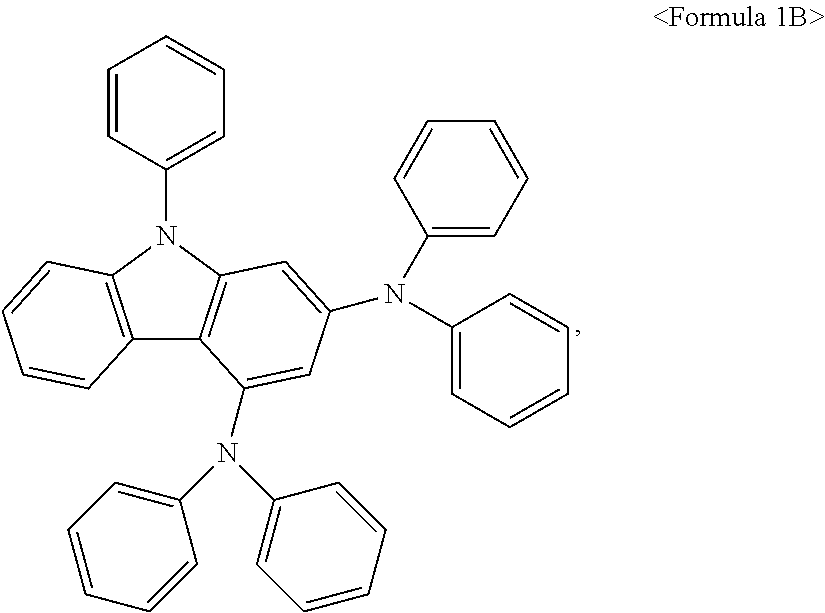


[Ar301]xb11-[(L301)xb1-R301]xb21 <Formula 301>


[Ar601]xe11-[(L601)xe1-R601]xe21 <Formula 601>


-
- Luminance: Power was supplied using a current-voltage meter (Keithley SMU 236) and the luminance was measured by using a luminance meter PR650.
- Efficiency: Power was supplied using a current-voltage meter (Keithley SMU 236), and the efficiency was measured by using a luminance meter PR650.
| TABLE 1 | |||||||
| Driving | Current | ||||||
| Hole transport | voltage | density | Luminance | Efficiency | Emission | T50 | |
| material | (V) | (mA/cm2) | (cd/m2) | (cd/A) | color | (hr) | |
| Example 1 | Compound 2 | 4.32 | 50 | 3670 | 7.34 | Blue | 362 |
| Example 2 | Compound 8 | 4.21 | 50 | 3715 | 7.43 | Blue | 353 |
| Example 3 | Compound 9 | 4.22 | 50 | 3665 | 7.33 | Blue | 372 |
| Example 4 | Compound 12 | 4.26 | 50 | 3730 | 7.46 | Blue | 374 |
| Example 5 | Compound 15 | 4.25 | 50 | 3630 | 7.26 | Blue | 384 |
| Example 6 | Compound 22 | 4.41 | 50 | 3725 | 7.45 | Blue | 343 |
| Example 7 | Compound 27 | 4.26 | 50 | 3630 | 7.26 | Blue | 366 |
| Example 8 | |
4.32 | 50 | 3670 | 7.34 | Blue | 378 |
| Example 9 | Compound 33 | 4.45 | 50 | 3440 | 6.88 | Blue | 325 |
| Example 10 | Compound 35 | 4.60 | 50 | 3490 | 6.98 | Blue | 330 |
| Comparative | NPB | 7.01 | 50 | 2645 | 5.29 | Blue | 258 |
| Example 1 | |||||||
| Comparative | Compound A | 4.89 | 50 | 3240 | 6.48 | Blue | 270 |
| Example 2 | |||||||
| Comparative | Compound B | 4.76 | 50 | 3197 | 6.39 | Blue | 257 |
| Example 3 | |||||||
| Comparative | Compound C | 4.80 | 50 | 3320 | 6.64 | Blue | 287 |
| Example 4 | |||||||
    |
|||||||
Claims (18)


Applications Claiming Priority (2)
| Application Number | Priority Date | Filing Date | Title |
|---|---|---|---|
| KR10-2018-0031122 | 2018-03-16 | ||
| KR1020180031122A KR102633851B1 (en) | 2018-03-16 | 2018-03-16 | Diamine-based compound and organic light emitting device comprising the same |
Publications (2)
| Publication Number | Publication Date |
|---|---|
| US20190284137A1 US20190284137A1 (en) | 2019-09-19 |
| US11192858B2 true US11192858B2 (en) | 2021-12-07 |
Family
ID=67905094
Family Applications (1)
| Application Number | Title | Priority Date | Filing Date |
|---|---|---|---|
| US16/208,555 Active 2039-12-16 US11192858B2 (en) | 2018-03-16 | 2018-12-03 | Diamine-based compound and organic light-emitting device including the same |
Country Status (2)
| Country | Link |
|---|---|
| US (1) | US11192858B2 (en) |
| KR (1) | KR102633851B1 (en) |
Families Citing this family (9)
| Publication number | Priority date | Publication date | Assignee | Title |
|---|---|---|---|---|
| KR102637792B1 (en) | 2018-03-22 | 2024-02-19 | 삼성디스플레이 주식회사 | Organic light emitting device and electronic device including the same |
| KR102804493B1 (en) | 2019-04-30 | 2025-05-09 | 삼성디스플레이 주식회사 | Organic light emitting device |
| CN111732530B (en) * | 2020-06-17 | 2023-06-02 | 烟台显华化工科技有限公司 | Compound, hole transport material, organic electroluminescent device and display device |
| KR102927097B1 (en) | 2020-10-23 | 2026-02-12 | 삼성디스플레이 주식회사 | A light emitting device and electronic device including the same |
| KR102867541B1 (en) | 2020-12-08 | 2025-10-13 | 삼성디스플레이 주식회사 | Display device |
| KR20220085924A (en) | 2020-12-15 | 2022-06-23 | 삼성디스플레이 주식회사 | Light emitting device and electronic apparatus comprising same |
| KR20220087631A (en) | 2020-12-17 | 2022-06-27 | 삼성디스플레이 주식회사 | Heterocyclic compound, light emitting device including the same and electronic apparatus including the device |
| KR102355848B1 (en) * | 2021-02-03 | 2022-02-10 | 삼성디스플레이 주식회사 | Light emitting element and amine compound for the same |
| CN116283608B (en) * | 2023-05-24 | 2023-08-29 | 吉林奥来德光电材料股份有限公司 | Light-emitting auxiliary material, preparation method thereof and light-emitting device |
Citations (6)
| Publication number | Priority date | Publication date | Assignee | Title |
|---|---|---|---|---|
| KR20100125004A (en) | 2009-05-20 | 2010-11-30 | 덕산하이메탈(주) | Amine compound having three carbazole and organic electronic element using the same, terminal thereof |
| KR20140018101A (en) | 2012-08-01 | 2014-02-12 | 에스케이케미칼주식회사 | Compound for organic electroluminescent device and organic electroluminescent device including the same |
| KR20140057418A (en) | 2012-10-29 | 2014-05-13 | 삼성디스플레이 주식회사 | Amine-based compound and organic light emitting diode comprising the same |
| KR101512059B1 (en) | 2014-10-06 | 2015-04-14 | 덕산네오룩스 주식회사 | Compound for organic electric element, organic electric element comprising the same and electronic device thereof |
| KR20160114526A (en) | 2015-03-24 | 2016-10-05 | 주식회사 엠비케이 | Organic electroluminescent compound, ink composition, organic electroluminescent device and electric apparatus |
| US20200212311A1 (en) * | 2017-09-25 | 2020-07-02 | Rohm And Haas Electronic Materials Korea Ltd. | Organic electroluminescent compound and organic electroluminescent device comprising the same |
Family Cites Families (1)
| Publication number | Priority date | Publication date | Assignee | Title |
|---|---|---|---|---|
| KR20140018789A (en) * | 2012-07-31 | 2014-02-13 | 에스케이케미칼주식회사 | Compound for organic electroluminescent device and organic electroluminescent device including the same |
-
2018
- 2018-03-16 KR KR1020180031122A patent/KR102633851B1/en active Active
- 2018-12-03 US US16/208,555 patent/US11192858B2/en active Active
Patent Citations (8)
| Publication number | Priority date | Publication date | Assignee | Title |
|---|---|---|---|---|
| KR20100125004A (en) | 2009-05-20 | 2010-11-30 | 덕산하이메탈(주) | Amine compound having three carbazole and organic electronic element using the same, terminal thereof |
| KR20140018101A (en) | 2012-08-01 | 2014-02-12 | 에스케이케미칼주식회사 | Compound for organic electroluminescent device and organic electroluminescent device including the same |
| KR20140057418A (en) | 2012-10-29 | 2014-05-13 | 삼성디스플레이 주식회사 | Amine-based compound and organic light emitting diode comprising the same |
| US9455409B2 (en) | 2012-10-29 | 2016-09-27 | Samsung Display Co., Ltd. | Amine-based compound and organic light emitting device including the same |
| KR101512059B1 (en) | 2014-10-06 | 2015-04-14 | 덕산네오룩스 주식회사 | Compound for organic electric element, organic electric element comprising the same and electronic device thereof |
| US20170301868A1 (en) | 2014-10-06 | 2017-10-19 | Duk San Neolux Co., Ltd. | Compound for organic electric element, organic electric element comprising the same and electronic device thereof |
| KR20160114526A (en) | 2015-03-24 | 2016-10-05 | 주식회사 엠비케이 | Organic electroluminescent compound, ink composition, organic electroluminescent device and electric apparatus |
| US20200212311A1 (en) * | 2017-09-25 | 2020-07-02 | Rohm And Haas Electronic Materials Korea Ltd. | Organic electroluminescent compound and organic electroluminescent device comprising the same |
Non-Patent Citations (1)
| Title |
|---|
| Kazuyuki et al. (1999). Photochemical Reaction of 1,3, 5-Tris(diphenylamino)benzene. Journal of Photopolymer Science and Technology, 12(5), 777-780. |
Also Published As
| Publication number | Publication date |
|---|---|
| US20190284137A1 (en) | 2019-09-19 |
| KR20190109691A (en) | 2019-09-26 |
| KR102633851B1 (en) | 2024-02-07 |
Similar Documents
| Publication | Publication Date | Title |
|---|---|---|
| US12035550B2 (en) | Organic light-emitting device and electronic apparatus including the same | |
| US11634438B2 (en) | Heterocyclic compound and organic light-emitting device including the same | |
| US11299502B2 (en) | Condensed cyclic compound and organic light-emitting device including condensed cyclic compound | |
| US20190058137A1 (en) | Organometallic compound, organic light-emitting device including the organometallic compound, and organic light-emitting apparatus including the organic light-emitting device | |
| US11192858B2 (en) | Diamine-based compound and organic light-emitting device including the same | |
| US10790464B2 (en) | Organic light-emitting device | |
| US12084433B2 (en) | Heterocyclic compound and organic light-emitting device including the same | |
| US11569459B2 (en) | Organometallic compound having imidazopyrazine-based ligand and organic light-emitting device including the same | |
| US10741773B2 (en) | Compound and organic light-emitting device including the same | |
| US20190131540A1 (en) | Condensed cyclic compound and organic light-emitting device including the same | |
| US10622564B2 (en) | Compound and organic light-emitting device including the same | |
| US11849632B2 (en) | Amine-based compound and organic light-emitting device including the same | |
| US10807984B2 (en) | Heterocyclic compound and organic light-emitting device including the same | |
| US11450811B2 (en) | Condensed cyclic compound and organic light-emitting device including the same | |
| US12178114B2 (en) | Azide-based compound, organic light-emitting device including the azide-based compound, and method of manufacturing the organic light-emitting device | |
| US11647668B2 (en) | Organometallic compound and organic light-emitting device including the same | |
| US11903309B2 (en) | Heterocyclic compound and organic light-emitting device including the same | |
| US11440902B2 (en) | Amine-based compound and organic light-emitting device including the same | |
| US20210193939A1 (en) | Organometallic compound and organic light-emitting device including same | |
| US12484441B2 (en) | Amine compound and organic light-emitting device including the same | |
| US11802116B2 (en) | Diamine compound and organic light-emitting device including the same | |
| US12082497B2 (en) | Condensed cyclic compound and organic light emitting device comprising same | |
| US20200055886A1 (en) | Organometallic compound and organic light-emitting device including the same | |
| US11839143B2 (en) | Organometallic compound and organic light-emitting device including same | |
| US20210376253A1 (en) | Heterocyclic compound and organic light-emitting device including the same |
Legal Events
| Date | Code | Title | Description |
|---|---|---|---|
| FEPP | Fee payment procedure |
Free format text: ENTITY STATUS SET TO UNDISCOUNTED (ORIGINAL EVENT CODE: BIG.); ENTITY STATUS OF PATENT OWNER: LARGE ENTITY |
|
| AS | Assignment |
Owner name: SAMSUNG DISPLAY CO., LTD., KOREA, REPUBLIC OF Free format text: ASSIGNMENT OF ASSIGNORS INTEREST;ASSIGNORS:BAEK, JANGYEOL;KIM, JONGWOO;JEONG, EUNJAE;AND OTHERS;REEL/FRAME:047663/0778 Effective date: 20180911 |
|
| STPP | Information on status: patent application and granting procedure in general |
Free format text: NON FINAL ACTION MAILED |
|
| STPP | Information on status: patent application and granting procedure in general |
Free format text: RESPONSE TO NON-FINAL OFFICE ACTION ENTERED AND FORWARDED TO EXAMINER |
|
| STPP | Information on status: patent application and granting procedure in general |
Free format text: NON FINAL ACTION MAILED |
|
| STPP | Information on status: patent application and granting procedure in general |
Free format text: RESPONSE TO NON-FINAL OFFICE ACTION ENTERED AND FORWARDED TO EXAMINER |
|
| STPP | Information on status: patent application and granting procedure in general |
Free format text: NOTICE OF ALLOWANCE MAILED -- APPLICATION RECEIVED IN OFFICE OF PUBLICATIONS |
|
| STPP | Information on status: patent application and granting procedure in general |
Free format text: PUBLICATIONS -- ISSUE FEE PAYMENT VERIFIED |
|
| STCF | Information on status: patent grant |
Free format text: PATENTED CASE |
|
| MAFP | Maintenance fee payment |
Free format text: PAYMENT OF MAINTENANCE FEE, 4TH YEAR, LARGE ENTITY (ORIGINAL EVENT CODE: M1551); ENTITY STATUS OF PATENT OWNER: LARGE ENTITY Year of fee payment: 4 |