US11187549B2 - Search system, vehicle, and server - Google Patents
Search system, vehicle, and server Download PDFInfo
- Publication number
- US11187549B2 US11187549B2 US16/589,197 US201916589197A US11187549B2 US 11187549 B2 US11187549 B2 US 11187549B2 US 201916589197 A US201916589197 A US 201916589197A US 11187549 B2 US11187549 B2 US 11187549B2
- Authority
- US
- United States
- Prior art keywords
- vehicle
- search
- transportation
- determination unit
- route
- Prior art date
- Legal status (The legal status is an assumption and is not a legal conclusion. Google has not performed a legal analysis and makes no representation as to the accuracy of the status listed.)
- Active, expires
Links
- 238000004891 communication Methods 0.000 description 15
- 238000000034 method Methods 0.000 description 12
- 230000005540 biological transmission Effects 0.000 description 8
- 238000010586 diagram Methods 0.000 description 8
- 239000004973 liquid crystal related substance Substances 0.000 description 2
- 239000004065 semiconductor Substances 0.000 description 2
- 230000003247 decreasing effect Effects 0.000 description 1
- 238000005516 engineering process Methods 0.000 description 1
- 230000006870 function Effects 0.000 description 1
- 238000010348 incorporation Methods 0.000 description 1
- 230000010354 integration Effects 0.000 description 1
- 239000000463 material Substances 0.000 description 1
Images




Classifications
-
- G—PHYSICS
- G05—CONTROLLING; REGULATING
- G05D—SYSTEMS FOR CONTROLLING OR REGULATING NON-ELECTRIC VARIABLES
- G05D1/00—Control of position, course, altitude or attitude of land, water, air or space vehicles, e.g. using automatic pilots
- G05D1/02—Control of position or course in two dimensions
- G05D1/021—Control of position or course in two dimensions specially adapted to land vehicles
- G05D1/0212—Control of position or course in two dimensions specially adapted to land vehicles with means for defining a desired trajectory
- G05D1/0223—Control of position or course in two dimensions specially adapted to land vehicles with means for defining a desired trajectory involving speed control of the vehicle
-
- G—PHYSICS
- G01—MEASURING; TESTING
- G01C—MEASURING DISTANCES, LEVELS OR BEARINGS; SURVEYING; NAVIGATION; GYROSCOPIC INSTRUMENTS; PHOTOGRAMMETRY OR VIDEOGRAMMETRY
- G01C21/00—Navigation; Navigational instruments not provided for in groups G01C1/00 - G01C19/00
- G01C21/26—Navigation; Navigational instruments not provided for in groups G01C1/00 - G01C19/00 specially adapted for navigation in a road network
- G01C21/34—Route searching; Route guidance
- G01C21/3453—Special cost functions, i.e. other than distance or default speed limit of road segments
- G01C21/3492—Special cost functions, i.e. other than distance or default speed limit of road segments employing speed data or traffic data, e.g. real-time or historical
-
- G—PHYSICS
- G01—MEASURING; TESTING
- G01C—MEASURING DISTANCES, LEVELS OR BEARINGS; SURVEYING; NAVIGATION; GYROSCOPIC INSTRUMENTS; PHOTOGRAMMETRY OR VIDEOGRAMMETRY
- G01C21/00—Navigation; Navigational instruments not provided for in groups G01C1/00 - G01C19/00
- G01C21/26—Navigation; Navigational instruments not provided for in groups G01C1/00 - G01C19/00 specially adapted for navigation in a road network
- G01C21/34—Route searching; Route guidance
- G01C21/3407—Route searching; Route guidance specially adapted for specific applications
- G01C21/343—Calculating itineraries
-
- G—PHYSICS
- G01—MEASURING; TESTING
- G01C—MEASURING DISTANCES, LEVELS OR BEARINGS; SURVEYING; NAVIGATION; GYROSCOPIC INSTRUMENTS; PHOTOGRAMMETRY OR VIDEOGRAMMETRY
- G01C21/00—Navigation; Navigational instruments not provided for in groups G01C1/00 - G01C19/00
- G01C21/26—Navigation; Navigational instruments not provided for in groups G01C1/00 - G01C19/00 specially adapted for navigation in a road network
- G01C21/34—Route searching; Route guidance
- G01C21/3453—Special cost functions, i.e. other than distance or default speed limit of road segments
- G01C21/3461—Preferred or disfavoured areas, e.g. dangerous zones, toll or emission zones, intersections, manoeuvre types or segments such as motorways, toll roads or ferries
-
- G—PHYSICS
- G01—MEASURING; TESTING
- G01S—RADIO DIRECTION-FINDING; RADIO NAVIGATION; DETERMINING DISTANCE OR VELOCITY BY USE OF RADIO WAVES; LOCATING OR PRESENCE-DETECTING BY USE OF THE REFLECTION OR RERADIATION OF RADIO WAVES; ANALOGOUS ARRANGEMENTS USING OTHER WAVES
- G01S19/00—Satellite radio beacon positioning systems; Determining position, velocity or attitude using signals transmitted by such systems
- G01S19/38—Determining a navigation solution using signals transmitted by a satellite radio beacon positioning system
- G01S19/39—Determining a navigation solution using signals transmitted by a satellite radio beacon positioning system the satellite radio beacon positioning system transmitting time-stamped messages, e.g. GPS [Global Positioning System], GLONASS [Global Orbiting Navigation Satellite System] or GALILEO
- G01S19/42—Determining position
-
- G—PHYSICS
- G05—CONTROLLING; REGULATING
- G05D—SYSTEMS FOR CONTROLLING OR REGULATING NON-ELECTRIC VARIABLES
- G05D1/00—Control of position, course, altitude or attitude of land, water, air or space vehicles, e.g. using automatic pilots
- G05D1/02—Control of position or course in two dimensions
- G05D1/021—Control of position or course in two dimensions specially adapted to land vehicles
- G05D1/0212—Control of position or course in two dimensions specially adapted to land vehicles with means for defining a desired trajectory
- G05D1/0221—Control of position or course in two dimensions specially adapted to land vehicles with means for defining a desired trajectory involving a learning process
-
- G—PHYSICS
- G05—CONTROLLING; REGULATING
- G05D—SYSTEMS FOR CONTROLLING OR REGULATING NON-ELECTRIC VARIABLES
- G05D1/00—Control of position, course, altitude or attitude of land, water, air or space vehicles, e.g. using automatic pilots
- G05D1/02—Control of position or course in two dimensions
- G05D1/021—Control of position or course in two dimensions specially adapted to land vehicles
- G05D1/0276—Control of position or course in two dimensions specially adapted to land vehicles using signals provided by a source external to the vehicle
-
- G—PHYSICS
- G05—CONTROLLING; REGULATING
- G05D—SYSTEMS FOR CONTROLLING OR REGULATING NON-ELECTRIC VARIABLES
- G05D1/00—Control of position, course, altitude or attitude of land, water, air or space vehicles, e.g. using automatic pilots
- G05D1/02—Control of position or course in two dimensions
- G05D1/021—Control of position or course in two dimensions specially adapted to land vehicles
- G05D1/0276—Control of position or course in two dimensions specially adapted to land vehicles using signals provided by a source external to the vehicle
- G05D1/0278—Control of position or course in two dimensions specially adapted to land vehicles using signals provided by a source external to the vehicle using satellite positioning signals, e.g. GPS
-
- G—PHYSICS
- G08—SIGNALLING
- G08G—TRAFFIC CONTROL SYSTEMS
- G08G1/00—Traffic control systems for road vehicles
- G08G1/09—Arrangements for giving variable traffic instructions
- G08G1/0962—Arrangements for giving variable traffic instructions having an indicator mounted inside the vehicle, e.g. giving voice messages
- G08G1/0968—Systems involving transmission of navigation instructions to the vehicle
- G08G1/096805—Systems involving transmission of navigation instructions to the vehicle where the transmitted instructions are used to compute a route
- G08G1/096811—Systems involving transmission of navigation instructions to the vehicle where the transmitted instructions are used to compute a route where the route is computed offboard
- G08G1/096816—Systems involving transmission of navigation instructions to the vehicle where the transmitted instructions are used to compute a route where the route is computed offboard where the complete route is transmitted to the vehicle at once
-
- G—PHYSICS
- G08—SIGNALLING
- G08G—TRAFFIC CONTROL SYSTEMS
- G08G1/00—Traffic control systems for road vehicles
- G08G1/123—Traffic control systems for road vehicles indicating the position of vehicles, e.g. scheduled vehicles; Managing passenger vehicles circulating according to a fixed timetable, e.g. buses, trains, trams
- G08G1/127—Traffic control systems for road vehicles indicating the position of vehicles, e.g. scheduled vehicles; Managing passenger vehicles circulating according to a fixed timetable, e.g. buses, trains, trams to a central station ; Indicators in a central station
-
- G—PHYSICS
- G08—SIGNALLING
- G08G—TRAFFIC CONTROL SYSTEMS
- G08G1/00—Traffic control systems for road vehicles
- G08G1/20—Monitoring the location of vehicles belonging to a group, e.g. fleet of vehicles, countable or determined number of vehicles
- G08G1/202—Dispatching vehicles on the basis of a location, e.g. taxi dispatching
Definitions
- the disclosure relates to a search system, a vehicle, and a server.
- JP 2018-112930 A describes a travel management system of a vehicle traveling autonomously on a predetermined route.
- the travel management system includes a mobile information terminal that is carried by a person who wants to ride on a vehicle traveling autonomously and that is configured such that the person can access travel information of the vehicle traveling autonomously.
- a person who wants to ride can find a vehicle traveling autonomously using a mobile information terminal such as a tablet PC or a smartphone and ride on the vehicle, thereby moving to a destination.
- a mobile information terminal such as a tablet PC or a smartphone
- the disclosure provides a search system, a vehicle, and a server that can autonomously search for a person who wants to ride so as to bring the person to a boarding point of transportation.
- a first aspect of the disclosure relates to a search system including a vehicle and a server.
- the server includes: a first determination unit that determines a search route for searching for a user who rides on transportation based on a timetable of the transportation and map information; a second determination unit that determines a time for the vehicle to start moving from a current position of the vehicle to a boarding point of the transportation based on the current position, a current time, a location of the boarding point, and a departure time of the transportation; a third determination unit that determines a travel route to move from the current position to the boarding point based on the map information; and a transmitter unit that transmits the search route and the travel route to the vehicle.
- the server can determine the search route to arrive in time for departure of the transportation, and the vehicle can autonomously search for a person who wants to use the transportation and send the person to the boarding point of the transportation.
- the first determination unit may determine the search route based on a location of a residence within a predetermined distance from the boarding point and the number of residents living in the residence.
- the first determination unit may determine the search route based on the pick-up location that the vehicle has picked up a user and the number of time that the vehicle has picked up the user in the past.
- the first determination unit may determine the search route based on the weather at the current time.
- the first determination unit may determine the search route based on the current time.
- the first determination unit may determine the search route based on an address of a user registered in advance.
- the search system may further include a plurality of vehicles, and the first determination unit may determine the search route along which the vehicles as a group search for the user.
- the first determination unit may determine a first search route along which a first group of vehicles, among the plurality of vehicles, travel and a second search route along which a second group of vehicles, among the plurality of vehicles, travel.
- the vehicles are divided into the first group and the second group so that a wider range can be searched.
- it is possible to search more people who want to use transportation and send them to the boarding points of the transportation.
- the search route may include a road having a width that does not allow an ordinary car to pass.
- the vehicle may travel along the search route and the travel route by autonomous driving.
- a second aspect of the disclosure relates to a vehicle.
- the vehicle includes a first determination unit that determines a search route for searching for a user who rides on transportation based on a timetable of the transportation and map information; a second determination unit that determines a time for the vehicle to start moving from a current position of the vehicle to a boarding point of the transportation based on the current position, a current time, a location of the boarding point, and a departure time of the transportation; a third determination unit that determines a travel route to move from the current position to the boarding point based on the map information; and an output unit that outputs guidance about the search route and the travel route.
- the vehicle can determine the search route to arrive in time for departure of the transportation, autonomously search for people who want to use the transportation, and send them to the boarding point of the transportation.
- a third aspect of the disclosure relates to a server.
- the server includes: a first determination unit that determines a search route for searching for a user who rides on transportation based on a timetable of the transportation and map information; a second determination unit that determines a time for a vehicle to start moving from a current position of the vehicle to a boarding point of the transportation based on the current position, a current time, a location of the boarding point, and a departure time of the transportation; a third determination unit that determines a travel route to move from the current position to the boarding point based on the map information; and a transmitter unit that transmits the search route and the travel route to the vehicle.
- a search system a vehicle, and a server that can autonomously search for a person who wants to use transportation and send the person to a boarding point of transportation.
- FIG. 1 is a diagram showing a network configuration of a search system according to a first embodiment
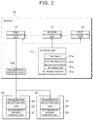
- FIG. 2 is a functional block diagram of the search system according to the first embodiment
- FIG. 3 is a diagram showing a physical configuration of a server according to the first embodiment
- FIG. 4 is a flowchart showing a search process executed by the search system according to the first embodiment
- FIG. 5 is a flowchart showing a search route determination process executed by the server according to the first embodiment.
- FIG. 6 is a functional block diagram of a vehicle according to a second embodiment.
- FIG. 1 is a diagram showing a network configuration of a search system 100 according to a first embodiment.
- the search system 100 includes a server 10 , a first vehicle 20 , and a second vehicle 30 .
- the server 10 and the first and second vehicles 20 , 30 can communicate with each other via a communication network N.
- the communication network N is a wireless communication network, and may be, for example, the Internet.
- the predetermined area A may be an area of any size and any population density, and may be, for example, a sparsely populated area.
- a boarding point 50 for transportation is provided in the predetermined area A.
- transportation may be public or private transportation, and may include buses, trains, ships and planes. It is assumed that some of the residents who live in the predetermined area A do not have their own cars or are difficult to drive, and are difficult to walk from their home to the boarding point 50 .
- a plurality of boarding points for transportation may be provided in a predetermined area.
- the first vehicle 20 and the second vehicle 30 may be any vehicles, and may be, for example, one-passenger or two-passenger, electrically-driven ultra-compact mobility vehicles.
- the first vehicle 20 and the second vehicle 30 may autonomously travel on a search route and a travel route described later. This allows the first vehicle 20 and the second vehicle 30 to autonomously search for people who want to use transportation and send the people to the boarding points of transportation.
- the first vehicle 20 and the second vehicle 30 may display a route received from the server 10 on a display of a car navigation device and allow a driver to drive along the route.
- FIG. 2 is a diagram showing functional blocks of the search system 100 according to the first embodiment.
- the search system 100 includes the server 10 , the first vehicle 20 , and the second vehicle 30 , and the server 10 includes a storage unit 11 , a first determination unit 12 , a second determination unit 13 , a third determination unit 14 , and a communication unit 10 d.
- the storage unit 11 stores a timetable 11 a , map information 11 b , registered user information 11 c and a riding history 11 d .
- the timetable 11 a is a timetable for transportation for which the boarding point 50 is provided, and includes a scheduled time of departure from the boarding point 50 .
- the map information 11 b may include at least information on a map indicating roads in the predetermined area A, and may include information on residences in the predetermined area A.
- the registered user information 11 c may include information on users who have registered for use of the search system 100 , and may include information on identification numbers and addresses of the users.
- the riding history 11 d includes pick-up locations and the number of times that a search for a user succeeded in the past. Here, the pick-up locations where a search for a user succeeded mean locations where the user got on the first vehicle 20 or the second vehicle 30 or the first vehicle 20 or the second vehicle 30 has picked up the user.
- the first determination unit 12 determines a search route for searching for a user who uses transportation, based on the timetable 11 a for the transportation and the map information 11 b .
- the first determination unit 12 may determine the search route based on the timetable 11 a of the transportation and the map information 11 b so as to search as wide a range as possible to arrive in time for the departure time of the transportation.
- the search route may include a road having a width that does not allow an ordinary car to pass.
- the search route may include a road that an ordinary car can not pass but an ultra-compact mobility vehicle can pass.
- the first determination unit 12 may determine the search route based on the locations of the residences within a predetermined distance from the boarding point 50 and the number of residents living in the residences. In this case, as the map information 11 b , information on the residences and the number of residents in the predetermined area A is required. Determining the search route in this way allows the search route to pass through places where the density of residents is high. Thus, it is possible to determine the search route that passes through places of high probabilities to pick up people who want to use transportation.
- the first determination unit 12 may determine the search route based on the pick-up locations and the number of times that the user was successfully searched out in the past. That is, the first determination unit 12 may determine the search route based on the riding history 11 d . Thus, based on the past riding history, it is possible to determine the search route that passes through places of high probabilities to pick up people who want to use transportation.
- the first determination unit 12 may determine the search route based on the weather at the current time.
- the weather at the current time is the weather in the predetermined area A at the current time, and may be acquired via the communication network N.
- the first determination unit 12 may determine the search route based on the current time.
- the first determination unit 12 may determine the search route based on a time range that contains the current time. For example, four time ranges, namely, morning, noon, evening and night, may be set, and the search route may be determined based on the time range to which the current time belongs. Thus, it is possible to determine the search route that passes through places of high probabilities to pick up people who want to use transportation, taking into consideration changes in the usage trend of transportation in accordance with the time range.
- the first determination unit 12 may determine the search route based on addresses of the users registered in advance. That is, the first determination unit 12 may determine the search route based on the registered user information 11 c . This makes it possible to determine the search route that preferentially passes through the points of the registered users' addresses.
- the search system 100 includes the plurality of vehicles (first vehicle 20 and second vehicle 30 ).
- the first determination unit 12 may determine a search route for searching users with a group of vehicles.
- the first determination unit 12 may determine, for example, a search route along which a group consisting of the first vehicle 20 and the second vehicle 30 search for users.
- a plurality of groups of vehicles may be set. For example, when ten vehicles are in operation, a group consisting of two vehicles, a group consisting of three vehicles, and a group consisting of five vehicles may be set so that the first determination unit 12 determines a search route for each group of vehicles.
- the first determination unit 12 may determine a first search route along which a first group of vehicles, among the plurality of vehicles, travel and a second search route along which a second group of vehicles, among the plurality of vehicles, travel.
- the first determination unit 12 may determine, for example, a first search route along which a first group consisting of two vehicles and a second search route along which a second group consisting of three vehicles.
- a vehicle group consisting of a larger number of vehicles may travel along a search route that passes through places where there are more people who want to ride on the vehicles. In this way, the vehicles are divided into the first group and the second group so that a wider range can be searched. Thus, it is possible to search more people who want to use transportation and sent them to the boarding points of the transportation.
- the second determination unit 13 determines the time for the first vehicle 20 or the second vehicle 30 to start moving to the boarding point 50 , based on the current position of the first vehicle 20 or the second vehicle 30 , the current time, the location of boarding point 50 of the transportation, and the departure time of the transportation.
- the second determination unit 13 may calculate a time required for the first vehicle 20 or the second vehicle 30 to move to the boarding point 50 by dividing a scheduled travel distance from the current position of the first vehicle 20 or the second vehicle 30 to the boarding point 50 by an average speed of the first vehicle 20 or the second vehicle 30 , and determine the time to start moving so as to arrive in time for the departure time of the transportation.
- the second determination unit 13 may determine the time to start moving in consideration of a road surface condition or a traffic congestion condition.
- the third determination unit 14 determines a travel route to travel from the current position to the boarding point 50 based on the map information.
- the third determination unit 14 may determine a route that allows travel to the boarding point 50 in the shortest time, when there are a plurality of possible routes from the current position to the boarding point 50 .
- the communication unit 10 d transmits the determined search route and the travel route to the first vehicle 20 and the second vehicle 30 .
- the communication unit 10 d may receive from the first vehicle 20 and the second vehicle 30 the pick-up location where the users have been picked up and the number of passengers.
- the communication unit 10 d can be regarded as a transmitter according to the disclosure.
- the server 10 can determine the search route so that the vehicle arrives in time for the departure of the transportation, and the vehicles can autonomously search for people who want to use the transportation and send them to the boarding point 50 of the transportation.
- the first vehicle 20 includes a transmission/reception unit 21 , a global positioning system (GPS) 22 , and an autonomous driving control unit 23 .
- the second vehicle 30 also includes a transmission/reception unit 31 , a GPS 32 , and an autonomous driving control unit 33 .
- the functions of the transmission/reception unit 31 , the GPS 32 and the autonomous driving control unit 33 are the same as those of the transmission/reception unit 21 , the GPS 22 and the autonomous driving control unit 23 , respectively. Therefore, the transmission/reception unit 21 , the GPS 22 and the autonomous driving control unit 23 will be described below.
- the transmission/reception unit 21 receives information on the search route and the travel route from the server 10 .
- the transmission/reception unit 21 may transmit, to the server 10 , the location where the first vehicle 20 has succeeded in the search for the user.
- the GPS 22 calculates the current position of the first vehicle 20 based on the signal received from a GPS satellite.
- the current position may be identified by latitude, longitude and altitude.
- the autonomous driving control unit 23 controls the first vehicle 20 so that the first vehicle 20 autonomously travel along a set route.
- the first vehicle 20 may be equipped with a sensor (not shown) required for autonomous driving.
- FIG. 3 is a diagram showing a physical configuration of the server 10 according to the first embodiment.
- the server 10 includes a central processing unit (CPU) 10 a serving as a computing device, a random access memory (RAM) 10 b serving as a storage unit, a read-only memory (ROM) 10 c serving as a storage unit, a communication unit 10 d , an input unit 10 e , and a display unit 10 f .
- CPU central processing unit
- RAM random access memory
- ROM read-only memory
- the CPU 10 a is a control unit that controls execution of a program stored in the RAM 10 b or the ROM 10 c , and calculates and processes data.
- the CPU 10 a is a computing device that executes a program (search program) for determining a search route for searching for a user who rides on transportation.
- the CPU 10 a receives various input data from the input unit 10 e and the communication unit 10 d , and displays the computation result of the input data on the display unit 10 f or stores the result in the RAM 10 b or the ROM 10 c.
- the RAM 10 b is a rewritable storage unit, and may be, for example, a semiconductor memory device.
- the RAM 10 b stores data such as a search program executed by the CPU 10 a , the timetable 11 a , the map information 11 b , the registered user information 11 c and the riding history 11 d.
- the ROM 10 c is a computer-readable storage unit, and may be, for example, a semiconductor memory device.
- the ROM 10 c stores, for example, a search program and data that is not rewritten.
- the communication unit 10 d is an interface for connecting the server 10 to external devices.
- the communication unit 10 d may be connected to the first vehicle 20 and the second vehicle 30 via the Internet, for example, to receive the boarding history from the first vehicle 20 and the second vehicle 30 .
- the communication unit 10 d may download a timetable of transportation or map information via the Internet.
- the input unit 10 e receives an input of data from the user, and may include, for example, a keyboard, a mouse, and a touch panel.
- the display unit 10 f visually displays the result of computation by the CPU 10 a , and may be, for example, a liquid crystal display (LCD).
- LCD liquid crystal display
- the search program may be stored in a storage medium readable by a computer such as the RAM 10 b or the ROM 10 c to be provided, or may be provided via a communication network connected through the communication unit 10 d .
- the CPU 10 a executes the search program so that the operations of the first determination unit 12 , the second determination unit 13 and the third determination unit 14 described with reference to FIG. 2 are realized.
- the server 10 may include a large-scale integration (LSI) in which the CPU 10 a , the RAM 10 b , and the ROM 10 c are integrated.
- LSI large-scale integration
- FIG. 4 is a flowchart showing a search process executed by the search system 100 according to the first embodiment.
- the server 10 acquires the map information 11 b of the predetermined area A (S 10 ).
- the server 10 divides the vehicles included in the search system 100 into the first group and the second group (S 11 ).
- the server 10 may handle the vehicles as group, or may handle the vehicles individually.
- the server 10 determines the first search route for searching for a user by the first group of vehicles (S 12 ). The details of this process will be described using FIG. 4 .
- the server 10 transmits the determined first search route to the first group of vehicles.
- the server 10 determines the second search route for searching for a user by the second group of vehicles (S 13 ). The details of this process are the same as those of the process of determining the first search route (S 12 ). The server 10 transmits the determined second search route to the second group of vehicles.
- the server 10 determines the time to start moving from the current position to the boarding point, based on the current position of the vehicle, the current time, the boarding point of the transportation and the departure time of the transportation (S 14 ). This process may be carried out each time the current position of the vehicle is updated.
- the server 10 determines whether it is the time to move the vehicle to the boarding point (S 16 ). When it is not the time to move (S 16 : NO), the time to start moving is determined again (S 14 ) and the search continues (S 15 ).
- the pickup point When the vehicle picks up a user, the pickup point may be transmitted to the server 10 .
- the user When the vehicle picks up a user and the boarding capacity of the vehicle is reached, the user may be sent to the boarding point even though the time to start moving has not come. In this case, the vehicle may start searching for a user again.
- the server 10 determines the travel route for the vehicle to move from the current position to the boarding point based on the map information (S 17 ). The server 10 transmits the determined travel route to the vehicle.
- the vehicle travels along the travel route, and sends the user the vehicle has picked up to the boarding point (S 18 ).
- the search process ends.
- FIG. 5 is a flowchart showing the search route determination process executed by the server 10 according to the first embodiment.
- FIG. 5 shows the details of the process of determining the first search route (S 12 ) of FIG. 4 .
- the server 10 calculates an available time based on the timetable of the transportation (S 121 ).
- the server 10 may calculate a period of time to the next departure as the available time.
- the server 10 calculates a riding probability distribution based on locations of residences and the number of residents within a predetermined distance from the boarding point of the transportation (S 122 ).
- the server 10 may calculate, for example, the riding probability distribution in accordance with a mixed normal distribution.
- the riding probability distribution may be calculated by setting an average value of the normal distribution as the location of the residence and setting the variance of the normal distribution as a predetermined value and adding the normal distribution with a weight in accordance with the number of residents.
- the server 10 also calculates the riding probability distribution from the riding history 11 d (S 123 ). For example, in the case of calculating the riding probability distribution with the mixed normal distribution, the server 10 may calculate the riding probability distribution such that a larger weight is assigned to a place where more people have been picked up.
- the server 10 calculates the riding probability distribution from the weather at the current time (S 124 ).
- the server 10 may filter the riding history 11 d according to the weather at the current time, and calculate the riding probability distribution such that a larger weight is assigned to a place where more people have been picked up based on the filtered riding history 11 d.
- the server 10 sets the registered user's address as a visiting point (S 125 ). That is, the server 10 determines the search route that passes through the point of the registered user's address at least once. The server 10 may determine the search route that passes through the point of the registered user's address within a predetermined time range.
- the server 10 determines the search route so that the vehicle stops at the visiting point within the available time and passes through a place where the riding probability is high (S 126 ).
- the search route may be determined using an existing algorithm. Thus, the search route determination process ends.
- FIG. 6 is a functional block diagram of a vehicle 60 according to a second embodiment. Unlike the first vehicle 20 and the second vehicle 30 , the vehicle 60 according to the present embodiment includes a storage unit 61 , a first determination unit 62 , a second determination unit 63 , a third determination unit 64 , and an output unit 65 , and does not include a transmission/reception unit.
- a GPS 66 and an autonomous driving control unit 67 are similar to the GPS 22 and the autonomous driving control unit 23 .
- the storage unit 61 may be similar to the storage unit 11 of the server 10 according to the first embodiment, and stores a timetable 61 a , map information 61 b , registered user information 61 c , and a riding history 61 d . Also, the first determination unit 62 , the second determination unit 63 and the third determination unit 64 may be similar to the first determination unit 12 , the second determination unit 13 and the third determination unit 14 .
- the first determination unit 62 determines a search route for searching for a user who rides on transportation based on the timetable 61 a of the transportation and the map information 61 b .
- the second determination unit 63 determines the time for the vehicle 60 to start moving from the current position to a boarding point of the transportation, based on the current position of the vehicle 60 , the current time, the location of the boarding point and the departure time of the transportation.
- the third determination unit 64 determines a travel route to move from the current position to the boarding point based on the map information 61 b.
- the output unit 65 outputs guidance about the search route and the travel route.
- the output unit 65 may include a display such as a liquid crystal display device that presents a route and an audio output unit that outputs audio guidance.
- the vehicle 60 can determine the search route to arrive in time for departure of the transportation, autonomously search for people who want to use the transportation, and send them to the boarding point of the transportation.
Landscapes
- Engineering & Computer Science (AREA)
- Radar, Positioning & Navigation (AREA)
- Remote Sensing (AREA)
- Physics & Mathematics (AREA)
- General Physics & Mathematics (AREA)
- Automation & Control Theory (AREA)
- Aviation & Aerospace Engineering (AREA)
- Computer Networks & Wireless Communication (AREA)
- Navigation (AREA)
- Traffic Control Systems (AREA)
- Instructional Devices (AREA)
Abstract
Description
Claims (12)
Applications Claiming Priority (3)
| Application Number | Priority Date | Filing Date | Title |
|---|---|---|---|
| JP2018-206426 | 2018-11-01 | ||
| JP2018206426A JP7137137B2 (en) | 2018-11-01 | 2018-11-01 | Search system and vehicle |
| JPJP2018-206426 | 2018-11-01 |
Publications (2)
| Publication Number | Publication Date |
|---|---|
| US20200141751A1 US20200141751A1 (en) | 2020-05-07 |
| US11187549B2 true US11187549B2 (en) | 2021-11-30 |
Family
ID=70459496
Family Applications (1)
| Application Number | Title | Priority Date | Filing Date |
|---|---|---|---|
| US16/589,197 Active 2040-03-20 US11187549B2 (en) | 2018-11-01 | 2019-10-01 | Search system, vehicle, and server |
Country Status (3)
| Country | Link |
|---|---|
| US (1) | US11187549B2 (en) |
| JP (1) | JP7137137B2 (en) |
| CN (1) | CN111142511B (en) |
Families Citing this family (1)
| Publication number | Priority date | Publication date | Assignee | Title |
|---|---|---|---|---|
| JP7505388B2 (en) * | 2020-12-03 | 2024-06-25 | トヨタ自動車株式会社 | Method, information processing device, and program |
Citations (6)
| Publication number | Priority date | Publication date | Assignee | Title |
|---|---|---|---|---|
| US20160033289A1 (en) * | 2014-08-04 | 2016-02-04 | Here Global B.V. | Method and apparatus calculating estimated time of arrival from multiple devices and services |
| US20170191841A1 (en) * | 2015-12-31 | 2017-07-06 | Juno Lab, Inc. | System for generating travel route to be serviced by primary transportation service and secondary transportation service |
| US20170268891A1 (en) * | 2016-03-18 | 2017-09-21 | Betria Interactive Llc | Real-time multimodal travel estimation and routing system |
| US20170328728A1 (en) * | 2016-05-10 | 2017-11-16 | Microsoft Technology Licensing, Llc | Constrained-Transportation Directions |
| JP2018112930A (en) | 2017-01-12 | 2018-07-19 | 三菱自動車工業株式会社 | Vehicle travel management system |
| US20200175558A1 (en) * | 2017-06-15 | 2020-06-04 | Honda Motor Co., Ltd. | Ridesharing management device, ridesharing management method, and program |
Family Cites Families (8)
| Publication number | Priority date | Publication date | Assignee | Title |
|---|---|---|---|---|
| EP1457761B1 (en) * | 2003-03-10 | 2007-05-02 | Matsushita Electric Industrial Co., Ltd. | Navigation device with departure time determination |
| CN101548155A (en) * | 2006-12-04 | 2009-09-30 | 三菱电机株式会社 | Navigation system |
| CN102750832A (en) * | 2006-12-15 | 2012-10-24 | 株式会社建伍 | Mobile body position information transmitting device for navigation system, and mobile body position information transmission method |
| JP4935840B2 (en) * | 2009-03-09 | 2012-05-23 | 株式会社デンソー | Navigation device |
| JP5874414B2 (en) * | 2012-01-30 | 2016-03-02 | 株式会社デンソー | Navigation system and server device |
| JP2018060372A (en) * | 2016-10-05 | 2018-04-12 | トヨタ自動車株式会社 | Operation management device and operation management method |
| JP6726605B2 (en) * | 2016-11-21 | 2020-07-22 | 株式会社日立製作所 | Transportation supply and demand matching system and transportation supply and demand matching method |
| JP2018018533A (en) * | 2017-09-13 | 2018-02-01 | 公立大学法人公立はこだて未来大学 | Vehicle operation management system, terminal device, control device, and vehicle operation management method |
-
2018
- 2018-11-01 JP JP2018206426A patent/JP7137137B2/en active Active
-
2019
- 2019-09-24 CN CN201910904233.7A patent/CN111142511B/en active Active
- 2019-10-01 US US16/589,197 patent/US11187549B2/en active Active
Patent Citations (6)
| Publication number | Priority date | Publication date | Assignee | Title |
|---|---|---|---|---|
| US20160033289A1 (en) * | 2014-08-04 | 2016-02-04 | Here Global B.V. | Method and apparatus calculating estimated time of arrival from multiple devices and services |
| US20170191841A1 (en) * | 2015-12-31 | 2017-07-06 | Juno Lab, Inc. | System for generating travel route to be serviced by primary transportation service and secondary transportation service |
| US20170268891A1 (en) * | 2016-03-18 | 2017-09-21 | Betria Interactive Llc | Real-time multimodal travel estimation and routing system |
| US20170328728A1 (en) * | 2016-05-10 | 2017-11-16 | Microsoft Technology Licensing, Llc | Constrained-Transportation Directions |
| JP2018112930A (en) | 2017-01-12 | 2018-07-19 | 三菱自動車工業株式会社 | Vehicle travel management system |
| US20200175558A1 (en) * | 2017-06-15 | 2020-06-04 | Honda Motor Co., Ltd. | Ridesharing management device, ridesharing management method, and program |
Also Published As
| Publication number | Publication date |
|---|---|
| JP7137137B2 (en) | 2022-09-14 |
| CN111142511B (en) | 2024-10-15 |
| CN111142511A (en) | 2020-05-12 |
| JP2020071165A (en) | 2020-05-07 |
| US20200141751A1 (en) | 2020-05-07 |
Similar Documents
| Publication | Publication Date | Title |
|---|---|---|
| US20200173808A1 (en) | Methods and systems for providing recommendations for parking of vehicles | |
| US8700327B2 (en) | Method of determining routes for use in navigation | |
| US8731814B2 (en) | Multi-modal navigation system and method | |
| CN111693055B (en) | Road network change detection and local propagation of detected changes | |
| US20160298974A1 (en) | Systems and methods for learning and displaying customized geographical navigational options | |
| US20200003569A1 (en) | Navigation systems, devices, and methods | |
| US11662215B2 (en) | Method, apparatus, and computer program product for anonymizing trajectories | |
| US11221626B2 (en) | Drone-based collection of location-related data | |
| JP2016085080A (en) | Avoidance route search system, avoidance route search device, avoidance route search method, and computer program | |
| US20220063639A1 (en) | Method, apparatus, and computer program product for predicting autonomous transition regions using historical information | |
| JP2012168796A (en) | Probe information management system, on-vehicle terminal, and probe information management apparatus | |
| US20210216076A1 (en) | Method and system to generate machine learning model for evaluating quality of data | |
| JP2013053999A (en) | Navigation system, navigation device, information processor, and route search method | |
| EP4099725A1 (en) | Method, apparatus, and computer program product for anonymizing trajectories and stay points | |
| US20200082303A1 (en) | Vehicle allocation method, server, and system | |
| EP4086783A1 (en) | Electronic horizon creation method and system | |
| US11405751B2 (en) | Method, apparatus, and computer program product for anonymizing trajectories including endogenous events | |
| US12507035B2 (en) | Method, apparatus, and computer program product for anonymizing trajectories and stay points | |
| US11187549B2 (en) | Search system, vehicle, and server | |
| US20240212486A1 (en) | Method and apparatus for determining an intersection condition | |
| US12205047B2 (en) | Method, apparatus, and computer program product for anonymized parking likelihood estimation | |
| US11687094B2 (en) | Method, apparatus, and computer program product for organizing autonomous vehicles in an autonomous transition region | |
| US11448514B2 (en) | Route information decision device, route information system, terminal, and method for deciding route information | |
| US20250200594A1 (en) | Method to detect, map, learn and predict cancelled ride-hailing rides | |
| US20240175688A1 (en) | Method, apparatus, and computer program product for intelligent trajectory configurations within mobility data using junctions inferred by features of the mobility data |
Legal Events
| Date | Code | Title | Description |
|---|---|---|---|
| AS | Assignment |
Owner name: TOYOTA JIDOSHA KABUSHIKI KAISHA, JAPAN Free format text: ASSIGNMENT OF ASSIGNORS INTEREST;ASSIGNORS:OBARA, RYOHEI;ITO, MASAKI;KAKUCHI, MAKOTO;AND OTHERS;SIGNING DATES FROM 20190710 TO 20190722;REEL/FRAME:050592/0719 |
|
| FEPP | Fee payment procedure |
Free format text: ENTITY STATUS SET TO UNDISCOUNTED (ORIGINAL EVENT CODE: BIG.); ENTITY STATUS OF PATENT OWNER: LARGE ENTITY |
|
| STPP | Information on status: patent application and granting procedure in general |
Free format text: DOCKETED NEW CASE - READY FOR EXAMINATION |
|
| STPP | Information on status: patent application and granting procedure in general |
Free format text: NON FINAL ACTION MAILED |
|
| STPP | Information on status: patent application and granting procedure in general |
Free format text: NOTICE OF ALLOWANCE MAILED -- APPLICATION RECEIVED IN OFFICE OF PUBLICATIONS |
|
| STPP | Information on status: patent application and granting procedure in general |
Free format text: PUBLICATIONS -- ISSUE FEE PAYMENT RECEIVED |
|
| STPP | Information on status: patent application and granting procedure in general |
Free format text: PUBLICATIONS -- ISSUE FEE PAYMENT VERIFIED |
|
| STCF | Information on status: patent grant |
Free format text: PATENTED CASE |
|
| MAFP | Maintenance fee payment |
Free format text: PAYMENT OF MAINTENANCE FEE, 4TH YEAR, LARGE ENTITY (ORIGINAL EVENT CODE: M1551); ENTITY STATUS OF PATENT OWNER: LARGE ENTITY Year of fee payment: 4 |