US11182637B2 - X-ray image processing system and method, and program therefor - Google Patents
X-ray image processing system and method, and program therefor Download PDFInfo
- Publication number
- US11182637B2 US11182637B2 US16/814,730 US202016814730A US11182637B2 US 11182637 B2 US11182637 B2 US 11182637B2 US 202016814730 A US202016814730 A US 202016814730A US 11182637 B2 US11182637 B2 US 11182637B2
- Authority
- US
- United States
- Prior art keywords
- image
- article
- ray
- articles
- transmission amount
- Prior art date
- Legal status (The legal status is an assumption and is not a legal conclusion. Google has not performed a legal analysis and makes no representation as to the accuracy of the status listed.)
- Active, expires
Links
Images




Classifications
-
- G06K9/4652—
-
- G—PHYSICS
- G06—COMPUTING OR CALCULATING; COUNTING
- G06T—IMAGE DATA PROCESSING OR GENERATION, IN GENERAL
- G06T7/00—Image analysis
- G06T7/30—Determination of transform parameters for the alignment of images, i.e. image registration
-
- G—PHYSICS
- G01—MEASURING; TESTING
- G01V—GEOPHYSICS; GRAVITATIONAL MEASUREMENTS; DETECTING MASSES OR OBJECTS; TAGS
- G01V5/00—Prospecting or detecting by the use of ionising radiation, e.g. of natural or induced radioactivity
- G01V5/20—Detecting prohibited goods, e.g. weapons, explosives, hazardous substances, contraband or smuggled objects
- G01V5/22—Active interrogation, i.e. by irradiating objects or goods using external radiation sources, e.g. using gamma rays or cosmic rays
-
- G—PHYSICS
- G01—MEASURING; TESTING
- G01N—INVESTIGATING OR ANALYSING MATERIALS BY DETERMINING THEIR CHEMICAL OR PHYSICAL PROPERTIES
- G01N23/00—Investigating or analysing materials by the use of wave or particle radiation, e.g. X-rays or neutrons, not covered by groups G01N3/00 – G01N17/00, G01N21/00 or G01N22/00
- G01N23/02—Investigating or analysing materials by the use of wave or particle radiation, e.g. X-rays or neutrons, not covered by groups G01N3/00 – G01N17/00, G01N21/00 or G01N22/00 by transmitting the radiation through the material
- G01N23/04—Investigating or analysing materials by the use of wave or particle radiation, e.g. X-rays or neutrons, not covered by groups G01N3/00 – G01N17/00, G01N21/00 or G01N22/00 by transmitting the radiation through the material and forming images of the material
-
- G—PHYSICS
- G01—MEASURING; TESTING
- G01V—GEOPHYSICS; GRAVITATIONAL MEASUREMENTS; DETECTING MASSES OR OBJECTS; TAGS
- G01V5/00—Prospecting or detecting by the use of ionising radiation, e.g. of natural or induced radioactivity
- G01V5/20—Detecting prohibited goods, e.g. weapons, explosives, hazardous substances, contraband or smuggled objects
- G01V5/22—Active interrogation, i.e. by irradiating objects or goods using external radiation sources, e.g. using gamma rays or cosmic rays
- G01V5/232—Active interrogation, i.e. by irradiating objects or goods using external radiation sources, e.g. using gamma rays or cosmic rays having relative motion between the source, detector and object other than by conveyor
-
- G—PHYSICS
- G06—COMPUTING OR CALCULATING; COUNTING
- G06F—ELECTRIC DIGITAL DATA PROCESSING
- G06F18/00—Pattern recognition
- G06F18/20—Analysing
- G06F18/21—Design or setup of recognition systems or techniques; Extraction of features in feature space; Blind source separation
- G06F18/214—Generating training patterns; Bootstrap methods, e.g. bagging or boosting
-
- G—PHYSICS
- G06—COMPUTING OR CALCULATING; COUNTING
- G06F—ELECTRIC DIGITAL DATA PROCESSING
- G06F18/00—Pattern recognition
- G06F18/20—Analysing
- G06F18/24—Classification techniques
-
- G06K9/6256—
-
- G—PHYSICS
- G06—COMPUTING OR CALCULATING; COUNTING
- G06N—COMPUTING ARRANGEMENTS BASED ON SPECIFIC COMPUTATIONAL MODELS
- G06N20/00—Machine learning
-
- G—PHYSICS
- G06—COMPUTING OR CALCULATING; COUNTING
- G06T—IMAGE DATA PROCESSING OR GENERATION, IN GENERAL
- G06T5/00—Image enhancement or restoration
- G06T5/50—Image enhancement or restoration using two or more images, e.g. averaging or subtraction
-
- G—PHYSICS
- G06—COMPUTING OR CALCULATING; COUNTING
- G06T—IMAGE DATA PROCESSING OR GENERATION, IN GENERAL
- G06T7/00—Image analysis
- G06T7/0002—Inspection of images, e.g. flaw detection
-
- G—PHYSICS
- G06—COMPUTING OR CALCULATING; COUNTING
- G06V—IMAGE OR VIDEO RECOGNITION OR UNDERSTANDING
- G06V10/00—Arrangements for image or video recognition or understanding
- G06V10/10—Image acquisition
- G06V10/12—Details of acquisition arrangements; Constructional details thereof
- G06V10/14—Optical characteristics of the device performing the acquisition or on the illumination arrangements
- G06V10/143—Sensing or illuminating at different wavelengths
-
- G—PHYSICS
- G06—COMPUTING OR CALCULATING; COUNTING
- G06V—IMAGE OR VIDEO RECOGNITION OR UNDERSTANDING
- G06V10/00—Arrangements for image or video recognition or understanding
- G06V10/20—Image preprocessing
- G06V10/26—Segmentation of patterns in the image field; Cutting or merging of image elements to establish the pattern region, e.g. clustering-based techniques; Detection of occlusion
-
- G—PHYSICS
- G06—COMPUTING OR CALCULATING; COUNTING
- G06V—IMAGE OR VIDEO RECOGNITION OR UNDERSTANDING
- G06V20/00—Scenes; Scene-specific elements
- G06V20/50—Context or environment of the image
- G06V20/52—Surveillance or monitoring of activities, e.g. for recognising suspicious objects
-
- G—PHYSICS
- G01—MEASURING; TESTING
- G01N—INVESTIGATING OR ANALYSING MATERIALS BY DETERMINING THEIR CHEMICAL OR PHYSICAL PROPERTIES
- G01N23/00—Investigating or analysing materials by the use of wave or particle radiation, e.g. X-rays or neutrons, not covered by groups G01N3/00 – G01N17/00, G01N21/00 or G01N22/00
- G01N23/02—Investigating or analysing materials by the use of wave or particle radiation, e.g. X-rays or neutrons, not covered by groups G01N3/00 – G01N17/00, G01N21/00 or G01N22/00 by transmitting the radiation through the material
- G01N23/06—Investigating or analysing materials by the use of wave or particle radiation, e.g. X-rays or neutrons, not covered by groups G01N3/00 – G01N17/00, G01N21/00 or G01N22/00 by transmitting the radiation through the material and measuring the absorption
- G01N23/10—Investigating or analysing materials by the use of wave or particle radiation, e.g. X-rays or neutrons, not covered by groups G01N3/00 – G01N17/00, G01N21/00 or G01N22/00 by transmitting the radiation through the material and measuring the absorption the material being confined in a container, e.g. in a luggage X-ray scanners
-
- G—PHYSICS
- G06—COMPUTING OR CALCULATING; COUNTING
- G06T—IMAGE DATA PROCESSING OR GENERATION, IN GENERAL
- G06T2207/00—Indexing scheme for image analysis or image enhancement
- G06T2207/10—Image acquisition modality
- G06T2207/10024—Color image
-
- G—PHYSICS
- G06—COMPUTING OR CALCULATING; COUNTING
- G06T—IMAGE DATA PROCESSING OR GENERATION, IN GENERAL
- G06T2207/00—Indexing scheme for image analysis or image enhancement
- G06T2207/10—Image acquisition modality
- G06T2207/10116—X-ray image
-
- G—PHYSICS
- G06—COMPUTING OR CALCULATING; COUNTING
- G06T—IMAGE DATA PROCESSING OR GENERATION, IN GENERAL
- G06T2207/00—Indexing scheme for image analysis or image enhancement
- G06T2207/20—Special algorithmic details
- G06T2207/20212—Image combination
- G06T2207/20221—Image fusion; Image merging
-
- G—PHYSICS
- G06—COMPUTING OR CALCULATING; COUNTING
- G06T—IMAGE DATA PROCESSING OR GENERATION, IN GENERAL
- G06T2207/00—Indexing scheme for image analysis or image enhancement
- G06T2207/30—Subject of image; Context of image processing
- G06T2207/30108—Industrial image inspection
- G06T2207/30112—Baggage; Luggage; Suitcase
-
- G—PHYSICS
- G06—COMPUTING OR CALCULATING; COUNTING
- G06V—IMAGE OR VIDEO RECOGNITION OR UNDERSTANDING
- G06V2201/00—Indexing scheme relating to image or video recognition or understanding
- G06V2201/05—Recognition of patterns representing particular kinds of hidden objects, e.g. weapons, explosives, drugs
Definitions
- the present invention relates to an X-ray image processing system, an X-ray image processing method, and a program therefor, and more particularly to a technique for determining an article included in an X-ray image acquired by an X-ray inspection apparatus used for baggage inspection.
- An X-ray baggage inspection apparatus is used for baggage inspection at airports, large-scale event venues, and the like.
- the X-ray baggage inspection apparatus generates a grayscale image indicating an X-ray transmission amount or a color image in which each material is determined and colored, and an inspector visually checks the image to see if any dangerous article is present or absent. When the inspector finds a dangerous article, it is common to perform an open inspection on the luggage.
- a highly-trained inspector is required to check whether or not an X-ray image includes a dangerous article. For this reason, it is difficult to temporarily secure a large number of inspectors, for example, at the time of a large-scale event in terms of prior training and cost. In order to reduce a burden on the inspector even a little bit, attempts have been made to automate the detection of the dangerous article.
- JP 2017-45441 A discloses a method of synthesizing images of an area acquired from two images after correcting color information of the images.
- JP 2017-45441 A is generally directed to images photographed by a security camera, a vehicle-mounted camera, or the like. Therefore, when synthesis targets overlap, it is possible to consider which image comes to the front. Further, since a type and a position of the image of the synthesis targets are limited based on installation position information of the camera, various conditions for the image recognition may be set in advance.
- An object of the present invention is to improve an accuracy of image recognition using an X-ray image acquired in an X-ray inspection operation.
- an X-ray image processing system information on an area specified as having an article is acquired, synthesis is performed with X-ray transmission amounts acquired by a plurality of sensors in the same area (for example, the same background and the same luggage), and material information is estimated from the X-ray transmission amount synthesized again to generate a color image.
- a synthesis target it is preferable to use combination information of articles accumulated during operation, for example, articles having many combinations as combination of articles included in the same luggage.
- a color image generated by synthesis is used as learning data.
- the present invention it is possible to improve an accuracy of image recognition using an X-ray image acquired in an X-ray inspection operation.
- learning data using an image synthesized with the X-ray image, it is possible to recognize articles with high accuracy even when the articles overlap.
- FIG. 1 is a configuration diagram of an X-ray inspection apparatus
- FIG. 2 is a functional configuration diagram of a processing apparatus 102 ;
- FIG. 3 is a diagram showing a configuration of a co-occurrence data table 220 and an example of data
- FIG. 4 is a diagram showing a configuration of an article data table 221 and an example of data
- FIG. 5 is a flowchart illustrating a processing operation of article recognition
- FIG. 6 is a flowchart illustrating operations to generate and learn learning data 218 ;
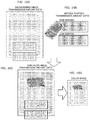
- FIG. 7 is a diagram illustrating a relationship between a color image and a transmission amount according to a second embodiment
- FIGS. 8A and 8B are diagrams illustrating an example of transmission amount data of two types of articles according to the second embodiment
- FIG. 9 is a flowchart illustrating a processing operation of synthesizing articles according to the second embodiment.
- FIGS. 10A-10D are diagrams illustrating an example of transmission amount data of two types of articles according to the second embodiment
- FIGS. 11A-11C are diagrams illustrating an example of transmission amount data of two types of articles according to the second embodiment.
- FIG. 12 is a diagram showing a configuration and data rows of an energy conversion table.
- FIG. 1 is a configuration diagram of an X-ray inspection apparatus according to an embodiment of an X-ray image processing system.
- An X-ray inspection apparatus 100 is an apparatus widely used as a baggage inspection apparatus in, for example, airport security inspection, and includes an X-ray apparatus main body (hereinafter, referred to as an apparatus main body) 101 , a processing apparatus 102 , a display unit 103 , and an input unit 104 .
- the processing apparatus 102 is, for example, a personal computer (PC).
- the apparatus main body 101 includes an irradiation mechanism configured to radiate an X-ray and an X-ray photographing mechanism configured to photograph an object such as a baggage and measure a transmission amount of the X-ray, and outputs X-ray transmission amount data (hereinafter, it may be simply referred to as transmission amount data or transmission amount).
- the processing apparatus 102 determines whether or not the baggage is safe based on an article recognition result of an X-ray image photographed by the apparatus main body 101 , and learns a model for image recognition using accumulated product information.
- the display unit 103 is a display terminal that displays the X-ray image, and allows an inspector to visually check the X-ray image displayed on a screen.
- the apparatus main body 101 includes a transport mechanism including a belt conveyor that transports the luggage, and the transport mechanism is controlled by a control unit to drive and stop the belt conveyor.
- the apparatus main body 101 includes a display lamp, and when the control unit determines that the luggage is a dangerous baggage (an alert target object) as a result of article recognition, the display lamp is turned on to notify the inspector that the baggage is the alert target object.
- Two types of X-ray sensors (hereinafter, simply referred to as sensors) for measuring an X-ray transmission amount are arranged in the transport mechanism and acquire two types of data. That is, one sensor acquires low energy data, and the other sensor acquires high energy data.
- the processing apparatus 102 determines material of an object based on a difference between the high energy data and the low energy data acquired by the two sensors.
- the X-ray sensor only needs to be able to acquire X-ray data from which material can be determined, and a detection method of the X-ray sensor does not matter. For example, a back scattering type material determination sensor or the like may be used. Note that the acquisition of X-ray data by the X-ray sensor can be referred to as an X-ray data acquisition unit.
- FIG. 2 is a functional configuration diagram of the processing apparatus 102 .
- the processing apparatus 102 is an information processing apparatus which includes a processing unit (CPU: Central Processing Unit) 201 , a main memory 202 , a display interface (I/F) unit 203 connecting the display unit 103 , an input interface (I/F) unit 204 connecting the input unit 104 , a communication unit 205 , and a storage unit 210 .
- a processing unit CPU: Central Processing Unit
- main memory 202 main memory
- I/F display interface
- I/F input interface
- I/F input interface
- the processing unit 201 implements a predetermined function or operation by executing a program.
- the storage unit 210 stores an article recognition program 212 , an image synthesis program 213 , a screen display program 214 , a co-occurrence data management program 215 , an X-ray data management program 216 , an article learning program 217 , learning data 218 , luggage photographing data 219 , a co-occurrence data table 220 , an article data table 221 , and a learning model 222 .
- the article recognition program 212 uses a deep learning segmentation technique for a color image in which luggage material information and article density information generated from the X-ray transmission amount data photographed by the apparatus main body 101 are visualized, and recognizes the articles included in the image in pixel unit. Details of an operation by the article recognition program 212 will be described later.
- the image synthesis program 213 generates combination of articles using the co-occurrence data table 220 , and synthesizes an image at a specified or randomly specified position using two types of high and low energies of an area of the article. Details of the operation of the image synthesis program 213 will be described later.
- the screen display program 214 displays on the display unit 103 a color image or a grayscale image generated from the X-ray transmission amount data photographed by the apparatus main body 101 and inspection target article information. Further, when there is an inspection target article that could not be recognized, additional article information is acquired by receiving specification of the area and type of the article from the input unit 104 such as a mouse. Details of an operation of the screen display program 214 will be described later.
- the co-occurrence data management program 215 aggregates combination of articles brought in together from the article information recognized during the baggage inspection, and generates combination information on the articles used in image synthesis. Details of an operation of the co-occurrence data management program 215 will be described later.
- the X-ray data management program 216 generates a color image indicating material and density information from the X-ray transmission amount data measured by the two types of sensors in the apparatus main body 101 , and registers the transmission amount data and the color image in the luggage photographing data 219 . That is, the material of the article is determined from a difference between the X-ray transmission amount data of the two sensors, and the color image is generated in which the material information is a color type and the transmission amount is a color density (a high density portion is dark, and a low density portion is light).
- the material information is a color type and the transmission amount is a color density (a high density portion is dark, and a low density portion is light).
- the article learning program 217 performs a learning by using a segmentation process of deep learning using the input color image and tag data, and the like, and generates a learning model 222 .
- the article recognition program 212 When executed by the processing unit 201 , the article recognition program 212 , the image synthesis program 213 , the screen display program 214 , the co-occurrence data management program 215 , the X-ray data management program 216 , and the article learning program 217 stored in the storage unit 210 function as an article recognition unit 212 ′, an image synthesis unit 213 ′, a screen display unit 214 ′, a co-occurrence data management unit 215 ′, an X-ray data management unit 216 ′, and an article learning unit 217 ′, respectively.
- the learning data 218 registers the color image and the tag data used for learning.
- the learning data 218 is a data set or a data area for storing the learning data.
- the color image is image data generated by the X-ray data management program 216 .
- the tag data is data representing an outline of the article, that is, data whose outline represents the type of the article, and is associated with an article ID of the article data table 221 (described later).
- the luggage photographing data 219 stores an X-ray luggage image photographed by the apparatus main body 101 , that is, two types of high and low transmission amount data, a color image, and a grayscale image.
- a luggage ID of the co-occurrence data table 220 (described later) is given to the luggage photographing data 219 .
- the co-occurrence data table 220 stores information on an article recognition result for each luggage acquired by the co-occurrence data management program 215 . That is, photographing date and time and presence or absence of a detected article such as a smartphone, a wallet, a PET bottle, a camera, and a timepiece are stored in correspondence with the luggage ID given to each luggage.
- the article data table 221 registers information such as a type, an overlap presence or absence, a frequency of use, an addition method of the article recognized from the X-ray luggage image (the luggage photographing data 219 ). That is, in the article data table 221 , for each article ID that specifies the article, a type ID indicating the type of the article, an overlap presence or absence flag indicating whether or not the article overlaps with another article, a frequency of use indicating the number of times of use for learning, and an addition flag indicating whether addition of the article information is a recognition result or an additional registration, and the like are registered.
- any method may be used as long as it can be determined that there is a possibility of overlap when pixels of two articles are in contact with each other.
- the color image and the grayscale image indicated by a rectangle surrounding the article two types of high and low transmission amount data of the article area, and mask data indicating the pixel where the article exists are separately registered in the luggage photographing data 219 in the storage unit 210 and linked with the article ID of the article data table 221 .
- Values corresponding to the number of rectangular pixels surrounding the article area are stored in the mask data, and 1 is registered for the pixel of the article and 0 is registered for the other pixels.
- data may be stored in another format.
- This processing operation is performed in a daily inspection operation using the X-ray inspection apparatus 100 .
- the X-ray data management program 216 acquires transmission amount data of X-rays photographed by a plurality of sensors and determines the material of pixel unit of the image from difference information of the transmission amount data of the plurality of sensors in order to determine the material.
- the material for example, a method of classifying metals, inorganic substances, organic substances, and other four types based on difference information of two types of high and low energy transmission amounts which is widely known in this field can be used.
- the article recognition program 212 acquires the color image acquired in step S 501 , and recognizes the article in pixel unit using the segmentation process of deep learning (S 502 ).
- a library such as “Fully Convolutional Instance-aware Semantic Segmentation” widely known as an open source software (OSS) library may be used for the recognition of the article. Any recognition method may be used as long as the article can be specified in pixel unit.
- OSS open source software
- step S 503 when the recognition result of step S 502 includes an alert target article as an inspection target, the screen display program 214 displays an image in which the pertinent portion is highlighted on the display unit 103 (S 503 ).
- the highlight display can be realized by, for example, surrounding the alert target article with a red rectangle.
- the method of highlight display is not limited as long as an area of the alert target object is known.
- specification of the outline of the article may be input by surrounding the outline with a plurality of points or by tracing the outline with hand using the display unit 103 such as a touch panel.
- the display unit 103 such as a touch panel.
- the inspection may be performed while switching and displaying the entire image in color and grayscale. In that case, by performing the coloring in accordance with visibility of each article for each article, an efficiency of the inspection may be expected. Since the coloring method may be realized by switching a color of a pixel specified as having an article between color and grayscale, a detailed description thereof is omitted.
- the X-ray data management program 216 registers the number of articles for each luggage recognized in step S 502 in the co-occurrence data table 220 (S 504 ).
- the number of articles additionally specified in step S 503 is also registered in the co-occurrence data table 220 .
- the types and the number of the articles are registered for each luggage ID in the co-occurrence data table 220 .
- the number of articles may be referred to as frequency information.
- the X-ray data management program 216 registers, in the article data table 221 , the image information and transmission amount data of the article recognized in step S 502 and the image information and transmission amount data of the article additionally specified in step S 503 (S 505 ).
- the article data table 221 a type ID of the article, an article overlap presence or absence flag, a frequency of use indicating the number of times of use for learning, an article information addition method flag, and the like are registered in correspondence with the article ID.
- the co-occurrence data management program 215 acquires co-occurrence data from the co-occurrence data table 220 , sums up combination information of articles that frequently appear within a specified period (for example, one week), and selects combination of the articles frequently appeared as an article list (S 601 ). For example, data having the same number of articles may be arranged in order of frequency, and candidates may be selected in descending order of frequency, and the first combination of articles may be selected. In the example of the co-occurrence data table 220 shown in FIG. 3 , combination of a smartphone and a wallet has a high frequency. After the first list is used, a list used in the past may be given a lower priority so as not to be limited to a specific combination of articles, such as using the second list.
- the image synthesis program 213 selects the article data of the article selected in step S 601 from the article data table 221 (S 602 ).
- acquisition of the article data is performed such that the image of the article used less frequently for the learning and the image of the article added manually (could not be recognized) is preferentially selected, and is randomly selected from candidate articles that match a condition determined in advance.
- the article data acquired from the image where the article overlaps another article is excluded from the selection because there is a possibility that a part of the article data is missing or a part of another article is included in the article data.
- the image synthesis program 213 selects an arrangement position in the image of the article acquired in step S 602 (S 603 ).
- a rotation angle of the image (0 to 360 degrees) and starting point coordinates X and Y (0 ⁇ X ⁇ a width of a luggage image, and 0 ⁇ Y ⁇ a height of the luggage image) are acquired by random numbers, and X and Y are selected such that the image of the article does not protrude from the area of the luggage image.
- a size of the luggage image is defined in advance, and a position of the article relative to the image is selected without the article of the X-ray luggage such as a bag or tray determined in advance.
- the image synthesis program 213 performs synthesis of the article data selected in step S 602 with the position and the rotation angle selected in step S 603 (S 604 ). Since the article is added to the bag, the tray, or the like in normal luggage image, the synthesis in the present disclosure is performed by preparing a large amount of photographing data only for the tray and the bag in advance and adding the article to the image selected from the photographing data. When there are a plurality of articles, the synthesis may be performed by adding the articles one by one in such a way that the synthesis for the first article is performed using the image of only the tray or the bag and the image of the article and the synthesis for the second article is performed with respect to the image to which the first article is added.
- An alert target article such as a dangerous article, needs to be actively included in the learning data even if a frequency of the alert target article is low, and therefore the alert target article may be intentionally added to the combination once in the number of times determined in advance.
- the position of the article is acquired from the mask data of the article data, two types of transmission amount data of coordinates including the article are acquired, and with respect to a transmission amount A of the article and a transmission amount B of the luggage image (including a case where the article has already been added), a value calculated by the following formula is used as a new transmission amount when the transmission amount A and the transmission amount B overlap with each other.
- the following calculation formula is an example, and another calculation formula may be used as long as a change in the transmission amount when the articles overlap may be approximated.
- the transmission amount MAX is a maximum value of the sensor of the device acquired when there is no luggage, and for example, a value such as “65535” is set.
- the calculation of the transmission amount when two articles are overlapped is performed on the transmission amount data of the two sensors, such that the change in the transmission amount when the article and the luggage images are overlapped may be approximated.
- the X-ray data management program 216 specifies the material of each pixel from the difference information of the two transmission amounts for the two transmission amounts acquired by synthesizing all the articles, generates a color image, and registers the color image together with the tag data indicating the pixel with the article and the type in the learning data 218 (S 605 ).
- the synthesizing method of the present embodiment it is possible to perform the synthesis in consideration of the overlap that cannot be synthesized with a color image, so that more natural learning data can be generated.
- N pieces of learning data are generated by repeating processes of steps S 602 to S 605 a predetermined number of times, and registered in the learning data 218 (S 606 ).
- the article data used for synthesis and a synthesis position are different even for the same article list, and therefore a different luggage image is generated each time. Therefore, when generating N pieces of luggage images for an M-pattern article list, it is preferable to set N so that M ⁇ N falls within the time that can be used for generating the learning data.
- steps S 601 to S 606 is executed until there is an instruction of terminating an article list selection, and when there is the instruction of terminating the selection, the process ends (S 607 ).
- the learning data 218 is read out by the article learning program 217 , and model learning is executed by a method capable of specifying the article in pixel unit such as the deep learning segmentation method (S 608 ).
- the image data and the tag data indicating at which coordinates the article is present are required, but since the position of the article can be specified at the time of synthesis, such information may be used as the tag data to perform the learning.
- FIGS. 5 and 6 in the present embodiment are performed by several programs illustrated in FIG. 2 in cooperation with each other, but each of these operations may be realized as one program.
- the second embodiment is based on the processing apparatus 102 of FIG. 2 according to the first embodiment, but differs from the first embodiment in terms of the image synthesis method.
- positions of a plurality of articles are specified by color image ( FIG. 7 ( 1 ))
- the article synthesis is performed by the X-ray transmission amount ( FIG. 7 ( 2 ))
- a color image is generated again from the X-ray transmission amount ( FIG. 7 ( 3 )), whereby the color image necessary for deep learning is generated. Since the conversion from the X-ray transmission amount to the color image is an irreversible conversion, the synthesis according to the second embodiment is realized by holding both two types of X-ray transmission amounts and the color image. As illustrated in FIGS.
- P 1 and P 2 are transmission amounts of target pixels of each image, and when two or more images are simultaneously synthesized, the integration is similarly performed for P 3 .
- an image synthesis program 213 acquires transmission amount data of the background obtained by photographing a tray, a bag, or the like, from luggage photographing data 219 (S 901 ).
- luggage photographing data in which objects other than the tray and the bag are already captured may be acquired.
- mask data a color image detection result
- the image synthesis program 213 synthesizes the transmission amounts by a synthesis method using the equations shown in [Equation 1] and [Equation 2] (S 903 ).
- the transmission amount is not 65536 level, portions of 65535 are adjusted to the number of level.
- steps S 902 to S 903 are repeated (S 904 ).
- the X-ray data management program 216 generates a color image from the synthesized transmission amount (two types of high and low energies) data, and outputs the color image, together with information indicating the type of the article of each pixel, as learning data (S 905 ).
- This process is an operation illustrated in FIGS. 10C and 10D .
- the learning data, together with the information indicating the type of the article of each pixel, is stored in the learning data 218 .
- the color image is converted to grayscale, and an image conversion is performed such that a high density portion is a dark image and a low density portion is a light image, whereby a value of each pixel of a grayscale image can be set to high energy or low energy.
- the transmission amount is estimated using, for example, an energy conversion table shown in FIG. 12 for converting the transmission amount (assumed to have high energy) into low energy.
- the energy conversion table does not have a corresponding value, it is preferable to use the conversion value of the transmission amount having the closest value.
- the energy conversion table is prepared in the storage unit 210 in advance, and the value of the table can be generated by acquiring statistics of combination of high and low energies in advance.
- the learning data can be automatically generated using the article data and the additional data accumulated while performing the X-ray baggage inspection, an accuracy can be improved while operating the X-ray baggage inspection. Further, since the combination of articles can be made close to the operation, generation of learning data according to the operation can be expected. Further, the image is synthesized using the transmission amount of the area of the article specified by the color image and returns to the color image, whereby there is an effect that learning data capable of reproducing the overlap of the articles can be constructed.
Landscapes
- Engineering & Computer Science (AREA)
- Physics & Mathematics (AREA)
- General Physics & Mathematics (AREA)
- Theoretical Computer Science (AREA)
- Computer Vision & Pattern Recognition (AREA)
- Multimedia (AREA)
- Data Mining & Analysis (AREA)
- Life Sciences & Earth Sciences (AREA)
- Artificial Intelligence (AREA)
- Evolutionary Computation (AREA)
- General Engineering & Computer Science (AREA)
- Bioinformatics & Cheminformatics (AREA)
- Bioinformatics & Computational Biology (AREA)
- Evolutionary Biology (AREA)
- Software Systems (AREA)
- Geophysics (AREA)
- General Life Sciences & Earth Sciences (AREA)
- High Energy & Nuclear Physics (AREA)
- Quality & Reliability (AREA)
- Medical Informatics (AREA)
- Analytical Chemistry (AREA)
- Biochemistry (AREA)
- General Health & Medical Sciences (AREA)
- Immunology (AREA)
- Pathology (AREA)
- Chemical & Material Sciences (AREA)
- Health & Medical Sciences (AREA)
- Mathematical Physics (AREA)
- Computing Systems (AREA)
- Analysing Materials By The Use Of Radiation (AREA)
- Image Processing (AREA)
Abstract
Description
(Transmission amount A/Transmission amount MAX)×(Transmission amount B/Transmission amount MAX)×Transmission amount MAX [Formula]
Claims (8)
Applications Claiming Priority (3)
| Application Number | Priority Date | Filing Date | Title |
|---|---|---|---|
| JP2019-147053 | 2019-08-09 | ||
| JPJP2019-147053 | 2019-08-09 | ||
| JP2019147053A JP7360841B2 (en) | 2019-08-09 | 2019-08-09 | X-ray image processing system, method, and program |
Publications (2)
| Publication Number | Publication Date |
|---|---|
| US20210042561A1 US20210042561A1 (en) | 2021-02-11 |
| US11182637B2 true US11182637B2 (en) | 2021-11-23 |
Family
ID=69804640
Family Applications (1)
| Application Number | Title | Priority Date | Filing Date |
|---|---|---|---|
| US16/814,730 Active 2040-04-23 US11182637B2 (en) | 2019-08-09 | 2020-03-10 | X-ray image processing system and method, and program therefor |
Country Status (4)
| Country | Link |
|---|---|
| US (1) | US11182637B2 (en) |
| EP (1) | EP3772722B1 (en) |
| JP (1) | JP7360841B2 (en) |
| CN (1) | CN112346138B (en) |
Cited By (2)
| Publication number | Priority date | Publication date | Assignee | Title |
|---|---|---|---|---|
| US20220230366A1 (en) * | 2021-01-20 | 2022-07-21 | Battelle Memorial Institute | X-ray baggage and parcel inspection system with efficient third-party image processing |
| US12322032B2 (en) | 2021-02-03 | 2025-06-03 | Battelle Memorial Institute | Techniques for generating synthetic three-dimensional representations of threats disposed within a volume of a bag |
Families Citing this family (9)
| Publication number | Priority date | Publication date | Assignee | Title |
|---|---|---|---|---|
| WO2021231888A1 (en) * | 2020-05-14 | 2021-11-18 | Cignal Llc | Creating imagery for al model training in security screening |
| CN113159110A (en) * | 2021-03-05 | 2021-07-23 | 安徽启新明智科技有限公司 | X-ray-based liquid intelligent detection method |
| KR102293548B1 (en) * | 2021-03-11 | 2021-08-25 | 대한민국 | Dangerous substance detection system and method using artificial intelligence |
| JP7716963B2 (en) * | 2021-11-15 | 2025-08-01 | 株式会社日立製作所 | X-ray image processing device and X-ray image processing method |
| CN114332543B (en) * | 2022-01-10 | 2023-02-14 | 成都智元汇信息技术股份有限公司 | Multi-template security inspection image identification method, equipment and medium |
| US12525066B2 (en) | 2023-02-01 | 2026-01-13 | Craig Mateer | System and method for de-personalized security data file sharing using passenger list messages |
| US12525065B2 (en) | 2023-02-01 | 2026-01-13 | Craig Mateer | System and method for security data file sharing with screening contents image file |
| US12530926B2 (en) | 2023-02-01 | 2026-01-20 | Craig Mateer | System and method for de-personalized security data file sharing using unique passenger identifier |
| US12430952B2 (en) | 2023-02-01 | 2025-09-30 | Craig Mateer | System and method for de-personalized security data file sharing with screening image |
Citations (7)
| Publication number | Priority date | Publication date | Assignee | Title |
|---|---|---|---|---|
| US20050058242A1 (en) * | 2003-09-15 | 2005-03-17 | Peschmann Kristian R. | Methods and systems for the rapid detection of concealed objects |
| US20080283761A1 (en) * | 2007-05-17 | 2008-11-20 | Durham Scientific Crystals Ltd. | Method and apparatus for inspection of materials |
| US20090080596A1 (en) * | 2004-10-05 | 2009-03-26 | Commonwealth Scientific And Industrial Research Or | Radiographic equipment |
| US20100119037A1 (en) * | 2007-04-23 | 2010-05-13 | Kabushiki Kaisha Toshiba | Nondestructive identification method and nondestructive identification device |
| US20100220835A1 (en) * | 2007-08-17 | 2010-09-02 | Durham Scientific Crystals Ltd | Method and apparatus for inspection of materials |
| JP2017045441A (en) | 2015-08-28 | 2017-03-02 | パナソニック インテレクチュアル プロパティ コーポレーション オブ アメリカPanasonic Intellectual Property Corporation of America | Image generation method and image generation system |
| US20170061664A1 (en) * | 2015-08-28 | 2017-03-02 | Panasonic Intellectual Property Corporation Of America | Method for generating image and image generation system |
Family Cites Families (7)
| Publication number | Priority date | Publication date | Assignee | Title |
|---|---|---|---|---|
| US6839403B1 (en) * | 2000-07-24 | 2005-01-04 | Rapiscan Security Products (Usa), Inc. | Generation and distribution of annotation overlays of digital X-ray images for security systems |
| CN101034071B (en) * | 2006-11-01 | 2010-12-01 | 公安部第一研究所 | Median direct-ray dual-energy X-ray inspection system for objects inside and outside the human body |
| JP5213105B2 (en) * | 2008-01-17 | 2013-06-19 | 株式会社日立製作所 | Video network system and video data management method |
| JP4471032B1 (en) | 2009-03-27 | 2010-06-02 | システム・プロダクト株式会社 | X-ray image composition apparatus, method and program |
| CN103176218A (en) * | 2011-12-26 | 2013-06-26 | 广东守门神电子科技有限公司 | X-ray transmission inspection method |
| JP6764709B2 (en) | 2016-06-30 | 2020-10-07 | 株式会社日立製作所 | X-ray automatic judgment device, X-ray automatic judgment method |
| CN108387593A (en) * | 2017-12-12 | 2018-08-10 | 北京航星机器制造有限公司 | A kind of CT detection devices |
-
2019
- 2019-08-09 JP JP2019147053A patent/JP7360841B2/en active Active
-
2020
- 2020-02-28 CN CN202010126421.4A patent/CN112346138B/en active Active
- 2020-03-10 US US16/814,730 patent/US11182637B2/en active Active
- 2020-03-11 EP EP20162374.1A patent/EP3772722B1/en active Active
Patent Citations (7)
| Publication number | Priority date | Publication date | Assignee | Title |
|---|---|---|---|---|
| US20050058242A1 (en) * | 2003-09-15 | 2005-03-17 | Peschmann Kristian R. | Methods and systems for the rapid detection of concealed objects |
| US20090080596A1 (en) * | 2004-10-05 | 2009-03-26 | Commonwealth Scientific And Industrial Research Or | Radiographic equipment |
| US20100119037A1 (en) * | 2007-04-23 | 2010-05-13 | Kabushiki Kaisha Toshiba | Nondestructive identification method and nondestructive identification device |
| US20080283761A1 (en) * | 2007-05-17 | 2008-11-20 | Durham Scientific Crystals Ltd. | Method and apparatus for inspection of materials |
| US20100220835A1 (en) * | 2007-08-17 | 2010-09-02 | Durham Scientific Crystals Ltd | Method and apparatus for inspection of materials |
| JP2017045441A (en) | 2015-08-28 | 2017-03-02 | パナソニック インテレクチュアル プロパティ コーポレーション オブ アメリカPanasonic Intellectual Property Corporation of America | Image generation method and image generation system |
| US20170061664A1 (en) * | 2015-08-28 | 2017-03-02 | Panasonic Intellectual Property Corporation Of America | Method for generating image and image generation system |
Cited By (3)
| Publication number | Priority date | Publication date | Assignee | Title |
|---|---|---|---|---|
| US20220230366A1 (en) * | 2021-01-20 | 2022-07-21 | Battelle Memorial Institute | X-ray baggage and parcel inspection system with efficient third-party image processing |
| US12007341B2 (en) * | 2021-01-20 | 2024-06-11 | Battelle Memorial Institute | X-ray baggage and parcel inspection system with efficient third-party image processing |
| US12322032B2 (en) | 2021-02-03 | 2025-06-03 | Battelle Memorial Institute | Techniques for generating synthetic three-dimensional representations of threats disposed within a volume of a bag |
Also Published As
| Publication number | Publication date |
|---|---|
| US20210042561A1 (en) | 2021-02-11 |
| JP7360841B2 (en) | 2023-10-13 |
| CN112346138A (en) | 2021-02-09 |
| JP2021026742A (en) | 2021-02-22 |
| EP3772722B1 (en) | 2024-05-08 |
| EP3772722A1 (en) | 2021-02-10 |
| CN112346138B (en) | 2024-11-12 |
Similar Documents
| Publication | Publication Date | Title |
|---|---|---|
| US11182637B2 (en) | X-ray image processing system and method, and program therefor | |
| US11790575B2 (en) | Object detection training based on artificially generated images | |
| ES3015707T3 (en) | Systems and methods for image processing | |
| KR101995294B1 (en) | Image analysis apparatus and method | |
| CA2640884C (en) | Methods and systems for use in security screening, with parallel processing capability | |
| CN110488368B (en) | Contraband identification method and device based on dual-energy X-ray security inspection machine | |
| CN106874845B (en) | Image recognition method and device | |
| Andrews et al. | Representation-learning for anomaly detection in complex x-ray cargo imagery | |
| KR102032796B1 (en) | Image analysis apparatus and method | |
| CN113960687B (en) | X-ray image processing device and X-ray image processing method | |
| US11676407B2 (en) | System and method for supporting user to read X-RAY image | |
| WO2008019473A1 (en) | Method and apparatus for use in security screening providing incremental display of threat detection information and security system incorporating same | |
| CN110648300A (en) | Image data synthesis method, image data synthesis device, computer equipment and storage medium | |
| CN118486015B (en) | NeRF and deep learning-based multi-view image contraband detection method | |
| US12541021B2 (en) | Method and apparatus of training radiation image recognition model online, and method and apparatus of recognizing radiation image | |
| US11734831B2 (en) | Method for supporting X-RAY image reading using image transform model and system performing the same | |
| EP4371038A1 (en) | Image inspection systems and methods for integrating third party artificial intelligence platforms | |
| Kuzevanov et al. | Deep learning for effective visualization and classification of recyclable material labels | |
| Vayadande et al. | Wildfire smoke detection using faster r-cnn | |
| Campos et al. | Development of a New Method for Measuring the Diameter of Iron Ore Pellets Using Digital Image Processing and Convolutional Neural Networks in Compliance with ISO 4698 | |
| Andrews | Anomaly detection for security imaging | |
| Vayadande et al. | Wildfire Smoke Detection Using Faster | |
| Anaz Anizan et al. | Performance analysis of the Yolov5 model for traffic sign detection | |
| Shen et al. | Cargo segmentation in stream of commerce (SoC) x-ray images with deep learning algorithms | |
| CN117693773A (en) | Image inspection system and method for integrating third-party artificial intelligence platform |
Legal Events
| Date | Code | Title | Description |
|---|---|---|---|
| FEPP | Fee payment procedure |
Free format text: ENTITY STATUS SET TO UNDISCOUNTED (ORIGINAL EVENT CODE: BIG.); ENTITY STATUS OF PATENT OWNER: LARGE ENTITY |
|
| AS | Assignment |
Owner name: HITACHI SOLUTIONS, LTD., JAPAN Free format text: ASSIGNMENT OF ASSIGNORS INTEREST;ASSIGNOR:AKIRA, NAOTO;REEL/FRAME:052089/0370 Effective date: 20200207 |
|
| STPP | Information on status: patent application and granting procedure in general |
Free format text: DOCKETED NEW CASE - READY FOR EXAMINATION |
|
| STPP | Information on status: patent application and granting procedure in general |
Free format text: NON FINAL ACTION MAILED |
|
| STPP | Information on status: patent application and granting procedure in general |
Free format text: NOTICE OF ALLOWANCE MAILED -- APPLICATION RECEIVED IN OFFICE OF PUBLICATIONS |
|
| STPP | Information on status: patent application and granting procedure in general |
Free format text: PUBLICATIONS -- ISSUE FEE PAYMENT RECEIVED |
|
| STPP | Information on status: patent application and granting procedure in general |
Free format text: PUBLICATIONS -- ISSUE FEE PAYMENT VERIFIED |
|
| STCF | Information on status: patent grant |
Free format text: PATENTED CASE |
|
| MAFP | Maintenance fee payment |
Free format text: PAYMENT OF MAINTENANCE FEE, 4TH YEAR, LARGE ENTITY (ORIGINAL EVENT CODE: M1551); ENTITY STATUS OF PATENT OWNER: LARGE ENTITY Year of fee payment: 4 |