US11174279B2 - Method for synthesizing ribonucleic acid H-phosphonate monomer, and oligonucleotide synthesis in which said monomer is used - Google Patents
Method for synthesizing ribonucleic acid H-phosphonate monomer, and oligonucleotide synthesis in which said monomer is used Download PDFInfo
- Publication number
- US11174279B2 US11174279B2 US16/310,938 US201716310938A US11174279B2 US 11174279 B2 US11174279 B2 US 11174279B2 US 201716310938 A US201716310938 A US 201716310938A US 11174279 B2 US11174279 B2 US 11174279B2
- Authority
- US
- United States
- Prior art keywords
- group
- substituted
- unsubstituted
- straight
- branched
- Prior art date
- Legal status (The legal status is an assumption and is not a legal conclusion. Google has not performed a legal analysis and makes no representation as to the accuracy of the status listed.)
- Active, expires
Links
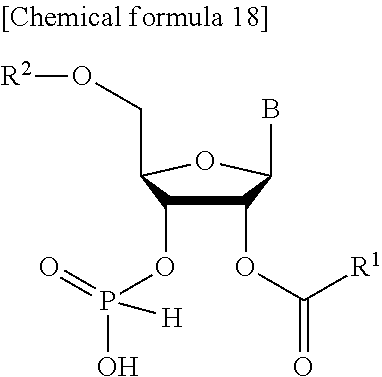
- 0 [1*]C(=O)O[C@H]1C(OP([H])(=O)O)[C@@H](CO[2*])O[C@H]1B Chemical compound [1*]C(=O)O[C@H]1C(OP([H])(=O)O)[C@@H](CO[2*])O[C@H]1B 0.000 description 57
- VFWZJSRWUCLRPQ-QBTYKYIGSA-N B[C@@H]1O[C@H](CC)C(O)[C@@H]1O.B[C@@H]1O[C@H](CO)C(O)[C@@H]1O.[H]P(=O)(O)OC1[C@@H](CC)O[C@@H](B)[C@H]1C Chemical compound B[C@@H]1O[C@H](CC)C(O)[C@@H]1O.B[C@@H]1O[C@H](CO)C(O)[C@@H]1O.[H]P(=O)(O)OC1[C@@H](CC)O[C@@H](B)[C@H]1C VFWZJSRWUCLRPQ-QBTYKYIGSA-N 0.000 description 1
- DFGOKZUBRZOLOI-JJOVJRGKSA-N C.CN(C)/C=N/C1=NC2=C(N=CN2[C@@H]2O[C@H](CC(C)(C)C)C(O)[C@@H]2O)C(=O)N1.CN(C)/C=N/C1=NC2=C(N=CN2[C@@H]2O[C@H](CO)C(O)[C@@H]2O)C(=O)N1.C[Si](C)=O Chemical compound C.CN(C)/C=N/C1=NC2=C(N=CN2[C@@H]2O[C@H](CC(C)(C)C)C(O)[C@@H]2O)C(=O)N1.CN(C)/C=N/C1=NC2=C(N=CN2[C@@H]2O[C@H](CO)C(O)[C@@H]2O)C(=O)N1.C[Si](C)=O DFGOKZUBRZOLOI-JJOVJRGKSA-N 0.000 description 1
- DQLLEQJHXWWWSM-FDOQAFKQSA-N CC[C@H]1O[C@@H](N2C=NC3=C2N=CN=C3N)[C@@H](O)C1O.CC[C@H]1O[C@@H](N2C=NC3=C2N=CN=C3N)[C@@H](O)C1OC(=O)C1=CC=CC=C1.CC[C@H]1O[C@@H](N2C=NC3=C2N=CN=C3N)[C@@H](OC(=O)C2=CC=CC=C2)C1O Chemical compound CC[C@H]1O[C@@H](N2C=NC3=C2N=CN=C3N)[C@@H](O)C1O.CC[C@H]1O[C@@H](N2C=NC3=C2N=CN=C3N)[C@@H](O)C1OC(=O)C1=CC=CC=C1.CC[C@H]1O[C@@H](N2C=NC3=C2N=CN=C3N)[C@@H](OC(=O)C2=CC=CC=C2)C1O DQLLEQJHXWWWSM-FDOQAFKQSA-N 0.000 description 1
- PDBRXAJZLXLPND-BJPXICEISA-N CN(C)/C=N/C1=NC2=C(N=CN2[C@@H]2O[C@H](CO)C(O)[C@@H]2O)C(=O)N1.CO.COC(OC)N(C)C.NC1=NC2=C(N=CN2[C@@H]2O[C@H](CO)C(O)[C@@H]2O)C(=O)N1 Chemical compound CN(C)/C=N/C1=NC2=C(N=CN2[C@@H]2O[C@H](CO)C(O)[C@@H]2O)C(=O)N1.CO.COC(OC)N(C)C.NC1=NC2=C(N=CN2[C@@H]2O[C@H](CO)C(O)[C@@H]2O)C(=O)N1 PDBRXAJZLXLPND-BJPXICEISA-N 0.000 description 1
Images


Classifications
-
- C—CHEMISTRY; METALLURGY
- C07—ORGANIC CHEMISTRY
- C07F—ACYCLIC, CARBOCYCLIC OR HETEROCYCLIC COMPOUNDS CONTAINING ELEMENTS OTHER THAN CARBON, HYDROGEN, HALOGEN, OXYGEN, NITROGEN, SULFUR, SELENIUM OR TELLURIUM
- C07F9/00—Compounds containing elements of Groups 5 or 15 of the Periodic Table
- C07F9/02—Phosphorus compounds
- C07F9/547—Heterocyclic compounds, e.g. containing phosphorus as a ring hetero atom
- C07F9/6558—Heterocyclic compounds, e.g. containing phosphorus as a ring hetero atom containing at least two different or differently substituted hetero rings neither condensed among themselves nor condensed with a common carbocyclic ring or ring system
- C07F9/65586—Heterocyclic compounds, e.g. containing phosphorus as a ring hetero atom containing at least two different or differently substituted hetero rings neither condensed among themselves nor condensed with a common carbocyclic ring or ring system at least one of the hetero rings does not contain nitrogen as ring hetero atom
-
- C—CHEMISTRY; METALLURGY
- C07—ORGANIC CHEMISTRY
- C07F—ACYCLIC, CARBOCYCLIC OR HETEROCYCLIC COMPOUNDS CONTAINING ELEMENTS OTHER THAN CARBON, HYDROGEN, HALOGEN, OXYGEN, NITROGEN, SULFUR, SELENIUM OR TELLURIUM
- C07F9/00—Compounds containing elements of Groups 5 or 15 of the Periodic Table
- C07F9/02—Phosphorus compounds
- C07F9/547—Heterocyclic compounds, e.g. containing phosphorus as a ring hetero atom
- C07F9/6561—Heterocyclic compounds, e.g. containing phosphorus as a ring hetero atom containing systems of two or more relevant hetero rings condensed among themselves or condensed with a common carbocyclic ring or ring system, with or without other non-condensed hetero rings
- C07F9/65616—Heterocyclic compounds, e.g. containing phosphorus as a ring hetero atom containing systems of two or more relevant hetero rings condensed among themselves or condensed with a common carbocyclic ring or ring system, with or without other non-condensed hetero rings containing the ring system having three or more than three double bonds between ring members or between ring members and non-ring members, e.g. purine or analogs
-
- C—CHEMISTRY; METALLURGY
- C07—ORGANIC CHEMISTRY
- C07H—SUGARS; DERIVATIVES THEREOF; NUCLEOSIDES; NUCLEOTIDES; NUCLEIC ACIDS
- C07H1/00—Processes for the preparation of sugar derivatives
- C07H1/02—Phosphorylation
-
- C—CHEMISTRY; METALLURGY
- C07—ORGANIC CHEMISTRY
- C07H—SUGARS; DERIVATIVES THEREOF; NUCLEOSIDES; NUCLEOTIDES; NUCLEIC ACIDS
- C07H19/00—Compounds containing a hetero ring sharing one ring hetero atom with a saccharide radical; Nucleosides; Mononucleotides; Anhydro-derivatives thereof
- C07H19/02—Compounds containing a hetero ring sharing one ring hetero atom with a saccharide radical; Nucleosides; Mononucleotides; Anhydro-derivatives thereof sharing nitrogen
- C07H19/04—Heterocyclic radicals containing only nitrogen atoms as ring hetero atom
- C07H19/06—Pyrimidine radicals
- C07H19/067—Pyrimidine radicals with ribosyl as the saccharide radical
-
- C—CHEMISTRY; METALLURGY
- C07—ORGANIC CHEMISTRY
- C07H—SUGARS; DERIVATIVES THEREOF; NUCLEOSIDES; NUCLEOTIDES; NUCLEIC ACIDS
- C07H19/00—Compounds containing a hetero ring sharing one ring hetero atom with a saccharide radical; Nucleosides; Mononucleotides; Anhydro-derivatives thereof
- C07H19/02—Compounds containing a hetero ring sharing one ring hetero atom with a saccharide radical; Nucleosides; Mononucleotides; Anhydro-derivatives thereof sharing nitrogen
- C07H19/04—Heterocyclic radicals containing only nitrogen atoms as ring hetero atom
- C07H19/16—Purine radicals
- C07H19/167—Purine radicals with ribosyl as the saccharide radical
-
- C—CHEMISTRY; METALLURGY
- C12—BIOCHEMISTRY; BEER; SPIRITS; WINE; VINEGAR; MICROBIOLOGY; ENZYMOLOGY; MUTATION OR GENETIC ENGINEERING
- C12N—MICROORGANISMS OR ENZYMES; COMPOSITIONS THEREOF; PROPAGATING, PRESERVING, OR MAINTAINING MICROORGANISMS; MUTATION OR GENETIC ENGINEERING; CULTURE MEDIA
- C12N15/00—Mutation or genetic engineering; DNA or RNA concerning genetic engineering, vectors, e.g. plasmids, or their isolation, preparation or purification; Use of hosts therefor
- C12N15/09—Recombinant DNA-technology
-
- Y—GENERAL TAGGING OF NEW TECHNOLOGICAL DEVELOPMENTS; GENERAL TAGGING OF CROSS-SECTIONAL TECHNOLOGIES SPANNING OVER SEVERAL SECTIONS OF THE IPC; TECHNICAL SUBJECTS COVERED BY FORMER USPC CROSS-REFERENCE ART COLLECTIONS [XRACs] AND DIGESTS
- Y02—TECHNOLOGIES OR APPLICATIONS FOR MITIGATION OR ADAPTATION AGAINST CLIMATE CHANGE
- Y02P—CLIMATE CHANGE MITIGATION TECHNOLOGIES IN THE PRODUCTION OR PROCESSING OF GOODS
- Y02P20/00—Technologies relating to chemical industry
- Y02P20/50—Improvements relating to the production of bulk chemicals
- Y02P20/55—Design of synthesis routes, e.g. reducing the use of auxiliary or protecting groups
Definitions
- the present invention relates to a method of manufacturing, at a low cost, an H-phosphonate nucleoside derivative, which can selectively protect position 2′ of a ribonucleoside monomer required for RNA oligonucleotide synthesis.
- RNA oligonucleotides mainly siRNAs
- siRNAs Since the discovery of RNAi, RNA oligonucleotides, mainly siRNAs, have had expectation for utilization in pharmaceutical products, and the development thereof is ongoing worldwide.
- the present invention also provides the following items.
- R 1 represents a group selected from the group consisting of a substituted or unsubstituted aryl group and a substituted or unsubstituted heteroaryl group
- R 2 represents a protecting group of a hydroxy group or a hydrogen atom
- B represents a nucleic acid base that may or may not have a protecting group, or a salt thereof, or solvate thereof, wherein the method comprises:
- R 3 and R 3 ′ each independently represent a group selected from the group consisting of a substituted or unsubstituted aryl group and a substituted or unsubstituted heteroaryl group, to obtain
- step 1 and step 2 are performed in a single reaction vessel.
- nucleic acid base that may or may not have a protecting group is selected from the group consisting of
- R 3a , R 3b , and R 3c each independently represent a group selected from the group consisting of a hydrogen atom, a substituted or unsubstituted straight or branched alkylacyl group, a substituted or unsubstituted arylacyl group, a substituted or unsubstituted alkyl group, a substituted or unsubstituted cycloalkyl group, a substituted or unsubstituted aryl group, and a substituted or unsubstituted heteroaryl group, or R 3a and R 3b are groups together forming an amidine protecting group.
- amidine protecting group is an N,N-dimethylformamidino group or an N,N-dimethylacetamidino group.
- R 1 is a substituted or unsubstituted aryl group.
- the protecting group of a hydroxy group is a protecting group selected from the group consisting of an ether based protecting group, a silyl ether based protecting group, an acetal based protecting group, and an acyl based protecting group.
- R 4a1 , R 4a2 , R 4a3 , R 4a4 , R 4a5 , R 4b1 , R 4b2 , R 4b3 , R 4b4 , R 4b5 , R 4c1 , R 4c2 , R 4c3 , R 4c4 , and R 4c5 are each independently a group selected from the group consisting of a hydrogen atom, a substituted or unsubstituted straight or branched alkoxy group, and a substituted or unsubstituted straight or branched alkyl group.
- R 4d , R 4e , and R 4f are each independently a group selected from the group consisting of a substituted or unsubstituted straight or branched alkyl group, a substituted or unsubstituted aryl group, and a substituted or unsubstituted alkenyl group.
- R 4g , R 4h , and R 4i are each independently a group selected from the group consisting of a substituted or unsubstituted hydrocarbon group, a substituted or unsubstituted silyl group, and a substituted or unsubstituted silyloxyalkyl group.
- the substituted or unsubstituted hydrocarbon group is a group selected from the group consisting of a substituted or unsubstituted straight or branched alkyl group, a substituted or unsubstituted straight or branched alkenyl group, a substituted or unsubstituted straight or branched alkynyl group, a substituted or unsubstituted cycloalkyl group, a substituted or unsubstituted cycloalkenyl group, a substituted or unsubstituted aryl group, and a substituted or unsubstituted straight or branched arylalkyl group.
- R 2 represents a protecting group of a hydroxy group or a hydrogen atom
- B represents a nucleic acid base that may or may not have a protecting group
- R 1 represents a group selected from the group consisting of a substituted or unsubstituted aryl group and a substituted or unsubstituted heteroaryl group, and X is a halogen atom; and P(OR 3 ) (OR 3 ′)OH
- R 3 and R 3 ′ each independently represent a group selected from the group consisting of a substituted or unsubstituted aryl group and a substituted or unsubstituted heteroaryl group.
- nucleic acid base that may or may not have a protecting group is selected from the group consisting of
- R 3a , R 3b , and R 3c each independently represent a group selected from the group consisting of a hydrogen atom, a substituted or unsubstituted straight or branched alkylacyl group, a substituted or unsubstituted arylacyl group, a substituted or unsubstituted alkyl group, a substituted or unsubstituted cycloalkyl group, a substituted or unsubstituted aryl group, and a substituted or unsubstituted heteroaryl group, or R 3a and R 3b are groups together forming an amidine protecting group.
- amidine protecting group is an N,N-dimethylformamidino group or an N,N-dimethylacetamidino group.
- R 1 is a substituted or unsubstituted aryl group.
- the protecting group of a hydroxy group is a protecting group selected from the group consisting of an ether based protecting group, a silyl ether based protecting group, an acetal based protecting group, and an acyl based protecting group.
- R 4a1 , R 4a2 , R 4a3 , R 4a4 , R 4a5 , R 4b1 , R 4b2 , R 4b3 , R 4b4 , R 4b5 , R 4c1 , R 4c2 , R 4c3 , R 4c4 , and R 4c5 are each independently a group selected from the group consisting of a hydrogen atom, a substituted or unsubstituted straight or branched alkoxy group, and a substituted or unsubstituted straight or branched alkyl group.
- R 4d , R 4e , and R 4f are each independently a group selected from the group consisting of a substituted or unsubstituted straight or branched alkyl group, a substituted or unsubstituted aryl group, and a substituted or unsubstituted alkenyl group.
- R 4g , R 4h , and R 4i are each independently a group selected from the group consisting of a substituted or unsubstituted hydrocarbon group, a substituted or unsubstituted silyl group, and a substituted or unsubstituted silyloxyalkyl group.
- the substituted or unsubstituted hydrocarbon group is a group selected from the group consisting of a substituted or unsubstituted straight or branched alkyl group, a substituted or unsubstituted straight or branched alkenyl group, a substituted or unsubstituted straight or branched alkynyl group, a substituted or unsubstituted cycloalkyl group, a substituted or unsubstituted cycloalkenyl group, a substituted or unsubstituted aryl group, and a substituted or unsubstituted straight or branched arylalkyl group.
- R 1 represents a group selected from the group consisting of a substituted or unsubstituted aryl group and a substituted or unsubstituted heteroaryl group
- R 2 represents a protecting group of a hydroxy group or a hydrogen atom
- B represents a nucleic acid base that may or may not have a protecting group, comprising: P(OR 3 )(OR 3 ′)OH
- R 3 and R 3 ′ each independently represent a group selected from the group consisting of a substituted or unsubstituted aryl group and a substituted or unsubstituted heteroaryl group, or a salt thereof, or solvate thereof.
- the phosphorous reagent of the preceding item, wherein the nucleic acid base that may or may not have a protecting group is selected form the group consisting of
- R 3a , R 3b , and R 3c each independently represent a group selected from the group consisting of a hydrogen atom, a substituted or unsubstituted straight or branched alkylacyl group, a substituted or unsubstituted arylacyl group, a substituted or unsubstituted alkyl group, a substituted or unsubstituted cycloalkyl group, a substituted or unsubstituted aryl group, and a substituted or unsubstituted heteroaryl group, or R 3a and R 3b are groups together forming an amidine protecting group.
- amidine protecting group is an N,N-dimethylformamidino group or an N,N-dimethylacetamidino group.
- R 4a1 , R 4a2 , R 4a3 , R 4a4 , R 4a5 , R 4b1 , R 4b2 , R 4b3 , R 4b4 , R 4b5 , R 4c1 , R 4c2 , R 4c3 , R 4c4 , and R 4c5 are each independently a group selected from the group consisting of a hydrogen atom, a substituted or unsubstituted straight or branched alkoxy group, and a substituted or unsubstituted straight or branched alkyl group.
- R 4d , R 4e , and R 4f are each independently a group selected from the group consisting of a substituted or unsubstituted straight or branched alkyl group, a substituted or unsubstituted aryl group, and a substituted or unsubstituted alkenyl group.
- R 4g , R 4h , and R 4i are each independently a group selected from the group consisting of a substituted or unsubstituted hydrocarbon group, a substituted or unsubstituted silyl group, and a substituted or unsubstituted silyloxyalkyl group.
- substituted or unsubstituted hydrocarbon group is a group selected from the group consisting of a substituted or unsubstituted straight or branched alkyl group, a substituted or unsubstituted straight or branched alkenyl group, a substituted or unsubstituted straight or branched alkynyl group, a substituted or unsubstituted cycloalkyl group, a substituted or unsubstituted cycloalkenyl group, a substituted or unsubstituted aryl group, and a substituted or unsubstituted straight or branched arylalkyl group.
- R 1 represents a group selected from the group consisting of a substituted or unsubstituted aryl group and a substituted or unsubstituted heteroaryl group
- R 2 represents a protecting group of a hydroxy group or a hydrogen atom
- B represents a nucleic acid base that may or may not have a protecting group, or a salt thereof, or solvate thereof.
- the present invention enables the manufacture of a ribonucleic acid H-phosphonate monomer at low cost, resulting in enabling the manufacture of RNA at low cost.
- the present invention is characterized by reacting hydroxyl groups at positions 2′ and 3′ having slightly different reactivity with aromatic acyl halide at a low temperature for selective esterification of position 2′ and subsequently capturing a hydroxyl group at position 3′ with a phosphityl group in one pot to induce transition of positions 2′ and 3′ of an acyl group.
- FIG. 1 shows a result of LC-MS analysis on 5′—HO-rU 19 dT-3′—OH.
- FIG. 2 shows a result of LC-MS analysis on 5′—HO-rU 3 rCrGrArU 3 dT-3′—OH.
- substitution refers to substitution of a specific hydrogen atom of an organic compound with another atom or group of atoms.
- the atom or group of atoms introduced in place of the hydrogen atom is referred to as a “substituent”.
- All functional groups can be considered a substituent, Examples of substituents include halogen atoms, hydroxy groups, alkyl groups, alkenyl groups, alkynyl groups, cycloalkyl groups, aryl groups, heteroaryl groups, and the like.
- Halogen atom encompasses fluorine atoms, chlorine atoms, bromine atoms, and iodine atoms.
- hydroxy group refers to a group represented by —OH.
- a “straight” group refers to a group having a linearly ranging shape, where carbon constituting the group does not branch or form a ring.
- branched group refers to a group with a structure where two or more carbon atoms are bound to a carbon atom constituting the group.
- C1, C2 . . . Cn represent the number of carbons, wherein n indicates any positive integer.
- C1 is used to represent a substituent with one carbon.
- alkyl group refers to a monovalent group resulting from aliphatic hydrocarbon (alkane) such as methane, ethane, or propane losing one hydrogen atom, and is generally represented by C n H 2n+1 wherein n is a positive integer.
- Examples thereof include methyl, ethyl, n-propyl, isopropyl, n-butyl, isobutyl, sec-butyl, tert-butyl, n-pentyl, isopentyl, neopentyl, n-hexyl, isohexyl, n-heptyl, isoheptyl, n-octyl, isooctyl, n-nonyl, n-decyl, and the like.
- substituted alkyl group refers to an alkyl group with H thereof substituted with a substituent defined above.
- Examples thereof include vinyl, allyl, propenyl, isopropenyl, butenyl, isobutenyl, prenyl, butadienyl, pentenyl, isopentenyl, pentadienyl, hexenyl, isohexenyl, hexadienyl, heptenyl, octenyl, nonenyl, decenyl, undecenyl, dodecenyl, tridecenyl, tetradecenyl, pentadecenyl, and the like.
- “Substituted alkenyl group” refers to an alkenyl group with H thereof substituted with a substituent defined above.
- alkynyl group refers to a group represented by CH 2 ⁇ CH—CH 2 —.
- alkynyl group refers to a monovalent group resulting from aliphatic hydrocarbon (alkyne) having a triple bond within the molecule losing a hydrogen atom, and is generally represented by C n H 2n-3 —, wherein n is a positive integer that is 2 or greater. Examples thereof include ethynyl, propynyl, butynyl, pentynyl, hexynyl, heptynyl, octynyl, nonynyl, decynyl, and the like.
- Substituted alkynyl group refers to an alkynyl group with H thereof substituted with a substituent defined above.
- cycloalkyl group refers to alkyl having a cyclic structure. Examples thereof include cyclopropyl, cyclobutyl, cyclopentyl, cyclohexyl, cycloheptyl, cyclooctyl, cyclononyl, cyclodecyl, and the like. “Substituted cycloalkyl group” refers to cycloalkyl with H thereof substituted with a substituent defined above.
- cycloalkenyl group refers to alkenyl having a cyclic structure. Examples thereof include cyclopropenyl, cyclobutenyl, cyclopentenyl, cyclohexenyl, cycloheptenyl, cyclooctenyl, cyclononenyl, cyclodecenyl, and the like. “Substituted cycloalkyl group” refers to cycloalkyl with H thereof substituted with a substituent defined above.
- aryl group refers to a group resulting from a hydrogen atom bound to a ring of an aromatic hydrocarbon leaving.
- a phenyl group (C 6 H 5 —) is derived from benzene, a tolyl group (CH 3 C 6 H 4 —) is derived from toluene, xylyl group ((CH 3 ) 2 C 6 H 3 —) is derived from xylene, naphthyl group (C 10 H 8 —) is derived from naphthalene, phenanthryl group (C 14 H 9 —) is derived from phenanthrene, anthracenyl group (C 14 H 9 —) is derived from anthracene, tetracenyl group (C 18 H 9 —) is derived from tetracene, chrysenyl group (C 18 H 11 —) is derived from chrysene, pyrenyl group (C 18 H 11 —) is
- heteroaryl group refers to a monocyclic aryl group, bicyclic aryl group, or aryl group with more rings having one or more of the same or different heteroatoms selected from any of O, S, and N.
- Heteroaryl groups with 2 or more rings encompass those in which a ring in the “aryl group” is fused to a monocyclic heteroaryl group, bicyclic heteroaryl group, or heteroaryl group with more rings.
- Monocyclic heteroaryl groups are preferably 5- to 8-membered and more preferably 5- to 6-membered. Examples thereof include pyrrolyl, imidazolyl, pyrazolyl, pyridyl, pyridazinyl, pyrimidinyl, pyrazinyl, triazolyl, triazinyl, tetrazolyl, furyl, thienyl, isoxazolyl, oxazolyl, oxadiazolyl, isothiazolyl, thiazolyl, thiadiazolyl, and the like.
- bicyclic heteroaryl groups include indolyl, isoindolyl, indazolyl, indolizinyl, quinolinyl, isoquinolinyl, cinnolinyl, phthalazinyl, quinazolinyl, naphthyridinyl, quinoxalinyl, purinyl, pteridinyl, benzimidazolyl, benzoisoxazolyl, benzoxazolyl, benzoxadiazolyl, benzoisothiazolyl, benzothiazolyl, benzothiadiazolyl, benzofuryl, isobenzofuryl, benzothienyl, benzotriazolyl, imidazopyridyl, triazolopyridyl, imidazothiazolyl, pyrazinopyridazinyl, oxazolopyridyl, thiazolopyridyl, and the like.
- heteroaryl groups with three or more rings include carbazolyl, acridinyl, xanthenyl, phenothiazinyl, phenoxathiinyl, phenoxazinyl, dibenzofuryl, and the like.
- alkoxy group refers to a group in which the “alkyl group” is bound to an oxygen atom. Examples thereof include methoxy, ethoxy, n-propyloxy, isopropyloxy, n-butyloxy, tert-butyloxy, isobutyloxy, sec-butyloxy, pentyloxy, isopentyloxy, hexyloxy, and the like.
- haloalkyl group refers to a group in which one or more of the “halogen atoms” is bound to the “alkyl group”. Examples thereof include monofluoromethyl, monofluoroethyl, monofluoropropyl, 2,2,3,3,3-pentafluoropropyl, monochlormethyl, trifluoromethyl, trichloromethyl, 2,2,2-trifluoroethyl, 2,2,2-trichloroethyl, 1,2-dibromoethyl, 1,1,1-trifluoropropane-2-yl, and the like.
- perfluoroalkyl group refers to an alkyl group in which some or all of the hydrogen bound to carbon of an alkyl group is replaced with fluorine.
- perfluoroalkoxy group refers to an alkoxy group in which some or all of the hydrogen bound to carbon of an alkoxy group is replaced with fluorine.
- arylacyl group refers to a group in which the “aryl group” is bound to a carbonyl group. Examples thereof include phenylcarbonyl, naphthylcarbonyl, phenanthrylcarbonyl, anthracenylcarbonyl, and the like.
- arylalkyl group refers to alkyl substituted with one or more of the “aryl groups”. Examples thereof include benzyl, phenethyl, phenylpropynyl, benzhydryl, trityl, naphthylmethyl, and the like.
- sil group refers to a group in which three of the “alkyl group”, “alkenyl group”, “alkynyl group”, or “aryl group” are bound to a silicon atom, where the three groups bound to a silicon atom can be the same or different. Examples thereof include, but are not limited to, trimethylsilyl group (TMS), triethylsilyl group (TES), tert-butyldimethylsilyl group (TBDMS), triisopropylsilyl group (TIPS), tert-butyldiphenylsilyl group (TBDPS), and the like.
- TMS trimethylsilyl group
- TES triethylsilyl group
- TDMS tert-butyldimethylsilyl group
- TIPS triisopropylsilyl group
- TDPS tert-butyldiphenylsilyl group
- siloxyalkyl group refers to a group wherein hydrogen on the “alkyl group” is replaced with a “silyloxy group”, which is a group where the “silyl group” is bound to an oxygen atom.
- examples thereof include, but are not limited to, trimethylsilyloxymethyl group, triethylsilyloxyethyl group, tert-butyldimethylsilyloxymethyl group, triisopropylsilyloxypropyl group, tert-butyldiphenylsilyloxybutyl group, and the like.
- cation refers to an ion having a positive charge. Examples thereof include, but are not limited to, hydrogen ion, quaternary ammonium ion, lithium ion, sodium ion, potassium ion, and the like.
- tertiary amine refers to a compound in which all hydrogens of ammonium are replaced with the “alkyl group” or the “aryl group”. Examples thereof include, but are not limited to, trimethylamine, N,N-diisopropylethylamine, tripropylamine, and the like.
- nucleic acid base refers to a base component constituting a nucleic acid. Examples thereof include, but are not limited to, adenine (A), guanine (G), cytosine (C), thymine (T), uracil (U), and the like.
- oligomer refers to a polymer with a low degree of polymerization.
- the degree of polymerization of an oligomer is, but not limited thereto, 2 to 100.
- protecting group refers to a group used to protect a functional group from a specific chemical reaction.
- protecting groups of a hydroxy group include, but are not limited to, ether based protecting groups (methyl group (Me), benzyl group (Bn), p-methoxybenzyl group (PMB), tert-butyl group (t-Bu), trityl group (Tr), and the like), silyl ether based protecting groups (trimethylsilyl group (TMS), triethylsilyl group (TES), tert-butyldimethylsilyl group (TBDMS), triisopropylsilyl group (TIPS), tert-butyldiphenylsilyl group (TBDPS) and the like), acetal based protecting groups (methoxymethyl group (MOM), 2-tetrahydropyranyl group (THP), ethoxyethyl group (EE) and the like), acyl based protecting groups (acetyl group (Ac), pivaloyl group (Piv), benzoyl group (Bz), and
- protecting groups of an amino group include, but are not limited to, carbamate based protecting groups (tert-butoxycarbonyl group (Boc), benzyloxycarbonyl group (Cbz), 9-fluorenylmethyloxycarbonyl group (Fmoc), 2,2,2-trichloroethoxycarbonyl group (Troc), allyloxycarbonyl group (Alloc) and the like), amide base protecting groups (trifluoroacetyl group and the like), imide based protecting group (phthaloyl group (Pht) and the like), sulfonamide based protecting groups (p-toluenesulfonyl group (Ts), 2-nitrobenzenesulfonyl group (Ns), and the like), amidine protecting groups (N,N-dimethylformamidino group, N,N-dimethylacetamidino group, and the like), and the like.
- carbamate based protecting groups tert-butoxycarbonyl group (B
- amidine protecting group is a protecting group represented by the following general formula
- R 1 , R 2 , and R 3 are each independently a group selected from the group consisting of hydrogen, a substituted or unsubstituted alkyl group, a substituted or unsubstituted cycloalkyl group, a substituted or unsubstituted aryl group, and a substituted or unsubstituted heteroaryl group. Examples thereof include, but are not limited to, N,N-dimethylformamidino group, an N,N-dimethylacetoamidino group, and the like.
- solvation refers to a phenomenon of several solvent molecules surrounding a solute molecule or ion to form a single group.
- the compound of the invention can also be provided as a salt.
- examples thereof include salts with an organic base (triethylamine or the like), especially trimethylamine. These salts can be formed by a commonly used method.
- a compound can be produced as a salt (e.g., derived from an additive) depending on the conditions of the manufacturing method of the invention.
- the compound of the invention can also be provided as a solvate.
- solvates of tertiary amine and water Such solvates can be formed by a commonly used method.
- a compound can be produced as a solvate depending on the conditions of the manufacturing method of the invention.
- a salt of the compound can also be produced and provided as a solvate.
- reaction vessel refers to an apparatus in which a chemical reaction takes place in the manufacturing process of a chemical substance. Examples thereof include, but are not limited to, flasks and beakers.
- Constituent unit refers to an atom or a group of atoms constituting a part of the basic structure of an oligomer. This is used synonymously with “monomer”.
- the present invention provides a method of manufacturing a compound represented by the following general formula
- R 1 represents a group selected from the group consisting of a substituted or unsubstituted aryl group and a substituted or unsubstituted heteroaryl group
- R 2 represents a protecting group of a hydroxy group or a hydrogen atom
- B represents a nucleic acid base that may or may not have a protecting group, or a salt thereof, or solvate thereof, wherein the method comprises:
- R 3 and R 3 ′ each independently represent a group selected from the group consisting of a substituted or unsubstituted aryl group and a substituted or unsubstituted heteroaryl group, to obtain
- step 1 and step 2 are performed in a single reaction vessel.
- intermediate (A) with a protected hydroxy group at position 2′ and intermediate (B) with a protected hydroxy group at position 3′ are in equilibrium, and the mole ratio of intermediate (A) and intermediate (B) becomes 50/50 over time.
- a reaction for introducing a phosphoric acid group needs to be performed quickly. For this reason, it was necessary to use a phosphorous reagent with a very high reactivity.
- phosphorous reagents with a very high reactivity are generally difficult to handle, with strong toxicity, instability at room temperature, etc.
- Some phosphorous reagents have problems of being labor-intensive with respect to purification, e.g., the need to increase the number of column chromatography runs due to the difficulty in removing residuals of the reagent (e.g., phosphoric acid) or the like.
- the present invention used phosphonate, which has relatively low reactivity, as a phosphorous reagent to unexpectedly find that a protecting group can be selectively introduced to a hydroxy group at position 2′ and a phosphonate residue can be readily removed from a reaction product. Since this enables phosphonate residue to be readily removed, the purity of position 2′ protected ribonucleotide monomer has improved compared to conventional methods.
- a greater variety of position 2′ protected ribonucleotide monomers can also be synthesized due to the expanded substrate specificity in comparison to conventional methods using enzymes.
- step 1 is performed at a low temperature below room temperature.
- the reaction temperature at this time is, but not limited to, ⁇ 40 to 20° C., ⁇ 40 to 15° C., ⁇ 40 to 10° C., ⁇ 40 to 5° C., ⁇ 40 to 0° C., ⁇ 40 to ⁇ 10° C., ⁇ 40 to ⁇ 20° C., ⁇ 40 to ⁇ 30° C., ⁇ 30 to 20° C., ⁇ 20 to 20° C., ⁇ 10 to 20° C., 0 to 20° C., or 5 to 20° C., and preferably ⁇ 40 to 20° C.
- step 2 is performed within 1 minutes, 2 minutes, 3 minutes, 4 minutes, 5 minutes, 10 minutes, 20 minutes, 30 minutes, 40 minutes, 50 minutes, 1 hour, 2 hours, 3 hours, or 4 hours after the completion of step 1, and preferably within 1 hour after the completion.
- step 1 has been completed by thin-layer chromatography (TLC) or liquid chromatography, but confirmation means is not limited thereto. If a preliminary experiment is conducted in advance so that the time at which step 1 is completed can be estimated, step 2 can be performed without confirming whether step 1 has been completed.
- TLC thin-layer chromatography
- step 2 can be performed without confirming whether step 1 has been completed.
- the temperature in a reaction system upon performing step 2 is, but not limited to, ⁇ 40 to 25° C., ⁇ 40 to 20° C., ⁇ 40 to 10° C., ⁇ 40 to 5° C., ⁇ 40 to 0° C., ⁇ 40 to ⁇ 10° C., ⁇ 40 to ⁇ 20° C., ⁇ 40 to ⁇ 30° C., ⁇ 30 to 25° C., ⁇ 20 to 25° C., ⁇ 10 to 25° C., 0 to 25° C., 5 to 25° C., 10 to 25° C., 20 to 25° C., ⁇ 30 to 20° C., ⁇ 20 to 20° C., ⁇ 10 to 20° C., 0 to 20° C., 5 to 20° C., or 10 to 20° C., and preferably ⁇ 20 to 20° C.
- a base before adding phosphite in step 2.
- this is for quenching an excessive amount of acyl halide added in step 1.
- the base added at this time is not limited, but dimethylamine hydrochloride is preferred.
- the time until adding phosphite after adding a base is, but is not limited to, 30 minutes, 1 hour, 2 hours, 3 hours, or 4 hours.
- the temperature at which a base is added is, but not limited to, ⁇ 40° C.
- the nucleic acid base that may or may not have a protecting group is selected from the group consisting of
- R 3a , R 3b , and R 3c each independently represent a group selected from the group consisting of a hydrogen atom, a substituted or unsubstituted straight or branched alkylacyl group, a substituted or unsubstituted arylacyl group, a substituted or unsubstituted alkyl group, a substituted or unsubstituted cycloalkyl group, a substituted or unsubstituted aryl group, and a substituted or unsubstituted heteroaryl group, or R 3a and R 3b are groups together forming an amidine protecting group.
- the amidine protecting group is an N,N-dimethylformamidino group or an N,N-dimethylacetamidino group.
- the reaction of the invention progresses position 2′ selectively not only when the nucleic acid base is a purine base, but also when it is a pyrimidine base.
- R 1 is a substituted or unsubstituted aryl group.
- the substituted or unsubstituted aryl group is a phenyl group.
- the protecting group of a hydroxy group is a protecting group selected from the group consisting of an ether based protecting group, a silyl ether based protecting group, an acetal based protecting group, and an acyl based protecting group.
- Position 2′ selective reaction progresses by using any of the protecting groups.
- the ether based protecting group is N-(2-aminoethyl)-2-aminoethyl ether based protecting group
- R 4a1 , R 4a2 , R 4a3 , R 4a4 , R 4a5 , R 4b1 , R 4b2 , R 4b3 , R 4b4 , R 4b5 , R 4c1 , R 4c2 , R 4c3 , R 4c4 , and R 4c5 are each independently a group selected from the group consisting of a hydrogen atom, a substituted or unsubstituted straight or branched alkoxy group, and a substituted or unsubstituted straight or branched alkyl group.
- the leaving capability can be adjusted by changing a substituent on a phenyl group.
- the substituted or unsubstituted straight or branched alkoxy group is a straight or branched perfluoroalkoxy group
- the substituted or unsubstituted straight or branched alkyl group is a straight or branched perfluoroalkyl group.
- the silyl ether based protecting group is
- R 4d , R 4e , and R 4f are each independently a group selected from the group consisting of a substituted or unsubstituted straight or branched alkyl group, a substituted or unsubstituted aryl group, and a substituted or unsubstituted alkenyl group.
- the substituted or unsubstituted alkenyl group is an allyl group.
- the silyl ether based protecting group is
- R 4g , R 4h , and R 4i are each independently a group selected from the group consisting of a substituted or unsubstituted hydrocarbon group, a substituted or unsubstituted silyl group, and a substituted or unsubstituted silyloxyalkyl group.
- the silyl group is substituted with 1 to 3 alkyl groups.
- the substituted or unsubstituted hydrocarbon group is a group selected from the group consisting of a substituted or unsubstituted straight or branched alkyl group, a substituted or unsubstituted straight or branched alkenyl group, a substituted or unsubstituted straight or branched alkynyl group, a substituted or unsubstituted cycloalkyl group, a substituted or unsubstituted cycloalkenyl group, a substituted or unsubstituted aryl group, and a substituted or unsubstituted straight or branched arylalkyl group.
- the substituted or unsubstituted straight or branched alkyl group is a straight or branched haloalkyl group.
- the straight or branched haloalkyl group is a straight or branched perfluoroalkyl group.
- the present invention provides a kit for manufacturing a compound represented by the following general formula
- R 2 represents a protecting group of a hydroxy group or a hydrogen atom
- B represents a nucleic acid base that may or may not have a protecting group
- R 1 represents a group selected from the group consisting of a substituted or unsubstituted aryl group and a substituted or unsubstituted heteroaryl group, and X is a halogen atom; and P(OR 3 )(OR 3 ′)OH
- R 3 and R 3 ′ each independently represent a group selected from the group consisting of a substituted or unsubstituted aryl group and a substituted or unsubstituted heteroaryl group.
- the present invention provides a phosphorous reagent for selectively manufacturing a compound represented by the following general formula
- R 1 represents a group selected from the group consisting of a substituted or unsubstituted aryl group and a substituted or unsubstituted heteroaryl group
- R 2 represents a protecting group of a hydroxy group or a hydrogen atom
- B represents a nucleic acid base that may or may not have a protecting group, comprising: P(OR 3 )(OR 3 ′)OH
- R 3 and R 3 ′ each independently represent a group selected from the group consisting of a substituted or unsubstituted aryl group and a substituted or unsubstituted heteroaryl group, or a salt thereof, or solvate thereof.
- the “selectively manufacturing” refers to the proportion of product of interest in the entire reaction product being 1/X or greater than 1/X when X products are expected to be producable.
- PG 1 and PG 2 represent a protecting group of any hydroxyl group
- R 3 and R 3 ′ represent a group selected from the group consisting of a substituted or unsubstituted aryl group and a substituted or unsubstituted heteroaryl group
- B represents a nucleic acid base that may or may not have a protecting group.
- a nucleoside e.g., 5.34 g (20 mmol) of adenosine
- a suitable reaction solvent e.g. 400 mL of pyridine
- a suitable reaction vessel e.g., three neck flask (500 mL)
- a suitable reaction temperature e.g., 0° C.
- a suitable protection reagent e.g., 40 mL of dichloromethane solution of 3.07 g (20.4 mmol) of t-butylchlorodimethylsilane
- a suitable temperature e.g., 12 hours at room temperature
- an inert gas e.g., nitrogen
- the reaction solvent is evaporated, and water (e.g., 100 mL) and organic solvent (e.g., 100 mL of chloroform/40 mL of methanol) are added to the resulting residue for extraction.
- the organic layer is evaporated under reduced pressure (e.g., after one more extraction of the aqueous layer with 100 mL of chloroform).
- the resulting mixture is purified (e.g., in a silica gel column) and the fraction of interest is concentrated under reduced pressure to obtain a product of interest (e.g., white solid).
- a position 5′ protected nucleoside e.g., 3.82 g (10 mmol) of t-butyldimethylsilyl protected adenosine
- a suitable solvent e.g., 100 mL of pyridine
- a suitable reaction vessel e.g., three neck flask (300 mL)
- a suitable reaction temperature e.g., ⁇ 40° C.
- a suitable protection reagent e.g., 10 mL of dichloromethane solution of 2.11 g (15 mmol) of benzoyl chloride
- a suitable temperature e.g., 3 hours at ⁇ 40° C.
- a suitable reagent e.g., 489 mg (6 mmol) of dimethylamine hydrochloride
- the temperature is raised (e.g., from ⁇ 40° C. to room temperature by detaching a cooling trough), and the resulting mixture is stirred for a suitable time (e.g., 2 hours) after adding the reagent.
- a suitable phosphorous reagent e.g., 20 mL of pyridine solution of 7.03 g (30 mmol) of diphenyl phosphite
- a suitable temperature e.g., room temperature
- a suitable temperature e.g., 3 hours at room temperature
- a suitable base e.g., 10 mL of triethylamine and 10 mL of water
- the mixture is further stirred for a suitable time at a suitable temperature (e.g., 1 hour at room temperature).
- the reaction solvent e.g., pyridine, dichloromethane
- water e.g., 100 mL
- an organic solvent e.g., 100 mL of chloroform
- the organic solvent e.g., chloroform
- the resultant is purified (e.g., in a silica gel column by adding 0.5 mL of triethylamine to the crude product) and the fraction of interest is concentrated under reduced pressure to obtain a product of interest (e.g., white solid).
- a product of interest e.g., white solid
- a suitable reaction temperature e.g., 25° C.
- a suitable reaction solvent e.g., pyr
- a desired degree of polymerization e.g., degree of polymerization of 20
- a suitable reagent e.g., ethylenediamine
- a desired oligonucleotide is obtained (e.g., by additional HPLC purification).
- a protecting group of a position 5′ hydroxy group e.g., TBDMS group
- a suitable reagent e.g., TBAF
- NMR spectra were measured with Bruker's AVANCE III 400.
- the monomer synthesized above was used to synthesize an RNA oligomer by liquid phase synthesis.
- the present invention is useful in the drug development industry and reagent industry using nucleic acid medicaments and the like.
Landscapes
- Chemical & Material Sciences (AREA)
- Organic Chemistry (AREA)
- Health & Medical Sciences (AREA)
- Life Sciences & Earth Sciences (AREA)
- Biochemistry (AREA)
- General Health & Medical Sciences (AREA)
- Molecular Biology (AREA)
- Engineering & Computer Science (AREA)
- Genetics & Genomics (AREA)
- Biotechnology (AREA)
- Bioinformatics & Cheminformatics (AREA)
- Biomedical Technology (AREA)
- General Engineering & Computer Science (AREA)
- Wood Science & Technology (AREA)
- Zoology (AREA)
- Biophysics (AREA)
- Plant Pathology (AREA)
- Physics & Mathematics (AREA)
- Microbiology (AREA)
- Saccharide Compounds (AREA)
Abstract
Description


and

with
P(OR3)(OR3′)OH


P(OR3) (OR3′)OH


P(OR3)(OR3′)OH


wherein R1, R2, and R3 are each independently a group selected from the group consisting of hydrogen, a substituted or unsubstituted alkyl group, a substituted or unsubstituted cycloalkyl group, a substituted or unsubstituted aryl group, and a substituted or unsubstituted heteroaryl group. Examples thereof include, but are not limited to, N,N-dimethylformamidino group, an N,N-dimethylacetoamidino group, and the like.


and

with
P(OR3)(OR3′)OH


In the above synthesis, intermediate (A) with a protected hydroxy group at position 2′ and intermediate (B) with a protected hydroxy group at


P(OR3)(OR3′)OH

P(OR3)(OR3′)OH

In the scheme, PG1 and PG2 represent a protecting group of any hydroxyl group, R3 and R3′ represent a group selected from the group consisting of a substituted or unsubstituted aryl group and a substituted or unsubstituted heteroaryl group, and B represents a nucleic acid base that may or may not have a protecting group.
- Bu: Butyl
- Et: Ethyl
- d: Deoxy (DNA)
- HPLC: High performance liquid chromatography
- Me: Methyl
- NMR: Nuclear magnetic resonance
- PEG: Polyethylene glycol
- Ph: Phenyl
- r: Ribose (RNA)
- suc: Succinic acid
- TBAF: Tetra-n-butylammonium fluoride
- TBDMS: tert-butyldimethylsilyl
- t-Bu: Tertiary butyl
- THF: Tetrahydrofuran
- X: Halogen group

| TABLE 1 | ||||
| | Equivalent | 3′-PhCO (%) | 2′-PhCO (%) | |
| (PhCO)2O | 1.5 eq. | 52% | 29% | |
| PhCO—Cl | 1.5 eq. | 28% | 70% | |
| Bu2SnO | 1.0 eq. | 36% | 39% | |
| PhCO—Cl | 1.5 eq. | |||
| Ph2B—OCH2CH2NH2 | 0.1 eq. | 30% | 38% | |
| PhCO—Cl | 1.5 .eq | |||

31P NMR (162 MHz, CDCl3), σ3.57


31P NMR (162 MHz, CDCl3), σ4.05


| TABLE 2 |
| Reaction condition |
| Reaction solvent | Pyridine: MeCN = 1:1 (0.05M) | ||
| Reaction temperature | 25° | ||
| Starting base | |||
| 5′-OH-dT-3′-O-suc-O-PEG (1 eq.) | |||
| Monomer | TBDMS-rU-H-phosphonate (1.3 eq.) | ||
| Condensing agent | Pivaloyl chloride (6.5 eq.) | ||
| Oxidizing agent | 0.1M I2 (1.5 eq.) | ||
| Desilylation agent | 1M TBAF (15 eq.) | ||
| TABLE 3 |
| Results of synthesis upon 20 base elongation |
| LC | |||||
| Num- | Sequence | Mean | purity (%) | ||
| ber | (5′-HO-R- | molecular | after |
| of | 3′-O-suc- | weight | Yield | precipi- |
| bases | O-PEG) | (PEGylation) | | μmol | tation | |
| 1 | dT | 5342 | 533.8 | 99.9 | — |
| 2 | rUdT | 5753 | 547.1 | 95.1 | 93.1 |
| 5 | rU4dT | 6983 | 345.6 | 49.5 | 86.2 |
| 9 | rU8dT | 8624 | 217.0 | 25.2 | 75.4 |
| 10 | rU9dT | 9034 | 214.4 | 23.7 | 70.6 |
| 15 | rU14dT | 11086 | 173.7 | 15.7 | 60.0 |
| 19 | rU18dT | 12727 | 133.8 | 10.5 | 59.2 |
| 20 | rU19dT | After | After HPLC | After HPLC | Yield |
| deprotection | purification | purification | 0.002% | ||
| 6059.38 | 14.1 μg | 2.3 nmol | |||
| TABLE 4 |
| Conditions for 10 base elongation reaction |
| Reaction condition | |||
| Reaction solvent | Pyridine: MeCN = 1:1 (0.05M) | ||
| Reaction temperature | 25° | ||
| Starting base | |||
| 5′-OH-dT-3′-O-suc-O-PEG (1 eq.) | |||
| Monomer | TBDMS-rU-H-phosphonate (1.3 eq.) | ||
| Condensing agent | Pivaloyl chloride (6.5 eq.) | ||
| Oxidizing agent | 0.1M I2 (1.5 eq.) | ||
| Desilylation agent | 1M TBAF (15 eq.) | ||
| TABLE 5 |
| Results of synthesis from 10 base elongation reaction |
| LC | |||||
| purity | |||||
| Num- | Mean | (%) | |||
| ber | Sequence | molecular | after |
| of | (5′-HO-R-3′- | weight | Yield | precipi- |
| bases | O-suc-O-PEG) | (PEGylation) | | μmol | tation | |
| 1 | dT | 5342 | 606.1 | 113.5 | |
| 2 | rUdT | 5753 | 620.7 | 107.9 | 94.9 |
| 3 | rU2dT | 6163 | 583.9 | 94.7 | 94.4 |
| 4 | rU3dT | 6573 | 590.2 | 89.8 | 91.6 |
| 5 | rArU3dT | 7006 | 614.8 | 87.8 | 88.6 |
| 6 | rGrArU3dT | 7526 | 616.6 | 81.9 | 87.0 |
| 7 | rCrGrArU3dT | 7936 | 541.2 | 68.2 | 84.1 |
| 8 | rUrCrGrArU3dT | 8346 | 519.0 | 62.2 | 86.6 |
| 9 | rU2rCrGrArU3dT | 8756 | 542.1 | 61.9 | 84.2 |
| 10 | rU3rCrGrArU3dT | After | After | After | Yield |
| deprotection | HPLC | HPLC | 0.077% | ||
| 3058.82 | purifi- | purifi- | |||
| cation | cation | ||||
| 267.1 μg | 87.3 nmol | ||||
- SEQ ID NO: 1: Sequence with 10 bases in Table 3
- SEQ ID NO: 2: Sequence with 15 bases in Table 3
- SEQ ID NO: 3: Sequence with 19 bases in Table 3
- SEQ ID NO: 4: Sequence with 20 bases in Table 3
- SEQ ID NO: 5: Sequence with 10 bases in Table 5
Claims (17)


Applications Claiming Priority (4)
| Application Number | Priority Date | Filing Date | Title |
|---|---|---|---|
| JPJP2016-122554 | 2016-06-21 | ||
| JP2016122554 | 2016-06-21 | ||
| JP2016-122554 | 2016-06-21 | ||
| PCT/JP2017/022691 WO2017221929A1 (en) | 2016-06-21 | 2017-06-20 | Method for synthesizing ribonucleic acid h-phosphonate monomer, and oligonucleotide synthesis in which said monomer is used |
Publications (2)
| Publication Number | Publication Date |
|---|---|
| US20200331945A1 US20200331945A1 (en) | 2020-10-22 |
| US11174279B2 true US11174279B2 (en) | 2021-11-16 |
Family
ID=60784587
Family Applications (1)
| Application Number | Title | Priority Date | Filing Date |
|---|---|---|---|
| US16/310,938 Active 2038-02-16 US11174279B2 (en) | 2016-06-21 | 2017-06-20 | Method for synthesizing ribonucleic acid H-phosphonate monomer, and oligonucleotide synthesis in which said monomer is used |
Country Status (5)
| Country | Link |
|---|---|
| US (1) | US11174279B2 (en) |
| EP (1) | EP3473637A4 (en) |
| JP (1) | JP7045669B2 (en) |
| CN (1) | CN109641931B (en) |
| WO (1) | WO2017221929A1 (en) |
Families Citing this family (3)
| Publication number | Priority date | Publication date | Assignee | Title |
|---|---|---|---|---|
| US11787831B2 (en) * | 2020-06-22 | 2023-10-17 | Illumina Cambridge Limited | Nucleosides and nucleotides with 3′ acetal blocking group |
| CN113717240B (en) * | 2021-09-09 | 2023-10-17 | 哈尔滨商业大学 | A kind of nucleoside compound and preparation method thereof |
| CN114249786A (en) * | 2021-12-29 | 2022-03-29 | 上海彩迩文生化科技有限公司 | Preparation and application of nucleoside intermediate containing N, N-diacyl structure |
Citations (11)
| Publication number | Priority date | Publication date | Assignee | Title |
|---|---|---|---|---|
| US20040023901A1 (en) | 2002-02-28 | 2004-02-05 | Cook Phillip D. | Nucleoside 5'-monophosphate mimics and their prodrugs |
| WO2006063717A2 (en) | 2004-12-16 | 2006-06-22 | Febit Biotech Gmbh | Polymerase-independent analysis of the sequence of polynucleotides |
| WO2008082602A2 (en) | 2006-12-28 | 2008-07-10 | Idenix Pharmaceuticals, Inc. | Compounds and pharmaceutical compositions for the treatment of liver disorders |
| US20100152128A1 (en) | 2007-05-22 | 2010-06-17 | Barbara Attenni | Antiviral Agents |
| WO2011003025A1 (en) | 2009-07-01 | 2011-01-06 | Rutgers, The State University Of New Jersey | Synthesis of cyclic diguanosine monophosphate and thiophosphate analogs thereof |
| WO2011028218A1 (en) | 2009-09-02 | 2011-03-10 | Alnylam Pharmaceuticals, Inc. | Process for triphosphate oligonucleotide synthesis |
| WO2011133871A2 (en) | 2010-04-22 | 2011-10-27 | Alnylam Pharmaceuticals, Inc. | 5'-end derivatives |
| WO2012017434A2 (en) | 2010-08-03 | 2012-02-09 | Yissum Research Development Company Of The Hebrew University Of Jerusalem Ltd. | Compounds for treating bacterial infections |
| US20120269903A1 (en) | 2009-11-10 | 2012-10-25 | Centre National De La Recherche Scientifique | Novel mannopyranoside derivatives with anticancer activity |
| WO2013019874A1 (en) | 2011-08-01 | 2013-02-07 | Mbc Pharma, Inc. | Vitamin b6 derivatives of nucleotides, acyclonucleotides and acyclonucleoside phosphonates |
| US20190169223A1 (en) * | 2015-11-17 | 2019-06-06 | Nissan Chemical Corporation | Oligonucleotide production method |
Family Cites Families (2)
| Publication number | Priority date | Publication date | Assignee | Title |
|---|---|---|---|---|
| CN101626683B (en) * | 2006-12-28 | 2015-08-19 | 埃迪尼克斯医药公司 | Be used for the treatment of compound and the pharmaceutical composition of virus infection |
| EP2878604B1 (en) * | 2012-07-25 | 2018-08-29 | Kochi University | Monomer for synthesis of rna, method for producing same, and method for producing rna |
-
2017
- 2017-06-20 WO PCT/JP2017/022691 patent/WO2017221929A1/en not_active Ceased
- 2017-06-20 US US16/310,938 patent/US11174279B2/en active Active
- 2017-06-20 JP JP2018524111A patent/JP7045669B2/en active Active
- 2017-06-20 EP EP17815397.9A patent/EP3473637A4/en active Pending
- 2017-06-20 CN CN201780051108.5A patent/CN109641931B/en active Active
Patent Citations (17)
| Publication number | Priority date | Publication date | Assignee | Title |
|---|---|---|---|---|
| US20040023901A1 (en) | 2002-02-28 | 2004-02-05 | Cook Phillip D. | Nucleoside 5'-monophosphate mimics and their prodrugs |
| JP2005524662A (en) | 2002-02-28 | 2005-08-18 | ビオタ インコーポレーティッド | Nucleoside 5'-monophosphate mimetics and their prodrugs |
| WO2006063717A2 (en) | 2004-12-16 | 2006-06-22 | Febit Biotech Gmbh | Polymerase-independent analysis of the sequence of polynucleotides |
| WO2008082602A2 (en) | 2006-12-28 | 2008-07-10 | Idenix Pharmaceuticals, Inc. | Compounds and pharmaceutical compositions for the treatment of liver disorders |
| WO2008082601A2 (en) | 2006-12-28 | 2008-07-10 | Idenix Pharmaceuticals, Inc. | Compounds and pharmaceutical compositions for the treatment of viral infections |
| JP2010514768A (en) | 2006-12-28 | 2010-05-06 | イデニク プハルマセウティカルス,インコーポレイテッド | Compounds and pharmaceutical compositions for the treatment of viral infections |
| US20100152128A1 (en) | 2007-05-22 | 2010-06-17 | Barbara Attenni | Antiviral Agents |
| JP2010527957A (en) | 2007-05-22 | 2010-08-19 | イステイチユート・デイ・リチエルケ・デイ・ビオロジア・モレコラーレ・ピ・アンジエレツテイ・エツセ・ピー・アー | Antiviral agent |
| WO2011003025A1 (en) | 2009-07-01 | 2011-01-06 | Rutgers, The State University Of New Jersey | Synthesis of cyclic diguanosine monophosphate and thiophosphate analogs thereof |
| US20120178710A1 (en) * | 2009-07-01 | 2012-07-12 | Rutgers, The State University Of New Jersey | Synthesis of cyclic diguanosine monophosphate and thiophosphate analogs thereof |
| WO2011028218A1 (en) | 2009-09-02 | 2011-03-10 | Alnylam Pharmaceuticals, Inc. | Process for triphosphate oligonucleotide synthesis |
| US20120269903A1 (en) | 2009-11-10 | 2012-10-25 | Centre National De La Recherche Scientifique | Novel mannopyranoside derivatives with anticancer activity |
| JP2013527128A (en) | 2009-11-10 | 2013-06-27 | サントル、ナショナール、ド、ラ、ルシェルシュ、シアンティフィク、(セーエヌエルエス) | Novel mannopyranoside derivatives with anticancer activity |
| WO2011133871A2 (en) | 2010-04-22 | 2011-10-27 | Alnylam Pharmaceuticals, Inc. | 5'-end derivatives |
| WO2012017434A2 (en) | 2010-08-03 | 2012-02-09 | Yissum Research Development Company Of The Hebrew University Of Jerusalem Ltd. | Compounds for treating bacterial infections |
| WO2013019874A1 (en) | 2011-08-01 | 2013-02-07 | Mbc Pharma, Inc. | Vitamin b6 derivatives of nucleotides, acyclonucleotides and acyclonucleoside phosphonates |
| US20190169223A1 (en) * | 2015-11-17 | 2019-06-06 | Nissan Chemical Corporation | Oligonucleotide production method |
Non-Patent Citations (16)
| Title |
|---|
| Chinese Patent Application No. 2017/0051108.5, First Office Action, dated Sep. 3, 2021. |
| European Patent Application No. 17815397.9, Extended European Search Report, dated Jan. 7, 2020. |
| Greene et al. (eds.), Protective Groups in Organic Synthesis, Second Edition, New York, NY: John Wiley & Sons, Inc. (1991). |
| International Application No. PCT/JP2017/022691, International Search Report, dated Aug. 22, 2017. |
| Janesko et al., P(-O)H to P-OH Tautomerism: A Theoretical and Experimental Study, J. Org. Chem., 80(20):10025-32 (Oct. 2015). |
| Neilands et al., Synthesis of novel tetrathiafulvalene system containing redox-active ribonucleoside and oligoribonucleotide, Org. Lett., 1(13):2065-7 (1999). |
| Neilands, Dioxo- and aminooxopyrimido-fused tetrathiafulvalenese-base compounds for novel organic semiconductors and for design of sensors for recognition of nucleic acid components, Molecular Crystals and Liquid Crystals Sciene and Technology, Section A: Molecular Crystals and Liquid Crystals, 355:331-49 (2001). |
| Rozners et al., Evaluation of 2′-hydroxyl protection in RNA-synthesis using the H-phosphonate approach, Nucleic Acids Res., 22(1):94-9 (Jan. 1994). |
| Rozners et al., Nucleosides and Nucleotides, vol. 14, No. 3-5, pp. 855-857, 1995. (Year: 1995). * |
| Rozners et al., Oligoribonucleotide analogues containing a mixed backbone of phosphodiester and formacetal internucleoside linkages, together with vicinal 2′-O-methyl groups, ChemBioChem, 8(5):537-45 (2007). |
| Rozners et al., Solid-phase synthesis of oligoribonucleotides by the H-phosphonate method using 2′-O-benzoyl protective groups, Bioorganicheskaya Khimiya, 14(11):1580-2 (1988). |
| Rozners et al., Synthesis and properties of oligoribonucleotide analogs having amide (3′-CH2-CO-NH-5′) internucleoside linkages, Nucleosides & Nucleotides, 16(7-9):967-70 (1997). |
| Rozners et al., Synthesis and properties of oligoribonucleotide analogs having formacetal internucleoside linkages, J. Org. Chem., 62(6):1846-50 (1997). |
| Rozners et al., Synthesis of Oligoribonucleotides by the H-Phosphonate Approach Using Base Labile 2′-O-Protecting Groups. V. Recent Progress in Development of the Method, Nucleosides and Nucleotides, 11(9):1579-93 (Jan. 1992). |
| Rozners et al., Synthesis of RNA fragments using the H-phosphonate method and 2′-(2-chlorobenzoyl) protection, Nucleosides & Nucleotides, 14(3-5):855-7 (1995). |
| STN Search Report, Chemical Abstracts, Database Registry, CAS No. 2073861-46-6 etc. (Feb. 22, 2017). |
Also Published As
| Publication number | Publication date |
|---|---|
| CN109641931A (en) | 2019-04-16 |
| JP7045669B2 (en) | 2022-04-01 |
| WO2017221929A1 (en) | 2017-12-28 |
| US20200331945A1 (en) | 2020-10-22 |
| JPWO2017221929A1 (en) | 2019-04-11 |
| CN109641931B (en) | 2022-10-18 |
| EP3473637A4 (en) | 2020-01-22 |
| EP3473637A1 (en) | 2019-04-24 |
Similar Documents
| Publication | Publication Date | Title |
|---|---|---|
| CN112020507B (en) | Amide compound and method for producing polynucleotide using the same | |
| US10457698B2 (en) | Chiral reagents for preparation of substituted phosphorodiamidate morpholino oligomers | |
| US11174279B2 (en) | Method for synthesizing ribonucleic acid H-phosphonate monomer, and oligonucleotide synthesis in which said monomer is used | |
| JP5350591B2 (en) | Method for fluorocytidine derivatives | |
| US11414451B2 (en) | Floxuridine synthesis | |
| US11214590B2 (en) | Photoresponsive nucleotide analog capable of photocrosslinking in visible light region | |
| US20230212178A1 (en) | Method of producing photoreactive nucleotide analog | |
| JP2000327694A (en) | Nucleoside compound | |
| US12351804B2 (en) | Production method for bifurcated lipid-linked oligonucleotide, and intermediate | |
| CN107629100B (en) | A class of conjugates comprising triazole derivatives, dinucleotides and peptides and methods for synthesizing the same | |
| KR100448211B1 (en) | Process for the preparation of cytidine derivatives | |
| US20200407392A1 (en) | Lna-dicarboxylic acid derivatives and process for their preparation | |
| US20170313735A1 (en) | Improved Fluorination Process | |
| JP2009256335A (en) | Preparation method of ribonucleic acid having alkyl protective group at position 2' | |
| US20230235328A1 (en) | Novel morpholino oligonucleotide derivatives | |
| WO2024135609A1 (en) | Linker for nucleic acid synthesis, carrier, and methods for producing same | |
| RU2791532C2 (en) | Chiral reagents for production of homogenous oligomers | |
| WO1999038879A1 (en) | Process for producing nucleoside derivatives | |
| CN121736033A (en) | Preparation method and application of cytidine vinyl phosphate compound | |
| JP2002293792A (en) | Method for producing nucleoside or fluorinated sugar derivative | |
| CN118076620A (en) | Method for producing 2' modified pyrimidine nucleoside | |
| JPS637557B2 (en) | ||
| JPWO2020050411A1 (en) | Method for producing glycoside compound | |
| JP2007238462A (en) | Nucleoside derivatives having an ester bond | |
| WO2009082844A1 (en) | A capecitabine hydroxyl-derivative, its preparation processes and uses for preparing capecitabine |
Legal Events
| Date | Code | Title | Description |
|---|---|---|---|
| FEPP | Fee payment procedure |
Free format text: ENTITY STATUS SET TO UNDISCOUNTED (ORIGINAL EVENT CODE: BIG.); ENTITY STATUS OF PATENT OWNER: LARGE ENTITY |
|
| AS | Assignment |
Owner name: NATIONAL INSTITUTE OF ADVANCED INDUSTRIAL SCIENCE AND TECHNOLOGY, JAPAN Free format text: ASSIGNMENT OF ASSIGNORS INTEREST;ASSIGNORS:TANAKA, MUTSUO;MURAKAMI, TEIICHI;REEL/FRAME:048752/0598 Effective date: 20190121 Owner name: GENEDESIGN, INC., JAPAN Free format text: ASSIGNMENT OF ASSIGNORS INTEREST;ASSIGNORS:INOUE, SATOSHI;HIMENO, KOHEI;NANKAI, HIROKAZU;REEL/FRAME:048752/0664 Effective date: 20190328 |
|
| STPP | Information on status: patent application and granting procedure in general |
Free format text: APPLICATION DISPATCHED FROM PREEXAM, NOT YET DOCKETED |
|
| STPP | Information on status: patent application and granting procedure in general |
Free format text: NON FINAL ACTION MAILED |
|
| STPP | Information on status: patent application and granting procedure in general |
Free format text: RESPONSE TO NON-FINAL OFFICE ACTION ENTERED AND FORWARDED TO EXAMINER |
|
| STPP | Information on status: patent application and granting procedure in general |
Free format text: NOTICE OF ALLOWANCE MAILED -- APPLICATION RECEIVED IN OFFICE OF PUBLICATIONS |
|
| STPP | Information on status: patent application and granting procedure in general |
Free format text: PUBLICATIONS -- ISSUE FEE PAYMENT VERIFIED |
|
| STCF | Information on status: patent grant |
Free format text: PATENTED CASE |
|
| STPP | Information on status: patent application and granting procedure in general |
Free format text: AWAITING TC RESP., ISSUE FEE NOT PAID |
|
| STPP | Information on status: patent application and granting procedure in general |
Free format text: PUBLICATIONS -- ISSUE FEE PAYMENT VERIFIED |
|
| STCF | Information on status: patent grant |
Free format text: PATENTED CASE |
|
| MAFP | Maintenance fee payment |
Free format text: PAYMENT OF MAINTENANCE FEE, 4TH YEAR, LARGE ENTITY (ORIGINAL EVENT CODE: M1551); ENTITY STATUS OF PATENT OWNER: LARGE ENTITY Year of fee payment: 4 |