US11173217B2 - Methods and compositions for near infrared fluorescent nanodots with aggregation-induced emission characteristics - Google Patents
Methods and compositions for near infrared fluorescent nanodots with aggregation-induced emission characteristics Download PDFInfo
- Publication number
- US11173217B2 US11173217B2 US16/324,851 US201716324851A US11173217B2 US 11173217 B2 US11173217 B2 US 11173217B2 US 201716324851 A US201716324851 A US 201716324851A US 11173217 B2 US11173217 B2 US 11173217B2
- Authority
- US
- United States
- Prior art keywords
- compound
- aie
- alkyl
- dots
- represent
- Prior art date
- Legal status (The legal status is an assumption and is not a legal conclusion. Google has not performed a legal analysis and makes no representation as to the accuracy of the status listed.)
- Active
Links
- 0 CC(C)C1=C2N=S=NC2=C(C(C)C)C2=NON=C21.CC(C)C1=C2N=S=NC2=C(C(C)C)C2=NSN=C21.[7*]C1N=C2C(=N1)C(C(C)C)=C1N=S=NC1=C2C(C)C.[7*]C1N=C2C(=N1)C(C(C)C)=C1N=[Se]=NC1=C2C(C)C.[7*]N1N=C2C(=N1)C(C(C)C)=C1N=S=NC1=C2C(C)C.[7*]N1N=C2C(=N1)C(C(C)C)=C1N=[Se]=NC1=C2C(C)C Chemical compound CC(C)C1=C2N=S=NC2=C(C(C)C)C2=NON=C21.CC(C)C1=C2N=S=NC2=C(C(C)C)C2=NSN=C21.[7*]C1N=C2C(=N1)C(C(C)C)=C1N=S=NC1=C2C(C)C.[7*]C1N=C2C(=N1)C(C(C)C)=C1N=[Se]=NC1=C2C(C)C.[7*]N1N=C2C(=N1)C(C(C)C)=C1N=S=NC1=C2C(C)C.[7*]N1N=C2C(=N1)C(C(C)C)=C1N=[Se]=NC1=C2C(C)C 0.000 description 4
- WASPCZBQWNROOZ-UHFFFAOYSA-N C.CC1=CC=C(C(C2=CC=C(C3=C4N=S=NC4=C(C4=CC=C(C(C5=CC=C(C)C=C5)=C(C5=CC=CC=C5)C5=CC=CC=C5)C=C4)C4=NSN=C43)C=C2)=C(C2=CC=CC=C2)C2=CC=CC=C2)C=C1.CC1=CC=C(C(C2=CC=CC=C2)=C(C2=CC=CC=C2)C2=CC=C(C3=C4N=S=NC4=C(C4=CC=C(C(C5=CC=CC=C5)=C(C5=CC=CC=C5)C5=CC=C(C)C=C5)C=C4)C4=NSN=C43)C=C2)C=C1 Chemical compound C.CC1=CC=C(C(C2=CC=C(C3=C4N=S=NC4=C(C4=CC=C(C(C5=CC=C(C)C=C5)=C(C5=CC=CC=C5)C5=CC=CC=C5)C=C4)C4=NSN=C43)C=C2)=C(C2=CC=CC=C2)C2=CC=CC=C2)C=C1.CC1=CC=C(C(C2=CC=CC=C2)=C(C2=CC=CC=C2)C2=CC=C(C3=C4N=S=NC4=C(C4=CC=C(C(C5=CC=CC=C5)=C(C5=CC=CC=C5)C5=CC=C(C)C=C5)C=C4)C4=NSN=C43)C=C2)C=C1 WASPCZBQWNROOZ-UHFFFAOYSA-N 0.000 description 3
- UTQSPQNZKUQTDU-UHFFFAOYSA-N C1=CC=C(C(C2=CC=CC=C2)=C(C2=CC=CC=C2)C2=CC=C(CC3=CC=C(C(C4=CC=CC=C4)=C(C4=CC=CC=C4)C4=CC=CC=C4)C=C3)C=C2)C=C1.CC.CC.CC.CC Chemical compound C1=CC=C(C(C2=CC=CC=C2)=C(C2=CC=CC=C2)C2=CC=C(CC3=CC=C(C(C4=CC=CC=C4)=C(C4=CC=CC=C4)C4=CC=CC=C4)C=C3)C=C2)C=C1.CC.CC.CC.CC UTQSPQNZKUQTDU-UHFFFAOYSA-N 0.000 description 3
- LNQVKAHFLMIDGA-UHFFFAOYSA-N CC1=CC=C(C(C2=CC=CC=C2)=C(C2=CC=C(C)C=C2)C2=CC=C(C3=C4N=S=NC4=C(C4=CC=C(C(C5=CC=C(C)C=C5)=C(C5=CC=CC=C5)C5=CC=C(C)C=C5)C=C4)C4=NSN=C43)C=C2)C=C1 Chemical compound CC1=CC=C(C(C2=CC=CC=C2)=C(C2=CC=C(C)C=C2)C2=CC=C(C3=C4N=S=NC4=C(C4=CC=C(C(C5=CC=C(C)C=C5)=C(C5=CC=CC=C5)C5=CC=C(C)C=C5)C=C4)C4=NSN=C43)C=C2)C=C1 LNQVKAHFLMIDGA-UHFFFAOYSA-N 0.000 description 3
- UCMPHKIIFWZKTQ-UHFFFAOYSA-N CC1=CC=C(C(C2=CC=CC=C2)=C(C2=CC=CC=C2)C2=CC=C(C3=C4N=S=NC4=C(C4=CC=C(C(C5=CC=CC=C5)=C(C5=CC=CC=C5)C5=CC=C(C)C=C5)C=C4)C4=NSN=C43)C=C2)C=C1.CC1=CC=C(C(C2=CC=CC=C2)=C(C2=CC=CC=C2)C2=CC=C(C3=C4N=S=NC4=C(C4=CC=C(C(C5=CC=CC=C5)=C(C5=CC=CC=C5)C5=CC=C(C)C=C5)C=C4)C4=NSN=C43)C=C2)C=C1.CCCCOC1=CC=C(C(C2=CC=C(C3=C4N=S=NC4=C(C4=CC=C(C(C5=CC=C(C)C=C5)=C(C5=CC=CC=C5)C5=CC=CC=C5)C=C4)C4=NSN=C43)C=C2)=C(C2=CC=CC=C2)C2=CC=CC=C2)C=C1.COC1=CC=C(C(C2=CC=C(C3=C4N=S=NC4=C(C4=CC=C(C(C5=CC=C(C)C=C5)=C(C5=CC=CC=C5)C5=CC=CC=C5)C=C4)C4=NSN=C43)C=C2)=C(C2=CC=CC=C2)C2=CC=CC=C2)C=C1 Chemical compound CC1=CC=C(C(C2=CC=CC=C2)=C(C2=CC=CC=C2)C2=CC=C(C3=C4N=S=NC4=C(C4=CC=C(C(C5=CC=CC=C5)=C(C5=CC=CC=C5)C5=CC=C(C)C=C5)C=C4)C4=NSN=C43)C=C2)C=C1.CC1=CC=C(C(C2=CC=CC=C2)=C(C2=CC=CC=C2)C2=CC=C(C3=C4N=S=NC4=C(C4=CC=C(C(C5=CC=CC=C5)=C(C5=CC=CC=C5)C5=CC=C(C)C=C5)C=C4)C4=NSN=C43)C=C2)C=C1.CCCCOC1=CC=C(C(C2=CC=C(C3=C4N=S=NC4=C(C4=CC=C(C(C5=CC=C(C)C=C5)=C(C5=CC=CC=C5)C5=CC=CC=C5)C=C4)C4=NSN=C43)C=C2)=C(C2=CC=CC=C2)C2=CC=CC=C2)C=C1.COC1=CC=C(C(C2=CC=C(C3=C4N=S=NC4=C(C4=CC=C(C(C5=CC=C(C)C=C5)=C(C5=CC=CC=C5)C5=CC=CC=C5)C=C4)C4=NSN=C43)C=C2)=C(C2=CC=CC=C2)C2=CC=CC=C2)C=C1 UCMPHKIIFWZKTQ-UHFFFAOYSA-N 0.000 description 3
- DTNVUYAUVHSTQG-UHFFFAOYSA-N CC1=CC=C(C(C2=CC=C(C3=C4N=S=NC4=C(C4=CC=C(C(C5=CC=C(C)C=C5)=C(C5=CC=CC=C5)C5=CC=CC=C5)C=C4)C4=NSN=C43)C=C2)=C(C2=CC=CC=C2)C2=CC=CC=C2)C=C1.CCCCOC1=CC=C(C(C2=CC=C(C3=C4N=S=NC4=C(C4=CC=C(C(C5=CC=C(C)C=C5)=C(C5=CC=CC=C5)C5=CC=CC=C5)C=C4)C4=NSN=C43)C=C2)=C(C2=CC=CC=C2)C2=CC=CC=C2)C=C1.COC1=CC=C(C(C2=CC=C(C3=C4N=S=NC4=C(C4=CC=C(C(C5=CC=C(C)C=C5)=C(C5=CC=CC=C5)C5=CC=CC=C5)C=C4)C4=NSN=C43)C=C2)=C(C2=CC=CC=C2)C2=CC=CC=C2)C=C1 Chemical compound CC1=CC=C(C(C2=CC=C(C3=C4N=S=NC4=C(C4=CC=C(C(C5=CC=C(C)C=C5)=C(C5=CC=CC=C5)C5=CC=CC=C5)C=C4)C4=NSN=C43)C=C2)=C(C2=CC=CC=C2)C2=CC=CC=C2)C=C1.CCCCOC1=CC=C(C(C2=CC=C(C3=C4N=S=NC4=C(C4=CC=C(C(C5=CC=C(C)C=C5)=C(C5=CC=CC=C5)C5=CC=CC=C5)C=C4)C4=NSN=C43)C=C2)=C(C2=CC=CC=C2)C2=CC=CC=C2)C=C1.COC1=CC=C(C(C2=CC=C(C3=C4N=S=NC4=C(C4=CC=C(C(C5=CC=C(C)C=C5)=C(C5=CC=CC=C5)C5=CC=CC=C5)C=C4)C4=NSN=C43)C=C2)=C(C2=CC=CC=C2)C2=CC=CC=C2)C=C1 DTNVUYAUVHSTQG-UHFFFAOYSA-N 0.000 description 2
- HKXBHHPMBZJOIM-HWZHNMFRSA-N COC1=CC=C(/C(C2=CC=CC=C2)=C(/C2=CC=CC=C2)C2=CC=C(CC3=CC=C(/C(C4=CC=CC=C4)=C(/C4=CC=CC=C4)C4=CC=C(CO)C=C4)C=C3)C=C2)C=C1.COC1=CC=C(/C(C2=CC=CC=C2)=C(/C2=CC=CC=C2)C2=CC=C(CC3=CC=C(/C(C4=CC=CC=C4)=C(\C4=CC=CC=C4)C4=CC=C(OC)C=C4)C=C3)C=C2)C=C1.COC1=CC=C(/C(C2=CC=CC=C2)=C(\C2=CC=CC=C2)C2=CC=C(CC3=CC=C(/C(C4=CC=CC=C4)=C(\C4=CC=CC=C4)C4=CC=C(CO)C=C4)C=C3)C=C2)C=C1 Chemical compound COC1=CC=C(/C(C2=CC=CC=C2)=C(/C2=CC=CC=C2)C2=CC=C(CC3=CC=C(/C(C4=CC=CC=C4)=C(/C4=CC=CC=C4)C4=CC=C(CO)C=C4)C=C3)C=C2)C=C1.COC1=CC=C(/C(C2=CC=CC=C2)=C(/C2=CC=CC=C2)C2=CC=C(CC3=CC=C(/C(C4=CC=CC=C4)=C(\C4=CC=CC=C4)C4=CC=C(OC)C=C4)C=C3)C=C2)C=C1.COC1=CC=C(/C(C2=CC=CC=C2)=C(\C2=CC=CC=C2)C2=CC=C(CC3=CC=C(/C(C4=CC=CC=C4)=C(\C4=CC=CC=C4)C4=CC=C(CO)C=C4)C=C3)C=C2)C=C1 HKXBHHPMBZJOIM-HWZHNMFRSA-N 0.000 description 1
Images


Classifications
-
- A—HUMAN NECESSITIES
- A61—MEDICAL OR VETERINARY SCIENCE; HYGIENE
- A61K—PREPARATIONS FOR MEDICAL, DENTAL OR TOILETRY PURPOSES
- A61K49/00—Preparations for testing in vivo
- A61K49/001—Preparation for luminescence or biological staining
- A61K49/0063—Preparation for luminescence or biological staining characterised by a special physical or galenical form, e.g. emulsions, microspheres
- A61K49/0069—Preparation for luminescence or biological staining characterised by a special physical or galenical form, e.g. emulsions, microspheres the agent being in a particular physical galenical form
- A61K49/0089—Particulate, powder, adsorbate, bead, sphere
- A61K49/0091—Microparticle, microcapsule, microbubble, microsphere, microbead, i.e. having a size or diameter higher or equal to 1 micrometer
- A61K49/0093—Nanoparticle, nanocapsule, nanobubble, nanosphere, nanobead, i.e. having a size or diameter smaller than 1 micrometer, e.g. polymeric nanoparticle
-
- C—CHEMISTRY; METALLURGY
- C09—DYES; PAINTS; POLISHES; NATURAL RESINS; ADHESIVES; COMPOSITIONS NOT OTHERWISE PROVIDED FOR; APPLICATIONS OF MATERIALS NOT OTHERWISE PROVIDED FOR
- C09B—ORGANIC DYES OR CLOSELY-RELATED COMPOUNDS FOR PRODUCING DYES, e.g. PIGMENTS; MORDANTS; LAKES
- C09B23/00—Methine or polymethine dyes, e.g. cyanine dyes
- C09B23/14—Styryl dyes
- C09B23/141—Bis styryl dyes containing two radicals C6H5-CH=CH-
-
- A—HUMAN NECESSITIES
- A61—MEDICAL OR VETERINARY SCIENCE; HYGIENE
- A61K—PREPARATIONS FOR MEDICAL, DENTAL OR TOILETRY PURPOSES
- A61K49/00—Preparations for testing in vivo
- A61K49/001—Preparation for luminescence or biological staining
- A61K49/0013—Luminescence
- A61K49/0017—Fluorescence in vivo
- A61K49/0019—Fluorescence in vivo characterised by the fluorescent group, e.g. oligomeric, polymeric or dendritic molecules
- A61K49/0021—Fluorescence in vivo characterised by the fluorescent group, e.g. oligomeric, polymeric or dendritic molecules the fluorescent group being a small organic molecule
-
- C—CHEMISTRY; METALLURGY
- C09—DYES; PAINTS; POLISHES; NATURAL RESINS; ADHESIVES; COMPOSITIONS NOT OTHERWISE PROVIDED FOR; APPLICATIONS OF MATERIALS NOT OTHERWISE PROVIDED FOR
- C09B—ORGANIC DYES OR CLOSELY-RELATED COMPOUNDS FOR PRODUCING DYES, e.g. PIGMENTS; MORDANTS; LAKES
- C09B23/00—Methine or polymethine dyes, e.g. cyanine dyes
- C09B23/0075—Methine or polymethine dyes, e.g. cyanine dyes the polymethine chain being part of an heterocyclic ring
-
- C—CHEMISTRY; METALLURGY
- C09—DYES; PAINTS; POLISHES; NATURAL RESINS; ADHESIVES; COMPOSITIONS NOT OTHERWISE PROVIDED FOR; APPLICATIONS OF MATERIALS NOT OTHERWISE PROVIDED FOR
- C09K—MATERIALS FOR MISCELLANEOUS APPLICATIONS, NOT PROVIDED FOR ELSEWHERE
- C09K11/00—Luminescent materials, e.g. electroluminescent or chemiluminescent
- C09K11/06—Luminescent materials, e.g. electroluminescent or chemiluminescent containing organic luminescent materials
-
- C—CHEMISTRY; METALLURGY
- C09—DYES; PAINTS; POLISHES; NATURAL RESINS; ADHESIVES; COMPOSITIONS NOT OTHERWISE PROVIDED FOR; APPLICATIONS OF MATERIALS NOT OTHERWISE PROVIDED FOR
- C09K—MATERIALS FOR MISCELLANEOUS APPLICATIONS, NOT PROVIDED FOR ELSEWHERE
- C09K2211/00—Chemical nature of organic luminescent or tenebrescent compounds
- C09K2211/10—Non-macromolecular compounds
- C09K2211/1018—Heterocyclic compounds
Definitions
- the current application relates to a series of far-red excitable near infrared fluorescent nanodots with aggregation-induced emission characteristics (AIE).
- AIE aggregation-induced emission characteristics
- the current application further describes compounds suitable as far-red excitable NIR fluorescent AIE chromophores and methods of nanodot fabrication using said chromophores.
- the AIE-dots may be used as fluorescent agents for NIR fluorescence image-guided tumor surgery.
- Fluorescence imaging technology has opened new avenues for the development of cancer diagnosis and therapeutics. Fluorescence imaging probes with intense emission in the near-infrared (NIR) region are attracting increasing attention due to their ability to overcome the interferences of optical absorption, light scattering and auto-fluorescence of biological media.
- NIR near-infrared
- ICG indocyanine green
- AIE aggregation-induced emission
- AIE-dots compounds suitable for use in the preparation of near infrared (NIR) fluorescent nanodots and methods of fabricating the same, where the compounds have aggregation-induced emission (AIE) characteristics and so provide nanodots with said properties (AIE-dots).
- the said AIE-dots may be used as fluorescent agents for NIR fluorescence imaging.
- the designed chromophores may have a donor-acceptor-donor (D-A-D) structure and peripheral mono-substituted tetraphenylethenes (TPE).
- the substituents bonded to the TPE groups and the D-A-D structure operate in conjunction to, e.g., improve solubility, reduce the intermolecular interaction in aggregated states and blue-shift the emission compared to comparative di-substituted TPE D-A-D NIR molecules.
- X represents an acceptor moiety
- R 1 and R 2 independently represent OR 5 or C 1-21 alkyl
- R 3 and R 4 independently represent OR 6 or C 1-21 alkyl
- R 5 and R 6 independently represent C 1-21 alkyl
- m and n represent 0 or 1
- o and p represent 0 or 1, provided that:
- each wavy line represents a point of attachment to the rest of the compound
- R 7 represents C 1-21 alkyl.
- the compound of Clause 1 or Clause 2 wherein, when present, each of R 1 to R 4 are attached to its respective phenyl ring in the ortho- or para-position relative to the point of attachment of said phenyl ring to the rest of the compound. 4.
- R 1 to R 4 , m, n, o and p are as defined in Clause 1. 11. The compound of any one of Clauses 1 to 4, and 7 to 9, wherein the compound is selected from:
- Fluorescent nanodots comprising a compound of any one of Clauses 1 to 12, wherein the nanodots have a diameter of from 5 nm to 500 nm. 14. The nanodots according to Clause 13, wherein the nanodots further comprise a carrier material and the compound is provided in the form of aggregated particles encapsulated within the carrier material. 15.
- the carrier material is selected from one or more of the group selected from lipids, polyethylene glycol, chitosan, polyvinyl alcohol, poly(2-hydroxyethylmethacrylate), bovine serum albumin, silica, polystyrene, blends thereof, and congugates
- the nanodots have a fluorescence emission peak at from around 800 nm to 820 nm (e.g. from 801 nm to 815 nm); and/or
- the nanodots have a quantum yield of from 2% to 10%;
- the nanodots have a Stokes shift of greater than or equal to 100 nm (e.g. from 100 nm to 200 nm).
- a pharmaceutical composition comprising a compound according to any one of Clauses 1 to 12 or fluorescent nanodots according to any one of Clauses 13 to 16 and a pharmaceutically acceptable carrier.
- a method for detecting cancer cells in a subject comprising administering an effective amount of the compound according to any one of Clauses 1 to 12, the fluorescent nanodots according to any one of Clauses 13 to 16, or the composition according to Clause 17 to the subject, and imaging the subject with a molecular imaging device to detect the compound or composition in the subject.
- the compound, nanodots or composition specifically accumulates in cancer cells relative to non-cancer cells;
- detection of the compound, nanodots or composition in an organ of the subject is an indication that cancers cells are present in the organ;
- the cancer cells are lung cancer, breast cancer, prostate cancer, cervical cancer, pancreatic cancer, colon cancer, ovarian cancer, stomach cancer, esophagus cancer, skin cancer, heart cancer, liver cancer, bronchial cancer, testicular cancer, kidney cancer, bladder cancer, spleen cancer, thymus cancer, thyroid cancer, brain cancer, or gall bladder cancer cells; and/or
- FIG. 1 schematically depicts a molecular design concept of far-red excitable NIR fluorescent AIE molecules and their chemical structures.
- FIG. 2 schematically depicts synthetic routes of compounds ⁇ -DTPEBDBBTD-Cx and ⁇ -DTPEBBTD-Cx, where the x represents the carbon numbers of the alkoxy chains.
- Reagents and conditions a) 4-bromobenzophenone, zinc, TiCl 4 , THF (tetrahydrofuran); b) BBr 3 , CH 2 Cl 2 ; c) Cs 2 CO 3 , DMF, room temperature, 1-bromobutane for 3a and 8a, 1-bromooctane for 3b and 8b; d) BuLi, Me 3 SnCl, THF, ⁇ 78° C., overnight; e) dibromoBBTD, Pd(PPh 3 ) 4 , toluene, 100° C., 24 h; f) 4-bromobenzoyl chloride, AlCl 3 , CH 2 Cl 2 ; g) diphenylmethane, n-BuLi
- FIGS. 3A-F depict photoluminescence spectra and plots of the relative PL intensity compounds for ⁇ -DTPEBDBBTD-Cx and ⁇ -DTPEBBTD-Cx in THF/H 2 O mixtures with different volume fractions of water (f w ).
- ⁇ ex 635 nm, where the x in Cx refers to the number of carbon atoms in the alkoxy chain and where x is 1, 4 or 8.
- the concentration is 5 ⁇ M.
- FIG. 4A provides a schematic illustration of AIE nanoparticles (NPs) preparation.
- FIG. 4B depicts representative LLS and TEM results of AIE-dots.
- FIGS. 4C-D depict UV-vis absorption and PL spectra of these AIE-dots in water, respectively.
- FIG. 4E graphically depicts quantum yields of AIE-dots in water.
- FIG. 5A depicts UV-vis and FIG. 5B depicts PL spectra of DSPE-PEG 2000 , AIE@silica and AIEPS@silica NPs in water.
- FIG. 6 depicts a 3D confocal image of 4T1 breast cancer cells after incubation with AIE-dots (2 nM) for 2 hours at 37° C.
- FIG. 7 depicts cell viabilities of 4T1 cancer cells and L02 hepatic cells (normal cells) after incubation with ⁇ -DTPEBBTD based AIE-dots at different concentrations for 48 hours, respectively.
- FIG. 8 depicts a comparison between AIE dots of the current disclosure and vivo-track 680 in cell tracking. Excitation wavelength: 633 nm, Emission: BA650IF filter.
- FIG. 9A depicts bioluminescence and FIG. 9B depicts fluorescence images of peritoneal carcinomatosis-bearing mice after intravenous injection of AIE-dots for 24 hours. The arrows indicate sub-millimeter tumors in the peritoneal cavity.
- FIG. 9C shows the average fluorescence intensity of tumors and surrounding normal tissues from AIE-dot-treated mice. The error bars were based on 5 mice.
- molecules having donor-acceptor-donor (D-A-D) structures 100 / 200 exemplified in FIG. 1 were prepared, in which the peripheral monoalkoxy-substituted tetraphenylethenes (monoalkoxy-substituted TPEs) act as donor and AIE-enabling units 110 / 210 attached to an acceptor unit 120 / 220 , where the inclusion of the alkoxy groups 130 / 230 may help to improve solubility, reduce intermolecular interaction and assist in tuning the emission maximum.
- D-A-D donor-acceptor-donor
- X represents an acceptor moiety
- R 1 and R 2 independently represent OR 5 or C 1-21 alkyl
- R 3 and R 4 independently represent OR 6 or C 1-21 alkyl
- R 5 and R 6 independently represent C 1-21 alkyl
- m and n represent 0 or 1
- o and p represent 0 or 1, provided that:
- references herein in any aspect or embodiment of the present disclosure includes references to such compounds per se, to isomers of such compound and to tautomers of such compounds.
- Compounds of formula I may contain double bonds and may thus exist as E (entussi) and Z (zusammen) geometric isomers about each individual double bond. All such isomers and mixtures thereof are included within the scope of the present disclosure.
- the wiggly bonds denote cis- and/or trans-stereochemistry, where the two donor groups have the same (i.e. both cis- or both trans-) or different (i.e. one cis- and the other trans-) stereochemistry.
- R 3 and R 4 represent OCH 3 in the para-position, relative to the point of attachment of the benzene ring it is attached on to the rest of the molecule, the following molecules are intended to be covered.
- trans- is defined as having the substituent on the benzene ring on the same side of the carbon to carbon double bond as the benzene ring attached to the acceptor moiety
- trans- is defined as having the substituent on the benzene ring on the opposite side of the carbon to carbon double bond as the benzene ring attached to the acceptor moiety.
- alkyl refers to saturated or unsaturated (so forming, for example, an alkenyl or alkynyl) cyclic or acyclic hydrocarbyl radical, which may be substituted or unsubstituted (with, for example, one or more halo atoms).
- alkyl refers to an acyclic group, it may be a branched or unbranched (i.e., linear) C 1-21 alkyl, such as C 1-18 alkyl or C 2-15 alkyl (e.g. C 4-12 alkyl).
- alkyl is, a cyclic group, it may be a C 3-12 cycloalkyl and, more preferably, C 5-10 (e.g. C 5-7 ) cycloalkyl. It will be appreciated that the alkyl group may incorporate both acyclic and cyclic components and may be an alkyl group having a total number of carbon atoms of from 4 to 21, such as from 4 to 18 or 5 to 15 (e.g. 6 to 12), where there may be one or more cyclic alkyl groups as defined herein connected to one or more acyclic alkyl groups. When “alkyl” relates to a group that incorporates both acyclic and cyclic components it will be appreciated that any suitable combination thereof is specifically covered herein.
- Suitable acceptor moieties include the following structural fragments:
- each wavy line represents a point of attachment to the rest of the compound, and R 7 represents C 1-21 alkyl.
- R 7 is selected from the group consisting of C 1-19 ; C 1-17 ; C 1-15 ; C 1-13 ; C 1-11 ; C 1-9 , C 1-7 , C 1-5 , C 1-3 , C 1-19 , C 3-19 , C 5-19 , C 7-19 , C 9-19 , C 11-19 , C 13-19 , C 15-19 , and C 17-19 alkyl.
- R 7 is selected from the group consisting of C 5-19 , C 10-19 , C 15-19 , C 1-15 , C 1-10 , and C 1-5 alkyl.
- each of R 1 to R 4 when present, may be attached to its respective phenyl ring in the ortho- or para-position relative to the point of attachment of said phenyl ring to the rest of the compound.
- each of R 1 to R 4 may be attached to its respective phenyl ring in the para-position relative to the point of attachment of said phenyl ring to the rest of the compound.
- R 1 , R 2 , R 3 and R 4 are independently selected from the group consisting of C 1-21 ; C 2-21 , C 3-21 , C 5-21 , C 5-19 , C 5-17 , C 5-15 , C 5-13 , C 5-11 , C 6-11 , and C 6-10 alkyl.
- R 1 , R 2 , R 3 and R 4 are each linear alkanes. In certain embodiments, R 1 , R 2 , R 3 and R 4 are independently selected from the group consisting of n-C 1-21 , n-C 2-21 , n-C 3-21 ; n-C 5-21 ; n-C 5-19 ; n-C 5-17 ; n-C 5-15 ; n-C 5-13 ; n-C 5-11 ; n-C 6-11 ; and n-C 6-10 alkyl.
- R 1 , R 2 , R 3 and R 4 are independently selected from the group consisting n-C 4 , n-C 5 , n-C 6 , n-C 7 , n-C 5 , n-C 9 , and n-C 10 .
- R 5 and/or R 6 for each instance is independently selected from the group consisting of C 1-21 ; C 2-21 , C 3-21 , C 6-21 , C 6-10 , C 6-17 , C 6-16 , C 6-13 , C 6-11 , C 6-11 , and C 6-10 alkyl.
- R 5 and/or R 6 for each instance is a linear alkane.
- R 6 for each instance is independently selected from the group consisting of n-C 1-21 ; n-C 2-21 ; n-C 3-21 ; n-C 5-21 ; n-C 5-19 ; n-C 5-17 ; n-C 5-15 ; n-C 5-13 ; n-C 5-11 ; n-C 6-11 ; and n-C 6-10 alkyl.
- R 5 and/or R 6 for each instance is independently selected from the group consisting of n-C 4 , n-C 5 , n-C 6 , n-C 7 , n-C 5 , n-C 9 , and n-C 10 .
- R 1 to R 4 and R 7 may independently represent C 1-18 alkyl (e.g. C 2-16 alkyl, such as C 4-12 alkyl).
- R 5 to R 7 may independently represent C 1-18 alkyl (e.g. C 2-16 alkyl, such as C 4-12 alkyl).
- R 1 and R 2 may both be OR 5 and R 3 and R 4 may both be H.
- the acceptor moeity that may be mentioned herein is benzo[1,2-c;4,5-c′]bis[1,2,5]thiadiazole (BBTD).
- BBTD benzo[1,2-c;4,5-c′]bis[1,2,5]thiadiazole
- the compound may have the structural formula II:
- R 1 to R 4 , m, n, o and p are as defined hereinbefore (including any technically sensible variation thereof).
- the compound of structural formula I or structural formula II may be selected from:
- R 1 and R 2 are independently selected from the group consisting of C 1-21 ; C 2-21 ; C 3-21 ; C 5-21 ; C 5-19 ; C 5-17 ; C 5-15 ; C 5-13 ; C 5-11 ; C 6-11 ; and C 6-10 alkyl; or R 5 ; R 3 , and R 4 are independently selected from the group consisting of C 1-21 ; C 2-21 , C 3-21 , C 5-21 , C 5-19 , C 5-17 , C 5-15 , C 5-13 , C 5-11 , C 6-11 , and C 6-10 alkyl; or R 6 ; and R 5 and/or R 6 for each instance is independently selected from the group consisting of n-C 1-21 , n-C 2-21 ; n-C 3-21 ; n-C 5-21 ; n-C 5-19 ; n-C 5-17 ; n-C 5-15 ; n-C 5-13 ; n-C 5-11 ; n-C 6 10
- the compound of structural formula I or structural formula II may be selected from:
- the compound of structural formula I or II may be compound (i), (iii) or (v) of the list above.
- the compounds described hereinbefore may be suitable for application in the manufacture and use of fluorescent nanodots.
- the current disclosure also relates to fluorescent nanodots comprising a compound of structural formula I or structural formula II, wherein the nanodots have a diameter of from 5 nm to 500 nm.
- the diameter of the fluorescent nanodots may be measured by any suitable method.
- the diameter may be measured using transmission electron microscopy, where the measured diameter of the nanodots may be from 5 to 500 nm, such as from 25 to 400 nm, such as from 50 to 250 nm.
- the nanodots may further comprise a carrier material and the compound may be provided in the form of aggregated particles encapsulated within the carrier material.
- suitable carrier materials include one or more of the group selected from lipids, polyethylene glycol, chitosan, polyvinyl alcohol, poly(2-hydroxyethylmethacrylate), bovine serum albumin, silica, polystyrene, blends thereof, and conjugates thereof (e.g.
- phospholipids is selected from one or more of the group selected from phospholipids, polyethylene glycol, silica, polystyrene, blends thereof, and conjugates thereof, such as a phospholipid-polyethylene glycol conjugate, silica, or a silica-polystyrene conjugate or blend).
- the nanodot is prepared by providing amphiphilic 1,2-distearoyl-sn-glycero-3-phosphoethanolamine conjugated polyethylene glycol (DSPE-PEG 2000 ) as a matrix and formulating the compounds of structural formula I and/or II into nanodots (AIE-dots) through the nanoprecipitation approach, as set out in more detail in FIG. 4A and the examples.
- DSPE-PEG 2000 amphiphilic 1,2-distearoyl-sn-glycero-3-phosphoethanolamine conjugated polyethylene glycol
- AIE-dots nanodots
- the nanodots may have:
- the compound of structural formula I (or II) and fluorescent nanodots that comprise said compounds may be useful in medicine.
- a pharmaceutical composition comprising a compound of formula I (or II) or fluorescent nanodots as described hereinbefore and a pharmaceutically acceptable carrier.
- compositions comprising the compound of formula I (or II) or fluorescent nanodots as described hereinbefore may be administered by any suitable route, but may particularly be administered orally, intravenously, intramuscularly, cutaneously, subcutaneously, transmucosally (e.g. sublingually or buccally), rectally, transdermally, nasally, pulmonarily (e.g. tracheally or bronchially), topically, by any other parenteral route, in the form of a pharmaceutical preparation comprising the compound in a pharmaceutically acceptable dosage form.
- Particular modes of administration that may be mentioned include oral, intravenous, cutaneous, subcutaneous, nasal, intramuscular or intraperitoneal administration.
- Compounds of formula I (or II) or the nanodots as described hereinbefore will generally be administered as a pharmaceutical composition in admixture with a pharmaceutically acceptable adjuvant, diluent or carrier, which may be selected with due regard to the intended route of administration and standard pharmaceutical practice.
- a pharmaceutically acceptable adjuvant, diluent or carrier may be chemically inert to the active compounds and may have no detrimental side effects or toxicity under the conditions of use.
- Suitable pharmaceutical compositions may be found in, for example, Remington The Science and Practice of Pharmacy, 19th ed., Mack Printing Company, Easton, Pa. (1995).
- a parenterally acceptable aqueous solution may be employed, which is pyrogen free and has requisite pH, isotonicity, and stability. Suitable solutions will be well known to the skilled person, with numerous methods being described in the literature. A brief review of methods of drug delivery may also be found in e.g. Langer, Science (1990) 249, 1527.
- compositions may be achieved routinely by the skilled person using routine techniques and/or in accordance with standard and/or accepted pharmaceutical practice.
- any pharmaceutical composition used in accordance with the present disclosure will depend on various factors, such as the severity of the condition, the particular patient to be treated, as well as the compound(s) which is/are employed. In any event, the amount of compound of formula I in the formulation may be determined routinely by the skilled person.
- the compounds of the present disclosure may be used in near infrared (NIR) fluorescence imaging for accurate tumor detection and resection, also in NIR fluorescent image-guided cancer surgery.
- NIR near infrared
- the emission maxima of the compounds of the present disclosure are blue-shifted to 800-810 nm, which is preferred for current in-vivo applications, such as diagnosis and surgery.
- the compounds of the present disclosure (and nanodots comprising the same) enables one to tune the AIE properties by changing the number, position and length of the substituted alkoxy chain on TPE blocks, as is illustrated in the non-limiting examples provided hereinbelow.
- the compounds of the present disclosure may be isolated from their reaction mixtures using conventional techniques (e.g. recrystallisation, column chromatography, preparative HPLC, etc.).
- the functional groups of intermediate compounds may need to be protected by protecting groups.
- Protecting groups may be removed in accordance with techniques that are well known to those skilled in the art and as described hereinafter.
- protected compounds/intermediates described herein may be converted chemically to unprotected compounds using standard deprotection techniques.
- the term “functional groups” means, in the case of unprotected functional groups, hydroxy-, thiol-, aminofunction, carboxylic acid and, in the case of protected functional groups, lower alkoxy, N-, O-, S-acetyl, carboxylic acid ester.
- a molecular design strategy 1.
- the absorption profiles can be to produce far-red excitable controlled by choosing appropriate near infrared fluorescent acceptor units. molecules with aggregation- 2.
- the emission maxima of the obtained induced emission (AIE) chromophores can be tuned by characteristics. changing the number of the substituted chains. 3.
- the AIE properties can be modulated by simply changing the position and length of substituted chain on peripheral TPE blocks.
- the AIE-dots described herein are promising fluorescent agents for in vivo applications.
- ICG indocyanine green
- the quantum dots of the present disclosure solve two problems, namely photostability of traditional fluorophores, and quenching of fluorescence caused by aggregation.
- the key steps to ⁇ -DTPEBBTD-Cx and ⁇ -DTPEBBTD-Cx are the Stille-coupling reaction of BBTD (step e in FIG. 2 ) with the corresponding trimethyltin compounds derived from monoalkoxy-substituted TPEs, which were synthesized by cross-coupling McMurry reaction using step (a) or alkoxylation of hydroxyl-functionalized TPEs using step (c).
- the NMR and MS data confirmed the correct chemical structure for each of the compounds depicted in FIG. 2 .
- a two-necked round-bottom flask with a reflux condenser was charged with 4-bromobenzophenone (3.91 g, 15.0 mmol), 4-methoxybenzophenone (3.18 g, 15.0 mmol) and zinc (5.20 g, 80.0 mmol).
- the flask was degassed with three freeze-pump-thaw cycles to remove air, and then anhydrous THF (150 mL) was added.
- the mixture was cooled to ⁇ 78° C. and TiCl 4 (4.9 mL, 45.0 mmol) was added dropwise by a syringe.
- the reaction mixture was slowly warmed to room temperature and stirred for 0.5 hour before it was heated to 80° C. for 24 hours.
- the compound 3b was synthesized with similar synthetic procedure of compound 3a, starting from compound 2 (852.0 mg, 2 mmol), Cs 2 CO 3 (975.0 mg, 3 mmol), DMF (5.0 mL) and 1-bromooctane (0.52 mL, 3 mmol).
- Compound 4b was synthesized by a synthetic procedure similar to that of compound 4a, starting from compound 3a (483.0 mg, 1.0 mmol), n-BuLi (1.6 M in hexane, 0.93 mL, 1.5 mmol), Me 3 SnCl (1.0 M in THF, 1.8 mL) and anhydrous THF (15 mL). The obtained colorless liquid was used directly in the next step without further purification.
- Compound 4c was synthesized with a synthetic procedure similar to that of compound 4a, starting from compound 3b (539.0 mg, 1.0 mmol), n-BuLi (1.6 M in hexane, 0.93 mL, 1.5 mmol), Me 3 SnCl (1.0 M in THF, 1.8 mL) and anhydrous THF (15 mL). The obtained colorless liquid was used directly in the next step without further purification.
- Compound ⁇ -DTPEBBTD-C4 was obtained as a blue solid (50.8 mg, yield: 51%) using a similar synthetic procedure to that set out above for compound ⁇ -DTPEBBTD-C1, starting from compound 4b (226.8 mg, 0.4 mmol), dibromoBBTD (35.2 mg, 0.1 mmol), Pd(PPh 3 ) 4 (11.5 mg, 10 ⁇ mol) and toluene (30 mL).
- Compound ⁇ -DTPEBBTD-C8 was obtained as a blue solid (59.9 mg, yield: 54%) using a similar synthetic procedure to that used for compound ⁇ -DTPEBBTD-C1, starting from compound 4c (249.2 mg, 0.4 mmol), dibromoBBTD (35.2 mg, 0.1 mmol), Pd(PPh 3 ) 4 (11.5 mg, 10 ⁇ mol) and toluene (30 mL).
- the combined organic phase was sequentially washed with water, dried over MgSO 4 and filtered to remove the MgSO 4 .
- the residue and p-toluenesulfonic acid (86.0 mg, 0.5 mmol) were treated in toluene (25 mL) at 100° C. for 3 hours.
- the crude product was sequentially extracted with dichloromethane (50 mL ⁇ 3), washed with water (100 mL ⁇ 3), and dried over MgSO 4 .
- Compound 8a was obtained as a fibrous solid (888.6 mg, yield: 92%) using similar synthetic procedure to that used for obtaining compound 3a, starting from compound 7 (854.0 mg, 2.0 mmol), Cs 2 CO 3 (975.0 mg, 3.0 mmol), DMF (5.0 mL) and 1-bromobutane (0.32 mL, 3.0 mmol).
- Compound 8b was obtained as a viscous oil (948.6 mg, yield: 88%) using similar synthetic procedure to that used for obtaining compound 3b, starting from compound 7 (854.0 mg, 2.0 mmol), Cs 2 CO 3 (975.0 mg, 3.0 mmol), DMF (5.0 mL) and 1-bromooctane (0.52 mL, 3 mmol).
- Compound ⁇ -DTPEBBTD-C1 was synthesized according to the synthetic procedure used to synthesize compound ⁇ -DTPEBBTD-C1, starting from compound 9a (210.0 mg, 0.4 mmol), dibromoBBTD (35.2 mg, 0.1 mmol), Pd(PPh 3 ) 4 (11.5 mg, 10 ⁇ mol) and toluene (30 mL). Due to the poor solubility of ⁇ -DTPEBBTD-C1 in the NMR solvent, 13 C NMR spectrum for ⁇ -DTPEBBTD-C1 was not obtained.
- Compound ⁇ -DTPEBBTD-C4 was synthesized according to the synthetic procedure used to synthesize compound ⁇ -DTPEBBTD-C1, starting from compound 9b (226.8 mg, 0.4 mmol), dibromoBBTD (35.2 mg, 0.1 mmol), Pd(PPh 3 ) 4 (11.5 mg, 10 ⁇ mol) and toluene (30 mL).
- Compound ⁇ -DTPEBBTD-C8 was synthesized according to the synthetic procedure used to synthesize compound ⁇ -DTPEBBTD-C1, starting from compound 9c (249.2 mg, 0.4 mmol), dibromoBBTD (35.2 mg, 0.1 mmol), Pd(PPh 3 ) 4 (11.5 mg, 10 ⁇ mol) and toluene (30 mL).
- ⁇ -DTPEBBTD-Cx and ⁇ -DTPEBBTD-Cx were verified by studying their photoluminescence (PL) spectra in a mixture of THF/water with varying water fractions (f w ), which enabled fine-tuning of the solvent polarity and the extent of solute aggregation. Specifically for ⁇ -DTPEBBTD-C4, it exhibits weak NIR fluorescence in pure THF solution with an emission peak at 814 nm ( FIG. 3E ).
- ⁇ -DTPEBBTD-C4 shows ⁇ 10-fold higher fluorescence intensity in aggregates than that in pure THF, indicative of AIE characteristics.
- the local environment becomes less polar and the D-A structure becomes less twisted.
- a hypochromatic shift from 836 to 804 nm was observed for the emission maximum, owing to the TICT-to-local emission transition.
- Other compounds show similar AIE behavior except for ⁇ -DTPEBBTD-C1, which shows fluorescence enhancement when the water fraction is higher than 20%, because the aggregation occurs at such lower water content due to its poor solubility.
- the AIE titration results reveal that the extent of fluorescence enhancement is dependent upon the variation of the substitutions, suggesting that the position and length of substituted chain has great effect on its optical properties.
- Amphiphilic DSPE-PEG 2000 (1,2-Distearoyl-sn-Glycero-3-Phosphoethanolamine conjugated Polyethylene Glycol) was employed as the matrix to formulate the six AIE compounds into nanodots (AIE-dots) through the nanoprecipitation approach outlined in FIG. 4A .
- Each of the AIE molecules ( ⁇ -DTPEBBTD-Cx and ⁇ -DTPEBBTD-Cx; where x represents 1, 4, and 8) (1 mg) and DSPE-PEG 2000 (2 mg) were dissolved in THF (1 mL) and then added into water (10 mL), followed by sonication for 2 min using a microtip sonicator at 16 W output (XL2000, Misonix Incorporated, NY). After the mixture was stirred vigorously for 24 hours to evaporate THF, the mixture was filtered using a 0.2 ⁇ m syringe driven filter to give the corresponding AIE-dots for further use.
- FIG. 4B gives the representative results, revealing that the AIE-dots have a sphere shape with a mean diameter of 46 nm, which is slightly smaller than that obtain from LLS (54 nm).
- the obtained AIE-dots can be stably stored at 4° C. over 3 months without any suspensions.
- the absorption spectra of these ⁇ -DTPEBBTD-Cx and ⁇ -DTPEBBTD-Cx based AIE-dots are shown in FIG. 4C .
- the absorption bands from 300 to 450 nm are assigned to the ⁇ - ⁇ * and n- ⁇ * transitions of the conjugated aromatic skeleton while those at lower energy bands peaked at 635 nm are attributed to the intramolecular charge transfer (ICT) from donor to acceptor units.
- ICT intramolecular charge transfer
- the absorption spectra are almost identical, indicating that the variation of position and length of the substituted chains has little effect on the ground state of these molecules, which is also supported by the constant HOMO and LUMO levels.
- the emission spectra of all the AIE-dots are mainly located within 700-900 nm region, which is beneficial to in vivo NIR fluorescence imaging.
- the PL spectra of the AIE-dots show three general trends.
- ⁇ -DTPEBBTD-Cx based AIE-dots have emission maxima at 801 nm while ⁇ -DTPEBBTD-Cx based AIE-dots at 815 nm.
- the fluorescence intensity is gradually enhanced as longer substituted chains are employed.
- ⁇ -DTPEBBTD-Cx based AIE-dots have stronger fluorescence than ⁇ -DTPEBBTD-Cx based ones.
- AIE-dots minimizes overlap with known regions of intense autofluorescence and they can be excited by readily available laser line at 635 nm, which would maximize its light-harvesting ability. Additionally, large Stokes shifts of 136 nm for ⁇ -DTPEBBTD-Cx and 150 nm for ⁇ -DTPEBBTD-Cx based AIE-dots would greatly minimize the self-absorption effect typically observed in conventional organic dyes and the interference between the absorption and emission signals.
- FIG. 4E shows that the QY of the AIE-dots goes up when longer substituent is used (from 3.8% to 4.8% for ⁇ -DTPEBBTD-Cx and from 2.2% to 3.8% for (3-DTPEBBTD-Cx based AIE-dots) and that the ⁇ -DTPEBBTD-Cx based AIE-dots have higher QYs than ⁇ -DTPEBBTD-Cx based ones.
- the intense NIR fluorescence observed for the AIE-dots can be attributed to AIE effect caused by the aggregates formation, in which the suppression of ⁇ - ⁇ stacking resulting from the substituted TPE blocks and the restriction of intramolecular rotations result in enhancement of fluorescence intensity. Additionally, preventing the molecules from contact with water by encapsulation should be also taken into account. Comparison with the optical properties of these AIE-dots provides strong support that changing the substitution on the peripheral TPE blocks is a facile but efficient way to improve their AIE properties, which would be a guidance for designing new NIR fluorescent molecules.
- AIE molecules have ICT character, which enables the fluorescence property of the fluorophores to be related to the polarity of the environments. That is, the more polar of the environment, the less fluorescent of the fluorophore. Therefore, we constructed AIE-loaded silica nanoparticles (AIE@silica NPs) to improve the quantum yield.
- poloxamer 407 PluronicTM F127; from BASF
- AIE fluorogens or AIE and polystyrene
- DEDMS diethoxydimethylsilane
- the UV-vis absorption spectra have two absorption peaks, which is similar to the DSPE-PEG 2000 formulated AIE-dots.
- the relatively higher intensity from 300-450 nm is due to light scattering.
- the PL spectra of the AIE@silica NPs exhibit blueshifts to 780 nm compared to AIE-dots, indicating the silica shell can provide a relatively hydrophobic microenvironment.
- the quantum yield of the AIE@silica was enhanced to 8%. As ⁇ - ⁇ stacking is associated with the fluorescent properties of conjugated molecules, reducing the intermolecular interaction would be good strategy.
- polystyrene as a spacer to separate the AIE molecules when they are in aggregated state.
- FIG. 5B the fluorescence of AIE-loaded with Polystyrene spacer silica nanoparticles (AIEPS@silica NPs) is further enhanced with quantum yield of 9.5% compared to AIE@silica NPs.
- AIE-dots 4T1 breast cancer cells were incubated with AIE-dots (2 nM) for 2 hours at 37° C. They were visualized with confocal microscopy with laser excitation at 633 m. The cell imaging results demonstrates that these AIE-dots can be used for high-contrast cell imaging upon laser excitation at 633 nm equipped by confocal microscopy due to its high NIR fluorescence ( FIG. 6 ).
- Luciferase-expressed 4T1 breast cancer cells and L02 hepatic cells were cultured in Dulbecco's Modified Eagle's Medium (DMEM) containing 10% FBS and 1% penicillin-streptomycin at 37° C. in a humidified environment containing 5% CO 2 , respectively. Before experiments, the cells were precultured until confluence was reached.
- DMEM Dulbecco's Modified Eagle's Medium
- 4T1 cancer cells were cultured in confocal imaging chambers at 37° C.
- AIE-dots (2 nM) in FBS-free culture medium were added to the chamber. After incubation for 2 h, the cells were washed with 1 ⁇ PBS buffer and then fixed with 4% paraformaldehyde. After stained by DAPI for 10 min, the cells were imaged by confocal laser scanning microscope (Zeiss LSM 410, Jena, Germany). The fluorescent signal from AIE-dots was collected from 700 to 800 nm upon excitation at 633 nm.
- In vivo toxicity of AIE-dots was also evaluated by intravenous injection of the AIE-dots into healthy mice, in which the dots concentration for assessment of in vivo toxicity (100 nM) is two times higher than that used for the following image-guided surgery experiment (see below). Further data including mouse body weight changes over time and the blood chemistry tests on day 9 post AIE-dots administration indicate that our AIE-dots lead to no observable in vivo toxicity.
- MTT assays were employed to evaluate the cytotoxicities of AIE-dots against both cancer and normal cells.
- 4T1 cancer cells and L02 hepatic cells were seeded in 96-well plates (Costar, Ill., USA) at a density of 4 ⁇ 10 4 cells/mL, respectively. After 24 h incubation, both the cells were exposed to a series of doses of AIE-dots.
- the wells were washed with 1 ⁇ PBS buffer and 100 ⁇ L of freshly prepared MTT solution (0.5 mg/mL) in culture medium was added into each well. The MTT medium solution was carefully removed after 3 h incubation in the incubator.
- DMSO 100 ⁇ L
- the absorbance of MTT at 490 nm was then monitored by the microplate Reader (GENios Tecan).
- Cell viability was expressed by the ratio of the absorbance of cells incubated with AIE-dots to that of the cells incubated with culture medium only.
- mice Healthy BALB/c mice were randomly assigned to 2 groups and each group contained 4 mice. On day 0, the mice in one group were intravenously injected with 100 ⁇ L of AIE-dots (100 nM). After the injection, 9 day follow-up experiments were conducted, in which the weights of all the mice in two groups were scrutinized. On day 9, the mice in two groups were sacrificed and the blood was collected through cardiac puncture at the time of sacrifice for blood chemistry analyses by Tianjin First Central Hospital.
- RAW 264.7 cells were cultured in T25 flask and 8-well confocal imaging chambers to achieve 80% confluence using DMEM+10% FBS+1% P/S cell culture medium. VivoTrack 680 and NIR AIE dots in cell culture medium were then added to the flask and 8-well chamber respectively. After 4 h incubation, the cells were washed with 1 ⁇ PBS. The cells in 8-well chamber were proceeding to fluorescence imaging studies using CLSM (Olympus FV1000, Jena, Germany). Cells in the T25 flask were further sub-cultured in 8-well confocal imaging chambers for fluorescence imaging studies at day 2 and day 3. The laser at 633 nm was adopted to obtain the fluorescence images with a 650IF nm bandpass filter.
- mice bearing peritoneal carcinomatosis were intravenously injected with 100 ⁇ L of AIE-dots (50 nM).
- AIE-dots 50 nM
- mice were anesthetized.
- the abdomen or thoracic cavity of mice was opened, followed by bioluminescence and fluorescence imaging during surgery.
- the excised tumor nodules were analyzed by both imaging modalities.
- the surgery was performed by the experience of a surgeon without imaging guidance (unguided).
- Bioluminescence imaging was performed using the Xenogen IVIS® Lumina II system post intraperitoneal injection of D-luciferin (150 mg/kg) into the mice.
- the bioluminescence signals were quantified in units of maximum photons per second per square centimeter per steridian.
- fluorescence imaging was carried out using a Maestro EX in vivo fluorescence imaging system (CRi, Inc.). The light with a central wavelength at 635 nm was selected as the excitation source. In vivo spectral imaging from 670 nm to 900 nm in 10 nm steps was conducted with an exposure time of 150 ms for each image frame. The original fluorescence images contained both signal and mouse autofluorescence were shown, which were not post-processed by any software, such as unmixing function of Maestro software, to remove the background fluorescence.
Landscapes
- Health & Medical Sciences (AREA)
- Chemical & Material Sciences (AREA)
- Engineering & Computer Science (AREA)
- Organic Chemistry (AREA)
- Life Sciences & Earth Sciences (AREA)
- Epidemiology (AREA)
- Biomedical Technology (AREA)
- Animal Behavior & Ethology (AREA)
- General Health & Medical Sciences (AREA)
- Public Health (AREA)
- Veterinary Medicine (AREA)
- Materials Engineering (AREA)
- Nanotechnology (AREA)
- Medicines Containing Antibodies Or Antigens For Use As Internal Diagnostic Agents (AREA)
Abstract
Description

wherein,
X represents an acceptor moiety;
R1 and R2 independently represent OR5 or C1-21 alkyl;
R3 and R4 independently represent OR6 or C1-21 alkyl;
R5 and R6 independently represent C1-21 alkyl;
m and n represent 0 or 1; and
o and p represent 0 or 1, provided that:
-
- when m and n represent 0, o and p represent 1; and
- when o and p represent 0, m and n represent 1.
2. The compound ofClause 1, where X is selected from one or more of the group consisting of:

where each wavy line represents a point of attachment to the rest of the compound, and R7 represents C1-21 alkyl.
3. The compound of
4. The compound of Clause 3, wherein, when present, each or R1 to R4 are attached to its respective phenyl ring in the para-position relative to the point of attachment of said phenyl ring to the rest of the compound.
5. The compound of any one of the preceding clauses, wherein, when present, R1 to R4 and R7 independently represent C1-18 alkyl.
6. The compound of
7. The compound of any one of
8. The compound of Clause 7, wherein, when present, R5 to R7 independently represent C2-15 alkyl (e.g. C4-12 alkyl).
9. The compound of any one of the
10. The compound of any one of the preceding clauses, wherein the compound has structural formula II:

wherein, R1 to R4, m, n, o and p are as defined in
11. The compound of any one of


12. The compound of Clause 11, wherein the compound is selected from:

13. Fluorescent nanodots comprising a compound of any one of
14. The nanodots according to Clause 13, wherein the nanodots further comprise a carrier material and the compound is provided in the form of aggregated particles encapsulated within the carrier material.
15. The nanodots according to Clause 13 or Clause 14, wherein the carrier material is selected from one or more of the group selected from lipids, polyethylene glycol, chitosan, polyvinyl alcohol, poly(2-hydroxyethylmethacrylate), bovine serum albumin, silica, polystyrene, blends thereof, and congugates thereof (e.g. is selected from one or more of the group selected from phospholipids, polyethylene glycol, silica, polystyrene, blends thereof, and congugates thereof, such as a phospholipid-polyethylene glycol conjugate, silica, or a silica-polystyrene conjugate or blend).
16. The nanodots according to any one of Clauses 13 to 15, wherein:
19. The compound according to any one of
20. A method for detecting cancer cells in a subject comprising administering an effective amount of the compound according to any one of
21. The compound according to Clause 18, the use according to Clause 19 or the method according to
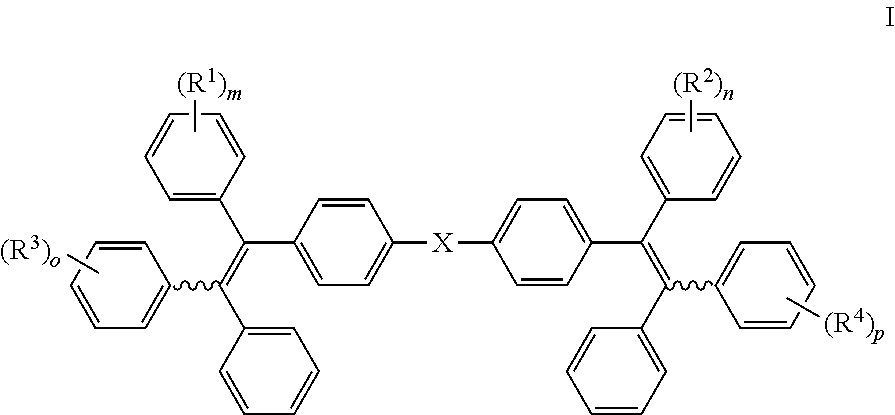
wherein,
X represents an acceptor moiety;
R1 and R2 independently represent OR5 or C1-21 alkyl;
R3 and R4 independently represent OR6 or C1-21 alkyl;
R5 and R6 independently represent C1-21 alkyl;
m and n represent 0 or 1; and
o and p represent 0 or 1, provided that:
-
- when m and n represent 0, o and p represent 1; and
- when o and p represent 0, m and n represent 1.


where each wavy line represents a point of attachment to the rest of the compound, and R7 represents C1-21 alkyl.

where R1 to R4, m, n, o and p are as defined hereinbefore (including any technically sensible variation thereof).

wherein R1 and R2 are independently selected from the group consisting of C1-21; C2-21; C3-21; C5-21; C5-19; C5-17; C5-15; C5-13; C5-11; C6-11; and C6-10 alkyl; or R5;
R3, and R4 are independently selected from the group consisting of C1-21; C2-21, C3-21, C5-21, C5-19, C5-17, C5-15, C5-13, C5-11, C6-11, and C6-10 alkyl; or R6; and
R5 and/or R6 for each instance is independently selected from the group consisting of n-C1-21, n-C2-21; n-C3-21; n-C5-21; n-C5-19; n-C5-17; n-C5-15; n-C5-13; n-C5-11; n-C6-11; and n-C6-10 alkyl.


For example, the compound of structural formula I or II may be compound (i), (iii) or (v) of the list above.
-
- (a) a fluorescence emission peak at from around 800 nm to 820 nm (e.g. from 801 nm to 815 nm); and/or
- (b) a quantum yield of from 2% to 10%; and/or
- (c) a Stokes shift of greater than or equal to 100 nm (e.g. from 100 nm to 200 nm).
-
- (a) a compound of formula I (or II), fluorescent nanodots or a pharmaceutical composition as described hereinbefore for use as an imaging agent (e.g. in fluorescence imaging) for detecting cancer cells in a subject;
- (b) a compound of formula I (or II), fluorescent nanodots or a pharmaceutical composition as described hereinbefore for use in the preparation of an in vivo imaging agent for detecting cancer cells in a subject;
- (c) a method for detecting cancer cells in a subject comprising administering an effective amount of a compound of formula I (or II), fluorescent nanodots or a pharmaceutical composition as described hereinbefore, and imaging the subject with a molecular imaging device to detect the compound or composition in the subject.
-
- (a) the compound, nanodots or composition may specifically accumulate in cancer cells relative to non-cancer cells; and/or
- (b) detection of the compound, nanodots or composition in an organ of the subject may be an indication that cancers cells are present in the organ; and/or
- (c) the cancer cells may be lung cancer, breast cancer, prostate cancer, cervical cancer, pancreatic cancer, colon cancer, ovarian cancer, stomach cancer, esophagus cancer, skin cancer, heart cancer, liver cancer, bronchial cancer, testicular cancer, kidney cancer, bladder cancer, spleen cancer, thymus cancer, thyroid cancer, brain cancer, or gall bladder cancer cells; and/or
- (d) the compound, nanodots or composition may be detected using an optical imaging device.
| Feature | Benefit/Advantage |
| A |
1. The absorption profiles can be |
| to produce far-red excitable | controlled by choosing appropriate |
| near infrared fluorescent | acceptor units. |
| molecules with aggregation- | 2. The emission maxima of the obtained |
| induced emission (AIE) | chromophores can be tuned by |
| characteristics. | changing the number of the |
| substituted chains. | |
| 3. The AIE properties can be modulated | |
| by simply changing the position and | |
| length of substituted chain on | |
| peripheral TPE blocks. | |
| NIR fluorescence imaging using | 1. Far-red excitable near infrared |
| the AIE-dots based on these | fluorescent AIE-dots. |
| obtained chromophores can be | 2. High brightness and excellent |
| applied to accurate tumor | biocompatibility. |
| detection and resection. | 3. High tumor-to-normal tissue ratio |
| value and accurate tumor | |
| identification ability. | |
Claims (14)


Applications Claiming Priority (3)
| Application Number | Priority Date | Filing Date | Title |
|---|---|---|---|
| SG10201606719P | 2016-08-12 | ||
| SG10201606719P | 2016-08-12 | ||
| PCT/SG2017/050399 WO2018030957A1 (en) | 2016-08-12 | 2017-08-10 | Methods and compositions for near infrared fluorescent nanodots with aggregation-induced emission characteristics |
Publications (2)
| Publication Number | Publication Date |
|---|---|
| US20190358350A1 US20190358350A1 (en) | 2019-11-28 |
| US11173217B2 true US11173217B2 (en) | 2021-11-16 |
Family
ID=61163125
Family Applications (1)
| Application Number | Title | Priority Date | Filing Date |
|---|---|---|---|
| US16/324,851 Active US11173217B2 (en) | 2016-08-12 | 2017-08-10 | Methods and compositions for near infrared fluorescent nanodots with aggregation-induced emission characteristics |
Country Status (2)
| Country | Link |
|---|---|
| US (1) | US11173217B2 (en) |
| WO (1) | WO2018030957A1 (en) |
Families Citing this family (10)
| Publication number | Priority date | Publication date | Assignee | Title |
|---|---|---|---|---|
| CN109476997B (en) * | 2016-07-19 | 2022-08-23 | 默克专利股份有限公司 | Liquid-crystalline medium |
| CN110787305B (en) * | 2018-07-31 | 2022-05-03 | 复旦大学 | An albumin nano-formulation containing a donor-acceptor-like near-infrared region II fluorescent molecule containing an aggregation-induced luminescent group |
| CN110845418B (en) * | 2018-08-20 | 2022-12-16 | 香港科技大学深圳研究院 | Compound based on quinoid electron-withdrawing group type and preparation method and application thereof |
| CN109776483B (en) * | 2019-03-01 | 2021-04-20 | 华南师范大学 | Tetraphenyl ethylene macrocyclic compound with strong fluorescence discoloration performance, and synthetic method and application thereof |
| CN112608217B (en) * | 2020-12-28 | 2022-04-22 | 华南理工大学 | Assembly and regulation fluorescence-enhanced aggregation-induced emission material, micro-nanosphere and preparation method and application |
| CN112980029A (en) * | 2021-02-07 | 2021-06-18 | 浙江清华柔性电子技术研究院 | Oxygen sensing film and manufacturing method thereof |
| CN114316084B (en) * | 2021-12-15 | 2022-10-11 | 武汉大学 | AIE functionalized and fluorescently traceable modified chitin material, preparation method and application |
| CN114231272B (en) * | 2021-12-17 | 2023-07-04 | 华中科技大学 | Near infrared II region nano probe for liver imaging and preparation and application thereof |
| CN115029324B (en) * | 2022-07-08 | 2023-06-06 | 西南交通大学 | Fluorescent covalent labeling method for phage, phage with fluorescent label and application thereof |
| CN118638133B (en) * | 2024-05-20 | 2025-03-25 | 河北博伦特药业有限公司 | A near-infrared photothermal agent and its preparation method and application |
Citations (6)
| Publication number | Priority date | Publication date | Assignee | Title |
|---|---|---|---|---|
| CN102276414A (en) | 2011-04-28 | 2011-12-14 | 中国科学院理化技术研究所 | Star-shaped tetraarylethene compound and preparation method and application thereof |
| US20120237964A1 (en) | 2011-03-17 | 2012-09-20 | The Hong Kong University Of Science And Technology | Luminogen compounds and the use of the same for biosensing and cellular imaging |
| WO2013029340A9 (en) | 2011-09-01 | 2013-07-11 | The Hong Kong University Of Science And Technology | Biocompatible nanoparticles with aggregation induced emission characteristics as fluorescent bioprobes and methods of using the same for in vitro and in vivo imaging |
| CN103788940A (en) | 2012-11-02 | 2014-05-14 | 国家纳米科学中心 | Aggregation-induced emission fluorescent molecule as well as preparation method and fluorescent dye composition, and application of aggregation-induced emission fluorescent molecule and fluorescent dye composition in mitochondria dyeing |
| US20140212359A1 (en) | 2013-01-29 | 2014-07-31 | The Hong Kong University Of Science And Technology | Photostable aie luminogens for specific mitochondrial imaging and its method of manufacturing thereof |
| WO2015163817A1 (en) | 2014-04-25 | 2015-10-29 | National University Of Singapore | Polymers and oligomers with aggregation-induced emission characteristics for imaging and image-guided therapy |
-
2017
- 2017-08-10 WO PCT/SG2017/050399 patent/WO2018030957A1/en not_active Ceased
- 2017-08-10 US US16/324,851 patent/US11173217B2/en active Active
Patent Citations (7)
| Publication number | Priority date | Publication date | Assignee | Title |
|---|---|---|---|---|
| US20120237964A1 (en) | 2011-03-17 | 2012-09-20 | The Hong Kong University Of Science And Technology | Luminogen compounds and the use of the same for biosensing and cellular imaging |
| CN102276414A (en) | 2011-04-28 | 2011-12-14 | 中国科学院理化技术研究所 | Star-shaped tetraarylethene compound and preparation method and application thereof |
| WO2013029340A9 (en) | 2011-09-01 | 2013-07-11 | The Hong Kong University Of Science And Technology | Biocompatible nanoparticles with aggregation induced emission characteristics as fluorescent bioprobes and methods of using the same for in vitro and in vivo imaging |
| US20140328764A1 (en) | 2011-09-01 | 2014-11-06 | National University Of Singapore | Biocompatible Nanoparticles with Aggregation Induced Emission Characteristics as Fluorescent Bioprobes and Methods of Using the Same for In Vitro and In Vivo Imaging |
| CN103788940A (en) | 2012-11-02 | 2014-05-14 | 国家纳米科学中心 | Aggregation-induced emission fluorescent molecule as well as preparation method and fluorescent dye composition, and application of aggregation-induced emission fluorescent molecule and fluorescent dye composition in mitochondria dyeing |
| US20140212359A1 (en) | 2013-01-29 | 2014-07-31 | The Hong Kong University Of Science And Technology | Photostable aie luminogens for specific mitochondrial imaging and its method of manufacturing thereof |
| WO2015163817A1 (en) | 2014-04-25 | 2015-10-29 | National University Of Singapore | Polymers and oligomers with aggregation-induced emission characteristics for imaging and image-guided therapy |
Non-Patent Citations (15)
| Title |
|---|
| Azael Gomez-Duran et al., "Effect of AIE Substituents on the Fluorescence of Tetraphenylethene-Containing BODIPY Derivatives," ACS Appl. Mater. Interfaces, 7, pp. 15168-15176 (2015). |
| Du, X. et al., "Efficient Non-doped Near Infrared Organic Light-Emitting Devices Based on Fluorophores with Aggregation-Induced Emission Enhancement," Chemistry of Materials (May 22, 2012); vol. 24, No. 11, pp. 2178-2185. |
| Du, Xiaobo. Efficient Non-doped Near Infrared Organic Light-Emitting Devices Based on Fluorophores with Aggregation-Induced Emission Enhancement. Chem. Mater. 24, 2012, 2178-2185. * |
| International Preliminary Report on Patentability corresponding to PCT/SG2017/050399 dated Feb. 12, 2019; 7 pages. |
| International Search Report corresponding to PCT/SG2017/050399 dated Nov. 3, 2017; 6 pages. |
| Jana, D. et al., "Pyridine-cored V-shaped Tr-conjugated oligomers: synthesis and optical properties," Tetrahedron (Jun. 29, 2012); vol. 68, No. 36, pp. 7309-7316. |
| Jana, D. et al., "Synthesis of gem-tetraphenylethylene oligomers utilizing Suzuki reaction and their aggregation properties," Dyes and Pigments (Jul. 15, 2013); vol. 99, No. 3, pp. 740-747. |
| Li et al., "Biocompatible organic dots with aggregation-induced emission for in vitro and in vivo fluorescence imaging," Sci. China Chem., 56, pp. 1228-1233 (2013). |
| Li et al., "Synthesis and Characterization of Near-Infrared Absorbing and Fluorescent Liquid-Crystal Chromophores," Organic Letters, 10(17), pp. 3785-3787 (2008). |
| Qian et al., "Simple and Efficient Near-Infrared Organic Chromophores for Light-Emitting Diodes with Single Electroluminescent Emission above 1000 nm,"Adv. Mater., 21, pp. 111-116 (2009). |
| Rananaware et al., "Construction of a highly efficient near-IR solid emitter based on naphthalene diimide with AIEactive tetraphenylethene periphery," RSC Adv., 6, pp. 16250-16255 (2016). |
| Wan, Q. et al., "Preparation of Ultrabright AIE Nanoprobes via Dynamic Bonds," Tetrahedron (Sep. 25, 2015); vol. 71, No. 46, pp. 8791-8797. |
| Wang and Yan, "Superior asymmetric supercapacitor based on Ni-Co oxide nanosheets and carbon nanorods," Scientific Reports 4(3712), pp. 1-9 (2014). |
| Wang et al., "Red emissive AIE nanodots with high two-photon absorption efficiency at 1040 nm for deep-tissue in vivo imaging," Biomedical Optics Express, 6(10), pp. 3783-3794 (2015). |
| Written Opinion of the International Searching Authority corresponding to PCT/SG2017/050399 completed Oct. 18, 2017; 6 pages. |
Also Published As
| Publication number | Publication date |
|---|---|
| WO2018030957A1 (en) | 2018-02-15 |
| US20190358350A1 (en) | 2019-11-28 |
Similar Documents
| Publication | Publication Date | Title |
|---|---|---|
| US11173217B2 (en) | Methods and compositions for near infrared fluorescent nanodots with aggregation-induced emission characteristics | |
| US12162889B2 (en) | Luminogens for biological applications | |
| Qi et al. | Dragonfly-shaped near-infrared AIEgen with optimal fluorescence brightness for precise image-guided cancer surgery | |
| Qin et al. | Biocompatible nanoparticles with aggregation‐induced emission characteristics as far‐red/near‐infrared fluorescent bioprobes for in vitro and in vivo imaging applications | |
| EP2251043B1 (en) | Nanoparticles of light emissive polymers and preparation method thereof | |
| Wang et al. | Ultra bright red AIE dots for cytoplasm and nuclear imaging | |
| US20150175747A1 (en) | Highly Emissive Far-Red/Near-Infrared Fluorescent Conjugated Polymer-Based Nanoparticles | |
| WO2017080449A1 (en) | Red fluorescent aiegens | |
| CN113307818B (en) | Fluorescent probe with fluorescence imaging and photodynamic functions, nano preparation thereof and preparation method | |
| Gan et al. | Triphenylamine isophorone derivatives with two photon absorption: Photo-physical property, DFT study and bio-imaging | |
| CN113336743B (en) | Compound with active and passive dual targeting, pharmaceutical composition and application thereof | |
| Li et al. | Near-infrared-emitting AIE multinuclear cationic Ir (III) complex-assembled nanoparticles for photodynamic therapy | |
| US8134017B1 (en) | Compound and use thereof | |
| Zhang et al. | Near-infrared-emitting difluoroboron β-diketonate dye with AIE characteristics for cellular imaging | |
| CN111742034A (en) | Cyclene-encapsulated AIE nanodots with high nonradiative attenuation suppression for enhanced in vivo cancer phototherapy | |
| Yan et al. | Self-assembling nonconjugated poly (amide-imide) into thermoresponsive nanovesicles with unexpected red fluorescence for bioimaging | |
| Kong et al. | Tunable two-photon absorption near-infrared materials containing different electron-donors and a π-bridge center with applications in bioimaging in live cells | |
| CN109180715B (en) | A kind of boron-dipyrrole methylene derivative, nanoparticle, preparation method and application | |
| CN117682984A (en) | AIE active photosensitizer and preparation method and application thereof | |
| CN105440277A (en) | Amphipathic AIE (aggregation-induced emission) molecule, synthetic method thereof, autofluorescence nano-micelle and application | |
| CN111793371A (en) | A kind of 3,5-position asymmetric modified BODIPY near-infrared fluorescent dye and preparation method thereof | |
| CN115490846A (en) | Water-soluble near-infrared two-region aggregation-induced luminescent material and preparation method and application thereof | |
| Liu et al. | Synthesis and optical properties of tetraphenylmethane-based tetrahedral fluorescent compounds and their water-soluble PEG-linked polymers | |
| CN104311822B (en) | The terpolymer and its purposes as bi-directional conversion fluorescent material and cancer therapy drug of a kind of Cabbeen diazonium compound olefine aldehydr | |
| Bremond et al. | 2-Phenylbenzoxazole derivatives as solid-state fluorescence emitters: Influence of steric hindrance and hydrogen bonding on the optical properties |
Legal Events
| Date | Code | Title | Description |
|---|---|---|---|
| FEPP | Fee payment procedure |
Free format text: ENTITY STATUS SET TO UNDISCOUNTED (ORIGINAL EVENT CODE: BIG.); ENTITY STATUS OF PATENT OWNER: SMALL ENTITY |
|
| FEPP | Fee payment procedure |
Free format text: ENTITY STATUS SET TO SMALL (ORIGINAL EVENT CODE: SMAL); ENTITY STATUS OF PATENT OWNER: SMALL ENTITY |
|
| AS | Assignment |
Owner name: NATIONAL UNIVERSITY OF SINGAPORE, SINGAPORE Free format text: ASSIGNMENT OF ASSIGNORS INTEREST;ASSIGNORS:LIU, BIN;LIU, JIE;REEL/FRAME:048970/0601 Effective date: 20170829 |
|
| STPP | Information on status: patent application and granting procedure in general |
Free format text: NON FINAL ACTION MAILED |
|
| STPP | Information on status: patent application and granting procedure in general |
Free format text: RESPONSE TO NON-FINAL OFFICE ACTION ENTERED AND FORWARDED TO EXAMINER |
|
| STPP | Information on status: patent application and granting procedure in general |
Free format text: NON FINAL ACTION MAILED |
|
| STPP | Information on status: patent application and granting procedure in general |
Free format text: RESPONSE TO NON-FINAL OFFICE ACTION ENTERED AND FORWARDED TO EXAMINER |
|
| STPP | Information on status: patent application and granting procedure in general |
Free format text: FINAL REJECTION MAILED |
|
| STPP | Information on status: patent application and granting procedure in general |
Free format text: RESPONSE AFTER FINAL ACTION FORWARDED TO EXAMINER |
|
| STPP | Information on status: patent application and granting procedure in general |
Free format text: NOTICE OF ALLOWANCE MAILED -- APPLICATION RECEIVED IN OFFICE OF PUBLICATIONS |
|
| STPP | Information on status: patent application and granting procedure in general |
Free format text: DOCKETED NEW CASE - READY FOR EXAMINATION |
|
| STPP | Information on status: patent application and granting procedure in general |
Free format text: NOTICE OF ALLOWANCE MAILED -- APPLICATION RECEIVED IN OFFICE OF PUBLICATIONS |
|
| STPP | Information on status: patent application and granting procedure in general |
Free format text: PUBLICATIONS -- ISSUE FEE PAYMENT VERIFIED |
|
| STCF | Information on status: patent grant |
Free format text: PATENTED CASE |
|
| MAFP | Maintenance fee payment |
Free format text: PAYMENT OF MAINTENANCE FEE, 4TH YR, SMALL ENTITY (ORIGINAL EVENT CODE: M2551); ENTITY STATUS OF PATENT OWNER: SMALL ENTITY Year of fee payment: 4 |