US11162029B2 - Liquid crystal composition, manufacturing method thereof, display panel and display device - Google Patents
Liquid crystal composition, manufacturing method thereof, display panel and display device Download PDFInfo
- Publication number
- US11162029B2 US11162029B2 US16/387,004 US201916387004A US11162029B2 US 11162029 B2 US11162029 B2 US 11162029B2 US 201916387004 A US201916387004 A US 201916387004A US 11162029 B2 US11162029 B2 US 11162029B2
- Authority
- US
- United States
- Prior art keywords
- liquid crystal
- mass percentage
- crystal composition
- present disclosure
- defoaming
- Prior art date
- Legal status (The legal status is an assumption and is not a legal conclusion. Google has not performed a legal analysis and makes no representation as to the accuracy of the status listed.)
- Expired - Fee Related, expires
Links
- FIQVJOWNNABYIC-UHFFFAOYSA-N CCCC1CCC(C2=CC=C(C3=CC=C(OCC)C=C3)C=C2)CC1 Chemical compound CCCC1CCC(C2=CC=C(C3=CC=C(OCC)C=C3)C=C2)CC1 FIQVJOWNNABYIC-UHFFFAOYSA-N 0.000 description 11
- OXBRRUNAAVNTOZ-UHFFFAOYSA-N CCCC1CCC(C2=CC=C(OCC)C=C2)CC1 Chemical compound CCCC1CCC(C2=CC=C(OCC)C=C2)CC1 OXBRRUNAAVNTOZ-UHFFFAOYSA-N 0.000 description 10
- QPIUMCSYBYOQSV-UHFFFAOYSA-N C=CC1CCC(C2CCC(C3=CC=C(OCC)C=C3)CC2)CC1 Chemical compound C=CC1CCC(C2CCC(C3=CC=C(OCC)C=C3)CC2)CC1 QPIUMCSYBYOQSV-UHFFFAOYSA-N 0.000 description 8
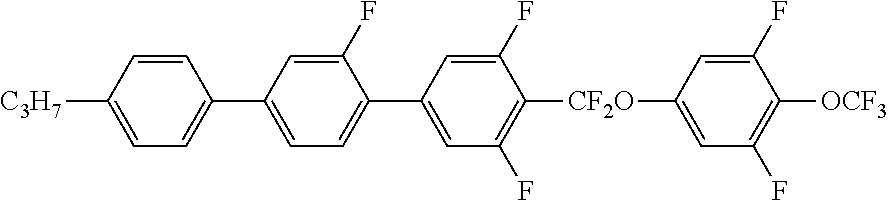
- AWTRXYLOCLICEJ-UHFFFAOYSA-N CCCC1=CC=C(C2=CC=C(C3=CC(F)=C(C(F)(F)OC4=CC(F)=C(OC(F)(F)F)C(F)=C4)C(F)=C3)C(F)=C2)C=C1 Chemical compound CCCC1=CC=C(C2=CC=C(C3=CC(F)=C(C(F)(F)OC4=CC(F)=C(OC(F)(F)F)C(F)=C4)C(F)=C3)C(F)=C2)C=C1 AWTRXYLOCLICEJ-UHFFFAOYSA-N 0.000 description 8
- IGPSRWWBYLJJKK-UHFFFAOYSA-N CCCC1=CC=C(C2=CC=C(C3=CC(F)=C(OC(F)(F)F)C(F)=C3)C(F)=C2)C=C1 Chemical compound CCCC1=CC=C(C2=CC=C(C3=CC(F)=C(OC(F)(F)F)C(F)=C3)C(F)=C2)C=C1 IGPSRWWBYLJJKK-UHFFFAOYSA-N 0.000 description 8
- XHXFGIMHPWXQJT-UHFFFAOYSA-N CCCC1CCC(C2=CC=C(C3=CC=C(C4=CC(F)=C(OC(F)(F)F)C(F)=C4)C(F)=C3)C=C2)CC1 Chemical compound CCCC1CCC(C2=CC=C(C3=CC=C(C4=CC(F)=C(OC(F)(F)F)C(F)=C4)C(F)=C3)C=C2)CC1 XHXFGIMHPWXQJT-UHFFFAOYSA-N 0.000 description 7
- KHULSSGLCRYRTK-CIZYBWJASA-N *.B.C.C.C1CCCCC1.C1CCCCC1.C1CCCCC1.C1CCCCC1.C1CCCCC1.[2HH] Chemical compound *.B.C.C.C1CCCCC1.C1CCCCC1.C1CCCCC1.C1CCCCC1.C1CCCCC1.[2HH] KHULSSGLCRYRTK-CIZYBWJASA-N 0.000 description 6
- 0 *.B.C.C.[1*]C1CCC(C2CCC(C3CCC(CC4CCC(C5CCC(C)CC5)CC4)CC3)CC2)CC1.[2HH] Chemical compound *.B.C.C.[1*]C1CCC(C2CCC(C3CCC(CC4CCC(C5CCC(C)CC5)CC4)CC3)CC2)CC1.[2HH] 0.000 description 6
- HKHAZWWPCQQAJK-UHFFFAOYSA-N CCCC1=CC=C(C2=CC=C(OCC)C=C2)C=C1 Chemical compound CCCC1=CC=C(C2=CC=C(OCC)C=C2)C=C1 HKHAZWWPCQQAJK-UHFFFAOYSA-N 0.000 description 6
- CONVBEDXTVAUGB-UHFFFAOYSA-N CCCC1CCC(C2=CC(F)=C(C(F)(F)OC3=CC=C(OCC)C=C3)C(F)=C2)CC1 Chemical compound CCCC1CCC(C2=CC(F)=C(C(F)(F)OC3=CC=C(OCC)C=C3)C(F)=C2)CC1 CONVBEDXTVAUGB-UHFFFAOYSA-N 0.000 description 6
- KWUSKGVYEMVEFR-UHFFFAOYSA-N CCCC1CCC(C2=CC=C(C(F)(F)OC3=CC=C(OCC)C=C3)C=C2)CC1 Chemical compound CCCC1CCC(C2=CC=C(C(F)(F)OC3=CC=C(OCC)C=C3)C=C2)CC1 KWUSKGVYEMVEFR-UHFFFAOYSA-N 0.000 description 6
- YAGVCMSXMAEADV-UHFFFAOYSA-N CCCC1CCC(C2=CC=C(C3=CC=C(OC(F)(F)F)C=C3)C=C2)CC1 Chemical compound CCCC1CCC(C2=CC=C(C3=CC=C(OC(F)(F)F)C=C3)C=C2)CC1 YAGVCMSXMAEADV-UHFFFAOYSA-N 0.000 description 6
- VHWNKXZABIKDPL-UHFFFAOYSA-N CCCC1=CC=C(C2=CC=C(C3=CC=C(OC(F)(F)F)C=C3)C=C2)C=C1 Chemical compound CCCC1=CC=C(C2=CC=C(C3=CC=C(OC(F)(F)F)C=C3)C=C2)C=C1 VHWNKXZABIKDPL-UHFFFAOYSA-N 0.000 description 5
- KUHAQOWPMZIQHU-UHFFFAOYSA-N CCCC1=CC=C(CCC2=CC=C(C3=CC=C(OCC)C=C3)C=C2)C=C1 Chemical compound CCCC1=CC=C(CCC2=CC=C(C3=CC=C(OCC)C=C3)C=C2)C=C1 KUHAQOWPMZIQHU-UHFFFAOYSA-N 0.000 description 5
- IZDFMBUSHAOFAO-UHFFFAOYSA-N CCCC1CCC(C2CCC(C3=CC=C(C4=CC(F)=C(OC(F)(F)F)C(F)=C4)C(F)=C3)CC2)CC1 Chemical compound CCCC1CCC(C2CCC(C3=CC=C(C4=CC(F)=C(OC(F)(F)F)C(F)=C4)C(F)=C3)CC2)CC1 IZDFMBUSHAOFAO-UHFFFAOYSA-N 0.000 description 5
- CYMJCECBIVYOIL-UHFFFAOYSA-N C1=CC=CC=C1.C1CCCCC1.FC1=CC=CC(F)=C1.FC1=CC=CC=C1.FC1CCCC(F)C1.FC1CCCCC1 Chemical compound C1=CC=CC=C1.C1CCCCC1.FC1=CC=CC(F)=C1.FC1=CC=CC=C1.FC1CCCC(F)C1.FC1CCCCC1 CYMJCECBIVYOIL-UHFFFAOYSA-N 0.000 description 3
- XQDDHYQVQLBKDS-UHFFFAOYSA-N C=CC1CCC(C2=CC=C(C3=CC=C(OCC)C=C3)C=C2)CC1 Chemical compound C=CC1CCC(C2=CC=C(C3=CC=C(OCC)C=C3)C=C2)CC1 XQDDHYQVQLBKDS-UHFFFAOYSA-N 0.000 description 3
- QXSAWMOMVOMWLV-UHFFFAOYSA-N CCCC1=CC=C(C2=CC=C(C3=CC(F)=C(C(F)(F=O)C4=CC(F)=C(OC(F)(F)F)C(F)=C4)C(F)=C3)C(F)=C2)C=C1 Chemical compound CCCC1=CC=C(C2=CC=C(C3=CC(F)=C(C(F)(F=O)C4=CC(F)=C(OC(F)(F)F)C(F)=C4)C(F)=C3)C(F)=C2)C=C1 QXSAWMOMVOMWLV-UHFFFAOYSA-N 0.000 description 3
- UHHUIEWXGWKABJ-UHFFFAOYSA-N CCCC1CCC(C2=CC=C(C(F)(F)OC3=CC(F)=C(OCC)C(F)=C3)C=C2)CC1 Chemical compound CCCC1CCC(C2=CC=C(C(F)(F)OC3=CC(F)=C(OCC)C(F)=C3)C=C2)CC1 UHHUIEWXGWKABJ-UHFFFAOYSA-N 0.000 description 3
- XJAZUFADNSJIQS-UHFFFAOYSA-N CCCC1CCC(C2=CC=C(C(F)(F=O)C3=CC=C(OCC)C=C3)C=C2)CC1 Chemical compound CCCC1CCC(C2=CC=C(C(F)(F=O)C3=CC=C(OCC)C=C3)C=C2)CC1 XJAZUFADNSJIQS-UHFFFAOYSA-N 0.000 description 3
- FXFZNZIPWAAKSA-UHFFFAOYSA-N CCCC1CCC(C2CCC(C3=CC=C(OCC)C=C3)CC2)CC1 Chemical compound CCCC1CCC(C2CCC(C3=CC=C(OCC)C=C3)CC2)CC1 FXFZNZIPWAAKSA-UHFFFAOYSA-N 0.000 description 3
- UVFHSPLUIOMOIO-UHFFFAOYSA-N C1=CC=CC=C1.C1CCCCC1.CC1=CC=CC(F)=C1.CC1CCCC(F)C1.CC1CCCCC1.FC1=CC=CC=C1 Chemical compound C1=CC=CC=C1.C1CCCCC1.CC1=CC=CC(F)=C1.CC1CCCC(F)C1.CC1CCCCC1.FC1=CC=CC=C1 UVFHSPLUIOMOIO-UHFFFAOYSA-N 0.000 description 2
- UCOKAHXKNUEDPE-UHFFFAOYSA-N CCCC1CCC(C2=CC(F)=C(C(F)(F=O)C3=CC=C(OCC)C=C3)C(F)=C2)CC1 Chemical compound CCCC1CCC(C2=CC(F)=C(C(F)(F=O)C3=CC=C(OCC)C=C3)C(F)=C2)CC1 UCOKAHXKNUEDPE-UHFFFAOYSA-N 0.000 description 2
- YBPXWWAJMUUUAV-UHFFFAOYSA-N CCCC1=CC=C(C2=CC=C(C3=CC(F)=C(F)C(F)=C3)C(F)=C2)C=C1 Chemical compound CCCC1=CC=C(C2=CC=C(C3=CC(F)=C(F)C(F)=C3)C(F)=C2)C=C1 YBPXWWAJMUUUAV-UHFFFAOYSA-N 0.000 description 1
- QHAFDBWJVZOZGH-UHFFFAOYSA-N CCCC1=CC=C(CCC2=CC=C(C3=CC=C(CC)C=C3)C=C2)C=C1 Chemical compound CCCC1=CC=C(CCC2=CC=C(C3=CC=C(CC)C=C3)C=C2)C=C1 QHAFDBWJVZOZGH-UHFFFAOYSA-N 0.000 description 1
- MPGQGKDTQHTGNE-UHFFFAOYSA-N CCCC1CCC(C2=CC=C(C(F)(F)OC3=CC(F)=C(F)C(F)=C3)C=C2)CC1 Chemical compound CCCC1CCC(C2=CC=C(C(F)(F)OC3=CC(F)=C(F)C(F)=C3)C=C2)CC1 MPGQGKDTQHTGNE-UHFFFAOYSA-N 0.000 description 1
- XHAQVTQQTINORH-UHFFFAOYSA-N CCCC1CCC(C2=CC=C(C3=CC=C(C(F)(F)F)C=C3)C=C2)CC1 Chemical compound CCCC1CCC(C2=CC=C(C3=CC=C(C(F)(F)F)C=C3)C=C2)CC1 XHAQVTQQTINORH-UHFFFAOYSA-N 0.000 description 1
- HTJAWOSBGHEXBU-UHFFFAOYSA-N CCCC1CCC(C2=CC=C(C3=CC=C(C4=CC(F)=C(C(F)(F)F)C(F)=C4)C(F)=C3)C=C2)CC1 Chemical compound CCCC1CCC(C2=CC=C(C3=CC=C(C4=CC(F)=C(C(F)(F)F)C(F)=C4)C(F)=C3)C=C2)CC1 HTJAWOSBGHEXBU-UHFFFAOYSA-N 0.000 description 1
- DOALOUQODWWGEZ-UHFFFAOYSA-N CCCC1CCC(C2=CC=C(C3=CC=C(CC)C=C3)C=C2)CC1 Chemical compound CCCC1CCC(C2=CC=C(C3=CC=C(CC)C=C3)C=C2)CC1 DOALOUQODWWGEZ-UHFFFAOYSA-N 0.000 description 1
- RHJZNALCKPDGPQ-UHFFFAOYSA-N CCCC1CCC(C2CCC(C3=CC=C(C4=CC(F)=C(F)C(F)=C4)C(F)=C3)CC2)CC1 Chemical compound CCCC1CCC(C2CCC(C3=CC=C(C4=CC(F)=C(F)C(F)=C4)C(F)=C3)CC2)CC1 RHJZNALCKPDGPQ-UHFFFAOYSA-N 0.000 description 1
Images

Classifications
-
- C—CHEMISTRY; METALLURGY
- C09—DYES; PAINTS; POLISHES; NATURAL RESINS; ADHESIVES; COMPOSITIONS NOT OTHERWISE PROVIDED FOR; APPLICATIONS OF MATERIALS NOT OTHERWISE PROVIDED FOR
- C09K—MATERIALS FOR MISCELLANEOUS APPLICATIONS, NOT PROVIDED FOR ELSEWHERE
- C09K19/00—Liquid crystal materials
- C09K19/04—Liquid crystal materials characterised by the chemical structure of the liquid crystal components, e.g. by a specific unit
- C09K19/42—Mixtures of liquid crystal compounds covered by two or more of the preceding groups C09K19/06 - C09K19/40
- C09K19/44—Mixtures of liquid crystal compounds covered by two or more of the preceding groups C09K19/06 - C09K19/40 containing compounds with benzene rings directly linked
-
- C—CHEMISTRY; METALLURGY
- C09—DYES; PAINTS; POLISHES; NATURAL RESINS; ADHESIVES; COMPOSITIONS NOT OTHERWISE PROVIDED FOR; APPLICATIONS OF MATERIALS NOT OTHERWISE PROVIDED FOR
- C09K—MATERIALS FOR MISCELLANEOUS APPLICATIONS, NOT PROVIDED FOR ELSEWHERE
- C09K19/00—Liquid crystal materials
- C09K19/04—Liquid crystal materials characterised by the chemical structure of the liquid crystal components, e.g. by a specific unit
- C09K19/06—Non-steroidal liquid crystal compounds
- C09K19/08—Non-steroidal liquid crystal compounds containing at least two non-condensed rings
- C09K19/10—Non-steroidal liquid crystal compounds containing at least two non-condensed rings containing at least two benzene rings
- C09K19/12—Non-steroidal liquid crystal compounds containing at least two non-condensed rings containing at least two benzene rings at least two benzene rings directly linked, e.g. biphenyls
-
- C—CHEMISTRY; METALLURGY
- C09—DYES; PAINTS; POLISHES; NATURAL RESINS; ADHESIVES; COMPOSITIONS NOT OTHERWISE PROVIDED FOR; APPLICATIONS OF MATERIALS NOT OTHERWISE PROVIDED FOR
- C09K—MATERIALS FOR MISCELLANEOUS APPLICATIONS, NOT PROVIDED FOR ELSEWHERE
- C09K19/00—Liquid crystal materials
- C09K19/04—Liquid crystal materials characterised by the chemical structure of the liquid crystal components, e.g. by a specific unit
- C09K19/06—Non-steroidal liquid crystal compounds
- C09K19/08—Non-steroidal liquid crystal compounds containing at least two non-condensed rings
- C09K19/10—Non-steroidal liquid crystal compounds containing at least two non-condensed rings containing at least two benzene rings
- C09K19/14—Non-steroidal liquid crystal compounds containing at least two non-condensed rings containing at least two benzene rings linked by a carbon chain
-
- C—CHEMISTRY; METALLURGY
- C09—DYES; PAINTS; POLISHES; NATURAL RESINS; ADHESIVES; COMPOSITIONS NOT OTHERWISE PROVIDED FOR; APPLICATIONS OF MATERIALS NOT OTHERWISE PROVIDED FOR
- C09K—MATERIALS FOR MISCELLANEOUS APPLICATIONS, NOT PROVIDED FOR ELSEWHERE
- C09K19/00—Liquid crystal materials
- C09K19/04—Liquid crystal materials characterised by the chemical structure of the liquid crystal components, e.g. by a specific unit
- C09K19/06—Non-steroidal liquid crystal compounds
- C09K19/08—Non-steroidal liquid crystal compounds containing at least two non-condensed rings
- C09K19/10—Non-steroidal liquid crystal compounds containing at least two non-condensed rings containing at least two benzene rings
- C09K19/20—Non-steroidal liquid crystal compounds containing at least two non-condensed rings containing at least two benzene rings linked by a chain containing carbon and oxygen atoms as chain links, e.g. esters or ethers
-
- C—CHEMISTRY; METALLURGY
- C09—DYES; PAINTS; POLISHES; NATURAL RESINS; ADHESIVES; COMPOSITIONS NOT OTHERWISE PROVIDED FOR; APPLICATIONS OF MATERIALS NOT OTHERWISE PROVIDED FOR
- C09K—MATERIALS FOR MISCELLANEOUS APPLICATIONS, NOT PROVIDED FOR ELSEWHERE
- C09K19/00—Liquid crystal materials
- C09K19/04—Liquid crystal materials characterised by the chemical structure of the liquid crystal components, e.g. by a specific unit
- C09K19/06—Non-steroidal liquid crystal compounds
- C09K19/08—Non-steroidal liquid crystal compounds containing at least two non-condensed rings
- C09K19/30—Non-steroidal liquid crystal compounds containing at least two non-condensed rings containing saturated or unsaturated non-aromatic rings, e.g. cyclohexane rings
- C09K19/3001—Cyclohexane rings
- C09K19/3003—Compounds containing at least two rings in which the different rings are directly linked (covalent bond)
-
- C—CHEMISTRY; METALLURGY
- C09—DYES; PAINTS; POLISHES; NATURAL RESINS; ADHESIVES; COMPOSITIONS NOT OTHERWISE PROVIDED FOR; APPLICATIONS OF MATERIALS NOT OTHERWISE PROVIDED FOR
- C09K—MATERIALS FOR MISCELLANEOUS APPLICATIONS, NOT PROVIDED FOR ELSEWHERE
- C09K19/00—Liquid crystal materials
- C09K19/04—Liquid crystal materials characterised by the chemical structure of the liquid crystal components, e.g. by a specific unit
- C09K19/06—Non-steroidal liquid crystal compounds
- C09K19/08—Non-steroidal liquid crystal compounds containing at least two non-condensed rings
- C09K19/30—Non-steroidal liquid crystal compounds containing at least two non-condensed rings containing saturated or unsaturated non-aromatic rings, e.g. cyclohexane rings
- C09K19/3001—Cyclohexane rings
- C09K19/3066—Cyclohexane rings in which the rings are linked by a chain containing carbon and oxygen atoms, e.g. esters or ethers
-
- G—PHYSICS
- G02—OPTICS
- G02F—OPTICAL DEVICES OR ARRANGEMENTS FOR THE CONTROL OF LIGHT BY MODIFICATION OF THE OPTICAL PROPERTIES OF THE MEDIA OF THE ELEMENTS INVOLVED THEREIN; NON-LINEAR OPTICS; FREQUENCY-CHANGING OF LIGHT; OPTICAL LOGIC ELEMENTS; OPTICAL ANALOGUE/DIGITAL CONVERTERS
- G02F1/00—Devices or arrangements for the control of the intensity, colour, phase, polarisation or direction of light arriving from an independent light source, e.g. switching, gating or modulating; Non-linear optics
- G02F1/01—Devices or arrangements for the control of the intensity, colour, phase, polarisation or direction of light arriving from an independent light source, e.g. switching, gating or modulating; Non-linear optics for the control of the intensity, phase, polarisation or colour
- G02F1/13—Devices or arrangements for the control of the intensity, colour, phase, polarisation or direction of light arriving from an independent light source, e.g. switching, gating or modulating; Non-linear optics for the control of the intensity, phase, polarisation or colour based on liquid crystals, e.g. single liquid crystal display cells
- G02F1/133—Constructional arrangements; Operation of liquid crystal cells; Circuit arrangements
- G02F1/1333—Constructional arrangements; Manufacturing methods
-
- C—CHEMISTRY; METALLURGY
- C09—DYES; PAINTS; POLISHES; NATURAL RESINS; ADHESIVES; COMPOSITIONS NOT OTHERWISE PROVIDED FOR; APPLICATIONS OF MATERIALS NOT OTHERWISE PROVIDED FOR
- C09K—MATERIALS FOR MISCELLANEOUS APPLICATIONS, NOT PROVIDED FOR ELSEWHERE
- C09K19/00—Liquid crystal materials
- C09K19/04—Liquid crystal materials characterised by the chemical structure of the liquid crystal components, e.g. by a specific unit
- C09K2019/0444—Liquid crystal materials characterised by the chemical structure of the liquid crystal components, e.g. by a specific unit characterized by a linking chain between rings or ring systems, a bridging chain between extensive mesogenic moieties or an end chain group
- C09K2019/0466—Liquid crystal materials characterised by the chemical structure of the liquid crystal components, e.g. by a specific unit characterized by a linking chain between rings or ring systems, a bridging chain between extensive mesogenic moieties or an end chain group the linking chain being a -CF2O- chain
-
- C—CHEMISTRY; METALLURGY
- C09—DYES; PAINTS; POLISHES; NATURAL RESINS; ADHESIVES; COMPOSITIONS NOT OTHERWISE PROVIDED FOR; APPLICATIONS OF MATERIALS NOT OTHERWISE PROVIDED FOR
- C09K—MATERIALS FOR MISCELLANEOUS APPLICATIONS, NOT PROVIDED FOR ELSEWHERE
- C09K19/00—Liquid crystal materials
- C09K19/04—Liquid crystal materials characterised by the chemical structure of the liquid crystal components, e.g. by a specific unit
- C09K19/06—Non-steroidal liquid crystal compounds
- C09K19/08—Non-steroidal liquid crystal compounds containing at least two non-condensed rings
- C09K19/10—Non-steroidal liquid crystal compounds containing at least two non-condensed rings containing at least two benzene rings
- C09K19/12—Non-steroidal liquid crystal compounds containing at least two non-condensed rings containing at least two benzene rings at least two benzene rings directly linked, e.g. biphenyls
- C09K2019/121—Compounds containing phenylene-1,4-diyl (-Ph-)
- C09K2019/122—Ph-Ph
-
- C—CHEMISTRY; METALLURGY
- C09—DYES; PAINTS; POLISHES; NATURAL RESINS; ADHESIVES; COMPOSITIONS NOT OTHERWISE PROVIDED FOR; APPLICATIONS OF MATERIALS NOT OTHERWISE PROVIDED FOR
- C09K—MATERIALS FOR MISCELLANEOUS APPLICATIONS, NOT PROVIDED FOR ELSEWHERE
- C09K19/00—Liquid crystal materials
- C09K19/04—Liquid crystal materials characterised by the chemical structure of the liquid crystal components, e.g. by a specific unit
- C09K19/06—Non-steroidal liquid crystal compounds
- C09K19/08—Non-steroidal liquid crystal compounds containing at least two non-condensed rings
- C09K19/10—Non-steroidal liquid crystal compounds containing at least two non-condensed rings containing at least two benzene rings
- C09K19/12—Non-steroidal liquid crystal compounds containing at least two non-condensed rings containing at least two benzene rings at least two benzene rings directly linked, e.g. biphenyls
- C09K2019/121—Compounds containing phenylene-1,4-diyl (-Ph-)
- C09K2019/123—Ph-Ph-Ph
-
- C—CHEMISTRY; METALLURGY
- C09—DYES; PAINTS; POLISHES; NATURAL RESINS; ADHESIVES; COMPOSITIONS NOT OTHERWISE PROVIDED FOR; APPLICATIONS OF MATERIALS NOT OTHERWISE PROVIDED FOR
- C09K—MATERIALS FOR MISCELLANEOUS APPLICATIONS, NOT PROVIDED FOR ELSEWHERE
- C09K19/00—Liquid crystal materials
- C09K19/04—Liquid crystal materials characterised by the chemical structure of the liquid crystal components, e.g. by a specific unit
- C09K19/06—Non-steroidal liquid crystal compounds
- C09K19/08—Non-steroidal liquid crystal compounds containing at least two non-condensed rings
- C09K19/30—Non-steroidal liquid crystal compounds containing at least two non-condensed rings containing saturated or unsaturated non-aromatic rings, e.g. cyclohexane rings
- C09K19/3001—Cyclohexane rings
- C09K19/3003—Compounds containing at least two rings in which the different rings are directly linked (covalent bond)
- C09K2019/3009—Cy-Ph
-
- C—CHEMISTRY; METALLURGY
- C09—DYES; PAINTS; POLISHES; NATURAL RESINS; ADHESIVES; COMPOSITIONS NOT OTHERWISE PROVIDED FOR; APPLICATIONS OF MATERIALS NOT OTHERWISE PROVIDED FOR
- C09K—MATERIALS FOR MISCELLANEOUS APPLICATIONS, NOT PROVIDED FOR ELSEWHERE
- C09K19/00—Liquid crystal materials
- C09K19/04—Liquid crystal materials characterised by the chemical structure of the liquid crystal components, e.g. by a specific unit
- C09K19/06—Non-steroidal liquid crystal compounds
- C09K19/08—Non-steroidal liquid crystal compounds containing at least two non-condensed rings
- C09K19/30—Non-steroidal liquid crystal compounds containing at least two non-condensed rings containing saturated or unsaturated non-aromatic rings, e.g. cyclohexane rings
- C09K19/3001—Cyclohexane rings
- C09K19/3003—Compounds containing at least two rings in which the different rings are directly linked (covalent bond)
- C09K2019/301—Cy-Cy-Ph
-
- C—CHEMISTRY; METALLURGY
- C09—DYES; PAINTS; POLISHES; NATURAL RESINS; ADHESIVES; COMPOSITIONS NOT OTHERWISE PROVIDED FOR; APPLICATIONS OF MATERIALS NOT OTHERWISE PROVIDED FOR
- C09K—MATERIALS FOR MISCELLANEOUS APPLICATIONS, NOT PROVIDED FOR ELSEWHERE
- C09K19/00—Liquid crystal materials
- C09K19/04—Liquid crystal materials characterised by the chemical structure of the liquid crystal components, e.g. by a specific unit
- C09K19/06—Non-steroidal liquid crystal compounds
- C09K19/08—Non-steroidal liquid crystal compounds containing at least two non-condensed rings
- C09K19/30—Non-steroidal liquid crystal compounds containing at least two non-condensed rings containing saturated or unsaturated non-aromatic rings, e.g. cyclohexane rings
- C09K19/3001—Cyclohexane rings
- C09K19/3003—Compounds containing at least two rings in which the different rings are directly linked (covalent bond)
- C09K2019/3016—Cy-Ph-Ph
-
- C—CHEMISTRY; METALLURGY
- C09—DYES; PAINTS; POLISHES; NATURAL RESINS; ADHESIVES; COMPOSITIONS NOT OTHERWISE PROVIDED FOR; APPLICATIONS OF MATERIALS NOT OTHERWISE PROVIDED FOR
- C09K—MATERIALS FOR MISCELLANEOUS APPLICATIONS, NOT PROVIDED FOR ELSEWHERE
- C09K19/00—Liquid crystal materials
- C09K19/04—Liquid crystal materials characterised by the chemical structure of the liquid crystal components, e.g. by a specific unit
- C09K19/06—Non-steroidal liquid crystal compounds
- C09K19/08—Non-steroidal liquid crystal compounds containing at least two non-condensed rings
- C09K19/30—Non-steroidal liquid crystal compounds containing at least two non-condensed rings containing saturated or unsaturated non-aromatic rings, e.g. cyclohexane rings
- C09K19/3001—Cyclohexane rings
- C09K19/3003—Compounds containing at least two rings in which the different rings are directly linked (covalent bond)
- C09K2019/3019—Cy-Cy-Ph-Ph
-
- C—CHEMISTRY; METALLURGY
- C09—DYES; PAINTS; POLISHES; NATURAL RESINS; ADHESIVES; COMPOSITIONS NOT OTHERWISE PROVIDED FOR; APPLICATIONS OF MATERIALS NOT OTHERWISE PROVIDED FOR
- C09K—MATERIALS FOR MISCELLANEOUS APPLICATIONS, NOT PROVIDED FOR ELSEWHERE
- C09K19/00—Liquid crystal materials
- C09K19/04—Liquid crystal materials characterised by the chemical structure of the liquid crystal components, e.g. by a specific unit
- C09K19/06—Non-steroidal liquid crystal compounds
- C09K19/08—Non-steroidal liquid crystal compounds containing at least two non-condensed rings
- C09K19/30—Non-steroidal liquid crystal compounds containing at least two non-condensed rings containing saturated or unsaturated non-aromatic rings, e.g. cyclohexane rings
- C09K19/3001—Cyclohexane rings
- C09K19/3003—Compounds containing at least two rings in which the different rings are directly linked (covalent bond)
- C09K2019/3025—Cy-Ph-Ph-Ph
-
- G—PHYSICS
- G02—OPTICS
- G02F—OPTICAL DEVICES OR ARRANGEMENTS FOR THE CONTROL OF LIGHT BY MODIFICATION OF THE OPTICAL PROPERTIES OF THE MEDIA OF THE ELEMENTS INVOLVED THEREIN; NON-LINEAR OPTICS; FREQUENCY-CHANGING OF LIGHT; OPTICAL LOGIC ELEMENTS; OPTICAL ANALOGUE/DIGITAL CONVERTERS
- G02F1/00—Devices or arrangements for the control of the intensity, colour, phase, polarisation or direction of light arriving from an independent light source, e.g. switching, gating or modulating; Non-linear optics
- G02F1/01—Devices or arrangements for the control of the intensity, colour, phase, polarisation or direction of light arriving from an independent light source, e.g. switching, gating or modulating; Non-linear optics for the control of the intensity, phase, polarisation or colour
- G02F1/13—Devices or arrangements for the control of the intensity, colour, phase, polarisation or direction of light arriving from an independent light source, e.g. switching, gating or modulating; Non-linear optics for the control of the intensity, phase, polarisation or colour based on liquid crystals, e.g. single liquid crystal display cells
- G02F1/133—Constructional arrangements; Operation of liquid crystal cells; Circuit arrangements
- G02F1/1333—Constructional arrangements; Manufacturing methods
- G02F1/1343—Electrodes
- G02F1/134309—Electrodes characterised by their geometrical arrangement
- G02F1/134363—Electrodes characterised by their geometrical arrangement for applying an electric field parallel to the substrate, i.e. in-plane switching [IPS]
-
- G—PHYSICS
- G02—OPTICS
- G02F—OPTICAL DEVICES OR ARRANGEMENTS FOR THE CONTROL OF LIGHT BY MODIFICATION OF THE OPTICAL PROPERTIES OF THE MEDIA OF THE ELEMENTS INVOLVED THEREIN; NON-LINEAR OPTICS; FREQUENCY-CHANGING OF LIGHT; OPTICAL LOGIC ELEMENTS; OPTICAL ANALOGUE/DIGITAL CONVERTERS
- G02F2201/00—Constructional arrangements not provided for in groups G02F1/00 - G02F7/00
- G02F2201/12—Constructional arrangements not provided for in groups G02F1/00 - G02F7/00 electrode
- G02F2201/124—Constructional arrangements not provided for in groups G02F1/00 - G02F7/00 electrode interdigital
Definitions
- Embodiments of the present disclosure relate to a liquid crystal composition, its manufacturing method, a display panel and a display device.
- Liquid crystal material is widely used in a display, a light-emitting device, a sensor device and so on. With consumer's increasing demand for display technology, especially in the aspects of realizing fast response, reducing driving voltage and reducing power consumption, the liquid crystal material plays an important role in improving the performance of the liquid crystal display.
- the liquid crystal material needs to have a good chemical stability, a thermal stability and a stability to an electric field and an electromagnetic radiation.
- the liquid crystal material of a thin film transistor liquid crystal display to have one or more of the following properties: a wide nematic temperature range, a suitable birefringence anisotropy, a high resistivity, a good UV resistance, a high charge retention and a low steam pressure.
- At least one embodiment of the present disclosure provides a liquid crystal composition, and the liquid crystal composition comprises: at least three organic compounds having a general formula of
- R 1 is selected from C1 to C3 alkyl or C2 to C3 alkenyl
- R 2 is selected from C1 to C2 alkyl or CF 3 ;
- the liquid crystal composition comprises:
- the liquid crystal composition comprises:
- the liquid crystal composition comprises:
- the liquid crystal composition comprises:
- the liquid crystal composition comprises:
- the liquid crystal composition comprises:
- the liquid crystal composition comprises:
- the liquid crystal composition has a fluid viscosity of from about 8 cP to 15 cP.
- the liquid crystal composition has a fluid viscosity of from about 9 cP to 13 cP.
- the liquid crystal composition has a fluid viscosity of about 10 cP, 11 cP or 12 cP.
- At least one embodiment of the present disclosure further provides a method of manufacturing any liquid crystal composition described above, and the method comprises: mixing components in the liquid crystal composition and heating to obtain the liquid crystal composition.
- the liquid crystal composition includes no defoaming agent.
- At least one embodiment of the present disclosure further provides a display panel, and the display panel comprises any one of the liquid crystal compositions described above.
- At least one embodiment of the present disclosure further provides a display device, and the display device comprises any one of the display panels described above.
- FIG. 1 schematically shows a top view of a partial structure of an array substrate in an IPS-mode liquid crystal panel provided by an embodiment of the present disclosure
- FIG. 2 schematically shows a section structure along a line A-A in FIG. 1 .
- a first method to remove bubbles is to add defoamers to the liquid crystal.
- defoamers include emulsified silicone oil, high-carbon alcohol fatty acid ester complex, polyoxyethylene polyoxypropylene pentaerythritol ether, polyoxyethylene polyoxypropylene amine ether, polyoxypropylene glyceryl ether, polyoxypropylene polyoxyethylene glyceryl ether and polydimethylsiloxane and so on.
- the defoamer is easy to aggregate, so that the defoamer is not uniformly dispersed in the liquid crystal, which leads to a problem of poor display such as Mura.
- the defoamer in the liquid crystal reduces a voltage holding ratio (VHR) and a resistivity of liquid crystal, and increases ion density, which results in the problem of reducing the reliability of the liquid crystal.
- VHR voltage holding ratio
- a second method to remove the bubbles is vacuum defoaming the liquid crystal before one drop filling (ODF).
- ODF vacuum defoaming the liquid crystal before one drop filling
- At least one embodiment of the present disclosure provides a liquid crystal composition, and all the monomers in the liquid crystal composition contain an ether structure or an ether-like structure, which reduces the solubility of air and nitrogen in the liquid crystal composition. Bubbles are seldom generated in the process of assembling the two substrates of the liquid crystal display panel. Furthermore, the liquid crystal composition has a small surface tension and a small fluid viscosity, and the gas dissolved in the liquid crystal can easily escape under the vacuum condition. Thus, the efficiency of the assembling process is greatly improved, that is, the liquid crystal composition can achieve a good defoaming effect without adding any defoamer.
- the fluid viscosity is measured as follows: taking about 2 mL of a sample for a liquid crystal composition, and measuring the fluid viscosity of the sample by a fluid viscometer. Clearing point of a liquid crystal composition is measured as follows: taking a trace sample (for example, 20 ⁇ L to 30 ⁇ L) of the liquid crystal composition on a slide glass and covering it with a coverslip, and using a MP90 Clearing Point Tester of Mettler Toledo to measure the clearing point of the liquid crystal composition.
- Rotational viscosity is measured as follows: siphoning a sample of a liquid crystal composition into a testing box with a thickness of about 20 ⁇ m, and then using INSTEC manufacturer's ALCT-IR1 equipment to measure the rotational viscosity.
- At least one embodiment of the present disclosure provides a liquid crystal composition, and the liquid crystal composition comprises at least three organic compounds having a general formula of
- R1 selected from C1 to C12 alkyl means that R1 is a straight chain alkyl with a carbon atom number of 1 to 12 or a cycloalkyl with a carbon atom number of 1 to 12.
- the liquid crystal molecule in a case that the second position or the third position of the benzene ring in the liquid crystal molecule is substituted with a fluorine atom, the liquid crystal molecule has a strong vertical dielectric constant, which effectively improves the deformation of the liquid crystal molecule under a flexure electric field. In this way the liquid crystal molecule has a lower flexure electric effect, so that the scintillation is improved.
- the liquid crystal molecule belongs to a positive molecule, which has a small rotational viscosity, and a short response time.
- R1 may be the same or different from each other;
- R2 may be the same or different from each other;
- the liquid crystal composition comprises at least three organic compounds having a general formula of:
- R 1 is selected from C1 to C3 alkyl or C2 to C3 alkenyl
- R 2 is selected from C1 to C2 alkyl or CF 3 ;
- j, k and m are independently selected from 0 and 1;
- the liquid crystal material needs to have a good chemical stability, a thermal stability and a stability to an electric field and an electromagnetic radiation.
- the liquid crystal material of a thin film transistor liquid crystal display to have one or more of the following properties: a wide nematic temperature range, a suitable birefringence anisotropy, a high resistivity, a good UV resistance, a high charge retention and a low steam pressure.
- the liquid crystal composition In order to achieve a high quality display and eliminate the remnant and tail of the display screen for a dynamic screen display application such as a liquid crystal TV, the liquid crystal composition needs to have a fast response speed, and thus the liquid crystal needs to have a low rotational viscosity ⁇ 1. In addition, in order to reduce the energy consumption of the device, the driving voltage of the liquid crystal is desired to be as low as possible. Therefore, improving dielectric anisotropy ⁇ of the liquid crystal composition is of great significance.
- the rotational viscosity ⁇ 1 of the liquid crystal is decreased by introducing a difluoromethylene oxy linker (—CF 2 O—) into the liquid crystal monomer. Due to the dipole moment of the difluoromethylene oxy linker (—CF 2 O—) and the dipole moment of the end-group fluoride atom, the dielectric anisotropy ⁇ of the liquid crystal molecule is increased.
- the liquid crystal composition has a fluid viscosity of from about 8 cP to 15 cP.
- the liquid crystal composition has a fluid viscosity of from about 9 cP to 13 cP.
- the liquid crystal composition has a fluid viscosity of about 8 cP, 10 cP, 11 cP, 12 cP, 14 cP or 15 cP.
- liquid crystal composition comprises:
- the fluid viscosity is: 15 cP.
- the rotation viscosity ⁇ 1 87 mPa ⁇ s, and the test temperature is 25 ⁇ 0.5° C.
- the melting point of the liquid crystal from crystalline to nematic phase S—N(° C.) ⁇ 30° C.
- Defoaming can be done under vacuum 50 Pa within 10 minutes, and the defoaming process is as follows: adding 300 g of the liquid crystal composition into a 500 ml glass bottle, opening the glass bottle and placing it into a filling machine, and observing bubbles escaping from the glass bottle under vacuum 50 Pa. The bubbles are completely defoamed within 10 minutes. That is to say, a complete defoaming is determined by observing that bubbles disappear and no new bubble is produced in the glass bottle.
- liquid crystal composition comprises:
- the fluid viscosity is: 13 cP.
- the rotation viscosity ⁇ 1 91 mPa ⁇ s, and the test temperature is 25 ⁇ 0.5° C.
- the melting point of the liquid crystal from crystalline to nematic phase S—N(° C.) ⁇ 30° C.
- Defoaming can be done under vacuum 50 Pa within 10 minutes, and the defoaming process is as follows: adding 300 g of the liquid crystal composition into a 500 ml glass bottle, opening the glass bottle and placing it into a filling machine, and observing bubbles escaping from the glass bottle under vacuum 50 Pa. The bubbles are completely defoamed within 10 minutes. That is to say, a complete defoaming is determined by observing that bubbles disappear and no new bubble is produced in the glass bottle.
- liquid crystal composition comprises:
- the fluid viscosity is: 9 cP.
- the rotation viscosity ⁇ 1 62 mPa ⁇ s, and the test temperature is 25 ⁇ 0.5° C.
- the melting point of the liquid crystal from crystalline to nematic phase S—N(° C.) ⁇ 30° C.
- Defoaming can be done under vacuum 50 Pa within 10 minutes, and the defoaming process is as follows: adding 300 g of the liquid crystal composition into a 500 ml glass bottle, opening the glass bottle and placing it into a filling machine, and observing bubbles escaping from the glass bottle under vacuum 50 Pa. The bubbles are completely defoamed within 10 minutes. That is to say, a complete defoaming is determined by observing that bubbles disappear and no new bubble is produced in the glass bottle.
- the liquid crystal composition comprises:
- the fluid viscosity is: 11 cP.
- the rotation viscosity ⁇ 1 71 mPa ⁇ s, and the test temperature is 25 ⁇ 0.5° C.
- the melting point of the liquid crystal from crystalline to nematic phase S—N(° C.) ⁇ 20° C.
- Defoaming can be done under vacuum 50 Pa within 10 minutes, and the defoaming process is as follows: adding 300 g of the liquid crystal composition into a 500 ml glass bottle, opening the glass bottle and placing it into a filling machine, and observing bubbles escaping from the glass bottle under vacuum 50 Pa. The bubbles are completely defoamed within 10 minutes. That is to say, a complete defoaming is determined by observing that bubbles disappear and no new bubble is produced in the glass bottle.
- liquid crystal composition comprises:
- the fluid viscosity is: 11 cP.
- the rotation viscosity ⁇ 1 76 mPa ⁇ s, and the test temperature is 25 ⁇ 0.5° C.
- the melting point of the liquid crystal from crystalline to nematic phase S—N(° C.) ⁇ 25° C.
- Defoaming can be done under vacuum 50 Pa within 8 minutes, and the defoaming process is as follows: adding 300 g of the liquid crystal composition into a 500 ml glass bottle, opening the glass bottle and placing it into a filling machine, and observing bubbles escaping from the glass bottle under vacuum 50 Pa. The bubbles are completely defoamed within 8 minutes. That is to say, a complete defoaming is determined by observing that bubbles disappear and no new bubble is produced in the glass bottle.
- liquid crystal composition comprises:
- the fluid viscosity is: 14 cP.
- the rotation viscosity ⁇ 1 95 mPa ⁇ s, and the test temperature is 25 ⁇ 0.5° C.
- the melting point of the liquid crystal from crystalline to nematic phase S—N(° C.) ⁇ 30° C.
- Defoaming can be done under vacuum 50 Pa within 7 minutes, and the defoaming process is as follows: adding 300 g of the liquid crystal composition into a 500 ml glass bottle, opening the glass bottle and placing it into a filling machine, and observing bubbles escaping from the glass bottle under vacuum 50 Pa. The bubbles are completely defoamed within 7 minutes. That is to say, a complete defoaming is determined by observing that bubbles disappear and no new bubble is produced in the glass bottle.
- liquid crystal composition comprises:
- the fluid viscosity is: 15 cP.
- the rotation viscosity ⁇ 1 93 mPa ⁇ s, and the test temperature is 25 ⁇ 0.5° C.
- the melting point of the liquid crystal from crystalline to nematic phase S—N(° C.) ⁇ 30° C.
- Defoaming can be done under vacuum 50 Pa within 6 minutes, and the defoaming process is as follows: adding 300 g of the liquid crystal composition into a 500 ml glass bottle, opening the glass bottle and placing it into a filling machine, and observing bubbles escaping from the glass bottle under vacuum 50 Pa. The bubbles are completely defoamed within 6 minutes. That is to say, a complete defoaming is determined by observing that bubbles disappear and no new bubble is produced in the glass bottle.
- the liquid crystal composition comprises:
- the fluid viscosity is: 21 cP.
- the rotation viscosity ⁇ 1 78 mPa ⁇ s, and the test temperature is 25 ⁇ 0.5° C.
- the melting point of the liquid crystal from crystalline to nematic phase S—N(° C.) ⁇ 20° C.
- Defoaming is conducted for 2 hours at vacuum 50 pa, and the defoaming process is as follows: adding 300 g of the liquid crystal composition into a 500 ml glass bottle, opening the glass bottle and placing it into a filling machine, and observing bubbles escaping from the glass bottle under vacuum 50 Pa. There are still bubbles after 2 hours of defoaming. That is to say, bubbles are always observed in the glass bottle.
- the liquid crystal composition provided by the embodiments of the present disclosure has a small fluid viscosity, and all the monomers in the liquid crystal composition contain an ether structure or an ether-like structure, which reduces the solubility of air and nitrogen in the liquid crystal composition. Bubbles are seldom generated in the process of assembling the two substrates of the liquid crystal display panel. Furthermore, the liquid crystal composition has a small surface tension and a small fluid viscosity, and the gas dissolved in the liquid crystal can easily escape under the vacuum condition. Thus, the efficiency of the assembling process is greatly improved, that is, the liquid crystal composition can achieve a good defoaming effect without adding any defoamer.
- the liquid crystal composition provided in the embodiments of the present disclosure can be applied to a plurality of types of displays, electro-optic devices, sensors, and the like.
- the nematic liquid crystal is used in a passive TN matrix display, a STN matrix display and a system having a TFT active matrix.
- At least one embodiment further provides a manufacturing method of any one of the liquid crystal compositions described above, and the manufacturing method comprises: mixing components in the liquid crystal composition and heating to obtain the liquid crystal composition.
- the specific method of manufacturing the liquid crystal composition is: mixing the components in the liquid crystal composition according to the ingredients and the mass percentages in the above examples; adding the liquid crystal composition to a glass bottle; heating the liquid crystal composition to 60° C.; magnetically stirring or mechanically stirring for 1 h; and then obtaining the liquid crystal composition which is mixed uniformly.
- the liquid crystal composition obtained is in a form of liquid.
- the components are mixed and heated to allow them to be completely dissolved.
- all the components are dissolved in an appropriate organic solvent, and the solvent is removed after the components being completely mixed to form the liquid crystal composition which is mixed uniformly.
- the formation of the liquid crystal monomers is generally monitored by a TLC.
- the treatment after the reaction usually comprises water washing, extraction, drying after combining organic phases, evaporating solvent under vacuum, recrystallization and performing a column chromatography process.
- Those skilled in the art are able to obtain various liquid crystal monomers in the above embodiments of the present disclosure in a routine method.
- the liquid crystal composition does not comprise a defoaming agent, that is, a defoaming effect can be achieved without any defoaming agent.
- the liquid crystal composition provided in the embodiment of the present disclosure has a better defoaming effect than other liquid crystal compositions comprising a defoaming agent, and has a shorter defoaming time.
- At least one embodiment of the present disclosure further provides a display panel, and the display panel comprises any one of the liquid crystal compositions described above, a first substrate and a second substrate, in which the liquid crystal composition is sandwiched between the first substrate and the second substrate.
- the first substrate is an array substrate and the second substrate is a color filter substrate.
- FIG. 1 is a schematic diagram of a local top view structure of an array substrate in an IPS-mode liquid crystal panel provided by an embodiment of the present disclosure; and
- FIG. 2 is a schematic diagram of a section structure along a line A-A in FIG. 1 , and the structure of the color filter substrate and liquid crystal 300 is shown in FIG. 2 .
- the array substrate comprises the first substrate 1 , the first substrate 1 is provided with a plurality of data lines 3 and a plurality of gate scanning lines 2 which are intersected vertically and horizontally.
- the plurality of data lines 3 and the plurality of gate scanning lines 2 surround an array of a plurality of pixel units, FIG. 1 and FIG. 2 show a structure in a pixel unit.
- Each of the pixel units comprises a thin film transistor (TFT), a pixel electrode 4 , a common electrode line 5 and a common electrode 6 .
- the TFT specifically comprises a gate electrode 7 , an active layer 8 , a source electrode 9 and a drain electrode 10 .
- the gate electrode 7 connects to the gate scanning line 2 .
- the source electrode 9 connects to the data line 3 .
- the drain electrode 10 connects to the pixel electrode 4 for applying a working voltage to the pixel electrode 4 .
- the common electrode line 5 is connected to the common electrode 6 for applying a common voltage to the common electrode 6 .
- Both the pattern of the pixel electrode 4 and the pattern of the common electrode 6 are in a shape of a comb.
- Both the pixel electrode 4 and the common electrode 6 comprise a plurality of narrow slots, and the pattern of the pixel electrode 4 and the pattern of the common electrode 6 match with each other by concave and convex.
- the conductive films are insulated with each other by a gate insulation layer 11 and a passivation layer 12 .
- Common electrode line 5 is usually formed in the same layer with the gate scanning line 2 , and the common electrode line 5 is connected to the common electrode 6 by a via hole 13 .
- the pixel electrode 4 is arranged at a different layer from the common electrode line 5 and the gate scanning line 2 .
- storage capacitances are formed between the pixel electrode 4 and the common electrode line 5 and between the pixel electrode 4 and the gate scanning line 2 to maintain an electric field in a gap of each frame of display.
- the color filter substrate usually comprises a second base substrate 14 , and a pattern of a black matrix layer 15 and a color filter resin layer 16 is formed on the second base substrate 14 .
- a spacer 17 is usually formed on a region corresponding to the black matrix layer 15 of the color filter substrate, and the spacer 17 is used for keeping a distance between the color filter substrate and the array substrate which are assembled, that is, to keep a thickness of a cell.
- the color filter substrate and the array substrate are named according to films formed on them. Both the color filter substrate and the array substrate can be collectively referred to as display substrates.
- a display manner of the liquid crystal includes a twisted nematic mode (TN), a supertwisted nematic mode (STN), an optical compensation bending mode (OCB), an in-plane switching display (IPS), an fringe field switching display (FFS), a vertical alignment mode (VA), an axisymmetric microstructured liquid crystal display (ASM), a multi-domain twisted liquid crystal display, etc.
- TN twisted nematic mode
- STN supertwisted nematic mode
- OOB optical compensation bending mode
- IPS in-plane switching display
- FFS fringe field switching display
- VA vertical alignment mode
- ASM axisymmetric microstructured liquid crystal display
- multi-domain twisted liquid crystal display etc.
- the display panel is an IPS-type display panel, an FFS-type display panel, a TN-type display panel, a STN-type display panel, or an OCB-type display panel.
- the display device comprises any one of the display panels described above.
- the display device is a display element such as a liquid crystal display, an electronic paper, and an organic light-emitting diode (OLED) display, or a television, a digital camera, a mobile phone, a watch, a tablet computer, a notebook computer, a navigation system including the display element, or any other product or component having a display function.
- OLED organic light-emitting diode
- Embodiments of the present disclosure provide a liquid crystal composition, its manufacturing method, a display panel and a display device having the following beneficial effects. All the monomers in the liquid crystal composition contain an ether structure or an ether-like structure, which reduces the solubility of air and nitrogen in the liquid crystal composition. Bubbles are seldom generated in the process of assembling the two substrates of the liquid crystal display panel. Furthermore, the liquid crystal composition has a small surface tension and a small fluid viscosity, and the gas dissolved in the liquid crystal can easily escape under the vacuum condition. Thus, the efficiency of the assembling process is greatly improved, that is, the liquid crystal composition can achieve a good defoaming effect without adding any defoamer.
Landscapes
- Chemical & Material Sciences (AREA)
- Crystallography & Structural Chemistry (AREA)
- Engineering & Computer Science (AREA)
- Materials Engineering (AREA)
- Organic Chemistry (AREA)
- Physics & Mathematics (AREA)
- Nonlinear Science (AREA)
- Mathematical Physics (AREA)
- General Physics & Mathematics (AREA)
- Optics & Photonics (AREA)
- Liquid Crystal Substances (AREA)
Abstract
Description

in which
- R1 is selected from C1 to C12 alkyl or C2 to C12 alkenyl;
- R2 is selected from C1 to C12 alkyl, C2 to C12 alkenyl or CF3;

are independently selected from

- j, k and m are independently selected from 0, 1, 2 and 3;
- l and n are independently selected from 1, 2 and 3; and
- Z is selected from a single bond, C1 to C12 alkyl, C2 to C12 alkenyl, C2 to C12 alkynyl, CF2O or COO.

are independently selected from

- j, k and m are independently selected from 0 and 1;
- l and n are 1; and
- Z is selected from a single bond or CF2O.

having a mass percentage of about 15%;

having a mass percentage of about 15%;

having a mass percentage of about 20%;

having a mass percentage of about 15%;

having a mass percentage of about 10%;

having a mass percentage of about 15%; and

having a mass percentage of about 10%.

having a mass percentage of about 20%;

having a mass percentage of about 20%;

having a mass percentage of about 15%;

having a mass percentage of about 15%;

having a mass percentage of about 15%; and

having a mass percentage of about 15%.

having a mass percentage of about 40%;

having a mass percentage of about 30%; and

having a mass percentage of about 30%.

having a mass percentage of about 30%;

having a mass percentage of about 30%;

having a mass percentage of about 20%; and

having a mass percentage of about 20%.

having a mass percentage of about 25%;

having a mass percentage of about 25%;

having a mass percentage of about 30%; and

having a mass percentage of about 20%.

having a mass percentage of about 15%;

having a mass percentage of about 15%;

having a mass percentage of about 20%;

having a mass percentage of about 10%;

having a mass percentage of about 20%; and

having a mass percentage of about 20%.

having a mass percentage of about 15%;

having a mass percentage of about 15%;

having a mass percentage of about 20%;

having a mass percentage of about 15%;

having a mass percentage of about 10%;

having a mass percentage of about 15%;

having a mass percentage of about 10%; and

having a mass percentage of about 10%.

in which
- R1 is selected from C1 to C12 alkyl or C2 to C12 alkenyl;
- R2 is selected from C1 to C12 alkyl, C2 to C12 alkenyl or CF3;

are independently selected from

- j, k and m are independently selected from 0, 1, 2 and 3;
- l and n are independently selected from 1, 2 and 3; and
- Z is selected from a single bond, C1 to C12 alkyl, C2 to C12 alkenyl, C2 to C12 alkynyl, CF2O or COO.

may be the same or different from each other.

in which R1 is selected from C1 to C3 alkyl or C2 to C3 alkenyl; R2 is selected from C1 to C2 alkyl or CF3;

are independently selected from

j, k and m are independently selected from 0 and 1;
- l and n are 1; and Z is selected from a single bond or CF2O.

having a mass percentage of 15%;

having a mass percentage of 15%;

having a mass percentage of 20%;

having a mass percentage of 15%;

having a mass percentage of 10%;

having a mass percentage of 15%; and

having a mass percentage of 10%.

having a mass percentage of 20%;

having a mass percentage of 20%;

having a mass percentage of 15%;

having a mass percentage of 15%;

having a mass percentage of 15%; and

having a mass percentage of 15%.

having a mass percentage of 40%;

having a mass percentage of 30%; and

having a mass percentage of 30%.

having a mass percentage of 30%;

having a mass percentage of 30%;

having a mass percentage of 20%; and

having a mass percentage of 20%.

having a mass percentage of 25%;

having a mass percentage of 25%;

having a mass percentage of 30%; and

having a mass percentage of 20%.

having a mass percentage of 15%;

having a mass percentage of 15%;

having a mass percentage of 20%;

having a mass percentage of 10%;

having a mass percentage of 20%; and

having a mass percentage of 20%.

having a mass percentage of 15%;

having a mass percentage of 15%;

having a mass percentage of 20%;

having a mass percentage of 15%;

having a mass percentage of 10%;

having a mass percentage of 15%;

having a mass percentage of 10%; and

having a mass percentage of 10%.

having a mass percentage of 15%;

having a mass percentage of 15%;

having a mass percentage of 20%;

having a mass percentage of 15%;

having a mass percentage of 10%;

having a mass percentage of 15%;

and having a mass percentage of 10%.
Claims (8)




Applications Claiming Priority (2)
| Application Number | Priority Date | Filing Date | Title |
|---|---|---|---|
| CN201810966213.8 | 2018-08-23 | ||
| CN201810966213.8A CN108913158B (en) | 2018-08-23 | 2018-08-23 | Liquid crystal composition and preparation method thereof, display panel and display device |
Publications (2)
| Publication Number | Publication Date |
|---|---|
| US20200063034A1 US20200063034A1 (en) | 2020-02-27 |
| US11162029B2 true US11162029B2 (en) | 2021-11-02 |
Family
ID=64406514
Family Applications (1)
| Application Number | Title | Priority Date | Filing Date |
|---|---|---|---|
| US16/387,004 Expired - Fee Related US11162029B2 (en) | 2018-08-23 | 2019-04-17 | Liquid crystal composition, manufacturing method thereof, display panel and display device |
Country Status (2)
| Country | Link |
|---|---|
| US (1) | US11162029B2 (en) |
| CN (1) | CN108913158B (en) |
Families Citing this family (1)
| Publication number | Priority date | Publication date | Assignee | Title |
|---|---|---|---|---|
| CN113384921B (en) * | 2021-07-22 | 2023-06-09 | 海宁美浪有机硅科技有限公司 | Polyether defoamer and preparation method thereof |
Citations (15)
| Publication number | Priority date | Publication date | Assignee | Title |
|---|---|---|---|---|
| CN1032435A (en) | 1987-09-25 | 1989-04-19 | 默克专利股份有限公司 | The phenyl trifluoromethyl ethers that replaces |
| JPH08311080A (en) | 1995-03-16 | 1996-11-26 | Shin Etsu Chem Co Ltd | Silacyclohexane compound and liquid crystal composition containing the same |
| JP2003238960A (en) | 2002-02-22 | 2003-08-27 | Chisso Corp | Liquid crystal composition and liquid crystal display device |
| US20070034830A1 (en) | 2003-05-21 | 2007-02-15 | Michael Heckmeier | Liquid-crystalline medium |
| CN103086848A (en) | 2013-01-28 | 2013-05-08 | 烟台德润液晶材料有限公司 | Dicyclohexylalkyl ether terminal olefines liquid crystal compound and preparation method thereof |
| CN104628541A (en) | 2015-02-09 | 2015-05-20 | 石家庄诚志永华显示材料有限公司 | Liquid crystal compound and liquid crystal medium containing same |
| CN104736670A (en) | 2012-10-23 | 2015-06-24 | Dic株式会社 | Liquid crystal composition, liquid crystal display element, and liquid crystal display |
| CN104812871A (en) | 2013-03-22 | 2015-07-29 | Dic株式会社 | Liquid crystal composition, and liquid crystal display element using same |
| CN105602575A (en) | 2015-10-16 | 2016-05-25 | 石家庄诚志永华显示材料有限公司 | Liquid crystal composition, and liquid crystal display element or display thereof |
| CN105849075A (en) | 2013-12-16 | 2016-08-10 | Dic株式会社 | Alkenyl ether compound and liquid crystal composition using same |
| US20170107427A1 (en) | 2014-06-11 | 2017-04-20 | Jnc Corporation | Liquid crystal compound having cf2o bonding group and tolan skeleton, liquid crystal composition and liquid crystal display device |
| US20170369418A1 (en) * | 2015-02-09 | 2017-12-28 | Jnc Corporation | Polymerizable polar compound, liquid crystal composition, and liquid crystal display element |
| EP3275971A1 (en) | 2016-07-27 | 2018-01-31 | JNC Corporation | Liquid crystal compound having difluoromethyleneoxy group, liquid crystal composition, and liquid crystal display device |
| US20180030351A1 (en) * | 2016-07-28 | 2018-02-01 | Jnc Corporation | Liquid crystal compound having polyfluoro-2-butenoxy group, liquid crystal composition and liquid crystal display device |
| CN108165279A (en) | 2018-03-08 | 2018-06-15 | 京东方科技集团股份有限公司 | A kind of liquid-crystal composition and preparation method, display panel, display device |
Family Cites Families (7)
| Publication number | Priority date | Publication date | Assignee | Title |
|---|---|---|---|---|
| JP2703981B2 (en) * | 1989-03-13 | 1998-01-26 | チッソ株式会社 | Alkenyl ether derivatives |
| US5180519A (en) * | 1989-03-13 | 1993-01-19 | Chisso Corporation | Alkenyl ether derivative and liquid crystal composition containing the same |
| JP3182797B2 (en) * | 1991-07-31 | 2001-07-03 | 大日本インキ化学工業株式会社 | Liquid crystal display device using nematic liquid crystal composition |
| CN105378032B (en) * | 2013-10-08 | 2016-11-30 | Dic株式会社 | Compositions and the liquid crystal display cells using it |
| TWI647285B (en) * | 2015-03-11 | 2019-01-11 | 東友精細化工有限公司 | A colored photo sensitive resin composition, color filter and liquid crystal display device having the same |
| CN107523314B (en) * | 2016-06-20 | 2019-09-20 | 北京八亿时空液晶科技股份有限公司 | A kind of negative dielectric liquid crystal composition containing cyclopropyl ether and its application |
| CN108277019A (en) * | 2017-11-13 | 2018-07-13 | 晶美晟光电材料(南京)有限公司 | A kind of preparation method of trans cvclohexvl base class liquid-crystal compounds |
-
2018
- 2018-08-23 CN CN201810966213.8A patent/CN108913158B/en not_active Expired - Fee Related
-
2019
- 2019-04-17 US US16/387,004 patent/US11162029B2/en not_active Expired - Fee Related
Patent Citations (20)
| Publication number | Priority date | Publication date | Assignee | Title |
|---|---|---|---|---|
| CN1032435A (en) | 1987-09-25 | 1989-04-19 | 默克专利股份有限公司 | The phenyl trifluoromethyl ethers that replaces |
| JPH08311080A (en) | 1995-03-16 | 1996-11-26 | Shin Etsu Chem Co Ltd | Silacyclohexane compound and liquid crystal composition containing the same |
| JP2003238960A (en) | 2002-02-22 | 2003-08-27 | Chisso Corp | Liquid crystal composition and liquid crystal display device |
| US20070034830A1 (en) | 2003-05-21 | 2007-02-15 | Michael Heckmeier | Liquid-crystalline medium |
| CN100480355C (en) | 2003-05-21 | 2009-04-22 | 默克专利股份有限公司 | Liquid-crystalline medium |
| CN104736670A (en) | 2012-10-23 | 2015-06-24 | Dic株式会社 | Liquid crystal composition, liquid crystal display element, and liquid crystal display |
| US20150337200A1 (en) | 2012-10-23 | 2015-11-26 | Dic Corporation | Liquid crystal composition, liquid crystal display element, and liquid crystal display |
| CN103086848A (en) | 2013-01-28 | 2013-05-08 | 烟台德润液晶材料有限公司 | Dicyclohexylalkyl ether terminal olefines liquid crystal compound and preparation method thereof |
| CN104812871A (en) | 2013-03-22 | 2015-07-29 | Dic株式会社 | Liquid crystal composition, and liquid crystal display element using same |
| US20150307780A1 (en) | 2013-03-22 | 2015-10-29 | Dic Corporation | Liquid crystal composition and liquid crystal display element using same |
| CN105849075A (en) | 2013-12-16 | 2016-08-10 | Dic株式会社 | Alkenyl ether compound and liquid crystal composition using same |
| US20160326433A1 (en) | 2013-12-16 | 2016-11-10 | Dic Corporation | An alkenyl ether compound and a liquid crystal composition using the same |
| US20170107427A1 (en) | 2014-06-11 | 2017-04-20 | Jnc Corporation | Liquid crystal compound having cf2o bonding group and tolan skeleton, liquid crystal composition and liquid crystal display device |
| JP6455511B2 (en) | 2014-06-11 | 2019-01-23 | Jnc株式会社 | Liquid crystal compound having CF2O bonding group and tolan skeleton, liquid crystal composition, and liquid crystal display device |
| CN104628541A (en) | 2015-02-09 | 2015-05-20 | 石家庄诚志永华显示材料有限公司 | Liquid crystal compound and liquid crystal medium containing same |
| US20170369418A1 (en) * | 2015-02-09 | 2017-12-28 | Jnc Corporation | Polymerizable polar compound, liquid crystal composition, and liquid crystal display element |
| CN105602575A (en) | 2015-10-16 | 2016-05-25 | 石家庄诚志永华显示材料有限公司 | Liquid crystal composition, and liquid crystal display element or display thereof |
| EP3275971A1 (en) | 2016-07-27 | 2018-01-31 | JNC Corporation | Liquid crystal compound having difluoromethyleneoxy group, liquid crystal composition, and liquid crystal display device |
| US20180030351A1 (en) * | 2016-07-28 | 2018-02-01 | Jnc Corporation | Liquid crystal compound having polyfluoro-2-butenoxy group, liquid crystal composition and liquid crystal display device |
| CN108165279A (en) | 2018-03-08 | 2018-06-15 | 京东方科技集团股份有限公司 | A kind of liquid-crystal composition and preparation method, display panel, display device |
Non-Patent Citations (6)
| Title |
|---|
| A Dictionary of Chemistry (6 ed.), Edited by John Daintith Oxford University Press 2008eISBN: 9780191726569 (Year: 2008). * |
| Chinese Office Action in Chinese Application No. 201810966213.8, dated Dec. 18, 2019 with English translation. |
| Dai et al., "Research on the Apply of Defoamer in Liquid Crystal Mixtures", Xi'an Ruilian Modern Electronic Chemicals Co. Ltd, China Academic Journal Electronic Publishing House http://www.cnki.net, Sep. 2008, pp. 32-36 with English translation (17 pages). |
| Dai et al., "Stability of foam and the effect of liquid crystal on it", (Institute of Physical Chemistry, Peking University) Chinese Journal of Applied Chemistry, China Academic Journal Electronic Publishing House http://www.cnki.net, 1989, pp. 79-82 with English translation (10 pages). |
| Liu et al., "Effect of Difluorooxymethylene Alkylbenzene on Properties of Low-Temperature Viscosity", Chinese Journal of Liquid Crystals and Displays, China Academic Journal Electronic Publishing House http://www.cnki.net, Aug. 2010, vol. 25, No. 4, pp. 490-493 with English translation (14 pages). |
| Zhang et al., "Effects of Oxygen on Viscosity of Nematic Liquid Crystal", Chinese Journal of Liquid Crystals and Displays, China Academic Journal Electronic Publishing House http://www.cnki.net, Oct. 2009, vol. 24 No. 5, pp. 640-644 with English translation (17 pages). |
Also Published As
| Publication number | Publication date |
|---|---|
| CN108913158B (en) | 2020-08-18 |
| US20200063034A1 (en) | 2020-02-27 |
| CN108913158A (en) | 2018-11-30 |
Similar Documents
| Publication | Publication Date | Title |
|---|---|---|
| JP6143146B2 (en) | Liquid crystal display element | |
| US9410085B2 (en) | Liquid crystal blend, liquid crystal display panel and liquid crystal display device | |
| CN107129811B (en) | Liquid crystal composition containing methyl substituent compound and application thereof | |
| CN104342167B (en) | Polymerizable liquid crystal compound and display device thereof | |
| TW201839103A (en) | Liquid crystal composition and display device thereof | |
| TWI719147B (en) | Liquid crystal composition and liquid crystal display element using the same | |
| JP2014505123A (en) | Liquid crystal medium and liquid crystal display | |
| EP3064991A1 (en) | Liquid-crystal display element | |
| CN107090299B (en) | liquid crystal composition containing methyl substituent multi-fluorine substituted compound and application thereof | |
| CN108728117A (en) | A kind of liquid-crystal composition and its display device | |
| US20090143609A1 (en) | Liquid crystal compositions and their use in liquid crystal devices | |
| TWI824181B (en) | A kind of liquid crystal composition and photoelectric display device | |
| KR20130026359A (en) | Liquid crystal medium and liquid crystal display | |
| CN104673324A (en) | Liquid crystal composition and display device comprising liquid crystal composition | |
| US11162029B2 (en) | Liquid crystal composition, manufacturing method thereof, display panel and display device | |
| JP6813238B2 (en) | Liquid crystal composition and its display device | |
| CN106978194A (en) | Liquid-crystal composition | |
| CN113667493A (en) | Liquid crystal composition and liquid crystal display device | |
| TWI530553B (en) | Polymerizable liquid crystal composition and display device | |
| CN109575950B (en) | Polymerizable liquid crystal composition and display device thereof | |
| US12110437B2 (en) | Liquid crystal composition and liquid crystal display device comprising same | |
| CN106147792B (en) | Liquid-crystal composition and liquid crystal display device | |
| CN105849234A (en) | Antioxidant for liquid crystal composition, liquid crystal composition, and liquid crystal display element using same | |
| US20190390114A1 (en) | Liquid crystal composition and use thereof | |
| CN112048313B (en) | Liquid crystal composition and liquid crystal display device thereof |
Legal Events
| Date | Code | Title | Description |
|---|---|---|---|
| AS | Assignment |
Owner name: BOE TECHNOLOGY GROUP CO., LTD., CHINA Free format text: ASSIGNMENT OF ASSIGNORS INTEREST;ASSIGNORS:LI, RUI;ZHANG, PENGJU;LIU, MINGXING;AND OTHERS;REEL/FRAME:048914/0560 Effective date: 20190318 |
|
| FEPP | Fee payment procedure |
Free format text: ENTITY STATUS SET TO UNDISCOUNTED (ORIGINAL EVENT CODE: BIG.); ENTITY STATUS OF PATENT OWNER: LARGE ENTITY |
|
| STPP | Information on status: patent application and granting procedure in general |
Free format text: DOCKETED NEW CASE - READY FOR EXAMINATION |
|
| STPP | Information on status: patent application and granting procedure in general |
Free format text: NON FINAL ACTION MAILED |
|
| STPP | Information on status: patent application and granting procedure in general |
Free format text: RESPONSE TO NON-FINAL OFFICE ACTION ENTERED AND FORWARDED TO EXAMINER |
|
| STPP | Information on status: patent application and granting procedure in general |
Free format text: ADVISORY ACTION MAILED |
|
| STPP | Information on status: patent application and granting procedure in general |
Free format text: DOCKETED NEW CASE - READY FOR EXAMINATION |
|
| STPP | Information on status: patent application and granting procedure in general |
Free format text: NON FINAL ACTION MAILED |
|
| STPP | Information on status: patent application and granting procedure in general |
Free format text: RESPONSE TO NON-FINAL OFFICE ACTION ENTERED AND FORWARDED TO EXAMINER |
|
| STPP | Information on status: patent application and granting procedure in general |
Free format text: NOTICE OF ALLOWANCE MAILED -- APPLICATION RECEIVED IN OFFICE OF PUBLICATIONS |
|
| STPP | Information on status: patent application and granting procedure in general |
Free format text: PUBLICATIONS -- ISSUE FEE PAYMENT VERIFIED |
|
| STCF | Information on status: patent grant |
Free format text: PATENTED CASE |
|
| FEPP | Fee payment procedure |
Free format text: MAINTENANCE FEE REMINDER MAILED (ORIGINAL EVENT CODE: REM.); ENTITY STATUS OF PATENT OWNER: LARGE ENTITY |
|
| LAPS | Lapse for failure to pay maintenance fees |
Free format text: PATENT EXPIRED FOR FAILURE TO PAY MAINTENANCE FEES (ORIGINAL EVENT CODE: EXP.); ENTITY STATUS OF PATENT OWNER: LARGE ENTITY |
|
| STCH | Information on status: patent discontinuation |
Free format text: PATENT EXPIRED DUE TO NONPAYMENT OF MAINTENANCE FEES UNDER 37 CFR 1.362 |
|
| FP | Lapsed due to failure to pay maintenance fee |
Effective date: 20251102 |