US11145818B2 - Electroluminescent material, method for manufacturing the same, and luminescent device - Google Patents
Electroluminescent material, method for manufacturing the same, and luminescent device Download PDFInfo
- Publication number
- US11145818B2 US11145818B2 US16/332,364 US201916332364A US11145818B2 US 11145818 B2 US11145818 B2 US 11145818B2 US 201916332364 A US201916332364 A US 201916332364A US 11145818 B2 US11145818 B2 US 11145818B2
- Authority
- US
- United States
- Prior art keywords
- intermediate product
- reactant
- electroluminescent material
- manufacturing
- reacting
- Prior art date
- Legal status (The legal status is an assumption and is not a legal conclusion. Google has not performed a legal analysis and makes no representation as to the accuracy of the status listed.)
- Active, expires
Links
- 239000000463 material Substances 0.000 title claims abstract description 120
- 238000000034 method Methods 0.000 title claims abstract description 62
- 238000004519 manufacturing process Methods 0.000 title claims abstract description 43
- 239000013067 intermediate product Substances 0.000 claims abstract description 151
- 229910052794 bromium Inorganic materials 0.000 claims abstract description 19
- IPWKHHSGDUIRAH-UHFFFAOYSA-N bis(pinacolato)diboron Chemical compound O1C(C)(C)C(C)(C)OB1B1OC(C)(C)C(C)(C)O1 IPWKHHSGDUIRAH-UHFFFAOYSA-N 0.000 claims abstract description 11
- 239000003153 chemical reaction reagent Substances 0.000 claims abstract description 4
- 239000000376 reactant Substances 0.000 claims description 143
- 239000002904 solvent Substances 0.000 claims description 42
- LYCAIKOWRPUZTN-UHFFFAOYSA-N Ethylene glycol Chemical compound OCCO LYCAIKOWRPUZTN-UHFFFAOYSA-N 0.000 claims description 27
- PPBRXRYQALVLMV-UHFFFAOYSA-N Styrene Chemical compound C=CC1=CC=CC=C1 PPBRXRYQALVLMV-UHFFFAOYSA-N 0.000 claims description 24
- YXFVVABEGXRONW-UHFFFAOYSA-N Toluene Chemical compound CC1=CC=CC=C1 YXFVVABEGXRONW-UHFFFAOYSA-N 0.000 claims description 24
- 239000000654 additive Substances 0.000 claims description 24
- 230000000996 additive effect Effects 0.000 claims description 24
- KWYUFKZDYYNOTN-UHFFFAOYSA-M Potassium hydroxide Chemical compound [OH-].[K+] KWYUFKZDYYNOTN-UHFFFAOYSA-M 0.000 claims description 21
- SCVFZCLFOSHCOH-UHFFFAOYSA-M potassium acetate Chemical compound [K+].CC([O-])=O SCVFZCLFOSHCOH-UHFFFAOYSA-M 0.000 claims description 20
- YMWUJEATGCHHMB-UHFFFAOYSA-N Dichloromethane Chemical compound ClCCl YMWUJEATGCHHMB-UHFFFAOYSA-N 0.000 claims description 18
- HEMHJVSKTPXQMS-UHFFFAOYSA-M Sodium hydroxide Chemical compound [OH-].[Na+] HEMHJVSKTPXQMS-UHFFFAOYSA-M 0.000 claims description 18
- MFRIHAYPQRLWNB-UHFFFAOYSA-N sodium tert-butoxide Chemical compound [Na+].CC(C)(C)[O-] MFRIHAYPQRLWNB-UHFFFAOYSA-N 0.000 claims description 18
- GSVQWRYRPRJOIM-UHFFFAOYSA-N 2-methylpropan-2-ol;sodium Chemical compound [Na].CC(C)(C)O GSVQWRYRPRJOIM-UHFFFAOYSA-N 0.000 claims description 12
- CSNNHWWHGAXBCP-UHFFFAOYSA-L Magnesium sulfate Chemical compound [Mg+2].[O-][S+2]([O-])([O-])[O-] CSNNHWWHGAXBCP-UHFFFAOYSA-L 0.000 claims description 12
- VMHLLURERBWHNL-UHFFFAOYSA-M Sodium acetate Chemical compound [Na+].CC([O-])=O VMHLLURERBWHNL-UHFFFAOYSA-M 0.000 claims description 12
- UIIMBOGNXHQVGW-UHFFFAOYSA-M Sodium bicarbonate Chemical compound [Na+].OC([O-])=O UIIMBOGNXHQVGW-UHFFFAOYSA-M 0.000 claims description 12
- GSEJCLTVZPLZKY-UHFFFAOYSA-N Triethanolamine Chemical compound OCCN(CCO)CCO GSEJCLTVZPLZKY-UHFFFAOYSA-N 0.000 claims description 12
- -1 perchloroethylene, trichloroethylene, acetone Chemical class 0.000 claims description 11
- 239000000203 mixture Substances 0.000 claims description 10
- ZMXDDKWLCZADIW-UHFFFAOYSA-N N,N-Dimethylformamide Chemical compound CN(C)C=O ZMXDDKWLCZADIW-UHFFFAOYSA-N 0.000 claims description 9
- DKGAVHZHDRPRBM-UHFFFAOYSA-N Tert-Butanol Chemical compound CC(C)(C)O DKGAVHZHDRPRBM-UHFFFAOYSA-N 0.000 claims description 9
- RTZKZFJDLAIYFH-UHFFFAOYSA-N ether Substances CCOCC RTZKZFJDLAIYFH-UHFFFAOYSA-N 0.000 claims description 9
- KDLHZDBZIXYQEI-UHFFFAOYSA-N palladium Substances [Pd] KDLHZDBZIXYQEI-UHFFFAOYSA-N 0.000 claims description 9
- 239000000758 substrate Substances 0.000 claims description 8
- PIBWKRNGBLPSSY-UHFFFAOYSA-L palladium(II) chloride Chemical compound Cl[Pd]Cl PIBWKRNGBLPSSY-UHFFFAOYSA-L 0.000 claims description 7
- 235000011056 potassium acetate Nutrition 0.000 claims description 7
- KZPYGQFFRCFCPP-UHFFFAOYSA-N 1,1'-bis(diphenylphosphino)ferrocene Chemical compound [Fe+2].C1=CC=C[C-]1P(C=1C=CC=CC=1)C1=CC=CC=C1.C1=CC=C[C-]1P(C=1C=CC=CC=1)C1=CC=CC=C1 KZPYGQFFRCFCPP-UHFFFAOYSA-N 0.000 claims description 6
- WYURNTSHIVDZCO-UHFFFAOYSA-N Tetrahydrofuran Chemical compound C1CCOC1 WYURNTSHIVDZCO-UHFFFAOYSA-N 0.000 claims description 6
- NGZFPJPVAGWPQH-UHFFFAOYSA-N cyclopenta-1,3-diene;1-cyclopenta-1,3-dien-1-ylcyclopenta-1,3-diene;iron(2+) Chemical compound [Fe+2].[Fe+2].C=1C=C[CH-]C=1.C=1C=C[CH-]C=1.C1=C[CH-]C(C=2[CH-]C=CC=2)=C1 NGZFPJPVAGWPQH-UHFFFAOYSA-N 0.000 claims description 6
- GPAYUJZHTULNBE-UHFFFAOYSA-N diphenylphosphine Chemical compound C=1C=CC=CC=1PC1=CC=CC=C1 GPAYUJZHTULNBE-UHFFFAOYSA-N 0.000 claims description 6
- 238000000605 extraction Methods 0.000 claims description 6
- 229910052943 magnesium sulfate Inorganic materials 0.000 claims description 6
- VLKZOEOYAKHREP-UHFFFAOYSA-N n-Hexane Chemical compound CCCCCC VLKZOEOYAKHREP-UHFFFAOYSA-N 0.000 claims description 6
- 239000001632 sodium acetate Substances 0.000 claims description 6
- 235000017281 sodium acetate Nutrition 0.000 claims description 6
- 235000017557 sodium bicarbonate Nutrition 0.000 claims description 6
- 229910000030 sodium bicarbonate Inorganic materials 0.000 claims description 6
- YJVFFLUZDVXJQI-UHFFFAOYSA-L palladium(ii) acetate Chemical compound [Pd+2].CC([O-])=O.CC([O-])=O YJVFFLUZDVXJQI-UHFFFAOYSA-L 0.000 claims description 4
- HEDRZPFGACZZDS-UHFFFAOYSA-N Chloroform Chemical compound ClC(Cl)Cl HEDRZPFGACZZDS-UHFFFAOYSA-N 0.000 claims description 3
- DGAQECJNVWCQMB-PUAWFVPOSA-M Ilexoside XXIX Chemical compound C[C@@H]1CC[C@@]2(CC[C@@]3(C(=CC[C@H]4[C@]3(CC[C@@H]5[C@@]4(CC[C@@H](C5(C)C)OS(=O)(=O)[O-])C)C)[C@@H]2[C@]1(C)O)C)C(=O)O[C@H]6[C@@H]([C@H]([C@@H]([C@H](O6)CO)O)O)O.[Na+] DGAQECJNVWCQMB-PUAWFVPOSA-M 0.000 claims description 3
- XSTXAVWGXDQKEL-UHFFFAOYSA-N Trichloroethylene Chemical group ClC=C(Cl)Cl XSTXAVWGXDQKEL-UHFFFAOYSA-N 0.000 claims description 3
- 229960001701 chloroform Drugs 0.000 claims description 3
- 238000004440 column chromatography Methods 0.000 claims description 3
- 235000019341 magnesium sulphate Nutrition 0.000 claims description 3
- HNPPKZRZKDKXDO-UHFFFAOYSA-N n,n-dimethylformamide;propan-2-one Chemical compound CC(C)=O.CN(C)C=O HNPPKZRZKDKXDO-UHFFFAOYSA-N 0.000 claims description 3
- FGIUAXJPYTZDNR-UHFFFAOYSA-N potassium nitrate Chemical compound [K+].[O-][N+]([O-])=O FGIUAXJPYTZDNR-UHFFFAOYSA-N 0.000 claims description 3
- 239000011734 sodium Substances 0.000 claims description 3
- 229910052708 sodium Inorganic materials 0.000 claims description 3
- YLQBMQCUIZJEEH-UHFFFAOYSA-N tetrahydrofuran Natural products C=1C=COC=1 YLQBMQCUIZJEEH-UHFFFAOYSA-N 0.000 claims description 3
- UBOXGVDOUJQMTN-UHFFFAOYSA-N trichloroethylene Natural products ClCC(Cl)Cl UBOXGVDOUJQMTN-UHFFFAOYSA-N 0.000 claims description 3
- 125000000217 alkyl group Chemical group 0.000 claims 1
- 230000003111 delayed effect Effects 0.000 abstract description 3
- 238000007725 thermal activation Methods 0.000 abstract description 3
- AVXFJPFSWLMKSG-UHFFFAOYSA-N 2,7-dibromo-9h-fluorene Chemical compound BrC1=CC=C2C3=CC=C(Br)C=C3CC2=C1 AVXFJPFSWLMKSG-UHFFFAOYSA-N 0.000 abstract description 2
- GDTBXPJZTBHREO-UHFFFAOYSA-N bromine Substances BrBr GDTBXPJZTBHREO-UHFFFAOYSA-N 0.000 abstract 1
- 0 C*CC(C)(c1ccccc1)c1ccc2-c3ccc(C(C)(C)C(C)(C)c4cc(OC)c(C(C)(C)C(C)(C)c(cc5)cc6c5-c5ccc(C(C)(C)c7ccccc7)cc5C6(*)*(C)C)cc4O*(C)Oc(c(F)c(c(N4c(cccc5)c5Oc5c4cccc5)c4C#N)C#N)c4F)cc3*(*)c2c1 Chemical compound C*CC(C)(c1ccccc1)c1ccc2-c3ccc(C(C)(C)C(C)(C)c4cc(OC)c(C(C)(C)C(C)(C)c(cc5)cc6c5-c5ccc(C(C)(C)c7ccccc7)cc5C6(*)*(C)C)cc4O*(C)Oc(c(F)c(c(N4c(cccc5)c5Oc5c4cccc5)c4C#N)C#N)c4F)cc3*(*)c2c1 0.000 description 34
- NGTJFRVBXYTUQR-UHFFFAOYSA-N [C-]#[N+]C1=C(F)C(OCOC2=CC(C3=CC4=C(C=C3)C3=CC=C(C5=CC=CC=C5)C=C3C4(CC)CC)=C(OCOC3=C(F)C(C#N)=C(N4C5=C(C=CC=C5)OC5=C4C=CC=C5)C([N+]#[C-])=C3F)C=C2C2=CC3=C(C=C2)C2=C(C=C(C4=CC=CC=C4)C=C2)C3(CC)CC)=C(F)C(C#N)=C1N1C2=C(C=CC=C2)OC2=C1C=CC=C2 Chemical compound [C-]#[N+]C1=C(F)C(OCOC2=CC(C3=CC4=C(C=C3)C3=CC=C(C5=CC=CC=C5)C=C3C4(CC)CC)=C(OCOC3=C(F)C(C#N)=C(N4C5=C(C=CC=C5)OC5=C4C=CC=C5)C([N+]#[C-])=C3F)C=C2C2=CC3=C(C=C2)C2=C(C=C(C4=CC=CC=C4)C=C2)C3(CC)CC)=C(F)C(C#N)=C1N1C2=C(C=CC=C2)OC2=C1C=CC=C2 NGTJFRVBXYTUQR-UHFFFAOYSA-N 0.000 description 11
- CSCPPACGZOOCGX-UHFFFAOYSA-N Acetone Chemical compound CC(C)=O CSCPPACGZOOCGX-UHFFFAOYSA-N 0.000 description 6
- DUCVONYFUZOPPQ-UHFFFAOYSA-N CCC1(CC)C2=C(C=CC(B3OC(C)(C)C(C)(C)O3)=C2)C2=C\C=C(B3OC(C)(C)C(C)(C)O3)/C=C\21 Chemical compound CCC1(CC)C2=C(C=CC(B3OC(C)(C)C(C)(C)O3)=C2)C2=C\C=C(B3OC(C)(C)C(C)(C)O3)/C=C\21 DUCVONYFUZOPPQ-UHFFFAOYSA-N 0.000 description 5
- AGNNTKJYHGCBBZ-UHFFFAOYSA-N [C-]#[N+]C1=C(F)C(OCOC2=CC(Br)=C(OCOC3=C(F)C([N+]#[C-])=C(N4C5=C(C=CC=C5)OC5=C4C=CC=C5)C(C#N)=C3F)C=C2Br)=C(F)C(C#N)=C1N1C2=C(C=CC=C2)OC2=C1/C=C\C=C/2 Chemical compound [C-]#[N+]C1=C(F)C(OCOC2=CC(Br)=C(OCOC3=C(F)C([N+]#[C-])=C(N4C5=C(C=CC=C5)OC5=C4C=CC=C5)C(C#N)=C3F)C=C2Br)=C(F)C(C#N)=C1N1C2=C(C=CC=C2)OC2=C1/C=C\C=C/2 AGNNTKJYHGCBBZ-UHFFFAOYSA-N 0.000 description 5
- OXFFIMLCSVJMHA-UHFFFAOYSA-N CCCCCCC1(CCCCCC)C2=C(C=CC(Br)=C2)C2=C\C=C(Br)/C=C\21 Chemical compound CCCCCCC1(CCCCCC)C2=C(C=CC(Br)=C2)C2=C\C=C(Br)/C=C\21 OXFFIMLCSVJMHA-UHFFFAOYSA-N 0.000 description 4
- PQXKHYXIUOZZFA-UHFFFAOYSA-M lithium fluoride Chemical compound [Li+].[F-] PQXKHYXIUOZZFA-UHFFFAOYSA-M 0.000 description 4
- 238000000103 photoluminescence spectrum Methods 0.000 description 4
- UHOVQNZJYSORNB-UHFFFAOYSA-N Benzene Chemical compound C1=CC=CC=C1 UHOVQNZJYSORNB-UHFFFAOYSA-N 0.000 description 3
- SYMMYBWUPCWTEI-UHFFFAOYSA-N CCCCCCC1(CCCCCC)C2=C(C=CC(B3OC(C)(C)C(C)(C)O3)=C2)C2=C\C=C(B3OC(C)(C)C(C)(C)O3)/C=C\21 Chemical compound CCCCCCC1(CCCCCC)C2=C(C=CC(B3OC(C)(C)C(C)(C)O3)=C2)C2=C\C=C(B3OC(C)(C)C(C)(C)O3)/C=C\21 SYMMYBWUPCWTEI-UHFFFAOYSA-N 0.000 description 2
- VYPSYNLAJGMNEJ-UHFFFAOYSA-N Silicium dioxide Chemical compound O=[Si]=O VYPSYNLAJGMNEJ-UHFFFAOYSA-N 0.000 description 2
- VFYNBAJPYXDDJG-UHFFFAOYSA-N [C-]#[N+]C1=C(F)C(OCCCCCCOC2=CC(Br)=C(OCCCCCCOC3=C(F)C([N+]#[C-])=C(N4C5=C(C=CC=C5)OC5=C4C=CC=C5)C(C#N)=C3F)C=C2Br)=C(F)C(C#N)=C1N1C2=C(C=CC=C2)OC2=C1C=CC=C2 Chemical compound [C-]#[N+]C1=C(F)C(OCCCCCCOC2=CC(Br)=C(OCCCCCCOC3=C(F)C([N+]#[C-])=C(N4C5=C(C=CC=C5)OC5=C4C=CC=C5)C(C#N)=C3F)C=C2Br)=C(F)C(C#N)=C1N1C2=C(C=CC=C2)OC2=C1C=CC=C2 VFYNBAJPYXDDJG-UHFFFAOYSA-N 0.000 description 2
- 239000012300 argon atmosphere Substances 0.000 description 2
- 238000002189 fluorescence spectrum Methods 0.000 description 2
- 238000004770 highest occupied molecular orbital Methods 0.000 description 2
- 238000004768 lowest unoccupied molecular orbital Methods 0.000 description 2
- 238000012986 modification Methods 0.000 description 2
- 230000004048 modification Effects 0.000 description 2
- 239000012074 organic phase Substances 0.000 description 2
- 239000000741 silica gel Substances 0.000 description 2
- 229910002027 silica gel Inorganic materials 0.000 description 2
- 230000001052 transient effect Effects 0.000 description 2
- GKWLILHTTGWKLQ-UHFFFAOYSA-N 2,3-dihydrothieno[3,4-b][1,4]dioxine Chemical compound O1CCOC2=CSC=C21 GKWLILHTTGWKLQ-UHFFFAOYSA-N 0.000 description 1
- WRSYEZVFCFGVIJ-UHFFFAOYSA-N 2,7-dibromo-1h-indole Chemical compound C1=CC(Br)=C2NC(Br)=CC2=C1 WRSYEZVFCFGVIJ-UHFFFAOYSA-N 0.000 description 1
- PUCXSRNGGVSNBQ-UHFFFAOYSA-N CCC1(CC)C2=C(C=CC(C)=C2)C2=C1C=C(C1=CC=CC=C1)C=C2.CCC1(CC)C2=CC(C3=CC=CC=C3)=CC=C2C2=C1C=C(C)C=C2.[C-]#[N+]C1=C(F)C(OCOC2=CC(C)=C(OCOC3=C(F)C(C#N)=C(N4C5=C(C=CC=C5)OC5=C4C=CC=C5)C([N+]#[C-])=C3F)C=C2C)=C(F)C(C#N)=C1N1C2=C(C=CC=C2)OC2=C1C=CC=C2 Chemical compound CCC1(CC)C2=C(C=CC(C)=C2)C2=C1C=C(C1=CC=CC=C1)C=C2.CCC1(CC)C2=CC(C3=CC=CC=C3)=CC=C2C2=C1C=C(C)C=C2.[C-]#[N+]C1=C(F)C(OCOC2=CC(C)=C(OCOC3=C(F)C(C#N)=C(N4C5=C(C=CC=C5)OC5=C4C=CC=C5)C([N+]#[C-])=C3F)C=C2C)=C(F)C(C#N)=C1N1C2=C(C=CC=C2)OC2=C1C=CC=C2 PUCXSRNGGVSNBQ-UHFFFAOYSA-N 0.000 description 1
- MNDIARAMWBIKFW-UHFFFAOYSA-N CCCCCCBr Chemical compound CCCCCCBr MNDIARAMWBIKFW-UHFFFAOYSA-N 0.000 description 1
- GADKMMXKSWUCHM-UHFFFAOYSA-N COc(c(F)c(c(N1c2ccccc2Oc2c1cccc2)c1C#N)C#N)c1F Chemical compound COc(c(F)c(c(N1c2ccccc2Oc2c1cccc2)c1C#N)C#N)c1F GADKMMXKSWUCHM-UHFFFAOYSA-N 0.000 description 1
- HKAUPPBKHOGRGL-UHFFFAOYSA-N Cc(c(C#N)c(c(C#N)c1F)N2c3ccccc3Oc3c2cccc3)c1OC Chemical compound Cc(c(C#N)c(c(C#N)c1F)N2c3ccccc3Oc3c2cccc3)c1OC HKAUPPBKHOGRGL-UHFFFAOYSA-N 0.000 description 1
- CZAIPBOPYQNCST-UHFFFAOYSA-N NOc(c(F)c(c(N1c2ccccc2Oc2c1cccc2)c1C#N)C#N)c1F Chemical compound NOc(c(F)c(c(N1c2ccccc2Oc2c1cccc2)c1C#N)C#N)c1F CZAIPBOPYQNCST-UHFFFAOYSA-N 0.000 description 1
- SNCJAJRILVFXAE-UHFFFAOYSA-N Nc(cc1Cc2c3)ccc1-c2ccc3N Chemical compound Nc(cc1Cc2c3)ccc1-c2ccc3N SNCJAJRILVFXAE-UHFFFAOYSA-N 0.000 description 1
- 229920000144 PEDOT:PSS Polymers 0.000 description 1
- 229910052782 aluminium Inorganic materials 0.000 description 1
- XAGFODPZIPBFFR-UHFFFAOYSA-N aluminium Chemical compound [Al] XAGFODPZIPBFFR-UHFFFAOYSA-N 0.000 description 1
- KTWOOEGAPBSYNW-UHFFFAOYSA-N ferrocene Chemical compound [Fe+2].C=1C=C[CH-]C=1.C=1C=C[CH-]C=1 KTWOOEGAPBSYNW-UHFFFAOYSA-N 0.000 description 1
- 239000011521 glass Substances 0.000 description 1
- 239000005457 ice water Substances 0.000 description 1
- AMGQUBHHOARCQH-UHFFFAOYSA-N indium;oxotin Chemical compound [In].[Sn]=O AMGQUBHHOARCQH-UHFFFAOYSA-N 0.000 description 1
- 239000012071 phase Substances 0.000 description 1
- 125000001997 phenyl group Chemical group [H]C1=C([H])C([H])=C(*)C([H])=C1[H] 0.000 description 1
- 229920001467 poly(styrenesulfonates) Polymers 0.000 description 1
- 239000011970 polystyrene sulfonate Substances 0.000 description 1
- 239000000843 powder Substances 0.000 description 1
- 238000005086 pumping Methods 0.000 description 1
Images


Classifications
-
- H01L51/0058—
-
- H—ELECTRICITY
- H05—ELECTRIC TECHNIQUES NOT OTHERWISE PROVIDED FOR
- H05B—ELECTRIC HEATING; ELECTRIC LIGHT SOURCES NOT OTHERWISE PROVIDED FOR; CIRCUIT ARRANGEMENTS FOR ELECTRIC LIGHT SOURCES, IN GENERAL
- H05B33/00—Electroluminescent light sources
- H05B33/10—Apparatus or processes specially adapted to the manufacture of electroluminescent light sources
-
- C—CHEMISTRY; METALLURGY
- C09—DYES; PAINTS; POLISHES; NATURAL RESINS; ADHESIVES; COMPOSITIONS NOT OTHERWISE PROVIDED FOR; APPLICATIONS OF MATERIALS NOT OTHERWISE PROVIDED FOR
- C09K—MATERIALS FOR MISCELLANEOUS APPLICATIONS, NOT PROVIDED FOR ELSEWHERE
- C09K11/00—Luminescent, e.g. electroluminescent, chemiluminescent materials
- C09K11/06—Luminescent, e.g. electroluminescent, chemiluminescent materials containing organic luminescent materials
-
- C—CHEMISTRY; METALLURGY
- C08—ORGANIC MACROMOLECULAR COMPOUNDS; THEIR PREPARATION OR CHEMICAL WORKING-UP; COMPOSITIONS BASED THEREON
- C08G—MACROMOLECULAR COMPOUNDS OBTAINED OTHERWISE THAN BY REACTIONS ONLY INVOLVING UNSATURATED CARBON-TO-CARBON BONDS
- C08G61/00—Macromolecular compounds obtained by reactions forming a carbon-to-carbon link in the main chain of the macromolecule
- C08G61/02—Macromolecular compounds containing only carbon atoms in the main chain of the macromolecule, e.g. polyxylylenes
-
- H—ELECTRICITY
- H10—SEMICONDUCTOR DEVICES; ELECTRIC SOLID-STATE DEVICES NOT OTHERWISE PROVIDED FOR
- H10K—ORGANIC ELECTRIC SOLID-STATE DEVICES
- H10K71/00—Manufacture or treatment specially adapted for the organic devices covered by this subclass
-
- H—ELECTRICITY
- H10—SEMICONDUCTOR DEVICES; ELECTRIC SOLID-STATE DEVICES NOT OTHERWISE PROVIDED FOR
- H10K—ORGANIC ELECTRIC SOLID-STATE DEVICES
- H10K71/00—Manufacture or treatment specially adapted for the organic devices covered by this subclass
- H10K71/10—Deposition of organic active material
- H10K71/12—Deposition of organic active material using liquid deposition, e.g. spin coating
- H10K71/15—Deposition of organic active material using liquid deposition, e.g. spin coating characterised by the solvent used
-
- H—ELECTRICITY
- H10—SEMICONDUCTOR DEVICES; ELECTRIC SOLID-STATE DEVICES NOT OTHERWISE PROVIDED FOR
- H10K—ORGANIC ELECTRIC SOLID-STATE DEVICES
- H10K85/00—Organic materials used in the body or electrodes of devices covered by this subclass
- H10K85/10—Organic polymers or oligomers
-
- H—ELECTRICITY
- H10—SEMICONDUCTOR DEVICES; ELECTRIC SOLID-STATE DEVICES NOT OTHERWISE PROVIDED FOR
- H10K—ORGANIC ELECTRIC SOLID-STATE DEVICES
- H10K85/00—Organic materials used in the body or electrodes of devices covered by this subclass
- H10K85/10—Organic polymers or oligomers
- H10K85/151—Copolymers
-
- H—ELECTRICITY
- H10—SEMICONDUCTOR DEVICES; ELECTRIC SOLID-STATE DEVICES NOT OTHERWISE PROVIDED FOR
- H10K—ORGANIC ELECTRIC SOLID-STATE DEVICES
- H10K85/00—Organic materials used in the body or electrodes of devices covered by this subclass
- H10K85/60—Organic compounds having low molecular weight
- H10K85/615—Polycyclic condensed aromatic hydrocarbons, e.g. anthracene
-
- H—ELECTRICITY
- H10—SEMICONDUCTOR DEVICES; ELECTRIC SOLID-STATE DEVICES NOT OTHERWISE PROVIDED FOR
- H10K—ORGANIC ELECTRIC SOLID-STATE DEVICES
- H10K85/00—Organic materials used in the body or electrodes of devices covered by this subclass
- H10K85/60—Organic compounds having low molecular weight
- H10K85/615—Polycyclic condensed aromatic hydrocarbons, e.g. anthracene
- H10K85/626—Polycyclic condensed aromatic hydrocarbons, e.g. anthracene containing more than one polycyclic condensed aromatic rings, e.g. bis-anthracene
-
- H—ELECTRICITY
- H10—SEMICONDUCTOR DEVICES; ELECTRIC SOLID-STATE DEVICES NOT OTHERWISE PROVIDED FOR
- H10K—ORGANIC ELECTRIC SOLID-STATE DEVICES
- H10K85/00—Organic materials used in the body or electrodes of devices covered by this subclass
- H10K85/60—Organic compounds having low molecular weight
- H10K85/631—Amine compounds having at least two aryl rest on at least one amine-nitrogen atom, e.g. triphenylamine
-
- C—CHEMISTRY; METALLURGY
- C08—ORGANIC MACROMOLECULAR COMPOUNDS; THEIR PREPARATION OR CHEMICAL WORKING-UP; COMPOSITIONS BASED THEREON
- C08G—MACROMOLECULAR COMPOUNDS OBTAINED OTHERWISE THAN BY REACTIONS ONLY INVOLVING UNSATURATED CARBON-TO-CARBON BONDS
- C08G2261/00—Macromolecular compounds obtained by reactions forming a carbon-to-carbon link in the main chain of the macromolecule
- C08G2261/10—Definition of the polymer structure
- C08G2261/12—Copolymers
- C08G2261/122—Copolymers statistical
-
- C—CHEMISTRY; METALLURGY
- C08—ORGANIC MACROMOLECULAR COMPOUNDS; THEIR PREPARATION OR CHEMICAL WORKING-UP; COMPOSITIONS BASED THEREON
- C08G—MACROMOLECULAR COMPOUNDS OBTAINED OTHERWISE THAN BY REACTIONS ONLY INVOLVING UNSATURATED CARBON-TO-CARBON BONDS
- C08G2261/00—Macromolecular compounds obtained by reactions forming a carbon-to-carbon link in the main chain of the macromolecule
- C08G2261/10—Definition of the polymer structure
- C08G2261/14—Side-groups
- C08G2261/142—Side-chains containing oxygen
- C08G2261/1424—Side-chains containing oxygen containing ether groups, including alkoxy
-
- C—CHEMISTRY; METALLURGY
- C08—ORGANIC MACROMOLECULAR COMPOUNDS; THEIR PREPARATION OR CHEMICAL WORKING-UP; COMPOSITIONS BASED THEREON
- C08G—MACROMOLECULAR COMPOUNDS OBTAINED OTHERWISE THAN BY REACTIONS ONLY INVOLVING UNSATURATED CARBON-TO-CARBON BONDS
- C08G2261/00—Macromolecular compounds obtained by reactions forming a carbon-to-carbon link in the main chain of the macromolecule
- C08G2261/10—Definition of the polymer structure
- C08G2261/14—Side-groups
- C08G2261/143—Side-chains containing nitrogen
-
- C—CHEMISTRY; METALLURGY
- C08—ORGANIC MACROMOLECULAR COMPOUNDS; THEIR PREPARATION OR CHEMICAL WORKING-UP; COMPOSITIONS BASED THEREON
- C08G—MACROMOLECULAR COMPOUNDS OBTAINED OTHERWISE THAN BY REACTIONS ONLY INVOLVING UNSATURATED CARBON-TO-CARBON BONDS
- C08G2261/00—Macromolecular compounds obtained by reactions forming a carbon-to-carbon link in the main chain of the macromolecule
- C08G2261/30—Monomer units or repeat units incorporating structural elements in the main chain
- C08G2261/31—Monomer units or repeat units incorporating structural elements in the main chain incorporating aromatic structural elements in the main chain
- C08G2261/314—Condensed aromatic systems, e.g. perylene, anthracene or pyrene
- C08G2261/3142—Condensed aromatic systems, e.g. perylene, anthracene or pyrene fluorene-based, e.g. fluorene, indenofluorene, or spirobifluorene
-
- C—CHEMISTRY; METALLURGY
- C08—ORGANIC MACROMOLECULAR COMPOUNDS; THEIR PREPARATION OR CHEMICAL WORKING-UP; COMPOSITIONS BASED THEREON
- C08G—MACROMOLECULAR COMPOUNDS OBTAINED OTHERWISE THAN BY REACTIONS ONLY INVOLVING UNSATURATED CARBON-TO-CARBON BONDS
- C08G2261/00—Macromolecular compounds obtained by reactions forming a carbon-to-carbon link in the main chain of the macromolecule
- C08G2261/50—Physical properties
- C08G2261/52—Luminescence
- C08G2261/522—Luminescence fluorescent
- C08G2261/5222—Luminescence fluorescent electrofluorescent
-
- C—CHEMISTRY; METALLURGY
- C08—ORGANIC MACROMOLECULAR COMPOUNDS; THEIR PREPARATION OR CHEMICAL WORKING-UP; COMPOSITIONS BASED THEREON
- C08G—MACROMOLECULAR COMPOUNDS OBTAINED OTHERWISE THAN BY REACTIONS ONLY INVOLVING UNSATURATED CARBON-TO-CARBON BONDS
- C08G2261/00—Macromolecular compounds obtained by reactions forming a carbon-to-carbon link in the main chain of the macromolecule
- C08G2261/90—Applications
- C08G2261/95—Use in organic luminescent diodes
-
- H01L51/5012—
-
- H01L51/56—
-
- H—ELECTRICITY
- H10—SEMICONDUCTOR DEVICES; ELECTRIC SOLID-STATE DEVICES NOT OTHERWISE PROVIDED FOR
- H10K—ORGANIC ELECTRIC SOLID-STATE DEVICES
- H10K2101/00—Properties of the organic materials covered by group H10K85/00
- H10K2101/20—Delayed fluorescence emission
-
- H—ELECTRICITY
- H10—SEMICONDUCTOR DEVICES; ELECTRIC SOLID-STATE DEVICES NOT OTHERWISE PROVIDED FOR
- H10K—ORGANIC ELECTRIC SOLID-STATE DEVICES
- H10K50/00—Organic light-emitting devices
- H10K50/10—OLEDs or polymer light-emitting diodes [PLED]
- H10K50/11—OLEDs or polymer light-emitting diodes [PLED] characterised by the electroluminescent [EL] layers
Definitions
- the present invention relates to a lighting field, and particularly to an electroluminescent material, a method for manufacturing the electroluminescent material, and a luminescent device.
- An electroluminescent material and a method for manufacturing the electroluminescent material, and a luminescent device are provided to realize a high quantum efficiency of a white light electroluminescent material and device.
- electroluminescent material wherein a molecular structural formula of the electroluminescent material is as follows:
- n is a number greater than or equal to 3
- a, b and c are natural numbers, a/(a+b+c) equals to a number ranging from 0.2 to 0.8, b/(a+b+c) equals to a number ranging from 0.1 to 0.4, and c/(a+b+c) equals to a number ranging from 0.1 to 0.4.
- a method for manufacturing an electroluminescent material includes:
- a molecular structural formula of the second reactant is CH 3 —(CH 2 ) n —R 3
- a molecular structural formula of the first intermediate product is
- n is a number greater than or equal to 3, R 1 is Cl, Br, or I, R 2 is Cl, Br, or I, and R 3 is Cl, Br, or I;
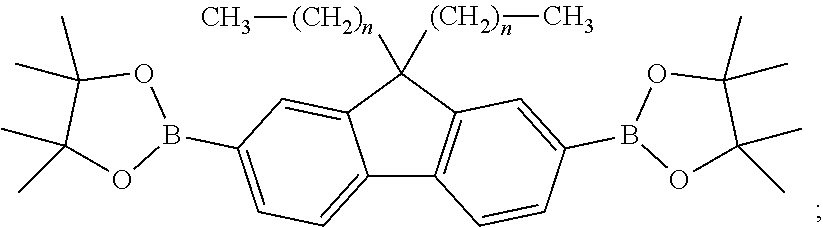
- the third reactant is a bis(pinacolato)diboron reagent, a molecular structural formula of the third reactant is
- m is a number greater than or equal to 4, R 4 is Cl, Br, or I, R 5 is Cl, Br, or I, and R 6 is Cl, Br, or I;
- a relationship between a molar weight of the first reactant and a volume of the second reactant is that for 1 millimoles of the first reactant, there are 0.5 milliliters-2 milliliters of the second reactant.
- the first reactant and the second reactant are reacted in a first solvent to generate the first intermediate product
- the first solvent is selected from a group consisting of styrene, perchloroethylene, trichloroethylene, acetone, ethylene glycol ether, and triethanolamine.
- the first solvent comprises a first additive
- the first additive is selected from a group consisting of potassium hydroxide, sodium hydroxide, sodium tertiary butanol (NaO t -Bu), and sodium bicarbonate.
- a relationship between a molar weight of the first intermediate product and a molar weight of the third reactant is that for 1 millimoles of the first intermediate product, there are 1 millimoles-5 millimoles of the third reactant.
- the first intermediate product and the third reactant are reacted in a second solvent to generate the second intermediate product
- the second solvent is selected from a group consisting of styrene, perchloroethylene, trichloroethylene, acetone, sodium tert-butanol (NaO t -Bu), N, n-dimethylformamide, and triethanolamine.
- the second solvent comprises a second additive
- the second additive is selected from a group consisting of [1,1′-bis (diphenyl phosphine) diferrocene] palladium dichloride (Pd(dppf)Cl 2 ), potassium acetate (KOAc), sodium acetate (NaOAc), sodium tert-butanol (NaO t -Bu), potassium nitrate (KNO 3 ), and magnesium sulfate (MgSO 4 ).
- a relationship between a molar weight of the fourth reactant and a molar weight of the fifth reactant is that for 1 millimoles of the fourth reactant, there are 1 millimoles-10 millimoles of the fifth reactant.
- the method for manufacturing the electroluminescent material of the present disclosure the fourth reactant and the fifth reactant are reacted in a third solvent to generate the third intermediate product, and the third solvent is selected from a group consisting of styrene, perchloroethylene, trichloroethylene, acetone, ethylene glycol ether, and triethanolamine.
- the third solvent comprises a third additive
- the third additive is selected from a group consisting of potassium hydroxide, sodium hydroxide, sodium tertiary butanol (NaO t -Bu) and sodium bicarbonate.
- a relationship among a molar weight of the first intermediate product, a molar weight of the second intermediate product and a molar weight of the third intermediate product is that for 1 millimoles of the first intermediate product, there are 0.5 millimoles-1.5 millimoles of the second intermediate product and 0.1 millimoles-1.5 millimoles of the third intermediate product.
- the method for manufacturing the electroluminescent material of the present disclosure the first intermediate product, the second intermediate product and the third intermediate product are reacted in a fourth solvent to generate the electroluminescent material, and the fourth solvent is selected from a group consisting of styrene, trichloroethylene, toluene, N, n-dimethylformamide acetone, ethylene glycol ether, and triethanolamine.
- the fourth solvent comprises a fourth additive
- the fourth additive is selected from a group consisting of [1,1′-bis (diphenyl phosphine) diferrocene] palladium dichloride (Pd(dppf)Cl 2 ), potassium acetate (KOAc), sodium tert-butyl alcohol (NaO t -Bu), sodium acetate (NaOAc), palladium acetate (Pd(C 2 H 3 O 2 ) 2 ), and tri-butyl phosphtetrafluoroborate.
- n is a number greater than or equal to 3
- a, b and c are natural numbers, a/(a+b+c) equals to a number ranging from 0.2 to 0.8, b/(a+b+c) equals to a number ranging from 0.1 to 0.4, and c/(a+b+c) equals to a number ranging from 0.1 to 0.4.
- the method for manufacturing the electroluminescent material of the present disclosure wherein the reacting process of reacting the first intermediate product, the second intermediate product and the third intermediate product to generate the electroluminescent material includes:
- the method for manufacturing the electroluminescent material of the present disclosure wherein the reacting process of separating and purifying the mixture containing the electroluminescent material to obtain the electroluminescent material includes:
- the extraction solvent is selected from a group consisting of dichloromethane, trichloromethane, and tetrahydrofuran.
- a volume ratio of dichloromethane and n-hexane of the chromatographic column ranges from 1:0.5 to 1:10.
- a luminescent device wherein includes:
- the base layer comprises a substrate base and a first electrode layer formed on the substrate base;
- a cavity transmitting and injecting layer is formed on the base layer, and electrically connected to the first electrode layer;
- the luminescent layer is formed on the cavity transmitting and injecting layer
- the electronic transmitting layer is formed on the luminescent layer
- the luminescent layer comprises an electroluminescent material, a molecular structural formula of the electroluminescent material is as follows:
- m is a number greater than or equal to 4, and n is a number greater than or equal to 3
- a, b and c are natural numbers, a/(a+b+c) equals to a number ranging from 0.2 to 0.8, b/(a+b+c) equals to a number ranging from 0.1 to 0.4, and c/(a+b+c) equals to a number ranging from 0.1 to 0.4.
- an electroluminescent material and a method for manufacturing the electroluminescent material, and a luminescent device are provided and includes: reacting the first reactant
- FIG. 1 is a photoluminescence spectrum of an electroluminescent material been in toluene of one exemplary embodiment of the present application.
- FIG. 2 is a transient photoluminescence spectrum of the electroluminescent material been in toluene of one exemplary embodiment of the present application.
- FIG. 3 is a structural view of a luminescent device of one exemplary embodiment of the present application.
- An electroluminescent material is provided.
- a molecular structural formula of the electroluminescent material is as follows:
- m is a number greater than or equal to 4, and n is a number greater than or equal to 3
- a, b and c are natural numbers, a/(a+b+c) equals to a number ranging from 0.2 to 0.8, b/(a+b+c) equals to a number ranging from 0.1 to 0.4, and c/(a+b+c) equals to a number ranging from 0.1 to 0.4.
- a method for manufacturing an electroluminescent material includes:
- a molecular structural formula of the first reactant is
- a molecular structural formula of the second reactant is CH 3 —(CH 2 ) n —R 3
- a molecular structural formula of the first intermediate product is
- n is a number greater than or equal to 3
- R 1 is Cl, Br, or I
- R 2 is Cl, Br, or I
- R 3 is Cl, Br, or I.
- a reaction formula of reacting the first reactant and the second reactant to generate the first intermediate product is:
- a relationship between a molar weight of the first reactant and a volume of the second reactant is that for 1 millimoles of the first reactant, there are 0.5 milliliters-2 milliliters of the second reactant.
- the relationship between the first reactant and the second reactant can be 5 millimoles of the first reactant:10 milliliters of the second reactant, 6 moles of the first reactant:9 liters of the second reactant, or 15 moles of the first reactant:15 liters of the second reactant, etc.
- the first reactant and the second reactant are reacted in a first solvent to generate the first intermediate product.
- the first solvent is selected from a group consisting of styrene, perchloroethylene, trichloroethylene, acetone, ethylene glycol ether, and triethanolamine.
- the first solvent includes a first additive.
- the first additive is selected from a group consisting of potassium hydroxide, sodium hydroxide, sodium tertiary butanol (NaO t -Bu), and sodium bicarbonate.
- a third reactant is provided, and the first intermediate product and the third reactant are reacted to generate a second intermediate product, the third reactant is a bis(pinacolato)diboron reagent, a molecular structural formula of the third reactant is
- a reaction formula of reacting the first intermediate product and the third reactant to generate the second intermediate product is:
- a relationship between a molar weight of the first intermediate product and a molar weight of the third reactant is that for 1 millimoles of the first intermediate product, there are 1 millimoles-5 millimoles of the third reactant.
- a relationship between the first intermediate and the third reactant is 5 millimoles of the first intermediate:5 millimoles of the third reactant, 8 moles of the first intermediate:10 liters of the third reactant, or 18 moles of the first intermediate:18 liters of the third reactant, etc.
- the first intermediate product and the third reactant are reacted in a second solvent to generate the second intermediate product.
- the second solvent is selected from a group consisting of styrene, perchloroethylene, trichloroethylene, acetone, sodium tert-butanol (NaO t -Bu), N, N-dimethylformamide, and triethanolamine.
- the second solvent includes a second additive, and the second additive is selected from a group consisting of [1,1′-bis (diphenyl phosphine) diferrocene] palladium dichloride (Pd(dppf)Cl 2 ), potassium acetate (KOAc), sodium acetate (NaOAc), sodium tert-butanol (NaO t -Bu), potassium nitrate (KNO 3 ), and magnesium sulfate (MgSO 4 ).
- the second additive is selected from a group consisting of [1,1′-bis (diphenyl phosphine) diferrocene] palladium dichloride (Pd(dppf)Cl 2 ), potassium acetate (KOAc), sodium acetate (NaOAc), sodium tert-butanol (NaO t -Bu), potassium nitrate (KNO 3 ), and magnesium sulfate (MgSO 4 ).
- a fourth reactant and a fifth reactant are provided, the fourth reactant and the fifth reactant are reacted to generate a third intermediate product, wherein, a molecular structural formula of the fourth reactant is
- m is a number greater than or equal to 4, R 4 is Cl, Br, or I, R 5 is Cl, Br, or I, and R 6 is Cl, Br, or I.
- a reaction formula of reacting the first intermediate product, the second intermediate product and the third intermediate product to generate the electroluminescent material is:
- the relationship between a molar weight of the fourth reactant and a molar weight of the fifth reactant is that for 1 millimoles of the fourth reactant, there are 1 millimoles-10 millimoles of the fifth reactant.
- the relationship between of the fourth reactant to the fifth reactant can be 12 millimoles of the fourth reactant to 15 millimoles of the fifth reactant, 8 millimoles of the fourth reactant to 8 millimoles of the fifth reactant, or 5 moles of the fourth reactant to 10 moles of the fifth reactant.
- the fifth reactant is made of an organic thermal activation delayed fluorescent material.
- the fourth reactant and the fifth reactant are reacted in a fourth solvent to generate the third intermediate product
- the third solvent is selected from a group consisting of styrene, perchloroethylene, trichloroethylene, acetone, ethylene glycol ether, and triethanolamine.
- the third solvent includes a third additive, and the third additive is selected from a group consisting of potassium hydroxide, sodium hydroxide, sodium tertiary butanol (NaO t -Bu) and sodium bicarbonate.
- a molecular structural formula of the electroluminescent material is as follows:
- m is a number greater than or equal to 4, and n is a number greater than or equal to 3
- a, b and c are natural numbers, a/(a+b+c) equals to a number ranging from 0.2 to 0.8, b/(a+b+c) equals to a number ranging from 0.1 to 0.4, and c/(a+b+c) equals to a number ranging from 0.1 to 0.4.
- a reaction formula of the first intermediate product, the second intermediate product and the third intermediate product to generate the electroluminescent material is:
- the relationship among a molar weight of the first intermediate product, a molar weight of the second intermediate product and a molar weight of the third intermediate product is that for 1 millimoles of the first intermediate product, there are 0.5 millimoles to 1.5 millimoles of the second intermediate product and 0.1 millimoles to 1.5 millimoles of the third intermediate product.
- the relationship among the first intermediate product, the second intermediate product and the third intermediate product is 1 millimoles of the first intermediate product corresponding to 1.2 millimoles of the second intermediate product and 0.8 millimoles of the third intermediate product, 0.2 millimoles of the first intermediate product corresponding to 0.2 millimoles of the second intermediate product and 0.2 millimoles of the third intermediate product, or 0.5 millimoles of the first intermediate product corresponding to 0.6 millimoles of the second intermediate product and 0.5 millimoles of the third intermediate product.
- the first intermediate product, the second intermediate product and the third intermediate product are reacted in a fourth solvent to generate the electroluminescent material
- the fourth solvent is selected from a group consisting of styrene, trichloroethylene, toluene, N, N-dimethylformamide acetone, ethylene glycol ether, and triethanolamine.
- the fourth solvent includes a fourth additive, and the fourth additive is selected from a group consisting of [1,1′-bis (diphenyl phosphine) diferrocene] palladium dichloride (Pd(dppf)Cl 2 ), potassium acetate (KOAc), sodium tert-butyl alcohol (NaO t -Bu), sodium acetate (NaOAc), palladium acetate (Pd(C 2 H 3 O 2 ) 2 ), and tri-butyl phosphtetrafluoroborate
- the reaction solution is cooled down to a room temperature, then the reaction solution is poured into ice water and extracted twice to five times by an extraction solvent to obtain the organic phase, the organic phase are spinned into silica gel, and the silica gel are employed column chromatography by a chromatographic column to obtain a white powder also defined as the electroluminescent material.
- the yield of the electroluminescent material is greater than or equal to 55%.
- the extraction solvent is selected from a group consisting of dichloromethane, trichloromethane, and tetrahydrofuran.
- a volume ratio of dichloromethane and n-hexane of the chromatographic column ranges from 1:0.5 to 1:10.
- a number average molecular weight of the electroluminescent material ranges from 10 kg/mol to 15 kg/mol.
- a weight average molecular weight of the electroluminescent material ranges from 15 g/mol to 20 g/mol.
- a fraction of the electroluminescent material ranges from 1.3 to 2.5.
- table 1 is the peak value of the fluorescence spectrum of the electroluminescent material and the energy level values of the energy states of the electroluminescent material.
- PL Peak is defined as a peak value of the fluorescence spectrum of the electroluminescent material
- S1 is a number of the lowest singlet energy level
- T1 is a number of the lowest triplet energy level
- ⁇ E ST S1 ⁇ T1
- HOMO is a number of an energy level of the highest electron occupied orbit
- LUMO is a number of an energy level of the lowest electron unoccupied orbit.
- FIG. 1 is a photoluminescence spectrum of an electroluminescent material been in toluene of the present application.
- a first peak of the electroluminescent material is between 440 nm and 470 nm.
- a wavelength of the first peak corresponds to a wavelength of a blue light.
- a second peak of the electroluminescent material is between 540 nm and 580 nm.
- a wavelength of the second peak corresponds to a wavelength of a yellow light. Therefore, the electroluminescent material provided in the present application is excited, emitting blue light and yellow light emitted from the electroluminescent material of the present application are mixed to a white light.
- FIG. 2 is a transient photoluminescence spectrum of the electroluminescent material been in toluene of the present application.
- FIG. 3 is a schematic structural view of a light emitting device of the present application.
- the luminescent device 10 includes a base layer 11 , a cavity transmitting and injecting layer 12 , a luminescent layer 13 , an electronic transmitting layer 14 and a second electrode layer 15 .
- the base layer 11 includes a substrate base 111 and a first electrode layer 112 formed on the substrate base 111 .
- the cavity transmitting and injecting layer 12 is formed on the base layer 10 .
- the cavity transmitting and injecting layer 12 is electrically connected to the first electrode layer 112 .
- the electronic transmitting layer 14 is formed on the luminescent layer 13 .
- the second electrode layer 15 is electrically connected to the electronic transmitting layer 14 .
- the substrate base 111 is made of a glass substrate.
- the first electrode layer 112 is made of indium tin oxide.
- the cavity transmitting and injecting layer 112 is made of 3,4-ethylenedioxythiophene: polystyrene sulfonates (PEDOT:PSS).
- the electronic transmitting layer 14 is made of 1,3, 5-tri(3-(3-pyridine) phenyl) benzene (Tm3PyPB).
- the second electrode layer 15 is made of lithium fluoride/aluminum (LiF/Al).
- the luminescent layer 13 includes the electroluminescent material, a molecular structural formula of the electroluminescent material is as follows:
- m is a number greater than or equal to 4, and n is a number greater than or equal to 3
- a, b and c are natural numbers, a/(a+b+c) equals to a number ranging from 0.2 to 0.8, b/(a+b+c) equals to a number ranging from 0.1 to 0.4, and c/(a+b+c) equals to a number ranging from 0.1 to 0.4.
- table 2 is a performance data of the luminescent device of the present application.
- An electroluminescent material and a method for manufacturing the electroluminescent material, and a luminescent device are provided and includes: reacting the first reactant
Landscapes
- Engineering & Computer Science (AREA)
- Chemical & Material Sciences (AREA)
- Manufacturing & Machinery (AREA)
- Materials Engineering (AREA)
- Physics & Mathematics (AREA)
- Spectroscopy & Molecular Physics (AREA)
- Organic Chemistry (AREA)
- Health & Medical Sciences (AREA)
- Medicinal Chemistry (AREA)
- Polymers & Plastics (AREA)
- Chemical Kinetics & Catalysis (AREA)
- Electroluminescent Light Sources (AREA)
- Organic Low-Molecular-Weight Compounds And Preparation Thereof (AREA)
Abstract
Description

m is a number greater than or equal to 4, and n is a number greater than or equal to 3, a, b and c are natural numbers, a/(a+b+c) equals to a number ranging from 0.2 to 0.8, b/(a+b+c) equals to a number ranging from 0.1 to 0.4, and c/(a+b+c) equals to a number ranging from 0.1 to 0.4.

a molecular structural formula of the second reactant is CH3—(CH2)n—R3, a molecular structural formula of the first intermediate product is

wherein n is a number greater than or equal to 3, R1 is Cl, Br, or I, R2 is Cl, Br, or I, and R3 is Cl, Br, or I;

a molecular structural formula of the second intermediate product is

a molecular structural formula of the fifth reactant is

a molecular structural formula of the third intermediate product is

wherein m is a number greater than or equal to 4, R4 is Cl, Br, or I, R5 is Cl, Br, or I, and R6 is Cl, Br, or I;

m is a number greater than or equal to 4, and n is a number greater than or equal to 3, a, b and c are natural numbers, a/(a+b+c) equals to a number ranging from 0.2 to 0.8, b/(a+b+c) equals to a number ranging from 0.1 to 0.4, and c/(a+b+c) equals to a number ranging from 0.1 to 0.4.

wherein m is a number greater than or equal to 4, and n is a number greater than or equal to 3, a, b and c are natural numbers, a/(a+b+c) equals to a number ranging from 0.2 to 0.8, b/(a+b+c) equals to a number ranging from 0.1 to 0.4, and c/(a+b+c) equals to a number ranging from 0.1 to 0.4.

and the second reactant CH3—(CH2)n—R3 to generate the intermediate product

reacting the first intermediate product and the third reactant

to generate the second intermediate product

reacting the fourth reactant

and the fifth reactant

to generate the third intermediate product

and reacting the first intermediate product, the second intermediate product and the third intermediate product to generate the electroluminescent material

to realize a high quantum efficiency of a white light electroluminescent material and device.

wherein, m is a number greater than or equal to 4, and n is a number greater than or equal to 3, a, b and c are natural numbers, a/(a+b+c) equals to a number ranging from 0.2 to 0.8, b/(a+b+c) equals to a number ranging from 0.1 to 0.4, and c/(a+b+c) equals to a number ranging from 0.1 to 0.4.

a molecular structural formula of the second reactant is CH3—(CH2)n—R3, a molecular structural formula of the first intermediate product is

wherein, n is a number greater than or equal to 3, R1 is Cl, Br, or I, R2 is Cl, Br, or I, and R3 is Cl, Br, or I.


are added to a 200 milliliters two-necked flask, 80 milliliters of the acetone and 10 milliliters of the bromohexyl

are added, and then the abovementioned are reacted at room temperature for 24 hours, separated and purified to obtain the first intermediate product


and a molecular structural formula of the second intermediate product is


is added to a 100 milliliters two-necked flask, 12 millimoles of the third reactant

0.8 millimoles of the [1,1′-bi (diphenylphosphonyl) ferrocene]palladium dichloride, and 12 millimoles of the potassium acetate are added and forms a vacuum pumping, 40 mL of acetone is added in an argon atmosphere, the abovementioned are reacted at 100 degrees centigrade for 24 hours, separates and purified to obtain the second intermediate


a molecular structural formula of the fifth reactant is

a molecular structural formula of the third intermediate product is

wherein, m is a number greater than or equal to 4, R4 is Cl, Br, or I, R5 is Cl, Br, or I, and R6 is Cl, Br, or I.


wherein m is a number greater than or equal to 4, and n is a number greater than or equal to 3, a, b and c are natural numbers, a/(a+b+c) equals to a number ranging from 0.2 to 0.8, b/(a+b+c) equals to a number ranging from 0.1 to 0.4, and c/(a+b+c) equals to a number ranging from 0.1 to 0.4.


is added to a 200 milliliters two-necked flask, 1.2 millimoles of the second intermediate

0.3 millimoles of the third intermediate

0.4 millimoles of the palladium acetate, 5 millimoles of the tri-tert-butylphosphine tetrafluoroborate, and 8 millimoles of the sodium tert-butoxide (NaOt-Bu) are added, 40 milliliters of toluene are added, it is reacted at 120 degrees centigrade for 24 hours, separates and purified to obtain the electroluminescent material

| TABLE 1 | ||||||
| PL Peak | S1 | T1 | ΔEST | HOMO | LUMO | |
| (nm) | (eV) | (eV) | (eV) | (eV) | (eV) | |
| main chain | 405 | 3.06 | 2.97 | 0.09 | −5.35 | −2.13 |
| TADF | 413 | 3.00 | 2.93 | 0.07 | −5.45 | −2.14 |
| side chain | ||||||

wherein m is a number greater than or equal to 4, and n is a number greater than or equal to 3, a, b and c are natural numbers, a/(a+b+c) equals to a number ranging from 0.2 to 0.8, b/(a+b+c) equals to a number ranging from 0.1 to 0.4, and c/(a+b+c) equals to a number ranging from 0.1 to 0.4.
| TABLE 2 | ||||
| maximum | ||||
| maximum | external | |||
| maximum | current | chromaticity | quantum | |
| brightness | efficiency | coordinates | efficiency | |
| (cd/m2) | (cd/A) | CIE | (%) | |
| luminescent | 3465 | 39.7 | (0.26, 0.35) | 15.3 |
| device | ||||

and the second reactant CH3—(CH2)n—R3 to generate the intermediate product

reacting the first intermediate product and the third reactant

to generate the second intermediate product

reacting the fourth reactant

and the fifth reactant

to generate the third intermediate product

and reacting the first intermediate product, the second intermediate product and the third intermediate product to generate the electroluminescent material

to realize a high quantum efficiency of a white light electroluminescent material and device.
Claims (20)


Applications Claiming Priority (3)
| Application Number | Priority Date | Filing Date | Title |
|---|---|---|---|
| CN201811220267.6 | 2018-10-19 | ||
| CN201811220267.6A CN109321234B (en) | 2018-10-19 | 2018-10-19 | Electroluminescent material, preparation method of electroluminescent material and luminescent device |
| PCT/CN2019/070050 WO2020077884A1 (en) | 2018-10-19 | 2019-01-02 | Electroluminescent material, method for preparing electroluminescent material, and light emitting device |
Publications (2)
| Publication Number | Publication Date |
|---|---|
| US20200136051A1 US20200136051A1 (en) | 2020-04-30 |
| US11145818B2 true US11145818B2 (en) | 2021-10-12 |
Family
ID=65261349
Family Applications (1)
| Application Number | Title | Priority Date | Filing Date |
|---|---|---|---|
| US16/332,364 Active 2039-11-28 US11145818B2 (en) | 2018-10-19 | 2019-01-02 | Electroluminescent material, method for manufacturing the same, and luminescent device |
Country Status (3)
| Country | Link |
|---|---|
| US (1) | US11145818B2 (en) |
| CN (1) | CN109321234B (en) |
| WO (1) | WO2020077884A1 (en) |
Families Citing this family (2)
| Publication number | Priority date | Publication date | Assignee | Title |
|---|---|---|---|---|
| CN110016027B (en) * | 2019-04-16 | 2020-09-08 | 武汉华星光电半导体显示技术有限公司 | Electroluminescent material, preparation method of electroluminescent material and luminescent device |
| CN113583219A (en) * | 2021-08-04 | 2021-11-02 | 滁州市玉林聚氨酯有限公司 | Preparation method of antistatic high polymer material for polyurethane tire |
Citations (1)
| Publication number | Priority date | Publication date | Assignee | Title |
|---|---|---|---|---|
| CN1730507A (en) * | 2005-07-07 | 2006-02-08 | 复旦大学 | A kind of soft and hard multi-block polymer and its synthesis method |
Family Cites Families (9)
| Publication number | Priority date | Publication date | Assignee | Title |
|---|---|---|---|---|
| KR101202340B1 (en) * | 2005-01-21 | 2012-11-16 | 삼성디스플레이 주식회사 | Blue electroluminescent compound and organo-electroluminescent device employing the same |
| KR101236428B1 (en) * | 2006-11-29 | 2013-02-22 | 삼성디스플레이 주식회사 | Anthracene derivative compound and an organic light emitting device comprising the same |
| KR101137386B1 (en) * | 2009-10-09 | 2012-04-20 | 삼성모바일디스플레이주식회사 | Polymer and organic light emitting diode comprising the same |
| JP5669550B2 (en) * | 2010-12-10 | 2015-02-12 | キヤノン株式会社 | Indolophenoxazine compound and organic light-emitting device using the same |
| CN106117524B (en) * | 2016-07-28 | 2019-04-09 | 华南理工大学 | A thermally activated delayed fluorescence conjugated polymer luminescent material containing a sulfone group in its side chain and its preparation method and application |
| CN106589324B (en) * | 2016-11-30 | 2018-08-21 | 武汉大学 | A kind of hot activation delayed fluorescence high-molecular compound and its preparation method and application |
| CN107142103A (en) * | 2017-04-21 | 2017-09-08 | 中节能万润股份有限公司 | A kind of conjugated polymer electroluminescent organic material and its application and device comprising TADF monomers by skeleton of acridine |
| CN107118334B (en) * | 2017-06-05 | 2019-06-04 | 盐城工学院 | Single white light polymer, organic electroluminescent material, organic electroluminescent device and preparation method thereof |
| CN107312523A (en) * | 2017-06-23 | 2017-11-03 | 中节能万润股份有限公司 | A kind of electroluminescent organic material and its preparation method and application |
-
2018
- 2018-10-19 CN CN201811220267.6A patent/CN109321234B/en active Active
-
2019
- 2019-01-02 US US16/332,364 patent/US11145818B2/en active Active
- 2019-01-02 WO PCT/CN2019/070050 patent/WO2020077884A1/en not_active Ceased
Patent Citations (1)
| Publication number | Priority date | Publication date | Assignee | Title |
|---|---|---|---|---|
| CN1730507A (en) * | 2005-07-07 | 2006-02-08 | 复旦大学 | A kind of soft and hard multi-block polymer and its synthesis method |
Non-Patent Citations (1)
| Title |
|---|
| Machine English translation of Huang (CN 1730507 A). Jun. 24, 2021. * |
Also Published As
| Publication number | Publication date |
|---|---|
| US20200136051A1 (en) | 2020-04-30 |
| WO2020077884A1 (en) | 2020-04-23 |
| CN109321234B (en) | 2020-04-03 |
| CN109321234A (en) | 2019-02-12 |
Similar Documents
| Publication | Publication Date | Title |
|---|---|---|
| US11649254B2 (en) | Compound, a display panel and an electronic device | |
| US10388885B2 (en) | Organic electroluminescent device | |
| US20220017552A1 (en) | Electroluminesecent material, method for manufactruing the same, and luminesecent device | |
| US10741771B2 (en) | Compound for organic electronic element, organic electronic element using the same, and an electronic device thereof | |
| US11279873B2 (en) | Thermally activated delayed fluorescent and synthesizing method thereof | |
| US10851292B2 (en) | Dark blue light thermally activated delayed fluorescence (TADF) material and application thereof | |
| WO2020113789A1 (en) | Green light thermally activated delayed fluorescent material, synthesis method thereof, and electroluminescent device | |
| US11145818B2 (en) | Electroluminescent material, method for manufacturing the same, and luminescent device | |
| US20180170894A1 (en) | Light emitting material, manufacture method thereof and organic light emitting diode using the light emitting material | |
| US11283029B2 (en) | Thermally activated delayed fluorescence material, organic electroluminescent device, and display panel | |
| CN110240574B (en) | Electroluminescent material, preparation method of electroluminescent material and luminescent device | |
| US11205756B2 (en) | Green light thermally activated delayed fluorescence (TADF) material and application thereof | |
| US20180201833A1 (en) | Light emitting material, manufacture method thereof and organic light emitting diode using the light emitting material | |
| US20180170893A1 (en) | Light emitting material, manufacture method thereof and organic light emitting diode using the light emitting material | |
| CN109988099B (en) | Electroluminescent material, preparation method of electroluminescent material and luminescent device | |
| US20180170900A1 (en) | Light emitting material, manufacture method thereof and organic light emitting diode using the light emitting material | |
| US11133469B2 (en) | Compounds for organic optoelectronic device and organic optoelectronic device including the same | |
| CN116535323A (en) | Novel triarylamine compound and organic electroluminescent device containing same | |
| US20180205025A1 (en) | Light emitting material, manufacture method thereof and organic light emitting diode using the light emitting material | |
| CN111018874B (en) | Hole transport material, preparation method thereof and organic light emitting diode device | |
| US10961447B2 (en) | Light emitting material, manufacture method thereof and organic light emitting diode using the light emitting material | |
| CN115746057A (en) | Carbazole phenyl phenanthroimidazole aromatic phosphine oxide compound, preparation method and application thereof | |
| US10208013B2 (en) | Light emitting material, manufacture method thereof and organic light emitting diode using the light emitting material | |
| KR20160045569A (en) | Delayed fluorescence compound, and Organic light emitting diode device and Display device using the same | |
| US20210043847A1 (en) | Hole transporting material, method for preparing same, and electroluminescent device |
Legal Events
| Date | Code | Title | Description |
|---|---|---|---|
| FEPP | Fee payment procedure |
Free format text: ENTITY STATUS SET TO UNDISCOUNTED (ORIGINAL EVENT CODE: BIG.); ENTITY STATUS OF PATENT OWNER: LARGE ENTITY |
|
| AS | Assignment |
Owner name: WUHAN CHINA STAR OPTOELECTRONICS SEMICONDUCTOR DISPLAY TECHNOLOGY CO., LTD., CHINA Free format text: ASSIGNMENT OF ASSIGNORS INTEREST;ASSIGNOR:LUO, JIAJIA;REEL/FRAME:048944/0274 Effective date: 20181031 |
|
| STPP | Information on status: patent application and granting procedure in general |
Free format text: DOCKETED NEW CASE - READY FOR EXAMINATION |
|
| STPP | Information on status: patent application and granting procedure in general |
Free format text: NON FINAL ACTION MAILED |
|
| STPP | Information on status: patent application and granting procedure in general |
Free format text: RESPONSE TO NON-FINAL OFFICE ACTION ENTERED AND FORWARDED TO EXAMINER |
|
| STPP | Information on status: patent application and granting procedure in general |
Free format text: NOTICE OF ALLOWANCE MAILED -- APPLICATION RECEIVED IN OFFICE OF PUBLICATIONS |
|
| STPP | Information on status: patent application and granting procedure in general |
Free format text: AWAITING TC RESP., ISSUE FEE NOT PAID |
|
| STPP | Information on status: patent application and granting procedure in general |
Free format text: NOTICE OF ALLOWANCE MAILED -- APPLICATION RECEIVED IN OFFICE OF PUBLICATIONS |
|
| STPP | Information on status: patent application and granting procedure in general |
Free format text: PUBLICATIONS -- ISSUE FEE PAYMENT RECEIVED |
|
| STPP | Information on status: patent application and granting procedure in general |
Free format text: PUBLICATIONS -- ISSUE FEE PAYMENT VERIFIED |
|
| STCF | Information on status: patent grant |
Free format text: PATENTED CASE |
|
| MAFP | Maintenance fee payment |
Free format text: PAYMENT OF MAINTENANCE FEE, 4TH YEAR, LARGE ENTITY (ORIGINAL EVENT CODE: M1551); ENTITY STATUS OF PATENT OWNER: LARGE ENTITY Year of fee payment: 4 |