US11137258B2 - Systems and methods for comprehensive routing - Google Patents
Systems and methods for comprehensive routing Download PDFInfo
- Publication number
- US11137258B2 US11137258B2 US16/241,723 US201916241723A US11137258B2 US 11137258 B2 US11137258 B2 US 11137258B2 US 201916241723 A US201916241723 A US 201916241723A US 11137258 B2 US11137258 B2 US 11137258B2
- Authority
- US
- United States
- Prior art keywords
- route
- assigned tasks
- determining
- assigned
- subset
- Prior art date
- Legal status (The legal status is an assumption and is not a legal conclusion. Google has not performed a legal analysis and makes no representation as to the accuracy of the status listed.)
- Active, expires
Links
Images




Classifications
-
- G—PHYSICS
- G01—MEASURING; TESTING
- G01C—MEASURING DISTANCES, LEVELS OR BEARINGS; SURVEYING; NAVIGATION; GYROSCOPIC INSTRUMENTS; PHOTOGRAMMETRY OR VIDEOGRAMMETRY
- G01C21/00—Navigation; Navigational instruments not provided for in groups G01C1/00 - G01C19/00
- G01C21/26—Navigation; Navigational instruments not provided for in groups G01C1/00 - G01C19/00 specially adapted for navigation in a road network
- G01C21/34—Route searching; Route guidance
- G01C21/3407—Route searching; Route guidance specially adapted for specific applications
- G01C21/343—Calculating itineraries
-
- G—PHYSICS
- G01—MEASURING; TESTING
- G01C—MEASURING DISTANCES, LEVELS OR BEARINGS; SURVEYING; NAVIGATION; GYROSCOPIC INSTRUMENTS; PHOTOGRAMMETRY OR VIDEOGRAMMETRY
- G01C21/00—Navigation; Navigational instruments not provided for in groups G01C1/00 - G01C19/00
- G01C21/26—Navigation; Navigational instruments not provided for in groups G01C1/00 - G01C19/00 specially adapted for navigation in a road network
- G01C21/34—Route searching; Route guidance
- G01C21/3446—Details of route searching algorithms, e.g. Dijkstra, A*, arc-flags or using precalculated routes
-
- G—PHYSICS
- G06—COMPUTING OR CALCULATING; COUNTING
- G06Q—INFORMATION AND COMMUNICATION TECHNOLOGY [ICT] SPECIALLY ADAPTED FOR ADMINISTRATIVE, COMMERCIAL, FINANCIAL, MANAGERIAL OR SUPERVISORY PURPOSES; SYSTEMS OR METHODS SPECIALLY ADAPTED FOR ADMINISTRATIVE, COMMERCIAL, FINANCIAL, MANAGERIAL OR SUPERVISORY PURPOSES, NOT OTHERWISE PROVIDED FOR
- G06Q10/00—Administration; Management
- G06Q10/04—Forecasting or optimisation specially adapted for administrative or management purposes, e.g. linear programming or "cutting stock problem"
- G06Q10/047—Optimisation of routes or paths, e.g. travelling salesman problem
-
- G—PHYSICS
- G06—COMPUTING OR CALCULATING; COUNTING
- G06Q—INFORMATION AND COMMUNICATION TECHNOLOGY [ICT] SPECIALLY ADAPTED FOR ADMINISTRATIVE, COMMERCIAL, FINANCIAL, MANAGERIAL OR SUPERVISORY PURPOSES; SYSTEMS OR METHODS SPECIALLY ADAPTED FOR ADMINISTRATIVE, COMMERCIAL, FINANCIAL, MANAGERIAL OR SUPERVISORY PURPOSES, NOT OTHERWISE PROVIDED FOR
- G06Q10/00—Administration; Management
- G06Q10/06—Resources, workflows, human or project management; Enterprise or organisation planning; Enterprise or organisation modelling
- G06Q10/063—Operations research, analysis or management
- G06Q10/0631—Resource planning, allocation, distributing or scheduling for enterprises or organisations
- G06Q10/06316—Sequencing of tasks or work
Definitions
- the present disclosure relates generally to route optimization.
- IT information technology
- a respective organization's IT infrastructure may have associated hardware resources (e.g. computing devices, load balancers, firewalls, switches, etc.) and software resources (e.g. productivity software, database applications, custom applications, and so forth).
- hardware resources e.g. computing devices, load balancers, firewalls, switches, etc.
- software resources e.g. productivity software, database applications, custom applications, and so forth.
- Cloud computing relates to the sharing of computing resources that are generally accessed via the Internet.
- a cloud computing infrastructure allows users, such as individuals and/or enterprises, to access a shared pool of computing resources, such as servers, storage devices, networks, applications, and/or other computing based services. By doing so, users are able to access computing resources on demand that are located at remote locations, which resources may be used to perform a variety of computing functions (e.g., storing and/or processing large quantities of computing data).
- cloud computing provides flexibility in accessing cloud computing resources without accruing large up-front costs, such as purchasing expensive network equipment or investing large amounts of time in establishing a private network infrastructure. Instead, by utilizing cloud computing resources, users are able redirect their resources to focus on their enterprise's core functions.
- Certain enterprises' core functions relate to dispatching agents to service locations so that the agents can provide services and complete tasks for customers.
- an agent may be assigned particular tasks through the one or more cloud computing resources and travel along a route between service locations to complete his or her assigned tasks.
- the route taken by agent may be inefficient and result in excessive travel time or travel distance for the agent.
- the agent may inefficiently travel between service locations associated with the tasks due to a lack of comprehensive route planning. For example, the agent may complete his or her assigned workflow of tasks by traveling from each task to a next-closest task, causing unnecessary cross-overs or double-backs along a route during the course of the agent's workday. These practices may cause unnecessary travel times and travel distances for the agent, which lead to increased resource expenditure and costs for an enterprise directing the agent.
- an agent e.g., field service agent, technician
- the present embodiments are directed toward a routing algorithm for generating a suitable ordering of geographically-separated tasks to be completed by an agent or other traveling personnel of a client.
- the presently disclosed algorithm considers each task assigned to the agent over a longer interval, such as for an entire workday. That is, the tasks and their respective service locations are considered in the aggregate or comprehensively to enable minimization of a travel cost (e.g., the travel time, travel distance) for a complete route between the tasks, as opposed to simply selecting the next closest task.
- a travel cost e.g., the travel time, travel distance
- the algorithm may determine the travel cost for each permutation of various subsets of the tasks, while tracking the permutation of each subset having the lowest travel cost. Then, the algorithm may trace back through the identified subsets to determine the lowest cost route from the identified lowest cost subsets. In some situations in which a number of tasks is greater than a threshold number of tasks (e.g., set based on computational limitations and/or service-level agreement), the algorithm may alternatively employ an approximation that conserves processing resources by generating a suitable approximate route.
- a threshold number of tasks e.g., set based on computational limitations and/or service-level agreement
- the algorithm may also provide a route that prioritizes performance of certain tasks before other tasks and/or that enables the agent to arrive at certain tasks within specified time windows.
- the algorithm may conserve processing resources by first performing a simplified set of calculations to determine whether any time constraints are violated by a proposed route, and providing the proposed route to the agent if it meets the time constraints. If time constraints are violated by the proposed route, the algorithm may proceed to more in-depth, time-conscious determinations that provide a suitable whole or partial route between the tasks.
- the agent may request redetermination of the route throughout the agent's workday, thus enabling reduction and/or minimization of travel costs via an acceptable route that is updatable on demand.
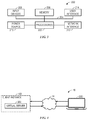
- FIG. 1 is a block diagram of an embodiment of a cloud architecture in which embodiments of the present disclosure may operate;
- FIG. 2 is a schematic diagram of an embodiment of a multi-instance cloud architecture in which embodiments of the present disclosure may operate;
- FIG. 3 is a block diagram of a computing device utilized in a computing system that may be present in FIG. 1 or 2 , in accordance with aspects of the present disclosure;
- FIG. 4 is a block diagram illustrating an embodiment in which a virtual server supports and enables the client instance, in accordance with aspects of the present disclosure
- FIG. 5 is a flow diagram of an embodiment of a top-level process of a routing algorithm for determining which of multiple sub-level processes may be performed to generate a suitable route, in accordance with aspects of the present disclosure
- FIG. 6 is a flow diagram of an embodiment of a sub-level process for generating all suitable routes with lowest costs between tasks without time constraints, in accordance with aspects of the present disclosure
- FIG. 7 is a flow diagram of an embodiment of a sub-level process for generating a suitable route between a subset of tasks without time constraints, in accordance with aspects of the present disclosure
- FIG. 8 is a flow diagram of an embodiment of a sub-level process for generating all suitable routes with a pair of lowest cost and arrival time between tasks with time constraints, in accordance with aspects of the present disclosure
- FIG. 9 is a flow diagram of an embodiment of a sub-level process for generating all suitable routes between tasks with time constraints via three-dimensional matrix calculations, in accordance with aspects of the present disclosure.
- FIG. 10 is a flow diagram of an embodiment of a sub-level process for generating all time-constraint satisfied routes between tasks without dependency violations, in accordance with aspects of the present disclosure
- FIG. 11 is a flow diagram of an embodiment of a sub-level process for generating a suitable route between a subset of tasks with time constraints, in accordance with aspects of the present disclosure
- FIG. 12 is a screenshot of an embodiment of a user interface for accessing a suitable route generated by a routing algorithm, in accordance with aspects of the present disclosure.
- FIG. 13 is a screenshot of an embodiment of a suitable route generated by a routing algorithm, in accordance with aspects of the present disclosure.
- computing system refers to an electronic computing device such as, but not limited to, a single computer, virtual machine, virtual container, host, server, laptop, and/or mobile device, or to a plurality of electronic computing devices working together to perform the function described as being performed on or by the computing system.
- medium refers to one or more non-transitory, computer-readable physical media that together store the contents described as being stored thereon.
- Embodiments may include non-volatile secondary storage, read-only memory (ROM), and/or random-access memory (RAM).
- an application refers to one or more computing modules, programs, processes, workloads, threads and/or a set of computing instructions executed by a computing system.
- Example embodiments of an application include software modules, software objects, software instances and/or other types of executable code.
- Embodiments of the present disclosure are directed to optimizing a route (e.g., an order in which tasks to be performed at different geographic locations are to be completed) for an agent over a relatively long interval of time, such as an entire workday of the agent.
- the route is determined by a routing algorithm (e.g., comprehensive algorithm, aggregate algorithm) that considers each task assigned to the agent for the entire workday in aggregate, thus enabling the assigned tasks to be scheduled in a manner that minimizes travel costs (e.g., travel time, travel distance) by comprehensively calculating respective travel costs for each possible route between the assigned tasks. That is, the comprehensive routing functionality disclosed herein encompasses each possible route between a start location, each assigned task, and an end location.
- a routing algorithm e.g., comprehensive algorithm, aggregate algorithm
- the algorithm may determine a travel cost for each route between an end location and one of the assigned tasks. Then, the algorithm may add in another assigned task and determine a travel cost for each route from the end location, to a first assigned task, and then to a second assigned task. Continuing in this manner, the algorithm constructs routes from the end location and through each possible subset of the assigned tasks, while tracking a permutation of each subset having the lowest travel cost. The algorithm may therefore trace back through the lowest-cost permutations to construct a complete route through the assigned tasks that has the lowest cost or most suitable cost for a given set of conditions.
- the algorithm may also consider time windows during which the assigned tasks are to be completed, task dependency, task priority, and agent availability during the determinations, facilitating generation of a suitable or useful route (e.g., optimized or optimal route) that provides a minimized travel cost in view of existing limitations.
- a suitable or useful route e.g., optimized or optimal route
- FIG. 1 a schematic diagram of an embodiment of a cloud computing system 10 , where embodiments of the present disclosure may operate, is illustrated.
- the cloud computing system 10 may include a client network 12 , a network 14 (e.g., the Internet), and a cloud-based platform 16 .
- the cloud-based platform 16 may be a configuration management database (CMDB) platform.
- CMDB configuration management database
- the client network 12 may be a local private network, such as local area network (LAN) having a variety of network devices that include, but are not limited to, switches, servers, and routers.
- LAN local area network
- the client network 12 represents an enterprise network that could include one or more LANs, virtual networks, data centers 18 , and/or other remote networks. As shown in FIG. 1 , the client network 12 is able to connect to one or more client devices 20 A, 20 B, and 20 C so that the client devices are able to communicate with each other and/or with the network hosting the platform 16 .
- the client devices 20 may be computing systems and/or other types of computing devices generally referred to as Internet of Things (IoT) devices that access cloud computing services, for example, via a web browser application or via an edge device 22 that may act as a gateway between the client devices 20 and the platform 16 .
- FIG. 1 also illustrates that the client network 12 includes an administration or managerial device or server, such as a management, instrumentation, and discovery (MID) server 24 that facilitates communication of data between the network hosting the platform 16 , other external applications, data sources, and services, and the client network 12 .
- the client network 12 may also include a connecting network device (e.g., a gateway or router) or a combination of devices that implement a customer firewall or intrusion protection system.
- FIG. 1 illustrates that client network 12 is coupled to a network 14 .
- the network 14 may include one or more computing networks, such as other LANs, wide area networks (WAN), the Internet, and/or other remote networks, to transfer data between the client devices 20 and the network hosting the platform 16 .
- Each of the computing networks within network 14 may contain wired and/or wireless programmable devices that operate in the electrical and/or optical domain.
- network 14 may include wireless networks, such as cellular networks (e.g., Global System for Mobile Communications (GSM) based cellular network), IEEE 802.11 networks, and/or other suitable radio-based networks.
- the network 14 may also employ any number of network communication protocols, such as Transmission Control Protocol (TCP) and Internet Protocol (IP).
- TCP Transmission Control Protocol
- IP Internet Protocol
- network 14 may include a variety of network devices, such as servers, routers, network switches, and/or other network hardware devices configured to transport data over the network 14 .
- the network hosting the platform 16 may be a remote network (e.g., a cloud network) that is able to communicate with the client devices 20 via the client network 12 and network 14 .
- the network hosting the platform 16 provides additional computing resources to the client devices 20 and/or the client network 12 .
- users of the client devices 20 are able to build and execute applications for various enterprise, IT, and/or other organization-related functions.
- the network hosting the platform 16 is implemented on the one or more data centers 18 , where each data center could correspond to a different geographic location.
- Each of the data centers 18 includes a plurality of virtual servers 26 (also referred to herein as application nodes, application servers, virtual server instances, application instances, or application server instances), where each virtual server 26 can be implemented on a physical computing system, such as a single electronic computing device (e.g., a single physical hardware server) or across multiple-computing devices (e.g., multiple physical hardware servers).
- virtual servers 26 include, but are not limited to a web server (e.g., a unitary Apache installation), an application server (e.g., unitary JAVA Virtual Machine), and/or a database server (e.g., a unitary relational database management system (RDBMS) catalog).
- a web server e.g., a unitary Apache installation
- an application server e.g., unitary JAVA Virtual Machine
- database server e.g., a unitary relational database management system (RDBMS) catalog
- network operators may choose to configure the data centers 18 using a variety of computing infrastructures.
- one or more of the data centers 18 are configured using a multi-tenant cloud architecture, such that one of the server instances 26 handles requests from and serves multiple customers.
- Data centers 18 with multi-tenant cloud architecture commingle and store data from multiple customers, where multiple customer instances are assigned to one of the virtual servers 26 .
- the particular virtual server 26 distinguishes between and segregates data and other information of the various customers.
- a multi-tenant cloud architecture could assign a particular identifier for each customer in order to identify and segregate the data from each customer.
- implementing a multi-tenant cloud architecture may suffer from various drawbacks, such as a failure of a particular one of the server instances 26 causing outages for all customers allocated to the particular server instance.
- one or more of the data centers 18 are configured using a multi-instance cloud architecture to provide every customer its own unique customer instance or instances.
- a multi-instance cloud architecture could provide each customer instance with its own dedicated application server and dedicated database server.
- the multi-instance cloud architecture could deploy a single physical or virtual server 26 and/or other combinations of physical and/or virtual servers 26 , such as one or more dedicated web servers, one or more dedicated application servers, and one or more database servers, for each customer instance.
- multiple customer instances could be installed on one or more respective hardware servers, where each customer instance is allocated certain portions of the physical server resources, such as computing memory, storage, and processing power.
- each customer instance has its own unique software stack that provides the benefit of data isolation, relatively less downtime for customers to access the platform 16 , and customer-driven upgrade schedules.
- An example of implementing a customer instance within a multi-instance cloud architecture will be discussed in more detail below with reference to FIG. 2 .
- FIG. 2 is a schematic diagram of an embodiment of a multi-instance cloud architecture 100 where embodiments of the present disclosure may operate.
- FIG. 2 illustrates that the multi-instance cloud architecture 100 includes the client network 12 and the network 14 that connect to two (e.g., paired) data centers 18 A and 18 B that may be geographically separated from one another.
- network environment and service provider cloud infrastructure client instance 102 (also referred to herein as a client instance 102 ) is associated with (e.g., supported and enabled by) dedicated virtual servers (e.g., virtual servers 26 A, 26 B, 26 C, and 26 D) and dedicated database servers (e.g., virtual database servers 104 A and 104 B).
- dedicated virtual servers e.g., virtual servers 26 A, 26 B, 26 C, and 26 D
- dedicated database servers e.g., virtual database servers 104 A and 104 B.
- the virtual servers 26 A- 26 D and virtual database servers 104 A and 104 B are not shared with other client instances and are specific to the respective client instance 102 .
- the virtual servers 26 A- 26 D and virtual database servers 104 A and 104 B are allocated to two different data centers 18 A and 18 B so that one of the data centers 18 acts as a backup data center.
- Other embodiments of the multi-instance cloud architecture 100 could include other types of dedicated virtual servers, such as a web server.
- the client instance 102 could be associated with (e.g., supported and enabled by) the dedicated virtual servers 26 A- 26 D, dedicated virtual database servers 104 A and 104 B, and additional dedicated virtual web servers (not shown in FIG. 2 ).
- FIGS. 1 and 2 illustrate specific embodiments of a cloud computing system 10 and a multi-instance cloud architecture 100 , respectively, the disclosure is not limited to the specific embodiments illustrated in FIGS. 1 and 2 .
- FIG. 1 illustrates that the platform 16 is implemented using data centers
- other embodiments of the platform 16 are not limited to data centers and can utilize other types of remote network infrastructures.
- other embodiments of the present disclosure may combine one or more different virtual servers into a single virtual server or, conversely, perform operations attributed to a single virtual server using multiple virtual servers.
- the virtual servers 26 A, 26 B, 26 C, 26 D and virtual database servers 104 A, 104 B may be combined into a single virtual server.
- FIGS. 1 and 2 are only examples to facilitate ease of description and explanation and are not intended to limit the disclosure to the specific examples illustrated therein.
- FIGS. 1 and 2 incorporate computing systems of various types (e.g., servers, workstations, client devices, laptops, tablet computers, cellular telephones, and so forth) throughout.
- computing systems of various types (e.g., servers, workstations, client devices, laptops, tablet computers, cellular telephones, and so forth) throughout.
- a brief, high level overview of components typically found in such systems is provided.
- the present overview is intended to merely provide a high-level, generalized view of components typical in such computing systems and should not be viewed as limiting in terms of components discussed or omitted from discussion.
- the present approach may be implemented using one or more processor-based systems such as shown in FIG. 3 .
- applications and/or databases utilized in the present approach stored, employed, and/or maintained on such processor-based systems.
- such systems as shown in FIG. 3 may be present in a distributed computing environment, a networked environment, or other multi-computer platform or architecture.
- systems such as that shown in FIG. 3 may be used in supporting or communicating with one or more virtual environments or computational instances on which the present approach may be implemented.
- FIG. 3 generally illustrates a block diagram of example components of a computing system 200 and their potential interconnections or communication paths, such as along one or more busses.
- the computing system 200 may include various hardware components such as, but not limited to, one or more processors 202 , one or more busses 204 , memory 206 , input devices 208 , a power source 210 , a network interface 212 , a user interface 214 , and/or other computer components useful in performing the functions described herein.
- the one or more processors 202 may include one or more microprocessors capable of performing instructions stored in the memory 206 . Additionally or alternatively, the one or more processors 202 may include application-specific integrated circuits (ASICs), field-programmable gate arrays (FPGAs), and/or other devices designed to perform some or all of the functions discussed herein without calling instructions from the memory 206 .
- ASICs application-specific integrated circuits
- FPGAs field-programmable gate arrays
- the one or more busses 204 include suitable electrical channels to provide data and/or power between the various components of the computing system 200 .
- the memory 206 may include any tangible, non-transitory, and computer-readable storage media. Although shown as a single block in FIG. 1 , the memory 206 can be implemented using multiple physical units of the same or different types in one or more physical locations.
- the input devices 208 correspond to structures to input data and/or commands to the one or more processors 202 .
- the input devices 208 may include a mouse, touchpad, touchscreen, keyboard and the like.
- the power source 210 can be any suitable source for power of the various components of the computing system 200 , such as line power and/or a battery source.
- the network interface 212 includes one or more transceivers capable of communicating with other devices over one or more networks (e.g., a communication channel).
- the network interface 212 may provide a wired network interface or a wireless network interface.
- a user interface 214 may include a display that is configured to display text or images transferred to it from the one or more processors 202 .
- the user interface 214 may include other devices for interfacing with a user, such as lights (e.g., LEDs), speakers, and the like.
- FIG. 4 is a block diagram illustrating an embodiment in which a virtual server 300 supports and enables the client instance 102 , according to one or more disclosed embodiments. More specifically, FIG. 4 illustrates an example of a portion of a service provider cloud infrastructure, including the cloud-based platform 16 discussed above.
- the cloud-based platform 16 is connected to a client device 20 D via the network 14 to provide a user interface to cloud-based applications executing within the client instance 102 (e.g., via a web browser of the client device 20 D).
- Client instance 102 is supported by virtual servers 26 similar to those explained with respect to FIG. 2 , and is illustrated here to show support for the disclosed routing functionality described herein in the context of the client instance 102 .
- Cloud provider infrastructures are generally configured to support a plurality of end-user devices, such as client device 20 D, concurrently, wherein each end-user device is in communication with the single client instance 102 . Also, cloud provider infrastructures may be configured to support any number of client instances, such as client instance 102 , concurrently, with each of the instances in communication with one or more end-user devices. As mentioned above, an end-user may also interface with client instance 102 using an application that is executed within a web browser.
- present embodiments are directed toward an algorithm (e.g., routing algorithm, route-optimizing algorithm) for generating an acceptable route between a set of tasks assigned to an agent for a particular time period.
- algorithm e.g., routing algorithm, route-optimizing algorithm
- routing functionality may be supported and enhanced by deployment on a cloud-based infrastructure as described herein, such as in an multi-instance or multi-tenant architecture as described above.
- the algorithm may be implemented on the cloud-based platform 16 and accessed by the agent through the client instance 102 .
- the algorithm may alternatively be performed locally on the client devices 20 or by any other suitable computing devices for generating acceptable routes between any suitable number of locations of interest.
- these techniques may be implemented in a multi-instance architecture as described herein, a multi-tenant architecture, a client-server or public network (i.e., Internet) context, or, in some instances, on a single computer or server suitably configured.
- a multi-instance architecture as described herein, a multi-tenant architecture, a client-server or public network (i.e., Internet) context, or, in some instances, on a single computer or server suitably configured.
- FIG. 5 is a flow chart of an embodiment of a process 500 (e.g., top-level process) to generate an acceptable route (e.g., ordering or schedule of geographically separated tasks) for an agent to follow to perform a set of tasks, in accordance with aspects of the present disclosure.
- the steps illustrated in the process 500 are meant to facilitate discussion and are not intended to limit the scope of this disclosure, because additional steps may be performed, certain steps may be omitted, and the illustrated steps may be performed in an alternative order or in parallel, where appropriate.
- the process 500 may be implemented by an algorithm implemented on or accessible via the client instance 102 , the network 14 , the cloud-based platform 16 , or a combination thereof.
- the algorithm is a Java algorithm that is executed on the cloud-based platform 16 , which provides a rapid run time (e.g., on the order of milliseconds (ms)); however, it is to be understood that the algorithm may be implemented as a Java Script algorithm or as an algorithm in any other suitable programming language or environment.
- the algorithm disclosed herein is particularly suited at determining an acceptable or suitable order in which the assigned tasks, or a subset of the assigned tasks, may be efficiently traveled to and completed by the agent. That is, the algorithm determines a route between assigned tasks that reduces or minimizes a travel cost (e.g., the travel time, travel distance) for a suitable route between geographic locations associated with the assigned tasks.
- the algorithm following the process 500 starts (block 502 ) by receiving a set of assigned tasks 504 for an agent.
- tasks may be submitted by (or retrieved from) one or more customers or uploaded by the client, such as through the client instance 42 , and subsequently distributed or assigned to the agent through the cloud-based platform 16 as the assigned tasks 504 .
- the assigned tasks 504 may include, for example, installation of a system (e.g., a network), system/component maintenance or repair, troubleshooting, delivery of a component, and so forth.
- a system e.g., a network
- system/component maintenance or repair e.g., troubleshooting
- delivery of a component e.g., a component
- each assigned task 504 of the assigned tasks 504 may be stored as an entry in a set or multi-dimensional array, with any suitable accompanying details.
- each assigned task 504 may be associated with a set of constraints, or task details, which should be considered when routing the task.
- the task details for a task may include, for example, a location of the task, a time window or time constraints for the task, a priority level of the task, and/or a task dependency of the task.
- the location of a task may refer to the physical, geographic location of the task.
- the location of the task may be associated with a set of geographic coordinates and/or an address. Specifically, the location of the task may be considered when determining travel times to/from the task.
- a time window or time constraints for a task may refer to a customer availability, time range, or appointment window to perform the task as requested by the customer (e.g., the party that requested the task).
- the time window may also be defined by operational hours of the customer, such as when the account/company associated with the customer is open and willing to have work performed.
- the time window may further refer to blackout hours, such as when a particular asset associated with the task cannot be worked on.
- blackout hours may be associated with high traffic times of the network.
- the time windows for the assigned tasks 504 may be processed with respect to agent availability including scheduled breaks of the agent, such that tasks are not scheduled during a meal break or meeting of the agent's workday.
- a priority level of a task may refer to a relative importance of the task compared to one or more other tasks. For example, a task that affects multiple customers or a task that is requested by a customer having a high service level plan with the client may be considered as high-priority and scheduled before other, lower-priority tasks in some embodiments.
- a task dependency of a task may refer to the dependency of a first task relative to one or more other tasks.
- the first task may only be performed once one or more other tasks have first been completed. Accordingly, the first task should not be scheduled until a time when the one or more other tasks have been completed.
- the algorithm following process 500 determines which sub-level process of multiple sub-level processes to perform based on a number of pre-requisite conditions. Indeed, because routes may be determined for multiple agents of an enterprise, employing fewer calculation-heavy determinations when possible enables the cloud-based platform 16 to more rapidly compute each of multiple requested suitable routes (e.g., by directing more processing resources to the computations) or to simultaneously compute a greater number of suitable routes. Thus, based on the assigned tasks 504 , the algorithm determines (block 506 ) whether the number of assigned tasks 504 for the agent is greater than a threshold number of assigned tasks.
- the threshold number of assigned tasks may be set based on functional processing limitations of the cloud-based platform 16 and/or based on a service level of service the client has with the cloud-computing system provider, such that higher service level clients may request generation of routes with a greater number of assigned tasks than lower service level clients.
- the threshold number of assigned tasks is 5, 10, 15, 20, or more assigned tasks.
- the threshold number of assigned tasks in some embodiments may be set based on a threshold running time for the algorithm on an associated computing device or system, such that a number of assigned tasks 504 that cause one or more of the processes of FIGS. 6-11 to have a running time that is greater than a threshold running time is set as the threshold number of assigned tasks.
- the threshold running time may be 0.5 seconds, 1 second, 1.5 seconds, 2 seconds, or more in some embodiments.
- the algorithm may execute (block 508 ) an approximation algorithm to determine a route between the relatively-large number of assigned tasks 504 .
- an approximation algorithm to determine a route between the relatively-large number of assigned tasks 504 .
- directing the algorithm to employ the approximation algorithm in high-task number situations may prevent long computation times, time-outs, and/or overexertion of the cloud-based platform 16 .
- the algorithm may output an indication to the agent that the number of assigned tasks 504 is greater than the threshold number, and enable the agent to either provide input indicative of a desire to proceed with the approximation algorithm or to select a subset of the assigned tasks 504 that is less than the threshold number so that acceptable routes for the selected subset may be determined by additional aspects of the algorithm performing the process 500 .
- the approximation algorithm may be an embodiment of the routing sequence of U.S. Pat. No. 9,911,087, issued Mar. 6, 2018, the disclosure of which is herein incorporated by reference in its entirety for all purposes.
- a route may be computed between various geographic task sites by setting a task site that has a shortest travel time (or is geographically nearest to) to a previous task site (or start location) as a next task site, enabling rapid generation of a satisfactory route between large numbers of task sites.
- the sequence is configured to determine the travel times between respective task sites by a third-party request, or when possible or desired, by a straight-line estimate.
- Use of the straight-line estimate may desirably reduce or minimize calls to a third-party service by first geographically expanding both origin and destination coordinates, and then searching a cache of previously computed or obtained travel times for any route satisfying the expanded origin and destination coordinates.
- the sequence begins by determining a travel time between a start location (e.g., route end point) of the agent and each of the task sites. The sequence then designates one of the task sites that is geographically nearest the start location as a current task site. The sequence continues this operation to designate one of the remaining task sites closest to the current task as the next current task, thus preparing a single virtual route proceeding in series from the current task site to each of the remaining task sites.
- start location e.g., route end point
- the sequence may also sort any task sites with time window conditions according to time window end times, to enable tasks with a chronologically earlier time window to be scheduled within a virtual route earlier than tasks with a chronologically later time window.
- Task sites without any time conditions may be placed in any suitable location within the virtual route, grouped at an end of the virtual route, or otherwise suitably positioned.
- the sequence computes every possible route among the no-condition tasks, and selects the route with the least overall travel time to add to the virtual route. The sequence then determines whether the current virtual route resulted in any unschedulable tasks, such as those which could not be completed during an applicable time window.
- the sequence determines whether the virtual route has been computed with all remaining task sites set as the current task to which the agent is routed to from the start location. In response to a negative determination, the sequence designates a different task, such as a second-closest task to the start location, as the current task and computes a new hypothetical route thereto and continuing through the remaining task sites. This process continues until there are no more tasks that are unschedulable or until all of the remaining task sites have been set as the first or current task. When all of the remaining task sites have been set as the current task site and an unschedulable task remains, the sequence may select the current task as the one resulting in a virtual route with the fewest unschedulable tasks.
- a different task such as a second-closest task to the start location
- the sequence adds the current task to a final route, fixing an order that the current task will be performed relative to the other tasks in the final route.
- the sequence determines whether there are two or more tasks remaining in the current task set, which is reduced by any tasks added to the final route. If so, the start location is set as the current task, the current task is removed from the input tasks, and the sequence returns to obtain the travel time between the new start location and each of the remaining input tasks. Once the input task set contains two tasks, the hypothetical route is finished and an ordered listing of tasks or task sites is output.
- the algorithm executes (block 508 ) the approximation algorithm as discussed above to generate an acceptable route 510 (e.g., optimized route) between the assigned tasks 504 .
- the acceptable route 510 may be an ordered list (e.g., tuple) of the assigned tasks 504 and their corresponding locations for the agent to travel between and complete.
- the acceptable route 510 routes the agent from one route end point to another route end point.
- the route end point is either an initial location or a final location of the agent.
- the algorithm factors (block 512 ) in break intervals for the agent to set a travel start time, arrival time, travel duration, and end time for the assigned tasks 504 on the acceptable route 510 .
- the break intervals are based on the agent availability introduced above, which includes working hours of the agent and scheduled breaks such as meal breaks or meetings of the agent.
- the work duration for each assigned task 504 may be set based on a default duration or an agent-specific duration for a given task, an average duration of each corresponding assigned task previously completed by the agent or the enterprise, and/or machine learning and so forth.
- the algorithm updates the acceptable route 510 , signaling an end ( 514 ) of the process 500 .
- timing considerations of the assigned tasks 504 and/or the agent may be considered by the algorithm during generation of an initial acceptable order in which the assigned tasks 504 are to be completed.
- the algorithm may output the acceptable route 510 in any suitable format, such as within a user interface of a client instance 102 , on a client device 20 , as a list that is texted or emailed to a computing device associated with the agent, or any other suitable distribution format.
- the client instance 42 may communicate the route to computing devices associated with other users (e.g., administration personnel), such that the agents may be informed of their respective routes for a time period or working period.
- the algorithm may continuously update the acceptable route 510 based on unassigned (e.g., incoming) tasks. That is, in certain embodiments, the acceptable route 510 or other routes determined by the algorithm may be tentative or otherwise subject to modification in that the algorithm may reevaluate the acceptable route 510 as new tasks are created/requested/submitted and assigned to the agent.
- the algorithm proceeds to determine (block 520 ) whether the assigned tasks 504 are associated with time windows.
- the determination of block 520 may be made by analyzing a multi-dimensional array of values associated with the assigned tasks 504 to identify any indicators of a requested time window.
- the time window data is stored in a specific dimension within the assigned tasks 504 , such that the algorithm determines that 2-dimensional arrays do not include time windows, while 3-dimensional arrays do include time windows.
- the algorithm proceeds to execute (block 522 ) a sub-level process set forth by FIG. 6 for generating routes without time constraints.
- FIG. 6 is a flow chart of an embodiment of a process 600 (e.g., sub-level process) to be implemented by the algorithm for generating all suitable routes with lowest costs between tasks without time constraints, in accordance with aspects of the present disclosure.
- the steps illustrated in the process 600 are meant to facilitate discussion and are not intended to limit the scope of this disclosure, because additional steps may be performed, certain steps may be omitted, and the illustrated steps may be performed in an alternative order or in parallel, where appropriate.
- a variable n is set as the total number of locations in the assigned tasks 504 , inclusive of a start location of the agent.
- the algorithm calculates (block 602 ) a distance and a travel time between task locations associated with the assigned tasks 504 .
- the distance and/or travel times between the task locations may be calculated by any suitable manner, such as by querying a third-party application programming interface (API).
- API application programming interface
- the task locations are also referred to herein as tasks.
- a variable r which is the number of locations to be visited from the start location, is set (block 604 ) as n.
- the algorithm following the process 600 determines (block 610 ) whether r is less than n. In response to determining that r is less than n, such as when there are more than one task included in the assigned tasks 504 , the algorithm sets (block 612 ) a variable e to have a value of 1, which represents a location index at which a current route ends. The algorithm then determines (block 614 ) whether e is less than n. In response to determining that e is less than n, the algorithm determines (block 616 ) whether e is equal to r. In response to determining that e is equal to r, the algorithm increments (block 620 ) e by one and returns to block 614 .
- the algorithm determines (block 622 ) whether a dependency is violated by a proposed route between the location of a task at index r in the assigned tasks 504 and the location of a task at index e in the assigned tasks 504 . For example, if the task at index e is not to be completed until a different task is completed, the algorithm may determine that a dependency is violated if the algorithm attempts to schedule the task at index e for completion before the different task. In such situations, in response to determining a dependency is violated, the algorithm increments (block 620 ) e by one and returns to block 614 , as discussed above.
- the algorithm determines (block 624 ) a lowest-cost path of length r ending at e, in line with any restrictions associated with performing the assigned tasks 504 .
- the algorithm records (block 626 ) the travel cost for the lowest-cost route ending at e, while visiting all r locations. Then, the algorithm following the process 600 increments (block 620 ) e by one and returns to block 614 . Because e is being incremented throughout portions of the process 600 that evaluate various subsets of the assigned tasks 504 , the determination at block 614 will eventually result in a determination that e is not less than n.
- the algorithm increments (block 630 ) r by one and returns to block 610 to analyze subsets of the assigned tasks 504 having a greater size.
- the above-introduced steps are thus cycled through until the algorithm determines at block 610 that r is not less than n, indicating that subsets of the assigned tasks 504 of each size have been processed by the algorithm.
- the algorithm therefore outputs one or multiple intermediate routes 632 that each suitably route the agent between the assigned tasks 504 , in line with task dependences.
- the intermediate routes 632 are denoted as intermediate in view of additional processing steps that may be performed by the process 500 of FIG. 5 , it is to be understood that the intermediate routes 632 , or a lowest-cost route(s) thereof, may instead be considered final, suitable routes that are provided to the agent, in some embodiments.
- the algorithm may return to process 500 of FIG. 5 for further evaluation of the intermediate routes 632 . That is, with reference now to FIG. 5 , the algorithm may determine (block 524 ) whether one or more of the assigned tasks 504 are unreachable. For example, if one or more of the assigned tasks 504 were identified by the process 600 of FIG. 6 as being infeasible or causing creation of a route with an unacceptable smallest cost, the algorithm may identify the one or more assigned tasks 504 as unreachable in view of existing constraints. In such situations and others, in response to determining that an assigned task 504 is unreachable, the algorithm following process 500 may proceed to execute (block 530 ) a sub-level process set forth by FIG.
- the algorithm may output the lowest cost intermediate route 632 as the acceptable route 510 . Then, the algorithm proceeds to factor (block 512 ) in the break intervals, travel start, arrival time, travel duration, and end time to end (block 514 ) the process 500 , as discussed above.
- FIG. 7 is a flow chart of an embodiment of a process 700 (e.g., sub-level process) to be implemented by the algorithm for generating a suitable route between a subset of tasks without time constraints, in accordance with aspects of the present disclosure.
- the steps illustrated in the process 700 are meant to facilitate discussion and are not intended to limit the scope of this disclosure, because additional steps may be performed, certain steps may be omitted, and the illustrated steps may be performed in an alternative order or in parallel, where appropriate.
- the variable n remains set as the total number of locations in the assigned tasks 504 .
- a variable r which is the number of locations to be visited from the start location, is set (block 702 ) as n ⁇ 1 to reduce the number of assigned tasks 504 included in the route generation, thereby enabling generation of a route between a subset of the assigned tasks 504 .
- the algorithm following process 700 next determines (block 704 ) whether r is greater than zero.
- the algorithm may output an empty route 706 that does not include any scheduled service tasks.
- the agent or a service administrator may determine that no incomplete tasks are currently assigned to the agent or no acceptable route exists between the subset of the assigned tasks 504 .
- the agent may be assigned one or more new or different tasks and the process 500 of FIG. 5 may be re-executed with a new set of assigned tasks 504 .
- the process 700 iterates through each possible permutation of various subsets of the assigned tasks 504 to identify an acceptable route therebetween having a suitably low or the lowest travel cost for a given set of conditions.
- index variable i used as a place marker or index through the subsequent determinations, is initialized to one. More particularly, in response to determining that r is greater than zero, the algorithm determines (block 710 ) whether an assigned task 504 at location i within r is unprocessed. For example, during a first iteration through block 710 , i is one and the first task in the assigned tasks 504 is unprocessed.
- the algorithm then proceeds to determine (block 712 ) whether traveling from the assigned task 504 at location i to an end location is feasible.
- the feasibility of traveling from the assigned task 504 to the end location may be determined based on a maximum travel distance and/or a maximum travel time that is not to be exceeded or based on a correspondence with task dependencies and priorities, in some embodiments.
- the assigned task 504 may be considered infeasible if it is the furthest or one of the furthest task of the assigned tasks 504 from the start location. If such traveling is infeasible, the algorithm increments (block 714 ) i by one and returns to block 710 to determine whether the next assigned task 504 at the new location i in r is unprocessed.
- Assigned tasks 504 that are infeasible for the agent to reach during the working period may be noted and stored for future reference by the algorithm or incorporated in subsequent steps of the process 700 .
- the algorithm calculates (block 716 ) a travel cost for traveling from location i to the end location.
- the travel cost may be determined based on a travel time or based on a travel distance for the agent to travel along a route to and from (e.g., between) two or more locations. That is, in certain embodiments such as those discussed herein, minimization of the total time spent traveling and minimization of the total distance traveled may be combined into a single metric of minimizing travel costs.
- An estimated time for completing each assigned task 504 may also be added into travel time determinations for a working period of the agent.
- the travel time and/or travel distance may be estimated using calls or requests to APIs, which return the requested travel time and/or travel distance.
- the travel time and/or travel distance may be estimated using straight line distances and regional average speeds, or previous data, if a particular route between task sites has been previously processed.
- the algorithm determines (block 720 ) whether the travel cost determined at block 716 is smaller than a previously determined smallest travel cost, which may be a multi-dimensional variable or array that is initialized as a null or blank value before a first execution of block 720 for a given r value, in some embodiments.
- the algorithm increments (block 714 ) i by one and returns to block 710 as discussed above.
- the algorithm In response to determining that the travel cost is smaller than the smallest travel cost (e.g., or is the first determined travel cost for a corresponding r value), the algorithm updates (block 722 ) the variable storing the smallest travel cost and location to correspond to the travel cost for traveling from location i to the end location. Then, the algorithm proceeds to increment (block 714 ) i by one and return to block 710 .
- the algorithm following the process 700 therefore cycles through each assigned task of the assigned tasks 504 to identify 1) any infeasible locations and 2) the lowest-cost route between one of the assigned tasks and the end location for the present conditions associated with the assigned tasks 504 .
- the algorithm determines (block 724 ) whether the smallest cost identified from the steps of process 700 above is acceptable. For example, if the agent is scheduled to work for 8 hours, and the lowest-cost route between each of the assigned tasks 504 will take 9 hours, the algorithm may determine that the smallest cost is not acceptable. In such a situation and others, the algorithm decrements (block 726 ) r by one to remove one of the assigned tasks 504 from consideration and returns to block 704 to determine whether r is greater than zero. In response to determining that r is not greater than zero, the algorithm generates the empty route 706 indicative of a lack of acceptable routes between the assigned tasks 504 .
- the algorithm proceeds to block 710 and the subsequent steps discussed above to identify a new smallest cost route between the end location and a reduced number of the assigned tasks 504 .
- the agent may alternatively be provided an option to select and perform the route having the smallest cost that is not acceptable (e.g., pending supervisor approval), such that the algorithm receives user input indicative of a selection of an elongated work window and proceeds to block 730 discussed below.
- the algorithm adds (block 730 ) the end location into the route.
- the algorithm also traces (block 732 ) back through the assigned tasks r times to add r locations into the route.
- the algorithm adds (block 734 ) the start location to the end of the route.
- the algorithm reverses (block 736 ) the route, such that the route begins at the start location and ends at the end location.
- the algorithm traces back through identified tasks to generate an intermediate route 740 that suitably routes the agent between each feasible task of the assigned tasks 504 in a suitable manner.
- the intermediate route 740 is denoted as intermediate in view of additional processing steps that may be performed by the process 500 of FIG. 5 ; however, the intermediate route 740 may be considered a final, acceptable route that is provided to the agent, in some embodiments.
- the process 600 performed by the algorithm may be set forth in further detail by the following mathematical pseudocode indicative of the portion of the algorithm set forth by process 600 , which is an exponential algorithm in the present embodiment. That is, it is to be understood that all of or certain portions of the process 600 of FIG. 6 may be performed according to all or a portion of the following pseudocode.
- A[ ][ ] be a 2-dimensional array indexed both by destination j in ⁇ 1, 2, . . . , n ⁇ 1 ⁇ and by subset S of ⁇ 0, 1, 2, . .
- Equation (1), pseudocode set (2), and equation (3) may therefore be implemented with a matrix C that defines the three tasks locations and the origin (e.g., starting node), as set forth by equation (4):
- subsets of size 3 are ⁇ 0, 1, 2 ⁇ , ⁇ 0, 1, 3 ⁇ , ⁇ 0, 2, 3 ⁇ , and a subset of size 4 is ⁇ 0, 1, 2, 3 ⁇ .
- the first equation of equation set (6) provides the distance for traveling from the starting node, to the second task, and to the first task
- the second equation of equation set (6) provides the distance for traveling from the starting node, the first task, and the second task
- the third equation of equation set (6) provides the distance for traveling from the starting node, the third task, and the second task, and so forth.
- equation set (7) provides the travel distances between subsets of three nodes of the set of assigned tasks 504 :
- the algorithm traces back through the previous determinations to identify the lowest cost permutation of each subset, corresponding to block 732 of process 700 .
- the minimum cost of 21 comes from A[2][ ⁇ 0, 1, 2, 3 ⁇ ]+C 20
- A[2][ ⁇ 0, 1, 2, 3 ⁇ ] comes from A[3][ ⁇ 0, 1, 3 ⁇ ]+C 32
- A[3][ ⁇ 0, 1, 3 ⁇ ] comes from A[1][ ⁇ 0, 1 ⁇ ], which yields 0 ⁇ 2 ⁇ 3 ⁇ 1 ⁇ 0. Reversing the order of this result according to block 736 of process 700 therefore gives the acceptable or intermediate route 740 of [0, 1, 3, 2, 0].
- the preceding determinations may be performed in any suitable alternative manner such as by formulating the intermediate route initially in the forward direction and omitting block 736 of FIG. 7 .
- the steps of process 700 may be computationally expensive with a time complexity of n 2 2 n , where n represents the number of tasks scheduled by the process 700
- the intermediate route 740 generated by the process 700 is a non-approximated, optimal route with the lowest travel cost for the given set of conditions associated with the assigned tasks 504 , benefiting the agent, the enterprise, and the clients by enabling the agent to efficiently travel between tasks requested by the client.
- the algorithm determines the assigned tasks 504 are associated with time windows, the algorithm determines (block 550 ) whether to use a timed intermediate algorithm instead of a complex timed intermediate algorithm, each of which are described in detail below.
- the algorithm may use the timed intermediate algorithm if the number of assigned tasks 504 is above a secondary threshold number of assigned tasks (lower than the threshold number of assigned tasks of block 506 ), if a threshold number of the assigned tasks 504 do not include time specifications, if an average time window for the assigned tasks 504 is above a threshold time window duration, or so forth.
- the algorithm proceeds to execute (block 552 ) a sub-level process set forth by FIG. 8 .
- the algorithm may alternatively proceed directly to block 562 , as discussed later.
- FIG. 8 is a flow chart of an embodiment of a process 800 (e.g., sub-level process) to be implemented by the algorithm for generating all suitable routes with a pair of lowest cost and arrival time between assigned tasks 504 with time windows, in accordance with aspects of the present disclosure.
- the steps illustrated in the process 800 are meant to facilitate discussion and are not intended to limit the scope of this disclosure, because additional steps may be performed, certain steps may be omitted, and the illustrated steps may be performed in an alternative order or in parallel, where appropriate.
- the process 800 of FIG. 8 corresponds to the process 600 of FIG. 6 , with three notable differences described below.
- detailed discussion of blocks 802 , 804 , 810 , 812 , 814 , 816 , 820 , 822 , and 830 is not provided herein, as corresponding descriptions may be understood with reference to blocks 602 , 604 , 610 , 612 , 614 , 616 , 620 , 622 , and 630 of FIG. 6 , respectively.
- block 810 which generally corresponds to block 610 of FIG. 6 , outputs one or multiple timed intermediate routes 832 that route the agent between the assigned tasks 504 in line with the corresponding time constraints.
- both blocks 824 and 826 of the process 800 are more complex than the corresponding blocks 624 and 626 of FIG. 6 , and thus, set forth the remaining two notable deviations from process 600 of FIG. 6 .
- the algorithm following the process 800 factors (block 824 ) in break intervals while calculating a lowest cost path of length r ending at e while the arrival time is in a corresponding time window.
- the algorithm records (block 826 ) the arrival time and travel cost for ending at e while visiting all r locations.
- the timed intermediate routes 832 are output.
- timed intermediate routes 832 are denoted as intermediate in view of additional processing steps that may be performed by the process 500 of FIG. 5 , it is to be understood that the timed intermediate routes 832 , or a lowest-cost route(s) thereof, may instead be considered final, suitable routes that are provided to the agent, in some embodiments.
- the algorithm may return to process 500 of FIG. 5 for further evaluation of the timed intermediate routes 832 . That is, with reference to FIG. 5 , the algorithm may determine (block 560 ) whether at least one of the timed intermediate routes 832 include all assigned tasks 504 . In response to determining that all assigned tasks are included in at least one of the timed intermediate routes 832 , that is, no time constraints were violated by the calculations of FIG. 8 , the algorithm may proceed to output the-lowest cost route of the timed intermediate routes 832 as a timed acceptable route 516 .
- FIG. 9 is a flow chart of an embodiment of a process 900 (e.g., sub-level process) to be implemented by the algorithm for generating all suitable routes between tasks with time windows, in accordance with aspects of the present disclosure.
- the steps illustrated in the process 900 are meant to facilitate discussion and are not intended to limit the scope of this disclosure, because additional steps may be performed, certain steps may be omitted, and the illustrated steps may be performed in an alternative order or in parallel, where appropriate.
- the algorithm following the process 900 may preprocess (block 902 ) the assigned tasks 504 to identify and remove or exclude infeasible routes from further consideration.
- one or multiple assigned tasks 504 may be identified as outliers or otherwise problematic for routing, and thus be excluded or individually processed by the algorithm.
- processed assigned tasks 904 may be generated that do not cause the infeasible routes (e.g., or include assigned tasks 504 that result in infeasible routes), thereby preventing generation of unsatisfactory routes by and/or reducing a number of computations performed in subsequent steps of the process 900 .
- a variable n is set as the total number of locations in the processed assigned tasks 804 .
- steps of the process 900 of FIG. 9 generally correspond to steps of the process 800 of FIG. 8 , with notable differences therebetween described herein.
- detailed discussion of blocks 906 , 910 , 912 , 914 , 916 , 920 , 922 , and 930 is not provided herein, as corresponding descriptions may be understood with reference to blocks 804 , 810 , 812 , 814 , 816 , 820 , 822 , and 830 of FIG. 8 , respectively.
- the preprocessed assigned tasks 904 include an additional dimension representative of their corresponding time constraints, such that the subsequent steps of the process 900 are performed with consideration of the additional dimension.
- the process 900 may be more computationally expensive than the process 800 of FIG. 8 , such that block 910 outputs one or multiple complex timed intermediate routes 932 that efficiently route the agent between the assigned tasks 504 in line with the corresponding time constraints.
- FIG. 10 is a flow chart of an embodiment of a process 1000 (e.g., sub-level process) to be implemented by the algorithm for generating all time-constraint satisfied routes between tasks without dependency violations, in accordance with aspects of the present disclosure.
- the steps illustrated in the process 1000 are meant to facilitate discussion and are not intended to limit the scope of this disclosure, because additional steps may be performed, certain steps may be omitted, and the illustrated steps may be performed in an alternative order or in parallel, where appropriate
- the algorithm following process 1000 determines (block 1002 ) whether any previous locations in the assigned tasks 504 are unprocessed. In response to determining that at least one location is unprocessed, the algorithm determines (block 1004 ) whether traveling from a previous location to the current location violates time constraints. In response to determining that a time constraint is violated, the algorithm sets (block 1006 ) a next previous location to be the previous location and returns to block 1002 . In some embodiments, the location that violated time constraints is also flagged or stored for future reference.
- the algorithm calculates (block 1010 ) arrival times and travel costs from the previous location to the current location, such as by a similar manner to the manner discussed above with reference to block 824 of process 800 of FIG. 8 . Then, the algorithm sets (block 1006 ) a next previous location to be the previous location and returns to block 1002 . The process 1000 continues this loop until all locations within the assigned tasks 504 are processed. Once the algorithm determines at block 1002 that there are no more unprocessed previous locations, the process 1000 outputs transitional routes 1012 . In the present embodiment of the process 1000 , the transitional routes 1012 are returned to the process 900 of FIG. 9 for further evaluation.
- the algorithm records (block 926 ) an array of the arrival times and travel costs for the identified transitional routes 1012 ending at e while visiting all r locations.
- the complex timed intermediate routes 932 are output.
- the complex timed intermediate routes 932 are denoted as intermediate in view of additional processing steps that may be performed by the process 500 of FIG. 5 , it is to be understood that the complex timed intermediate routes 932 , or a lowest-cost route(s) thereof, may instead be considered final, suitable routes that are provided to the agent, in some embodiments.
- the processes 900 and 1000 performed by the algorithm may be set forth in further detail by the following time-complex recurrence equation indicative of the algorithm.
- a third dimension is included in the algorithm to track an arrival time of the agent at each of the assigned tasks 504 .
- A[ ][ ][ ] be a three-dimensional array indexed by destination j and subset S of locations and arrival time t.
- a recurrence equation is performed by the algorithm for determining the complex timed intermediate route 932 .
- the recurrence equation is provided by equation (9):
- a ⁇ [ j ] ⁇ [ S ] ⁇ [ t ] min ( i , j ) ⁇ E ⁇ ⁇ A ⁇ [ i ] ⁇ [ S - ⁇ j ⁇ ] ⁇ [ t ′ ] + C ij ⁇ , where ⁇ ⁇ ... ⁇ ⁇ a i ⁇ t ′ ⁇ b i , a j ⁇ t ⁇ b j , and ⁇ ⁇ t ′ + s j + t ij ⁇ t ( 9 )
- the algorithm may return to process 500 of FIG. 5 for further evaluation of the complex timed intermediate route 932 . That is, with reference now to FIG. 5 , the algorithm may determine (block 570 ) whether at least one of the complex timed intermediate routes 932 is valid. In response to determining that at least one of the complex timed intermediate routes 932 is valid, the algorithm may output a lowest-cost one of the complex timed intermediate routes 932 as the timed acceptable route 516 to end (block 514 ) the process 500 , as discussed above. Alternatively, if the process 900 of FIG.
- the algorithm may determine that the complex timed intermediate routes 932 are not valid. In response to determining that the complex timed intermediate route 932 are not valid, the algorithm proceeds to execute (block 572 ) a sub-level process set forth by FIG. 11 to generate a new complex timed intermediate route 932 between the subset of the assigned tasks 504 .
- FIG. 11 is a flow chart of an embodiment of a process 1100 (e.g., sub-level process) to be implemented by the algorithm for generating a suitable route between a subset of tasks with time constraints, in accordance with aspects of the present disclosure.
- the steps illustrated in the process 1100 are meant to facilitate discussion and are not intended to limit the scope of this disclosure, because additional steps may be performed, certain steps may be omitted, and the illustrated steps may be performed in an alternative order or in parallel, where appropriate.
- the variable n is set as the total number of locations in the assigned tasks 504 associated with the complex timed intermediate routes 932 .
- certain subsequent steps of the process 1100 of FIG. 11 generally correspond to steps of the process 700 of FIG. 7 , with notable differences therebetween described herein.
- detailed discussion of blocks 1102 , 1104 , 1106 , 1108 , 1110 , 1112 , 1114 , 1120 , 1124 , 1126 , 1130 , 1132 , 1134 , and 1136 is not provided herein, as corresponding descriptions may be understood with reference to blocks 702 , 704 , 706 , 708 , 710 , 712 , 714 , 720 , 724 , 726 , 730 , 732 , 734 , and 736 of FIG. 7 , respectively.
- the assigned tasks 504 of the complex timed intermediate routes 932 include the additional dimension representative of their corresponding time constraints, such that the subsequent steps of the process 900 are performed with consideration of the additional dimension. For example, after determining at block 1112 that traveling from location i to the end location is feasible, the algorithm calculates (block 1116 ) the lowest travel cost and arrival time to a given end location from location i using a recorded array, thereby keeping track of the time dimension during the process 1100 .
- the algorithm updates *block 1122 ) the smallest cost, arrival time, and location for a given iteration through the process 1100 .
- the algorithm outputs the timed acceptable route 516 between a subset of the assigned tasks 504 , which is returned to the process 500 of FIG. 5 to end (block 514 ) the process 500 .
- FIG. 12 is a screenshot illustrating an example embodiment of a user interface 1200 for accessing the timed acceptable route 516 of an agent, in accordance with aspects of the present disclosure.
- the user interface 1200 is a screen that is displayed on a suitable client device 20 after execution of the algorithm of FIGS. 5-11 to generate the timed acceptable route 516 .
- the user interface 1200 includes a sidebar 1202 from which the user may select a “My Map” virtual button 1204 , which displays a map 1206 or map portion adjacent to the sidebar 1202 .
- the map may be populated with tasks for a particular region associated with the agent, including assigned tasks 1210 and unassigned tasks 1212 (e.g., unnumbered tasks).
- an “Optimize Route” virtual button 1220 on an interaction window 1222 overlaid onto a portion of the map 1206 the agent may request generation of a route between geographic locations associated with the assigned tasks 1212 for the agent to complete within a selected working period 1223 .
- the assigned tasks 1210 of the timed acceptable route 516 may be displayed to the agent in the form of numbered markers 1224 disposed on the map 1206 , each in a position corresponding to an actual physical location of a respective assigned task.
- an aggregate marker 1230 may be displayed in an average location of the multiple tasks.
- the aggregate marker 1230 is larger than the numbered markers 1224 and includes a number indicating the quantity of numbered markers 1224 replaced by the aggregate marker 1230 .
- the agent may interact with zoom virtual buttons 1232 on the map 1206 to change a scale of the map 1206 .
- the aggregate markers 1230 may be broken into their corresponding numbered markers 1224 .
- certain numbered markers 1224 that are within the respective threshold distance from one another may be combined into a corresponding aggregate marker 1230 .
- the timed acceptable route 516 is generated on a periodic or scheduled basis, such as at a particular time before the next working period of the agent (e.g., midnight, 6 am, 1 hour before the working period).
- the agent may access the user interface 1200 to view the assigned tasks 1210 of the previously-generated timed acceptable route 516 , without necessarily requesting specific generation of the timed acceptable route 516 .
- the agent may also select the “Optimize Route” virtual button 1220 at any desired time, such as after completion of a first assigned task for the workday or a time period, to instruct the algorithm to generate a new timed acceptable route 516 that is updated in view of current traffic conditions.
- the algorithm after an unassigned task 1212 is assigned to the agent, the algorithm automatically determines and illustrates a new timed acceptable route 516 .
- FIG. 13 is a screenshot of an embodiment of an acceptable route 1300 generated by the algorithm, in accordance with aspects of the present disclosure.
- the acceptable route 1300 of the illustrated embodiment includes ten assigned tasks 1302 for the agent to complete, each indicated by a numbered marker 1304 .
- a route path 1306 is provided by the algorithm and illustrated as sequentially connecting the assigned tasks 1302 into a loop.
- the agent is positioned at a “0” numbered marker 1310 , which may correspond to a home location, dispatch location, or start location (e.g., route end point) of the agent, and returns to the “0” numbered marker 1310 at the end of the agent's work period, which corresponds to an end location (e.g., route end point) of the agent.
- the route path 1306 is a straight line estimate in the present embodiment that linearly connects sequentially-scheduled assigned tasks 1302 , although it is to be understood that the algorithm may alternatively provide a route path that aligns with roads and other infrastructures in some embodiments.
- the route path 1306 does not intersect or cross over itself, illustrating an efficiency of the routing of the assigned tasks 1302 provided by the algorithm disclosed herein.
- the route path 1306 generated by the algorithm may intersect itself to enable the relatively far away task to be completed in line with its corresponding restrictions.
- a “10” numbered marker 1314 (e.g., corresponding to a tenth task) is closer to the “0” numbered marker 1310 than a “1” numbered marker 1316 (e.g., corresponding to a first task)
- the algorithm determined that first traveling the longer distance to the “1” numbered marker 1316 provided a more efficient or suitable embodiment of the route path 1306 than first traveling to the “10” numbered marker 1314 .
- the threshold number of tasks for the algorithm may have been set to eleven tasks or higher so that the algorithm generated the acceptable route 1300 via one or multiple of the processes of FIGS. 6-11 , instead of by the sequence of U.S. Pat. No. 9,911,087.
- a direction (e.g., clockwise, counterclockwise) through the assigned tasks 1302 may be determined based on task dependency, time windows, and/or task priority. For example, the first task associated with the “1” numbered marker 1316 may have an earlier time window and/or a higher priority than the tenth task associated with the “10” numbered marker 1314 , causing the algorithm to sequence the first task for earlier completion than the tenth task.
- efficiently routing an agent between a plurality of assigned tasks is a complication-heavy endeavor that may be proficiently performed by a routing algorithm.
- the algorithm may consider multiple factors when routing the assigned tasks within the acceptable or aggregate route, such as location of the task, a time window or time constraints for the task, a priority level of the task, and/or a task dependency of the task.
- the algorithm determines a travel cost for traveling from an end location to each of the assigned tasks. Then, the algorithm determines a travel cost for each permutation of traveling from the end location, to a first assigned task, and to a second assigned task, identifying a subset having the lowest cost.
- the algorithm is then able to work or trace back through the identified subsets to construct the lowest-cost route from the end location, to each task, and to the start location. Then, the algorithm may reverse the order of the assigned tasks to output an acceptable or comprehensive route from a start location, visiting each assigned task in line with its corresponding restrictions, and to an end location.
- the algorithm may alternatively perform an approximation sequence to generate a suitable route, with a reduced use of processing resources compared to use of the processing resources by aspects of the algorithm performed when the number of tasks is less than the threshold number of tasks.
Landscapes
- Engineering & Computer Science (AREA)
- Business, Economics & Management (AREA)
- Human Resources & Organizations (AREA)
- Radar, Positioning & Navigation (AREA)
- Remote Sensing (AREA)
- Physics & Mathematics (AREA)
- General Physics & Mathematics (AREA)
- Strategic Management (AREA)
- Economics (AREA)
- Entrepreneurship & Innovation (AREA)
- Game Theory and Decision Science (AREA)
- Development Economics (AREA)
- Automation & Control Theory (AREA)
- Marketing (AREA)
- Operations Research (AREA)
- Quality & Reliability (AREA)
- Tourism & Hospitality (AREA)
- General Business, Economics & Management (AREA)
- Theoretical Computer Science (AREA)
- Educational Administration (AREA)
- Computer And Data Communications (AREA)
Abstract
Description
A[j][{0,j}]=C 0j for j>0 (1)
For m=3,4, . . . ,n, (2)
-
- For each j in S that is not 0,
- AW[S]=min{A[k][S−{j}]+Ckj} over each kin S that is not j nor 0
Minimum travel cost=min{A[j][{0,1,2, . . . ,n−1}]+C j0} over j>0 (3)
- AW[S]=min{A[k][S−{j}]+Ckj} over each kin S that is not j nor 0
- For each j in S that is not 0,
A[1][{0,1}]=C 01=1
A[2][{0,2}]=C 02=15
A[3][{0,3}]=C 03=6 (5)
A[1][{0,1,2}]=A[2][{0,2}]+C 21=15+6=21
A[2][{0,1,2}]=A[1][{0,1}]+C 12=1+7=8
A[1][{0,1,3}]=A[3][{0,3}]+C 31=6+4=10
A[3][{0,1,3}]=A[1][{0,1}]+C 13=1+3=4
A[2][{0,2,3}]=A[3][{0,3}]+C 32=6+8=14
A[3][{0,2,3}]=A[2][{0,2}]+C 23=15+12=27 (6)
A[1][{0,1,2,3}]=min{A[2][{0,2,3}]+C 21 ,A[3][{0,2,3}]+C 31}=min{14+6,27+4}=20
A[2][{0,1,2,3}]=min{A[1][{0,1,3}]+C 12 ,A[3][{0,1,3}]+C 32}==min{10+7,4+8}=12
A[3][{0,1,2,3}]=min{A[2][{0,1,2]+C 23 ,A[1][{0,1,2}]+C 13}==min{8+12,21+3}=20 (7)
min{A[1][{0,1,2,3}]+C 10 ,A[2]{0,1,2,3}]+C 20 ,A[3][{0,1,2,3}]+C 30}=min{20+2,12+9,20+10}=21 (8)
Claims (20)
Priority Applications (1)
| Application Number | Priority Date | Filing Date | Title |
|---|---|---|---|
| US16/241,723 US11137258B2 (en) | 2019-01-07 | 2019-01-07 | Systems and methods for comprehensive routing |
Applications Claiming Priority (1)
| Application Number | Priority Date | Filing Date | Title |
|---|---|---|---|
| US16/241,723 US11137258B2 (en) | 2019-01-07 | 2019-01-07 | Systems and methods for comprehensive routing |
Publications (2)
| Publication Number | Publication Date |
|---|---|
| US20200217672A1 US20200217672A1 (en) | 2020-07-09 |
| US11137258B2 true US11137258B2 (en) | 2021-10-05 |
Family
ID=71405052
Family Applications (1)
| Application Number | Title | Priority Date | Filing Date |
|---|---|---|---|
| US16/241,723 Active 2040-01-25 US11137258B2 (en) | 2019-01-07 | 2019-01-07 | Systems and methods for comprehensive routing |
Country Status (1)
| Country | Link |
|---|---|
| US (1) | US11137258B2 (en) |
Families Citing this family (5)
| Publication number | Priority date | Publication date | Assignee | Title |
|---|---|---|---|---|
| GB2592066A (en) * | 2020-02-17 | 2021-08-18 | Ford Global Tech Llc | Delivery optimisation |
| US20210334682A1 (en) * | 2020-04-23 | 2021-10-28 | Oracle International Corporation | Machine learning systems for managing inventory |
| CN112184053B (en) * | 2020-10-14 | 2024-05-10 | 浙江华睿科技股份有限公司 | Task scheduling method, device and equipment thereof |
| US20220253767A1 (en) * | 2021-02-09 | 2022-08-11 | Verizon Patent And Licensing Inc. | Computerized system and method for dynamic task management and execution |
| US12333145B2 (en) * | 2021-12-21 | 2025-06-17 | Micron Technology, Inc. | Peak power management in a memory device during suspend status |
Citations (55)
| Publication number | Priority date | Publication date | Assignee | Title |
|---|---|---|---|---|
| US5938720A (en) * | 1995-02-09 | 1999-08-17 | Visteon Technologies, Llc | Route generation in a vehicle navigation system |
| US6609122B1 (en) | 2000-08-01 | 2003-08-19 | Bmc Software, Inc. | Navigation of view relationships in database system |
| US6678887B1 (en) | 2000-07-11 | 2004-01-13 | Networks Associates Technology, Inc. | Customizing business logic and data sources by modifying methods defined within an API |
| US6816898B1 (en) | 2000-08-16 | 2004-11-09 | Proactivenet, Inc. | Interfacing external metrics into a performance management system |
| US7020706B2 (en) | 2002-06-17 | 2006-03-28 | Bmc Software, Inc. | Method and system for automatically updating multiple servers |
| US7028301B2 (en) | 2000-12-08 | 2006-04-11 | Bmc Software, Inc. | System and method for automatic workload characterization |
| US7062683B2 (en) | 2003-04-22 | 2006-06-13 | Bmc Software, Inc. | Two-phase root cause analysis |
| US7131037B1 (en) | 2002-06-05 | 2006-10-31 | Proactivenet, Inc. | Method and system to correlate a specific alarm to one or more events to identify a possible cause of the alarm |
| US7170864B2 (en) | 2001-03-08 | 2007-01-30 | Bmc Software, Inc. | System and method for WAP server management using a single console |
| US7350209B2 (en) | 2001-06-29 | 2008-03-25 | Bmc Software | System and method for application performance management |
| US7610512B2 (en) | 2006-01-06 | 2009-10-27 | Hewlett-Packard Development Company, L.P. | System and method for automated and assisted resolution of it incidents |
| US7617073B2 (en) | 2002-03-01 | 2009-11-10 | Bmc Software, Inc. | System and method for assessing and indicating the health of components |
| US7689628B2 (en) | 2005-05-19 | 2010-03-30 | Atul Garg | Monitoring several distributed resource elements as a resource pool |
| US7716353B2 (en) | 2005-12-21 | 2010-05-11 | Bmc Software, Inc. | Web services availability cache |
| US7769718B2 (en) | 2003-11-26 | 2010-08-03 | Bmc Software, Inc. | Unobtrusive point-in-time consistent copies |
| US7783744B2 (en) | 2003-06-03 | 2010-08-24 | Bmc Software, Inc. | Facilitating root cause analysis for abnormal behavior of systems in a networked environment |
| US7925981B2 (en) | 2003-05-14 | 2011-04-12 | Hewlett-Packard Development Company, L.P. | Systems and methods for managing web services via a framework of interfaces |
| US7930396B2 (en) | 2000-07-10 | 2011-04-19 | Bmc Software, Inc. | System and method of enterprise systems and business impact management |
| US7945860B2 (en) | 2003-05-14 | 2011-05-17 | Hewlett-Packard Development Company, L.P. | Systems and methods for managing conversations between information technology resources |
| US7966398B2 (en) | 2001-03-30 | 2011-06-21 | Bmc Software, Inc. | Synthetic transaction monitor with replay capability |
| US8051164B2 (en) | 2007-12-14 | 2011-11-01 | Bmc Software, Inc. | Impact propagation in a directed acyclic graph having restricted views |
| US8224683B2 (en) | 2003-07-08 | 2012-07-17 | Hewlett-Packard Development Company, L.P. | Information technology service request level of service monitor |
| US8266096B2 (en) | 2008-10-24 | 2012-09-11 | Bmc Software, Inc. | Vendor portfolio management in support of vendor relationship management analysis, planning and evaluation |
| US8402127B2 (en) | 2010-06-28 | 2013-03-19 | Bmc Software, Inc. | System and method for offering virtual private clouds within a public cloud environment |
| US8457928B2 (en) | 2010-03-26 | 2013-06-04 | Bmc Software, Inc. | Automatic determination of dynamic threshold for accurate detection of abnormalities |
| US8478569B2 (en) | 2010-03-26 | 2013-07-02 | Bmc Software, Inc. | Auto adjustment of baseline on configuration change |
| US8612408B2 (en) | 2004-12-21 | 2013-12-17 | Bmc Software, Inc. | System and method for business service management |
| US20130339266A1 (en) * | 2012-06-15 | 2013-12-19 | Telogis, Inc. | Vehicle fleet routing system |
| US8674992B2 (en) | 2010-06-24 | 2014-03-18 | Bmc Software, Inc. | Spotlight graphs |
| US8689241B2 (en) | 2011-09-30 | 2014-04-01 | Bmc Software, Inc. | Dynamic evocations for computer event management |
| US8743121B2 (en) | 2009-12-23 | 2014-06-03 | Bmc Software, Inc. | Smart impact views |
| US8832652B2 (en) | 2010-03-26 | 2014-09-09 | Bmc Software, Inc. | Method for customizing software applications |
| US8887133B2 (en) | 2006-04-28 | 2014-11-11 | Bmc Software, Inc. | Bi-directional communication between change management tool and implementation tools |
| US8983982B2 (en) | 2009-12-22 | 2015-03-17 | Bmc Software, Inc. | Mechanism for deprecating object oriented data |
| US9065783B2 (en) | 2006-08-31 | 2015-06-23 | Bmc Software, Inc. | Automated capacity provisioning method using historical performance data |
| US9098322B2 (en) | 2013-03-15 | 2015-08-04 | Bmc Software, Inc. | Managing a server template |
| US9122552B2 (en) | 2012-06-29 | 2015-09-01 | Bmc Software, Inc. | Hybrid cloud infrastructures |
| US9317327B2 (en) | 2013-02-28 | 2016-04-19 | Bmc Software, Inc. | Computing infrastructure planning |
| US9508051B2 (en) | 2013-03-15 | 2016-11-29 | Bmc Software, Inc. | Business development configuration |
| US9535737B2 (en) | 2015-01-30 | 2017-01-03 | Bladelogic, Inc. | Dynamic virtual port provisioning |
| US9535674B2 (en) | 2012-12-21 | 2017-01-03 | Bmc Software, Inc. | Application wrapping system and method |
| US9557969B2 (en) | 2012-03-28 | 2017-01-31 | Bmc Software, Inc. | Automated blueprint assembly for assembling an application |
| US9645833B2 (en) | 2012-12-31 | 2017-05-09 | Bmc Software, Inc. | Additive independent object modification |
| US9654473B2 (en) | 2013-06-28 | 2017-05-16 | Bmc Software, Inc. | Authentication proxy agent |
| US9766935B2 (en) | 2009-12-30 | 2017-09-19 | Bmc Software, Inc. | Automating application provisioning for heterogeneous datacenter environments |
| US9792387B2 (en) | 2001-08-31 | 2017-10-17 | Bmc Software, Inc. | Service desk data transfer interface |
| US20170301053A1 (en) * | 2016-04-14 | 2017-10-19 | Fujitsu Limited | Operation planning method, operation planning apparatus, operation planning system, and computer-readable recording medium |
| US9805322B2 (en) | 2010-06-24 | 2017-10-31 | Bmc Software, Inc. | Application blueprint and deployment model for dynamic business service management (BSM) |
| US9819729B2 (en) | 2012-12-21 | 2017-11-14 | Bmc Software, Inc. | Application monitoring for cloud-based architectures |
| US20180005530A1 (en) * | 2016-06-30 | 2018-01-04 | Korea Aerospace Research Institute | System and method of extracting ground route of aircraft, and computer-readable recording medium thereof |
| US9911087B1 (en) | 2014-09-18 | 2018-03-06 | Servicenow, Inc. | System and method for efficient travel time and route computation |
| US20180188065A1 (en) * | 2016-12-29 | 2018-07-05 | Fastzach, Llc | Configurable routes |
| US20190017840A1 (en) * | 2016-02-17 | 2019-01-17 | Mitsubishi Electric Corporation | Information provision device, information provision server, and information provision method |
| US20190020578A1 (en) * | 2017-07-12 | 2019-01-17 | Clemens Beckmann | Routing System |
| US20210063181A1 (en) * | 2019-08-29 | 2021-03-04 | Toyota Motor North America, Inc. | Cost-based vehicle routing |
-
2019
- 2019-01-07 US US16/241,723 patent/US11137258B2/en active Active
Patent Citations (58)
| Publication number | Priority date | Publication date | Assignee | Title |
|---|---|---|---|---|
| US5938720A (en) * | 1995-02-09 | 1999-08-17 | Visteon Technologies, Llc | Route generation in a vehicle navigation system |
| US7930396B2 (en) | 2000-07-10 | 2011-04-19 | Bmc Software, Inc. | System and method of enterprise systems and business impact management |
| US6678887B1 (en) | 2000-07-11 | 2004-01-13 | Networks Associates Technology, Inc. | Customizing business logic and data sources by modifying methods defined within an API |
| US6609122B1 (en) | 2000-08-01 | 2003-08-19 | Bmc Software, Inc. | Navigation of view relationships in database system |
| US6816898B1 (en) | 2000-08-16 | 2004-11-09 | Proactivenet, Inc. | Interfacing external metrics into a performance management system |
| US7028301B2 (en) | 2000-12-08 | 2006-04-11 | Bmc Software, Inc. | System and method for automatic workload characterization |
| US7170864B2 (en) | 2001-03-08 | 2007-01-30 | Bmc Software, Inc. | System and method for WAP server management using a single console |
| US7966398B2 (en) | 2001-03-30 | 2011-06-21 | Bmc Software, Inc. | Synthetic transaction monitor with replay capability |
| US7350209B2 (en) | 2001-06-29 | 2008-03-25 | Bmc Software | System and method for application performance management |
| US9792387B2 (en) | 2001-08-31 | 2017-10-17 | Bmc Software, Inc. | Service desk data transfer interface |
| US7617073B2 (en) | 2002-03-01 | 2009-11-10 | Bmc Software, Inc. | System and method for assessing and indicating the health of components |
| US7131037B1 (en) | 2002-06-05 | 2006-10-31 | Proactivenet, Inc. | Method and system to correlate a specific alarm to one or more events to identify a possible cause of the alarm |
| US7020706B2 (en) | 2002-06-17 | 2006-03-28 | Bmc Software, Inc. | Method and system for automatically updating multiple servers |
| US7062683B2 (en) | 2003-04-22 | 2006-06-13 | Bmc Software, Inc. | Two-phase root cause analysis |
| US7945860B2 (en) | 2003-05-14 | 2011-05-17 | Hewlett-Packard Development Company, L.P. | Systems and methods for managing conversations between information technology resources |
| US7925981B2 (en) | 2003-05-14 | 2011-04-12 | Hewlett-Packard Development Company, L.P. | Systems and methods for managing web services via a framework of interfaces |
| US7783744B2 (en) | 2003-06-03 | 2010-08-24 | Bmc Software, Inc. | Facilitating root cause analysis for abnormal behavior of systems in a networked environment |
| US8224683B2 (en) | 2003-07-08 | 2012-07-17 | Hewlett-Packard Development Company, L.P. | Information technology service request level of service monitor |
| US7769718B2 (en) | 2003-11-26 | 2010-08-03 | Bmc Software, Inc. | Unobtrusive point-in-time consistent copies |
| US8612408B2 (en) | 2004-12-21 | 2013-12-17 | Bmc Software, Inc. | System and method for business service management |
| US9239857B2 (en) | 2004-12-21 | 2016-01-19 | Bmc Software, Inc. | System and method for building business service model |
| US7689628B2 (en) | 2005-05-19 | 2010-03-30 | Atul Garg | Monitoring several distributed resource elements as a resource pool |
| US7716353B2 (en) | 2005-12-21 | 2010-05-11 | Bmc Software, Inc. | Web services availability cache |
| US7890802B2 (en) | 2006-01-06 | 2011-02-15 | Hewlett-Packard Development Company, L.P. | System and method for automated and assisted resolution of IT incidents |
| US7610512B2 (en) | 2006-01-06 | 2009-10-27 | Hewlett-Packard Development Company, L.P. | System and method for automated and assisted resolution of it incidents |
| US8887133B2 (en) | 2006-04-28 | 2014-11-11 | Bmc Software, Inc. | Bi-directional communication between change management tool and implementation tools |
| US9065783B2 (en) | 2006-08-31 | 2015-06-23 | Bmc Software, Inc. | Automated capacity provisioning method using historical performance data |
| US8051164B2 (en) | 2007-12-14 | 2011-11-01 | Bmc Software, Inc. | Impact propagation in a directed acyclic graph having restricted views |
| US8266096B2 (en) | 2008-10-24 | 2012-09-11 | Bmc Software, Inc. | Vendor portfolio management in support of vendor relationship management analysis, planning and evaluation |
| US8983982B2 (en) | 2009-12-22 | 2015-03-17 | Bmc Software, Inc. | Mechanism for deprecating object oriented data |
| US8743121B2 (en) | 2009-12-23 | 2014-06-03 | Bmc Software, Inc. | Smart impact views |
| US9766935B2 (en) | 2009-12-30 | 2017-09-19 | Bmc Software, Inc. | Automating application provisioning for heterogeneous datacenter environments |
| US8832652B2 (en) | 2010-03-26 | 2014-09-09 | Bmc Software, Inc. | Method for customizing software applications |
| US9363252B2 (en) | 2010-03-26 | 2016-06-07 | Bmc Software, Inc. | Method for customizing software applications |
| US8478569B2 (en) | 2010-03-26 | 2013-07-02 | Bmc Software, Inc. | Auto adjustment of baseline on configuration change |
| US8457928B2 (en) | 2010-03-26 | 2013-06-04 | Bmc Software, Inc. | Automatic determination of dynamic threshold for accurate detection of abnormalities |
| US8674992B2 (en) | 2010-06-24 | 2014-03-18 | Bmc Software, Inc. | Spotlight graphs |
| US9805322B2 (en) | 2010-06-24 | 2017-10-31 | Bmc Software, Inc. | Application blueprint and deployment model for dynamic business service management (BSM) |
| US8402127B2 (en) | 2010-06-28 | 2013-03-19 | Bmc Software, Inc. | System and method for offering virtual private clouds within a public cloud environment |
| US8689241B2 (en) | 2011-09-30 | 2014-04-01 | Bmc Software, Inc. | Dynamic evocations for computer event management |
| US9557969B2 (en) | 2012-03-28 | 2017-01-31 | Bmc Software, Inc. | Automated blueprint assembly for assembling an application |
| US20130339266A1 (en) * | 2012-06-15 | 2013-12-19 | Telogis, Inc. | Vehicle fleet routing system |
| US9122552B2 (en) | 2012-06-29 | 2015-09-01 | Bmc Software, Inc. | Hybrid cloud infrastructures |
| US9535674B2 (en) | 2012-12-21 | 2017-01-03 | Bmc Software, Inc. | Application wrapping system and method |
| US9819729B2 (en) | 2012-12-21 | 2017-11-14 | Bmc Software, Inc. | Application monitoring for cloud-based architectures |
| US9645833B2 (en) | 2012-12-31 | 2017-05-09 | Bmc Software, Inc. | Additive independent object modification |
| US9317327B2 (en) | 2013-02-28 | 2016-04-19 | Bmc Software, Inc. | Computing infrastructure planning |
| US9508051B2 (en) | 2013-03-15 | 2016-11-29 | Bmc Software, Inc. | Business development configuration |
| US9098322B2 (en) | 2013-03-15 | 2015-08-04 | Bmc Software, Inc. | Managing a server template |
| US9654473B2 (en) | 2013-06-28 | 2017-05-16 | Bmc Software, Inc. | Authentication proxy agent |
| US9911087B1 (en) | 2014-09-18 | 2018-03-06 | Servicenow, Inc. | System and method for efficient travel time and route computation |
| US9535737B2 (en) | 2015-01-30 | 2017-01-03 | Bladelogic, Inc. | Dynamic virtual port provisioning |
| US20190017840A1 (en) * | 2016-02-17 | 2019-01-17 | Mitsubishi Electric Corporation | Information provision device, information provision server, and information provision method |
| US20170301053A1 (en) * | 2016-04-14 | 2017-10-19 | Fujitsu Limited | Operation planning method, operation planning apparatus, operation planning system, and computer-readable recording medium |
| US20180005530A1 (en) * | 2016-06-30 | 2018-01-04 | Korea Aerospace Research Institute | System and method of extracting ground route of aircraft, and computer-readable recording medium thereof |
| US20180188065A1 (en) * | 2016-12-29 | 2018-07-05 | Fastzach, Llc | Configurable routes |
| US20190020578A1 (en) * | 2017-07-12 | 2019-01-17 | Clemens Beckmann | Routing System |
| US20210063181A1 (en) * | 2019-08-29 | 2021-03-04 | Toyota Motor North America, Inc. | Cost-based vehicle routing |
Non-Patent Citations (2)
| Title |
|---|
| Baker, Edward K. "An Exact Algorithm for the Time-Constrained Traveling Salesman Problem." Operations Research, vol. 31, No. 5, 1983, pp. 938-945. JSTOR, www.jstor.org/stable/170895. Accessed Mar. 22, 2021 (Year: 1983). * |
| Howden, William The Planning Approach to Interactive Problem Solving and the Travelling Salesman problem Technical Report #20, 1972, {Retrieved [ONLINE] Mar. 13, 2021 (Year: 1972). * |
Also Published As
| Publication number | Publication date |
|---|---|
| US20200217672A1 (en) | 2020-07-09 |
Similar Documents
| Publication | Publication Date | Title |
|---|---|---|
| US11137258B2 (en) | Systems and methods for comprehensive routing | |
| US11709706B2 (en) | Lock scheduling using machine learning | |
| US10275727B2 (en) | Dynamic location-aware coordination method and system | |
| US10817809B2 (en) | Systems and methods for customizable route optimization | |
| US10909484B2 (en) | Dynamic directed graph workflows | |
| US20190005431A1 (en) | Cross-domain multi-attribute hashed and weighted dynamic process prioritization | |
| Mora et al. | Multilayer architecture model for mobile cloud computing paradigm | |
| US10008121B2 (en) | Method and system for managing a dispatch of vehicles | |
| AU2020241610B2 (en) | Systems and methods for license analysis | |
| US11106525B2 (en) | Systems and methods for classifying and predicting the cause of information technology incidents using machine learning | |
| AU2020310108B2 (en) | Intelligent load balancer | |
| US10157356B2 (en) | Activity based resource allocation modeling | |
| US11853909B1 (en) | Prediction of travel time and determination of prediction interval | |
| EP3367240A1 (en) | Allocation method and allocation system for allocating resources to a data-based service | |
| JP7296476B2 (en) | Action decisions for case management | |
| US10248922B1 (en) | Managing network paths within a network of inventory spaces | |
| Katru et al. | Enhancing Sovereign Allocation of Resources in Cloud Milieus Using a Causal Dilated Geometric Algebra Approach for Dynamic Scalability | |
| US20170185929A1 (en) | Resource allocation forecasting | |
| US11157273B2 (en) | Scaled agile framework program board | |
| US20170352009A1 (en) | Method for assigning time windows for Vehicle Routing problem | |
| US20200167717A1 (en) | Systems and methods for outputting resource allocation records | |
| Chen et al. | Efficient placement of interdependent services in multi-access edge computing | |
| Zolfaghari et al. | Dynamic function placement and request scheduling of serverless workflows in edge environment | |
| EP4592915B1 (en) | STOCHASTIC MINPLUS WITH CONDITION (SMS) AGENT-BASED APPROACH TO INLINE AIRLINE OPERATIONS RECOVERY | |
| EP3435298A1 (en) | Computer implemented technologies configured to enable efficient processing of data in a transportation network based on generation of directed graph data derived from transportation timetable data |
Legal Events
| Date | Code | Title | Description |
|---|---|---|---|
| AS | Assignment |
Owner name: SERVICENOW, INC., CALIFORNIA Free format text: ASSIGNMENT OF ASSIGNORS INTEREST;ASSIGNORS:DENG, XIANFA;CHEN, AUDREY YACHUN;NARANG, DEVINDER;AND OTHERS;SIGNING DATES FROM 20181227 TO 20190104;REEL/FRAME:047922/0548 |
|
| FEPP | Fee payment procedure |
Free format text: ENTITY STATUS SET TO UNDISCOUNTED (ORIGINAL EVENT CODE: BIG.); ENTITY STATUS OF PATENT OWNER: LARGE ENTITY |
|
| STPP | Information on status: patent application and granting procedure in general |
Free format text: NON FINAL ACTION MAILED |
|
| STPP | Information on status: patent application and granting procedure in general |
Free format text: RESPONSE TO NON-FINAL OFFICE ACTION ENTERED AND FORWARDED TO EXAMINER |
|
| STPP | Information on status: patent application and granting procedure in general |
Free format text: NOTICE OF ALLOWANCE MAILED -- APPLICATION RECEIVED IN OFFICE OF PUBLICATIONS |
|
| STPP | Information on status: patent application and granting procedure in general |
Free format text: PUBLICATIONS -- ISSUE FEE PAYMENT RECEIVED |
|
| STPP | Information on status: patent application and granting procedure in general |
Free format text: PUBLICATIONS -- ISSUE FEE PAYMENT VERIFIED |
|
| STCF | Information on status: patent grant |
Free format text: PATENTED CASE |
|
| CC | Certificate of correction | ||
| MAFP | Maintenance fee payment |
Free format text: PAYMENT OF MAINTENANCE FEE, 4TH YEAR, LARGE ENTITY (ORIGINAL EVENT CODE: M1551); ENTITY STATUS OF PATENT OWNER: LARGE ENTITY Year of fee payment: 4 |