US11136453B2 - Electrospun nanofiber composites for water treatment applications - Google Patents
Electrospun nanofiber composites for water treatment applications Download PDFInfo
- Publication number
- US11136453B2 US11136453B2 US16/303,807 US201716303807A US11136453B2 US 11136453 B2 US11136453 B2 US 11136453B2 US 201716303807 A US201716303807 A US 201716303807A US 11136453 B2 US11136453 B2 US 11136453B2
- Authority
- US
- United States
- Prior art keywords
- composite
- pan
- composites
- metal oxide
- nanofibers
- Prior art date
- Legal status (The legal status is an assumption and is not a legal conclusion. Google has not performed a legal analysis and makes no representation as to the accuracy of the status listed.)
- Active, expires
Links
- 239000002121 nanofiber Substances 0.000 title claims abstract description 92
- 239000002131 composite material Substances 0.000 title claims abstract description 74
- XLYOFNOQVPJJNP-UHFFFAOYSA-N water Substances O XLYOFNOQVPJJNP-UHFFFAOYSA-N 0.000 title abstract description 33
- 239000002105 nanoparticle Substances 0.000 claims abstract description 42
- 239000000203 mixture Substances 0.000 claims abstract description 40
- 239000004094 surface-active agent Substances 0.000 claims abstract description 23
- 229910044991 metal oxide Inorganic materials 0.000 claims abstract description 20
- 150000004706 metal oxides Chemical class 0.000 claims abstract description 19
- OKTJSMMVPCPJKN-UHFFFAOYSA-N Carbon Chemical compound [C] OKTJSMMVPCPJKN-UHFFFAOYSA-N 0.000 claims description 25
- 238000004458 analytical method Methods 0.000 claims description 18
- 238000001914 filtration Methods 0.000 claims description 15
- 239000000126 substance Substances 0.000 claims description 14
- 239000002041 carbon nanotube Substances 0.000 claims description 11
- 229910021393 carbon nanotube Inorganic materials 0.000 claims description 10
- DAJSVUQLFFJUSX-UHFFFAOYSA-M sodium;dodecane-1-sulfonate Chemical group [Na+].CCCCCCCCCCCCS([O-])(=O)=O DAJSVUQLFFJUSX-UHFFFAOYSA-M 0.000 claims description 10
- 238000004630 atomic force microscopy Methods 0.000 claims description 9
- 230000003647 oxidation Effects 0.000 claims description 8
- 238000007254 oxidation reaction Methods 0.000 claims description 8
- 238000004659 sterilization and disinfection Methods 0.000 claims description 7
- 229910021389 graphene Inorganic materials 0.000 claims description 6
- 239000006227 byproduct Substances 0.000 claims description 4
- WOWHHFRSBJGXCM-UHFFFAOYSA-M cetyltrimethylammonium chloride Chemical compound [Cl-].CCCCCCCCCCCCCCCC[N+](C)(C)C WOWHHFRSBJGXCM-UHFFFAOYSA-M 0.000 claims description 4
- RLGQACBPNDBWTB-UHFFFAOYSA-N cetyltrimethylammonium ion Chemical compound CCCCCCCCCCCCCCCC[N+](C)(C)C RLGQACBPNDBWTB-UHFFFAOYSA-N 0.000 claims description 4
- 239000005446 dissolved organic matter Substances 0.000 claims description 4
- 238000007373 indentation Methods 0.000 claims description 4
- 239000011148 porous material Substances 0.000 claims description 4
- JRMUNVKIHCOMHV-UHFFFAOYSA-M tetrabutylammonium bromide Chemical compound [Br-].CCCC[N+](CCCC)(CCCC)CCCC JRMUNVKIHCOMHV-UHFFFAOYSA-M 0.000 claims description 4
- CPELXLSAUQHCOX-UHFFFAOYSA-M Bromide Chemical compound [Br-] CPELXLSAUQHCOX-UHFFFAOYSA-M 0.000 claims description 2
- 229960003431 cetrimonium Drugs 0.000 claims description 2
- 239000002243 precursor Substances 0.000 abstract description 28
- 238000000034 method Methods 0.000 abstract description 21
- 239000002086 nanomaterial Substances 0.000 abstract description 18
- 239000012528 membrane Substances 0.000 abstract description 7
- 230000004907 flux Effects 0.000 abstract description 3
- JEIPFZHSYJVQDO-UHFFFAOYSA-N iron(III) oxide Inorganic materials O=[Fe]O[Fe]=O JEIPFZHSYJVQDO-UHFFFAOYSA-N 0.000 description 89
- 229920002239 polyacrylonitrile Polymers 0.000 description 61
- 238000001179 sorption measurement Methods 0.000 description 44
- 239000000463 material Substances 0.000 description 33
- LZZYPRNAOMGNLH-UHFFFAOYSA-M Cetrimonium bromide Chemical compound [Br-].CCCCCCCCCCCCCCCC[N+](C)(C)C LZZYPRNAOMGNLH-UHFFFAOYSA-M 0.000 description 22
- OKKJLVBELUTLKV-UHFFFAOYSA-N Methanol Chemical compound OC OKKJLVBELUTLKV-UHFFFAOYSA-N 0.000 description 21
- 238000002474 experimental method Methods 0.000 description 21
- 239000000523 sample Substances 0.000 description 21
- 239000000243 solution Substances 0.000 description 21
- 229910017251 AsO4 Inorganic materials 0.000 description 20
- 229910052751 metal Inorganic materials 0.000 description 18
- 239000002184 metal Substances 0.000 description 18
- 238000001523 electrospinning Methods 0.000 description 16
- XEEYBQQBJWHFJM-UHFFFAOYSA-N iron Substances [Fe] XEEYBQQBJWHFJM-UHFFFAOYSA-N 0.000 description 14
- 229920000642 polymer Polymers 0.000 description 13
- 238000010335 hydrothermal treatment Methods 0.000 description 12
- UQSXHKLRYXJYBZ-UHFFFAOYSA-N Iron oxide Chemical compound [Fe]=O UQSXHKLRYXJYBZ-UHFFFAOYSA-N 0.000 description 11
- 239000002594 sorbent Substances 0.000 description 11
- 238000011068 loading method Methods 0.000 description 10
- WEVYAHXRMPXWCK-UHFFFAOYSA-N Acetonitrile Chemical compound CC#N WEVYAHXRMPXWCK-UHFFFAOYSA-N 0.000 description 9
- 238000005516 engineering process Methods 0.000 description 9
- ZMXDDKWLCZADIW-UHFFFAOYSA-N N,N-Dimethylformamide Chemical compound CN(C)C=O ZMXDDKWLCZADIW-UHFFFAOYSA-N 0.000 description 8
- NHNBFGGVMKEFGY-UHFFFAOYSA-N Nitrate Chemical compound [O-][N+]([O-])=O NHNBFGGVMKEFGY-UHFFFAOYSA-N 0.000 description 8
- 238000000576 coating method Methods 0.000 description 8
- 239000000356 contaminant Substances 0.000 description 8
- 238000006073 displacement reaction Methods 0.000 description 8
- -1 ferrihydrite Inorganic materials 0.000 description 8
- 229910052595 hematite Inorganic materials 0.000 description 8
- 239000011019 hematite Substances 0.000 description 8
- LIKBJVNGSGBSGK-UHFFFAOYSA-N iron(3+);oxygen(2-) Chemical compound [O-2].[O-2].[O-2].[Fe+3].[Fe+3] LIKBJVNGSGBSGK-UHFFFAOYSA-N 0.000 description 8
- 150000002739 metals Chemical class 0.000 description 8
- 229910002651 NO3 Inorganic materials 0.000 description 7
- 238000004833 X-ray photoelectron spectroscopy Methods 0.000 description 7
- 229910052799 carbon Inorganic materials 0.000 description 7
- 239000011248 coating agent Substances 0.000 description 7
- 239000003344 environmental pollutant Substances 0.000 description 7
- 238000012986 modification Methods 0.000 description 7
- 230000004048 modification Effects 0.000 description 7
- 231100000719 pollutant Toxicity 0.000 description 7
- 230000008569 process Effects 0.000 description 7
- 238000003786 synthesis reaction Methods 0.000 description 7
- HEMHJVSKTPXQMS-UHFFFAOYSA-M Sodium hydroxide Chemical compound [OH-].[Na+] HEMHJVSKTPXQMS-UHFFFAOYSA-M 0.000 description 6
- QAOWNCQODCNURD-UHFFFAOYSA-N Sulfuric acid Chemical compound OS(O)(=O)=O QAOWNCQODCNURD-UHFFFAOYSA-N 0.000 description 6
- 239000003463 adsorbent Substances 0.000 description 6
- 230000015572 biosynthetic process Effects 0.000 description 6
- 150000001768 cations Chemical class 0.000 description 6
- 235000013980 iron oxide Nutrition 0.000 description 6
- 239000011133 lead Substances 0.000 description 6
- 238000005259 measurement Methods 0.000 description 6
- 239000003361 porogen Substances 0.000 description 6
- 238000000926 separation method Methods 0.000 description 6
- 241000894007 species Species 0.000 description 6
- 229960005404 sulfamethoxazole Drugs 0.000 description 6
- JLKIGFTWXXRPMT-UHFFFAOYSA-N sulphamethoxazole Chemical compound O1C(C)=CC(NS(=O)(=O)C=2C=CC(N)=CC=2)=N1 JLKIGFTWXXRPMT-UHFFFAOYSA-N 0.000 description 6
- VEXZGXHMUGYJMC-UHFFFAOYSA-N Hydrochloric acid Chemical compound Cl VEXZGXHMUGYJMC-UHFFFAOYSA-N 0.000 description 5
- 229910019142 PO4 Inorganic materials 0.000 description 5
- MXWJVTOOROXGIU-UHFFFAOYSA-N atrazine Chemical compound CCNC1=NC(Cl)=NC(NC(C)C)=N1 MXWJVTOOROXGIU-UHFFFAOYSA-N 0.000 description 5
- 238000012512 characterization method Methods 0.000 description 5
- 239000010949 copper Substances 0.000 description 5
- 238000004090 dissolution Methods 0.000 description 5
- 239000003651 drinking water Substances 0.000 description 5
- 235000020188 drinking water Nutrition 0.000 description 5
- 239000007788 liquid Substances 0.000 description 5
- 239000002245 particle Substances 0.000 description 5
- 239000007987 MES buffer Substances 0.000 description 4
- IOVCWXUNBOPUCH-UHFFFAOYSA-M Nitrite anion Chemical compound [O-]N=O IOVCWXUNBOPUCH-UHFFFAOYSA-M 0.000 description 4
- 239000004698 Polyethylene Substances 0.000 description 4
- 125000000129 anionic group Chemical group 0.000 description 4
- 239000003125 aqueous solvent Substances 0.000 description 4
- 229910052785 arsenic Inorganic materials 0.000 description 4
- 239000011651 chromium Substances 0.000 description 4
- 229910052802 copper Inorganic materials 0.000 description 4
- 239000011258 core-shell material Substances 0.000 description 4
- 238000002347 injection Methods 0.000 description 4
- 239000007924 injection Substances 0.000 description 4
- NBIIXXVUZAFLBC-UHFFFAOYSA-K phosphate Chemical compound [O-]P([O-])([O-])=O NBIIXXVUZAFLBC-UHFFFAOYSA-K 0.000 description 4
- 239000010452 phosphate Substances 0.000 description 4
- 229920000573 polyethylene Polymers 0.000 description 4
- 125000001453 quaternary ammonium group Chemical group 0.000 description 4
- 238000012360 testing method Methods 0.000 description 4
- CSCPPACGZOOCGX-UHFFFAOYSA-N Acetone Chemical compound CC(C)=O CSCPPACGZOOCGX-UHFFFAOYSA-N 0.000 description 3
- DJHGAFSJWGLOIV-UHFFFAOYSA-K Arsenate3- Chemical compound [O-][As]([O-])([O-])=O DJHGAFSJWGLOIV-UHFFFAOYSA-K 0.000 description 3
- ODKSFYDXXFIFQN-BYPYZUCNSA-N L-arginine Chemical compound OC(=O)[C@@H](N)CCCN=C(N)N ODKSFYDXXFIFQN-BYPYZUCNSA-N 0.000 description 3
- 229930064664 L-arginine Natural products 0.000 description 3
- 235000014852 L-arginine Nutrition 0.000 description 3
- 239000004677 Nylon Substances 0.000 description 3
- KDLHZDBZIXYQEI-UHFFFAOYSA-N Palladium Chemical compound [Pd] KDLHZDBZIXYQEI-UHFFFAOYSA-N 0.000 description 3
- 239000002253 acid Substances 0.000 description 3
- 238000004887 air purification Methods 0.000 description 3
- 229910052782 aluminium Inorganic materials 0.000 description 3
- XAGFODPZIPBFFR-UHFFFAOYSA-N aluminium Chemical compound [Al] XAGFODPZIPBFFR-UHFFFAOYSA-N 0.000 description 3
- 150000001450 anions Chemical class 0.000 description 3
- 229940000489 arsenate Drugs 0.000 description 3
- 125000002091 cationic group Chemical group 0.000 description 3
- 230000008859 change Effects 0.000 description 3
- 239000003153 chemical reaction reagent Substances 0.000 description 3
- ZCDOYSPFYFSLEW-UHFFFAOYSA-N chromate(2-) Chemical compound [O-][Cr]([O-])(=O)=O ZCDOYSPFYFSLEW-UHFFFAOYSA-N 0.000 description 3
- 229910052804 chromium Inorganic materials 0.000 description 3
- 239000002322 conducting polymer Substances 0.000 description 3
- 229920001940 conductive polymer Polymers 0.000 description 3
- 239000000835 fiber Substances 0.000 description 3
- 239000011888 foil Substances 0.000 description 3
- 239000007789 gas Substances 0.000 description 3
- 239000000499 gel Substances 0.000 description 3
- 229910001385 heavy metal Inorganic materials 0.000 description 3
- 238000004128 high performance liquid chromatography Methods 0.000 description 3
- 238000002354 inductively-coupled plasma atomic emission spectroscopy Methods 0.000 description 3
- 229910052742 iron Inorganic materials 0.000 description 3
- VBMVTYDPPZVILR-UHFFFAOYSA-N iron(2+);oxygen(2-) Chemical group [O-2].[Fe+2] VBMVTYDPPZVILR-UHFFFAOYSA-N 0.000 description 3
- 239000010410 layer Substances 0.000 description 3
- 229910052752 metalloid Inorganic materials 0.000 description 3
- 150000002738 metalloids Chemical class 0.000 description 3
- 229920001778 nylon Polymers 0.000 description 3
- SBOJXQVPLKSXOG-UHFFFAOYSA-N o-amino-hydroxylamine Chemical class NON SBOJXQVPLKSXOG-UHFFFAOYSA-N 0.000 description 3
- 238000012805 post-processing Methods 0.000 description 3
- 230000009257 reactivity Effects 0.000 description 3
- 239000000725 suspension Substances 0.000 description 3
- JKMHFZQWWAIEOD-UHFFFAOYSA-N 2-[4-(2-hydroxyethyl)piperazin-1-yl]ethanesulfonic acid Chemical compound OCC[NH+]1CCN(CCS([O-])(=O)=O)CC1 JKMHFZQWWAIEOD-UHFFFAOYSA-N 0.000 description 2
- NQESDIIOYWZCLK-UHFFFAOYSA-N 9-hexadecyl-1,7,11,17-tetraoxa-2,6,12,16-tetrazacycloicosane Chemical compound CCCCCCCCCCCCCCCCC1CONCCCNOCCCONCCCNOC1 NQESDIIOYWZCLK-UHFFFAOYSA-N 0.000 description 2
- 230000035495 ADMET Effects 0.000 description 2
- QTBSBXVTEAMEQO-UHFFFAOYSA-N Acetic acid Chemical compound CC(O)=O QTBSBXVTEAMEQO-UHFFFAOYSA-N 0.000 description 2
- VTYYLEPIZMXCLO-UHFFFAOYSA-L Calcium carbonate Chemical compound [Ca+2].[O-]C([O-])=O VTYYLEPIZMXCLO-UHFFFAOYSA-L 0.000 description 2
- RYGMFSIKBFXOCR-UHFFFAOYSA-N Copper Chemical compound [Cu] RYGMFSIKBFXOCR-UHFFFAOYSA-N 0.000 description 2
- LFQSCWFLJHTTHZ-UHFFFAOYSA-N Ethanol Chemical compound CCO LFQSCWFLJHTTHZ-UHFFFAOYSA-N 0.000 description 2
- 239000007995 HEPES buffer Substances 0.000 description 2
- 229910021578 Iron(III) chloride Inorganic materials 0.000 description 2
- PXHVJJICTQNCMI-UHFFFAOYSA-N Nickel Chemical compound [Ni] PXHVJJICTQNCMI-UHFFFAOYSA-N 0.000 description 2
- 229920002873 Polyethylenimine Polymers 0.000 description 2
- KKEYFWRCBNTPAC-UHFFFAOYSA-N Terephthalic acid Chemical compound OC(=O)C1=CC=C(C(O)=O)C=C1 KKEYFWRCBNTPAC-UHFFFAOYSA-N 0.000 description 2
- WYURNTSHIVDZCO-UHFFFAOYSA-N Tetrahydrofuran Chemical compound C1CCOC1 WYURNTSHIVDZCO-UHFFFAOYSA-N 0.000 description 2
- GWEVSGVZZGPLCZ-UHFFFAOYSA-N Titan oxide Chemical compound O=[Ti]=O GWEVSGVZZGPLCZ-UHFFFAOYSA-N 0.000 description 2
- XLOMVQKBTHCTTD-UHFFFAOYSA-N Zinc monoxide Chemical compound [Zn]=O XLOMVQKBTHCTTD-UHFFFAOYSA-N 0.000 description 2
- 238000010535 acyclic diene metathesis reaction Methods 0.000 description 2
- 230000000845 anti-microbial effect Effects 0.000 description 2
- 238000013459 approach Methods 0.000 description 2
- RQNWIZPPADIBDY-UHFFFAOYSA-N arsenic atom Chemical compound [As] RQNWIZPPADIBDY-UHFFFAOYSA-N 0.000 description 2
- 239000002717 carbon nanostructure Substances 0.000 description 2
- SFZULDYEOVSIKM-UHFFFAOYSA-N chembl321317 Chemical compound C1=CC(C(=N)NO)=CC=C1C1=CC=C(C=2C=CC(=CC=2)C(=N)NO)O1 SFZULDYEOVSIKM-UHFFFAOYSA-N 0.000 description 2
- 238000010668 complexation reaction Methods 0.000 description 2
- 150000001875 compounds Chemical class 0.000 description 2
- 238000011109 contamination Methods 0.000 description 2
- 230000008021 deposition Effects 0.000 description 2
- 238000001514 detection method Methods 0.000 description 2
- 238000010586 diagram Methods 0.000 description 2
- 239000006185 dispersion Substances 0.000 description 2
- 238000009826 distribution Methods 0.000 description 2
- GVGUFUZHNYFZLC-UHFFFAOYSA-N dodecyl benzenesulfonate;sodium Chemical compound [Na].CCCCCCCCCCCCOS(=O)(=O)C1=CC=CC=C1 GVGUFUZHNYFZLC-UHFFFAOYSA-N 0.000 description 2
- 230000007613 environmental effect Effects 0.000 description 2
- 239000010931 gold Substances 0.000 description 2
- AEIXRCIKZIZYPM-UHFFFAOYSA-M hydroxy(oxo)iron Chemical compound [O][Fe]O AEIXRCIKZIZYPM-UHFFFAOYSA-M 0.000 description 2
- 238000003384 imaging method Methods 0.000 description 2
- 230000010354 integration Effects 0.000 description 2
- 239000002555 ionophore Substances 0.000 description 2
- RBTARNINKXHZNM-UHFFFAOYSA-K iron trichloride Chemical compound Cl[Fe](Cl)Cl RBTARNINKXHZNM-UHFFFAOYSA-K 0.000 description 2
- 229910052745 lead Inorganic materials 0.000 description 2
- 238000004519 manufacturing process Methods 0.000 description 2
- 239000010445 mica Substances 0.000 description 2
- 229910052618 mica group Inorganic materials 0.000 description 2
- 238000012544 monitoring process Methods 0.000 description 2
- 239000000178 monomer Substances 0.000 description 2
- 239000002048 multi walled nanotube Substances 0.000 description 2
- 239000002071 nanotube Substances 0.000 description 2
- 230000003287 optical effect Effects 0.000 description 2
- 238000005457 optimization Methods 0.000 description 2
- 239000008363 phosphate buffer Substances 0.000 description 2
- XNGIFLGASWRNHJ-UHFFFAOYSA-N phthalic acid Chemical compound OC(=O)C1=CC=CC=C1C(O)=O XNGIFLGASWRNHJ-UHFFFAOYSA-N 0.000 description 2
- 230000000704 physical effect Effects 0.000 description 2
- 229920003023 plastic Polymers 0.000 description 2
- 239000004033 plastic Substances 0.000 description 2
- 229920002981 polyvinylidene fluoride Polymers 0.000 description 2
- 238000012545 processing Methods 0.000 description 2
- 230000001681 protective effect Effects 0.000 description 2
- 238000011084 recovery Methods 0.000 description 2
- 238000011160 research Methods 0.000 description 2
- 238000005070 sampling Methods 0.000 description 2
- 238000001878 scanning electron micrograph Methods 0.000 description 2
- 239000002356 single layer Substances 0.000 description 2
- 229940080264 sodium dodecylbenzenesulfonate Drugs 0.000 description 2
- 239000007787 solid Substances 0.000 description 2
- 239000002904 solvent Substances 0.000 description 2
- 229910001220 stainless steel Inorganic materials 0.000 description 2
- 239000010935 stainless steel Substances 0.000 description 2
- 239000011550 stock solution Substances 0.000 description 2
- 238000004885 tandem mass spectrometry Methods 0.000 description 2
- 229920001169 thermoplastic Polymers 0.000 description 2
- 231100000331 toxic Toxicity 0.000 description 2
- 230000002588 toxic effect Effects 0.000 description 2
- QLOKJRIVRGCVIM-UHFFFAOYSA-N 1-[(4-methylsulfanylphenyl)methyl]piperazine Chemical compound C1=CC(SC)=CC=C1CN1CCNCC1 QLOKJRIVRGCVIM-UHFFFAOYSA-N 0.000 description 1
- MIIIXQJBDGSIKL-UHFFFAOYSA-N 2-morpholin-4-ylethanesulfonic acid;hydrate Chemical compound O.OS(=O)(=O)CCN1CCOCC1 MIIIXQJBDGSIKL-UHFFFAOYSA-N 0.000 description 1
- NIXOWILDQLNWCW-UHFFFAOYSA-M Acrylate Chemical compound [O-]C(=O)C=C NIXOWILDQLNWCW-UHFFFAOYSA-M 0.000 description 1
- 241000270728 Alligator Species 0.000 description 1
- OYPRJOBELJOOCE-UHFFFAOYSA-N Calcium Chemical compound [Ca] OYPRJOBELJOOCE-UHFFFAOYSA-N 0.000 description 1
- BVKZGUZCCUSVTD-UHFFFAOYSA-L Carbonate Chemical compound [O-]C([O-])=O BVKZGUZCCUSVTD-UHFFFAOYSA-L 0.000 description 1
- VYZAMTAEIAYCRO-UHFFFAOYSA-N Chromium Chemical compound [Cr] VYZAMTAEIAYCRO-UHFFFAOYSA-N 0.000 description 1
- KRHYYFGTRYWZRS-UHFFFAOYSA-M Fluoride anion Chemical compound [F-] KRHYYFGTRYWZRS-UHFFFAOYSA-M 0.000 description 1
- AVXURJPOCDRRFD-UHFFFAOYSA-N Hydroxylamine Chemical compound ON AVXURJPOCDRRFD-UHFFFAOYSA-N 0.000 description 1
- 229910000003 Lead carbonate Inorganic materials 0.000 description 1
- FXHOOIRPVKKKFG-UHFFFAOYSA-N N,N-Dimethylacetamide Chemical compound CN(C)C(C)=O FXHOOIRPVKKKFG-UHFFFAOYSA-N 0.000 description 1
- GRYLNZFGIOXLOG-UHFFFAOYSA-N Nitric acid Chemical compound O[N+]([O-])=O GRYLNZFGIOXLOG-UHFFFAOYSA-N 0.000 description 1
- 241000057726 Panine gammaherpesvirus 1 Species 0.000 description 1
- 206010035148 Plague Diseases 0.000 description 1
- 229920001609 Poly(3,4-ethylenedioxythiophene) Polymers 0.000 description 1
- 239000004793 Polystyrene Substances 0.000 description 1
- BUGBHKTXTAQXES-UHFFFAOYSA-N Selenium Chemical compound [Se] BUGBHKTXTAQXES-UHFFFAOYSA-N 0.000 description 1
- 229910052581 Si3N4 Inorganic materials 0.000 description 1
- BQCADISMDOOEFD-UHFFFAOYSA-N Silver Chemical compound [Ag] BQCADISMDOOEFD-UHFFFAOYSA-N 0.000 description 1
- PPBRXRYQALVLMV-UHFFFAOYSA-N Styrene Natural products C=CC1=CC=CC=C1 PPBRXRYQALVLMV-UHFFFAOYSA-N 0.000 description 1
- QYTDEUPAUMOIOP-UHFFFAOYSA-N TEMPO Chemical group CC1(C)CCCC(C)(C)N1[O] QYTDEUPAUMOIOP-UHFFFAOYSA-N 0.000 description 1
- 229910052770 Uranium Inorganic materials 0.000 description 1
- 238000002441 X-ray diffraction Methods 0.000 description 1
- 241000607479 Yersinia pestis Species 0.000 description 1
- HCHKCACWOHOZIP-UHFFFAOYSA-N Zinc Chemical compound [Zn] HCHKCACWOHOZIP-UHFFFAOYSA-N 0.000 description 1
- CUPCBVUMRUSXIU-UHFFFAOYSA-N [Fe].OOO Chemical compound [Fe].OOO CUPCBVUMRUSXIU-UHFFFAOYSA-N 0.000 description 1
- 230000001133 acceleration Effects 0.000 description 1
- 238000009825 accumulation Methods 0.000 description 1
- 229960000583 acetic acid Drugs 0.000 description 1
- 238000000184 acid digestion Methods 0.000 description 1
- 150000007513 acids Chemical class 0.000 description 1
- 150000003926 acrylamides Chemical group 0.000 description 1
- NIXOWILDQLNWCW-UHFFFAOYSA-N acrylic acid group Chemical group C(C=C)(=O)O NIXOWILDQLNWCW-UHFFFAOYSA-N 0.000 description 1
- 239000000654 additive Substances 0.000 description 1
- 230000000996 additive effect Effects 0.000 description 1
- 125000005529 alkyleneoxy group Chemical group 0.000 description 1
- 125000003277 amino group Chemical group 0.000 description 1
- BVCZEBOGSOYJJT-UHFFFAOYSA-N ammonium carbamate Chemical compound [NH4+].NC([O-])=O BVCZEBOGSOYJJT-UHFFFAOYSA-N 0.000 description 1
- 238000005349 anion exchange Methods 0.000 description 1
- 239000003957 anion exchange resin Substances 0.000 description 1
- 239000003945 anionic surfactant Substances 0.000 description 1
- 230000003466 anti-cipated effect Effects 0.000 description 1
- 239000004599 antimicrobial Substances 0.000 description 1
- 229910052787 antimony Inorganic materials 0.000 description 1
- WATWJIUSRGPENY-UHFFFAOYSA-N antimony atom Chemical compound [Sb] WATWJIUSRGPENY-UHFFFAOYSA-N 0.000 description 1
- 239000012298 atmosphere Substances 0.000 description 1
- 238000000418 atomic force spectrum Methods 0.000 description 1
- QVGXLLKOCUKJST-UHFFFAOYSA-N atomic oxygen Chemical compound [O] QVGXLLKOCUKJST-UHFFFAOYSA-N 0.000 description 1
- 230000008275 binding mechanism Effects 0.000 description 1
- 230000003115 biocidal effect Effects 0.000 description 1
- 239000007853 buffer solution Substances 0.000 description 1
- 239000004067 bulking agent Substances 0.000 description 1
- YHWCPXVTRSHPNY-UHFFFAOYSA-N butan-1-olate;titanium(4+) Chemical compound [Ti+4].CCCC[O-].CCCC[O-].CCCC[O-].CCCC[O-] YHWCPXVTRSHPNY-UHFFFAOYSA-N 0.000 description 1
- 125000000484 butyl group Chemical group [H]C([*])([H])C([H])([H])C([H])([H])C([H])([H])[H] 0.000 description 1
- 229920005549 butyl rubber Polymers 0.000 description 1
- 229910052793 cadmium Inorganic materials 0.000 description 1
- BDOSMKKIYDKNTQ-UHFFFAOYSA-N cadmium atom Chemical compound [Cd] BDOSMKKIYDKNTQ-UHFFFAOYSA-N 0.000 description 1
- 239000011575 calcium Substances 0.000 description 1
- 229910052791 calcium Inorganic materials 0.000 description 1
- 229910000019 calcium carbonate Inorganic materials 0.000 description 1
- 239000002134 carbon nanofiber Substances 0.000 description 1
- 150000004649 carbonic acid derivatives Chemical class 0.000 description 1
- KXDHJXZQYSOELW-UHFFFAOYSA-N carbonic acid monoamide Natural products NC(O)=O KXDHJXZQYSOELW-UHFFFAOYSA-N 0.000 description 1
- 239000003093 cationic surfactant Substances 0.000 description 1
- 238000006243 chemical reaction Methods 0.000 description 1
- JOPOVCBBYLSVDA-UHFFFAOYSA-N chromium(6+) Chemical compound [Cr+6] JOPOVCBBYLSVDA-UHFFFAOYSA-N 0.000 description 1
- 229910017052 cobalt Inorganic materials 0.000 description 1
- 239000010941 cobalt Substances 0.000 description 1
- GUTLYIVDDKVIGB-UHFFFAOYSA-N cobalt atom Chemical compound [Co] GUTLYIVDDKVIGB-UHFFFAOYSA-N 0.000 description 1
- 230000000295 complement effect Effects 0.000 description 1
- MPTQRFCYZCXJFQ-UHFFFAOYSA-L copper(II) chloride dihydrate Chemical compound O.O.[Cl-].[Cl-].[Cu+2] MPTQRFCYZCXJFQ-UHFFFAOYSA-L 0.000 description 1
- 238000005260 corrosion Methods 0.000 description 1
- 230000007797 corrosion Effects 0.000 description 1
- 238000005202 decontamination Methods 0.000 description 1
- 230000003588 decontaminative effect Effects 0.000 description 1
- 230000003247 decreasing effect Effects 0.000 description 1
- 230000001419 dependent effect Effects 0.000 description 1
- 230000005595 deprotonation Effects 0.000 description 1
- 238000010537 deprotonation reaction Methods 0.000 description 1
- 238000013461 design Methods 0.000 description 1
- 238000011161 development Methods 0.000 description 1
- 230000018109 developmental process Effects 0.000 description 1
- ALXQWDKICJDVQV-UHFFFAOYSA-N dimethylazanium 3-ethyl-2-methylheptadec-2-enoate bromide Chemical compound CCCCCCCCCCCCCCC(=C(C)C(=O)[O-])CC.C[NH2+]C.C[NH2+]C.[Br-] ALXQWDKICJDVQV-UHFFFAOYSA-N 0.000 description 1
- KOLXPEJIBITWIQ-UHFFFAOYSA-L disodium hydrogenarsenate heptahydrate Chemical compound O.O.O.O.O.O.O.[Na+].[Na+].O[As]([O-])([O-])=O KOLXPEJIBITWIQ-UHFFFAOYSA-L 0.000 description 1
- 238000010494 dissociation reaction Methods 0.000 description 1
- 230000005593 dissociations Effects 0.000 description 1
- XJWSAJYUBXQQDR-UHFFFAOYSA-M dodecyltrimethylammonium bromide Chemical compound [Br-].CCCCCCCCCCCC[N+](C)(C)C XJWSAJYUBXQQDR-UHFFFAOYSA-M 0.000 description 1
- 239000002019 doping agent Substances 0.000 description 1
- 230000000694 effects Effects 0.000 description 1
- 238000007720 emulsion polymerization reaction Methods 0.000 description 1
- 238000011067 equilibration Methods 0.000 description 1
- 239000005038 ethylene vinyl acetate Substances 0.000 description 1
- 238000001704 evaporation Methods 0.000 description 1
- 230000008020 evaporation Effects 0.000 description 1
- 238000001125 extrusion Methods 0.000 description 1
- 230000002349 favourable effect Effects 0.000 description 1
- 238000012840 feeding operation Methods 0.000 description 1
- 229960004887 ferric hydroxide Drugs 0.000 description 1
- 239000012530 fluid Substances 0.000 description 1
- 238000009472 formulation Methods 0.000 description 1
- 125000000524 functional group Chemical group 0.000 description 1
- 238000007306 functionalization reaction Methods 0.000 description 1
- 239000012362 glacial acetic acid Substances 0.000 description 1
- 239000011521 glass Substances 0.000 description 1
- 229910052598 goethite Inorganic materials 0.000 description 1
- PCHJSUWPFVWCPO-UHFFFAOYSA-N gold Chemical compound [Au] PCHJSUWPFVWCPO-UHFFFAOYSA-N 0.000 description 1
- 229910052737 gold Inorganic materials 0.000 description 1
- 230000005484 gravity Effects 0.000 description 1
- 239000003673 groundwater Substances 0.000 description 1
- 230000036541 health Effects 0.000 description 1
- 238000000589 high-performance liquid chromatography-mass spectrometry Methods 0.000 description 1
- IEECXTSVVFWGSE-UHFFFAOYSA-M iron(3+);oxygen(2-);hydroxide Chemical compound [OH-].[O-2].[Fe+3] IEECXTSVVFWGSE-UHFFFAOYSA-M 0.000 description 1
- SZVJSHCCFOBDDC-UHFFFAOYSA-N iron(II,III) oxide Inorganic materials O=[Fe]O[Fe]O[Fe]=O SZVJSHCCFOBDDC-UHFFFAOYSA-N 0.000 description 1
- 229910021519 iron(III) oxide-hydroxide Inorganic materials 0.000 description 1
- 238000002955 isolation Methods 0.000 description 1
- 239000012633 leachable Substances 0.000 description 1
- RLJMLMKIBZAXJO-UHFFFAOYSA-N lead nitrate Chemical compound [O-][N+](=O)O[Pb]O[N+]([O-])=O RLJMLMKIBZAXJO-UHFFFAOYSA-N 0.000 description 1
- 238000004895 liquid chromatography mass spectrometry Methods 0.000 description 1
- 230000014759 maintenance of location Effects 0.000 description 1
- WPBNNNQJVZRUHP-UHFFFAOYSA-L manganese(2+);methyl n-[[2-(methoxycarbonylcarbamothioylamino)phenyl]carbamothioyl]carbamate;n-[2-(sulfidocarbothioylamino)ethyl]carbamodithioate Chemical compound [Mn+2].[S-]C(=S)NCCNC([S-])=S.COC(=O)NC(=S)NC1=CC=CC=C1NC(=S)NC(=O)OC WPBNNNQJVZRUHP-UHFFFAOYSA-L 0.000 description 1
- 230000007246 mechanism Effects 0.000 description 1
- QSHDDOUJBYECFT-UHFFFAOYSA-N mercury Chemical compound [Hg] QSHDDOUJBYECFT-UHFFFAOYSA-N 0.000 description 1
- 229910052753 mercury Inorganic materials 0.000 description 1
- CERQOIWHTDAKMF-UHFFFAOYSA-M methacrylate group Chemical group C(C(=C)C)(=O)[O-] CERQOIWHTDAKMF-UHFFFAOYSA-M 0.000 description 1
- 125000005395 methacrylic acid group Chemical group 0.000 description 1
- VNWKTOKETHGBQD-UHFFFAOYSA-N methane Chemical class C VNWKTOKETHGBQD-UHFFFAOYSA-N 0.000 description 1
- GDOPTJXRTPNYNR-UHFFFAOYSA-N methyl-cyclopentane Natural products CC1CCCC1 GDOPTJXRTPNYNR-UHFFFAOYSA-N 0.000 description 1
- IUBSYMUCCVWXPE-UHFFFAOYSA-N metoprolol Chemical compound COCCC1=CC=C(OCC(O)CNC(C)C)C=C1 IUBSYMUCCVWXPE-UHFFFAOYSA-N 0.000 description 1
- 229960002237 metoprolol Drugs 0.000 description 1
- 230000000877 morphologic effect Effects 0.000 description 1
- 229910052759 nickel Inorganic materials 0.000 description 1
- GVMHPPQEENVYSW-UHFFFAOYSA-N nitrate ionophore v Chemical compound N1C(=S)NC2=CC=CC=C2C2=CC=CC=C2NC(=S)NC2=CC=CC=C2C2=CC=CC=C21 GVMHPPQEENVYSW-UHFFFAOYSA-N 0.000 description 1
- 229910017604 nitric acid Inorganic materials 0.000 description 1
- 125000002560 nitrile group Chemical group 0.000 description 1
- 229910052757 nitrogen Inorganic materials 0.000 description 1
- 239000012299 nitrogen atmosphere Substances 0.000 description 1
- 230000001473 noxious effect Effects 0.000 description 1
- 230000006911 nucleation Effects 0.000 description 1
- 238000010899 nucleation Methods 0.000 description 1
- 238000010943 off-gassing Methods 0.000 description 1
- TWNQGVIAIRXVLR-UHFFFAOYSA-N oxo(oxoalumanyloxy)alumane Chemical compound O=[Al]O[Al]=O TWNQGVIAIRXVLR-UHFFFAOYSA-N 0.000 description 1
- 229910052760 oxygen Inorganic materials 0.000 description 1
- 239000001301 oxygen Substances 0.000 description 1
- SOQBVABWOPYFQZ-UHFFFAOYSA-N oxygen(2-);titanium(4+) Chemical group [O-2].[O-2].[Ti+4] SOQBVABWOPYFQZ-UHFFFAOYSA-N 0.000 description 1
- 229910052763 palladium Inorganic materials 0.000 description 1
- 244000052769 pathogen Species 0.000 description 1
- 230000001717 pathogenic effect Effects 0.000 description 1
- 230000010412 perfusion Effects 0.000 description 1
- 239000000575 pesticide Substances 0.000 description 1
- 239000008055 phosphate buffer solution Substances 0.000 description 1
- 229910052698 phosphorus Inorganic materials 0.000 description 1
- 238000004375 physisorption Methods 0.000 description 1
- 229920000301 poly(3-hexylthiophene-2,5-diyl) polymer Polymers 0.000 description 1
- 229920003229 poly(methyl methacrylate) Polymers 0.000 description 1
- 229920000767 polyaniline Polymers 0.000 description 1
- 239000004926 polymethyl methacrylate Substances 0.000 description 1
- 229920000128 polypyrrole Polymers 0.000 description 1
- 229920002223 polystyrene Polymers 0.000 description 1
- 229920000123 polythiophene Polymers 0.000 description 1
- 238000002360 preparation method Methods 0.000 description 1
- 238000011085 pressure filtration Methods 0.000 description 1
- 239000000047 product Substances 0.000 description 1
- 238000000746 purification Methods 0.000 description 1
- 238000000197 pyrolysis Methods 0.000 description 1
- 150000003242 quaternary ammonium salts Chemical class 0.000 description 1
- 238000010526 radical polymerization reaction Methods 0.000 description 1
- 229910052761 rare earth metal Inorganic materials 0.000 description 1
- 150000002910 rare earth metals Chemical class 0.000 description 1
- 230000008929 regeneration Effects 0.000 description 1
- 238000011069 regeneration method Methods 0.000 description 1
- 230000015227 regulation of liquid surface tension Effects 0.000 description 1
- 230000001846 repelling effect Effects 0.000 description 1
- 230000000717 retained effect Effects 0.000 description 1
- 150000003839 salts Chemical class 0.000 description 1
- 238000004626 scanning electron microscopy Methods 0.000 description 1
- 229910052711 selenium Inorganic materials 0.000 description 1
- 239000011669 selenium Substances 0.000 description 1
- 230000035945 sensitivity Effects 0.000 description 1
- 230000009919 sequestration Effects 0.000 description 1
- HQVNEWCFYHHQES-UHFFFAOYSA-N silicon nitride Chemical compound N12[Si]34N5[Si]62N3[Si]51N64 HQVNEWCFYHHQES-UHFFFAOYSA-N 0.000 description 1
- 239000004332 silver Substances 0.000 description 1
- 229910052709 silver Inorganic materials 0.000 description 1
- 238000001228 spectrum Methods 0.000 description 1
- 125000003011 styrenyl group Chemical group [H]\C(*)=C(/[H])C1=C([H])C([H])=C([H])C([H])=C1[H] 0.000 description 1
- 239000000758 substrate Substances 0.000 description 1
- BDHFUVZGWQCTTF-UHFFFAOYSA-M sulfonate Chemical compound [O-]S(=O)=O BDHFUVZGWQCTTF-UHFFFAOYSA-M 0.000 description 1
- 230000002195 synergetic effect Effects 0.000 description 1
- YLQBMQCUIZJEEH-UHFFFAOYSA-N tetrahydrofuran Natural products C=1C=COC=1 YLQBMQCUIZJEEH-UHFFFAOYSA-N 0.000 description 1
- 229910052716 thallium Inorganic materials 0.000 description 1
- BKVIYDNLLOSFOA-UHFFFAOYSA-N thallium Chemical compound [Tl] BKVIYDNLLOSFOA-UHFFFAOYSA-N 0.000 description 1
- 239000010936 titanium Substances 0.000 description 1
- 238000004627 transmission electron microscopy Methods 0.000 description 1
- SZEMGTQCPRNXEG-UHFFFAOYSA-M trimethyl(octadecyl)azanium;bromide Chemical compound [Br-].CCCCCCCCCCCCCCCCCC[N+](C)(C)C SZEMGTQCPRNXEG-UHFFFAOYSA-M 0.000 description 1
- DNYWZCXLKNTFFI-UHFFFAOYSA-N uranium Chemical compound [U][U][U][U][U][U][U][U][U][U][U][U][U][U][U][U][U][U][U][U][U][U][U][U][U][U][U][U][U][U][U][U][U][U][U][U][U][U][U][U][U][U][U][U][U][U][U][U][U][U][U][U][U][U][U][U][U][U][U][U][U][U][U][U][U][U][U][U][U][U][U][U][U][U][U][U][U][U][U][U][U][U][U][U][U][U][U][U][U][U][U][U][U][U][U][U][U][U][U][U][U][U][U][U][U][U][U][U][U][U][U][U][U][U] DNYWZCXLKNTFFI-UHFFFAOYSA-N 0.000 description 1
- 125000000391 vinyl group Chemical group [H]C([*])=C([H])[H] 0.000 description 1
- 229920002554 vinyl polymer Polymers 0.000 description 1
- 238000005406 washing Methods 0.000 description 1
- 239000002351 wastewater Substances 0.000 description 1
- 239000003643 water by type Substances 0.000 description 1
- 229910052725 zinc Inorganic materials 0.000 description 1
- 239000011701 zinc Substances 0.000 description 1
- 239000011787 zinc oxide Substances 0.000 description 1
- 229910003153 β-FeOOH Inorganic materials 0.000 description 1
Images




Classifications
-
- D—TEXTILES; PAPER
- D04—BRAIDING; LACE-MAKING; KNITTING; TRIMMINGS; NON-WOVEN FABRICS
- D04H—MAKING TEXTILE FABRICS, e.g. FROM FIBRES OR FILAMENTARY MATERIAL; FABRICS MADE BY SUCH PROCESSES OR APPARATUS, e.g. FELTS, NON-WOVEN FABRICS; COTTON-WOOL; WADDING ; NON-WOVEN FABRICS FROM STAPLE FIBRES, FILAMENTS OR YARNS, BONDED WITH AT LEAST ONE WEB-LIKE MATERIAL DURING THEIR CONSOLIDATION
- D04H1/00—Non-woven fabrics formed wholly or mainly of staple fibres or like relatively short fibres
- D04H1/70—Non-woven fabrics formed wholly or mainly of staple fibres or like relatively short fibres characterised by the method of forming fleeces or layers, e.g. reorientation of fibres
- D04H1/72—Non-woven fabrics formed wholly or mainly of staple fibres or like relatively short fibres characterised by the method of forming fleeces or layers, e.g. reorientation of fibres the fibres being randomly arranged
- D04H1/728—Non-woven fabrics formed wholly or mainly of staple fibres or like relatively short fibres characterised by the method of forming fleeces or layers, e.g. reorientation of fibres the fibres being randomly arranged by electro-spinning
-
- C—CHEMISTRY; METALLURGY
- C08—ORGANIC MACROMOLECULAR COMPOUNDS; THEIR PREPARATION OR CHEMICAL WORKING-UP; COMPOSITIONS BASED THEREON
- C08L—COMPOSITIONS OF MACROMOLECULAR COMPOUNDS
- C08L33/00—Compositions of homopolymers or copolymers of compounds having one or more unsaturated aliphatic radicals, each having only one carbon-to-carbon double bond, and only one being terminated by only one carboxyl radical, or of salts, anhydrides, esters, amides, imides or nitriles thereof; Compositions of derivatives of such polymers
- C08L33/18—Homopolymers or copolymers of nitriles
- C08L33/20—Homopolymers or copolymers of acrylonitrile
-
- B—PERFORMING OPERATIONS; TRANSPORTING
- B01—PHYSICAL OR CHEMICAL PROCESSES OR APPARATUS IN GENERAL
- B01D—SEPARATION
- B01D39/00—Filtering material for liquid or gaseous fluids
- B01D39/14—Other self-supporting filtering material ; Other filtering material
- B01D39/16—Other self-supporting filtering material ; Other filtering material of organic material, e.g. synthetic fibres
- B01D39/1607—Other self-supporting filtering material ; Other filtering material of organic material, e.g. synthetic fibres the material being fibrous
- B01D39/1623—Other self-supporting filtering material ; Other filtering material of organic material, e.g. synthetic fibres the material being fibrous of synthetic origin
-
- B—PERFORMING OPERATIONS; TRANSPORTING
- B01—PHYSICAL OR CHEMICAL PROCESSES OR APPARATUS IN GENERAL
- B01D—SEPARATION
- B01D39/00—Filtering material for liquid or gaseous fluids
- B01D39/14—Other self-supporting filtering material ; Other filtering material
- B01D39/20—Other self-supporting filtering material ; Other filtering material of inorganic material, e.g. asbestos paper, metallic filtering material of non-woven wires
- B01D39/2068—Other inorganic materials, e.g. ceramics
- B01D39/2072—Other inorganic materials, e.g. ceramics the material being particulate or granular
- B01D39/2079—Other inorganic materials, e.g. ceramics the material being particulate or granular otherwise bonded, e.g. by resins
-
- B—PERFORMING OPERATIONS; TRANSPORTING
- B01—PHYSICAL OR CHEMICAL PROCESSES OR APPARATUS IN GENERAL
- B01D—SEPARATION
- B01D69/00—Semi-permeable membranes for separation processes or apparatus characterised by their form, structure or properties; Manufacturing processes specially adapted therefor
- B01D69/12—Composite membranes; Ultra-thin membranes
-
- B—PERFORMING OPERATIONS; TRANSPORTING
- B01—PHYSICAL OR CHEMICAL PROCESSES OR APPARATUS IN GENERAL
- B01D—SEPARATION
- B01D69/00—Semi-permeable membranes for separation processes or apparatus characterised by their form, structure or properties; Manufacturing processes specially adapted therefor
- B01D69/14—Dynamic membranes
- B01D69/141—Heterogeneous membranes, e.g. containing dispersed material; Mixed matrix membranes
- B01D69/148—Organic/inorganic mixed matrix membranes
-
- C—CHEMISTRY; METALLURGY
- C08—ORGANIC MACROMOLECULAR COMPOUNDS; THEIR PREPARATION OR CHEMICAL WORKING-UP; COMPOSITIONS BASED THEREON
- C08K—Use of inorganic or non-macromolecular organic substances as compounding ingredients
- C08K3/00—Use of inorganic substances as compounding ingredients
- C08K3/18—Oxygen-containing compounds, e.g. metal carbonyls
- C08K3/20—Oxides; Hydroxides
- C08K3/22—Oxides; Hydroxides of metals
-
- D—TEXTILES; PAPER
- D04—BRAIDING; LACE-MAKING; KNITTING; TRIMMINGS; NON-WOVEN FABRICS
- D04H—MAKING TEXTILE FABRICS, e.g. FROM FIBRES OR FILAMENTARY MATERIAL; FABRICS MADE BY SUCH PROCESSES OR APPARATUS, e.g. FELTS, NON-WOVEN FABRICS; COTTON-WOOL; WADDING ; NON-WOVEN FABRICS FROM STAPLE FIBRES, FILAMENTS OR YARNS, BONDED WITH AT LEAST ONE WEB-LIKE MATERIAL DURING THEIR CONSOLIDATION
- D04H1/00—Non-woven fabrics formed wholly or mainly of staple fibres or like relatively short fibres
- D04H1/40—Non-woven fabrics formed wholly or mainly of staple fibres or like relatively short fibres from fleeces or layers composed of fibres without existing or potential cohesive properties
- D04H1/42—Non-woven fabrics formed wholly or mainly of staple fibres or like relatively short fibres from fleeces or layers composed of fibres without existing or potential cohesive properties characterised by the use of certain kinds of fibres insofar as this use has no preponderant influence on the consolidation of the fleece
- D04H1/4209—Inorganic fibres
- D04H1/4242—Carbon fibres
-
- D—TEXTILES; PAPER
- D04—BRAIDING; LACE-MAKING; KNITTING; TRIMMINGS; NON-WOVEN FABRICS
- D04H—MAKING TEXTILE FABRICS, e.g. FROM FIBRES OR FILAMENTARY MATERIAL; FABRICS MADE BY SUCH PROCESSES OR APPARATUS, e.g. FELTS, NON-WOVEN FABRICS; COTTON-WOOL; WADDING ; NON-WOVEN FABRICS FROM STAPLE FIBRES, FILAMENTS OR YARNS, BONDED WITH AT LEAST ONE WEB-LIKE MATERIAL DURING THEIR CONSOLIDATION
- D04H1/00—Non-woven fabrics formed wholly or mainly of staple fibres or like relatively short fibres
- D04H1/40—Non-woven fabrics formed wholly or mainly of staple fibres or like relatively short fibres from fleeces or layers composed of fibres without existing or potential cohesive properties
- D04H1/42—Non-woven fabrics formed wholly or mainly of staple fibres or like relatively short fibres from fleeces or layers composed of fibres without existing or potential cohesive properties characterised by the use of certain kinds of fibres insofar as this use has no preponderant influence on the consolidation of the fleece
- D04H1/4282—Addition polymers
- D04H1/43—Acrylonitrile series
-
- B—PERFORMING OPERATIONS; TRANSPORTING
- B01—PHYSICAL OR CHEMICAL PROCESSES OR APPARATUS IN GENERAL
- B01D—SEPARATION
- B01D2239/00—Aspects relating to filtering material for liquid or gaseous fluids
- B01D2239/02—Types of fibres, filaments or particles, self-supporting or supported materials
- B01D2239/025—Types of fibres, filaments or particles, self-supporting or supported materials comprising nanofibres
-
- B—PERFORMING OPERATIONS; TRANSPORTING
- B01—PHYSICAL OR CHEMICAL PROCESSES OR APPARATUS IN GENERAL
- B01D—SEPARATION
- B01D2239/00—Aspects relating to filtering material for liquid or gaseous fluids
- B01D2239/06—Filter cloth, e.g. knitted, woven non-woven; self-supported material
- B01D2239/0604—Arrangement of the fibres in the filtering material
- B01D2239/0631—Electro-spun
-
- B—PERFORMING OPERATIONS; TRANSPORTING
- B01—PHYSICAL OR CHEMICAL PROCESSES OR APPARATUS IN GENERAL
- B01D—SEPARATION
- B01D2323/00—Details relating to membrane preparation
- B01D2323/39—Electrospinning
-
- B—PERFORMING OPERATIONS; TRANSPORTING
- B82—NANOTECHNOLOGY
- B82Y—SPECIFIC USES OR APPLICATIONS OF NANOSTRUCTURES; MEASUREMENT OR ANALYSIS OF NANOSTRUCTURES; MANUFACTURE OR TREATMENT OF NANOSTRUCTURES
- B82Y30/00—Nanotechnology for materials or surface science, e.g. nanocomposites
-
- B—PERFORMING OPERATIONS; TRANSPORTING
- B82—NANOTECHNOLOGY
- B82Y—SPECIFIC USES OR APPLICATIONS OF NANOSTRUCTURES; MEASUREMENT OR ANALYSIS OF NANOSTRUCTURES; MANUFACTURE OR TREATMENT OF NANOSTRUCTURES
- B82Y40/00—Manufacture or treatment of nanostructures
-
- C—CHEMISTRY; METALLURGY
- C08—ORGANIC MACROMOLECULAR COMPOUNDS; THEIR PREPARATION OR CHEMICAL WORKING-UP; COMPOSITIONS BASED THEREON
- C08K—Use of inorganic or non-macromolecular organic substances as compounding ingredients
- C08K3/00—Use of inorganic substances as compounding ingredients
- C08K3/18—Oxygen-containing compounds, e.g. metal carbonyls
- C08K3/20—Oxides; Hydroxides
- C08K3/22—Oxides; Hydroxides of metals
- C08K2003/2227—Oxides; Hydroxides of metals of aluminium
-
- C—CHEMISTRY; METALLURGY
- C08—ORGANIC MACROMOLECULAR COMPOUNDS; THEIR PREPARATION OR CHEMICAL WORKING-UP; COMPOSITIONS BASED THEREON
- C08K—Use of inorganic or non-macromolecular organic substances as compounding ingredients
- C08K3/00—Use of inorganic substances as compounding ingredients
- C08K3/18—Oxygen-containing compounds, e.g. metal carbonyls
- C08K3/20—Oxides; Hydroxides
- C08K3/22—Oxides; Hydroxides of metals
- C08K2003/2265—Oxides; Hydroxides of metals of iron
- C08K2003/2268—Ferrous oxide (FeO)
-
- C—CHEMISTRY; METALLURGY
- C08—ORGANIC MACROMOLECULAR COMPOUNDS; THEIR PREPARATION OR CHEMICAL WORKING-UP; COMPOSITIONS BASED THEREON
- C08K—Use of inorganic or non-macromolecular organic substances as compounding ingredients
- C08K3/00—Use of inorganic substances as compounding ingredients
- C08K3/18—Oxygen-containing compounds, e.g. metal carbonyls
- C08K3/20—Oxides; Hydroxides
- C08K3/22—Oxides; Hydroxides of metals
- C08K2003/2265—Oxides; Hydroxides of metals of iron
- C08K2003/2272—Ferric oxide (Fe2O3)
-
- C—CHEMISTRY; METALLURGY
- C08—ORGANIC MACROMOLECULAR COMPOUNDS; THEIR PREPARATION OR CHEMICAL WORKING-UP; COMPOSITIONS BASED THEREON
- C08K—Use of inorganic or non-macromolecular organic substances as compounding ingredients
- C08K3/00—Use of inorganic substances as compounding ingredients
- C08K3/02—Elements
- C08K3/04—Carbon
- C08K3/041—Carbon nanotubes
-
- C—CHEMISTRY; METALLURGY
- C08—ORGANIC MACROMOLECULAR COMPOUNDS; THEIR PREPARATION OR CHEMICAL WORKING-UP; COMPOSITIONS BASED THEREON
- C08K—Use of inorganic or non-macromolecular organic substances as compounding ingredients
- C08K5/00—Use of organic ingredients
- C08K5/16—Nitrogen-containing compounds
- C08K5/17—Amines; Quaternary ammonium compounds
- C08K5/19—Quaternary ammonium compounds
Definitions
- the invention relates generally to nanofiber composites and more particularly, to chemically-functional nanofiber composites useful for, inter alia, selective separations.
- Metal pollutants in drinking water remains a problem with occurrence from corrosion (e.g., copper, lead, and the like) and natural and anthropogenic contamination (e.g., arsenic, hexavalent chromium, and the like).
- Granular activated carbon and granular ferric hydroxide have been used in conventional water treatment, but suffer from having mostly internal reactive surface area, thereby reducing exposure of the reactive surface area to the pollutants that they are meant to remove. In addition, they have relatively large application footprints (e.g., bed filtration). Engineered nanomaterials have been used to increase the reactive surface area of water treatment materials.
- the invention provides novel, highly-reactive composite nanofibers, which are preferably fabricated via electrospinning, a scalable and industrially-viable technique that yields non-woven nanofiber mats.
- Composite benefits are two-fold. First, these materials are much stronger than conventional approaches to nanofiber production. Thus, the filters produced herein are more robust (e.g., flexible, durable, etc.) than conventional electrospun nanofibers. Second, composites can exhibit extraordinarily reactivity that exploits synergies between different nanofiber components. For example, several types of engineered nanomaterials (e.g., carbon nanotubes and metal oxide nanoparticles) are known to be highly reactive toward common pollutants that plague drinking water supplies.
- the filters are also modular, and thus can be assembled into a single, multi-target treatment system tailored to the problems of a particular water supply (e.g., metals, pesticides, pathogens, and/or other contaminants).
- Other potential fields of application for these technologies include energy generation, air purification and carbon capture, environmental monitoring and sensing, disinfection and antimicrobial materials, and protective clothing
- the composites of the invention enable the deployment of nanostructured materials for water treatment within a self-contained, robust membrane that permits high water fluxes (and thus faster rates of high quality water production).
- the invention not only allows deployment of nanomaterials, providing a highly reactive technology within a small physical footprint, but provides a modular treatment system with the potential to exhibit high removal capacities toward broad suites of chemical pollutants and their complex mixtures.
- the invention overcomes problems typically encountered with electrospun nanofiber devices. Often times, electrospun nanofibers are too weak or too brittle to be of practical use. However, by developing novel composites, we not only improve their reactivity (and thus treatment efficiency), but also their strength. This leads to composites nanofibers and electrospun filters that can be more easily handled and manipulated.
- the robust platform is user-friendly and deployable across a range of technology designs and reactor configurations.
- the invention is directed to precursor compositions, comprising:
- At least one polymer particularly thermoplastic polymer
- At least one surface-segregating surfactant optionally, at least one surface-segregating surfactant
- the invention is directed to composites, comprising,
- carbon nanotubes optionally, carbon nanotubes, graphene, or a combination thereof.
- the composites are prepared via electrospinning.
- the invention is directed to nonwoven mats, comprising:
- the invention is directed to point-of-use filtration devices, comprising:
- the invention is directed to modular filter systems, comprising:
- a first module comprising the nonwoven mat described herein;
- a second module capable of chemical oxidation, disinfection, or a combination thereof
- the invention is directed to methods of preparing a composite, comprising
- pyrolyzing said composite e.g., for carbon-based nanofibers composites, pyrolysis up to 1000° C. for 1 h in an inert, e.g., N 2 atmosphere; or hydrothermally treating carbon- and polymer-based nanofibers composites to generate carbon- or polymer-metal oxide core shell nanofibers (e.g., iron oxide core shell nanofibers are produced at 90-100° C. for up to 24 h in a solution of ferric chloride and L-arginine; and titanium dioxide core shell nanofibers are produced at 150-200° C. in a mixture of hydrochloric acid and sulfuric acid with titanium butoxide).
- an inert e.g., N 2 atmosphere
- hydrothermally treating carbon- and polymer-based nanofibers composites to generate carbon- or polymer-metal oxide core shell nanofibers e.g., iron oxide core shell nanofibers are produced at 90-100° C. for up to 24 h in a solution of ferric chloride and
- the invention is directed to methods, comprising:
- said contaminant is a material selected from the group consisting of heavy metals, heavy metalloids, and oxyanions.
- FIG. 1 is a schematic diagram an electrospinning apparatus 1 with high-voltage power supply 2 , spinneret (metallic needle) 3 , collector (aluminum foil/metallic drum), and syringe pump 4 .
- FIG. 2 shows adsorption isotherms for CrO 4 2 ⁇ for materials without hydrothermal treatment, less Fe in the hydrothermal treatment solution, different loadings of 10 nm Fe 2 O 3 nanoparticles in PAN, and different hydrothermal treatment times. Isotherms are given in terms of mass adsorbed per mass adsorbent. Experiments were completed in pH 6 10 mM MES buffer.
- FIG. 3 shows PAN/Fe 2 O 3 @Fe 2 O 3 nanofiber networks at a) 1 h and b) 12 h of hydrothermal treatment. Longer hydrothermal treatment resulted in a thicker coverage of Fe 2 O 3 nanostructures.
- FIG. 4 shows size distribution histograms for PAN/Fe 2 O 3 and PAN/Fe 2 O 3 @Fe 2 O 3 nanofibers with corresponding images of the mats and SEM images of the nanofiber networks.
- FIG. 5 shows adsorption isotherms for PAN/Fe 2 O 3 @Fe 2 O 3 in red and GFH in blue for a) AsO 4 3 ⁇ , b) CrO 4 2 ⁇ , c) Cu 2+ , and d) Pb 2+ .
- Isotherms are given in terms of mass adsorbed per surface area of adsorbent, and lines are Langmuir model fits.
- FIG. 6 shows adsorption kinetics for PAN/Fe 2 O 3 @Fe 2 O 3 in red and GFH in blue for a) 7.4 mg/L AsO 4 3 ⁇ , b) 6.7 mg/L CrO 4 2 ⁇ , c) 0.6 mg/L Cu 2+ , and d) 3.0 mg/L Pb 2+ .
- Kinetics are given in terms of mass adsorbed per surface area of adsorbent.
- FIG. 7 shows adsorption pH edges for PAN/Fe 2 O 3 @Fe 2 O 3 in red and GFH in blue for a) 7.4 mg/L AsO 4 3 ⁇ , 6.7 mg/L CrO 4 2 ⁇ and b) 0.6 mg/L Cu 2 , 3.0 mg/L Pb 2+ .
- pH edges are given in terms of mass adsorbed per surface area of adsorbent. Speciation of metals is given above each plot, delineated with pKa and complexation constant values.
- a typical pzc value for ⁇ -Fe 2 O 3 , 7.5, is provided in green.
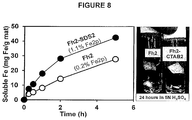
- FIG. 8 shows (a) Dissolution of Fh2 composites (w/and w/o SDS) in 0.1 N H 2 SO 4 . XPS Fe concentrations are provided. (b) Image of Fh2 composites (w/and w/o CTAB) after 24 h in 5 N H 2 SO 4 .
- FIG. 11 shows kinetics for AsO 4 3 ⁇ and CrO 4 2 ⁇ uptake on Fh 3 -CTAB 3 for systems where species were studied in isolation and concurrently as mixtures (pH 7, 0.5 g/L composite).
- FIG. 12 is a schematic diagram of a spiral wound configuration for dead end filtration applications of one embodiment of the invention.
- separation and “separating” mean the act or process of isolating or extracting from or of becoming isolated from a mixture (a composition of two or more substances that are not chemically combined).
- purification and “purifying” means the actor process of separating and removing from anything that which is impure or noxious, or heterogeneous or foreign to it.
- fluid refers to a continuous amorphous substance that tends to flow and to conform to the outline of its container, including a liquid or a gas, and specifically includes solutions (where solids dissolved in the liquid or gas) and suspensions (where solids are suspended in liquid or gas).
- the term “portable” refers to a device that may be capable of being carried or moved.
- the term refers to a device that may be carried by an adult or child with little or no effort.
- the term also refers to a device that is not permanently affixed to a permanent structure and is of sufficiently low mass and bulk that it may be easily transported as part of a vehicle or transportation device.
- the oxygen enrichment devices of the invention weigh less than about 1 kg.
- the invention is directed to precursor compositions, comprising:
- At least one polymer particularly thermoplastic polymer
- At least one surface-segregating surfactant optionally, at least one surface-segregating surfactant
- the invention is directed to composites, comprising, polymeric nanofibers
- carbon nanotubes optionally, carbon nanotubes, graphene, or a combination thereof.
- the composites are prepared via electrospinning.
- the invention is directed to nonwoven mats, comprising:
- the invention is directed to point-of-use filtration devices, comprising:
- the invention is directed to modular filter systems, comprising:
- a first module comprising the nonwoven mat described herein;
- a second module capable of chemical oxidation, disinfection, or a combination thereof (such as, for example, a Mn-doped TiO 2 nanofiber composite with or without carbon nanostructures); and
- At least one further module capable of sorbing dissolved organic matter, oxidation byproducts, or a combination thereof (such as, for example, carbon nanofibers with or without carbon nanostructures).
- the invention is directed to methods of preparing a composite, comprising:
- the invention is directed to methods, comprising:
- said contaminant is a material selected from the group consisting of heavy metals, heavy metalloids, and oxyanions.
- the composites of the invention are useful for removing contaminants, such as, for example, cadmium, mercury, lead, arsenic, manganese, chromium, cobalt, nickel, copper, zinc, selenium, silver, antimony, thallium, nitrate, nitrite, phosphate, arsenate, chromate, uranium, radionuclides, rare earth metals, and mixtures thereof.
- contaminants such as, for example, cadmium, mercury, lead, arsenic, manganese, chromium, cobalt, nickel, copper, zinc, selenium, silver, antimony, thallium, nitrate, nitrite, phosphate, arsenate, chromate, uranium, radionuclides, rare earth metals, and mixtures thereof.
- Polymers useful in the precursor compositions of the invention include, but are not limited to, is polyacrylonitrile (PAN), polymethyl methacrylate, polystyrene, polyvinylidene difluoride (PVDF), ethylene-vinyl acetate (EVA), or mixtures thereof.
- PAN polyacrylonitrile
- PVDF polyvinylidene difluoride
- EVA ethylene-vinyl acetate
- the polymer may be present at a level of about 5% by weight to about 25% by weight, preferably, about 5% by weight to about 15% by weight, based on the total weight of the precursor composition.
- Non-aqueous solvent useful in the precursor compositions of the invention include, but are not limited to, ethanol, glacial acetic acid, N,N-dimethyl acetamide, tetrahydrofuran, acetone, N,N-dimethyl formamide, or mixtures thereof.
- the wherein said non-aqueous solvent is present at a level of about 75% by weight to about 95% by weight, based on the total weight of the precursor composition, preferably, about 80% by weight to about 95% by weight, based on the total weight of the precursor composition.
- Metal oxides useful in the precursor compositions of the invention include, but are not limited to, iron oxide (such as hematite, goethite, ferrihydrite, magnetite and mixtures thereof), iron oxyhydroxide, aluminum oxide, and mixtures thereof.
- iron oxide such as hematite, goethite, ferrihydrite, magnetite and mixtures thereof
- iron oxyhydroxide aluminum oxide
- aluminum oxide and mixtures thereof.
- the inclusion of aluminum in the metal oxide provides for the removal of other targets, such as fluoride, for example, and can be used to alter the charge and physical properties of the iron (as a dopant) to provide a better sorbent.
- the metal oxides may be present at a level of about 0.1% by weight to about 10% by weight, preferably, about 0.5% by weight to about 7.5% by weight, based on the total weight of the precursor composition, based on the total weight of the precursor composition.
- Surfactants are often included in electrospinning precursor solutions to influence conductivity and viscosity. In addition to morphological benefits (e.g., more uniform diameter distributions), we have discovered that certain surface-segregating surfactants also impart chemical functionality.
- the optional surface-segregating surfactants useful in the precursor compositions of the invention may be an anionic surfactant or a cationic surfactant.
- Suitable surface-segregating surfactants useful in the precursor compositions of the invention include, but are not limited to, sodium dodecyl sulfonate (SDS), cetyltrimethylammonium (cetrimonium) bromide (CTAB), tetra-n-butylammonium bromide (TBAB), cetyltrimethylammonium chloride (CTAC), and mixtures thereof.
- SDS sodium dodecyl sulfonate
- CTCAB cetyltrimethylammonium bromide
- TBAB tetra-n-butylammonium bromide
- CTAC cetyltrimethylammonium chloride
- the surface-segregating surfactant may be a polymerizable surfactant.
- Suitable surface-segregating surfactants include surfactants that contain polymerizable groups such as styrene, acrylic, methacrylic and acrylamides, including ⁇ - ⁇ -ethylenically unsaturated poly(alkyleneoxy) compounds that display surfactant activity and that polymerize when used in the emulsion polymerization of ethylenically unsaturated monomers, including vinyl monomers.
- Suitable surfactants include polymerizable quaternary ammonium surfactants that contain acrylate or methacrylate groups and have chain lengths between about 10 to 18 carbons, tetradecylethylmethacrylate dimethylammonium bromide (and others disclosed in U.S. Pat. No. 5,162,475), the hindered aminoethers (such as 2,2,6,6-tetramethyl-1-piperidinyloxy (TEMPO) aminoether) disclosed in Hu, S., Malpert, J. H., Yang, X. and Neckers, D. C. (2000) Exploring Chromophore Tethered Aminoethers as Potential Photoinitiators for Controlled Radical Polymerization.
- TEMPO 2,2,6,6-tetramethyl-1-piperidinyloxy
- the surface-segregating surfactant may be present at a level of about 0.1% by weight to about 3% by weight, preferably, about 1% by weight to about 2% by weight, based on the total weight of the precursor composition.
- the carbon nanotubes are multi-wall carbon nanotubes. In certain other embodiments, the carbon nanotubes are unfunctionalized multi-wall carbon nanotubes.
- the carbon nanotubes may be present at a level of about 0.1% by weight to about 3% by weight, preferably, about 1% by weight to about 2% by weight, based on the total weight of the precursor composition.
- a porogen is any material (e.g., chemical or particle) that can be used to introduce porosity into a structure, typically through the process of embedding the material during synthesis and removing it (via physical or chemical means) via post-processing.
- Suitable examples include leachable materials, (such as surfactants that can be leached or washed from the structure to introduce porosity, such as sodium dodecyl sulfonate (SDS), sodium dodecyl benzene sulfonate (SDBS), other sulfonate surfactants, and the like) and nanoscale materials (e.g., calcium-based oxides or carbonates that can be leached/dissolved from the structure post-synthesis using mild acid or base, leaving behind a pore).
- leachable materials such as surfactants that can be leached or washed from the structure to introduce porosity, such as sodium dodecyl sulfonate (SDS), sodium dodecyl benzene s
- the porogen is an acid-soluble bulking agent having a particle size of about 3 nm to about 40 nm (such calcium carbonate, zinc oxide, and mixtures thereof). While not preferred porogens due to the need for increased temperatures sufficiently to volatilize them from the material), volatile acids, such as terephthalic acid, phthalic acid, or mixtures thereof, may be used in certain embodiments.
- the porogen may be present at a level of about 0.25% by weight to about 5% by weight, preferably, about 0.5% by weight to about 3.5% by weight, based on the total weight of the precursor composition.
- the precursor composition may further comprise quaternary ammonium salts having at least one C 12 -C 18 alkyl group (such as dodecyltrimethylammonium bromide, trimethyloctadecylammonium bromide, and the like).
- the salts may be present at a level of about 0.1% by weight to about 3% by weight, preferably, about 1% by weight to about 2% by weight, based on the total weight of the precursor composition.
- the precursor composition may further comprise a N-ionophore (such as nitrate ionophore VI (or 9-hexadecyl-1,7,11,17-tetraoxa-2,6,12,16-tetraazacycloeicosane) and nitrate ionophore V (9,11,20,22-Tetrahydrotetrabenzo[d.f,k,m][1,3,8,10]tetraazacyclotetradecine-10,21-dithione), and the like).
- the N-ionophores may be present at a level of about 0.1% by weight to about 3% by weight, preferably, about 1% by weight to about 2% by weight, based on the total weight of the precursor composition.
- the composite is prepared via electrospinning of the precursor composition disclosed herein.
- the composite may further comprise at least one conducting polymer fiber.
- Composites containing the conducting polymer fiber may be prepared via dual-extrusion electrospinning.
- Suitable conducting polymer include, but are not limited to, polypyrrole, polyaniline, polythiophene, poly(3-hexylthiophene), and poly(3,4-ethylenedioxythiophene), or mixtures thereof.
- the composite has a pore volume, as determined by N 2 -BET analysis, of at least about 0.1 cm 3 /g.
- the mechanical strength is an important property of the nanofibers and nanofiber mats.
- Inorganic nanofibers are typically brittle and lack the material strength to make them practical in treatment applications.
- the composites of the invention overcome this problem.
- the composite has a Young's Modulus, as measured by atomic force microscopy indentation, of less than about 100 MPa.
- the composites of the invention may be formed into a nonwoven mat of essentially any size. For point-of-use filtration devices and applications, smaller nonwoven mats may be preferred. The dimensions of the nonwoven mats depends on the application point. In a single use/drinking water bottle, for example, the mat can be quite small (about 50 cm in diameter and about 10 to 1000 ⁇ m thick). In a larger volume application (such as at a tap or inside a refrigerator, for example), a long sheet of material that is wound into a spiral that would increase thickness/retention time in the sorbent layer for improved performance and longer lifetime may be used, such as shown in FIG. 12 .
- the nanofiber composites of the invention may be used in water treatment to remove heavy metals, heavy metalloids, and oxyanions, including nitrate, nitrite, phosphate, arsenate, and chromate.
- the composites may also be used in energy generation and recovery, air purification, carbon capture, environmental monitoring and sensing, disinfection and antimicrobial materials, protective clothing, and the like.
- the invention is directly applicable to water treatment (both drinking water and wastewater), including point-of-use and point-of-entry treatment systems (e.g., attachment to taps or other “in-home” treatment systems).
- point-of-use and point-of-entry treatment systems e.g., attachment to taps or other “in-home” treatment systems.
- point-of-use and point-of-entry treatment systems e.g., attachment to taps or other “in-home” treatment systems.
- electrospinning allows composites to be easily produced at larger scales, thus also facilitating the application of these materials in full-scale water treatment.
- a range of other applications are available via this platform, including energy recovery systems, carbon capture, air purification, and personal protection in fields where exposure to airborne contamination is of concern (e.g., decontamination of pathogenic bioaerosols to reduce health risks to works in concentrated feeding operations).
- the nonwoven mats of the invention may be used in conjunction with separate nonwoven mats for carbon capture, wherein the separate nonwoven mats use N-doped carbon.
- Polymeric nanofibers can be synthesized using methods described herein with N-functional groups loaded either into their bulk and/or onto their surface.
- bulk loading of N-containing functional groups can be accomplished by varying the level of polyethylenimine (PEI) in a PAN precursor solution.
- surface N-functionalities can be introduced via post-synthesis functionalization of PAN nanofibers with hydroxylamine, which converts the surface nitrile groups in PAN to amidoxime (AO) groups.
- AO amidoxime
- N-doped CNTs can be integrated into the polymeric electrospinning solutions.
- the N-containing surface groups on the nanofibers react with the CO 2 . While it is not wishing to be bound by theory, it is believed that adjacent surface amino groups, for example, react with CO 2 to form an ammonium carbamate species (—NHCO 2 ⁇ ), which may be recovered during solvent regeneration, for example.
- the composites of the invention may be used in other applications. For example, in water treatment, they may be used for antimicrobials/disinfection (Ag composites with biocidal surfactant composites). Also, they have application in sensing and passive sampling.
- a typical electrospinning apparatus is shown in in the schematic of FIG. 1 with high-voltage power supply 2 , spinneret (metallic needle) 3 , collector (aluminum foil/metallic drum), and syringe pump 4 .
- the kinematic viscosity of select sol gels was estimated by measuring the time for a set volume of sol gel to flow by gravity through a fixed length of tubing.
- the precursor solutions were then loaded into a 12 mL plastic syringe (HSW Norm-Ject).
- the syringe was connected to 2.0 mm ID polyethylene (PE) tubing via a PE 1/16′′ female luer lock fitting (NanoNC Co., Ltd).
- the tubing was also connected to a metal nozzle adapter (NanoNC Co., Ltd) via a PE 1/16′′ male luer lock fitting, and a 25 G 1/2′′ needle was attached to the other end of the nozzle adapter.
- the needle tip was located at a distance of 10 cm from the surface of a 9-5/16′′-circumference metal drum collector (SPG Co., Ltd; Korea), which was coated in Al foil and grounded.
- SPG Co., Ltd; Korea 9-5/16′′-circumference metal drum collector
- the precursor solution was pumped through the needle at 0.5 mL/h (New Era Pump Systems, Inc.), a positive 12 kV voltage was applied at the needle tip (Acopian), and the grounded collector was rotating at 500 rpm (Dingtuo Technology).
- the high voltage difference between needle tip and collector caused formation of a whipping polymer jet, evaporation of the solvent, and deposition of non-woven polymer (or polymer CNT composite) nanofibers on the collector surface.
- the morphology of electrospun nanofiber mats was investigated using a field-emission scanning electron microscope (SEM) (S4800, Hitachi) at an acceleration voltage of 1.8 kV. All samples were sputter-coated with a thin layer of gold/palladium (60:40 Au:Pd) prior to SEM imaging. Average fiber diameters were developed from measurement of 50-100 nanofibers in ImageJ software. Morphology of selected mats was also examined using transmission electron microscopy (TEM) (JEOL JEM-1230) at an operating voltage of 120 kV. Surface area and pore volumes were determined by N 2 -BET analysis using a Micromeritics ASAP 2020 Physisorption Analyzer. All samples were degassed at 300° C. for 3 hours prior to analysis.
- SEM field-emission scanning electron microscope
- the mechanical strength of nanofibers and nanofiber mats was characterized by two complementary methods.
- the goal of characterization was to develop a quantitative assessment of the influence of CNT inclusion and macroporosity on nanofiber strength.
- Atomic Force Microscopy Nanoindentation The mechanical strength of individual nanofibers was characterized using atomic force microscopy (AFM) based nanoindentation conducted on a Molecular Force Probe 3D AFM (Asylum Research, Santa Barbara, Calif.). AFM height images and nanoindentation measurements were performed at room temperature in air, using silicon nitride probes (Mikromasch, San Jose, Calif., CSC37) with a nominal spring constant of 0.35 N/m and a typical tip radius of curvature of 10 nm. The tip radius of curvature was verified using scanning electron microscopy (SEM) and was found to be approximately 10 nm, as expected. Actual spring constants were determined using the built-in thermal noise method.
- AFM atomic force microscopy
- Topographic images were collected using intermittent contact mode (AC mode) or contact mode at a typical scan rate of 1 Hz.
- Nanofiber mat samples were adhered to freshly cleaved atomically flat mica (V-I grade, SPI Supplies, Westchester, Pa.) using double-sided tape, and topographic images were obtained prior to indentation experiments in AC mode.
- force-displacement curves were collected during the AFM probe motion towards and away from the sample. The probe was initially ⁇ 200 nm away from the surface, was moved towards the nanofiber surface until a predetermined force of 10 nN was achieved, and then the applied force was reversed until the probe returned to the initial position.
- Equation S1 a plot of the force to the 2/3 power vs. the tip-sample separation should be linear in the contact region.
- the Young's modulus of the sample can then be calculated using the linear slope of the F 2/3 vs. ⁇ plot in the contact region, with known or reported values of the tip radius of curvature and the Poisson's ratio.
- R and v were assumed to be 10 nm (using SEM) and 0.3 (typical value for organic nanomaterials), respectively.
- Load-Displacement Testing Stress-strain curves were also developed for select nanofiber mats from load-displacement data collected in a BioTense Perfusion Bioreactor (ADMET, Inc., Norwood, Mass.), which consisted of a linear actuator, sample grips, a reactor frame, and a 250 g load cell. Data acquisition was performed at 10 samples/sec through the MTestQuattro System (ADMET, Inc., Norwood, Mass.). Unlike the AFM-based nanoindentation performed on individual nanofibers within a mat, this load-displacement technique provided understanding as to the average mechanical properties of the entire, bulk nanofiber mat. Optical images of the system were recorded with a DS-Qi1 Nikon CCD camera.
- Dog-bone-shaped pieces (with area for break 2 mm width by 8 mm length by 0.25 mm thickness) were cut out using a stainless steel punch.
- the dog-bone pieces were clamped to the sample grips with flat alligator clips, with the thin portion of the wishbone in the gap between the arms.
- the load cell can measure a maximum tensile load of 2 N, and the closed-loop, servo-controlled actuator can provide a 25 mm stroke.
- the initial gap between the arms was measured with calipers and recorded (5.78 mm), the position was zeroed within the associated software, and the initial load on the sample was recorded.
- the dog-bone pieces were loaded to failure at a rate of 10 mm/min, with the maximum extension set to 4 mm.
- Timescales necessary to achieve sorption equilibrium were determined first via kinetic experiments conducted in 20 mL vials sealed with butyl stoppers. Each vial contained 15 mL of 5 mM phosphate buffer solution adjusted to pH 7 and a sorbent (e.g., nanofiber mat or GAC) at a mass loading at 0.5 g/L. Reactors were spiked at the start of the experiment with either 50 ⁇ M of atrazine (ATZ) or sulfamethoxazole (SMX) from 50 mM stock solutions prepared in methanol (which produced ⁇ 10 ⁇ 3 % v/v MeOH in the final reactor suspension).
- ATZ atrazine
- SMX sulfamethoxazole
- Reactors were well-mixed throughout the experiment on a rotator (Cole-Palmer Roto-Torque). Samples were taken periodically and then passed through a 0.2 ⁇ m Nylon syringe filter to remove the sorbent material. Controls containing no sorbent were conducted in parallel to reactors with nanofiber mats to account for any inadvertent losses via sorption to the vial stopper and/or syringe filter during equilibration and sample processing. After filtration, samples were transferred to 1.5 mL amber vials for subsequent analysis via high pressure liquid chromatography equipped with a photodiode array detector (HPLC-DAD).
- HPLC-DAD photodiode array detector
- Sorption isotherms were collected in batch experiments performed in well-mixed reactors similar to those used for kinetic experiments.
- the sorbent mass loading was held constant (0.4 g/L).
- Reactors were spiked at the start of the experiment with varying concentrations (13-170 ⁇ M) of ATZ or SMX from 50 mM stock solutions prepared in methanol (resulting in ⁇ 3.4 ⁇ 10 3 % v/v MeOH in the final reactor suspension).
- isotherm samples were taken at 0 and 6 h for nanofiber mats and after 24 h for GAC. Samples were then passed through a 0.2 ⁇ m Nylon syringe filter to remove the sorbent material.
- Sample post-processing and analysis was identical to that performed for kinetic sorption experiments. Batch pH-edge experiments were also performed in identical reactors, with 0.4 g/L sorbent mass loading, 70 ⁇ M initial concentration SMX or metoprolol, 5 mM phosphate buffer (pH 6-9), and sample post-processing and analysis identical to that for sorption isotherm experiments.
- ATZ acetonitrile
- ATZ Analysis of ATZ was performed via a MS2 SIM method, with a mobile phase of 50:50 ACN:H 2 O, a flow rate of 0.4 mL/min, an injection volume of 5 ⁇ L, and a parent compound mass of 216, whereas SMX analysis was performed via a MS2 SIM method, with a mobile phase of 30:70 MeOH:H 2 O, a flow rate of 0.4 mL/min, an injection volume of 5 ⁇ L, and a parent compound mass of 254.
- Example 1 ⁇ -Fe 2 O 3 Coated Nanofiber Networks
- CTAB cetyltrimethylammonium bromide
- Electrospun PAN nanofibers seeded with ⁇ -Fe 2 O 3 nanoparticles were hydrothermally coated with ⁇ -Fe 2 O 3 (hereafter simply Fe 2 O 3 ) to obtain polymer-iron oxide hybrid nanofiber networks.
- 10 nm Fe 2 O 3 nanoparticles were prepared, suspended in 3.5 mL N,N-dimethylformamide (DMF, BDH, 99.8%), and sonicated for 5 h.
- PAN Aldrich, MW 150,000 was added and the solution was thermally mixed for 2 h at 60° C.
- the sol gel was allowed to cool to room temperature and then electrospun with a flow rate of 0.5 mL/h, 18 kV/10 cm, and 23 G needle. After 6 h, the electrospinning process was stopped and the mat was peeled off the grounded collector. PAN/Fe 2 O 3 nanofiber networks were coated by placing pieces ( ⁇ 6 cm ⁇ 10 cm) in 150 mL solution of 0.14 M FeCl 3 ⁇ 6H 2 O (Sigma-Aldrich, 97%) and 0.14 M L-arginine (Sigma, ⁇ 98.5%) solution in a plastic container that was then loosely covered and heated at 95° C. for 12 h.
- Nanofiber networks were characterized to determine their physical and chemical properties. Nanofiber diameter and extent of hydrothermal coating were examined with a Hitachi S-4800 scanning electron microscope (SEM). X-ray diffraction (XRD, Rigaku MiniFlexll) was used to confirm the phase of nanoparticles and nanofiber coatings as hematite. Surface area of the materials was determined via N 2 -BET analysis (Quantachrome Nova 4200e) after outgassing samples at 40° C. for 6 h prior to analysis.
- SEM Hitachi S-4800 scanning electron microscope
- Pieces of nanofiber networks were reacted in batch with As, Cu, Cr, and Pb to assess their reactivity.
- Experiments were conducted in 20 mL glass vials sealed with butyl rubber septa. Approximately 5 mg of material (typically a 0.5 cm ⁇ 0.5 cm mat of nanofibers) was placed in 10 mL of appropriate buffer solution (e.g., 10 mM MES hydrate (Sigma, ⁇ 99.5%) or HEPES (RPI, ⁇ 99.9%)) adjusted to a pH value between 6 and 8 and containing either potassium chromate (Sigma-Aldrich, ⁇ 99.0%), sodium arsenate dibasic heptahydrate (Sigma, ⁇ 98.0%), copper chloride dihydrate (Sigma-Alrich, ⁇ 99.0%), or lead nitrate (Fisher Scientific).
- appropriate buffer solution e.g., 10 mM MES hydrate (Sigma, ⁇ 99.5%) or HEPES (RPI, ⁇ 99
- Vials were placed on a rotator (Cole-Parmer Roto-Torque) for times ranging from 10 minutes to 24 hours, after which 5 mL samples were taken, acidified to 2% HNO 3 and filtered with 0.45 ⁇ m nylon filters for analysis.
- a rotator Cold-Parmer Roto-Torque
- ICP-OES inductively coupled plasma optical emission spectrometry
- FIG. 2 shows CrO 4 2 ⁇ adsorption isotherms for a suite of PAN/Fe 2 O 3 composites, which were synthesized by systematically tuning iron oxide loading on PAN. Results show that the loading of Fe 2 O 3 on PAN, and thus metal sorption capacity, could be controlled either by varying the amount of Fe 2 O 3 nanoparticles seeded into PAN, the concentration of dissolved iron in hydrothermal solution, or the length of hydrothermal treatment. PAN/Fe 2 O 3 hybrid nanofiber networks, regardless of the amount of seed Fe 2 O 3 nanoparticles embedded in the PAN, exhibited low adsorption capacities for CrO 4 2 ⁇ prior to hydrothermal coating with surface Fe 2 O 3 ( FIG. 2 ).
- an optimal synthetic formulation i.e., optimal performance and simplest synthesis
- PAN treated in 0.14 M Fe solution for 12 hours we attribute this material's superior performance to its high loading of seed nanoparticles, which produced an abundance of uniformly distributed nucleation sites on the PAN surface for additional deposition and growth of Fe 2 O 3 nanostructures during hydrothermal coating.
- Evidence of this growth can be seen in FIG.
- hydrothermal treatment of PAN/Fe 2 O 3 did not eliminate the flexibility or wettability of the nanofiber network despite extensive surface coating with Fe 2 O 3 .
- Mats could be bended and rolled ( FIG. 4 , panel b), which may help facilitate their application in reactor platforms (e.g., spiral-wound membrane filters) that optimize their treatment capacity.
- SEM imaging and histograms revealed that although hydrothermal treatment resulted in clear growth of rod-like and particulate nanostructures on the surface of PAN/Fe 2 O 3 nanofibers, Fe 2 O 3 -coated PAN/Fe 2 O 3 nanofibers (hereafter PAN/Fe 2 O 3 @Fe 2 O 3 ) did not significantly increase in average diameter.
- this core-shell, polymer-oxide composite represents a cohesive material that combines the benefits of material strength and external reactive surface area ideal for reactive filtration applications for water treatment.
- q is the mass of contaminant adsorbed per mass or specific surface area of adsorbent (mg/g or mg/m 2 )
- KL is the Langmuir coefficient
- q max is the amount of adsorption at one monolayer
- C e is the equilibrium concentration of the contaminant in solution.
- maximum capacities (q max ) were used to compare performance.
- Adsorption isotherms for AsO 4 3 ⁇ , CrO 4 2 ⁇ , Cu 2+ , and Pb 2+ are shown in FIG. 5 for PAN/Fe 2 O 3 @Fe 2 O 3 , GFH@ and a dispersion of 10 nm ⁇ -Fe 2 O 3 nanoparticles.
- PAN/Fe 2 O 3 @Fe 2 O 3 (i) outperforms commercial GFH@ on the basis of available surface area and (ii) performs equivalently to dispersions of 10 nm Fe 2 O 3 nanoparticles.
- GFH@ which consists of poorly crystalline akaganeite ( ⁇ —FeOOH)
- ⁇ —FeOOH poorly crystalline akaganeite
- the hematite materials followed adsorption capacity trends known for AsO 4 3 ⁇ , CrO 4 3 ⁇ , Cu 2+ , and Pb 2+ , consistent with a shared binding mechanism (i.e., surface complexation) for Fe 2 O 3 nanoparticles and our synthetic PAN/Fe 2 O 3 @Fe 2 O 3 .
- the composite nanofibers herein appear to behave identically to their nanoparticle analogs. This is especially promising for predicting performance and application targets for Fe2O3 nanofiber networks from the plethora of existing studies on nanoparticulate Fe2O3 sorbents.
- the extent of adsorption of AsO 4 3 ⁇ is expected to decrease with increasing pH due to H 2 AsO 4 ⁇ deprotonating to HCrO 4 2 ⁇ at its acid dissociation constant (pKa), pH 6.8, and the surface of hematite becoming more negative at higher pH values (and thus repelling anions).
- the decrease in CrO 4 2 ⁇ adsorption with increasing pH can be attributed to HCrO 4 2 ⁇ deprotonation to CrO 4 2 ⁇ at its pKa, pH 6.5, while the hematite surface is also becoming more negatively charged.
- This example demonstrates the promise of a cohesive platform for metal sequestration in water treatment applications—PAN/Fe 2 O 3 @Fe 2 O 3 .
- the electrospinning process allowed the facile synthesis of a flexible, stable nanofiber network, while the hydrothermal treatment achieved a coating of Fe 2 O 3 nanostructures increasing the reactive iron oxide surface area available to adsorb metals from solution.
- Hydrothermal treatment parameters could be varied to change the thickness of the Fe 2 O 3 coating on the nanofibers.
- the optimal PAN/Fe 2 O 3 @Fe 2 O 3 adsorbed significant amounts of AsO 4 3 ⁇ , CrO 4 2 ⁇ , Cu 2+ , and Pb 2+ across a range of initial concentrations and pH values.
- Adsorption capacities were comparable to those of 10 nm Fe 2 O 3 nanoparticles, so a material has been created that likely utilizes the studied mechanisms of uptake of nanoparticulate hematite while bound in a cohesive platform.
- the kinetics for the material demonstrate that the majority of adsorption occurs in the first two hours from utilizing external surface area. This result in particular shows that the PAN/Fe 2 O 3 @Fe 2 O 3 nanofiber mat, intended to be used as a point-of-use filtration membrane (among other applications), employs rapid kinetics required in flow-through filtration as compared to GFH@.
- the PAN/Fe 2 O 3 @Fe 2 O 3 nanofiber network a flexible sheet of nanofibers, even after hydrothermal treatment—is a robust candidate as a filtration technology.
- the small footprint of this membrane as a filter would allow it to be deployed in point-of-use scenarios (e.g., by individual groundwater well users in rural areas) where larger technologies (e.g., a packed bed of GFH) cannot be easily utilized.
- PAN nanofibers were prepared containing cetyltrimethylammonium bromide (CTAB) and/or ferrihydrite (Fh) nanoparticles (materials are hereafter referred to as Fh x -CTAB y , where x and y indicate weight % of Fh and CTAB, respectively, in the precursor solution).
- CTAB cetyltrimethylammonium bromide
- Fh ferrihydrite
- PAN nanofibers electrospun from solutions with CTAB and Fh exhibited surface enrichment of both cationic quaternary ammonium functionalities and Fh nanoparticles.
- X-ray photoelectron spectroscopy indicated a 2-fold increase in surface Fe concentration for Fh composites containing CTAB. This surface Fe excess increases to 5-fold when anionic sodium dodecyl sulfonate (SDS; 2 weight %) is used ( FIG. 8 , panel a). Additional evidence for surface Fh accumulation is provided by Fe dissolution rates during mat acid digestion. Over 2 h in 0.1 N H 2 SO 4 , Fh 2 -SDS 2 composites exhibited a 2-fold greater Fe dissolution rate than non-SDS-containing mats.
- Example 3 Surface-Functionalized Polymer-Metal Oxide Composites as Materials for Oxyanion Uptake
- composites with both CTAB and Fh produced AsO 4 3 ⁇ uptake that was both synergistic (i.e., more than additive for Fh 2 -CTAB 2 ) and tunable with increasing Fh and CTAB (greater uptake for Fh 3 -CTAB 3 ).
- CTAB 2 mats achieved high levels of removal.
- the mixed Fh 2 -CTAB 2 composite exhibited slightly lower sorption relative to CTAB 2 , consistent with quaternary ammonium sites being primarily responsible for CrO 4 2 ⁇ binding.
- these CTAB-integrated materials behave as anion exchange resins (indeed, Br release is measurable during CrO 4 2 ⁇ uptake).
- no significant loss in AsO 4 3 ⁇ capacity was observed after washing of Fh x -CTAB, composites, consistent with CTAB not being directly responsible for AsO 4 3 ⁇ uptake.
- FIG. 10 illustrates that Fh and CTAB composites exhibit appreciable uptake for nitrate (NO 3 ⁇ ), with higher CTAB concentrations yielding better performance.
- NO 3 ⁇ nitrate
- CrO 4 2 ⁇ these data support the role of quaternary ammonium groups as strong base anion exchange sites primarily responsible for NO 3 ⁇ binding. Further, we anticipate this mode of NO 3 ⁇ binding will be complemented by the preferential sorption of PO 4 3 ⁇ onto iron oxides.
- FIG. 11 these materials should be able to simultaneously and non-competitively bind environmentally relevant N and P species.
Landscapes
- Chemical & Material Sciences (AREA)
- Chemical Kinetics & Catalysis (AREA)
- Engineering & Computer Science (AREA)
- Inorganic Chemistry (AREA)
- Textile Engineering (AREA)
- Medicinal Chemistry (AREA)
- Organic Chemistry (AREA)
- Polymers & Plastics (AREA)
- Health & Medical Sciences (AREA)
- Ceramic Engineering (AREA)
- Life Sciences & Earth Sciences (AREA)
- Geology (AREA)
- Dispersion Chemistry (AREA)
- Solid-Sorbent Or Filter-Aiding Compositions (AREA)
Abstract
Description
-
- at least one further module capable of sorbing dissolved organic matter, oxidation byproducts, or a combination thereof.
| TABLE 1 |
| Langmuir isotherm adsorption capacities for AsO4 3−, CrO4 2−, |
| Cu2+, and Pb2+ for PAN/Fe2O3 @ Fe2O3, GFH ®, and |
| 10 nm α-Fe2O3 nanoparticles. |
| Langmuir model adsorption capacities |
| AsO4 3− qmax | CrO4 2− qmax | Cu2+ qmax | Pb2+ qmax | |
| Adsorbent | (mg/m2) | (mg/m2) | (mg/m2) | (mg/m2) |
| PAN/Fe2O3 @ | 0.4 +/− 0.0 | 0.3 +/− 0.0 | 0.6 +/− 0.0 | 1.2 +/− 0.1 |
| Fe2O3 | ||||
| GFH ® | 0.2 +/− 0.0 | 0.2 +/− 0.0 | 0.1 +/− 0.0 | 0.3 +/− 0.0 |
| 10 nm α-Fe2O3 | 0.4 +/− 0.0 | 0.2 +/− 0.1 | 0.5 +/− 0.1 | 1.0 +/− 0.2 |
Claims (10)
Priority Applications (1)
| Application Number | Priority Date | Filing Date | Title |
|---|---|---|---|
| US16/303,807 US11136453B2 (en) | 2016-05-26 | 2017-05-26 | Electrospun nanofiber composites for water treatment applications |
Applications Claiming Priority (3)
| Application Number | Priority Date | Filing Date | Title |
|---|---|---|---|
| US201662341753P | 2016-05-26 | 2016-05-26 | |
| PCT/US2017/034663 WO2017205732A1 (en) | 2016-05-26 | 2017-05-26 | Electrospun nanofiber composites for water treatment applications |
| US16/303,807 US11136453B2 (en) | 2016-05-26 | 2017-05-26 | Electrospun nanofiber composites for water treatment applications |
Publications (2)
| Publication Number | Publication Date |
|---|---|
| US20200317903A1 US20200317903A1 (en) | 2020-10-08 |
| US11136453B2 true US11136453B2 (en) | 2021-10-05 |
Family
ID=60411592
Family Applications (1)
| Application Number | Title | Priority Date | Filing Date |
|---|---|---|---|
| US16/303,807 Active 2037-12-23 US11136453B2 (en) | 2016-05-26 | 2017-05-26 | Electrospun nanofiber composites for water treatment applications |
Country Status (2)
| Country | Link |
|---|---|
| US (1) | US11136453B2 (en) |
| WO (1) | WO2017205732A1 (en) |
Cited By (1)
| Publication number | Priority date | Publication date | Assignee | Title |
|---|---|---|---|---|
| US12385818B2 (en) | 2023-02-14 | 2025-08-12 | Saudi Arabian Oil Company | Modeling gas desorption in a subsurface reservoir |
Families Citing this family (13)
| Publication number | Priority date | Publication date | Assignee | Title |
|---|---|---|---|---|
| WO2019237017A1 (en) * | 2018-06-08 | 2019-12-12 | The Regents Of The University Of California | Core-shell iron oxide-polymer nanofiber composites for removal of heavy metals from drinking water |
| CN108745320B (en) * | 2018-06-28 | 2021-03-09 | 西南科技大学 | Preparation method of nano-gelatin/polymer composite fiber tape based on seawater extraction of uranium |
| KR102121130B1 (en) * | 2018-12-27 | 2020-06-09 | 전주대학교 산학협력단 | PAN-Fe2O3 magnetic composites amd manufacturing method thereof |
| CN110591266A (en) * | 2019-09-03 | 2019-12-20 | 鄂尔多斯市紫荆创新研究院 | Method for preparing graphene oxide EVA rubber by utilizing electrostatic spinning process |
| CN111020882A (en) * | 2019-12-13 | 2020-04-17 | 中国科学院深圳先进技术研究院 | Flexible conductive fiber membrane material and preparation method thereof |
| US20230167591A1 (en) * | 2020-03-31 | 2023-06-01 | Matregenix, Inc. | Electrospun nanofibrous polymer membrane for use in air filtration applications |
| CN112691560B (en) * | 2020-10-23 | 2025-08-19 | 南北兄弟药业投资有限公司 | Preparation method of MOFs-PVDF composite ultrafiltration membrane |
| CN112691557B (en) * | 2020-10-23 | 2025-08-19 | 南北兄弟药业投资有限公司 | Preparation method of modified PVDF ultrafiltration membrane |
| US12311335B2 (en) | 2021-01-14 | 2025-05-27 | Georgia State University Research Foundation, Inc. | Composite materials and methods of making and use thereof |
| CN113668245B (en) * | 2021-08-19 | 2023-02-24 | 南京市产品质量监督检验院 | Preparation method and application of polystyrene-hydroxylated multi-walled carbon nanotube-polypyrrole composite nanofiber |
| CN114471716B (en) * | 2022-03-11 | 2022-10-04 | 北京师范大学珠海校区 | Preparation method, product and application of a gradient adjustable high-strength anti-deposition long-term catalytic film |
| US20240002261A1 (en) * | 2022-06-29 | 2024-01-04 | University Of Iowa Research Foundation | Materials and methods for water purification |
| CN116926784B (en) * | 2023-06-09 | 2026-03-20 | 浙江理工大学 | Preparation method and application of composite nanofiber membranes based on photothermal enhanced uranium ion selective adsorption-photocatalytic cascade mechanism |
Citations (14)
| Publication number | Priority date | Publication date | Assignee | Title |
|---|---|---|---|---|
| US3826369A (en) | 1971-07-02 | 1974-07-30 | Yuasa Battery Co Ltd | Filtration process and filtration equipment |
| US3950507A (en) | 1974-03-19 | 1976-04-13 | Boreskov Georgy Konstantinovic | Method for producing granulated porous corundum |
| US4231768A (en) | 1978-09-29 | 1980-11-04 | Pall Corporation | Air purification system and process |
| US6706795B1 (en) | 1998-02-26 | 2004-03-16 | Yissum Research Development Company Of The Hebrew University Of Jerusalem | Methods for the preparation of nanosized material particles |
| US20060264140A1 (en) | 2005-05-17 | 2006-11-23 | Research Triangle Institute | Nanofiber Mats and production methods thereof |
| US20100009267A1 (en) | 2006-09-29 | 2010-01-14 | The University Of Akron | Metal oxide fibers and nanofibers, method for making same, and uses thereof |
| US20100035047A1 (en) | 2008-08-07 | 2010-02-11 | William Marsh Rice University | Metal and metal oxide nanoparticle-embedded composites |
| US20110031441A1 (en) | 2005-06-27 | 2011-02-10 | E.I. Du Pont De Nemours And Company Dupont Display Inc | Electrically conductive polymer compositions |
| US20110052467A1 (en) | 2008-03-20 | 2011-03-03 | University Of Akron | Ceramic nanofibers containing nanosize metal catalyst particles and medium thereof |
| WO2011140304A1 (en) | 2010-05-05 | 2011-11-10 | The Research Foundation Of State University Of New York | Water testing system |
| US20120132644A1 (en) | 2009-03-16 | 2012-05-31 | Zhiyong Gu | Methods for the fabrication of nanostructures heating elements |
| US20130175026A1 (en) | 2012-01-11 | 2013-07-11 | Baker Hughes Incorporated | Nanocomposites for absorption tunable sandscreens |
| US8714776B2 (en) * | 2008-05-13 | 2014-05-06 | Research Triangle Institute | Porous and non-porous nanostructures and application thereof |
| US20150056471A1 (en) * | 2012-02-16 | 2015-02-26 | Cornell University | Ordered porous nanofibers, methods, and applications |
-
2017
- 2017-05-26 US US16/303,807 patent/US11136453B2/en active Active
- 2017-05-26 WO PCT/US2017/034663 patent/WO2017205732A1/en not_active Ceased
Patent Citations (14)
| Publication number | Priority date | Publication date | Assignee | Title |
|---|---|---|---|---|
| US3826369A (en) | 1971-07-02 | 1974-07-30 | Yuasa Battery Co Ltd | Filtration process and filtration equipment |
| US3950507A (en) | 1974-03-19 | 1976-04-13 | Boreskov Georgy Konstantinovic | Method for producing granulated porous corundum |
| US4231768A (en) | 1978-09-29 | 1980-11-04 | Pall Corporation | Air purification system and process |
| US6706795B1 (en) | 1998-02-26 | 2004-03-16 | Yissum Research Development Company Of The Hebrew University Of Jerusalem | Methods for the preparation of nanosized material particles |
| US20060264140A1 (en) | 2005-05-17 | 2006-11-23 | Research Triangle Institute | Nanofiber Mats and production methods thereof |
| US20110031441A1 (en) | 2005-06-27 | 2011-02-10 | E.I. Du Pont De Nemours And Company Dupont Display Inc | Electrically conductive polymer compositions |
| US20100009267A1 (en) | 2006-09-29 | 2010-01-14 | The University Of Akron | Metal oxide fibers and nanofibers, method for making same, and uses thereof |
| US20110052467A1 (en) | 2008-03-20 | 2011-03-03 | University Of Akron | Ceramic nanofibers containing nanosize metal catalyst particles and medium thereof |
| US8714776B2 (en) * | 2008-05-13 | 2014-05-06 | Research Triangle Institute | Porous and non-porous nanostructures and application thereof |
| US20100035047A1 (en) | 2008-08-07 | 2010-02-11 | William Marsh Rice University | Metal and metal oxide nanoparticle-embedded composites |
| US20120132644A1 (en) | 2009-03-16 | 2012-05-31 | Zhiyong Gu | Methods for the fabrication of nanostructures heating elements |
| WO2011140304A1 (en) | 2010-05-05 | 2011-11-10 | The Research Foundation Of State University Of New York | Water testing system |
| US20130175026A1 (en) | 2012-01-11 | 2013-07-11 | Baker Hughes Incorporated | Nanocomposites for absorption tunable sandscreens |
| US20150056471A1 (en) * | 2012-02-16 | 2015-02-26 | Cornell University | Ordered porous nanofibers, methods, and applications |
Non-Patent Citations (105)
| Title |
|---|
| "A Proven, Safe, and Simple Solution to Arsenic Removal Challenges", GFH Dry Granular Ferric Hydroxide Media, 2018, pp. 1-2, Evoqua Water Technologies LLC. |
| "Arsenic Contamination Exceeds Drinking Water Standards", American Gypsum, 2017, pp. 1-2, Evoqua Water Technologies LLC. |
| "Chromium-6 in U.S. Tap Water", Dec. 20, 2010, pp. 1-3, Environmental Working Group. |
| "Iowa Quick Facts", https://www.iowa.gov/about, 5 pages (2019). |
| "Iowa Statewide Rural Well Water Survey Phase 2", (SWRL2) Results and Analysis, Aug. 2009, pp. 1-27, Center for Health Effects of Environmental Contamination, The University of Iowa. |
| Ajouyed et al., "Sorption of Cr(VI) onto Natural Iron and Aluminum (oxy) Hydroxides: Effects of pH, Ionic Strength and Initial Concentration" Journal of Hazardous Materials, 2010, pp. 616-622, vol. 174, Elsevier B.V. |
| Bargar et al., "Surface Complexation of Pb (II) at Oxide-water Interfaces: II. XAFS and Bond-valence Determination of Mononuclear Pb (II) Sorption Products and Surface Functional Groups on Iron Oxides", Geochimica et Cosmochimica Acta, 1997, pp. 2639-2652, vol. 61, No. 13, Elsevier Science Ltd., USA. |
| Barton et al., "Size-Dependent Pb Sorption to Nanohematite in the Presence and Absence of a Microbial Siderophore", Environmental Science and Technology, 2011, pp. 3231-3237, vol. 45, American Chemical Society. |
| Benotti, M , et al., "Pharmaceuticals and Endocrine Disrupting Compounds in U.S. Drinking Water", Environ Sci Technol 43, 597-603 (2009). |
| Biswas et al., "Adsorption of Fluoride from Aqueous Solution by a Synthetic Iron(III)-Aluminum(III) Mixed Oxide", Ind. Eng. Chem. Res., 2007, pp. 5346-5356, vol. 46, American Chemical Society. |
| Bjorge et al., "Initial Testing of Electrospun Nanofibre Filters in Water Filtration Applications", Short Communication, Jan. 1, 2010, pp. 151-156, vol. 36, No. 1. |
| Bjorge et al., "Performance Assessment of Electrospun Nanofibers for Filter Applications", Desalination, 2009, pp. 942-948, vol. 249, Elsevier B.V. |
| Bora et al., "Hydrothermal Treatment of a Hematite Film Leads to Highly Oriented Faceted Nanostructures with Enhanced Photocurrents", Chemistry of Materials, Apr. 1, 2011, pp. 2051-2061, vol. 23, American Chemical Society. |
| Botes et al., "The Potential of Nanofibers and Nanobiocides in Water Purification", Critical Reviews in Microbiology, Jan. 20, 2010, pp. 68-81, vol. 36, No. 1, Informa UK Ltd. |
| Brass et al. "Much Effort and Resources Needed to Help Small Drinking Water Systems Overcome Challenges", Evaluation Report, Report No. 2006-P-00026, May 30, 2006, pp. 1-55, U.S. Environmental Protection Agency, Office of Inspector General. |
| Cacho et al., "Studies on Photo-induced NO Removal by Mn-doped TiO2 Under Indoor-like Illumination Conditions", Journal of Photochemistry and Photobiology A: Chemistry, 2011, pp. 304-306, vol. 222, Elsevier B.V. |
| Cain, T , et al., "Occurrence of Antibiotics, Pharmaceuticals and Sterols at Select Surface and Wastewater Sites in Iowa", in Proceedings of the 4th International conference on pharmaceuticals and endocrine disrupting chemicals in water, Minneapolis, Minn., National Ground Water Association, 151-157, Oct. 13-15, 2004. |
| Campos et al., "Removal of Chromate from Drinking Water Using Powder Carbon Steel", Environ. Geol., Feb. 2, 2015, pp. 926-930, vol. 47, Springer-Verlag. |
| Catalano et al., "Simulaneous Inner- and Outer-sphere Arsenate Adsorption on Corundum and Hematite", Geochimica et Cosmochimica Acta, 2008, pp. 1986-2004, vol. 72, Elsevier Ltd. |
| Chen et al., "Arsenic Removal by Tailored Activated Carbon at Ambient pH", Water Research Foundation and Arsenic Water Technology Partnership, 2009, pp. 1-66, WERC, A Consortium for Environmental Education and Technology Development at New Mexico State University. |
| Cuppett et al., "Evaluation of Copper Speciation and Water Quality Factors that Affect Aqueous Copper Tasting Response", Chem. Senses, Jul. 13, 2006, pp. 689-697, vol. 31, Oxford University Press. |
| Cwiertny et al., "Characterization and Acid-mobilization Study of Iron-containing Mineral Dust Source Materials", Journal of Geophysical Research, 2008, pp. 1-18, vol. 113, The American Geophysical Union. |
| Cwiertny et al., "Exploring the Influence of Granular Iron Additives on 1,1,1-Trichloroethane Reduction", Environmental Science & Technology, 2006, pp. 6837-6843, vol. 40, No. 21, American Chemical Society. |
| Cwiertny et al., "Interpreting Nanoscale Size-effects in Aggregated Fe-oxide Suspensions: Reaction of Fe(II) with Goethite", Geochimica et Cosmochimica Acta, 2009, pp. 1365-1380, vol. 72, Elsevier Ltd. |
| Cwiertny et al., "Research and Demonstration of Electrospun Nanofibers Filters: Multifunctional, Chemically Active Filtration Technologies for Small-Scale Water Treatment Systems", Project Overview, Dec. 1, 2011-Nov. 30, 2016, pp. 1-4. |
| Cwiertny et al., "Surface Chemistry and Dissolution of α-FeOOH Nanorods and Microrods: Environmental Implications of Size-Dependent interactions with Oxalate", J. Phys. Chem. C, 2009, pp. 2175-2186, vol. 113, American Chemical Society. |
| Cwiertny, D , et al., "Research and Demonstration of Electrospun Nanofiber Filters: Multifunctional, Chemically Active Filtration Technologies for Small-Scale Water Treatment Systems", EPA Agreement No. 83517701, Civil and Environmental Engineering, University of Iowa, Chemical and Environmental Engineering, University of California Riverside, 23 pages, (Project Period Dec. 1, 2011-Nov. 30, 2016). |
| Daels et al., "The Use of Electrospun Flat Sheet Nanofibre Membranes in MBR Applications", Desalination, 2010, pp. 170-176, vol. 257, Elsevier B.V. |
| Dai et al., "Ceramic Nanofibers Fabricated by Electrospinning and their Applications in Catalysis, Environmental Science, and Energy Technology", Polymers Advanced Technologies, 2011, pp. 326-338, vol. 22, John Wiley & Sons, Ltd. |
| Davis et al., "Adsorption of Cadmium and Humic Acid onto Hematite", Chemosphere, 1995, pp. 243-256, vol. 30, No. 2, Elsevier Science Ltd., Great Britain. |
| Dickenson et al., "Applying Surrogates and Indicators to Assess Removal Efficiency of Trace Organic Chemicals during Chemical Oxidation of Wastewaters", Environmental Science & Technology, 2009, pp. 6242-6247, vol. 43, No. 16, American Chemical Society. |
| Donn et al., "An AP Investigation: Pharmaceuticals Found in Drinking Water", Mar. 10, 2008, pp. 1-7, Associated Press. |
| Duncan et al., "Introduction to Societal Issues: The Responsible Development of Nanotechnology for Water", Societal Issues, Nanotechnology Applications for Clean Water, 2009, pp. 449-451, William Andrew Inc. |
| Evoqua Water Technologies , "American Gypsum, Albuquerque, New Mexico: Arsenic Contamination Exceeds Drinking Water Standards", Evoqua Water Technologies LLC, 210 Sixth Avenue, Suite 3300, Pittsburgh, PA 15222, 2 pages (2017). |
| Evoqua Water Technologies , "Bucks County Water Authority, Solebury, Pennsylvania: Arsenic Treatment to Meet New Drinking Water Standards", Evoqua Water Technologies LLC, 210 Sixth Avenue, Suite 3300, Pittsburgh, PA 15222, 2 pages (2017). |
| Evoqua Water Technologies , "GFH Dry Granular Ferric Hydroxide Media: A Proven, Safe, and Simple Solution to Arsenic Removal Challenges", Evoqua Water Technologies LLC, 210 Sixth Avenue, Suite 3300, Pittsburgh, PA 15222, 2 page (2018). |
| Evoqua Water Technologies , "Municipal Drinking Water Facility: GFH Media Removes Arsenic in Arizona Water Supply", Evoqua Water Technologies LLC, 4800 North Point Parkway, Suite 250, Alpharetta, GA 30022, 2 pages (2014). |
| Friedmann et al., "TiO2 for Water Treatment: Parameters Affecting the Kinetics and Mechanisms of Photocatalysis", Applied Catalysis B: Environmental, 2010, pp. 398-406, vol. 99, Elsevier B.V. |
| Ganesh, Tissue Engineering: Part A, vol. 18, Nos. 17 and 18, 2012, p. 1867-1881 (Year: 2012). * |
| Genc-Fuhrman et al., "Simultaneous Removal of As, Cd, Cr, Cu, Ni, and Zn from Stormwater: Experimental Comparison of 11 Different Sorbents", Water Research, 2007, pp. 591-602, vol. 41, Elsevier Ltd. |
| Gimenez et al., "Arsenic Sorption onto Natural Hematite, Magnetite, and Goethite", Journal of Hazardous Materials, 2007, pp. 575-580, vol. 141, Elsevier B.V. |
| Gong et al., "Lack of Influence of Extracellular Polymeric Substances (EPS) Level on Hydroxyl Radical Mediated Disinfection of Escherichia coli", Environmental Science & Technology, 2012, pp. 241-249, vol. 46, American Chemical Society. |
| Greenstein et al., "Development of Polymer-Iron Oxide Hybrid Nanofiber Networks for Metal Sequestration in Point-of-use Water Treatment Applications", Civil and Environmental Engineering, Dec. 2016, pp. 1-15, University of Iowa. |
| Hanna-Attisha et al., "Elevated Blood Lead Levels in Children Associated with the Flint Drinking Water Crisis: A Spatial Analysis of Risk and Public Health Response", AJPH Research, Feb. 2016, pp. 283-290, vol. 106, No. 2. |
| Hering et al., "Arsenic Removal from Drinking Water during Coagulation", Journal of Environmental Engineering, Aug. 1997, pp. 800-807, vol. 123, No. 8. |
| Homaeigohar et al., "Plolyethersulfone Electrospun Nanofibrous Composite Membrane for Liquid Filtration", Journal of Membrane Science, 2010, pp. 68-77, vol. 365, Elsevier B.V. |
| Hong et al., "Electrochemical Synthesis of FexNi1-x−x Nanostructures for Environmental Remediation", Chemical Engineering Journal, 2009, pp. 66-72, vol. 151, Elsevier B.V. |
| Hua et al., "Heavy Metal Removal from Water/Wasterwater by Nanosized Metal Oxides: A Review", Journal of Hazardous Materials, 2012, pp. 317-331, vol. 211-212, Elsevier B.V. |
| International Search Report (PCT/ISA/210) dated Aug. 21, 2017, by the ISA/US, Commissioner for Patents as the International Searching Authority for International Application No. PCT/US2017/034663. |
| Jeon et al., "Sorption Kinetics of Fe(II), Zn(II), Co(II), Ni(II), Cd(II), and Fe(II)/Me(II) onto Hematite", Water Research, 2003, pp. 4135-4142, vol. 37, Elsevier Ltd. |
| Keller et al., "Stability and Aggregation of Metal Oxide Nanoparticles in Natural Aqueous Matrices", Environmental Science & Technology, 2010, pp. 1962-1967, vol. 44, No. 6, American Chemical Society. |
| Kosmulski, "pH-dependent Surface Charging and Points to Zero Charge. IV. Updated and New Approach", Journal of Colloid and Interface Science, 2009, pp. 439-448, vol. 337, Elsevier Inc. |
| Lakshmipathiraj et al., "Adsorption of Arsenate on Synthetic Goethite from Aqueous Solutions", Journal of Hazardous Materials, 2006, pp. 281-287, vol. B136, Elsevier B.V. |
| Larese-Casanova et al., "Nanogoethite Formation from Oxidation of Fe(II) Sorbed on Aluminum Oxide: Implications for Contaminant Reduction", Environmental Science & Technology, 2010, pp. 3765-3771, vol. 44, No. 10, American Chemical Society. |
| Lee et al., "Synthesis and Characterization of TiO2 Nanowires with Controlled Porosity and Microstructure Using Electrospinning Method", Current Applied Physics, 2011, pp. S210-S214, vol. 11, Elsevier B.V. |
| Lee et al., "Synthesis of Ultra-long Hollow Chalcogenide Nanofibers", Chem. Commun., 2011, pp. 9107-9109, vol. 47, The Royal Society of Chemistry. |
| Lei et al., "Highly Active Mixed-phase TiO2 Photocatalysts Fabricated at Low Temperature and the Correlation Between Phase Composition and Photocatalytic Activity", Journal of Environmental Sciences C, 2008, pp. 1263-1267, vol. 20. |
| Lenhart et al., Reactions at the Solid/Solution Interface: Fe-Oxides and Hydroxides—Uranium(VI) Sorption to Hematite in the Presence of Humic Acid, Geochimica et Cosmochimica Acta, Apr. 29, 1999, pp. 2891-2901, vol. 63, No. 19/20, Elsevier Science Ltd. |
| Leonnig, "CDC Misled District Residents about Lead Levels in Water, House Probe Finds", Washington Post, May 20, 2010, pp. 1-2, The Washington Post Company. |
| Li et al., "Effect of Phosphate on the Adsorption of Cu and Cd on Natural Hematite", Chemosphere, 2006, pp. 1235-1241, vol. 63, Elsevier Ltd. |
| Li et al., "Enhanced Arsenite Adsorption onto Litchi-like AI-doped Iron Oxides", J. Am. Ceram. Soc., 2011, pp. 584-591, vol. 94, No. 2, The American Ceramic Society. |
| Liang et al., "Removal of Arsenate from Water by Using the Synthetical Iron-Aluminum Hydroxide Complexes", Acta Scientiae Circumstantiae, 2006, pp. 1, Oriprobe Information Services, Inc. |
| Mamindy-Pajany et al., "Arsenic Adsorption onto Hematite and Goethite", C. R. Chime, 2009, pp. 876-881, vol. 12, Academie des sciences, Elsevier Masson SAS. |
| Martin et al., "Surface Interactions of Arsenite and Arsenate on Soil Colloids", Soil Science Society of America Journal, Jan. 30, 2014, pp. 157-170, vol. 78, Soil Science Society of America. |
| Masciangioli et al., "Environmental Technologies and the Nanoscale", Environmental Science & Technology, Mar. 1, 2003, pp. 102-108, American Chemical Society. |
| Mohan et al., Arsenic Removal from Water/Wastewater Using Adsorbents—A Critical Review, Journal of Hazardous Materials, 2007, pp. 1-53, vol. 142, Elsevier B.V. |
| Mohapatra et al., Fluoride Adsorption Studies on Mixed-phase Nano Iron Oxides Prepared by Surfactant Mediation-precipitation Technique, Journal of Hazardous Materials, 2011, pp. 1751-1757, vol. 186, Elsevier B.V. |
| Nalbandian et al., "Synthesis and Optimization of Ag-TiO2 Composite Nanofibers for Photocatalytic Treatment of Impaired Water Sources", Journal of Hazardous Materials, 2015, pp. 141-148, vol. 229, Elsevier B.V. |
| Nalbandian et al., "Synthesis and Optimization of BiVO4 and Co-Catalyzed BiVO4 Nanofibers for Visible Light-Activated Photocatalytic Degradation of Aquatic Micropollutants", Journal of Molecular Catalysis A: Chemical, 2015, pp. 18-26, vol. 404-405, Elsevier B.V. |
| Nalbandian et al., "Synthesis and Optimization of Fe2O3 Nanofibers for Chromate Adsorption from Contaminated Water Sources", Chemosphere, 2016, pp. 975-981, vol. 144, Elsevier Ltd. |
| Nalbandian et al., "Tailored Synthesis of Photoactive TiO2 Nanofibers and Au/TiO2 Nanofiber Composites: Structure and Reactivity Optimization for Water Treatment Applications", Environmental Science & Technology, 2015, pp. 1654-1663, vol. 49, American Chemical Society. |
| Ohno et al., "Synergism Between Rutile and Anatase TiO2 Particles in Photocatalytic Oxidation of Naphthalene", Applied Catalysis A: General, 2003, p. 383-391, vol. 244, Elsevier Science B.V. |
| Osseo-Asare et al., "Adsorption Phenomena in Hydrometallurgy, 1 the Uptake of Copper, Nickel and Cobalt by Oxide Adsorbents in Aqueous Ammoniacal Solutions", International Journal of Mineral Processing, Mar. 15, 1979, pp. 85-104, vol. 6, Elsevier Scientific Publishing Company, Amsterdam. |
| Oulton et al., "Hydroxyl Radical Formation during Ozonation of Multiwalled Carbon Nanotubes: Performance Optimization and Demonstration of a Reactive CNT Filter", Environmental Science and Technology, 2015, pp. 3687-3697, vol. 49, American Chemical Society. |
| Oulton et al., "Phamaceuticals and Personal Care Products in Effluent Matrices: A Survey of Transformation and Removal during Wastewater Treatment and Implications for Wastewater Management", Journal of Environmental Monitoring, 2010, pp. 1956-1978, The Royal Society of Chemistry. |
| Papadimitriou et al., "Determination of Photo-Catalytic Activity of Un-doped and Mn-doped TiO2 Anatase Powders on Acetaldehyde Under UV and Visible Light", Thin Solids Films, 2011, pp. 1195-1201, vol. 520, Elsevier B.V. |
| Peacock et al., "Copper(II) Sorption onto Goethite, Hematite and Lepidocrocite: A Surface Complexation Model Based on Ab Initio Molecular Geometries and EXAFAS Spectroscopy", Geochimica et Cosmochimica Acta, 2004, pp. 2623-2637, vol. 68, No. 12, Elsevier Ltd. |
| Perera et al., "An Investigation of the Lead(II)-Hydroxide System", Inorganic Chemistry, Jun. 23, 2001, pp. 3974-3978, vol. 40, American Chemical Society. |
| Peter et al., "Synthesis, Optimization, and Performance Demonstration of Electrospun Carbon Nanofiber-Carbon Nanotube Composite Sorbents for Point-of-Use Water Treatment", ACS Applied Materials & Interfaces, 2016, pp. 11431-11440, vol. 8, American Chemical Society. |
| Pettibone et al., Adsorption of Organic Acids on TiO2 Nansoparticles: Effects of pH, Nanoparticle Size, and Vanoparticle Aggregation, Langmuir, 2008, pp. 6659-6667, vol. 24, American Chemical Society. |
| Ramakrishna et al., "Electrospun Nanofibers: Solving Global Issues" MaterialsToday, Mar. 2006, pp. 40-50, vol. 9, No. 3, Elsevier Ltd. |
| Ramakrishna et al., "Science and Engineering of Electrospun Nanofibers for Advances in Clean Energy, Water Filtration, and Regenerative Medicine", J. Mater. Sci., 2010, pp. 6283-6312, vol. 45, Springer Science+Business Media, LLC. |
| Ramsden, J , "Micro & Nano Technologies", Published by William Andrew Inc., ISBN: 978-0-8155-1578-4, 20 pages (2009). |
| Redding et al., "A QSAR-like Analysis of the Adsorption of Endocrine Disrupting Compounds, Pharmaceuticals, and Personal Care Products on Modified Activated Carbons", Water Research, 2009, pp. 3849-3861, vol. 43, Elsevier Ltd. |
| Roco , et al., "National Nanotechnology Initiative: The Initiative and Its Implementation Plan", National Science and Technology Councel Committee on Technology Subcommittee on Nanoscale Science, Engineering and Technology, 1-144 pages (Jul. 2000). |
| Rose et al., "Adsorption of Cu, Pb, Zn, Co, Ni, and Ag on Geothite and Hematite: A Control on Metal Mobilization from Red Beds into Stratiform Copper Deposits", Economic Geology, pp. 1226, 1236, vol. 88, No. 1993. |
| Savage et al., "Nanotechnology Applications for Clean Water", Library of Congress Catalonging-in-Publication Data, ISBN: 978-0-8155-1578-4, 2009, pp. 1, William Andrew Inc. |
| Schwarzenbach et al., "The Challenge of Micropollutants in Aquatic Systems", Science, Aug. 25, 2006, pp. 1072-1077, vol. 313, No. 5790, American Association for the Advancement of Science. |
| Shao, "Red Shift in Manganese- and Iron-Doped TiO2: A DFT+U Analysis", J. Phys. Chem. C, 2009, pp. 6800-6808, vol. 113, American Chemical Society. |
| Shipley et al., "Removal of Pb(II), Cd(II), Cu(II), and Zn(II) by Hematite Nanoparticles: Effect of Sorbent Concentration, pH, Temperature, and Exhaustion", Environ. Sci. Pollut. Res., 2013, pp. 1727-1736, vol. 20, Springer-Verlag. |
| Shock, "Response of Lead Solubility to Dissolved Carbonate in Drinking Water", American Water Works Association, Dec. 1980, pp. 695-704, vol. 72, No. 12, Wiley. |
| Shuibo et al., "Removal of Uranium (VI) from Aqueous Solution by Adsorption of Hematite", Journal of Environmental Radioactivity, 2009, pp. 162-166, vol. 100, Elsevier Ltd. |
| Singh et al., "Adsorption Technique for the Treatment of As(V)-Rich Effluents", Colloids and Surfaces A: Physiochemical and Engineering Aspects, 1996, pp. 49-56, vol. 111, Elsevier Science B.V. |
| Steger-Hartmann et al., "Environmental Risk Assessment for the Widely Used Iodinated X-Ray Contrast Agent Iopromide (Ultravist)" Ecotoxicology and Environmental Safety, Environmental Research, Section B, 1999, pp. 274-281, vol. 42, Academic Press. |
| Sustich et al., "Introduction: Water Purification in the Twenty-First Century—Challenges and Opportunities", Nanotechnology Applications for Clean Water, 2009, pp. xxxi-xl, William Andrew Inc. |
| Sutton, R , "Chromium-6 in U.S. Tap Water", Environmental Working Group, https://www.ewg.org/research/chromium6-in-tap-water, 1-24 (Dec. 20, 2010). |
| Tachikawa et al., "Mechanistic Insight into the TiO2 Photocatalytic Reactions: Design of New Photocatalysts", The Journal of Physical Chemistry, Apr. 12, 2007, pp. 5260-5275, vol. 111, No. 14, American Chemical Society. |
| Thavasi et al., "Electrospun Nanofibers in Energy and Environmental Applications", Energy & Environmental Science, 2008, pp. 205-221, vol. 1, The Royal Society of Chemistry. |
| The Initiative and its Implementation Plan, National Nanotechnology Initiative, Jul. 2000, pp. 1-144, National Science and Technology Council Committee on Technology Subcommittee on Nansoscale Science, Engineering and Technology, Washington, D.C. |
| Westerhoff et al., "Fate of Endocrine-Disruptor, Pharmaceutical, and Personal Care Product Chemicals during Simulated Drinking Water Treatment Processes", Environmental Science & Technology, 2005, pp. 6649-6663, vol. 39, No. 17, American Chemical Society. |
| Wiesner et al., "Assessing the Risks of Manufactured Nanomaterials", Environmental Science & Technology, Jul. 15, 2006, pp. 4337-4345, American Chemical Society. |
| Written Opinion (PCT/ISA/237) dated Aug. 21, 2017, by the ISA/US, Commissioner for Patents as the International Searching Authority for International Application No. PCT/US2017/034663. |
| Xie et al., "Use of Dithionite to Extend the Reactive Lifetime of Nanoscale Zero-Valent Iron Treatment Systems", Environmental Science & Technology, 2010, pp. 8649-8655, vol. 44, No. 22, American Chemical Society. |
| Yin et al., "DFT Studies of Cr(VI) Complex Adsorption on Hydroxylated Hematite (1102) Surfaces", Surface Science, 2009, pp. 736-746, vol. 603, Elsevier B.V. |
| Zhang et al., "Stability of Commercial Metal Oxide Nanoparticles in Water", Water Research, 2008, pp. 2204-2212, vol. 42, Elsevier Ltd. |
Cited By (1)
| Publication number | Priority date | Publication date | Assignee | Title |
|---|---|---|---|---|
| US12385818B2 (en) | 2023-02-14 | 2025-08-12 | Saudi Arabian Oil Company | Modeling gas desorption in a subsurface reservoir |
Also Published As
| Publication number | Publication date |
|---|---|
| US20200317903A1 (en) | 2020-10-08 |
| WO2017205732A1 (en) | 2017-11-30 |
Similar Documents
| Publication | Publication Date | Title |
|---|---|---|
| US20200317903A1 (en) | Electrospun nanofiber composites for water treatment applications | |
| US11078093B2 (en) | Surfactant-assisted synthesis of surface-functionalized nanoparticle-polymer electrospun composites | |
| Wang et al. | Structure regulation of silica nanotubes and their adsorption behaviors for heavy metal ions: pH effect, kinetics, isotherms and mechanism | |
| Hassanzadeh-Afruzi et al. | Magnetic nanocomposite hydrogel based on Arabic gum for remediation of lead (II) from contaminated water | |
| Li et al. | PVA/PEI crosslinked electrospun nanofibers with embedded La (OH) 3 nanorod for selective adsorption of high flux low concentration phosphorus | |
| Zhao et al. | Synthesis of β-cyclodextrin-based electrospun nanofiber membranes for highly efficient adsorption and separation of methylene blue | |
| Wang et al. | Removal of Pb2+ from water environment using a novel magnetic chitosan/graphene oxide imprinted Pb2+ | |
| Bhadra et al. | Adsorption of diclofenac sodium from water using oxidized activated carbon | |
| Rahmanian et al. | Carbon quantum dots/layered double hydroxide hybrid for fast and efficient decontamination of Cd (II): The adsorption kinetics and isotherms | |
| Zhang et al. | Core–shell structured magnetic γ-Fe2O3@ PANI nanocomposites for enhanced As (V) adsorption | |
| Yazdi et al. | Retracted Article: Surface modified composite nanofibers for the removal of indigo carmine dye from polluted water | |
| Zhu et al. | Polyaniline-modified Mg/Al layered double hydroxide composites and their application in efficient removal of Cr (VI) | |
| Wang et al. | Removal of humic acid from aqueous solution by magnetically separable polyaniline: adsorption behavior and mechanism | |
| Li et al. | Removal of aqueous Hg (II) and Cr (VI) using phytic acid doped polyaniline/cellulose acetate composite membrane | |
| Ravi et al. | Aminoethanethiol-grafted porous organic polymer for Hg2+ removal in aqueous solution | |
| Xiong et al. | Facile synthesis of magnetic nanocomposites of cellulose@ ultrasmall iron oxide nanoparticles for water treatment | |
| Zhang et al. | Novel sea buckthorn biocarbon SBC@ β-FeOOH composites: efficient removal of doxycycline in aqueous solution in a fixed-bed through synergistic adsorption and heterogeneous Fenton-like reaction | |
| Islam et al. | Phosphine-functionalized electrospun poly (vinyl alcohol)/silica nanofibers as highly effective adsorbent for removal of aqueous manganese and nickel ions | |
| Madaeni et al. | Convective flow adsorption of nickel ions in PVDF membrane embedded with multi-walled carbon nanotubes and PAA coating | |
| Wang et al. | Triethylene tetramine functionalized magnetic graphene oxide chitosan composite with superior capacity for the removal of phosphate | |
| Huang et al. | Carbon nanomaterial-based composites in wastewater purification | |
| Yakout et al. | High performance Zr-MnO2@ reduced graphene oxide nanocomposite for efficient and simultaneous remediation of arsenates As (V) from environmental water samples | |
| Ji et al. | Fe-metal-organic-framework/MnO2 nanowire/granular activated carbon nanostructured composites for enhanced As (III) removal from aqueous solutions | |
| Zhang et al. | One-step preparation of emulsion-templated amino-functionalized porous organosilica monoliths for highly efficient Cr (VI) removal | |
| Kumarage et al. | Electrospun amine-functionalized silica nanoparticles–cellulose acetate nanofiber membranes for effective removal of hardness and heavy metals (As (v), Cd (ii), Pb (ii)) in drinking water sources |
Legal Events
| Date | Code | Title | Description |
|---|---|---|---|
| FEPP | Fee payment procedure |
Free format text: ENTITY STATUS SET TO UNDISCOUNTED (ORIGINAL EVENT CODE: BIG.); ENTITY STATUS OF PATENT OWNER: SMALL ENTITY |
|
| FEPP | Fee payment procedure |
Free format text: ENTITY STATUS SET TO SMALL (ORIGINAL EVENT CODE: SMAL); ENTITY STATUS OF PATENT OWNER: SMALL ENTITY |
|
| AS | Assignment |
Owner name: UNIVERSITY OF IOWA RESEARCH FOUNDATION, IOWA Free format text: ASSIGNMENT OF ASSIGNORS INTEREST;ASSIGNORS:CWIERTNY, DAVID MICHAEL;PETER, KATHERINE TANYA;GREENSTEIN, KATHERINE ELIZABETH;AND OTHERS;SIGNING DATES FROM 20191114 TO 20200105;REEL/FRAME:054026/0032 Owner name: THE REGENTS OF THE UNIVERSITY OF CALIFORNIA, CALIFORNIA Free format text: ASSIGNMENT OF ASSIGNORS INTEREST;ASSIGNOR:MYUNG, NOSANG VINCENT;REEL/FRAME:054025/0927 Effective date: 20181128 |
|
| STPP | Information on status: patent application and granting procedure in general |
Free format text: NON FINAL ACTION MAILED |
|
| STPP | Information on status: patent application and granting procedure in general |
Free format text: RESPONSE TO NON-FINAL OFFICE ACTION ENTERED AND FORWARDED TO EXAMINER |
|
| STPP | Information on status: patent application and granting procedure in general |
Free format text: FINAL REJECTION MAILED |
|
| STPP | Information on status: patent application and granting procedure in general |
Free format text: RESPONSE AFTER FINAL ACTION FORWARDED TO EXAMINER |
|
| STPP | Information on status: patent application and granting procedure in general |
Free format text: NOTICE OF ALLOWANCE MAILED -- APPLICATION RECEIVED IN OFFICE OF PUBLICATIONS |
|
| STPP | Information on status: patent application and granting procedure in general |
Free format text: PUBLICATIONS -- ISSUE FEE PAYMENT RECEIVED |
|
| STPP | Information on status: patent application and granting procedure in general |
Free format text: PUBLICATIONS -- ISSUE FEE PAYMENT VERIFIED |
|
| STCF | Information on status: patent grant |
Free format text: PATENTED CASE |
|
| AS | Assignment |
Owner name: NATIONAL SCIENCE FOUNDATION, VIRGINIA Free format text: CONFIRMATORY LICENSE;ASSIGNOR:UNIVERSITY OF IOWA;REEL/FRAME:063903/0917 Effective date: 20201130 |
|
| MAFP | Maintenance fee payment |
Free format text: PAYMENT OF MAINTENANCE FEE, 4TH YR, SMALL ENTITY (ORIGINAL EVENT CODE: M2551); ENTITY STATUS OF PATENT OWNER: SMALL ENTITY Year of fee payment: 4 |