US11135319B2 - Compounds useful as imaging agents of hypoxia - Google Patents

Compounds useful as imaging agents of hypoxia Download PDF

Info

Publication number
US11135319B2
US11135319B2 US16/628,288 US201816628288A US11135319B2 US 11135319 B2 US11135319 B2 US 11135319B2 US 201816628288 A US201816628288 A US 201816628288A US 11135319 B2 US11135319 B2 US 11135319B2
Authority
US
United States
Prior art keywords
compound
formula
following formula
equiv
mmol
Prior art date
Legal status (The legal status is an assumption and is not a legal conclusion. Google has not performed a legal analysis and makes no representation as to the accuracy of the status listed.)
Active
Application number
US16/628,288
Other versions
US20200171178A1 (en
Inventor
Anne-Elodie Lafargue
Cecile Perrio
Current Assignee (The listed assignees may be inaccurate. Google has not performed a legal analysis and makes no representation or warranty as to the accuracy of the list.)
Centre National de la Recherche Scientifique CNRS
Universite de Caen Normandie
Original Assignee
Centre National de la Recherche Scientifique CNRS
Priority date (The priority date is an assumption and is not a legal conclusion. Google has not performed a legal analysis and makes no representation as to the accuracy of the date listed.)
Filing date
Publication date
Application filed by Centre National de la Recherche Scientifique CNRS filed Critical Centre National de la Recherche Scientifique CNRS
Publication of US20200171178A1 publication Critical patent/US20200171178A1/en
Assigned to UNIVERSITE DE CAEN NORMANDIE, CENTRE NATIONAL DE LA RECHERCHE SCIENTIFIQUE reassignment UNIVERSITE DE CAEN NORMANDIE ASSIGNMENT OF ASSIGNORS INTEREST (SEE DOCUMENT FOR DETAILS). Assignors: LAFARGUE, Anne-Elodie, PERRIO, CECILE
Application granted granted Critical
Publication of US11135319B2 publication Critical patent/US11135319B2/en
Active legal-status Critical Current
Anticipated expiration legal-status Critical

Links

Classifications

    • CCHEMISTRY; METALLURGY
    • C07ORGANIC CHEMISTRY
    • C07DHETEROCYCLIC COMPOUNDS
    • C07D411/00Heterocyclic compounds containing two or more hetero rings, at least one ring having oxygen and sulfur atoms as the only ring hetero atoms
    • C07D411/14Heterocyclic compounds containing two or more hetero rings, at least one ring having oxygen and sulfur atoms as the only ring hetero atoms containing three or more hetero rings
    • AHUMAN NECESSITIES
    • A61MEDICAL OR VETERINARY SCIENCE; HYGIENE
    • A61KPREPARATIONS FOR MEDICAL, DENTAL OR TOILETRY PURPOSES
    • A61K51/00Preparations containing radioactive substances for use in therapy or testing in vivo
    • A61K51/02Preparations containing radioactive substances for use in therapy or testing in vivo characterised by the carrier, i.e. characterised by the agent or material covalently linked or complexing the radioactive nucleus
    • A61K51/04Organic compounds
    • A61K51/041Heterocyclic compounds
    • A61K51/044Heterocyclic compounds having nitrogen as a ring hetero atom, e.g. guanethidine, rifamycins
    • A61K51/0453Heterocyclic compounds having nitrogen as a ring hetero atom, e.g. guanethidine, rifamycins having five-membered rings with two or more ring hetero atoms, at least one of which being nitrogen, e.g. tetrazole
    • CCHEMISTRY; METALLURGY
    • C07ORGANIC CHEMISTRY
    • C07DHETEROCYCLIC COMPOUNDS
    • C07D327/00Heterocyclic compounds containing rings having oxygen and sulfur atoms as the only ring hetero atoms
    • C07D327/02Heterocyclic compounds containing rings having oxygen and sulfur atoms as the only ring hetero atoms one oxygen atom and one sulfur atom
    • C07D327/04Five-membered rings
    • CCHEMISTRY; METALLURGY
    • C07ORGANIC CHEMISTRY
    • C07DHETEROCYCLIC COMPOUNDS
    • C07D327/00Heterocyclic compounds containing rings having oxygen and sulfur atoms as the only ring hetero atoms
    • C07D327/02Heterocyclic compounds containing rings having oxygen and sulfur atoms as the only ring hetero atoms one oxygen atom and one sulfur atom
    • C07D327/06Six-membered rings
    • CCHEMISTRY; METALLURGY
    • C07ORGANIC CHEMISTRY
    • C07DHETEROCYCLIC COMPOUNDS
    • C07D403/00Heterocyclic compounds containing two or more hetero rings, having nitrogen atoms as the only ring hetero atoms, not provided for by group C07D401/00
    • C07D403/02Heterocyclic compounds containing two or more hetero rings, having nitrogen atoms as the only ring hetero atoms, not provided for by group C07D401/00 containing two hetero rings
    • C07D403/06Heterocyclic compounds containing two or more hetero rings, having nitrogen atoms as the only ring hetero atoms, not provided for by group C07D401/00 containing two hetero rings linked by a carbon chain containing only aliphatic carbon atoms
    • CCHEMISTRY; METALLURGY
    • C07ORGANIC CHEMISTRY
    • C07BGENERAL METHODS OF ORGANIC CHEMISTRY; APPARATUS THEREFOR
    • C07B2200/00Indexing scheme relating to specific properties of organic compounds
    • C07B2200/05Isotopically modified compounds, e.g. labelled

Definitions

  • the present invention relates to compounds useful as imaging agents of hypoxia, their methods of preparation, imaging methods implementing them and intermediate compounds useful for preparing them.
  • Hypoxia namely a low concentration of oxygen
  • ischemic cardiac diseases vascular diseases, strokes and cancers.
  • vascular diseases vascular diseases
  • strokes vascular diseases
  • cancers vascular diseases
  • tumors a tumor that is associated with numerous pathologies, particularly ischemic cardiac diseases, vascular diseases, strokes and cancers.
  • ischemic cardiac diseases vascular diseases, strokes and cancers.
  • tumors Within the scope of tumors, it is also considered to be the source of resistance to treatments, whether chemo- or radiotherapy.
  • Imaging methods by positron emissions tomography (PET) supply information on intracellular hypoxia are advantageously non-invasive and use imaging agents that inform directly regarding oxygen concentrations.
  • PET positron emissions tomography
  • Fleming et al. British Journal of Cancer, 2015, 112, 238-250
  • Lopci et al. Am. J; Nucl. Med. Mol. Imaging., 2014, 4(4), 365-384
  • the compound with formula (I) comprises: at least one radionuclide (at least one of R 5 , R 6 , R 7 , R 8 , R 9 and R 10 ) which allows it to be detectable by positron emission tomography.
  • Radionuclide is an unstable isotope of an element, which can decompose while emitting radiation, in particular gamma radiation.
  • Radionuclides or radioisotopes useful for implementing the invention are radionuclides of fluorine, iodine, astatine, carbon and/or the radiometals such as gallium, copper or lutetium.
  • the radionuclide is preferably selected from among 120 I, 123 I, 124 I, 125 I, 131 I, 76 Br, 75 Br, 18 F, 211 At, 11 C, 13 C, 14 C, 99 Tc and 3 H, where 18 F and 19 F are particularly preferred.
  • the compound of formula I comprises from one to three radionuclides, in particular one or two and in particular only one.
  • at least R 5 represents a radionuclide.
  • the compound with formula (I) comprises an imidazole and a —SO 3 H group (possibly in the form of a pharmaceutically acceptable salt), which confer on it very hydrophilic properties (low log P).
  • Compounds with formula (I) can be in the form of pharmaceutically acceptable salts, for example those derived from ammonium salts, for example ammonium (NH 4 + ), tromethamine, meglumine, or epolamine salts, or metal salts such as sodium, potassium, calcium, zinc or magnesium.
  • ammonium salts for example ammonium (NH 4 + ), tromethamine, meglumine, or epolamine salts, or metal salts such as sodium, potassium, calcium, zinc or magnesium.
  • the “arylene comprising from 5 to 6 atoms” preferably comprises at least one carbon atom, the other atoms being selected among C, N, O and S.
  • a halogen is typically Cl, Br, I or F.
  • the linear, branched or cyclic alkyl comprising from 1 to 4 carbon atoms is for example a methyl, an ethyl, an n-propyl or s-propyl, a t-butyl or a cyclopropylmethyl, preferably a methyl.
  • X 3 and R 4 are not bonded together.
  • R 4 then represents —H, —OR 12 or a halogen, preferably —H.
  • X 3 is then a divalent hydrocarbon chain comprising from 1 to 3 carbon atoms, possibly interrupted by an oxygen, a sulfur or an NR 16 R 17 group.
  • X 3 represents —CH 2 —.
  • the compound typically has the following formula:
  • the compound has one of the following formulas (IIIa), (IIIb), (IIIc) or (IIId):
  • R 5 is a radionuclide, preferably 18 F.
  • X 3 and R 4 are bonded together to form a phenyl with the carbon atoms which carry them.
  • X 3 then represents an uninterrupted multivalent hydrocarbon chain comprising from 1 to 3 carbon atoms.
  • R 4 is then a hydrocarbon chain comprising 1 to 3 carbon atoms bonded to X 3 (the number of carbon atoms of R 4 depends on the number of carbon atoms of X 3 and on which carbon of X 3 is bonded to R 4 ).
  • X 2 represents a single bond
  • X 4 represents —CH 2 —
  • X 3 represents a trivalent hydrocarbon chain comprising 3 carbon atoms (the 1 st carbon being bonded both to the triazolyl group and to R 4 , and the 3 rd carbon being bonded to —C(SO 3 H)—)
  • R 4 is ⁇ CH—
  • R 5 is a radionuclide, preferably 18 F.
  • the invention relates to the method for preparing the compound with formula (I) as defined above.
  • the method comprises a step b) consisting of reacting a radionuclide and a compound with the following formula (XI):
  • R 1 , R 2 , R 3 , X 1 , X 2 , X 3 , X 4 , R 4 and R 5 are as defined above.
  • the method comprises, prior to step b), a step a) consisting of preparation of the compound with formula (XI), comprising the reaction of a compound with the following formula (X):
  • the method comprises a step ⁇ ) consisting of reaction of the compound with the following formula (X):
  • the method comprises, prior to step ⁇ ), a step ⁇ ) consisting of preparation of the compound with formula (XXI), comprising the reaction of a radionuclide with a compound with formula (XX) as defined above.
  • XX a compound with formula (XX), which can be prepared by methods known to a person skilled in the art, typically based on the corresponding sultone, which is deprotonated by a strong base (such as n-butyllithium) on the alpha carbon of the sultone, then contact with an electrophilic group allowing grafting of the R 6 C ⁇ C—X 2 —X 3 group.
  • a strong base such as n-butyllithium
  • Steps b) or ⁇ ) lead to the opening of the sultone cycle by nucleophilic attack of the radionuclide, which is generally in the form of an anion.
  • the radionuclide is 18 F
  • these steps employ the 18 F ⁇ anion, typically by using the fluoride [ 18 F] of tetra-n-butylammonium ([ 18 F]TBAF) or the complex [ 18 F] KF/K222 (Kryptofix 2.2.2).
  • These steps b) or ⁇ ) thus allow freeing the sulfonate function (possibly in the form of a salt) and introducing the radionuclide.
  • the method only implements a single step for introducing the radionuclide.
  • the separation of the labeled compound (compound with formula (I) in alternative 1/compound with formula (XXI) in alternative 2) from its precursor (compound with formula (XI) in alternative 1/compound with formula (XX) in alternative 2) is very simple.
  • the invention relates to compounds with formula (XX), (XI) or (XXI) as defined above, in the form of a base or a salt.
  • the compounds are useful as synthesis intermediates for compounds with formula (I).
  • R 5 is a radionuclide, preferable 18 F.
  • R 5 is a radionuclide, preferable 18 F.
  • These compounds can be in the form of a salt, for example in the form of a pharmaceutically acceptable salt as defined above, but also in the form of a salt with a cation resulting from the reaction with the radionuclide during step b) or ⁇ ), for example with tetra-n-butylammonium as the cation.
  • the invention relates to an imaging agent, particularly for PET, comprising the compound with formula (I) as defined above or one of its pharmaceutically acceptable salts. Due to its high affinity for water, the compound with formula (I) is very easy to formulate in a physiological medium.
  • the imaging agent typically comprises the compound with formula (I) as defined above or one of its pharmaceutically acceptable salts, a pharmaceutically acceptable vehicle and a physiological medium.
  • the invention also relates to the use of a compound with formula (I) as defined above or of one of its pharmaceutically acceptable salts as an imaging agent, particularly for PET.
  • the invention relates to a compound with formula (I) as defined above or one of its pharmaceutically acceptable salts, intended to be used in an “in vivo” diagnostic method for hypoxia or a disease associated with hypoxia, such as cancer, a cardiac disease, a stroke or a cerebral vascular accident.
  • the invention relates in particular to compounds with formula I as defined in the present description and the examples, for their use in a diagnostic method for hypoxia, and more particularly as labelers of low or high hypoxia for cancers such as sarcomas, myelomas, lymphomas, cerebral tumors, head and/or neck tumors, tumors of the breast, of the lung, of ovaries, of the prostate or of the liver.
  • cancers such as sarcomas, myelomas, lymphomas, cerebral tumors, head and/or neck tumors, tumors of the breast, of the lung, of ovaries, of the prostate or of the liver.
  • the invention also relates to a method for detecting hypoxia or a disease associated with hypoxia in cells comprising the steps consisting of:
  • the compound with formula (I) is particularly suited for intravenous administration.
  • the compounds with formula (I) are advantageously biocompatible and bioavailable. Without seeking to be linked to a particular theory, the inventors assume that the presence of the very hydrophilic imidazole and sulfonate groups is the source of these good properties.
  • certain imaging agents of the prior art require post-injection delays of at least two hours to accomplish the imaging.
  • certain pathologies such as cerebral vascular accidents (CVA)
  • CVA cerebral vascular accidents
  • the compounds with formula (I) are very advantageous in that they allow PET images to be accomplished right after injection.
  • the signal originating in compounds with formula (I) is excellent starting 20 min. after injection, and remains optimum for at least 60 min. post-injection.
  • the anhydrous THF, the diethyl ether and the dichloromethane (hereafter DCM) were obtained with the Mbraun SPS-800 solvent delivery system.
  • the other anhydrous solvents were supplied by Sigma Aldrich.
  • the HPLC and LCMS type solvents were supplied by Sigma Aldrich and the deuterated solvents were supplied by Euriso-top.
  • the RMN 1 H (400 MHz), RMN 13 C (100 MHz), RMN 19 F (376 MHz) and RMN 11 B (128 MHz) spectra were recorded on a Brücker DPX 400 apparatus and the RMN 15 N (50 MHz) spectra on a Brücker Advance III 500 MHz.
  • the samples were dissolved in an appropriate deuterated solvent (CDCl 3 , CD 3 CN, CD 3 OD, D 2 O or DMSO-d 6 ). Chemical shifts ⁇ have been reported in parts per million (ppm) with reference to the proton resonances originating in the incomplete deuteration of the solvent RMN.
  • the coupling constants (J) are provided in Hertz (Hz).
  • the abbreviations of the coupling constants are the following: s (singlet), bs (large singlet), d (doublet), t (triplet), q (quadruplet), qt (quintuplet), m (multiplet), dd (doublet of doublets), dt (doublet of triplets), etc. . . . .
  • the GCMS analyses were recorded on a Varian GCMS Saturn 2000 spectrometer by electronic impact (EI) and were carried out with a BPX SGE column (0.25 mm ⁇ 30 m, 0.25 ⁇ m) with, as a stationary phase: 5% phenyl and 95% dimethyl polysiloxane, as a gas vector: helium and the following gradient: 3 min at 50° C., then linear gradient of 50° C. to 250° C. at 15° C. min ⁇ 1 and 10 min at 250° C. at a flux of 1 mL ⁇ min ⁇ 1 .
  • HRMS high resolution mass spectra
  • ESI electro-nebulization
  • the LCMS analyses were carried out on an LC Waters Acquity UPLC apparatus equipped with a Waters Acquity UPLC BEH C18 inverse phase column (2.1 ⁇ 75 mm, 1.7 ⁇ m) with the following gradient: (A: MeOH, B: H 2 O-0.1% formic acid) 0-20 min: linear gradient from 10% A to 90% A; 20-30 min: 10% A isocratic at 0.3 mL/min.
  • the LC apparatus was coupled to an MS Waters Q-TOF electro-nebulization ionization micro-spectrometer.
  • the source temperature was 300° C. and the analyses were carried out in the appropriate ionization mode (ES + ou ES ⁇ ) within the range of mass of 100 to 1500 Da.
  • the LCMS conversions and quantifications were determined by calculating the ratio of the mass intensity between the desired compound and the initial product.
  • the fusion points were determined on a Barnstead Electrothermal IA 9100 apparatus and were not corrected.
  • the elementary analyses were carried out on a ThermoQuest NA2500 CHNS apparatus and were in the range of ⁇ 0.4% relative to the calculated values.
  • HPLC High performance liquid chromatography
  • Waters 600 pump controller Waters 717 controller system plus autosampler and Water 996 photodiode detector (198-380 nm) coupled to a detector with an integrated NaI crystal radioactive source (Novolec ⁇ +-flow detector) or a Waters Alliance separation e2695 module, Waters 2998 photodiode detector (190-380 nm) and Berthold Herm LB 500 activity detector.
  • the following chromatographic systems were used for the detection of products:
  • System D analytical HPLC, Phenomenex BioSep-SEC-s2000, 7.8 ⁇ 300 with isocratic elution of 50 mM sodium phosphate and 300 mM NaCl, pH 6.8 (6.9 g of monobasic sodium phosphate monohydrate (NaH 2 PO 4 .H 2 O) and 17.5 g NaCl in 900 mL H 2 O adjusted to a pH of 6.8 with 50% NaOH and completed to 1000 mL with H 2 O) at 1 mL/min.
  • pH 6.8 monobasic sodium phosphate monohydrate (NaH 2 PO 4 .H 2 O) and 17.5 g NaCl in 900 mL H 2 O adjusted to a pH of 6.8 with 50% NaOH and completed to 1000 mL with H 2 O
  • the identity of the labeled compounds was determined by comparison with the unlabeled reference compound by HPLC or by radio-CCM.
  • n-Octanol (1 mL) and H 2 O (1 mL) were mixed for 20 min at ambient temperature before adding 10 ⁇ L of radioactively labeled compound.
  • the tube was vigorously agitated by a vortex mixer for 30 min at ambient temperature.
  • Three aliquots of 100 ⁇ L were collected from each phase and counted in a Packard Cobra Gamma counter.
  • the evaluations of the radio-tracers were carried out in the animal rhabdomyosarcoma model provided by Biomedical Magnetic Resonance Research Group (REMA)—Catholic University of Louvain (UCL)—Belgium according to Peeters et al. ( Int J Radiat Oncol, 2015) in the comparative study of [ 18 F]HX-4, [ 18 F]FMISO and [ 18 F]FAZA.
  • the in vivo imaging was carried out using an Inveon ⁇ TEP/ ⁇ TDM camera (Siemens).
  • the animals were handled under gaseous anesthesia using isoflurane (induction at 5%, maintenance between 1.5% and 2.5% in 70% N 2 O/30% O 2 ).
  • the body temperature of the animals was maintained above 37.5° C.
  • TDM acquisition is systematically performed prior to TEP imaging and is used for corrections of attenuation and diffusion of photos as well as for obtaining anatomical data. Acquisitions and reconstructions were performed with a coincidence time of 3.4 ns, an energy window of 350 to 650 keV, the OSEM3D-MAP reconstruction algorithm (respectively 2 and 18 iterations) with the “fastMAP” option, uniform variance and a required resolution of 2.26 mm.
  • RMN 13 C (DMSO-d 6 , 100 MHz): ⁇ 62.6, 127.8, 128.6, 139.8.
  • RMN 15 N (CDCl 3 , 50 MHz): ⁇ 77.3, 173.5, 246.5, 270.6.
  • RMN 13 C (CDCl 3 , 100 MHz): ⁇ 18.4, 23.5, 27.5, 57.4, 71.9, 74.2, 78.0.
  • RMN 13 C (CDCl 3 , 100 MHz): ⁇ 23.8, 24.9, 28.5, 58.8, 59.4, 74.0, 123.5, 126.2, 129.4, 143.6, 144.0.
  • RMN s1 N (CDCl 3 , 50 MHz): ⁇ 166.6, 240.5, 269.7, 359.1, 363.4.
  • Acetylenic sultone 3 (5 mg) in ACN (500 ⁇ L) was added to the dried complex [ 18 F]KF/K 222 or to tetra-n-butylammonium fluoride [ 18 F] (hereafter [ 18 F]TBAF) and the sealed reaction chamber was heated to the desired temperature (ta, 50° C., 75° C. or 110° C.) for 15 min.
  • ACN was eliminated at ambient temperature under a stream of nitrogen, which led to crude [ 18 F]5, which was diluted in H 2 O (0.5 mL).
  • the solution was absorbed in a tC18 cartridge (Sep-Pak Plus®, Waters).
  • the radioactive fraction was recovered with 1 mL of H 2 O as eluent.
  • ACN (2 ⁇ 500 ⁇ L) was added in order to eliminate water from [ 18 F]5 azeotropically.
  • HMDS (0.84 mL, 4.0 mmol, 1.7 equiv) and anhydrous THF (5 mL) were introduced into a double-necked flask (A) under nitrogen. After being cooled to 0° C., n-butyllithium (1.6M in hexane, 2.5 mL, 4.0 mmol, 1.7 equiv) was added drop by drop. The mixture was mixed at 0° C. for 15 min, then at ⁇ 78° C. for 10 min.
  • Propane-1,3-sultone (0.40 g, 3.3 mmol, 1.5 equiv)
  • propargyl bromide (0.25 mL, 2.2 mmol, 1 equiv) and anhydrous THF (45 mL) were introduced into a second double-necked flask (B) under nitrogen.
  • the mixture was cooled to ⁇ 98° C.
  • LiHMDS was transferred from flask A to flask B by a cannula and the final mixture was mixed at ⁇ 98° C. for 4 h, allowed to reheat gently to 0° C. then treated with H 2 O.
  • EtOAc the organic phase was washed with water, then with brine, dried over MgSO 4 and concentrated under reduced pressure.
  • reaction medium was mixed at ambient temperature for 12 h, then filtered on celite. After addition of DCM, the organic phase was washed in water, dried over MgSO 4 and concentrated under reduced pressure. Purification on silica gel with pentane/EtOAc 9:1 as eluent led to the desired compound in the form of an orange solid (0.55 g, 90%).
  • RMN 13 C (CDCl 3 , 100 MHz): ⁇ 0.0, 64.9, 94.2, 104.9, 122.4, 126.6, 132.2, 141.2.
  • HMDS (1.55 mL, 7.65 mmol, 1.7 equiv) and anhydrous THF (10 mL) were introduced into a double-necked flask (A) under nitrogen. After being cooled to 0° C., n-butyllithium (1.6M in hexane, 4.8 mL, 7.65 mmol, 1.7 equiv) was added drop by drop. The mixture was mixed at 0° C. for 15 min, then at ⁇ 78° C. for 10 min.
  • Propane-1,3-sultone (820 mg, 6.7 mmol, 1.5 equiv), benzyl bromide 17 (1.20 g, 4.5 mmol, 1 equiv) and anhydrous THF (90 mL) were introduced into a second double-necked flask (B) under nitrogen.
  • the mixture was cooled to ⁇ 98° C.
  • LiHMDS was transferred from flask A to flask B via a cannula and the final mixture was mixed at ⁇ 98° C. for 4 h, allowed to reheat gently to 0° C. then treated with H 2 O. After addition of EtOAc, the organic phase was washed in water, then in brine, dried over MgSO 4 and concentrated under reduced pressure.
  • RMN 13 C (CDCl 3 , 100 MHz): ⁇ 0.05, 29.2, 34.5, 56.3, 66.9, 94.9, 104.5, 125.9, 128.8, 132.5, 136.4.
  • RMN 13 C (CDCl 3 , 100 MHz): ⁇ 30.1, 54.9), 99.3, 128.4, 138.1, 143.3.
  • IR (neat): ⁇ 3251, 1567, 1326, 1146, 1008, 726, 612, 572.
  • RMN 13 C (CDCl 3 , 100 MHz): ⁇ 0.0, 30.4, 55.0, 98.3, 103.5, 127.1, 127.5, 132.5, 143.0.
  • RMN 13C (CDCl 3 , 100 MHz): ⁇ 70.6, 81.2, 81.7, 122.0, 126.7, 128.2, 130.3, 133.7, 135.5.
  • HRMS (ESI + ): calculated for C 9 H 7 O 3 S: 195.0116 [M+H].; 5 found: 195.0117.
  • IR (neat): 2961, 2875, 2360, 1462, 1381, 1197, 1175, 1032, 731.
  • RMN 13 C (CDCl 3 , 100 MHz): ⁇ 23.7, 29.5, 57.8, 59.2, 74.7, 123.8, 126.7, 129.9, 143.1, 144.9.
  • RMN 13 C (CDCl 3 , 100 MHz): ⁇ 23.7, 29.5, 57.8, 59.2, 74.7, 123.8, 126.7, 129.9, 130.2, 133.4, 137.8, 139.2, 143.1, 144.9.
  • RMN 13 C (CDCl 3 , 100 MHz): ⁇ 23.7, 29.5, 57.8, 59.2, 74.7, 123.8, 126.7, 129.9, 130.2, 133.4, 137.8, 139.2, 143.1, 144.9.
  • the animals were imaged for 180 consecutive minutes starting with the injection of the radiotracer [ 18 F]AEL-3156 (23 ⁇ 3 MBq) or [ 18 F]FMISO (18 ⁇ 3 MBq) coinciding with the beginning of TEP acquisition.
  • the 180 min post-injection time is known to be optimal for this animal model, for obtaining imaging of hypoxia with TEP tracers such as [ 18 F]FMISO and [ 18 F]HX4.
  • TEP imaging and before waking the animals systematically received an intraperitoneal injection of saline solution (2 mL) in order to rehydrate them.

Landscapes

  • Chemical & Material Sciences (AREA)
  • Organic Chemistry (AREA)
  • Health & Medical Sciences (AREA)
  • Life Sciences & Earth Sciences (AREA)
  • Pharmacology & Pharmacy (AREA)
  • Physics & Mathematics (AREA)
  • Medicinal Chemistry (AREA)
  • Optics & Photonics (AREA)
  • Proteomics, Peptides & Aminoacids (AREA)
  • Epidemiology (AREA)
  • Animal Behavior & Ethology (AREA)
  • General Health & Medical Sciences (AREA)
  • Public Health (AREA)
  • Veterinary Medicine (AREA)
  • Medicines Containing Antibodies Or Antigens For Use As Internal Diagnostic Agents (AREA)
  • Plural Heterocyclic Compounds (AREA)

Abstract

The application relates to a compound with the following formula (I):
Figure US11135319-20211005-C00001

its preparation method, its synthesis intermediates and its uses as an imaging agent of hypoxia.

Description

The present invention relates to compounds useful as imaging agents of hypoxia, their methods of preparation, imaging methods implementing them and intermediate compounds useful for preparing them.
Hypoxia, namely a low concentration of oxygen, is associated with numerous pathologies, particularly ischemic cardiac diseases, vascular diseases, strokes and cancers. Within the scope of tumors, it is also considered to be the source of resistance to treatments, whether chemo- or radiotherapy.
Methods that are simple to implement and reproducible for detecting and quantifying hypoxia are therefore required for improving the care of patients, following the evolution of diseases and selecting the most suitable therapies.
Different techniques have been developed for this purpose. Among them, imaging methods by positron emissions tomography (PET) supply information on intracellular hypoxia are advantageously non-invasive and use imaging agents that inform directly regarding oxygen concentrations. Within this scope, Fleming et al. (British Journal of Cancer, 2015, 112, 238-250) and Lopci et al. (Am. J; Nucl. Med. Mol. Imaging., 2014, 4(4), 365-384) describe imaging agents with the following formulas for detecting hypoxia using PET:
Figure US11135319-20211005-C00002
Figure US11135319-20211005-C00003
which can also be represented as:
Figure US11135319-20211005-C00004
in which:
    • R1, R2 and R3 independently represent —H, —NO2, —OR11 or a halogen, provided that at least one of R1, R2 or R3 represents NO2,
    • X1 represents an alkylene comprising from 1 to 4 carbon atoms, possibly interrupted by a group selected from —O—, —S—, —(C═O)—, —(CONR14)—, —(NR15CO)—, —NR16R17—, a cycloalkylene of 3 to 8 atoms and a heterocycloalkylene of 3 to 8 atoms, said cycloalkylene and heterocycloalkylene being possibly substituted by one or more groups selected from —S(O)mR18 where m represents an integer from 0 to 2, —R19, —OR20, —NR21R22 and a halogen,
    • X2 represents a single bond or an arylene comprising from 5 to 6 atoms, and possibly substituted by one or more groups selected from —COR23, —COOR24, —CONR25R26, —NR27R28, —S(O)pR29 where p represents an integer from 0 to 2, —R30, —OR31, a halogen, a cycloalkyl of 3 to 8 atoms and heterocycloalkyl of 3 to 8 members, said cycloalkylene and heterocycloalkylene possibly being substituted by one or more groups selected from the groups —S(O)qR41 where q represents an integer from 0 to 2, —R42, —OR43, —NR44R45 and a halogen,
    • X3 represents a multivalent hydrocarbon chain comprising from 1 to 6 carbon atoms, possibly interrupted by a group selected from —O—, —S—, —(C═O)—, —(CONR32)—, —(NR33CO)—, —NR34R35—, a cycloalkylene or heterocycloalkylene of 3 to 8 atoms, said cycloalkylene and heterocycloalkylene possibly being substituted by one or more groups selected among —S(O)nR36 where n represents an integer from 0 to 2, —R37, —OR38, —NR39R40 and a halogen,
    • R4 represents —H, —OR12 or a halogen, or R4 and X3 are bonded together to form a phenyl with the carbon atoms that carry them,
    • X4 represents —CR7R8— or —CR7R8—CR9R10—,
    • R5, R6, R7, R8, R9 and R10 represent independently —H, —OR13, a halogen or a radionuclide, provided that at least one of R5, R6, R7, R8, R9 and R10 represents a radionuclide,
    • R11, R12, R13, R14, R15, R16, R17, R18, R20, R21, R22, R23, R24, R25, R26, R27, R28, R29, R31, R32, R33, R34, R35, R36, R38, R39, R40, R41, R43, R44 and R45 represent independently H or a linear, branched or cyclic alkyl, comprising from 1 to 4 carbon atoms,
    • R19, R30, R37, and R42 represent independently a linear, branched or cyclic alkyl comprising from 1 to 4 carbon atoms, or one of its pharmaceutically acceptable salts.
The compound with formula (I) comprises: at least one radionuclide (at least one of R5, R6, R7, R8, R9 and R10) which allows it to be detectable by positron emission tomography.
What is meant by radionuclide is an unstable isotope of an element, which can decompose while emitting radiation, in particular gamma radiation. Radionuclides or radioisotopes useful for implementing the invention are radionuclides of fluorine, iodine, astatine, carbon and/or the radiometals such as gallium, copper or lutetium. The radionuclide is preferably selected from among 120I, 123I, 124I, 125I, 131I, 76Br, 75Br, 18F, 211At, 11C, 13C, 14C, 99Tc and 3H, where 18F and 19F are particularly preferred.
According to embodiments particularly suitable for its implementation, the compound of formula I comprises from one to three radionuclides, in particular one or two and in particular only one. Advantageously, at least R5 represents a radionuclide.
In addition, the compound with formula (I) comprises an imidazole and a —SO3H group (possibly in the form of a pharmaceutically acceptable salt), which confer on it very hydrophilic properties (low log P).
Compounds with formula (I) can be in the form of pharmaceutically acceptable salts, for example those derived from ammonium salts, for example ammonium (NH4 +), tromethamine, meglumine, or epolamine salts, or metal salts such as sodium, potassium, calcium, zinc or magnesium.
The “arylene comprising from 5 to 6 atoms” preferably comprises at least one carbon atom, the other atoms being selected among C, N, O and S. What can be cited for example are a phenylene, a furanylene, a thiophenylene, a pyrrolylene, an isoxazolylene, an isothiazolylene, an imidazolylene, a triazolylene, a pyridynylene or a pyrimidynylene.
A halogen is typically Cl, Br, I or F.
The linear, branched or cyclic alkyl comprising from 1 to 4 carbon atoms is for example a methyl, an ethyl, an n-propyl or s-propyl, a t-butyl or a cyclopropylmethyl, preferably a methyl.
In a preferred embodiment of the formula (I) above:
    • R1, R2 and R3 represent independently —H, —NO2, —OR11 or a halogen, provided that at least one of R1, R2 or R3 represents NO2,
    • X1 represents an alkylene comprising from 1 to 4 carbon atoms, possibly interrupted by a group selected from among —O—, —S—, —NR16R17—,
    • X2 represents a single bond or an arylene comprising from 5 to 6 atoms,
    • X3 represents a multivalent hydrocarbon chain comprising from 1 to 3 carbon atoms, possibly interrupted by a group selected among —O—, —S— and —NR34R35
    • R4 represents —H, —OR12 or a halogen, or R4 and X3 are linked together to form a phenyl with the carbon atoms that carry them,
    • X4, R5, R6, R11, R12, R16, R17, R34 and R35 being as defined above.
The following embodiments, taken alone or in combination with one another, are particularly preferred in formula (I) or in the preferred embodiment of formula (I) described above:
    • R1, R2 and R3 represent independently —H our —NO2, provided that at least one of R1, R2 or R3 represents NO2, preferably R1 represents NO2 and R2 and R3 represent —H, and/or
    • X1 represents a group —(CH2)n—, or —(CH2)p—O—(CH2)q—, where n represents an integer from 1 to 4, preferably 1, and p and q represent independently 1 or 2, preferably 1, the group X1=—CH2— being particularly preferred, and/or
    • R5, R6, R7, R8, R9 and R10 represent independently —H or a radionuclide, provided that at least one of R5, R6, R7, R8, R9 and R10 represents a radionuclide, preferably R1 represents —H, and/or
    • X2 represents a single bond or a phenyl, and/or
    • X3 represents a multivalent hydrocarbon chain comprising from 1 to 3 carbon atoms, and/or
    • R11, R12, R13, R14, R15, R16 and/or R17 represent —H.
In one embodiment:
    • R1 represents NO2 and R2, R3 and R5 represent —H, and
    • X1 represents a —CH2— group,
and the compound then has the following formula (II):
Figure US11135319-20211005-C00005
which can also be represented as:
Figure US11135319-20211005-C00006
In which X2, X3, X4, R4, and R5 are as defined above.
In the formulas of the present application,
Figure US11135319-20211005-C00007

signify:
    • either that X3 and R4 are not bonded together. The bond between CX3 and CR4 is single.
This group then represents
Figure US11135319-20211005-C00008

and the formula (I) reads:
Figure US11135319-20211005-C00009
in which X1, X2, X3, X4, R1, R2, R3, R4, R5, and R6 are as defined above (the case of the first alternative detailed below),
    • or that X3 and R4 are bonded together to form a phenyl with the carbon atoms which carry them (the case of the second alternative detailed below).
According to a first alternative, in formulas (I) or (II), X3 and R4 are not bonded together. R4 then represents —H, —OR12 or a halogen, preferably —H. X3 is then a divalent hydrocarbon chain comprising from 1 to 3 carbon atoms, possibly interrupted by an oxygen, a sulfur or an NR16R17 group. Preferably, X3 represents —CH2—. The compound typically has the following formula:
Figure US11135319-20211005-C00010

in which X2, X4, R4, and R5 are as defined above.
Preferably, in formula (III):
    • X2 represents a single bond or a phenyl, and/or
    • R4 represents H, and/or
    • X4 represents —CH2— or —CH2—CH2— and R5 represents a radionuclide, preferably 18F.
For example, the compound has one of the following formulas (IIIa), (IIIb), (IIIc) or (IIId):
Figure US11135319-20211005-C00011
in which R5 is a radionuclide, preferably 18F.
According to a second alternative, in formulas (I) or (II), X3 and R4 are bonded together to form a phenyl with the carbon atoms which carry them. X3 then represents an uninterrupted multivalent hydrocarbon chain comprising from 1 to 3 carbon atoms. R4 is then a hydrocarbon chain comprising 1 to 3 carbon atoms bonded to X3 (the number of carbon atoms of R4 depends on the number of carbon atoms of X3 and on which carbon of X3 is bonded to R4).
Preferably:
    • X2 represents a single bond, and/or
    • X4 represents —CH2— and R5 represents a radionuclide.
For example, X2 represents a single bond, X4 represents —CH2—, X3 represents a trivalent hydrocarbon chain comprising 3 carbon atoms (the 1st carbon being bonded both to the triazolyl group and to R4, and the 3rd carbon being bonded to —C(SO3H)—), and R4 is ═CH—, and the compound then has the following formula (IV):
Figure US11135319-20211005-C00012

in which R5 is a radionuclide, preferably 18F.
According to a second object, the invention relates to the method for preparing the compound with formula (I) as defined above.
Two alternatives are possible for preparing the compound with formula (I).
According to a first alternative (alternative 1), the method comprises a step b) consisting of reacting a radionuclide and a compound with the following formula (XI):
Figure US11135319-20211005-C00013
which can also be represented as
Figure US11135319-20211005-C00014
in which R1, R2, R3, X1, X2, X3, X4, R4 and R5 are as defined above.
Typically, the method comprises, prior to step b), a step a) consisting of preparation of the compound with formula (XI), comprising the reaction of a compound with the following formula (X):
Figure US11135319-20211005-C00015
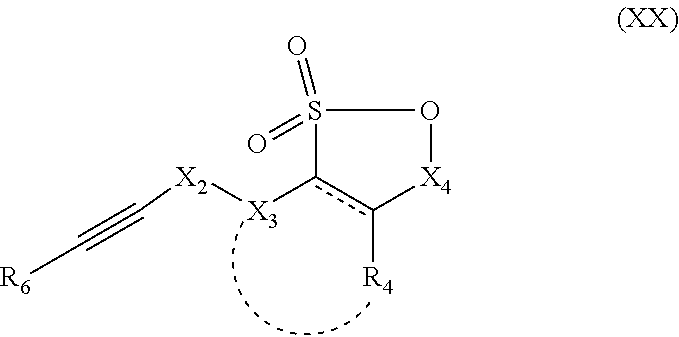
in which R1, R2, R3, and X1 are as defined above, with the compound having the following formula (XX):
Figure US11135319-20211005-C00016
which can also be represented as
Figure US11135319-20211005-C00017
in which X2, X3, X4, R4 and R6 are as defined above.
According to a second alternative (alternative 2), the method comprises a step β) consisting of reaction of the compound with the following formula (X):
Figure US11135319-20211005-C00018
in which R1, R2, R3, and X1 are as defined above, with a compound having the following formula (XXI):
Figure US11135319-20211005-C00019
which can also be represented as
Figure US11135319-20211005-C00020
in which X2, X3, X4, R4, R5 and RE are as defined above.
Typically, the method comprises, prior to step β), a step α) consisting of preparation of the compound with formula (XXI), comprising the reaction of a radionuclide with a compound with formula (XX) as defined above.
The two alternatives employ a compound with formula (XX), which can be prepared by methods known to a person skilled in the art, typically based on the corresponding sultone, which is deprotonated by a strong base (such as n-butyllithium) on the alpha carbon of the sultone, then contact with an electrophilic group allowing grafting of the R6C≡C—X2—X3 group.
The following reaction scheme 1 illustrates the two paths for preparation of the compound with formula (I):
Figure US11135319-20211005-C00021
Reaction scheme 1: Synthesis Paths for Compounds with Formula (I)
Steps b) or α) lead to the opening of the sultone cycle by nucleophilic attack of the radionuclide, which is generally in the form of an anion. For example, when the radionuclide is 18F, these steps employ the 18F anion, typically by using the fluoride [18F] of tetra-n-butylammonium ([18F]TBAF) or the complex [18F] KF/K222 (Kryptofix 2.2.2). These steps b) or α) thus allow freeing the sulfonate function (possibly in the form of a salt) and introducing the radionuclide.
Regardless of the alternative of the method used, the method only implements a single step for introducing the radionuclide. The separation of the labeled compound (compound with formula (I) in alternative 1/compound with formula (XXI) in alternative 2) from its precursor (compound with formula (XI) in alternative 1/compound with formula (XX) in alternative 2) is very simple.
The preparation of compounds of formula (I) based on the sultone (XX) is therefore very easy, which advantageously allows compounds with formula (I) to be less costly. In particular, due to their very simple preparation method, the compounds with formula (I) are generally less costly than the imaging agents of the prior art described above. The simplicity of the method also makes it very easy to automate.
According to a third object, the invention relates to compounds with formula (XX), (XI) or (XXI) as defined above, in the form of a base or a salt. The compounds are useful as synthesis intermediates for compounds with formula (I).
The preferred embodiments describe above for formula (I) are of course applicable for compounds with formulas (XX), (XI) and (XXI).
In particular, among the compounds with formula (XI), those with formula (XII) are preferred:
Figure US11135319-20211005-C00022
which can also be represented as
Figure US11135319-20211005-C00023
in which X2, X3, X4, R4 and R6 are as defined above, and in particular the following compounds with formulas (XIIIa), (XIIIb), (XIIIc), (XIIId) and (XIV):
Figure US11135319-20211005-C00024
Among the compounds with formulas (XXI), the following compounds with formulas (XVIIIa), (XVIIIb), (XVIIIc), (XVIIId) or (XXIV) are preferred:
Figure US11135319-20211005-C00025
in which R5 is a radionuclide, preferable 18F. These compounds can be in the form of a salt, for example in the form of a pharmaceutically acceptable salt as defined above, but also in the form of a salt with a cation resulting from the reaction with the radionuclide during step b) or α), for example with tetra-n-butylammonium as the cation.
Among the compounds with formulas (XX), the following compounds with formulas 10, 10 nis, 11, 12 or 13 are preferred:
Figure US11135319-20211005-C00026
According to a fourth object, the invention relates to an imaging agent, particularly for PET, comprising the compound with formula (I) as defined above or one of its pharmaceutically acceptable salts. Due to its high affinity for water, the compound with formula (I) is very easy to formulate in a physiological medium. The imaging agent typically comprises the compound with formula (I) as defined above or one of its pharmaceutically acceptable salts, a pharmaceutically acceptable vehicle and a physiological medium.
The invention also relates to the use of a compound with formula (I) as defined above or of one of its pharmaceutically acceptable salts as an imaging agent, particularly for PET.
According to a fifth object, the invention relates to a compound with formula (I) as defined above or one of its pharmaceutically acceptable salts, intended to be used in an “in vivo” diagnostic method for hypoxia or a disease associated with hypoxia, such as cancer, a cardiac disease, a stroke or a cerebral vascular accident.
The invention relates in particular to compounds with formula I as defined in the present description and the examples, for their use in a diagnostic method for hypoxia, and more particularly as labelers of low or high hypoxia for cancers such as sarcomas, myelomas, lymphomas, cerebral tumors, head and/or neck tumors, tumors of the breast, of the lung, of ovaries, of the prostate or of the liver.
The invention also relates to a method for detecting hypoxia or a disease associated with hypoxia in cells comprising the steps consisting of:
    • administration to a mammal, such as a human, of an effective quantity of a compound with formula (I) as defined above, then
    • detection by positron emission tomography of the presence of the radionuclide in the hypoxic cells of the mammal.
The compound with formula (I) is particularly suited for intravenous administration.
It has, in the physiological condition, a high metabolic stability and very rapid pharmacokinetics. Its elimination through the kidneys and urine is quasi-exclusive, without capture by the digestive organs. The absence of competitive labeling of the digestive organs allows PET images to be obtained with a high signal-to-noise ratio and hence good contrast, which is not always the case with the imaging agents of the prior art described above.
The compounds with formula (I) are advantageously biocompatible and bioavailable. Without seeking to be linked to a particular theory, the inventors assume that the presence of the very hydrophilic imidazole and sulfonate groups is the source of these good properties.
Moreover, certain imaging agents of the prior art require post-injection delays of at least two hours to accomplish the imaging. However, certain pathologies, such as cerebral vascular accidents (CVA), require an accurate and precocious diagnosis or rapid care of the patient. The compounds with formula (I) are very advantageous in that they allow PET images to be accomplished right after injection. Typically, the signal originating in compounds with formula (I), is excellent starting 20 min. after injection, and remains optimum for at least 60 min. post-injection.
The following examples describe the preparation of certain compounds in conformity with the invention. These examples are not limiting, and only illustrate the present invention.
EXAMPLES
Reagents and Solvents
All the commercially available reagents were supplies by Sigma Aldrich, Alfa Aesar, Apollo Scientific and were used as received, without subsequent purification. The cRGD peptides were supplied by Peptides International, Human Serum Albumin was supplied by Sigma Aldrich and recombinant EPO (rhEPO) was supplied by Proteogenix.
The anhydrous THF, the diethyl ether and the dichloromethane (hereafter DCM) were obtained with the Mbraun SPS-800 solvent delivery system. The other anhydrous solvents were supplied by Sigma Aldrich. The HPLC and LCMS type solvents were supplied by Sigma Aldrich and the deuterated solvents were supplied by Euriso-top.
Spectroscopy
The RMN 1H (400 MHz), RMN 13C (100 MHz), RMN 19F (376 MHz) and RMN 11B (128 MHz) spectra were recorded on a Brücker DPX 400 apparatus and the RMN 15N (50 MHz) spectra on a Brücker Advance III 500 MHz. The samples were dissolved in an appropriate deuterated solvent (CDCl3, CD3CN, CD3OD, D2O or DMSO-d6). Chemical shifts δ have been reported in parts per million (ppm) with reference to the proton resonances originating in the incomplete deuteration of the solvent RMN. Chemical shifts 11B have been reported with BF3.Et2O as the external standard and chemical shifts 15N have been reported with aqueous ammonia as the external reference. The coupling constants (J) are provided in Hertz (Hz). The abbreviations of the coupling constants are the following: s (singlet), bs (large singlet), d (doublet), t (triplet), q (quadruplet), qt (quintuplet), m (multiplet), dd (doublet of doublets), dt (doublet of triplets), etc. . . . .
The infrared spectra (hereafter IR) have been recorded on a Thermo Scientific Nicolet 380 FT-IR ATR spectrometer. Only the selected absorptions have been reported (in cm−1).
Mass Spectrometry
The GCMS analyses were recorded on a Varian GCMS Saturn 2000 spectrometer by electronic impact (EI) and were carried out with a BPX SGE column (0.25 mm×30 m, 0.25 μm) with, as a stationary phase: 5% phenyl and 95% dimethyl polysiloxane, as a gas vector: helium and the following gradient: 3 min at 50° C., then linear gradient of 50° C. to 250° C. at 15° C. min−1 and 10 min at 250° C. at a flux of 1 mL·min−1.
The high resolution mass spectra (HRMS) were obtained with a Waters Q-TOF micro-spectrometer using ionization by electro-nebulization (ESI). The relative intensities are given in brackets.
The LCMS analyses were carried out on an LC Waters Acquity UPLC apparatus equipped with a Waters Acquity UPLC BEH C18 inverse phase column (2.1×75 mm, 1.7 μm) with the following gradient: (A: MeOH, B: H2O-0.1% formic acid) 0-20 min: linear gradient from 10% A to 90% A; 20-30 min: 10% A isocratic at 0.3 mL/min. The LC apparatus was coupled to an MS Waters Q-TOF electro-nebulization ionization micro-spectrometer. The source temperature was 300° C. and the analyses were carried out in the appropriate ionization mode (ES+ ou ES) within the range of mass of 100 to 1500 Da. The LCMS conversions and quantifications were determined by calculating the ratio of the mass intensity between the desired compound and the initial product.
Fusion Point
The fusion points were determined on a Barnstead Electrothermal IA 9100 apparatus and were not corrected.
Elementary Analysis
The elementary analyses were carried out on a ThermoQuest NA2500 CHNS apparatus and were in the range of ±0.4% relative to the calculated values.
Chromatography
Column chromatography was carried out on silica gel (Merck Kieselgel 60 F254, 40-63 μm). Thin-layer chromatography (TLC) was carried out on Merck plastic plates covered with silica gel 60F254. The spots were developed using a UV lamp at 254 nm and/or using vanillin, with KMnO4 (for visualization of the sultone) or using ninhydrin. For the azide development, the plates were dried and immersed in a 10% triphenylphosphine solution in DCM, dried, immersed in a 0.3% ninhydrin solution in a mixture of ethanol/AcOH (100:3 v/v) and finally dried. The radioactive TLC was measured on a Packard Imager® device.
High performance liquid chromatography (HPLC) were carried out on a Waters 600 pump controller Waters 717 controller system plus autosampler and Water 996 photodiode detector (198-380 nm) coupled to a detector with an integrated NaI crystal radioactive source (Novolec β+-flow detector) or a Waters Alliance separation e2695 module, Waters 2998 photodiode detector (190-380 nm) and Berthold Herm LB 500 activity detector. The following chromatographic systems were used for the detection of products:
System A: analytical HPLC, Macherey-Nagel Nucleodur 100-3 Hilic, 150×4.6 mm, 3 μm, 1 mL/min
Gradient 1: (A: acetonitrile (hereafter ACN), B: aqueous ammonium acetate 100 mM) 0-15 min: 3% B isocratic; 15-35 min: 3% B to 30% B linear increase; 35-40 min: 30% B isocratic.
Gradient 2: (A: ACN, B: aqueous ammonium acetate 100 mM) 0-3 min: 3% B isocratic; 3-5 min: 3% B to 50% B linear increase; 5-10 min: 50% B isocratic.
System B: analytical HPLC, Waters XTerra RP 18, 4.6×250 mm, 5 lam, 1 mL/min
Gradient 1: (A: ACN, B: aqueous trifluoroacetic acid 0.1%) 0-5 min: 95% B isocratic; 5-7 min: 95% B to 60% B linear increase; 7-25 min: 60% B isocratic; 25-27 min: 60% to 20% B linear increase; 27-40 min: 20% B isocratic.
Gradient 2: (A: ACN, B: aqueous trifluoroacetic acid 0.1%) 0-4 min: 80% B isocratic; 4-15 min: 80% B to 10% B linear increase; 15-25 min: 10% B isocratic.
Gradient 3: (A: ACN, B: aqueous trifluoroacetic acid 0.1%) 0-10 min: 100% B isocratic; 10-15 min: 100% B to 60% B linear increase; 15-20 min: 60% B isocratic; 20-22 min: 60% to 20% B linear increase; 22-35 min: 20% B isocratic.
Gradient 4: (A: ACN, B: aqueous trifluoroacetic acid 0.1%) 0-15 min: 100% B isocratic; 15-20 min: 100% B to 60% B linear increase; 20-22 min: 60% B to 20% B linear increase; 22-35 min: 20% B isocratic.
Gradient 5: (A: ACN, B: aqueous trifluoroacetic acid 0.1%) 0-5 min: 100% B isocratic; 5-6 min: 60% B isocratic; 6-10 min: 20% B isocratic.
Gradient 6: (A: ACN, B: aqueous trifluoroacetic acid 0.1%) 0-10 min: 100% to 20% B linear increase.
System C: semi-preparative HPLC, Waters XTerra RP 18, 10×250 mm 10 μm, 5 mL/min
Gradient 1: (A: ACN, B: H2O) 0-5 min: 100% B isocratic; 5-30 min: 20% B isocratic. UV detection λ=254 nm
Gradient 2: (A: ACN, B: H2O) 0-3 min: 100% B isocratic; 3-8 min: 80% B isocratic; 8-20 min: 20% B isocratic. UV detection h=316 nm
Gradient 3: (A: EtOH, B: H2O) 0-30 min: 90% B isocratic. UV detection A=316 nm
Gradient 4: (A: ACN, B: aqueous trifluoroacetic acid 0.1%) 0-5 min: 100% B isocratic; 5-40 min: 100% B to 20% B linear increase; 40-45 min: 20% 5 B isocratic.
System D: analytical HPLC, Phenomenex BioSep-SEC-s2000, 7.8×300 with isocratic elution of 50 mM sodium phosphate and 300 mM NaCl, pH 6.8 (6.9 g of monobasic sodium phosphate monohydrate (NaH2PO4.H2O) and 17.5 g NaCl in 900 mL H2O adjusted to a pH of 6.8 with 50% NaOH and completed to 1000 mL with H2O) at 1 mL/min.
The identity of the labeled compounds was determined by comparison with the unlabeled reference compound by HPLC or by radio-CCM.
Determination of the partition coefficient:
n-Octanol (1 mL) and H2O (1 mL) were mixed for 20 min at ambient temperature before adding 10 μL of radioactively labeled compound. The tube was vigorously agitated by a vortex mixer for 30 min at ambient temperature. Three aliquots of 100 μL were collected from each phase and counted in a Packard Cobra Gamma counter. Log P was calculated as follows: log P=log (concentration of radioactivity in the n-octanol phase/concentration of radioactivity in the aqueous phase). The values provided are an average of the three measurements carried out.
In Vivo Imaging:
The evaluations of the radio-tracers were carried out in the animal rhabdomyosarcoma model provided by Biomedical Magnetic Resonance Research Group (REMA)—Catholic University of Louvain (UCL)—Belgium according to Peeters et al. (Int J Radiat Oncol, 2015) in the comparative study of [18F]HX-4, [18F]FMISO and [18F]FAZA. The in vivo imaging was carried out using an Inveon μTEP/μTDM camera (Siemens). The animals were handled under gaseous anesthesia using isoflurane (induction at 5%, maintenance between 1.5% and 2.5% in 70% N2O/30% O2). The body temperature of the animals was maintained above 37.5° C. while the rate of respiration was constantly monitored, in order to obtain stable anesthesia reproducible from one animal to another. A catheter was placed without surgery (Insight Autoguard 24 Ga) at the caudal vein in order to allow the administration of radio-tracers. TDM acquisition is systematically performed prior to TEP imaging and is used for corrections of attenuation and diffusion of photos as well as for obtaining anatomical data. Acquisitions and reconstructions were performed with a coincidence time of 3.4 ns, an energy window of 350 to 650 keV, the OSEM3D-MAP reconstruction algorithm (respectively 2 and 18 iterations) with the “fastMAP” option, uniform variance and a required resolution of 2.26 mm. 128×128×159 pixels per image, with a voxel size of 0.776×0.776×0.796 mm3. The images were normalized in SUV (Standardized Uptake Value) and analyzed with the PMOD (3.6 PMODTechnologies) software, by manual delimitation of the volumes of interest (VOIs) “entire tumor” and “muscle” and simultaneously using the 2 imaging modes.
Example 1: Preparation of a Compound with Formula (IIIb) with R5=18F
1.1. Following the Method According to Alternative 1 (Steps a) and b) Described Above)
Figure US11135319-20211005-C00027
1) Synthesis of Precursors 2-4:
Figure US11135319-20211005-C00028
1-(Chloromethyl)-2-nitro-1H-imidazole 1 (Step a of Reaction Scheme 1)
Figure US11135319-20211005-C00029
To a solution of 2-nitroimidazole (0.2 mg, 1.77 mmol, 1 equiv) in anhydrous DMF (5 mL) were added bromochloromethane (2.3 mL, 35.4 mmol, 20 equiv) and cesium carbonate (1.15 g, 3.54 mmol, 2 equiv). The reaction medium was mixed at ambient temperature for 24 h and diluted in EtOAc and H2O. The organic phase was washed with H2O and brine, dried over MgSO4 and concentrated under reduced pressure, which led to the desired compound 1 appearing as a pale yellow oil, which was used without subsequent purification (236 mg, 81%).
CAS number: 1569296-82-7
Spectroscopic data agree with those described in Bonnet et al, Bioorg Med Chem 2014, 22 (7), 2123-2132. RMN 1H (DMSO-d6, 400 MHz): δ 6.17 (s, 2H), 7.15 (d, 3J=1.0 Hz, 1H), 7.78 (d, 3J=1.0 Hz, 1H). RMN 13C (DMSO-d6, 100 MHz): δ 55.2, 127.1, 127.9, 128.8. RMN 15N (DMSO-d6, 50 MHz): δ 173.5, 271.5. HRMS (ESI+): calculated for C4H4ClN3NaO2: 184.9889 [M+Na]+; found: 185.1156
1-(Azidomethyl)-2-nitro-1H-imidazole 2 (Step b of Reaction Scheme 1)
(Compound Corresponding to Formula (X))
Figure US11135319-20211005-C00030
To a solution of chloromethylnitroimidazole 1 (0.2 g, 1.2 mmol, 1 equiv) in H2O (10 mL) was added potassium iodide (0.1 g, 0.6 mmol, 0.5 equiv) and sodium nitride (234 mg, 3.6 mmol, 3 equiv). The reaction medium was brought into reflux for 24 h and separated between EtOAc and H2O. After separation, the organic phase was washed with H2O and brine, dried over MgSO4 and concentrated under reduced pressure. Purification over silica gel with DCM/MeOH 1:0 to 9:1 as eluent led to the desired compound 2 appearing in the form of a yellow oil (0.19 g, 91%). pf: 52° C. Rf: 0.41 (DCM/MeOH 9:1). RMN 1H (DMSO-d5, 400 MHz): δ 5.83 (s, 2H), 7.26 (d, 3J=1.0 Hz, 1H), 7.26 (d, 3J=1.0 Hz, 1H). RMN 13C (DMSO-d6, 100 MHz): δ 62.6, 127.8, 128.6, 139.8. RMN 15N (CDCl3, 50 MHz): δ 77.3, 173.5, 246.5, 270.6.
3-Prop-2-ynyl-[1,2]oxathiane 2,2-dioxide 3 (Step c of Reaction Scheme 1)
(Compound Corresponding to Formula (XX)
Figure US11135319-20211005-C00031
In a double-necked flask under nitrogen were introduced 1,4-butanesultone (0.75 mL, 7.3 mmol, 1 equiv) and anhydrous THF (80 mL). The mixture was cooled to −78° C. and n-butyllithium (1.6M in hexane, 3.2 mL, 8.03 mmol, 1.1 equiv) was added drop by drop. The mixture was mixed at −78° C. for 15 min and propargyl bromide (0.81 mL, 7.3 mmol, 1 equiv) was added drop by drop. The mixture was mixed at −78° C. for 4 h, then allowed to gently reheat to 0° C., then treated with H2O. After extraction with EtOAc, the combined organic phases were washed with H2O, dried over MgSO4 and concentrated under reduced pressure. Purification over silica gel with pentane/Et2O 1:1 as eluent led to the desired compound 3 in the form of a yellow oil (350 mg, 31%). pf: 66° C. Rf: 0.48 (Pentane/Et2O 1:1). RMN 1H (CDCl3, 400 MHz): δ 1.86-1.95 (m, 2H), 1.97-2.08 (m, 1H,), 2.10 (t, 4J=2.7 Hz, 1H), 2.42-2.48 (m, 1H), 2.53 (ddd, 2J=16.9 Hz, 3J=10 Hz, 4J=2.7 Hz, 1H), 2.93 (ddd, 2J=16.9 Hz, 3J=4.2 Hz, 4J=2.7 Hz, 1H), 4.48-4.53 (m, 2H). RMN 13C (CDCl3, 100 MHz): δ 18.4, 23.5, 27.5, 57.4, 71.9, 74.2, 78.0. HRMS (ESI+): calculated for C7H10NaO3S: 197.0248 [M+Na]+; found: 197.0241.
3-((1-(2-Nitro-1H-imidazol-1-yl)methyl)-1H-1,2,3-triazol-4-yl)methyl)-1,2-oxathiane 2,2-dioxide 4 (Step d of the Reaction Scheme 1, which Corresponds to Step a) of the Method According to Alternative 1)
(Compound Corresponding to Formula (XI))
Figure US11135319-20211005-C00032
To a solution of azidoimidazole 2 (400 mg, 2.4 mmol, 1 equiv) in 1,4-dioxane (10 mL) were added acetylenic sultone 3 (415 mg, 2.4 mmol, 1 equiv), copper iodide (46 mg, 0.24 mmol, 0.1 equiv) and triethylamine (100 μL, 0.24 mmol, 0.1 equiv). The reaction medium was mixed at ambient temperature for 24 h, then separated between EtOAc and H2O. After separation, the organic phase was washed with H2O and brine, dried over MgSO4 and concentrated under reduced pressure. Purification on silica gel with DCM/MeOH 9:1 as eluent led to the desired compound 4 in the form of a white solid (680 mg, 84%). pf: 120° C. Rf: 0.43 (DCM/MeOH 9:1). RMN 1H (CDCl3, 400 MHz): δ 1.82-1.88 (m, 2H), 1.89-2.25 (m, 2H), 3.00 (dd, 2J=15.1 Hz, 3J=7.8 Hz, 1H), 3.40 (dd, 2J=15.1 Hz, 3J=5.8 Hz, 1H), 3.48-3.50 (m, 1H), 4.45-4.57 (m, 2H), 6.81-6.89 (m, 2H), 7.19 (s, 1H), 7.44 (s, 1H), 7.93 (s, 1H). RMN 13C (CDCl3, 100 MHz): δ 23.8, 24.9, 28.5, 58.8, 59.4, 74.0, 123.5, 126.2, 129.4, 143.6, 144.0. RMN s1N (CDCl3, 50 MHz): δ 166.6, 240.5, 269.7, 359.1, 363.4. HRMS (ESI+): calculated for C11H15N6O5S: 343.0825 [M+H]+; found: 343.0825.
2) Synthesis of [18F]AEL-3156:
Figure US11135319-20211005-C00033

Single Step Radio-Synthesis of [18F]AEL-3156 (Step f of Reaction Scheme 2, which Corresponds to Step b) of the Method According to Alternative 1)
The sultone precursor 4 (15 mg) in ACN (500 μL) has been added to the dried complex [18F]KF/K222 and the sealed reaction chamber has been heated to 110° C. for 15 min. Purification by HPLC has led to the desired compound with radiochemical efficiencies of 80-95%. HPLC: System B, gradient 3. [18F]AEL-3156 (tR=22.1 min), sultone precursor 4 (tR=24.4 min).
1.2. Following the Method According to Alternative 2 (Steps α) and β) Described Above)
Figure US11135319-20211005-C00034

Two-step radio-synthesis of [18F]AEL-3156 (steps g and h of the reaction scheme 3, which correspond to steps α) and β) of the method according to alternative 2)
Acetylenic sultone 3 (5 mg) in ACN (500 μL) was added to the dried complex [18F]KF/K222 or to tetra-n-butylammonium fluoride [18F] (hereafter [18F]TBAF) and the sealed reaction chamber was heated to the desired temperature (ta, 50° C., 75° C. or 110° C.) for 15 min. ACN was eliminated at ambient temperature under a stream of nitrogen, which led to crude [18F]5, which was diluted in H2O (0.5 mL). The solution was absorbed in a tC18 cartridge (Sep-Pak Plus®, Waters). The radioactive fraction was recovered with 1 mL of H2O as eluent. ACN (2×500 μL) was added in order to eliminate water from [18F]5 azeotropically.
H2O (500 μL), CuSO4.TBTA (10 mM, 100 μL), sodium ascorbate (100 mM, 50 μL) and azidomethylnitroimidazole 2 (6 mg) were added to the dried [18F]5. The reaction medium was mixed at 90° C. for 30 min. Purification by HPLC led to the desired product [18F]AEL-3156 with radiochemical efficiencies of 75-85%. HPLC: System B, gradient 3. [18F]5 (tR=7.6 min), [18F]AEL-3156 (tR=22.1 min), sultone precursor 3 (tR=20.5 min).
Log P value: −2.9
Example 2: Preparation of Compounds with Formula (XX)
2.1. Synthesis of Sultone 10:
(Compound Corresponding to Formula (XX))
Figure US11135319-20211005-C00035
3-Prop-2-ynyl-[1,2]oxathiolane 2,2-dioxide 10
(Compound Corresponding to Formula (XI))
Figure US11135319-20211005-C00036
HMDS (0.84 mL, 4.0 mmol, 1.7 equiv) and anhydrous THF (5 mL) were introduced into a double-necked flask (A) under nitrogen. After being cooled to 0° C., n-butyllithium (1.6M in hexane, 2.5 mL, 4.0 mmol, 1.7 equiv) was added drop by drop. The mixture was mixed at 0° C. for 15 min, then at −78° C. for 10 min. Propane-1,3-sultone (0.40 g, 3.3 mmol, 1.5 equiv), propargyl bromide (0.25 mL, 2.2 mmol, 1 equiv) and anhydrous THF (45 mL) were introduced into a second double-necked flask (B) under nitrogen. The mixture was cooled to −98° C. LiHMDS was transferred from flask A to flask B by a cannula and the final mixture was mixed at −98° C. for 4 h, allowed to reheat gently to 0° C. then treated with H2O. After addition of EtOAc, the organic phase was washed with water, then with brine, dried over MgSO4 and concentrated under reduced pressure. Purification on silica gel with pentane/Et2O 1:1 as eluent led to the desired compound in the form of a colorless oil (112 mg, 32%). Rf: 0.31 (pentane/EtOAc 1:1). RMN 1H (CDCl3, 400 MHz): δ 2.14 (t, 4J4-6=2.7 Hz, 1H), 2.45 (dq, 2J=13.6 Hz, 3J=8.0 Hz, 1H), 2.60 (ddd, 2J=17.2 Hz, 3J=8.8 Hz, 4J=2.8 Hz, 1H), 2.77 (ddd, 2J=13.6 Hz, 3J=8.0 Hz, 3J=5.6 Hz, 1H), 2.84 (ddd, 2J=17.2 Hz, 3J=5.8 Hz, 4J=2.6 Hz, 1H), 3.46 (dq, 3J=8.2 Hz, 3J=5.9 Hz, 1H), 4.35-4.49 (m, 2H). RMN 13C (CDCl3, 100 MHz): δ 19.2, 28.9, 53.6, 66.7, 71.8, 77.3. HRMS (ESI+): calculated for C6H9O2S: 161.0275 [M+H]+; found: 161.0272.
2.2. Synthesis of Aromatic Acetylenic Sultone Precursors 11-12
Figure US11135319-20211005-C00037

(Compound Corresponding to Formula (XX))
Reaction Scheme 4 was Followed
Figure US11135319-20211005-C00038

4-Iodobenzyl Alcohol 14 (Step i of Reaction Scheme 4)
Figure US11135319-20211005-C00039
To a solution of 4-iodo-benzoic acid (3.00 g, 12.1 mmol, 1 equiv) in THF (20 mL) was added, drop by drop, a solution of the borane tetrahydrofuran complex (1M in THF, 23.1 mL, 242.0 mmol, 20 equiv). The mixture was mixed at ambient temperature for 24 h and treated with caution with 2N HCl. After extraction with DCM, the organic phases were washed with water, dried over MgSO4 and concentrated under reduced pressure. Purification over silica gel with pentane/EtOAc 8:2 as eluent led to the desired compound 14 in the form of white solid (2.57 g, 91%).
CAS number: 18282-51-4
Spectroscopic data agree with those described by Yang et al, Chem Eur J 2011, 17, 5652-5660. pf: 69° C. (litt 71-73° C.). Rf: 0.15 (Pent/EtOAc 9:1). RMN 1H (CDCl3, 400 MHz): δ 4.65 (s, 2H), 7.11 (d, 3J=8.4 Hz, 2H), 7.69 (d, 3J=8.4 Hz, 2H). RMN 13C (CDCl3, 100 MHz): δ 64.7, 93.0, 128.7, 137.6, 140.4. GCMS: calculated for C7H7IO: 234; found 234 (12.3 min).
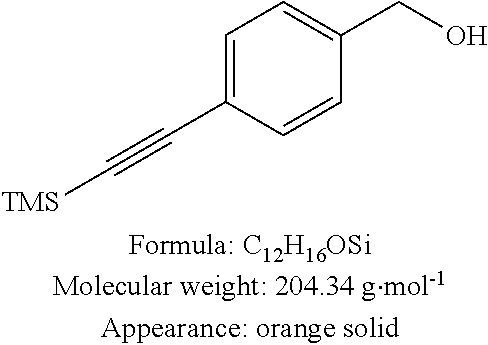
(4-Trimethylsilanylethynyl-phenyl)-methanol 15 (step j of Reaction Scheme 4)
Figure US11135319-20211005-C00040
To a solution of (4-iodophenyl)-methanol 14 (0.70 g, 3.0 mmol, 1 equiv) in anhydrous 1,4-dioxane (10 mL) were added ethynyltrimethylsilane (0.5 mL, 3.6 mmol, 1.2 equiv), triethylamine (5.0 mL, 35.9 mmol, 12 equiv), copper iodide (57 mg, 0.30 mmol, 0.1 equiv) and bis(triphenylphosphine)palladium(II) dichloride (105 mg, 0.15 mmol, 0.05 equiv). The reaction medium was mixed at ambient temperature for 12 h, then filtered on celite. After addition of DCM, the organic phase was washed in water, dried over MgSO4 and concentrated under reduced pressure. Purification on silica gel with pentane/EtOAc 9:1 as eluent led to the desired compound in the form of an orange solid (0.55 g, 90%).
CAS number: 275386-60-2
Spectroscopic data agree with those described in Hiraoka et al, Angew Chem Int Ed 2004, 43, 3814-3818. pf: 69° C. (litt 66° C.). Rf: 0.62 (Pent/EtOAC 9:1). RMN 1H (CDCl3, 400 MHz): δ 0.25 (s, 9H), 1.68 (s, 1H), 4.69 (s, 2H), 7.29 (d, 3J=7.7 Hz, 2H), 7.45 (d, 3J=7.7 Hz, 2H). RMN 13C (CDCl3, 100 MHz): δ 0.0, 64.9, 94.2, 104.9, 122.4, 126.6, 132.2, 141.2. HRMS (ESI+): calculated for C12H16NaOSi: 227.0868 [M+Na]+; found: 227.0873. Elementary analysis: calculated for C12H16OSi: C, 70.53; H, 7.89. found C, 70.57; H, 8.75.
(4-Bromomethyl-phenylethynyl)-trimethyl-silane 16 (Step k of the Reaction Scheme 4)
Figure US11135319-20211005-C00041
To a solution of benzyl bromide 15 (0.30 g, 1.5 mmol, 1 equiv) in anhydrous Et2O (10 mL) were added carbon tetrabromide (0.61 g, 1.8 mmol, 1.25 equiv) and triphenylphosphine (0.47 g, 1.8 mmol, 1.25 equiv). The mixture was mixed at ambient temperature for 4 h, filtered, and the filtrate was concentrated under reduced pressure. Purification on silica gel with heptane/EtOAc 8:2 as eluent led to the desired compound in the form of a colorless oil (325 mg, 84%).
CAS number: 686275-89-8
Spectroscopic data agree with those described by Leventis et al, Chem Mater 2004, 16, 1493-1506. Rf: 0.74 (Hetp/EtOAc 8:2). RMN 1H (CDCl3, 400 MHz): δ 0.25 (s, 9H), 4.45 (s, 2H), 7.31 (d, 3J=8.2 Hz, 2H), 7.42 (d, 3J=8.2 Hz, 2H). RMN 13C (CDCl3, 100 MHz): δ 0.0, 32.9, 95.3, 104.5, 123.3, 128.9, 132.4, 138.0. GCMS: calculated for C12H15BrSi: 267; found: 266 (13.8 min).
[4-(2,2-Dioxo-[1,2]oxathiolan-3-ylmethyl)-phenylethynyl]-trimethyl-silane 17 (Step I of Reaction Scheme 4)
Figure US11135319-20211005-C00042
HMDS (1.55 mL, 7.65 mmol, 1.7 equiv) and anhydrous THF (10 mL) were introduced into a double-necked flask (A) under nitrogen. After being cooled to 0° C., n-butyllithium (1.6M in hexane, 4.8 mL, 7.65 mmol, 1.7 equiv) was added drop by drop. The mixture was mixed at 0° C. for 15 min, then at −78° C. for 10 min. Propane-1,3-sultone (820 mg, 6.7 mmol, 1.5 equiv), benzyl bromide 17 (1.20 g, 4.5 mmol, 1 equiv) and anhydrous THF (90 mL) were introduced into a second double-necked flask (B) under nitrogen. The mixture was cooled to −98° C. LiHMDS was transferred from flask A to flask B via a cannula and the final mixture was mixed at −98° C. for 4 h, allowed to reheat gently to 0° C. then treated with H2O. After addition of EtOAc, the organic phase was washed in water, then in brine, dried over MgSO4 and concentrated under reduced pressure. Purification on silica gel with heptane/EtOAc 1:1 as eluent led to the desired compound 17 in the form of a colorless oil (1.11 g, 80%). Rf: 0.14 (Pent/EtOAc 8:2). RMN 1H (CDCl3, 400 MHz): δ 0.08 (s, 9H), 2.14-2.17 (m, 1H), 2.29-2.32 (m, 1H), 2.68-2.74 (m, 1H), 3.14-3.19 (m, 1H), 3.31-3.35 (m, 1H), 4.15-4.27 (m, 2H), 7.02 (d, 3J=8.2 Hz, 2H), 7.27 (d, 3J=8.2 Hz, 2H). RMN 13C (CDCl3, 100 MHz): δ 0.05, 29.2, 34.5, 56.3, 66.9, 94.9, 104.5, 125.9, 128.8, 132.5, 136.4. HRMS (ESI+): calculated for C15H21O3SSi: 309.0981 [M+H]+; found: 309.0995. MS/MS (ESI+): m/z (%) 309.2 (100) 155.1 (75).
3-(4-Ethynyl-benzyl)-[1,2]oxathiolone 2,2-dioxide 11 (Step m of Reaction Scheme 4)
Figure US11135319-20211005-C00043
To a solution of trimethylsilylsultone 17 (0.91 g, 2.9 mmol, 1 equiv) in THF (5 mL) was added, drop by drop at 0° C., TBAF (1M in THF, 0.30 mL, 0.30 mmol, 0.1 equiv). The mixture was mixed at 0° C. for 2 h. Purification on silica gel with heptane/Et2O 1:1 as eluent and recrystallization at ambient temperature in petroleum ether led to the desired compound 11 in the form of a white solid (340 mg, 50%). mp: 118° C. Rf: 0.54 (pentane/Et2O 1:1). RMN 1H (CDCl3, 400 MHz): δ 2.30-2.36 (m, 1H), 2.47-2.51 (m, 2H), 2.89 (dd, 2J=14.2 Hz, 3J=9.4 Hz, 1H), 3.09 (s, 1H), 3.38 (dd, 2J=14.2 Hz, 3J=5.7 Hz, 1H), 3.47-3.51 (m, 1H), 4.34 (dt, 2J=8.7 Hz, 3J=7.2 Hz, 1H), 4.43 (dt, 2J=8.8 Hz, 13J=3.8 Hz, 1H), 7.20 (dd, 3J=8.2 Hz, 2H), 7.46 (dd, 3J=8.2 Hz, 2H). RMN 13C (CDCl3, 100 MHz): δ 29.2, 34.5, 56.3, 66.8, 77.7, 121.4, 121.4, 128.9, 132.8, 136.3. HRMS (ESI+): calculated for C12H13O3S: 237.0585 [M+H]+; found: 237.0583.
2.3. Synthesis of Aromatic Acetylenic Sultone Precursors
Figure US11135319-20211005-C00044

(Compound Corresponding to Formula (XX))
Reaction Scheme 5 was Followed:
Figure US11135319-20211005-C00045
Figure US11135319-20211005-C00046
N-tert-Butyl-4-iodo-benzenesulfonamide 19 (Step n of Reaction Scheme 5)
Figure US11135319-20211005-C00047
To a solution of 4-iodophenylsulfonyl chloride (3.00 g, 9.9 mmol, 1 equiv) in anhydrous DCM (20 mL) was added triethylamine (2.1 mL, 14.9 mmol, 1.5 equiv). The mixture was cooled to 0° C. and tert-butylamine (1.6 mL, 14.9 mmol, 1.5 equiv) was added drop by drop. The mixture was mixed at 0° C. for 1 h, then at ambient temperature for 12 h and treated with 1N HCl. After extraction with DCM, the combined organic phases were washed with water, dried over MgSO4 and concentrated under reduced pressure. Purification on silica gel with DCM as eluent led to the desired compound in the form of a white solid (3.31 g, 98%).
CAS number: 403793-15-7. pf: 137-138° C. RR: 0.50 (DCM). RMN 1H (CDCl3, 400 MHz): δ 1.20 (s, 9H), 5.23 (s, 1H), 7.61 (d, 3J=8.8 Hz, 2H), 7.82 (d, 3J=8.4 Hz, 2H). RMN 13C (CDCl3, 100 MHz): δ 30.1, 54.9), 99.3, 128.4, 138.1, 143.3. IR (neat): ν 3251, 1567, 1326, 1146, 1008, 726, 612, 572. HRMS (ESI+): calculated for C10H15INO2S: 339.9868 [M+H]+; found: 339.9878. MS/MS (ESI+): m/z (%) 340.1 (27), 284.0 (100). Elementary analysis: calculated for C10H4INO2S: C, 35.41; H, 4.16; N, 4.13; S, 9.45. found: C, 35.39; H, 4.02; N, 4.36; S, 9.94.
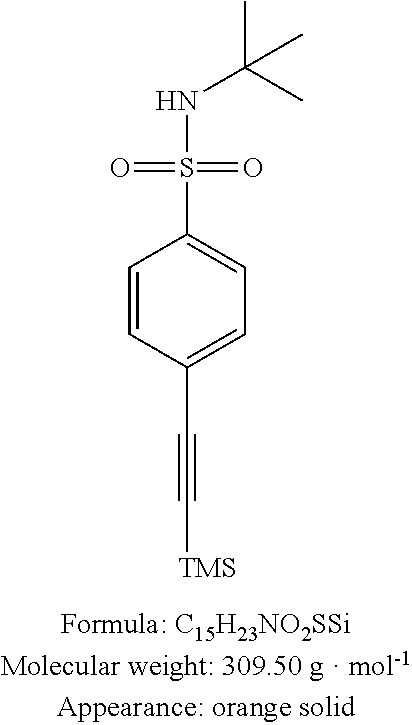
N-tert-Butyl-4-trimethylsilanylethynyl-benzenesulfonamide 20 (Step o of Reaction Scheme 5)
Figure US11135319-20211005-C00048
To a solution of sulfonamide 19 (2.00 g, 5.9 mmol, 1 equiv) in 1,4-dioxane (20 mL) were added ethynyltrimethylsilane (1.0 mL, 7.1 mmol, 1.2 equiv), trimethylamine (10.0 mL, 70.8 mmol, 12 equiv), copper iodide (112 mg, 0.59 mmol, 0.1 equiv) and bis(triphenylphosphine)palladium(II) dichloride (211 mg, 0.30 mmol, 0.05 equiv). The reaction medium was mixed at ambient temperature for 12 h then filtered over celite. After extraction with DCM, the combined organic phases were washed with water, dried over MgSO4 and concentrated under reduced pressure. Purification on silica gel with pentane/EtOAc 9:1 as eluent led to the desired compound 20 in the form of an orange solid (1.73 g, 96%). pf: 147-148° C. Rf: 0.35 (Pent/EtOAc 9:1). RMN 1H (CDCl3, 400 MHz): δ 0.26 (s, 9H), 1.21 (s, 9H), 4.61 (s, 1H), 7.55 (dd, 3J=6.8 Hz, 4J=2.0 Hz, 2H), 7.81 (dd, 3J=6.8 Hz, 4J=2.0 Hz, 2H). RMN 13C (CDCl3, 100 MHz): δ 0.0, 30.4, 55.0, 98.3, 103.5, 127.1, 127.5, 132.5, 143.0. IR (neat): ν 3253, 1436, 1324, 1147, 858, 601, 570. HRMS (ESI+): calculated for C15H24NO2SSi: 310.1297 [M+H]+; found: 310.1302. MS/MS (ESI+): m/z (%) 310.2 (13) 254.1 (100) 237.1 (77). Elementary analysis: calculated for C15H23NO2SSi: C, 58.21; H, 7.49; N, 4.53; S, 10.36. found: C, 57.8; H, 7.33; N, 4.61; S, 9.64.
N-tert-Butyl-2-hydroxymethyl-4-trimethylsilanylethynyl benzenesulfonamide 22 (Steps p-q of Reaction Scheme 5)
Figure US11135319-20211005-C00049
To a solution of sulfonamide 20 (1.5 g, 4.9 mmol, 1 equiv) in anhydrous THF (10 mL) under nitrogen at −78° C. was added, drop by drop, a solution of n-butyllithium (1.6M in hexane, 9.1 mL, 14.6 mmol, 3 equiv). The mixture was mixed at −78° C. for 30 min, then at −20° C. for 15 min. After having been cooled to −78° C., anhydrous DMF (1.5 mL, 19.4 mmol, 4 equiv) was added drop by drop. The mixture was mixed at −78° C. for 4 h and allowed to reheat to ambient temperature for 12 h. The totality was transferred onto ammonium chloride cooled in ice. After extraction with EtOAc, the organic phase was dried over MgSO4 and concentrated under reduced pressure. The oil obtained, containing aldehyde 21, was diluted in anhydrous THF (5 mL) and NaBH4 (280 mg, 7.3 mmol, 1.5 equiv) was added by portions. The reaction medium was mixed at ambient temperature for 24 h and treated with H2O and extracted with EtOAc. The combined organic phases were washed with brine, dried over MgSO4 and concentrated under reduced pressure. Purification on silica gel with pentane/EtOAc 7:3 as eluent led to the desired compound in the form of a white solid (681 mg, 41% in 2 steps). pf: 190-191° C. Rf: 0.50 (Pent/EtOAc 7:3). RMN 1H (CDCl3, 400 MHz): δ 0.26 (s, 9H), 1.22 (s, 9H), 1.57 (bs, 1H), 4.96 (s, 2H), 4.99 (bs, 1H), 7.49 (dd, 3=8.1 Hz, 4J=1.6 Hz, 1H), 7.60 (d, 4J=1.5 Hz, 1H), 7.96 (d, 3J=8.1 Hz, 1H). RMN 13C (CDCl3, 100 MHz): δ 0.0, 30.4, 55.5, 63.4, 98.7, 103.3, 128.1, 129.5, 131.6, 134.5, 138.6, 140.9. IR (neat): ν 3398, 2967, 1306, 1153, 830, 575. HRMS (ESI+): calculated for C16H25NNaO3SSi: 362.1215 [M+Na]+; found: 362.1222. Elementary analysis: calculated for C16H25NO3SSi: C, 46.01; H, 5.79; N, 4.13; S, 9.45. found: C, 56.29; H, 7.31; N, 4.41; S, 10.06.
2-Hydroxymethyl-4-trimethylsilanylethynyl-benzenesulfonamide 23 (Step r of Reaction Scheme 5)
Figure US11135319-20211005-C00050
In a double-necked flask under nitrogen, to sulfonamide 22 (0.30 g, 0.88 mmol, 1 equiv) in anhydrous DCM anhydre (10 mL), was added, drop by drop, a solution of BCl3 (1M in DCM, 0.97 mL, 0.97 mmol, 1.1 equiv). The reaction medium was mixed at ambient temperature for 1 h and treated with H2O. After extraction with DCM, the combined organic phases were washed with brine, dried over MgSO4 and concentrated under reduced pressure, which led to the desired compound 23 in the form of a white solid (129 mg, 52%). pf: 102° C. Rf: 0.43 (pentane/EtOAc 7:3). RMN 1H (CDCl3, 400 MHz): δ 0.26 (s, 9H), 4.97 (s, 2H), 7.48 (d, 3J=8.1 Hz, 1H), 7.51 (s, 1H), 7.92 (d, 3J=8.1 Hz, 1H). RMN 13C (CDCl3, 100 MHz): δ 0.0, 63.9, 99.1, 103.1, 128.4, 128.7, 132.1, 134.7, 137.9, 140.1. HRMS (ESI+): calculated for C12H17NNaO3SSi: 306.0596 [M+Na]+; found: 306.0612.
[2-(2,5-Dimethyl-pyrrole-1-sulfonyl)-5-trimethylsilanylethynyl-phenyl]-methanol 24 (Step s of Reaction Scheme 5)
Figure US11135319-20211005-C00051
To a solution of sulfonamide 23 (104 mg, 0.37 mmol, 1 equiv) in anhydrous toluene (10 mL) were added 2,2,5,5-tetraethoxy-hexane (144 mg, 0.55 mmol, 1.5 equiv) and P2O5 (58 mg, 0.41 mmol, 1.1 equiv). The mixture was mixed under reflux for 2 h, cooled to ambient temperature and treated with 2M KOH (10 mL). After extraction with EtOAc, the combined organic phases were washed with water, dried over MgSO4 and concentrated under reduced pressure. Purification on silica gel with a pentane/EtOAc 9:1 mixture as eluent led to the desired compound 24 in the form of a yellow oil (104 mg, 78%). Rf: 0.95 (Pent/EtOAc 7:3). RMN 1H (CDCl3, 400 MHz): δ 0.24 (s, 9H), 2.27 (s, 6H), 2.69 (bs, 1H), 4.88 (s, 2H), 5.92 (s, 2H), 6.74 (d, 3J=8.2 Hz, 1H), 7.35 (dd, 3J=8.2 Hz, 4J=1.5 Hz, 1H), 7.75 (d, 4J=1.1 Hz, 1H). RMN 13C (CDCl3, 100 MHz): δ 0.0, 15.7, 61.6, 99.6, 103.0, 112.1, 126.5, 129.1, 131.5, 133.6, 133.9, 138.5, 139.9. HRMS (ESI+): calculated for C18H23NNaO3SSi: 384.1066 [M+Na]+; found: 384.1072.
5-Ethynyl-3H-benzo[c][1,2]oxathiole 1,1-dioxide 13 (Step t of Reaction Scheme 5)
Figure US11135319-20211005-C00052
To a solution of pyrrole 24 (400 mg, 1.1 mmol, 1 equiv) in anhydrous THF (5 mL) was added sodium hydride (59 mg, 2.4 mmol, 2.2 equiv) by portions. The mixture was mixed at ambient temperature for 12 h, then treated with H2O. After extraction with EtOAc, the combined organic phases were washed with water, dried over MgSO4a and concentrated under reduced pressure. Purification on silica gel with pentane/Et2O as eluent led to the desired compound 13 in the form of a colorless oil (68 mg, 32%). pf: 32° C. Rf: 0.46 (Pent/Et2O 1:1). RMN 1H (CDCl3, 400 MHz): δ 3.31 (s, 1H), 5.50 (s, 2H), 7.51 (bs, 1H), 7.68 (d, 3J=7.8 Hz, 1H), 7.79 (d, 3J=7.8 Hz, 1H). RMN 13C (CDCl3, 100 MHz): δ 70.6, 81.2, 81.7, 122.0, 126.7, 128.2, 130.3, 133.7, 135.5. HRMS (ESI+): calculated for C9H7O3S: 195.0116 [M+H].; 5 found: 195.0117.
Example 3: Preparation of Compounds with Formula (XXI)
Radiofluorination of Acetylenic Sultones 3, 10-13 as [18F]fluorosulfonates [18F]5, [18F]25-[18F]28 (Step α) of the Method According to Alternative 2)
Sultones 3, 10-13 (5 mg) in ACN (500 μL) were added to the dried complex [18F]KF/K222 or to [18F]TBAF and the sealed reaction chamber was heated to the desired temperature (ta, 50° C., 75° C. or 110° C.) for 15 min. Purification by HPLC led to the desired compound with radiochemical efficiencies of 80-95%.
HPLC
system and tR tR
[18F]-compounds gradient (min) Precursor (min)
Figure US11135319-20211005-C00053
C4 6.1
Figure US11135319-20211005-C00054
26.6
Figure US11135319-20211005-C00055
B3 7.6
Figure US11135319-20211005-C00056
32.2
Figure US11135319-20211005-C00057
B1 17.7
Figure US11135319-20211005-C00058
29.5
Figure US11135319-20211005-C00059
B1 19.3
Figure US11135319-20211005-C00060
27.4
Figure US11135319-20211005-C00061
B1 17.0
Figure US11135319-20211005-C00062
22.7
Synthesis of fluorosulfonates 5, 25-28 (Compounds Corresponding to Formula (XXI)) 1-Fluoro-hex-5-yne-3-sulfonatetetrabutyl-ammonium 25
Figure US11135319-20211005-C00063
To a solution of propargylic sultone 10 (100 mg, 0.63 mmol, 1 equiv) in anhydrous ACN (1 mL) was added TBAF (1M in THF, 0.69 mL, 0.69 mmol, 1.1 equiv). The mixture was mixed at ambient temperature for 12 h then concentrated under reduced pressure, which led to the desired compound in the form of a colorless oil (245 mg, 93%). RMN 1H (CD3CN, 400 MHz): δ 0.86 (t, 3J=7.4 Hz, 12H), 1.21-1.31 (m, 8H), 1.47-1.55 (m, 8H), 1.98-2.09 (m, 2H), 2.16-2.24 (m, 2H), 2.53-2.60 (m, 1H), 2.70-2.76 (m, 1H), 3.03-3.07 (m, 8H), 4.51-4.71 (m, 2H). RMN 13C (CD3CN, 100 MHz): δ 13.6, 20.1, 24.1, 31.7 (d, 2JCF=20.4 Hz), 33.7, 55.2 (d, 3JCF=6.2 Hz), 58.9, 70.8, 83.1, 83.4 (d, 3JCF=159.5 Hz). RMN 18F (CD3CN, 376 MHz): δ −217.3 (tt, 2J=47.3 Hz, 3J=22.0 Hz, 1F). HRMS (ESI−): calculated for C6H8FO3S—: 179.0178 [M−H]−; found: 179.0171. MS/MS (ESI−): m/z (%) 179.0 (100) 159.0 (40) 81.0 (90).
7-Fluoro-hept-1-yne-4-sulfonatetetrabutyl-ammonium 5
Figure US11135319-20211005-C00064
To a solution of propargylic sultone 3 (100 mg, 0.57 mmol, 1 equiv) in anhydrous ACN (1 mL) was added TBAF (1M in THF, 0.63 mL, 0.63 mmol, 1.1 equiv). The mixture was mixed at ambient temperature for 12 h, then concentrated under reduced pressure, which led to the desired compound in the form of a colorless oil (225 mg, 90%). RMN 1H (CD3CN, 400 MHz): δ 0.97 (t, 3J=7.4 Hz, 12H), 1.32-1.42 (m, 8H), 1.58-1.66 (m, 8H), 1.85-1.94 (m, 2H), 2.24-2.34 (m, 3H), 2.51-2.60 (m, 2H), 2.83 (dt, 2J=16.9 Hz, 3J=3.0 Hz, 2H), 3.14-3.19 (m, 8H), 4.37-4.52 (m, 2H). RMN 13C (CD3CN, 100 MHz): δ 13.6, 20.1, 24.1, 26.5 (d, 3JCF=5.8 Hz), 28.3, 28.8 (d, 2JCF=19.1 Hz), 58.9, 72.9, 75.4, 83.4, 85.0 (d, 1JCF=161.0 Hz). RMN 19F (CD3CN, 376 MHz): δ −218.6 (tt, 2J=47.5 Hz, 3J=25.3 Hz, 1F). HRMS (ESI−): calculated for C7H10FO3S—: 193.0335 [M−H]−; found: 193.0342. MS/MS (ESI−): m/z (%) 193.0 (20) 173.0 (10) 129.1 (5) 109.1 (4) 81.0 (100).
1-(4-Ethynylphenyl)-4-fluorobutane-2-sulfonate tetrabutylammonium 26
Figure US11135319-20211005-C00065
To a solution of sultone 11 (50 mg, 0.21 mmol, 1 equiv) in anhydrous ACN (1 mL) was added TBAF (1M in THF, 0.23 mL, 0.23 mmol, 1.1 equiv). The mixture was mixed at ambient temperature for 12 h, then concentrated under reduced pressure, which led to the desired compound in the form of a colorless oil (50 mg, 92%). RMN 1H (CD3CN, 400 MHz): δ 0.93 (t, 3J=7.2 Hz, 12H), 1.27-1.37 (m, 8H), 1.53-1.61 (m, 8H), 1.94-2.09 (m, 2H), 2.57 (dd, 3J=14.0 Hz, 3J=10.8 Hz, 2H), 2.75-2.81 (m, 2H), 3.07-3.11 (m, 8H), 3.39 (s, 1H), 4.38-4.59 (m, 2H), 7.22 (d, 3J=8.0 Hz, 2H), 7.36 (d, 31=8.0 Hz, 2H). RMN 13C (CD3CN, 100 MHz): δ 13.5, 20.0, 24.0, 31.4 (d, 2JCF=21.0 Hz), 37.8, 57.6 (d, 3JCF=6.0 Hz), 58.9, 78.3, 83.6 (d, 1JCF=159.0 Hz), 83.9, 120.2, 130.1, 132.4, 142.5. RMN 19F (CD3CN, 376 MHz): δ −216.7 (ddt, 2J=47.4 Hz, 3J=24.8 Hz, 3J=19.9 Hz). IR (neat): 2961, 2875, 2360, 1462, 1381, 1197, 1175, 1032, 731. HRMS (ESI−): calculated for C12H12FO3S—: 255.0491 [M−H]−; found: 255.0497. MS/MS (ESI−): m/z (%) 255.1 (95) 235.0 (50) 205.0 (5) 141.1 (42) 81.0 (100).
Tetrabutylammonium 4-ethynyl-2-(fluoromethyl)benzenesulfonate 28
Figure US11135319-20211005-C00066
To a solution of sultone 13 (22 mg, 0.11 mmol, 1 equiv) in 1 mL of anhydrous ACN (1 mL) was added TBAF (1M in THF, 0.13 mL, 0.13 mmol, 1.1 equiv). The reaction medium was mixed at ambient temperature for 24 h and concentrated, which led to the desired compound in the form of a colorless oil (48 mg, 93%). RMN 1H (CDCl3, 400 MHz): δ 0.99 (t, 3J=7.3 Hz, 16H), 1.34-1.39 (m, 8H), 1.58-1.64 (m, 8H), 3.09-3.13 (m, 9H), 5.92 (d, 2J=47.9 Hz, 2H), 7.43 (d, 3J=8.0 Hz, 1H), 7.61 (s, 1H), 7.83 (d, 3J=7.9 Hz, 1H). RMN 13C (CDCl3, 100 MHz): δ 13.4, 19.9, 23.9, 58.8, 79.5, 82.2 (d, 1JCF=163.5 Hz), 83.3, 123.2, 127.5, 129.3 (d, 3JCF=13.9 Hz), 131.1 (d, 4JCF=1.6 Hz), 135.8 (d, 2JCF=17.4 Hz), 145.2 (d, 3JCF=4.9 Hz). RMN 19F (CDCl3, 376 MHz): δ −221.4 (t, 2J1-F=47.9 Hz, 1F). HRMS (ESI−): calculated for: C9H6FO3S—; 213.0022 [M−H]−; found: 213.0029. MS/MS (ESI−): m/z (%) 213.00 (100), 145.03 (30), 129.03 (22), 101.04 (20).
Example 4: Preparation of Compounds with Formula (I) (Step β) of the Method According to Alternative 2)
By replacing the compound [18F]5 by one of compounds [18F]25-[18F]28 prepared for example in step h of example 1.2. above, namely the reaction with azidomethylnitroimidazole 2, 3, on the compounds with respectively the following formulas 6, 7, 8 and 9 are obtained (which correspond to formula (I)):
Figure US11135319-20211005-C00067
Example 5: Preparation of Compounds with Formula 1 According to Alternative 1 of the Reaction Scheme 3-((1-((2-Nitro-1H-imidazol-1-yl)methyl)-1H-1,2,3-triazol-4-yl)methyl)-1,2-oxathiolane 2,2-dioxide 30
Figure US11135319-20211005-C00068

(Compound Corresponding to Formula (XI))
To a solution of azidoimidazole 2 (400 mg, 2.4 mmol, 1 equiv) in 1,4-dioxane (10 mL) were added acetylenic sultone 10 (387 mg, 2.4 mmol, 1 equiv), copper iodide (46 mg, 0.24 mmol, 0.1 equiv) and triethylamine (100 μL, 0.24 mmol, 0.1 equiv). The reaction medium was mixed at ambient temperature for 24 h, then separated between EtOAc and H2O. After separation, the organic phase was washed with H2O and brine, dried over MgSO4 and concentrated under reduced pressure. Purification on silica gel with DCM/MeOH 9:1 as eluent led to the desired compound 30 in the form of a white solid (680 mg, 84%). pf: 98° C. Rf: 0.38 (DCM/MeOH 9:1). RMN 1H (CDCl3, 400 MHz): δ 1.80-2.20 (m, 2H), 3.00 (dd, 2J=15.1 Hz, 3J=7.8 Hz, 1H), 3.40 (dd, 2J=15.1 Hz, 3J=5.8 Hz, 1H), 3.48-3.50 (m, 1H), 4.45-4.57 (m, 2H), 6.81-6.89 (m, 2H), 7.19 (s, 1H), 7.44 (s, 1H), 7.93 (s, 1H). RMN 13C (CDCl3, 100 MHz): δ 23.7, 29.5, 57.8, 59.2, 74.7, 123.8, 126.7, 129.9, 143.1, 144.9. RMN 15N (CDCl3, 50 MHz): δ 166.6, 240.5, 269.7, 359.1, 363.4. HRMS (ESI+): calculated for C11H15N6OsS: 328.0590 [M+H]+; found: 328.0578.
3-((1-((2-Nitro-1H-imidazol-1-yl)methyl)-1H-1,2,3-triazol-4-yl)phenylmethyl)-1,2-oxathiolane 2,2-dioxide 31
Figure US11135319-20211005-C00069
(Compound Corresponding to Formula (XI))
To a solution of azidoimidazole 2 (400 mg, 2.4 mmol, 1 equiv) in 1,4-dioxane (10 mL) were added acetylenic sultone 11 (566 mg, 2.4 mmol, 1 equiv), copper iodide (46 mg, 0.24 mmol, 0.1 equiv) and triethylamine (100 μL, 0.24 mmol, 0.1 equiv). The reaction medium was mixed at ambient temperature for 24 h then separated between EtOAc and H2O. After separation, the organic phase was washed with H2O and brine, dried over MgSO4 and concentrated under reduced pressure. Purification on silica gel with DCM/MeOH 9:1 as eluent led to the desired compound 31 in the form of a white solid (680 mg, 84%). pf: 145° C. Rf: 0.48 (DCM/MeOH 9:1). RMN 1H (CDCl3, 400 MHz): δ 1.80-2.20 (m, 2H), 3.00 (dd, 2J=15.1 Hz, 3J=7.8 Hz, 1H), 3.40 (dd, 2J=15.1 Hz, 3J=5.8 Hz, 1H), 3.48-3.50 (m, 1H), 4.45-4.57 (m, 2H), 6.81-6.89 (m, 2H), 7.19-7.98 (m, 7H). RMN 13C (CDCl3, 100 MHz): δ 23.7, 29.5, 57.8, 59.2, 74.7, 123.8, 126.7, 129.9, 130.2, 133.4, 137.8, 139.2, 143.1, 144.9. RMN 15N (CDCl3, 50 MHz): δ 166.6, 240.5, 269.7, 359.1, 363.4. HRMS (ESI+): calculated for C11H15N6O5S: 404.0903 [M+H]+; found: 404.0908.
3-((1-((2-Nitro-1H-imidazol-1-yl)methyl)-1H-1,2,3-triazol-4-yl)-4-yl)phenylmethyl)-1,2-oxathiane 2,2-dioxide 32
Figure US11135319-20211005-C00070

(Compound Corresponding to Formula (XI))
To a solution of azidoimidazole 2 (400 mg, 2.4 mmol, 1 equiv) in 1,4-dioxane (10 mL) were added acetylenic sultone 12 (600 mg, 2.4 mmol, 1 equiv), copper iodide (46 mg, 0.24 mmol, 0.1 equiv) and triethylamine (100 μL, 0.24 mmol, 0.1 equiv). The reaction medium was mixed at ambient temperature for 24 h, then separated between EtOAc and H2O. After separation, the organic phase was washed with H2O and brine, dried over MgSO4 and concentrated under reduced pressure. Purification on silica gel with DCM/MeOH 9:1 as eluent led to the desired compound 32 in the form of a white solid (680 mg, 84%). pf: 154° C. Rf: 0.49 (DCM/MeOH 9:1). RMN 1H (CDCl3, 400 MHz): δ 1.80-2.20 (m, 4H), 3.00 (dd, 2J=15.1 Hz, 3J=7.8 Hz, 1H), 3.40 (dd, 2J=15.1 Hz, 3J=5.8 Hz, 1H), 3.48-3.50 (m, 1H), 4.45-4.57 (m, 2H), 6.81-6.89 (m, 2H), 7.10-7.95 (m, 7H). RMN 13C (CDCl3, 100 MHz): δ 23.7, 29.5, 57.8, 59.2, 74.7, 123.8, 126.7, 129.9, 130.2, 133.4, 137.8, 139.2, 143.1, 144.9. RMN 15N (CDCl3, 50 MHz): δ 166.6, 240.5, 269.7, 359.1, 363.4. HRMS (ESI+): calculated for C11H15N6O5S: 418.1059 [M+H]+; found: 418.1045.
Synthesis of 6 and [18F]6:
Figure US11135319-20211005-C00071
The precursor sultone 30 (15 mg) in ACN (500 μL) was added to the dried complex [18/19F]KF/K222 (or [18/19F]TBAF) and the sealed reaction chamber was heated to 110° C. for 15 min. Purification by HPLC led to the desired compound with radiochemical (or chemical) efficiencies of 80-95%. HPLC: System B, gradient 3. 6 or [18F]6 (tR=23.1 min), precursor sultone 30 (tR=34.4 min).
Synthesis of 7 [18F]7:
Figure US11135319-20211005-C00072
The precursor sultone 31 (15 mg) in ACN (500 μL) was added to the dried complex [18/19F]KF/K222 (or [18/19F]TBAF) and the sealed reaction chamber was heated to 110° C. for 15 min. Purification by HPLC led to the desired compound with radiochemical (or chemical) efficiencies of 80-95%. HPLC: System B, gradient 3. 7 or [18F]7 (tR=25.1 min), precursor sultone 31 (tR=29.4 min).
Synthesis of 8 and [18F]8:
Figure US11135319-20211005-C00073
The precursor sultone 32 (15 mg) in ACN (500 μL) was added to the dried complex [18/19F]KF/K222 (or [18/19F]TBAF) and the sealed reaction chamber was heated to 110° C. for 15 min. Purification by HPLC led to the desired compound with radiochemical (or chemical) efficiencies of 80-95%. HPLC: System B, gradient 3. 7 or [18F]6 (tR=27.2 min), precursor sultone 32 (tR=31.4 min).
Example 6: Results of In Vivo Evaluations
Comparison of Radioligand [18F]AEL-3156 with [18F]MISO:
The animals were imaged for 180 consecutive minutes starting with the injection of the radiotracer [18F]AEL-3156 (23±3 MBq) or [18F]FMISO (18±3 MBq) coinciding with the beginning of TEP acquisition. The 180 min post-injection time is known to be optimal for this animal model, for obtaining imaging of hypoxia with TEP tracers such as [18F]FMISO and [18F]HX4. After TEP imaging and before waking, the animals systematically received an intraperitoneal injection of saline solution (2 mL) in order to rehydrate them.
The results obtained, provided in tables 1 and 2 below, show, at 20-30 min of acquisition:
    • an optimal tumor to muscle ratio (of 3 in SUVmean or of 5 in SUVmax) for [18F]AEL-3156 et
    • 3 times lower (1 in SUVmean or 1.7 in SUVmax) for [18F]FMISO.
For [18F]AEL-3156, the optimal ratio remains constant at least 60 min post-injection.
For [18F]FMISO, this optimal ratio is achieved only after 180 minutes of acquisition.
TABLE 1
SUVMean of [18F]AEL-3156 and of
[18F] FMISO as a function of time
[18F]AEL-3156 [18F] FMISO
(according to the invention) (for comparison)
standard standard
SUVMean average deviation average deviation
20-30 min 2.94 0.37 1.00
40-60 min 2.93 0.65 1.45
160-180 min 1.51 0.83 3.42 0.12
SUVMax of [18F]AEL-3156 and of
[18F] FMISO as a function of time
[18F]AEL-3156 [18F] FMISO
(according to the invention) (for comparison)
standard standard
SUVMax average deviation average deviation
20-30 min 5.20 0.59 2.04
40-60 min 5.10 0.84 3.64
160-180 min 2.90 1.06 5.42 0.90

Claims (12)

The invention claimed is:
1. A compound with the following formula (I):
Figure US11135319-20211005-C00074
wherein:
R1 represents NO2,
R2 and R3 represent —H,
X1 represents an alkylene comprising from 1 to 4 carbon atoms, possibly interrupted by a group selected from —O—, —S—, —(C═O)—, —(CONR14)—, —(NR15CO)—, —NR16R17—, a cycloalkylene of 3 to 8 atoms and a heterocycloalkylene of 3 to 8 atoms, said cycloalkylene and heterocycloalkylene being possibly substituted by one or more groups selected from —S(O)mR18 where m represents an integer from 0 to 2, —R19, —OR20, —NR21R22 and a halogen,
X2 represents a single bond or an arylene comprising from 5 to 6 atoms, and possibly substituted by one or more groups selected from —COR23, —COOR24, —CONR25R26, —NR27R28, —S(O)pR29 where p represents an integer from 0 to 2, —R30, —OR31, a halogen, a cycloalkyl of 3 to 8 atoms and heterocycloalkyl of 3 to 8 members, said cycloalkylene and heterocycloalkylene possibly being substituted by one or more groups selected from the groups —S(O)qR41 where q represents an integer from 0 to 2, —R42, —OR43, —NR44R45 and a halogen,
X3 represents a multivalent hydrocarbon chain comprising from 1 to 6 carbon atoms, possibly interrupted by a group selected from —O—, —S—, —C═O)—, —(CONR32)—, —(NR33CO)—, —NR34R35—, a cycloalkylene or heterocycloalkylene of 3 to 8 atoms, said cycloalkylene and heterocycloalkylene possibly being substituted by one or more groups selected among —S(O)nR36 where n represents an integer from 0 to 2, —R37, —OR38, —NR39R40 and a halogen,
R4 represents —H, —OR12 or a halogen, or R4 and X3 are bonded together to form a phenyl with the carbon atoms that carry them,
X4 represents —CR7R8— or —CR7R8—CR9R10—,
R5, R6, R7, R8, R9 and R10 represent independently —H, —OR13, a halogen or a radionuclide, provided that at least one of R5, R6, R7, R8, R9 and R10 represents a radionuclide,
R11, R12, R13, R14, R15, R16, R17, R18, R20, R21, R22, R23, R24, R25, R26, R27, R28, R29, R31, R32, R33, R34, R35, R36, R38, R39, R40, R41, R43, R44 and R45 represent independently H or a linear, branched or cyclic alkyl, comprising from 1 to 4 carbon atoms,
R19, R30, R37, and R42 represent independently a linear, branched or cyclic alkyl comprising from 1 to 4 carbon atoms, or one of its pharmaceutically acceptable salts.
2. The compound according to claim 1, with the following formula (II):
Figure US11135319-20211005-C00075
wherein X2, X3, X4, R4, and R5 are as defined in claim 1.
3. The compound according to claim 2, with the following formula (IIIa), (IIIb), (IIIc), (IIId) or (IV):
Figure US11135319-20211005-C00076
wherein R5 is a radionuclide.
4. A method for preparing the compound according to claim 1, comprising a step b) of reaction of a radionuclide and a compound with the following formula (XI):
Figure US11135319-20211005-C00077
wherein R1, R2, R3, X1, X2, X3, X4, R4 and R6 are as defined in claim 1.
5. The method according to claim 4, comprising, prior to step b), a step a) consisting of preparing the compound with formula (XI) comprising the reaction of a compound with the following formula (X):
Figure US11135319-20211005-C00078
wherein R1, R2, R3, and X1 are as defined in claim 1, with a compound having the following formula (XX):
Figure US11135319-20211005-C00079
wherein X2, X3, X4, R4 and R6 are as defined in claim 1.
6. The method for preparing the compound according to claim 1, comprising a step β) of reaction of a compound with the following formula (X):
Figure US11135319-20211005-C00080
wherein R1, R2, R3, and X1 are as defined in claim 1, with a compound having the following formula (XXI):
Figure US11135319-20211005-C00081
wherein X2, X3, X4, R4, R5 and R6 are as defined in claim 1.
7. The method according to claim 6 comprising, prior to step β), a step α) of preparation of the compound with formula (XXI) comprising the reaction of a radionuclide with a compound with the following formula (XX):
Figure US11135319-20211005-C00082
wherein X2, X3, X4, R4 and R6 are as defined in claim 1.
8. A compound with the following formula (XX), (XI) or (XXI), in the form of a base or of a salt:
Figure US11135319-20211005-C00083
wherein X2, X3, X4, R4 and R6 are as defined in claim 1,
Figure US11135319-20211005-C00084
wherein X2, X3, X4, R4, R5 and R6 are as defined in claim 1, or
Figure US11135319-20211005-C00085
wherein R1, R2, R3, X1, X2, X3, X4, R4 and R6 are as defined in claim 1.
9. An imaging agent, particularly for positron emission tomography, comprising a compound of claim 1, or one of its pharmaceutically acceptable salts.
10. An in vivo diagnostic method for detecting hypoxia or a disease associated with hypoxia in a subject, the method comprising administering to the subject an effective amount of a compound of the Formula (I) in claim 1, and detecting the presence of the radionuclide in hypoxic cells of the subject by positron emission tomography.
11. A compound according to claim 1 or one of its pharmaceutically acceptable salts, wherein R5 is 18F.
12. The method of claim 10, wherein the disease associated with hypoxia is selected from the group consisting of cancer, heart disease, ischemic disease, vascular disease, a stroke, and cerebral vascular accident.
US16/628,288 2017-07-05 2018-07-05 Compounds useful as imaging agents of hypoxia Active US11135319B2 (en)

Applications Claiming Priority (3)

Application Number Priority Date Filing Date Title
FR1756329 2017-07-05
FR1756329A FR3068695B1 (en) 2017-07-05 2017-07-05 COMPOUNDS USEFUL AS HYPOXIA IMAGING AGENT
PCT/EP2018/068303 WO2019008119A1 (en) 2017-07-05 2018-07-05 Triazole derivatives used as a hypoxia imaging agent

Publications (2)

Publication Number Publication Date
US20200171178A1 US20200171178A1 (en) 2020-06-04
US11135319B2 true US11135319B2 (en) 2021-10-05

Family

ID=60765701

Family Applications (1)

Application Number Title Priority Date Filing Date
US16/628,288 Active US11135319B2 (en) 2017-07-05 2018-07-05 Compounds useful as imaging agents of hypoxia

Country Status (6)

Country Link
US (1) US11135319B2 (en)
EP (1) EP3649120A1 (en)
JP (1) JP2020525555A (en)
CN (1) CN110997658B (en)
FR (1) FR3068695B1 (en)
WO (1) WO2019008119A1 (en)

Families Citing this family (2)

* Cited by examiner, † Cited by third party
Publication number Priority date Publication date Assignee Title
CN114478489B (en) * 2022-01-18 2023-04-28 中国科学院精密测量科学与技术创新研究院 Preparation method and application of fluorine-19 modified nitroimidazole compound and derivative thereof
CN119486998A (en) * 2022-07-01 2025-02-18 法国特种经营公司 Sulfonated and sulfated aryl-alkyl compounds useful as surfactants

Citations (2)

* Cited by examiner, † Cited by third party
Publication number Priority date Publication date Assignee Title
WO2008124651A2 (en) 2007-04-05 2008-10-16 Siemens Medical Solutions Usa, Inc. Nitro-imidazole hypoxia imaging agents
WO2015104589A1 (en) 2014-01-13 2015-07-16 Shanghai Lawring Biomedical Co., Ltd Dendrimer compositions, methods of synthesis, and uses thereof

Family Cites Families (1)

* Cited by examiner, † Cited by third party
Publication number Priority date Publication date Assignee Title
CN101624392B (en) * 2009-08-10 2014-07-09 北京师范大学 Novel F-triazole ring-polyethyleneglycol-2-nitroimidazole compound and preparation method thereof

Patent Citations (2)

* Cited by examiner, † Cited by third party
Publication number Priority date Publication date Assignee Title
WO2008124651A2 (en) 2007-04-05 2008-10-16 Siemens Medical Solutions Usa, Inc. Nitro-imidazole hypoxia imaging agents
WO2015104589A1 (en) 2014-01-13 2015-07-16 Shanghai Lawring Biomedical Co., Ltd Dendrimer compositions, methods of synthesis, and uses thereof

Non-Patent Citations (9)

* Cited by examiner, † Cited by third party
Title
Bonnet, Muriel et al., "Novel nitroimidazole alkylsulfonamides as hypoxic cell radiosensitisers", Bioorganic & Medicinal Chemistry (2014), vol. 22, pp. 2123-2132.
Fleming, I N et al., "Imaging tumour hypoxia with positron emission tomography", British Journal of Cancer (Dec. 16, 2014), vol. 112, No. 2, pp. 238-250.
Hiraoka, Shuichi et al., "A Molecular Ball Bearing Mediated by Multiligand Exchange in Concert", Angew. Chem. Int. Ed. (2004), vol. 43, pp. 3814-3818.
International Search Report dated Aug. 6, 2018 issued in PCT/EP2018/068303.
Leventis, Nicholas et al., "Synthesis and Characterization of Ru(II) Tris(1, 10-phenanthroline)-Electron Acceptor Dyads Incorporating the 4-Benzoyl-N-methylpyridinium Cation or N-Benzyl-N-methyl Viologen. Improving the Dynamic Range, Sensitivity, and Response Time of Sol-Gel-Based Optical Oxygen Sensors", Chem. Mater. (2004), vol. 16, pp. 1493-1506.
Lopci, Egesta et al., "PET radiopharmaceuticals for imaging of tumor hypoxia: a review of the evidence", Am J Nucl Med Mol Imaging (2014), vol. 4, No. 4, pp. 365-384.
Peeters, Sarah G.J.A. et al., "A Comparative Study of the Hypoxia PET Tracers [18F]HX4, [18F]FAZA, and [18F] FMISO in a Preclinical Tumor Model", International Journal of Radiation Oncology Biology Physics (2015), vol. 91, No. 2, pp. 351-359.
Yang, Haijun et al., "General Copper-Catalyzed Transformations of Functional Groups from Arylboronic Acids in Water", Chem. Eur. J. (2011), vol. 17, pp. 5652-5660.
Youssif, Bahaa Gamal Mohamed et al., "Development of a Hypoxia-Selective Near-Infrared Fluorescent Probe for Non-invasive Tumor Imaging", Chern. Phann. Bull. (Jan. 1, 2012), vol. 60, No. 3, pp. 402-407.

Also Published As

Publication number Publication date
US20200171178A1 (en) 2020-06-04
WO2019008119A1 (en) 2019-01-10
CN110997658A (en) 2020-04-10
FR3068695B1 (en) 2019-08-16
JP2020525555A (en) 2020-08-27
EP3649120A1 (en) 2020-05-13
CN110997658B (en) 2024-01-26
FR3068695A1 (en) 2019-01-11

Similar Documents

Publication Publication Date Title
US20220088229A1 (en) Psma-binding agents and uses thereof
EP3400229B1 (en) 18/19f-labelled compounds which target the prostate specific membrane antigen
US7408079B2 (en) Imaging agents and methods of imaging NAALADase or PSMA
US9238631B2 (en) Radiolabeled amino acids for diagnostic imaging
TW201410656A (en) Composition, method and system for synthesizing and using contrast agent
US20190225589A1 (en) Triazole conjugated ureas, thioureas, carbamates, and reversed carbamates for psma-targeted imaging agents and uses thereof
US20120288445A1 (en) Radiolabelling
US11135319B2 (en) Compounds useful as imaging agents of hypoxia
US20200407360A1 (en) Process for Producing Fluorinated Compounds Using Alcohol Solvent Having Unsaturated Hydrocarbon
WO2008128058A1 (en) New gallium bisaminothiolate complexes for myocardial imaging
EP3216796B1 (en) Phosphonium compound and production method therefor
Shalgunov et al. Evaluation of F-537-Tetrazine in a model for brain pretargeting imaging. Comparison to N-(3-[18F] fluoro-5-(1, 2, 4, 5-tetrazin-3-yl) benzyl) propan-1-amine
EP3814325B1 (en) A radiolabelled compound of quaternary ammonium salt of a polycyclic aromatic amine, the use of the radiolabelled compound in a diagnostic method of positron emission tomography, and a pharmaceutical composition containing the radiolabelled compound of quaternary ammonium salt of a polycyclic aromatic amine
Shalguno et al. an den, ndersen, IV, Ra al, NR, Schäfer, G
US8372379B2 (en) Technetium-99m (I) tricarbonyl complexes with tridentate chelators for myocardium imaging
US20030086873A1 (en) Myocardial imaging agent and preparation method thereof
Iannone DEVELOPMENT OF NEW “GENERAL PURPOSE” METHODS TO INTRODUCE FLUORINE-18 IN BIOLOGICALLY ACTIVE MOLECULES
KR101824412B1 (en) Radioisotope labeled compounds for diagnosis of cancer and precursor compounds
KR20130121830A (en) Isotopic carbon choline analogs

Legal Events

Date Code Title Description
FEPP Fee payment procedure

Free format text: ENTITY STATUS SET TO UNDISCOUNTED (ORIGINAL EVENT CODE: BIG.); ENTITY STATUS OF PATENT OWNER: LARGE ENTITY

STPP Information on status: patent application and granting procedure in general

Free format text: NON FINAL ACTION MAILED

AS Assignment

Owner name: UNIVERSITE DE CAEN NORMANDIE, FRANCE

Free format text: ASSIGNMENT OF ASSIGNORS INTEREST;ASSIGNORS:PERRIO, CECILE;LAFARGUE, ANNE-ELODIE;REEL/FRAME:053512/0899

Effective date: 20200213

Owner name: CENTRE NATIONAL DE LA RECHERCHE SCIENTIFIQUE, FRANCE

Free format text: ASSIGNMENT OF ASSIGNORS INTEREST;ASSIGNORS:PERRIO, CECILE;LAFARGUE, ANNE-ELODIE;REEL/FRAME:053512/0899

Effective date: 20200213

STPP Information on status: patent application and granting procedure in general

Free format text: RESPONSE TO NON-FINAL OFFICE ACTION ENTERED AND FORWARDED TO EXAMINER

STPP Information on status: patent application and granting procedure in general

Free format text: NON FINAL ACTION MAILED

STPP Information on status: patent application and granting procedure in general

Free format text: RESPONSE TO NON-FINAL OFFICE ACTION ENTERED AND FORWARDED TO EXAMINER

STPP Information on status: patent application and granting procedure in general

Free format text: NOTICE OF ALLOWANCE MAILED -- APPLICATION RECEIVED IN OFFICE OF PUBLICATIONS

STPP Information on status: patent application and granting procedure in general

Free format text: AWAITING TC RESP., ISSUE FEE NOT PAID

STPP Information on status: patent application and granting procedure in general

Free format text: NOTICE OF ALLOWANCE MAILED -- APPLICATION RECEIVED IN OFFICE OF PUBLICATIONS

STPP Information on status: patent application and granting procedure in general

Free format text: PUBLICATIONS -- ISSUE FEE PAYMENT VERIFIED

STCF Information on status: patent grant

Free format text: PATENTED CASE

MAFP Maintenance fee payment

Free format text: PAYMENT OF MAINTENANCE FEE, 4TH YEAR, LARGE ENTITY (ORIGINAL EVENT CODE: M1551); ENTITY STATUS OF PATENT OWNER: LARGE ENTITY

Year of fee payment: 4