US11111236B2 - Method for preparing oxaspirocycle derivative, and intermediate thereof - Google Patents
Method for preparing oxaspirocycle derivative, and intermediate thereof Download PDFInfo
- Publication number
- US11111236B2 US11111236B2 US16/651,922 US201816651922A US11111236B2 US 11111236 B2 US11111236 B2 US 11111236B2 US 201816651922 A US201816651922 A US 201816651922A US 11111236 B2 US11111236 B2 US 11111236B2
- Authority
- US
- United States
- Prior art keywords
- formula
- compound represented
- heteroaryl
- aryl
- alkyl
- Prior art date
- Legal status (The legal status is an assumption and is not a legal conclusion. Google has not performed a legal analysis and makes no representation as to the accuracy of the status listed.)
- Expired - Fee Related
Links
- 0 *[C@]1(CC(=O)O)CCOC2(CCCC2)C1 Chemical compound *[C@]1(CC(=O)O)CCOC2(CCCC2)C1 0.000 description 55
- UUIMDJFBHNDZOW-UHFFFAOYSA-N CC(C)(C)C1=CC=CC=N1 Chemical compound CC(C)(C)C1=CC=CC=N1 UUIMDJFBHNDZOW-UHFFFAOYSA-N 0.000 description 7
- YUMLNLMFBWBKSK-OHSXHVKISA-N CCO[C@H]1CC[C@H](NCC[C@@]2(C3=CC=CC=N3)CCOC3(CCCC3)C2)C2=C1C=CC=C2 Chemical compound CCO[C@H]1CC[C@H](NCC[C@@]2(C3=CC=CC=N3)CCOC3(CCCC3)C2)C2=C1C=CC=C2 YUMLNLMFBWBKSK-OHSXHVKISA-N 0.000 description 5
- DMNOVGJWPASQDL-OAQYLSRUSA-N COC1=C(CNCC[C@@]2(C3=CC=CC=N3)CCOC3(CCCC3)C2)SC=C1 Chemical compound COC1=C(CNCC[C@@]2(C3=CC=CC=N3)CCOC3(CCCC3)C2)SC=C1 DMNOVGJWPASQDL-OAQYLSRUSA-N 0.000 description 5
- ZWJIMWCLGYOHTR-INIZCTEOSA-N C=C(O)C[C@@]1(C2=NC=CC=C2)CCOC2(CCCC2)C1 Chemical compound C=C(O)C[C@@]1(C2=NC=CC=C2)CCOC2(CCCC2)C1 ZWJIMWCLGYOHTR-INIZCTEOSA-N 0.000 description 4
- NVGSPCSQFOQQPW-OAHLLOKOSA-N [H]C(=O)C[C@@]1(C2=CC=CC=N2)CCOC2(CCCC2)C1 Chemical compound [H]C(=O)C[C@@]1(C2=CC=CC=N2)CCOC2(CCCC2)C1 NVGSPCSQFOQQPW-OAHLLOKOSA-N 0.000 description 4
- NOLYHNFJOVQLFR-CTHGTPPESA-N BB.C.C.C#C.CCO[C@H]1CC[C@H](N)C2=C1C=CC=C2.CCO[C@H]1CC[C@H](NCC[C@@]2(C3=CC=CC=N3)CCOC3(CCCC3)C2)C2=C1C=CC=C2.CON(C)C(=O)C[C@@]1(C2=CC=CC=N2)CCOC2(CCCC2)C1.C[C@H](N)C1=CC=CC=C1.I[IH]I.N#CCC1(C2=CC=CC=N2)CCOC2(CCCC2)C1.O=C(O)CC1(C2=NC=CC=C2)CCOC2(CCCC2)C1.O=C(O)C[C@@]1(C2=NC=CC=C2)CCOC2(CCCC2)C1.O=C(O)C[C@@]1(C2=NC=CC=C2)CCOC2(CCCC2)C1.[2H-].[2H][2H-].[2H][2H].[H]C(=O)C[C@@]1(C2=CC=CC=N2)CCOC2(CCCC2)C1 Chemical compound BB.C.C.C#C.CCO[C@H]1CC[C@H](N)C2=C1C=CC=C2.CCO[C@H]1CC[C@H](NCC[C@@]2(C3=CC=CC=N3)CCOC3(CCCC3)C2)C2=C1C=CC=C2.CON(C)C(=O)C[C@@]1(C2=CC=CC=N2)CCOC2(CCCC2)C1.C[C@H](N)C1=CC=CC=C1.I[IH]I.N#CCC1(C2=CC=CC=N2)CCOC2(CCCC2)C1.O=C(O)CC1(C2=NC=CC=C2)CCOC2(CCCC2)C1.O=C(O)C[C@@]1(C2=NC=CC=C2)CCOC2(CCCC2)C1.O=C(O)C[C@@]1(C2=NC=CC=C2)CCOC2(CCCC2)C1.[2H-].[2H][2H-].[2H][2H].[H]C(=O)C[C@@]1(C2=CC=CC=N2)CCOC2(CCCC2)C1 NOLYHNFJOVQLFR-CTHGTPPESA-N 0.000 description 2
- OQJBOOHECWCDSF-KRWDZBQOSA-N CON(C)C(=O)C[C@@]1(C2=CC=CC=N2)CCOC2(CCCC2)C1 Chemical compound CON(C)C(=O)C[C@@]1(C2=CC=CC=N2)CCOC2(CCCC2)C1 OQJBOOHECWCDSF-KRWDZBQOSA-N 0.000 description 2
- QEUMFHKUEQOSHR-LUVSFQFJSA-N BB.C#C.CON(C)C(=O)C[C@@]1(C2=CC=CC=N2)CCOC2(CCCC2)C1.C[C@H](N)C1=CC=CC=C1.N#CCC1(C2=CC=CC=N2)CCOC2(CCCC2)C1.O=C(O)CC1(C2=NC=CC=C2)CCOC2(CCCC2)C1.O=C(O)C[C@@]1(C2=NC=CC=C2)CCOC2(CCCC2)C1.O=C(O)C[C@@]1(C2=NC=CC=C2)CCOC2(CCCC2)C1.[2H-].[2H][2H-].[2H][2H].[H]C(=O)C[C@@]1(C2=CC=CC=N2)CCOC2(CCCC2)C1 Chemical compound BB.C#C.CON(C)C(=O)C[C@@]1(C2=CC=CC=N2)CCOC2(CCCC2)C1.C[C@H](N)C1=CC=CC=C1.N#CCC1(C2=CC=CC=N2)CCOC2(CCCC2)C1.O=C(O)CC1(C2=NC=CC=C2)CCOC2(CCCC2)C1.O=C(O)C[C@@]1(C2=NC=CC=C2)CCOC2(CCCC2)C1.O=C(O)C[C@@]1(C2=NC=CC=C2)CCOC2(CCCC2)C1.[2H-].[2H][2H-].[2H][2H].[H]C(=O)C[C@@]1(C2=CC=CC=N2)CCOC2(CCCC2)C1 QEUMFHKUEQOSHR-LUVSFQFJSA-N 0.000 description 1
- SHERHBLBFXOHLS-GCBULILRSA-N BB.C#C.CON(C)C(=O)C[C@@]1(C2=CC=CC=N2)CCOC2(CCCC2)C1.O=C(O)C[C@@]1(C2=NC=CC=C2)CCOC2(CCCC2)C1.[2H][2H].[H]C(=O)C[C@@]1(C2=CC=CC=N2)CCOC2(CCCC2)C1 Chemical compound BB.C#C.CON(C)C(=O)C[C@@]1(C2=CC=CC=N2)CCOC2(CCCC2)C1.O=C(O)C[C@@]1(C2=NC=CC=C2)CCOC2(CCCC2)C1.[2H][2H].[H]C(=O)C[C@@]1(C2=CC=CC=N2)CCOC2(CCCC2)C1 SHERHBLBFXOHLS-GCBULILRSA-N 0.000 description 1
- RXELJPQOGDNJMP-XYBOZWMNSA-M BB.C.C.C#C.COC1=C(CN)SC=C1.COC1=C(CNCC[C@@]2(C3=CC=CC=N3)CCOC3(CCCC3)C2)SC=C1.CON(C)C(=O)C[C@@]1(C2=CC=CC=N2)CCOC2(CCCC2)C1.C[C@H](N)C1=CC=CC=C1.N#CCC1(C2=CC=CC=N2)CCOC2(CCCC2)C1.O=C(O)CC1(C2=NC=CC=C2)CCOC2(CCCC2)C1.O=C(O)C[C@@]1(C2=NC=CC=C2)CCOC2(CCCC2)C1.O=C(O)C[C@@]1(C2=NC=CC=C2)CCOC2(CCCC2)C1.[2H-].[2H][2H-].[2H][2H].[H]C(=O)C[C@@]1(C2=CC=CC=N2)CCOC2(CCCC2)C1.[V]I Chemical compound BB.C.C.C#C.COC1=C(CN)SC=C1.COC1=C(CNCC[C@@]2(C3=CC=CC=N3)CCOC3(CCCC3)C2)SC=C1.CON(C)C(=O)C[C@@]1(C2=CC=CC=N2)CCOC2(CCCC2)C1.C[C@H](N)C1=CC=CC=C1.N#CCC1(C2=CC=CC=N2)CCOC2(CCCC2)C1.O=C(O)CC1(C2=NC=CC=C2)CCOC2(CCCC2)C1.O=C(O)C[C@@]1(C2=NC=CC=C2)CCOC2(CCCC2)C1.O=C(O)C[C@@]1(C2=NC=CC=C2)CCOC2(CCCC2)C1.[2H-].[2H][2H-].[2H][2H].[H]C(=O)C[C@@]1(C2=CC=CC=N2)CCOC2(CCCC2)C1.[V]I RXELJPQOGDNJMP-XYBOZWMNSA-M 0.000 description 1
- CNECDESVUODINU-FBFILOEGSA-N BB.C.CCO[C@H]1CC[C@H](N)C2=C1C=CC=C2.CCO[C@H]1CC[C@H](NCC[C@@]2(C3=CC=CC=N3)CCOC3(CCCC3)C2)C2=C1C=CC=C2.I[IH]I.[H]C(=O)C[C@@]1(C2=CC=CC=N2)CCOC2(CCCC2)C1 Chemical compound BB.C.CCO[C@H]1CC[C@H](N)C2=C1C=CC=C2.CCO[C@H]1CC[C@H](NCC[C@@]2(C3=CC=CC=N3)CCOC3(CCCC3)C2)C2=C1C=CC=C2.I[IH]I.[H]C(=O)C[C@@]1(C2=CC=CC=N2)CCOC2(CCCC2)C1 CNECDESVUODINU-FBFILOEGSA-N 0.000 description 1
- VICPMAQVPRIWOX-XUOKKYIASA-M BB.C.COC1=C(CN)SC=C1.COC1=C(CNCC[C@@]2(C3=CC=CC=N3)CCOC3(CCCC3)C2)SC=C1.[H]C(=O)C[C@@]1(C2=CC=CC=N2)CCOC2(CCCC2)C1.[V]I Chemical compound BB.C.COC1=C(CN)SC=C1.COC1=C(CNCC[C@@]2(C3=CC=CC=N3)CCOC3(CCCC3)C2)SC=C1.[H]C(=O)C[C@@]1(C2=CC=CC=N2)CCOC2(CCCC2)C1.[V]I VICPMAQVPRIWOX-XUOKKYIASA-M 0.000 description 1
- CQGZZODRNDAKSQ-BCOVQBOBSA-N C#C.CON(C)C(=O)C[C@@]1(C2=CC=CC=N2)CCOC2(CCCC2)C1.C[C@H](N)C1=CC=CC=C1.N#CCC1(C2=CC=CC=N2)CCOC2(CCCC2)C1.O=C(O)CC1(C2=NC=CC=C2)CCOC2(CCCC2)C1.O=C(O)C[C@@]1(C2=NC=CC=C2)CCOC2(CCCC2)C1.O=C(O)C[C@@]1(C2=NC=CC=C2)CCOC2(CCCC2)C1.[2H-].[2H][2H-].[2H][2H] Chemical compound C#C.CON(C)C(=O)C[C@@]1(C2=CC=CC=N2)CCOC2(CCCC2)C1.C[C@H](N)C1=CC=CC=C1.N#CCC1(C2=CC=CC=N2)CCOC2(CCCC2)C1.O=C(O)CC1(C2=NC=CC=C2)CCOC2(CCCC2)C1.O=C(O)C[C@@]1(C2=NC=CC=C2)CCOC2(CCCC2)C1.O=C(O)C[C@@]1(C2=NC=CC=C2)CCOC2(CCCC2)C1.[2H-].[2H][2H-].[2H][2H] CQGZZODRNDAKSQ-BCOVQBOBSA-N 0.000 description 1
- ZGPFWNRFHXXIMC-ULMAWIJWSA-N C#C.CON(C)C(=O)C[C@@]1(C2=CC=CC=N2)CCOC2(CCCC2)C1.O=C(O)C[C@@]1(C2=NC=CC=C2)CCOC2(CCCC2)C1.[2H][2H] Chemical compound C#C.CON(C)C(=O)C[C@@]1(C2=CC=CC=N2)CCOC2(CCCC2)C1.O=C(O)C[C@@]1(C2=NC=CC=C2)CCOC2(CCCC2)C1.[2H][2H] ZGPFWNRFHXXIMC-ULMAWIJWSA-N 0.000 description 1
- WEMSKBJBNLDAQX-JYYPDTHZSA-N C1=CC=C([C@@H]2CCOC3(CCCC3)C2)N=C1.CC(C)(C)OC(=O)N[C@H]1CCC(=O)C2=C1C=CC=C2.CC(C)(C)OC(=O)N[C@H]1CCCC2=C1C=CC=C2.CC(C)(C)OC(=O)N[C@H]1CC[C@H](O)C2=C1C=CC=C2.CCCC[C@H]1CC[C@H](OCC)C2=C1C=CC=C2.CCO[C@H]1CC[C@H](N)C2=C1C=CC=C2.CCO[C@H]1CC[C@H](NC(=O)OC(C)(C)C)C2=C1C=CC=C2.N[C@H]1CCCC2=C1C=CC=C2.[H]C(=O)C[C@@]1(C2=CC=CC=N2)CCOC2(CCCC2)C1 Chemical compound C1=CC=C([C@@H]2CCOC3(CCCC3)C2)N=C1.CC(C)(C)OC(=O)N[C@H]1CCC(=O)C2=C1C=CC=C2.CC(C)(C)OC(=O)N[C@H]1CCCC2=C1C=CC=C2.CC(C)(C)OC(=O)N[C@H]1CC[C@H](O)C2=C1C=CC=C2.CCCC[C@H]1CC[C@H](OCC)C2=C1C=CC=C2.CCO[C@H]1CC[C@H](N)C2=C1C=CC=C2.CCO[C@H]1CC[C@H](NC(=O)OC(C)(C)C)C2=C1C=CC=C2.N[C@H]1CCCC2=C1C=CC=C2.[H]C(=O)C[C@@]1(C2=CC=CC=N2)CCOC2(CCCC2)C1 WEMSKBJBNLDAQX-JYYPDTHZSA-N 0.000 description 1
- FPMJVRIMSFSGSZ-SSSQEESXSA-N C=C(O)C[C@@]1(C2=NC=CC=C2)CCOC2(CCCC2)C1.C[C@H](N)C1=CC=CC=C1.O=C(O)CC1(C2=NC=CC=C2)CCOC2(CCCC2)C1.O=C(O)C[C@@]1(C2=NC=CC=C2)CCOC2(CCCC2)C1.[2H-].[2H][2H-].[2H][2H] Chemical compound C=C(O)C[C@@]1(C2=NC=CC=C2)CCOC2(CCCC2)C1.C[C@H](N)C1=CC=CC=C1.O=C(O)CC1(C2=NC=CC=C2)CCOC2(CCCC2)C1.O=C(O)C[C@@]1(C2=NC=CC=C2)CCOC2(CCCC2)C1.[2H-].[2H][2H-].[2H][2H] FPMJVRIMSFSGSZ-SSSQEESXSA-N 0.000 description 1
- JGQGHTNQXGNGAJ-DAZZGFTFSA-N C=C(O)C[C@@]1(C2=NC=CC=C2)CCOC2(CCCC2)C1.O=C(O)CC1(C2=NC=CC=C2)CCOC2(CCCC2)C1.[2H-].[2H][2H] Chemical compound C=C(O)C[C@@]1(C2=NC=CC=C2)CCOC2(CCCC2)C1.O=C(O)CC1(C2=NC=CC=C2)CCOC2(CCCC2)C1.[2H-].[2H][2H] JGQGHTNQXGNGAJ-DAZZGFTFSA-N 0.000 description 1
- WHTSWICHXAGEHR-FCHARDOESA-N CC(=O)CC1(C2=NC=CC=C2)CCOC2(CCCC2)C1.N#CCC1(C2=CC=CC=N2)CCOC2(CCCC2)C1.[2H-] Chemical compound CC(=O)CC1(C2=NC=CC=C2)CCOC2(CCCC2)C1.N#CCC1(C2=CC=CC=N2)CCOC2(CCCC2)C1.[2H-] WHTSWICHXAGEHR-FCHARDOESA-N 0.000 description 1
- OKNBWHABAQRREV-AMHVKJLSSA-N CC(C)C1=CC=CC=C1.O=C(O)CC1(C2=NC=CC=C2)CCOC2(CCCC2)C1.O=C(O)C[C@@]1(C2=NC=CC=C2)CCOC2(CCCC2)C1.[2H-].[2H][2H-] Chemical compound CC(C)C1=CC=CC=C1.O=C(O)CC1(C2=NC=CC=C2)CCOC2(CCCC2)C1.O=C(O)C[C@@]1(C2=NC=CC=C2)CCOC2(CCCC2)C1.[2H-].[2H][2H-] OKNBWHABAQRREV-AMHVKJLSSA-N 0.000 description 1
- NQVSRLQLDDLBEE-RSAXXLAASA-N CC(C)C1=CC=CC=C1.O=C(O)C[C@@]1(C2=NC=CC=C2)CCOC2(CCCC2)C1 Chemical compound CC(C)C1=CC=CC=C1.O=C(O)C[C@@]1(C2=NC=CC=C2)CCOC2(CCCC2)C1 NQVSRLQLDDLBEE-RSAXXLAASA-N 0.000 description 1
- GDDVAKBOBBYCLK-UHFFFAOYSA-N COc1c(CN)[s]cc1 Chemical compound COc1c(CN)[s]cc1 GDDVAKBOBBYCLK-UHFFFAOYSA-N 0.000 description 1
- PMNAQUPHGGDMFX-JMTKCEJHSA-N C[C@H](N)C1=CC=CC=C1.N#CCC1(C2=CC=CC=N2)CCOC2(CCCC2)C1.O=C(O)CC1(C2=NC=CC=C2)CCOC2(CCCC2)C1.O=C(O)C[C@@]1(C2=NC=CC=C2)CCOC2(CCCC2)C1.O=C(O)C[C@@]1(C2=NC=CC=C2)CCOC2(CCCC2)C1.[2H-].[2H][2H-].[2H][2H] Chemical compound C[C@H](N)C1=CC=CC=C1.N#CCC1(C2=CC=CC=N2)CCOC2(CCCC2)C1.O=C(O)CC1(C2=NC=CC=C2)CCOC2(CCCC2)C1.O=C(O)C[C@@]1(C2=NC=CC=C2)CCOC2(CCCC2)C1.O=C(O)C[C@@]1(C2=NC=CC=C2)CCOC2(CCCC2)C1.[2H-].[2H][2H-].[2H][2H] PMNAQUPHGGDMFX-JMTKCEJHSA-N 0.000 description 1
- AJVYDBCIZBRGAK-UHFFFAOYSA-N N#CCC1(C2=CC=CC=N2)CCOC2(CCCC2)C1 Chemical compound N#CCC1(C2=CC=CC=N2)CCOC2(CCCC2)C1 AJVYDBCIZBRGAK-UHFFFAOYSA-N 0.000 description 1
- DOYOMVWYDCZMMX-NITKULRDSA-N N#CCC1(C2=CC=CC=N2)CCOC2(CCCC2)C1.N#CC[C@@]1(C2=CC=CC=N2)CCOC2(CCCC2)C1.[H]C(=O)C[C@@]1(C2=CC=CC=N2)CCOC2(CCCC2)C1 Chemical compound N#CCC1(C2=CC=CC=N2)CCOC2(CCCC2)C1.N#CC[C@@]1(C2=CC=CC=N2)CCOC2(CCCC2)C1.[H]C(=O)C[C@@]1(C2=CC=CC=N2)CCOC2(CCCC2)C1 DOYOMVWYDCZMMX-NITKULRDSA-N 0.000 description 1
Classifications
-
- C—CHEMISTRY; METALLURGY
- C07—ORGANIC CHEMISTRY
- C07D—HETEROCYCLIC COMPOUNDS
- C07D405/00—Heterocyclic compounds containing both one or more hetero rings having oxygen atoms as the only ring hetero atoms, and one or more rings having nitrogen as the only ring hetero atom
- C07D405/02—Heterocyclic compounds containing both one or more hetero rings having oxygen atoms as the only ring hetero atoms, and one or more rings having nitrogen as the only ring hetero atom containing two hetero rings
- C07D405/04—Heterocyclic compounds containing both one or more hetero rings having oxygen atoms as the only ring hetero atoms, and one or more rings having nitrogen as the only ring hetero atom containing two hetero rings directly linked by a ring-member-to-ring-member bond
-
- A—HUMAN NECESSITIES
- A61—MEDICAL OR VETERINARY SCIENCE; HYGIENE
- A61K—PREPARATIONS FOR MEDICAL, DENTAL OR TOILETRY PURPOSES
- A61K31/00—Medicinal preparations containing organic active ingredients
- A61K31/33—Heterocyclic compounds
- A61K31/395—Heterocyclic compounds having nitrogen as a ring hetero atom, e.g. guanethidine or rifamycins
- A61K31/435—Heterocyclic compounds having nitrogen as a ring hetero atom, e.g. guanethidine or rifamycins having six-membered rings with one nitrogen as the only ring hetero atom
- A61K31/44—Non condensed pyridines; Hydrogenated derivatives thereof
- A61K31/4427—Non condensed pyridines; Hydrogenated derivatives thereof containing further heterocyclic ring systems
- A61K31/4433—Non condensed pyridines; Hydrogenated derivatives thereof containing further heterocyclic ring systems containing a six-membered ring with oxygen as a ring hetero atom
-
- A—HUMAN NECESSITIES
- A61—MEDICAL OR VETERINARY SCIENCE; HYGIENE
- A61P—SPECIFIC THERAPEUTIC ACTIVITY OF CHEMICAL COMPOUNDS OR MEDICINAL PREPARATIONS
- A61P25/00—Drugs for disorders of the nervous system
- A61P25/08—Antiepileptics; Anticonvulsants
-
- A—HUMAN NECESSITIES
- A61—MEDICAL OR VETERINARY SCIENCE; HYGIENE
- A61P—SPECIFIC THERAPEUTIC ACTIVITY OF CHEMICAL COMPOUNDS OR MEDICINAL PREPARATIONS
- A61P29/00—Non-central analgesic, antipyretic or antiinflammatory agents, e.g. antirheumatic agents; Non-steroidal antiinflammatory drugs [NSAID]
-
- C—CHEMISTRY; METALLURGY
- C07—ORGANIC CHEMISTRY
- C07D—HETEROCYCLIC COMPOUNDS
- C07D311/00—Heterocyclic compounds containing six-membered rings having one oxygen atom as the only hetero atom, condensed with other rings
- C07D311/96—Heterocyclic compounds containing six-membered rings having one oxygen atom as the only hetero atom, condensed with other rings spiro-condensed with carbocyclic rings or ring systems
-
- C—CHEMISTRY; METALLURGY
- C07—ORGANIC CHEMISTRY
- C07D—HETEROCYCLIC COMPOUNDS
- C07D409/00—Heterocyclic compounds containing two or more hetero rings, at least one ring having sulfur atoms as the only ring hetero atoms
- C07D409/14—Heterocyclic compounds containing two or more hetero rings, at least one ring having sulfur atoms as the only ring hetero atoms containing three or more hetero rings
Definitions
- the present disclosure relates to a method for preparing an oxaspirocyclic derivative and an intermediate thereof.
- Postoperative pain is the most common acute pain.
- Commonly used drugs are opioids, e.g., Fentanyl, Morphine, Pethidine, Oxycodone, etc., the analgesic pharmacological activity of which is achieved by activating the G ⁇ i protein receptor ( ⁇ opioid receptor, MOR) expressed on the cell membrane in the central nervous system and gastrointestinal tract and inhibiting hyperpolarization of nerve fibers.
- ⁇ opioid receptor MOR
- Opioid receptors are an important kind of G protein coupled receptors (GPCR) and are the targets to which endogenous opioid peptides and opioid drugs bind.
- GPCR G protein coupled receptors
- the activated opioid receptors play a role in regulating the nervous system immunity and endocrine system.
- opioid drugs are the strongest and most commonly used central analgesics.
- Endogenous opioid peptides are naturally occurring opioid-like active substances in mammals.
- the known endogenous opioid peptides can be roughly classified into enkephalin, endorphin, dynorphin and nociceptin ( Pharmacol. Rev. 2007; 59: 88-123).
- opioid receptors in the central nervous system i.e., ⁇ (MOR), ⁇ (DOR), ⁇ (KOR) receptors, etc.
- MOR is the target of opioid analgesics such as endogenous enkephalin and Morphine.
- MOR compound represented by formula (III) with a single configuration, the chemical name of which is (1S,4S)-4-ethoxy-N-(2-((R)-9-(pyridin-2-yl)-6-oxaspiro[4.5]decan-9-yl)ethyl)-1,2,3,4-tetrahydronaphthalen-1-amine.
- the method for preparing the compound is shown below:
- This method has some drawbacks, such as small batch production, post-treatment method using chiral chromatography column purification, thin layer chromatography purification, and low yield, etc., wherein the yield for preparing compound 19 is only 35%.
- the reductant DIBAL used for preparing compound 5a is a dangerous and flammable reagent, and a lot of impurities are generated during the process, therefore, the method is not applicable to expanded industrial production and needs to be improved.
- the present disclosure provides a method for preparing a compound represented by formula D1 or a salt thereof,
- the method comprising a step of chiral resolution of a compound represented by formula D or a salt thereof; wherein the method for the chiral resolution is preferably a chromatographic resolution method (e.g., chiral high performance liquid chromatography HPLC) or a chemical resolution method (e.g., using a chiral resolving agent for resolution),
- a chromatographic resolution method e.g., chiral high performance liquid chromatography HPLC
- a chemical resolution method e.g., using a chiral resolving agent for resolution
- R is selected from aryl or heteroaryl, wherein the aryl or heteroaryl is optionally substituted by one or more substituents selected from the group consisting of alkyl, haloalkyl, halogen, amino, nitro, cyano, oxo, alkenyl, haloalkoxy, hydroxyalkyl, cycloalkyl, heterocyclyl, aryl, heteroaryl, OR 3 , C(O)R 3 , C(O)OR 3 , S(O) m R 3 and NR 4 R 5 ;
- R 3 is selected from the group consisting of hydrogen, alkyl, deuterated alkyl, amino, alkoxy, hydroxyalkyl, cycloalkyl, heterocyclyl, aryl and heteroaryl, wherein the alkyl, cycloalkyl, heterocyclyl, aryl and heteroaryl are optionally substituted by one or more substituents selected from the group consisting of alkyl, halogen, hydroxyl, amino, nitro, cyano, alkoxy, hydroxyalkyl, cycloalkyl, heterocyclyl, aryl and heteroaryl;
- each of R 4 and R 5 is independently selected from the group consisting of hydrogen, alkyl, alkoxy, hydroxyalkyl, hydroxyl, amino, carboxylic ester group, cycloalkyl, heterocyclyl, aryl and heteroaryl, wherein the alkyl, cycloalkyl, heterocyclyl, aryl and heteroaryl are optionally substituted by one or more substituents selected from the group consisting of alkyl, halogen, hydroxyl, amino, carboxylic ester group, nitro, cyano, alkoxy, hydroxyalkyl, cycloalkyl, heterocyclyl, aryl and heteroaryl; and
- n 0, 1 or 2.
- the resolving agent used in the chiral resolution method is a basic chiral resolving agent, which can be S-phenylethylamine, quinidine, cinchonidine or arginine.
- the resolving agent used in the chiral resolution method is S-phenylethylamine.
- the method for preparing the compound represented by formula D1 or a salt thereof comprises a step of preparing the compound represented by formula D from a compound represented by formula E, and the reaction condition is preferably basic hydrolysis,
- R is as defined in the compound represented by formula D.
- the base used in the hydrolysis reaction is selected from the group consisting of sodium hydroxide, potassium hydroxide and lithium hydroxide, etc.
- the compound represented by formula D1 is shown as follows,
- the method for preparing the compound represented by formula D1 or a salt thereof comprises:
- R is as defined in the compound represented by formula D.
- the method for preparing the compound represented by formula D2 or a salt thereof comprises:
- the present disclosure also provides a compound represented by formula D1 or a salt thereof,
- R is as defined above.
- the compound represented by formula D1 is shown as follows,
- the salt of the compound represented by formula D1 is shown as follows,
- M is S-phenylethylamine, quinidine, cinchonidine or arginine.
- the salt of the compound represented by formula D1 is shown as follows,
- the present disclosure also provides a method for preparing a compound represented by formula D1-1, the method comprising reacting a compound represented by formula D with a chiral resolving agent M to give the compound represented by formula D1-1; wherein the chiral resolving agent is preferably a basic chiral resolving agent, more preferably S-phenylethylamine, quinidine, cinchonidine or arginine,
- R is as defined in formula D1.
- the method for preparing the compound represented by formula D1-1 comprises:
- R is as defined in formula D1.
- R is
- M is S-phenylethylamine, and the preparation method is shown as follows,
- the preparation method comprises:
- the present disclosure also provides a method for preparing a compound represented by formula B or a stereoisomer thereof, which comprises preparing the compound represented by formula B or a stereoisomer thereof from a compound represented by formula D or a stereoisomer thereof via an one-step reaction or a reaction of more than one steps,
- R is as defined in the compound represented by formula D1, preferably
- the compound represented by formula B is shown as follows,
- the compound containing an aldehyde group is prepared via a one-step reaction, a two-step reaction, or a reaction of more than two steps.
- the compound containing an aldehyde group is preferably prepared via a two-step reaction in the present disclosure.
- the method for preparing the compound represented by formula B or a stereoisomer thereof comprises:
- R is as defined in the compound represented by formula D1, preferably
- the compound represented by formula B or a stereoisomer thereof is shown as follows,
- R is preferably
- the compound represented by formula B or a stereoisomer thereof is shown as follows,
- the method for preparing the compound represented by formula B or a stereoisomer thereof comprises:
- R is as defined in the compound represented by formula D1.
- the method for preparing the compound represented by formula B or a stereoisomer thereof further comprises a step of the aforementioned method for preparing the compound represented by formula D1 or a salt thereof.
- the compound represented by formula B or a stereoisomer thereof is
- R is as defined in the compound represented by formula D1.
- the present disclosure also provides a compound represented by formula C,
- R is as defined in the compound represented by formula D1, preferably
- the compound represented by formula C is shown as follows,
- R is as defined in the compound represented by formula D1, preferably
- the compound represented by formula C is shown as follows,
- the present disclosure also provides a method for preparing the compound represented by formula C, which comprises:
- R is as defined in the compound represented by formula D1.
- the compound represented by formula C is shown as follows,
- the method for preparing the compound represented by formula C1 further comprises a step of the aforementioned method for preparing the compound represented by formula D1.
- the method for preparing the compound represented by formula C1 comprises:
- R is as defined in the compound represented by formula D1.
- the compound represented by formula C is shown as follows,
- the method for preparing the compound represented by formula C2 further comprises a step of the aforementioned method for preparing the compound represented by formula D-1.
- the method for preparing the compound represented by formula C2 comprises:
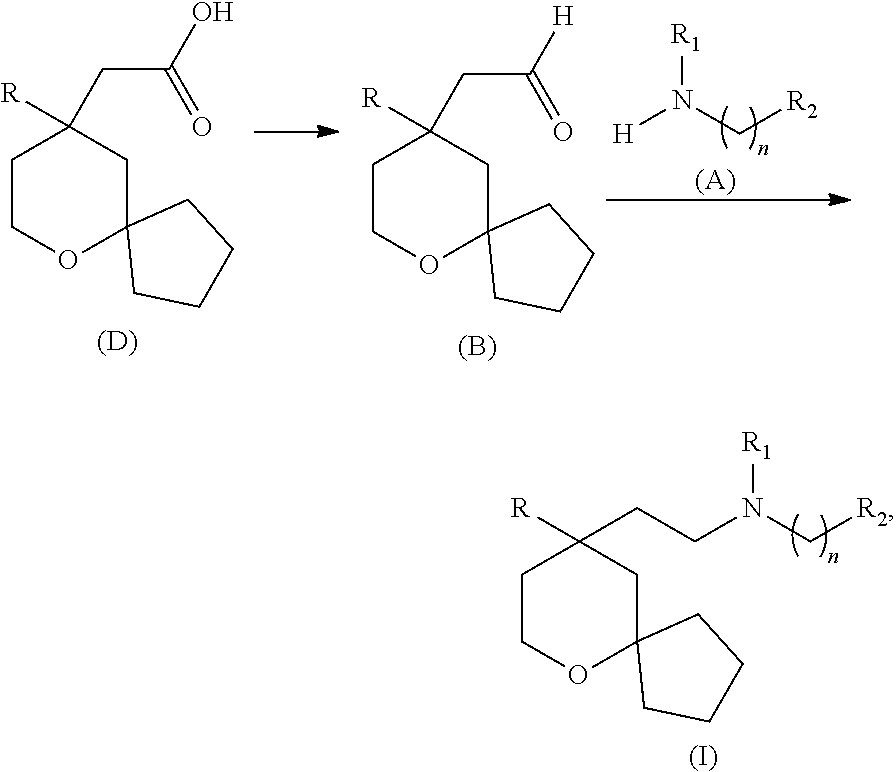
- the present disclosure also provides a method for preparing a compound represented by formula I or a salt thereof, which comprises reacting a compound represented by formula D or a stereoisomer thereof to give a compound represented by formula B or a stereoisomer thereof, and reacting the compound represented by formula B or a stereoisomer thereof with a compound represented by formula A or a stereoisomer thereof to give the compound represented by formula I,
- R1 is a hydrogen or an alkyl
- R2 is an optionally substituted aryl or heteroaryl
- the substituent is selected from the group consisting of hydrogen, alkyl, haloalkyl, halogen, amino, nitro, cyano, oxo, alkenyl, haloalkoxy, hydroxyalkyl, cycloalkyl, heterocyclyl, aryl, heteroaryl, —OR3, —C(O)R3, —C(O)OR3, —S(O)mR3 and —NR4R5, wherein the alkyl, alkoxy, alkenyl, haloalkyl, cycloalkyl, heterocyclyl, aryl and heteroaryl are optionally substituted by one or more than one substituents selected from the group consisting of deuterium, alkyl, haloalkyl, halogen, amino, nitro, cyano, hydroxyl, alkoxy, haloalkoxy,
- the method for preparing the compound represented by formula I or a salt thereof further comprises:
- R is as defined in the compound represented by formula D1.
- the method for preparing the compound represented by formula I or a salt thereof further comprises:
- the method for preparing the compound represented by formula I or a salt thereof further comprises a step of the aforementioned method for preparing the compound represented by formula D1 or a salt thereof.
- the method for preparing the compound represented by formula I or a salt thereof further comprises a step of the aforementioned method for preparing the compound represented by formula B or a stereoisomer thereof.
- the compound represented by formula I is shown as follows,
- the method for preparing the compound represented by formula II comprises:
- the compound represented by formula I is shown as follows,
- the method for preparing the compound represented by formula III comprises:
- the method for preparing the compound represented by formula III comprises:
- the basic condition is preferably sodium hydroxide, potassium hydroxide or aqueous ammonia.
- the chiral resolving agent is preferably a basic chiral resolving agent, more preferably S-phenylethylamine, quinidine, cinchonidine or arginine;
- the alcohol solvent is preferably methanol, ethanol or isopropanol.
- the basic condition is preferably sodium hydroxide, potassium hydroxide or aqueous ammonia.
- the compound represented by formula D2 reacting the compound represented by formula D2 with N,O-dimethylhydroxylamine hydrochloride, 1-(3-dimethylaminopropyl)-3-ethylcarbodiimide hydrochloride and 4-dimethylaminopyridine under a basic condition to give the compound represented by formula C2;
- the basic condition is preferably N,N-diisopropylethylamine, triethylamine or diisopropylamine.
- the reductant is preferably red aluminum.
- the compound represented by formula I is shown as follows,
- the method for preparing the compound represented by formula IV comprises:
- the present disclosure also provides a use of the compound represented by formula D1, the compound represented by formula C or a salt thereof in the preparation of the compound represented by formula I,
- the compound represented by formula I is shown as follows,
- the compound represented by formula I is shown as follows,
- the present disclosure also provides a method for preparing a pharmaceutically acceptable salt of the compound represented by formula I, formula II, formula III, or formula IV, which comprises the steps as described in the above embodiments, and a step of reacting the compound represented by formula I, formula II, formula III, or formula IV with an acid to give the pharmaceutically acceptable salt thereof;
- the acid is an organic acid or an inorganic acid, preferably an organic acid;
- the organic acid is selected from the group consisting of acetic acid, maleic acid, fumaric acid, tartaric acid, citric acid, methanesulfonic acid, benzenesulfonic acid and p-toluenesulfonic acid, preferably fumaric acid;
- the inorganic acid is selected from the group consisting of hydrochloric acid, hydrobromic acid, sulfuric acid and phosphoric acid.
- halogen or halogen atom in the present disclosure refers to fluorine, chlorine, bromine, iodine, etc.
- alkyl in the present disclosure refers to a straight or branched alkyl group containing 1-20 carbon atoms, and includes, for example, “C 1-6 alkyl”, “C 1-4 alkyl”, etc. Specific examples include, but are not limited to, methyl, ethyl, n-propyl, isopropyl, n-butyl, isobutyl, sec-butyl, tert-butyl, n-pentyl, isopentyl, 2-methylbutyl, neopentyl, 1-ethylpropyl, n-hexyl, isohexyl, 3-methylpentyl, 2-methylpentyl, 1-methylpentyl, 3,3-dimethylbutyl, 2,2-dimethylbutyl, 1,1-dimethylbutyl, 1,2-dimethylbutyl, 1,3-dimethylbutyl, 2,3-dimethylbutyl, 2-ethylbutyl
- alkenyl in the present disclosure refers to a straight or branched group containing at least one double bond and 2-20 carbon atoms, and includes, for example, “C 2-6 alkenyl, C 2-4 alkenyl”, etc.
- alkenyl include, but are not limited to, vinyl, propenyl, 2-butenyl, 2-pentenyl, 3-pentenyl, 2-hexenyl, 3-hexenyl, etc.
- haloalkyl in the present disclosure refers to a group derived by replacing one or more than one hydrogen atoms attached to the “alkyl” with one or more than one “halogen atom”, the “halogen atom” and “alkyl” are as defined above.
- hydroxylalkyl or hydroxyalkyl in the present disclosure refers to a group derived by replacing one or more than one hydrogen atoms attached to the “alkyl” with one or more than one “hydroxyl”, the “alkyl” is as defined above.
- alkoxy, haloalkoxy, alkylcarbonyl, alkoxycarbonyl, alkoxycarbonyl, carbonylalkoxy, alkylcarbonylamino, alkylaminocarbonyl, alkylamino, dialkylamino, alkylsulfonylamino or alkylsulfonyl” in the present disclosure refers to the substituent in the form of alkyl-O—, haloalkyl-O—, alkyl-C(O)—, alkyl-O—C(O)—, C(O)-alkyl-O—, alkyl-C(O)—NH—, alkyl-NH—C(O)—, alkyl-NH—, (alkyl) 2 -N—, alkyl-S(O) 2 —NH— or alkyl-S(O) 2 —, wherein the “alkyl, haloalkyl” are as defined above.
- the “oxo” in the present disclosure refers to ⁇ O.
- cycloalkyl in the present disclosure refers to a saturated or partially unsaturated monocyclic or polycyclic hydrocarbon substituent containing 3 to 20 carbon atoms, preferably 3 to 12 carbon atoms, more preferably 3 to 10 carbon atoms, and most preferably 3 to 6 carbon atoms.
- Non-limiting examples of monocyclic cycloalkyl include cyclopropyl, cyclobutyl, cyclopentyl, cyclopentenyl, cyclohexyl, cyclohexenyl, cyclohexadienyl, cycloheptyl, cycloheptatrienyl, cyclooctyl, etc., preferably cyclopropyl, cyclohexenyl.
- Polycyclic cycloalkyl includes a cycloalkyl containing a spiro ring, fused ring and bridged ring.
- aryl in the present disclosure refers to a 6 to 14 membered monocyclic ring or polycyclic fused ring (that is, each ring in the system shares an adjacent pair of carbon atoms with another ring), with only carbon atom as ring atoms, having a conjugated n-electron system, preferably 6 to 10 membered aryl, more preferably phenyl, naphthyl, dihydronaphthyl, tetrahydronaphthyl, indenyl or fluorenyl, and most preferably phenyl.
- heterocyclyl in the present disclosure refers to a saturated or partially unsaturated monocyclic or polycyclic hydrocarbon substituent containing 3 to 20 ring atoms, wherein at least one ring atom is heteroatom, e.g. N, O or S, and the remaining ring atoms are C; optionally, the ring atoms (e.g., C, N or S) constituting the cyclic structure can be oxidized.
- the heterocyclyl contains 3 to 12 ring atoms or 5 to 12 ring atoms wherein 1-4 ring atoms are heteroatoms; more preferably, the heterocyclyl contains 3 to 8 ring atoms, and most preferably 5 to 6 ring atoms.
- Non-limiting examples of monocyclic heterocyclyl include pyrrolidinyl, piperidinyl, piperazinyl, morpholinyl, thiomorpholinyl, homopiperazinyl, pyranyl, dihydrofuranyl, tetrahydrofuranyl, etc.
- Polycyclic heterocyclyl includes heterocyclyl containing a spiro ring, fused ring or bridged ring.
- heteroaryl in the present disclosure refers to a 5 to 14 membered aryl group having 1 to 4 heteroatoms as ring atoms, and the remaining ring atoms are C, wherein the heteroatom includes O, S or N.
- the heteroaryl is preferably 5 to 10 membered heteroaryl, more preferably 5 to 6 membered heteroaryl, specific examples include, but are not limited to, furyl, thienyl, pyrrolyl, thiazolyl, isothiazolyl, thiadiazolyl, oxazolyl, isoxazolyl, oxadiazolyl, imidazolyl, pyrazolyl, 1,2,3-triazolyl, 1,2,4-triazolyl, 1,2,3-oxadiazolyl, 1,2,4-oxadiazolyl, 1,2,5-oxadiazolyl, 1,3,4-oxadiazolyl, pyridyl, indolinyl, 2-pyridonyl, 4-pyridonyl, pyrimidinyl, pyridazinyl, pyrazinyl, 1,2,3-triazinyl, 1,3,5-triazinyl, 1,2,4,5-tetrazinyl azacycl
- the “C, N or S is oxidized” in the present disclosure means forming the structure C ⁇ O, N ⁇ O, S ⁇ O or SO 2 .
- the “alcohol solvent” in the present disclosure refers to a group derived by substituting one or more than one hydrogen atoms attached to “C 1-6 alkyl” with one or more than one “hydroxyl”, the “hydroxyl” and “C 1-6 alkyl” are as defined above; specific examples include, but are not limited to, methanol, ethanol, isopropanol, n-propanol, isopentanol or trifluoroethanol.
- the “stereoisomerism” described in the present disclosure is classified into conformational isomerism and configurational isomerism, and configurational isomerism is further classified into cis-trans isomerism and optical isomerism (or enantiomerism).
- Conformational isomerism is a form of stereoisomerism in which rotations or distortions of single C—C bonds result in different spatial arrangements of atoms or atomic groups in an organic molecule with a certain configuration, commonly in alkane and cycloalkane compounds, such as cyclohexane conformations with chair and boat conformers.
- Optical isomers means that, when the compounds of the present disclosure have one or more than one asymmetry centers, and thus can be racemes and racemic mixtures, single enantiomers, diastereoisomer mixtures, and single diastereoisomers.
- the compounds of the present disclosure have asymmetry centers, which each independently lead to two optical isomers.
- the scope of the present disclosure includes all possible optical isomers and diastereoisomer mixtures, as well as pure or partially pure compounds. If the compounds of the present disclosure have alkene double bonds, unless otherwise specified, the compounds of the present disclosure include cis-isomers and trans-isomers.
- the compounds of the present disclosure can be present in form of tautomers, which have different hydrogen connection sites due to one or more than one double-bond shifts.
- ketone and its enol form are keto-enol tautomers.
- Various tautomers and mixtures thereof are all included in the present disclosure. All the enantiomers, diastereoisomers, racemes, mesomers, cis-trans isomers, tautomers, geometric isomers, epimerides, and mixtures thereof fall into the scope of the present disclosure.
- NMR nuclear magnetic resonance
- MS mass spectrometry
- MS was determined by a FINNIGAN LCQAd (ESI) mass spectrometer (manufacturer: Thermo, type: Finnigan LCQ advantage MAX).
- HPLC High performance liquid chromatography
- the compound represented by the formula (E1) 25 g), potassium hydroxide (22.4 g) and ethylene glycol (150 mL) were mixed and the resulting mixture was stirred at 150° C. for 16 hours, and then the reaction was stopped.
- the reaction solution was cooled to room temperature, diluted with water (150 mL) and extracted with dichloromethane (150 mL ⁇ 2).
- the combined organic phase was washed with saturated sodium chloride solution (200 mL), dried over anhydrous sodium sulfate and filtered. The filtrate was concentrated under reduced pressure to give the product (26.1 g, pale yellow oil) with a yield of 97.4% and a HPLC purity of 92%.
- the compound represented by the formula (D-1) (28 g) was dissolved in anhydrous ethanol (100 mL) and the temperature was raised to 50° C.
- the resolving agent S-phenylethylamine (6.2 g) was dissolved in anhydrous ethanol (100 mL) and the resulting S-phenylethylamine solution was added dropwise into the above solution at 50° C.
- the mixture was heated to reflux and stirred for 2 hours. Then the mixture was allowed to cool to 10° C. naturally, and solid was precipitated.
- the mixture was filtered, and the filter cake was washed to give the product (13 g, solid) with an enantiomeric excess (ee) value of 96.7%;
- the compound represented by formula (C2) (334.4 g) was dissolved in toluene (2.2 kg) in a reaction flask. The solution was cooled to ⁇ 45° C. to ⁇ 35° C. and purged with argon, and then red aluminum (348.76 g) was added dropwise while maintaining the temperature between ⁇ 45° C. to ⁇ 35° C. After completion of the addition, the reaction solution was stirred at ⁇ 45° C. to ⁇ 35° C. for 3-4 hours, and then 10% citric acid aqueous solution (1 kg) was added to the reaction solution at ⁇ 45° C. to ⁇ 35° C.
- the compound represented by the formula (E1) (13.5 kg, 1.0 eq), potassium hydroxide (2.6 kg, 2.0 eq) and ethylene glycol (135 L, 10 vol) were mixed, and the mixture was heated to 110° C. and stirred for 24 hours, and then the reaction was stopped. The resulting mixture was concentrated under reduced pressure to remove ethanol, then dichloromethane (26 L) was added to the residue and the mixture was stirred for dissolution. The mixture was washed twice with saturated sodium chloride solution (5 L), dried over anhydrous sodium sulfate and filtered. The filtrate was concentrated under reduced pressure to give the product (13 kg, yellow oil) with a yield of 90% and a HPLC purity of 95%.
- the 4700 g solid was dissolved in water, and then 1.2 eq of potassium hydroxide was added and the resulting mixture was stirred for dissolution.
- the mixture was extracted with dichloromethane (DCM) (30 L ⁇ 3).
- the combined organic phase was dried and concentrated to give 200 g product with an ee value of 99.42% and a purity of 99%.
Landscapes
- Chemical & Material Sciences (AREA)
- Organic Chemistry (AREA)
- Health & Medical Sciences (AREA)
- Life Sciences & Earth Sciences (AREA)
- Veterinary Medicine (AREA)
- Public Health (AREA)
- General Health & Medical Sciences (AREA)
- Medicinal Chemistry (AREA)
- Animal Behavior & Ethology (AREA)
- Pharmacology & Pharmacy (AREA)
- General Chemical & Material Sciences (AREA)
- Pain & Pain Management (AREA)
- Chemical Kinetics & Catalysis (AREA)
- Nuclear Medicine, Radiotherapy & Molecular Imaging (AREA)
- Bioinformatics & Cheminformatics (AREA)
- Epidemiology (AREA)
- Engineering & Computer Science (AREA)
- Rheumatology (AREA)
- Biomedical Technology (AREA)
- Neurology (AREA)
- Neurosurgery (AREA)
- Pharmaceuticals Containing Other Organic And Inorganic Compounds (AREA)
- Organic Low-Molecular-Weight Compounds And Preparation Thereof (AREA)
- Low-Molecular Organic Synthesis Reactions Using Catalysts (AREA)
- Plural Heterocyclic Compounds (AREA)
Abstract
Description


M is S-phenylethylamine, and the preparation method is shown as follows,




Claims (15)


Applications Claiming Priority (3)
| Application Number | Priority Date | Filing Date | Title |
|---|---|---|---|
| CN201710896555.2 | 2017-09-28 | ||
| CN201710896555 | 2017-09-28 | ||
| PCT/CN2018/107901 WO2019062804A1 (en) | 2017-09-28 | 2018-09-27 | Method for preparing oxaspirocycle derivative, and intermediate thereof |
Publications (2)
| Publication Number | Publication Date |
|---|---|
| US20200308151A1 US20200308151A1 (en) | 2020-10-01 |
| US11111236B2 true US11111236B2 (en) | 2021-09-07 |
Family
ID=65900832
Family Applications (1)
| Application Number | Title | Priority Date | Filing Date |
|---|---|---|---|
| US16/651,922 Expired - Fee Related US11111236B2 (en) | 2017-09-28 | 2018-09-27 | Method for preparing oxaspirocycle derivative, and intermediate thereof |
Country Status (12)
| Country | Link |
|---|---|
| US (1) | US11111236B2 (en) |
| EP (1) | EP3689859A4 (en) |
| JP (1) | JP2020535177A (en) |
| KR (1) | KR20200060750A (en) |
| CN (1) | CN110678453B (en) |
| AU (1) | AU2018341782A1 (en) |
| BR (1) | BR112020005858A2 (en) |
| CA (1) | CA3076395A1 (en) |
| MX (1) | MX395589B (en) |
| TW (1) | TWI690524B (en) |
| WO (1) | WO2019062804A1 (en) |
| ZA (1) | ZA202002138B (en) |
Families Citing this family (7)
| Publication number | Priority date | Publication date | Assignee | Title |
|---|---|---|---|---|
| WO2019205983A1 (en) * | 2018-04-28 | 2019-10-31 | 四川科伦博泰生物医药股份有限公司 | Oxa-spiro compound and preparation method therefor and uses thereof |
| CN116368138B (en) * | 2020-12-29 | 2026-03-03 | 上海海雁医药科技有限公司 | Oxaspiro-substituted pyrrolopyrazoles derivatives, intermediates therefor and process for preparing same |
| CN117529481B (en) * | 2021-07-13 | 2026-03-03 | 上海海雁医药科技有限公司 | Pharmaceutically acceptable salts of MOR receptor agonists, polymorphs thereof and uses thereof |
| CN117624138A (en) * | 2022-08-29 | 2024-03-01 | 江苏恒瑞医药股份有限公司 | Pharmaceutically acceptable salts, crystal forms and preparation methods of oxaspirocyclic derivatives |
| TW202434547A (en) | 2023-01-18 | 2024-09-01 | 大陸商上海森輝醫藥有限公司 | A method for preparing tetrahydro-1-naphthylamine and its derivatives |
| CN118638109B (en) * | 2024-04-30 | 2025-10-28 | 中山大学 | A preparation method of opioid drug-oxelidine |
| CN118994123B (en) * | 2024-10-23 | 2025-02-14 | 江苏恒瑞医药股份有限公司 | Method for preparing 9-(pyridin-2-yl)-6-oxaspiro[4.5]decane derivatives |
Citations (2)
| Publication number | Priority date | Publication date | Assignee | Title |
|---|---|---|---|---|
| WO2012129495A1 (en) | 2011-03-23 | 2012-09-27 | Trevena, Inc. | Opioid receptor ligands and methods of using and making same |
| WO2017063509A1 (en) | 2015-10-15 | 2017-04-20 | 江苏恒瑞医药股份有限公司 | Oxa spiro derivative, preparation method therefor, and applications thereof in medicines |
Family Cites Families (1)
| Publication number | Priority date | Publication date | Assignee | Title |
|---|---|---|---|---|
| CN106588899B (en) * | 2015-10-15 | 2019-11-15 | 江苏恒瑞医药股份有限公司 | 6- oxaspiro [4.5] decane analog derivative, preparation method and its application in medicine that pyridyl group replaces |
-
2018
- 2018-09-27 CA CA3076395A patent/CA3076395A1/en active Pending
- 2018-09-27 AU AU2018341782A patent/AU2018341782A1/en not_active Abandoned
- 2018-09-27 EP EP18862192.4A patent/EP3689859A4/en not_active Withdrawn
- 2018-09-27 KR KR1020207012222A patent/KR20200060750A/en not_active Withdrawn
- 2018-09-27 US US16/651,922 patent/US11111236B2/en not_active Expired - Fee Related
- 2018-09-27 MX MX2020003784A patent/MX395589B/en unknown
- 2018-09-27 WO PCT/CN2018/107901 patent/WO2019062804A1/en not_active Ceased
- 2018-09-27 CN CN201880035013.9A patent/CN110678453B/en active Active
- 2018-09-27 TW TW107134070A patent/TWI690524B/en not_active IP Right Cessation
- 2018-09-27 JP JP2020517594A patent/JP2020535177A/en not_active Ceased
- 2018-09-27 BR BR112020005858-0A patent/BR112020005858A2/en not_active Application Discontinuation
-
2020
- 2020-05-04 ZA ZA2020/02138A patent/ZA202002138B/en unknown
Patent Citations (3)
| Publication number | Priority date | Publication date | Assignee | Title |
|---|---|---|---|---|
| WO2012129495A1 (en) | 2011-03-23 | 2012-09-27 | Trevena, Inc. | Opioid receptor ligands and methods of using and making same |
| WO2017063509A1 (en) | 2015-10-15 | 2017-04-20 | 江苏恒瑞医药股份有限公司 | Oxa spiro derivative, preparation method therefor, and applications thereof in medicines |
| US10442793B2 (en) | 2015-10-15 | 2019-10-15 | Jiangsu Hengrui Medicine Co., Ltd | Oxa spiro derivative, preparation method therefor, and applications thereof in medicines |
Non-Patent Citations (4)
| Title |
|---|
| Jakub Fichna et al., The Endomorphin System and Its Evolving Neurophysiological Role, Pharmacol. Rev. 2007; 59: 88-123. |
| Nov. 28, 2018 International Search Report issued in International Patent Application No. PCT/CN2018/107901. |
| Nov. 28, 2018 Written Opinion of the International Searching Authority issued in International Patent Application No. PCT/CN2018/107901. |
| Xiaotao Chen et al., Structure-Activity Relationships and Discovery of a G Protein Biased μ Opioid Receptor Ligand, [(3-Methoxythiophen-2-yl)methyl]({2-[(9R)-9-(pyridin-2-yl)-6-oxaspiro-[4.5]decan-9-yl]ethyl})amine (TRV130), for the Treatment of Acute Severe Pain, J. Med. Chem.2013, 56, 8019-8031. |
Also Published As
| Publication number | Publication date |
|---|---|
| BR112020005858A2 (en) | 2020-09-29 |
| EP3689859A1 (en) | 2020-08-05 |
| RU2020113709A3 (en) | 2022-01-25 |
| RU2020113709A (en) | 2021-10-18 |
| AU2018341782A1 (en) | 2020-04-16 |
| KR20200060750A (en) | 2020-06-01 |
| ZA202002138B (en) | 2021-05-26 |
| CN110678453A (en) | 2020-01-10 |
| MX395589B (en) | 2025-03-25 |
| EP3689859A4 (en) | 2021-08-25 |
| CN110678453B (en) | 2023-03-10 |
| CA3076395A1 (en) | 2019-04-04 |
| TW201914997A (en) | 2019-04-16 |
| US20200308151A1 (en) | 2020-10-01 |
| MX2020003784A (en) | 2020-08-03 |
| JP2020535177A (en) | 2020-12-03 |
| TWI690524B (en) | 2020-04-11 |
| WO2019062804A1 (en) | 2019-04-04 |
Similar Documents
| Publication | Publication Date | Title |
|---|---|---|
| US20200308151A1 (en) | Method for preparing oxaspirocycle derivative, and intermediate thereof | |
| TW555752B (en) | Secondary alcohol useful in producing oxazolidinones and its preparation | |
| US8829196B2 (en) | TRPA1 antagonists | |
| AU2018251119B2 (en) | Opioid receptor (MOR) agonist salt, fumarate salt I crystal form thereof and preparation method thereof | |
| US8357705B2 (en) | Substituted cyclohexyldiamines | |
| EP2958894B1 (en) | Process for the preparation of enantiomerically enriched 3-aminopiperidine | |
| NO180195B (en) | Analogous Process for Preparation of Hexahydroazepine Derivatives | |
| WO2019149244A1 (en) | Jak inhibitor and use thereof | |
| JP7498702B2 (en) | TLR8 agonists | |
| EP3169666B1 (en) | Substituted azaspiro(4.5)decane derivatives | |
| JP2006500353A (en) | Urea derivatives as kinase inhibitors | |
| US20200369715A1 (en) | Cyclin-dependent kinase inhibitors and methods of use | |
| US20220098195A1 (en) | Heterocyclic compounds and their application in medicine | |
| RU2777983C2 (en) | Method for production of oxaspirocyclic derivative and its intermediate compound | |
| WO2022179611A1 (en) | Substituted pyridine-2,4-dione derivatives | |
| TW577877B (en) | Improved methods of preparing 4-cyano-4-(substituted indazole)cyclohexane-carboxylic acids useful as PDE4 inhibitors | |
| US7358393B2 (en) | Method for preparing β-alaninamides | |
| HK40019965A (en) | Method for preparing oxaspirocycle derivative, and intermediate thereof | |
| TW200916443A (en) | 5-aryl-4,5-dihydro-(1H)-pyrazolines as cannabinoid CB1 receptor agonists | |
| CN111902406B (en) | Pharmaceutically acceptable salt, crystal form and preparation method of azabicyclyl-substituted triazole derivatives | |
| WO2025080781A1 (en) | Nk3 modulators and uses thereof | |
| WO2026032320A1 (en) | Method for preparing intermediate of isoxazoline type drug | |
| JP2010195688A (en) | Amide and urea derivative having npyy5 receptor antagonism | |
| US20110190529A1 (en) | Method for preparing the ethyl ester of 4-[trans-4-[(phenylmethyl)-amino]cyclohexyl]benzoic acid and the hemifumarate salt thereof | |
| HK1235783B (en) | Substituted azaspiro(4.5)decane derivatives |
Legal Events
| Date | Code | Title | Description |
|---|---|---|---|
| FEPP | Fee payment procedure |
Free format text: ENTITY STATUS SET TO UNDISCOUNTED (ORIGINAL EVENT CODE: BIG.); ENTITY STATUS OF PATENT OWNER: LARGE ENTITY |
|
| AS | Assignment |
Owner name: JIANGSU HENGRUI MEDICINE CO., LTD., CHINA Free format text: ASSIGNMENT OF ASSIGNORS INTEREST;ASSIGNORS:LI, WENHAI;QI, WEIXING;QIU, ZHENJUN;REEL/FRAME:053260/0693 Effective date: 20200409 |
|
| STPP | Information on status: patent application and granting procedure in general |
Free format text: DOCKETED NEW CASE - READY FOR EXAMINATION |
|
| STPP | Information on status: patent application and granting procedure in general |
Free format text: NON FINAL ACTION MAILED |
|
| STPP | Information on status: patent application and granting procedure in general |
Free format text: RESPONSE TO NON-FINAL OFFICE ACTION ENTERED AND FORWARDED TO EXAMINER |
|
| STPP | Information on status: patent application and granting procedure in general |
Free format text: NOTICE OF ALLOWANCE MAILED -- APPLICATION RECEIVED IN OFFICE OF PUBLICATIONS |
|
| STPP | Information on status: patent application and granting procedure in general |
Free format text: PUBLICATIONS -- ISSUE FEE PAYMENT VERIFIED |
|
| STCF | Information on status: patent grant |
Free format text: PATENTED CASE |
|
| FEPP | Fee payment procedure |
Free format text: MAINTENANCE FEE REMINDER MAILED (ORIGINAL EVENT CODE: REM.); ENTITY STATUS OF PATENT OWNER: LARGE ENTITY |
|
| LAPS | Lapse for failure to pay maintenance fees |
Free format text: PATENT EXPIRED FOR FAILURE TO PAY MAINTENANCE FEES (ORIGINAL EVENT CODE: EXP.); ENTITY STATUS OF PATENT OWNER: LARGE ENTITY |
|
| STCH | Information on status: patent discontinuation |
Free format text: PATENT EXPIRED DUE TO NONPAYMENT OF MAINTENANCE FEES UNDER 37 CFR 1.362 |
|
| FP | Lapsed due to failure to pay maintenance fee |
Effective date: 20250907 |