US11105810B2 - Reagents for quantitative mass spectrometry - Google Patents
Reagents for quantitative mass spectrometry Download PDFInfo
- Publication number
- US11105810B2 US11105810B2 US16/692,762 US201916692762A US11105810B2 US 11105810 B2 US11105810 B2 US 11105810B2 US 201916692762 A US201916692762 A US 201916692762A US 11105810 B2 US11105810 B2 US 11105810B2
- Authority
- US
- United States
- Prior art keywords
- reporter
- tag
- mass spectrometry
- optionally substituted
- group
- Prior art date
- Legal status (The legal status is an assumption and is not a legal conclusion. Google has not performed a legal analysis and makes no representation as to the accuracy of the status listed.)
- Active
Links
- 0 [1*]CC[4*]CC(C)[6*][7*] Chemical compound [1*]CC[4*]CC(C)[6*][7*] 0.000 description 34
- DWKUKQRKVCMOLP-UHFFFAOYSA-O C1=[NH+]CCCC1 Chemical compound C1=[NH+]CCCC1 DWKUKQRKVCMOLP-UHFFFAOYSA-O 0.000 description 13
- DWKUKQRKVCMOLP-HOSYLAQJSA-O C1=[NH+][13CH2]CCC1 Chemical compound C1=[NH+][13CH2]CCC1 DWKUKQRKVCMOLP-HOSYLAQJSA-O 0.000 description 9
- MRFJLDYZLFSEMU-UHFFFAOYSA-N CC(=O)[N+]1=CCCCC1 Chemical compound CC(=O)[N+]1=CCCCC1 MRFJLDYZLFSEMU-UHFFFAOYSA-N 0.000 description 8
- MRFJLDYZLFSEMU-CDYZYAPPSA-N C[13C](=O)[N+]1=CCCCC1 Chemical compound C[13C](=O)[N+]1=CCCCC1 MRFJLDYZLFSEMU-CDYZYAPPSA-N 0.000 description 6
- MRFJLDYZLFSEMU-VJJZLTLGSA-N CC(=O)[15N+]1=CCCCC1 Chemical compound CC(=O)[15N+]1=CCCCC1 MRFJLDYZLFSEMU-VJJZLTLGSA-N 0.000 description 4
- DWKUKQRKVCMOLP-PTQBSOBMSA-O C1=[15NH+]CCCC1 Chemical compound C1=[15NH+]CCCC1 DWKUKQRKVCMOLP-PTQBSOBMSA-O 0.000 description 3
- BMIFCDLDYUQBKO-UHFFFAOYSA-O CC(=O)NCCCCC=[N+](C)C Chemical compound CC(=O)NCCCCC=[N+](C)C BMIFCDLDYUQBKO-UHFFFAOYSA-O 0.000 description 3
- MRFJLDYZLFSEMU-PTQBSOBMSA-N CC(=O)[N+]1=CCCC[13CH2]1 Chemical compound CC(=O)[N+]1=CCCC[13CH2]1 MRFJLDYZLFSEMU-PTQBSOBMSA-N 0.000 description 3
- BMIFCDLDYUQBKO-IVBHDYLYSA-O C[13C](=O)NCCCC/C=[N+](/C)[13CH3] Chemical compound C[13C](=O)NCCCC/C=[N+](/C)[13CH3] BMIFCDLDYUQBKO-IVBHDYLYSA-O 0.000 description 3
- MRFJLDYZLFSEMU-AKZCFXPHSA-N C[13C](=O)[N+]1=CCCC[13CH2]1 Chemical compound C[13C](=O)[N+]1=CCCC[13CH2]1 MRFJLDYZLFSEMU-AKZCFXPHSA-N 0.000 description 3
- XKUFQUFLKMBOGV-MTPUMVFESA-N O=[13CH][N+]1=CCCCC1.[13CH4] Chemical compound O=[13CH][N+]1=CCCCC1.[13CH4] XKUFQUFLKMBOGV-MTPUMVFESA-N 0.000 description 3
- MRFJLDYZLFSEMU-OUBTZVSYSA-N [13CH3]C(=O)[N+]1=CCCCC1 Chemical compound [13CH3]C(=O)[N+]1=CCCCC1 MRFJLDYZLFSEMU-OUBTZVSYSA-N 0.000 description 3
- MRFJLDYZLFSEMU-NWRBOQJNSA-N [13CH3][13C](=O)[N+]1=CCCC[13CH2]1 Chemical compound [13CH3][13C](=O)[N+]1=CCCC[13CH2]1 MRFJLDYZLFSEMU-NWRBOQJNSA-N 0.000 description 3
- DWKUKQRKVCMOLP-GDTGSDDISA-O C1=[15NH+][13CH2][13CH2]CC1 Chemical compound C1=[15NH+][13CH2][13CH2]CC1 DWKUKQRKVCMOLP-GDTGSDDISA-O 0.000 description 2
- DIMVNJJMGYSQBL-UHFFFAOYSA-N C1=[N-14]CCCC1 Chemical compound C1=[N-14]CCCC1 DIMVNJJMGYSQBL-UHFFFAOYSA-N 0.000 description 2
- BMIFCDLDYUQBKO-KQLGELOASA-O CC(=O)NCCCC/C=[N+](/C)[13CH3] Chemical compound CC(=O)NCCCC/C=[N+](/C)[13CH3] BMIFCDLDYUQBKO-KQLGELOASA-O 0.000 description 2
- TZZLPANHKDOBAO-OEFCHXIRSA-N CC(=O)NCCCCC(C(=O)[15NH]C[13CH3])N(C)[13CH3].CC(=O)NCCCCC(C(N)=O)[15N](C)C.CC(=O)NCCCCC(C([15NH2])=O)N(C)C.CC(=O)N[13CH2]CCCC(C([15NH2])=O)[15N](C)C.CC(=O)[15NH]CCCCC(C(N)=O)N(C)C.CC(=O)[15NH][13CH2]CCCC(C([15NH2])=O)N(C)C.CN(C)C(CCCCNC([13CH3])=O)C(=O)[15NH]C[13CH3].CN(C)C(CCC[13CH2]N[13C]([13CH3])=O)C(=O)[15NH]CCC(=O)ON1C(=O)CCC1=O.CN([13CH3])C(CCC[13CH2]N[13C]([13CH3])=O)C(=O)[15NH]CCC(=O)ON1C(=O)CCC1=O.O=[13CH]ON1C(=O)CCC1=O.O=[13CH]ON1C(=O)CCC1=O.O=[13CH]ON1C(=O)CCC1=O.O=[13CH]ON1C(=O)CCC1=O.O=[13CH]ON1C(=O)CCC1=O.[13CH3]C(=O)NCCCCC(C(=O)[15NH]CCC(=O)ON1C(=O)CCC1=O)N([13CH3])[13CH3].[13CH3]CC(=O)ON1C(=O)CCC1=O.[13CH3]CC(=O)ON1C(=O)CCC1=O.[13CH3][13CH3].[13CH3][13CH3].[13CH3][13CH3] Chemical compound CC(=O)NCCCCC(C(=O)[15NH]C[13CH3])N(C)[13CH3].CC(=O)NCCCCC(C(N)=O)[15N](C)C.CC(=O)NCCCCC(C([15NH2])=O)N(C)C.CC(=O)N[13CH2]CCCC(C([15NH2])=O)[15N](C)C.CC(=O)[15NH]CCCCC(C(N)=O)N(C)C.CC(=O)[15NH][13CH2]CCCC(C([15NH2])=O)N(C)C.CN(C)C(CCCCNC([13CH3])=O)C(=O)[15NH]C[13CH3].CN(C)C(CCC[13CH2]N[13C]([13CH3])=O)C(=O)[15NH]CCC(=O)ON1C(=O)CCC1=O.CN([13CH3])C(CCC[13CH2]N[13C]([13CH3])=O)C(=O)[15NH]CCC(=O)ON1C(=O)CCC1=O.O=[13CH]ON1C(=O)CCC1=O.O=[13CH]ON1C(=O)CCC1=O.O=[13CH]ON1C(=O)CCC1=O.O=[13CH]ON1C(=O)CCC1=O.O=[13CH]ON1C(=O)CCC1=O.[13CH3]C(=O)NCCCCC(C(=O)[15NH]CCC(=O)ON1C(=O)CCC1=O)N([13CH3])[13CH3].[13CH3]CC(=O)ON1C(=O)CCC1=O.[13CH3]CC(=O)ON1C(=O)CCC1=O.[13CH3][13CH3].[13CH3][13CH3].[13CH3][13CH3] TZZLPANHKDOBAO-OEFCHXIRSA-N 0.000 description 2
- ZFNOKHWFQICIOW-BPAKSVBSSA-N CC(=O)NCCCCC(C([15NH2])=O)N([13CH3])[13CH3].CC(=O)NCCCCC([15NH][13CH3])C(N)=O.CN(C)C(CCCCN[13C]([13CH3])=O)C([15NH2])=O.CN([13CH3])C(CCCCNC([13CH3])=O)C([15NH2])=O.C[15NH]C(CCCCN[13C](C)=O)C(N)=O.C[15N](C)C(CCCCN[13C]([13CH3])=O)C(N)=O.[13CH3]CC(=O)ON1C(=O)CCC1=O.[13CH3]CC(=O)ON1C(=O)CCC1=O.[13CH3]CC(=O)ON1C(=O)CCC1=O.[13CH3]CC(=O)ON1C(=O)CCC1=O.[13CH3]CC(=O)ON1C(=O)CCC1=O.[13CH3]CC(=O)ON1C(=O)CCC1=O.[13CH4].[13CH4] Chemical compound CC(=O)NCCCCC(C([15NH2])=O)N([13CH3])[13CH3].CC(=O)NCCCCC([15NH][13CH3])C(N)=O.CN(C)C(CCCCN[13C]([13CH3])=O)C([15NH2])=O.CN([13CH3])C(CCCCNC([13CH3])=O)C([15NH2])=O.C[15NH]C(CCCCN[13C](C)=O)C(N)=O.C[15N](C)C(CCCCN[13C]([13CH3])=O)C(N)=O.[13CH3]CC(=O)ON1C(=O)CCC1=O.[13CH3]CC(=O)ON1C(=O)CCC1=O.[13CH3]CC(=O)ON1C(=O)CCC1=O.[13CH3]CC(=O)ON1C(=O)CCC1=O.[13CH3]CC(=O)ON1C(=O)CCC1=O.[13CH3]CC(=O)ON1C(=O)CCC1=O.[13CH4].[13CH4] ZFNOKHWFQICIOW-BPAKSVBSSA-N 0.000 description 2
- MRFJLDYZLFSEMU-ANVYNZRWSA-N CC(=O)[15N+]1=CCCC[13CH2]1 Chemical compound CC(=O)[15N+]1=CCCC[13CH2]1 MRFJLDYZLFSEMU-ANVYNZRWSA-N 0.000 description 2
- MRFJLDYZLFSEMU-ZIBLLEECSA-N CC(=O)[15N+]1=CCC[13CH2][13CH2]1 Chemical compound CC(=O)[15N+]1=CCC[13CH2][13CH2]1 MRFJLDYZLFSEMU-ZIBLLEECSA-N 0.000 description 2
- BMIFCDLDYUQBKO-DETAZLGJSA-O CC(=O)[15NH]CCCCC=[N+](C)C Chemical compound CC(=O)[15NH]CCCCC=[N+](C)C BMIFCDLDYUQBKO-DETAZLGJSA-O 0.000 description 2
- JILVFYDRBBNXKP-UHFFFAOYSA-N CC(C)(C)ON1C(=O)CCC1=O Chemical compound CC(C)(C)ON1C(=O)CCC1=O JILVFYDRBBNXKP-UHFFFAOYSA-N 0.000 description 2
- BMIFCDLDYUQBKO-OJJJIBSVSA-O C[13C](=O)[15NH]CCCCC=[N+](C)C Chemical compound C[13C](=O)[15NH]CCCCC=[N+](C)C BMIFCDLDYUQBKO-OJJJIBSVSA-O 0.000 description 2
- BMIFCDLDYUQBKO-CBDCKILASA-O C[N+](C)=CCCC[13CH2]N[13C]([13CH3])=O Chemical compound C[N+](C)=CCCC[13CH2]N[13C]([13CH3])=O BMIFCDLDYUQBKO-CBDCKILASA-O 0.000 description 2
- ZVYCPFCNAXPUFP-YMEJRBPBSA-O [13CH3]C/C=[NH+]\[13CH2][13CH3] Chemical compound [13CH3]C/C=[NH+]\[13CH2][13CH3] ZVYCPFCNAXPUFP-YMEJRBPBSA-O 0.000 description 2
- MRFJLDYZLFSEMU-SPBYTNOZSA-N [13CH3][13C](=O)[N+]1=CCCCC1 Chemical compound [13CH3][13C](=O)[N+]1=CCCCC1 MRFJLDYZLFSEMU-SPBYTNOZSA-N 0.000 description 2
- KHUGGXKSRHFUAW-UHFFFAOYSA-N [O-][N+]1=CCCCC1 Chemical compound [O-][N+]1=CCCCC1 KHUGGXKSRHFUAW-UHFFFAOYSA-N 0.000 description 2
- BMIFCDLDYUQBKO-UIFUTTKMSA-O C/[N+]([13CH3])=C/CCCCN[13C]([13CH3])=O Chemical compound C/[N+]([13CH3])=C/CCCCN[13C]([13CH3])=O BMIFCDLDYUQBKO-UIFUTTKMSA-O 0.000 description 1
- DWKUKQRKVCMOLP-MPOCSFTDSA-O C1=[15NH+][13CH2]CCC1 Chemical compound C1=[15NH+][13CH2]CCC1 DWKUKQRKVCMOLP-MPOCSFTDSA-O 0.000 description 1
- DWKUKQRKVCMOLP-TUZLZUAPSA-O C1=[15NH+][13CH2][13CH2][13CH2]C1 Chemical compound C1=[15NH+][13CH2][13CH2][13CH2]C1 DWKUKQRKVCMOLP-TUZLZUAPSA-O 0.000 description 1
- DWKUKQRKVCMOLP-QGLWEVTGSA-O C1=[15NH+][13CH2][13CH2][13CH2][13CH2]1 Chemical compound C1=[15NH+][13CH2][13CH2][13CH2][13CH2]1 DWKUKQRKVCMOLP-QGLWEVTGSA-O 0.000 description 1
- DIMVNJJMGYSQBL-HOSYLAQJSA-N C1=[N-14][13CH2]CCC1 Chemical compound C1=[N-14][13CH2]CCC1 DIMVNJJMGYSQBL-HOSYLAQJSA-N 0.000 description 1
- DIMVNJJMGYSQBL-ZIEKVONGSA-N C1=[N-14][13CH2][13CH2]CC1 Chemical compound C1=[N-14][13CH2][13CH2]CC1 DIMVNJJMGYSQBL-ZIEKVONGSA-N 0.000 description 1
- DWKUKQRKVCMOLP-ZIEKVONGSA-O C1=[NH+][13CH2][13CH2]CC1 Chemical compound C1=[NH+][13CH2][13CH2]CC1 DWKUKQRKVCMOLP-ZIEKVONGSA-O 0.000 description 1
- DWKUKQRKVCMOLP-CGANOEODSA-O C1=[NH+][13CH2][13CH2][13CH2]C1 Chemical compound C1=[NH+][13CH2][13CH2][13CH2]C1 DWKUKQRKVCMOLP-CGANOEODSA-O 0.000 description 1
- QAVNEQWVEVMTMR-UHFFFAOYSA-N C=C1CCC(=O)N1OC(=O)CCNC(=O)CCC(=O)C(CCCCNC(C)=O)N(C)C.CC(=O)CCCC(=O)C(CCCCNC(C)=O)N(C)C.CC(=O)CCNC(=O)CCC(=O)C(CCCCNC(C)=O)N(C)C.CC(=O)NCCCCC(C(=O)CCCC(=O)ON1C(=O)CCC1=O)N(C)C Chemical compound C=C1CCC(=O)N1OC(=O)CCNC(=O)CCC(=O)C(CCCCNC(C)=O)N(C)C.CC(=O)CCCC(=O)C(CCCCNC(C)=O)N(C)C.CC(=O)CCNC(=O)CCC(=O)C(CCCCNC(C)=O)N(C)C.CC(=O)NCCCCC(C(=O)CCCC(=O)ON1C(=O)CCC1=O)N(C)C QAVNEQWVEVMTMR-UHFFFAOYSA-N 0.000 description 1
- SOWNAIHQPSNHKP-JEHNXWOXSA-N CC(=O)/[15N+](=C/[13CH2][13CH3])[13CH2][13CH3] Chemical compound CC(=O)/[15N+](=C/[13CH2][13CH3])[13CH2][13CH3] SOWNAIHQPSNHKP-JEHNXWOXSA-N 0.000 description 1
- SOWNAIHQPSNHKP-TYUMXNSASA-N CC(=O)/[N+](=C/C[13CH3])[13CH2][13CH3] Chemical compound CC(=O)/[N+](=C/C[13CH3])[13CH2][13CH3] SOWNAIHQPSNHKP-TYUMXNSASA-N 0.000 description 1
- MARDJSWULOLADR-OVSVEPSRSA-N CC(=O)N1=[13C+][13CH2][13CH2][13CH2][13CH2]1 Chemical compound CC(=O)N1=[13C+][13CH2][13CH2][13CH2][13CH2]1 MARDJSWULOLADR-OVSVEPSRSA-N 0.000 description 1
- BMIFCDLDYUQBKO-XZWKNLJRSA-O CC(=O)NCCCC/C=[15N+](/C)[13CH3] Chemical compound CC(=O)NCCCC/C=[15N+](/C)[13CH3] BMIFCDLDYUQBKO-XZWKNLJRSA-O 0.000 description 1
- PPHUPVHJRCYFGS-CGMYNUMASA-O CC(=O)NCCCC/C=[NH+]\[13CH3].[13CH4] Chemical compound CC(=O)NCCCC/C=[NH+]\[13CH3].[13CH4] PPHUPVHJRCYFGS-CGMYNUMASA-O 0.000 description 1
- SNJXBIYKPADMGH-UHFFFAOYSA-N CC(=O)NCCCCC(C(=O)CCCC(=O)O)N(C)C.CC(=O)NCCCCC(C(=O)CCCC(=O)OCC1=CC=CC=C1)N(C)C.CC(=O)NCCCCC(C(=O)CCCC(=O)ON1C(=O)CCC1=O)N(C)C.CCCCCC(C(=O)O)N(C)C.CCCCCC(N)C(=O)O.CN(C)C(CCCCNC(=O)OC(C)(C)C)C(=O)CCCC(=O)OCC1=CC=CC=C1.NCCC(=O)O.NCCC(=O)OCC1=CC=CC=C1.NCCCCC(N)C(=O)O Chemical compound CC(=O)NCCCCC(C(=O)CCCC(=O)O)N(C)C.CC(=O)NCCCCC(C(=O)CCCC(=O)OCC1=CC=CC=C1)N(C)C.CC(=O)NCCCCC(C(=O)CCCC(=O)ON1C(=O)CCC1=O)N(C)C.CCCCCC(C(=O)O)N(C)C.CCCCCC(N)C(=O)O.CN(C)C(CCCCNC(=O)OC(C)(C)C)C(=O)CCCC(=O)OCC1=CC=CC=C1.NCCC(=O)O.NCCC(=O)OCC1=CC=CC=C1.NCCCCC(N)C(=O)O SNJXBIYKPADMGH-UHFFFAOYSA-N 0.000 description 1
- JPGALBVHHIQRBF-BHNSIPBNSA-N CC(=O)NCCCCC(C(=O)N[13CH2][13CH2][13C](=O)ON1C(=O)CCC1=O)[15N](C)C Chemical compound CC(=O)NCCCCC(C(=O)N[13CH2][13CH2][13C](=O)ON1C(=O)CCC1=O)[15N](C)C JPGALBVHHIQRBF-BHNSIPBNSA-N 0.000 description 1
- AQYYJXCOAXVQAS-VQEHIDDOSA-N CC(=O)NCCCCC(C(=O)N[13CH3])N(C)C.[H]O[13C]([13CH3])=O Chemical compound CC(=O)NCCCCC(C(=O)N[13CH3])N(C)C.[H]O[13C]([13CH3])=O AQYYJXCOAXVQAS-VQEHIDDOSA-N 0.000 description 1
- AQYYJXCOAXVQAS-SUEIGJEOSA-N CC(=O)NCCCCC(C(=O)N[13CH3])N(C)[13CH3].[H]OC([13CH3])=O Chemical compound CC(=O)NCCCCC(C(=O)N[13CH3])N(C)[13CH3].[H]OC([13CH3])=O AQYYJXCOAXVQAS-SUEIGJEOSA-N 0.000 description 1
- WUVHUJGMQHWNLU-BMRFOHSTSA-N CC(=O)NCCCCC(C(=O)N[13CH3])[15N](C)C.CC(=O)NCCCCC(C(=O)[15NH][13CH3])N(C)C.CC(=O)[15NH]CCCCC(C(=O)N[13CH3])N(C)C.CN(C)C(CCCCNC([13CH3])=O)C(=O)[15NH][13CH3].[13CH3]C(N)=O.[13CH4].[13CH4].[13CH4].[13CH4].[13CH4].[H]OC(=O)CC[15NH]C(=O)C(CCCCNC([13CH3])=O)N[13CH3].[H]OC(=O)CC[15NH]C(=O)C(CCC[13CH3])N(C)C.[H]OC(=O)C[13CH2]NC(=O)C(CCCCN[13CH]=O)[15N](C)C.[H]OC(=O)C[13CH2]NC(=O)C(CCCC[15NH]C(C)=O)N[13CH3].[H]OC(=O)C[13CH2]NC(=O)C(CCCC[15NH][13CH]=O)N(C)C.[H]OC(=O)C[13CH2][15NH]C(=O)C(CCCCNC(C)=O)N[13CH3].[H]OC([13CH3])=O.[H]O[13C]([13CH3])=O.[H]O[13C]([13CH3])=O.[H]O[13C]([13CH3])=O Chemical compound CC(=O)NCCCCC(C(=O)N[13CH3])[15N](C)C.CC(=O)NCCCCC(C(=O)[15NH][13CH3])N(C)C.CC(=O)[15NH]CCCCC(C(=O)N[13CH3])N(C)C.CN(C)C(CCCCNC([13CH3])=O)C(=O)[15NH][13CH3].[13CH3]C(N)=O.[13CH4].[13CH4].[13CH4].[13CH4].[13CH4].[H]OC(=O)CC[15NH]C(=O)C(CCCCNC([13CH3])=O)N[13CH3].[H]OC(=O)CC[15NH]C(=O)C(CCC[13CH3])N(C)C.[H]OC(=O)C[13CH2]NC(=O)C(CCCCN[13CH]=O)[15N](C)C.[H]OC(=O)C[13CH2]NC(=O)C(CCCC[15NH]C(C)=O)N[13CH3].[H]OC(=O)C[13CH2]NC(=O)C(CCCC[15NH][13CH]=O)N(C)C.[H]OC(=O)C[13CH2][15NH]C(=O)C(CCCCNC(C)=O)N[13CH3].[H]OC([13CH3])=O.[H]O[13C]([13CH3])=O.[H]O[13C]([13CH3])=O.[H]O[13C]([13CH3])=O WUVHUJGMQHWNLU-BMRFOHSTSA-N 0.000 description 1
- AQYYJXCOAXVQAS-KUKJDOBDSA-N CC(=O)NCCCCC(C(=O)N[13CH3])[15N](C)C.[H]O[13C]([13CH3])=O Chemical compound CC(=O)NCCCCC(C(=O)N[13CH3])[15N](C)C.[H]O[13C]([13CH3])=O AQYYJXCOAXVQAS-KUKJDOBDSA-N 0.000 description 1
- JPGALBVHHIQRBF-OTKZPIEWSA-N CC(=O)NCCCCC(C(=O)[15NH]C[13CH2][13C](=O)ON1C(=O)CCC1=O)N(C)[13CH3] Chemical compound CC(=O)NCCCCC(C(=O)[15NH]C[13CH2][13C](=O)ON1C(=O)CCC1=O)N(C)[13CH3] JPGALBVHHIQRBF-OTKZPIEWSA-N 0.000 description 1
- JPGALBVHHIQRBF-VGSPUJCUSA-N CC(=O)NCCCCC(C(=O)[15NH][13CH2]CC(=O)ON1C(=O)CCC1=O)N([13CH3])[13CH3] Chemical compound CC(=O)NCCCCC(C(=O)[15NH][13CH2]CC(=O)ON1C(=O)CCC1=O)N([13CH3])[13CH3] JPGALBVHHIQRBF-VGSPUJCUSA-N 0.000 description 1
- JPGALBVHHIQRBF-BHJBWDMOSA-N CC(=O)NCCCCC(C(=O)[15NH][13CH2]CC(=O)ON1C(=O)CCC1=O)[15N]([13CH3])[13CH3] Chemical compound CC(=O)NCCCCC(C(=O)[15NH][13CH2]CC(=O)ON1C(=O)CCC1=O)[15N]([13CH3])[13CH3] JPGALBVHHIQRBF-BHJBWDMOSA-N 0.000 description 1
- JPGALBVHHIQRBF-UGRCTZNNSA-N CC(=O)NCCCCC(C(=O)[15NH][13CH2][13CH2][13C](=O)ON1C(=O)CCC1=O)N(C)C Chemical compound CC(=O)NCCCCC(C(=O)[15NH][13CH2][13CH2][13C](=O)ON1C(=O)CCC1=O)N(C)C JPGALBVHHIQRBF-UGRCTZNNSA-N 0.000 description 1
- AQYYJXCOAXVQAS-YZGYIGAXSA-N CC(=O)NCCCCC(C(=O)[15NH][13CH3])N(C)C.[H]O[13C]([13CH3])=O Chemical compound CC(=O)NCCCCC(C(=O)[15NH][13CH3])N(C)C.[H]O[13C]([13CH3])=O AQYYJXCOAXVQAS-YZGYIGAXSA-N 0.000 description 1
- BMIFCDLDYUQBKO-KHWBWMQUSA-O CC(=O)NCCCCC=[15N+](C)C Chemical compound CC(=O)NCCCCC=[15N+](C)C BMIFCDLDYUQBKO-KHWBWMQUSA-O 0.000 description 1
- HCLJVSJFZIGENI-VVRWCSTPSA-N CC(=O)N[13CH2]CCC/C=N(/[13CH2+])[13CH3] Chemical compound CC(=O)N[13CH2]CCC/C=N(/[13CH2+])[13CH3] HCLJVSJFZIGENI-VVRWCSTPSA-N 0.000 description 1
- JVUMDCAHKXDUOU-VVRWCSTPSA-O CC(=O)N[13CH2]CCC/C=[N+](/[13CH2+])[13CH3] Chemical compound CC(=O)N[13CH2]CCC/C=[N+](/[13CH2+])[13CH3] JVUMDCAHKXDUOU-VVRWCSTPSA-O 0.000 description 1
- JPGALBVHHIQRBF-ANSMTQEASA-N CC(=O)N[13CH2]CCCC(C(=O)NCCC(=O)ON1C(=O)CCC1=O)[15N]([13CH3])[13CH3] Chemical compound CC(=O)N[13CH2]CCCC(C(=O)NCCC(=O)ON1C(=O)CCC1=O)[15N]([13CH3])[13CH3] JPGALBVHHIQRBF-ANSMTQEASA-N 0.000 description 1
- JPGALBVHHIQRBF-IMVAVWDASA-N CC(=O)N[13CH2]CCCC(C(=O)[15NH][13CH2]CC(=O)ON1C(=O)CCC1=O)[15N](C)C Chemical compound CC(=O)N[13CH2]CCCC(C(=O)[15NH][13CH2]CC(=O)ON1C(=O)CCC1=O)[15N](C)C JPGALBVHHIQRBF-IMVAVWDASA-N 0.000 description 1
- BMIFCDLDYUQBKO-CDYZYAPPSA-O CC(=O)N[13CH2]CCCC=[N+](C)C Chemical compound CC(=O)N[13CH2]CCCC=[N+](C)C BMIFCDLDYUQBKO-CDYZYAPPSA-O 0.000 description 1
- BMIFCDLDYUQBKO-WXOWWYAKSA-O CC(=O)N[13CH2][13CH2][13CH2]CC=[N+](C)C Chemical compound CC(=O)N[13CH2][13CH2][13CH2]CC=[N+](C)C BMIFCDLDYUQBKO-WXOWWYAKSA-O 0.000 description 1
- BMIFCDLDYUQBKO-XOIDAORXSA-O CC(=O)N[13CH2][13CH2][13CH2][13CH2]/C=[N+](/C)[13CH3] Chemical compound CC(=O)N[13CH2][13CH2][13CH2][13CH2]/C=[N+](/C)[13CH3] BMIFCDLDYUQBKO-XOIDAORXSA-O 0.000 description 1
- BMIFCDLDYUQBKO-XOEADDDZSA-O CC(=O)N[13CH2][13CH2][13CH2][13CH2][13CH]=[N+](C)C Chemical compound CC(=O)N[13CH2][13CH2][13CH2][13CH2][13CH]=[N+](C)C BMIFCDLDYUQBKO-XOEADDDZSA-O 0.000 description 1
- DUCORBQDHLPFPZ-ODNZAXPHSA-N CC(=O)N[13CH2][13CH3].[H]OC(=O)CCNC(=O)C(C[13CH3])N(C)C Chemical compound CC(=O)N[13CH2][13CH3].[H]OC(=O)CCNC(=O)C(C[13CH3])N(C)C DUCORBQDHLPFPZ-ODNZAXPHSA-N 0.000 description 1
- MRFJLDYZLFSEMU-CGAFNYDUSA-N CC(=O)[15N+]1=CC[13CH2][13CH2][13CH2]1 Chemical compound CC(=O)[15N+]1=CC[13CH2][13CH2][13CH2]1 MRFJLDYZLFSEMU-CGAFNYDUSA-N 0.000 description 1
- MRFJLDYZLFSEMU-WMCJYJLFSA-N CC(=O)[15N+]1=C[13CH2][13CH2][13CH2][13CH2]1 Chemical compound CC(=O)[15N+]1=C[13CH2][13CH2][13CH2][13CH2]1 MRFJLDYZLFSEMU-WMCJYJLFSA-N 0.000 description 1
- JOMBZVBORRGXPL-BBCIDNRYSA-N CC(=O)[15NH]CCCC/C=N\[13CH3].[13CH3+] Chemical compound CC(=O)[15NH]CCCC/C=N\[13CH3].[13CH3+] JOMBZVBORRGXPL-BBCIDNRYSA-N 0.000 description 1
- JPGALBVHHIQRBF-ICYZSVLCSA-N CC(=O)[15NH]CCCCC(C(=O)N[13CH2]CC(=O)ON1C(=O)CCC1=O)N([13CH3])[13CH3] Chemical compound CC(=O)[15NH]CCCCC(C(=O)N[13CH2]CC(=O)ON1C(=O)CCC1=O)N([13CH3])[13CH3] JPGALBVHHIQRBF-ICYZSVLCSA-N 0.000 description 1
- JPGALBVHHIQRBF-LEAFPOEASA-N CC(=O)[15NH]CCCCC(C(=O)N[13CH2][13CH2][13C](=O)ON1C(=O)CCC1=O)N(C)C Chemical compound CC(=O)[15NH]CCCCC(C(=O)N[13CH2][13CH2][13C](=O)ON1C(=O)CCC1=O)N(C)C JPGALBVHHIQRBF-LEAFPOEASA-N 0.000 description 1
- AQYYJXCOAXVQAS-VURPRORCSA-N CC(=O)[15NH]CCCCC(C(=O)N[13CH3])N(C)C.[H]O[13C]([13CH3])=O Chemical compound CC(=O)[15NH]CCCCC(C(=O)N[13CH3])N(C)C.[H]O[13C]([13CH3])=O AQYYJXCOAXVQAS-VURPRORCSA-N 0.000 description 1
- BMIFCDLDYUQBKO-KAAAMYGMSA-O CC(=O)[15NH]CCCCC=[N+]([13CH3])[13CH3] Chemical compound CC(=O)[15NH]CCCCC=[N+]([13CH3])[13CH3] BMIFCDLDYUQBKO-KAAAMYGMSA-O 0.000 description 1
- BMIFCDLDYUQBKO-CMWFRFDASA-O CC(=O)[15NH][13CH2]CCC/C=[N+](/C)[13CH3] Chemical compound CC(=O)[15NH][13CH2]CCC/C=[N+](/C)[13CH3] BMIFCDLDYUQBKO-CMWFRFDASA-O 0.000 description 1
- JPGALBVHHIQRBF-DRDUEKARSA-N CC(=O)[15NH][13CH2]CCCC(C(=O)NCCC(=O)ON1C(=O)CCC1=O)N([13CH3])[13CH3] Chemical compound CC(=O)[15NH][13CH2]CCCC(C(=O)NCCC(=O)ON1C(=O)CCC1=O)N([13CH3])[13CH3] JPGALBVHHIQRBF-DRDUEKARSA-N 0.000 description 1
- JPGALBVHHIQRBF-APFNFTJMSA-N CC(=O)[15NH][13CH2]CCCC(C(=O)[15NH][13CH2]CC(=O)ON1C(=O)CCC1=O)N(C)C Chemical compound CC(=O)[15NH][13CH2]CCCC(C(=O)[15NH][13CH2]CC(=O)ON1C(=O)CCC1=O)N(C)C JPGALBVHHIQRBF-APFNFTJMSA-N 0.000 description 1
- BMIFCDLDYUQBKO-YSSYWRFOSA-O CC(=O)[15NH][13CH2][13CH2]CC/C=[15N+](/C)[13CH3] Chemical compound CC(=O)[15NH][13CH2][13CH2]CC/C=[15N+](/C)[13CH3] BMIFCDLDYUQBKO-YSSYWRFOSA-O 0.000 description 1
- BMIFCDLDYUQBKO-DEVUSEROSA-O CC(=O)[15NH][13CH2][13CH2]CCC=[N+](C)C Chemical compound CC(=O)[15NH][13CH2][13CH2]CCC=[N+](C)C BMIFCDLDYUQBKO-DEVUSEROSA-O 0.000 description 1
- BMIFCDLDYUQBKO-WHCDZXGWSA-O CC(=O)[15NH][13CH2][13CH2][13CH2]CC=[N+](C)C Chemical compound CC(=O)[15NH][13CH2][13CH2][13CH2]CC=[N+](C)C BMIFCDLDYUQBKO-WHCDZXGWSA-O 0.000 description 1
- BMIFCDLDYUQBKO-RKDRJGEDSA-O CC(=O)[15NH][13CH2][13CH2][13CH2][13CH2]C=[N+](C)C Chemical compound CC(=O)[15NH][13CH2][13CH2][13CH2][13CH2]C=[N+](C)C BMIFCDLDYUQBKO-RKDRJGEDSA-O 0.000 description 1
- MRFJLDYZLFSEMU-OCJBEUKVSA-N CC(=O)[N+]1=CC[13CH2][13CH2][13CH2]1 Chemical compound CC(=O)[N+]1=CC[13CH2][13CH2][13CH2]1 MRFJLDYZLFSEMU-OCJBEUKVSA-N 0.000 description 1
- DUUFTMDCQUIQQH-UHFFFAOYSA-N CC(C(CCCCNC(C)=O)N(C)C)=O Chemical compound CC(C(CCCCNC(C)=O)N(C)C)=O DUUFTMDCQUIQQH-UHFFFAOYSA-N 0.000 description 1
- KSYJLRLQNQVFMK-UHFFFAOYSA-N CC(CC(ON(C(CC1)=O)C1=O)=O)=[IH] Chemical compound CC(CC(ON(C(CC1)=O)C1=O)=O)=[IH] KSYJLRLQNQVFMK-UHFFFAOYSA-N 0.000 description 1
- UYTMZVTUBPVGNP-AWQJXPNKSA-N CC(N)=O.CN(C)C(CCC[13CH3])C(=O)N[13CH3].[H]OC([13CH3])=O Chemical compound CC(N)=O.CN(C)C(CCC[13CH3])C(=O)N[13CH3].[H]OC([13CH3])=O UYTMZVTUBPVGNP-AWQJXPNKSA-N 0.000 description 1
- NJJBRPZAKORHPT-VVSKKRPWSA-N CC(N)=O.C[N+](C)=CC[13CH3].[13CH3][13CH3] Chemical compound CC(N)=O.C[N+](C)=CC[13CH3].[13CH3][13CH3] NJJBRPZAKORHPT-VVSKKRPWSA-N 0.000 description 1
- LTLVNRCBFODNPJ-RKKONCRMSA-N CC([15NH2])=O.CN(C)C(CCCC[15NH]C([13CH3])=O)C(=O)N[13CH3].COC(=O)CCNC(=O)C(CCC[13CH3])N(C)C.C[15N](C)C(CCCCNC([13CH3])=O)C(=O)N[13CH3].[13CH4].[13CH4].[13CH4].[13CH4].[13CH4].[15NH2][13CH]=O.[H]OC(=O)CCNC(=O)C(CCCCN[13CH]=O)N[13CH3].[H]OC(=O)CCNC(=O)C(CCC[13CH3])N[15NH2].[H]OC(=O)C[13CH2][15NH]C(=O)C(CCCCN[13CH]=O)N(C)C.[H]OC([13CH3])=O.[H]OC([13CH3])=O Chemical compound CC([15NH2])=O.CN(C)C(CCCC[15NH]C([13CH3])=O)C(=O)N[13CH3].COC(=O)CCNC(=O)C(CCC[13CH3])N(C)C.C[15N](C)C(CCCCNC([13CH3])=O)C(=O)N[13CH3].[13CH4].[13CH4].[13CH4].[13CH4].[13CH4].[15NH2][13CH]=O.[H]OC(=O)CCNC(=O)C(CCCCN[13CH]=O)N[13CH3].[H]OC(=O)CCNC(=O)C(CCC[13CH3])N[15NH2].[H]OC(=O)C[13CH2][15NH]C(=O)C(CCCCN[13CH]=O)N(C)C.[H]OC([13CH3])=O.[H]OC([13CH3])=O LTLVNRCBFODNPJ-RKKONCRMSA-N 0.000 description 1
- PVRUYKUTTHYZAT-PATQOWDQSA-O CC([15NH2])=O.[13CH3]CCC/C=[NH+]\[13CH3].[13CH4] Chemical compound CC([15NH2])=O.[13CH3]CCC/C=[NH+]\[13CH3].[13CH4] PVRUYKUTTHYZAT-PATQOWDQSA-O 0.000 description 1
- SLHZCOVIYJFXQM-ZOEMLZPUSA-N CC([15NH2])=O.[13CH4].[H]OC(=O)CCNC(=O)C(CCC[13CH3])N[13CH3] Chemical compound CC([15NH2])=O.[13CH4].[H]OC(=O)CCNC(=O)C(CCC[13CH3])N[13CH3] SLHZCOVIYJFXQM-ZOEMLZPUSA-N 0.000 description 1
- KLBWKVJRSYENSM-UHFFFAOYSA-N CCCCCC(NC)C(C)=O.CNC(CCCCN)C(=O)O Chemical compound CCCCCC(NC)C(C)=O.CNC(CCCCN)C(=O)O KLBWKVJRSYENSM-UHFFFAOYSA-N 0.000 description 1
- RHOLXOLJAVJEGX-UXKYNMAMSA-N CN(C)C(C=O)CCC[13CH3].N[13CH]=O.[13CH4].[H]OC(=O)CC[15NH2] Chemical compound CN(C)C(C=O)CCC[13CH3].N[13CH]=O.[13CH4].[H]OC(=O)CC[15NH2] RHOLXOLJAVJEGX-UXKYNMAMSA-N 0.000 description 1
- JPGALBVHHIQRBF-DXESDGAXSA-N CN(C)C(CCCCNC([13CH3])=O)C(=O)[15NH]C[13CH2][13C](=O)ON1C(=O)CCC1=O Chemical compound CN(C)C(CCCCNC([13CH3])=O)C(=O)[15NH]C[13CH2][13C](=O)ON1C(=O)CCC1=O JPGALBVHHIQRBF-DXESDGAXSA-N 0.000 description 1
- AQYYJXCOAXVQAS-NKLYDEBPSA-N CN(C)C(CCCCNC([13CH3])=O)C(=O)[15NH][13CH3].[H]OC([13CH3])=O Chemical compound CN(C)C(CCCCNC([13CH3])=O)C(=O)[15NH][13CH3].[H]OC([13CH3])=O AQYYJXCOAXVQAS-NKLYDEBPSA-N 0.000 description 1
- JPGALBVHHIQRBF-PVIOSPTLSA-N CN(C)C(CCCCN[13C]([13CH3])=O)C(=O)[15NH][13CH2]CC(=O)ON1C(=O)CCC1=O Chemical compound CN(C)C(CCCCN[13C]([13CH3])=O)C(=O)[15NH][13CH2]CC(=O)ON1C(=O)CCC1=O JPGALBVHHIQRBF-PVIOSPTLSA-N 0.000 description 1
- AQYYJXCOAXVQAS-BQVJSTSOSA-N CN(C)C(CCCC[15NH]C([13CH3])=O)C(=O)N[13CH3].[H]OC([13CH3])=O Chemical compound CN(C)C(CCCC[15NH]C([13CH3])=O)C(=O)N[13CH3].[H]OC([13CH3])=O AQYYJXCOAXVQAS-BQVJSTSOSA-N 0.000 description 1
- JPGALBVHHIQRBF-NHILBEBJSA-N CN(C)C(CCCC[15NH][13C]([13CH3])=O)C(=O)N[13CH2]CC(=O)ON1C(=O)CCC1=O Chemical compound CN(C)C(CCCC[15NH][13C]([13CH3])=O)C(=O)N[13CH2]CC(=O)ON1C(=O)CCC1=O JPGALBVHHIQRBF-NHILBEBJSA-N 0.000 description 1
- JPGALBVHHIQRBF-MTTKSKLXSA-N CN(C)C(CCC[13CH2]N[13C]([13CH3])=O)C(=O)[15NH]CCC(=O)ON1C(=O)CCC1=O Chemical compound CN(C)C(CCC[13CH2]N[13C]([13CH3])=O)C(=O)[15NH]CCC(=O)ON1C(=O)CCC1=O JPGALBVHHIQRBF-MTTKSKLXSA-N 0.000 description 1
- JPGALBVHHIQRBF-JARCNFTISA-N CN(C)C(CCC[13CH2][15NH][13C]([13CH3])=O)C(=O)NCCC(=O)ON1C(=O)CCC1=O Chemical compound CN(C)C(CCC[13CH2][15NH][13C]([13CH3])=O)C(=O)NCCC(=O)ON1C(=O)CCC1=O JPGALBVHHIQRBF-JARCNFTISA-N 0.000 description 1
- JPGALBVHHIQRBF-HGVDSMNNSA-N CN(C)C(CC[13CH2][13CH2]N[13C]([13CH3])=O)C(=O)NCCC(=O)ON1C(=O)CCC1=O Chemical compound CN(C)C(CC[13CH2][13CH2]N[13C]([13CH3])=O)C(=O)NCCC(=O)ON1C(=O)CCC1=O JPGALBVHHIQRBF-HGVDSMNNSA-N 0.000 description 1
- JPGALBVHHIQRBF-UYKHPRRHSA-N CN([13CH3])C(CCCCNC([13CH3])=O)C(=O)[15NH][13CH2]CC(=O)ON1C(=O)CCC1=O Chemical compound CN([13CH3])C(CCCCNC([13CH3])=O)C(=O)[15NH][13CH2]CC(=O)ON1C(=O)CCC1=O JPGALBVHHIQRBF-UYKHPRRHSA-N 0.000 description 1
- JPGALBVHHIQRBF-PNODDGPJSA-N CN([13CH3])C(CCCCN[13C]([13CH3])=O)C(=O)[15NH]CCC(=O)ON1C(=O)CCC1=O Chemical compound CN([13CH3])C(CCCCN[13C]([13CH3])=O)C(=O)[15NH]CCC(=O)ON1C(=O)CCC1=O JPGALBVHHIQRBF-PNODDGPJSA-N 0.000 description 1
- JPGALBVHHIQRBF-MIQUGLQOSA-N CN([13CH3])C(CCC[13CH2]N[13C]([13CH3])=O)C(=O)NCCC(=O)ON1C(=O)CCC1=O Chemical compound CN([13CH3])C(CCC[13CH2]N[13C]([13CH3])=O)C(=O)NCCC(=O)ON1C(=O)CCC1=O JPGALBVHHIQRBF-MIQUGLQOSA-N 0.000 description 1
- JPGALBVHHIQRBF-RRRQTMBESA-N CN([13CH3])C(CCC[13CH2][15NH]C([13CH3])=O)C(=O)NCCC(=O)ON1C(=O)CCC1=O Chemical compound CN([13CH3])C(CCC[13CH2][15NH]C([13CH3])=O)C(=O)NCCC(=O)ON1C(=O)CCC1=O JPGALBVHHIQRBF-RRRQTMBESA-N 0.000 description 1
- SOWNAIHQPSNHKP-ZQILDXPYSA-N C[13C](=O)/[N+](=C/C[13CH3])[13CH2][13CH3] Chemical compound C[13C](=O)/[N+](=C/C[13CH3])[13CH2][13CH3] SOWNAIHQPSNHKP-ZQILDXPYSA-N 0.000 description 1
- HCLJVSJFZIGENI-GRYZAXPLSA-N C[13C](=O)NCCCC/C=N(/[13CH2+])[13CH3] Chemical compound C[13C](=O)NCCCC/C=N(/[13CH2+])[13CH3] HCLJVSJFZIGENI-GRYZAXPLSA-N 0.000 description 1
- JOMBZVBORRGXPL-NWHNUOBJSA-N C[13C](=O)NCCCC/C=N\[13CH3].[13CH3+] Chemical compound C[13C](=O)NCCCC/C=N\[13CH3].[13CH3+] JOMBZVBORRGXPL-NWHNUOBJSA-N 0.000 description 1
- JPGALBVHHIQRBF-RPRNFPKISA-N C[13C](=O)NCCCCC(C(=O)N[13CH2]CC(=O)ON1C(=O)CCC1=O)[15N](C)[13CH3] Chemical compound C[13C](=O)NCCCCC(C(=O)N[13CH2]CC(=O)ON1C(=O)CCC1=O)[15N](C)[13CH3] JPGALBVHHIQRBF-RPRNFPKISA-N 0.000 description 1
- BMIFCDLDYUQBKO-QBZHADDCSA-O C[13C](=O)NCCCCC=[N+](C)C Chemical compound C[13C](=O)NCCCCC=[N+](C)C BMIFCDLDYUQBKO-QBZHADDCSA-O 0.000 description 1
- JVUMDCAHKXDUOU-PWGCNZDUSA-O C[13C](=O)N[13CH2]CCC/C=[15N+](/[13CH2+])[13CH3] Chemical compound C[13C](=O)N[13CH2]CCC/C=[15N+](/[13CH2+])[13CH3] JVUMDCAHKXDUOU-PWGCNZDUSA-O 0.000 description 1
- BMIFCDLDYUQBKO-VEJAREIZSA-O C[13C](=O)N[13CH2]CCCC=[N+](C)C Chemical compound C[13C](=O)N[13CH2]CCCC=[N+](C)C BMIFCDLDYUQBKO-VEJAREIZSA-O 0.000 description 1
- BMIFCDLDYUQBKO-OXAYUZNWSA-O C[13C](=O)N[13CH2][13CH2]CC/C=[15N+](/C)[13CH3] Chemical compound C[13C](=O)N[13CH2][13CH2]CC/C=[15N+](/C)[13CH3] BMIFCDLDYUQBKO-OXAYUZNWSA-O 0.000 description 1
- BMIFCDLDYUQBKO-KXGTWFNHSA-O C[13C](=O)N[13CH2][13CH2][13CH2]CC=[N+](C)C Chemical compound C[13C](=O)N[13CH2][13CH2][13CH2]CC=[N+](C)C BMIFCDLDYUQBKO-KXGTWFNHSA-O 0.000 description 1
- MRFJLDYZLFSEMU-BFGUONQLSA-N C[13C](=O)[15N+]1=CCCCC1 Chemical compound C[13C](=O)[15N+]1=CCCCC1 MRFJLDYZLFSEMU-BFGUONQLSA-N 0.000 description 1
- BMIFCDLDYUQBKO-MYLZIJJFSA-O C[13C](=O)[15NH]CCCC/C=[N+](/C)[13CH3] Chemical compound C[13C](=O)[15NH]CCCC/C=[N+](/C)[13CH3] BMIFCDLDYUQBKO-MYLZIJJFSA-O 0.000 description 1
- JPGALBVHHIQRBF-FSKZFOBWSA-N C[13C](=O)[15NH]CCCCC(C(=O)N[13CH2]CC(=O)ON1C(=O)CCC1=O)N(C)[13CH3] Chemical compound C[13C](=O)[15NH]CCCCC(C(=O)N[13CH2]CC(=O)ON1C(=O)CCC1=O)N(C)[13CH3] JPGALBVHHIQRBF-FSKZFOBWSA-N 0.000 description 1
- AQYYJXCOAXVQAS-RADIDLHHSA-N C[13C](=O)[15NH]CCCCC(C(=O)N[13CH3])N(C)C.[H]O[13C]([13CH3])=O Chemical compound C[13C](=O)[15NH]CCCCC(C(=O)N[13CH3])N(C)C.[H]O[13C]([13CH3])=O AQYYJXCOAXVQAS-RADIDLHHSA-N 0.000 description 1
- AQYYJXCOAXVQAS-UAEHYFOBSA-N C[13C](=O)[15NH]CCCCC(C(=O)N[13CH3])N(C)[13CH3].[H]OC([13CH3])=O Chemical compound C[13C](=O)[15NH]CCCCC(C(=O)N[13CH3])N(C)[13CH3].[H]OC([13CH3])=O AQYYJXCOAXVQAS-UAEHYFOBSA-N 0.000 description 1
- BMIFCDLDYUQBKO-QWDUMURSSA-O C[13C](=O)[15NH][13CH2]CCCC=[15N+]([13CH3])[13CH3] Chemical compound C[13C](=O)[15NH][13CH2]CCCC=[15N+]([13CH3])[13CH3] BMIFCDLDYUQBKO-QWDUMURSSA-O 0.000 description 1
- BMIFCDLDYUQBKO-PRLXOMPVSA-O C[13C](=O)[15NH][13CH2][13CH2]CCC=[N+](C)C Chemical compound C[13C](=O)[15NH][13CH2][13CH2]CCC=[N+](C)C BMIFCDLDYUQBKO-PRLXOMPVSA-O 0.000 description 1
- RUGVAPUOYQGQQV-BFGUONQLSA-N C[13C](=O)[15N]1=CCCCC1 Chemical compound C[13C](=O)[15N]1=CCCCC1 RUGVAPUOYQGQQV-BFGUONQLSA-N 0.000 description 1
- MRFJLDYZLFSEMU-XZQGXACKSA-N C[13C](=O)[N+]1=CCC[13CH2][13CH2]1 Chemical compound C[13C](=O)[N+]1=CCC[13CH2][13CH2]1 MRFJLDYZLFSEMU-XZQGXACKSA-N 0.000 description 1
- MHMROPANQWODAZ-CDYZYAPPSA-N C[13C](=O)[N-14]1=CCCCC1 Chemical compound C[13C](=O)[N-14]1=CCCCC1 MHMROPANQWODAZ-CDYZYAPPSA-N 0.000 description 1
- MHMROPANQWODAZ-AKZCFXPHSA-N C[13C](=O)[N-14]1=CCCC[13CH2]1 Chemical compound C[13C](=O)[N-14]1=CCCC[13CH2]1 MHMROPANQWODAZ-AKZCFXPHSA-N 0.000 description 1
- MHMROPANQWODAZ-XZQGXACKSA-N C[13C](=O)[N-14]1=CCC[13CH2][13CH2]1 Chemical compound C[13C](=O)[N-14]1=CCC[13CH2][13CH2]1 MHMROPANQWODAZ-XZQGXACKSA-N 0.000 description 1
- BMIFCDLDYUQBKO-HAZFEAMMSA-O C[15N+](C)=CCCCCNC([13CH3])=O Chemical compound C[15N+](C)=CCCCCNC([13CH3])=O BMIFCDLDYUQBKO-HAZFEAMMSA-O 0.000 description 1
- JUBIJYHWNDGSPX-CALCXHHYSA-O C[15N+](C)=CCCCCN[13CH]=O.[13CH4] Chemical compound C[15N+](C)=CCCCCN[13CH]=O.[13CH4] JUBIJYHWNDGSPX-CALCXHHYSA-O 0.000 description 1
- BMIFCDLDYUQBKO-NXVMJPLXSA-O C[15N+](C)=CCCC[13CH2]N[13C]([13CH3])=O Chemical compound C[15N+](C)=CCCC[13CH2]N[13C]([13CH3])=O BMIFCDLDYUQBKO-NXVMJPLXSA-O 0.000 description 1
- AQYYJXCOAXVQAS-HKVZHQAYSA-N C[15N](C)C(CCCCNC([13CH3])=O)C(=O)[15NH][13CH3].[H]OC([13CH3])=O Chemical compound C[15N](C)C(CCCCNC([13CH3])=O)C(=O)[15NH][13CH3].[H]OC([13CH3])=O AQYYJXCOAXVQAS-HKVZHQAYSA-N 0.000 description 1
- JPGALBVHHIQRBF-HCKZBBRTSA-N C[15N](C)C(CCCCN[13C]([13CH3])=O)C(=O)N[13CH2]CC(=O)ON1C(=O)CCC1=O Chemical compound C[15N](C)C(CCCCN[13C]([13CH3])=O)C(=O)N[13CH2]CC(=O)ON1C(=O)CCC1=O JPGALBVHHIQRBF-HCKZBBRTSA-N 0.000 description 1
- JPGALBVHHIQRBF-RTYQARSCSA-N C[15N](C)C(CCC[13CH2]N[13C]([13CH3])=O)C(=O)NCCC(=O)ON1C(=O)CCC1=O Chemical compound C[15N](C)C(CCC[13CH2]N[13C]([13CH3])=O)C(=O)NCCC(=O)ON1C(=O)CCC1=O JPGALBVHHIQRBF-RTYQARSCSA-N 0.000 description 1
- BMIFCDLDYUQBKO-OUBTZVSYSA-O C[N+](C)=CCCCCNC([13CH3])=O Chemical compound C[N+](C)=CCCCCNC([13CH3])=O BMIFCDLDYUQBKO-OUBTZVSYSA-O 0.000 description 1
- JUBIJYHWNDGSPX-DGVLSCEQSA-O C[N+](C)=CCCCCN[13CH]=O.[13CH4] Chemical compound C[N+](C)=CCCCCN[13CH]=O.[13CH4] JUBIJYHWNDGSPX-DGVLSCEQSA-O 0.000 description 1
- BMIFCDLDYUQBKO-NMBXTSCVSA-O C[N+](C)=CCCCCN[13C]([13CH3])=O Chemical compound C[N+](C)=CCCCCN[13C]([13CH3])=O BMIFCDLDYUQBKO-NMBXTSCVSA-O 0.000 description 1
- BMIFCDLDYUQBKO-WUACOMEQSA-O C[N+](C)=CCCCC[15NH]C([13CH3])=O Chemical compound C[N+](C)=CCCCC[15NH]C([13CH3])=O BMIFCDLDYUQBKO-WUACOMEQSA-O 0.000 description 1
- JUBIJYHWNDGSPX-DMIPXRMPSA-O C[N+](C)=CCCCC[15NH][13CH]=O.[13CH4] Chemical compound C[N+](C)=CCCCC[15NH][13CH]=O.[13CH4] JUBIJYHWNDGSPX-DMIPXRMPSA-O 0.000 description 1
- VTHZVXZRDVGVMM-DHXANBFQSA-N C[N+](C)=CCCC[13CH3].N[13CH]=O.[13CH4] Chemical compound C[N+](C)=CCCC[13CH3].N[13CH]=O.[13CH4] VTHZVXZRDVGVMM-DHXANBFQSA-N 0.000 description 1
- VTHZVXZRDVGVMM-VUMQMHBYSA-N C[N+](C)=CCCC[13CH3].[13CH4].[15NH2][13CH]=O Chemical compound C[N+](C)=CCCC[13CH3].[13CH4].[15NH2][13CH]=O VTHZVXZRDVGVMM-VUMQMHBYSA-N 0.000 description 1
- XKUFQUFLKMBOGV-MGUQVVNNSA-N O=[13CH][15N+]1=CCCCC1.[13CH4] Chemical compound O=[13CH][15N+]1=CCCCC1.[13CH4] XKUFQUFLKMBOGV-MGUQVVNNSA-N 0.000 description 1
- XKUFQUFLKMBOGV-CIVXSMMYSA-N O=[13CH][15N+]1=CCCC[13CH2]1.[13CH4] Chemical compound O=[13CH][15N+]1=CCCC[13CH2]1.[13CH4] XKUFQUFLKMBOGV-CIVXSMMYSA-N 0.000 description 1
- XKUFQUFLKMBOGV-DSNOZMKNSA-N O=[13CH][N+]1=CCCC[13CH2]1.[13CH4] Chemical compound O=[13CH][N+]1=CCCC[13CH2]1.[13CH4] XKUFQUFLKMBOGV-DSNOZMKNSA-N 0.000 description 1
- IICZASVHOCBZJD-IDEBNGHGSA-N [13C+]1=[15NH+][13CH2][13CH2][13CH2][13CH2]1 Chemical compound [13C+]1=[15NH+][13CH2][13CH2][13CH2][13CH2]1 IICZASVHOCBZJD-IDEBNGHGSA-N 0.000 description 1
- JOMBZVBORRGXPL-BFHSIZOISA-N [13CH3+].[13CH3]/N=C\CCCCNC([13CH3])=O Chemical compound [13CH3+].[13CH3]/N=C\CCCCNC([13CH3])=O JOMBZVBORRGXPL-BFHSIZOISA-N 0.000 description 1
- LNXOKBHLTYBWJW-QZFANCNVSA-O [13CH3]/C=[NH+]\[13CH2][13CH3].[13CH4] Chemical compound [13CH3]/C=[NH+]\[13CH2][13CH3].[13CH4] LNXOKBHLTYBWJW-QZFANCNVSA-O 0.000 description 1
- UXOXQQZRHRLNHH-NDOJVUJCSA-O [13CH3]/[NH+]=C\CCCCN[13CH]=O.[13CH4].[13CH4] Chemical compound [13CH3]/[NH+]=C\CCCCN[13CH]=O.[13CH4].[13CH4] UXOXQQZRHRLNHH-NDOJVUJCSA-O 0.000 description 1
- JPGALBVHHIQRBF-KKWZDHBJSA-N [13CH3]C(=O)NCCCCC(C(=O)[15NH]CCC(=O)ON1C(=O)CCC1=O)N([13CH3])[13CH3] Chemical compound [13CH3]C(=O)NCCCCC(C(=O)[15NH]CCC(=O)ON1C(=O)CCC1=O)N([13CH3])[13CH3] JPGALBVHHIQRBF-KKWZDHBJSA-N 0.000 description 1
- MRFJLDYZLFSEMU-AXZPNSSOSA-N [13CH3]C(=O)[15N+]1=CCCCC1 Chemical compound [13CH3]C(=O)[15N+]1=CCCCC1 MRFJLDYZLFSEMU-AXZPNSSOSA-N 0.000 description 1
- HDELBIVIDCFSNV-ZSTJSQNSSA-N [13CH3]NC(C=O)CCCCNC([13CH3])=O.[13CH4].[H]OC(=O)CC[15NH2] Chemical compound [13CH3]NC(C=O)CCCCNC([13CH3])=O.[13CH4].[H]OC(=O)CC[15NH2] HDELBIVIDCFSNV-ZSTJSQNSSA-N 0.000 description 1
- JPGALBVHHIQRBF-XSOUQGBUSA-N [13CH3][13C](=O)NCCCCC(C(=O)NCCC(=O)ON1C(=O)CCC1=O)N([13CH3])[13CH3] Chemical compound [13CH3][13C](=O)NCCCCC(C(=O)NCCC(=O)ON1C(=O)CCC1=O)N([13CH3])[13CH3] JPGALBVHHIQRBF-XSOUQGBUSA-N 0.000 description 1
- ONNLTLUCTZREMZ-XMVHOKCFSA-N [13CH4].[13CH4].[H]OC(=O)CCNC(=O)C(CCCCN[13CH]=O)N[13CH3] Chemical compound [13CH4].[13CH4].[H]OC(=O)CCNC(=O)C(CCCCN[13CH]=O)N[13CH3] ONNLTLUCTZREMZ-XMVHOKCFSA-N 0.000 description 1
- RDFGLARFPQPFJR-VUMQMHBYSA-N [13CH4].[15NH2][13CH]=O.[H]OC(=O)CCNC(=O)C(CCC[13CH3])N(C)C Chemical compound [13CH4].[15NH2][13CH]=O.[H]OC(=O)CCNC(=O)C(CCC[13CH3])N(C)C RDFGLARFPQPFJR-VUMQMHBYSA-N 0.000 description 1
- LLKZTKGUVWBKOS-JLPBFYEFSA-N [13CH4].[H]OC(=O)CCNC(=O)C(CCCCN[13C](C)=O)N[13CH3] Chemical compound [13CH4].[H]OC(=O)CCNC(=O)C(CCCCN[13C](C)=O)N[13CH3] LLKZTKGUVWBKOS-JLPBFYEFSA-N 0.000 description 1
- NDCYWWZRUNZCFG-ZHKZBBNWSA-N [13CH4].[H]OC(=O)C[13CH2]NC(=O)C(CCCCN[13CH]=O)[15N](C)C Chemical compound [13CH4].[H]OC(=O)C[13CH2]NC(=O)C(CCCCN[13CH]=O)[15N](C)C NDCYWWZRUNZCFG-ZHKZBBNWSA-N 0.000 description 1
- LLKZTKGUVWBKOS-GYGRTOAASA-N [13CH4].[H]OC(=O)C[13CH2]NC(=O)C(CCCC[15NH]C(C)=O)N[13CH3] Chemical compound [13CH4].[H]OC(=O)C[13CH2]NC(=O)C(CCCC[15NH]C(C)=O)N[13CH3] LLKZTKGUVWBKOS-GYGRTOAASA-N 0.000 description 1
- NDCYWWZRUNZCFG-GERALLJRSA-N [13CH4].[H]OC(=O)C[13CH2]NC(=O)C(CCCC[15NH][13CH]=O)N(C)C Chemical compound [13CH4].[H]OC(=O)C[13CH2]NC(=O)C(CCCC[15NH][13CH]=O)N(C)C NDCYWWZRUNZCFG-GERALLJRSA-N 0.000 description 1
- LLKZTKGUVWBKOS-IFAWYTEJSA-N [13CH4].[H]OC(=O)C[13CH2][15NH]C(=O)C(CCCCNC(C)=O)N[13CH3] Chemical compound [13CH4].[H]OC(=O)C[13CH2][15NH]C(=O)C(CCCCNC(C)=O)N[13CH3] LLKZTKGUVWBKOS-IFAWYTEJSA-N 0.000 description 1
- NDCYWWZRUNZCFG-YDCADKTGSA-N [13CH4].[H]OC(=O)C[13CH2][15NH]C(=O)C(CCCCN[13CH]=O)N(C)C Chemical compound [13CH4].[H]OC(=O)C[13CH2][15NH]C(=O)C(CCCCN[13CH]=O)N(C)C NDCYWWZRUNZCFG-YDCADKTGSA-N 0.000 description 1
- LYSGDHCYADEVAA-VEJAREIZSA-N [C-13]/[NH15+16](C)=C\CCC[13CH2]N[13C](C)=O Chemical compound [C-13]/[NH15+16](C)=C\CCC[13CH2]N[13C](C)=O LYSGDHCYADEVAA-VEJAREIZSA-N 0.000 description 1
- FFQFYCSYTGDOLX-OVOVHDMTSA-N [H]OC(=O)CCNC(=O)C(CCC[13CH2]NC(C)=O)N([13CH3])[13CH3] Chemical compound [H]OC(=O)CCNC(=O)C(CCC[13CH2]NC(C)=O)N([13CH3])[13CH3] FFQFYCSYTGDOLX-OVOVHDMTSA-N 0.000 description 1
- FFQFYCSYTGDOLX-BHVJRDLKSA-N [H]OC(=O)CCNC(=O)C(CCC[13CH2]N[13C](C)=O)[15N]([13CH3])[13CH3] Chemical compound [H]OC(=O)CCNC(=O)C(CCC[13CH2]N[13C](C)=O)[15N]([13CH3])[13CH3] FFQFYCSYTGDOLX-BHVJRDLKSA-N 0.000 description 1
- FFQFYCSYTGDOLX-DYFVTFPJSA-N [H]OC(=O)CCNC(=O)C(CCC[13CH2]N[13C]([13CH3])=O)N(C)C Chemical compound [H]OC(=O)CCNC(=O)C(CCC[13CH2]N[13C]([13CH3])=O)N(C)C FFQFYCSYTGDOLX-DYFVTFPJSA-N 0.000 description 1
- FFQFYCSYTGDOLX-LMVDIXJQSA-N [H]OC(=O)CCNC(=O)C(CCC[13CH2][15NH][13C](C)=O)N([13CH3])[13CH3] Chemical compound [H]OC(=O)CCNC(=O)C(CCC[13CH2][15NH][13C](C)=O)N([13CH3])[13CH3] FFQFYCSYTGDOLX-LMVDIXJQSA-N 0.000 description 1
- FFQFYCSYTGDOLX-IIGYFTMASA-N [H]OC(=O)CCNC(=O)C(CC[13CH2][13CH2]N[13C](C)=O)[15N](C)[13CH3] Chemical compound [H]OC(=O)CCNC(=O)C(CC[13CH2][13CH2]N[13C](C)=O)[15N](C)[13CH3] FFQFYCSYTGDOLX-IIGYFTMASA-N 0.000 description 1
- FFQFYCSYTGDOLX-XVRSRUOCSA-N [H]OC(=O)CCNC(=O)C(CC[13CH2][13CH2][15NH]C(C)=O)N([13CH3])[13CH3] Chemical compound [H]OC(=O)CCNC(=O)C(CC[13CH2][13CH2][15NH]C(C)=O)N([13CH3])[13CH3] FFQFYCSYTGDOLX-XVRSRUOCSA-N 0.000 description 1
- FFQFYCSYTGDOLX-LOMNZYEZSA-N [H]OC(=O)CCNC(=O)C(C[13CH2][13CH2][13CH2]N[13C](C)=O)N(C)[13CH3] Chemical compound [H]OC(=O)CCNC(=O)C(C[13CH2][13CH2][13CH2]N[13C](C)=O)N(C)[13CH3] FFQFYCSYTGDOLX-LOMNZYEZSA-N 0.000 description 1
- FFQFYCSYTGDOLX-AWLWCVLRSA-N [H]OC(=O)CCNC(=O)C(C[13CH2][13CH2][13CH2][15NH][13C](C)=O)N(C)C Chemical compound [H]OC(=O)CCNC(=O)C(C[13CH2][13CH2][13CH2][15NH][13C](C)=O)N(C)C FFQFYCSYTGDOLX-AWLWCVLRSA-N 0.000 description 1
- FFQFYCSYTGDOLX-LTKHNMIWSA-N [H]OC(=O)CCNC(=O)C([13CH2][13CH2][13CH2][13CH2]N[13C](C)=O)N(C)C Chemical compound [H]OC(=O)CCNC(=O)C([13CH2][13CH2][13CH2][13CH2]N[13C](C)=O)N(C)C FFQFYCSYTGDOLX-LTKHNMIWSA-N 0.000 description 1
- FFQFYCSYTGDOLX-VXHXRYJMSA-N [H]OC(=O)CCNC(=O)C([13CH2][13CH2][13CH2][13CH2][15NH]C(C)=O)N(C)C Chemical compound [H]OC(=O)CCNC(=O)C([13CH2][13CH2][13CH2][13CH2][15NH]C(C)=O)N(C)C FFQFYCSYTGDOLX-VXHXRYJMSA-N 0.000 description 1
- FFQFYCSYTGDOLX-NBQUIHGFSA-N [H]OC(=O)CCNC(=O)C([13CH2][13CH2][13CH2][13CH2][15NH]C(C)=O)N(C)[13CH3] Chemical compound [H]OC(=O)CCNC(=O)C([13CH2][13CH2][13CH2][13CH2][15NH]C(C)=O)N(C)[13CH3] FFQFYCSYTGDOLX-NBQUIHGFSA-N 0.000 description 1
- FFQFYCSYTGDOLX-BJFXPKSBSA-N [H]OC(=O)CCNC(=O)[13CH]([13CH2][13CH2][13CH2][13CH2]NC(C)=O)N(C)C Chemical compound [H]OC(=O)CCNC(=O)[13CH]([13CH2][13CH2][13CH2][13CH2]NC(C)=O)N(C)C FFQFYCSYTGDOLX-BJFXPKSBSA-N 0.000 description 1
- FFQFYCSYTGDOLX-RVGQDVMCSA-N [H]OC(=O)CC[15NH]C(=O)C(CCC[13CH2]N[13C]([13CH3])=O)N(C)[13CH3] Chemical compound [H]OC(=O)CC[15NH]C(=O)C(CCC[13CH2]N[13C]([13CH3])=O)N(C)[13CH3] FFQFYCSYTGDOLX-RVGQDVMCSA-N 0.000 description 1
- FFQFYCSYTGDOLX-PIILHOAGSA-N [H]OC(=O)CC[15NH]C(=O)C(C[13CH2][13CH2][13CH2]N[13C](C)=O)N(C)C Chemical compound [H]OC(=O)CC[15NH]C(=O)C(C[13CH2][13CH2][13CH2]N[13C](C)=O)N(C)C FFQFYCSYTGDOLX-PIILHOAGSA-N 0.000 description 1
- FFQFYCSYTGDOLX-GFJIDJSMSA-N [H]OC(=O)C[13CH2]NC(=O)C(CCCCN[13C](C)=O)N(C)[13CH3] Chemical compound [H]OC(=O)C[13CH2]NC(=O)C(CCCCN[13C](C)=O)N(C)[13CH3] FFQFYCSYTGDOLX-GFJIDJSMSA-N 0.000 description 1
- FFQFYCSYTGDOLX-WOUVPXOLSA-N [H]OC(=O)C[13CH2]NC(=O)C(CCCCN[13C]([13CH3])=O)N(C)C Chemical compound [H]OC(=O)C[13CH2]NC(=O)C(CCCCN[13C]([13CH3])=O)N(C)C FFQFYCSYTGDOLX-WOUVPXOLSA-N 0.000 description 1
- FFQFYCSYTGDOLX-SKMPNTIBSA-N [H]OC(=O)C[13CH2]NC(=O)C(CCC[13CH2]N[13C](C)=O)N(C)C Chemical compound [H]OC(=O)C[13CH2]NC(=O)C(CCC[13CH2]N[13C](C)=O)N(C)C FFQFYCSYTGDOLX-SKMPNTIBSA-N 0.000 description 1
- FFQFYCSYTGDOLX-ARRIASCLSA-N [H]OC(=O)C[13CH2]NC(=O)C(CCC[13CH2]N[13C](C)=O)[15N](C)[13CH3] Chemical compound [H]OC(=O)C[13CH2]NC(=O)C(CCC[13CH2]N[13C](C)=O)[15N](C)[13CH3] FFQFYCSYTGDOLX-ARRIASCLSA-N 0.000 description 1
- FFQFYCSYTGDOLX-CGDDKDDNSA-N [H]OC(=O)C[13CH2]NC(=O)C(CCC[13CH2]N[13C]([13CH3])=O)[15N](C)C Chemical compound [H]OC(=O)C[13CH2]NC(=O)C(CCC[13CH2]N[13C]([13CH3])=O)[15N](C)C FFQFYCSYTGDOLX-CGDDKDDNSA-N 0.000 description 1
- FFQFYCSYTGDOLX-SXWXFPQASA-N [H]OC(=O)C[13CH2]NC(=O)C(CC[13CH2][13CH2][15NH][13C](C)=O)N(C)C Chemical compound [H]OC(=O)C[13CH2]NC(=O)C(CC[13CH2][13CH2][15NH][13C](C)=O)N(C)C FFQFYCSYTGDOLX-SXWXFPQASA-N 0.000 description 1
- FFQFYCSYTGDOLX-MCLVYBKFSA-N [H]OC(=O)C[13CH2]NC(=O)C(C[13CH2][13CH2][13CH2][15NH]C(C)=O)N(C)C Chemical compound [H]OC(=O)C[13CH2]NC(=O)C(C[13CH2][13CH2][13CH2][15NH]C(C)=O)N(C)C FFQFYCSYTGDOLX-MCLVYBKFSA-N 0.000 description 1
- FFQFYCSYTGDOLX-FVOHAADRSA-N [H]OC(=O)C[13CH2]N[13C](=O)C(CC[13CH2][13CH2][15NH]C(C)=O)N(C)C Chemical compound [H]OC(=O)C[13CH2]N[13C](=O)C(CC[13CH2][13CH2][15NH]C(C)=O)N(C)C FFQFYCSYTGDOLX-FVOHAADRSA-N 0.000 description 1
- FFQFYCSYTGDOLX-BUAQYYSNSA-N [H]OC(=O)C[13CH2][15NH]C(=O)C(CCCCN[13C](C)=O)N(C)[13CH3] Chemical compound [H]OC(=O)C[13CH2][15NH]C(=O)C(CCCCN[13C](C)=O)N(C)[13CH3] FFQFYCSYTGDOLX-BUAQYYSNSA-N 0.000 description 1
- FFQFYCSYTGDOLX-PCGJRKNZSA-N [H]OC(=O)C[13CH2][15NH]C(=O)C(CCCCN[13C](C)=O)N([13CH3])[13CH3] Chemical compound [H]OC(=O)C[13CH2][15NH]C(=O)C(CCCCN[13C](C)=O)N([13CH3])[13CH3] FFQFYCSYTGDOLX-PCGJRKNZSA-N 0.000 description 1
- FFQFYCSYTGDOLX-VMMAVVPQSA-N [H]OC(=O)C[13CH2][15NH]C(=O)C(CCC[13CH2]NC(C)=O)N([13CH3])[13CH3] Chemical compound [H]OC(=O)C[13CH2][15NH]C(=O)C(CCC[13CH2]NC(C)=O)N([13CH3])[13CH3] FFQFYCSYTGDOLX-VMMAVVPQSA-N 0.000 description 1
- FFQFYCSYTGDOLX-PAAGACHBSA-N [H]OC(=O)C[13CH2][15NH]C(=O)C(CCC[13CH2]N[13C]([13CH3])=O)N(C)C Chemical compound [H]OC(=O)C[13CH2][15NH]C(=O)C(CCC[13CH2]N[13C]([13CH3])=O)N(C)C FFQFYCSYTGDOLX-PAAGACHBSA-N 0.000 description 1
- FFQFYCSYTGDOLX-PFQKJTAASA-N [H]OC(=O)C[13CH2][15NH]C(=O)C(C[13CH2][13CH2][13CH2]NC(C)=O)N(C)C Chemical compound [H]OC(=O)C[13CH2][15NH]C(=O)C(C[13CH2][13CH2][13CH2]NC(C)=O)N(C)C FFQFYCSYTGDOLX-PFQKJTAASA-N 0.000 description 1
- FFQFYCSYTGDOLX-MVCHDWLHSA-N [H]OC(=O)[13CH2][13CH2]NC(=O)C(CCCC[15NH]C(C)=O)N([13CH3])[13CH3] Chemical compound [H]OC(=O)[13CH2][13CH2]NC(=O)C(CCCC[15NH]C(C)=O)N([13CH3])[13CH3] FFQFYCSYTGDOLX-MVCHDWLHSA-N 0.000 description 1
- FFQFYCSYTGDOLX-QHCROPJDSA-N [H]OC(=O)[13CH2][13CH2]NC(=O)C(CCC[13CH2][15NH]C(C)=O)N(C)[13CH3] Chemical compound [H]OC(=O)[13CH2][13CH2]NC(=O)C(CCC[13CH2][15NH]C(C)=O)N(C)[13CH3] FFQFYCSYTGDOLX-QHCROPJDSA-N 0.000 description 1
- FFQFYCSYTGDOLX-SCWPBZJOSA-N [H]O[13C](=O)[13CH2][13CH2]NC(=O)C(CCCCNC(C)=O)[15N](C)[13CH3] Chemical compound [H]O[13C](=O)[13CH2][13CH2]NC(=O)C(CCCCNC(C)=O)[15N](C)[13CH3] FFQFYCSYTGDOLX-SCWPBZJOSA-N 0.000 description 1
- FFQFYCSYTGDOLX-ADWKIPMBSA-N [H]O[13C](=O)[13CH2][13CH2]N[13C](=O)C(CCCC[15NH]C(C)=O)N(C)C Chemical compound [H]O[13C](=O)[13CH2][13CH2]N[13C](=O)C(CCCC[15NH]C(C)=O)N(C)C FFQFYCSYTGDOLX-ADWKIPMBSA-N 0.000 description 1
- FFQFYCSYTGDOLX-WVFADEBQSA-N [H]O[13C](=O)[13CH2][13CH2][15NH]C(=O)C(CCCCNC(C)=O)N(C)[13CH3] Chemical compound [H]O[13C](=O)[13CH2][13CH2][15NH]C(=O)C(CCCCNC(C)=O)N(C)[13CH3] FFQFYCSYTGDOLX-WVFADEBQSA-N 0.000 description 1
- FFQFYCSYTGDOLX-CLMKSANYSA-N [H]O[13C](=O)[13CH2][13CH2][15NH][13C](=O)C(CCCCNC(C)=O)N(C)C Chemical compound [H]O[13C](=O)[13CH2][13CH2][15NH][13C](=O)C(CCCCNC(C)=O)N(C)C FFQFYCSYTGDOLX-CLMKSANYSA-N 0.000 description 1
Images


Classifications
-
- G—PHYSICS
- G01—MEASURING; TESTING
- G01N—INVESTIGATING OR ANALYSING MATERIALS BY DETERMINING THEIR CHEMICAL OR PHYSICAL PROPERTIES
- G01N33/00—Investigating or analysing materials by specific methods not covered by groups G01N1/00 - G01N31/00
- G01N33/48—Biological material, e.g. blood, urine; Haemocytometers
- G01N33/50—Chemical analysis of biological material, e.g. blood, urine; Testing involving biospecific ligand binding methods; Immunological testing
- G01N33/58—Chemical analysis of biological material, e.g. blood, urine; Testing involving biospecific ligand binding methods; Immunological testing involving labelled substances
-
- C—CHEMISTRY; METALLURGY
- C07—ORGANIC CHEMISTRY
- C07C—ACYCLIC OR CARBOCYCLIC COMPOUNDS
- C07C237/00—Carboxylic acid amides, the carbon skeleton of the acid part being further substituted by amino groups
- C07C237/02—Carboxylic acid amides, the carbon skeleton of the acid part being further substituted by amino groups having the carbon atoms of the carboxamide groups bound to acyclic carbon atoms of the carbon skeleton
- C07C237/22—Carboxylic acid amides, the carbon skeleton of the acid part being further substituted by amino groups having the carbon atoms of the carboxamide groups bound to acyclic carbon atoms of the carbon skeleton having nitrogen atoms of amino groups bound to the carbon skeleton of the acid part, further acylated
-
- C—CHEMISTRY; METALLURGY
- C07—ORGANIC CHEMISTRY
- C07D—HETEROCYCLIC COMPOUNDS
- C07D207/00—Heterocyclic compounds containing five-membered rings not condensed with other rings, with one nitrogen atom as the only ring hetero atom
- C07D207/46—Heterocyclic compounds containing five-membered rings not condensed with other rings, with one nitrogen atom as the only ring hetero atom with hetero atoms directly attached to the ring nitrogen atom
-
- C—CHEMISTRY; METALLURGY
- C07—ORGANIC CHEMISTRY
- C07K—PEPTIDES
- C07K1/00—General methods for the preparation of peptides, i.e. processes for the organic chemical preparation of peptides or proteins of any length
- C07K1/13—Labelling of peptides
-
- C—CHEMISTRY; METALLURGY
- C07—ORGANIC CHEMISTRY
- C07K—PEPTIDES
- C07K5/00—Peptides containing up to four amino acids in a fully defined sequence; Derivatives thereof
- C07K5/02—Peptides containing up to four amino acids in a fully defined sequence; Derivatives thereof containing at least one abnormal peptide link
- C07K5/0202—Peptides containing up to four amino acids in a fully defined sequence; Derivatives thereof containing at least one abnormal peptide link containing the structure -NH-X-X-C(=0)-, X being an optionally substituted carbon atom or a heteroatom, e.g. beta-amino acids
-
- G—PHYSICS
- G01—MEASURING; TESTING
- G01N—INVESTIGATING OR ANALYSING MATERIALS BY DETERMINING THEIR CHEMICAL OR PHYSICAL PROPERTIES
- G01N33/00—Investigating or analysing materials by specific methods not covered by groups G01N1/00 - G01N31/00
- G01N33/48—Biological material, e.g. blood, urine; Haemocytometers
- G01N33/50—Chemical analysis of biological material, e.g. blood, urine; Testing involving biospecific ligand binding methods; Immunological testing
- G01N33/68—Chemical analysis of biological material, e.g. blood, urine; Testing involving biospecific ligand binding methods; Immunological testing involving proteins, peptides or amino acids
- G01N33/6803—General methods of protein analysis not limited to specific proteins or families of proteins
- G01N33/6848—Methods of protein analysis involving mass spectrometry
-
- C—CHEMISTRY; METALLURGY
- C07—ORGANIC CHEMISTRY
- C07B—GENERAL METHODS OF ORGANIC CHEMISTRY; APPARATUS THEREFOR
- C07B2200/00—Indexing scheme relating to specific properties of organic compounds
- C07B2200/07—Optical isomers
-
- G—PHYSICS
- G01—MEASURING; TESTING
- G01N—INVESTIGATING OR ANALYSING MATERIALS BY DETERMINING THEIR CHEMICAL OR PHYSICAL PROPERTIES
- G01N2458/00—Labels used in chemical analysis of biological material
- G01N2458/15—Non-radioactive isotope labels, e.g. for detection by mass spectrometry
Definitions
- Mass spectrometry is a technique that analyzes a sample by identifying the mass-to-charge ratio of constituent parts of the sample.
- MS Mass spectrometry
- proteomics has many applications in the study of proteins, known as proteomics. MS may be used to characterize and identify proteins in a sample or to quantify the amount of particular proteins in a sample.
- instrumentation and methodological improvements have allowed mass spectrometry based proteomics to significantly mature, allowing for the identification of entire proteomes and their post-translational modifications.
- the field of quantitative MS-based proteomics has emerged as a powerful technique for interrogating the proteome-based mechanisms underlying phenotypic differences.
- a variety of MS approaches for quantitative proteomics have been developed, including metabolic labeling, chemical labeling, and label-free approaches.
- Reagents for quantitative mass spectrometry and related systems and methods are generally described.
- the subject matter of the present invention involves, in some cases, interrelated products, alternative solutions to a particular problem, and/or a plurality of different uses of one or more systems and/or articles.
- mass spectrometry tags are provided.
- a mass spectrometry tag comprises Formula (I): L-Q-R′ (I) wherein:
- L is a linker region comprising a reactive group
- R′ is a reporter region, and wherein at least one of Q or R′ comprises a stable heavy isotope and the tag is configured to fragment under dissociation conditions in a mass spectrometer to produce fragments comprising a primary reporter ion and a secondary reporter ion.
- a compound comprises Formula (II): M-T-Q-R′ (II) wherein:
- M is a biological molecule
- T is a tethering region
- R′ is a reporter region, and wherein at least one of Q or R′ comprises a stable heavy isotope and the compound is configured to fragment under dissociation conditions in a mass spectrometer to produce fragments comprising a primary reporter ion and a secondary reporter ion.
- a compound comprises Formula (III):
- R 1 is selected from the group consisting of optionally substituted alkyl, optionally substituted acyl, optionally substituted aryl, and optionally substituted heteroaryl;
- Z is a nucleophilic group
- R 4 is absent or selected from the group consisting of optionally substituted alkylene and optionally substituted heteroalkylene;
- E is a leaving group
- R 6 is selected from the group consisting of optionally substituted alkylene and optionally substituted heteroalkylene;
- R 7 is a reactive group.
- a system comprises a plurality of distinguishable mass spectrometry tags comprising a first tag comprising a first reporter region and a second tag comprising a second reporter region, wherein the first and second tags comprise one or more isotopes, and wherein the difference between the molecular weight of the first reporter region and the second reporter region is indistinguishable via mass spectrometry.
- a system comprises a set of mass spectrometry tags, wherein each tag of the set is configured to fragment under dissociation conditions in a mass spectrometer to produce at least two reporter ions.
- a system comprises a set of mass spectrometry tags comprising reporter regions, wherein the set comprises distinguishable isotopomeric reporter regions and isotopologous reporter regions.
- a system comprises a set of mass spectrometry tags comprising one or more isotopes, wherein the multiplexing capacity is greater than 2.2.
- FIG. 1A is a schematic of a mass spectrometry tag and a fragmentation process, according to one set of embodiments
- FIG. 1B is a schematic of a conventional mass spectrometry tag and a fragmentation process
- FIG. 2A is a mass spectrometry tag and associated reporter ions, according to one set of embodiments
- FIG. 2B is a conventional mass spectrometry tag and the reporter ion, according to certain embodiments.
- FIG. 3A is a schematic of the multiplexing capacity for a mass spectrometry tag containing two different isotopes, according to one set of embodiments
- FIG. 3B is a schematic of the multiplexing capacity for a conventional mass spectrometry tag containing two different isotopes, according to one set of embodiments;
- FIG. 4 is a schematic of a mass spectrometry approach for the quantitative determination of an analyte in various samples using a mass spectrometry tag, according to certain embodiments;
- FIG. 5 is a schematic of the fragmentation of a conventional mass spectrometry tag and a mass spectrometry tag, described herein, according to certain embodiments;
- FIG. 6A is a schematic of primary and secondary reporter ions, according to one set of embodiments.
- FIG. 6B is a schematic of the expected reporter ion intensities of a sample mixed with equal amounts of different tags, according to certain embodiments.
- FIG. 6C shows exemplary linear equations used to determine the fraction of the reporter ion intensity originating from each mass spectrometry tag, according to one set of embodiments
- FIG. 6D is a schematic of a mass spectrum of the reporter ion distribution of a 1:1:1:1:1:1 mixture of labeled peptide, according to certain embodiments.
- FIG. 6E is a comparison of the multiplexing capacity of a conventional label system and the multiplexing capacity of the mass spectrometry tags described herein, according to one set of embodiments;
- FIG. 7 is a synthetic scheme for a mass spectrometry tag, according to certain embodiments.
- FIG. 8A is a plot of observed relative amount per mixing ratio for a conventional tag and a tag, described herein, according to certain embodiments.
- FIG. 8B is a plot of observed relative amount per mixing ratio for a conventional tag and a tag, described herein, according to one set of embodiments.
- FIG. 8C is signal to noise ratio plots for various signals, according to certain embodiments.
- FIG. 9A is a schematic of a deconvolution method, according to one set of embodiments.
- FIG. 9B is a graphical representation of iterative deconvolution on idealized mixtures, according to certain embodiments.
- a mass spectrometry tag may comprise a linker region, a mass balance region, and a reporter region.
- the mass spectrometry tag may be configured to fragment in a mass spectrometer under dissociation conditions to produce multiple reporter ions.
- the reporter region of the tag may be configured to produce at least two reporter ions (e.g., a primary reporter ion, a secondary reporter ion) via fragmentation.
- one or more regions (e.g., mass balance region, reporter region) of the tag may comprise at least one stable heavy isotope.
- the ability to fragment into multiple reporter ions as well as the placement and/or number of stable heavy isotope(s) allows the mass spectrometry tag to be distinguished from other similar mass spectrometry tags.
- a mass spectrometry tag may be distinguishable from another tag having the same or substantially similar (e.g., indistinguishable via mass spectrometry) total mass to charge ratio and reporter region mass.
- the mass spectrometry tags, described herein may be used in a system for labeling an analyte in samples.
- the ability to distinguish between tags having the same or substantially similar (e.g., indistinguishable via mass spectrometry) total mass to charge ratio and reporter region mass to charge ratio may allow the system to have a greater multiplexing capacity than conventional systems.
- nominal isobaric and isobaric labeling have proven to be an accurate, reliable, and sensitive quantitative technique for determining an analyte in one or more samples.
- Conventional isobaric labeling utilizes a set of mass spectrometry tags having the same or a substantially similar (e.g., indistinguishable via mass spectrometry) molecular weight, which can co-migrate in chromatographic separation, to label an analyte in different samples.
- each isobaric tag has a reporter region with a different molecular weight from the other isobaric tags in the set. Fragmentation of the tag results in the cleavage of the bond anchoring the reporter region to the tag.
- the sample origin and relative abundance of an analyte may be determined based on the location and intensity, respectively, of the reporter region peak on the mass spectrum.
- isobaric refers to molecules that have the same accurate mass. In some instances, molecules having a mass that is indistinguishable via mass spectrometry may be referred to as isobaric.
- nominal isobaric refers to molecules that have the same nominal mass. The nominal mass of an ion or molecule is calculated using the integer mass of the most abundant isotope of each element. A set of nominal isobaric molecules may include isobaric molecules.
- a conventional isobaric set includes tags comprising reporter regions that are isotopic analogues, also known as isotopologues, of other reporter regions in the set.
- tags comprising reporter regions that are isotopic analogues, also known as isotopologues, of other reporter regions in the set.
- conventional isobaric tags may comprise a mass balancing region.
- the combined molecular weight of the mass balance region and the reporter region are the same or substantially similar for at least a portion (e.g., all) of the tags in an isobaric set.
- isotopologues refer to molecules that differ only in isotopic composition (number of isotopic substitutions), e.g. CH 4 , CH 3 D, CH 2 D 2 .
- multiplexing capacity refers to the maximum number of distinguishable tags per number of isotopes that can be generated for a given tag structure.
- the multiplexing capacity is related (e.g., linearly) to the maximum number of distinguishable tags per the molecular weight of the tags and determines the maximum number of samples that may be processed in a single stream.
- restraints on the molecular weight of the tags due to the inverse relationship between tag molecular weight and sensitivity, limit the total number of isotopes that can be used in a tag, and accordingly the multiplexing capacity.
- a mass spectrometry tag comprising a reporter region capable of fragmenting into at least two distinguishable reporter ions may be used to increase the multiplexing capacity in mass spectrometer tag systems (e.g., isobaric labeling system). More distinguishable tags are produced for a given number of isotopes due, at least in part, to the ability to generate multiple distinguishable tags having the same reporter region mass to charge ratio. For instance, unlike conventional isobaric labeling systems, reporter regions that are isotopic isomers (also known as isotopomers) can be distinguished using the tags, systems, and methods described herein.
- isotopomers refer to isomers having the same number of each isotopic atom but differing in their positions. In some instances, the isotopomers may be constitutional isomers (e.g. CH 2 DCH ⁇ O and CH 3 CD ⁇ O).
- FIG. 1A is a schematic of a mass spectrometry tag 10 comprising a linker region 15 , a mass balance region 20 , and a reporter region 25 A.
- the linker region 15 may be connected to mass balance region 20 via bond 30 .
- bond 30 may not be susceptible to cleavage under dissociation conditions in the mass spectrometer as indicated by the solid line in FIG. 1A . In other embodiments, bond 30 may be susceptible to cleavage.
- Mass balance region 20 may be positioned between the linker region and the reporter region as shown in FIG.
- the mass balance region may be connected to reporter region 25 A via bond 35 .
- bond 35 may be susceptible to cleavage under dissociation conditions in the mass spectrometer as indicated by the dashed line in FIG. 1A .
- the regions of the mass spectrometry tag need not be connected as shown in FIG. 1A and the susceptibility of the bonds in the tag to cleavage in dissociation conditions may depend on the position of the regions within the tag.
- the linker region may be positioned between the reporter region and the mass balance region. In some such cases, the linker may be bound to the reporter region via a cleavable bond.
- the reporter region may be positioned between the mass balance region and the linker region. In some such cases, the reporter region may be bound to the other regions via cleavable bonds.
- the tag may be exposed to analyte 45 .
- the linker region may comprise a reactive group 50 capable of associating with (e.g., via a covalent bond) the analyte.
- the reactive group may associate with the analyte and tether the tag to the analyte forming a labeled analyte 55 .
- the association between the reactive group and the analyte may convert the linker region into a tethered region 60 .
- the labeled analyte may be exposed to dissociation conditions in a mass spectrometer.
- the tag may produce fragments comprising at least two reporter ions.
- the fragments may primarily be formed via cleavage of susceptible bonds, as described in more detail below.
- bond 35 may be broken thereby releasing reporter region 25 A to form free reporter region 25 B and complement region 80 .
- At least a portion of the reporter region may fragment to from ions 70 and 75 .
- the free reporter region may serve as a primary reporter ion and ion 70 and/or ion 75 may serve as additional reporter ions.
- the free reporter region, ion 70 , and/or ion 75 may not be a reporter ion.
- the mass to charge ratio of ion 75 may be relatively small, such that it does not fall within the region typically used for determination of the analyte and/or may not be accurately identified.
- the fragments may be formed via cleavage of susceptible bonds and one or more chemical reactions of the reporter region, as described in more detail below.
- bond 35 is cleaved to form free reporter region 25 B and complement region 80 .
- At least some of free reporter region 25 may undergo one or more chemical reactions (e.g., an intramolecular reaction) to form ion 85 and 90 .
- free reporter region 25 B may undergo one or more chemical reactions that comprise an elimination step, which reduces the molecular weight of the free reporter region and produces ion 85 .
- ion 90 may be the eliminated portion of free reporter region 25 B.
- free reporter region 25 B may serve as a primary reporter ion and ion 85 and/or ion 90 may serve as additional reporter ions.
- free reporter region 25 B, ion 85 , and/or ion 90 may not be a reporter ion.
- ion 90 may not be a reporter ion due, e.g., to one or more of the reasons described above with respect to ion 75 .
- FIG. 1B is a schematic of a conventional mass spectrometry tag 100 comprising a linker region 105 , a mass balance region 110 , and a reporter region 115 .
- the linker region 105 may be connected to mass balance region 110 via bond 120 .
- Bond 120 may not be susceptible to cleavage under dissociation conditions in the mass spectrometer as indicated by the solid line in FIG. 1B .
- the mass balance region may be connected to reporter region 115 via bond 125 .
- Bond 125 may be susceptible to cleavage under dissociation conditions in the mass spectrometer as indicated by the dashed line in FIG. 1B .
- the tag may be exposed to analyte 130 to from a labeled analyte 135 . After the analyte is labeled with the tag, the labeled analyte may be exposed to dissociation conditions in a mass spectrometer. In some such embodiments, tag 100 fragments to produce a single reporter ion 140 .
- a mass spectrometry tag (e.g., tag 10 ) comprises Formula (I): L-Q-R′ (I) wherein:
- L is a linker region comprising a reactive group
- R′ is a reporter region.
- At least one of Q or R′ comprises one or more stable heavy isotopes (e.g., at least two stable heavy isotopes, at least three stable heavy isotopes, at least five stable heavy isotopes).
- each of Q and R′ comprise at least one stable heavy isotope.
- suitable stable heavy isotopes include 2 H, 13 C, 15 N, 18 O, 33 S, and 34 S.
- at least one of Q or R′ (e.g., both) comprises 13 C, 15 N, and/or 18 O.
- at least one of Q or R′ (e.g., each) comprises 13 C and 15 N.
- the one or more stable heavy isotopes in the tag are selected from the group consisting of 13 C, 15 N, 18 O, 33 S, and 34 S. In some instances, the stable heavy isotopes in the tag are selected from the group consisting of 13 C, 15 N, and 18 O. In certain cases, the stable heavy isotopes in the tag are selected from the group consisting of 13 C and 15 N. In certain cases, the stable heavy isotopes in the tag consist essentially of 13 C. It should be understood that Q and R′ may comprise the same or different stable heavy isotopes.
- the tag may be configured to fragment under dissociation conditions (e.g., collision induced dissociation) in a mass spectrometer.
- one or more bonds within the tag may be selected to have a bond dissociation energy that is less than or equal to the energy (e.g., collision energy) produced during dissociation conditions in the mass spectrometer.
- the Q-R bond may be selected to have a bond dissociation energy that is less than or equal to about the energy generated under dissociation conditions in the mass spectrometer.
- one or more bonds within the tag may be designed to not be susceptible to cleavage by the dissociation conditions in the mass spectrometer.
- the L-Q bond may be configured to resist dissociation and/or not dissociate under the dissociation conditions.
- the dissociation energy of the bonds within the tag may be configured such that the fragments produced under dissociation conditions may comprise at least two reporter ions (e.g., primary reporter ions and secondary reporter ions) and/or complement ions.
- the fragments produced under dissociation conditions may comprise at least two reporter ions (e.g., primary reporter ions and secondary reporter ions) and/or complement ions.
- cleavage of the Q-R′ bond may produce a primary reporter ion (e.g., primary reporter ion) and at least a portion of the primary reporter ion may further react and/or fragment under the conditions in the mass spectrometer to produce a secondary reporter ion and, optionally, a tertiary reporter ion.
- Non-limiting examples of bonds that may have dissociation energies less than or equal to the energy generated under dissociation conditions, described herein, include amide bonds, ester bonds, and bonds that are alpha to carbonyl bonds.
- Non-limiting examples of bonds that may have a dissociation energies greater than the energy generated under dissociation conditions, described herein, include carbon-carbon bonds.
- At least one of Q or R′ comprises a charged group and/or a functional group that becomes charged as part of a fragmentation process in a mass spectrometer.
- R′ comprises one or more charged groups and/or functional groups that becomes charged as part of a fragmentation process in a mass spectrometer.
- Q and/or R′ may comprise a functional group that is a Lewis base.
- at least one of Q or R′ comprises a nitrogen containing functional group.
- each of Q and R′ comprise the same or different nitrogen containing functional group.
- nitrogen containing functional groups include amides, amines, imines, imides, azides, and nitriles.
- At least one of Q or R′ comprises an amine (e.g., primary amine, secondary amine, tertiary amine).
- Q and/or R′ comprises two or more nitrogen containing functional groups.
- R′ may comprise at least two nitrogen containing functional groups that are the same or different (e.g., two amines; an amine and an imine).
- the mass spectrometry tags are designed to produce two or more reporter ions under dissociation conditions in a mass spectrometer. Without being bound by theory, it is believed that at least a portion of the reporter regions (e.g., free reporter regions, reporter regions within the tag) undergoes fragmentation and/or one or more chemical reactions to generate additional reporter ions (e.g., secondary reporter ion, tertiary reporter ion).
- additional reporter ions e.g., secondary reporter ion, tertiary reporter ion.
- cleavage of the Q-R′ bond may undergo one or more chemical reactions (e.g., intramolecular ring forming reaction) to generate additional distinguishable reporter ions (e.g., secondary reporter ions, tertiary reporter ions).
- cleavage of the Q-R′ bond may produce a functional group that participates in the one or more chemical reactions.
- the bond cleavage may produce a nucleophile, electrophile, radical, or a leaving group.
- one or more (e.g., all) chemical reactions may be an intramolecular chemical reaction.
- the reporter region may undergo at least one intermolecular chemical reaction. In other embodiments, the reporter region may not undergo an intermolecular chemical reaction.
- suitable chemical reactions include substitution reactions, rearrangement reactions, elimination reactions, and cyclization reactions.
- the reporter region may be designed to undergo one or more intramolecular and/or intermolecular reaction. For instance, the spacing of functional groups that participate in the chemical reactions may be selected to allow for an energetically favorable chemical reaction.
- the reporter region may be designed to allow for formation of energetically favorable ring structures (e.g., five-membered rings, six-membered rings) via one or more intramolecular reactions.
- one or more bonds in the reporter region may be configured to have a bond dissociation energy less than or equal to about the energy generated under dissociation conditions in the mass spectrometer, such that prior to, during, or after cleavage of the Q-R′ bond, the reporter region breaks into one or more fragments.
- one or more fragments produced from the reporter region may be a distinguishable reporter ion.
- the reporter region may not comprise bonds having bond dissociation energies that allow for cleavage under dissociation conditions.
- a mass spectrometry tag may be designed to produce two reporter ions. In certain embodiments, a mass spectrometry tag may be designed to produce three reporter ions. In some such embodiments, a tertiary reporter ion may be used to increase the precision of a system of mass spectrometry tags by, e.g., generating additional linear equations to describe the system of reporter ions already solved in a 2-reporter ion system. Such an overdetermined system would be deconvolved by means of an ‘ordinary least squares’ regression model to fit the data. Comparing the measurement variability across each channel with and without this additional data will allow one to set tertiary ion signal intensity thresholds above which these corrections are useful.
- a tertiary reporter ion may be used to increase multiplexing capacity.
- the mass spectrometry tag is configured to produce a plurality of distinguishable reporter ions upon exposure to dissociation conditions in a mass spectrometer.
- reporter ions may be distinguishable based on their molecular weight:charge ratio.
- a reporter ion comprises one or more charged groups.
- one or more reporter ions may be positively charged or negatively charged.
- one or more reporter ion e.g., primary reporter ion, secondary reporter ion
- one or more reporter ions may comprise a quaternary amine.
- the term “charged group” has its ordinary meaning in the art and may refer to a molecule comprising one or more charged moiety.
- a “charged moiety” is a chemical moiety that carries a formal electronic charge, e.g., monovalent (+1), divalent (+2), trivalent (+3), etc.
- the charged moiety may be anionic (i.e., negatively charged) or cationic (i.e., positively charged).
- negatively-charged groups or precursors thereof include carboxylate groups, sulfonate group, sulfate groups, phosphonate groups, phosphate groups, and the like.
- positively-charged moieties include amino groups (e.g., primary, secondary, tertiary amines, quaternary amines), carbocation groups (e.g., carbeniums) ammonium groups, pyridinium group, and imidizolium groups.
- the charge of the charged moiety may vary, in some cases, with the environmental conditions, for example, changes in mass spectrometry may alter the charge of the moiety, and/or cause the moiety to become charged or uncharged.
- one or more reporter ions comprises one or more stable heavy isotopes (e.g., at least two stable heavy isotopes, at least three stable heavy isotopes, at least five stable heavy isotopes).
- the primary reporter ion comprises at least one stable heavy isotopes.
- a secondary reporter ion comprises at least one stable heavy isotope.
- one or more stable heavy isotopes in the reporter ion(s) are selected from the group consisting of 2 H, 13 C, 15 N, 18 O, 33 S, and 34 S.
- one or more stable heavy isotopes in the reporter ion(s) are selected from the group consisting of 13 C, 15 N, and/or 18 O. In some instances, one or more stable heavy isotopes in the reporter ion(s) are selected from the group consisting of 13 C and 15 N. In some cases, the reporter ion(s) comprises one or more 13 C. It should be understood that each reporter ion may comprise the same or different stable heavy isotopes and may comprise the same or a different number of stable heavy isotope. In some embodiments, one or more reporter ion may not comprise a stable heavy isotope.
- the mass spectrometry tag may include a linker region comprising a reactive group.
- the reactive group may be designed to associate with an analyte.
- the reactive group may be capable of reacting with a functional group in the analyte to produce a covalent bond.
- the association between the mass spectrometry tag and the analyte may produce a compound of Formula (II): M-T-Q-R′ (II) wherein:
- M is an analyte
- R′ is the reporter region described above.
- the association between the reactive group in the linker region to the analyte may serve to tether the analyte to the tag and thereby converting the linker region to a tethering region.
- the tether region refers to the group formed from the association between the reactive group and the analyte.
- reactive groups which can be used to form the tether include esters, amides, amines, ethers, ureas, carbamates, carbonates, and anhydride moieties.
- a mass spectrometry tag comprises Formula (III):
- R 1 is selected from the group consisting of optionally substituted alkyl, optionally substituted acyl, optionally substituted aryl, and optionally substituted heteroaryl;
- Z is a nucleophilic group
- R 4 is absent or selected from the group consisting of optionally substituted alkylene and optionally substituted heteroalkylene;
- E is a leaving group
- R 6 is selected from the group consisting of optionally substituted alkylene and optionally substituted heteroalkylene;
- R 7 is a reactive group.
- a “leaving group” is given its ordinary meaning in the art of synthetic organic chemistry and refers to an atom or a group of atoms capable of being displaced by a nucleophile during a chemical reaction.
- suitable leaving groups include, but are not limited to, halides (such as chloride, bromide, and iodide), thiols, amines (e.g., tertiary amine, quaternary amine), acyl groups, alkoxy groups, alkanesulfonyloxy, arenesulfonyloxy, alkyl-carbonyloxy (e.g., acetoxy, carboxylate), arylcarbonyloxy, mesyloxy, tosyloxy, trifluoromethane-sulfonyloxy, aryloxy, methoxy, N,O-dimethylhydroxylamino, pixyl, oxalato, malonato, and the like.
- the leaving group in Formula (III) is selected from the group consisting of optionally substituted thiol, optionally substituted amino, optionally substituted acyl, and optionally substituted heteroalkyl.
- the leaving group is an amine group (e.g., tertiary amine, quaternary amine). Those of ordinary skill in the art would be able to select which leaving groups may be suitable for use in the invention.
- nucleophilic group and “nucleophile” are given their ordinary meaning in the art and refers to a chemical moiety having a reactive pair of electrons.
- a nucleophilic group may include any species capable of donating electrons, generally resulting in formation of a bond, such as a covalent bond.
- the nucleophile may comprise, for example, a heteroatom such as oxygen, nitrogen, or phosphorous, or other atoms capable of donating electrons to form a bond.
- the nucleophile may comprise an electron-donating group, such as amino, alkoxy (e.g., methoxy), heteroaryl, and the like.
- the nucleophile may comprise a heteroalkyl or heteroaryl group, optionally substituted.
- the nucleophilic group in Formula (III) may be —NH—, —O—, or —S—.
- R 7 is a reactive group as described herein.
- the term “reactive group” refers to a group or moiety which is capable of being chemically modified (e.g., via chemical reaction with a compound comprising a functional group).
- the reactive group is a group or moiety which is capable of being chemically modified with a functional group of an analyte via formation of a bond (e.g., covalent bond, non-covalent bond, etc.) or interaction (e.g., chemical or biological interaction) between the reactive group and the functional group of an analyte (e.g., amine).
- the reactive group may be selected from the group consisting of optionally substituted alkyl (e.g., haloalkyl), optionally substituted heteroalkyl (e.g., alkoxy), substituted cycloheteroalkyl (e.g., succinimides), optionally substituted heteroalkenyl, optionally substituted heteroaryl, alcohol, optionally substituted amino, optionally substituted acyl, and optionally substituted thiol.
- alkyl e.g., haloalkyl
- optionally substituted heteroalkyl e.g., alkoxy
- substituted cycloheteroalkyl e.g., succinimides
- optionally substituted heteroalkenyl optionally substituted heteroaryl
- alcohol optionally substituted amino
- optionally substituted acyl optionally substituted thiol
- the reactive group may be selected from the group consisting of optionally substituted alkyl (e.g., haloalkyl), optionally substituted heteroalkyl (e.g., alkoxy), substituted cycloheteroalkyl, alcohol, optionally substituted amino, optionally substituted acyl, and optionally substituted thiol.
- optionally substituted alkyl e.g., haloalkyl
- optionally substituted heteroalkyl e.g., alkoxy
- substituted cycloheteroalkyl e.g., alcohol
- optionally substituted amino e.g., acyl
- thiocyanates e.g., iodoalkanes, ketones, and aldehydes.
- Reactive groups will be selected readily, by those of ordinary skill in the art, based upon the description provided herein and knowledge in the art.
- the reactive group is a group or moiety which is capable of being chemically modified with a functional group via formation of a covalent bond.
- the chemical reaction may be a coupling reaction or a substitution reaction.
- suitable chemical reactions include addition reactions (including cycloaddition), oxidation reactions, reduction reactions, elimination reactions, substitution reactions, rearrangement reactions, polymerization reactions, transition-metal catalyzed coupling or cross-coupling reactions, and olefin metathesis. It should be understood that covalent bonds may be formed by other types of reactions, as known to those of ordinary skill in the art, using reactive groups described herein.
- the reactive group is a group or moiety which is capable of being chemically modified with a functional group via formation of a non-covalent bond (e.g., via hydrogen-bonds, ionic bonds, dative bonds, Van der Waals interactions, or the like).
- the functional group may form a hydrogen-bond with another molecule.
- Reactive groups capable of forming hydrogen-bonds include hydrogen-bond donors and acceptors. Those of ordinary skill in the art will be able to identify hydrogen-bond donors and acceptors suitable for use in the present invention.
- a hydrogen-bond donor may comprise at least one hydrogen atom capable of associating with a pair of electrons on a hydrogen-bond acceptor to form the hydrogen bond.
- the reactive groups may comprise one or more hydrogen-bond donor/acceptor moieties.
- Other examples of reactive groups which may form hydrogen bonds include carbonyl groups, amines, hydroxyls, and the like.
- the reactive groups may comprise an electron-rich or electron-poor moiety may form an electrostatic interaction with another molecule.
- the reactive group is a group or moiety which is capable of being chemically modified with a functional group via a biological binding event (i.e., between complementary pairs of biological molecules).
- a molecule may include an entity such as biotin that specifically binds to a complementary entity, such as avidin or streptavidin, on the binding partner.
- Other examples of biological molecules that may form biological bonds between pairs of biological molecules include, but are not limited to, proteins, nucleic acids, glycoproteins, carbohydrates, hormones, and the like.
- an antibody/peptide pair an antibody/antigen pair, an antibody fragment/antigen pair, an antibody/antigen fragment pair, an antibody fragment/antigen fragment pair, an antibody/hapten pair, an enzyme/substrate pair, an enzyme/inhibitor pair, an enzyme/cofactor pair, a protein/substrate pair, a nucleic acid/nucleic acid pair, a protein/nucleic acid pair, a peptide/peptide pair, a protein/protein pair, a small molecule/protein pair, a glutathione/GST pair, an anti-GFP/GFP fusion protein pair, a Myc/Max pair, a maltose/maltose binding protein pair, a carbohydrate/protein pair, a carbohydrate derivative/protein pair, a metal binding tag/metal/chelate, a peptide tag/metal ion-metal chelate pair, a peptide/NTA pair, a lectin
- Biological interactions between a molecule and a binding partner suitable for use in the embodiments described herein can be selected readily, by those of ordinary skill in the art, based upon the description herein as their function, examples of such biological interactions, and knowledge herein and in the art as to simple techniques for identifying suitable chemical interactions.
- R 1 in Formula (III) is selected from the group consisting of optionally substituted alkyl, optionally —C( ⁇ O)R 2 , optionally substituted aryl, and optionally substituted heteroaryl, wherein R 2 is selected from the group consisting of optionally substituted alkyl, optionally substituted heteroalkyl, optionally substituted aryl, and optionally substituted heteroaryl.
- R 1 in Formula (III) is selected from the group consisting of optionally substituted alkyl, optionally substituted —C( ⁇ O)R 2 , optionally substituted aryl, and optionally substituted heteroaryl, wherein R 2 is selected from the group consisting of optionally substituted alkyl and optionally substituted heteroalkyl.
- R 1 in Formula (III) is selected from the group consisting of optionally substituted alkyl, optionally substituted —C( ⁇ O)R 2 , optionally substituted aryl, and optionally substituted heteroaryl, wherein R 2 is selected from the group consisting of optionally substituted alkyl.
- R 1 in Formula (III) is selected from the group consisting of optionally substituted alkyl and optionally substituted —C( ⁇ O)R 2 , wherein R 2 is selected from the group consisting of optionally substituted alkyl.
- the leaving group in Formula (III) is selected from the group consisting of optionally substituted thiol, optionally substituted amine, optionally substituted acyl, and optionally substituted heteroalkyl (e.g., alkoxy group).
- the leaving group is an optionally substituted amine (e.g., tertiary amine, quaternary amine).
- R 7 in Formula (III) is selected from the group consisting of optionally substituted heteroalkyl, substituted cycloheteroalkyl, optionally substituted heteroalkenyl, optionally substituted heteroaryl, alcohol, optionally substituted acyl, and optionally substituted thiol.
- R 6 in Formula (III) is selected from the group consisting of optionally substituted alkylene and optionally substituted heteroalkylene, wherein R 6 is optionally substituted with oxo.
- R 6 in Formula (III) comprises 0-10 substituents and wherein at least some (e.g., all) of the substituents are oxo.
- alkyl and/or heteroalkyl groups may comprise any suitable number of atoms.
- alkyl and/or heteroalkyl may be C 1-10 (e.g., C 1-5 , C 1-3 ).
- a mass spectrometry tag of Formula (III) has the structure:
- R 1 is selected from the group consisting of optionally substituted alkyl, optionally substituted —C( ⁇ O)R 2 , optionally substituted aryl, and optionally substituted heteroaryl;
- R 2 is selected from the group consisting of optionally substituted alkyl, optionally substituted heteroalkyl, optionally substituted aryl, and optionally substituted heteroaryl;
- Z is selected from the group consisting of —NH—, —O—, and —S—;
- R 4 is absent or selected from the group consisting of optionally substituted alkylene and optionally substituted heteroalkylene;
- E is selected from the group consisting of optionally substituted thiol, optionally substituted amino, optionally substituted acyl, and optionally substituted heteroalkyl;
- R 6 is selected from the group consisting of optionally substituted alkylene, and optionally substituted heteroalkylene;
- R 7 is selected from the group consisting of optionally substituted heteroalkyl, substituted cycloheteroalkyl, optionally substituted heteroalkenyl, optionally substituted heteroaryl, alcohol, optionally substituted acyl, and optionally substituted thiol.
- R 1 is as described above with respect to a mass spectrometry tag of Formula (III).
- Z is —NH—.
- R 7 is selected from the group consisting of optionally substituted heteroalkyl, substituted cycloheteroalkyl, alcohol, optionally substituted acyl, and optionally substituted thiol.
- a mass spectrometry tag of Formula (III) has the above structure:
- R 1 is selected from the group consisting of optionally substituted alkyl, optionally substituted —C( ⁇ O)R 2 , optionally substituted aryl, and optionally substituted heteroaryl;
- R 2 is selected from the group consisting of optionally substituted alkyl, optionally substituted heteroalkyl, optionally substituted aryl, and optionally substituted heteroaryl;
- R 4 is absent or selected from the group consisting of optionally substituted alkylene and optionally substituted heteroalkylene;
- E is selected from the group consisting of optionally substituted thiol, optionally substituted amino, optionally substituted acyl, and optionally substituted heteroalkyl;
- R 6 is selected from the group consisting of optionally substituted alkylene and optionally substituted heteroalkylene;
- R 7 is selected from the group consisting of optionally substituted heteroalkyl, substituted cycloheteroalkyl, optionally substituted heteroalkenyl, optionally substituted heteroaryl, alcohol, optionally substituted acyl, and optionally substituted thiol.
- R 1 is as described above with respect to a mass spectrometry tag of Formula (III).
- R 7 is selected from the group consisting of optionally substituted heteroalkyl, substituted cycloheteroalkyl, alcohol, optionally substituted acyl, and optionally substituted thiol.
- a mass spectrometry tag of Formula (III) has the above structure:
- R 1 is selected from the group consisting of optionally substituted alkyl, optionally substituted —C( ⁇ O)R 2 , optionally substituted aryl, and optionally substituted heteroaryl;
- R 4 is absent or selected from the group consisting of optionally substituted alkylene and optionally substituted heteroalkylene;
- each R 5 is the same or different and selected from the group consisting of optionally substituted alkyl and optionally substituted heteroalkyl, optionally two R 5 may be joined to form a ring;
- R 6 is selected from the group consisting of optionally substituted alkylene and optionally substituted heteroalkylene;
- R 7 is selected from the group consisting of optionally substituted heteroalkyl, substituted cycloheteroalkyl, optionally substituted heteroalkenyl, optionally substituted heteroaryl, alcohol, optionally substituted acyl, and optionally substituted thiol.
- R 1 is as described above with respect to a mass spectrometry tag of Formula (III).
- R 7 is selected from the group consisting of optionally substituted heteroalkyl, substituted cycloheteroalkyl, alcohol, optionally substituted acyl, and optionally substituted thiol.
- a mass spectrometry tag of Formula (III) may have the structure:
- R 3 is optionally substituted alkyl
- X is O or N
- R 4 is absent or selected from the group consisting of optionally substituted alkylene and optionally substituted heteroalkylene;
- each R 5 is the same or different and selected from the group consisting of optionally substituted alkyl and optionally substituted heteroalkyl, optionally two R 5 may be joined to form a ring;
- R 6 is selected from the group consisting of optionally substituted alkylene and optionally substituted heteroalkylene;
- R 7 is a reactive group.
- R 6 is the mass balance region Q and R 7 is the linker region L.
- X is O. In some instances, X is N.
- R 4 is optionally substituted alkylene. In other instances, R 4 is optionally substituted heteroalkylene. In some embodiments, R 4 is absent.
- a mass spectrometry tag of Formula (III) may have the structure:
- R 3 is optionally substituted C 1-10 alkyl
- X is O or N
- R 4 is absent or selected from the group consisting of optionally substituted C 1-5 alkylene and optionally substituted hetero C 1-5 alkylene;
- each R 5 is the same or different and is selected from the group consisting of optionally substituted C 1-10 alkyl and optionally substituted hetero C 1-10 alkyl, optionally two R 5 may be joined to form a ring;
- R 6 is selected from the group consisting of optionally substituted C 1-10 alkylene and optionally substituted hetero C 1-10 alkylene;
- R 7 is a reactive group.
- X is O. In other instances, X is N. In certain embodiments, R 4 is optionally substituted optionally substituted C 1-5 alkylene. In other instances, R 4 is optionally substituted hetero C 1-5 alkylene. In some embodiments, R 4 is absent.
- a mass spectrometry tag of Formula (III) may have the structure:
- R 3 is optionally substituted C 1-10 alkyl
- X is O or N
- R 4 is absent or C 1-5 alkylene
- each R 5 is the same or different and is selected from the group consisting of optionally substituted C 1-10 alkyl and optionally substituted hetero C 1-10 alkyl, optionally two R 5 may be joined to form a ring;
- R 6 is selected from the group consisting of optionally substituted C 1-10 alkylene and optionally substituted hetero C 1-10 alkylene;
- R 7 is a reactive group.
- R 6 is optionally substituted hetero C 1-10 alkylene and/or X is O.
- a mass spectrometry tag of Formula (III) may have the structure:
- R 3 is optionally substituted C 1-5 alkyl
- X is O or N
- R 4 is absent or C 1-5 alkylene
- each R 5 is the same or different and is selected from the group consisting of optionally substituted C 1-5 alkyl and optionally substituted hetero C 1-5 alkyl, optionally two R 5 may be joined to form a ring;
- R 6 is optionally substituted hetero C 1-10 alkylene
- R 7 is a reactive group.
- the mass spectrometry tag of Formula (III) has a structure selected from the group consisting of:
- R 6 is selected from the group consisting of optionally substituted alkylene and optionally substituted heteroalkylene, as described herein;
- R 7 is a reactive group, as described herein.
- the mass spectrometry tag of Formula (III) has a structure selected from the group consisting of:
- R 7 is selected from the group consisting of optionally substituted alkyl (e.g., haloalkyl), optionally substituted heteroalkyl (e.g., alkoxy), substituted cycloheteroalkyl (e.g., succinimides), optionally substituted heteroalkenyl, optionally substituted heteroaryl, alcohol, optionally substituted amino, optionally substituted acyl, and optionally substituted thiol.
- R 7 is selected from the group consisting of optionally substituted alkyl (e.g., haloalkyl), optionally substituted heteroalkyl (e.g., alkoxy), substituted cycloheteroalkyl (e.g., succinimides), optionally substituted heteroalkenyl, optionally substituted heteroaryl, alcohol, optionally substituted amino, optionally substituted acyl, and optionally substituted thiol.
- R 7 is selected from the group consisting of optionally substituted alkyl (e.g.
- the mass spectrometry tag of Formula (III) has a structure selected from the group consisting of:
- R 7 is selected from the group consisting of optionally substituted alkyl (e.g., haloalkyl), optionally substituted heteroalkyl (e.g., alkoxy), substituted cycloheteroalkyl (e.g., succinimides), optionally substituted heteroalkenyl, optionally substituted heteroaryl, alcohol, optionally substituted amino, optionally substituted acyl, and optionally substituted thiol.
- R 7 is selected from the group consisting of optionally substituted alkyl (e.g., haloalkyl), optionally substituted heteroalkyl (e.g., alkoxy), substituted cycloheteroalkyl (e.g., succinimides), optionally substituted heteroalkenyl, optionally substituted heteroaryl, alcohol, optionally substituted amino, optionally substituted acyl, and optionally substituted thiol.
- R 7 is selected from the group consisting of optionally substituted alkyl (e.g.
- the mass spectrometry tag of Formula (III) has a structure selected from the group consisting of:
- a set of mass spectrometry tags may be used to form a set for a mass spectrometry labeling system.
- at least a portion of the tags in the set may have the same or a substantially similar (e.g., indistinguishable via mass spectrometry) molecular weight.
- one or more tags (e.g., each tag) of the set are configured to fragment under dissociation conditions to produce at least two reporter ions (e.g., reporter ions).
- the ability to produce multiple reporter ions may allow isobaric tags to comprise distinguishable isotopomeric reporter regions and isotopologous reporter regions.
- FIG. 2A shows tag 150 and an isotopic isomer of tag 150 , tag 155 .
- Tags 150 and 155 may have the same total molecular weight, reporter region molar weight, and linker region 160 , but differ in the position of stable heavy isotopes in the mass balance region 165 and the reporter region 170 as shown in FIG. 2A .
- Tags 150 and 155 may also comprise bond 175 , which is susceptible to cleavage under dissociation conditions.
- tags 150 and 155 may undergo the same fragmentation mechanism as illustrated in FIG. 2A . In other embodiments, tags 150 and 155 may undergo different fragmentation schematic mechanisms.
- bond 175 may cleave to form primary reporter ion 180 (e.g., primary reporter ion). At least some of the primary reporter ion may undergo a chemical reaction, as indicated by arrow 185 , to produce a secondary reporter ion (e.g., secondary reporter ion).
- the secondary reporter ion 190 formed from tag 150 and the secondary reporter ion 195 formed from tag 155 are distinguishable by mass due at least in part to the position of the stable heavy isotopes in tags 150 and 155 .
- secondary reporter ion 190 comprises a heavy stable isotope due to the placement of isotopes in tag 150 .
- secondary reporter ion 195 does not comprise a heavy stable isotope due to the placement of isotopes in tag 155 .
- the difference in molecular weight of the secondary reporter ions based on the presence or absence of a stable heavy isotope allows the secondary reporter ions to be distinguished, and accordingly isobaric tags 150 and 155 having isotopic isomeric reporter regions to be distinguished.
- FIG. 2B shows isobaric tags 200 and 205 .
- Tags 200 and 205 may have the same molecular weight, but differ in molecular weight of the reporter region as shown in FIG. 2B .
- Tags 200 and 205 may also comprise bond 210 , which is susceptible to cleavage under dissociation conditions. In some embodiments, under dissociation conditions, bond 210 may cleave to form a single reporter ion 215 from tag 200 and 220 from tag 205 . Neither tag 200 or 205 undergoes a chemical reaction, as described herein.
- the mass spectrometry tags may have a relatively high multiplexing capacity compared to conventional isobaric labeling techniques.
- the maximum number of distinguishable tags per total number of isotopes when the tag comprises C and N stable heavy isotopes is ((C+1)(N+1) ⁇ (2N ⁇ 1))*RIS ⁇ (RIS ⁇ 1), wherein C is the number of carbon stable heavy isotopes, N is the number of nitrogen stable heavy isotopes, and RIS is the number of reporter ion series (e.g, 1—only primary reporter ions, 2—primary and secondary reporter ions, 3—primary, secondary, and tertiary reporter ions), assuming that each heavy isotope can be placed on either the primary or secondary reporter regions and that only two reporter ion series are used for quantification.
- reporter ion series e.g, 1—only primary reporter ions, 2—primary and secondary reporter ions, 3—primary, secondary, and tertiary reporter ions
- the maximum number of distinguishable tags per total number of isotopes in a tag may be (C+1)(N+1)*2 ⁇ 1, assuming that all carbon and nitrogen heavy isotopes can be placed on either the primary or secondary reporter ion regions of the tag and that only two reporter ion series are used for quantification.
- the maximum number of distinguishable tags per total number of isotopes in a conventional isobaric tag, such as Tandem Mass TagTM may be (C+1)(N+1).
- the multiplexing capacity of a set of isobaric mass spectrometry tags may be greater than or equal to about 2.5, greater than or equal to about 3, greater than or equal to about 4, greater than or equal to about 5, greater than or equal to about 6, or greater than or equal to about 8. In some instances, the multiplexing capacity of a set of isobaric mass spectrometry tags is between about 2.5 and about 10, between about 3 and about 10, between about 4 and about 10, between about 3 and about 8, or between about 4 and about 8.
- FIGS. 3A-3B A non-limiting example of the difference in multiplexing capacity between the tags described herein and conventional tags are shown in FIGS. 3A-3B .
- FIG. 3A shows the mass balance 222 regions and reporter regions 224 of the distinguishable tags that can be produced using a stable heavy nitrogen isotope, indicated by the solid triangle, a stable heavy carbon isotope, indicated by the solid circle.
- the mass spectra 226 shows the primary reporter ion (indicated by a dashed line on the spectra) that is produced by cleavage of bond 228 and the secondary reporter ion (illustrated by the oval within the primary reporter region) and solid line on the spectra.
- the mass spectrometry system, described herein, was able to produce eight distinguishable tags.
- FIG. 3A shows the mass balance 222 regions and reporter regions 224 of the distinguishable tags that can be produced using a stable heavy nitrogen isotope, indicated by the solid triangle, a stable heavy carbon isotope, indicated
- 3B shows the mass balance regions 221 and reporter regions 223 of the distinguishable tags that can be produce using a stable heavy nitrogen isotope (indicated by the solid triangle), a stable heavy carbon isotope (indicated by the solid circle) for a conventional system.
- the mass spectra 225 showing the sole reporter ion that is produced by cleavage of bond 227 .
- the conventional mass spectrometry system, described herein, was only able to produce four distinguishable tags.
- Table 1 shows a set of mass spectrometry tags formed using 4 heavy isotopes per tag with a limit of one heavy nitrogen isotope per tag as well as the resulting primary and secondary reporter ions.
- the exemplified set in Table 1 comprises distinguishable 16 isotopic isomers (e.g., 16-plex) having distinguishable isotopomeric reporter regions and/or isotopologous reporter regions.
- a system may comprise two or more (e.g., four or more, six or more, all) of the mass spectrometry tags in Table 1 or isotopic isomers thereof.
- Table 2 shows a set of mass spectrometry tags formed using 4 heavy isotopes per tag with a limit of one heavy nitrogen isotope per tag.
- the exemplified set in Table 2 comprises distinguishable 27 isotopic isomers.
- a system may comprise two or more (e.g., four or more, eight or more, 16 or more) of the mass spectrometry tags in Table 2 or isotopic isomers thereof.
- a subset of the distinguishable mass spectrometry tags may be used to form a detection system.
- a subset of 17 distinguishable isotopic isomers from the distinguishable isotopic isomers in Table 2 may be used to form a set of mass spectrometry tags.
- a plethora of detection systems may be formed using subsets of a larger set of mass spectrometry tags. For instance, millions of 17-plex detection systems may be formed using the distinguishable 27 isotopic isomers in Table 2.
- Table 3 shows a set of mass spectrometry tags formed using 3 heavy isotopes per tag.
- the exemplified set in Table 3 comprises distinguishable 10 isotopic isomers (e.g., 10-plex) having distinguishable isotopomeric reporter regions and/or isotopologous reporter regions.
- a system may comprise two or more (e.g., four or more, six or more, all) of the mass spectrometry tags in Table 3 or isotopic isomers thereof.
- a non-limiting example of a set a mass spectrometry tags, described herein, having a relatively high multiplexing capacity as well as a tertiary reporter ion series is shown in Table 4.
- the exemplified set in Table 4 comprises distinguishable 30 isotopic isomers (e.g., 30-plex) having distinguishable isotopomeric reporter regions and/or isotopologous reporter regions.
- a system may comprise two or more (e.g., four or more, eight or more, 16 or more) of the mass spectrometry tags in Table 4 or isotopic isomers thereof.
- a system comprising a set of mass spectrometry tags, as described herein, may be used for a variety of applications.
- the labeling systems, described herein may be used to determine an analyte using tandem mass spectrometry.
- a set of mass spectrometry tags may be used to determine the relative abundance of an analyte in a variety of samples that are processed in a single stream.
- FIG. 4 shows a schematic of a method of quantitatively determining an analyte using two mass spectrometry tags, described herein.
- Tags 230 and 235 may be isobaric and have reporting regions that are isotopic isomers.
- tag 230 may be placed into sample 240 comprising a certain amount of analyte 245 and ion 250 .
- Tag 235 may be placed into sample 255 comprising a certain amount of analyte 245 and ion 250 .
- the linker regions in tags 230 and 235 may comprise a reactive group that is capable of associating with analyte 245 .
- Tags 230 and 235 may associate with analyte 245 in their respective samples to formed labeled analyte 260 and 265 , respectively.
- Samples 240 and 255 may be combined and subject to chromatographic separation.
- Labeled analyte 260 and 265 may co-migrate, such that the chromatogram includes a peak 270 for ion 250 and a peak 275 for the labeled analyte. Peak 275 may be analyzed using a tandem mass spectrometry detection system.
- the first mass spectrometer may not employ dissociation conditions and labeled analyte may not be distinguishable based on the mass spectrum.
- the second mass spectrum may utilize dissociation conditions, which cause tags 230 and 235 to fragment.
- the primary reporter ion 280 from tags 230 and 235 may be the same as illustrated in FIG. 4 .
- peak(s) attributable to the primary reporter ion on the mass spectrum may be the same for tags 230 and 235 and the intensity of the peak(s) may be proportional to the total concentration of the analyte in the combined samples.
- the secondary reporter ions 290 produced from tag 230 and 285 produced from tag 235 appear at different locations on the mass spectrum.
- the intensity of the secondary reporter ions is proportional to the relative amount of the analyte in the tag's corresponding sample.
- a complementary ion may be analyzed instead of the respective tag's reporter ion.
- the complementary ion may be a high-mass counterpart to each reporter ion that carries a mass-balancing group of the chemical tag as well as a portion or the entirety of the tether region and/or analyte.
- An analysis of the complementary ions may benefit from a dynamic isolation waveform because a plurality of MS2 product ions may be selected for analysis in an efficient manner.
- the mass spectrometry tags of Formula (I) and/or (III) produce the complement ion with increased signal for a greater proportion of labelled analytes compared to conventional isobaric reagents (e.g., TMT).
- conventional isobaric reagents e.g., TMT
- methods for using the tags for multiplexed MS are provided. It is known to analyze proteins, peptides or other large molecules in a multistep process. In the example of a protein analysis, in a first portion of the process, the protein may be broken into smaller pieces, such as peptides. Certain of these peptides may be selected for further processing. Because the peptides are ions—or may be ionized by known processes such as electrospray ionization (ESI), matrix-assisted laser desorption/ionization (MALDI), or any other suitable process—selection, manipulation, and analysis may be performed using an ion trap.
- ESI electrospray ionization
- MALDI matrix-assisted laser desorption/ionization
- ions of different mass-to-charge ratios may be excited by an excitation signal with sufficient energy to escape the ion trap. What remains in the trap following excitation are ions that did not have a mass-to-charge ratio corresponding to the excitation signal.
- the ion trap may be excited with a signal that includes a range of frequencies except the frequency that excites the ions of interest.
- Such an excitation signal also referred to as an isolation waveform, is said to have a frequency “notch” corresponding to the target ion that is to be isolated.
- the selected ions remaining in the trap may be again broken into smaller pieces, generating smaller ions. These ions may then be further processed. Processing may entail selecting and further breaking up the ions.
- the number of stages at which ions are selected and then broken down again may define the order of the mass spectrometry analysis, such as MS2 (also referred to as MS/MS) or MS3. Regardless of the order, at the end stage, the mass-to-charge distribution of the ions may be measured, providing data from which properties of the compound under analysis may be inferred.
- the ions prior to a fragmentation are sometimes called “precursor” ions and the ions resulting from a fragmentation are sometimes called “product ions.”
- the mass-to-charge distribution may be acquired for any group of product ions. Moreover, all or a subset of product ions from one stage of MS may be used as precursor for a subsequent stage of MS.
- each precursor ion being isolated is typically isolated one at a time in a serial manner, one after the other.
- An isolation waveform is applied with a single isolation notch to isolate a particular precursor ion.
- the resulting precursor ion population is moved to an intermediate storage vessel.
- This process is repeated serially with single notch waveforms until the intermediate vessel contained the desired number of precursor ions.
- the entire ensemble is fragmented and the resulting fragment ions are analyzed.
- each precursor ion is fragmented individually and then the resulting fragment ions are moved to the intermediate ion storage vessel.
- multiplexing can include the use of specially designed tags, as described herein, which provided the ability to perform multiplexed quantitation of a plurality of samples simultaneously. Performing multiplexed quantitation allows the relative quantities of particular proteins or peptides between samples to be determined. For example, multiplexed quantitation may be used to identify differences between two tissue samples, which may comprise thousands of unique proteins.
- the tags are included in reagents used to treat peptides as part of sample processing.
- a different tag may be used for each sample.
- the intensity of the reporter ion signal for a given tag is indicative of the amount of the tagged protein or peptide within the sample. Accordingly, multiple samples may be tagged with different tags and simultaneously analyzed to directly compare the difference in the quantity of particular proteins or peptides in each sample.
- peptides selected for fragmentation are typically contaminated by co-eluting ions. Reporter ions may therefore originate from both target and interfering ions, which cause a distortion of the quantification. In this case, determining the quantity of the tagged target peptide is difficult due to the reporter ions of the target peptides being indistinguishable from the reporter ions of interfering ions. Accordingly, any interfering ion that was co-isolated with the target peptide destroyed the ability to accurately determine the relative quantity of the target peptide in the sample.
- the isobaric chemical tags may be designed to quantify the relative abundance of molecules in a complex sample using the low-mass reporter ions
- the problem of co-isolated peptides may be remedied by measuring the intensity of each high-mass complementary ion associated with each labeled peptide, instead of quantifying the amount of each differentially labeled peptide based on reporter ion intensities.
- the fragmentation mechanism for labeled peptides is such that, concurrent with the formation of the low-mass reporter ions, high-mass complementary ions are formed as well.
- the high-mass complementary ions carry most of the mass-balancing group of the tag. Accordingly, information regarding the relative abundances of the labeled samples may be obtained by measuring the relative abundances of the complementary ions.
- quadrupole time-of-flight Q-TOF
- QExactive quadrupole Orbitrap instruments
- FT-ICRs Fourier-transform ion cyclotron resonance analyzers
- This complementary ion technique not only provides higher accuracy in the quantification of labeled molecules, but also maintains the parallelization of the multiplexed tags; hence, it has the potential to multiply the number of distinct peptides that can be quantified in a given time frame.
- embodiments of the present application do not require any additional gas-phase purification steps and may therefore result in higher sensitivity and faster data acquisition. It has been recognized and appreciated that the high mass accuracy and resolution mass-spectrometers allow the quantification of peptides using tag complement ions. As an alternative to using the low m/z reporter ions in the MS 2 spectrum, embodiments quantify differences between the various samples based on tag complement ions. The complementary ions carry the equivalent quantitative information about the relative levels of the differentially labeled peptides as the low m/z reporter ions, but are minimally affected by interfering peptide ions.
- the low-mass m/z reporter ions are isomeric and therefore undistinguishable regarding their origin from target or contaminating ions
- the resulting tag complement ions from target and contaminating ions are expected to show differences in their m/z values, which makes them distinguishable using modern mass spectrometry.
- the mass balance region and/or at least a portion of complement ion 80 may be used as the complement ion.
- the mass balance region may be configured to fragment in a mass spectrometer under dissociation conditions to produce multiple complement ions.
- the mass balance region may fragment via the same mechanisms as described above with respect to the reporter region.
- the mass balance region of the tag may be configured to produce at least two complement ions (e.g., a primary complement ion, a secondary complement ion) via fragmentation.
- the mass balance region may be configured to fragment and the reporter region may be designed to fragment as described above. In other embodiments, only one region (e.g., mass balance region, reporter region) is configured to fragment to produce distinguishable ions.
- the dissociation energy of the bonds within the tag may be configured such that the fragments produced under dissociation conditions may comprise at least two reporter ions (e.g., primary reporter ions and secondary reporter ions) and/or at least one complement ions (e.g., at least two complement ions), as described in more detail below.
- cleavage of the Q-R′ bond may produce a primary reporter ion (e.g., primary reporter ion) and at least a portion of the primary reporter ions may further react and/or fragment under the conditions in the mass spectrometer to produce a secondary reporter ion and, optionally, a tertiary reporter ion.
- cleavage of the L-Q bond may produce a primary complement ion (e.g., primary complement ion) and at least a portion of the primary complement ions may further react and/or fragment under the conditions in the mass spectrometer to produce a secondary complement ion and, optionally, a tertiary complement ion.
- a primary complement ion e.g., primary complement ion
- the primary complement ions may further react and/or fragment under the conditions in the mass spectrometer to produce a secondary complement ion and, optionally, a tertiary complement ion.
- the mass balance region may fragment to produce fragments comprising at least two complement ions.
- the fragments may primarily be formed via cleavage of susceptible bonds, as described above with respect to the reporter region.
- a bond e.g., bond 30
- the mass balance region may be broken thereby releasing the mass balance region to form a free mass balance region.
- At least a portion of the mass balance region may fragment to from ions.
- the mass balance region may serve as a primary complement ion and the other ions may serve as additional complement ions.
- the mass balance region or one of the other ions may not be a complement ion.
- the fragments may be formed via cleavage of susceptible bonds and one or more chemical reaction of the mass balance region, as described above, e.g., with respect to the reporter region.
- a bond e.g., bond 30
- a free mass balance region may undergo one or more chemical reaction to form ions.
- a free mass balance region may undergo one or more chemical reaction that comprises an elimination step, which reduces its molecular weight and produces a secondary ion. In such cases, a tertiary ion may be the eliminated portion of the free mass balance region.
- the mass balance region may serve as a primary complement ion and the other ions may serve as additional complement ions.
- the mass balance region 25 or one of the other ions may not be a complement ion.
- Dissociation conditions refer to conditions that induce fragmentation of a molecule. Dissociation conditions may be produced by using collision induced dissociation (CID), proton transfer reaction (PTR), infrared multi-photon dissociation (IRMPD), ultraviolet photon dissociation (UVPD), electron transfer dissociation (ETD), electron capture dissociation (ECD), high energy beam type dissociation (HCD), surface induced dissociation (SID), and/or pulsed-q dissociation (PQD).
- CID collision induced dissociation
- PTR proton transfer reaction
- IRMPD infrared multi-photon dissociation
- UVPD ultraviolet photon dissociation
- ETD electron transfer dissociation
- ECD electron capture dissociation
- HCD high energy beam type dissociation
- SID surface induced dissociation
- PQD pulsed-q dissociation
- the energy produced during dissociation conditions that is used to fragment a molecule is between about 100 eV and about 10 keV, about 500 eV and about 10 keV, about 1 keV and about 10 keV, about 2 keV and about 10 keV, or about 3 keV and about 10 keV.
- Embodiments are not limited to any particular process of fragmentation.
- isotopic envelope contributions in the mass spectrometry data from each tag to RI intensities may be corrected via deconvolution.
- an estimation of the contributions of each reagent to each reporter ion may be deconvoluted using the methods described herein without considering isotopic envelope contributions to the reporter ion signals. This estimation may be used to calculate an approximate contribution of the isotopic envelope impurities of each reagent to the reporter ion signal, which may then be used to refine the estimated contribution of each reagent to the reporter ion intensities.
- the refined contributions are used to estimate a refined contribution of the isotopic envelopes of each reagent, which may then be used to calculate a further updated deconvolution of the contributions of each reagent to their respective reporter ion intensities. This cycle may be repeated until the refined calculation is not significantly different than the refined calculation from the previous iteration, or until a maximum number of iterations are reached.
- the refined contributions of each reagent to their respective reporter ion intensities is normalized to the fraction of each reagent's most abundant isotopic peak within its respective isotopic envelope.
- stable heavy isotope has its ordinary meaning in the art and may refer to non-radioactive elemental variant that contains one or more additional neutrons than the predominant form found in nature.
- an analyte may be any molecule of diagnostic value.
- the analyte may be a nucleic acid, a biomarker, a gene, a protein, a peptide, supramolecular structure, a small molecule (e.g., therapeutics, toxin, metal, metabolite, cofactor, metal containing compound, ligand) macromolecule, receptor, biological cell, biological cell cluster, single-cell organism, or a multi-cellular organism.
- Compounds described herein can comprise one or more asymmetric centers, and thus can exist in various stereoisomeric forms, e.g., enantiomers and/or diastereomers.
- the compounds described herein can be in the form of an individual enantiomer, diastereomer, or geometric isomer, or can be in the form of a mixture of stereoisomers, including racemic mixtures and mixtures enriched in one or more stereoisomer.
- Isomers can be isolated from mixtures by methods known to those skilled in the art, including chiral high pressure liquid chromatography (HPLC) and the formation and crystallization of chiral salts; or preferred isomers can be prepared by asymmetric syntheses.
- HPLC high pressure liquid chromatography
- C 1-6 alkyl is intended to encompass, C 1 , C 2 , C 3 , C 4 , C 5 , C 6 , C 1-6 , C 1-5 , C 1-4 , C 1-3 , C 1-2 , C 2-6 , C 2-5 , C 2-4 , C 2-3 , C 3-6 , C 3-5 , C 3-4 , C 4-6 , C 4-5 , and C 5-6 alkyl.
- structures depicted herein are also meant to include compounds that differ only in the presence of one or more isotopically enriched atoms.
- compounds having the present structures except for the replacement of hydrogen by deuterium or tritium, replacement of 19 F with 18 F, or the replacement of a carbon by a 13 C- or 14 C-enriched carbon are within the scope of the disclosure.
- Such compounds are useful, for example, as analytical tools or probes in biological assays.
- reactive group refers to a group or moiety which is capable of being chemically modified (e.g., via chemical reaction with a compound comprising a functional group).
- the functionalizable group is a group or moiety which is capable of being chemically modified with a functional group via formation of a bond (e.g., covalent bond, non-covalent bond, etc.) or interaction (e.g., chemical or biological interaction) between the functionalizable group and the functional group.
- Functionalizable groups will be selected readily, by those of ordinary skill in the art, based upon the description provided herein and knowledge in the art.
- aliphatic includes both saturated and unsaturated, nonaromatic, straight chain (i.e., unbranched), branched, acyclic, and cyclic (i.e., carbocyclic) hydrocarbons, which are optionally substituted with one or more functional groups.
- aliphatic is intended herein to include, but is not limited to, alkyl, alkenyl, alkynyl, cycloalkyl, cycloalkenyl, and cycloalkynyl moieties.
- alkyl includes straight, branched and cyclic alkyl groups.
- alkenyl alkynyl
- alkynyl alkenyl
- alkynyl alkynyl
- aliphatic is used to indicate those aliphatic groups (cyclic, acyclic, substituted, unsubstituted, branched or unbranched) having 1-20 carbon atoms.
- Aliphatic group substituents include, but are not limited to, any of the substituents described herein, that result in the formation of a stable moiety (e.g., aliphatic, alkyl, alkenyl, alkynyl, heteroaliphatic, heterocyclic, aryl, heteroaryl, acyl, nitrido, imino, thionitrido, cyano, isocyano, amino, azido, nitro, hydroxyl, thiol, halo, aliphaticamino, heteroaliphaticamino, alkylamino, heteroalkylamino, arylamino, heteroarylamino, alkylaryl, arylalkyl, aliphaticoxy, heteroaliphaticoxy, alkyloxy, heteroalkyloxy, aryloxy, heteroaryloxy, aliphaticthioxy, heteroaliphaticthioxy, alkylthioxy, heteroalkylthioxy, arylthioxy, heteroarylthioxy,
- alkyl is given its ordinary meaning in the art and refers to the radical of saturated aliphatic groups, including straight-chain alkyl groups, branched-chain alkyl groups, cycloalkyl (alicyclic) groups, alkyl substituted cycloalkyl groups, and cycloalkyl substituted alkyl groups.
- the alkyl group may be a lower alkyl group, i.e., an alkyl group having 1 to 10 carbon atoms (e.g., methyl, ethyl, propyl, butyl, pentyl, hexyl, heptyl, octyl, nonyl, or decyl).
- a straight chain or branched chain alkyl may have 30 or fewer carbon atoms in its backbone, and, in some cases, 20 or fewer. In some embodiments, a straight chain or branched chain alkyl may have 12 or fewer carbon atoms in its backbone (e.g., C 1 -C 12 for straight chain, C 3 -C 12 for branched chain), 6 or fewer, or 4 or fewer. Likewise, cycloalkyls may have from 3-10 carbon atoms in their ring structure, or 5, 6, or 7 carbons in the ring structure.
- alkyl groups include, but are not limited to, methyl, ethyl, propyl, isopropyl, cyclopropyl, butyl, isobutyl, t-butyl, cyclobutyl, hexyl, and cyclohexyl.
- alkylene refers to a bivalent alkyl group.
- An “alkylene” group is a polymethylene group, i.e., —(CH 2 ) z —, wherein z is a positive integer, e.g., from 1 to 20, from 1 to 10, from 1 to 6, from 1 to 4, from 1 to 3, from 1 to 2, or from 2 to 3.
- a substituted alkylene chain is a polymethylene group in which one or more methylene hydrogen atoms are replaced with a substituent. Suitable substituents include those described herein for a substituted aliphatic group.
- a bivalent carbocycle is “carbocyclylene”, a bivalent aryl ring is “arylene”, a bivalent benzene ring is “phenylene”, a bivalent heterocycle is “heterocyclylene”, a bivalent heteroaryl ring is “heteroarylene”, a bivalent alkyl chain is “alkylene”, a bivalent alkenyl chain is “alkenylene”, a bivalent alkynyl chain is “alkynylene”, a bivalent heteroalkyl chain is “heteroalkylene”, a bivalent heteroalkenyl chain is “heteroalkenylene”, a bivalent heteroalkynyl chain is “heteroalkynylene”, and so forth.
- the alkyl groups employed in the invention contain 1-10 aliphatic carbon atoms. In yet other embodiments, the alkyl, alkenyl, and alkynyl groups employed in the invention contain 1-8 aliphatic carbon atoms. In still other embodiments, the alkyl groups employed in the invention contain 1-6 aliphatic carbon atoms. In yet other embodiments, the alkyl groups employed in the invention contain 1-4 carbon atoms.
- Illustrative aliphatic groups thus include, but are not limited to, for example, methyl, ethyl, n-propyl, isopropyl, allyl, n-butyl, sec-butyl, isobutyl, t-butyl, n-pentyl, sec-pentyl, isopentyl, t-pentyl, n-hexyl, sec-hexyl, moieties and the like, which again, may bear one or more substituents.
- cycloalkyl refers specifically to groups having three to ten, preferably three to seven carbon atoms. Suitable cycloalkyls include, but are not limited to cyclopropyl, cyclobutyl, cyclopentyl, cyclohexyl, cycloheptyl and the like, which, as in the case of other aliphatic, heteroaliphatic, or heterocyclic moieties, may optionally be substituted with substituents including, but not limited to aliphatic; heteroaliphatic; aryl; heteroaryl; arylalkyl; heteroarylalkyl; alkoxy; aryloxy; heteroalkoxy; heteroaryloxy; alkylthio; arylthio; heteroalkylthio; heteroarylthio; —F; —Cl; —Br; —I; —OH; —NO 2 ; —CN; —CF 3 ; —CH 2 CF 3
- heteroaliphatic refers to an aliphatic moiety, as defined herein, which includes both saturated and unsaturated, nonaromatic, straight chain (i.e., unbranched), branched, acyclic, cyclic (i.e., heterocyclic), or polycyclic hydrocarbons, which are optionally substituted with one or more functional groups, and that contain one or more oxygen, sulfur, nitrogen, phosphorus, or silicon atoms, e.g., in place of carbon atoms.
- heteroaliphatic moieties are substituted by independent replacement of one or more of the hydrogen atoms thereon with one or more substituents.
- heteroaliphatic is intended herein to include, but is not limited to, heteroalkyl, heteroalkenyl, heteroalkynyl, heterocycloalkyl, heterocycloalkenyl, and heterocycloalkynyl moieties.
- heteroaliphatic includes the terms “heteroalkyl,” “heteroalkenyl”, “heteroalkynyl”, and the like.
- heteroalkyl “heteroalkenyl”, “heteroalkynyl”, and the like encompass both substituted and unsubstituted groups.
- heteroaliphatic is used to indicate those heteroaliphatic groups (cyclic, acyclic, substituted, unsubstituted, branched or unbranched) having 1-20 carbon atoms.
- Heteroaliphatic group substituents include, but are not limited to, any of the substituents described herein, that result in the formation of a stable moiety (e.g., aliphatic, alkyl, alkenyl, alkynyl, heteroaliphatic, heterocyclic, aryl, heteroaryl, acyl, sulfinyl, sulfonyl, nitrido, imino, thionitrido, cyano, isocyano, amino, azido, nitro, hydroxyl, thiol, halo, aliphaticamino, heteroaliphaticamino, alkylamino, heteroalkylamino, arylamino, heteroarylamino, alkyla
- heteroalkyl refers to an alkyl group as defined herein which further includes at least one heteroatom (e.g., 1, 2, 3, or 4 heteroatoms) selected from oxygen, nitrogen, or sulfur within (i.e., inserted between adjacent carbon atoms of) and/or placed at one or more terminal position(s) of the parent chain.
- a heteroalkyl group refers to a saturated group having from 1 to 10 carbon atoms and 1 or more heteroatoms within the parent chain (“heteroC 1-10 alkyl”).
- a heteroalkyl group is a saturated group having 1 to 9 carbon atoms and 1 or more heteroatoms within the parent chain (“heteroC 1-9 alkyl”).
- a heteroalkyl group is a saturated group having 1 to 8 carbon atoms and 1 or more heteroatoms within the parent chain (“heteroC 1-8 alkyl”). In some embodiments, a heteroalkyl group is a saturated group having 1 to 7 carbon atoms and 1 or more heteroatoms within the parent chain (“heteroC 1-7 alkyl”). In some embodiments, a heteroalkyl group is a saturated group having 1 to 6 carbon atoms and 1 or more heteroatoms within the parent chain (“heteroC 1-6 alkyl”). In some embodiments, a heteroalkyl group is a saturated group having 1 to 5 carbon atoms and 1 or 2 heteroatoms within the parent chain (“heteroC 1-5 alkyl”).
- a heteroalkyl group is a saturated group having 1 to 4 carbon atoms and for 2 heteroatoms within the parent chain (“heteroC 1-4 alkyl”). In some embodiments, a heteroalkyl group is a saturated group having 1 to 3 carbon atoms and 1 heteroatom within the parent chain (“heteroC 1-3 alkyl”). In some embodiments, a heteroalkyl group is a saturated group having 1 to 2 carbon atoms and 1 heteroatom within the parent chain (“heteroC 1-2 alkyl”). In some embodiments, a heteroalkyl group is a saturated group having 1 carbon atom and 1 heteroatom (“heteroC 1 alkyl”).
- a heteroalkyl group is a saturated group having 2 to 6 carbon atoms and 1 or 2 heteroatoms within the parent chain (“heteroC 2-6 alkyl”). Unless otherwise specified, each instance of a heteroalkyl group is independently unsubstituted (an “unsubstituted heteroalkyl”) or substituted (a “substituted heteroalkyl”) with one or more substituents. In certain embodiments, the heteroalkyl group is an unsubstituted heteroC 1-10 alkyl. In certain embodiments, the heteroalkyl group is a substituted heteroC 1-10 alkyl.
- substituents of the above-described aliphatic (and other) moieties of compounds of the invention include, but are not limited to aliphatic; heteroaliphatic; aryl; heteroaryl; alkylaryl; alkylheteroaryl; alkoxy; aryloxy; heteroalkoxy; heteroaryloxy; alkylthio; arylthio; heteroalkylthio; heteroarylthio; F; C1; Br; I; —OH; —NO 2 ; —CN; —CF 3 ; —CHF 2 ; —CH 2 F; —CH 2 CF 3 ; —CHCl 2 ; —CH 2 OH; —CH 2 CH 2 OH; —CH 2 NH 2 ; —CH 2 SO 2 CH 3 ; —C(O)R x ; —CO 2 (R x ); —CON(R x ) 2 ; —OC(O)R x ; —OCO 2 R
- aryl is given its ordinary meaning in the art and refers to aromatic carbocyclic groups, optionally substituted, having a single ring (e.g., phenyl), multiple rings (e.g., biphenyl), or multiple fused rings in which at least one is aromatic (e.g., 1,2,3,4-tetrahydronaphthyl, naphthyl, anthryl, or phenanthryl). That is, at least one ring may have a conjugated pi electron system, while other, adjoining rings can be cycloalkyls, cycloalkenyls, cycloalkynyls, aryls and/or heterocyclyls.
- the aryl group may be optionally substituted, as described herein.
- Substituents include, but are not limited to, any of the previously mentioned substituents, i.e., the substituents recited for aliphatic moieties, or for other moieties as disclosed herein, resulting in the formation of a stable compound.
- an aryl group is a stable mono- or polycyclic unsaturated moiety having preferably 3-14 carbon atoms, each of which may be substituted or unsubstituted.
- “Carbocyclic aryl groups” refer to aryl groups wherein the ring atoms on the aromatic ring are carbon atoms. Carbocyclic aryl groups include monocyclic carbocyclic aryl groups and polycyclic or fused compounds (e.g., two or more adjacent ring atoms are common to two adjoining rings) such as naphthyl groups.
- the aryl group is a radical of a monocyclic or polycyclic (e.g., bicyclic or tricyclic) 4n+2 aromatic ring system (e.g., having 6, 10, or 14 ⁇ electrons shared in a cyclic array) having 6-14 ring carbon atoms and zero heteroatoms provided in the aromatic ring system (“C 6-14 aryl”).
- an aryl group has 6 ring carbon atoms (“C 6 aryl”; e.g., phenyl).
- an aryl group has 10 ring carbon atoms (“C 10 aryl”; e.g., naphthyl such as 1-naphthyl and 2-naphthyl).
- an aryl group has 14 ring carbon atoms (“C 14 aryl”; e.g., anthracyl).
- Aryl also includes ring systems wherein the aryl ring, as defined above, is fused with one or more carbocyclyl or heterocyclyl groups wherein the radical or point of attachment is on the aryl ring, and in such instances, the number of carbon atoms continue to designate the number of carbon atoms in the aryl ring system.
- heteroaryl is given its ordinary meaning in the art and refers to aryl groups comprising at least one heteroatom as a ring atom.
- a “heteroaryl” is a stable heterocyclic or polyheterocyclic unsaturated moiety having preferably 3-14 carbon atoms, each of which may be substituted or unsubstituted. Substituents include, but are not limited to, any of the previously mentioned substituents, i.e., the substitutes recited for aliphatic moieties, or for other moieties as disclosed herein, resulting in the formation of a stable compound.
- a heteroaryl is a cyclic aromatic radical having from five to ten ring atoms of which one ring atom is selected from S, O, and N; zero, one, or two ring atoms are additional heteroatoms independently selected from S, O, and N; and the remaining ring atoms are carbon, the radical being joined to the rest of the molecule via any of the ring atoms, such as, for example, pyridyl, pyrazinyl, pyrimidinyl, pyrrolyl, pyrazolyl, imidazolyl, thiazolyl, oxazolyl, isooxazolyl, thiadiazolyl, oxadiazolyl, thiophenyl, furanyl, quinolinyl, isoquinolinyl, and the like.
- a heteroaryl group is a 5-10 membered aromatic ring system having ring carbon atoms and 1-4 ring heteroatoms provided in the aromatic ring system, wherein each heteroatom is independently selected from nitrogen, oxygen, and sulfur (“5-10 membered heteroaryl”).
- a heteroaryl group is a 5-8 membered aromatic ring system having ring carbon atoms and 1-4 ring heteroatoms provided in the aromatic ring system, wherein each heteroatom is independently selected from nitrogen, oxygen, and sulfur (“5-8 membered heteroaryl”).
- a heteroaryl group is a 5-6 membered aromatic ring system having ring carbon atoms and 1-4 ring heteroatoms provided in the aromatic ring system, wherein each heteroatom is independently selected from nitrogen, oxygen, and sulfur (“5-6 membered heteroaryl”).
- the 5-6 membered heteroaryl has 1-3 ring heteroatoms selected from nitrogen, oxygen, and sulfur.
- the 5-6 membered heteroaryl has 1-2 ring heteroatoms selected from nitrogen, oxygen, and sulfur.
- the 5-6 membered heteroaryl has 1 ring heteroatom selected from nitrogen, oxygen, and sulfur.
- each instance of a heteroaryl group is independently unsubstituted (an “unsubstituted heteroaryl”) or substituted (a “substituted heteroaryl”) with one or more substituents.
- the heteroaryl group is an unsubstituted 5-14 membered heteroaryl.
- the heteroaryl group is a substituted 5-14 membered heteroaryl.
- Exemplary 5-membered heteroaryl groups containing 1 heteroatom include, without limitation, pyrrolyl, furanyl and thiophenyl.
- Exemplary 5-membered heteroaryl groups containing 2 heteroatoms include, without limitation, imidazolyl, pyrazolyl, oxazolyl, isoxazolyl, thiazolyl, and isothiazolyl.
- Exemplary 5-membered heteroaryl groups containing 3 heteroatoms include, without limitation, triazolyl, oxadiazolyl, and thiadiazolyl.
- Exemplary 5-membered heteroaryl groups containing 4 heteroatoms include, without limitation, tetrazolyl.
- Exemplary 6-membered heteroaryl groups containing 1 heteroatom include, without limitation, pyridinyl.
- Exemplary 6-membered heteroaryl groups containing 2 heteroatoms include, without limitation, pyridazinyl, pyrimidinyl, and pyrazinyl.
- Exemplary 6-membered heteroaryl groups containing 3 or 4 heteroatoms include, without limitation, triazinyl and tetrazinyl, respectively.
- Exemplary 7-membered heteroaryl groups containing 1 heteroatom include, without limitation, azepinyl, oxepinyl, and thiepinyl.
- Exemplary 5,6-bicyclic heteroaryl groups include, without limitation, indolyl, isoindolyl, indazolyl, benzotriazolyl, benzothiophenyl, isobenzothiophenyl, benzofuranyl, benzoisofuranyl, benzimidazolyl, benzoxazolyl, benzisoxazolyl, benzoxadiazolyl, benzthiazolyl, benzisothiazolyl, benzthiadiazolyl, indolizinyl, and purinyl.
- Exemplary 6,6-bicyclic heteroaryl groups include, without limitation, naphthyridinyl, pteridinyl, quinolinyl, isoquinolinyl, cinnolinyl, quinoxalinyl, phthalazinyl, and quinazolinyl.
- Exemplary tricyclic heteroaryl groups include, without limitation, phenanthridinyl, dibenzofuranyl, carbazolyl, acridinyl, phenothiazinyl, phenoxazinyl and phenazinyl.
- aryl and heteroaryl moieties may be attached via an alkyl or heteroalkyl moiety and thus also include -(alkyl)aryl, -(heteroalkyl)aryl, -(heteroalkyl)heteroaryl, and -(heteroalkyl)heteroaryl moieties.
- aryl or heteroaryl moieties and “aryl, heteroaryl, -(alkyl)aryl, -(heteroalkyl)aryl, -(heteroalkyl)heteroaryl, and -(heteroalkyl)heteroaryl” are interchangeable.
- Substituents include, but are not limited to, any of the previously mentioned substituents, i.e., the substituents recited for aliphatic moieties, or for other moieties as disclosed herein, resulting in the formation of a stable compound.
- aryl and heteroaryl groups can be unsubstituted or substituted, wherein substitution includes replacement of one or more of the hydrogen atoms thereon independently with any one or more of the following moieties including, but not limited to: aliphatic; alicyclic; heteroaliphatic; heterocyclic; aromatic; heteroaromatic; aryl; heteroaryl; alkylaryl; heteroalkylaryl; alkylheteroaryl; heteroalkylheteroaryl; alkoxy; aryloxy; heteroalkoxy; heteroaryloxy; alkylthio; arylthio; heteroalkylthio; heteroarylthio; F; C1; Br; I; —OH; —NO 2 ; —CN; —CF 3 ; —CH 2 F; —CHF 2 ; —CH 2 CF 3 ; —CHCl 2 ; —CH 2 OH; —CH 2 CH 2 OH;
- the aryl group is an unsubstituted C 6-14 aryl. In certain embodiments, the aryl group is a substituted C 6-14 aryl. Additionally, it will be appreciated, that any two adjacent groups taken together may represent a 4, 5, 6, or 7-membered substituted or unsubstituted alicyclic or heterocyclic moiety. Additional examples of generally applicable substituents are illustrated by the specific embodiments described herein.
- acyl refers to a group having the general formula —C( ⁇ O)R X1 , —C( ⁇ O)OR X1 , —C( ⁇ O)—O—C( ⁇ O)R X1 , —C( ⁇ O)SR X1 , and —C( ⁇ O)N(R X1 ) 2 , wherein R X1 is hydrogen; halogen; substituted or unsubstituted hydroxyl; substituted or unsubstituted thiol; substituted or unsubstituted amino; substituted or unsubstituted acyl, cyclic or acyclic, substituted or unsubstituted, branched or unbranched aliphatic; cyclic or acyclic, substituted or unsubstituted, branched or unbranched heteroaliphatic; cyclic or acyclic, substituted or unsubstituted, branched or unbranched alkyl; cyclic or a
- acyl groups include aldehydes (—CHO), carboxylic acids (—CO 2 H), ketones, acyl halides, esters, amides, carbonates, carbamates, and ureas.
- Acyl substituents include, but are not limited to, any of the substituents described herein, that result in the formation of a stable moiety (e.g., aliphatic, alkyl, alkenyl, alkynyl, heteroaliphatic, heterocyclic, aryl, heteroaryl, acyl, oxo, imino, thiooxo, cyano, isocyano, amino, azido, nitro, hydroxyl, thiol, halo, aliphaticamino, heteroaliphaticamino, alkylamino, heteroalkylamino, arylamino, heteroarylamino, alkylaryl, arylalkyl, aliphaticoxy, heteroaliphaticoxy, alkyloxy, hetero
- thiol refers to the group —SH.
- substituted thiol or “substituted thio,” by extension, refers to a thiol group wherein the sulfur atom directly attached to the parent molecule is substituted with a group other than hydrogen.
- amino refers to the group —NH 2 .
- substituted amino by extension, refers to a monosubstituted amino, a disubstituted amino, or a trisubstituted amino, as defined herein. In certain embodiments, the “substituted amino” is a monosubstituted amino or a disubstituted amino group.
- halo refers to fluorine (fluoro, —F), chlorine (chloro, —Cl), bromine (bromo, —Br), or iodine (iodo, —I).
- haloalkyl is a substituted alkyl group as defined herein wherein one or more of the hydrogen atoms are independently replaced by a halogen, e.g., fluoro, bromo, chloro, or iodo.
- Perhaloalkyl is a subset of haloalkyl, and refers to an alkyl group wherein all of the hydrogen atoms are independently replaced by a halogen, e.g., fluoro, bromo, chloro, or iodo.
- the haloalkyl moiety has 1 to 8 carbon atoms (“C 1-8 haloalkyl”).
- the haloalkyl moiety has 1 to 6 carbon atoms (“C 1-6 haloalkyl”). In some embodiments, the haloalkyl moiety has 1 to 4 carbon atoms (“C 1-4 haloalkyl”). In some embodiments, the haloalkyl moiety has 1 to 3 carbon atoms (“C 1-3 haloalkyl”). In some embodiments, the haloalkyl moiety has 1 to 2 carbon atoms (“C 1-2 haloalkyl”). In some embodiments, all of the haloalkyl hydrogen atoms are replaced with fluoro to provide a perfluoroalkyl group.
- haloalkyl hydrogen atoms are replaced with chloro to provide a “perchloroalkyl” group.
- haloalkyl groups include —CF 3 , —CF 2 CF 3 , —CF 2 CF 2 CF 3 , —CCl 3 , —CFCl 2 , —CF 2 Cl, and the like.
- oxo refers to the group ⁇ O
- thiooxo refers to the group ⁇ S.
- any of the above groups may be optionally substituted.
- substituted is contemplated to include all permissible substituents of organic compounds, “permissible” being in the context of the chemical rules of valence known to those of ordinary skill in the art.
- substituted whether preceded by the term “optionally” or not, and substituents contained in formulas of this invention, refer to the replacement of hydrogen radicals in a given structure with the radical of a specified substituent.
- substituent When more than one position in any given structure may be substituted with more than one substituent selected from a specified group, the substituent may be either the same or different at every position. It will be understood that “substituted” also includes that the substitution results in a stable compound, e.g., which does not spontaneously undergo transformation such as by rearrangement, cyclization, elimination, etc. In some cases, “substituted” may generally refer to replacement of a hydrogen with a substituent as described herein. However, “substituted,” as used herein, does not encompass replacement and/or alteration of a key functional group by which a molecule is identified, e.g., such that the “substituted” functional group becomes, through substitution, a different functional group.
- a “substituted phenyl group” must still comprise the phenyl moiety and cannot be modified by substitution, in this definition, to become, e.g., a pyridine ring.
- the permissible substituents include acyclic and cyclic, branched and unbranched, carbocyclic and heterocyclic, aromatic and nonaromatic substituents of organic compounds.
- Illustrative substituents include, for example, those described herein.
- the permissible substituents can be one or more and the same or different for appropriate organic compounds.
- the heteroatoms such as nitrogen may have hydrogen substituents and/or any permissible substituents of organic compounds described herein which satisfy the valences of the heteroatoms. Furthermore, this invention is not intended to be limited in any manner by the permissible substituents of organic compounds.
- stable preferably refers to compounds which possess stability sufficient to allow manufacture and which maintain the integrity of the compound for a sufficient period of time to be detected and preferably for a sufficient period of time to be useful for the purposes detailed herein.
- substituents include, but are not limited to, halogen, azide, alkyl, aralkyl, alkenyl, alkynyl, cycloalkyl, hydroxyl, alkoxyl, amino, nitro, sulfhydryl, imino, amido, phosphonate, phosphinate, carbonyl, carboxyl, silyl, ether, alkylthio, sulfonyl, sulfonamido, ketone, aldehyde, ester, heterocyclyl, aromatic or heteroaromatic moieties, —CF 3 , —CN, aryl, aryloxy, perhaloalkoxy, aralkoxy, heteroaryl, heteroaryloxy, heteroarylalkyl, heteroaralkoxy, azido, amino, halide, alkylthio, nitrido, acylalkyl, carboxy esters, -carboxamido, acyloxy,
- This example describes a novel isobaric labeling architecture called Combinatorial isobaric Mass Tags (CMTs) that allows a unique method for increasing the multiplexing density and capacity of isobaric reagents as shown in FIG. 5 .
- CMTs Combinatorial isobaric Mass Tags
- This new tag structure uniquely undergoes dual fragmentation to release two sets of reporter ions that can both be used to obtain quantitative information.
- the mass shift of each reporter fragment is dependent on both the number of isotopes, and their placement, within the reporter region of the tag molecule ( FIG. 6A ).
- This dual dependence on both the number and position of isotopes within the reporter region of the molecule increases the number of unique isobaric labels that can be generated for a given number of isotopes present in the isobaric tag ( FIG. 6A-E ).
- the resulting reagents have the potential for several fold improvement in multiplexing capacity over current methods
- Isotopic envelopes for the reporter ions generated by each CMT tag were experimentally determined by analyzing samples labeled individually with each tag and extracting reporter ion intensities. Isotopic envelopes were defined as the median intensities of all reporter ion intensities observed within a 2 Da range on either side of the predominant primary and secondary reporter ions for each tag.
- a small c++ command line application deconvolutes each spectrum where the fractional contribution of each tag is calculated from the peak heights of the reporter ions, and the tag values are scaled with the total peak intensity to produce the intensity of each tag.
- the tag intensities are adjusted for isotopic impurities with a three-step iterative method: First the tag intensities are calculated, then the fraction of spillover in the reporter ions is estimated from the tags using user-provided values for isotopic impurities, and finally the original peat heights are adjusted by this amount. This process is repeated until the tag intensities do not change or a maximum number of iterations is reached. Finally, converged deconvoluted RI intensities were normalized with respect to the known fraction of the monoisotopic peak for each tag. Signal to noise values use the noise extracted from the RAW file from the most intense peak produced by the tag.
- Pre-loaded Fmoc-bAla Wang resin was coupled first to Fmoc-glycine, followed by one of two orthogonally protected versions of lysine, and subsequent lysine epsilon amine acylation using standard Fmoc/HATU deprotection and coupling protocols on an automated peptide synthesizer.
- resins were either cleaved with TFA, or mono-methylated prior to cleavage from the resin.
- Cleaved compounds were reductively methylated, and reacted with N,N′-Disuccinimidyl carbonate to obtain the NHS activated esters. Yields of 77% (260 ⁇ mol scale) and 87% (225 ⁇ mol scale) of CMT free acid for the homo- and hetero-dimethylation synthetic routes based on Fmoc- ⁇ Ala resin loading using this protocol were achieved.
- yeast whole cell lysate (YWCL) tryptic digest and analyzed reporter ion fragmentation via nano-LC-MS/MS were labeled.
- YWCL yeast whole cell lysate
- FIG. 6A a sixplex CMT reagent set with two series of overlapping reporter ions ( FIG. 6B , FIG. 6D ) was synthesized.
- FIG. 6C a system of linear equations
- YWCL tryptic digest was labeled with each of our sixplex reagents along with those of a commercial sixplex reagent.
- CMT labelled samples performed similarly in terms of number of peptides identified, and estimated labeling percentage (>97% in all cases).
- TMT Proteome Sciences
- both the primary and secondary reporter ion series of CMT reagents faithfully reported mixing ratios across an order of magnitude with similar accuracy to measurements made with TMT labeled samples. It was observed that while both CMT reporter ion series accurately reflected mixing ratios, the reporter ion splitting ratio was influenced by the presence or absence of a highly mobile proton on the labeled precursor peptide.
- mass spectrometry based proteomics experiments often operate in data-dependent mode, where ions are chosen for MS2 sequencing based on a prior MS1 scan and a set of selection rules.
- the stochastic nature of peak picking results in an imperfect overlap in peptide identifications from run to run. Therefore, only those peptides or proteins that are reliably detected across all mass spectrometry runs can be compared when the sample number exceeds the multiplexing capacity of the quantitative strategy. Since reproducible identification is correlated with protein abundance, the practical consequence of this is that often only the most abundant proteins in the proteome of interest are quantifiable across all samples in large studies.
- a principle advantage of isobaric labeling is the ability to mix samples early in the sample preparation workflow. This not only increases sample preparation throughput, but eliminates variability associated with inconsistent sample treatment. Additionally, simultaneous measurement of multiplexed reporter ions allows direct comparison of relative abundance across mixed samples under instrument conditions that are necessarily identical. The magnitude of these advantages should increase with increasing multiplexing capacity of isobaric tags. Finally, any increases in multiplexing capacity will directly lead to the ability to analyze more samples in a given amount of time regardless of instrument speed. In order for large scale quantitative proteomics studies to be routinely feasible, both instrument speed and multiplexing capacity will likely need to improve.
- the CMT strategy has intrinsically higher multiplexing density for a given number of isotopes per tag than conventional isobaric reagents. For instance, with the current reagent structure, 25-Plex CMT is possible using only 5 isotopes per reagent, more than a two-fold improvement over TMT ( FIG. 6E ). Theoretically, the influence of the tag on the chromatographic and ionization properties of labeled peptides should increase with increasing tag size. This may partially explain why increasing isobaric reagent size has been shown to negatively impact protein identification rates.
- CMT scaffold reported herein is its relatively quick, easy, and high yielding synthesis.
- the predominantly solid-phase nature of the synthesis enables a significant amount of automation and parallelization on standard peptide synthesizers, and eliminates laborious purification of intermediates. Indeed, with all protected amino acid groups in-hand, parallel synthesis and purification of multiple CMT free-acid isotopologues can be completed in approximately 1 week. Further, the ready availability of lysine, acetic acid, and formaldehyde isotopologues should allow for rapid, cost effective, large scale synthesis of CMT isobaric tags, potentially enabling large scale isobaric labeling of samples prior to enrichment for post-translational modifications.
- FIG. 7 shows the synthesis of CMT Isobaric Tags, wherein:
- FIG. 8 shows the iterative process for CMT isotopic envelope correction used for deconvolution.
- FIG. 8A shows the isotopic envelopes correction is achieved with CMT reporter ion signals in a two-step process.
- approximate relative tag contributions to the signal are computed as in FIG. 6C based on measured raw reporter ion intensities.
- isotopic envelope distortion is estimated based on previously measured values for individual tags, and the raw reporter ion intensities are corrected based on this estimated distortion. This process is iterated until the calculations converge. Converged values are then normalized based on the fraction of the isotopic envelope contributed by the monoisotopic peak.
- FIG. 8B shows a graphical representation of iterative deisotoping on idealized mixtures. Based on measured isotopic impurities for each tag, expected raw relative reporter ion intensities were calculated for theoretical sixplex mixing ratios of 1:1:1:1:1:1 (left), and 1:4:10:1:4:10 (right). Iterative deisotoping of the theoretical signal intensities and the results after each iteration of the process are shown, as well as the final normalization step.
- FIG. 9A shows a CMT and TMT YWCL mixing experiments that demonstrated accurate determination of input mixing ratios over an order of magnitude.
- FIG. 9A shows box and whisker plots that demonstrate that CMT and TMT labeling systems have comparable variability of measurement over mixing ratios spanning an order of magnitude.
- CMT reagents A and B, along with TMT 129 and 131, were used to label YWCL tryptic digests. Labeled samples were mixed at both equal and 10:1 mixing ratios, and analyzed on a Q Exactive instrument. Ratios between samples were determined by comparing the ratios between 126/128 (CMT Secondary), 175/173 (CMT Primary), and 129/131 (TMT).
- FIG. 9B shows the TMT sixplex reagents that were used to label YWCL tryptic digests. Labeled samples were mixed at combinations of 1:4:10 ratios, as well as equal mixing ratios, and analyzed on a Q Exactive instrument. Contributions of individual CMT labels to overall signal were calculated from the equations in FIG. 6C .
- FIG. 9C shows the duplex mixing data demonstrating that ratios within reporter ion series, but not between them, are reliably reproducible.
- the splitting ratio between primary and secondary reporter ions is correlated to the presence or absence of a highly mobile protein on the labeled precursor peptide.
- Aloc-Lys(Fmoc)-OH was obtained from Advanced Chemtech.
- Fmoc- ⁇ Ala-Wang resin (RFX-1344-PI) was from Peptides International. 1-[Bis(dimethylamino)methylene]-1H-1,2,3-triazolo[4,5-b]pyridinium 3-oxid hexafluorophosphate (HATU) was purchased from Accela Chembio Inc.
- Dimethylformamide (DMF) and dichlormethane (DCM) were obtained from VWR. All other reagents were obtained from Sigma-Aldrich. All reagents were used without further purification.
- Mouse liver samples were obtained from the Jackson Laboratory.
- Fmoc-Gly-OH synthesis Glycine-1- 13 C—OH, Glycine- 13 C2-OH, and Glycine- 13 C2 15 N—OH were Fmoc-protected using Fmoc-Chloride according to the method of Cruz and co-workers.
- Isobaric tags were synthesized via solid phase synthesis (Wang Resin), using a combination of automated and manual methods. Automation was achieved with a Symphony X peptide synthesizer (Protein Technologies Inc.).
- Aloc Deprotection 0.2 equivalents of Tetrakis(triphenylphosphine)palladium(0) were suspended in 5 mL of a 37:2:1 mixture of chloroform, acetic acid, and N-methylmorpholine, added to the reaction vessel, and agitated with nitrogen bubbling for 1 hour, followed by a DCM wash. This deprotection reaction was repeated an additional 2 times, and finally the resin was rinsed 5 times each with 5 mL of 0.5% DIPEA in DMF and 0.5% sodium diethylthiocarbonate in DMF.
- NBS Protection NBS protection and methylation were done in accordance with the methods published by Biron 20 and Miller 21 . Briefly, 4 eq. of 2-nitrobenzenesulfonyl chloride was dissolved in 5 mL of NMP, and 10 eq of 2,4,6-trimethylpyrisine were added. The protection mixture was added to the reaction vessel with nitrogen agitation for 15 minutes, followed by washing with DMF 3 times.
- NBS Deprotection A solution of 2-mercaptoethanol (10 eq.) and 1,8-Diazabicycloundec-7-ene (5 eq.) in NMP (5 mL) was mixed in the reaction vessel for 5 minutes, drained and rinsed with NMP. The deprotection was repeated 1 additional time.
- any unreacted amine was capped by coupling with 10 molar equivalents of decanoic acid using the standard amino acid coupling protocol.
- Resin Cleavage Resins were agitated for 3 hours in trifluoroacetic acid (TFA) containing 2.5% each of water and triisopropylsilane. Cleavage reactions were filtered into glass vials, and resin was washed 2 times with 2 mL of cleavage buffer. Cleaved solutions were evaporated to dryness under a stream of nitrogen gas, resuspended in a 1:1 mixture of acetonitrile and water, frozen and lyophilized overnight.
- TFA trifluoroacetic acid
- Reductive Methylation Compounds were dissolved in citrate buffer (pH 5.5), and formaldehyde (4 eq.) was added, followed by dropwise addition of 10 eq of sodium cyanoborohydride (5M in 1M NaOH). The reaction was stirred for 2 hours, quenched with 1% TFA to a final pH of 2.5, and stirred for an additional 2 hours. Methylated compounds were purified by solid phase extraction on SEP-PAK C18 cartridges, with washes of 0.1% TFA in water and elution in 0.1% TFA/5% Acetonitrile. Eluted compounds were frozen and lyophilized overnight.
- Peptide labeling To peptide solutions in 0.1M EPPS (pH 8.0) was added 4 equivalents by weight of NHS activated tag (10 ug/uL in anhydrous acetonitrile). Labeling reactions were incubated for 2 hours at room temperature, quenched with 5% hydroxylamine (0.5% final) for 15 minutes, and finally 0.1% TFA was added to adjust the pH to 2.5. Samples were desalted via C18 STAGE tips.
- the yeast strain was BY4742 MAT ⁇ , derived from S288c.
- the yeast minimal media was comprised of yeast nitrogenous base with amino acids, ammonium sulfate, and 2% glucose.
- Three starter cultures were grown in raffinose-containing minimal media overnight from individual colonies. Cultures were grown to reach an optical density (OD) of 0.6 and then harvested.
- OD optical density
- Yeast cultures were harvested by centrifugation, washed two times with ice cold deionized water, and resuspended at 4° C. in a buffer containing 50 mM HEPES pH 8.5, 8 M urea, 75 mM NaCl, protease (complete mini, EDTA-free), and phosphatase (PhosphoStop) inhibitors (Roche).
- Cells were lysed using the MiniBeadbeater (Biospec) in microcentrifuge tubes at maximum speed for three cycles of 60 sec each, with 3 min pauses between cycles to avoid overheating of the lysates. After centrifugation, lysates were transferred to new tubes. The protein concentration was determined in the lysate using the bicinchoninic acid (BCA) protein assay (Thermo Fisher Scientific).
- BCA bicinchoninic acid
- Proteins were subjected to disulfide reduction with 5 mM tris (2-carboxyethyl)phosphine (TCEP), (room temperature, 25 min) and alkylation with 10 mM iodoacetamide (room temperature, 30 min in the dark). Excess iodoacetamide was quenched with 15 mM dithiotreitol (room temperature, 15 min in the dark). Methanol-chloroform precipitation was performed prior to protease digestion. In brief, four parts neat methanol was added to each sample and vortexed, one part chloroform was added to the sample and vortexed, and three parts water was added to the sample and vortexed. The sample was centrifuged at 4000 RPM for 15 min at room temperature and subsequently washed twice with 100% acetone, prior to air-drying.
- TCEP tris (2-carboxyethyl)phosphine
- Samples were resuspended in 8 M urea, 50 mM HEPES, pH 8.5.
- the protein extract was then diluted to 1 M urea with 50 mM HEPES pH 8.5 and digested at room temperature for 16 hrs with LysC protease at a 100:1 protein-to-protease ratio. Trypsin was then added at a 100:1 protein-to-protease ratio and the reaction was incubated 6 hrs at 37° C.
- Liver tissue was homogenized in 1 ml of lysis buffer (1% SDS, 50 mM Tris (pH 8.8) and Roche complete protease inhibitors). Samples were reduced with 5 mM dithiothreitol for 30 minutes at 37° C. followed by alkylation with 15 mM for 30 minutes at room temperature in the dark. The alkylation reaction was quenched by adding 5 mM dithiothreitol for 15 minutes at room temperature in the dark. A 500 uL aliquot was then methanol/chloroform precipitated. Firstly, 2 ml of ice cold methanol was added to the sample and vortexed.
- lysis buffer 1% SDS, 50 mM Tris (pH 8.8) and Roche complete protease inhibitors
- Proteins were quantified using a BCA assay. Protein was then digested using a combination of Lys-C/trypsin at an enzyme-to-protein ratio of 1:100. Firstly, protein was digested overnight with Lys-C followed by 6 hour digestion with trypsin all at 37° C. Samples were then acidified using formic acid to approximately pH 3. Samples were then desalted using a SepPak column. Elutes were then dried using a vacuum centrifuge.
- the number of resolvable isobaric channels is equal to one less than the sum of the amount of unique primary and secondary reporter ions that can be distinguished.
- the number of unique (primary and secondary) reporter ions that can be distinguished can be calculated algebraically.
- the generalized formula can be written for any system of primary and secondary reporter ions (not limited to the structures presented in this manuscript).
- the equations listed in FIG. 6C assume a limitation to the number of solvable isobaric tags of one less than the number of unique reporter ions that can be generated. This limitation arises from the fact that each reporter ion series are considered in isolation for these calculations, resulting in an underdetermined system when the number of tags is equal to the number of unique reporter ions. Theoretically, one could generate an additional equation relating primary to secondary reporter ion intensity based on an IF statement to separate those peptides with and without highly mobile protons, which would enable a number of tags equal to the number unique reporter.
- the reporter ion splitting ratio while highly correlated to the presence or absence of highly mobile protons, is a less precise measurement that those between reporter ions within a series, the choice was made to not take advantage of this effect to increase the multiplicity of our reagents. More generally, in cases where the number of equations exceeds the number of encoded isobaric the square difference between observed ion pattern c and predicted ion pattern ⁇ 33 reagent can also be minimized. The ratio of the channel mixing r was varied and Diff was minimized.
- N6-(tert-butoxycarbonyl)lysine (4) was synthesized from Lysine hydrochloride (3) via the copper chelate according to the methods of Wiejak and co-workers. Lysine hydrochloride (3) (2 g, 11.01 mMol) was dissolved in 20 mL aqueous sodium bicarbonate (1.1 mM). CuSO 4 pentahydrate (1.375 g, 5.51 mMol) in water (20 mL) was added under stirring, after which sodium bicarbonate (0.925 g, 11.01 mMol) was added.
- the rentate was washed several times with water and air dried to yield a blue powder (2.4 g, 79%)
- the air-dried filtrate (2.4 g) was added to a stirred solution of 8-quinolinol (1.635 g, 11.26 mMol) in water (50 mL), and stirred for 5 h, following which copper (II) quinolinolate was removed via filtration and the retentate washed with water several times.
- the filtrates were extracted 3 times with ethyl acetate, and the aqeuous phase concentrated to dryness via rotary evaporation to yield (4) (2 g, 94%).
- benzyl 3-(6-((tert-butoxycarbonyl)amino)-2-(dimethylamino)hexanamido)propanoate (6a).
- DMF dimethylformamide
- the product (8b) was obtained as a clear oil that was treated with disuccinimidyl carbonate (50.6 mg, 0.198 mMol) and anhydrous pyridine (10.7 uL, 132 uMol) and stirred overnight. After 12 hours, the directly purified via preparative HPLC-MS (Buffer A—Water+0.1% formic acid, Buffer B—Acetonitrile+0.1% formic acid) using mass-triggered fractionation. Purified fractions were snap frozen in liquid nitrogen as they eluted from the column, and pooled purified fractions were dried via lyophilization to yield (9b) as a clear oil (15.5 mg, 61% yield).
- the product (8c) was obtained as a clear oil that was treated with disuccinimidyl carbonate (38 mg, 0.148 mMol) and anhydrous pyridine (7.8 uL, 0.099 mMol) and stirred overnight. After 12 hours, the directly purified via preparative HPLC-MS (Buffer A—Water+0.1% formic acid, Buffer B—Acetonitrile+0.1% formic acid) using mass-triggered fractionation. Purified fractions were snap frozen in liquid nitrogen as they eluted from the column, and pooled purified fractions were dried via lyophilization to yield (9c) as a clear oil (13.5 mg, 71% yield).
- a reference to “A and/or B,” when used in conjunction with open-ended language such as “comprising” can refer, in one embodiment, to A without B (optionally including elements other than B); in another embodiment, to B without A (optionally including elements other than A); in yet another embodiment, to both A and B (optionally including other elements); etc.
- the phrase “at least one,” in reference to a list of one or more elements, should be understood to mean at least one element selected from any one or more of the elements in the list of elements, but not necessarily including at least one of each and every element specifically listed within the list of elements and not excluding any combinations of elements in the list of elements.
- This definition also allows that elements may optionally be present other than the elements specifically identified within the list of elements to which the phrase “at least one” refers, whether related or unrelated to those elements specifically identified.
- “at least one of A and B” can refer, in one embodiment, to at least one, optionally including more than one, A, with no B present (and optionally including elements other than B); in another embodiment, to at least one, optionally including more than one, B, with no A present (and optionally including elements other than A); in yet another embodiment, to at least one, optionally including more than one, A, and at least one, optionally including more than one, B (and optionally including other elements); etc.
Landscapes
- Chemical & Material Sciences (AREA)
- Life Sciences & Earth Sciences (AREA)
- Health & Medical Sciences (AREA)
- Organic Chemistry (AREA)
- Engineering & Computer Science (AREA)
- Molecular Biology (AREA)
- Urology & Nephrology (AREA)
- Biomedical Technology (AREA)
- Hematology (AREA)
- Immunology (AREA)
- Physics & Mathematics (AREA)
- General Health & Medical Sciences (AREA)
- Medicinal Chemistry (AREA)
- Biochemistry (AREA)
- Analytical Chemistry (AREA)
- Proteomics, Peptides & Aminoacids (AREA)
- Biophysics (AREA)
- Pathology (AREA)
- General Physics & Mathematics (AREA)
- Microbiology (AREA)
- Biotechnology (AREA)
- Cell Biology (AREA)
- Food Science & Technology (AREA)
- Genetics & Genomics (AREA)
- Bioinformatics & Cheminformatics (AREA)
- Bioinformatics & Computational Biology (AREA)
- Crystallography & Structural Chemistry (AREA)
- Spectroscopy & Molecular Physics (AREA)
- Other Investigation Or Analysis Of Materials By Electrical Means (AREA)
Abstract
Description
L-Q-R′ (I)
wherein:
M-T-Q-R′ (II)
wherein:

or a isotopic analogue thereof,
wherein:
L-Q-R′ (I)
wherein:
M-T-Q-R′ (II)
wherein:

or a isotopic analogue thereof,
wherein:

or a isotopic analogue thereof,
wherein:

or a isotopic analogue thereof,
wherein:

or a isotopic analogue thereof,
wherein:

or a isotopic analogue thereof,
wherein:

or a isotopic analogue thereof,
wherein:

or a isotopic analogue thereof,
wherein:

or a isotopic analogue thereof,
wherein:

and isotopic isomers thereof,
wherein:

and isotopic analogues thereof, wherein R7 is a reactive group, as described herein. In some embodiments, R7 is selected from the group consisting of optionally substituted alkyl (e.g., haloalkyl), optionally substituted heteroalkyl (e.g., alkoxy), substituted cycloheteroalkyl (e.g., succinimides), optionally substituted heteroalkenyl, optionally substituted heteroaryl, alcohol, optionally substituted amino, optionally substituted acyl, and optionally substituted thiol. In some embodiments, R7 is

or —OH.

and isotopic analogues thereof, wherein R7 is a reactive group, as described herein. In some embodiments, R7 is selected from the group consisting of optionally substituted alkyl (e.g., haloalkyl), optionally substituted heteroalkyl (e.g., alkoxy), substituted cycloheteroalkyl (e.g., succinimides), optionally substituted heteroalkenyl, optionally substituted heteroaryl, alcohol, optionally substituted amino, optionally substituted acyl, and optionally substituted thiol. In some embodiments, R7 is

or —OH.

and isotopic isomers thereof.
| TABLE 1 |
| Set of mass spectroscopy tags |
| Tags | Primary | Secondary |
 |
 |
 |
 |
 |
 |
 |
 |
 |
 |
 |
 |
 |
 |
 |
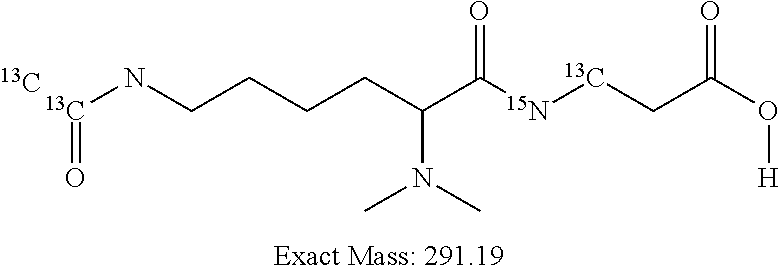 |
 |
 |
 |
 |
 |
 |
 |
 |
 |
 |
 |
 |
 |
 |
 |
 |
 |
 |
 |
 |
 |
 |
 |
 |
 |
 |
 |
 |
 |
 |
 |
 |
| TABLE 2 |
| Set of mass spectroscopy tags |
 |
1 |
 |
2 |
 |
3 |
 |
4 |
 |
5 |
 |
6 |
 |
7 |
 |
8 |
 |
9 |
 |
10 |
 |
11 |
 |
12 |
 |
13 |
 |
14 |
 |
15 |
 |
16 |
 |
17 |
 |
18 |
 |
19 |
 |
20 |
 |
21 |
 |
22 |
 |
23 |
 |
24 |
 |
25 |
 |
26 |
 |
27 |
| TABLE 3 |
| Set of mass spectroscopy tags |
| Tag | Primary | Secondary | Tertiary |
 |
 |
 |
 |
 |
 |
 |
 |
 |
 |
 |
 |
 |
 |
 |
 |
 |
 |
 |
 |
 |
 |
 |
 |
 |
 |
 |
 |
 |
 |
 |
 |
 |
 |
 |
 |
 |
 |
 |
 |
| TABLE 4 |
| Set of mass spectroscopy tags |
| Tag | Primary | Secondary | Tertiary |
 |
 |
 |
 |
 |
 |
 |
 |
 |
 |
 |
 |
 |
 |
 |
 |
 |
 |
 |
 |
 |
 |
 |
 |
 |
 |
 |
 |
 |
 |
 |
 |
 |
 |
 |
 |
 |
 |
 |
 |
 |
 |
 |
 |
 |
 |
 |
 |
 |
 |
 |
 |
 |
 |
 |
 |
 |
 |
 |
 |
 |
 |
 |
 |
 |
 |
 |
 |
 |
 |
 |
 |
 |
 |
 |
 |
 |
 |
 |
 |
 |
 |
 |
 |
 |
 |
 |
 |
 |
 |
 |
 |
 |
 |
 |
 |
 |
 |
 |
 |
 |
 |
 |
 |
 |
 |
 |
 |
 |
 |
 |
 |
 |
 |
 |
 |
 |
 |
 |
 |
Z=(N+1)(C+1)*2−1
Z=(N+1)(C+1)
min{circumflex over (r)}Diff(c,ĉ({circumflex over (r)}))=min{circumflex over (r)}Σi(ĉ i({circumflex over (r)})−c i)2 with Σi ĉ i=1 and Σi c i=1


Claims (7)


Priority Applications (1)
| Application Number | Priority Date | Filing Date | Title |
|---|---|---|---|
| US16/692,762 US11105810B2 (en) | 2015-06-03 | 2019-11-22 | Reagents for quantitative mass spectrometry |
Applications Claiming Priority (4)
| Application Number | Priority Date | Filing Date | Title |
|---|---|---|---|
| US201562170657P | 2015-06-03 | 2015-06-03 | |
| PCT/US2016/035819 WO2016196994A1 (en) | 2015-06-03 | 2016-06-03 | Reagents for quantitative mass spectrometry |
| US201815578382A | 2018-06-20 | 2018-06-20 | |
| US16/692,762 US11105810B2 (en) | 2015-06-03 | 2019-11-22 | Reagents for quantitative mass spectrometry |
Related Parent Applications (2)
| Application Number | Title | Priority Date | Filing Date |
|---|---|---|---|
| PCT/US2016/035819 Continuation WO2016196994A1 (en) | 2015-06-03 | 2016-06-03 | Reagents for quantitative mass spectrometry |
| US15/578,382 Continuation US11169155B2 (en) | 2015-06-03 | 2016-06-03 | Reagents for quantitative mass spectrometry |
Publications (2)
| Publication Number | Publication Date |
|---|---|
| US20200174007A1 US20200174007A1 (en) | 2020-06-04 |
| US11105810B2 true US11105810B2 (en) | 2021-08-31 |
Family
ID=57442034
Family Applications (4)
| Application Number | Title | Priority Date | Filing Date |
|---|---|---|---|
| US15/578,382 Active 2037-02-16 US11169155B2 (en) | 2015-06-03 | 2016-06-03 | Reagents for quantitative mass spectrometry |
| US16/692,762 Active US11105810B2 (en) | 2015-06-03 | 2019-11-22 | Reagents for quantitative mass spectrometry |
| US17/387,888 Active 2036-11-18 US11982674B2 (en) | 2015-06-03 | 2021-07-28 | Reagents for quantitative mass spectrometry |
| US18/626,881 Active US12153051B2 (en) | 2015-06-03 | 2024-04-04 | Reagents for quantitative mass spectrometry |
Family Applications Before (1)
| Application Number | Title | Priority Date | Filing Date |
|---|---|---|---|
| US15/578,382 Active 2037-02-16 US11169155B2 (en) | 2015-06-03 | 2016-06-03 | Reagents for quantitative mass spectrometry |
Family Applications After (2)
| Application Number | Title | Priority Date | Filing Date |
|---|---|---|---|
| US17/387,888 Active 2036-11-18 US11982674B2 (en) | 2015-06-03 | 2021-07-28 | Reagents for quantitative mass spectrometry |
| US18/626,881 Active US12153051B2 (en) | 2015-06-03 | 2024-04-04 | Reagents for quantitative mass spectrometry |
Country Status (3)
| Country | Link |
|---|---|
| US (4) | US11169155B2 (en) |
| EP (1) | EP3304058B1 (en) |
| WO (1) | WO2016196994A1 (en) |
Cited By (1)
| Publication number | Priority date | Publication date | Assignee | Title |
|---|---|---|---|---|
| US11982674B2 (en) | 2015-06-03 | 2024-05-14 | President And Fellows Of Harvard College | Reagents for quantitative mass spectrometry |
Families Citing this family (7)
| Publication number | Priority date | Publication date | Assignee | Title |
|---|---|---|---|---|
| WO2018042454A2 (en) * | 2016-09-01 | 2018-03-08 | Translational Health Science And Technology Institute (Thsti) | Method of hyperplexing in mass spectrometry to elucidate temporal dynamics of proteome |
| US10895578B2 (en) | 2017-12-15 | 2021-01-19 | Thermo Finnigan Llc | Deconvolving isobaric reporter ion ratios |
| SG11202008266SA (en) | 2018-03-02 | 2020-09-29 | Quantumcyte Inc | Methods, compositions, and devices for isolation and expression analysis of regions of interest from a tissue |
| EP3806888B1 (en) | 2018-06-12 | 2024-01-31 | Obsidian Therapeutics, Inc. | Pde5 derived regulatory constructs and methods of use in immunotherapy |
| CN109187940A (en) * | 2018-07-27 | 2019-01-11 | 南京谱利健生物技术有限公司 | The preparation and application of a kind of isotopic tag reagent for Analysis of polysaccharides |
| EP3870600A1 (en) | 2018-10-24 | 2021-09-01 | Obsidian Therapeutics, Inc. | Er tunable protein regulation |
| US20250336658A1 (en) * | 2022-06-30 | 2025-10-30 | Shimadzu Corporation | Mass spectrometry method and mass spectrometer |
Citations (8)
| Publication number | Priority date | Publication date | Assignee | Title |
|---|---|---|---|---|
| WO2007012849A2 (en) | 2005-07-26 | 2007-02-01 | Electrophoretics Limited | MASS LABELS FOR BIOMOLECULES CONTAINING A 2,6-DIMETHYL-PIPERIDIN-l-YL METHYLENE OR A PYRIMIDIN-2-YL THIOMETHYLENE MASS MARKER MOIETY AND A SUCCINIMID-OXY-CARBONYL REACTIVE FUNCTIONAL GROUP |
| EP2108957A1 (en) | 2008-04-07 | 2009-10-14 | Koninklijke Philips Electronics N.V. | Compounds and methods for the labelling and affinity-selection of proteins |
| US20100167267A1 (en) | 2007-03-12 | 2010-07-01 | Electrophoretics Limited | Mass Spectrometric Quantitation |
| WO2010104981A2 (en) | 2009-03-10 | 2010-09-16 | University Of Maryland Biotechnology Institute | Deuterium isobaric tag reagents for quantitative analysis |
| US20110207228A1 (en) | 2010-01-15 | 2011-08-25 | Sohn Chang Ho | Isobaric tags for analyte detection and quantification |
| WO2014066284A1 (en) | 2012-10-22 | 2014-05-01 | President And Fellows Of Harvard College | Accurate and interference-free multiplexed quantitative proteomics using mass spectrometry |
| US20140364337A1 (en) | 2013-06-07 | 2014-12-11 | Pierce Biotechnology, Inc. | Absolute quantitation of proteins and protein modifications by mass spectrometry with multiplexed internal standards |
| US20180209985A1 (en) | 2015-06-03 | 2018-07-26 | President And Fellows Of Harvard College | Reagents for quantitative mass spectrometry |
-
2016
- 2016-06-03 EP EP16804562.3A patent/EP3304058B1/en active Active
- 2016-06-03 US US15/578,382 patent/US11169155B2/en active Active
- 2016-06-03 WO PCT/US2016/035819 patent/WO2016196994A1/en not_active Ceased
-
2019
- 2019-11-22 US US16/692,762 patent/US11105810B2/en active Active
-
2021
- 2021-07-28 US US17/387,888 patent/US11982674B2/en active Active
-
2024
- 2024-04-04 US US18/626,881 patent/US12153051B2/en active Active
Patent Citations (8)
| Publication number | Priority date | Publication date | Assignee | Title |
|---|---|---|---|---|
| WO2007012849A2 (en) | 2005-07-26 | 2007-02-01 | Electrophoretics Limited | MASS LABELS FOR BIOMOLECULES CONTAINING A 2,6-DIMETHYL-PIPERIDIN-l-YL METHYLENE OR A PYRIMIDIN-2-YL THIOMETHYLENE MASS MARKER MOIETY AND A SUCCINIMID-OXY-CARBONYL REACTIVE FUNCTIONAL GROUP |
| US20100167267A1 (en) | 2007-03-12 | 2010-07-01 | Electrophoretics Limited | Mass Spectrometric Quantitation |
| EP2108957A1 (en) | 2008-04-07 | 2009-10-14 | Koninklijke Philips Electronics N.V. | Compounds and methods for the labelling and affinity-selection of proteins |
| WO2010104981A2 (en) | 2009-03-10 | 2010-09-16 | University Of Maryland Biotechnology Institute | Deuterium isobaric tag reagents for quantitative analysis |
| US20110207228A1 (en) | 2010-01-15 | 2011-08-25 | Sohn Chang Ho | Isobaric tags for analyte detection and quantification |
| WO2014066284A1 (en) | 2012-10-22 | 2014-05-01 | President And Fellows Of Harvard College | Accurate and interference-free multiplexed quantitative proteomics using mass spectrometry |
| US20140364337A1 (en) | 2013-06-07 | 2014-12-11 | Pierce Biotechnology, Inc. | Absolute quantitation of proteins and protein modifications by mass spectrometry with multiplexed internal standards |
| US20180209985A1 (en) | 2015-06-03 | 2018-07-26 | President And Fellows Of Harvard College | Reagents for quantitative mass spectrometry |
Non-Patent Citations (19)
| Title |
|---|
| Braun et al., Generation of multiple reporter ions from a single isobaric reagent increases multiplexing capacity for quantitative proteomics. Anal Chem. Oct. 6, 2015;87(19):9855-63. |
| EP 16804562.3, Jan. 16, 2019, Extended European Search Report. |
| EP 16804562.3, Mar. 30, 2020, European Offic Action. |
| European Office Action dated Mar. 30, 2020 for Application No. EP 16804562.3. |
| Extended European Search Report for Application No. 16804562.3 dated Jan. 16, 2019. |
| Gung, Mass Spectrometry: Fragmentation. University of Maimi. Presentation Created Jan. 30, 2017. http://chemistry.miamioh.edu/gung/CHM526/pdfs/Mass-fragmentation.pdf. |
| Herbert et al., Amine-reactive neutron-encoded labels for highly plexed proteomic quantitation. Mol Cell Proteomics. 2013;12(11):3360-3369. |
| Herzog, Isotope. Britannica Online Encyclopedia. Accessed Dec. 10, 2019: 1-29. https://www.britannica.com/print/article/296583. |
| International Preliminary Report on Patentability dated Dec. 14, 2017 for Application No. PCT/US2016/035819. |
| International Search Report dated Sep. 1, 2016 for Application No. PCT/US2016/035819. |
| McAlister et al., Increasing the multiplexing capacity of TMTs using reporter ion isotopologues with isobaric masses. Anal Chem. Sep. 4, 2012;84(17):7469-78. doi: 10.1021/ac301572t. |
| McAlister et al., MultiNotch MS3 enables accurate, sensitive, and multiplexed detection of differential expression across cancer cell line proteomes. Anal Chem. Jul. 15, 2014;86(14):7150-8. doi: 10.1021/ac502040v. |
| Office Action dated Dec. 31, 2019 for U.S. Appl. No. 15/578,382. |
| Office Action dated Jun. 24, 2020 for U.S. Appl. No. 15/578,382. |
| PCT/US2016/035819, Dec. 14, 2017, International Preliminary Report on Patentability. |
| PCT/US2016/035819, Sep. 1, 2016, International Search Report. |
| Ross et al., Multiplexed protein quantitation in Saccharomyces cerevisiae using amine-reactive isobaric tagging reagents. Molecular & Cellular Proteomics. Sep. 22, 2004;3(12):1154-1169. |
| U.S. Appl. No. 15/578,382, filed Nov. 30, 2017, Braun et al. |
| Wühr et al., Accurate multiplexed proteomics at the MS2 level using the complement reporter ion cluster. Analytical Chemistry. Oct. 25, 2012;84(21):9214-9221. |
Cited By (2)
| Publication number | Priority date | Publication date | Assignee | Title |
|---|---|---|---|---|
| US11982674B2 (en) | 2015-06-03 | 2024-05-14 | President And Fellows Of Harvard College | Reagents for quantitative mass spectrometry |
| US12153051B2 (en) | 2015-06-03 | 2024-11-26 | President And Fellows Of Harvard College | Reagents for quantitative mass spectrometry |
Also Published As
| Publication number | Publication date |
|---|---|
| EP3304058A4 (en) | 2019-02-13 |
| US20240272167A1 (en) | 2024-08-15 |
| US20220018847A1 (en) | 2022-01-20 |
| US20200174007A1 (en) | 2020-06-04 |
| US20180209985A1 (en) | 2018-07-26 |
| WO2016196994A9 (en) | 2017-03-02 |
| WO2016196994A1 (en) | 2016-12-08 |
| EP3304058B1 (en) | 2023-08-02 |
| US20230132372A9 (en) | 2023-04-27 |
| EP3304058A1 (en) | 2018-04-11 |
| EP3304058C0 (en) | 2023-08-02 |
| US11169155B2 (en) | 2021-11-09 |
| HK1253726A1 (en) | 2019-06-28 |
| US11982674B2 (en) | 2024-05-14 |
| US12153051B2 (en) | 2024-11-26 |
Similar Documents
| Publication | Publication Date | Title |
|---|---|---|
| US12153051B2 (en) | Reagents for quantitative mass spectrometry | |
| US20160139140A1 (en) | Mass labels | |
| EP2467350B1 (en) | Mass labels | |
| Kang et al. | Synthesis of biotin‐tagged chemical cross‐linkers and their applications for mass spectrometry | |
| JP5054694B2 (en) | Mass label | |
| US8309359B2 (en) | Isobaric tags for analyte detection and quantification | |
| EP3692372B1 (en) | Sulfoxide-based reagent for mass spectrometry | |
| CA3007430C (en) | Isobaric mass labels | |
| EP3155436B1 (en) | Isobaric mass labels | |
| HK1253726B (en) | Reagents for quantitative mass spectrometry | |
| Greer et al. | Isotopic N, N-dimethyl leucine (iDiLeu) for absolute quantification of peptides using a standard curve approach | |
| CN108463723B (en) | Isobaric and ectopic mass marker | |
| US20250369981A1 (en) | Phenylglyoxal-Based Alkyne (PGA) Chemical Tag for Protein Citrullination Analysis | |
| US20060234314A1 (en) | Selective binding and analysis of macromolecules | |
| WO2024214049A1 (en) | Mass spectrometric analysis |
Legal Events
| Date | Code | Title | Description |
|---|---|---|---|
| FEPP | Fee payment procedure |
Free format text: ENTITY STATUS SET TO UNDISCOUNTED (ORIGINAL EVENT CODE: BIG.); ENTITY STATUS OF PATENT OWNER: SMALL ENTITY |
|
| FEPP | Fee payment procedure |
Free format text: ENTITY STATUS SET TO SMALL (ORIGINAL EVENT CODE: SMAL); ENTITY STATUS OF PATENT OWNER: SMALL ENTITY |
|
| AS | Assignment |
Owner name: PRESIDENT AND FELLOWS OF HARVARD COLLEGE, MASSACHUSETTS Free format text: ASSIGNMENT OF ASSIGNORS INTEREST;ASSIGNORS:BRAUN, CRAIG R.;ERICKSON, BRIAN KEITH;GYGI, STEVEN P.;AND OTHERS;SIGNING DATES FROM 20160914 TO 20170517;REEL/FRAME:052930/0300 |
|
| STPP | Information on status: patent application and granting procedure in general |
Free format text: NON FINAL ACTION MAILED |
|
| STPP | Information on status: patent application and granting procedure in general |
Free format text: RESPONSE TO NON-FINAL OFFICE ACTION ENTERED AND FORWARDED TO EXAMINER |
|
| STPP | Information on status: patent application and granting procedure in general |
Free format text: FINAL REJECTION MAILED |
|
| STPP | Information on status: patent application and granting procedure in general |
Free format text: RESPONSE AFTER FINAL ACTION FORWARDED TO EXAMINER |
|
| STPP | Information on status: patent application and granting procedure in general |
Free format text: NOTICE OF ALLOWANCE MAILED -- APPLICATION RECEIVED IN OFFICE OF PUBLICATIONS |
|
| AS | Assignment |
Owner name: DANA-FARBER CANCER INSTITUTE, INC., MASSACHUSETTS Free format text: ASSIGNMENT OF ASSIGNORS INTEREST;ASSIGNORS:BIRD, GREG;WALENSKY, LOREN;REEL/FRAME:056202/0991 Effective date: 20160930 |
|
| STCF | Information on status: patent grant |
Free format text: PATENTED CASE |
|
| MAFP | Maintenance fee payment |
Free format text: PAYMENT OF MAINTENANCE FEE, 4TH YR, SMALL ENTITY (ORIGINAL EVENT CODE: M2551); ENTITY STATUS OF PATENT OWNER: SMALL ENTITY Year of fee payment: 4 |