US11104759B2 - Polyol for crosslinkable polyurethane resin composition, and crosslinkable polyurethane resin - Google Patents

Polyol for crosslinkable polyurethane resin composition, and crosslinkable polyurethane resin Download PDF

Info

Publication number
US11104759B2
US11104759B2 US16/439,864 US201916439864A US11104759B2 US 11104759 B2 US11104759 B2 US 11104759B2 US 201916439864 A US201916439864 A US 201916439864A US 11104759 B2 US11104759 B2 US 11104759B2
Authority
US
United States
Prior art keywords
polyol
polyurethane resin
crosslinkable polyurethane
storage modulus
resin composition
Prior art date
Legal status (The legal status is an assumption and is not a legal conclusion. Google has not performed a legal analysis and makes no representation as to the accuracy of the status listed.)
Active, expires
Application number
US16/439,864
Other versions
US20190382523A1 (en
Inventor
Akihiro Matsumoto
Yuo MARUYAMA
Current Assignee (The listed assignees may be inaccurate. Google has not performed a legal analysis and makes no representation or warranty as to the accuracy of the list.)
Hodogaya Chemical Co Ltd
Original Assignee
Hodogaya Chemical Co Ltd
Priority date (The priority date is an assumption and is not a legal conclusion. Google has not performed a legal analysis and makes no representation as to the accuracy of the date listed.)
Filing date
Publication date
Priority claimed from JP2019108531A external-priority patent/JP7271325B2/en
Application filed by Hodogaya Chemical Co Ltd filed Critical Hodogaya Chemical Co Ltd
Assigned to HODOGAYA CHEMICAL CO., LTD. reassignment HODOGAYA CHEMICAL CO., LTD. ASSIGNMENT OF ASSIGNORS INTEREST (SEE DOCUMENT FOR DETAILS). Assignors: MATSUMOTO, AKIHIRO, MARUYAMA, YUO
Publication of US20190382523A1 publication Critical patent/US20190382523A1/en
Application granted granted Critical
Publication of US11104759B2 publication Critical patent/US11104759B2/en
Active legal-status Critical Current
Adjusted expiration legal-status Critical

Links

Images

Classifications

    • CCHEMISTRY; METALLURGY
    • C08ORGANIC MACROMOLECULAR COMPOUNDS; THEIR PREPARATION OR CHEMICAL WORKING-UP; COMPOSITIONS BASED THEREON
    • C08GMACROMOLECULAR COMPOUNDS OBTAINED OTHERWISE THAN BY REACTIONS ONLY INVOLVING UNSATURATED CARBON-TO-CARBON BONDS
    • C08G18/00Polymeric products of isocyanates or isothiocyanates
    • C08G18/06Polymeric products of isocyanates or isothiocyanates with compounds having active hydrogen
    • C08G18/70Polymeric products of isocyanates or isothiocyanates with compounds having active hydrogen characterised by the isocyanates or isothiocyanates used
    • C08G18/72Polyisocyanates or polyisothiocyanates
    • C08G18/74Polyisocyanates or polyisothiocyanates cyclic
    • C08G18/76Polyisocyanates or polyisothiocyanates cyclic aromatic
    • C08G18/7657Polyisocyanates or polyisothiocyanates cyclic aromatic containing two or more aromatic rings
    • C08G18/7664Polyisocyanates or polyisothiocyanates cyclic aromatic containing two or more aromatic rings containing alkylene polyphenyl groups
    • C08G18/7671Polyisocyanates or polyisothiocyanates cyclic aromatic containing two or more aromatic rings containing alkylene polyphenyl groups containing only one alkylene bisphenyl group
    • CCHEMISTRY; METALLURGY
    • C08ORGANIC MACROMOLECULAR COMPOUNDS; THEIR PREPARATION OR CHEMICAL WORKING-UP; COMPOSITIONS BASED THEREON
    • C08GMACROMOLECULAR COMPOUNDS OBTAINED OTHERWISE THAN BY REACTIONS ONLY INVOLVING UNSATURATED CARBON-TO-CARBON BONDS
    • C08G18/00Polymeric products of isocyanates or isothiocyanates
    • C08G18/06Polymeric products of isocyanates or isothiocyanates with compounds having active hydrogen
    • C08G18/08Processes
    • C08G18/10Prepolymer processes involving reaction of isocyanates or isothiocyanates with compounds having active hydrogen in a first reaction step
    • C08G18/12Prepolymer processes involving reaction of isocyanates or isothiocyanates with compounds having active hydrogen in a first reaction step using two or more compounds having active hydrogen in the first polymerisation step
    • CCHEMISTRY; METALLURGY
    • C08ORGANIC MACROMOLECULAR COMPOUNDS; THEIR PREPARATION OR CHEMICAL WORKING-UP; COMPOSITIONS BASED THEREON
    • C08GMACROMOLECULAR COMPOUNDS OBTAINED OTHERWISE THAN BY REACTIONS ONLY INVOLVING UNSATURATED CARBON-TO-CARBON BONDS
    • C08G18/00Polymeric products of isocyanates or isothiocyanates
    • C08G18/06Polymeric products of isocyanates or isothiocyanates with compounds having active hydrogen
    • C08G18/28Polymeric products of isocyanates or isothiocyanates with compounds having active hydrogen characterised by the compounds used containing active hydrogen
    • C08G18/30Low-molecular-weight compounds
    • C08G18/32Polyhydroxy compounds; Polyamines; Hydroxyamines
    • C08G18/3203Polyhydroxy compounds
    • C08G18/3206Polyhydroxy compounds aliphatic
    • CCHEMISTRY; METALLURGY
    • C08ORGANIC MACROMOLECULAR COMPOUNDS; THEIR PREPARATION OR CHEMICAL WORKING-UP; COMPOSITIONS BASED THEREON
    • C08GMACROMOLECULAR COMPOUNDS OBTAINED OTHERWISE THAN BY REACTIONS ONLY INVOLVING UNSATURATED CARBON-TO-CARBON BONDS
    • C08G18/00Polymeric products of isocyanates or isothiocyanates
    • C08G18/06Polymeric products of isocyanates or isothiocyanates with compounds having active hydrogen
    • C08G18/28Polymeric products of isocyanates or isothiocyanates with compounds having active hydrogen characterised by the compounds used containing active hydrogen
    • C08G18/40High-molecular-weight compounds
    • C08G18/48Polyethers
    • C08G18/4804Two or more polyethers of different physical or chemical nature
    • C08G18/4812Mixtures of polyetherdiols with polyetherpolyols having at least three hydroxy groups
    • CCHEMISTRY; METALLURGY
    • C08ORGANIC MACROMOLECULAR COMPOUNDS; THEIR PREPARATION OR CHEMICAL WORKING-UP; COMPOSITIONS BASED THEREON
    • C08GMACROMOLECULAR COMPOUNDS OBTAINED OTHERWISE THAN BY REACTIONS ONLY INVOLVING UNSATURATED CARBON-TO-CARBON BONDS
    • C08G18/00Polymeric products of isocyanates or isothiocyanates
    • C08G18/06Polymeric products of isocyanates or isothiocyanates with compounds having active hydrogen
    • C08G18/28Polymeric products of isocyanates or isothiocyanates with compounds having active hydrogen characterised by the compounds used containing active hydrogen
    • C08G18/40High-molecular-weight compounds
    • C08G18/48Polyethers
    • C08G18/4854Polyethers containing oxyalkylene groups having four carbon atoms in the alkylene group
    • CCHEMISTRY; METALLURGY
    • C08ORGANIC MACROMOLECULAR COMPOUNDS; THEIR PREPARATION OR CHEMICAL WORKING-UP; COMPOSITIONS BASED THEREON
    • C08GMACROMOLECULAR COMPOUNDS OBTAINED OTHERWISE THAN BY REACTIONS ONLY INVOLVING UNSATURATED CARBON-TO-CARBON BONDS
    • C08G18/00Polymeric products of isocyanates or isothiocyanates
    • C08G18/06Polymeric products of isocyanates or isothiocyanates with compounds having active hydrogen
    • C08G18/28Polymeric products of isocyanates or isothiocyanates with compounds having active hydrogen characterised by the compounds used containing active hydrogen
    • C08G18/40High-molecular-weight compounds
    • C08G18/48Polyethers
    • C08G18/4887Polyethers containing carboxylic ester groups derived from carboxylic acids other than acids of higher fatty oils or other than resin acids
    • CCHEMISTRY; METALLURGY
    • C08ORGANIC MACROMOLECULAR COMPOUNDS; THEIR PREPARATION OR CHEMICAL WORKING-UP; COMPOSITIONS BASED THEREON
    • C08GMACROMOLECULAR COMPOUNDS OBTAINED OTHERWISE THAN BY REACTIONS ONLY INVOLVING UNSATURATED CARBON-TO-CARBON BONDS
    • C08G18/00Polymeric products of isocyanates or isothiocyanates
    • C08G18/06Polymeric products of isocyanates or isothiocyanates with compounds having active hydrogen
    • C08G18/28Polymeric products of isocyanates or isothiocyanates with compounds having active hydrogen characterised by the compounds used containing active hydrogen
    • C08G18/65Low-molecular-weight compounds having active hydrogen with high-molecular-weight compounds having active hydrogen
    • C08G18/66Compounds of groups C08G18/42, C08G18/48, or C08G18/52
    • C08G18/6666Compounds of group C08G18/48 or C08G18/52
    • C08G18/667Compounds of group C08G18/48 or C08G18/52 with compounds of group C08G18/32 or polyamines of C08G18/38
    • C08G18/6674Compounds of group C08G18/48 or C08G18/52 with compounds of group C08G18/32 or polyamines of C08G18/38 with compounds of group C08G18/3203
    • CCHEMISTRY; METALLURGY
    • C08ORGANIC MACROMOLECULAR COMPOUNDS; THEIR PREPARATION OR CHEMICAL WORKING-UP; COMPOSITIONS BASED THEREON
    • C08GMACROMOLECULAR COMPOUNDS OBTAINED OTHERWISE THAN BY REACTIONS ONLY INVOLVING UNSATURATED CARBON-TO-CARBON BONDS
    • C08G63/00Macromolecular compounds obtained by reactions forming a carboxylic ester link in the main chain of the macromolecule
    • C08G63/66Polyesters containing oxygen in the form of ether groups
    • C08G63/668Polyesters containing oxygen in the form of ether groups derived from polycarboxylic acids and polyhydroxy compounds
    • C08G63/672Dicarboxylic acids and dihydroxy compounds

Definitions

  • the present invention relates to a polyol for a crosslinkable polyurethane resin composition, and further relates to a high functional crosslinkable polyurethane resin having improved various physical properties such as heat resistance.
  • Polyether polyols containing tetrahydrofuran unit have excellent elastic properties, low-temperature properties, hydrolysis resistance and the like, and are extremely useful material on chemical industries in polyurethane elastic fibers, polyurethane elastic bodies, polyether polyester elastic bodies, elastic paints containing polyurethane, and the like.
  • Rubber elasticity of a polyurethane resin is developed because hard segments having toughness are insolubilized from a matrix of soft segments having flexibility to form a domain.
  • a polyurethane resin is generally a material having poor heat resistance and has a problem that rubber elasticity generally disappears by the melting of hard segments at 100 to 140° C. to cause liquefaction.
  • the method of increasing the proportion of hard segments and the method of introducing many urea bonds into hard segments involve the increase of viscosity of the polyurethane resin, which is not preferred.
  • the method of synthesizing hybrid material with inorganic glass increases performances such as heat resistance by filler effect, but on the other hand, glass particles are dispersed in the whole polyurethane resin and thus, flexibility of soft segments, which is inherent in a polyurethane resin, may be lost to be brittle.
  • the method of adding an oxazole compound or the like as a heat stabilizer may cause deterioration of stability of heat-aging resistance and mechanical strength. Thus, those methods require further improvement in the present circumstances.
  • Patent Literature 1 JP-B H07-47690
  • Patent Literature 2 JP-T 2006-528260
  • Patent Literature 3 JP-T 2008-527127
  • Patent Literature 4 JP-T 2008-527129
  • Patent Literature 5 JP-A 2010-270318
  • Patent Literature 6 JP-A S62-22817
  • Patent Literature 7 JP-A H06-136321
  • the present invention has made in view of the above problems.
  • the present invention relates to a polyol for a crosslinkable polyurethane resin composition, and further relates to a high functional crosslinkable polyurethane resin having improved various physical properties such as heat resistance.
  • the present invention provides the following polyol for a crosslinkable polyurethane resin composition and a crosslinkable polyurethane resin using the same.
  • a polyol for a crosslinkable polyurethane resin composition containing a high molecular polyol represented by the following formula (1) or (2), in which the high molecular polyol is a condensate of a polyfunctional carboxylic acid (A) with a bifunctional polyether polyol (B), the high molecular polyol has a number average molecular weight (Mn) in a range of 1,000 to 10,000, and the polyol for a crosslinkable polyurethane resin composition has a content of the high molecular polyol of 0.1 wt % to 15 wt %.
  • R 1 to R 4 each independently represent an alkyl chain having a carbon atom number of 3 to 5, and m, n, l and o each independently are an integer of 3 to 30.
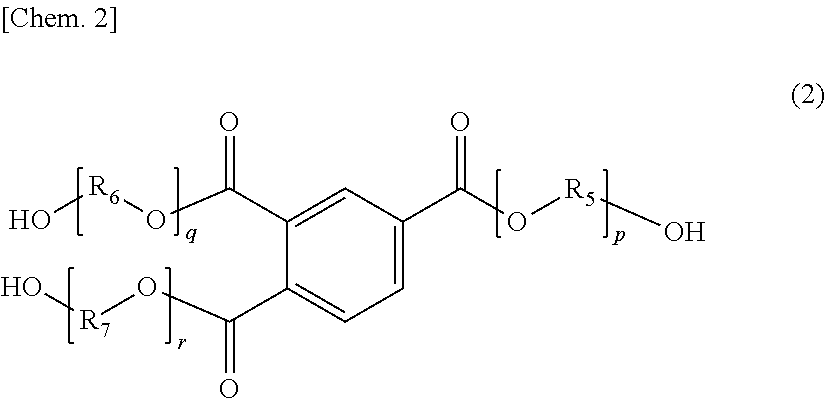
  • R 5 to R 7 each independently represent an alkyl chain having a carbon atom number of 3 to 5, and p, q and r each independently are an integer of 3 to 30.
  • polyol for a crosslinkable polyurethane resin composition described in [1], in which the polyfunctional carboxylic acid (A) is at least one selected from the group consisting of pyromellitic acid and trimellitic acid.
  • a crosslinkable polyurethane resin which is a reaction product of the polyol for a crosslinkable polyurethane resin composition, described in any one of [1] to [4] above, with an organic polyisocyanate component.
  • the crosslinkable polyurethane resin that is a product obtained by reacting the polyol for a crosslinkable polyurethane resin composition in the present invention with an organic polyisocyanate component has excellent heat resistance in high temperature region. Therefore, stability of heat-aging resistance and mechanical strength is improved. Furthermore, the crosslinkable polyurethane resin has satisfactory viscoelasticity in low temperature region. Therefore, flexibility of soft segments, which is inherent in a polyurethane resin, is not lost and various properties are improved, including not becoming brittle in low temperature region. According to the present invention, a polyol for the crosslinkable polyurethane resin composition having satisfactory strength, heat resistance and the like, and the crosslinkable polyurethane resin can be provided.
  • FIG. 1 is a graph showing temperature dependency of storage modulus (E′) of Examples 2 to 5 and Comparative Example 1.
  • FIG. 2 is a graph showing temperature dependency of storage modulus (E′) of Examples 7, 9, 10 and 12 and Comparative Example 1.
  • the polyol for a crosslinkable polyurethane resin composition includes a high molecular polyol represented by the following formula (1) or (2) that is a condensate of a polyfunctional carboxylic acid (A) and a bifunctional polyether polyol (B), and has a content of the high molecular polyol having a number average molecular weight (Mn) of 1,000 to 10,000 being 0.1% to 15 wt %.
  • Mn number average molecular weight
  • R 1 to R 4 each independently represent an alkyl chain having a carbon atom number of 3 to 5, and m, n, l and o each independently are an integer of 3 to 30.
  • m, n, l and o each independently are an integer of 3 to 30, and more preferably an integer of 3 to 10. In the case where m, n, l and o are smaller than 3, heat resistance is not sufficiently developed. In the case where m, n, l and o are larger than 30, the polyol has high viscosity, compatibility with an isocyanate component is deteriorated and as a result, satisfactory urethane properties are not obtained.
  • a plurality of R 1 may be the same as or different from each other. The same is applied to R 2 , R 3 and R 4 .
  • R 5 to R 7 each independently represent an alkyl chain having a carbon atom number of 3 to 5, and p, q and r each independently are an integer of 3 to 30.
  • p, q and r each independently is an integer of 3 to 30, and more preferably an integer of 3 to 10. In the case where p, q and r are smaller than 3, heat resistance is not sufficiently developed. In the case where p, q and r are larger than 30, the polyol has high viscosity, compatibility with an isocyanate component is deteriorated and as a result, satisfactory urethane properties are not obtained.
  • a plurality of R 5 may be the same as or different from each other. The same is applied to R 6 and R 7 .
  • aromatic polycarboxylic acid used to constitute the polyfunctional carboxylic acid (A) include aromatic polycarboxylic acids having a carbon number of 9 to 30, for example, tricarboxylic acids such as trimellitic acid, 1,2,3-benzenetricarboxylix acid, trimesic acid, hemilittic acid, 1,2,4-, 1,3,6- or 2,3,6-naphthalenetricarboxylic acid, and 2,3,6-anthrathenetricarboxylic acid; tetracarboxyclic acids such as pyromellitic acid, 3,3′,4,4′-benzophenone tetracarboxylic acid, 2,2′,3,3′-benzophenone tetracarboxylic acid, 2,3,3′,4′-benzophenone tetracarboxylic acid, 3,3′,4,4′-biphenyltetracarboxylic acid, 2,2′,3,3′-biphenyltetracarboxylic acid,
  • polyether polyol of the bifunctional polyether polyol (B) examples include polytetramethylene ether glycol (PTG) and polypropylene ethylene polyol (PPG). Those polyether polyols may be used in one kind alone and may be used in combination of two or more kinds.
  • a polyester polyol and/or a polycarbonate polyol can be used in place of or in combination with the bifunctional polyether polyol (B).
  • the polyester polyol include polyethylene adipate diol, polybutylene adipate diol, polyhexamethylene adipate diol, polyhexamethylene isophthalate diol, polyneopentylene adipate diol, polyethylene propylene adipate diol, polyethylene butylene adipate diol, polybutylene hexamethylene adipate diol, polydiethylene adipate diol, poly(polytetramethylene ether)adipate diol, poly(3-methylpentylene adipate)diol, polyethylene azelate diol, polyethylene sebacate diol, polybutylene azelate diol, polybutylene sebacate diol, and polyneopentylene tere
  • polycarbonate polyol examples include polycarbonate polyols produced by condensing a dihydric alcohol having a carbon number of 2 to 9 with a low molecular carbonate compound (e.g., a dialkyl carbonate having a carbon number of 1 to 6 in the alkyl moiety, an alkylene carbonate having an alkylene group with a carbon number of 2 to 6 and a diaryl carbonate having an aryl group with a carbon number of 6 to 9) while conducting dealcoholization reaction.
  • Dihydric alcohols having a carbon number of 2 to 9 and low molecular carbonate compounds may be used in combination of two or more kinds, respectively.
  • polycarbonate polyol examples include polyhexamethylene carbonate diol, polypentamethylene carbonate diol, polytetramethylene carbonate diol, and poly(tetramethylene/hexamethylene) carbonate diol (e.g., diol obtained by condensing 1,4-butanediol and 1,6-hexanediol with a dialkyl carbonate while conducting dealcoholization reaction).
  • Those polycarbonate polyols may be used in one kind alone and may be used in combination of two or more kinds.
  • the condensate of the polyfunctional carboxylic acid (A) and the bifunctional polyether polyol (B) can be produced by conventional methods.
  • a carboxylic acid may be subjected to an esterification reaction with an alcohol at 70° C. to 120° C., followed by a transesterification reaction with a polyether polyol, and alternatively, an anhydrous carboxylic acid may be subjected to an esterification reaction with a polyether polyol.
  • a conventional esterification catalyst is used in the esterification reaction in the present invention.
  • An acid catalyst is generally used as the catalyst.
  • Lewis acid examples include orthotitanic esters such as tetraisopropyl titanate and tetra-n-butyl titanate, tin compounds such as diethyltin oxide and dibutyltin oxide, and metal compounds such as zinc oxide.
  • Other than Lewis acid Bronsted acid such as p-toluenesulfonic acid may be used.
  • the condensate of the polyfunctional carboxylic acid (A) with the bifunctional polyether polyol (B) is a high molecular polyol represented by the formula (1) or (2).
  • the high molecular polyol represented by the formula (1) In the case of tetrafunctional carboxylic acid, it is the high molecular polyol represented by the formula (1), and in the case of trifunctional carboxylic acid, it is the high molecular polyol represented by the formula (2).
  • the condensate of the polyfunctional carboxylic acid (A) with the bifunctional polyether polyol (B) of the present invention has a number average molecular weight (Mn) preferably in a range of 1,000 to 10,000, more preferably 1,500 to 8,500 and still more preferably in a range of 2,000 to 4,000.
  • Mn number average molecular weight
  • the number average molecular weight (Mn) of the condensate is smaller than 1,000, heat resistance is not sufficiently developed.
  • the number average molecular weight (Mn) of the condensate is larger than 10,000, compatibility is deteriorated and satisfactory urethane properties cannot be obtained.
  • the condensate of the polyfunctional carboxylic acid (A) with the bifunctional polyether polyol (B) of the present invention may be used in a mixture with a conventional polyol (D) for a polyurethane resin.
  • the polyol (D) to be mixed with the condensate has a number average molecular weight (Mn) of preferably 250 to 5,000 and more preferably 250 to 700.
  • Mn number average molecular weight
  • compatibility is deteriorated and satisfactory urethane properties cannot be obtained.
  • the polyol (D) is desirably a polyether polyol and/or a polyester polyol.
  • polyether polyol examples include polytetramethylene ether glycol (PTG) and polypropylene ethylene polyol (PPG).
  • polyester polyol as the polyol (D) examples include polyethylene adipate diol, polybutylene adipate diol, polyhexamethylene adipate diol, polyhexamethylene isophthalte diol, polyneopentylene adipate diol, polyethylene propylene adipate diol, polyethylene butylene adipate diol, polybutylene hexamethylene adipate diol, polydiethylene adipate diol, poly(polytetramethylene ether)adipate diol, poly(3-methylpentylene adipate)diol, polyethylene azelate diol, polyethylene sebacate diol, polybutylene azelate diol, polybutylene sebacate diol, and polyneopentylene terephthalate diol.
  • Those polyols (D) may be used in one kind alone and may be used in combination
  • the condensate of the polyfunctional carboxylic acid (A) with the bifunctional polyether polyol (B) of the present invention is the high molecular polyol having a number average molecular weight (Mn) in a range of 1,000 to 10,000.
  • the condensate is mixed with, for example, the conventional polyol (D) for a polyurethane resin to provide a polyol for a crosslinkable polyurethane resin composition.
  • the content of the condensate in the polyol for a crosslinkable polyurethane resin composition is 0.1 wt % to 15 wt %, preferably 0.5 wt % to 10 wt % and more preferably 1 wt % to 5 wt %.
  • the polyol for a crosslinkable polyurethane resin composition of the present invention contains a high molecular polyol of the condensate, after reacting with an organic polyisocyanate component, a part of the resin forms a steric network structure through a crosslinking reaction and as a result, heat-aging resistance is improved.
  • the content of the high molecular polyol of the condensate in the polyol for a crosslinkable polyurethane resin composition of the present invention is less than 0.1 w %, satisfactory heat-aging resistance may not be obtained in some cases.
  • the content of the high molecular polyol of the condensate is larger than 15 wt %, compatibility may be deteriorated and satisfactory urethane properties may not be obtained in some cases.
  • the content of the polyol (D) in the crosslinkable polyurethane resin is preferably 62 wt % to 76.9 wt % and more preferably 72 wt % to 76 wt %.
  • the addition of the polyol (D) can make a polyurethane resin obtained after curing reaction to have sufficient hardness, and excellent flexibility and heat resistance.
  • a method for producing the crosslinkable polyurethane resin of the present invention is not particularly limited, and it can be produced by conventional methods.
  • a polyisocyanate component may be charged en bloc in a polyol, a chain extender and an organometallic catalyst, to conduct a reaction.
  • a polyol is reacted with a polyisocynate component to obtain an isocyanate group-ended prepolymer, and thereto is then added a chain extender, followed by conducting an elongation reaction.
  • polyisocyanate compound examples include aromatic, alicyclic or aliphatic polyisocyanates having two or more isocyanate groups.
  • polyisocyanates such as tolylene diisocyanate (TDI), diphenylmethane diisocyanate (MDI), polymethylene polyphenyl polyisocyanate (PMDI), xylene diisocyanate (XDI), isophorone diisocyanate (IPDI), and hexamethylene diisocyanate (HMDI).
  • TDI tolylene diisocyanate
  • MDI diphenylmethane diisocyanate
  • PMDI polymethylene polyphenyl polyisocyanate
  • XDI xylene diisocyanate
  • IPDI isophorone diisocyanate
  • HMDI hexamethylene diisocyanate
  • MDI is particularly preferred from the standpoints of easy availability and easy control of the reaction with a hydroxyl group.
  • chain extender examples include low molecular weight dihydric alcohols such as 1,3-propanediol, 1,4-butanediol and 1,5-pentanediol.
  • the organometallic catalyst is not particularly limited, and specific examples thereof include organotin catalysts such as dibutyltin oxide, dibutyltin diacetate, dibutyltin dilaurate, dibutyltin dichloride, and dioctyltin dilaurate; nickel octylate, nickel naphthenate, cobalt octylate, cobalt naphthenate, bismuth octylate, bismuth naphthenate, and the like. Of those, an organotin catalyst is preferred and dibutyltin dilaurate is more preferred.
  • the content thereof is generally in a range of 0.0001 to 5.0 parts by weight and more preferably in a range of 0.001 to 3.0 parts by weight, per 100.0 parts by weight of the polyol.
  • Number average molecular weight (Mn) of the polyol for a polyurethane resin in the present invention can be measured by using a gel permeation chromatography (hereinafter referred to as GPC) under, for example, the following conditions.
  • GPC gel permeation chromatography
  • Temperature dependency of storage modulus (E′) as an index of heat resistance, softening point (tan ⁇ ) and melting point of the polyurethane resin are measured by the following methods.
  • Storage modulus (E′) is measured by a dynamic viscoelasticity measurement (hereinafter referred to as DMA) under the following conditions.
  • Measurement temperature ⁇ 100° C. to 200° C.
  • the value of storage modulus (E′) is obtained by reading values at ⁇ 5° C., 0° C., 20° C., 120° C. and 140° C., and the softening point is calculated from tan ⁇ .
  • E′ t is E′(MPa) at ⁇ 5° C., 0° C., 120° C. and 140° C. at 10 Hz
  • E′ 20 is E′(MPa) at the ordinary temperature (20° C.) at 10 Hz.
  • the storage modulus (E′) in a temperature range of 0 to ⁇ 5° C. at 10 Hz preferably increases 10% to 150% with respect to the storage modulus (E′) at 20° C. at 10 Hz in the dynamic viscoelasticity measurement.
  • the storage modulus (E′) in a temperature range of 100° C. to 150° C. at 10 Hz preferably decreases 0% to 70% with respect to the storage modulus (E′) at 20° C. at 10 Hz in the dynamic viscoelasticity measurement.
  • Atmosphere Nitrogen gas (50 ml/min)
  • the reaction liquid was naturally cooled to 60° C., and in the reaction system was added an aqueous solution of 16 parts of potassium hydrogen carbonate and 75 parts of warm water, followed by washing and separation. Thereto was further added 18 parts of warm water, and washing and separation operations were conducted twice.
  • the washed liquid was cooled to 7° C., and crystals precipitated were collected by filtration and dried at 80° C. under reduced pressure for 5 hours, to thereby obtain a methyl ester of pyromellitic acid (PMA) (86.3 parts, yield: 93%).
  • PMA methyl ester of pyromellitic acid
  • the number average molecular weight (Mn) of the pyromellitic acid PTG650 (PMA/PTG650) polymer measured by the above-mentioned measurement method of the number average molecular weight (Mn) of a high molecular polyol was 2,827.
  • the resultant was poured on a glass plate and aged at 100° C. for 24 hours, to thereby prepare a sheet of a crosslinkable polyurethane resin.
  • Temperature dependency of storage modulus (E′), hardness and melting point were measured.
  • the temperature dependency of storage modulus (E′) is shown in FIG. 1 .
  • Measured values of hardness, melting point and storage modulus of the crosslinkable polyurethane resin are shown in Table 1. Variations (%) of E′ (MPa) at each temperature at 10 Hz with respect to E′ (MPa) at ordinary temperature (20° C.) at 10 Hz are shown in Table 3.
  • Example 2 Preparation was conducted in the same manner as in Example 2 except for adding 1 part of PMA/PTG650 polymer obtained in Example 1, and temperature dependency of storage modulus (E′), hardness and melting point were measured.
  • the temperature dependency of storage modulus (E′) is shown in FIG. 1 .
  • Measured values of hardness, melting point and storage modulus are shown in Table 1.
  • Variations (%) of E′ (MPa) at each temperature at 10 Hz with respect to E′ (MPa) at ordinary temperature (20° C.) at 10 Hz are shown in Table 3.
  • Example 2 Preparation was conducted in the same manner as in Example 2 except for adding 5 parts of PMA/PTG650 polymer obtained in Example 1, and temperature dependency of storage modulus (E′), hardness and melting point were measured.
  • the temperature dependency of storage modulus (E′) is shown in FIG. 1 .
  • Measured values of hardness, melting point and storage modulus are shown in Table 1.
  • Variations (%) of E′ (MPa) at each temperature at 10 Hz with respect to E′ (MPa) at ordinary temperature (20° C.) at 10 Hz are shown in Table 3.
  • Example 2 Preparation was conducted in the same manner as in Example 2 except for adding 10 parts of PMA/PTG650 polymer obtained in Example 1, and temperature dependency of storage modulus (E′), hardness and melting point were measured.
  • the temperature dependency of storage modulus (E′) is shown in FIG. 1 .
  • Measured values of hardness, melting point and storage modulus are shown in Table 1.
  • Variations (%) of E′ (MPa) at each temperature at 10 Hz with respect to E′ (MPa) at ordinary temperature (20° C.) at 10 Hz are shown in Table 3.
  • the number average molecular weight (Mn) of the pyromellitic acid PTG2000 (PMA/PTG2000) polymer measured by the above-mentioned measurement method of the number average molecular weight (Mn) of a high molecular polyol was 8,296.
  • the resultant was poured on a glass plate and aged at 100° C. for 24 hours, to thereby prepare a sheet of a crosslinkable polyurethane resin.
  • Temperature dependency of storage modulus (E′), hardness and melting point were measured.
  • the temperature dependency of storage modulus (E′) is shown in FIG. 2 .
  • Measured values of hardness, melting point and storage modulus of the crosslinkable polyurethane resin are shown in Table 1. Variations (%) of E′ (MPa) at each temperature at 10 Hz with respect to E′ (MPa) at ordinary temperature (20° C.) at 10 Hz are shown in Table 3.
  • the number average molecular weight (Mn) of the pyromellitic acid PTG250 (PMA/PTG250) polymer measured by the above-mentioned measurement method of the number average molecular weight (Mn) of a high molecular polyol was 1,218.
  • the resultant was poured on a glass plate and aged at 100° C. for 24 hours, to thereby prepare a sheet of a crosslinkable polyurethane resin.
  • Temperature dependency of storage modulus (E′), hardness and melting point were measured.
  • the temperature dependency of storage modulus (E′) is shown in FIG. 2 .
  • Measured values of hardness, melting point and storage modulus of the crosslinkable polyurethane resin are shown in Table 2.
  • Variations (%) of E′ (MPa) at each temperature at 10 Hz with respect to E′ (MPa) at ordinary temperature (20° C.) at 10 Hz are shown in Table 3.
  • a crosslinkable polyurethane resin was prepared in the same manner as in Example 9 except for adding 5 parts of PMA/PTG250 polymer obtained in Example 8, and temperature dependency of storage modulus (E′), hardness and melting point were measured.
  • the temperature dependency of storage modulus (E′) is shown in FIG. 2 .
  • Measured values of hardness, melting point and storage modulus are shown in Table 2.
  • Variations (%) of E′ (MPa) at each temperature at 10 Hz with respect to E′ (MPa) at ordinary temperature (20° C.) at 10 Hz are shown in Table 3.
  • the reaction liquid was naturally cooled to 60° C., and in the reaction system was added an aqueous solution of 16 parts of potassium hydrogen carbonate and 75 parts of warm water, followed by washing and separation. Thereto was further added 18 parts of warm water, and washing and separation operations were conducted twice.
  • the washed liquid was cooled to 7° C., and crystals precipitated were collected by filtration and dried at 80° C. under reduced pressure for 5 hours, to thereby obtain a methyl ester of trimellitic acid (92 parts, yield: 80%).
  • the number average molecular weight (Mn) of the trimellitic acid PTG650 (TMA/PTG650) polymer measured by the above-mentioned measurement method of the number average molecular weight (Mn) of a high molecular polyol was 2,774.
  • the resultant was poured on a glass plate and aged at 100° C. for 24 hours, to thereby prepare a sheet of a crosslinkable polyurethane resin.
  • Temperature dependency of storage modulus (E′), hardness and melting point were measured.
  • the temperature dependency of storage modulus (E′) is shown in FIG. 2 .
  • Measured values of hardness, melting point and storage modulus are shown in Table 2.
  • Variations (%) of E′ (MPa) at each temperature at 10 Hz with respect to E′ (MPa) at ordinary temperature (20° C.) at 10 Hz are shown in Table 3.
  • the crosslinkable polyurethane resins of the present invention maintain hardness and simultaneously have the tendency that melting point and softening point increase and variations of E′ (MPa) at 120° C. and 140° C. at 10 Hz are small. Furthermore, as compared with Comparative Example 1, the crosslinkable polyurethane resins of the present invention maintain hardness and simultaneously have the tendency that variations of E′ (MPa) at ⁇ 5° C. and 0° C. at 10 Hz are small.
  • the crosslinkable polyurethane resin obtained by reacting the polyol for a crosslinkable polyurethane resin of the present invention with an organic polyisocyanate component can maintain dynamic characteristics and is useful as a urethane resin having excellent low-temperature properties, elastic properties and heat resistance.
  • the polyurethane resin composition of the present invention When used, the polyurethane resin obtained has excellent low-temperature properties, elastic properties and thermal durability and therefore, can be used in the fields of electric appliances, electronic parts and the like.

Landscapes

  • Chemical & Material Sciences (AREA)
  • Health & Medical Sciences (AREA)
  • Chemical Kinetics & Catalysis (AREA)
  • Medicinal Chemistry (AREA)
  • Polymers & Plastics (AREA)
  • Organic Chemistry (AREA)
  • Polyurethanes Or Polyureas (AREA)

Abstract

The present invention relates to a polyol for a crosslinkable polyurethane resin composition, containing a high molecular polyol represented by the following formula (1) or (2), in which the high molecular polyol is a condensate of a polyfunctional carboxylic acid (A) with a bifunctional polyether polyol (B), the high molecular polyol has a number average molecular weight (Mn) in a range of 1,000 to 10,000, and the polyol for a crosslinkable polyurethane resin composition has a content of the high molecular polyol of 0.1 wt % to 15 wt %.
Figure US11104759-20210831-C00001

Description

TECHNICAL FIELD
The present invention relates to a polyol for a crosslinkable polyurethane resin composition, and further relates to a high functional crosslinkable polyurethane resin having improved various physical properties such as heat resistance.
BACKGROUND
Polyether polyols containing tetrahydrofuran unit have excellent elastic properties, low-temperature properties, hydrolysis resistance and the like, and are extremely useful material on chemical industries in polyurethane elastic fibers, polyurethane elastic bodies, polyether polyester elastic bodies, elastic paints containing polyurethane, and the like. Rubber elasticity of a polyurethane resin is developed because hard segments having toughness are insolubilized from a matrix of soft segments having flexibility to form a domain. However, a polyurethane resin is generally a material having poor heat resistance and has a problem that rubber elasticity generally disappears by the melting of hard segments at 100 to 140° C. to cause liquefaction.
For example, regarding an engine room of electric vehicles in recent years, environmental temperature in the engine room is increased with the increase of engine output, densification of parts, and the like, and heat-aging resistance as never before is being required.
As a method of improving heat-aging resistance to solve the above-mentioned problems, there have been known a method of increasing the proportion of hard segments, a method of introducing many urea bonds into hard segments, a method of synthesizing a hybrid body with inorganic glass, a method of adding copper halide, potassium halide, an oxazole compound or the like as a heat stabilizer, and the like. Those technologies are employed in parts that are used to be exposed to high temperature environment at about 150° C. in the fields of automobile parts and electric and electronic parts.
However, the method of increasing the proportion of hard segments and the method of introducing many urea bonds into hard segments involve the increase of viscosity of the polyurethane resin, which is not preferred. The method of synthesizing hybrid material with inorganic glass increases performances such as heat resistance by filler effect, but on the other hand, glass particles are dispersed in the whole polyurethane resin and thus, flexibility of soft segments, which is inherent in a polyurethane resin, may be lost to be brittle. The method of adding an oxazole compound or the like as a heat stabilizer may cause deterioration of stability of heat-aging resistance and mechanical strength. Thus, those methods require further improvement in the present circumstances.
Patent Literature 1: JP-B H07-47690
Patent Literature 2: JP-T 2006-528260
Patent Literature 3: JP-T 2008-527127
Patent Literature 4: JP-T 2008-527129
Patent Literature 5: JP-A 2010-270318
Patent Literature 6: JP-A S62-22817
Patent Literature 7: JP-A H06-136321
SUMMARY
The present invention has made in view of the above problems. The present invention relates to a polyol for a crosslinkable polyurethane resin composition, and further relates to a high functional crosslinkable polyurethane resin having improved various physical properties such as heat resistance.
As a result of intensive investigations to solve the above-described problems, the present inventors have reached the present invention. Specifically, the present invention provides the following polyol for a crosslinkable polyurethane resin composition and a crosslinkable polyurethane resin using the same.
[1] A polyol for a crosslinkable polyurethane resin composition, containing a high molecular polyol represented by the following formula (1) or (2), in which the high molecular polyol is a condensate of a polyfunctional carboxylic acid (A) with a bifunctional polyether polyol (B), the high molecular polyol has a number average molecular weight (Mn) in a range of 1,000 to 10,000, and the polyol for a crosslinkable polyurethane resin composition has a content of the high molecular polyol of 0.1 wt % to 15 wt %.
Figure US11104759-20210831-C00002
(In the formula, R1 to R4 each independently represent an alkyl chain having a carbon atom number of 3 to 5, and m, n, l and o each independently are an integer of 3 to 30.)
Figure US11104759-20210831-C00003
(In the formula, R5 to R7 each independently represent an alkyl chain having a carbon atom number of 3 to 5, and p, q and r each independently are an integer of 3 to 30.)
[2] The polyol for a crosslinkable polyurethane resin composition, described in [1], in which the polyfunctional carboxylic acid (A) is at least one selected from the group consisting of pyromellitic acid and trimellitic acid.
[3] The polyol for a crosslinkable polyurethane resin composition, described in [1], in which the bifunctional polyether polyol (B) has a carbon atom number of 3 to 5 in a repeating unit.
[4] The polyol for a crosslinkable polyurethane resin composition, described in [3], in which the bifunctional polyether polyol (B) is at least one selected from the group consisting of polytetramethylene ether glycol and polypropylene ethylene polyol.
[5] A crosslinkable polyurethane resin, which is a reaction product of the polyol for a crosslinkable polyurethane resin composition, described in any one of [1] to [4] above, with an organic polyisocyanate component.
[6] The crosslinkable polyurethane resin described in [5] above, having a storage modulus (E′) at 10 Hz in a temperature range of 100° C. to 150° C. decreasing 0% to 70% with respect to a storage modulus (E′) at 10 Hz at 20° C. in a dynamic viscoelasticity measurement.
[7] The crosslinkable polyurethane resin described in [5] above, having a storage modulus (E′) at 10 Hz in a temperature range of 0° C. to −5° C. increasing 10% to 150% with respect to a storage modulus (E′) at 10 Hz at 20° C. in a dynamic viscoelasticity measurement.
[8] The crosslinkable polyurethane resin described in [5] above, having a storage modulus (E′) at 10 Hz in a temperature range of 0° C. to −5° C. increasing 10% to 150% and a storage modulus (E′) at 10 Hz in a temperature range of 100° C. to 150° C. decreasing 0% to 70%, with respect to a storage modulus (E′) at 10 Hz at 20° C. in a dynamic viscoelasticity measurement.
The crosslinkable polyurethane resin that is a product obtained by reacting the polyol for a crosslinkable polyurethane resin composition in the present invention with an organic polyisocyanate component has excellent heat resistance in high temperature region. Therefore, stability of heat-aging resistance and mechanical strength is improved. Furthermore, the crosslinkable polyurethane resin has satisfactory viscoelasticity in low temperature region. Therefore, flexibility of soft segments, which is inherent in a polyurethane resin, is not lost and various properties are improved, including not becoming brittle in low temperature region. According to the present invention, a polyol for the crosslinkable polyurethane resin composition having satisfactory strength, heat resistance and the like, and the crosslinkable polyurethane resin can be provided.
BRIEF DESCRIPTION OF DRAWINGS
FIG. 1 is a graph showing temperature dependency of storage modulus (E′) of Examples 2 to 5 and Comparative Example 1.
FIG. 2 is a graph showing temperature dependency of storage modulus (E′) of Examples 7, 9, 10 and 12 and Comparative Example 1.
EMBODIMENTS
The present invention is described in more detail below by reference to preferred embodiments.
The polyol for a crosslinkable polyurethane resin composition, according to the present invention includes a high molecular polyol represented by the following formula (1) or (2) that is a condensate of a polyfunctional carboxylic acid (A) and a bifunctional polyether polyol (B), and has a content of the high molecular polyol having a number average molecular weight (Mn) of 1,000 to 10,000 being 0.1% to 15 wt %.
Figure US11104759-20210831-C00004
(In the formula, R1 to R4 each independently represent an alkyl chain having a carbon atom number of 3 to 5, and m, n, l and o each independently are an integer of 3 to 30.)
In the formula (1), m, n, l and o each independently are an integer of 3 to 30, and more preferably an integer of 3 to 10. In the case where m, n, l and o are smaller than 3, heat resistance is not sufficiently developed. In the case where m, n, l and o are larger than 30, the polyol has high viscosity, compatibility with an isocyanate component is deteriorated and as a result, satisfactory urethane properties are not obtained. Here, a plurality of R1 may be the same as or different from each other. The same is applied to R2, R3 and R4.
Figure US11104759-20210831-C00005
(In the formula, R5 to R7 each independently represent an alkyl chain having a carbon atom number of 3 to 5, and p, q and r each independently are an integer of 3 to 30.)
In the formula (2), p, q and r each independently is an integer of 3 to 30, and more preferably an integer of 3 to 10. In the case where p, q and r are smaller than 3, heat resistance is not sufficiently developed. In the case where p, q and r are larger than 30, the polyol has high viscosity, compatibility with an isocyanate component is deteriorated and as a result, satisfactory urethane properties are not obtained. Here, a plurality of R5 may be the same as or different from each other. The same is applied to R6 and R7.
Examples of aromatic polycarboxylic acid used to constitute the polyfunctional carboxylic acid (A) include aromatic polycarboxylic acids having a carbon number of 9 to 30, for example, tricarboxylic acids such as trimellitic acid, 1,2,3-benzenetricarboxylix acid, trimesic acid, hemilittic acid, 1,2,4-, 1,3,6- or 2,3,6-naphthalenetricarboxylic acid, and 2,3,6-anthrathenetricarboxylic acid; tetracarboxyclic acids such as pyromellitic acid, 3,3′,4,4′-benzophenone tetracarboxylic acid, 2,2′,3,3′-benzophenone tetracarboxylic acid, 2,3,3′,4′-benzophenone tetracarboxylic acid, 3,3′,4,4′-biphenyltetracarboxylic acid, 2,2′,3,3′-biphenyltetracarboxylic acid, 2,3,3′,4′-biphenyltetracarboxylic acid, 4,4′-oxybisphthalic acid, diphenylmethane tetracarboxylic acid, 1,4,5,8-naphthalene tetraccarboxylic acid, 1,2,5,6-naphthalene tetracarboxylic acid, 2,3,6,7-naphthalene tetracarboxylic acid, and 4,4′-(hexafluoroisopropylidene)bisphthalic acid; and the like. Those aromatic polycarboxylic acids may be used in one kind alone and may be used in combination of two or more kinds.
Examples of polyether polyol of the bifunctional polyether polyol (B) include polytetramethylene ether glycol (PTG) and polypropylene ethylene polyol (PPG). Those polyether polyols may be used in one kind alone and may be used in combination of two or more kinds.
A polyester polyol and/or a polycarbonate polyol can be used in place of or in combination with the bifunctional polyether polyol (B). Examples of the polyester polyol include polyethylene adipate diol, polybutylene adipate diol, polyhexamethylene adipate diol, polyhexamethylene isophthalate diol, polyneopentylene adipate diol, polyethylene propylene adipate diol, polyethylene butylene adipate diol, polybutylene hexamethylene adipate diol, polydiethylene adipate diol, poly(polytetramethylene ether)adipate diol, poly(3-methylpentylene adipate)diol, polyethylene azelate diol, polyethylene sebacate diol, polybutylene azelate diol, polybutylene sebacate diol, and polyneopentylene terephthalate diol. Those polyester polyols may be used in one kind alone and may be used in combination of two or more kinds.
Examples of the polycarbonate polyol include polycarbonate polyols produced by condensing a dihydric alcohol having a carbon number of 2 to 9 with a low molecular carbonate compound (e.g., a dialkyl carbonate having a carbon number of 1 to 6 in the alkyl moiety, an alkylene carbonate having an alkylene group with a carbon number of 2 to 6 and a diaryl carbonate having an aryl group with a carbon number of 6 to 9) while conducting dealcoholization reaction. Dihydric alcohols having a carbon number of 2 to 9 and low molecular carbonate compounds may be used in combination of two or more kinds, respectively.
Specific examples of the polycarbonate polyol include polyhexamethylene carbonate diol, polypentamethylene carbonate diol, polytetramethylene carbonate diol, and poly(tetramethylene/hexamethylene) carbonate diol (e.g., diol obtained by condensing 1,4-butanediol and 1,6-hexanediol with a dialkyl carbonate while conducting dealcoholization reaction). Those polycarbonate polyols may be used in one kind alone and may be used in combination of two or more kinds.
In the polyol for a polyurethane resin of the present invention, the condensate of the polyfunctional carboxylic acid (A) and the bifunctional polyether polyol (B) can be produced by conventional methods. For example, a carboxylic acid may be subjected to an esterification reaction with an alcohol at 70° C. to 120° C., followed by a transesterification reaction with a polyether polyol, and alternatively, an anhydrous carboxylic acid may be subjected to an esterification reaction with a polyether polyol.
Usually, a conventional esterification catalyst is used in the esterification reaction in the present invention. An acid catalyst is generally used as the catalyst. Examples of Lewis acid that can be used include orthotitanic esters such as tetraisopropyl titanate and tetra-n-butyl titanate, tin compounds such as diethyltin oxide and dibutyltin oxide, and metal compounds such as zinc oxide. Other than Lewis acid, Bronsted acid such as p-toluenesulfonic acid may be used.
In the polyol for a polyurethane resin of the resent invention, the condensate of the polyfunctional carboxylic acid (A) with the bifunctional polyether polyol (B) is a high molecular polyol represented by the formula (1) or (2). In the case of tetrafunctional carboxylic acid, it is the high molecular polyol represented by the formula (1), and in the case of trifunctional carboxylic acid, it is the high molecular polyol represented by the formula (2).
The condensate of the polyfunctional carboxylic acid (A) with the bifunctional polyether polyol (B) of the present invention has a number average molecular weight (Mn) preferably in a range of 1,000 to 10,000, more preferably 1,500 to 8,500 and still more preferably in a range of 2,000 to 4,000. In the case where the number average molecular weight (Mn) of the condensate is smaller than 1,000, heat resistance is not sufficiently developed. On the other hand, in the case where the number average molecular weight (Mn) of the condensate is larger than 10,000, compatibility is deteriorated and satisfactory urethane properties cannot be obtained.
The condensate of the polyfunctional carboxylic acid (A) with the bifunctional polyether polyol (B) of the present invention may be used in a mixture with a conventional polyol (D) for a polyurethane resin. The polyol (D) to be mixed with the condensate has a number average molecular weight (Mn) of preferably 250 to 5,000 and more preferably 250 to 700. In the case where the number average molecular weight (Mn) of the polyol (D) to be mixed with the condensate is smaller than 250, heat resistance is not sufficiently developed. On the other hand, in the case where the number average molecular weight (Mn) of the polyol (D) to be mixed with the condensate is larger than 5,000, compatibility is deteriorated and satisfactory urethane properties cannot be obtained.
The polyol (D) is desirably a polyether polyol and/or a polyester polyol.
Examples of the polyether polyol as the polyol (D) include polytetramethylene ether glycol (PTG) and polypropylene ethylene polyol (PPG).
Examples of the polyester polyol as the polyol (D) include polyethylene adipate diol, polybutylene adipate diol, polyhexamethylene adipate diol, polyhexamethylene isophthalte diol, polyneopentylene adipate diol, polyethylene propylene adipate diol, polyethylene butylene adipate diol, polybutylene hexamethylene adipate diol, polydiethylene adipate diol, poly(polytetramethylene ether)adipate diol, poly(3-methylpentylene adipate)diol, polyethylene azelate diol, polyethylene sebacate diol, polybutylene azelate diol, polybutylene sebacate diol, and polyneopentylene terephthalate diol. Those polyols (D) may be used in one kind alone and may be used in combination of two or more kinds.
The condensate of the polyfunctional carboxylic acid (A) with the bifunctional polyether polyol (B) of the present invention is the high molecular polyol having a number average molecular weight (Mn) in a range of 1,000 to 10,000. The condensate is mixed with, for example, the conventional polyol (D) for a polyurethane resin to provide a polyol for a crosslinkable polyurethane resin composition. The content of the condensate in the polyol for a crosslinkable polyurethane resin composition is 0.1 wt % to 15 wt %, preferably 0.5 wt % to 10 wt % and more preferably 1 wt % to 5 wt %.
As compared with a conventional polyol for a crosslinkable polyurethane resin, since the polyol for a crosslinkable polyurethane resin composition of the present invention contains a high molecular polyol of the condensate, after reacting with an organic polyisocyanate component, a part of the resin forms a steric network structure through a crosslinking reaction and as a result, heat-aging resistance is improved.
In the case where the content of the high molecular polyol of the condensate in the polyol for a crosslinkable polyurethane resin composition of the present invention is less than 0.1 w %, satisfactory heat-aging resistance may not be obtained in some cases. On the other hand, in the case where the content of the high molecular polyol of the condensate is larger than 15 wt %, compatibility may be deteriorated and satisfactory urethane properties may not be obtained in some cases.
In the case where the high molecular polyol represented by the formula (1) or (2) of the present invention is mixed with the polyol (D), the content of the polyol (D) in the crosslinkable polyurethane resin is preferably 62 wt % to 76.9 wt % and more preferably 72 wt % to 76 wt %. The addition of the polyol (D) can make a polyurethane resin obtained after curing reaction to have sufficient hardness, and excellent flexibility and heat resistance.
A method for producing the crosslinkable polyurethane resin of the present invention is not particularly limited, and it can be produced by conventional methods. For example, a polyisocyanate component may be charged en bloc in a polyol, a chain extender and an organometallic catalyst, to conduct a reaction. Alternatively, a polyol is reacted with a polyisocynate component to obtain an isocyanate group-ended prepolymer, and thereto is then added a chain extender, followed by conducting an elongation reaction.
Examples of the polyisocyanate compound include aromatic, alicyclic or aliphatic polyisocyanates having two or more isocyanate groups.
Specific examples thereof include polyisocyanates such as tolylene diisocyanate (TDI), diphenylmethane diisocyanate (MDI), polymethylene polyphenyl polyisocyanate (PMDI), xylene diisocyanate (XDI), isophorone diisocyanate (IPDI), and hexamethylene diisocyanate (HMDI). Of those, MDI is particularly preferred from the standpoints of easy availability and easy control of the reaction with a hydroxyl group.
Examples of the chain extender include low molecular weight dihydric alcohols such as 1,3-propanediol, 1,4-butanediol and 1,5-pentanediol.
The organometallic catalyst is not particularly limited, and specific examples thereof include organotin catalysts such as dibutyltin oxide, dibutyltin diacetate, dibutyltin dilaurate, dibutyltin dichloride, and dioctyltin dilaurate; nickel octylate, nickel naphthenate, cobalt octylate, cobalt naphthenate, bismuth octylate, bismuth naphthenate, and the like. Of those, an organotin catalyst is preferred and dibutyltin dilaurate is more preferred.
In the case where another organometallic catalyst or a tertiary amine catalyst is used in the present invention, the content thereof is generally in a range of 0.0001 to 5.0 parts by weight and more preferably in a range of 0.001 to 3.0 parts by weight, per 100.0 parts by weight of the polyol.
The measurement methods used in the present invention are described below.
[Measurement of Number Average Molecular Weight (Mn)]
Number average molecular weight (Mn) of the polyol for a polyurethane resin in the present invention can be measured by using a gel permeation chromatography (hereinafter referred to as GPC) under, for example, the following conditions.
Apparatus: TOSOH HCL-8320
Column: TSKgel G4000H+G2500H (7.5 mm I. D×30 cm)
Detector: RI
Eluent: THF
Injection amount: 100 μL
Flow rate: 1.0 mL/min
Measurement temperature: 40° C.
Sample concentration: 0.3 wt/vol %
[Measurement of Hardness]
Hardness is measured by Type A according to JIS K7312 (1996)
Temperature dependency of storage modulus (E′) as an index of heat resistance, softening point (tan δ) and melting point of the polyurethane resin are measured by the following methods.
[Measurement of Temperature Dependency of Storage Modulus (E′) and Softening Point (Tan δ)]
Storage modulus (E′) is measured by a dynamic viscoelasticity measurement (hereinafter referred to as DMA) under the following conditions.
Apparatus: DMA7100 (manufactured by Hitachi High-Tech Science Corporation)
Frequency: 10 Hz
Measurement temperature: −100° C. to 200° C.
Temperature rising rate: 2° C./min
Measurement mode: Tension
Film thickness: 2 mm
The value of storage modulus (E′) is obtained by reading values at −5° C., 0° C., 20° C., 120° C. and 140° C., and the softening point is calculated from tan δ.
Heat resistance of the resin is evaluated by using variation (%) of the value of storage modulus (E′) at each temperature at 10 Hz with respect to E′ (MPa) value at the ordinary temperature (20° C.) at 10 Hz.
Variation (%)=(E′ t −E′ 20)/E′ 20×100%
Here, E′t is E′(MPa) at −5° C., 0° C., 120° C. and 140° C. at 10 Hz, and E′20 is E′(MPa) at the ordinary temperature (20° C.) at 10 Hz.
As for the crosslinkable polyurethane resin of the present invention, the storage modulus (E′) in a temperature range of 0 to −5° C. at 10 Hz preferably increases 10% to 150% with respect to the storage modulus (E′) at 20° C. at 10 Hz in the dynamic viscoelasticity measurement. In addition, as for the crosslinkable polyurethane resin of the present invention, the storage modulus (E′) in a temperature range of 100° C. to 150° C. at 10 Hz preferably decreases 0% to 70% with respect to the storage modulus (E′) at 20° C. at 10 Hz in the dynamic viscoelasticity measurement.
[Measurement of Melting Point]
Apparatus: DSC3100S (manufactured by MAC Science)
Atmosphere: Nitrogen gas (50 ml/min)
Amount of sample: 10 mg
Temperature: 20° C. to 300° C.
Temperature rising rate: 10° C./min
EXAMPLES
The present invention is described below by reference to Examples, but they do not limit the present invention at all. In Examples, all “parts” mean “parts by mass”.
Example 1
(Synthesis of Methyl Ester of Pyromellitic Acid)
In a reactor were put 75.7 parts (0.28 mol) of pyromellitic acid, 315 parts (9.82 mol) of methanol and 8 parts of concentrated sulfuric acid. After refluxing at 66° C. for 1 hour, methanol was distilled away. In the reaction liquid was added 150 parts of toluene, followed by distillation by a Dean-Stark reflux pipe at 67 to 110° C. for 2 hours (distilled water: 22 parts). Thereto was added 200 parts of methanol, followed by refluxing at 66° C. for 1 hour, and methanol was then distilled away. Distillation was conducted by a Dean-Stark relfux pipe at 67 to 110° C. for 2 hours (distilled water: 4 parts). The reaction liquid was naturally cooled to 60° C., and in the reaction system was added an aqueous solution of 16 parts of potassium hydrogen carbonate and 75 parts of warm water, followed by washing and separation. Thereto was further added 18 parts of warm water, and washing and separation operations were conducted twice. The washed liquid was cooled to 7° C., and crystals precipitated were collected by filtration and dried at 80° C. under reduced pressure for 5 hours, to thereby obtain a methyl ester of pyromellitic acid (PMA) (86.3 parts, yield: 93%).
(Synthesis of Pyromellitic Acid PTG650 (PMA/PTG650) Polymer)
In a reactor were put 75.0 parts (0.24 mol) of methyl ester of pyromellitic acid (PMA) obtained above, 1,263 parts (1.93 mol) of PTG650SN (manufactured by Hodogaya Chemical Co., Ltd., PTG650SN, Mn: 650) and 1.0 part of tetra-n-butyltin, followed by refluxing at 130° C. to 135° C. for 2 hours. Methanol was distilled away at 135 to 194° C. for 5 hours. After cooling to 60° C., in the reaction liquid were added 500 parts of toluene and 4,577 parts of 47% sulfuric acid, followed by washing and separation. After washing with 1,624 parts of warm water and separating, the resultant was concentrated, to thereby obtain a pyromellitic acid PTG650 (PMA/PTG650) polymer (amount obtained: 587 parts, yield: 82%).
The number average molecular weight (Mn) of the pyromellitic acid PTG650 (PMA/PTG650) polymer measured by the above-mentioned measurement method of the number average molecular weight (Mn) of a high molecular polyol was 2,827.
Example 2
(Preparation of Crosslinkable Polyurethane Resin)
In a reactor were put 0.1 parts of the PMA/PTG650 polymer obtained in Example 1 and 100 parts of PTG2000SN (manufactured by Hodogaya Chemical Co., Ltd., Mn: 2000), followed by drying at 100° C. for 1 hour. After naturally cooling to 70° C., thereto was added 28 parts (0.11 mol) of MDI (NCO: 4%, manufactured by Nippon Polyurethane Industry Co., Ltd.), followed by stirring at 80° C. for 3 hours. The pressure was gradually reduced to 5 mmHg to perform defoamation. After cooling to an inner temperature of 70° C., thereto was added 5 parts (0.06 mol) of 1,4-butanediol, followed by stirring for 3 minutes. The resultant was poured on a glass plate and aged at 100° C. for 24 hours, to thereby prepare a sheet of a crosslinkable polyurethane resin. Temperature dependency of storage modulus (E′), hardness and melting point were measured. The temperature dependency of storage modulus (E′) is shown in FIG. 1. Measured values of hardness, melting point and storage modulus of the crosslinkable polyurethane resin are shown in Table 1. Variations (%) of E′ (MPa) at each temperature at 10 Hz with respect to E′ (MPa) at ordinary temperature (20° C.) at 10 Hz are shown in Table 3.
Example 3
(Preparation of Crosslinkable Polyurethane Resin)
Preparation was conducted in the same manner as in Example 2 except for adding 1 part of PMA/PTG650 polymer obtained in Example 1, and temperature dependency of storage modulus (E′), hardness and melting point were measured. The temperature dependency of storage modulus (E′) is shown in FIG. 1. Measured values of hardness, melting point and storage modulus are shown in Table 1. Variations (%) of E′ (MPa) at each temperature at 10 Hz with respect to E′ (MPa) at ordinary temperature (20° C.) at 10 Hz are shown in Table 3.
Example 4
(Preparation of Crosslinkable Polyurethane Resin)
Preparation was conducted in the same manner as in Example 2 except for adding 5 parts of PMA/PTG650 polymer obtained in Example 1, and temperature dependency of storage modulus (E′), hardness and melting point were measured. The temperature dependency of storage modulus (E′) is shown in FIG. 1. Measured values of hardness, melting point and storage modulus are shown in Table 1. Variations (%) of E′ (MPa) at each temperature at 10 Hz with respect to E′ (MPa) at ordinary temperature (20° C.) at 10 Hz are shown in Table 3.
Example 5
(Preparation of Crosslinkable Polyurethane Resin)
Preparation was conducted in the same manner as in Example 2 except for adding 10 parts of PMA/PTG650 polymer obtained in Example 1, and temperature dependency of storage modulus (E′), hardness and melting point were measured. The temperature dependency of storage modulus (E′) is shown in FIG. 1. Measured values of hardness, melting point and storage modulus are shown in Table 1. Variations (%) of E′ (MPa) at each temperature at 10 Hz with respect to E′ (MPa) at ordinary temperature (20° C.) at 10 Hz are shown in Table 3.
Example 6
(Synthesis of Pyromellitic Acid PTG2000 (PMA/PTG2000) Polymer)
In a reactor were put 6.3 parts (0.02 mol) of methyl ester of pyromellitic acid obtained in Example 1, 244.0 parts (0.12 mol) of PTG2000SN (manufactured by Hodogaya Chemical Co., Ltd., Mn: 2,000) and 0.1 parts of tetra-n-butyltin, followed by refluxing at 130° C. to 135° C. for 2 hours. Methanol was distilled away at 135 to 195° C. for 5 hours. After cooling to 60° C., in the reaction liquid were added 500 parts of toluene and 1,000 parts of warm water, followed by washing and separation. The resultant was concentrated, to thereby obtain a pyromellitic acid PTG2000 (PMA/PTG2000) polymer (amount obtained: 240 parts, yield: 94%).
The number average molecular weight (Mn) of the pyromellitic acid PTG2000 (PMA/PTG2000) polymer measured by the above-mentioned measurement method of the number average molecular weight (Mn) of a high molecular polyol was 8,296.
Example 7
(Preparation of Crosslinkable Polyurethane Resin)
In a reactor were put 10 parts of PMA/PTG2000 polymer obtained in Example 6 and 100 parts of PTG2000SN (manufactured by Hodogaya Chemical Co., Ltd., Mn: 2,000), followed by drying at 100° C. for 1 hour. After naturally cooling to 70° C., thereto was added 28 parts (0.11 mol) of MDI (NCO: 4%, manufactured by Nippon Polyurethane Industry Co., Ltd.), followed by stirring at 80° C. for 3 hours. The pressure was gradually reduced to 5 mmHg to perform defoamation. After cooling to an inner temperature of 70° C., thereto was added 5 parts (0.06 mol) of 1,4-butanediol, followed by stirring for 3 minutes. The resultant was poured on a glass plate and aged at 100° C. for 24 hours, to thereby prepare a sheet of a crosslinkable polyurethane resin. Temperature dependency of storage modulus (E′), hardness and melting point were measured. The temperature dependency of storage modulus (E′) is shown in FIG. 2. Measured values of hardness, melting point and storage modulus of the crosslinkable polyurethane resin are shown in Table 1. Variations (%) of E′ (MPa) at each temperature at 10 Hz with respect to E′ (MPa) at ordinary temperature (20° C.) at 10 Hz are shown in Table 3.
Example 8
(Synthesis of Pyromellitic Acid PTG250 (PMA/PTG250) Polymer)
In a reactor were put 27.2 parts (0.09 mol) of methyl ester of pyromellitic acid obtained in Example 1, 93.7 parts (0.36 mol) of PTG250SN (manufactured by Hodogaya Chemical Co., Ltd., Mn: 250) and 0.1 parts of tetra-n-butyltin, followed by refluxing at 130° C. to 135° C. for 2 hours. Methanol was distilled away at 135 to 195° C. for 5 hours. After cooling to 60° C., in the reaction liquid were added 500 parts of toluene and 1,000 parts of warm water, followed by washing and separation. The resultant was concentrated, to thereby obtain a pyromellitic acid PTG250 (PMA/PTG250) polymer (amount obtained: 100 parts, yield: 83%).
The number average molecular weight (Mn) of the pyromellitic acid PTG250 (PMA/PTG250) polymer measured by the above-mentioned measurement method of the number average molecular weight (Mn) of a high molecular polyol was 1,218.
Example 9
(Preparation of Crosslinkable Polyurethane Resin)
In a reactor were put 1 part of PMA/PTG250 polymer obtained in Example 8 and 100 parts of PTG2000SN (manufactured by Hodogaya Chemical Co., Ltd., Mn: 2,000), followed by drying at 100° C. for 1 hour. After naturally cooling to 70° C., thereto was added 28 parts (0.11 mol) of MDI (NCO: 4%, manufactured by Nippon Polyurethane Industry Co., Ltd.), followed by stirring at 80° C. for 3 hours. The pressure was gradually reduced to 5 mmHg to perform defoamation. After cooling to an inner temperature of 70° C., thereto was added 5 parts (0.06 mol) of 1,4-butanediol, followed by stirring for 3 minutes. The resultant was poured on a glass plate and aged at 100° C. for 24 hours, to thereby prepare a sheet of a crosslinkable polyurethane resin. Temperature dependency of storage modulus (E′), hardness and melting point were measured. The temperature dependency of storage modulus (E′) is shown in FIG. 2. Measured values of hardness, melting point and storage modulus of the crosslinkable polyurethane resin are shown in Table 2. Variations (%) of E′ (MPa) at each temperature at 10 Hz with respect to E′ (MPa) at ordinary temperature (20° C.) at 10 Hz are shown in Table 3.
Example 10
(Preparation of Crosslinkable Polyurethane Resin)
A crosslinkable polyurethane resin was prepared in the same manner as in Example 9 except for adding 5 parts of PMA/PTG250 polymer obtained in Example 8, and temperature dependency of storage modulus (E′), hardness and melting point were measured. The temperature dependency of storage modulus (E′) is shown in FIG. 2. Measured values of hardness, melting point and storage modulus are shown in Table 2. Variations (%) of E′ (MPa) at each temperature at 10 Hz with respect to E′ (MPa) at ordinary temperature (20° C.) at 10 Hz are shown in Table 3.
Example 11
(Synthesis of Methyl Ester of Trimellitic Acid)
In a reactor were put 80.2 parts (0.38 mol) of trimellitic acid, 60.4 parts (1.89 mol) of methanol and 0.8 parts of concentrated sulfuric acid. After refluxing at 66° C. for 1 hour, methanol was distilled away. In the reaction liquid was added 150 parts of toluene, followed by distillation by a Dean-Stark reflux pipe at 67 to 110° C. for 2 hours (distilled water: 22 parts). Thereto was added 200 parts of methanol, followed by refluxing at 66° C. for 1 hour, and methanol was then distilled away. Distillation was conducted by a Dean-Stark reflux pipe at 67 to 110° C. for 2 hours (distilled water: 5 parts). The reaction liquid was naturally cooled to 60° C., and in the reaction system was added an aqueous solution of 16 parts of potassium hydrogen carbonate and 75 parts of warm water, followed by washing and separation. Thereto was further added 18 parts of warm water, and washing and separation operations were conducted twice. The washed liquid was cooled to 7° C., and crystals precipitated were collected by filtration and dried at 80° C. under reduced pressure for 5 hours, to thereby obtain a methyl ester of trimellitic acid (92 parts, yield: 80%).
(Synthesis of Trimellitic Acid PTG650 (TMA/PTG650) Polymer)
In a reactor were put 20.0 parts (0.07 mol) of methyl ester of trimellitic acid obtained above, 133 parts (0.20 mol) of PTG650SN (manufactured by Hodogaya Chemical Co., Ltd., Mn: 650) and 0.5 parts of tetra-n-butyltin, followed by refluxing at 130° C. to 135° C. for 2 hours. Methanol was distilled away at 135 to 194° C. for 5 hours. After cooling to 60° C., washing and separation were conducted by 500 parts of toluene and 1,000 parts of warm water. The resultant was concentrated, to thereby obtain a trimellitic acid PTG650 (TMA/PTG650) polymer (amount obtained: 140 parts, yield: 91%).
The number average molecular weight (Mn) of the trimellitic acid PTG650 (TMA/PTG650) polymer measured by the above-mentioned measurement method of the number average molecular weight (Mn) of a high molecular polyol was 2,774.
Example 12
(Preparation of Crosslinkable Polyurethane Resin)
In a reactor were put 1 part of TMA/PTG650 polymer obtained in Example 11 and 100 parts of PTG2000SN (manufactured by Hodogaya Chemical Co., Ltd., Mn: 2,000), followed by drying at 100° C. for 1 hour. After naturally cooling to 70° C., thereto was added 28 parts (0.11 mol) of MDI (NCO: 4%, manufactured by Nippon Polyurethane Industry Co., Ltd.,), followed by stirring at 80° C. for 3 hours. The pressure was gradually reduced to 5 mmHg to perform defoamation. After cooling to an inner temperature of 70° C., thereto was added 5 parts (0.06 mol) of 1,4-butanediol, followed by stirring for 3 minutes. The resultant was poured on a glass plate and aged at 100° C. for 24 hours, to thereby prepare a sheet of a crosslinkable polyurethane resin. Temperature dependency of storage modulus (E′), hardness and melting point were measured. The temperature dependency of storage modulus (E′) is shown in FIG. 2. Measured values of hardness, melting point and storage modulus are shown in Table 2. Variations (%) of E′ (MPa) at each temperature at 10 Hz with respect to E′ (MPa) at ordinary temperature (20° C.) at 10 Hz are shown in Table 3.
Comparative Example 1
(Preparation of Crosslinkable Polyurethane Resin)
In a reactor was put 100 parts of PTG2000SN (manufactured by Hodogaya Chemical Co., Ltd., Mn: 2,000), followed by drying at 100° C. for 1 hour. After naturally cooling to 70° C., thereto was added 28 parts (0.11 mol) of MDI (NCO: 4%, manufactured by Nippon Polyurethane Industry Co., Ltd.), followed by stirring at 80° C. for 3 hours. The pressure was gradually reduced to 5 mmHg to perform defoamation. After cooling to an inner temperature of 70° C., thereto was added 5 parts (0.06 mol) of 1,4-butanediol, followed by stirring for 3 minutes. The resultant was poured on a glass plate and aged at 100° C. for 24 hours, to thereby prepare a sheet of a crosslinkable polyurethane resin. Temperature dependency of storage modulus (E′), hardness and melting point were measured. The temperature dependency of storage modulus (E′) is shown in FIG. 1 and FIG. 2. Measured values of hardness, melting point and storage modulus are shown in Table 2. Variations (%) of E′ (MPa) at each temperature at 10 Hz with respect to E′ (MPa) at ordinary temperature (20° C.) at 10 Hz are shown in Table 3.
TABLE 1
Example
Resin composition
2 3 4 5 7
Polyol (parts) (B) PTG2000SN 100 100 100 100 100
(C) Ex. 1 PMA/PTG650 0.1 1 5 10
Polymer
Ex. 6 PMA/PTG2000 10
Polymer
Organic polyisocyanate (parts) MDI 28 28 28 28 28
Chain extender (parts) 1,4-Butanediol 5 5 5 5 5
Proportion of (B) in polyurethane resin (wt %) 75 75 73 70 70
Proportion of (C) in polyurethane resin (wt %) 0.1 1 4 7 7
Evaluation results of Hardness (JIS-A) 78 78 80 82 74
urethane resin Melting Point (° C.) 165 166 168 169 165
Softening point (tan δ, ° C.) 163 154 175 180 156
10 Hz, E′ (MPa)  −5 24 30 19 16 26
 0 25 32 18 15 26
 20 12 14 15 14 13
120 8 7 14 12 5
140 7 5 12 11 4
TABLE 2
Comp.
Example Ex.
Resin composition 9 10 12 1
Polyol (parts) (B) PTG 100 100 100 100
2000-
SN
(C) Ex. PMA/ 1 5
8 PTG-
250
Poly-
mer
Ex. TMA/ 1
11 PTG-
650
Poly-
mer
Organic polyisocyanate (parts) MDI 28 28 28 28
Chain extender (parts) 1,4-Butanediol 5 5 5 5
Proportion of (B) in polyurethane resin (wt %) 75 73 75 75
Proportion of (C) in polyurethane resin (wt %) 0.4 4 1 0
Evaluation results of Hardness 73 75 76 75
urethane resin (JIS-A)
Melting point 168 168 171 156
(° C.)
Softening point 162 166 173 149
(tan δ, ° C.)
10 Hz,  −5 17 28 26 60
E′  0 17 25 26 56
(MPa)  20 12 13 14 17
120 5 8 11 5
140 4 7 10 3
TABLE 3
Variation (%) to E′ (MPa) at ordinary temperature (20° C.) at 10 Hz
−5° C. 0° C. 20° C. 120° C. 140° C.
Example 2 105%  112%  0 −29% −36%
Example 3 121%  139%  0 −49% −60%
Example 4 29% 23% 0  −3% −14%
Example 5 21% 12% 0 −12% −17%
Example 7 98% 94% 0 −59% −66%
Example 9 36% 36% 0 −57% −68%
Example 10 119%  102%  0 −36% −44%
Example 12 88% 86% 0 −19% −28%
Comparative 258%  234%  0 −70% −80%
Example
As shown in Table 1, Table 2, Table 3, FIG. 1, and FIG. 2, as compared with Comparative Example 1, the crosslinkable polyurethane resins of the present invention maintain hardness and simultaneously have the tendency that melting point and softening point increase and variations of E′ (MPa) at 120° C. and 140° C. at 10 Hz are small. Furthermore, as compared with Comparative Example 1, the crosslinkable polyurethane resins of the present invention maintain hardness and simultaneously have the tendency that variations of E′ (MPa) at −5° C. and 0° C. at 10 Hz are small. In other words, the crosslinkable polyurethane resin obtained by reacting the polyol for a crosslinkable polyurethane resin of the present invention with an organic polyisocyanate component can maintain dynamic characteristics and is useful as a urethane resin having excellent low-temperature properties, elastic properties and heat resistance.
Although the present invention has been described in detail and by reference to the specific embodiments, it is apparent to one skilled in the art that various modifications or changes can be made without departing the spirit and scope of the present invention.
This application is based on Japanese Patent Application No. 2018-114917 filed on Jun. 15, 2018 and Japanese Patent Application No. 2019-108531 filed on Jun. 11, 2019, the disclosures of which are incorporated herein by reference.
INDUSTRIAL APPLICABILITY
When the polyurethane resin composition of the present invention is used, the polyurethane resin obtained has excellent low-temperature properties, elastic properties and thermal durability and therefore, can be used in the fields of electric appliances, electronic parts and the like.

Claims (10)

What is claimed is:
1. A polyol for a crosslinkable polyurethane resin composition, comprising a high molecular polyol represented by the following formula (1) or (2),
wherein the high molecular polyol is a condensate of a polyfunctional carboxylic acid (A) with a bifunctional polyether polyol (B),
the high molecular polyol has a number average molecular weight (Mn) in a range of 1,000 to 10,000, and
the polyol for a crosslinkable polyurethane resin composition has a content of the high molecular polyol of 0.1 wt % to 15 wt %:
Figure US11104759-20210831-C00006
wherein in formula (1), R1 to R4 each independently represent an alkyl chain having a carbon atom number of 3 to 5, and m, n, l and o each independently are an integer of 3 to 30;
Figure US11104759-20210831-C00007
wherein in formula (2), R5 to R7 each independently represent an alkyl chain having a carbon atom number of 3 to 5, and p, q and r each independently are an integer of 3 to 30.
2. The polyol for a crosslinkable polyurethane resin composition, according to claim 1, wherein the polyfunctional carboxylic acid (A) is at least one selected from the group consisting of pyromellitic acid and trimellitic acid.
3. The polyol for a crosslinkable polyurethane resin composition, according to claim 1, wherein the bifunctional polyether polyol (B) has a carbon atom number of 3 to 5 in a repeating unit.
4. The polyol for a crosslinkable polyurethane resin composition, according to claim 3, wherein the bifunctional polyether polyol (B) is at least one selected from the group consisting of polytetramethylene ether glycol and polypropylene ethylene polyol.
5. A crosslinkable polyurethane resin, which is a reaction product of the polyol for a crosslinkable polyurethane resin composition, described in claim 1, with an organic polyisocyanate component.
6. The crosslinkable polyurethane resin according to claim 5, having a storage modulus (E′) at 10 Hz in a temperature range of 100° C. to 150° C. decreasing 0% to 70% with respect to a storage modulus (E′) at 10 Hz at 20° C. in a dynamic viscoelasticity measurement.
7. The crosslinkable polyurethane resin according to claim 5, having a storage modulus (E′) at 10 Hz in a temperature range of 0° C. to −5° C. increasing 10% to 150% with respect to a storage modulus (E′) at 10 Hz at 20° C. in a dynamic viscoelasticity measurement.
8. The crosslinkable polyurethane resin according to claim 5, having a storage modulus (E′) at 10 Hz in a temperature range of 0° C. to −5° C. increasing 10% to 150% and a storage modulus (E′) at 10 Hz in a temperature range of 100° C. to 150° C. decreasing 0% to 70%, with respect to a storage modulus (E′) at 10 Hz at 20° C. in a dynamic viscoelasticity measurement.
9. The polyol for a crosslinkable polyurethane resin composition, according to claim 1, wherein the high molecular polyol has a number average molecular weight (Mn) in a range of 1,500 to 10,000.
10. The polyol for a crosslinkable polyurethane resin composition, according to claim 1, wherein the high molecular polyol has a number average molecular weight (Mn) in a range of 2,000 to 10,000.
US16/439,864 2018-06-15 2019-06-13 Polyol for crosslinkable polyurethane resin composition, and crosslinkable polyurethane resin Active 2039-07-11 US11104759B2 (en)

Applications Claiming Priority (6)

Application Number Priority Date Filing Date Title
JPJP2018-114917 2018-06-15
JP2018-114917 2018-06-15
JP2018114917 2018-06-15
JP2019-108531 2019-06-11
JP2019108531A JP7271325B2 (en) 2018-06-15 2019-06-11 Polyol and crosslinkable polyurethane resin for crosslinkable polyurethane resin composition
JPJP2019-108531 2019-06-11

Publications (2)

Publication Number Publication Date
US20190382523A1 US20190382523A1 (en) 2019-12-19
US11104759B2 true US11104759B2 (en) 2021-08-31

Family

ID=68724790

Family Applications (1)

Application Number Title Priority Date Filing Date
US16/439,864 Active 2039-07-11 US11104759B2 (en) 2018-06-15 2019-06-13 Polyol for crosslinkable polyurethane resin composition, and crosslinkable polyurethane resin

Country Status (2)

Country Link
US (1) US11104759B2 (en)
DE (1) DE102019004188A1 (en)

Citations (11)

* Cited by examiner, † Cited by third party
Publication number Priority date Publication date Assignee Title
JPS6222817A (en) 1985-07-23 1987-01-31 Kuraray Co Ltd Production of polyurethane
JPH06136321A (en) 1991-10-17 1994-05-17 Agency Of Ind Science & Technol Production of polyurethane/silica hybrid and alcoholic sol solution
JPH0747690A (en) 1993-08-04 1995-02-21 Brother Ind Ltd Inkjet device
US6716892B1 (en) * 1999-03-19 2004-04-06 Nippon Kayaku Kabushiki Kaisha Urethane oligomer, resin compositions thereof, and cured article thereof
US20060155034A1 (en) 2003-07-18 2006-07-13 Pieter Gijsman Heat stabilized moulding composition
US20080146718A1 (en) 2005-01-12 2008-06-19 Pieter Gijsman Heat Stabilized Moulding Composition
US20080146717A1 (en) 2005-01-17 2008-06-19 Pieter Gijsman Heat Stabilized Moulding Composition
JP2010270318A (en) 2009-04-22 2010-12-02 Asahi Kasei Chemicals Corp Polyamide resin composition
US20140142257A1 (en) * 2011-07-08 2014-05-22 Yoshihiro Nagatani Polyurethane resin for moisture-permeable water-proof materials, and polyurethane resin compostion
CN105153410A (en) * 2015-07-07 2015-12-16 北京市建筑工程研究院有限责任公司 Preparation method of flame retardant polyester ether polyol
US20180362799A1 (en) * 2015-12-09 2018-12-20 Basf Coatings Gmbh Carboxy-functional, polyether-based reaction products and aqueous basecoat materials comprising the reaction products

Family Cites Families (3)

* Cited by examiner, † Cited by third party
Publication number Priority date Publication date Assignee Title
JPH0747690B2 (en) 1989-08-17 1995-05-24 東レ株式会社 Polyamide resin composition
JP6871744B2 (en) 2017-01-20 2021-05-12 株式会社Subaru Cruise control device
JP7161928B2 (en) 2017-12-18 2022-10-27 株式会社日本触媒 Polymer, curable resin composition containing polymer, and use thereof

Patent Citations (17)

* Cited by examiner, † Cited by third party
Publication number Priority date Publication date Assignee Title
JPS6222817A (en) 1985-07-23 1987-01-31 Kuraray Co Ltd Production of polyurethane
JPH06136321A (en) 1991-10-17 1994-05-17 Agency Of Ind Science & Technol Production of polyurethane/silica hybrid and alcoholic sol solution
JPH0747690A (en) 1993-08-04 1995-02-21 Brother Ind Ltd Inkjet device
US6716892B1 (en) * 1999-03-19 2004-04-06 Nippon Kayaku Kabushiki Kaisha Urethane oligomer, resin compositions thereof, and cured article thereof
US20060155034A1 (en) 2003-07-18 2006-07-13 Pieter Gijsman Heat stabilized moulding composition
JP2006528260A (en) 2003-07-18 2006-12-14 ディーエスエム アイピー アセッツ ビー.ブイ. Thermally stable molding composition
JP2008527127A (en) 2005-01-12 2008-07-24 ディーエスエム アイピー アセッツ ビー.ブイ. Heat-stabilized molding composition
US20080146718A1 (en) 2005-01-12 2008-06-19 Pieter Gijsman Heat Stabilized Moulding Composition
US20140288224A1 (en) 2005-01-12 2014-09-25 Dsm Ip Assets B.V. Heat stabilized moulding composition
JP2008527129A (en) 2005-01-17 2008-07-24 ディーエスエム アイピー アセッツ ビー.ブイ. Heat-stabilized molding composition
US20140275385A1 (en) 2005-01-17 2014-09-18 Dsm Ip Assets B.V. Heat stabilized moulding composition
US20080146717A1 (en) 2005-01-17 2008-06-19 Pieter Gijsman Heat Stabilized Moulding Composition
JP2010270318A (en) 2009-04-22 2010-12-02 Asahi Kasei Chemicals Corp Polyamide resin composition
US20140142257A1 (en) * 2011-07-08 2014-05-22 Yoshihiro Nagatani Polyurethane resin for moisture-permeable water-proof materials, and polyurethane resin compostion
CN105153410A (en) * 2015-07-07 2015-12-16 北京市建筑工程研究院有限责任公司 Preparation method of flame retardant polyester ether polyol
CN105153410B (en) * 2015-07-07 2019-03-19 北京市建筑工程研究院有限责任公司 A kind of preparation method of flame retardant polyester ethoxylated polyhydric alcohol
US20180362799A1 (en) * 2015-12-09 2018-12-20 Basf Coatings Gmbh Carboxy-functional, polyether-based reaction products and aqueous basecoat materials comprising the reaction products

Non-Patent Citations (1)

* Cited by examiner, † Cited by third party
Title
CN-105153410_Mar. 2019_English. *

Also Published As

Publication number Publication date
US20190382523A1 (en) 2019-12-19
DE102019004188A1 (en) 2019-12-19

Similar Documents

Publication Publication Date Title
JP7271325B2 (en) Polyol and crosslinkable polyurethane resin for crosslinkable polyurethane resin composition
CN101120034B (en) Polycarbonate diol
US5070173A (en) Thermoplastic polyurethane
CN113121786B (en) Polyurethane elastomer with bio-based amorphous multi-polyester as soft segment and preparation method thereof
EP1288241A1 (en) Polycarbonate diol having high proportion of primary terminal oh
KR101908777B1 (en) Polycarbonate diol and thermoplastic polyurethane made from the same
US20200048396A1 (en) Process for producing polyurethanes exhibiting low blooming effects and good low-temperature flexibility on the basis of urethane-containing polymeric hydroxyl compounds
US5070172A (en) Process for producing polyurethane
JP4605491B2 (en) A method for producing a copolycarbonate diol mainly comprising 1,4-butanediol, and a polyurethane resin using the copolycarbonate diol.
WO1999051656A1 (en) Polyesterurethane elastomers and process for their production
JP2885872B2 (en) Aliphatic copolycarbonates and polyurethanes containing said units
US11104759B2 (en) Polyol for crosslinkable polyurethane resin composition, and crosslinkable polyurethane resin
US6069222A (en) Polyester and polyurethane derived from specific alicyclic diols
CA1076292A (en) Polymalonate ester-amides
JP2013166852A (en) Polycarbonate diol
US12122911B2 (en) Polyalkylene ether glycol composition and method for producing polyurethane using the same
JP2020084152A (en) Polyurethane elastomer and method for producing the same
JP4045857B2 (en) Polyester carbonate urethane
US12077628B2 (en) Transparent hard thermoplastic polyurethanes
JP4032298B2 (en) Urethane elastomer forming composition, urethane elastomer production method, and urethane elastomer
JPS62101622A (en) Production of thermosetting resin
CN1250594C (en) Method for producing polyurethanes
JPH07292061A (en) Polyurethane
CN118620169A (en) A method for synthesizing rigid lubricating polyurethane
JPH1077325A (en) Production of polyurethane

Legal Events

Date Code Title Description
FEPP Fee payment procedure

Free format text: ENTITY STATUS SET TO UNDISCOUNTED (ORIGINAL EVENT CODE: BIG.); ENTITY STATUS OF PATENT OWNER: LARGE ENTITY

AS Assignment

Owner name: HODOGAYA CHEMICAL CO., LTD., JAPAN

Free format text: ASSIGNMENT OF ASSIGNORS INTEREST;ASSIGNORS:MATSUMOTO, AKIHIRO;MARUYAMA, YUO;SIGNING DATES FROM 20190701 TO 20190703;REEL/FRAME:049945/0461

STPP Information on status: patent application and granting procedure in general

Free format text: DOCKETED NEW CASE - READY FOR EXAMINATION

STPP Information on status: patent application and granting procedure in general

Free format text: NON FINAL ACTION MAILED

STPP Information on status: patent application and granting procedure in general

Free format text: RESPONSE TO NON-FINAL OFFICE ACTION ENTERED AND FORWARDED TO EXAMINER

STPP Information on status: patent application and granting procedure in general

Free format text: NOTICE OF ALLOWANCE MAILED -- APPLICATION RECEIVED IN OFFICE OF PUBLICATIONS

STCF Information on status: patent grant

Free format text: PATENTED CASE

MAFP Maintenance fee payment

Free format text: PAYMENT OF MAINTENANCE FEE, 4TH YEAR, LARGE ENTITY (ORIGINAL EVENT CODE: M1551); ENTITY STATUS OF PATENT OWNER: LARGE ENTITY

Year of fee payment: 4