US11102980B2 - Method of preparing copper-containing wood preserving compositions - Google Patents
Method of preparing copper-containing wood preserving compositions Download PDFInfo
- Publication number
- US11102980B2 US11102980B2 US16/114,675 US201816114675A US11102980B2 US 11102980 B2 US11102980 B2 US 11102980B2 US 201816114675 A US201816114675 A US 201816114675A US 11102980 B2 US11102980 B2 US 11102980B2
- Authority
- US
- United States
- Prior art keywords
- value
- chloride
- copper
- bicarbonate
- carbonate
- Prior art date
- Legal status (The legal status is an assumption and is not a legal conclusion. Google has not performed a legal analysis and makes no representation as to the accuracy of the status listed.)
- Active, expires
Links
- UDLABYWFHQTOKO-UHFFFAOYSA-N C[N+](C)(C)C.[CH3-] Chemical compound C[N+](C)(C)C.[CH3-] UDLABYWFHQTOKO-UHFFFAOYSA-N 0.000 description 12
- BVFLXCHPCYAVED-UHFFFAOYSA-N C.C[N+](C)(C)C Chemical compound C.C[N+](C)(C)C BVFLXCHPCYAVED-UHFFFAOYSA-N 0.000 description 3
Images


Classifications
-
- A—HUMAN NECESSITIES
- A01—AGRICULTURE; FORESTRY; ANIMAL HUSBANDRY; HUNTING; TRAPPING; FISHING
- A01N—PRESERVATION OF BODIES OF HUMANS OR ANIMALS OR PLANTS OR PARTS THEREOF; BIOCIDES, e.g. AS DISINFECTANTS, AS PESTICIDES OR AS HERBICIDES; PEST REPELLANTS OR ATTRACTANTS; PLANT GROWTH REGULATORS
- A01N59/00—Biocides, pest repellants or attractants, or plant growth regulators containing elements or inorganic compounds
- A01N59/16—Heavy metals; Compounds thereof
- A01N59/20—Copper
-
- A—HUMAN NECESSITIES
- A01—AGRICULTURE; FORESTRY; ANIMAL HUSBANDRY; HUNTING; TRAPPING; FISHING
- A01N—PRESERVATION OF BODIES OF HUMANS OR ANIMALS OR PLANTS OR PARTS THEREOF; BIOCIDES, e.g. AS DISINFECTANTS, AS PESTICIDES OR AS HERBICIDES; PEST REPELLANTS OR ATTRACTANTS; PLANT GROWTH REGULATORS
- A01N25/00—Biocides, pest repellants or attractants, or plant growth regulators, characterised by their forms, or by their non-active ingredients or by their methods of application, e.g. seed treatment or sequential application; Substances for reducing the noxious effect of the active ingredients to organisms other than pests
- A01N25/02—Biocides, pest repellants or attractants, or plant growth regulators, characterised by their forms, or by their non-active ingredients or by their methods of application, e.g. seed treatment or sequential application; Substances for reducing the noxious effect of the active ingredients to organisms other than pests containing liquids as carriers, diluents or solvents
-
- A—HUMAN NECESSITIES
- A01—AGRICULTURE; FORESTRY; ANIMAL HUSBANDRY; HUNTING; TRAPPING; FISHING
- A01N—PRESERVATION OF BODIES OF HUMANS OR ANIMALS OR PLANTS OR PARTS THEREOF; BIOCIDES, e.g. AS DISINFECTANTS, AS PESTICIDES OR AS HERBICIDES; PEST REPELLANTS OR ATTRACTANTS; PLANT GROWTH REGULATORS
- A01N33/00—Biocides, pest repellants or attractants, or plant growth regulators containing organic nitrogen compounds
- A01N33/02—Amines; Quaternary ammonium compounds
- A01N33/12—Quaternary ammonium compounds
-
- B—PERFORMING OPERATIONS; TRANSPORTING
- B27—WORKING OR PRESERVING WOOD OR SIMILAR MATERIAL; NAILING OR STAPLING MACHINES IN GENERAL
- B27K—PROCESSES, APPARATUS OR SELECTION OF SUBSTANCES FOR IMPREGNATING, STAINING, DYEING, BLEACHING OF WOOD OR SIMILAR MATERIALS, OR TREATING OF WOOD OR SIMILAR MATERIALS WITH PERMEANT LIQUIDS, NOT OTHERWISE PROVIDED FOR; CHEMICAL OR PHYSICAL TREATMENT OF CORK, CANE, REED, STRAW OR SIMILAR MATERIALS
- B27K3/00—Impregnating wood, e.g. impregnation pretreatment, for example puncturing; Wood impregnation aids not directly involved in the impregnation process
- B27K3/16—Inorganic impregnating agents
- B27K3/22—Compounds of zinc or copper
-
- C—CHEMISTRY; METALLURGY
- C09—DYES; PAINTS; POLISHES; NATURAL RESINS; ADHESIVES; COMPOSITIONS NOT OTHERWISE PROVIDED FOR; APPLICATIONS OF MATERIALS NOT OTHERWISE PROVIDED FOR
- C09D—COATING COMPOSITIONS, e.g. PAINTS, VARNISHES OR LACQUERS; FILLING PASTES; CHEMICAL PAINT OR INK REMOVERS; INKS; CORRECTING FLUIDS; WOODSTAINS; PASTES OR SOLIDS FOR COLOURING OR PRINTING; USE OF MATERIALS THEREFOR
- C09D5/00—Coating compositions, e.g. paints, varnishes or lacquers, characterised by their physical nature or the effects produced; Filling pastes
- C09D5/14—Paints containing biocides, e.g. fungicides, insecticides or pesticides
-
- C—CHEMISTRY; METALLURGY
- C09—DYES; PAINTS; POLISHES; NATURAL RESINS; ADHESIVES; COMPOSITIONS NOT OTHERWISE PROVIDED FOR; APPLICATIONS OF MATERIALS NOT OTHERWISE PROVIDED FOR
- C09D—COATING COMPOSITIONS, e.g. PAINTS, VARNISHES OR LACQUERS; FILLING PASTES; CHEMICAL PAINT OR INK REMOVERS; INKS; CORRECTING FLUIDS; WOODSTAINS; PASTES OR SOLIDS FOR COLOURING OR PRINTING; USE OF MATERIALS THEREFOR
- C09D7/00—Features of coating compositions, not provided for in group C09D5/00; Processes for incorporating ingredients in coating compositions
- C09D7/40—Additives
- C09D7/60—Additives non-macromolecular
- C09D7/63—Additives non-macromolecular organic
-
- C—CHEMISTRY; METALLURGY
- C09—DYES; PAINTS; POLISHES; NATURAL RESINS; ADHESIVES; COMPOSITIONS NOT OTHERWISE PROVIDED FOR; APPLICATIONS OF MATERIALS NOT OTHERWISE PROVIDED FOR
- C09D—COATING COMPOSITIONS, e.g. PAINTS, VARNISHES OR LACQUERS; FILLING PASTES; CHEMICAL PAINT OR INK REMOVERS; INKS; CORRECTING FLUIDS; WOODSTAINS; PASTES OR SOLIDS FOR COLOURING OR PRINTING; USE OF MATERIALS THEREFOR
- C09D7/00—Features of coating compositions, not provided for in group C09D5/00; Processes for incorporating ingredients in coating compositions
- C09D7/40—Additives
- C09D7/65—Additives macromolecular
-
- Y—GENERAL TAGGING OF NEW TECHNOLOGICAL DEVELOPMENTS; GENERAL TAGGING OF CROSS-SECTIONAL TECHNOLOGIES SPANNING OVER SEVERAL SECTIONS OF THE IPC; TECHNICAL SUBJECTS COVERED BY FORMER USPC CROSS-REFERENCE ART COLLECTIONS [XRACs] AND DIGESTS
- Y02—TECHNOLOGIES OR APPLICATIONS FOR MITIGATION OR ADAPTATION AGAINST CLIMATE CHANGE
- Y02P—CLIMATE CHANGE MITIGATION TECHNOLOGIES IN THE PRODUCTION OR PROCESSING OF GOODS
- Y02P10/00—Technologies related to metal processing
- Y02P10/20—Recycling
Definitions
- the present invention relates to methods of preparing copper-containing aqueous solutions.
- Wood preserving compositions are well known for preserving wood and other cellulose-based materials, such as paper, particleboard, textiles, rope, etc., against organisms responsible for the destruction of wood, namely fungus and insects.
- Many conventional wood preserving compositions comprise copper amine complexes. Copper amine complexes have been used in the past because the copper when in such complexes become soluble in aqueous solutions.
- the copper in such copper amine complexes is obtained from a variety of copper-containing materials, such as copper scrap, cuprous oxide, copper carbonate, copper hydroxide, a variety of cuprous and cupric salts, and copper-containing ores.
- the amine in such copper amine complexes is normally obtained from an aqueous solution of ammonia and ammonium salts, such as ammonium carbonate, and ammonium sulfate.
- U.S. Patent Publication 2007/0207076 described producing metal-containing amine solutions by reacting a metal or metal-containing compound, in particular copper or a copper-containing compound, with an amine, carbon dioxide and an oxidizing agent.
- the resulting metal-amine solution is disclosed as useful to formulate a variety of metal-based wood preserving products.
- U.S. Pat. No. 4,622,248 describes forming copper amine complexes by dissolving copper oxide in ammonia in the presence of ammonium bicarbonate.
- U.S. Pat. No. 5,492,681 disclose processes to produce cupric oxide dissolving copper-containing materials with aqueous ammonia and an ammonium salt in the presence of oxygen to form a cupric amine compound. Upon heating, the cupric amine compounds decompose to cupric oxide, ammonia and water.
- the present invention provides methods for producing copper-containing solutions.
- cuprous oxide ammonia, carbon dioxide and an oxidant are provided, combined to produce an aqueous solution that promotes the dissolution of the copper.
- the present invention provides a method for dissolving copper or a copper-containing material comprising the steps of mixing cuprous oxide, water, ammonia, carbon dioxide in an amount less than about 15% by weight, optionally a cationic surfactant, and an oxidant such that the aqueous solution contains between about 5 and about 12% by weight dissolved copper within 5, 3, 2 or 1 hours.
- the aqueous solution contains about 6% dissolved copper within 5 minutes, about 6% dissolved copper within 10 minutes, about 8% dissolved copper within 10 minutes, about 8% dissolved copper within 20 minutes, about 10% dissolved copper within 20 minutes, about 10% dissolved copper within 30 minutes, about 10% dissolved copper within 40 minutes, and about 10% dissolved copper within 60 minutes.
- the methods of the present invention provide average dissolution rates of between 1 and 20%, 2 and 20%, 3 and 20%, 4 and 20% 5, and 20%, 6 and 20%, 7 and 20%, 8 and 20%, 9 and 20%, 10 and 20%, 11 and 20%, 12 and 20%, 13 and 20%, 14 and 20%, 15 and 20%, 16 and 20%, 17 and 20%, 13 and 20%, 10 and 30%, 11 and 30%, 12 and 30%, 13 and 30%, 14 and 30%, 15 and 30%, 16 and 30%, 17 and 30%, 18 and 30%, 19 and 30%, 20 and 30%, 21 and 10%, 22 and 30%, 23 and 30%, 24 and 30%, and 25 and 30% by weight copper dissolved per hour.
- the methods of the present invention provide average dissolution rates of about 1, 2, 3, 4, 5, 6, 7, 8, 9, 0, 11, 12, 13, 14, 15, 6, 17, 18, 19, or 20% by weight copper dissolved per hour. In yet another embodiment, the methods of the present invention provide average dissolution rates of between about 01 and 1% per minute or between about 0.1 and 0.6, 0.2 and 0.6%, 0.3 and 0.6%, 0.4 and 0.1 and 0.2 and 0.5%, or 0.3 and 0.5% by weight copper dissolved per minute.
- the term average dissolution rate means the rate over any portion of the reaction. In another embodiment, the average dissolution rate refers to the initial portion of the reaction, for example, between 0-5, 0-10, 0-20, 0-30 or 0-60 minutes.
- the present invention also provides a method for dissolving cuprous oxide comprising the steps of mixing the cuprous oxide, water, ammonia, carbon dioxide, optionally a cationic surfactant, and an oxidant such that the aqueous solution contains between about 5 and about 12% by weight dissolved copper within 5, 3, 2 or 1 hours.
- the aqueous solution contains about 6% dissolved copper within 5 minutes, about 6% dissolved copper within 10 minutes, about 8% dissolved copper within 10 minutes, about 8% dissolved copper within 20 minutes, about 10% dissolved copper within 20 minutes, about 10% dissolved copper within 30 minutes, about 10% dissolved copper within 40 minutes, and about 10% dissolved copper within 60 minutes.
- the methods of the present invention provide average dissolution rates of between 1 and 20%, 2 and 20%, 3 and 20%, 4 and 20% 5, and 20%, 6 and 20%, 7 and 20%, 8 and 20%, 9 and 20%, 10 and 20%, 11 and 20%, 12 and 20%, 13 and 20%, 14 and 20%, 15 and 20%, 16 and 20%, 17 and 20%, 18 and 20%, 10 and 30%, 11 and 30%, 12 and 30%, 13 and 30%, 14 and 30%, 15 and 30%, 16 and 30%, 17 and 30%, 18 and 30%, 19 and 30%, 20 and 30%, 21 and 30%, 22 and 30%, 23 and 30%, 24 and 30%, and 25 and 30% by weight copper dissolved per hour.
- the methods of the present invention provide average dissolution rates of about 1, 2, 3, 4, 5, 6, 7, 8, 9, 10, 11, 12, 13, 14, 15, 16, 17, 18, 19, or 20% by weight copper dissolved per hour. In yet another embodiment, the methods of the present invention provide average dissolution rates of between about 0.1 and 1% per minute or between about 0.1 and 0.6%, 0.2 and 0.6%, 0.3 and 0.6%, 0.4 and 0.6%, 0.1 and 0.5%, 0.2 and 0.5%, or 0.3 and 0.5% by weight copper dissolved per minute. In one embodiment, the term average dissolution rate, as used herein, means the rate over any portion of the reaction. In another embodiment, the average dissolution rate refers to the initial portion of the reaction, for example, between 0-5, 0-10, 0-20, 0-30 or 0-60 minutes.
- the present invention also provides a method for dissolving cuprous oxide comprising the steps of mixing the cuprous oxide, water, ammonia, and carbon dioxide, optionally a cationic surfactant, and introducing an oxidant to the solution at an air flow rate of between about 0.5 and 100 standard cubic feet per hour (SCFH).
- a method for dissolving cuprous oxide comprising the steps of mixing the cuprous oxide, water, ammonia, and carbon dioxide, optionally a cationic surfactant, and introducing an oxidant to the solution at an air flow rate of between about 0.5 and 100 standard cubic feet per hour (SCFH).
- the oxidant is introduced at an air flow rate of between 0.5 and 10, 0.5 and 20, 0.5 and 30, 0.5 and 40, 0.5 and 50, 1 and 5, 1 and 10, 1 and 20, 1 and 30, 1 and 40, 1 and 50, 2 and 10, 2 and 20, 2 and 30, 2 and 40, 2 and 50, 5 and 10, 5 and 20, 5 and 30, 5 and 40, 5 and 50, 10 and 20, 10 and 30, 10 and 40, 10 and 50, 10 and 60, 10 and 70, 10 and 80, 10 and 90, 10 and 100, 20 and 50, 20 and 60, 20 and 70, 20 and 80, 20 and 90, or 20 and 100 SCFH.
- the present invention also provides a method for dissolving copper or a copper-containing material comprising the steps of mixing cuprous oxide, water, ammonia, carbon dioxide, an oxidant and a cationic surfactant.
- the cationic surfactant is a quaternary ammonium compound.
- the quaternary ammonium compound is present in an amount sufficient to produce an average dissolution rate at least 1.5-, 2-, 5-, or 10-fold of that rate observed in the absence of the quaternary ammonium compound.
- the surfactant is in a concentration sufficient to produce a copper-amine solution at a rate at least 50% greater than that observed in the absence of the surfactant.
- the cationic surfactant is present in an amount sufficient to substantially reduce any solid residue produced during the reaction.
- the cationic surfactant is present in an amount sufficient to produce substantially no visible residue during the reaction.
- the present invention also provides a method for dissolving copper comprising the steps of mixing cuprous oxide, water, between about 5 to 25% by weight ammonia (by weight), carbon dioxide in an amount less than about 15% by weight, an oxidant and a quaternary ammonium compound such that the aqueous solution contains between about 5 and about 12% by weight dissolved copper within 5, 3, 2 or 1 hours.
- the aqueous solution contains about 6% dissolved copper within 5 minutes, about 6% dissolved copper within 10 minutes, about 8% dissolved copper within 10 minutes, about 8% dissolved copper within 20 minutes, about 10% dissolved copper within 20 minutes, about 10% dissolved copper within 30 minutes, about 10% dissolved copper within 40 minutes, and about 10% dissolved copper within 60 minutes.
- the methods of the present invention provide average dissolution rates of between 1 and 20%, 2 and 20%, 3 and 20%, 4 and 20% 5, and 20%, 6 and 20%, 7 and 20%, 8 and 20%, 9 and 20%, 10 and 20%, 11 and 20%, 12 and 20%, 13 and 20%, 14 and 20%, 15 and 20%, 16 and 20%, 17 and 20%, 18 and 20%, 10 and 30%, 11 and 30%, 12 and 30%, 13 and 30%, 14 and 30%, 15 and 30%, 16 and 30%, 17 and 30%, 18 and 30%, 19 and 30%, 20 and 30%, 21 and 30%, 22 and 30%, 23 and 30%, 24 and 30%, and 25 and 30% by weight copper dissolved per hour.
- the methods of the present invention provide average dissolution rates of about 1, 2, 3, 4, 5, 6, 7, 8, 9, 10, 11, 12, 13, 14, 15, 16, 17, 18, 19, or 20% by weight copper dissolved per hour. In yet another embodiment, the methods of the present invention provide average dissolution rates of between about 0.1 and 1% per minute or between about 0.1 and 0.6%, 0.2 and 0.6%, 0.3 and 0.6%, 0.4 and 0.6%, 0.1 and 0.5%, 0.2 and 0.5%, or 0.3 and 0.5% by weight copper dissolved per minute. In one embodiment, the term average dissolution rate, as used herein, means the rate over any portion of the reaction. In another embodiment, the average dissolution rate refers to the initial portion of the reaction, for example, between 0-5, 0-10, 0-20, 0-30 or 0-60 minutes.
- the methods of the present invention provide dissolution rates where the aqueous solution contains between about 5 and about 12% by weight dissolved copper within 5, 3, 2 or 1 hours.
- the aqueous solution contains about 6% dissolved copper within 5 minutes, about 6% dissolved copper within 10 minutes, about 8% dissolved copper within 10 minutes, about 8% dissolved copper within 20 minutes, about 10% dissolved copper within 20 minutes, about 10% dissolved copper within 30 minutes, about 10% dissolved copper within 40 minutes, and about 10%, dissolved copper within 60 minutes.
- the methods of the present invention provide average dissolution rates of between 1 and 20%, 2 and 20%, 3 and 20%, 4 and 20%, and 20%, 6 and 7 and 20%, 8 and 9 and 20%, 10 and 20%, 11 and 20%, 12 and 20%, 13 and 20%, 14 and 20%, 15 and 20%, 16 and 20%, 17 and 20%, 18 and 20%, 10 and 30%, 11 and 30%, 12 and 30%, 14 and 30%, 15 and 30%, 16 and 30%, 17 and 30%, 18 and 30%, 19 and 30%, 20 and 30%, 21 and 30%, 22 and 30%, 23 and 30%, 24 and 30%, and 25 and 30% by weight copper dissolved per hour.
- the methods of the present invention provide average dissolution rates of about 1, 2, 3, 4, 5, 6, 7, 8, 9, 10, 11, 12, 13, 14, 15, 16, 17, 18, 19, or 20% by weight copper dissolved per hour. In yet another embodiment, the methods of the present invention provide average dissolution rates of between about 0.1 and 1% per minute or between about 0.1 and 0.6%, 0.2 and 0.6%, 0.3 and 0.6%, 0.4 and 0.6%, 0.1 and 0.5%, 0.2 and 05%, or 0.3 and 0.5%, by weight copper dissolved per minute.
- the term average dissolution rate means the rate over any portion of the reaction. In another embodiment, the average dissolution rate refers to the initial portion of the reaction, for example, between 0-5, 0-10, 0-20, 0-30 or 0-60 minutes.
- the carbon dioxide is present in an amount less than about 15%, 10%, 5%, 4%, 3%, 2% or 1% by weight.
- the quaternary ammonium compound has a chemical structure comprising:
- the value of m is at least 1 and at most 20, the value of n is at least 1 and at most 20, the value of a is at least 1 and at most 5, the value of b is at least 1 and at most 5, and X ⁇ is an anion selected from the group consisting of borate, chloride, carbonate, bicarbonate, bromide, iodide, formate, acetate, propionate, and other alkyl carboxylates.
- the value of m is at least 8 and at most 14, and the value of n is at least 8 and at most 14.
- the value of m is 10 or 12
- the value of n is 10 or 12
- the value of a is 1
- the value of b is 1.
- X ⁇ is borate, chloride, propionate, carbonate, or bicarbonate.
- the value of m is 10 and the value of n is 10.
- the value of m is 12 and the value of n is 12.
- the quaternary ammonium compound has a chemical structure comprising:
- the value of m is at least 1 and at most 20, the value of n is at least 1 and at most 20, the value of a is at least 1 and at most 5, the value of b is at least 1 and at most 5, and X ⁇ is an anion selected from the group consisting of borate, chloride, carbonate, bicarbonate, bromide, iodide, formate, acetate, propionate, acetate, propionate, and other alkyl carboxylates.
- the value of m is at least 8 and at most 14.
- the value of n is at least 8 and at most 14.
- the value of a is 1, the value of b is 1.
- X ⁇ is borate, chloride, propionate, carbonate, or bicarbonate.
- the value of m is 10 and the value of n is 10.
- the value of m is 12 and the value of n is 12.
- the quaternary ammonium compound has a chemical structure comprising:
- X ⁇ is an anion selected from the group consisting of borate, chloride, carbonate, bicarbonate, bromide, iodides, formate, acetate, propionate, and other alkyl carboxylates.
- the value of m, n is 10 or 12
- the value of a is 1
- the value of b is 1
- X ⁇ is borate, chloride, propionate, carbonate, or bicarbonate.
- the quaternary ammonium compound is n-alkydimethyl benzyl ammonium chloride, alkyldimethylbenzylammonium chloride, alkyldimethylbenzylammonium carbonate/bicarbonate, didecyldimethyl ammonium chloride, didecyldimethyl ammonium carbonate/bicarbonate, didodecyldimethyl ammonium chloride, didodecyldimethyl ammonium carbonate/bicarbonate, cocobis(2-hydroxyethyl) methylammonium chloride, and didecylmethylpoly(oxyethyl)ammonium propionate.
- Each of the methods of the present invention may also be practiced by introducing the oxidant to the solution at a flow rate of between about 0.5 and about 100 standard cubic feet per hour (SCFH). In one embodiment, the oxidant flow rate is between about 0.5 and 5 SCFH. In another embodiment, the oxidant flow rate is between about 0.5 and about 10 SCFH.
- SCFH standard cubic feet per hour
- the oxidant is introduced at an air flow rate of between 0.5 and 10, 0.5 and 20, 0.5 and 30, 0.5 and 40, 0.5 and 50, 1 and 5, 1 and 10, 1 and 20, 1 and 30, 1 and 40, 1 and 50, 2 and 10, 2 and 20, 2 and 30, 2 and 40, 2 and 50, 5 and 10, 5 and 20, 5 and 30, 5 and 40, 5 and 50, 10 and 20, 10 and 30, 10 and 40, 10 and 50, 10 and 60, 10 and 70, 10 and 80, 10 and 90, 10 and 100, 20 and 50, 20 and 60, 20 and 70, 20 and 80, 20 and 90, or 20 and 100 SCFH.
- the cuprous oxide, water, ammonia and the oxidant are mixed in a single reaction chamber.
- the single reaction chamber is columnar.
- the water, ammonia and the oxidant are mixed in a first reaction chamber and the resulting solution is circulated through copper or a copper-containing material in a second reaction chamber.
- carbon dioxide is introduced either in the form of air or as carbon dioxide gas into the solution in the first reaction chamber.
- carbon dioxide is introduced either in the form of air or as carbon dioxide gas into the solution and cuprous oxide in the second reaction chamber.
- the methods of the present invention may be practiced by adding the carbon dioxide to the solution, either in the first or second reaction chamber, after addition of the copper.
- the solution contains between about 5 to 25% by weight ammonia.
- the solution contains between about 10 to 20% by weight ammonia. More preferably, the solution contains between about 8 to 15% by weight ammonia.
- the oxidant is oxygen, air, ozone, or hydrogen peroxide.
- each of the methods of the present invention may also be practiced by adding a defoaming agent to the solution.
- the defoaming agent is a silicon polymer.
- the silicon polymer is polyoxylalkylene silicon.
- Each of the methods of the present invention may also be practiced at ambient temperature, for example room temperature, or by heating the solution to between about 20 and about 100° C.
- the temperature is maintained between about 30° and about 80° C. More preferably, the temperature is maintained between about 40° and about 70° C. Most preferably, the temperature is between about 50 and 60° C.
- Each of the methods of the present invention may also be practiced by adding an a source of carbon dioxide selected from, for example, carbonic acid, dry ice, ammonium carbonate, ammonium bicarbonate and carbon dioxide.
- carbon dioxide is present in the solution in an amount less than about 15% by weight.
- the carbon dioxide is added to the solution prior to addition of the cuprous oxide.
- the carbon dioxide is added to the solution after addition of the cuprous oxide.
- the carbon dioxide is added to the solution during the addition of the cuprous oxide.
- Each of the methods of the present invention may also be practiced by initially adjusting the pH of the solution to between about 9 and 12.
- the pH is initially adjusted to between about 10.5 and about 11.5.
- the pH of the solution is maintained between about 10 and 12 by the addition of carbon dioxide.
- the pH of the reaction is maintained at about 10.5 and about 11.5.
- the pH of the reaction is maintained about pH 11.
- Each of the methods of the present invention may also be practiced by adding a defoaming agent, stirring the solution, circulating the solution or conducting the methods of the present invention at pressure greater than 1 atmosphere.
- FIG. 1 Production of copper ammonium carbonate according to Example 2.
- FIG. 2 Production of copper ammonium carbonate according to Example 3.
- FIG. 3 Production of copper ammonium carbonate according to Example 4.
- FIG. 4 Production of copper ammonium carbonate according to Example 5.
- FIG. 5 Production of copper ammonium carbonate according to Example 6.
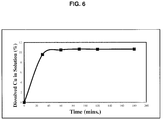
- FIG. 6 Production of copper ammonium carbonate according to Example 7.
- the present invention provides a method for the production of a dissolved copper ammonia solution that efficiently produces the solution at an expedited rate.
- the copper ammonia solution is obtained by dissolving cuprous oxide that is normally insoluble in water.
- Carbon dioxide may be added prior to or after the addition of the cuprous oxide to the composition to adjust the pH of the mixture to about 11.0. However the preferred addition order is prior to the addition of the cuprous oxide. The process can be run without the addition of carbon dioxide; however, the dissolution rate of the copper source is reduced significantly.
- Sources of carbon dioxide include but are not limited to air, carbon dioxide (g), dry ice (s)(i.e. dry ice), carbonic acid, ammonium carbonate and ammonium bicarbonate.
- Any source of oxygen can be used to oxidize copper in this process. Pure oxygen, however, is preferred. Air, ozone, and hydrogen peroxide are also suitable sources of oxygen for use in this process providing standard safety precautions are taken for using oxidants in the presence of organic compounds.
- the copper dissolution process could be conducted at ambient pressure. Alternatively the copper dissolution process could be conducted under pressure, such as less than 200 PSI. Preferably, the copper dissolution process could be conducted at pressures less than 100 PSI, less than 50 PSI, Less than 25 PSI and less than 10 PSI.
- the quaternary ammonium compound has a chemical structure comprising:
- the value of m is at least 1 and at most 20, the value of n is at least 1 and at most 20, the value of a is at least 1 and at most 5, the value of b is at least 1 and at most 5, and X is an anion selected from the group consisting of borate, chloride, carbonate, bicarbonate, bromide, iodide, formate, acetate, propionate, and other alkyl carboxylates.
- the value of m is at least 8 and at most 14, and the value of n is at least 8 and at most 14.
- the value of m is 10 or 12
- the value of n is 10 or 12
- the value of a is 1
- the value of b is 1.
- X ⁇ is borate, chloride, propionate, carbonate, or bicarbonate.
- the value of m is 10 and the value of n is 10.
- the value of m is 12 and the value of n is 12.
- the quaternary ammonium compound has a chemical structure comprising:
- the value of m is at least 1 and at most 20, the value of n is at least 1 and at most 20, the value of a is at least 1 and at most 5, the value of b is at least 1 and at most 5, and X ⁇ is an anion selected from the group consisting of borate, chloride, carbonate, bicarbonate, bromide, iodide, formate, acetate, propionate, acetate, propionate, and other alkyl carboxylates.
- the value of m is at least 8 and at most 14.
- the value of n is at least 8 and at most 14.
- the value of a is 1, the value of b is 1.
- X ⁇ is borate, chloride, propionate, carbonate, or bicarbonate.
- the value of m is 10 and the value of n is 10.
- the value of m is 12 and the value of n is 12.
- the quaternary ammonium compound has a chemical structure comprising:
- X ⁇ is an anion selected from the group consisting of borate, chloride, carbonate, bicarbonate, bromide, iodides, formate, acetate, propionate, and other alkyl carboxylates.
- the value of m, n is 10 or 12
- the value of a is 1
- the value of b is 1
- X ⁇ is borate, chloride, propionate, carbonate, or bicarbonate.
- the quaternary ammonium compound is n-alkydimethyl benzyl ammonium chloride, alkyldimethylbenzylammonium chloride, alkyldimethylbenzylammonium carbonate/bicarbonate, didecyldimethyl ammonium chloride, didecyldimethyl ammonium carbonate/bicarbonate, didodecyldimethyl ammonium chloride, didodecyldimethyl ammonium carbonate/bicarbonate, cocobis(2-hydroxyethyl) methylammonium chloride, and didecylmethylpoly(oxyethyl)ammonium propionate.
- the resulting dissolved copper solution can be mixed with a variety of biocides such as fungicides and insecticides to produce a formulation suitable for the preservation of wood and other cellulose-base materials.
- biocides such as fungicides and insecticides
- Typical biocides that can be used for this formulation are fungicides such as azoles, quaternary ammonium compounds, and various other conventional insecticides.
- Another embodiment of the present invention is a method for preserving and/or waterproofing a wood substrate by contacting a wood substrate with the composition of the present invention.
- the composition may be applied by any wood treating method known to one of ordinary skill in the art including, but not limited to, brushing, dipping, soaking, vacuum impregnation (e.g. double vacuum technique), and pressure treatment using various cycles.
- a solution mixture of 771.4 g of water and 862.0 g of aqueous ammonium hydroxide solution containing 29% ammonia was added to a beaker.
- the solution was mixed while a glass frit connected to a CO 2 tank was submerged in the beaker and sparged into the solution.
- a charge of 181.8 g of cuprous oxide powder was added to the beaker while mixing.
- a separate glass frit connected to an oxygen line was submerged into the solution.
- Oxygen was then sparged into the solution while mixing.
- Solution samples were periodically taken during, the reaction process to measure the copper content of the solution. After 3 hours of sparging oxygen into the solution, a solution sample was taken and analyzed for Cu.
- the Cu was found to be low, about 4.0%, so more oxygen was sparged into the solution to try to react the rest of the cuprous oxide. The reaction was continued for about 9 hours and the Cu content was analyzed at approximately 4.5% which was still much lower than the theoretical value of 8.0%. It was apparent much of the cuprous oxide was unreacted due to the excess buildup of material on the walls of the beaker as well as solid material present in the beaker.
- a solution mixture of 771.4 g of water and 862.0 g of aqueous ammonium hydroxide solution, containing 29% ammonia was added to a beaker.
- the solution was mixed while a glass frit connected to a CO 2 tank was submerged in the beaker and sparged into the solution.
- Approximately 120.0 g of CO 2 was initially added to the solution, with the remaining 40.0 g left out to be added after the reaction is complete for pH adjustment.
- the temperature of the solution after the addition of CO 2 was at about 50° C.
- 2.65 g of antifoam and 1.0 g of alkyldimethylbenzyl ammonium chloride (ADBAC) was added to the solution while mixing.
- ADBAC alkyldimethylbenzyl ammonium chloride
- cuprous oxide powder was added to the solution while mixing.
- a glass frit connected to an oxygen line was submerged into the solution.
- the sparging of oxygen was initiated and was continued for a total of 3 hours.
- the temperature was measured at about 60° C.
- Solution samples were periodically taken during the reaction process to measure the copper content of the solution.
- the glass frit connected to the CO 2 tank was re-submerged in the solution and a final 38.0 g of CO 2 was added.
- the final Cu concentration was analyzed at about 8.31% and the reaction ran much smoother than the previous batch with no residue left on the wall of the beaker.
- a graph depicting the copper results throughout the reaction are shown in the appendix as FIG. 1 .
- the solution was mixed while a glass frit connected to a CO 2 tank was submerged in the beaker and sparged into the solution.
- Approximately 190.0 g of CO 2 was then added to the solution while mixing.
- the temperature of the solution after the addition of CO 2 was at about 60° C.
- 2.50 g of antifoam and 1.22 g of alkyldimethylbenzyl ammonium chloride was added to the solution mixing.
- a glass frit connected to an oxygen line was submerged into the solution.
- the final Cu concentration was analyzed at about 10.24%.
- a graph depicting the copper results throughout the reaction are shown in the appendix as FIG. 2 .
- the solution was mixed while a glass frit connected to a CO 2 tank was submerged in the beaker and sparged into the solution.
- Approximately 130.0 g of CO 2 was initially added to the solution, with the remaining 31.0 g left out to be added after the reaction is complete for pH adjustment.
- cuprous oxide 2.10 g of antifoam and 1.5 g of cocobis(2-hydroxyethyl) methylammonium chloride was added to the solution while mixing.
- Approximately 181.8 g of cuprous oxide powder was added to the solution while mixing.
- the final Cu concentration was analyzed at about 8.14%.
- a graph depicting the copper results throughout the reaction are shown in the appendix as FIG. 3 .
- the solution was mixed while a glass frit connected to a CO 2 tank was submerged in the beaker and sparged into the solution.
- Approximately 140.0 g of CO 2 was initially added to the solution, with the remaining 30.0 g left out to be added after the reaction is complete for pH adjustment.
- cuprous oxide 3.20 g of antifoam and 1.6 g of cocobis(2-hydroxyethyl) methylammonium chloride was added to the solution while mixing.
- Approximately 229.4 g of cuprous oxide was added to the solution while mixing.
- the final Cu concentration was analyzed at about 9.23%.
- a graph depicting the copper results throughout the reaction are shown in the appendix as FIG. 4 . After a few days of static stability, a large chuck of solid formed on the bottom of the jug.
- the solution was mixed while a glass frit connected to a CO 2 tank was submerged in the beaker and sparged into the solution.
- Approximately 150.0 g of CO 2 was added to the solution, with the remaining 130.0 g left out to be added after the reaction is complete for pH adjustment.
- 3.27 g of antifoam and 2.84 g of cocobis(2-hydroxyethyl) methylammonium chloride was added to the solution while mixing.
- cuprous oxide Approximately 378.6 g of cuprous oxide was added to the solution while mixing. Immediately after the addition of cuprous oxide, a glass fit connected to an oxygen line was submerged into the solution. The sparging of oxygen was initiated and was continued for approximately 3 hours. About 60 minutes into the reaction, some foam began to form in the beaker, so an additional 1.72 g of antifoam was added to the solution while mixing. Solution samples were periodically taken during the reaction process to measure the copper content of the solution.
- the final Cu concentration was analyzed at about 10.41%.
- a graph depicting the copper results throughout the reaction are shown in the appendix as FIG. 5 . After a few days of static stability, a large chuck of solid formed on the bottom of the jug.
- the solution was mixed while a glass frit connected to a CO 2 tank was submerged in the beaker and sparged into the solution. Approximately 105.0 g of CO 2 was then added to the solution while mixing.
- 2.6 g of antifoam and 1.6 g of cocobis(2-hydroxyethyl) methylammonium chloride was added to the solution while mixing. Approximately 229.4 g of cuprous oxide was added to the solution while mixing.
- a glass frit connected to an oxygen line was submerged into the solution.
- the final Cu concentration was analyzed at about 10.66%.
- a graph depicting the copper results throughout the reaction are shown in the appendix as FIG. 6 . No solid formation appeared in the jug after a few days of static stability.
Landscapes
- Life Sciences & Earth Sciences (AREA)
- Chemical & Material Sciences (AREA)
- Wood Science & Technology (AREA)
- Engineering & Computer Science (AREA)
- General Health & Medical Sciences (AREA)
- Health & Medical Sciences (AREA)
- Plant Pathology (AREA)
- Dentistry (AREA)
- Pest Control & Pesticides (AREA)
- Agronomy & Crop Science (AREA)
- Zoology (AREA)
- Environmental Sciences (AREA)
- Inorganic Chemistry (AREA)
- Organic Chemistry (AREA)
- Materials Engineering (AREA)
- Toxicology (AREA)
- Forests & Forestry (AREA)
- Agricultural Chemicals And Associated Chemicals (AREA)
- Chemical And Physical Treatments For Wood And The Like (AREA)
Abstract
Description


wherein the value of m is at least 1 and at most 20, the value of n is at least 1 and at most 20, the value of a is at least 1 and at most 5, the value of b is at least 1 and at most 5, and X− is an anion selected from the group consisting of borate, chloride, carbonate, bicarbonate, bromide, iodide, formate, acetate, propionate, acetate, propionate, and other alkyl carboxylates. In certain embodiments, the value of m is at least 8 and at most 14. In certain embodiments, the value of n is at least 8 and at most 14. In certain embodiments, the value of a is 1, the value of b is 1. In certain embodiments X− is borate, chloride, propionate, carbonate, or bicarbonate. In certain embodiments, the value of m is 10 and the value of n is 10. In certain embodiments, the value of m is 12 and the value of n is 12.

wherein the value of m is at least 1 and at most 20, the value of n is at least 1 and at most 20, the value of a is at least 1 and at most 5, the value of b is at least 1 and at most 5, and X− is an anion selected from the group consisting of borate, chloride, carbonate, bicarbonate, bromide, iodides, formate, acetate, propionate, and other alkyl carboxylates. In certain embodiments, the value of m, n is 10 or 12, the value of a is 1, the value of b is 1, and X− is borate, chloride, propionate, carbonate, or bicarbonate.


wherein the value of m is at least 1 and at most 20, the value of n is at least 1 and at most 20, the value of a is at least 1 and at most 5, the value of b is at least 1 and at most 5, and X− is an anion selected from the group consisting of borate, chloride, carbonate, bicarbonate, bromide, iodide, formate, acetate, propionate, acetate, propionate, and other alkyl carboxylates. In certain embodiments, the value of m is at least 8 and at most 14. In certain embodiments, the value of n is at least 8 and at most 14. In certain embodiments, the value of a is 1, the value of b is 1. In certain embodiments X− is borate, chloride, propionate, carbonate, or bicarbonate. In certain embodiments, the value of m is 10 and the value of n is 10. In certain embodiments, the value of m is 12 and the value of n is 12.

wherein the value of m is at least 1 and at most 20, the value of n is at least 1 and at most 20, the value of a is at least 1 and at most 5, the value of b is at least 1 and at most 5, and X− is an anion selected from the group consisting of borate, chloride, carbonate, bicarbonate, bromide, iodides, formate, acetate, propionate, and other alkyl carboxylates. In certain embodiments, the value of m, n is 10 or 12, the value of a is 1, the value of b is 1, and X− is borate, chloride, propionate, carbonate, or bicarbonate.
Claims (38)


Priority Applications (2)
| Application Number | Priority Date | Filing Date | Title |
|---|---|---|---|
| US16/114,675 US11102980B2 (en) | 2017-09-01 | 2018-08-28 | Method of preparing copper-containing wood preserving compositions |
| US17/387,750 US20210352908A1 (en) | 2017-09-01 | 2021-07-28 | Method of preparing copper-containing wood preserving compositions |
Applications Claiming Priority (2)
| Application Number | Priority Date | Filing Date | Title |
|---|---|---|---|
| US201762553173P | 2017-09-01 | 2017-09-01 | |
| US16/114,675 US11102980B2 (en) | 2017-09-01 | 2018-08-28 | Method of preparing copper-containing wood preserving compositions |
Related Child Applications (1)
| Application Number | Title | Priority Date | Filing Date |
|---|---|---|---|
| US17/387,750 Continuation US20210352908A1 (en) | 2017-09-01 | 2021-07-28 | Method of preparing copper-containing wood preserving compositions |
Publications (2)
| Publication Number | Publication Date |
|---|---|
| US20190090493A1 US20190090493A1 (en) | 2019-03-28 |
| US11102980B2 true US11102980B2 (en) | 2021-08-31 |
Family
ID=63528950
Family Applications (2)
| Application Number | Title | Priority Date | Filing Date |
|---|---|---|---|
| US16/114,675 Active 2039-01-14 US11102980B2 (en) | 2017-09-01 | 2018-08-28 | Method of preparing copper-containing wood preserving compositions |
| US17/387,750 Abandoned US20210352908A1 (en) | 2017-09-01 | 2021-07-28 | Method of preparing copper-containing wood preserving compositions |
Family Applications After (1)
| Application Number | Title | Priority Date | Filing Date |
|---|---|---|---|
| US17/387,750 Abandoned US20210352908A1 (en) | 2017-09-01 | 2021-07-28 | Method of preparing copper-containing wood preserving compositions |
Country Status (3)
| Country | Link |
|---|---|
| US (2) | US11102980B2 (en) |
| CA (1) | CA3015716C (en) |
| WO (1) | WO2019046245A1 (en) |
Citations (5)
| Publication number | Priority date | Publication date | Assignee | Title |
|---|---|---|---|---|
| US3637508A (en) | 1970-03-06 | 1972-01-25 | William B Willsey | Process and composition for dissolving copper oxide |
| EP0058142A2 (en) | 1981-02-05 | 1982-08-18 | Domtar Inc. | Wood treatment compositions |
| WO2007053252A1 (en) | 2005-11-01 | 2007-05-10 | Osmose, Inc. | Method of preparing metal-containing wood preserving compositions |
| US7713341B2 (en) * | 2007-04-10 | 2010-05-11 | Kao Corporation | Quaternary ammonium salt compositions |
| WO2017112848A1 (en) | 2015-12-23 | 2017-06-29 | American Chemet Corporation | Methods for enhancing the preservation of cellulosic materials and cellulosic materials prepared thereby |
Family Cites Families (4)
| Publication number | Priority date | Publication date | Assignee | Title |
|---|---|---|---|---|
| US4622248A (en) | 1984-04-04 | 1986-11-11 | Osmose Wood Preserving Co. Of America, Inc. | Preservative composition for wood |
| US5492681A (en) | 1993-03-22 | 1996-02-20 | Hickson Corporation | Method for producing copper oxide |
| CA2262186A1 (en) | 1998-03-27 | 1999-09-27 | Gb Biosciences Corporation | Copper dissolver process |
| US20070207076A1 (en) | 2006-03-06 | 2007-09-06 | Osmose Inc. | Method of preparing metal-containing wood preserving compositions |
-
2018
- 2018-08-28 US US16/114,675 patent/US11102980B2/en active Active
- 2018-08-28 CA CA3015716A patent/CA3015716C/en active Active
- 2018-08-28 WO PCT/US2018/048263 patent/WO2019046245A1/en not_active Ceased
-
2021
- 2021-07-28 US US17/387,750 patent/US20210352908A1/en not_active Abandoned
Patent Citations (5)
| Publication number | Priority date | Publication date | Assignee | Title |
|---|---|---|---|---|
| US3637508A (en) | 1970-03-06 | 1972-01-25 | William B Willsey | Process and composition for dissolving copper oxide |
| EP0058142A2 (en) | 1981-02-05 | 1982-08-18 | Domtar Inc. | Wood treatment compositions |
| WO2007053252A1 (en) | 2005-11-01 | 2007-05-10 | Osmose, Inc. | Method of preparing metal-containing wood preserving compositions |
| US7713341B2 (en) * | 2007-04-10 | 2010-05-11 | Kao Corporation | Quaternary ammonium salt compositions |
| WO2017112848A1 (en) | 2015-12-23 | 2017-06-29 | American Chemet Corporation | Methods for enhancing the preservation of cellulosic materials and cellulosic materials prepared thereby |
Non-Patent Citations (1)
| Title |
|---|
| Notification of Transmittal of the International Search Report and the Written Opinion of the International Searching Authority dated Oct. 29, 2018, issued in PCT/US2018/048263. |
Also Published As
| Publication number | Publication date |
|---|---|
| CA3015716A1 (en) | 2019-03-01 |
| US20210352908A1 (en) | 2021-11-18 |
| CA3015716C (en) | 2023-09-12 |
| US20190090493A1 (en) | 2019-03-28 |
| WO2019046245A1 (en) | 2019-03-07 |
Similar Documents
| Publication | Publication Date | Title |
|---|---|---|
| EP1490375B1 (en) | Process for the dissolution of copper metal | |
| US6896908B2 (en) | Wood preservative concentrate | |
| EP1640463B2 (en) | Process for the dissolution of copper metal | |
| US8597419B2 (en) | Preservative compositions for wood and like materials | |
| CA1329453C (en) | Wood preservative | |
| JP3832399B2 (en) | Bactericidal algicide composition and water-based bactericidal algae method | |
| WO2005037507A1 (en) | Methods for producing and using a cu(1)-based wood preservative | |
| EP2794957A1 (en) | In situ production of a biocidal bromine species via electrolysis | |
| US11102980B2 (en) | Method of preparing copper-containing wood preserving compositions | |
| JP4778909B2 (en) | Method for producing a copper ethanolamine solution | |
| JP6823401B2 (en) | Method for treating water containing low molecular weight organic substances and method for modifying reverse osmosis membranes | |
| US20070207076A1 (en) | Method of preparing metal-containing wood preserving compositions | |
| WO2007053252A1 (en) | Method of preparing metal-containing wood preserving compositions | |
| US6869912B2 (en) | Biocidal composition | |
| EP1899124B1 (en) | Wood preservative composition | |
| AU3056700A (en) | Method for making aqueous solutions of unsaturated quaternary ammonium salts | |
| ZA200604911B (en) | Methods for producing copper ethanolamine solutions | |
| CA2813773C (en) | Ammoniacal copper zinc arsenate concentrates and methods of preparation | |
| HK1088639A (en) | Process for the dissolution of copper metal |
Legal Events
| Date | Code | Title | Description |
|---|---|---|---|
| FEPP | Fee payment procedure |
Free format text: ENTITY STATUS SET TO UNDISCOUNTED (ORIGINAL EVENT CODE: BIG.); ENTITY STATUS OF PATENT OWNER: LARGE ENTITY |
|
| STPP | Information on status: patent application and granting procedure in general |
Free format text: DOCKETED NEW CASE - READY FOR EXAMINATION |
|
| AS | Assignment |
Owner name: KOPPERS PERFORMANCE CHEMICALS INC., PENNSYLVANIA Free format text: ASSIGNMENT OF ASSIGNORS INTEREST;ASSIGNORS:ZHANG, JUN;THAM, PETER;REEL/FRAME:048139/0687 Effective date: 20190124 |
|
| STPP | Information on status: patent application and granting procedure in general |
Free format text: NON FINAL ACTION MAILED |
|
| STPP | Information on status: patent application and granting procedure in general |
Free format text: NON FINAL ACTION MAILED |
|
| STPP | Information on status: patent application and granting procedure in general |
Free format text: RESPONSE TO NON-FINAL OFFICE ACTION ENTERED AND FORWARDED TO EXAMINER |
|
| STPP | Information on status: patent application and granting procedure in general |
Free format text: NOTICE OF ALLOWANCE MAILED -- APPLICATION RECEIVED IN OFFICE OF PUBLICATIONS |
|
| STPP | Information on status: patent application and granting procedure in general |
Free format text: AWAITING TC RESP., ISSUE FEE NOT PAID |
|
| STPP | Information on status: patent application and granting procedure in general |
Free format text: NOTICE OF ALLOWANCE MAILED -- APPLICATION RECEIVED IN OFFICE OF PUBLICATIONS |
|
| STCF | Information on status: patent grant |
Free format text: PATENTED CASE |
|
| AS | Assignment |
Owner name: PNC BANK, NATIONAL ASSOCIATION, AS COLLATERAL AGENT, PENNSYLVANIA Free format text: SECURITY AGREEMENT;ASSIGNORS:KOPPERS DELAWARE, INC.;KOPPERS PERFORMANCE CHEMICALS INC.;REEL/FRAME:060390/0246 Effective date: 20220617 |
|
| MAFP | Maintenance fee payment |
Free format text: PAYMENT OF MAINTENANCE FEE, 4TH YEAR, LARGE ENTITY (ORIGINAL EVENT CODE: M1551); ENTITY STATUS OF PATENT OWNER: LARGE ENTITY Year of fee payment: 4 |