US11098061B2 - MK2 inhibitors and uses thereof - Google Patents
MK2 inhibitors and uses thereof Download PDFInfo
- Publication number
- US11098061B2 US11098061B2 US16/194,577 US201816194577A US11098061B2 US 11098061 B2 US11098061 B2 US 11098061B2 US 201816194577 A US201816194577 A US 201816194577A US 11098061 B2 US11098061 B2 US 11098061B2
- Authority
- US
- United States
- Prior art keywords
- ring
- nitrogen
- oxygen
- sulfur
- membered
- Prior art date
- Legal status (The legal status is an assumption and is not a legal conclusion. Google has not performed a legal analysis and makes no representation as to the accuracy of the status listed.)
- Active
Links
- 229940124789 MK2 inhibitor Drugs 0.000 title 1
- 150000001875 compounds Chemical class 0.000 claims abstract description 141
- 150000003839 salts Chemical class 0.000 claims abstract description 61
- 239000000203 mixture Substances 0.000 claims abstract description 48
- IJGRMHOSHXDMSA-UHFFFAOYSA-N nitrogen Substances N#N IJGRMHOSHXDMSA-UHFFFAOYSA-N 0.000 claims description 433
- 229910052757 nitrogen Inorganic materials 0.000 claims description 406
- 125000005842 heteroatom Chemical group 0.000 claims description 376
- QVGXLLKOCUKJST-UHFFFAOYSA-N atomic oxygen Chemical group [O] QVGXLLKOCUKJST-UHFFFAOYSA-N 0.000 claims description 373
- 229910052760 oxygen Inorganic materials 0.000 claims description 373
- 239000001301 oxygen Chemical group 0.000 claims description 373
- QJGQUHMNIGDVPM-UHFFFAOYSA-N nitrogen group Chemical group [N] QJGQUHMNIGDVPM-UHFFFAOYSA-N 0.000 claims description 362
- NINIDFKCEFEMDL-UHFFFAOYSA-N Sulfur Chemical group [S] NINIDFKCEFEMDL-UHFFFAOYSA-N 0.000 claims description 359
- 229910052717 sulfur Chemical group 0.000 claims description 359
- 239000011593 sulfur Chemical group 0.000 claims description 359
- -1 carrier Substances 0.000 claims description 249
- 229920006395 saturated elastomer Polymers 0.000 claims description 231
- 125000001931 aliphatic group Chemical group 0.000 claims description 154
- 125000001997 phenyl group Chemical group [H]C1=C([H])C([H])=C(*)C([H])=C1[H] 0.000 claims description 143
- 125000002837 carbocyclic group Chemical group 0.000 claims description 134
- 229910052739 hydrogen Inorganic materials 0.000 claims description 123
- 239000001257 hydrogen Substances 0.000 claims description 123
- 229910052736 halogen Inorganic materials 0.000 claims description 86
- 150000002367 halogens Chemical group 0.000 claims description 86
- 125000004435 hydrogen atom Chemical group [H]* 0.000 claims description 84
- 125000000325 methylidene group Chemical group [H]C([H])=* 0.000 claims description 66
- 125000003118 aryl group Chemical group 0.000 claims description 57
- 125000002619 bicyclic group Chemical group 0.000 claims description 55
- 125000000623 heterocyclic group Chemical group 0.000 claims description 44
- 150000002431 hydrogen Chemical group 0.000 claims description 32
- 125000001072 heteroaryl group Chemical group 0.000 claims description 25
- 125000000449 nitro group Chemical group [O-][N+](*)=O 0.000 claims description 25
- 125000004980 cyclopropylene group Chemical group 0.000 claims description 17
- 125000002950 monocyclic group Chemical group 0.000 claims description 17
- 125000004433 nitrogen atom Chemical group N* 0.000 claims description 12
- UFHFLCQGNIYNRP-UHFFFAOYSA-N Hydrogen Chemical compound [H][H] UFHFLCQGNIYNRP-UHFFFAOYSA-N 0.000 claims description 10
- 125000000882 C2-C6 alkenyl group Chemical group 0.000 claims description 9
- 125000004169 (C1-C6) alkyl group Chemical group 0.000 claims description 8
- 125000006569 (C5-C6) heterocyclic group Chemical group 0.000 claims description 8
- 125000006163 5-membered heteroaryl group Chemical group 0.000 claims description 8
- 125000003601 C2-C6 alkynyl group Chemical group 0.000 claims description 8
- 239000002671 adjuvant Substances 0.000 claims description 6
- 125000001183 hydrocarbyl group Chemical group 0.000 claims 8
- 239000003112 inhibitor Substances 0.000 abstract description 38
- 102000001253 Protein Kinase Human genes 0.000 abstract description 14
- 108060006633 protein kinase Proteins 0.000 abstract description 14
- 238000000034 method Methods 0.000 abstract description 11
- 235000002639 sodium chloride Nutrition 0.000 description 63
- 125000004076 pyridyl group Chemical group 0.000 description 62
- 125000000714 pyrimidinyl group Chemical group 0.000 description 54
- 229910052799 carbon Inorganic materials 0.000 description 49
- 150000001721 carbon Chemical group 0.000 description 46
- 125000000160 oxazolidinyl group Chemical group 0.000 description 43
- WYURNTSHIVDZCO-UHFFFAOYSA-N Tetrahydrofuran Chemical compound C1CCOC1 WYURNTSHIVDZCO-UHFFFAOYSA-N 0.000 description 42
- 125000004594 isoindolinyl group Chemical group C1(NCC2=CC=CC=C12)* 0.000 description 42
- 125000001544 thienyl group Chemical group 0.000 description 42
- 150000002430 hydrocarbons Chemical group 0.000 description 38
- 125000004429 atom Chemical group 0.000 description 36
- 125000003386 piperidinyl group Chemical group 0.000 description 35
- 125000004193 piperazinyl group Chemical group 0.000 description 33
- 125000003226 pyrazolyl group Chemical group 0.000 description 33
- 125000000719 pyrrolidinyl group Chemical group 0.000 description 33
- 125000002098 pyridazinyl group Chemical group 0.000 description 32
- 125000001422 pyrrolinyl group Chemical group 0.000 description 32
- 125000000561 purinyl group Chemical group N1=C(N=C2N=CNC2=C1)* 0.000 description 31
- 125000004309 pyranyl group Chemical group O1C(C=CC=C1)* 0.000 description 31
- 125000003373 pyrazinyl group Chemical group 0.000 description 31
- 125000003072 pyrazolidinyl group Chemical group 0.000 description 31
- 125000002755 pyrazolinyl group Chemical group 0.000 description 31
- 125000000113 cyclohexyl group Chemical group [H]C1([H])C([H])([H])C([H])([H])C([H])(*)C([H])([H])C1([H])[H] 0.000 description 29
- 125000001995 cyclobutyl group Chemical group [H]C1([H])C([H])([H])C([H])(*)C1([H])[H] 0.000 description 28
- 125000001559 cyclopropyl group Chemical group [H]C1([H])C([H])([H])C1([H])* 0.000 description 28
- 125000001511 cyclopentyl group Chemical group [H]C1([H])C([H])([H])C([H])([H])C([H])(*)C1([H])[H] 0.000 description 26
- 125000002971 oxazolyl group Chemical group 0.000 description 25
- 125000002471 4H-quinolizinyl group Chemical group C=1(C=CCN2C=CC=CC12)* 0.000 description 24
- 125000002883 imidazolyl group Chemical group 0.000 description 24
- 125000000842 isoxazolyl group Chemical group 0.000 description 24
- 125000002496 methyl group Chemical group [H]C([H])([H])* 0.000 description 24
- 125000002757 morpholinyl group Chemical group 0.000 description 24
- 125000000168 pyrrolyl group Chemical group 0.000 description 24
- 125000000147 tetrahydroquinolinyl group Chemical group N1(CCCC2=CC=CC=C12)* 0.000 description 24
- GAMYYCRTACQSBR-UHFFFAOYSA-N 4-azabenzimidazole Chemical compound C1=CC=C2NC=NC2=N1 GAMYYCRTACQSBR-UHFFFAOYSA-N 0.000 description 23
- BBAWTPDTGRXPDG-UHFFFAOYSA-N [1,3]thiazolo[4,5-b]pyridine Chemical compound C1=CC=C2SC=NC2=N1 BBAWTPDTGRXPDG-UHFFFAOYSA-N 0.000 description 23
- 125000000582 cycloheptyl group Chemical group [H]C1([H])C([H])([H])C([H])([H])C([H])([H])C([H])(*)C([H])([H])C1([H])[H] 0.000 description 23
- 125000002632 imidazolidinyl group Chemical group 0.000 description 23
- 125000002636 imidazolinyl group Chemical group 0.000 description 23
- QNNHQVPFZIFNFK-UHFFFAOYSA-N oxazolo[4,5-b]pyridine Chemical compound C1=CC=C2OC=NC2=N1 QNNHQVPFZIFNFK-UHFFFAOYSA-N 0.000 description 23
- 125000002294 quinazolinyl group Chemical group N1=C(N=CC2=CC=CC=C12)* 0.000 description 23
- 125000001567 quinoxalinyl group Chemical group N1=C(C=NC2=CC=CC=C12)* 0.000 description 23
- 125000003039 tetrahydroisoquinolinyl group Chemical group C1(NCCC2=CC=CC=C12)* 0.000 description 23
- 125000004856 decahydroquinolinyl group Chemical group N1(CCCC2CCCCC12)* 0.000 description 22
- 125000002541 furyl group Chemical group 0.000 description 22
- 125000003392 indanyl group Chemical group C1(CCC2=CC=CC=C12)* 0.000 description 22
- 125000003387 indolinyl group Chemical group N1(CCC2=CC=CC=C12)* 0.000 description 22
- 125000004934 phenanthridinyl group Chemical group C1(=CC=CC2=NC=C3C=CC=CC3=C12)* 0.000 description 22
- 125000002943 quinolinyl group Chemical group N1=C(C=CC2=CC=CC=C12)* 0.000 description 22
- 125000004621 quinuclidinyl group Chemical group N12C(CC(CC1)CC2)* 0.000 description 22
- 125000003718 tetrahydrofuranyl group Chemical group 0.000 description 22
- 125000001712 tetrahydronaphthyl group Chemical group C1(CCCC2=CC=CC=C12)* 0.000 description 22
- 125000000335 thiazolyl group Chemical group 0.000 description 22
- 108091000080 Phosphotransferase Proteins 0.000 description 21
- 125000000641 acridinyl group Chemical group C1(=CC=CC2=NC3=CC=CC=C3C=C12)* 0.000 description 21
- 125000005073 adamantyl group Chemical group C12(CC3CC(CC(C1)C3)C2)* 0.000 description 21
- 125000003785 benzimidazolyl group Chemical group N1=C(NC2=C1C=CC=C2)* 0.000 description 21
- 125000000499 benzofuranyl group Chemical group O1C(=CC2=C1C=CC=C2)* 0.000 description 21
- 125000001164 benzothiazolyl group Chemical group S1C(=NC2=C1C=CC=C2)* 0.000 description 21
- 125000004196 benzothienyl group Chemical group S1C(=CC2=C1C=CC=C2)* 0.000 description 21
- 125000000609 carbazolyl group Chemical group C1(=CC=CC=2C3=CC=CC=C3NC12)* 0.000 description 21
- 125000003016 chromanyl group Chemical group O1C(CCC2=CC=CC=C12)* 0.000 description 21
- 125000000259 cinnolinyl group Chemical group N1=NC(=CC2=CC=CC=C12)* 0.000 description 21
- 125000000640 cyclooctyl group Chemical group [H]C1([H])C([H])([H])C([H])([H])C([H])([H])C([H])(*)C([H])([H])C([H])([H])C1([H])[H] 0.000 description 21
- 125000003983 fluorenyl group Chemical group C1(=CC=CC=2C3=CC=CC=C3CC12)* 0.000 description 21
- 125000003406 indolizinyl group Chemical group C=1(C=CN2C=CC=CC12)* 0.000 description 21
- 125000001041 indolyl group Chemical group 0.000 description 21
- 125000003384 isochromanyl group Chemical group C1(OCCC2=CC=CC=C12)* 0.000 description 21
- 125000000904 isoindolyl group Chemical group C=1(NC=C2C=CC=CC12)* 0.000 description 21
- 125000001786 isothiazolyl group Chemical group 0.000 description 21
- 125000001624 naphthyl group Chemical group 0.000 description 21
- 125000004593 naphthyridinyl group Chemical group N1=C(C=CC2=CC=CN=C12)* 0.000 description 21
- 125000004930 octahydroisoquinolinyl group Chemical group C1(NCCC2CCCC=C12)* 0.000 description 21
- 125000001715 oxadiazolyl group Chemical group 0.000 description 21
- 125000001791 phenazinyl group Chemical group C1(=CC=CC2=NC3=CC=CC=C3N=C12)* 0.000 description 21
- 125000001484 phenothiazinyl group Chemical group C1(=CC=CC=2SC3=CC=CC=C3NC12)* 0.000 description 21
- 125000001644 phenoxazinyl group Chemical group C1(=CC=CC=2OC3=CC=CC=C3NC12)* 0.000 description 21
- 102000020233 phosphotransferase Human genes 0.000 description 21
- 125000004592 phthalazinyl group Chemical group C1(=NN=CC2=CC=CC=C12)* 0.000 description 21
- 125000001042 pteridinyl group Chemical group N1=C(N=CC2=NC=CN=C12)* 0.000 description 21
- YLQBMQCUIZJEEH-UHFFFAOYSA-N tetrahydrofuran Natural products C=1C=COC=1 YLQBMQCUIZJEEH-UHFFFAOYSA-N 0.000 description 21
- 125000001834 xanthenyl group Chemical group C1=CC=CC=2OC3=CC=CC=C3C(C12)* 0.000 description 21
- 125000004502 1,2,3-oxadiazolyl group Chemical group 0.000 description 20
- 125000004511 1,2,3-thiadiazolyl group Chemical group 0.000 description 20
- 125000001399 1,2,3-triazolyl group Chemical group N1N=NC(=C1)* 0.000 description 20
- 125000004504 1,2,4-oxadiazolyl group Chemical group 0.000 description 20
- 125000004514 1,2,4-thiadiazolyl group Chemical group 0.000 description 20
- 125000001376 1,2,4-triazolyl group Chemical group N1N=C(N=C1)* 0.000 description 20
- 125000004517 1,2,5-thiadiazolyl group Chemical group 0.000 description 20
- 125000001781 1,3,4-oxadiazolyl group Chemical group 0.000 description 20
- 125000004520 1,3,4-thiadiazolyl group Chemical group 0.000 description 20
- 125000005955 1H-indazolyl group Chemical group 0.000 description 20
- 125000004931 azocinyl group Chemical group N1=C(C=CC=CC=C1)* 0.000 description 20
- 125000004604 benzisothiazolyl group Chemical group S1N=C(C2=C1C=CC=C2)* 0.000 description 20
- 125000004603 benzisoxazolyl group Chemical group O1N=C(C2=C1C=CC=C2)* 0.000 description 20
- 125000004541 benzoxazolyl group Chemical group O1C(=NC2=C1C=CC=C2)* 0.000 description 20
- 125000005512 benztetrazolyl group Chemical group 0.000 description 20
- 125000004623 carbolinyl group Chemical group 0.000 description 20
- 125000004230 chromenyl group Chemical group O1C(C=CC2=CC=CC=C12)* 0.000 description 20
- 125000003838 furazanyl group Chemical group 0.000 description 20
- 125000004926 indolenyl group Chemical group 0.000 description 20
- 125000001977 isobenzofuranyl group Chemical group C=1(OC=C2C=CC=CC12)* 0.000 description 20
- 125000005438 isoindazolyl group Chemical group 0.000 description 20
- 125000002183 isoquinolinyl group Chemical group C1(=NC=CC2=CC=CC=C12)* 0.000 description 20
- 125000004625 phenanthrolinyl group Chemical group N1=C(C=CC2=CC=C3C=CC=NC3=C12)* 0.000 description 20
- 125000005954 phenoxathiinyl group Chemical group 0.000 description 20
- 125000001424 substituent group Chemical group 0.000 description 20
- 125000004627 thianthrenyl group Chemical group C1(=CC=CC=2SC3=CC=CC=C3SC12)* 0.000 description 20
- 125000004306 triazinyl group Chemical group 0.000 description 20
- 125000000956 methoxy group Chemical group [H]C([H])([H])O* 0.000 description 19
- 125000002023 trifluoromethyl group Chemical group FC(F)(F)* 0.000 description 17
- 239000003607 modifier Substances 0.000 description 16
- 125000002947 alkylene group Chemical group 0.000 description 15
- 125000005843 halogen group Chemical group 0.000 description 14
- 125000000217 alkyl group Chemical group 0.000 description 12
- 208000037265 diseases, disorders, signs and symptoms Diseases 0.000 description 11
- 125000000876 trifluoromethoxy group Chemical group FC(F)(F)O* 0.000 description 11
- 102000004190 Enzymes Human genes 0.000 description 8
- 108090000790 Enzymes Proteins 0.000 description 8
- 201000010099 disease Diseases 0.000 description 8
- XUJNEKJLAYXESH-REOHCLBHSA-N L-Cysteine Chemical compound SC[C@H](N)C(O)=O XUJNEKJLAYXESH-REOHCLBHSA-N 0.000 description 7
- XUJNEKJLAYXESH-UHFFFAOYSA-N cysteine Natural products SCC(N)C(O)=O XUJNEKJLAYXESH-UHFFFAOYSA-N 0.000 description 7
- 235000018417 cysteine Nutrition 0.000 description 7
- 108090000623 proteins and genes Proteins 0.000 description 7
- WVDDGKGOMKODPV-UHFFFAOYSA-N Benzyl alcohol Chemical compound OCC1=CC=CC=C1 WVDDGKGOMKODPV-UHFFFAOYSA-N 0.000 description 6
- FAPWRFPIFSIZLT-UHFFFAOYSA-M Sodium chloride Chemical compound [Na+].[Cl-] FAPWRFPIFSIZLT-UHFFFAOYSA-M 0.000 description 6
- 125000000151 cysteine group Chemical group N[C@@H](CS)C(=O)* 0.000 description 6
- 230000000694 effects Effects 0.000 description 6
- 238000009472 formulation Methods 0.000 description 6
- 125000001449 isopropyl group Chemical group [H]C([H])([H])C([H])(*)C([H])([H])[H] 0.000 description 6
- 102000004169 proteins and genes Human genes 0.000 description 6
- 239000000725 suspension Substances 0.000 description 6
- 125000004450 alkenylene group Chemical group 0.000 description 5
- 125000000484 butyl group Chemical group [H]C([*])([H])C([H])([H])C([H])([H])C([H])([H])[H] 0.000 description 5
- 125000001495 ethyl group Chemical group [H]C([H])([H])C([H])([H])* 0.000 description 5
- 230000005764 inhibitory process Effects 0.000 description 5
- 230000002427 irreversible effect Effects 0.000 description 5
- 238000004519 manufacturing process Methods 0.000 description 5
- 231100000252 nontoxic Toxicity 0.000 description 5
- 230000003000 nontoxic effect Effects 0.000 description 5
- 125000001436 propyl group Chemical group [H]C([*])([H])C([H])([H])C([H])([H])[H] 0.000 description 5
- 235000018102 proteins Nutrition 0.000 description 5
- 239000000243 solution Substances 0.000 description 5
- 239000003981 vehicle Substances 0.000 description 5
- 239000004215 Carbon black (E152) Substances 0.000 description 4
- MUBZPKHOEPUJKR-UHFFFAOYSA-N Oxalic acid Chemical compound OC(=O)C(O)=O MUBZPKHOEPUJKR-UHFFFAOYSA-N 0.000 description 4
- 150000001413 amino acids Chemical class 0.000 description 4
- 125000001797 benzyl group Chemical group [H]C1=C([H])C([H])=C(C([H])=C1[H])C([H])([H])* 0.000 description 4
- 239000000969 carrier Substances 0.000 description 4
- 125000000753 cycloalkyl group Chemical group 0.000 description 4
- 239000002270 dispersing agent Substances 0.000 description 4
- 239000002552 dosage form Substances 0.000 description 4
- 239000003814 drug Substances 0.000 description 4
- 239000003937 drug carrier Substances 0.000 description 4
- 125000000219 ethylidene group Chemical group [H]C(=[*])C([H])([H])[H] 0.000 description 4
- 125000000524 functional group Chemical group 0.000 description 4
- 125000004051 hexyl group Chemical group [H]C([H])([H])C([H])([H])C([H])([H])C([H])([H])C([H])([H])C([H])([H])* 0.000 description 4
- 229930195733 hydrocarbon Natural products 0.000 description 4
- 230000002401 inhibitory effect Effects 0.000 description 4
- 239000013038 irreversible inhibitor Substances 0.000 description 4
- 230000004048 modification Effects 0.000 description 4
- 238000012986 modification Methods 0.000 description 4
- 125000001147 pentyl group Chemical group C(CCCC)* 0.000 description 4
- 125000006413 ring segment Chemical group 0.000 description 4
- 239000011780 sodium chloride Substances 0.000 description 4
- 239000002904 solvent Substances 0.000 description 4
- XLYOFNOQVPJJNP-UHFFFAOYSA-N water Substances O XLYOFNOQVPJJNP-UHFFFAOYSA-N 0.000 description 4
- 229910001868 water Inorganic materials 0.000 description 4
- QTBSBXVTEAMEQO-UHFFFAOYSA-N Acetic acid Chemical compound CC(O)=O QTBSBXVTEAMEQO-UHFFFAOYSA-N 0.000 description 3
- OKTJSMMVPCPJKN-UHFFFAOYSA-N Carbon Chemical compound [C] OKTJSMMVPCPJKN-UHFFFAOYSA-N 0.000 description 3
- 229910019142 PO4 Inorganic materials 0.000 description 3
- OFOBLEOULBTSOW-UHFFFAOYSA-N Propanedioic acid Natural products OC(=O)CC(O)=O OFOBLEOULBTSOW-UHFFFAOYSA-N 0.000 description 3
- DNIAPMSPPWPWGF-UHFFFAOYSA-N Propylene glycol Chemical compound CC(O)CO DNIAPMSPPWPWGF-UHFFFAOYSA-N 0.000 description 3
- RWRDLPDLKQPQOW-UHFFFAOYSA-N Pyrrolidine Chemical compound C1CCNC1 RWRDLPDLKQPQOW-UHFFFAOYSA-N 0.000 description 3
- 229910052784 alkaline earth metal Inorganic materials 0.000 description 3
- 125000003342 alkenyl group Chemical group 0.000 description 3
- 229910052794 bromium Inorganic materials 0.000 description 3
- 210000004027 cell Anatomy 0.000 description 3
- 230000036755 cellular response Effects 0.000 description 3
- 229910052801 chlorine Inorganic materials 0.000 description 3
- KRKNYBCHXYNGOX-UHFFFAOYSA-N citric acid Chemical compound OC(=O)CC(O)(C(O)=O)CC(O)=O KRKNYBCHXYNGOX-UHFFFAOYSA-N 0.000 description 3
- 239000003085 diluting agent Substances 0.000 description 3
- 208000035475 disorder Diseases 0.000 description 3
- 229910052731 fluorine Inorganic materials 0.000 description 3
- 235000013305 food Nutrition 0.000 description 3
- 238000000338 in vitro Methods 0.000 description 3
- 238000001727 in vivo Methods 0.000 description 3
- 239000007788 liquid Substances 0.000 description 3
- 230000001404 mediated effect Effects 0.000 description 3
- 239000002207 metabolite Substances 0.000 description 3
- 235000019271 petrolatum Nutrition 0.000 description 3
- 235000021317 phosphate Nutrition 0.000 description 3
- 229920001223 polyethylene glycol Polymers 0.000 description 3
- 108090000765 processed proteins & peptides Proteins 0.000 description 3
- 239000000523 sample Substances 0.000 description 3
- 239000000126 substance Substances 0.000 description 3
- 238000012360 testing method Methods 0.000 description 3
- 229940124597 therapeutic agent Drugs 0.000 description 3
- 230000000699 topical effect Effects 0.000 description 3
- VZCYOOQTPOCHFL-UHFFFAOYSA-N trans-butenedioic acid Natural products OC(=O)C=CC(O)=O VZCYOOQTPOCHFL-UHFFFAOYSA-N 0.000 description 3
- 229910052720 vanadium Inorganic materials 0.000 description 3
- PUPZLCDOIYMWBV-UHFFFAOYSA-N (+/-)-1,3-Butanediol Chemical compound CC(O)CCO PUPZLCDOIYMWBV-UHFFFAOYSA-N 0.000 description 2
- 125000006590 (C2-C6) alkenylene group Chemical group 0.000 description 2
- HBAQYPYDRFILMT-UHFFFAOYSA-N 8-[3-(1-cyclopropylpyrazol-4-yl)-1H-pyrazolo[4,3-d]pyrimidin-5-yl]-3-methyl-3,8-diazabicyclo[3.2.1]octan-2-one Chemical class C1(CC1)N1N=CC(=C1)C1=NNC2=C1N=C(N=C2)N1C2C(N(CC1CC2)C)=O HBAQYPYDRFILMT-UHFFFAOYSA-N 0.000 description 2
- DLFVBJFMPXGRIB-UHFFFAOYSA-N Acetamide Chemical compound CC(N)=O DLFVBJFMPXGRIB-UHFFFAOYSA-N 0.000 description 2
- QGZKDVFQNNGYKY-UHFFFAOYSA-O Ammonium Chemical compound [NH4+] QGZKDVFQNNGYKY-UHFFFAOYSA-O 0.000 description 2
- CIWBSHSKHKDKBQ-JLAZNSOCSA-N Ascorbic acid Chemical compound OC[C@H](O)[C@H]1OC(=O)C(O)=C1O CIWBSHSKHKDKBQ-JLAZNSOCSA-N 0.000 description 2
- 229920002261 Corn starch Polymers 0.000 description 2
- FEWJPZIEWOKRBE-JCYAYHJZSA-N Dextrotartaric acid Chemical compound OC(=O)[C@H](O)[C@@H](O)C(O)=O FEWJPZIEWOKRBE-JCYAYHJZSA-N 0.000 description 2
- DHMQDGOQFOQNFH-UHFFFAOYSA-N Glycine Chemical compound NCC(O)=O DHMQDGOQFOQNFH-UHFFFAOYSA-N 0.000 description 2
- VEXZGXHMUGYJMC-UHFFFAOYSA-N Hydrochloric acid Chemical compound Cl VEXZGXHMUGYJMC-UHFFFAOYSA-N 0.000 description 2
- 102000008070 Interferon-gamma Human genes 0.000 description 2
- 108010074328 Interferon-gamma Proteins 0.000 description 2
- GUBGYTABKSRVRQ-QKKXKWKRSA-N Lactose Natural products OC[C@H]1O[C@@H](O[C@H]2[C@H](O)[C@@H](O)C(O)O[C@@H]2CO)[C@H](O)[C@@H](O)[C@H]1O GUBGYTABKSRVRQ-QKKXKWKRSA-N 0.000 description 2
- 241001465754 Metazoa Species 0.000 description 2
- 229910002651 NO3 Inorganic materials 0.000 description 2
- NHNBFGGVMKEFGY-UHFFFAOYSA-N Nitrate Chemical compound [O-][N+]([O-])=O NHNBFGGVMKEFGY-UHFFFAOYSA-N 0.000 description 2
- 239000004264 Petrolatum Substances 0.000 description 2
- NBIIXXVUZAFLBC-UHFFFAOYSA-N Phosphoric acid Chemical compound OP(O)(O)=O NBIIXXVUZAFLBC-UHFFFAOYSA-N 0.000 description 2
- OAICVXFJPJFONN-UHFFFAOYSA-N Phosphorus Chemical compound [P] OAICVXFJPJFONN-UHFFFAOYSA-N 0.000 description 2
- NQRYJNQNLNOLGT-UHFFFAOYSA-N Piperidine Chemical compound C1CCNCC1 NQRYJNQNLNOLGT-UHFFFAOYSA-N 0.000 description 2
- 239000002202 Polyethylene glycol Substances 0.000 description 2
- XUIMIQQOPSSXEZ-UHFFFAOYSA-N Silicon Chemical compound [Si] XUIMIQQOPSSXEZ-UHFFFAOYSA-N 0.000 description 2
- QAOWNCQODCNURD-UHFFFAOYSA-L Sulfate Chemical compound [O-]S([O-])(=O)=O QAOWNCQODCNURD-UHFFFAOYSA-L 0.000 description 2
- QAOWNCQODCNURD-UHFFFAOYSA-N Sulfuric acid Chemical compound OS(O)(=O)=O QAOWNCQODCNURD-UHFFFAOYSA-N 0.000 description 2
- 108060008682 Tumor Necrosis Factor Proteins 0.000 description 2
- 102000000852 Tumor Necrosis Factor-alpha Human genes 0.000 description 2
- LXEKPEMOWBOYRF-UHFFFAOYSA-N [2-[(1-azaniumyl-1-imino-2-methylpropan-2-yl)diazenyl]-2-methylpropanimidoyl]azanium;dichloride Chemical compound Cl.Cl.NC(=N)C(C)(C)N=NC(C)(C)C(N)=N LXEKPEMOWBOYRF-UHFFFAOYSA-N 0.000 description 2
- 230000002159 abnormal effect Effects 0.000 description 2
- 125000001118 alkylidene group Chemical group 0.000 description 2
- 239000007900 aqueous suspension Substances 0.000 description 2
- 238000003556 assay Methods 0.000 description 2
- 239000002585 base Substances 0.000 description 2
- 235000019445 benzyl alcohol Nutrition 0.000 description 2
- 239000012472 biological sample Substances 0.000 description 2
- 230000015572 biosynthetic process Effects 0.000 description 2
- 230000037396 body weight Effects 0.000 description 2
- 238000006664 bond formation reaction Methods 0.000 description 2
- 239000002775 capsule Substances 0.000 description 2
- 125000004432 carbon atom Chemical group C* 0.000 description 2
- 239000001768 carboxy methyl cellulose Substances 0.000 description 2
- 230000003197 catalytic effect Effects 0.000 description 2
- 125000003636 chemical group Chemical group 0.000 description 2
- 239000008120 corn starch Substances 0.000 description 2
- 229940099112 cornstarch Drugs 0.000 description 2
- 125000004122 cyclic group Chemical group 0.000 description 2
- 235000014113 dietary fatty acids Nutrition 0.000 description 2
- ZUOUZKKEUPVFJK-UHFFFAOYSA-N diphenyl Chemical compound C1=CC=CC=C1C1=CC=CC=C1 ZUOUZKKEUPVFJK-UHFFFAOYSA-N 0.000 description 2
- MOTZDAYCYVMXPC-UHFFFAOYSA-N dodecyl hydrogen sulfate Chemical compound CCCCCCCCCCCCOS(O)(=O)=O MOTZDAYCYVMXPC-UHFFFAOYSA-N 0.000 description 2
- 229940043264 dodecyl sulfate Drugs 0.000 description 2
- 239000003995 emulsifying agent Substances 0.000 description 2
- 150000002148 esters Chemical class 0.000 description 2
- 239000000194 fatty acid Substances 0.000 description 2
- 229930195729 fatty acid Natural products 0.000 description 2
- 150000004665 fatty acids Chemical class 0.000 description 2
- 210000001035 gastrointestinal tract Anatomy 0.000 description 2
- 125000005456 glyceride group Chemical group 0.000 description 2
- 125000004475 heteroaralkyl group Chemical group 0.000 description 2
- 238000000099 in vitro assay Methods 0.000 description 2
- 229960003130 interferon gamma Drugs 0.000 description 2
- 125000000654 isopropylidene group Chemical group C(C)(C)=* 0.000 description 2
- 239000008101 lactose Substances 0.000 description 2
- HQKMJHAJHXVSDF-UHFFFAOYSA-L magnesium stearate Chemical compound [Mg+2].CCCCCCCCCCCCCCCCCC([O-])=O.CCCCCCCCCCCCCCCCCC([O-])=O HQKMJHAJHXVSDF-UHFFFAOYSA-L 0.000 description 2
- VZCYOOQTPOCHFL-UPHRSURJSA-N maleic acid Chemical compound OC(=O)\C=C/C(O)=O VZCYOOQTPOCHFL-UPHRSURJSA-N 0.000 description 2
- 239000002480 mineral oil Substances 0.000 description 2
- 235000010446 mineral oil Nutrition 0.000 description 2
- 150000007522 mineralic acids Chemical class 0.000 description 2
- 239000000346 nonvolatile oil Substances 0.000 description 2
- 239000003921 oil Substances 0.000 description 2
- 235000019198 oils Nutrition 0.000 description 2
- 239000002674 ointment Substances 0.000 description 2
- ZQPPMHVWECSIRJ-KTKRTIGZSA-N oleic acid Chemical compound CCCCCCCC\C=C/CCCCCCCC(O)=O ZQPPMHVWECSIRJ-KTKRTIGZSA-N 0.000 description 2
- 210000000056 organ Anatomy 0.000 description 2
- 150000007524 organic acids Chemical class 0.000 description 2
- 235000005985 organic acids Nutrition 0.000 description 2
- VLTRZXGMWDSKGL-UHFFFAOYSA-N perchloric acid Chemical compound OCl(=O)(=O)=O VLTRZXGMWDSKGL-UHFFFAOYSA-N 0.000 description 2
- 229940066842 petrolatum Drugs 0.000 description 2
- 239000010452 phosphate Substances 0.000 description 2
- NBIIXXVUZAFLBC-UHFFFAOYSA-K phosphate Chemical compound [O-]P([O-])([O-])=O NBIIXXVUZAFLBC-UHFFFAOYSA-K 0.000 description 2
- 229910052698 phosphorus Inorganic materials 0.000 description 2
- 239000011574 phosphorus Substances 0.000 description 2
- 238000002360 preparation method Methods 0.000 description 2
- 239000003755 preservative agent Substances 0.000 description 2
- 150000003254 radicals Chemical class 0.000 description 2
- 229910052710 silicon Inorganic materials 0.000 description 2
- 239000010703 silicon Substances 0.000 description 2
- 239000007787 solid Substances 0.000 description 2
- KDYFGRWQOYBRFD-UHFFFAOYSA-N succinic acid Chemical compound OC(=O)CCC(O)=O KDYFGRWQOYBRFD-UHFFFAOYSA-N 0.000 description 2
- 239000000375 suspending agent Substances 0.000 description 2
- 239000003826 tablet Substances 0.000 description 2
- 238000004885 tandem mass spectrometry Methods 0.000 description 2
- 238000011282 treatment Methods 0.000 description 2
- 230000001960 triggered effect Effects 0.000 description 2
- LSPHULWDVZXLIL-UHFFFAOYSA-N (+/-)-Camphoric acid Chemical compound CC1(C)C(C(O)=O)CCC1(C)C(O)=O LSPHULWDVZXLIL-UHFFFAOYSA-N 0.000 description 1
- 125000004178 (C1-C4) alkyl group Chemical group 0.000 description 1
- 125000006650 (C2-C4) alkynyl group Chemical group 0.000 description 1
- WRIDQFICGBMAFQ-UHFFFAOYSA-N (E)-8-Octadecenoic acid Natural products CCCCCCCCCC=CCCCCCCC(O)=O WRIDQFICGBMAFQ-UHFFFAOYSA-N 0.000 description 1
- IIZPXYDJLKNOIY-JXPKJXOSSA-N 1-palmitoyl-2-arachidonoyl-sn-glycero-3-phosphocholine Chemical compound CCCCCCCCCCCCCCCC(=O)OC[C@H](COP([O-])(=O)OCC[N+](C)(C)C)OC(=O)CCC\C=C/C\C=C/C\C=C/C\C=C/CCCCC IIZPXYDJLKNOIY-JXPKJXOSSA-N 0.000 description 1
- JLQSRMIXXTWQJH-UHFFFAOYSA-N 2,3-dihydro-1,2-benzothiazole Chemical compound C1=CC=C2CNSC2=C1 JLQSRMIXXTWQJH-UHFFFAOYSA-N 0.000 description 1
- CHHHXKFHOYLYRE-UHFFFAOYSA-M 2,4-Hexadienoic acid, potassium salt (1:1), (2E,4E)- Chemical compound [K+].CC=CC=CC([O-])=O CHHHXKFHOYLYRE-UHFFFAOYSA-M 0.000 description 1
- 229940080296 2-naphthalenesulfonate Drugs 0.000 description 1
- LEACJMVNYZDSKR-UHFFFAOYSA-N 2-octyldodecan-1-ol Chemical compound CCCCCCCCCCC(CO)CCCCCCCC LEACJMVNYZDSKR-UHFFFAOYSA-N 0.000 description 1
- LQJBNNIYVWPHFW-UHFFFAOYSA-N 20:1omega9c fatty acid Natural products CCCCCCCCCCC=CCCCCCCCC(O)=O LQJBNNIYVWPHFW-UHFFFAOYSA-N 0.000 description 1
- BMYNFMYTOJXKLE-UHFFFAOYSA-N 3-azaniumyl-2-hydroxypropanoate Chemical compound NCC(O)C(O)=O BMYNFMYTOJXKLE-UHFFFAOYSA-N 0.000 description 1
- ZRPLANDPDWYOMZ-UHFFFAOYSA-N 3-cyclopentylpropionic acid Chemical compound OC(=O)CCC1CCCC1 ZRPLANDPDWYOMZ-UHFFFAOYSA-N 0.000 description 1
- XMIIGOLPHOKFCH-UHFFFAOYSA-M 3-phenylpropionate Chemical compound [O-]C(=O)CCC1=CC=CC=C1 XMIIGOLPHOKFCH-UHFFFAOYSA-M 0.000 description 1
- FHVDTGUDJYJELY-UHFFFAOYSA-N 6-{[2-carboxy-4,5-dihydroxy-6-(phosphanyloxy)oxan-3-yl]oxy}-4,5-dihydroxy-3-phosphanyloxane-2-carboxylic acid Chemical compound O1C(C(O)=O)C(P)C(O)C(O)C1OC1C(C(O)=O)OC(OP)C(O)C1O FHVDTGUDJYJELY-UHFFFAOYSA-N 0.000 description 1
- QSBYPNXLFMSGKH-UHFFFAOYSA-N 9-Heptadecensaeure Natural products CCCCCCCC=CCCCCCCCC(O)=O QSBYPNXLFMSGKH-UHFFFAOYSA-N 0.000 description 1
- 108091006112 ATPases Proteins 0.000 description 1
- HRPVXLWXLXDGHG-UHFFFAOYSA-N Acrylamide Chemical group NC(=O)C=C HRPVXLWXLXDGHG-UHFFFAOYSA-N 0.000 description 1
- 208000030090 Acute Disease Diseases 0.000 description 1
- 102000057290 Adenosine Triphosphatases Human genes 0.000 description 1
- 208000024827 Alzheimer disease Diseases 0.000 description 1
- 101001053401 Arabidopsis thaliana Acid beta-fructofuranosidase 3, vacuolar Proteins 0.000 description 1
- 101001053395 Arabidopsis thaliana Acid beta-fructofuranosidase 4, vacuolar Proteins 0.000 description 1
- 208000023275 Autoimmune disease Diseases 0.000 description 1
- 102000004506 Blood Proteins Human genes 0.000 description 1
- 108010017384 Blood Proteins Proteins 0.000 description 1
- 208000020084 Bone disease Diseases 0.000 description 1
- BTBUEUYNUDRHOZ-UHFFFAOYSA-N Borate Chemical compound [O-]B([O-])[O-] BTBUEUYNUDRHOZ-UHFFFAOYSA-N 0.000 description 1
- FERIUCNNQQJTOY-UHFFFAOYSA-M Butyrate Chemical compound CCCC([O-])=O FERIUCNNQQJTOY-UHFFFAOYSA-M 0.000 description 1
- FERIUCNNQQJTOY-UHFFFAOYSA-N Butyric acid Natural products CCCC(O)=O FERIUCNNQQJTOY-UHFFFAOYSA-N 0.000 description 1
- 125000006519 CCH3 Chemical group 0.000 description 1
- OYPRJOBELJOOCE-UHFFFAOYSA-N Calcium Chemical compound [Ca] OYPRJOBELJOOCE-UHFFFAOYSA-N 0.000 description 1
- 229920002134 Carboxymethyl cellulose Polymers 0.000 description 1
- 208000024172 Cardiovascular disease Diseases 0.000 description 1
- VEXZGXHMUGYJMC-UHFFFAOYSA-M Chloride anion Chemical compound [Cl-] VEXZGXHMUGYJMC-UHFFFAOYSA-M 0.000 description 1
- KRKNYBCHXYNGOX-UHFFFAOYSA-K Citrate Chemical compound [O-]C(=O)CC(O)(CC([O-])=O)C([O-])=O KRKNYBCHXYNGOX-UHFFFAOYSA-K 0.000 description 1
- 102000004127 Cytokines Human genes 0.000 description 1
- 108090000695 Cytokines Proteins 0.000 description 1
- RGHNJXZEOKUKBD-SQOUGZDYSA-M D-gluconate Chemical compound OC[C@@H](O)[C@@H](O)[C@H](O)[C@@H](O)C([O-])=O RGHNJXZEOKUKBD-SQOUGZDYSA-M 0.000 description 1
- YZCKVEUIGOORGS-OUBTZVSYSA-N Deuterium Chemical compound [2H] YZCKVEUIGOORGS-OUBTZVSYSA-N 0.000 description 1
- 241000792859 Enema Species 0.000 description 1
- LFQSCWFLJHTTHZ-UHFFFAOYSA-N Ethanol Chemical compound CCO LFQSCWFLJHTTHZ-UHFFFAOYSA-N 0.000 description 1
- BDAGIHXWWSANSR-UHFFFAOYSA-M Formate Chemical compound [O-]C=O BDAGIHXWWSANSR-UHFFFAOYSA-M 0.000 description 1
- VZCYOOQTPOCHFL-OWOJBTEDSA-N Fumaric acid Chemical compound OC(=O)\C=C\C(O)=O VZCYOOQTPOCHFL-OWOJBTEDSA-N 0.000 description 1
- 239000004471 Glycine Substances 0.000 description 1
- 108010045100 HSP27 Heat-Shock Proteins Proteins 0.000 description 1
- 206010019280 Heart failures Diseases 0.000 description 1
- 102100039165 Heat shock protein beta-1 Human genes 0.000 description 1
- 108010093488 His-His-His-His-His-His Proteins 0.000 description 1
- 241000282412 Homo Species 0.000 description 1
- 102000008100 Human Serum Albumin Human genes 0.000 description 1
- 108091006905 Human Serum Albumin Proteins 0.000 description 1
- 206010020751 Hypersensitivity Diseases 0.000 description 1
- 101150101999 IL6 gene Proteins 0.000 description 1
- DGAQECJNVWCQMB-PUAWFVPOSA-M Ilexoside XXIX Chemical compound C[C@@H]1CC[C@@]2(CC[C@@]3(C(=CC[C@H]4[C@]3(CC[C@@H]5[C@@]4(CC[C@@H](C5(C)C)OS(=O)(=O)[O-])C)C)[C@@H]2[C@]1(C)O)C)C(=O)O[C@H]6[C@@H]([C@H]([C@@H]([C@H](O6)CO)O)O)O.[Na+] DGAQECJNVWCQMB-PUAWFVPOSA-M 0.000 description 1
- 208000022559 Inflammatory bowel disease Diseases 0.000 description 1
- 102000004889 Interleukin-6 Human genes 0.000 description 1
- 108090001005 Interleukin-6 Proteins 0.000 description 1
- XEEYBQQBJWHFJM-UHFFFAOYSA-N Iron Chemical compound [Fe] XEEYBQQBJWHFJM-UHFFFAOYSA-N 0.000 description 1
- CKLJMWTZIZZHCS-REOHCLBHSA-N L-aspartic acid Chemical compound OC(=O)[C@@H](N)CC(O)=O CKLJMWTZIZZHCS-REOHCLBHSA-N 0.000 description 1
- HNDVDQJCIGZPNO-YFKPBYRVSA-N L-histidine Chemical compound OC(=O)[C@@H](N)CC1=CN=CN1 HNDVDQJCIGZPNO-YFKPBYRVSA-N 0.000 description 1
- KDXKERNSBIXSRK-YFKPBYRVSA-N L-lysine Chemical compound NCCCC[C@H](N)C(O)=O KDXKERNSBIXSRK-YFKPBYRVSA-N 0.000 description 1
- AYFVYJQAPQTCCC-GBXIJSLDSA-N L-threonine Chemical compound C[C@@H](O)[C@H](N)C(O)=O AYFVYJQAPQTCCC-GBXIJSLDSA-N 0.000 description 1
- JVTAAEKCZFNVCJ-UHFFFAOYSA-M Lactate Chemical compound CC(O)C([O-])=O JVTAAEKCZFNVCJ-UHFFFAOYSA-M 0.000 description 1
- WHXSMMKQMYFTQS-UHFFFAOYSA-N Lithium Chemical compound [Li] WHXSMMKQMYFTQS-UHFFFAOYSA-N 0.000 description 1
- KDXKERNSBIXSRK-UHFFFAOYSA-N Lysine Natural products NCCCCC(N)C(O)=O KDXKERNSBIXSRK-UHFFFAOYSA-N 0.000 description 1
- 239000004472 Lysine Substances 0.000 description 1
- 102100034069 MAP kinase-activated protein kinase 2 Human genes 0.000 description 1
- 101710141394 MAP kinase-activated protein kinase 2 Proteins 0.000 description 1
- FYYHWMGAXLPEAU-UHFFFAOYSA-N Magnesium Chemical compound [Mg] FYYHWMGAXLPEAU-UHFFFAOYSA-N 0.000 description 1
- OFOBLEOULBTSOW-UHFFFAOYSA-L Malonate Chemical compound [O-]C(=O)CC([O-])=O OFOBLEOULBTSOW-UHFFFAOYSA-L 0.000 description 1
- 241000124008 Mammalia Species 0.000 description 1
- AFVFQIVMOAPDHO-UHFFFAOYSA-N Methanesulfonic acid Chemical compound CS(O)(=O)=O AFVFQIVMOAPDHO-UHFFFAOYSA-N 0.000 description 1
- 206010028980 Neoplasm Diseases 0.000 description 1
- 208000012902 Nervous system disease Diseases 0.000 description 1
- 208000025966 Neurological disease Diseases 0.000 description 1
- PVNIIMVLHYAWGP-UHFFFAOYSA-N Niacin Chemical compound OC(=O)C1=CC=CN=C1 PVNIIMVLHYAWGP-UHFFFAOYSA-N 0.000 description 1
- 229910004749 OS(O)2 Inorganic materials 0.000 description 1
- 239000005642 Oleic acid Substances 0.000 description 1
- ZQPPMHVWECSIRJ-UHFFFAOYSA-N Oleic acid Natural products CCCCCCCCC=CCCCCCCCC(O)=O ZQPPMHVWECSIRJ-UHFFFAOYSA-N 0.000 description 1
- 229920003171 Poly (ethylene oxide) Polymers 0.000 description 1
- 229920001214 Polysorbate 60 Polymers 0.000 description 1
- ZLMJMSJWJFRBEC-UHFFFAOYSA-N Potassium Chemical compound [K] ZLMJMSJWJFRBEC-UHFFFAOYSA-N 0.000 description 1
- XBDQKXXYIPTUBI-UHFFFAOYSA-M Propionate Chemical compound CCC([O-])=O XBDQKXXYIPTUBI-UHFFFAOYSA-M 0.000 description 1
- 102000007327 Protamines Human genes 0.000 description 1
- 108010007568 Protamines Proteins 0.000 description 1
- VYPSYNLAJGMNEJ-UHFFFAOYSA-N Silicium dioxide Chemical compound O=[Si]=O VYPSYNLAJGMNEJ-UHFFFAOYSA-N 0.000 description 1
- HVUMOYIDDBPOLL-XWVZOOPGSA-N Sorbitan monostearate Chemical compound CCCCCCCCCCCCCCCCCC(=O)OC[C@@H](O)[C@H]1OC[C@H](O)[C@H]1O HVUMOYIDDBPOLL-XWVZOOPGSA-N 0.000 description 1
- FEWJPZIEWOKRBE-UHFFFAOYSA-N Tartaric acid Natural products [H+].[H+].[O-]C(=O)C(O)C(O)C([O-])=O FEWJPZIEWOKRBE-UHFFFAOYSA-N 0.000 description 1
- ZMZDMBWJUHKJPS-UHFFFAOYSA-M Thiocyanate anion Chemical compound [S-]C#N ZMZDMBWJUHKJPS-UHFFFAOYSA-M 0.000 description 1
- AYFVYJQAPQTCCC-UHFFFAOYSA-N Threonine Natural products CC(O)C(N)C(O)=O AYFVYJQAPQTCCC-UHFFFAOYSA-N 0.000 description 1
- 239000004473 Threonine Substances 0.000 description 1
- YZCKVEUIGOORGS-NJFSPNSNSA-N Tritium Chemical compound [3H] YZCKVEUIGOORGS-NJFSPNSNSA-N 0.000 description 1
- 102000004142 Trypsin Human genes 0.000 description 1
- 108090000631 Trypsin Proteins 0.000 description 1
- 108050009309 Tuberin Proteins 0.000 description 1
- 102000044633 Tuberous Sclerosis Complex 2 Human genes 0.000 description 1
- 239000007875 V-40 Substances 0.000 description 1
- AVTLBBWTUPQRAY-BUHFOSPRSA-N V-59 Substances CCC(C)(C#N)\N=N\C(C)(CC)C#N AVTLBBWTUPQRAY-BUHFOSPRSA-N 0.000 description 1
- 229940124532 absorption promoter Drugs 0.000 description 1
- DPXJVFZANSGRMM-UHFFFAOYSA-N acetic acid;2,3,4,5,6-pentahydroxyhexanal;sodium Chemical compound [Na].CC(O)=O.OCC(O)C(O)C(O)C(O)C=O DPXJVFZANSGRMM-UHFFFAOYSA-N 0.000 description 1
- 239000002253 acid Substances 0.000 description 1
- 239000004480 active ingredient Substances 0.000 description 1
- 230000001154 acute effect Effects 0.000 description 1
- 125000004423 acyloxy group Chemical group 0.000 description 1
- WNLRTRBMVRJNCN-UHFFFAOYSA-L adipate(2-) Chemical compound [O-]C(=O)CCCCC([O-])=O WNLRTRBMVRJNCN-UHFFFAOYSA-L 0.000 description 1
- 229940072056 alginate Drugs 0.000 description 1
- 235000010443 alginic acid Nutrition 0.000 description 1
- 229920000615 alginic acid Polymers 0.000 description 1
- 239000003513 alkali Substances 0.000 description 1
- 229910052783 alkali metal Inorganic materials 0.000 description 1
- 150000001340 alkali metals Chemical class 0.000 description 1
- 150000001342 alkaline earth metals Chemical class 0.000 description 1
- 125000003545 alkoxy group Chemical group 0.000 description 1
- 125000005278 alkyl sulfonyloxy group Chemical group 0.000 description 1
- 125000000304 alkynyl group Chemical group 0.000 description 1
- 125000004419 alkynylene group Chemical group 0.000 description 1
- 208000026935 allergic disease Diseases 0.000 description 1
- 230000007815 allergy Effects 0.000 description 1
- AWUCVROLDVIAJX-UHFFFAOYSA-N alpha-glycerophosphate Natural products OCC(O)COP(O)(O)=O AWUCVROLDVIAJX-UHFFFAOYSA-N 0.000 description 1
- PNEYBMLMFCGWSK-UHFFFAOYSA-N aluminium oxide Inorganic materials [O-2].[O-2].[O-2].[Al+3].[Al+3] PNEYBMLMFCGWSK-UHFFFAOYSA-N 0.000 description 1
- 229910000147 aluminium phosphate Inorganic materials 0.000 description 1
- CEGOLXSVJUTHNZ-UHFFFAOYSA-K aluminium tristearate Chemical compound [Al+3].CCCCCCCCCCCCCCCCCC([O-])=O.CCCCCCCCCCCCCCCCCC([O-])=O.CCCCCCCCCCCCCCCCCC([O-])=O CEGOLXSVJUTHNZ-UHFFFAOYSA-K 0.000 description 1
- 229940063655 aluminum stearate Drugs 0.000 description 1
- 235000001014 amino acid Nutrition 0.000 description 1
- 229940024606 amino acid Drugs 0.000 description 1
- 125000000539 amino acid group Chemical group 0.000 description 1
- 125000003277 amino group Chemical group 0.000 description 1
- 229940045988 antineoplastic drug protein kinase inhibitors Drugs 0.000 description 1
- 239000007864 aqueous solution Substances 0.000 description 1
- 206010003246 arthritis Diseases 0.000 description 1
- 125000003710 aryl alkyl group Chemical group 0.000 description 1
- 125000005160 aryl oxy alkyl group Chemical group 0.000 description 1
- 125000005228 aryl sulfonate group Chemical group 0.000 description 1
- 125000005279 aryl sulfonyloxy group Chemical group 0.000 description 1
- 229940072107 ascorbate Drugs 0.000 description 1
- 235000010323 ascorbic acid Nutrition 0.000 description 1
- 239000011668 ascorbic acid Substances 0.000 description 1
- 229940009098 aspartate Drugs 0.000 description 1
- 208000006673 asthma Diseases 0.000 description 1
- 235000013871 bee wax Nutrition 0.000 description 1
- 239000012166 beeswax Substances 0.000 description 1
- 230000008901 benefit Effects 0.000 description 1
- 229940077388 benzenesulfonate Drugs 0.000 description 1
- SRSXLGNVWSONIS-UHFFFAOYSA-M benzenesulfonate Chemical compound [O-]S(=O)(=O)C1=CC=CC=C1 SRSXLGNVWSONIS-UHFFFAOYSA-M 0.000 description 1
- 125000005605 benzo group Chemical group 0.000 description 1
- 229940050390 benzoate Drugs 0.000 description 1
- WPYMKLBDIGXBTP-UHFFFAOYSA-N benzoic acid Chemical compound OC(=O)C1=CC=CC=C1 WPYMKLBDIGXBTP-UHFFFAOYSA-N 0.000 description 1
- 125000000649 benzylidene group Chemical group [H]C(=[*])C1=C([H])C([H])=C([H])C([H])=C1[H] 0.000 description 1
- XMIIGOLPHOKFCH-UHFFFAOYSA-N beta-phenylpropanoic acid Natural products OC(=O)CCC1=CC=CC=C1 XMIIGOLPHOKFCH-UHFFFAOYSA-N 0.000 description 1
- 125000002618 bicyclic heterocycle group Chemical group 0.000 description 1
- 238000004166 bioassay Methods 0.000 description 1
- 230000033228 biological regulation Effects 0.000 description 1
- 239000004305 biphenyl Substances 0.000 description 1
- 235000010290 biphenyl Nutrition 0.000 description 1
- 210000004556 brain Anatomy 0.000 description 1
- 239000000872 buffer Substances 0.000 description 1
- 235000019437 butane-1,3-diol Nutrition 0.000 description 1
- 239000011575 calcium Substances 0.000 description 1
- 229910052791 calcium Inorganic materials 0.000 description 1
- FATUQANACHZLRT-KMRXSBRUSA-L calcium glucoheptonate Chemical compound [Ca+2].OC[C@@H](O)[C@@H](O)[C@H](O)[C@@H](O)C(O)C([O-])=O.OC[C@@H](O)[C@@H](O)[C@H](O)[C@@H](O)C(O)C([O-])=O FATUQANACHZLRT-KMRXSBRUSA-L 0.000 description 1
- MIOPJNTWMNEORI-UHFFFAOYSA-N camphorsulfonic acid Chemical compound C1CC2(CS(O)(=O)=O)C(=O)CC1C2(C)C MIOPJNTWMNEORI-UHFFFAOYSA-N 0.000 description 1
- 201000011510 cancer Diseases 0.000 description 1
- 235000010948 carboxy methyl cellulose Nutrition 0.000 description 1
- 150000007942 carboxylates Chemical class 0.000 description 1
- 239000008112 carboxymethyl-cellulose Substances 0.000 description 1
- 239000012876 carrier material Substances 0.000 description 1
- 239000004359 castor oil Substances 0.000 description 1
- 235000019438 castor oil Nutrition 0.000 description 1
- 229920002678 cellulose Polymers 0.000 description 1
- 239000001913 cellulose Substances 0.000 description 1
- 235000010980 cellulose Nutrition 0.000 description 1
- 229940081733 cetearyl alcohol Drugs 0.000 description 1
- 230000008859 change Effects 0.000 description 1
- 229910052729 chemical element Inorganic materials 0.000 description 1
- 239000003795 chemical substances by application Substances 0.000 description 1
- 125000001309 chloro group Chemical group Cl* 0.000 description 1
- WBLIXGSTEMXDSM-UHFFFAOYSA-N chloromethane Chemical compound Cl[CH2] WBLIXGSTEMXDSM-UHFFFAOYSA-N 0.000 description 1
- 208000037976 chronic inflammation Diseases 0.000 description 1
- 208000037893 chronic inflammatory disorder Diseases 0.000 description 1
- 229940110456 cocoa butter Drugs 0.000 description 1
- 235000019868 cocoa butter Nutrition 0.000 description 1
- 239000008119 colloidal silica Substances 0.000 description 1
- 239000003086 colorant Substances 0.000 description 1
- 238000010835 comparative analysis Methods 0.000 description 1
- 239000006071 cream Substances 0.000 description 1
- 125000000392 cycloalkenyl group Chemical group 0.000 description 1
- 125000001047 cyclobutenyl group Chemical group C1(=CCC1)* 0.000 description 1
- 125000000596 cyclohexenyl group Chemical group C1(=CCCCC1)* 0.000 description 1
- 125000002433 cyclopentenyl group Chemical group C1(=CCCC1)* 0.000 description 1
- 125000000298 cyclopropenyl group Chemical group [H]C1=C([H])C1([H])* 0.000 description 1
- 210000000805 cytoplasm Anatomy 0.000 description 1
- 230000001419 dependent effect Effects 0.000 description 1
- 238000001514 detection method Methods 0.000 description 1
- 229910052805 deuterium Inorganic materials 0.000 description 1
- 125000004431 deuterium atom Chemical group 0.000 description 1
- 125000002576 diazepinyl group Chemical group N1N=C(C=CC=C1)* 0.000 description 1
- IJGRMHOSHXDMSA-UHFFFAOYSA-O diazynium Chemical group [NH+]#N IJGRMHOSHXDMSA-UHFFFAOYSA-O 0.000 description 1
- 235000005911 diet Nutrition 0.000 description 1
- 230000037213 diet Effects 0.000 description 1
- GLUUGHFHXGJENI-UHFFFAOYSA-N diethylenediamine Natural products C1CNCCN1 GLUUGHFHXGJENI-UHFFFAOYSA-N 0.000 description 1
- GXGAKHNRMVGRPK-UHFFFAOYSA-N dimagnesium;dioxido-bis[[oxido(oxo)silyl]oxy]silane Chemical compound [Mg+2].[Mg+2].[O-][Si](=O)O[Si]([O-])([O-])O[Si]([O-])=O GXGAKHNRMVGRPK-UHFFFAOYSA-N 0.000 description 1
- 125000000532 dioxanyl group Chemical group 0.000 description 1
- 125000005879 dioxolanyl group Chemical group 0.000 description 1
- ZPWVASYFFYYZEW-UHFFFAOYSA-L dipotassium hydrogen phosphate Chemical compound [K+].[K+].OP([O-])([O-])=O ZPWVASYFFYYZEW-UHFFFAOYSA-L 0.000 description 1
- 229910000396 dipotassium phosphate Inorganic materials 0.000 description 1
- 235000019797 dipotassium phosphate Nutrition 0.000 description 1
- BNIILDVGGAEEIG-UHFFFAOYSA-L disodium hydrogen phosphate Chemical compound [Na+].[Na+].OP([O-])([O-])=O BNIILDVGGAEEIG-UHFFFAOYSA-L 0.000 description 1
- 238000006073 displacement reaction Methods 0.000 description 1
- POULHZVOKOAJMA-UHFFFAOYSA-M dodecanoate Chemical compound CCCCCCCCCCCC([O-])=O POULHZVOKOAJMA-UHFFFAOYSA-M 0.000 description 1
- 229940079593 drug Drugs 0.000 description 1
- 239000000890 drug combination Substances 0.000 description 1
- 239000003596 drug target Substances 0.000 description 1
- 239000003792 electrolyte Substances 0.000 description 1
- 230000001804 emulsifying effect Effects 0.000 description 1
- 239000008387 emulsifying waxe Substances 0.000 description 1
- 239000000839 emulsion Substances 0.000 description 1
- 239000007920 enema Substances 0.000 description 1
- 229940095399 enema Drugs 0.000 description 1
- 239000003623 enhancer Substances 0.000 description 1
- CCIVGXIOQKPBKL-UHFFFAOYSA-M ethanesulfonate Chemical compound CCS([O-])(=O)=O CCIVGXIOQKPBKL-UHFFFAOYSA-M 0.000 description 1
- 235000019441 ethanol Nutrition 0.000 description 1
- BEFDCLMNVWHSGT-UHFFFAOYSA-N ethenylcyclopentane Chemical compound C=CC1CCCC1 BEFDCLMNVWHSGT-UHFFFAOYSA-N 0.000 description 1
- 230000029142 excretion Effects 0.000 description 1
- 238000002474 experimental method Methods 0.000 description 1
- 235000019197 fats Nutrition 0.000 description 1
- 239000000796 flavoring agent Substances 0.000 description 1
- 125000001153 fluoro group Chemical group F* 0.000 description 1
- VUWZPRWSIVNGKG-UHFFFAOYSA-N fluoromethane Chemical compound F[CH2] VUWZPRWSIVNGKG-UHFFFAOYSA-N 0.000 description 1
- 125000004785 fluoromethoxy group Chemical group [H]C([H])(F)O* 0.000 description 1
- 229940050410 gluconate Drugs 0.000 description 1
- ZEMPKEQAKRGZGQ-XOQCFJPHSA-N glycerol triricinoleate Natural products CCCCCC[C@@H](O)CC=CCCCCCCCC(=O)OC[C@@H](COC(=O)CCCCCCCC=CC[C@@H](O)CCCCCC)OC(=O)CCCCCCCC=CC[C@H](O)CCCCCC ZEMPKEQAKRGZGQ-XOQCFJPHSA-N 0.000 description 1
- 229960002449 glycine Drugs 0.000 description 1
- 150000004820 halides Chemical class 0.000 description 1
- 125000001188 haloalkyl group Chemical group 0.000 description 1
- 230000036541 health Effects 0.000 description 1
- MNWFXJYAOYHMED-UHFFFAOYSA-N heptanoic acid Chemical compound CCCCCCC(O)=O MNWFXJYAOYHMED-UHFFFAOYSA-N 0.000 description 1
- 125000004415 heterocyclylalkyl group Chemical group 0.000 description 1
- UBHWBODXJBSFLH-UHFFFAOYSA-N hexadecan-1-ol;octadecan-1-ol Chemical compound CCCCCCCCCCCCCCCCO.CCCCCCCCCCCCCCCCCCO UBHWBODXJBSFLH-UHFFFAOYSA-N 0.000 description 1
- IPCSVZSSVZVIGE-UHFFFAOYSA-M hexadecanoate Chemical compound CCCCCCCCCCCCCCCC([O-])=O IPCSVZSSVZVIGE-UHFFFAOYSA-M 0.000 description 1
- FUZZWVXGSFPDMH-UHFFFAOYSA-N hexanoic acid Chemical compound CCCCCC(O)=O FUZZWVXGSFPDMH-UHFFFAOYSA-N 0.000 description 1
- HNDVDQJCIGZPNO-UHFFFAOYSA-N histidine Natural products OC(=O)C(N)CC1=CN=CN1 HNDVDQJCIGZPNO-UHFFFAOYSA-N 0.000 description 1
- 239000005556 hormone Substances 0.000 description 1
- 229940088597 hormone Drugs 0.000 description 1
- XMBWDFGMSWQBCA-UHFFFAOYSA-N hydrogen iodide Chemical compound I XMBWDFGMSWQBCA-UHFFFAOYSA-N 0.000 description 1
- ZMZDMBWJUHKJPS-UHFFFAOYSA-N hydrogen thiocyanate Natural products SC#N ZMZDMBWJUHKJPS-UHFFFAOYSA-N 0.000 description 1
- QAOWNCQODCNURD-UHFFFAOYSA-M hydrogensulfate Chemical compound OS([O-])(=O)=O QAOWNCQODCNURD-UHFFFAOYSA-M 0.000 description 1
- XLYOFNOQVPJJNP-UHFFFAOYSA-M hydroxide Chemical compound [OH-] XLYOFNOQVPJJNP-UHFFFAOYSA-M 0.000 description 1
- 125000003453 indazolyl group Chemical group N1N=C(C2=C1C=CC=C2)* 0.000 description 1
- 208000027866 inflammatory disease Diseases 0.000 description 1
- 238000001802 infusion Methods 0.000 description 1
- 229940102223 injectable solution Drugs 0.000 description 1
- 229940102213 injectable suspension Drugs 0.000 description 1
- 238000002347 injection Methods 0.000 description 1
- 239000007924 injection Substances 0.000 description 1
- 229940100601 interleukin-6 Drugs 0.000 description 1
- 230000003834 intracellular effect Effects 0.000 description 1
- 230000031146 intracellular signal transduction Effects 0.000 description 1
- 238000007917 intracranial administration Methods 0.000 description 1
- 238000007918 intramuscular administration Methods 0.000 description 1
- 238000007919 intrasynovial administration Methods 0.000 description 1
- 238000007913 intrathecal administration Methods 0.000 description 1
- 238000001990 intravenous administration Methods 0.000 description 1
- 238000005342 ion exchange Methods 0.000 description 1
- 150000002500 ions Chemical class 0.000 description 1
- 230000007794 irritation Effects 0.000 description 1
- 208000037906 ischaemic injury Diseases 0.000 description 1
- SUMDYPCJJOFFON-UHFFFAOYSA-N isethionic acid Chemical compound OCCS(O)(=O)=O SUMDYPCJJOFFON-UHFFFAOYSA-N 0.000 description 1
- 125000000959 isobutyl group Chemical group [H]C([H])([H])C([H])(C([H])([H])[H])C([H])([H])* 0.000 description 1
- QXJSBBXBKPUZAA-UHFFFAOYSA-N isooleic acid Natural products CCCCCCCC=CCCCCCCCCC(O)=O QXJSBBXBKPUZAA-UHFFFAOYSA-N 0.000 description 1
- 125000005956 isoquinolyl group Chemical group 0.000 description 1
- 229940043355 kinase inhibitor Drugs 0.000 description 1
- 238000012933 kinetic analysis Methods 0.000 description 1
- 238000002372 labelling Methods 0.000 description 1
- 229940001447 lactate Drugs 0.000 description 1
- 229940099584 lactobionate Drugs 0.000 description 1
- JYTUSYBCFIZPBE-AMTLMPIISA-N lactobionic acid Chemical compound OC(=O)[C@H](O)[C@@H](O)[C@@H]([C@H](O)CO)O[C@@H]1O[C@H](CO)[C@H](O)[C@H](O)[C@H]1O JYTUSYBCFIZPBE-AMTLMPIISA-N 0.000 description 1
- 229940070765 laurate Drugs 0.000 description 1
- 239000000787 lecithin Substances 0.000 description 1
- 235000010445 lecithin Nutrition 0.000 description 1
- 229940067606 lecithin Drugs 0.000 description 1
- 150000002632 lipids Chemical class 0.000 description 1
- 229910052744 lithium Inorganic materials 0.000 description 1
- 239000006210 lotion Substances 0.000 description 1
- 239000000314 lubricant Substances 0.000 description 1
- 239000011777 magnesium Substances 0.000 description 1
- 229910052749 magnesium Inorganic materials 0.000 description 1
- 239000000391 magnesium silicate Substances 0.000 description 1
- 235000019359 magnesium stearate Nutrition 0.000 description 1
- 229910000386 magnesium trisilicate Inorganic materials 0.000 description 1
- 235000019793 magnesium trisilicate Nutrition 0.000 description 1
- 229940099273 magnesium trisilicate Drugs 0.000 description 1
- 229940049920 malate Drugs 0.000 description 1
- 239000011976 maleic acid Substances 0.000 description 1
- BJEPYKJPYRNKOW-UHFFFAOYSA-N malic acid Chemical compound OC(=O)C(O)CC(O)=O BJEPYKJPYRNKOW-UHFFFAOYSA-N 0.000 description 1
- 238000004949 mass spectrometry Methods 0.000 description 1
- 239000000463 material Substances 0.000 description 1
- 125000005905 mesyloxy group Chemical group 0.000 description 1
- 208000030159 metabolic disease Diseases 0.000 description 1
- 229940042472 mineral oil Drugs 0.000 description 1
- 238000002156 mixing Methods 0.000 description 1
- KVBGVZZKJNLNJU-UHFFFAOYSA-M naphthalene-2-sulfonate Chemical compound C1=CC=CC2=CC(S(=O)(=O)[O-])=CC=C21 KVBGVZZKJNLNJU-UHFFFAOYSA-M 0.000 description 1
- 239000007922 nasal spray Substances 0.000 description 1
- 230000004770 neurodegeneration Effects 0.000 description 1
- 208000015122 neurodegenerative disease Diseases 0.000 description 1
- 230000000926 neurological effect Effects 0.000 description 1
- 235000001968 nicotinic acid Nutrition 0.000 description 1
- 239000011664 nicotinic acid Substances 0.000 description 1
- 150000002829 nitrogen Chemical class 0.000 description 1
- 125000006574 non-aromatic ring group Chemical group 0.000 description 1
- 231100000344 non-irritating Toxicity 0.000 description 1
- 230000000269 nucleophilic effect Effects 0.000 description 1
- QIQXTHQIDYTFRH-UHFFFAOYSA-N octadecanoic acid Chemical compound CCCCCCCCCCCCCCCCCC(O)=O QIQXTHQIDYTFRH-UHFFFAOYSA-N 0.000 description 1
- 229940049964 oleate Drugs 0.000 description 1
- 239000004006 olive oil Substances 0.000 description 1
- 235000008390 olive oil Nutrition 0.000 description 1
- WCPAKWJPBJAGKN-UHFFFAOYSA-N oxadiazole Chemical compound C1=CON=N1 WCPAKWJPBJAGKN-UHFFFAOYSA-N 0.000 description 1
- 235000006408 oxalic acid Nutrition 0.000 description 1
- 125000003566 oxetanyl group Chemical group 0.000 description 1
- 150000002924 oxiranes Chemical class 0.000 description 1
- 102000002574 p38 Mitogen-Activated Protein Kinases Human genes 0.000 description 1
- 108010068338 p38 Mitogen-Activated Protein Kinases Proteins 0.000 description 1
- 230000036961 partial effect Effects 0.000 description 1
- 230000001575 pathological effect Effects 0.000 description 1
- 230000000737 periodic effect Effects 0.000 description 1
- JRKICGRDRMAZLK-UHFFFAOYSA-L peroxydisulfate Chemical compound [O-]S(=O)(=O)OOS([O-])(=O)=O JRKICGRDRMAZLK-UHFFFAOYSA-L 0.000 description 1
- 239000008194 pharmaceutical composition Substances 0.000 description 1
- 239000000546 pharmaceutical excipient Substances 0.000 description 1
- 230000000144 pharmacologic effect Effects 0.000 description 1
- 239000012071 phase Substances 0.000 description 1
- 150000003013 phosphoric acid derivatives Chemical class 0.000 description 1
- 230000026731 phosphorylation Effects 0.000 description 1
- 238000006366 phosphorylation reaction Methods 0.000 description 1
- 239000003757 phosphotransferase inhibitor Substances 0.000 description 1
- 125000005545 phthalimidyl group Chemical group 0.000 description 1
- 229950010765 pivalate Drugs 0.000 description 1
- IUGYQRQAERSCNH-UHFFFAOYSA-N pivalic acid Chemical compound CC(C)(C)C(O)=O IUGYQRQAERSCNH-UHFFFAOYSA-N 0.000 description 1
- 229920000058 polyacrylate Polymers 0.000 description 1
- 229920000642 polymer Polymers 0.000 description 1
- 239000001818 polyoxyethylene sorbitan monostearate Substances 0.000 description 1
- 235000010989 polyoxyethylene sorbitan monostearate Nutrition 0.000 description 1
- 229920001451 polypropylene glycol Polymers 0.000 description 1
- 229920000136 polysorbate Polymers 0.000 description 1
- 229940113124 polysorbate 60 Drugs 0.000 description 1
- 239000001267 polyvinylpyrrolidone Substances 0.000 description 1
- 229920000036 polyvinylpyrrolidone Polymers 0.000 description 1
- 235000013855 polyvinylpyrrolidone Nutrition 0.000 description 1
- 229910052700 potassium Inorganic materials 0.000 description 1
- 239000011591 potassium Substances 0.000 description 1
- 239000004302 potassium sorbate Substances 0.000 description 1
- 235000010241 potassium sorbate Nutrition 0.000 description 1
- 229940069338 potassium sorbate Drugs 0.000 description 1
- 230000002335 preservative effect Effects 0.000 description 1
- 230000008569 process Effects 0.000 description 1
- 230000000069 prophylactic effect Effects 0.000 description 1
- 235000013772 propylene glycol Nutrition 0.000 description 1
- OSFBJERFMQCEQY-UHFFFAOYSA-N propylidene Chemical compound [CH]CC OSFBJERFMQCEQY-UHFFFAOYSA-N 0.000 description 1
- 229950008679 protamine sulfate Drugs 0.000 description 1
- 239000003909 protein kinase inhibitor Substances 0.000 description 1
- 238000000746 purification Methods 0.000 description 1
- HAMAGKWXRRTWCJ-UHFFFAOYSA-N pyrido[2,3-b][1,4]oxazin-3-one Chemical compound C1=CN=C2OC(=O)C=NC2=C1 HAMAGKWXRRTWCJ-UHFFFAOYSA-N 0.000 description 1
- 125000001453 quaternary ammonium group Chemical group 0.000 description 1
- 125000005493 quinolyl group Chemical group 0.000 description 1
- 238000000163 radioactive labelling Methods 0.000 description 1
- 238000011084 recovery Methods 0.000 description 1
- 229940100618 rectal suppository Drugs 0.000 description 1
- 239000006215 rectal suppository Substances 0.000 description 1
- 210000000664 rectum Anatomy 0.000 description 1
- 230000002441 reversible effect Effects 0.000 description 1
- 239000013037 reversible inhibitor Substances 0.000 description 1
- 230000019491 signal transduction Effects 0.000 description 1
- 210000003491 skin Anatomy 0.000 description 1
- AWUCVROLDVIAJX-GSVOUGTGSA-N sn-glycerol 3-phosphate Chemical compound OC[C@@H](O)COP(O)(O)=O AWUCVROLDVIAJX-GSVOUGTGSA-N 0.000 description 1
- 239000011734 sodium Substances 0.000 description 1
- 229910052708 sodium Inorganic materials 0.000 description 1
- 235000019812 sodium carboxymethyl cellulose Nutrition 0.000 description 1
- 229920001027 sodium carboxymethylcellulose Polymers 0.000 description 1
- 230000003381 solubilizing effect Effects 0.000 description 1
- 239000004334 sorbic acid Substances 0.000 description 1
- 235000010199 sorbic acid Nutrition 0.000 description 1
- 229940075582 sorbic acid Drugs 0.000 description 1
- 239000001587 sorbitan monostearate Substances 0.000 description 1
- 235000011076 sorbitan monostearate Nutrition 0.000 description 1
- 229940035048 sorbitan monostearate Drugs 0.000 description 1
- 241000894007 species Species 0.000 description 1
- 239000007921 spray Substances 0.000 description 1
- 230000000638 stimulation Effects 0.000 description 1
- 230000035882 stress Effects 0.000 description 1
- 238000007920 subcutaneous administration Methods 0.000 description 1
- 239000000758 substrate Substances 0.000 description 1
- KDYFGRWQOYBRFD-UHFFFAOYSA-L succinate(2-) Chemical compound [O-]C(=O)CCC([O-])=O KDYFGRWQOYBRFD-UHFFFAOYSA-L 0.000 description 1
- 239000001384 succinic acid Substances 0.000 description 1
- BDHFUVZGWQCTTF-UHFFFAOYSA-M sulfonate Chemical compound [O-]S(=O)=O BDHFUVZGWQCTTF-UHFFFAOYSA-M 0.000 description 1
- 239000000829 suppository Substances 0.000 description 1
- 239000004094 surface-active agent Substances 0.000 description 1
- 239000003765 sweetening agent Substances 0.000 description 1
- 239000011975 tartaric acid Substances 0.000 description 1
- 235000002906 tartaric acid Nutrition 0.000 description 1
- 229940095064 tartrate Drugs 0.000 description 1
- LMBFAGIMSUYTBN-MPZNNTNKSA-N teixobactin Chemical compound C([C@H](C(=O)N[C@@H]([C@@H](C)CC)C(=O)N[C@@H](CO)C(=O)N[C@H](CCC(N)=O)C(=O)N[C@H]([C@@H](C)CC)C(=O)N[C@@H]([C@@H](C)CC)C(=O)N[C@@H](CO)C(=O)N[C@H]1C(N[C@@H](C)C(=O)N[C@@H](C[C@@H]2NC(=N)NC2)C(=O)N[C@H](C(=O)O[C@H]1C)[C@@H](C)CC)=O)NC)C1=CC=CC=C1 LMBFAGIMSUYTBN-MPZNNTNKSA-N 0.000 description 1
- MOHYPEBTGARVCM-UHFFFAOYSA-N tert-butyl 2-[2-[(3-nitrobenzoyl)amino]pyridin-4-yl]-4-oxo-5-[(2,4,6-trimethoxyphenyl)methyl]spiro[1,6-dihydropyrrolo[3,2-c]pyridine-7,3'-piperidine]-1'-carboxylate Chemical compound [N+](=O)([O-])C=1C=C(C(=O)NC2=NC=CC(=C2)C2=CC=3C(N(CC4(C=3N2)CN(CCC4)C(=O)OC(C)(C)C)CC2=C(C=C(C=C2OC)OC)OC)=O)C=CC=1 MOHYPEBTGARVCM-UHFFFAOYSA-N 0.000 description 1
- DVVYVNCSKUPFFV-GOSISDBHSA-N tert-butyl N-[(3R)-1-(1-oxospiro[2,3-dihydropyrazino[1,2-a]indole-4,1'-cyclobutane]-7-carbonyl)piperidin-3-yl]carbamate Chemical compound O=C1NCC2(N3C1=CC=1C=CC(=CC3=1)C(=O)N1C[C@@H](CCC1)NC(OC(C)(C)C)=O)CCC2 DVVYVNCSKUPFFV-GOSISDBHSA-N 0.000 description 1
- WXMIZBPRTXPPSK-UHFFFAOYSA-N tert-butyl N-[3-[4-(12-oxo-5,13,17-triazatetracyclo[8.7.0.02,7.011,16]heptadeca-1(10),2,4,6,11(16)-pentaen-4-yl)-2-(prop-2-enoylamino)phenoxy]propyl]carbamate Chemical compound C(C=C)(=O)NC1=C(OCCCNC(OC(C)(C)C)=O)C=CC(=C1)C=1N=CC=2CCC3=C(C=2C=1)NC1=C3C(NCC1)=O WXMIZBPRTXPPSK-UHFFFAOYSA-N 0.000 description 1
- 125000000999 tert-butyl group Chemical group [H]C([H])([H])C(*)(C([H])([H])[H])C([H])([H])[H] 0.000 description 1
- MHXBHWLGRWOABW-UHFFFAOYSA-N tetradecyl octadecanoate Chemical compound CCCCCCCCCCCCCCCCCC(=O)OCCCCCCCCCCCCCC MHXBHWLGRWOABW-UHFFFAOYSA-N 0.000 description 1
- 125000003831 tetrazolyl group Chemical group 0.000 description 1
- 230000001225 therapeutic effect Effects 0.000 description 1
- VLLMWSRANPNYQX-UHFFFAOYSA-N thiadiazole Chemical compound C1=CSN=N1.C1=CSN=N1 VLLMWSRANPNYQX-UHFFFAOYSA-N 0.000 description 1
- 125000001113 thiadiazolyl group Chemical group 0.000 description 1
- 125000005308 thiazepinyl group Chemical group S1N=C(C=CC=C1)* 0.000 description 1
- 125000003396 thiol group Chemical group [H]S* 0.000 description 1
- 150000003573 thiols Chemical group 0.000 description 1
- 210000001519 tissue Anatomy 0.000 description 1
- JOXIMZWYDAKGHI-UHFFFAOYSA-N toluene-4-sulfonic acid Chemical compound CC1=CC=C(S(O)(=O)=O)C=C1 JOXIMZWYDAKGHI-UHFFFAOYSA-N 0.000 description 1
- 238000011200 topical administration Methods 0.000 description 1
- 239000012049 topical pharmaceutical composition Substances 0.000 description 1
- 125000005424 tosyloxy group Chemical group S(=O)(=O)(C1=CC=C(C)C=C1)O* 0.000 description 1
- 231100000419 toxicity Toxicity 0.000 description 1
- 230000001988 toxicity Effects 0.000 description 1
- 238000011269 treatment regimen Methods 0.000 description 1
- 150000003852 triazoles Chemical class 0.000 description 1
- 125000001425 triazolyl group Chemical group 0.000 description 1
- 229910052722 tritium Inorganic materials 0.000 description 1
- 239000012588 trypsin Substances 0.000 description 1
- SZCZSKMCTGEJKI-UHFFFAOYSA-N tuberin Natural products COC1=CC=C(C=CNC=O)C=C1 SZCZSKMCTGEJKI-UHFFFAOYSA-N 0.000 description 1
- ZDPHROOEEOARMN-UHFFFAOYSA-N undecanoic acid Chemical compound CCCCCCCCCCC(O)=O ZDPHROOEEOARMN-UHFFFAOYSA-N 0.000 description 1
- NQPDZGIKBAWPEJ-UHFFFAOYSA-N valeric acid Chemical class CCCCC(O)=O NQPDZGIKBAWPEJ-UHFFFAOYSA-N 0.000 description 1
- 235000013311 vegetables Nutrition 0.000 description 1
- 239000001993 wax Substances 0.000 description 1
- 239000000080 wetting agent Substances 0.000 description 1
- 239000003871 white petrolatum Substances 0.000 description 1
- 210000002268 wool Anatomy 0.000 description 1
- 150000003751 zinc Chemical class 0.000 description 1
Images


Classifications
-
- C—CHEMISTRY; METALLURGY
- C07—ORGANIC CHEMISTRY
- C07D—HETEROCYCLIC COMPOUNDS
- C07D519/00—Heterocyclic compounds containing more than one system of two or more relevant hetero rings condensed among themselves or condensed with a common carbocyclic ring system not provided for in groups C07D453/00 or C07D455/00
-
- C—CHEMISTRY; METALLURGY
- C07—ORGANIC CHEMISTRY
- C07D—HETEROCYCLIC COMPOUNDS
- C07D471/00—Heterocyclic compounds containing nitrogen atoms as the only ring hetero atoms in the condensed system, at least one ring being a six-membered ring with one nitrogen atom, not provided for by groups C07D451/00 - C07D463/00
- C07D471/02—Heterocyclic compounds containing nitrogen atoms as the only ring hetero atoms in the condensed system, at least one ring being a six-membered ring with one nitrogen atom, not provided for by groups C07D451/00 - C07D463/00 in which the condensed system contains two hetero rings
- C07D471/04—Ortho-condensed systems
-
- A—HUMAN NECESSITIES
- A61—MEDICAL OR VETERINARY SCIENCE; HYGIENE
- A61K—PREPARATIONS FOR MEDICAL, DENTAL OR TOILETRY PURPOSES
- A61K31/00—Medicinal preparations containing organic active ingredients
- A61K31/33—Heterocyclic compounds
- A61K31/395—Heterocyclic compounds having nitrogen as a ring hetero atom, e.g. guanethidine or rifamycins
- A61K31/435—Heterocyclic compounds having nitrogen as a ring hetero atom, e.g. guanethidine or rifamycins having six-membered rings with one nitrogen as the only ring hetero atom
- A61K31/4353—Heterocyclic compounds having nitrogen as a ring hetero atom, e.g. guanethidine or rifamycins having six-membered rings with one nitrogen as the only ring hetero atom ortho- or peri-condensed with heterocyclic ring systems
- A61K31/4375—Heterocyclic compounds having nitrogen as a ring hetero atom, e.g. guanethidine or rifamycins having six-membered rings with one nitrogen as the only ring hetero atom ortho- or peri-condensed with heterocyclic ring systems the heterocyclic ring system containing a six-membered ring having nitrogen as a ring heteroatom, e.g. quinolizines, naphthyridines, berberine, vincamine
-
- A—HUMAN NECESSITIES
- A61—MEDICAL OR VETERINARY SCIENCE; HYGIENE
- A61K—PREPARATIONS FOR MEDICAL, DENTAL OR TOILETRY PURPOSES
- A61K31/00—Medicinal preparations containing organic active ingredients
- A61K31/33—Heterocyclic compounds
- A61K31/395—Heterocyclic compounds having nitrogen as a ring hetero atom, e.g. guanethidine or rifamycins
- A61K31/495—Heterocyclic compounds having nitrogen as a ring hetero atom, e.g. guanethidine or rifamycins having six-membered rings with two or more nitrogen atoms as the only ring heteroatoms, e.g. piperazine or tetrazines
- A61K31/505—Pyrimidines; Hydrogenated pyrimidines, e.g. trimethoprim
- A61K31/506—Pyrimidines; Hydrogenated pyrimidines, e.g. trimethoprim not condensed and containing further heterocyclic rings
-
- A—HUMAN NECESSITIES
- A61—MEDICAL OR VETERINARY SCIENCE; HYGIENE
- A61K—PREPARATIONS FOR MEDICAL, DENTAL OR TOILETRY PURPOSES
- A61K47/00—Medicinal preparations characterised by the non-active ingredients used, e.g. carriers or inert additives; Targeting or modifying agents chemically bound to the active ingredient
- A61K47/50—Medicinal preparations characterised by the non-active ingredients used, e.g. carriers or inert additives; Targeting or modifying agents chemically bound to the active ingredient the non-active ingredient being chemically bound to the active ingredient, e.g. polymer-drug conjugates
- A61K47/51—Medicinal preparations characterised by the non-active ingredients used, e.g. carriers or inert additives; Targeting or modifying agents chemically bound to the active ingredient the non-active ingredient being chemically bound to the active ingredient, e.g. polymer-drug conjugates the non-active ingredient being a modifying agent
- A61K47/62—Medicinal preparations characterised by the non-active ingredients used, e.g. carriers or inert additives; Targeting or modifying agents chemically bound to the active ingredient the non-active ingredient being chemically bound to the active ingredient, e.g. polymer-drug conjugates the non-active ingredient being a modifying agent the modifying agent being a protein, peptide or polyamino acid
- A61K47/64—Drug-peptide, drug-protein or drug-polyamino acid conjugates, i.e. the modifying agent being a peptide, protein or polyamino acid which is covalently bonded or complexed to a therapeutically active agent
-
- A—HUMAN NECESSITIES
- A61—MEDICAL OR VETERINARY SCIENCE; HYGIENE
- A61P—SPECIFIC THERAPEUTIC ACTIVITY OF CHEMICAL COMPOUNDS OR MEDICINAL PREPARATIONS
- A61P29/00—Non-central analgesic, antipyretic or antiinflammatory agents, e.g. antirheumatic agents; Non-steroidal antiinflammatory drugs [NSAID]
-
- A—HUMAN NECESSITIES
- A61—MEDICAL OR VETERINARY SCIENCE; HYGIENE
- A61P—SPECIFIC THERAPEUTIC ACTIVITY OF CHEMICAL COMPOUNDS OR MEDICINAL PREPARATIONS
- A61P35/00—Antineoplastic agents
-
- A—HUMAN NECESSITIES
- A61—MEDICAL OR VETERINARY SCIENCE; HYGIENE
- A61P—SPECIFIC THERAPEUTIC ACTIVITY OF CHEMICAL COMPOUNDS OR MEDICINAL PREPARATIONS
- A61P37/00—Drugs for immunological or allergic disorders
- A61P37/02—Immunomodulators
- A61P37/06—Immunosuppressants, e.g. drugs for graft rejection
-
- A—HUMAN NECESSITIES
- A61—MEDICAL OR VETERINARY SCIENCE; HYGIENE
- A61P—SPECIFIC THERAPEUTIC ACTIVITY OF CHEMICAL COMPOUNDS OR MEDICINAL PREPARATIONS
- A61P43/00—Drugs for specific purposes, not provided for in groups A61P1/00-A61P41/00
-
- A—HUMAN NECESSITIES
- A61—MEDICAL OR VETERINARY SCIENCE; HYGIENE
- A61P—SPECIFIC THERAPEUTIC ACTIVITY OF CHEMICAL COMPOUNDS OR MEDICINAL PREPARATIONS
- A61P9/00—Drugs for disorders of the cardiovascular system
-
- C—CHEMISTRY; METALLURGY
- C07—ORGANIC CHEMISTRY
- C07D—HETEROCYCLIC COMPOUNDS
- C07D213/00—Heterocyclic compounds containing six-membered rings, not condensed with other rings, with one nitrogen atom as the only ring hetero atom and three or more double bonds between ring members or between ring members and non-ring members
- C07D213/02—Heterocyclic compounds containing six-membered rings, not condensed with other rings, with one nitrogen atom as the only ring hetero atom and three or more double bonds between ring members or between ring members and non-ring members having three double bonds between ring members or between ring members and non-ring members
- C07D213/04—Heterocyclic compounds containing six-membered rings, not condensed with other rings, with one nitrogen atom as the only ring hetero atom and three or more double bonds between ring members or between ring members and non-ring members having three double bonds between ring members or between ring members and non-ring members having no bond between the ring nitrogen atom and a non-ring member or having only hydrogen or carbon atoms directly attached to the ring nitrogen atom
- C07D213/60—Heterocyclic compounds containing six-membered rings, not condensed with other rings, with one nitrogen atom as the only ring hetero atom and three or more double bonds between ring members or between ring members and non-ring members having three double bonds between ring members or between ring members and non-ring members having no bond between the ring nitrogen atom and a non-ring member or having only hydrogen or carbon atoms directly attached to the ring nitrogen atom with hetero atoms or with carbon atoms having three bonds to hetero atoms with at the most one bond to halogen, e.g. ester or nitrile radicals, directly attached to ring carbon atoms
- C07D213/72—Nitrogen atoms
- C07D213/74—Amino or imino radicals substituted by hydrocarbon or substituted hydrocarbon radicals
-
- C—CHEMISTRY; METALLURGY
- C07—ORGANIC CHEMISTRY
- C07D—HETEROCYCLIC COMPOUNDS
- C07D213/00—Heterocyclic compounds containing six-membered rings, not condensed with other rings, with one nitrogen atom as the only ring hetero atom and three or more double bonds between ring members or between ring members and non-ring members
- C07D213/02—Heterocyclic compounds containing six-membered rings, not condensed with other rings, with one nitrogen atom as the only ring hetero atom and three or more double bonds between ring members or between ring members and non-ring members having three double bonds between ring members or between ring members and non-ring members
- C07D213/04—Heterocyclic compounds containing six-membered rings, not condensed with other rings, with one nitrogen atom as the only ring hetero atom and three or more double bonds between ring members or between ring members and non-ring members having three double bonds between ring members or between ring members and non-ring members having no bond between the ring nitrogen atom and a non-ring member or having only hydrogen or carbon atoms directly attached to the ring nitrogen atom
- C07D213/60—Heterocyclic compounds containing six-membered rings, not condensed with other rings, with one nitrogen atom as the only ring hetero atom and three or more double bonds between ring members or between ring members and non-ring members having three double bonds between ring members or between ring members and non-ring members having no bond between the ring nitrogen atom and a non-ring member or having only hydrogen or carbon atoms directly attached to the ring nitrogen atom with hetero atoms or with carbon atoms having three bonds to hetero atoms with at the most one bond to halogen, e.g. ester or nitrile radicals, directly attached to ring carbon atoms
- C07D213/72—Nitrogen atoms
- C07D213/75—Amino or imino radicals, acylated by carboxylic or carbonic acids, or by sulfur or nitrogen analogues thereof, e.g. carbamates
-
- C—CHEMISTRY; METALLURGY
- C07—ORGANIC CHEMISTRY
- C07D—HETEROCYCLIC COMPOUNDS
- C07D401/00—Heterocyclic compounds containing two or more hetero rings, having nitrogen atoms as the only ring hetero atoms, at least one ring being a six-membered ring with only one nitrogen atom
- C07D401/02—Heterocyclic compounds containing two or more hetero rings, having nitrogen atoms as the only ring hetero atoms, at least one ring being a six-membered ring with only one nitrogen atom containing two hetero rings
- C07D401/04—Heterocyclic compounds containing two or more hetero rings, having nitrogen atoms as the only ring hetero atoms, at least one ring being a six-membered ring with only one nitrogen atom containing two hetero rings directly linked by a ring-member-to-ring-member bond
-
- C—CHEMISTRY; METALLURGY
- C07—ORGANIC CHEMISTRY
- C07D—HETEROCYCLIC COMPOUNDS
- C07D401/00—Heterocyclic compounds containing two or more hetero rings, having nitrogen atoms as the only ring hetero atoms, at least one ring being a six-membered ring with only one nitrogen atom
- C07D401/02—Heterocyclic compounds containing two or more hetero rings, having nitrogen atoms as the only ring hetero atoms, at least one ring being a six-membered ring with only one nitrogen atom containing two hetero rings
- C07D401/12—Heterocyclic compounds containing two or more hetero rings, having nitrogen atoms as the only ring hetero atoms, at least one ring being a six-membered ring with only one nitrogen atom containing two hetero rings linked by a chain containing hetero atoms as chain links
-
- C—CHEMISTRY; METALLURGY
- C07—ORGANIC CHEMISTRY
- C07D—HETEROCYCLIC COMPOUNDS
- C07D413/00—Heterocyclic compounds containing two or more hetero rings, at least one ring having nitrogen and oxygen atoms as the only ring hetero atoms
- C07D413/02—Heterocyclic compounds containing two or more hetero rings, at least one ring having nitrogen and oxygen atoms as the only ring hetero atoms containing two hetero rings
- C07D413/04—Heterocyclic compounds containing two or more hetero rings, at least one ring having nitrogen and oxygen atoms as the only ring hetero atoms containing two hetero rings directly linked by a ring-member-to-ring-member bond
-
- C—CHEMISTRY; METALLURGY
- C07—ORGANIC CHEMISTRY
- C07D—HETEROCYCLIC COMPOUNDS
- C07D413/00—Heterocyclic compounds containing two or more hetero rings, at least one ring having nitrogen and oxygen atoms as the only ring hetero atoms
- C07D413/02—Heterocyclic compounds containing two or more hetero rings, at least one ring having nitrogen and oxygen atoms as the only ring hetero atoms containing two hetero rings
- C07D413/12—Heterocyclic compounds containing two or more hetero rings, at least one ring having nitrogen and oxygen atoms as the only ring hetero atoms containing two hetero rings linked by a chain containing hetero atoms as chain links
-
- C—CHEMISTRY; METALLURGY
- C07—ORGANIC CHEMISTRY
- C07D—HETEROCYCLIC COMPOUNDS
- C07D471/00—Heterocyclic compounds containing nitrogen atoms as the only ring hetero atoms in the condensed system, at least one ring being a six-membered ring with one nitrogen atom, not provided for by groups C07D451/00 - C07D463/00
- C07D471/12—Heterocyclic compounds containing nitrogen atoms as the only ring hetero atoms in the condensed system, at least one ring being a six-membered ring with one nitrogen atom, not provided for by groups C07D451/00 - C07D463/00 in which the condensed system contains three hetero rings
- C07D471/14—Ortho-condensed systems
-
- C—CHEMISTRY; METALLURGY
- C07—ORGANIC CHEMISTRY
- C07D—HETEROCYCLIC COMPOUNDS
- C07D471/00—Heterocyclic compounds containing nitrogen atoms as the only ring hetero atoms in the condensed system, at least one ring being a six-membered ring with one nitrogen atom, not provided for by groups C07D451/00 - C07D463/00
- C07D471/12—Heterocyclic compounds containing nitrogen atoms as the only ring hetero atoms in the condensed system, at least one ring being a six-membered ring with one nitrogen atom, not provided for by groups C07D451/00 - C07D463/00 in which the condensed system contains three hetero rings
- C07D471/20—Spiro-condensed systems
-
- C—CHEMISTRY; METALLURGY
- C07—ORGANIC CHEMISTRY
- C07D—HETEROCYCLIC COMPOUNDS
- C07D487/00—Heterocyclic compounds containing nitrogen atoms as the only ring hetero atoms in the condensed system, not provided for by groups C07D451/00 - C07D477/00
- C07D487/02—Heterocyclic compounds containing nitrogen atoms as the only ring hetero atoms in the condensed system, not provided for by groups C07D451/00 - C07D477/00 in which the condensed system contains two hetero rings
- C07D487/04—Ortho-condensed systems
-
- C—CHEMISTRY; METALLURGY
- C07—ORGANIC CHEMISTRY
- C07D—HETEROCYCLIC COMPOUNDS
- C07D487/00—Heterocyclic compounds containing nitrogen atoms as the only ring hetero atoms in the condensed system, not provided for by groups C07D451/00 - C07D477/00
- C07D487/02—Heterocyclic compounds containing nitrogen atoms as the only ring hetero atoms in the condensed system, not provided for by groups C07D451/00 - C07D477/00 in which the condensed system contains two hetero rings
- C07D487/10—Spiro-condensed systems
-
- C—CHEMISTRY; METALLURGY
- C07—ORGANIC CHEMISTRY
- C07D—HETEROCYCLIC COMPOUNDS
- C07D495/00—Heterocyclic compounds containing in the condensed system at least one hetero ring having sulfur atoms as the only ring hetero atoms
- C07D495/02—Heterocyclic compounds containing in the condensed system at least one hetero ring having sulfur atoms as the only ring hetero atoms in which the condensed system contains two hetero rings
- C07D495/04—Ortho-condensed systems
-
- C—CHEMISTRY; METALLURGY
- C07—ORGANIC CHEMISTRY
- C07D—HETEROCYCLIC COMPOUNDS
- C07D495/00—Heterocyclic compounds containing in the condensed system at least one hetero ring having sulfur atoms as the only ring hetero atoms
- C07D495/12—Heterocyclic compounds containing in the condensed system at least one hetero ring having sulfur atoms as the only ring hetero atoms in which the condensed system contains three hetero rings
- C07D495/14—Ortho-condensed systems
-
- C—CHEMISTRY; METALLURGY
- C12—BIOCHEMISTRY; BEER; SPIRITS; WINE; VINEGAR; MICROBIOLOGY; ENZYMOLOGY; MUTATION OR GENETIC ENGINEERING
- C12N—MICROORGANISMS OR ENZYMES; COMPOSITIONS THEREOF; PROPAGATING, PRESERVING, OR MAINTAINING MICROORGANISMS; MUTATION OR GENETIC ENGINEERING; CULTURE MEDIA
- C12N9/00—Enzymes; Proenzymes; Compositions thereof; Processes for preparing, activating, inhibiting, separating or purifying enzymes
- C12N9/10—Transferases (2.)
- C12N9/12—Transferases (2.) transferring phosphorus containing groups, e.g. kinases (2.7)
-
- C—CHEMISTRY; METALLURGY
- C12—BIOCHEMISTRY; BEER; SPIRITS; WINE; VINEGAR; MICROBIOLOGY; ENZYMOLOGY; MUTATION OR GENETIC ENGINEERING
- C12N—MICROORGANISMS OR ENZYMES; COMPOSITIONS THEREOF; PROPAGATING, PRESERVING, OR MAINTAINING MICROORGANISMS; MUTATION OR GENETIC ENGINEERING; CULTURE MEDIA
- C12N9/00—Enzymes; Proenzymes; Compositions thereof; Processes for preparing, activating, inhibiting, separating or purifying enzymes
- C12N9/96—Stabilising an enzyme by forming an adduct or a composition; Forming enzyme conjugates
-
- C—CHEMISTRY; METALLURGY
- C12—BIOCHEMISTRY; BEER; SPIRITS; WINE; VINEGAR; MICROBIOLOGY; ENZYMOLOGY; MUTATION OR GENETIC ENGINEERING
- C12N—MICROORGANISMS OR ENZYMES; COMPOSITIONS THEREOF; PROPAGATING, PRESERVING, OR MAINTAINING MICROORGANISMS; MUTATION OR GENETIC ENGINEERING; CULTURE MEDIA
- C12N9/00—Enzymes; Proenzymes; Compositions thereof; Processes for preparing, activating, inhibiting, separating or purifying enzymes
- C12N9/99—Enzyme inactivation by chemical treatment
-
- G—PHYSICS
- G01—MEASURING; TESTING
- G01N—INVESTIGATING OR ANALYSING MATERIALS BY DETERMINING THEIR CHEMICAL OR PHYSICAL PROPERTIES
- G01N33/00—Investigating or analysing materials by specific methods not covered by groups G01N1/00 - G01N31/00
- G01N33/48—Biological material, e.g. blood, urine; Haemocytometers
- G01N33/50—Chemical analysis of biological material, e.g. blood, urine; Testing involving biospecific ligand binding methods; Immunological testing
- G01N33/53—Immunoassay; Biospecific binding assay; Materials therefor
- G01N33/573—Immunoassay; Biospecific binding assay; Materials therefor for enzymes or isoenzymes
-
- C—CHEMISTRY; METALLURGY
- C12—BIOCHEMISTRY; BEER; SPIRITS; WINE; VINEGAR; MICROBIOLOGY; ENZYMOLOGY; MUTATION OR GENETIC ENGINEERING
- C12Y—ENZYMES
- C12Y207/00—Transferases transferring phosphorus-containing groups (2.7)
- C12Y207/11—Protein-serine/threonine kinases (2.7.11)
- C12Y207/11001—Non-specific serine/threonine protein kinase (2.7.11.1), i.e. casein kinase or checkpoint kinase
-
- G—PHYSICS
- G01—MEASURING; TESTING
- G01N—INVESTIGATING OR ANALYSING MATERIALS BY DETERMINING THEIR CHEMICAL OR PHYSICAL PROPERTIES
- G01N2333/00—Assays involving biological materials from specific organisms or of a specific nature
- G01N2333/90—Enzymes; Proenzymes
- G01N2333/91—Transferases (2.)
- G01N2333/912—Transferases (2.) transferring phosphorus containing groups, e.g. kinases (2.7)
- G01N2333/91205—Phosphotransferases in general
-
- G—PHYSICS
- G01—MEASURING; TESTING
- G01N—INVESTIGATING OR ANALYSING MATERIALS BY DETERMINING THEIR CHEMICAL OR PHYSICAL PROPERTIES
- G01N2458/00—Labels used in chemical analysis of biological material
-
- G—PHYSICS
- G01—MEASURING; TESTING
- G01N—INVESTIGATING OR ANALYSING MATERIALS BY DETERMINING THEIR CHEMICAL OR PHYSICAL PROPERTIES
- G01N2500/00—Screening for compounds of potential therapeutic value
- G01N2500/04—Screening involving studying the effect of compounds C directly on molecule A (e.g. C are potential ligands for a receptor A, or potential substrates for an enzyme A)
-
- G—PHYSICS
- G01—MEASURING; TESTING
- G01N—INVESTIGATING OR ANALYSING MATERIALS BY DETERMINING THEIR CHEMICAL OR PHYSICAL PROPERTIES
- G01N2500/00—Screening for compounds of potential therapeutic value
- G01N2500/20—Screening for compounds of potential therapeutic value cell-free systems
Definitions
- the present invention relates to compounds useful as inhibitors of MK2 kinases.
- the invention also provides pharmaceutically acceptable compositions comprising compounds of the present invention and methods of using said compositions in the treatment of various disorders.
- Protein kinases constitute a large family of structurally related enzymes that are responsible for the control of a variety of signal transduction processes within the cell. Protein kinases are thought to have evolved from a common ancestral gene due to the conservation of their structure and catalytic function. Almost all kinases contain a similar 250-300 amino acid catalytic domain. The kinases may be categorized into families by the substrates they phosphorylate (e.g., protein-tyrosine, protein-serine/threonine, lipids, etc.).
- MK2 Mitogen-activated protein kinase-activated protein kinase 2
- TNFa tumor necrosis factor alpha
- Il-6 interleukin 6
- IFNg interferon gamma
- MK2 resides in the nucleus of non-stimulated cells and upon stimulation, it translocates to the cytoplasm and phosphorylates and activates tuberin and HSP27.
- MK2 is also implicated in heart failure, brain ischemic injury, the regulation of stress resistance and the production of TNF-quadrature. (see Deak et al., EMBO. 17:4426-4441 (1998); Shi et al., Biol. Chem. 383:1519-1536 (2002); Staklatvala., Curr. Opin. Pharmacol. 4:372-377 (2004), and Shiroto et al., J. Mol. Cardiol. 38:93-97 (2005)).
- autoimmune diseases include, but are not limited to, autoimmune diseases, inflammatory diseases, bone diseases, metabolic diseases, neurological and neurodegenerative diseases, cancer, cardiovascular diseases, allergies and asthma, Alzheimer's disease, and hormone-related diseases. Accordingly, there remains a need to find protein kinase inhibitors useful as therapeutic agents.
- R 1 is a warhead group.
- Compounds provided by this invention are also useful for the study of kinases in biological and pathological phenomena; the study of intracellular signal transduction pathways mediated by such kinases; and the comparative evaluation of new kinase inhibitors.
- FIG. 1 Covalent Modification Assessment via Mass Modification Assay.
- FIG. 2 Panel A shows the peptide fingerprint from a trypsin digest of untreated MK2 protein, and panel B shows the fingerprint of compound II-20 treated MK2
- FIG. 3 Panel A shows the MS/MS of an unmodified peptide containing CYS140 (alkylated with acetamide).
- Panel B shows the MS/MS of the peptide modified by compound II-20.
- the present invention provides irreversible inhibitors of MK2 and conjugates thereof.
- such compounds include those of the formulae described herein, or a pharmaceutically acceptable salt thereof, wherein each variable is as defined and described herein.
- aliphatic or “aliphatic group”, as used herein, means a straight-chain (i.e., unbranched) or branched, substituted or unsubstituted hydrocarbon chain that is completely saturated or that contains one or more units of unsaturation, or a monocyclic hydrocarbon or bicyclic hydrocarbon that is completely saturated or that contains one or more units of unsaturation, but which is not aromatic (also referred to herein as “carbocycle,” “carbocyclic”, “cycloaliphatic” or “cycloalkyl”), that has a single point of attachment to the rest of the molecule.
- aliphatic groups contain 1-6 aliphatic carbon atoms.
- aliphatic groups contain 1-5 aliphatic carbon atoms. In other embodiments, aliphatic groups contain 1-4 aliphatic carbon atoms. In still other embodiments, aliphatic groups contain 1-3 aliphatic carbon atoms, and in yet other embodiments, aliphatic groups contain 1-2 aliphatic carbon atoms.
- “carbocyclic” refers to a monocyclic C 3 -C 8 hydrocarbon that is completely saturated or that contains one or more units of unsaturation, but which is not aromatic, that has a single point of attachment to the rest of the molecule.
- Suitable aliphatic groups include, but are not limited to, linear or branched, substituted or unsubstituted alkyl, alkenyl, alkynyl groups and hybrids thereof such as (cycloalkyl)alkyl, (cycloalkenyl)alkyl or (cycloalkyl)alkenyl.
- bridged bicyclic refers to any bicyclic ring system, i.e. carbocyclic or heterocyclic, saturated or partially unsaturated, having at least one bridge.
- a “bridge” is an unbranched chain of atoms or an atom or a valence bond connecting two bridgeheads, where a “bridgehead” is any skeletal atom of the ring system which is bonded to three or more skeletal atoms (excluding hydrogen).
- a bridged bicyclic group has 7-12 ring members and 0-4 heteroatoms independently selected from nitrogen, oxygen, or sulfur.
- bridged bicyclic groups are well known in the art and include those groups set forth below where each group is attached to the rest of the molecule at any substitutable carbon or nitrogen atom. Unless otherwise specified, a bridged bicyclic group is optionally substituted with one or more substituents as set forth for aliphatic groups. Additionally or alternatively, any substitutable nitrogen of a bridged bicyclic group is optionally substituted. Exemplary bridged bicyclics include:
- lower alkyl refers to a C 1-4 straight or branched alkyl group.
- exemplary lower alkyl groups are methyl, ethyl, propyl, isopropyl, butyl, isobutyl, and tert-butyl.
- lower haloalkyl refers to a C 1-4 straight or branched alkyl group that is substituted with one or more halogen atoms.
- heteroatom means one or more of oxygen, sulfur, nitrogen, phosphorus, or silicon (including, any oxidized form of nitrogen, sulfur, phosphorus, or silicon; the quaternized form of any basic nitrogen or; a substitutable nitrogen of a heterocyclic ring, for example N (as in 3,4-dihydro-2H-pyrrolyl), NH (as in pyrrolidinyl) or NR + (as in N-substituted pyrrolidinyl)).
- unsaturated means that a moiety has one or more units of unsaturation.
- bivalent C 1-8 (or C 1-6 ) saturated or unsaturated, straight or branched, hydrocarbon chain refers to bivalent alkylene, alkenylene, and alkynylene chains that are straight or branched as defined herein.
- alkylene refers to a bivalent alkyl group.
- An “alkylene chain” is a polymethylene group, i.e., —(CH 2 ) n —, wherein n is a positive integer, preferably from 1 to 6, from 1 to 4, from 1 to 3, from 1 to 2, or from 2 to 3.
- a substituted alkylene chain is a polymethylene group in which one or more methylene hydrogen atoms are replaced with a substituent. Suitable substituents include those described below for a substituted aliphatic group.
- alkenylene refers to a bivalent alkenyl group.
- a substituted alkenylene chain is a polymethylene group containing at least one double bond in which one or more hydrogen atoms are replaced with a substituent. Suitable substituents include those described below for a substituted aliphatic group.
- cyclopropylenyl refers to a bivalent cyclopropyl group of the following structure:
- halogen means F, Cl, Br, or I.
- aryl used alone or as part of a larger moiety as in “aralkyl,” “aralkoxy,” or “aryloxyalkyl,” refers to monocyclic or bicyclic ring systems having a total of five to fourteen ring members, wherein at least one ring in the system is aromatic and wherein each ring in the system contains 3 to 7 ring members.
- aryl may be used interchangeably with the term “aryl ring.”
- aryl refers to an aromatic ring system and exemplary groups include phenyl, biphenyl, naphthyl, anthracyl and the like, which may bear one or more substituents.
- aryl is a group in which an aromatic ring is fused to one or more non-aromatic rings, such as indanyl, phthalimidyl, naphthimidyl, phenanthridinyl, or tetrahydronaphthyl, and the like.
- heteroaryl and “heteroar-,” used alone or as part of a larger moiety, e.g., “heteroaralkyl,” or “heteroaralkoxy,” refer to groups having 5 to 10 ring atoms, preferably 5, 6, or 9 ring atoms; having 6, 10, or 14 ⁇ electrons shared in a cyclic array; and having, in addition to carbon atoms, from one to five heteroatoms.
- heteroatom refers to nitrogen, oxygen, or sulfur, and includes any oxidized form of nitrogen or sulfur, and any quaternized form of a basic nitrogen.
- heteroaryl groups include thienyl, furanyl, pyrrolyl, imidazolyl, pyrazolyl, triazolyl, tetrazolyl, oxazolyl, isoxazolyl, oxadiazolyl, thiazolyl, isothiazolyl, thiadiazolyl, pyridyl, pyridazinyl, pyrimidinyl, pyrazinyl, indolizinyl, purinyl, naphthyridinyl, and pteridinyl.
- heteroaryl and “heteroar-”, as used herein, also include groups in which a heteroaromatic ring is fused to one or more aryl, cycloaliphatic, or heterocyclyl rings, where the radical or point of attachment is on the heteroaromatic ring.
- Exemplary groups include indolyl, isoindolyl, benzothienyl, benzofuranyl, dibenzofuranyl, indazolyl, benzimidazolyl, benzthiazolyl, quinolyl, isoquinolyl, cinnolinyl, phthalazinyl, quinazolinyl, quinoxalinyl, 4H-quinolizinyl, carbazolyl, acridinyl, phenazinyl, phenothiazinyl, phenoxazinyl, tetrahydroquinolinyl, tetrahydroisoquinolinyl, and pyrido[2,3-b]-1,4-oxazin-3(4H)-one.
- heteroaryl group may be mono- or bicyclic.
- heteroaryl may be used interchangeably with the terms “heteroaryl ring,” “heteroaryl group,” or “heteroaromatic,” any of which terms include rings that are optionally substituted.
- heteroarylkyl refers to an alkyl group substituted by a heteroaryl, wherein the alkyl and heteroaryl portions independently are optionally substituted.
- heterocycle As used herein, the terms “heterocycle,” “heterocyclyl,” “heterocyclic radical,” and “heterocyclic ring” are used interchangeably and refer to a stable 5- to 7-membered monocyclic or 7-10-membered bicyclic heterocyclic moiety that is either saturated or partially unsaturated, and having, in addition to carbon atoms, one or more, preferably one to four, heteroatoms, as defined above.
- nitrogen includes a substituted nitrogen.
- the nitrogen may be N (as in 3,4-dihydro-2H-pyrrolyl), NH (as in pyrrolidinyl), or + NR (as in N-substituted pyrrolidinyl).
- a heterocyclic ring can be attached to its pendant group at any heteroatom or carbon atom that results in a stable structure and any of the ring atoms can be optionally substituted.
- saturated or partially unsaturated heterocyclic radicals include tetrahydrofuranyl, tetrahydrothiophenyl pyrrolidinyl, piperidinyl, pyrrolinyl, tetrahydroquinolinyl, tetrahydroisoquinolinyl, decahydroquinolinyl, oxazolidinyl, piperazinyl, dioxanyl, dioxolanyl, diazepinyl, oxazepinyl, thiazepinyl, morpholinyl, and quinuclidinyl.
- heterocycle refers to an alkyl group substituted by a heterocyclyl, wherein the alkyl and heterocyclyl portions independently are optionally substituted.
- partially unsaturated refers to a ring moiety that includes at least one double or triple bond.
- partially unsaturated is intended to encompass rings having multiple sites of unsaturation, but is not intended to include aryl or heteroaryl moieties, as herein defined.
- compounds of the invention may contain “optionally substituted” moieties.
- substituted whether preceded by the term “optionally” or not, means that one or more hydrogens of the designated moiety are replaced with a suitable substituent. “Substituted” applies to one or more hydrogens that are either explicit or implicit from the structure
- an “optionally substituted” group may have a suitable substituent at each substitutable position of the group, and when more than one position in any given structure may be substituted with more than one substituent selected from a specified group, the substituent may be either the same or different at every position.
- Combinations of substituents envisioned by this invention are preferably those that result in the formation of stable or chemically feasible compounds.
- stable refers to compounds that are not substantially altered when subjected to conditions to allow for their production, detection, and, in certain embodiments, their recovery, purification, and use for one or more of the purposes disclosed herein.
- Suitable monovalent substituents on a substitutable carbon atom of an “optionally substituted” group are independently halogen; —(CH 2 ) 0-4 R ⁇ ; —(CH 2 ) 0-4 OR ⁇ ; —O(CH 2 ) 0-4 R ⁇ , —O—(CH 2 ) 0-4 C(O)OR ⁇ ; —(CH 2 ) 0-4 CH(OR ⁇ ) 2 ; —(CH 2 ) 0-4 SR ⁇ ; —(CH 2 ) 0-4 Ph, which may be substituted with R ⁇ ; —(CH 2 ) 0-4 O(CH 2 ) 0-1 Ph which may be substituted with R ⁇ ; —CH ⁇ CHPh, which may be substituted with R ⁇ ; —(CH 2 ) 0-4 O(CH 2 ) 0-1 -pyridyl which may be substituted with R ⁇ ; —NO 2 ; —CN;
- Suitable monovalent substituents on R ⁇ are independently halogen, —(CH 2 ) 0-2 R ⁇ , -(haloR ⁇ ), —(CH 2 ) 0-2 OH, —(CH 2 ) 0-2 OR ⁇ , —(CH 2 ) 0-2 CH(OR ⁇ ) 2 ; —O(haloR ⁇ ), —CN, —N 3 , —(CH 2 ) 0-2 C(O)R ⁇ , —(CH 2 ) 0-2 C(O)OH, —(CH 2 ) 0-2 C(O)OR ⁇ , —(CH 2 ) 0-2 SR ⁇ , —(CH 2 ) 0-2 SH, —(CH 2 ) 0-2 NH 2 , —(CH 2 ) 0-2 NHR ⁇ , —(CH 2
- Suitable divalent substituents on a saturated carbon atom of an “optionally substituted” group include the following: ⁇ O (“oxo”), ⁇ S, ⁇ NNR* 2 , ⁇ NNHC(O)R*, ⁇ NNHC(O)OR*, ⁇ NNHS(O) 2 R*, ⁇ NR*, ⁇ NOR*, —O(C(R* 2 )) 2-3 O—, or —S(C(R* 2 )) 2-3 S—, wherein each independent occurrence of R* is selected from hydrogen, C 1-6 aliphatic which may be substituted as defined below, or an unsubstituted 5-6-membered saturated, partially unsaturated, or aryl ring having 0-4 heteroatoms independently selected from nitrogen, oxygen, or sulfur.
- Suitable divalent substituents that are bound to vicinal substitutable carbons of an “optionally substituted” group include: —O(CR* 2 ) 2-3 O—, wherein each independent occurrence of R* is selected from hydrogen, C 1-6 aliphatic which may be substituted as defined below, or an unsubstituted 5-6-membered saturated, partially unsaturated, or aryl ring having 0-4 heteroatoms independently selected from nitrogen, oxygen, or sulfur.
- Suitable substituents on the aliphatic group of R* include halogen, —R ⁇ , -(haloR ⁇ ), —OH, —OR ⁇ , —O(haloR ⁇ ), —CN, —C(O)OH, —C(O)OR ⁇ , —NH 2 , —NHR ⁇ , —NR ⁇ 2 , or —NO 2 , wherein each R ⁇ is unsubstituted or where preceded by “halo” is substituted only with one or more halogens, and is independently C 1-4 aliphatic, —CH 2 Ph, —O(CH 2 ) 0l Ph, or a 5-6-membered saturated, partially unsaturated, or aryl ring having 0-4 heteroatoms independently selected from nitrogen, oxygen, or sulfur.
- Suitable substituents on a substitutable nitrogen of an “optionally substituted” group include —R ⁇ , —NR ⁇ 2 , —C(O)R ⁇ , —C(O)OR ⁇ , —C(O)C(O)R ⁇ , —C(O)CH 2 C(O)R ⁇ , —S(O) 2 R ⁇ , —S(O) 2 NR ⁇ 2 , —C(S)NR ⁇ 2 , —C(NH)NR ⁇ 2 , or —N(R ⁇ )S(O) 2 R ⁇ ; wherein each R ⁇ is independently hydrogen, C 1-6 aliphatic which may be substituted as defined below, unsubstituted —OPh, or an unsubstituted 5-6-membered saturated, partially unsaturated, or aryl ring having 0-4 heteroatoms independently selected from nitrogen, oxygen, or sulfur, or, notwithstanding the definition above, two independent occurrence
- Suitable substituents on the aliphatic group of R ⁇ are independently halogen, —R ⁇ , -(haloR ⁇ ), —OH, —OR ⁇ , —O(haloR ⁇ ), —CN, —C(O)OH, —C(O)OR ⁇ , —NH 2 , —NHR ⁇ , —NR ⁇ 2 , or —NO 2 , wherein each R ⁇ is unsubstituted or where preceded by “halo” is substituted only with one or more halogens, and is independently C 1-4 aliphatic, —CH 2 Ph, —O(CH 2 ) 0-1 Ph, or a 5-6-membered saturated, partially unsaturated, or aryl ring having 0-4 heteroatoms independently selected from nitrogen, oxygen, or sulfur.
- the term “pharmaceutically acceptable salt” refers to those salts which are, within the scope of sound medical judgment, suitable for use in contact with the tissues of humans and lower animals without undue toxicity, irritation, allergic response and the like, and are commensurate with a reasonable benefit/risk ratio.
- Pharmaceutically acceptable salts are well known in the art. For example, S. M. Berge et al., describe pharmaceutically acceptable salts in detail in J. Pharmaceutical Sciences, 1977, 66, 1-19, incorporated herein by reference.
- Pharmaceutically acceptable salts of the compounds of this invention include those derived from suitable inorganic and organic acids and bases.
- Examples of pharmaceutically acceptable, nontoxic acid addition salts are salts of an amino group formed with inorganic acids such as hydrochloric acid, hydrobromic acid, phosphoric acid, sulfuric acid and perchloric acid or with organic acids such as acetic acid, oxalic acid, maleic acid, tartaric acid, citric acid, succinic acid or malonic acid or by using other methods used in the art such as ion exchange.
- inorganic acids such as hydrochloric acid, hydrobromic acid, phosphoric acid, sulfuric acid and perchloric acid
- organic acids such as acetic acid, oxalic acid, maleic acid, tartaric acid, citric acid, succinic acid or malonic acid or by using other methods used in the art such as ion exchange.
- salts include adipate, alginate, ascorbate, aspartate, benzenesulfonate, benzoate, bisulfate, borate, butyrate, camphorate, camphorsulfonate, citrate, cyclopentanepropionate, digluconate, dodecylsulfate, ethanesulfonate, formate, fumarate, glucoheptonate, glycerophosphate, gluconate, hemisulfate, heptanoate, hexanoate, hydroiodide, 2-hydroxy-ethanesulfonate, lactobionate, lactate, laurate, lauryl sulfate, malate, maleate, malonate, methanesulfonate, 2-naphthalenesulfonate, nicotinate, nitrate, oleate, oxalate, palmitate, pamoate, pectinate,
- Salts derived from appropriate bases include alkali metal, alkaline earth metal, ammonium and N+(C 1-4 -alkyl) 4 salts.
- Representative alkali or alkaline earth metal salts include sodium, lithium, potassium, calcium, magnesium, and the like.
- Further pharmaceutically acceptable salts include, when appropriate, nontoxic ammonium, quaternary ammonium, and amine cations formed using counterions such as halide, hydroxide, carboxylate, sulfate, phosphate, nitrate, loweralkyl sulfonate and aryl sulfonate.
- structures depicted herein are also meant to include all isomeric (e.g., enantiomeric, diastereomeric, and geometric (or conformational)) forms of the structure; for example, the R and S configurations for each asymmetric center, Z and E double bond isomers, and Z and E conformational isomers. Therefore, single stereochemical isomers as well as enantiomeric, diastereomeric, and geometric (or conformational) mixtures of the present compounds are within the scope of the invention. Unless otherwise stated, all tautomeric forms of the compounds of the invention are within the scope of the invention.
- structures depicted herein are also meant to include compounds that differ only in the presence of one or more isotopically enriched atoms.
- compounds having the present structures including the replacement of hydrogen by deuterium or tritium, or the replacement of a carbon by a 13 C- or 14 C-enriched carbon are within the scope of this invention.
- Such compounds are useful, for example, as analytical tools, as probes in biological assays, or as therapeutic agents in accordance with the present invention.
- a warhead moiety, R 1 of a provided compound comprises one or more deuterium atoms.
- the term “irreversible” or “irreversible inhibitor” refers to an inhibitor (i.e. a compound) that is able to be covalently bonded to a kinase in a substantially non-reversible manner. That is, whereas a reversible inhibitor is able to bind to (but is generally unable to form a covalent bond with) a kinase, and therefore can become dissociated from the a kinase, an irreversible inhibitor will remain substantially bound to a kinase once covalent bond formation has occurred. Irreversible inhibitors usually display time dependency, whereby the degree of inhibition increases with the time with which the inhibitor is in contact with the enzyme. In certain embodiments, an irreversible inhibitor will remain substantially bound to a kinase once covalent bond formation has occurred and will remain bound for a time period that is longer than the life of the protein.
- Such methods include, but are not limited to, enzyme kinetic analysis of the inhibition profile of the compound with a kinase, the use of mass spectrometry of the protein drug target modified in the presence of the inhibitor compound, discontinuous exposure, also known as “washout,” experiments, and the use of labeling, such as radiolabelled inhibitor, to show covalent modification of the enzyme, as well as other methods known to one of skill in the art.
- warheads refers to a functional group present on a compound of the present invention wherein that functional group is capable of covalently binding to an amino acid residue (such as cysteine, lysine, histidine, or other residues capable of being covalently modified) present in the binding pocket of the target protein, thereby irreversibly inhibiting the protein.
- an amino acid residue such as cysteine, lysine, histidine, or other residues capable of being covalently modified
- the -L-Y group as defined and described herein, provides such warhead groups for covalently, and irreversibly, inhibiting the protein.
- a “pro-warhead group” can be used in place of a warhead group. Such pro-warhead groups convert to a warhead group in vivo or in vitro.
- an inhibitor is defined as a compound that binds to and/or inhibits a kinase with measurable affinity.
- an inhibitor has an IC 50 and/or binding constant of less about 50 ⁇ M, less than about 1 ⁇ M, less than about 500 nM, less than about 100 nM, less than about 10 nM, or less than about 1 nM.
- an inhibitor has an IC 50 ⁇ 100 nM; in certain embodiments, an inhibitor has an IC 50 of 101-500 nM; in certain embodiments, an inhibitor has an IC 50 of 501-999 nM; in certain embodiments, an inhibitor has an IC 50 of ⁇ 1000 nM.
- an inhibitor has an EC 50 ⁇ 100 nM; in certain embodiments, an inhibitor has an EC 50 of 101-500 nM; in certain embodiments, an inhibitor has an EC 50 of 501-999 nM; in certain embodiments, an inhibitor has an EC 50 of ⁇ 1000 nM.
- measurable affinity and “measurably inhibit,” as used herein, means a measurable change in a kinase activity between a sample comprising a compound of the present invention, or composition thereof, and a kinase, and an equivalent sample comprising a kinase, in the absence of said compound, or composition thereof.
- stable refers to compounds which possess stability sufficient to allow manufacture and which maintains the integrity of the compound for a sufficient period of time to be useful for the purposes detailed herein (e.g., therapeutic or prophylactic administration to a subject).
- the present invention provides irreversible inhibitors of MK2 kinase.
- the compounds of the invention comprise a warhead group, designated as R 1 , as described herein.
- R 1 groups i.e. warhead groups
- MK2 kinase, and mutants thereof have a cysteine residue in the binding domain.
- proximity of a warhead group to the cysteine of interest facilitates covalent modification of that cysteine by the warhead group.
- cysteine residues of interest can also be described by an identifying portion of the Target's amino acid sequence which includes the cysteine of interest.
- Cys140 of MK2 is characterized in that Cys140 is the cysteine embedded in the amino acid sequence of MK2:
- SEQ ID NO. 1 MLSNSQGQSPPVPFPAPAPPPQPPTPALPHPPAQPPPPPPQQFPQFHVKS GLQIKKNAIIDDYKVTSQVLGLGINGKVLQIFNKRTQEKFALKMLQDCPK ARREVELHWRASQCPHIVRIVDVYENLYAGRKCLLIVME C LDGGELFSRI QDRGDQAFTEREASEIMKSIGEAIQYLHSINIAHRDVKPENLLYTSKRPN AILKLTDFGFAKETTSHNSLTTPCYTPYYVAPEVLGPEKYDKSCDMWSLG VIMYILLCGYPPFYSNHGLAISPGMKTRIRMGQYEFPNPEWSEVSEEVKM LIRNLLKTEPTQRMTITEFMNHPWIMQSTKVPQTPLHTSRVLKEDKERWE DVKEEMTSALATMRVDYEQIKIKKIEDASNPLLLKRRKKARALEAAALA H.
- SEQ ID NO. 2 NLYAGRKCLLIVME C(140) LDGGELFSRIQDR.
- Cysteine 140 is highlighted in bold with underlining.
- compounds of the present invention include a warhead group characterized in that provided compounds covalently modify Cys140 of MK2.
- compounds of the present invention include a warhead group characterized in that a compound covalently modifies a target of Cys140 of MK2, thereby irreversibly inhibiting the kinase.
- the R 1 warhead group is characterized in that the -L-Y moiety, as defined and described below, is capable of covalently binding to a cysteine residue thereby irreversibly inhibiting the enzyme.
- the cysteine residue is Cys140 of MK2.
- warhead groups as defined herein, are suitable for such covalent bonding.
- Such R 1 groups include, but are not limited to, those described herein and depicted infra.
- the present invention provides a compound of formula I,
- a 4-7 membered heterocylic ring having 1-2 heteroatoms independently selected from nitrogen, oxygen, or sulfur, a 5-6 membered monocyclic heteroaryl ring having 1-4 heteroatoms independently selected from nitrogen, oxygen, or sulfur, a 7-10 membered bicyclic saturated, partially unsaturated or aryl ring which is optionally bridged, an 8-10 membered bicyclic heteroaryl ring having 1-5 heteroatoms independently selected from nitrogen, oxygen, or sulfur, or a 7-10 membered bicyclic saturated or partially unsaturated heterocyclic ring having 1-5 heteroatoms independently selected from nitrogen, oxygen, or sulfur;
- R 1 is a warhead group, wherein when Ring A is a 5 or 6-membered ring, then R 1 is attached to an atom next to an atom adjacent to where T is attached (i.e., in the case where Ring A is phenyl, R 1 is attached at the meta position), or R 1 is attached to an atom adjacent to where T is attached (i.e., in the case where Ring A is phenyl, R 1 is attached at the ortho position).
- Ring A is N-(2-aminoethyl)-2-aminoethyl-N-(2-aminoethyl)-2-aminoethyl-N-(2-aminoethyl)-2-aminoethyl-N-(2-aminoethyl)-2-aminoethyl-N-(2-aminoethyl)-2-aminoethyl
- Ring A is
- Y 1 is CH (i.e., Ring A is phenyl). In some embodiments, Y 1 is N.
- Ring A is an optionally substituted 3-8 membered saturated or partially unsaturated carbocyclic ring, an optionally substituted 4-7 membered heterocylic ring having 1-2 heteroatoms independently selected from nitrogen, oxygen, or sulfur, an optionally substituted 5-6 membered monocyclic heteroaryl ring having 1-4 heteroatoms independently selected from nitrogen, oxygen, or sulfur, a 7-10 membered bicyclic saturated, partially unsaturated or aryl ring which is optionally bridged, an 8-10 membered bicyclic heteroaryl ring having 1-5 heteroatoms independently selected from nitrogen, oxygen, or sulfur, or a 7-10 membered bicyclic saturated or partially unsaturated heterocyclic ring having 1-5 heteroatoms independently selected from nitrogen, oxygen, or sulfur.
- Ring A is cyclopropyl, cyclobutyl, cyclopentyl, cyclohexyl, cycloheptyl, adamantyl, cyclooctyl, [3.3.0]bicyclooctanyl, [4.3.0]bicyclononanyl, [4.4.0]bicyclodecanyl, [2.2.2]bicyclooctanyl, fluorenyl, phenyl, naphthyl, indanyl, tetrahydronaphthyl, acridinyl, azocinyl, benzimidazolyl, benzofuranyl, benzothiofuranyl, benzothiophenyl, benzoxazolyl, benzthiazolyl, benztriazolyl, benztetrazolyl, benzisoxazolyl, benzisothiazolyl, benzimidazolinyl, carbazolyl,
- Ring A is N-(2-aminoethyl)-2-aminoethyl-N-(2-aminoethyl)-2-aminoethyl-N-(2-aminoethyl)-2-aminoethyl-N-(2-aminoethyl)-2-aminoethyl-N-(2-aminoethyl)-2-aminoethyl
- Ring A is selected from those depicted in Table 1, below.
- Y 1 is CR 2 wherein R 2 is hydrogen.
- Y 1 is CR 2 wherein R 2 is an optionally substituted group selected from C 1-6 aliphatic, phenyl, a 3-8 membered saturated or partially unsaturated carbocyclic ring, a 4-7 membered heterocylic ring having 1-2 heteroatoms independently selected from nitrogen, oxygen, or sulfur, or a 5-6 membered monocyclic heteroaryl ring having 1-4 heteroatoms independently selected from nitrogen, oxygen, or sulfur.
- Y 1 is CR 2 wherein R 2 is an optionally substituted C 1-6 aliphatic. In certain embodiments, Y 1 is CR 2 wherein R 2 is an optionally substituted phenyl. In certain embodiments, Y 1 is CR 2 wherein R 2 is an optionally substituted 3-8 membered saturated or partially unsaturated carbocyclic ring. In certain embodiments, Y 1 is CR 2 wherein R 2 is an optionally substituted 4-7 membered heterocylic ring having 1-2 heteroatoms independently selected from nitrogen, oxygen, or sulfur. In certain embodiments, Y 1 is CR 2 wherein R 2 is an optionally substituted 5-6 membered monocyclic heteroaryl ring having 1-4 heteroatoms independently selected from nitrogen, oxygen, or sulfur.
- Y 1 is CR 2 wherein R 2 is —CF 3 .
- Y 2 is N. In certain embodiments, Y 2 is CR′.
- Y 2 is CR′ wherein R′ is hydrogen.
- Y 2 is CR′ wherein R is an optionally substituted group selected from C 1-6 aliphatic, phenyl, a 3-8 membered saturated or partially unsaturated carbocyclic ring, a 4-7 membered heterocylic ring having 1-2 heteroatoms independently selected from nitrogen, oxygen, or sulfur, or a 5-6 membered monocyclic heteroaryl ring having 1-4 heteroatoms independently selected from nitrogen, oxygen, or sulfur.
- R is an optionally substituted group selected from C 1-6 aliphatic, phenyl, a 3-8 membered saturated or partially unsaturated carbocyclic ring, a 4-7 membered heterocylic ring having 1-2 heteroatoms independently selected from nitrogen, oxygen, or sulfur, or a 5-6 membered monocyclic heteroaryl ring having 1-4 heteroatoms independently selected from nitrogen, oxygen, or sulfur.
- Y 2 is CR′ wherein R′ is an optionally substituted C 1-6 aliphatic. In certain embodiments, Y 2 is CR′ wherein R′ is an optionally substituted phenyl. In certain embodiments, Y 2 is CR′ wherein R′ is an optionally substituted 3-8 membered saturated or partially unsaturated carbocyclic ring. In certain embodiments, Y 2 is CR′ wherein R′ is an optionally substituted 4-7 membered heterocylic ring having 1-2 heteroatoms independently selected from nitrogen, oxygen, or sulfur. In certain embodiments, Y 2 is CR′ wherein R′ is an optionally substituted 5-6 membered monocyclic heteroaryl ring having 1-4 heteroatoms independently selected from nitrogen, oxygen, or sulfur.
- each R 2 is independently hydrogen.
- each R 2 is independently —R.
- each R 2 is independently halogen, —OR, —SR, —CN, —NO 2 , —SO 2 R, —SOR, —C(O)R, —CO 2 R, —C(O)N(R) 2 , —NRC(O)R, —NRC(O)N(R) 2 , —NRSO 2 R, or —N(R) 2 .
- each R 2 is independently cyclopropyl, cyclobutyl, cyclopentyl, cyclohexyl, cycloheptyl, adamantyl, cyclooctyl, [3.3.0]bicyclooctanyl, [4.3.0]bicyclononanyl, [4.4.0]bicyclodecanyl, [2.2.2]bicyclooctanyl, fluorenyl, phenyl, naphthyl, indanyl, tetrahydronaphthyl, acridinyl, azocinyl, benzimidazolyl, benzofuranyl, benzothiofuranyl, benzothiophenyl, benzoxazolyl, benzthiazolyl, benztriazolyl, benztetrazolyl, benzisoxazolyl, benzisothiazolyl, benzimidazolinyl, carbazoly
- each R 2 is independently piperazinyl, piperidinyl, purinyl, pyranyl, pyrazinyl, pyrazolidinyl, pyrazolinyl, pyrazolyl, pyridazinyl, pyridinyl, pyridyl, pyrimidinyl, pyrrolidinyl, or pyrrolinyl.
- each R 2 is independently
- each R 2 is independently
- each R 2 is independently —CH 3 , —F, —CF 3 , —OCH 3 , —OCF 3 , —OCH 2 CH 2 NMe 2 , —OCH 2 CH 2 NH 2 , or —OCH 2 CH 2 OCH 3 .
- each R 2 is independently —CH 3 , —F, —CF 3 , —OCH 3 , —OCF 3 , —OCH 2 CH 2 NMe 2 , or —OCH 2 CH 2 OCH 3 .
- each R 2 is independently selected from those depicted in Table 1, below.
- R 3 is an optionally substituted group selected from C 1 aliphatic, phenyl, a 3-8 membered saturated or partially unsaturated carbocyclic ring, a 4-7 membered heterocylic ring having 1-2 heteroatoms independently selected from nitrogen, oxygen, or sulfur, or a 5-6 membered monocyclic heteroaryl ring having 1-4 heteroatoms independently selected from nitrogen, oxygen, or sulfur.
- R 3 is selected from those depicted in Table 1, below.
- R 4 is an optionally substituted group selected from C 1 aliphatic, phenyl, a 3-8 membered saturated or partially unsaturated carbocyclic ring, a 4-7 membered heterocylic ring having 1-2 heteroatoms independently selected from nitrogen, oxygen, or sulfur, or a 5-6 membered monocyclic heteroaryl ring having 1-4 heteroatoms independently selected from nitrogen, oxygen, or sulfur.
- R 4 is selected from those depicted in Table 1, below.
- R 3 and R 4 are taken together with the carbon atom to which they are attached to form a 3-8 membered saturated or partially unsaturated carbocyclic ring, a 4-7 membered heterocylic ring having 1-2 heteroatoms independently selected from nitrogen, oxygen, or sulfur, or a 5-6 membered monocyclic heteroaryl ring having 1-4 heteroatoms independently selected from nitrogen, oxygen, or sulfur.
- R 3 and R 4 are taken together with the carbon atom to which they are attached to form a 3-8 membered saturated or partially unsaturated carbocyclic ring. In certain embodiments, R 3 and R 4 are taken together with the carbon atom to which they are attached to form a 4-7 membered heterocylic ring having 1-2 heteroatoms independently selected from nitrogen, oxygen, or sulfur. In certain embodiments, R 3 and R 4 are taken together with the carbon atom to which they are attached to form a 5-6 membered monocyclic heteroaryl ring having 1-4 heteroatoms independently selected from nitrogen, oxygen, or sulfur.
- R 3 and R 4 are taken together with the carbon atom to which they are attached to form a spiro cyclopropyl, cyclobutyl, cyclopentyl, cyclohexyl, cycloheptyl, adamantyl, cyclooctyl, fluorenyl, indanyl, tetrahydronaphthyl, decahydroquinolinyl, 2H,6H-1,5,2-dithiazinyl, dihydrofuro [2,3-b] tetrahydrofuran, imidazolidinyl, imidazolinyl, indolinyl, 3H-indolyl, isoindolinyl, isochromanyl, isoindolinyl, morpholinyl, octahydroisoquinolinyl, oxazolidinyl, oxazolidinyl, piperazinyl, pipe
- R 3 and R 4 are taken together with the carbon atom to which they are attached to form:
- R 3 and R 4 are taken together with the carbon atom to which they are attached to form:
- the ring formed by R 3 and R 4 is selected from those depicted in Table 1, below.
- each R a is independently hydrogen. In certain embodiments, each R a is independently an optionally substituted C 1-6 aliphatic group. In some embodiments, each R a is selected from those depicted in Table 1, below.
- T is a covalent bond
- T is —O—, —S—, —N(R)—, —C(O)—, —OC(O)—, —C(O)O—, —C(O)N(R)—, —N(R)C(O)—, —N(R)C(O)N(R)—, —S(O)—, —SO 2 —, —SO 2 N(R)—, —N(R)SO 2 —, or —N(R)SO 2 N(R)—.
- T is —N(R)—, —C(O)N(R)—, or —N(R)C(O)—. In some embodiments, T is selected from those depicted in Table 1, below.
- the invention provides a compound of formula I-a:
- each of R 1 , R 2 , R 3 , R 4 , Y 1 , Y 2 , and q is as defined above and described in embodiments, classes and subclasses above and herein, singly or in combination.
- the invention provides a compound of formula I-aa:
- R 1 , R 2 , Y 2 , and q is as defined above and described in embodiments, classes and subclasses above and herein, singly or in combination.
- the invention provides a compound of formula I-b:
- each of R 1 , R 2 , R 3 , R 4 , Y 1 , Y 2 , and q is as defined above and described in embodiments, classes and subclasses above and herein, singly or in combination.
- the invention provides a compound of formula I-bb:
- R 1 , R 2 , Y 2 , and q is as defined above and described in embodiments, classes and subclasses above and herein, singly or in combination.
- the invention provides a compound of formula I-c:
- Ring A is any pharmaceutically acceptable salt thereof, wherein each of Ring A, R 1 , R 2 , Y 2 , T, and q is as defined above and described in embodiments, classes and subclasses above and herein, singly or in combination, and wherein Ring A is
- the invention provides a compound selected from those depicted in Table 1, below:
- the present invention provides a compound depicted in Table 1, above, or a pharmaceutically acceptable salt thereof.
- the present invention provides a compound of formula II:
- a 4-7 membered heterocylic ring having 1-2 heteroatoms independently selected from nitrogen, oxygen, or sulfur, a 5-6 membered monocyclic heteroaryl ring having 1-4 heteroatoms independently selected from nitrogen, oxygen, or sulfur, a 7-10 membered bicyclic saturated, partially unsaturated or aryl ring which is optionally bridged, an 8-10 membered bicyclic heteroaryl ring having 1-5 heteroatoms independently selected from nitrogen, oxygen, or sulfur, or a 7-10 membered bicyclic saturated or partially unsaturated heterocyclic ring having 1-5 heteroatoms independently selected from nitrogen, oxygen, or sulfur;
- R 1 is a warhead group, wherein when Ring B is a 5 or 6-membered ring, then R 1 is attached to an atom next to an atom adjacent to where T is attached (i.e., in the case where Ring B is phenyl, R 1 is attached at the meta position), or R 1 is attached to an atom adjacent to where T is attached (i.e., in the case where Ring B is phenyl, R 1 is attached at the ortho position).
- Ring B is
- Ring B is
- Y 1 is CH (i.e., Ring B is phenyl). In some embodiments Y 1 is N.
- Ring B is an optionally substituted 3-8 membered saturated or partially unsaturated carbocyclic ring, an optionally substituted 4-7 membered heterocylic ring having 1-2 heteroatoms independently selected from nitrogen, oxygen, or sulfur, an optionally substituted 5-6 membered monocyclic heteroaryl ring having 1-4 heteroatoms independently selected from nitrogen, oxygen, or sulfur, a 7-10 membered bicyclic saturated, partially unsaturated or aryl ring which is optionally bridged, an 8-10 membered bicyclic heteroaryl ring having 1-5 heteroatoms independently selected from nitrogen, oxygen, or sulfur, or a 7-10 membered bicyclic saturated or partially unsaturated heterocyclic ring having 1-5 heteroatoms independently selected from nitrogen, oxygen, or sulfur.
- Ring B is cyclopropyl, cyclobutyl, cyclopentyl, cyclohexyl, cycloheptyl, adamantyl, cyclooctyl, [3.3.0]bicyclooctanyl, [4.3.0]bicyclononanyl, [4.4.0]bicyclodecanyl, [2.2.2]bicyclooctanyl, fluorenyl, phenyl, naphthyl, indanyl, tetrahydronaphthyl, acridinyl, azocinyl, benzimidazolyl, benzofuranyl, benzothiofuranyl, benzothiophenyl, benzoxazolyl, benzthiazolyl, benztriazolyl, benztetrazolyl, benzisoxazolyl, benzisothiazolyl, benzimidazolinyl, carbazolyl,
- Y 1 is CR 2 wherein R 2 is hydrogen.
- Y 1 is CR 2 wherein R 2 is an optionally substituted group selected from C 1-6 aliphatic, phenyl, a 3-8 membered saturated or partially unsaturated carbocyclic ring, a 4-7 membered heterocylic ring having 1-2 heteroatoms independently selected from nitrogen, oxygen, or sulfur, or a 5-6 membered monocyclic heteroaryl ring having 1-4 heteroatoms independently selected from nitrogen, oxygen, or sulfur.
- Y 1 is CR 2 wherein R 2 is an optionally substituted C 1-6 aliphatic. In certain embodiments, Y 1 is CR 2 wherein R 2 is an optionally substituted phenyl. In certain embodiments, Y 1 is CR 2 wherein R 2 is an optionally substituted 3-8 membered saturated or partially unsaturated carbocyclic ring. In certain embodiments, Y 1 is CR 2 wherein R 2 is an optionally substituted 4-7 membered heterocylic ring having 1-2 heteroatoms independently selected from nitrogen, oxygen, or sulfur. In certain embodiments, Y 1 is CR 2 wherein R 2 is an optionally substituted 5-6 membered monocyclic heteroaryl ring having 1-4 heteroatoms independently selected from nitrogen, oxygen, or sulfur.
- Y 1 is CR 2 wherein R 2 is halo. In certain embodiments, R 2 is F.
- Ring B is N-(2-aminoethyl)-2-aminoethyl-N-(2-aminoethyl)-2-aminoethyl-N-(2-aminoethyl)-2-aminoethyl-N-(2-aminoethyl)-2-aminoethyl-N-(2-aminoethyl)-2-aminoethyl
- Ring B is N-(2-aminoethyl)-2-aminoethyl-N-(2-aminoethyl)-2-aminoethyl-N-(2-aminoethyl)-2-aminoethyl-N-(2-aminoethyl)-2-aminoethyl-N-(2-aminoethyl)-2-aminoethyl
- Ring B is N-(2-aminoethyl)-2-aminoethyl-N-(2-aminoethyl)-2-aminoethyl-N-(2-aminoethyl)-2-aminoethyl-N-(2-aminoethyl)-2-aminoethyl-N-(2-aminoethyl)-2-aminoethyl
- Ring B is selected from those depicted in Table 2, below.
- Y 2 is N. In certain embodiments, Y 2 is CR′.
- Y 2 is CR′ wherein R′ is hydrogen.
- Y 2 is CR′ wherein R′ is an optionally substituted group selected from C 1-6 aliphatic, phenyl, a 3-8 membered saturated or partially unsaturated carbocyclic ring, a 4-7 membered heterocylic ring having 1-2 heteroatoms independently selected from nitrogen, oxygen, or sulfur, or a 5-6 membered monocyclic heteroaryl ring having 1-4 heteroatoms independently selected from nitrogen, oxygen, or sulfur.
- R′ is an optionally substituted group selected from C 1-6 aliphatic, phenyl, a 3-8 membered saturated or partially unsaturated carbocyclic ring, a 4-7 membered heterocylic ring having 1-2 heteroatoms independently selected from nitrogen, oxygen, or sulfur, or a 5-6 membered monocyclic heteroaryl ring having 1-4 heteroatoms independently selected from nitrogen, oxygen, or sulfur.
- Y 2 is CR′ wherein R′ is an optionally substituted C 1 6 aliphatic. In certain embodiments, Y 2 is CR′ wherein R′ is an optionally substituted phenyl. In certain embodiments, Y 2 is CR′ wherein R′ is an optionally substituted 3-8 membered saturated or partially unsaturated carbocyclic ring. In certain embodiments, Y 2 is CR′ wherein R′ is an optionally substituted 4-7 membered heterocylic ring having 1-2 heteroatoms independently selected from nitrogen, oxygen, or sulfur. In certain embodiments, Y 2 is CR′ wherein R′ is an optionally substituted 5-6 membered monocyclic heteroaryl ring having 1-4 heteroatoms independently selected from nitrogen, oxygen, or sulfur.
- each R 2 is independently hydrogen.
- each R 2 is independently —R.
- each R 2 is independently halogen, —OR, —SR, —CN, —NO 2 , —SO 2 R, —SOR, —C(O)R, —CO 2 R, —C(O)N(R) 2 , —NRC(O)R, —NRC(O)N(R) 2 , —NRSO 2 R, or —N(R) 2 .
- each R 2 is independently cyclopropyl, cyclobutyl, cyclopentyl, cyclohexyl, cycloheptyl, adamantyl, cyclooctyl, [3.3.0]bicyclooctanyl, [4.3.0]bicyclononanyl, [4.4.0]bicyclodecanyl, [2.2.2]bicyclooctanyl, fluorenyl, phenyl, naphthyl, indanyl, tetrahydronaphthyl, acridinyl, azocinyl, benzimidazolyl, benzofuranyl, benzothiofuranyl, benzothiophenyl, benzoxazolyl, benzthiazolyl, benztriazolyl, benztetrazolyl, benzisoxazolyl, benzisothiazolyl, benzimidazolinyl, carbazoly
- each R 2 is independently piperazinyl, piperidinyl, purinyl, pyranyl, pyrazinyl, pyrazolidinyl, pyrazolinyl, pyrazolyl, pyridazinyl, pyridinyl, pyridyl, pyrimidinyl, pyrrolidinyl, or pyrrolinyl.
- each R 2 is independently
- each R 2 is independently
- each R 2 is independently —CH 3 , —F, —CF 3 , —OCH 3 , —OCF 3 , —OCH 2 CH 2 NMe 2 , —OCH 2 CH 2 NH 2 , or —OCH 2 CH 2 OCH 3 .
- each R 2 is selected from those depicted in Table 2, below.
- R 6 is hydrogen. In various embodiments, R 6 is an optionally substituted group selected from C 1-6 aliphatic, phenyl, a 3-8 membered saturated or partially unsaturated carbocyclic ring, a 4-7 membered heterocylic ring having 1-2 heteroatoms independently selected from nitrogen, oxygen, or sulfur, or a 5-6 membered monocyclic heteroaryl ring having 1-4 heteroatoms independently selected from nitrogen, oxygen, or sulfur.
- R 6 is an optionally substituted C 1-6 aliphatic. In various embodiments, R 6 is an optionally substituted phenyl. In various embodiments, R 6 is an optionally substituted 3-8 membered saturated or partially unsaturated carbocyclic ring. In various embodiments, R 6 is an optionally substituted a 4-7 membered heterocylic ring having 1-2 heteroatoms independently selected from nitrogen, oxygen, or sulfur. In various embodiments, R 6 is an optionally substituted 5-6 membered monocyclic heteroaryl ring having 1-4 heteroatoms independently selected from nitrogen, oxygen, or sulfur. In some embodiments, R 6 is selected from those depicted in Table 2, below.
- R 7 is hydrogen. In various embodiments, R 7 is an optionally substituted group selected from C 1-6 aliphatic, phenyl, a 3-8 membered saturated or partially unsaturated carbocyclic ring, a 4-7 membered heterocylic ring having 1-2 heteroatoms independently selected from nitrogen, oxygen, or sulfur, or a 5-6 membered monocyclic heteroaryl ring having 1-4 heteroatoms independently selected from nitrogen, oxygen, or sulfur.
- R 7 is an optionally substituted C 1-6 aliphatic. In various embodiments, R 7 is an optionally substituted phenyl. In various embodiments, R 7 is an optionally substituted 3-8 membered saturated or partially unsaturated carbocyclic ring. In various embodiments, R 7 is an optionally substituted a 4-7 membered heterocylic ring having 1-2 heteroatoms independently selected from nitrogen, oxygen, or sulfur. In various embodiments, R 7 is an optionally substituted 5-6 membered monocyclic heteroaryl ring having 1-4 heteroatoms independently selected from nitrogen, oxygen, or sulfur. In some embodiments, R 7 is selected from those depicted in Table 2, below.
- R 6 and R 7 are taken together to form a C 2-6 alkylene.
- R 6 and R 7 are taken together to form a C 2 alkylene.
- R 6 and R 7 are taken together to form a C 3 alkylene.
- R 8 is hydrogen. In various embodiments, R 8 is an optionally substituted group selected from C 1-6 aliphatic, phenyl, a 3-8 membered saturated or partially unsaturated carbocyclic ring, a 4-7 membered heterocylic ring having 1-2 heteroatoms independently selected from nitrogen, oxygen, or sulfur, or a 5-6 membered monocyclic heteroaryl ring having 1-4 heteroatoms independently selected from nitrogen, oxygen, or sulfur.
- R 8 is an optionally substituted C 1-6 aliphatic. In various embodiments, R 8 is an optionally substituted phenyl. In various embodiments, R 8 is an optionally substituted 3-8 membered saturated or partially unsaturated carbocyclic ring. In various embodiments, R 8 is an optionally substituted 4-7 membered heterocylic ring having 1-2 heteroatoms independently selected from nitrogen, oxygen, or sulfur. In various embodiments, R 8 is an optionally substituted 5-6 membered monocyclic heteroaryl ring having 1-4 heteroatoms independently selected from nitrogen, oxygen, or sulfur. In some embodiments, R 8 is selected from those depicted in Table 2, below.
- R 9 is hydrogen. In various embodiments, R 9 is an optionally substituted group selected from C 1-6 aliphatic, phenyl, a 3-8 membered saturated or partially unsaturated carbocyclic ring, a 4-7 membered heterocylic ring having 1-2 heteroatoms independently selected from nitrogen, oxygen, or sulfur, or a 5-6 membered monocyclic heteroaryl ring having 1-4 heteroatoms independently selected from nitrogen, oxygen, or sulfur.
- R 9 is an optionally substituted C 1-6 aliphatic. In various embodiments, R 9 is an optionally substituted phenyl. In various embodiments, R 9 is an optionally substituted 3-8 membered saturated or partially unsaturated carbocyclic ring. In various embodiments, R 9 is an optionally substituted 4-7 membered heterocylic ring having 1-2 heteroatoms independently selected from nitrogen, oxygen, or sulfur. In various embodiments, R 9 is an optionally substituted 5-6 membered monocyclic heteroaryl ring having 1-4 heteroatoms independently selected from nitrogen, oxygen, or sulfur. In some embodiments, R 9 is selected from those depicted in Table 2, below.
- R 8 and R 9 are taken together with the carbon atom to which they are attached to form a 3-8 membered saturated or partially unsaturated carbocyclic ring, a 4-7 membered heterocylic ring having 1-2 heteroatoms independently selected from nitrogen, oxygen, or sulfur, or a 5-6 membered monocyclic heteroaryl ring having 1-4 heteroatoms independently selected from nitrogen, oxygen, or sulfur.
- R 8 and R 9 are taken together with the carbon atom to which they are attached to form a 3-8 membered saturated or partially unsaturated carbocyclic ring. In various embodiments, R 8 and R 9 are taken together with the carbon atom to which they are attached to form a 4-7 membered heterocylic ring having 1-2 heteroatoms independently selected from nitrogen, oxygen, or sulfur. In various embodiments, R 8 and R 9 are taken together with the carbon atom to which they are attached to form a 5-6 membered monocyclic heteroaryl ring having 1-4 heteroatoms independently selected from nitrogen, oxygen, or sulfur.
- R 8 and R 9 are taken together with the carbon atom to which they are attached to form a 3 membered saturated or partially unsaturated carbocyclic ring. In various embodiments, R 8 and R 9 are taken together with the carbon atom to which they are attached to form a 4 membered saturated or partially unsaturated carbocyclic ring. In various embodiments, R 8 and R 9 are taken together with the carbon atom to which they are attached to form a 5 membered saturated or partially unsaturated carbocyclic ring. In various embodiments, R 8 and R 9 are taken together with the carbon atom to which they are attached to form a 6 membered saturated or partially unsaturated carbocyclic ring. In various embodiments, R 8 and R 9 are taken together with the carbon atom to which they are attached to form a 7 membered saturated or partially unsaturated carbocyclic ring.
- R 8 and R 9 are taken together with the carbon atom to which they are attached to form a cyclopropyl, cyclobutyl, cyclopentyl, cyclohexyl, or cycloheptyl.
- each R a is independently hydrogen. In various embodiments, each R a is independently an optionally substituted C 1-6 aliphatic group.
- T is a covalent bond
- T is —O—, —S—, —N(R)—, —C(O)—, —OC(O)—, —C(O)O—, —C(O)N(R)—, —N(R)C(O)—, —N(R)C(O)N(R)—, —S(O)—, —SO 2 —, —SO 2 N(R)—, —N(R)SO 2 —, or —N(R)SO 2 N(R)—.
- T is —O—, —N(R)—, —C(O)N(R)—, or —N(R)C(O)—. In some embodiments, T is selected from those depicted in Table 2, below.
- the invention provides a compound of II-a:
- R 1 , R 2 , R 8 , R 9 , Y 1 , Y 2 , T, and q is as defined above and described in embodiments, classes and subclasses above and herein, singly or in combination.
- the invention provides a compound of II-b:
- R 1 , R 2 , R 8 , R 9 , Y 1 , Y 2 , T, and q is as defined above and described in embodiments, classes and subclasses above and herein, singly or in combination.
- the invention provides a compound of II-c:
- R 1 , R 2 , R 6 , R 7 , Y 1 , Y 2 , T, and q is as defined above and described in embodiments, classes and subclasses above and herein, singly or in combination.
- the invention provides a compound of II-d:
- R 1 , R 2 , R 6 , R 7 , R 8 , R 9 , Y 2 , T, and q is as defined above and described in embodiments, classes and subclasses above and herein, singly or in combination, and Ring B is
- the invention provides a compound of II-d:
- R 1 , R 2 , R 6 , R 7 , R 8 , R 9 , Y 2 , T, and q is as defined above and described in embodiments, classes and subclasses above and herein, singly or in combination, and Ring B is
- the invention provides a compound selected from those depicted in Table 2:
- the present invention provides a compound depicted in Table 2, above, or a pharmaceutically acceptable salt thereof.
- the present invention provides a compound of formula II-e:
- a 3-8 membered saturated or partially unsaturated carbocyclic ring a 4-7 membered heterocylic ring having 1-2 heteroatoms independently selected from nitrogen, oxygen, or sulfur, a 5-6 membered monocyclic heteroaryl ring having 1-4 heteroatoms independently selected from nitrogen, oxygen, or sulfur, a 7-10 membered bicyclic saturated, partially unsaturated or aryl ring which is optionally bridged, an 8-10 membered bicyclic heteroaryl ring having 1-5 heteroatoms independently selected from nitrogen, oxygen, or sulfur, or a 7-10 membered bicyclic saturated or partially unsaturated heterocyclic ring having 1-5 heteroatoms independently selected from nitrogen, oxygen, or sulfur; or
- R 1 is a warhead group, wherein when Ring B′ is a 5 or 6-membered ring, then R 1 is attached to an atom next to an atom adjacent to where T is attached (i.e., in the case where Ring B′ is phenyl, R 1 is attached at the meta position), or R 1 is attached to an atom adjacent to where T is attached (i.e., in the case where Ring B′ is phenyl, R 1 is attached at the ortho position).
- Ring B′ is N-(2-aminoethyl)-2-aminoethyl-N-(2-aminoethyl)-2-aminoethyl-N-(2-aminoethyl)-2-aminoethyl-N-(2-aminoethyl)-2-aminoethyl-N-(2-aminoethyl)-2-aminoethyl
- Ring B′ is
- Y 1 is CH. In some embodiments, Y 1 is N.
- Ring B′ is a 5-6 membered monocyclic heteroaryl ring having 1-4 heteroatoms independently selected from nitrogen, oxygen, or sulfur an optionally substituted 4-7 membered saturated or partially unsaturated heterocyclic ring having 1-3 heteroatoms independently selected from nitrogen, oxygen, or sulfur a 7-10 membered bicyclic saturated, partially unsaturated or aryl ring which is optionally bridged, an 8-10 membered bicyclic heteroaryl ring having 1-5 heteroatoms independently selected from nitrogen, oxygen, or sulfur, or a 7-10 membered bicyclic saturated or partially unsaturated heterocyclic ring having 1-5 heteroatoms independently selected from nitrogen, oxygen, or sulfur.
- Ring B′ is a 3-8 membered saturated or partially unsaturated carbocyclic ring.
- Ring B′ is a 5-6 membered monocyclic heteroaryl ring having 1-4 heteroatoms independently selected from nitrogen, oxygen, or sulfur.
- Ring B′ is a 4-7 membered saturated or partially unsaturated heterocyclic ring having 1-3 heteroatoms independently selected from nitrogen, oxygen, or sulfur.
- Ring B′ is cyclopropyl, cyclobutyl, cyclopentyl, cyclohexyl, cycloheptyl, adamantyl, cyclooctyl, [3.3.0]bicyclooctanyl, [4.3.0]bicyclononanyl, [4.4.0]bicyclodecanyl, [2.2.2]bicyclooctanyl, fluorenyl, phenyl, naphthyl, indanyl, tetrahydronaphthyl, acridinyl, azocinyl, benzimidazolyl, benzofuranyl, benzothiofuranyl, benzothiophenyl, benzoxazolyl, benzthiazolyl, benztriazolyl, benztetrazolyl, benzisoxazolyl, benzisothiazolyl, benzimidazolinyl, carbazolyl
- Ring B′ is N-(2-aminoethyl)-2-aminoethyl-N-(2-aminoethyl)-2-aminoethyl-N-(2-aminoethyl)-2-aminoethyl-N-(2-aminoethyl)-2-aminoethyl-N-(2-aminoethyl)-2-aminoethyl
- Ring B′ is N-(2-aminoethyl)-2-aminoethyl-N-(2-aminoethyl)-2-aminoethyl-N-(2-aminoethyl)-2-aminoethyl-N-(2-aminoethyl)-2-aminoethyl-N-(2-aminoethyl)-2-aminoethyl
- Ring B′ is selected from those depicted in Table 3, below.
- Y 2 is CR′ wherein R′ is hydrogen.
- Y 2 is CR′ wherein R′ is an optionally substituted group selected from C 1-6 aliphatic, phenyl, a 3-8 membered saturated or partially unsaturated carbocyclic ring, a 4-7 membered heterocylic ring having 1-2 heteroatoms independently selected from nitrogen, oxygen, or sulfur, or a 5-6 membered monocyclic heteroaryl ring having 1-4 heteroatoms independently selected from nitrogen, oxygen, or sulfur.
- R′ is an optionally substituted group selected from C 1-6 aliphatic, phenyl, a 3-8 membered saturated or partially unsaturated carbocyclic ring, a 4-7 membered heterocylic ring having 1-2 heteroatoms independently selected from nitrogen, oxygen, or sulfur, or a 5-6 membered monocyclic heteroaryl ring having 1-4 heteroatoms independently selected from nitrogen, oxygen, or sulfur.
- Y 2 is CR′ wherein R′ is an optionally substituted C 1-6 aliphatic. In certain embodiments, Y 2 is CR′ wherein R′ is an optionally substituted phenyl. In certain embodiments, Y 2 is CR′ wherein R′ is an optionally substituted 3-8 membered saturated or partially unsaturated carbocyclic ring. In certain embodiments, Y 2 is CR′ wherein R′ is an optionally substituted 4-7 membered heterocylic ring having 1-2 heteroatoms independently selected from nitrogen, oxygen, or sulfur. In certain embodiments, Y 2 is CR′ wherein R′ is an optionally substituted 5-6 membered monocyclic heteroaryl ring having 1-4 heteroatoms independently selected from nitrogen, oxygen, or sulfur.
- each R 2 is independently hydrogen.
- each R 2 is independently —R.
- each R 2 is independently halogen, —OR, —SR, —CN, —NO 2 , —SO 2 R, —SOR, —C(O)R, —CO 2 R, —C(O)N(R) 2 , —NRC(O)R, —NRC(O)N(R) 2 , —NRSO 2 R, or —N(R) 2 .
- each R 2 is independently cyclopropyl, cyclobutyl, cyclopentyl, cyclohexyl, cycloheptyl, adamantyl, cyclooctyl, [3.3.0]bicyclooctanyl, [4.3.0]bicyclononanyl, [4.4.0]bicyclodecanyl, [2.2.2]bicyclooctanyl, fluorenyl, phenyl, naphthyl, indanyl, tetrahydronaphthyl, acridinyl, azocinyl, benzimidazolyl, benzofuranyl, benzothiofuranyl, benzothiophenyl, benzoxazolyl, benzthiazolyl, benztriazolyl, benztetrazolyl, benzisoxazolyl, benzisothiazolyl, benzimidazolinyl, carbazoly
- each R 2 is independently piperazinyl, piperidinyl, purinyl, pyranyl, pyrazinyl, pyrazolidinyl, pyrazolinyl, pyrazolyl, pyridazinyl, pyridinyl, pyridyl, pyrimidinyl, pyrrolidinyl, or pyrrolinyl.
- each R 2 is independently
- each R 2 is independently —CH 3 , —F, —CF 3 , —OCH 3 , —OCF 3 , —OCH 2 CH 2 NMe 2 , —OCH 2 CH 2 NH 2 , or —OCH 2 CH 2 OCH 3 .
- each R 2 is —F, —CF 3 , —OCH 3 , —OCH 2 CH 2 CH 2 NH 2 , or —OCH 2 CH 2 OCH 3 .
- R 6 is hydrogen. In various embodiments, R 6 is an optionally substituted group selected from C 1-6 aliphatic, phenyl, a 3-8 membered saturated or partially unsaturated carbocyclic ring, a 4-7 membered heterocylic ring having 1-2 heteroatoms independently selected from nitrogen, oxygen, or sulfur, or a 5-6 membered monocyclic heteroaryl ring having 1-4 heteroatoms independently selected from nitrogen, oxygen, or sulfur.
- R 6 is an optionally substituted C 1-6 aliphatic. In various embodiments, R 6 is an optionally substituted phenyl. In various embodiments, R 6 is an optionally substituted 3-8 membered saturated or partially unsaturated carbocyclic ring. In various embodiments, R 6 is an optionally substituted a 4-7 membered heterocylic ring having 1-2 heteroatoms independently selected from nitrogen, oxygen, or sulfur. In various embodiments, R 6 is an optionally substituted 5-6 membered monocyclic heteroaryl ring having 1-4 heteroatoms independently selected from nitrogen, oxygen, or sulfur. In some embodiments, R 6 is selected from those depicted in Table 3, below.
- R 7 is hydrogen. In various embodiments, R 7 is an optionally substituted group selected from C 1-6 aliphatic, phenyl, a 3-8 membered saturated or partially unsaturated carbocyclic ring, a 4-7 membered heterocylic ring having 1-2 heteroatoms independently selected from nitrogen, oxygen, or sulfur, or a 5-6 membered monocyclic heteroaryl ring having 1-4 heteroatoms independently selected from nitrogen, oxygen, or sulfur.
- R 7 is an optionally substituted C 1 aliphatic. In various embodiments, R 7 is an optionally substituted phenyl. In various embodiments, R 7 is an optionally substituted 3-8 membered saturated or partially unsaturated carbocyclic ring. In various embodiments, R 7 is an optionally substituted a 4-7 membered heterocylic ring having 1-2 heteroatoms independently selected from nitrogen, oxygen, or sulfur. In various embodiments, R 7 is an optionally substituted 5-6 membered monocyclic heteroaryl ring having 1-4 heteroatoms independently selected from nitrogen, oxygen, or sulfur. In some embodiments, R 7 is selected from those depicted in Table 3, below.
- R 6 and R 7 are taken together to form a C 2-6 alkylene.
- R 6 and R 7 are taken together to form a C 2 alkylene.
- R 6 and R 7 are taken together to form a C 3 alkylene.
- R 6 and R 7 are taken together to form a C 2-6 alkenylene.
- R 6 and R 7 are taken together to form a C 2 alkenylene.
- R 6 and R 7 are taken together to form a C 3 alkenylene.
- R 8 is hydrogen. In various embodiments, R 8 is an optionally substituted group selected from C 1-6 aliphatic, phenyl, a 3-8 membered saturated or partially unsaturated carbocyclic ring, a 4-7 membered heterocylic ring having 1-2 heteroatoms independently selected from nitrogen, oxygen, or sulfur, or a 5-6 membered monocyclic heteroaryl ring having 1-4 heteroatoms independently selected from nitrogen, oxygen, or sulfur.
- R 8 is an optionally substituted C 1-6 aliphatic. In various embodiments, R 8 is an optionally substituted phenyl. In various embodiments, R 8 is an optionally substituted 3-8 membered saturated or partially unsaturated carbocyclic ring. In various embodiments, R 8 is an optionally substituted 4-7 membered heterocylic ring having 1-2 heteroatoms independently selected from nitrogen, oxygen, or sulfur. In various embodiments, R 8 is an optionally substituted 5-6 membered monocyclic heteroaryl ring having 1-4 heteroatoms independently selected from nitrogen, oxygen, or sulfur. In some embodiments, R 8 is selected from those depicted in Table 3, below.
- R 9 is hydrogen. In various embodiments, R 9 is an optionally substituted group selected from C 1-6 aliphatic, phenyl, a 3-8 membered saturated or partially unsaturated carbocyclic ring, a 4-7 membered heterocylic ring having 1-2 heteroatoms independently selected from nitrogen, oxygen, or sulfur, or a 5-6 membered monocyclic heteroaryl ring having 1-4 heteroatoms independently selected from nitrogen, oxygen, or sulfur.
- R 9 is an optionally substituted C 15 aliphatic. In various embodiments, R 9 is an optionally substituted phenyl. In various embodiments, R 9 is an optionally substituted 3-8 membered saturated or partially unsaturated carbocyclic ring. In various embodiments, R 9 is an optionally substituted 4-7 membered heterocylic ring having 1-2 heteroatoms independently selected from nitrogen, oxygen, or sulfur. In various embodiments, R 9 is an optionally substituted 5-6 membered monocyclic heteroaryl ring having 1-4 heteroatoms independently selected from nitrogen, oxygen, or sulfur. In some embodiments, R 9 is selected from those depicted in Table 3, below.
- R 8 and R 9 are taken together with the carbon atom to which they are attached to form a 3-8 membered saturated or partially unsaturated carbocyclic ring, a 4-7 membered heterocylic ring having 1-2 heteroatoms independently selected from nitrogen, oxygen, or sulfur, or a 5-6 membered monocyclic heteroaryl ring having 1-4 heteroatoms independently selected from nitrogen, oxygen, or sulfur.
- R 8 and R 9 are taken together with the carbon atom to which they are attached to form a 3-8 membered saturated or partially unsaturated carbocyclic ring. In various embodiments, R 8 and R 9 are taken together with the carbon atom to which they are attached to form a 4-7 membered heterocylic ring having 1-2 heteroatoms independently selected from nitrogen, oxygen, or sulfur. In various embodiments, R 8 and R 9 are taken together with the carbon atom to which they are attached to form a 5-6 membered monocyclic heteroaryl ring having 1-4 heteroatoms independently selected from nitrogen, oxygen, or sulfur.
- R 8 and R 9 are taken together with the carbon atom to which they are attached to form a 3 membered saturated or partially unsaturated carbocyclic ring. In various embodiments, R 8 and R 9 are taken together with the carbon atom to which they are attached to form a 4 membered saturated or partially unsaturated carbocyclic ring. In various embodiments, R 8 and R 9 are taken together with the carbon atom to which they are attached to form a 5 membered saturated or partially unsaturated carbocyclic ring. In various embodiments, R 8 and R 9 are taken together with the carbon atom to which they are attached to form a 6 membered saturated or partially unsaturated carbocyclic ring. In various embodiments, R 8 and R 9 are taken together with the carbon atom to which they are attached to form a 7 membered saturated or partially unsaturated carbocyclic ring.
- R 8 and R 9 are taken together with the carbon atom to which they are attached to form a cyclopropyl, cyclobutyl, cyclopentyl, cyclohexyl, or cycloheptyl.
- each R a is independently hydrogen. In various embodiments, each R a is independently an optionally substituted C 1-6 aliphatic group.
- T is a covalent bond
- T is —O—, —S—, —N(R)—, —C(O)—, —OC(O)—, —C(O)O—, —C(O)N(R)—, —N(R)C(O)—, —N(R)C(O)N(R)—, —S(O)—, —SO 2 —, —SO 2 N(R)—, —N(R)SO 2 —, or —N(R)SO 2 N(R)—.
- T is —O—, —N(R)—, —C(O)N(R)—, or —N(R)C(O)—. In some embodiments, T is selected from those depicted in Table 3, below.
- the invention provides a compound of formula II-e, wherein the moiety
- the invention provides a compound of II-ee:
- R 1 , R 2 , Y 2 , T, and q is as defined above and described in embodiments, classes and subclasses above and herein, singly or in combination.
- the invention provides a compound selected from those depicted in Table 3, below:
- the present invention provides a compound depicted in Table 3, above, or a pharmaceutically acceptable salt thereof.
- the present invention provides a compound of formula III.
- a 4-7 membered heterocylic ring having 1-2 heteroatoms independently selected from nitrogen, oxygen, or sulfur, a 5-6 membered monocyclic heteroaryl ring having 1-4 heteroatoms independently selected from nitrogen, oxygen, or sulfur, a 7-10 membered bicyclic saturated, partially unsaturated or aryl ring which is optionally bridged, an 8-10 membered bicyclic heteroaryl ring having 1-5 heteroatoms independently selected from nitrogen, oxygen, or sulfur, or a 7-10 membered bicyclic saturated or partially unsaturated heterocyclic ring having 1-5 heteroatoms independently selected from nitrogen, oxygen, or sulfur; or
- R 1 is a warhead group, wherein when Ring C is a 5 or 6-membered ring, then R 1 is attached to an atom next to an atom adjacent to where T is attached (i.e., in the case where Ring C is phenyl, R 1 is attached at the meta position), or R 1 is attached to an atom adjacent to where T is attached (i.e., in the case where Ring C is phenyl, R 1 is attached at the ortho position).
- Ring C is N-(2-aminoethyl)-2-aminoethyl-N-(2-aminoethyl)-2-aminoethyl-N-(2-aminoethyl)-2-aminoethyl-N-(2-aminoethyl)-2-aminoethyl-N-(2-aminoethyl)-2-aminoethyl
- Y 1 is CH (i.e., phenyl). In some embodiments, Y 1 is N.
- Ring C is an optionally substituted 3-8 membered saturated or partially unsaturated carbocyclic ring, an optionally substituted 4-7 membered heterocylic ring having 1-2 heteroatoms independently selected from nitrogen, oxygen, or sulfur, an optionally substituted 5-6 membered monocyclic heteroaryl ring having 1-4 heteroatoms independently selected from nitrogen, oxygen, or sulfur, a 7-10 membered bicyclic saturated, partially unsaturated or aryl ring which is optionally bridged, an 8-10 membered bicyclic heteroaryl ring having 1-5 heteroatoms independently selected from nitrogen, oxygen, or sulfur, or a 7-10 membered bicyclic saturated or partially unsaturated heterocyclic ring having 1-5 heteroatoms independently selected from nitrogen, oxygen, or sulfur.
- Ring C is cyclopropyl, cyclobutyl, cyclopentyl, cyclohexyl, cycloheptyl, adamantyl, cyclooctyl, [3.3.0]bicyclooctanyl, [4.3.0]bicyclononanyl, [4.4.0]bicyclodecanyl, [2.2.2]bicyclooctanyl, fluorenyl, phenyl, naphthyl, indanyl, tetrahydronaphthyl, acridinyl, azocinyl, benzimidazolyl, benzofuranyl, benzothiofuranyl, benzothiophenyl, benzoxazolyl, benzthiazolyl, benztriazolyl, benztetrazolyl, benzisoxazolyl, benzisothiazolyl, benzimidazolinyl, carbazolyl,
- Y 1 is N. In certain embodiments, Y 1 is CR 2 .
- Y 1 is CR 2 wherein R 2 is hydrogen.
- Y 1 is CR 2 wherein R 2 is an optionally substituted group selected from C 1-6 aliphatic, phenyl, a 3-8 membered saturated or partially unsaturated carbocyclic ring, a 4-7 membered heterocylic ring having 1-2 heteroatoms independently selected from nitrogen, oxygen, or sulfur, or a 5-6 membered monocyclic heteroaryl ring having 1-4 heteroatoms independently selected from nitrogen, oxygen, or sulfur.
- Y 1 is CR 2 wherein R 2 is an optionally substituted C 1-6 aliphatic. In certain embodiments, Y 1 is CR 2 wherein R 2 is an optionally substituted phenyl. In certain embodiments, Y 1 is CR 2 wherein R 2 is an optionally substituted 3-8 membered saturated or partially unsaturated carbocyclic ring. In certain embodiments, Y 1 is CR 2 wherein R 2 is an optionally substituted 4-7 membered heterocylic ring having 1-2 heteroatoms independently selected from nitrogen, oxygen, or sulfur. In certain embodiments, Y 1 is CR 2 wherein R 2 is an optionally substituted 5-6 membered monocyclic heteroaryl ring having 1-4 heteroatoms independently selected from nitrogen, oxygen, or sulfur.
- Ring C is N-(2-aminoethyl)-2-aminoethyl-N-(2-aminoethyl)-2-aminoethyl-N-(2-aminoethyl)-2-aminoethyl-N-(2-aminoethyl)-2-aminoethyl-N-(2-aminoethyl)-2-aminoethyl
- Ring C is N-(2-aminoethyl)-2-aminoethyl-N-(2-aminoethyl)-2-aminoethyl-N-(2-aminoethyl)-2-aminoethyl-N-(2-aminoethyl)-2-aminoethyl-N-(2-aminoethyl)-2-aminoethyl
- Ring C is selected from those depicted in Table 4, below.
- Ring C′ is N-(2-aminoethyl)-2-aminoethyl-N-(2-aminoethyl)-2-aminoethyl-N-(2-aminoethyl)-2-aminoethyl-N-(2-aminoethyl)-2-aminoethyl-N-(2-aminoethyl)-2-aminoethyl
- Y 2 is N. In certain embodiments, Y 2 is CR′.
- Y 2 is CR′ wherein R′ is hydrogen.
- Y 2 is CR′ wherein R′ is an optionally substituted group selected from C 1-6 aliphatic, phenyl, a 3-8 membered saturated or partially unsaturated carbocyclic ring, a 4-7 membered heterocylic ring having 1-2 heteroatoms independently selected from nitrogen, oxygen, or sulfur, or a 5-6 membered monocyclic heteroaryl ring having 1-4 heteroatoms independently selected from nitrogen, oxygen, or sulfur.
- R′ is an optionally substituted group selected from C 1-6 aliphatic, phenyl, a 3-8 membered saturated or partially unsaturated carbocyclic ring, a 4-7 membered heterocylic ring having 1-2 heteroatoms independently selected from nitrogen, oxygen, or sulfur, or a 5-6 membered monocyclic heteroaryl ring having 1-4 heteroatoms independently selected from nitrogen, oxygen, or sulfur.
- Y 2 is CR′ wherein R′ is an optionally substituted C 1 6 aliphatic. In certain embodiments, Y 2 is CR′ wherein R′ is an optionally substituted phenyl. In certain embodiments, Y 2 is CR′ wherein R′ is an optionally substituted 3-8 membered saturated or partially unsaturated carbocyclic ring. In certain embodiments, Y 2 is CR′ wherein R′ is an optionally substituted 4-7 membered heterocylic ring having 1-2 heteroatoms independently selected from nitrogen, oxygen, or sulfur. In certain embodiments, Y 2 is CR′ wherein R′ is an optionally substituted 5-6 membered monocyclic heteroaryl ring having 1-4 heteroatoms independently selected from nitrogen, oxygen, or sulfur.
- Ring C′ is absent.
- each R 2 is independently hydrogen.
- each R 2 is independently —R.
- each R 2 is independently halogen, —OR, —SR, —CN, —NO 2 , —SO 2 R, —SOR, —C(O)R, —CO 2 R, —C(O)N(R) 2 , —NRC(O)R, —NRC(O)N(R) 2 , —NRSO 2 R, or —N(R) 2 .
- each R 2 is independently cyclopropyl, cyclobutyl, cyclopentyl, cyclohexyl, cycloheptyl, adamantyl, cyclooctyl, [3.3.0]bicyclooctanyl, [4.3.0]bicyclononanyl, [4.4.0]bicyclodecanyl, [2.2.2]bicyclooctanyl, fluorenyl, phenyl, naphthyl, indanyl, tetrahydronaphthyl, acridinyl, azocinyl, benzimidazolyl, benzofuranyl, benzothiofuranyl, benzothiophenyl, benzoxazolyl, benzthiazolyl, benztriazolyl, benztetrazolyl, benzisoxazolyl, benzisothiazolyl, benzimidazolinyl, carbazoly
- each R 2 is independently piperazinyl, piperidinyl, purinyl, pyranyl, pyrazinyl, pyrazolidinyl, pyrazolinyl, pyrazolyl, pyridazinyl, pyridinyl, pyridyl, pyrimidinyl, pyrrolidinyl, or pyrrolinyl.
- each R 2 is independently
- each R 2 is independently-CH 3 , —F, —CF 3 , —OCH 3 , —OCF 3 , —OCH 2 CH 2 NMe 2 , —OCH 2 CH 2 NH 2 , or —OCH 2 CH 2 OCH 3 .
- each R 2 is independently —F, —CH 3 , —CF 3 , —OCH 3 , or —OCH 2 CH 2 OCH 3 . In some embodiments, each R 2 is selected from those depicted in Table 4, below.
- R 5 is hydrogen
- R 5 is an optionally substituted group selected from C 1 aliphatic, phenyl, a 3-8 membered saturated or partially unsaturated carbocyclic ring, a 4-7 membered heterocylic ring having 1-2 heteroatoms independently selected from nitrogen, oxygen, or sulfur, or a 5-6 membered monocyclic heteroaryl ring having 1-4 heteroatoms independently selected from nitrogen, oxygen, or sulfur.
- R 5 is an optionally substituted C 1-6 aliphatic. In certain embodiments, R 5 is an optionally substituted phenyl. In certain embodiments, R 5 is an optionally substituted a 3-8 membered saturated or partially unsaturated carbocyclic ring. In certain embodiments, R 5 is an optionally substituted a 4-7 membered heterocylic ring having 1-2 heteroatoms independently selected from nitrogen, oxygen, or sulfur. In certain embodiments, R 5 is an optionally substituted a 5-6 membered monocyclic heteroaryl ring having 1-4 heteroatoms independently selected from nitrogen, oxygen, or sulfur.
- R 5 is methyl. In some embodiments, R 5 is selected from those depicted in Table 4, below.
- each R a is independently hydrogen. In various embodiments, each R a is independently an optionally substituted C 1-6 aliphatic group. In some embodiments, R a is selected from those depicted in Table 4, below.
- T is a covalent bond
- T is —O—, —S—, —N(R)—, —C(O)—, —OC(O)—, —C(O)O—, —C(O)N(R)—, —N(R)C(O)—, —N(R)C(O)N(R)—, —S(O)—, —SO 2 —, —SO 2 N(R)—, —N(R)SO 2 —, or —N(R)SO 2 N(R)—.
- T is —O—, —N(R)—, —C(O)N(R)—, or —N(R)C(O)—. In some embodiments, T is selected from those depicted in Table 4, below.
- the invention provides a compound of formula III, wherein the moiety
- the invention provides a compound of formula III-a:
- R 1 , R 2 , R 5 , Y 1 , Y 2 , T, and q is as defined above and described in embodiments, classes and subclasses above and herein, singly or in combination.
- the invention provides a compound of formula III-aa:
- R 1 , R 2 , R 5 , Y 1 , and q is as defined above and described in embodiments, classes and subclasses above and herein, singly or in combination.
- the invention provides a compound of formula III-b:
- R 1 , R 2 , R 5 , Y 1 , Y 2 , T, and q is as defined above and described in embodiments, classes and subclasses above and herein, singly or in combination.
- the invention provides a compound of formula III-bb:
- R 1 , R 2 , R 5 , T, and q is as defined above and described in embodiments, classes and subclasses above and herein, singly or in combination.
- the invention provides a compound of formula III-c:
- Ring C is any pharmaceutically acceptable salt thereof, wherein each of Ring C′, R 1 , R 2 , R 5 , T, and q is as defined above and described in embodiments, classes and subclasses above and herein, singly or in combination, wherein: Ring C is
- the invention provides a compound of formula III-c:
- Ring C is any pharmaceutically acceptable salt thereof, wherein each of Ring C′, R 1 , R 2 , R 5 , T, and q is as defined above and described in embodiments, classes and subclasses above and herein, singly or in combination, wherein: Ring C is
- the invention provides a compound selected from those depicted in Table 4:
- the present invention provides a compound depicted in Table 4, above, or a pharmaceutically acceptable salt thereof.
- the invention provides a compound of formula III-d:
- a 4-7 membered heterocylic ring having 1-2 heteroatoms independently selected from nitrogen, oxygen, or sulfur, a 5-6 membered monocyclic heteroaryl ring having 1-4 heteroatoms independently selected from nitrogen, oxygen, or sulfur, a 7-10 membered bicyclic saturated, partially unsaturated or aryl ring which is optionally bridged, an 8-10 membered bicyclic heteroaryl ring having 1-5 heteroatoms independently selected from nitrogen, oxygen, or sulfur, or a 7-10 membered bicyclic saturated or partially unsaturated heterocyclic ring having 1-5 heteroatoms independently selected from nitrogen, oxygen, or sulfur;
- R 1 is a warhead group, wherein when Ring C′′ is a 5 or 6-membered ring, then R 1 is attached to an atom next to an atom adjacent to where T is attached (i.e., in the case where Ring C′′ is phenyl, R 1 is attached at the meta position), or R 1 is attached to an atom adjacent to where T is attached (i.e., in the case where Ring C′ is phenyl, R 1 is attached at the ortho position).
- Ring C′′ is
- Y 1 is CH (i.e., phenyl). In some embodiments, Y 1 is N.
- Ring C′′ is an optionally substituted 3-8 membered saturated or partially unsaturated carbocyclic ring, an optionally substituted 4-7 membered heterocylic ring having 1-2 heteroatoms independently selected from nitrogen, oxygen, or sulfur, an optionally substituted 5-6 membered monocyclic heteroaryl ring having 1-4 heteroatoms independently selected from nitrogen, oxygen, or sulfur, a 7-10 membered bicyclic saturated, partially unsaturated or aryl ring which is optionally bridged, an 8-10 membered bicyclic heteroaryl ring having 1-5 heteroatoms independently selected from nitrogen, oxygen, or sulfur, or a 7-10 membered bicyclic saturated or partially unsaturated heterocyclic ring having 1-5 heteroatoms independently selected from nitrogen, oxygen, or sulfur.
- Ring C′′ is cyclopropyl, cyclobutyl, cyclopentyl, cyclohexyl, cycloheptyl, adamantyl, cyclooctyl, [3.3.0]bicyclooctanyl, [4.3.0]bicyclononanyl, [4.4.0]bicyclodecanyl, [2.2.2]bicyclooctanyl, fluorenyl, phenyl, naphthyl, indanyl, tetrahydronaphthyl, acridinyl, azocinyl, benzimidazolyl, benzofuranyl, benzothiofuranyl, benzothiophenyl, benzoxazolyl, benzthiazolyl, benztriazolyl, benztetrazolyl, benzisoxazolyl, benzisothiazolyl, benzimidazolinyl, carbazolyl
- Y 1 is CR 2 wherein CR 2 is hydrogen.
- Y 1 is CR 2 wherein R 2 is an optionally substituted group selected from C 1-6 aliphatic, phenyl, a 3-8 membered saturated or partially unsaturated carbocyclic ring, a 4-7 membered heterocylic ring having 1-2 heteroatoms independently selected from nitrogen, oxygen, or sulfur, or a 5-6 membered monocyclic heteroaryl ring having 1-4 heteroatoms independently selected from nitrogen, oxygen, or sulfur.
- Y 1 is CR 2 wherein R 2 is an optionally substituted C 1-6 aliphatic. In certain embodiments, Y 1 is CR 2 wherein R 2 is an optionally substituted phenyl. In certain embodiments, Y 1 is CR 2 wherein R 2 is an optionally substituted 3-8 membered saturated or partially unsaturated carbocyclic ring. In certain embodiments, Y 1 is CR 2 wherein R 2 is an optionally substituted 4-7 membered heterocylic ring having 1-2 heteroatoms independently selected from nitrogen, oxygen, or sulfur. In certain embodiments, Y 1 is CR 2 wherein R 2 is an optionally substituted 5-6 membered monocyclic heteroaryl ring having 1-4 heteroatoms independently selected from nitrogen, oxygen, or sulfur.
- Ring C′′ is
- Ring C′′ is
- Ring C′′ is selected from those depicted in Table 5, below.
- Y 2 is N. In certain embodiments, Y 2 is CR′.
- Y 2 is CR′ wherein R′ is hydrogen.
- Y 2 is CR′ wherein R′ is an optionally substituted group selected from C 1-6 aliphatic, phenyl, a 3-8 membered saturated or partially unsaturated carbocyclic ring, a 4-7 membered heterocylic ring having 1-2 heteroatoms independently selected from nitrogen, oxygen, or sulfur, or a 5-6 membered monocyclic heteroaryl ring having 1-4 heteroatoms independently selected from nitrogen, oxygen, or sulfur.
- R′ is an optionally substituted group selected from C 1-6 aliphatic, phenyl, a 3-8 membered saturated or partially unsaturated carbocyclic ring, a 4-7 membered heterocylic ring having 1-2 heteroatoms independently selected from nitrogen, oxygen, or sulfur, or a 5-6 membered monocyclic heteroaryl ring having 1-4 heteroatoms independently selected from nitrogen, oxygen, or sulfur.
- Y 2 is CR′ wherein R′ is an optionally substituted C 1 6 aliphatic. In certain embodiments, Y 2 is CR′ wherein R′ is an optionally substituted phenyl. In certain embodiments, Y 2 is CR′ wherein R′ is an optionally substituted 3-8 membered saturated or partially unsaturated carbocyclic ring. In certain embodiments, Y 2 is CR′ wherein R′ is an optionally substituted 4-7 membered heterocylic ring having 1-2 heteroatoms independently selected from nitrogen, oxygen, or sulfur. In certain embodiments, Y 2 is CR′ wherein R′ is an optionally substituted 5-6 membered monocyclic heteroaryl ring having 1-4 heteroatoms independently selected from nitrogen, oxygen, or sulfur.
- each R 2 is independently hydrogen.
- each R 2 is independently —R.
- each R 2 is independently cyclopropyl, cyclobutyl, cyclopentyl, cyclohexyl, cycloheptyl, adamantyl, cyclooctyl, [3.3.0]bicyclooctanyl, [4.3.0]bicyclononanyl, [4.4.0]bicyclodecanyl, [2.2.2]bicyclooctanyl, fluorenyl, phenyl, naphthyl, indanyl, tetrahydronaphthyl, acridinyl, azocinyl, benzimidazolyl, benzofuranyl, benzothiofuranyl, benzothiophenyl, benzoxazolyl, benzthiazolyl, benztriazolyl, benztetrazolyl, benzisoxazolyl, benzisothiazolyl, benzimidazolinyl, carbazoly
- each R 2 is independently piperazinyl, piperidinyl, purinyl, pyranyl, pyrazinyl, pyrazolidinyl, pyrazolinyl, pyrazolyl, pyridazinyl, pyridinyl, pyridyl, pyrimidinyl, pyrrolidinyl, or pyrrolinyl.
- each R 2 is independently
- each R 2 is independently halogen, —OR, —SR, —CN, —NO 2 , —SO 2 R, —SOR, —C(O)R, —CO 2 R, —C(O)N(R) 2 , —NRC(O)R, —NRC(O)N(R) 2 , —NRSO 2 R, or —N(R) 2 .
- each R 2 is independently —CH 3 , —F, —CF 3 , —OCH 3 , —OCF 3 , —OCH 2 CH 2 NMe 2 , —OCH 2 CH 2 NH 2 , or —OCH 2 CH 2 OCH 3 .
- each R 2 is independently —F, —CF 3 , —OCH 3 , or —OCH 2 CH 2 OCH 3 .
- each R 2 is selected from those depicted in Table 5, below.
- R 5 is hydrogen
- R 5 is an optionally substituted group selected from C 1 aliphatic, phenyl, a 3-8 membered saturated or partially unsaturated carbocyclic ring, a 4-7 membered heterocylic ring having 1-2 heteroatoms independently selected from nitrogen, oxygen, or sulfur, or a 5-6 membered monocyclic heteroaryl ring having 1-4 heteroatoms independently selected from nitrogen, oxygen, or sulfur.
- R 5 is an optionally substituted C 1-6 aliphatic. In certain embodiments, R 5 is an optionally substituted phenyl. In certain embodiments, R 5 is an optionally substituted a 3-8 membered saturated or partially unsaturated carbocyclic ring. In certain embodiments, R 5 is an optionally substituted a 4-7 membered heterocylic ring having 1-2 heteroatoms independently selected from nitrogen, oxygen, or sulfur. In certain embodiments, R 5 is an optionally substituted a 5-6 membered monocyclic heteroaryl ring having 1-4 heteroatoms independently selected from nitrogen, oxygen, or sulfur.
- R 5 is methyl. In some embodiments, R 5 is selected from those depicted in Table 5, below.
- each R a is independently hydrogen. In various embodiments, each R a is independently an optionally substituted C 1-6 aliphatic group.
- T is a covalent bond
- T is —O—, —S—, —N(R)—, —C(O)—, —OC(O)—, —C(O)O—, —C(O)N(R)—, —N(R)C(O)—, —N(R)C(O)N(R)—, —S(O)—, —SO 2 —, —SO 2 N(R)—, —N(R)SO 2 —, or —N(R)SO 2 N(R)—.
- T is —O—, —N(R)—, —C(O)N(R)—, or —N(R)C(O)—. In some embodiments, T is selected from those depicted in Table 5, below.
- the invention provides a compound selected from those depicted in Table 5:
- the present invention provides a compound depicted in Table 5, above, or a pharmaceutically acceptable salt thereof.
- the present invention provides a compound of formula IV:
- R 1 is a warhead, wherein R 1 is in an ortho or meta position. In some embodiments, R 1 is a warhead, wherein R 1 is in an ortho position. In some embodiments, R 1 is a warhead, wherein R 1 is in a meta position.
- Ring D is an optionally substituted fused 5-6 membered monocyclic heteroaryl ring having 0-2 additional heteroatoms independently selected from nitrogen, oxygen, or sulfur.
- Ring D is an optionally substituted fused 4-7 membered saturated or partially unsaturated heterocyclic ring having 1-3 additional heteroatoms independently selected from nitrogen, oxygen, or sulfur.
- Ring D is an optionally substituted fused imidazolidinyl, imidazolinyl, imidazolyl, isoxazolyl, morpholinyl, pyrimidinyl, piperazinyl, piperidinyl, purinyl, pyranyl, pyrazinyl, pyrazolidinyl, pyrazolinyl, pyrazolyl, pyridazinyl, pyridooxazole, pyridoimidazole, pyridothiazole, pyridinyl, pyridyl, pyrimidinyl, pyrrolidinyl, pyrrolinyl, 2H-pyrrolyl, pyrrolyl, quinazolinyl, quinolinyl, 4H-quinolizinyl, or quinoxalinyl.
- Ring D is N-(2-aminoethyl)-2-aminoethyl-N-(2-aminoethyl)-2-aminoethyl-N-(2-aminoethyl)-2-aminoethyl-N-(2-aminoethyl)-2-aminoethyl-N-(2-aminoethyl)-2-aminoethyl
- Ring D is selected from those depicted in Table 6, below.
- Ring E is an optionally substituted phenyl.
- Ring E is an optionally substituted a 3-8 membered saturated or partially unsaturated carbocyclic ring.
- Ring E is an optionally substituted 5-6 membered monocyclic heteroaryl ring having 1-4 heteroatoms independently selected from nitrogen, oxygen, or sulfur.
- Ring E is an optionally substituted 4-7 membered saturated or partially unsaturated heterocyclic ring having 1-3 heteroatoms independently selected from nitrogen, oxygen, or sulfur.
- Ring E is an optionally substituted cyclopropyl, cyclobutyl, cyclopentyl, cyclohexyl, cycloheptyl, adamantyl, cyclooctyl, [3.3.0]bicyclooctanyl, [4.3.0]bicyclononanyl, [4.4.0]bicyclodecanyl, [2.2.2]bicyclooctanyl, fluorenyl, phenyl, naphthyl, indanyl, tetrahydronaphthyl, acridinyl, azocinyl, benzimidazolyl, benzofuranyl, benzothiofuranyl, benzothiophenyl, benzoxazolyl, benzthiazolyl, benztriazolyl, benztetrazolyl, benzisoxazolyl, benzisothiazolyl, benzimidazolinyl,
- Ring E is N-(2-aminoethyl)-2-aminoethyl-N-(2-aminoethyl)-2-aminoethyl-N-(2-aminoethyl)-2-aminoethyl-N-(2-aminoethyl)-2-aminoethyl-N-(2-aminoethyl)-2-aminoethyl
- Ring E is
- Ring E is selected from those depicted in Table 6, below.
- Y 1 is CR 2 . In various embodiments, Y 1 is N. In various embodiments, Y 1 is CH.
- each R 2 is independently hydrogen.
- each R 2 is independently —R.
- each R 2 is cyclopropyl, cyclobutyl, cyclopentyl, cyclohexyl, cycloheptyl, adamantyl, cyclooctyl, [3.3.0]bicyclooctanyl, [4.3.0]bicyclononanyl, [4.4.0]bicyclodecanyl, [2.2.2]bicyclooctanyl, fluorenyl, phenyl, naphthyl, indanyl, tetrahydronaphthyl, acridinyl, azocinyl, benzimidazolyl, benzofuranyl, benzothiofuranyl, benzothiophenyl, benzoxazolyl, benzthiazolyl, benztriazolyl, benztetrazolyl, benzisoxazolyl, benzisothiazolyl, benzimidazolinyl, carbazolyl
- each R 2 is independently piperazinyl, piperidinyl, purinyl, pyranyl, pyrazinyl, pyrazolidinyl, pyrazolinyl, pyrazolyl, pyridazinyl, pyridinyl, pyridyl, pyrimidinyl, pyrrolidinyl, or pyrrolinyl.
- each R 2 is independently
- each R 2 is independently halogen, —OR, —SR, —CN, —NO 2 , —SO 2 R, —SOR, —C(O)R, —CO 2 R, —C(O)N(R) 2 , —NRC(O)R, —NRC(O)N(R) 2 , —NRSO 2 R, or —N(R) 2 .
- each R 2 is independently —CH 3 , —F, —CF 3 , —OCH 3 , —OCF 3 , —OCH 2 CH 2 NMe 2 , —OCH 2 CH 2 NH 2 , or —OCH 2 CH 2 OCH 3 .
- each R 2 is independently OCH 3 or —OCH 2 CH 3 .
- each R 2 is selected from those depicted in Table 6, below.
- each R a is independently hydrogen. In various embodiments, each R a is independently an optionally substituted C 1-6 aliphatic group. In some embodiments, R a is selected from those depicted in Table 6, below.
- T is a covalent bond
- T is —O—, —S—, —N(R)—, —C(O)—, —OC(O)—, —C(O)O—, —C(O)N(R)—, —N(R)C(O)—, —N(R)C(O)N(R)—, —S(O)—, —SO 2 —, —SO 2 N(R)—, —N(R)SO 2 —, or —N(R)SO 2 N(R)—.
- T is —O—, —N(R)—, —C(O)N(R)—, or —N(R)C(O)—. In some embodiments, T is selected from those depicted in Table 6, below.
- the invention provides a compound of formula IV-a:
- Ring E, R 1 , R 2 , Y 1 , T, and q is as defined above and described in embodiments, classes and subclasses above and herein, singly or in combination.
- the invention provides a compound selected from those depicted in Table 6:
- the present invention provides a compound depicted in Table 6, above, or a pharmaceutically acceptable salt thereof.
- the invention provides a compound of formula IV-b:
- Ring D is an optionally substituted fused 5-6 membered monocyclic heteroaryl ring having 0-2 additional heteroatoms independently selected from nitrogen, oxygen, or sulfur.
- Ring D is an optionally substituted fused 4-7 membered saturated or partially unsaturated heterocyclic ring having 1-3 additional heteroatoms independently selected from nitrogen, oxygen, or sulfur.
- Ring D is an optionally substituted fused imidazolidinyl, imidazolinyl, imidazolyl, isoxazolyl, morpholinyl, pyrimidinyl, piperazinyl, piperidinyl, purinyl, pyranyl, pyrazinyl, pyrazolidinyl, pyrazolinyl, pyrazolyl, pyridazinyl, pyridooxazole, pyridoimidazole, pyridothiazole, pyridinyl, pyridyl, pyrimidinyl, pyrrolidinyl, pyrrolinyl, 2H-pyrrolyl, pyrrolyl, quinazolinyl, quinolinyl, 4H-quinolizinyl, or quinoxalinyl.
- Ring D is N-(2-aminoethyl)-2-aminoethyl-N-(2-aminoethyl)-2-aminoethyl-N-(2-aminoethyl)-2-aminoethyl-N-(2-aminoethyl)-2-aminoethyl-N-(2-aminoethyl)-2-aminoethyl
- Ring D is selected from those depicted in Table 7, below.
- Ring E is an optionally substituted phenyl.
- Ring E is an optionally substituted a 3-8 membered saturated or partially unsaturated carbocyclic ring.
- Ring E is an optionally substituted 5-6 membered monocyclic heteroaryl ring having 1-4 heteroatoms independently selected from nitrogen, oxygen, or sulfur.
- Ring E is an optionally substituted 4-7 membered saturated or partially unsaturated heterocyclic ring having 1-3 heteroatoms independently selected from nitrogen, oxygen, or sulfur.
- Ring E is an optionally substituted cyclopropyl, cyclobutyl, cyclopentyl, cyclohexyl, cycloheptyl, adamantyl, cyclooctyl, [3.3.0]bicyclooctanyl, [4.3.0]bicyclononanyl, [4.4.0]bicyclodecanyl, [2.2.2]bicyclooctanyl, fluorenyl, phenyl, naphthyl, indanyl, tetrahydronaphthyl, acridinyl, azocinyl, benzimidazolyl, benzofuranyl, benzothiofuranyl, benzothiophenyl, benzoxazolyl, benzthiazolyl, benztriazolyl, benztetrazolyl, benzisoxazolyl, benzisothiazolyl, benzimidazolinyl,
- Ring E is
- Ring E is
- Ring E is selected from those depicted in Table 7, below.
- R 2 is hydrogen
- R 2 is —R.
- R 2 is cyclopropyl, cyclobutyl, cyclopentyl, cyclohexyl, cycloheptyl, adamantyl, cyclooctyl, [3.3.0]bicyclooctanyl, [4.3.0]bicyclononanyl, [4.4.0]bicyclodecanyl, [2.2.2]bicyclooctanyl, fluorenyl, phenyl, naphthyl, indanyl, tetrahydronaphthyl, acridinyl, azocinyl, benzimidazolyl, benzofuranyl, benzothiofuranyl, benzothiophenyl, benzoxazolyl, benzthiazolyl, benztriazolyl, benztetrazolyl, benzisoxazolyl, benzisothiazolyl, benzimidazolinyl, carbazolyl,
- R 2 is piperazinyl, piperidinyl, purinyl, pyranyl, pyrazinyl, pyrazolidinyl, pyrazolinyl, pyrazolyl, pyridazinyl, pyridinyl, pyridyl, pyrimidinyl, pyrrolidinyl, or pyrrolinyl.
- R 2 is halogen, —OR, —SR, —CN, —NO 2 , —SO 2 R, —SOR, —C(O)R, —CO 2 R, —C(O)N(R) 2 , —NRC(O)R, —NRC(O)N(R) 2 , —NRSO 2 R, or —N(R) 2 .
- R 2 is independently —CH 3 , —F, —CF 3 , —OCH 3 , —OCF 3 , —OCH 2 CH 2 NMe 2 , —OCH 2 CH 2 NH 2 , or —OCH 2 CH 2 OCH 3 .
- R 2 is —F, —CH 3 , —CF 3 , —OCH 3 , —OCH 2 CH 2 CH 2 NH 2 , or —OCH 2 CH 2 OCH 3 .
- R 2 is —CH 3 .
- each R 2 is selected from those depicted in Table 7, below.
- each R a is independently hydrogen. In various embodiments, each R a is independently an optionally substituted C 1-6 aliphatic group. In some embodiments, R a is selected from those depicted in Table 7, below.
- the invention provides a compound selected from those depicted in Table 7.
- the present invention provides a compound of formula IV-b depicted in Table 7, above, or a pharmaceutically acceptable salt thereof.
- the invention provides a compound of formula V:
- R 1 is a warhead group, wherein when Ring F is a 5 or 6-membered ring, then R 1 is attached to an atom next to an atom adjacent to where T is attached (i.e., in the case where Ring F is phenyl, R 1 is attached at the meta position), or R 1 is attached to an atom adjacent to where T is attached (i.e., in the case where Ring F is phenyl, R 1 is attached at the ortho position).
- Ring F is an optionally substituted phenyl. In various embodiments, Ring F is an optionally substituted 3-8 membered saturated or partially unsaturated carbocyclic ring. In various embodiments, Ring F is an optionally substituted 4-7 membered heterocylic ring having 1-2 heteroatoms independently selected from nitrogen, oxygen, or sulfur. In various embodiments, Ring F is an optionally substituted 5-6 membered monocyclic heteroaryl ring having 1-4 heteroatoms independently selected from nitrogen, oxygen, or sulfur.
- Ring F is a 7-10 membered bicyclic saturated, partially unsaturated or aryl ring which is optionally bridged, an 8-10 membered bicyclic heteroaryl ring having 1-5 heteroatoms independently selected from nitrogen, oxygen, or sulfur, or a 7-10 membered bicyclic saturated or partially unsaturated heterocyclic ring having 1-5 heteroatoms independently selected from nitrogen, oxygen, or sulfur.
- Ring F is cyclopropyl, cyclobutyl, cyclopentyl, cyclohexyl, cycloheptyl, adamantyl, cyclooctyl, [3.3.0]bicyclooctanyl, [4.3.0]bicyclononanyl, [4.4.0]bicyclodecanyl, [2.2.2]bicyclooctanyl, fluorenyl, phenyl, naphthyl, indanyl, tetrahydronaphthyl, acridinyl, azocinyl, benzimidazolyl, benzofuranyl, benzothiofuranyl, benzothiophenyl, benzoxazolyl, benzthiazolyl, benztriazolyl, benztetrazolyl, benzisoxazolyl, benzisothiazolyl, benzimidazolinyl, carbazolyl,
- Ring F is an optionally substituted group selected from phenyl, cyclohexyl, piperidinyl, and oxazolyl.
- Ring F is substituted as defined herein.
- Ring F is N-(2-aminoethyl)-2-aminoethyl-N-(2-aminoethyl)-2-aminoethyl-N-(2-aminoethyl)-2-aminoethyl-N-(2-aminoethyl)-2-aminoethyl-N-(2-aminoethyl)-2-aminoethyl
- Ring F groups are set forth below:
- Ring F is selected from those depicted in Table 8, below.
- each R 2 is hydrogen.
- each R 2 is independently —R.
- each R 2 is independently methyl, ethyl, propyl, i-propyl, straight chain or branched butyl, straight chain or branched pentyl, or straight chain or branched hexyl. In various embodiments, each R 2 is independently F, Cl, Br, or I.
- each R 2 is independently cyclopropyl, cyclobutyl, cyclopentyl, cyclohexyl, cycloheptyl, adamantyl, cyclooctyl, [3.3.0]bicyclooctanyl, [4.3.0]bicyclononanyl, [4.4.0]bicyclodecanyl, [2.2.2]bicyclooctanyl, fluorenyl, phenyl, naphthyl, indanyl, tetrahydronaphthyl, acridinyl, azocinyl, benzimidazolyl, benzofuranyl, benzothiofuranyl, benzothiophenyl, benzoxazolyl, benzthiazolyl, benztriazolyl, benztetrazolyl, benzisoxazolyl, benzisothiazolyl, benzimidazolinyl, carbazoly
- each R 2 is independently
- each R 2 is independently halogen, —OR, —SR, —CN, —NO 2 , —SO 2 R, —SOR, —C(O)R, —CO 2 R, —C(O)N(R) 2 , —NRC(O)R, —NRC(O)N(R) 2 , —NRSO 2 R, or —N(R) 2 .
- each R 2 is independently —CH 3 , —F, —CF 3 , —OCH 3 , —OCF 3 , —OCH 2 CH 2 NMe 2 , —OCH 2 CH 2 NH 2 , or —OCH 2 CH 2 OCH 3 .
- R 2 is OCH 3 .
- R 10 is hydrogen. In certain embodiments, R 10 is an optionally substituted group selected from C 1-6 aliphatic, phenyl, a 3-8 membered saturated or partially unsaturated carbocyclic ring, a 4-7 membered heterocylic ring having 1-2 heteroatoms independently selected from nitrogen, oxygen, or sulfur, or a 5-6 membered monocyclic heteroaryl ring having 1-4 heteroatoms independently selected from nitrogen, oxygen, or sulfur. In some embodiments, each R 2 is independently selected from those depicted in Table 8, below.
- R 10 is an optionally substituted C 1-6 aliphatic. In certain embodiments, R 10 is an optionally substituted phenyl. In certain embodiments, R 10 is an optionally substituted 3-8 membered saturated or partially unsaturated carbocyclic ring. In certain embodiments, R 10 is an optionally substituted 4-7 membered heterocylic ring having 1-2 heteroatoms independently selected from nitrogen, oxygen, or sulfur. In certain embodiments, R 10 is an optionally substituted 5-6 membered monocyclic heteroaryl ring having 1-4 heteroatoms independently selected from nitrogen, oxygen, or sulfur. In some embodiments, R 10 is selected from those depicted in Table 8, below.
- R 11 is hydrogen. In certain embodiments, R 11 is an optionally substituted group selected from C 1-6 aliphatic, phenyl, a 3-8 membered saturated or partially unsaturated carbocyclic ring, a 4-7 membered heterocylic ring having 1-2 heteroatoms independently selected from nitrogen, oxygen, or sulfur, or a 5-6 membered monocyclic heteroaryl ring having 1-4 heteroatoms independently selected from nitrogen, oxygen, or sulfur.
- R 11 is an optionally substituted C 1-6 aliphatic. In certain embodiments, R 11 is an optionally substituted phenyl. In certain embodiments, R 11 is an optionally substituted 3-8 membered saturated or partially unsaturated carbocyclic ring. In certain embodiments, R 11 is an optionally substituted 4-7 membered heterocylic ring having 1-2 heteroatoms independently selected from nitrogen, oxygen, or sulfur. In certain embodiments, R 11 is an optionally substituted 5-6 membered monocyclic heteroaryl ring having 1-4 heteroatoms independently selected from nitrogen, oxygen, or sulfur. In some embodiments, R 11 is selected from those depicted in Table 8, below.
- R 10 and R 11 are taken together with the carbon atom to which they are attached to form a 3-8 membered saturated or partially unsaturated carbocyclic ring.
- R 10 and R 11 are taken together with the carbon atom to which they are attached to form a 4-7 membered heterocylic ring having 1-2 heteroatoms independently selected from nitrogen, oxygen, or sulfur.
- R 10 and R 11 are taken together with the carbon atom to which they are attached to form a 5-6 membered monocyclic heteroaryl ring having 1-4 heteroatoms independently selected from nitrogen, oxygen, or sulfur.
- R 10 and R 11 are taken together with the carbon atom to which they are attached to form a cyclopropyl, cyclobutyl, cyclopentyl, or cyclohexyl.
- R 10 and R 11 are taken together with the carbon atom to which they are attached to form cyclobutyl.
- each R a is independently hydrogen. In various embodiments, each R a is independently an optionally substituted C 1-6 aliphatic group. In some embodiments, each R a is independently selected from those depicted in Table 8, below.
- T is a covalent bond
- T is —O—, —S—, —N(R)—, —C(O)—, —OC(O)—, —C(O)O—, —C(O)N(R)—, —N(R)C(O)—, —N(R)C(O)N(R)—, —S(O)—, —SO 2 —, —SO 2 N(R)—, —N(R)SO 2 —, or —N(R)SO 2 N(R)—.
- T is —N(R)—, —C(O)—, —C(O)N(R)—, or —N(R)C(O)—. In some embodiments, T is selected from those depicted in Table 8, below.
- the invention provides a compound of formula V, wherein the moiety
- the invention provides a compound of formula V-a:
- Ring F, R 1 , R 2 , T, and q is as defined above and described in embodiments, classes and subclasses above and herein, singly or in combination.
- the invention provides a compound of formula V-b:
- Ring F, R 1 , R 2 , T, and q is as defined above and described in embodiments, classes and subclasses above and herein, singly or in combination.
- the invention provides a compound selected from those depicted in Table 8:
- the present invention provides a compound of formula V depicted in Table 8, above, or a pharmaceutically acceptable salt thereof.
- the invention provides a compound of formula V-c:
- R 1 is a warhead group, wherein when Ring F′ is a 5 or 6-membered ring, then R 1 is attached to an atom next to an atom adjacent to where T is attached (i.e., in the case where Ring F′ is phenyl, R 1 is attached at the meta position), or R 1 is attached to an atom adjacent to where T is attached (i.e., in the case where Ring F′ is phenyl, R 1 is attached at the ortho position).
- Ring F is an optionally substituted phenyl. In various embodiments, Ring F is an optionally substituted 3-8 membered saturated or partially unsaturated carbocyclic ring. In various embodiments, Ring F is an optionally substituted 4-7 membered heterocylic ring having 1-2 heteroatoms independently selected from nitrogen, oxygen, or sulfur. In various embodiments, Ring F is an optionally substituted 5-6 membered monocyclic heteroaryl ring having 1-4 heteroatoms independently selected from nitrogen, oxygen, or sulfur.
- Ring F is a 7-10 membered bicyclic saturated, partially unsaturated or aryl ring which is optionally bridged, an 8-10 membered bicyclic heteroaryl ring having 1-5 heteroatoms independently selected from nitrogen, oxygen, or sulfur, or a 7-10 membered bicyclic saturated or partially unsaturated heterocyclic ring having 1-5 heteroatoms independently selected from nitrogen, oxygen, or sulfur.
- Ring F is cyclopropyl, cyclobutyl, cyclopentyl, cyclohexyl, cycloheptyl, adamantyl, cyclooctyl, [3.3.0]bicyclooctanyl, [4.3.0]bicyclononanyl, [4.4.0]bicyclodecanyl, [2.2.2]bicyclooctanyl, fluorenyl, phenyl, naphthyl, indanyl, tetrahydronaphthyl, acridinyl, azocinyl, benzimidazolyl, benzofuranyl, benzothiofuranyl, benzothiophenyl, benzoxazolyl, benzthiazolyl, benztriazolyl, benztetrazolyl, benzisoxazolyl, benzisothiazolyl, benzimidazolinyl, carbazolyl,
- Ring F is an optionally substituted group selected from phenyl, cyclohexyl, piperidinyl, and oxazolyl.
- Ring F is substituted as defined herein.
- Ring F is N-(2-aminoethyl)-2-aminoethyl-N-(2-aminoethyl)-2-aminoethyl-N-(2-aminoethyl)-2-aminoethyl-N-(2-aminoethyl)-2-aminoethyl-N-(2-aminoethyl)-2-aminoethyl
- Ring F groups are set forth below:
- Ring F is selected from those depicted in Table 9, below.
- each R 2 is hydrogen.
- each R 2 is independently —R.
- each R 2 is independently methyl, ethyl, propyl, i-propyl, straight chain or branched butyl, straight chain or branched pentyl, or straight chain or branched hexyl. In various embodiments, each R 2 is independently F, Cl, Br, or I.
- each R 2 is independently cyclopropyl, cyclobutyl, cyclopentyl, cyclohexyl, cycloheptyl, adamantyl, cyclooctyl, [3.3.0]bicyclooctanyl, [4.3.0]bicyclononanyl, [4.4.0]bicyclodecanyl, [2.2.2]bicyclooctanyl, fluorenyl, phenyl, naphthyl, indanyl, tetrahydronaphthyl, acridinyl, azocinyl, benzimidazolyl, benzofuranyl, benzothiofuranyl, benzothiophenyl, benzoxazolyl, benzthiazolyl, benztriazolyl, benztetrazolyl, benzisoxazolyl, benzisothiazolyl, benzimidazolinyl, carbazoly
- each R 2 is independently
- each R 2 is independently halogen, —OR, —SR, —CN, —NO 2 , —SO 2 R, —SOR, —C(O)R, —CO 2 R, —C(O)N(R) 2 , —NRC(O)R, —NRC(O)N(R) 2 , —NRSO 2 R, or —N(R) 2 .
- each R 2 is independently —CH 3 , —F, —CF 3 , —OCH 3 , —OCF 3 , —OCH 2 CH 2 NMe 2 , —OCH 2 CH 2 NH 2 , or —OCH 2 CH 2 OCH 3 .
- R 2 is OCH 3 .
- each R 2 is independently selected from those depicted in Table 9, below.
- Y 2 is N.
- Y 2 is CR′ and R′ is independently hydrogen, halo, or an optionally substituted group selected from C 1-6 aliphatic, phenyl, a 3-8 membered saturated or partially unsaturated carbocyclic ring, a 4-7 membered heterocylic ring having 1-2 heteroatoms independently selected from nitrogen, oxygen, or sulfur, or a 5-6 membered monocyclic heteroaryl ring having 1-4 heteroatoms independently selected from nitrogen, oxygen, or sulfur.
- R 10 is hydrogen. In certain embodiments, R 10 is an optionally substituted group selected from C 1-6 aliphatic, phenyl, a 3-8 membered saturated or partially unsaturated carbocyclic ring, a 4-7 membered heterocylic ring having 1-2 heteroatoms independently selected from nitrogen, oxygen, or sulfur, or a 5-6 membered monocyclic heteroaryl ring having 1-4 heteroatoms independently selected from nitrogen, oxygen, or sulfur.
- R 10 is an optionally substituted C 1-6 aliphatic. In certain embodiments, R 10 is an optionally substituted phenyl. In certain embodiments, R 10 is an optionally substituted 3-8 membered saturated or partially unsaturated carbocyclic ring. In certain embodiments, R 10 is an optionally substituted 4-7 membered heterocylic ring having 1-2 heteroatoms independently selected from nitrogen, oxygen, or sulfur. In certain embodiments, R 10 is an optionally substituted 5-6 membered monocyclic heteroaryl ring having 1-4 heteroatoms independently selected from nitrogen, oxygen, or sulfur. In some embodiments, R 10 is selected from those depicted in Table 9, below.
- R 11 is hydrogen. In certain embodiments, R 11 is an optionally substituted group selected from C 1-6 aliphatic, phenyl, a 3-8 membered saturated or partially unsaturated carbocyclic ring, a 4-7 membered heterocylic ring having 1-2 heteroatoms independently selected from nitrogen, oxygen, or sulfur, or a 5-6 membered monocyclic heteroaryl ring having 1-4 heteroatoms independently selected from nitrogen, oxygen, or sulfur.
- R 11 is an optionally substituted C 1-6 aliphatic. In certain embodiments, R 11 is an optionally substituted phenyl. In certain embodiments, R 11 is an optionally substituted 3-8 membered saturated or partially unsaturated carbocyclic ring. In certain embodiments, R 11 is an optionally substituted 4-7 membered heterocylic ring having 1-2 heteroatoms independently selected from nitrogen, oxygen, or sulfur. In certain embodiments, R 11 is an optionally substituted 5-6 membered monocyclic heteroaryl ring having 1-4 heteroatoms independently selected from nitrogen, oxygen, or sulfur. In some embodiments, R 11 is selected from those depicted in Table 9, below.
- R 10 and R 11 are taken together with the carbon atom to which they are attached to form a 3-8 membered saturated or partially unsaturated carbocyclic ring.
- R 10 and R 11 are taken together with the carbon atom to which they are attached to form a 4-7 membered heterocylic ring having 1-2 heteroatoms independently selected from nitrogen, oxygen, or sulfur.
- R 10 and R 11 are taken together with the carbon atom to which they are attached to form a 5-6 membered monocyclic heteroaryl ring having 1-4 heteroatoms independently selected from nitrogen, oxygen, or sulfur.
- R 10 and R 11 are taken together with the carbon atom to which they are attached to form a cyclopropyl, cyclobutyl, cyclopentyl, or cyclohexyl.
- R 10 and R 11 are taken together with the carbon atom to which they are attached to form cyclobutyl.
- each R a is independently hydrogen. In various embodiments, each R a is independently an optionally substituted C 1-6 aliphatic group. In some embodiments, each R a is independently selected from those depicted in Table 9, below.
- T is a covalent bond
- T is —O—, —S—, —N(R)—, —C(O)—, —OC(O)—, —C(O)O—, —C(O)N(R)—, —N(R)C(O)—, —N(R)C(O)N(R)—, —S(O)—, —SO 2 —, —SO 2 N(R)—, —N(R)SO 2 —, or —N(R)SO 2 N(R)—.
- T is —N(R)—, —C(O)—, —C(O)N(R)—, or —N(R)C(O)—. In some embodiments, T is selected from those depicted in Table 9, below.
- the invention provides a compound of formula V-cc:
- Ring F′, R 1 , R 2 , R 10 , R 11 , T, and q is as defined above and described in embodiments, classes and subclasses above and herein, singly or in combination.
- the invention provides a compound selected from those depicted in Table 9:
- the present invention provides a compound depicted in Table 9, above, or a pharmaceutically acceptable salt thereof.
- the invention provides a compound of formula VI:
- R 1 is a warhead group, wherein when ring G is a 5 or 6-membered ring, then R 1 is attached to an atom next to an atom adjacent to where T is attached (i.e., in the case where Ring G is phenyl, R 1 is attached at the meta position), or R 1 is attached to an atom adjacent to where T is attached (i.e., in the case where Ring G is phenyl, R 1 is attached at the ortho position).
- Ring G is an optionally substituted phenyl. In various embodiments, Ring G is an optionally substituted 3-8 membered saturated or partially unsaturated carbocyclic ring. In various embodiments, Ring G is an optionally substituted 4-7 membered heterocylic ring having 1-2 heteroatoms independently selected from nitrogen, oxygen, or sulfur. In various embodiments, Ring G is an optionally substituted 5-6 membered monocyclic heteroaryl ring having 1-4 heteroatoms independently selected from nitrogen, oxygen, or sulfur.
- Ring G is cyclopropyl, cyclobutyl, cyclopentyl, cyclohexyl, cycloheptyl, adamantyl, cyclooctyl, [3.3.0]bicyclooctanyl, [4.3.0]bicyclononanyl, [4.4.0]bicyclodecanyl, [2.2.2]bicyclooctanyl, fluorenyl, phenyl, naphthyl, indanyl, tetrahydronaphthyl, acridinyl, azocinyl, benzimidazolyl, benzofuranyl, benzothiofuranyl, benzothiophenyl, benzoxazolyl, benzthiazolyl, benztriazolyl, benztetrazolyl, benzisoxazolyl, benzisothiazolyl, benzimidazolinyl, carbazolyl,
- Ring G is an optionally substituted group selected from phenyl, cyclohexyl, piperidinyl, and oxazolyl.
- Ring G is substituted as defined herein.
- Ring G groups are set forth below:
- Ring G groups are set forth below:
- Ring G is selected from those depicted in Table 10, below.
- Ring G is absent.
- each R 2 is hydrogen.
- each R 2 is independently —R.
- each R 2 is independently cyclopropyl, cyclobutyl, cyclopentyl, cyclohexyl, cycloheptyl, adamantyl, cyclooctyl, [3.3.0]bicyclooctanyl, [4.3.0]bicyclononanyl, [4.4.0]bicyclodecanyl, [2.2.2]bicyclooctanyl, fluorenyl, phenyl, naphthyl, indanyl, tetrahydronaphthyl, acridinyl, azocinyl, benzimidazolyl, benzofuranyl, benzothiofuranyl, benzothiophenyl, benzoxazolyl, benzthiazolyl, benztriazolyl, benztetrazolyl, benzisoxazolyl, benzisothiazolyl, benzimidazolinyl, carbazoly
- each R 2 is independently piperazinyl, piperidinyl, purinyl, pyranyl, pyrazinyl, pyrazolidinyl, pyrazolinyl, pyrazolyl, pyridazinyl, pyridinyl, pyridyl, pyrimidinyl, pyrrolidinyl, or pyrrolinyl.
- each R 2 is independently methyl, ethyl, propyl, i-propyl, straight chain or branched butyl, straight chain or branched pentyl, or straight chain or branched hexyl.
- each R 2 is independently halogen, —OR, —SR, —CN, —NO 2 , —SO 2 R, —SOR, —C(O)R, —CO 2 R, —C(O)N(R) 2 , —NRC(O)R, —NRC(O)N(R) 2 , —NRSO 2 R, or —N(R) 2 .
- each R 2 is independently —CH 3 , —F, —CF 3 , —OCH 3 , —OCF 3 , —OCH 2 CH 2 NMe 2 , —OCH 2 CH 2 NH 2 , or —OCH 2 CH 2 OCH 3 .
- each R 2 is independently —F, —CF 3 , —OCH 3 , —OCH 2 CH 2 CH 2 NH 2 , or —OCH 2 CH 2 OCH 3 .
- each R 2 is independently selected from those depicted in Table 10, below.
- R 12 is hydrogen
- R 12 is an optionally substitute d group selected from C 1-6 aliphatic, phenyl, a 3-8 membered saturated or partially unsaturated carbocyclic ring, a 4-7 membered heterocylic ring having 1-2 heteroatoms independently selected from nitrogen, oxygen, or sulfur, or a 5-6 membered monocyclic heteroaryl ring having 1-4 heteroatoms independently selected from nitrogen, oxygen, or sulfur.
- R 12 is an optionally substituted C 1-6 aliphatic. In certain embodiments, R 12 is an optionally substituted phenyl. In certain embodiments, R 12 is an optionally substituted 3-8 membered saturated or partially unsaturated carbocyclic ring. In certain embodiments, R 12 is an optionally substituted 4-7 membered heterocylic ring having 1-2 heteroatoms independently selected from nitrogen, oxygen, or sulfur. In certain embodiments, R 12 is an optionally substituted 5-6 membered monocyclic heteroaryl ring having 1-4 heteroatoms independently selected from nitrogen, oxygen, or sulfur.
- R 12 is an optionally substituted methyl, ethyl, propyl, i-propyl, straight chain or branched butyl, straight chain or branched pentyl, or straight chain or branched hexyl.
- R 12 is
- R 12 is selected from those depicted in Table 10, below.
- each R a is independently hydrogen. In various embodiments, each R a is independently an optionally substituted C 1-6 aliphatic group. In some embodiments, each R a is independently selected from those depicted in Table 10, below.
- T is a covalent bond
- T is —O—, —S—, —N(R)—, —C(O)—, —OC(O)—, —C(O)O—, —C(O)N(R)—, —N(R)C(O)—, —N(R)C(O)N(R)—, —S(O)—, —SO 2 —, —SO 2 N(R)—, —N(R)SO 2 —, or —N(R)SO 2 N(R)—.
- T is —N(R)—, —C(O)N(R)—, or —N(R)C(O)—. In some embodiments, T is selected from those depicted in Table 10, below.
- the invention provides a compound of formula VI-a:
- Ring G, R 1 , R 2 , Y 2 , T, and q is as defined above and described in embodiments, classes and subclasses above and herein, singly or in combination.
- the invention provides a compound of formula VI-b:
- Ring G, R 1 , R 12 , Y 2 , T, and q is as defined above and described in embodiments, classes and subclasses above and herein, singly or in combination.
- the invention provides a compound selected from those depicted in Table 10:
- the present invention provides a compound depicted in Table 10, above, or a pharmaceutically acceptable salt thereof.
- the invention provides a compound selected from
- R 1 group of formulae I, II, II-e, III, III-d, IV, IV-b, V, and VI is a warhead group.
- R 1 is -L-Y, wherein:
- L is a covalent bond
- L is a bivalent C 1-8 saturated or unsaturated, straight or branched, hydrocarbon chain. In certain embodiments, L is —CH 2 —.
- L is a covalent bond, —CH 2 —, —NH—, —CH 2 NH—, —NHCH 2 —, —NHC(O)—, —NHC(O)CH 2 OC(O)—, —CH 2 NHC(O)—, —NHSO 2 —, —NHSO 2 CH 2 —, —NHC(O)CH 2 OC(O)—, or —SO 2 NH—.
- L is a bivalent C 1-8 hydrocarbon chain wherein at least one methylene unit of L is replaced by —C(O)—. In certain embodiments, L is a bivalent C 1-8 hydrocarbon chain wherein at least two methylene units of L are replaced by —C(O)—. In some embodiments, L is —C(O)CH 2 CH 2 C(O)—, —C(O)CH 2 NHC(O)—, —C(O)CH 2 NHC(O)CH 2 CH 2 C(O)—, or —C(O)CH 2 CH 2 CH 2 NHC(O)CH 2 CH 2 C(O)—.
- L is a bivalent C 1-8 hydrocarbon chain wherein at least one methylene unit of L is replaced by —S(O) 2 —. In certain embodiments, L is a bivalent C 1-8 hydrocarbon chain wherein at least one methylene unit of L is replaced by —S(O) 2 — and at least one methylene unit of L is replaced by —C(O)—. In certain embodiments, L is a bivalent C 1-8 hydrocarbon chain wherein at least one methylene unit of L is replaced by —S(O) 2 — and at least two methylene units of L are replaced by —C(O)—. In some embodiments, L is —S(O) 2 CH 2 CH 2 NHC(O)CH 2 CH 2 C(O)— or —S(O) 2 CH 2 CH 2 NHC(O)—.
- L is a bivalent C 2-8 straight or branched, hydrocarbon chain wherein L has at least one double bond and one or two additional methylene units of L are optionally and independently replaced by —NRC(O)—, —C(O)NR—, —N(R)SO 2 —, —SO 2 N(R)—, —S—, —S(O)—, —SO 2 —, —OC(O)—, —C(O)O—, cyclopropylene, —O—, —N(R)—, or —C(O)—.
- L is a bivalent C 2-8 straight or branched, hydrocarbon chain wherein L has at least one double bond and at least one methylene unit of L is replaced by —C(O)—, —NRC(O)—, —C(O)NR—, —N(R)SO 2 —, —SO 2 N(R)—, —S—, —S(O)—, —SO 2 —, —OC(O)—, or —C(O)O—, and one or two additional methylene units of L are optionally and independently replaced by cyclopropylene, —O—, —N(R)—, or —C(O)—.
- L is a bivalent C 2-8 straight or branched, hydrocarbon chain wherein L has at least one double bond and at least one methylene unit of L is replaced by —C(O)—, and one or two additional methylene units of L are optionally and independently replaced by cyclopropylene, —O—, —N(R)—, or —C(O)—.
- L is a bivalent C 2-8 straight or branched, hydrocarbon chain wherein L has at least one double bond.
- a double bond may exist within the hydrocarbon chain backbone or may be “exo” to the backbone chain and thus forming an alkylidene group.
- such an L group having an alkylidene branched chain includes —CH 2 C( ⁇ CH 2 )CH 2 —.
- L is a bivalent C 2-8 straight or branched, hydrocarbon chain wherein L has at least one alkylidenyl double bond.
- Exemplary L groups include —NHC(O)C( ⁇ CH 2 )CH 2 —.
- L is a bivalent C 2-8 straight or branched, hydrocarbon chain wherein L has at least one double bond and at least one methylene unit of L is replaced by —C(O)—.
- L is —C(O)CH ⁇ CH(CH 3 )—, —C(O)CH ⁇ CHCH 2 NH(CH 3 )—, —C(O)CH ⁇ CH(CH 3 )—, —C(O)CH ⁇ CH—, —CH 2 C(O)CH ⁇ CH—, —CH 2 C(O)CH ⁇ CH(CH 3 )—, —CH 2 CH 2 C(O)CH ⁇ CH—, —CH 2 CH 2 C(O)CH ⁇ CHCH 2 —, —CH 2 CH 2 C(O)CH ⁇ CHCH 2 NH(CH 3 )—, or —CH 2 CH 2 C(O)CH ⁇ CH(CH 3 )—, or —CH(CH 3 )OC(O)CH ⁇ CH—.
- L is a bivalent C 2-8 straight or branched, hydrocarbon chain wherein L has at least one double bond and at least one methylene unit of L is replaced by —OC(O)—.
- L is a bivalent C 2-8 straight or branched, hydrocarbon chain wherein L has at least one double bond and at least one methylene unit of L is replaced by —NRC(O)—, —C(O)NR—, —N(R)SO 2 —, —SO 2 N(R)—, —S—, —S(O)—, —SO 2 —, —OC(O)—, or —C(O)O—, and one or two additional methylene units of L are optionally and independently replaced by cyclopropylene, —O—, —N(R)—, or —C(O)—.
- L is —CH 2 OC(O)CH ⁇ CHCH 2 —, —CH 2 —OC(O)CH ⁇ CH—, or —CH(CH ⁇ CH 2 )OC(O)CH ⁇ CH—.
- L is —NRC(O)CH ⁇ CH—, —NRC(O)CH ⁇ CHCH 2 N(CH 3 )—, —NRC(O)CH ⁇ CHCH 2 O—, —CH 2 NRC(O)CH ⁇ CH—, —NRSO 2 CH ⁇ CH—, —NRSO 2 CH ⁇ CHCH 2 —, —NRC(O)(C ⁇ N 2 )C(O)—, —NRC(O)CH ⁇ CHCH 2 N(CH 3 )—, —NRSO 2 CH ⁇ CH—, —NRSO 2 CH ⁇ CHCH 2 —, —NRC(O)CH ⁇ CHCH 2 O—, —NRC(O)C( ⁇ CH 2 )CH 2 —, —CH 2 NRC(O)—, —CH 2 NRC(O)CH ⁇ CH—, —CH 2 CH 2 NRC(O)—, or —CH 2 NRC(O)cyclopropylene-, wherein each R is independently hydrogen or optionally substituted
- L is —NHC(O)CH ⁇ CH—, —NHC(O)CH ⁇ CHCH 2 N(CH 3 )—, —NHC(O)CH ⁇ CHCH 2 O—, —CH 2 NHC(O)CH ⁇ CH—, —NHSO 2 CH ⁇ CH—, —NHSO 2 CH ⁇ CHCH 2 —, —NHC(O)(C ⁇ N 2 )C(O)—, —NHC(O)CH ⁇ CHCH 2 N(CH 3 )—, —NHSO 2 CH ⁇ CH—, —NHSO 2 CH ⁇ CHCH 2 —, —NHC(O)CH ⁇ CHCH 2 O—, —NHC(O)C( ⁇ CH 2 )CH 2 —, —CH 2 NHC(O)—, —CH 2 NHC(O)CH ⁇ CH—, —CH 2 CH 2 NHC(O)—, or —CH 2 NHC(O)cyclopropylene-.
- L is a bivalent C 2-8 straight or branched, hydrocarbon chain wherein L has at least one triple bond.
- L is a bivalent C 2-8 straight or branched, hydrocarbon chain wherein L has at least one triple bond and one or two additional methylene units of L are optionally and independently replaced by —NRC(O)—, —C(O)NR—, —S—, —S(O)—, —SO 2 —, —C( ⁇ S)—, —C( ⁇ NR)—, —O—, —N(R)—, or —C(O)—.
- L has at least one triple bond and at least one methylene unit of L is replaced by —N(R)—, —N(R)C(O)—, —C(O)—, —C(O)O—, or —OC(O)—, or —O—.
- Exemplary L groups include —C ⁇ C—, —C ⁇ CCH 2 N(isopropyl)-, —NHC(O)C ⁇ CCH 2 CH 2 —, —CH 2 —C ⁇ C—CH 2 —, —C ⁇ CCH 2 O—, —CH 2 C(O)C ⁇ C—, —C(O)C ⁇ C—, or —CH 2 OC( ⁇ O)C ⁇ C—.
- L is a bivalent C 2-8 straight or branched, hydrocarbon chain wherein one methylene unit of L is replaced by cyclopropylene and one or two additional methylene units of L are independently replaced by —C(O)—, —NRC(O)—, —C(O)NR—, —N(R)SO 2 —, or —SO 2 N(R)—.
- Exemplary L groups include —NHC(O)-cyclopropylene-SO 2 — and —NHC(O)— cyclopropylene-.
- Y is hydrogen, C 1-6 aliphatic optionally substituted with oxo, halogen, NO 2 , or CN, or a 3-10 membered monocyclic or bicyclic, saturated, partially unsaturated, or aryl ring having 0-3 heteroatoms independently selected from nitrogen, oxygen, or sulfur, and wherein said ring is substituted with at 1-4 R e groups, each R e is independently selected from -Q-Z, oxo, NO 2 , halogen, CN, a suitable leaving group, or C 1-6 aliphatic, wherein Q is a covalent bond or a bivalent C 1-6 saturated or unsaturated, straight or branched, hydrocarbon chain, wherein one or two methylene units of Q are optionally and independently replaced by —N(R)—, —S—, —O—, —C(O)—, —OC(O)—, —C(O)O—, —SO—, or —SO 2 —,
- Y is hydrogen
- Y is C 1-6 aliphatic optionally substituted with oxo, halogen, NO 2 , or CN. In some embodiments, Y is C 2-6 alkenyl optionally substituted with oxo, halogen, NO 2 , or CN. In other embodiments, Y is C 2-6 alkynyl optionally substituted with oxo, halogen, NO 2 , or CN. In some embodiments, Y is C 2-6 alkenyl. In other embodiments, Y is C 2-4 alkynyl.
- Y is C 1-6 alkyl substituted with oxo, halogen, NO 2 , or CN.
- Y groups include —CH 2 F, —CH 2 Cl, —CH 2 CN, and —CH 2 NO 2 .
- Y is a saturated 3-6 membered monocyclic ring having 0-3 heteroatoms independently selected from nitrogen, oxygen, or sulfur, wherein Y is substituted with 1-4 R e groups, wherein each R e is as defined above and described herein.
- Y is a saturated 3-4 membered heterocyclic ring having 1 heteroatom selected from oxygen or nitrogen wherein said ring is substituted with 1-2 R e groups, wherein each R e is as defined above and described herein.
- exemplary such rings are epoxide and oxetane rings, wherein each ring is substituted with 1-2 R e groups, wherein each R e is as defined above and described herein.
- Y is a saturated 5-6 membered heterocyclic ring having 1-2 heteroatom selected from oxygen or nitrogen wherein said ring is substituted with 1-4 R e groups, wherein each R e is as defined above and described herein.
- Such rings include piperidine and pyrrolidine, wherein each ring is substituted with 1-4 R e groups, wherein each R e is as defined above and described herein.
- Y is
- R, Q, Z, and R e is as defined above and described herein.
- Y is piperazine.
- Y is a saturated 3-6 membered carbocyclic ring, wherein said ring is substituted with 1-4 R e groups, wherein each R e is as defined above and described herein.
- Y is cyclopropyl, cyclobutyl, cyclopentyl, or cyclohexyl, wherein each ring is substituted with 1-4 R e groups, wherein each R e is as defined above and described herein.
- Y is
- Y is cyclopropyl optionally substituted with halogen, CN or NO 2 .
- Y is a partially unsaturated 3-6 membered monocyclic ring having 0-3 heteroatoms independently selected from nitrogen, oxygen, or sulfur, wherein said ring is substituted with 1-4 R e groups, wherein each R e is as defined above and described herein.
- Y is a partially unsaturated 3-6 membered carbocyclic ring, wherein said ring is substituted with 1-4 R e groups, wherein each R e is as defined above and described herein.
- Y is cyclopropenyl, cyclobutenyl, cyclopentenyl, or cyclohexenyl wherein each ring is substituted with 1-4 R e groups, wherein each R e is as defined above and described herein.
- Y is
- each R e is as defined above and described herein.
- Y is a partially unsaturated 4-6 membered heterocyclic ring having 1-2 heteroatoms independently selected from nitrogen, oxygen, or sulfur, wherein said ring is substituted with 1-4 R e groups, wherein each R e is as defined above and described herein.
- Y is selected from:
- each R and R e is as defined above and described herein.
- Y is a 6-membered aromatic ring having 0-2 nitrogens wherein said ring is substituted with 1-4 R e groups, wherein each R e group is as defined above and described herein.
- Y is phenyl, pyridyl, or pyrimidinyl, wherein each ring is substituted with 1-4 R e groups, wherein each R e is as defined above and described herein.
- Y is selected from:
- each R e is as defined above and described herein.
- Y is a 5-membered heteroaryl ring having 1-3 heteroatoms independently selected from nitrogen, oxygen, or sulfur, wherein said ring is substituted with 1-3 R e groups, wherein each R e group is as defined above and described herein.
- Y is a 5 membered partially unsaturated or aryl ring having 1-3 heteroatoms independently selected from nitrogen, oxygen, and sulfur, wherein said ring is substituted with 1-4 R e groups, wherein each R e group is as defined above and described herein.
- rings are isoxazolyl, oxazolyl, thiazolyl, imidazolyl, pyrazolyl, pyrrolyl, furanyl, thienyl, triazole, thiadiazole, and oxadiazole, wherein each ring is substituted with 1-3 R e groups, wherein each R e group is as defined above and described herein.
- Y is selected from:
- each R and R e is as defined above and described herein.
- Y is an 8-10 membered bicyclic, saturated, partially unsaturated, or aryl ring having 0-3 heteroatoms independently selected from nitrogen, oxygen, or sulfur, wherein said ring is substituted with 1-4 R e groups, wherein R e is as defined above and described herein.
- Y is a 9-10 membered bicyclic, partially unsaturated, or aryl ring having 1-3 heteroatoms independently selected from nitrogen, oxygen, or sulfur, wherein said ring is substituted with 1-4 R e groups, wherein R e is as defined above and described herein.
- Exemplary such bicyclic rings include 2,3-dihydrobenzo[d]isothiazole, wherein said ring is substituted with 1-4 R e groups, wherein R e is as defined above and described herein.
- each R e group is independently selected from -Q-Z, oxo, NO 2 , halogen, CN, a suitable leaving group, or C 1-6 aliphatic optionally substituted with oxo, halogen, NO 2 , or CN, wherein Q is a covalent bond or a bivalent C 1-6 saturated or unsaturated, straight or branched, hydrocarbon chain, wherein one or two methylene units of Q are optionally and independently replaced by —N(R)—, —S—, —O—, —C(O)—, —OC(O)—, —C(O)O—, —SO—, or —SO 2 —, —N(R)C(O)—, —C(O)N(R)—, —N(R)SO 2 —, or —SO 2 N(R)—; and Z is hydrogen or C 1-6 aliphatic optionally substituted with oxo, halogen, NO 2 ,
- R e is C 1-6 aliphatic optionally substituted with oxo, halogen, NO 2 , or CN. In other embodiments, R e is oxo, NO 2 , halogen, or CN.
- R e is -Q-Z, wherein Q is a covalent bond and Z is hydrogen (i.e., R e is hydrogen).
- R e is -Q-Z, wherein Q is a bivalent C 1-6 saturated or unsaturated, straight or branched, hydrocarbon chain, wherein one or two methylene units of Q are optionally and independently replaced by —NR—, —NRC(O)—, —C(O)NR—, —S—, —O—, —C(O)—, —SO—, or —SO 2 —.
- Q is a bivalent C 2-6 straight or branched, hydrocarbon chain having at least one double bond, wherein one or two methylene units of Q are optionally and independently replaced by —NR—, —NRC(O)—, —C(O)NR—, —S—, —O—, —C(O)—, —SO—, or —SO 2 —.
- the Z moiety of the R e group is hydrogen.
- -Q-Z is —NHC(O)CH ⁇ CH 2 or —C(O)CH ⁇ CH 2 .
- each R e is independently selected from oxo, NO 2 , CN, fluoro, chloro, —NHC(O)CH ⁇ CH 2 , —C(O)CH ⁇ CH 2 , —CH 2 CH ⁇ CH 2 , —C ⁇ CH, —C(O)OCH 2 Cl, —C(O)OCH 2 F, —C(O)OCH 2 CN, —C(O)CH 2 Cl, —C(O)CH 2 F, —C(O)CH 2 CN, or —CH 2 C(O)CH 3 .
- R e is a suitable leaving group, is a group that is subject to nucleophilic displacement.
- a “suitable leaving” is a chemical group that is readily displaced by a desired incoming chemical moiety such as the thiol moiety of a cysteine of interest. Suitable leaving groups are well known in the art, e.g., see, “Advanced Organic Chemistry,” Jerry March, 5 th Ed., pp. 351-357, John Wiley and Sons, N.Y.
- Such leaving groups include, but are not limited to, halogen, alkoxy, sulphonyloxy, optionally substituted alkylsulphonyloxy, optionally substituted alkenylsulfonyloxy, optionally substituted arylsulfonyloxy, acyloxy, and diazonium moieties.
- suitable leaving groups include chloro, iodo, bromo, fluoro, acetoxy, methanesulfonyloxy (mesyloxy), tosyloxy, triflyloxy, nitro-phenylsulfonyloxy (nosyloxy), and bromo-phenylsulfonyloxy (brosyloxy).
- each R, Q, Z, and R e is as defined above and described herein;
- each R e is as defined above and described herein;
- each R e is as defined above and described herein;
- each R, Q, Z, and R e is as defined above and described herein;
- each R e is as defined above and described herein;
- each R e is as defined above and described herein;
- each R, Q, Z, and R e is as defined above and described herein;
- each R e is as defined above and described herein;
- each R e is as defined above and described herein;
- each R, Q, Z, and R e is as defined above and described herein;
- each R e is as defined above and described herein;
- each R e is as defined above and described herein;
- each R, Q, Z, and R e is as defined above and described herein;
- each R e is as defined above and described herein;
- each R e is as defined above and described herein;
- LG is a leaving group as understood by one of ordinary skill in the art.
- L-Y is
- the “pro-warhead” is converted to a warhead group (e.g., an acrylamide group) according to the following:
- Such “pro-warheads” are applicable to any ⁇ , ⁇ unsaturated system, e.g.,
- R 1 is -L-Y, wherein:
- the Y group of an R 1 warhead group is selected from those set forth in Table 11, below, wherein each wavy line indicates the point of attachment to the rest of the molecule.
- R 1 is —C ⁇ CH, C ⁇ CCH 2 NH(isopropyl), —NHC(O)C ⁇ CCH 2 CH 3 , —CH 2 —C ⁇ C—CH 3 , —C ⁇ CCH 2 OH, —CH 2 C(O)C ⁇ CH, —C(O)C ⁇ CH, or —CH 2 OC( ⁇ O)C ⁇ CH.
- R 1 is selected from —NHC(O)CH ⁇ CH 2 , —NHC(O)CH ⁇ CHCH 2 N(CH 3 ) 2 , or —CH 2 NHC(O)CH ⁇ CH 2 .
- R 1 is 6-12 atoms long. In certain embodiments, R 1 is 6-9 atoms long. In certain embodiments, R 1 is 10-12 atoms long. In certain embodiments, R 1 is at least 8 atoms long.
- R 1 is —C(O)CH 2 CH 2 C(O)CH ⁇ C(CH 3 ) 2 , —C(O)CH 2 CH 2 C(O)CH ⁇ CH(cyclopropyl), —C(O)CH 2 CH 2 C(O)CH ⁇ CHCH 3 , —C(O)CH 2 CH 2 C(O)CH ⁇ CHCH 2 CH 3 , or —C(O)CH 2 CH 2 C(O)C( ⁇ CH 2 )CH 3 .
- R 1 is —C(O)CH 2 NHC(O)CH ⁇ CH 2 , —C(O)CH 2 NHC(O)CH 2 CH 2 C(O)CH ⁇ CHCH 3 , or —C(O)CH 2 NHC(O)CH 2 CH 2 C(O)C( ⁇ CH 2 )CH 3 .
- R 1 is —S(O) 2 CH 2 CH 2 NHC(O)CH 2 CH 2 C(O)CH ⁇ C(CH 3 ) 2 , S(O) 2 CH 2 CH 2 NHC(O)CH 2 CH 2 C(O)CH ⁇ CHCH 3 , or S(O) 2 CH 2 CH 2 NHC(O)CH 2 CH 2 C(O)CH ⁇ CH 2 .
- R 1 is —C(O)(CH 2 ) 3 NHC(O)CH 2 CH 2 C(O)CH ⁇ CHCH 3 or —C(O)(CH 2 ) 3 NHC(O)CH 2 CH 2 C(O)CH ⁇ CH 2 .
- R 1 is selected from those set forth in Table 12, below, wherein each wavy line indicates the point of attachment to the rest of the molecule.
- R 1 is selected from:
- R 1 is selected from:
- R 1 is selected from:
- R 1 is selected from:
- the present invention provides a conjugate comprising MK2 kinase having a cysteine residue, Cys140, wherein the CysX is covalently, and irreversibly, bonded to an inhibitor, such that inhibition of the kinase is maintained.
- the present invention provides a conjugate of the formula A: Cys140-modifier-inhibitor moiety A wherein: the Cys140 is Cys140 of MK2; the modifier is a bivalent group resulting from covalent bonding of a warhead group with the Cys140 of MK2 kinase; the warhead group is a functional group capable of covalently binding to Cys140; and the inhibitor moiety is a moiety that binds in the active site of the MK2 kinase.
- the inhibitor moiety of conjugate A is of formula I-i:
- inhibitor moiety of conjugate A is of formula II-i:
- the inhibitor moiety of conjugate A is of formula II-e-i:
- inhibitor moiety of conjugate A is of formula III-i:
- the inhibitor moiety of conjugate A is of formula III-d-i:
- inhibitor moiety of conjugate A is of formula IV-i:
- the inhibitor moiety of conjugate A is of formula IV-b-i:
- the inhibitor moiety of conjugate A is of formula V-i:
- the inhibitor moiety of conjugate A is of formula V-c-i:
- inhibitor moiety of conjugate A is of formula VI-i:
- the present invention provides a conjugate of any of formulae below:
- the modifier moiety of any of conjugate described above is selected from those set forth in Table 13, below.
- Exemplary modifiers further include any bivalent group resulting from covalent bonding of a warhead moiety found in Table 11 or Table 12 with Cys140 of MK2 kinase. It will be understood that the exemplary modifiers below are shown as conjugated to the sulfhydryl of Cys140 of MK2 kinase.
- the invention provides a composition comprising a compound of this invention or a pharmaceutically acceptable derivative thereof and a pharmaceutically acceptable carrier, adjuvant, or vehicle.
- the amount of compound in compositions of this invention is such that is effective to measurably inhibit MK2, or a mutant thereof, in a biological sample or in a patient.
- the amount of compound in compositions of this invention is such that is effective to measurably inhibit MK2, or a mutant thereof, in a biological sample or in a patient.
- a composition of this invention is formulated for administration to a patient in need of such composition.
- a composition of this invention is formulated for oral administration to a patient.
- patient means an animal, preferably a mammal, and most preferably a human.
- compositions of this invention refers to a non-toxic carrier, adjuvant, or vehicle that does not destroy the pharmacological activity of the compound with which it is formulated.
- Pharmaceutically acceptable carriers, adjuvants or vehicles that may be used in the compositions of this invention include, but are not limited to, ion exchangers, alumina, aluminum stearate, lecithin, serum proteins, such as human serum albumin, buffer substances such as phosphates, glycine, sorbic acid, potassium sorbate, partial glyceride mixtures of saturated vegetable fatty acids, water, salts or electrolytes, such as protamine sulfate, disodium hydrogen phosphate, potassium hydrogen phosphate, sodium chloride, zinc salts, colloidal silica, magnesium trisilicate, polyvinyl pyrrolidone, cellulose-based substances, polyethylene glycol, sodium carboxymethylcellulose, polyacrylates, waxes, polyethylene-polyoxypropylene-block
- a “pharmaceutically acceptable derivative” means any non-toxic salt, ester, salt of an ester or other derivative of a compound of this invention that, upon administration to a recipient, is capable of providing, either directly or indirectly, a compound of this invention or an inhibitorily active metabolite or residue thereof.
- inhibitors as used herein, the term “inhibitorily active metabolite or residue thereof” means that a metabolite or residue thereof is also an inhibitor of MK2, or a mutant thereof.
- compositions of the present invention may be administered orally, parenterally, by inhalation spray, topically, rectally, nasally, buccally, vaginally or via an implanted reservoir.
- parenteral as used herein includes subcutaneous, intravenous, intramuscular, intra-articular, intra-synovial, intrastemal, intrathecal, intrahepatic, intralesional and intracranial injection or infusion techniques.
- the compositions are administered orally, intraperitoneally or intravenously.
- Sterile injectable forms of the compositions of this invention may be aqueous or oleaginous suspension. These suspensions may be formulated according to techniques known in the art using suitable dispersing or wetting agents and suspending agents.
- the sterile injectable preparation may also be a sterile injectable solution or suspension in a non-toxic parenterally acceptable diluent or solvent, for example as a solution in 1,3-butanediol.
- a non-toxic parenterally acceptable diluent or solvent for example as a solution in 1,3-butanediol.
- acceptable vehicles and solvents that may be employed are water, Ringer's solution and isotonic sodium chloride solution.
- sterile, fixed oils are conventionally employed as a solvent or suspending medium.
- any bland fixed oil may be employed including synthetic mono- or di-glycerides.
- Fatty acids such as oleic acid and its glyceride derivatives are useful in the preparation of injectables, as are natural pharmaceutically-acceptable oils, such as olive oil or castor oil, especially in their polyoxyethylated versions.
- These oil solutions or suspensions may also contain a long-chain alcohol diluent or dispersant, such as carboxymethyl cellulose or similar dispersing agents that are commonly used in the formulation of pharmaceutically acceptable dosage forms including emulsions and suspensions.
- Other commonly used surfactants such as Tweens, Spans and other emulsifying agents or bioavailability enhancers which are commonly used in the manufacture of pharmaceutically acceptable solid, liquid, or other dosage forms may also be used for the purposes of formulation.
- compositions of this invention may be orally administered in any orally acceptable dosage form including, but not limited to, capsules, tablets, aqueous suspensions or solutions.
- carriers commonly used include lactose and corn starch.
- Lubricating agents such as magnesium stearate, are also typically added.
- useful diluents include lactose and dried cornstarch.
- aqueous suspensions are required for oral use, the active ingredient is combined with emulsifying and suspending agents. If desired, certain sweetening, flavoring or coloring agents may also be added.
- compositions of this invention may be administered in the form of suppositories for rectal administration.
- suppositories for rectal administration.
- suppositories can be prepared by mixing the agent with a suitable non-irritating excipient that is solid at room temperature but liquid at rectal temperature and therefore will melt in the rectum to release the drug.
- suitable non-irritating excipient include cocoa butter, beeswax and polyethylene glycols.
- compositions of this invention may also be administered topically, especially when the target of treatment includes areas or organs readily accessible by topical application, including diseases of the eye, the skin, or the lower intestinal tract. Suitable topical formulations are readily prepared for each of these areas or organs.
- Topical application for the lower intestinal tract can be effected in a rectal suppository formulation (see above) or in a suitable enema formulation. Topically-transdermal patches may also be used.
- compositions may be formulated in a suitable ointment containing the active component suspended or dissolved in one or more carriers.
- Carriers for topical administration of compounds of this invention include, but are not limited to, mineral oil, liquid petrolatum, white petrolatum, propylene glycol, polyoxyethylene, polyoxypropylene compound, emulsifying wax and water.
- provided pharmaceutically acceptable compositions can be formulated in a suitable lotion or cream containing the active components suspended or dissolved in one or more pharmaceutically acceptable carriers.
- Suitable carriers include, but are not limited to, mineral oil, sorbitan monostearate, polysorbate 60, cetyl esters wax, cetearyl alcohol, 2-octyldodecanol, benzyl alcohol and water.
- compositions may be formulated as micronized suspensions in isotonic, pH adjusted sterile saline, or, preferably, as solutions in isotonic, pH adjusted sterile saline, either with or without a preservative such as benzylalkonium chloride.
- the pharmaceutically acceptable compositions may be formulated in an ointment such as petrolatum.
- compositions of this invention may also be administered by nasal aerosol or inhalation.
- Such compositions are prepared according to techniques well-known in the art of pharmaceutical formulation and may be prepared as solutions in saline, employing benzyl alcohol or other suitable preservatives, absorption promoters to enhance bioavailability, fluorocarbons, and/or other conventional solubilizing or dispersing agents.
- compositions of this invention are formulated for oral administration. Such formulations may be administered with or without food. In some embodiments, pharmaceutically acceptable compositions of this invention are administered without food. In other embodiments, pharmaceutically acceptable compositions of this invention are administered with food.
- compositions of the present invention that may be combined with the carrier materials to produce a composition in a single dosage form will vary depending upon the host treated, the particular mode of administration.
- provided compositions should be formulated so that a dosage of between 0.01-100 mg/kg body weight/day of the inhibitor can be administered to a patient receiving these compositions.
- a specific dosage and treatment regimen for any particular patient will depend upon a variety of factors, including the activity of the specific compound employed, the age, body weight, general health, sex, diet, time of administration, rate of excretion, drug combination, and the judgment of the treating physician and the severity of the particular disease being treated.
- the amount of a compound of the present invention in the composition will also depend upon the particular compound in the composition.
- kinases that are inhibited by the compounds and compositions described herein and against which the methods described herein are useful MK2, or a mutant thereof.
- the activity of a compound utilized in this invention as an inhibitor of a MK2 kinase, or a mutant thereof may be assayed in vitro, in vivo or in a cell line.
- In vitro assays include assays that determine inhibition of either the phosphorylation activity and/or the subsequent functional consequences, or ATPase activity of activated MK2 kinase, or a mutant thereof. Alternate in vitro assays quantitate the ability of the test compound to bind to MK2. Inhibitor binding may be measured by radiolabeling the test compound prior to binding, isolating the test compound/MK2 complex and determining the amount of radiolabel bound.
- inhibitor binding may be determined by running a competition experiment where test compounds are incubated with MK2 kinase bound to known radioligands.
- Detailed conditions for assaying a compound utilized in this invention as an inhibitor of MK2, or a mutant thereof, are set forth in the Examples below.
- a provided compound comprising a warhead moiety is more effective at inhibiting MK2 or a mutant thereof, as compared to a corresponding compound wherein the R 1 moiety of any of the formulae herein is instead a non-warhead group or is completely absent (i.e., is hydrogen).
- a compound of any of the formulae herein is more effective at inhibition of MK2, or a mutant thereof, as compared to a corresponding compound wherein the R 1 moiety of any of the formulae herein is instead a non-warhead moiety or is absent.
- a provided compound comprising a warhead moiety is more potent with respect to an IC 50 against MK2, or a mutant thereof, than a corresponding compound wherein the R 1 moiety of any of the formulae herein is instead a non-warhead moiety or is absent.
- Such comparative potency can be determined by standard time-dependent assay methods, such as those described in detail in the Examples section, infra.
- a compound of any of the formulae herein is measurably more potent than a corresponding compound of any of the formulae herein wherein the R 1 moiety is a non-warhead moiety or is absent.
- a compound of any of the formulae herein is measurably more potent, wherein such potency is observed after about 1 minute, about 2 minutes, about 5 minutes, about 10 minutes, about 20 minutes, about 30 minutes, about 1 hour, about 2 hours, about 3 hours, about 4 hours, about 8 hours, about 12 hours, about 16 hours, about 24 hours, or about 48 hours, than a corresponding compound of any of the formulae herein wherein the R 1 moiety of formula is a non-warhead moiety or is absent.
- a compound of any of the formulae herein is any of about 1.5 times, about 2 times, about 5 times, about 10 times, about 20 times, about 25 times, about 50 times, about 100 times, or even about 1000 times more potent than a corresponding compound of any of the formulae herein wherein the R 1 moiety is a non-warhead moiety or is absent.
- MAP kinase-activated protein kinase 2 is an enzyme that in humans is encoded by the MAPKAPK2 gene. This gene encodes a member of the Ser/Thr protein kinase family. This kinase is regulated through direct phosphorylation by p38 MAP kinase. In conjunction with p38 MAP kinase, this kinase is known to be involved in many cellular processes including stress and inflammatory responses, nuclear export, gene expression regulation and cell proliferation. Heat shock protein HSP27 was shown to be one of the substrates of this kinase in vivo. Two transcript variants encoding two different isoforms have been found for this gene.
- MK2 is a multi-domain protein consisting of an N-terminal proline-rich domain, a catalytic domain, an autoinhibitory domain and at the C-terminus a nuclear export signal (NES) and nuclear localization signal (NLS).
- NES nuclear export signal
- NLS nuclear localization signal
- Two isoforms of human MK2 have been characterized. One isoform consists of 400 amino acids and the other isoform 370 residues which is thought to be a splice variant missing the C-terminal NLS.
- MK2 is located in the nucleus of the cell and upon binding and phosphorylation by p38, the MK2 NES becomes functional and both kinases are co-transported out of the nucleus to the cytoplasm.
- MK2-mediated disease or “MK2-mediated condition”, as used herein, means any disease or other deleterious condition in which MK2 protein kinase is known or suspected to play a role. Such conditions include, without limitation, inflammatory disorders, arthritis, ischemia/reperfusion
- Disorders related to MK2 kinase that are treated by the compounds of any of the formulae presented herein include autoimmune disorders, chronic inflammatory disorders, acute inflammatory disorders, auto-inflammatory disorders, pain, atherosclerosis, diabetes, fibrotic diseases, metabolic disorders, cancer, neoplasia, leukemia, lymphoma and the like.
- the methods described herein are used to treat a patient in need thereof suffering from an autoimmune disorder, chronic and/or acute inflammatory disorder and/or auto-inflammatory disorder.
- exemplary disorders include: colitis, multiple sclerosis, arthritis, rheumatoid arthritis, osteoarthritis, juvenile arthritis, psoriatic arthritis, cryopyrin associated periodic syndromes, Muckle-Wells Syndrome, Familial Cold Auto-inflammatory Syndrome, neonatal-onset multisystem inflammatory disease, TNF receptor associated periodic synderome, acute pancreatitis, chronic pancreatitis, atherosclerosis, inflammatory bowel disease, Crohn's disease, gout, ankylosing spondylitis, hepatic fibrosis, idiopathic pulmonary fibrosis, nephropathy, sarcoidosis, scleroderma, anaphylaxis, ulcerative colitis, Diabetes mellitus type 1, Diabetes mellitus type 2, diabetic retinopathy, Still's disease, multiple s
- Exemplary inflammatory disorders include sepsis, septic shock, endotoxic shock, exotoxin-induced toxic shock, gram negative sepsis, toxic shock syndrome, glomerulonephritis, peritonitis, interstitial cystitis, psoriasis, atopic dermatitis, hyperoxia-induced inflammations, asthma, chronic obstructive pulmonary disease (COPD), vasculitis, graft vs. host reaction (i.e., graft vs.
- allograft rejections e.g., acute allograft rejection, and chronic allograft rejection
- early transplantation rejection e.g., acute allograft rejection
- reperfusion injury acute pain, chronic pain, neuropathic pain, Fibromyalgia, pancreatitis, chronic infections, meningitis, encephalitis, myocarditis, gingivitis, post surgical trauma, tissue injury, traumatic brain injury, hepatitis, enterocolitis, sinusitis, uveitis, ocular inflammation, optic neuritis, gastric ulcers, esophagitis, peritonitis, periodontitis, dermatomyositis, gastritis, myositis, polymyalgia, pneumonia and bronchitis.
- allograft rejections e.g., acute allograft rejection, and chronic allograft rejection
- early transplantation rejection e.g., acute allograft rejection
- reperfusion injury acute
- Exemplary fibrotic diseases and/or metabolic disorders include obesity, steroid-resistance, glucose intolerance, metabolic syndrome.
- the methods described herein can be used to treat a patient in need thereof and suffering from neoplasia.
- exemplary conditions include angiogenesis, multiple myeloma, leukemia, B cell lymphoma, T cell lymphoma, mast cell tumors, lymphoma, Hodgkin's disease, cancer of the bone, mouth/pharynx, esophagus, larynx, stomach, intestine, colon, rectum, lung, liver, pancreas, nerve, brain, head and neck, throat, ovary, uterus, prostate, testis, bladder, kidney, breast, gall bladder, cervix, thyroid, prostate, including squamous cell carcinoma; leukemia, acute lymphocytic leukemia, chronic lymphocytic leukemia, acute lymphoblastic leukemia, B-cell lymphoma, T-cell lymphoma, Hodgkins lymphoma, non-Hodgkins lymphoma, hairy cell lymphoma
- the disease is a cardiovascular or cerebrovascular disease
- exemplary disorders include atherosclerosis, restenosis of an atherosclerotic coronary artery, acute coronary syndrome, myocardial infarction, cardiac-allograft vasculopathy and stroke; central nervous system disorders with an inflammatory or apoptotic component, Alzheimer's disease, Parkinson's disease, Huntington's disease, amyotrophic lateral sclerosis, spinal cord injury, neuronal ischemia and peripheral neuropathy.
- clinical drug resistance refers to the loss of susceptibility of a drug target to drug treatment as a consequence of mutations in the drug target.
- the term “resistance” refers to changes in the wild-type nucleic acid sequence coding a target protein, and/or the protein sequence of the target, which changes decrease or abolish the inhibitory effect of the inhibitor on the target protein.
- treatment refers to reversing, alleviating, delaying the onset of, or inhibiting the progress of a disease or disorder, or one or more symptoms thereof, as described herein.
- treatment is administered after one or more symptoms have developed.
- treatment is administered in the absence of symptoms.
- treatment is administered to a susceptible individual prior to the onset of symptoms (e.g., in light of a history of symptoms and/or in light of genetic or other susceptibility factors). Treatment is also continued after symptoms have resolved, for example to prevent or delay their recurrence.
- the compounds and compositions, according to the method of the present invention are administered using any amount and any route of administration effective for treating or lessening the severity of a disorder provided above.
- the exact amount required will vary from subject to subject, depending on the species, age, and general condition of the subject, the severity of the infection, the particular agent, its mode of administration, and the like.
- Compounds of the invention are preferably formulated in dosage unit form for ease of administration and uniformity of dosage.
- dosage unit form refers to a physically discrete unit of agent appropriate for the patient to be treated. It will be understood, however, that the total daily usage of the compounds and compositions of the present invention will be decided by the attending physician within the scope of sound medical judgment.
- the specific effective dose level for any particular patient or organism will depend upon a variety of factors including the disorder being treated and the severity of the disorder; the activity of the specific compound employed; the specific composition employed; the age, body weight, general health, sex and diet of the patient; the time of administration, route of administration, and rate of excretion of the specific compound employed; the duration of the treatment; drugs used in combination or coincidental with the specific compound employed, and like factors well known in the medical arts.
- compositions of this invention can be administered to humans and other animals orally, rectally, parenterally, intracisternally, intravaginally, intraperitoneally, topically (as by powders, ointments, or drops), bucally, as an oral or nasal spray, or the like, depending on the severity of the infection being treated.
- the compounds of the invention are administered orally or parenterally at dosage levels of about 0.01 mg/kg to about 50 mg/kg and preferably from about 1 mg/kg to about 25 mg/kg, of subject body weight per day, one or more times a day, to obtain the desired therapeutic effect.
- Liquid dosage forms for oral administration include, but are not limited to, pharmaceutically acceptable emulsions, microemulsions, solutions, suspensions, syrups and elixirs.
- the liquid dosage forms may contain inert diluents commonly used in the art such as, for example, water or other solvents, solubilizing agents and emulsifiers such as ethyl alcohol, isopropyl alcohol, ethyl carbonate, ethyl acetate, benzyl alcohol, benzyl benzoate, propylene glycol, 1,3-butylene glycol, dimethylformamide, oils (in particular, cottonseed, groundnut, corn, germ, olive, castor, and sesame oils), glycerol, tetrahydrofurfuryl alcohol, polyethylene glycols and fatty acid esters of sorbitan, and mixtures thereof.
- the oral compositions can also include adjuvants such as, for example, water or other solvents, solubil
- sterile injectable aqueous or oleaginous suspensions may be formulated according to the known art using suitable dispersing or wetting agents and suspending agents.
- the sterile injectable preparation may also be a sterile injectable solution, suspension or emulsion in a nontoxic parenterally acceptable diluent or solvent, for example, as a solution in 1,3-butanediol.
- acceptable vehicles and solvents that may be employed are water, Ringer's solution, U.S.P. and isotonic sodium chloride solution.
- sterile, fixed oils are conventionally employed as a solvent or suspending medium.
- any bland fixed oil can be employed including synthetic mono- or diglycerides.
- fatty acids such as oleic acid are used in the preparation of injectables.
- Injectable formulations can be sterilized, for example, by filtration through a bacterial-retaining filter, or by incorporating sterilizing agents in the form of sterile solid compositions which can be dissolved or dispersed in sterile water or other sterile injectable medium prior to use.
- the rate of compound release can be controlled.
- biodegradable polymers include poly(orthoesters) and poly(anhydrides).
- Depot injectable formulations are also prepared by entrapping the compound in liposomes or microemulsions that are compatible with body tissues.
- compositions for rectal or vaginal administration are preferably suppositories which can be prepared by mixing the compounds of this invention with suitable non-irritating excipients or carriers such as cocoa butter, polyethylene glycol or a suppository wax which are solid at ambient temperature but liquid at body temperature and therefore melt in the rectum or vaginal cavity and release the active compound.
- suitable non-irritating excipients or carriers such as cocoa butter, polyethylene glycol or a suppository wax which are solid at ambient temperature but liquid at body temperature and therefore melt in the rectum or vaginal cavity and release the active compound.
- Solid dosage forms for oral administration include capsules, tablets, pills, powders, and granules.
- the active compound is mixed with at least one inert, pharmaceutically acceptable excipient or carrier such as sodium citrate or dicalcium phosphate and/or a) fillers or extenders such as starches, lactose, sucrose, glucose, mannitol, and silicic acid, b) binders such as, for example, carboxymethylcellulose, alginates, gelatin, polyvinylpyrrolidinone, sucrose, and acacia, c) humectants such as glycerol, d) disintegrating agents such as agar-agar, calcium carbonate, potato or tapioca starch, alginic acid, certain silicates, and sodium carbonate, e) solution retarding agents such as paraffin, f) absorption accelerators such as quaternary ammonium compounds, g) wetting agents such as, for example, cetyl alcohol and gly
- Solid compositions of a similar type may also be employed as fillers in soft and hard-filled gelatin capsules using such excipients as lactose or milk sugar as well as high molecular weight polyethylene glycols and the like.
- the solid dosage forms of tablets, dragees, capsules, pills, and granules can be prepared with coatings and shells such as enteric coatings and other coatings well known in the pharmaceutical formulating art. They may optionally contain opacifying agents and can also be of a composition that they release the active ingredient(s) only, or preferentially, in a certain part of the intestinal tract, optionally, in a delayed manner. Examples of embedding compositions that can be used include polymeric substances and waxes. Solid compositions of a similar type may also be employed as fillers in soft and hard-filled gelatin capsules using such excipients as lactose or milk sugar as well as high molecular weight polethylene glycols and the like.
- the active compounds can also be in micro-encapsulated form with one or more excipients as noted above.
- the solid dosage forms of tablets, dragees, capsules, pills, and granules can be prepared with coatings and shells such as enteric coatings, release controlling coatings and other coatings well known in the pharmaceutical formulating art.
- the active compound may be admixed with at least one inert diluent such as sucrose, lactose or starch.
- Such dosage forms may also comprise, as is normal practice, additional substances other than inert diluents, e.g., tableting lubricants and other tableting aids such a magnesium stearate and microcrystalline cellulose.
- the dosage forms may also comprise buffering agents. They may optionally contain opacifying agents and can also be of a composition that they release the active ingredient(s) only, or preferentially, in a certain part of the intestinal tract, optionally, in a delayed manner.
- buffering agents include polymeric substances and waxes.
- Dosage forms for topical or transdermal administration of a compound of this invention include ointments, pastes, creams, lotions, gels, powders, solutions, sprays, inhalants or patches.
- the active component is admixed under sterile conditions with a pharmaceutically acceptable carrier and any needed preservatives or buffers as may be required.
- Ophthalmic formulation, ear drops, and eye drops are also contemplated as being within the scope of this invention.
- the present invention contemplates the use of transdermal patches, which have the added advantage of providing controlled delivery of a compound to the body.
- Such dosage forms can be made by dissolving or dispensing the compound in the proper medium.
- Absorption enhancers can also be used to increase the flux of the compound across the skin. The rate can be controlled by either providing a rate controlling membrane or by dispersing the compound in a polymer matrix or gel.
- the invention relates to a method of inhibiting protein kinase activity in a biological sample comprising the step of contacting said biological sample with a compound of this invention, or a composition comprising said compound.
- the invention relates to a method of inhibiting MK2 kinase, or a mutant thereof, activity in a biological sample comprising the step of contacting said biological sample with a compound of this invention, or a composition comprising said compound.
- the invention relates to a method of irreversibly inhibiting MK2 kinase, or a mutant thereof, activity in a biological sample comprising the step of contacting said biological sample with a compound of this invention, or a composition comprising said compound.
- biological sample includes, without limitation, cell cultures or extracts thereof; biopsied material obtained from a mammal or extracts thereof; and blood, saliva, urine, feces, semen, tears, or other body fluids or extracts thereof.
- Inhibition of MK2, or a mutant thereof, activity in a biological sample is useful for a variety of purposes that are known to one of skill in the art. Examples of such purposes include, but are not limited to, blood transfusion, organ-transplantation, biological specimen storage, and biological assays.
- Another embodiment of the present invention relates to a method of inhibiting protein kinase activity in a patient comprising the step of administering to said patient a compound of the present invention, or a composition comprising said compound.
- the invention relates to a method of inhibiting MK2 kinase, or a mutant thereof, activity in a patient comprising the step of administering to said patient a compound of the present invention, or a composition comprising said compound.
- the invention relates to a method of irreversibly inhibiting MK2 kinase, or a mutant thereof, activity in a patient comprising the step of administering to said patient a compound of the present invention, or a composition comprising said compound.
- the present invention provides a method for treating a disorder mediated by MK2 kinase, or a mutant thereof, in a patient in need thereof, comprising the step of administering to said patient a compound according to the present invention or pharmaceutically acceptable composition thereof.
- a disorder mediated by MK2 kinase, or a mutant thereof in a patient in need thereof, comprising the step of administering to said patient a compound according to the present invention or pharmaceutically acceptable composition thereof.
- additional therapeutic agents that are normally administered to treat that condition may also be present in the compositions of this invention.
- additional therapeutic agents that are normally administered to treat a particular disease, or condition are known as “appropriate for the disease, or condition, being treated.”
- the compounds of this invention, or pharmaceutical compositions thereof, may also be incorporated into compositions for coating an implantable medical device, such as prostheses, artificial valves, vascular grafts, stents and catheters.
- an implantable medical device such as prostheses, artificial valves, vascular grafts, stents and catheters.
- Vascular stents for example, have been used to overcome restenosis (re-narrowing of the vessel wall after injury).
- patients using stents or other implantable devices risk clot formation or platelet activation. These unwanted effects may be prevented or mitigated by pre-coating the device with a pharmaceutically acceptable composition comprising a kinase inhibitor.
- Implantable devices coated with a compound of this invention are another embodiment of the present invention.
- a compound of the present invention is tethered to a detectable moiety to form a probe compound.
- a probe compound of the invention comprises an irreversible protein kinase inhibitor of any formulae as described herein, a detectable moiety, and a tethering moiety that attaches the inhibitor to the detectable moiety.
- such probe compounds of the present invention comprise a provided compound of any formulae as described herein, tethered to a detectable moiety, R P , by a bivalent tethering moiety, -T P -.
- the tethering moiety is attached to a compound of the invention via R 1 .
- R 1 is a bivalent warhead group denoted as R 1′ .
- a provided probe compound is selected from any of following formulae:
- T P is a bivalent tethering moiety
- R P is a detectable moiety
- R P is a detectable moiety selected from a primary label or a secondary label.
- R P is a detectable moiety selected from a fluorescent label (e.g., a fluorescent dye or a fluorophore), a mass-tag, a chemiluminescent group, a chromophore, an electron dense group, or an energy transfer agent.
- a fluorescent label e.g., a fluorescent dye or a fluorophore
- mass-tag e.g., a chemiluminescent group, a chromophore, an electron dense group, or an energy transfer agent.
- detectable moiety is used interchangeably with the term “label” and “reporter” and relates to any moiety capable of being detected, e.g., primary labels and secondary labels.
- a presence of a detectable moiety can be measured using methods for quantifying (in absolute, approximate or relative terms) the detectable moiety in a system under study.
- such methods are well known to one of ordinary skill in the art and include any methods that quantify a reporter moiety (e.g., a label, a dye, a photocrosslinker, a cytotoxic compound, a drug, an affinity label, a photoaffinity label, a reactive compound, an antibody or antibody fragment, a biomaterial, a nanoparticle, a spin label, a fluorophore, a metal-containing moiety, a radioactive moiety, quantum dot(s), a novel functional group, a group that covalently or noncovalently interacts with other molecules, a photocaged moiety, an actinic radiation excitable moiety, a ligand, a photoisomerizable moiety, biotin, a biotin analog (e.g., biotin sulfoxide), a moiety incorporating a heavy atom, a chemically cleavable group, a photocleavable group, a redox-active agent, an is
- Primary labels such as radioisotopes (e.g., tritium, 32 P, 33 P, 35 S, 14 C, 123 I, 124 I, 125 I, or 131I), mass-tags are stable isotopes (e.g., 13 C, 2 H, 17 O, 18 O, 15 N, 19 F, and 127 I), positron emitting isotopes (e.g., 11 C, 18 F, 13 N, 124 I, and 15 O), and fluorescent labels, which are signal generating reporter groups which can be detected without further modifications. Detectable moities are analyzed by methods.
- radioisotopes e.g., tritium, 32 P, 33 P, 35 S, 14 C, 123 I, 124 I, 125 I, or 131I
- mass-tags are stable isotopes (e.g., 13 C, 2 H, 17 O, 18 O, 15 N, 19 F, and 127 I), positron emitting isotopes (e.g.,
- Exemplary methods are fluorescence, positron emission tomography, SPECT medical imaging, chemiluminescence, electron-spin resonance, ultraviolet/visible absorbance spectroscopy, mass spectrometry, nuclear magnetic resonance, magnetic resonance, flow cytometry, autoradiography, scintillation counting, phosphoimaging, and electrochemical methods.
- secondary label refers to moieties such as biotin and various protein antigens that require the presence of a second intermediate for production of a detectable signal.
- the secondary intermediate includes streptavidin-enzyme conjugates.
- antigen labels include antibody-enzyme conjugates.
- fluorescent label refers to moieties that absorb light energy at a defined excitation wavelength and emit light energy at a different wavelength.
- fluorescent labels include, but are not limited to: Alexa Fluor dyes (Alexa Fluor 350, Alexa Fluor 488, Alexa Fluor 532, Alexa Fluor 546, Alexa Fluor 568, Alexa Fluor 594, Alexa Fluor 633, Alexa Fluor 660 and Alexa Fluor 680), AMCA, AMCA-S, BODIPY dyes (BODIPY FL, BODIPY R6G, BODIPY TMR, BODIPY TR, BODIPY 493/503, BODIPY 530/550, BODIPY 558/568, BODIPY 564/570, BODIPY 576/589, BODIPY 581/591, BODIPY 630/650, BODIPY 650/665), Carboxyrhodamine 6
- mass-tag refers to any moiety that is capable of being uniquely detected by virtue of its mass using mass spectrometry (MS) detection techniques.
- mass-tags include electrophore release tags such as N-[3-[4′-[(p-Methoxytetrafluorobenzyl)oxy]phenyl]-3-methylglyceronyl]isonipecotic Acid, 4′-[2,3,5,6-Tetrafluoro-4-(pentafluorophenoxyl)]methyl acetophenone, and their derivatives.
- electrophore release tags such as N-[3-[4′-[(p-Methoxytetrafluorobenzyl)oxy]phenyl]-3-methylglyceronyl]isonipecotic Acid, 4′-[2,3,5,6-Tetrafluoro-4-(pentafluorophenoxyl)]methyl acetophenone, and their derivatives.
- electrophore release tags such as N-[3-[4′
- mass-tags include, but are not limited to, nucleotides, dideoxynucleotides, oligonucleotides of varying length and base composition, oligopeptides, oligosaccharides, and other synthetic polymers of varying length and monomer composition.
- a large variety of organic molecules, both neutral and charged (biomolecules or synthetic compounds) of an appropriate mass range (100-2000 Daltons) are also used as mass-tags.
- Stable isotopes e.g., 13 C, 2 H, 17 O, 18 O, and 15 N are also used as mass-tags.
- chemiluminescent group refers to a group which emits light as a result of a chemical reaction without the addition of heat.
- luminol 5-amino-2,3-dihydro-1,4-phthalazinedione
- oxidants like hydrogen peroxide (H 2 O 2 ) in the presence of a base and a metal catalyst to produce an excited state product (3-aminophthalate, 3-APA).
- chromophore refers to a molecule which absorbs light of visible wavelengths, UV wavelengths or IR wavelengths.
- die refers to a soluble, coloring substance which contains a chromophore.
- electrostatic group refers to a group which scatters electrons when irradiated with an electron beam.
- groups include, but are not limited to, ammonium molybdate, bismuth subnitrate, cadmium iodide, carbohydrazide, ferric chloride hexahydrate, hexamethylene tetramine, indium trichloride anhydrous, lanthanum nitrate, lead acetate trihydrate, lead citrate trihydrate, lead nitrate, periodic acid, phosphomolybdic acid, phosphotungstic acid, potassium ferricyanide, potassium ferrocyanide, ruthenium red, silver nitrate, silver proteinate (Ag Assay: 8.0-8.5%) “Strong”, silver tetraphenylporphin (S-TPPS), sodium chloroaurate, sodium tungstate, thallium nitrate, thiosemicarbazide (TSC), uranyl acetate
- FRET fluorescence resonance energy transfer
- molecular incorporating a heavy atom refers to a group which incorporates an ion of atom which is usually heavier than carbon.
- ions or atoms include, but are not limited to, silicon, tungsten, gold, lead, and uranium.
- photoaffinity label refers to a label with a group, which, upon exposure to light, forms a linkage with a molecule for which the label has an affinity.
- photocaged moiety refers to a group which, upon illumination at certain wavelengths, covalently or non-covalently binds other ions or molecules.
- photoisomerizable moiety refers to a group wherein upon illumination with light changes from one isomeric form to another.
- radioactive moiety refers to a group whose nuclei spontaneously give off nuclear radiation, such as alpha, beta, or gamma particles; wherein, alpha particles are helium nuclei, beta particles are electrons, and gamma particles are high energy photons.
- spin label refers to molecules which contain an atom or a group of atoms exhibiting an unpaired electron spin (i.e. a stable paramagnetic group) that in some embodiments are detected by electron spin resonance spectroscopy and in other embodiments are attached to another molecule.
- spin-label molecules include, but are not limited to, nitryl radicals and nitroxides, and in some embodiments are single spin-labels or double spin-labels.
- quantum dots refers to colloidal semiconductor nanocrystals that in some embodiments are detected in the near-infrared and have extremely high quantum yields (i.e., very bright upon modest illumination).
- a detectable moiety is attached to a provided compound via a suitable substituent.
- suitable substituent refers to a moiety that is capable of covalent attachment to a detectable moiety.
- moieties are well known to one of ordinary skill in the art and include groups containing, e.g., a carboxylate moiety, an amino moiety, a thiol moiety, or a hydroxyl moiety, to name but a few. It will be appreciated that such moieties are directly attached to a provided compound or via a tethering moiety, such as a bivalent saturated or unsaturated hydrocarbon chain.
- detectable moieties are attached to a provided compound via click chemistry.
- such moieties are attached via a 1,3-cycloaddition of an azide with an alkyne, optionally in the presence of a copper catalyst.
- Methods of using click chemistry are known in the art and include those described by Rostovtsev et al., Angew. Chem. Int. Ed. 2002, 41, 2596-99 and Sun et al., Bioconjugate Chem., 2006, 17, 52-57.
- a click ready inhibitor moiety is provided and reacted with a click ready -T-R t moiety.
- click ready refers to a moiety containing an azide or alkyne for use in a click chemistry reaction.
- the click ready inhibitor moiety comprises an azide.
- the click ready -T-R t moiety comprises a strained cyclooctyne for use in a copper-free click chemistry reaction (for example, using methods described in Baskin et al., Proc. Natl. Acad. Sci. USA 2007, 104, 16793-16797).
- the detectable moiety, R P is selected from a label, a dye, a photocrosslinker, a cytotoxic compound, a drug, an affinity label, a photoaffinity label, a reactive compound, an antibody or antibody fragment, a biomaterial, a nanoparticle, a spin label, a fluorophore, a metal-containing moiety, a radioactive moiety, quantum dot(s), a novel functional group, a group that covalently or noncovalently interacts with other molecules, a photocaged moiety, an actinic radiation excitable moiety, a ligand, a photoisomerizable moiety, biotin, a biotin analog (e.g., biotin sulfoxide), a moiety incorporating a heavy atom, a chemically cleavable group, a photocleavable group, a redox-active agent, an isotopically labeled moiety, a biophysical probe, a
- R P is biotin or an analog thereof. In certain embodiments, R P is biotin. In certain other embodiments, R P is biotin sulfoxide.
- R P is a fluorophore.
- the fluorophore is selected from Alexa Fluor dyes (Alexa Fluor 350, Alexa Fluor 488, Alexa Fluor 532, Alexa Fluor 546, Alexa Fluor 568, Alexa Fluor 594, Alexa Fluor 633, Alexa Fluor 660 and Alexa Fluor 680), AMCA, AMCA-S, BODIPY dyes (BODIPY FL, BODIPY R6G, BODIPY TMR, BODIPY TR, BODIPY 493/503, BODIPY 530/550, BODIPY 558/568, BODIPY 564/570, BODIPY 576/589, BODIPY 581/591, BODIPY 630/650, BODIPY 650/665), Carboxyrhodamine 6G, carboxy-X-rhodamine (ROX), Cascade Blue, Cascade Yellow, Coumarin 343, Cyanine dye
- a provided probe compound comprises a tethering moiety, -T P -, that attaches the irreversible inhibitor to the detectable moiety.
- tether or “tethering moiety” refers to any bivalent chemical spacer.
- Exemplary tethers are a covalent bond, a polymer, a water soluble polymer, optionally substituted alkyl, optionally substituted heteroalkyl, optionally substituted heterocycloalkyl, optionally substituted cycloalkyl, optionally substituted heterocyclyl, optionally substituted heterocycloalkylalkyl, optionally substituted heterocycloalkylalkenyl, optionally substituted aryl, optionally substituted heteroaryl, optionally substituted heterocycloalkylalkenylalkyl, an optionally substituted amide moiety, an ether moiety, an ketone moiety, an ester moiety, an optionally substituted carbamate moiety, an optionally substituted hydrazone moiety, an optionally substituted hydrazine moiety, an optionally substituted oxime moiety, a disulfide moiety, an optionally substituted imine moiety, an optionally substituted sulfonamide moiety, a sulfone mo
- the tethering moiety, -T P - is selected from a covalent bond, a polymer, a water soluble polymer, optionally substituted alkyl, optionally substituted heteroalkyl, optionally substituted heterocycloalkyl, optionally substituted cycloalkyl, optionally substituted heterocycloalkylalkyl, optionally substituted heterocycloalkylalkenyl, optionally substituted aryl, optionally substituted heteroaryl, and optionally substituted heterocycloalkylalkenylalkyl.
- the tethering moiety is an optionally substituted heterocycle.
- the heterocycle is selected from aziridine, oxirane, episulfide, azetidine, oxetane, pyrroline, tetrahydrofuran, tetrahydrothiophene, pyrrolidine, pyrazole, pyrrole, imidazole, triazole, tetrazole, oxazole, isoxazole, oxirene, thiazole, isothiazole, dithiolane, furan, thiophene, piperidine, tetrahydropyran, thiane, pyridine, pyran, thiapyrane, pyridazine, pyrimidine, pyrazine, piperazine, oxazine, thiazine, dithiane, and dioxane.
- the heterocycle is piperazine.
- the tethering moiety is optionally substituted with halogen, —CN, —OH, —NO 2 , alkyl, S(O), and S(O) 2 .
- the water soluble polymer is a PEG group.
- the tethering moiety provides sufficient spatial separation between the detectable moiety and the protein kinase inhibitor moiety. In further embodiments, the tethering moiety is stable. In yet a further embodiment, the tethering moiety does not substantially affect the response of the detectable moiety. In other embodiments, the tethering moiety provides chemical stability to the probe compound. In further embodiments, the tethering moiety provides sufficient solubility to the probe compound.
- a tethering moiety, -T P - such as a water soluble polymer is coupled at one end to a provided irreversible inhibitor and to a detectable moiety, R t , at the other end.
- a water soluble polymer is coupled via a functional group or substituent of the provided irreversible inhibitor.
- a water soluble polymer is coupled via a functional group or substituent of the reporter moiety.
- examples of hydrophilic polymers for use in tethering moiety -T P -, include, but are not limited to: polyalkyl ethers and alkoxy-capped analogs thereof (e.g., polyoxyethylene glycol, polyoxyethylene/propylene glycol, and methoxy or ethoxy-capped analogs thereof, polyoxyethylene glycol, the latter is also known as polyethylene glycol or PEG); polyvinylpyrrolidones; polyvinylalkyl ethers; polyoxazolines, polyalkyl oxazolines and polyhydroxyalkyl oxazolines; polyacrylamides, polyalkyl acrylamides, and polyhydroxyalkyl acrylamides (e.g., polyhydroxypropylmethacrylamide and derivatives thereof); polyhydroxyalkyl acrylates; polysialic acids and analogs thereof, hydrophilic peptide sequences; polysaccharides and their derivatives, including dextran and dextran derivatives, e
- a water soluble polymer is any structural form.
- Exemplary forms are linear, forked or branched.
- multifunctional polymer derivatives include, but are not limited to, linear polymers having two termini, each terminus being bonded to a functional group which is the same or different.
- a water polymer comprises a poly(ethylene glycol) moiety.
- the molecular weight of the polymer is of a wide range. Exemplary ranges are between about 100 Da and about 100,000 Da or more. In yet further embodiments, the molecular weight of the polymer is between about 100 Da and about 100,000 Da, about 100,000 Da, about 95,000 Da, about 90,000 Da, about 85,000 Da, about 80,000 Da, about 75,000 Da, about 70,000 Da, about 65,000 Da, about 60,000 Da, about 55,000 Da, about 50,000 Da, about 45,000 Da, about 40,000 Da, about 35,000 Da, 30,000 Da, about 25,000 Da, about 20,000 Da, about 15,000 Da, about 10,000 Da, about 9,000 Da, about 8,000 Da, about 7,000 Da, about 6,000 Da, about 5,000 Da, about 4,000 Da, about 3,000 Da, about 2,000 Da, about 1,000 Da, about 900 Da, about 800 Da, about 700 Da, about 600 Da, about 500 Da, about 400 Da, about 300 Da, about 200 Da, and
- the molecular weight of the polymer is between about 100 Da and 50,000 Da. In some embodiments, the molecular weight of the polymer is between about 100 Da and 40,000 Da. In some embodiments, the molecular weight of the polymer is between about 1,000 Da and 40,000 Da. In some embodiments, the molecular weight of the polymer is between about 5,000 Da and 40,000 Da. In some embodiments, the molecular weight of the polymer is between about 10,000 Da and 40,000 Da. In some embodiments, the poly(ethylene glycol) molecule is a branched polymer. In further embodiments, the molecular weight of the branched chain PEG is between about 1,000 Da and about 100,000 Da.
- Exemplary ranges are about 100,000 Da, about 95,000 Da, about 90,000 Da, about 85,000 Da, about 80,000 Da, about 75,000 Da, about 70,000 Da, about 65,000 Da, about 60,000 Da, about 55,000 Da, about 50,000 Da, about 45,000 Da, about 40,000 Da, about 35,000 Da, about 30,000 Da, about 25,000 Da, about 20,000 Da, about 15,000 Da, about 10,000 Da, about 9,000 Da, about 8,000 Da, about 7,000 Da, about 6,000 Da, about 5,000 Da, about 4,000 Da, about 3,000 Da, about 2,000 Da, and about 1,000 Da.
- the molecular weight of a branched chain PEG is between about 1,000 Da and about 50,000 Da.
- the molecular weight of a branched chain PEG is between about 1,000 Da and about 40,000 Da. In some embodiments, the molecular weight of a branched chain PEG is between about 5,000 Da and about 40,000 Da. In some embodiments, the molecular weight of a branched chain PEG is between about 5,000 Da and about 20,000 Da.
- the foregoing list for substantially water soluble backbones is by no means exhaustive and is merely illustrative, and in some embodiments, polymeric materials having the qualities described above are suitable for use in methods and compositions described herein.
- the tethering moiety, -T P - has one of the following structures:
- the tethering moiety, -T P - has the following structure:
- the tethering moiety, -T P - has the following structure:
- the tethering moiety, -T P - has the following structure:
- the tethering moiety, -T P - has the following structure:
- the tethering moiety, -T P - has the following structure:
- -T P -R is of the following structure:
- -T P -R P is of the following structure:
- -T P -R P is of the following structure:
- a probe compound is derived from any compound described herein.
- the probe compound is one of the following structures:
- T P -R P reagents are commercially available.
- biotinylating reagents are available from, e.g., Thermo Scientific having varying tether lengths.
- Such reagents include NHS-PEG 4 -Biotin and NHS-PEG 12 -Biotin.
- analogous probe structures to the ones exemplified above are prepared using click-ready inhibitor moieties and click-ready -T P -R P moieties, as described herein.
- a provided probe compound covalently modifies a phosphorylated conformation of a protein kinase.
- the phosphorylated conformation of the protein kinase is either an active or inactive form of the protein kinase.
- the phosphorylated conformation of the protein kinase is an active form of said kinase.
- the probe compound is cell permeable.
- the present invention provides a method for determining occupancy of a protein kinase by a provided irreversible inhibitor (i.e., a compound of any of the formulae presented herein) in a patient, comprising providing one or more tissues, cell types, or a lysate thereof, obtained from a patient administered at least one dose of a compound of said irreversible inhibitor, contacting said tissue, cell type or lysate thereof with a probe compound to covalent modify at least one protein kinase present in said lysate, and measuring the amount of said protein kinase covalently modified by the probe compound to determine occupancy of said protein kinase by said compound as compared to occupancy of said protein kinase by said probe compound.
- a provided irreversible inhibitor i.e., a compound of any of the formulae presented herein
- the method further comprises the step of adjusting the dose of the compound of formulae presented herein to increase occupancy of the protein kinase. In certain other embodiments, the method further comprises the step of adjusting the dose of the compound of formulae presented herein to decrease occupancy of the protein kinase.
- occupancy refers to the extent to which a protein kinase is modified by a provided covalent inhibitor compound.
- a protein kinase is modified by a provided covalent inhibitor compound.
- One of ordinary skill in the art would appreciate that it is desirable to administer the lowest dose possible to achieve the desired efficacious occupancy of the protein kinase.
- the protein kinase to be modified is MK2.
- the probe compound comprises the irreversible inhibitor for which occupancy is being determined.
- the present invention provides a method for assessing the efficacy of a provided irreversible inhibitor in a mammal, comprising administering a provided irreversible inhibitor to the mammal, administering a provided probe compound to tissues or cells isolated from the mammal, or a lysate thereof, measuring the activity of the detectable moiety of the probe compound, and comparing the activity of the detectable moiety to a standard.
- the present invention provides a method for assessing the pharmacodynamics of a provided irreversible inhibitor in a mammal, comprising administering a provided irreversible inhibitor to the mammal, administering a probe compound presented herein to one or more cell types, or a lysate thereof, isolated from the mammal, and measuring the activity of the detectable moiety of the probe compound at different time points following the administration of the inhibitor.
- the present invention provides a method for in vitro labeling of a protein kinase comprising contacting said protein kinase with a probe compound described herein.
- the contacting step comprises incubating the protein kinase with a probe compound presented herein.
- the present invention provides a method for in vitro labeling of a protein kinase comprising contacting one or more cells or tissues, or a lysate thereof, expressing the protein kinase with a probe compound described herein.
- the present invention provides a method for detecting a labeled protein kinase comprising separating proteins, the proteins comprising a protein kinase labeled by probe compound described herein, by electrophoresis and detecting the probe compound by fluorescence.
- the present invention provides a method for assessing the pharmacodynamics of a provided irreversible inhibitor in vitro, comprising incubating the provided irreversible inhibitor with the target protein kinase, adding the probe compound presented herein to the target protein kinase, and determining the amount of target modified by the probe compound.
- the probe compound is detected by binding to avidin, streptavidin, neutravidin, or captavidin.
- the probe is detected by Western blot. In other embodiments, the probe is detected by ELISA. In certain embodiments, the probe is detected by flow cytometry.
- the present invention provides a method for probing the kinome with irreversible inhibitors comprising incubating one or more cell types, or a lysate thereof, with a biotinylated probe compound to generate proteins modified with a biotin moiety, digesting the proteins, capturing with avidin or an analog thereof, and performing multi-dimensional LC-MS-MS to identify protein kinases modified by the probe compound and the adduction sites of said kinases.
- the present invention provides a method for measuring protein synthesis in cells comprising incubating cells with an irreversible inhibitor of the target protein, forming lysates of the cells at specific time points, and incubating said cell lysates with an inventive probe compound to measure the appearance of free protein over an extended period of time.
- the present invention provides a method for determining a dosing schedule in a mammal for maximizing occupancy of a target protein kinase comprising assaying a one or more cell types, or a lysate thereof, isolated from the mammal, (derived from, e.g., splenocytes, peripheral B cells, whole blood, lymph nodes, intestinal tissue, or other tissues) from a mammal administered a provided irreversible inhibitor of any of the formulae presented herein, wherein the assaying step comprises contacting said one or more tissues, cell types, or a lysate thereof, with a provided probe compound and measuring the amount of protein kinase covalently modified by the probe compound.
- the assaying step comprises contacting said one or more tissues, cell types, or a lysate thereof, with a provided probe compound and measuring the amount of protein kinase covalently modified by the probe compound.
- Enantioenriched compounds of the invention were prepared in enantioenriched form using chiral starting materials, or were separated after reaction with a racemic starting material, using chiral chromatography.
- the single isomers can be prepared in optically pure form by either employing chiral starting materials or performing chiral chromatography.
Landscapes
- Chemical & Material Sciences (AREA)
- Organic Chemistry (AREA)
- Health & Medical Sciences (AREA)
- Life Sciences & Earth Sciences (AREA)
- Engineering & Computer Science (AREA)
- Bioinformatics & Cheminformatics (AREA)
- General Health & Medical Sciences (AREA)
- Medicinal Chemistry (AREA)
- Genetics & Genomics (AREA)
- Wood Science & Technology (AREA)
- Zoology (AREA)
- Molecular Biology (AREA)
- Animal Behavior & Ethology (AREA)
- Pharmacology & Pharmacy (AREA)
- Veterinary Medicine (AREA)
- Public Health (AREA)
- Biomedical Technology (AREA)
- Biotechnology (AREA)
- Biochemistry (AREA)
- Microbiology (AREA)
- General Chemical & Material Sciences (AREA)
- General Engineering & Computer Science (AREA)
- Immunology (AREA)
- Chemical Kinetics & Catalysis (AREA)
- Nuclear Medicine, Radiotherapy & Molecular Imaging (AREA)
- Epidemiology (AREA)
- Proteomics, Peptides & Aminoacids (AREA)
- Hematology (AREA)
- Urology & Nephrology (AREA)
- Analytical Chemistry (AREA)
- Food Science & Technology (AREA)
- Pathology (AREA)
- Cell Biology (AREA)
- General Physics & Mathematics (AREA)
- Physics & Mathematics (AREA)
- Pain & Pain Management (AREA)
- Cardiology (AREA)
- Rheumatology (AREA)
- Heart & Thoracic Surgery (AREA)
- Transplantation (AREA)
Abstract
Description


or a pharmaceutically acceptable salt thereof, wherein each of Ring A, Ring B, Ring B′, Ring C, Ring C′, Ring C″, Ring D, Ring E, Ring F, Ring F′, Ring G, R1, R2, R3, R4, R5, R6, R7, R8, R9, R10, R11, R12, Ra, Y1, Y2, T, and q, with respect to the formulae above, is as defined and described in embodiments herein. In certain embodiments, R1 is a warhead group.


refers to at least

refers to at least

Unless otherwise indicated, an “optionally substituted” group may have a suitable substituent at each substitutable position of the group, and when more than one position in any given structure may be substituted with more than one substituent selected from a specified group, the substituent may be either the same or different at every position. Combinations of substituents envisioned by this invention are preferably those that result in the formation of stable or chemically feasible compounds. The term “stable,” as used herein, refers to compounds that are not substantially altered when subjected to conditions to allow for their production, detection, and, in certain embodiments, their recovery, purification, and use for one or more of the purposes disclosed herein.
| SEQ ID NO. 1: |
| MLSNSQGQSPPVPFPAPAPPPQPPTPALPHPPAQPPPPPPQQFPQFHVKS |
| GLQIKKNAIIDDYKVTSQVLGLGINGKVLQIFNKRTQEKFALKMLQDCPK |
| ARREVELHWRASQCPHIVRIVDVYENLYAGRKCLLIVME C LDGGELFSRI |
| QDRGDQAFTEREASEIMKSIGEAIQYLHSINIAHRDVKPENLLYTSKRPN |
| AILKLTDFGFAKETTSHNSLTTPCYTPYYVAPEVLGPEKYDKSCDMWSLG |
| VIMYILLCGYPPFYSNHGLAISPGMKTRIRMGQYEFPNPEWSEVSEEVKM |
| LIRNLLKTEPTQRMTITEFMNHPWIMQSTKVPQTPLHTSRVLKEDKERWE |
| DVKEEMTSALATMRVDYEQIKIKKIEDASNPLLLKRRKKARALEAAALA |
| H. |
| SEQ ID NO. 2: | |
| NLYAGRKCLLIVME C(140) LDGGELFSRIQDR. |

or a pharmaceutically acceptable salt thereof, wherein:
- Ring A is an optionally substituted group selected from

or a 3-8 membered saturated or partially unsaturated carbocyclic ring, a 4-7 membered heterocylic ring having 1-2 heteroatoms independently selected from nitrogen, oxygen, or sulfur, a 5-6 membered monocyclic heteroaryl ring having 1-4 heteroatoms independently selected from nitrogen, oxygen, or sulfur, a 7-10 membered bicyclic saturated, partially unsaturated or aryl ring which is optionally bridged, an 8-10 membered bicyclic heteroaryl ring having 1-5 heteroatoms independently selected from nitrogen, oxygen, or sulfur, or a 7-10 membered bicyclic saturated or partially unsaturated heterocyclic ring having 1-5 heteroatoms independently selected from nitrogen, oxygen, or sulfur;
- Y1 is CR2 or N;
- Y2 is CR′ or N;
- each R′ is independently hydrogen, halo, or an optionally substituted group selected from C1a aliphatic, phenyl, a 3-8 membered saturated or partially unsaturated carbocyclic ring, a 4-7 membered heterocylic ring having 1-2 heteroatoms independently selected from nitrogen, oxygen, or sulfur, or a 5-6 membered monocyclic heteroaryl ring having 1-4 heteroatoms independently selected from nitrogen, oxygen, or sulfur;
- R1 is a warhead group;
- q is 0-6;
- each R2 is independently —R, halogen, —OR, —SR, —CN, —NO2, —SO2NR, —SO2R, —SOR, —C(O)R, —CO2R, —C(O)N(R)2, —NRC(O)R, —NRC(O)OR, —NRC(O)N(R)2, —NRSO2R, or —N(R)2;
- each R is independently hydrogen or an optionally substituted group selected from C1-6 aliphatic, phenyl, a 3-8 membered saturated or partially unsaturated carbocyclic ring, a 4-7 membered heterocylic ring having 1-2 heteroatoms independently selected from nitrogen, oxygen, or sulfur, or a 5-6 membered monocyclic heteroaryl ring having 1-4 heteroatoms independently selected from nitrogen, oxygen, or sulfur; or
- two R groups on the same nitrogen are taken together with the nitrogen atom to which they are attached to form a 4-7 membered heterocylic ring having 0-2 additional heteroatoms independently selected from nitrogen, oxygen, or sulfur, or a 4-7 membered heteroaryl ring having 0-4 additional heteroatoms independently selected from nitrogen, oxygen, or sulfur;
- R3 is an optionally substituted group selected from C1-6 aliphatic, phenyl, a 3-8 membered saturated or partially unsaturated carbocyclic ring, a 4-7 membered heterocylic ring having 1-2 heteroatoms independently selected from nitrogen, oxygen, or sulfur, or a 5-6 membered monocyclic heteroaryl ring having 1-4 heteroatoms independently selected from nitrogen, oxygen, or sulfur;
- R4 is an optionally substituted group selected from C1-6 aliphatic, phenyl, a 3-8 membered saturated or partially unsaturated carbocyclic ring, a 4-7 membered heterocylic ring having 1-2 heteroatoms independently selected from nitrogen, oxygen, or sulfur, or a 5-6 membered monocyclic heteroaryl ring having 1-4 heteroatoms independently selected from nitrogen, oxygen, or sulfur;
- or R3 and R4 are taken together with the carbon atom to which they are attached to form a 3-8 membered saturated or partially unsaturated carbocyclic ring, a 4-7 membered heterocylic ring having 1-2 heteroatoms independently selected from nitrogen, oxygen, or sulfur, or a 5-6 membered monocyclic heteroaryl ring having 1-4 heteroatoms independently selected from nitrogen, oxygen, or sulfur;
- each Ra is independently hydrogen or an optionally substituted C1-6 aliphatic group; and
- T is a covalent bond, —O—, —S—, —N(R)—, —C(O)—, —OC(O)—, —C(O)O—, —C(O)N(R)—, —N(R)C(O)—, —N(R)C(O)N(R)—, —S(O)—, —SO2—, —SO2N(R)—, —N(R)SO2—, or —N(R)SO2N(R)—.

wherein each of R1, Y1, R2, and q is as defined above and described herein. In certain embodiments, Ring A is

wherein Y1 is CH (i.e., Ring A is phenyl). In some embodiments, Y1 is N.


In some embodiments, the ring formed by R3 and R4 is selected from those depicted in Table 1, below.

or a pharmaceutically acceptable salt thereof, wherein each of R1, R2, R3, R4, Y1, Y2, and q is as defined above and described in embodiments, classes and subclasses above and herein, singly or in combination.

or a pharmaceutically acceptable salt thereof, wherein each of R1, R2, Y2, and q is as defined above and described in embodiments, classes and subclasses above and herein, singly or in combination.

or a pharmaceutically acceptable salt thereof, wherein each of R1, R2, R3, R4, Y1, Y2, and q is as defined above and described in embodiments, classes and subclasses above and herein, singly or in combination.

or a pharmaceutically acceptable salt thereof, wherein each of R1, R2, Y2, and q is as defined above and described in embodiments, classes and subclasses above and herein, singly or in combination.

or a pharmaceutically acceptable salt thereof, wherein each of Ring A, R1, R2, Y2, T, and q is as defined above and described in embodiments, classes and subclasses above and herein, singly or in combination, and wherein Ring A is

| TABLE 1 |
| Examplary Compounds of Formula I |
 |
I-1 |
 |
I-2 |
 |
I-3 |
 |
I-4 |
 |
I-5 |
 |
I-6 |
 |
I-7 |
 |
I-8 |
 |
I-9 |
 |
I-10 |
 |
I-11 |
 |
I-12 |
 |
I-13 |
 |
I-14 |
 |
I-15 |
 |
I-16 |
 |
I-17 |
 |
I-18 |
 |
I-19 |
 |
I-20 |
 |
I-21 |
 |
I-22 |
 |
I-23 |
 |
I-24 |

or a pharmaceutically acceptable salt thereof, wherein:
- Ring B is an optionally substituted group selected from

or a 3-8 membered saturated or partially unsaturated carbocyclic ring, a 4-7 membered heterocylic ring having 1-2 heteroatoms independently selected from nitrogen, oxygen, or sulfur, a 5-6 membered monocyclic heteroaryl ring having 1-4 heteroatoms independently selected from nitrogen, oxygen, or sulfur, a 7-10 membered bicyclic saturated, partially unsaturated or aryl ring which is optionally bridged, an 8-10 membered bicyclic heteroaryl ring having 1-5 heteroatoms independently selected from nitrogen, oxygen, or sulfur, or a 7-10 membered bicyclic saturated or partially unsaturated heterocyclic ring having 1-5 heteroatoms independently selected from nitrogen, oxygen, or sulfur;
- Y1 is CR2 or N;
- Y2 is CR′ or N;
- each R′ is independently hydrogen, halo, or an optionally substituted group selected from C1-6 aliphatic, phenyl, a 3-8 membered saturated or partially unsaturated carbocyclic ring, a 4-7 membered heterocylic ring having 1-2 heteroatoms independently selected from nitrogen, oxygen, or sulfur, or a 5-6 membered monocyclic heteroaryl ring having 1-4 heteroatoms independently selected from nitrogen, oxygen, or sulfur;
- R1 is a warhead group;
- q is 0-6;
- each R2 is independently —R, halogen, —OR, —SR, —CN, —NO2, —SO2NR, —SO2R, —SOR, —C(O)R, —CO2R, —C(O)N(R)2, —NRC(O)R, —NRC(O)OR, —NRC(O)N(R)2, —NRSO2R, or —N(R)2;
- each R is independently hydrogen or an optionally substituted group selected from C1-6 aliphatic, phenyl, a 3-8 membered saturated or partially unsaturated carbocyclic ring, a 4-7 membered heterocylic ring having 1-2 heteroatoms independently selected from nitrogen, oxygen, or sulfur, or a 5-6 membered monocyclic heteroaryl ring having 1-4 heteroatoms independently selected from nitrogen, oxygen, or sulfur; or
- two R groups on the same nitrogen are taken together with the nitrogen atom to which they are attached to form a 4-7 membered heterocylic ring having 0-2 additional heteroatoms independently selected from nitrogen, oxygen, or sulfur, or a 4-7 membered heteroaryl ring having 0-4 additional heteroatoms independently selected from nitrogen, oxygen, or sulfur;
- R6 is hydrogen, an optionally substituted group selected from C1-6 aliphatic, phenyl, a 3-8 membered saturated or partially unsaturated carbocyclic ring, a 4-7 membered heterocylic ring having 1-2 heteroatoms independently selected from nitrogen, oxygen, or sulfur, or a 5-6 membered monocyclic heteroaryl ring having 1-4 heteroatoms independently selected from nitrogen, oxygen, or sulfur;
- R7 is hydrogen, an optionally substituted group selected from C1-6 aliphatic, phenyl, a 3-8 membered saturated or partially unsaturated carbocyclic ring, a 4-7 membered heterocylic ring having 1-2 heteroatoms independently selected from nitrogen, oxygen, or sulfur, or a 5-6 membered monocyclic heteroaryl ring having 1-4 heteroatoms independently selected from nitrogen, oxygen, or sulfur;
- or R6 and R7 are taken together to form a C2-6 alkylene;
- R8 is hydrogen, an optionally substituted group selected from C1-6 aliphatic, phenyl, a 3-8 membered saturated or partially unsaturated carbocyclic ring, a 4-7 membered heterocylic ring having 1-2 heteroatoms independently selected from nitrogen, oxygen, or sulfur, or a 5-6 membered monocyclic heteroaryl ring having 1-4 heteroatoms independently selected from nitrogen, oxygen, or sulfur;
- R9 is hydrogen, an optionally substituted group selected from C1-6 aliphatic, phenyl, a 3-8 membered saturated or partially unsaturated carbocyclic ring, a 4-7 membered heterocylic ring having 1-2 heteroatoms independently selected from nitrogen, oxygen, or sulfur, or a 5-6 membered monocyclic heteroaryl ring having 1-4 heteroatoms independently selected from nitrogen, oxygen, or sulfur;
- or R8 and R9 are taken together with the carbon atom to which they are attached to form a 3-8 membered saturated or partially unsaturated carbocyclic ring, a 4-7 membered heterocylic ring having 1-2 heteroatoms independently selected from nitrogen, oxygen, or sulfur, or a 5-6 membered monocyclic heteroaryl ring having 1-4 heteroatoms independently selected from nitrogen, oxygen, or sulfur;
- each Ra is independently hydrogen or an optionally substituted C1-6 aliphatic group; and
- T is a covalent bond, —O—, —S—, —N(R)—, —C(O)—, —OC(O)—, —C(O)O—, —C(O)N(R)—, —N(R)C(O)—, —N(R)C(O)N(R)—, —S(O)—, —SO2—, —SO2N(R)—, —N(R)SO2—, or —N(R)SO2N(R)—;
- provided that when Y1 is CH; Y2 is CH; each of R6, R7, R8, R9, and Ra is hydrogen; and T is a covalent bond, then at least one of (R2)q is other than hydrogen.

wherein each of R1, R2, Y1, and q is as defined above and described herein. In certain embodiments, Ring B is

wherein Y1 is CH (i.e., Ring B is phenyl). In some embodiments Y1 is N.


In certain embodiments, Ring B is


or a pharmaceutically acceptable salt thereof, wherein each of R1, R2, R8, R9, Y1, Y2, T, and q is as defined above and described in embodiments, classes and subclasses above and herein, singly or in combination.

or a pharmaceutically acceptable salt thereof, wherein each of R1, R2, R8, R9, Y1, Y2, T, and q is as defined above and described in embodiments, classes and subclasses above and herein, singly or in combination.

or a pharmaceutically acceptable salt thereof, wherein each of R1, R2, R6, R7, Y1, Y2, T, and q is as defined above and described in embodiments, classes and subclasses above and herein, singly or in combination.

or a pharmaceutically acceptable salt thereof, wherein each of R1, R2, R6, R7, R8, R9, Y2, T, and q is as defined above and described in embodiments, classes and subclasses above and herein, singly or in combination, and Ring B is


or a pharmaceutically acceptable salt thereof, wherein each of R1, R2, R6, R7, R8, R9, Y2, T, and q is as defined above and described in embodiments, classes and subclasses above and herein, singly or in combination, and Ring B is

| TABLE 2 |
| Exemplary Compounds of Formula II |
 |
II-1 |
 |
II-2 |
 |
II-3 |
 |
II-4 |
 |
II-5 |
 |
II-6 |
 |
II-7 |
 |
II-8 |
 |
II-9 |
 |
II-10 |
 |
II-11 |
 |
II-12 |
 |
II-13 |
 |
II-14 |
 |
II-15 |
 |
II-16 |
 |
II-17 |
 |
II-18 |
 |
II-20 |
 |
II-21 |
 |
II-22 |
 |
II-23 |
 |
II-24 |
 |
II-25 |
 |
II-26 |
 |
II-27 |
 |
II-28 |
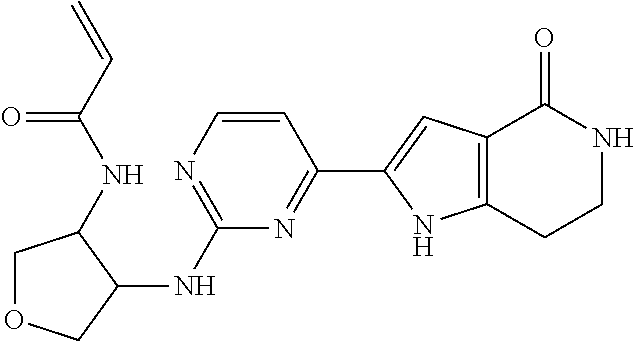 |
II-29 |
 |
II-30 |
 |
II-31 |
 |
II-32 |
 |
II-33 |
 |
II-34 |
 |
II-35 |
 |
II-36 |
 |
II-37 |
 |
II-38 |
 |
II-39 |
 |
II-40 |
 |
II-41 |
 |
II-42 |
 |
II-43 |
 |
II-44 |
 |
II-45 |
 |
II-46 |
 |
II-47 |

or a pharmaceutically acceptable salt thereof, wherein:
- Ring B′ is

or an optionally substituted group selected from a 3-8 membered saturated or partially unsaturated carbocyclic ring, a 4-7 membered heterocylic ring having 1-2 heteroatoms independently selected from nitrogen, oxygen, or sulfur, a 5-6 membered monocyclic heteroaryl ring having 1-4 heteroatoms independently selected from nitrogen, oxygen, or sulfur, a 7-10 membered bicyclic saturated, partially unsaturated or aryl ring which is optionally bridged, an 8-10 membered bicyclic heteroaryl ring having 1-5 heteroatoms independently selected from nitrogen, oxygen, or sulfur, or a 7-10 membered bicyclic saturated or partially unsaturated heterocyclic ring having 1-5 heteroatoms independently selected from nitrogen, oxygen, or sulfur; or
- Y1 is CR2 or N;
- Y2 is CR′ or N;
- each R′ is independently hydrogen, halo, or an optionally substituted group selected from C1a aliphatic, phenyl, a 3-8 membered saturated or partially unsaturated carbocyclic ring, a 4-7 membered heterocylic ring having 1-2 heteroatoms independently selected from nitrogen, oxygen, or sulfur, or a 5-6 membered monocyclic heteroaryl ring having 1-4 heteroatoms independently selected from nitrogen, oxygen, or sulfur;
- R1 is a warhead group;
- q is 0-6;
- each R2 is independently —R, halogen, —OR, —SR, —CN, —NO2, —SO2NR, —SO2R, —SOR, —C(O)R, —CO2R, —C(O)N(R)2, —NRC(O)R, —NRC(O)OR, —NRC(O)N(R)2, —NRSO2R, or —N(R)2;
- each R is independently hydrogen or an optionally substituted group selected from C1-6 aliphatic, phenyl, a 3-8 membered saturated or partially unsaturated carbocyclic ring, a 4-7 membered heterocylic ring having 1-2 heteroatoms independently selected from nitrogen, oxygen, or sulfur, or a 5-6 membered monocyclic heteroaryl ring having 1-4 heteroatoms independently selected from nitrogen, oxygen, or sulfur; or
- two R groups on the same nitrogen are taken together with the nitrogen atom to which they are attached to form a 4-7 membered heterocylic ring having 0-2 additional heteroatoms independently selected from nitrogen, oxygen, or sulfur, or a 4-7 membered heteroaryl ring having 0-4 additional heteroatoms independently selected from nitrogen, oxygen, or sulfur;
- R6 is hydrogen, an optionally substituted group selected from C1-6 aliphatic, phenyl, a 3-8 membered saturated or partially unsaturated carbocyclic ring, a 4-7 membered heterocylic ring having 1-2 heteroatoms independently selected from nitrogen, oxygen, or sulfur, or a 5-6 membered monocyclic heteroaryl ring having 1-4 heteroatoms independently selected from nitrogen, oxygen, or sulfur;
- R7 is hydrogen, an optionally substituted group selected from C1-6 aliphatic, phenyl, a 3-8 membered saturated or partially unsaturated carbocyclic ring, a 4-7 membered heterocylic ring having 1-2 heteroatoms independently selected from nitrogen, oxygen, or sulfur, or a 5-6 membered monocyclic heteroaryl ring having 1-4 heteroatoms independently selected from nitrogen, oxygen, or sulfur;
- or R6 and R7 are taken together to form a C2-6 alkylene or C2-6 alkenylene;
- R8 is hydrogen, an optionally substituted group selected from C1-6 aliphatic, phenyl, a 3-8 membered saturated or partially unsaturated carbocyclic ring, a 4-7 membered heterocylic ring having 1-2 heteroatoms independently selected from nitrogen, oxygen, or sulfur, or a 5-6 membered monocyclic heteroaryl ring having 1-4 heteroatoms independently selected from nitrogen, oxygen, or sulfur;
- R9 is hydrogen, an optionally substituted group selected from C1-6 aliphatic, phenyl, a 3-8 membered saturated or partially unsaturated carbocyclic ring, a 4-7 membered heterocylic ring having 1-2 heteroatoms independently selected from nitrogen, oxygen, or sulfur, or a 5-6 membered monocyclic heteroaryl ring having 1-4 heteroatoms independently selected from nitrogen, oxygen, or sulfur;
- or R8 and R9 are taken together with the carbon atom to which they are attached to form a 3-8 membered saturated or partially unsaturated carbocyclic ring, a 4-7 membered heterocylic ring having 1-2 heteroatoms independently selected from nitrogen, oxygen, or sulfur, or a 5-6 membered monocyclic heteroaryl ring having 1-4 heteroatoms independently selected from nitrogen, oxygen, or sulfur;
- each Ra is independently hydrogen or an optionally substituted C1-6 aliphatic group; and
- T is a covalent bond, —O—, —S—, —N(R)—, —C(O)—, —OC(O)—, —C(O)O—, —C(O)N(R)—, —N(R)C(O)—, —N(R)C(O)N(R)—, —S(O)—, —SO2—, —SO2N(R)—, —N(R)SO2—, or —N(R)SO2N(R)—.

wherein each of R1, R2, Y, and q is as defined above and described herein. In various embodiments, Ring B′ is

wherein Y1 is CH. In some embodiments, Y1 is N.


is selected from any one of the following structures:


or a pharmaceutically acceptable salt thereof, wherein each of R1, R2, Y2, T, and q is as defined above and described in embodiments, classes and subclasses above and herein, singly or in combination.
| TABLE 3 |
| Exemplary Compounds of Formula II-e |
 |
II-e-1 |
 |
II-e-2 |
 |
II-e-3 |
 |
II-e-4 |
 |
II-e-5 |
 |
II-e-6 |
 |
II-e-7 |
 |
II-e-8 |
 |
II-e-9 |
 |
II-e-10 |
 |
II-e-11 |
 |
II-e-12 |
 |
II-e-13 |
 |
II-e-14 |
 |
II-e-15 |
 |
II-e-17 |
 |
II-e-19 |
 |
II-e-20 |
 |
II-e-21 |
 |
II-e-22 |
 |
II-e-23 |

or a pharmaceutically acceptable salt thereof, wherein:
- Ring C is an optionally substituted group selected from

or a 3-8 membered saturated or partially unsaturated carbocyclic ring, a 4-7 membered heterocylic ring having 1-2 heteroatoms independently selected from nitrogen, oxygen, or sulfur, a 5-6 membered monocyclic heteroaryl ring having 1-4 heteroatoms independently selected from nitrogen, oxygen, or sulfur, a 7-10 membered bicyclic saturated, partially unsaturated or aryl ring which is optionally bridged, an 8-10 membered bicyclic heteroaryl ring having 1-5 heteroatoms independently selected from nitrogen, oxygen, or sulfur, or a 7-10 membered bicyclic saturated or partially unsaturated heterocyclic ring having 1-5 heteroatoms independently selected from nitrogen, oxygen, or sulfur; or
- Ring C′ is

or absent;
- wherein if Ring C′ is absent, then T is attached to the benzo ring para to S;
- Y1 is CR2 or N;
- Y2 is CR′ or N;
- each R′ is independently hydrogen, halo, or an optionally substituted group selected from C1-6 aliphatic, phenyl, a 3-8 membered saturated or partially unsaturated carbocyclic ring, a 4-7 membered heterocylic ring having 1-2 heteroatoms independently selected from nitrogen, oxygen, or sulfur, or a 5-6 membered monocyclic heteroaryl ring having 1-4 heteroatoms independently selected from nitrogen, oxygen, or sulfur;
- R1 is a warhead group;
- q is 0-6;
- each R2 is independently —R, halogen, —OR, —SR, —CN, —NO2, —SO2NR, —SO2R, —SOR, —C(O)R, —CO2R, —C(O)N(R)2, —NRC(O)R, —NRC(O)OR, —NRC(O)N(R)2, —NRSO2R, or —N(R)2;
- each R is independently hydrogen or an optionally substituted group selected from C1-6 aliphatic, phenyl, a 3-8 membered saturated or partially unsaturated carbocyclic ring, a 4-7 membered heterocylic ring having 1-2 heteroatoms independently selected from nitrogen, oxygen, or sulfur, or a 5-6 membered monocyclic heteroaryl ring having 1-4 heteroatoms independently selected from nitrogen, oxygen, or sulfur; or
- two R groups on the same nitrogen are taken together with the nitrogen atom to which they are attached to form a 4-7 membered heterocylic ring having 0-2 additional heteroatoms independently selected from nitrogen, oxygen, or sulfur, or a 4-7 membered heteroaryl ring having 0-4 additional heteroatoms independently selected from nitrogen, oxygen, or sulfur;
- R5 is hydrogen, an optionally substituted group selected from C1-6 aliphatic, phenyl, a 3-8 membered saturated or partially unsaturated carbocyclic ring, a 4-7 membered heterocylic ring having 1-2 heteroatoms independently selected from nitrogen, oxygen, or sulfur, or a 5-6 membered monocyclic heteroaryl ring having 1-4 heteroatoms independently selected from nitrogen, oxygen, or sulfur;
- each Ra is independently hydrogen or an optionally substituted C1-6 aliphatic group; and
- T is a covalent bond, —O—, —S—, —N(R)—, —C(O)—, —OC(O)—, —C(O)O—, —C(O)N(R)—, —N(R)C(O)—, —N(R)C(O)N(R)—, —S(O)—, —SO2—, —SO2N(R)—, —N(R)SO2—, or —N(R)SO2N(R)—.

wherein Y1 is CH (i.e., phenyl). In some embodiments, Y1 is N.


is selected from any one of the following structures:


In various embodiments, the invention provides a compound of formula III-a:

or a pharmaceutically acceptable salt thereof, wherein each of R1, R2, R5, Y1, Y2, T, and q is as defined above and described in embodiments, classes and subclasses above and herein, singly or in combination.

or a pharmaceutically acceptable salt thereof, wherein each of R1, R2, R5, Y1, and q is as defined above and described in embodiments, classes and subclasses above and herein, singly or in combination.

or a pharmaceutically acceptable salt thereof, wherein each of R1, R2, R5, Y1, Y2, T, and q is as defined above and described in embodiments, classes and subclasses above and herein, singly or in combination.

or a pharmaceutically acceptable salt thereof, wherein each of R1, R2, R5, T, and q is as defined above and described in embodiments, classes and subclasses above and herein, singly or in combination.

or a pharmaceutically acceptable salt thereof, wherein each of Ring C′, R1, R2, R5, T, and q is as defined above and described in embodiments, classes and subclasses above and herein, singly or in combination, wherein:
Ring C is


or a pharmaceutically acceptable salt thereof, wherein each of Ring C′, R1, R2, R5, T, and q is as defined above and described in embodiments, classes and subclasses above and herein, singly or in combination, wherein:
Ring C is

| TABLE 4 |
| Exemplary Compounds of Formula III |
 |
III-1 |
 |
III-2 |
 |
III-3 |
 |
III-4 |
 |
III-5 |
 |
III-6 |
 |
III-7 |
 |
III-8 |
 |
III-9 |
 |
III-10 |
 |
III-11 |
 |
III-12 |
 |
III-13 |
 |
III-14 |
 |
III-15 |
 |
III-16 |
 |
III-17 |
 |
III-18 |
 |
III-19 |
 |
III-20 |
 |
III-21 |
 |
III-22 |
 |
III-23 |
 |
III-24 |
 |
III-25 |
 |
III-26 |
 |
III-27 |
 |
III-28 |
 |
III-29 |
 |
III-30 |
 |
III-31 |
 |
III-32 |
 |
III-33 |
 |
III-34 |
 |
III-35 |
 |
III-36 |
 |
III-37 |
 |
III-38 |
 |
III-39 |
 |
III-40 |
 |
III-41 |
 |
III-42 |
 |
III-43 |
 |
III-44 |
 |
III-45 |
 |
III-46 |
 |
III-47 |
 |
III-48 |
 |
III-49 |
 |
III-50 |
 |
III-51 |
 |
III-52 |
 |
III-53 |
 |
III-54 |
 |
III-55 |
 |
III-56 |
 |
III-57 |
 |
III-58 |
 |
III-59 |
 |
III-61 |
 |
III-62 |
 |
III-63 |
 |
III-64 |
 |
III-65 |
 |
III-66 |
 |
III-67 |
 |
III-68 |
 |
III-69 |
 |
III-70 |
 |
III-71 |
 |
III-72 |
 |
III-73 |
 |
III-74 |

or a pharmaceutically acceptable salt thereof, wherein:
- Ring C″ is an optionally substituted group selected from

or a 3-8 membered saturated or partially unsaturated carbocyclic ring, a 4-7 membered heterocylic ring having 1-2 heteroatoms independently selected from nitrogen, oxygen, or sulfur, a 5-6 membered monocyclic heteroaryl ring having 1-4 heteroatoms independently selected from nitrogen, oxygen, or sulfur, a 7-10 membered bicyclic saturated, partially unsaturated or aryl ring which is optionally bridged, an 8-10 membered bicyclic heteroaryl ring having 1-5 heteroatoms independently selected from nitrogen, oxygen, or sulfur, or a 7-10 membered bicyclic saturated or partially unsaturated heterocyclic ring having 1-5 heteroatoms independently selected from nitrogen, oxygen, or sulfur;
- Y1 is CR2 or N;
- Y2 is CR′ or N;
- each R′ is independently hydrogen, halo, or an optionally substituted group selected from C1-6 aliphatic, phenyl, a 3-8 membered saturated or partially unsaturated carbocyclic ring, a 4-7 membered heterocylic ring having 1-2 heteroatoms independently selected from nitrogen, oxygen, or sulfur, or a 5-6 membered monocyclic heteroaryl ring having 1-4 heteroatoms independently selected from nitrogen, oxygen, or sulfur;
- R1 is a warhead group;
- q is 0-6;
- each R2 is independently —R, halogen, —OR, —SR, —CN, —NO2, —SO2NR, —SO2R, —SOR, —C(O)R, —CO2R, —C(O)N(R)2, —NRC(O)R, —NRC(O)OR, —NRC(O)N(R)2, —NRSO2R, or —N(R)2;
- each R is independently hydrogen or an optionally substituted group selected from C1-6 aliphatic, phenyl, a 3-8 membered saturated or partially unsaturated carbocyclic ring, a 4-7 membered heterocylic ring having 1-2 heteroatoms independently selected from nitrogen, oxygen, or sulfur, or a 5-6 membered monocyclic heteroaryl ring having 1-4 heteroatoms independently selected from nitrogen, oxygen, or sulfur; or
- two R groups on the same nitrogen are taken together with the nitrogen atom to which they are attached to form a 4-7 membered heterocylic ring having 0-2 additional heteroatoms independently selected from nitrogen, oxygen, or sulfur, or a 4-7 membered heteroaryl ring having 0-4 additional heteroatoms independently selected from nitrogen, oxygen, or sulfur;
- R5 is hydrogen, an optionally substituted group selected from C1-6 aliphatic, phenyl, a 3-8 membered saturated or partially unsaturated carbocyclic ring, a 4-7 membered heterocylic ring having 1-2 heteroatoms independently selected from nitrogen, oxygen, or sulfur, or a 5-6 membered monocyclic heteroaryl ring having 1-4 heteroatoms independently selected from nitrogen, oxygen, or sulfur;
- each Ra is independently hydrogen or an optionally substituted C1-6 aliphatic group; and
- T is a covalent bond, —O—, —S—, —N(R)—, —C(O)—, —OC(O)—, —C(O)O—, —C(O)N(R)—, —N(R)C(O)—, —N(R)C(O)N(R)—, —S(O)—, —SO2—, —SO2N(R)—, —N(R)SO2—, or —N(R)SO2N(R)—.

wherein Y1 is CH (i.e., phenyl). In some embodiments, Y1 is N.


| TABLE 5 |
| Exemplary Compounds of Formula III-d |
 |
III-d-1 |

or a pharmaceutically acceptable salt thereof, wherein:
- Ring D is an optionally substituted group selected from a fused 5-6 membered monocyclic heteroaryl ring having 0-2 additional heteroatoms independently selected from nitrogen, oxygen, or sulfur, and a fused 4-7 membered saturated or partially unsaturated heterocyclic ring having 1-3 additional heteroatoms independently selected from nitrogen, oxygen, or sulfur;
- Ring E is an optionally substituted group selected from phenyl, a 3-8 membered saturated or partially unsaturated carbocyclic ring which is optionally bridged, a 5-6 membered monocyclic heteroaryl ring having 1-4 heteroatoms independently selected from nitrogen, oxygen, or sulfur, and a 4-7 membered saturated or partially unsaturated heterocyclic ring having 1-3 heteroatoms independently selected from nitrogen, oxygen, or sulfur;
- Y1 is CR2 or N;
- each R′ is independently hydrogen, halo, or an optionally substituted group selected from C1-6 aliphatic, phenyl, a 3-8 membered saturated or partially unsaturated carbocyclic ring, a 4-7 membered heterocylic ring having 1-2 heteroatoms independently selected from nitrogen, oxygen, or sulfur, or a 5-6 membered monocyclic heteroaryl ring having 1-4 heteroatoms independently selected from nitrogen, oxygen, or sulfur;
- R1 is a warhead;
- q is 0-6;
- each R2 is independently —R, halogen, —OR, —SR, —CN, —NO2, —SO2NR, —SO2R, —SOR, —C(O)R, —CO2R, —C(O)N(R)2, —NRC(O)R, —NRC(O)OR, —NRC(O)N(R)2, —NRSO2R, or —N(R)2;
- each R is independently hydrogen or an optionally substituted group selected from C1-6 aliphatic, phenyl, a 3-8 membered saturated or partially unsaturated carbocyclic ring, a 4-7 membered heterocylic ring having 1-2 heteroatoms independently selected from nitrogen, oxygen, or sulfur, or a 5-6 membered monocyclic heteroaryl ring having 1-4 heteroatoms independently selected from nitrogen, oxygen, or sulfur; or two R groups on the same nitrogen are taken together with the nitrogen atom to which they are attached to form a 4-7 membered heterocylic ring having 0-2 additional heteroatoms independently selected from nitrogen, oxygen, or sulfur, or a 4-7 membered heteroaryl ring having 0-4 additional heteroatoms independently selected from nitrogen, oxygen, or sulfur;
- each Ra is independently hydrogen or an optionally substituted C1-6 aliphatic group; and
- T is a covalent bond, —O—, —S—, —N(R)—, —C(O)—, —OC(O)—, —C(O)O—, —C(O)N(R)—, —N(R)C(O)—, —N(R)C(O)N(R)—, —S(O)—, —SO2—, —SO2N(R)—, —N(R)SO2—, or —N(R)SO2N(R)—.


In some embodiments, Ring E is selected from those depicted in Table 6, below.


or a pharmaceutically acceptable salt thereof, wherein each of Ring E, R1, R2, Y1, T, and q is as defined above and described in embodiments, classes and subclasses above and herein, singly or in combination.
| TABLE 6 |
| Exemplary Compounds of Formula IV |
 |
IV-1 |
 |
IV-2 |
 |
IV-3 |
 |
IV-4 |

- or a pharmaceutically acceptable salt thereof, wherein:
- Ring D is an optionally substituted group selected from a fused 5-6 membered monocyclic heteroaryl ring having 0-2 additional heteroatoms independently selected from nitrogen, oxygen, or sulfur, and a fused 4-7 membered saturated or partially unsaturated heterocyclic ring having 1-3 additional heteroatoms independently selected from nitrogen, oxygen, or sulfur;
- Ring E is an optionally substituted group selected from phenyl, a 3-8 membered saturated or partially unsaturated carbocyclic ring, a 5-6 membered monocyclic heteroaryl ring having 1-4 heteroatoms independently selected from nitrogen, oxygen, or sulfur, and a 4-7 membered saturated or partially unsaturated heterocyclic ring having 1-3 heteroatoms independently selected from nitrogen, oxygen, or sulfur;
- R1 is a warhead group;
- each R2 is independently —R, halogen, —OR, —SR, —CN, —NO2, —SO2NR, —SO2R, —SOR, —C(O)R, —CO2R, —C(O)N(R)2, —NRC(O)R, —NRC(O)OR, —NRC(O)N(R)2, —NRSO2R, or —N(R)2;
- each R is independently hydrogen or an optionally substituted group selected from C1-6 aliphatic, phenyl, a 3-8 membered saturated or partially unsaturated carbocyclic ring, a 4-7 membered heterocylic ring having 1-2 heteroatoms independently selected from nitrogen, oxygen, or sulfur, or a 5-6 membered monocyclic heteroaryl ring having 1-4 heteroatoms independently selected from nitrogen, oxygen, or sulfur; or
- two R groups on the same nitrogen are taken together with the nitrogen atom to which they are attached to form a 4-7 membered heterocylic ring having 0-2 additional heteroatoms independently selected from nitrogen, oxygen, or sulfur, or a 4-7 membered heteroaryl ring having 0-4 additional heteroatoms independently selected from nitrogen, oxygen, or sulfur; and
- each Ra is independently hydrogen or an optionally substituted C1-6 aliphatic group.

In some embodiments, Ring D is selected from those depicted in Table 7, below.


In some embodiments, Ring E is selected from those depicted in Table 7, below.
| TABLE 7 |
| Exemplary Compounds of Formula IV-b |
 |
IV-b-1 | ||

- or a pharmaceutically acceptable salt thereof, wherein:
- Ring F is an optionally substituted group selected from phenyl, a 3-8 membered saturated or partially unsaturated carbocyclic ring, a 4-7 membered heterocylic ring having 1-2 heteroatoms independently selected from nitrogen, oxygen, or sulfur, a 5-6 membered monocyclic heteroaryl ring having 1-4 heteroatoms independently selected from nitrogen, oxygen, or sulfur, a 7-10 membered bicyclic saturated, partially unsaturated or aryl ring which is optionally bridged, an 8-10 membered bicyclic heteroaryl ring having 1-5 heteroatoms independently selected from nitrogen, oxygen, or sulfur, or a 7-10 membered bicyclic saturated or partially unsaturated heterocyclic ring having 1-5 heteroatoms independently selected from nitrogen, oxygen, or sulfur;
- R1 is a warhead group;
- q is 0-6;
- each R2 is independently —R, halogen, —OR, —SR, —CN, —NO2, —SO2NR, —SO2R, —SOR, —C(O)R, —CO2R, —C(O)N(R)2, —NRC(O)R, —NRC(O)OR, —NRC(O)N(R)2, —NRSO2R, or —N(R)2;
- each R is independently hydrogen or an optionally substituted group selected from C1-6 aliphatic, phenyl, a 3-8 membered saturated or partially unsaturated carbocyclic ring, a 4-7 membered heterocylic ring having 1-2 heteroatoms independently selected from nitrogen, oxygen, or sulfur, or a 5-6 membered monocyclic heteroaryl ring having 1-4 heteroatoms independently selected from nitrogen, oxygen, or sulfur; or
- two R groups on the same nitrogen are taken together with the nitrogen atom to which they are attached to form a 4-7 membered heterocylic ring having 0-2 additional heteroatoms independently selected from nitrogen, oxygen, or sulfur, or a 4-7 membered heteroaryl ring having 0-4 additional heteroatoms independently selected from nitrogen, oxygen, or sulfur;
- R10 is hydrogen, an optionally substituted group selected from C1-6 aliphatic, phenyl, a 3-8 membered saturated or partially unsaturated carbocyclic ring, a 4-7 membered heterocylic ring having 1-2 heteroatoms independently selected from nitrogen, oxygen, or sulfur, or a 5-6 membered monocyclic heteroaryl ring having 1-4 heteroatoms independently selected from nitrogen, oxygen, or sulfur;
- R11 is hydrogen, an optionally substituted group selected from C1-6 aliphatic, phenyl, a 3-8 membered saturated or partially unsaturated carbocyclic ring, a 4-7 membered heterocylic ring having 1-2 heteroatoms independently selected from nitrogen, oxygen, or sulfur, or a 5-6 membered monocyclic heteroaryl ring having 1-4 heteroatoms independently selected from nitrogen, oxygen, or sulfur;
- or R10 and R11 are taken together with the carbon atom to which they are attached to form a 3-8 membered saturated or partially unsaturated carbocyclic ring, a 4-7 membered heterocylic ring having 1-2 heteroatoms independently selected from nitrogen, oxygen, or sulfur, or a 5-6 membered monocyclic heteroaryl ring having 1-4 heteroatoms independently selected from nitrogen, oxygen, or sulfur;
- n is 1 or 2;
- each Ra is independently hydrogen or an optionally substituted C1-6 aliphatic group; and
- T is a covalent bond, —O—, —S—, —N(R)—, —C(O)—, —OC(O)—, —C(O)O—, —C(O)N(R)—, —N(R)C(O)—, —N(R)C(O)N(R)—, —S(O)—, —SO2—, —SO2N(R)—, —N(R)SO2—, or —N(R)SO2N(R)—.


In some embodiments, Ring F is selected from those depicted in Table 8, below.


is selected from any one of the following structures:


or a pharmaceutically acceptable salt thereof, wherein each of Ring F, R1, R2, T, and q is as defined above and described in embodiments, classes and subclasses above and herein, singly or in combination.

or a pharmaceutically acceptable salt thereof, wherein each of Ring F, R1, R2, T, and q is as defined above and described in embodiments, classes and subclasses above and herein, singly or in combination.
| TABLE 8 |
| Exemplary Compounds of Formula V |
 |
V-1 |
 |
V-2 |
 |
V-3 |
 |
V-4 |
 |
V-5 |
 |
V-6 |
 |
V-7 |
 |
V-8 |
 |
V-9 |
 |
V-10 |
 |
V-11 |
 |
V-12 |
 |
V-13 |
 |
V-14 |
 |
V-15 |
 |
V-16 |
 |
V-17 |
 |
V-18 |
 |
V-19 |
 |
V-20 |
 |
V-21 |
 |
V-22 |
 |
V-23 |
 |
V-24 |
 |
V-25 |
 |
V-26 |
 |
V-27 |
 |
V-28 |
 |
V-29 |
 |
V-30 |
 |
V-31 |
 |
V-32 |
 |
V-33 |
 |
V-34 |
 |
V-35 |
 |
V-36 |
 |
V-37 |
 |
V-38 |
 |
V-39 |
 |
V-40 |
 |
V-41 |
 |
V-42 |
 |
V-43 |
 |
V-44 |
 |
V-45 |
 |
V-46 |
 |
V-47 |
 |
V-48 |
 |
V-49 |
 |
V-50 |
 |
V-51 |
 |
V-52 |
 |
V-53 |
 |
V-54 |
 |
V-55 |
 |
V-56 |
 |
V-57 |
 |
V-58 |
 |
V-59 |
 |
V-60 |
 |
V-61 |
 |
V-62 |
 |
V-63 |
 |
V-64 |

or a pharmaceutically acceptable salt thereof, wherein:
- Ring F′ is an optionally substituted group selected from phenyl, a 3-8 membered saturated or partially unsaturated carbocyclic ring, a 4-7 membered heterocylic ring having 1-2 heteroatoms independently selected from nitrogen, oxygen, or sulfur, a 5-6 membered monocyclic heteroaryl ring having 1-4 heteroatoms independently selected from nitrogen, oxygen, or sulfur, a 7-10 membered bicyclic saturated, partially unsaturated or aryl ring which is optionally bridged, an 8-10 membered bicyclic heteroaryl ring having 1-5 heteroatoms independently selected from nitrogen, oxygen, or sulfur, or a 7-10 membered bicyclic saturated or partially unsaturated heterocyclic ring having 1-5 heteroatoms independently selected from nitrogen, oxygen, or sulfur;
- R1 is a warhead group;
- q is 0-6;
- each R2 is independently —R, halogen, —OR, —SR, —CN, —NO2, —SO2NR, —SO2R, —SOR, —C(O)R, —CO2R, —C(O)N(R)2, —NRC(O)R, —NRC(O)OR, —NRC(O)N(R)2, —NRSO2R, or —N(R)2;
- each R is independently hydrogen or an optionally substituted group selected from C1-6 aliphatic, phenyl, a 3-8 membered saturated or partially unsaturated carbocyclic ring, a 4-7 membered heterocylic ring having 1-2 heteroatoms independently selected from nitrogen, oxygen, or sulfur, or a 5-6 membered monocyclic heteroaryl ring having 1-4 heteroatoms independently selected from nitrogen, oxygen, or sulfur; or
- two R groups on the same nitrogen are taken together with the nitrogen atom to which they are attached to form a 4-7 membered heterocylic ring having 0-2 additional heteroatoms independently selected from nitrogen, oxygen, or sulfur, or a 4-7 membered heteroaryl ring having 0-4 additional heteroatoms independently selected from nitrogen, oxygen, or sulfur;
- Y2 is CR′ or N;
- each R′ is independently hydrogen, halo, or an optionally substituted group selected from C1-6 aliphatic, phenyl, a 3-8 membered saturated or partially unsaturated carbocyclic ring, a 4-7 membered heterocylic ring having 1-2 heteroatoms independently selected from nitrogen, oxygen, or sulfur, or a 5-6 membered monocyclic heteroaryl ring having 1-4 heteroatoms independently selected from nitrogen, oxygen, or sulfur;
- R10 is hydrogen, an optionally substituted group selected from C1-6 aliphatic, phenyl, a 3-8 membered saturated or partially unsaturated carbocyclic ring, a 4-7 membered heterocylic ring having 1-2 heteroatoms independently selected from nitrogen, oxygen, or sulfur, or a 5-6 membered monocyclic heteroaryl ring having 1-4 heteroatoms independently selected from nitrogen, oxygen, or sulfur;
- R11 is hydrogen, an optionally substituted group selected from C1-6 aliphatic, phenyl, a 3-8 membered saturated or partially unsaturated carbocyclic ring, a 4-7 membered heterocylic ring having 1-2 heteroatoms independently selected from nitrogen, oxygen, or sulfur, or a 5-6 membered monocyclic heteroaryl ring having 1-4 heteroatoms independently selected from nitrogen, oxygen, or sulfur;
- or R10 and R11 are taken together with the carbon atom to which they are attached to form a 3-8 membered saturated or partially unsaturated carbocyclic ring, a 4-7 membered heterocylic ring having 1-2 heteroatoms independently selected from nitrogen, oxygen, or sulfur, or a 5-6 membered monocyclic heteroaryl ring having 1-4 heteroatoms independently selected from nitrogen, oxygen, or sulfur;
- n is 1 or 2;
- each Ra is independently hydrogen or an optionally substituted C1-6 aliphatic group; and
- T is a covalent bond, —O—, —S—, —N(R)—, —C(O)—, —OC(O)—, —C(O)O—, —C(O)N(R)—, —N(R)C(O)—, —N(R)C(O)N(R)—, —S(O)—, —SO2—, —SO2N(R)—, —N(R)SO2—, or —N(R)SO2N(R)—.


In some embodiments, Ring F is selected from those depicted in Table 9, below.


or a pharmaceutically acceptable salt thereof, wherein each of Ring F′, R1, R2, R10, R11, T, and q is as defined above and described in embodiments, classes and subclasses above and herein, singly or in combination.
| TABLE 9 |
| Exemplary Compounds of Formula V-c |
 |
V-c-1 |
 |
V-c-2 |
 |
V-c-3 |

or a pharmaceutically acceptable salt thereof, wherein:
- Ring G is an optionally substituted group selected from phenyl, a 3-8 membered saturated or partially unsaturated carbocyclic ring, a 4-7 membered heterocylic ring having 1-2 heteroatoms independently selected from nitrogen, oxygen, or sulfur, a 5-6 membered monocyclic heteroaryl ring having 1-4 heteroatoms independently selected from nitrogen, oxygen, or sulfur, a 7-10 membered bicyclic saturated, partially unsaturated or aryl ring which is optionally bridged, an 8-10 membered bicyclic heteroaryl ring having 1-5 heteroatoms independently selected from nitrogen, oxygen, or sulfur, or a 7-10 membered bicyclic saturated or partially unsaturated heterocyclic ring having 1-5 heteroatoms independently selected from nitrogen, oxygen, or sulfur;
- or Ring G is absent, and R1 is attached to T;
- Y2 is CR′ or N;
- each R′ is independently hydrogen, halo, or an optionally substituted group selected from C1-6 aliphatic, phenyl, a 3-8 membered saturated or partially unsaturated carbocyclic ring, a 4-7 membered heterocylic ring having 1-2 heteroatoms independently selected from nitrogen, oxygen, or sulfur, or a 5-6 membered monocyclic heteroaryl ring having 1-4 heteroatoms independently selected from nitrogen, oxygen, or sulfur;
- R1 is a warhead group;
- q is 0-6;
- each R2 is independently —R, halogen, —OR, —SR, —CN, —NO2, —SO2NR, —SO2R, —SOR, —C(O)R, —CO2R, —C(O)N(R)2, —NRC(O)R, —NRC(O)OR, —NRC(O)N(R)2, —NRSO2R, or —N(R)2;
- each R is independently hydrogen or an optionally substituted group selected from C1-6 aliphatic, phenyl, a 3-8 membered saturated or partially unsaturated carbocyclic ring, a 4-7 membered heterocylic ring having 1-2 heteroatoms independently selected from nitrogen, oxygen, or sulfur, or a 5-6 membered monocyclic heteroaryl ring having 1-4 heteroatoms independently selected from nitrogen, oxygen, or sulfur; or
- two R groups on the same nitrogen are taken together with the nitrogen atom to which they are attached to form a 4-7 membered heterocylic ring having 0-2 additional heteroatoms independently selected from nitrogen, oxygen, or sulfur, or a 4-7 membered heteroaryl ring having 0-4 additional heteroatoms independently selected from nitrogen, oxygen, or sulfur;
- R12 is hydrogen, an optionally substituted group selected from C1-6 aliphatic, phenyl, a 3-8 membered saturated or partially unsaturated carbocyclic ring, a 4-7 membered heterocylic ring having 1-2 heteroatoms independently selected from nitrogen, oxygen, or sulfur, or a 5-6 membered monocyclic heteroaryl ring having 1-4 heteroatoms independently selected from nitrogen, oxygen, or sulfur;
- each Ra is independently hydrogen or an optionally substituted C1-6 aliphatic group; and
- T is a covalent bond, —O—, —S—, —N(R)—, —C(O)—, —OC(O)—, —C(O)O—, —C(O)N(R)—, —N(R)C(O)—, —N(R)C(O)N(R)—, —S(O)—, —SO2—, —SO2N(R)—, —N(R)SO2—, or —N(R)SO2N(R)—.


In some embodiments, R12 is selected from those depicted in Table 10, below.

or a pharmaceutically acceptable salt thereof, wherein each of Ring G, R1, R2, Y2, T, and q is as defined above and described in embodiments, classes and subclasses above and herein, singly or in combination.

or a pharmaceutically acceptable salt thereof, wherein each of Ring G, R1, R12, Y2, T, and q is as defined above and described in embodiments, classes and subclasses above and herein, singly or in combination.
| TABLE 10 |
| Exemplary Compounds of Formula VI |
 |
VI-1 |
 |
VI-2 |
 |
VI-3 |
 |
VI-4 |
 |
VI-5 |
 |
VI-6 |
 |
VI-7 |
 |
VI-8 |
 |
VI-9 |
 |
VI-10 |

- L is a covalent bond or a bivalent C1-8 saturated or unsaturated, straight or branched, hydrocarbon chain, wherein one, two, or three methylene units of L are optionally and independently replaced by cyclopropylene, —NR—, —N(R)C(O)—, —C(O)N(R)—, —N(R)SO2—, —SO2N(R)—, —O—, —C(O)—, —OC(O)—, —C(O)O—, —S—, —SO—, —SO2—, —C(═S)—, —C(═NR)—, —N═N—, or —C(═N2)—;
- Y is hydrogen, C1-6 aliphatic optionally substituted with oxo, halogen, NO2, or CN, or a 3-10 membered monocyclic or bicyclic, saturated, partially unsaturated, or aryl ring having 0-3 heteroatoms independently selected from nitrogen, oxygen, or sulfur, and wherein said ring is substituted with 1-4 Re groups; and
- each Re is independently selected from -Q-Z, oxo, NO2, halogen, CN, a suitable leaving group, or a C1-6 aliphatic optionally substituted with oxo, halogen, NO2, or CN, wherein:
- Q is a covalent bond or a bivalent C1-6 saturated or unsaturated, straight or branched, hydrocarbon chain, wherein one or two methylene units of Q are optionally and independently replaced by —N(R)—, —S—, —O—, —C(O)—, —OC(O)—, —C(O)O—, —SO—, or —SO2—, —N(R)C(O)—, —C(O)N(R)—, —N(R)SO2—, or —SO2N(R)—; and
- Z is hydrogen or C1-6 aliphatic optionally substituted with oxo, halogen, NO2, or CN.

wherein each R, Q, Z, and Re is as defined above and described herein. In certain embodiments, Y is piperazine.

wherein R is as defined above and described herein. In certain embodiments, Y is cyclopropyl optionally substituted with halogen, CN or NO2.

wherein each Re is as defined above and described herein.

wherein each R and Re is as defined above and described herein.

wherein each Re is as defined above and described herein.

wherein each R and Re is as defined above and described herein.
- (a) L is a bivalent C2-8 straight or branched, hydrocarbon chain wherein L has at least one double bond and one or two additional methylene units of L are optionally and independently replaced by —NRC(O)—, —C(O)NR—, —N(R)SO2—, —SO2N(R)—, —S—, —S(O)—, —SO2—, —OC(O)—, —C(O)O—, cyclopropylene, —O—, —N(R)—, or —C(O)—; and Y is hydrogen or C1-6 aliphatic optionally substituted with oxo, halogen, NO2, or CN; or
- (b) L is a bivalent C2-8 straight or branched, hydrocarbon chain wherein L has at least one double bond and at least one methylene unit of L is replaced by —C(O)—, —NRC(O)—, —C(O)NR—, —N(R)SO2—, —SO2N(R)—, —S—, —S(O)—, —SO2—, —OC(O)—, or —C(O)O—, and one or two additional methylene units of L are optionally and independently replaced by cyclopropylene, —O—, —N(R)—, or —C(O)—; and Y is hydrogen or C1-6 aliphatic optionally substituted with oxo, halogen, NO2, or CN; or
- (c) L is a bivalent C2-8 straight or branched, hydrocarbon chain wherein L has at least one double bond and at least one methylene unit of L is replaced by —C(O)—, and one or two additional methylene units of L are optionally and independently replaced by cyclopropylene, —O—, —N(R)—, or —C(O)—; and Y is hydrogen or C1-6 aliphatic optionally substituted with oxo, halogen, NO2, or CN; or
- (d) L is a bivalent C2-8 straight or branched, hydrocarbon chain wherein L has at least one double bond and at least one methylene unit of L is replaced by —C(O)—; and Y is hydrogen or C1-6 aliphatic optionally substituted with oxo, halogen, NO2, or CN; or
- (e) L is a bivalent C2-8 straight or branched, hydrocarbon chain wherein L has at least one double bond and at least one methylene unit of L is replaced by —OC(O)—; and Y is hydrogen or C1-6 aliphatic optionally substituted with oxo, halogen, NO2, or CN; or
- (f) L is —NRC(O)CH═CH—, —NRC(O)CH═CHCH2N(CH3)—, —NRC(O)CH═CHCH2O—, —CH2NRC(O)CH═CH—, —NRSO2CH═CH—, —NRSO2CH═CHCH2—, —NRC(O)(C═N2)—, —NRC(O)(C═N2)C(O)—, —NRC(O)CH═CHCH2N(CH3)—, —NRSO2CH═CH—, —NRSO2CH═CHCH2—, —NRC(O)CH═CHCH2O—, —NRC(O)C(═CH2)CH2—, —CH2NRC(O)—, —CH2NRC(O)CH═CH—, —CH2CH2NRC(O)—, or —CH2NRC(O)cyclopropylene-; wherein R is H or optionally substituted C1-6 aliphatic; and Y is hydrogen or C1-6 aliphatic optionally substituted with oxo, halogen, NO2, or CN; or
- (g) L is —NHC(O)CH═CH—, —NHC(O)CH═CHCH2N(CH3)—, —NHC(O)CH═CHCH2O—, —CH2NHC(O)CH═CH—, —NHSO2CH═CH—, —NHSO2CH═CHCH2—, —NHC(O)(C═N2)—, —NHC(O)(C═N2)C(O)—, —NHC(O)CH═CHCH2N(CH3)—, —NHSO2CH═CH—, —NHSO2CH═CHCH2—, —NHC(O)CH═CHCH2O—, —NHC(O)C(═CH2)CH2—, —CH2NHC(O)—, —CH2NHC(O)CH═CH—, —CH2CH2NHC(O)—, or —CH2NHC(O)cyclopropylene-; and Y is hydrogen or C1-6 aliphatic optionally substituted with oxo, halogen, NO2, or CN; or
- (h) L is a bivalent C2-8 straight or branched, hydrocarbon chain wherein L has at least one alkylidenyl double bond and at least one methylene unit of L is replaced by —C(O)—, —NRC(O)—, —C(O)NR—, —N(R)SO2—, —SO2N(R)—, —S—, —S(O)—, —SO2—, —OC(O)—, or —C(O)O—, and one or two additional methylene units of L are optionally and independently replaced by cyclopropylene, —O—, —N(R)—, or —C(O)—; and Y is hydrogen or C1-6 aliphatic optionally substituted with oxo, halogen, NO2, or CN; or
- (i) is a bivalent C2-8 straight or branched, hydrocarbon chain wherein L has at least one triple bond and one or two additional methylene units of L are optionally and independently replaced by —NRC(O)—, —C(O)NR—, —N(R)SO2—, —SO2N(R)—, —S—, —S(O)—, —SO2—, —OC(O)—, or —C(O)O—, and Y is hydrogen or C1-6 aliphatic optionally substituted with oxo, halogen, NO2, or CN; or
- (j) L is —C≡C—, —C≡CCH2N(isopropyl)-, —NHC(O)C≡CCH2CH2—, —CH2—C≡C—CH2—, —C≡CCH2O—, —CH2C(O)C≡C—, —C(O)C≡C—, or —CH2OC(═O)C≡C—; and Y is hydrogen or C1-6 aliphatic optionally substituted with oxo, halogen, NO2, or CN; or
- (k) L is a bivalent C2-8 straight or branched, hydrocarbon chain wherein one methylene unit of L is replaced by cyclopropylene and one or two additional methylene units of L are independently replaced by —NRC(O)—, —C(O)NR—, —N(R)SO2—, —SO2N(R)—, —S—, —S(O)—, —SO2—, —OC(O)—, or —C(O)O—; and Y is hydrogen or C1-6 aliphatic optionally substituted with oxo, halogen, NO2, or CN; or
- (l) L is a covalent bond and Y is selected from:
- (i) C1-6 alkyl substituted with oxo, halogen, NO2, or CN;
- (ii) C2-6 alkenyl optionally substituted with oxo, halogen, NO2, or CN; or
- (iii) C2-6 alkynyl optionally substituted with oxo, halogen, NO2, or CN; or
- (iv) a saturated 3-4 membered heterocyclic ring having 1 heteroatom selected from oxygen or nitrogen wherein said ring is substituted with 1-2 Re groups, wherein each Re is as defined above and described herein; or
- (v) a saturated 5-6 membered heterocyclic ring having 1-2 heteroatom selected from oxygen or nitrogen wherein said ring is substituted with 1-4 Re groups, wherein each Re is as defined above and described herein; or

wherein each R, Q, Z, and Re is as defined above and described herein; or
- (vii) a saturated 3-6 membered carbocyclic ring, wherein said ring is substituted with 1-4 Regroups, wherein each Re is as defined above and described herein; or
- (viii) a partially unsaturated 3-6 membered monocyclic ring having 0-3 heteroatoms independently selected from nitrogen, oxygen, or sulfur, wherein said ring is substituted with 1-4 Re groups, wherein each Re is as defined above and described herein; or
- (ix) a partially unsaturated 3-6 membered carbocyclic ring, wherein said ring is substituted with 1-4 Re groups, wherein each Re is as defined above and described herein; or

wherein each Re is as defined above and described herein; or
- (xi) a partially unsaturated 4-6 membered heterocyclic ring having 1-2 heteroatoms independently selected from nitrogen, oxygen, or sulfur, wherein said ring is substituted with 1-4 Re groups, wherein each Re is as defined above and described herein; or

-
- wherein each R and Re is as defined above and described herein; or
- (xiii) a 6-membered aromatic ring having 0-2 nitrogens wherein said ring is substituted with 1-4 Re groups, wherein each Re group is as defined above and described herein; or

wherein each Re is as defined above and described herein; or
- (xv) a 5-membered heteroaryl ring having 1-3 heteroatoms independently selected from nitrogen, oxygen, or sulfur, wherein said ring is substituted with 1-3 Re groups, wherein each Re group is as defined above and described herein; or

-
- wherein each R and Re is as defined above and described herein; or
- (xvii) an 8-10 membered bicyclic, saturated, partially unsaturated, or aryl ring having 0-3 heteroatoms independently selected from nitrogen, oxygen, or sulfur, wherein said ring is substituted with 1-4 Re groups, wherein Re is as defined above and described herein;
- (m) L is —C(O)— and Y is selected from:
- (i) C1-6 alkyl substituted with oxo, halogen, NO2, or CN; or
- (ii) C2-6 alkenyl optionally substituted with oxo, halogen, NO2, or CN; or
- (iii) C2-6 alkynyl optionally substituted with oxo, halogen, NO2, or CN; or
- (iv) a saturated 3-4 membered heterocyclic ring having 1 heteroatom selected from oxygen or nitrogen wherein said ring is substituted with 1-2 Re groups, wherein each Re is as defined above and described herein; or
- (v) a saturated 5-6 membered heterocyclic ring having 1-2 heteroatom selected from oxygen or nitrogen wherein said ring is substituted with 1-4 Re groups, wherein each Re is as defined above and described herein; or

wherein each R, Q, Z, and Re is as defined above and described herein; or
- (vii) a saturated 3-6 membered carbocyclic ring, wherein said ring is substituted with 1-4 Regroups, wherein each Re is as defined above and described herein; or
- (viii) a partially unsaturated 3-6 membered monocyclic ring having 0-3 heteroatoms independently selected from nitrogen, oxygen, or sulfur, wherein said ring is substituted with 1-4 Re groups, wherein each Re is as defined above and described herein; or
- (ix) a partially unsaturated 3-6 membered carbocyclic ring, wherein said ring is substituted with 1-4 Re groups, wherein each Re is as defined above and described herein; or

wherein each Re is as defined above and described herein; or
- (xi) a partially unsaturated 4-6 membered heterocyclic ring having 1-2 heteroatoms independently selected from nitrogen, oxygen, or sulfur, wherein said ring is substituted with 1-4 Re groups, wherein each Re is as defined above and described herein; or

-
- wherein each R and Re is as defined above and described herein; or
- (xiii) a 6-membered aromatic ring having 0-2 nitrogens wherein said ring is substituted with 1-4 Re groups, wherein each Re group is as defined above and described herein; or

wherein each Re is as defined above and described herein; or
- (xv) a 5-membered heteroaryl ring having 1-3 heteroatoms independently selected from nitrogen, oxygen, or sulfur, wherein said ring is substituted with 1-3 Re groups, wherein each Re group is as defined above and described herein; or

-
- wherein each R and Re is as defined above and described herein; or
- (xvii) an 8-10 membered bicyclic, saturated, partially unsaturated, or aryl ring having 0-3 heteroatoms independently selected from nitrogen, oxygen, or sulfur, wherein said ring is substituted with 1-4 Re groups, wherein Re is as defined above and described herein;
- (n) L is —N(R)C(O)— and Y is selected from:
- (i) C1-6 alkyl substituted with oxo, halogen, NO2, or CN; or
- (ii) C2-6 alkenyl optionally substituted with oxo, halogen, NO2, or CN; or
- (iii) C2-6 alkynyl optionally substituted with oxo, halogen, NO2, or CN; or
- (iv) a saturated 3-4 membered heterocyclic ring having 1 heteroatom selected from oxygen or nitrogen wherein said ring is substituted with 1-2 Re groups, wherein each Re is as defined above and described herein; or
- (v) a saturated 5-6 membered heterocyclic ring having 1-2 heteroatom selected from oxygen or nitrogen wherein said ring is substituted with 1-4 Re groups, wherein each Re is as defined above and described herein; or

wherein each R, Q, Z, and Re is as defined above and described herein; or
- (vii) a saturated 3-6 membered carbocyclic ring, wherein said ring is substituted with 1-4 Regroups, wherein each Re is as defined above and described herein; or
- (viii) a partially unsaturated 3-6 membered monocyclic ring having 0-3 heteroatoms independently selected from nitrogen, oxygen, or sulfur, wherein said ring is substituted with 1-4 Re groups, wherein each Re is as defined above and described herein; or
- (ix) a partially unsaturated 3-6 membered carbocyclic ring, wherein said ring is substituted with 1-4 Re groups, wherein each Re is as defined above and described herein; or

wherein each Re is as defined above and described herein; or
- (xi) a partially unsaturated 4-6 membered heterocyclic ring having 1-2 heteroatoms independently selected from nitrogen, oxygen, or sulfur, wherein said ring is substituted with 1-4 Re groups, wherein each Re is as defined above and described herein; or

-
- wherein each R and Re is as defined above and described herein; or
- (xiii) a 6-membered aromatic ring having 0-2 nitrogens wherein said ring is substituted with 1-4 Re groups, wherein each Re group is as defined above and described herein; or

wherein each Re is as defined above and described herein; or
- (xv) a 5-membered heteroaryl ring having 1-3 heteroatoms independently selected from nitrogen, oxygen, or sulfur, wherein said ring is substituted with 1-3 Re groups, wherein each Re group is as defined above and described herein; or

-
- wherein each R and Re is as defined above and described herein; or
- (xvii) an 8-10 membered bicyclic, saturated, partially unsaturated, or aryl ring having 0-3 heteroatoms independently selected from nitrogen, oxygen, or sulfur, wherein said ring is substituted with 1-4 Re groups, wherein Re is as defined above and described herein;
- (o) L is a bivalent C1-8 saturated or unsaturated, straight or branched, hydrocarbon chain; and Y is selected from:
- (i) C1-6 alkyl substituted with oxo, halogen, NO2, or CN;
- (ii) C2-6 alkenyl optionally substituted with oxo, halogen, NO2, or CN; or
- (iii) C2-6 alkynyl optionally substituted with oxo, halogen, NO2, or CN; or
- (iv) a saturated 3-4 membered heterocyclic ring having 1 heteroatom selected from oxygen or nitrogen wherein said ring is substituted with 1-2 Re groups, wherein each Re is as defined above and described herein; or
- (v) a saturated 5-6 membered heterocyclic ring having 1-2 heteroatom selected from oxygen or nitrogen wherein said ring is substituted with 1-4 Re groups, wherein each Re is as defined above and described herein; or

wherein each R, Q, Z, and Re is as defined above and described herein; or
- (vii) a saturated 3-6 membered carbocyclic ring, wherein said ring is substituted with 1-4 Regroups, wherein each Re is as defined above and described herein; or
- (viii) a partially unsaturated 3-6 membered monocyclic ring having 0-3 heteroatoms independently selected from nitrogen, oxygen, or sulfur, wherein said ring is substituted with 1-4 Re groups, wherein each Re is as defined above and described herein; or
- (ix) a partially unsaturated 3-6 membered carbocyclic ring, wherein said ring is substituted with 1-4 Re groups, wherein each Re is as defined above and described herein; or

wherein each Re is as defined above and described herein; or
- (xi) a partially unsaturated 4-6 membered heterocyclic ring having 1-2 heteroatoms independently selected from nitrogen, oxygen, or sulfur, wherein said ring is substituted with 1-4 Re groups, wherein each Re is as defined above and described herein; or

-
- wherein each R and Re is as defined above and described herein; or
- (xiii) a 6-membered aromatic ring having 0-2 nitrogens wherein said ring is substituted with 1-4 Re groups, wherein each Re group is as defined above and described herein; or

wherein each Re is as defined above and described herein; or
- (xv) a 5-membered heteroaryl ring having 1-3 heteroatoms independently selected from nitrogen, oxygen, or sulfur, wherein said ring is substituted with 1-3 Re groups, wherein each Re group is as defined above and described herein; or

-
- wherein each R and Re is as defined above and described herein; or
- (xvii) an 8-10 membered bicyclic, saturated, partially unsaturated, or aryl ring having 0-3 heteroatoms independently selected from nitrogen, oxygen, or sulfur, wherein said ring is substituted with 1-4 Re groups, wherein Re is as defined above and described herein;
- (p) L is a covalent bond, —CH2—, —NH—, —C(O)—, —CH2NH—, —NHCH2—, —NHC(O)—, —NHC(O)CH2OC(O)—, —CH2NHC(O)—, —NHSO2—, —NHSO2CH2—, —NHC(O)CH2OC(O)—, or —SO2NH—; and Y is selected from:
- (i) C1-6 alkyl substituted with oxo, halogen, NO2, or CN; or
- (ii) C2-6 alkenyl optionally substituted with oxo, halogen, NO2, or CN; or
- (iii) C2-6 alkynyl optionally substituted with oxo, halogen, NO2, or CN; or
- (iv) a saturated 3-4 membered heterocyclic ring having 1 heteroatom selected from oxygen or nitrogen wherein said ring is substituted with 1-2 Re groups, wherein each Re is as defined above and described herein; or
- (v) a saturated 5-6 membered heterocyclic ring having 1-2 heteroatom selected from oxygen or nitrogen wherein said ring is substituted with 1-4 Re groups, wherein each Re is as defined above and described herein; or

wherein each R, Q, Z, and Re is as defined above and described herein; or
- (vii) a saturated 3-6 membered carbocyclic ring, wherein said ring is substituted with 1-4 Regroups, wherein each Re is as defined above and described herein; or
- (viii) a partially unsaturated 3-6 membered monocyclic ring having 0-3 heteroatoms independently selected from nitrogen, oxygen, or sulfur, wherein said ring is substituted with 1-4 Re groups, wherein each Re is as defined above and described herein; or
- (ix) a partially unsaturated 3-6 membered carbocyclic ring, wherein said ring is substituted with 1-4 Re groups, wherein each Re is as defined above and described herein; or

wherein each Re is as defined above and described herein; or
- (xi) a partially unsaturated 4-6 membered heterocyclic ring having 1-2 heteroatoms independently selected from nitrogen, oxygen, or sulfur, wherein said ring is substituted with 1-4 Re groups, wherein each Re is as defined above and described herein; or

-
- wherein each R and Re is as defined above and described herein; or
- (xiii) a 6-membered aromatic ring having 0-2 nitrogens wherein said ring is substituted with 1-4 Re groups, wherein each Re group is as defined above and described herein; or

wherein each Re is as defined above and described herein; or
- (xv) a 5-membered heteroaryl ring having 1-3 heteroatoms independently selected from nitrogen, oxygen, or sulfur, wherein said ring is substituted with 1-3 Re groups, wherein each Re group is as defined above and described herein; or

-
- wherein each R and Re is as defined above and described herein; or
- (xvii) an 8-10 membered bicyclic, saturated, partially unsaturated, or aryl ring having 0-3 heteroatoms independently selected from nitrogen, oxygen, or sulfur, wherein said ring is substituted with 1-4 Re groups, wherein Re is as defined above and described herein.
- (q) L is a bivalent C2-8 straight or branched, hydrocarbon chain wherein two or three methylene units of L are optionally and independently replaced by —NRC(O)—, —C(O)NR—, —N(R)SO2—, —SO2N(R)—, —S—, —S(O)—, —SO2—, —OC(O)—, —C(O)O—, cyclopropylene, —O—, —N(R)—, or —C(O)—; and Y is hydrogen or C1-6 aliphatic optionally substituted with oxo, halogen, NO2, or CN.
- (r) L-Y is “pro-warhead” that is converted in vitro or in vivo to an irreversible warhead. In
certain embodiments, L-Y is

wherein LG is a leaving group as understood
by one of ordinary skill in the art. In certain embodiments, L-Y is

wherein R is as defined and described above and herein. In certain embodiments, the “pro-warhead” is converted to a warhead group (e.g., an acrylamide group) according to the following:

Such “pro-warheads” are applicable to any α,β unsaturated system, e.g.,

- L is a covalent bond or a bivalent C1-8 saturated or unsaturated, straight or branched, hydrocarbon chain, wherein one, two, or three methylene units of L are optionally and independently replaced by —N(R)C(O)—, —N(R)SO2—, —O—, —C(O)—, or —SO2—; and
- Y is hydrogen, or C1-6 aliphatic optionally substituted with oxo, halogen, N(R)2, NO2, or CN.
| TABLE 11 |
| Exemplary Y groups: |
 | a | ||
 | b | ||
 | c | ||
 | d | ||
 | e | ||
 | f | ||
 | g | ||
 | h | ||
 | i | ||
 | j | ||
 | k | ||
 | l | ||
 | m | ||
 | n | ||
 | o | ||
 | p | ||
 | q | ||
 | r | ||
 | s | ||
 | t | ||
 | u | ||
 | v | ||
 | w | ||
 | x | ||
 | y | ||
 | z | ||
 | aa | ||
 | bb | ||
 | cc | ||
 | dd | ||
 | ee | ||
 | ff | ||
 | gg | ||
 | hh | ||
 | ii | ||
 | jj | ||
 | kk | ||
 | ll | ||
 | mm | ||
 | nn | ||
 | oo | ||
 | pp | ||
 | |||
 | rr | ||
 | ss | ||
 | tt | ||
 | uu | ||
 | vv | ||
 | ww | ||
 | xx | ||
 | yy | ||
 | zz | ||
 | aaa | ||
 | bbb | ||
 | ccc | ||
 | ddd | ||
 | eee | ||
 | fff | ||
 | ggg | ||
 | hhh | ||
 | iii | ||
 | jjj | ||
 | kkk | ||
 | lll | ||
 | mmm | ||
 | nnn | ||
 | ooo | ||
 | ppp | ||
 | qqq | ||
 | rrr | ||
 | sss | ||
 | ttt | ||
 | uuu | ||
 | vvv | ||
 | qqq | ||
 | www | ||
 | xxx | ||
 | yyy | ||
 | zzz | ||
 | aaaa | ||
 | bbbb | ||
 | cccc | ||
 | dddd | ||
 | eeee | ||
 | ffff | ||
 | gggg | ||
 | hhhh | ||
 | iiii | ||
 | jjjj | ||
 | kkkk | ||
 | llll | ||
 | mmmm | ||
 | nnnn | ||
 | oooo | ||
 | pppp | ||
 | qqqq | ||
 | rrrr | ||
 | ssss | ||
 | tttt | ||
 | uuuu | ||
 | vvvv | ||
 | wwww | ||
 | xxxx | ||
 | yyyy | ||
 | zzzz | ||
 | aaaaa | ||
 | bbbbb | ||
 | ccccc | ||
wherein each Re is independently a suitable leaving group, NO2, CN, or oxo.
| TABLE 12 |
| Exemplary R1 Groups |
 | a |
 | b |
 | c |
 | d |
 | e |
 | f |
 | g |
 | h |
 | i |
 | j |
 | k |
 | l |
 | m |
 | n |
 | o |
 | p |
 | q |
 | r |
 | s |
 | t |
 | u |
 | v |
 | w |
 | x |
 | y |
 | z |
 | aa |
 | bb |
 | cc |
 | dd |
 | ee |
 | ff |
 | gg |
 | hh |
 | ii |
 | jj |
 | kk |
 | ll |
 | mm |
 | nn |
 | oo |
 | pp |
 | |
 | rr |
 | ss |
 | tt |
 | uu |
 | vv |
 | ww |
 | xx |
 | yy |
 | zz |
 | aaa |
 | bbb |
 | ccc |
 | ddd |
 | eee |
 | fff |
 | ggg |
 | hhh |
 | iii |
 | jjj |
 | kkk |
 | lll |
 | mmm |
 | nnn |
 | ooo |
 | ppp |
 | |
 | qqq |
 | rrr |
 | sss |
 | ttt |
 | uuu |
 | vvv |
 | www |
 | xxx |
 | yyy |
 | zzz |
 | aaaa |
 | bbbb |
 | cccc |
 | dddd |
 | eeee |
 | ffff |
 | gggg |
 | hhhh |
 | iiii |
 | jjjj |
 | kkkk |
 | llll |
 | mmmm |
 | nnnn |
 | oooo |
 | pppp |
 | qqqq |
 | rrrr |
 | ssss |
 | tttt |
 | uuuu |
 | vvvv |
 | wwww |
 | xxxx |
 | yyyy |
 | zzzz |
 | aaaaa |
 | bbbbb |
 | ccccc |
 | ddddd |
 | eeeee |
 | fffff |
 | ggggg |
 | hhhhh |
 | iiiii |
 | jjjjj |
 | kkkkk |
 | lllll |
 | mmmmm |
 | nnnnn |
 | ooooo |
 | ppppp |
 | qqqqq |
 | rrrrr |
 | sssss |
 | ttttt |
 | uuuuu |
 | vvvvv |
 | wwwww |
 | xxxxx |
 | yyyyy |
 | zzzzz |
 | aaaaaa |
 | bbbbbb |
 | cccccc |
 | dddddd |
 | eeeeee |
 | ffffff |
 | gggggg |
 | hhhhhh |
 | iiiiii |
 | jjjjjj |
 | kkkkkk |
 | llllll |
 | mmmmmm |
 | nnnnnn |
 | oooooo |
 | pppppp |
 | qqqqqq |
 | rrrrrr |
 | ssssss |
 | tttttt |
 | uuuuuu |
 | vvvvvv |
 | wwwwww |
 | xxxxxx |
 | yyyyyy |
 | zzzzzz |
 | aaaaaaa |
 | bbbbbbb |
 | ccccccc |
 | ddddddd |
 | eeeeeee |
 | fffffff |
 | ggggggg |
 | hhhhhhh |
 | iiiiiii |
 | jjjjjjj |
 | kkkkkkk |
 | lllllll |
 | mmmmmmm |
 | nnnnnnn |
 | ooooooo |
 | ppppppp |
 | qqqqqqq |
 | rrrrrrr |
 | sssssss |
 | ttttttt |
 | uuuuuuu |
 | vvvvvvv |
 | wwwwwww |
 | xxxxxxx |
 | yyyyyyy |
 | zzzzzzz |
 | aaaaaaaa |
 | bbbbbbbb |
 | cccccccc |
 | dddddddd |
 | eeeeeeee |
 | ffffffff |
 | gggggggg |
 | hhhhhhhh |
 | iiiiiiii |
 | jjjjjjjj |
 | kkkkkkkk |
 | llllllll |
 | mmmmmmmm |
 | nnnnnnnn |
 | oooooooo |
 | pppppppp |
 | qqqqqqqq |
 | rrrrrrrr |
 | ssssssss |
 | tttttttt |
 | uuuuuuuu |
 | vvvvvvvv |
 | wwwwwwww |
 | xxxxxxxx |
 | yyyyyyyy |
 | zzzzzzzz |
 | aaaaaaaaa |
 | bbbbbbbbb |
 | ccccccccc |
 | ddddddddd |
 | eeeeeeeee |
 | fffffffff |
 | ggggggggg |
 | hhhhhhhhh |
 | iiiiiiiii |
 | jjjjjjjjj |
wherein each Re is independently a suitable leaving group, NO2, CN, or oxo.


Cys140-modifier-inhibitor moiety A
wherein:
the Cys140 is Cys140 of MK2;
the modifier is a bivalent group resulting from covalent bonding of a warhead group with the Cys140 of MK2 kinase;
the warhead group is a functional group capable of covalently binding to Cys140; and the inhibitor moiety is a moiety that binds in the active site of the MK2 kinase.

wherein the wavy bond indicates the point of attachment to Cys140 of conjugate A via the modifier, and wherein each of Ring A, R2, R3, R4, Ra, Y2, T, and q, of formula I-i is as defined for formula I above and as defined and described in embodiments herein.

wherein the wavy bond indicates the point of attachment to Cys140 of conjugate A via the modifier, and wherein each of Ring B, R2, R6, R7, R8, R9, Ra, Y2, T and q of formula II-i is as defined for formula II above and as defined and described in embodiments herein.

wherein the wavy bond indicates the point of attachment to Cys140 of conjugate A via the modifier, and wherein each of Ring B′, R2, R6, R7, R8, R9, Ra, Y2, T and q of formula II-e-i is as defined for formula II-e above and as defined and described in embodiments herein.

wherein the wavy bond indicates the point of attachment to Cys140 of conjugate A via the modifier, and wherein each of Ring C, Ring C′, R2, R5, Ra, T, and q, of formula III-i is as defined for formula III above and as defined and described in embodiments herein.

wherein the wavy bond indicates the point of attachment to Cys140 of conjugate A via the modifier, and wherein each of Ring C″, R2, R5, Ra, Y2, T, and q, of formula III-d-i is as defined for formula III-d above and as defined and described in embodiments herein.

wherein the wavy bond indicates the point of attachment to Cys140 of conjugate A via the modifier, and wherein each of Ring D, Ring E, R2, Ra, Y1, T and q of formula IV-i is as defined for formula IV above and as defined and described in embodiments herein.

wherein the wavy bond indicates the point of attachment to Cys140 of conjugate A via the modifier, and wherein each of Ring D, Ring E, R2, T and q of formula IV-b-i is as defined for formula IV-b above and as defined and described in embodiments herein.

wherein the wavy bond indicates the point of attachment to Cys140 of conjugate A via the modifier, and wherein each of Ring F, R2, R10, R11, Ra, T, n, and q of formula V-i is as defined for formula V above and as defined and described in embodiments herein.

wherein the wavy bond indicates the point of attachment to Cys140 of conjugate A via the modifier, and wherein each of Ring F′, R2, R10, R11, Ra, Y2, T, n, and q of formula V-c-i is as defined for formula V-c above and as defined and described in embodiments herein.

wherein the wavy bond indicates the point of attachment to Cys140 of conjugate A via the modifier, and wherein each of Ring G, R2, R12, Ra, Y2, T and q of formula VI-i is as defined for formula VI above and as defined and described in embodiments herein.


wherein each of Cys140, Modifier, Rings, R groups, Y groups, T, and q, with respect to the above formulae is as defined and described in embodiments herein for formulae I, II, II-e, III, III-d, IV, IV-b, V, V-c, and VI.
| TABLE 13 |
| Exemplary Modifiers Conjugated to Cys140: |
 |
a | |
 |
b | |
 |
c | |
 |
d | |
 |
e | |
 |
f | |
 |
g | |
 |
h | |
 |
i | |
 |
j | |
 |
k | |
 |
l | |
 |
m | |
 |
n | |
 |
o | |
 |
p | |
 |
q | |
 |
r | |
 |
s | |
 |
t | |
 |
u | |
 |
v | |
 |
w | |
 |
x | |
 |
y | |
 |
z | |
 |
aa | |
 |
bb | |
 |
cc | |
 |
dd | |
 |
ee | |
 |
ff | |
 |
gg | |
 |
hh | |
 |
ii | |
 |
jj | |
 |
kk | |
 |
ll | |
 |
mm | |
 |
nn | |
 |
oo | |
 |
pp | |
 |
||
 |
rr | |
 |
ss | |
 |
tt | |
 |
uu | |
 |
vv | |
 |
ww | |
 |
xx | |
 |
yy | |
 |
zz | |
 |
aaa | |
 |
bbb | |
 |
ccc | |
 |
ddd | |
 |
eee | |
 |
fff | |
 |
ggg | |
 |
hhh | |
 |
iii | |
 |
jjj | |
 |
kkk | |
 |
lll | |
 |
mmm | |
 |
nnn | |
 |
ooo | |
 |
ppp | |
 |
qqq | |
 |
rrr | |
 |
sss | |
 |
ttt | |
 |
uuu | |
 |
vvv | |
 |
www | |
 |
xxx | |
 |
yyy | |
 |
zzz | |
 |
aaaa | |
 |
bbbb | |
 |
cccc | |
 |
dddd | |
 |
eeee | |
 |
ffff | |
 |
gggg | |
 |
hhhh | |
 |
iiii | |
 |
jjjj | |
 |
kkkk | |
 |
llll | |
 |
mmmm | |
 |
nnnn | |
 |
oooo | |
 |
pppp | |
 |
qqqq | |
 |
rrrr | |
 |
ssss | |
 |
tttt | |
 |
uuuu | |
 |
vvvv | |
 |
wwww | |
 |
xxxx | |
 |
yyyy | |
 |
zzzz | |
 |
aaaaa | |
 |
bbbbb | |
 |
ccccc | |
 |
ddddd | |
 |
eeeee | |


wherein each of Ring A, Ring B, Ring B′, Ring C, Ring C′, Ring C″, Ring D, Ring E, Ring F, Ring F′, Ring G, R1, R2, R3, R4, R5, R6, R7, R8, R9, R10, R11, Ra, Y1, Y2, T, and q, with respect to the formulae above, is as defined and described in embodiments herein, TP is a bivalent tethering moiety; and RP is a detectable moiety.


Step 1:


Step 1:


Step 1:


Step 1:


The synthesis of intermediate 12 is provided in detail in Example 14.
Step 1:


The synthesis of intermediate 6 is provided in detail at Example 21.
Step 1:


Step 1:


Step 1:


Step 1:


Step 1:


Step 1:


Step 1:


Step 1:


Step 1:


Step 1:


Step 1:


Step 1:


Step 1:


Step 1:


Step 1:


The synthesis of intermediate 5 is provided in detail in Example 65.
Step 1:


The synthesis of intermediate 4 is provided in detail in Example 65.
Step 1:


Step 1:

Step 1:


Step 1:


Step 1:


Step 1:


Step 1:


Step 1:


Step 1:


Step 1:


Step 1:


| TABLE 14 |
| Intermediates (INT) utilized for |
| the synthesis of compounds described herein: |
| INTER- | |
| MEDIATE | STRUCTURE |
| INT-1 |
 |
| INT-2 |
 |
| INT-3 |
 |
| INT-4 |
 |
| INT-5 |
 |
| INT-6 |
 |
| INT-7 |
 |
| INT-8 |
 |
| INT-9 |
 |
| INT-10 |
 |
| INT-11 |
 |
| INT-12 |
 |
| INT-13 |
 |
| INT-14 |
 |
| INT-15 |
 |
| INT-16 |
 |
| INT-17 |
 |
| INT-18 |
 |
| INT-19 |
 |
| INT-20 |
 |
| INT-21 |
 |
| INT-22 |
 |
| INT-23 |
 |
| INT-24 |
 |
| INT-25 |
 |
| INT-26 |
 |
| INT-27 |
 |
| INT-28 |
 |
| INT-29 |
 |
| INT-30 |
 |
| INT-31 |
 |
| INT-32 |
 |
| INT-33 |
 |
| INT-34 |
 |
| INT-35 |
 |
| INT-36 |
 |
| INT-37 |
 |
| INT-38 |
 |
| INT-39 |
 |
| INT-40 |
 |
| INT-41 |
 |
| INT-42 |
 |
| INT-43 |
 |
| INT-44 |
 |
| INT-45 |
 |
| INT-46 |
 |

Step 1:

Step 1:

Step 1:

Step 1:

Step 1:

Step 1:

Step 1:

Step 1:

Step 1:

Step 1:

Step 1:

Step 1:


Step 1:


Step 1:


Step 1:


Step 1:


Step 1:


Step 1:


Step 1:


Step 1:


Step 1:


| TABLE A | |||||
| Compound | MK2 IC50 | MK2EC50 | MK2 Mass Mod | ||
| I-1 | B | D | F | ||
| I-8 | A | D | E | ||
| I-3 | A | D | E | ||
| I-4 | A | D | E | ||
| I-5 | D | F | |||
| I-6 | B | G | |||
| I-7 | A | C | E | ||
| I-9 | A | D | E | ||
| I-10 | A | E | |||
| I-23 | A | C | E | ||
| I-24 | B | F | |||
| II-1 | A | A | E | ||
| II-2 | A | A | E | ||
| II-3 | A | A | F | ||
| II-4 | A | A | E | ||
| II-5 | A | A | E | ||
| II-6 | A | A | E | ||
| II-7 | B | E | |||
| II-8 | A | A | E | ||
| II-9 | A | D | E | ||
| II-10 | A | C | E | ||
| II-11 | A | A | E | ||
| II-12 | A | C | E | ||
| II-13 | A | B | E | ||
| II-14 | A | A | E | ||
| II-15 | A | A | E | ||
| II-16 | A | A | E | ||
| II-17 | A | E | |||
| II-18 | A | E | |||
| II-19 | A | ||||
| II-20 | A | E | |||
| II-21 | A | E | |||
| II-22 | A | E | |||
| II-23 | A | E | |||
| II-24 | A | E | |||
| II-25 | A | E | |||
| II-26 | A | B | E | ||
| II-27 | A | A | E | ||
| II-e-1 | B | C | E | ||
| III-1 | A | A | E | ||
| III-2 | D | G | |||
| III-3 | A | A | E | ||
| III-4 | A | A | E | ||
| III-5 | A | D | E | ||
| III-6 | A | A | E | ||
| III-7 | A | D | E | ||
| III-8 | B | A | E | ||
| III-9 | D | F | |||
| III-10 | B | D | E | ||
| III-11 | A | A | E | ||
| III-12 | A | C | F | ||
| III-13 | A | A | F | ||
| III-d-1 | D | E | |||
| III-35 | A | B | E | ||
| III-37 | A | A | E | ||
| III-40 | A | A | E | ||
| III-41 | D | G | |||
| III-43 | D | G | |||
| III-45 | A | A | E | ||
| III-46 | A | A | E | ||
| IV-1 | C | G | |||
| IV-2 | B | D | E | ||
| IV-b-1 | B | F | |||
| V-1 | C | E | |||
| V-2 | D | G | |||
| V-3 | D | G | |||
| V-4 | D | G | |||
| V-5 | D | G | |||
| V-6 | A | D | E | ||
| V-7 | D | F | |||
| V-8 | D | E | |||
| V-9 | B | E | |||
| V-10 | D | G | |||
| V-c-1 | A | F | |||
| V-c-2 | A | D | E | ||
| V-c-3 | A | D | E | ||
| V-15 | A | B | E | ||
| VI-9 | D | G | |||
| Probe 1 | A | ||||
| Probe 2 | A | ||||
| II-e-4 | A | A | E | ||
| II-e-15 | A | B | E | ||
| II-e-8 | A | D | E | ||
| II-e-17 | A | C | E | ||
| II-e-19 | A | A | E | ||
| II-e-20 | A | B | E | ||
| II-e-21 | C | D | E | ||
| II-e-22 | B | B | E | ||
| II-e-23 | A | C | E | ||
| III-31 | A | A | E | ||
| III-32 | A | A | E | ||
| III-40 | A | A | F | ||
| III-41 | A | B | E | ||
| III-42 | A | D | E | ||
| III-43 | A | A | E | ||
| III-44 | A | B | E | ||
| III-45 | A | A | G | ||
| III-46 | A | D | G | ||
| III-47 | A | A | E | ||
| III-48 | A | G | |||
| III-49 | A | G | |||
| III-50 | A | G | |||
| III-51 | A | A | E | ||
| III-53 | A | D | E | ||
| III-54 | A | B | E | ||
| III-55 | A | G | |||
| III-56 | A | A | E | ||
| III-57 | C | G | |||
| III-58 | A | B | E | ||
| V-12 | D | E | |||
| V-14 | D | E | |||
| V-43 | D | G | |||
| V-45 | A | B | E | ||
| V-46 | D | G | |||
| V-47 | D | G | |||
| V-48 | D | G | |||
| V-49 | D | G | |||
| V-50 | A | B | E | ||
| V-51 | A | B | E | ||
| V-52 | D | G | |||
| V-53 | D | E | |||
| V-54 | B | B | E | ||
| V-55 | D | G | |||
| V-56 | D | D | F | ||
| V-57 | A | B | E | ||
| V-58 | A | A | E | ||
| V-59 | A | G | |||
| V-60 | A | G | |||
| V-61 | A | A | E | ||
| V-62 | B | B | E | ||
| V-63 | A | A | E | ||
| V-64 | D | G | |||
| VI-26 | D | D | G | ||
| V-39 | B | B | E | ||
| V-31 | C | E | |||
| V-12 | D | G | |||
| TABLE C |
| Inhibition of TNFα Release After LPS Challenge in Mice (30 mg/kg PO). |
| Cmpd | % Inhibition of TNFa | ||
| III-8* | Y | ||
| III-35 | X | ||
| II-27 | X | ||
| III-47 | X | ||
| III-56 | X | ||
| V-39 | Z | ||
| III-37 | X | ||
| II-e-1 | X | ||
| II-e-3 | X | ||
| III-40 | X | ||
| V-58 | X | ||
| *100 mg/kg PO. | |||


Step 1:


Step 1:


Step 1:


Step 1:


Step 1:


Step 1:


Step 1:


Step 1:


Step 1:


Step 1:


Step 1:

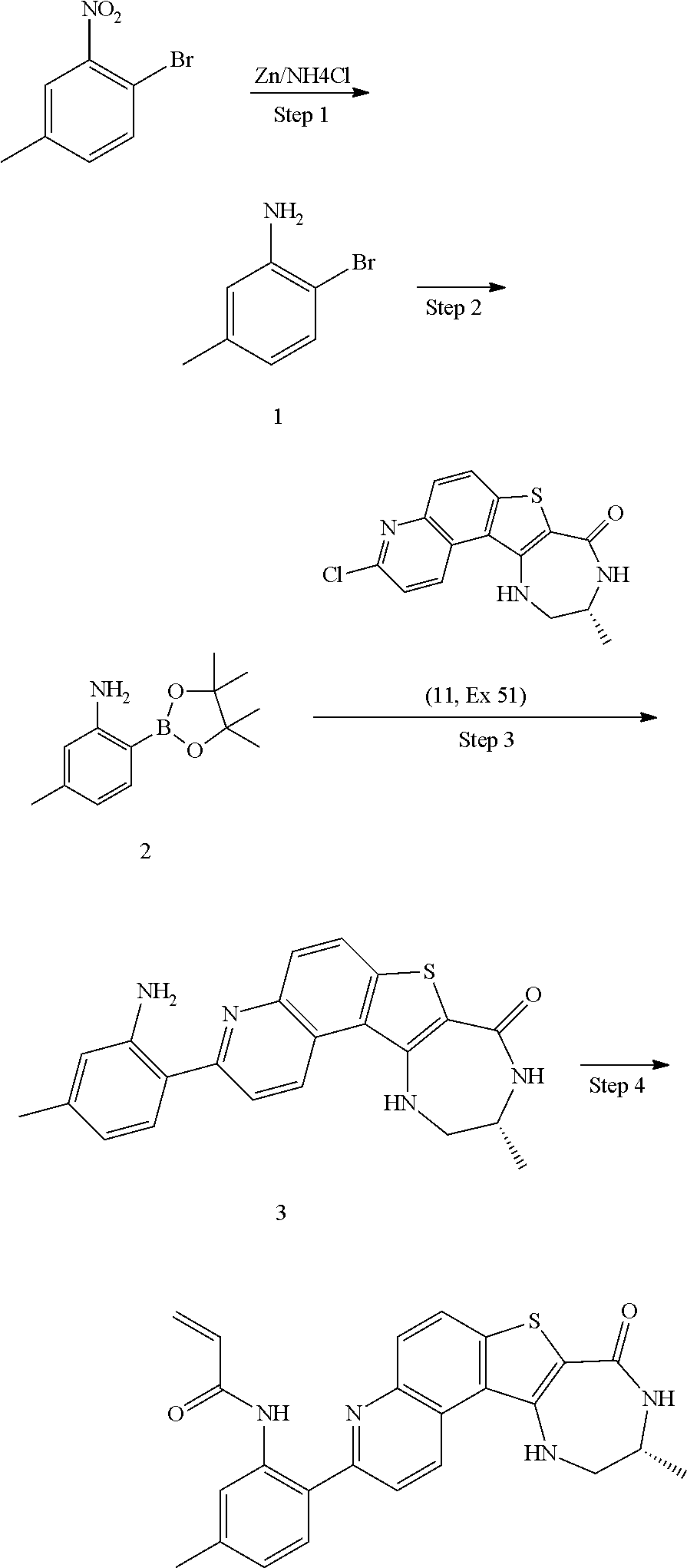
Step 1:


Step 1:


Step 1:


Step 1:


Step 1:


Step 1:


Step 1:


Step 1:


Step 1:


Step 1:


Step 1:


Step 1:


Step 1:


Step 1:


Step 1:


Step 1:


Step 1:
Claims (14)


Priority Applications (1)
| Application Number | Priority Date | Filing Date | Title |
|---|---|---|---|
| US16/194,577 US11098061B2 (en) | 2013-03-15 | 2018-11-19 | MK2 inhibitors and uses thereof |
Applications Claiming Priority (4)
| Application Number | Priority Date | Filing Date | Title |
|---|---|---|---|
| US201361794310P | 2013-03-15 | 2013-03-15 | |
| PCT/US2014/011501 WO2014149164A1 (en) | 2013-03-15 | 2014-01-14 | Mk2 inhibitors and uses thereof |
| US201514760697A | 2015-07-13 | 2015-07-13 | |
| US16/194,577 US11098061B2 (en) | 2013-03-15 | 2018-11-19 | MK2 inhibitors and uses thereof |
Related Parent Applications (2)
| Application Number | Title | Priority Date | Filing Date |
|---|---|---|---|
| US14/760,697 Division US10138256B2 (en) | 2013-03-15 | 2014-01-14 | MK2 inhibitors and uses thereof |
| PCT/US2014/011501 Division WO2014149164A1 (en) | 2013-03-15 | 2014-01-14 | Mk2 inhibitors and uses thereof |
Publications (2)
| Publication Number | Publication Date |
|---|---|
| US20190135835A1 US20190135835A1 (en) | 2019-05-09 |
| US11098061B2 true US11098061B2 (en) | 2021-08-24 |
Family
ID=51580575
Family Applications (2)
| Application Number | Title | Priority Date | Filing Date |
|---|---|---|---|
| US14/760,697 Active US10138256B2 (en) | 2013-03-15 | 2014-01-14 | MK2 inhibitors and uses thereof |
| US16/194,577 Active US11098061B2 (en) | 2013-03-15 | 2018-11-19 | MK2 inhibitors and uses thereof |
Family Applications Before (1)
| Application Number | Title | Priority Date | Filing Date |
|---|---|---|---|
| US14/760,697 Active US10138256B2 (en) | 2013-03-15 | 2014-01-14 | MK2 inhibitors and uses thereof |
Country Status (11)
| Country | Link |
|---|---|
| US (2) | US10138256B2 (en) |
| EP (1) | EP2968339A4 (en) |
| JP (1) | JP2016518316A (en) |
| KR (2) | KR20150133172A (en) |
| CN (2) | CN110746424A (en) |
| AU (3) | AU2014238443A1 (en) |
| CA (1) | CA2908098A1 (en) |
| EA (1) | EA201591137A1 (en) |
| HK (1) | HK1220355A1 (en) |
| MX (1) | MX380146B (en) |
| WO (1) | WO2014149164A1 (en) |
Families Citing this family (57)
| Publication number | Priority date | Publication date | Assignee | Title |
|---|---|---|---|---|
| WO2011090738A2 (en) | 2009-12-29 | 2011-07-28 | Dana-Farber Cancer Institute, Inc. | Type ii raf kinase inhibitors |
| CN102382106A (en) * | 2010-08-30 | 2012-03-21 | 黄振华 | Aniline substituted quinazoline derivative |
| CA2908098A1 (en) | 2013-03-15 | 2014-09-25 | Celgene Avilomics Research, Inc. | Mk2 inhibitors and uses thereof |
| PH12016500676B1 (en) | 2013-10-18 | 2022-07-20 | Eisai R&D Man Co Ltd | Pyrimidine fgfr4 inhibitors |
| WO2016032882A1 (en) * | 2014-08-25 | 2016-03-03 | Stc.Unm | Inhibition of mk2 in the treatment of cancer |
| RS62017B1 (en) * | 2014-09-17 | 2021-07-30 | Celgene Car Llc | Mk2 inhibitors and uses thereof |
| CN105693727B (en) * | 2014-11-27 | 2018-10-16 | 上海合全药业股份有限公司 | 8-(Tertbutyloxycarbonyl)The synthetic method of -6,7,8,9- tetrahydrochysenes -5- hydrogen-imidazoles [1,5-a] [1,4] diaza -6- carboxylic acids |
| JP6854762B2 (en) | 2014-12-23 | 2021-04-07 | ダナ−ファーバー キャンサー インスティテュート, インコーポレイテッド | Inhibitor of cyclin-dependent kinase 7 (CDK7) |
| JP6480728B2 (en) * | 2014-12-26 | 2019-03-13 | 住友化学株式会社 | Compound |
| ES2899196T3 (en) * | 2015-03-09 | 2022-03-10 | Aurigene Discovery Tech Ltd | Pyrazolo[1,5-a][1,3,5]triazine and pyrazolo[1,5-a]pyrimidine derivatives as CDK inhibitors |
| USRE50776E1 (en) | 2015-03-27 | 2026-02-03 | Dana-Farber Cancer Institute, Inc. | Inhibitors of cyclin-dependent kinases |
| WO2016164703A1 (en) * | 2015-04-09 | 2016-10-13 | Eisai R & D Management Co., Ltd. | Fgfr4 inhibitors |
| KR102548229B1 (en) | 2015-04-14 | 2023-06-27 | 에자이 알앤드디 매니지먼트 가부시키가이샤 | Crystalline FGFR4 inhibitor compounds and uses thereof |
| CN107849046B (en) * | 2015-06-03 | 2020-06-12 | 常州捷凯医药科技有限公司 | Heterocyclic compounds as ERK inhibitors |
| WO2016192064A1 (en) | 2015-06-03 | 2016-12-08 | Js Innopharm (Shanghai) Ltd. | Heterocyclic compounds for treating psoriasis |
| WO2017007756A1 (en) | 2015-07-06 | 2017-01-12 | Rodin Therapeutics, Inc | Hetero-halo inhibitors of histone deacetylase |
| EP3319968A1 (en) | 2015-07-06 | 2018-05-16 | Rodin Therapeutics, Inc. | Heterobicyclic n-aminophenyl-amides as inhibitors of histone deacetylase |
| AU2016319125B2 (en) | 2015-09-09 | 2021-04-08 | Dana-Farber Cancer Institute, Inc. | Inhibitors of cyclin-dependent kinases |
| SG11201805286RA (en) * | 2015-12-24 | 2018-07-30 | Kyowa Hakko Kirin Co Ltd | α,β-UNSATURATED AMIDE COMPOUND |
| US10059718B2 (en) | 2016-01-04 | 2018-08-28 | Tabomedex Biosciences, LLC | Fused quadracyclic compounds, compositions and uses thereof |
| JP7372740B2 (en) | 2016-05-10 | 2023-11-01 | エーザイ・アール・アンド・ディー・マネジメント株式会社 | Combinations of drugs to reduce cell viability and/or cell proliferation |
| WO2018022897A1 (en) * | 2016-07-27 | 2018-02-01 | Padlock Therapeutics, Inc. | Covalent inhibitors of pad4 |
| CN106810460A (en) * | 2016-12-30 | 2017-06-09 | 苏州诚和医药化学有限公司 | A kind of preparation method of 4 [2 (dimethylamino) ethyoxyl] benzylamines |
| HUE057849T2 (en) | 2017-01-11 | 2022-06-28 | Alkermes Inc | Bicyclic inhibitors of histone deacetylase |
| US10882867B2 (en) | 2017-03-16 | 2021-01-05 | Celgene Car Llc | Forms and compositions of a MK2 inhibitor |
| WO2018170203A1 (en) * | 2017-03-16 | 2018-09-20 | Celgene Car Llc | Mk2 inhibitors, synthesis thereof, and intermediates thereto |
| WO2018170200A1 (en) * | 2017-03-16 | 2018-09-20 | Celgene Car Llc | Heteroaryl compounds useful as mk2 inhibitors |
| EP3596085A4 (en) | 2017-03-16 | 2020-11-25 | Celgene CAR LLC | Deuterated analogs of mk2 inhibitors and uses thereof |
| US11098057B2 (en) * | 2017-03-16 | 2021-08-24 | Celgene Car Llc | 9,10,11,12-tetrahydro-8H-[1,4]diazepino[5′,6′:4,5]thieno[3,2-F]quinolin-8-one compounds and uses thereof |
| LT3664802T (en) | 2017-08-07 | 2022-06-27 | Alkermes, Inc. | Bicyclic inhibitors of histone deacetylase |
| CN107382853A (en) * | 2017-09-05 | 2017-11-24 | 中国药科大学 | 3- arylquinolines, its preparation method and medical usage |
| US11338242B2 (en) * | 2017-12-27 | 2022-05-24 | Renaissance Energy Research Corporation | Method and apparatus for removing CO2 |
| EP3810132A4 (en) | 2018-06-25 | 2022-06-22 | Dana-Farber Cancer Institute, Inc. | TAIRE KINA INHIBITORS AND THEIR USES |
| CN108658860B (en) * | 2018-07-17 | 2020-11-27 | 成都睿智化学研究有限公司 | Preparation method of 3-chloro-5, 6,7, 8-tetrahydroisoquinoline |
| SG11202101827RA (en) | 2018-09-21 | 2021-04-29 | Pfizer | N-substituted-dioxocyclobutenylamino-3-hydroxy-picolinamides useful as ccr6 inhibitors |
| KR20250133471A (en) | 2020-02-18 | 2025-09-05 | 길리애드 사이언시즈, 인코포레이티드 | Antiviral compounds |
| TWI883391B (en) | 2020-02-18 | 2025-05-11 | 美商基利科學股份有限公司 | Antiviral compounds |
| TWI775313B (en) | 2020-02-18 | 2022-08-21 | 美商基利科學股份有限公司 | Antiviral compounds |
| WO2021257660A1 (en) * | 2020-06-16 | 2021-12-23 | Dana-Farber Cancer Institute, Inc. | Small molecule covalent activators of ucp1 |
| US20230322767A1 (en) | 2020-07-29 | 2023-10-12 | Bayer Aktiengesellschaft | Aryl substituted pyrrolo-pyridinones and therapeutic uses thereof |
| US11685744B2 (en) | 2020-09-21 | 2023-06-27 | Prelude Therapeutics Incorporated | CDK inhibitors and their use as pharmaceuticals |
| EP4232161A1 (en) * | 2020-10-23 | 2023-08-30 | Dana-Farber Cancer Institute, Inc. | Covalent inhibitors of creatine kinase (ck) and uses thereof for treating and preventing cancer |
| JP2023550347A (en) * | 2020-11-12 | 2023-12-01 | アクティーヴァ セラピューティクス, インコーポレイテッド | MK2 activating compounds for use in treating vascular leak disorders and endothelial barrier disorders |
| CN116670142A (en) | 2021-02-01 | 2023-08-29 | 细胞基因公司 | MK2 inhibitors, their synthesis and their intermediates |
| CA3216162A1 (en) | 2021-04-16 | 2022-10-20 | Gilead Sciences, Inc. | Methods of preparing carbanucleosides using amides |
| TW202317573A (en) * | 2021-06-30 | 2023-05-01 | 美商凱麥拉醫療公司 | Mk2 degraders and uses thereof |
| CN113402523B (en) * | 2021-07-13 | 2022-07-12 | 西安交通大学 | Targeted mast cell MrgX2 small-molecule fluorescent probe and preparation method and application thereof |
| AU2022328698B2 (en) | 2021-08-18 | 2025-02-20 | Gilead Sciences, Inc. | Phospholipid compounds and methods of making and using the same |
| WO2023025298A1 (en) * | 2021-08-27 | 2023-03-02 | 瑞石生物医药有限公司 | Quinolinofuran derivative and use thereof |
| CN116444492B (en) * | 2021-12-29 | 2026-03-03 | 上海美悦生物科技发展有限公司 | P38 MAPK/MK2 pathway regulator, and composition, preparation method and application thereof |
| CN117186098A (en) * | 2022-06-07 | 2023-12-08 | 上海科恩泰生物医药科技有限公司 | A kind of carboxamide derivative with RSK inhibitory effect, pharmaceutical composition containing same and use thereof |
| EP4608401A2 (en) * | 2022-10-27 | 2025-09-03 | Bristol-Myers Squibb Company | Mk2 inhibitors and uses thereof |
| CN120344531A (en) * | 2022-12-11 | 2025-07-18 | 江苏豪森药业集团有限公司 | Piperidone derivatives, preparation methods and medical uses thereof |
| CN115925718A (en) * | 2022-12-27 | 2023-04-07 | 瑞石生物医药有限公司 | A tetracyclic lactam derivative and its application |
| WO2024148060A1 (en) * | 2023-01-04 | 2024-07-11 | Kymera Therapeutics, Inc. | Mk2 degraders and uses thereof |
| CN120530120A (en) * | 2023-02-07 | 2025-08-22 | 细胞基因公司 | Compounds and compositions useful as degraders of MK2 kinase |
| WO2025096869A1 (en) * | 2023-11-01 | 2025-05-08 | Matchpoint Therapeutics Inc. | Pyrrolo-isoquinoline compounds and their use in therapy |
Citations (13)
| Publication number | Priority date | Publication date | Assignee | Title |
|---|---|---|---|---|
| US20040091872A1 (en) | 2002-11-13 | 2004-05-13 | Parris Kevin D. | Crystal structures of MK2 and uses thereof |
| WO2004058762A1 (en) | 2002-12-20 | 2004-07-15 | Pharmacia Corporation | Mitogen activated protein kinase-activated protein kinase-2 inhibiting compounds |
| WO2008025512A1 (en) | 2006-08-30 | 2008-03-06 | Novartis Ag | Pyrrolo isoquinolines as kinase inhibitors |
| WO2009010488A1 (en) | 2007-07-16 | 2009-01-22 | Novartis Ag | Heterocyclic compounds useful as mk2 inhibitors |
| US20100029610A1 (en) | 2008-06-27 | 2010-02-04 | Avila Therapeutics, Inc. | Heteroaryl Compounds and Uses Thereof |
| WO2010028236A1 (en) | 2008-09-05 | 2010-03-11 | Avila Therapeutics, Inc. | Algorithm for designing irreversible inhibitors |
| US20110223207A1 (en) | 2010-03-11 | 2011-09-15 | Travis Mickle | Fatty Acid Conjugates of Quetiapine, Process for Making and Using the Same |
| US20110281322A1 (en) | 2006-09-22 | 2011-11-17 | Pharmacyclics, Inc. | Inhibitors of bruton's tyrosine kinase |
| US20120245175A1 (en) | 2009-12-14 | 2012-09-27 | N.V. Organon | Mk2 inhibitors |
| US20130137708A1 (en) | 2010-06-04 | 2013-05-30 | The Regents Of The University Of California | Methods and compositions for kinase inhibition |
| US20140018343A1 (en) | 2012-07-11 | 2014-01-16 | Nimbus Iris, Inc. | Irak inhibitors and uses thereof |
| WO2014149164A1 (en) | 2013-03-15 | 2014-09-25 | Celgene Avilomics Research, Inc. | Mk2 inhibitors and uses thereof |
| US20160075720A1 (en) | 2014-09-17 | 2016-03-17 | Celgene Avilomics Research, Inc. | Mk2 inhibitors and uses thereof |
-
2014
- 2014-01-14 CA CA2908098A patent/CA2908098A1/en not_active Abandoned
- 2014-01-14 CN CN201910894630.0A patent/CN110746424A/en active Pending
- 2014-01-14 EP EP14769652.0A patent/EP2968339A4/en not_active Withdrawn
- 2014-01-14 MX MX2015008999A patent/MX380146B/en unknown
- 2014-01-14 EA EA201591137A patent/EA201591137A1/en unknown
- 2014-01-14 HK HK16108382.1A patent/HK1220355A1/en unknown
- 2014-01-14 US US14/760,697 patent/US10138256B2/en active Active
- 2014-01-14 KR KR1020157018816A patent/KR20150133172A/en not_active Ceased
- 2014-01-14 AU AU2014238443A patent/AU2014238443A1/en not_active Abandoned
- 2014-01-14 CN CN201480004727.5A patent/CN105163738A/en active Pending
- 2014-01-14 WO PCT/US2014/011501 patent/WO2014149164A1/en not_active Ceased
- 2014-01-14 JP JP2016500164A patent/JP2016518316A/en active Pending
- 2014-01-14 KR KR1020217021981A patent/KR20210091832A/en not_active Withdrawn
-
2018
- 2018-11-19 US US16/194,577 patent/US11098061B2/en active Active
-
2019
- 2019-07-11 AU AU2019204981A patent/AU2019204981A1/en not_active Abandoned
-
2021
- 2021-02-11 AU AU2021200884A patent/AU2021200884A1/en not_active Abandoned
Patent Citations (22)
| Publication number | Priority date | Publication date | Assignee | Title |
|---|---|---|---|---|
| US7167802B2 (en) | 2002-11-13 | 2007-01-23 | Wyeth | Methods for identifying agents that interact with MAP kinase activated protein kinase 2 |
| US20040091872A1 (en) | 2002-11-13 | 2004-05-13 | Parris Kevin D. | Crystal structures of MK2 and uses thereof |
| WO2004058762A1 (en) | 2002-12-20 | 2004-07-15 | Pharmacia Corporation | Mitogen activated protein kinase-activated protein kinase-2 inhibiting compounds |
| US20040152739A1 (en) | 2002-12-20 | 2004-08-05 | Pharmacia Corporation | Acyclic pyrazole compounds for the inhibition of mitogen activated protein kinase-activated protein kinase-2 |
| US20040209897A1 (en) | 2002-12-20 | 2004-10-21 | Pharmacia Corporation | Mitogen activated protein kinase-activated protein kinase-2 inhibiting compounds |
| WO2008025512A1 (en) | 2006-08-30 | 2008-03-06 | Novartis Ag | Pyrrolo isoquinolines as kinase inhibitors |
| US20100069360A1 (en) | 2006-08-30 | 2010-03-18 | Laszlo Revesz | Organic compounds |
| US20110281322A1 (en) | 2006-09-22 | 2011-11-17 | Pharmacyclics, Inc. | Inhibitors of bruton's tyrosine kinase |
| WO2009010488A1 (en) | 2007-07-16 | 2009-01-22 | Novartis Ag | Heterocyclic compounds useful as mk2 inhibitors |
| US20100029610A1 (en) | 2008-06-27 | 2010-02-04 | Avila Therapeutics, Inc. | Heteroaryl Compounds and Uses Thereof |
| WO2010028236A1 (en) | 2008-09-05 | 2010-03-11 | Avila Therapeutics, Inc. | Algorithm for designing irreversible inhibitors |
| US20120245175A1 (en) | 2009-12-14 | 2012-09-27 | N.V. Organon | Mk2 inhibitors |
| US20110223207A1 (en) | 2010-03-11 | 2011-09-15 | Travis Mickle | Fatty Acid Conjugates of Quetiapine, Process for Making and Using the Same |
| US20130137708A1 (en) | 2010-06-04 | 2013-05-30 | The Regents Of The University Of California | Methods and compositions for kinase inhibition |
| US20140018343A1 (en) | 2012-07-11 | 2014-01-16 | Nimbus Iris, Inc. | Irak inhibitors and uses thereof |
| WO2014149164A1 (en) | 2013-03-15 | 2014-09-25 | Celgene Avilomics Research, Inc. | Mk2 inhibitors and uses thereof |
| US20150376208A1 (en) | 2013-03-15 | 2015-12-31 | Celgene Avilomics Research, Inc. | Mk2 inhibitors and uses thereof |
| US10138256B2 (en) | 2013-03-15 | 2018-11-27 | Celgene Car Llc | MK2 inhibitors and uses thereof |
| US20160075720A1 (en) | 2014-09-17 | 2016-03-17 | Celgene Avilomics Research, Inc. | Mk2 inhibitors and uses thereof |
| WO2016044463A2 (en) | 2014-09-17 | 2016-03-24 | Celgene Avilomics Research, Inc. | Mk2 inhibitors and uses thereof |
| US9458175B2 (en) | 2014-09-17 | 2016-10-04 | Celgene Avilomics Research, Inc. | MK2 inhibitors and uses thereof |
| US20170114073A1 (en) | 2014-09-17 | 2017-04-27 | Celgene Avilomics Research, Inc. | Mk2 inhibitors and uses thereof |
Non-Patent Citations (35)
| Title |
|---|
| Anderson, D.R. et al., Benzothiophene inhibitors of MK2. Part 1: Structure-activity relationships, assessments of selectivity and cellular potency, Bioorganic & Medicinal Chemistry Letters, 19: 4878-4881 (2009). |
| Anderson, D.R. et al., Benzothiophene inhibitors of MK2. Part 2: Improvements in kinase selectivity and cell potency, Bioorganic & Medicinal Chemistry Letters, 19: 4882-4884 (2009). |
| Anderson, D.R. et al., Pyrrolopyridine Inhibitors of Mitogen-Activated Protein Kinase-Activated Protein Kinase 2 (MK-2), J. Med. Chem., 50(11): 2647-2654 (2007). |
| Apsel, B. et al., Targeted polypharmacology: discovery of dual inhibitors of tyrosine and phosphoinositide kinases, Nature Chemical Biology, 4(11): 691-699 (2008). |
| Barf, T. and Kaptein, A., Irreversible Protein Kinase Inhibitors: Balacing the Benefits and Risks, Journal of Medicinal Chemistry, 55: 6243-6262 (2012). |
| Barf, T. et al., Structure-based lead identification of ATP-competitive MK2 inhibitors, Bioorganic & Medicinal Chemistry Letters, 21(12): 3818-3822 (2011). |
| Ben-Levy, R. et al., Nuclear export of the stress-activated protein kinase p38 mediated by its substrate MAPKAP kinase-2, Current Biology, 8(19): 1049-1057 (1998). |
| Caffrey, D.R. et al., Prediction of specificity-determining residues for small-molecule kinase inhibitors, BMC Bioinformatics, 9(491): 1-15 (2008). |
| Crisp, G.T., Conjugate addition of amino acid side chains to alkynones and alkynoic acid derivatives, Tetrahedron, 54(3-4): 637-648 (1998). |
| Crisp, G.T., Conjugate addition of amino acid side chains to dyes containing alkynone, alkynoic ester and alkynoic amide linker arms, Tetrahedron, 54(3-4): 649-666 (1998). |
| Downey, C.D. et al., One-pot synthesis of (Z)-_-sulfonyl enoates from ethyl propiolate, Tetrahedron Letters, 53(43): pp. 5763-5765 (2012). |
| Goldberg, D.R. et al., Pyrazinoindolone inhibitors of MAPKAP-K2, Bioorganic & Medicinal Chemistry, 18: 938-941 (2008). |
| International Search Report for PCT/US14/11501, 6 pages (dated Jul. 3, 2014). |
| International Search Report for PCT/US2015/050495, 2 pages (dated Dec. 11, 2015). |
| Kaptein, A. et al., Discovery of selective and orally available spiro-3-piperidyl ATP-competitive MK2 inhibitors, Bioorganic & Medicinal Chemistry Letters, 21: 3823-3827 (2011). |
| Knight, Z.A. et al., Targeting the cancer kinome through polypharmacology, Nature Reviews, Cancer, 10: 130-137 (2010). |
| Kopper, F. et al., The MAPK-activated protein kinase 2 mediates gemcitabine sensitivity in pancreatic cancer cells, Cell Cycle, 13(6): 1-6 (2014). |
| Kosugi, T. et al., Mitogen-Activated Protein Kinase-Activated Protein Kinase 2 (MAPKAP-K2) as an Antiinflammatory Target: Discovery and in Vivo Activity of Selective Pyrazolo[1,5-a]pyrimidine Inhibitors Using a Focused Library and Structure-Based Optimization Approach, Journal of Medicinal Chemistry, 55: 6700-6715 (2012). |
| Leproult, et al., Cysteine Mapping in Conformationally Distinct Kinase Nucleotide Binding Sites: Application to the Design of Selective Covalent Inhibitors, J. Med. Chem. , 54: 1347-1355 (2011). |
| Mansour, F.R. et al., Separation methods for captopril in pharmaceuticals and biological fluids, Journal of Separation Science, 35(10-11): 1213-1226 (2012). |
| Mola, L. et al., Nucleophile-catalyzed additions to activated triple bonds. Protection of lactams, imides, and nucleosides with MocVinyl and related groups, Journal of Organic Chemistry, 78(12) : 5832-5842 (2013). |
| Mourey, R.J. et al., A Benzothiophene Inhibitor of Mitogen-Activated Protein Kinase-Activated Protein Kinase 2 Inhibits Tumor Necrosis Factor α Production and Has Oral Anti-Inflammatory Efficacy in Acute and Chronic Models of Inflammation, The Journal of Pharmacology and Experimental Therapeutics, 333(2): 797-807 (2010). |
| Natesan, S. et al., Binding Affinity Prediction for Ligans and Receptors Forming Tautomers and Ionization Species: Inhibition of Mitogen-Activated Protein Kinase-Activated Protein Kinase 2 (MK2), Journal of Medicinal Chemistry, 55(5): 2035-2047 (2012). |
| O'Donnell, J.S. et al., Cesium (Z)-2-carbomethoxyethenethiolate: a reagent for the preparation of (Z)-2-carbomethoxyethenyl thioethers including selected cysteine and homocysteine derivatives, European Journal of Organic Chemistry, 2009(4): 547-553 (2009). |
| Oubrie, A. et al., Novel ATP competitive MK2 inhibitors with potent biochemical and cell-based activity throughout the series, Bioorganic & Medicinal Chemistry Letters, 22: 613-618 (2012). |
| Revesz, L. et al., In vivo and in vitro SAR of tetracyclic MAPKAP-K2 (MK2) inhibitors. Part I, Bioorganic & Medicinal Chemistry Letters, 20: 4715-4718 (2010). |
| Revesz, L. et al., In vivo and in vitro SAR of tetracyclic MAPKAP-K2 (MK2) inhibitors. Part II, Bioorganic & Medicinal Chemistry Letters, 20: 4719-4723 (2010). |
| Schlapbach, A. et al., Pyrrolo-pyrimidones: A novel class of MK2 inhibitors with potent cellular activity, Bioorganic & Medicinal Chemistry Letters, 18: 6142-6146 (2008). |
| Schwan, A.L. et al., Diastereoselective alkylations of a protected cysteinesulfenate, Journal of Organic Chemistry, 74(17): 6851-6854 (2009). |
| Serafimova, I.M. et al., Reversible targeting of noncatalytic cysteines with chemically tuned electrophiles, Nature Chemical Biology, 8(5):471-476 (2012). |
| Shiu, H.-Y. et al., Electron-deficient alkynes as cleavable reagents for the modification of cysteine-containing peptides in aqueous medium, Chemistry—A European Journal, 15(15): 3839-3850 (2009). |
| Singh, J. et al., The resurgence of covalent drugs, Nature Review, Drug Discovery, 10: 307-317 (2011). |
| Written Opinion for PCT/US14/11501, 50 pages (dated Jul. 3, 2014). |
| Written Opinion for PCT/US2015/050495, 7 pages (dated Dec. 11, 2015). |
| Zheng, C. et al., MAPK-activated Protein Kinase-2 (MK2)-mediated Formation and Phosphorylation-regulated Dissociation of the Signal Complex Consisting of p38, MK2, Akt, and Hsp27, Journal of Biological Chemistry, 281(48): 37215-37226 (2006). |
Also Published As
| Publication number | Publication date |
|---|---|
| CN110746424A (en) | 2020-02-04 |
| US20150376208A1 (en) | 2015-12-31 |
| JP2016518316A (en) | 2016-06-23 |
| KR20150133172A (en) | 2015-11-27 |
| KR20210091832A (en) | 2021-07-22 |
| CA2908098A1 (en) | 2014-09-25 |
| WO2014149164A1 (en) | 2014-09-25 |
| AU2019204981A1 (en) | 2019-08-01 |
| AU2014238443A1 (en) | 2015-07-30 |
| HK1220355A1 (en) | 2017-05-05 |
| EP2968339A1 (en) | 2016-01-20 |
| MX380146B (en) | 2025-03-12 |
| US20190135835A1 (en) | 2019-05-09 |
| US10138256B2 (en) | 2018-11-27 |
| CN105163738A (en) | 2015-12-16 |
| EP2968339A4 (en) | 2017-02-15 |
| EA201591137A1 (en) | 2016-02-29 |
| MX2015008999A (en) | 2015-09-16 |
| AU2021200884A1 (en) | 2021-03-04 |
Similar Documents
| Publication | Publication Date | Title |
|---|---|---|
| US11098061B2 (en) | MK2 inhibitors and uses thereof | |
| US8530480B2 (en) | Substituted pyrimidinyl-amines as protein kinase inhibitors | |
| TWI398439B (en) | Certain substituted amides, method of making, and method of use thereof | |
| CA2727455C (en) | Heteroaryl compounds and uses thereof | |
| ES2477878T3 (en) | Compounds and compositions of 5- (4- (aloalkoxy) phenyl) pyrimidin-2-amine as kinase inhibitors | |
| KR101571720B1 (en) | Substituted pyridopyrazines as novel syk inhibitors | |
| CN101605766A (en) | Pyrimidine derivatives and their use as kinase inhibitors | |
| US9475817B2 (en) | Pyrazole substituted imidazopyrazines as casein kinase 1 d/e inhibitors | |
| KR102752564B1 (en) | Adenosine receptor antagonist compounds | |
| TW201002716A (en) | Fused pyrazine compounds useful for the treatment of degenerative and inflammatory diseases | |
| TW200403247A (en) | An optically active pyridine derivative and a medicament containing the same | |
| US10654868B2 (en) | Dihydropyrazole azepine compound serving as Akt inhibitor | |
| US12325701B2 (en) | YKL-40 inhibitors and their therapeutic | |
| US20230271942A1 (en) | Cdk9 inhibitor and use thereof | |
| CN120676947A (en) | Compounds and compositions useful as MK2 kinase degrading agents | |
| WO2024164702A1 (en) | Pyrrolopyridine-structure compound, preparation method therefor, and use thereof | |
| CN117986184A (en) | N-substituted pyridone compounds and their preparation method and pharmaceutical use |
Legal Events
| Date | Code | Title | Description |
|---|---|---|---|
| FEPP | Fee payment procedure |
Free format text: ENTITY STATUS SET TO UNDISCOUNTED (ORIGINAL EVENT CODE: BIG.); ENTITY STATUS OF PATENT OWNER: LARGE ENTITY |
|
| AS | Assignment |
Owner name: STRATACUITY STAFFING PARTNERS, INC., NEW HAMPSHIRE Free format text: ASSIGNMENT OF ASSIGNORS INTEREST;ASSIGNOR:WANG, TAO;REEL/FRAME:048156/0217 Effective date: 20140524 Owner name: CELGENE AVILOMICS RESEARCH, INC., MASSACHUSETTS Free format text: ASSIGNMENT OF ASSIGNORS INTEREST;ASSIGNOR:STRATACUITY STAFFING PARTNERS, INC.;REEL/FRAME:048156/0243 Effective date: 20140528 Owner name: CELGENE CAR LLC, BERMUDA Free format text: MERGER AND CHANGE OF NAME;ASSIGNORS:CELGENE AVILOMICS RESEARCH, INC.;CELGENE CAR LLC;REEL/FRAME:048156/0261 Effective date: 20161223 Owner name: CELGENE AVILOMICS RESEARCH, INC., MASSACHUSETTS Free format text: ASSIGNMENT OF ASSIGNORS INTEREST;ASSIGNORS:ALEXANDER, MATTHEW DAVID;MCDONALD, JOSEPH JOHN;NI, YIKE;AND OTHERS;SIGNING DATES FROM 20140514 TO 20140904;REEL/FRAME:048176/0660 |
|
| STPP | Information on status: patent application and granting procedure in general |
Free format text: APPLICATION DISPATCHED FROM PREEXAM, NOT YET DOCKETED |
|
| STPP | Information on status: patent application and granting procedure in general |
Free format text: DOCKETED NEW CASE - READY FOR EXAMINATION |
|
| STPP | Information on status: patent application and granting procedure in general |
Free format text: NON FINAL ACTION MAILED |
|
| STPP | Information on status: patent application and granting procedure in general |
Free format text: RESPONSE TO NON-FINAL OFFICE ACTION ENTERED AND FORWARDED TO EXAMINER |
|
| STPP | Information on status: patent application and granting procedure in general |
Free format text: FINAL REJECTION MAILED |
|
| STPP | Information on status: patent application and granting procedure in general |
Free format text: RESPONSE AFTER FINAL ACTION FORWARDED TO EXAMINER |
|
| STPP | Information on status: patent application and granting procedure in general |
Free format text: NOTICE OF ALLOWANCE MAILED -- APPLICATION RECEIVED IN OFFICE OF PUBLICATIONS |
|
| STPP | Information on status: patent application and granting procedure in general |
Free format text: AWAITING TC RESP., ISSUE FEE NOT PAID |
|
| STPP | Information on status: patent application and granting procedure in general |
Free format text: NOTICE OF ALLOWANCE MAILED -- APPLICATION RECEIVED IN OFFICE OF PUBLICATIONS |
|
| STPP | Information on status: patent application and granting procedure in general |
Free format text: PUBLICATIONS -- ISSUE FEE PAYMENT VERIFIED |
|
| STPP | Information on status: patent application and granting procedure in general |
Free format text: AWAITING TC RESP, ISSUE FEE PAYMENT VERIFIED |
|
| STPP | Information on status: patent application and granting procedure in general |
Free format text: PUBLICATIONS -- ISSUE FEE PAYMENT VERIFIED |
|
| STCF | Information on status: patent grant |
Free format text: PATENTED CASE |
|
| AS | Assignment |
Owner name: BRISTOL-MYERS SQUIBB COMPANY, NEW JERSEY Free format text: NUNC PRO TUNC ASSIGNMENT;ASSIGNOR:CELGENE CAR LLC;REEL/FRAME:063526/0959 Effective date: 20230426 |
|
| MAFP | Maintenance fee payment |
Free format text: PAYMENT OF MAINTENANCE FEE, 4TH YEAR, LARGE ENTITY (ORIGINAL EVENT CODE: M1551); ENTITY STATUS OF PATENT OWNER: LARGE ENTITY Year of fee payment: 4 |