US11098025B2 - Bi-functional compounds and methods for targeted ubiquitination of androgen receptor - Google Patents
Bi-functional compounds and methods for targeted ubiquitination of androgen receptor Download PDFInfo
- Publication number
- US11098025B2 US11098025B2 US16/777,294 US202016777294A US11098025B2 US 11098025 B2 US11098025 B2 US 11098025B2 US 202016777294 A US202016777294 A US 202016777294A US 11098025 B2 US11098025 B2 US 11098025B2
- Authority
- US
- United States
- Prior art keywords
- alkyl
- optionally substituted
- mmol
- halo
- nmr
- Prior art date
- Legal status (The legal status is an assumption and is not a legal conclusion. Google has not performed a legal analysis and makes no representation as to the accuracy of the status listed.)
- Active
Links
- 0 *.*.*.B.C*C.[1*]C1=C(C)N=C(C)S1.[1*]C1=C(C)N=C2C(*C)=C([1*])C([1*])=C([1*])C2=C1[1*].[1*]C1=C([1*])C2=C(N=C(C)S2)C(*C)=C1[1*] Chemical compound *.*.*.B.C*C.[1*]C1=C(C)N=C(C)S1.[1*]C1=C(C)N=C2C(*C)=C([1*])C([1*])=C([1*])C2=C1[1*].[1*]C1=C([1*])C2=C(N=C(C)S2)C(*C)=C1[1*] 0.000 description 35
- YESWRGOCAYFSBK-UHFFFAOYSA-N B.C.CCC Chemical compound B.C.CCC YESWRGOCAYFSBK-UHFFFAOYSA-N 0.000 description 5
- OILJIEKQCVHNMM-UHFFFAOYSA-N CC(C)(C)N1CCOCC1 Chemical compound CC(C)(C)N1CCOCC1 OILJIEKQCVHNMM-UHFFFAOYSA-N 0.000 description 5
- MXXISJZSRMSFNV-UHFFFAOYSA-N *.B.B.B.B.C.CCC.CCC.CCC Chemical compound *.B.B.B.B.C.CCC.CCC.CCC MXXISJZSRMSFNV-UHFFFAOYSA-N 0.000 description 3
- PQNPHMCXHSYBTH-UHFFFAOYSA-N CC(C)(C)OC1=C(C(C)(C)C)C=CC(F)=C1F Chemical compound CC(C)(C)OC1=C(C(C)(C)C)C=CC(F)=C1F PQNPHMCXHSYBTH-UHFFFAOYSA-N 0.000 description 3
- QZVYPDZWCBPQML-UHFFFAOYSA-N CC.CC.CC.CC.CC.CC.CC.CC Chemical compound CC.CC.CC.CC.CC.CC.CC.CC QZVYPDZWCBPQML-UHFFFAOYSA-N 0.000 description 2
- YQOKQYLTYNNDAP-UHFFFAOYSA-N O=C(COC1=C(C2=CSC(N3CCOCC3)=N2)C=CC(F)=C1F)NCCCCCCCC1=CC=CC2=C1C(=O)N(C1CCC(=O)NC1=O)C2=O Chemical compound O=C(COC1=C(C2=CSC(N3CCOCC3)=N2)C=CC(F)=C1F)NCCCCCCCC1=CC=CC2=C1C(=O)N(C1CCC(=O)NC1=O)C2=O YQOKQYLTYNNDAP-UHFFFAOYSA-N 0.000 description 2
- WJAPTXOSCHGHGS-ORRLHKMPSA-M *.*.*.*.B.C.CC(C)(C)OC(=O)N[C@@H](CC(=O)O)C1=CC=C(Br)C=C1.CC(C)(C)OC(=O)N[C@@H](CC(=O)O)C1=CC=C(Br)C=C1.CC(C)(C)[C@H](NC(=O)C1(F)CC1)C(=O)N1C[C@H](O)C[C@H]1C(=O)O.CC1=CSC=N1.COC(=O)[C@@H]1C[C@@H](O)CN1C(=O)[C@@H](N)C(C)(C)C.COC(=O)[C@@H]1C[C@@H](O)CN1C(=O)[C@@H](NC(=O)C1(F)CC1)C(C)(C)C.COC(=O)[C@@H]1C[C@@H](O)CN1C(=O)[C@@H](NC(=O)OC(C)(C)C)C(C)(C)C.Cl.Cl.O.O=C(O)C1(F)CC1.S.S.S.S.S.S.S.S.S.S.[Li]O Chemical compound *.*.*.*.B.C.CC(C)(C)OC(=O)N[C@@H](CC(=O)O)C1=CC=C(Br)C=C1.CC(C)(C)OC(=O)N[C@@H](CC(=O)O)C1=CC=C(Br)C=C1.CC(C)(C)[C@H](NC(=O)C1(F)CC1)C(=O)N1C[C@H](O)C[C@H]1C(=O)O.CC1=CSC=N1.COC(=O)[C@@H]1C[C@@H](O)CN1C(=O)[C@@H](N)C(C)(C)C.COC(=O)[C@@H]1C[C@@H](O)CN1C(=O)[C@@H](NC(=O)C1(F)CC1)C(C)(C)C.COC(=O)[C@@H]1C[C@@H](O)CN1C(=O)[C@@H](NC(=O)OC(C)(C)C)C(C)(C)C.Cl.Cl.O.O=C(O)C1(F)CC1.S.S.S.S.S.S.S.S.S.S.[Li]O WJAPTXOSCHGHGS-ORRLHKMPSA-M 0.000 description 1
- IFQPRZGCDKGHER-WAVWHFSOSA-N *.*.*.*.CC1=CC(C(=O)NCOC2=C(C3=CSC(N4CCOCC4)=N3)C=CC(F)=C2F)=CC=C1NC(=O)[C@@H]1C[C@@H](CC(C)(C)C)[C@](C#N)(C2=CC=C(Cl)C=C2F)[C@H]1C1=C(F)C(Cl)=CC=C1.CC1=CC(C(=O)O)=CC=C1NC(=O)[C@@H]1C[C@@H](CC(C)(C)C)[C@](C#N)(C2=CC=C(Cl)C=C2F)[C@H]1C1=C(F)C(Cl)=CC=C1.Cl.NCOC1=C(F)C(F)=CC=C1C1=CSC(N2CCOCC2)=N1.S.S.S.S Chemical compound *.*.*.*.CC1=CC(C(=O)NCOC2=C(C3=CSC(N4CCOCC4)=N3)C=CC(F)=C2F)=CC=C1NC(=O)[C@@H]1C[C@@H](CC(C)(C)C)[C@](C#N)(C2=CC=C(Cl)C=C2F)[C@H]1C1=C(F)C(Cl)=CC=C1.CC1=CC(C(=O)O)=CC=C1NC(=O)[C@@H]1C[C@@H](CC(C)(C)C)[C@](C#N)(C2=CC=C(Cl)C=C2F)[C@H]1C1=C(F)C(Cl)=CC=C1.Cl.NCOC1=C(F)C(F)=CC=C1C1=CSC(N2CCOCC2)=N1.S.S.S.S IFQPRZGCDKGHER-WAVWHFSOSA-N 0.000 description 1
- JBTURJIYSNVZAA-VKHARFLWSA-N *.*.BF.CC1=C(C2=CC=C([C@H](C)NC(=O)[C@@H]3C[C@@H](O)CN3C(=O)[C@@H](N)C(C)(C)C)C=C2)SC=N1.CC1=C(C2=CC=C([C@H](C)NC(=O)[C@@H]3C[C@@H](O)CN3C(=O)[C@@H](NC(=O)CCCCCCCOC3=C(C4=CSC(N5CCOCC5)=N4)C=CC(F)=C3F)C(C)(C)C)C=C2)SC=N1.CCOC(=O)CCCCCCCBr.CCOC(=O)CCCCCCCOC1=C(C2=CSC(N3CCOCC3)=N2)C=CC(F)=C1F.Cl.O=C(O)CCCCCCCOC1=C(C2=CSC(N3CCOCC3)=N2)C=CC(F)=C1F.OC1=C(C2=CSC(N3CCOCC3)=N2)C=CC(F)=C1F.S.S.S.S.S.S Chemical compound *.*.BF.CC1=C(C2=CC=C([C@H](C)NC(=O)[C@@H]3C[C@@H](O)CN3C(=O)[C@@H](N)C(C)(C)C)C=C2)SC=N1.CC1=C(C2=CC=C([C@H](C)NC(=O)[C@@H]3C[C@@H](O)CN3C(=O)[C@@H](NC(=O)CCCCCCCOC3=C(C4=CSC(N5CCOCC5)=N4)C=CC(F)=C3F)C(C)(C)C)C=C2)SC=N1.CCOC(=O)CCCCCCCBr.CCOC(=O)CCCCCCCOC1=C(C2=CSC(N3CCOCC3)=N2)C=CC(F)=C1F.Cl.O=C(O)CCCCCCCOC1=C(C2=CSC(N3CCOCC3)=N2)C=CC(F)=C1F.OC1=C(C2=CSC(N3CCOCC3)=N2)C=CC(F)=C1F.S.S.S.S.S.S JBTURJIYSNVZAA-VKHARFLWSA-N 0.000 description 1
- RGEINCALYCZUBD-QKMONFALSA-N *.*.C.CC(C)(C)[C@H](NC(=O)C1(F)CC1)C(=O)N1C[C@H](O)C[C@H]1C(=O)O.CC1=C(C2=CC=C([C@@H](N)CC(=O)NCNC(=O)COC3=C(F)C(F)=CC=C3C3=CSC(N4CCOCC4)=N3)C=C2)SC=N1.CC1=C(C2=CC=C([C@H](CC(=O)NCNC(=O)COC3=C(F)C(F)=CC=C3C3=CSC(N4CCOCC4)=N3)NC(=O)[C@@H]3C[C@@H](O)CN3C(=O)[C@@H](NC(=O)C3(F)CC3)C(C)(C)C)C=C2)SC=N1.Cl.S.S.S.S.S.S Chemical compound *.*.C.CC(C)(C)[C@H](NC(=O)C1(F)CC1)C(=O)N1C[C@H](O)C[C@H]1C(=O)O.CC1=C(C2=CC=C([C@@H](N)CC(=O)NCNC(=O)COC3=C(F)C(F)=CC=C3C3=CSC(N4CCOCC4)=N3)C=C2)SC=N1.CC1=C(C2=CC=C([C@H](CC(=O)NCNC(=O)COC3=C(F)C(F)=CC=C3C3=CSC(N4CCOCC4)=N3)NC(=O)[C@@H]3C[C@@H](O)CN3C(=O)[C@@H](NC(=O)C3(F)CC3)C(C)(C)C)C=C2)SC=N1.Cl.S.S.S.S.S.S RGEINCALYCZUBD-QKMONFALSA-N 0.000 description 1
- QVKYLFQHMRGKRS-WRLPQNJSSA-N *.*.CC1=C(C2=CC=C([C@H](C)NC(=O)[C@@H]3C[C@@H](O)CN3C(=O)[C@@H](NC(=O)CCCCNC(=O)C3=CC=CC4=C3N=C(N3CCOCC3)S4)C(C)(C)C)C=C2)SC=N1.CC1=C(C2=CC=C([C@H](C)NC(=O)[C@@H]3C[C@@H](O)CN3C(=O)[C@@H](NC(=O)CN)C(C)(C)C)C=C2)SC=N1.Cl.O=C(O)C1=C2N=C(N3CCOCC3)SC2=CC=C1.S.S.S.S.S.S Chemical compound *.*.CC1=C(C2=CC=C([C@H](C)NC(=O)[C@@H]3C[C@@H](O)CN3C(=O)[C@@H](NC(=O)CCCCNC(=O)C3=CC=CC4=C3N=C(N3CCOCC3)S4)C(C)(C)C)C=C2)SC=N1.CC1=C(C2=CC=C([C@H](C)NC(=O)[C@@H]3C[C@@H](O)CN3C(=O)[C@@H](NC(=O)CN)C(C)(C)C)C=C2)SC=N1.Cl.O=C(O)C1=C2N=C(N3CCOCC3)SC2=CC=C1.S.S.S.S.S.S QVKYLFQHMRGKRS-WRLPQNJSSA-N 0.000 description 1
- KTMSURCGJUIYDS-BHNMWEQYSA-N *.*.CC1=C(C2=CC=C([C@H](C)NC(=O)[C@@H]3C[C@@H](O)CN3C(=O)[C@@H](NC(=O)CN)C(C)(C)C)C=C2)SC=N1.CC1=C(C2=CC=C([C@H](C)NC(=O)[C@@H]3C[C@@H](O)CN3C(=O)[C@@H](NC(=O)CNC(=O)COC3=C(C4=CSC(N5CCOCC5)=N4)C=CC(F)=C3F)C(C)(C)C)C=C2)SC=N1.Cl.O=C(O)COC1=C(C2=CSC(N3CCOCC3)=N2)C=CC(F)=C1F.S.S.S.S.S.S Chemical compound *.*.CC1=C(C2=CC=C([C@H](C)NC(=O)[C@@H]3C[C@@H](O)CN3C(=O)[C@@H](NC(=O)CN)C(C)(C)C)C=C2)SC=N1.CC1=C(C2=CC=C([C@H](C)NC(=O)[C@@H]3C[C@@H](O)CN3C(=O)[C@@H](NC(=O)CNC(=O)COC3=C(C4=CSC(N5CCOCC5)=N4)C=CC(F)=C3F)C(C)(C)C)C=C2)SC=N1.Cl.O=C(O)COC1=C(C2=CSC(N3CCOCC3)=N2)C=CC(F)=C1F.S.S.S.S.S.S KTMSURCGJUIYDS-BHNMWEQYSA-N 0.000 description 1
- CGFVOQXCFFWSLI-JCMFPDMGSA-N *.*.COC1=C(NC(=O)C2C[C@@H](CC(C)(C)C)[C@](C#N)(C3=C(F)C=C(Cl)C=C3)[C@H]2C2=C(F)C(Cl)=CC=C2)C=CC(C(=O)NCCCCCCCC(=O)COC2=C(C3=CSC(N4CCOCC4)=N3)C=CC(F)=C2F)=C1.S.S Chemical compound *.*.COC1=C(NC(=O)C2C[C@@H](CC(C)(C)C)[C@](C#N)(C3=C(F)C=C(Cl)C=C3)[C@H]2C2=C(F)C(Cl)=CC=C2)C=CC(C(=O)NCCCCCCCC(=O)COC2=C(C3=CSC(N4CCOCC4)=N3)C=CC(F)=C2F)=C1.S.S CGFVOQXCFFWSLI-JCMFPDMGSA-N 0.000 description 1
- FOAMIYAALHDOTO-IJXSBIIRSA-N *.*.COC1=C(NC(=O)C2C[C@@H](CC(C)(C)C)[C@](C#N)(C3=C(F)C=C(Cl)C=C3)[C@H]2C2=C(F)C(Cl)=CC=C2)C=CC(C(=O)NCCOCCOCCOC2=C(C3=CSC(N4CCOCC4)=N3)C=CC(F)=C2F)=C1.S.S Chemical compound *.*.COC1=C(NC(=O)C2C[C@@H](CC(C)(C)C)[C@](C#N)(C3=C(F)C=C(Cl)C=C3)[C@H]2C2=C(F)C(Cl)=CC=C2)C=CC(C(=O)NCCOCCOCCOC2=C(C3=CSC(N4CCOCC4)=N3)C=CC(F)=C2F)=C1.S.S FOAMIYAALHDOTO-IJXSBIIRSA-N 0.000 description 1
- BUEXGHWWZGZFQX-PRBMHFLQSA-N *.*.COC1=C(NC(=O)[C@@H]2C[C@@H](CC(C)(C)C)[C@](C#N)(C3=C(F)C=C(Cl)C=C3)[C@H]2C2=C(F)C(Cl)=CC=C2)C=CC(C(=O)NCCCCCC(=O)COC2=C(C3=CSC(N4CCOCC4)=N3)C=CC(F)=C2F)=C1.S.S Chemical compound *.*.COC1=C(NC(=O)[C@@H]2C[C@@H](CC(C)(C)C)[C@](C#N)(C3=C(F)C=C(Cl)C=C3)[C@H]2C2=C(F)C(Cl)=CC=C2)C=CC(C(=O)NCCCCCC(=O)COC2=C(C3=CSC(N4CCOCC4)=N3)C=CC(F)=C2F)=C1.S.S BUEXGHWWZGZFQX-PRBMHFLQSA-N 0.000 description 1
- ZLQGSTHGLCLYQH-UHFFFAOYSA-N *.B.B.B.B.CCC.CCC.CCC Chemical compound *.B.B.B.B.CCC.CCC.CCC ZLQGSTHGLCLYQH-UHFFFAOYSA-N 0.000 description 1
- KYWFBITZVQGNLH-PJFFJJQTSA-I *.B.Br[Cu]Br.C.C.CC(=O)C1=C(O)C(F)=C(F)C=C1.CC(=O)Cl.CC(=O)OC1=CC=CC(F)=C1F.CC(C)(C)OC(=O)CBr.CC(C)(C)OC(=O)COC1=C(C2=CSC(N3CCOCC3)=N2)C=CC(F)=C1F.Cl.Cl[Al](Cl)Cl.NC(=S)N1CCOCC1.O=C(CBr)C1=C(O)C(F)=C(F)C=C1.O=C(O)COC1=C(C2=CSC(N3CCOCC3)=N2)C=CC(F)=C1F.OC1=C(C2=CSC(N3CCOCC3)=N2)C=CC(F)=C1F.OC1=CC=CC(F)=C1F.[2HH] Chemical compound *.B.Br[Cu]Br.C.C.CC(=O)C1=C(O)C(F)=C(F)C=C1.CC(=O)Cl.CC(=O)OC1=CC=CC(F)=C1F.CC(C)(C)OC(=O)CBr.CC(C)(C)OC(=O)COC1=C(C2=CSC(N3CCOCC3)=N2)C=CC(F)=C1F.Cl.Cl[Al](Cl)Cl.NC(=S)N1CCOCC1.O=C(CBr)C1=C(O)C(F)=C(F)C=C1.O=C(O)COC1=C(C2=CSC(N3CCOCC3)=N2)C=CC(F)=C1F.OC1=C(C2=CSC(N3CCOCC3)=N2)C=CC(F)=C1F.OC1=CC=CC(F)=C1F.[2HH] KYWFBITZVQGNLH-PJFFJJQTSA-I 0.000 description 1
- WGICNPQEMOOEPN-UHFFFAOYSA-N *.C.C.C.CC(=O)COC1=C2C(=O)N(C3CCC(=O)NC3=O)C(=O)C2=CC=C1.CC(C)(C)OC(=O)CBr.CC(C)(C)OC(=O)NCN.CCCC(=O)COC1=C2C(=O)N(C3CCC(=O)NC3=O)C(=O)C2=CC=C1.Cl.Cl.Cl.Cl.NC1CCC(=O)NC1.NCCC(=O)COC1=C2C(=O)N(C3CCC(=O)NC3=O)C(=O)C2=CC=C1.O=C(O)COC1=C2C(=O)N(C3CCC(=O)NC3=O)C(=O)C2=CC=C1.O=C1CCC(N2C(=O)C3=CC=CC(O)=C3C2=O)C(=O)N1.O=C1OC(=O)C2=C(O)C=CC=C12.S Chemical compound *.C.C.C.CC(=O)COC1=C2C(=O)N(C3CCC(=O)NC3=O)C(=O)C2=CC=C1.CC(C)(C)OC(=O)CBr.CC(C)(C)OC(=O)NCN.CCCC(=O)COC1=C2C(=O)N(C3CCC(=O)NC3=O)C(=O)C2=CC=C1.Cl.Cl.Cl.Cl.NC1CCC(=O)NC1.NCCC(=O)COC1=C2C(=O)N(C3CCC(=O)NC3=O)C(=O)C2=CC=C1.O=C(O)COC1=C2C(=O)N(C3CCC(=O)NC3=O)C(=O)C2=CC=C1.O=C1CCC(N2C(=O)C3=CC=CC(O)=C3C2=O)C(=O)N1.O=C1OC(=O)C2=C(O)C=CC=C12.S WGICNPQEMOOEPN-UHFFFAOYSA-N 0.000 description 1
- GUWDUWGJNMBNEA-SQCGBPLXSA-N *.CC1=C(C2=CC=C(C(CC(=O)NCCCCCC(=O)COC3=C(C4=CSC(N5CCOCC5)=N4)C=CC(F)=C3F)NC(=O)C3C[C@@H](O)CN3C(=O)[C@@H](NC(=O)C3(F)CC3)C(C)(C)C)C=C2)SC=N1.S.S.S Chemical compound *.CC1=C(C2=CC=C(C(CC(=O)NCCCCCC(=O)COC3=C(C4=CSC(N5CCOCC5)=N4)C=CC(F)=C3F)NC(=O)C3C[C@@H](O)CN3C(=O)[C@@H](NC(=O)C3(F)CC3)C(C)(C)C)C=C2)SC=N1.S.S.S GUWDUWGJNMBNEA-SQCGBPLXSA-N 0.000 description 1
- QGMWHRLBQYZOFY-BXFYBECTSA-N *.CC1=C(C2=CC=C(C(CC(=O)NCCCCCCCC(=O)COC3=C(C4=CSC(N5CCOCC5)=N4)C=CC(F)=C3F)NC(=O)C3C[C@@H](O)CN3C(=O)[C@@H](NC(=O)C3(F)CC3)C(C)(C)C)C=C2)SC=N1.S.S.S Chemical compound *.CC1=C(C2=CC=C(C(CC(=O)NCCCCCCCC(=O)COC3=C(C4=CSC(N5CCOCC5)=N4)C=CC(F)=C3F)NC(=O)C3C[C@@H](O)CN3C(=O)[C@@H](NC(=O)C3(F)CC3)C(C)(C)C)C=C2)SC=N1.S.S.S QGMWHRLBQYZOFY-BXFYBECTSA-N 0.000 description 1
- SNBNUMLGGZZCBV-OPTOZKRCSA-N *.CC1=C(C2=CC=C([C@H](C)NC(=O)[C@@H]3C[C@@H](O)CN3C(=O)C(NC(=O)CCCCNC(=O)C3=CC=CC4=C3N=C(N3CCOCC3)S4)C(C)(C)C)C=C2)SC=N1.S.S.S Chemical compound *.CC1=C(C2=CC=C([C@H](C)NC(=O)[C@@H]3C[C@@H](O)CN3C(=O)C(NC(=O)CCCCNC(=O)C3=CC=CC4=C3N=C(N3CCOCC3)S4)C(C)(C)C)C=C2)SC=N1.S.S.S SNBNUMLGGZZCBV-OPTOZKRCSA-N 0.000 description 1
- WTTZCRDJNYQQOR-VANGDWAHSA-N *.CC1=C(C2=CC=C([C@H](C)NC(=O)[C@@H]3C[C@@H](O)CN3C(=O)[C@@H](CC(=O)CCCCCC(=O)COC3=C(C4=CSC(N5CCOCC5)=N4)C=CC(F)=C3F)C(C)(C)C)C=C2)SC=N1.S.S.S Chemical compound *.CC1=C(C2=CC=C([C@H](C)NC(=O)[C@@H]3C[C@@H](O)CN3C(=O)[C@@H](CC(=O)CCCCCC(=O)COC3=C(C4=CSC(N5CCOCC5)=N4)C=CC(F)=C3F)C(C)(C)C)C=C2)SC=N1.S.S.S WTTZCRDJNYQQOR-VANGDWAHSA-N 0.000 description 1
- PHBZYEULEVMBSO-NJLCMDAUSA-N *.CC1=C(C2=CC=C([C@H](C)NC(=O)[C@@H]3C[C@@H](O)CN3C(=O)[C@@H](CC(=O)CCCCCCCC(=O)COC3=C(C4=CSC(N5CCOCC5)=N4)C=CC(F)=C3F)C(C)(C)C)C=C2)SC=N1.S.S.S Chemical compound *.CC1=C(C2=CC=C([C@H](C)NC(=O)[C@@H]3C[C@@H](O)CN3C(=O)[C@@H](CC(=O)CCCCCCCC(=O)COC3=C(C4=CSC(N5CCOCC5)=N4)C=CC(F)=C3F)C(C)(C)C)C=C2)SC=N1.S.S.S PHBZYEULEVMBSO-NJLCMDAUSA-N 0.000 description 1
- KWJLSCLBKSPFBI-OJOGOBBRSA-N *.CC1=C(C2=CC=C([C@H](C)NC(=O)[C@@H]3C[C@@H](O)CN3C(=O)[C@@H](CC(=O)CCCNC(=O)COC3=C(C4=CSC(N5CCOCC5)=N4)C=CC(F)=C3F)C(C)(C)C)C=C2)SC=N1.S.S.S Chemical compound *.CC1=C(C2=CC=C([C@H](C)NC(=O)[C@@H]3C[C@@H](O)CN3C(=O)[C@@H](CC(=O)CCCNC(=O)COC3=C(C4=CSC(N5CCOCC5)=N4)C=CC(F)=C3F)C(C)(C)C)C=C2)SC=N1.S.S.S KWJLSCLBKSPFBI-OJOGOBBRSA-N 0.000 description 1
- DPPOUWOHRTUHJO-AFTWYWOTSA-N *.CC1=C(C2=CC=C([C@H](C)NC(=O)[C@@H]3C[C@@H](O)CN3C(=O)[C@@H](CC(=O)COCCCNC(=O)COC3=C(C4=CSC(N5CCOCC5)=N4)C=CC(F)=C3F)C(C)(C)C)C=C2)SC=N1.S.S.S Chemical compound *.CC1=C(C2=CC=C([C@H](C)NC(=O)[C@@H]3C[C@@H](O)CN3C(=O)[C@@H](CC(=O)COCCCNC(=O)COC3=C(C4=CSC(N5CCOCC5)=N4)C=CC(F)=C3F)C(C)(C)C)C=C2)SC=N1.S.S.S DPPOUWOHRTUHJO-AFTWYWOTSA-N 0.000 description 1
- NULVAOGBLSZMOI-FHNYDIFISA-N *.CC1=C(C2=CC=C([C@H](C)NC(=O)[C@@H]3C[C@@H](O)CN3C(=O)[C@@H](CC(=O)COCCOCCNC(=O)COC3=C(C4=CSC(N5CCOCC5)=N4)C=CC(F)=C3F)C(C)(C)C)C=C2)SC=N1.S.S.S Chemical compound *.CC1=C(C2=CC=C([C@H](C)NC(=O)[C@@H]3C[C@@H](O)CN3C(=O)[C@@H](CC(=O)COCCOCCNC(=O)COC3=C(C4=CSC(N5CCOCC5)=N4)C=CC(F)=C3F)C(C)(C)C)C=C2)SC=N1.S.S.S NULVAOGBLSZMOI-FHNYDIFISA-N 0.000 description 1
- CCYMPNBKYXBLQK-MLXUHXQFSA-N *.CC1=C(C2=CC=C([C@H](C)NC(=O)[C@@H]3C[C@@H](O)CN3C(=O)[C@@H](NC(=O)CCCCCCCOC3=C(C4=CSC(N5CCOCC5)=N4)C=CC(F)=C3F)C(C)(C)C)C=C2)SC=N1.S.S.S Chemical compound *.CC1=C(C2=CC=C([C@H](C)NC(=O)[C@@H]3C[C@@H](O)CN3C(=O)[C@@H](NC(=O)CCCCCCCOC3=C(C4=CSC(N5CCOCC5)=N4)C=CC(F)=C3F)C(C)(C)C)C=C2)SC=N1.S.S.S CCYMPNBKYXBLQK-MLXUHXQFSA-N 0.000 description 1
- LBZDEMKAZDOFRF-SPZVMTLVSA-N *.CC1=C(C2=CC=C([C@H](C)NC(=O)[C@@H]3C[C@@H](O)CN3C(=O)[C@@H](NC(=O)CN)C(C)(C)C)C=C2)SC=N1.Cl.S.S.S Chemical compound *.CC1=C(C2=CC=C([C@H](C)NC(=O)[C@@H]3C[C@@H](O)CN3C(=O)[C@@H](NC(=O)CN)C(C)(C)C)C=C2)SC=N1.Cl.S.S.S LBZDEMKAZDOFRF-SPZVMTLVSA-N 0.000 description 1
- IKIYMHZANOKXRX-IJCVYRLJSA-N *.CN[C@@H](C)C(=O)C[C@H](C(=O)N1CCC[C@H]1C(=O)N[C@H](C(=O)NCCOCCOCCOC1=C(F)C(F)=CC=C1C1=CSC(N2CCOCC2)=N1)C(C1=CC=CC=C1)C1=CC=CC=C1)C1CCCCC1.S.S Chemical compound *.CN[C@@H](C)C(=O)C[C@H](C(=O)N1CCC[C@H]1C(=O)N[C@H](C(=O)NCCOCCOCCOC1=C(F)C(F)=CC=C1C1=CSC(N2CCOCC2)=N1)C(C1=CC=CC=C1)C1=CC=CC=C1)C1CCCCC1.S.S IKIYMHZANOKXRX-IJCVYRLJSA-N 0.000 description 1
- XUGCFQXRCSWPFL-OZVNXQOQSA-N BC.C.C.C#C.CC(C)(C)OC(=O)NCCCCCCCC(=O)C1=C2N=C(N3CCOCC3)SC2=CC=C1.CC(C)(C)OC(=O)NCCCCCCN.CN[C@@H](C)C(=O)N[C@H](C(=O)N1CCC[C@H]1C(=O)C[C@H](C(=O)NCCCCCCCC(=O)C1=CC=CC2=C1N=C(N1CCOCC1)S2)C(C1=CC=CC=C1)C1=CC=CC=C1)C1CCCCC1.C[C@@H](C(=O)N[C@H](C(=O)N1CCC[C@H]1C(=O)C[C@H](C(=O)NCCCCCCCC(=O)C1=CC=CC2=C1N=C(N1CCOCC1)S2)C(C1=CC=CC=C1)C1=CC=CC=C1)C1CCCCC1)N(C)C(=O)OC(C)(C)C.C[C@@H](C(=O)N[C@H](C(=O)N1CCC[C@H]1C(=O)C[C@H](C(=O)O)C(C1=CC=CC=C1)C1=CC=CC=C1)C1CCCCC1)N(C)C(=O)OC(C)(C)C.Cl.Cl.Cl.NCCCCCCCC(=O)C1=C2N=C(N3CCOCC3)SC2=CC=C1.O=C(O)C1=C2N=C(N3CCOCC3)SC2=CC=C1.S.S.S.S.S.S.S.S.S.S.S.S.[2H]C Chemical compound BC.C.C.C#C.CC(C)(C)OC(=O)NCCCCCCCC(=O)C1=C2N=C(N3CCOCC3)SC2=CC=C1.CC(C)(C)OC(=O)NCCCCCCN.CN[C@@H](C)C(=O)N[C@H](C(=O)N1CCC[C@H]1C(=O)C[C@H](C(=O)NCCCCCCCC(=O)C1=CC=CC2=C1N=C(N1CCOCC1)S2)C(C1=CC=CC=C1)C1=CC=CC=C1)C1CCCCC1.C[C@@H](C(=O)N[C@H](C(=O)N1CCC[C@H]1C(=O)C[C@H](C(=O)NCCCCCCCC(=O)C1=CC=CC2=C1N=C(N1CCOCC1)S2)C(C1=CC=CC=C1)C1=CC=CC=C1)C1CCCCC1)N(C)C(=O)OC(C)(C)C.C[C@@H](C(=O)N[C@H](C(=O)N1CCC[C@H]1C(=O)C[C@H](C(=O)O)C(C1=CC=CC=C1)C1=CC=CC=C1)C1CCCCC1)N(C)C(=O)OC(C)(C)C.Cl.Cl.Cl.NCCCCCCCC(=O)C1=C2N=C(N3CCOCC3)SC2=CC=C1.O=C(O)C1=C2N=C(N3CCOCC3)SC2=CC=C1.S.S.S.S.S.S.S.S.S.S.S.S.[2H]C XUGCFQXRCSWPFL-OZVNXQOQSA-N 0.000 description 1
- VLYPXNDNZDCDIS-WDCMPKMMSA-N B[V].C.C.CC(=O)[C@@H](CC(=O)[C@@H]1CCCN1C(=O)[C@@H](NC(=O)[C@H](C)N(C)C(=O)OC(C)(C)C)C1CCCCC1)C(C1=CC=CC=C1)C1=CC=CC=C1.C[C@@H](C(=O)N[C@H](C(=O)N1CCC[C@H]1C(=O)C[C@H](C(=O)O)C(C1=CC=CC=C1)C1=CC=CC=C1)C1CCCCC1)N(C)C(=O)OC(C)(C)C.S.S.S.S.S.S.S.S Chemical compound B[V].C.C.CC(=O)[C@@H](CC(=O)[C@@H]1CCCN1C(=O)[C@@H](NC(=O)[C@H](C)N(C)C(=O)OC(C)(C)C)C1CCCCC1)C(C1=CC=CC=C1)C1=CC=CC=C1.C[C@@H](C(=O)N[C@H](C(=O)N1CCC[C@H]1C(=O)C[C@H](C(=O)O)C(C1=CC=CC=C1)C1=CC=CC=C1)C1CCCCC1)N(C)C(=O)OC(C)(C)C.S.S.S.S.S.S.S.S VLYPXNDNZDCDIS-WDCMPKMMSA-N 0.000 description 1
- WMGSLNSNWNZHPQ-GCMWCERDSA-N C.CN[C@@H](C)C(=O)N[C@H](C(=O)N1CCC[C@H]1C(=O)C[C@H](C(=O)NCOC1=C(F)C(F)=CC=C1C1=CSC(N2CCOCC2)=N1)C(C1=CC=CC=C1)C1=CC=CC=C1)C1CCCCC1.C[C@@H](C(=O)N[C@H](C(=O)N1CCC[C@H]1C(=O)C[C@H](C(=O)NCOC1=C(F)C(F)=CC=C1C1=CSC(N2CCOCC2)=N1)C(C1=CC=CC=C1)C1=CC=CC=C1)C1CCCCC1)N(C)C(=O)OC(C)(C)C.C[C@@H](C(=O)N[C@H](C(=O)N1CCC[C@H]1C(=O)C[C@H](C(=O)O)C(C1=CC=CC=C1)C1=CC=CC=C1)C1CCCCC1)N(C)C(=O)OC(C)(C)C.Cl.Cl.NCOC1=C(F)C(F)=CC=C1C1=CSC(N2CCOCC2)=N1.S.S.S.S.S.S.S.S.S.S.S.S Chemical compound C.CN[C@@H](C)C(=O)N[C@H](C(=O)N1CCC[C@H]1C(=O)C[C@H](C(=O)NCOC1=C(F)C(F)=CC=C1C1=CSC(N2CCOCC2)=N1)C(C1=CC=CC=C1)C1=CC=CC=C1)C1CCCCC1.C[C@@H](C(=O)N[C@H](C(=O)N1CCC[C@H]1C(=O)C[C@H](C(=O)NCOC1=C(F)C(F)=CC=C1C1=CSC(N2CCOCC2)=N1)C(C1=CC=CC=C1)C1=CC=CC=C1)C1CCCCC1)N(C)C(=O)OC(C)(C)C.C[C@@H](C(=O)N[C@H](C(=O)N1CCC[C@H]1C(=O)C[C@H](C(=O)O)C(C1=CC=CC=C1)C1=CC=CC=C1)C1CCCCC1)N(C)C(=O)OC(C)(C)C.Cl.Cl.NCOC1=C(F)C(F)=CC=C1C1=CSC(N2CCOCC2)=N1.S.S.S.S.S.S.S.S.S.S.S.S WMGSLNSNWNZHPQ-GCMWCERDSA-N 0.000 description 1
- ZCAXCVDHWVWPTP-UHFFFAOYSA-N C.Cl.NCCC(=O)COC1=C2C(=O)N(C3CCC(=O)NC3=O)C(=O)C2=CC=C1.O=C(CCCC(=O)COC1=C(F)C(F)=CC=C1C1=CSC(N2CCOCC2)=N1)COC1=CC=CC2=C1C(=O)N(C1CCC(=O)NC1=O)C2=O.O=C(O)COC1=C(C2=CSC(N3CCOCC3)=N2)C=CC(F)=C1F Chemical compound C.Cl.NCCC(=O)COC1=C2C(=O)N(C3CCC(=O)NC3=O)C(=O)C2=CC=C1.O=C(CCCC(=O)COC1=C(F)C(F)=CC=C1C1=CSC(N2CCOCC2)=N1)COC1=CC=CC2=C1C(=O)N(C1CCC(=O)NC1=O)C2=O.O=C(O)COC1=C(C2=CSC(N3CCOCC3)=N2)C=CC(F)=C1F ZCAXCVDHWVWPTP-UHFFFAOYSA-N 0.000 description 1
- ZJXWXHOKJIDXMB-UHFFFAOYSA-N C.Cl.NCNC1=C2C(=O)N(C3CCC(=O)NC3=O)C(=O)C2=CC=C1.O=C(CCCC1=CC=CC2=C1C(=O)N(C1CCC(=O)NC1=O)C2=O)COC1=C(F)C(F)=CC=C1C1=CSC(N2CCOCC2)=N1.O=C(O)COC1=C(C2=CSC(N3CCOCC3)=N2)C=CC(F)=C1F Chemical compound C.Cl.NCNC1=C2C(=O)N(C3CCC(=O)NC3=O)C(=O)C2=CC=C1.O=C(CCCC1=CC=CC2=C1C(=O)N(C1CCC(=O)NC1=O)C2=O)COC1=C(F)C(F)=CC=C1C1=CSC(N2CCOCC2)=N1.O=C(O)COC1=C(C2=CSC(N3CCOCC3)=N2)C=CC(F)=C1F ZJXWXHOKJIDXMB-UHFFFAOYSA-N 0.000 description 1
- HVXGZMRMNPUFEO-UHFFFAOYSA-M C1COCCN1.CC(=O)C1=C(N=C=S)C=CC=C1.CC(=O)C1=C2N=C(N3CCOCC3)SC2=CC=C1.O=C(O)C1=C2N=C(N3CCOCC3)SC2=CC=C1.[Li]O Chemical compound C1COCCN1.CC(=O)C1=C(N=C=S)C=CC=C1.CC(=O)C1=C2N=C(N3CCOCC3)SC2=CC=C1.O=C(O)C1=C2N=C(N3CCOCC3)SC2=CC=C1.[Li]O HVXGZMRMNPUFEO-UHFFFAOYSA-M 0.000 description 1
- CFELBGKCSZJGFZ-UHFFFAOYSA-M CC(=O)O[K].CC(C)(C)OC(=O)NCN.CCNC1=C2C(=O)N(C3CCC(=O)NC3=O)C(=O)C2=CC=C1.Cl.Cl.Cl.NC1CCC(=O)NC1=O.NCNC1=C2C(=O)N(C3CCC(=O)NC3=O)C(=O)C2=CC=C1.O=C1CCC(N2C(=O)C3=CC=CC(F)=C3C2=O)C(=O)N1.O=C1OC(=O)C2=C(F)C=CC=C12 Chemical compound CC(=O)O[K].CC(C)(C)OC(=O)NCN.CCNC1=C2C(=O)N(C3CCC(=O)NC3=O)C(=O)C2=CC=C1.Cl.Cl.Cl.NC1CCC(=O)NC1=O.NCNC1=C2C(=O)N(C3CCC(=O)NC3=O)C(=O)C2=CC=C1.O=C1CCC(N2C(=O)C3=CC=CC(F)=C3C2=O)C(=O)N1.O=C1OC(=O)C2=C(F)C=CC=C12 CFELBGKCSZJGFZ-UHFFFAOYSA-M 0.000 description 1
- ACYFFVOMMTYDMT-UHFFFAOYSA-N CC(C)(C)CC(=O)NCCCC(=O)C(C)(C)C.CC(C)(C)CC(=O)NCCCCC(=O)C(C)(C)C.CC(C)(C)CC(=O)NCCCCCC(=O)C(C)(C)C.CC(C)(C)CC(=O)NCCCCCCC(=O)C(C)(C)C.CC(C)(C)CC(=O)NCCCCCCNC(C)(C)C.CC(C)(C)CC(=O)NCCCCNC(C)(C)C.CC(C)(C)CC(=O)NCCCOCC(=O)C(C)(C)C.CC(C)(C)CCCCCCCC(=O)C(C)(C)C.CC(C)(C)CCCCCCNC(C)(C)C.CC(C)(C)CCOCCOCCNC(C)(C)C.CC(C)(C)NCCCCC(=O)C(C)(C)C.CC(C)(C)NCCCCCCNC(C)(C)C Chemical compound CC(C)(C)CC(=O)NCCCC(=O)C(C)(C)C.CC(C)(C)CC(=O)NCCCCC(=O)C(C)(C)C.CC(C)(C)CC(=O)NCCCCCC(=O)C(C)(C)C.CC(C)(C)CC(=O)NCCCCCCC(=O)C(C)(C)C.CC(C)(C)CC(=O)NCCCCCCNC(C)(C)C.CC(C)(C)CC(=O)NCCCCNC(C)(C)C.CC(C)(C)CC(=O)NCCCOCC(=O)C(C)(C)C.CC(C)(C)CCCCCCCC(=O)C(C)(C)C.CC(C)(C)CCCCCCNC(C)(C)C.CC(C)(C)CCOCCOCCNC(C)(C)C.CC(C)(C)NCCCCC(=O)C(C)(C)C.CC(C)(C)NCCCCCCNC(C)(C)C ACYFFVOMMTYDMT-UHFFFAOYSA-N 0.000 description 1
- XJWCOIKGDVTOAK-UHFFFAOYSA-N CC(C)(C)CC(=O)NCCOCCOCC(=O)C(C)(C)C.CC(C)(C)CC(=O)NCCOCCOCCOCCOC(=O)CC(C)(C)C.CC(C)(C)CCOCCOCCC(C)(C)C.CC(C)(C)CCOCCOCCOCCC(C)(C)C.CC(C)(C)CCOCCOCCOCCOCCC(C)(C)C.CC(C)(C)CCOCCOCCOCCOCCNC(=O)CC(C)(C)C Chemical compound CC(C)(C)CC(=O)NCCOCCOCC(=O)C(C)(C)C.CC(C)(C)CC(=O)NCCOCCOCCOCCOC(=O)CC(C)(C)C.CC(C)(C)CCOCCOCCC(C)(C)C.CC(C)(C)CCOCCOCCOCCC(C)(C)C.CC(C)(C)CCOCCOCCOCCOCCC(C)(C)C.CC(C)(C)CCOCCOCCOCCOCCNC(=O)CC(C)(C)C XJWCOIKGDVTOAK-UHFFFAOYSA-N 0.000 description 1
- XZIUPWDIHPIKDZ-UHFFFAOYSA-N CC(C)(C)OC(=O)NCCOCCO.CC(C)(C)OC(=O)NCCOCCOC1=C(C2=CSC(N3CCOCC3)=N2)C=CC(F)=C1F.Cl.Cl.NCCOCCOC1=C(C2=CSC(N3CCOCC3)=N2)C=CC(F)=C1F.O=C(CCCOCCOC1=C(C2=CSC(N3CCOCC3)=N2)C=CC(F)=C1F)COC1=CC=CC2=C1C(=O)N(C1CCC(=O)NC1=O)C2=O.O=C1CCC(N2C(=O)C3=C(C2=O)C(CCCOCCOC2=C(C4=CSC(N5CCOCC5)=N4)C=CC(F)=C2F)=CC=C3)C(=O)N1.OC1=C(C2=CSC(N3CCOCC3)=N2)C=CC(F)=C1F Chemical compound CC(C)(C)OC(=O)NCCOCCO.CC(C)(C)OC(=O)NCCOCCOC1=C(C2=CSC(N3CCOCC3)=N2)C=CC(F)=C1F.Cl.Cl.NCCOCCOC1=C(C2=CSC(N3CCOCC3)=N2)C=CC(F)=C1F.O=C(CCCOCCOC1=C(C2=CSC(N3CCOCC3)=N2)C=CC(F)=C1F)COC1=CC=CC2=C1C(=O)N(C1CCC(=O)NC1=O)C2=O.O=C1CCC(N2C(=O)C3=C(C2=O)C(CCCOCCOC2=C(C4=CSC(N5CCOCC5)=N4)C=CC(F)=C2F)=CC=C3)C(=O)N1.OC1=C(C2=CSC(N3CCOCC3)=N2)C=CC(F)=C1F XZIUPWDIHPIKDZ-UHFFFAOYSA-N 0.000 description 1
- QVQIGFCABVJARZ-PXSXIRFRSA-N CC(C)(C)OC(=O)NCNC(=O)COC1=C(F)C(F)=CC=C1C1=CSC(N2CCOCC2)=N1.CC1=C(C2=CC=C([C@H](CC(=O)NCNC(=O)COC3=C(F)C(F)=CC=C3C3=CSC(N4CCOCC4)=N3)NC(=O)OC(C)(C)C)C=C2)SC=C1.CC1=C(C2=CC=C([C@H](CC(=O)O)NC(=O)OC(C)(C)C)C=C2)SC=N1.CCNC(=O)CCl.Cl.Cl.Cl.NCNC(=O)COC1=C(F)C(F)=CC=C1C1=CSC(N2CCOCC2)=N1.OC1=C(F)C(F)=CC=C1C1=CSC(N2CCOCC2)=N1.S Chemical compound CC(C)(C)OC(=O)NCNC(=O)COC1=C(F)C(F)=CC=C1C1=CSC(N2CCOCC2)=N1.CC1=C(C2=CC=C([C@H](CC(=O)NCNC(=O)COC3=C(F)C(F)=CC=C3C3=CSC(N4CCOCC4)=N3)NC(=O)OC(C)(C)C)C=C2)SC=C1.CC1=C(C2=CC=C([C@H](CC(=O)O)NC(=O)OC(C)(C)C)C=C2)SC=N1.CCNC(=O)CCl.Cl.Cl.Cl.NCNC(=O)COC1=C(F)C(F)=CC=C1C1=CSC(N2CCOCC2)=N1.OC1=C(F)C(F)=CC=C1C1=CSC(N2CCOCC2)=N1.S QVQIGFCABVJARZ-PXSXIRFRSA-N 0.000 description 1
- SYJRMRSSNTXRCR-TWQDYZAYSA-N CC[C@@H](C)C(=O)N[C@H](C(=O)N1CCCC1C(=O)N[C@H](C(=O)NCCCCCCNC(=O)COC1=C(F)C(F)=CC=C1C1=CSC(N2CCOCC2)=N1)C(C1=CC=CC=C1)C1=CC=CC=C1)C1CCCCC1.S.S.S.S Chemical compound CC[C@@H](C)C(=O)N[C@H](C(=O)N1CCCC1C(=O)N[C@H](C(=O)NCCCCCCNC(=O)COC1=C(F)C(F)=CC=C1C1=CSC(N2CCOCC2)=N1)C(C1=CC=CC=C1)C1=CC=CC=C1)C1CCCCC1.S.S.S.S SYJRMRSSNTXRCR-TWQDYZAYSA-N 0.000 description 1
- JZGGFZATDOUQHS-HHPFEZDHSA-N CN[C@@H](C)C(=O)N[C@H](C(=O)N1CCCC1C(=O)N[C@H](C(=O)NCCCCCCNC(=O)C1=CC=CC2=C1/N=C(/N1CCOCC1)S2)C(C1=CCCC=C1)C1C=CC=CC1)C1CCCCC1 Chemical compound CN[C@@H](C)C(=O)N[C@H](C(=O)N1CCCC1C(=O)N[C@H](C(=O)NCCCCCCNC(=O)C1=CC=CC2=C1/N=C(/N1CCOCC1)S2)C(C1=CCCC=C1)C1C=CC=CC1)C1CCCCC1 JZGGFZATDOUQHS-HHPFEZDHSA-N 0.000 description 1
- CORCPOBZOAIDRF-JCTPCRFJSA-N CN[C@@H](C)C(=O)N[C@H](C(=O)N1CCCC1C(=O)N[C@H](C(=O)NCCCCNC(=O)COC1=C(F)C(F)=CC=C1C1=CSC(N2CCOCC2)=N1)C(C1=CC=CC=C1)C1=CC=CC=C1)C1CCCCC1.S.S.S.S Chemical compound CN[C@@H](C)C(=O)N[C@H](C(=O)N1CCCC1C(=O)N[C@H](C(=O)NCCCCNC(=O)COC1=C(F)C(F)=CC=C1C1=CSC(N2CCOCC2)=N1)C(C1=CC=CC=C1)C1=CC=CC=C1)C1CCCCC1.S.S.S.S CORCPOBZOAIDRF-JCTPCRFJSA-N 0.000 description 1
- SMWLVJNRMRRDIS-AXHNGXLOSA-N C[C@@H](c(cc1)ccc1-c1c(C)nc[s]1)NC([C@H](C[C@H](C1)O)N1C(CC(C)(C)CC(CCCNC(c1cccc2c1nc(N1CCOCC1)[s]2)=O)C(N)=O)=O)=O Chemical compound C[C@@H](c(cc1)ccc1-c1c(C)nc[s]1)NC([C@H](C[C@H](C1)O)N1C(CC(C)(C)CC(CCCNC(c1cccc2c1nc(N1CCOCC1)[s]2)=O)C(N)=O)=O)=O SMWLVJNRMRRDIS-AXHNGXLOSA-N 0.000 description 1
- TYLTXKZKRYRGTG-UHFFFAOYSA-N NCCCCCCCCCCCC1=CC=CC2=C1C(=O)N(C1CCC(=O)NC1=O)C2=O.[H]Cl Chemical compound NCCCCCCCCCCCC1=CC=CC2=C1C(=O)N(C1CCC(=O)NC1=O)C2=O.[H]Cl TYLTXKZKRYRGTG-UHFFFAOYSA-N 0.000 description 1
- GSDLNRCVYLYVID-UHFFFAOYSA-N O=C(CCCCCCCCCCCNC(=O)COC1=CC=CC2=C1C(=O)N(C1CCC(=O)NC1=O)C2=O)COC1=C(C2=CSC(N3CCOCC3)=N2)C=CC(F)=C1F Chemical compound O=C(CCCCCCCCCCCNC(=O)COC1=CC=CC2=C1C(=O)N(C1CCC(=O)NC1=O)C2=O)COC1=C(C2=CSC(N3CCOCC3)=N2)C=CC(F)=C1F GSDLNRCVYLYVID-UHFFFAOYSA-N 0.000 description 1
- VYNDALWIONHKLA-UHFFFAOYSA-N O=C(CCCCCCCCCNC(=O)COC1=CC=CC2=C1C(=O)N(C1CCC(=O)NC1=O)C2=O)COC1=C(C2=CSC(N3CCOCC3)=N2)C=CC(F)=C1F Chemical compound O=C(CCCCCCCCCNC(=O)COC1=CC=CC2=C1C(=O)N(C1CCC(=O)NC1=O)C2=O)COC1=C(C2=CSC(N3CCOCC3)=N2)C=CC(F)=C1F VYNDALWIONHKLA-UHFFFAOYSA-N 0.000 description 1
- OVVMIIBQFGJMOU-UHFFFAOYSA-N O=C(CCCCCCCNC(=O)COC1=CC=CC2=C1C(=O)N(C1CCC(=O)NC1=O)C2=O)COC1=C(C2=CSC(N3CCOCC3)=N2)C=CC(F)=C1F Chemical compound O=C(CCCCCCCNC(=O)COC1=CC=CC2=C1C(=O)N(C1CCC(=O)NC1=O)C2=O)COC1=C(C2=CSC(N3CCOCC3)=N2)C=CC(F)=C1F OVVMIIBQFGJMOU-UHFFFAOYSA-N 0.000 description 1
- OXZYAZZEQYEZMY-UHFFFAOYSA-N O=C(CCCOCCOCCNC(=O)COC1=CC=CC2=C1C(=O)N(C1CCC(=O)NC1=O)C2=O)COC1=C(C2=CSC(N3CCOCC3)=N2)C=CC(F)=C1F Chemical compound O=C(CCCOCCOCCNC(=O)COC1=CC=CC2=C1C(=O)N(C1CCC(=O)NC1=O)C2=O)COC1=C(C2=CSC(N3CCOCC3)=N2)C=CC(F)=C1F OXZYAZZEQYEZMY-UHFFFAOYSA-N 0.000 description 1
- FSNUNUUCMCKUMR-UHFFFAOYSA-N O=C(CCCOCCOCCOCCCC1=CC=CC2=C1C(=O)N(C1CCC(=O)NC1=O)C2=O)COC1C(F)=C(F)C=CC1C1=CSC(N2CCOCC2)=N1 Chemical compound O=C(CCCOCCOCCOCCCC1=CC=CC2=C1C(=O)N(C1CCC(=O)NC1=O)C2=O)COC1C(F)=C(F)C=CC1C1=CSC(N2CCOCC2)=N1 FSNUNUUCMCKUMR-UHFFFAOYSA-N 0.000 description 1
- QQEGULUUAQGQLI-UHFFFAOYSA-N O=C(COC1=C(C2=CSC(N3CCOCC3)=N2)C=CC(F)=C1F)NCCCCCCCCCC1CC=CC2=C1C(=O)N(C1CCC(=O)NC1=O)C2=O Chemical compound O=C(COC1=C(C2=CSC(N3CCOCC3)=N2)C=CC(F)=C1F)NCCCCCCCCCC1CC=CC2=C1C(=O)N(C1CCC(=O)NC1=O)C2=O QQEGULUUAQGQLI-UHFFFAOYSA-N 0.000 description 1
- WNXSULPOLGHQSO-UHFFFAOYSA-N O=C(COC1=C(C2=CSC(N3CCOCC3)=N2)C=CC(F)=C1F)NCCOCCOCCCC1=CC=CC2=C1C(=O)N(C1CCC(=O)NC1=O)C2=O Chemical compound O=C(COC1=C(C2=CSC(N3CCOCC3)=N2)C=CC(F)=C1F)NCCOCCOCCCC1=CC=CC2=C1C(=O)N(C1CCC(=O)NC1=O)C2=O WNXSULPOLGHQSO-UHFFFAOYSA-N 0.000 description 1
- CVPNKBNGIJLEPY-UHFFFAOYSA-N O=C(COC1=C(C2=CSC(N3CCOCC3)=N2)C=CC(F)=C1F)NCCOCCOCCOCCOCCCC1=CC=CC2=C1C(=O)N(C1CCC(=O)NC1=O)C2=O Chemical compound O=C(COC1=C(C2=CSC(N3CCOCC3)=N2)C=CC(F)=C1F)NCCOCCOCCOCCOCCCC1=CC=CC2=C1C(=O)N(C1CCC(=O)NC1=O)C2=O CVPNKBNGIJLEPY-UHFFFAOYSA-N 0.000 description 1
- XGYANVKAVCOXLM-UHFFFAOYSA-N O=C(COC1=CC=CC2=C1C(=O)N(C1CCC(=O)NC1=O)C2=O)NCCOCCOCCOCCNC(=O)COC1=C(C2=CSC(N3CCOCC3)=N2)C=CC(F)=C1F Chemical compound O=C(COC1=CC=CC2=C1C(=O)N(C1CCC(=O)NC1=O)C2=O)NCCOCCOCCOCCNC(=O)COC1=C(C2=CSC(N3CCOCC3)=N2)C=CC(F)=C1F XGYANVKAVCOXLM-UHFFFAOYSA-N 0.000 description 1
- VCTRKWBUVZEJEP-UHFFFAOYSA-N O=C(COC1=CC=CC2=C1C(=O)N(C1CCC(=O)NC1=O)C2=O)NCCOCCOCCOCCOCCOC1=C(C2=CSC(N3CCOCC3)=N2)C=CC(F)=C1F Chemical compound O=C(COC1=CC=CC2=C1C(=O)N(C1CCC(=O)NC1=O)C2=O)NCCOCCOCCOCCOCCOC1=C(C2=CSC(N3CCOCC3)=N2)C=CC(F)=C1F VCTRKWBUVZEJEP-UHFFFAOYSA-N 0.000 description 1
- WNWXQZIEGNEDCI-UHFFFAOYSA-N O=C1CCC(N2C(=O)C3=C(C2=O)C(CCCOCCOCCOC2=C(C4=CSC(N5CCOCC5)=N4)C=CC(F)=C2F)=CC=C3)C(=O)N1 Chemical compound O=C1CCC(N2C(=O)C3=C(C2=O)C(CCCOCCOCCOC2=C(C4=CSC(N5CCOCC5)=N4)C=CC(F)=C2F)=CC=C3)C(=O)N1 WNWXQZIEGNEDCI-UHFFFAOYSA-N 0.000 description 1
- MVYCEGAEYHVFPH-UHFFFAOYSA-N O=C1CCC(N2C(=O)C3=C(C2=O)C(CCCOCCOCCOCCOC2=C(C4=CSC(N5CCOCC5)=N4)C=CC(F)=C2F)=CC=C3)C(=O)N1 Chemical compound O=C1CCC(N2C(=O)C3=C(C2=O)C(CCCOCCOCCOCCOC2=C(C4=CSC(N5CCOCC5)=N4)C=CC(F)=C2F)=CC=C3)C(=O)N1 MVYCEGAEYHVFPH-UHFFFAOYSA-N 0.000 description 1
- WCSOMNSTXNOOIH-UHFFFAOYSA-N O=C1CCC(N2C(=O)C3=C(C2=O)C(NCCCCCCCC(=O)C2=C(Br)N(C4=CSC(N5CCOCC5)=N4)C(Br)=N2)=CC=C3)C(=O)N1 Chemical compound O=C1CCC(N2C(=O)C3=C(C2=O)C(NCCCCCCCC(=O)C2=C(Br)N(C4=CSC(N5CCOCC5)=N4)C(Br)=N2)=CC=C3)C(=O)N1 WCSOMNSTXNOOIH-UHFFFAOYSA-N 0.000 description 1
- UZAAQZBDAQCXKS-UHFFFAOYSA-N O=C1CCC(N2C(=O)C3=C(C2=O)C(NCCCCCCCC(=O)C2=CN(C4=CSC(N5CCOCC5)=N4)C=N2)=CC=C3)C(=O)N1 Chemical compound O=C1CCC(N2C(=O)C3=C(C2=O)C(NCCCCCCCC(=O)C2=CN(C4=CSC(N5CCOCC5)=N4)C=N2)=CC=C3)C(=O)N1 UZAAQZBDAQCXKS-UHFFFAOYSA-N 0.000 description 1
Images

Classifications
-
- C—CHEMISTRY; METALLURGY
- C07—ORGANIC CHEMISTRY
- C07D—HETEROCYCLIC COMPOUNDS
- C07D417/00—Heterocyclic compounds containing two or more hetero rings, at least one ring having nitrogen and sulfur atoms as the only ring hetero atoms, not provided for by group C07D415/00
- C07D417/02—Heterocyclic compounds containing two or more hetero rings, at least one ring having nitrogen and sulfur atoms as the only ring hetero atoms, not provided for by group C07D415/00 containing two hetero rings
- C07D417/04—Heterocyclic compounds containing two or more hetero rings, at least one ring having nitrogen and sulfur atoms as the only ring hetero atoms, not provided for by group C07D415/00 containing two hetero rings directly linked by a ring-member-to-ring-member bond
-
- A—HUMAN NECESSITIES
- A61—MEDICAL OR VETERINARY SCIENCE; HYGIENE
- A61P—SPECIFIC THERAPEUTIC ACTIVITY OF CHEMICAL COMPOUNDS OR MEDICINAL PREPARATIONS
- A61P13/00—Drugs for disorders of the urinary system
- A61P13/08—Drugs for disorders of the urinary system of the prostate
-
- A—HUMAN NECESSITIES
- A61—MEDICAL OR VETERINARY SCIENCE; HYGIENE
- A61P—SPECIFIC THERAPEUTIC ACTIVITY OF CHEMICAL COMPOUNDS OR MEDICINAL PREPARATIONS
- A61P35/00—Antineoplastic agents
-
- A—HUMAN NECESSITIES
- A61—MEDICAL OR VETERINARY SCIENCE; HYGIENE
- A61P—SPECIFIC THERAPEUTIC ACTIVITY OF CHEMICAL COMPOUNDS OR MEDICINAL PREPARATIONS
- A61P35/00—Antineoplastic agents
- A61P35/04—Antineoplastic agents specific for metastasis
-
- C—CHEMISTRY; METALLURGY
- C07—ORGANIC CHEMISTRY
- C07D—HETEROCYCLIC COMPOUNDS
- C07D401/00—Heterocyclic compounds containing two or more hetero rings, having nitrogen atoms as the only ring hetero atoms, at least one ring being a six-membered ring with only one nitrogen atom
- C07D401/02—Heterocyclic compounds containing two or more hetero rings, having nitrogen atoms as the only ring hetero atoms, at least one ring being a six-membered ring with only one nitrogen atom containing two hetero rings
- C07D401/04—Heterocyclic compounds containing two or more hetero rings, having nitrogen atoms as the only ring hetero atoms, at least one ring being a six-membered ring with only one nitrogen atom containing two hetero rings directly linked by a ring-member-to-ring-member bond
-
- C—CHEMISTRY; METALLURGY
- C07—ORGANIC CHEMISTRY
- C07D—HETEROCYCLIC COMPOUNDS
- C07D417/00—Heterocyclic compounds containing two or more hetero rings, at least one ring having nitrogen and sulfur atoms as the only ring hetero atoms, not provided for by group C07D415/00
- C07D417/02—Heterocyclic compounds containing two or more hetero rings, at least one ring having nitrogen and sulfur atoms as the only ring hetero atoms, not provided for by group C07D415/00 containing two hetero rings
- C07D417/12—Heterocyclic compounds containing two or more hetero rings, at least one ring having nitrogen and sulfur atoms as the only ring hetero atoms, not provided for by group C07D415/00 containing two hetero rings linked by a chain containing hetero atoms as chain links
-
- C—CHEMISTRY; METALLURGY
- C07—ORGANIC CHEMISTRY
- C07D—HETEROCYCLIC COMPOUNDS
- C07D417/00—Heterocyclic compounds containing two or more hetero rings, at least one ring having nitrogen and sulfur atoms as the only ring hetero atoms, not provided for by group C07D415/00
- C07D417/14—Heterocyclic compounds containing two or more hetero rings, at least one ring having nitrogen and sulfur atoms as the only ring hetero atoms, not provided for by group C07D415/00 containing three or more hetero rings
-
- A—HUMAN NECESSITIES
- A61—MEDICAL OR VETERINARY SCIENCE; HYGIENE
- A61K—PREPARATIONS FOR MEDICAL, DENTAL OR TOILETRY PURPOSES
- A61K45/00—Medicinal preparations containing active ingredients not provided for in groups A61K31/00 - A61K41/00
- A61K45/06—Mixtures of active ingredients without chemical characterisation, e.g. antiphlogistics and cardiaca
Definitions
- This invention relates to therapeutic compounds and compositions, and methods for their use in the treatment of various indications, including various cancers.
- the invention relates to therapies and methods of treatment for cancers such as prostate cancer.
- Prostate cancer is the most commonly diagnosed malignancy in males in the United States and the second leading cause of male cancer mortality. Numerous studies have shown that the androgen receptor (AR) is central not only to the development of prostate cancer, but also the progression of the disease to the castration resistance state (Taplin, M. E. et al., J. Clin. Oncol. 2003 21:2673-8; and Tilley, W. D. et al., Cancer Res. 1994 54:4096-4102). Thus, effective inhibition of human AR remains one of the most effective therapeutic approaches to the treatment of advanced, metastatic prostate cancer.
- AR androgen receptor
- Androgens are also known to play a role in female cancers.
- ovarian cancer where elevated levels of androgens are associated with an increased risk of developing ovarian cancer (Helzlsouer, K. J. et al., JAMA 1995 274, 1926-1930; Edmondson, R. J. et al., Br. J. Cancer 2002 86, 879-885).
- AR has been detected in a majority of ovarian cancers (Risch, H. A., J. Natl. Cancer Inst. 1998 90, 1774-1786; Rao, B. R. et al., Endocr. Rev. 1991 12, 14-26; Clinton, G. M. et al., Crit. Rev. Oncol. Hematol. 1997 25, 1-9).
- AR belongs to the nuclear hormone receptor family that is activated by androgens such as testosterone and dihydrotestosterone. These androgens, as well as antagonists such as enzalutamide, compete with the androgens that bind to the ligand binding domain (LBD).
- LBD ligand binding domain
- AR possesses a modular organization characteristic of all nuclear receptors. It is comprised of an N-terminal domain (NTD), a central DNA binding domain (DBD), a short hinge region, and C-terminal domain that contains a hormone ligand binding pocket (the LBD, which also comprises the hormone binding site (HBS)) and the Activation Function-2 (AF2) site (Gao, W. Q. et al., Chem. Rev. 2005 105:3352-3370).
- NTD N-terminal domain
- DBD central DNA binding domain
- AF2 Activation Function-2
- the activation of AR follows a well characterized pathway: in the cytoplasm, the receptor is associated with chaperone proteins that maintain agonist binding conformation of the AR (Georget, V. et al., Biochemistry 2002 41:11824-11831). Upon binding of an androgen, the AR undergoes a series of conformational changes, disassociation from chaperones, dimerization, and translocation into the nucleus (Fang, Y. F. et al., J. Biol. Chem. 1996 271:28697-28702; and Wong, C. I. et al., J. Biol. Chem. 1993 268:19004-19012) where it further interacts with co-activator proteins at the AF2 site (Zhou, X. E. et al. J. Biol. Chem. 2010 285:9161-9171). This event triggers the recruitment of RNA polymerase II and other factors to form a functional transcriptional complex with the AR.
- AR-LBD mutations that convert AR-antagonists into agonists or by expression of AR-variants lacking the LBD.
- AR is a major driver of prostate cancer and inhibition of its transcriptional activity using competitive antagonists such as enzalutamide and apalutamide remains a frontline therapy for prostate cancer management.
- Another therapy is abiraterone which is an inhibitor of cytochrome P450 17A1 that impairs AR signaling by depleting adrenal and intratumoral testosterone and dihydrotestosterone.
- AR-V7 patients on enzalutamide and abiraterone with a splice variant of AR, labelled as AR-V7, had lower PSA response rates, shorter PSA progression-free survival, and shorter overall survival.
- AR-V7 lacks the LBD, which is the target of enzalutamide and testosterone, but AR-V7 remains constitutively active as a transcription factor. Accordingly, it is desirable to investigate other approaches to antagonize the AR receptor as well as AR-V7.
- the common domain between these two proteins is the DBD and compounds have been identified as discussed in Li, H. et al., J. Med. Chem. 2014 57, 6458-6467 (2014); Dalal, K. et al., Mol. Cancer Ther. 2017 vol. 16, 2281-2291; Xu, R. et al., Chem. Biol . & Drug Design 2018 91(1), 172-180; and WO 2015/120543.
- bi-functional proteolysis targeting chimeric molecules which contain a ligand that recognizes the target protein that is linked to a ligand that binds to a specific E3 ubiquitin ligase.
- the ensuing bifunctional molecule binds to the target protein and the E3 ligase enabling the transfer of ubiquitin to the target protein from the Ligase provided there is a suitable acceptor on the target protein.
- Another method is the “molecular glue” process whereby the molecule together with the E3 ligase recruit the target protein to the E3 ligase followed by the ubiquitin transfer and degradation of the target (Chopra, R., Sadok, A., Collins, I., Drug Disc Today: Technologies, 2019, 31, 5-13.)
- the only requirement is the presence of an E3 ligase binding moiety. After binding to the E3 ligase, the ensuing moiety could recruit the protein to be degraded.
- the labelling of proteins with ubiquitin is implicated in the protein's turnover by the 26S proteasome.
- Protein ubiquitination is a multi-step process whereby a ubiquitin protein is successively relayed between different classes of enzymes (E1, E2, E3) in order to eventually tag a cellular substrate.
- E1, E2, E3 the C-terminal carboxylate of ubiquitin is adenylated by the E1 activating enzyme in an ATP-dependent step.
- a conserved nucleophilic cysteine residue of the E1 enzyme displaces the AMP from the ubiquitin adenylate resulting in a covalent ubiquitin thioester conjugate.
- the binding and ensuing adenylation of a second ubiquitin molecule promote the recruitment of an E2 conjugating enzyme to this ternary complex.
- An active site Cys on the E2 subsequently facilitates the transfer of the covalently linked ubiquitin from the E1 to a Cys residue on the E2 through a trans-thioesterification reaction.
- an E3 ligase recruits a specific downstream target protein and mediates the transfer of the ubiquitin from the E2 enzyme to the terminal substrate through either a covalent or non-covalent mechanism.
- Each ubiquitin is ligated to a protein through either a peptide bond with the N-terminal amino group or an isopeptide bond formed between a side chain ⁇ -amino group of a select Lys residue on the target protein and the ubiquitin.
- Deubiquitinating enzymes are enzymes that specifically cleave the ubiquitin protein from the substrate thereby offering additional mechanisms of regulation over the entire labeling pathway.
- DUBs Deubiquitinating enzymes
- E1s enzymes that specifically cleave the ubiquitin protein from the substrate thereby offering additional mechanisms of regulation over the entire labeling pathway.
- human proteome there are eight known human E1s, about 40 E2s, over 600 E3s and over 100 DUBs. These enzymes are well described in Pavia, S. et al., J. Med. Chem. 2018 61(2), 405-421.
- the E3 ligases originate in three major classes—the RING finger and U-box E3s, the HECT E3s, and the RING/HECT-hybrid type E3s.
- the E3 ligases are localized in various cell organelles and hence the effectiveness of the E3 ligase ligand depends at least in part on the location of the protein targeted for degradation, assuming that the full molecule is available within the appropriate location in the cell.
- the linker length and conformational flexibility also contributes to the effectiveness of the degradation molecule. The mechanism depends on the availability of a Lys residue on the surface of the protein close to the targeted protein ligand binding pocket.
- Ubiquitin binds at Lys residues and hence the “delivery” of ubiquitin for binding at the appropriate Lys influences the effectiveness of the degradation molecule.
- Crew et al. (US20170327469A1, US20180099940A1) are progressing a proposed treatment for castration-resistant prostate cancer based on bifunctional molecules coupling various E3 ligases to AR antagonists binding at the AR LBD site.
- Our approach is different in that we do not target the LBD site but the DBD site and, correspondingly, the chemical matter is quite different.
- the present invention relates to bi-functional compounds which function to recruit endogenous proteins to an E3 ubiquitin ligase for degradation, and methods for using same. More specifically, the present disclosure provides specific proteolysis targeting chimera (PROTAC) molecules which find utility as modulators of targeted ubiquitinization of a variety of polypeptides and other proteins, such as AR, which are then degraded and/or otherwise inhibited by the compounds as described herein.
- PROTAC proteolysis targeting chimera
- these PROTAC molecules comprise an E3 ubiquitin ligase binding moiety (i.e., a ligand for an E3 ubiquitin ligase) linked to a moiety that binds a target protein (i.e., a protein/polypeptide targeting ligand) such that the target protein/polypeptide is placed in proximity to the ubiquitin ligase to effect degradation (and/or inhibition) of that protein.
- a target protein i.e., a protein/polypeptide targeting ligand
- the description provides methods for using an effective amount of the compounds described herein for the treatment or amelioration of a disease condition including cancer, e.g., prostate cancer, and Kennedy's Disease.
- Suitable ligands that bind to the E3 ubiquitin ligase include cereblon binders such as immunomodulatory imide drugs (IMiDs) including thalidomide, pomalidomide, and lenalidomide (Deshales, R. J., Nature Chem Biol. 2015 11, 634-635), and analogs or derivatives thereof.
- IMDs immunomodulatory imide drugs
- the IMiDs themselves act as “molecular glues” and therefore have been shown to recruit a different set of proteins for degradation (reference).
- E3 ubiquitin ligase binders are E3 CRL2 VHL compounds, also called Von-Hippel-Lindau or VHL ligands, the cellular inhibitor of apoptosis protein (IAP) as discussed in Shibata, N. et al., J. Med. Chem., 2018 61(2), 543-575.
- Binders of the E3 ligase Mouse Double Minute 2 (MDM2) comprise the fourth class of E3 Ligase Binders (E3LBs) that are utilized (Skalniak, L., et al., Expert Opin. Ther, Patents, 2019, 29, 151-170).
- compositions comprising such compounds which function to recruit proteins including AR-V7 and AR for targeted ubiquitination and degradation.
- structure of such compounds can be depicted as: ARB-E3LB wherein ARB is an AR binding moiety and E3LB is a ubiquitin ligase binding moiety.
- the compounds may further comprise a chemical linker (“L”).
- L chemical linker
- the structure of such compounds can be depicted as: ARB-L-E3LB wherein ARB is an AR binding moiety, L is a bond or linker moiety, and E3LB is a ubiquitin ligase binding moiety.
- the description provides therapeutic compositions comprising an effective amount of a compound as described herein or pharmaceutically acceptable salt form thereof, and a pharmaceutically acceptable carrier.
- the therapeutic compositions modulate protein degradation in a patient or subject, for example, an animal such as a human, and can be used for treating or ameliorating disease states or conditions which are modulated through the degraded protein.
- the therapeutic compositions as described herein may be used to effectuate the degradation and/or inhibition of proteins of interest for the treatment or amelioration of a disease, e.g., cancer.
- the present disclosure provides a method of ubiquitinating/degrading a target protein in a cell.
- the method comprises administering a bi-functional compound as described herein comprising an ARB moiety and a E3LB moiety, preferably linked through a linker moiety, as otherwise described herein, wherein the E3LB moiety is coupled to the ARB moiety and wherein the E3LB moiety recognizes an E3 ubiquitin ligase and the ARB moiety recognizes the target protein such that degradation of the target protein occurs when the target protein is placed in proximity to the ubiquitin ligase, thus resulting in degradation/inhibition of the effects of the target protein and the control of protein levels.
- the control of protein levels afforded by the present disclosure provides treatment of a disease state or condition, which is modulated through the target protein by lowering the level of that protein in the cells of a patient.
- the description provides methods for treating or ameliorating a disease, disorder or symptom thereof in a subject or a patient, e.g., an animal such as a human, comprising administering to a subject in need thereof a pharmaceutical composition comprising an effective amount, e.g., a therapeutically effective amount, of a compound as described herein or pharmaceutically acceptable salt form thereof, and a pharmaceutically acceptable carrier, wherein the composition is effective for treating or ameliorating the disease or disorder or symptom thereof in the subject.
- a pharmaceutical composition comprising an effective amount, e.g., a therapeutically effective amount, of a compound as described herein or pharmaceutically acceptable salt form thereof, and a pharmaceutically acceptable carrier, wherein the composition is effective for treating or ameliorating the disease or disorder or symptom thereof in the subject.
- the description provides methods for identifying the effects of the degradation of proteins of interest in a biological system using compounds according to the present disclosure.
- FIG. 1 is an immunoblot of certain exemplified compounds.
- an E3 ubiquitin ligase protein can ubiquitinate a target protein, in particular the androgen receptor of a slice variant of AR which lacks the LBD, labelled as AR-V7, once the E3 ubiquitin ligase protein and the target protein are brought into proximity by a chimeric construct (e.g., a PROTAC) as described herein, in which a moiety that binds the E3 ubiquitin ligase protein is coupled, e.g., covalently, to a moiety that binds the androgen receptor target protein.
- a chimeric construct e.g., a PROTAC
- a moiety that binds the E3 ubiquitin ligase protein is coupled, e.g., covalently, to a moiety that binds the androgen receptor target protein.
- the present description provides compounds, compositions comprising the same, and associated methods of use for ubiquitination and degradation of a chosen target protein,
- the present disclosure provides compounds useful for regulating protein activity.
- the composition comprises a ubiquitin pathway protein binding moiety (preferably for an E3 ubiquitin ligase, alone or in complex with an E2 ubiquitin conjugating enzyme which is responsible for the transfer of ubiquitin to targeted proteins) according to a defined chemical structure and a protein targeting moiety which are linked or coupled together, preferably through a linker, wherein the ubiquitin pathway protein binding moiety recognizes a ubiquitin pathway protein and the targeting moiety recognizes a target protein (e.g., androgen receptor).
- a target protein e.g., androgen receptor
- the PROTACs of the present invention comprise an E3 ubiquitin ligase binding moiety (“E3LB”), and a moiety that binds a target protein (i.e. a protein/polypeptide targeting ligand) that is an AR binding moiety (“ARB”).
- E3LB E3 ubiquitin ligase binding moiety
- ARB AR binding moiety
- the structure of the bi-functional compound can be depicted as: ARB-E3LB where ARB is an AR binding moiety as described herein, and E3LB is an E3 ligase binding moiety as described herein
- the bi-functional compound further comprises a chemical linker (“L”).
- L the structure of the bi-functional compounds can be depicted as: ARB-L-E3LB where ARB is an AR binding moiety as described herein, E3LB is an E3 ligase binding moiety as described herein, and L is a chemical linker moiety, e.g., a linker as described herein, or optionally a bond, that links the ARB and E3LB moieties.
- the respective positions of the ARB and E3LB moieties as well as their number as illustrated herein is provided by way of example only and is not intended to limit the compounds in any way.
- the bi-functional compounds as described herein can be synthesized such that the number and position of the respective functional moieties can be varied as desired.
- the compounds as described herein comprise multiple E3LB moieties, multiple ARB moieties, multiple chemical linkers, or a combination thereof.
- the general structures are exemplary and the respective moieties can be arranged spatially in any desired order or configuration, e.g., ARB-L-E3LB, and E3LB-L-ARB, respectively.
- the E3LB group and ARB group may be covalently linked to the linker group through any covalent bond which is appropriate and stable to the chemistry of the linker.
- one or more hydrogen atoms may be replaced with an equivalent number of deuterium atoms.
- the ARB may be selected from the following structures:
- L is the linker in the general formula above;
- A is 3-7 membered alicyclic with 0-4 heteroatoms or aryl, heteroaryl independently substituted by 1 or more halo, hydroxyl, nitro, CN, C ⁇ CH, NR 2 R 3 , OCH 3 , OC 1-3 alkyl (optionally substituted by 1 or more halo), CH 2 F, CHF 2 , CF 3 , C 1-6 alkyl (linear, branched, optionally substituted by 1 or more halo, C 1-6 alkoxyl), C 1-6 alkoxyl (linear, branched, optionally substituted by 1 or more halo), C 2-6 alkenyl, C 2-6 alkynyl, 3-6 membered alicyclic with 0-4 heteroatoms and substituted by 1 or more halo, hydroxyl, nitro, CN, C ⁇ CH, CF 3 , C 1-6 alkyl (linear, branched, optionally substituted by 1 or more halo, C 1-6 alkoxy),
- B is aryl, heteroaryl independently substituted by 1 or more halo, hydroxyl, nitro, CN, C ⁇ CH, NR 2 R 3 , OCH 3 , OC 1-3 alkyl (optionally substituted by 1 or more halo), CF 3 , C 1-6 alkyl (linear, branched, optionally substituted by 1 or more halo, C 1-6 alkoxyl), C 1-6 alkoxyl (linear, branched, optionally substituted by 1 or more halo), C 2-6 alkenyl, C 2-6 alkynyl, 3-6 membered alicyclic with 0-4 heteroatoms and substituted by 1 or more halo, hydroxyl, nitro, CN, C ⁇ CH, CF 3 , C 1-6 alkyl (linear, branched, optionally substituted by 1 or more halo, C 1-6 alkoxy), C 1-6 alkoxy (linear, branched, optionally substituted by 1 or more halo),
- R 1 are independently H, OH, CONH 2 , CONR 2 R 3 , SONH 2 , SONR 2 R 3 , SO 2 NH 2 , SO 2 NR 2 R 3 , NHCO C 1-3 alkyl (optionally substituted by 1 or more halo), NR 2 COC 1-3 alkyl (optionally substituted by 1 or more halo), NR 2 SO 2 C 1-3 alkyl (optionally substituted by 1 or more halo), NR 2 SOC 1-3 alkyl (optionally substituted by 1 or more halo), CN, C ⁇ CH, NH 2 , NR 2 R 3 , OCH 3 , OC 1-3 alkyl (optionally substituted by 1 or more halo), CHF 2 , CH 2 F, CF 3 , halo, C 1-6 alkyl (linear, branched, optionally substituted by 1 or more halo, C 1-6 alkoxyl) or, if applicable, taken together with an R 1 on an adjacent
- A is:
- A is:
- B is:
- L is the linker as described above, and R 1 is described above.
- B is:
- L is the linker as described above, and R 1 is described above.
- B is:
- L is the linker as described above, and R 1 is described above.
- the linker group (L) comprises a chemical structural unit represented by the formula: -A q -, in which q is an integer greater than 1; and A is independently selected from the group consisting of a bond, CR L1 R L2 , O, S, SO, SO 2 , NR L3 , SO 2 NR L3 , SONR L3 , CONR L3 , NR L3 CONR L4 , NR L3 SO 2 NR L4 , CO, CR L1 ⁇ CR L2 , C ⁇ C, SiR L1 R L2 , P(O)R L1 , P(O)OR L1 , NR L3 C( ⁇ NCN)NR L4 , NR L3 C( ⁇ NCN), NR L3 C( ⁇ CNO 2 )NR L4 , C 3-11 cycloalkyl optionally substituted with 0-6 R L1 and/or R L2 groups, and heteroaryl optionally substituted with 0-6 R L1 and/or R L
- the E3LB moiety may be selected from a variety of moieties, including the following structures:
- R 1 is described above;
- R 4 consists of H, alkyl (linear, branched, optionally substituted with R 5 ), OH, R 5 OCOOR 6 , R 5 OCONR 5 R 7 , CH 2 -heterocyclyl optionally substituted with R 5 , or benzyl optionally substituted with R 5 ;
- R 1 and R 7 are each independently a bond, H, alkyl (linear, branched), cycloalkyl, aryl, hetaryl heterocyclyl, or —C( ⁇ O)R 6 each of which is optionally substitute; and
- R 6 includes CONR 5 R 7 , OR 5 , NR 5 R 7 , SR 5 , SO 2 R 5 , SO 2 NR 5 R 7 , CR 5 R 7 , CR 5 NR 5 R 7 , aryl, hetaryl, alkyl (linear, branched, optionally substituted), cycloalkyl, heterocyclyl, P(O)(OR 5 )R 7 , P(O)R 5 R 7 , OP(O)(OR 5 )R 7 , OP(O)R 5 R 7 , Cl, F, Br, I, CF 3 , CHF 2 , CH 2 F, CN, NR 5 SO 2 NR 5 R 7 , NR 5 CONR 5 R 7 , CONR 5 COR 7 , NR 5 C( ⁇ N—CN)NR 5 R 7 , C( ⁇ N—CN)NR 5 R 7 , NR 5 C(—N ⁇ CN)R 7 , NR 5 C( ⁇ C—NO 2 )
- the E3LB moiety may also be selected from E3LB-e and E3LB-f as described below:
- L is the linker previously described;
- R 8 is H, a straight chain or branched C 1-8 alkyl, C 3-6 cycloalkyl, halo, CFH 2 , CF 2 H, or CF 3 ; and
- R 9 is a H, halo, 4-methylthiazol-5-ylm, or oxazol-5-yl.
- L is the linker previously described and R 11 are independently optionally substituted alkyl, optionally substituted cycloalkyl, optionally substituted aryl, optionally substituted arylalkyl, optionally substituted arylalkoxy, optionally substituted heteroaryl, optionally substituted heterocyclyl, optionally substituted heterocyclyalkyl wherein the substituents are alkyl, halogen, or OH.
- the E3LB moiety may also be selected from E3LB-g, E3LB-h, E3LB-i, E3LB-j, and E3LB-k as described below:
- L is the linker previously described
- R 12 and R 13 are independently hydrogen, optionally substituted alkyl, or optionally substituted cycloalkyl;
- X is CH 2 , N, or O; Y is S or O;
- D is a bond (direct bond between X and L) or a ring which may be aryl, heteroaryl independently substituted by 1 or more halo, hydroxyl, nitro, CN, C ⁇ CH, NR 2 R 3 , OCH 3 , OC 1-3 alkyl (optionally substituted by 1 or more halo), CF 3 , C 1-6 alkyl (linear, branched, optionally substituted by 1 or more halo, C 1-6 alkoxyl), C 1-6 alkoxyl (linear, branched, optionally substituted by 1 or more halo), C 2-6 alkenyl, C 2-6 alkynyl, 3-6 membered alicyclic with 0-4 heteroatoms and substituted by 1 or more halo, hydroxyl, nitro, CN, C ⁇ CH, CF 3 , C 1-6 alkyl (linear, branched, optionally substituted by 1 or more halo, C 1-6 alkoxy), C 1-6 alkoxy
- R 2 , R 3 is independently H, halo, C 1-6 alkyl (optionally substituted by 1 or more F) or taken together with the atom they are attached to, form a 3-8 membered ring system containing 0-2 heteroatoms;
- R 20 is selected from the group consisting of:
- A is a C 4-8 aliphatic ring
- B is an aryl or N-containing heteroaryl and optionally substituted by alkyl or haloalkyl.
- E3LB may be selected from the MDM2 class of E3 ligases represented by E3LB-1 below.
- R 22 is independently aryl or heteroaryl optionally substituted by halogen, mono-, di or tri-substituted halogen;
- R 21 is independently aryl or heteroaryl, optionally substituted by mono-, di- or tri-substituted halogen, CN, ethynyl, cyclopropyl, methyl, ethyl, isopropyl, methoxy, ethoxy, isopropoxy, other C 1-6 alkyl, other C 1-6 alkenyl and C 1-6 alkynyl;
- R 23 is selected from alkyl, substituted alkyl, alkenyl, substituted alkenyl, substituted alkynyl, aryl, substituted aryl, heteroaryl, substituted heteroaryl, cycloalkyl, substituted cycloalkyl, alkenyl and substituted cycloalkenyl;
- R 24 is H, alkyl, aryl, substituted alkyl, cycloalkyl, aryl substituted cycloakyl and alkoxy substituted cycloalkyl;
- E is para-substituted aryl, single or multiple N containing heteroaryl optionally substituted by —OCH 3 , —OCH 2 CH 3 and Halogen.
- L is the linker previously defined above.
- the E3LB moiety is inclusive of all cereblon binders such as immunomodulatory imide drugs (IMiDs) including thalidomide, pomalidomide, and lenalidomide, and analogs or derivatives thereof, as well as E3 CRL2 VHL compounds, the cellular inhibitor of apoptosis protein (IAP), and the mouse double minute 2 (MDM2) binders.
- IiDs immunomodulatory imide drugs
- IAP apoptosis protein
- MDM2 mouse double minute 2
- the compounds as described herein comprise a plurality of E3LB moieties and/or a plurality of ARB moieties.
- the compounds as described herein comprise multiple ARB moieties (targeting the same or different locations of the AR), multiple E3LB moieties, one or more moieties that bind specifically to another E3 ubiquitin ligase, e.g., VHL, IAP, MDM2, or a combination thereof.
- the ARB moieties, E3LB moieties, and other moieties that bind specifically to another E3 ubiquitin ligase can be coupled directly or via one or more chemical linkers or a combination thereof.
- the moieties can be for the same E3 ubiquitin ligase or each respective moiety can bind specifically to a different E3 ubiquitin ligase.
- such moieties may be the same or, optionally, different.
- Example 1 2-(2,3-difluoro-6-(2-morpholinothiazol-4- yl)phenoxy)-N-(6-((2-(2,6-dioxopiperidin-3- yl)-1,3-dioxoisoindolin-4- yl)amino)hexyl)acetamide
- Example 2 2-(2,3-difluoro-6-(2-morpholinothiazol-4- yl)phenoxy)-N-(8-((2-(2,6-dioxopiperidin-3- yl)-1,3-dioxoisoindolin-4- yl)amino)octyl)acetamide
- Example 3 2-(2,3-difluoro-6-(2-morpholinothiazol-4- yl)phenoxy)-N-(10-((2-(2,6-dioxopiperidin-3- yl)-1,3-dioxoisondolin-4
- High-Resolution Mass Spectroscopy (HRMS) spectra were registered on Agilent Technologies 6540 UHD Accurate Mass Q-TOF LC-MS system. The purity of all final compounds that were evaluated in biological assays was assessed as >95%, using LC-MS. The analyses were carried out according to the method listed below.
- the mobile phase was a mixture of water (solvent A) and acetonitrile (solvent B), both containing formic acid at 0.1%.
- ACN acetonitrile
- AcOH acetic acid
- AcOK potassium acetate
- Boc tert-butoxycarbonyl
- CD 3 OD deuterated methanol
- DEE diethyl ether
- DIAD diisopropyl azodicarboxylate
- DIPEA N,N′-diisopropylethylamine
- DMA dimethylacetamide
- DMF dimethylformamide
- DMSO dimethylsulfoxide
- DMSO-d 6 deuterated dimethylsulfoxide
- EA ethyl acetate
- Et 3 N triethylamine
- HATU 2-(7-Aza-1H-benzotriazole-1-yl)
- the titled compound can be prepared according to the process described by Huifang Li et al. J. Med. Chem. 2014, 57, 6458-6467.
- Acetyl chloride (commercially available from, for example, Fluorochem) (6.01 mL, 6.63 g, 84.55 mmol) was slowly added at rt to a stirred solution of 2,3-difluorophenol (commercially available from, for example, Fluorochem) (10.0 g, 76.87 mmol) and pyridine (6.83 mL, 6.68 g, 84.55 mmol) in dry DCM (60.0 mL).
- the titled compound can be prepared according to the process described by Gomtsyan, Arthur R. et al. PCT Int. Appl. WO2010045401. AlCl 3 (1.55 g, 11.62 mmol) was added under nitrogen at 0° C. in small portions to a stirred solution of 2,3-difluorophenyl acetate (A) (2.00 g, 11.62 mmol) in DCE (3.0 mL). After addition was completed, the mixture was refluxed for 14 h. After cooling at rt, the solvent was evaporated and the residue diluted with DCM (20 mL). 2N HCl (10 mL) was added, and the mixture was stirred for 20 min.
- A 2,3-difluorophenyl acetate
- the titled compound can be prepared according to the process described by Huifang Li et al. J. Med. Chem. 2014, 57, 6458-6467.
- a solution of 1-(3,4-difluoro-2-hydroxyphenyl)ethan-1-one (B) (1.95 g, 11.33 mmol) in EA (40.0 mL) was added dropwise at rt to a stirred suspension of CuBr 2 (3.03 g, 13.59 mmol) in EA (40 mL). After 24 h of reflux, the mixture was allowed to cool at rt, filtered over Celite, and the filtrate evaporated to dryness.
- the titled compound can be prepared according to the process described by Huifang Li et al. J. Med. Chem. 2014, 57, 6458-6467.
- Morpholine-4-carbothioamide (commercially available from, for example, Fluorochem) (0.330 g, 2.26 mmol) was added in small portions to a stirred solution of compound 2-bromo-1-(3,4-difluoro-2-hydroxyphenyl)ethan-1-one (C) (0.568 g, 2.26 mmol) in absolute EtOH (10 mL) at 0° C. When addition was completed, the mixture was refluxed for 4 h.
- the titled compound can be prepared according to the process described by Bradner James et al. PCT Int. Appl., WO2016/105518.
- the titled compound can be prepared according to the process described by Ishoey, M. et al. ACS Chem. Biol., 2018, 13, 553-560. Under nitrogen atmosphere, a mixture of 2-(2,6-dioxopiperidin-3-yl)-4-fluoroisoindoline-1,3-dione (E3LB-1) (0.050 g, 0.181 mmol, 1.0 equiv), tert-butyl (6-aminohexyl)carbamate (commercially available from, for example, Fluorochem) (0.043 g, 0.199 mmol, 1.1 equiv), and DIPEA (0.061 mL, 0.362 mmol, 2.0 equiv) in dry THF (2.0 mL) was reacted at 70° C.
- E3LB-1 2-(2,6-dioxopiperidin-3-yl)-4-fluoroisoindoline-1,3-dione
- the titled compound can be prepared according to the process described by Remillard, D. et al. Angew. Chem. Int. Ed. Engl. 2017, 56, 5738-5743.
- General Procedure I (2h) was followed by using 2-(2,6-dioxopiperidin-3-yl)-4-fluoroisoindoline-1,3-dione (E3LB-1) (0.15 g, 0.543 mmol), tert-butyl (8-aminooctyl)carbamate (0.146 g, 0.597 mmol), and DIPEA (0.18 mL, 1.086 mmol) in NMP (5.0 mL) to afford the titled compound as fluorescent yellow solid (0.103 g, 39% yield) following purification by flash column chromatography on SiO 2 (DCM/MeOH 98:2).
- the titled compound can be prepared according to the process described by Remillard, D. et al. Angew. Chem. Int. Ed. Engl. 2017, 56, 5738-5743.
- General Procedure I (2h) was followed by using 2-(2,6-dioxopiperidin-3-yl)-4-fluoroisoindoline-1,3-dione (E3LB-1) (0.150 g, 0.597 mmol), tert-butyl (2-(2-(2-aminoethoxy)ethoxy)ethyl)carbamate (0.134 g, mmol), and DIPEA (0.18 mL, 0.108 mmol) in NMP (2.0 mL) to afford the titled compound as fluorescent yellow film (0.040 g, 14% yield) following double purification by flash column chromatography on SiO 2 (first: DCM/MeOH 98:2; second: PE/EA 6:4).
- the titled compound can be prepared according to the process described by Peng, L. et al. ACS Med. Chem. Lett. 2019, 10, 767-772.
- General Procedure I (4h) was followed by using 2-(2,6-dioxopiperidin-3-yl)-4-fluoroisoindoline-1,3-dione (E3 LB-1) (0.250 g, 0.905 mmol), tert-butyl (2-(2-(2-(2-aminoethoxy)ethoxy)ethyl)carbamate (0.291 g, 0.995 mmol), and DIPEA (0.31 mL, 1.810 mmol) in dry DMF (4.0 mL) to afford the titled compound as fluorescent yellow film (0.085 g, 15% yield) following purification by flash column chromatography on SiO 2 (DCM/MeOH 98:2).
- the titled compound can be prepared according to the process described by Remillard, D. et al. Angew. Chem. Int. Ed. Engl. 2017, 56, 5738-5743.
- the solution of 3-hydroxyphthalic anhydride (0.50 g, 3.05 mmol) and 3-aminopiperidine-2,6-dione hydrochloride (0.50 g, 3.05 mmol) in pyridine (12.0 mL) was stirred at 110° C. overnight. After cooling, the mixture was cooled to rt and concentrated under reduced pressure.
- the crude was purified by flash column chromatography on SiO 2 (DCM/MeOH, 95:5) to give the titled compound as light-yellow solid (0.7 g, 84% yield).
- the titled compound can be prepared according to the process described by Remillard, D. et al. Angew. Chem. Int. Ed. Engl. 2017, 56, 5738-5743.
- the titled compound can be prepared according to the process described by Remillard, D. et al. Angew. Chem. Int. Ed. Engl. 2017, 56, 5738-5743.
- Tert-butyl 2-((2-(2,6-dioxopiperidin-3-yl)-1,3-dioxoisoindolin-4-yl)oxy)acetate (S) (1.75 g, 4.51 mmol) was dissolved in 4N HCl in dioxane (15 mL, 0.1M) and stirred at rt overnight. The solvent was evaporated under reduced pressure and the crude residue was tritured with DEE affording the titled compound as white solid (1.26 g, 84% yield).
- the titled compound can be prepared according to the process described by Bradner, J. et al. U.S. Pat. Appl. Publ., US20160176916.
- E3LB-2 2-((2-(2,6-dioxopiperidin-3-yl)-1,3-dioxoisoindolin-4-yl)oxy)acetic acid
- tert-butyl (6-aminohexyl)carbamate 0.014 g, 0.066 mmol, 1.1 equiv
- DIPEA 0.02 mL, 0.120 mmol, 2.0 equiv
- HATU 0.027 g, 0.072 mmol, 1.20 equiv).
- the titled compound can be prepared according to the process described by Remillard, D. et al. Angew. Chem. Int. Ed. Engl. 2017, 56, 5738-5743.
- General Procedure IV (4 h) was followed by using 2-((2-(2,6-dioxopiperidin-3-yl)-1,3-dioxoisoindolin-4-yl)oxy)acetic acid (E3LB-2) (0.250 g, 0.752 mmol), tert-butyl (8-aminooctyl)carbamate (0.202 g, 0.827 mmol), DIPEA (0.26 mL, 1.505 mmol) and HATU (0.343 g, 0.903 mmol) in dry DMF (3.0 mL) to afford the titled compound as light-yellow solid (0.140 g, 33% yield) following purification by flash column chromatography on SiO 2 (DCM/Acetone, 85:15 to 70:30).
- the titled compound can be prepared according to the process described by Kanak Raina et al. Proc. Natl. Acad. Sci. U.S.A. 2016, 113, 7124-7129.
- the collected solid was suspended in a mixture of hexane (10 mL) and water (10 mL) for 30 min. The solid was filtered and dried in an oven at 50° C. to afford the titled compound as a white solid (5.41 g, 91% yield).
- the titled compound can be prepared according to the process described by Raina K. et al. Proc. Natl. Acad. Sci. U.S.A. 2016, 113, 7124-7129. Under nitrogen atmosphere, a mixture of compound tert-butyl (S)-1-(4-bromophenyl)ethyl)carbamate (AK) (5.00 g, 16.65 mmol), 4-methylthiazole (commercially available from, for example, Fluorochem) (3.30 g, 33.31 mmol), palladium (11) acetate (0.037 g, 0.166 mmol), and potassium acetate (3.27 g, 33.31 mmol) in DMA (12.5 mL) was stirred at 90° C.
- the titled compound can be prepared according to the process described by Raina K. et al. Proc. Natl. Acad. Sci. U.S.A. 2016, 113, 7124-7129.
- a solution of 4N HCl in dioxane (10 mL) was added to tert-butyl (S)-(1-(4-(4-methylthiazol-5-yl)phenyl)ethyl)carbamate (AL) (3.00 g, 9.42 mmol).
- the reaction mixture was stirred at rt for 3 h.
- the solvent was evaporated to dryness, and the residue was triturated with DEE, filtered, and dried in an oven at 60° C.
- the titled compound can be prepared according to the process described by Gmez-Bengoa E. et al. Chemistry 2010, 16, 5333-5342. Tionyl chloride (2.12 mL, 3.48 g, 29.2 mmol) was slowly added dropwise under nitrogen atmosphere to a stirred suspension of (2S,4R)-4-hydroxypyrrolidine-2-carboxylic acid (commercially available from, for example, Fluorochem) (3.20 g, 24.4 mmol) in dry MeOH (60.0 mL) at 0° C. After stirring overnight at rt, the solvent was evaporated to dryness and the crude residue was tritured with DEE, filtered, and dried to afford the titled product as white solid (4.43 g, 100% yield).
- the titled compound can be prepared according to the process described by Raina K. et al. Proc. Natl. Acad. Sci. U.S.A. 2016, 113, 7124-7129. Under nitrogen atmosphere, to a solution of (S)-2-(tert-butoxycarbonyl)amino-3,3-dimethylbutanoic acid (commercially available from, for example, Fluorochem) (5.09 g, 22.02 mmol), methyl (2S,4R)-4-hydroxypyrrolidine-2-carboxylate hydrochloride (AN) (4.00 g, 22.02 mmol), and DIPEA (13.43 mL, 9.97 g, 77.08 mmol) in dry DMF (40 mL) was added HATU (9.20 g, 21.2 mmol) at 0° C.
- (S)-2-(tert-butoxycarbonyl)amino-3,3-dimethylbutanoic acid commercially available from, for example, Fluor
- the resulting mixture was allowed to warm to rt and stirred for 16 h.
- the reaction mixture was dropped in water (200 mL) and extracted with EA (100 mL ⁇ 3).
- the combined organic phases were washed with water (100 mL ⁇ 3), 1N HCl (100 mL ⁇ 2), saturated NaHCO 3 solution (100 mL ⁇ 2), brine (100 mL ⁇ 2), dried over anhydrous Na 2 SO 4 , and concentrated under reduced pressure to afford the titled product as a light-yellow oil (7.66 g, 98% yield).
- the titled compound can be prepared according to the process described by Raina K. et al. Proc. Natl. Acad. Sci. U.S.A. 2016, 113, 7124-7129.
- the titled compound can be prepared according to the process described by Raina K. et al. Proc. Natl. Acad. Sci. U.S.A. 2016, 113, 7124-7129. Under nitrogen atmosphere, to a stirred solution of (2S,4R)-1-((S)-2-((tert-butoxycarbonyl)amino)-3,3-dimethylbutanoyl)-4-hydroxypyrrolidine-2-carboxylic acid (AP) (1.40 g, 4.06 mmol), (S)-1-(4-(4-methylthiazol-5-yl)phenyl)ethan-1-amine hydrochloride (AM) (1.04 g, 4.06 mmol), and DIPEA (2.12 mL, 1.57 g, 12.19 mmol) in dry THF (20 mL) was added HATU (1.85 g, 4.88 mmol) at 0° C.
- AP 2S,4R)-1-((S)-2-((tert
- the titled compound can be prepared according to the process described by Raina K. et al. Proc. Natl. Acad. Sci. U.S.A. 2016, 113, 7124-7129.
- a solution of 4N HCl in dioxane (6.0 mL) was added to tert-butyl ((S)-1-((2S,4R)-4-hydroxy-2-(((S)-1-(4-(4-methylthiazol-5-yl)phenyl)ethyl)carbamoyl)pyrrolidin-1-yl)-3,3-dimethyl-1-oxobutan-2-yl)carbamate (AQ) (1.55 g, 2.85 mmol) and the mixture was stirred at rt for 3 h.
- reaction mixture was poured in ice-water (10 mL) yielding a precipitate which was collected by filtration, dried, and purified by flash column chromatography on SiO 2 (DCM/MeOH, 97:3) to afford the titled compound as light-yellow solid (0.018 g, 51% yield).
- the titled compound can be prepared according to the process described by Han, X et al. J Med Chem. 2019, 62, 941-964. Under nitrogen atmosphere, a mixture of (S)-3-(4-bromophenyl)-3-((tert-butoxycarbonyl)amino)propanoic acid (0.25 g, 0.726 mmol), 4-methylthiazole (commercially available from, for example, Fluorochem) (0.132 ml, 1.453 mmol), palladium (II) acetate (1.63 mg, 7.26 ⁇ 10 ⁇ 3 mmol), and potassium acetate (0.142 g, 1.453 mmol) in dry DMA (0.8 mL) was stirred at 90° C.
- the titled compound can be prepared according to the process described by Laurent, A. et al. PCT Int. Appl. WO 2011098904.
- 4N HCl in dioxane (10.0 mL
- reaction mixture was diluted with water (30 mL) and extracted with EA (20 mL ⁇ 4).
- the reunited organic layers were washed with water (30 mL ⁇ 2), brine (30 mL), dried over anhydrous Na 2 SO 4 and then evaporated under reduced pressure to give an oil residue, which was purified by double flash column chromatography on SiO 2 (first: DCM/MeOH, 98:2; second: DCM/Acetone, 95:5 to 8:2) affording the titled compound as white solid (0.687 g, 38% yield).
- reaction mixture was quenched with saturated solution NaHCO 3 and extracted with EA (50 mL ⁇ 3).
- the reunited organic phases were washed with brine (50 mL ⁇ 2), dried over anhydrous Na 2 SO 4 , and concentrated under reduced pressure to afford a colorless oil which was purified by flash chromatography on SiO 2 (PE/EA, 9:1 to 7:3) to give the titled compound (0.325 g, 24% yield) as a clear oil, which turned white solid upon standing.
- the titled compound can be prepared according to the process described by Shibata, N. et al. J. Med. Chem. 2019, 61, 543-575. Under nitrogen atmosphere, to a solution of benzyl (S)-2-amino-3,3-diphenylpropanoate (BQ) (0.32 g, 0.965 mmol) and (tert-butoxycarbonyl)-L-proline (commercially available from, for example, Fluorochem) (0.291 g, 1.352 mmol) in dry DMF (3.0 mL) were added HOBt monohydrate (0.207 g, 1.352 mmol), DIPEA (0.336 mL, 1.931 mmol), and EDC HCl (0.259 g, 1.352 mmol) and the reaction mixture was stirred at rt overnight.
- BQ benzyl
- BQ benzyl (S)-2-amino-3,3-diphenylpropanoate
- BQ ter
- the titled compound can be prepared according to the process slightly modified from that described by Shibata, N. et al. J. Med. Chem. 2019, 61, 543-575.
- the titled compound can be prepared according to the process described by Shibata, N. et al. J. Med. Chem. 2019, 61, 543-575. Under nitrogen atmosphere, to a solution of benzyl (S)-3,3-diphenyl-2-((S)-pyrrolidine-2-carboxamido)propanoate hydrochloride (BS) (0.338 g, 0.727 mmol) and (S)-2-((tert-butoxycarbonyl)amino)-2-cyclohexylacetic acid (commercially available from, for example, Fluorochem) (0.261 g, 1.018 mmol) in dry DMF (4.0 mL) were added HOBt monohydrate (0.156 g, 1.018 mmol), DIPEA (0.38 mL, 2.181 mmol), and EDC HCl (0.195 g, 1.018 mmol) and the reaction mixture was stirred at rt overnight.
- BS benzyl
- the titled compound can be prepared according to the process described by Shibata, N. et al. J. Med. Chem. 2019, 61, 543-575.
- a solution of 4N HCl in dioxane (2.5 mL) was added to benzyl (S)-2-((S)-1-((S)-2-((tert-butoxycarbonyl)amino)-2-cyclohexylacetyl)pyrrolidine-2-carboxamido)-3,3-diphenylpropanoate (BT) (0.345 g, 0.516 mmol) and the mixture was stirred at rt for 3 h.
- the titled compound can be prepared according to the process slightly modified from that described by Shibata, N. et al. J. Med. Chem. 2019, 61, 543-575. Under nitrogen atmosphere, to a solution of benzyl (S)-2-((S)-1-((S)-2-((S)-2-((tert-butoxycarbonyl(methyl)amino)propanamido)-2-cyclohexylacetyl)pyrrolidine-2-carboxamido)-3,3-diphenylpropanoate (BV) (0.280 g, 0.353 mmol) in dry MeOH (4.0 mL) were added 10% palladium on carbon (0.056 g) and anhydrous ammonium formate (0.089 g, 1.412 mmol).
- Methyl 2-isothiocyanatobenzoate (0.20 g, 1.035 mmol) and morpholine (0.09 mL, 1.035 mmol) were stirred under solvent free condition for 15 min. Successively, DMF (4.0 mL) was added and the mixture was stirred for further 10 min. Then, K 2 CO 3 (0.143 g, 1.035 mmol), phenanthroline (0.019 g, 0.103 mmol), and palladium (II) acetate (0.014 g, 0.062 mmol) were added and the reaction mixture was stirred at 85° C. for 24h. The reaction mixture was diluted with water (40 mL) and extracted with EA (20 mL ⁇ 3).
- reaction mixture was poured in ice-water yielding a precipitate collected by filtration and then purified by flash column chromatography on SiO 2 (DCM/MeOH, 98:2 to 97:3) affording a yellow film (0.011 g, 17% yield).
- the human prostate cancer cell line, 22Rv1 has been reported to express a high level of AR-V7.
- 22Rv1 was seeded at 50,000 cells/well on a 24-well plate in quadruplicates and treated with test compound in concentrations ranging up to 20 ⁇ M for four days.
- Standard culture media was RPMI-1640 supplemented with 10% fetal bovine serum.
- the test compound initially was dissolved in DMSO at 50 mM. This stock solution was then diluted as needed for the indicated concentrations. At the end of the four-day period, cells were harvested using 1% trypsin and counted using an automated cell counter.
- Immunoblot was carried out to determine the effect of the test compound on AR-V7.
- 22Rv1 was plated at 200,000 cell/well on a 6-well plate and cultured as described with 10 ⁇ M test compound. After four days of treatment, cells were harvested using a cell scraper and lysed in a standard fashion using SDS. After removing debris via centrifuge, 30 ⁇ g of protein were loaded onto SDS-PAGE gel. After electrophoresis, protein was transferred to a nylon membrane and ECL was carried out using primary antibody against AR-V7 (Thermofisher Scientific, cat #NC0752138). Protein bands were visualized using the commercially available Enhanced Chemiluminescence (ECL) kit (Thermofisher). As shown in FIG. 1 , the results demonstrated a dramatically decreased level of AR-V7 protein.
- ECL Enhanced Chemiluminescence
- a reference to “A and/or B”, when used in conjunction with open-ended language such as “comprising” can refer, in one embodiment, to A only (optionally including elements other than B); in another embodiment, to B only (optionally including elements other than A); in yet another embodiment, to both A and B (optionally including other elements); etc.
- the term “or” should be understood to have the same meaning as “and/or” as defined above.
- “or” or “and/or” shall be interpreted as being inclusive, i.e., the inclusion of at least one, but also including more than one, of a number or list of elements, and, optionally, additional unlisted items. Only terms clearly indicated to the contrary, such as “only one of” or “exactly one of,” or, when used in the claims, “consisting of,” will refer to the inclusion of exactly one element of a number or list of elements.
- the phrase “at least one,” in reference to a list of one or more elements, should be understood to mean at least one element selected from anyone or more of the elements in the list of elements, but not necessarily including at least one of each and every element specifically listed within the list of elements and not excluding any combinations of elements in the list of elements.
- This definition also allows that elements may optionally be present other than the elements specifically identified within the list of elements to which the phrase “at least one” refers, whether related or unrelated to those elements specifically identified.
- “at least one of A and B” can refer, in one embodiment, to at least one, optionally including more than one, A, with no B present (and optionally including elements other than B); in another embodiment, to at least one, optionally including more than one, B, with no A present (and optionally including elements other than A); in yet another embodiment, to at least one, optionally including more than one, A, and at least one, optionally including more than one, B (and optionally including other elements); etc.
- co-administration and “co-administering” or “combination therapy” can refer to both concurrent administration (administration of two or more therapeutic agents at the same time) and time varied administration (administration of one or more therapeutic agents at a time different from that of the administration of an additional therapeutic agent or agents), as long as the therapeutic agents are present in the patient to some extent, preferably at effective amounts, at the same time.
- one or more of the present compounds described herein are co-administered in combination with at least one additional bioactive agent, especially including an anticancer agent.
- the co-administration of compounds results in synergistic activity and/or therapy, including anticancer activity.
- the term “effective” can mean, but is in no way limited to, that amount/dose of the active pharmaceutical ingredient, which, when used in the context of its intended use, effectuates or is sufficient to prevent, inhibit the occurrence, ameliorate, delay or treat (alleviate a symptom to some extent, preferably all) the symptoms of a condition, disorder or disease state in a subject in need of such treatment or receiving such treatment.
- effective subsumes all other effective amount or effective concentration terms, e.g., “effective amount/dose,” “pharmaceutically effective amount/dose” or “therapeutically effective amount/dose,” which are otherwise described or used in the present application.
- the effective amount depends on the type and severity of disease, the composition used, the route of administration, the type of mammal being treated, the physical characteristics of the specific mammal under consideration, concurrent medication, and other factors which those skilled in the medical arts will recognize.
- the exact amount can be ascertainable by one skilled in the art using known techniques (see, e.g., Lieberman, Pharmaceutical Dosage Forms (vols. 1-3, 1992); Lloyd, The Art, Science and Technology of Pharmaceutical Compounding (1999); Pickar, Dosage Calculations (1999); and Remington, The Science and Practice of Pharmacy, 20th Edition, 2003, Gennaro, Ed., Lippincott, Williams & Wilkins).
- composition can mean, but is in no way limited to, a composition or formulation that allows for the effective distribution of an agent provided by the present disclosure, which is in a form suitable for administration to the physical location most suitable for their desired activity, e.g., systemic administration.
- pharmaceutically acceptable can mean, but is in no way limited to, entities and compositions that do not produce an adverse, allergic or other untoward reaction when administered to a patient or subject.
- pharmaceutically acceptable carrier can mean, but is in no way limited to, any and all solvents, dispersion media, coatings, antibacterial and antifungal agents, isotonic and absorption delaying agents, and the like, compatible with pharmaceutical administration to a patient or subject. Suitable carriers are described in the most recent edition of Remington's Pharmaceutical Sciences, a standard reference text in the field, which is incorporated herein by reference. Preferred examples of such carriers or diluents include, but are not limited to, water, saline, ringer's solutions, dextrose solution, and 5% human serum albumin. Liposomes and non-aqueous vehicles such as fixed oils may also be used. The use of such media and agents for pharmaceutically active substances is well known in the art. Except insofar as any conventional media or agent is incompatible with the active compound, use thereof in the compositions is contemplated. Supplementary active compounds can also be incorporated into the compositions.
- systemic administration refers to a route of administration that is, e.g., enteral or parenteral, and results in the systemic distribution of an agent leading to systemic absorption or accumulation of drugs in the blood stream followed by distribution throughout the entire body. Suitable forms, in part, depend upon the use or the route of entry, for example oral, transdermal, or by injection. Such forms should not prevent the composition or formulation from reaching a target cell (i.e., a cell to which the negatively charged polymer is desired to be delivered to). For example, pharmacological compositions injected into the blood stream should be soluble. Other factors are known in the art, and include considerations such as toxicity and forms which prevent the composition or formulation from exerting its effect. Administration routes which lead to systemic absorption include, without limitations: intravenous, subcutaneous, intraperitoneal, inhalation, oral, intrapulmonary and intramuscular.
- the rate of entry of a drug into the circulation has been shown to be a function of molecular weight or size.
- a liposome or other drug carrier comprising the compounds of the instant disclosure can potentially localize the drug, for example, in certain tissue types, such as the tissues of the reticular endothelial system (RES).
- RES reticular endothelial system
- a liposome formulation which can facilitate the association of drug with the surface of cells, such as, lymphocytes and macrophages is also useful.
- patient and “subject” are used throughout the specification to describe a cell, tissue, or animal, preferably a mammal, e.g., a human or a domesticated animal, to whom treatment, including prophylactic treatment, with the compositions according to the present disclosure is provided.
- a mammal e.g., a human or a domesticated animal
- the term patient refers to that specific animal, including a domesticated animal such as a dog or cat or a farm animal such as a horse, cow, sheep, etc.
- the term patient refers to a human patient unless otherwise stated or implied from the context of the use of the term.
- compound refers to any specific chemical compound disclosed herein and includes tautomers, regioisomers, geometric isomers, and where applicable, stereoisomers, including optical isomers (enantiomers) and other stereoisomers (diastereomers) thereof, as well as pharmaceutically acceptable salts and derivatives thereof where applicable, in context.
- compound generally refers to a single compound, but also may include other compounds such as stereoisomers, regioisomers and/or optical isomers (including racemic mixtures) as well as specific enantiomers or enantiomerically enriched mixtures of disclosed compounds.
- the term also refers, in context to prodrug forms of compounds which have been modified to facilitate the administration and delivery of compounds to a site of activity.
- the term also refers to any specific chemical compound in which one or more atoms have been replaced with one or more different isotopes of the same element. It is noted that in describing the present compounds, numerous substituents and variables associated with same, among others, are described.
- derivatives can mean compositions formed from the native compounds either directly, by modification, or by partial substitution.
- analogs can mean compositions that have a structure similar to, but not identical to, the native compound.
- ubiquitin ligase refers to a family of proteins that facilitate the transfer of ubiquitin to a specific substrate protein, targeting the substrate protein for degradation.
- cereblon is an E3 ubiquitin ligase protein that alone or in combination with an E2 ubiquitin-conjugating enzyme causes the attachment of ubiquitin to a lysine on a target protein, and subsequently targets the specific protein substrates for degradation by the proteasome.
- E3 ubiquitin ligase alone or in complex with an E2 ubiquitin conjugating enzyme is responsible for the transfer of ubiquitin to targeted proteins.
- the ubiquitin ligase may be involved in polyubiquitination such that a second ubiquitin may be attached to the first; a third may be attached to the second, and so forth.
- Polyubiquitination marks proteins for degradation by the proteasome.
- Mono-ubiquitinated proteins may not be targeted to the proteasome for degradation, but may instead be altered in their cellular location or function, for example, via binding other proteins that have domains capable of binding ubiquitin.
- different lysines on ubiquitin can be targeted by an E3 to make chains. The most common lysine is Lys48 on the ubiquitin chain. This is the lysine used to make polyubiquitin, which is recognized by the proteasome.
- halo or halogen means fluoro (F), chloro (Cl), bromo (Br) or iodo (0).
- hydrocarbyl means a compound which contains carbon and hydrogen and which may be fully saturated, partially unsaturated or aromatic and includes aryl groups, alkyl groups, alkenyl groups and alkynyl groups.
- alkyl means within its context a linear, branch-chained, or cyclic fully saturated hydrocarbon radical or alkyl group, preferably a C 1 -C 10 , more preferably a C 1 -C 6 , alternatively a C 1 -C 3 alkyl group, which may be optionally substituted.
- alkyl groups are methyl, ethyl, n-butyl, sec-butyl, n-hexyl, n-heptyl, n-octyl, n-nonyl, n-decyl, isopropyl, 2-methylpropyl, cyclopropyl, cyclopropylmethyl, cyclobutyl, cyclopentyl, cyclopentylmethyl, cyclopentylethyl, cyclohexylmethyl, cyclohexylethyl and cyclohexyl, among others.
- alkenyl refers to linear, branch-chained, or cyclic C 2 -C 10 (preferably C 2 -C 6 ) hydrocarbon radicals containing at least one C ⁇ C bond.
- Alkynyl refers to linear, branch-chained, or cyclic C 2 -C 10 (preferably C 2 -C 6 ) hydrocarbon radicals containing at least one C ⁇ C bond.
- alkylene refers to a —(CH 2 ) n — group (wherein n is an integer generally from 0-6), which may be optionally substituted.
- the alkylene group preferably is substituted on one or more of the methylene groups with a C 1 -C 6 alkyl group (including a cyclopropyl group or a t-butyl group), more preferably a methyl group, but may also be substituted with one or more halo groups, preferably from 1 to 3 halo groups or one or two hydroxyl groups.
- an alkylene group may be substituted with a urethane or alkoxy group (or other group) which is further substituted with a polyethylene glycol chain (of from 1 to 10, preferably 1 to 6, often 1 to 4 ethylene glycol units) to which is substituted (preferably, but not exclusively on the distal end of the polyethylene glycol chain) an alkyl chain substituted with a single halogen group, preferably a chlorine group.
- a polyethylene glycol chain of from 1 to 10, preferably 1 to 6, often 1 to 4 ethylene glycol units
- the alkylene (often, a methylene) group may be substituted with an amino acid sidechain group such as a sidechain group of a natural or unnatural amino acid, for example, alanine, (3-alanine, arginine, asparagine, aspartic acid, cysteine, cystine, glutamic acid, glutamine, glycine, phenylalanine, histidine, isoleucine, lysine, leucine, methionine, praline, serine, threonine, valine, tryptophan, or tyrosine.
- alanine 3-alanine, arginine, asparagine, aspartic acid, cysteine, cystine, glutamic acid, glutamine, glycine, phenylalanine, histidine
- isoleucine lysine, leucine, methionine, praline, serine, threonine, valine, tryptophan, or ty
- a range of carbon atoms which includes C 0 means that carbon is absent and is replaced with H (or deuterium).
- a range of carbon atoms which is C 0 -C 6 includes carbons atoms of 1, 2, 3, 4, 5 and 6 and for C 0 , H (or deuterium) stands in place of carbon.
- unsubstituted means substituted only with hydrogen atoms.
- substituted or “optionally substituted” means independently (i.e., where more than a single substitution occurs, each substituent is independent of another substituent) one or more substituents (independently up to five substituents, preferably up to three substituents, often 1 or 2 substituents on a moiety in a compound according to the present invention, and may include substituents which themselves may be further substituted) at a carbon (or nitrogen) position anywhere on a molecule within context, and includes as substituents hydroxyl, thiol, carboxyl, cyano (C ⁇ N), nitro (NO 2 ), halogen (preferably, 1, 2 or 3 halogens, especially on an alkyl, especially a methyl group such as a trifluoromethyl), an alkyl group (preferably, C 1 -C 10 , more preferably, C 1 -C 6 ), aryl (especially phenyl and substituted phenyl for example benzyl or benzoyl
- Substituents according to the present invention may include, for example SiR 1 R 2 R 3 groups wherein each of R 1 and R 2 is as otherwise described herein, and R 3 is H or a C 1 -C 6 alkyl group, preferably R 1 , R 2 , R 3 in this context is a C 1 -C 3 alkyl group (including an isopropyl or t-butyl group).
- Each of the above-described groups may be linked directly to the substituted moiety or alternatively, the substituent may be linked to the substituted moiety (preferably in the case of an aryl or heteraryl moiety) through an optionally substituted —(CH 2 ) m — or, alternatively, an optionally substituted —(OCH 2 ) m —, —(OCH 2 CH 2 ) m — or —(CH 2 CH 2 O) m — group, which may be substituted with any one or more of the above described substituents.
- Alkylene groups —(CH 2 ) m — or —(CH 2 ) m — groups or other chains such as ethylene glycol chains, as identified above, may be substituted anywhere on the chain.
- Preferred substituents on alkylene groups include halogen or C 1 -C 6 (preferably C 1 -C 3 ) alkyl groups, which may be optionally substituted with one or two hydroxyl groups, one or two ether groups (O—C 1 -C 6 groups), up to three halo groups (preferably F), or a sidechain of an amino acid as otherwise described herein and optionally substituted amide (preferably carboxamide substituted as described above) or urethane groups (often with one or two C 0 -C 6 alkyl substituents, which group(s) may be further substituted).
- the alkylene group (often a single methylene group) is substituted with one or two optionally substituted C 1 -C 6 alkyl groups, preferably C 1 -C 4 alkyl group, most often methyl or O-methyl groups or a sidechain of an amino acid as otherwise described herein.
- a moiety in a molecule may be optionally substituted with up to five substituents, preferably up to three substituents. Most often, in the present invention moieties which are substituted are substituted with one or two substituents.
- substituted also means within its context of use C 1 -C 6 alkyl, C 1 -C 6 alkoxy, halogen, amido, carboxamido, sulfone, including sulfonamide, keto, carboxy, C 1 -C 6 ester (oxyester or carbonylester), C 1 -C 6 keto, urethane —O—C(O)—NR 1 R 2 or —N(R 1 )—C(O)—O—R 1 , nitro, cyano and amine (especially including a C 1 -C 6 alkylene —NR 1 R 2 , a mono- or di-C 1 -C 6 alkyl substituted amines which may be optionally substituted with one or two hydroxyl groups).
- substituents will include, for example, NH, NHC(O), O, ⁇ O, (CH 2 ) m (here, m and n are in context, 1, 2, 3, 4, 5 or 6), S, S(O), SO 2 or NHC(O)NH, (CH 2 ) n OH, (CH 2 ) n SH, (CH 2 ) n COOH, C 1 -C 6 alkyl, (CH 2 ) n O(C 1 -C 6 alkyl), (CH 2 ) n C(O)(C 1 -C 6 alkyl), (CH 2 ) n OC(O)(C 1 -C 6 alkyl), (CH 2 ) n C(O)O(C 1 -C 6 alkyl), (CH 2 ) n NHC(O)R 1 , (CH 2 ) n C(O)NR 1 R 2 , (CH 2 ) n NHC(O)R 1 , (CH 2 ) n C(O)NR
- substituted also means, within the chemical context of the compound defined and substituent used, an optionally substituted aryl or heteroaryl group or an optionally substituted heterocyclic group as otherwise described herein.
- Alkylene groups may also be substituted as otherwise disclosed herein, preferably with optionally substituted C 1 -C 6 alkyl groups (methyl, ethyl or hydroxymethyl or hydroxyethyl is preferred, thus providing a chiral center), a sidechain of an amino acid group as otherwise described herein, an amido group as described hereinabove, or a urethane group OC(O)NR 1 R 2 group wherein R 1 and R 2 are as otherwise described herein, although numerous other groups may also be used as substituents.
- Various optionally substituted moieties may be substituted with 3 or more substituents, preferably no more than 3 substituents and preferably with 1 or 2 substituents. It is noted that in instances where, in a compound at a particular position of the molecule substitution is required (principally, because of valency), but no substitution is indicated, then that substituent is construed or understood to be H, unless the context of the substitution suggests otherwise.
- aryl and “aromatic,” in context, refer to a substituted (as otherwise described herein) or unsubstituted monovalent aromatic radical having a single ring (e.g., benzene, phenyl, benzyl) or condensed rings (e.g., naphthyl, anthracenyl, phenanthrenyl, etc.) and can be bound to the compound according to the present invention at any available stable position on the ring(s) or as otherwise indicated in the chemical structure presented.
- aryl groups in context, may include heterocyclic aromatic ring systems “heteroaryl” groups having one or more nitrogen, oxygen, or sulfur atoms in the ring (monocyclic) such as imidazole, furyl, pyrrole, furanyl, thiene, thiazole, pyridine, pyrimidine, pyrazine, triazole, oxazole or fused ring systems such as indole, quinoline, indolizine, azaindolizine, benzofurazan, etc., among others, which may be optionally substituted as described above.
- heteroaryl having one or more nitrogen, oxygen, or sulfur atoms in the ring (monocyclic) such as imidazole, furyl, pyrrole, furanyl, thiene, thiazole, pyridine, pyrimidine, pyrazine, triazole, oxazole or fused ring systems such as indole, quinoline, indolizin
- heteroaryl groups include nitrogen-containing heteroaryl groups such as pyrrole, pyridine, pyridone, pyridazine, pyrimidine, pyrazine, pyrazole, imidazole, triazole, triazine, tetrazole, indole, isoindole, indolizine, azaindolizine, purine, indazole, quinoline, dihydroquinoline, tetrahydroquinoline, isoquinoline, dihydroisoquinoline, tetrahydroiso-quinoline, quinolizine, phthalazine, naphthyridine, quinoxaline, quinazoline, cinnoline, pteridine, imidazopyridine, imidazotriazine, pyrazinopyridazine, acridine, phenanthridine, carbazole, carbazoline, perimidine, phenanthroline
- substituted aryl refers to an aromatic carbocyclic group comprised of at least one aromatic ring or of multiple condensed rings at least one of which being aromatic, wherein the ring(s) are substituted with one or more substituents.
- an aryl group can comprise a substituent(s) selected from: (CH 2 ) n OH, (CH 2 ) n O(C 1 -C 6 )alkyl, (CH 2 ) n O(CH 2 ) n (C 1 -C 6 )alkyl, (CH 2 ) n C(O)(C 0 -C 6 ) alkyl, (CH 2 ) n C(O)O(C 0 -C 6 ) alkyl, (CH 2 ) n OC(O)(C 0 -C 6 ) alkyl, amine, mono- or di-(C 1 -C 6 alkyl) amine wherein the alkyl group on the amine is optionally substituted with 1 or 2 hydroxyl groups or up to three halo (preferably F, Cl) groups, OH, COOH, C 1 -C 6 alkyl, preferably CH 3 , CF 3 , OMe, OCF 3 , NO 2
- carboxyl denotes the group C(O)OR, wherein R is hydrogen, alkyl, substituted alkyl, aryl, substituted aryl, heteroaryl or substituted heteroaryl, whereas these generic substituents have meanings which are identical with definitions of the corresponding groups defined herein.
- heteroaryl and “hetaryl” include, without limitation, an optionally substituted quinoline (which may be attached to the pharmacophore or substituted on any carbon atom within the quinoline ring), an optionally substituted indole (including dihydroindole), an optionally substituted indolizine, an optionally substituted azaindolizine (2, 3 or 4-azaindolizine) an optionally substituted benzimidazole, benzodiazole, benzoxofuran, an optionally sub-stituted imidazole, an optionally substituted isoxazole, an optionally substituted oxazole (preferably methyl substituted), an optionally substituted diazole, an optionally sub-stituted triazole, a tetrazole, an optionally substituted benzofuran, an optionally substituted thiophene, an optionally substituted thiazole (preferably methyl and/or thiol
- S C is CHR SS , NR URE , or O;
- R HET is H, CN, NO 2 , halo (preferably Cl or F), optionally substituted C 1 -C 6 alkyl (preferably substi-tuted with one or two hydroxyl groups or up to three halo groups (e.g. CF 3 ), optionally substituted O(C 1 -C 6 alkyl) (preferably substituted with one or two hydroxyl groups or up to three halo groups) or an optionally substituted acetylenic group —C ⁇ C—R s , wherein R a is H or a C 1 -C 6 alkyl group (preferably C 1 -C 3 alkyl).
- R SS is H, CN, NO 2 , halo (preferably F or Cl), optionally substituted C 1 -C 6 alkyl (preferably substituted with one or two hydroxyl groups or up to three halo groups), optionally substituted O—(C 1 -C 6 alkyl) (preferably substituted with one or two hydroxyl groups or up to three halo groups) or an optionally substituted —C(O)(C 1 -C 6 alkyl) (preferably substituted with one or two hydroxyl groups or up to three halo groups);
- R URE is H, a C 1 -C 6 alkyl (preferably H or C 1 -C 3 alkyl) or a —C(O)(C 1 -C 6 alkyl), each of which groups is optionally substituted with one or two hydroxyl groups or up to three halogen, preferably fluorine groups, or an optionally substituted phenyl group, an optionally substituted heterocycle, for example piperidine, morpholine, pyrrolidine, tetrahydrofuran, tetrahydrothiophene, piperidine, piperazine, each of which is optionally substituted, and
- Y C is N or C—R YC , wherein R YC is H, OH, CN, NO 2 , halo (preferably Cl or F), optionally substituted C 1 -C 6 alkyl (preferably substituted with one or two hydroxyl groups or up to three halo groups (e.g. CF 3 ), optionally substituted O(C 1 -C 6 alkyl) (preferably substituted with one or two hydroxyl groups or up to three halo groups) or an optionally substituted acetylenic group —C ⁇ C—R a , wherein R a is H or a C 1 -C 6 alkyl group (preferably C 1 -C 3 alkyl).
- R PRO is H, optionally substituted C 0 -C 6 alkyl or an optionally substituted aryl, heteroaryl or heterocyclic group selected from the group consisting of oxazole, isoxazole, thiazole, isothiazole, imidazole, diazole, oximidazole, pyrrole, pyrollidine, furan, dihydrofuran, tetrahydrofuran, thiene, dihydrothiene, tetrahydrothiene, pyridine, piperidine, piperazine, morpholine, quinoline (each preferably substituted with a C 0 -C 3 alkyl group, preferably methyl or a halo group preferably F or Cl), benzofuran, indolem indolizine, azaindolizine:
- R PRO1 and R PRO2 are each independently H, an optionally substituted C 0 -C 3 alkyl group or together form a keto group and each n is independently 0, 1, 2, 3, 4, 5 or 6 or an optionally substituted heterocycle, preferably tetrahydrofuran, tetrahydrothiene, piperidine, piperazine or morpholine (each of which groups when substituted are preferably substituted with a methyl or halo).
- arylkyl and heteroarylalkyl refer to groups that comprise both aryl or, respectively, heteroaryl as well as alkyl and/or heteroalkyl and/or carbocyclic and/or heterocycloalkyl ring systems according to the above definitions.
- arylalkyl refers to an aryl group as defined above appended to an alkyl group defined above.
- the arylalkyl group is attached to the parent moiety through an alkyl group wherein the alkyl group is one to six carbon atoms.
- the aryl group in the arylalkyl group may be substituted as defined above.
- heterocycle and “heterocyclic” refer to a cyclic group which contains at least one heteroatom, i.e., O, N or S, and may be aromatic (heteroaryl) or non-aromatic.
- heteroaryl moieties are subsumed under the definition of heterocycle, depending on the context of its use.
- heterocyclics include: azetidinyl, benzimidazolyl 1,4-benzodioxanyl, 1,3-benzodioxolyl, benzoxazolyl, benzothiazolyl, benzothienyl, dihydroimidazolyl, dihydropyranyl, dihydrofuranyl, dioxanyl, dioxolanyl, ethyleneurea, 1,3-dioxolane, 1,3-dioxane, 1,4-dioxane, furyl, homopiperidinyl, imidazolyl, imidazolinyl, imidazolidinyl, indolinyl, indolyl, isoquinolinyl, isothiazolidinyl, isothiazolyl, isoxazolidinyl, isoxazolyl, morpholinyl, naphthyridinyl, oxazolidinyl, oxazoly
- Heterocyclic groups can be optionally substituted with a member selected from the group consisting of alkoxy, substituted alkoxy, cycloalkyl, substituted cycloalkyl, cycloalkenyl, substituted cycloalkenyl, acyl, acylamino, acyloxy, amino, substituted amino, aminoacyl, aminoacyloxy, oxyaminoacyl, azido, cyano, halogen, hydroxyl, keto, thioketo, carboxy, carboxyalkyl, thioaryloxy, thioheteroaryloxy, thioheterocyclooxy, thiol, thioalkoxy, substituted thioalkoxy, aryl, aryloxy, heteroaryl, heteroaryloxy, heterocyclic, heterocyclooxy, hydroxyamino, alkoxyamino, nitro, —SO-alkyl, —SO-substituted alkyl, —SOary
- heterocyclic groups can have a single ring or multiple condensed rings.
- nitrogen heterocycles and heteroaryls include, but are not limited to, pyrrole, imidazole, pyrazole, pyridine, pyrazine, pyrimidine, pyridazine, indolizine, isoindole, indole, indazole, purine, quinolizine, isoquinoline, quinoline, phthalazine, naphthylpyridine, quinoxaline, quinazoline, cinnoline, pteridine, carbazole, carboline, phenanthridine, acridine, phenanthroline, isothiazole, phenazine, isoxazole, phenoxazine, phenothiazine, imidazolidine, imidazoline, piperidine, piperazine, indoline, morpholino, piperidinyl, tetrahydrofur
- heterocyclic also includes bicyclic groups in which any of the heterocyclic rings is fused to a benzene ring or a cyclohexane ring or another heterocyclic ring (for example, indolyl, quinolyl, isoquinolyl, tetrahydroquinolyl, and the like).
- cycloalkyl includes, without limitation, univalent groups derived from monocyclic or polycyclic alkyl groups or cycloalkanes, as defined herein, e.g., saturated monocyclic hydrocarbon groups having from three to twenty carbon atoms in the ring, including, but not limited to, cyclopropyl, cyclobutyl, cyclopentyl, cyclohexyl, cycloheptyl and the like.
- substituted cycloalkyl includes, without limitation, a monocyclic or polycyclic alkyl group being substituted by one or more substituents, for example, amino, halogen, alkyl, substituted alkyl, carbyloxy, carbylmercapto, aryl, nitro, mercapto, or sulfa, whereas these generic substituent groups have meanings which are identical with definitions of the corresponding groups as defined herein.
- heterocycloalkyl refers to a monocyclic or polycyclic alkyl group in which at least one ring carbon atom of its cyclic structure being replaced with a heteroatom selected from the group consisting of N, O, S, or P.
- substituted heterocycloalkyl refers to a monocyclic or polycyclic alkyl group in which at least one ring carbon atom of its cyclic structure being replaced with a heteroatom selected from the group consisting of N, O, S, or P, and the group contains one or more substituents selected from the group consisting of halogen, alkyl, substituted alkyl, carbyloxy, carbylmercapto, aryl, nitro, mercapto, or sulfa, whereas these generic substituent group have meanings which are identical with definitions of the corresponding groups as defined herein.
Landscapes
- Chemical & Material Sciences (AREA)
- Organic Chemistry (AREA)
- Health & Medical Sciences (AREA)
- Chemical Kinetics & Catalysis (AREA)
- General Chemical & Material Sciences (AREA)
- Medicinal Chemistry (AREA)
- Nuclear Medicine, Radiotherapy & Molecular Imaging (AREA)
- Pharmacology & Pharmacy (AREA)
- Life Sciences & Earth Sciences (AREA)
- Animal Behavior & Ethology (AREA)
- General Health & Medical Sciences (AREA)
- Public Health (AREA)
- Veterinary Medicine (AREA)
- Engineering & Computer Science (AREA)
- Bioinformatics & Cheminformatics (AREA)
- Urology & Nephrology (AREA)
- Oncology (AREA)
- Pharmaceuticals Containing Other Organic And Inorganic Compounds (AREA)
- Peptides Or Proteins (AREA)
- Plural Heterocyclic Compounds (AREA)
- Medicinal Preparation (AREA)
- Medicines That Contain Protein Lipid Enzymes And Other Medicines (AREA)
Abstract
Description
ARB-E3LB
wherein ARB is an AR binding moiety and E3LB is a ubiquitin ligase binding moiety.
ARB-L-E3LB
wherein ARB is an AR binding moiety, L is a bond or linker moiety, and E3LB is a ubiquitin ligase binding moiety.
ARB-E3LB
where ARB is an AR binding moiety as described herein, and E3LB is an E3 ligase binding moiety as described herein
ARB-L-E3LB
where ARB is an AR binding moiety as described herein, E3LB is an E3 ligase binding moiety as described herein, and L is a chemical linker moiety, e.g., a linker as described herein, or optionally a bond, that links the ARB and E3LB moieties.


wherein R1 is described above.

wherein R1 is described above and X═C or N.

wherein L is the linker as described above, and R1 is described above.

wherein L is the linker as described above, and R1 is described above.

wherein L is the linker as described above, and R1 is described above.


wherein L is the linker previously described; R8 is H, a straight chain or branched C1-8 alkyl, C3-6 cycloalkyl, halo, CFH2, CF2H, or CF3; and R9 is a H, halo, 4-methylthiazol-5-ylm, or oxazol-5-yl.

wherein L is the linker previously described and R11 are independently optionally substituted alkyl, optionally substituted cycloalkyl, optionally substituted aryl, optionally substituted arylalkyl, optionally substituted arylalkoxy, optionally substituted heteroaryl, optionally substituted heterocyclyl, optionally substituted heterocyclyalkyl wherein the substituents are alkyl, halogen, or OH.

wherein L is the linker previously described;

wherein A is a C4-8 aliphatic ring, and B is an aryl or N-containing heteroaryl and optionally substituted by alkyl or haloalkyl.

wherein R22 is independently aryl or heteroaryl optionally substituted by halogen, mono-, di or tri-substituted halogen;
-
- In certain embodiments, where the compound comprises multiple E3LB moieties, the E3LB moieties are identical or, optionally, different. In additional embodiments, the compound comprising a plurality of E3LB moieties further comprises at least one ARB moiety coupled to a E3LB moiety directly or via a chemical linker (“L”) or both. In certain additional embodiments, the compound comprising a plurality of E3LB moieties further comprises multiple ARB moieties. In still additional embodiments, the ARB moieties are the same or, optionally, different.
- In certain embodiments, the compound is selected from the group consisting of the exemplary compounds as described below, and salts and polymorphs thereof:
| Example 1 |
 |
2-(2,3-difluoro-6-(2-morpholinothiazol-4- yl)phenoxy)-N-(6-((2-(2,6-dioxopiperidin-3- yl)-1,3-dioxoisoindolin-4- yl)amino)hexyl)acetamide |
| Example 2 |
 |
2-(2,3-difluoro-6-(2-morpholinothiazol-4- yl)phenoxy)-N-(8-((2-(2,6-dioxopiperidin-3- yl)-1,3-dioxoisoindolin-4- yl)amino)octyl)acetamide |
| Example 3 |
 |
2-(2,3-difluoro-6-(2-morpholinothiazol-4- yl)phenoxy)-N-(10-((2-(2,6-dioxopiperidin-3- yl)-1,3-dioxoisondolin-4- yl)amino)decyl)acetamide |
| Example 4 |
 |
2-(2,3-difluoro-6-(2-morpholinothiazol-4- yl)phenoxy)-N-(2-(2-(2-((2-(2,6- dioxopiperidin-3-yl)-1,3-dioxoisoindolin-4- yl)amino)ethoxy)ethoxy)ethyl)acetamide |
| Example 5 |
 |
2-(2,3-difluoro-6-(2-morpholinothiazol-4- yl)phenoxy)-N-(2-(2-(2-(2-((2-(2,6- dioxopiperidin-3-yl)-1,3-dioxoisoindolin-4- yl)amino)ethoxy)ethoxy)ethoxy)ethyl)acetamide |
| Example 6 |
 |
2-(2,3-difluoro-6-(2-morpholinothiazol-4- yl)phenoxy)-N-(14-((2-(2,6-dioxopiperidin-3- yl)-1,3-dioxoisoindolin-4-yl)amino)-3,6,9,12- tetraoxatetradecyl)acetamide |
| Example 7 |
 |
2-(2,3-difluoro-6-(2-morpholinothiazol-4- yl)phenoxy)-N-(6-(2-((2-(2,6-dioxopiperidin- 3-yl)-1,3-dioxoisoindolin-4- yl)oxy)acetamido)hexyl)acetamide |
| Example 8 |
 |
2-(2,3-difluoro-6-(2-morpholinothiazol-4- yl)phenoxy)-N-(8-(2-((2-(2,6-dioxopiperidin- 3-yl)-1,3-dioxoisoindolin-4- yl)oxy)acetamido)octyl)acetamide |
| Example 9 |
 |
2-(2,3-difluoro-6-(2-morpholinothiazol-4- yl)phenoxy)-N-(10-(2-((2-(2,6- dioxopiperidin-3-yl)-1,3-dioxoisoindolin-4- yl)oxy)acetamido)decyl)acetamide |
| Example 10 |
 |
2-(2,3-difluoro-6-(2-morpholinothiazol-4- yl)phenoxy)-N-(2-(2-(2-(2-((2-(2,6- dioxopiperidin-3-yl)-1,3-dioxoisoindolin-4- yl)oxy)acetamido)ethoxy)ethoxy)ethyl)aceta- mide |
| Example 11 |
 |
2-(2,3-difluoro-6-(2-morpholinothiazol-4- yl)phenoxy)-N-(1-((2-(2,6-dioxopiperidin-3- yl)-1,3-dioxoisoindolin-4-yl)oxy)-2-oxo- 6,9,12-trioxa-3-azatetradecan-14- yl)acetamide |
| Example 12 |
 |
4-((2-(2-(2-(2,3-difluoro-6-(2- morpholinothiazol-4- yl)phenoxy)ethoxy)ethoxy)ethyl)amino)-2- (2,6-dioxopiperidin-3-yl)isoindoline-1,3- dione |
| Example 13 |
 |
4-((2-(2-(2-(2-(2,3-difluoro-6-(2- morpholinothiazol-4- yl)phenoxy)ethoxy)ethoxy)ethoxy)ethyl)amino)- 2-(2,6-dioxopiperidin-3-yl)isoindoline-1,3- dione |
| Example 14 |
 |
N-(14-(2,3-difluoro-6-(2-morpholinothiazol- 4-yl)phenoxy)-3,6,9,12-tetraoxatetradecyl)-2- ((2-(2,6-dioxopiperidin-3-yl)-1,3- dioxoisoindolin-4-yl)oxy)acetamide |
| Example 15 |
 |
(2S,4R)-1-((S)-2-(4-(2-(2,3-difluoro-6-(2- morpholinothiazol-4- yl)phenoxy)acetamido)butanamido)-3,3- dimethylbutanoyl)-4-hydroxy-N-((S)-1-(4-(4- methylthiazol-5-yl)phenyl)ethyl)pyrrolidine- 2-carboxamide |
| Example 16 |
 |
(2S,4R)-1-((S)-2-(5-(2-(2,3-difluoro-6-(2- morpholinothiazol-4- yl)phenoxy)acetamido)pentanamido)-3,3- dimethylbutanoyl)-4-hydroxy-N-((S)-1-(4-(4- methylthiazol-5-yl)phenyl)ethyl)pyrrolidine- 2-carboxamide |
| Example 17 |
 |
(2S,4R)-1-((S)-2-(6-(2-(2,3-difluoro-6-(2- morpholinothiazol-4- yl)phenoxy)acetamido)hexanamido)-3,3- dimethylbutanoyl)-4-hydroxy-N-((S)-1-(4-(4- methylthiazol-5-yl)phenyl)ethyl)pyrrolidine- 2-carboxamide |
| Example 18 |
 |
(2S,4R)-1-((S)-2-(7-(2-(2,3-difluoro-6-(2- morpholinothiazol-4- yl)phenoxy)acetamido)heptanamido)-3,3- dimethylbutanoyl)-4-hydroxy-N-((S)-1-(4-(4- methylthiazol-5-yl)phenyl)ethyl)pyrrolidine- 2-carboxamide |
| Example 19 |
 |
(2S,4R)-1-((S)-2-(2-(3-(2-(2,3-difluoro-6-(2- morpholinothiazol-4- yl)phenoxy)acetamido)propoxy)acetamido)- 3,3-dimethylbutanoyl)-4-hydroxy-N-((S)-1- (4-(4-methylthiazol-5- yl)phenyl)ethyl)pyrrolidine-2-carboxamide |
| Example 20 |
 |
(2S,4R)-1-((S)-2-(tert-butyl)-14-(2,3- difluoro-6-(2-morpholinothiazol-4- yl)phenoxy)-4,13-dioxo-6,9-dioxa-3,12- diazatetradecanoyl)-4-hydroxy-N-((S)-1-(4- (4-methylthiazol-5- yl)phenyl)ethyl)pyrrolidine-2-carboxamide |
| Example 21 |
 |
(2S,4R)-1-((S)-2-(8-(2,3-difluoro-6-(2- morpholinothiazol-4- yl)phenoxy)octanamido)-3,3- dimethylbutanoyl)-4-hydroxy-N-((S)-1-(4-(4- methylthiazol-5-yl)phenyl)ethyl)pyrrolidine- 2-carboxamide |
| Example 22 |
 |
(2S,4R)-N-((S)-3-((4-(2-(2,3-difluoro-6-(2- morpholinothiazol-4- yl)phenoxy)acetamido)butyl)amino)-1-(4-(4- methylthiazol-5-yl)phenyl)-3-oxopropyl)-1- ((S)-2-(1-fluorocyclopropane-1- carboxamido)-3,3-dimethylbutanoyl)-4- hydroxypyrrolidine-2-carboxamide |
| Example 23 |
 |
(2S,4R)-N-((S)-3-((6-(2-(2,3-difluoro-6-(2- morpholinothiazol-4- yl)phenoxy)acetamido)hexyl)amino)-1-(4-(4- methylthiazol-5-yl)phenyl)-3-oxopropyl)-1- ((S)-2-(1-fluorocyclopropane-1- carboxamido)-3,3-dimethylbutanoyl)-4- hydroxypyrrolidine-2-carboxamide |
| Example 24 |
 |
(S)-1-((S)-2-cyclohexyl-2-((S)-2- (methylamino)propanamido)acetyl)-N-((S)-1- ((2-(2-(2-(2,3-difluoro-6-(2- morpholinothiazol-4- yl)phenoxy)ethoxy)ethoxy)ethyl)amino)-1- oxo-3,3-diphenylpropan-2-yl)pyrrolidine-2- carboxamide |
| Example 25 |
 |
(S)-1-((S)-2-cyclohexyl-2-((S)-2- (methylamino)propanamido)acetyl-N-((S)-1- ((4-(2-(2,3-difluoro-6-(2-morpholinothiazol- 4-yl)phenoxy)acetamido)butyl)amino)-1-oxo- 3,3-diphenylpropan-2-yl)pyrrolidine-2- carboxamide |
| Example 26 |
 |
(S)-1-((S)-2-cyclohexyl-2-((S)-2- (methylamino)propanamido)acetyl)-N-((S)-1- ((6-(2-(2,3-difluoro-6-(2-morpholinothiazol- 4-yl)phenoxy)acetamido)hexyl)amino)-1-oxo- 3,3-diphenylpropan-2-yl)pyrrolidine-2- carboxamide |
| Example 27 |
 |
(2R,3S,4R,5S)-3-(3-chloro-2-fluorophenyl)-4- (4-chloro-2-fluorophenyl)-4-cyano-N-(4-((2- (2-(2-(2,3-difluoro-6-(2-morpholinothiazol-4- yl)phenoxy)ethoxy)ethoxy)ethyl)carbamoyl)- 2-methoxyphenyl)-5-neopentylpyrrolidine-2- carboxamide |
| Example 28 |
 |
(2R,3S,4R,5S)-3-(3-chloro-2-fluorophenyl)-4- (4-chloro-2-fluorophenyl)-4-cyano-N-(4-((4- (2-(2,3-difluoro-6-(2-morpholinothiazol-4- yl)phenoxy)acetamido)butyl)carbamoyl)-2- methoxyphenyl)-5-neopentylpyrrolidine-2- carboxamide |
| Example 29 |
 |
(2R,3S,4R,5S)-3-(3-chloro-2-fluorophenyl)-4- (4-chloro-2-fluorophenyl)-4-cyano-N-(4-((6- (2-(2,3-difluoro-6-(2-morpholinothiazol-4- yl)phenoxy)acetamido)hexyl)carbamoyl)-2- methoxyphenyl)-5-neopentylpyrrolidine-2- carboxamide |
| Example 30 |
 |
N-(5-(((S)-1-((2S,4R)-4-hydroxy-2-(((S)-1-(4- (4-methylthiazol-5- yl)phenyl)ethyl)carbamoyl)pyrrolidin-1-yl)- 3,3-dimethyl-1-oxobutan-2-yl)amino)-5- oxopentyl)-2-morpholinobenzo[d]thiazole-4- carboxamide |
| Example 31 |
 |
N-(6-((S)-2-((S)-1-((S)-2-cyclohexyl-2-((S)- 2- (methylamino)propanamido)acetyl)pyrrolidine- 2-carboxamido)-3,3- diphenylpropanamido)hexyl)-2- morpholinobenzo[d]thiazole-4-carboxamide |
| Example 32 |
 |
N-(6-((2-(2,6-dioxopiperidin-3-yl)-1,3- dioxoisoindolin-4-yl)amino)hexyl)-1-(2- morpholinothiazol-4-yl)-1H-imidazole-4- carboxamide |
| Example 33 |
 |
2,5-dibromo-N-(6-((2-(2,6-dioxopiperidin-3- yl)-1,3-dioxoisoindolin-4-yl)amino)hexyl)-1- (2-morpholinothiazol-4-yl)-1H-imidazole-4- carboxamide |
| Example 34 |
 |
4-((10-aminodecyl)amino)-2-(2,6- dioxopiperidin-3-yl)isoindoline-1,3-dione hydrochloride |
-
- In one aspect, the disclosure provides compounds of formula (I):

-
- which is referred to as Androgen Receptor Binder-Linker-E3 Ligase Binder (I).


| TABLE 1 |
| 22Rv1 cell count decrease by compounds in the examples |
| 22Rv1 cell count decrease | |||
| Examples | at 10 uM for 48 |
||
| 1 | ++ | ||
| 2 | + | ||
| 3 | ++ | ||
| 4 | + | ||
| 5 | + | ||
| 6 | + | ||
| 7 | + | ||
| 8 | + | ||
| 9 | + | ||
| 10 | + | ||
| 11 | + | ||
| 12 | + | ||
| 13 | + | ||
| 14 | + | ||
| 15 | ++ | ||
| 16 | ++ | ||
| 17 | ++ | ||
| 18 | ++ | ||
| 19 | ++ | ||
| 20 | ++ | ||
| 21 | ++ | ||
| 22 | + | ||
| 23 | + | ||
| 24 | +++ | ||
| 25 | +++ | ||
| 26 | +++ | ||
| 27 | +++ | ||
| 28 | +++ | ||
| 29 | ++ | ||
| 30 | ++ | ||
| 31 | +++ | ||
| 32 | + | ||
| 33 | + | ||
| 34 | ++ | ||
| + - the cell count decreased between 0 and 20% | |||
| ++ - the cell count decreased less than 50% | |||
| +++ - the cell count decreased by more than 50%. | |||

Claims (20)
ARB-Link-E3LB


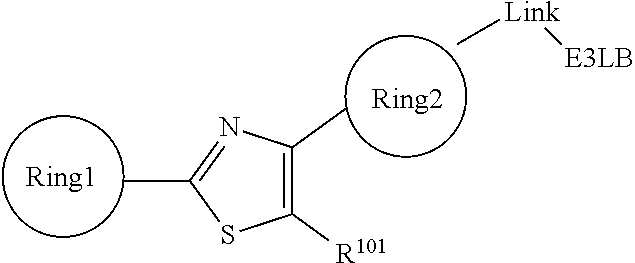


Priority Applications (5)
| Application Number | Priority Date | Filing Date | Title |
|---|---|---|---|
| US16/777,294 US11098025B2 (en) | 2019-01-30 | 2020-01-30 | Bi-functional compounds and methods for targeted ubiquitination of androgen receptor |
| US16/876,949 US11547759B2 (en) | 2019-01-30 | 2020-05-18 | Bi-functional compounds and methods for targeted ubiquitination of androgen receptor |
| US17/331,940 US11787778B2 (en) | 2019-01-30 | 2021-05-27 | Bi-functional compounds and methods for targeted ubiquitination of androgen receptor |
| US18/151,904 US20230241227A1 (en) | 2019-01-30 | 2023-01-09 | Bi-functional compounds and methods for targeted ubiquitination of androgen receptor |
| US18/459,944 US20240002360A1 (en) | 2019-01-30 | 2023-09-01 | Bi-functional compounds and methods for targeted ubiquitination of androgen receptor |
Applications Claiming Priority (2)
| Application Number | Priority Date | Filing Date | Title |
|---|---|---|---|
| US201962798554P | 2019-01-30 | 2019-01-30 | |
| US16/777,294 US11098025B2 (en) | 2019-01-30 | 2020-01-30 | Bi-functional compounds and methods for targeted ubiquitination of androgen receptor |
Related Child Applications (2)
| Application Number | Title | Priority Date | Filing Date |
|---|---|---|---|
| US16/876,949 Continuation-In-Part US11547759B2 (en) | 2019-01-30 | 2020-05-18 | Bi-functional compounds and methods for targeted ubiquitination of androgen receptor |
| US17/331,940 Continuation US11787778B2 (en) | 2019-01-30 | 2021-05-27 | Bi-functional compounds and methods for targeted ubiquitination of androgen receptor |
Publications (2)
| Publication Number | Publication Date |
|---|---|
| US20200239430A1 US20200239430A1 (en) | 2020-07-30 |
| US11098025B2 true US11098025B2 (en) | 2021-08-24 |
Family
ID=71733785
Family Applications (3)
| Application Number | Title | Priority Date | Filing Date |
|---|---|---|---|
| US16/777,294 Active US11098025B2 (en) | 2019-01-30 | 2020-01-30 | Bi-functional compounds and methods for targeted ubiquitination of androgen receptor |
| US17/331,940 Active 2040-03-02 US11787778B2 (en) | 2019-01-30 | 2021-05-27 | Bi-functional compounds and methods for targeted ubiquitination of androgen receptor |
| US18/459,944 Abandoned US20240002360A1 (en) | 2019-01-30 | 2023-09-01 | Bi-functional compounds and methods for targeted ubiquitination of androgen receptor |
Family Applications After (2)
| Application Number | Title | Priority Date | Filing Date |
|---|---|---|---|
| US17/331,940 Active 2040-03-02 US11787778B2 (en) | 2019-01-30 | 2021-05-27 | Bi-functional compounds and methods for targeted ubiquitination of androgen receptor |
| US18/459,944 Abandoned US20240002360A1 (en) | 2019-01-30 | 2023-09-01 | Bi-functional compounds and methods for targeted ubiquitination of androgen receptor |
Country Status (5)
| Country | Link |
|---|---|
| US (3) | US11098025B2 (en) |
| EP (1) | EP3917916A4 (en) |
| JP (1) | JP7555938B2 (en) |
| CN (1) | CN113677668B (en) |
| WO (1) | WO2020160295A1 (en) |
Cited By (3)
| Publication number | Priority date | Publication date | Assignee | Title |
|---|---|---|---|---|
| US11787778B2 (en) | 2019-01-30 | 2023-10-17 | Montelino Therapeutics, Inc. | Bi-functional compounds and methods for targeted ubiquitination of androgen receptor |
| US11981672B2 (en) | 2021-09-13 | 2024-05-14 | Montelino Therapeutics Inc. | Bi-functional compounds and methods for targeted ubiquitination of androgen receptor |
| WO2024102810A1 (en) | 2022-11-08 | 2024-05-16 | Montelino Therapeutics, Inc. | Bi-functional compounds and methods for targeted ubiquitination of androgen receptor |
Families Citing this family (15)
| Publication number | Priority date | Publication date | Assignee | Title |
|---|---|---|---|---|
| WO2021127443A1 (en) | 2019-12-19 | 2021-06-24 | Arvinas Operations, Inc. | Compounds and methods for the targeted degradation of androgen receptor |
| CN115996918A (en) | 2020-05-09 | 2023-04-21 | 阿尔维纳斯运营股份有限公司 | Process for the manufacture of bifunctional compounds, ultrapure forms of bifunctional compounds, and dosage forms comprising said bifunctional compounds |
| EP4153587A4 (en) * | 2020-05-18 | 2024-06-12 | Montelino Therapeutics, Inc. | Bi-functional compounds and methods for targeted ubiquitination of androgen receptor |
| CN114262319B (en) * | 2020-12-01 | 2023-05-05 | 南昌奥瑞药业有限公司 | Bifunctional molecule, preparation method and application thereof |
| WO2022183006A1 (en) * | 2021-02-25 | 2022-09-01 | Mayo Foundation For Medical Education And Research | Compounds for programmable protein degradation and methods of use for the disease treatment |
| US20240382603A1 (en) * | 2021-09-13 | 2024-11-21 | Montelino Therapeutics, Inc. | Bi-functional compounds and methods for targeted ubiquitination of androgen receptor |
| US20240376118A1 (en) * | 2021-09-13 | 2024-11-14 | Montelino Therapeutics, Inc. | Bi-functional compounds and methods for targeted ubiquitination of androgen receptor |
| US20240408106A1 (en) * | 2021-09-13 | 2024-12-12 | Montelino Therapeutics, Inc. | Bi-functional compounds and methods for targeted ubiquitination of androgen receptor |
| US20240317734A1 (en) * | 2021-09-13 | 2024-09-26 | Montelino Therapeutics, Inc. | Bi-functional compounds and methods for targeted ubiquitination of androgen receptor |
| US20260131009A1 (en) * | 2021-11-03 | 2026-05-14 | Relay Therapeutics, Inc. | Bifunctional pi3k-alpha inhibitors and uses thereof |
| CA3240051A1 (en) | 2021-12-30 | 2023-07-06 | Beigene Switzerland Gmbh | Degradation of bruton's tyrosine kinase (btk) by conjugation of btk inhibitors with e3 ligase ligand and methods of use |
| CN119301111A (en) | 2022-03-24 | 2025-01-10 | 葛兰素史密斯克莱知识产权发展有限公司 | 2,4-Dioxotetrahydropyrimidinyl derivatives as degrons in PROTACs |
| CN114890989B (en) * | 2022-05-25 | 2024-03-22 | 广东晨康生物科技有限公司 | HDAC8 degradation agent with nitrogenous derivative as Linker, preparation method and application thereof |
| KR20250047848A (en) * | 2023-09-27 | 2025-04-07 | 강원대학교산학협력단 | Method for specific degradation of G12V mutant protein of KRAS and composition thereof |
| AU2024392985A1 (en) | 2023-12-08 | 2026-06-04 | Arvinas Operations, Inc. | Use of androgen receptor degrader for the treatment of spinal and bulbar muscular atrophy |
Citations (14)
| Publication number | Priority date | Publication date | Assignee | Title |
|---|---|---|---|---|
| WO2000007612A1 (en) | 1998-08-08 | 2000-02-17 | The University Of Nottingham | Defensins against ocular infection |
| US6306663B1 (en) | 1999-02-12 | 2001-10-23 | Proteinex, Inc. | Controlling protein levels in eucaryotic organisms |
| US20140356322A1 (en) | 2012-01-12 | 2014-12-04 | Yale University | Compounds & Methods for the Enhanced Degradation of Targeted Proteins & Other Polypeptides by an E3 Ubiquitin Ligase |
| WO2015120543A1 (en) | 2014-02-14 | 2015-08-20 | The University Of British Columbia | Human androgen receptor dna-binding domain (dbd) compounds as therapeutics and methods for their use |
| WO2016105518A1 (en) | 2014-12-23 | 2016-06-30 | Dana-Farber Cancer Institute, Inc. | Methods to induce targeted protein degradation through bifunctional molecules |
| US20160214972A1 (en) | 2015-01-20 | 2016-07-28 | Arvinas, Inc. | Compounds and methods for the targeted degradation of androgen receptor |
| US20170008904A1 (en) | 2015-07-10 | 2017-01-12 | Arvinas, Inc. | Mdm2-based modulators of proteolysis and associated methods of use |
| WO2017176957A1 (en) | 2016-04-06 | 2017-10-12 | The Regents Of The University Of Michigan | Mdm2 protein degraders |
| US20170327469A1 (en) | 2015-01-20 | 2017-11-16 | Arvinas, Inc. | Compounds and methods for the targeted degradation of androgen receptor |
| US20180099940A1 (en) | 2016-10-11 | 2018-04-12 | Arvinas, Inc. | Compounds and methods for the targeted degradation of androgen receptor |
| US20180118733A1 (en) | 2015-04-22 | 2018-05-03 | Glaxosmithkline Intellectual Property Development Limited | lAP E3 LIGASE DIRECTED PROTEOLYSIS TARGETING CHIMERIC MOLECULES |
| US20180134688A1 (en) | 2015-04-22 | 2018-05-17 | Glaxosmithkline Intellectual Property Development Limited | Novel compounds |
| US9993514B2 (en) | 2013-07-03 | 2018-06-12 | Glaxosmithkline Intellectual Property Development Limited | Compounds |
| WO2018114781A1 (en) | 2016-12-19 | 2018-06-28 | F. Hoffmann-La Roche Ag | Ar-v7 inhibitors |
Family Cites Families (22)
| Publication number | Priority date | Publication date | Assignee | Title |
|---|---|---|---|---|
| ATE381743T1 (en) | 1999-09-15 | 2008-01-15 | Europ Economic Community | MULTI-WAY ELECTRONIC SEAL USING A PASSIVE TRANSPONDER |
| UY32180A (en) | 2008-10-17 | 2010-05-31 | Abbott Lab | VANILLOID POTENTIAL TRANSITORY RECEIVER ANTAGONISTS 1 (TRPV1) |
| WO2011082285A1 (en) | 2009-12-30 | 2011-07-07 | Avila Therapeutics, Inc. | Ligand-directed covalent modification of protein |
| NZ602368A (en) | 2010-02-12 | 2014-10-31 | Pharmascience Inc | Iap bir domain binding compounds |
| JP5934986B2 (en) | 2011-09-07 | 2016-06-15 | 公益財団法人ヒューマンサイエンス振興財団 | Apoptosis-inhibiting protein ligand-estrogen receptor ligand hybrid compound, estrogen receptor degradation inducer using the same, and preventive and therapeutic agent for breast cancer, cervical cancer or ovarian cancer |
| WO2014026198A1 (en) | 2012-08-10 | 2014-02-13 | Epizyme, Inc. | Inhibitors of protein methyltransferase dot1l and methods of use thereof |
| EP4649963A3 (en) | 2014-04-14 | 2026-05-13 | Arvinas Operations, Inc. | Imide-based modulators of proteolysis and associated methods of use |
| US9694084B2 (en) | 2014-12-23 | 2017-07-04 | Dana-Farber Cancer Institute, Inc. | Methods to induce targeted protein degradation through bifunctional molecules |
| WO2017007612A1 (en) | 2015-07-07 | 2017-01-12 | Dana-Farber Cancer Institute, Inc. | Methods to induce targeted protein degradation through bifunctional molecules |
| CA2988436A1 (en) | 2015-07-13 | 2017-01-19 | Arvinas, Inc. | Alanine-based modulators of proteolysis and associated methods of use |
| WO2017197056A1 (en) | 2016-05-10 | 2017-11-16 | C4 Therapeutics, Inc. | Bromodomain targeting degronimers for target protein degradation |
| IL319363A (en) | 2017-01-31 | 2025-05-01 | Arvinas Operations Inc | Cereblon ligands and bifunctional compounds comprising the same |
| EP3634451A4 (en) | 2017-05-15 | 2021-03-24 | The Trustees of Columbia University in the City of New York | REPROGRAMMATION OF METABOLISM BY VHL INHIBITION FOR THE TREATMENT OF NEURODEGENERENCE |
| IL315310A (en) | 2017-12-26 | 2024-10-01 | Kymera Therapeutics Inc | IRAK joints and used in them |
| WO2020010210A1 (en) | 2018-07-06 | 2020-01-09 | Kymera Therapeutics, Inc. | Mertk degraders and uses thereof |
| KR102596354B1 (en) | 2018-11-05 | 2023-10-31 | 삼성디스플레이 주식회사 | Liquid crystal display and the method therrof |
| WO2020102575A1 (en) | 2018-11-16 | 2020-05-22 | Inception Ibd, Inc. | Heterocyclic aminothiazoles and uses thereof |
| WO2020160295A1 (en) | 2019-01-30 | 2020-08-06 | Montelino Therapeutics, Llc | Bi-functional compounds and methods for targeted ubiquitination of androgen receptor |
| US11547759B2 (en) | 2019-01-30 | 2023-01-10 | Montelino Therapeutics, Inc. | Bi-functional compounds and methods for targeted ubiquitination of androgen receptor |
| EP4034114A4 (en) | 2019-09-23 | 2023-07-26 | Accutar Biotechnology Inc. | NEW UREAES HAVING ANDROGEN RECEPTOR DEGRADING ACTIVITY AND THEIR USES |
| CA3160713A1 (en) | 2019-12-04 | 2021-06-10 | Nurix Therapeutics, Inc. | Bifunctional compounds for degrading btk via ubiquitin proteosome pathway |
| EP4153587A4 (en) | 2020-05-18 | 2024-06-12 | Montelino Therapeutics, Inc. | Bi-functional compounds and methods for targeted ubiquitination of androgen receptor |
-
2020
- 2020-01-30 WO PCT/US2020/015922 patent/WO2020160295A1/en not_active Ceased
- 2020-01-30 US US16/777,294 patent/US11098025B2/en active Active
- 2020-01-30 EP EP20748314.0A patent/EP3917916A4/en not_active Withdrawn
- 2020-01-30 CN CN202080026615.5A patent/CN113677668B/en not_active Expired - Fee Related
- 2020-01-30 JP JP2021544763A patent/JP7555938B2/en active Active
-
2021
- 2021-05-27 US US17/331,940 patent/US11787778B2/en active Active
-
2023
- 2023-09-01 US US18/459,944 patent/US20240002360A1/en not_active Abandoned
Patent Citations (15)
| Publication number | Priority date | Publication date | Assignee | Title |
|---|---|---|---|---|
| WO2000007612A1 (en) | 1998-08-08 | 2000-02-17 | The University Of Nottingham | Defensins against ocular infection |
| US6306663B1 (en) | 1999-02-12 | 2001-10-23 | Proteinex, Inc. | Controlling protein levels in eucaryotic organisms |
| US20140356322A1 (en) | 2012-01-12 | 2014-12-04 | Yale University | Compounds & Methods for the Enhanced Degradation of Targeted Proteins & Other Polypeptides by an E3 Ubiquitin Ligase |
| US9993514B2 (en) | 2013-07-03 | 2018-06-12 | Glaxosmithkline Intellectual Property Development Limited | Compounds |
| US20170183319A1 (en) | 2014-02-14 | 2017-06-29 | The University Of British Columbia | Human androgen receptor dna-binding doman (dbd) compounds as therapeutics and methods for their use |
| WO2015120543A1 (en) | 2014-02-14 | 2015-08-20 | The University Of British Columbia | Human androgen receptor dna-binding domain (dbd) compounds as therapeutics and methods for their use |
| WO2016105518A1 (en) | 2014-12-23 | 2016-06-30 | Dana-Farber Cancer Institute, Inc. | Methods to induce targeted protein degradation through bifunctional molecules |
| US20170327469A1 (en) | 2015-01-20 | 2017-11-16 | Arvinas, Inc. | Compounds and methods for the targeted degradation of androgen receptor |
| US20160214972A1 (en) | 2015-01-20 | 2016-07-28 | Arvinas, Inc. | Compounds and methods for the targeted degradation of androgen receptor |
| US20180118733A1 (en) | 2015-04-22 | 2018-05-03 | Glaxosmithkline Intellectual Property Development Limited | lAP E3 LIGASE DIRECTED PROTEOLYSIS TARGETING CHIMERIC MOLECULES |
| US20180134688A1 (en) | 2015-04-22 | 2018-05-17 | Glaxosmithkline Intellectual Property Development Limited | Novel compounds |
| US20170008904A1 (en) | 2015-07-10 | 2017-01-12 | Arvinas, Inc. | Mdm2-based modulators of proteolysis and associated methods of use |
| WO2017176957A1 (en) | 2016-04-06 | 2017-10-12 | The Regents Of The University Of Michigan | Mdm2 protein degraders |
| US20180099940A1 (en) | 2016-10-11 | 2018-04-12 | Arvinas, Inc. | Compounds and methods for the targeted degradation of androgen receptor |
| WO2018114781A1 (en) | 2016-12-19 | 2018-06-28 | F. Hoffmann-La Roche Ag | Ar-v7 inhibitors |
Non-Patent Citations (25)
| Title |
|---|
| Antonarakis, E. et al, AR-V7 and Resistance to Enzalutamide and Abiraterone in Prostate Cancer, New England Journal of Medicine, 2014, 371 (11), 1028-1038. |
| Chamberlain, Philip P., Cereblon modulators: Low molecular weight inducers of protein degradation, Drug Discovery Today: Technologies, vol. 31, 2019, pp. 29-34. |
| Chopra, Rajesh, A critical evaluation of the approaches to targeted protein degradation for drug discovery, Drug Discovery Today: Technologies, vol. 31, 2019, pp. 5-13. |
| Churcher, Ian, Protac-Induced Protein Degradation in Drug Discovery: Breaking the Rules or Just Making New Ones?, Journal of Medicinal Chemistry, 2018, 61, pp. 444-452. |
| Crews, Craig M., Targeting the Undruggable Proteome: The Small Molecules of My Dreams, Chemistry & Biology 17, Jun. 25, 2010, pp. 551-555. |
| Dalai, Kush, The Journal of Biological Chemistry, vol. 292, No. 10, Mar. 10, 2017, p. 4359 (Correction). |
| Dalal, Kush, Bypassing Drug Resistance Mechanisms of Prostate Cancer with Small Molecules that Target Androgen Receptor-Chromatin Interactions, Molecular Cancer Therapeutics, 2017, 16, 2281-2291. |
| Dalal, Kush, Selectively targeting the dimerization interface of human androgen receptor with small-molecules to treat castration-resistant prostate cancer, Elsevier, Cancer Letters 437, 2018, pp. 35-43. |
| Dalal, Kush, Selectively targeting the DNA-binding domain of the androgen receptor as a prospective therapy for prostate cancer, The Journal of Biological Chemistry, vol. 289, 2014, pp. 26417-26429 (Correction Included). |
| Han, Ting, Anticancer sulfonamides target splicing by inducing RBM39 degradation via recruitment to DCAF15, Science, 2017, 356, 397. |
| Hansen, Joshua D., Protein Degradation via CRL4CRBN Ubiquitin Ligase: Discovery and Structure-Activity Relationships of Novel Glutarimide Analogs That Promote Degradation of Aiolos and/or GSPT1, Journal of Medicinal Chemistry, 2018, 61, 492-503. |
| Hines, John, MDM2-Recruiting PROTAC Offers Superior, Synergistic Antiproliferative Activity via Simultaneous Degradation of BRD4 and Stabilization of p53, American Association for Cancer Research, 2019, 79, pp. 251-262. |
| Hunter, Allison M., The inhibitors of apoptosis (IAPs) as cancer targets, Science+Business Media, 2007, 12, pp. 1543-1598. |
| Itoh, Yukihiro, Double protein knockdown of cIAP1 and CRABP-II using a hybrid molecule consisting of ATRA and IAPs antagonist, Bioorganic & Medicinal Chemistry Letters 22, 2012, 4453-4457. |
| Li, Huifang, Correction to Discovery of Small-Molecule Inhibitors Selectively Targeting the DNA-Binding Domain of the Human Androgen Receptor, Journal of Medicinal Chemistry, 2014, 57, pp. 6458-6467 (Correction). |
| Li, Huifang, Discovery of Small-Molecule Inhibitors Selectively Targeting the DNA-Binding Domain of the Human Androgen Receptor, Journal of Medicinal Chemistry, 2014, 57, 6458-6467 (correction included). |
| Naito, Mikihiko, SNIPERs—Hijacking IAP activity to induce protein degradation, Drug Discovery Today: Technologies, 2019, vol. 31, pp. 35-42. |
| Ohoka, Nobumichi, In Vivo Knockdown of Pathogenic Proteins via Specific and Nongenetic Inhibitor of Apoptosis Protein (IAP)—dependent Protein Erasers (SNIPERs), Journal of Biological Chemistry, 2017, vol. 292, No. 11, 4556-4570. |
| Ohoka, Nobumichi, Protein Knockdown Technology: Application of Ubiquitin Ligase to Cancer Therapy, Current Cancer Drug Targets, 2016, 16(2), pp. 136-146. |
| Pettersson, Mariell, PROteolysis Targeting Chimeras (PROTACs)—Past, present and future, Drug Discovery Today: Technologies, 2019, vol. 31, pp. 15-27. |
| Rodriguez-Gonzalez, A., Targeting steroid hormone receptors for ubiquitination and degradation in breast and prostate cancer, Oncogene, 2008, 27, pp. 7201-7211. |
| Shibata, Norihito, Development of Protein Degradation Inducers of Androgen Receptor by Conjugation of Androgen Receptor Ligands and Inhibitor of Apoptosis Protein Ligands, Journal of Medicinal Chemistry, 2018, 61, 543-575. |
| Sievers, Quinlan, L., Defining the human C2H2 zinc-finger degrome targeted by thalidomide analogs through CRBN, Science, 2018, 362. |
| Skalniak, Lukasz, A therapeutic patent overview of MDM2/X—targeted therapies (2014-2018), Expert Opinion on Therapeutic Patents, 2019. |
| Soares, Pedro, Group-Based Optimization of Potent and Cell-Active Inhibitors of the von Hippel-Lindau (VHL) E3 Ubiquitin Ligase: Structure—Activity Relationships Leading to the Chemical Probe (2S,4R)-1-((S)-2-(1-Cyanocyclopropanecarboxamido)-3,3-dimethylbutanoyl-4-hydroxy-N-(4-(4-methylthiazol-5-yl)benzyl)pyrrolidine-2-carboxamide (VH298), Journal of Medicinal Chemistry, 2018, 61, 599-618. |
Cited By (3)
| Publication number | Priority date | Publication date | Assignee | Title |
|---|---|---|---|---|
| US11787778B2 (en) | 2019-01-30 | 2023-10-17 | Montelino Therapeutics, Inc. | Bi-functional compounds and methods for targeted ubiquitination of androgen receptor |
| US11981672B2 (en) | 2021-09-13 | 2024-05-14 | Montelino Therapeutics Inc. | Bi-functional compounds and methods for targeted ubiquitination of androgen receptor |
| WO2024102810A1 (en) | 2022-11-08 | 2024-05-16 | Montelino Therapeutics, Inc. | Bi-functional compounds and methods for targeted ubiquitination of androgen receptor |
Also Published As
| Publication number | Publication date |
|---|---|
| WO2020160295A1 (en) | 2020-08-06 |
| US20240002360A1 (en) | 2024-01-04 |
| JP7555938B2 (en) | 2024-09-25 |
| US20210292298A1 (en) | 2021-09-23 |
| CN113677668B (en) | 2024-09-27 |
| CN113677668A (en) | 2021-11-19 |
| US11787778B2 (en) | 2023-10-17 |
| EP3917916A4 (en) | 2022-12-14 |
| EP3917916A1 (en) | 2021-12-08 |
| US20200239430A1 (en) | 2020-07-30 |
| JP2022523916A (en) | 2022-04-27 |
Similar Documents
| Publication | Publication Date | Title |
|---|---|---|
| US11787778B2 (en) | Bi-functional compounds and methods for targeted ubiquitination of androgen receptor | |
| US20230241227A1 (en) | Bi-functional compounds and methods for targeted ubiquitination of androgen receptor | |
| US20240059686A1 (en) | Compounds and methods for the targeted degradation of the androgen receptor | |
| US20250223265A1 (en) | Compounds and methods for the targeted degradation of androgen receptor | |
| US11028088B2 (en) | Modulators of BTK proteolysis and methods of use | |
| US20230132823A1 (en) | Bi-functional compounds and methods for targeted ubiquitination of androgen receptor | |
| US20220370416A1 (en) | Compounds and methods for targeted degradation of kras | |
| US11858940B2 (en) | Selective modulators of mutant LRRK2 proteolysis and associated methods of use | |
| US20240294489A1 (en) | Low molecular weight protein degraders and their applications | |
| US20180147202A1 (en) | TANK-BINDING KINASE-1 PROTACs AND ASSOCIATED METHODS OF USE | |
| US20200010504A1 (en) | Compounds | |
| US20240316059A1 (en) | Peptide drug conjugates | |
| US20200121684A1 (en) | Modulators of btk proteolysis and methods of use | |
| US20240408106A1 (en) | Bi-functional compounds and methods for targeted ubiquitination of androgen receptor | |
| US20240252488A1 (en) | Mlkl binding or degrading compound and pharmaceutical use thereof | |
| US20240382603A1 (en) | Bi-functional compounds and methods for targeted ubiquitination of androgen receptor | |
| CN107001240B (en) | Dipeptidyl ketoamide compounds and their use for the treatment and/or prevention of fat accumulation | |
| US20240317734A1 (en) | Bi-functional compounds and methods for targeted ubiquitination of androgen receptor | |
| RU2774863C2 (en) | Compounds and methods for targeted degradation of androgen receptor | |
| US20240207415A1 (en) | Bi-functional compounds and methods for targeted ubiquitination of androgen receptor | |
| HK40062040A (en) | Bi-functional compounds and methods for targeted ubiquitination of androgen receptor |
Legal Events
| Date | Code | Title | Description |
|---|---|---|---|
| FEPP | Fee payment procedure |
Free format text: ENTITY STATUS SET TO UNDISCOUNTED (ORIGINAL EVENT CODE: BIG.); ENTITY STATUS OF PATENT OWNER: SMALL ENTITY |
|
| FEPP | Fee payment procedure |
Free format text: ENTITY STATUS SET TO SMALL (ORIGINAL EVENT CODE: SMAL); ENTITY STATUS OF PATENT OWNER: SMALL ENTITY Free format text: ENTITY STATUS SET TO UNDISCOUNTED (ORIGINAL EVENT CODE: BIG.); ENTITY STATUS OF PATENT OWNER: SMALL ENTITY |
|
| AS | Assignment |
Owner name: MONTELINO THERAPEUTICS, LLC, MASSACHUSETTS Free format text: ASSIGNMENT OF ASSIGNORS INTEREST;ASSIGNORS:DESANTIS, JENNY;VAZ, ROY JOSEPH;KIM, ISAAC;REEL/FRAME:052168/0847 Effective date: 20200318 |
|
| AS | Assignment |
Owner name: MONTELINO THERAPEUTICS, INC., MASSACHUSETTS Free format text: ASSIGNMENT OF ASSIGNORS INTEREST;ASSIGNOR:MONTELINO THERAPEUTICS, LLC;REEL/FRAME:053188/0120 Effective date: 20200709 |
|
| STPP | Information on status: patent application and granting procedure in general |
Free format text: NON FINAL ACTION MAILED |
|
| STPP | Information on status: patent application and granting procedure in general |
Free format text: NON FINAL ACTION MAILED |
|
| STPP | Information on status: patent application and granting procedure in general |
Free format text: RESPONSE TO NON-FINAL OFFICE ACTION ENTERED AND FORWARDED TO EXAMINER |
|
| STPP | Information on status: patent application and granting procedure in general |
Free format text: NOTICE OF ALLOWANCE MAILED -- APPLICATION RECEIVED IN OFFICE OF PUBLICATIONS |
|
| STPP | Information on status: patent application and granting procedure in general |
Free format text: AWAITING TC RESP., ISSUE FEE NOT PAID |
|
| STPP | Information on status: patent application and granting procedure in general |
Free format text: NOTICE OF ALLOWANCE MAILED -- APPLICATION RECEIVED IN OFFICE OF PUBLICATIONS |
|
| STPP | Information on status: patent application and granting procedure in general |
Free format text: AWAITING TC RESP., ISSUE FEE NOT PAID |
|
| STPP | Information on status: patent application and granting procedure in general |
Free format text: NOTICE OF ALLOWANCE MAILED -- APPLICATION RECEIVED IN OFFICE OF PUBLICATIONS |
|
| STPP | Information on status: patent application and granting procedure in general |
Free format text: PUBLICATIONS -- ISSUE FEE PAYMENT VERIFIED |
|
| STPP | Information on status: patent application and granting procedure in general |
Free format text: AWAITING TC RESP, ISSUE FEE PAYMENT VERIFIED |
|
| STCF | Information on status: patent grant |
Free format text: PATENTED CASE |
|
| CC | Certificate of correction | ||
| AS | Assignment |
Owner name: DBD THERAPEUTICS, LLC, OHIO Free format text: ASSIGNMENT OF ASSIGNORS INTEREST;ASSIGNOR:MONTELINO THERAPEUTICS, INC.;REEL/FRAME:069690/0674 Effective date: 20241227 |
|
| MAFP | Maintenance fee payment |
Free format text: PAYMENT OF MAINTENANCE FEE, 4TH YR, SMALL ENTITY (ORIGINAL EVENT CODE: M2551); ENTITY STATUS OF PATENT OWNER: SMALL ENTITY Year of fee payment: 4 |