US11095452B2 - Out-of-band authentication in group communications - Google Patents
Out-of-band authentication in group communications Download PDFInfo
- Publication number
- US11095452B2 US11095452B2 US17/047,897 US201917047897A US11095452B2 US 11095452 B2 US11095452 B2 US 11095452B2 US 201917047897 A US201917047897 A US 201917047897A US 11095452 B2 US11095452 B2 US 11095452B2
- Authority
- US
- United States
- Prior art keywords
- receiver
- sender
- channel
- computing devices
- computing device
- Prior art date
- Legal status (The legal status is an assumption and is not a legal conclusion. Google has not performed a legal analysis and makes no representation as to the accuracy of the status listed.)
- Expired - Fee Related
Links
Images




Classifications
-
- H—ELECTRICITY
- H04—ELECTRIC COMMUNICATION TECHNIQUE
- H04L—TRANSMISSION OF DIGITAL INFORMATION, e.g. TELEGRAPHIC COMMUNICATION
- H04L9/00—Cryptographic mechanisms or cryptographic arrangements for secret or secure communications; Network security protocols
- H04L9/32—Cryptographic mechanisms or cryptographic arrangements for secret or secure communications; Network security protocols including means for verifying the identity or authority of a user of the system or for message authentication, e.g. authorization, entity authentication, data integrity or data verification, non-repudiation, key authentication or verification of credentials
- H04L9/3236—Cryptographic mechanisms or cryptographic arrangements for secret or secure communications; Network security protocols including means for verifying the identity or authority of a user of the system or for message authentication, e.g. authorization, entity authentication, data integrity or data verification, non-repudiation, key authentication or verification of credentials using cryptographic hash functions
- H04L9/3239—Cryptographic mechanisms or cryptographic arrangements for secret or secure communications; Network security protocols including means for verifying the identity or authority of a user of the system or for message authentication, e.g. authorization, entity authentication, data integrity or data verification, non-repudiation, key authentication or verification of credentials using cryptographic hash functions involving non-keyed hash functions, e.g. modification detection codes [MDCs], MD5, SHA or RIPEMD
-
- H—ELECTRICITY
- H04—ELECTRIC COMMUNICATION TECHNIQUE
- H04W—WIRELESS COMMUNICATION NETWORKS
- H04W12/00—Security arrangements; Authentication; Protecting privacy or anonymity
- H04W12/06—Authentication
-
- H04L51/12—
-
- H—ELECTRICITY
- H04—ELECTRIC COMMUNICATION TECHNIQUE
- H04L—TRANSMISSION OF DIGITAL INFORMATION, e.g. TELEGRAPHIC COMMUNICATION
- H04L51/00—User-to-user messaging in packet-switching networks, transmitted according to store-and-forward or real-time protocols, e.g. e-mail
- H04L51/21—Monitoring or handling of messages
- H04L51/212—Monitoring or handling of messages using filtering or selective blocking
-
- H—ELECTRICITY
- H04—ELECTRIC COMMUNICATION TECHNIQUE
- H04L—TRANSMISSION OF DIGITAL INFORMATION, e.g. TELEGRAPHIC COMMUNICATION
- H04L63/00—Network architectures or network communication protocols for network security
- H04L63/04—Network architectures or network communication protocols for network security for providing a confidential data exchange among entities communicating through data packet networks
- H04L63/0428—Network architectures or network communication protocols for network security for providing a confidential data exchange among entities communicating through data packet networks wherein the data content is protected, e.g. by encrypting or encapsulating the payload
-
- H—ELECTRICITY
- H04—ELECTRIC COMMUNICATION TECHNIQUE
- H04L—TRANSMISSION OF DIGITAL INFORMATION, e.g. TELEGRAPHIC COMMUNICATION
- H04L63/00—Network architectures or network communication protocols for network security
- H04L63/06—Network architectures or network communication protocols for network security for supporting key management in a packet data network
- H04L63/065—Network architectures or network communication protocols for network security for supporting key management in a packet data network for group communications
-
- H—ELECTRICITY
- H04—ELECTRIC COMMUNICATION TECHNIQUE
- H04L—TRANSMISSION OF DIGITAL INFORMATION, e.g. TELEGRAPHIC COMMUNICATION
- H04L63/00—Network architectures or network communication protocols for network security
- H04L63/08—Network architectures or network communication protocols for network security for authentication of entities
-
- H—ELECTRICITY
- H04—ELECTRIC COMMUNICATION TECHNIQUE
- H04L—TRANSMISSION OF DIGITAL INFORMATION, e.g. TELEGRAPHIC COMMUNICATION
- H04L63/00—Network architectures or network communication protocols for network security
- H04L63/12—Applying verification of the received information
- H04L63/123—Applying verification of the received information received data contents, e.g. message integrity
-
- H—ELECTRICITY
- H04—ELECTRIC COMMUNICATION TECHNIQUE
- H04L—TRANSMISSION OF DIGITAL INFORMATION, e.g. TELEGRAPHIC COMMUNICATION
- H04L63/00—Network architectures or network communication protocols for network security
- H04L63/12—Applying verification of the received information
- H04L63/126—Applying verification of the received information the source of the received data
-
- H—ELECTRICITY
- H04—ELECTRIC COMMUNICATION TECHNIQUE
- H04L—TRANSMISSION OF DIGITAL INFORMATION, e.g. TELEGRAPHIC COMMUNICATION
- H04L69/00—Network arrangements, protocols or services independent of the application payload and not provided for in the other groups of this subclass
- H04L69/14—Multichannel or multilink protocols
-
- H—ELECTRICITY
- H04—ELECTRIC COMMUNICATION TECHNIQUE
- H04L—TRANSMISSION OF DIGITAL INFORMATION, e.g. TELEGRAPHIC COMMUNICATION
- H04L9/00—Cryptographic mechanisms or cryptographic arrangements for secret or secure communications; Network security protocols
- H04L9/06—Cryptographic mechanisms or cryptographic arrangements for secret or secure communications; Network security protocols the encryption apparatus using shift registers or memories for block-wise or stream coding, e.g. DES systems or RC4; Hash functions; Pseudorandom sequence generators
- H04L9/0643—Hash functions, e.g. MD5, SHA, HMAC or f9 MAC
-
- H—ELECTRICITY
- H04—ELECTRIC COMMUNICATION TECHNIQUE
- H04L—TRANSMISSION OF DIGITAL INFORMATION, e.g. TELEGRAPHIC COMMUNICATION
- H04L9/00—Cryptographic mechanisms or cryptographic arrangements for secret or secure communications; Network security protocols
- H04L9/08—Key distribution or management, e.g. generation, sharing or updating, of cryptographic keys or passwords
- H04L9/0816—Key establishment, i.e. cryptographic processes or cryptographic protocols whereby a shared secret becomes available to two or more parties, for subsequent use
- H04L9/0819—Key transport or distribution, i.e. key establishment techniques where one party creates or otherwise obtains a secret value, and securely transfers it to the other(s)
- H04L9/083—Key transport or distribution, i.e. key establishment techniques where one party creates or otherwise obtains a secret value, and securely transfers it to the other(s) involving central third party, e.g. key distribution center [KDC] or trusted third party [TTP]
- H04L9/0833—Key transport or distribution, i.e. key establishment techniques where one party creates or otherwise obtains a secret value, and securely transfers it to the other(s) involving central third party, e.g. key distribution center [KDC] or trusted third party [TTP] involving conference or group key
-
- H—ELECTRICITY
- H04—ELECTRIC COMMUNICATION TECHNIQUE
- H04L—TRANSMISSION OF DIGITAL INFORMATION, e.g. TELEGRAPHIC COMMUNICATION
- H04L9/00—Cryptographic mechanisms or cryptographic arrangements for secret or secure communications; Network security protocols
- H04L9/08—Key distribution or management, e.g. generation, sharing or updating, of cryptographic keys or passwords
- H04L9/0816—Key establishment, i.e. cryptographic processes or cryptographic protocols whereby a shared secret becomes available to two or more parties, for subsequent use
- H04L9/0838—Key agreement, i.e. key establishment technique in which a shared key is derived by parties as a function of information contributed by, or associated with, each of these
- H04L9/0841—Key agreement, i.e. key establishment technique in which a shared key is derived by parties as a function of information contributed by, or associated with, each of these involving Diffie-Hellman or related key agreement protocols
-
- H—ELECTRICITY
- H04—ELECTRIC COMMUNICATION TECHNIQUE
- H04L—TRANSMISSION OF DIGITAL INFORMATION, e.g. TELEGRAPHIC COMMUNICATION
- H04L9/00—Cryptographic mechanisms or cryptographic arrangements for secret or secure communications; Network security protocols
- H04L9/12—Transmitting and receiving encryption devices synchronised or initially set up in a particular manner
-
- H—ELECTRICITY
- H04—ELECTRIC COMMUNICATION TECHNIQUE
- H04L—TRANSMISSION OF DIGITAL INFORMATION, e.g. TELEGRAPHIC COMMUNICATION
- H04L9/00—Cryptographic mechanisms or cryptographic arrangements for secret or secure communications; Network security protocols
- H04L9/32—Cryptographic mechanisms or cryptographic arrangements for secret or secure communications; Network security protocols including means for verifying the identity or authority of a user of the system or for message authentication, e.g. authorization, entity authentication, data integrity or data verification, non-repudiation, key authentication or verification of credentials
- H04L9/3215—Cryptographic mechanisms or cryptographic arrangements for secret or secure communications; Network security protocols including means for verifying the identity or authority of a user of the system or for message authentication, e.g. authorization, entity authentication, data integrity or data verification, non-repudiation, key authentication or verification of credentials using a plurality of channels
-
- H—ELECTRICITY
- H04—ELECTRIC COMMUNICATION TECHNIQUE
- H04L—TRANSMISSION OF DIGITAL INFORMATION, e.g. TELEGRAPHIC COMMUNICATION
- H04L9/00—Cryptographic mechanisms or cryptographic arrangements for secret or secure communications; Network security protocols
- H04L9/32—Cryptographic mechanisms or cryptographic arrangements for secret or secure communications; Network security protocols including means for verifying the identity or authority of a user of the system or for message authentication, e.g. authorization, entity authentication, data integrity or data verification, non-repudiation, key authentication or verification of credentials
- H04L9/3271—Cryptographic mechanisms or cryptographic arrangements for secret or secure communications; Network security protocols including means for verifying the identity or authority of a user of the system or for message authentication, e.g. authorization, entity authentication, data integrity or data verification, non-repudiation, key authentication or verification of credentials using challenge-response
- H04L9/3273—Cryptographic mechanisms or cryptographic arrangements for secret or secure communications; Network security protocols including means for verifying the identity or authority of a user of the system or for message authentication, e.g. authorization, entity authentication, data integrity or data verification, non-repudiation, key authentication or verification of credentials using challenge-response for mutual authentication
Definitions
- Instant messaging is gaining increased popularity as a tool enabling users to communicate with other users individually or within groups.
- a variety of available messaging platforms such as WhatsApp, Signal, and Telegram, hold an overall user base of more than 1.5 billion active users. These platform often recognize the need for user authentication and end-to-end encryption as key ingredients for ensuring secure communication within them.
- a key challenge in securing messaging platforms may include protecting against man-in-the-middle attacks when setting up secure end-to-end channels. Such attacks may be enabled by an inability of users to authenticate their incoming messages, e.g., given the somewhat ad-hoc nature of messaging platforms.
- out-of-band (OOB) authentication protocols configured to authenticate a short value over a low-bandwidth authenticated channel, are becoming more popular in real-world scenarios, whenever there are ad hoc networks with no trusted infrastructure.
- this model was found suitable for initial pairing of devices in wireless networks, such as Wireless USB and Bluetooth.
- a low-bandwidth authenticated channel may enable a man-on-the-middle (MTIM) attacker to view, delay, prevent delivery, insert, or even remove any message sent over the authenticated channel, without being able to modify a message's content, e.g., in an undetectable manner.
- MTIM man-on-the-middle
- a protocol may enable two users who recognize each other's voice, to mutually authenticate their public keys in an absence of a trusted infrastructure.
- a system comprising at least three computing device, each comprising at least one hardware processor and a non-transitory computer-readable storage medium having stored thereon program instructions, the program instructions executable by the at least one hardware processor to operate each of said at least three computing devices to: send over a first communication channel: (i) by each of two or more receiver computing devices selected from said at least three computing devices, to (a) all other said receiver computing devices, and (b) to a sender computing device selected from said at least three computing devices, an encrypted receiver bit string associated with the sending receiver computing device, (ii) by said sender computing device, to each of said receiver computing devices, an encrypted communication comprising: a sender bit string, and a message payload, (iii) by each of said receiver computing devices, to all other said receiver computing devices and to said sender computing device, a decrypted version of said receiver bit string, and (iv) by said sender computing device, to all said receiver computing devices, a decrypted version of said communication;
- said second communication channel is an authenticated channel.
- said second communication channel is a unidirectional channel only between said sender device and each of said receiver devices.
- FIG. 1 is a flowchart illustrating functional steps in a group messaging authentication protocol, according to an embodiment of the present invention
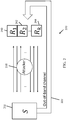
- FIG. 2 shows a schematic illustration of an exemplary system, according to an embodiment of the present invention
- FIG. 3 is a schematic illustration of a naive protocol, according to an embodiment.
- FIG. 4 is a schematic illustration of a group setting, according to an embodiment of the present invention.
- Described herein are systems, methods, and computer program products for authenticating a message communicated between a plurality of computing devices over a communication channel, referred to as an “in-band” channel.
- an authentication protocol of the present disclosure may provide for a practical and efficient way to authenticate a group message over a communication channel assumed to be unsecured, using a provided second communication channel, referred to as an “out-of-band” (OOB) channel.
- OOB out-of-band
- the OOB channel may be an authenticated channel.
- the OOB channel may comprise a low bandwidth channel which permits sending of short and/or relatively simple authentication message among the group of computing device.
- the present authentication protocol may enable users of a group to authenticate their public keys, or more generally, authenticate the transcript of any group key-exchange protocol of their choice.
- the present authentication protocol provides for an optimal tradeoff between a length and/or complexity of an authentication message, and a risk of success of a man-in-the-middle (MTIM) attack by an attacker, assuming computational limitations of the attacker.
- MTIM man-in-the-middle
- the present authentication protocol may provide for security that holds even when the attacker is computationally unbounded.
- some messaging platforms offer users the ability to compare with each other a value that is displayed by their devices. This may rely on the realistic assumption that by recognizing each other's voice, two users can establish a low-bandwidth authenticated channel: An MTIM attacker can view, delay or even remove any message sent over this channel, but cannot modify its content in an undetectable manner.
- Similar authentication protocols for group messaging have not been implemented.
- the present disclosure extends a user-to-user authentication protocol to consider a group of users that may consist, e.g., of a sender (e.g., the group administrator) and multiple receivers (e.g., all other group members).
- all users communicate over an unsecured channel, wherein there is available to the sender an out-of-band (OOB) authenticated channel which may be used to send, e.g., a short message to all receivers.
- OOB out-of-band
- the OOB channel may be based, for example, on the assumption that each user within the group can identify the sender's voice.
- other OOB verification methods based, e.g., in data, auditory, or visual verification, may be used.
- the OOB channel may be visible to an MTIM attacker, i.e., the attacker may be able to read, block, delay, or entirely remove any messages sent over the OOB channel for some or all receivers, however, the attacker cannot modify any message in an undetectable manner.
- a potential advantage of the present disclosure is, therefore, in that it provides for a simple and efficient authentication protocol of a group message over a communication channel in a group setting, while ensuring an optimal tradeoff between a length of the authenticated value and an attacker's success probability.
- references to a ‘man-in-the-middle’ (MTIM) attack may refer to an attacker, e.g., a hacker, who attempts to relay and possibly alters a communication between parties who may believe they are directly communicating with each other.
- MTIM man-in-the-middle
- a MITM attacker makes independent connections with each user and relays messages between them to make them believe they are talking directly to each other, when in fact the entire conversation is controlled by the attacker.
- references to an ‘unsecured’ channel may refer to a channel in which an attacker, e.g., using an MTIM attack, is able to intercept, read, delay, stop, modify, add, and/or alter any message sent over the unsecured channel.
- authentication may refer to the act of confirming the truth of an attribute of a piece of data claimed true by an entity.
- authentication may comprise confirming the identity of a sender, e.g., that the message was sent by a specified person and not by an impostor purporting to be that person.
- references to an ‘out-of-band’ (OOB) and/or ‘auxiliary’ channels and/or authentication may refer to authenticating a transmission (e.g., a string of bits) via a secondary verification method, e.g., through a separate authentication channel, for example, a voice medium, a visual medium, a data channel, a biometric medium, and/or any other medium.
- the authenticating may be performed by, e.g., typing, voicing, viewing, and/or transmitting a specified value over the separate authenticated channel.
- the group messaging authentication protocol may be based on a user-to-user protocol, e.g., as described below.
- a user-to-user message authentication problem may include, e.g., a situation in which a message sender and a message receiver are connected by a bidirectional unsecured channel, and by a unidirectional low-bandwidth auxiliary channel (also referred to as a manual and/or out-of-band channel), but do not share any secret information and/or keys.
- the attacker and/or hacker may have full control over the unsecured channel.
- messaging platforms in which users have access to an external low-bandwidth may utilize a user-to-user “out-of-band” setting, e.g., configured to authenticate a message between two users.
- the user-to-user setting may be implemented by a user comparing two short strings displayed by two devices, for example, via a visual channel, an audio channel, and/or any other OOB channel.
- the short strings and/or values may correspond to short hash values, e.g., which may be derived, for example, from a transcript of any key-exchange protocol that users may execute and/or implement for setting up a secure end-to-end channel, e.g., public encryption keys of users.
- short hash values e.g., which may be derived, for example, from a transcript of any key-exchange protocol that users may execute and/or implement for setting up a secure end-to-end channel, e.g., public encryption keys of users.
- an OOB and/or auxiliary channel may enable two users, who recognize each other's voice, to mutually authenticate their public encryption keys in absence of trusted infrastructure, e.g., via a voice medium.
- an authenticated, e.g., OOB, channel may have a low bandwidth
- the user-to-user setting may be required to optimize a tradeoff between a length of an OOB authenticated value, e.g., which optimally may be as short as possible, and an attacker's success probability, e.g., which optimally may be as low as possible.
- An optimal tradeoff may provide optimal computationally-secure and/or statistically-secure protocols and/or schemes.
- a length of a manually authenticated string may be a significant constraint.
- the length may be determined by an environment in which the user-to-user setting is executed, and in particular by capabilities of users. For example, while it may be reasonable to expect a user to manually authenticate 20 to 40 bits, it may not be reasonable to expect a user to manually authenticate 160 bits.
- the user-to-user setting may be required to provide authenticity of long messages, for example, while minimizing a length of a manually authenticated, e.g., short, hash string.
- the user-to-user setting may be implemented between two users, e.g., only, and may not enable a group of users to be implement a group setting.
- FIG. 1 is a flowchart illustrating the functional steps in a method implementing a group messaging authentication protocol, e.g., which may be configured for k receivers and one sender of a message, e.g., according to the present invention.
- the group messaging authentication protocol may be initiated when a user inputs a message to a sending computing device to be sent to a group of receiver devices.
- a plurality of receiver devices may be configured to determine each a receiver bit string, which may be a randomly-generated string of bits having a specified length. Each receiver then sends to the sender device and all other receiver devices a “commitment” message of its corresponding receiver bit string over a first communication channel. In some embodiments, each receiver device sends its commitment to the sender device, wherein the sender device in turn sends these commitments to all receiver devices.
- the sender device may determine a sender bit string, which may be a randomly-generated string of bits having a specified length. The sender device may then send to each receiver device an encrypted communication comprising (i) the sender bit string, and (ii) a message payload.
- each receiver device sends a decommitment (i.e., a decryption) of the receiver bit string to all other receiver devices and to the sender device.
- each receiver device sends its decommitment to the sender device, wherein the sender device in turn sends these decommitments to all receiver devices.
- the sender device then checks to verify whether the decommitment is valid. In some embodiments, if the decryptions are determined to be invalid, e.g., when they do not decrypt and/or open the plurality of first messages, computing device may be configured to determine that the message is fraudulent and/or terminate the protocol.
- the sender device sends a decommitment (i.e., a decryption) of the sender communication comprising the sender bit string and the message payload.
- each receiver device checks to verify whether the decommitment is valid, e.g., can decrypt and/or open the encrypted communication, for example, to extract and/or reveal a value of the sender bit string and a value of the message payload from the encrypted communication.
- the receiver devices may be configured to compare an extracted value of the message payload, e.g., which may be determined by decrypting the encrypted communication, to the non-encrypted message payload, for example, to ensure that they have a same content.
- computing device may be configured to determine that the message is fraudulent and/or terminate the protocol. For example, if the values are determined to be different from each other, then the receiver devices may determine that the message payload is fraudulent and/or terminate the protocol thereafter.
- each of the sender and receiver devices possesses all (i) encrypted and decrypted bit strings of sender and all other receivers, and (ii) and encrypted and decrypted message payload.
- the sender device may be configured to send to the receiver devices a result of an exclusive or (XOR) of the sender bit string with extracted values of the plurality of receiver bit strings, for example, over a second, for example, OOB, communication channel, e.g., as described below.
- XOR exclusive or
- the each of the receiver devices may calculate a XOR of the decommitted (decrypted) sender bit string and the decommitted (decrypted) receiver bit strings received from each receiver.
- each receiver device may be configured to compare the sender-received XOR with the calculated XOR.
- a group messaging authentication protocol and/or scheme configured for a group setting may be based, for example, on an assumption that each user in a group can identify the group's administrator's voice.
- the group messaging authentication protocol may require the group's administrator to record and/or broadcast a voice message, e.g., a short voice message, to be received by all users.
- an attacker and/or hacker e.g., attacker 210
- the group messaging authentication protocol may include authentication protocols and/or schemes which may be configured to achieve a best-possible and/or optimal tradeoff between a length of an OOB authenticated value and an attacker's success probability, for example, which may be advantageous and/or required at least since the OOB channel may be of low bandwidth.
- groups may consist of at least one group administrator, e.g., a sender, and a plurality of k receivers, for example, including all other group members.
- a solution for the computational setting may be implemented by a computationally-secure protocol wherein messaging security is guaranteed against computationally-bounded attackers, for example, including attackers who may have a bounded restriction on their computing capabilities.
- a solution for the statistical setting may be implemented by a statistically-secure protocol wherein messaging security is guaranteed against computationally-unbounded attackers, e.g., as described below.
- a user-to-user protocol may include a sender S committing to and/or encrypting a value (m, r S ), wherein m denotes a message to be authenticated, and r S denotes a random -bit string.
- a receiver R may then reply with a random string r R , followed by sender S revealing r S and OOB authenticating a value of r S ⁇ r R . Finally, receiver R may accept m if and only if the OOB authenticated value is consistent with his view of the protocol, e.g., if he determined a same value.
- an MTIM attacker when applied to the group setting, has many more possible ways to interleave its interactions with the parties than he does in the first user-to-user setting, thus making a security task more complex and/or intricate.
- a naive and/or inefficient attempt to generalize the first user-to-user protocol to the group setting might include a following na ⁇ ve protocol: Have a sender choose a single random value r S and send each receiver a commitment to (m i , r S ), wherein m i denotes a message for an ith receiver R i , and r S denotes a random -bit string. Each receiver R i may reply with a string r R i to all other parties. The OOB authenticated value may then be r S ⁇ r R 1 ⁇ . . .
- each receiver R i may accept the message m i if and only if the OOB authenticated value is consistent with his view of the protocol, e.g., if he determined a same OOB authenticated value as the sender.
- FIG. 3 is a schematic illustration of a naive and/or inefficient protocol 300 .
- sender 302 may send a commitment to k receivers including receiver 340 , receiver 342 , and receiver 344 .
- Receivers 340 , 342 , and 344 may each reply with a random string to all parties, e.g., receivers and sender.
- Sender 302 may reveal his commitment to receivers 340 , 342 , and 344 , and each party may then calculate a XOR value based on the revealed commitment from sender 302 and the random strings from receivers 340 , 342 , and 344 .
- the XOR value may be OOB authenticated.
- a message m 1 may be committed to receiver R 1 by (m 1 , r S ).
- an attacker may send to R 1 a commitment to ( , ) for a fraudulent and/or modified message ⁇ m 1 and an arbitrary bit string .
- the computationally-secure protocol of the present disclosure may be immune from this attack, for example, since the computationally-secure protocol may require receivers to avoid sending their random strings, e.g., in the clear. Instead, the receivers may only send commitments of their random strings at a beginning of the protocol, e.g., as described below.
- FIG. 4 is a schematic illustration of computationally-secure protocol 500 .
- computationally-secure protocol 400 starts with receivers 440 and 442 share with sender 402 and each other commitments of random strings c 1 and c 2 , respectively.
- Sender 402 responds with a non-committed message m and with c s , which includes a commitment of the message m and of a random string.
- the additional commitments of each receiver, e.g., c 1 and c 2 , in computationally-secure protocol 400 may prevent, e.g., efficiently, the attack of the naive protocol.
- ⁇ comp An in-depth description of the computationally-secure protocol, denoted ⁇ comp , may be described using the following definitions:
- a symbol ⁇ may imply rejection of the message.
- the computationally-secure protocol may be defined, e.g., as follows:
- the computationally-secure protocol denoted ⁇ Comp
- ⁇ Comp may be computationally-secure according to a following theorem:
- protocol ⁇ Comp is a computationally-secure out-of-band (n, , k, O(r), k ⁇ )-authentication protocol.
- a non-interactive concurrent non-malleable statistically-binding commitment scheme may be very efficiently constructed in a cryptographic hash function, e.g., a random oracle.
- a cryptographic hash function e.g., a random oracle.
- (A, D) may denote a pair of poly-query algorithms where A is an attacker, e.g., an MTIM attacker, and D is a distinguisher. It may be assumed that H is sufficiently length-increasing, e.g., length-doubling, so that it is difficult to find an element y in its image without querying H on a pre-image of y.
- non-malleable commitment schemes also exist in the common reference string (CRS) model.
- CRS common reference string
- a trusted CRS may be somewhat incompatible with an ad-hoc nature of instant messaging platforms and applications.
- a statistically-secure protocol of the present disclosure may extent and/or enhance a second user-to-user protocol, e.g., as described below.
- a sender and/or a receiver may maintain a joint sequence of values with a decreasing length, e.g., starting with an input, e.g., a message to be sent by the sender, and ending with the GOB authenticated value.
- users apply to a current value a hash function that may be chosen, e.g., cooperatively, by both users. Specifically, half of a randomness for choosing the hash function may be determined by the sender, and another half may be determined by the receiver.
- a naive protocol when generalizing the second user-to-user protocol to implement the group setting, may include independently executing the second user-to-user protocol for each receiver. However, this naive protocol may result in an increasement in the length of the OOB authenticated value.
- the statistically-secure protocol may start with the sender contributing a same randomness for all k hash functions, e.g., before sending the OOB authenticated value in a last round. Specifically, if the sender contributes a same randomness for all k hash functions, then all k executions may be tied together in a way that may permit a significant reduction in a number of bits that are authenticated out-of-band.
- the statistically-secure protocol may be based on an observation that k executions of the second user-to-user protocol, e.g., with each receiver, do not need to be completely independent from each other.
- the statistically-secure protocol may provide an essentially optimal tradeoff between the length of the GOB authenticated value and its security.
- an in-depth description of the statistically-secure protocol denoted ⁇ Stat , may be described using definitions, e.g., as follows:
- the statistically-secure protocol may be parametrized by a maximal forgery probability ⁇ (0,1), integers n, k ⁇ denoting a length of each message and a number of receivers, respectively, and an odd integer r ⁇ denoting a number of rounds.
- a Galois field with q elements may be denoted by GF(q).
- the statistically-secure protocol denoted ⁇ Stat , may be defined, e.g., as follows:
- R i receives , chooses x i j ⁇ GF(q j ) and sends it to S.
- R i chooses y i j ⁇ GF(q j ) and sends it to S.
- R i chooses y i r ⁇ 1 ⁇ GF(q j ) and sends it to S.
- R i outputs ⁇ and terminates.
- the statistically-secure protocol may be statistically-secure according to a following theorem, e.g., when ⁇ Stat is invoked with at least log*n rounds:
- a communication model of the group messaging authentication protocol may be formally specified, e.g., as described below.
- the group messaging authentication protocol may include parties connected via two types of communication channels: unsecured and/or unauthenticated channels and an authenticated low-bandwidth channel.
- a sender and receivers of the group messaging platform may send multiple messages over the OOB authenticated channel throughout the protocol.
- this will not be necessary in the group messaging authentication protocol.
- lower bounds of the group messaging authentication protocol readily capture this more general case as well, e.g., by providing a lower bound on a total number of bits sent over the authenticated, e.g., OOB, channel throughout the group messaging authentication protocol.
- the unsecured and/or unauthenticated channels may be vulnerable to MTIM attacks, and the attacker may be assumed to have complete control over them. In particular, this provides the attacker with considerable control over a synchronization of the group messaging authentication protocol's execution. Nonetheless, the execution may still be guaranteed to be marginally synchronized, e.g., wherein each party sends her messages in the ith round of the group messaging authentication protocol only upon receiving all due messages of round i ⁇ 1.
- a topology of the unsecured channels may include various possible networks, e.g., including at least the following and/or any combination thereof:
- a performance of both computational and statistical protocols may be compared, e.g., as described below.
- a comparison may be made between results of the computationally-secure protocol and the statistically-secure protocol, e.g., based on a number of bits the sender has to OOB authenticate in each protocol and/or a length of an OOB authenticated value.
- a corresponding lower bound and the number of bits to be OOB authenticates may indicate whether the protocol has a best possible tradeoff between the length of the OOB authenticated value and the attacker's success probability.
- results of the computationally-secure protocol and the statistically-secure protocol may be, e.g., as follows in table 1:
- the computationally-secure protocol may rely on an existence of any one-way function, whereas the statistically-secure protocol and lower bounds of both protocols do not rely on any computational assumptions.
- an upper bound and/or a lower bound on the length of the OOB authenticated value in the computationally-secure protocol may match, e.g., within an additive constant term.
- a significant gap between a length of the OOB authenticated value in both protocols may exist.
- a lower bound depends, e.g., linearly, on a size of the group
- a length of the OOB authenticated value depends very weakly on the size of the group.
- the group messaging authentication protocol described herein may yield an efficient and/or practically-relevant protocol, for example, when instantiating and/or implementing its cryptographic building block and/or primitives, e.g., which may include a concurrent non-malleable commitment scheme in a random-oracle model and/or in any one-way function in a standard model.
- results of the computationally-secure protocol and the statistically-secure protocol may be compared to results of naive and/or inefficient protocols, e.g., as described below.
- a naive and/or inefficient approach to constructing an authentication protocol in the group setting may include relying on any such protocol in the user-to-user setting, e.g., by simply utilizing the same protocol multiple time.
- the naive approach may include invoking a user-to-user protocol between the sender and each of the receivers, e.g., independently.
- a length of the OOB authenticated value in the underlying user-to-user protocol may include ( ⁇ ) bits, e.g., where ⁇ is the attacker's forgery probability, then a length of the OOB authenticated value in an entire group may include k ⁇ ( ⁇ /k) bits.
- the naive approach may yield OOB authenticated values whose length is linear to the size of the group.
- user-to-user protocols e.g., the first and second user-to-user protocols
- may have OOB authenticated values of lengths ( ⁇ ) log(1/ ⁇ ) and
- instantiating the naive approach with multiple user-to-user protocols may yield protocols wherein the sender must OOB authenticate k ⁇ (log(1/ ⁇ )+log k) bits and 2 k ⁇ (log(1/ ⁇ )+log k+ ⁇ (1)) bits, respectively.
- the present disclosure may exhibit completely different behaviors than the naive approach.
- the computationally-secure protocol may have better, e.g., dramatically better, performances at least compared to the naive approach, e.g., as described below.
- implementing the computationally-secure protocol of the present disclosure may enable to completely eliminate a linear dependency on the size of the group.
- the naive approach may be asymptotically optimal, but may still be improved, e.g., substantially, by implementing the statistically-secure protocol of the present disclosure, for example, which may implement a multiplicative constant factor.
- security and/or correctness requirements may be defined for authentication protocols of a group setting.
- Authentication protocols may include an input to the sender S which may be chosen by the attacker, e.g., including a vector of message m 1 , . . . , m k .
- each receiver R i outputs either a received message or the unique symbol 1 , implying rejection.
- security of an authentication protocol requires that an attacker, e.g., which may be efficient in the computational setting and unbounded in the statistical setting, cannot convince a receiver to output an incorrect message, i.e., the probability that ⁇ m i , ⁇ is bounded by a pre-specified parameter.
- a formal definition of security and/or correctness requirements in the statistical setting may include, e.g., the following:
- a statistically-secure out-of-band (n, , k, r, E)-authentication protocol is a (k+1)-party r-round protocol in which the sender S is invoked on a k-tuple of n-bit messages, and sends at most bits over the authenticated out-of-band channel.
- the following requirements must hold:
- this definition may be applied to the complete network model, the star network model, and/or any other communication model.
- a formal definition of security and/or correctness requirements in the computational setting may be defined similarly to the statistical setting, except that here the security need only hold against efficient adversaries and/or attackers, and the probability of forgery is also allowed to additively grow by a negligible function of the security parameter ⁇ , e.g., as follows:
- a computationally-secure out-of-hand (n, ,k, r, ⁇ )-authentication protocol is a (k+1)-party r-round protocol in which the sender S is invoked on a k-tuple of n-hit messages, and sends at most hits oxer the authenticated out-of-hand channel.
- the following requirements must hold:
- constant-round concurrent and/or non-malleable commitment schemes to be implemented in the group messaging authentication protocol may be constructed from any one-way function, for example, with a random-oracle model which may be highly efficient.
- a one-to-many concurrent non-malleable commitment scheme may have a following guarantee: any efficient attacker cannot use a commitment to a value v in order to produce commitments to values , . . . , that are non-trivially related to v.
- only addressing a one-to-many setting for example, which includes a message from one sender to may receivers, e.g., may be useful for simplicity and since the one-to-many setting is equivalent to a general many-many setting.
- any other setting may be addressed.
- An efficient attacker A gets an auxiliary and/or OOB input z ⁇ 0,1 ⁇ *, e.g., in addition to the security parameter.
- Attacker A may participate in an MTIM attack, e.g., as follows:
- a possible instantiation of the computationally-secure protocol when used to OOB authenticate a transcript of a group key-exchange protocol may be described below.
- G may be a group of prime order q that is generated by g ⁇ G.
- a group key-exchange protocol for a group consisting of k+1 parties, denoted S and R 1 , . . . , R k may be defined, e.g., as follows:
- S knows a and can compute K directly, while each R i knows b i and can compute
- a security of the group key-exchange protocol in the presence of an eavesdropper follows easily from a decisional Diffie-Hellman (DDH) assumption.
- DDH decisional Diffie-Hellman
- the computationally-secure protocol may be utilized and/or implemented to overcome the attack.
- a group may employ the computationally-secure protocol on top of the above key-exchange protocol, for example, in order to immune it from MTIM attacks.
- the commitment scheme used in the computationally-secure protocol was instantiated via any cryptographic hash function H, e.g., SHA-2. As discussed above, security is guaranteed when H is modeled as a random oracle.
- H cryptographic hash function
- the computationally-secure protocol may have a following form when combined with the key-exchange protocol:
- R i sends (B i ,c i ) to S;
- R i also sends c i to all other receivers.
- Values received by S may be denoted by ( , ) and the value received by receiver R j may be denoted by for every j ⁇ [k] ⁇ i ⁇ .
- S sends (r S , s S i ) to receiver R i , for every i ⁇ [k].
- the values received by R i may be denoted by ( , ).
- x ⁇ may denote a process of sampling a value x from a uniform distribution over .
- [n] may denote a set ⁇ 1, . . . , n ⁇ .
- a function v: ⁇ + may be negligible if for any polynomial p( ⁇ ) there exists an integer N such that for all n>N it holds that v(n) ⁇ 1/p (n).
- the present disclosure may be a system, a method, and/or a computer program product.
- the computer program product may include a computer readable storage medium (or media) having computer readable program instructions thereon for causing a processor to carry out aspects of the present disclosure.
- the computer readable storage medium can be a tangible device that can retain and store instructions for use by an instruction execution device.
- the computer readable storage medium may be, for example, but is not limited to, an electronic storage device, a magnetic storage device, an optical storage device, an electromagnetic storage device, a semiconductor storage device, or any suitable combination of the foregoing.
- a non-exhaustive list of more specific examples of the computer readable storage medium includes the following: a portable computer diskette, a hard disk, a random access memory (RAM), a read-only memory (ROM), an erasable programmable read-only memory (EPROM or Flash memory), a static random access memory (SRAM), a portable compact disc read-only memory (CD-ROM), a digital versatile disk (DVD), a memory stick, a floppy disk, a mechanically encoded device having instructions recorded thereon, and any suitable combination of the foregoing.
- a computer readable storage medium is not to be construed as being transitory signals per se, such as radio waves or other freely propagating electromagnetic waves, electromagnetic waves propagating through a waveguide or other transmission media (e.g., light pulses passing through a fiber-optic cable), or electrical signals transmitted through a wire. Rather, the computer readable storage medium is a non-transient (i.e., not-volatile) medium.
- Computer readable program instructions described herein can be downloaded to respective computing/processing devices from a computer readable storage medium or to an external computer or external storage device via a network, for example, the Internet, a local area network, a wide area network and/or a wireless network.
- the network may comprise copper transmission cables, optical transmission fibers, wireless transmission, routers, firewalls, switches, gateway computers and/or edge servers.
- a network adapter card or network interface in each computing/processing device receives computer readable program instructions from the network and forwards the computer readable program instructions for storage in a computer readable storage medium within the respective computing/processing device.
- Computer readable program instructions for carrying out operations of the present disclosure may be assembler instructions, instruction-set-architecture (ISA) instructions, machine instructions, machine dependent instructions, microcode, firmware instructions, state-setting data, or either source code or object code written in any combination of one or more programming languages, including an object oriented programming language such as Java, Smalltalk, C++ or the like, and conventional procedural programming languages, such as the “C” programming language or similar programming languages.
- the computer readable program instructions may execute entirely on the user's computer, partly on the user's computer, as a stand-alone software package, partly on the user's computer and partly on a remote computer or entirely on the remote computer or server.
- the remote computer may be connected to the user's computer through any type of network, including a local area network (LAN) or a wide area network (WAN), or the connection may be made to an external computer (for example, through the Internet using an Internet Service Provider).
- electronic circuitry including, for example, programmable logic circuitry, field-programmable gate arrays (FPGA), or programmable logic arrays (PLA) may execute the computer readable program instructions by utilizing state information of the computer readable program instructions to personalize the electronic circuitry, in order to perform aspects of the present disclosure.
- These computer readable program instructions may be provided to a processor of a general purpose computer, special purpose computer, or other programmable data processing apparatus to produce a machine, such that the instructions, which execute via the processor of the computer or other programmable data processing apparatus, create means for implementing the functions/acts specified in the flowchart and/or block diagram block or blocks.
- These computer readable program instructions may also be stored in a computer readable storage medium that can direct a computer, a programmable data processing apparatus, and/or other devices to function in a particular manner, such that the computer readable storage medium having instructions stored therein comprises an article of manufacture including instructions which implement aspects of the function/act specified in the flowchart and/or block diagram block or blocks.
- the computer readable program instructions may also be loaded onto a computer, other programmable data processing apparatus, or other device to cause a series of operational steps to be performed on the computer, other programmable apparatus or other device to produce a computer implemented process, such that the instructions which execute on the computer, other programmable apparatus, or other device implement the functions/acts specified in the flowchart and/or block diagram block or blocks.
- each block in the flowchart or block diagrams may represent a module, segment, or portion of instructions, which comprises one or more executable instructions for implementing the specified logical function(s).
- the functions noted in the block may occur out of the order noted in the figures.
- two blocks shown in succession may, in fact, be executed substantially concurrently, or the blocks may sometimes be executed in the reverse order, depending upon the functionality involved.
Landscapes
- Engineering & Computer Science (AREA)
- Computer Security & Cryptography (AREA)
- Computer Networks & Wireless Communication (AREA)
- Signal Processing (AREA)
- Computer Hardware Design (AREA)
- Computing Systems (AREA)
- General Engineering & Computer Science (AREA)
- Power Engineering (AREA)
- Data Exchanges In Wide-Area Networks (AREA)
Abstract
Description


-
- On the one hand, if attacker A delivers all the commitments, e.g., including c2, and cs, to S and to Ri before Ri reveals rR
i , then Ri accepting a fraudulent message implies breaking the concurrent non-malleability of the commitment scheme. Specifically, the 2 k commitments delivered to S and to Ri by the attacker must define values whose exclusive-or (XOR) is equal to rRi ⊕rS. These commitments thus satisfy a non-trivial relation which violates the concurrent non-malleability of the commitment scheme. - On the other hand, if rR
i is revealed before all commitments were delivered to S, then rS is chosen after all commitments were delivered to S and to Ri. Hence, all other values contributing to the authenticated value sent by S, and to the value Ri is expecting to see as the OOB authenticated value, have already been determined, so the XOR of all relevant values guarantees that the probability of the chosen rS to result in equality is.
- On the one hand, if attacker A delivers all the commitments, e.g., including c2, and cs, to S and to Ri before Ri reveals rR


-
- 1. for every i∈[k] a receiver Ri chooses a random -bit string ri←{0,1, and commits it to a sender S using Com. A resulting commitment according to the view of Ri may be denoted by ci, and commitments received by S may be denoted by
 .
.
- 2. for every i∈[k] the sender S chooses a random string rs←{0,1, and executes, e.g., in parallel, and/or one after another, k executions of Com to commit the message (mi,rs) to the receiver Ri. The resulting commitments of the message (mi, rs), as seen by the sender S may be denoted by cs i for every i∈[k], and the commitment received by Ri may be denoted by.

- the sender S may explicitly append following information to the first message it sends Ri as part of the commitment: the message mi, and received commitments ()j∈[k]\[i] which may be received from the k receivers in step 1, and may be possibly tampered with message mi.
 and (
and ( )j∈[k]\[i] may denote the message and the forwarded commitments as received by the receiver Ri, e.g., respectively.
- the sender S may explicitly append following information to the first message it sends Ri as part of the commitment: the message mi, and received commitments (
- 3. for every i∈[k] the receiver Ri sends a decommitment di of her commitment from step 1 to reveal ri to the sender S. may denote the decommitment received by S from Ri. The sender S checks whether
 is a valid decommitment to
 . If so,
 may denote the committed value. Otherwise, the sender S may determine a fraud and accordingly send ⊥ over an authenticated, e.g., OOB, channel, in which case all receivers output ⊥ and terminate.
- 4. for every i∈[k] the sender S sends every receiver Ri a decommitment ds i to the corresponding commitment from
step 2 of the protocol, and reveals rs to each receiver Ri.may denote the decommitment received by Ri. Every receiver Ri checks if is a valid decommitment to
 . If it is, the committed value may be denoted by (
 ). If it is not a valid decommitment or if
 ≠
≠ , e.g. where
 was received in step 2., then receiver Ri may determine a fraud, output ⊥ an terminate.
- the sender S also sends Ri the decommitments ()j∈[k][i] she received in step 3, which may be possibly tampered with the decommitment ds i. (
 )j∈[k]\[i] may denote the decommitments received by every Ri. If for some j∈[k]{i} it holds that
 is not a valid decommitment to
 received by Ri is step 2., then Ri may determine a fraud, output ⊥ and terminate. Otherwise, (
 )j∈[k]\[i] may denote the values obtained by opening the commitments.
- the sender S also sends Ri the decommitments (
- 5. S computes σ=rs ⊕. . . ⊕
 and sends σ over the authenticated OOB channel. For every i∈[k] the receiver Ri computes
 =
= ⊕
⊕ ⊕ . . . ⊕
 ⊕ri⊕
⊕ri⊕ ⊕ . . .
 , and then, if
 =σ, outputs and/or authenticates
 , e.g., as received in
step 2, and otherwise determines a fraud, outputs ⊥ and terminates.
- 1. for every i∈[k] a receiver Ri chooses a random


Let ε′=ε/k, and n1=n. For every j∈[r−1], let qj denote a prime number chosen in a deterministic manner and/or any other agreed upon manner in an interval
and let nj+1=┌2 log qj┐.


-
- A star network model: in this model each receiver Ri is connected to the sender S via a bidirectional unsecured channel. In particular, the receivers cannot send messages directly to each other, and any communication among them must pass through the sender S.
- A complete network model: In this model every pair of parties, e.g., sender and receiver and/or two receivers, may be connected through an unsecured channel.
| TABLE 1 | |||
| Protocol | Lower Bound | ||
| Computational | log(1/ε) + logk | log(1/ε) + logk − Θ(1) | ||
| Security | ||||
| Statistical | (k + 1) · (log(1/ε) + | (k + 1) · log(1/ε) − k | ||
| Security | logk + Θ(1)) | |||
wherein k denoted a number of receivers, and ε denotes an attacker's forgery and/or cheating probability.
respectively, instantiating the naive approach with multiple user-to-user protocols may yield protocols wherein the sender must OOB authenticate k·(log(1/ε)+log k) bits and 2 k·(log(1/ε)+log k+Θ(1)) bits, respectively.

-
- Correctness: In an honest execution of the protocol, for all input messages m1, . . . , mk∈{0,1}n to S and for every i∈[k], receiver Ri outputs mi with a probability of 1.
- Unforgeability: For any attacker and for every adversarially-chosen input messages m1, . . . , mk on which S is invoked, a probability that there exists some i∈[k] for which receiver Ri outputs some message ∉{mi, ⊥} is at most ε.


-
- Correctness: In an honest execution of the protocol, for all input messages m1, . . . , mk∈{0,1}n to S and for every i∈[k], receiver Ri outputs mi with probability 1.
- Unforgeability: Tor any probabilistic polynomial-time attacker there exists a negligible function v=v(⋅) such that the following holds: For every input messages my, chosen by the attacker and on which S is invoked, the probability that there exists some i∈[k] for which receiver outputs some message ∉{mi, ⊥} is at most ε+v(λ) for all sufficiently large λ∈
 .
.
Non-Malleable Commitment Schemes


-
- A may take a part in a single left interaction and k right interactions, e.g., as described below.
- In the left interaction, A may interact with a committer C, and receive a commitment to a value v. A resulting commitment, e.g., including a transcript of the left interaction, may be denoted by c.
- In each right interaction, A may interact with a receiver R, resulting all together in k commitments , . . . ,
 .
.
k related values, . . . , may be defined in a following manner: for every i∈[k], if
 =c, if
 is not a valid commitment, or if
 can be opened to more than one value, then=⊥. A statistical binding property of Com may ensure that the latter case can only happen with a negligible probability. Otherwise,
 is a unique value to whichmay be opened. Let mimCom A(v,z) denote random variable that include the values, . . . ,and A's view at an end of the experiment.
An advantage of (A, D), wherein A and D are a pair of algorithms, with respect to security parameter λ∈may be defined, e.g., as follows:


Otherwise, Ri outputs ⊥ and terminates.


Claims (20)
Priority Applications (1)
| Application Number | Priority Date | Filing Date | Title |
|---|---|---|---|
| US17/047,897 US11095452B2 (en) | 2018-04-16 | 2019-04-15 | Out-of-band authentication in group communications |
Applications Claiming Priority (3)
| Application Number | Priority Date | Filing Date | Title |
|---|---|---|---|
| US201862658019P | 2018-04-16 | 2018-04-16 | |
| PCT/IL2019/050427 WO2019202592A1 (en) | 2018-04-16 | 2019-04-15 | Out-of-band authentication in group communications |
| US17/047,897 US11095452B2 (en) | 2018-04-16 | 2019-04-15 | Out-of-band authentication in group communications |
Publications (2)
| Publication Number | Publication Date |
|---|---|
| US20210160078A1 US20210160078A1 (en) | 2021-05-27 |
| US11095452B2 true US11095452B2 (en) | 2021-08-17 |
Family
ID=66554454
Family Applications (1)
| Application Number | Title | Priority Date | Filing Date |
|---|---|---|---|
| US17/047,897 Expired - Fee Related US11095452B2 (en) | 2018-04-16 | 2019-04-15 | Out-of-band authentication in group communications |
Country Status (2)
| Country | Link |
|---|---|
| US (1) | US11095452B2 (en) |
| WO (1) | WO2019202592A1 (en) |
Citations (7)
| Publication number | Priority date | Publication date | Assignee | Title |
|---|---|---|---|---|
| EP1898577A1 (en) | 2006-09-11 | 2008-03-12 | Research In Motion Limited | Virtual IM Buddy in an Instant Messaging System to Provide Authentification Information |
| US20100046755A1 (en) * | 2005-12-07 | 2010-02-25 | Fiske Software Llc | Cryptography related to keys with signature |
| US8649522B2 (en) * | 2006-04-03 | 2014-02-11 | Trend Micro Incorporated | Electronic data communication system |
| EP2728824A1 (en) | 2012-10-31 | 2014-05-07 | ABB Research Ltd. | Secure group communication |
| US20180241548A1 (en) * | 2015-02-25 | 2018-08-23 | Secret Double Octopus Ltd | Method and system for authenticating and preserving the integrity of communication, secured by secret sharing |
| US10212144B2 (en) * | 2013-03-15 | 2019-02-19 | Assa Abloy Ab | Digital credential with embedded authentication instructions |
| US10356054B2 (en) * | 2014-05-20 | 2019-07-16 | Secret Double Octopus Ltd | Method for establishing a secure private interconnection over a multipath network |
-
2019
- 2019-04-15 WO PCT/IL2019/050427 patent/WO2019202592A1/en not_active Ceased
- 2019-04-15 US US17/047,897 patent/US11095452B2/en not_active Expired - Fee Related
Patent Citations (7)
| Publication number | Priority date | Publication date | Assignee | Title |
|---|---|---|---|---|
| US20100046755A1 (en) * | 2005-12-07 | 2010-02-25 | Fiske Software Llc | Cryptography related to keys with signature |
| US8649522B2 (en) * | 2006-04-03 | 2014-02-11 | Trend Micro Incorporated | Electronic data communication system |
| EP1898577A1 (en) | 2006-09-11 | 2008-03-12 | Research In Motion Limited | Virtual IM Buddy in an Instant Messaging System to Provide Authentification Information |
| EP2728824A1 (en) | 2012-10-31 | 2014-05-07 | ABB Research Ltd. | Secure group communication |
| US10212144B2 (en) * | 2013-03-15 | 2019-02-19 | Assa Abloy Ab | Digital credential with embedded authentication instructions |
| US10356054B2 (en) * | 2014-05-20 | 2019-07-16 | Secret Double Octopus Ltd | Method for establishing a secure private interconnection over a multipath network |
| US20180241548A1 (en) * | 2015-02-25 | 2018-08-23 | Secret Double Octopus Ltd | Method and system for authenticating and preserving the integrity of communication, secured by secret sharing |
Non-Patent Citations (37)
| Title |
|---|
| "HMAC—Wikipedia"; Available at https://en.wikipedia.org/w/index.php?title=HMAC&oldid=832688082. (accessed Mar. 27, 2018). |
| C. M. Ellison, "Establishing identity without certification authorities"; In Proceedings of the 6th USENIX Security Symposium. pp. 7-7, Jul. 20, 1996. |
| D. Dolev et al, "Non-malleable cryptography"; SIAM Journal on Computing. vol. 30(2)391-437, Mar. 24, 2000. |
| G. D. Crescenzo et al, "Efficient and non-interactive non-malleable commitment"; In International Conference on the Theory and Applications of Cryptographic Techniques. pp. 40-59, Apr. 23, 2001. |
| G. D. Crescenzo et al, "Non-interactive and non-malleable commitment"; In Proceedings of the 30th Annual ACM Symposium on Theory of Computing. pp. 141-150, May 1, 1998. |
| H. Lin et al, "Concurrent non-malleable commitments from any one-way function"; In Proceedings of the 5th Theory of Cryptography Conference. pp. 571-588, Mar. 19, 2008. |
| H. Lin et al, "Constant-round non-malleable commitments from any one-way function"; In Proceedings of the 43rd annual ACM symposium on Theory of computing. pp. 705-714; Sep. 2, 2010. |
| I. Damgard et al, "Non-interactive and reusable non-malleable commitment schemes"; In Proceedings of the 35th annual ACM Symposium on Theory of Computing. pp. 426-437, Jun. 16, 2003. |
| K. Cohn-Gordon et al, "A formal security analysis of the Signal messaging protocol"; In Proceedings of the 2nd IEEE European Symposium on Security and Privacy (EuroS&P). pp. 451-466, Nov. 8, 2017. |
| K. Cohn-Gordon et al, "On ends-to-ends encryption: Asynchronous group messaging with strong security guarantees"; Cryptology ePrint Archive, Report 2017/666, Jul. 1, 2017. |
| M. Bellare et al, "Random oracles are practical: A paradigm for designing efficient protocols"; In Proceedings of the 1st ACM Conference on Computer and Communications Security. pp. 62-73, Dec. 1, 1993. |
| M. Bellare, et al, "Ratcheted encryption and key exchange: The security of messaging"; In Advances in Cryptology CRYPTO '17, pp. 619-650, Jun. 1, 2017. |
| M. Ciampi et al, "Four-round concurrent non-malleable commitments from one-way functions"; In Advances in Cryptology—CRYPTO '17. pp. 127-157, Jul. 29, 2017. |
| M. Fischlin et al, "Efficient non-malleable commitment schemes"; In Advances in Cryptology—CRYPTO '00. pp. 113-431, Aug. 20, 2000. |
| M. Naor et al, "Tight bounds for unconditional authentication protocols in the manual channel and shared key models"; IEEE Transactions on Information Theory. vol. 54(6); pp. 2408-2425, Jul. 1, 2008. |
| M. Naor et al, "Tight bounds for unconditional authentication protocols in the manual channel and shared key models"; In Advances in Cryptology—CRYPTO'06. pp. 214-231, Aug. 1, 2006. |
| M. Naor. "Bit commitment using pseudo-randomness"; Journal of Cryptology. vol. 4(2); pp. 151-158. Feb. 25, 2001. |
| Menezes A J et al., "Handbook of Applied Cryptography—Chapter 9"; CRC Press. pp. 321-383, Jan. 1, 1996. |
| N. Kobeissi et al, "Automated verification for secure messaging protocols and their implementations: A symbolic and computational approach"; In Proceedings of the 2nd IEEE European Symposium on Security and Privacy (EuroS&P). pp. 435-450, Aug. 21, 2017. |
| P. Rösler et al, "More is less: On the end-to-end security of group chats in Signal, WhatsApp, and Threema"; In Proceedings of the 3nd IEEE European Symposium on Security and Privacy (EuroS&P), Jan. 15, 2018. |
| PCT International Preliminary Report on Patenability for International Application No. PCT/IL2019/050427, dated Oct. 20, 2020, 7 pp. |
| PCT International Search Report for International Application No. PCT/IL2019/050427, dated Jun. 18, 2019, 4 pp. |
| PCT Written Opinion for International Application No. PCT/IL2019/050427, dated Jun. 18, 2019, 6 pp. |
| R. Canetti et al, "Universally composable commitments"; In Advances in Cryptology—CRPYTO '01, pp. 19-40, Aug. 2, 2001. |
| R. L. Rivest et al, "How to expose an eavesdropper"; Communications of the ACM. vol. 27(4); pp. 393-395, Apr. 1, 1984. |
| R. Pass et al, "Concurrent non-malleable commitments"; In Proceedings of the 46th Annual IEEE Symposium on Foundations of Computer Science. pp. 563-572, Oct. 1, 2005. |
| R. Pass et al, "New and improved constructions of nonmalleable cryptographic protocols"; SIAM Journal on Computing. vol. 38(2); pp. 702-752, Jan. 1, 2008. |
| S. M. Bellovin et al, "An attack on the Interlock protocol when used for authentication"; IEEE Transactions on Information Theory. vol. 40(1): pp. 273-275, Jan. 1, 1994. |
| S. Pasini el al; "An optimal non-interactive message authentication protocol"; in Topics in Cryptology—CT-RSA '06. pp. 280-294, Feb. 13, 2006. |
| S. Vaudenay, "Secure communications over insecure channels based on short authenticated strings"; In Advances in Cryptology—CRYPTO'05. pp. 309-326, Aug. 1, 2005. |
| T. Frosch et al, "How secure is TextSecure?"; In Proceedings of the 1st IEEE European Symposium on Security and Privacy (EuroS&P). pp. 457-472, Mar. 21, 2016. |
| T. Perrin et al; "The double ratchet algorithm"; 2016. Available at https://signal.org/docs/specifications/doubleratchet/doubleratchet.pdf (accessed May 16, 2018). |
| Telegram. End-to-end encrypted voice calls—key verification. Available at https://core.telegram.org/api/end-to-end/voice-calls#key-verification (accessed May 16, 2018). |
| Telegram. End-to-end encryption. Available at https://core.telegram.org/api/end-to-end (accessed May 16, 2018). |
| V. Goyal., "Constant round non-malleable protocols using one way functions"; In Proceedings of the 43rd Annual ACM Symposium on Theory of Computing. pp. 695-704; Mar. 14, 2015. |
| Viber encryption overview. Available at https://www.viber.com/app/uploads/Viber-Encryption-Overview.pdf (accessed May 16, 2018). |
| WhatsApp encryption overview. Available at https://www.whatsapp.com/security/WhatsApp-Security-Whitepaper.pdf (accessed May 16, 2018). Apr. 5, 2016. |
Also Published As
| Publication number | Publication date |
|---|---|
| US20210160078A1 (en) | 2021-05-27 |
| WO2019202592A1 (en) | 2019-10-24 |
Similar Documents
| Publication | Publication Date | Title |
|---|---|---|
| US9077521B2 (en) | Method and system for secure communication | |
| US11880831B2 (en) | Encryption system, encryption key wallet and method | |
| US8422670B2 (en) | Password authentication method | |
| EP0661845B1 (en) | System and method for message authentication in a non-malleable public-key cryptosystem | |
| CN114143117B (en) | Data processing method and device | |
| Gong et al. | A novel one-time password mutual authentication scheme on sharing renewed finite random sub-passwords | |
| CN116633530A (en) | Quantum key transmission method, device and system | |
| US11516658B2 (en) | Efficient and secure distributed signing protocol for mobile devices in wireless networks | |
| CN110020524A (en) | A kind of mutual authentication method based on smart card | |
| JP7804776B2 (en) | Method and structure for establishing a digital identity | |
| Chen et al. | Security analysis and improvement of user authentication framework for cloud computing | |
| EP1913728B1 (en) | Total exchange session security | |
| Dowling et al. | Continuous authentication in secure messaging | |
| Huang et al. | An Efficient ECC‐Based Authentication Scheme against Clock Asynchronous for Spatial Information Network | |
| Farb et al. | Safeslinger: An easy-to-use and secure approach for human trust establishment | |
| US20260012363A1 (en) | Systems and methods for blockchain-enabled end-to-end encryption in instant messaging applications | |
| Chaeikar et al. | Secure SMS transmission based on social network messages | |
| Truong et al. | Improved Chebyshev polynomials‐based authentication scheme in client‐server environment | |
| CN106230840A (en) | A kind of command identifying method of high security | |
| Kobeissi | An analysis of the protonmail cryptographic architecture | |
| US20210160078A1 (en) | Out-of-band authentication in group communications | |
| Rotem et al. | Out-of-band authentication in group messaging: Computational, statistical, optimal | |
| Yakovlev et al. | Authentication of Diffie-Hellman Protocol for Mobile Units Executing a Secure Device Pairing Procedure in Advance | |
| Syed et al. | On the pivotal role of digital signatures: A review of conception, mensuration, and applications | |
| US12580738B1 (en) | System and method for multi-factor key derivation |
Legal Events
| Date | Code | Title | Description |
|---|---|---|---|
| AS | Assignment |
Owner name: YISSUM RESEARCH DEVELOPMENT COMPANY OF THE HEBREW UNIVERSITY OF JERUSALEM LTD., ISRAEL Free format text: ASSIGNMENT OF ASSIGNORS INTEREST;ASSIGNORS:SEGEV, GIL;ROTEM, LIOR;SIGNING DATES FROM 20200922 TO 20200923;REEL/FRAME:054067/0113 |
|
| FEPP | Fee payment procedure |
Free format text: ENTITY STATUS SET TO UNDISCOUNTED (ORIGINAL EVENT CODE: BIG.); ENTITY STATUS OF PATENT OWNER: SMALL ENTITY |
|
| FEPP | Fee payment procedure |
Free format text: ENTITY STATUS SET TO SMALL (ORIGINAL EVENT CODE: SMAL); ENTITY STATUS OF PATENT OWNER: SMALL ENTITY |
|
| STPP | Information on status: patent application and granting procedure in general |
Free format text: NOTICE OF ALLOWANCE MAILED -- APPLICATION RECEIVED IN OFFICE OF PUBLICATIONS |
|
| STPP | Information on status: patent application and granting procedure in general |
Free format text: NOTICE OF ALLOWANCE MAILED -- APPLICATION RECEIVED IN OFFICE OF PUBLICATIONS |
|
| STPP | Information on status: patent application and granting procedure in general |
Free format text: PUBLICATIONS -- ISSUE FEE PAYMENT RECEIVED |
|
| STPP | Information on status: patent application and granting procedure in general |
Free format text: PUBLICATIONS -- ISSUE FEE PAYMENT VERIFIED |
|
| STCF | Information on status: patent grant |
Free format text: PATENTED CASE |
|
| FEPP | Fee payment procedure |
Free format text: MAINTENANCE FEE REMINDER MAILED (ORIGINAL EVENT CODE: REM.); ENTITY STATUS OF PATENT OWNER: SMALL ENTITY |
|
| LAPS | Lapse for failure to pay maintenance fees |
Free format text: PATENT EXPIRED FOR FAILURE TO PAY MAINTENANCE FEES (ORIGINAL EVENT CODE: EXP.); ENTITY STATUS OF PATENT OWNER: SMALL ENTITY |
|
| STCH | Information on status: patent discontinuation |
Free format text: PATENT EXPIRED DUE TO NONPAYMENT OF MAINTENANCE FEES UNDER 37 CFR 1.362 |
|
| FP | Lapsed due to failure to pay maintenance fee |
Effective date: 20250817 |