US11093817B2 - Information processing device and information processing method - Google Patents
Information processing device and information processing method Download PDFInfo
- Publication number
- US11093817B2 US11093817B2 US15/819,292 US201715819292A US11093817B2 US 11093817 B2 US11093817 B2 US 11093817B2 US 201715819292 A US201715819292 A US 201715819292A US 11093817 B2 US11093817 B2 US 11093817B2
- Authority
- US
- United States
- Prior art keywords
- neural network
- polynomial
- divided
- neural networks
- output
- Prior art date
- Legal status (The legal status is an assumption and is not a legal conclusion. Google has not performed a legal analysis and makes no representation as to the accuracy of the status listed.)
- Expired - Fee Related, expires
Links
Images




Classifications
-
- G—PHYSICS
- G06—COMPUTING OR CALCULATING; COUNTING
- G06N—COMPUTING ARRANGEMENTS BASED ON SPECIFIC COMPUTATIONAL MODELS
- G06N3/00—Computing arrangements based on biological models
- G06N3/02—Neural networks
- G06N3/04—Architecture, e.g. interconnection topology
-
- G—PHYSICS
- G06—COMPUTING OR CALCULATING; COUNTING
- G06N—COMPUTING ARRANGEMENTS BASED ON SPECIFIC COMPUTATIONAL MODELS
- G06N3/00—Computing arrangements based on biological models
- G06N3/02—Neural networks
- G06N3/04—Architecture, e.g. interconnection topology
- G06N3/045—Combinations of networks
-
- G—PHYSICS
- G06—COMPUTING OR CALCULATING; COUNTING
- G06F—ELECTRIC DIGITAL DATA PROCESSING
- G06F17/00—Digital computing or data processing equipment or methods, specially adapted for specific functions
- G06F17/10—Complex mathematical operations
- G06F17/11—Complex mathematical operations for solving equations, e.g. nonlinear equations, general mathematical optimization problems
-
- G06N3/0454—
-
- G—PHYSICS
- G06—COMPUTING OR CALCULATING; COUNTING
- G06N—COMPUTING ARRANGEMENTS BASED ON SPECIFIC COMPUTATIONAL MODELS
- G06N3/00—Computing arrangements based on biological models
- G06N3/02—Neural networks
- G06N3/04—Architecture, e.g. interconnection topology
- G06N3/0499—Feedforward networks
-
- G—PHYSICS
- G06—COMPUTING OR CALCULATING; COUNTING
- G06N—COMPUTING ARRANGEMENTS BASED ON SPECIFIC COMPUTATIONAL MODELS
- G06N3/00—Computing arrangements based on biological models
- G06N3/02—Neural networks
- G06N3/08—Learning methods
- G06N3/082—Learning methods modifying the architecture, e.g. adding, deleting or silencing nodes or connections
-
- G—PHYSICS
- G06—COMPUTING OR CALCULATING; COUNTING
- G06N—COMPUTING ARRANGEMENTS BASED ON SPECIFIC COMPUTATIONAL MODELS
- G06N3/00—Computing arrangements based on biological models
- G06N3/02—Neural networks
- G06N3/08—Learning methods
- G06N3/09—Supervised learning
Definitions
- the embodiments discussed herein are related to an information processing device, and an information processing method for neural networks.
- An information processing device includes, a memory, and a processor coupled to the memory and the processor configured to, acquire a neural network, divide the neural network into divided neural networks, identify, based on input-output characteristics of the divided neural networks, parameters of each of polynomial neural networks corresponding to each of the divided neural networks, and output another neural network generated by linking the identified polynomial neural networks.
- FIG. 1 is an explanatory diagram illustrating an outline of processing
- FIG. 2 is a block diagram illustrating a hardware configuration of a computer
- FIG. 3 is an explanatory diagram illustrating a deep-layered neural network
- FIG. 4 is an explanatory diagram illustrating a concept of function approximation in a three-layered neural network
- FIG. 5 is an explanatory diagram illustrating an example of a case where a targeted function smoothly changes little by little
- FIG. 6 is an explanatory diagram illustrating an example of a case where a targeted function smoothly changes little by little
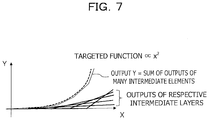
- FIG. 7 is an explanatory diagram illustrating an example of a case where a targeted function is proportional to x 2 ;
- FIG. 8 is an explanatory diagram illustrating a deep-layered neural network and polynomial neural networks
- FIG. 9 is an explanatory diagram illustrating a configuration of a polynomial neural network and an output of an intermediate layer
- FIG. 10 is an explanatory diagram illustrating a concept of function approximation in a three-layered polynomial neural network
- FIGS. 11A and 11B are explanatory diagrams for making a comparison between function approximation abilities
- FIG. 12 is an explanatory diagram illustrating a deep-layered neural network
- FIG. 13 is an explanatory diagram illustrating a divided state
- FIG. 14 is a flowchart illustrating a procedure of division processing
- FIG. 15 is a flowchart illustrating a procedure of learning processing
- FIG. 16 is a flowchart illustrating a procedure of the learning processing
- FIG. 17 is a flowchart illustrating a procedure of redivision processing
- FIG. 18 is an explanatory diagram illustrating the redivision processing
- FIG. 19 is a functional block diagram illustrating an operation of the computer of the above-mentioned embodiment.
- FIG. 20 is a block diagram illustrating a hardware group of the computer according to a third embodiment.
- FIG. 1 is an explanatory diagram illustrating an outline of processing.
- An information processing device 1 is a server computer, a personal computer, a tablet, a smartphone, a mobile phone, or the like, for example.
- the information processing device 1 will be replaced with a “computer 1 ” and be described.
- the computer 1 acquires a deep-layered neural network.
- the computer 1 divides the acquired neural network into neural networks.
- the computer 1 generates polynomial neural networks corresponding to the respective divided neural networks. Based on input-output characteristics obtained from the divided neural networks, the computer 1 performs learning processing on the polynomial neural networks, thereby identifying parameters.
- the computer 1 links the polynomial neural networks the parameters of which are identified.
- FIG. 2 is a block diagram illustrating a hardware configuration of the computer 1 .
- the computer 1 includes a central processing unit (CPU) 11 to serve as a control unit, a random access memory (RAM) 12 , an input unit 13 , a display unit 14 , a storage unit 15 , a clock unit 18 , a communication unit 16 , and so forth.
- the CPU 11 is coupled to the individual hardware units via a bus 17 .
- the CPU 11 controls the individual hardware units in accordance with a control program 15 P stored in the storage unit 15 .
- the CPU 11 may be a multi-core processor equipped with processor cores.
- the RAM 12 is a static RAM (SRAM), a dynamic RAM (DRAM), a flash memory, or the like, for example.
- the RAM 12 further functions as a storage unit and temporarily stores therein various kinds of data generated at a time when the CPU 11 executes various programs.
- the input unit 13 is an input device such as a mouse, keyboard, a touch panel, or a button and outputs received operation information to the CPU 11 .
- the display unit 14 is a liquid crystal display, an organic electroluminescence (EL) display, or the like and displays various kinds of information in accordance with instructions of the CPU 11 .
- the communication unit 16 is a communication module such as a router and transmits and receives pieces of information to and from another computer or the like not illustrated, via a communication network N as the Internet or a public line network.
- the clock unit 18 outputs time and date information to the CPU 11 .
- the storage unit 15 is a large-capacity memory and stores therein the control program 15 P and so forth.
- FIG. 3 is an explanatory diagram illustrating a deep-layered neural network.
- a first layer is an input layer
- an L-th layer is an output layer
- intermediate layers exist between the input layer and the output layer.
- X 1 to X M(1) are individually input to the input layer.
- the first layer to the L-th layer exist including the intermediate layers (first layers).
- the deep-layered neural network illustrated in the present embodiment is just an example and that there is no limitation to this.
- the deep-layered neural network only has to have at least four or more layers.
- Y 1 to Y M(L) are individually output by the output layer.
- an input-output relationship of the deep-layered neural network may be expressed by the following Expression (1) and Expression (2).
- “W (i) ” is a matrix
- “b i ” is a vector and is a weighting parameter.
- “ ⁇ ” is an activation function
- “z l ” is an output of one of the intermediate layers (the first layers).
- an output of one of the intermediate layers (the first layers) is defined based on the following Expression (4).
- the output of one of the first layers is equivalent to an M(I)-dimensional real-valued vector.
- intermediate elements elements to perform arithmetic operations of the intermediate layers are called intermediate elements.
- the intermediate elements are configured by addition circuits, multiplication circuits, memories, and so forth.
- the deep layering of a neural network is further advanced.
- the number L of layers of the neural network is increased, the number of arithmetic operations is sequentially increased in proportion to the number L of layers. In this case, it becomes difficult to perform parallel arithmetic operations, and arithmetic processing performance is reduced.
- FIG. 3 in a case of obtaining an output result of “one of the first layers+one layer”, an output result of the relevant first layer at a preceding stage has to be obtained.
- calculations have to be sequentially performed starting from the first stage, and it is difficult to independently perform the calculation of each of the layers.
- the number of intermediate elements is infinite, in other words, it is possible to infinitely increase the dimension M(2) of an output of a second layer, it is possible to mathematically approximate an arbitrary function. Accordingly, even in a case of the three-layered neural network, it is conceivable that it is possible to realize the same function as that of the deep-layered neural network if the number of intermediate elements is infinite. Therefore, it is conceivable that the deep-layered neural network is approximated by the three-layered neural network and is subjected to parallel operations, thereby enhancing arithmetic processing performance.
- FIG. 4 is an explanatory diagram illustrating a concept of function approximation in a three-layered neural network.
- FIG. 4 is an example in which a triangular waveform is created by using an activation function and displaced triangular waveforms are overlapped with each other, thereby approximating a function.
- FIG. 5 and FIG. 6 are explanatory diagram illustrating an example of a case where a targeted function smoothly changes little by little.
- many sharp triangular waveforms have to be used.
- at least two intermediate elements have to be used, and many intermediate elements have to be used as a result.
- FIG. 7 is an explanatory diagram illustrating an example of a case where a targeted function is proportional to x 2 .
- a method for approximating, by a three-layered neural net, a deep-layered neural net and performing parallel arithmetic operations thereon in order to enhance arithmetic processing performance of the deep-layered neural net is ineffective.
- FIG. 8 is an explanatory diagram illustrating a deep-layered neural network and polynomial neural networks.
- the CPU 11 in the computer 1 divides a targeted deep-layered neural network into two parts at the center thereof, for example.
- the CPU 11 approximates each of the two divided neural networks by a three-layered polynomial neural network.
- FIG. 9 is an explanatory diagram illustrating a configuration of a polynomial neural network and an output of an intermediate layer.
- An input and an output of the three-layered polynomial neural network may be expressed by the following Expression (5) and Expression (6).
- each “w” is a weighting parameter
- “f” is an activation function
- “d” serving as one of parameters is the degree of the three-layered polynomial neural network. Note that usually the degree “d” is greater than or equal to two and details thereof well be described later.
- FIG. 10 is an explanatory diagram illustrating a concept of function approximation in a three-layered polynomial neural network.
- FIGS. 11A and 11B are explanatory diagrams for making a comparison between function approximation abilities.
- Impulse waveforms created in the three-layered neural network are only triangular waveforms.
- impulse waveforms created in the three-layered polynomial neural network include a waveform other than the triangular waveforms.
- the three-layered polynomial neural net has a function approximation ability higher than the three-layered neural network.
- a targeted function is a quadratic function
- function approximation is performed in the three-layered neural network by using many intermediate elements.
- FIG. 11B in the polynomial neural network, it is possible to perform function approximation with only one intermediate element, and the targeted function turns out to be adequately approximated by an output Y of one intermediate element. In this way, it is understood that the function approximation ability of the polynomial neural network is higher than that of the three-layered neural network.
- an arithmetic operation of the three-layered polynomial neural network includes an arithmetic operation of a multivariable polynomial the degree of which is greater than or equal to two. Therefore, in a case where the number of intermediate elements is an identical number, an arithmetic operation amount becomes greater than that of a three-layered neural network of the related art.
- calculations of respective terms of the arithmetic operation of the multivariable polynomial are able to be independently performed, it is possible to perform parallel arithmetic operations. Accordingly, by performing parallel arithmetic operations, it is possible to enhance arithmetic processing performance, compared with the neural network.
- M(1) is the dimension of input data
- M(2) is the number of intermediate elements (multiplication circuits and addition circuits).
- desired resources (multiplication circuits and addition circuits) of hardware are decreased with a decrease in the degree and are decreased with a decrease in the number M(2) of intermediate elements.
- the degree d and the number M(2) of intermediate elements are excessively decreased, the function approximation ability of the polynomial neural network is reduced.
- the degree d and the number M(2) of intermediate elements are adjusted to lower levels so that the function approximation ability of the polynomial neural network is not excessively reduced.
- FIG. 12 is an explanatory diagram illustrating a deep-layered neural network.
- the CPU 11 reads, from the storage unit 15 , a targeted deep-layered neural network and input data used at a time of learning of the relevant deep-layered neural network.
- the CPU 11 inputs the read pieces of input data x 1 to x 3 , to the targeted deep-layered neural network.
- “W (1) ” to “W (L-1) ” are weighting matrices between individual layers.
- the output data of one of the intermediate layers may be expressed by the following Expression (9), and the output data Y of the output layer may be expressed by the following Expression (10).
- the CPU 11 stores, in the RAM 12 , the pieces of input data, the calculated pieces of output data of the respective intermediate layers, and the calculated output data of the output layer.
- FIG. 13 is an explanatory diagram illustrating a divided state.
- the CPU 11 divides into two parts of a neural network having a first layer to an L/2-th layer and a neural network having the L/2-th layer to an L-th layer, thereby generating two deep-layered neural networks.
- dividing into two parts there is no limitation to this. Dividing into three parts or dividing into four parts may be adopted. In addition, a division number may be changed in accordance with the number of layers.
- the CPU 11 may switch from dividing into two parts to dividing into four parts, and in a case where the number of layers exceeds a second threshold value ( 200 ), the CPU 11 may switch from dividing into four parts to dividing into eight parts, for example.
- the CPU 11 acquires input and output data of each of the neural networks.
- the CPU 11 acquires first learning data for the first deep-layered neural network and second learning data for the second deep-layered neural network.
- Input data of the first learning data is data input to the first layer, and output data of the first learning data is data output from the L/2-th layer.
- the CPU 11 acquires and stores the first learning data from the RAM 12 and in the RAM 12 .
- Input data of the second learning data is data output from the L/2-th layer, and output data of the second learning data is data output from the L-th layer.
- the CPU 11 acquires and stores the second learning data from the RAM 12 and in the RAM 12 .
- the CPU 11 sets initial values of weighting parameters, an initial value (one or two, for example) of the degree d of a polynomial expression, and an initial value (one or two, for example) of the number of intermediate elements. Based on the settings of the initial values, the CPU 11 generates a first polynomial neural network corresponding to the first deep-layered neural network and a second polynomial neural network corresponding to the second deep-layered neural network. Based on the first learning data, the CPU 11 causes the first polynomial neural network to be subjected to learning. In the same way, based on the second learning data, the CPU 11 causes the second polynomial neural network to be subjected to learning. In other words, through learning, weighting parameters serving as parameters, a degree, and the number of intermediate elements are identified.
- the CPU 11 uses a gradient method.
- the gradient method is just an example and another method may be adopted.
- a simulated annealing (SA) method or a genetic algorithm method may be used, for example.
- SA simulated annealing
- a loss function E(X,W (2) ,W (3) ) that is based on the gradient method and that serves as a correspondence value corresponding to a polynomial neural network a square loss illustrated by the following Expression (11) is used.
- y j is output data of the learning data
- W (2) and W (3) are weighting parameters included in the three-layered polynomial neural network.
- the gradients of E(W (2) ,W (3) ) of the loss function are expressed by the following Expression (12), for example.
- the CPU 11 updates weighting parameters. Updates of the weighting parameters are calculated based on the following Expression (13), for example.
- the CPU 11 determines whether or not a value of the loss function E(W (2) ,W (3) ) is greater than a threshold value stored in the storage unit 15 .
- the CPU 11 changes the degree d of the polynomial neural network and the number M(2) of intermediate elements, based on the following Expression (14). d ⁇ d+l M (2) ⁇ M max /( M (1)+ M (1) 2 + . . . +M (1) d (14)
- M max is the upper limit number of intermediate elements. Note that, as the upper limit number of intermediate elements, an arbitrarily value may be set by the input unit 13 .
- the CPU 11 performs the above-mentioned processing on both the first polynomial neural network and the second polynomial neural network. In a case where the loss function is not greater than the threshold value, the CPU 11 stores, in the RAM 12 , the first polynomial neural network and the second polynomial neural network that each have weighting parameters, a degree, and the number of intermediate elements, finally defined.
- the CPU 11 links the output layer of the first polynomial neural network and the input layer of the second polynomial neural network with each other.
- the CPU 11 outputs the linked polynomial neural networks to the display unit 14 or outputs the linked polynomial neural networks to another computer (not illustrated) via the communication unit 16 .
- FIG. 14 is a flowchart illustrating a procedure of division processing.
- the CPU 11 in the computer 1 acquires, from the input unit 13 or the storage unit 15 , already learned weighting parameters of a deep-layered neural network (step S 141 ).
- the CPU 11 reads, from the storage unit 15 , a deep-layered neural network serving as a target (step S 142 ).
- the CPU 11 inputs input data for learning to the deep-layered neural network (step S 143 ).
- the CPU 11 acquires pieces of output data of an output layer and intermediate layers and stores these in the RAM 12 (step S 144 ).
- the CPU 11 divides the deep-layered neural network into the first deep-layered neural network and the second deep-layered neural network and stores the divided first deep-layered neural network and second deep-layered neural network in the RAM 12 (step S 145 ).
- the CPU 11 stores, in the RAM 12 , the input data and output data of the first polynomial neural network as the first learning data (step S 146 ).
- the CPU 11 stores, in the RAM 12 , input data of the second polynomial neural network and the output data of the output layer as the second learning data (step S 147 ).
- FIG. 15 and FIG. 16 is a flowchart illustrating a procedure of learning processing.
- the CPU 11 reads, from the storage unit 15 , initial values of a degree and the number of intermediate elements of a polynomial neural network (step S 151 ).
- the CPU 11 reads, from the storage unit 15 , a preliminarily set upper limit of the number of intermediate elements (step S 152 ).
- the CPU 11 reads initial values of weighting parameters of the polynomial neural network (step S 153 ).
- the CPU 11 reads the first learning data and the first deep-layered neural network that are stored in the RAM 12 (step S 154 ).
- the CPU 11 Based on Expression (5) to Expression (11) and the first learning data, the CPU 11 performs learning processing of the first polynomial neural network. Specifically, based on the first learning data, the CPU 11 calculates a loss function of the first polynomial neural network (step S 155 ). The CPU 11 calculates gradients of the calculated loss function, based on Expression (12) (step S 156 ). Based on the calculated gradients of the loss function and Expression (13), the CPU 11 updates the weighting parameters (step S 157 ). The CPU 11 stores the updated weighting parameters in the RAM 12 .
- the CPU 11 reads a threshold value from the storage unit 15 (step S 158 ).
- the CPU 11 determines whether or not the calculated loss function is greater than the threshold value (step S 159 ). In a case where it is determined that the loss function is greater than the threshold value (step S 159 : YES), the CPU 11 shifts the processing to step S 161 . Based on Expression (14) to which the upper limit number of intermediate elements is input, the CPU 11 changes the degree and the number of intermediate elements (step S 161 ).
- the CPU 11 stores, in the RAM 12 , the changed degree and the changed number of intermediate elements.
- step S 155 the CPU 11 returns the processing to step S 155 .
- the learning progresses, thereby causing the loss function to be less than the threshold value.
- step S 159 NO
- the CPU 11 shifts the processing to step S 162 .
- the CPU 11 reads the already updated weighting parameters, the changed degree, and the changed number of intermediate element that are stored in the RAM 12 .
- the CPU 11 generates the already learned first polynomial neural network for which the weighting parameters, the degree, and the number of intermediate elements that are read are identified (step S 162 ).
- the CPU 11 performs the processing operations in steps S 154 to S 162 in the same way, thereby performing learning processing of the second polynomial neural network.
- the CPU 11 generates the second polynomial neural network for which the weighting parameters, the degree, and the number of intermediate elements are finally identified (step S 163 ).
- the CPU 11 links the generated first polynomial neural network and second polynomial neural network with each other (step S 164 ).
- the CPU 11 outputs the linked polynomial neural networks to the display unit 14 (step S 165 ). For this reason, it becomes possible to accelerate the speed of arithmetic processing. In addition, it becomes possible to perform the arithmetic processing within a constraint on the number of intermediate elements.
- FIG. 17 is a flowchart illustrating a procedure of redivision processing.
- the CPU 11 in the computer 1 determines whether or not the number of intermediate elements reaches the upper limit number (step S 171 ). In a case where the number of intermediate elements does not reach the upper limit number (step S 171 : NO), the CPU 11 shifts the processing to step S 172 . As described in the first embodiment, the CPU 11 changes the degree and the number of intermediate elements (step S 172 ). After that, the CPU 11 shifts the processing to step S 155 described in the first embodiment.
- step S 171 the CPU 11 shifts the processing to step S 174 .
- the loss function is greater than the threshold value even though the number of intermediate elements on a first deep-layered neural network side reaches the upper limit number.
- the CPU 11 redivides the first deep-layered neural network after division, thereby generating a first redivided deep-layered neural network and a second redivided deep-layered neural network (step S 174 ).
- FIG. 18 is an explanatory diagram illustrating the redivision processing. As illustrated in FIG. 18 , a description will be provided while assuming that the loss function of the first deep-layered neural network of Z (1) to Z (L/2) is greater than the threshold value. In this case, the CPU 11 redivides the first deep-layered neural network into two parts with Z (L/4) as a boundary. Note that the example of division is just an example and dividing into three or more parts may be adopted. On the other hand, since the loss function of the second deep-layered neural network is less than or equal to the threshold value, the learning processing of the second polynomial neural network is completed based on the processing described in the first embodiment.
- the first deep-layered neural network is divided into two parts of the first redivided deep-layered neural network of Z (1) to Z (L/4) and the second redivided deep-layered neural network of Z (L/4) to Z (L/2) .
- the CPU 11 stores, in the RAM 12 , first redivision learning data corresponding to the first redivided deep-layered neural network (step S 175 ). Specifically, input data is Z (1) , and output data is Z (L/4) .
- the CPU 11 stores, in the RAM 12 , second redivision learning data corresponding to the second redivided deep-layered neural network (step S 176 ). Specifically, input data is Z (L/4) , and output data is Z (L/2) .
- the CPU 11 learns a first redivided polynomial neural network corresponding to the first redivided deep-layered neural network, by using the first redivision learning data (step S 177 ). In the same way, the CPU 11 learns a second redivided polynomial neural network corresponding to the second redivided deep-layered neural network, by using the second redivision learning data (step S 178 ).
- the CPU 11 links the first redivided polynomial neural network, the second redivided polynomial neural network, and the second polynomial neural network that are already learned (step S 179 ).
- the CPU 11 outputs, to the display unit 14 , a polynomial neural network after the linking (step S 1710 ). For this reason, even in a case where the upper limit number of the number of intermediate elements is insufficient, redivision is performed, thereby enabling the polynomial neural networks to be subjected to adequate learning.
- the present second embodiment is as described above, and the other portions thereof are the same as those of the first embodiment. Therefore, the same reference number is assigned to a corresponding portion, and details thereof will be omitted.
- FIG. 19 is a functional block diagram illustrating an operation of the computer 1 of the above-mentioned embodiments.
- the CPU 11 executes the control program 15 P, thereby causing the computer 1 to operate as follows.
- a dividing unit 191 divides a neural network into neural networks. Based on input-output characteristics of the respective divided neural networks, an identification unit 192 identifies parameters of each of polynomial neural networks corresponding to the respective divided neural networks.
- a linking unit 193 links the individual polynomial neural networks after the identification with each other.
- FIG. 20 is a block diagram illustrating a hardware group of the computer 1 according to a third embodiment.
- a reading unit 10 A such as a disk drive or a memory card slot may be caused to read a portable recording medium 1 A such as a CD-ROM, a DVD disk, a memory card, or a USB memory, thereby storing, in the storage unit 15 , a program for causing the computer 1 to operate.
- a semiconductor memory 1 B such as a flash memory, which stores therein the relevant program, may be installed within the computer 1 .
- the relevant program may be downloaded from another server computer (not illustrated) coupled via the communication network N such as the Internet.
- the computer 1 illustrated in FIG. 20 reads a program for performing the above-mentioned various kinds of software processing from the portable recording medium 1 A or the semiconductor memory 1 B or downloads the program from another server computer (not illustrated) via the communication network N.
- the relevant program is installed as the control program 15 P and is loaded into the RAM 12 , thereby being executed. For this reason, the relevant program functions as the above-mentioned computer 1 .
- the present third embodiment is as described above, and the other portions thereof are the same as those of the first or second embodiment. Therefore, the same reference number is assigned to a corresponding portion, and details thereof will be omitted. Note that the above-mentioned individual embodiments may be arbitrarily combined.
Landscapes
- Engineering & Computer Science (AREA)
- Physics & Mathematics (AREA)
- Theoretical Computer Science (AREA)
- Mathematical Physics (AREA)
- General Physics & Mathematics (AREA)
- Data Mining & Analysis (AREA)
- Software Systems (AREA)
- General Engineering & Computer Science (AREA)
- Computing Systems (AREA)
- Health & Medical Sciences (AREA)
- General Health & Medical Sciences (AREA)
- Molecular Biology (AREA)
- Computational Linguistics (AREA)
- Biophysics (AREA)
- Biomedical Technology (AREA)
- Artificial Intelligence (AREA)
- Life Sciences & Earth Sciences (AREA)
- Evolutionary Computation (AREA)
- Computational Mathematics (AREA)
- Mathematical Analysis (AREA)
- Mathematical Optimization (AREA)
- Pure & Applied Mathematics (AREA)
- Operations Research (AREA)
- Algebra (AREA)
- Databases & Information Systems (AREA)
- Image Analysis (AREA)
Abstract
Description
σ((νl, . . . ,νM))≡(f(νl), . . . ,f(νM))
f(x)=max{x,0} (3)
z l≡σl(W (l) z l-1 +b l) (4)
M(2)·(M(1)+M(1)2 + . . . +M(1)d) (7)
M(2)·(M(1)+M(1)2 + . . . +M(1)d) (8)
Z (i) ≡f i(W (i-1) Z (i-1)) (9)
Y=Z (L) =f L(W (L-1) f L-1(Z (L-1)))= . . . =f L(W (L-1) f L-1(W (L-2) f L-2( . . . f 2(W (t) X)))) (10)
d←d+l
M(2)←M max/(M(1)+M(1)2 + . . . +M(1)d (14)
Claims (9)
Applications Claiming Priority (3)
| Application Number | Priority Date | Filing Date | Title |
|---|---|---|---|
| JP2016241629A JP6784162B2 (en) | 2016-12-13 | 2016-12-13 | Information processing equipment, programs and information processing methods |
| JPJP2016-241629 | 2016-12-13 | ||
| JP2016-241629 | 2016-12-13 |
Publications (2)
| Publication Number | Publication Date |
|---|---|
| US20180165571A1 US20180165571A1 (en) | 2018-06-14 |
| US11093817B2 true US11093817B2 (en) | 2021-08-17 |
Family
ID=62489365
Family Applications (1)
| Application Number | Title | Priority Date | Filing Date |
|---|---|---|---|
| US15/819,292 Expired - Fee Related US11093817B2 (en) | 2016-12-13 | 2017-11-21 | Information processing device and information processing method |
Country Status (2)
| Country | Link |
|---|---|
| US (1) | US11093817B2 (en) |
| JP (1) | JP6784162B2 (en) |
Cited By (2)
| Publication number | Priority date | Publication date | Assignee | Title |
|---|---|---|---|---|
| US20210110247A1 (en) * | 2019-10-11 | 2021-04-15 | International Business Machines Corporation | Hybrid data-model parallelism for efficient deep learning |
| US20210166118A1 (en) * | 2018-04-18 | 2021-06-03 | Nippon Telegraph And Telephone Corporation | Data analysis system, method, and program |
Families Citing this family (12)
| Publication number | Priority date | Publication date | Assignee | Title |
|---|---|---|---|---|
| JP2017136484A (en) * | 2017-05-19 | 2017-08-10 | シャープ株式会社 | Washing machine |
| JP2017136483A (en) * | 2017-05-19 | 2017-08-10 | シャープ株式会社 | Washing machine |
| JP2017136481A (en) * | 2017-05-19 | 2017-08-10 | シャープ株式会社 | Washing machine |
| JP6291112B2 (en) * | 2017-05-19 | 2018-03-14 | シャープ株式会社 | Washing machine |
| WO2019210300A1 (en) * | 2018-04-27 | 2019-10-31 | Carnegie Mellon University | Polynomial convolutional neural network with late fan-out |
| JP6775251B2 (en) * | 2018-05-22 | 2020-10-28 | 京楽産業.株式会社 | Game machine |
| CN111382835B (en) * | 2018-12-27 | 2024-08-20 | 中科寒武纪科技股份有限公司 | Neural network compression method, electronic equipment and computer readable medium |
| CN111523653B (en) * | 2019-02-03 | 2024-03-29 | 上海寒武纪信息科技有限公司 | Computing device and method |
| AU2020240239B2 (en) * | 2019-03-15 | 2025-02-20 | Geek Guild Co., Ltd. | Conversion system, method and program |
| JP7521336B2 (en) * | 2020-09-01 | 2024-07-24 | 新東工業株式会社 | NETWORK SUBSTITUTION DEVICE, NETWORK SUBSTITUTION METHOD, TRAINED MODEL, ESTIMATION DEVICE, AND ESTIMATION METHOD |
| JP2022156989A (en) * | 2021-03-31 | 2022-10-14 | 新東工業株式会社 | Molding condition derivation device, molding condition derivation method, machine learning device and machine learning method |
| JP7708035B2 (en) | 2022-08-24 | 2025-07-15 | トヨタ自動車株式会社 | Information Processing Method |
Citations (6)
| Publication number | Priority date | Publication date | Assignee | Title |
|---|---|---|---|---|
| US3922536A (en) * | 1974-05-31 | 1975-11-25 | Rca Corp | Multionomial processor system |
| JPH02181284A (en) | 1988-02-18 | 1990-07-16 | Hitachi Ltd | neural network |
| JPH0635889A (en) | 1992-07-20 | 1994-02-10 | Hitachi Ltd | Neural network device and learning method therefor |
| JPH0713949A (en) | 1993-06-14 | 1995-01-17 | Motorola Inc | Neural network and its usage method |
| JP2014229124A (en) | 2013-05-23 | 2014-12-08 | 独立行政法人情報通信研究機構 | Learning method of deep neural network, storage medium storing parameter of subnetwork of deep neural network, and computer program |
| US9626621B2 (en) * | 2013-12-06 | 2017-04-18 | International Business Machines Corporation | Systems and methods for combining stochastic average gradient and hessian-free optimization for sequence training of deep neural networks |
Family Cites Families (4)
| Publication number | Priority date | Publication date | Assignee | Title |
|---|---|---|---|---|
| JPH0738186B2 (en) * | 1989-03-13 | 1995-04-26 | シャープ株式会社 | Self-expanding neural network |
| JPH05108595A (en) * | 1991-10-17 | 1993-04-30 | Hitachi Ltd | Distributed learning device for neural networks |
| JP3430673B2 (en) * | 1994-10-19 | 2003-07-28 | 富士ゼロックス株式会社 | Color converter |
| US20160267380A1 (en) * | 2015-03-13 | 2016-09-15 | Nuance Communications, Inc. | Method and System for Training a Neural Network |
-
2016
- 2016-12-13 JP JP2016241629A patent/JP6784162B2/en not_active Expired - Fee Related
-
2017
- 2017-11-21 US US15/819,292 patent/US11093817B2/en not_active Expired - Fee Related
Patent Citations (8)
| Publication number | Priority date | Publication date | Assignee | Title |
|---|---|---|---|---|
| US3922536A (en) * | 1974-05-31 | 1975-11-25 | Rca Corp | Multionomial processor system |
| JPH02181284A (en) | 1988-02-18 | 1990-07-16 | Hitachi Ltd | neural network |
| JPH0635889A (en) | 1992-07-20 | 1994-02-10 | Hitachi Ltd | Neural network device and learning method therefor |
| JPH0713949A (en) | 1993-06-14 | 1995-01-17 | Motorola Inc | Neural network and its usage method |
| US5720002A (en) | 1993-06-14 | 1998-02-17 | Motorola Inc. | Neural network and method of using same |
| JP2014229124A (en) | 2013-05-23 | 2014-12-08 | 独立行政法人情報通信研究機構 | Learning method of deep neural network, storage medium storing parameter of subnetwork of deep neural network, and computer program |
| US20160110642A1 (en) | 2013-05-23 | 2016-04-21 | National Institute Of Information And Communications Technology | Deep neural network learning method and apparatus, and category-independent sub-network learning apparatus |
| US9626621B2 (en) * | 2013-12-06 | 2017-04-18 | International Business Machines Corporation | Systems and methods for combining stochastic average gradient and hessian-free optimization for sequence training of deep neural networks |
Non-Patent Citations (8)
| Title |
|---|
| Karnavas, Yannis L., and Demetrios P. Papadopoulos. "Excitation control of a synchronous machine using polynomial neural networks." Journal of Electrical Engineering—Bratislava—55.7/8 (2004): 169-179. (Year: 2004). * |
| Kim, Juyong, et al. "SplitNet: Learning to semantically split deep networks for parameter reduction and model parallelization." International Conference on Machine Learning. 2017. (Year: 2017). * |
| Lin-Lin Huang et al. , "Face detection from cluttered images using a polynomial neural network," Elsevier, Neurocomputing, 51, 2003, pp. 15. |
| Noboru Murata "An Integral Representation of Functions using Three-layered Networks and Their Approximation Bounds," Preprint submitted to Elsevier Science, Nov. 22, 1995, pp. 23. |
| Oh, Sung-Kwun, Witold Pedrycz, and Byoung-Jun Park. "Polynomial neural networks architecture: analysis and design." Computers & Electrical Engineering 29.6 (2003): 703-725. (Year: 2003). * |
| Roh, Seok-Beom, Sung-Kwun Oh, and Witold Pedrycz. "A fuzzy ensemble of parallel polynomial neural networks with information granules formed by fuzzy clustering." Knowledge-Based Systems 23.3 (2010): 202-219. (Year: 2010). * |
| Shankar, Sukrit, et al. "Refining architectures of deep convolutional neural networks." Proceedings of the IEEE Conference on Computer Vision and Pattern Recognition. 2016. (Year: 2016). * |
| Yu-Hsin Chen, et al. "Eyeriss: An Energy-Efficient Reconfigurable Accelerator for Deep Convolutional Neural Networks," ISSCC 2016, Session 14, Next-Generation Processing, 14.5, Feb. 2, 2016, pp. 3. |
Cited By (3)
| Publication number | Priority date | Publication date | Assignee | Title |
|---|---|---|---|---|
| US20210166118A1 (en) * | 2018-04-18 | 2021-06-03 | Nippon Telegraph And Telephone Corporation | Data analysis system, method, and program |
| US20210110247A1 (en) * | 2019-10-11 | 2021-04-15 | International Business Machines Corporation | Hybrid data-model parallelism for efficient deep learning |
| US11556450B2 (en) * | 2019-10-11 | 2023-01-17 | International Business Machines Corporation | Hybrid data-model parallelism for efficient deep learning |
Also Published As
| Publication number | Publication date |
|---|---|
| JP6784162B2 (en) | 2020-11-11 |
| US20180165571A1 (en) | 2018-06-14 |
| JP2018097612A (en) | 2018-06-21 |
Similar Documents
| Publication | Publication Date | Title |
|---|---|---|
| US11093817B2 (en) | Information processing device and information processing method | |
| US20230252327A1 (en) | Neural architecture search for convolutional neural networks | |
| US20180293512A1 (en) | New rule creation using mdp and inverse reinforcement learning | |
| CN111788583B (en) | Continuous Sparsity Pattern Neural Network | |
| WO2017116924A1 (en) | Neural network training performance optimization framework | |
| US20220237465A1 (en) | Performing inference and signal-to-noise ratio based pruning to train sparse neural network architectures | |
| JP7137064B2 (en) | Optimization device and control method for optimization device | |
| JP2023139286A (en) | Circuit information, information processing methods, programs and information processing systems | |
| CN104750731A (en) | Method and device for obtaining complete user portrait | |
| CN111144574B (en) | Artificial intelligence system and method for training learner model using instructor model | |
| US12346800B2 (en) | Meta-feature training models for machine learning algorithms | |
| JP2023044336A (en) | Learning apparatus, learning method, and program | |
| US11263511B2 (en) | Neural network training device, neural network training method and storage medium storing program | |
| KR20210060146A (en) | Method and apparatus for processing data using deep neural network model, method and apparatus for trining deep neural network model | |
| US20200233921A1 (en) | Data processing apparatus, data processing method, and computer-readable storage medium | |
| US20180232152A1 (en) | Gated end-to-end memory network | |
| CN111506742B (en) | Method and system for constructing multivariate relation knowledge base | |
| US20220414461A1 (en) | Inference method, information processing apparatus, and computer-readable recording medium | |
| US20200320393A1 (en) | Data processing method and data processing device | |
| US20120203815A1 (en) | Matrix calculation method, program, and system | |
| KR20200072308A (en) | Method and apparatus for performing convolution operations in neural networks | |
| CN114595630A (en) | Activity effect evaluation model training method and device, computer equipment and medium | |
| US20230206094A1 (en) | Inferring device, inferring method and non-transitory computer readable medium | |
| US20220405561A1 (en) | Electronic device and controlling method of electronic device | |
| US11868885B2 (en) | Learning device, inference device, learning method, and inference method using a transformation matrix generated from learning data |
Legal Events
| Date | Code | Title | Description |
|---|---|---|---|
| AS | Assignment |
Owner name: FUJITSU LIMITED, JAPAN Free format text: ASSIGNMENT OF ASSIGNORS INTEREST;ASSIGNOR:TANABE, SATOSHI;REEL/FRAME:044190/0219 Effective date: 20171114 |
|
| FEPP | Fee payment procedure |
Free format text: ENTITY STATUS SET TO UNDISCOUNTED (ORIGINAL EVENT CODE: BIG.); ENTITY STATUS OF PATENT OWNER: LARGE ENTITY |
|
| STPP | Information on status: patent application and granting procedure in general |
Free format text: DOCKETED NEW CASE - READY FOR EXAMINATION |
|
| STPP | Information on status: patent application and granting procedure in general |
Free format text: NON FINAL ACTION MAILED |
|
| STPP | Information on status: patent application and granting procedure in general |
Free format text: RESPONSE TO NON-FINAL OFFICE ACTION ENTERED AND FORWARDED TO EXAMINER |
|
| STPP | Information on status: patent application and granting procedure in general |
Free format text: NOTICE OF ALLOWANCE MAILED -- APPLICATION RECEIVED IN OFFICE OF PUBLICATIONS |
|
| STPP | Information on status: patent application and granting procedure in general |
Free format text: PUBLICATIONS -- ISSUE FEE PAYMENT RECEIVED |
|
| STPP | Information on status: patent application and granting procedure in general |
Free format text: PUBLICATIONS -- ISSUE FEE PAYMENT VERIFIED |
|
| STCF | Information on status: patent grant |
Free format text: PATENTED CASE |
|
| FEPP | Fee payment procedure |
Free format text: MAINTENANCE FEE REMINDER MAILED (ORIGINAL EVENT CODE: REM.); ENTITY STATUS OF PATENT OWNER: LARGE ENTITY |
|
| LAPS | Lapse for failure to pay maintenance fees |
Free format text: PATENT EXPIRED FOR FAILURE TO PAY MAINTENANCE FEES (ORIGINAL EVENT CODE: EXP.); ENTITY STATUS OF PATENT OWNER: LARGE ENTITY |
|
| STCH | Information on status: patent discontinuation |
Free format text: PATENT EXPIRED DUE TO NONPAYMENT OF MAINTENANCE FEES UNDER 37 CFR 1.362 |
|
| FP | Lapsed due to failure to pay maintenance fee |
Effective date: 20250817 |