US11091646B2 - Luminescent squaraine rotaxane compounds - Google Patents
Luminescent squaraine rotaxane compounds Download PDFInfo
- Publication number
- US11091646B2 US11091646B2 US16/102,421 US201816102421A US11091646B2 US 11091646 B2 US11091646 B2 US 11091646B2 US 201816102421 A US201816102421 A US 201816102421A US 11091646 B2 US11091646 B2 US 11091646B2
- Authority
- US
- United States
- Prior art keywords
- alkyl
- rotaxane
- groups
- aromatic
- amino
- Prior art date
- Legal status (The legal status is an assumption and is not a legal conclusion. Google has not performed a legal analysis and makes no representation as to the accuracy of the status listed.)
- Active, expires
Links
- 0 CCCC(C1)*CC1(C1)C1C1C(C)C1 Chemical compound CCCC(C1)*CC1(C1)C1C1C(C)C1 0.000 description 36
- BOUBUFOFBHNEAP-UHFFFAOYSA-N BCC.[KH] Chemical compound BCC.[KH] BOUBUFOFBHNEAP-UHFFFAOYSA-N 0.000 description 3
- LADSEYCNPMADGQ-UHFFFAOYSA-N BCCC.CC.[KH] Chemical compound BCCC.CC.[KH] LADSEYCNPMADGQ-UHFFFAOYSA-N 0.000 description 1
- XLCJSDFAIDNRKZ-OWNFOMEGSA-N C.C.CC(=O)O.CCCCN(CCCC)C1=CC=C(C2=C([O-])C(=C3C=CC(=[N+](CCCC)CCCS(=O)(=O)[O-])C=C3)C2=O)C=C1.CC[NH+](C(C)C)C(C)C.COC=O.NCC1=CC(C(=O)O)=C(CN)C=C1.O=C(Cl)C1=CC=CC(C(=O)Cl)=N1.O=C1CCC2=CC=C(C=C2)CNC(=O)C2=CC=CC(=N2)C(=O)NCc2c-cc(-cc-2)CNC(=O)C2=CC=CC1=N2.O=S(=O)=O.O=S(=O)=O.O=S(=O)=O.[H]CCCN(CCC[H])C1=CC=C(C2=C([O-])C(C3C=CC(=[N+](CCC[H])CCCS(=O)(=O)O)C=C3)C2=O)C=C1 Chemical compound C.C.CC(=O)O.CCCCN(CCCC)C1=CC=C(C2=C([O-])C(=C3C=CC(=[N+](CCCC)CCCS(=O)(=O)[O-])C=C3)C2=O)C=C1.CC[NH+](C(C)C)C(C)C.COC=O.NCC1=CC(C(=O)O)=C(CN)C=C1.O=C(Cl)C1=CC=CC(C(=O)Cl)=N1.O=C1CCC2=CC=C(C=C2)CNC(=O)C2=CC=CC(=N2)C(=O)NCc2c-cc(-cc-2)CNC(=O)C2=CC=CC1=N2.O=S(=O)=O.O=S(=O)=O.O=S(=O)=O.[H]CCCN(CCC[H])C1=CC=C(C2=C([O-])C(C3C=CC(=[N+](CCC[H])CCCS(=O)(=O)O)C=C3)C2=O)C=C1 XLCJSDFAIDNRKZ-OWNFOMEGSA-N 0.000 description 1
- HBGJRYWEZWKKCL-CTRYNOEUSA-O C.C.CC=O.CCCCN(CCCC)C1=CC=C(C2=C([O-])C(=C3C=CC(=[N+](CCCC)CCCC(=O)OCC)C=C3)C2=O)C=C1.CC[NH+](C(C)C)C(C)C.COC.COC1=C(CN)C=CC(CN)=C1.O=C(Cl)C1=CC=CC(C(=O)Cl)=N1.O=C1CCC2=CC=C(C=C2)CNC(=O)C2=CC=CC(=N2)C(=O)NCc2c-cc(-cc-2)CNC(=O)C2=CC=CC1=N2.O=S(=O)=O.O=S(=O)=O.O=S(=O)=O.[H]CCCN(CCC[H])C1=CC=C(C2=C([O-])C(C3C=CC(=[N+](CCC[H])CCCC(=O)O)C=C3)C2=O)C=C1 Chemical compound C.C.CC=O.CCCCN(CCCC)C1=CC=C(C2=C([O-])C(=C3C=CC(=[N+](CCCC)CCCC(=O)OCC)C=C3)C2=O)C=C1.CC[NH+](C(C)C)C(C)C.COC.COC1=C(CN)C=CC(CN)=C1.O=C(Cl)C1=CC=CC(C(=O)Cl)=N1.O=C1CCC2=CC=C(C=C2)CNC(=O)C2=CC=CC(=N2)C(=O)NCc2c-cc(-cc-2)CNC(=O)C2=CC=CC1=N2.O=S(=O)=O.O=S(=O)=O.O=S(=O)=O.[H]CCCN(CCC[H])C1=CC=C(C2=C([O-])C(C3C=CC(=[N+](CCC[H])CCCC(=O)O)C=C3)C2=O)C=C1 HBGJRYWEZWKKCL-CTRYNOEUSA-O 0.000 description 1
- JSZMYPSJDWQVQI-JMWSIOIJSA-O C.C.CCCCN(CCCC(=O)OCC)C1=CC=C(C2=C([O-])C(=C3C=CC(=[N+](CCCC)CCCC(=O)OCC)C=C3)C2=O)C=C1.CC[NH+](C(C)C)C(C)C.NCC1=C(Cl)C(Cl)=C(CN)C(Cl)=C1Cl.O=C(Cl)C1=CC=CC(C(=O)Cl)=N1.O=C1NCc2c(Cl)-c(Cl)c(CNC(=O)C3=NC(=CC=C3)C(=O)NCC3=C(Cl)C(Cl)=C(CNC(=O)C4=NC1=CC=C4)C(Cl)=C3Cl)-c(Cl)c-2Cl.O=S(=O)=O.O=S(=O)=O.[H]CCCN(CCCC(=O)O)C1=CC=C(C2=C([O-])C(C3C=CC(=[N+](CCC[H])CCCC(=O)O)C=C3)C2=O)C=C1 Chemical compound C.C.CCCCN(CCCC(=O)OCC)C1=CC=C(C2=C([O-])C(=C3C=CC(=[N+](CCCC)CCCC(=O)OCC)C=C3)C2=O)C=C1.CC[NH+](C(C)C)C(C)C.NCC1=C(Cl)C(Cl)=C(CN)C(Cl)=C1Cl.O=C(Cl)C1=CC=CC(C(=O)Cl)=N1.O=C1NCc2c(Cl)-c(Cl)c(CNC(=O)C3=NC(=CC=C3)C(=O)NCC3=C(Cl)C(Cl)=C(CNC(=O)C4=NC1=CC=C4)C(Cl)=C3Cl)-c(Cl)c-2Cl.O=S(=O)=O.O=S(=O)=O.[H]CCCN(CCCC(=O)O)C1=CC=C(C2=C([O-])C(C3C=CC(=[N+](CCC[H])CCCC(=O)O)C=C3)C2=O)C=C1 JSZMYPSJDWQVQI-JMWSIOIJSA-O 0.000 description 1
- BWRBRWYERXLMSU-JMWSIOIJSA-O C.C.CCCCN(CCCC(=O)OCC)C1=CC=C(C2=C([O-])C(=C3C=CC(=[N+](CCCC)CCCC(=O)OCC)C=C3)C2=O)C=C1.CC[NH+](C(C)C)C(C)C.NCC1=C(F)C(F)=C(CN)C(F)=C1F.O=C(Cl)C1=CC=CC(C(=O)Cl)=N1.O=C1NCc2c(F)-c(F)c(CNC(=O)C3=NC(=CC=C3)C(=O)NCC3=C(F)C(F)=C(CNC(=O)C4=NC1=CC=C4)C(F)=C3F)-c(F)c-2F.O=S(=O)=O.O=S(=O)=O.[H]CCCN(CCCC(=O)O)C1=CC=C(C2=C([O-])C(C3C=CC(=[N+](CCC[H])CCCC(=O)O)C=C3)C2=O)C=C1 Chemical compound C.C.CCCCN(CCCC(=O)OCC)C1=CC=C(C2=C([O-])C(=C3C=CC(=[N+](CCCC)CCCC(=O)OCC)C=C3)C2=O)C=C1.CC[NH+](C(C)C)C(C)C.NCC1=C(F)C(F)=C(CN)C(F)=C1F.O=C(Cl)C1=CC=CC(C(=O)Cl)=N1.O=C1NCc2c(F)-c(F)c(CNC(=O)C3=NC(=CC=C3)C(=O)NCC3=C(F)C(F)=C(CNC(=O)C4=NC1=CC=C4)C(F)=C3F)-c(F)c-2F.O=S(=O)=O.O=S(=O)=O.[H]CCCN(CCCC(=O)O)C1=CC=C(C2=C([O-])C(C3C=CC(=[N+](CCC[H])CCCC(=O)O)C=C3)C2=O)C=C1 BWRBRWYERXLMSU-JMWSIOIJSA-O 0.000 description 1
- JIGKNXHWPYZYJP-XSRBLLHFSA-O C.C.CCCCN(CCCC(=O)OCC)C1=CC=C(C2=C([O-])C(=C3C=CC(=[N+](CCCC)CCCC(=O)OCC)C=C3)C2=O)C=C1.CC[NH+](C(C)C)C(C)C.NCC1=CC(S(=O)(=O)O)=C(CN)C=C1.O=C(Cl)C1=CC=CC(C(=O)Cl)=N1.O=S(=O)=O.O=S(=O)=O.O=S(=O)=O.[H]C1=C2C=CC(=C1)CNC(=O)C1=CC=CC(=N1)C(=O)NCc1c-c(S(=O)(=O)O)c(-cc-1)CNC(=O)C1=CC=CC(=N1)C(=O)CC2.[H]CCCN(CCCC(=O)O)C1=CC=C(C2=C([O-])C(C3C=CC(=[N+](CCC[H])CCCC(=O)O)C=C3)C2=O)C=C1 Chemical compound C.C.CCCCN(CCCC(=O)OCC)C1=CC=C(C2=C([O-])C(=C3C=CC(=[N+](CCCC)CCCC(=O)OCC)C=C3)C2=O)C=C1.CC[NH+](C(C)C)C(C)C.NCC1=CC(S(=O)(=O)O)=C(CN)C=C1.O=C(Cl)C1=CC=CC(C(=O)Cl)=N1.O=S(=O)=O.O=S(=O)=O.O=S(=O)=O.[H]C1=C2C=CC(=C1)CNC(=O)C1=CC=CC(=N1)C(=O)NCc1c-c(S(=O)(=O)O)c(-cc-1)CNC(=O)C1=CC=CC(=N1)C(=O)CC2.[H]CCCN(CCCC(=O)O)C1=CC=C(C2=C([O-])C(C3C=CC(=[N+](CCC[H])CCCC(=O)O)C=C3)C2=O)C=C1 JIGKNXHWPYZYJP-XSRBLLHFSA-O 0.000 description 1
- XGXHXRDUSUUHLH-JMWSIOIJSA-Q C.C.CCCCN(CCCC(=O)OCC)C1=CC=C(C2=C([O-])C(=C3C=CC(=[N+](CCCC)CCCC(=O)OCC)C=C3)C2=O)C=C1.CC[NH+](C(C)C)C(C)C.O=C(Cl)C1=CC=CC(C(=O)Cl)=N1.O=C1NCc2c-cc(CNC(=O)C3=NC(=CC=C3)C(=O)NCC3=CC([N+](=O)[O-])=C(C=C3)CNC(=O)C3=NC1=CC=C3)-c([N+](=O)[O-])c-2.O=S(=O)=O.O=S(=O)=O.[Cl-].[Cl-].[H]CCCN(CCCC(=O)O)C1=CC=C(C2=C([O-])C(C3C=CC(=[N+](CCC[H])CCCC(=O)O)C=C3)C2=O)C=C1.[NH3+]CC1=CC([N+](=O)[O-])=C(C[NH3+])C=C1 Chemical compound C.C.CCCCN(CCCC(=O)OCC)C1=CC=C(C2=C([O-])C(=C3C=CC(=[N+](CCCC)CCCC(=O)OCC)C=C3)C2=O)C=C1.CC[NH+](C(C)C)C(C)C.O=C(Cl)C1=CC=CC(C(=O)Cl)=N1.O=C1NCc2c-cc(CNC(=O)C3=NC(=CC=C3)C(=O)NCC3=CC([N+](=O)[O-])=C(C=C3)CNC(=O)C3=NC1=CC=C3)-c([N+](=O)[O-])c-2.O=S(=O)=O.O=S(=O)=O.[Cl-].[Cl-].[H]CCCN(CCCC(=O)O)C1=CC=C(C2=C([O-])C(C3C=CC(=[N+](CCC[H])CCCC(=O)O)C=C3)C2=O)C=C1.[NH3+]CC1=CC([N+](=O)[O-])=C(C[NH3+])C=C1 XGXHXRDUSUUHLH-JMWSIOIJSA-Q 0.000 description 1
- OPZDSHGFTIMESE-XARFKIDMSA-O C.C.CCCCN(CCCC)C1=CC=C(C2=C([O-])C(=C3C=CC(=[N+](CCCC)CCCC(=O)OCC)C=C3)C2=O)C=C1.CC[NH+](C(C)C)C(C)C.NCC1=C(Cl)C(Cl)=C(CN)C(Cl)=C1Cl.O=C(Cl)C1=CC=CC(C(=O)Cl)=N1.O=C1NCc2c(Cl)-c(Cl)c(CNC(=O)C3=NC(=CC=C3)C(=O)NCC3=C(Cl)C(Cl)=C(CNC(=O)C4=NC1=CC=C4)C(Cl)=C3Cl)-c(Cl)c-2Cl.O=S(=O)=O.O=S(=O)=O.O=S(=O)=O.[H]CCCN(CCC[H])C1=CC=C(C2=C([O-])C(C3C=CC(=[N+](CCC[H])CCCC(=O)O)C=C3)C2=O)C=C1 Chemical compound C.C.CCCCN(CCCC)C1=CC=C(C2=C([O-])C(=C3C=CC(=[N+](CCCC)CCCC(=O)OCC)C=C3)C2=O)C=C1.CC[NH+](C(C)C)C(C)C.NCC1=C(Cl)C(Cl)=C(CN)C(Cl)=C1Cl.O=C(Cl)C1=CC=CC(C(=O)Cl)=N1.O=C1NCc2c(Cl)-c(Cl)c(CNC(=O)C3=NC(=CC=C3)C(=O)NCC3=C(Cl)C(Cl)=C(CNC(=O)C4=NC1=CC=C4)C(Cl)=C3Cl)-c(Cl)c-2Cl.O=S(=O)=O.O=S(=O)=O.O=S(=O)=O.[H]CCCN(CCC[H])C1=CC=C(C2=C([O-])C(C3C=CC(=[N+](CCC[H])CCCC(=O)O)C=C3)C2=O)C=C1 OPZDSHGFTIMESE-XARFKIDMSA-O 0.000 description 1
- BPUXSKGQEMCCDK-XARFKIDMSA-O C.C.CCCCN(CCCC)C1=CC=C(C2=C([O-])C(=C3C=CC(=[N+](CCCC)CCCC(=O)OCC)C=C3)C2=O)C=C1.CC[NH+](C(C)C)C(C)C.NCC1=C(F)C(F)=C(CN)C(F)=C1F.O=C(Cl)C1=CC=CC(C(=O)Cl)=N1.O=C1NCc2c(F)-c(F)c(CNC(=O)C3=NC(=CC=C3)C(=O)NCC3=C(F)C(F)=C(CNC(=O)C4=NC1=CC=C4)C(F)=C3F)-c(F)c-2F.O=S(=O)=O.O=S(=O)=O.O=S(=O)=O.[H]CCCN(CCC[H])C1=CC=C(C2=C([O-])C(C3C=CC(=[N+](CCC[H])CCCC(=O)O)C=C3)C2=O)C=C1 Chemical compound C.C.CCCCN(CCCC)C1=CC=C(C2=C([O-])C(=C3C=CC(=[N+](CCCC)CCCC(=O)OCC)C=C3)C2=O)C=C1.CC[NH+](C(C)C)C(C)C.NCC1=C(F)C(F)=C(CN)C(F)=C1F.O=C(Cl)C1=CC=CC(C(=O)Cl)=N1.O=C1NCc2c(F)-c(F)c(CNC(=O)C3=NC(=CC=C3)C(=O)NCC3=C(F)C(F)=C(CNC(=O)C4=NC1=CC=C4)C(F)=C3F)-c(F)c-2F.O=S(=O)=O.O=S(=O)=O.O=S(=O)=O.[H]CCCN(CCC[H])C1=CC=C(C2=C([O-])C(C3C=CC(=[N+](CCC[H])CCCC(=O)O)C=C3)C2=O)C=C1 BPUXSKGQEMCCDK-XARFKIDMSA-O 0.000 description 1
- KTLWDPYTBFWANY-LOZABHAYSA-O C.C.CCCCN(CCCC)C1=CC=C(C2=C([O-])C(=C3C=CC(=[N+](CCCC)CCCC(=O)OCC)C=C3)C2=O)C=C1.CC[NH+](C(C)C)C(C)C.NCC1=CC(Br)=C(CN)C=C1Br.O=C(Cl)C1=CC=CC(C(=O)Cl)=N1.O=C1NCc2c-c(Br)c(-cc-2Br)CNC(=O)C2=NC(=CC=C2)C(=O)NCC2=C(Br)C=C(CNC(=O)C3=NC1=CC=C3)C(Br)=C2.O=S(=O)=O.O=S(=O)=O.O=S(=O)=O.[H]CCCN(CCC[H])C1=CC=C(C2=C([O-])C(C3C=CC(=[N+](CCC[H])CCCC(=O)OCC)C=C3)C2=O)C=C1 Chemical compound C.C.CCCCN(CCCC)C1=CC=C(C2=C([O-])C(=C3C=CC(=[N+](CCCC)CCCC(=O)OCC)C=C3)C2=O)C=C1.CC[NH+](C(C)C)C(C)C.NCC1=CC(Br)=C(CN)C=C1Br.O=C(Cl)C1=CC=CC(C(=O)Cl)=N1.O=C1NCc2c-c(Br)c(-cc-2Br)CNC(=O)C2=NC(=CC=C2)C(=O)NCC2=C(Br)C=C(CNC(=O)C3=NC1=CC=C3)C(Br)=C2.O=S(=O)=O.O=S(=O)=O.O=S(=O)=O.[H]CCCN(CCC[H])C1=CC=C(C2=C([O-])C(C3C=CC(=[N+](CCC[H])CCCC(=O)OCC)C=C3)C2=O)C=C1 KTLWDPYTBFWANY-LOZABHAYSA-O 0.000 description 1
- PWVIAGQOGQKBLH-JUXQIFQESA-P C.C.CCCCN(CCCC)C1=CC=C(C2=C([O-])C(=C3C=CC(=[N+](CCCC)CCCS(=O)(=O)[O-])C=C3)C2=O)C=C1.CC[NH+](C(C)C)C(C)C.NC1=C2C=CC(=C1)CNC(=O)C1=CC=CC(=N1)C(=O)NCc1c-c(N)c(-cc-1)CNC(=O)C1=CC=CC(=N1)C(=O)CC2.O=C(Cl)C1=CC=CC(C(=O)Cl)=N1.O=C1CCC2=C([N+](=O)[O-])C=C(C=C2)CNC(=O)C2=CC=CC(=N2)C(=O)NCc2c-c([N+](=O)[O-])c(-cc-2)CNC(=O)C2=CC=CC1=N2.O=S(=O)=O.O=S(=O)=O.O=S(=O)=O.O=S(=O)=O.O=S(=O)=O.O=S(=O)=O.[Cl-].[Cl-].[H]CCCN(CCC[H])C1=CC=C(C2=C([O-])C(C3C=CC(=[N+](CCC[H])CCCS(=O)(=O)O)C=C3)C2=O)C=C1.[H]CCCN(CCC[H])C1=CC=C(C2=C([O-])C(C3C=CC(=[N+](CCC[H])CCCS(=O)(=O)O)C=C3)C2=O)C=C1.[NH3+]CC1=CC([N+](=O)[O-])=C(C[NH3+])C=C1 Chemical compound C.C.CCCCN(CCCC)C1=CC=C(C2=C([O-])C(=C3C=CC(=[N+](CCCC)CCCS(=O)(=O)[O-])C=C3)C2=O)C=C1.CC[NH+](C(C)C)C(C)C.NC1=C2C=CC(=C1)CNC(=O)C1=CC=CC(=N1)C(=O)NCc1c-c(N)c(-cc-1)CNC(=O)C1=CC=CC(=N1)C(=O)CC2.O=C(Cl)C1=CC=CC(C(=O)Cl)=N1.O=C1CCC2=C([N+](=O)[O-])C=C(C=C2)CNC(=O)C2=CC=CC(=N2)C(=O)NCc2c-c([N+](=O)[O-])c(-cc-2)CNC(=O)C2=CC=CC1=N2.O=S(=O)=O.O=S(=O)=O.O=S(=O)=O.O=S(=O)=O.O=S(=O)=O.O=S(=O)=O.[Cl-].[Cl-].[H]CCCN(CCC[H])C1=CC=C(C2=C([O-])C(C3C=CC(=[N+](CCC[H])CCCS(=O)(=O)O)C=C3)C2=O)C=C1.[H]CCCN(CCC[H])C1=CC=C(C2=C([O-])C(C3C=CC(=[N+](CCC[H])CCCS(=O)(=O)O)C=C3)C2=O)C=C1.[NH3+]CC1=CC([N+](=O)[O-])=C(C[NH3+])C=C1 PWVIAGQOGQKBLH-JUXQIFQESA-P 0.000 description 1
- JVSCTLZXGAFLDP-XARFKIDMSA-N C.C.CCCCN(CCCS(=O)(=O)[O-])C1=CC=C(C2=C([O-])C(=C3C=CC(=[N+](CCCC)CCCC(=O)OCC)C=C3)C2=O)C=C1.CC[NH+](C(C)C)C(C)C.NCC1=CC=C(CN)C=C1.O=C(Cl)C1=CC=C(C(=O)Cl)N1.O=C1NCC2=CC=C(C=C2)CNC(=O)C2=CC=C(N2)C(=O)NCc2c-cc(-cc-2)CNC(=O)C2=CC=C1C2.O=S(=O)=O.O=S(=O)=O.O=S(=O)=O.[H]CCCN(CCC[H])C1=CC=C(C2=C([O-])C(C3C=CC(=[N+](CCC[H])CCCC(=O)O)C=C3)C2=O)C=C1 Chemical compound C.C.CCCCN(CCCS(=O)(=O)[O-])C1=CC=C(C2=C([O-])C(=C3C=CC(=[N+](CCCC)CCCC(=O)OCC)C=C3)C2=O)C=C1.CC[NH+](C(C)C)C(C)C.NCC1=CC=C(CN)C=C1.O=C(Cl)C1=CC=C(C(=O)Cl)N1.O=C1NCC2=CC=C(C=C2)CNC(=O)C2=CC=C(N2)C(=O)NCc2c-cc(-cc-2)CNC(=O)C2=CC=C1C2.O=S(=O)=O.O=S(=O)=O.O=S(=O)=O.[H]CCCN(CCC[H])C1=CC=C(C2=C([O-])C(C3C=CC(=[N+](CCC[H])CCCC(=O)O)C=C3)C2=O)C=C1 JVSCTLZXGAFLDP-XARFKIDMSA-N 0.000 description 1
- JFCUAELPBDOPDU-JAFXZEBOSA-N C.C.CCCCN(CCCS(=O)(=O)[O-])C1=CC=C(C2=C([O-])C(=C3C=CC(=[N+](CCCC)CCCC(=O)OCC)C=C3)C2=O)C=C1.CC[NH+](C(C)C)C(C)C.NCC1=CC=C(CN)C=C1.O=C(Cl)C1=CC=C(C(=O)Cl)O1.O=C1NCC2=CC=C(C=C2)CNC(=O)C2=CC=C(O2)C(=O)NCc2c-cc(-cc-2)CNC(=O)C2=CC=C1O2.O=S(=O)=O.O=S(=O)=O.O=S(=O)=O.[H]CCCN(CCC[H])C1=CC=C(C2=C([O-])C(C3C=CC(=[N+](CCC[H])CCCC(=O)O)C=C3)C2=O)C=C1 Chemical compound C.C.CCCCN(CCCS(=O)(=O)[O-])C1=CC=C(C2=C([O-])C(=C3C=CC(=[N+](CCCC)CCCC(=O)OCC)C=C3)C2=O)C=C1.CC[NH+](C(C)C)C(C)C.NCC1=CC=C(CN)C=C1.O=C(Cl)C1=CC=C(C(=O)Cl)O1.O=C1NCC2=CC=C(C=C2)CNC(=O)C2=CC=C(O2)C(=O)NCc2c-cc(-cc-2)CNC(=O)C2=CC=C1O2.O=S(=O)=O.O=S(=O)=O.O=S(=O)=O.[H]CCCN(CCC[H])C1=CC=C(C2=C([O-])C(C3C=CC(=[N+](CCC[H])CCCC(=O)O)C=C3)C2=O)C=C1 JFCUAELPBDOPDU-JAFXZEBOSA-N 0.000 description 1
- FIJBFMUOQWJKDZ-JAFXZEBOSA-N C.C.CCCCN(CCCS(=O)(=O)[O-])C1=CC=C(C2=C([O-])C(=C3C=CC(=[N+](CCCC)CCCC(=O)OCC)C=C3)C2=O)C=C1.CC[NH+](C(C)C)C(C)C.NCC1=CC=C(CN)C=C1.O=C(Cl)C1=CC=C(C(=O)Cl)S1.O=C1NCC2=CC=C(C=C2)CNC(=O)C2=CC=C(S2)C(=O)NCc2c-cc(-cc-2)CNC(=O)C2=CC=C1S2.O=S(=O)=O.O=S(=O)=O.O=S(=O)=O.[H]CCCN(CCC[H])C1=CC=C(C2=C([O-])C(C3C=CC(=[N+](CCC[H])CCCC(=O)O)C=C3)C2=O)C=C1 Chemical compound C.C.CCCCN(CCCS(=O)(=O)[O-])C1=CC=C(C2=C([O-])C(=C3C=CC(=[N+](CCCC)CCCC(=O)OCC)C=C3)C2=O)C=C1.CC[NH+](C(C)C)C(C)C.NCC1=CC=C(CN)C=C1.O=C(Cl)C1=CC=C(C(=O)Cl)S1.O=C1NCC2=CC=C(C=C2)CNC(=O)C2=CC=C(S2)C(=O)NCc2c-cc(-cc-2)CNC(=O)C2=CC=C1S2.O=S(=O)=O.O=S(=O)=O.O=S(=O)=O.[H]CCCN(CCC[H])C1=CC=C(C2=C([O-])C(C3C=CC(=[N+](CCC[H])CCCC(=O)O)C=C3)C2=O)C=C1 FIJBFMUOQWJKDZ-JAFXZEBOSA-N 0.000 description 1
- KAYSSVSDJXOORU-VXUBRZHJSA-N C.C.CCCC[N+](CCCC(=O)OCC)=C1C=CC(=C2C(=O)C(C3=CC=C(N(CCCC(=O)OCC)CCCS(=O)(=O)[O-])C=C3)=C2[O-])C=C1.CC[NH+](C(C)C)C(C)C.NCC1=C(F)C(F)=C(CN)C(F)=C1F.O=C(Cl)C1=CC=C(C(=O)Cl)O1.O=C1NCC2=C(F)C(F)=C(CNC(=O)C3=CC=C(O3)C(=O)NCc3c(F)-c(F)c(CNC(=O)C4=CC=C1O4)-c(F)c-3F)C(F)=C2F.O=S(=O)=O.O=S(=O)=O.[H]CCCN(CCCC(=O)O)C1=CC=C(C2=C([O-])C(C3C=CC(=[N+](CCC[H])CCCC(=O)O)C=C3)C2=O)C=C1 Chemical compound C.C.CCCC[N+](CCCC(=O)OCC)=C1C=CC(=C2C(=O)C(C3=CC=C(N(CCCC(=O)OCC)CCCS(=O)(=O)[O-])C=C3)=C2[O-])C=C1.CC[NH+](C(C)C)C(C)C.NCC1=C(F)C(F)=C(CN)C(F)=C1F.O=C(Cl)C1=CC=C(C(=O)Cl)O1.O=C1NCC2=C(F)C(F)=C(CNC(=O)C3=CC=C(O3)C(=O)NCc3c(F)-c(F)c(CNC(=O)C4=CC=C1O4)-c(F)c-3F)C(F)=C2F.O=S(=O)=O.O=S(=O)=O.[H]CCCN(CCCC(=O)O)C1=CC=C(C2=C([O-])C(C3C=CC(=[N+](CCC[H])CCCC(=O)O)C=C3)C2=O)C=C1 KAYSSVSDJXOORU-VXUBRZHJSA-N 0.000 description 1
- MLJBPAGGOXZMLV-UHFFFAOYSA-N C1=CC=C(CNCC2=CC=CC=C2)C=C1.CC[NH+](C(C)C)C(C)C.O=C(O)CCCN(CCCS(=O)(=O)O)C1=CC=C(C2=C([O-])C(=[N+](CC3=CC=CC=C3)CC3=CC=CC=C3)C2=O)C=C1.O=C(O)CCCN(CCCS(=O)(=O)[O-])C1=CC=C(C2=C(O)C(=O)C2=O)C=C1 Chemical compound C1=CC=C(CNCC2=CC=CC=C2)C=C1.CC[NH+](C(C)C)C(C)C.O=C(O)CCCN(CCCS(=O)(=O)O)C1=CC=C(C2=C([O-])C(=[N+](CC3=CC=CC=C3)CC3=CC=CC=C3)C2=O)C=C1.O=C(O)CCCN(CCCS(=O)(=O)[O-])C1=CC=C(C2=C(O)C(=O)C2=O)C=C1 MLJBPAGGOXZMLV-UHFFFAOYSA-N 0.000 description 1
- DNLLCKZMSRVCOD-UHFFFAOYSA-N C1=CC=C(NC2=CC=CC=C2)C=C1.CC[NH+](C(C)C)C(C)C.CC[NH+](C(C)C)C(C)C.O=C(O)CCCN(CCCS(=O)(=O)[O-])C1=CC=C(C2=C(O)C(=O)C2=O)C=C1.O=C(O)CCCN(CCCS(=O)(=O)[O-])C1=CC=C(C2=C([O-])C(=[N+](C3=CC=CC=C3)C3=CC=CC=C3)C2=O)C=C1 Chemical compound C1=CC=C(NC2=CC=CC=C2)C=C1.CC[NH+](C(C)C)C(C)C.CC[NH+](C(C)C)C(C)C.O=C(O)CCCN(CCCS(=O)(=O)[O-])C1=CC=C(C2=C(O)C(=O)C2=O)C=C1.O=C(O)CCCN(CCCS(=O)(=O)[O-])C1=CC=C(C2=C([O-])C(=[N+](C3=CC=CC=C3)C3=CC=CC=C3)C2=O)C=C1 DNLLCKZMSRVCOD-UHFFFAOYSA-N 0.000 description 1
- GZTBYMFLYTUVBZ-UHFFFAOYSA-M CC(C)(C)C1=CC(=CC2=C(O)C(=O)C2=O)C=C(C(C)(C)C)O1.CC(C)(C)C1=CC(=CC2=C([O-])C(=CC3=CC=CC=C3)C2=O)C=C(C(C)(C)C)O1.COC1=C(C=C2C=C(C(C)(C)C)OC(C(C)(C)C)=C2)C(=O)C1=O.NC1=CC=CC=C1 Chemical compound CC(C)(C)C1=CC(=CC2=C(O)C(=O)C2=O)C=C(C(C)(C)C)O1.CC(C)(C)C1=CC(=CC2=C([O-])C(=CC3=CC=CC=C3)C2=O)C=C(C(C)(C)C)O1.COC1=C(C=C2C=C(C(C)(C)C)OC(C(C)(C)C)=C2)C(=O)C1=O.NC1=CC=CC=C1 GZTBYMFLYTUVBZ-UHFFFAOYSA-M 0.000 description 1
- XNSUKWJRZSRTPO-UHFFFAOYSA-L CC.CC.CC.CC(C)(C)C1=CC(C=C2=C([O-])C(=CC3=CC=CC=C3)C2=O)C=C(C(C)(C)C)O1.CC(C)(C)C1=CCC=C(C(C)(C)C)O1.CC1=C([O-])C(CC2=CC=CC=C2)C1=O.NCC1=C(F)C(F)=C(CN)C(F)=C1F.O=C(Cl)C1=CC=CC(C(=O)Cl)=N1.O=C1NCc2c(F)-c(F)c(CNC(=O)C3=CC=CC(=N3)C(=O)NCC3=C(F)C(F)=C(CNC(=O)C4=NC1=CC=C4)C(F)=C3F)-c(F)c-2F Chemical compound CC.CC.CC.CC(C)(C)C1=CC(C=C2=C([O-])C(=CC3=CC=CC=C3)C2=O)C=C(C(C)(C)C)O1.CC(C)(C)C1=CCC=C(C(C)(C)C)O1.CC1=C([O-])C(CC2=CC=CC=C2)C1=O.NCC1=C(F)C(F)=C(CN)C(F)=C1F.O=C(Cl)C1=CC=CC(C(=O)Cl)=N1.O=C1NCc2c(F)-c(F)c(CNC(=O)C3=CC=CC(=N3)C(=O)NCC3=C(F)C(F)=C(CNC(=O)C4=NC1=CC=C4)C(F)=C3F)-c(F)c-2F XNSUKWJRZSRTPO-UHFFFAOYSA-L 0.000 description 1
- OLSUMYHROGSTFV-UHFFFAOYSA-M CC.CC.CC1=[N+](C)C2=C(C=CC=C2)C1(C)C.NCC1=C(F)C(F)=C(CN)C(F)=C1F.O=C(Cl)C1=CC=CC(C(=O)Cl)=N1.O=C1NCc2c(F)-c(F)c(CNC(=O)C3=CC=CC(=N3)C(=O)NCC3=C(F)C(F)=C(CNC(=O)C4=NC1=CC=C4)C(F)=C3F)-c(F)c-2F.[H]N(C1=CC=CC=C1)C1=C([O-])C(C)C1=O.[H]N(C1=CC=CC=C1)C1C(=O)C(=CC2=[N+](C)C3=C(C=CC=C3)C2(C)C)=C1[O-] Chemical compound CC.CC.CC1=[N+](C)C2=C(C=CC=C2)C1(C)C.NCC1=C(F)C(F)=C(CN)C(F)=C1F.O=C(Cl)C1=CC=CC(C(=O)Cl)=N1.O=C1NCc2c(F)-c(F)c(CNC(=O)C3=CC=CC(=N3)C(=O)NCC3=C(F)C(F)=C(CNC(=O)C4=NC1=CC=C4)C(F)=C3F)-c(F)c-2F.[H]N(C1=CC=CC=C1)C1=C([O-])C(C)C1=O.[H]N(C1=CC=CC=C1)C1C(=O)C(=CC2=[N+](C)C3=C(C=CC=C3)C2(C)C)=C1[O-] OLSUMYHROGSTFV-UHFFFAOYSA-M 0.000 description 1
- GIVACBQRXJOLKU-PRCTUBRISA-P CC.CC.CCCCN(CCCC)C1=CC=C(C2=C([O-])C(C3C=CC(=[N+](CCCC)CCCC(=O)O)C=C3)C2=O)C=C1.CCCCN(CCCC)C1=CC=C(C2=C([O-])C(C3C=CC(=[N+](CCCC)CCCC(=O)O)C=C3)C2=O)C=C1.CC[NH+](C(C)C)C(C)C.CC[NH+](C(C)C)C(C)C.O=C1CCC2=CC=C(C=C2)CNC(=O)C2=CC=CC(=N2)C(=O)NCc2c-cc(-cc-2)CNC(=O)C2=CC=CC1=N2.O=C1NCc2c(F)-c(F)c(CNC(=O)C3=NC(=CC=C3)C(=O)NCC3=C(F)C(F)=C(CNC(=O)C4=NC1=CC=C4)C(F)=C3F)-c(F)c-2F Chemical compound CC.CC.CCCCN(CCCC)C1=CC=C(C2=C([O-])C(C3C=CC(=[N+](CCCC)CCCC(=O)O)C=C3)C2=O)C=C1.CCCCN(CCCC)C1=CC=C(C2=C([O-])C(C3C=CC(=[N+](CCCC)CCCC(=O)O)C=C3)C2=O)C=C1.CC[NH+](C(C)C)C(C)C.CC[NH+](C(C)C)C(C)C.O=C1CCC2=CC=C(C=C2)CNC(=O)C2=CC=CC(=N2)C(=O)NCc2c-cc(-cc-2)CNC(=O)C2=CC=CC1=N2.O=C1NCc2c(F)-c(F)c(CNC(=O)C3=NC(=CC=C3)C(=O)NCC3=C(F)C(F)=C(CNC(=O)C4=NC1=CC=C4)C(F)=C3F)-c(F)c-2F GIVACBQRXJOLKU-PRCTUBRISA-P 0.000 description 1
- HYYJXITUFWWIPC-FUIJEKEQSA-O CC.CCCCN(CCCC(=O)OCC)C1=CC=C(C2=C([O-])C(=C3C=CC(=[N+](CCCC)CCCC(=O)OCC)C=C3)C2=O)C=C1.CC[NH+](C(C)C)C(C)C.NCC1=CC=C(CN)C=C1.O=C(Cl)C1=CC=CC(C(=O)Cl)=N1.O=C1NCc2c-cc(-cc-2)CNC(=O)C2=NC(=CC=C2)C(=O)NCC2=CC=C(C=C2)CNC(=O)C2=NC1=CC=C2.O=S(=O)=O.O=S(=O)=O.[H]CCCN(CCCC(=O)O)C1=CC=C(C2=C([O-])C(C3C=CC(=[N+](CCC[H])CCCC(=O)O)C=C3)C2=O)C=C1 Chemical compound CC.CCCCN(CCCC(=O)OCC)C1=CC=C(C2=C([O-])C(=C3C=CC(=[N+](CCCC)CCCC(=O)OCC)C=C3)C2=O)C=C1.CC[NH+](C(C)C)C(C)C.NCC1=CC=C(CN)C=C1.O=C(Cl)C1=CC=CC(C(=O)Cl)=N1.O=C1NCc2c-cc(-cc-2)CNC(=O)C2=NC(=CC=C2)C(=O)NCC2=CC=C(C=C2)CNC(=O)C2=NC1=CC=C2.O=S(=O)=O.O=S(=O)=O.[H]CCCN(CCCC(=O)O)C1=CC=C(C2=C([O-])C(C3C=CC(=[N+](CCC[H])CCCC(=O)O)C=C3)C2=O)C=C1 HYYJXITUFWWIPC-FUIJEKEQSA-O 0.000 description 1
- MGBWSNWNNBVKGF-AJEYKIKZSA-O CC.CCCCN(CCCC)C1=CC=C(C2=C([O-])C(=C3C=CC(=[N+](CCCC)CCCC(=O)OCC)C=C3)C2=O)C=C1.CC[NH+](C(C)C)C(C)C.NCC1=CC=C(CN)C=C1.O=C(Cl)C1=CC=CC(C(=O)Cl)=N1.O=C1NCc2c-cc(-cc-2)CNC(=O)C2=NC(=CC=C2)C(=O)NCC2=CC=C(C=C2)CNC(=O)C2=NC1=CC=C2.O=S(=O)=O.O=S(=O)=O.O=S(=O)=O.[H]CCCN(CCC[H])C1=CC=C(C2=C([O-])C(C3C=CC(=[N+](CCC[H])CCCC(=O)O)C=C3)C2=O)C=C1 Chemical compound CC.CCCCN(CCCC)C1=CC=C(C2=C([O-])C(=C3C=CC(=[N+](CCCC)CCCC(=O)OCC)C=C3)C2=O)C=C1.CC[NH+](C(C)C)C(C)C.NCC1=CC=C(CN)C=C1.O=C(Cl)C1=CC=CC(C(=O)Cl)=N1.O=C1NCc2c-cc(-cc-2)CNC(=O)C2=NC(=CC=C2)C(=O)NCC2=CC=C(C=C2)CNC(=O)C2=NC1=CC=C2.O=S(=O)=O.O=S(=O)=O.O=S(=O)=O.[H]CCCN(CCC[H])C1=CC=C(C2=C([O-])C(C3C=CC(=[N+](CCC[H])CCCC(=O)O)C=C3)C2=O)C=C1 MGBWSNWNNBVKGF-AJEYKIKZSA-O 0.000 description 1
- HBECTTYSQQQGCB-HMEFXCFDSA-O CC.CCCCN(CCCC)C1=CC=C(C2=C([O-])C(C3C=CC(=[N+](CCCC)CCCC(=O)O)C=C3)C2=O)C=C1.CC[NH+](C(C)C)C(C)C.O=C1NCc2c(Cl)-c(Cl)c(CNC(=O)C3=NC(=CC=C3)C(=O)NCC3=C(Cl)C(Cl)=C(CNC(=O)C4=NC1=CC=C4)C(Cl)=C3Cl)-c(Cl)c-2Cl Chemical compound CC.CCCCN(CCCC)C1=CC=C(C2=C([O-])C(C3C=CC(=[N+](CCCC)CCCC(=O)O)C=C3)C2=O)C=C1.CC[NH+](C(C)C)C(C)C.O=C1NCc2c(Cl)-c(Cl)c(CNC(=O)C3=NC(=CC=C3)C(=O)NCC3=C(Cl)C(Cl)=C(CNC(=O)C4=NC1=CC=C4)C(Cl)=C3Cl)-c(Cl)c-2Cl HBECTTYSQQQGCB-HMEFXCFDSA-O 0.000 description 1
- KFQHJNMLUPUGLO-KUESXPNGSA-N CC.CCCCN(CCCS(=O)(=O)[O-])C1=CC=C(C2=C([O-])C(=C3C=CC(=[N+](CCCC)CCCC(=O)OCC)C=C3)C2=O)C=C1.CC[NH+](C(C)C)C(C)C.NCC1=C(Cl)C(Cl)=C(CN)C(Cl)=C1Cl.O=C(Cl)C1=CC=C(C(=O)Cl)O1.O=C1NCC2=C(Cl)C(Cl)=C(CNC(=O)C3=CC=C(O3)C(=O)NCc3c(Cl)-c(Cl)c(CNC(=O)C4=CC=C1O4)[C@H](Cl)[C@@H]3Cl)C(Cl)=C2Cl.O=S(=O)=O.O=S(=O)=O.O=S(=O)=O.[H]CCCN(CCC[H])C1=CC=C(C2=C([O-])C(C3C=CC(=[N+](CCC[H])CCCC(=O)O)C=C3)C2=O)C=C1 Chemical compound CC.CCCCN(CCCS(=O)(=O)[O-])C1=CC=C(C2=C([O-])C(=C3C=CC(=[N+](CCCC)CCCC(=O)OCC)C=C3)C2=O)C=C1.CC[NH+](C(C)C)C(C)C.NCC1=C(Cl)C(Cl)=C(CN)C(Cl)=C1Cl.O=C(Cl)C1=CC=C(C(=O)Cl)O1.O=C1NCC2=C(Cl)C(Cl)=C(CNC(=O)C3=CC=C(O3)C(=O)NCc3c(Cl)-c(Cl)c(CNC(=O)C4=CC=C1O4)[C@H](Cl)[C@@H]3Cl)C(Cl)=C2Cl.O=S(=O)=O.O=S(=O)=O.O=S(=O)=O.[H]CCCN(CCC[H])C1=CC=C(C2=C([O-])C(C3C=CC(=[N+](CCC[H])CCCC(=O)O)C=C3)C2=O)C=C1 KFQHJNMLUPUGLO-KUESXPNGSA-N 0.000 description 1
- NIAOKLIMZZAEBH-FVOKMSOISA-N CC.CCCC[N+](CCCC(=O)OCC)=C1C=CC(=C2C(=O)C(C3=CC=C(N(CCCC(=O)OCC)CCCS(=O)(=O)[O-])C=C3)=C2[O-])C=C1.CC[NH+](C(C)C)C(C)C.NCC1=C(Cl)C(Cl)=C(CN)C(Cl)=C1Cl.O=C(Cl)C1=CC=C(C(=O)Cl)O1.O=C1NCC2=C(Cl)C(Cl)=C(CNC(=O)C3=CC=C(O3)C(=O)NCc3c(Cl)-c(Cl)c(CNC(=O)C4=CC=C1O4)-c(Cl)c-3Cl)C(Cl)=C2Cl.O=S(=O)=O.O=S(=O)=O.[H]CCCN(CCCC(=O)O)C1=CC=C(C2=C([O-])C(C3C=CC(=[N+](CCC[H])CCCC(=O)O)C=C3)C2=O)C=C1 Chemical compound CC.CCCC[N+](CCCC(=O)OCC)=C1C=CC(=C2C(=O)C(C3=CC=C(N(CCCC(=O)OCC)CCCS(=O)(=O)[O-])C=C3)=C2[O-])C=C1.CC[NH+](C(C)C)C(C)C.NCC1=C(Cl)C(Cl)=C(CN)C(Cl)=C1Cl.O=C(Cl)C1=CC=C(C(=O)Cl)O1.O=C1NCC2=C(Cl)C(Cl)=C(CNC(=O)C3=CC=C(O3)C(=O)NCc3c(Cl)-c(Cl)c(CNC(=O)C4=CC=C1O4)-c(Cl)c-3Cl)C(Cl)=C2Cl.O=S(=O)=O.O=S(=O)=O.[H]CCCN(CCCC(=O)O)C1=CC=C(C2=C([O-])C(C3C=CC(=[N+](CCC[H])CCCC(=O)O)C=C3)C2=O)C=C1 NIAOKLIMZZAEBH-FVOKMSOISA-N 0.000 description 1
- PFGQNVYSKHYZBA-RUVYOYMXSA-N CC1=C(C)C2=C(C)C(C)=C1CNC(=O)C1=CC=CC(=N1)C(=O)NCc1c(C)-c(C)c(CNC(=O)C3=CC=CC(=N3)C(=O)NC2)-c(C)c-1C.CC1=C(C)C2=C(C)C(C)=C1CNC(=O)C1=CC=CC(=N1)C(=O)NCc1c(C)-c(C)c(CNC(=O)C3=CC=CC(=N3)C(=O)NC2)-c(C)c-1C.CC1=C(O)C(C)=C2CCC(C)(C(=O)NCCN)OC2=C1C.O=S(=O)=O.O=S(=O)=O.O=S(=O)=O.O=S(=O)=O.[H]CCCN(CCCC(=O)NCCNC(=O)C1(C)CCC2=C(C)C(O)=C(C)C(C)=C2O1)C1=CC=C(C2=C([O-])C(C3C=CC(=[N+](CCC[H])CCCC(=O)O)C=C3)C2=O)C=C1.[H]CCCN(CCCC(=O)O)C1=CC=C(C2=C([O-])C(C3C=CC(=[N+](CCC[H])CCCC(=O)O)C=C3)C2=O)C=C1 Chemical compound CC1=C(C)C2=C(C)C(C)=C1CNC(=O)C1=CC=CC(=N1)C(=O)NCc1c(C)-c(C)c(CNC(=O)C3=CC=CC(=N3)C(=O)NC2)-c(C)c-1C.CC1=C(C)C2=C(C)C(C)=C1CNC(=O)C1=CC=CC(=N1)C(=O)NCc1c(C)-c(C)c(CNC(=O)C3=CC=CC(=N3)C(=O)NC2)-c(C)c-1C.CC1=C(O)C(C)=C2CCC(C)(C(=O)NCCN)OC2=C1C.O=S(=O)=O.O=S(=O)=O.O=S(=O)=O.O=S(=O)=O.[H]CCCN(CCCC(=O)NCCNC(=O)C1(C)CCC2=C(C)C(O)=C(C)C(C)=C2O1)C1=CC=C(C2=C([O-])C(C3C=CC(=[N+](CCC[H])CCCC(=O)O)C=C3)C2=O)C=C1.[H]CCCN(CCCC(=O)O)C1=CC=C(C2=C([O-])C(C3C=CC(=[N+](CCC[H])CCCC(=O)O)C=C3)C2=O)C=C1 PFGQNVYSKHYZBA-RUVYOYMXSA-N 0.000 description 1
- NKXONTNRCAAMCU-ATTWWRJJSA-N CC1=C(O)C(C)=C2CCC(C)(C(=O)NCCN)OC2=C1C.CC1=C(O)C(C)=C2CCC(C)(C(=O)NCCNC(=O)C3=C4C=CC(=C3)CNC(=O)C3=CC=CC(=N3)C(=O)NCc3c-cc(-cc-3C(=O)O)CNC(=O)C3=CC=CC(=N3)C(=O)NC4)OC2=C1C.O=COC1=C2C=CC(=C1)CNC(=O)C1=CC=CC(=N1)C(=O)NCc1c(C(=O)O)-cc(-cc-1)CNC(=O)C1=CC=CC(=N1)C(=O)NC2.O=S(=O)=O.O=S(=O)=O.O=S(=O)=O.O=S(=O)=O.O=S(=O)=O.O=S(=O)=O.[H]CCCN(CCC[H])C1=CC=C(C2=C([O-])C(C3C=CC(=[N+](CCC[H])CCCS(=O)(=O)O)C=C3)C2=O)C=C1.[H]CCCN(CCC[H])C1=CC=C(C2=C([O-])C(C3C=CC(=[N+](CCC[H])CCCS(=O)(=O)O)C=C3)C2=O)C=C1 Chemical compound CC1=C(O)C(C)=C2CCC(C)(C(=O)NCCN)OC2=C1C.CC1=C(O)C(C)=C2CCC(C)(C(=O)NCCNC(=O)C3=C4C=CC(=C3)CNC(=O)C3=CC=CC(=N3)C(=O)NCc3c-cc(-cc-3C(=O)O)CNC(=O)C3=CC=CC(=N3)C(=O)NC4)OC2=C1C.O=COC1=C2C=CC(=C1)CNC(=O)C1=CC=CC(=N1)C(=O)NCc1c(C(=O)O)-cc(-cc-1)CNC(=O)C1=CC=CC(=N1)C(=O)NC2.O=S(=O)=O.O=S(=O)=O.O=S(=O)=O.O=S(=O)=O.O=S(=O)=O.O=S(=O)=O.[H]CCCN(CCC[H])C1=CC=C(C2=C([O-])C(C3C=CC(=[N+](CCC[H])CCCS(=O)(=O)O)C=C3)C2=O)C=C1.[H]CCCN(CCC[H])C1=CC=C(C2=C([O-])C(C3C=CC(=[N+](CCC[H])CCCS(=O)(=O)O)C=C3)C2=O)C=C1 NKXONTNRCAAMCU-ATTWWRJJSA-N 0.000 description 1
- NZQRZOOOCVFHFE-UHFFFAOYSA-O CCCCN(CCCC(=O)OCC)C1=CC=CC=C1.CCCCN(CCCC)=C1C=CC(=C2C(=O)C(C3=CC=C(N(CCCC(=O)OCC)CCCS(=O)(=O)[O-])C=C3)=C2[O-])C=C1.CCCCN(CCCC)C1=CC=CC=C1.CC[NH+](C(C)C)C(C)C.CC[NH+](C(C)C)C(C)C.CC[NH+](C(C)C)C(C)C.O=C1C(=O)C(O)=C1O Chemical compound CCCCN(CCCC(=O)OCC)C1=CC=CC=C1.CCCCN(CCCC)=C1C=CC(=C2C(=O)C(C3=CC=C(N(CCCC(=O)OCC)CCCS(=O)(=O)[O-])C=C3)=C2[O-])C=C1.CCCCN(CCCC)C1=CC=CC=C1.CC[NH+](C(C)C)C(C)C.CC[NH+](C(C)C)C(C)C.CC[NH+](C(C)C)C(C)C.O=C1C(=O)C(O)=C1O NZQRZOOOCVFHFE-UHFFFAOYSA-O 0.000 description 1
- AALKRGTXGYKFLY-UHFFFAOYSA-O CCCCN(CCCC(=O)OCC)C1=CC=CC=C1.CCCC[N+](CCCC(=O)OCC)=C1C=CC(=C2C(=O)C(C3=CC=C(N(CCCC(=O)OCC)CCCS(=O)(=O)[O-])C=C3)=C2[O-])C=C1.CC[NH+](C(C)C)C(C)C.CC[NH+](C(C)C)C(C)C.O=C1C(=O)C(O)=C1O Chemical compound CCCCN(CCCC(=O)OCC)C1=CC=CC=C1.CCCC[N+](CCCC(=O)OCC)=C1C=CC(=C2C(=O)C(C3=CC=C(N(CCCC(=O)OCC)CCCS(=O)(=O)[O-])C=C3)=C2[O-])C=C1.CC[NH+](C(C)C)C(C)C.CC[NH+](C(C)C)C(C)C.O=C1C(=O)C(O)=C1O AALKRGTXGYKFLY-UHFFFAOYSA-O 0.000 description 1
- NKPMHIZBZURZGV-UHFFFAOYSA-P CCCCN(CCCC(=O)OCC)C1=CC=CC=C1.CCCC[NH2+]C1=CC=CC=C1.CCOC(=O)CCCBr.CC[NH+](C(C)C)C(C)C Chemical compound CCCCN(CCCC(=O)OCC)C1=CC=CC=C1.CCCC[NH2+]C1=CC=CC=C1.CCOC(=O)CCCBr.CC[NH+](C(C)C)C(C)C NKPMHIZBZURZGV-UHFFFAOYSA-P 0.000 description 1
- SZUVXKIERPYAEP-XHCUKQPZSA-N CCCCN(CCCC(=O)ON1C(=O)CCC1=O)C1=CC=C(C2=C([O-])C(C3C=CC(=[N+](CCCC)CCCS(=O)(=O)[O-])C=C3)C2=O)C=C1.CC[NH+](C(C)C)C(C)C.O=C1NCc2c(Cl)-c(Cl)c(CNC(=O)C3=NC(=CC=C3)C(=O)NCC3=C(Cl)C(Cl)=C(CNC(=O)C4=NC1=CC=C4)C(Cl)=C3Cl)-c(Cl)c-2Cl Chemical compound CCCCN(CCCC(=O)ON1C(=O)CCC1=O)C1=CC=C(C2=C([O-])C(C3C=CC(=[N+](CCCC)CCCS(=O)(=O)[O-])C=C3)C2=O)C=C1.CC[NH+](C(C)C)C(C)C.O=C1NCc2c(Cl)-c(Cl)c(CNC(=O)C3=NC(=CC=C3)C(=O)NCC3=C(Cl)C(Cl)=C(CNC(=O)C4=NC1=CC=C4)C(Cl)=C3Cl)-c(Cl)c-2Cl SZUVXKIERPYAEP-XHCUKQPZSA-N 0.000 description 1
- YTVQASFKTGYCBA-UHFFFAOYSA-O CCCCN(CCCC)C1=CC=C(C2=C([O-])C(=C3C=CC(=[N+](CCCC)CCCS(=O)(=O)[O-])C=C3)C2=O)C=C1.CCCCN(CCCC)C1=CC=CC=C1.CC[NH+](C(C)C)C(C)C.CC[NH+](C(C)C)C(C)C.O=C1C(=O)C(O)=C1O Chemical compound CCCCN(CCCC)C1=CC=C(C2=C([O-])C(=C3C=CC(=[N+](CCCC)CCCS(=O)(=O)[O-])C=C3)C2=O)C=C1.CCCCN(CCCC)C1=CC=CC=C1.CC[NH+](C(C)C)C(C)C.CC[NH+](C(C)C)C(C)C.O=C1C(=O)C(O)=C1O YTVQASFKTGYCBA-UHFFFAOYSA-O 0.000 description 1
- NSYQTWULYSMSDN-LWUBNOLCSA-O CCCCN(CCCC)C1=CC=C(C2=C([O-])C(C3C=CC(=[N+](CCCC)CCCC(=O)ON4C(=O)CCC4=O)C=C3)C2=O)C=C1.CC[NH+](C(C)C)C(C)C.O=C1NCC2=C(Cl)C(Cl)=C(CNC(=O)C3=CC=C(O3)C(=O)NCc3c(Cl)-c(Cl)c(CNC(=O)C4=CC=C1O4)-c(Cl)c-3Cl)C(Cl)=C2Cl.O=C1NCC2=C(Cl)C(Cl)=C(CNC(=O)C3=CC=C(O3)C(=O)NCc3c(Cl)-c(Cl)c(CNC(=O)C4=CC=C1O4)-c(Cl)c-3Cl)C(Cl)=C2Cl.O=S(=O)=O.O=S(=O)=O.O=S(=O)=O.[H]CCCN(CCC[H])C1=CC=C(C2=C([O-])C(C3C=CC(=[N+](CCC[H])CCCC(=O)O)C=C3)C2=O)C=C1 Chemical compound CCCCN(CCCC)C1=CC=C(C2=C([O-])C(C3C=CC(=[N+](CCCC)CCCC(=O)ON4C(=O)CCC4=O)C=C3)C2=O)C=C1.CC[NH+](C(C)C)C(C)C.O=C1NCC2=C(Cl)C(Cl)=C(CNC(=O)C3=CC=C(O3)C(=O)NCc3c(Cl)-c(Cl)c(CNC(=O)C4=CC=C1O4)-c(Cl)c-3Cl)C(Cl)=C2Cl.O=C1NCC2=C(Cl)C(Cl)=C(CNC(=O)C3=CC=C(O3)C(=O)NCc3c(Cl)-c(Cl)c(CNC(=O)C4=CC=C1O4)-c(Cl)c-3Cl)C(Cl)=C2Cl.O=S(=O)=O.O=S(=O)=O.O=S(=O)=O.[H]CCCN(CCC[H])C1=CC=C(C2=C([O-])C(C3C=CC(=[N+](CCC[H])CCCC(=O)O)C=C3)C2=O)C=C1 NSYQTWULYSMSDN-LWUBNOLCSA-O 0.000 description 1
- FAHPLKUBNMDKQX-IDLUMGGSSA-N CCCC[N+](CCCC(=O)OCC)=C1C=CC(=C2C(=O)C(C3=CC=C(N(CCCC(=O)OCC)CCCS(=O)(=O)[O-])C=C3)=C2[O-])C=C1.CC[NH+](C(C)C)C(C)C.NCC1=C(Cl)C(Cl)=C(CN)C(Cl)=C1Cl.O=C(Cl)C1=CC=C(C(=O)Cl)N1.O=C1NCC2=C(Cl)C(Cl)=C(CNC(=O)C3=CC=C(N3)C(=O)NCc3c(Cl)-c(Cl)c(CNC(=O)C4=CC=C1C4)-c(Cl)c-3Cl)C(Cl)=C2Cl.O=S(=O)=O.O=S(=O)=O.[H]CCCN(CCCC(=O)O)C1=CC=C(C2=C([O-])C(C3C=CC(=[N+](CCC[H])CCCC(=O)O)C=C3)C2=O)C=C1 Chemical compound CCCC[N+](CCCC(=O)OCC)=C1C=CC(=C2C(=O)C(C3=CC=C(N(CCCC(=O)OCC)CCCS(=O)(=O)[O-])C=C3)=C2[O-])C=C1.CC[NH+](C(C)C)C(C)C.NCC1=C(Cl)C(Cl)=C(CN)C(Cl)=C1Cl.O=C(Cl)C1=CC=C(C(=O)Cl)N1.O=C1NCC2=C(Cl)C(Cl)=C(CNC(=O)C3=CC=C(N3)C(=O)NCc3c(Cl)-c(Cl)c(CNC(=O)C4=CC=C1C4)-c(Cl)c-3Cl)C(Cl)=C2Cl.O=S(=O)=O.O=S(=O)=O.[H]CCCN(CCCC(=O)O)C1=CC=C(C2=C([O-])C(C3C=CC(=[N+](CCC[H])CCCC(=O)O)C=C3)C2=O)C=C1 FAHPLKUBNMDKQX-IDLUMGGSSA-N 0.000 description 1
- ILLPIGSMBINOCA-IDLUMGGSSA-N CCCC[N+](CCCC(=O)OCC)=C1C=CC(=C2C(=O)C(C3=CC=C(N(CCCC(=O)OCC)CCCS(=O)(=O)[O-])C=C3)=C2[O-])C=C1.CC[NH+](C(C)C)C(C)C.NCC1=C(F)C(F)=C(CN)C(F)=C1F.O=C(Cl)C1=CC=C(C(=O)Cl)N1.O=C1NCC2=C(F)C(F)=C(CNC(=O)C3=CC=C(N3)C(=O)NCc3c(F)-c(F)c(CNC(=O)C4=CC=C1C4)-c(F)c-3F)C(F)=C2F.O=S(=O)=O.O=S(=O)=O.[H]CCCN(CCCC(=O)O)C1=CC=C(C2=C([O-])C(C3C=CC(=[N+](CCC[H])CCCC(=O)O)C=C3)C2=O)C=C1 Chemical compound CCCC[N+](CCCC(=O)OCC)=C1C=CC(=C2C(=O)C(C3=CC=C(N(CCCC(=O)OCC)CCCS(=O)(=O)[O-])C=C3)=C2[O-])C=C1.CC[NH+](C(C)C)C(C)C.NCC1=C(F)C(F)=C(CN)C(F)=C1F.O=C(Cl)C1=CC=C(C(=O)Cl)N1.O=C1NCC2=C(F)C(F)=C(CNC(=O)C3=CC=C(N3)C(=O)NCc3c(F)-c(F)c(CNC(=O)C4=CC=C1C4)-c(F)c-3F)C(F)=C2F.O=S(=O)=O.O=S(=O)=O.[H]CCCN(CCCC(=O)O)C1=CC=C(C2=C([O-])C(C3C=CC(=[N+](CCC[H])CCCC(=O)O)C=C3)C2=O)C=C1 ILLPIGSMBINOCA-IDLUMGGSSA-N 0.000 description 1
- JXRKFWMWBXONMP-IDLUMGGSSA-N CCCC[N+](CCCC(=O)OCC)=C1C=CC(=C2C(=O)C(C3=CC=C(N(CCCC(=O)OCC)CCCS(=O)(=O)[O-])C=C3)=C2[O-])C=C1.CC[NH+](C(C)C)C(C)C.NCC1=C(F)C(F)=C(CN)C(F)=C1F.O=C(Cl)C1=CC=C(C(=O)Cl)S1.O=C1NCC2=C(F)C(F)=C(CNC(=O)C3=CC=C(S3)C(=O)NCc3c(F)-c(F)c(CNC(=O)C4=CC=C1S4)-c(F)c-3F)C(F)=C2F.O=S(=O)=O.O=S(=O)=O.[H]CCCN(CCCC(=O)O)C1=CC=C(C2=C([O-])C(C3C=CC(=[N+](CCC[H])CCCC(=O)O)C=C3)C2=O)C=C1 Chemical compound CCCC[N+](CCCC(=O)OCC)=C1C=CC(=C2C(=O)C(C3=CC=C(N(CCCC(=O)OCC)CCCS(=O)(=O)[O-])C=C3)=C2[O-])C=C1.CC[NH+](C(C)C)C(C)C.NCC1=C(F)C(F)=C(CN)C(F)=C1F.O=C(Cl)C1=CC=C(C(=O)Cl)S1.O=C1NCC2=C(F)C(F)=C(CNC(=O)C3=CC=C(S3)C(=O)NCc3c(F)-c(F)c(CNC(=O)C4=CC=C1S4)-c(F)c-3F)C(F)=C2F.O=S(=O)=O.O=S(=O)=O.[H]CCCN(CCCC(=O)O)C1=CC=C(C2=C([O-])C(C3C=CC(=[N+](CCC[H])CCCC(=O)O)C=C3)C2=O)C=C1 JXRKFWMWBXONMP-IDLUMGGSSA-N 0.000 description 1
- UYXBBSTUMNJKJX-UHFFFAOYSA-Q CCCC[NH+](CCCC)C1=CC=CC=C1.CC[NH+](C(C)C)C(C)C.CC[NH+](C(C)C)C(C)C.NC1=CC=CC=C1.O=S1(=O)CCCO1 Chemical compound CCCC[NH+](CCCC)C1=CC=CC=C1.CC[NH+](C(C)C)C(C)C.CC[NH+](C(C)C)C(C)C.NC1=CC=CC=C1.O=S1(=O)CCCO1 UYXBBSTUMNJKJX-UHFFFAOYSA-Q 0.000 description 1
- ABUJNHVAFIBNCN-UHFFFAOYSA-O CCCC[NH2+]C1=CC=CC=C1.NC1=CC=CC=C1.O=S1(=O)CCCO1 Chemical compound CCCC[NH2+]C1=CC=CC=C1.NC1=CC=CC=C1.O=S1(=O)CCCO1 ABUJNHVAFIBNCN-UHFFFAOYSA-O 0.000 description 1
- UIXBZGXROAVOQC-VCWZQCKKSA-N CCC[C@H](C([C@@H](C)[C@@H](C)N)N)N Chemical compound CCC[C@H](C([C@@H](C)[C@@H](C)N)N)N UIXBZGXROAVOQC-VCWZQCKKSA-N 0.000 description 1
- JRDQJAKRACSSMM-AAQRXHMASA-N CCOCCOCCOCCOCCOCCOCCOCCOCNS(=O)(=O)CCC[N+](CCCC(=O)O)=C1C=CC(C2C(=O)C(C3=CC=C(N(CCCS(=O)(=O)O)CCCS(=O)(=O)NCCOCCOCCOCCOCCOCCOCCOCCOC)C=C3)=C2[O-])C=C1.COCCOCCOCCOCCOCCOCCOCCOCCNS(=O)(=O)CCCN(CCCS(=O)(=O)NCCOCCOCCOCCOCCOCCOCCOCCOC)C1=CC=C(C2=C([O-])C(C3C=CC(=[N+](CCCC(=O)O)CCCS(=O)(=O)NCCOCCOCCOCCOCCOCCOCCOCCOC)C=C3)C2=O)C=C1.COCCOCCOCCOCCOCCOCCOCCOCCNS(=O)(=O)CCCN(CCCS(=O)(=O)NCCOCCOCCOCCOCCOCCOCCOCCOC)C1=CC=C(C2=C([O-])C(C3C=CC(=[N+](CCCC(=O)O)CCCS(=O)(=O)O)C=C3)C2=O)C=C1.O=C1NCc2c(Cl)-c(Cl)c(CNC(=O)C3=NC(=CC=C3)C(=O)NCC3=C(Cl)C(Cl)=C(CNC(=O)C4=NC1=CC=C4)C(Cl)=C3Cl)-c(Cl)c-2Cl.O=C1NCc2c(Cl)-c(Cl)c(CNC(=O)C3=NC(=CC=C3)C(=O)NCC3=C(Cl)C(Cl)=C(CNC(=O)C4=NC1=CC=C4)C(Cl)=C3Cl)-c(Cl)c-2Cl.O=C1NCc2c(Cl)-c(Cl)c(CNC(=O)C3=NC(=CC=C3)C(=O)NCC3=C(Cl)C(Cl)=C(CNC(=O)C4=NC1=CC=C4)C(Cl)=C3Cl)-c(Cl)c-2Cl.O=C1NCc2c(Cl)-c(Cl)c(CNC(=O)C3=NC(=CC=C3)C(=O)NCC3=C(Cl)C(Cl)=C(CNC(=O)C4=NC1=CC=C4)C(Cl)=C3Cl)-c(Cl)c-2Cl.O=S(=O)=O.[H]CCC[N+](CCCC(=O)OCC)=C1C=CC(C2C(=O)C(C3=CC=C(N(CCCS(=O)(=O)O)CCCS(=O)(=O)O)C=C3)=C2[O-])C=C1 Chemical compound CCOCCOCCOCCOCCOCCOCCOCCOCNS(=O)(=O)CCC[N+](CCCC(=O)O)=C1C=CC(C2C(=O)C(C3=CC=C(N(CCCS(=O)(=O)O)CCCS(=O)(=O)NCCOCCOCCOCCOCCOCCOCCOCCOC)C=C3)=C2[O-])C=C1.COCCOCCOCCOCCOCCOCCOCCOCCNS(=O)(=O)CCCN(CCCS(=O)(=O)NCCOCCOCCOCCOCCOCCOCCOCCOC)C1=CC=C(C2=C([O-])C(C3C=CC(=[N+](CCCC(=O)O)CCCS(=O)(=O)NCCOCCOCCOCCOCCOCCOCCOCCOC)C=C3)C2=O)C=C1.COCCOCCOCCOCCOCCOCCOCCOCCNS(=O)(=O)CCCN(CCCS(=O)(=O)NCCOCCOCCOCCOCCOCCOCCOCCOC)C1=CC=C(C2=C([O-])C(C3C=CC(=[N+](CCCC(=O)O)CCCS(=O)(=O)O)C=C3)C2=O)C=C1.O=C1NCc2c(Cl)-c(Cl)c(CNC(=O)C3=NC(=CC=C3)C(=O)NCC3=C(Cl)C(Cl)=C(CNC(=O)C4=NC1=CC=C4)C(Cl)=C3Cl)-c(Cl)c-2Cl.O=C1NCc2c(Cl)-c(Cl)c(CNC(=O)C3=NC(=CC=C3)C(=O)NCC3=C(Cl)C(Cl)=C(CNC(=O)C4=NC1=CC=C4)C(Cl)=C3Cl)-c(Cl)c-2Cl.O=C1NCc2c(Cl)-c(Cl)c(CNC(=O)C3=NC(=CC=C3)C(=O)NCC3=C(Cl)C(Cl)=C(CNC(=O)C4=NC1=CC=C4)C(Cl)=C3Cl)-c(Cl)c-2Cl.O=C1NCc2c(Cl)-c(Cl)c(CNC(=O)C3=NC(=CC=C3)C(=O)NCC3=C(Cl)C(Cl)=C(CNC(=O)C4=NC1=CC=C4)C(Cl)=C3Cl)-c(Cl)c-2Cl.O=S(=O)=O.[H]CCC[N+](CCCC(=O)OCC)=C1C=CC(C2C(=O)C(C3=CC=C(N(CCCS(=O)(=O)O)CCCS(=O)(=O)O)C=C3)=C2[O-])C=C1 JRDQJAKRACSSMM-AAQRXHMASA-N 0.000 description 1
- SASNLWLDTGWIGT-UHFFFAOYSA-N CC[NH+](C(C)C)C(C)C.CC[NH+](C(C)C)C(C)C.NCC1=C(F)C(F)=C(CN)C(F)=C1F.O=C(Cl)C1=CC=CC(C(=O)Cl)=N1.O=C(O)CCCN(CCCS(=O)(=O)[O-])C1=CC=C(C2=C([O-])C(=[N+](C3=CC=CC=C3)C3=CC=CC=C3)C2=O)C=C1.O=C(O)CCCN(CCCS(=O)(=O)[O-])C1=CC=C(C2=C([O-])C(N(C3=CC=CC=C3)C3=CC=CC=C3)C2=O)C=C1.O=C1NCc2c(F)-c(F)c(CNC(=O)C3=CC=CC(=N3)C(=O)NCC3=C(F)C(F)=C(CNC(=O)C4=NC1=CC=C4)C(F)=C3F)-c([FH+])c-2F Chemical compound CC[NH+](C(C)C)C(C)C.CC[NH+](C(C)C)C(C)C.NCC1=C(F)C(F)=C(CN)C(F)=C1F.O=C(Cl)C1=CC=CC(C(=O)Cl)=N1.O=C(O)CCCN(CCCS(=O)(=O)[O-])C1=CC=C(C2=C([O-])C(=[N+](C3=CC=CC=C3)C3=CC=CC=C3)C2=O)C=C1.O=C(O)CCCN(CCCS(=O)(=O)[O-])C1=CC=C(C2=C([O-])C(N(C3=CC=CC=C3)C3=CC=CC=C3)C2=O)C=C1.O=C1NCc2c(F)-c(F)c(CNC(=O)C3=CC=CC(=N3)C(=O)NCC3=C(F)C(F)=C(CNC(=O)C4=NC1=CC=C4)C(F)=C3F)-c([FH+])c-2F SASNLWLDTGWIGT-UHFFFAOYSA-N 0.000 description 1
- ZGTMNKMQGAWQPF-UHFFFAOYSA-N NCC1=C(F)C(F)=C(CN)C(F)=C1F.O=C(Cl)C1=CC=CC(C(=O)Cl)=N1.O=C(O)CCCN(CCCS(=O)(=O)O)C1=CC=C(C2=C([O-])C(=[N+](CC3=CC=CC=C3)CC3=CC=CC=C3)C2=O)C=C1.O=C1NCc2c(F)-c(F)c(CNC(=O)C3=CC=CC(=N3)C(=O)NCC3=C(F)C(F)=C(CNC(=O)C4=NC1=CC=C4)C(F)=C3F)-c(F)c-2F.[H][N+](CC1=CC=CC=C1)(CC1=CC=CC=C1)C1C(=O)C(C2=CC=C(N(CCCC(=O)O)CCCS(=O)(=O)O)C=C2)=C1[O-] Chemical compound NCC1=C(F)C(F)=C(CN)C(F)=C1F.O=C(Cl)C1=CC=CC(C(=O)Cl)=N1.O=C(O)CCCN(CCCS(=O)(=O)O)C1=CC=C(C2=C([O-])C(=[N+](CC3=CC=CC=C3)CC3=CC=CC=C3)C2=O)C=C1.O=C1NCc2c(F)-c(F)c(CNC(=O)C3=CC=CC(=N3)C(=O)NCC3=C(F)C(F)=C(CNC(=O)C4=NC1=CC=C4)C(F)=C3F)-c(F)c-2F.[H][N+](CC1=CC=CC=C1)(CC1=CC=CC=C1)C1C(=O)C(C2=CC=C(N(CCCC(=O)O)CCCS(=O)(=O)O)C=C2)=C1[O-] ZGTMNKMQGAWQPF-UHFFFAOYSA-N 0.000 description 1
Images


Classifications
-
- C—CHEMISTRY; METALLURGY
- C09—DYES; PAINTS; POLISHES; NATURAL RESINS; ADHESIVES; COMPOSITIONS NOT OTHERWISE PROVIDED FOR; APPLICATIONS OF MATERIALS NOT OTHERWISE PROVIDED FOR
- C09B—ORGANIC DYES OR CLOSELY-RELATED COMPOUNDS FOR PRODUCING DYES, e.g. PIGMENTS; MORDANTS; LAKES
- C09B69/00—Dyes not provided for by a single group of this subclass
- C09B69/10—Polymeric dyes; Reaction products of dyes with monomers or with macromolecular compounds
-
- C—CHEMISTRY; METALLURGY
- C09—DYES; PAINTS; POLISHES; NATURAL RESINS; ADHESIVES; COMPOSITIONS NOT OTHERWISE PROVIDED FOR; APPLICATIONS OF MATERIALS NOT OTHERWISE PROVIDED FOR
- C09B—ORGANIC DYES OR CLOSELY-RELATED COMPOUNDS FOR PRODUCING DYES, e.g. PIGMENTS; MORDANTS; LAKES
- C09B57/00—Other synthetic dyes of known constitution
-
- C—CHEMISTRY; METALLURGY
- C08—ORGANIC MACROMOLECULAR COMPOUNDS; THEIR PREPARATION OR CHEMICAL WORKING-UP; COMPOSITIONS BASED THEREON
- C08G—MACROMOLECULAR COMPOUNDS OBTAINED OTHERWISE THAN BY REACTIONS ONLY INVOLVING UNSATURATED CARBON-TO-CARBON BONDS
- C08G69/00—Macromolecular compounds obtained by reactions forming a carboxylic amide link in the main chain of the macromolecule
- C08G69/02—Polyamides derived from amino-carboxylic acids or from polyamines and polycarboxylic acids
- C08G69/26—Polyamides derived from amino-carboxylic acids or from polyamines and polycarboxylic acids derived from polyamines and polycarboxylic acids
-
- C—CHEMISTRY; METALLURGY
- C08—ORGANIC MACROMOLECULAR COMPOUNDS; THEIR PREPARATION OR CHEMICAL WORKING-UP; COMPOSITIONS BASED THEREON
- C08G—MACROMOLECULAR COMPOUNDS OBTAINED OTHERWISE THAN BY REACTIONS ONLY INVOLVING UNSATURATED CARBON-TO-CARBON BONDS
- C08G69/00—Macromolecular compounds obtained by reactions forming a carboxylic amide link in the main chain of the macromolecule
- C08G69/42—Polyamides containing atoms other than carbon, hydrogen, oxygen, and nitrogen
-
- C—CHEMISTRY; METALLURGY
- C08—ORGANIC MACROMOLECULAR COMPOUNDS; THEIR PREPARATION OR CHEMICAL WORKING-UP; COMPOSITIONS BASED THEREON
- C08G—MACROMOLECULAR COMPOUNDS OBTAINED OTHERWISE THAN BY REACTIONS ONLY INVOLVING UNSATURATED CARBON-TO-CARBON BONDS
- C08G73/00—Macromolecular compounds obtained by reactions forming a linkage containing nitrogen with or without oxygen or carbon in the main chain of the macromolecule, not provided for in groups C08G12/00 - C08G71/00
- C08G73/06—Polycondensates having nitrogen-containing heterocyclic rings in the main chain of the macromolecule
- C08G73/0622—Polycondensates containing six-membered rings, not condensed with other rings, with nitrogen atoms as the only ring hetero atoms
- C08G73/0627—Polycondensates containing six-membered rings, not condensed with other rings, with nitrogen atoms as the only ring hetero atoms with only one nitrogen atom in the ring
-
- C—CHEMISTRY; METALLURGY
- C08—ORGANIC MACROMOLECULAR COMPOUNDS; THEIR PREPARATION OR CHEMICAL WORKING-UP; COMPOSITIONS BASED THEREON
- C08G—MACROMOLECULAR COMPOUNDS OBTAINED OTHERWISE THAN BY REACTIONS ONLY INVOLVING UNSATURATED CARBON-TO-CARBON BONDS
- C08G83/00—Macromolecular compounds not provided for in groups C08G2/00 - C08G81/00
- C08G83/007—Polyrotaxanes; Polycatenanes
-
- C—CHEMISTRY; METALLURGY
- C09—DYES; PAINTS; POLISHES; NATURAL RESINS; ADHESIVES; COMPOSITIONS NOT OTHERWISE PROVIDED FOR; APPLICATIONS OF MATERIALS NOT OTHERWISE PROVIDED FOR
- C09B—ORGANIC DYES OR CLOSELY-RELATED COMPOUNDS FOR PRODUCING DYES, e.g. PIGMENTS; MORDANTS; LAKES
- C09B23/00—Methine or polymethine dyes, e.g. cyanine dyes
- C09B23/0066—Methine or polymethine dyes, e.g. cyanine dyes the polymethine chain being part of a carbocyclic ring,(e.g. benzene, naphtalene, cyclohexene, cyclobutenene-quadratic acid)
-
- C—CHEMISTRY; METALLURGY
- C09—DYES; PAINTS; POLISHES; NATURAL RESINS; ADHESIVES; COMPOSITIONS NOT OTHERWISE PROVIDED FOR; APPLICATIONS OF MATERIALS NOT OTHERWISE PROVIDED FOR
- C09B—ORGANIC DYES OR CLOSELY-RELATED COMPOUNDS FOR PRODUCING DYES, e.g. PIGMENTS; MORDANTS; LAKES
- C09B57/00—Other synthetic dyes of known constitution
- C09B57/007—Squaraine dyes
-
- C—CHEMISTRY; METALLURGY
- C08—ORGANIC MACROMOLECULAR COMPOUNDS; THEIR PREPARATION OR CHEMICAL WORKING-UP; COMPOSITIONS BASED THEREON
- C08L—COMPOSITIONS OF MACROMOLECULAR COMPOUNDS
- C08L71/00—Compositions of polyethers obtained by reactions forming an ether link in the main chain; Compositions of derivatives of such polymers
-
- C—CHEMISTRY; METALLURGY
- C08—ORGANIC MACROMOLECULAR COMPOUNDS; THEIR PREPARATION OR CHEMICAL WORKING-UP; COMPOSITIONS BASED THEREON
- C08L—COMPOSITIONS OF MACROMOLECULAR COMPOUNDS
- C08L79/00—Compositions of macromolecular compounds obtained by reactions forming in the main chain of the macromolecule a linkage containing nitrogen with or without oxygen or carbon only, not provided for in groups C08L61/00 - C08L77/00
- C08L79/02—Polyamines
-
- G—PHYSICS
- G01—MEASURING; TESTING
- G01N—INVESTIGATING OR ANALYSING MATERIALS BY DETERMINING THEIR CHEMICAL OR PHYSICAL PROPERTIES
- G01N1/00—Sampling; Preparing specimens for investigation
- G01N1/28—Preparing specimens for investigation including physical details of (bio-)chemical methods covered elsewhere, e.g. G01N33/50, C12Q
- G01N1/30—Staining; Impregnating ; Fixation; Dehydration; Multistep processes for preparing samples of tissue, cell or nucleic acid material and the like for analysis
-
- G—PHYSICS
- G01—MEASURING; TESTING
- G01N—INVESTIGATING OR ANALYSING MATERIALS BY DETERMINING THEIR CHEMICAL OR PHYSICAL PROPERTIES
- G01N1/00—Sampling; Preparing specimens for investigation
- G01N1/28—Preparing specimens for investigation including physical details of (bio-)chemical methods covered elsewhere, e.g. G01N33/50, C12Q
- G01N1/30—Staining; Impregnating ; Fixation; Dehydration; Multistep processes for preparing samples of tissue, cell or nucleic acid material and the like for analysis
- G01N2001/302—Stain compositions
Definitions
- the invention relates to compounds based on squaraine dyes among others. More particularly, the invention relates to compounds based on squaric acid derivatives, among others that are useful as dyes and luminescent reporters.
- Colorimetric and/or luminescent compounds may offer researchers the opportunity to use color and light to analyze samples, investigate reactions, and perform assays, either qualitatively or quantitatively. Generally, brighter, more photostable reporters may permit faster, more sensitive, and more selective methods to be utilized in such research.
- a luminescent compound While a colorimetric compound absorbs light, and may be detected by that absorbance, a luminescent compound, or luminophore, is a compound that emits light.
- a luminescence method is a method that involves detecting light emitted by a luminophore, and using properties of that light to understand properties of the luminophore and its environment. Luminescence methods may be based on chemiluminescence and/or photoluminescence, among others, and may be used in spectroscopy, microscopy, immunoassays, and hybridization assays, among others.
- Photoluminescence is a particular type of luminescence that involves the absorption and subsequent re-emission of light.
- a luminophore In photoluminescence, a luminophore is excited from a low-energy ground state into a higher-energy excited state by the absorption of a photon of light. The energy associated with this transition is subsequently lost through one or more of several mechanisms, including production of a photon through fluorescence or phosphorescence.
- Photoluminescence may be characterized by a number of parameters, including extinction coefficient, excitation and emission spectrum, Stokes' shift, luminescence lifetime, and quantum yield.
- An extinction coefficient is a wavelength-dependent measure of the absorbing power of a luminophore.
- An excitation spectrum is the dependence of emission intensity upon the excitation wavelength, measured at a single constant emission wavelength.
- An emission spectrum is the wavelength distribution of the emission, measured after excitation with a single constant excitation wavelength.
- a Stokes' shift is the difference in wavelengths between the maximum of the emission spectrum and the maximum of the absorption spectrum.
- a luminescence lifetime is the average time that a luminophore spends in the excited state prior to returning to the ground state.
- a quantum yield is the ratio of the number of photons emitted to the number of photons absorbed by a luminophore.
- Luminescence methods may be influenced by extinction coefficient, excitation and emission spectra, Stokes' shift, and quantum yield, among others, and may involve characterizing fluorescence intensity, fluorescence polarization (FP), fluorescence resonance energy transfer (FRET), fluorescence lifetime (FLT), total internal reflection fluorescence (TIRF), fluorescence correlation spectroscopy (FCS), fluorescence recovery after photobleaching (FRAP), and their phosphorescence analogs, among others.
- FP fluorescence polarization
- FRET fluorescence resonance energy transfer
- FLT fluorescence lifetime
- TIRF total internal reflection fluorescence
- FCS fluorescence correlation spectroscopy
- FRAP fluorescence recovery after photobleaching
- Luminescence methods have several significant potential strengths. First, luminescence methods may be very sensitive, because modern detectors, such as photomultiplier tubes (PMTs) and charge-coupled devices (CODs), can detect very low levels of light. Second, luminescence methods may be very selective, because the luminescence signal may come almost exclusively from the luminophore.
- PMTs photomultiplier tubes
- CODs charge-coupled devices
- the luminophore may have an extinction coefficient and/or quantum yield that is too low to permit detection of an adequate amount of light.
- the luminophore also may have a Stokes' shift that is too small to permit detection of emission light without significant detection of excitation light.
- the luminophore also may have an excitation spectrum that does not permit it to be excited by wavelength-limited light sources, such as common lasers and arc lamps.
- the luminophore also may be unstable, so that it is readily bleached and rendered nonluminescent.
- the luminophore also may have an excitation and/or emission spectrum that overlaps with the well-known autoluminescence of biological and other samples; such autoluminescence is particularly significant at wavelengths below about 600 nm.
- the luminophore also may be expensive to synthesize, especially if it is difficult to manufacture.
- the luminophore may be highly quenched when labeled to proteins or other biomolecules at higher dye-to-biomolecule ratios.
- the aim of the current application is to increase the range of absorption and emission wavelength for water-soluble squaraine rotaxanes that are suitable for biological applications by synthesizing novel furan, pyrrole and thiophene based rotaxanes and substitution of the central p-xylylenediamine ring systems in these rotaxanes with substituents other than hydrogen or methyl groups.
- Luminescent reporter compounds that are rotaxanes having the structure
- B—Z—C is a reporter molecule based on a squaraine type molecule, or similar reporter
- K is a macrocycle that encircles and interlocks with the reporter molecule.
- FIG. 1 is a plot showing the absorption and emission spectrum of squaraine-rotaxane compound SR-3 in phosphate buffer 7.4.
- FIG. 2 is a plot showing the absorption and emission spectrum of squaraine-rotaxane compound SR-5 in phosphate buffer 7.4.
- FIG. 3 is a plot showing the total brightness (QY ⁇ D/P) vs. dye-to-protein ratio (D/P) of SR-3-IgG conjugates in comparison to Cy5.5-IgG conjugates in phosphate buffer pH 7.4.
- FIG. 4 is a plot showing the total brightness (QY ⁇ D/P) vs. dye-to-protein ratio (D/P) of SR-5-IgG conjugates in comparison to SR-2-IgG conjugates in phosphate buffer pH 7.4.
- FIG. 6 is a plot showing the absorption and emission spectrum of squaraine-rotaxane SR-18 in phosphate buffer 7.4.
- FIG. 7 is a plot showing the photostability comparison of SR-2, SR-4, SR-5, SR-16 and SR-18 against Cy5.
- FIG. 8 is a plot showing the absorption and emission spectrum of SR-5 modified with polyethylene glycol.
- the invention relates generally to photoluminescent compounds and their synthetic precursors, and to methods of synthesizing and using such compounds.
- These photoluminescent compounds may be useful in both free and conjugated forms, as probes, labels, and/or indicators. This usefulness may reflect in part enhancement of one or more of the following: quantum yield, fluorescent lifetime, Stokes' shift, extinction coefficients, photostability and chemical stability. This usefulness also may reflect excitation and emission spectra in relatively inaccessible regions of the spectrum, including the red and near infrared.
- the invention provides novel rotaxane reporter compounds based on squaric acid, among others, and reactive intermediates used to synthesize the reporter compounds, and methods of synthesizing and using the reporter compounds, among others.
- Rotaxanes are a class of mechanically-interlocked molecular complexes.
- the complex includes an at least partially “dumbbell-shaped” molecule that is threaded through the central cavity of a macrocyclic molecule.
- the two components remain interlocked, because the ends of the “dumbbell-shaped” molecule are larger than the internal diameter of the macrocycle cavity.
- the molecule threaded through the macrocycle is a luminescent reporter molecule
- the presence of the macrocycle can confer enhanced stability on the reporter molecule.
- the reporter compounds relate generally to the following rotaxane structure:
- B—Z—C is a reporter molecule and K is a macrocycle that encircles and interlocks with the reporter molecule.
- the macrocycle K has the formula K 1 , K 2 , K 3 , where
- R 2 , R 3 , R 4 , R 5 , R 6 , R 7 , R 8 , R 2′ , R 3′ , R 4′ , R 5′ , R 6′ , R 7′ , R 8′ and R p , R q , R s , R t , R p′ , R q′ , R s′ , R t′ are described in detail below.
- T is O, S, N—H; L is a linker, R x is a reactive group; S c is a conjugated substance;
- P is either CR 3 , N, or + N—R 3 or + O;
- R ⁇ is an ionic group
- ⁇ is a four-membered aromatic ring and A, B, C and D are the substituents of the four-membered ring;
- B and C are separated by one of A or D, and B is one of W 2 , W 4 , W 6 , W 8 , W 10 , W 14 , W 16 , W 18 , W 20 , W 22 , W 24 , W 26 or W 28 and C is one of W 1 , W 3 , W 5 , W 7 , W 9 , W 11 , W 13 , W 15 , W 17 , W 19 , W 21 , W 23 , W 25 or W 27 in which case one of A or D is negatively charged; A and D are defined in detail below.
- W 1 , W 2 , W 3 , W 4 , W 5 , W 6 , W 7 , W 8 , W 9 , W 10 , W 11 , W 12 , W 13 , W 14 , W 15 , W 16 , W 17 , W 18 , W 19 , W 20 , W 21 , W 22 , W 23 , W 24 , W 25 , W 26 , W 27 and W 28 have the respective formulae
- the compound may include a reactive group and/or a carrier.
- A, B, C, and D may be chosen so that the compound is photoluminescent.
- the particular substituents on the rings may be chosen quite broadly, and may include the various components listed above, among others. Selection of a particular combination of substituents may be used to fine-tune the spectral properties of the reporter compound, alter the hydrophilicity or hydrophobicity or the reporter compound, or otherwise tailor the properties of the reporter compound to a particular application.
- the applications and methods relate generally to the synthesis and/or use of reporter compounds, especially those described below.
- reporter compound is a colorimetric dye and/or a photoluminescent compound based on an aromatic center
- B and C are typically chosen from W 1 and W 2 , and B and C are separated by A and D.
- the reporter compounds may be colorimetric dyes, useful as stains and for colorimetric detection.
- the reporter compounds may be photoluminescent, particularly fluorescent, and may have utility in photoluminescence assays and methods, as discussed above.
- the substituents of Z or K may include one or more reactive groups, where a reactive group generally is a group capable of forming a covalent attachment with another molecule or substrate.
- a reactive group generally is a group capable of forming a covalent attachment with another molecule or substrate.
- Such other molecules or substrates may include proteins, carbohydrates, nucleic acids, and plastics, among others.
- Reactive groups vary in their specificity and may preferentially react with particular functionalities and molecule types.
- reactive compounds generally include reactive groups chosen preferentially to react with functionalities found on the molecule or substrate with which the reactive compound is intended to react.
- the compounds of the invention are optionally substituted, either directly or via a substituent, by one or more chemically reactive functional groups that may be useful for covalently attaching the compound to a desired substance.
- Each reactive group, or R x may be bound to the compound directly by a single covalent bond, or may be attached via a covalent spacer or linkage, L, and may be depicted as -L-R x .
- the reactive functional group of the invention R x may be selected from the following functionalities, among others: activated carboxylic esters, acyl azides, acyl halides, acyl halides, acyl nitriles, acyl nitriles, aldehydes, ketones, alkyl halides, alkyl sulfonates, anhydrides, aryl halides, aziridines, boronates, carboxylic acids, carbodiimides, diazoalkanes, epoxides, haloacetamides, halotriazines, imido esters, isocyanates, isothiocyanates, maleimides, phosphoramidites, silyl halides, sulfonate esters, and sulfonyl halides.
- R moieties associated with the various substituents of Z may include any of a number of groups, as described above, including but not limited to alicyclic groups, aliphatic groups, aromatic groups, and heterocyclic rings, as well as substituted versions thereof.
- Aliphatic groups may include groups of organic compounds characterized by straight- or branched-chain arrangements of the constituent carbon atoms.
- Aliphatic hydrocarbons comprise three subgroups: (1) paraffins (alkanes), which are saturated and comparatively unreactive; (2) olefins (alkenes or alkadienes), which are unsaturated and quite reactive; and (3) acetylenes (alkynes), which contain a triple bond and are highly reactive.
- the chains may be branched or cross-linked and may contain one or more heteroatoms (such as polyethers and polyamines, among others).
- alicyclic groups include hydrocarbon substituents that incorporate closed rings. Alicyclic substituents may include rings in boat conformations, chair conformations, or resemble bird cages. Most alicyclic groups are derived from petroleum or coal tar, and many can be synthesized by various methods. Alicyclic groups may optionally include heteroalicyclic groups that include one or more heteroatoms, typically nitrogen, oxygen, or sulfur. These compounds have properties resembling those of aliphatics and should not be confused with aromatic compounds having the hexagonal benzene ring.
- Alicyclics may comprise three subgroups: (1) cycloparaffins (saturated), (2) cycloolefins (unsaturated with two or more double bonds), and (3) cycloacetylenes (cyclynes) with a triple bond.
- the best-known cycloparaffins (sometimes called naphthenes) are cyclopropane, cyclohexane, and cyclopentane; typical of the cycloolefins are cyclopentadiene and cyclooctatetraene.
- Most alicyclics are derived from petroleum or coal tar, and many can be synthesized by various methods.
- Aromatic groups may include groups of unsaturated cyclic hydrocarbons containing one or more rings.
- a typical aromatic group is benzene, which has a 6-carbon ring formally containing three double bonds in a delocalized ring system.
- Aromatic groups may be highly reactive and chemically versatile. Most aromatics are derived from petroleum and coal tar.
- Heterocyclic rings include closed-ring structures, usually of either 5 or 6 members, in which one or more of the atoms in the ring is an element other than carbon, e.g., sulfur, nitrogen, etc. Examples include pyridine, pyrole, furan, thiophene, and purine.
- Some 5-membered heterocyclic compounds exhibit aromaticity, such as furans and thiophenes, among others, and are analogous to aromatic compounds in reactivity and properties.
- Any substituent of the compounds of the invention may be further substituted one or more times by any of a variety of substituents, including without limitation, F, Cl, Br, I, carboxylic acid, sulfonic acid, CN, nitro, hydroxy, phosphate, phosphonate, sulfate, cyano, azido, amine, alkyl, alkoxy, trialkylammonium or aryl.
- Aliphatic residues can incorporate up to six heteroatoms selected from N, O, S.
- Alkyl substituents include hydrocarbon chains having 1-22 carbons, more typically having 1-6 carbons, sometimes called “lower alkyl”.
- a substituent is further substituted by a functional group R ⁇ that is ionically charged, such as, for example, a carboxylic acid, sulfonic acid, phosphoric acid, phosphonic acid, or a quaternary ammonium group
- the ionic substituent R ⁇ may serve to increase the overall hydrophilic nature of the compound.
- functional groups such as “carboxylic acid,” “sulfonic acid,” “phosphoric acid,” and “phosphonic acid” include the free acid moiety as well as the corresponding metal salts of the acid moiety, and any of a variety of esters or amides of the acid moiety, including without limitation alkyl esters, aryl esters, and esters that are cleavable by intracellular esterase enzymes, such as alpha-acyloxyalkyl ester (for example acetoxymethyl esters, among others).
- the compounds of the invention are optionally further substituted by a reactive functional group R x , or a conjugated substance S c , as described below.
- the compounds of the invention may be depicted in structural descriptions as possessing an overall charge. It is to be understood that the compounds depicted include an appropriate counter ion or counter ions to balance the formal charge present on the compound.
- the reporter compounds of the invention may be covalently or noncovalently associated with one or more substances. Covalent association may occur through various mechanisms, including a reactive functional group as described above, and may involve a covalent linkage, L, separating the compound or precursor from the associated substance (which may therefore be referred to as -L-S c ).
- the covalent linkage L binds the reactive group R x , the conjugated substance S c or the ionic group R ⁇ to the dye molecule, either directly (L is a single bond) or with a combination of stable chemical bonds, that include single, double, triple or aromatic carbon-carbon bonds; carbon-sulfur bonds, carbon-nitrogen bonds, phosphorus-sulfur bonds, nitrogen-nitrogen bonds, nitrogen-oxygen or nitrogen-platinum bonds, or aromatic or heteroaromatic bonds; L includes ether, thioether, carboxamide, sulfonamide, urea, urethane or hydrazine moieties.
- Preferable L's include a combination of single carbon-carbon bonds and carboxamide or thioether bonds.
- association may occur through various mechanisms, including incorporation of the compound or precursor into or onto a solid or semisolid matrix, such as a bead or a surface, or by nonspecific interactions, such as hydrogen bonding, ionic bonding, or hydrophobic interactions (such as Van der Waals forces).
- the associated carrier may be selected from the group consisting of polypeptides, polynucleotides, carbohydrades, nucleic acids, nucleotide triphosphates, polysaccharides, haptens, RNAs, PNAs, beads, microplate well surfaces, metal surfaces, semiconductor and non-conducting surfaces, nano-particles, and other solid surfaces.
- the associated or conjugated substance may be associated with or conjugated to more than one reporter compound, which may be the same or different.
- methods for the preparation of dye-conjugates of biological substances are well-known in the art. See, for example, Haugland, Handbook of Fluorescent Probes and Research Chemicals, Sixth Edition (1996), which is hereby incorporated by reference.
- the association or conjugation of a chromophore or luminophore to a substance imparts the spectral properties of the chromophore or luminophore to that substance.
- Useful substances for preparing conjugates according to the present invention include, but are not limited to, amino acids, peptides, proteins, nucleosides, nucleotides, nucleic acids, carbohydrates, haptens, lipids, ion-chelators, nonbiological polymers, cells, and cellular components.
- the substance to be conjugated may be protected on one or more functional groups in order to facilitate the conjugation, or to insure subsequent reactivity.
- the peptide may be a dipeptide or larger, and typically includes 5 to 36 amino acids.
- the conjugated substance may be a protein, it may be for example, an enzyme, an antibody, lectin, protein A, protein G, hormones, a peridinin-chlorophyll-protein (PerCP) or a phycobiliprotein.
- the conjugated substance may be a nucleic acid polymer, such as for example DNA oligonucleotides, RNA oligonucleotides (or hybrids thereof), or single-stranded, double-stranded, triple-stranded, or quadruple-stranded DNA, or single-stranded or double-stranded RNA.
- Another class of carriers includes carbohydrates that are polysaccharides, such as dextran, heparin, glycogen, starch and cellulose.
- the resulting conjugate may be useful as an ion indicator (calcium, sodium, magnesium, zinc, potassium and other important metal ions) particularly where the optical properties of the reporter-conjugate are altered by binding a target ion.
- Preferred ion-complexing moieties are crown ethers (U.S. Pat. No. 5,405,957) and BAPTA chelators (U.S. Pat. No. 5,453,517).
- Nanoparticles such as carbon-nanotubes, nanowires, silicon nanoparticles, quantum dots, gold and silver nanoparticles and other nanomaterials.
- the associated or conjugated substance may be a member of a specific binding pair, and therefore useful as a probe for the complementary member of that specific binding pair, each specific binding pair member having an area on the surface or in a cavity which specifically binds to and is complementary with a particular spatial and polar organization of the other.
- the conjugate of a specific binding pair member may be useful for detecting and optionally quantifying the presence of the complementary specific binding pair member in a sample, by methods that are well known in the art.
- Representative specific binding pairs may include ligands and receptors, and may include but are not limited to the following pairs: antigen-antibody, biotin-avidin, biotin-streptavidin, IgG-protein A, IgG-protein G, carbohydrate-lectin, enzyme-enzyme substrate; ion-ion-chelator, hormone-hormone receptor, protein-protein receptor, drug-drug receptor, DNA-antisense DNA, and RNA-antisense RNA.
- the associated or conjugated substance includes proteins, carbohydrates, nucleic acids, and nonbiological polymers such as plastics, metallic nanoparticles such as gold, silver and carbon nanostructures among others.
- Further carrier systems include cellular systems (animal cells, plant cells, bacteria). Reactive dyes can be used to label groups at the cell surface, in cell membranes, organelles, or the cytoplasm.
- these compounds can be linked to small molecules such as amino acids, vitamins, drugs, haptens, toxins, environmental pollutants, but also triplet state quenchers such as trolox (vitamin E), p-nitrobenzyl alcohol (NBA), 6-mercaptoethanol (BME), mercaptoethylamine (MEA), n-propyl gallate, 1,4-diazabicyclo[2.2.2]octane (DABCO), and cyclooctatetraene (COT).
- Another important ligand is tyramine, where the conjugate is useful as a substrate for horseradish peroxidase. Additional embodiments are described in U.S. Patent Application Publication No. US2002/0077487 as well as U.S. Provisional Patent Application Ser. Nos. 62/568,587 and 62/545,302, the disclosures of which are incorporated by reference.
- the synthesis of the disclosed reporter compounds typically is achieved in a multi-step reaction, starting with the synthesis of a methylene base.
- the synthesis of suitable methylene bases can be achieved based on literature or novel methods.
- the spectral properties of the reporter compounds, including excitation and emission wavelengths for luminescent compounds may be strongly dependent on the type of methylene base used.
- Typical starting materials include quarternized indolenines, benzthiazoles, benzoxazoles, benzimidazoles among others, and squaric acid and its derivatives.
- aniline-based squaraine dyes typical starting materials are various aniline-derivatives and squaric acid.
- the dye molecules of this invention typically consist of a bridging unit and the heterocyclic bases W 1 and W 2 , W 3 and W 4 , W 5 and W 6 , W 7 and W 8 , W 9 and W 10 , W 11 and W 12 , W 13 and W 14 , W 15 and W 16 , W 17 and W 18 , W 19 and W 20 , W 21 and W 22 , W 23 and W 24 , W 25 and W 26 , W 27 and W 28 or a combination thereof.
- the aniline-moiety may be directly connected to the squaraine center or like in Wand W 18 contain additional groups that help shifting the wavelength into the red and NIR region.
- Squaraine dyes are synthesized using squaric acid or one of its derivatives as starting materials and reacting them with a methylene base or substituted aniline to form the dye.
- Squaric acid is a dibasic acid that undergoes a series of nucleophilic substitution reactions with various reagents, including amines, phenols, and CH-acidic compounds such as 1,2,3,3-tetramethyl-benzindole.
- the squaraine bridge in the resulting compounds stabilizes the conjugated chain and shifts the excitation and emission wavelength of these dyes as compared to cyanine-based dyes.
- the exchange of the oxygen in the squaraine moiety by an imino ( ⁇ N—R), sulfur ( ⁇ S), or a methylene ( ⁇ CR 2 ) moiety was also shown to be a pathway to dyes with useful luminescent properties.
- the spectral properties of squaraine dyes can be modified by thio-, imino- and methylene-derivatization of the squaraine bridge.
- the absorption and emission wavelengths of the reporter compounds may be tuned by variation of the methylene base (e.g. indolenine vs. benzothiazole) and by an increase or decrease of the length of the conjugated carbon chain.
- the indolenine-squaraines absorb around 635 nm to 650 nm in water.
- the absorption and emission spectra of benzothiazolium and benzoselenazolium based dyes are shifted towards longer wavelengths.
- the emission maxima for benzothiazole based squaraine dyes in organic solvents are around 680 nm to 690 nm and can be found beyond 700 nm for benzoselenazole derivatives.
- Benzoxazole and oxazole based squaraines absorb and emit even at shorter wavelengths than indolenine-based squaraines.
- the synthesis of benzoxazole-squaraines and other squaraines based on five-membered heterocyclic rings that absorb and emit between 500 and 600 nm is described in WO 2003/087052.
- sulfonic acid or other groups such as including quaternary ammonium, polyether, carboxyl, and phosphate, among others, may be introduced into the heterocyclic ring systems.
- sulfonic acid or other groups such as including quaternary ammonium, polyether, carboxyl, and phosphate, among others, may be introduced into the heterocyclic ring systems.
- reactive N-hydroxysuccinimide ester (NHS ester) or other reactive derivatives may be synthesized.
- the encapsulation procedures that are utilized to synthesize the rotaxanes of this invention depend on the type of the encapsulating species used: one way to synthesize these rotaxanes is using the templated amide macrocylization chemistry developed by Leigh et al. [Angew. Chem. Int. Ed. 36(7), 728-732 (1997); Chem. Eur. J. 2004, 10, 4960-4969].
- the dye component is dissolved in an inert solvent (depending on solubility of the compounds chloroform, or solvent mixtures might be used) and then titrated with equimolar amounts of diacid dichloride and xylylenediamine (e.g. 2,6 pyridinedicarbonyl dichloride or isophthaloyl dichloride and p-xylylenediamine) in presence of NEt 3 as base.
- diacid dichloride and xylylenediamine e.g. 2,6 pyridinedicarbonyl dichloride or isophthaloyl dichloride and p-xylylenediamine
- NEt 3 e.g. 2,6 pyridinedicarbonyl dichloride or isophthaloyl dichloride and p-xylylenediamine
- NEt 3 e.g. 2,6 pyridinedicarbonyl dichloride or isophthaloyl dichloride and p-xy
- Dimethoxy-substituted versions of p-xylylenediamine, synthesized via reduction of 2,5-dicyano-hydroquinone-dimethylether with LiAIH 4 have been described by Schill et al. in Liebigs Ann. Chem. 1973, 2055.
- a nitro-derivative of p-xylylenediamine that can be reduced to a reactive amino-function after the rotaxane ring is synthesized was described by Lustig in Chem. Ber. 28, 2987 (1895).
- the pyridine heterocycle of the dicarbonyl dichloride component in rotaxanes can be replaced with other heterocyclic components such as a thiophene, pyrrol or furan.
- 2,5-thiophene-dicarbonyl dichloride is commercially available from Aldrich or Matrix Scientific.
- 3,4-dimethoxy-2,5-furandicarboxylic acid, the precursor for the synthesis of the acid chloride is also available from Aldrich and can be converted into the acid chloride by treatment with PCl 5 or acetyl chloride according to Klinkhardt, J. Prakt. Chem. (2), 25, 1882, 51 or Lewkowski, Pol. J. Chem. 75, 12, 1943-46 (2001).
- the macrocyclic encapsulation of squaraine dyes helps to improve on the aggregation tendencies and the quenching effect of these dyes that causes a reduction in quantum yield in aqueous solution.
- such encapsulation may yield luminescent compounds that have longer luminescent lifetimes in water as compared to conventional non-encapsulated dyes.
- Such encapsulation procedure could also help to improve in the properties of squaraine dyes, in particular where such encapsulation prevents the occurrence of photo-induced isomerization reactions.
- Dye compositions that are described in this invention can be encapsulated to yield luminescent compounds with improved properties for luminescence detection in bioanalytical and imaging applications.
- NIR based squaraine dyes are in particular interesting for imaging applications as the formation of rotaxanes typically increases the photostability and brightness of these dyes.
- NIR squaraines are provided in ACS Nano, 2015, 9 (6), pp 5695-5704, or Org. Biomol. Chem., 2012, 10, 911-920.
- novel dye compositions that are introduced herein are aimed at improving the shortcomings of conventional squaraine dyes such as limited excitation and emission wavelengths, short lifetimes and low quantum yields in aqueous solution.
- the short lifetimes and low quantum yields can mostly be attributed to quenching and aggregation of the dye molecules in aqueous solution.
- the novel structural features that are introduced in this invention might also help to reduce the self-aggregation and quenching tendencies of these labels. Further, some of these dye compositions exhibit improved chemical and photochemical stability.
- the invention aims at producing water-soluble, longer wavelength, luminescent bio- and protein-conjugates that are less prone to reducing their quantum yields at higher dye-to-protein ratios, as is the case with many other luminescent labels, including squaraines.
- the effects of the substitution of the central p-xylylenediamine ring can be clearly demonstrated with the comparison of the fluorinated SR-4 and the conventional squaraine rotaxane SR-2 below, where a long-wavelength shift of the absorption and emission spectra, and an increase in the lifetime and quantum yields are observed.
- Rotaxane-formation leads to an unexpected, 30-nm bathochromic shift of the absorption and emission maxima and a more than 3-fold increase in its fluorescence lifetime and two-fold increase in quantum yield in rotaxane SR-5 as compared to the unsubstituted squaraine rotaxane dye SR-2.
- SR-5 SR-5-NHS
- TSTU 3.0 mg of TSTU
- 13.0 mg 10 ⁇ mop of DIPEA
- the obtained residue was dissolved in a mixture of 6 mL of acetic acid and 2.5 mL of 1 M aqueous hydrochloric acid and stirred for about 1 hour at 90° C.
- the reaction mixture was filtered to remove any polymeric materials, filtrate was collected and solvent was removed on a rotary evaporator.
- the resulting crude product was passed through a Dowex 50WX8 (hydrogen form) ion-exchange column and then column purified on RP-18 (acetonitrile/water gradient) to yield 8 mg (6%) of squaraine-rotaxane SR-6.
- reaction mixture was filtered, filtrate was collected and solvent was removed on a rotary evaporator.
- the resulting crude product was passed through a Dowex 50WX8 (hydrogen form) ion-exchange column and then column purified on RP-18 (acetonitrile/water gradient) to yield 2.9 mg of squaraine-rotaxane SR-7.
- a hydrazine glyoxylate was prepared by neutralizing of hydrazine hydrate (1 ⁇ L, 0.02 mmol) in 100 ⁇ L of deionized water with glyoxylic acid (1.8 mg, 0.02 mmol) with stirring and the obtained hydrazine glyoxylate solution was used for the reduction.
- the resulting crude product was column purified (RP-18, methanol/water gradient) to yield SR-10 with esterified carboxy-groups.
- SR-10 ethyl ester were dissolved in a mixture of 2.5 mL of acetic acid and 1.5 mL of 1 M aqueous hydrochloric acid and stirred at 95° C.
- the reaction mixture was filtered, filtrate was collected and solvent was removed by a rotary evaporator.
- the resulting solution was column purified again (RP-18; acetonitrile/water, gradient) to yield 3.4 mg (12%) of squaraine-rotaxane SR-10.
- the residue was dissolved in a mixture of 5 mL of acetic acid and 3 mL of 1 M aqueous hydrochloric acid and stirred for 1 hour at 95° C.
- the reaction mixture was filtered, filtrate was collected and solvent was removed by a rotary evaporator.
- the resulting solution was column purified (RP-18; acetonitrile/water gradient) to yield 15.7 mg (16%) squaraine-rotaxane SR-11.
- the residue was dissolved in a mixture of 5 mL of acetic acid and 3 mL of 1 M aqueous hydrochloric acid and stirred for 1 hour at 95° C.
- the reaction mixture was filtered, filtrate was collected and solvent was removed by a rotary evaporator.
- the resulting solution was column purified again (RP-18; acetonitrile/water gradient) to yield 8 mg of squaraine-rotaxane SR-12.
- the reaction mixture was filtered, filtrate was collected and solvent was removed by a rotary evaporator.
- the resulting crude product was passed through a Dowex 50WX8 (hydrogen form) ion-exchange column and then column purified on RP-18 (acetonitrile/water gradient) to yield 12.2 mg (10%) of squaraine-rotaxane SR-14.
- Ethyl-diisopropyl-ammonium 3-((3-carboxypropyl)(4-(2-hydroxy-3,4-dioxocyclobut-1-en-1-yl)phenyl)amino)propane-1-sulfonate (645 mg, 1.22 mmol) and dibenzylamine (322 mg, 1.63 mmol) were dissolved and mixed under heating in 8 ml of butanol.
- SR-23 ⁇ max (abs): 483 nm, ⁇ 65,000 M ⁇ 1 cm ⁇ 1 , ⁇ max (em): 536 nm, QY.: 30% (phosphate buffer, pH 7.4).
- Ethyl-diisopropyl-ammonium3-((3-carboxypropyl)(4-(2-hydroxy-3,4-dioxocyclobut-1-en-1-yl)phenyl)amino)propane-1-sulfonate 213.8 mg, 0.406 mmol
- diphenylamine 85.8 mg, 0.51 mmol
- the relative photostabilities were calculated as the ratio between (i) the measured absorbances at the long-wavelength maximum before and after exposure (A/A0) and (ii) relative fluorescence intensities before and after exposure (I/I0), and the corresponding plot ( FIG. 7 .) was generated.
- Protein labelling reactions are carried out using a 50 mM bicarbonate buffer (pH 9.1). A stock solution of 1 mg of dye in 100 ⁇ L of anhydrous DMF is prepared. 10 mg of protein is dissolved in 1 mL of 100 mM bicarbonate buffer (pH 9.1). Dye from the stock solution is added, and the mixture is stirred for 3-12 h at room temperature.
- Unconjugated dye is separated from labeled protein using gel permeation chromatography with SEPHADEX G50 (0.5 cm ⁇ 20 cm column) and a 22 mM phosphate buffer solution (pH 7.3) as the eluent.
- the first colored band contains the dye-protein conjugate.
- the blue band with the much higher retention time contains the separated free dye.
- a series of labeling reactions using different dye-to-protein starting ratios are set up to obtain different dye-to-protein ratios for the labeled protein.
- the protein-bound forms of the dyes sometimes show distinct changes in their spectral properties, in particular when the dye is a squaraine dye.
- FIGS. 1 and 2 The table below is showing data on the photophysical properties for rotaxane-protein conjugates at various dye-to-protein ratios.
- the absorption and emission spectra of relevant squaraine rotaxanes are shown in FIGS. 1 and 2 .
- FIG. 4 A graph of the brightness of IgG-conjugates of SR-5 for different D/P ratios in comparison to SR-2, an unsubsituted marker.
- the residue was mixed with 0.5 mL of 1,4-dioxane and a solution of 50 ⁇ L of amino-PEG 8 in 150 ⁇ L of 1,4-dioxane.
- the solvent was evaporated by a rotary evaporator.
- the residue was dissolved in 3 mL of glacial acetic acid and 2 mL of 1 M aqueous hydrochloric acid and heated for 40 minutes at 90° C. for hydrolysis.
- SR-5-PEG3 ⁇ max (abs): 620 nm, 675 nm, ⁇ max (em): 699 nm (phosphate buffer, pH 7.4);
- SR-5-PEG2 ⁇ max (abs): 679 nm, ⁇ max (em): 700 nm (phosphate buffer, pH 7.4) (see FIG. 8 .)
- compositions exhibit utility for a variety of useful methods and for various assay formats:
- the assay may be a competitive assay that includes a recognition moiety, a binding partner, and an analyte. Binding partners and analytes may be selected from the group consisting of biomolecules, drugs, and polymers, among others.
- binding partners and analytes may be selected from the group consisting of biomolecules, drugs, and polymers, among others.
- one or more components are labeled with photoluminescent compounds in accordance with the invention.
- the binding partner may be labeled with such a photoluminescent compound, and the displacement of the compound from an immobilized recognition moiety may be detected by the appearance of fluorescence in a liquid phase of the assay.
- an immobilized enzyme may be used to form a complex with the fluorophore-conjugated substrate.
- the binding of antagonists to a receptor can be assayed by a competitive binding method in so-called ligand/receptor assays.
- a labeled antagonist competes with an unlabeled ligand for the receptor binding site.
- One of the binding partners can be, but not necessarily has to be, immobilized.
- Such assays may also be performed in microplates. Immobilization can be achieved via covalent attachment to the well wall or to the surface of beads.
- immunological assays There are several such assay formats, including competitive binding assays, in which labeled and unlabeled antigens compete for the binding sites on the surface of an antibody (binding material). Typically, there is a certain incubation time required to provide sufficient time for equilibration. Such assays can be performed in a heterogeneous or homogeneous fashion.
- Sandwich assays may use secondary antibodies and excess binding material may be removed from the analyte by a washing step.
- reactions include binding between avidin and biotin, protein A and immunoglobulins, lectins and sugars (e.g., concanavalin A and glucose).
- Certain dyes of the invention are charged due to the presence of sulfonic groups. These compounds are impermeant to membranes of biological cells. In these cases treatments such as electroporation and shock osmosis can be used to introduce the dye into the cell. Alternatively, such dyes can be physically inserted into the cells by pressure microinjection, scrape loading etc.
- the reporter compounds described here also may be used to sequence nucleic acids and peptides.
- fluorescently-labeled oligonucleotides may be used to trace DNA fragments.
- Other applications of labeled DNA primers include fluorescence in-situ hybridization methods (FISH) and for single nucleotide polymorphism (SNIPS) applications, among others.
- Multicolor labeling experiments may permit different biochemical parameters to be monitored simultaneously.
- two or more reporter compounds are introduced into the biological system to report on different biochemical functions.
- the technique can be applied to fluorescence in-situ hybridization (FISH), DNA sequencing, fluorescence microscopy, and flow cytometry.
- FISH fluorescence in-situ hybridization
- One way to achieve multicolor analysis is to label biomolecules such as nucleotides, proteins or DNA primers with different luminescent reporters having distinct luminescence properties.
- Luminophores with narrow emission bandwidths are preferred for multicolor labeling, because they have only a small overlap with other dyes and hence increase the number of dyes possible in a multicolor experiment.
- the emission maxima have to be well separated from each other to allow sufficient resolution of the signal.
- the aim of the current application is to increase the range of absorption and emission wavelength for water-soluble squaraine rotaxanes that are suitable for biological applications.
- FISH fluorescence in-situ hybridization
- the dye-compositions of this invention might be used to directly stain or label a sample so that the sample can be identified and or quantitated.
- Such dyes might be added/labeled to a target analyte as a tracer.
- tracers could be used, e.g., in photodynamic therapy where the labeled compound is irradiated with a light source and thus producing singlet oxygen that helps to destroy tumor cells and diseased tissue samples.
- the reporter compounds of the invention can also be used for screening assays for a combinatorial library of compounds.
- the compounds can be screened for a number of characteristics, including their specificity and avidity for a particular recognition moiety.
- a screening assay is used to determine compounds that bind to a target molecule, and thereby create a signal change which is generated by a labeled ligand bound to the target molecule.
- Such assays allow screening of compounds that act as agonists or antagonists of a receptor, or that disrupt a protein-protein interaction. It also can be used to detect hybridization due to binding of DNA and/or RNA.
- quenched enzyme substrates of the invention could be used to trace the interaction with the substrate.
- the cleavage of the fluorescent substrate leads to a change in the spectral properties, such as the excitation and emission maxima, intensity and/or lifetime, which allows distinguishing between the free and the bound luminophore.
- the reporter compounds disclosed above may also be relevant to single molecule fluorescence microscopy (SMFM) where detection of single probe molecules depends on the availability of a fluorophore with high fluorescence yield, high photostability, and long excitation wavelength, including stability against radical oxygen species.
- SMFM single molecule fluorescence microscopy
- the dye compositions are also useful for use as biological stains.
- typically only a limited number of dyes may be attached to a biomolecule without altering the fluorescence properties of the dyes (e.g. quantum yields, lifetime, polarization, emission characteristics, etc.) and/or the biological activity of the bioconjugate.
- quantum yields may be reduced at higher degrees of labelling.
- the current invention should help to overcome some of these limitations by reducing the aggregation tendencies of these dye compositions.
- Noncovalent encapsulation in beads may be achieved by swelling the polymer in an organic solvent, such as toluene or chloroform, containing the dye. Covalent encapsulation may be achieved using appropriate reactive functional groups on both the polymer and the dyes.
- hydrophobic versions of the invention may be used for non-covalent encapsulation in polymers, and one or more dyes could be introduced at the same time.
- Surface-reactive fluorescent particles allow covalent attachment to molecules of biological interest, such as antigens, antibodies, receptors etc.
- Hydrophobic versions of the invention such as dye having lipophilic substituents such as phospholipids will non-covalently associate with lipids, liposomes, lipoproteins. They are also useful for probing membrane structure and membrane potentials.
- Dyes lacking ionic charges are used for cell-based applications where the dye conjugate is dissolved in the loading buffer and allowed to diffuse through the cell membrane into the interior of the cell.
- rotaxanes with neutral groups such as phosphonate or sulfonamides that sustain water-solubility of the compound without adding ionic charges are preferred.
- Hydrophobic versions of these compositions are also useful for the detection of proteins (BSA, HSA, globins etc.) based on gel and capillary electrophoresis.
- Compounds of this invention may also be attached to the surface of metallic nanoparticles such as gold or silver nanoparticles or colloids. It has recently been demonstrated that fluorescent molecules may show increased quantum yields near metallic nanostructures, e.g., gold or silver nanoparticles (O. Kulakovich et al., Nanoletters 2(12) 1449-52 (2002)). This enhanced fluorescence may be attributable to the presence of a locally enhanced electromagnetic field around metal nanostructures. The changes in the photophysical properties of a fluorophore in the vicinity of the metal surface may be used to develop novel assays and sensors.
- the nanoparticle may be labeled with one member of a specific binding pair (antibody, protein, receptor, etc.) and the complementary member (antigen, ligand) may be labeled with a fluorescent molecule in such a way that the interaction of both binding partners leads to a detectable change in one or more fluorescence properties (such as intensity, quantum yield, lifetime, among others). Replacement of the labeled binding partner from the metal surface may lead to a change in fluorescence that can then be used to detect and/or quantify an analyte.
- a specific binding pair antibody, protein, receptor, etc.
- the complementary member antigen, ligand
- Gold colloids can be synthesized by citrate reduction of a diluted aqueous HAuCl 4 solution. These gold nanoparticles are negatively charged due to chemisorption of citrate ions. Surface functionalization may be achieved by reacting the nanoparticles with thiolated linker groups containing amino or carboxy functions. In another approach, thiolated biomolecules are used directly for coupling to these particles.
- the invention may be used to detect an analyte that interacts with a recognition moiety in a detectable manner.
- the invention can be attached to a recognition moiety, which is known to those of skill in the art.
- recognition moieties allow the detection of specific analytes. Examples are pH-, or potassium sensing molecules, e.g., synthesized by introduction of potassium chelators such as crown-ethers (aza crowns, thio crowns etc). Dyes with N—H substitution in the heterocyclic rings such as 4 exhibit pH-sensitive absorption and emission (S. Miltsov et al., Tetrahedron Lett. 40: 4067-68 (1999), M. E. Cooper et al., J. Chem. Soc. Chem.
- NH-substituted dyes of this invention are pH sensitive and may also be useful for the assessment of the intracellular pH and for applications where the local pH of the environment changes, e.g., cell-based measurements of G-protein coupled receptors as described in M. E. Cooper et al. J. Chem. Soc. Chem. Commun. 2000, 2323-2324.
- the water-soluble dyes may be used directly or the reactive pH-sensitive dyes of the invention are associated with specific biomolecules which bind to certain domains in cells thus enabling the pH of only that specific environment to be assessed.
- the pKa's of squaraine-ring-substituted versions like the thio-derivatives may be closer to the physiological pH range, which would make them more useful for this type of measurements. It is understood that the dyes pKa's can be tuned to cover a broad pH-range by variation of the substituents on the heterocyclic bases as well as on the squaraine bridge.
- the disclosed reporter compounds may be detected using common intensity-based fluorescence methods.
- Unrotaxanated squaraine dyes are known to have lifetimes in the range of hundreds of ps to a few ns.
- the table below provides some of the lifetime data of the newly synthesized squaraine rotaxanes.
- the lifetimes for the aniline-based squaraine SR-2 increases about 2-times upon fluorination of the outer benzene ring and 5-fold upon chlorination (table below).
- the nanosecond lifetime and long-wavelength absorption and emission of these dyes may allow them to be measured using relatively inexpensive instrumentation that employs laser diodes for excitation and avalanche photodiodes for detection.
- Typical assays based on the measurement of the fluorescence lifetime as a parameter include for example FRET (fluorescence resonance energy transfer) assays.
- FRET fluorescence resonance energy transfer
- the binding between a fluorescent donor labeled species (typically an antigen) and a fluorescent acceptor labeled species may be accompanied by a change in the intensity and the fluorescence lifetime.
- the lifetime can be measured using intensity- or phase-modulation-based methods (J. R. Lakowicz, Principles of Fluorescence Spectroscopy (2 nd ed. 1999)).
- Fluorescence polarization immunoassays are widely applied to quantify low molecular weight antigens.
- the assays are based on polarization measurements of antigens labeled with fluorescent probes.
- the requirement for polarization probes used in FPIs is that emission from the unbound labeled antigen be depolarized and increase upon binding to the antibody.
- Low molecular weight species labeled with the compounds of the invention can be used in such binding assays, and the unknown analyte concentration can be determined by the change in polarized emission from the fluorescent tracer molecule.
- Luminescent dyes of this invention are also useful as fluorescent acceptors in TR-FRET applications with luminescent lanthanides as donors. In these assays the emission from both the donor and the acceptor is collected and ratioed to increase the robustness of the assay.
- the luminescent rotaxanes of the invention are also useful for in vivo near infrared diagnostic methods, as described in U.S. Pat. No. 6,083,485 (hereby incorporated by reference). Such methods typically include administering a rotaxane of the present invention to diseased tissue, exposing the diseased tissue to light in the visible and near infrared range, and recording the emitted light produced from the rotaxane.
- kits and integrated systems for practicing the various aspects and embodiments of the invention, including producing the novel compounds and practicing of assays.
- kits and systems may include a reporter compound as described above, and may optionally include one or more of solvents, buffers, calibration standards, enzymes, enzyme substrates, and additional reporter compounds having similar or distinctly different optical properties.
Landscapes
- Chemical & Material Sciences (AREA)
- Organic Chemistry (AREA)
- Health & Medical Sciences (AREA)
- Chemical Kinetics & Catalysis (AREA)
- Medicinal Chemistry (AREA)
- Polymers & Plastics (AREA)
- Life Sciences & Earth Sciences (AREA)
- Engineering & Computer Science (AREA)
- Biomedical Technology (AREA)
- Molecular Biology (AREA)
- Physics & Mathematics (AREA)
- Analytical Chemistry (AREA)
- Biochemistry (AREA)
- General Health & Medical Sciences (AREA)
- General Physics & Mathematics (AREA)
- Immunology (AREA)
- Pathology (AREA)
- Measuring Or Testing Involving Enzymes Or Micro-Organisms (AREA)
Abstract
Description

where B—Z—C is a reporter molecule based on a squaraine type molecule, or similar reporter, and K is a macrocycle that encircles and interlocks with the reporter molecule. Applications of the reporter compounds are provided, as well as reactive intermediates used to synthesize the reporter compounds, and methods of synthesizing the reporter compounds.
| Abbreviation | Definition | ||
| BSA | bovine serum albumin | ||
| Bu | butyl | ||
| DMF | dimethylformamide | ||
| D/P | dye-to-protein ratio | ||
| Et | ethyl | ||
| g | grams | ||
| h | hours | ||
| HSA | human serum albumin | ||
| L | liters | ||
| m | milli (10−3) | ||
| M | molar | ||
| Me | methyl | ||
| nm | nanometer (10−9 meter) | ||
| NHS | N-hydroxysuccinimide | ||
| NIR | near infrared region | ||
| PBS | phosphate-buffered saline | ||
| TSTU | N,N,N′,N′-tetramethyl(succinimido)uronium tetra- | ||
| fluoroborate | |||


K2 is

and
K3 is


- a) N-hydroxysuccinimide esters, isothiocyanates, and sulfonylchlorides, which form stable covalent bonds with amines, including amines in proteins and amine-modified nucleic acids;
- b) Iodoacetamides and maleimides, which form covalent bonds with thiol-functions, as in proteins;
- c) Carboxyl functions and various derivatives, including N-hydroxybenztriazole esters, thioesters, p-nitrophenyl esters, alkyl, alkenyl, alkynyl, and aromatic esters, and acyl imidazoles;
- d) Alkylhalides, including iodoacetamides and chloroacetamides;
- e) Hydroxyl groups, which can be converted into esters, ethers, and aldehydes and iodoacetamides;
- f) Aldehydes and ketones and various derivatives, including hydrazones, oximes, and semicarbazones;
- g) Isocyanates, which may react with amines;
- h) Activated C═C double-bond-containing groups, which may react in a Diels-Alder reaction to form stable ring systems under mild conditions;
- i) Thiol groups, which may form disulfide bonds and react with alkylhalides (such as iodoacetamide);
- j) Alkenes, which can undergo a Michael addition with thiols, e.g., maleimide reactions with thiols;
- k) Phosphoramidites, which can be used for direct labeling of nucleosides, nucleotides, and oligonucleotides, including primers on solid or semi-solid supports;
- l) Primary amines that may be coupled to a variety of groups including carboxyl, aldehydes, ketones, and acid chlorides, among others;
- m) Boronic acid derivatives that may react with sugars;
- n) Pyrylium moieties that react with primary amines;
- o) Haloplatinates that form stable platinum complexes with amines, thiols and heterocycles;
- p) Aryl halides that react with thiols and amines;
- q) Azides, alkynes, DBCO, tetrazines and other functionalities that enable click-chemistry reactions.
R Groups

| λmax | λmax | Stokes' | Quantum | Lifetime | ||
| Dye | (abs) | (em) | Solvent | Shift Δλ | Yield [%] | [ns] |
| SR-2 | 654 | 674 | PB 7.4 | 20 | 28 | 0.9 |
| SR-4 | 673 | 694 | PB 7.4 | 21 | 36 | 1.6 |

| λmax | λmax | Stokes' Shift | Quantum | Lifetime | ||
| Dye | (abs) | (em) | Solvent | Δλ | Yield [%] | [ns] |
| SR-2 | 654 | 674 | PB 7.4 | 20 | 28 | 0.90 |
| SR-5 | 683 | 705 | PB 7.4 | 22 | 58 | 2.95 |


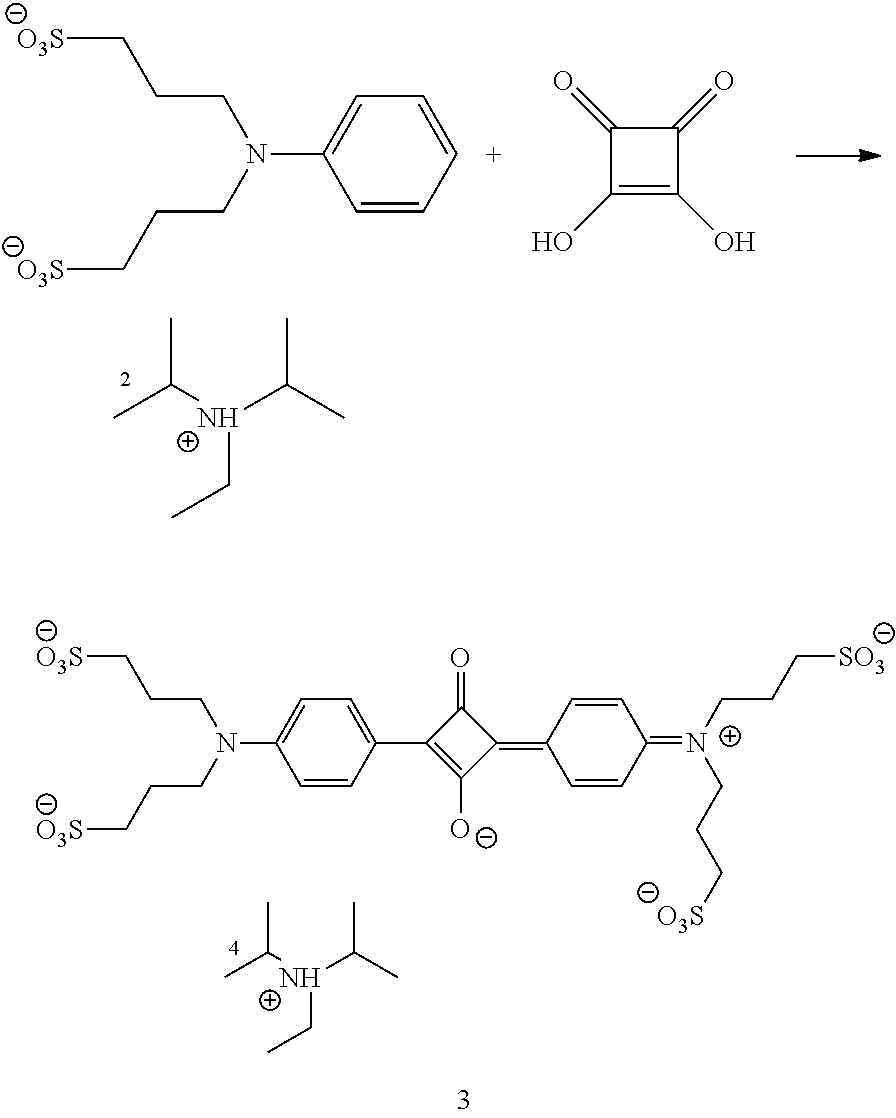


| TABLE |
| Spectral and photophysical properties of compound SR-5 and SR-5-IgG |
| Dye-to- | Absorption | Extinction | Emission | Quantum | |
| protein | max. | Coefficient | max. | Yield | |
| Sample | Ratio | [nm] | [M−1 · cm−1] | [nm] | [%] |
| SR-5 | — | 683 | 295,000 | 705 | 58 |
| SR-5- | 1.0 | 682 | 703 | 47 | |
| SR-5- | 2.0 | 682 | 703 | 40 | |
| SR-5- | 4.0 | 682 | 703 | 32 | |
| SR-5- | 6.0 | 682 | 703 | 27 | |
Covalent Labelling to IgG

| TABLE |
| Fluorescence lifetimes of novel squaraine rotaxanes |
| (λex: 630 nm, λobs: 670 nm) |
| Compound | Solvent | τ [ns] | χ2 | ||
| Rotaxane SR-2 | PB 7.4 | 0.9 | 1.1 | ||
| Rotaxane SR-4 | PB 7.4 | 1.6 | 1.5 | ||
| Rotaxane SR-5 | PB 7.4 | 2.95 | 0.9 | ||
Claims (29)


Priority Applications (1)
| Application Number | Priority Date | Filing Date | Title |
|---|---|---|---|
| US16/102,421 US11091646B2 (en) | 2017-08-14 | 2018-08-13 | Luminescent squaraine rotaxane compounds |
Applications Claiming Priority (3)
| Application Number | Priority Date | Filing Date | Title |
|---|---|---|---|
| US201762545302P | 2017-08-14 | 2017-08-14 | |
| US201762568587P | 2017-10-05 | 2017-10-05 | |
| US16/102,421 US11091646B2 (en) | 2017-08-14 | 2018-08-13 | Luminescent squaraine rotaxane compounds |
Publications (3)
| Publication Number | Publication Date |
|---|---|
| US20190048196A1 US20190048196A1 (en) | 2019-02-14 |
| US20200199369A9 US20200199369A9 (en) | 2020-06-25 |
| US11091646B2 true US11091646B2 (en) | 2021-08-17 |
Family
ID=65274803
Family Applications (1)
| Application Number | Title | Priority Date | Filing Date |
|---|---|---|---|
| US16/102,421 Active 2039-02-24 US11091646B2 (en) | 2017-08-14 | 2018-08-13 | Luminescent squaraine rotaxane compounds |
Country Status (1)
| Country | Link |
|---|---|
| US (1) | US11091646B2 (en) |
Families Citing this family (4)
| Publication number | Priority date | Publication date | Assignee | Title |
|---|---|---|---|---|
| KR20200127482A (en) * | 2019-05-02 | 2020-11-11 | 삼성에스디아이 주식회사 | Photosensitive resin composition, photosensitive resin layer including the same and color filter |
| KR102735326B1 (en) * | 2021-11-08 | 2024-11-29 | 덕산네오룩스 주식회사 | Reactive dye and photo-curable composition with reactive dye |
| KR102927438B1 (en) * | 2022-02-24 | 2026-02-12 | 삼성에스디아이 주식회사 | Core-shell dye, near-infrared absorbing composition including the same, and near-infrared absorbing film |
| CN118620231B (en) * | 2024-06-28 | 2024-11-15 | 江苏师范大学 | Luminescent metal organic frame material, preparation method thereof and application thereof in nitrofuran antibiotic detection |
Citations (11)
| Publication number | Priority date | Publication date | Assignee | Title |
|---|---|---|---|---|
| US5405907A (en) | 1989-12-05 | 1995-04-11 | Eastman Kodak Company | Print retaining coatings and coating compositions for the preparation thereof |
| US5453517A (en) | 1992-02-25 | 1995-09-26 | Molecular Probes, Inc. | Reactive derivatives of bapta used to make ion-selective chelators |
| US6083485A (en) | 1994-12-07 | 2000-07-04 | Institut Fur Diagnostikforschung Gmbh | Near infrared radiation in-vivo diagnostic methods and dyes |
| WO2000058405A2 (en) | 1999-03-31 | 2000-10-05 | Amersham Pharmacia Biotech Uk Limited | Squaraine dyes |
| WO2001011370A1 (en) | 1999-08-05 | 2001-02-15 | Bayer Aktiengesellschaft | Use of acylsulfonamido-substituted polymethine dyes as fluorescence dyes and/or markers |
| US20020077487A1 (en) | 2000-09-29 | 2002-06-20 | Molecular Probes, Inc. | Modified carbocyanine dyes and their conjugates |
| US6538129B1 (en) | 1999-04-07 | 2003-03-25 | Ewald A. Terpetschnig | Luminescent compounds |
| WO2003087052A2 (en) | 2002-04-10 | 2003-10-23 | Terpetschnig Ewald A | Dyes and fluorescent compounds |
| US20050202565A1 (en) | 1998-04-08 | 2005-09-15 | Terpetschnig Ewald A. | Luminescent compounds |
| US20100266507A1 (en) * | 2007-01-30 | 2010-10-21 | Terpetschnig Ewald A | Luminescent compounds |
| EP2129788B1 (en) | 2007-01-30 | 2014-09-03 | SETA BioMedicals, LLC | Luminescent compounds |
-
2018
- 2018-08-13 US US16/102,421 patent/US11091646B2/en active Active
Patent Citations (12)
| Publication number | Priority date | Publication date | Assignee | Title |
|---|---|---|---|---|
| US5405907A (en) | 1989-12-05 | 1995-04-11 | Eastman Kodak Company | Print retaining coatings and coating compositions for the preparation thereof |
| US5453517A (en) | 1992-02-25 | 1995-09-26 | Molecular Probes, Inc. | Reactive derivatives of bapta used to make ion-selective chelators |
| US6083485A (en) | 1994-12-07 | 2000-07-04 | Institut Fur Diagnostikforschung Gmbh | Near infrared radiation in-vivo diagnostic methods and dyes |
| US20050202565A1 (en) | 1998-04-08 | 2005-09-15 | Terpetschnig Ewald A. | Luminescent compounds |
| WO2000058405A2 (en) | 1999-03-31 | 2000-10-05 | Amersham Pharmacia Biotech Uk Limited | Squaraine dyes |
| US6538129B1 (en) | 1999-04-07 | 2003-03-25 | Ewald A. Terpetschnig | Luminescent compounds |
| WO2001011370A1 (en) | 1999-08-05 | 2001-02-15 | Bayer Aktiengesellschaft | Use of acylsulfonamido-substituted polymethine dyes as fluorescence dyes and/or markers |
| US20020077487A1 (en) | 2000-09-29 | 2002-06-20 | Molecular Probes, Inc. | Modified carbocyanine dyes and their conjugates |
| WO2003087052A2 (en) | 2002-04-10 | 2003-10-23 | Terpetschnig Ewald A | Dyes and fluorescent compounds |
| US20100266507A1 (en) * | 2007-01-30 | 2010-10-21 | Terpetschnig Ewald A | Luminescent compounds |
| US8642014B2 (en) | 2007-01-30 | 2014-02-04 | Seta Biomedicals, Llc | Luminescent compounds |
| EP2129788B1 (en) | 2007-01-30 | 2014-09-03 | SETA BioMedicals, LLC | Luminescent compounds |
Non-Patent Citations (2)
| Title |
|---|
| Arunkumar et al., Squaraine-Derived Rotaxanes: Sterically Protected Fluorescent Near-IR Dyes, J. Am. Chem. Soc., vol. 127, No. 10, pp. 3288-3289, 2005. |
| Leigh et al., The Mechanism of Formation of Amide-Based Interlocked Compounds: Prediction of a New Rotaxane-Forming Motif, Chem. Eur. J., vol. 10, Issue 20, pp. 4960-4969, 2004. |
Also Published As
| Publication number | Publication date |
|---|---|
| US20200199369A9 (en) | 2020-06-25 |
| US20190048196A1 (en) | 2019-02-14 |
Similar Documents
| Publication | Publication Date | Title |
|---|---|---|
| US8642014B2 (en) | Luminescent compounds | |
| EP2129788B1 (en) | Luminescent compounds | |
| US7250517B2 (en) | Luminescent compounds | |
| EP1078023B1 (en) | Luminescent compounds | |
| US6207464B1 (en) | Rigidized monomethine cyanines | |
| US9110069B2 (en) | Luminescent compounds | |
| US6750346B2 (en) | Stable near-infrared (NIR) marker dyes based on benzopyrylium-polymethines | |
| US20190048196A1 (en) | Luminescent squaraine rotaxane compounds | |
| US20080076188A1 (en) | Luminescent compounds | |
| JP2003501540A (en) | PH-functional cyanine dyes as reactive fluorescent reagents | |
| US20070281363A1 (en) | Luminescent compounds | |
| KR20240031282A (en) | Compound based cyanine, labeling dye, kit and contrast medium composition for biomolecule comprising the same | |
| US9034655B2 (en) | Highly water-soluble, cationic luminescent labels | |
| US7411068B2 (en) | Luminescent compounds | |
| US6538129B1 (en) | Luminescent compounds | |
| US20030211454A1 (en) | Detection reagent | |
| EP1810998B1 (en) | Fluorescent cyanine dye | |
| Cao et al. | Styrylcyanine-based fluorescent probes with red-emission and large Stokes shift for the detection of viscosity | |
| US9841428B2 (en) | Viscosity-sensitive dyes and method | |
| WO2003087052A2 (en) | Dyes and fluorescent compounds | |
| US20140200333A1 (en) | Dendron reporter molecules | |
| US20030235846A1 (en) | Luminescent compounds | |
| US8476462B2 (en) | Sulfonyl cyanine dyes and derivatives | |
| US20150268246A1 (en) | Luminescent compounds | |
| EP1849837A2 (en) | Luminescent compounds |
Legal Events
| Date | Code | Title | Description |
|---|---|---|---|
| FEPP | Fee payment procedure |
Free format text: ENTITY STATUS SET TO UNDISCOUNTED (ORIGINAL EVENT CODE: BIG.); ENTITY STATUS OF PATENT OWNER: SMALL ENTITY |
|
| AS | Assignment |
Owner name: SETA BIOMEDICALS, LLC, ILLINOIS Free format text: ASSIGNMENT OF ASSIGNORS INTEREST;ASSIGNOR:TERPETSCHNIG, EWALD A.;REEL/FRAME:046648/0281 Effective date: 20180815 Owner name: SETA BIOMEDICALS, LLC, ILLINOIS Free format text: ASSIGNMENT OF ASSIGNORS INTEREST;ASSIGNOR:KOLOSOVA, OLGA S.;REEL/FRAME:046883/0774 Effective date: 20180814 Owner name: SETA BIOMEDICALS, LLC, ILLINOIS Free format text: ASSIGNMENT OF ASSIGNORS INTEREST;ASSIGNOR:OBUKHOVA, OLENA M.;REEL/FRAME:046883/0786 Effective date: 20180814 Owner name: SETA BIOMEDICALS, LLC, ILLINOIS Free format text: ASSIGNMENT OF ASSIGNORS INTEREST;ASSIGNOR:TATARETS, ANATOLIY L.;REEL/FRAME:046883/0803 Effective date: 20180814 Owner name: SETA BIOMEDICALS, LLC, ILLINOIS Free format text: ASSIGNMENT OF ASSIGNORS INTEREST;ASSIGNOR:SEMENOVA, OLGA M.;REEL/FRAME:046883/0801 Effective date: 20180814 Owner name: SETA BIOMEDICALS, LLC, ILLINOIS Free format text: ASSIGNMENT OF ASSIGNORS INTEREST;ASSIGNOR:KOBZEV, DMYTRO V.;REEL/FRAME:046883/0753 Effective date: 20180814 Owner name: SETA BIOMEDICALS, LLC, ILLINOIS Free format text: ASSIGNMENT OF ASSIGNORS INTEREST;ASSIGNOR:SVOYAKOV, ROSTYSLAV P.;REEL/FRAME:046883/0799 Effective date: 20180814 |
|
| FEPP | Fee payment procedure |
Free format text: ENTITY STATUS SET TO SMALL (ORIGINAL EVENT CODE: SMAL); ENTITY STATUS OF PATENT OWNER: SMALL ENTITY |
|
| STPP | Information on status: patent application and granting procedure in general |
Free format text: DOCKETED NEW CASE - READY FOR EXAMINATION |
|
| FEPP | Fee payment procedure |
Free format text: PETITION RELATED TO MAINTENANCE FEES GRANTED (ORIGINAL EVENT CODE: PTGR); ENTITY STATUS OF PATENT OWNER: SMALL ENTITY |
|
| STPP | Information on status: patent application and granting procedure in general |
Free format text: NON FINAL ACTION MAILED |
|
| STPP | Information on status: patent application and granting procedure in general |
Free format text: RESPONSE TO NON-FINAL OFFICE ACTION ENTERED AND FORWARDED TO EXAMINER |
|
| STPP | Information on status: patent application and granting procedure in general |
Free format text: NON FINAL ACTION MAILED |
|
| STPP | Information on status: patent application and granting procedure in general |
Free format text: RESPONSE TO NON-FINAL OFFICE ACTION ENTERED AND FORWARDED TO EXAMINER |
|
| STPP | Information on status: patent application and granting procedure in general |
Free format text: FINAL REJECTION MAILED |
|
| STPP | Information on status: patent application and granting procedure in general |
Free format text: RESPONSE AFTER FINAL ACTION FORWARDED TO EXAMINER |
|
| STPP | Information on status: patent application and granting procedure in general |
Free format text: NOTICE OF ALLOWANCE MAILED -- APPLICATION RECEIVED IN OFFICE OF PUBLICATIONS |
|
| STPP | Information on status: patent application and granting procedure in general |
Free format text: PUBLICATIONS -- ISSUE FEE PAYMENT RECEIVED |
|
| STPP | Information on status: patent application and granting procedure in general |
Free format text: PUBLICATIONS -- ISSUE FEE PAYMENT VERIFIED |
|
| STCF | Information on status: patent grant |
Free format text: PATENTED CASE |
|
| CC | Certificate of correction | ||
| FEPP | Fee payment procedure |
Free format text: ENTITY STATUS SET TO UNDISCOUNTED (ORIGINAL EVENT CODE: BIG.); ENTITY STATUS OF PATENT OWNER: LARGE ENTITY |
|
| MAFP | Maintenance fee payment |
Free format text: PAYMENT OF MAINTENANCE FEE, 4TH YEAR, LARGE ENTITY (ORIGINAL EVENT CODE: M1551); ENTITY STATUS OF PATENT OWNER: LARGE ENTITY Year of fee payment: 4 |