US11089343B2 - Capability advertisement, configuration and control for video coding and decoding - Google Patents
Capability advertisement, configuration and control for video coding and decoding Download PDFInfo
- Publication number
- US11089343B2 US11089343B2 US13/348,510 US201213348510A US11089343B2 US 11089343 B2 US11089343 B2 US 11089343B2 US 201213348510 A US201213348510 A US 201213348510A US 11089343 B2 US11089343 B2 US 11089343B2
- Authority
- US
- United States
- Prior art keywords
- data
- bitstream
- bitstreams
- encoder
- component
- Prior art date
- Legal status (The legal status is an assumption and is not a legal conclusion. Google has not performed a legal analysis and makes no representation as to the accuracy of the status listed.)
- Active, expires
Links
Images



Classifications
-
- H—ELECTRICITY
- H04—ELECTRIC COMMUNICATION TECHNIQUE
- H04N—PICTORIAL COMMUNICATION, e.g. TELEVISION
- H04N21/00—Selective content distribution, e.g. interactive television or video on demand [VOD]
- H04N21/20—Servers specifically adapted for the distribution of content, e.g. VOD servers; Operations thereof
- H04N21/23—Processing of content or additional data; Elementary server operations; Server middleware
- H04N21/234—Processing of video elementary streams, e.g. splicing of video streams or manipulating encoded video stream scene graphs
- H04N21/2343—Processing of video elementary streams, e.g. splicing of video streams or manipulating encoded video stream scene graphs involving reformatting operations of video signals for distribution or compliance with end-user requests or end-user device requirements
- H04N21/234327—Processing of video elementary streams, e.g. splicing of video streams or manipulating encoded video stream scene graphs involving reformatting operations of video signals for distribution or compliance with end-user requests or end-user device requirements by decomposing into layers, e.g. base layer and one or more enhancement layers
-
- H—ELECTRICITY
- H04—ELECTRIC COMMUNICATION TECHNIQUE
- H04N—PICTORIAL COMMUNICATION, e.g. TELEVISION
- H04N19/00—Methods or arrangements for coding, decoding, compressing or decompressing digital video signals
- H04N19/10—Methods or arrangements for coding, decoding, compressing or decompressing digital video signals using adaptive coding
- H04N19/134—Methods or arrangements for coding, decoding, compressing or decompressing digital video signals using adaptive coding characterised by the element, parameter or criterion affecting or controlling the adaptive coding
- H04N19/164—Feedback from the receiver or from the transmission channel
-
- H—ELECTRICITY
- H04—ELECTRIC COMMUNICATION TECHNIQUE
- H04N—PICTORIAL COMMUNICATION, e.g. TELEVISION
- H04N19/00—Methods or arrangements for coding, decoding, compressing or decompressing digital video signals
- H04N19/30—Methods or arrangements for coding, decoding, compressing or decompressing digital video signals using hierarchical techniques, e.g. scalability
-
- H—ELECTRICITY
- H04—ELECTRIC COMMUNICATION TECHNIQUE
- H04N—PICTORIAL COMMUNICATION, e.g. TELEVISION
- H04N21/00—Selective content distribution, e.g. interactive television or video on demand [VOD]
- H04N21/20—Servers specifically adapted for the distribution of content, e.g. VOD servers; Operations thereof
- H04N21/23—Processing of content or additional data; Elementary server operations; Server middleware
- H04N21/24—Monitoring of processes or resources, e.g. monitoring of server load, available bandwidth, upstream requests
- H04N21/2405—Monitoring of the internal components or processes of the server, e.g. server load
-
- H—ELECTRICITY
- H04—ELECTRIC COMMUNICATION TECHNIQUE
- H04N—PICTORIAL COMMUNICATION, e.g. TELEVISION
- H04N21/00—Selective content distribution, e.g. interactive television or video on demand [VOD]
- H04N21/40—Client devices specifically adapted for the reception of or interaction with content, e.g. set-top-box [STB]; Operations thereof
- H04N21/45—Management operations performed by the client for facilitating the reception of or the interaction with the content or administrating data related to the end-user or to the client device itself, e.g. learning user preferences for recommending movies, resolving scheduling conflicts
- H04N21/462—Content or additional data management e.g. creating a master electronic programme guide from data received from the Internet and a Head-end or controlling the complexity of a video stream by scaling the resolution or bit-rate based on the client capabilities
- H04N21/4621—Controlling the complexity of the content stream or additional data, e.g. lowering the resolution or bit-rate of the video stream for a mobile client with a small screen
-
- H—ELECTRICITY
- H04—ELECTRIC COMMUNICATION TECHNIQUE
- H04N—PICTORIAL COMMUNICATION, e.g. TELEVISION
- H04N21/00—Selective content distribution, e.g. interactive television or video on demand [VOD]
- H04N21/60—Network structure or processes for video distribution between server and client or between remote clients; Control signalling between clients, server and network components; Transmission of management data between server and client, e.g. sending from server to client commands for recording incoming content stream; Communication details between server and client
- H04N21/63—Control signaling related to video distribution between client, server and network components; Network processes for video distribution between server and clients or between remote clients, e.g. transmitting basic layer and enhancement layers over different transmission paths, setting up a peer-to-peer communication via Internet between remote STB's; Communication protocols; Addressing
- H04N21/637—Control signals issued by the client directed to the server or network components
- H04N21/6377—Control signals issued by the client directed to the server or network components directed to server
- H04N21/6379—Control signals issued by the client directed to the server or network components directed to server directed to encoder, e.g. for requesting a lower encoding rate
-
- H—ELECTRICITY
- H04—ELECTRIC COMMUNICATION TECHNIQUE
- H04N—PICTORIAL COMMUNICATION, e.g. TELEVISION
- H04N21/00—Selective content distribution, e.g. interactive television or video on demand [VOD]
- H04N21/80—Generation or processing of content or additional data by content creator independently of the distribution process; Content per se
- H04N21/83—Generation or processing of protective or descriptive data associated with content; Content structuring
- H04N21/845—Structuring of content, e.g. decomposing content into time segments
- H04N21/8451—Structuring of content, e.g. decomposing content into time segments using Advanced Video Coding [AVC]
Definitions
- video When video is streamed over the Internet and played back through a Web browser or media player, the video is delivered in digital form.
- Digital video is also used when video is delivered through many broadcast services, satellite services and cable television services.
- Real-time videoconferencing often uses digital video, and digital video is used during video capture with most smartphones, Web cameras and other video capture devices.
- Digital video can consume an extremely high amount of bits.
- the number of bits that is used per second of represented video content is known as the bit rate.
- Engineers use compression (also called source coding or source encoding) to reduce the bit rate of digital video. Compression decreases the cost of storing and transmitting video information by converting the information into a lower bit rate form.
- Decompression also called decoding reconstructs a version of the original information from the compressed form.
- a “codec” is an encoder/decoder system.
- H.261, H.262 MPEG-2 or ISO/IEC 13818-2
- H.263 and H.264 MPEG-4 AVC or ISO/IEC 14496-10) standards
- MPEG-1 ISO/IEC 11172-2
- MPEG-4 Visual ISO/IEC 14496-2
- SMPTE 421M SMPTE 421M
- decoding according to the H.264 standard is widely used in game consoles and media players to play back encoded video.
- H.264 decoding is also widely used in set-top boxes, personal computers, smart phones and other mobile computing devices for playback of encoded video streamed over the Internet or other networks.
- a video codec standard typically defines options for the syntax of an encoded video bitstream, detailing parameters in the bitstream when particular features are used in encoding and decoding. In many cases, a video codec standard also provides details about the decoding operations a decoder should perform to achieve correct results in decoding.
- Spatial resolution generally refers to the number of samples in a video image. Images with higher spatial resolution tend to look crisper than other images and contain more discernable details.
- Frame rate is a common term for temporal resolution for video. Video with higher frame rate tends to mimic the smooth motion of natural objects better than other video, and can similarly be considered to contain more detail in the temporal dimension.
- an encoder can selectively introduce distortion to reduce bit rate, usually by quantizing video information during encoding. If an encoder introduces little distortion, the encoder maintains quality at the cost of higher bit rate. An encoder can introduce more distortion to reduce bit rate, but quality typically suffers. For these factors, the tradeoff for high quality is the cost of storing and transmitting the information in terms of bit rate.
- one video source can provide encoded video to multiple receiver devices.
- one device may deliver encoded video to multiple receiver devices.
- Different receiver devices may have different screen sizes or computational capabilities, with some devices able to decode and play back high quality video, and other devices only able to play back lower quality video.
- different receiver devices may use network connections having different bandwidths, with some devices able to receive higher bit rate (higher quality) encoded video, and other devices only able to receive lower bit rate (lower quality) encoded video.
- video is encoded in multiple different ways to provide versions of the video at different levels of distortion, temporal quality and/or spatial resolution quality.
- Each version of video is represented in a bitstream that can be decoded to reconstruct that version of the video, independent of decoding other versions of the video.
- a video source (or given receiver device) can select an appropriate version of video for delivery to the receiver device, considering available network bandwidth, screen size, computational capabilities, or another characteristic of the receiver device.
- Scalable video coding and decoding are another way to provide different versions of video at different levels of distortion, temporal quality and/or spatial resolution quality.
- an encoder splits video into a base layer and one or more enhancement layers.
- the base layer alone provides a reconstruction of the video at a lower quality level (e.g., lower frame rate, lower spatial resolution and/or higher distortion).
- One or more enhancement layers can be decoded along with the base layer video data to provide a reconstruction with increased video quality in terms of higher frame rate, higher spatial resolution and/or lower distortion.
- Scalability in terms of distortion is sometimes called signal-to-noise ratio (SNR) scalability.
- SNR signal-to-noise ratio
- a receiver device can receive a scalable video bitstream and decode those parts of it appropriate for the receiver device, which may be the base layer video only, the base layer video plus some of the enhancement layer video, or the base layer video plus all enhancement layer video.
- a video source, media server or given receiver device can select an appropriate version of video for delivery to the receiver device, considering available network bandwidth, screen size, computational capabilities, or another characteristic of the receiver device, and deliver only layers for that version of the video to the receiver device.
- Scalable video coding enables a rich set of configuration options, but this flexibility poses challenges for an encoder to advertise its encoding capabilities. It also poses challenges in terms of configuring which scalable video coding options are used for a given bitstream and signaling of run-time controls during encoding.
- innovations described herein provide a framework for advertising encoder capabilities, initializing encoder configuration, and signaling run-time control messages for video coding and decoding.
- the framework facilitates scalable video coding/decoding, simulcast video coding/decoding, or video coding/decoding that combines features of scalable and simulcast video coding/decoding.
- a controller for encoding receives a request for encoder capability data.
- the encoding controller receives the request as part of a function call from a controller for a decoding host.
- the encoding can include scalable video coding and/or simulcast video coding.
- the encoding controller determines the encoder capability data, which can include various types of data. It can include data that indicate a number of bitstreams, each bitstream providing an alternative version of input video. For example, the number of bitstreams is a maximum number of simulcast bitstreams supported by an encoder, where each bitstream can be encoded as a scalable bitstream or non-scalable bitstream.
- the capability data can also include data that indicate scalable video coding capabilities for encoding of the bitstreams.
- the encoder capability data can further include data that indicate computational limits for the encoding of the bitstreams, which can, for example, be parameterized in terms of macroblocks per second.
- the encoder capability data can also include data that indicate spatial resolution and/or frame rate of the input video.
- the encoding controller sends the encoder capability data, for example, as part of a reply, to a decoding host controller.
- the decoding host controller From the perspective of a decoding host controller, the decoding host controller creates a request for encoder capability data and sends the request, for example, as part of a function call to an encoding controller as described above.
- the encoded video data can include data encoded using scalable video coding and/or simulcast video coding.
- the decoding host controller receives encoder capability data in reply and processes the encoder capability data.
- an encoder is initially configured.
- a controller for a decoding host determines encoder capability data for an encoder. For example, the decoding host controller determines the encoder capability data by requesting it and receiving it from an encoding controller. The decoding host controller then creates stream configuration request data based at least in part on the encoder capability data.
- the stream configuration request data can include various types of data. It can include data that indicate a number of bitstreams, each bitstream providing an alternative version of input video. For example, the number of bitstreams is a target number of simulcast bitstreams, where each bitstream can be encoded as a scalable bitstream or non-scalable bitstream.
- the configuration request data can also include data that indicate scalable video coding options for the bitstreams.
- the decoding host controller sends the stream configuration request data, for example, as part of a function call to the encoding controller. Eventually, the decoding host controller receives and processes a reply.
- the encoding controller receives stream configuration request data.
- the encoding controller processes the stream configuration request data, for example, configuring an encoder and allocating encoder resources if the stream configuration request is permissible.
- the encoding controller then sends a reply, e.g., indicating successful configuration according to the request, or indicating failure.
- run-time control messages are signaled.
- a decoding host controller creates a control message for run-time control of encoding for the bitstream.
- the control message includes layer identifier data.
- the layer identifier data can include at least a stream identifier for the bitstream and a layer identifier for a given layer of the bitstream.
- the layer identifier data can include different types of layer identifiers.
- the stream identifier and/or a layer identifier can use a wild card symbol to identify multiple different streams and/or multiple different layers.
- the decoding host controller then sends the control message, e.g., as part of a function call to an encoding controller.
- the control message can be, for example, a request to insert a synchronization picture for the given layer, a request to change spatial resolution for the given layer, a request to start streaming of a subset of the bitstream, a request to stop streaming of a subset of the bitstream, or another request.
- the encoding controller receives and processes the control message. For example, the encoding controller receives a control message as described above from a decoding host controller. The way the control message is processed depends on the type of control message. The encoding controller then sends a reply, e.g., indicating successful processing of the control message as expected, or indicating failure.
- a reply e.g., indicating successful processing of the control message as expected, or indicating failure.
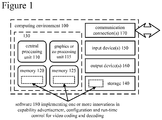
- FIG. 1 is a diagram of an example computing system in which some described embodiments can be implemented.
- FIGS. 2 a , 2 b and 2 c are diagrams of frameworks for encoding and decoding in conjunction with which some described embodiments can be implemented.
- FIG. 3 is a protocol diagram illustrating a generalized approach to capability advertisement, configuration and run-time control for video coding and decoding.
- FIGS. 4 and 5 are flowcharts illustrating generalized techniques for capability advertisement from the perspectives of a decoding host controller and an encoding controller.
- FIGS. 6 and 7 are flowcharts illustrating generalized techniques for encoder configuration from the perspectives of a decoding host controller and an encoding controller.
- FIGS. 8 and 9 are flowcharts illustrating generalized techniques for signaling run-time control messages from the perspectives of a decoding host controller and an encoding controller.
- FIG. 10 is a protocol diagram illustrating an example approach to capability advertisement, encoder configuration and run-time control for video coding and decoding.
- FIGS. 11 a , 11 b , 12 a , 12 b and 13 a -13 g are pseudocode listings that show data structures and interface signatures for the example approach.
- An encoding controller advertises encoding capabilities to a decoding host controller, which specifies an initial configuration for encoding subject to the advertised encoder capabilities.
- the decoding host controller and encoding controller can then exchange run-time control messages during streaming.
- Example data structures, signatures for functions calls, and call flows for communication between a decoding host controller and encoding controller are presented.
- encoder capability advertisement, encoder configuration and run-time control messages are described for encoders that perform scalable video coding (SVC) compliant with the H.264 standard to produce H.264/SVC bitstreams.
- Innovations described herein can also be implemented for encoder capability advertisement, encoder configuration and run-time control messages for video coding and decoding according to other standards or formats.
- innovations described herein can be used for encoder capability advertisement, encoder configuration and run-time control messages for VP6, VP8, SMPTE 421M or another format, including formats under development such as H.265 or HEVC.
- FIG. 1 illustrates a generalized example of a suitable computing system ( 100 ) in which several of the described innovations may be implemented.
- the computing system ( 100 ) is not intended to suggest any limitation as to scope of use or functionality, as the innovations may be implemented in diverse general-purpose or special-purpose computing systems.
- the computing system ( 100 ) includes one or more processing units ( 110 , 115 ) and memory ( 120 , 125 ).
- the processing units ( 110 , 115 ) execute computer-executable instructions.
- a processing unit can be a general-purpose central processing unit (CPU), processor in an application-specific integrated circuit (ASIC) or any other type of processor.
- ASIC application-specific integrated circuit
- FIG. 1 shows a central processing unit ( 110 ) as well as a graphics processing unit or co-processing unit ( 115 ).
- the tangible memory ( 120 , 125 ) may be volatile memory (e.g., registers, cache, RAM), non-volatile memory (e.g., ROM, EEPROM, flash memory, etc.), or some combination of the two, accessible by the processing unit(s).
- the memory ( 120 , 125 ) stores software ( 180 ) implementing one or more innovations for encoder capability advertisement, encoder configuration and run-time control for video coding and decoding, in the form of computer-executable instructions suitable for execution by the processing unit(s).
- a computing system may have additional features.
- the computing system ( 100 ) includes storage ( 140 ), one or more input devices ( 150 ), one or more output devices ( 160 ), and one or more communication connections ( 170 ).
- An interconnection mechanism such as a bus, controller, or network interconnects the components of the computing system ( 100 ).
- operating system software provides an operating environment for other software executing in the computing system ( 100 ), and coordinates activities of the components of the computing system ( 100 ).
- the tangible storage ( 140 ) may be removable or non-removable, and includes magnetic disks, magnetic tapes or cassettes, CD-ROMs, DVDs, or any other medium which can be used to store information in a non-transitory way and which can be accessed within the computing system ( 100 ).
- the storage ( 140 ) stores instructions for the software ( 180 ) implementing one or more innovations for encoder capability advertisement, encoder configuration and run-time control for video coding and decoding.
- the input device(s) ( 150 ) may be a touch input device such as a keyboard, mouse, pen, or trackball, a voice input device, a scanning device, or another device that provides input to the computing system ( 100 ).
- the input device(s) ( 150 ) may be a camera, video card, TV tuner card, or similar device that accepts video input in analog or digital form, or a CD-ROM or CD-RW that reads video samples into the computing system ( 100 ).
- the output device(s) ( 160 ) may be a display, printer, speaker, CD-writer, or another device that provides output from the computing system ( 100 ).
- the communication connection(s) ( 170 ) enable communication over a communication medium to another computing entity.
- the communication medium conveys information such as computer-executable instructions, audio or video input or output, or other data in a modulated data signal.
- a modulated data signal is a signal that has one or more of its characteristics set or changed in such a manner as to encode information in the signal.
- communication media can use an electrical, optical, RF, or other carrier.
- Computer-readable media are any available tangible media that can be accessed within a computing environment.
- computer-readable media include memory ( 120 , 125 ), storage ( 140 ), and combinations of any of the above.
- program modules include routines, programs, libraries, objects, classes, components, data structures, etc. that perform particular tasks or implement particular abstract data types.
- the functionality of the program modules may be combined or split between program modules as desired in various embodiments.
- Computer-executable instructions for program modules may be executed within a local or distributed computing system.
- system and “device” are used interchangeably herein. Unless the context clearly indicates otherwise, neither term implies any limitation on a type of computing system or computing device. In general, a computing system or computing device can be local or distributed, and can include any combination of special-purpose hardware and/or general-purpose hardware with software implementing the functionality described herein.
- FIGS. 2 a , 2 b and 2 c show frameworks ( 201 , 202 , 203 ) that include video encoders and video decoders as well as controllers for a decoding host and encoding.
- a decoding host can be associated with any consumer of a bitstream of encoded data, whether the bitstream is a non-scalable bitstream, scalable bitstream or multi-layer encoding (MLE) bitstream.
- the framework ( 201 ) of FIG. 2 a shows a single encoder that produces a single bitstream.
- the frameworks ( 202 , 203 ) support multiplexing/demultiplexing of multiple non-scalable bitstreams, multiple scalable bitstreams or a mix of scalable and non-scalable bitstreams.
- the encoder ( 211 ) encodes input video ( 209 ) to produce a bitstream ( 223 ) of encoded data compliant with the H.264 standard, SMPTE 421M standard, H.265/HEVC standard, another standard, or a proprietary format.
- the output bitstream ( 223 ) from the encoder ( 211 ) can be a non-scalable bitstream or scalable bitstream, which may provide for spatial, temporal and/or SNR scalability within the scalable bitstream.
- a scalable bitstream complies with SVC sections of the H.264 standard.
- the H.264/SVC bitstream itself includes a non-scalable bitstream (sometimes called an H.264/AVC bitstream) for the base layer of the H.264/SVC bitstream.
- the encoder ( 211 ) can encode video for a videoconference, video telephone call, streaming over the Internet, or other use scenario.
- the bitstream ( 223 ) is conveyed over a transport channel ( 230 ) using an appropriate communication protocol.
- the transport channel ( 230 ) can include the Internet or another computer network.
- FIG. 2 a shows “n” decoders ( 271 , . . . , 27 n ).
- the number of decoders depends on implementation.
- Each decoder ( 271 , . . . , 27 n ) decodes at least part of the bitstream ( 223 ) of encoded data, which is compliant with the H.264 standard, SMPTE 421M standard, H.265/HEVC standard, another standard, or a proprietary format.
- the input bitstream for decoding can be a non-scalable bitstream or scalable bitstream.
- the controller ( 222 ) is an encoding controller that communicates with the encoder ( 211 ).
- the encoding controller ( 222 ) can be part of the same computing system as the encoder ( 211 ) or part of another computing system.
- the encoding controller ( 222 ) gets encoder capability data from the encoder ( 211 ) and advertises the capabilities of the encoder ( 211 ) to one or more controllers for decoding hosts. Sections III, IV and VII describe aspects of encoder capability advertisement.
- the controller ( 252 ) is a decoding host controller that communicates with the decoder(s) ( 271 , . . . , 27 n ).
- the decoding host controller ( 252 ) can be part of the same computing system as the decoder(s) ( 271 , . . . , 27 n ) or part of another computing system.
- the decoding host controller ( 252 ) gets the encoder capability data from the encoding controller ( 222 ) and creates stream configuration request data appropriate for the decoder(s) ( 271 , . . . , 27 n ).
- the stream configuration request data can be set considering the computational capabilities, screen size or quality setting of a given decoder or decoders, or considering the network bandwidth between the encoder ( 211 ) and decoder(s) ( 271 , . . . , 27 n ).
- the stream configuration request data are also set subject to the encoder capability data.
- the decoding host controller sends the configuration request data to the encoding controller ( 222 ), which uses the configuration request data to configure the encoder ( 211 ).
- Sections III, V and VII describe aspects of initial encoder configuration.
- the decoding host controller ( 252 ) and encoding controller ( 222 ) can also exchange run-time control messages during streaming and playback of the bitstream. Such run-time control messages can be based upon feedback from one of the decoder(s) ( 271 , . . . , 27 n ) to the decoding host controller ( 252 ). Sections III, VI and VII describe aspects of run-time control.
- a multi-layer encoder includes one or more video encoders as well as a bitstream multiplexer (MUX).
- Each encoder encodes input video ( 209 ) to produce a component bitstream of encoded data compliant with the H.264 standard, SMPTE 421M standard, H.265/HEVC standard, another standard, or a proprietary format.
- the output bitstream from an encoder can be a non-scalable bitstream or scalable bitstream, which may provide for spatial, temporal and/or SNR scalability within the scalable bitstream.
- the multi-layer encoder ( 210 ) can include a single encoder used multiple times to encode different versions of video in different component bitstreams for simulcast transmission. Or, the multi-layer encoder ( 210 ) can include multiple encoders used to produce the respective component bitstreams in parallel.
- the multi-layer encoder ( 210 ) can encode video for a videoconference, video telephone call, streaming over the Internet, or other use scenario.
- the component bitstreams can differ from each other in terms of the number of layers of temporal, spatial and/or SNR scalability supported in the bitstream, if the bitstream is scalable at all.
- the component bitstreams can all use the same format, or different component bitstreams can use different formats.
- the component bitstreams can be encoded for the same profile and level of decoding, or different component bitstreams can be encoded for different profile and/or level of decoding to serve decoders with different capabilities.
- the multi-layer encoder ( 210 ) multiplexes the component bitstreams together to form a multi-layer encoding (MLE) bitstream ( 221 ). In doing so, the multi-layer encoder ( 210 ) applies composition rules to facilitate demultiplexing and avoid contradictory assignments of values to parameters in the MLE bitstream ( 221 ).
- Example composition rules are described in U.S. patent application Ser. No. 13/235,217, filed Sep. 16, 2011, entitled “Multi-layer Encoding and Decoding,” the disclosure of which is hereby incorporated by reference.
- an MLE bitstream can include multiple H.264/SVC bitstreams multiplexed together, multiple H.264/AVC bitstreams multiplexed together or a mix of H.264/AVC and H.264/SVC bitstreams multiplexed together.
- the MLE bitstream DEMUX ( 250 ) receives the MLE bitstream ( 221 ) and demultiplexes at least part of a component bitstream ( 251 ) from it.
- the MLE DEMUX ( 250 ) applies decomposition rules in demultiplexing.
- the DEMUX ( 250 ) can be part of a multi-point conferencing unit in a videoconferencing system, network server that distributes streaming media, receiver, or other entity in a network environment.
- the operations of the DEMUX ( 250 ) depend on its role, as further detailed in U.S. patent application Ser. No. 13/235,217, which also describes example decomposition rules.
- the DEMUX ( 250 ) selects all or part of a component bitstream ( 251 ) that is appropriate in terms of bit rate, spatial resolution, frame rate or other quality level, for delivery to a decoder.
- Different decoders ( 271 , 272 , . . . , 27 n ) can thus receive different versions of the video from the MLE DEMUX ( 250 ).
- the number of decoders depends on implementation.
- the encoding controller ( 222 ) communicates with the multi-layer encoder ( 210 ).
- the encoding controller ( 222 ) can be part of the same computing system as the multi-layer encoder ( 210 ) or part of another computing system.
- the encoding controller ( 222 ) gets encoder capability data from the multi-layer encoder ( 210 ) and advertises the capabilities of the encoders of the multi-layer encoder ( 210 ) to one or more controllers for decoding hosts, as further detailed in sections III, IV and VII.
- the decoding host controller ( 252 ) communicates with the MLE DEMUX ( 250 ).
- the decoding host controller ( 252 ) can be part of the same computing system as the DEMUX ( 250 ) or part of another computing system.
- the decoding host controller ( 252 ) gets the encoder capability data from the encoding controller ( 222 ) and creates stream configuration request data appropriate for the decoder(s) ( 271 , . . . , 27 n ), e.g., considering the computational capabilities, screen size or quality setting of a given decoder or decoders, or considering network bandwidth.
- the decoding host controller ( 252 ) sends the stream configuration request data to the encoding controller ( 222 ), which uses the configuration request data to configure the encoders of the multi-layer encoder ( 210 ).
- the decoding host controller ( 252 ) and encoding controller ( 222 ) can also exchange run-time control messages during streaming and playback of the bitstream, as explained with reference to FIG. 2 a . See sections III and V-VII.
- the framework ( 203 ) includes one or more encoders ( 211 , 212 , . . . , 21 n ) apart from an MLE MUX ( 220 ). Each encoder encodes input video ( 209 ) to produce a component bitstream ( 219 ), which can be a non-scalable bitstream or scalable bitstream.
- the MLE MUX ( 220 ) receives the component bitstreams ( 219 ) and multiplexes them together to form an MLE bitstream ( 221 ).
- the transport channel ( 230 ), DEMUX ( 250 ) and decoder(s) ( 271 , 272 , . . . , 27 n ) in the framework ( 203 ) of FIG. 2 c operate as in the framework ( 202 ) of FIG. 2 b.
- the encoding controller ( 222 ) communicates with the MLE MUX ( 220 ).
- the encoding controller ( 222 ) can be part of the same computing system as the MUX ( 220 ) or part of another computing system.
- the encoding controller ( 222 ) gets encoder capability data from the MUX ( 220 ) and advertises the capabilities of the encoders to one or more controllers for decoding hosts, as explained with reference to FIG. 2 b .
- the encoding controller ( 222 ) communicates directly with the encoders ( 211 , . . . , 21 n ).
- the decoding host controller ( 252 ) communicates with the MLE demultiplexer ( 250 ), as explained with reference to FIG. 2 b.
- FIG. 3 shows an example approach ( 300 ) to encoder capability advertisement, encoder configuration and run-time control for video coding and decoding.
- a controller for a decoding host creates a request for encoder capability data and sends the request to an encoding controller.
- the encoding controller determines encoder capability data and provides the encoder capability data to the decoding host controller.
- the encoder capability data are formatted and requested using the structures, call signatures and call flows explained with reference to FIGS. 10, 11 a and 11 b .
- the encoder capability data are formatted and/or requested in another way, or the encoder capability data have fields other than or in addition to the fields shown in FIGS. 11 a and 11 b.
- the decoding host controller processes the encoder capability data received from the encoding controller.
- the decoding host controller creates stream configuration request data appropriate for the decoder(s) in question, subject to the capabilities indicated in the encoder capability data.
- the decoding host controller provides the configuration request data to the encoding controller.
- the encoder controller uses it to configure the encoder(s) and allocate resources for encoding, and also acknowledges receipt of the configuration request data.
- the stream configuration request data are formatted and sent using the structures, call signatures and call flows explained with reference to FIGS. 10, 12 a and 12 b .
- the stream configuration request data are formatted and/or sent in another way, or the stream configuration request data have fields other than or in addition to the fields shown in FIGS. 12 a and 12 b.
- the encoder then starts encoding and streaming, and the decoder starts decoding and playback.
- the decoding host control can create a control message and send it to the encoding controller.
- the encoding controller processes the run-time control message appropriately, and also acknowledges receipt of the run-time control message.
- run-time control messages are formatted and sent using the structures, call signatures and call flows explained with reference to FIGS. 10 and 13 a - 13 g .
- run-time control messages are formatted and/or sent in another way, or run-time control messages other than or in addition to the messages shown in FIGS. 13 b -13 g are used.
- the decoding host controller can then create and send other run-time control messages. Such messages are processed by the encoding controller, which continues streaming.
- FIG. 4 illustrates a generalized technique ( 400 ) for encoder capability advertisement from the perspective of a decoding host controller.
- a decoding host controller such as the decoding host controller ( 252 ) of FIGS. 2 a -2 c , or other decoding host controller, performs the technique ( 400 ).
- FIG. 5 illustrates a generalized technique ( 500 ) for encoder capability advertisement from the perspective of an encoding controller.
- An encoding controller such as the encoding controller ( 222 ) of FIGS. 2 a -2 c , or other encoding controller, performs the technique ( 500 ).
- the decoding host controller creates ( 410 ) a request for encoder capability data and sends ( 420 ) the request (e.g., as part of a function call) to the encoding controller.
- the request for encoder capability data is formatted and sent using the structures, call signatures and call flows explained with reference to FIGS. 10, 11 a and 11 b .
- the request is formatted and/or sent in another way.
- the encoding controller receives ( 530 ) the request for encoder capability data and determines ( 540 ) the encoder capability data.
- the encoder capability data can include one or more of the following.
- the encoder capability data include other and/or additional data.
- the encoding controller then sends ( 550 ) the encoder capability data (e.g., as part of a return for a function call).
- the decoding host controller receives ( 460 ) the encoder capability data and processes it.
- the decoding host controller evaluates ( 470 ) whether the encoder capability data has been successfully provided. If so, the decoding host controller can continue to the encoder configuration phase. Otherwise, the decoding host controller creates ( 410 ) another request for encoder capability data and again attempts to get encoder capability data.
- FIG. 6 illustrates a generalized technique ( 600 ) for encoder configuration from the perspective of a decoding host controller.
- a decoding host controller such as the decoding host controller ( 252 ) of FIGS. 2 a -2 c , or other decoding host controller, performs the technique ( 600 ).
- FIG. 7 illustrates a generalized technique ( 700 ) for encoder configuration from the perspective of an encoding controller.
- An encoding controller such as the encoding controller ( 222 ) of FIGS. 2 a -2 c , or other encoding controller, performs the technique ( 700 ).
- the decoding host controller determines ( 610 ) encoder capability data. For example, the decoding host controller receives the encoder capability data from an encoding controller as described with reference to FIGS. 4 and 5 . Alternatively, the decoding host controller determines the encoder capability data in some other way, e.g., retrieving the encoder capability data from archived storage.
- the decoding host controller then creates ( 620 ) stream configuration request data based at least in part on the encoder capability data.
- the stream configuration request data can include one or more of the following.
- the stream configuration request data include other and/or additional data.
- the stream configuration request data can also be based at least in part on data that indicate computational limits for encoding.
- the data that indicate computational limits for encoding are maximum macroblock processing rates.
- the data that indicate computational limits take another form.
- the decoding host controller sends ( 630 ) the stream configuration request data (e.g., as part of a function call) to the encoding controller.
- the stream configuration request data are formatted and sent using the structures, call signatures and call flows explained with reference to FIGS. 10, 12 a and 12 b .
- the stream configuration request data are formatted and/or sent in another way.
- the encoding controller receives ( 740 ) the stream configuration request data and processes ( 750 ) it. For example, the encoding controller configures one or more encoders and allocates resources such as memory buffers for encoding. The encoder can then start streaming with the encoder(s).
- the encoding controller sends ( 760 ) a reply (e.g., as part of a return for a function call).
- the decoding host controller receives ( 670 ) the reply and processes it.
- the decoding host controller evaluates ( 680 ) whether the encoder configuration succeeded. If so, the decoding host controller can continue to the run-time control phase. Otherwise, the decoding host controller creates ( 620 ) new stream configuration request data and again attempts to initialize the encoder.
- FIG. 8 illustrates a generalized technique ( 800 ) for signaling run-time control messages from the perspective of a decoding host controller.
- a decoding host controller such as the decoding host controller ( 252 ) of FIGS. 2 a -2 c , or other decoding host controller, performs the technique ( 800 ).
- FIG. 9 illustrates a generalized technique ( 900 ) for signaling run-time control messages from the perspective of an encoding controller.
- An encoding controller such as the encoding controller ( 222 ) of FIGS. 2 a -2 c , or other encoding controller, performs the technique ( 900 ).
- a decoding host controller creates ( 810 ) a run-time control message for control of encoding for the bitstream.
- Such run-time control can use commands specified for a particular layer of a bitstream, in which case the control message indicates which layer is controlled/changed.
- the control message can include layer identifier data, which in turn can include a stream identifier of the bitstream and at least one layer identifier of a given layer of the bitstream.
- the layer identifier data are formatted using the structure explained with reference to FIG. 13 a , which includes a stream identifier and three different types of layer identifiers.
- the layer identifier data use another format.
- the decoding host controller sends ( 820 ) the control message (e.g., as part of a function call) to an encoding controller.
- the control message is formatted and sent using the structures, call signatures and call flows explained with reference to FIGS. 10 and 13 b - 13 g .
- the control message is formatted and/or sent in another way.
- the control message can be a request to insert a synchronization picture for the given layer, a request to change spatial resolution for the given layer, a request to set a priority identifier for the given layer, a request to set quantization parameters and/or rate control parameters for the given layer, a request to start streaming of a subset of the bitstream, a request to stop streaming of a subset of the bitstream, or some other type of control message.
- the control message is a request to start streaming a subset of the bitstream
- the subset can include encoded video data for the given layer and any layers upon which the given layer depends.
- the control message is a request to stop streaming a subset of the bitstream
- the subset can include encoded video data for the given layer and any higher layers.
- the encoding controller receives ( 930 ) the run-time control message and processes ( 940 ) it, in a way that depends on the type of control message, and if such processing is feasible. For example, the encoding controller causes an encoder to insert a synchronization picture for the given layer, change spatial resolution for the given layer, set quantization parameters and/or rate control parameters for the given layer, or make some other change. Or, the encoding controller causes an encoder or multiplexer to set a priority identifier for the given layer, start streaming of a subset of the bitstream, stop streaming of a subset of the bitstream, or perform some other action.
- the encoding controller then sends ( 950 ) a reply (e.g., as part of a return from a function call).
- the decoding host controller receives ( 860 ) the reply and processes it.
- the decoding host controller evaluates ( 680 ) whether the run-time control succeeded. If so, the decoding host controller can continue the run-time control phase, possibly restarting the technique ( 800 ) for another control message. Otherwise, the decoding host controller creates ( 810 ) the control message again for another attempt at the run-time control operation.
- features of encoder capability advertisement, encoder configuration and run-time control are provided in a framework that supports a wide range of hardware and software H.264 encoders with different capabilities.
- the H.264 encoders can use scalable video coding (that is, H.264/SVC) and/or non-scalable video coding (that is, H.264/AVC).
- the framework uses a tiered approach from low to high capabilities that is designed to allow these different encoders to be used in a unified video system.
- the framework supports a variety of frame rates and spatial resolutions. For additional details about the framework in the example implementation, see U.S. patent application Ser. No. 13/235,217.
- FIG. 10 shows an example approach ( 1000 ) to capability advertisement, configuration and run-time control for video coding and decoding in the example implementation.
- a controller for a decoding host initiates a call to query an encoding controller for encoder capabilities.
- the decoding host controller calls a function QueryEncoderCapability( ) of an interface.
- FIG. 11 b shows a function signature ( 1102 ) for the function QueryEncoderCapability( )
- the encoding controller determines encoder capabilities and creates a reply structure.
- FIG. 11 a shows an example structure ( 1101 ) that indicates encoder capabilities, including maximum number of simulcast streams, H.264/SVC capabilities, computational capabilities and input video characteristics.
- the encoding controller provides a reply (e.g., S_OK indicating success, or a different value indicating failure) along with the structure indicating encoder capabilities.
- the decoding host controller processes the reply (including the structure that indicates encoder capabilities).
- the decoding host controller creates a stream configuration request structure.
- FIG. 12 a shows an example stream configuration request structure ( 1201 ) for a bitstream.
- the decoding host controller can create a structure ( 1201 ) per bitstream.
- the stream configuration request is subject to both H.264/SVC capabilities of the encoder and computational capabilities of the encoder.
- the possible combinations of number of simulcast streams, number of scalability layers, frame rates and spatial resolutions are subject to limits on encoder processing capabilities, which may be expressed in terms of maximum macroblock processing rates.
- the relevant total is the sum of macroblocks per second for the highest quality layer across the streams.
- the decoding host controller initiates a call to initialize the encoder.
- the decoding host controller calls a function InitializeEncoder( )
- FIG. 12 b shows a function signature ( 1202 ) for the function InitializeEncoder( )
- the encoding controller processes the stream configuration request structure(s). If possible, the encoding controller configures the encoder accordingly and allocates resources such as memory buffers for encoding.
- the encoding controller provides a reply (e.g., S_OK indicating success, or a different value indicating failure).
- the encoder then starts encoding and streaming, and the decoder starts decoding and playback.
- the decoding host controller initiates a call to an appropriate function of the interface.
- the decoding host controller initiates a call to the StartLayer( ) function.
- FIG. 13 f shows a function signature ( 1306 ) for the StartLayer( ) function.
- the StartLayer( ) function has a parameter that represents a layer of the bitstream that is affected for the function call.
- FIG. 13 a shows a structure ( 1301 ) for a layer identifier.
- FIGS. 13 b -13 e and 13 g show signatures for other function calls for run-time control.
- the encoding controller processes the function call, taking appropriate action if possible.
- the encoding controller then provides a reply (e.g., S_OK indicating success, or a different value indicating failure).
- the decoding host controller can then initiate other calls for run-time control, which are processed by the encoding controller.
- FIG. 11 b shows the function signature ( 1102 ) for QueryEncoderCapability( ). This is the main function for query/reply between controllers for the decoding host and encoding in the example implementation.
- the function signature ( 1102 ) includes a first field that indicates a maximum number of simulcast streams. Each stream can be an H.264/AVC bitstream or H.264/SVC bitstream.
- the next field in the function signature ( 1102 ) has a type of H264SVCCapability and indicates the maximum encoder capabilities and options for an H.264/SVC bitstream.
- FIG. 11 a shows a structure ( 1101 ) used to indicate H.264/SVC capabilities of an encoder during the capability advertisement phase. Using the structure ( 1101 ), an encoder can advertise its H.264/SVC capabilities for any H.264/SVC bitstream. The capabilities can apply for all streams when multiple simulcast streams are supported, but computational limits still apply. (Full scalability options might not be possible for all streams, due to limits on computational capacity of the encoder.)
- the field MaxNumOfTemporalEnhancementLayers indicates the maximum number of temporal enhancement layers in a bitstream.
- the field has 3 bits, as indicated by the number 3 in the structure ( 1101 ).
- a non-zero value of this field indicates the encoder supports the creation of temporal scalable bitstreams formed in a hierarchical prediction structure.
- an encoder can produce an H.264/SVC bitstream using a hierarchical P-picture prediction structure to achieve temporal scalability.
- a frame in a temporal enhancement layer uses the immediate previously reconstructed frame in the lower layer as a reference frame.
- each layer represents a temporal scale.
- a value of temporal_id can specify the hierarchical dependency of a temporal layer relative to other layers, with 0 representing the base temporal layer, 1 the first temporal enhancement layer, 2 the second temporal enhancement layer, and so forth.
- the single-bit field RewriteSupport indicates whether the encoder supports the creation of quality scalable bitstreams that can be converted into bitstreams that conform to one of the non-scalable H.264/AVC profiles by using a low-complexity rewriting process.
- the next fields of the structure ( 1101 ) relate to support for SNR scalability.
- an encoder can use coarse-grained scalability (“CGS”) and medium-grained scalability (“MGS”) in a single bitstream.
- CGS coarse-grained scalability
- MGS medium-grained scalability
- the three-bit field MaxNumOfCGSEnhancementLayers indicates the maximum number of CGS quality enhancement layers in a bitstream. A non-zero value of this field indicates the encoder supports the creation of CGS quality scalable bitstreams.
- the field MaxNumOfMGSSublayers indicates the maximum number of MGS sub-layers allowed in an MGS enhancement layer in a bitstream. A non-zero value of this field indicates the encoder supports the creation of MGS quality scalable bitstreams with sub-layering. Key frame generation is supported when MGS is supported.
- the field AdditionalSNRScalabilitySupport indicates whether additional SNR layers are allowed to be present in a spatial enhancement layer.
- MaxNumOfSpatialEnhancementLayers indicates the maximum number of spatial enhancement layers supported in a bitstream. A non-zero value of this field indicates the encoder supports the creation of spatial scalable bitstreams. The remaining bits are reserved in the structure ( 1101 ) of FIG. 11 a.
- the function signature ( 1102 ) includes fields that indicate the computational limits for streams produced by the encoder, in aggregate.
- the field pwMaxMacroblockProcessingRateArraySize indicates the size of the array in the next field pdwMaxMacroblockProcessingRate.
- the computational limits are represented with maximum macroblock processing rates organized in a two-dimensional array:
- the remaining fields of the function signature ( 1102 ) indicate the maximum source resolution and frame rate for the input video.
- the maximum input resolution and frame rate are specified by three variables pwMaxInputWidth, pwMaxInputHeight, and pdwMaxInputFrameRate. Other fields may follow in the function signature ( 1102 ).
- the decoding host controller can determine one or more feasible and appropriate layering structures for the respective stream(s), along with spatial resolutions and frame rates at the respective layers. With these structure(s), the decoding host controller can specify a particular stream configuration to the encoding controller.
- FIG. 12 a shows a structure ( 1201 ) of type H264SVCStreamLayout with fields that indicate spatial resolutions and layering structure for a given bitstream.
- the first fields indicate spatial resolution of the base layer.
- the field BaseOutputWidth indicates the width in pixels of the base spatial layer.
- the field BaseOutputHeight indicates the height in pixels of the base spatial layer. The values for width and height do not exceed the width and height specified in the encoder capability signature ( 1102 ).
- the three-bit field NumberOfTemporalEnhancementLayers indicates the number of temporal enhancement layers in the stream. This value effectively corresponds to the values of syntax element temporal_id in H.264/SVC. For example, if this field is 2, three temporal layers, corresponding to temporal_id 0, 1, and 2 are present in the bitstream. The value of this field does not exceed the maximum number of temporal layers specified in the H.264/SVC capability structure ( 1101 ).
- the remaining fields of the configuration structure ( 1201 ) are organized according to spatial base layer and 1 st , 2 nd and 3 rd spatial enhancement layers.
- the structure ( 1201 ) shown in FIG. 12 a assumes the encoder supports at most four spatial enhancement layers, but a bitstream can have fewer spatial layers (e.g., only spatial base layer, or only spatial base layer and one spatial enhancement layer).
- the values permitted are subject to the constraints indicated in the encoder capability data, in particular the H.264/SVC capability structure ( 1101 ).
- the next fields indicate SNR scalability attributes for the spatial base layer.
- the single-bit field SNRModeBase indicates whether CGS or MGS is used to generate quality layers in the spatial base layer.
- the value 0 means CGS is used, and the value 1 means MGS is used.
- SNRModeAttributeBase (1 bit) indicates whether a rewriting process is enabled (0 means rewriting is not used, and 1 means rewriting is used).
- the two-bit field NumberOfSNREnhancementLayersBase indicates the number of CGS quality enhancement layers in the spatial base layer. When the value of this field is 0, it means no SNR scalability is introduced in the spatial base layer. A non-zero value effectively corresponds to the values of the syntax element dependency_id in H.264/SVC. For example, if the value of this field is 2, three CGS layers (corresponding to dependency_id 0, 1, and 2) are present in the spatial base layer in the bitstream.
- SNRModeAttributeBase indicates whether key frame generation is enabled (0 means key frame generation is disabled, and 1 means it is enabled).
- the field NumberOfSNREnhancementLayersBase indicates the number of MGS sub-layers in the spatial base layer. When the value of this field is 0, it means no SNR scalability is introduced in the spatial base layer, as noted above for the CGS case.
- a non-zero value effectively corresponds to the values of the syntax element quality_id in H.264/SVC. For example, if the value of this field is 3, three MGS sub-layers (corresponding to quality_id 1, 2, and 3) are present in the spatial base layer in the bitstream. (That is, quality_id value 0 corresponds to the base quality layer, and quality_id values 1, 2, and 3 correspond to sub-layers in the MGS enhancement layer.)
- the three-bit field NumberOfSNRLayers1st indicates whether spatial scalability is introduced in the bitstream and whether and how additional SNR scalability is used.
- NumberOfSNRLayers1st When the value of NumberOfSNRLayers1st is 0, spatial scalability is not introduced in the bitstream.
- this field When the value of this field is 1, spatial scalability is used, but no additional SNR scalability is introduced in the 1 st spatial enhancement layer.
- the value of this field is 2 or larger, spatial scalability is used and additional SNR scalability is also introduced in the 1 st spatial enhancement layer.
- the value of NumberOfSNRLayers1st indicates the number of CGS quality layers or MGS sub-layers used in the 1 st spatial enhancement layer.
- the maximum number of spatial layers advised by the encode capability data is at least 2.
- the value of NumberOfSNRLayers1st is larger than 1, the use of additional SNR scalability does not exceed that specified in the encoder capability data.
- the field SNRMode1st (1 bit) indicates whether CGS or MGS is used to generate additional quality layers in a 1 st spatial enhancement layer, if present.
- the value 0 means CGS is used, and the value 1 means MGS is used.
- the field SNRModeAttribute1st (1 bit) indicates whether the rewriting process is enabled (0 means rewriting is not used; 1 means it is used).
- the value of NumberOfSNRLayers1st effectively corresponds to the values of the syntax element dependency_id in H.264/SVC. For example, if the value of this field is 3, three CGS layers (corresponding to dependency_id K+1, K+2, and K+3) are present in the 1 st spatial enhancement layer in the bitstream, where K is 0 if SNRModeBase is 1 and K is NumberOfSNREnhancementLayersBase if SNRModeBase is 0.
- the field SNRModeAttribute1st indicates whether key frame generation is enabled (0 means key frame generation is disabled; 1 means it is enabled).
- the value of NumberOfSNRLayers1st effectively corresponds to the values of the syntax element quality_id in H.264/SVC. For example, if the value of this field is 3, three MGS sub-layers (corresponding to quality_id 1, 2, and 3) are present in the 1 st spatial enhancement layer in the bitstream.
- the field UpscaleRatio1st (1 bit) indicates the resolution upscale ratio of the 1 st spatial enhancement layer with respect to the base spatial layer. Two resolution upscale ratios are supported. A value of 0 means the upscaling ratio is 2, and a value of 1 means the ratio is 1.5.
- the fields SNRMode2nd and SNRMode3rd have the same meaning as the field SNRMode1st but relate to the 2 nd and 3 rd spatial enhancement layers, if present.
- the two-bit field NumberOfSNRLayers2nd indicates whether the 2 nd spatial enhancement layer is introduced in the bitstream and, if so, whether additional SNR scalability is used. When this field is 0, the 2 nd spatial enhancement layer is not introduced in the bitstream. When the value of this field is 1, the 2 nd spatial enhancement layer exists, but no additional SNR scalability is introduced. When the value of this field is 2 or larger, additional SNR scalability is introduced in the 2 nd spatial enhancement layer. In the last case, depending on the value of SNRMode2nd, the value of NumberOfSNRLayers2nd indicates the number of CGS quality layers or MGS sub-layers used in the 2 nd spatial enhancement layer.
- NumberOfSNRLayers2nd When the value of NumberOfSNRLayers2nd is non-zero, NumberOfSNRLayers1st is also non-zero and the maximum number of spatial layers advised by the encode capability data is at least 3. When the value of this field is larger than 1, the use of additional SNR scalability does not exceed that specified in the encoder capability data.
- NumberOfSNRLayers2nd effectively corresponds to the values of the syntax element dependency_id in H.264/SVC. For example, if the value of this field is 3, three CGS layers (corresponding to dependency_id K+1, K+2, and K+3) are present in the 2nd spatial enhancement layer in the bitstream, where (a) K is 1 if both SNRModeBase and SNRMode1st are 1, (b) K is NumberOfSNREnhancementLayersBase+1 if SNRModeBase is 0 but SNRMode1st is 1, and (c) K is NumberOfSNRLayers1st if SNRModeBase is 1 but SNRMode1st is 0.
- NumberOfSNRLayers2nd effectively corresponds to the values of syntax element quality_id in H.264/SVC. For example, if the value of this field is 3, three MGS sub-layers (corresponding to quality_id 1, 2, and 3) are present in the 2 nd spatial enhancement layer in the bitstream.
- NumberOfSNRLayers3rd is defined in a similar way for the 3 rd spatial enhancement layer.
- the controller for the decoding host can pick any combination of resolutions/frame rates for a particular layering structure, so long as the selected resolution and frame rate do not exceed the resolution and frame rate of the source or exceed the maximum values advised by the encoding controller, and so long as the aggregate macroblock processing rate does not exceed the relevant value indicated by the encoding controller.
- the aggregate macroblock processing rate for a given layer depends on the frame rate and spatial resolution for the given layer, and also depends on the frame rate and spatial resolution for layers used in reconstruction of the given layer.
- layer A is 360p video with spatial resolution of 640 ⁇ 360 at 15 frames per second.
- the macroblock processing rate for layer A is:
- ceil ⁇ ( 640 16 ) ⁇ ceil ⁇ ( 360 16 ) ⁇ 15 13800 ⁇ ⁇ macroblocks ⁇ ⁇ per ⁇ ⁇ second , where ceil( ) is a function that rounds up a fractional value to the next highest integer value.
- layer B is 720p video with spatial resolution of 1280 ⁇ 720 at 30 frames per second.
- the macroblock processing rate for layer B by itself is:
- ceil ⁇ ( 1280 16 ) ⁇ ceil ⁇ ( 720 16 ) ⁇ 30 108000 ⁇ ⁇ macroblocks ⁇ ⁇ per ⁇ ⁇ second .
- the H.264/SVC bitstream includes one spatial resolution re-scaling stage (re-scaling by a factor of 2 horizontally and vertically, from 640 ⁇ 360 to 1280 ⁇ 720).
- the value of index i is 1.
- the H.264/SVC bitstream uses temporal and spatial scalability, so the value of index j is 3.
- the decoding host controller computes the macroblock processing rate for the configuration that it has specified using the configuration structures ( 1201 ), then compares that macroblock processing rate to the maximum value for the appropriate values of i and j to confirm that the configuration is within the applicable computational limit specified in the encoder capability data. If the configuration exceeds the applicable computational limit, the decoding host controller can adjust the spatial resolution, frame rate and/or layering structure for the configuration to reduce the expected computational cost.
- the values for the indices i and j depend on the number of spatial resolution re-scaling stages and degree of scalability for that one bitstream. If the configuration includes multiple bitstreams, conservatively, the decoding host controller can use the highest applicable values for the indices i and j. Also, the decoding host can count different simulcast streams at different spatial resolutions as re-scaling operations, since these affect the computational cost for the encoder. For example, when the configuration includes two simulcast streams having different spatial resolutions, and neither bitstream uses spatial scalability within that bitstream, the decoding host controller can set the value of the index i to 1. If one of the simulcast streams also uses spatial scalability within the bitstream, the decoding host controller can increment the value of the index i appropriately to account for the re-scaling operations.
- FIG. 12 b shows the function signature ( 1202 ) for InitializeEncoder( ) which is the main function that the decoding host controller uses to provide configuration data to the encoding controller in the example implementation.
- the function signature ( 1202 ) includes the fields wInputWidth and wInputHeight that indicate a target spatial resolution for input video.
- the function signature ( 1202 ) then includes a field wNumOfSimulcastStreamsMinus1 that indicates the number of simulcast streams in the configuration request, where each simulcast stream provides an alternative version of the input video. This field is followed by a per stream layout configuration of type H264SVCStreamLayout for each of the simulcast streams.
- a stream configuration request within the SVC capabilities and computational limits advertised by the encoder works. If not, the decoding host controller can create a new configuration request and provide the new configuration request through a call to InitializeEncoder( ).
- the encoder After the successful completion of the initialization phase, the encoder starts streaming the H.264 bitstreams.
- the decoding host controller may need to adjust how the encoder operates in response to network bandwidth fluctuation, a remote decoder request, a decoding host-side resource change, or another factor.
- the decoding host controller creates and sends run-time control messages.
- the decoding host controller can request the insertion of an intra-coded picture in a scalable layer to react packet loss at the decoding side.
- FIG. 13 a shows a structure ( 1301 ) for the StreamLayerId type, which the decoding host controller and encoding controller use to identify a specific layer of a specific bitstream for a run-time control message.
- the structure includes multiple layer identifiers as well as a stream identifier.
- the H.264/SVC standard employs three layer identifiers to identify a scalable layer in a bitstream: temporal_id, quality_id and dependency_id. These layer identifiers are non-negative integers. Lesser values are associated with lower scalable layers, and greater values are associated with higher scalable layers.
- the stream layer ID structure ( 1301 ) includes fields TemporalId (3 bits), QualityId (3 bits), and DependencyId (4 bits) that correspond to the syntax elements temporal_id, quality_id and dependency_id, respectively.
- values for the layer identifiers are constrained as follows.
- the value starts from zero and is incremented by one in the next higher scalable layer for that identifier (e.g., according to separate numbering, values 0 . . . x for temporal_id, values 0 . . . y for quality_id, and values 0 . . . z for dependency_id).
- the stream layer ID structure ( 1301 ) further includes a four-bit field StreamId whose value identifies a stream with which the particular layer is associated.
- the stream layer ID structure ( 1301 ) can be used to identify layers in different simulcast streams.
- the value of StreamId indicates an index to the stream layout structures ( 1201 ) signaled as part of the call to InitializeEncoder( ). More generally, StreamId is used between the encoding controller and decoding host controller to identify a particular stream for run-time control. When the configuration has only one stream, the value of StreamId is 0.
- wildcard masking can be used to reduce the number of control messages and calls.
- the maximum value in each field is reserved for wildcard masking purpose. For example, the value of 7 for TemporalId refers to layers with TemporalId 0 . . . 6.
- FIGS. 13 b -13 g show function signatures for run-time control messages in the example implementation.
- the run-time control messages are implemented as function calls.
- FIG. 13 b shows a function signature ( 1302 ) for InsertSyncPicture( ) which allows the decoding host controller to request the insertion of a synchronization picture for a particular layer at run-time. This can be used, for example, to request that the encoder insert a key frame for the indicated stream layer wLayerId.
- FIG. 13 c shows a function signature ( 1303 ) for SetResolution( ) which allows the decoding host controller to change the resolution of a spatial scalable layer. This can be used to set spatial resolution of layer wLayerId to the resolution indicated with wBaseOutputWidth and wBaseOutputHeight.
- FIG. 13 d shows a function signature ( 1304 ) for SetPriorityId( ) which allows the decoding host controller to set the value of syntax element priority_id of a scalable layer.
- the priority_id can be used by a MLE MUX and DEMUX when processing a MLE bitstream.
- the meaning of the syntax element priority_id in the example implementation is detailed in U.S. patent application Ser. No. 13/235,217.
- FIG. 13 e shows a function signature ( 1305 ) for SetBitrateControlInfo( ) which allows the decoding host controller to set the quantization parameters or rate control parameters for a layer.
- the decoding host controller can set a peak bitrate, average bitrate and leaky bucket size for a given layer wLayerId.
- the decoding host controller can set quantization parameters for intra-coded (I) content, predicatively coded (P) content and bi-predicatively coded (B) content of the given layer wLayerId.
- FIG. 13 f shows a function signature ( 1306 ) for StartLayer( ), which allows the decoding host controller to request that the encoder start streaming of a sub-bitstream that consists of the encoded data for the layer wLayerId and all of its lower dependent layers.
- This run-time control call can be used to cause the encoder to stream a proper subset of a full H.264/SVC bitstream.
- FIG. 13 g shows a function signature ( 1307 ) for StopLayer( ), which allows the decoding host controller to request that the encoder stop streaming of a sub-bitstream that consists of encoded data for the layer wLayerId and all of the higher layers that depend on it. This run-time control call can be used to cause the encoder to stop streaming certain layers.
Landscapes
- Engineering & Computer Science (AREA)
- Multimedia (AREA)
- Signal Processing (AREA)
- Databases & Information Systems (AREA)
- General Engineering & Computer Science (AREA)
- Compression Or Coding Systems Of Tv Signals (AREA)
Abstract
Description
-
- (1) Data that indicate a number of alternative bitstreams, each providing an alternative version of the input video. For example, the number of bitstreams is a maximum number of bitstreams that can be encoded for simulcast. Each of the bitstreams can be encoded as a scalable bitstream or non-scalable bitstream.
- (2) Data that indicate scalable video coding capabilities for encoding of the bitstreams. For example, the scalable video coding capabilities apply for all of the bitstreams. Alternatively, different scalable video coding capabilities are indicated for different bitstreams.
FIG. 11a shows an example structure (1101) for indicating scalable video coding capabilities. Alternatively, capability data have different and/or additional fields. - (3) Data that indicate computational limits for the encoding of the bitstreams. For example, the computational limits are parameterized in terms of macroblocks per second. The computational limits can be organized in an array having multiple indices, including a first index for number of spatial resolutions and a second index for degree of scalability. For example, the array is an array of maximum macroblock processing rates having indices i and j, as explained in section VII. Alternatively, the computational limits are parameterized and/or organized in some other way.
- (4) Data that indicate spatial resolution and/or frame rate of the input video.
-
- (1) Data that indicate a number of alternative bitstreams, each providing an alternative version of the input video. For example, the number of bitstreams is a target number of bitstreams to be encoded for simulcast. Each of the bitstreams can be encoded as a scalable bitstream or non-scalable bitstream.
- (2) Data that indicate scalable video coding options for the bitstreams. The scalable video coding options are indicated separately for each of the bitstreams. Alternatively, scalable video coding options can be indicated collectively for at least some of the bitstreams. The data that indicate the scalable video coding options can include, for each of the bitstreams, one or more of: (a) spatial resolution for a base layer of the bitstream, (b) number of temporal enhancement layers of the bitstream, (c) one or more attributes for SNR enhancement layers at the spatial resolution for the base layer of the bitstream, and (d) for each of the bitstreams, for an additional enhancement layer of the bitstream, an upscaling ratio to reach a spatial resolution for the additional enhancement layer and one or more attributes of SNR enhancement layers at the spatial resolution for the additional enhancement layer.
- (3) Data that indicate a target spatial resolution and/or frame rate.
-
- unsigned int MaxMacroblockProcessingRate[i][j].
The array is organized by two indices i and j to account for the cost for spatial resolution re-scaling and degree of scalable coding. The index i indicates the number of spatial resolution re-scaling stages (or, equivalently, the number of spatial resolutions across all scalable layers minus 1). Thus, the index i can account for different spatial resolutions within one bitstream and/or different spatial resolutions among simulcast bitstreams. Generally, the higher the number of re-scaling stages or different spatial resolutions, the smaller the possible macroblock processing rate. The index j indicates the degree of scalability—a value 0 means no scalability; avalue 1 means temporal scalability only; avalue 2 means temporal and SNR scalability; and avalue 3 means temporal, SNR and spatial scalability. Generally, the higher the degree of scalability, the smaller the possible macroblock processing rate.
- unsigned int MaxMacroblockProcessingRate[i][j].
where ceil( ) is a function that rounds up a fractional value to the next highest integer value.
Claims (23)
Priority Applications (1)
| Application Number | Priority Date | Filing Date | Title |
|---|---|---|---|
| US13/348,510 US11089343B2 (en) | 2012-01-11 | 2012-01-11 | Capability advertisement, configuration and control for video coding and decoding |
Applications Claiming Priority (1)
| Application Number | Priority Date | Filing Date | Title |
|---|---|---|---|
| US13/348,510 US11089343B2 (en) | 2012-01-11 | 2012-01-11 | Capability advertisement, configuration and control for video coding and decoding |
Publications (2)
| Publication Number | Publication Date |
|---|---|
| US20130177071A1 US20130177071A1 (en) | 2013-07-11 |
| US11089343B2 true US11089343B2 (en) | 2021-08-10 |
Family
ID=48743909
Family Applications (1)
| Application Number | Title | Priority Date | Filing Date |
|---|---|---|---|
| US13/348,510 Active 2036-06-07 US11089343B2 (en) | 2012-01-11 | 2012-01-11 | Capability advertisement, configuration and control for video coding and decoding |
Country Status (1)
| Country | Link |
|---|---|
| US (1) | US11089343B2 (en) |
Cited By (1)
| Publication number | Priority date | Publication date | Assignee | Title |
|---|---|---|---|---|
| US12382061B2 (en) * | 2022-01-17 | 2025-08-05 | Nokia Technologies Oy | Predictive and residual coding of sparse signals for weight update compression |
Families Citing this family (10)
| Publication number | Priority date | Publication date | Assignee | Title |
|---|---|---|---|---|
| US10491913B2 (en) * | 2012-04-24 | 2019-11-26 | Telefonaktiebolaget L M Ericsson (Publ) | Identifying a parameter set for decoding a multi-layer video representation |
| US9277222B2 (en) * | 2012-05-14 | 2016-03-01 | Qualcomm Incorporated | Unified fractional search and motion compensation architecture across multiple video standards |
| JP2015053565A (en) * | 2013-09-05 | 2015-03-19 | ソニー株式会社 | Information processing device and information processing method |
| TW201547271A (en) * | 2014-06-04 | 2015-12-16 | Wistron Corp | Playback method and associated transmitting device, playback device, and communication system |
| CN104093028B (en) * | 2014-06-25 | 2019-02-01 | 中兴通讯股份有限公司 | A method and apparatus for device capability negotiation |
| KR102656605B1 (en) * | 2014-11-05 | 2024-04-12 | 삼성전자주식회사 | Method and apparatus to control sharing screen between plural devices and recording medium thereof |
| US12101475B2 (en) * | 2020-12-18 | 2024-09-24 | Intel Corporation | Offloading video coding processes to hardware for better density-quality tradeoffs |
| CN116248941B (en) * | 2021-12-08 | 2025-11-28 | 青岛海信传媒网络技术有限公司 | Video playing method in display device and display device |
| CN115580735B (en) * | 2022-12-08 | 2023-05-02 | 安徽海马云科技股份有限公司 | Video coding and decoding processing and system, coding and decoding server and plug-in module |
| CN117412062A (en) * | 2023-09-28 | 2024-01-16 | 协创芯片(上海)有限公司 | A multimedia chip that supports H265 encoding |
Citations (199)
| Publication number | Priority date | Publication date | Assignee | Title |
|---|---|---|---|---|
| US4142071A (en) | 1977-04-29 | 1979-02-27 | International Business Machines Corporation | Quantizing process with dynamic allocation of the available bit resources and device for implementing said process |
| US4216354A (en) | 1977-12-23 | 1980-08-05 | International Business Machines Corporation | Process for compressing data relative to voice signals and device applying said process |
| US4464783A (en) | 1981-04-30 | 1984-08-07 | International Business Machines Corporation | Speech coding method and device for implementing the improved method |
| US5243420A (en) | 1990-08-30 | 1993-09-07 | Sharp Kabushiki Kaisha | Image encoding and decoding apparatus using quantized transform coefficients transformed orthogonally |
| US5381143A (en) | 1992-09-11 | 1995-01-10 | Sony Corporation | Digital signal coding/decoding apparatus, digital signal coding apparatus, and digital signal decoding apparatus |
| US5416521A (en) | 1992-06-03 | 1995-05-16 | Toshiba Corporation | Variable-rate video coding apparatus for maintaining a desired average bit-rate |
| US5418570A (en) | 1992-03-03 | 1995-05-23 | Kabushiki Kaisha Toshiba | Motion picture coding apparatus |
| US5436665A (en) | 1992-03-03 | 1995-07-25 | Kabushiki Kaisha Toshiba | Motion picture coding apparatus |
| US5454011A (en) | 1992-11-25 | 1995-09-26 | Sony Corporation | Apparatus and method for orthogonally transforming a digital information signal with scale down to prevent processing overflow |
| US5463424A (en) | 1993-08-03 | 1995-10-31 | Dolby Laboratories Licensing Corporation | Multi-channel transmitter/receiver system providing matrix-decoding compatible signals |
| US5537440A (en) | 1994-01-07 | 1996-07-16 | Motorola, Inc. | Efficient transcoding device and method |
| US5541852A (en) | 1994-04-14 | 1996-07-30 | Motorola, Inc. | Device, method and system for variable bit-rate packet video communications |
| US5544266A (en) | 1993-08-04 | 1996-08-06 | Koninklijke Ptt Nederland N.V. | Transcoding device |
| JP3032088U (en) | 1996-06-06 | 1996-12-13 | 中興 章 | Cutting pliers |
| US5617142A (en) | 1994-11-08 | 1997-04-01 | General Instrument Corporation Of Delaware | Method and apparatus for changing the compression level of a compressed digital signal |
| US5623424A (en) | 1995-05-08 | 1997-04-22 | Kabushiki Kaisha Toshiba | Rate-controlled digital video editing method and system which controls bit allocation of a video encoder by varying quantization levels |
| US5659660A (en) | 1992-04-09 | 1997-08-19 | Institut Fuer Rundfunktechnik Gmbh | Method of transmitting and/or storing digitized, data-reduced audio signals |
| US5835495A (en) | 1995-10-11 | 1998-11-10 | Microsoft Corporation | System and method for scaleable streamed audio transmission over a network |
| EP0909094A1 (en) | 1997-10-07 | 1999-04-14 | CANAL+ Société Anonyme | Multithread data processor |
| US5970173A (en) | 1995-10-05 | 1999-10-19 | Microsoft Corporation | Image compression and affine transformation for image motion compensation |
| US5986712A (en) | 1998-01-08 | 1999-11-16 | Thomson Consumer Electronics, Inc. | Hybrid global/local bit rate control |
| US5995151A (en) | 1995-12-04 | 1999-11-30 | Tektronix, Inc. | Bit rate control mechanism for digital image and video data compression |
| US6084909A (en) | 1994-03-30 | 2000-07-04 | Sigma Designs, Inc. | Method of encoding a stream of motion picture data |
| US6192075B1 (en) | 1997-08-21 | 2001-02-20 | Stream Machine Company | Single-pass variable bit-rate control for digital video coding |
| US6192154B1 (en) | 1998-01-26 | 2001-02-20 | International Business Machines Corporation | Two-pass encoding method of digital motion video sequences for constant-or variable bit rate |
| US6249288B1 (en) | 1998-12-14 | 2001-06-19 | Ati International Srl | Multi thread display controller |
| US6259741B1 (en) | 1999-02-18 | 2001-07-10 | General Instrument Corporation | Method of architecture for converting MPEG-2 4:2:2-profile bitstreams into main-profile bitstreams |
| US6278691B1 (en) | 1997-02-17 | 2001-08-21 | Matsushita Electric Industrial Co., Ltd. | Communications system |
| US6278735B1 (en) | 1998-03-19 | 2001-08-21 | International Business Machines Corporation | Real-time single pass variable bit rate control strategy and encoder |
| US6285716B1 (en) | 1994-06-17 | 2001-09-04 | Snell & Wilcox Limited | Video compression |
| WO2001095633A2 (en) | 2000-06-09 | 2001-12-13 | General Instrument Corporation | Video size conversion and transcoding from mpeg-2 to mpeg-4 |
| US20020036707A1 (en) | 2000-05-01 | 2002-03-28 | Qunshan Gu | Filtering artifacts from multi-threaded video |
| US6370502B1 (en) | 1999-05-27 | 2002-04-09 | America Online, Inc. | Method and system for reduction of quantization-induced block-discontinuities and general purpose audio codec |
| EP1195992A1 (en) | 2000-04-11 | 2002-04-10 | Mitsubishi Denki Kabushiki Kaisha | Transcoding of compressed video |
| US6393059B1 (en) | 1998-01-22 | 2002-05-21 | Victor Company Of Japan, Ltd. | Conversion of video data bit stream |
| JP2002152752A (en) | 2000-11-13 | 2002-05-24 | Sony Corp | Image information conversion apparatus and method |
| US6404814B1 (en) | 2000-04-28 | 2002-06-11 | Hewlett-Packard Company | Transcoding method and transcoder for transcoding a predictively-coded object-based picture signal to a predictively-coded block-based picture signal |
| US20020080877A1 (en) | 2000-12-27 | 2002-06-27 | Ligang Lu | Method and system for video transcoding |
| US20020090027A1 (en) | 2000-11-10 | 2002-07-11 | Marta Karczewicz | Apparatus, and associated method, for selecting an encoding rate by which to encode video frames of a video sequence |
| WO2002054774A2 (en) | 2001-01-08 | 2002-07-11 | Siemens Aktiengesellschaft | Optimal snr scalable video coding |
| US6426977B1 (en) | 1999-06-04 | 2002-07-30 | Atlantic Aerospace Electronics Corporation | System and method for applying and removing Gaussian covering functions |
| US6434197B1 (en) | 1999-01-07 | 2002-08-13 | General Instrument Corporation | Multi-functional transcoder for compressed bit streams |
| JP3317327B2 (en) | 1996-02-07 | 2002-08-26 | 日本電信電話株式会社 | Moving picture coding method and apparatus |
| US20020131492A1 (en) | 2001-01-31 | 2002-09-19 | Nec Corporation | Moving image coding device, moving image coding method and program thereof employing pre-analysis |
| US20020136298A1 (en) | 2001-01-18 | 2002-09-26 | Chandrashekhara Anantharamu | System and method for adaptive streaming of predictive coded video data |
| US6463414B1 (en) | 1999-04-12 | 2002-10-08 | Conexant Systems, Inc. | Conference bridge processing of speech in a packet network environment |
| US6466623B1 (en) | 1998-03-27 | 2002-10-15 | Industrial Technology Research Institute | Method and apparatus for motion estimation for high performance transcoding |
| US20020172154A1 (en) | 2001-04-27 | 2002-11-21 | Hirofumi Uchida | Signal processing apparatus and signal processing method |
| US20020181584A1 (en) | 2001-03-29 | 2002-12-05 | Patrice Alexandre | Method and device for controlling the quality of video data |
| US6496216B2 (en) | 2000-01-13 | 2002-12-17 | Polycom Israel Ltd. | Method and system for multimedia communication control |
| US6496868B2 (en) | 1996-06-03 | 2002-12-17 | Webtv Networks, Inc. | Transcoding audio data by a proxy computer on behalf of a client computer |
| US6504494B1 (en) | 2001-11-06 | 2003-01-07 | Motorola, Inc. | Software, method and apparatus for rate controlled image compression |
| US6507615B1 (en) | 1998-04-30 | 2003-01-14 | Sony Corporation | Video signal processing apparatus and video signal processing method |
| US6522693B1 (en) | 2000-02-23 | 2003-02-18 | International Business Machines Corporation | System and method for reencoding segments of buffer constrained video streams |
| US20030035480A1 (en) * | 2001-08-15 | 2003-02-20 | Philips Electronics North America Corporation | Method for transmission control in hybrid temporal-SNR fine granular video coding |
| US6526099B1 (en) | 1996-10-25 | 2003-02-25 | Telefonaktiebolaget Lm Ericsson (Publ) | Transcoder |
| US6529552B1 (en) | 1999-02-16 | 2003-03-04 | Packetvideo Corporation | Method and a device for transmission of a variable bit-rate compressed video bitstream over constant and variable capacity networks |
| US20030058931A1 (en) * | 2001-09-24 | 2003-03-27 | Mitsubishi Electric Research Laboratories, Inc. | Transcoder for scalable multi-layer constant quality video bitstreams |
| JP2003259307A (en) | 2002-03-06 | 2003-09-12 | Ricoh Co Ltd | Recording system, recording method, recording / playback system, and recording medium |
| US20030185298A1 (en) | 2002-04-01 | 2003-10-02 | Alvarez Jose?Apos; R. | Method of operating a video decoding system |
| US20030206597A1 (en) | 2002-04-19 | 2003-11-06 | Droplet Technology, Inc. | System, method and computer program product for image and video transcoding |
| US6650705B1 (en) | 2000-05-26 | 2003-11-18 | Mitsubishi Electric Research Laboratories Inc. | Method for encoding and transcoding multiple video objects with variable temporal resolution |
| US20030227974A1 (en) | 2002-06-11 | 2003-12-11 | Hitachi, Ltd. | Bitstream transcoder |
| WO2004004359A1 (en) | 2002-07-01 | 2004-01-08 | E G Technology Inc. | Efficient compression and transport of video over a network |
| US6678654B2 (en) | 2001-04-02 | 2004-01-13 | Lockheed Martin Corporation | TDVC-to-MELP transcoder |
| WO2004025405A2 (en) | 2002-09-10 | 2004-03-25 | Thomson Licensing S.A. | Video on demand server system and method |
| US6728317B1 (en) | 1996-01-30 | 2004-04-27 | Dolby Laboratories Licensing Corporation | Moving image compression quality enhancement using displacement filters with negative lobes |
| US20040117427A1 (en) | 2001-03-16 | 2004-06-17 | Anystream, Inc. | System and method for distributing streaming media |
| US6757648B2 (en) | 2001-06-28 | 2004-06-29 | Microsoft Corporation | Techniques for quantization of spectral data in transcoding |
| US20040125877A1 (en) | 2000-07-17 | 2004-07-01 | Shin-Fu Chang | Method and system for indexing and content-based adaptive streaming of digital video content |
| US20040136457A1 (en) | 2002-10-23 | 2004-07-15 | John Funnell | Method and system for supercompression of compressed digital video |
| US20040165667A1 (en) | 2003-02-06 | 2004-08-26 | Lennon Brian Timothy | Conversion of synthesized spectral components for encoding and low-complexity transcoding |
| US6823008B2 (en) | 2000-10-10 | 2004-11-23 | Koninklijke Philips Electronics N.V. | Video bitrate control method and device for digital video recording |
| US20040234142A1 (en) | 2003-05-23 | 2004-11-25 | Yung-Ching Chang | Apparatus for constant quality rate control in video compression and target bit allocator thereof |
| US20040264489A1 (en) | 2003-06-30 | 2004-12-30 | Klemets Anders E. | Streaming of variable bit rate multimedia content |
| US20050025234A1 (en) * | 2003-07-01 | 2005-02-03 | Sadaatsu Kato | Motion picture receiving device, motion picture transmitting device, motion picture decoding method, and motion picture encoding method |
| US20050041740A1 (en) | 2002-04-06 | 2005-02-24 | Shunichi Sekiguchi | Video data conversion device and video data conversion method |
| US20050053157A1 (en) | 2003-09-05 | 2005-03-10 | Lillevold Karl O. | Parallel video decoding |
| US20050075869A1 (en) | 1999-09-22 | 2005-04-07 | Microsoft Corporation | LPC-harmonic vocoder with superframe structure |
| US20050084007A1 (en) | 2003-10-16 | 2005-04-21 | Lightstone Michael L. | Apparatus, system, and method for video encoder rate control |
| US20050123058A1 (en) | 1999-04-27 | 2005-06-09 | Greenbaum Gary S. | System and method for generating multiple synchronized encoded representations of media data |
| US20050165611A1 (en) | 2004-01-23 | 2005-07-28 | Microsoft Corporation | Efficient coding of digital media spectral data using wide-sense perceptual similarity |
| US6925501B2 (en) | 2001-04-17 | 2005-08-02 | General Instrument Corporation | Multi-rate transcoder for digital streams |
| US20050169545A1 (en) | 2004-01-29 | 2005-08-04 | Ratakonda Krishna C. | System and method for the dynamic resolution change for video encoding |
| US20050175091A1 (en) | 2004-02-06 | 2005-08-11 | Atul Puri | Rate and quality controller for H.264/AVC video coder and scene analyzer therefor |
| US6931064B2 (en) | 2001-09-21 | 2005-08-16 | Mitsubishi Denki Kabushiki Kaisha | Motion picture data converter, and computer product |
| US20050180511A1 (en) | 2004-02-13 | 2005-08-18 | Kabushiki Kaisha Toshiba | H. 264 codec IC, DVD playback apparatus, H. 264 codec method |
| US6934334B2 (en) | 2000-10-02 | 2005-08-23 | Kabushiki Kaisha Toshiba | Method of transcoding encoded video data and apparatus which transcodes encoded video data |
| US6937653B2 (en) | 2000-06-28 | 2005-08-30 | Hyundai Electronics Industries, Co., Ltd. | Rate control apparatus and method for real-time video communication |
| US20050195899A1 (en) | 2004-03-04 | 2005-09-08 | Samsung Electronics Co., Ltd. | Method and apparatus for video coding, predecoding, and video decoding for video streaming service, and image filtering method |
| US6944224B2 (en) | 2002-08-14 | 2005-09-13 | Intervideo, Inc. | Systems and methods for selecting a macroblock mode in a video encoder |
| JP2005252555A (en) | 2004-03-03 | 2005-09-15 | Kddi Corp | Video information re-encoding device |
| US20050201469A1 (en) * | 2004-03-11 | 2005-09-15 | John Sievers | Method and apparatus for improving the average image refresh rate in a compressed video bitstream |
| US20050207497A1 (en) | 2004-03-18 | 2005-09-22 | Stmicroelectronics S.R.I. | Encoding/decoding methods and systems, computer program products therefor |
| US20050228854A1 (en) | 2004-03-05 | 2005-10-13 | Jeffrey Steinheider | Controlling jittering effects |
| US20050232497A1 (en) | 2004-04-15 | 2005-10-20 | Microsoft Corporation | High-fidelity transcoding |
| US6961377B2 (en) | 2002-10-28 | 2005-11-01 | Scopus Network Technologies Ltd. | Transcoder system for compressed digital video bitstreams |
| US6963347B1 (en) | 2000-08-04 | 2005-11-08 | Ati International, Srl | Vertex data processing with multiple threads of execution |
| US20060002479A1 (en) | 2004-06-22 | 2006-01-05 | Fernandes Felix C A | Decoder for H.264/AVC video |
| US7027982B2 (en) | 2001-12-14 | 2006-04-11 | Microsoft Corporation | Quality and rate control strategy for digital audio |
| US7039116B1 (en) | 2000-11-07 | 2006-05-02 | Cisco Technology, Inc. | Methods and apparatus for embedding and format conversion of compressed video data |
| US20060114995A1 (en) | 2004-12-01 | 2006-06-01 | Joshua Robey | Method and system for high speed video encoding using parallel encoders |
| US20060120610A1 (en) | 2004-12-02 | 2006-06-08 | Hao-Song Kong | Image transcoding |
| US20060126744A1 (en) | 2004-12-10 | 2006-06-15 | Liang Peng | Two pass architecture for H.264 CABAC decoding process |
| US20060126726A1 (en) | 2004-12-10 | 2006-06-15 | Lin Teng C | Digital signal processing structure for decoding multiple video standards |
| US7068718B2 (en) | 2002-07-27 | 2006-06-27 | Samsung Electronics Co., Ltd. | Advanced method for rate control and apparatus thereof |
| US20060159169A1 (en) | 1998-03-20 | 2006-07-20 | Stmicroelectronics Asia Pacific Pte Limited | Moving pictures encoding with constant overall bit-rate |
| US7085322B2 (en) | 1998-05-29 | 2006-08-01 | International Business Machines Corporation | Distributed control strategy for dynamically encoding multiple streams of video data in parallel for multiplexing onto a constant bit rate channel |
| WO2006096612A2 (en) | 2005-03-04 | 2006-09-14 | The Trustees Of Columbia University In The City Of New York | System and method for motion estimation and mode decision for low-complexity h.264 decoder |
| US20060215754A1 (en) | 2005-03-24 | 2006-09-28 | Intel Corporation | Method and apparatus for performing video decoding in a multi-thread environment |
| US7116714B2 (en) | 2000-08-14 | 2006-10-03 | Nokia Corporation | Video coding |
| US20060222078A1 (en) | 2005-03-10 | 2006-10-05 | Raveendran Vijayalakshmi R | Content classification for multimedia processing |
| US20060239343A1 (en) | 2005-04-22 | 2006-10-26 | Nader Mohsenian | Method and system for parallel processing video data |
| US20060248516A1 (en) | 2005-04-27 | 2006-11-02 | Stephen Gordon | Decoder system for decoding multi-standard encoded video |
| US20060248563A1 (en) | 2005-04-27 | 2006-11-02 | Samsung Electronics Co., Ltd. | Method and apparatus for supporting a priority data transmission in a transmitter of a digital audio broadcasting system |
| US20060245491A1 (en) | 2005-04-28 | 2006-11-02 | Mehrban Jam | Method and circuit for transcoding transform data |
| US20060262844A1 (en) | 2005-05-17 | 2006-11-23 | Douglas Chin | Input filtering in a video encoder |
| US20060262846A1 (en) * | 2003-08-29 | 2006-11-23 | Koninklijke Philips Electronics N.V. | System and method for encoding and decoding enhancement layer data using descriptive model parameters |
| US7142601B2 (en) | 2003-04-14 | 2006-11-28 | Mitsubishi Electric Research Laboratories, Inc. | Transcoding compressed videos to reducing resolution videos |
| WO2006134110A1 (en) | 2005-06-14 | 2006-12-21 | Thomson Licensing | Method and apparatus for transmitting encoded video data, and method and apparatus for decoding video data |
| JP2007036666A (en) | 2005-07-27 | 2007-02-08 | Onkyo Corp | Content distribution system, client, and client program |
| US20070039028A1 (en) | 2005-08-11 | 2007-02-15 | Shahar Bar | Real time bit rate switching for internet protocol television |
| US20070053444A1 (en) | 2003-05-14 | 2007-03-08 | Shojiro Shibata | Image processing device and image processing method, information processing device and information processing method, information recording device and information recording method, information reproducing device and information reproducing method, storage medium, and program |
| US20070058718A1 (en) | 2005-09-14 | 2007-03-15 | Microsoft Corporation | Efficient integrated digital video transcoding |
| US20070058729A1 (en) | 1997-07-25 | 2007-03-15 | Hiromi Yoshinari | System method and apparatus for seamlessly splicing data |
| US20070071105A1 (en) | 2005-09-27 | 2007-03-29 | Tao Tian | Mode selection techniques for multimedia coding |
| US20070140352A1 (en) | 2005-12-19 | 2007-06-21 | Vasudev Bhaskaran | Temporal and spatial analysis of a video macroblock |
| US20070153906A1 (en) | 2005-12-29 | 2007-07-05 | Petrescu Mihai G | Method and apparatus for compression of a video signal |
| US20070160128A1 (en) | 2005-10-17 | 2007-07-12 | Qualcomm Incorporated | Method and apparatus for shot detection in video streaming |
| US20070223564A1 (en) | 2004-05-12 | 2007-09-27 | Koninklijke Philips Electronics, N.V. | Csalable Video Coding Broadcasting |
| US20070230564A1 (en) | 2006-03-29 | 2007-10-04 | Qualcomm Incorporated | Video processing with scalability |
| US7292634B2 (en) | 2002-09-24 | 2007-11-06 | Matsushita Electric Industrial Co., Ltd. | Image coding method and apparatus |
| JP2007295423A (en) | 2006-04-27 | 2007-11-08 | Sony Corp | Image data processing apparatus, image data processing method, image data processing method program, and recording medium storing image data processing method program |
| US7295612B2 (en) | 2003-09-09 | 2007-11-13 | Apple Inc. | Determining the number of unidirectional and bidirectional motion compensated frames to be encoded for a video sequence and detecting scene cuts in the video sequence |
| US20070280349A1 (en) | 2006-05-30 | 2007-12-06 | Freescale Semiconductor Inc. | Scalable rate control system for a video encoder |
| US20080007438A1 (en) | 2006-07-10 | 2008-01-10 | Sharp Laboratories Of America, Inc. | Methods and Systems for Signaling Multi-Layer Bitstream Data |
| US7319720B2 (en) | 2002-01-28 | 2008-01-15 | Microsoft Corporation | Stereoscopic video |
| US20080046939A1 (en) | 2006-07-26 | 2008-02-21 | Microsoft Corporation | Bitstream Switching in Multiple Bit-Rate Video Streaming Environments |
| US7336720B2 (en) | 2002-09-27 | 2008-02-26 | Vanguard Software Solutions, Inc. | Real-time video coding/decoding |
| US7343291B2 (en) | 2003-07-18 | 2008-03-11 | Microsoft Corporation | Multi-pass variable bitrate media encoding |
| US7346106B1 (en) | 2003-12-30 | 2008-03-18 | Apple Inc. | Robust multi-pass variable bit rate encoding |
| US20080137736A1 (en) | 2005-01-19 | 2008-06-12 | Joseph J. Laks, Patent Operations | Method and Apparatus for Real Time Parallel Encoding |
| US20080144723A1 (en) | 2005-05-03 | 2008-06-19 | Qualcomm Incorporated | Rate control for multi-layer video design |
| US20080151101A1 (en) | 2006-04-04 | 2008-06-26 | Qualcomm Incorporated | Preprocessor method and apparatus |
| US20080165864A1 (en) | 2007-01-09 | 2008-07-10 | Alexandros Eleftheriadis | Systems and methods for error resilience in video communication systems |
| US20080165844A1 (en) | 2007-01-08 | 2008-07-10 | Qualcomm Incorporated | Cavlc enhancements for svc cgs enhancement layer coding |
| US20080187046A1 (en) | 2007-02-07 | 2008-08-07 | Lsi Logic Corporation | Motion vector refinement for MPEG-2 to H.264 video transcoding |
| US20080247460A1 (en) * | 2005-10-07 | 2008-10-09 | Jung Won Kang | Method and Apparatus For Scalable Video Adaption Using Adaption Operators For Scalable Video |
| US20080259921A1 (en) | 2007-04-18 | 2008-10-23 | At&T Knowledge Ventures, L.P. | System and method for multi-rate video delivery using multicast stream |
| KR20080102141A (en) | 2006-01-31 | 2008-11-24 | 콸콤 인코포레이티드 | Rate control method and system in encoding device |
| US20090003452A1 (en) | 2007-06-29 | 2009-01-01 | The Hong Kong University Of Science And Technology | Wyner-ziv successive refinement video compression |
| US20090012982A1 (en) | 2007-07-05 | 2009-01-08 | Ambikeshwar Raj Merchia | System and method for enabling parallel access to serially compressed files |
| US20090028247A1 (en) | 2007-07-02 | 2009-01-29 | Lg Electronics Inc. | Digital broadcasting system and data processing method |
| US20090037959A1 (en) | 2007-07-02 | 2009-02-05 | Lg Electronics Inc. | Digital broadcasting system and data processing method |
| US20090033739A1 (en) | 2007-07-31 | 2009-02-05 | Cisco Technology, Inc. | Dynamic management of picture quality in a video conference with diversified constraints |
| US20090034629A1 (en) | 2007-07-02 | 2009-02-05 | Lg Electronics Inc. | Digital broadcasting system and data processing method |
| US20090074074A1 (en) | 2007-06-29 | 2009-03-19 | The Hong Kong University Of Science And Technology | Multiple description encoder and decoder for transmitting multiple descriptions |
| US20090110060A1 (en) | 2007-10-30 | 2009-04-30 | Mauricio Cortes | Method and apparatus for performing lower complexity multiple bit rate video encoding using metadata |
| US20090147859A1 (en) | 2007-12-05 | 2009-06-11 | Mcgowan James William | Method and apparatus for performing multiple bit rate video encoding and video stream switching |
| US20090176454A1 (en) | 2008-01-07 | 2009-07-09 | Camille Chen | Methods and apparatus for wireless device coexistence |
| US20090201990A1 (en) | 2008-02-04 | 2009-08-13 | Alcatel-Lucent | Method and device for reordering and multiplexing multimedia packets from multimedia streams pertaining to interrelated sessions |
| US20090219993A1 (en) | 2008-02-29 | 2009-09-03 | Novafora, Inc. | Resource Allocation for Frame-Based Controller |
| US20090225870A1 (en) | 2008-03-06 | 2009-09-10 | General Instrument Corporation | Method and apparatus for decoding an enhanced video stream |
| US20090244633A1 (en) | 2008-03-31 | 2009-10-01 | Konica Minolta Systems Laboratory, Inc. | Systems and Methods for Color Data Compression |
| US20090268805A1 (en) * | 2008-04-24 | 2009-10-29 | Motorola, Inc. | Method and apparatus for encoding and decoding video |
| US20090282162A1 (en) | 2008-05-12 | 2009-11-12 | Microsoft Corporation | Optimized client side rate control and indexed file layout for streaming media |
| US20090279605A1 (en) | 2008-05-07 | 2009-11-12 | Microsoft Corporation | Encoding streaming media as a high bit rate layer, a low bit rate layer, and one or more intermediate bit rate layers |
| US7643422B1 (en) | 2006-03-24 | 2010-01-05 | Hewlett-Packard Development Company, L.P. | Dynamic trans-framing and trans-rating for interactive playback control |
| US7694075B1 (en) | 2005-03-09 | 2010-04-06 | Globalfoundries Inc. | System for enabling and disabling cache and a method thereof |
| US20100086048A1 (en) | 2008-10-03 | 2010-04-08 | Faisal Ishtiaq | System and Method for Video Image Processing |
| US20100091837A1 (en) | 2007-01-05 | 2010-04-15 | Thomson Licensing | Hypothetical Reference Decoder For Scalable Video Coding |
| US20100091888A1 (en) | 2008-10-13 | 2010-04-15 | General Instrument Corporation | Multi-Rate Encoder with GOP Alignment |
| US20100142622A1 (en) | 2008-12-09 | 2010-06-10 | Canon Kabushiki Kaisha | Video coding method and device |
| US20100189179A1 (en) | 2009-01-29 | 2010-07-29 | Microsoft Corporation | Video encoding using previously calculated motion information |
| US20100189183A1 (en) | 2009-01-29 | 2010-07-29 | Microsoft Corporation | Multiple bit rate video encoding using variable bit rate and dynamic resolution for adaptive video streaming |
| US20100208795A1 (en) | 2009-02-19 | 2010-08-19 | Motorola, Inc. | Reducing aliasing in spatial scalable video coding |
| US20100272171A1 (en) | 2008-03-11 | 2010-10-28 | Susan Xu | Self-adapting code rate distribution method of video image macro-block level |
| US7840078B2 (en) | 2006-07-10 | 2010-11-23 | Sharp Laboratories Of America, Inc. | Methods and systems for image processing control based on adjacent block characteristics |
| US7844992B2 (en) * | 2003-09-10 | 2010-11-30 | Thomson Licensing | Video on demand server system and method |
| US20100316126A1 (en) | 2009-06-12 | 2010-12-16 | Microsoft Corporation | Motion based dynamic resolution multiple bit rate video encoding |
| US20100316134A1 (en) | 2009-06-12 | 2010-12-16 | Qualcomm Incorporated | Assembling multiview video coding sub-bistreams in mpeg-2 systems |
| US20110001642A1 (en) * | 2004-06-07 | 2011-01-06 | Rongshan Yu | Systems and Methods For Scalably Encoding and Decoding Data |
| US7885341B2 (en) | 2005-10-21 | 2011-02-08 | Cisco Technology, Inc. | Spatial filtering for improving compression efficiency of motion compensated interframe coding |
| US7936820B2 (en) | 2004-12-22 | 2011-05-03 | Nec Corporation | Moving-picture compression encoding method, apparatus and program |
| US20110188577A1 (en) | 2010-02-01 | 2011-08-04 | Kishore Kelly Y | Method and system for parallelizing video compression |
| US20110305273A1 (en) | 2010-06-11 | 2011-12-15 | Microsoft Corporation | Parallel multiple bitrate video encoding |
| US20120044999A1 (en) | 2010-08-19 | 2012-02-23 | Samsung Electronics Co., Ltd. | Method and apparatus for encoding and decoding multilayer videos |
| US20120051432A1 (en) | 2010-08-26 | 2012-03-01 | Samsung Electronics Co., Ltd | Method and apparatus for a video codec with low complexity encoding |
| US8130828B2 (en) | 2006-04-07 | 2012-03-06 | Microsoft Corporation | Adjusting quantization to preserve non-zero AC coefficients |
| US20120056981A1 (en) | 2009-05-01 | 2012-03-08 | Dong Tian | Inter-layer dependency information for 3dv |
| US20120219069A1 (en) | 2011-02-28 | 2012-08-30 | Chong Soon Lim | Methods and apparatuses for encoding and decoding images of a plurality of views using multiview video coding standard and mpeg-2 video standard |
| US20120320993A1 (en) * | 2011-06-14 | 2012-12-20 | Google Inc. | Apparatus and method for mitigating the effects of packet loss on digital video streams |
| US20130003833A1 (en) * | 2011-06-30 | 2013-01-03 | Vidyo Inc. | Scalable Video Coding Techniques |
| US20130034170A1 (en) * | 2011-08-01 | 2013-02-07 | Qualcomm Incorporated | Coding parameter sets for various dimensions in video coding |
| US20130044811A1 (en) | 2011-08-18 | 2013-02-21 | Hyung Joon Kim | Content-Based Adaptive Control of Intra-Prediction Modes in Video Encoding |
| US20130070859A1 (en) * | 2011-09-16 | 2013-03-21 | Microsoft Corporation | Multi-layer encoding and decoding |
| US8553769B2 (en) * | 2011-01-19 | 2013-10-08 | Blackberry Limited | Method and device for improved multi-layer data compression |
| US20140133547A1 (en) | 2011-08-30 | 2014-05-15 | Sony Corporation | Image processing device and image processing method |
| US9191671B2 (en) | 2012-04-19 | 2015-11-17 | Vid Scale, Inc. | System and method for error-resilient video coding |
-
2012
- 2012-01-11 US US13/348,510 patent/US11089343B2/en active Active
Patent Citations (208)
| Publication number | Priority date | Publication date | Assignee | Title |
|---|---|---|---|---|
| US4142071A (en) | 1977-04-29 | 1979-02-27 | International Business Machines Corporation | Quantizing process with dynamic allocation of the available bit resources and device for implementing said process |
| US4216354A (en) | 1977-12-23 | 1980-08-05 | International Business Machines Corporation | Process for compressing data relative to voice signals and device applying said process |
| US4464783A (en) | 1981-04-30 | 1984-08-07 | International Business Machines Corporation | Speech coding method and device for implementing the improved method |
| US5243420A (en) | 1990-08-30 | 1993-09-07 | Sharp Kabushiki Kaisha | Image encoding and decoding apparatus using quantized transform coefficients transformed orthogonally |
| US5418570A (en) | 1992-03-03 | 1995-05-23 | Kabushiki Kaisha Toshiba | Motion picture coding apparatus |
| US5436665A (en) | 1992-03-03 | 1995-07-25 | Kabushiki Kaisha Toshiba | Motion picture coding apparatus |
| US5677735A (en) | 1992-03-03 | 1997-10-14 | Kabushiki Kaisha Toshiba | Motion picture coding apparatus |
| US5659660A (en) | 1992-04-09 | 1997-08-19 | Institut Fuer Rundfunktechnik Gmbh | Method of transmitting and/or storing digitized, data-reduced audio signals |
| US5416521A (en) | 1992-06-03 | 1995-05-16 | Toshiba Corporation | Variable-rate video coding apparatus for maintaining a desired average bit-rate |
| US5381143A (en) | 1992-09-11 | 1995-01-10 | Sony Corporation | Digital signal coding/decoding apparatus, digital signal coding apparatus, and digital signal decoding apparatus |
| US5454011A (en) | 1992-11-25 | 1995-09-26 | Sony Corporation | Apparatus and method for orthogonally transforming a digital information signal with scale down to prevent processing overflow |
| US5463424A (en) | 1993-08-03 | 1995-10-31 | Dolby Laboratories Licensing Corporation | Multi-channel transmitter/receiver system providing matrix-decoding compatible signals |
| US5544266A (en) | 1993-08-04 | 1996-08-06 | Koninklijke Ptt Nederland N.V. | Transcoding device |
| US5537440A (en) | 1994-01-07 | 1996-07-16 | Motorola, Inc. | Efficient transcoding device and method |
| US6084909A (en) | 1994-03-30 | 2000-07-04 | Sigma Designs, Inc. | Method of encoding a stream of motion picture data |
| US5541852A (en) | 1994-04-14 | 1996-07-30 | Motorola, Inc. | Device, method and system for variable bit-rate packet video communications |
| US6285716B1 (en) | 1994-06-17 | 2001-09-04 | Snell & Wilcox Limited | Video compression |
| US5617142A (en) | 1994-11-08 | 1997-04-01 | General Instrument Corporation Of Delaware | Method and apparatus for changing the compression level of a compressed digital signal |
| US5623424A (en) | 1995-05-08 | 1997-04-22 | Kabushiki Kaisha Toshiba | Rate-controlled digital video editing method and system which controls bit allocation of a video encoder by varying quantization levels |
| US5970173A (en) | 1995-10-05 | 1999-10-19 | Microsoft Corporation | Image compression and affine transformation for image motion compensation |
| US5835495A (en) | 1995-10-11 | 1998-11-10 | Microsoft Corporation | System and method for scaleable streamed audio transmission over a network |
| US6044089A (en) | 1995-10-11 | 2000-03-28 | Microsoft Corporation | System and method for scaleable audio transmission over a network |
| US5995151A (en) | 1995-12-04 | 1999-11-30 | Tektronix, Inc. | Bit rate control mechanism for digital image and video data compression |
| US6728317B1 (en) | 1996-01-30 | 2004-04-27 | Dolby Laboratories Licensing Corporation | Moving image compression quality enhancement using displacement filters with negative lobes |
| JP3317327B2 (en) | 1996-02-07 | 2002-08-26 | 日本電信電話株式会社 | Moving picture coding method and apparatus |
| US6496868B2 (en) | 1996-06-03 | 2002-12-17 | Webtv Networks, Inc. | Transcoding audio data by a proxy computer on behalf of a client computer |
| JP3032088U (en) | 1996-06-06 | 1996-12-13 | 中興 章 | Cutting pliers |
| US6526099B1 (en) | 1996-10-25 | 2003-02-25 | Telefonaktiebolaget Lm Ericsson (Publ) | Transcoder |
| US6278691B1 (en) | 1997-02-17 | 2001-08-21 | Matsushita Electric Industrial Co., Ltd. | Communications system |
| US20070058729A1 (en) | 1997-07-25 | 2007-03-15 | Hiromi Yoshinari | System method and apparatus for seamlessly splicing data |
| US6192075B1 (en) | 1997-08-21 | 2001-02-20 | Stream Machine Company | Single-pass variable bit-rate control for digital video coding |
| EP0909094A1 (en) | 1997-10-07 | 1999-04-14 | CANAL+ Société Anonyme | Multithread data processor |
| US5986712A (en) | 1998-01-08 | 1999-11-16 | Thomson Consumer Electronics, Inc. | Hybrid global/local bit rate control |
| US6393059B1 (en) | 1998-01-22 | 2002-05-21 | Victor Company Of Japan, Ltd. | Conversion of video data bit stream |
| US6192154B1 (en) | 1998-01-26 | 2001-02-20 | International Business Machines Corporation | Two-pass encoding method of digital motion video sequences for constant-or variable bit rate |
| US6278735B1 (en) | 1998-03-19 | 2001-08-21 | International Business Machines Corporation | Real-time single pass variable bit rate control strategy and encoder |
| US20060159169A1 (en) | 1998-03-20 | 2006-07-20 | Stmicroelectronics Asia Pacific Pte Limited | Moving pictures encoding with constant overall bit-rate |
| US6466623B1 (en) | 1998-03-27 | 2002-10-15 | Industrial Technology Research Institute | Method and apparatus for motion estimation for high performance transcoding |
| US6507615B1 (en) | 1998-04-30 | 2003-01-14 | Sony Corporation | Video signal processing apparatus and video signal processing method |
| US7085322B2 (en) | 1998-05-29 | 2006-08-01 | International Business Machines Corporation | Distributed control strategy for dynamically encoding multiple streams of video data in parallel for multiplexing onto a constant bit rate channel |
| US6249288B1 (en) | 1998-12-14 | 2001-06-19 | Ati International Srl | Multi thread display controller |
| US6434197B1 (en) | 1999-01-07 | 2002-08-13 | General Instrument Corporation | Multi-functional transcoder for compressed bit streams |
| US6529552B1 (en) | 1999-02-16 | 2003-03-04 | Packetvideo Corporation | Method and a device for transmission of a variable bit-rate compressed video bitstream over constant and variable capacity networks |
| US6259741B1 (en) | 1999-02-18 | 2001-07-10 | General Instrument Corporation | Method of architecture for converting MPEG-2 4:2:2-profile bitstreams into main-profile bitstreams |
| US6463414B1 (en) | 1999-04-12 | 2002-10-08 | Conexant Systems, Inc. | Conference bridge processing of speech in a packet network environment |
| US20050123058A1 (en) | 1999-04-27 | 2005-06-09 | Greenbaum Gary S. | System and method for generating multiple synchronized encoded representations of media data |
| US6370502B1 (en) | 1999-05-27 | 2002-04-09 | America Online, Inc. | Method and system for reduction of quantization-induced block-discontinuities and general purpose audio codec |
| US6426977B1 (en) | 1999-06-04 | 2002-07-30 | Atlantic Aerospace Electronics Corporation | System and method for applying and removing Gaussian covering functions |
| US20050075869A1 (en) | 1999-09-22 | 2005-04-07 | Microsoft Corporation | LPC-harmonic vocoder with superframe structure |
| US6496216B2 (en) | 2000-01-13 | 2002-12-17 | Polycom Israel Ltd. | Method and system for multimedia communication control |
| US6522693B1 (en) | 2000-02-23 | 2003-02-18 | International Business Machines Corporation | System and method for reencoding segments of buffer constrained video streams |
| EP1195992A1 (en) | 2000-04-11 | 2002-04-10 | Mitsubishi Denki Kabushiki Kaisha | Transcoding of compressed video |
| US6404814B1 (en) | 2000-04-28 | 2002-06-11 | Hewlett-Packard Company | Transcoding method and transcoder for transcoding a predictively-coded object-based picture signal to a predictively-coded block-based picture signal |
| US20020036707A1 (en) | 2000-05-01 | 2002-03-28 | Qunshan Gu | Filtering artifacts from multi-threaded video |
| US6650705B1 (en) | 2000-05-26 | 2003-11-18 | Mitsubishi Electric Research Laboratories Inc. | Method for encoding and transcoding multiple video objects with variable temporal resolution |
| WO2001095633A2 (en) | 2000-06-09 | 2001-12-13 | General Instrument Corporation | Video size conversion and transcoding from mpeg-2 to mpeg-4 |
| US6647061B1 (en) | 2000-06-09 | 2003-11-11 | General Instrument Corporation | Video size conversion and transcoding from MPEG-2 to MPEG-4 |
| US6937653B2 (en) | 2000-06-28 | 2005-08-30 | Hyundai Electronics Industries, Co., Ltd. | Rate control apparatus and method for real-time video communication |
| US20040125877A1 (en) | 2000-07-17 | 2004-07-01 | Shin-Fu Chang | Method and system for indexing and content-based adaptive streaming of digital video content |
| US6963347B1 (en) | 2000-08-04 | 2005-11-08 | Ati International, Srl | Vertex data processing with multiple threads of execution |
| US7116714B2 (en) | 2000-08-14 | 2006-10-03 | Nokia Corporation | Video coding |
| US6934334B2 (en) | 2000-10-02 | 2005-08-23 | Kabushiki Kaisha Toshiba | Method of transcoding encoded video data and apparatus which transcodes encoded video data |
| US6823008B2 (en) | 2000-10-10 | 2004-11-23 | Koninklijke Philips Electronics N.V. | Video bitrate control method and device for digital video recording |
| US7039116B1 (en) | 2000-11-07 | 2006-05-02 | Cisco Technology, Inc. | Methods and apparatus for embedding and format conversion of compressed video data |
| US20020090027A1 (en) | 2000-11-10 | 2002-07-11 | Marta Karczewicz | Apparatus, and associated method, for selecting an encoding rate by which to encode video frames of a video sequence |
| JP2002152752A (en) | 2000-11-13 | 2002-05-24 | Sony Corp | Image information conversion apparatus and method |
| US20020080877A1 (en) | 2000-12-27 | 2002-06-27 | Ligang Lu | Method and system for video transcoding |
| US7058127B2 (en) | 2000-12-27 | 2006-06-06 | International Business Machines Corporation | Method and system for video transcoding |
| WO2002054774A2 (en) | 2001-01-08 | 2002-07-11 | Siemens Aktiengesellschaft | Optimal snr scalable video coding |
| US20020136298A1 (en) | 2001-01-18 | 2002-09-26 | Chandrashekhara Anantharamu | System and method for adaptive streaming of predictive coded video data |
| US20020131492A1 (en) | 2001-01-31 | 2002-09-19 | Nec Corporation | Moving image coding device, moving image coding method and program thereof employing pre-analysis |
| US20040117427A1 (en) | 2001-03-16 | 2004-06-17 | Anystream, Inc. | System and method for distributing streaming media |
| US20020181584A1 (en) | 2001-03-29 | 2002-12-05 | Patrice Alexandre | Method and device for controlling the quality of video data |
| US6678654B2 (en) | 2001-04-02 | 2004-01-13 | Lockheed Martin Corporation | TDVC-to-MELP transcoder |
| US6925501B2 (en) | 2001-04-17 | 2005-08-02 | General Instrument Corporation | Multi-rate transcoder for digital streams |
| US20020172154A1 (en) | 2001-04-27 | 2002-11-21 | Hirofumi Uchida | Signal processing apparatus and signal processing method |
| US6757648B2 (en) | 2001-06-28 | 2004-06-29 | Microsoft Corporation | Techniques for quantization of spectral data in transcoding |
| US20030035480A1 (en) * | 2001-08-15 | 2003-02-20 | Philips Electronics North America Corporation | Method for transmission control in hybrid temporal-SNR fine granular video coding |
| US6931064B2 (en) | 2001-09-21 | 2005-08-16 | Mitsubishi Denki Kabushiki Kaisha | Motion picture data converter, and computer product |
| US20030058931A1 (en) * | 2001-09-24 | 2003-03-27 | Mitsubishi Electric Research Laboratories, Inc. | Transcoder for scalable multi-layer constant quality video bitstreams |
| US6504494B1 (en) | 2001-11-06 | 2003-01-07 | Motorola, Inc. | Software, method and apparatus for rate controlled image compression |
| US7027982B2 (en) | 2001-12-14 | 2006-04-11 | Microsoft Corporation | Quality and rate control strategy for digital audio |
| US7319720B2 (en) | 2002-01-28 | 2008-01-15 | Microsoft Corporation | Stereoscopic video |
| JP2003259307A (en) | 2002-03-06 | 2003-09-12 | Ricoh Co Ltd | Recording system, recording method, recording / playback system, and recording medium |
| US20030185298A1 (en) | 2002-04-01 | 2003-10-02 | Alvarez Jose?Apos; R. | Method of operating a video decoding system |
| US20050041740A1 (en) | 2002-04-06 | 2005-02-24 | Shunichi Sekiguchi | Video data conversion device and video data conversion method |
| US20030206597A1 (en) | 2002-04-19 | 2003-11-06 | Droplet Technology, Inc. | System, method and computer program product for image and video transcoding |
| US20030227974A1 (en) | 2002-06-11 | 2003-12-11 | Hitachi, Ltd. | Bitstream transcoder |
| WO2004004359A1 (en) | 2002-07-01 | 2004-01-08 | E G Technology Inc. | Efficient compression and transport of video over a network |
| US7068718B2 (en) | 2002-07-27 | 2006-06-27 | Samsung Electronics Co., Ltd. | Advanced method for rate control and apparatus thereof |
| US6944224B2 (en) | 2002-08-14 | 2005-09-13 | Intervideo, Inc. | Systems and methods for selecting a macroblock mode in a video encoder |
| WO2004025405A2 (en) | 2002-09-10 | 2004-03-25 | Thomson Licensing S.A. | Video on demand server system and method |
| US7292634B2 (en) | 2002-09-24 | 2007-11-06 | Matsushita Electric Industrial Co., Ltd. | Image coding method and apparatus |
| US7336720B2 (en) | 2002-09-27 | 2008-02-26 | Vanguard Software Solutions, Inc. | Real-time video coding/decoding |
| US20040136457A1 (en) | 2002-10-23 | 2004-07-15 | John Funnell | Method and system for supercompression of compressed digital video |
| US6961377B2 (en) | 2002-10-28 | 2005-11-01 | Scopus Network Technologies Ltd. | Transcoder system for compressed digital video bitstreams |
| US20040165667A1 (en) | 2003-02-06 | 2004-08-26 | Lennon Brian Timothy | Conversion of synthesized spectral components for encoding and low-complexity transcoding |
| US7142601B2 (en) | 2003-04-14 | 2006-11-28 | Mitsubishi Electric Research Laboratories, Inc. | Transcoding compressed videos to reducing resolution videos |
| US20070053444A1 (en) | 2003-05-14 | 2007-03-08 | Shojiro Shibata | Image processing device and image processing method, information processing device and information processing method, information recording device and information recording method, information reproducing device and information reproducing method, storage medium, and program |
| US20040234142A1 (en) | 2003-05-23 | 2004-11-25 | Yung-Ching Chang | Apparatus for constant quality rate control in video compression and target bit allocator thereof |
| US20040264489A1 (en) | 2003-06-30 | 2004-12-30 | Klemets Anders E. | Streaming of variable bit rate multimedia content |
| US20050025234A1 (en) * | 2003-07-01 | 2005-02-03 | Sadaatsu Kato | Motion picture receiving device, motion picture transmitting device, motion picture decoding method, and motion picture encoding method |
| US7343291B2 (en) | 2003-07-18 | 2008-03-11 | Microsoft Corporation | Multi-pass variable bitrate media encoding |
| US20060262846A1 (en) * | 2003-08-29 | 2006-11-23 | Koninklijke Philips Electronics N.V. | System and method for encoding and decoding enhancement layer data using descriptive model parameters |
| US20050053157A1 (en) | 2003-09-05 | 2005-03-10 | Lillevold Karl O. | Parallel video decoding |
| US7295612B2 (en) | 2003-09-09 | 2007-11-13 | Apple Inc. | Determining the number of unidirectional and bidirectional motion compensated frames to be encoded for a video sequence and detecting scene cuts in the video sequence |
| US7844992B2 (en) * | 2003-09-10 | 2010-11-30 | Thomson Licensing | Video on demand server system and method |
| US20050084007A1 (en) | 2003-10-16 | 2005-04-21 | Lightstone Michael L. | Apparatus, system, and method for video encoder rate control |
| US7346106B1 (en) | 2003-12-30 | 2008-03-18 | Apple Inc. | Robust multi-pass variable bit rate encoding |
| US20050165611A1 (en) | 2004-01-23 | 2005-07-28 | Microsoft Corporation | Efficient coding of digital media spectral data using wide-sense perceptual similarity |
| US7352808B2 (en) | 2004-01-29 | 2008-04-01 | International Business Machines Corporation | System and method for the dynamic resolution change for video encoding |
| KR20060132890A (en) | 2004-01-29 | 2006-12-22 | 인터내셔널 비지네스 머신즈 코포레이션 | Predictive encoding methods, systems and computer program products for digital video sequences |
| US20050169545A1 (en) | 2004-01-29 | 2005-08-04 | Ratakonda Krishna C. | System and method for the dynamic resolution change for video encoding |
| US20050175091A1 (en) | 2004-02-06 | 2005-08-11 | Atul Puri | Rate and quality controller for H.264/AVC video coder and scene analyzer therefor |
| US20050180511A1 (en) | 2004-02-13 | 2005-08-18 | Kabushiki Kaisha Toshiba | H. 264 codec IC, DVD playback apparatus, H. 264 codec method |
| JP2005252555A (en) | 2004-03-03 | 2005-09-15 | Kddi Corp | Video information re-encoding device |
| KR20050089720A (en) | 2004-03-04 | 2005-09-08 | 삼성전자주식회사 | Method and apparatus for video coding, pre-decoding, video decoding for vidoe streaming service, and method for image filtering |
| US20050195899A1 (en) | 2004-03-04 | 2005-09-08 | Samsung Electronics Co., Ltd. | Method and apparatus for video coding, predecoding, and video decoding for video streaming service, and image filtering method |
| US20050228854A1 (en) | 2004-03-05 | 2005-10-13 | Jeffrey Steinheider | Controlling jittering effects |
| US20050201469A1 (en) * | 2004-03-11 | 2005-09-15 | John Sievers | Method and apparatus for improving the average image refresh rate in a compressed video bitstream |
| US20050207497A1 (en) | 2004-03-18 | 2005-09-22 | Stmicroelectronics S.R.I. | Encoding/decoding methods and systems, computer program products therefor |
| US20050232497A1 (en) | 2004-04-15 | 2005-10-20 | Microsoft Corporation | High-fidelity transcoding |
| US20070223564A1 (en) | 2004-05-12 | 2007-09-27 | Koninklijke Philips Electronics, N.V. | Csalable Video Coding Broadcasting |
| US20110001642A1 (en) * | 2004-06-07 | 2011-01-06 | Rongshan Yu | Systems and Methods For Scalably Encoding and Decoding Data |
| US20060002479A1 (en) | 2004-06-22 | 2006-01-05 | Fernandes Felix C A | Decoder for H.264/AVC video |
| US20060114995A1 (en) | 2004-12-01 | 2006-06-01 | Joshua Robey | Method and system for high speed video encoding using parallel encoders |
| US20060120610A1 (en) | 2004-12-02 | 2006-06-08 | Hao-Song Kong | Image transcoding |
| US20060126726A1 (en) | 2004-12-10 | 2006-06-15 | Lin Teng C | Digital signal processing structure for decoding multiple video standards |
| US20060126744A1 (en) | 2004-12-10 | 2006-06-15 | Liang Peng | Two pass architecture for H.264 CABAC decoding process |
| US7936820B2 (en) | 2004-12-22 | 2011-05-03 | Nec Corporation | Moving-picture compression encoding method, apparatus and program |
| US20080137736A1 (en) | 2005-01-19 | 2008-06-12 | Joseph J. Laks, Patent Operations | Method and Apparatus for Real Time Parallel Encoding |
| WO2006096612A2 (en) | 2005-03-04 | 2006-09-14 | The Trustees Of Columbia University In The City Of New York | System and method for motion estimation and mode decision for low-complexity h.264 decoder |
| US7694075B1 (en) | 2005-03-09 | 2010-04-06 | Globalfoundries Inc. | System for enabling and disabling cache and a method thereof |
| US20060222078A1 (en) | 2005-03-10 | 2006-10-05 | Raveendran Vijayalakshmi R | Content classification for multimedia processing |
| US20060215754A1 (en) | 2005-03-24 | 2006-09-28 | Intel Corporation | Method and apparatus for performing video decoding in a multi-thread environment |
| US20060239343A1 (en) | 2005-04-22 | 2006-10-26 | Nader Mohsenian | Method and system for parallel processing video data |
| US20060248516A1 (en) | 2005-04-27 | 2006-11-02 | Stephen Gordon | Decoder system for decoding multi-standard encoded video |
| US20060248563A1 (en) | 2005-04-27 | 2006-11-02 | Samsung Electronics Co., Ltd. | Method and apparatus for supporting a priority data transmission in a transmitter of a digital audio broadcasting system |
| US20060245491A1 (en) | 2005-04-28 | 2006-11-02 | Mehrban Jam | Method and circuit for transcoding transform data |
| US20080144723A1 (en) | 2005-05-03 | 2008-06-19 | Qualcomm Incorporated | Rate control for multi-layer video design |
| US20060262844A1 (en) | 2005-05-17 | 2006-11-23 | Douglas Chin | Input filtering in a video encoder |
| WO2006134110A1 (en) | 2005-06-14 | 2006-12-21 | Thomson Licensing | Method and apparatus for transmitting encoded video data, and method and apparatus for decoding video data |
| JP2007036666A (en) | 2005-07-27 | 2007-02-08 | Onkyo Corp | Content distribution system, client, and client program |
| US20070039028A1 (en) | 2005-08-11 | 2007-02-15 | Shahar Bar | Real time bit rate switching for internet protocol television |
| US20070058718A1 (en) | 2005-09-14 | 2007-03-15 | Microsoft Corporation | Efficient integrated digital video transcoding |
| US20070071105A1 (en) | 2005-09-27 | 2007-03-29 | Tao Tian | Mode selection techniques for multimedia coding |
| US20080247460A1 (en) * | 2005-10-07 | 2008-10-09 | Jung Won Kang | Method and Apparatus For Scalable Video Adaption Using Adaption Operators For Scalable Video |
| US20070160128A1 (en) | 2005-10-17 | 2007-07-12 | Qualcomm Incorporated | Method and apparatus for shot detection in video streaming |
| US7885341B2 (en) | 2005-10-21 | 2011-02-08 | Cisco Technology, Inc. | Spatial filtering for improving compression efficiency of motion compensated interframe coding |
| US20070140352A1 (en) | 2005-12-19 | 2007-06-21 | Vasudev Bhaskaran | Temporal and spatial analysis of a video macroblock |
| US20070153906A1 (en) | 2005-12-29 | 2007-07-05 | Petrescu Mihai G | Method and apparatus for compression of a video signal |
| KR20080102141A (en) | 2006-01-31 | 2008-11-24 | 콸콤 인코포레이티드 | Rate control method and system in encoding device |
| US7643422B1 (en) | 2006-03-24 | 2010-01-05 | Hewlett-Packard Development Company, L.P. | Dynamic trans-framing and trans-rating for interactive playback control |
| US20070230564A1 (en) | 2006-03-29 | 2007-10-04 | Qualcomm Incorporated | Video processing with scalability |
| US20080151101A1 (en) | 2006-04-04 | 2008-06-26 | Qualcomm Incorporated | Preprocessor method and apparatus |
| US8130828B2 (en) | 2006-04-07 | 2012-03-06 | Microsoft Corporation | Adjusting quantization to preserve non-zero AC coefficients |
| JP2007295423A (en) | 2006-04-27 | 2007-11-08 | Sony Corp | Image data processing apparatus, image data processing method, image data processing method program, and recording medium storing image data processing method program |
| US7773672B2 (en) | 2006-05-30 | 2010-08-10 | Freescale Semiconductor, Inc. | Scalable rate control system for a video encoder |
| US20070280349A1 (en) | 2006-05-30 | 2007-12-06 | Freescale Semiconductor Inc. | Scalable rate control system for a video encoder |
| US7840078B2 (en) | 2006-07-10 | 2010-11-23 | Sharp Laboratories Of America, Inc. | Methods and systems for image processing control based on adjacent block characteristics |
| US20080007438A1 (en) | 2006-07-10 | 2008-01-10 | Sharp Laboratories Of America, Inc. | Methods and Systems for Signaling Multi-Layer Bitstream Data |
| US20080046939A1 (en) | 2006-07-26 | 2008-02-21 | Microsoft Corporation | Bitstream Switching in Multiple Bit-Rate Video Streaming Environments |
| US20100091837A1 (en) | 2007-01-05 | 2010-04-15 | Thomson Licensing | Hypothetical Reference Decoder For Scalable Video Coding |
| US20080165844A1 (en) | 2007-01-08 | 2008-07-10 | Qualcomm Incorporated | Cavlc enhancements for svc cgs enhancement layer coding |
| US20080165864A1 (en) | 2007-01-09 | 2008-07-10 | Alexandros Eleftheriadis | Systems and methods for error resilience in video communication systems |
| US20080187046A1 (en) | 2007-02-07 | 2008-08-07 | Lsi Logic Corporation | Motion vector refinement for MPEG-2 to H.264 video transcoding |
| US20080259921A1 (en) | 2007-04-18 | 2008-10-23 | At&T Knowledge Ventures, L.P. | System and method for multi-rate video delivery using multicast stream |
| US20090003452A1 (en) | 2007-06-29 | 2009-01-01 | The Hong Kong University Of Science And Technology | Wyner-ziv successive refinement video compression |
| US20090074074A1 (en) | 2007-06-29 | 2009-03-19 | The Hong Kong University Of Science And Technology | Multiple description encoder and decoder for transmitting multiple descriptions |
| US20090028247A1 (en) | 2007-07-02 | 2009-01-29 | Lg Electronics Inc. | Digital broadcasting system and data processing method |
| US20090034629A1 (en) | 2007-07-02 | 2009-02-05 | Lg Electronics Inc. | Digital broadcasting system and data processing method |
| US20090037959A1 (en) | 2007-07-02 | 2009-02-05 | Lg Electronics Inc. | Digital broadcasting system and data processing method |
| US20090012982A1 (en) | 2007-07-05 | 2009-01-08 | Ambikeshwar Raj Merchia | System and method for enabling parallel access to serially compressed files |
| US20090033739A1 (en) | 2007-07-31 | 2009-02-05 | Cisco Technology, Inc. | Dynamic management of picture quality in a video conference with diversified constraints |
| US20090110060A1 (en) | 2007-10-30 | 2009-04-30 | Mauricio Cortes | Method and apparatus for performing lower complexity multiple bit rate video encoding using metadata |
| US20090147859A1 (en) | 2007-12-05 | 2009-06-11 | Mcgowan James William | Method and apparatus for performing multiple bit rate video encoding and video stream switching |
| US20090176454A1 (en) | 2008-01-07 | 2009-07-09 | Camille Chen | Methods and apparatus for wireless device coexistence |
| US20090201990A1 (en) | 2008-02-04 | 2009-08-13 | Alcatel-Lucent | Method and device for reordering and multiplexing multimedia packets from multimedia streams pertaining to interrelated sessions |
| US20090219993A1 (en) | 2008-02-29 | 2009-09-03 | Novafora, Inc. | Resource Allocation for Frame-Based Controller |
| US20090225870A1 (en) | 2008-03-06 | 2009-09-10 | General Instrument Corporation | Method and apparatus for decoding an enhanced video stream |
| US20100272171A1 (en) | 2008-03-11 | 2010-10-28 | Susan Xu | Self-adapting code rate distribution method of video image macro-block level |
| US20090244633A1 (en) | 2008-03-31 | 2009-10-01 | Konica Minolta Systems Laboratory, Inc. | Systems and Methods for Color Data Compression |
| US20090268805A1 (en) * | 2008-04-24 | 2009-10-29 | Motorola, Inc. | Method and apparatus for encoding and decoding video |
| US20090279605A1 (en) | 2008-05-07 | 2009-11-12 | Microsoft Corporation | Encoding streaming media as a high bit rate layer, a low bit rate layer, and one or more intermediate bit rate layers |
| US20090282162A1 (en) | 2008-05-12 | 2009-11-12 | Microsoft Corporation | Optimized client side rate control and indexed file layout for streaming media |
| US20100086048A1 (en) | 2008-10-03 | 2010-04-08 | Faisal Ishtiaq | System and Method for Video Image Processing |
| US20100091888A1 (en) | 2008-10-13 | 2010-04-15 | General Instrument Corporation | Multi-Rate Encoder with GOP Alignment |
| US20100142622A1 (en) | 2008-12-09 | 2010-06-10 | Canon Kabushiki Kaisha | Video coding method and device |
| US20100189179A1 (en) | 2009-01-29 | 2010-07-29 | Microsoft Corporation | Video encoding using previously calculated motion information |
| US20100189183A1 (en) | 2009-01-29 | 2010-07-29 | Microsoft Corporation | Multiple bit rate video encoding using variable bit rate and dynamic resolution for adaptive video streaming |
| WO2010088030A2 (en) | 2009-01-29 | 2010-08-05 | Microsoft Corporation | Multiple bit rate video encoding using variable bit rate and dynamic resolution for adaptive video streaming |
| US20100208795A1 (en) | 2009-02-19 | 2010-08-19 | Motorola, Inc. | Reducing aliasing in spatial scalable video coding |
| US20120056981A1 (en) | 2009-05-01 | 2012-03-08 | Dong Tian | Inter-layer dependency information for 3dv |
| US20100316134A1 (en) | 2009-06-12 | 2010-12-16 | Qualcomm Incorporated | Assembling multiview video coding sub-bistreams in mpeg-2 systems |
| US20100316126A1 (en) | 2009-06-12 | 2010-12-16 | Microsoft Corporation | Motion based dynamic resolution multiple bit rate video encoding |
| US20110188577A1 (en) | 2010-02-01 | 2011-08-04 | Kishore Kelly Y | Method and system for parallelizing video compression |
| US20110305273A1 (en) | 2010-06-11 | 2011-12-15 | Microsoft Corporation | Parallel multiple bitrate video encoding |
| US20120044999A1 (en) | 2010-08-19 | 2012-02-23 | Samsung Electronics Co., Ltd. | Method and apparatus for encoding and decoding multilayer videos |
| US20120051432A1 (en) | 2010-08-26 | 2012-03-01 | Samsung Electronics Co., Ltd | Method and apparatus for a video codec with low complexity encoding |
| US8553769B2 (en) * | 2011-01-19 | 2013-10-08 | Blackberry Limited | Method and device for improved multi-layer data compression |
| US20120219069A1 (en) | 2011-02-28 | 2012-08-30 | Chong Soon Lim | Methods and apparatuses for encoding and decoding images of a plurality of views using multiview video coding standard and mpeg-2 video standard |
| US20120320993A1 (en) * | 2011-06-14 | 2012-12-20 | Google Inc. | Apparatus and method for mitigating the effects of packet loss on digital video streams |
| US20130003833A1 (en) * | 2011-06-30 | 2013-01-03 | Vidyo Inc. | Scalable Video Coding Techniques |
| US20130034170A1 (en) * | 2011-08-01 | 2013-02-07 | Qualcomm Incorporated | Coding parameter sets for various dimensions in video coding |
| US20130044811A1 (en) | 2011-08-18 | 2013-02-21 | Hyung Joon Kim | Content-Based Adaptive Control of Intra-Prediction Modes in Video Encoding |
| US20140133547A1 (en) | 2011-08-30 | 2014-05-15 | Sony Corporation | Image processing device and image processing method |
| US20130070859A1 (en) * | 2011-09-16 | 2013-03-21 | Microsoft Corporation | Multi-layer encoding and decoding |
| US9191671B2 (en) | 2012-04-19 | 2015-11-17 | Vid Scale, Inc. | System and method for error-resilient video coding |
Non-Patent Citations (105)
| Title |
|---|
| Akramullah et al., "Parallelization of MPEG-2 Video Encoder for Parallel and Distributed Computing Systems," IEEE, pp. 834-837 (Aug. 1995). |
| Asbun et al., "Very Low Bit Rate Wavelet-Based Scalable Video Compression," Proc. Int'l Conf. on Image Processing, vol. 3, pp. 948-952 (Oct. 1998). |
| Assuncao et al., "A Frequency-Domain Video Transcoder for Dynamic Bit-Rate Reduction of MPEG-2 Bit Streams," IEEE Transactions on Circuits and Systems for Video Technology, vol. 8, No. 8, pp. 953-967 (Dec. 1998). |
| Assuncao et al., "Buffer Analysis and Control in CBR Video Transcoding," IEEE Transactions on Circuits and Systems for Video Technology, vol. 10, No. 1, pp. 83-92 (Feb. 2000). |
| Assuncao et al., "Transcoding of Single-Layer MPEG Video Into Lower Rates," IEE Proc.-Vis. Image Signal Process., vol. 144, No. 6, pp. 377-383 (Dec. 1997). |
| ATI Technologies, Inc., "Introduction to H.264," 6 pp. (month unknown, 2005). |
| Braun et al., "Motion-Compensating Real-Time Format Converter for Video on Multimedia Displays," Proceedings IEEE 4th International Conference on Image Processing (ICIP-97), vol. I, pp. 125-128 (Oct. 1997). |
| Brightwell et al., "Flexible Switching and Editing of MPEG-2 Video Bitstreams," IBC-97, 11 pp. (Sep. 1997). |
| Chang et al., "Real-Time Content-Based Adaptive Streaming of Sports Videos," IEEE, pp. 139-146 (Jul. 2001). |
| Chen et al., "Bandwidth-Efficient Encoder Framework for H.264/AVC Scalable Extension," IEEE Int'l Symp. on Multimedia Workshops, pp. 401-406 (2007). |
| Chen et al., "Bandwidth-Efficient Encoder Framework for H.264/AVC Scalable extension", 2007, IEEE, Int'l Symp. on Multimedia Workshops, pp. 401-406. * |
| Chen et al., "Implementation of H.264 Encoder and Decoder on Personal Computers," Journal of Visual Comm. and Image Representation, 19 pp. (Apr. 2006). |
| Chen, "Synchronization and Control of Multi-threads for MPEG-4 Video Decoder," IEEE 1999 Int'l Conf. on Consumer Electronics, pp. 298-299 (Jun. 1999). |
| Crooks, "Analysis of MPEG Encoding Techniques on Picture Quality," Tektronix Application Note, 11 pp. (Jun. 1998). |
| Dawson, "Coding for Multiple Cores on Xbox 360 and Microsoft Windows," 8 pp. (Aug. 2006) [Downloaded from the Internet on Jan. 22, 2007]. |
| Detti et al., "SVEF: an Open-Source Experimental Evaluation Framework for H.264 Scalable Video Streaming," IEEE Symp. on Computers and Communications, pp. 36-41 (2009). |
| Dipert, "Image Compression Article Addendum," EDN Magazine, 8 pp. (Jun. 18, 1998). |
| Duffy, "CLR Inside Out: Using Concurrency for Scalability," MSDN Magazine, 11 pp. (Sep. 2006) [Downloaded from the Internet on Jan. 22, 2007]. |
| Flordal et al., "Accelerating CABAC Encoding for Multi-standard Media with Configurability," IEEE Xplore, 8 pp. (Apr. 2006). |
| Fogg, "Question That Should Be Frequently Asked About MPEG," Version 3.8, 46 pp. (Apr. 1996). |
| foldoc.org, "multitasking," 1 p. (Document dated Apr. 24, 1998) [Downloaded from the Internet on Jan. 26, 2007]. |
| foldoc.org, "priority scheduling," 1 p. (No date) [Downloaded from the Internet on Jan. 26, 2007]. |
| Gerber et al., "Optimizing Video Encoding using Threads and Parallelism: Part 1—Threading a video codec," 3 pp., downloaded from Embedded.com, (Dec. 2009). |
| Gibson et al., Digital Compression for Multimedia, "Chapter 4: Quantization," Morgan Kaufman Publishers, Inc., pp. 113-138 (Jan. 1998). |
| Gibson et al., Digital Compression for Multimedia, "Chapter 7: Frequency Domain Coding," Morgan Kaufman Publishers, Inc., pp. 227-262 (Jan. 1998). |
| Gill, "Tips and Tricks for Encoding Long Format Content with Windows Media Encoder," downloaded from World Wide Web, 12 pp. (document marked Aug. 2003). |
| Hamming, Digital Filters, Second Edition, "Chapter 2: The Frequency Approach," Prentice-Hall, Inc., pp. 19-31 (Jan. 1983). |
| Haskell et al., Digital Video: An Introduction to MPEG-2, Table of Contents, International Thomson Publishing, 6 pp. (1997). |
| Huang et al., "Optimal Coding Rate Control of Scalable and Multi Bit Rate Streaming Media," Microsoft Research Technical Report MSR-TR-2005-47, Apr. 2005 (also appeared in Proc. International Packet Video Workshop (PV 2004), Irvine, CA, Dec. 2004 and in Proc. Picture Coding Symposium (PCS 2004), San Francisco, CA, Dec. 2004, 26 pages. |
| Huang et al., "Optimal Control of Multiple Bit Rates for Streaming Media," Proc. Picture Coding Symposium, 4 pp. (Dec. 2004). |
| Intel Corp., "Intel's Next Generation Integrated Graphics Architecture—Intel® Graphics Media Accelerator X3000 and 3000," 14 pp. (Jul. 2006). |
| ISO/IEC MPEG-2 Test Model 5, "TM5 Overview," 10 pp. (Mar. 1993). |
| ISO/IEC, "ISO/IEC 11172-2, Information Technology—Coding of Moving Pictures and Associated Audio for Digital Storage Media at up to about 1.5 Mbit/s—Part 2: Video," 112 pp. (Aug. 1993). |
| ISO/IEC, "JTC1/SC29/WG11 N2202, Information Technology—Coding of Audio-Visual Objects: Visual, ISO/IEC 14496-2," 329 pp. (Mar. 1998). |
| Ito et al., "Rate control for video coding using exchange of quantization noise and signal resolution," Electronics & Communications in Japan, Part II, Hoboken, New Jersey, vol. 83, No. 1, Jan. 1, 2000, pp. 33-43. |
| ITU-T, "ITU-T Recommendation H.261, Video Codec for Audiovisual Services at p × 64 kbits," 25 pp. (Mar. 1993). |
| ITU-T, "ITU-T Recommendation H.262, Information Technology—Generic Coding of Moving Pictures and Associated Audio Information: Video," 205 pp. (Jul. 1995). |
| ITU-T, "ITU-T Recommendation H.263, Video Coding for Low Bit Rate Communication," 162 pp. (Feb. 1998). |
| ITU-T, "ITU-T Recommendation H.264, Advanced video coding for generic audiovisual services," 676 pp. (Mar. 2010). |
| Jacobs et al., "Thread-Parallel MPEG-2, MPEG-4 and H.264 Video Encoders for SoC Multi-Processor Architectures," IEEE Trans. On Consumer Electronics, vol. 52, No. 1, pp. 269-275 (Feb. 2006). |
| Joint Video Team (JVT) of ISO/IEC MPEG & ITU-T VCEG, "Joint Final Committee Draft (JFCD) of Joint Video Specification," JVT-D157, 207 pp. (Aug. 2002). |
| Kamikura et al., "Global brightness-variation compensation for video coding" IEEE Trans. on Circuits and Systems for Video Technology, vol. 8, No. 8, pp. 988-1000 (Dec. 1998). |
| Kari et al., "Intensity controlled motion compensation," Data Compression Conference Proc., pp. 249-258, (Mar. 30-Apr. 1, 1998). |
| Keesman et al., "Transcoding of MPEG Bitstreams," Signal Processing: Image Communication 8, pp. 481-500 (Sep. 1996). |
| Khan et al., "Architecture Overview of Motion Vector Reuse Mechanism in MPEG-2 Transcoding," Technical Report TR2001-01-01, 7 pp. (Jan. 2001). |
| Kim et al., "Multi-thread VLIW processor architecture for HDTV decoding," IEEE 2000 Custom Integrated Circuits Conf., pp. 559-562 (May 2000). |
| Knee et al., "Seamless Concatenation—A 21st Century Dream," 13 pp. (Jun. 1997). |
| Kofler et al., "Improving IPTV Services by H.264/SVC Adaptation and Traffic Control, " IEEE Int'l Symp. on Broadband Multimedia Systems and Broadcasting, 6 pp. (2009). |
| Lei et al., "Rate Adaptation Transcoding for Precoded Video Streams," 13 pp. (month unknown, 2000). |
| Leventer et al., "Towards Optimal Bit-Rate Control in Video Transcoding," ICIP, pp. 265-268 (Sep. 2003). |
| Loomis et al., "VC-1 Technical Overview," 7 pp. (Apr. 2006) [Downloaded from the Internet on Jan. 24, 2007]. |
| Microsoft Corporation, "Microsoft Debuts New Windows Media Player 9 Series, Redefining Digital Media on the PC," 4 pp. (Sep. 4, 2002) [Downloaded from the World Wide Web on May 14, 2004]. |
| Microsoft Corporation, "Microsoft Lync—Unified Communication Specification for H.264 AVC and SVC Encoder Implementation V 1.01," 32 pp. (Jan. 2011). |
| Microsoft Corporation, "Microsoft Lync—Unified Communication Specification for H.264 AVC and SVC UCConfig Modes V 1.1," 37 pp. (Jun. 2011). |
| Microsoft Corporation, "Windows Media and Web Distribution for Broadcasters," downloaded from the World Wide Web, 4 pp. (document marked Sep. 2007). |
| Miyata et al., "A novel MPEG-4 rate control method with spatial resolution conversion for low bit-rate coding," Conference Proceedings / IEEE International Symposium on Circuits and Systems (ISCAS), Kobe, Japan, May 23-26, 2005, pp. 4538-4541. |
| Mook, "Next-Gen Windows Media Player Leaks to the Web," BetaNews, 17 pp. (Jul. 2002) [Downloaded from the World Wide Web on Aug. 8, 2003]. |
| Moshnyaga, "An Implementation of Data Reusable MPEG Video Coding Scheme," Proceedings of World Academy of Science, Engineering and Technology, vol. 2, pp. 193-196 (Jan. 2005). |
| Moshnyaga, "Reduction of Memory Accesses in Motion Estimation by Block-Data Reuse," ICASSP '02 Proceedings, IEEE International Conference on Acoustics, Speech, and Signal Processing, vol. 3, pp. III-3128-III-3131 (May 2002). |
| Nasim et al., "Architectural Optimizations for Software-Bassed MPEG4 Video Encoder," 13th European Signal Processing Conference: EUSIPCO '2005, 4 pp. (Sep. 2005). |
| Nuntius Systems, Inc., "H.264—a New Technology for Video Compression", downloaded from the World Wide Web, 4 pp. (document marked Mar. 2004). |
| Oehring et al., "MPEG-2 Video Decompression on Simultaneous Multithreaded Multimedia," Int. Conf. on Parallel Architectures and Compilation Techniques (PACT '99), Newport Beach, CA (Oct. 1999). |
| Ortiz Murillo et al., "Towards User-driven Adaptation of H.264/SVC Streams," European Conf. on Interactive TV and Video, 4 pp. (2010). |
| Ostermann et al., "Video Coding with H.264/AVC: Tools, Performance, and Complexity," IEEE Circuits and Systems Magazine, pp. 7-28 (Aug. 2004). |
| Ozcelebi et al., "Optimal rate and input format control for content and context adaptive streaming of sports videos," 2004 IEEE 6th Workshop on Multimedia Signal Processing, Siena, Italy, Sep. 29-Oct. 1, 2004, pp. 502-505. |
| Ozcelebi et al., "Optimal rate and input format control for content and context adaptive video streaming," 2004 International Conference on Image Processing (ICIP), Singapore, Oct. 24-27, 2004, pp. 2043-2046. |
| Printouts of FTO directories from http://ftp3.itu.ch, 8 pp. [Downloaded from the World Wide Web on Sep. 20, 2005]. |
| Reader, "History of MPEG Video Compression—Ver. 4.0," 99 pp. [Document marked Dec. 16, 2003]. |
| RealNetworks, Inc., "Chapter 5: Producing Video," downloaded from the World Wide Web, 22 pp. (document marked 2004). |
| Reed et al., "Optimal multidimensional bit-rate control for video communication," IEEE Transactions on Image Processing, vol. 11, No. 8, pp. 873-874 (Aug. 1, 2002). |
| Roy et al., "Application Level Hand-off Support for Mobile Media Transcoding Sessions," Proceedings of the 12th International Workshop on Network and Operating Systems Support for Digital Audio and Video, 22 pp. (May 2002). |
| Sambe et al., "High-speed Distributed Video Transcoding for Multiple Rates and Formats," IEICE Trans on Information and Systems, vol. E88-D, Issue 8, pp. 1923-1931 (Aug. 2005). |
| Schwarz et al., "Overview of the Scalable Video Coding Extension of the H.264/AVC Standard," IEEE Trans. on Circuits and Systems for Video Technology, vol. 17, No. 9, pp. 1103-1120 (Sep. 2007). |
| Senda et al., "A Realtime Software MPEG Transcoder Using a Novel Motion Vector Reuse and a SIMD Optimization Techniques," ICASSP '99 Proceedings, 1999 IEEE International Conference on Acoustics, Speech, and Signal Processing, vol. 4, pp. 2359-2362 (Mar. 1999). |
| Shanableh et al., "Heterogeneous Video Transcoding to Lower Spatio-Temporal Resolutions and Different Encoding Formats," IEEE Transactions on Multimedia, 31 pp. (Jun. 2000). |
| Shanableh et al., "Transcoding of Video Into Different Encoding Formats," ICASSP-2000 Proceedings, vol. IV of VI, pp. 1927-1930 (Jun. 2000). |
| SMPTE, "Proposed SMPTE Standard for Television: VC-1 Compressed Video Bitstream Format and Decoding Process," SMPTE 421M, pp. i-xx, 5-7, 23-27 (Aug. 2005). |
| SMPTE, "SMPTE 327M-2000—MPEG-2 Video Recoding Data Set," 9 pp. (Jan. 2000). |
| Sullivan et al., "DirectX Video Acceleration (DXVA) Specification for H.264/MPEG-4 Scalable Video Coding (SVC) Off-Host VLD Mode Decoding," 24 pp. (Jun. 2012). |
| Sullivan et al., "DirectX Video Acceleration Specification for H.264/MPEG-4 AVC Multiview Video Coding (MVC), Including the Stereo High Profile," 17 pp. (Mar. 2011). |
| Sullivan, "DirectX Video Acceleration Specification for H.264/AVC Decoding," 66 pp. (Dec. 2007, updated Dec. 2010). |
| Sun et al., "Architectures for MPEG Compressed Bitstream Scaling," IEEE Transactions on Circuits and Systems for Video Technology, vol. 6, No. 2, pp. 191-199 (Apr. 1996). |
| Sun et al., "Lossless Coders," Digital Signal Processing for Multimedia Systems, Chapter 15, pp. 385-416 (Mar. 1999). |
| Swann et al., "Transcoding of MPEG-II for Enhanced Resilience to Transmission Errors," Cambridge University Engineering Department, Cambridge, UK, pp. 1-4 (Sep. 1996). |
| Takahashi et al., "Motion Vector Synthesis Algorithm for MPEG2-to-MPEG4 Transcoder," Proc. of SPIE, vol. 4310, pp. 872-882 (Jan. 2001). |
| Tan et al., "On the Methods and Performances of Rational Downsizing Video Transcoding," Signal Processing: Image Communication 19, pp. 47-65 (Jan. 2004). |
| Tektronix Application Note, "Measuring and Interpreting Picture Quality in MPEG Compressed Video Content," 8 pp. (2001). |
| Tsai et al., "Rate-Distortion Model for Motion Prediction Efficiency in Scalable Wavelet Video Coding," 17th International Packet Video Workshop, 9 pp. (May 2009). |
| Tudor et al., "Real-Time Transcoding of MPEG-2 Video Bit Streams," BBC R&D, U.K., 6 pp. (Sep. 1997). |
| U.S. Appl. No. 60/341,674, filed Dec. 17, 2001, Lee et al. |
| U.S. Appl. No. 60/488,710, filed Jul. 18, 2003, Srinivasan et al. |
| U.S. Appl. No. 60/501,081, filed Sep. 7, 2003, Srinivasan et al. |
| U.S. Appl. No. 60/501,133, filed Sep. 7, 2003, Holcomb et al. |
| Van Der Tol et al., "Mapping of H.264 decoding on a multiprocessor architecture," Proceedings of the SPIE, vol. 5022, pp. 707-718 (May 2003). |
| Van Der Tol et al., "Mapping of MPEG-4 decoding on a flexible architecture platform," Proceedings of the SPIE, Media Processors, vol. 4674, 13 pp. (Jan. 2002). |
| Vetro et al., "Complexity-Quality Analysis of Transcoding Architectures for Reduced Spatial Resolution," IEEE Transactions on Consumer Electronics, 9 pp. (Aug. 2002). |
| Vishwanath et al., "A VLSI Architecture for Real-Time Hierarchical Encoding/Decoding of Video Using the Wavelet Transform," Proc. ICASSP, 5 pp. (Apr. 1994). |
| Waggoner, "In Depth Microsoft Silverlight," downloaded from the World Wide Web, 94 pp. (document marked 2007). |
| Watkinson, The MPEG Handbook, pp. 275-281 (Nov. 2004). |
| Werner, "Generic Quantiser for Transcoding of Hybrid Video," Proc. 1997 Picture Coding Symposium, Berlin, Germany, 6 pp. (Sep. 1997). |
| Werner, "Requantization for Transcoding of MPEG-2 Intraframes," IEEE Transactions on Image Processing, vol. 8, No. 2, pp. 179-191 (Feb. 1999). |
| Wiegand et al., "Overview of the H.264/AVC Coding Standard," IEEE Trans. on Circuits and Systems for Video Technology, vol. 13, No. 7, pp. 560-576 (Jul. 2003). |
| Youn et al., "Video Transcoder Architectures for Bit Rate Scaling of H.263 Bit Streams," ACM Multimedia 1999, Orlando, Florida, pp. 243-250 (Oct. 1999). |
| Zhou et al., "Motion Vector Reuse Algorithm to Improve Dual-Stream Video Encoder," ICSP 2008, 9th International Conference on Signal Processing, pp. 1283-1286 (Oct. 2008). |
| Zhu et al., "Rate Control Scheme for Temporal Scalability of H.264/SVC Based on New Rate Distortion Model," Journal of Convergence Information Technology, vol. 6, No. 1, pp. 24-33 (Jan. 2011). |
Cited By (1)
| Publication number | Priority date | Publication date | Assignee | Title |
|---|---|---|---|---|
| US12382061B2 (en) * | 2022-01-17 | 2025-08-05 | Nokia Technologies Oy | Predictive and residual coding of sparse signals for weight update compression |
Also Published As
| Publication number | Publication date |
|---|---|
| US20130177071A1 (en) | 2013-07-11 |
Similar Documents
| Publication | Publication Date | Title |
|---|---|---|
| US20130177071A1 (en) | Capability advertisement, configuration and control for video coding and decoding | |
| US11394985B2 (en) | Hybrid backward-compatible signal encoding and decoding | |
| KR101224097B1 (en) | Controlling method and device of multi-point meeting | |
| US9769485B2 (en) | Multi-layer encoding and decoding | |
| JP4981927B2 (en) | CAVLC extensions for SVCCGS enhancement layer coding | |
| CN101669370B (en) | Inter-view prediction with downsampled reference pictures | |
| KR101058591B1 (en) | Method and system for multi resolution video delivery | |
| CN116018782B (en) | Method for processing media stream, related device and storage medium | |
| US9204156B2 (en) | Adding temporal scalability to a non-scalable bitstream | |
| US8842159B2 (en) | Encoding processing for conferencing systems | |
| TW200845764A (en) | Method and apparatus for providing improved residual prediction for spatial scalability in video coding | |
| JP2022502955A (en) | Video encoding and decoding methods, and equipment | |
| EP3734974A1 (en) | Method and apparatus for processing video bitstream, network device, and readable storage medium | |
| US9432624B2 (en) | Method for improving an MCU's performance using common properties of the H.264 codec standard | |
| US20110194619A1 (en) | Method and video receiving system for adaptively decoding embedded video bitstream | |
| CN106162174B (en) | A kind of video multi-resolution encoding method and apparatus | |
| US10432946B2 (en) | De-juddering techniques for coded video | |
| US20110274157A1 (en) | Method and system for 3d video pre-processing and post-processing | |
| US20120002726A1 (en) | Method and apparatus for scalable video coding | |
| KR102312668B1 (en) | Video transcoding system | |
| US9386267B1 (en) | Cooperative transcoding to multiple streams | |
| US20260122280A1 (en) | A coding method or apparatus signaling an indication of camera parameters | |
| KR20150006465A (en) | Mechanism for facilitating cost-efficient and low-latency encoding of video streams | |
| CN121284264A (en) | Encoding and decoding method, apparatus, device, storage medium, and program product | |
| CN116916032A (en) | Video encoding method, video encoding device, electronic equipment and storage medium |
Legal Events
| Date | Code | Title | Description |
|---|---|---|---|
| AS | Assignment |
Owner name: MICROSOFT CORPORATION, WASHINGTON Free format text: ASSIGNMENT OF ASSIGNORS INTEREST;ASSIGNORS:LU, MEI-HSUAN;LEE, MING-CHIEH;SIGNING DATES FROM 20120110 TO 20120111;REEL/FRAME:027518/0512 |
|
| AS | Assignment |
Owner name: MICROSOFT TECHNOLOGY LICENSING, LLC, WASHINGTON Free format text: ASSIGNMENT OF ASSIGNORS INTEREST;ASSIGNOR:MICROSOFT CORPORATION;REEL/FRAME:034544/0541 Effective date: 20141014 |
|
| STCV | Information on status: appeal procedure |
Free format text: EXAMINER'S ANSWER TO APPEAL BRIEF MAILED |
|
| STCV | Information on status: appeal procedure |
Free format text: ON APPEAL -- AWAITING DECISION BY THE BOARD OF APPEALS |
|
| STCV | Information on status: appeal procedure |
Free format text: BOARD OF APPEALS DECISION RENDERED |
|
| STPP | Information on status: patent application and granting procedure in general |
Free format text: NOTICE OF ALLOWANCE MAILED -- APPLICATION RECEIVED IN OFFICE OF PUBLICATIONS |
|
| STPP | Information on status: patent application and granting procedure in general |
Free format text: PUBLICATIONS -- ISSUE FEE PAYMENT RECEIVED |
|
| STPP | Information on status: patent application and granting procedure in general |
Free format text: PUBLICATIONS -- ISSUE FEE PAYMENT VERIFIED |
|
| STCF | Information on status: patent grant |
Free format text: PATENTED CASE |
|
| MAFP | Maintenance fee payment |
Free format text: PAYMENT OF MAINTENANCE FEE, 4TH YEAR, LARGE ENTITY (ORIGINAL EVENT CODE: M1551); ENTITY STATUS OF PATENT OWNER: LARGE ENTITY Year of fee payment: 4 |