US11087425B2 - Robot and service providing method thereof - Google Patents
Robot and service providing method thereof Download PDFInfo
- Publication number
- US11087425B2 US11087425B2 US16/555,639 US201916555639A US11087425B2 US 11087425 B2 US11087425 B2 US 11087425B2 US 201916555639 A US201916555639 A US 201916555639A US 11087425 B2 US11087425 B2 US 11087425B2
- Authority
- US
- United States
- Prior art keywords
- user
- space
- robot
- guest
- processor
- Prior art date
- Legal status (The legal status is an assumption and is not a legal conclusion. Google has not performed a legal analysis and makes no representation as to the accuracy of the status listed.)
- Active, expires
Links
Images




Classifications
-
- G—PHYSICS
- G06—COMPUTING OR CALCULATING; COUNTING
- G06T—IMAGE DATA PROCESSING OR GENERATION, IN GENERAL
- G06T1/00—General purpose image data processing
- G06T1/0014—Image feed-back for automatic industrial control, e.g. robot with camera
-
- B—PERFORMING OPERATIONS; TRANSPORTING
- B25—HAND TOOLS; PORTABLE POWER-DRIVEN TOOLS; MANIPULATORS
- B25J—MANIPULATORS; CHAMBERS PROVIDED WITH MANIPULATION DEVICES
- B25J11/00—Manipulators not otherwise provided for
- B25J11/008—Manipulators for service tasks
-
- B—PERFORMING OPERATIONS; TRANSPORTING
- B25—HAND TOOLS; PORTABLE POWER-DRIVEN TOOLS; MANIPULATORS
- B25J—MANIPULATORS; CHAMBERS PROVIDED WITH MANIPULATION DEVICES
- B25J13/00—Controls for manipulators
- B25J13/003—Controls for manipulators by means of an audio-responsive input
-
- B—PERFORMING OPERATIONS; TRANSPORTING
- B25—HAND TOOLS; PORTABLE POWER-DRIVEN TOOLS; MANIPULATORS
- B25J—MANIPULATORS; CHAMBERS PROVIDED WITH MANIPULATION DEVICES
- B25J13/00—Controls for manipulators
- B25J13/08—Controls for manipulators by means of sensing devices, e.g. viewing or touching devices
-
- B—PERFORMING OPERATIONS; TRANSPORTING
- B25—HAND TOOLS; PORTABLE POWER-DRIVEN TOOLS; MANIPULATORS
- B25J—MANIPULATORS; CHAMBERS PROVIDED WITH MANIPULATION DEVICES
- B25J19/00—Accessories fitted to manipulators, e.g. for monitoring, for viewing; Safety devices combined with or specially adapted for use in connection with manipulators
- B25J19/02—Sensing devices
-
- B—PERFORMING OPERATIONS; TRANSPORTING
- B25—HAND TOOLS; PORTABLE POWER-DRIVEN TOOLS; MANIPULATORS
- B25J—MANIPULATORS; CHAMBERS PROVIDED WITH MANIPULATION DEVICES
- B25J9/00—Programme-controlled manipulators
- B25J9/16—Programme controls
- B25J9/1602—Programme controls characterised by the control system, structure, architecture
- B25J9/161—Hardware, e.g. neural networks, fuzzy logic, interfaces, processor
-
- B—PERFORMING OPERATIONS; TRANSPORTING
- B25—HAND TOOLS; PORTABLE POWER-DRIVEN TOOLS; MANIPULATORS
- B25J—MANIPULATORS; CHAMBERS PROVIDED WITH MANIPULATION DEVICES
- B25J9/00—Programme-controlled manipulators
- B25J9/16—Programme controls
- B25J9/1679—Programme controls characterised by the tasks executed
-
- G06K9/00369—
-
- G06K9/00664—
-
- G06K9/00771—
-
- G—PHYSICS
- G06—COMPUTING OR CALCULATING; COUNTING
- G06Q—INFORMATION AND COMMUNICATION TECHNOLOGY [ICT] SPECIALLY ADAPTED FOR ADMINISTRATIVE, COMMERCIAL, FINANCIAL, MANAGERIAL OR SUPERVISORY PURPOSES; SYSTEMS OR METHODS SPECIALLY ADAPTED FOR ADMINISTRATIVE, COMMERCIAL, FINANCIAL, MANAGERIAL OR SUPERVISORY PURPOSES, NOT OTHERWISE PROVIDED FOR
- G06Q20/00—Payment architectures, schemes or protocols
- G06Q20/08—Payment architectures
- G06Q20/12—Payment architectures specially adapted for electronic shopping systems
- G06Q20/127—Shopping or accessing services according to a time-limitation
-
- G—PHYSICS
- G06—COMPUTING OR CALCULATING; COUNTING
- G06Q—INFORMATION AND COMMUNICATION TECHNOLOGY [ICT] SPECIALLY ADAPTED FOR ADMINISTRATIVE, COMMERCIAL, FINANCIAL, MANAGERIAL OR SUPERVISORY PURPOSES; SYSTEMS OR METHODS SPECIALLY ADAPTED FOR ADMINISTRATIVE, COMMERCIAL, FINANCIAL, MANAGERIAL OR SUPERVISORY PURPOSES, NOT OTHERWISE PROVIDED FOR
- G06Q20/00—Payment architectures, schemes or protocols
- G06Q20/08—Payment architectures
- G06Q20/20—Point-of-sale [POS] network systems
-
- G—PHYSICS
- G06—COMPUTING OR CALCULATING; COUNTING
- G06Q—INFORMATION AND COMMUNICATION TECHNOLOGY [ICT] SPECIALLY ADAPTED FOR ADMINISTRATIVE, COMMERCIAL, FINANCIAL, MANAGERIAL OR SUPERVISORY PURPOSES; SYSTEMS OR METHODS SPECIALLY ADAPTED FOR ADMINISTRATIVE, COMMERCIAL, FINANCIAL, MANAGERIAL OR SUPERVISORY PURPOSES, NOT OTHERWISE PROVIDED FOR
- G06Q20/00—Payment architectures, schemes or protocols
- G06Q20/30—Payment architectures, schemes or protocols characterised by the use of specific devices or networks
- G06Q20/32—Payment architectures, schemes or protocols characterised by the use of specific devices or networks using wireless devices
- G06Q20/322—Aspects of commerce using mobile devices [M-devices]
- G06Q20/3224—Transactions dependent on location of M-devices
-
- G—PHYSICS
- G06—COMPUTING OR CALCULATING; COUNTING
- G06Q—INFORMATION AND COMMUNICATION TECHNOLOGY [ICT] SPECIALLY ADAPTED FOR ADMINISTRATIVE, COMMERCIAL, FINANCIAL, MANAGERIAL OR SUPERVISORY PURPOSES; SYSTEMS OR METHODS SPECIALLY ADAPTED FOR ADMINISTRATIVE, COMMERCIAL, FINANCIAL, MANAGERIAL OR SUPERVISORY PURPOSES, NOT OTHERWISE PROVIDED FOR
- G06Q20/00—Payment architectures, schemes or protocols
- G06Q20/30—Payment architectures, schemes or protocols characterised by the use of specific devices or networks
- G06Q20/36—Payment architectures, schemes or protocols characterised by the use of specific devices or networks using electronic wallets or electronic money safes
- G06Q20/363—Payment architectures, schemes or protocols characterised by the use of specific devices or networks using electronic wallets or electronic money safes with the personal data of a user
-
- G—PHYSICS
- G06—COMPUTING OR CALCULATING; COUNTING
- G06Q—INFORMATION AND COMMUNICATION TECHNOLOGY [ICT] SPECIALLY ADAPTED FOR ADMINISTRATIVE, COMMERCIAL, FINANCIAL, MANAGERIAL OR SUPERVISORY PURPOSES; SYSTEMS OR METHODS SPECIALLY ADAPTED FOR ADMINISTRATIVE, COMMERCIAL, FINANCIAL, MANAGERIAL OR SUPERVISORY PURPOSES, NOT OTHERWISE PROVIDED FOR
- G06Q30/00—Commerce
- G06Q30/06—Buying, selling or leasing transactions
- G06Q30/0601—Electronic shopping [e-shopping]
- G06Q30/0631—Recommending goods or services
-
- G—PHYSICS
- G06—COMPUTING OR CALCULATING; COUNTING
- G06T—IMAGE DATA PROCESSING OR GENERATION, IN GENERAL
- G06T7/00—Image analysis
- G06T7/50—Depth or shape recovery
- G06T7/55—Depth or shape recovery from multiple images
-
- G—PHYSICS
- G06—COMPUTING OR CALCULATING; COUNTING
- G06T—IMAGE DATA PROCESSING OR GENERATION, IN GENERAL
- G06T7/00—Image analysis
- G06T7/70—Determining position or orientation of objects or cameras
- G06T7/73—Determining position or orientation of objects or cameras using feature-based methods
- G06T7/74—Determining position or orientation of objects or cameras using feature-based methods involving reference images or patches
-
- G—PHYSICS
- G06—COMPUTING OR CALCULATING; COUNTING
- G06V—IMAGE OR VIDEO RECOGNITION OR UNDERSTANDING
- G06V20/00—Scenes; Scene-specific elements
- G06V20/10—Terrestrial scenes
-
- G—PHYSICS
- G06—COMPUTING OR CALCULATING; COUNTING
- G06V—IMAGE OR VIDEO RECOGNITION OR UNDERSTANDING
- G06V20/00—Scenes; Scene-specific elements
- G06V20/50—Context or environment of the image
- G06V20/52—Surveillance or monitoring of activities, e.g. for recognising suspicious objects
-
- G—PHYSICS
- G07—CHECKING-DEVICES
- G07F—COIN-FREED OR LIKE APPARATUS
- G07F11/00—Coin-freed apparatus for dispensing, or the like, discrete articles
- G07F11/02—Coin-freed apparatus for dispensing, or the like, discrete articles from non-movable magazines
- G07F11/04—Coin-freed apparatus for dispensing, or the like, discrete articles from non-movable magazines in which magazines the articles are stored one vertically above the other
- G07F11/16—Delivery means
- G07F11/165—Delivery means using xyz-picker or multi-dimensional article picking arrangements
-
- G—PHYSICS
- G05—CONTROLLING; REGULATING
- G05B—CONTROL OR REGULATING SYSTEMS IN GENERAL; FUNCTIONAL ELEMENTS OF SUCH SYSTEMS; MONITORING OR TESTING ARRANGEMENTS FOR SUCH SYSTEMS OR ELEMENTS
- G05B2219/00—Program-control systems
- G05B2219/30—Nc systems
- G05B2219/50—Machine tool, machine tool null till machine tool work handling
- G05B2219/50391—Robot
-
- G—PHYSICS
- G06—COMPUTING OR CALCULATING; COUNTING
- G06Q—INFORMATION AND COMMUNICATION TECHNOLOGY [ICT] SPECIALLY ADAPTED FOR ADMINISTRATIVE, COMMERCIAL, FINANCIAL, MANAGERIAL OR SUPERVISORY PURPOSES; SYSTEMS OR METHODS SPECIALLY ADAPTED FOR ADMINISTRATIVE, COMMERCIAL, FINANCIAL, MANAGERIAL OR SUPERVISORY PURPOSES, NOT OTHERWISE PROVIDED FOR
- G06Q2220/00—Business processing using cryptography
-
- G—PHYSICS
- G06—COMPUTING OR CALCULATING; COUNTING
- G06T—IMAGE DATA PROCESSING OR GENERATION, IN GENERAL
- G06T2207/00—Indexing scheme for image analysis or image enhancement
- G06T2207/30—Subject of image; Context of image processing
- G06T2207/30196—Human being; Person
-
- G—PHYSICS
- G06—COMPUTING OR CALCULATING; COUNTING
- G06T—IMAGE DATA PROCESSING OR GENERATION, IN GENERAL
- G06T2207/00—Indexing scheme for image analysis or image enhancement
- G06T2207/30—Subject of image; Context of image processing
- G06T2207/30232—Surveillance
-
- G—PHYSICS
- G06—COMPUTING OR CALCULATING; COUNTING
- G06V—IMAGE OR VIDEO RECOGNITION OR UNDERSTANDING
- G06V40/00—Recognition of biometric, human-related or animal-related patterns in image or video data
- G06V40/10—Human or animal bodies, e.g. vehicle occupants or pedestrians; Body parts, e.g. hands
- G06V40/103—Static body considered as a whole, e.g. static pedestrian or occupant recognition
Definitions
- the present invention relates to a robot and a service providing method performed by a processor included in the robot.
- a plurality of users may be present in a store, and the plurality of users may be customers or workers who manages the store.
- a robot is not able to distinguish between customers and workers and thus is not able to effectively provide various services to the customers.
- the present invention is directed to providing a method of effectively providing service to each user by determining whether a user present in a space is a guest or a host, and a robot performing the same.
- a robot for providing service in a space including a camera configured to acquire images of an internal space, a microphone configured to receive a sound generated in the internal space, a sensing unit configured to sense specific information of the internal space, and a processor configured to calculate clothing information of a first user who is in the space, location information of the first user in the space, and space entry time information of the first user on the basis of at least one of the acquired images, the received sound, and the sensed information, determine whether the first user is a guest or a host on the basis of the calculated information, determine whether the first user who has been determined as the guest is a first guest who stays in the space for a short period of time or a second guest who stays in the space for a long period of time, and determine a type of service provided by the robot on the basis of a result of the determination.
- a service providing method performed by a processor included in a robot, the method including calculating clothing information of a first user who is in a space, location information of the first user in the space, and space entry time information of the first user on the basis of at least one of images acquired through a camera, a sound received by a microphone, and sensing information sensed by a sensing unit, determining whether the first user is a guest or a host on the basis of the calculated information and determining whether the first user who has been determined as the guest is a first guest who stays in the space for a short period of time or a second guest who stays in the space for a long period of time, and determining a type of service provided by the robot on the basis of a result of the determination.
- FIG. 1 is a diagram schematically showing a configuration of a store according to an exemplary embodiment of the present invention
- FIG. 2 shows the appearance of a robot according to an exemplary embodiment of the present invention
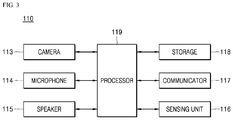
- FIG. 3 is a block diagram schematically showing a configuration of a robot according to an exemplary embodiment of the present invention.
- FIGS. 4 to 6 are flowcharts of a service providing method of a robot according to exemplary embodiments of the present invention.
- first, second, A, B, (a), and (b) may be used. These terms are used only to differentiate the elements from other elements, but the nature, sequence, order, number, etc. of the corresponding elements are not limited by these terms.
- a element is referred to as being “connected,” “coupled,” or “linked” to another element, it should be understood that the element may be directly connected or linked to the other element, but another element may be “interposed” therebetween or the elements may be “connected,” “coupled,” or “linked” to each other via another element.
- subdivided elements may be implemented in one device or module, or one subdivided element may be implemented in multiple devices or modules in a distributed manner.
- a robot is a collective name of apparatuses which may perform specific functions and travel a specific area.
- the functions performed by the robot include various functions that may be provided by a moving apparatus, such as notification of cleaning, map building, and security functions.
- FIG. 1 is a diagram schematically showing a configuration of a store according to an exemplary embodiment of the present invention.
- the store may be a specific space, and at least one customer (i.e., a guest) and at least one worker (i.e., a host) are present in the store.
- the store may be a bakery, a coffee shop, a fast-food shop, a cafeteria, and the like.
- a plurality of users 130 are present in a store 100 , and a robot 110 provides service to each of the users 130 .
- a point of sales (POS) terminal 120 is located in the store 100 , and a worker carries out a payment operation using the POS terminal 120 .
- the robot 110 determines whether each of the users 130 is a customer or a worker and may provide different services on the basis of determination results.
- FIG. 2 shows the appearance of a robot according to an exemplary embodiment of the present invention.
- the robot 110 is shown as a stationary robot which does not move.
- the present invention is not limited thereto, and the following description may be applied to a moving robot.
- a moving robot may further include a travel section (not shown).
- the robot 110 includes a first body 111 provided at a lower part and a second body 112 provided on the first body 111 .
- the first body 111 is provided to be stationary.
- the second body 112 rotates left or right on the first body 111 , and an angle thereof is adjusted (i.e., tilts) upward or downward.
- a camera 113 is installed on an upper surface of the second body 112 . Therefore, the camera 113 is rotated and tilted as the second body 112 rotates and tilts.
- a microphone 114 and a speaker 115 are installed in the second body 112 .
- a sensing unit 116 may include human detecting sensors 116 A and 116 B and the like and may be installed on an external surface of the second body 112 .
- a communicator may be provided in the second body 112 .
- a storage may be provided in the second body 112 .
- a processor may be provided in the second body 112 .
- FIG. 3 is a block diagram schematically showing a configuration of the robot 110 according to an exemplary embodiment of the present invention.
- the robot 110 is an apparatus for providing a specific service to a user in a store and includes the above-described camera 113 , microphone 114 , speaker 115 , and sensing unit 116 , a communicator 117 , a storage 118 , and a processor 119 .
- the camera 113 acquires images of the inside of the store and is installed on the outside of the second body 112 .
- the second body 112 may rotate left or right, and the camera 113 may be rotated along with the rotation of the second body 112 . Therefore, the camera 113 may acquire images of the whole store.
- the microphone 114 receives sounds generated in the store and is installed on the external surface of the second body 112 .
- the speaker 115 outputs a voice signal and is installed on the external surface of the second body 112 .
- the voice signal is used to provide service to a user and is generated by the processor 119 .
- the sensing unit 116 includes a plurality of sensors and senses specific information in the store.
- the sensing unit 116 may include the human detecting sensors 116 A and 116 B, a proximity sensor, a depth sensor, a barometric pressure sensor, an acceleration sensor, a magnetic sensor, a gravity sensor, a gyroscope, a motion sensor, an ultrasonic sensor, an optical sensor, a light detection and ranging (LiDAR) sensor, a radar, and the like.
- the communicator 117 communicates with an external device such as the POS terminal 120 .
- the communicator 117 may include a mobile communication module, a short-range communication module, and the like.
- the mobile communication module exchanges wireless signals with at least one of a base station, an external terminal, and a communication server in a mobile communication network constructed according to mobile communication standards or methods, such as global system for mobile (GSM) communication, code-division multiple access (CDMA), CDMA2000, enhanced voice-data optimized or enhanced voice-data only (EV-DO), wideband CDMA (WCDMA), high speed downlink packet access (HSDPA), high speed uplink packet access (HSUPA), long term evolution (LTE), and LTE-advanced (LTE-A).
- GSM global system for mobile
- CDMA code-division multiple access
- CDMA2000 code-division multiple access
- EV-DO enhanced voice-data optimized or enhanced voice-data only
- WCDMA wideband CDMA
- HSDPA high speed downlink packet access
- HSUPA high speed uplink packet access
- LTE long term evolution
- LTE-advanced LTE-advanced
- the short-range communication module is intended for short-range communication and may support at least one of BluetoothTM, radio frequency identification (RFID), infrared data association (IrDA), ultra-wideband (UWB), ZigBee, near field communication (NFC), Wi-Fi, Wi-Fi direct, and wireless universal serial bus (USB) technologies.
- RFID radio frequency identification
- IrDA infrared data association
- UWB ultra-wideband
- ZigBee ultra-wideband
- NFC near field communication
- Wi-Fi Wi-Fi direct
- USB wireless universal serial bus
- the storage 118 stores various kinds of information for providing service.
- the storage 118 may store the shape of a shop uniform in advance and store information on a past purchase history of the store 100 received through the communicator 117 .
- the processor 119 may include one or more of a central processing unit (CPU), an application processor, and a communication processor.
- the processor 119 may perform calculation or data processing for control and/or communication of at least one other element of the robot 110 .
- the processor 119 may determine whether each user present in the store 100 is a customer or a worker and determine a type of service provided by the robot 110 on the basis of the determination result.
- the processor 119 calculates clothing information of a user who is in the store 100 , location information of the user in the store 100 , and store entry time information of the user on the basis of at least one of images acquired by the camera 113 , a sound received by the microphone 114 , and information sensed by the sensing unit 116 , determines whether the user is a customer or a worker on the basis of the calculated information, and determines whether the user who has been determined as a customer is a first customer who stays in the store 100 for a short period of time or a second customer who stays in the store 100 for a long period of time. Then, the processor 119 determines a type of service provided by the robot 110 on the basis of the determination result.
- FIG. 4 is a flowchart of a service providing method according to a first exemplary embodiment of the present invention.
- the store 100 has a uniform for workers and the shape of the uniform has been imaged and stored in the storage 118 .
- a user may be given a unique identification (ID), and it is possible to distinguish users from each other through IDs.
- ID unique identification
- an ID of a user may be generated on the basis of a snapshot acquired by the camera 113 .
- the camera 113 photographs a first user among users present in the store 100 .
- the processor 119 extracts the shape of the first user's clothing from the acquired image of the first user.
- the processor 119 may extract feature points of the shape of the first user's clothing from the acquired image of the first user.
- the processor 119 compares the extracted shape of the clothing with the shape of the worker uniform stored in the storage 118 and determines whether the shapes are identical to each other. For example, the processor 119 determines whether the shapes are identical to each other by comparing the extracted feature points with feature points of the worker uniform stored in the storage 118 .
- the processor 119 determines that the first user is a worker in operation S 408 . Then, in operation S 410 , the processor 119 determines a type of service to provide to the worker.
- the robot 110 may provide a guide service regarding stocks of products in the store 100 , a guide service regarding whether cleaning is required, a payment assist service, and the like.
- the robot 110 may take inventory of bread placed on display stands and output a message indicating the lack of certain kinds of bread through the speaker 115 .
- the robot 110 may register the layout of bread placed on display stands in advance and take inventory of bread using images acquired by the camera 113 and distances between the robot 110 and bread sensed by a distance sensor (e.g., a depth sensor) together with the registered layout.
- a distance sensor e.g., a depth sensor
- the robot 110 may determine whether there is trash on a table in the store 100 and output a notification that cleaning is required through the speaker 115 when there is trash.
- the storage 118 stores a shape of the table on which there is no trash in advance, and the robot 110 may determine whether cleaning is required by comparing a shape of the table imaged by the camera 113 and the stored shape of the table.
- the processor 119 may determine that cleaning is required.
- the robot 110 may provide the payment assist service for informing a worker which type of product that a customer holds in his or her hand is on the basis of an image acquired by the camera 113 .
- the processor 119 determines that the first user is a customer. In operation S 412 , it is determined whether the customer is a first customer or a second customer.
- a first customer is a customer who stays in the store for a short period of time
- a second customer is a customer who stays in the store for a long period of time.
- the store 100 is a coffee shop or a bakery
- a first customer is a customer who purchases a product and then leaves the store 100 right away
- a second customer is a customer who purchases a product and then stays in the store 100 .
- the processor 119 determines whether a time interval between a current time and the first user's store entry time is less than a third threshold value.
- the processor 119 determines that the first user as a first customer in operation S 414 . Then, in operation S 416 , the processor 119 determines a type of service to provide to the first customer.
- the robot 110 may provide a service for recommending a product in the store 100 based on purchase histories of past customers in the store 100 , a zone guide service for the store 100 , and the like.
- the processor 119 may read information of a purchase history of a past customer at the same time of a past day as the current time from the storage 118 or receive information of the purchase history through the communicator 117 and determine a recommended product in the store 100 for the first user who is a customer on the basis of the information.
- the purchase history information of a past customer includes information on purchased products and may further include type information of the past customer (e.g., sex and age).
- the processor 119 may recommend the first user a product on the basis of information on products purchased by a past customer of the same sex and age as the first user.
- the processor 119 determines that the first user as a second customer in operation S 418 . Then, in operation S 420 , the processor 119 determines a type of service to provide to the second customer.
- the service of the robot 110 provided when the first user is the second customer may be a service for recommending a product different from a product purchased at the time of entering the store 100 .
- the processor 119 may receive information on the product that the first user has purchased upon entering the store 100 from the POS terminal 120 and recommend other product on the basis of the received information. Also, the processor 119 may recommend other products by further using information on a purchase history of a past customer.
- the processor 119 may determine a recommendation service of a product provided by the robot 110 according to the type of the group.
- groups include a first group, a second group, and a third group.
- the first group includes only the first user who has visited the store alone.
- the second group includes two customers of different sexes. In other words, the first user and another user of a different sex than the first user belong to the second group.
- the other user of the second group may be the first user's lover.
- the third group includes the first user and two or more other users.
- the processor 119 may determine a recommendation service of a product provided by the robot 110 according to the type of the group. Therefore, the processor 119 may classify and provide a product recommendation service according to a group type.
- the processor 119 may analyze images including the first user and include another user in the group when the other user in the store 100 looks at the first user for a preset period of time or more.
- the preset period of time may be three seconds or more.
- the processor 119 does not include a person who looks at the first user for less than the preset period of time in the group and includes a person who looks at the first user for the preset period of time or more in the group.
- the processor 119 may analyze images including the first user and determine sexes of users belonging to the group on the basis of hair lengths of the users and whether an object of a color different from that of hair is attached to the hair.
- the processor 119 may determine that the user is a female user.
- the store entry time of the first user may be acquired in various ways.
- the processor 119 may determine whether a door at the entrance of the store 100 is opened on the basis of at least one of an image acquired by the camera 113 and a sound received by the microphone 114 . When the distance between the first user and the entrance gradually increases after the door is opened, it is possible to determine that the first user enters the store 100 . Also, the processor 119 may calculate the time at which the door has been opened as the store entry time of the first user.
- the distance between the first user and the entrance may be sensed by a distance sensor (e.g., a LiDAR sensor) included in the sensing unit 116 .
- the sound received by the microphone 114 may be a sliding sound generated when the door is opened, a sound of a person passing through an air curtain attached to the door, or the like.
- the processor 119 may calculate a user's store entry time on the basis of a sensing value sensed by a human detecting sensor attached to the robot 110 .
- the sensing unit 116 includes the first human detecting sensor 116 A and the second human detecting sensor 116 B installed on a front side of the robot 110 .
- the first human detecting sensor 116 A is disposed closer to the entrance of the store 100 compared to the second human detecting sensor 116 B.
- the first human detecting sensor 116 A and the second human detecting sensor 116 B sense the first user. In this case, if the first user is sequentially sensed by the first human detecting sensor 116 A and the second human detecting sensor 116 B, the processor 119 determines that the first user enters the store 100 , and if the first user is sequentially sensed by the second human detecting sensor 116 B and the first human detecting sensor 116 A, the processor 119 determines that the first user leaves the store 100 .
- the processor 119 may calculate a time at which the first human detecting sensor 116 A has sensed the first user as the store entry time of the first user.
- FIG. 5 is a flowchart of a service providing method according to a second exemplary embodiment of the present invention.
- the camera 113 photographs a first user among users present in the store 100 a plurality of times.
- the processor 119 detects the location of the first user a plurality of times on the basis of the acquired images of the first user.
- the store 100 is divided into a first zone and a second zone on the basis of the POS terminal 120 .
- the first zone is a worker zone in which workers are present
- the second zone is a customer zone in which customers are mainly present.
- the second zone is larger than the first zone. Therefore, the processor 119 determines whether the first user is in the first zone or the second zone on the basis of the plurality of acquired images of the first user.
- the robot 110 is generally disposed in a zone between the POS terminal 120 and the entrance, and the processor 119 detects the location of the POS terminal 120 through a distance sensor (e.g., a depth sensor).
- the processor 119 determines a zone which is present at a longer distance than the POS terminal 120 as the first zone and determines the inside of the store 100 other than the first zone as the second zone.
- the processor 119 determines whether the first user is a customer or a worker on the basis of the plurality of detected locations of the first user.
- the processor 119 may determine the first user as a worker when the number of times that the first user has been present in the first zone is greater than the number of times that the first user has been present in the second zone by a first threshold value or more. Also, the processor 119 may determine the first user as a customer when the number of times that the first user has been present in the second zone is greater than the number of times that the first user has been present in the first zone by a second threshold value or more. The first threshold value and the second threshold value may be set in proportion to the number of times that the location of the first user has been detected.
- the first threshold value when the number of times that the location of the first user has been detected is 10, the first threshold value may be 8, and when the number of times that the location of the first user has been detected is 20, the first threshold value may be 16. Also, when the number of times that the location of the first user has been detected is 10, the second threshold value may be 9, and when the number of times that the location of the first user has been detected is 20, the second threshold value may be 18. Meanwhile, when the number of times that the location of the first user has been detected is 10 and the number of times that the first user has been detected in the first zone is 9, the processor 119 may determine the first user as a customer.
- the processor 119 when the first user is a customer, the processor 119 additionally determines whether the first user is a first customer or a second customer. This is the same as described above, and thus detailed description thereof will be omitted.
- the processor 119 determines a type of service provided by the robot 110 on the basis of the determination result.
- the robot 110 provides the determined service to the first user. This is the same as described above, and thus detailed description thereof will be omitted.
- FIG. 6 is a flowchart of a service providing method according to a third exemplary embodiment of the present invention.
- the store 100 does not have a uniform for workers and the shape of a uniform is not stored in the storage 118 .
- the robot 110 is assumed to be disposed in a zone between the POS terminal 120 and the entrance.
- the camera 113 photographs a first user among users present in the store 100 .
- a distance sensor in the sensing unit 116 measures a first distance between the POS terminal 120 located in the store 100 and the robot 110 and a second distance between the first user and the robot 110 .
- the processor 119 determines whether the first user is a customer or a worker by comparing the first distance with the second distance. In other words, the processor 119 determines the first user as a worker when the first distance is shorter than the second distance and determines the first user as a customer when the first distance is longer than the second distance.
- the processor 119 when the first user is a customer, the processor 119 additionally determines whether the first user is a first customer or a second customer. This is the same as described above, and thus detailed description thereof will be omitted.
- the processor 119 determines a type of service provided by the robot 110 on the basis of the determination result.
- the robot 110 provides the determined service to the first user. This is the same as described above, and thus detailed description thereof will be omitted.
- FIGS. 4 to 6 illustrate that the processor 119 calculates clothing information of a first user who is in the store 100 , location information of the first user in the store 100 , and store entry time information of the first user on the basis of at least one of an image acquired by the camera 113 , a sound received by the microphone 114 , and sensing information sensed by the sensing unit 116 and determines which one of a worker, a first customer, and a second customer the first user is on the basis of the calculated information. Also, the processor 119 determines a type of service provided by the robot 110 on the basis of the determination result and provides the determined service. Accordingly, it is possible to efficiently provide service to each user.
- the present invention is not limited to the embodiment, and all the elements may be selectively combined into at least one entity and then operated within the scope of the present invention.
- each of all the elements may be implemented as one independent piece of hardware, but some or all of the elements may be selectively combined to be implemented as a computer program including a program module which performs some or all functions which are combined in one or more pieces of hardware. Codes and code segments which constitute the computer program may be easily deduced by those of ordinary skill in the art.
- Such a computer program is stored in computer readable media and read and executed by a computer to implement the exemplary embodiment of the present invention.
- a storage medium of the computer program may include a magnetic recording medium, an optical recording medium, and a semiconductor recording medium.
- the computer program for implementing the exemplary embodiment of the present invention includes a program module which is transmitted in real time through an external device.
Landscapes
- Engineering & Computer Science (AREA)
- Physics & Mathematics (AREA)
- Business, Economics & Management (AREA)
- General Physics & Mathematics (AREA)
- Theoretical Computer Science (AREA)
- Accounting & Taxation (AREA)
- Robotics (AREA)
- Mechanical Engineering (AREA)
- Finance (AREA)
- Strategic Management (AREA)
- General Business, Economics & Management (AREA)
- Multimedia (AREA)
- Automation & Control Theory (AREA)
- Computer Vision & Pattern Recognition (AREA)
- Development Economics (AREA)
- Economics (AREA)
- Marketing (AREA)
- Human Computer Interaction (AREA)
- Computer Networks & Wireless Communication (AREA)
- Artificial Intelligence (AREA)
- Evolutionary Computation (AREA)
- Fuzzy Systems (AREA)
- Mathematical Physics (AREA)
- Software Systems (AREA)
- Manipulator (AREA)
Abstract
Description
Claims (16)
Applications Claiming Priority (2)
| Application Number | Priority Date | Filing Date | Title |
|---|---|---|---|
| KR1020190094826A KR102757912B1 (en) | 2019-08-05 | 2019-08-05 | Robot and Method for providing service providing of the robot |
| KR10-2019-0094826 | 2019-08-05 |
Publications (2)
| Publication Number | Publication Date |
|---|---|
| US20190385267A1 US20190385267A1 (en) | 2019-12-19 |
| US11087425B2 true US11087425B2 (en) | 2021-08-10 |
Family
ID=67763965
Family Applications (1)
| Application Number | Title | Priority Date | Filing Date |
|---|---|---|---|
| US16/555,639 Active 2040-02-10 US11087425B2 (en) | 2019-08-05 | 2019-08-29 | Robot and service providing method thereof |
Country Status (2)
| Country | Link |
|---|---|
| US (1) | US11087425B2 (en) |
| KR (1) | KR102757912B1 (en) |
Families Citing this family (7)
| Publication number | Priority date | Publication date | Assignee | Title |
|---|---|---|---|---|
| US11017238B2 (en) * | 2018-06-25 | 2021-05-25 | Shopify Inc. | Capturing transactional context |
| KR102909471B1 (en) * | 2019-12-31 | 2026-01-08 | 삼성전자주식회사 | Method for determining movement of electronic device and electronic device using same |
| CN112518741B (en) * | 2020-11-06 | 2022-09-09 | 深圳优地科技有限公司 | Robot control method, device, robot and storage medium |
| US12111633B2 (en) | 2021-05-10 | 2024-10-08 | Bear Robotics, Inc. | Method, system, and non-transitory computer-readable recording medium for controlling a robot |
| KR20220158385A (en) | 2021-05-24 | 2022-12-01 | 하승우 | Service robot capable of selecting desired module from function modules |
| GB2610414B (en) * | 2021-09-03 | 2024-08-14 | Integrated Design Ltd | Anti-climb system |
| CN114347023A (en) * | 2021-12-31 | 2022-04-15 | 深圳市中博科创信息技术有限公司 | Intelligent sensing system for robot |
Citations (3)
| Publication number | Priority date | Publication date | Assignee | Title |
|---|---|---|---|---|
| US20180043542A1 (en) * | 2014-10-24 | 2018-02-15 | Fellow, Inc. | Customer service robot and related systems and methods |
| US20180308052A1 (en) * | 2011-03-21 | 2018-10-25 | Trucktrax, Llc | Interactive material distribution system |
| US20200104593A1 (en) * | 2018-09-27 | 2020-04-02 | Ncr Corporation | Context-aided machine vision |
Family Cites Families (3)
| Publication number | Priority date | Publication date | Assignee | Title |
|---|---|---|---|---|
| JP4072033B2 (en) * | 2002-09-24 | 2008-04-02 | 本田技研工業株式会社 | Reception guidance robot device |
| KR101382063B1 (en) * | 2012-04-30 | 2014-04-04 | 이용정 | System for management of the exhibition center using image recognition |
| JP6214494B2 (en) * | 2014-08-21 | 2017-10-18 | 日本システム開発株式会社 | User identification device, user identification method, and computer program |
-
2019
- 2019-08-05 KR KR1020190094826A patent/KR102757912B1/en active Active
- 2019-08-29 US US16/555,639 patent/US11087425B2/en active Active
Patent Citations (3)
| Publication number | Priority date | Publication date | Assignee | Title |
|---|---|---|---|---|
| US20180308052A1 (en) * | 2011-03-21 | 2018-10-25 | Trucktrax, Llc | Interactive material distribution system |
| US20180043542A1 (en) * | 2014-10-24 | 2018-02-15 | Fellow, Inc. | Customer service robot and related systems and methods |
| US20200104593A1 (en) * | 2018-09-27 | 2020-04-02 | Ncr Corporation | Context-aided machine vision |
Also Published As
| Publication number | Publication date |
|---|---|
| KR20190098926A (en) | 2019-08-23 |
| KR102757912B1 (en) | 2025-01-20 |
| US20190385267A1 (en) | 2019-12-19 |
Similar Documents
| Publication | Publication Date | Title |
|---|---|---|
| US11087425B2 (en) | Robot and service providing method thereof | |
| US11847689B2 (en) | Dynamic customer checkout experience within an automated shopping environment | |
| US20230017398A1 (en) | Contextually aware customer item entry for autonomous shopping applications | |
| CN102549600B (en) | Device, method and computer program for identifying queues of objects | |
| TWI778030B (en) | Store apparatus, store management method and program | |
| US9306660B2 (en) | Dynamic interactive zone driven proximity awareness system | |
| CN109255642B (en) | People flow analysis method, people flow analysis device and people flow analysis system | |
| CN108876504B (en) | Unmanned selling system and control method thereof | |
| KR20190124114A (en) | Analysis of commercial power big data system using floating population data and pos data | |
| US10990945B2 (en) | Self-checkout system | |
| JP6827743B2 (en) | Customer management system, customer management equipment and customer service program | |
| JPWO2019181364A1 (en) | Store management device and store management method, program | |
| JP7418173B2 (en) | Customer monitoring system and customer monitoring method | |
| KR101888922B1 (en) | System for Management of Customer and Customer Behavior Analysis | |
| EP3070900A1 (en) | Method and system of access of a mobile terminal to information in an area | |
| US20240161133A1 (en) | System for and method of determining user interactions with smart items | |
| JP2016167172A (en) | Information processing method, information processing system, information processing apparatus, and program thereof | |
| WO2021240904A1 (en) | Information processing device, information processing method, and program | |
| JP2019086944A (en) | Product data processing apparatus, product data processing system, and product data processing program | |
| US20220027952A1 (en) | Sales support system | |
| US20190122231A1 (en) | Container, non-transitory computer-readable storage medium for storing program, and customer management method | |
| KR101306827B1 (en) | Advertising apparatus and method for moving walk | |
| JP7263951B2 (en) | rating system | |
| US20180075462A1 (en) | Systems and methods for analyzing remotely located facilities | |
| JP2021039784A (en) | Purchased product estimation device |
Legal Events
| Date | Code | Title | Description |
|---|---|---|---|
| AS | Assignment |
Owner name: LG ELECTRONICS INC., KOREA, REPUBLIC OF Free format text: ASSIGNMENT OF ASSIGNORS INTEREST;ASSIGNOR:SHIN, JONGCHEOL;REEL/FRAME:050216/0376 Effective date: 20190827 |
|
| FEPP | Fee payment procedure |
Free format text: ENTITY STATUS SET TO UNDISCOUNTED (ORIGINAL EVENT CODE: BIG.); ENTITY STATUS OF PATENT OWNER: LARGE ENTITY |
|
| STPP | Information on status: patent application and granting procedure in general |
Free format text: DOCKETED NEW CASE - READY FOR EXAMINATION |
|
| STPP | Information on status: patent application and granting procedure in general |
Free format text: NOTICE OF ALLOWANCE MAILED -- APPLICATION RECEIVED IN OFFICE OF PUBLICATIONS |
|
| STPP | Information on status: patent application and granting procedure in general |
Free format text: PUBLICATIONS -- ISSUE FEE PAYMENT RECEIVED |
|
| STPP | Information on status: patent application and granting procedure in general |
Free format text: PUBLICATIONS -- ISSUE FEE PAYMENT VERIFIED |
|
| STCF | Information on status: patent grant |
Free format text: PATENTED CASE |
|
| MAFP | Maintenance fee payment |
Free format text: PAYMENT OF MAINTENANCE FEE, 4TH YEAR, LARGE ENTITY (ORIGINAL EVENT CODE: M1551); ENTITY STATUS OF PATENT OWNER: LARGE ENTITY Year of fee payment: 4 |