US11084834B2 - Chiral phosphoramidimidates and derivatives thereof - Google Patents
Chiral phosphoramidimidates and derivatives thereof Download PDFInfo
- Publication number
- US11084834B2 US11084834B2 US15/756,136 US201615756136A US11084834B2 US 11084834 B2 US11084834 B2 US 11084834B2 US 201615756136 A US201615756136 A US 201615756136A US 11084834 B2 US11084834 B2 US 11084834B2
- Authority
- US
- United States
- Prior art keywords
- alkyl
- heteroaryl
- aryl
- chiral
- optionally
- Prior art date
- Legal status (The legal status is an assumption and is not a legal conclusion. Google has not performed a legal analysis and makes no representation as to the accuracy of the status listed.)
- Active
Links
- 0 *C1=C(*)C(*)=C2C(=C1*)C(*)=C(*)C1=C2C2=C3C(*)=C(*)C(*)=C(*)C3=C(*)C(*)=C2OP(=O)(N([W])P2(=O)OC3=C(*)C(*)=C4C(*)=C(*)C(*)=C(*)C4=C3C3=C(O2)C(*)=C(*)C2=C(*)C(*)=C(*)C(*)=C23)O1 Chemical compound *C1=C(*)C(*)=C2C(=C1*)C(*)=C(*)C1=C2C2=C3C(*)=C(*)C(*)=C(*)C3=C(*)C(*)=C2OP(=O)(N([W])P2(=O)OC3=C(*)C(*)=C4C(*)=C(*)C(*)=C(*)C4=C3C3=C(O2)C(*)=C(*)C2=C(*)C(*)=C(*)C(*)=C23)O1 0.000 description 69
- OXKCNIFIMPJINF-UHFFFAOYSA-N CP1(C)=NCN=P(C)(C)N1[W] Chemical compound CP1(C)=NCN=P(C)(C)N1[W] OXKCNIFIMPJINF-UHFFFAOYSA-N 0.000 description 5
- SPLGZANLVHBDCC-UHFFFAOYSA-N CC(C)(C)C1=C2C=CC=CC2=CC=C1 Chemical compound CC(C)(C)C1=C2C=CC=CC2=CC=C1 SPLGZANLVHBDCC-UHFFFAOYSA-N 0.000 description 2
- VMYIYCCZCHPNIY-UHFFFAOYSA-N CC1=CC(C(C)(C)C)=CC(C(F)(F)F)=C1 Chemical compound CC1=CC(C(C)(C)C)=CC(C(F)(F)F)=C1 VMYIYCCZCHPNIY-UHFFFAOYSA-N 0.000 description 2
- NHLSPGZBDKASMU-UHFFFAOYSA-N O=S(=O)(N=P1(NP2(=NS(=O)(=O)C(F)(F)F)OC3=C(C4=CC=CC=C4C=C3C3=CC=CC=C3)C3=C(O2)C(C2=CC=CC=C2)=CC2=C3C=CC=C2)OC2=C(C3=CC=CC=C3C=C2C2=CC=CC=C2)C2=C(O1)C(C1=CC=CC=C1)=CC1=C2C=CC=C1)C(F)(F)F Chemical compound O=S(=O)(N=P1(NP2(=NS(=O)(=O)C(F)(F)F)OC3=C(C4=CC=CC=C4C=C3C3=CC=CC=C3)C3=C(O2)C(C2=CC=CC=C2)=CC2=C3C=CC=C2)OC2=C(C3=CC=CC=C3C=C2C2=CC=CC=C2)C2=C(O1)C(C1=CC=CC=C1)=CC1=C2C=CC=C1)C(F)(F)F NHLSPGZBDKASMU-UHFFFAOYSA-N 0.000 description 2
- XTOMRUHSJPPWFS-CGPIXXNKSA-N C1=CCC=C1.COC(=O)/C=C/C1=CC=CC=C1.COC(=O)[C@H]1C2C=CC(C2)[C@@H]1C1=CC=CC=C1 Chemical compound C1=CCC=C1.COC(=O)/C=C/C1=CC=CC=C1.COC(=O)[C@H]1C2C=CC(C2)[C@@H]1C1=CC=CC=C1 XTOMRUHSJPPWFS-CGPIXXNKSA-N 0.000 description 1
- PEUCMDGXNUDUIG-UHFFFAOYSA-N C=CCC.C=CCC1CCCO1.CC(=O)OC1CCCO1 Chemical compound C=CCC.C=CCC1CCCO1.CC(=O)OC1CCCO1 PEUCMDGXNUDUIG-UHFFFAOYSA-N 0.000 description 1
- SLGFDRXAJXMMSS-UHFFFAOYSA-N C=P1(N(C)P2(=NS(=O)(=O)C(F)(F)F)OC3=C(C4=CC=CC=C4C=C3C3=CC(C)=CC(C)=C3)C3=C(O2)C(C2=CC(C)=CC(C)=C2)=CC2=C3C=CC=C2)OC2=C(C3=C(C=CC=C3)C=C2C2=CC(C)=CC(C)=C2)/C2=C(O1)/C(C1=CC(C)=CC(C)=C1)=C\C1=CC=CC=C12 Chemical compound C=P1(N(C)P2(=NS(=O)(=O)C(F)(F)F)OC3=C(C4=CC=CC=C4C=C3C3=CC(C)=CC(C)=C3)C3=C(O2)C(C2=CC(C)=CC(C)=C2)=CC2=C3C=CC=C2)OC2=C(C3=C(C=CC=C3)C=C2C2=CC(C)=CC(C)=C2)/C2=C(O1)/C(C1=CC(C)=CC(C)=C1)=C\C1=CC=CC=C12 SLGFDRXAJXMMSS-UHFFFAOYSA-N 0.000 description 1
- BILLBBGRRCOEMQ-UHFFFAOYSA-N C=P1(N(C)P2(=NS(=O)(=O)C(F)(F)F)OC3=C(C4=CC=CC=C4C=C3C3=CC=C4C=CC=CC4=C3)C3=C(O2)C(C2=CC4=C(C=CC=C4)C=C2)=CC2=C3C=CC=C2)OC2=C(C3=CC=CC=C3C=C2C2=CC3=C(C=CC=C3)C=C2)C2=C(O1)C(C1=CC=C3C=CC=CC3=C1)=CC1=C2C=CC=C1 Chemical compound C=P1(N(C)P2(=NS(=O)(=O)C(F)(F)F)OC3=C(C4=CC=CC=C4C=C3C3=CC=C4C=CC=CC4=C3)C3=C(O2)C(C2=CC4=C(C=CC=C4)C=C2)=CC2=C3C=CC=C2)OC2=C(C3=CC=CC=C3C=C2C2=CC3=C(C=CC=C3)C=C2)C2=C(O1)C(C1=CC=C3C=CC=CC3=C1)=CC1=C2C=CC=C1 BILLBBGRRCOEMQ-UHFFFAOYSA-N 0.000 description 1
- JETDKLJZXBZIIE-UHFFFAOYSA-N C=P1(NP2(=NS(=O)(=O)C(F)(F)F)OC3=C(C4=CC=CC=C4C=C3C3=CC(C)=CC(C)=C3)C3=C(O2)C(C2=CC(C)=CC(C)=C2)=CC2=C3C=CC=C2)OC2=C(C3=C(C=CC=C3)C=C2C2=CC(C)=CC(C)=C2)/C2=C(O1)/C(C1=CC(C)=CC(C)=C1)=C\C1=CC=CC=C12 Chemical compound C=P1(NP2(=NS(=O)(=O)C(F)(F)F)OC3=C(C4=CC=CC=C4C=C3C3=CC(C)=CC(C)=C3)C3=C(O2)C(C2=CC(C)=CC(C)=C2)=CC2=C3C=CC=C2)OC2=C(C3=C(C=CC=C3)C=C2C2=CC(C)=CC(C)=C2)/C2=C(O1)/C(C1=CC(C)=CC(C)=C1)=C\C1=CC=CC=C12 JETDKLJZXBZIIE-UHFFFAOYSA-N 0.000 description 1
- QLJHHIONVYTWLQ-UHFFFAOYSA-N C=P1(NP2(=NS(=O)(=O)C(F)(F)F)OC3=C(C4=CC=CC=C4C=C3C3=CC=C4C=CC=CC4=C3)C3=C(O2)C(C2=CC4=C(C=CC=C4)C=C2)=CC2=C3C=CC=C2)OC2=C(C3=CC=CC=C3C=C2C2=CC3=C(C=CC=C3)C=C2)C2=C(O1)C(C1=CC=C3C=CC=CC3=C1)=CC1=C2C=CC=C1 Chemical compound C=P1(NP2(=NS(=O)(=O)C(F)(F)F)OC3=C(C4=CC=CC=C4C=C3C3=CC=C4C=CC=CC4=C3)C3=C(O2)C(C2=CC4=C(C=CC=C4)C=C2)=CC2=C3C=CC=C2)OC2=C(C3=CC=CC=C3C=C2C2=CC3=C(C=CC=C3)C=C2)C2=C(O1)C(C1=CC=C3C=CC=CC3=C1)=CC1=C2C=CC=C1 QLJHHIONVYTWLQ-UHFFFAOYSA-N 0.000 description 1
- RBAYPVVOZKQNIB-UHFFFAOYSA-N CC(C)(C)C1=C/C=C2/C3=C(C=CC=C3)C(C)(C)/C2=C\1 Chemical compound CC(C)(C)C1=C/C=C2/C3=C(C=CC=C3)C(C)(C)/C2=C\1 RBAYPVVOZKQNIB-UHFFFAOYSA-N 0.000 description 1
- XCYVLZXWLBLNID-UHFFFAOYSA-N CC(C)(C)C1=CC2=C(C=C1)CCCC2 Chemical compound CC(C)(C)C1=CC2=C(C=C1)CCCC2 XCYVLZXWLBLNID-UHFFFAOYSA-N 0.000 description 1
- MCEORGGPAKTORV-UHFFFAOYSA-N CC(C)(C)C1=CC2=C(C=CC=C2)C=C1 Chemical compound CC(C)(C)C1=CC2=C(C=CC=C2)C=C1 MCEORGGPAKTORV-UHFFFAOYSA-N 0.000 description 1
- AYMGBIYWAZRPJY-UHFFFAOYSA-N CC(C)(C)C1=CC2=C3C(=C1)/C=C\C1=CC=CC(=C13)C=C2 Chemical compound CC(C)(C)C1=CC2=C3C(=C1)/C=C\C1=CC=CC(=C13)C=C2 AYMGBIYWAZRPJY-UHFFFAOYSA-N 0.000 description 1
- OOWNNCMFKFBNOF-UHFFFAOYSA-N CC(C)(C)C1=CC=C(C(C)(C)C)C=C1 Chemical compound CC(C)(C)C1=CC=C(C(C)(C)C)C=C1 OOWNNCMFKFBNOF-UHFFFAOYSA-N 0.000 description 1
- YTZKOQUCBOVLHL-UHFFFAOYSA-N CC(C)(C)C1=CC=CC=C1 Chemical compound CC(C)(C)C1=CC=CC=C1 YTZKOQUCBOVLHL-UHFFFAOYSA-N 0.000 description 1
- RCEZFNQOGWSMBH-UHFFFAOYSA-N CC(C)C1=CC(C(C)C)=C(C2=CC3=CC=CC=C3C3=C2OP(=NS(=O)(=O)C(F)(F)F)(NS(=O)(=O)C(F)(F)F)OC2=C3C3=C(C=CC=C3)C=C2C2=C(C(C)C)C=C(C(C)C)C=C2C(C)C)C(C(C)C)=C1 Chemical compound CC(C)C1=CC(C(C)C)=C(C2=CC3=CC=CC=C3C3=C2OP(=NS(=O)(=O)C(F)(F)F)(NS(=O)(=O)C(F)(F)F)OC2=C3C3=C(C=CC=C3)C=C2C2=C(C(C)C)C=C(C(C)C)C=C2C(C)C)C(C(C)C)=C1 RCEZFNQOGWSMBH-UHFFFAOYSA-N 0.000 description 1
- XSDNSRILLLQGGW-UHFFFAOYSA-N CC1=CC(C)=C2/C=C\C3=CC(C(C)(C)C)=CC4=C3C2=C1C=C4 Chemical compound CC1=CC(C)=C2/C=C\C3=CC(C(C)(C)C)=CC4=C3C2=C1C=C4 XSDNSRILLLQGGW-UHFFFAOYSA-N 0.000 description 1
- YLXGHOXMFPTQBM-UHFFFAOYSA-N CC1=CC(C)=CC(C2=CC3=CC=CC=C3C3=C2OP(N(C)P2OC4=C(C5=C(C=CC=C5)C=C4C4=CC(C)=CC(C)=C4)/C4=C(O2)/C(C2=CC(C)=CC(C)=C2)=C\C2=CC=CC=C24)OC2=C3C3=C(C=CC=C3)C=C2C2=CC(C)=CC(C)=C2)=C1 Chemical compound CC1=CC(C)=CC(C2=CC3=CC=CC=C3C3=C2OP(N(C)P2OC4=C(C5=C(C=CC=C5)C=C4C4=CC(C)=CC(C)=C4)/C4=C(O2)/C(C2=CC(C)=CC(C)=C2)=C\C2=CC=CC=C24)OC2=C3C3=C(C=CC=C3)C=C2C2=CC(C)=CC(C)=C2)=C1 YLXGHOXMFPTQBM-UHFFFAOYSA-N 0.000 description 1
- OROJXGACXIMJEL-UHFFFAOYSA-N CC1=CC(C2=CC3=C(C=CC=C3)C3=C2OP(=NS(=O)(=O)C(F)(F)F)([N-]P2(=NS(=O)(=O)C(F)(F)F)OC4=C(C5=CC(C(F)(F)F)=CC(C(F)(F)F)=C5)C=C5C=CC=CC5=C4C4=C(O2)C(C2=CC(C(F)(F)F)=CC(C(F)(F)F)=C2)=CC2=C4C=CC=C2)OC2=C(C4=CC(C)=CC(C(F)(F)F)=C4)C=C4C=CC=CC4=C23)=CC(C(F)(F)F)=C1 Chemical compound CC1=CC(C2=CC3=C(C=CC=C3)C3=C2OP(=NS(=O)(=O)C(F)(F)F)([N-]P2(=NS(=O)(=O)C(F)(F)F)OC4=C(C5=CC(C(F)(F)F)=CC(C(F)(F)F)=C5)C=C5C=CC=CC5=C4C4=C(O2)C(C2=CC(C(F)(F)F)=CC(C(F)(F)F)=C2)=CC2=C4C=CC=C2)OC2=C(C4=CC(C)=CC(C(F)(F)F)=C4)C=C4C=CC=CC4=C23)=CC(C(F)(F)F)=C1 OROJXGACXIMJEL-UHFFFAOYSA-N 0.000 description 1
- SMCPNHZXBWUSAC-UHFFFAOYSA-N CC1=CC=C(C(C)C)C(C(C)(C)C)=C1 Chemical compound CC1=CC=C(C(C)C)C(C(C)(C)C)=C1 SMCPNHZXBWUSAC-UHFFFAOYSA-N 0.000 description 1
- DFVGTTJINKGEKO-UHFFFAOYSA-N CC1=CC=C(C2CCCCC2)C(C(C)(C)C)=C1 Chemical compound CC1=CC=C(C2CCCCC2)C(C(C)(C)C)=C1 DFVGTTJINKGEKO-UHFFFAOYSA-N 0.000 description 1
- WZOBWXRHSNCJFE-UHFFFAOYSA-N CCC1=CC(CC)=C(C(C)(C)C)C(CC)=C1 Chemical compound CCC1=CC(CC)=C(C(C)(C)C)C(CC)=C1 WZOBWXRHSNCJFE-UHFFFAOYSA-N 0.000 description 1
- DZHXCKZHCRQIRL-UHFFFAOYSA-N CCC1=CC(CC)=C(C2=CC3=CC=CC=C3C3=C2OP(=NS(=O)(=O)C(F)(F)F)(NP2(=O)OC4=C(C5=C(C=CC=C5)C=C4C4=C(CC)C=C(CC)C=C4CC)/C4=C(O2)/C(C2=C(CC)C=C(CC)C=C2CC)=C\C2=CC=CC=C24)OC2=C3C3=C(C=CC=C3)C=C2C2=C(CC)C=C(CC)C=C2CC)C(CC)=C1 Chemical compound CCC1=CC(CC)=C(C2=CC3=CC=CC=C3C3=C2OP(=NS(=O)(=O)C(F)(F)F)(NP2(=O)OC4=C(C5=C(C=CC=C5)C=C4C4=C(CC)C=C(CC)C=C4CC)/C4=C(O2)/C(C2=C(CC)C=C(CC)C=C2CC)=C\C2=CC=CC=C24)OC2=C3C3=C(C=CC=C3)C=C2C2=C(CC)C=C(CC)C=C2CC)C(CC)=C1 DZHXCKZHCRQIRL-UHFFFAOYSA-N 0.000 description 1
- FKYCWVDKPMKIQD-UHFFFAOYSA-N CCC1=CC(CC)=C(C2=CC3=CC=CC=C3C3=C2OP(=O)(N=[N+]=[N-])OC2=C3C3=C(C=CC=C3)C=C2C2=C(CC)C=C(CC)C=C2CC)C(CC)=C1 Chemical compound CCC1=CC(CC)=C(C2=CC3=CC=CC=C3C3=C2OP(=O)(N=[N+]=[N-])OC2=C3C3=C(C=CC=C3)C=C2C2=C(CC)C=C(CC)C=C2CC)C(CC)=C1 FKYCWVDKPMKIQD-UHFFFAOYSA-N 0.000 description 1
- AYPKVGNLKKLBLU-UHFFFAOYSA-N CCC1=CC(CC)=C(C2=CC3=CC=CC=C3C3=C2OP(NS(=O)(=O)C(F)(F)F)OC2=C3C3=C(C=CC=C3)C=C2C2=C(CC)C=C(CC)C=C2CC)C(CC)=C1 Chemical compound CCC1=CC(CC)=C(C2=CC3=CC=CC=C3C3=C2OP(NS(=O)(=O)C(F)(F)F)OC2=C3C3=C(C=CC=C3)C=C2C2=C(CC)C=C(CC)C=C2CC)C(CC)=C1 AYPKVGNLKKLBLU-UHFFFAOYSA-N 0.000 description 1
- ISMIPBZQDCUHAO-UHFFFAOYSA-N CCC1=CC(CC)=CC(C(C)(C)C)=C1 Chemical compound CCC1=CC(CC)=CC(C(C)(C)C)=C1 ISMIPBZQDCUHAO-UHFFFAOYSA-N 0.000 description 1
- OZKYYUHWIKIKFK-UHFFFAOYSA-N CCCC1=CC(CCC)=CC(C(C)(C)C)=C1 Chemical compound CCCC1=CC(CCC)=CC(C(C)(C)C)=C1 OZKYYUHWIKIKFK-UHFFFAOYSA-N 0.000 description 1
- RHDMAZUUIDDOMP-UHFFFAOYSA-N CN(P1(=NS(=O)(=O)C(F)(F)F)OC2=C(C3=CC=CC=C3C=C2C2=CC=CC=C2)C2=C(O1)C(C1=CC=CC=C1)=CC1=C2C=CC=C1)P1(=NS(=O)(=O)C(F)(F)F)OC2=C(C3=CC=CC=C3C=C2C2=CC=CC=C2)C2=C(O1)C(C1=CC=CC=C1)=CC1=C2C=CC=C1 Chemical compound CN(P1(=NS(=O)(=O)C(F)(F)F)OC2=C(C3=CC=CC=C3C=C2C2=CC=CC=C2)C2=C(O1)C(C1=CC=CC=C1)=CC1=C2C=CC=C1)P1(=NS(=O)(=O)C(F)(F)F)OC2=C(C3=CC=CC=C3C=C2C2=CC=CC=C2)C2=C(O1)C(C1=CC=CC=C1)=CC1=C2C=CC=C1 RHDMAZUUIDDOMP-UHFFFAOYSA-N 0.000 description 1
- QRPUROIHWIAXNJ-UHFFFAOYSA-N CN(P1OC2=C(C3=CC=CC=C3C=C2C2=CC3=C(C=CC=C3)C=C2)C2=C(O1)C(C1=CC=C3C=CC=CC3=C1)=CC1=C2C=CC=C1)P1OC2=C(C3=CC=CC=C3C=C2C2=CC=C3C=CC=CC3=C2)C2=C(O1)C(C1=CC3=C(C=CC=C3)C=C1)=CC1=C2C=CC=C1 Chemical compound CN(P1OC2=C(C3=CC=CC=C3C=C2C2=CC3=C(C=CC=C3)C=C2)C2=C(O1)C(C1=CC=C3C=CC=CC3=C1)=CC1=C2C=CC=C1)P1OC2=C(C3=CC=CC=C3C=C2C2=CC=C3C=CC=CC3=C2)C2=C(O1)C(C1=CC3=C(C=CC=C3)C=C1)=CC1=C2C=CC=C1 QRPUROIHWIAXNJ-UHFFFAOYSA-N 0.000 description 1
- VUEREAQNJDVXMU-UHFFFAOYSA-N CN(P1OC2=C(C3=CC=CC=C3C=C2C2=CC=CC=C2)C2=C(O1)C(C1=CC=CC=C1)=CC1=C2C=CC=C1)P1OC2=C(C3=CC=CC=C3C=C2C2=CC=CC=C2)C2=C(O1)C(C1=CC=CC=C1)=CC1=C2C=CC=C1 Chemical compound CN(P1OC2=C(C3=CC=CC=C3C=C2C2=CC=CC=C2)C2=C(O1)C(C1=CC=CC=C1)=CC1=C2C=CC=C1)P1OC2=C(C3=CC=CC=C3C=C2C2=CC=CC=C2)C2=C(O1)C(C1=CC=CC=C1)=CC1=C2C=CC=C1 VUEREAQNJDVXMU-UHFFFAOYSA-N 0.000 description 1
- LFTPBLZGIAROJU-BVUSFOFSSA-N COC(=O)/C=C/C1=CC=CC=C1.COC(=O)CC(C1=CC=CC=C1)C(C)(C)C(=O)OC.COC(O[Si](C)(C)C)=C(C)C Chemical compound COC(=O)/C=C/C1=CC=CC=C1.COC(=O)CC(C1=CC=CC=C1)C(C)(C)C(=O)OC.COC(O[Si](C)(C)C)=C(C)C LFTPBLZGIAROJU-BVUSFOFSSA-N 0.000 description 1
- MJLYTZMVSKHETJ-XOZUOACSSA-N COC([C@@H](C1C=CC2C1)C2c1ccccc1)=O Chemical compound COC([C@@H](C1C=CC2C1)C2c1ccccc1)=O MJLYTZMVSKHETJ-XOZUOACSSA-N 0.000 description 1
- NEDZHAHXCNCKHW-UHFFFAOYSA-N O=S(=O)(N=P(Cl)(Cl)Cl)C(F)(F)F Chemical compound O=S(=O)(N=P(Cl)(Cl)Cl)C(F)(F)F NEDZHAHXCNCKHW-UHFFFAOYSA-N 0.000 description 1
Classifications
-
- C—CHEMISTRY; METALLURGY
- C07—ORGANIC CHEMISTRY
- C07F—ACYCLIC, CARBOCYCLIC OR HETEROCYCLIC COMPOUNDS CONTAINING ELEMENTS OTHER THAN CARBON, HYDROGEN, HALOGEN, OXYGEN, NITROGEN, SULFUR, SELENIUM OR TELLURIUM
- C07F9/00—Compounds containing elements of Groups 5 or 15 of the Periodic Table
- C07F9/02—Phosphorus compounds
- C07F9/06—Phosphorus compounds without P—C bonds
- C07F9/22—Amides of acids of phosphorus
- C07F9/24—Esteramides
-
- C—CHEMISTRY; METALLURGY
- C07—ORGANIC CHEMISTRY
- C07F—ACYCLIC, CARBOCYCLIC OR HETEROCYCLIC COMPOUNDS CONTAINING ELEMENTS OTHER THAN CARBON, HYDROGEN, HALOGEN, OXYGEN, NITROGEN, SULFUR, SELENIUM OR TELLURIUM
- C07F9/00—Compounds containing elements of Groups 5 or 15 of the Periodic Table
- C07F9/02—Phosphorus compounds
- C07F9/547—Heterocyclic compounds, e.g. containing phosphorus as a ring hetero atom
- C07F9/6564—Heterocyclic compounds, e.g. containing phosphorus as a ring hetero atom having phosphorus atoms, with or without nitrogen, oxygen, sulfur, selenium or tellurium atoms, as ring hetero atoms
- C07F9/6571—Heterocyclic compounds, e.g. containing phosphorus as a ring hetero atom having phosphorus atoms, with or without nitrogen, oxygen, sulfur, selenium or tellurium atoms, as ring hetero atoms having phosphorus and oxygen atoms as the only ring hetero atoms
-
- C—CHEMISTRY; METALLURGY
- C07—ORGANIC CHEMISTRY
- C07F—ACYCLIC, CARBOCYCLIC OR HETEROCYCLIC COMPOUNDS CONTAINING ELEMENTS OTHER THAN CARBON, HYDROGEN, HALOGEN, OXYGEN, NITROGEN, SULFUR, SELENIUM OR TELLURIUM
- C07F9/00—Compounds containing elements of Groups 5 or 15 of the Periodic Table
- C07F9/02—Phosphorus compounds
- C07F9/547—Heterocyclic compounds, e.g. containing phosphorus as a ring hetero atom
- C07F9/6564—Heterocyclic compounds, e.g. containing phosphorus as a ring hetero atom having phosphorus atoms, with or without nitrogen, oxygen, sulfur, selenium or tellurium atoms, as ring hetero atoms
- C07F9/6571—Heterocyclic compounds, e.g. containing phosphorus as a ring hetero atom having phosphorus atoms, with or without nitrogen, oxygen, sulfur, selenium or tellurium atoms, as ring hetero atoms having phosphorus and oxygen atoms as the only ring hetero atoms
- C07F9/657154—Cyclic esteramides of oxyacids of phosphorus
-
- B—PERFORMING OPERATIONS; TRANSPORTING
- B01—PHYSICAL OR CHEMICAL PROCESSES OR APPARATUS IN GENERAL
- B01J—CHEMICAL OR PHYSICAL PROCESSES, e.g. CATALYSIS OR COLLOID CHEMISTRY; THEIR RELEVANT APPARATUS
- B01J31/00—Catalysts comprising hydrides, coordination complexes or organic compounds
- B01J31/02—Catalysts comprising hydrides, coordination complexes or organic compounds containing organic compounds or metal hydrides
- B01J31/0234—Nitrogen-, phosphorus-, arsenic- or antimony-containing compounds
- B01J31/0255—Phosphorus containing compounds
-
- B—PERFORMING OPERATIONS; TRANSPORTING
- B01—PHYSICAL OR CHEMICAL PROCESSES OR APPARATUS IN GENERAL
- B01J—CHEMICAL OR PHYSICAL PROCESSES, e.g. CATALYSIS OR COLLOID CHEMISTRY; THEIR RELEVANT APPARATUS
- B01J31/00—Catalysts comprising hydrides, coordination complexes or organic compounds
- B01J31/02—Catalysts comprising hydrides, coordination complexes or organic compounds containing organic compounds or metal hydrides
- B01J31/0234—Nitrogen-, phosphorus-, arsenic- or antimony-containing compounds
- B01J31/0271—Nitrogen-, phosphorus-, arsenic- or antimony-containing compounds also containing elements or functional groups covered by B01J31/0201 - B01J31/0231
-
- B—PERFORMING OPERATIONS; TRANSPORTING
- B01—PHYSICAL OR CHEMICAL PROCESSES OR APPARATUS IN GENERAL
- B01J—CHEMICAL OR PHYSICAL PROCESSES, e.g. CATALYSIS OR COLLOID CHEMISTRY; THEIR RELEVANT APPARATUS
- B01J31/00—Catalysts comprising hydrides, coordination complexes or organic compounds
- B01J31/16—Catalysts comprising hydrides, coordination complexes or organic compounds containing coordination complexes
- B01J31/18—Catalysts comprising hydrides, coordination complexes or organic compounds containing coordination complexes containing nitrogen, phosphorus, arsenic or antimony as complexing atoms, e.g. in pyridine ligands, or in resonance therewith, e.g. in isocyanide ligands C=N-R or as complexed central atoms
- B01J31/1845—Catalysts comprising hydrides, coordination complexes or organic compounds containing coordination complexes containing nitrogen, phosphorus, arsenic or antimony as complexing atoms, e.g. in pyridine ligands, or in resonance therewith, e.g. in isocyanide ligands C=N-R or as complexed central atoms the ligands containing phosphorus
-
- C—CHEMISTRY; METALLURGY
- C07—ORGANIC CHEMISTRY
- C07B—GENERAL METHODS OF ORGANIC CHEMISTRY; APPARATUS THEREFOR
- C07B53/00—Asymmetric syntheses
-
- C—CHEMISTRY; METALLURGY
- C07—ORGANIC CHEMISTRY
- C07F—ACYCLIC, CARBOCYCLIC OR HETEROCYCLIC COMPOUNDS CONTAINING ELEMENTS OTHER THAN CARBON, HYDROGEN, HALOGEN, OXYGEN, NITROGEN, SULFUR, SELENIUM OR TELLURIUM
- C07F9/00—Compounds containing elements of Groups 5 or 15 of the Periodic Table
- C07F9/02—Phosphorus compounds
- C07F9/06—Phosphorus compounds without P—C bonds
- C07F9/22—Amides of acids of phosphorus
-
- C—CHEMISTRY; METALLURGY
- C07—ORGANIC CHEMISTRY
- C07F—ACYCLIC, CARBOCYCLIC OR HETEROCYCLIC COMPOUNDS CONTAINING ELEMENTS OTHER THAN CARBON, HYDROGEN, HALOGEN, OXYGEN, NITROGEN, SULFUR, SELENIUM OR TELLURIUM
- C07F9/00—Compounds containing elements of Groups 5 or 15 of the Periodic Table
- C07F9/02—Phosphorus compounds
- C07F9/06—Phosphorus compounds without P—C bonds
- C07F9/22—Amides of acids of phosphorus
- C07F9/24—Esteramides
- C07F9/2404—Esteramides the ester moiety containing a substituent or a structure which is considered as characteristic
- C07F9/242—Esteramides the ester moiety containing a substituent or a structure which is considered as characteristic of hydroxyaryl compounds
-
- C—CHEMISTRY; METALLURGY
- C07—ORGANIC CHEMISTRY
- C07F—ACYCLIC, CARBOCYCLIC OR HETEROCYCLIC COMPOUNDS CONTAINING ELEMENTS OTHER THAN CARBON, HYDROGEN, HALOGEN, OXYGEN, NITROGEN, SULFUR, SELENIUM OR TELLURIUM
- C07F9/00—Compounds containing elements of Groups 5 or 15 of the Periodic Table
- C07F9/02—Phosphorus compounds
- C07F9/06—Phosphorus compounds without P—C bonds
- C07F9/22—Amides of acids of phosphorus
- C07F9/24—Esteramides
- C07F9/2454—Esteramides the amide moiety containing a substituent or a structure which is considered as characteristic
- C07F9/2479—Compounds containing the structure P(=X)n-N-acyl, P(=X)n-N-heteroatom, P(=X)n-N-CN (X = O, S, Se; n = 0, 1)
- C07F9/2495—Compounds containing the structure P(=X)n-N-acyl, P(=X)n-N-heteroatom, P(=X)n-N-CN (X = O, S, Se; n = 0, 1) containing the structure P(=X)n-N-P (X = O, S, Se; n = 0, 1)
-
- C—CHEMISTRY; METALLURGY
- C07—ORGANIC CHEMISTRY
- C07F—ACYCLIC, CARBOCYCLIC OR HETEROCYCLIC COMPOUNDS CONTAINING ELEMENTS OTHER THAN CARBON, HYDROGEN, HALOGEN, OXYGEN, NITROGEN, SULFUR, SELENIUM OR TELLURIUM
- C07F9/00—Compounds containing elements of Groups 5 or 15 of the Periodic Table
- C07F9/02—Phosphorus compounds
- C07F9/28—Phosphorus compounds with one or more P—C bonds
- C07F9/38—Phosphonic acids [RP(=O)(OH)2]; Thiophosphonic acids ; [RP(=X1)(X2H)2(X1, X2 are each independently O, S or Se)]
- C07F9/44—Amides thereof
-
- C—CHEMISTRY; METALLURGY
- C07—ORGANIC CHEMISTRY
- C07F—ACYCLIC, CARBOCYCLIC OR HETEROCYCLIC COMPOUNDS CONTAINING ELEMENTS OTHER THAN CARBON, HYDROGEN, HALOGEN, OXYGEN, NITROGEN, SULFUR, SELENIUM OR TELLURIUM
- C07F9/00—Compounds containing elements of Groups 5 or 15 of the Periodic Table
- C07F9/02—Phosphorus compounds
- C07F9/28—Phosphorus compounds with one or more P—C bonds
- C07F9/38—Phosphonic acids [RP(=O)(OH)2]; Thiophosphonic acids ; [RP(=X1)(X2H)2(X1, X2 are each independently O, S or Se)]
- C07F9/44—Amides thereof
- C07F9/4403—Amides thereof the acid moiety containing a substituent or a structure which is considered as characteristic
- C07F9/4419—Amides of aromatic acids (P-C aromatic linkage)
-
- C—CHEMISTRY; METALLURGY
- C07—ORGANIC CHEMISTRY
- C07F—ACYCLIC, CARBOCYCLIC OR HETEROCYCLIC COMPOUNDS CONTAINING ELEMENTS OTHER THAN CARBON, HYDROGEN, HALOGEN, OXYGEN, NITROGEN, SULFUR, SELENIUM OR TELLURIUM
- C07F9/00—Compounds containing elements of Groups 5 or 15 of the Periodic Table
- C07F9/02—Phosphorus compounds
- C07F9/547—Heterocyclic compounds, e.g. containing phosphorus as a ring hetero atom
- C07F9/6564—Heterocyclic compounds, e.g. containing phosphorus as a ring hetero atom having phosphorus atoms, with or without nitrogen, oxygen, sulfur, selenium or tellurium atoms, as ring hetero atoms
-
- C—CHEMISTRY; METALLURGY
- C07—ORGANIC CHEMISTRY
- C07F—ACYCLIC, CARBOCYCLIC OR HETEROCYCLIC COMPOUNDS CONTAINING ELEMENTS OTHER THAN CARBON, HYDROGEN, HALOGEN, OXYGEN, NITROGEN, SULFUR, SELENIUM OR TELLURIUM
- C07F9/00—Compounds containing elements of Groups 5 or 15 of the Periodic Table
- C07F9/02—Phosphorus compounds
- C07F9/547—Heterocyclic compounds, e.g. containing phosphorus as a ring hetero atom
- C07F9/6564—Heterocyclic compounds, e.g. containing phosphorus as a ring hetero atom having phosphorus atoms, with or without nitrogen, oxygen, sulfur, selenium or tellurium atoms, as ring hetero atoms
- C07F9/6578—Heterocyclic compounds, e.g. containing phosphorus as a ring hetero atom having phosphorus atoms, with or without nitrogen, oxygen, sulfur, selenium or tellurium atoms, as ring hetero atoms having phosphorus and sulfur atoms with or without oxygen atoms, as ring hetero atoms
-
- C—CHEMISTRY; METALLURGY
- C07—ORGANIC CHEMISTRY
- C07F—ACYCLIC, CARBOCYCLIC OR HETEROCYCLIC COMPOUNDS CONTAINING ELEMENTS OTHER THAN CARBON, HYDROGEN, HALOGEN, OXYGEN, NITROGEN, SULFUR, SELENIUM OR TELLURIUM
- C07F9/00—Compounds containing elements of Groups 5 or 15 of the Periodic Table
- C07F9/02—Phosphorus compounds
- C07F9/547—Heterocyclic compounds, e.g. containing phosphorus as a ring hetero atom
- C07F9/6564—Heterocyclic compounds, e.g. containing phosphorus as a ring hetero atom having phosphorus atoms, with or without nitrogen, oxygen, sulfur, selenium or tellurium atoms, as ring hetero atoms
- C07F9/6581—Heterocyclic compounds, e.g. containing phosphorus as a ring hetero atom having phosphorus atoms, with or without nitrogen, oxygen, sulfur, selenium or tellurium atoms, as ring hetero atoms having phosphorus and nitrogen atoms with or without oxygen or sulfur atoms, as ring hetero atoms
- C07F9/6584—Heterocyclic compounds, e.g. containing phosphorus as a ring hetero atom having phosphorus atoms, with or without nitrogen, oxygen, sulfur, selenium or tellurium atoms, as ring hetero atoms having phosphorus and nitrogen atoms with or without oxygen or sulfur atoms, as ring hetero atoms having one phosphorus atom as ring hetero atom
- C07F9/65848—Cyclic amide derivatives of acids of phosphorus, in which two nitrogen atoms belong to the ring
-
- C—CHEMISTRY; METALLURGY
- C07—ORGANIC CHEMISTRY
- C07F—ACYCLIC, CARBOCYCLIC OR HETEROCYCLIC COMPOUNDS CONTAINING ELEMENTS OTHER THAN CARBON, HYDROGEN, HALOGEN, OXYGEN, NITROGEN, SULFUR, SELENIUM OR TELLURIUM
- C07F9/00—Compounds containing elements of Groups 5 or 15 of the Periodic Table
- C07F9/02—Phosphorus compounds
- C07F9/547—Heterocyclic compounds, e.g. containing phosphorus as a ring hetero atom
- C07F9/6564—Heterocyclic compounds, e.g. containing phosphorus as a ring hetero atom having phosphorus atoms, with or without nitrogen, oxygen, sulfur, selenium or tellurium atoms, as ring hetero atoms
- C07F9/6581—Heterocyclic compounds, e.g. containing phosphorus as a ring hetero atom having phosphorus atoms, with or without nitrogen, oxygen, sulfur, selenium or tellurium atoms, as ring hetero atoms having phosphorus and nitrogen atoms with or without oxygen or sulfur atoms, as ring hetero atoms
- C07F9/6587—Heterocyclic compounds, e.g. containing phosphorus as a ring hetero atom having phosphorus atoms, with or without nitrogen, oxygen, sulfur, selenium or tellurium atoms, as ring hetero atoms having phosphorus and nitrogen atoms with or without oxygen or sulfur atoms, as ring hetero atoms having two phosphorus atoms as ring hetero atoms in the same ring
-
- B—PERFORMING OPERATIONS; TRANSPORTING
- B01—PHYSICAL OR CHEMICAL PROCESSES OR APPARATUS IN GENERAL
- B01J—CHEMICAL OR PHYSICAL PROCESSES, e.g. CATALYSIS OR COLLOID CHEMISTRY; THEIR RELEVANT APPARATUS
- B01J2531/00—Additional information regarding catalytic systems classified in B01J31/00
- B01J2531/02—Compositional aspects of complexes used, e.g. polynuclearity
-
- C—CHEMISTRY; METALLURGY
- C07—ORGANIC CHEMISTRY
- C07B—GENERAL METHODS OF ORGANIC CHEMISTRY; APPARATUS THEREFOR
- C07B2200/00—Indexing scheme relating to specific properties of organic compounds
- C07B2200/07—Optical isomers
Definitions
- the present invention relates to chiral phosphoramidimidates, their salts and metal complexes as well as derivatives thereof and their use as catalysts.
- substituent R may be the same or different on each position and each represents hydrogen, a heterosubstituent, C 1 to C 20 straight chain, branched chain or cyclic aliphatic hydrocarbons, optionally further substituted and W is exemplarily hydrogen.
- a particular process making use of such imidodiphosphate has been disclosed in WO2013104605.
- said WO2013104605 does not disclose electron withdrawing substituent groups on the phosphor.
- the present invention provides such new particularly reactive Br ⁇ nsted acid catalysts by means of new chiral phosphoramidimidates, a simple process for preparing chiral phosphoramidimidates and also their use in catalysis.
- Said phosphoramidimidate anions are showing a particularly high influence on the reactivity of specific reaction partners which could not be reacted so far using conventional catalysts.
- the present invention provides chiral phosphoramidimidates and derivatives thereof having the general formula (I)
- X represents O, S, Se or NR N
- Z 1 to Z 4 may be, independently from each other, the same or different and represent O, S, Se and NR N
- n stands for 0 or preferably 1
- W is a substituent being capable of forming a bond with the phosphoramidimidate moiety
- R 1 , R 2 , R 3 and R 4 may be, independently from each other, the same or different and are each an aliphatic, heteroaliphatic, aromatic or heteroaromatic hydrocarbon group, each optionally being further substituted by one or more heterosubstituents, aliphatic, heteroaliphatic, aromatic or heteroaromatic hydrocarbon groups, whereby R 1 may be forming a ring system with any one of R 2 , R 3 or R 4 and the other two of R 2 , R 3 or R 4 may be forming a ring system with each other; and R N is an electron withdrawing group, being the same or different on each N and being selected from:
- R N1 represents —(SO)—, —(SO 2 )— or —(NR N2 )— wherein R N2 is an electron withdrawing group being selected from -alkyl, —CO-alkyl, —(CO)—O-alkyl, wherein alkyl is a C 1 to C 20 straight chain, branched chain or cyclic aliphatic hydrocarbon having at least one halogen, preferably F or Cl, substituent on the alkyl residue.
- the inventors have found out that by forming the groups around the at least one phosphoramidimidate unit of the chiral compound, the catalytic site thereof can be protected and is perfectly suitable for highly selective catalytic reactions.
- the groups R N and R N(1,2) are an electron withdrawing group bearing electron withdrawing substituents(s) such as halogen, in particular fluorine, chlorine, and/or sulfur-oxygen-group(s).
- phosphoramidimidates is to be understood to comprise derivatives thereof, wherein one or more of the oxygen atoms of the phosphoramidimidate moiety is replaced by S, Se, NR N as defined above as long as they are chiral and preferably enantiopure.
- any tautomeric form of the inventive chiral phosphoramidimidates as well as any charged form thereof including any anionic form is to be comprised by the representation of said formula. It is also to be understood that phosphoramidimidates could possess inherent chirality even if all of the groups R 1 to R 4 are achiral groups. Thus, chirality might also be present for the inventive compounds if P is substituted by four different substituents.
- any of R 1 to R 4 is each selected from C 1 to C 20 straight chain, branched chain or cyclic aliphatic hydrocarbons, optionally having one or more unsaturated bonds such as C 1 -C 20 -alkyl, C 2 -C 20 -alkenyl or C 2 -C 20 -alkinyl, C 3 -C 8 -heterocycloalkyl or C 6 to C 20 aromatic hydrocarbon and partially arene-hydrogenated forms such as aryl, aryl-(C 1 -C 6 )-alkyl, heteroaryl-(C 1 -C 6 )-alkyl, each hydrocarbon optionally being substituted by one or more groups selected from C 1 to C 20 straight chain, branched chain or cyclic aliphatic hydrocarbons, optionally having one or more unsaturated bonds such as C 1 -C 20 -alkyl, C 2 -C 20 -alkenyl or C 2 -C 20 -al
- R 1 and R 2 may also be forming a ring system together with Z 1 and Z 2 , and independently, R 3 and R 4 may also be forming a ring system together with Z 3 and Z 4 , respectively.
- R 1 may also be forming a ring system with any one of R 2 , R 3 or R 4 and the other two of R 2 , R 3 or R 4 may be forming a ring system with each other.
- one ring system may be formed on one phosphorimidate unit or may be linking one phosphorimidate unit to the other phosphorimidate unit on either side of the amide center moiety.
- R N is an electron withdrawing group, being selected from -alkyl, —CO-alkyl, —(CO)—O-alkyl, sulfinyl alkyl, sulfonyl alkyl, —(P ⁇ O)-dialkyl, wherein alkyl is a C 1 to C 20 straight chain, branched chain or cyclic aliphatic hydrocarbon having at least one halogen, preferably F and/or Cl, substituent on the alkyl residue, aryl, —CO-aryl, —(CO)—O-aryl, sulfinyl aryl, sulfonyl aryl, —(P ⁇ O)-diaryl, wherein aryl is a C 6 to C 18 aromatic hydrocarbon, preferably having at least one halogen, preferably F and/or Cl, substituent on the aryl residue; heteroaryl, —CO-heteroaryl, —(CO)—O-he
- R N1 represents —(SO)—, —(SO 2 )— or —(NR N2 )— wherein R N2 is an electron withdrawing group being selected from -alkyl, —CO-alkyl, —(CO)—O-alkyl, wherein alkyl is a C 1 to C 20 straight chain, branched chain or cyclic aliphatic hydrocarbon having at least one halogen, preferably F or Cl, substituent on the alkyl residue.
- R N may be present only and may be bridging as R N1 the two P ⁇ N— units as explained before.
- R N may be preferably selected from electron withdrawing groups which are either present on either P-atom or might be bridging the two P ⁇ N— units as indicated, such as
- Tf represents the preferred trifluoromethanesulfonyl group or, more generally, a polyfluoro- or perfluoroalkyl-sulfonyl group wherein alkyl can be a C 1 to C 8 aliphatic hydrocarbon group.
- W is a substituent being capable of forming an bond with the phosphoramidimidate moiety which may be a ionic or covalent bond which may also be polarized, and thus, W is selected from hydrogen, halogen, a metal such as Li, Na, K, Rb, Cs, Be, Mg, Ca, Sr, Ba, Sc, Ti, V, Cr, Mn, Fe, Co, Ni, Cu, Zn, Y, Zr, Mo, Ru, Rh, Pd, Ag, W, Re, Os, Ir, Pt, Au, Al, Pb, La, Sm, Eu, Yb, U, or a cationic organic group as exemplified in Scheme 2 below, or a substituted silicon such as —SiR I R II R III , wherein R I , R II and R III may be same or different and each stands for hydrogen, halogen, C 1 to C 20 straight chain, branched chain or cyclic aliphatic hydrocarbons, optional
- partially arene-hydrogenated forms thereof is to be understood that in case that the aromatic structure comprises more than one aromatic cycle such as for naphthalene, at least one aromatic cycle, one aromatic cycle remaining, might be partially or fully hydrogenated.
- the anionic form may be complemented by any cation for forming an ion pair.
- Z 1 to Z 4 independently represent O, S or NR N , preferably O, n is 1 and X, R 1 to R 4 , R N as well as W are as defined before, as represented by formula (II):
- R 1 , R 2 , Z 1 , Z 2 and —PX— might also be a five to ten-membered ring structure of (R 1 , R 2 , Z 1 , Z 2 and —PX—) or (R 3 , R 4 , Z 3 , Z 4 and —PNR N —), respectively, wherein R 1 to R 4 , Z 1 to Z 4 , n, R N , X and W are as defined above.
- the two NR N may be replaced by one NR n unit bridging the two P-atoms, as represented by formula (IIIa):
- R 1 to R 4 and W are as defined before wherein R N1 represents —(SO)—, —(SO 2 )— or —(NR N2 )— wherein R N2 is an electron withdrawing group being selected from -alkyl, —CO-alkyl, —(CO)—O-alkyl, wherein alkyl is a C 1 to C 20 straight chain, branched chain or cyclic aliphatic hydrocarbon having at least one halogen, preferably F or Cl, substituent on the alkyl residue.
- a chiral phosphoramidimidate according to the invention is represented by formula (IIIb) wherein Z 1 to Z 4 represent O, R 1 to R 4 , X, R N and W are as defined before:
- R N is an electron withdrawing group, being the same or different on each N and being selected from -alkyl, —CO-alkyl, —(CO)—O-alkyl, sulfinyl alkyl, sulfonyl alkyl, —(P ⁇ O)-dialkyl, wherein alkyl is a C 1 to C 20 straight chain, branched chain or cyclic aliphatic hydrocarbon having at least one halogen, preferably F and/or Cl, substituent on the alkyl residue; aryl, —CO-aryl, —(CO)—O-aryl, sulfinyl aryl, sulfonyl aryl, —(P ⁇ O)-diaryl, wherein aryl is a C 6 to C 18 aromatic hydrocarbon, preferably having at least one halogen, preferably F and/or Cl, substituent on the aryl residue; heteroaryl, —CO-heteroaryl, —
- At least one of (R 1 , R 2 , Z 1 and Z 2 ) and (R 3 , R 4 , Z 3 and Z 4 ), respectively, may form a ring structure derived from a bridged aromatic structure such as biphenyl optionally substituted, BINOL, TADDOL, VAPOL, SPINOL, 1,1′-binaphthalene, 1,1′-bianthracene, 1,1-biphenanthrene, or a partially arene-hydrogenated form of such aromatic ring structure such as 8H-BINOL, each of said rings systems optionally being substituted by one or more substituents which may be the same or different on each position and is each selected from hydrogen, heterosubstituents, C 1 to C 20 straight chain, branched chain or cyclic aliphatic hydrocarbons, optionally having one or more unsaturated bonds such as C 1 -C 20 -alkyl, C 2 -C 20 -
- the ring structure formed by R 1 , R 2 , Z 1 and Z 2 ) and (R 3 , R 4 , Z 3 and Z 4 ) may be the same or different and may be chiral, wherein n, R N , X and W are as defined before.
- the substituent R may be same or different on each position and is each selected from hydrogen, heterosubstituents, C 1 to C 20 straight chain, branched chain or cyclic aliphatic hydrocarbons, optionally having one or more unsaturated bonds such as C 1 -C 20 -alkyl, C 2 -C 20 -alkenyl or C 2 -C 20 -alkinyl, C 3 -C 8 -heterocycloalkyl or C 6 to C 20 aromatic hydrocarbon and partially arene-hydrogenated forms such as aryl, aryl-(C 1 -C 6 )-alkyl, heteroaryl-(C 1 -C 6 )-alkyl, and each hydrocarbon optionally being substituted by one or more groups selected from C 1 to C 20 straight chain, branched chain or cyclic aliphatic hydrocarbons, optionally having one or more unsaturated bonds such as C 1 -C 20 -alkyl, C 2 -C
- the substituents R on the structure are preferably bulky groups and may also be selected from the definitions for R N or heterosubstituents.
- any chiral groups are possible as chiral groups for the inventive compounds. If the other group in each case is not chiral, the groups R 1 to R 4 are any organic group which may be saturated or unsaturated, linear, cyclic or heterocyclic, aromatic and/or heteroaromatic.
- the compounds according to the invention are well suited as catalysts for enantioselective synthesis.
- they function as chiral Br ⁇ nsted acids or the conjugated bases thereof as chiral anions in enantioselective catalyses directed by counterions.
- a heterosubstituent as defined according to the invention can be selected from OH, F, Cl, Br, I, CN, NO 2 , SO 3 H, a monohalogenomethyl group, a dihalogenomethyl group, a trihalogenomethyl group, CF(CF3) 2 , SF 5 , amine bound through N atom, —O-alkyl (alkoxy), —O-aryl, —O—SiR S 3 , S—R S , S(O)—R S , S(O) 2 —R S , COOH, CO 2 —R S , —BR S 2 , —PR S 2 .
- R S may be, independently from each other, the same or different and is each an aliphatic, heteroaliphatic, aromatic or heteroaromatic group, each optionally being further substituted by one or more heterosubstituents, aliphatic, heteroaliphatic, aromatic or heteroaromatic groups.
- Aliphatic hydrocarbons including alkyl, alkenyl and alkinyl may comprise straight-chain, branched and cyclic hydrocarbons.
- Heteroaliphatic is a hydrocarbon including alkyl, alkenyl and alkinyl which may comprise straight-chain, branched and cyclic hydrocarbons with one or more carbon atoms substituted with a heteroatom.
- C 1 -C 20 -alkyl can be straight chain or branched and has 1, 2, 3, 4, 5, 6, 7, 8, 9, 10, 11, 12, 13, 14, 15, 16, 17, 18, 19 or 20 carbon atoms.
- Alkyl might be C 1 -C 6 -alkyl, in particular methyl, ethyl, propyl, isopropyl, butyl, isobutyl, sec-butyl or tert-butyl, likewise pentyl, 1-, 2- or 3-methylpropyl, 1,1-, 1,2- or 2,2-dimethylpropyl, 1-ethylpropyl, hexyl, 1-, 2-, 3- or 4-methylpentyl, 1,1-, 1,2-, 1,3-, 2,2-, 2,3- or 3,3-dimethylbutyl, 1- or 2-ethylbutyl, 1-ethyl-1-methylpropyl, 1-ethyl-2-methylpropyl, 1,1,2- or 1,2,2-trimethylpropyl. Substituted
- Cycloalkyl might be cyclopropyl, cyclobutyl, cyclopentyl, cyclohexyl or cycloheptyl.
- Alkenyl might be C 2 -C 20 alkenyl.
- Alkinyl might be C 2 -C 20 alkinyl.
- Said unsaturated alkenyl- or alkinyl groups can be used for linking the inventive compounds to a carrier such as a polymer to serve for an immobilized catalyst.
- Halogen is F, Cl, Br or I.
- Alkoxy is preferably C 2 -C 10 alkoxy such as methoxy, ethoxy, propoxy, tert-butoxy etc.
- C 3 -C 8 -Heterocycloalkyl having one or more heteroatoms selected from among N, O and S is preferably 2,3-dihydro-2-, -3-, -4- or -5-furyl, 2,5-dihydro-2-, -3-, -4- or -5-furyl, tetrahydro-2- or -3-furyl, 1,3-dioxolan-4-yl, tetrahydro-2- or -3-thienyl, 2,3-dihydro-1-, -2-, -3-, -4- or -5-pyrrolyl, 2,5-dihydro-1-, -2-, -3-, -4- or -5-pyrrolyl, 1-, 2- or 3-pyrrolidinyl, tetrahydro-1-, -2- or -4-imidazolyl, 2,3-dihydro-1-, -2-, -3-, -4- or -5-pyrazolyl
- Optionally substituted means unsubstituted or monosubstituted, disubstituted, trisubstituted, tetrasubstituted, pentasubstituted, or even further substituted for each hydrogen on the hydrocarbon.
- Aryl might be phenyl, naphthyl, anthracenyl, phenanthryl or biphenyl.
- Arylalkyl might be benzyl.
- Heteroaryl having one or more heteroatoms selected from among N, O and S is preferably 2- or 3-furyl, 2- or 3-thienyl, 1-, 2- or 3-pyrrolyl, 1-, 2-, 4- or 5-imidazolyl, 1-, 3-, 4- or 5-pyrazolyl, 2-, 4- or 5-oxazolyl, 3-, 4- or 5-isoxazolyl, 2-, 4- or 5-thiazolyl, 3-, 4- or 5-isothiazolyl, 2-, 3- or 4-pyridyl, 2-, 4-, 5- or 6-pyrimidinyl, also preferably 1,2,3-triazol-1-, -4- or -5-yl, 1,2,4-triazol-1-, -3- or -5-yl, 1- or 5-tetrazolyl, 1,2,3-oxadiazol-4- or -5-yl, 1,2,4-oxadiazol-3- or -5-yl, 1,3,4-thiadiazol-2- or -5-yl, 1,2,4-thiadiazol-3-
- At least one of R proximal to the —O—P— bond is not hydrogen and is selected from among methyl, ethyl, isopropyl, cyclohexyl, cyclopentyl, phenyl, 2,4,6-triisopropylphenyl, 2,4,6-triethylphenyl, 2,6-diethylphenyl, 2,6-diethylphenyl, 2-isopropylphenyl, 5-methyl-2-isopropylphenyl, mesityl, 9-phenanthryl, 9-anthracenyl, ferrocenyl, N-(perfluorophenyl)acetamide, N-(4-chlorophenyl)acetamide, N-(naphthalen-1-yl)acetamide, N-benzhydrylacetamide, N-(2,6-diisopropylphenyl)acetamide
- the compounds according to the invention can be converted in process steps which are well known per se to those skilled in the art into organic salts, metal salts or metal complexes.
- the phosphoramidimidates are reacted with an appropriate metal salt, for example with the carbonate or acetate of the appropriate metal.
- Examples of organic salts, metal salts and metal complexes are shown in the following Scheme 1 for formula (V):
- any metals or organic cations e.g. tertiary ammonium ions, can be represented by M.
- the compounds are shown as salts in scheme 1, the precise structure with metals is not known; they can also have the structure of metal complexes.
- the formulation metal salts or metal complexes is therefore used for the purposes of the present invention.
- the metal compounds are not restricted to particular metal compounds or complexes.
- Suitable metal compounds are derived from Li, Na, K, Rb, Cs, Be, Mg, Ca, Sr, Ba, Sc, Ti, V, Cr, Mn, Fe, Co, Ni, Cu, Zn, Y, Zr, Mo, Ru, Rh, Pd, Ag, W, Re, Os, Ir, Pt, Au, Al, Pb, La, Sm, Eu, Yb, U.
- the phosphoramidimidates of the invention in their ionic form indicated above as X A ⁇
- their organic salts, metal salts and metal complexes can be prepared according an exemplary reaction path shown for imido-di-(BINOL-phosphate):
- a process for preparing said chiral phosphoramidimidates of the general formula (I) may be comprising the steps of reacting a compound of the general formulae (V) in equivalent stoichiometric amounts with a compound of the formula (VI) in the presence of a basic compound in an organic solvent to yield a compound of the formula (VII), further reacting compound (VII) in a two step oxidation, for example with triflic azide, to yield compound (VIII) and finally removing the leaving group L to yield a compound of the general formula (I) as shown in the following reaction scheme:
- L 1 is a electropositive leaving group and is selected from hydrogen, a metal selected from Li, Na, K, Rb, Cs, Be, Mg, Ca, Sr, Ba Sc, Ti, V, Cr, Mn, Fe, Co, Ni, Cu, Zn, Y, Zr, Mo, Ru, Rh, Pd, Ag, W, Re, Os, Ir, Pt, Au, Ai, Pb, La, Sm, Eu, Yb, U or a cationic organic group, or a substituted silicon —SiR I R II R III , wherein R I , R II and R III may be same or different and are as defined in claim 1 above, L 2 is a electronegative leaving group and is selected from halogen, alkoxy, aryloxy, heteroaryloxy, sulfonyl or heteroaryl, L 3 is a leaving group selected from hydrogen, halogen, alkyl, al
- the basic compound may be an organic amine such as trimethylamine which is soluble in the organic solvent such as toluene.
- a further process for preparing chiral phosphoramidimidates of the general formula (I) is comprising the steps of reacting a compound of the general formulae (IX) with a compound of the formula (X) in the presence of a basic compound in an organic solvent to yield a compound of the formula (I) as shown in the following reaction scheme:
- L 1 is a electropositive leaving group and is selected from hydrogen, a metal selected from Li, Na, K, Rb, Cs, Be, Mg, Ca, Sr, Ba Sc, Ti, V, Cr, Mn, Fe, Co, Ni, Cu, Zn, Y, Zr, Mo, Ru, Rh, Pd, Ag, W, Re, Os, Ir, Pt, Au, Al, Pb, La, Sm, Eu, Yb, U or a cationic organic group, or a substituted silicon —SiR I R II R III , wherein R I , R II and R III may be same or different and are as defined in claim 1 above, L 2 is a electronegative leaving group and is selected from halogen, alkoxy, aryloxy, heteroaryloxy, sulfonyl or heteroaryl, and R 1-4 , Z 1-4 , X and W are as defined as above.
- the basic compound may also be here an organic amine such as trimethylamine which is soluble in the organic solvent such as toluene.
- a still further process for preparing chiral phosphoramidimidates of the general formula (I) comprising the steps of reacting a compound of the general formulae (XI) with a compound of the formula (XII) in an organic solvent to yield a compound of the formula (I) as shown in the following reaction scheme:
- L 4 represents a leaving group selected from N 2 , or a combination of L 1 and L 2 , and R 1-4 , Z 1-4 , X and W are as defined above.
- the organic solvent may be here a solvent or a solvent mixture of toluene and THF.
- phosphoramidimidates of the invention in their ionic form indicated above as X A ⁇
- organic salts, metal salts and metal complexes may be prepared according an exemplary reaction path shown for imido-di-(BINOL-phosphate):
- the present invention also comprises the process for preparing the key compound P(NTf)Cl 3 by reacting TfNH 2 with an overstoichiometric amount of PCl 5 (1-2 equimolar amount) under reduced pressure below 760 mbar, preferably 100 to 400 mbar in the absence of a solvent to a temperature range of 80° C. to 200° C. until the development of hydrochloric acid gas stops.
- P(NR)R P 3-x Cl X can be prepared by reacting R f NH 2 and PR P 5-y Cl y , in an overstoichiometric amount of PR P 5-y Cl y of 1-2 equimolar amount under reduced pressure below 760 mbar, preferably 100 to 400 mbar in the absence of a solvent to a temperature range of 80° C. to 200° C.
- x is an integer from 1 to 3
- y is an integer from 1 to 5
- R P is an hydrocarbon group, which may be the same or different, which is selected from alkyl, alkoxy, aryl, aryloxy, heteroaryl and heteroaryloxy, and which is having 1 to 60 carbon atoms and is optionally substituted.
- the resulting P(NR)R P 3-x Cl X can then be used for preparing the inventive chiral phosphoramidimidates and derivatives thereof.
- N-triflyl phosphoramidimidate 5a and of further inventive compounds having the N-triflyl phosphoramidimidate central unit, reveals a confined active site within a highly sterically demanding chiral environment (FIG. 2.2).
- the P—N—P bond angles alter between 140° to 160°, which allows a conformation suggesting an intramolecular hydrogen bond (TfNH—O 2 SCF 3 ) stabilizing the acidic proton deeply buried in the chiral microenviroment.
- N-triflyl phosphoramidimidate acid catalyst 5 proved quite general, and various homoallylic alcohols 8 were obtained with high enantioselectivity (Scheme 3).
- Aromatic aldehydes 9 were converted at ⁇ 78° C. with 1 mol % of N-triflyl phosphoramidimidate 5b with 2-naphthyl substituents on the 3,3′-positions of the two BINOL backbones. More basic aliphatic aldehydes 9 required higher temperatures and catalyst loadings (5 mol %).
- N-triflyl phosphoramidimidate 5c with 3, 5-Me 2 C 6 H 3 substituents on the 3,3′-positions gave excellent enantioselectivities.
- the electronic properties of the active catalyst center showed significant dependencies on inductive effects of the substituents installed.
- the electron deficient N-triflyl phosphoramidimidate 5a was barely active in the Hosomi-Sakurai reaction, instead the aliphatic aldehyde 9e was trimerized.
- Catalyst dimer 5c showed a significant preference for silyl group transfer from alkene 8 to aliphatic aldehydes 9.
- the relatively electron neutral phosphoramidimidate 5d with simple phenyl substitution formed exclusively aliphatic alcohols 8 with lower enantioselectivities.
- the preference of catalyst dimer 5c for silyl transfer was circumvented upon usage of chlorinated solvents. Increased catalyst loadings (1 mol %) furnished trimethylsilyl protected alcohols (89% yield) in less than two hours at ⁇ 78° C. Linear, ⁇ -, and ⁇ -branched aldehydes were also suitable substrates.
- the inventors have carried out various studies on asymmetric Mukaiyama aldol reactions and Hosomi-Sakurai reaction catalyzed by disulfonimides, and they focused on the asymmetric Br ⁇ nsted acid catalyzed addition of allyltrimethylsilanes to aldehydes.
- the envisaged asymmetric addition of allyttrimethylsilanes to carbonyls with high selectivity is unknown with chiral Br ⁇ nsted acid catalysts and the inventors considered that the absence of a compact chiral environment for the relatively small O-silylated oxonium cation, which lacks specific and sterically well defined interactions with its chiral anion, resulted in poor enantiofacial discrimination.
- a confined space could limit this freedom and thereby increase selectivity.
- the inventors realized that a solution of the Hosomi-Sakurai reaction is a crossover of two independent research areas of broad significance in current Br ⁇ nsted acid catalysis.
- the combination of confined Br ⁇ nsted acids and silyl cation asymmetric counter anion directed (ACDC) catalysis would allow reactions with small aliphatic substrates at rates and catalyst loadings rivaling those of enzymes and highly active transition metal catalysts.
- the specific phosphoramidimidates of the invention and their organic salts, metal salts and metal complexes are particularly suitable as strong, chiral Br ⁇ nsted acid catalysts or chiral Lewis acid catalysts for many reactions, in particular for the activation of ketones, aldehydes, alkenes, imines, enol ethers, ethers, alkynes, and acetals.
- the reactions in which compounds according to the invention can be used as catalysts include reactions such as aldol reactions, vinylogous aldol reactions, Mukaiyama aldol reactions, vinylogous Mukaiyama aldol reactions, Mukaiyama-Michael reactions, Michael additions, Mannich reactions, TMSCN additions to aldehydes and ketones and to imines, esterifications, etherifications, pinacol rearrangements, acetalizations, transacetalization, spiroacetalization and related reactions, cycloadditions, hydroaminations, hydroalkoxylation, hydrations, haloalkoxylation, haloamination, olefin activations in general, Friedel-Crafts reactions, epoxide openings, Ritter reactions, nucleophilic substitutions of alcohols, asymmetric ring openings, asymmetric reductions, transfer hydrogenations, alkyne additions, imine additions, Strecker reactions, allylations,
- R 1,2,3,4,5 alkyl, aryl allylations propargylations reductions hydroxyalkoxylation hydration hydroamination
- Mukaiyama-Michael additions indirect Mannich reactions
- R 1,2,3,4,5 alkyl, aryl Hetero-Diels-Alder reactions cycloadditions Ritter reactions aminalization thioacetalization Michael additions
- the inventors have designed a novel class of Br ⁇ nsted acids, in particular employing a C 2 -symmetric phosphoramidimidate anion.
- the corresponding acid should have a flexible relative positioning of acid/basic pairs due to free P—N rotation.
- the inventor's catalyst design aimed at restricting the phosphoramidimidate moiety to a single N,N-syn conformation preferably between two identical BINOL subunits with bulky 3,3′-substituents.
- the inventors have found that the inclusion of two BINOL subunits will result in their interlocking due to sterically demanding 3,3′-substituents.
- the BINOL subunits are unable to freely rotate and the resulting molecular structure possesses a very high rigidity.
- such arrangement also resulted in the sterical blocking of the undesirable alternative Br ⁇ nsted basic N-site.
- anion is C 2 -symmetric, and has therefore only a single type of catalytically relevant Br ⁇ nsted basic site. Consequently, the corresponding Br ⁇ nsted acid possesses a single catalytically active bifunctional acid/base pair with a fixed geometry.
- reaction mixture was cooled to RT, CF 3 SO 2 NH 2 (0.27 g, 1.8 mmol, 12 equiv) and N,N-dimethylpyridin-4-amine (DMAP, 10 mg, 0.08 mmol, 0.5 equiv) were added, heated to 85° C. for 5 d, cooled to RT, and concentrated under reduced pressure.
- HCl (10 mL, 1.0 M) was added, extracted with CH 2 Cl 2 (1 ⁇ 10 mL, 2 ⁇ 5 mL), washed with brine (10 mL), dried (Na 2 SO 4 ), filtered, and concentrated under reduced pressure.
- reaction mixture was cooled to RT, diluted with MTBE (15 mL), washed with brine, NaHSO 3 , HCl (6.0 M), NaHCO 3 (each 10 mL), dried (Na 2 SO 4 ), filtered, and concentrated under reduced pressure.
- reaction mixture was cooled to RT, diluted with MTBE (15 mL), filtered, washed with brine, Na 2 SO 3 , HCl (1.0 M, each 10 mL), dried (Na 2 SO 4 ), filtered, and concentrated under reduced pressure.
- Example 12 (S,S)-3,3′-(2,6-bis(3,5-dimethylphenyl)-[1,1′-binaphthalene]-2,2′-dinaphthyl-N′—P,P-dinaphthoxy-N((trifluoromethyl)sulfonyl)phosphorimidoyl-N-((trifluoromethyl) sulfonyl)phosphor-amidimidate ((+)-5c
- reaction mixture was cooled to RT, diluted with MTBE (10 mL), filtered, washed with brine, Na 2 SO 3 , HCl (1.0 M, each 10 mL), dried (Na 2 SO 4 ), filtered, and concentrated under reduced pressure.
- reaction mixture was diluted with CH 2 Cl 2 (5 mL), filtered (silica gel), and concentrated under reduced pressure. Purification by CC (silica gel, EtOAc/hexanes 1:19) afforded compound (0.55 g, 80%) as a colorless solid.
- reaction mixture was stirred at 50° C. for 3 d, then heated to 100′C for 23 h, cooled to RT, diluted with MTBE (10 mL), filtered, washed with HCl (1.0 M), brine (each 10 mL), dried (Na 2 SO 4 ), filtered, and concentrated under reduced pressure.
- aqueous HCl (0.2 mL, 1.0 M) was added to the stirred reaction mixture, which was then warmed to room temperature and stirred vigorously for 2 h (only for aldehydes).
- the mixture was diluted with Et 2 O (0.2 mL) and basified with saturated aqueous NaHCO 3 (0.5 mL).
- the layers were separated and the aqueous layer was extracted with Et 2 O (3 ⁇ 0.5 mL).
- the combined organic layers were dried (Na 2 SO 4 ), filtered and concentrated under reduced pressure (>100 mbar). Purification by CC (silica gel) afforded the corresponding homoallylic alcohol or ether.
- aldehyde (0.12 mmol) and 3-methyl-3-buten-1-ol (0.10 mmol) were added to the mixture of catalyst (0.005 mmol, 5 mol %) and 50 mg 5 ⁇ molecular sieves in anhydrous solvent (0.1 M).
- the vial was flushed with argon and sealed.
- the reaction mixture was basified with Et3N, filtered and concentrated under reduced pressure. Purification by CC (silica gel) afforded the corresponding ether.
Landscapes
- Chemical & Material Sciences (AREA)
- Organic Chemistry (AREA)
- Life Sciences & Earth Sciences (AREA)
- Biochemistry (AREA)
- General Health & Medical Sciences (AREA)
- Molecular Biology (AREA)
- Health & Medical Sciences (AREA)
- Chemical Kinetics & Catalysis (AREA)
- Engineering & Computer Science (AREA)
- Materials Engineering (AREA)
- Crystallography & Structural Chemistry (AREA)
- Inorganic Chemistry (AREA)
- Organic Low-Molecular-Weight Compounds And Preparation Thereof (AREA)
- Low-Molecular Organic Synthesis Reactions Using Catalysts (AREA)
- Catalysts (AREA)
- Pyrane Compounds (AREA)
- Heterocyclic Carbon Compounds Containing A Hetero Ring Having Oxygen Or Sulfur (AREA)
Abstract
Description

wherein the substituent R may be the same or different on each position and each represents hydrogen, a heterosubstituent, C1 to C20 straight chain, branched chain or cyclic aliphatic hydrocarbons, optionally further substituted and W is exemplarily hydrogen. A particular process making use of such imidodiphosphate has been disclosed in WO2013104605. However, said WO2013104605 does not disclose electron withdrawing substituent groups on the phosphor.

wherein:
X represents O, S, Se or NRN,
Z1 to Z4 may be, independently from each other, the same or different and represent O, S, Se and NRN,
n stands for 0 or preferably 1,
W is a substituent being capable of forming a bond with the phosphoramidimidate moiety,
R1, R2, R3 and R4 may be, independently from each other, the same or different and are each an aliphatic, heteroaliphatic, aromatic or heteroaromatic hydrocarbon group, each optionally being further substituted by one or more heterosubstituents, aliphatic, heteroaliphatic, aromatic or heteroaromatic hydrocarbon groups,
whereby R1 may be forming a ring system with any one of R2, R3 or R4 and the other two of R2, R3 or R4 may be forming a ring system with each other; and
RN is an electron withdrawing group, being the same or different on each N and being selected from:
- i. -alkyl, —CO-alkyl, —(CO)—O-alkyl, sulfinyl alkyl, sulfonyl alkyl, —(P═O)-dialkyl, wherein alkyl is a C1 to C20 straight chain, branched chain or cyclic aliphatic hydrocarbon having at least one halogen, preferably F and/or Cl, substituent on the alkyl residue;
- ii. aryl, —CO-aryl, —(CO)—O-aryl, sulfinyl aryl, sulfonyl aryl, —(P═O)-diaryl, wherein aryl is a C6 to C18 aromatic hydrocarbon, preferably having at least one halogen, preferably F and/or Cl, substituent on the aryl residue;
- iii. heteroaryl, —CO-heteroaryl, —(CO)—O-heteroaryl, sulfinyl heteroaryl, sulfonyl heteroaryl, —(P═O)-di-heteroaryl, wherein heteroaryl is a C2 to C20 aromatic hydrocarbon, preferably having at least one halogen, preferably F and/or Cl, substituent on the heteroaryl residue; or
in case that X represents NRN, one RN may be bridging the two P═N— units to form a ring structure represented by formula:

wherein RN1 represents —(SO)—, —(SO2)— or —(NRN2)— wherein RN2 is an electron withdrawing group being selected from -alkyl, —CO-alkyl, —(CO)—O-alkyl, wherein alkyl is a C1 to C20 straight chain, branched chain or cyclic aliphatic hydrocarbon having at least one halogen, preferably F or Cl, substituent on the alkyl residue.

wherein RN1 represents —(SO)—, —(SO2)— or —(NRN2)— wherein RN2 is an electron withdrawing group being selected from -alkyl, —CO-alkyl, —(CO)—O-alkyl, wherein alkyl is a C1 to C20 straight chain, branched chain or cyclic aliphatic hydrocarbon having at least one halogen, preferably F or Cl, substituent on the alkyl residue.

wherein Tf represents the preferred trifluoromethanesulfonyl group or, more generally, a polyfluoro- or perfluoroalkyl-sulfonyl group wherein alkyl can be a C1 to C8 aliphatic hydrocarbon group.

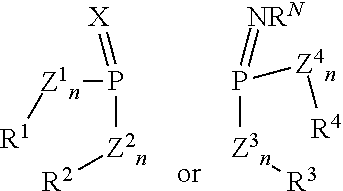
might also be a five to ten-membered ring structure of (R1, R2, Z1, Z2 and —PX—) or (R3, R4, Z3, Z4 and —PNRN—), respectively, wherein R1 to R4, Z1 to Z4, n, RN, X and W are as defined above.

wherein R1 to R4 and W are as defined before wherein RN1 represents —(SO)—, —(SO2)— or —(NRN2)— wherein RN2 is an electron withdrawing group being selected from -alkyl, —CO-alkyl, —(CO)—O-alkyl, wherein alkyl is a C1 to C20 straight chain, branched chain or cyclic aliphatic hydrocarbon having at least one halogen, preferably F or Cl, substituent on the alkyl residue.

wherein RN is an electron withdrawing group, being the same or different on each N and being selected from -alkyl, —CO-alkyl, —(CO)—O-alkyl, sulfinyl alkyl, sulfonyl alkyl, —(P═O)-dialkyl, wherein alkyl is a C1 to C20 straight chain, branched chain or cyclic aliphatic hydrocarbon having at least one halogen, preferably F and/or Cl, substituent on the alkyl residue; aryl, —CO-aryl, —(CO)—O-aryl, sulfinyl aryl, sulfonyl aryl, —(P═O)-diaryl, wherein aryl is a C6 to C18 aromatic hydrocarbon, preferably having at least one halogen, preferably F and/or Cl, substituent on the aryl residue; heteroaryl, —CO-heteroaryl, —(CO)—O-heteroaryl, sulfinyl heteroaryl, sulfonyl heteroaryl, —(P═O)-di-heteroaryl, wherein heteroaryl is a C2 to C20 aromatic hydrocarbon, preferably having at least one halogen, preferably F and/or Cl, substituent on the heteroaryl residue.

wherein in said formula (IV), the substituent R may be same or different on each position and is each selected from hydrogen, heterosubstituents, C1 to C20 straight chain, branched chain or cyclic aliphatic hydrocarbons, optionally having one or more unsaturated bonds such as C1-C20-alkyl, C2-C20-alkenyl or C2-C20-alkinyl, C3-C8-heterocycloalkyl or C6 to C20 aromatic hydrocarbon and partially arene-hydrogenated forms such as aryl, aryl-(C1-C6)-alkyl, heteroaryl-(C1-C6)-alkyl, and each hydrocarbon optionally being substituted by one or more groups selected from C1 to C20 straight chain, branched chain or cyclic aliphatic hydrocarbons, optionally having one or more unsaturated bonds such as C1-C20-alkyl, C2-C20-alkenyl or C2-C20-alkinyl, C3-C8-heterocycloalkyl or C6 to C20 aromatic hydrocarbon and partially arene-hydrogenated forms such as aryl, aryl-(C1-C6)-alkyl, heteroaryl-(C1-C6)-alkyl, or a heterosubstituent, and RN, X and W are as defined before, including its tautomeric and ionic forms, and derivatives thereof.


tertiary carbocation salts secondary carbocation salts primary carbocation salts
R3Si+, R2B+, I+ wherein R=alkyl, aryl XA −
silylium, borenium and iodonium salts


wherein in said formulae (V), (VI), (VII), (VIII) and (I):
L1 is a electropositive leaving group and is selected from hydrogen, a metal selected from Li, Na, K, Rb, Cs, Be, Mg, Ca, Sr, Ba Sc, Ti, V, Cr, Mn, Fe, Co, Ni, Cu, Zn, Y, Zr, Mo, Ru, Rh, Pd, Ag, W, Re, Os, Ir, Pt, Au, Ai, Pb, La, Sm, Eu, Yb, U or a cationic organic group, or a substituted silicon —SiRIRIIRIII, wherein RI, RII and RIII may be same or different and are as defined in claim 1 above,
L2 is a electronegative leaving group and is selected from halogen, alkoxy, aryloxy, heteroaryloxy, sulfonyl or heteroaryl,
L3 is a leaving group selected from hydrogen, halogen, alkyl, alkoxy, aryloxy, heteroaryloxy, aryl, heteroaryl, and
R1-4, Z1-4, X and W are as defined above.

wherein in said formulae (IX), (X), and (I):
L1 is a electropositive leaving group and is selected from hydrogen, a metal selected from Li, Na, K, Rb, Cs, Be, Mg, Ca, Sr, Ba Sc, Ti, V, Cr, Mn, Fe, Co, Ni, Cu, Zn, Y, Zr, Mo, Ru, Rh, Pd, Ag, W, Re, Os, Ir, Pt, Au, Al, Pb, La, Sm, Eu, Yb, U or a cationic organic group, or a substituted silicon —SiRIRIIRIII, wherein RI, RII and RIII may be same or different and are as defined in claim 1 above,
L2 is a electronegative leaving group and is selected from halogen, alkoxy, aryloxy, heteroaryloxy, sulfonyl or heteroaryl, and
R1-4, Z1-4, X and W are as defined as above.

wherein in said formulae (XI), (XII) and (I):
L4 represents a leaving group selected from N2, or a combination of L1 and L2, and
R1-4, Z1-4, X and W are as defined above.


| Application | 3,3′-substituent R |
 |
 |
 |
 |
 |
 |
 |
 |
 |
 |
 |
 |

| Application | 3,3′-substituent R |
 |
 |
 |
 |
 |
 |
 |
 |
 |
 |
 |
 |
 |
 |
 |
 |
 |
 |
 |
 |
 |
R1,2,3,4,5 = alkyl, aryl allylations |
 |
propargylations |
 |
reductions |
 |
hydroxyalkoxylation |
 |
hydration |
 |
hydroamination |
 |
Friedel-Crafts reactions |
 |
nucleophilic substitution |
 |
epoxide openings |
 |
Friedel-Crafts reactions |
 |
Mukaiyama aldol reactions |
 |
Mukaiyama-Michael additions |
 |
indirect Mannich reactions |
 |
Diels-Alder reactions |
 |
R1,2,3,4,5 = alkyl, aryl Hetero-Diels-Alder reactions |
 |
cycloadditions |
 |
Ritter reactions |
 |
aminalization |
 |
thioacetalization |
 |
Michael additions |


Claims (20)


Applications Claiming Priority (4)
| Application Number | Priority Date | Filing Date | Title |
|---|---|---|---|
| EP15183404 | 2015-09-01 | ||
| EP15183404.1 | 2015-09-01 | ||
| EP15183404.1A EP3138845A1 (en) | 2015-09-01 | 2015-09-01 | Chiral phosphoramidimidates and derivatives thereof |
| PCT/EP2016/070555 WO2017037141A1 (en) | 2015-09-01 | 2016-08-31 | Chiral phosphoramidimidates and derivatives thereof |
Publications (2)
| Publication Number | Publication Date |
|---|---|
| US20180339999A1 US20180339999A1 (en) | 2018-11-29 |
| US11084834B2 true US11084834B2 (en) | 2021-08-10 |
Family
ID=54065702
Family Applications (1)
| Application Number | Title | Priority Date | Filing Date |
|---|---|---|---|
| US15/756,136 Active US11084834B2 (en) | 2015-09-01 | 2016-08-31 | Chiral phosphoramidimidates and derivatives thereof |
Country Status (12)
| Country | Link |
|---|---|
| US (1) | US11084834B2 (en) |
| EP (2) | EP3138845A1 (en) |
| JP (1) | JP7010822B2 (en) |
| KR (1) | KR102740741B1 (en) |
| CN (2) | CN107922449A (en) |
| AU (1) | AU2016316712B2 (en) |
| BR (1) | BR112018002669B1 (en) |
| CA (1) | CA2994788C (en) |
| EA (1) | EA038820B1 (en) |
| ES (1) | ES2814328T3 (en) |
| IL (1) | IL257283B (en) |
| WO (1) | WO2017037141A1 (en) |
Cited By (2)
| Publication number | Priority date | Publication date | Assignee | Title |
|---|---|---|---|---|
| WO2025093710A1 (en) * | 2023-11-02 | 2025-05-08 | Basf Se | Process for a stereoselective polyene cyclization |
| US12534484B2 (en) | 2020-10-07 | 2026-01-27 | Studiengesellschaft Kohle Ggmbh | Process for preparing dimeric phosphazene derived BrØnsted acids |
Families Citing this family (8)
| Publication number | Priority date | Publication date | Assignee | Title |
|---|---|---|---|---|
| US12030911B2 (en) | 2018-06-15 | 2024-07-09 | The Regents Of The University Of Colorado, A Body Corporate | Synthesis and biological activity of phosphoramidimidate and phosphoramidate DNA |
| WO2019246282A1 (en) | 2018-06-19 | 2019-12-26 | The Regents Of The University Of Colorado | Protection from stress, anxiety, neuroinflammation and cognitive dysfunction |
| CN111205328B (en) * | 2020-02-27 | 2021-07-13 | 上海交通大学 | A kind of chiral sulfur/selenium compound and its preparation method and application |
| EP3981775A1 (en) | 2020-10-07 | 2022-04-13 | Studiengesellschaft Kohle mbH | Process for preparing dimeric phosphazene derived brønsted acids |
| EP4023626A1 (en) | 2020-12-31 | 2022-07-06 | Studiengesellschaft Kohle mbH | Process for the asymmetric synthesis of isopiperitenol |
| CN113527556B (en) * | 2021-01-12 | 2022-05-24 | 福州大学 | Process for the catalytic preparation of vinyl ether polymers |
| WO2025196015A1 (en) | 2024-03-18 | 2025-09-25 | Basf Se | Process for preparing monocyclic diterpene compounds (i) |
| EP4678622A1 (en) * | 2024-07-07 | 2026-01-14 | Studiengesellschaft Kohle gGmbH | Process for preparing an enantiomeric pure diels-alder adduct |
Citations (5)
| Publication number | Priority date | Publication date | Assignee | Title |
|---|---|---|---|---|
| US6340716B1 (en) | 1997-07-25 | 2002-01-22 | Acep Inc. | Ionic compounds with delocalized anionic charge, and their use as ion conducting components or as catalysts |
| EP1623971A1 (en) | 2003-04-25 | 2006-02-08 | Toagosei Co., Ltd. | Asymmetric-synthesis catalyst based on chiral broensted acid and method of asymmetric synthesis with the catalyst |
| EP2615083A1 (en) | 2012-01-10 | 2013-07-17 | Studiengesellschaft Kohle mbH | Process for the asymmetric oxidation of organic compounds with peroxides in the presence of a chiral acid catalyst |
| EP2615098A1 (en) | 2012-01-10 | 2013-07-17 | Studiengesellschaft Kohle mbH | Chiral imidodiphosphates and derivatives thereof |
| CN103936821A (en) | 2013-01-18 | 2014-07-23 | 江苏奥赛康药业股份有限公司 | A kind of preparation method of optically pure argatroban |
-
2015
- 2015-09-01 EP EP15183404.1A patent/EP3138845A1/en not_active Withdrawn
-
2016
- 2016-08-31 EP EP16758198.2A patent/EP3344639B1/en active Active
- 2016-08-31 WO PCT/EP2016/070555 patent/WO2017037141A1/en not_active Ceased
- 2016-08-31 CA CA2994788A patent/CA2994788C/en active Active
- 2016-08-31 ES ES16758198T patent/ES2814328T3/en active Active
- 2016-08-31 CN CN201680050137.5A patent/CN107922449A/en active Pending
- 2016-08-31 BR BR112018002669-7A patent/BR112018002669B1/en active IP Right Grant
- 2016-08-31 US US15/756,136 patent/US11084834B2/en active Active
- 2016-08-31 KR KR1020187009202A patent/KR102740741B1/en active Active
- 2016-08-31 EA EA201890632A patent/EA038820B1/en unknown
- 2016-08-31 JP JP2018529740A patent/JP7010822B2/en active Active
- 2016-08-31 IL IL257283A patent/IL257283B/en unknown
- 2016-08-31 CN CN202311606313.7A patent/CN117659092A/en active Pending
- 2016-08-31 AU AU2016316712A patent/AU2016316712B2/en active Active
Patent Citations (12)
| Publication number | Priority date | Publication date | Assignee | Title |
|---|---|---|---|---|
| US6340716B1 (en) | 1997-07-25 | 2002-01-22 | Acep Inc. | Ionic compounds with delocalized anionic charge, and their use as ion conducting components or as catalysts |
| EP1623971A1 (en) | 2003-04-25 | 2006-02-08 | Toagosei Co., Ltd. | Asymmetric-synthesis catalyst based on chiral broensted acid and method of asymmetric synthesis with the catalyst |
| US20060276329A1 (en) | 2003-04-25 | 2006-12-07 | Takahiko Akiyama | Asymmetric synthesis catalyst based on chiral brsnsted acid and method of asymmetric synthesis with the catalyst |
| US7517828B2 (en) | 2003-04-25 | 2009-04-14 | Toagosei Co., Ltd. | Chiral broensted acid catalyst for asymmetric synthesis and method of asymmetric synthesis with the catalyst |
| EP2615083A1 (en) | 2012-01-10 | 2013-07-17 | Studiengesellschaft Kohle mbH | Process for the asymmetric oxidation of organic compounds with peroxides in the presence of a chiral acid catalyst |
| EP2615098A1 (en) | 2012-01-10 | 2013-07-17 | Studiengesellschaft Kohle mbH | Chiral imidodiphosphates and derivatives thereof |
| WO2013104605A2 (en) | 2012-01-10 | 2013-07-18 | Studiengesellschaft Kohle Mbh | Process for the asymmetric oxidation of organic compounds with peroxides in the presence of a chiral acid catalyst |
| WO2013104604A1 (en) | 2012-01-10 | 2013-07-18 | Studiengesellschaft Kohle Mbh | Chiral imidodiphosphates and derivatives thereof |
| CN104039759A (en) | 2012-01-10 | 2014-09-10 | 科勒研究有限公司 | Chiral Imidodiphosphates And Derivatives Thereof |
| US9783561B2 (en) * | 2012-01-10 | 2017-10-10 | Studiengesellschaft Kohle Mbh | Chiral imidodiphosphates and derivatives thereof |
| US9932305B2 (en) * | 2012-01-10 | 2018-04-03 | Studiengesellschaft Kohle Mbh | Process for the asymmetric oxidation of organic compounds with peroxides in the presence of a chiral acid catalyst |
| CN103936821A (en) | 2013-01-18 | 2014-07-23 | 江苏奥赛康药业股份有限公司 | A kind of preparation method of optically pure argatroban |
Non-Patent Citations (18)
| Title |
|---|
| CAS Reg. No. 747388-28-9; Sep. 17, 2004. |
| CHEMICAL ABSTRACTS, 1 January 1982, Columbus, Ohio, US; SUVALOVA E A, KASUKHIN L F, PONOMARCHUK M P, CHUDAKOVA T I, KLEPA T I, TUPCHIENKO S K, DUDCHENKO T N, GOLOLOBOV YU G: "Inductive effects of phosphorus-containing substituents" XP002754962 |
| CHEMICAL ABSTRACTS, 1 January 1983, Columbus, Ohio, US; TUPCHIENKO S K, DUDCHENKO T N, GOLOLOBOV YU G: "Reaction of monosubstituted amides of diethyl phosphite with sulfur chlorides" XP002754963 |
| CHEMICAL ABSTRACTS, 1 January 1990, Columbus, Ohio, US; ROZANOV I. A., MEDVEDEVA L YA, GEOVA L V: "Preparation and properties of aminotrihydroxythiatriazaphosphorine anion" XP002754960 |
| CHEMICAL ABSTRACTS, 1 January 1996, Columbus, Ohio, US; GATES DEREK P, PARK PETER, LIANG MONG, EDWARDS MARK, ANGELAKOS CONSTANTINA, LIABLE-SANDS LOUISE M, RHEINGOLD ARNOLD L, MANNERS IAN: "Regioselective Substitution Reactions of Sulfur(VI)-Nitrogen-Phosphorus Rings: Reactions of the Halogenated Cyclic Thionylphosphazenes [NSOX(NPCl2)2] (X = Cl or F) with Oxygen-Based Nucleophiles" XP002754961 |
| Chivers ("Formation and X-ray Crystal Structures of (PH2PN)2(NS(O)NPPh2NPPh2NH2) and Et2NH2+[(Ph2PN)2(NSO2)]- . . . " Inorg. Chem, 1984, 23, p. 1531-1535 (Year: 1984). * |
| Coric, I.; Muiier, S.; List, B., "Kinetic Resolution of Homoaldols via Catalytic Asymmetric Transacetalization.", J. Am. Chem. Soc., (2010), vol. 132, pp. 17370-17373. |
| Gates ("Regioselective Substitution Reactions of Sulfur(VI)-Nitrogen-Phosphorus Rings" Inorg. Chem. 1996, 35, p. 4301-4309) (Year: 1996). * |
| Gates, et al., Regioselective substitution reactions of sulfur (VI)-nitrogen-phosphorus rings: reactions of the halogenated cyclic thionylphosphazenes . . . , Database Chemical Abstracts Service; XP002754961; 1996. |
| Hasselbring et al., "New cyclic and spirocyclic metal-containing phosphazenes"; Phosphorus, Sulfur, and Silicon, 1994, vol. 93-94; pp. 423-424. |
| Herbert W. Roesky et al., "Sulfur-nitrogen compounds. 29. N-trifluoromethylsulfonyl compounds", Zeitschrift fuer Naturforschung, Teil B: Anorganische Chemie, Organische Chemie, Biochemie, Biophysik, Biologie, 25 (3), 252-254 (1969). |
| IDPi Catalysis, Ange. Chemie Intern. Edit., vol. 58, No. 37, pp. 12761-12777 (Mar. 6, 2019). |
| Jaiswal, et al., "Reactivity of a dihydroboron species: synthesis of a hydroborenium complex and an expedient entry into stable thioxo- and selenoxo-boranes"; Dalton Transactions, 2015, 441 pp. 15779-15785. |
| Rong et al., "Rare-earth-metal complexes bearing phosphazene ancillary ligands: structures and catalysis toward highly trans-1,4-selective (co)polymerizations of conjugated dienes"; Organometallics, 2013, 32, pp. 1166-1175. |
| Rozanov, et al., "Preparation and properties of aminotrihydroxythiatriazaphosphorine anion"; Database Chemical Abstracts Service; XP002754960; 1990. |
| Suvalova, et al., "Inductive effects of phosphorus-containing substituents" Database Chemical Abstracts Service; XP002754962; 1982. |
| Tupchienko, et al., "Reaction of monosubstituted amides of diethyl phosphite with sulfur chlorides", Database Chemical Abstracts Service; XP002754963; 1983. |
| Xu, F. et al., "SPINOL-Derived Phosphoric Acids: Synthesis and Application in Enantioselective Friedel-Crafts Reaction of Indoles with Imines", J. Org. Chem., (2010), vol. 7, pp. 8677-8680. |
Cited By (2)
| Publication number | Priority date | Publication date | Assignee | Title |
|---|---|---|---|---|
| US12534484B2 (en) | 2020-10-07 | 2026-01-27 | Studiengesellschaft Kohle Ggmbh | Process for preparing dimeric phosphazene derived BrØnsted acids |
| WO2025093710A1 (en) * | 2023-11-02 | 2025-05-08 | Basf Se | Process for a stereoselective polyene cyclization |
Also Published As
| Publication number | Publication date |
|---|---|
| KR20180044420A (en) | 2018-05-02 |
| CN117659092A (en) | 2024-03-08 |
| BR112018002669B1 (en) | 2021-11-23 |
| IL257283B (en) | 2022-07-01 |
| KR102740741B1 (en) | 2024-12-09 |
| CA2994788C (en) | 2023-10-24 |
| WO2017037141A1 (en) | 2017-03-09 |
| EA201890632A1 (en) | 2018-09-28 |
| US20180339999A1 (en) | 2018-11-29 |
| AU2016316712B2 (en) | 2021-04-08 |
| CN107922449A (en) | 2018-04-17 |
| ES2814328T3 (en) | 2021-03-26 |
| IL257283A (en) | 2018-03-29 |
| JP7010822B2 (en) | 2022-02-10 |
| EP3344639A1 (en) | 2018-07-11 |
| EP3138845A1 (en) | 2017-03-08 |
| EP3344639B1 (en) | 2020-06-24 |
| EA038820B1 (en) | 2021-10-25 |
| AU2016316712A1 (en) | 2018-03-08 |
| CA2994788A1 (en) | 2017-03-09 |
| BR112018002669A2 (en) | 2018-10-02 |
| JP2018534341A (en) | 2018-11-22 |
Similar Documents
| Publication | Publication Date | Title |
|---|---|---|
| US11084834B2 (en) | Chiral phosphoramidimidates and derivatives thereof | |
| US9783561B2 (en) | Chiral imidodiphosphates and derivatives thereof | |
| AU2013209049B2 (en) | Process for the asymmetric oxidation of organic compounds with peroxides in the presence of a chiral acid catalyst | |
| US9079869B2 (en) | Chiral disulfonimides | |
| US12534484B2 (en) | Process for preparing dimeric phosphazene derived BrØnsted acids |
Legal Events
| Date | Code | Title | Description |
|---|---|---|---|
| FEPP | Fee payment procedure |
Free format text: ENTITY STATUS SET TO UNDISCOUNTED (ORIGINAL EVENT CODE: BIG.); ENTITY STATUS OF PATENT OWNER: SMALL ENTITY |
|
| FEPP | Fee payment procedure |
Free format text: ENTITY STATUS SET TO SMALL (ORIGINAL EVENT CODE: SMAL); ENTITY STATUS OF PATENT OWNER: SMALL ENTITY |
|
| AS | Assignment |
Owner name: STUDIENGESELLSCHAFT KOHLE MBH, GERMANY Free format text: ASSIGNMENT OF ASSIGNORS INTEREST;ASSIGNORS:LIST, BENJAMIN;KAIB, PHILIP STEPHAN JOSEPH;SCHREYER, LUCAS;AND OTHERS;SIGNING DATES FROM 20180309 TO 20180316;REEL/FRAME:045264/0630 |
|
| STPP | Information on status: patent application and granting procedure in general |
Free format text: APPLICATION DISPATCHED FROM PREEXAM, NOT YET DOCKETED |
|
| STPP | Information on status: patent application and granting procedure in general |
Free format text: NON FINAL ACTION MAILED |
|
| STPP | Information on status: patent application and granting procedure in general |
Free format text: RESPONSE TO NON-FINAL OFFICE ACTION ENTERED AND FORWARDED TO EXAMINER |
|
| STPP | Information on status: patent application and granting procedure in general |
Free format text: NON FINAL ACTION MAILED |
|
| STPP | Information on status: patent application and granting procedure in general |
Free format text: RESPONSE TO NON-FINAL OFFICE ACTION ENTERED AND FORWARDED TO EXAMINER |
|
| STPP | Information on status: patent application and granting procedure in general |
Free format text: FINAL REJECTION MAILED |
|
| STPP | Information on status: patent application and granting procedure in general |
Free format text: RESPONSE TO NON-FINAL OFFICE ACTION ENTERED AND FORWARDED TO EXAMINER |
|
| STPP | Information on status: patent application and granting procedure in general |
Free format text: NOTICE OF ALLOWANCE MAILED -- APPLICATION RECEIVED IN OFFICE OF PUBLICATIONS |
|
| STPP | Information on status: patent application and granting procedure in general |
Free format text: DOCKETED NEW CASE - READY FOR EXAMINATION |
|
| STPP | Information on status: patent application and granting procedure in general |
Free format text: NOTICE OF ALLOWANCE MAILED -- APPLICATION RECEIVED IN OFFICE OF PUBLICATIONS |
|
| STPP | Information on status: patent application and granting procedure in general |
Free format text: PUBLICATIONS -- ISSUE FEE PAYMENT VERIFIED |
|
| STCF | Information on status: patent grant |
Free format text: PATENTED CASE |
|
| AS | Assignment |
Owner name: STUDIENGESELLSCHAFT KOHLE GGMBH, GERMANY Free format text: CHANGE OF NAME;ASSIGNOR:STUDIENGESELLSCHAFT KOHLE MBH;REEL/FRAME:062876/0181 Effective date: 20230101 |
|
| MAFP | Maintenance fee payment |
Free format text: PAYMENT OF MAINTENANCE FEE, 4TH YR, SMALL ENTITY (ORIGINAL EVENT CODE: M2551); ENTITY STATUS OF PATENT OWNER: SMALL ENTITY Year of fee payment: 4 |