CROSS-REFERENCE TO RELATED APPLICATIONS
This application is a continuation of U.S. patent application Ser. No. 15/754,244 filed Feb. 21, 2018, which is a national phase application of International Application No. PCT/US2016/048890 filed Aug. 26, 2016, which claims priority to U.S. Provisional Patent Application Ser. No. 62/210,224, filed Aug. 26, 2015.
TECHNICAL FIELD
The present disclosure relates to compositions for parasite inhibition and/or sensitization or re-sensitization of a parasite to another drug or combination of drugs. In particular, it relates to compositions including one or more arylphenoxypropionate derivatives, such as, but not limited to, quizalofop, fenoxaprop, proquizalofop, and haloxyfop, one or more aryloxyphenoxyacetate derivatives, one or more aryloxyphenylacetate derivatives, and one or more substituted quinols, and combinations thereof. The present disclosure also relates to methods of parasite inhibition and/or sensitizing or re-sensitizing a parasite to another drug or combination of drugs by applying more arylphenoxypropionate derivatives to the parasite.
BACKGROUND
Parasitic infection is treated, or prevented, by the administration of a drug or drugs, such as xenobiotic chemotherapeutic drugs, to a susceptible or infected host organism. Effective treatment of parasitic infection by drug administration is frequently impaired, however, due to resistance of the parasite to the drug. Such resistance can be “inherent” to the parasite in the sense that the susceptibility of the parasite to the drug has not increased due to widespread use of the drug. Commonly, however, drug resistance of infectious parasites is observed due to evolved resistance associated with widespread treatment with the drug and associated selection pressure for resistant phenotypes. Currently, many infectious parasites are completely or highly resistant to available drugs and drug combinations, and parasites still susceptible to available drugs require treatment with greater doses than previously required, such that complete or effectively complete resistance is foreseeable.
For example, chloroquine resistance in certain species of malaria-causing Plasmodium parasites is so widespread that alternative or combination anti-malarial therapies are now required, and many parasitic species, including malaria-causing Plasmodium species, are now multi-drug resistant. As a further example, the incidence of parasite resistance to avermectins, a widely used class of nematicides, acaridices and insecticides in veterinary and human medicine and plant protection, is increasing.
Resistance of infectious parasites to anti-parasitic drugs can be avoided or lessened by rendering the parasites more sensitive to one or more drugs. The calcium channel blocker Verapramil, for example, has been evaluated for its effect on sensitization of parasites to xenobiotics. However, safe, economical, and effective methods for sensitizing parasites in such a manner are lacking.
SUMMARY
Compositions and methods for inhibiting and/or sensitizing or re-sensitizing a parasite to an antiparasitic drug are provided. The compositions can comprise a an arylphenoxypropionate derivative, an aryloxyphenoxyacetate derivative, an aryloxyphenylacetate derivative, one or more substituted quinols, or a pharmaceutically acceptable salt, hydrate, or prodrug thereof, or a combination thereof in an amount and formulation sufficient to sensitize the parasite to the drug, treating infection of a patient by a parasite with a drug, or to prevent symptomatic infection of a patient by a parasite with a drug.
BRIEF DESCRIPTION OF THE DRAWINGS
A more complete understanding of the present embodiments and advantages thereof may be acquired by referring to the following description taken in conjunction with the accompanying drawings, which depict embodiments of the present disclosure, and in which like numbers refer to similar components, and in which:
FIG. 1 is a graph of oocyst numbers vs. days post infection in mice with Cryptosporodosis treated with a control or test compounds;
FIG. 2 is a graph of fecal volume vs. days post infection in calves with Cryptosporodosis treated with a control or test compound;
FIG. 3 is a graph of urine volume vs. days post infection in calves with Cryptosporodosis treated with a control or test compound;
FIG. 4 is a graph of overall clinical evaluation vs. days post infection in calves with Cryptosporodosis treated with a control or test compound;
FIG. 5 is a graph of fecal consistency vs. days post infection in calves with Cryptosporodosis treated with a control or test compound;
FIG. 6 is a graph of percent weight change over a trial period in calves with Cryptosporodosis treated with a control or test compound; and
FIG. 7 is a graph of lesion scores for duodenal lesions in broiler chicks with coccidiosis that were untreated or treated with a control or test compound.
DETAILED DESCRIPTION
The present disclosure relates to compositions and methods for inhibition and/or drug-sensitization of a parasite. These compositions and methods are described in further detail below.
Unless otherwise indicated by the specific context of this specification, a parasite can include any type of parasite, or any part thereof. Furthermore, it can include a parasite in a host organism, or outside a host organism, such as in the environment occupied by an organism susceptible to infection by the parasite. The organism or host organism can be any animal. By way of example, and not limitation, the organism or host organism can be a mammal, such as a human, a pet mammal such as a dog or cat, an agricultural mammal, such as a horse, cow, pig, sheep, or goat, or a zoo mammal.
Although many embodiments herein are described with reference to a single parasite, the present disclosure is not so limited. The present disclosure encompasses, for example, infections of a single host animal with a plurality of parasites of the same species and with a plurality of parasites of different species, concurrently or otherwise. These embodiments and others will be readily apparent to one of ordinary skill in the art in view of the present disclosure.
Drug-sensitization, unless otherwise indicated by the specific context of this specification, can include increased sensitivity to a drug, decreased resistance to a drug, or potentiation of a drug's activity or efficacy. Any effect can be measured using any methods accepted in the art. In certain embodiments, drug-sensitization can be determined by an increased ability of the drug to inhibit a parasite. Parasitic inhibition can include killing the parasite, rendering the parasite more susceptible to the immune system of a host organism, arresting the parasite in a phase of its life cycle that is relatively benign with respect to the host organism, reducing the rate of propagation of the parasite in the host organism, or otherwise negatively affecting a parasite. An increased ability of the drug to inhibit a parasite can be demonstrated by, for example, an ability to inhibit the cell with a reduced amount of drug or in a shorter period of time than in the absence of drug-sensitization. In the case of drug-resistant parasites, which include parasites with inherent or acquired resistance, drug-sensitization can result in a renewed, restored, restored or newly acquired ability of the drug to inhibit a parasite or type of parasite.
Administration to a parasite, unless otherwise indicated by the specific context of this specification, can include administration directly to a parasite or indirect administration to a parasite, such as by direct or indirect administration to a host organism infected by the parasite or by prophylactic administration to an organism susceptible to infection by the parasite, or such as by administration to the environment of the parasite, such as by administration to an environment of the parasite. By way of example and not limitation, administration to a parasite can include, in addition to directly contacting the parasite with the composition administered, oral, enteral, and parenteral administration to an infected or susceptible host, as well as administration of the compound to a body of or source of water, for example, in which the parasite resides or will reside, as well as administration of the compound to a substrate or fomite upon which the parasite resides or will reside, or upon which another host or susceptible host organism resides or will reside, such as, for example, a mosquito netting, a portion of a plant such as a leaf, or a consumer product that can come into close contact with the skin of a human or animal, such as a bedsheet, a protective athletic garment, or a harness. By way of further example, the compositions of the present disclosure can be administered to a susceptible animal or infected host in the form of aerosolized particles, e.g., by way of aerosolizer, nebulizer or other like device, or transdermally, or transbucally, or sublingually, or by subcutaneous administration, or any other method of drug delivery, and any combination thereof.
Compositions
The present disclosure includes parasite drug-sensitization compositions, including one or more arylphenoxypropionate derivatives, one or more aryloxyphenoxyacetate derivatives, one or more aryloxyphenylacetate derivatives, one or more substituted quinols, or pharmaceutically acceptable salts, hydrates, or prodrugs thereof; or combinations thereof.
In certain embodiments, the present disclosure provides arylphenoxypropionate derivatives according to one of the following structures:
haloxyfop (IUPAC name: (RS)-2-{4-[3-chloro-5-(trifluoromethyl)-2-pyridyloxy]phenoxy}propionic acid);
quizalofop-p (IUPAC name: (R)-2-[4-(6-chloroquinoxalin-2-yloxy)phenoxy]propionic acid);
quizalofop-p-ethyl (IUPAC name: ethyl (2R)-2-[4-(6-chloroquinoxalin-2-yloxy)phenoxy]propionate);
fenoxaprop-p (IUPAC name: (R)-2-[4-(6-chlorobenzoxazol-2-yloxy)phenoxy]propionic acid;
fenoxaprop-p-ethyl (IUPAC name: ethyl (R)-2-[4-(6-chlorobenzoxazol-2-yloxy)phenoxy]propionate); or
proquizafop (IUPAC name: 2-isopropylideneaminooxyethyl (R)-2-[4-(6-chloroquinoxalin-2-yloxy)phenoxy]propionate); and enantiomers of the general structures.
In certain embodiments, the present disclosure provides aryloxyphenoxyacetate derivatives according to the following structure:
wherein R1 is selected from —OR5, —NR6R7 and —NH—SO2—R groups; R2 and R3 are independently selected from hydrogen, alkyl, alkenyl, alkynyl, cycloalkyl, aryl, and heteroaryl groups; or R2 and R3 together are a cycloalkyl group; R4 is selected from the group consisting of aryl, heteroaryl, bicycloaryl, and bicycloheteroaryl groups optionally additionally substituted with from zero to four substitutions selected independently from halogen, hydroxyl, alkyl, alkoxy, nitril, nitro, amino, alkylamino, dialkylamino, dialkylaminoalkyl, carboxy, acyl, carboxamido, alkylsulfoxide, acylamino, phenyl, benzyl, phenoxy, and benzyloxy groups; R5 is selected from hydrogen or an alkyl, aryl, or benzyl group that is optionally additionally substituted with an alkyloxy, alkylamino, dialkylamino, or acylamino group; R6 and R7 are independently selected from hydrogen, alkyl, alkenyl, alkynyl, cycloalkyl, heterocycloalkyl, aryl, heteroaryl, and alkoxy groups; or R6 and R7 together are a cycloalkyl or heterocycloalkyl group; and R8 is an alkyl or aryl group optionally substituted with halogen.
In certain embodiments, the present disclosure provides aryloxyphenylacetate derivatives according to the following structure:
wherein R1 is selected from —OR5, —NR6R7 and —NH—SO2—R8 groups; R2 and R3 are independently selected from hydrogen, alkyl, alkenyl, alkynyl, cycloalkyl, aryl, and heteroaryl groups; or R2 and R3 together are a cycloalkyl group; R4 is selected from the group consisting of aryl, heteroaryl, bicycloaryl, and bicycloheteroaryl groups optionally additionally substituted with from zero to four substitutions selected independently from halogen, hydroxyl, alkyl, alkoxy, nitril, nitro, amino, alkylamino, dialkylamino, dialkylaminoalkyl, carboxy, acyl, carboxamido, alkylsulfoxide, acylamino, phenyl, benzyl, phenoxy, and benzyloxy groups; R5 is selected from hydrogen or an alkyl, aryl, or benzyl group that is optionally additionally substituted with an alkyloxy, alkylamino, dialkylamino, or acylamino group; R6 and R7 are independently selected from hydrogen, alkyl, alkenyl, alkynyl, cycloalkyl, heterocycloalkyl, aryl, heteroaryl, and alkoxy groups; or R6 and R7 together are a cycloalkyl or heterocycloalkyl group; and R8 is an alkyl or aryl group optionally substituted with halogen.
In certain embodiments, the present disclosure provides substituted quinols according to the following structure:
wherein R9 is selected from nitril, hydroxyl, heterocycloaryl and alkyloxy groups; and R4 is selected from the group consisting of aryl, heteroaryl, bicycloaryl, and bicycloheteroaryl groups optionally additionally substituted with from zero to four substitutions chosen independently from the group consisting of halogen, hydroxyl, alkyl, alkyloxy, nitril, nitro, amino, alkylamino, dialkylamino, dialkylaminoalkyl, carboxy, acyl, carboxamido, alkylsulfoxide, acylamino, phenyl, benzyl, phenoxy, and benzyloxy groups.
Specific compounds of the invention include those named in Table 1 and characterized in the examples herein.
| TABLE 1 |
| |
| Arylphenoxypropionate Derivatives |
| |
| |
| WuXi-N8 |
|
1-{5-[(6-chloro-1,3-benzothiazol-2- yl)oxy]pyridin-2-yl}-3-(propan-2-yl)urea |
| |
| WuXi-N7 |
|
1-{6-[(6-chloro-1,3-benzothiazol-2- yl)oxy]pyridazin-3-yl}-3-(propan-2-yl)urea |
| |
| WuXi-N6 |
|
1-{6-[(6-chloro-1,3-benzothiazol-2- yl)oxy]pyridin-3-yl}-3-(propan-2-yl)urea |
| |
| WUXI-N5 |
|
3-{4-[(6-chloro-1,3-benzothiazol-2- yl)oxy]piperidin-1-yl}-N-methoxypropanamide |
| |
| WUXI-N4 |
|
2-{4-[(6-chloro-1,3-benzothiazol-2- yl)oxy]piperidin-1-yl}-N-methoxyacetamide |
| |
| quizalofop-p- ethyl |
|
ethyl (2R)-2-{4-[(6-chloroquinoxalin-2- yl)oxy]phenoxy}propanoate |
| |
| quizalofop-p |
|
(2R)-2-{4-[(6-chloroquinoxalin-2- yl)oxy]phenoxy}propanoic acid |
| |
| propaquizafop |
|
2-{[(propan-2-ylidene)amino]oxy}ethyl 2-{4-[(6- chloroquinoxalin-2-yl)oxy]phenoxy}propanoate |
| |
| NZ-578 |
|
2-{4-[(6-chloro-1,3-benzothiazol-2- yl)oxy]phenyl}-N-(2- methanesulfonylethyl)propanamide |
| |
| NZ-577 |
|
2-{4-[(6-chloro-1,3-benzothiazol-2- yl)oxy]phenyl}-N-(oxetan-3-yl)acetamide |
| |
| NZ-576 |
|
4-(2-{4-[(6-chloro-1,3-benzothiazol-2- yl)oxy]phenyl}acetyl)-1λ6,4-thiomorpholine-1,1- dione |
| |
| NZ-575 |
|
2-{4-[(6-chloro-1,3-benzothiazol-2- yl)oxy]phenyl}-1-(morpholin-4-yl)ethan-1-one |
| |
| NZ-574 |
|
1-{4-[(6-chloro-1,3-benzothiazol-2- yl)oxy]phenyl}-3-(oxetan-3-yl)urea |
| |
| NZ-573 |
|
N-{4-[(6-chloro-1,3-benzothiazol-2- yl)oxy]phenyl}-1,1-dioxo-1λ6,4-thiomorpholine- 4-carboxamide |
| |
| NZ-572 |
|
N-{4-[(6-chloro-1,3-benzothiazol-2- yl)oxy]phenyl}morpholine-4-carboxamide |
| |
| NZ-564 |
|
1-{4-[(6-chloro-1,3-benzothiazol-2- yl)oxy]phenyl}-N-(oxetan-3-yl)cyclopropane-1- carboxamide |
| |
| NZ-563 |
|
4-(1-{4-[(6-chloro-1,3-benzothiazol-2- yl)oxy]phenyl}cyclopropanecarbonyl)-1λ6,4- thiomorpholine-1,1-dione |
| |
| NZ-562 |
|
2-{4-[(6-chloro-1,3-benzothiazol-2- yl)oxy]phenyl}-N-(5-oxopyrrolidin-3- yl)propanamide |
| |
| NZ-561 |
|
6-chloro-2-{4-[1-(morpholine-4- carbonyl)cyclopropyl]phenoxy}-1,3- benzothiazole |
| |
| NZ-560 |
|
2-{4-[(6-chloro-1,3-benzothiazol-2- yl)oxy]phenyl}-N-(3- hydroxycyclobutyl)propanamide |
| |
| NZ-559 |
|
2-{4-[(6-chloro-1,3-benzothiazol-2- yl)oxy]phenyl}-N,N-bis(2- hydroxyethy)propanamide |
| |
| NZ-558 |
|
2-{4-[(6-chloro-1,3-benzothiazol-2- yl)oxy]phenyl}-1-[2-(hydroxymethyl)morpholin- 4-yl]propan-1-one |
| |
| NZ-557 |
|
N-{2-[bis(2-hydroxyethyl)amino]ethyl}-2-{4-[(6- chloro-1,3-benzothiazol-2- yl)oxy]phenyl}propanamide |
| |
| NZ-556 |
|
2-{4-[(6-chloro-1,3-benzothiazol-2- yl)oxy]phenyl}-N-{2-[(2- hydroxyethyl)(methyl)amino]ethyl}propanamide |
| |
| NZ-555 |
|
2-{4-[(6-chloro-1,3-benzothiazol-2- yl)oxy]phenyl}-1-[3-(hydroxymethyl)morpholin- 4-yl]propan-1-one |
| |
| NZ-554 |
|
4-(2-{4-[(6-chloro-1,3-benzothiazol-2- yl)oxy]phenyl}propanoyl)morpholine-2- carboxamide |
| |
| NZ-553 |
|
4-(2-{4-[(6-chloro-1,3-benzothiazol-2- yl)oxy]phenyl}propanoyl)-1λ6,4-thiomorpholine- 1,1-dione |
| |
| NZ-550 |
|
2-{4-[(6-chloroquinoxalin-2-yl)oxy]phenyl}-N-[2- (methylamino)ethyl]propanamide |
| |
| NZ-548 |
|
2-{4-[(6-chloro-1,3-benzothiazol-2- yl)oxy]phenyl}-N-[2- (methylamino)ethyl]propanamide |
| |
| NZ-547 |
|
2-{4-[(6-chloro-1,3-benzothiazol-2- yl)oxy]phenyl}-N-[2-(dimethylamino)ethyl]-N- methylpropanamide |
| |
| NZ-546 |
|
N-[2-(dimethylamino)ethyl]-2,2-difluoro-2-{4- [(6-fluoro-1,3-benzothiazol-2- yl)oxy]phenyl}acetamide |
| |
| NZ-545 |
|
2,2-difluoro-2-{4-[(6-fluoro-1,3-benzothiazol-2- yl)oxy]phenyl}-1-(4-methylpiperazin-1-yl)ethan- 1-one |
| |
| N-544 |
|
2-{4-[(6-chloro-1,3-benzothiazol-2- yl)oxy]phenyl}-N-(oxolan-3-yl)propanamide |
| |
| NZ-543 |
|
2-{4-[(6-chloro-1,3-benzothiazol-2- yl)oxy]phenyl}-N-(oxetan-3-yl)propanamide |
| |
| NZ-542 |
|
2-{4-[(6-chloro-1,3-benzothiazol-2- yl)oxy]phenyl}-N-(1,3-dimethoxypropan-2- yl)propanamide |
| |
| NZ-541 |
|
2-{4-[(6-chloro-1,3-benzothiazol-2- yl)oxy]phenyl]-N-(2-methoxyethyl)propanamide |
| |
| NZ-539 |
|
2-{4-[(6-chloro-1,3-benzothiazol-2- yl)oxy]phenyl}-N-cyclobutylpropanamide |
| |
| NZ-538 |
|
2-{4-[(6-chloro-1,3-benzothiazol-2- yl)oxy]phenyl}-N-cyclopropylpropanamide |
| |
| NZ-537 |
|
2-{4-[(6-chloroquinoxalin-2-yl)oxy]phenyl}-1- (piperazin-1-yl)propan-1-one |
| |
| NZ-536 |
|
2-{4-[(6-chloroquinoxalin-2-yl)oxy]phenyl}-N- (1,3-dihydroxypropan-2-yl)propanamide |
| |
| NZ-535 |
|
2-{4-[(6-chloroquinoxalin-2-yl)oxy]phenyl-N-[2- (dimethylamino)ethyl]propanamide |
| |
| NZ-534 |
|
2-{4-[(6-chloroquinoxalin-2-yl)oxy]phenyl}-N- (2,3-dihydroxypropyl)propanamide |
| |
| NZ-533 |
|
2-{4-[(6-chloroquinoxalin-2-yl)oxy]phenyl}-N-(2- hydroxyethyl)propanamide |
| |
| NZ-532 |
|
2-{4-[(6-chloroquinoxalin-2-yl)oxy]phenyl}-N- (propan-2-yl)propanamide |
| |
| NZ-531 |
|
2-{4-([6-chloroquinoxalin-2-yl)oxy]phenyl}-N- methylpropanamide |
| |
| NZ-530 |
|
2-{4-([6-chloroquinoxalin-2-yl)oxy]phenyl}-N,N- dimethylpropanamide |
| |
| NZ-529 |
|
2-{4-[(6-chloroquinoxalin-2-yl)oxy]phenyl}-1- (morpholin-4-yl)propan-1-one |
| |
| NZ-522 |
|
6-chloro-2-{4-[1-(4-methylpiperazine-1- carbonyl)cyclopropyl]phenoxy}-1,3- benzothiazole |
| |
| NZ-521 |
|
1-{4-[(6-chloro-1,3-benzothiazol-2- yl)oxy]phenyl}-N-methylcyclopropane-1- carboxamide |
| |
| NZ-518 |
|
N-(2-aminoethyl)-2-{4-([6-chloro-1,3- benzothiazol-2-yl)oxy]phenyl}propanamide |
| |
| NZ-516 |
|
2-{4-[(6-chloro-1,3-benzothiazol-2- yl)oxy]phenyl}-N-[2- (dimethylamino)ethyl]propanamide |
| |
| NZ-513 |
|
2-{4-[(6-chloro-1,3-benzothiazol-2- yl)oxy]phenyl}-1-[4-(oxetan-3-yl)piperazin-1- yl]propan-1-one |
| |
| NZ-512 |
|
2-{4-[(6-chloro-1,3-benzothiazol-2- yl)oxy]phenyl-1-[4-(2,2,2- trifluoroethyl)piperazin-1-yl]propan-1-one |
| |
| NZ-511 |
|
2-{4-[(6-chloro-1,3-benzothiazol-2- yl)oxy]phenyl}-1-(4-cyclopropylpiperazin-1- yl)propan-1-one |
| |
| NZ-510 |
|
2-{4-[(6-chloro-1,3-benzothiazol-2- yl)oxy]phenyl}-1-[4-(propan-2-yl]piperazin-1- yl]propan-1-one |
| |
| NZ-509 |
|
N-{4-[(6-chloro-1,3-benzothiazol-2- yl)oxy]phenyl}piperazine-1-carboxamide |
| |
| NZ-506 |
|
4-[(6-chloro-1,3-benzothiazol-2-yl)oxy]phenyl 4-methylpiperazine-1-carboxylate |
| |
| NZ-505 |
|
2-{4-[(6-chloro-1,3-benzothiazol-2- yl)oxy]phenyl}acetamide |
| |
| NZ-500 |
|
2-{4-[(6-chloro-1,3-benzothiazol-2-yl)oxy]-2- fluorophenyl}acetamide |
| |
| NZ-496 |
|
2-{4-[(5,6-difluoro-1,3-benzothiazol-2-yl)oxy]-2- fluorophenyl}acetamide |
| |
| NZ-490 |
|
2-{4-[(6-fluoro-1,3-benzothiazol-2- yl)oxy]phenyl}-1-(pyrrolidin-1-yl)ethan-1-one |
| |
| NZ-489 |
|
2-{4-[(5,6-difluoro-1,3-benzothiazol-2- yl)oxy]phenyl}-1-(piperazin-1-yl)propan-1-one |
| |
| NZ-485 |
|
2-{4-[(5,6-difluoro-1,3-benzothiazol-2- yl)oxy]phenyl}acetamide |
| |
| NZ-484 |
|
2-{2-fluoro-4-[(6-fluoro-1,3-benzothiazol-2- yl)oxy]phenyl}acetamide |
| |
| NZ-481 |
|
2-{4-[(5,6-difluoro-1,3-benzothiazol-2- yl)oxy]phenyl}-1-(piperidin-1-yl)ethan-1-one |
| |
| NZ-479 |
|
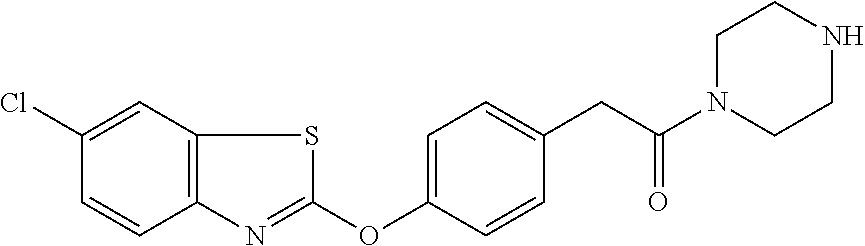
2-{4-[(6-chloro-1,3-benzothiazol-2- yl)oxy]phenyl}-1-(piperazin-1-yl)ethan-1-one |
| |
| NZ-477 |
|
2-{4-[(6-fluoro-1,3-benzothiazol-2- yl)oxy]phenyl}-1-(piperazin-1-yl)propan-1-one |
| |
| NZ-476 |
|
2-{4-[(6-fluoro-1,3-benzothiazol-2- yl)oxy]phenyl}-1-(4-methylpiperazin-1-yl)ethan- 1-one |
| |
| NZ-475 |
|
N-{4-[(6-chloro-1,3-benzothiazol-2- yl)oxy]phenyl}-4-methylpiperazine-1- carboxamide |
| |
| NZ-472 |
|
2-{4-[(6-fluoro-1,3-benzothiazol-2- yl)oxy]phenyl}-1-(piperazin-1-yl)ethan-1-one |
| |
| NZ-471 |
|
2-{4-[(6-fluoro-1,3-benzothiazol-2- yl)oxy]phenyl}-1-(piperidin-1-yl)ethan-1-one |
| |
| NZ-469 |
|
tert-butyl 4-(2-{4-[(6-fluoro-1,3-benzothiazol-2- yl)oxy]phenyl}acetyl)piperazine-1-carboxylate |
| |
| NZ-467 |
|
2-{2-fluoro-4-[(6-fluoro-1,3-benzothiazol-2- yl)oxy]phenyl}-1-(4-methylpiperazin-1-yl)ethan- 1-one |
| |
| NZ-466 |
|
2-{4-[(6-fluoro-1,3-benzothiazol-2- yl)oxy]phenyl}-1-(4-methylpiperazin-1- yl)propan-1-one |
| |
| NZ-465 |
|
2-{4-[(5,6-difluoro-1,3-benzothiazol-2- yl)oxy]phenyl}-1-(4-methylpiperazin-1- yl)propan-1-one |
| |
| NZ-464 |
|
2-{4-[(6-chloro-1,3-benzothiazol-2- yl)oxy]phenyl}-1-(4-methylpiperazin-1-yl)ethan- 1-one |
| |
| NZ-460 |
|
2-{4-[(6-chloroquinoxalin-2-yl)oxy]-2,6- difluorophenyl}-N-methylacetamide |
| |
| NZ-459 |
|
2-{4-[(6-chloro-1,3-benzothiazol-2-yl)oxy]-2,6- difluorophenyl}-N-methylacetamide |
| |
| NZ-458 |
|
2-{4-[(6-chloro-1,3-benzothiazol-2-yl)oxy]-2,6- difluorophenyl}acetic acid |
| |
| NZ-450 |
|
2-{4-[(5,6-difluoro-1,3-benzothiazol-2-yl)oxy]- 2,6-difluorophenyl}-N-methylacetamide |
| |
| NZ-446 |
|
N-cyclopropyl-2-{2-fluoro-4-[(6-fluoro-1,3- benzothiazol-2-yl)oxy]phenyl}acetamide |
| |
| NZ-440 |
|
2-{4-[(5,6-difluoro-1,3-benzothiazol-2-yl)oxy]-2- fluorophenyl}acetic acid |
| |
| NZ-438 |
|
N-(carbamoylmethyl)-2-{4-[(6-fluoro-1,3- benzothiazol-2-yl)oxy]phenyl}acetamide |
| |
| NZ-433 |
|
2-{2,6-difluoro-4-[(6-fluoro-1,3-benzothiazol-2- yl)oxy]phenyl}-N-methylacetamide |
| |
| NZ-427 |
|
N-(2-aminoethyl)-2-{4-[(6-fluoro-1,3- benzothiazol-2-yl)oxy]phenyl}acetamide |
| |
| NZ-426 |
|
2-{4-[(6-fluoro-1,3-benzothiazol-2- yl)oxy]phenyl}-N-(2-hydroxyethyl)acetamide |
| |
| NZ-425 |
|
N-[2-(dimethylamino)ethyl]-2-{4-[(6-fluoro-1,3- benzothiazol-2-yl)oxy]phenyl}acetamide |
| |
| NZ-420 |
|
N-{4-[(6-fluoro-1,3-benzothiazol-2- yl)oxy]phenyl}acetamide |
| |
| NZ-419 |
|
2-{4-[(6-fluoro-1,3-benzothiazol-2-yl)oxy]-2- oxo-1,2-dihydropyridin-1-yl}-N- methylacetamide |
| |
| NZ-418 |
|
2-{4-[(6-fluoro-1,3-benzothiazol-2-yl)oxy]-2- oxo-1,2-dihydropyridin-1-yl}acetic acid |
| |
| NZ-417 |
|
2-amino-N-{4-[(6-fluoro-1,3-benzothiazol-2- yl)oxy]phenyl}acetamide |
| |
| NZ-416 |
|
3-amino-N-{4-[(6-fluoro-1,3-benzothiazol-2- yl)oxy]phenyl}propanamide |
| |
| NZ-415 |
|
tert-butyl N-[({4-[(6-fluoro-1,3-benzothiazol-2- yl)oxy]phenyl}carbamoyl)methyl]carbamate |
| |
| NZ-414 |
|
tert-butyl N-[2-({4-[(6-fluoro-1,3-benzothiazol-2- yl)oxy]phenyl}carbamoyl)ethyl]carbamate |
| |
| NZ-413 |
|
4-[(6-fluoro-1,3-benzothiazol-2-yl)oxy]aniline |
| |
| NZ-412 |
|
tert-butyl N-{4-[(6-fluoro-1,3-benzothiazol-2- yl)oxy]phenyl}carbamate |
| |
| NZ-411 |
|
2-{4-[(5,6-difluoro-1,3-benzothiazol-2-yl)oxy]-2- fluorophenyl}-N-methylacetamide |
| |
| NZ-410 |
|
2-{2-fluoro-4-[(6-fluoro-1,3-benzothiazol-2- yl)oxy]phenyl}-N-methylacetamide |
| |
| NZ-409 |
|
2-{4-[(5,6-difluoro-1,3-benzothiazol-2- yl)oxy]phenyl}-1-(4-methylpiperazin-1-yl)ethan- 1-one |
| |
| NZ-408 |
|
2-{4-[(6-fluoro-1,3-benzothiazol-2-yl)oxy]-2- hydroxyphenyl}-N-methylpropanamide |
| |
| NZ-407 |
|
2-{4-[(5,6-difluoro-1,3-benzothiazol-2-yl)oxy]-2- hydroxyphenyl}-N-(propan-2-yl)acetamide |
| |
| NZ-406 |
|
2-{2-[(6-fluoro-1,3-benzothiazol-2-yl)oxy]-4- hydroxyphenyl}-N-(propan-2-yl)acetamide |
| |
| NZ-405 |
|
2-{4-[(6-fluoro-1,3-benzothiazol-2-yl)oxy]-2- hydroxyphenyl}-N-(propan-2-yl)acetamide |
| |
| NZ-404 |
|
2-{4-[(6-chloro-1,3-benzothiazol-2-yl)oxy]-2- oxo-1,2-dihydropyridin-1-yl}-N-(propan-2- yl)acetamide |
| |
| NZ-403 |
|
2-{4-[(5,6-difluoro-1,3-benzothiazol-2- yl)oxy]phenyl)-N-(propan-2-yl)acetamide |
| |
| NZ-402 |
|
2-{4-[(6-chloroquinoxalin-2-yl)oxy]-2- hydroxyphenyl}-N-methylacetamide |
| |
| NZ-401 |
|
2-{4-[(5,6-difluoro-1,3-benzothiazol-2-yl)oxy]-2- hydroxyphenyl}-N-methylacetamide |
| |
| NZ-400 |
|
2-{4-[(5,6-difluoro-1,3-benzothiazol-2- yl)oxy]phenyl}-N-methylacetamide |
| |
| NZ-399 |
|
2-{4-[(5,6-difluoro-1,3-benzothiazol-2- yl)oxy]phenyl}acetic acid |
| |
| NZ-398 |
|
methyl 2-{4-[(5,6-difluoro-1,3-benzothiazol-2- yl)oxy]phenyl}acetate |
| |
| NZ-397 |
|
2-{4-[(6-chloro-1,3-benzothiazol-2-yl)oxy]-2- oxo-1,2-dihydropyridin-1-yl}acetic acid |
| |
| NZ-396 |
|
methyl 2-{4-[(6-chloro-1,3-benzothiazol-2- yl)oxy]-2-oxo-1,2-dihydropyridin-1-yl}acetate |
| |
| NZ-395 |
|
2-{4-[(6-fluoro-1,3-benzothiazol-2-yl)oxy]-2- hydroxyphenyl}-N-methylacetamide |
| |
| NZ-394 |
|
2-{4-[(5,6-dichloro-1,3-benzothiazol-2- yl)oxy]phenyl}-N-methylpropanamide |
| |
| NZ-393 |
|
1-{4-[(5,6-dichloro-1,3-benzothiazol-2- yl)oxy]phenyl}-3-(propan-2-yl)urea |
| |
| NZ-392 |
|
2-{4-[(6-chloro-1,3-benzothiazol-2-yl)oxy]-2- methoxyphenyl}-N-methylacetamide |
| |
| NZ-391 |
|
1-{5-[(6-chloro-1,3-benzothiazol-2-yl)oxy]-1- oxo-1λ5-pyridin-2-yl}-3-(propan-2-yl)urea |
| |
| NZ-390 |
|
2-{2-[(6-chloro-1,3-benzothiazol-2-yl)oxy]-4- hydroxyphenyl}-N-methylacetamide |
| |
| NZ-389 |
|
2-{4-[(6-chloro-1,3-benzothiazol-2-yl)oxy]-2- hydroxyphenyl}-N-methylacetamide |
| |
| NZ-388 |
|
1-{4-[(6-chloro-1,3-benzothiazol-2- yl)oxy]phenyl}-1-methyl-3-(propan-2-yl)urea |
| |
| NZ-387 |
|
2-{4-[(5,6-difluoro-1,3-benzothiazol-2- yl)oxy]phenyl}-N-methylpropanamide |
| |
| NZ-386 |
|
2-{4-[(6-fluoro-1,3-benzothiazol-2- yl)oxy]phenyl}-N-methylpropanamide |
| |
| NZ-385 |
|
2-{4-[(6-fluoro-1,3-benzothiazol-2- yl)oxy]phenyl}-N-methylacetamide |
| |
| NZ-383 |
|
2-4-[(6-chloro-1,3-benzothiazol-2- yl)oxy]phenyl}-N-methylacetamide |
| |
| NZ-382 |
|
1-{4-[(5,6-difluoro-1,3-benzothiazol-2- yl)oxy]phenyl}-3-(propan-2-yl)urea |
| |
| NZ-381 |
|
1-(4-{[6-(hydroxymethyl)-1,3-benzothiazol-2- yl]oxy}phenyl)-3-(propan-2-yl)urea |
| |
| NZ-380 |
|
1-{4-[(6-methanesulfonyl-1,3-benzothiazol-2- yl)oxy]phenyl}-3-(propan-2-yl)urea |
| |
| NZ-379 |
|
3-(propan-2-yl)-1-(4-{[6-(trifluoromethyl)-1,3- benzothiazol-2-yl]oxy}phenyl)urea |
| |
| NZ-378 |
|
ethyl 2-(4-{[(propan-2- yl)carbamoyl]amino}phenoxy)-1,3- benzothiazole-6-carboxylate |
| |
| NZ-377 |
|
1-{4-[(6-cyano-1,3-benzothiazol-2- yl)oxy]phenyl}-3-(propan-2-yl)urea |
| |
| NZ-376 |
|
1-{4-[(5-chloro-1,3-benzothiazol-2- yl)oxy]phenyl}-3-(propan-2-yl)urea |
| |
| NZ-374 |
|
1-{4-[(4-fluoro-1,3-benzothiazol-2- yl)oxy]phenyl}-3-(propan-2-yl)urea |
| |
| NZ-373 |
|
1-{4-[(5-fluoro-1,3-benzothiazol-2- yl)oxy]phenyl}-3-(propan-2-yl)urea |
| |
| NZ-372 |
|
2-{4-[(6-chloro-1,3-benzothiazol-2- yl)oxy]phenyl}-N-(2,3- dihydroxypropyl)propanamide |
| |
| NZ-371 |
|
2-{4-[(6-chloro-1,3-benzothiazol-2- yl)oxy]phenyl}-N-(1,3-dihydroxypropan-2- yl)propanamide |
| |
| NZ-370 |
|
2-{4-[(6-chloro-1,3-benzothiazol-2- yl)oxy]phenyl}-N-(2-hydroxyethyl)propanamide |
| |
| NZ-369 |
|
2-{4-[(6-chloro-1,3-benzothiazol-2- yl)oxy]phenyl}-N-methylpropanamide |
| |
| NZ-368 |
|
2-{4-[(6-chloro-1,3-benzothiazol-2- yl)oxy]phenyl}-N,N-dimethylpropanamide |
| |
| NZ-366 |
|
2-{4-[(6-chloro-1,3-benzothiazol-2- yl)oxy]phenyl}-1-(4-methylpiperazin-1- yl)propan-1-one |
| |
| NZ-365 |
|
2-{4-[(6-chloro-1,3-benzothiazol-2- yl)oxy]phenyl}-1-(morpholin-4-yl)propan-1-one |
| |
| NZ-364 |
|
2-{4-[(6-chloro-1,3-benzothiazol-2- yl)oxy]phenyl}-1-(piperazin-1-yl)propan-1-one |
| |
| NZ-363 |
|
1-{4-[(6-nitro-1,3-benzothiazol-2- yl)oxy]phenyl}-3-(propan-2-yl)urea |
| |
| NZ-362 |
|
1-{4-[(6-hydroxy-1,3-benzothiazol-2- yl)oxy]phenyl}-3-(propan-2-yl)urea |
| |
| NZ-361 |
|
1-{4-[(6-methoxy-1,3-benzathiazol-2- yl)oxy]phenyl}-3-(propan-2-yl)urea |
| |
| NZ-360 |
|
1-{4-(1,3-benzothiazol-2-yloxy)phenyl]-3- (propan-2-yl)urea |
| |
| NZ-359 |
|
1-{4-[(6-bromo-1,3-benzothiazol-2- yl)oxy]phenyl}-3-(propan-2-yl)urea |
| |
| NZ-358 |
|
1-{4-[(6-methyl-1,3-benzothiazol-2- yl)oxy]phenyl}-3-(propan-2-yl)urea |
| |
| NZ-357 |
|
2-{4-[(6-chloro-1,3-benzothiazol-2- yl)oxy]phenyl}-N,2-dimethoxyacetamide |
| |
| NZ-356 |
|
2-4-[(6-chloro-1,3-benzothiazol-2- yl)oxy]phenyl}-2-methoxyacetic acid |
| |
| NZ-355 |
|
methyl 2-{4-[(6-chloro-1,3-benzothiazol-2- yl)oxy]phenyl}-2-methoxyacetate |
| |
| NZ-354 |
|
1-{4-[(6-chloro-1,3-benzothiazol-2- yl)oxy]phenyl}-3,3-dimethylurea |
| |
| NZ-353 |
|
1-{4-[(6-chloro-1,3-benzothiazol-2- yl)oxy]phenyl}-3-methylurea |
| |
| NZ-352 |
|
4-[(6-chloro-1,3-benzothiazol-2-yl)oxy]aniline |
| |
| NZ-351 |
|
tert-butyl N-{4-[(6-chloro-1,3-benzothiazol-2- yl)oxy]phenyl}carbamate |
| |
| NZ-350 |
|
1-({4-[(6-chloro-1,3-benzothiazol-2- yl)oxy]phenyl}methyl)-3-methylurea |
| |
| NZ-349 |
|
1-({4-[(6-chloro-1,3-benzothiazol-2- yl)oxy]phenyl}methyl)-3,3-dimethylurea |
| |
| NZ-348 |
|
{4-[(6-chloro-1,3-benzothiazol-2- yl)oxy]phenyl}methanamine |
| |
| NZ-347 |
|
tert-butyl N-({4-[(6-chloro-1,3-benzothiazol-2- yl)oxy]phenyl}methyl)carbamate |
| |
| NZ-346 |
|
1-{4-[(6-chloroquinolin-2-yl)oxy]phenyl}-3- (propan-2-yl)urea |
| |
| NZ-345 |
|
1-{4-[(6-fluoroquinoxalin-2-yl)oxy]phenyl}-3- (propan-2-yl)urea |
| |
| NZ-344 |
|
1-{4-[(6-chloroquinoxalin-2-yl)oxy]phenyl}-3- methoxyurea |
| |
| NZ-343 |
|
1-{4-[(6-chloroquinoxalin-2-yl)oxy]phenyl}-3,3- dimethylurea |
| |
| NZ-342 |
|
1-{4-[(6-chloroquinoxalin-2-yl)oxy]phenyl}-3- methylurea |
| |
| NZ-341 |
|
1-{4-[(6-chloro-1,3-benzothiazol-2- yl)oxy]phenyl}imidazolidin-2-one |
| |
| NZ-338 |
|
2-{4-[(6-chloro-1,3-benzothiazol-2- yl)oxy]phenyl}-2-hydroxy-N-methoxyacetamide |
| |
| NZ-337 |
|
2-{4-[(6-chloro-1,3-benzothiazol-2- yl)oxy]phenyl}-2-hydroxyacetic acid |
| |
| NZ-336 |
|
methyl 2-{4-[(6-chloro-1,3-benzothiazol-2- yl)oxy]phenyl}-2-hydroxyacetate |
| |
| NZ-335 |
|
N-methoxy-2-{4-[(6-methoxy-1,3-benzothiazol- 2-yl)oxy]phenyl}propanamide |
| |
| NZ-334 |
|
2-{4--methoxy-1,3-benzothiazol-2- yl)oxy]phenyl}propanoic acid |
| |
| NZ-333 |
|
methyl 2-{4-[(6-methoxy-1,3-benzothiazol-2- yl)oxy]phenyl}propanoate |
| |
| NZ-332 |
|
1-{4-[(6-fluoro-1,3-benzothiazol-2- yl)oxy]phenyl}-3-(propan-2-yl)urea |
| |
| NZ-331 |
|
1-{4-[(6-chloro-1,3-benzothiazol-2- yl)oxy]phenyl}-3-(propan-2-yl)urea |
| |
| NZ-330 |
|
2-{4-[(6-fluoro-1,3-benzothiazol-2- yl)oxy]phenyl}-N-methoxypropanamide |
| |
| NZ-329 |
|
2-{4-[(6-fluoro-1,3-benzothiazol-2- yl)oxy]phenyl}propanoic acid |
| |
| NZ-328 |
|
methyl 2-{4-[(6-fluoro-1,3-benzothiazol-2- yl)oxy]phenyl}propanoate |
| |
| NZ-327 |
|
2-{4-[(6-chloro-1,3-benzothiazol-2- yl)oxy]phenyl}-N-(propan-2-yl)propanamide |
| |
| NZ-326 |
|
2-{4-[(6-chloroquinoxalin-2-yl)oxy]phenoxy}-N- (propan-2-yloxy)acetamide |
| |
| NZ-325 |
|
(Z)-2-{4-[(6-chloroquinoxalin-2- yl)oxy]phenoxy}-N- methoxyethenecarbonimidoyl chloride |
| |
| NZ-323 |
|
2-{4-[(6-chloroquinoxalin-2-yl)oxy]phenoxy}-N- (cyclopropylmethoxy)acetamide |
| |
| NZ-322 |
|
1-{4-[(6-chloroquinoxalin-2-yl)oxy]phenyl}-3- (propan-2-yl)urea |
| |
| NZ-321 |
|
tert-butyl N-{4-[(6-chloroquinoxalin-2- yl)oxy]phenyl}carbamate |
| |
| NZ-320 |
|
N-methoxy-2-oxo-7-phenoxy-2H-chromene-3- carboxamide |
| |
| NZ-319 |
|
2-{4-[(6-chloro-1,3-benzothiazol-2- yl)oxy]phenoxy}-N-methoxy-2- methylpropanamide |
| |
| NZ-318 |
|
2-{4-[(6-chloro-1,3-benzothiazol-2- yl)oxy]phenoxy}-2-methylpropanoic acid |
| |
| NZ-317 |
|
methyl 2-{4-[(6-chloro-1,3-benzothiazol-2- yl)oxy]phenoxy}-2-methylpropanoate |
| |
| NZ-316 |
|
2-{4-[(6-chloroquinoxalin-2-yl)oxy]phenoxy}-N- methoxy-2-methylpropanamide |
| |
| NZ-315 |
|
2-{4-[(6-chloroquinoxalin-2-yl)oxy]phenoxy}-2- methylpropanoic acid |
| |
| NZ-314 |
|
methyl 2-{4-[(6-chloroquinoxalin-2- yl)oxy]phenoxy}-2-methylpropanoate |
| |
| NZ-313 |
|
2-{4-[(6-chloro-1,3-benzothiazol-2- yl)oxy]phenyl}-N-methoxypropanamide |
| |
| NZ-312 |
|
2-{4-[(6-chloro-1,3-benzothiazol-2- yl)oxy]phenyl}propanoic acid |
| |
| NZ-311 |
|
methyl 2-{4-[(6-chloro-1,3-benzothiazol-2- yl)oxy]phenyl}propanoate |
| |
| NZ-310 |
|
2-{4-[(6-chloroquinoxalin-2-yl)oxy]phenyl}-N- methoxypropanamide |
| |
| NZ-309 |
|
2-{4-[(6-chloroquinoxalin-2- yl)oxy]phenyl}propanoic acid |
| |
| NZ-308 |
|
methyl 2-{4-[(6-chloroquinoxalin-2- yl)oxy]phenyl}propanoate |
| |
| NZ-307 |
|
2-{4-[(6-chloroquinoxalin-2-yl)oxy]phenoxy}-N- (propan-2-yl)acetamide |
| |
| NZ-306 |
|
2-{4-[(6-chloroquinoxalin-2-yl)oxy]phenoxy}-N- ethylacetamide |
| |
| NZ-305 |
|
2-{4-[(6-fluoro-1,3-benzothiazol-2- yl)oxy]phenoxy}-N-methoxyacetamide |
| |
| NZ-304 |
|
2-{4-[(6-fluoro-1,3-benzothiazol-2- yl)oxy]phenoxy}acetic acid |
| |
| NZ-303 |
|
methyl 2-{4-[(6-fluoro-1,3-benzothiazol-2- yl)oxy]phenoxy}acetate |
| |
| NZ-302 |
|
methyl 2-{4-[(6-chloro-1,3-benzoxazol-2- yl)oxy]phenyl}acetate |
| |
| NZ-301 |
|
2-{4-[(6-chloroquinoxalin-2-yl)oxy]phenyl}-N- methoxyacetamide |
| |
| NZ-300 |
|
2-{4-[(6-fluoro-1,3-benzothiazol-2- yl)oxy]phenyl}-N-methoxyacetamide |
| |
| NZ-299 |
|
2-{4-[(6-fluoro-1,3-benzothiazol-2- yl)oxy]phenyl}acetic acid |
| |
| NZ-298 |
|
2-{4-[(6-chloroquinoxalin-2-yl)oxy]phenyl}acetic acid |
| |
| NZ-297 |
|
methyl 2-{4-[(6-chloroquinoxalin-2- yl)oxy]phenyl}acetate |
| |
| NZ-296 |
|
(2R)-2-{4-[(6-chloro-1,3-benzoxazol-2- yl)oxy]phenoxy}-N-methoxypropanamide |
| |
| NZ-295 |
|
(2R)-2-{4-[(6-chloroquinoxalin-2- yl)oxy]phenoxy}-N-methoxypropanamide |
| |
| NZ-294 |
|
methyl 2-{4-[(6-fluoro-1,3-benzothiazol-2- yl)oxy]phenyl}acetate |
| |
| NZ-293 |
|
2-{4-[(6-chloro-1,3-benzothiazol-2- yl)oxy]phenyl}-N-methoxyacetamide |
| |
| NZ-292 |
|
6-chloro-2-phenoxy-1,3-benzothiazole |
| |
| NZ-291 |
|
6-chloro-2-(3-methylphenoxy)-1,3- benzothiazole |
| |
| NZ-290 |
|
2-{4-[(6-chloroquinoxalin-2-yl)oxy]phenoxy}-N- methoxy-N-methylacetamide |
| |
| NZ-289 |
|
(2R)-2-{4-[(6-fluoro-1,3-benzothiazol-2- yl)oxy]phenoxy}-N-methoxypropanamide |
| |
| NZ-288 |
|
4-[(6-chloro-1,3-benzothiazol-2-yl)oxy]benzoic acid |
| |
| NZ-287 |
|
2-{4-[(6-chloro-1,3-benzothiazol-2- yl)oxy]phenyl}acetic acid |
| |
| NZ-286 |
|
2-{4-[(6-chloroquinoxalin-2-yl)oxy]phenoxy}-N- hydroxyacetamide |
| |
| NZ-285 |
|
methyl 4-[(6-chloro-1,3-benzothiazol-2- yl)oxy]benzoate |
| |
| NZ-284 |
|
methyl 2-{4-([6-chloro-1,3-benzothiazol-2- yl)oxy]phenyl}acetate |
| |
| NZ-283 |
|
(2E)-3-{4-[(6-chloro-1,3-benzothiazol-2- yl)oxy]phenyl}prop-2-enoic acid |
| |
| NZ-282 |
|
3-{4-[(6-chloro-1,3-benzothiazol-2- yl)oxy]phenyl}propanoic acid |
| |
| NZ-281 |
|
methyl (2E)-3-{4-[(6-chloro-1,3-benzothiazol-2- yl)oxy]phenyl}prop-2-enoate |
| |
| NZ-280 |
|
methyl 3-{4-[(6-chloro-1,3-benzothiazol-2- yl)oxy]phenyl}propanoate |
| |
| NZ-279 |
|
2-{4-[(6-chloroquinoxalin-2-yl)oxy]phenoxy}-N- hydroxy-N-methylacetamide |
| |
| NZ-278 |
|
2-{4-[(6-chloroquinoxalin-2-yl)oxy]phenoxy}-1- (4-methylpiperazin-1-yl)ethan-1-one |
| |
| NZ-277 |
|
2-{4-[(6-chloroquinoxalin-2-yl)oxy]phenoxy}-1- (piperazin-1-yl)ethan-1-one |
| |
| NZ-276 |
|
N-(benzenesulfonyl)-2-{4-[(6-chloroquinoxalin- 2-yl)oxy]phenoxy}acetamide |
| |
| NZ-275 |
|
2-{4-[(6-chloroquinoxalin-2-yl)oxy]phenoxy}-N- trifluoromethanesulfonylacetamide |
| |
| NZ-274 |
|
2-{4-[(6-chloroquinoxalin-2-yl)oxy]phenoxy}-N- methoxyacetamide |
| |
| NZ-273 |
|
6-chloro-2-[4-(1H-imidazol-2- ylmethoxy)phenoxy]quinoxaline |
| |
| NZ-272 |
|
6-chloro-2-[4-(2,2- diethoxyethoxy)phenoxy]quinoxaline |
| |
| NZ-271 |
|
6-chloro-2-[4-(1,3-oxazol-2- ylmethoxy)phenoxy]quinoxaline |
| |
| NZ-270 |
|
6-chloro-2-{4-[(1-methyl-1H-1,2,3,4-tetrazol-5- yl)methoxy]phenoxy}quinoxaline |
| |
| NZ-269 |
|
6-chloro-2-{4-[(2-methyl-2H-1,23,4-tetrazol-5- yl)methoxy]phenoxy}quinoxaline |
| |
| NZ-268 |
|
6-chloro-2-[4-(1H-1,2,3,4-tetrazol-5- ylmethoxy)phenoxy]quinoxaline |
| |
| NZ-267 |
|
2-{4-[(6-chloroquinoxalin-2-yl)oxy]phenoxy}-N- methylacetamide |
| |
| NZ-266 |
|
2-{4-[(6-chloroquinoxalin-2-yl)oxy]phenoxy}-1- (morpholin-4-yl)ethan-1-one |
| |
| NZ-265 |
|
2-{4-[(6-chloroquinoxalin-2-yl)oxy]phenoxy}-1- (piperidin-1-yl)ethan-1-one |
| |
| NZ-264 |
|
1-{4-[(6-chloroquinoxalin-2- yl)oxy]phenoxy}propan-2-ol |
| |
| NZ-263 |
|
2-{4-[(6-chloroquinoxalin-2- yl)oxy]phenoxy}acetonitrile |
| |
| NZ-262 |
|
2-{4-[(6-chloroquinoxalin-2-yl)oxy]phenoxy}- N,N-dimethylacetamide |
| |
| NZ-261 |
|
(2R)-2-{4-[(6-nitro-1,3-benzothiazol-2- yl)oxy]phenoxy}propanoic acid |
| |
| NZ-260 |
|
ethyl (2R)-2-{4-[(6-nitro-1,3-benzothiazol-2- yl)oxy]phenoxy}propanoate |
| |
| NZ-259 |
|
2-{4-[(6-chloroquinoxalin-2-yl)oxy]phenoxy}-N- methanesulfonylacetamide |
| |
| NZ-258 |
|
2-{4-[(6-chloroquinoxalin-2- yl)oxy]phenoxy}acetamide |
| |
| NZ-257 |
|
2-{4-[(6-chloroquinoxalin-2- yl)oxy]phenoxy}acetic acid |
| |
| NZ-256 |
|
methyl 2-{4-[(6-chloroquinoxalin-2- yl)oxy]phenoxy}acetate |
| |
| NZ-255 |
|
(2R)-2-{4-[(6-fluoro-1,3-benzothiazol-2- yl)oxy]phenoxy}propanoic acid |
| |
| NZ-254 |
|
(2R)-2-[4-(1,3-benzothiazol-2- yloxy)phenoxy]propanoic acid |
| |
| NZ-253 |
|
(2R)-2-{4-[(6-bromo-1,3-benzothiazol-2- yl)oxy]phenoxy}propanoic acid |
| |
| NZ-252 |
|
ethyl (2R)-2-[4-(1,3-benzothiazol-2- yloxy)phenoxy]propanoate |
| |
| NZ-251 |
|
ethyl (2R)-2-{4-[(6-fluoro-1,3-benzothiazol-2- yl)oxy]phenoxy}propanoate |
| |
| NZ-250 |
|
ethyl (2R)-2-{4-[(6-bromo-1,3-benzothiazol-2- yl)oxy]phenoxy}propanoate |
| |
| NZ-247 |
|
(2R)-2-{4-[(6-chloro-1,3-benzothiazol-2- yl)oxy]phenoxy}propanoic acid |
| |
| NZ-246 |
|
ethyl (2R)-2-{4-[(6-chloro-1,3-benzothiazol-2- yl)oxy]phenoxy}propanoate |
| |
| fenoxaprop-p- ethyl |
|
ethyl (2R)-2-{4-[(6-chloro-1,3-benzoxazol-2- yl)oxy]phenoxy}propanoate |
| |
| fenoxaprop-p |
|
2-{4-[(6-chloro-1,3-benzoxazol-2- yl)oxy]phenoxy}propanoic acid |
| |
The present disclosure also includes pharmaceutically acceptable salts, hydrates, prodrugs, and mixtures of any of the above compositions. The term “pharmaceutically acceptable salt” refers to salts whose counter ion derives from pharmaceutically acceptable non-toxic acids and bases.
The arylphenoxypropionate derivatives, aryloxyphenoxyacetate derivatives, aryloxyphenylacetate derivatives, and substituted quinols which contain a basic moiety, such as, but not limited to an amine or a pyridine or imidazole ring, may form salts with a variety of organic and inorganic acids. Suitable pharmaceutically acceptable (i.e., non-toxic, physiologically acceptable) base addition salts for the compounds of the present invention include inorganic acids and organic acids. Examples include acetate, adipate, alginates, ascorbates, aspartates, benzenesulfonate (besylate), benzoate, bicarbonate, bisulfate, borates, butyrates, carbonate, camphorsulfonate, citrate, digluconates, dodecylsulfates, ethanesulfonate, fumarate, gluconate, glutamate, glycerophosphates, hemisulfates, heptanoates, hexanoates, hydrobromides, hydrochloride, hydroiodides, 2-hydroxyethanesulfonates, isethionate, lactate, maleate, malate, mandelate, methanesulfonate, 2-naphthalenesulfonates, nicotinates, mucate, nitrate, oxalates, pectinates, persulfates, 3-phenylpropionates, picrates, pivalates, propionates, pamoate, pantothenate, phosphate, salicylates, succinate, sulfate, sulfonates, tartrate, p-toluenesulfonate, and the like.
The arylphenoxypropionate derivatives, aryloxyphenoxyacetate derivatives, aryloxyphenylacetate derivatives, and substituted quinols which contain an acidic moiety, such as, but not limited to a carboxylic acid, may form salts with variety of organic and inorganic bases. Suitable pharmaceutically acceptable base addition salts for the compounds of the present invention include, but are not limited to, ammonium salts, metallic salts made from calcium, lithium, magnesium, potassium, sodium and zinc or organic salts made from lysine, N,N-dialkyl amino acid derivatives (e.g. N,N-dimethylglycine, piperidine-1-acetic acid and morpholine-4-acetic acid), N,N′-dibenzylethylenediamine, chloroprocaine, choline, diethanolamine, ethylenediamine, meglumine (N-methylglucamine), t-butylamine, dicyclohexylamine, hydrabamine, and procaine.
The arylphenoxypropionate derivatives, aryloxyphenoxyacetate derivatives, aryloxyphenylacetate derivatives, and substituted quinols, and salts thereof, may exist in their tautomeric form (for example, as an amide or imino ether). All such tautomeric forms are contemplated herein as part of the present invention.
The compounds described herein may contain asymmetric centers and may thus give rise to enantiomers, diastereomers, and other stereoisomeric forms. Each chiral center may be defined, in terms of absolute stereochemistry, as (R)- or (S)-. The present invention is meant to include all such possible isomers, as well as, their racemic and optically pure forms. Optically active (R)- and (S)-, or (D)- and (L)-isomers may be prepared using chiral synthons or chiral reagents, or resolved using conventional techniques. When the compounds described herein contain olefinic double bonds or other centers of geometric asymmetry, and unless specified otherwise, it is intended that the compounds include both E and Z geometric isomers.
Compositions of the present disclosure may also include a pharmaceutically acceptable carrier, in particular a carrier suitable for the intended mode of administration, or salts, buffers, or preservatives. Certain of the compounds disclosed herein are poorly soluble in water. Accordingly, aqueous compositions of the present disclosure may include solubility enhancers. Compositions for oral use may include components to enhance intestinal absorption. The overall formulation of the compositions may be based on the intended mode of administration. For instance, the composition may be formulated as a pill or capsule for oral ingestion. In other examples, the composition may be encapsulated, such as in a liposome or nanoparticle.
Compositions of the present disclosure may contain a sufficient amount of one or more one or more arylphenoxypropionate derivatives, one or more aryloxyphenoxyacetate derivatives, one or more aryloxyphenylacetate derivatives, one or more substituted quinols, or pharmaceutically acceptable salts, hydrates, or prodrugs thereof; or combinations thereof, to cause inhibition of a mycobacterium to occur when the composition is administered to the mycobacterium. The amount can vary depending on other components of the composition and their effects on drug availability in a patient, the amount of otherwise required to inhibit the mycobacterium, the intended mode of administration, the intended schedule for administration, any drug toxicity concerns, drug-drug interactions, such as interactions with other medications used by the patient, or the individual response of a patient. Many compositions may contain an amount well below levels at which toxicity to the patient becomes a concern.
The amount of arylphenoxypropionate derivative, aryloxyphenoxyacetate derivative, aryloxyphenylacetate derivative, substituted quinol, or pharmaceutically acceptable salt, hydrate, or prodrug thereof; or combination thereof, present in a composition may be measured in any of a number of ways. The amount may, for example, express concentration or total amount. Concentration may be for example, weight/weight, weight/volume, moles/weight, or moles/volume. Total amount may be total weight, total volume, or total moles. Typically, the amount may be expressed in a manner standard for the type of formulation or dosing regimen used.
Parasite Drug Sensitization and Inhibition Methods
The present disclosure also includes drug-sensitization and/or inhibition methods in which a composition comprising one or more arylphenoxypropionate derivatives, one or more aryloxyphenoxyacetate derivatives, one or more aryloxyphenylacetate derivatives, one or more substituted quinols, or pharmaceutically acceptable salts, hydrates, or prodrugs thereof, or combinations thereof, is administered to a parasite in order to sensitize the parasite to another drug or combination of drugs and/or to inhibit the parasite. The composition can be any composition described above. In certain embodiments, the composition can be administered with any other drug or drugs which can alternatively be present in a pharmaceutical composition as described herein. For example, the other drug can include ivermectin.
In methods in which a parasite is sensitized to a drug or drugs, the drug or drugs can be any drug or drugs for which rifamycin or a rifamycin derivative, such as rifabutin or a rifabutin derivative, or rifampicin or a rifampicin derivative, or a pharmaceutically acceptable salt, hydrate, or prodrug thereof; or a combination thereon one or more arylphenoxypropionate derivatives, one or more aryloxyphenoxyacetate derivatives, one or more aryloxyphenylacetate derivatives, one or more substituted quinols, or pharmaceutically acceptable salts, hydrates, or prodrugs thereof; or combinations thereof, increase sensitivity in a parasite. In certain embodiments, the drug or drugs can include an antiparasitic drug. Example types of suitable antiparasitic drugs and drug combinations include antinematodic drugs, anticestodic drugs, antitrematodic drugs, antiamamoebic drugs, antiprotazoal drugs, antihelminthic drugs, tiniacides, antiprotozoic drugs, and other drugs. Example classes of suitable antiparasitic drugs include benzimidazoles, avermectins, milbemycins, piperazines, octadepsipeptides, thiophenes, pamoates, spiroindoles, imadazothiazoles, quinines, biguanides, sulfonamides, tetracyclines, lincomycins, alkaloids, carbamates, formamidines, organophosphates, Rifampin, Amphotericin B, Melarsoprol, Eflornithine, Miltefosine, Metronidazole, Tinadadazole, Quinine-pyrithamine-sulfadiazine, Trimethoprin-sulfa methoxazole, Piperazine, Praziquantel Triclabendazole, Octadepsipeptides, Amino Acetonitrile derivatives and derivatives thereof.
Exemplary suitable antiparasitic drugs for use with the compositions and methods of the present disclosure include, without limitation, ivermectin, selamectin, doramectin, abamectin, albendazole, mebendazole, thiabendazole, fenbendazole, triclabendazole, flubendazole, diethylcarbazamine, niclosamide, suramin, pyrantel pamoate, levamisole, praziquantel, emodepside, monepantel, derquantel, rifoxanide, artemether, quinine, quinidine, chloroquine, amodiaquine, pyrimethamine, proguanil, sulfadozine, mefloquine, atovaquone, primaquine, artemisinin, doxycycline, clindamycin, sulfadoxine-pyrimethamine, moxidectin, permethrin, hexylresorcinol, and combinations thereof.
Accordingly, in certain embodiments, the antiparasitic drug or drugs to which sensitivity is increased in a parasite by the one or more arylphenoxypropionate derivatives, one or more aryloxyphenoxyacetate derivatives, one or more aryloxyphenylacetate derivatives, one or more substituted quinols, or pharmaceutically acceptable salts, hydrates, or prodrugs thereof, or combinations thereof can include, without limitation, one or more of the antiparasitic drugs listed in Table 2 below, or any class or type referred to therein, or any antiparasitic drug referred to herein.
| TABLE 2 |
| |
| Antiparasitic Drugs |
| Antiparasitic Drug |
Class/Type |
Mechanism/Target |
| |
| Trimethoprim |
Anti-folate |
Dihydrofolate reductase (“DHFR”) |
| Pyrimethamine (Daraprim) |
|
deoxyhypusine synthase (“DHPS”) |
| Proguanil (Paludrine) |
|
|
| Sulfamethoxazole |
|
|
| Sulfadiazine |
|
|
| Sulfadoxine |
|
|
| Atovaquone (Mepron) |
Ubiquinone Analog |
Perturbs Mitochondrial Electron Transpot |
| Spiramycin (Rovmycin)- |
Antibiotic |
Ketolide Protein Synthesis Inhibitor |
| Azithromycin Zithromax)- |
|
Macrolide Protein Synthesis Inhibitor |
| Paromomycin Humatin)- |
|
Aminoglycoside Protein Synthesis Inhibitor |
| Clindamycin (Cleocin)- |
|
Lincosamide Protein Synthesis Inhibitor |
| Tetracycline (Sumycin)- |
|
Polyketide Protein Synthesis Inhibitor |
| Doxycycline (Vibramycin)- |
|
Polyketide Protein Synthesis Inhibitor |
| Metronidazole (Flagyl) |
Nitroimidazole |
PFOR-Dependent RNS Generation |
| Tinidazole (Tindamax) |
|
|
| Nitazoxanide (Alinia) |
Nitrothiazole |
|
| Iodoquinol (Yodoxin) |
Quinoline |
Iron chelation |
| Chloroquine |
|
Hemozoin Inhibitor |
| Primaquine |
|
|
| Mefloquine |
|
|
| Quinine |
|
|
| Quinidine |
|
|
| Praziquantel (Biltride)1,2 |
|
Paralytic |
| Oxaminquine (Vansil)1 |
|
|
| Triclabendazole (Egaten)1 |
Benzimidazole |
Prevents tubulin polymerization |
| Niridazole1 |
Thiazole |
Paralytic Phosphofructokinase Inhibitor |
| Stibophen1 |
Arylsulfonate |
|
| Trichlorfon1 |
Organophosphate |
Paralytic ACE Inhibitor |
| Mebendazole (Vermox)2,3 |
Benzimidazole |
Prevents tublin polymerization |
| Albendazole (Albenza)2,3 |
|
|
| Niclosamide2 |
Salicylanilide |
Decouples Oxidative Phosphorylation |
| Ivermectin (Stromectol, |
Macroyclic Lactone |
Paralytic GABA Agonist |
| Mectizan)3,4 |
|
|
| Doxycycline (Vibramycin)3 |
Antibiotic |
Targets Symbiotic Bacteria in Parasite Gut |
| Diethylcarbamazine (DEC)3 |
Piperazine |
Perturbs Arachidonic Acid Metabilism |
| Pyrantel Pamoate (Helmex)3 |
Tetrahydropyrimidine |
Paralytic |
| Permethrin (Elimite, Nix)4 |
Pyrethroid |
Neurotoxin via Na-Channel Binding |
| Tiabendazole3,5 |
Nitrothiazole |
Fumarate reductase |
| Levamisole3,5 |
Imidazothiazole |
Paralytic Ach agonist |
| Mibemycin3 |
Macrolide |
Glutamate sensitive chloride channels |
| |
| 1Anti-trematodal; |
| 2Anti-cestodal; |
| 3Anti-nematodal; |
| 4Anti-ectoparasitic; |
| 5Anti-helminthic |
In methods of the current disclosure, the parasite can be sensitized to a drug or drugs already known to inhibit the parasite, or it can be sensitized to a drug or drugs not previously used with that type of parasite. If the parasite is a drug-resistant parasite that has acquired or evolved a resistance to a drug, it can be sensitized to a drug that previously exhibited a decreased ability to inhibit the parasite. In certain embodiments, sensitization of the parasite to the drug occurs at least in part by P-gp inhibition.
In certain embodiments, the composition can directly inhibit the parasite instead of or in addition to causing drug-sensitization.
The parasite that undergoes drug-sensitization or inhibition can be any type of parasite. It may, for instance, be a helminth, such as a nematode, a trematode, or a cestode, a protozoa, or an arthropod (i.e., an ectoparasite). The parasite can be a parasite of any animal or plant. By way of example and not limitation, the parasite that undergoes drug-sensitization or inhibition can be a species of the genus Plasmodium, such as Plasmodium falciparum, Plasmodium malariae, Plasmodium ovale, and Plasmodium vivax, a species of the genus Ascaris, such as Ascaris lumbricoides, a species of the genus Enterobius, such as Enterobius vermicularis, a species of the genus Trichinella, such as Trichinella spiralis, a species of the genus Haemonchus, such as Haemonchus contortus, a species of the genera Aphelenchoides, Ditylenchus, Globodera, Heterodera, Longidorus, Meloidogyne, Nacobbus, Pratylenchus, Trichodorus, and Xiphinema, a species of the genus Bursaphelenchus, such as Bursaphelenchus xylophilus, a species of the genus Fasciola, such as Fasciola hepatica, a species of the genus Coccidoides, or a species of the genus Onchocerca, such as Onchocerca volvulus.
The parasite that undergoes drug-sensitization or inhibition can be any parasite. The parasite can be, for example, any parasite commonly referred to or known as a flea, a tick, a worm, a hookworm, a roundworm, a heartworm, a fluke, a mite, a spider, a beetle, a mosquito, a fly, or a bed bug.
Accordingly, in certain embodiments, the parasite that undergoes drug-sensitization or inhibition can be a protozoan parasite, such as, for example, the protozoan parasites of Table 3 below. In certain embodiments, the parasite that undergoes drug sensitization or inhibition can be a helminthic parasite (parasitic worm) such as, for example, the helminthic parasites of Table 4 below. In certain embodiments, the parasite that undergoes drug sensitization or inhibition can be an ectoparasite, such as, for example, the helminthic parasites of Table 5 below. In certain embodiments, multiple parasites of different species, genera, class, or other category can simultaneously undergo drug sensitization or inhibition in a single host harboring the multiple parasites.
| TABLE 3 |
| |
| Representative Protozoan Parasites |
| Parasite |
Disease |
Symptoms (humans) |
Current Drug Regimen |
| |
|
Cryptosporidium
|
Cryptosporidiasis |
Diarrhea-causing parasites |
Uncomplicated: Nitazoxanide |
|
hominis, parvum
|
|
(typically asymptomatic) but |
(Alinia) |
| |
|
deadly in susceptible pop. |
AIDS: Paromomycin (Humatin) w/ |
| |
|
(AIDS, Children, etc.) |
Azithromycin (Zithromax) |
| |
|
|
Questionable Efficacy for both |
| |
|
|
regimes. |
|
Isosporiasis belli
|
Isosporiasis |
Diarrhea-causing parasites |
#1: Trimethoprim-Sulfamethoxazole |
| |
|
(typically asymptomatic) but |
w/ folinic acid (Leucovorin) |
| |
|
deadly in susceptible pop. |
#2: Pyrimethamine (Daraprim) w/ |
| |
|
(AIDS, Children, etc.) |
folinic acid (Leucovorin) |
|
Cyclospora
|
Cycosporiasis |
Diarrhea-causing parasites |
Uncomplicated: No Recognized |
|
cayetanesis
|
|
(typically asymptomatic) but |
Effective Treatment |
| |
|
deadly in susceptible pop. |
AIDS: Trimethoprim- |
| |
|
(AIDS, Children, etc.) |
Sulfamethoxazole w/ folinic acid |
| |
|
|
(Leucovorin) considered effective at |
| |
|
|
reducing severity. Control HIV |
| |
|
|
infection to resolve parasite |
| |
|
|
infestation. |
|
Toxoplasma
|
Toxoplasmosis |
Usually asymptomatic but |
Uncomplicated: Pyrimethamine |
|
gondii
|
|
causes fatal encephalitis in |
(Daraprim) + |
| |
|
AIDS/Immunocompromised |
sulfadiazine/clindamycin (Cleocin)/ |
| |
|
Patients. TORCH Pathogen |
azithromycin (Zithromax) |
| |
|
associated with transplacental |
Pregnancy: Uncomplicated + |
| |
|
infection. |
Spiramycin (Rovamycin) |
| |
|
|
AIDS: Pyrimethamine (Daraprim) + |
| |
|
|
sulfadiazine/clindamycin (Cleocin)/ |
| |
|
|
azithromycin (Zithromax). Treat |
| |
|
|
patient indefinitely once Dx. |
| |
|
|
*** All regimes require folinic acid |
| |
|
|
(Leucovorin)*** |
|
Balantidium coil
|
Balantidiasis |
Diarrhea, Constiption. Can |
#1: Tetracycline (Sumycin) |
| |
|
mimick inflammatory bowel |
#2: Metronidazole (Flagyl) |
| |
|
conditions. |
#3: Iodoquinol (Yodoxin) |
|
Entamoeba
|
Amebiasis |
Typically asymptomatic but |
Asymptomatic: Luminal Agents |
|
histolytica, dispar
|
|
can cause wide range of |
Iodoquinol (Yodoxin) or |
| |
|
symptoms ranging from mild |
paromomycin (Humatin) |
| |
|
diarrhea to severe dysentery |
Symptomatic: Colitis & Hepatic |
| |
|
with mucoid, bloody |
Abscess Metronidazole (Flagyl) + |
| |
|
diarrhea. May cause ameobic |
Luminal Agents. |
| |
|
liver abscesses w/ or w/o |
|
| |
|
intestinal disease. |
|
|
Giardia lamblia
| Giardiasis | |
2/3 Asymptomatic. Others |
Metronidazole (Flagyl) |
| |
|
experience diarrhea varying |
|
| |
|
in severity, sulfurous |
|
| |
|
gas/belches, weight loss, |
|
| |
|
cramping, pain, etc. |
|
| |
|
Traveler’s Diarrhea. |
|
|
Trichmonas
|
Trichomoniasis |
Very common STI that is |
#1 Metronidazole (Flagyl) |
|
vaginalis
|
|
usually asymtomatic but can |
#2 Tinidazole (Tindamax) |
| |
|
cause vaginits, urethritis, etc. |
|
|
Dientamoeba
|
Dientamoebiasis |
Traveler’s diarrhea, chronic |
Prophylaxis: Paromomycin |
|
fragilis
|
|
diarrhea/abdominal pain, |
(Humatin) |
| |
|
failure to thrive. |
Symptomatic: Iodouinol (Yodoxin), |
| |
|
|
Paromornycin (Humatin), |
| |
|
|
Tetracycline (Sumycin), |
| |
|
|
Metronidazole (Flagyl) combination |
| |
|
|
of any two. |
|
Biastocystis
|
Blastocystosis |
Typically nonsymptomatic |
Metronidazole (Flagyl) now |
|
hominis
|
|
and colonization transient. |
considered ineffective. Nitazoxanide |
| |
|
Nonspecific GI symptoms |
(Alinia) possible replacement (trials |
| |
|
including diarrhea, |
ongoing) |
| |
|
flatulence, pain, etc. |
|
|
Plasmodium
|
Malaria |
Classical paroxysm (cyclic |
Hemozoin Inhibitors: Chloroquine |
|
falciparum, vivax.
|
|
fevers) w/ headache, joint |
(I), Primaquine (II), Mefloquine (I), |
|
ovale, malariea
|
|
pain, vomiting, hemolytic |
Quinine (I), Quinidine Gluconate (I). |
| |
|
anemia, jaundice, and |
Antifolates: sulfadoxine (I), |
| |
|
convulsions. Neurological |
sulfamethoxypyrazine (1) + proguanil |
| |
|
signs in severe cases. |
(II) or pyrimethamine (I). |
| |
|
Presents 1-3 weeks post |
Sesquiterpene Lactones: |
| |
|
infection w/o prophylaxis. |
Artemether, Artesunate, |
| |
|
|
Dihyroartemisin, Artemotil, |
| |
|
|
Artemisin (II) None FDA Approved. |
| |
|
|
Naphthoquinonones: Atovaquone |
| |
|
|
(II) Adjuncts: |
| |
|
|
Tetracycline/Doxycycline, |
| |
|
|
Clindamycin (Lincosamides). Proven |
| |
|
|
Schizoticides. Use when indicated for |
| |
|
|
Severe Disease. |
|
Babesia
|
Babesiosis |
Typically asymptomatic |
Mild/Moderate: Atovaquone |
|
divergens,
|
|
(>50%) with others |
(Mepron) w/ Azithromycin |
|
microfti, other
|
|
developing malaria-like |
(Zithromax) |
| |
|
illness w/ hemolytic anemia, |
Severe: Quinine Sulfate w/ |
| |
|
cyclic fevers, |
Clindamycin (Cleocin) |
| |
|
thrombocytopenia, and |
|
| |
|
possible organ failure 1-4 |
|
| |
|
weeks post infection. |
|
|
Trypanosoma
|
African |
Hemolymphatic phase with |
No CNS T.b. rhodesiense: Suramin |
|
brucei
|
Trypanosomiasis |
fever, headache, pains, and |
No CNS T.b. gambiense: |
| |
(Sleeping Sickness) |
fever followed by CNS |
Pentamidine |
| |
|
involvement. Fatal if not |
CNS T.b. rhodesiense: Melarsoprol |
| |
|
treated promptly. |
(Mel B, Arsobal) |
| |
|
|
CNS T.b. gambiense: Eflornithine |
| |
|
|
(DFMO, Ordinyl) |
|
Trypanosoma
|
American |
Acute disease usually |
#1: Nifurtimox (Lampit) |
|
cruzi
|
Trypanosomiasis |
asymptomatic but |
#2: Benzidazole (Rohagan) |
| |
(Chaga's Disease) |
cagoma/Romana’s Sign may |
Both drugs can effect radical cure in |
| |
|
be present. Chronic infection |
acute phase but become less effecitve |
| |
|
destroys myenteric complex |
in chronic patients (especially those |
| |
|
causing megaesophaug, |
who have been infected for longer |
| |
|
colon, other dilations and |
periods of time) |
| |
|
dilated cardiomyopathy. |
|
|
Leishomania
|
Leishmaniasis |
Cutaneous, mucocutaneous, |
Classical Tx: Sodium Stibogluconate + |
|
mexicana,
|
|
difffuse cutaneous, and |
pentavalent antimony (Pentostam) |
|
aethiopica, tropic,
|
|
viseral (Kala Azar) |
w/ meglumine antimonate |
|
braziliensis,
|
|
Presentations |
(Glucontime). Retired due to tox & |
|
donovani,
|
|
|
resistance. |
|
infantum.
|
|
|
Cutaneous Local: Topical |
| |
|
|
paromomycin + gentamicin |
| |
|
|
formulation. |
| |
|
|
Oral Systemic: Miltefosine |
| |
|
|
(Impavido) w/ azoles ketoconazole, |
| |
|
|
itraconazole, fluconazole |
| |
|
|
IV Systemic: Amphotericin B |
| |
|
|
(Ambisome) |
| |
| TABLE 4 |
| |
| Representative Helminthic Parasites |
| Parasite |
Disease |
Symptoms (humans) |
Current Drug Regimen |
| |
|
Schistosoma
|
Schistosomiasis |
Direct skin penetration in |
Praziquantel (Biltride) |
|
mansoni,
|
|
aquatic soils, etc. with |
|
|
japonicum,
|
|
infected fresh-water snails |
|
|
haemotobium
|
|
resulting in prolonged |
|
| |
|
colonization of the |
|
| |
|
intestines/urinary tract |
|
| |
|
dependent on species. Causes |
|
| |
|
malnutiriton, organ damage, |
|
| |
|
and associated with bladder |
|
| |
|
cancer. |
|
|
Trichobilharzia
|
Swimmer’s Itch |
Direct skin penetration in |
Antihistamines |
|
regenti
|
|
aquatic soils, etc. with |
No specific treatment |
| |
|
infected fresh-water snails. |
|
| |
|
Mild w/ localized skin |
|
| |
|
irritation. |
|
|
Clonorchis
|
Clonorchiasis |
Following ingestion of raw |
#1: Praziquantel (Biltride) |
|
simensis
|
|
fish, colonize biliary tract. |
#2: Albendazole |
| |
|
Associated with |
|
| |
|
cholangiocarcinoma, liver |
|
| |
|
damage, etc. |
|
|
Fasciola hepatica,
|
Fascioliasis |
Liver dysfunction, pain |
Triclabendazole (Egaten) |
|
gigantica
|
|
following colonization of the |
|
| |
|
liver and biliary tract |
|
|
Opisthorchis
|
Opisthorchiasis |
Following ingestion of raw |
#1: Praziquantel (Biltride) |
|
viverrinil
|
|
fish, colonize biliary tract. |
#2: Albendazole |
| |
|
Associated with |
|
| |
|
cholangiocarcinoma, liver |
|
| |
|
damage, etc. |
|
|
Paragonimus
|
Paragonimiasis |
Liver, Lung dysfunction w/ |
#1: Praziquantel (Biltride) |
|
westermani,
|
|
pulmonary manifestations in |
#2: Triclabendazole (Egaten) |
|
kellicotti
|
|
chronic infections. |
|
|
Fasciolopsis buski
|
Fasciolopisiasis |
Typically asymptomatic but |
Praziquantel (Biltride) |
| |
|
can include diarrhea, |
|
| |
|
abdominal pain, obstruction. |
|
|
Metagonimus
|
Metagonimiasis |
Diarrhea, colic, obstruction. |
Praziquantel (Biltride) |
|
yokagawai
|
|
|
|
|
Heterophyes
|
Heterophyiasis |
Diarrhea, colic, obstruction. |
Praziquantel (Biltride) |
|
heterophyes
|
|
|
|
|
Echinococcus
|
Echinocccosis |
Typically asymptomatic with |
Cystic: Albendazole (Albenza) w/ |
|
granulosus,
|
|
formation of large cysts |
Surgical resection of cysts. Add |
|
multilocularis
|
|
containing parasites. Rupture |
Praziquantel (Biltride) if cyst spillage |
| |
|
results in allergic |
occurs during surgery. |
| |
|
reaction/anaphylaxis. Can |
Alveolar: Albendazole (Albenza) or |
| |
|
behave like slow-growing |
Mebendazole (Vermox) |
| |
|
destructive tumors. |
|
|
Taenia saginata,
|
Taeniasis |
Tapeworms acquired from |
Praziquantel (Biltride) |
|
solium, asiatica
|
|
eating undercooked beef and |
|
| |
|
pork. Adult worms reside in |
|
| |
|
intestines and reach large |
|
| |
|
sizes causing malnutrition, |
|
| |
|
obstruction, etc. |
|
|
Taenia solium,
|
Cysticerosis |
Occur following infection |
Praziquantel (Biltride) w/ prednisone |
|
asiatica
|
|
with pork tapeworms. All |
|
| |
|
tissues susceptible to cyst |
|
| |
|
infestation. CNS/CVS most |
|
| |
|
dangerous. |
|
|
Hymenolpeis
|
Hymenolepiasis |
Asymptomatic dwarf |
#1: Praziquantel |
|
nana, diminuta
|
|
tapeworm. Extremely |
#2: Niclosamide |
| |
|
common. |
#3: Nitazoxanide |
|
Diphyllobotrium
|
Diphyllobothriasis |
Freshwater fish tapeworm. |
Praziquantel |
|
latum,
|
|
Largest of all tapeworms and |
|
|
mansonoides
|
|
can cause obstruction, B12 |
|
| |
|
def. w/ megaloblastic anemia. |
|
|
Spirometra
|
Sparganosis |
Asymptomatic unless woms |
No drug treatment. Surgical removal |
|
erinaceieuropaei
|
|
migrate to CNS. Typically |
of worms required. |
| |
|
nonspecific skin irritation as |
|
| |
|
worms migrate. |
|
|
Dracunculus
|
Dracunculiasis |
Guinea Worms. Enough said. |
No drug treatment. “Stick Therapy” |
|
medinensis
|
|
|
to remove erupting worms from |
| |
|
|
lower extremities. |
|
Onchocerca
|
Onchocerciasis |
River Blindess |
Ivermectin (Stromectol) & |
|
volvulus
|
|
|
Doxycycline (Vibramycin) |
|
Loa loa
|
Loiasis |
Asymptomatic Eye Worm |
Diethylcarbamazine |
|
Mansonella
|
Mansonellosis |
Swelling, nonspecific skin |
#1: Mebendazole (Vermox) or |
|
perstans, ozzardi,
|
|
symptoms, rashes, typically |
Albendazole (Albenza) |
|
streptocera
|
|
asymptomatic. |
#2: Ivermectin (Stromectol) |
| |
|
|
*** Include doxycycline |
| |
|
|
(Vibramycin) w/ #1 or #2 *** |
|
Wucheria
|
Lymphatic |
Typically asymtomatic but |
Ivermectin (Stromectol) w/ |
|
bancrofti, Brugia
|
Filariasis |
some develop profound |
Deithylcarbamazine (DEC) Typically |
|
malayi, timori
|
|
lymphatic obstruction and |
responds poorly to drugs once |
| |
|
lymphadema (Elephantiasis) |
lymphedema sets in. |
| |
|
w/ episodes of febrile/afebrile |
|
| |
|
lymphangitis and |
|
| |
|
lymphadenitis. Nocturnal |
|
| |
|
cough associated with |
|
| |
|
migrating worms. |
|
|
Gnathostoma
|
Gnathostomiasis |
Painful, intermittent, itchy |
#1: Ivermectin (Stromectol) |
|
spinigerum,
|
|
swellings caused by |
#2: Albendazole (Albenza) |
|
hispidium
|
|
migrating worms. Possible |
|
| |
|
VLM organism. |
|
|
Ancylostoma
|
Ancylostomiasis |
Signs of iron-deficiency |
|
|
duodenale,
|
and Cutaneous |
anemia, malnutrition, and |
|
|
brazilienes
|
Larva Migrans |
skin manifestations following |
#1: Albendazole (Albenza) |
| |
|
infection by penetration of |
#2: Mebendazole (Vermox) |
| |
|
intact skin from infected soil. |
#3: Pyrantel Pamoate (Helmex) |
| |
|
(Hookworms) |
|
|
Necator
|
Necatoriasis |
Signs of iron-deficiency |
#1: Albendazole (Albenza) |
|
americanus
|
|
anemia, malnutrition, and |
#2: Mebendazole (Vermox) |
| |
|
skin manifestations following |
#3: Pyrantel Pamoate (Helmex) |
| |
|
infection by penetration of |
|
| |
|
intact skin from infected soil. |
|
| |
|
(Hookworms) |
|
|
Angiostrongylus
|
Angiostrongyliasis |
Abdominal disease and |
#1: Albendazole (Albenza) |
|
cantonensis
|
|
eosinophilic meningitis |
#2: Mebendazole (Vermox) |
| |
|
presentations possible. |
*** w/ prednisolone *** |
|
Ascaris
|
Ascariasis |
Typically asymptomatic w/ |
#1: Abendazole (Albenza) |
|
lumbricoides
|
|
nonspecific respiratory |
#2: Mebendazole (Vermox) |
| |
|
symptoms during pulmonary |
#3: Ivermectin (Stromectol) |
| |
|
stage followed by adominal |
|
| |
|
pain and possible obstrcution |
|
| |
|
of biliary tract and/or |
|
| |
|
intestines. |
|
|
Toxocara canis,
|
Toxocariasis and |
Typically asymptomatic. |
#1: Ivermectin (Stromectol) |
|
cati
|
Visceral Larva |
VLM very serious depending |
#2: Albendazole (Albenza) |
| |
Migrans |
on what organ is invaded. |
|
| |
|
Non-VLM show generalized |
|
| |
|
signs of worm infestations. |
|
|
Strongyloides
|
Strongyloidiasis |
Typically asymptomatic w/ |
#1: Mebendazole (Vermox) |
|
stercoralis
|
|
mild GI symptoms including |
#2: Albendazole (Albenza) |
| |
|
pain and diarrhea. May |
|
| |
|
present with rashes. |
|
|
Enterobius
|
Enterobiasis |
Typically asymptomatic w/ |
#1: Albendazole (Albenza) |
|
vermicularis
|
|
pruitic perianal region and |
#2: Mebendazole (Vermox) |
| |
|
possible superinfections. |
#3: Pyrantel Pamoate (Helmex) |
|
Trichinella
|
Trichinellosis |
Acquired from undercooked |
#1: Mebendazole (Vermox) |
|
spiralis
|
|
pork resulting in tissue |
#2: Albendazole (Albenza) |
| |
|
infestation following actue |
|
| |
|
GI symptoms. Larval |
|
| |
|
encystments cause organ- |
|
| |
|
specific symptoms. |
|
|
Trichuris trichiura
|
Trichuriasis |
Typically asymptomatic but |
#1: Mebendazole (Vermox) or |
| |
|
heavy infections may cause |
#2: Albendazole (Albenza) |
| |
|
GI symptoms. |
#3: Ivermectin (Stromectol) |
| |
| TABLE 5 |
| |
| Representative Ectoparasites |
| Parasite |
Disease |
Symptoms (humans) |
Current Drug Regimen |
| |
|
Pedicululs
|
Pediculosis |
Head lice, body lice spread |
Permethrin (Elimite, Nix, Acticin, |
|
humanus capitus,
|
|
by direct contact with either |
etc.) OTC any 1% formulation |
|
humanus
|
|
infected persons or infested |
topical only. |
| |
|
bedding, clothing, hats, etc. |
|
|
Phthiriasis pubis
|
Phthiriasis |
Pubic lice or “Crabs” spread |
Permethrin (Elimite, Nix, Acticin, |
| |
|
by direct contact (sexual). |
etc.) OTC any 1% formulation |
| |
|
|
topical only. |
|
Sarcoptes scabiei
|
Scabies |
Mite infests stratum corneum |
#1: Rx Permethrin (Elimite, Lyclear, |
| |
|
with resulting immune |
Nix) Any 5% formulation. |
| |
|
reaction forming itchy |
#2: Crotamiton (Eurax, Crotan) |
| |
|
blisters/lesions. |
#3: Lindane 1% |
| |
|
|
#4: Ivermectin (Stromectol) for |
| |
|
|
Norwegian variant. |
| |
The organism may also be Eimeria vermiformis.
The composition can be delivered to the parasite in a host organism by delivering the composition to the host organism, such as by administering, feeding, injecting, topical application, attachment, or providing for inhalation. In certain embodiments, the composition contacts the parasite by diffusion throughout the host organism after administration. Additionally or alternatively, the composition can be delivered to a recipient prophylactically, i.e., prior to recipient infection, or contact with, or exposure to, the parasite. The mode of delivery can be selected based on a number of factors, including metabolism of one or more arylphenoxypropionate derivatives, one or more aryloxyphenoxyacetate derivatives, one or more aryloxyphenylacetate derivatives, one or more substituted quinols, or pharmaceutically acceptable salts, hydrates, or prodrugs thereof, or combinations thereof, or another drug in the composition, the mode of administration of other drugs to the host organism, such as the drug to which the parasite is sensitized, the location and type of parasite to be drug-sensitized, the health of the host organism, the ability or inability to use particular dosing forms or schedules with the host organism, preferred dosing schedule, including any adjustment to dosing schedules due to side effects of other drugs, and ease of administration. In certain embodiments, the mode of administration can be enteral, such as orally or by introduction into a feeding tube. In certain embodiments, the mode of administration can be parenteral, such as intravenously. In certain embodiments, the mode of administration is transcutaneous. In certain embodiments, the mode of administration is topical. In certain embodiments, the mode of administration is by affixing a dosage form to the to body of an infected or susceptible animal, such as a collar or tag.
The dosage amounts of the and administration schedule of the one or more arylphenoxypropionate derivatives, one or more aryloxyphenoxyacetate derivatives, one or more aryloxyphenylacetate derivatives, one or more substituted quinols, or pharmaceutically acceptable salts, hydrates, or prodrugs thereof; or combinations thereof, can vary depending on other components of the composition and their effects on drug availability in a recipient, the type of drug or drugs to which the parasite is sensitized, the intended mode of administration, the intended schedule for administration, when other drugs are administered, any drug toxicity concerns, and the recipient's response to the drug. In certain embodiments, the amount and frequency of delivery of one or more arylphenoxypropionate derivatives, one or more aryloxyphenoxyacetate derivatives, one or more aryloxyphenylacetate derivatives, one or more substituted quinols, or pharmaceutically acceptable salts, hydrates, or prodrugs thereof, or combinations thereof, can be such that levels in the recipient remain well below levels at which toxicity to the recipient becomes a concern. However the amount and frequency can also be such that the levels of one or more arylphenoxypropionate derivatives, one or more aryloxyphenoxyacetate derivatives, one or more aryloxyphenylacetate derivatives, one or more substituted quinols, or pharmaceutically acceptable salts, hydrates, or prodrugs thereof; or combinations thereof, in the recipient remain continuously at a level sufficient to induce drug-sensitization or are at a level sufficient to induce drug sensitization when or shortly after the drug to which the parasite is sensitized is delivered to it. Accordingly, the composition can be taken on a regular basis during treatment with the drug to which the parasite is sensitized or it can be taken only a set time before, at the same time, or a set time after the drug to which the parasite is sensitized.
In certain embodiments, the administration of the arylphenoxypropionate derivative, aryloxyphenoxyacetate derivative, aryloxyphenylacetate derivative, substituted quinol, or pharmaceutically acceptable salt, hydrate, or prodrug thereof, or combination thereof; is calibrated to reach a threshold concentration in the plasma or tissue of a patient. Such calibration can take into consideration experimentally derived bioavailability, such as the exemplary study data provided below, as well as the mass of the patient. In certain embodiments, the threshold concentration is a proportion of the minimum inhibitory concentration (MIC50).
In certain embodiments, and based on one or more of the considerations discussed, the unit dosage of the arylphenoxypropionate derivative, aryloxyphenoxyacetate derivative, aryloxyphenylacetate derivative, substituted quinol, or pharmaceutically acceptable salt, hydrate, or prodrug thereof, or combination thereof, is between about 1 mg/kg body weight to about 500 mg/kg body weight. In certain embodiments, the unit dosage is between about 5 mg/kg to about 350 mg/kg. In certain embodiments, the unit dosage is between about 10 mg/kg and about 200 mg/kg body weight.
The present disclosure further includes methods of identifying whether an arylphenoxypropionate derivative, aryloxyphenoxyacetate derivative, aryloxyphenylacetate derivative, substituted quinol, or pharmaceutically acceptable salt, hydrate, or prodrug thereof, or combination thereof, is able to inhibit a parasite. Such methods include preparing or obtaining such a derivative, applying it to the parasite, and identifying that the derivative inhibits the parasite.
Representative MIC50 data for certain arylphenoxypropionate derivatives in Cryptosporidium parvum (CP) are provided below. In certain embodiments, the arylphenoxypropionate derivative, aryloxyphenoxyacetate derivative, aryloxyphenylacetate derivative, substituted quinol, or pharmaceutically acceptable salt, hydrate, or prodrug thereof, or combination thereof, has an MIC50 value against CP of about 0.01 μM to about 20 μM, or about 0.1 μM to about 15 μM, or about 0.5 μM to about 12.5 μM, or about 1 μM to about 10 μM.
EXAMPLES
The following examples are provided to further illustrate certain embodiments of the disclosure. They are not intended to disclose or describe each and every aspect of the disclosure in complete detail and should be not be so interpreted. Unless otherwise specified, designations of cells lines and compositions are used consistently throughout these examples.
Example 1—Synthesis of Aryloxyphenoxyacetate Derivatives
Aryloxyphenoxyacetate derivatives can be prepared according the following scheme:
The compounds (3) are synthesized by condensation of hydroquinone (1) with chloro- or bromo-substituted acetate (2) at a temperature range from 5° C. to 120° C. in water, or organic solvent, such as DMF, DMSO, ethanol, in the presence of base, such as NaOH, K2CO3, or NaH. Substitution of compounds (3) with aromatic chloride or bromide (R4-X) in organic solvent, such as DMF, DMSO, dioxane, acetonitril, ethanol in the presence or absence of a catalyst, such as CuI, at a temperature range from 25° C. to 150° C. in the presence of base, such as K2CO3. Li2CO3, LiOH, KOH, produces ester (4). Hydrolysis of ester (4) will give acid (5). Coupling of acid (5) with amine in the presence of coupling reagents, such as EDCI, CDI or via acyl chloride in organic solvent, such as DCM, THF, DMF, produces amide (6).
Other aryloxyphenoxy or aryloxyphenyl-acetate, -acetyl amide, -acyl sulfonamide can be prepared by similar methods. It is apparent to one skilled in art that other sequence of the reactions, and alternative reagents can be used for the synthesis of compounds of the present disclosure. These alternatives for the synthesis of the derivatives are within the scope of this invention.
Aryloxyphenyl urea or carbamate derivatives can be prepared according the following schemes:
The compound (8) are synthesized by reaction of aminophenol (7) with isocyanate in organic solvent, such as DMF, dioxane, acetonitril, ethanol, THF, methanol, ethyl acetate, dichloromethane, or toluene, in the presence or absence of base, such as K2CO3, NaHCO3, triethylamine at a temperature range from 5° C. to 120° C. Substitution of compounds (8) with aromatic chloride or bromide (R4-X) in organic solvent, such as DMF, DMSO, dioxane, acetonitril, ethanol in the presence or absence of a catalyst, such as CuI, at a temperature range from 25° C. to 150° C. in the presence of base, such as K2CO3. Li2CO3, LiOH, KOH, produces Aryloxyphenyl urea derivatives (9).
Example 2—Cryptosporidium Testing
Cell Culture Model of Cryptosporidium parvum Infection
Fresh oocysts of CP (Iowa strain) were purchased from Bunch Grass Farm (Deary, Id.). Oocysts were further purified by a Percoll-based gradient centrifugation method and surface sterilized with 10% bleach for 7 min on ice, followed by washes with phosphate-buffered saline (PBS). An ileocecal colorectal adenocarcinoma cell line (HCT-8, ATCC #CCL-244) was used to host the growth of CP in vitro. One day before the inoculation, HCT-8 cells were seeded in 96-well plates (2.5×10⁴/well) containing RPMI 1640 medium supplied with 10% fetal bovine serum (200 μL medium/well in all experiments) and allowed to grow overnight at 37° C. under 5% CO2 atmosphere until they reached ˜90% confluence. For drug testing, host cells were infected with 1.5×10⁴ oocysts per well (ratio ˜1:3). After inoculation, parasite oocysts were allowed to undergo excystation and invasion into host cells for 3 h at 37° C. Free parasites and oocyst walls in the medium were removed from the plates by an exchange of the culture medium. Drugs at specified concentrations were added into the culture at this time point (immediately after the medium exchange). Parasite-infected cells were then incubated at 37° C. for additional 41 h (total 44 h infection time). At least two independent experiments were conducted for every experimental condition, each including two replicates drugs and eight replicates for negative controls.
Preparation of Cell Lysates
Plates containing HCT-8 cells infected with CP for 44 h were first centrifuged for 10 min at 1000×g to ensure that free merozoites in the medium were firmly settled on the bottom of the wells. Medium was removed, followed by two gentle washes with PBS. For extracting total RNA, 200 μL of ice-cold Bio-Rad iScript qRT-PCR sample preparation reagent (lysis buffer) (Bio-Rad Laboratories, Hercules, Calif.) was added into each well. Plates were sealed with heat sealing films and subjected to vortex for 20 min. Plates were then incubated at 75° C. for 15 min, followed by centrifugation (5 min, 2000×g) to settle down cell debris. Supernatants were used immediately in subsequent qRT-PCR reactions or the plates were stored at −80° C. until use.
Real-Time qRT-PCR Assay
The levels of 18S rRNA transcripts from CP and host cells (referred to as Cp18S and Hs18S) were detected by real-time qRT-PCR method using qScrip™ one-step SYBR green qRT-PCR kit (Quanta Biosciences, Gaithersburg, Md.). Cell lysates prepared as described above were diluted by 100 and 2000 folds for detecting Cp18S and Hs18S transcripts, respectively. Reactions were performed in hard-shell 384-well skirted PCR plates (Bio-Rad Laboratories, Hercules, Calif.) (10 μL/well) containing 3 μL diluted cell lysate, 5 μL one-step SYBR green master mix, 0.2 μl RT master mix and the following primers: Cp18S-1011F and Cp18S-1185R primer pair for Cp18S rRNA, and Hs18S-1F and Hs18S-1R primer pair for Hs18S rRNA. Hs18S levels were used as controls and for normalization.
Real-time qRT-PCR reactions were performed by a Bio-Rad CFX384 Touch Real-Time PCR Detection System. The reactions started with synthesizing cDNA at 50° C. for 20 min, followed by 5 min at 95° C. to denature RNA-cDNA hybrids and deactivate reverse transcriptase, and 40 two-temperature thermal cycles of PCR amplification at 95° C., 10 sec and 58° C., 30 sec. At the end of PCR amplification, melting curve analysis was performed between 65° C. to 95° C. At least 2 technical replicates were included in qRT-PCR reactions for each sample.
After qRT-PCR reactions were completed, amplification curves and melting peaks were examined to assess the quality and specificity of the reactions, followed by the computation of relative parasite loads based on the cycle threshold (CT) values of Cp18S and Hs18S transcripts as previously described. qRT-PCR was used to quantify parasite 18S rRNA and MIC50 was determined by the amount of compound resulting in 50% reduction of parasite growth compared to the control. The % inhibition (% inh @ (μM)) was calculated using a standard curve. No toxicity to the HCT-8 monolayers was observed.
| TABLE 6 |
| |
| Cytyptosporidium inhibition Data |
| Compound |
% inh @ (μM) |
MIC50 (μM) |
| |
| NZ-259 |
33% @10 uM |
>10 |
| NZ-261 |
60% @10 uM |
~10 |
| NZ-274 |
1.5% @10 uM |
NA |
| NZ-278 |
|
~0.25 |
| NZ-289 |
88% @10 uM |
|
| NZ-295 |
61% @10 uM |
|
| NZ-302 |
60% @10 uM |
~10 |
| NZ-310 |
83% @10 uM |
|
| NZ-322 |
44% @0.9 uM |
|
| NZ-327 |
|
0.007 to 0.022 |
| NZ-331 |
36% @0.05 uM |
|
| NZ-332 |
|
~2.5 |
| NZ-364 |
|
0.12 |
| NZ-365 |
|
0.025 |
| NZ-366 |
|
0.05 |
| NZ-366 |
85% @0.05 uM |
<0.05 |
| (peak 1) |
|
|
| NZ-366 |
81% @0.05 uM |
<0.05 |
| (peak 2) |
|
|
| NZ-368 |
63% @0.125 uM |
<0.125 |
| NZ-369 |
|
0.05 to 0.08 |
| NZ-369 |
|
0.07 |
| (peak 1) |
|
|
| NZ-369 |
|
~0.02 |
| (peak 2) |
|
|
| NZ-370 |
|
0.05 to 0.06 |
| NZ-371 |
|
0.15 to 0.23 |
| NZ-372 |
|
0.085 |
| NZ-386 |
|
0.05 to 0.3 |
| NZ-387 |
|
~0.44 |
| NZ-389 |
|
~1.1 |
| NZ-395 |
|
~5 |
| NZ-398 |
50% @10 uM |
~10 |
| NZ-399 |
|
NA |
| NZ-400 |
67% @10 uM |
~10 |
| NZ-401 |
3% @4 uM |
NA |
| NZ-403 |
63% @10 uM |
~10 |
| NZ-409 |
|
~0.44 |
| NZ-410 |
94% @10 uM |
2-10 |
| NZ-411 |
75.7% @10 uM |
|
| NZ-425 |
|
0.25 to 0.5 |
| NZ-426 |
|
0.25 to 1 |
| NZ-427 |
71% @0.25 uM |
<0.25 |
| NZ-433 |
|
~2 |
| NZ-438 |
43% @0.25 uM |
0.25 to 1 |
| NZ-440 |
53% @10 uM |
~10 |
| NZ-446 |
|
1-4 |
| NZ-450 |
|
~2 |
| NZ-458 |
|
NA |
| NZ-459 |
|
1 |
| NZ-460 |
19% @5 uM |
NA |
| NZ-464 |
|
0.05 to 0.27 |
| NZ-465 |
68% @0.25 uM |
<0.25 |
| NZ-466 |
|
0.05 to 0.1 |
| NZ-467 |
|
0.25-1 |
| NZ-469 |
82% @0.25 uM |
<0.25 |
| NZ-471 |
89% @4 uM |
1-4 |
| NZ-472 |
|
~1 |
| NZ-475 |
|
0.06 |
| NZ-476 |
|
~0.5-1 |
| NZ-477 |
|
0.05 to 0.17 |
| NZ-479 |
|
~0.5-1 |
| NZ-481 |
|
1-4 |
| NZ-484 |
|
~1 |
| NZ-485 |
|
1-4 |
| NZ-489 |
68% @0.25 uM |
<0.25 |
| NZ-490 |
60% @0.25 uM |
~0.25 |
| NZ-496 |
|
0.25 to 1 |
| NZ-500 |
|
~0.25 |
| NZ-505 |
|
~0.25 |
| NZ-516 |
|
0.016 |
| NZ-518 |
32% @0.45 uM |
>0.45 |
| NZ-521 |
|
0.25 |
| NZ-522 |
|
0.022 to 0.045 |
| NZ-528 |
|
0.45 to 0.9 |
| NZ-529 |
42% @0.45 uM |
>0.45 |
| NZ-530 |
|
~0.225 |
| NZ-531 |
|
|
| NZ-532 |
|
NA |
| NZ-533 |
|
NA |
| NZ-534 |
|
NA |
| NZ-535 |
|
0.225 to 0.45 |
| NZ-536 |
|
NA |
| NZ-538 |
|
0.054 |
| NZ-539 |
|
0.057 |
| NZ-541 |
|
0.081 |
| NZ-542 |
|
0.112 |
| NZ-543 |
|
0.045 |
| NZ-544 |
|
0.072 |
| NZ-545 |
|
0.45 |
| NZ-546 |
76% @0.225 uM |
<0.225 |
| NZ-547 |
96% @0.056 uM |
<0.056 |
| NZ-548 |
45% @0.112 uM |
0.112 to 0.225 |
| NZ-553 |
|
0.002 |
| NZ-554 |
|
0.056 to 0.112 |
| NZ-555 |
79% @0.056 uM |
<0.056 |
| NZ-556 |
64% @0.056 uM |
~0.056 |
| NZ-557 |
|
0.112 to 0.225 |
| NZ-558 |
|
~0.056 |
| NZ-561 |
|
0.04 |
| NZ-562 |
|
~0.45 |
| NZ-563 |
|
0.018 |
| NZ-564 |
|
0.054 |
| NZ-572 |
|
~0.5 |
| NZ-573 |
|
~0.5 |
| NZ-574 |
|
~1 |
| NZ-575 |
|
~1 |
| NZ-576 |
|
~0.03 |
| NZ-577 |
|
~0.25 |
| NZ-578 |
|
0.018 |
| |
| NA: not active |
In general, compounds with a benzothiazole core inhibited CP better than those with a benzopyrazine core. In additions, benzothiazole cores substituted with 6-Cl inhibited CP better than benzothiazole cores with a 6-F or 5,6-di-f substitution. α-methyl substitution at phenyl acetic amides improved inhibition as compared to unsubstituted phenyl acetic amides, often decreasing MIC50 to less than 100 nM.
Example 3—Additional Cryptosporidium, Toxicity, Dosing, and Other Testing
Cell Toxicity Testing
S. cerevisiae cytotoxicity and human fibroblast cytotoxicity testing was performed. The following compounds were not toxic at concentrations at or above 100 μM in both S. cerevisiae cytotoxicity and human fibroblast cytotoxicity testing: NZ-251, NZ-274, NZ-287, NZ-289, NZ-290, NZ-293, NZ-294, NZ-295, NZ-296, NZ-298, NZ-299, NZ-300, NZ-301, NZ-302, NZ-304, NZ-305, NZ-306, NZ-307, NZ-308, NZ-309, NZ-310, NZ-311, NZ-312, NZ-313, NZ-314, NZ-315, NZ-316, NZ-317, NZ-318, NZ-319, NZ-320, NZ-321, NZ-322, NZ-323, NZ-325, NZ-326, NZ-327, NZ-328, NZ-329, NZ-330, NZ-331, NZ-332, NZ-334, NZ-335, NZ-337. NZ-361, NZ-362, NZ-363, NZ-364, NZ-369, NZ-370, NZ-371. NZ-373, NZ-374, NZ-376, NZ-377, NZ-378, NZ-379, NZ-380, NZ-381, NZ-383, NZ-385, NZ-386, NZ-387, NZ-388, NZ-389, NZ-390, NZ-391, NZ-392, NZ-393, NZ-394, NZ-395, NZ-396, NZ-397, NZ-398, NZ-399, NZ-400, NZ-401, NZ-402, NZ-403, NZ-404, NZ405, NZ-406, NZ-407, NZ-408, NZ-409, NZ-410, NZ-411, NZ-412, NZ-413, NZ-414, NZ-415, NZ-416, NZ-417, NZ-418, NZ-419, NZ-420, NZ-421, NZ-422, NZ-423, NZ-424, NZ-425, NZ-426, NZ-427, NZ-428, NZ-429, NZ-430, NZ-431, NZ-432, NZ-433, NZ-534, NZ-435, NZ-436, NZ-437, NZ-438, NZ-439, NZ-440, NZ-441, NZ-442, NZ-443, NZ-444, NZ-445, NZ-446, NZ-447, NZ-448, NZ449, NZ-450, NZ-451, NZ-452, NZ-453, NZ-454, NZ-455, NZ-456, NZ-457, NZ-458, NZ-459, NZ-460, NZ-461, NZ-462, NZ-463, NZ-464, NZ-465, NZ-466, NZ-467, NZ-468, NZ-469, NZ-470, NZ-471, NZ-472, NZ-473, NZ-474, NZ-475, NZ-476, NZ-477, NZ-478, NZ-479, NZ-480, NZ-481, NZ-481, NZ-482, NZ-483, NZ-484, NZ-485, NZ-486, NZ-487, NZ-488, NZ-489, NZ-490, NZ-491, NZ-492, NZ-493, NZ-494, NZ-495, NZ-496, NZ-497, NZ-498, NZ-499, NZ-500, NZ-501, NZ-502, NZ-503, NZ-504, NZ-505, NZ-506, NZ-507, NZ-508, NZ-509, NZ-510, NZ-511, NZ-512, NZ-513, NZ-514, NZ-515, NZ-516, NZ-517-NZ 578.
The following compounds were not toxic at concentrations at or above 100 μM in S. cerevisiae cytotoxicity testing: NZ-347, NZ-349, NZ-350, NZ-351, NZ-353, NZ-355, NZ-356, NZ-357, NZ-358, NZ-359, NZ-360, NZ-372.
The following compounds were not toxic at concentrations at or above 100 μM in human fibroblast cytotoxicity testing: NZ-303, NZ-338, NZ-341, NZ-342, NZ-343, NZ-345, NZ-346, NZ-368, NZ-365, NZ-382, fenoxaprop-p, fenoxaprop-p-ethyl.
The following compounds were not toxic at concentrations at or above 25 μM and at or below 50 μM in S. cerevisiae cytotoxicity testing: NZ-348, NZ-352, NZ-366, NZ-368.
The following compound was not toxic at concentrations at or above 25 μM and at or below 50 μM in human fibroblast cytotoxicity testing: NZ-366.
The following compounds were not toxic at concentrations at or above 50 μM and at or below 100 μM in S. cerevisiae cytotoxicity testing: NZ-336, NZ-354, NZ-365, NZ-382.
The following compound was not toxic at concentrations at or above 50 μM and at or below 100 μM in human fibroblast cytotoxicity testing: NZ-336.
A group of compounds found to be promising were subjected to further tests. These tests included an IL-12 mouse model test to determine compound efficacy, verification of MIC50 for CP, cytotoxicity test for fibroblasts and yeast to determine potential toxic effects, a Human ether-a-go-go-related gene (hERG) test to determine potential cardiotoxicity, an AMES test tp determine mutagenic potential, a Safety Screen 44 test to determine common negative off-target drug interastion (Eurofins Cerep, SA, France), a cytochrome P450 (CYP) test to determine potential liver toxicity, a maximum tolerated dose, test, a Pharmacokinetics (PK) test to determine fate of the substance administered to a living organism tests for plasma stability in human and mouse, to measure the degradation of compound in plasma MClint and HClint test to determine in vitro intrinsic clearance for Mouse and Human, and kinetic solubility and plasma protein binding tests in mouse and human. Results are presented in Table 7.
| TABLE 7 |
| |
| Basic Efficacy, Toxicity, and Dosing Test Results |
| |
|
|
Fibroblast |
Yeast |
|
MCLint, |
|
|
| |
Mouse |
MIC50 |
Cytotox |
Cytotox |
hERG |
HCLint |
Kinetic |
|
| |
Model |
(nM) |
(IC50) |
(IC50) |
(Abbvie) |
(mL/min/g |
Sol. |
|
| Compound |
(Mead) |
(CP) |
(uM) |
(uM) |
(uM) |
liver) |
(uM) |
PPB |
| |
| NZ-366 |
DPI7 = 59% |
50 |
48 |
80 |
2.4 |
MLM = 41 |
62 |
98.1% |
| |
@50 mg/kg |
|
|
|
|
HLM = 7.9 |
|
(mice) |
| NZ-369 |
DPI7 = 70% |
80 |
>100 |
>100 |
>30 |
MLM = 3.3 |
86 |
98.5% |
| |
@100 mg/kg |
|
|
|
|
HLM = 0.69 |
|
(mice) |
| NZ-516 |
DPI7 = 94% |
16 |
5.6 |
>100 |
2.7 |
MLM = 4.1 |
100 |
|
| |
@50 mg/kg |
|
|
|
|
HLM = 0.54 |
|
|
| NZ-370 |
|
50-60 |
>100 |
>100 |
30 |
MLM = |
40 |
|
| |
|
|
|
|
|
HLM = |
|
|
| NZ-365 |
|
25 |
>100 |
>100 |
12 |
MLM = 10 |
28 |
|
| |
|
|
|
|
|
HLM = 4.8 |
|
|
| NZ-327 |
|
7-22 |
>100 |
>100 |
|
MLM = 3.7 |
33 |
98.4% |
| |
|
|
|
|
|
HLM = 1.3 |
|
(mice) |
| NZ-538 |
|
54 |
>100 |
>100 |
7.3 |
MLM = 3.9 |
|
|
| |
|
|
|
|
|
HLM = 0.7 |
|
|
| NZ-539 |
|
57 |
>100 |
>100 |
>30 |
MLM = 4.4 |
|
|
| |
|
|
|
|
|
HLM = 1.8 |
|
|
| NZ-541 |
|
81 |
>100 |
>100 |
27 |
MLM = 6.3 |
|
|
| |
|
|
|
|
|
HLM = 2.0 |
|
|
| NZ-543 |
|
45 |
>100 |
>100 |
24.0 |
MLM = 2 |
|
|
| |
|
|
|
|
|
HLM = 1.2 |
|
|
| NZ-544 |
|
72 |
>100 |
>100 |
11.0 |
MLM = 3.3 |
|
|
| |
|
|
|
|
|
HLM = 2.6 |
|
|
| NZ-553 |
|
2 |
40 |
>100 |
11.0 |
MLM = 1.28 |
100 |
99% |
| |
|
|
|
|
|
HLM = 0.87 |
|
(mice) |
| NZ-578 |
|
<30 |
>100 |
|
|
|
|
|
| |
|
83% |
|
|
|
|
|
|
| |
|
@31 uM |
| |
Example 4: Efficacy of NZ-366 and NZ-369 in an Acute Cryptosporodosis Mouse Model
To investigate the relationship between anticryptosporidial activity and systemic exposure the plasma pharmacokinetics for NZ-369 were measured. Compound NZ-369 had excellent systemic pharmacokinetics, with the greatest values of Cmax and t1/2, for an overall area under the curve (AUC).
The pharmacokinetics of NZ-369 following single intravenous (IV) and oral administration (PO) at 3 and 10 mg free base/kg respectively to the female Balb/c mouse. PK parameters are presented in Table 8.
| TABLE 8 |
| |
| PK Parameters for NZ-369 |
| |
Cmax (ng/mL) |
|
2159 |
| |
Tmax (hr) |
|
2 |
| |
T1/2 (hr) |
3.4 |
|
| |
AUC0-24 (mg-min/mL) |
452102 |
1186472 |
| |
Clb (mL/min/kg) |
6.6 |
|
| |
Vdss |
1.7 |
|
| |
F (%) |
78.8 |
| |
|
The anticryptosporidial activity of the in vitro inhibitors was assessed in the IL-12 knockout mouse model that resembles the acute human disease (Ehigiator H N, Romagnoli P, Borgelt K, Fernandez M, McNair N, Secor W E, Mead J R. 2005. Mucosal cytokine and antigen-specific responses to Cryptosporidium parvum in IL-12p40 KO mice. Parasite Immunol. 27: 17-28; Campbell L D, Stewart J N, Mead J R. 2002. Susceptibility to Cryptosporidium parvum infections in cytokine- and chemokine-receptor knockout mice. J. Parasitol. 88:1014-1016). The protocol was approved by the Institutional Animal Care and Use Committees of Emory University, the AtlantaVAMedical Center, and Brandeis University. Mice (6 to 10 per group) were inoculated with 1,000 purified CP oocysts (Iowa isolate, from cattle). Treatment by gavage began 4 h postinfection with either vehicle (5% dimethyl sulfoxide (DMSO) in canola oil), 50-100 mg/kg compound, or 2,000 mg/kg paromomycin. Compounds were given for 7 days, and mice were sacrificed on day 8 (peak infection). Parasite load was quantified by fluorescence-activated cell sorting (FACS) assays for the presence of the oocysts in the feces at days 0, 4, and 7. Fecal pellets from individual mice were routinely collected daily and homogenized in adjusted volumes of 2.5% potassium dichromate. Samples were processed individually. Aliquots (200 ul) of vortexed samples were processed over microscale sucrose gradients as previously described (Arrowood M J, Hurd M R, Mead J R. 1995. A new method for evaluating experimental cryptosporidial parasite loads using immunofluorescent flowcytometry. J. Parasitol. 81:404-409). The oocyst-containing fraction was collected, washed, and treated with monoclonal antibody (OW5O-FITC) for 20 min. Samples were adjusted to 600 ul, and a portion (100 ul) was assayed with a 102-s sampling interval using logical gating of forward/side scatter and OW5O-FITC fluorescence signal on a Becton, Dickinson FACScan flow cytometer. Flow cytometry data were evaluated by analysis of variance (KaleidaGraph (Synergy Software, Reading Pa.); Microsoft Excel (Microsoft Corporation, Redmond, Wash.)).
NZ-366 (50 mg/kg) and NZ-369 (100 mg/kg) were administered via gavage in a single daily dose to IL-12 knockout mice that were infected with 1,000 CP oocysts. Additional control groups included those treated with single daily doses of vehicle, and paromomycin (Prm) (2,000 mg/kg), by oral gavage. Fecal oocysts were counted on day 7 post infection and these results demonstrated that the two compounds, NZ-366 and NZ-369, have anticryptosporidial activity in the acute IL-12 knockout mouse model of disease. Results are presented in FIG. 1. NZ-366 and NZ-369 were more effective than paromomycin, a current leading drug used to combat the parasite, when administered after a single dose, and equally as effective as paromomycin over the course of the study. As expected there was no overt toxicity noted in the mice. NZ-516, NZ-364, NX-475, and NZ-372 have also been shown to be effective in the same type of test.
Example 5: In Vivo Toxicity Evaluation of NZ-369
Compound toxicity was evaluated at 200 mg/kg of body weight in uninfected mice treated for 7 days (5 mice/group). Toxicity was assessed by weight loss and signs of distress (e.g., ruffled fur, hunched shoulders, and decreased appetite). No overt signs of toxicity were observed for any of the compounds. No significant changes in weight were observed between treated and vehicle control mice
Example 6: Calf Studies of NZ-369
New born calves are susceptible to CP infection. They can develop severe diarrhea like humans. Calves were inoculated with 5×10⁷ CP oocysts/calf on day 0. Calves had diarrhea in both the groups at onset of dosing. Treatment was started on day 3. Calves were given NZ-369 @ 8.5 mg/kg every 12 hrs for 5 days. Fecal volume, urine volume, daily clinical evaluation, fecal consistency scores and weight gains were evaluated. Results for fecal volume are presented in FIG. 2. The treatment and control calves had about the same fecal volume for the first two days of treatment, then the treatment calves treated with NZ-369 shoed a marked reduction in fecal volume through day 8 post infection as compared to the control.
Greater urine output was seen in calves treated with NZ-369 than in control calves except on day 4 post-infection as shown in FIG. 3. Calves receiving NZ-369 also had higher clinical evaluation scores and greater improvement post-infection as shown in FIG. 4.
A lower fecal consistency score, as shown in FIG. 5, was observed in the NZ-369 treated calved compared with control calves on days 4-7 post infection, which demonstrates decreased diarrhea with NZ-369 therapy.
As shown in FIG. 6, calves treated with NZ-369 maintained their weight over the trial period compared to the control calf. Treatment calves actually gained a slight amount of weight compared to the control calf.
Example 7. Eimeriosis Testing in Chickens
Eimeriosis, often also referred to as coccidiosis, is the disease caused by Eimeria parasites resulting in severe mucosal damage, weight loss and sometimes even death. The disease is widespread and many species are found in poultry, livestock and small animals. Infections with Eimeria sp. confined to the distal ileum and/or the large bowel can often result in intermittent diarrhoea or even be asymptomatic. Infections may often involve the pyloric region of the gastric mucosa. Parasite forms displace the microvillus border and eventually lead to the loss of the mature surface epithelium. The rapid loss of surface epithelium causes marked shortening and fusion of the villi and lengthening of the crypts due to acceleration of cell division to compensate for the loss of cells. The combined loss of microvillus border and villus height diminishes the absorptive intestinal surface and reduces uptake of fluids, electrolytes and nutrients from the gut lumen.
The pharmacokinetics of NZ-369 was first investigated in in broiler chickens. 9 male broiler chicks age 14-21 days were used in two studies, with triplicate time points. In the first study, chicks received 1-20 mg per animal (57 mg/kg) in 500 μL of 10% DMSO, 90% Canola oil by gavage. In the second study, chick received 2-40 mg per animal (117 mg/kg) in 500 μL of 10% DMSO, 90% Canola oil by gavage.
3 male broiler chicks age 14-21 days were used a third study with triplicate time points. These chicks in the third study received 3-40 mg per animal (125 mg/kg) in a 240 mg NZ-369 plus 400 g blended bird feed for two days per cohort. These chicks consumed the feed without prejudice, with most of it being eaten on day 1 such that dosing at 24 hours was 0.9823 μg/mL and at 48 hours it was 0.3646 μg/mL.
All chicks tolerated the dose well without any obvious signs of distress, morbidity, or mortality.
To determine the effects of NZ-366 and NZ-369 on coccidiosis in broiler chicks, experimental animals were divided into 4 treatment groups: Unmedicated (UNM), those receiving the experimental compounds (366 and 369); and those receiving Salinomycin (SAL).
Compounds NZ-366 and NZ-369 were administered at a dose of 20 mg/bird by oral gavage daily beginning from 11 days post-hatching. Salinomycin was administered in-feed beginning from 10 days post-hatching. Broilers were administered a 1000× dose of coccidiosis vaccine by oral gavage at 13 days post-hatching.
Results for duodenal lesions, which result from coccidiosis, are presented in FIG. 7. Lesion scores in the duodenum were lower in broiler chicks administered NZ-369 as compared to unmedicated broilers and those administered NZ-366. Additionally, reduction of lesion scores by NZ-369 was comparable to broiler chicks administered Salinomycin. Treatment with NZ-369 appeared to reduce lesion scores in the duodenum of broiler chicks to a level comparable to treatment with Salinomycin. The reduction in lesion scores suggests the efficacy of NZ-369 and similar compounds as anticoccidials for use in broiler chickens. In FIG. 7, lesion scores expressed as the mean±SEM from 24 broilers per treatment. Different letters indicate significantly different means as determined using Duncan's multiple range test (P<0.05)
Although only exemplary embodiments of the invention are specifically described above, it will be appreciated that modifications and variations of these examples are possible without departing from the spirit and intended scope of the invention. For example, various specific formulations including components not listed herein and specific methods of administering such formulations can be developed using the ordinary skill in the art. Numeric amounts expressed herein will be understood by one of ordinary skill in the art to include amounts that are approximately or about those expressed. Furthermore, the term “or” as used herein is not intended to express exclusive options (either/or) unless the context specifically indicates that exclusivity is required; rather “or” is intended to be inclusive (and/or).