US11081242B2 - Coolant tank, and passive containment cooling system comprising same - Google Patents
Coolant tank, and passive containment cooling system comprising same Download PDFInfo
- Publication number
- US11081242B2 US11081242B2 US16/338,247 US201716338247A US11081242B2 US 11081242 B2 US11081242 B2 US 11081242B2 US 201716338247 A US201716338247 A US 201716338247A US 11081242 B2 US11081242 B2 US 11081242B2
- Authority
- US
- United States
- Prior art keywords
- storage tank
- cooling water
- nuclear reactor
- reactor building
- heat exchanger
- Prior art date
- Legal status (The legal status is an assumption and is not a legal conclusion. Google has not performed a legal analysis and makes no representation as to the accuracy of the status listed.)
- Active, expires
Links
- 238000001816 cooling Methods 0.000 title claims abstract description 70
- 239000002826 coolant Substances 0.000 title abstract 6
- XLYOFNOQVPJJNP-UHFFFAOYSA-N water Substances O XLYOFNOQVPJJNP-UHFFFAOYSA-N 0.000 claims abstract description 12
- 239000000498 cooling water Substances 0.000 claims description 103
- 238000005192 partition Methods 0.000 claims description 15
- 230000000694 effects Effects 0.000 description 6
- 230000009467 reduction Effects 0.000 description 4
- 239000012857 radioactive material Substances 0.000 description 3
- 238000009835 boiling Methods 0.000 description 2
- 239000000470 constituent Substances 0.000 description 2
- 230000006378 damage Effects 0.000 description 2
- 230000007423 decrease Effects 0.000 description 2
- 230000006866 deterioration Effects 0.000 description 2
- 230000000630 rising effect Effects 0.000 description 2
- 230000009471 action Effects 0.000 description 1
- 230000008901 benefit Effects 0.000 description 1
- 230000034303 cell budding Effects 0.000 description 1
- 230000008859 change Effects 0.000 description 1
- 230000003247 decreasing effect Effects 0.000 description 1
- 238000007599 discharging Methods 0.000 description 1
- -1 for example Substances 0.000 description 1
- 230000005484 gravity Effects 0.000 description 1
- 238000010438 heat treatment Methods 0.000 description 1
- 230000004048 modification Effects 0.000 description 1
- 238000012986 modification Methods 0.000 description 1
- 238000003303 reheating Methods 0.000 description 1
- 230000004044 response Effects 0.000 description 1
- 238000000638 solvent extraction Methods 0.000 description 1
- 230000006641 stabilisation Effects 0.000 description 1
- 238000011105 stabilization Methods 0.000 description 1
- 239000000126 substance Substances 0.000 description 1
- 230000001052 transient effect Effects 0.000 description 1
Images


Classifications
-
- G—PHYSICS
- G21—NUCLEAR PHYSICS; NUCLEAR ENGINEERING
- G21C—NUCLEAR REACTORS
- G21C15/00—Cooling arrangements within the pressure vessel containing the core; Selection of specific coolants
- G21C15/18—Emergency cooling arrangements; Removing shut-down heat
-
- G—PHYSICS
- G21—NUCLEAR PHYSICS; NUCLEAR ENGINEERING
- G21C—NUCLEAR REACTORS
- G21C13/00—Pressure vessels; Containment vessels; Containment in general
- G21C13/02—Details
-
- G—PHYSICS
- G21—NUCLEAR PHYSICS; NUCLEAR ENGINEERING
- G21C—NUCLEAR REACTORS
- G21C9/00—Emergency protection arrangements structurally associated with the reactor, e.g. safety valves provided with pressure equalisation devices
- G21C9/004—Pressure suppression
- G21C9/012—Pressure suppression by thermal accumulation or by steam condensation, e.g. ice condensers
-
- G—PHYSICS
- G21—NUCLEAR PHYSICS; NUCLEAR ENGINEERING
- G21D—NUCLEAR POWER PLANT
- G21D3/00—Control of nuclear power plant
- G21D3/04—Safety arrangements
-
- Y—GENERAL TAGGING OF NEW TECHNOLOGICAL DEVELOPMENTS; GENERAL TAGGING OF CROSS-SECTIONAL TECHNOLOGIES SPANNING OVER SEVERAL SECTIONS OF THE IPC; TECHNICAL SUBJECTS COVERED BY FORMER USPC CROSS-REFERENCE ART COLLECTIONS [XRACs] AND DIGESTS
- Y02—TECHNOLOGIES OR APPLICATIONS FOR MITIGATION OR ADAPTATION AGAINST CLIMATE CHANGE
- Y02E—REDUCTION OF GREENHOUSE GAS [GHG] EMISSIONS, RELATED TO ENERGY GENERATION, TRANSMISSION OR DISTRIBUTION
- Y02E30/00—Energy generation of nuclear origin
- Y02E30/30—Nuclear fission reactors
Definitions
- a radioactive material is discharged together with steam into the nuclear reactor building and thus a temperature and pressure in the nuclear reactor building rise sharply.
- the nuclear reactor building may be destroyed. Therefore, a nuclear reactor building cooling system is provided in the nuclear reactor building and thus in case of a design basis accident and a major accident, the rising temperature and pressure may be adjusted.
- the passive cooling system may include a cooling water storage reservoir installed outside the nuclear reactor building and a heat exchanger extended from the cooling water storage reservoir into the nuclear reactor building.
- the present invention provides a cooling water storage reservoir, and a nuclear reactor building passive cooling system including the same, the reservoir capable of preventing re-pressurization and reheating of a nuclear reactor building from the cooling of a nuclear reactor building in the case of a design basis accident and severe accident.
- a nuclear reactor building passive cooling system is disposed adjacent to an outer wall of a nuclear reactor building and capable of passively cooling the nuclear reactor building, and the system includes: a storage tank storing cooling water; a partition part arranged within the storage tank and dividing inside of the storage tank into a first storage tank and a second storage tank to separate the cooling water; a first heat exchanger extending from the storage tank to the nuclear reactor building and cooling the nuclear reactor building on the basis of the cooling water; and a unidirectional valve provided on the partition part and allowing the cooling water of the second storage tank to flow into the first storage tank when a water level of the first storage tank is reduced.
- the system may further include a second heat exchanger extending from the first storage tank to outside of the storage tank to cool the cooling water of the first storage tank.
- the system may further include an air inlet part provided on an outer surface of the storage tank to induce air to flow into the second heat exchanger.
- the air inlet part may be disposed to surround the second heat exchanger and provided in a tube shape having an open top.
- the air inlet part may be provided in a venturi tube shape having an open top.
- the unidirectional valve may include at least one of a floating valve or a check valve.
- the first heat exchanger may include: an inlet pipe into which the cooling water is introduced from the second storage tank, an outlet pipe along which the cooling water provided from the inlet pipe into the first storage tank; and a heat exchange unit disposed between the inlet pipe and the outlet pipe.
- the first heat exchanger may include: an inlet pipe into which the cooling water is introduced from the first storage tank, an outlet pipe along which the cooling water provided from the inlet pipe returns back to the first storage tank, and a heat exchange unit disposed between the inlet pipe and the outlet pipe.
- a capacity of the first storage tank may be smaller than a capacity of the second storage tank.
- a cooling water storage reservoir is capable of passively cooling a building and includes: a storage tank storing cooling water; a partition part arranged within the storage tank and dividing inside of the storage tank into a first storage tank and a second storage tank to separate the cooling water; a first heat exchanger extending from the storage tank to the building and cooling the nuclear building on the basis of the cooling water; and a unidirectional valve provided on the partition part and allowing the cooling water of the second storage tank to flow into the first storage tank when the water level of the first storage tank is reduced.
- a cooling water storage reservoir and a nuclear reactor building passive cooling system including the same according to the present invention can quickly stabilize a performance of the nuclear reactor building passive cooling system, thereby preventing performance deterioration of the nuclear reactor building passive cooling system.
- a cooling water storage reservoir and a nuclear reactor building passive cooling system including the same can continuously reduce a pressure and temperature of the nuclear reactor building, thereby suppressing occurrence of a secondary accident such as destruction of the nuclear reactor building.
- FIG. 1 is a conceptual view schematically illustrating a nuclear reactor building passive cooling system according to the present embodiment
- FIG. 2 is a cross-sectional view illustrating a nuclear reactor building passive cooling system according to the present embodiment taken along line I-I′ of FIG. 1 ;
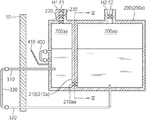
- FIG. 3 is a cross-sectional view schematically illustrating a cooling water storage reservoir of a nuclear reactor building passive cooling system according to the present embodiment
- FIG. 4 is a cross-sectional view illustrating a cooling water storage reservoir of a nuclear reactor building passive cooling system according to the present embodiment taken along line II-II′ of FIG. 1 ;
- FIG. 5 is a graph illustrating changers in an internal pressure and temperature of a nuclear reactor budding according to use of a cooling water storage reservoir of a conventional passive cooling system
- FIG. 6 is a graph illustrating changes in an internal pressure and temperature of a nuclear reactor building according to use of a cooling water storage reservoir of a nuclear reactor building passive cooling system according to the present embodiment
- FIG. 7 is a flowchart illustrating an operation of a nuclear reactor building passive cooling system according to the present embodiment.
- FIG. 8 is a cross-sectional view schematically illustrating a cooling water storage reservoir of a nuclear reactor building passive cooling system according to another embodiment.
- a nuclear reactor building passive cooling system 100 (hereinafter, referred to as a cooling system) according to the present embodiment includes a cooling water storage reservoir 200 .
- the cooling water storage reservoir 200 may be disposed in an upper area of an outer circumference of a nuclear reactor building 10 .
- the cooling water storage reservoir 200 may supply cooling water to the inside of the nuclear reactor building 10 , as needed, and in this case, even if main power of a reactor facility is loss, the cooling water storage reservoir 200 may be disposed in an upper area of the nuclear reactor building 10 so as to supply cooling water by gravity.
- the height of the cooling water storage reservoir 200 may be changed.
- the cooling water storage reservoir 200 may be disposed in the plural, FIG. 2 illustrates an embodiment in which four cooling water storage reservoir 200 are provided, and the number of the cooling water storage reservoir 200 is not limited thereto.
- a first heat exchanger 300 is connected to the cooling water storage reservoir 200 .
- One side of the first heat exchanger 300 is disposed inside the cooling water storage reservoir 200 , and the other side thereof extends into the inside of the nuclear reactor building 10 so that the nuclear reactor building 10 is cooled by cooling water contained in the cooling water storage reservoir 200 .
- the first heat exchanger 300 will be described in more details with reference to the accompanying drawings.
- cooling water contained in the cooling water storage reservoir 200 may be contained while partitioned inside the cooling water storage reservoir 200 .
- the cooling water storage reservoir 200 according to the present embodiment will be described in more details with reference to the accompanying drawings. However, description about elements mentioned above will be omitted, and like reference numerals refer to like elements.
- FIG. 3 is a cross-sectional view schematically illustrating a cooling water storage reservoir of a nuclear reactor building passive cooling system according to the present embodiment
- FIG. 4 is a cross-sectional view illustrating a cooling water storage reservoir of a nuclear reactor building passive cooling system according to the present embodiment taken along line II-II′ of FIG. 3 .
- the cooling water storage reservoir 200 includes a storage tank 200 a .
- the storage tank 200 a may form an outer shape of the cooling water storage reservoir 200 and may be supported to an outer wall of the nuclear reactor building 10 .
- the storage tank 200 a forms a space for receiving cooling water therein and may be provided in a substantially cubic shape, but a shape of the storage tank 200 a is not limited thereto.
- a partition part 210 for partitioning a receiving space of the cooling water is provided at the inside of the storage tank 200 a .
- the partition part 210 may be provided as a partition 210 a .
- the partition 210 a disposed between an upper wall and a lower wall of the storage tank 200 a forms a first storage tank 200 aa adjacent to the nuclear reactor building 10 and a second storage tank 200 ab separated from the first storage tank 200 aa.
- a capacity of the second storage tank 200 ab may be set to be greater than a capacity of the first storage tank 200 aa .
- the capacity of the first storage tank 200 aa may be equal to or less than 50% of the total capacity of the storage tank 200 a.
- the first heat exchanger 300 is connected to the first storage tank 200 aa and the second storage tank 200 ab .
- the first heat exchanger 300 may include a outlet pipe 310 connected to the first storage tank 200 aa , an inlet pipe 320 connected to the second storage tank 200 ab , and a heat exchange unit 330 disposed between the outlet pipe 310 and the inlet pipe 320 . Accordingly, the first heat exchanger 300 may circulate cooling water in the second storage tank 200 ab in a direction toward the first storage tank 200 aa , thereby cooling the nuclear reactor building 10 .
- the present embodiments described an example in which the outlet pipe 310 and the inlet pipe 320 of the first heat exchanger 300 are respectively connected to the first storage tank 200 aa and the second storage tank 200 ab .
- this is merely an example of the present embodiment, and the outlet pipe 310 and the inlet pipe 320 of the first heat exchanger 300 extends to the inside of the first storage tank 200 aa , as shown in FIG. 8 .
- a steam outlet H 1 is formed in an upper wall of the first storage tank 200 aa .
- the steam outlet H 1 enables steam generating by heating cooling water of the first storage tank 200 aa when cooling the nuclear reactor building 10 to be discharged to the outside. Therefore, the storage tank 200 a can be prevented from being broken or damaged due to a change in an internal pressure.
- the water level reduction delay unit 220 may be provided as a moisture separator, and may delay cooling water level reduction in the storage tank 200 a so as to enable passive cooling of the nuclear reactor building 10 for a long time.
- a passive alarm unit 230 may be installed above the water level delay unit 220 .
- the passive alarm unit 230 may give an alarm to perform cooling of the nuclear reactor building 10 .
- the passive alarm unit 230 may generate an alarm or turn on alarm lamp based on vapor flow.
- the passive alarm unit 230 may be provided as a sound alarm device capable of generating noise in response to occurrence of pressure, or as an emergency lamp alarm device configured to turn on an emergency warning lamp by a self power generator such as a propeller which rotates in accordance with vapor flow.
- a self power generator such as a propeller which rotates in accordance with vapor flow.
- the passive alarm unit 230 may be implemented as any of various configurations capable of passively providing an alarm even without power supplied from the outside.
- a pressure regulator H 2 is formed in an upper wall of the second storage tank 200 ab .
- the pressure regulator H 2 maintains an internal pressure of the second storage tank 200 ab to be equal to an external atmospheric pressure irrespective of an internal pressure of the first storage tank 200 aa.
- Filters F 1 and F 1 are mounted in the steam outlet H 1 and the pressure regulator H 2 , respectively.
- the filters F 1 and F 2 prevent harmful substances, for example, radioactive materials that may be entered from the inside of the nuclear reactor building 10 into the storage tank 200 a from being discharged to outer air.
- an inlet connecting the first storage tank 200 aa and the second storage tank 200 ab may be provided in a lower portion of the partition 210 a .
- the inlet may be provided as a unidirectional valve 210 aa .
- the unidirectional valve 210 aa allows cooling water in the side of the second storage tank 200 ab to flow to the side of the first storage tank 200 aa , and prevents cooling water in the first storage tank 200 aa from flowing into the second storage tank 200 ab.
- the unidirectional valve 210 aa may be provided as a floating valve or a check valve, and may be provided as a plurality of unidirectional valves installed on the partition 210 a.
- the unidirectional valve 210 aa forms a path that may enable cooling water received in the second storage tank to enter into the first storage tank 200 aa.
- the first storage tank 200 aa connected to the outlet pipe 310 quickly reaches a saturation temperature. This contributes to stabilization of a heat removal performance of the cooling system 100 and thus a temperature and pressure of the nuclear reactor building 10 are quickly stabilized.
- the reason why a capacity of the first storage tank 200 aa is smaller than that of the second storage tank 200 ab as described above is intended to achieve such an effect.
- the first storage tank 200 aa reaches a saturation temperature, and cooling water received in the first storage tank 200 aa is heated and discharged to the outside through the steam outlet H 1 . Therefore, a water level difference occurs between the first storage tank 200 aa and the second storage tank 200 ab . Therefore, cooling water in the second storage tank 200 ab is entered into the first storage tank 200 aa through the unidirectional valve 210 aa so as to eliminate the water level difference.
- the cooling water storage reservoir 200 constantly maintains a heat removal performance of the cooling system 100 from the beginning of the case of a design basis accident and severe accident to enable a pressure and temperature of the nuclear reactor building 10 to gradually reduce. Therefore, in a conventional cooling system, while a temperature and pressure of the nuclear reactor building 10 decrease, a heat removal performance decreases due to increase of the cooling water temperature and a problem can be solved that the pressure and temperature of the nuclear reactor building 10 is thus re-pressurized and reheated.
- the conventional cooling system and the cooling system 100 according to the present embodiment are compared as follows.
- a conventional cooling system operates with temperature and pressure rise of the nuclear reactor building 10 in the event of a cooling water spill accident.
- the conventional cooling system may reduce a temperature and pressure of the nuclear reactor building 10 .
- cooling system 100 even if cooling water stored in the first storage tank 200 aa is heated, cooling water received in the second storage tank 200 ab is naturally entered into the first storage tank 200 aa according to steam discharged to outside air. Accordingly, as shown in FIG. 6 , a temperature and pressure of the nuclear reactor building 10 are reduced smoothly in the case of a design basis accident and severe accident, and a problem that the temperature and pressure of the nuclear reactor building 10 rise again is resolved.
- the inlet pipe 320 having an orifice mounted thereto may be connected to the second storage tank 200 ab (see FIG. 3 ), and the unidirectional valve 210 aa may be installed to the partition part 210 .
- the unidirectional valve 210 aa may be installed to the partition part 210 .
- a second heat exchanger 400 may be connected to the first storage tank 200 aa .
- An inlet pipe and an outlet pipe of the second heat exchanger 400 extend from the outside of the storage tank 200 a into the first storage tank 200 aa .
- the second heat exchanger 400 cools cooling water of the first storage tank 200 aa through atmosphere.
- the second heat exchanger 400 may be provided as an air-cooled heat exchanger, and may improve cooling performance of the first heat exchanger 300 by cooling the cooling water of the first storage tank 200 aa.
- An air inlet part 410 may be provided. In an outer wall of the storage tank 200 aa .
- the air inlet part 410 may be disposed to surround the second heat exchanger 400 and may be open at the top. In this case, the air inlet part 410 may induce air to flow into the second heat exchanger 400 , thereby improving heat transfer performance of the second heat exchanger 400 that can be provided as an air-cooled heat exchanger.
- the air inlet part 410 is provided for Venturi effect, and may have a shape of a Venturi pipe having an open top, but the shape of the air inlet part 400 is not limited.
- FIG. 7 is a flowchart illustrating an operation of a nuclear reactor building passive cooling system according to the present embodiment.
- the cooling system 100 may be operated in the case of a design basis accident and severe accident (S 100 ).
- S 100 design basis accident and severe accident
- steam and radioactive materials are discharged from inside the nuclear reactor building 10 , thereby increasing a temperature and pressure of an inner space of the nuclear reactor building 10 .
- a time at which cooling water in the first storage tank 200 aa reaches a boiling point becomes shorter than that of a conventional cooling water storage reservoir having the same capacity as that of the cooling water storage reservoir 200 according to the present embodiment. Therefore, the cooling system 100 according to the present embodiment is stabilized through a relatively short transient period.
- cooling water of the first storage tank 200 aa evaporates, cooling water of a low temperature of the second storage tank 200 ab is naturally entered into the first storage tank 200 aa (S 400 ). Accordingly, a heat removal performance of the cooling system 100 is lowered due to increase in a temperature of cooling water stored in the first storage tank 200 aa , thereby solving a problem that a pressure and temperature of the nuclear reactor building 10 are re-pressurized and reheated.
- a cooling water storage reservoir and a nuclear reactor building passive cooling system including the same can quickly stabilize a performance of the nuclear reactor building passive cooling system, thereby preventing performance deterioration of the nuclear reactor building passive cooling system.
- cooling water storage reservoir and the nuclear reactor building passive cooling system including the same can continuously reduce a pressure and temperature of the nuclear reactor building, and thus a secondary accident such as destruction of the nuclear reactor building can be suppressed from occurring.
Landscapes
- Physics & Mathematics (AREA)
- Engineering & Computer Science (AREA)
- Plasma & Fusion (AREA)
- General Engineering & Computer Science (AREA)
- High Energy & Nuclear Physics (AREA)
- Structure Of Emergency Protection For Nuclear Reactors (AREA)
Abstract
Description
Claims (9)
Applications Claiming Priority (5)
| Application Number | Priority Date | Filing Date | Title |
|---|---|---|---|
| KR10-2016-0126859 | 2016-09-30 | ||
| KR1020160126859 | 2016-09-30 | ||
| KR1020160126864A KR101832067B1 (en) | 2016-09-30 | 2016-09-30 | Coolant tank, and containment passive cooling system including the same |
| KR10-2016-0126864 | 2016-09-30 | ||
| PCT/KR2017/010875 WO2018062916A1 (en) | 2016-09-30 | 2017-09-28 | Coolant tank, and passive containment cooling system comprising same |
Publications (2)
| Publication Number | Publication Date |
|---|---|
| US20190237207A1 US20190237207A1 (en) | 2019-08-01 |
| US11081242B2 true US11081242B2 (en) | 2021-08-03 |
Family
ID=61760025
Family Applications (1)
| Application Number | Title | Priority Date | Filing Date |
|---|---|---|---|
| US16/338,247 Active 2038-05-02 US11081242B2 (en) | 2016-09-30 | 2017-09-28 | Coolant tank, and passive containment cooling system comprising same |
Country Status (3)
| Country | Link |
|---|---|
| US (1) | US11081242B2 (en) |
| EP (1) | EP3522175B1 (en) |
| WO (1) | WO2018062916A1 (en) |
Families Citing this family (1)
| Publication number | Priority date | Publication date | Assignee | Title |
|---|---|---|---|---|
| CN116631658A (en) * | 2023-05-19 | 2023-08-22 | 中国核电工程有限公司 | Passive and active safety system and arrangement thereof |
Citations (16)
| Publication number | Priority date | Publication date | Assignee | Title |
|---|---|---|---|---|
| US5295169A (en) * | 1990-10-15 | 1994-03-15 | Hitachi, Ltd. | Reactor containment facilities |
| JPH06242279A (en) | 1993-02-12 | 1994-09-02 | Hitachi Ltd | Reactor containment equipment |
| JPH06258491A (en) | 1993-03-02 | 1994-09-16 | Toshiba Eng Co Ltd | Condensate storage tank water supply facility |
| JPH085772A (en) | 1994-06-17 | 1996-01-12 | Hitachi Ltd | Containment vessel |
| JPH085882A (en) | 1994-06-22 | 1996-01-12 | Olympus Optical Co Ltd | Lens holder |
| US20090116607A1 (en) * | 2004-02-10 | 2009-05-07 | Korea Atomic Energy Research Institute | Passive cooling and arresting device for molten core material |
| KR20120094726A (en) * | 2011-02-17 | 2012-08-27 | 주식회사 티알엑서지 | Cooling and heating system for building |
| JP2012198168A (en) | 2011-03-23 | 2012-10-18 | Toshiba Corp | Reactor container cooling apparatus and reactor building with the reactor container cooling apparatus |
| US20140016734A1 (en) | 2012-07-13 | 2014-01-16 | Korea Atomic Energy Research Institute | Passive safety system of integral reactor |
| KR101528223B1 (en) | 2014-10-01 | 2015-06-12 | 한국원자력연구원 | Passive safety facility and nuclear power plant having the same |
| GB2531840A (en) | 2014-06-04 | 2016-05-04 | China Nuclear Power Eng Co Ltd | In-containment refueling water tank having rinsing function |
| US20160247585A1 (en) | 2013-10-04 | 2016-08-25 | Korea Atomic Energy Research Institute | Passive safety equipment and nuclear power plant including same |
| KR101659864B1 (en) | 2015-05-13 | 2016-09-26 | 한국원자력연구원 | Nuclear power plant |
| US9761333B2 (en) * | 2011-09-08 | 2017-09-12 | Kepco Nuclear Fuel Co., Ltd. | Passive auxiliary condensing apparatus of nuclear power plant |
| US20180233240A1 (en) * | 2014-09-22 | 2018-08-16 | Korea Atomic Energy Research Institute | Nuclear power plant |
| US10319481B2 (en) * | 2013-05-09 | 2019-06-11 | Korea Atomic Energy Research Institute | Passive containment spray system |
-
2017
- 2017-09-28 WO PCT/KR2017/010875 patent/WO2018062916A1/en not_active Ceased
- 2017-09-28 US US16/338,247 patent/US11081242B2/en active Active
- 2017-09-28 EP EP17856802.8A patent/EP3522175B1/en active Active
Patent Citations (17)
| Publication number | Priority date | Publication date | Assignee | Title |
|---|---|---|---|---|
| US5295169A (en) * | 1990-10-15 | 1994-03-15 | Hitachi, Ltd. | Reactor containment facilities |
| JPH06242279A (en) | 1993-02-12 | 1994-09-02 | Hitachi Ltd | Reactor containment equipment |
| JPH06258491A (en) | 1993-03-02 | 1994-09-16 | Toshiba Eng Co Ltd | Condensate storage tank water supply facility |
| JPH085772A (en) | 1994-06-17 | 1996-01-12 | Hitachi Ltd | Containment vessel |
| JPH085882A (en) | 1994-06-22 | 1996-01-12 | Olympus Optical Co Ltd | Lens holder |
| US20090116607A1 (en) * | 2004-02-10 | 2009-05-07 | Korea Atomic Energy Research Institute | Passive cooling and arresting device for molten core material |
| KR20120094726A (en) * | 2011-02-17 | 2012-08-27 | 주식회사 티알엑서지 | Cooling and heating system for building |
| JP2012198168A (en) | 2011-03-23 | 2012-10-18 | Toshiba Corp | Reactor container cooling apparatus and reactor building with the reactor container cooling apparatus |
| US9761333B2 (en) * | 2011-09-08 | 2017-09-12 | Kepco Nuclear Fuel Co., Ltd. | Passive auxiliary condensing apparatus of nuclear power plant |
| US20140016734A1 (en) | 2012-07-13 | 2014-01-16 | Korea Atomic Energy Research Institute | Passive safety system of integral reactor |
| KR101389276B1 (en) | 2012-07-13 | 2014-04-25 | 한국원자력연구원 | Passive Safety System of Integral Reactor |
| US10319481B2 (en) * | 2013-05-09 | 2019-06-11 | Korea Atomic Energy Research Institute | Passive containment spray system |
| US20160247585A1 (en) | 2013-10-04 | 2016-08-25 | Korea Atomic Energy Research Institute | Passive safety equipment and nuclear power plant including same |
| GB2531840A (en) | 2014-06-04 | 2016-05-04 | China Nuclear Power Eng Co Ltd | In-containment refueling water tank having rinsing function |
| US20180233240A1 (en) * | 2014-09-22 | 2018-08-16 | Korea Atomic Energy Research Institute | Nuclear power plant |
| KR101528223B1 (en) | 2014-10-01 | 2015-06-12 | 한국원자력연구원 | Passive safety facility and nuclear power plant having the same |
| KR101659864B1 (en) | 2015-05-13 | 2016-09-26 | 한국원자력연구원 | Nuclear power plant |
Also Published As
| Publication number | Publication date |
|---|---|
| WO2018062916A1 (en) | 2018-04-05 |
| US20190237207A1 (en) | 2019-08-01 |
| EP3522175A1 (en) | 2019-08-07 |
| EP3522175B1 (en) | 2021-03-03 |
| EP3522175A4 (en) | 2020-03-11 |
Similar Documents
| Publication | Publication Date | Title |
|---|---|---|
| KR101832067B1 (en) | Coolant tank, and containment passive cooling system including the same | |
| US10811148B2 (en) | Self-diagnosis and accident-handling unmanned nuclear reactor | |
| KR101659864B1 (en) | Nuclear power plant | |
| KR101594440B1 (en) | Shutdown cooling facility and nuclear power plant having the same | |
| US10319481B2 (en) | Passive containment spray system | |
| KR101535479B1 (en) | Depressurization system of reactor coolant system and nuclear power plant having the same | |
| RU2682901C2 (en) | Floating nuclear power reactor with self-cooling containment structure and emergency heat exchange system | |
| JP2012154644A (en) | Heat transportation device of reactor container and method of the same | |
| KR101374751B1 (en) | Passive decay heat removal system using organoic fluid, method of driving heat removal system | |
| KR101456170B1 (en) | Passive containment air cooling device and system with isolated pressure boundary | |
| US20190237207A1 (en) | Coolant tank, and passive containment cooling system comprising same | |
| US11195632B2 (en) | Cooling water reservoir and nuclear reactor building passive cooling system | |
| JP6203196B2 (en) | Power generation module | |
| JP6307443B2 (en) | Submersible power generation module | |
| US20190252083A1 (en) | Cooling water reservoir and passive cooling system comprising same for reactor containment building | |
| KR101806043B1 (en) | Coolant tank, and containment passive cooling system including the same | |
| KR101790451B1 (en) | Coolant supplying system, and reactor building passive cooling system including the same | |
| KR101677981B1 (en) | Safty system for a nuclear power plant and nuclear power plant having the same | |
| US20200043618A1 (en) | Cooling water storage reservoir and nuclear reactor building passive cooling system comprising same | |
| KR102425224B1 (en) | Coolant tank, and containment passive cooling system including the same | |
| KR101790450B1 (en) | Coolant tank, and nuclear reactor building passive cooling system including the same | |
| EP3492811B1 (en) | Nuclear power plants | |
| KR101805316B1 (en) | Coolant tank, and containment passive cooling system including the same | |
| KR102458247B1 (en) | Passive cooling installation of atomic reactor and passive cooling method thereof | |
| KR101570076B1 (en) | Containment cooling system and nuclear power plant having the same |
Legal Events
| Date | Code | Title | Description |
|---|---|---|---|
| AS | Assignment |
Owner name: KOREA HYDRO & NUCLEAR POWER CO., LTD, KOREA, REPUB Free format text: ASSIGNMENT OF ASSIGNORS INTEREST;ASSIGNORS:LIM, SANG GYU;KIM, DAE HUN;HA, HUI UN;AND OTHERS;REEL/FRAME:048750/0410 Effective date: 20190321 Owner name: KOREA HYDRO & NUCLEAR POWER CO., LTD, KOREA, REPUBLIC OF Free format text: ASSIGNMENT OF ASSIGNORS INTEREST;ASSIGNORS:LIM, SANG GYU;KIM, DAE HUN;HA, HUI UN;AND OTHERS;REEL/FRAME:048750/0410 Effective date: 20190321 |
|
| FEPP | Fee payment procedure |
Free format text: ENTITY STATUS SET TO UNDISCOUNTED (ORIGINAL EVENT CODE: BIG.); ENTITY STATUS OF PATENT OWNER: LARGE ENTITY |
|
| STPP | Information on status: patent application and granting procedure in general |
Free format text: DOCKETED NEW CASE - READY FOR EXAMINATION |
|
| STPP | Information on status: patent application and granting procedure in general |
Free format text: NON FINAL ACTION MAILED |
|
| STPP | Information on status: patent application and granting procedure in general |
Free format text: RESPONSE TO NON-FINAL OFFICE ACTION ENTERED AND FORWARDED TO EXAMINER |
|
| STPP | Information on status: patent application and granting procedure in general |
Free format text: NOTICE OF ALLOWANCE MAILED -- APPLICATION RECEIVED IN OFFICE OF PUBLICATIONS |
|
| STPP | Information on status: patent application and granting procedure in general |
Free format text: PUBLICATIONS -- ISSUE FEE PAYMENT RECEIVED |
|
| STPP | Information on status: patent application and granting procedure in general |
Free format text: PUBLICATIONS -- ISSUE FEE PAYMENT VERIFIED |
|
| STCF | Information on status: patent grant |
Free format text: PATENTED CASE |
|
| MAFP | Maintenance fee payment |
Free format text: PAYMENT OF MAINTENANCE FEE, 4TH YEAR, LARGE ENTITY (ORIGINAL EVENT CODE: M1551); ENTITY STATUS OF PATENT OWNER: LARGE ENTITY Year of fee payment: 4 |