US11075389B2 - Electrode for rechargeable lithium battery, and rechargeable lithium battery including same - Google Patents
Electrode for rechargeable lithium battery, and rechargeable lithium battery including same Download PDFInfo
- Publication number
- US11075389B2 US11075389B2 US16/142,621 US201816142621A US11075389B2 US 11075389 B2 US11075389 B2 US 11075389B2 US 201816142621 A US201816142621 A US 201816142621A US 11075389 B2 US11075389 B2 US 11075389B2
- Authority
- US
- United States
- Prior art keywords
- electrode
- active material
- metal
- lithium battery
- current collector
- Prior art date
- Legal status (The legal status is an assumption and is not a legal conclusion. Google has not performed a legal analysis and makes no representation as to the accuracy of the status listed.)
- Active, expires
Links
Images


Classifications
-
- H—ELECTRICITY
- H01—ELECTRIC ELEMENTS
- H01M—PROCESSES OR MEANS, e.g. BATTERIES, FOR THE DIRECT CONVERSION OF CHEMICAL ENERGY INTO ELECTRICAL ENERGY
- H01M4/00—Electrodes
- H01M4/02—Electrodes composed of, or comprising, active material
- H01M4/13—Electrodes for accumulators with non-aqueous electrolyte, e.g. for lithium-accumulators; Processes of manufacture thereof
-
- H—ELECTRICITY
- H01—ELECTRIC ELEMENTS
- H01M—PROCESSES OR MEANS, e.g. BATTERIES, FOR THE DIRECT CONVERSION OF CHEMICAL ENERGY INTO ELECTRICAL ENERGY
- H01M10/00—Secondary cells; Manufacture thereof
- H01M10/05—Accumulators with non-aqueous electrolyte
- H01M10/052—Li-accumulators
- H01M10/0525—Rocking-chair batteries, i.e. batteries with lithium insertion or intercalation in both electrodes; Lithium-ion batteries
-
- H—ELECTRICITY
- H01—ELECTRIC ELEMENTS
- H01M—PROCESSES OR MEANS, e.g. BATTERIES, FOR THE DIRECT CONVERSION OF CHEMICAL ENERGY INTO ELECTRICAL ENERGY
- H01M4/00—Electrodes
- H01M4/02—Electrodes composed of, or comprising, active material
- H01M4/13—Electrodes for accumulators with non-aqueous electrolyte, e.g. for lithium-accumulators; Processes of manufacture thereof
- H01M4/133—Electrodes based on carbonaceous material, e.g. graphite-intercalation compounds or CFx
-
- H—ELECTRICITY
- H01—ELECTRIC ELEMENTS
- H01M—PROCESSES OR MEANS, e.g. BATTERIES, FOR THE DIRECT CONVERSION OF CHEMICAL ENERGY INTO ELECTRICAL ENERGY
- H01M4/00—Electrodes
- H01M4/02—Electrodes composed of, or comprising, active material
- H01M4/13—Electrodes for accumulators with non-aqueous electrolyte, e.g. for lithium-accumulators; Processes of manufacture thereof
- H01M4/134—Electrodes based on metals, Si or alloys
-
- H—ELECTRICITY
- H01—ELECTRIC ELEMENTS
- H01M—PROCESSES OR MEANS, e.g. BATTERIES, FOR THE DIRECT CONVERSION OF CHEMICAL ENERGY INTO ELECTRICAL ENERGY
- H01M4/00—Electrodes
- H01M4/02—Electrodes composed of, or comprising, active material
- H01M4/36—Selection of substances as active materials, active masses, active liquids
- H01M4/38—Selection of substances as active materials, active masses, active liquids of elements or alloys
- H01M4/386—Silicon or alloys based on silicon
-
- H—ELECTRICITY
- H01—ELECTRIC ELEMENTS
- H01M—PROCESSES OR MEANS, e.g. BATTERIES, FOR THE DIRECT CONVERSION OF CHEMICAL ENERGY INTO ELECTRICAL ENERGY
- H01M4/00—Electrodes
- H01M4/02—Electrodes composed of, or comprising, active material
- H01M4/36—Selection of substances as active materials, active masses, active liquids
- H01M4/38—Selection of substances as active materials, active masses, active liquids of elements or alloys
- H01M4/387—Tin or alloys based on tin
-
- H—ELECTRICITY
- H01—ELECTRIC ELEMENTS
- H01M—PROCESSES OR MEANS, e.g. BATTERIES, FOR THE DIRECT CONVERSION OF CHEMICAL ENERGY INTO ELECTRICAL ENERGY
- H01M4/00—Electrodes
- H01M4/02—Electrodes composed of, or comprising, active material
- H01M4/36—Selection of substances as active materials, active masses, active liquids
- H01M4/48—Selection of substances as active materials, active masses, active liquids of inorganic oxides or hydroxides
- H01M4/485—Selection of substances as active materials, active masses, active liquids of inorganic oxides or hydroxides of mixed oxides or hydroxides for inserting or intercalating light metals, e.g. LiTi2O4 or LiTi2OxFy
-
- H—ELECTRICITY
- H01—ELECTRIC ELEMENTS
- H01M—PROCESSES OR MEANS, e.g. BATTERIES, FOR THE DIRECT CONVERSION OF CHEMICAL ENERGY INTO ELECTRICAL ENERGY
- H01M4/00—Electrodes
- H01M4/02—Electrodes composed of, or comprising, active material
- H01M4/36—Selection of substances as active materials, active masses, active liquids
- H01M4/58—Selection of substances as active materials, active masses, active liquids of inorganic compounds other than oxides or hydroxides, e.g. sulfides, selenides, tellurides, halogenides or LiCoFy; of polyanionic structures, e.g. phosphates, silicates or borates
- H01M4/583—Carbonaceous material, e.g. graphite-intercalation compounds or CFx
- H01M4/587—Carbonaceous material, e.g. graphite-intercalation compounds or CFx for inserting or intercalating light metals
-
- H—ELECTRICITY
- H01—ELECTRIC ELEMENTS
- H01M—PROCESSES OR MEANS, e.g. BATTERIES, FOR THE DIRECT CONVERSION OF CHEMICAL ENERGY INTO ELECTRICAL ENERGY
- H01M4/00—Electrodes
- H01M4/02—Electrodes composed of, or comprising, active material
- H01M4/64—Carriers or collectors
- H01M4/66—Selection of materials
- H01M4/661—Metal or alloys, e.g. alloy coatings
-
- H—ELECTRICITY
- H01—ELECTRIC ELEMENTS
- H01M—PROCESSES OR MEANS, e.g. BATTERIES, FOR THE DIRECT CONVERSION OF CHEMICAL ENERGY INTO ELECTRICAL ENERGY
- H01M4/00—Electrodes
- H01M4/02—Electrodes composed of, or comprising, active material
- H01M4/64—Carriers or collectors
- H01M4/70—Carriers or collectors characterised by shape or form
- H01M4/80—Porous plates, e.g. sintered carriers
- H01M4/808—Foamed, spongy materials
-
- H—ELECTRICITY
- H01—ELECTRIC ELEMENTS
- H01M—PROCESSES OR MEANS, e.g. BATTERIES, FOR THE DIRECT CONVERSION OF CHEMICAL ENERGY INTO ELECTRICAL ENERGY
- H01M4/00—Electrodes
- H01M4/02—Electrodes composed of, or comprising, active material
- H01M2004/026—Electrodes composed of, or comprising, active material characterised by the polarity
- H01M2004/027—Negative electrodes
-
- Y—GENERAL TAGGING OF NEW TECHNOLOGICAL DEVELOPMENTS; GENERAL TAGGING OF CROSS-SECTIONAL TECHNOLOGIES SPANNING OVER SEVERAL SECTIONS OF THE IPC; TECHNICAL SUBJECTS COVERED BY FORMER USPC CROSS-REFERENCE ART COLLECTIONS [XRACs] AND DIGESTS
- Y02—TECHNOLOGIES OR APPLICATIONS FOR MITIGATION OR ADAPTATION AGAINST CLIMATE CHANGE
- Y02E—REDUCTION OF GREENHOUSE GAS [GHG] EMISSIONS, RELATED TO ENERGY GENERATION, TRANSMISSION OR DISTRIBUTION
- Y02E60/00—Enabling technologies; Technologies with a potential or indirect contribution to GHG emissions mitigation
- Y02E60/10—Energy storage using batteries
Definitions
- Embodiments relate to an electrode for a rechargeable lithium battery and a rechargeable lithium battery including the same.
- a rechargeable lithium battery has recently drawn attention as a power source for small portable electronic devices.
- the rechargeable lithium battery uses an organic electrolyte solution and thereby may have a discharge voltage that is twice or more higher than a conventional battery using an alkali aqueous solution and accordingly, may have a higher energy density.
- a lithium-transition metal oxide having a structure capable of intercalating lithium ions such as LiCoO 2 , LiMn 2 O 4 , LiNi 1 ⁇ x Co x O 2 (0 ⁇ x ⁇ 1), and the like has been used.
- negative active materials various carbon-based materials such as artificial graphite, natural graphite, hard carbon and the like have been used. Recently, a non-carbon-based negative active material based on silicon or tin has been researched in order to obtain more higher capacity.
- Embodiments are directed to an electrode for a rechargeable lithium battery, including a metal-containing foam current collector, and an active mass that fills in the metal-containing foam current collector, the active mass including an active material.
- the electrode includes a central region and a surface region. The central region corresponds to a ⁇ 5% upper and lower area with a reference to a central thickness line of the electrode. A volume ratio of the metal and the active material in the central region is different from a volume ratio of the metal and the active material in the surface region.
- the volume ratio of the metal and the active material in the central region may range from about 90:10 to less than 100:greater than 0.
- the volume ratio of the metal and the active material in the surface region may range from about 5:95 to about 20:80.
- the active material may be present with a concentration gradient such that a concentration increases from the central region to the surface region.
- the surface region may include an outermost surface region corresponding to a depth of about 10% from the outermost surface in a direction contacting the central region.
- the volume ratio of the metal and the active material may range from about 10:90 to about 1:99.
- the active material may be present at uniform concentration in the surface region.
- the electrode further may further include an active mass layer on the surface region.
- the active mass layer may include an active material.
- the electrode may be a negative electrode.
- the metal-containing foam current collector may be a Cu-containing foam current collector.
- the active material may be a Si-based material, a Sn-based material, or a combination thereof.
- Embodiments are also directed to a rechargeable lithium battery including a first electrode, wherein the first electrode is the electrode as described above, a second electrode, and an electrolyte.
- the first electrode may be a negative electrode and the second electrode may be a positive electrode.
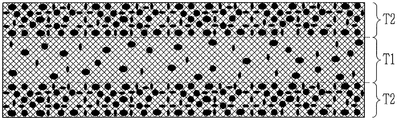
- FIG. 1 illustrates a schematic cross-sectional view showing a structure of an electrode according to an embodiment.
- FIG. 2 illustrates a schematic cross-sectional view showing a structure of an electrode according to an embodiment.
- FIG. 3 illustrates a schematic view showing a structure of a rechargeable lithium battery according to an embodiment.
- FIG. 4 illustrates a graph showing charge rate capabilities of half-cells including the positive electrodes according to Example 1 and Comparative Examples 1 to 2.
- An electrode for a rechargeable lithium battery may include a metal-containing foam current collector and an active mass including an active material filling the metal-containing foam current collector, wherein the electrode includes a central region and a surface region.
- the foam current collector may be a current collector having a three-dimensional reticular structure including a metal fiber.
- the central region and the surface region may respectively correspond to areas T 1 and T 2 shown in FIGS. 1 and 2 .
- the central region may correspond to +5% upper and lower areas with a reference to a central thickness line of the electrode.
- the central region may be the middle 10% in a thickness direction of the electrode (i.e., 5% of the thickness in each direction from the central thickness line), relative to a total thickness of the electrode.
- dots indicate active materials.
- the volume ratio of the metal and the active material may be about 90:10 to less than 100:greater than 0 in the central region.
- the volume ratio of the metal and the active material may be about 90:10 to about 95:5 in the central region.
- This volume ratio may be obtained by preparing a cross section specimen of the electrode, mapping the active material and the metal with an SEM-EDX instrument to obtain areas of the active material and the metal, and using the areas to calculate a ratio of the active material and the metal.
- Metal fibers may be substantially uniformly formed in the foam current collector, such that the ratio of the metal/the active material from the cross section may be assumed as an entire volume ratio.
- the volume ratio of the metal and the active material When the volume ratio of the metal and the active material is included within the ranges in the central region, the amount of metal may be sufficient to prevent the metal fibers from being broken by an active material during the compression of an electrode. Accordingly, a conductive path for fast transferring of a current may be secured. An electrode having excellent charge rate capability and excellent electron conductivity may be obtained.
- the volume ratio is out of the range, that is, less than about 90, the charge rate capability may be deteriorated, the current transfer capability may be gradually deteriorated as cycles are repeated, even though a charge rate (C-rate) is not much increased, and accordingly, a cycle-life degradation speed may be accelerated due to an occurrence of a side-reaction or the like.
- the electrode according to an embodiment may be the most effectively applied to an electrode using a Si-based or Sn-based negative active material that is generally severely volume-expanded during the charge and discharge.
- the volume ratio of the metal and the active material may be about 5:95 to about 20:80, or, for example, about 10:90 to about 20:80, or, for example about 10:90 to about 15:85.
- the active material may be constantly, or, for example, uniformly present in the surface region as shown in FIG. 1 .
- the active material may be present with a concentration gradient in which a concentration of the active material increases from the central region to the surface region, as shown in FIG. 2 .
- the surface region may include an outermost surface region corresponding to a depth of about 10% from the outermost surface in a direction contacting the central region. In the outermost surface region, a volume ratio of the metal and the active material may range from about 10:90 to about 1:99.
- the active material may be present at a uniform concentration in the surface region.
- the electrode according to an embodiment has different volumes of the active material in the central region and the surface region of the foam current collector, for example, when the metal is present in a higher volume in the central region, metal fibers may not be broken but may be well maintained during compression in an electrode manufacturing process. Accordingly, the capacity as well as the battery performance may be effectively maintained.
- the foam current collector may transfer a current as fast as does a foil-shaped current collector not charged with an active material inside a central region. Accordingly, excellent output characteristics may be obtained.
- the active material were to be present in the same volume in both the central region and the surface region of the foam current collector or in a higher volume in the central region, metal fibers could broken by the active material during the compression in the manufacture of the electrode, and a conductive path could be short-circuited. Accordingly, battery performance or battery capacity could be deteriorated, and resultantly, output characteristics could be deteriorated.
- the active mass may further include a binder along with the active material, and, optionally, a conductive material.
- the electrode may further include an active mass layer formed on the surface part and including an active material
- the active mass layer may further include a binder along with the active material, and optionally a conductive material.
- the electrode may be manufactured by coating an active mass composition including an active material, a binder, a conductive material, and a solvent and having viscosity of about 1500 cP to about 3000 cP onto the metal-containing foam current collector and compressing the active mass composition.
- the active mass composition When the active mass composition has a viscosity within the range, the active mass composition may have a high viscosity that inhibits permeating into the central region of the current collector. Accordingly, the active mass composition may be mostly present in the surface region, while permeated in a small amount into the central region.
- the surface region of the current collector When a finally manufactured electrode is examined, the surface region of the current collector may be highly charged with the active material, but the central region may be charged with at most about 10 volume % of the active material and thus with at least about 90 volume % of a metal.
- an electrode having the active material uniformly present in the surface region may be manufactured as shown in FIG. 1 .
- the active mass composition could permeate easily into the central region of the current collector and to be almost equally present in the central region and the surface region. Accordingly, metal fibers could be broken by the active material after compression, and resultantly, there could be a decrease of battery performance due to a conductive path short circuit, a decrease in battery capacity, and a deterioration of output characteristics.
- the active mass composition were to have a viscosity higher than about 3000 cP, the active material may be permeated in an appropriate level into the surface region of the foam type current collector, but might not be easily permeated among pores in the central region to fabricate an electrode. Accordingly, the electrode may be difficult to manufacture.
- the electrode may be manufactured by primarily coating an active mass composition including an active material, a binder, a conductive material, and a solvent and having high viscosity of about 2500 cP to about 3000 cP onto the metal-containing foam current collector and compressing the active mass composition, and then, secondarily coating another active mass composition having low viscosity of about 1500 cP to about 2500 cP and compressing the secondary coating.
- the active material when active mass compositions having different viscosities are used, the active material may be present with a concentration gradient in which a concentration of the active material increases from the central region to the surface region, as shown in FIG. 2 .
- the compression may be performed with a pressure of about 150 kg/cm 2 to about 250 kg/cm 2 .
- the electrode compression may be effectively performed. If the compression were to be performed with a lower pressure than the range, the electrode might not be well compressed. If the compression were to be performed with a higher pressure than the range, the electrode could be severely pushed down. If the active material were to be pushed down, metal fibers surrounding the active material could be broken, and thus a conductive path could be broken.
- the coating method may be blade coating.
- the solvent may be N-methylpyrrolidone or water.
- the solvent may be appropriately selected therefrom depending on whether the binder is a non-aqueous binder or an aqueous binder.
- the electrode may be a positive electrode or a negative electrode. In another embodiment, the electrode may be a negative electrode.
- the current collector When the electrode is a positive electrode, the current collector may be an Al-containing foam current collector, for example, a foam current collector made of Al. When the electrode is a negative electrode, the current collector may be a Cu-containing foam current collector, for example, a foam current collector made of Cu.
- the active material may be a positive active material.
- the positive active material may include a compound (lithiated intercalation compound) being capable of intercalating and deintercalating lithium.
- a compound lithiumated intercalation compound
- one or more composite oxides of a metal selected from cobalt, manganese, nickel, and a combination thereof, and lithium may be used. More specific examples may be compounds represented by one of the following chemical formulae.
- Li a A 1 ⁇ b X b D 2 (0.90 ⁇ a ⁇ 1.8, 0 ⁇ b ⁇ 0.5); Li a A 1 ⁇ b X b O 2 ⁇ c D c (0.90 ⁇ a ⁇ 1.8, 0 ⁇ b ⁇ 0.5, 0 ⁇ c ⁇ 0.05); Li a E 1 ⁇ b X b O 2 ⁇ c D c (0.90 ⁇ a ⁇ 1.8, 0 ⁇ b ⁇ 0.5, 0 ⁇ c ⁇ 0.05); Li a E 2 ⁇ b X b O 4 ⁇ c D c (0.90 ⁇ a ⁇ 1.8, 0 ⁇ b ⁇ 0.5, 0 ⁇ c ⁇ 0.05); Li a Ni 1 ⁇ b ⁇ c Co b X c D ⁇ (0.90 ⁇ a ⁇ 1.8, 0 ⁇ b ⁇ 0.5, 0 ⁇ c ⁇ 0.5, 0 ⁇ 2); Li a Ni 1 ⁇ b ⁇ c Co b X c O 2 ⁇ T ⁇ (0.90 ⁇ a ⁇ 1.8, 0 ⁇ b ⁇ 0.5, 0 ⁇ c ⁇ 0.05, 0 ⁇ 2); Li a Ni 1 ⁇ b ⁇ c Co
- A is selected from Ni, Co, Mn, and a combination thereof;
- X is selected from Al, Ni, Co, Mn, Cr, Fe, Mg. Sr, V, a rare earth element, and a combination thereof;
- D is selected from O, F, S, P, and a combination thereof;
- E is selected from Co, Mn, and a combination thereof, T is selected from F, S, P, and a combination thereof;
- G is selected from Al, Cr, Mn, Fe. Mg, La, Ce, Sr, V, and a combination thereof;
- Q is selected from Ti, Mo. Mn, and a combination thereof;
- Z is selected from Cr, V, Fe, Sc, Y, and a combination thereof;
- J is selected from V, Cr, Mn, Co, Ni, Cu, and a combination thereof.
- the compounds may have a coating layer on the surface thereof, or may be mixed with another compound having a coating layer.
- the coating layer may include at least one coating element compound selected from an oxide of a coating element, a hydroxide of a coating element, an oxyhydroxide of a coating element, an oxycarbonate of a coating element, and a hydroxyl carbonate of a coating element.
- the compound for the coating layer may be amorphous or crystalline.
- the coating element included in the coating layer may include Mg, Al, Co, K, Na, Ca, Si, Ti, V, Sn, Ge, Ga, B, As, Zr, or a mixture thereof.
- the coating layer may be disposed using a method that has no adverse influence on properties of a positive active material, by using these elements in the compound.
- the method may include a suitable coating method such as spray coating, dipping, or the like.
- the active material may be a negative active material.
- the negative active material may be a material that reversibly intercalates/deintercalates lithium ions, a lithium metal, a lithium metal alloy, a material being capable of doping/dedoping lithium, or a transition metal oxide.
- the material that can reversibly intercalate/deintercalate lithium ions may be or include a carbon material.
- the carbon material may be any generally-used carbon-based negative active material in a rechargeable lithium battery.
- Examples of the carbon-based negative active material may include crystalline carbon, amorphous carbon, or mixtures thereof.
- the crystalline carbon may be non-shaped, or sheet, flake, spherical, or fiber shaped natural graphite or artificial graphite.
- the amorphous carbon may be a soft carbon, a hard carbon, a mesophase pitch carbonization product, fired coke, and the like.
- the lithium metal alloy may include an alloy of lithium and a metal selected from Na, K, Rb, Cs, Fr, Be, Mg, Ca, Sr, Si, Sb, Pb, In, Zn, Ba, Ra, Ge, Al, and Sn.
- the material being capable of doping/dedoping lithium may be a silicon-based material, for example, Si, SiO x (0 ⁇ x ⁇ 2), a Si-Q′ alloy (wherein Q′ is an element selected from an alkali metal, an alkaline-earth metal, a Group 13 element, a Group 14 element, a Group 15 element, a Group 16 element, a transition metal, a rare earth element, and a combination thereof, but not Si), a Si-carbon composite, Sn, SnO 2 , Sn—R (wherein R is an element selected from an alkali metal, an alkaline-earth metal, a Group 13 element, a Group 14 element, a Group 15 element, a Group 16 element, a transition metal, a rare earth element, and a combination thereof, but not Sn), a Sn-carbon composite, and the like.
- the elements Q′ and R may be selected from Mg, Ca, Sr, Ba, Ra, Sc, Y, Ti, Zr, Hf, Rf, V, Nb, Ta, Db, Cr, Mo, W, Sg, Tc, Re, Bh, Fe, Pb, Ru, Os, Hs, Rh, Ir, Pd, Pt, Cu, Ag, Au, Zn, Cd, B, Al, Ga, Sn, In, Ge, P, As, Sb, Bi, S, Se, Te, Po, and a combination thereof.
- the transition metal oxide may include lithium titanium oxide.
- the negative active material may be a Si-based active material, a Sn-based active material, or a combination thereof.
- the negative active material may have an excessive volume expansion during the charge and discharge, but a negative electrode according to an embodiment may effectively absorb an expanded volume of the active material and resultantly, the negative active material may be prevented from the volume expansion, since the active material is less present in the central region having a three-dimensional reticular structure.
- the active mass may include a positive active material, a binder, and a conductive material.
- the content of the positive active material may be about 90 wt % to about 98 wt % based on the total weight of the active mass.
- each content of the binder and conductive material may be about 1 wt % to about 5 wt % based on the total weight of the active mass.
- the binder may improve binding properties of positive active material particles with one another and with a current collector.
- the binder may be polyvinyl alcohol, carboxymethyl cellulose, hydroxypropyl cellulose, diacetyl cellulose, polyvinylchloride, carboxylated polyvinylchloride, polyvinylfluoride, an ethylene oxide-containing polymer, polyvinylpyrrolidone, polyurethane, polytetrafluoroethylene, polyvinylidene fluoride, polyethylene, polypropylene, a styrene-butadiene rubber, an acrylated styrene-butadiene rubber, an epoxy resin, nylon, or the like.
- the conductive material may be included to provide electrode conductivity.
- a suitable electrically conductive material that does not cause a chemical change may be used as the conductive material.
- the conductive material may be or include a carbon-based material such as natural graphite, artificial graphite, carbon black, acetylene black, ketjen black, a carbon fiber, or the like; a metal-based material of a metal powder or a metal fiber including copper, nickel, aluminum silver, or the like; a conductive polymer such as a polyphenylene derivative, or the like, or a mixture thereof.
- the active mass may include a negative active material, a binder, and, optionally, a conductive material.
- the content of the negative active material may be about 95 wt % to about 99 wt % based on the total weight of the active mass.
- the content of the binder in the active mass may be about 1 wt % to about 5 wt % based on the total weight of the active mass.
- the negative electrode when the negative electrode further includes the conductive material, the negative electrode may include about 90 wt % to about 98 wt % of the negative active material, about 1 wt % to about 5 wt % of the binder, and about 1 wt % to about 5 wt % of the conductive material. These amounts are the same as those of the negative active material, the binder, and the conductive material in an active mass composition except for the solvent during manufacture of the electrode.
- the binder may improve binding properties of negative active material particles with one another and with a current collector.
- the binder may include a non-water-soluble binder, a water-soluble binder, or a combination thereof.
- the non-water-soluble binder may be polyvinylchloride, carboxylated polyvinylchloride, polyvinylfluoride, an ethylene oxide-containing polymer, polyvinylpyrrolidone, polyurethane, polytetrafluoroethylene, polyvinylidene fluoride, polyethylene, polypropylene, polyamideimide, polyimide or a combination thereof.
- the water-soluble binder may be a styrene-butadiene rubber, an acrylated styrene-butadiene rubber (SBR), an acrylonitrile-butadiene rubber, an acrylic rubber, a butyl rubber, a fluorine rubber, an ethylene propylene copolymer, polyepichlorohydrine, polyphosphazene, polyacrylonitrile, polystyrene, an ethylene propylene diene copolymer, polyvinylpyridine, chlorosulfonated polyethylene, latex, a polyester resin, an acrylic resin, a phenolic resin, an epoxy resin, polyvinyl alcohol, or a combination thereof.
- SBR acrylated styrene-butadiene rubber
- an acrylonitrile-butadiene rubber an acrylic rubber, a butyl rubber, a fluorine rubber, an ethylene propylene copolymer, polyepichlorohydrine, polyphos
- a cellulose-based compound may be further used to provide viscosity as a thickener.
- the cellulose-based compound includes one or more of carboxymethyl cellulose, hydroxypropylmethyl cellulose, methyl cellulose, or alkali metal salts thereof.
- the alkali metal may be Na, K, or Li.
- the thickener may be included in an amount of about 0.1 parts by weight to about 3 parts by weight based on 100 parts by weight of the negative active material.
- the conductive material may be included to provide electrode conductivity.
- a suitable electrically conductive material that does not cause a chemical change may be used as the conductive material.
- the conductive material may include a carbon-based material such as natural graphite, artificial graphite, carbon black, acetylene black, ketjen black, a carbon fiber, or the like; a metal-based material of a metal powder or a metal fiber including copper, nickel, aluminum silver, or the like; a conductive polymer such as a polyphenylene derivative, or the like, or a mixture thereof.
- a rechargeable lithium battery may include a first electrode, a second electrode, and an electrolyte.
- the first electrode may be a negative electrode and the second electrode may be a positive electrode or the first electrode may be a positive electrode and the second electrode may be a negative electrode.
- the first electrode is a negative electrode and the second electrode is a positive electrode.
- the electrolyte may include a non-aqueous organic solvent and a lithium salt.
- the non-aqueous organic solvent may serve as a medium for transmitting ions taking part in the electrochemical reaction of a battery.
- the non-aqueous organic solvent may serve as a medium for transmitting ions taking part in the electrochemical reaction of a battery.
- the carbonate-based solvent may include dimethyl carbonate (DMC), diethyl carbonate (DEC), dipropyl carbonate (DPC), methylpropyl carbonate (MPC), ethylpropyl carbonate (EPC), methylethyl carbonate (MEC), ethylene carbonate (EC), propylene carbonate (PC), butylene carbonate (BC), and the like.
- the ester-based solvent may include methyl acetate, ethyl acetate, n-propyl acetate, dimethylacetate, methyl propionate, ethyl propionate, propyl propionate, decanolide, mevalonolactone, caprolactone, or the like.
- the ether-based solvent may include dibutyl ether, tetraglyme, diglyme, dimethoxyethane, 2-methyltetrahydrofuran, tetrahydrofuran, or the like.
- the ketone-based solvent includes cyclohexanone, or the like.
- the alcohol-based solvent may include ethyl alcohol, isopropyl alcohol, or the like.
- aprotic solvent may include nitriles such as R—CN (where R is a C2 to C20 linear, branched, or cyclic hydrocarbon or may include, a double bond, an aromatic ring, or an ether bond), amides such as dimethylformamide, dioxolanes such as 1,3-dioxolane, sulfolanes, or the like.
- R—CN where R is a C2 to C20 linear, branched, or cyclic hydrocarbon or may include, a double bond, an aromatic ring, or an ether bond
- amides such as dimethylformamide
- dioxolanes such as 1,3-dioxolane, sulfolanes, or the like.
- the organic solvent may be used singularly or in a mixture.
- the mixture ratio may be controlled in accordance with a desirable battery performance.
- the carbonate-based solvent may include a mixture with a cyclic carbonate and a linear carbonate.
- the cyclic carbonate and linear carbonate may be mixed together in a volume ratio of about 1:1 to about 1:9.
- the electrolyte may have enhanced performance.
- the organic solvent may further include an aromatic hydrocarbon-based solvent as well as the carbonate-based solvent.
- the carbonate-based solvent and aromatic hydrocarbon-based solvent may be mixed together in a volume ratio of about 1:1 to about 30:1.
- the aromatic hydrocarbon-based organic solvent may be an aromatic hydrocarbon-based compound represented by Chemical Formula 1.
- R 1 to R 6 may be the same or different and may be selected from hydrogen, a halogen, a C1 to C10 alkyl group, a haloalkyl group, and a combination thereof.
- aromatic hydrocarbon-based organic solvent may be selected from benzene, fluorobenzene, 1,2-difluorobenzene, 1,3-difluorobenzene, 1,4-difluorobenzene, 1,2,3-trifluorobenzene, 1,2,4-trifluorobenzene, chlorobenzene, 1,2-dichlorobenzene, 1,3-dichlorobenzene, 1,4-dichlorobenzene, 1,2,3-trichlorobenzene, 1,2,4-trichlorobenzene, iodobenzene, 1,2-diiodobenzene, 1,3-diiodobenzene, 1,4-diiodobenzene, 1,2,3-triiodobenzene, 1,2,4-triiodobenzene, toluene, fluorotoluene, 2,3-difluorotoluene, 2,4-di
- the electrolyte may further include an additive of vinylene carbonate, an ethylene carbonate-based compound represented by Chemical Formula 2, or propane sultone to improve a cycle life.
- R 7 and R 8 may be the same or different, and may be selected from hydrogen, a halogen, a cyano group (CN), a nitro group (NO 2 ), and a fluorinated C1 to C5 alkyl group, provided that at least one of R 7 and R 8 is selected from a halogen, a cyano group (CN), a nitro group (NO 2 ), and a fluorinated C1 to C5 alkyl group, wherein both of R 7 and R 8 are not hydrogen.
- Examples of the ethylene carbonate-based compound may be difluoro ethylenecarbonate, chloroethylene carbonate, dichloroethylene carbonate, bromoethylene carbonate, dibromoethylene carbonate, nitroethylene carbonate, cyanoethylene carbonate, or fluoroethylene carbonate.
- the amount of the additive for improving cycle life may be flexibly used within an appropriate range.
- the electrolyte may further include vinylethylene carbonate, propane sultone, succinonitrile, or a combination thereof.
- the use amount thereof may be adjusted within an appropriate range.
- the lithium salt dissolved in an organic solvent supplies a battery with lithium ions, basically operates the rechargeable lithium battery, and improves transportation of the lithium ions between positive and negative electrodes.
- the lithium salt may include at least one supporting salt selected from LiPF 6 , LiBF 4 , LiSbF 6 , LiAsF 6 , LiN(SO 2 C 2 F 5 ) 2 , Li(CF 3 SO 2 ) 2 N, LiN(SO 3 C 2 F 5 ) 2 , LiC 4 F 9 SO 3 , LiClO 4 , LiAlO 2 , LiAlCl 4 , LiN(C x F 2x+1 SO 2 )(C y F 2y+1 SO 2 ) (where x and y are natural numbers, for example integers of 1 to 20), LiCl, LiI, and LiB(C 2 O 4 ) 2 (lithium bis(oxalato) borate; LiBOB).
- a concentration of the lithium salt may range from about 0.1 M to about 2.0 M.
- LiBF 4 may be used as an additive. The use amount thereof may be adjusted within an appropriate range.
- the rechargeable lithium battery may further include a separator between the negative electrode and the positive electrode, depending on a kind of the battery.
- a suitable separator material include polyethylene, polypropylene, polyvinylidene fluoride, and multi-layers thereof such as a polyethylene/polypropylene double-layered separator, a polyethylene/polypropylene/polyethylene triple-layered separator, and a polypropylene/polyethylene/polypropylene triple-layered separator.
- FIG. 3 illustrates an exploded perspective view of a rechargeable lithium battery according to an embodiment.
- the rechargeable lithium battery may include variously-shaped batteries such as a cylindrical battery, a pouch battery, or the like.
- the rechargeable lithium battery may be a prismatic battery as illustrated in FIG. 3 .
- a rechargeable lithium battery 100 includes an electrode assembly 40 manufactured by winding a separator 30 interposed between a positive electrode 10 and a negative electrode 20 , and a case 50 housing the electrode assembly 40 .
- An electrolyte may be impregnated in the positive electrode 10 , the negative electrode 20 , and the separator 30 .
- a negative active material slurry having a viscosity of 3000 cP 97 wt % of an artificial graphite negative active material, 1 wt % of a carboxymethyl cellulose (CMC) thickener, and 2 wt % of a styrene-butadiene rubber binder (SBR) were mixed in a deionized water solvent to prepare a negative active material slurry having a viscosity of 3000 cP.
- CMC carboxymethyl cellulose
- SBR styrene-butadiene rubber binder
- the negative active material slurry was blade-coated onto a Cu foam current collector and compressed with a pressure of 250 kg/cm 2 to manufacture a negative electrode including a Cu foam current collector having a central region and a surface region, and an active mass charged in the central region and the surface region.
- the central region corresponded to ⁇ 5% of upper and lower areas with a reference to a central thickness line of the negative electrode.
- the cross section of the negative electrode when a volume ratio of Cu and an active material in the central region of the Cu foam current collector was measured by mapping the active material and the metal with an SEM-EDX instrument, the result was 90:10 volume %, and when a volume ratio of Cu and an active material was measured in the surface region, the result was 10:90 volume %. In addition, in the surface region, the active material was present in the same concentration as in the central region.
- a negative active material slurry having viscosity of 400 cP 97 wt % of an artificial graphite negative active material, 1 wt % of a carboxymethyl cellulose thickener (CMC), and 2 wt % of a styrene-butadiene rubber binder (SBR) were mixed in a deionized water solvent to prepare a negative active material slurry having viscosity of 400 cP.
- CMC carboxymethyl cellulose thickener
- SBR styrene-butadiene rubber binder
- the negative active material slurry was used according to the same method as Example 1 to manufacture a negative electrode including a Cu foam current collector having a central region and a surface region and an active mass charged in the central region and the surface region.
- a negative active material slurry having viscosity of 1000 cP was used according to the same method as Example 1 to manufacture a negative electrode including a Cu foam current collector having a central region and a surface region and an active mass charged in the central region and the surface region.
- CMC carboxymethyl cellulose thickener
- SBR styrene-butadiene rubber binder
- each negative electrode according to Example 1 and Comparative Examples 1 to 2 a lithium metal counter electrode, and an electrolyte solution were used to manufacture a half-cell.
- the half-cell was respectively once charged and discharged at 0.2 C, 1 C, 2 C, and 3 C, and its charge capacity was measured.
- the obtained charge capacity was used to calculate a capacity ratio based on charge capacity at 0.2 C, and the results are shown in FIG. 4 .
- Example 1 showed the most excellent charge capacity ratio compared with the half-cells according to the half-cells according to Comparative Examples 1 and 2.
- a lithium-transition metal oxide having a structure capable of intercalating lithium ions such as LiCoO 2 , LiMn 2 O 4 , LiNi 1 ⁇ x Co x O 2 (0 ⁇ x ⁇ 1), and the like have been used.
- negative active materials various carbon-based materials such as artificial graphite, natural graphite, hard carbon and the like have been used. Recently, a non-carbon-based negative active material based on silicon or tin has been researched in order to obtain more higher capacity.
- Embodiments provide an electrode for a rechargeable lithium battery having improved safety and output characteristics.
Landscapes
- Chemical & Material Sciences (AREA)
- Chemical Kinetics & Catalysis (AREA)
- Electrochemistry (AREA)
- General Chemical & Material Sciences (AREA)
- Engineering & Computer Science (AREA)
- Materials Engineering (AREA)
- Inorganic Chemistry (AREA)
- Manufacturing & Machinery (AREA)
- Secondary Cells (AREA)
- Battery Electrode And Active Subsutance (AREA)
Abstract
Description


Claims (7)
Applications Claiming Priority (2)
| Application Number | Priority Date | Filing Date | Title |
|---|---|---|---|
| KR10-2017-0147472 | 2017-11-07 | ||
| KR1020170147472A KR102570117B1 (en) | 2017-11-07 | 2017-11-07 | Electrode for rechargeable lithium battery, and rechargeable lithium battery including same |
Publications (2)
| Publication Number | Publication Date |
|---|---|
| US20190140286A1 US20190140286A1 (en) | 2019-05-09 |
| US11075389B2 true US11075389B2 (en) | 2021-07-27 |
Family
ID=66328907
Family Applications (1)
| Application Number | Title | Priority Date | Filing Date |
|---|---|---|---|
| US16/142,621 Active 2039-04-11 US11075389B2 (en) | 2017-11-07 | 2018-09-26 | Electrode for rechargeable lithium battery, and rechargeable lithium battery including same |
Country Status (2)
| Country | Link |
|---|---|
| US (1) | US11075389B2 (en) |
| KR (1) | KR102570117B1 (en) |
Families Citing this family (1)
| Publication number | Priority date | Publication date | Assignee | Title |
|---|---|---|---|---|
| KR102459358B1 (en) * | 2020-08-13 | 2022-10-28 | 한국과학기술원 | Porous composite electrode having ratio gradient of active material/current-collecting material by three-dimensional nanostructure, method for manufacturing electrode and secondary battery including the electrode |
Citations (11)
| Publication number | Priority date | Publication date | Assignee | Title |
|---|---|---|---|---|
| US4251603A (en) * | 1980-02-13 | 1981-02-17 | Matsushita Electric Industrial Co., Ltd. | Battery electrode |
| US6902846B2 (en) * | 2000-12-12 | 2005-06-07 | Matsushita Electric Industrial Co., Ltd. | Positive electrode plate for alkaline storage battery and method for manufacturing the same, and alkaline storage battery using the same |
| KR20120111508A (en) | 2011-04-01 | 2012-10-10 | 주식회사 엘지화학 | Electrode current collector for secondary battery and lithium secondary battery comprising the same |
| KR20130025525A (en) | 2011-09-02 | 2013-03-12 | 주식회사에스티엑스종합기술원 | Multilayer electrode for rechargeable battery and preparation method thereof |
| KR20130101375A (en) | 2012-03-05 | 2013-09-13 | 주식회사에스티엑스종합기술원 | Preparation method of electrode for litium rechargeable battery |
| US20130252092A1 (en) * | 2012-03-26 | 2013-09-26 | Long Power Systems (Suzhou) Co., Ltd. | Lithium Ion Battery |
| US20140186701A1 (en) * | 2012-12-31 | 2014-07-03 | West Virginia University | Composite Anode Of Lithium-ion Batteries |
| US20160079626A1 (en) * | 2014-09-16 | 2016-03-17 | Samsung Sdi Co., Ltd. | Rechargeable lithium battery |
| US9564656B1 (en) * | 2015-09-14 | 2017-02-07 | Nanotek Instruments, Inc. | Process for producing alkali metal or alkali-ion batteries having high volumetric and gravimetric energy densities |
| US20190288295A1 (en) * | 2018-03-14 | 2019-09-19 | Seung-Ki Joo | Lithium negative electrode having metal foam and lithium secondary battery using the same |
| US20190305306A1 (en) * | 2016-09-29 | 2019-10-03 | Tdk Corporation | All-solid lithium ion secondary battery |
Family Cites Families (1)
| Publication number | Priority date | Publication date | Assignee | Title |
|---|---|---|---|---|
| KR100624971B1 (en) * | 2005-01-28 | 2006-09-19 | 삼성에스디아이 주식회사 | Electrode plate for secondary battery and manufacturing method thereof |
-
2017
- 2017-11-07 KR KR1020170147472A patent/KR102570117B1/en active Active
-
2018
- 2018-09-26 US US16/142,621 patent/US11075389B2/en active Active
Patent Citations (11)
| Publication number | Priority date | Publication date | Assignee | Title |
|---|---|---|---|---|
| US4251603A (en) * | 1980-02-13 | 1981-02-17 | Matsushita Electric Industrial Co., Ltd. | Battery electrode |
| US6902846B2 (en) * | 2000-12-12 | 2005-06-07 | Matsushita Electric Industrial Co., Ltd. | Positive electrode plate for alkaline storage battery and method for manufacturing the same, and alkaline storage battery using the same |
| KR20120111508A (en) | 2011-04-01 | 2012-10-10 | 주식회사 엘지화학 | Electrode current collector for secondary battery and lithium secondary battery comprising the same |
| KR20130025525A (en) | 2011-09-02 | 2013-03-12 | 주식회사에스티엑스종합기술원 | Multilayer electrode for rechargeable battery and preparation method thereof |
| KR20130101375A (en) | 2012-03-05 | 2013-09-13 | 주식회사에스티엑스종합기술원 | Preparation method of electrode for litium rechargeable battery |
| US20130252092A1 (en) * | 2012-03-26 | 2013-09-26 | Long Power Systems (Suzhou) Co., Ltd. | Lithium Ion Battery |
| US20140186701A1 (en) * | 2012-12-31 | 2014-07-03 | West Virginia University | Composite Anode Of Lithium-ion Batteries |
| US20160079626A1 (en) * | 2014-09-16 | 2016-03-17 | Samsung Sdi Co., Ltd. | Rechargeable lithium battery |
| US9564656B1 (en) * | 2015-09-14 | 2017-02-07 | Nanotek Instruments, Inc. | Process for producing alkali metal or alkali-ion batteries having high volumetric and gravimetric energy densities |
| US20190305306A1 (en) * | 2016-09-29 | 2019-10-03 | Tdk Corporation | All-solid lithium ion secondary battery |
| US20190288295A1 (en) * | 2018-03-14 | 2019-09-19 | Seung-Ki Joo | Lithium negative electrode having metal foam and lithium secondary battery using the same |
Non-Patent Citations (1)
| Title |
|---|
| Components of Cells and Batteries, accessed at https://depts.washington.edu/matseed/batteries/MSE/components.html (date unknown). (Year: 2020). * |
Also Published As
| Publication number | Publication date |
|---|---|
| KR102570117B1 (en) | 2023-08-22 |
| KR20190051620A (en) | 2019-05-15 |
| US20190140286A1 (en) | 2019-05-09 |
Similar Documents
| Publication | Publication Date | Title |
|---|---|---|
| US11646422B2 (en) | Negative electrode for lithium secondary battery and lithium secondary battery comprising same | |
| US12206090B2 (en) | Negative active material for rechargeable lithium battery and rechargeable lithium battery including the same | |
| US9209482B2 (en) | Positive active material for rechargeable lithium battery, method of manufacturing the same and rechargeable lithium battery using the same | |
| US9293761B2 (en) | Positive active material layer composition for rechargeable lithium battery and rechargeable lithium battery using the same | |
| US8877375B2 (en) | Aqueous active material composition, electrode, and rechargeable lithium battery using the same | |
| US12525648B2 (en) | Additive, electrolyte comprising same for rechargeable lithium battery, and rechargeable lithium battery | |
| EP3249721A1 (en) | Positive electrode for rechargeable lithium battery and rechargeable lithium battery including same | |
| US9123957B2 (en) | Rechargeable lithium battery | |
| US20160233501A1 (en) | Negative active material for rechargeable lithium battery and rechargeable lithium battery comprising same | |
| US20170133681A1 (en) | Negative electrode for a rechargeable lithium battery and rechargeable lithium battery comprising same | |
| US10637047B2 (en) | Positive active material for rechargeable lithium battery and rechargeable lithium battery including the same | |
| US11626619B2 (en) | Non-aqueous electrolyte for lithium secondary battery and lithium secondary battery comprising same | |
| US20140120410A1 (en) | Positive electrode for rechargeable lithium battery and rechargeable lithium battery including same | |
| US10978697B2 (en) | Negative active material for rechargeable lithium battery and rechargeable lithium battery including same | |
| US20200028177A1 (en) | Lithium secondary battery cathode and lithium secondary battery including same | |
| US12548765B2 (en) | Positive active material for rechargeable lithium battery and rechargeable lithium battery including same | |
| EP3940813B1 (en) | Negative active material for rechargeable lithium battery and rechargeable lithium battery including same | |
| US20190140286A1 (en) | Electrode for rechargeable lithium battery, and rechargeable lithium battery including same | |
| US11557791B2 (en) | Non-aqueous electrolyte for lithium secondary battery and lithium secondary battery comprising same | |
| US12614755B2 (en) | Non-aqueous electrolyte for rechargeable lithium battery and rechargeable lithium battery comprising same | |
| US20240396087A1 (en) | Electrolyte for rechargeable lithium battery and rechargeable lithium battery including the same | |
| US20240304813A1 (en) | Negative electrode for rechargeable lithium battery and rechargeable lithium battery including same | |
| US20190379054A1 (en) | Lithium secondary battery |
Legal Events
| Date | Code | Title | Description |
|---|---|---|---|
| AS | Assignment |
Owner name: SAMSUNG SDI CO., LTD., KOREA, REPUBLIC OF Free format text: ASSIGNMENT OF ASSIGNORS INTEREST;ASSIGNORS:EOM, HYERI;LEE, SEUNGJAE;HAN, DA-UN;REEL/FRAME:046980/0856 Effective date: 20180917 |
|
| FEPP | Fee payment procedure |
Free format text: ENTITY STATUS SET TO UNDISCOUNTED (ORIGINAL EVENT CODE: BIG.); ENTITY STATUS OF PATENT OWNER: LARGE ENTITY |
|
| STPP | Information on status: patent application and granting procedure in general |
Free format text: DOCKETED NEW CASE - READY FOR EXAMINATION |
|
| STPP | Information on status: patent application and granting procedure in general |
Free format text: NON FINAL ACTION MAILED |
|
| STPP | Information on status: patent application and granting procedure in general |
Free format text: RESPONSE TO NON-FINAL OFFICE ACTION ENTERED AND FORWARDED TO EXAMINER |
|
| STPP | Information on status: patent application and granting procedure in general |
Free format text: DOCKETED NEW CASE - READY FOR EXAMINATION |
|
| STPP | Information on status: patent application and granting procedure in general |
Free format text: NOTICE OF ALLOWANCE MAILED -- APPLICATION RECEIVED IN OFFICE OF PUBLICATIONS |
|
| STPP | Information on status: patent application and granting procedure in general |
Free format text: PUBLICATIONS -- ISSUE FEE PAYMENT VERIFIED |
|
| STCF | Information on status: patent grant |
Free format text: PATENTED CASE |
|
| MAFP | Maintenance fee payment |
Free format text: PAYMENT OF MAINTENANCE FEE, 4TH YEAR, LARGE ENTITY (ORIGINAL EVENT CODE: M1551); ENTITY STATUS OF PATENT OWNER: LARGE ENTITY Year of fee payment: 4 |