US11072790B2 - Directed evolution through mutation rate modulation - Google Patents
Directed evolution through mutation rate modulation Download PDFInfo
- Publication number
- US11072790B2 US11072790B2 US15/848,029 US201715848029A US11072790B2 US 11072790 B2 US11072790 B2 US 11072790B2 US 201715848029 A US201715848029 A US 201715848029A US 11072790 B2 US11072790 B2 US 11072790B2
- Authority
- US
- United States
- Prior art keywords
- phage
- evolving
- host organism
- mutation rate
- desired activity
- Prior art date
- Legal status (The legal status is an assumption and is not a legal conclusion. Google has not performed a legal analysis and makes no representation as to the accuracy of the status listed.)
- Active, expires
Links
Images




Classifications
-
- C—CHEMISTRY; METALLURGY
- C12—BIOCHEMISTRY; BEER; SPIRITS; WINE; VINEGAR; MICROBIOLOGY; ENZYMOLOGY; MUTATION OR GENETIC ENGINEERING
- C12N—MICROORGANISMS OR ENZYMES; COMPOSITIONS THEREOF; PROPAGATING, PRESERVING, OR MAINTAINING MICROORGANISMS; MUTATION OR GENETIC ENGINEERING; CULTURE MEDIA
- C12N15/00—Mutation or genetic engineering; DNA or RNA concerning genetic engineering, vectors, e.g. plasmids, or their isolation, preparation or purification; Use of hosts therefor
- C12N15/09—Recombinant DNA-technology
- C12N15/10—Processes for the isolation, preparation or purification of DNA or RNA
- C12N15/1034—Isolating an individual clone by screening libraries
- C12N15/1058—Directional evolution of libraries, e.g. evolution of libraries is achieved by mutagenesis and screening or selection of mixed population of organisms
-
- C—CHEMISTRY; METALLURGY
- C07—ORGANIC CHEMISTRY
- C07K—PEPTIDES
- C07K14/00—Peptides having more than 20 amino acids; Gastrins; Somatostatins; Melanotropins; Derivatives thereof
- C07K14/005—Peptides having more than 20 amino acids; Gastrins; Somatostatins; Melanotropins; Derivatives thereof from viruses
-
- C—CHEMISTRY; METALLURGY
- C12—BIOCHEMISTRY; BEER; SPIRITS; WINE; VINEGAR; MICROBIOLOGY; ENZYMOLOGY; MUTATION OR GENETIC ENGINEERING
- C12N—MICROORGANISMS OR ENZYMES; COMPOSITIONS THEREOF; PROPAGATING, PRESERVING, OR MAINTAINING MICROORGANISMS; MUTATION OR GENETIC ENGINEERING; CULTURE MEDIA
- C12N15/00—Mutation or genetic engineering; DNA or RNA concerning genetic engineering, vectors, e.g. plasmids, or their isolation, preparation or purification; Use of hosts therefor
- C12N15/01—Preparation of mutants without inserting foreign genetic material therein; Screening processes therefor
-
- C—CHEMISTRY; METALLURGY
- C12—BIOCHEMISTRY; BEER; SPIRITS; WINE; VINEGAR; MICROBIOLOGY; ENZYMOLOGY; MUTATION OR GENETIC ENGINEERING
- C12N—MICROORGANISMS OR ENZYMES; COMPOSITIONS THEREOF; PROPAGATING, PRESERVING, OR MAINTAINING MICROORGANISMS; MUTATION OR GENETIC ENGINEERING; CULTURE MEDIA
- C12N15/00—Mutation or genetic engineering; DNA or RNA concerning genetic engineering, vectors, e.g. plasmids, or their isolation, preparation or purification; Use of hosts therefor
- C12N15/09—Recombinant DNA-technology
- C12N15/63—Introduction of foreign genetic material using vectors; Vectors; Use of hosts therefor; Regulation of expression
- C12N15/70—Vectors or expression systems specially adapted for E. coli
-
- C—CHEMISTRY; METALLURGY
- C12—BIOCHEMISTRY; BEER; SPIRITS; WINE; VINEGAR; MICROBIOLOGY; ENZYMOLOGY; MUTATION OR GENETIC ENGINEERING
- C12N—MICROORGANISMS OR ENZYMES; COMPOSITIONS THEREOF; PROPAGATING, PRESERVING, OR MAINTAINING MICROORGANISMS; MUTATION OR GENETIC ENGINEERING; CULTURE MEDIA
- C12N7/00—Viruses; Bacteriophages; Compositions thereof; Preparation or purification thereof
-
- C—CHEMISTRY; METALLURGY
- C12—BIOCHEMISTRY; BEER; SPIRITS; WINE; VINEGAR; MICROBIOLOGY; ENZYMOLOGY; MUTATION OR GENETIC ENGINEERING
- C12N—MICROORGANISMS OR ENZYMES; COMPOSITIONS THEREOF; PROPAGATING, PRESERVING, OR MAINTAINING MICROORGANISMS; MUTATION OR GENETIC ENGINEERING; CULTURE MEDIA
- C12N7/00—Viruses; Bacteriophages; Compositions thereof; Preparation or purification thereof
- C12N7/02—Recovery or purification
-
- C—CHEMISTRY; METALLURGY
- C40—COMBINATORIAL TECHNOLOGY
- C40B—COMBINATORIAL CHEMISTRY; LIBRARIES, e.g. CHEMICAL LIBRARIES
- C40B10/00—Directed molecular evolution of macromolecules, e.g. RNA, DNA or proteins
-
- C—CHEMISTRY; METALLURGY
- C40—COMBINATORIAL TECHNOLOGY
- C40B—COMBINATORIAL CHEMISTRY; LIBRARIES, e.g. CHEMICAL LIBRARIES
- C40B30/00—Methods of screening libraries
- C40B30/06—Methods of screening libraries by measuring effects on living organisms, tissues or cells
-
- G01N33/574—
-
- G—PHYSICS
- G01—MEASURING; TESTING
- G01N—INVESTIGATING OR ANALYSING MATERIALS BY DETERMINING THEIR CHEMICAL OR PHYSICAL PROPERTIES
- G01N33/00—Investigating or analysing materials by specific methods not covered by groups G01N1/00 - G01N31/00
- G01N33/48—Biological material, e.g. blood, urine; Haemocytometers
- G01N33/50—Chemical analysis of biological material, e.g. blood, urine; Testing involving biospecific ligand binding methods; Immunological testing
- G01N33/53—Immunoassay; Biospecific binding assay; Materials therefor
- G01N33/575—Immunoassay; Biospecific binding assay; Materials therefor for cancer
-
- G—PHYSICS
- G01—MEASURING; TESTING
- G01N—INVESTIGATING OR ANALYSING MATERIALS BY DETERMINING THEIR CHEMICAL OR PHYSICAL PROPERTIES
- G01N33/00—Investigating or analysing materials by specific methods not covered by groups G01N1/00 - G01N31/00
- G01N33/48—Biological material, e.g. blood, urine; Haemocytometers
- G01N33/50—Chemical analysis of biological material, e.g. blood, urine; Testing involving biospecific ligand binding methods; Immunological testing
- G01N33/68—Chemical analysis of biological material, e.g. blood, urine; Testing involving biospecific ligand binding methods; Immunological testing involving proteins, peptides or amino acids
- G01N33/6893—Chemical analysis of biological material, e.g. blood, urine; Testing involving biospecific ligand binding methods; Immunological testing involving proteins, peptides or amino acids related to diseases not provided for elsewhere
-
- C—CHEMISTRY; METALLURGY
- C12—BIOCHEMISTRY; BEER; SPIRITS; WINE; VINEGAR; MICROBIOLOGY; ENZYMOLOGY; MUTATION OR GENETIC ENGINEERING
- C12N—MICROORGANISMS OR ENZYMES; COMPOSITIONS THEREOF; PROPAGATING, PRESERVING, OR MAINTAINING MICROORGANISMS; MUTATION OR GENETIC ENGINEERING; CULTURE MEDIA
- C12N2795/00—Bacteriophages
- C12N2795/00011—Details
- C12N2795/14011—Details ssDNA Bacteriophages
- C12N2795/14111—Inoviridae
- C12N2795/14121—Viruses as such, e.g. new isolates, mutants or their genomic sequences
-
- C—CHEMISTRY; METALLURGY
- C12—BIOCHEMISTRY; BEER; SPIRITS; WINE; VINEGAR; MICROBIOLOGY; ENZYMOLOGY; MUTATION OR GENETIC ENGINEERING
- C12N—MICROORGANISMS OR ENZYMES; COMPOSITIONS THEREOF; PROPAGATING, PRESERVING, OR MAINTAINING MICROORGANISMS; MUTATION OR GENETIC ENGINEERING; CULTURE MEDIA
- C12N2795/00—Bacteriophages
- C12N2795/00011—Details
- C12N2795/14011—Details ssDNA Bacteriophages
- C12N2795/14111—Inoviridae
- C12N2795/14151—Methods of production or purification of viral material
-
- C—CHEMISTRY; METALLURGY
- C12—BIOCHEMISTRY; BEER; SPIRITS; WINE; VINEGAR; MICROBIOLOGY; ENZYMOLOGY; MUTATION OR GENETIC ENGINEERING
- C12N—MICROORGANISMS OR ENZYMES; COMPOSITIONS THEREOF; PROPAGATING, PRESERVING, OR MAINTAINING MICROORGANISMS; MUTATION OR GENETIC ENGINEERING; CULTURE MEDIA
- C12N2795/00—Bacteriophages
- C12N2795/00011—Details
- C12N2795/14011—Details ssDNA Bacteriophages
- C12N2795/14111—Inoviridae
- C12N2795/14151—Methods of production or purification of viral material
- C12N2795/14152—Methods of production or purification of viral material relating to complementing cells and packaging systems for producing virus or viral particles
-
- C—CHEMISTRY; METALLURGY
- C12—BIOCHEMISTRY; BEER; SPIRITS; WINE; VINEGAR; MICROBIOLOGY; ENZYMOLOGY; MUTATION OR GENETIC ENGINEERING
- C12N—MICROORGANISMS OR ENZYMES; COMPOSITIONS THEREOF; PROPAGATING, PRESERVING, OR MAINTAINING MICROORGANISMS; MUTATION OR GENETIC ENGINEERING; CULTURE MEDIA
- C12N2800/00—Nucleic acids vectors
- C12N2800/10—Plasmid DNA
- C12N2800/101—Plasmid DNA for bacteria
Definitions
- a transformed Escherichia coli ( E. coli ) host cell provides a high level of mutation as well as a fitness selection mechanism that rewards virions exhibiting the desired property.
- directed evolution requires repeated cycles of the following three processes: (1) variation, or mutation, to allow for new or enhanced functionality; (2) selection that gives individuals with the desired new or enhanced functionality a reproductive advantage over individuals that exhibit a lesser degree of said functionality; and (3) reproduction to pass the selected functionality to the next generation.
- the PACE system requires: (1) A modified viral genome replacing a crucial phage gene with the gene to be evolved, (2) a transformed host with inducible mutagenesis, (3) a host plasmid containing a selection mechanism to provide the crucial phage gene in proportion to the desired activity of the evolving gene, and (4) an E. coli transit time close to the cell division time.
- the second difficulty involves the choice of the crucial phage gene employed by the current implementation of PACE: the fusion protein (pIII).
- the presence of this protein in E. coli usually as the result of an infection by M13, evokes a response which prevents subsequent phage infection.
- This infection response is one of the reasons that E. coli infection by M13 is such an effective platform for directed evolution.
- the E. coli responds to and rewards the first M13 that infects it, and only produces phage progeny that are descendants of that phage. If super-infection were possible, the E. coli would produce progeny for multiple phage lineages with a selection mechanism subjected to the combined effects of their evolving proteins.
- the mechanism by which the host produces the pIII fusion protein must not only be externally inducible, in order to propagate the crippled phage, but also held firmly in check until infection occurs. This is because the inadvertent production of pIII within the host cell evokes the infection response which prevents any phage infection.
- the methods of the present invention implement a continuous evolution system that employs mutagenesis suppression as the selection mechanism.
- the desired activity of the evolving macromolecule results in a higher number of progeny identical to the parent, rewarding the genotype by increasing the number of phage carrying that genotype.
- Phage encoding an evolving protein which does not exhibit the desired activity will continue to undergo the maximal induced mutation rate. While this selection mechanism does not immediately eliminate non-performing individuals, their lines of descent will experience extinction due to error catastrophe within a few generations. Unless, of course, one of the mutants expresses an improvement to the evolving protein, in which case its progeny will begin to experience a reduced mutation rate and therefore more faithful reproduction.
- a method described herein further employs the E. coli infection response, the phage shock promoter, as one method of inducing the elevated mutagenesis.
- E. coli infection response the phage shock promoter
- a method described herein further employs the E. coli infection response, the phage shock promoter, as one method of inducing the elevated mutagenesis.
- uninfected host cells are not subject to enhanced mutation and can remain in the lagoon indefinitely awaiting infection.
- Infected cells grow more slowly than uninfected cells as energy is devoted to phage production and this slows the cell life-cycle, reducing the requirement for a high flow rate.
- infected cells only produce pre-infected daughter cells eliminating any interaction between a mutated E. coli and subsequent generations of phage.
- the present methods of mutagenesis selection reduce the difficulty of propagating a crippled phage.
- the protein to be evolved is added to a fully functional phage.
- Mutagenesis selection also avoids the problems associated with unwanted pIII production in the host cell by eliminating the need for a host plasmid to encode the pIII gene.
- mutagenesis is not externally induced, therefore, uninfected cells are not mutated allowing the production of a minimum number of faithful copies before the infected host expresses mutagenesis products. It may prove useful to retain the arabinose-induced mutagenesis of PACE as a way of achieving a moderate baseline mutation rate in the lagoon.
- FIG. 1 shows a general schematic of Mutagenesis Selection (M-Selection)
- FIG. 2 shows an exemplar of M-Selection using phage shock promoter and Tet repressor wherein two-hybrid protein-protein binding causes expression of the tetracycline repressor gene (tetR) to produce the tetracycline repressor protein (TetR) which can bind to a tetracycline response element or other tetracycline operator sequence in the plasmid or modified host chromosome to block transcription from the phage shock promoter.
- tetR tetracycline repressor gene
- TetR tetracycline repressor protein
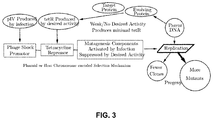
- FIG. 3 shows an exemplar responding to a phage exhibiting a low level of the desired activity. Weak binding allows for a higher rate of mutation.
- FIG. 4 shows an exemplar responding to a phage exhibiting a high level of the desired activity. Strong binding produces more clones.
- a “desired activity” is the property of the evolving gene product (e.g. a protein or RNA) that we wish to enhance.
- the desired activity can be the ability to bind with another protein or to a specific nucleotide sequence in a nucleic acid molecule (e.g. dsDNA, ssDNA, ssRNA, dsRNA, and the like) which is designated as the target.
- the desired activity can also be an enzymatic activity. It is recognized that the initial minimal level or amount of the desired activity can be further enhanced using the methods of the present invention.
- the desired activity can be binding of the evolving gene product to a particular protein.
- the desired activity can be a minimum level of binding of the gene product to the particular protein sufficient to cause a minimal suppression of mutagenesis.
- the level of binding of the gene product to the particular protein can be further increased or enhanced whereby the suppression of mutagenesis is further enhanced.
- a “target” is the protein or nucleic acid substrate we are seeking to affect.
- the target is produced by the host organism and not subjected to evolutionary pressure.
- this could be the protein or nucleic acid substrate, particularly a specific nucleotide sequence therein, to which we want our evolving protein to bind.
- a “host organism” is a microorganism that is transformed with one or more nucleic acid molecules, whereby the transformed microorganism is capable of affecting the reproduction of the evolving organism based upon a desired activity exhibited by the evolving or evolved gene product.
- the microorganism should not be subject to evolutionary pressure.
- a “cellstat” is a vessel in which the host cells are propagated prior to infection by the evolving organism (e.g. bacteriophage).
- the cellstat environment is designed to maintain low levels of mutagenesis and avoid selective pressure on the host cells (e.g. bacterial cells, E. coli cells).
- a “lagoon” is the vessel in which the population of host organisms (e.g. bacteria) come into contact with and can be infected by the population of evolving organisms (e.g. bacteriophage) and where the subsequent generations of evolving organism are maintained.
- the lagoon environment is designed to enhance mutagenesis in order to accelerate evolution of the gene of interest and the gene product encoded thereby.
- Error catastrophe is extinction caused by accumulation of excessive mutations.
- population is intended to mean two or more individuals but typically, a population of the present invention will comprise 10 4 , 10 5 , 10 6 , or more individuals (e.g. bacteriophage, bacteria) it is recognized that the number of individuals in a population of the present invention can vary depending on any number of factors including, for example, the volume of the lagoon or other vessel, the species of evolving organism, the species of host organism, and the environmental conditions.
- individuals e.g. bacteriophage, bacteria
- Super-infection is the infection of a single host cell with more than one virus.
- Clones versus Mutants may sound like the title of a bad science fiction movie, it precisely states how Mutagenesis Selection operates. The process creates more mutants if the genotype does not encode a protein with the desired property, and more clones if the genotype leads to the expression of a protein with the desired property.
- the level of mutagenesis is modulated between maximum mutagenesis in the presence of proteins exhibiting none of the desired activity and a very low level of mutagenesis when proteins that exhibit the desired activity are produced.
- FIG. 1 shows a general outline of the Mutagenic Selection process.
- An inducer activates mutagenesis by enabling expression of the mutagenic components.
- a repressor protein is expressed and suppresses the expression of said mutagenic components.
- the amount of mutagenesis suppression is proportional to the amount of desired activity. The reduction in mutagenesis increases the number of phage progeny that have no mutations.
- FIG. 2 shows one example of how this might work.
- Increases in the binding affinity between the target and the evolving protein results in greater levels of expression of the repressor and therefore lower mutation rates within that host cell.
- the phage shock promoter is an exceptionally good inducer to activate the nominal level of mutation, ensuring that only infected cells will have higher levels of mutation.
- the phage-shock promoter is activated by the p4 protein (pIV) expressed after infection, and the repressor is activated by the expression of the evolving protein, the activator and repressor components will be simultaneously competing to modulate the mutation rate.
- pIV p4 protein
- FIG. 3 shows the exemplar responding to a phage which encodes an evolving protein which has a low level of the desired behavior, in this case, binding with the target protein. Because little or none of the repressor is expressed, the mutation rate remains at the high level established by the reaction to the phage shock promoter. The progeny produced by the host organism will contain a large number of mutants, thus aggressively searching the evolutionary landscape, and few clones, or exact copies, of this non-performing phage genotype will be produced.
- FIG. 4 shows the exemplar responding to a phage encoding a protein which has a high level of the desired activity.
- the strong binding between the evolving protein and the target results in enhanced expression of the repressor, resulting in lower production of the mutagenic components, and therefore a lower mutation rate. Fewer of the resulting progeny will contain mutations, resulting in a less aggressive search for variation, and more of the progeny will carry exact copies of this genotype encoding the protein with the high level of desired activity.
- Non-limiting embodiments of the invention include, for example, the following embodiments.
- a method of directed evolution of macromolecules comprising increasing artificially the mutation rate experienced by a population of an evolving organism comprising a gene of interest to be evolved, wherein the gene of interest encodes a gene product that does not comprise a desired activity, whereby the gene of interest evolves in one or more of the evolving organisms so as to encode an evolved gene product comprising the desired activity, wherein the mutation rate decreases proportionally in response to the production of the evolved gene product comprising the desired activity, whereby the one or more evolving organisms comprising the evolved gene of interest are favored for reproduction in the population and at decreased mutation rate.
- the method of embodiment 2 or 3, wherein increasing artificially the mutation rate experienced by the population of the evolving organism comprises contacting the population of the evolving organism with a population of the host organism, wherein optionally the contacting occurs in a lagoon. 5.
- the engineered host organism comprises a plasmid or a modified host chromosome containing a set of inducible genes encoding one or more mutagenic components. 6.
- the one or more mutagenic components are selected from the group consisting of a modified DNA polymerase protein domain that is capable of reducing the fidelity of DNA replication by a DNA polymerase in the host organism and a protein that is capable of interacting with a DNA polymerase in the host organism so as to reduce the fidelity of DNA replication by the DNA polymerase.
- increasing the mutation rate comprises introducing a plasmid containing a phage shock promotor that is capable of inducing the production of the mutagenic components.
- the repressor is the tetracycline repressor (TetR) and the plasmid comprises a binding site for TetR, the binding site comprising a tetracycline response element or one or more repeats of the tetracycline operator sequence.
- mutagenesis is increased by the introduction of a mutagenic compound to the environment of the evolving organism.
- the evolving organism is a modified M13 bacteriophage, and wherein the genome of said evolving organism comprises a subset of the wild-type M13 phage genes comprising gIII, gIV, and the DNA sequences of the origin of replication and the packaging signal, wherein all other M13 phage genes necessary for phage propagation are encoded in a plasmid contained in a host organism and expressed either constitutively, as a response to phage infection, or through inducement by an external agent. 13.
- the evolving organism is a modified M13 bacteriophage, and wherein the genome of said evolving organism comprises a subset of the wild-type M13 phage genes comprising gIII, gIV, and the DNA sequences of the origin of replication and the packaging signal, wherein all other M13 phage genes necessary for phage propagation are encoded in the plasmid in the host organism and expressed either constitutively, as a response to phage infection, or through inducement by an external agent.
- the method of any one of embodiments 2-13 wherein the evolving organism is a bacteriophage and the host organism is a bacterium.
- the host organism is Escherichia coli ( E. coli ). 16.
- a system for the directed evolution of macromolecules comprising:
- invention 16 further comprising at least one member selected from the group consisting of a vessel, a cellstat, and a growth medium suitable for propagation of the evolving organism and/or host organism.
- M13 bacteriophage is a modified M13 bacteriophage comprising a subset of the wild-type M13 phage genes comprising gIII, gIV, and the DNA sequences of the origin of replication and the packaging signal, wherein all other M13 phage genes necessary for phage propagation are encoded in a plasmid contained in the host organism and expressed either constitutively, as a response to phage infection, or through inducement by an external agent.
- 21. The system of embodiment 16 or 17, wherein the evolving organism is the evolving organism of any one of embodiments 1-15.
- 22. The system of any one of embodiments 16, 17, and 21, wherein the host organism is the host organism of any one of embodiments 2-15.
- RNA interference with the mRNA encoding the mutagenic polymerase components, stimulating the production of high-accuracy polymerase components, or the activation of anti-mutator genes.
- the defined steps can be carried out in any order or simultaneously (except where the context excludes that possibility), and the method can include one or more other steps which are carried out before any of the defined steps, between two of the defined steps, or after all the defined steps (except where the context excludes that possibility).
- the term “at least” followed by a number is used herein to denote the start of a range including that number (which may be a range having an upper limit or no upper limit, depending on the variable being defined). For example, “at least 1” means 1 or more than 1.
- the term “at most” followed by a number is used herein to denote the end of a range, including that number (which may be a range having 1 or 0 as its lower limit, or a range having no lower limit, depending upon the variable being defined). For example, “at most 4” means 4 or less than 4, and “at most 40%” means “40% or less than 40%.
- a range is given as “(a first number) to (a second number)” or “(a first number) ⁇ (a second number),” this means a range whose limits include both numbers.
- “25 to 100” means a range whose lower limit is 25 and upper limit is 100, and includes both 25 and 100.
Landscapes
- Health & Medical Sciences (AREA)
- Life Sciences & Earth Sciences (AREA)
- Chemical & Material Sciences (AREA)
- Engineering & Computer Science (AREA)
- Genetics & Genomics (AREA)
- Organic Chemistry (AREA)
- Biomedical Technology (AREA)
- Biotechnology (AREA)
- Molecular Biology (AREA)
- Bioinformatics & Cheminformatics (AREA)
- Zoology (AREA)
- Wood Science & Technology (AREA)
- Biochemistry (AREA)
- General Health & Medical Sciences (AREA)
- General Engineering & Computer Science (AREA)
- Immunology (AREA)
- Microbiology (AREA)
- Medicinal Chemistry (AREA)
- Physics & Mathematics (AREA)
- Hematology (AREA)
- Urology & Nephrology (AREA)
- Biophysics (AREA)
- Plant Pathology (AREA)
- Virology (AREA)
- General Physics & Mathematics (AREA)
- Pathology (AREA)
- Analytical Chemistry (AREA)
- Food Science & Technology (AREA)
- Cell Biology (AREA)
- Proteomics, Peptides & Aminoacids (AREA)
- General Chemical & Material Sciences (AREA)
- Chemical Kinetics & Catalysis (AREA)
- Ecology (AREA)
- Crystallography & Structural Chemistry (AREA)
- Bioinformatics & Computational Biology (AREA)
- Gastroenterology & Hepatology (AREA)
- Micro-Organisms Or Cultivation Processes Thereof (AREA)
- Hospice & Palliative Care (AREA)
- Oncology (AREA)
Abstract
Description
2. The method of embodiment 1, wherein the evolving organism requires a host organism to replicate.
3. The method of embodiment 2, wherein the host organism is engineered for an increased mutation rate, relative to the mutation rate of a host organism that is not engineered for an increased mutation rate.
4. The method of embodiment 2 or 3, wherein increasing artificially the mutation rate experienced by the population of the evolving organism comprises contacting the population of the evolving organism with a population of the host organism, wherein optionally the contacting occurs in a lagoon.
5. The method of embodiment 4, wherein the engineered host organism comprises a plasmid or a modified host chromosome containing a set of inducible genes encoding one or more mutagenic components.
6. The method of embodiment 5, wherein the one or more mutagenic components are selected from the group consisting of a modified DNA polymerase protein domain that is capable of reducing the fidelity of DNA replication by a DNA polymerase in the host organism and a protein that is capable of interacting with a DNA polymerase in the host organism so as to reduce the fidelity of DNA replication by the DNA polymerase.
7. The method of any one of embodiments 1-5, wherein increasing the mutation rate comprises introducing a plasmid containing a phage shock promotor that is capable of inducing the production of the mutagenic components.
8. The method of any one of embodiments 1-6, wherein the mutation rate is decreased by a repressor molecule that is produced proportionally to the production of the desired activity and down regulates expression of the mutagenic components.
9. The method of embodiment 7, wherein in the mutation rate is decreased by a repressor molecule that is produced proportionally to the production of the desired activity and down regulates expression of the mutagenic components.
10. The method of embodiment 8 or 9, wherein the repressor is the tetracycline repressor (TetR) and the plasmid comprises a binding site for TetR, the binding site comprising a tetracycline response element or one or more repeats of the tetracycline operator sequence.
11. The method of any one of embodiments 1-10, wherein mutagenesis is increased by the introduction of a mutagenic compound to the environment of the evolving organism.
12. The method of embodiment 1, wherein the evolving organism is a modified M13 bacteriophage, and wherein the genome of said evolving organism comprises a subset of the wild-type M13 phage genes comprising gIII, gIV, and the DNA sequences of the origin of replication and the packaging signal, wherein all other M13 phage genes necessary for phage propagation are encoded in a plasmid contained in a host organism and expressed either constitutively, as a response to phage infection, or through inducement by an external agent.
13. The method of any one of embodiments 2-11, wherein the evolving organism is a modified M13 bacteriophage, and wherein the genome of said evolving organism comprises a subset of the wild-type M13 phage genes comprising gIII, gIV, and the DNA sequences of the origin of replication and the packaging signal, wherein all other M13 phage genes necessary for phage propagation are encoded in the plasmid in the host organism and expressed either constitutively, as a response to phage infection, or through inducement by an external agent.
14. The method of any one of embodiments 2-13, wherein the evolving organism is a bacteriophage and the host organism is a bacterium.
15. The method of any one of embodiments 2-14, wherein the host organism is Escherichia coli (E. coli).
16. A system for the directed evolution of macromolecules, the system comprising:
21. The system of embodiment 16 or 17, wherein the evolving organism is the evolving organism of any one of embodiments 1-15.
22. The system of any one of embodiments 16, 17, and 21, wherein the host organism is the host organism of any one of embodiments 2-15.
Claims (15)
Priority Applications (1)
| Application Number | Priority Date | Filing Date | Title |
|---|---|---|---|
| US15/848,029 US11072790B2 (en) | 2016-12-20 | 2017-12-20 | Directed evolution through mutation rate modulation |
Applications Claiming Priority (2)
| Application Number | Priority Date | Filing Date | Title |
|---|---|---|---|
| US201662437034P | 2016-12-20 | 2016-12-20 | |
| US15/848,029 US11072790B2 (en) | 2016-12-20 | 2017-12-20 | Directed evolution through mutation rate modulation |
Publications (2)
| Publication Number | Publication Date |
|---|---|
| US20180187182A1 US20180187182A1 (en) | 2018-07-05 |
| US11072790B2 true US11072790B2 (en) | 2021-07-27 |
Family
ID=62627831
Family Applications (1)
| Application Number | Title | Priority Date | Filing Date |
|---|---|---|---|
| US15/848,029 Active 2039-09-13 US11072790B2 (en) | 2016-12-20 | 2017-12-20 | Directed evolution through mutation rate modulation |
Country Status (4)
| Country | Link |
|---|---|
| US (1) | US11072790B2 (en) |
| EP (1) | EP3559229A4 (en) |
| CN (1) | CN110546256A (en) |
| WO (1) | WO2018119042A1 (en) |
Families Citing this family (8)
| Publication number | Priority date | Publication date | Assignee | Title |
|---|---|---|---|---|
| EP3097196B1 (en) | 2014-01-20 | 2019-09-11 | President and Fellows of Harvard College | Negative selection and stringency modulation in continuous evolution systems |
| WO2017015545A1 (en) | 2015-07-22 | 2017-01-26 | President And Fellows Of Harvard College | Evolution of site-specific recombinases |
| WO2017019895A1 (en) | 2015-07-30 | 2017-02-02 | President And Fellows Of Harvard College | Evolution of talens |
| WO2019040935A1 (en) | 2017-08-25 | 2019-02-28 | President And Fellows Of Harvard College | Evolution of bont peptidases |
| US10858648B1 (en) | 2018-01-12 | 2020-12-08 | Marshall Hall Edgell | Laboratory directed evolution via HG-Selection |
| WO2019241649A1 (en) | 2018-06-14 | 2019-12-19 | President And Fellows Of Harvard College | Evolution of cytidine deaminases |
| WO2021202651A1 (en) | 2020-04-01 | 2021-10-07 | Voyager Therapeutics, Inc. | Redirection of tropism of aav capsids |
| WO2023010050A1 (en) * | 2021-07-28 | 2023-02-02 | The Broad Institute, Inc. | Methods of periplasmic phage-assisted continuous evolution |
Citations (4)
| Publication number | Priority date | Publication date | Assignee | Title |
|---|---|---|---|---|
| WO2010028347A2 (en) * | 2008-09-05 | 2010-03-11 | President & Fellows Of Harvard College | Continuous directed evolution of proteins and nucleic acids |
| WO2012088381A2 (en) * | 2010-12-22 | 2012-06-28 | President And Fellows Of Harvard College | Continuous directed evolution |
| WO2012093128A1 (en) | 2011-01-05 | 2012-07-12 | Stichting Voor De Technische Wetenschappen | A method for the adaptive evolution of a cell and selection for a desired phenotype by serial propagation in an emulsion based system and uses thereof |
| WO2016168631A1 (en) * | 2015-04-17 | 2016-10-20 | President And Fellows Of Harvard College | Vector-based mutagenesis system |
Family Cites Families (8)
| Publication number | Priority date | Publication date | Assignee | Title |
|---|---|---|---|---|
| EP1477558A1 (en) * | 1992-03-16 | 2004-11-17 | WOHLSTADTER, Jacob Nathaniel | Selection methods |
| WO2006051552A2 (en) * | 2004-11-15 | 2006-05-18 | Yeda Research And Development Co. Ltd. At The Weizmann Institute Of Science | Directed evolution and selection using in vitro compartmentalization |
| DE102005037351B3 (en) * | 2005-08-08 | 2007-01-11 | Geneart Ag | In vitro method for directed evolution of proteins, useful e.g. in pharmaceutical development, uses expression system for performing translation, transcription and reverse transcription |
| WO2014093402A2 (en) * | 2012-12-10 | 2014-06-19 | The Regents Of The University Of California | A synthetic transcription factor and uses thereof |
| GB201309132D0 (en) * | 2013-05-21 | 2013-07-03 | Biosyntia Aps | Regulatable gene expression |
| JP2015154768A (en) * | 2014-01-14 | 2015-08-27 | 国立大学法人九州大学 | Novel artificial gene circuit |
| EP3097196B1 (en) * | 2014-01-20 | 2019-09-11 | President and Fellows of Harvard College | Negative selection and stringency modulation in continuous evolution systems |
| WO2016138034A1 (en) * | 2015-02-24 | 2016-09-01 | The Regents Of The University Of California | Binding-triggered transcriptional switches and methods of use thereof |
-
2017
- 2017-12-20 US US15/848,029 patent/US11072790B2/en active Active
- 2017-12-20 WO PCT/US2017/067537 patent/WO2018119042A1/en not_active Ceased
- 2017-12-20 EP EP17882952.9A patent/EP3559229A4/en not_active Withdrawn
- 2017-12-20 CN CN201780085712.XA patent/CN110546256A/en active Pending
Patent Citations (5)
| Publication number | Priority date | Publication date | Assignee | Title |
|---|---|---|---|---|
| WO2010028347A2 (en) * | 2008-09-05 | 2010-03-11 | President & Fellows Of Harvard College | Continuous directed evolution of proteins and nucleic acids |
| WO2012088381A2 (en) * | 2010-12-22 | 2012-06-28 | President And Fellows Of Harvard College | Continuous directed evolution |
| WO2012093128A1 (en) | 2011-01-05 | 2012-07-12 | Stichting Voor De Technische Wetenschappen | A method for the adaptive evolution of a cell and selection for a desired phenotype by serial propagation in an emulsion based system and uses thereof |
| WO2016168631A1 (en) * | 2015-04-17 | 2016-10-20 | President And Fellows Of Harvard College | Vector-based mutagenesis system |
| US20180087046A1 (en) * | 2015-04-17 | 2018-03-29 | President And Fellows Of Harvard College | Vector-based mutagenesis system |
Non-Patent Citations (5)
| Title |
|---|
| Diggle, et al., "Cooperation and conflict in quorum-sensing bacterial populations," Nature, 450, Nov. 15, 2007, pp. 411-414, doi:10.1038/nature06279, abstract. |
| International Search Report and Written Opinion for PCT/US2017/067537, RU, dated May 4, 2018. |
| Joung et al., "Abacterial two-hybrid selection system for studying protein-DNA and protein-protein interactions" 97(13) Proceedings of the National Academy of Sciences USA 7382-7387 (Year: 2000). * |
| Kunkel,et al., "Directed evolution to produce sludge communities with improved oxygen uptake abilities," Appl Microbiol biotechnol., 2015, pp. 1-10, doi:10.1007/s00253-015-6891-8. |
| Na D, et al., "Synthetic inter-species cooperation of host and virus for targeted genetic evolution," Journal of Biotechnology, 2011, vol. 153, pp. 35-41. |
Also Published As
| Publication number | Publication date |
|---|---|
| EP3559229A1 (en) | 2019-10-30 |
| WO2018119042A1 (en) | 2018-06-28 |
| CN110546256A (en) | 2019-12-06 |
| EP3559229A4 (en) | 2020-08-19 |
| US20180187182A1 (en) | 2018-07-05 |
Similar Documents
| Publication | Publication Date | Title |
|---|---|---|
| US20180187182A1 (en) | Directed evolution through mutation rate modulation | |
| Hendel et al. | Directed evolution in mammalian cells | |
| McBride et al. | Robustness promotes evolvability of thermotolerance in an RNA virus | |
| Balzer et al. | A comparative analysis of the properties of regulated promoter systems commonly used for recombinant gene expression in Escherichia coli | |
| Schubert et al. | Maintaining inhibition: siRNA double expression vectors against coxsackieviral RNAs | |
| Trask et al. | Dual selection mechanisms drive efficient single-gene reverse genetics for rotavirus | |
| Domingo et al. | What is a quasispecies? Historical origins and current scope | |
| Joly-Lopez et al. | Phylogenetic and genomic analyses resolve the origin of important plant genes derived from transposable elements | |
| US8916376B2 (en) | Metal-binding peptides | |
| Petrie et al. | Limits of neutral drift: lessons from the in vitro evolution of two ribozymes | |
| Goncearenco et al. | The fundamental tradeoff in genomes and proteomes of prokaryotes established by the genetic code, codon entropy, and physics of nucleic acids and proteins | |
| Farafonov et al. | Complete virion simulated: All-Atom model of an MS2 bacteriophage with native genome | |
| Chantranupong et al. | A common, non-optimal phenotypic endpoint in experimental adaptations of bacteriophage lysis time | |
| Feldman et al. | The Nav channel bench series: Plasmid preparation | |
| Podnar et al. | Next‐generation sequencing fragment library construction | |
| Michalowski et al. | Sequence tolerance of the phage λ P RM promoter: implications for evolution of gene regulatory circuitry | |
| Davidson et al. | An in vitro autogene | |
| EP4017976B1 (en) | Coiled-coil mediated tethering of crispr/cas and exonucleases for enhanced genome editing | |
| KR102822470B1 (en) | Methods and systems for CRISPR selection | |
| Musayev et al. | Structural studies of AAV2 Rep68 reveal a partially structured linker and compact domain conformation | |
| Kopsidas et al. | RNA mutagenesis yields highly diverse mRNA libraries for in vitro protein evolution | |
| Bull et al. | Mathematical comparison of protocols for adapting a bacteriophage to a new host | |
| Van den Hoecke et al. | Illumina MiSeq sequencing disfavours a sequence motif in the GFP reporter gene | |
| Umeno et al. | Transcription factors as evolvable biosensors | |
| Krakauer | Evolutionary principles of genomic compression |
Legal Events
| Date | Code | Title | Description |
|---|---|---|---|
| FEPP | Fee payment procedure |
Free format text: ENTITY STATUS SET TO UNDISCOUNTED (ORIGINAL EVENT CODE: BIG.); ENTITY STATUS OF PATENT OWNER: MICROENTITY |
|
| FEPP | Fee payment procedure |
Free format text: ENTITY STATUS SET TO MICRO (ORIGINAL EVENT CODE: MICR); ENTITY STATUS OF PATENT OWNER: MICROENTITY |
|
| STPP | Information on status: patent application and granting procedure in general |
Free format text: DOCKETED NEW CASE - READY FOR EXAMINATION |
|
| STPP | Information on status: patent application and granting procedure in general |
Free format text: NON FINAL ACTION MAILED |
|
| STPP | Information on status: patent application and granting procedure in general |
Free format text: RESPONSE TO NON-FINAL OFFICE ACTION ENTERED AND FORWARDED TO EXAMINER |
|
| STPP | Information on status: patent application and granting procedure in general |
Free format text: RESPONSE TO NON-FINAL OFFICE ACTION ENTERED AND FORWARDED TO EXAMINER |
|
| STPP | Information on status: patent application and granting procedure in general |
Free format text: NON FINAL ACTION MAILED |
|
| STPP | Information on status: patent application and granting procedure in general |
Free format text: RESPONSE TO NON-FINAL OFFICE ACTION ENTERED AND FORWARDED TO EXAMINER |
|
| STPP | Information on status: patent application and granting procedure in general |
Free format text: NOTICE OF ALLOWANCE MAILED -- APPLICATION RECEIVED IN OFFICE OF PUBLICATIONS |
|
| STPP | Information on status: patent application and granting procedure in general |
Free format text: PUBLICATIONS -- ISSUE FEE PAYMENT RECEIVED |
|
| STPP | Information on status: patent application and granting procedure in general |
Free format text: PUBLICATIONS -- ISSUE FEE PAYMENT VERIFIED |
|
| STCF | Information on status: patent grant |
Free format text: PATENTED CASE |
|
| MAFP | Maintenance fee payment |
Free format text: PAYMENT OF MAINTENANCE FEE, 4TH YEAR, MICRO ENTITY (ORIGINAL EVENT CODE: M3551); ENTITY STATUS OF PATENT OWNER: MICROENTITY Year of fee payment: 4 |