US11071738B2 - Therapeutic agent for fatty liver diseases and therapeutic agent for adiposity - Google Patents
Therapeutic agent for fatty liver diseases and therapeutic agent for adiposity Download PDFInfo
- Publication number
- US11071738B2 US11071738B2 US16/636,752 US201816636752A US11071738B2 US 11071738 B2 US11071738 B2 US 11071738B2 US 201816636752 A US201816636752 A US 201816636752A US 11071738 B2 US11071738 B2 US 11071738B2
- Authority
- US
- United States
- Prior art keywords
- group
- optionally substituted
- therapeutic
- prophylactic agent
- ring
- Prior art date
- Legal status (The legal status is an assumption and is not a legal conclusion. Google has not performed a legal analysis and makes no representation as to the accuracy of the status listed.)
- Active
Links
- 0 *.C1=CC=CC=C1.[1*]OC(=O)CC(C)(CC)C[Y][2*].[3*]C Chemical compound *.C1=CC=CC=C1.[1*]OC(=O)CC(C)(CC)C[Y][2*].[3*]C 0.000 description 20
- FHLMLUGPILBINM-JOCHJYFZSA-N O=C(O)[C@@H](CC1=CC2=CC=CC=C2C=C1)NC(=O)N1C2=CC=CC=C2C2=C1C=CC=C2 Chemical compound O=C(O)[C@@H](CC1=CC2=CC=CC=C2C=C1)NC(=O)N1C2=CC=CC=C2C2=C1C=CC=C2 FHLMLUGPILBINM-JOCHJYFZSA-N 0.000 description 3
- FWYMTJVFGUCEAF-CQSZACIVSA-N COC(=O)[C@@H](CC1=CC2=CC=CC=C2C=C1)N=C=O Chemical compound COC(=O)[C@@H](CC1=CC2=CC=CC=C2C=C1)N=C=O FWYMTJVFGUCEAF-CQSZACIVSA-N 0.000 description 2
- WAVOGDLLTIUQOC-HSZRJFAPSA-N COC(=O)[C@@H](CC1=CC2=CC=CC=C2C=C1)NC(=O)N1C2=CC=CC=C2C2=C1C=CC=C2 Chemical compound COC(=O)[C@@H](CC1=CC2=CC=CC=C2C=C1)NC(=O)N1C2=CC=CC=C2C2=C1C=CC=C2 WAVOGDLLTIUQOC-HSZRJFAPSA-N 0.000 description 2
- DCHWMYIFLHRCBK-WJOKGBTCSA-N O=C(N[C@H](CC1=CC2=CC=CC=C2C=C1)C(=O)OCC1=CC=CC=C1)C1C2=CC=CC=C2C2=C1C=CC=C2 Chemical compound O=C(N[C@H](CC1=CC2=CC=CC=C2C=C1)C(=O)OCC1=CC=CC=C1)C1C2=CC=CC=C2C2=C1C=CC=C2 DCHWMYIFLHRCBK-WJOKGBTCSA-N 0.000 description 2
- KSTQBXHJJGVKFO-LJQANCHMSA-N O=C(OCC1=CC=CC=C1)[C@H](O)CC1=CC2=CC=CC=C2C=C1 Chemical compound O=C(OCC1=CC=CC=C1)[C@H](O)CC1=CC2=CC=CC=C2C=C1 KSTQBXHJJGVKFO-LJQANCHMSA-N 0.000 description 2
- GDVIJBAXWAYXFO-IKOFQBKESA-N O=C(O[C@H](CC1=CC2=CC=CC=C2C=C1)C(=O)O)C1=CC=C(C(O)C2=CC=CC=C2)C=C1 Chemical compound O=C(O[C@H](CC1=CC2=CC=CC=C2C=C1)C(=O)O)C1=CC=C(C(O)C2=CC=CC=C2)C=C1 GDVIJBAXWAYXFO-IKOFQBKESA-N 0.000 description 2
- QPYPFRYJQJKHKC-XMMPIXPASA-N O=C(O[C@H](CC1=CC2=CC=CC=C2C=C1)C(=O)O)C1C2=CC=CC=C2C2=C1C=CC=C2 Chemical compound O=C(O[C@H](CC1=CC2=CC=CC=C2C=C1)C(=O)O)C1C2=CC=CC=C2C2=C1C=CC=C2 QPYPFRYJQJKHKC-XMMPIXPASA-N 0.000 description 2
- HLAQICXVYOTJFR-QUIJINPXSA-N CC(C(=O)C[C@H](C/C1=N/C2=CC=C(F)C=C2C1)C(=O)O)C1=CC=C(C2=CC=CC=C2)C(F)=C1.O=C(/C=C/C1=C2C=CC=CC2=CC=C1)N[C@H](C/C1=N/C2=CC=C(Cl)C=C2N1)C(=O)O.O=C(CCC(=O)C1=CC=CC=C1)C[C@H](C/C1=N/C2=CC=C(F)C=C2C1)C(=O)O Chemical compound CC(C(=O)C[C@H](C/C1=N/C2=CC=C(F)C=C2C1)C(=O)O)C1=CC=C(C2=CC=CC=C2)C(F)=C1.O=C(/C=C/C1=C2C=CC=CC2=CC=C1)N[C@H](C/C1=N/C2=CC=C(Cl)C=C2N1)C(=O)O.O=C(CCC(=O)C1=CC=CC=C1)C[C@H](C/C1=N/C2=CC=C(F)C=C2C1)C(=O)O HLAQICXVYOTJFR-QUIJINPXSA-N 0.000 description 1
- ZNZVHOUIQVHKJS-XZOQPEGZSA-N CC(C)(C)OC(=O)N[C@@H](CC1=CC=CC=C1)C(=O)O[C@H](CC1=CC2=CC=CC=C2C=C1)C(=O)O Chemical compound CC(C)(C)OC(=O)N[C@@H](CC1=CC=CC=C1)C(=O)O[C@H](CC1=CC2=CC=CC=C2C=C1)C(=O)O ZNZVHOUIQVHKJS-XZOQPEGZSA-N 0.000 description 1
- YPFGJVUKKSWKEB-XCQTXRJWSA-N CC(C)CC(NC(=O)C1=CC=CC=C1)C(=O)C[C@H](C/C1=N/C2=CC=C(F)C=C2C1)C(=O)O.O=C(CC1CCCCCC1)C[C@H](CC1=NC2=CC=C(Cl)C=C2C1)C(=O)O.O=C(CSC1=CC=C2C=CC=CC2=C1)C[C@H](CC1=NC2=CC=C(Cl)C=C2C1)C(=O)O.O=C(C[C@H](CC1=NC2=CC=C(Cl)C=C2C1)C(=O)O)CS(=O)(=O)C1=CC=CC=C1 Chemical compound CC(C)CC(NC(=O)C1=CC=CC=C1)C(=O)C[C@H](C/C1=N/C2=CC=C(F)C=C2C1)C(=O)O.O=C(CC1CCCCCC1)C[C@H](CC1=NC2=CC=C(Cl)C=C2C1)C(=O)O.O=C(CSC1=CC=C2C=CC=CC2=C1)C[C@H](CC1=NC2=CC=C(Cl)C=C2C1)C(=O)O.O=C(C[C@H](CC1=NC2=CC=C(Cl)C=C2C1)C(=O)O)CS(=O)(=O)C1=CC=CC=C1 YPFGJVUKKSWKEB-XCQTXRJWSA-N 0.000 description 1
- HKSAEBFXCDFOIN-UDBJCGJASA-N CC(OC1=CC=CC=C1)C(=O)C[C@H](C/C1=C/C2=CC(Cl)=CC=C2N1)C(=O)O.CN(C(=O)CCC(=O)C[C@H](C/C1=C/C2=CC(Cl)=CC=C2N1)C(=O)O)C1=CC=CC=C1 Chemical compound CC(OC1=CC=CC=C1)C(=O)C[C@H](C/C1=C/C2=CC(Cl)=CC=C2N1)C(=O)O.CN(C(=O)CCC(=O)C[C@H](C/C1=C/C2=CC(Cl)=CC=C2N1)C(=O)O)C1=CC=CC=C1 HKSAEBFXCDFOIN-UDBJCGJASA-N 0.000 description 1
- DSHGALKPEUEMKO-HXUWFJFHSA-N CC1=C(C)C=C(C(=O)O[C@H](CC2=CC3=CC=CC=C3C=C2)C(=O)O)C=C1 Chemical compound CC1=C(C)C=C(C(=O)O[C@H](CC2=CC3=CC=CC=C3C=C2)C(=O)O)C=C1 DSHGALKPEUEMKO-HXUWFJFHSA-N 0.000 description 1
- UKIBYIYFZOHQTP-HXUWFJFHSA-N CC1=CC(C)=CC(C(=O)O[C@H](CC2=CC3=CC=CC=C3C=C2)C(=O)O)=C1 Chemical compound CC1=CC(C)=CC(C(=O)O[C@H](CC2=CC3=CC=CC=C3C=C2)C(=O)O)=C1 UKIBYIYFZOHQTP-HXUWFJFHSA-N 0.000 description 1
- SQHOYIGVKVRQJM-UHFFFAOYSA-N CC1=CC2=C(C=C1)C=C(CC(OC(=O)C1=CC3=C(C=CC=C3)C=C1)C(=O)O)C=C2 Chemical compound CC1=CC2=C(C=C1)C=C(CC(OC(=O)C1=CC3=C(C=CC=C3)C=C1)C(=O)O)C=C2 SQHOYIGVKVRQJM-UHFFFAOYSA-N 0.000 description 1
- NCFMSVVSHNRLJY-UHFFFAOYSA-N CC1=CC2=CC=C(F)C=C2N1.CC1=CC2=CC=CC=C2C=C1.CC1=CC2=CC=CC=C2N=C1.CC1=CNC2=CC=CC=C12.CC1=NC2=CC=CC=C2N1 Chemical compound CC1=CC2=CC=C(F)C=C2N1.CC1=CC2=CC=CC=C2C=C1.CC1=CC2=CC=CC=C2N=C1.CC1=CNC2=CC=CC=C12.CC1=NC2=CC=CC=C2N1 NCFMSVVSHNRLJY-UHFFFAOYSA-N 0.000 description 1
- PDCKWTNYQYCAAQ-XMMPIXPASA-N CC1=CC=C(C2=CC(C(=O)O[C@H](CC3=CC4=CC=CC=C4C=C3)C(=O)O)=C(C)O2)C=C1 Chemical compound CC1=CC=C(C2=CC(C(=O)O[C@H](CC3=CC4=CC=CC=C4C=C3)C(=O)O)=C(C)O2)C=C1 PDCKWTNYQYCAAQ-XMMPIXPASA-N 0.000 description 1
- IXFXBVZLLNDWPA-DCWQJPKNSA-N CC1=CC=C2C(=C1)C(C(=O)O[C@H](CC1=CC3=CC=CC=C3C=C1)C(=O)O)C1=C2C=CC=C1 Chemical compound CC1=CC=C2C(=C1)C(C(=O)O[C@H](CC1=CC3=CC=CC=C3C=C1)C(=O)O)C1=C2C=CC=C1 IXFXBVZLLNDWPA-DCWQJPKNSA-N 0.000 description 1
- SNRSJLVPWGMNSQ-IFQVXJEXSA-N CN(C(=O)CC[C@H](C/C1=N/C2=CC=C(F)C=C2C1)C(=O)O)C(C)(C)CC1=CC=CC=C1.O=C(O)[C@@H](CC1=NC2=CC=C(F)C=C2C1)NCCCCOCC1=CC=CC=C1.O=C(OCCN[C@H](CC1=NC2=CC=C(F)C=C2C1)C(=O)O)C1=CC=CC=C1 Chemical compound CN(C(=O)CC[C@H](C/C1=N/C2=CC=C(F)C=C2C1)C(=O)O)C(C)(C)CC1=CC=CC=C1.O=C(O)[C@@H](CC1=NC2=CC=C(F)C=C2C1)NCCCCOCC1=CC=CC=C1.O=C(OCCN[C@H](CC1=NC2=CC=C(F)C=C2C1)C(=O)O)C1=CC=CC=C1 SNRSJLVPWGMNSQ-IFQVXJEXSA-N 0.000 description 1
- IRGNEQOFQKOJSF-HXUWFJFHSA-N CN(C)C1=CC=C(C(=O)O[C@H](CC2=CC3=CC=CC=C3C=C2)C(=O)O)C=C1 Chemical compound CN(C)C1=CC=C(C(=O)O[C@H](CC2=CC3=CC=CC=C3C=C2)C(=O)O)C=C1 IRGNEQOFQKOJSF-HXUWFJFHSA-N 0.000 description 1
- XKHLPVPHCJGTJR-HSZRJFAPSA-N COC(=O)C1=CC2=C(C=C1)C=C(C(=O)N[C@H](CC1=CC3=CC=CC=C3C=C1)C(=O)O)C=C2 Chemical compound COC(=O)C1=CC2=C(C=C1)C=C(C(=O)N[C@H](CC1=CC3=CC=CC=C3C=C1)C(=O)O)C=C2 XKHLPVPHCJGTJR-HSZRJFAPSA-N 0.000 description 1
- NOOBOKMMEMVKSP-SSEXGKCCSA-N COC(=O)C1=CC2=C(C=C1)C=C(C(=O)N[C@H](CC1=CC3=CC=CC=C3C=C1)C(=O)OCC1=CC=CC=C1)C=C2 Chemical compound COC(=O)C1=CC2=C(C=C1)C=C(C(=O)N[C@H](CC1=CC3=CC=CC=C3C=C1)C(=O)OCC1=CC=CC=C1)C=C2 NOOBOKMMEMVKSP-SSEXGKCCSA-N 0.000 description 1
- FDBHBZHZYIGWRC-KWKWTDQQSA-N COC(=O)[C@@H](CC1=CC2=C(C=CC=C2)C=C1)NC(=O)CN1C2=C(C=CC=C2)C2C=CC=CC21 Chemical compound COC(=O)[C@@H](CC1=CC2=C(C=CC=C2)C=C1)NC(=O)CN1C2=C(C=CC=C2)C2C=CC=CC21 FDBHBZHZYIGWRC-KWKWTDQQSA-N 0.000 description 1
- FUYPFZHISFFHQB-RUZDIDTESA-N COC(=O)[C@@H](CC1=CC2=CC=CC=C2C=C1)NC(=O)C1C2=CC=CC=C2C2=C1C=CC=C2 Chemical compound COC(=O)[C@@H](CC1=CC2=CC=CC=C2C=C1)NC(=O)C1C2=CC=CC=C2C2=C1C=CC=C2 FUYPFZHISFFHQB-RUZDIDTESA-N 0.000 description 1
- HIHHIRFFVPIQTA-XMMPIXPASA-N COC(=O)[C@@H](CC1=CC2=CC=CC=C2C=C1)NC(=O)CC1=CC2=C(C=CC=C2)C=C1 Chemical compound COC(=O)[C@@H](CC1=CC2=CC=CC=C2C=C1)NC(=O)CC1=CC2=C(C=CC=C2)C=C1 HIHHIRFFVPIQTA-XMMPIXPASA-N 0.000 description 1
- LWMRSNRMDFUGJN-HHHXNRCGSA-N COC(=O)[C@@H](CC1=CC2=CC=CC=C2C=C1)NC(=O)CC1C2=C(C=CC=C2)C2=C1C=CC=C2 Chemical compound COC(=O)[C@@H](CC1=CC2=CC=CC=C2C=C1)NC(=O)CC1C2=C(C=CC=C2)C2=C1C=CC=C2 LWMRSNRMDFUGJN-HHHXNRCGSA-N 0.000 description 1
- LXDBGNOTLHBYHE-RUZDIDTESA-N COC(=O)[C@@H](CC1=CC2=CC=CC=C2C=C1)NC(=O)N(C1=CC=CC=C1)C1=CC=CC=C1 Chemical compound COC(=O)[C@@H](CC1=CC2=CC=CC=C2C=C1)NC(=O)N(C1=CC=CC=C1)C1=CC=CC=C1 LXDBGNOTLHBYHE-RUZDIDTESA-N 0.000 description 1
- UCITXICYKOEZHL-RUZDIDTESA-N COC(=O)[C@@H](CC1=CC2=CC=CC=C2C=C1)NC(=O)N1C2=CC=CC=C2C=CC2=C1C=CC=C2 Chemical compound COC(=O)[C@@H](CC1=CC2=CC=CC=C2C=C1)NC(=O)N1C2=CC=CC=C2C=CC2=C1C=CC=C2 UCITXICYKOEZHL-RUZDIDTESA-N 0.000 description 1
- PLIYVWQYNNYMCO-OAQYLSRUSA-N COC(=O)[C@@H](CC1=CC2=CC=CC=C2C=C1)NC(=O)N1C2=CC=CC=C2OC2=C1C=CC=C2 Chemical compound COC(=O)[C@@H](CC1=CC2=CC=CC=C2C=C1)NC(=O)N1C2=CC=CC=C2OC2=C1C=CC=C2 PLIYVWQYNNYMCO-OAQYLSRUSA-N 0.000 description 1
- ZFBJRZIOILRHTG-RUZDIDTESA-N COC(=O)[C@@H](CC1=CC2=CC=CC=C2C=C1)NC(=O)NC1=CC=C(C(=O)C2=CC=CC=C2)C=C1 Chemical compound COC(=O)[C@@H](CC1=CC2=CC=CC=C2C=C1)NC(=O)NC1=CC=C(C(=O)C2=CC=CC=C2)C=C1 ZFBJRZIOILRHTG-RUZDIDTESA-N 0.000 description 1
- DQCLZKWAPIYBHN-XMMPIXPASA-N COC(=O)[C@@H](CC1=CC2=CC=CC=C2C=C1)NC(=O)NC1=CC=CC=C1OC1=CC=CC=C1 Chemical compound COC(=O)[C@@H](CC1=CC2=CC=CC=C2C=C1)NC(=O)NC1=CC=CC=C1OC1=CC=CC=C1 DQCLZKWAPIYBHN-XMMPIXPASA-N 0.000 description 1
- NJPNWMZBNBROPE-CYBMUJFWSA-N COC(=O)[C@H](N)CC1=CC2=CC=CC=C2C=C1.Cl Chemical compound COC(=O)[C@H](N)CC1=CC2=CC=CC=C2C=C1.Cl NJPNWMZBNBROPE-CYBMUJFWSA-N 0.000 description 1
- DDWANRBKGMFUDG-HXUWFJFHSA-N COC1=C(C)C=C(C(=O)O[C@H](CC2=CC3=CC=CC=C3C=C2)C(=O)O)C=C1 Chemical compound COC1=C(C)C=C(C(=O)O[C@H](CC2=CC3=CC=CC=C3C=C2)C(=O)O)C=C1 DDWANRBKGMFUDG-HXUWFJFHSA-N 0.000 description 1
- YQKBJBJGPDVMGT-HXUWFJFHSA-N COC1=CC(C(=O)O[C@H](CC2=CC3=CC=CC=C3C=C2)C(=O)O)=CC(C)=C1 Chemical compound COC1=CC(C(=O)O[C@H](CC2=CC3=CC=CC=C3C=C2)C(=O)O)=CC(C)=C1 YQKBJBJGPDVMGT-HXUWFJFHSA-N 0.000 description 1
- ZLOMZNSCWJABFX-HWSYBJRPSA-N COC1=CC=C(NC(=O)CCN[C@H](CC2=NC3=CC=C(F)C=C3C2)C(=O)O)C=N1.O=C(CN[C@H](CC1=NC2=CC=C(F)C=C2C1)C(=O)O)NCC1=CC=CC=N1.O=C(CN[C@H](CC1=NC2=CC=C(F)C=C2C1)C(=O)O)NCCC1=CNC2=C1C=CC=C2 Chemical compound COC1=CC=C(NC(=O)CCN[C@H](CC2=NC3=CC=C(F)C=C3C2)C(=O)O)C=N1.O=C(CN[C@H](CC1=NC2=CC=C(F)C=C2C1)C(=O)O)NCC1=CC=CC=N1.O=C(CN[C@H](CC1=NC2=CC=C(F)C=C2C1)C(=O)O)NCCC1=CNC2=C1C=CC=C2 ZLOMZNSCWJABFX-HWSYBJRPSA-N 0.000 description 1
- ACRXYOYPCSIILG-USCSVXAZSA-N COC1=NC=C(NC(=O)C2=CC=CC=C2CC(=O)C[C@H](CC2=NC3=CC=C(Cl)C=C3C2)C(=O)O)C=C1.O=C(C1=CC=C(Cl)C=C1)C1=CC=C(OCC2=NC(CC3=CC4=C(C=C(F)C=C4)C3)(C(=O)O)CS2)C=C1.O=C(O)C1(CC2=CC3=C(C=C(F)C=C3)C2)CSC(COC2=C(C3CCCCC3)C=CC=C2)=N1 Chemical compound COC1=NC=C(NC(=O)C2=CC=CC=C2CC(=O)C[C@H](CC2=NC3=CC=C(Cl)C=C3C2)C(=O)O)C=C1.O=C(C1=CC=C(Cl)C=C1)C1=CC=C(OCC2=NC(CC3=CC4=C(C=C(F)C=C4)C3)(C(=O)O)CS2)C=C1.O=C(O)C1(CC2=CC3=C(C=C(F)C=C3)C2)CSC(COC2=C(C3CCCCC3)C=CC=C2)=N1 ACRXYOYPCSIILG-USCSVXAZSA-N 0.000 description 1
- PDUKJRFDUGNBPQ-UHFFFAOYSA-N CSC1=NN=C(SCC2=NC(CC3=CC4=C(C=C(F)C=C4)C3)(C(=O)O)CS2)S1.O=C(CSCC1=NC(CC2=CC3=C(C=C(F)C=C3)C2)(C(=O)O)CS1)NC1=CC=CC=C1.O=C(O)C1(CC2=CC3=C(C=C(F)C=C3)C2)CSC(CSCCC2=NC=CC=C2)=N1 Chemical compound CSC1=NN=C(SCC2=NC(CC3=CC4=C(C=C(F)C=C4)C3)(C(=O)O)CS2)S1.O=C(CSCC1=NC(CC2=CC3=C(C=C(F)C=C3)C2)(C(=O)O)CS1)NC1=CC=CC=C1.O=C(O)C1(CC2=CC3=C(C=C(F)C=C3)C2)CSC(CSCCC2=NC=CC=C2)=N1 PDUKJRFDUGNBPQ-UHFFFAOYSA-N 0.000 description 1
- BNZQVTHGMNDJCZ-XMMPIXPASA-N Cc([o]c(-c(cc1)ccc1OC)c1)c1C(O[C@H](Cc1cc(cccc2)c2cc1)C(O)=O)=O Chemical compound Cc([o]c(-c(cc1)ccc1OC)c1)c1C(O[C@H](Cc1cc(cccc2)c2cc1)C(O)=O)=O BNZQVTHGMNDJCZ-XMMPIXPASA-N 0.000 description 1
- ZQBSGUZHORLRQK-UHFFFAOYSA-N Cc1cc(ccc(F)c2)c2[n]1C Chemical compound Cc1cc(ccc(F)c2)c2[n]1C ZQBSGUZHORLRQK-UHFFFAOYSA-N 0.000 description 1
- SAWFXWAKCJGRSQ-LJQANCHMSA-N Cl.N[C@H](CC1=CC2=CC=CC=C2C=C1)C(=O)OCC1=CC=CC=C1 Chemical compound Cl.N[C@H](CC1=CC2=CC=CC=C2C=C1)C(=O)OCC1=CC=CC=C1 SAWFXWAKCJGRSQ-LJQANCHMSA-N 0.000 description 1
- VHMAPMQGFFSAKK-UHFFFAOYSA-N NC1=NC=CC=C1OCC1=NC(CC2=CC3=C(C=C(F)C=C3)C2)(C(=O)O)CS1.O=C(O)C1(CC2=CC3=C(C=C(F)C=C3)C2)CSC(COC2=C(C3CCCCC3)C=CC=C2)=N1.O=C(O)C1(CC2=CC3=C(C=C(F)C=C3)C2)CSC(COC2=C(F)C=CC=C2)=N1 Chemical compound NC1=NC=CC=C1OCC1=NC(CC2=CC3=C(C=C(F)C=C3)C2)(C(=O)O)CS1.O=C(O)C1(CC2=CC3=C(C=C(F)C=C3)C2)CSC(COC2=C(C3CCCCC3)C=CC=C2)=N1.O=C(O)C1(CC2=CC3=C(C=C(F)C=C3)C2)CSC(COC2=C(F)C=CC=C2)=N1 VHMAPMQGFFSAKK-UHFFFAOYSA-N 0.000 description 1
- ZBEWWHBKZHPRBT-HSZRJFAPSA-N O=C(CC1=CC2=C(C=CC=C2)C=C1)N[C@H](CC1=CC2=CC=CC=C2C=C1)C(=O)O Chemical compound O=C(CC1=CC2=C(C=CC=C2)C=C1)N[C@H](CC1=CC2=CC=CC=C2C=C1)C(=O)O ZBEWWHBKZHPRBT-HSZRJFAPSA-N 0.000 description 1
- KGIVJWCRCYVLLB-HSZRJFAPSA-N O=C(CC1=CC2=C(C=CC=C2)C=C1)O[C@H](CC1=CC2=CC=CC=C2C=C1)C(=O)O Chemical compound O=C(CC1=CC2=C(C=CC=C2)C=C1)O[C@H](CC1=CC2=CC=CC=C2C=C1)C(=O)O KGIVJWCRCYVLLB-HSZRJFAPSA-N 0.000 description 1
- XTIHOOBPTAAQBK-HSZRJFAPSA-N O=C(CC1=CC=CC2=C1C=CC=C2)O[C@H](CC1=CC2=CC=CC=C2C=C1)C(=O)O Chemical compound O=C(CC1=CC=CC2=C1C=CC=C2)O[C@H](CC1=CC2=CC=CC=C2C=C1)C(=O)O XTIHOOBPTAAQBK-HSZRJFAPSA-N 0.000 description 1
- GCFDHIJQAHFACA-OAQYLSRUSA-N O=C(CC1=CNC2=C1C=CC=C2)O[C@H](CC1=CC2=CC=CC=C2C=C1)C(=O)O Chemical compound O=C(CC1=CNC2=C1C=CC=C2)O[C@H](CC1=CC2=CC=CC=C2C=C1)C(=O)O GCFDHIJQAHFACA-OAQYLSRUSA-N 0.000 description 1
- SNCGUGOSPPYBOW-AREMUKBSSA-N O=C(CC1C2=C(C=CC=C2)C2=C1C=CC=C2)N[C@H](CC1=CC2=CC=CC=C2C=C1)C(=O)O Chemical compound O=C(CC1C2=C(C=CC=C2)C2=C1C=CC=C2)N[C@H](CC1=CC2=CC=CC=C2C=C1)C(=O)O SNCGUGOSPPYBOW-AREMUKBSSA-N 0.000 description 1
- PVADOZHVCUGHJN-AREMUKBSSA-N O=C(CC1C2=C(C=CC=C2)C2=C1C=CC=C2)O[C@H](CC1=CC2=CC=CC=C2C=C1)C(=O)O Chemical compound O=C(CC1C2=C(C=CC=C2)C2=C1C=CC=C2)O[C@H](CC1=CC2=CC=CC=C2C=C1)C(=O)O PVADOZHVCUGHJN-AREMUKBSSA-N 0.000 description 1
- HZTGYPDIODTJIG-HSZRJFAPSA-N O=C(CN1C2=C(C=CC=C2)C2=C1C=CC=C2)N[C@H](CC1=CC2=C(C=CC=C2)C=C1)C(=O)O Chemical compound O=C(CN1C2=C(C=CC=C2)C2=C1C=CC=C2)N[C@H](CC1=CC2=C(C=CC=C2)C=C1)C(=O)O HZTGYPDIODTJIG-HSZRJFAPSA-N 0.000 description 1
- XCFVXLGIBYLFBT-HSZRJFAPSA-N O=C(COC1=C2C=CC=CC2=CC=C1)O[C@H](CC1=CC2=CC=CC=C2C=C1)C(=O)O Chemical compound O=C(COC1=C2C=CC=CC2=CC=C1)O[C@H](CC1=CC2=CC=CC=C2C=C1)C(=O)O XCFVXLGIBYLFBT-HSZRJFAPSA-N 0.000 description 1
- VAQBJFUUSHIOKB-HSZRJFAPSA-N O=C(COC1=CC2=C(C=CC=C2)C=C1)O[C@H](CC1=CC2=CC=CC=C2C=C1)C(=O)O Chemical compound O=C(COC1=CC2=C(C=CC=C2)C=C1)O[C@H](CC1=CC2=CC=CC=C2C=C1)C(=O)O VAQBJFUUSHIOKB-HSZRJFAPSA-N 0.000 description 1
- XOANJTDSYIGAFP-LJQANCHMSA-N O=C(COC1=CC=CC=C1)O[C@H](CC1=CC2=CC=CC=C2C=C1)C(=O)O Chemical compound O=C(COC1=CC=CC=C1)O[C@H](CC1=CC2=CC=CC=C2C=C1)C(=O)O XOANJTDSYIGAFP-LJQANCHMSA-N 0.000 description 1
- PUKHWJLMWZJMKZ-AGFJDXKQSA-N O=C(C[C@H](CC1=NC2=CC=C(F)C=C2C1)C(=O)O)C(SC1=CC=CC=C1)C1=CC=CC=C1.O=C(O)C1(CC2=CC3=C(C=C(F)C=C3)C2)CSC(COC2=CC=C(/C=C/C3=CC=CC=C3)C=C2)=N1.O=C(O)C1(CC2=CC3=C(C=C(F)C=C3)C2)CSC(CSC(C2=CC=CC=C2)C2=CC=CC=C2)=N1 Chemical compound O=C(C[C@H](CC1=NC2=CC=C(F)C=C2C1)C(=O)O)C(SC1=CC=CC=C1)C1=CC=CC=C1.O=C(O)C1(CC2=CC3=C(C=C(F)C=C3)C2)CSC(COC2=CC=C(/C=C/C3=CC=CC=C3)C=C2)=N1.O=C(O)C1(CC2=CC3=C(C=C(F)C=C3)C2)CSC(CSC(C2=CC=CC=C2)C2=CC=CC=C2)=N1 PUKHWJLMWZJMKZ-AGFJDXKQSA-N 0.000 description 1
- VLZMZJPVKQAIHO-XMMPIXPASA-N O=C(NC1=CC=C(C(=O)C2=CC=CC=C2)C=C1)N[C@H](CC1=CC2=CC=CC=C2C=C1)C(=O)O Chemical compound O=C(NC1=CC=C(C(=O)C2=CC=CC=C2)C=C1)N[C@H](CC1=CC2=CC=CC=C2C=C1)C(=O)O VLZMZJPVKQAIHO-XMMPIXPASA-N 0.000 description 1
- SDKPRKVQIDCSMX-HSZRJFAPSA-N O=C(NC1=CC=CC=C1OC1=CC=CC=C1)N[C@H](CC1=CC2=CC=CC=C2C=C1)C(=O)O Chemical compound O=C(NC1=CC=CC=C1OC1=CC=CC=C1)N[C@H](CC1=CC2=CC=CC=C2C=C1)C(=O)O SDKPRKVQIDCSMX-HSZRJFAPSA-N 0.000 description 1
- MLQLCAGBQSJRKC-XMMPIXPASA-N O=C(N[C@H](CC1=CC2=CC=CC=C2C=C1)C(=O)O)C1C2=CC=CC=C2C2=C1C=CC=C2 Chemical compound O=C(N[C@H](CC1=CC2=CC=CC=C2C=C1)C(=O)O)C1C2=CC=CC=C2C2=C1C=CC=C2 MLQLCAGBQSJRKC-XMMPIXPASA-N 0.000 description 1
- UNSCMAADUQSBDX-VERLMJSHSA-N O=C(O)C1(CC2=CC3=C(C=C(F)C=C3)C2)CSC(COC2=CC=C(OCC3=CC=CC=C3)C=C2)=N1.O=C(O)[C@H](CCC1=C(CS(=O)(=O)C2=CC=CC=C2)C=CC=C1)CC1=NC2=CC=C(F)C=C2C1 Chemical compound O=C(O)C1(CC2=CC3=C(C=C(F)C=C3)C2)CSC(COC2=CC=C(OCC3=CC=CC=C3)C=C2)=N1.O=C(O)[C@H](CCC1=C(CS(=O)(=O)C2=CC=CC=C2)C=CC=C1)CC1=NC2=CC=C(F)C=C2C1 UNSCMAADUQSBDX-VERLMJSHSA-N 0.000 description 1
- MUEYHNPXTVEQLC-UHFFFAOYSA-N O=C(O)CC(CC1=CC2=CC=CC=C2C=C1)OC(=O)C1=CC2=C(C=CC=C2)C=C1 Chemical compound O=C(O)CC(CC1=CC2=CC=CC=C2C=C1)OC(=O)C1=CC2=C(C=CC=C2)C=C1 MUEYHNPXTVEQLC-UHFFFAOYSA-N 0.000 description 1
- BNEBXCPFHNIZCW-UHFFFAOYSA-N O=C(O)CCC(CC1=CC2=C(C=CC=C2)C=C1)OC(=O)C1=CC2=C(C=CC=C2)C=C1 Chemical compound O=C(O)CCC(CC1=CC2=C(C=CC=C2)C=C1)OC(=O)C1=CC2=C(C=CC=C2)C=C1 BNEBXCPFHNIZCW-UHFFFAOYSA-N 0.000 description 1
- KPWGGOSKVGHRGL-XMMPIXPASA-N O=C(O)[C@@H](CC1=CC2=CC=CC=C2C=C1)NC(=O)C1(O)C2=CC=CC=C2C2=C1C=CC=C2 Chemical compound O=C(O)[C@@H](CC1=CC2=CC=CC=C2C=C1)NC(=O)C1(O)C2=CC=CC=C2C2=C1C=CC=C2 KPWGGOSKVGHRGL-XMMPIXPASA-N 0.000 description 1
- JNBZJIPFANLADW-XMMPIXPASA-N O=C(O)[C@@H](CC1=CC2=CC=CC=C2C=C1)NC(=O)N(C1=CC=CC=C1)C1=CC=CC=C1 Chemical compound O=C(O)[C@@H](CC1=CC2=CC=CC=C2C=C1)NC(=O)N(C1=CC=CC=C1)C1=CC=CC=C1 JNBZJIPFANLADW-XMMPIXPASA-N 0.000 description 1
- HGPHXBDUEMOQAD-XMMPIXPASA-N O=C(O)[C@@H](CC1=CC2=CC=CC=C2C=C1)NC(=O)N1C2=CC=CC=C2C=CC2=C1C=CC=C2 Chemical compound O=C(O)[C@@H](CC1=CC2=CC=CC=C2C=C1)NC(=O)N1C2=CC=CC=C2C=CC2=C1C=CC=C2 HGPHXBDUEMOQAD-XMMPIXPASA-N 0.000 description 1
- HYKAYPKEYCIPOI-XMMPIXPASA-N O=C(O)[C@@H](CC1=CC2=CC=CC=C2C=C1)NC(=O)N1C2=CC=CC=C2CCC2=C1C=CC=C2 Chemical compound O=C(O)[C@@H](CC1=CC2=CC=CC=C2C=C1)NC(=O)N1C2=CC=CC=C2CCC2=C1C=CC=C2 HYKAYPKEYCIPOI-XMMPIXPASA-N 0.000 description 1
- KAEYVCVEONQSJF-HXUWFJFHSA-N O=C(O)[C@@H](CC1=CC2=CC=CC=C2C=C1)NC(=O)N1C2=CC=CC=C2OC2=C1C=CC=C2 Chemical compound O=C(O)[C@@H](CC1=CC2=CC=CC=C2C=C1)NC(=O)N1C2=CC=CC=C2OC2=C1C=CC=C2 KAEYVCVEONQSJF-HXUWFJFHSA-N 0.000 description 1
- BBVJLNDJZTYNRE-XMMPIXPASA-N O=C(O)[C@@H](CC1=CC2=CC=CC=C2C=C1)OC(=O)N1C2=CC=CC=C2C2=C1C=CC=C2 Chemical compound O=C(O)[C@@H](CC1=CC2=CC=CC=C2C=C1)OC(=O)N1C2=CC=CC=C2C2=C1C=CC=C2 BBVJLNDJZTYNRE-XMMPIXPASA-N 0.000 description 1
- KJUBWZVTLCLQSM-XMMPIXPASA-N O=C(O)[C@@H](CC1=CC2=CC=CC=C2C=C1)OC(=O)N1C2=CC=CC=C2OC2=C1C=CC=C2 Chemical compound O=C(O)[C@@H](CC1=CC2=CC=CC=C2C=C1)OC(=O)N1C2=CC=CC=C2OC2=C1C=CC=C2 KJUBWZVTLCLQSM-XMMPIXPASA-N 0.000 description 1
- RBICUMHNZWNYPW-ATHKSDCYSA-N O=C(O)[C@@H](CC1=NC2=CC=C(Cl)C=C2N1)N1C(=O)C2=C(C=C(Cl)C(Cl)=C2)C1=O.O=C(O)[C@@H](CC1=NC2=CC=C(Cl)C=C2N1)N1C(=O)C2=CC=C3C=CC=CC3=C2C1=O.[H][C@]12CCC13C1=C(C(=O)N([C@H](CC4=NC5=CC=C(Cl)C=C5C4)C(=O)O)C1=O)[C@]3([H])CC2 Chemical compound O=C(O)[C@@H](CC1=NC2=CC=C(Cl)C=C2N1)N1C(=O)C2=C(C=C(Cl)C(Cl)=C2)C1=O.O=C(O)[C@@H](CC1=NC2=CC=C(Cl)C=C2N1)N1C(=O)C2=CC=C3C=CC=CC3=C2C1=O.[H][C@]12CCC13C1=C(C(=O)N([C@H](CC4=NC5=CC=C(Cl)C=C5C4)C(=O)O)C1=O)[C@]3([H])CC2 RBICUMHNZWNYPW-ATHKSDCYSA-N 0.000 description 1
- KYXWJDOLBJYDIE-VNNTXDRJSA-N O=C(O)[C@@H](CC1=NC2=CC=C(F)C=C2C1)NCCN1CCOCC1.O=C(O)[C@@H](CC1=NC2=CC=C(F)C=C2N1)CC1C2=CC=CC=C2C2=C1C=CC=C2.O=C(O)[C@H](CCC1=NC=CN1CC1=CC=CC=C1)CC1=NC2=CC=C(F)C=C2C1 Chemical compound O=C(O)[C@@H](CC1=NC2=CC=C(F)C=C2C1)NCCN1CCOCC1.O=C(O)[C@@H](CC1=NC2=CC=C(F)C=C2N1)CC1C2=CC=CC=C2C2=C1C=CC=C2.O=C(O)[C@H](CCC1=NC=CN1CC1=CC=CC=C1)CC1=NC2=CC=C(F)C=C2C1 KYXWJDOLBJYDIE-VNNTXDRJSA-N 0.000 description 1
- ZKBPQCNXIPSZNO-GFCCVEGCSA-N O=C(O)[C@H](O)CC1=CC2=CC=CC=C2C=C1 Chemical compound O=C(O)[C@H](O)CC1=CC2=CC=CC=C2C=C1 ZKBPQCNXIPSZNO-GFCCVEGCSA-N 0.000 description 1
- CQGLYEBATWXVSY-UHFFFAOYSA-N O=C(OC(CCC1=CC=C2C=CC=CC2=C1)C(=O)O)C1=CC2=C(C=CC=C2)C=C1 Chemical compound O=C(OC(CCC1=CC=C2C=CC=CC2=C1)C(=O)O)C1=CC2=C(C=CC=C2)C=C1 CQGLYEBATWXVSY-UHFFFAOYSA-N 0.000 description 1
- PCKWSOVVTJARCV-WJOKGBTCSA-N O=C(OCC1=CC=CC=C1)[C@@H](CC1=CC2=CC=CC=C2C=C1)OC(=O)N1C2=CC=CC=C2C2=C1C=CC=C2 Chemical compound O=C(OCC1=CC=CC=C1)[C@@H](CC1=CC2=CC=CC=C2C=C1)OC(=O)N1C2=CC=CC=C2C2=C1C=CC=C2 PCKWSOVVTJARCV-WJOKGBTCSA-N 0.000 description 1
- QPYPFRYJQJKHKC-DEOSSOPVSA-N O=C(O[C@@H](CC1=CC2=CC=CC=C2C=C1)C(=O)O)C1C2=CC=CC=C2C2=C1C=CC=C2 Chemical compound O=C(O[C@@H](CC1=CC2=CC=CC=C2C=C1)C(=O)O)C1C2=CC=CC=C2C2=C1C=CC=C2 QPYPFRYJQJKHKC-DEOSSOPVSA-N 0.000 description 1
- CUMQXKYGAHNXOM-JOCHJYFZSA-N O=C(O[C@H](CC1=C2C=CC=CC2=CC=C1)C(=O)O)C1=CC2=C(C=CC=C2)C=C1 Chemical compound O=C(O[C@H](CC1=C2C=CC=CC2=CC=C1)C(=O)O)C1=CC2=C(C=CC=C2)C=C1 CUMQXKYGAHNXOM-JOCHJYFZSA-N 0.000 description 1
- LLVRXNBHQNJDJB-XMMPIXPASA-N O=C(O[C@H](CC1=C2C=CC=CC2=CC=C1)C(=O)O)C1C2=C(C=CC=C2)C2=C1C=CC=C2 Chemical compound O=C(O[C@H](CC1=C2C=CC=CC2=CC=C1)C(=O)O)C1C2=C(C=CC=C2)C2=C1C=CC=C2 LLVRXNBHQNJDJB-XMMPIXPASA-N 0.000 description 1
- PIYDGZWBPLZSLU-XMMPIXPASA-N O=C(O[C@H](CC1=CC2=CC=CC=C2C=C1)C(=O)O)C(C1=CC=CC=C1)C1=CC=CC=C1 Chemical compound O=C(O[C@H](CC1=CC2=CC=CC=C2C=C1)C(=O)O)C(C1=CC=CC=C1)C1=CC=CC=C1 PIYDGZWBPLZSLU-XMMPIXPASA-N 0.000 description 1
- XIEASLUZDUPOFE-XMMPIXPASA-N O=C(O[C@H](CC1=CC2=CC=CC=C2C=C1)C(=O)O)C1=C(OC2=CC=CC=C2)C=CC=C1 Chemical compound O=C(O[C@H](CC1=CC2=CC=CC=C2C=C1)C(=O)O)C1=C(OC2=CC=CC=C2)C=CC=C1 XIEASLUZDUPOFE-XMMPIXPASA-N 0.000 description 1
- IEEAAQFXRKVJMY-GOSISDBHSA-N O=C(O[C@H](CC1=CC2=CC=CC=C2C=C1)C(=O)O)C1=CC(Cl)=C(Cl)C=C1 Chemical compound O=C(O[C@H](CC1=CC2=CC=CC=C2C=C1)C(=O)O)C1=CC(Cl)=C(Cl)C=C1 IEEAAQFXRKVJMY-GOSISDBHSA-N 0.000 description 1
- IOQCQLKAJKWHNT-GOSISDBHSA-N O=C(O[C@H](CC1=CC2=CC=CC=C2C=C1)C(=O)O)C1=CC(Cl)=CC(Cl)=C1 Chemical compound O=C(O[C@H](CC1=CC2=CC=CC=C2C=C1)C(=O)O)C1=CC(Cl)=CC(Cl)=C1 IOQCQLKAJKWHNT-GOSISDBHSA-N 0.000 description 1
- ZLXNERJYDXHEQI-GOSISDBHSA-N O=C(O[C@H](CC1=CC2=CC=CC=C2C=C1)C(=O)O)C1=CC(F)=C(F)C=C1 Chemical compound O=C(O[C@H](CC1=CC2=CC=CC=C2C=C1)C(=O)O)C1=CC(F)=C(F)C=C1 ZLXNERJYDXHEQI-GOSISDBHSA-N 0.000 description 1
- XPZNKKBMURBQBK-XMMPIXPASA-N O=C(O[C@H](CC1=CC2=CC=CC=C2C=C1)C(=O)O)C1=CC(OC2=CC=CC=C2)=CC=C1 Chemical compound O=C(O[C@H](CC1=CC2=CC=CC=C2C=C1)C(=O)O)C1=CC(OC2=CC=CC=C2)=CC=C1 XPZNKKBMURBQBK-XMMPIXPASA-N 0.000 description 1
- REZXCJQDHPPUEW-JOCHJYFZSA-N O=C(O[C@H](CC1=CC2=CC=CC=C2C=C1)C(=O)O)C1=CC2=C(C=CC=C2)C=C1 Chemical compound O=C(O[C@H](CC1=CC2=CC=CC=C2C=C1)C(=O)O)C1=CC2=C(C=CC=C2)C=C1 REZXCJQDHPPUEW-JOCHJYFZSA-N 0.000 description 1
- MAFGWUGFAXLFRQ-XMMPIXPASA-N O=C(O[C@H](CC1=CC2=CC=CC=C2C=C1)C(=O)O)C1=CC=C(C2=CC=CC=C2)C=C1 Chemical compound O=C(O[C@H](CC1=CC2=CC=CC=C2C=C1)C(=O)O)C1=CC=C(C2=CC=CC=C2)C=C1 MAFGWUGFAXLFRQ-XMMPIXPASA-N 0.000 description 1
- MQYOBMGRLJNLKU-XMMPIXPASA-N O=C(O[C@H](CC1=CC2=CC=CC=C2C=C1)C(=O)O)C1=CC=C(OC2=CC=CC=C2)C=C1 Chemical compound O=C(O[C@H](CC1=CC2=CC=CC=C2C=C1)C(=O)O)C1=CC=C(OC2=CC=CC=C2)C=C1 MQYOBMGRLJNLKU-XMMPIXPASA-N 0.000 description 1
- SDUCUTFFDUFAOG-IKOFQBKESA-N O=C(O[C@H](CC1=CC2=CC=CC=C2C=C1)C(=O)O)C1C2=CC(Cl)=CC=C2C2=C1C=CC=C2 Chemical compound O=C(O[C@H](CC1=CC2=CC=CC=C2C=C1)C(=O)O)C1C2=CC(Cl)=CC=C2C2=C1C=CC=C2 SDUCUTFFDUFAOG-IKOFQBKESA-N 0.000 description 1
- MZXNMJJBLBRPTR-IKOFQBKESA-N O=C(O[C@H](CC1=CC2=CC=CC=C2C=C1)C(=O)O)C1C2=CC(F)=CC=C2C2=C1C=CC=C2 Chemical compound O=C(O[C@H](CC1=CC2=CC=CC=C2C=C1)C(=O)O)C1C2=CC(F)=CC=C2C2=C1C=CC=C2 MZXNMJJBLBRPTR-IKOFQBKESA-N 0.000 description 1
- SVJSWOXCJNTEJD-GDLZYMKVSA-N O=C(O[C@H](CC1=CC2=CC=CC=C2C=C1)C(=O)OCC1=CC=CC=C1)C1=CC2=C(C=CC=C2)C=C1 Chemical compound O=C(O[C@H](CC1=CC2=CC=CC=C2C=C1)C(=O)OCC1=CC=CC=C1)C1=CC2=C(C=CC=C2)C=C1 SVJSWOXCJNTEJD-GDLZYMKVSA-N 0.000 description 1
- KQPYUDDGWXQXHS-UHFFFAOYSA-N O=C1C=CC(=O)C2=C1C=CC=C2O Chemical compound O=C1C=CC(=O)C2=C1C=CC=C2O KQPYUDDGWXQXHS-UHFFFAOYSA-N 0.000 description 1
- FUIODQUQAVNAST-UHFFFAOYSA-N [H]OC(=O)C(CC1=CC2=CC=CC=C2C=C1)NC(=O)C1=C(C)OC(C2=CC=C(OC)C=C2)=C1.[H]OC(=O)C(CC1=CC2=CC=CC=C2C=C1)NC(=O)C1=N(C)NC(C2=CC=C(OC)C=C2)=C1.[H]OC(=O)C(CC1=NC2=CC=CC=C2N1)NC(=O)C1=C(C)OC(C2=CC=C([N+]#[C-])C=C2)=C1 Chemical compound [H]OC(=O)C(CC1=CC2=CC=CC=C2C=C1)NC(=O)C1=C(C)OC(C2=CC=C(OC)C=C2)=C1.[H]OC(=O)C(CC1=CC2=CC=CC=C2C=C1)NC(=O)C1=N(C)NC(C2=CC=C(OC)C=C2)=C1.[H]OC(=O)C(CC1=NC2=CC=CC=C2N1)NC(=O)C1=C(C)OC(C2=CC=C([N+]#[C-])C=C2)=C1 FUIODQUQAVNAST-UHFFFAOYSA-N 0.000 description 1
Images


Classifications
-
- A—HUMAN NECESSITIES
- A61—MEDICAL OR VETERINARY SCIENCE; HYGIENE
- A61K—PREPARATIONS FOR MEDICAL, DENTAL OR TOILETRY PURPOSES
- A61K45/00—Medicinal preparations containing active ingredients not provided for in groups A61K31/00 - A61K41/00
- A61K45/06—Mixtures of active ingredients without chemical characterisation, e.g. antiphlogistics and cardiaca
-
- A—HUMAN NECESSITIES
- A61—MEDICAL OR VETERINARY SCIENCE; HYGIENE
- A61K—PREPARATIONS FOR MEDICAL, DENTAL OR TOILETRY PURPOSES
- A61K31/00—Medicinal preparations containing organic active ingredients
- A61K31/33—Heterocyclic compounds
- A61K31/395—Heterocyclic compounds having nitrogen as a ring hetero atom, e.g. guanethidine or rifamycins
- A61K31/535—Heterocyclic compounds having nitrogen as a ring hetero atom, e.g. guanethidine or rifamycins having six-membered rings with at least one nitrogen and one oxygen as the ring hetero atoms, e.g. 1,2-oxazines
- A61K31/5375—1,4-Oxazines, e.g. morpholine
- A61K31/5377—1,4-Oxazines, e.g. morpholine not condensed and containing further heterocyclic rings, e.g. timolol
-
- A—HUMAN NECESSITIES
- A61—MEDICAL OR VETERINARY SCIENCE; HYGIENE
- A61K—PREPARATIONS FOR MEDICAL, DENTAL OR TOILETRY PURPOSES
- A61K31/00—Medicinal preparations containing organic active ingredients
- A61K31/21—Esters, e.g. nitroglycerine, selenocyanates
- A61K31/215—Esters, e.g. nitroglycerine, selenocyanates of carboxylic acids
- A61K31/216—Esters, e.g. nitroglycerine, selenocyanates of carboxylic acids of acids having aromatic rings, e.g. benactizyne, clofibrate
-
- A—HUMAN NECESSITIES
- A61—MEDICAL OR VETERINARY SCIENCE; HYGIENE
- A61K—PREPARATIONS FOR MEDICAL, DENTAL OR TOILETRY PURPOSES
- A61K31/00—Medicinal preparations containing organic active ingredients
- A61K31/185—Acids; Anhydrides, halides or salts thereof, e.g. sulfur acids, imidic, hydrazonic or hydroximic acids
- A61K31/19—Carboxylic acids, e.g. valproic acid
- A61K31/195—Carboxylic acids, e.g. valproic acid having an amino group
- A61K31/197—Carboxylic acids, e.g. valproic acid having an amino group the amino and the carboxyl groups being attached to the same acyclic carbon chain, e.g. gamma-aminobutyric acid [GABA], beta-alanine, epsilon-aminocaproic acid or pantothenic acid
- A61K31/198—Alpha-amino acids, e.g. alanine or edetic acid [EDTA]
-
- A—HUMAN NECESSITIES
- A61—MEDICAL OR VETERINARY SCIENCE; HYGIENE
- A61K—PREPARATIONS FOR MEDICAL, DENTAL OR TOILETRY PURPOSES
- A61K31/00—Medicinal preparations containing organic active ingredients
- A61K31/21—Esters, e.g. nitroglycerine, selenocyanates
- A61K31/215—Esters, e.g. nitroglycerine, selenocyanates of carboxylic acids
- A61K31/22—Esters, e.g. nitroglycerine, selenocyanates of carboxylic acids of acyclic acids, e.g. pravastatin
- A61K31/223—Esters, e.g. nitroglycerine, selenocyanates of carboxylic acids of acyclic acids, e.g. pravastatin of alpha-aminoacids
-
- A—HUMAN NECESSITIES
- A61—MEDICAL OR VETERINARY SCIENCE; HYGIENE
- A61K—PREPARATIONS FOR MEDICAL, DENTAL OR TOILETRY PURPOSES
- A61K31/00—Medicinal preparations containing organic active ingredients
- A61K31/21—Esters, e.g. nitroglycerine, selenocyanates
- A61K31/215—Esters, e.g. nitroglycerine, selenocyanates of carboxylic acids
- A61K31/235—Esters, e.g. nitroglycerine, selenocyanates of carboxylic acids having an aromatic ring attached to a carboxyl group
-
- A—HUMAN NECESSITIES
- A61—MEDICAL OR VETERINARY SCIENCE; HYGIENE
- A61K—PREPARATIONS FOR MEDICAL, DENTAL OR TOILETRY PURPOSES
- A61K31/00—Medicinal preparations containing organic active ingredients
- A61K31/21—Esters, e.g. nitroglycerine, selenocyanates
- A61K31/215—Esters, e.g. nitroglycerine, selenocyanates of carboxylic acids
- A61K31/235—Esters, e.g. nitroglycerine, selenocyanates of carboxylic acids having an aromatic ring attached to a carboxyl group
- A61K31/24—Esters, e.g. nitroglycerine, selenocyanates of carboxylic acids having an aromatic ring attached to a carboxyl group having an amino or nitro group
- A61K31/245—Amino benzoic acid types, e.g. procaine, novocaine
-
- A—HUMAN NECESSITIES
- A61—MEDICAL OR VETERINARY SCIENCE; HYGIENE
- A61K—PREPARATIONS FOR MEDICAL, DENTAL OR TOILETRY PURPOSES
- A61K31/00—Medicinal preparations containing organic active ingredients
- A61K31/33—Heterocyclic compounds
- A61K31/335—Heterocyclic compounds having oxygen as the only ring hetero atom, e.g. fungichromin
- A61K31/34—Heterocyclic compounds having oxygen as the only ring hetero atom, e.g. fungichromin having five-membered rings with one oxygen as the only ring hetero atom, e.g. isosorbide
- A61K31/341—Heterocyclic compounds having oxygen as the only ring hetero atom, e.g. fungichromin having five-membered rings with one oxygen as the only ring hetero atom, e.g. isosorbide not condensed with another ring, e.g. ranitidine, furosemide, bufetolol, muscarine
-
- A—HUMAN NECESSITIES
- A61—MEDICAL OR VETERINARY SCIENCE; HYGIENE
- A61K—PREPARATIONS FOR MEDICAL, DENTAL OR TOILETRY PURPOSES
- A61K31/00—Medicinal preparations containing organic active ingredients
- A61K31/33—Heterocyclic compounds
- A61K31/395—Heterocyclic compounds having nitrogen as a ring hetero atom, e.g. guanethidine or rifamycins
- A61K31/40—Heterocyclic compounds having nitrogen as a ring hetero atom, e.g. guanethidine or rifamycins having five-membered rings with one nitrogen as the only ring hetero atom, e.g. sulpiride, succinimide, tolmetin, buflomedil
- A61K31/403—Heterocyclic compounds having nitrogen as a ring hetero atom, e.g. guanethidine or rifamycins having five-membered rings with one nitrogen as the only ring hetero atom, e.g. sulpiride, succinimide, tolmetin, buflomedil condensed with carbocyclic rings, e.g. carbazole
-
- A—HUMAN NECESSITIES
- A61—MEDICAL OR VETERINARY SCIENCE; HYGIENE
- A61K—PREPARATIONS FOR MEDICAL, DENTAL OR TOILETRY PURPOSES
- A61K31/00—Medicinal preparations containing organic active ingredients
- A61K31/33—Heterocyclic compounds
- A61K31/395—Heterocyclic compounds having nitrogen as a ring hetero atom, e.g. guanethidine or rifamycins
- A61K31/41—Heterocyclic compounds having nitrogen as a ring hetero atom, e.g. guanethidine or rifamycins having five-membered rings with two or more ring hetero atoms, at least one of which being nitrogen, e.g. tetrazole
- A61K31/415—1,2-Diazoles
-
- A—HUMAN NECESSITIES
- A61—MEDICAL OR VETERINARY SCIENCE; HYGIENE
- A61K—PREPARATIONS FOR MEDICAL, DENTAL OR TOILETRY PURPOSES
- A61K31/00—Medicinal preparations containing organic active ingredients
- A61K31/33—Heterocyclic compounds
- A61K31/395—Heterocyclic compounds having nitrogen as a ring hetero atom, e.g. guanethidine or rifamycins
- A61K31/41—Heterocyclic compounds having nitrogen as a ring hetero atom, e.g. guanethidine or rifamycins having five-membered rings with two or more ring hetero atoms, at least one of which being nitrogen, e.g. tetrazole
- A61K31/4164—1,3-Diazoles
- A61K31/4184—1,3-Diazoles condensed with carbocyclic rings, e.g. benzimidazoles
-
- A—HUMAN NECESSITIES
- A61—MEDICAL OR VETERINARY SCIENCE; HYGIENE
- A61K—PREPARATIONS FOR MEDICAL, DENTAL OR TOILETRY PURPOSES
- A61K31/00—Medicinal preparations containing organic active ingredients
- A61K31/33—Heterocyclic compounds
- A61K31/395—Heterocyclic compounds having nitrogen as a ring hetero atom, e.g. guanethidine or rifamycins
- A61K31/435—Heterocyclic compounds having nitrogen as a ring hetero atom, e.g. guanethidine or rifamycins having six-membered rings with one nitrogen as the only ring hetero atom
- A61K31/44—Non condensed pyridines; Hydrogenated derivatives thereof
- A61K31/4427—Non condensed pyridines; Hydrogenated derivatives thereof containing further heterocyclic ring systems
- A61K31/4439—Non condensed pyridines; Hydrogenated derivatives thereof containing further heterocyclic ring systems containing a five-membered ring with nitrogen as a ring hetero atom, e.g. omeprazole
-
- A—HUMAN NECESSITIES
- A61—MEDICAL OR VETERINARY SCIENCE; HYGIENE
- A61K—PREPARATIONS FOR MEDICAL, DENTAL OR TOILETRY PURPOSES
- A61K31/00—Medicinal preparations containing organic active ingredients
- A61K31/33—Heterocyclic compounds
- A61K31/395—Heterocyclic compounds having nitrogen as a ring hetero atom, e.g. guanethidine or rifamycins
- A61K31/535—Heterocyclic compounds having nitrogen as a ring hetero atom, e.g. guanethidine or rifamycins having six-membered rings with at least one nitrogen and one oxygen as the ring hetero atoms, e.g. 1,2-oxazines
- A61K31/5375—1,4-Oxazines, e.g. morpholine
- A61K31/538—1,4-Oxazines, e.g. morpholine ortho- or peri-condensed with carbocyclic ring systems
-
- A—HUMAN NECESSITIES
- A61—MEDICAL OR VETERINARY SCIENCE; HYGIENE
- A61K—PREPARATIONS FOR MEDICAL, DENTAL OR TOILETRY PURPOSES
- A61K31/00—Medicinal preparations containing organic active ingredients
- A61K31/33—Heterocyclic compounds
- A61K31/395—Heterocyclic compounds having nitrogen as a ring hetero atom, e.g. guanethidine or rifamycins
- A61K31/55—Heterocyclic compounds having nitrogen as a ring hetero atom, e.g. guanethidine or rifamycins having seven-membered rings, e.g. azelastine, pentylenetetrazole
-
- A—HUMAN NECESSITIES
- A61—MEDICAL OR VETERINARY SCIENCE; HYGIENE
- A61P—SPECIFIC THERAPEUTIC ACTIVITY OF CHEMICAL COMPOUNDS OR MEDICINAL PREPARATIONS
- A61P1/00—Drugs for disorders of the alimentary tract or the digestive system
- A61P1/16—Drugs for disorders of the alimentary tract or the digestive system for liver or gallbladder disorders, e.g. hepatoprotective agents, cholagogues, litholytics
-
- A—HUMAN NECESSITIES
- A61—MEDICAL OR VETERINARY SCIENCE; HYGIENE
- A61P—SPECIFIC THERAPEUTIC ACTIVITY OF CHEMICAL COMPOUNDS OR MEDICINAL PREPARATIONS
- A61P3/00—Drugs for disorders of the metabolism
- A61P3/04—Anorexiants; Antiobesity agents
Definitions
- the present invention relates to therapeutic or prophylactic agents for fatty liver disease and for obesity each comprising a specific inhibitory compound against the function of Pin1 as an active ingredient.
- Fatty liver disease which is also called “fatty liver,” is a condition with excessive hepatic accumulation of neutral fats.
- Alcoholic fatty liver disease which is caused by excessive alcohol intake, is a typical type of fatty liver disease.
- non-alcoholic fatty liver disease NAFLD
- NASH non-alcoholic fatty liver disease
- Simple steatosis is a mild form of non-alcoholic fatty liver disease (NAFLD) and progresses to non-alcoholic steatohepatitis (NASH), which is a severe form of non-alcoholic fatty liver disease involving liver tissue inflammation and fibrosis.
- NASH non-alcoholic steatohepatitis
- NASH is a disease that eventually progresses to liver cirrhosis and liver cancer, and the number of patients with NASH is significantly increasing in developed countries. Consequently, there is strong demand for development of novel therapeutic agents for NAFLD, including NASH and a precursor thereto, namely simple steatosis.
- Non-Patent Document 1 The inventors previously found that Pin1 knockout mice were resistant to NASH development and high-fat-diet-induced obesity.
- Pin1 is a kind of peptidyl-prolyl cis-trans isomerase (PPIase) that catalyzes cis/trans isomerization of proline residues in proteins, and specifically acts on proline residues immediately preceded by phosphorylated serine or threonine to change the conformation of those proline residues. Accordingly, Pin1 is a molecule that couples phosphorylation of a protein to conformational change of the protein, and is considered to play an important role in intracellular signal transduction. In respect of Pin1, it is reported that Pin1 inhibitors have ability to inhibit cancer cell growth (Non-Patent Documents 2 and 3).
- Juglone is a compound having the following structure, and is a naturally-occurring plant growth inhibitor that inhibits various enzymes, and is reported not only to have an inhibitory activity against Pin1, but also to prevent liver fibrosis and inflammation (Non-Patent Documents 6 to 8).
- Non-Patent Documents 6 to 8 the mechanism to inhibit liver fibrosis and inflammation is not fully elucidated, although several hypotheses have been proposed, since various enzymes are inhibited by Juglone (for example, Non-Patent Document 6).
- an object of the present invention is to develop new therapeutic agents for fatty liver disease, such as NASH and NAFLD, and for obesity.
- Juglone has an inhibitory effect on liver tissue inflammation but also produces severe side effects, and that not a compound like Juglone which inhibits various enzymes, but rather a compound which has a certain structure to specifically inhibit the function of Pin1 can be used to inhibit liver tissue inflammation and fibrosis with reduced side effects and, furthermore, to reduce fat accumulation, and finally completed the present invention.
- the present invention provides the following first invention relating to therapeutic or prophylactic agents for fatty liver disease, and the following second invention relating to a therapeutic or prophylactic agent for obesity.
- the first invention provides therapeutic or prophylactic agents for fatty liver disease, which comprises a compound represented by following Formula (I) or a pharmaceutically acceptable salt thereof as an active ingredient:
- n represents an integer of 0 to 1, provided that 0 ⁇ m+n ⁇ 2;
- a ring A represents an optionally substituted monocyclic aromatic or heterocyclic ring
- X represents a single bond, —NH— group, —NH—CO— group, —O—CO— group, —CH 2 —S—CH 2 — group, —CH 2 —S—(CH 2 ) 2 —S— group, or —NH—R 4 — group (R 4 represents a C 1-5 alkylene group or a C 2-5 alkenylene group);
- Y represents a single bond, —NH— group, —CO— group, —SO 2 — group, —O—CO— group, —CO—NR 5 — group (R 5 represents a hydrogen atom or an optionally substituted C 1-5 alkyl group), —O—R 6 — group (R 6 represents an optionally substituted C 1-5 alkylene group or an optionally substituted C 2-5 alkenylene group), —NR 5 —R 6 — group, —S—R 6 — group, —CO—R 6 — group, —SO 2 —R 6 — group, —NR—CO—R 6 — group, —R 6 —NR 5 —CO— group, an optionally substituted C 1-6 alkylene group, or an optionally substituted C 2-6 alkenylene group;
- Z represents a hydrogen atom, an optionally substituted amino group, or an optionally substituted amine
- X and Z forms a ring when Z represents an optionally substituted amine
- R 1 represents a hydrogen atom, an optionally substituted hydrocarbon group, an optionally substituted heterocyclic group, or an optionally substituted amino group
- R 2 represents an optionally substituted aryl group, an optionally substituted heterocyclic group, an optionally substituted cycloalkyl group, or a group represented by the following Formula (II):
- rings B and C independently represent an optionally substituted aryl group, an optionally substituted heterocyclic group, or an optionally substituted cycloalkyl group, and R 7 represents a single bond, —O— group, —CO— group, —NH— group, —SO 2 — group, —CO—NH— group, an optionally substituted C 1-3 alkylene group, an optionally substituted C 2-3 alkenylene group, —S—R 8 — group (R 8 represents an optionally substituted C 1-2 alkylene group), —CO—R 8 — group, —O—R 8 — group, or —SO 2 —R— group, and Y is attached to any of the ring B, ring C, and R 7 ); and
- R 3 represents 0 to 4 identical or different substituents).
- the fatty liver disease is preferably non-alcoholic steatohepatitis.
- m and n are preferably 1 and 0, respectively.
- X preferably represents an —NH—CO— group or a —O—CO— group.
- the ring A preferably represents a benzene ring.
- the R 2 preferably represents an optionally substituted polycyclic aryl group or an optionally substituted polycyclic heterocyclic group.
- Z preferably represents a hydrogen atom.
- Y preferably represents a single bond, —CH 2 — group, or —CH 2 —O— group.
- the R 1 preferably represents a hydrogen atom.
- Any aforementioned therapeutic or prophylactic agent for fatty liver disease may further comprise active ingredients in at least one or more drugs selected from the group of other therapeutic or prophylactic agents for fatty liver disease.
- any aforementioned therapeutic or prophylactic agent for fatty liver disease may be used in combination with at least one or more drugs selected from the group of other therapeutic or prophylactic agents for fatty liver disease.
- the first invention provides any aforementioned compound or a pharmaceutically acceptable salt thereof for use as a therapeutic or prophylactic agent for fatty liver disease.
- the first invention also provides use of any aforementioned compound or a pharmaceutically acceptable salt thereof for the manufacture of a medicament for the treatment or prevention of fatty liver disease.
- the first invention also provides a method of treating or preventing fatty liver disease by administering any aforementioned compound or a pharmaceutically acceptable salt thereof to a patient.
- the second invention provides therapeutic or prophylactic agents for obesity, which comprises a compound represented by following Formula (I) or a pharmaceutically acceptable salt thereof as an active ingredient:
- n represents an integer of 0 to 1, provided that 0 ⁇ m+n ⁇ 2;
- a ring A represents an optionally substituted monocyclic aromatic or heterocyclic ring
- X represents a single bond, —NH— group, —NH—CO— group, —O—CO— group, —CH 2 —S—CH 2 — group, —CH 2 —S—(CH 2 ) 2 —S— group, or —NH—R 4 — group (R 4 represents a C 1-5 alkylene group or a C 2-5 alkenylene group);
- Y represents a single bond, —NH— group, —CO— group, —SO 2 — group, —O—CO— group, —CO—NR 5 — group (R 5 represents a hydrogen atom or an optionally substituted C 1-5 alkyl group), —O—R 6 — group (R 6 represents an optionally substituted C 1-5 alkylene group or an optionally substituted C 2 — alkenylene group), —NR 5 —R 6 — group, —S—R 6 — group, —CO—R 6 — group, —SO 2 —R 6 — group, —NR—CO—R 6 — group, —R 6 —NR 5 —CO— group, an optionally substituted C 1-6 alkylene group, or an optionally substituted C 2-6 alkenylene group;
- Z represents a hydrogen atom, an optionally substituted amino group, or an optionally substituted amine
- X and Z forms a ring when Z represents an optionally substituted amine
- R 1 represents a hydrogen atom, an optionally substituted hydrocarbon group, an optionally substituted heterocyclic group, or an optionally substituted amino group
- R 2 represents an optionally substituted aryl group, an optionally substituted heterocyclic group, an optionally substituted cycloalkyl group, or a group represented by the following Formula (II):
- rings B and C independently represent an optionally substituted aryl group, an optionally substituted heterocyclic group, or an optionally substituted cycloalkyl group, and R 7 represents a single bond, —O— group, —CO— group, —NH— group, —SO 2 — group, —CO—NH— group, an optionally substituted C 1-3 alkylene group, an optionally substituted C 2-3 alkenylene group, —S—R 8 — group (R 8 represents an optionally substituted C 1-2 alkylene group), —CO—R 8 — group, —O—R 8 — group, or —SO 2 —R— group, and Y is attached to any of the ring B, ring C, and R 7 ); and
- R 3 represents 0 to 4 identical or different substituents).
- m and n are preferably 1 and 0, respectively.
- X preferably represents an —NH—CO— group or a —O—CO— group.
- the ring A preferably represents a benzene ring.
- the R 2 preferably represents an optionally substituted polycyclic aryl group or an optionally substituted polycyclic heterocyclic group.
- Z preferably represents a hydrogen atom.
- Y preferably represents a single bond, —CH 2 — group, or —CH 2 —O— group.
- the R 1 preferably represents a hydrogen atom.
- Any aforementioned therapeutic or prophylactic agent for obesity may further comprise active ingredients in at least one or more drugs selected from the group of other therapeutic or prophylactic agents for obesity.
- any aforementioned therapeutic or prophylactic agent for obesity may be used in combination with at least one or more drugs selected from the group of other therapeutic or prophylactic agents for obesity.
- the second invention provides any aforementioned compound or a pharmaceutically acceptable salt thereof for use as a therapeutic or prophylactic agent for obesity.
- the second invention also provides use of any aforementioned compound or a pharmaceutically acceptable salt thereof for the manufacture of a medicament for the treatment or prevention of obesity.
- the second invention also provides a method of treating or preventing obesity by administering any aforementioned compound or a pharmaceutically acceptable salt thereof to a patient.
- Therapeutic or prophylactic agents for fatty liver disease according to the first invention have effects to inhibit liver inflammation and fibrosis and to reduce accumulation of fat in the liver and thereby to treat or prevent fatty liver disease.
- Therapeutic or prophylactic agents for obesity according to the second invention have an effect to reduce accumulation of body fat and thereby to treat or prevent obesity.
- FIG. 1 shows graphs depicting results of measurements of liver weight, blood ALT (GPT) concentration, and fasting blood glucose concentration in mice in a NASH treatment study.
- FIG. 1 (A) is a graph depicting the result of measurement of mouse liver weight
- FIG. 1 (B) is a graph depicting the result of measurement of blood ALT (GPT) concentration in mice
- FIG. 1 (C) is a graph depicting the result of measurement of fasting blood glucose concentration in mice.
- FIGS. 1 shows graphs depicting results of measurements of liver weight, blood ALT (GPT) concentration, and fasting blood glucose concentration in mice in a NASH treatment study.
- FIG. 1 (A) is a graph depicting the result of measurement of mouse liver weight
- FIG. 1 (B) is a graph depicting the result of measurement of blood ALT (GPT) concentration in mice
- FIG. 1 (C) is a graph depicting the result of measurement of fasting blood glucose concentration in mice.
- graph bars represent the measurement results in control mice, NASH mice, NASH mice treated by intraperitoneal administration of H-163, NASH mice treated by oral administration of H-163, NASH mice treated by intraperitoneal administration of H-144, NASH mice treated by oral administration of H-144, NASH mice treated by intraperitoneal administration of Juglone, and NASH mice treated by oral administration of Juglone, from left to right.
- FIG. 2 shows photographs provided instead of drawings and depicting results of microscopic observation of liver tissue sections from mice in a NASH treatment study.
- FIG. 2 (A) is a photograph depicting the result of observation of liver tissue from control mice given a normal diet
- FIG. 2 (B) is a photograph depicting the result of observation of liver tissue from NASH mice given a HFDT
- FIG. 2 (C) is a photograph depicting the result of observation of liver tissue from NASH mice given a HFDT and H-163.
- FIG. 3 shows photographs provided instead of drawings and depicting results of microscopic observation of liver tissue sections with Azan staining from mice in a NASH treatment study.
- FIG. 3 (A) is a photograph depicting the result of observation of liver tissue from control mice given a normal diet
- FIG. 3 (B) is a photograph depicting the result of observation of liver tissue from NASH mice given a MCDD
- FIG. 3 (C) is a photograph depicting the result of observation of liver tissue from NASH mice given a MCDD and H-163
- FIG. 3 (D) is a photograph depicting the result of observation of liver tissue from NASH mice given a MCDD and H-31.
- FIG. 4 shows graphs depicting results of measurement of Collagen 1a1 mRNA, Collagen 1a2 mRNA, and SMA mRNA expression levels in a NASH treatment study.
- FIG. 4 (A) is a graph depicting the result of measurement of Collagen 1a1 mRNA expression level
- FIG. 4 (B) is a graph depicting the result of measurement of Collagen 1a2 mRNA expression level
- FIG. 4 (C) is a graph depicting the result of measurement of SMA mRNA expression level.
- graph bars represent the result of measurement of each mRNA expression level in control mice given a normal diet, NASH mice given a MCDD, NASH mice given a MCDD and H-31, and NASH mice given a MCDD and H-163, from left to right.
- Compounds that are used as active ingredients in therapeutic or prophylactic agents for fatty liver disease according to the present invention have a chemical structure represented by the following Formula (I) and an inhibitory activity against the function of Pin1.
- m represents an integer of 0 to 2
- n represents an integer of 0 to 1, provided that m and n are integers that satisfy the following relation: 0 ⁇ m+n ⁇ 2. That is, there are five combinations of (m, n): (0, 0), (0, 1), (1, 0), (1, 1), and (2, 0).
- the compounds used as active ingredients in the present invention can have any of five chemical structures represented by the following Formula (III) to (VII) and based on the five combinations of (m, n).
- the ring A represents an optionally substituted monocyclic aromatic ring or an optionally substituted monocyclic heterocyclic ring.
- the “monocyclic aromatic ring” refers to an unsaturated organic compound containing one ring composed of carbon and hydrogen atoms, and can be, but is not limited to, for example, benzene ring, cyclopentadiene ring, or the like.
- the “monocyclic heterocyclic ring” refers to an unsaturated organic compound containing one ring composed of atoms of carbon, hydrogen, and some other elements, and can be, but is not limited to, pyrrole ring, imidazole ring, pyrazole ring, furan ring, thiophene ring, isothiazole ring, isoxazole ring, pyridine ring, pyrazine ring, pyrimidine ring, pyridazine ring, pyran ring, pyrroline ring, or the like.
- the ring A is conjugated with a neighboring benzene ring to form a condensed ring, whereby a group containing a bicyclic condensed ring is formed.
- the group containing a bicyclic condensed ring can include, but are not limited to, naphthyl group, indenyl group, indolyl group, benzimidazolyl group, isoindolyl group, 3H-indolyl group, 1H-indazolyl group, isobenzofuranyl group, quinolyl group, isoquinolyl group, phthalazinyl group, quinoxalinyl group, quinazolinyl group, cinnolinyl group, and chromenyl group, which are each optionally substituted.
- an optionally substituted naphthyl group, an optionally substituted indolyl group, or an optionally substituted benzimidazolyl group is preferred as the group containing a bicyclic condensed ring.
- a substituted naphthyl group is more preferred as the group containing a bicyclic condensed ring, and the ring A in this case is benzene ring.
- the compounds used as active ingredients in the present invention are roughly divided into two parts, composed of a cyclic moiety consisting of a group containing a bicyclic condensed ring, which contains a benzene ring and a ring A, and a chain moiety attached to the cyclic moiety.
- the chain moiety can be attached to position 1 or 2 of the naphthyl group.
- the chain moiety should be attached to position 2 of the naphthyl group.
- the chain moiety can be attached to position 1, 2, or 3 of the indolyl group.
- the chain moiety should be attached to position 2 or 3 of the indolyl group.
- the chain moiety can be attached to position 1 or 2 of the benzimidazolyl group.
- the chain moiety should be attached to position 2 of the benzindolyl group.
- the chemical structure of the group containing a bicyclic condensed ring (the cyclic moiety) can be specifically illustrated by, but not limited to, those of the following groups.
- X represents a single bond, —NH— group, —NH—CO— group, —O—CO— group, —CH 2 —S—CH 2 — group, —CH 2 —S—(CH 2 ) 2 —S— group, or —NH—R 4 — group (R 4 represents a C 1-5 alkylene group or a C 2-5 alkenylene group).
- These groups are all divalent groups and may be oriented in either direction to get attached to Y.
- Y may be attached to the CO— or the —NH.
- examples of the “C 1-5 alkylene group” in the present invention include, but are not limited to, linear or branched alkylene groups, such as methylene group, ethylene group, trimethylene group, 2-methyltrimethylene group, and pentamethylene group.
- examples of the “C 2-5 alkenylene group” in the present invention include, but are not limited to, linear or branched alkenylene groups containing two to five carbon atoms and having one to three double bonds, such as vinylene group, 1-propenylene group, 1-methyl-1-propenylene group, 2-methyl-1-propenylene group, 2-butenylene group, 2-pentenylene group, 1,3-butadienylene group, and 3-dimethyl-1-propenylene group.
- Y represents a single bond, —NH— group, —CO— group, —SO 2 — group, —O—CO— group, —CO—NR 5 — group (R 5 represents a hydrogen atom or an optionally substituted C 1-5 alkyl group), —O—R 6 — group (R 6 represents an optionally substituted C 1-5 alkylene group or an optionally substituted C 2-5 alkenylene group), —NR 5 —R 6 — group, —S—R 6 — group, —CO—R 6 — group, —SO 2 —R 6 — group, —NR—CO—R 6 — group, —R 6 —NR—CO— group, an optionally substituted C 1-6 alkylene group, or an optionally substituted C 2-6 alkenylene group.
- R 2 are all divalent groups and may be oriented in either direction to get attached to R 2 .
- R 2 may be attached to either the CO— or the —O.
- C 1-6 alkylene group examples include, but are not limited to, linear or branched alkylene groups, such as methylene group, ethylene group, trimethylene group, 2-methyltrimethylene group, pentamethylene group, hexamethylene group, and 3-methylpentamethylene group.
- examples of the “C 2-6 alkenylene group” in the present invention include, but are not limited to, linear or branched alkenylene groups containing two to six carbon atoms and having one to three double bonds, such as vinylene group, 1-propenylene group, 1-methyl-1-propenylene group, 2-methyl-1-propenylene group, 2-butenylene group, 2-pentenylene group, 1,3-butadienylene group, 3-dimethyl-1-propenylene group, 1,4-hexadienylene group, and 4-methyl-3-pentenylene group.
- R 1 represents a hydrogen atom, an optionally substituted hydrocarbon group, an optionally substituted heterocyclic group, or an optionally substituted amino group.
- R 1 represents a hydrogen atom to form a carboxyl group
- the compounds used as active ingredients in the present invention have an inhibitory activity against the function of Pin1.
- R 1 preferably represents a hydrogen atom.
- R 1 represents an optionally substituted hydrocarbon group, an optionally substituted heterocyclic group, or an optionally substituted amino group
- the R 1 moiety in the compound represented by the Formula (I) is attached via an ester bond, and the ester bond can be hydrolyzed to form a carboxyl group.
- R 1 is an optionally substituted hydrocarbon group, an optionally substituted heterocyclic group, or an optionally substituted amino group
- the compounds used as active ingredients in the present invention can be used as prodrugs.
- the “hydrocarbon group” used for, for example, R 1 in the Formula (I) means a group derived from a compound composed of carbon and hydrogen atoms.
- the hydrocarbon group can include, but are not limited to, aliphatic hydrocarbon, monocyclic saturated hydrocarbon, and aromatic hydrocarbon groups, and preferably contain 1 to 16 carbon atoms.
- Specific examples of the hydrocarbon group include, but are not limited to, alkyl groups, alkenyl groups, alkynyl groups, cycloalkyl groups, aryl groups, and aralkyl groups.
- alkyl group examples include methyl group, ethyl group, propyl group, isopropyl group, butyl group, isobutyl group, sec-butyl group, tert-butyl group, pentyl group, and hexyl group.
- alkenyl group examples include vinyl group, 1-propenyl group, allyl group, isopropenyl group, butenyl group, and isobutenyl group.
- alkynyl group examples include ethynyl group, propargyl group, and 1-propynyl group.
- cycloalkyl group examples include cyclopropyl group, cyclobutyl group, cyclopentyl group, and cyclohexyl group.
- aryl group examples include phenyl group, indenyl group, naphthyl group, fluorenyl group, anthryl group, biphenylenyl group, phenanthrenyl group, as-indacenyl group, s-indacenyl group, acenaphthylenyl group, phenalenyl group, fluoranthenyl group, pyrenyl group, naphthacenyl group, and hexacenyl group.
- aralkyl group examples include benzyl group, styryl group, and phenethyl group.
- the “heterocyclic group” used for, for example, R 1 in the Formula (I) refers to a group derived from a cyclic compound composed of atoms of carbon and some other elements.
- an aromatic heterocyclic group is preferably used.
- heterocyclic group in the present invention can be, but is not limited to, for example, any of 5- to 14-membered monocyclic to pentacyclic heterocyclic groups each having carbon atoms and further having one to four heteroatoms of one or two elements selected from nitrogen, oxygen, and sulfur.
- heterocyclic group can include, but are not limited to, 5-membered cyclic groups each having carbon atoms and further having one to four heteroatoms selected from oxygen, sulfur, and nitrogen, such as 2- or 3-thienyl group, 2- or 3-furyl group, 1-, 2- or 3-pyrrolyl group, 1-, 2- or 3-pyrrolidinyl group, 2-, 4- or 5-oxazolyl group, 3-, 4- or 5-isooxazolyl group, 2-, 4- or 5-thiazolyl group, 3-, 4- or 5-isothiazolyl group, 3-, 4- or 5-pyrazolyl group, 2-, 3- or 4-pyrazolidinyl group, 2-, 4- or 5-imidazolyl group, 1,2,3-triazolyl group, 1,2,4-triazolyl group, and 1H- or 2H-tetrazolyl group.
- 5-membered cyclic groups each having carbon atoms and further having one to four heteroatoms selected from oxygen, sulfur, and nitrogen, such as 2- or 3-thienyl group
- heterocyclic group can include 6-membered cyclic groups each having carbon atoms and further having one to four heteroatoms selected from oxygen, sulfur, and nitrogen, such as 2-, 3- or 4-pyridyl group, N-oxide-2-, 3- or 4-pyridyl group, 2-, 4- or 5-pyrimidinyl group, N-oxide-2-, 4- or 5-pyrimidinyl group, thiomorpholinyl group, morpholinyl group, piperidino group, 2-, 3- or 4-piperidyl group, thiopyranyl group, 1,4-oxazinyl group, 1,4-thiazinyl group, 1,3-thiazinyl group, piperazinyl group, triazinyl group, 3- or 4-pyridazinyl group, pyrazinyl group, and N-oxide-3- or 4-pyridazinyl group.
- heterocyclic group can include bicyclic to tetracyclic condensed ring groups each having carbon atoms and further having one to four heteroatoms selected from oxygen, sulfur, and nitrogen, such as indolyl group, benzofuryl group, benzothiazolyl group, benzoxazolyl group, xanthenyl group, benzimidazolyl group, quinolyl group, isoquinolyl group, phthalazinyl group, quinazolinyl group, quinoxalinyl group, indolizinyl group, quinolizinyl group, 1,8-naphthyridinyl group, dibenzofuranyl group, carbazolyl group, acridinyl group, phenanthridinyl group, perimidinyl group, phenazinyl group, chromanyl group, phenothiazinyl group, phenoxazinyl group, and 7H-pirazino[2,
- R 2 represents an optionally substituted aryl group, an optionally substituted heterocyclic group, an optionally substituted cycloalkyl group, or a group represented by the Formula (II).
- examples of the “aryl group” in the present invention can include, but are not limited to, phenyl group, indenyl group, naphthyl group, fluorenyl group, anthryl group, biphenylenyl group, phenanthrenyl group, as-indacenyl group, s-indacenyl group, acenaphthylenyl group, phenalenyl group, fluoranthenyl group, pyrenyl group, naphthacenyl group, and hexacenyl group.
- examples of the “cycloalkyl group” in the present invention can include, but are not limited to, cyclopropyl group, cyclobutyl group, cyclopentyl group, cyclohexyl group, cycloheptyl group, and cyclooctyl group.
- the R 2 in the Formula (I) can be a group represented by the Formula (II), and the structure of the Formula (II) is illustrated below.
- the rings B and C independently represent an optionally substituted aryl group, an optionally substituted heterocyclic group, or an optionally substituted cycloalkyl group
- R 7 represents a single bond, —O— group, —CO— group, —NH— group, —SO 2 — group, —CO—NH— group, an optionally substituted C 1-3 alkylene group, an optionally substituted C 2-3 alkenylene group, —S—R 8 — group (R 8 represents an optionally substituted C 1-2 alkylene group), —CO—R 8 — group, —O—R 8 — group, or —SO 2 —R 8 — group.
- C 1-2 alkylene group refers to methylene group or ethylene group
- examples of the “C 1-3 alkylene group” can include trimethylene group, in addition to the above-described alkylene groups.
- examples of the “C 2-3 alkenylene group” include vinylene group and 1-propenylene group.
- R 2 in the above Formula (I) is a group represented by the Formula (II)
- Y is attached to any of the ring B, ring C, and R 7 .
- R 2 in the above Formula (I) preferably represents an optionally substituted polycyclic aryl group or an optionally substituted polycyclic heterocyclic group to form a compound with high activity.
- R 3 represents identical or different substituents.
- the “substituent” in the present invention is a halogen (such as, for example, fluorine, chlorine, bromine, or iodine), an alkyl group (for example, a C 1-6 alkyl group, such as methyl group, ethyl group, propyl group, isopropyl group, butyl group, isobutyl group, sec-butyl group, tert-butyl group, pentyl group, or hexyl group), a cycloalkyl group (for example, a C 3-6 cycloalkyl group, such as cyclopropyl group, cyclobutyl group, cyclopentyl group, or cyclohexyl group), an alkynyl group (for example, a C 2-6 alkynyl group, such as ethynyl group, 1-propynyl group, or propargyl group),
- substituents low-molecular-weight substituents containing 1 to 10 atoms are preferred as the substituent.
- substituents include, but are not limited to, halogens, methyl group, ethyl group, vinyl group, methoxy group, ethoxy group, acetyl group, carboxyl group, methoxycarbonyl group, chloromethyl group, amino group, methylamino group, hydroxy group, sulfo group, and methylthio group.
- the phrase “optionally substituted” means that a substituent as described above is present or absent. In cases where a moiety is substituted, two or more substituents may be present within the moiety, and the substituents may be identical to or different from each other. In cases where a compound according to the present invention is “optionally substituted,” the number of substituents within the compound is preferably from 0 to 3.
- Z represents a hydrogen atom, an optionally substituted amino group, or an optionally substituted amine.
- the “optionally substituted amino group” in the present invention refers to a primary amino group, a secondary amino group, or a tertiary amino group.
- the primary amino group refers to —NH 2 group.
- the secondary amino group is an amino group having one substituent. Examples of the secondary amino group can include, but are not limited to, alkylamino groups, arylamino groups, and alkoxycarbonylamino groups.
- the tertiary amino group refers to an amino group having two identical or different substituents. Examples of the tertiary amino group can include, but are not limited to, dialkylamino groups and diarylamino groups.
- X and Z together form a ring.
- the phrase “together form a ring” refers to ring formation involving attachment of Z, which is —NH—, —N ⁇ , or —NR— (R represents a substituent), to any atom in X.
- the ring formed by X and Z can be, but is not limited to, for example, a dihydrothiazole ring formed by attachment of Z, which represents —N ⁇ , to a carbon atom in X, which is —CH 2 —S—CH 2 — group or —CH 2 —S—(CH 2 ) 2 —S— group, through a double bond.
- the ring can be a piperidine ring formed by attachment of Z, which is —NH—, to a carbon atom in X, which is tetramethylene group.
- a dihydrothiazole ring formed by X and Z can be represented by the following Formula (XI) when X represents —CH 2 —S—CH 2 — group and Z represents —N ⁇ :
- a dihydrothiazole ring formed by X and Z can be represented by the following Formula (XII) when X represents-CH 2 —S—(CH 2 ) 2 —S— group and Z represents —N ⁇ group:
- These compounds are compounds represented by the Formula (XII), where Y represents a single bond, a —CH 2 —CH 2 — group (an alkylene group), and a —CH 2 —CO—NH— group (a —NR 5 —CO—R 6 — group).
- X may represent an —NH—CO— group.
- Y represents a —CH ⁇ CH— group (an alkenylene group), a —CH 2 —CH 2 —CO— group (a —CO—R 6 — group), and a —CH(CH 3 )— group (a substituted alkylene group), from left to right, for the compounds shown in the upper panel;
- Y represents a —CH 2 — group (an alkylene group), a —CH 2 —SO 2 — group (a —SO 2 —R 6 — group), and a —CH 2 —S— group (a —S—R 6 — group), from left to right, for the compounds shown in the middle panel; and
- Y represents a —CH(CH 2 CH(CH 3 ) 2 )—NH—CO— group (a —R 6 —NR 5 —CO— group), a —CH(CH 3 ) —O— group (a —O—R 6 — group), and a —CH 2 —CH 2 —CO—N(CH 3 )— group (a —NR 5 —CO—R 6 — group), for the compounds shown in the lower panel.
- Non-Patent Document 3 Bioorg. Med. Chem. Lett., 2010, Vol. 20, No. 2, pp. 586-590
- the chemical structures of some of the compounds are specifically illustrated as follows.
- Y in the Formula (XIII) represents a single bond, —CH 2 — group (an alkylene group), or —NH— group.
- a compound represented by the above Formula (XIII) can be synthesized by, for example, but not limited to, using an amino acid derivative as a starting material, according to the scheme shown in the following reaction flow chart:
- R 1 , R 2 , R 3 , and Y are the same as defined above, and Z represents a hydroxyl group or a chlorine atom).
- the reaction (1) is a reaction in which the carboxyl group of an amino acid derivative is allowed to react with an R 1 -containing alcohol through condensation reaction and thereby to attach R 1 to the amino acid derivative via an ester bond.
- the reaction (2) is a reaction in which the amino group of the compound prepared by the reaction (1) is allowed to react with a carboxylic acid or acid chloride containing R 2 and Y through condensation reaction and thereby to attach Y and R 2 to the above compound via an amide bond.
- the compound in which R 1 is H can be obtained by, for example, hydrolysis of the product after the reactions (1) and (2) to remove R 1 .
- the compound in which R 1 is H can also be obtained by allowing an amino acid derivative in which R 1 is a hydrogen atom to react directly with a carboxylic acid containing R 2 and Y through condensation reaction, bypassing the reaction (1).
- X may represent a —O—CO— group.
- Compounds represented by the above Formula (XIV) are easily degraded due to the presence of an ester bond, and can be used as therapeutic or prophylactic agents with less side effects.
- the chemical structure of the compounds can be designed such that the compounds are used as therapeutic or prophylactic agents for fatty liver disease which are absorbed from the digestive tract, transported to the liver through the portal vein, and easily degraded in the liver to provide effects mainly on the liver.
- Y in the Formula (XIV) represents a single bond, —CH 2 — group (an alkylene group), —CH 2 —O— group (a —O—R 6 — group), or —CH(NHBoc)—CH 2 — group (a substituted alkylene group).
- a compound represented by the above Formula (XIV) can be synthesized by, for example, but not limited to, using an amino acid derivative as a starting material, according to the scheme shown in the following reaction flow chart:
- the reaction (1) is a reaction in which the amino group of an amino acid derivative used as a starting material is converted into a hydroxy group by a substitution reaction.
- the reaction (2) is a reaction in which the carboxylic acid moiety of the hydroxycarboxylic acid derivative is allowed to react with an R 1 -containing alcohol through condensation reaction and thereby to attach R 1 to the hydroxycarboxylic acid derivative via an ester bond.
- the reaction (3) is a reaction in which the hydroxy group generated in the reaction (1) is allowed to react with a carboxylic acid containing R 2 and Y through condensation reaction to attach Y and R 2 to the above compound via an ester bond.
- the compound in which R 1 is H can be obtained by, for example, hydrolysis of the product after the reactions (1) to (3) to remove R 1 .
- the compound in which R 1 is H can also be obtained by allowing a hydroxycarboxylic acid derivative directly with a carboxylic acid containing R 2 and Y through condensation reaction, bypassing the reaction (2).
- X may represent an —NH— group.
- Synthesis of many different types of compounds represented by the above Formula (I) where X represents an —NH— group is disclosed in Patent Document 2 (WO 2006/040646), and those compounds are confirmed to have an inhibitory activity against Pin1.
- Patent Document 2 WO 2006/040646
- the chemical structures of some of the compounds are specifically illustrated as follows.
- These compounds are compounds represented by the Formula (I), where Y represents a single bond, a —CH 2 — group (an alkylene group), and a —CH 2 —CH 2 — group (an alkylene group), from left to right.
- X may represent an —NH—R 4 — group (R 4 represents a C 1-5 alkylene group or a C 2-5 alkenylene group).
- the compound indicated at the left in the upper panel is a compound in which X represents an —NH—CH 2 — group (an —NH—R 4 — group) and Y represents a —CO—N(CH 3 )—C (CH 3 ) 2 —CH 2 — group (a —R 6 —NR—CO— group), and the compound indicated at the center in the upper panel is a compound in which X represents an —NH—(CH 2 ) 4 — group (an —NH—R 4 — group) and Y represents a —O—CH 2 — group (a —O—R 6 — group), and the compound indicated at the right in the upper panel is a compound in which X represents an —NH—(CH 2 ) 2 — group and Y represents a —O—CO— group; and
- the compound indicated at the left in the lower panel is a compound in which X represents an —NH—CH 2 — group (an —NH—R 4 — group) and Y represents a —CO—NH—CH 2 — group (a —R 6 —NR—CO— group), and the compound indicated at the center in the lower panel is a compound in which X represents an —NH—(CH 2 ) 2 — group (an —NH—R 4 — group) and Y represents a —CO—NH— group (a —CO—NR 5 — group), and the compound indicated at the right in the lower panel is a compound in which X represents an —NH—CH 2 — group (an —NH—R 4 — group) and Y represents a —CO—NH—(CH 2 ) 2 — group (a —R 6 —NR 5 —CO— group).
- both X and Y may represent a single bond.
- the R 2 in the Formula (I) can be a group represented by the Formula (II), and the structure of the Formula (II) is illustrated below.
- the rings B and C independently represent an optionally substituted aryl group, an optionally substituted heterocyclic group, or an optionally substituted cycloalkyl group
- R 7 represents a single bond, —O— group, —CO— group, —NH— group, —SO 2 — group, —CO—NH— group, an optionally substituted C 1-3 alkylene group, an optionally substituted C 2-3 alkenylene group, —S—R 8 — group (R 8 represents an optionally substituted C 1-2 alkylene group), —CO—R 8 — group, —O—R 8 — group, or —SO 2 —R 8 — group.
- R 7 which connects two rings together in the Formula (II), represents a single bond, a —CO— group, and a —CO—NH— group, from left to right, for the compounds shown in the upper panel;
- R 7 represents a —CH 2 — group (an alkylene group), a —C ⁇ C— group (an alkenylene group), and a —CH 2 —S— group (a —S—R 8 — group), from left to right, for the compounds shown in the middle panel; and
- R 7 represents a —O—CH 2 — group (a —O—R 8 — group) and a —CH 2 —SO 2 — group (a —SO 2 —R 8 — group), from left to right, for the compounds shown in the lower panel.
- R 7 represents a —O— group, —CO— group, or —NH— group.
- R 7 represents a single bond, —O— group, —CH 2 — group (an alkylene group), or —CH(OH)— group (a substituted alkylene group).
- the compounds used as active ingredients in the present invention have a chemical structure represented by the Formula (I) and an inhibitory activity against the function of Pin1.
- the inhibitory activity against the function of Pin1 means inhibiting the isomerase activity of Pin1 and/or the activity of Pin1 to associate or interact with another protein, such as IRS-1.
- the activity of the putative Pin1 inhibitor according to the present invention to inhibit the function of Pin1 can be measured by, for example, but not limited to, examining AMPK (AMP-activated protein kinase) phosphorylation level as an index (see Yusuke Nakatsu et al., Journal of Biological Chemistry, 2015, Vol. 290, No. 40, pp. 24255-24266).
- the activity of the putative Pin1 inhibitor according to the present invention to inhibit the function of Pin1 can also be measured by detecting a change in the isomerase activity of Pin1 against a peptide substrate as a change in absorbance (see Hailong Zhao et al.
- the activity of the putative Pin1 inhibitor according to the present invention to inhibit the function of Pin1 can also be measured by detecting the association of the inhibitor with Pin1, which competes with the association of Pin1 with a peptide substrate (see Shuo Wei et al., Nature Medicine, Vol. 21, No. 5, pp. 457-466, online methods).
- Therapeutic or prophylactic agents for fatty liver disease according to the present invention contain a compound represented by the Formula (I) or a pharmaceutically acceptable salt thereof as an active ingredient.
- examples of the pharmaceutically acceptable salt can include, but are not limited to, sodium, potassium, and ammonium salts, in cases where the compound has an acidic functional group in the molecule.
- the pharmaceutically acceptable salt of the compound can include hydrochloride, phosphate, acetate, phthalate, fumarate, and oxalate salts.
- Fatty liver disease which is an indication for therapeutic or prophylactic agents according to the present invention, is also called “fatty liver” and is a condition with excessive hepatic accumulation of neutral fats.
- Fatty liver disease includes alcoholic fatty liver and non-alcoholic fatty liver disease (NAFLD).
- NAFLD non-alcoholic fatty liver disease
- NFLD is a condition characterized by fat accumulation, similar to that found in cases of alcoholic fatty liver, and observed even in patients who have no history of alcohol intake sufficient to induce liver injury, and classified as metabolic syndrome.
- Non-alcoholic fatty liver disease includes a mild form of non-alcoholic fatty liver disease, simple steatosis, and a severe form of non-alcoholic fatty liver disease involving liver tissue inflammation and fibrosis, non-alcoholic steatohepatitis (NASH).
- NASH non-alcoholic steatohepatitis
- the compounds used as active ingredients in the present invention can inhibit the function of Pin1 as a mechanism of action to reduce fat accumulation, and therefore can be used as therapeutic or prophylactic agents for fatty liver disease.
- the therapeutic or prophylactic agents for fatty liver disease according to the present invention can be administered as therapeutic or prophylactic agents not only to patients diagnosed with fatty liver disease but also to patients suspected of having or at risk of fatty liver disease.
- the therapeutic or prophylactic agents for fatty liver disease according to the present invention can be suitably used for inhibition of liver inflammation and fibrosis, particularly for treatment or prevention of non-alcoholic steatohepatitis (NASH).
- NASH non-alcoholic steatohepatitis
- a therapeutic or prophylactic agent for fatty liver disease according to the present invention can be prepared as a pharmaceutical composition by combining the compound or a pharmaceutically acceptable salt thereof as an active ingredient with a pharmaceutically acceptable carrier, and may be made in the form of, for example, but not limited to, tablets, granules, capsules, powders, liquids, injection solutions, suppositories, patches, eye drops, and inhalants.
- Suitable dosage forms for oral administration can be, for example, tablets, granules, capsules, powders, and liquids.
- the therapeutic or prophylactic agent can also be administered in the form of injection solution directly to the liver by, for example, tube feeding, from the viewpoint of allowing the therapeutic or prophylactic agent to act directly on the liver and thereby to reduce side effects.
- a pharmaceutically acceptable carrier that can be used in therapeutic or prophylactic agents for fatty liver disease according to the present invention
- various inorganic or organic carrier materials can be used.
- an excipient, a lubricant, a binder, a disintegrator, and the like can be used.
- the pharmaceutical composition is prepared in liquid formulation, such as a liquid or an injection solution, a solvent, a solubilizing agent, a suspending agent, a buffering agent, and the like can be used.
- additives such as antioxidant, antiseptic agent, and coloring agent can also be used as necessary.
- Non-limiting examples of an excipient that can be used include lactose, D-mannitol, and starch; non-limiting examples of a lubricant that can be used include magnesium stearate and talc; non-limiting examples of a binder that can be used include crystalline cellulose and gelatin; non-limiting examples of a disintegrator that can be used include carboxymethyl cellulose.
- examples of a solvent that can be used include distilled water, alcohols, and propylene glycol; examples of a solubilizing agent that can be used include polyethylene glycol and ethanol; examples of a suspending agent that can be used include stearyl triethanolamine and sodium lauryl sulfate; examples of a buffering agent that can be used include phosphate and acetate salts.
- the therapeutic or prophylactic agents for fatty liver disease according to the present invention should preferably be administered to a patient at a daily dose of 0.01 to 100 mg, more preferably 0.1 to 10 mg, of active ingredient per kg of body weight.
- the therapeutic or prophylactic agents for fatty liver disease according to the present invention may contain a compound according to the present invention or a pharmaceutically acceptable salt thereof and further contain active ingredients in at least one or more drugs selected from the group of therapeutic or prophylactic agents for fatty liver disease.
- active ingredients examples include, but are not limited to, vitamin E, and drugs under clinical trial at the timing of this application, such as obeticholic acid (6-ethyl-chenodeoxycholic acid), elafibranor, selonsertib, saroglitazar, lanifibranor, semaglutide, and pemafibrate.
- obeticholic acid (6-ethyl-chenodeoxycholic acid)
- elafibranor elafibranor
- selonsertib saroglitazar
- lanifibranor semaglutide
- pemafibrate examples include, but are not limited to, vitamin E, and drugs under clinical trial at the timing of this application, such as obeticholic acid (6-ethyl-chenodeoxycholic acid), elafibranor, selonsertib, saroglitazar, lanifibranor
- therapeutic or prophylactic agents for fatty liver disease can be used in combination with other therapeutic or prophylactic agents for fatty liver disease.
- Therapeutic or prophylactic agents for obesity contain a compound represented by the Formula (I) or a pharmaceutically acceptable salt thereof as an active ingredient.
- the therapeutic or prophylactic agents for obesity have an effect to reduce accumulation of body fat and thereby to treat or prevent obesity.
- Such beneficial effects are based on inhibition of Pin1 function as the mechanism of action of the compound represented by the Formula (I) or the pharmaceutically acceptable salt thereof.
- “obesity” refers to a condition with excessive fat accumulation in the internal organs or under the skin, which can be diagnosed with, for example, abdominal fat area measured by abdominal CT scanning.
- the therapeutic or prophylactic agents for obesity according to the present invention can be administered as therapeutic or prophylactic agents for obesity not only to patient diagnosed with obesity but also to patients suspected of having or at risk of obesity.
- the therapeutic or prophylactic agents for obesity according to the present invention may be formulated in various dosage forms, which are combined with pharmaceutically acceptable carriers, as described in the above section 1-5.
- the therapeutic or prophylactic agents for obesity according to the present invention should preferably be administered to a patient at a daily dose of 0.01 to 100 mg, more preferably 0.1 to 10 mg, of active ingredient per kg of body weight.
- the therapeutic or prophylactic agents for obesity according to the present invention may contain a compound according to the present invention or a pharmaceutically acceptable salt thereof and further contain active ingredients in at least one or more drugs selected from the group of therapeutic or prophylactic agents for obesity.
- active ingredients examples include, but are not limited to, cetilistat, orlistat, and lorcaserin.
- therapeutic or prophylactic agents for obesity can be used in combination with other therapeutic or prophylactic agents for obesity.
- H-47 represented by the following structural formula as a white powder (4.59 g, 13.5 mmol, 97%).
- 293T cells were plated on a collagen-coated 24-well plate. Forty-eight hours later, each compound synthesized in the preceding example (at 100 ⁇ M) was added to the plate, and the plate was left to stand in an incubator for 30 minutes. Subsequently, 10 mM 2-DG was added to the plate, and one hour later, each sample was collected with a buffer containing mercaptoethanol and SDS.
- the inhibitory activity against the function of Pin1 was evaluated by comparing the inhibition levels between each compound and a known Pin1 inhibitor, C1, as indicated below:
- Example 1-3 When H-163 synthesized in Example 1-3 was evaluated by this method, the result was rated as (++), and a similar level of AMPK phosphorylation was promoted, as compared with C1.
- H-144 is an ester formed by attachment of a methyl group to the carboxylic acid of H-163. This ester can be easily hydrolyzed into a carboxylic acid, which is an active compound.
- H-53, H-91, H-129, H-138, H-143, H-144, H-156, H-287, and H-291 which are esters formed by attachment of a methyl or benzyl group to the carboxylic acids of H-62, H-103, H-161, H-158, H-162, H-163, H-164, H-334, and H-341, respectively.
- esters can be easily hydrolyzed into carboxylic acids, which are active compounds.
- H-85 is an ester formed by attachment of a methyl group to the carboxylic acid of H-109. This ester can be easily hydrolyzed into a carboxylic acid, which is an active compound.
- H-105 has no Pin1 inhibition activity, but H-105 is an ester formed by attachment of a benzyl group to the carboxylic acid of H-109. This ester can be easily hydrolyzed into a carboxylic acid, which is an active compound.
- H-22 (188 mg, 0.377 mmol) in THF (6 mL)
- 5% Pd/C 100 mg was added, and the resulting mixture was stirred under hydrogen atmosphere at room temperature for 16 hours.
- the reaction mixture was filtered using celite. After the residue was washed with ethyl acetate, the resulting wash solution was concentrated under reduced pressure to give H-31 as a white gel (140 mg, 0.343 mmol, 91%) (>99% ee, AD-H column, hexane:isopropanol, 5:1).
- Example 2-1 Multiple ester compounds were synthesized using the intermediate synthesized in Example 2-1 by synthesis methods similar to that in Example 2-2. Then, the inhibitory activity of the synthesized compounds against Pin1 was evaluated by the same evaluation method as that in Example 1-4.
- the chemical structures and activity evaluation results of the synthesized compounds are shown in the following tables.
- NASH non-alcoholic steatohepatitis
- NASH model mice (hereinafter referred to as “NASH mice”) were produced by feeding a high-fat diet containing trans fatty acids (HFDT) to individual male laboratory mice (C57BL/6J) for 8 weeks.
- the mice were divided into groups, and animal experiments were performed on a group of mice to which the compound (H-144) synthesized in Example 1-2 or the compound (H-163) synthesized in Example 1-3 was administered intraperitoneally at a dose of 2.5 mg/kg/day three times a week, a group of mice to which H-144 or H-163 was administered orally at a dose of 5.0 mg/kg/day three times a week, a group of mice to which Juglone, a known Pin1 inhibitor, was administered intraperitoneally at a dose of 2.5 mg/kg/day three times a week, a group of mice to which Juglone was administered orally at a dose of 5.0 mg/kg/day three times a week, and a group of mice to which nothing was administered, during the 8-week
- FIG. 1 (A) is a graph depicting the result of measurement of mouse liver weight, and graph bars represent the results of measurement of liver weight in the control mice, the NASH mice, the NASH mice treated by intraperitoneal administration of H-163, the NASH mice treated by oral administration of H-163, the NASH mice treated by intraperitoneal administration of H-144, the NASH mice treated by oral administration of H-144, the NASH mice treated by intraperitoneal administration of Juglone, and the NASH mice treated by oral administration of Juglone, from left to right.
- the liver weight was increased in the NASH mice as a result of fat accumulation in the liver.
- the increase in liver weight was significantly reduced when either H-163 or H-144 was administered.
- the increase in liver weight was significantly reduced in the NASH mice treated by oral administration of Juglone, while the NASH mice treated by intraperitoneal administration of Juglone were all dead within 8 weeks. Severe side effects were suspected to have occurred because of the low specificity of Juglone as a Pin1 inhibitor.
- FIG. 1 (B) is a graph depicting the result of measurement of blood ALT (GPT) concentration (IU/ml), and graph bars represent the results of measurement of blood ALT in the control mice, the NASH mice, the NASH mice treated by intraperitoneal administration of H-163, the NASH mice treated by oral administration of H-163, the NASH mice treated by intraperitoneal administration of H-144, the NASH mice treated by oral administration of H-144, the NASH mice treated by intraperitoneal administration of Juglone, and the NASH mice treated by oral administration of Juglone, from left to right.
- GTT blood ALT
- the ALT value an index of liver inflammation
- the ALT value was decreased and inhibition of liver inflammation was observed when either H-163 or H-144 was administered.
- FIG. 1 (C) is a graph depicting the result of measurement of fasting blood glucose concentration (mg/dl), and graph bars represent the results of measurement of fasting blood glucose level in the control mice, the NASH mice, the NASH mice treated by intraperitoneal administration of H-163, the NASH mice treated by oral administration of H-163, the NASH mice treated by intraperitoneal administration of H-144, the NASH mice treated by oral administration of H-144, the NASH mice treated by intraperitoneal administration of Juglone, and the NASH mice treated by oral administration of Juglone, from left to right.
- FIG. 2 shows results of microscopic observation of liver tissue sections from the control mice given a normal diet, the NASH mice given a HFDT, and the NASH mice given a HFDT and H-163.
- FIG. 2 (A) is a photograph depicting the result of observation of liver tissue from the control mice given a normal diet
- FIG. 2 (B) is a photograph depicting the result of observation of liver tissue from the NASH mice given a HFDT
- FIG. 2 (C) is a photograph depicting the result of observation of liver tissue from the NASH mice given a HFDT and H-163.
- NASH mice were produced by feeding a methionine-choline-deficient diet (MCDD) to individual male laboratory mice (C57BL/6J) for 8 weeks.
- MCDD methionine-choline-deficient diet
- the mice were divided into groups, and animal experiments were performed on a group of mice to which the compound (H-163) synthesized in Example 1-3 or the compound (H-31) synthesized in Example 2-2 was administered intraperitoneally at a dose of 2.5 mg/kg/day three times a week, and a group of mice to which nothing was administered, during the 8-week MCDD feeding period.
- a normal diet was given to individual male laboratory mice (C57BL/6J) for 8 weeks to prepare control mice.
- FIG. 3 shows results of microscopic observation of liver tissue sections with Azan staining from those mice.
- FIG. 3 (A) is a photograph depicting the result of observation of liver tissue from the control mice
- FIG. 3 (B) is a photograph depicting the result of observation of liver tissue from the NASH mice given a MCDD
- FIG. 3 (C) is a photograph depicting the result of observation of liver tissue from the NASH mice given a MCDD and H-163
- FIG. 3 (D) is a photograph depicting the result of observation of liver tissue from the NASH mice given a MCDD and H-31.
- FIG. 4 (A) is a graph depicting the result of measurement of Collagen 1a1 mRNA expression level
- FIG. 4 (B) is a graph depicting the result of measurement of Collagen 1a2 mRNA expression level
- FIG. 4 (C) is a graph depicting the result of measurement of SMA mRNA expression level.
- graph bars represent the result of measurement of each mRNA expression level in the control mice given a normal diet, the NASH mice given a MCDD, the NASH mice given a MCDD and H-31, and the NASH mice given a MCDD and H-163, from left to right.
- Collagen 1a1, Collagen 1a2, and SMA expression levels, indexes of tissue fibrosis, were increased by feeding of MCDD.
- administration of H-31 or H-163 reduced the expression levels of these genes, which was indicated to inhibit fibrosis.
- the therapeutic or prophylactic agents for fatty liver disease and for obesity according to the present invention are each useful in the pharmaceutical industry.
Landscapes
- Health & Medical Sciences (AREA)
- Chemical & Material Sciences (AREA)
- Medicinal Chemistry (AREA)
- Pharmacology & Pharmacy (AREA)
- Life Sciences & Earth Sciences (AREA)
- Animal Behavior & Ethology (AREA)
- General Health & Medical Sciences (AREA)
- Public Health (AREA)
- Veterinary Medicine (AREA)
- Epidemiology (AREA)
- Bioinformatics & Cheminformatics (AREA)
- Chemical Kinetics & Catalysis (AREA)
- Engineering & Computer Science (AREA)
- Organic Chemistry (AREA)
- Nuclear Medicine, Radiotherapy & Molecular Imaging (AREA)
- General Chemical & Material Sciences (AREA)
- Emergency Medicine (AREA)
- Obesity (AREA)
- Hematology (AREA)
- Diabetes (AREA)
- Child & Adolescent Psychology (AREA)
- Gastroenterology & Hepatology (AREA)
- Pharmaceuticals Containing Other Organic And Inorganic Compounds (AREA)
- Acyclic And Carbocyclic Compounds In Medicinal Compositions (AREA)
- Medicines That Contain Protein Lipid Enzymes And Other Medicines (AREA)
Abstract
Description

- Patent Document 1: WO 2005/089316
- Patent Document 2: WO 2006/040646
- Patent Document 3: WO 2004/087720
- Patent Document 4: WO 2005/007123
- Patent Document 5: WO 2002/060436
- Non-Patent Document 1: Yusuke Nakatsu, and 20 other authors, The Journal of Biological Chemistry (J Biol Chem.), Published: Dec. 28, 2012 (Epub: Oct. 29, 2012), Vol. 287, No. 53, pp. 44526-44535.
- Non-Patent Document 2: Andrew Potter, and 16 other authors, Bioorganic & Medicinal Chemistry Letters (Bioorg. Med. Chem. Lett.), Published: Nov. 15, 2010 (Epub: Sep. 17, 2010), Vol. 20, No. 22, pp. 6483-6488.
- Non-Patent Document 3: Andrew Potter, and 14 other authors, Bioorganic & Medicinal Chemistry Letters (Bioorg. Med. Chem. Lett.), Published: Jan. 15, 2010 (Epub: Nov. 22, 2009), Vol. 20, No. 2, pp. 586-590.
- Non-Patent Document 4: Liming Dong, and 11 other authors, Bioorganic & Medicinal Chemistry Letters (Bioorg. Med. Chem. Lett.), Published: Apr. 1, 2010 (Epub: Feb. 14, 2010), Vol. 20, No. 7, pp. 2210-2214.
- Non-Patent Document 5: Hidehiko Nakagawa, and 6 other authors, Bioorganic & Medicinal Chemistry Letters (Bioorg. Med. Chem. Lett.), Published: Dec. 1, 2015 (Epub: Oct. 22, 2015), Vol. 25, pp. 5619-5624.
- Non-Patent Document 6: De-Jiang Zhou, and 7 other authors, Molecular Medicine Reports (Mol Med Rep.), Published: Sep. 12, 2015 (Epub: Jun. 24, 2015), Vol. 12, No. 3, pp. 4095-4102.
- Non-Patent Document 7: Jin Won Yang, and 7 other authors, Journal of Hepatology (J Hepatol.), Published: June, 2014, Vol. 60, No. 6, pp. 1235-1241.
- Non-Patent Document 8: Xiaohui Peng, and 4 other authors, Biochemical and Biophysical Research Communications (Biochem Biophys Res Commun.), Published: Jul. 3, 2015 (Epub: May 9, 2015), Vol. 462, No. 3, pp. 245-250.

(wherein m represents an integer of 0 to 2, and n represents an integer of 0 to 1, provided that 0≤m+n≤2;

(wherein rings B and C independently represent an optionally substituted aryl group, an optionally substituted heterocyclic group, or an optionally substituted cycloalkyl group, and R7 represents a single bond, —O— group, —CO— group, —NH— group, —SO2— group, —CO—NH— group, an optionally substituted C1-3 alkylene group, an optionally substituted C2-3 alkenylene group, —S—R8— group (R8 represents an optionally substituted C1-2 alkylene group), —CO—R8— group, —O—R8— group, or —SO2—R— group, and Y is attached to any of the ring B, ring C, and R7); and

(wherein m represents an integer of 0 to 2, and n represents an integer of 0 to 1, provided that 0≤m+n≤2;

(wherein rings B and C independently represent an optionally substituted aryl group, an optionally substituted heterocyclic group, or an optionally substituted cycloalkyl group, and R7 represents a single bond, —O— group, —CO— group, —NH— group, —SO2— group, —CO—NH— group, an optionally substituted C1-3 alkylene group, an optionally substituted C2-3 alkenylene group, —S—R8— group (R8 represents an optionally substituted C1-2 alkylene group), —CO—R8— group, —O—R8— group, or —SO2—R— group, and Y is attached to any of the ring B, ring C, and R7); and


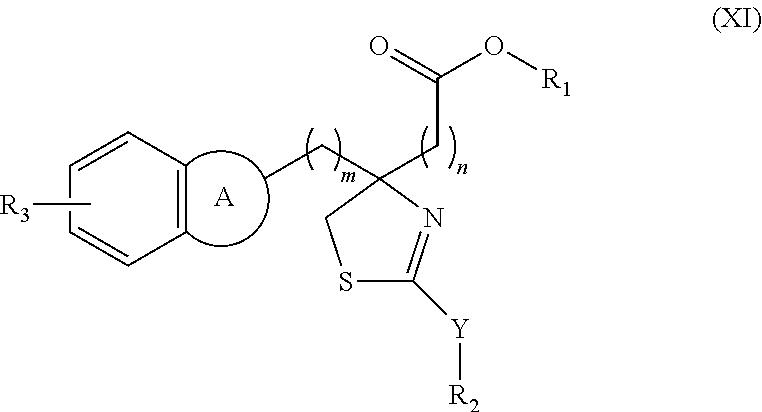
(wherein m, n, A, Y, R1, R2, and R3 are the same as defined above).


(wherein m, n, A, Y, R1, R2, and R3 are the same as defined above).


(wherein A, Y, R1, R2, and R3 are the same as defined above, and the position of the asymmetric carbon atom is also denoted by an asterisk).


(wherein R1, R2, R3, and Y are the same as defined above, and Z represents a hydroxyl group or a chlorine atom).

(wherein A, Y, R1, R2, and R3 are the same as defined above, and the position of the asymmetric carbon atom is also denoted by an asterisk).

(wherein A, Y, R1, R2, and R3 are the same as defined above).


| TABLE 1 | ||
| Pin1 | ||
| Compound | inhibition | |
| No. | Structural formula | activity |
| H-53 |
 |
Not measured (Hydrolysis causes conversion to H- 62, which is active) |
| H-62 |
 |
+ |
| H-85 |
 |
Not measured (Hydrolysis causes conversion to H- 109, which is active) |
| H-101 |
 |
++ |
| TABLE 2 | ||
| Pin1 | ||
| Compound | inhibition | |
| No. | Structural formula | activity |
| H-91 |
 |
Not measured (Hydrolysis causes conversion to H-103, which is active) |
| H-103 |
 |
+++ |
| H-105 |
 |
− (Hydrolysis causes conversion to H-109, which is active) |
| H-109 |
 |
+++ |
| TABLE 3 | ||
| Pin1 | ||
| Compound | inhibition | |
| No. | Structural formula | activity |
| H-129 |
 |
Not measured (Hydrolysis causes conversion to H-161, which is active) |
| H-161 |
 |
++ |
| H-138 |
 |
Not measured (Hydrolysis causes conversion to H-158, which is active) |
| H-158 |
 |
++ |
| TABLE 4 | ||
| Pin1 | ||
| Compound | inhibition | |
| No. | Structural formula | activity |
| H-143 |
 |
Not measured (Hydrolysis causes conversion to H-162, which is active) |
| H-162 |
 |
++ |
| H-144 |
 |
Not measured (Hydrolysis causes conversion to H-163, which is active) |
| H-163 |
 |
++ |
| TABLE 5 | ||
| Pin1 | ||
| Compound | inhibition | |
| No. | Structural formula | activity |
| H-156 |
 |
Not measured (Hydrolysis causes conversion to H-164, which is active) |
| H-164 |
 |
+ |
| H-178 |
 |
+++ |
| H-287 |
 |
Not measured (Hydrolysis causes conversion to H-334, which is active) |
| TABLE 6 | ||
| Pin1 | ||
| Compound | inhibition | |
| No. | Structural formula | activity |
| H-334 |
 |
+++ |
| H-291 |
 |
Not measured (Hydrolysis causes conversion to H-341, which is active) |
| H-341 |
 |
++ |
| H-521 |
 |
+ |
| TABLE 7 | ||
| Pin1 | ||
| Compound | inhibition | |
| No. | Structural formula | activity |
| H-536 |
 |
+ |


| TABLE 8 | ||
| Pin1 | ||
| Compound | inhibition | |
| No. | Structural formula | activity |
| H-23 |
 |
++ |
| H-30 |
 |
++ |
| H-21 |
 |
− (Hydrolysis causes conversion to H-30, which is active) |
| H-31 |
 |
+++ |
| H-141 |
 |
+++ |
| TABLE 9 | ||
| Pin1 | ||
| Compound | inhibition | |
| No. | Structural formula | activity |
| H-32 |
 |
+ |
| H-33 |
 |
+ |
| H-106 |
 |
++ |
| H-123 |
 |
++ |
| TABLE 10 | ||
| Pin1 | ||
| Compound | inhibition | |
| No. | Structural formula | activity |
| H-130 |
 |
++ |
| H-132 |
 |
+ |
| H-134 |
 |
++ |
| H-149 |
 |
+ |
| H-151 |
 |
++ |
| TABLE 11 | ||
| Pin1 | ||
| Compound | inhibition | |
| No. | Structural formula | activity |
| H-157 |
 |
++ |
| H-175 |
 |
+++ |
| H-176 |
 |
++ |
| H-177 |
 |
++ |
| H-179 |
 |
+++ |
| TABLE 12 | ||
| Pin1 | ||
| Compound | inhibition | |
| No. | Structural formula | activity |
| H-180 |
 |
++ |
| H-198 |
 |
+ |
| H-200 |
 |
+ |
| H-210 |
 |
+ |
| H-212 |
 |
+ |
| TABLE 13 | ||
| Pin1 | ||
| Compound | inhibition | |
| No. | Structural formula | activity |
| H-248 |
 |
+ |
| H-265 |
 |
+ |
| H-266 |
 |
+ |
| H-269 |
 |
+ |
| H-270 |
 |
+ |
| TABLE 14 | ||
| Pin1 | ||
| Compound | inhibition | |
| No. | Structural formula | activity |
| H-254 |
 |
Not measured |
| H-262 |
 |
Not measured |
| H-263 |
 |
Not measured |
| H-438 |
 |
Not measured |
| H-441 |
 |
Not measured |
| TABLE 15 | ||
| Pin1 | ||
| Compound | inhibition | |
| No. | Structural formula | activity |
| H-507 |
 |
Not measured |
| H-512 |
 |
Not measured |
| H-514 |
 |
Not measured |
| H-516 |
 |
Not measured |
Claims (15)


Applications Claiming Priority (4)
| Application Number | Priority Date | Filing Date | Title |
|---|---|---|---|
| JP2017-152807 | 2017-08-07 | ||
| JPJP2017-152807 | 2017-08-07 | ||
| JP2017152807 | 2017-08-07 | ||
| PCT/JP2018/029496 WO2019031471A1 (en) | 2017-08-07 | 2018-08-06 | Therapeutic agent for fatty liver diseases and therapeutic agent for adiposity |
Publications (2)
| Publication Number | Publication Date |
|---|---|
| US20200383989A1 US20200383989A1 (en) | 2020-12-10 |
| US11071738B2 true US11071738B2 (en) | 2021-07-27 |
Family
ID=65272012
Family Applications (1)
| Application Number | Title | Priority Date | Filing Date |
|---|---|---|---|
| US16/636,752 Active US11071738B2 (en) | 2017-08-07 | 2018-08-06 | Therapeutic agent for fatty liver diseases and therapeutic agent for adiposity |
Country Status (6)
| Country | Link |
|---|---|
| US (1) | US11071738B2 (en) |
| EP (1) | EP3679930A4 (en) |
| JP (1) | JPWO2019031471A1 (en) |
| KR (1) | KR20200041336A (en) |
| CN (1) | CN111182896A (en) |
| WO (1) | WO2019031471A1 (en) |
Families Citing this family (4)
| Publication number | Priority date | Publication date | Assignee | Title |
|---|---|---|---|---|
| US11504379B2 (en) * | 2017-08-07 | 2022-11-22 | Hiroshima University | Amide compound, and Pin1 inhibitor, therapeutic agent for inflammatory diseases and therapeutic agent for cancer that use the same |
| JP7701738B2 (en) | 2020-03-12 | 2025-07-02 | アメニス バイオサイエンス インク | Novel 3,5-diaminobenzoic acid compound, Pin1 inhibitor and therapeutic agent for inflammatory disease using the same |
| JP7835423B2 (en) * | 2020-11-17 | 2026-03-25 | アメニス バイオサイエンス インク | A therapeutic or prophylactic agent for COVID-19 |
| CN116869980A (en) * | 2023-08-01 | 2023-10-13 | 中国药科大学 | Application of Juglone in Preparing Drugs for Treating and/or Preventing Abnormal Lipid Metabolism Diseases |
Citations (10)
| Publication number | Priority date | Publication date | Assignee | Title |
|---|---|---|---|---|
| WO2002060436A2 (en) | 2000-12-22 | 2002-08-08 | Pintex Pharmaceuticals, Inc. | Use of fredericamycin a and its derivatives in the treatment of pin1-associated states |
| WO2004087720A1 (en) | 2003-03-10 | 2004-10-14 | Pfizer Inc. | Phosphate/sulfate ester compounds and pharmaceutical compositions for inhibiting protein interacting nima (pin1) |
| WO2005007123A2 (en) | 2003-07-18 | 2005-01-27 | Pintex Pharmaceuticals, Inc. | Pin1-modulating compounds and methods of use thereof |
| WO2005089316A2 (en) | 2004-03-12 | 2005-09-29 | Intercept Pharmaceuticals, Inc. | Treatment of fibrosis using fxr ligands |
| WO2006040646A1 (en) | 2004-10-14 | 2006-04-20 | Pfizer, Inc. | Benzimidazole or indole amides as inhibitors of pin1 |
| CN102030700A (en) | 2009-09-30 | 2011-04-27 | 中国医学科学院药物研究所 | Benzamide carboxylic acid compound as well as manufacturing method and medicinal application thereof |
| WO2012116176A2 (en) | 2011-02-25 | 2012-08-30 | Helsinn Healthcare Sa | Asymmetric ureas and medical uses thereof |
| WO2012151958A1 (en) | 2011-05-12 | 2012-11-15 | Fan Rulin | Low-toxic 3-pyrazole carboxylic acid amides, preparation methods and uses thereof in manufacture of medicines as cb1 receptor inhibitors |
| US20160199367A1 (en) * | 2015-01-12 | 2016-07-14 | Research & Business Foundation Sungkyunkwan University | Composition for the prevention or treatment of the symptoms in the stroke comprising the inhibitor of Pin1 |
| WO2018101329A1 (en) | 2016-11-29 | 2018-06-07 | 国立大学法人広島大学 | Novel ester compound and pin1 inhibitor, inflammatory disease therapeutic, and colon cancer therapeutic in which said ester compound is used |
-
2018
- 2018-08-06 EP EP18844350.1A patent/EP3679930A4/en not_active Withdrawn
- 2018-08-06 JP JP2019535661A patent/JPWO2019031471A1/en active Pending
- 2018-08-06 WO PCT/JP2018/029496 patent/WO2019031471A1/en not_active Ceased
- 2018-08-06 US US16/636,752 patent/US11071738B2/en active Active
- 2018-08-06 CN CN201880065038.3A patent/CN111182896A/en active Pending
- 2018-08-06 KR KR1020207006615A patent/KR20200041336A/en not_active Withdrawn
Patent Citations (12)
| Publication number | Priority date | Publication date | Assignee | Title |
|---|---|---|---|---|
| WO2002060436A2 (en) | 2000-12-22 | 2002-08-08 | Pintex Pharmaceuticals, Inc. | Use of fredericamycin a and its derivatives in the treatment of pin1-associated states |
| WO2004087720A1 (en) | 2003-03-10 | 2004-10-14 | Pfizer Inc. | Phosphate/sulfate ester compounds and pharmaceutical compositions for inhibiting protein interacting nima (pin1) |
| WO2005007123A2 (en) | 2003-07-18 | 2005-01-27 | Pintex Pharmaceuticals, Inc. | Pin1-modulating compounds and methods of use thereof |
| WO2005089316A2 (en) | 2004-03-12 | 2005-09-29 | Intercept Pharmaceuticals, Inc. | Treatment of fibrosis using fxr ligands |
| WO2006040646A1 (en) | 2004-10-14 | 2006-04-20 | Pfizer, Inc. | Benzimidazole or indole amides as inhibitors of pin1 |
| CN102030700A (en) | 2009-09-30 | 2011-04-27 | 中国医学科学院药物研究所 | Benzamide carboxylic acid compound as well as manufacturing method and medicinal application thereof |
| WO2012116176A2 (en) | 2011-02-25 | 2012-08-30 | Helsinn Healthcare Sa | Asymmetric ureas and medical uses thereof |
| JP2014518543A (en) | 2011-02-25 | 2014-07-31 | ヘルシン ヘルスケア ソシエテ アノニム | Asymmetric urea and its medical use |
| WO2012151958A1 (en) | 2011-05-12 | 2012-11-15 | Fan Rulin | Low-toxic 3-pyrazole carboxylic acid amides, preparation methods and uses thereof in manufacture of medicines as cb1 receptor inhibitors |
| US20160199367A1 (en) * | 2015-01-12 | 2016-07-14 | Research & Business Foundation Sungkyunkwan University | Composition for the prevention or treatment of the symptoms in the stroke comprising the inhibitor of Pin1 |
| WO2018101329A1 (en) | 2016-11-29 | 2018-06-07 | 国立大学法人広島大学 | Novel ester compound and pin1 inhibitor, inflammatory disease therapeutic, and colon cancer therapeutic in which said ester compound is used |
| EP3549930A1 (en) | 2016-11-29 | 2019-10-09 | Hiroshima University | Novel ester compound and pin1 inhibitor, inflammatory disease therapeutic, and colon cancer therapeutic in which said ester compound is used |
Non-Patent Citations (13)
| Title |
|---|
| Asano T (2013) Mechanism of insulin resistance and inflammation onset by malformation of proline isomerase Pin1 complex, Journal of Japan Applied Enzyme Association, No. 48, pp. 39-40. |
| Dong et al. (2010) Structure-Based design of novel human Pin1 inhibitors (II), Bioorg Med Chem Lett 20(70):2210-2214. |
| Guo et al. (2014) Structure-based Design of Novel Human Pin1 Inhibitors (III): Optimizing affinity Beyond the Phosphate Recognition Pocket, Bioorganic & Medicinal Chemistry Letters, 24(17):4187-4191. |
| Mori et al. (2014) A High-throughput Screen for Inhibitors of the Prolyl Isomerase, Pin1, Identifies a Seaweed Polyphenol that Reduces Adipose Cell Differentiation, Bioscience Biotechnology and Biochemistry, 78(5):832-838. |
| Nakagawa et al. (2015) Peptidyl Prolyl Isomerase Pin1-inhibitory Activity of D-glutamic and D-aspartic Acid Derivatives Bearing a Cyclic Aliphatic Amine Moiety, Bioorganic & Medicinal Chemistry Letters, 25(23):5619-5624. |
| Nakatsu et al. (2012) Role of Pin1 Protein in the Pathogenesis of Nonalcoholic Steatohepatitis in a Rodent Model, J Biol Chem 287(53):44526-44535. |
| Peng et al. (2015) Juglone prevents metabolic endotoxemia-induced hepatitis and neuroinflammation via suppressing TLR4/NF-κB signaling pathway in high-fat diet rats, Biochem Biophys Res Commun 462(3):245-250. |
| Potter et al. (2010) Discovery of Cell-Active Phenyl-Imidazole Pinl Inhibitors by Structure-Guided Fragment Evolution, Bioorg Med Chem Lett 20(2):6483-6488. |
| Potter et al. (2010) Structure-guided Design of α-amino acid-derived Pin1 inhibitors, Bioorg Med Chem Lett 20(2):586-590. |
| Stal "Liver fibrosis in non-alcoholic fatty liver disease-diagnostic challenge with prognostic significance," World J. Gastroenterology, 2015, vol. 21, p. 11077-11087 (Year: 2015). * |
| Yamazaki et al. (2014) Study of treatment effect of NASH by using Pin1 inhibitor Juglone, Journal of the Japan Diabetic Society, vol. 57, Supp. 1, S-456. |
| Yang et al. (2014) Pin1 induction in the fibrotic liver and its roles in TGF-β1 expression and smad2/3 phosphorylation, J Hepatol 60(6):1235-1241. |
| Zhou et al. (2015) Hepatoprotective effect of juglone on dimethylnitrosamine-induced liver fibrosis and its effect on hepatic antioxidant defense and the expression levels of α-SMA and collagen III, Mol Med Rep 12(3):4095-4102. |
Also Published As
| Publication number | Publication date |
|---|---|
| US20200383989A1 (en) | 2020-12-10 |
| JPWO2019031471A1 (en) | 2020-11-26 |
| CN111182896A (en) | 2020-05-19 |
| EP3679930A1 (en) | 2020-07-15 |
| WO2019031471A1 (en) | 2019-02-14 |
| EP3679930A4 (en) | 2021-11-17 |
| KR20200041336A (en) | 2020-04-21 |
Similar Documents
| Publication | Publication Date | Title |
|---|---|---|
| US12357626B2 (en) | Anthranilic acid-based compound, and Pin1 inhibitor, therapeutic agent for inflammatory diseases and therapeutic agent for cancer that use the same | |
| US20200383989A1 (en) | Therapeutic Agent for Fatty Liver Diseases and Therapeutic Agent for Adiposity | |
| EP3458448B1 (en) | Fasn inhibitors for use in treating non-alcoholic steatohepatitis | |
| US11504379B2 (en) | Amide compound, and Pin1 inhibitor, therapeutic agent for inflammatory diseases and therapeutic agent for cancer that use the same | |
| EP2184073A1 (en) | Therapeutic agent for cancer with resistance to protease inhibitor | |
| US12545643B2 (en) | 3,5-diaminobenzoic acid compound, and Pin1 inhibitor and therapeutic agent for inflammatory diseases using same | |
| RU2056416C1 (en) | Derivatives of thiourea, pharmaceutical composition and method of treatment | |
| JP2021525269A (en) | Compounds for pain treatment, compositions containing them and methods of using them | |
| US20210145822A1 (en) | Novel Spirolactone Compounds | |
| WO2019099457A1 (en) | Benzodioxinone compounds | |
| US11098043B2 (en) | Certain imidazopyridines as cyclic AMP response element binding (CREB) binding protein (CBP) inhibitors and uses thereof | |
| US7115666B2 (en) | Nitrone compounds, pharmaceutical compositions containing the same and methods for treating inflammation and neuropathic pain | |
| EA000166B1 (en) | Biologically active ureido derivatives useful in the treatment of multiple sclerosis | |
| US8865761B1 (en) | Regulation of cholesterol homeostasis | |
| US20240059725A1 (en) | Coumarin compounds and a process for preparation thereof | |
| WO2019056375A1 (en) | Acid-sensitive gefitinib axially substituted silicon phthalocyanine complex and preparation method therefor and medical use thereof | |
| JP2016539179A (en) | 4-methylsulfonyl-2-butenenitrile and its pharmaceutical use | |
| JP2021522338A (en) | Preparation method of strong thiazole compound, pharmaceutical preparation and its use |
Legal Events
| Date | Code | Title | Description |
|---|---|---|---|
| FEPP | Fee payment procedure |
Free format text: ENTITY STATUS SET TO UNDISCOUNTED (ORIGINAL EVENT CODE: BIG.); ENTITY STATUS OF PATENT OWNER: SMALL ENTITY |
|
| FEPP | Fee payment procedure |
Free format text: ENTITY STATUS SET TO SMALL (ORIGINAL EVENT CODE: SMAL); ENTITY STATUS OF PATENT OWNER: SMALL ENTITY |
|
| AS | Assignment |
Owner name: THE UNIVERSITY OF TOKYO, JAPAN Free format text: ASSIGNMENT OF ASSIGNORS INTEREST;ASSIGNOR:OKABE, TAKAYOSHI;REEL/FRAME:053243/0009 Effective date: 20200708 Owner name: HIROSHIMA UNIVERSITY, JAPAN Free format text: ASSIGNMENT OF ASSIGNORS INTEREST;ASSIGNORS:ASANO, TOMOICHIRO;NAKATSU, YUSUKE;REEL/FRAME:053242/0932 Effective date: 20200701 Owner name: TOKYO UNIVERSITY OF PHARMACY & LIFE SCIENCES, JAPAN Free format text: ASSIGNMENT OF ASSIGNORS INTEREST;ASSIGNOR:ITO, HISANAKA;REEL/FRAME:053242/0965 Effective date: 20200706 |
|
| STPP | Information on status: patent application and granting procedure in general |
Free format text: NON FINAL ACTION MAILED |
|
| STPP | Information on status: patent application and granting procedure in general |
Free format text: RESPONSE TO NON-FINAL OFFICE ACTION ENTERED AND FORWARDED TO EXAMINER |
|
| STPP | Information on status: patent application and granting procedure in general |
Free format text: NOTICE OF ALLOWANCE MAILED -- APPLICATION RECEIVED IN OFFICE OF PUBLICATIONS |
|
| STPP | Information on status: patent application and granting procedure in general |
Free format text: AWAITING TC RESP., ISSUE FEE NOT PAID |
|
| STPP | Information on status: patent application and granting procedure in general |
Free format text: NOTICE OF ALLOWANCE MAILED -- APPLICATION RECEIVED IN OFFICE OF PUBLICATIONS |
|
| STPP | Information on status: patent application and granting procedure in general |
Free format text: PUBLICATIONS -- ISSUE FEE PAYMENT RECEIVED |
|
| STPP | Information on status: patent application and granting procedure in general |
Free format text: PUBLICATIONS -- ISSUE FEE PAYMENT VERIFIED |
|
| STCF | Information on status: patent grant |
Free format text: PATENTED CASE |
|
| AS | Assignment |
Owner name: AMENIS BIOSCIENCE, INC., KOREA, REPUBLIC OF Free format text: ASSIGNMENT OF ASSIGNORS INTEREST;ASSIGNORS:HIROSHIMA UNIVERSITY;THE UNIVERSITY OF TOKYO;TOKYO UNIVERSITY OF PHARMACY AND LIFE SCIENCES;SIGNING DATES FROM 20240305 TO 20240307;REEL/FRAME:066781/0504 |
|
| MAFP | Maintenance fee payment |
Free format text: PAYMENT OF MAINTENANCE FEE, 4TH YR, SMALL ENTITY (ORIGINAL EVENT CODE: M2551); ENTITY STATUS OF PATENT OWNER: SMALL ENTITY Year of fee payment: 4 |