US11061580B2 - Storage device and controllers included in storage device - Google Patents
Storage device and controllers included in storage device Download PDFInfo
- Publication number
- US11061580B2 US11061580B2 US15/945,385 US201815945385A US11061580B2 US 11061580 B2 US11061580 B2 US 11061580B2 US 201815945385 A US201815945385 A US 201815945385A US 11061580 B2 US11061580 B2 US 11061580B2
- Authority
- US
- United States
- Prior art keywords
- local controller
- power
- controller
- cycle
- commands
- Prior art date
- Legal status (The legal status is an assumption and is not a legal conclusion. Google has not performed a legal analysis and makes no representation as to the accuracy of the status listed.)
- Active
Links
Images




Classifications
-
- G—PHYSICS
- G06—COMPUTING OR CALCULATING; COUNTING
- G06F—ELECTRIC DIGITAL DATA PROCESSING
- G06F3/00—Input arrangements for transferring data to be processed into a form capable of being handled by the computer; Output arrangements for transferring data from processing unit to output unit, e.g. interface arrangements
- G06F3/06—Digital input from, or digital output to, record carriers, e.g. RAID, emulated record carriers or networked record carriers
- G06F3/0601—Interfaces specially adapted for storage systems
- G06F3/0602—Interfaces specially adapted for storage systems specifically adapted to achieve a particular effect
- G06F3/061—Improving I/O performance
-
- G—PHYSICS
- G06—COMPUTING OR CALCULATING; COUNTING
- G06F—ELECTRIC DIGITAL DATA PROCESSING
- G06F3/00—Input arrangements for transferring data to be processed into a form capable of being handled by the computer; Output arrangements for transferring data from processing unit to output unit, e.g. interface arrangements
- G06F3/06—Digital input from, or digital output to, record carriers, e.g. RAID, emulated record carriers or networked record carriers
- G06F3/0601—Interfaces specially adapted for storage systems
- G06F3/0602—Interfaces specially adapted for storage systems specifically adapted to achieve a particular effect
- G06F3/061—Improving I/O performance
- G06F3/0613—Improving I/O performance in relation to throughput
-
- G—PHYSICS
- G06—COMPUTING OR CALCULATING; COUNTING
- G06F—ELECTRIC DIGITAL DATA PROCESSING
- G06F13/00—Interconnection of, or transfer of information or other signals between, memories, input/output devices or central processing units
- G06F13/14—Handling requests for interconnection or transfer
- G06F13/16—Handling requests for interconnection or transfer for access to memory bus
- G06F13/1668—Details of memory controller
-
- G—PHYSICS
- G06—COMPUTING OR CALCULATING; COUNTING
- G06F—ELECTRIC DIGITAL DATA PROCESSING
- G06F3/00—Input arrangements for transferring data to be processed into a form capable of being handled by the computer; Output arrangements for transferring data from processing unit to output unit, e.g. interface arrangements
- G06F3/06—Digital input from, or digital output to, record carriers, e.g. RAID, emulated record carriers or networked record carriers
- G06F3/0601—Interfaces specially adapted for storage systems
- G06F3/0602—Interfaces specially adapted for storage systems specifically adapted to achieve a particular effect
- G06F3/0625—Power saving in storage systems
-
- G—PHYSICS
- G06—COMPUTING OR CALCULATING; COUNTING
- G06F—ELECTRIC DIGITAL DATA PROCESSING
- G06F3/00—Input arrangements for transferring data to be processed into a form capable of being handled by the computer; Output arrangements for transferring data from processing unit to output unit, e.g. interface arrangements
- G06F3/06—Digital input from, or digital output to, record carriers, e.g. RAID, emulated record carriers or networked record carriers
- G06F3/0601—Interfaces specially adapted for storage systems
- G06F3/0628—Interfaces specially adapted for storage systems making use of a particular technique
- G06F3/0629—Configuration or reconfiguration of storage systems
-
- G—PHYSICS
- G06—COMPUTING OR CALCULATING; COUNTING
- G06F—ELECTRIC DIGITAL DATA PROCESSING
- G06F3/00—Input arrangements for transferring data to be processed into a form capable of being handled by the computer; Output arrangements for transferring data from processing unit to output unit, e.g. interface arrangements
- G06F3/06—Digital input from, or digital output to, record carriers, e.g. RAID, emulated record carriers or networked record carriers
- G06F3/0601—Interfaces specially adapted for storage systems
- G06F3/0628—Interfaces specially adapted for storage systems making use of a particular technique
- G06F3/0655—Vertical data movement, i.e. input-output transfer; data movement between one or more hosts and one or more storage devices
- G06F3/0658—Controller construction arrangements
-
- G—PHYSICS
- G06—COMPUTING OR CALCULATING; COUNTING
- G06F—ELECTRIC DIGITAL DATA PROCESSING
- G06F3/00—Input arrangements for transferring data to be processed into a form capable of being handled by the computer; Output arrangements for transferring data from processing unit to output unit, e.g. interface arrangements
- G06F3/06—Digital input from, or digital output to, record carriers, e.g. RAID, emulated record carriers or networked record carriers
- G06F3/0601—Interfaces specially adapted for storage systems
- G06F3/0628—Interfaces specially adapted for storage systems making use of a particular technique
- G06F3/0655—Vertical data movement, i.e. input-output transfer; data movement between one or more hosts and one or more storage devices
- G06F3/0659—Command handling arrangements, e.g. command buffers, queues, command scheduling
-
- G—PHYSICS
- G06—COMPUTING OR CALCULATING; COUNTING
- G06F—ELECTRIC DIGITAL DATA PROCESSING
- G06F3/00—Input arrangements for transferring data to be processed into a form capable of being handled by the computer; Output arrangements for transferring data from processing unit to output unit, e.g. interface arrangements
- G06F3/06—Digital input from, or digital output to, record carriers, e.g. RAID, emulated record carriers or networked record carriers
- G06F3/0601—Interfaces specially adapted for storage systems
- G06F3/0668—Interfaces specially adapted for storage systems adopting a particular infrastructure
- G06F3/0671—In-line storage system
- G06F3/0673—Single storage device
- G06F3/0679—Non-volatile semiconductor memory device, e.g. flash memory, one time programmable memory [OTP]
-
- G—PHYSICS
- G06—COMPUTING OR CALCULATING; COUNTING
- G06F—ELECTRIC DIGITAL DATA PROCESSING
- G06F3/00—Input arrangements for transferring data to be processed into a form capable of being handled by the computer; Output arrangements for transferring data from processing unit to output unit, e.g. interface arrangements
- G06F3/06—Digital input from, or digital output to, record carriers, e.g. RAID, emulated record carriers or networked record carriers
- G06F3/0601—Interfaces specially adapted for storage systems
- G06F3/0668—Interfaces specially adapted for storage systems adopting a particular infrastructure
- G06F3/0671—In-line storage system
- G06F3/0683—Plurality of storage devices
- G06F3/0688—Non-volatile semiconductor memory arrays
-
- G—PHYSICS
- G06—COMPUTING OR CALCULATING; COUNTING
- G06F—ELECTRIC DIGITAL DATA PROCESSING
- G06F3/00—Input arrangements for transferring data to be processed into a form capable of being handled by the computer; Output arrangements for transferring data from processing unit to output unit, e.g. interface arrangements
- G06F3/06—Digital input from, or digital output to, record carriers, e.g. RAID, emulated record carriers or networked record carriers
- G06F3/0601—Interfaces specially adapted for storage systems
- G06F3/0668—Interfaces specially adapted for storage systems adopting a particular infrastructure
- G06F3/0671—In-line storage system
- G06F3/0683—Plurality of storage devices
- G06F3/0689—Disk arrays, e.g. RAID, JBOD
-
- G—PHYSICS
- G06—COMPUTING OR CALCULATING; COUNTING
- G06F—ELECTRIC DIGITAL DATA PROCESSING
- G06F9/00—Arrangements for program control, e.g. control units
- G06F9/06—Arrangements for program control, e.g. control units using stored programs, i.e. using an internal store of processing equipment to receive or retain programs
- G06F9/30—Arrangements for executing machine instructions, e.g. instruction decode
- G06F9/38—Concurrent instruction execution, e.g. pipeline or look ahead
- G06F9/3854—Instruction completion, e.g. retiring, committing or graduating
- G06F9/3856—Reordering of instructions, e.g. using queues or age tags
-
- Y—GENERAL TAGGING OF NEW TECHNOLOGICAL DEVELOPMENTS; GENERAL TAGGING OF CROSS-SECTIONAL TECHNOLOGIES SPANNING OVER SEVERAL SECTIONS OF THE IPC; TECHNICAL SUBJECTS COVERED BY FORMER USPC CROSS-REFERENCE ART COLLECTIONS [XRACs] AND DIGESTS
- Y02—TECHNOLOGIES OR APPLICATIONS FOR MITIGATION OR ADAPTATION AGAINST CLIMATE CHANGE
- Y02D—CLIMATE CHANGE MITIGATION TECHNOLOGIES IN INFORMATION AND COMMUNICATION TECHNOLOGIES [ICT], I.E. INFORMATION AND COMMUNICATION TECHNOLOGIES AIMING AT THE REDUCTION OF THEIR OWN ENERGY USE
- Y02D10/00—Energy efficient computing, e.g. low power processors, power management or thermal management
Definitions
- the present disclosure relates to a storage device, and more particularly to a storage device with optimized performance and QoS (Quality of Service).
- QoS Quality of Service
- Storage devices have been developed to increase performance, capacity and reliability.
- a large amount of flash memories e.g., a NAND flash memory
- the number of memories included in the storage devices is ever increasing.
- a storage device When operations such as sequential read/write are performed, a large number of memories may be operated simultaneously, and thus a storage device may consume a large amount of power.
- the storage device has to perform an operation of lowering the performance of the storage device (for example, delaying the operation) before the power consumption exceeds the power specification of the storage device, that is, the power consumption required by the customers.
- the performance e.g., processing speed
- aspects of the present disclosure provide a storage device with optimized performance and QoS (Quality of Service).
- the storage device comprises a plurality of flash memories, a first local controller connected to a first group of flash memories among the plurality of flash memories, a second local controller connected to a second group of flash memories among the plurality of flash memories, and a global controller.
- the second group of flash memories are different from the first group of flash memories.
- the global controller transmits commands to at least one of the first local controller and the second local controller.
- the first local controller comprises a first processor that transmits first information on a type and number of commands associated with an operation performed on the first group of the flash memories to the global controller
- the second local controller comprises a second processor that transmits second information on a type and number of commands associated with an operation performed on the second group of the flash memories to the global controller.
- a local controller is disposed in a storage device and connected to a global controller.
- the local controller comprises a command receiver that receives one or more commands from the global controller, a processor that performs an operation corresponding to the received one or more commands on a plurality of flash memories connected to the local controller, and an adaptive power management (APM) that receives information on a number and type of commands associated with the operation performed on the plurality of flash memories from the processor.
- the APM calculates a power consumption based on the received information.
- the processor transmits information on the number and type of commands associated with the operation performed on the plurality of flash memories to the global controller.
- a global controller is disposed in a storage device and connected to a first local controller and a second local controller, which are physically separated from each other.
- the global controller comprises a queue area where one or more commands associated with a next cycle are queued during a current cycle, a power controller having a predetermined number of power tokens that it distributes to each of the first local controller and the second local controller, and a command analyzer that checks first information on the one or more commands queued in the queue area during the current cycle.
- the power controller receives, from the first local controller, second information on a type and number of commands associated with an operation performed on a first group of flash memories connected to the first local controller during the current cycle.
- the power controller receives, from the second local controller, third information on a type and number of commands associated with an operation performed on a second group of flash memories connected to the second local controller during the current cycle.
- the second group of flash memories are different from the first group of flash memories.
- the third information is different from the first information and from the second information.
- FIG. 1 is a block diagram for illustrating a storage device according to some exemplary embodiments of the present disclosure
- FIG. 2 is a block diagram for illustrating a global controller included in a storage device according to some exemplary embodiments of the present disclosure
- FIG. 3 is a block diagram for illustrating a local controller included in a storage device according to some exemplary embodiments of the present disclosure
- FIG. 4 is a flowchart for illustrating an example of a method of determining power consumed in each of a plurality of local controllers and adjusting a command processing speed of each of the plurality of local controllers in a storage device according to some exemplary embodiments of the present disclosure
- FIGS. 5A, 5B and 6 to 8 are diagrams for illustrating an example of a method of determining power consumed in each of the plurality of local controllers in a storage device according to some exemplary embodiments of the present disclosure
- FIGS. 9 and 10 illustrate an example of a method for distributing power tokens when there are more commands queued in the queue area during the current cycle than power tokens included in the power controller of the global controller in the storage device according to some exemplary embodiments of the present disclosure
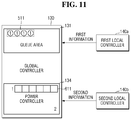
- FIGS. 11 and 12 illustrate examples of a method for distributing power tokens when it is recognized that there is no command that is to be processed by the second local controller during the next cycle in the queue area of the global controller included in the storage device according to some exemplary embodiments of the present disclosure
- FIG. 13 is a diagram for illustrating an example of a method of transmitting information from a local controller to a global controller in a storage device according to some exemplary embodiments of the present disclosure.
- FIG. 14 is a block diagram for illustrating a server system using the SSD of FIG. 1 .
- FIG. 1 is a block diagram for illustrating a storage device according to some exemplary embodiments of the present disclosure.
- FIG. 2 is a block diagram for illustrating a global controller included in a storage device according to some exemplary embodiments of the present disclosure.
- FIG. 3 is a block diagram for illustrating a local controller included in a storage device according to some exemplary embodiments of the present disclosure.
- the storage device 1 may be, but is not limited to, a solid-state drive (SSD) device.
- SSD solid-state drive
- the storage device 1 includes an SSD controller 100 , a host interface logic 200 , a random access memory (RAM) buffer 300 , and a plurality of flash memories 410 and 420 .
- the elements shown in FIG. 1 are not essential for implementing the storage device 1 .
- the storage device 1 may include more or fewer elements than those listed above.
- An SSD controller 100 may include a processor 110 , a buffer manager 120 , a global controller 130 , and a plurality of local controllers (e.g., a first local controller 140 a and a second local controller 140 b ).
- the processor 110 may receive commands from a host via the host interface logic 200 .
- the processor 110 may process the received commands and may control the buffer manager 120 , the global controller 130 , the local controllers 140 a and 140 b , and the like.
- the host interface logic 200 may be disposed between the host and the SSD controller 100 to deliver commands from the host to the SSD controller 100 or to deliver responses from the SSD controller 100 to the host.
- the host interface logic 200 may be implemented in accordance with a serial ATA (SATA) interface, a PCI Express interface, a serial attached SCSI (SAS) interface, etc., for example.
- SATA serial ATA
- SAS serial attached SCSI
- the RAM buffer 300 may include a volatile memory mounted outside the SSD controller 100 including DRAM (dynamic RAM).
- the RAM buffer 300 may be used as a cache or may be used to store mapping information on data stored in a flash memory 400 .
- Each of the plurality of flash memories 410 and 420 may include one or more flash memory chips.
- the flash memory chip may be a NAND flash memory chip.
- the global controller 130 may be connected to the processor 110 and the plurality of local controllers 140 a and 140 b.
- the processor 110 may transmit commands received from the host interface logic 200 to the global controller 130 .
- the commands transmitted to the global controller 130 may include a read command, a write command, an erase command, and the like.
- the host interface logic 200 may send a plurality of commands directly to the global controller 130 .
- the global controller 130 may transmit the commands received via the processor 110 to each of the plurality of local controllers 140 a and 140 b .
- the global controller 130 may determine the power consumption in each of the plurality of local controllers 140 a and 140 b .
- the global controller 130 may queue the commands therein. A detailed description thereof will be made below with reference to FIG. 2 .
- the global controller 130 may include a queue area 131 , a command analyzer 132 , a processor 133 , and a power controller 134 .
- the elements shown in FIG. 2 are not essential for implementing the global controller 130 .
- the global controller 130 may include more or fewer elements than those listed above.
- the queue area 131 may be where one or more commands associated with a second cycle, which is the next cycle to the first cycle are queued during the first cycle (e.g., the current cycle). For example, if the global controller 130 receives one or more commands associated with the second cycle during the first cycle, it may store the command in the queue area 131 during the first cycle.
- the command analyzer 132 may check information on one or more commands waiting in the queue area 131 during the first cycle.
- the information checked by the command analyzer 132 may include information on the number of commands queued in the queue area 131 during the first cycle, information on the type of the commands queued in the queue area 131 during the first cycle, and information on the local controllers to process each of the commands during the second cycle.
- the processor 133 may be responsible for the overall operation performed on the global controller 130 and may control the queue area 131 , the command analyzer 132 and the power controller 134 .
- the processor 133 may transmit the commands queued in the queue area 131 during the first cycle to each of the plurality of local controllers 140 a and 140 b during the second cycle.
- the command to be transmitted to the first local controller 140 a may be one to be processed at the first local controller 140 a during the second cycle
- the command to be transmitted to the second local controller 140 b may be one to be processed at the second local controller 140 b during the second cycle.
- the power controller 134 may receive first information on the type and number of commands associated with the operations performed on the plurality of flash memories connected to the first local controller 140 a during the first cycle from the first local controller 140 a , and second information on the type and number of commands associated with the operations performed on the plurality of flash memories connected to the second local controller 140 b during the first cycle from the second local controller 140 b.
- the command analyzer 132 may recognize third information on the type and number of commands queued in the queue area 131 during the first cycle.
- the third information may be different from the first information and from the second information.
- the power controller 134 may determine the power to be consumed in the first local controller 140 a during the second cycle and the power to be consumed in the second local controller 140 b during the second cycle based on the first information, the second information and the third information described above.
- the power controller 134 may have a predetermined number of power tokens and may use these power tokens to determine the power to be consumed in each of the plurality of local controllers 140 a and 140 b during the second cycle.
- the power controller 134 may distribute power tokens across the plurality of local controllers 140 a and 140 b based on the first information, the second information and the third information described above.
- the power tokens described above may be virtual resources representing the power to be consumed in each of the plurality of local controllers 140 a and 140 b during the second cycle.
- the power consumed by the first local controller 140 a and the second local controller 140 b during the second cycle may vary depending on the numbers of distributed power tokens.
- the power controller 134 may distribute the power tokens so that one of the local controllers, which has more operations to process during the second cycle, can consume more power.
- the power controller 134 may include a mapping table indicating the power to be consumed during the second cycle using the above-described third information.
- the power controller 134 may store therein a mapping table indicating power consumption according to a read command, power consumption according to a write command, and power consumption according to an erase command. It is to be understood that this is merely illustrative and the mapping table may indicate power consumption depending on the types and numbers of commands.
- the power controller 134 may use the above-described mapping table when it distributes power tokens across the plurality of local controllers 140 a and 140 b based on the first info, the second information and the third information.
- the plurality of flash memories 410 and 420 may be connected to the plurality of local controllers 140 a and 140 b , respectively.
- a first group of flash memories 410 among the plurality of flash memories 410 , 420 may be connected to the first local controller 140 a .
- a second group of flash memories 420 among the plurality of flash memories 410 , 420 may be connected to the second local controller 140 b .
- the second group of flash memories 420 may include flash memories different from the first group of flash memories 410 among the memories included in the plurality of flash memories.
- the first local controller 140 a may include a command receiver 141 a , a processor 142 a , and an adaptive power management (APM) 143 a .
- the elements shown in FIG. 3 are not essential for implementing the first local controller 140 a .
- the first local controller 140 a may include more or fewer elements than those listed above. It is to be noted that although only the first local controller 140 a is described for convenience of illustration, all the local controllers included in the storage device 1 according to some exemplary embodiments of the present disclosure may have the same elements as the first local controller 140 a.
- the command receiver 141 a may receive one or more commands from the global controller 130 during the first cycle.
- the command receiver 141 a may receive power tokens from the global controller 130 .
- the processor 142 a may receive one or more commands from the command receiver 141 a during the first cycle.
- the processor 142 a may perform an operation corresponding to the one or more commands received during the first cycle on the first group of flash memories 410 connected to the first local controller 140 a.
- the operations performed by the processor 142 a on the first group of flash memories 410 may include operations performed based on the commands received via the host, and operations for processing internal IO such as garbage collection or wear leveling.
- the processor 142 a may periodically or aperiodically transmit information on commands associated with operations performed on the first group of flash memories 410 to the APM 143 a and the global controller 130 .
- the information on the commands associated with the operation performed on the first group of flash memories 410 may include information on the type and number of commands received via the host and information on the type and number of commands for processing the internal IO.
- the commands received via the host and the commands for processing the internal IO may include a read command, a write command, and an erase command.
- the APM 143 a may receive information on the type and number of commands associated with the operations performed on the first group of flash memories 410 during the first cycle via the processor 142 a , and may calculate the power to be consumed by operations performed on the first group of flash memories 410 during the first cycle based on the received information.
- Ip may denote a value of idle power consumed by the local controller 140 a during the current cycle irrespectively of the commands received by the local controller 140 a
- Rcount may denote the number of read commands
- Ecount may denote the number of erase commands
- Wcount may denote the number of write commands
- Rpower may denote a value of power to be consumed when the first local controller 140 a performs an operation on the first group of flash memories 410 during the current cycle for a single read command
- Epower may denote a value of power to be consumed when the first local controller 140 a performs an operation on the first group of flash memories 410 during the current cycle for a single erase command
- Wpower may denote a value of power to be consumed when the first local controller 140 a performs an operation on the first group of flash memories 410 during the current cycle for a single write command.
- the APM 143 a may store in advance a mapping table for extracting power consumption based on information on the number and type of commands received via the processor 133 .
- the APM 143 a may calculate the power consumption during the first cycle using the above-described mapping table.
- the APM 143 a may check the number of power tokens received at the global controller 130 . By checking the number of such power tokens, the APM 143 a may check the power available to the first local controller 140 a during the first cycle. The APM 143 a may adjust the command processing speed by the first local controller 140 a based on the checked power and the power to be consumed during the current cycle calculated by Equation 1.
- the APM 143 a when the APM 143 a recognizes that the power corresponding to the number of the received power tokens is 12 W, it may decrease the command processing speed if the power to be consumed during the current cycle calculated by Equation 1 exceeds 12 W, whereas it may increase the command processing speed if the power to be consumed during the current cycle calculated by Equation 1 is less than 12 W.
- the APM 143 a predicts the power consumption in real-time, increases the command processing speed if the predicted power is smaller than the power allocated to the first local controller 140 a , and decreases the command processing speed if the predicted power is greater than the power allocated to the first local controller 140 a , such that the local controller itself can automatically adjust its performance.
- FIG. 4 is a flowchart for illustrating an example of a method of determining power consumed in each of a plurality of local controllers and adjusting a command processing speed of each of the plurality of local controllers in a storage device according to some exemplary embodiments of the present disclosure.
- FIGS. 5A, 5B and 6 to 8 are diagrams for illustrating an example of a method of determining power consumed in each of the plurality of local controllers in a storage device according to some exemplary embodiments of the present disclosure.
- the global controller 130 may queue one or more commands in the queue area 131 included therein before the first cycle, which will be described with reference to FIGS. 5A and 5B prior to describing step S 101 of FIG. 4 .
- the host interface logic 200 may send a plurality of commands 500 associated with the first cycle to the global controller 130 before the first cycle.
- the plurality of commands 500 may include commands 510 associated with the operation to be performed at the first local controller 140 a during the first cycle, and commands 520 associated with the operation to be performed at the second local controller 140 b during the first cycle.
- the power controller 134 included in the global controller 130 may have a predetermined number of power tokens 600 .
- the power controller 134 may have six power tokens 600 . It is to be understood that the number of power tokens 600 is merely an example for convenience of illustration and is not limited to six.
- the queue area 131 included in the global controller 130 may queue the plurality of commands 500 received from the host interface logic 200 .
- the power controller 134 included in the global controller 130 may check information on the plurality of commands 500 queued in the queue area 131 .
- the information on the plurality of commands 500 may include information on the number of the plurality of commands 500 queued in the queue area 131 , information on the types of the plurality of commands 500 queued in the queue area 131 , and information on the local controller to process each of the plurality of commands queued in the queue area 131 during the first cycle.
- the power controller 134 may recognize that there are three read commands in the queue area 131 , which are to be processed at the first local controller 140 a during the first cycle. In addition, the power controller 134 may recognize that there are three read commands in the queue area 131 , which are to be processed at the second local controller 140 b during the first cycle.
- the power controller 134 may predict the power consumption in Watts when the three read commands are processed at the first local controller 140 a during the first cycle.
- the power controller 134 may predict the power consumption in Watts when the three read commands are processed at the second local controller 140 b during the first cycle.
- the power controller 134 may distribute the same number of power tokens 600 to the first local controller 140 a and to the second local controller 140 b . For example, if the power controller 134 predicts that the power consumed by the first local controller 140 a is equal to that of the second local controller 140 b during the first cycle as in the example of FIG. 5B , it may distribute three power tokens 610 to the first local controller 140 a and three power tokens 620 to the second local controller 140 b.
- the power controller 134 may distribute the power tokens 600 such that the number of power tokens distributed to the first local controller 140 a is different from that of the second local controller 140 b . For example, if the power controller 134 predicts that the power consumed by the first local controller 140 a is larger than that of the second local controller 140 b during the first cycle based on the predicted information, it may distribute more power tokens 600 to the first local controller 140 a than to the second local controller 140 b.
- the global controller 130 included in the storage device 1 may transmit one or more commands 500 and at least one power token 600 associated with the first cycle during the first cycle to the first local controller 140 a and to the second local controller 140 b (step S 101 ).
- the processor 133 included in the global controller 130 may send a command 510 and a power token 610 to the first local controller 140 a and a command 520 and a power token 620 to the second local controller 140 b .
- the number of commands 510 transmitted to the first local controller 140 a may be equal to the number of the power tokens 610 distributed to the first local controller 140 a in FIG. 5B .
- the number of commands 520 transmitted to the second local controller 140 b may be equal to the number of the power tokens 610 distributed to the second local controller 140 b in FIG. 5B .
- the processor 133 may transmit three commands 510 to the first local controller 140 a .
- the processor 133 may transmit three commands 520 to the second local controller 140 b .
- the processor 133 may transmit the power tokens 610 and 620 along with the commands 510 and 520 to the first local controller 140 a and the second local controller 140 b , respectively, during the first cycle.
- the first local controller 140 a may transmit to the global controller 130 first information on the type and number of commands 510 associated with the operations performed on the first group of flash memories 410 connected to the first local controller 140 a during the first cycle (step S 102 ).
- the second local controller 140 b may transmit to the global controller 130 second information on the type and number of commands 520 associated with the operations performed on the second group of flash memories 420 connected to the second local controller 140 b during the first cycle (step S 103 ).
- the first processor 142 a included in the first local controller 140 a may transmit to the global controller 130 first information on the types and number of commands 510 associated with the operations performed on the first group of flash memories 410 connected to the first local controller 140 a using the commands 510 received during the first cycle.
- the first processor 142 a may also transmit the first information to the first APM 143 a.
- the second processor 142 b included in the second local controller 140 b may transmit to the global controller 130 second information on the types and number of commands 520 associated with the operations performed on the second group of flash memories 420 connected to the second local controller 140 b using the commands 520 received during the first cycle.
- the second processor 142 b may also transmit the second information to the second APM 143 b.
- the first local controller 140 a may calculate the first power consumed by the first local controller 140 a during the first cycle (step S 104 ).
- the second local controller 140 b may calculate the second power consumed by the second local controller 140 b during the first cycle (step S 105 ).
- the first APM 143 a included in the first local controller 140 a may calculate the first power based on the first information received from the first processor 142 a , which is the power consumption by the first local controller 140 a to perform the operations on the first group of flash memories 410 during the first cycle.
- the second APM 143 b included in the second local controller 140 b may calculate the second power based on the second information received from the second processor 142 b , which is the power consumption by the second local controller 140 b to perform the operations on the second group of flash memories 420 during the first cycle.
- the first power and the second power may be calculated by Equation 1 above.
- the first local controller 140 a may check the first power calculated in step S 104 and the number of power tokens 610 received in step S 101 and may adjust the command processing speed of the first local controller 140 a during the first cycle based on the calculated first power and the number of tokens 610 (step S 106 ).
- the second local controller 140 b may check the second power calculated in step S 105 and the number of power tokens 620 received in step 5101 and may adjust the command processing speed of the second local controller 140 b during the first cycle based on the calculated second power and the number of tokens 620 (step S 107 ).
- the first APM 143 a included in the first local controller 140 a may recognize the number of power tokens 610 received together with the commands 510 during the first cycle. For example, the first APM 143 a may recognize that three power tokens 610 are received together with the commands 510 during the first cycle.
- the first APM 143 a may store therein in advance a mapping table that indicates powers each corresponding to a respective number of received power tokens. The first APM 143 a may recognize a first power corresponding to the number of the received tokens 610 using the mapping table.
- the first APM 143 a may delay the commands 510 received at the first local controller 140 a during the first cycle, may change the clock provided to the first local controller 140 a , or may limit the number of banks of the first group of flash memories 410 on which the first local controller 140 a performs an operation during the first cycle, thereby decreasing the command processing speed of the first local controller 140 a.
- the first APM 143 a may not delay the commands 510 received at the first local controller 140 a during the first cycle, may change the clock provided to the first local controller 140 a , or may not limit the number of banks of the first group of flash memories 410 on which the first local controller 140 a performs an operation during the first cycle, thereby increasing the command processing speed of the first local controller 140 a.
- the second local controller 140 b may adjust the command processing speed of the second local controller 140 b in step S 107 of FIG. 4 in the same manner as the first local controller 140 a adjusts the command processing speed of the first local controller 140 a in step S 106 of FIG. 4 , and thus a detailed description thereof will be omitted.
- the first APM 143 a and the second APM 143 b (see FIG. 7 ) predict the power consumption in real-time, increase the command processing speed if the predicted power is smaller than the power allocated to each of the first local controller 140 a and the second local controller 140 b , and decrease the command processing speed if the predicted power is greater than the power allocated to each of the first local controller 140 a and the second local controller 140 b , such that the local controllers 140 a , 140 b themselves can automatically adjust their performances.
- the global controller 130 may receive from the host interface logic 200 a plurality of commands associated with the second cycle, which is the next cycle to the first cycle, during the first cycle in step S 108 . In addition, the global controller 130 may queue the plurality of commands associated with the second cycle received in step S 108 . The global controller 130 may perform step S 108 after steps S 102 to S 107 , but this is not limiting. For example, the global controller 130 may perform step S 108 simultaneously with steps S 102 to S 108 or before steps S 102 to S 107 . Step S 108 will be described in more detail below.
- the global controller 130 may receive from the host interface logic, during the first cycle, the plurality of commands 501 associated with the second cycle.
- the plurality of commands 501 may include commands 511 associated with the operation to be performed at the first local controller 140 a during the second cycle, and commands 521 associated with the operation to be performed at the second local controller 140 b during the second cycle.
- the queue area 131 included in the global controller 130 may queue the commands 511 associated with an operation to be performed at the first local controller 140 a during the second cycle and the commands 521 associated with an operation to be performed at the second local controller 140 b during the second cycle.
- the global controller 130 may recognize third information on the commands 501 queued in the queue area 131 during the first cycle, and may distribute power tokens to the first local controller 140 a and the second local controller 140 b based on the first information, the second information and the third information (step S 109 ).
- the third information may include information on the number of commands 501 queued in the queue area 131 during the first cycle, information on the types of commands 501 queued in the queue area 131 during the first cycle, and information on the local controllers 140 a , 140 b to process, during the second cycle, each of the commands 501 queued in the queue area 131 during the first cycle.
- the global controller 130 When the global controller 130 recognizes that the power consumed by the first local controller 140 a is equal to that of the second local controller 140 b during the first cycle based on the first information and the second information, it may distribute the power tokens based on third information.
- the power controller 134 may recognize that four read commands among the commands 501 queued in the queue area 131 during the first cycle are to be processed at the first local controller 140 a during the second cycle based on the third information. In addition, the power controller 134 may recognize that two read commands among the commands 501 queued in the queue area 131 during the first cycle are to be processed at the second local controller 140 b during the second cycle based on the third information.
- the power controller 134 included in the global controller 130 may recognize that the operation is being performed at the first local controller 140 a during the first cycle through the three read commands based on the first information. In addition, the power controller 134 may recognize that the operation is being performed at the second local controller 140 b during the first cycle through the three read commands based on the second information. The power controller 134 may calculate power consumed during the first cycle at each of the first local controller 140 a and the second local controller 140 b based on the first information and the second information.
- the power controller 134 may distribute four power tokens 611 , which is equal to the number of commands 511 to be processed at the first local controller 140 a during the second cycle, to the first local controller 140 a , and two power tokens 621 , which is equal to the number of commands 521 to be processed at the second local controller 140 b during the second cycle, to the second local controller 140 b.
- the global controller 130 may transmit one or more commands 511 , 521 and power tokens 611 , 621 associated with the second cycle to the first local controller 140 a and to the second local controller 140 b during the second cycle (S 110 ).
- the processor 133 included in the global controller 130 may transmit the commands 511 and the power tokens 611 associated with the second cycle to the first local controller 140 a and the commands 521 and the power tokens 621 associated with the second cycle to the second local controller 140 b .
- the number of commands 511 transmitted to the first local controller 140 a may be equal to the number of the power tokens 611 distributed to the first local controller 140 a .
- the number of commands 521 transmitted to the second local controller 140 b may be equal to the number of the power tokens 621 distributed to the second local controller 140 b.
- the processor 133 may transmit four commands 511 to the first local controller 140 a .
- the processor 133 may transmit two commands 521 to the second local controller 140 b .
- the processor 133 may transmit the power tokens 611 and 621 along with the commands 511 and 521 associated with the second cycle to the first local controller 140 a and the second local controller 140 b , respectively, during the second cycle.
- FIGS. 9 and 10 illustrate examples of a method for distributing power tokens when the commands queued in the queue area 131 during the current cycle outnumber the power tokens possessed by the power controller of the global controller included in the storage device, according to some exemplary embodiments of the present disclosure.
- descriptions will be made focusing on differences from the above exemplary embodiments described with reference to FIGS. 1 to 8 ; and the redundant description will be omitted.
- the queue area 131 included in the global controller 130 may include commands 501 associated with the second cycle that are received or evaluated by the global controller 130 during the first cycle.
- the commands 501 may include four first commands 511 to be processed at the first local controller 140 a during the second cycle and three second commands 521 to be processed at the second local controller 140 b during the second cycle.
- first commands 511 and the second commands 521 are of the same kind.
- the global controller 130 may receive the first information from the first local controller 140 a and the second information from the second local controller 140 b .
- the power controller 134 may recognize the third information on the commands 501 queued in the queue area 131 .
- the first information, the second information and the third information have been described above with reference to FIGS. 1 to 8 , and thus will not be described in detail.
- the power controller 134 When the power controller 134 recognizes that seven commands 501 , which outnumber the six power tokens 600 possessed by the power controller 134 , are queued in the queue area 131 during the first cycle based on the third information, it may calculate the first power consumed at the first local controller 140 a and the second power consumed at the second local controller 140 b during the first cycle based on the first and second information. Then, the power controller 134 may distribute more power tokens 600 to the one of the local controllers that is consuming more power during the first cycle.
- An algorithm for distributing the power tokens 600 may be stored in the power controller 134 in advance.
- the power controller 134 when the power controller 134 recognizes that the magnitude of the second power is greater than the magnitude of the first power based on the first information and the second information, it may distribute three power tokens 611 to the first local controller 140 a and three power tokens 621 to the second local controller 140 b .
- the global controller 130 may transmit three commands 511 and three power tokens 611 to the first local controller 140 a and three commands 521 and three power tokens 621 to the second local controller 140 b during the second cycle, and may queue one of the commands 511 associated with the operation to be performed at the first local controller 140 a during the second cycle in the queue area 131 during the second cycle.
- the power controller 134 when the power controller 134 recognizes that the magnitude of the first power is greater than the magnitude of the second power based on the first information and the second information, it may distribute four power tokens 611 to the first local controller 140 a and two power tokens 621 to the second local controller 140 b .
- the global controller 130 may transmit four commands 511 and four power tokens 611 to the first local controller 140 a and two commands 521 and two power tokens 621 to the second local controller 140 b during the second cycle, and may queue one of the commands 521 associated with the operation to be performed at the second local controller 140 b during the second cycle in the queue area 131 during the second cycle.
- FIGS. 11 and 12 illustrate examples of a method for distributing power tokens 600 when it is recognized that there is no command 521 that is to be processed by the second local controller 140 b during the next cycle in the queue area 131 of the global controller 130 included in the storage device 1 according to some exemplary embodiments of the present disclosure.
- descriptions will be made focusing on differences from the above exemplary embodiments described above with reference to FIGS. 1 to 10 ; and the redundant description will be omitted.
- the queue area 131 included in the global controller 130 may include, during the first cycle, commands 501 associated with the second cycle.
- commands 501 there may be four first commands 511 to be processed at the first local controller 140 a during the second cycle, and there may be no second command 521 to be processed at the second local controller 140 b during the second cycle.
- the global controller 130 may receive the first information from the first local controller 140 a and the second information from the second local controller 140 b .
- the power controller 134 may recognize the third information on the commands 501 queued in the queue area 131 .
- the first information, the second information and the third information have been described above with reference to FIGS. 1 to 8 , and thus will not be described in detail.
- the power controller 134 When the power controller 134 recognizes that there is no command 521 to be processed by the second local controller 140 b during the second cycle among the commands 501 queued in the queue area 131 during the first cycle based on the third information, it may distribute the power tokens 621 to the second local controller in consideration of the second information.
- the power controller 134 may distribute no power token 621 to the second local controller 140 b .
- the power controller 134 may then distribute all of the power tokens 611 to the first local controller 140 a .
- the global controller 130 sends the commands 511 associated with the second cycle to the first local controller 140 a , it may send power tokens 611 to the first local controller 140 a , which outnumber the commands 511 .
- the first local controller 140 a recognizes that the number of power tokens 611 is greater than the number of received commands 511 , and the first local controller 140 a may consume as much power as possible within the power specification limit of the storage device 1 to quickly process the operation associated with the second cycle.
- the power controller 134 may distribute one or more power tokens 621 to the second local controller 140 b .
- the global controller 130 may transmit power tokens 621 to the second local controller 140 b during the second cycle without commands 521 . This is because the second local controller 140 b has to process internal IO, such as garbage collection and wear leveling during the second cycle when it has received the power tokens 621 only.
- the power controller 134 when the power controller 134 recognizes that there is no command 511 to be processed by the first local controller 140 a during the second cycle among the commands 501 queued in the queue area 131 during the first cycle based on the third information, it may distribute the power tokens 611 to the first local controller in consideration of the first information. This has been described above with reference to FIGS. 11 and 12 ; and, therefore, the redundant description will be omitted.
- FIG. 13 is a diagram for illustrating an example of a method of transmitting information from a local controller to a global controller in a storage device according to some exemplary embodiments of the present disclosure. Although FIG. 13 depicts only the first local controller 140 a , the embodiment described in FIG. 13 can be equally applied to the second local controller 140 b.
- an SSD controller 100 may include a hardware pin 150 .
- the hardware pin 150 may include a general purpose input/output (GPIO).
- the first local controller 140 a may transmit to the hardware pin 150 information on the type and number of commands associated with the operations performed on the plurality of flash memories connected to the first local controller 140 a during the current cycle.
- the hardware pin 150 may receive and store the information.
- the global controller 130 may check the hardware pin 150 at a predetermined time interval (e.g., 100 ms). If the hardware pin 150 has the information, the global controller 130 may receive the information stored in the hardware pin 150 .
- a predetermined time interval e.g. 100 ms.
- the global controller 130 cannot transmit a command to a local controller 140 a while the local controller 140 a transmits information to the global controller 130 , which happens when the global controller 130 transmits a command to the local controller 140 a and the local controller 140 a transmits information to the global controller 130 via the same line.
- the global controller 130 may receive information on the type and the number of commands associated with the operations performed on the plurality of flash memories 410 connected to the first local controller 140 a from the first local controller 140 a via a line different from the line on which a command is transmitted to the local controller 140 a.
- FIG. 14 is a block diagram for illustrating a server system using the SSD of FIG. 1 .
- a server system 70 may include a server 720 and an SSD 740 that stores data necessary for driving the server 720 .
- the SSD 740 includes the same configuration as the storage device 1 shown in FIG. 1 .
- the server 720 may include an application communications module 721 , a data processing module 722 , an upgrade module 723 , a scheduling center 724 , a local resource module 725 and a repair information module 726 .
- the application communications module 721 may be used to enable the server 720 to communicate with a computing system connected to a network, Network, or with the SSD 740 .
- the application communications module 721 transmits data or information provided via a user interface to the data processing module 722 .
- Data processing module 722 may be linked to the local resource module 725 .
- the local resource module 725 provides the user with a list of repair shops/dealers/technical information based on the data or information input to the server 720 .
- the upgrade module 723 interfaces with the data processing module 722 .
- the upgrade module 723 upgrades the electronic appliance with firmware, a reset code, a diagnostic system upgrade or other information based on the data or information transmitted from the SSD 740 .
- the scheduling center 724 allows the user to use options in real-time based on the data or information input to the server 720 .
- the repair information module 726 interfaces with the data processing module 722 .
- the repair information module 726 may be used to provide repair-related information (e.g., audio, video, or document files) to the user.
- Data processing module 722 packages the related information based on the information delivered from SSD 740 . Then, such information may be transmitted to the SSD 740 or displayed to the user.
- An apparatus for fabricating a storage device provides a wafer or package including a plurality of physically separated controllers and a plurality of flash memories, and tests the wafer or package.
- the provided wafer or package includes: a first local controller connected to a first group of flash memories among the plurality of flash memories; a second local controller connected to a second group of flash memories different from the first group of flash memories among the plurality of flash memories, and a global controller connected to the first local controller and the second local controller.
- the global controller transmits commands and power tokens to the first local controller and/or the second local controller during the current cycle.
- the first local controller transmits to the global controller first information on the type and number of commands associated with operations performed on the first group of flash memories during the current cycle, calculates a power consumption by the first local controller during the current cycle based on the first information, and adjusts the command processing speed of the first local controller based on the second information on the calculated power consumption and the number of power tokens received by the first local controller.
- the second local controller transmits to the global controller third information on the type and number of commands associated with operations performed on the second group of flash memories during the current cycle, calculates a power consumption by the second local controller during the current cycle based on the third information, and adjusts the command processing speed of the second local controller based on the fourth information on the calculated power consumption and the number of power tokens received by the second local controller.
- circuits may, for example, be embodied in one or more semiconductor chips, or on substrate supports such as printed circuit boards and the like.
- circuits constituting a block may be implemented by dedicated hardware, or by a processor (e.g., one or more programmed microprocessors and associated circuitry), or by a combination of dedicated hardware to perform some functions of the block and a processor to perform other functions of the block.
- a processor e.g., one or more programmed microprocessors and associated circuitry
- Each block of the embodiments may be physically separated into two or more interacting and discrete blocks without departing from the scope of the disclosure.
- the blocks of the embodiments may be physically combined into more complex blocks without departing from the scope of the disclosure.
Landscapes
- Engineering & Computer Science (AREA)
- Theoretical Computer Science (AREA)
- Physics & Mathematics (AREA)
- General Engineering & Computer Science (AREA)
- General Physics & Mathematics (AREA)
- Human Computer Interaction (AREA)
- Software Systems (AREA)
- Power Sources (AREA)
Abstract
Description
P=Ip+(Rcount*Rpower+Ecount*Epower+Wcount*Wpower) [Equation 1]
Claims (20)
Applications Claiming Priority (2)
| Application Number | Priority Date | Filing Date | Title |
|---|---|---|---|
| KR1020170114772A KR102430209B1 (en) | 2017-09-07 | 2017-09-07 | Storage device and controllers included in the storage device |
| KR10-2017-0114772 | 2017-09-07 |
Publications (2)
| Publication Number | Publication Date |
|---|---|
| US20190073139A1 US20190073139A1 (en) | 2019-03-07 |
| US11061580B2 true US11061580B2 (en) | 2021-07-13 |
Family
ID=65518754
Family Applications (1)
| Application Number | Title | Priority Date | Filing Date |
|---|---|---|---|
| US15/945,385 Active US11061580B2 (en) | 2017-09-07 | 2018-04-04 | Storage device and controllers included in storage device |
Country Status (3)
| Country | Link |
|---|---|
| US (1) | US11061580B2 (en) |
| KR (1) | KR102430209B1 (en) |
| CN (1) | CN109471592B (en) |
Cited By (1)
| Publication number | Priority date | Publication date | Assignee | Title |
|---|---|---|---|---|
| US12518799B2 (en) | 2022-07-25 | 2026-01-06 | Samsung Electronics Co., Ltd. | Storage devices for power optimization, storage systems including the same, and operating methods thereof |
Families Citing this family (21)
| Publication number | Priority date | Publication date | Assignee | Title |
|---|---|---|---|---|
| KR102695482B1 (en) * | 2018-08-03 | 2024-08-14 | 에스케이하이닉스 주식회사 | Data storage device and operating method thereof |
| WO2020205598A1 (en) | 2019-03-29 | 2020-10-08 | Micron Technology, Inc. | Computational storage and networked based system |
| CN110221775B (en) * | 2019-05-05 | 2020-10-16 | 华为技术有限公司 | Method and device for allocating token in storage system |
| US11454941B2 (en) | 2019-07-12 | 2022-09-27 | Micron Technology, Inc. | Peak power management of dice in a power network |
| US11079829B2 (en) | 2019-07-12 | 2021-08-03 | Micron Technology, Inc. | Peak power management of dice in a power network |
| KR102515790B1 (en) * | 2019-11-28 | 2023-03-30 | 경희대학교 산학협력단 | 6g cellular networks system based on federated learning and method of performing thereof |
| US11175837B2 (en) | 2020-03-16 | 2021-11-16 | Micron Technology, Inc. | Quantization of peak power for allocation to memory dice |
| US11307806B2 (en) * | 2020-07-22 | 2022-04-19 | Seagate Technology Llc | Controlling SSD performance by queue depth |
| US12175363B2 (en) | 2020-07-27 | 2024-12-24 | Microchip Technology Inc. | Regression neural network for identifying threshold voltages to be used in reads of flash memory devices |
| US11347394B2 (en) | 2020-08-03 | 2022-05-31 | Seagate Technology Llc | Controlling SSD performance by the number of active memory dies |
| US12393846B2 (en) | 2020-08-20 | 2025-08-19 | Microchip Technology Inc. | Partitionable neural network for solid state drives |
| US12493778B2 (en) | 2020-12-15 | 2025-12-09 | Microchip Technology Inc. | Method and apparatus for performing a neural network operation |
| US12625623B2 (en) * | 2020-12-19 | 2026-05-12 | Intel Corporation | Multi-level memory system power management apparatus and method |
| KR20220135786A (en) | 2021-03-31 | 2022-10-07 | 에스케이하이닉스 주식회사 | Apparatus and method for scheduing operations performed in plural memory devices included in a memory system |
| US12014068B2 (en) | 2021-04-27 | 2024-06-18 | Microchip Technology Inc. | System and method for double data rate (DDR) chip-kill recovery |
| US11934696B2 (en) * | 2021-05-18 | 2024-03-19 | Microchip Technology Inc. | Machine learning assisted quality of service (QoS) for solid state drives |
| WO2023055676A1 (en) | 2021-09-28 | 2023-04-06 | Microchip Technology Inc. | Ldpc decoding with trapped-block management |
| TW202332306A (en) * | 2021-11-30 | 2023-08-01 | 美商元平台技術有限公司 | Systems and methods for peak power control |
| US11720256B2 (en) * | 2021-12-15 | 2023-08-08 | Dell Products L.P. | Maximizing power savings using IO monitoring |
| CN114842896B (en) * | 2022-05-05 | 2025-07-22 | 合肥兆芯电子有限公司 | Write control method based on write behavior prediction, storage device and control circuit |
| CN119597211B (en) * | 2024-11-06 | 2025-11-04 | 深圳市德明利技术股份有限公司 | Firmware adaptation system and method for NAND flash |
Citations (17)
| Publication number | Priority date | Publication date | Assignee | Title |
|---|---|---|---|---|
| JP2003157200A (en) | 2001-11-21 | 2003-05-30 | Mitsubishi Electric Corp | Memory circuit configuration method |
| US7543108B2 (en) | 2006-06-20 | 2009-06-02 | Hitachi, Ltd. | Storage system and storage control method achieving both power saving and good performance |
| US20090172258A1 (en) * | 2007-12-27 | 2009-07-02 | Pliant Technology, Inc | Flash memory controller garbage collection operations performed independently in multiple flash memory groups |
| US7724602B2 (en) | 2007-07-10 | 2010-05-25 | International Business Machines Corporation | Memory controller with programmable regression model for power control |
| US20110060927A1 (en) * | 2009-09-09 | 2011-03-10 | Fusion-Io, Inc. | Apparatus, system, and method for power reduction in a storage device |
| US8145828B2 (en) | 2008-08-25 | 2012-03-27 | Hitachi, Ltd. | Flash memory-mounted storage apparatus |
| US8332673B2 (en) | 2009-08-04 | 2012-12-11 | Hitachi, Ltd. | System and method to manage power consumption |
| US8467262B2 (en) | 2010-05-27 | 2013-06-18 | Samsung Electronics Co., Ltd. | Method of controlling non-volatile memory device |
| US20130305008A1 (en) | 2012-05-14 | 2013-11-14 | Samsung Electronics Co., Ltd | Memory operation timing control method and memory system using the same |
| US20140325122A1 (en) | 2013-04-30 | 2014-10-30 | Samsung Electronics Co., Ltd. | Nonvolatile memory system including nonvolatile memory device, memory controller and operating method thereof |
| US20150032915A1 (en) | 2013-07-25 | 2015-01-29 | Samsung Electronics Co., Ltd. | Storage system including data transfer speed manager and method for changing data transfer speed thereof |
| KR101564574B1 (en) | 2013-11-15 | 2015-11-03 | 에스케이텔레콤 주식회사 | Memory apparatus and control method thereof |
| US20160224246A1 (en) * | 2015-01-30 | 2016-08-04 | Sandisk Technologies Inc. | Multi-die rolling status mode for non-volatile storage |
| US20160306592A1 (en) | 2015-04-14 | 2016-10-20 | Samsung Electronics Co., Ltd. | Storage device and operating method of storage device |
| US20160342328A1 (en) * | 2015-05-21 | 2016-11-24 | Intel Corporation | Gathering sensed data from devices to manage host command transmission and cooling of the devices |
| JP2016212580A (en) | 2015-05-07 | 2016-12-15 | 富士通株式会社 | Semiconductor storage device, control method thereof, and control program |
| US9760311B1 (en) * | 2016-06-23 | 2017-09-12 | Sandisk Technologies Llc | Storage system and method for adaptive thermal throttling |
Family Cites Families (8)
| Publication number | Priority date | Publication date | Assignee | Title |
|---|---|---|---|---|
| US7568075B2 (en) * | 2005-09-22 | 2009-07-28 | Hitachi, Ltd. | Apparatus, system and method for making endurance of storage media |
| US8996794B2 (en) * | 2009-12-11 | 2015-03-31 | International Business Machines Corporation | Flash memory controller |
| US8745282B2 (en) * | 2011-06-08 | 2014-06-03 | Lsi Corporation | Concurrent response for device information during an initialization process for a storage device |
| US9442668B1 (en) * | 2013-08-29 | 2016-09-13 | Western Digital Technologies, Inc. | Adaptive power management control with performance feedback |
| US9798574B2 (en) * | 2013-09-27 | 2017-10-24 | Intel Corporation | Techniques to compose memory resources across devices |
| US9348518B2 (en) * | 2014-07-02 | 2016-05-24 | International Business Machines Corporation | Buffered automated flash controller connected directly to processor memory bus |
| KR102238652B1 (en) * | 2014-11-12 | 2021-04-09 | 삼성전자주식회사 | Data storage devce, method thereof, and method for operating data processing system having the same |
| US10228866B2 (en) * | 2015-01-19 | 2019-03-12 | Western Digital Technologies, Inc. | Performance tuning for storage devices |
-
2017
- 2017-09-07 KR KR1020170114772A patent/KR102430209B1/en active Active
-
2018
- 2018-04-04 US US15/945,385 patent/US11061580B2/en active Active
- 2018-09-06 CN CN201811036681.1A patent/CN109471592B/en active Active
Patent Citations (17)
| Publication number | Priority date | Publication date | Assignee | Title |
|---|---|---|---|---|
| JP2003157200A (en) | 2001-11-21 | 2003-05-30 | Mitsubishi Electric Corp | Memory circuit configuration method |
| US7543108B2 (en) | 2006-06-20 | 2009-06-02 | Hitachi, Ltd. | Storage system and storage control method achieving both power saving and good performance |
| US7724602B2 (en) | 2007-07-10 | 2010-05-25 | International Business Machines Corporation | Memory controller with programmable regression model for power control |
| US20090172258A1 (en) * | 2007-12-27 | 2009-07-02 | Pliant Technology, Inc | Flash memory controller garbage collection operations performed independently in multiple flash memory groups |
| US8145828B2 (en) | 2008-08-25 | 2012-03-27 | Hitachi, Ltd. | Flash memory-mounted storage apparatus |
| US8332673B2 (en) | 2009-08-04 | 2012-12-11 | Hitachi, Ltd. | System and method to manage power consumption |
| US20110060927A1 (en) * | 2009-09-09 | 2011-03-10 | Fusion-Io, Inc. | Apparatus, system, and method for power reduction in a storage device |
| US8467262B2 (en) | 2010-05-27 | 2013-06-18 | Samsung Electronics Co., Ltd. | Method of controlling non-volatile memory device |
| US20130305008A1 (en) | 2012-05-14 | 2013-11-14 | Samsung Electronics Co., Ltd | Memory operation timing control method and memory system using the same |
| US20140325122A1 (en) | 2013-04-30 | 2014-10-30 | Samsung Electronics Co., Ltd. | Nonvolatile memory system including nonvolatile memory device, memory controller and operating method thereof |
| US20150032915A1 (en) | 2013-07-25 | 2015-01-29 | Samsung Electronics Co., Ltd. | Storage system including data transfer speed manager and method for changing data transfer speed thereof |
| KR101564574B1 (en) | 2013-11-15 | 2015-11-03 | 에스케이텔레콤 주식회사 | Memory apparatus and control method thereof |
| US20160224246A1 (en) * | 2015-01-30 | 2016-08-04 | Sandisk Technologies Inc. | Multi-die rolling status mode for non-volatile storage |
| US20160306592A1 (en) | 2015-04-14 | 2016-10-20 | Samsung Electronics Co., Ltd. | Storage device and operating method of storage device |
| JP2016212580A (en) | 2015-05-07 | 2016-12-15 | 富士通株式会社 | Semiconductor storage device, control method thereof, and control program |
| US20160342328A1 (en) * | 2015-05-21 | 2016-11-24 | Intel Corporation | Gathering sensed data from devices to manage host command transmission and cooling of the devices |
| US9760311B1 (en) * | 2016-06-23 | 2017-09-12 | Sandisk Technologies Llc | Storage system and method for adaptive thermal throttling |
Cited By (1)
| Publication number | Priority date | Publication date | Assignee | Title |
|---|---|---|---|---|
| US12518799B2 (en) | 2022-07-25 | 2026-01-06 | Samsung Electronics Co., Ltd. | Storage devices for power optimization, storage systems including the same, and operating methods thereof |
Also Published As
| Publication number | Publication date |
|---|---|
| CN109471592A (en) | 2019-03-15 |
| KR102430209B1 (en) | 2022-08-05 |
| KR20190027677A (en) | 2019-03-15 |
| US20190073139A1 (en) | 2019-03-07 |
| CN109471592B (en) | 2023-11-07 |
Similar Documents
| Publication | Publication Date | Title |
|---|---|---|
| US20190073139A1 (en) | Storage device and controllers included in storage device | |
| US10430347B2 (en) | Power savings via dynamic page type selection | |
| US8392635B2 (en) | Selectively enabling a host transfer interrupt | |
| US10884469B2 (en) | Method and system for dynamically allocating and optimizing power resources | |
| US20220350655A1 (en) | Controller and memory system having the same | |
| US10228866B2 (en) | Performance tuning for storage devices | |
| US12141068B2 (en) | Loading data in a tiered memory system | |
| US20130086352A1 (en) | Dynamically configurable storage device | |
| US10114438B2 (en) | Dynamic power budgeting in a chassis | |
| US20160071604A1 (en) | Semiconductor memory device | |
| CN111065997A (en) | Collaborative data migration for storage media | |
| US10514848B2 (en) | Data storage method for selectively storing data in a buffer preset in a memory of an electronic device or an inherent buffer in an SSD | |
| US20190026022A1 (en) | System and Method to Detect Storage Controller Workloads and to Dynamically Split a Backplane | |
| TWI639921B (en) | Command processing method and storage controller using the same | |
| EP4057150B1 (en) | Systems, methods, and devices for data storage with specified data transfer rate | |
| US11847326B2 (en) | Storage operation suspend system | |
| US20250147811A1 (en) | Workload migration between client and edge devices | |
| US10877918B2 (en) | System and method for I/O aware processor configuration | |
| KR101465447B1 (en) | Method for external merge sort, system for external merge sort and distributed processing system for external merge sort | |
| US10802760B2 (en) | Apparatus and method of intelligent dynamic application aware storage device optimization | |
| US11880299B2 (en) | Calendar based flash command scheduler for dynamic quality of service scheduling and bandwidth allocations | |
| US10768853B2 (en) | Information handling system with memory flush during shut down | |
| CN107885667B (en) | Method and apparatus for reducing read command processing delay | |
| US12366985B1 (en) | Customer informed composable core matrix for sustainable service levels | |
| US20250147908A1 (en) | Composable core matrix for service level compliance |
Legal Events
| Date | Code | Title | Description |
|---|---|---|---|
| FEPP | Fee payment procedure |
Free format text: ENTITY STATUS SET TO UNDISCOUNTED (ORIGINAL EVENT CODE: BIG.); ENTITY STATUS OF PATENT OWNER: LARGE ENTITY |
|
| AS | Assignment |
Owner name: SAMSUNG ELECTRONICS CO., LTD., KOREA, REPUBLIC OF Free format text: ASSIGNMENT OF ASSIGNORS INTEREST;ASSIGNORS:KIM, JAE WOONG;KANG, NAM WOOK;JUNG, DA WOON;SIGNING DATES FROM 20180208 TO 20180218;REEL/FRAME:045474/0902 |
|
| STPP | Information on status: patent application and granting procedure in general |
Free format text: DOCKETED NEW CASE - READY FOR EXAMINATION |
|
| STPP | Information on status: patent application and granting procedure in general |
Free format text: NON FINAL ACTION MAILED |
|
| STPP | Information on status: patent application and granting procedure in general |
Free format text: RESPONSE TO NON-FINAL OFFICE ACTION ENTERED AND FORWARDED TO EXAMINER |
|
| STPP | Information on status: patent application and granting procedure in general |
Free format text: FINAL REJECTION MAILED |
|
| STPP | Information on status: patent application and granting procedure in general |
Free format text: RESPONSE AFTER FINAL ACTION FORWARDED TO EXAMINER |
|
| STPP | Information on status: patent application and granting procedure in general |
Free format text: FINAL REJECTION MAILED |
|
| STPP | Information on status: patent application and granting procedure in general |
Free format text: RESPONSE AFTER FINAL ACTION FORWARDED TO EXAMINER |
|
| STPP | Information on status: patent application and granting procedure in general |
Free format text: DOCKETED NEW CASE - READY FOR EXAMINATION |
|
| STPP | Information on status: patent application and granting procedure in general |
Free format text: RESPONSE TO NON-FINAL OFFICE ACTION ENTERED AND FORWARDED TO EXAMINER |
|
| STPP | Information on status: patent application and granting procedure in general |
Free format text: NOTICE OF ALLOWANCE MAILED -- APPLICATION RECEIVED IN OFFICE OF PUBLICATIONS |
|
| STPP | Information on status: patent application and granting procedure in general |
Free format text: PUBLICATIONS -- ISSUE FEE PAYMENT RECEIVED |
|
| STPP | Information on status: patent application and granting procedure in general |
Free format text: PUBLICATIONS -- ISSUE FEE PAYMENT VERIFIED |
|
| STCF | Information on status: patent grant |
Free format text: PATENTED CASE |
|
| MAFP | Maintenance fee payment |
Free format text: PAYMENT OF MAINTENANCE FEE, 4TH YEAR, LARGE ENTITY (ORIGINAL EVENT CODE: M1551); ENTITY STATUS OF PATENT OWNER: LARGE ENTITY Year of fee payment: 4 |