US11057956B2 - Apparatus and method for performing packet duplication - Google Patents
Apparatus and method for performing packet duplication Download PDFInfo
- Publication number
- US11057956B2 US11057956B2 US16/498,354 US201816498354A US11057956B2 US 11057956 B2 US11057956 B2 US 11057956B2 US 201816498354 A US201816498354 A US 201816498354A US 11057956 B2 US11057956 B2 US 11057956B2
- Authority
- US
- United States
- Prior art keywords
- duplicate
- mapped
- pdcp
- entity
- activated cell
- Prior art date
- Legal status (The legal status is an assumption and is not a legal conclusion. Google has not performed a legal analysis and makes no representation as to the accuracy of the status listed.)
- Active
Links
Images



Classifications
-
- H—ELECTRICITY
- H04—ELECTRIC COMMUNICATION TECHNIQUE
- H04W—WIRELESS COMMUNICATION NETWORKS
- H04W28/00—Network traffic management; Network resource management
- H04W28/02—Traffic management, e.g. flow control or congestion control
-
- H—ELECTRICITY
- H04—ELECTRIC COMMUNICATION TECHNIQUE
- H04L—TRANSMISSION OF DIGITAL INFORMATION, e.g. TELEGRAPHIC COMMUNICATION
- H04L1/00—Arrangements for detecting or preventing errors in the information received
- H04L1/08—Arrangements for detecting or preventing errors in the information received by repeating transmission, e.g. Verdan system
-
- H04W72/0413—
-
- H04W72/048—
-
- H—ELECTRICITY
- H04—ELECTRIC COMMUNICATION TECHNIQUE
- H04W—WIRELESS COMMUNICATION NETWORKS
- H04W72/00—Local resource management
- H04W72/20—Control channels or signalling for resource management
- H04W72/21—Control channels or signalling for resource management in the uplink direction of a wireless link, i.e. towards the network
-
- H—ELECTRICITY
- H04—ELECTRIC COMMUNICATION TECHNIQUE
- H04W—WIRELESS COMMUNICATION NETWORKS
- H04W72/00—Local resource management
- H04W72/50—Allocation or scheduling criteria for wireless resources
- H04W72/51—Allocation or scheduling criteria for wireless resources based on terminal or device properties
-
- H—ELECTRICITY
- H04—ELECTRIC COMMUNICATION TECHNIQUE
- H04W—WIRELESS COMMUNICATION NETWORKS
- H04W76/00—Connection management
- H04W76/10—Connection setup
- H04W76/15—Setup of multiple wireless link connections
Definitions
- the present invention relates to wireless communication, and more particularly, to apparatus and method for performing packet duplication.
- LTE 3rd Generation Partnership Project Long Term Evolution
- FIG. 1 is a block diagram illustrating network structure of an evolved universal mobile telecommunication system (E-UMTS).
- E-UMTS may be also referred to as an LTE system.
- the communication network is widely deployed to provide a variety of communication services such as voice (VoIP) through IMS and packet data.
- VoIP voice
- IMS packet data
- the E-UMTS network includes an evolved UMTS terrestrial radio access network (E-UTRAN), an Evolved Packet Core (EPC) and one or more user equipment.
- the E-UTRAN may include one or more evolved NodeB (eNodeB) 20 , and a plurality of user equipment (UE) 10 may be located in one cell.
- eNodeB evolved NodeB
- UE user equipment
- MME mobility management entity
- SAE gateways 30 may be positioned at the end of the network and connected to an external network.
- downlink refers to communication from eNodeB 20 to UE 10
- uplink refers to communication from the UE to an eNodeB
- UE 10 refers to communication equipment carried by a user and may be also referred to as a mobile station (MS), a user terminal (UT), a subscriber station (SS) or a wireless device.
- eNode B 20 may be reffered to as eNB and gNode B (gNB), etc.
- gNB gNode B
- FIG. 2 is a block diagram depicting architecture of a typical E-UTRAN and a typical EPC.
- an eNodeB 20 provides end points of a user plane and a control plane to the UE 10 .
- MME/SAE gateway 30 provides an end point of a session and mobility management function for UE 10 .
- the eNodeB and MME/SAE gateway may be connected via an S1 interface.
- the eNodeB 20 is generally a fixed station that communicates with a UE 10 , and may also be referred to as a base station (BS) or an access point.
- BS base station
- One eNodeB 20 may be deployed per cell.
- An interface for transmitting user traffic or control traffic may be used between eNodeBs 20 .
- the MME provides various functions including NAS signaling to eNodeBs 20 , NAS signaling security, AS Security control, Inter CN node signaling for mobility between 3GPP access networks, Idle mode UE Reachability (including control and execution of paging retransmission), Tracking Area list management (for UE in idle and active mode), PDN GW and Serving GW selection, MME selection for handovers with MME change, SGSN selection for handovers to 2G or 3G 3GPP access networks, Roaming, Authentication, Bearer management functions including dedicated bearer establishment, Support for PWS (which includes ETWS and CMAS) message transmission.
- the SAE gateway host provides assorted functions including Per-user based packet filtering (by e.g.
- MME/SAE gateway 30 will be referred to herein simply as a “gateway,” but it is understood that this entity includes both an MME and an SAE gateway.
- a plurality of nodes may be connected between eNodeB 20 and gateway 30 via the S1 interface.
- the eNodeBs 20 may be connected to each other via an X2 interface and neighboring eNodeBs may have a meshed network structure that has the X2 interface.
- eNodeB 20 may perform functions of selection for gateway 30 , routing toward the gateway during a Radio Resource Control (RRC) activation, scheduling and transmitting of paging messages, scheduling and transmitting of Broadcast Channel (BCCH) information, dynamic allocation of resources to UEs 10 in both uplink and downlink, configuration and provisioning of eNodeB measurements, radio bearer control, radio admission control (RAC), and connection mobility control in LTE_ACTIVE state.
- gateway 30 may perform functions of paging origination, LTE-IDLE state management, ciphering of the user plane, System Architecture Evolution (SAE) bearer control, and ciphering and integrity protection of Non-Access Stratum (NAS) signaling.
- SAE System Architecture Evolution
- NAS Non-Access Stratum
- the EPC includes a mobility management entity (MME), a serving-gateway (S-GW), and a packet data network-gateway (PDN-GW).
- MME mobility management entity
- S-GW serving-gateway
- PDN-GW packet data network-gateway
- FIG. 3 is a diagram showing a control plane and a user plane of a radio interface protocol between a UE and an E-UTRAN based on a 3GPP radio access network standard.
- the control plane refers to a path used for transmitting control messages used for managing a call between the UE and the E-UTRAN.
- the user plane refers to a path used for transmitting data generated in an application layer, e.g., voice data or Internet packet data.
- a physical (PHY) layer (L1) of a first layer provides an information transfer service to a higher layer using a physical channel.
- the PHY layer is connected to a medium access control (MAC) layer located on the higher layer via a transport channel.
- Data is transported between the MAC layer and the PHY layer via the transport channel.
- Data is transported between a physical layer of a transmitting side and a physical layer of a receiving side via physical channels.
- the physical channels use time and frequency as radio resources.
- the physical channel is modulated using an orthogonal frequency division multiple access (OFDMA) scheme in downlink and is modulated using a single carrier frequency division multiple access (SC-FDMA) scheme in uplink.
- OFDMA orthogonal frequency division multiple access
- SC-FDMA single carrier frequency division multiple access
- the MAC layer (L2) of a second layer provides a service to a radio link control (RLC) layer of a higher layer via a logical channel.
- the RLC layer of the second layer supports reliable data transmission.
- a function of the RLC layer may be implemented by a functional block of the MAC layer.
- a packet data convergence protocol (PDCP) layer of the second layer performs a header compression function to reduce unnecessary control information for efficient transmission of an Internet protocol (IP) packet such as an IP version 4 (IPv4) packet or an IP version 6 (IPv6) packet in a radio interface having a relatively small bandwidth.
- IP Internet protocol
- IPv4 IP version 4
- IPv6 IP version 6
- a radio resource control (RRC) layer located at the bottom of a third layer is defined only in the control plane.
- the RRC layer controls logical channels, transport channels, and physical channels in relation to configuration, re-configuration, and release of radio bearers (RBs).
- An RB refers to a service that the second layer provides for data transmission between the UE and the E-UTRAN.
- the RRC layer of the UE and the RRC layer of the E-UTRAN exchange RRC messages with each other.
- One cell of the eNB is set to operate in one of bandwidths such as 1.25, 2.5, 5, 10, 15, and 20 MHz and provides a downlink or uplink transmission service to a plurality of UEs in the bandwidth. Different cells may be set to provide different bandwidths.
- Downlink transport channels for transmission of data from the E-UTRAN to the UE include a broadcast channel (BCH) for transmission of system information, a paging channel (PCH) for transmission of paging messages, and a downlink shared channel (SCH) for transmission of user traffic or control messages.
- BCH broadcast channel
- PCH paging channel
- SCH downlink shared channel
- Traffic or control messages of a downlink multicast or broadcast service may be transmitted through the downlink SCH and may also be transmitted through a separate downlink multicast channel (MCH).
- MCH downlink multicast channel
- Uplink transport channels for transmission of data from the UE to the E-UTRAN include a random access channel (RACH) for transmission of initial control messages and an uplink SCH for transmission of user traffic or control messages.
- Logical channels that are defined above the transport channels and mapped to the transport channels include a broadcast control channel (BCCH), a paging control channel (PCCH), a common control channel (CCCH), a multicast control channel (MCCH), and a multicast traffic channel (MTCH).
- BCCH broadcast control channel
- PCCH paging control channel
- CCCH common control channel
- MCCH multicast control channel
- MTCH multicast traffic channel
- NR New Radio Access Technology
- NR New Radio Access Technology
- random access (RA) procedure may be an essential procedure for all UEs when establishing an RRC Connection or scheduling, increased latency. It is not desirable that random access preamble collision between UEs is not desirable. Therefore, a new method is required in supporting RA procedure with NR system.
- An object of the present invention devised to solve the problem lies in method for a user equipment (UE) performing packet duplication.
- UE user equipment
- Another object of the present invention is to provide a user equipment (UE) for performing packet duplication.
- UE user equipment
- the object of the present invention can be achieved by providing a method for a user equipment (UE) performing packet duplication comprising: receiving a duplication activation command for a duplicate radio bearer (RB); and applying the packet duplication for the duplicate RB if each of transmission paths of the duplicate RB is mapped to at least one activated cell.
- UE user equipment
- the method further comprises submitting, by a Packet Data Convergence Protocol (PDCP) entity of the duplicate RB, a PDCP PDU to only a specific RLC entity associated with an activated cell mapped to the duplicate RB.
- PDCP Packet Data Convergence Protocol
- the applying comprises duplicating, by a Packet Data Convergence Protocol (PDCP) entity of the duplicate RB, a PDCP Protocol Data Unit (PDCP PDU); and submitting, by the PDCP entity of the duplicate RB, the duplicated PDCP PDU to at least two Radio Link Control (RLC) entities associated with at least one activated cell mapped to the duplicate RB.
- PDCP Packet Data Convergence Protocol
- PDCP PDU PDCP Protocol Data Unit
- RLC Radio Link Control
- the method further comprises stopping the packet duplication for the duplicate RB if all cells mapped to one transmission path of the duplicate RB become deactivated.
- the duplicate RB is associated with a Packet Data Convergence Protocol (PDCP) entity and two RLC entities.
- PDCP Packet Data Convergence Protocol
- a method for a user equipment (UE) performing packet duplication comprising performing the packet duplication for a duplicate radio bearer (RB); and stopping the packet duplication for the duplicate RB if all cells mapped to one transmission path of the duplicate RB become deactivated.
- the packet duplication for the duplicate RB is performed if each of transmission paths of the duplicate RB is mapped to at least one activated cell.
- a user equipment (UE) performing packet duplication comprising: a receiver configured to receive a duplication activation command for a duplicate radio bearer (RB); and a processor configured to apply the packet duplication for the duplicate RB if each of transmission paths of the duplicate RB is mapped to at least one activated cell.
- UE user equipment
- RB duplicate radio bearer
- the processor is configured not to apply the packet duplication for the duplicate RB.
- the processor is configured to control: duplicate, by a Packet Data Convergence Protocol (PDCP) entity of the duplicate RB, a PDCP Protocol Data Unit (PDCP PDU); and submit, by the PDCP entity of the duplicate RB, the duplicated PDCP PDU to at least two Radio Link Control (RLC) entities associated with at least one activated cell mapped to the duplicate RB.
- PDCP Packet Data Convergence Protocol
- PDCP PDU PDCP Protocol Data Unit
- RLC Radio Link Control
- the processor is configured to control a Packet Data Convergence Protocol (PDCP) entity of the duplicate RB to submit a PDCP PDU to only a specific RLC entity associated with an activated cell mapped to the duplicate RB.
- PDCP Packet Data Convergence Protocol
- the processor is configured to stop the packet duplication for the duplicate RB if all cells mapped to one transmission path of the duplicate RB become deactivated.
- a user equipment (UE) performing packet duplication comprising: a processor configured to perform the packet duplication for a duplicate radio bearer (RB); and stop the packet duplication for the duplicate RB if all cells mapped to one transmission path of the duplicate RB become deactivated.
- the processor is configured to perform the packet duplication for the duplicate RB if each of transmission paths of the duplicate RB is mapped to at least one activated cell.
- the UE can apply packet duplication depending on cell activation status.
- FIG. 1 is a block diagram illustrating network structure of an evolved universal mobile telecommunication system (E-UMTS).
- E-UMTS evolved universal mobile telecommunication system
- FIG. 2 is a block diagram depicting architecture of a typical E-UTRAN and a typical EPC.
- FIG. 3 is a diagram showing a control plane and a user plane of a radio interface protocol between a UE and an E-UTRAN based on a 3GPP radio access network standard.
- FIG. 4 is a diagram illustrating Activation/Deactivation MAC control element of one octet.
- FIG. 5 is a diagram illustrating Activation/Deactivation MAC control element of four octets.
- FIG. 6 is a diagram illustrating an example of applying packet duplication depending on cell activation status.
- FIG. 7 is a block diagram of an apparatus (e.g., communication apparatus) according to an embodiment of the present invention.
- the network may activate and deactivate the configured SCells.
- the SpCell is always activated.
- the network activates and deactivates the SCell(s) by sending the Activation/Deactivation MAC control element.
- the MAC entity maintains a sCellDeactivationTimer timer per configured SCell (except the SCell configured with PUCCH, if any) and deactivates the associated SCell upon its expiry.
- the same initial timer value applies to each instance of the sCellDeactivationTimer and it is configured by RRC.
- the configured SCells are initially deactivated upon addition and after a handover.
- the configured SCG SCells are initially deactivated after a SCG change.
- the MAC entity shall for each TTI and for each configured SCell:
- HARQ feedback for the MAC PDU containing Activation/Deactivation MAC control element shall not be impacted by PCell, PSCell and PUCCH SCell interruptions due to SCell activation/deactivation [9].
- FIG. 4 is a diagram illustrating Activation/Deactivation MAC control element of one octet.
- the Activation/Deactivation MAC control element of one octet is identified by a MAC PDU subheader with LCID as specified in Table 1. It has a fixed size and consists of a single octet containing seven C-fields and one R-field.
- the Activation/Deactivation MAC control element with one octet is defined as follows FIG. 4 . Table 1 describes values of LCID for DL-SCH.
- FIG. 5 is a diagram illustrating Activation/Deactivation MAC control element of four octets.
- the Activation/Deactivation MAC control element of four octets is identified by a MAC PDU subheader with LCID as specified in table 1. It has a fixed size and consists of a four octets containing 31 C-fields and one R-field.
- the Activation/Deactivation MAC control element of four octets is defined as follows ( FIG. 5 ).
- Activation/Deactivation MAC control element of one octet is applied, otherwise Activation/Deactivation MAC control element of four octets is applied.
- E-UTRAN New Radio-Dual Connectivity E-UTRAN New Radio-Dual Connectivity
- the PDCP is a NR PDCP, and the packet duplication is agreed to be supported.
- the PDCP is a LTE PDCP, and we have to discuss whether it can be supported.
- the LTE PDCP For downlink, there is no problem to support this feature, because the LTE PDCP already implements duplication elimination function. As long as the LTE PDCP in the master eNB duplicates PDCP PDUs to LTE RLC and NR RLC, there is no problem to support this feature in the UE side. It's all up to eNB implementation.
- the LTE PDCP has to be upgraded in the UE. It might be possible, but we think it is out of the scope of NR WI. This issue can be discussed in other WI such as URLLC.
- Proposal1 the present application proposes Packet duplication in LTE PDCP should be discussed in LTE Rel-15 URLLC WI.
- Second issue is whether the packet duplication function is mandatory for NR PDCP.
- the packet duplication is required only for special cases such as URLLC transmission or during handover. As it is not always required, it does not have to be mandatorily supported. Whether to support packet duplication function should be configured per PDCP depending on radio bearer characteristics.
- Proposal2 the present application proposes support for packet duplication function should be configured per radio bearer.
- the PDCP transmitter does not have to perform packet duplication for all PDCP PDUs.
- the packet duplication is useful only at special conditions e.g. bad radio conditions, important packet transmission, etc., it is desirable to perform packet duplication only when it is really needed.
- the UE may decide to enable/disable packet duplication function by its own, or the gNB may command the UE to turn on/off the duplication function.
- Proposal3 the present application proposes, for a radio bearer supporting packet duplicate function, enabling/disabling packet duplication function should be dynamically controlled.
- a MAC CE is used for dynamic on/off of packet duplication in PDCP. If the PDCP duplication is turned on, the transmitting PDCP entity duplicates a PDCP PDU, and submits it to two different RLC entities. The two RLC entities are mapped to two different cells in order to avoid transmitting duplicated packets on a single cell.
- CA Carrier Aggregation
- a duplication activation command e.g., a duplication MAC CE
- Proposals according to the present invention may be applied when eNB can't aware of deactivated state of UE.
- a duplication activation command e.g., a Duplication MAC CE (Dup MAC CE)
- the UE may receive information related to configuration of a Duplicate RB from the eNB (or gNB).
- the duplicate RB is composed of one PDCP entity and two RLC entities.
- the duplicate RB may be associated with two RLC entities.
- the configuration of duplicate RB includes an indication that the RB is able to perform packet duplication.
- Each RLC entity of the duplicate RB is mapped to a different cell, i.e. the data of two RLC entities are transmitted on different cells.
- the UE checks for each Duplicate RB whether both transmission paths of the Duplicate RB have at least one activated cell. If each of both transmission paths has at least one activated cell, the UE starts to perform packet duplication in the PDCP entity of the Duplicate RB. In other words, the UE
- a PDCP entity of the duplicate RB duplicates a PDCP Protocol Data Unit (PDCP PDU) and submits the duplicated PDCP PDU to at least two Radio Link Control (RLC) entities associated with at least one activated cell mapped to the duplicate RB. If all cells mapped to one transmission path of the duplicate RB become deactivated, the UE may stop the packet duplication for the duplicate RB.
- PDCP PDU PDCP Protocol Data Unit
- RLC Radio Link Control
- the UE does not apply packet duplication for the Duplicate RB, i.e. does not perform packet duplication in the PDCP entity of the Duplicate RB.
- the PDCP entity of the Duplicate RB transmits the packet to one transmission path where at least one cell is activated.
- a Packet Data Convergence Protocol (PDCP) entity of the duplicate RB submits PDCP PDU to only a specific RLC entity associated with an activated cell mapped to the duplicate RB.
- PDCP Packet Data Convergence Protocol
- the Duplication MAC CE may indicate a specific Duplicate RB, e.g. via LCID or RB ID included in the Duplication MAC CE. In this case, the UE checks the activation status of cells belonging to the specific Duplicate RB.
- the invention may be only applied to SCell.
- the activation of a cell means normal cell operation is applied, i.e.:
- the (transmitting) PDCP entity of each of one or more Duplicate RB duplicates PDCP PDUs, and submits each duplicated PDCP PDU to both RLC entities associated with the PDCP entity.
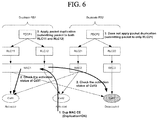
- FIG. 6 is a diagram illustrating an example of applying packet duplication depending on cell activation status.
- the UE may be configured with three cells as an example. In other words, three cells may be configured for the UE as an example. As shown in FIG. 6 , cell 1 and cell 2 are activated, and cell 3 is deactivated.
- the UE may be configured with two duplicate RBs, i.e. Duplicate RB 1 and Duplicate RB 2 .
- the Duplicate RB 1 consists of PDCP 1 entity, RLC 11 entity, and RLC 12 entity
- the Duplicate RB 2 consists of PDCP 2 entity, RLC 21 entity, and RLC 22 entity.
- the MAC entity is independent of RBs, i.e. same or different MAC entity can be used for different RBs.
- the RLC entities are mapped to cells with following relationship.
- RLC 11 entity is mapped to cell 1 and cell 3
- RLC 12 entity is mapped to cell 2
- RLC 21 entity is mapped to cell 1 and cell 2
- RLC 22 entity is mapped to cell 3 .
- Duplicate RB 1 As both transmission paths of Duplicate RB 1 have at least one activated cell, the PDCP entity of Duplicate RB 1 submits a PDCP PDU to either RLC 11 entity or RLC 12 entity. As one transmission path of Duplicate RB 2 does not have at least one activated cell, the PDCP entity of Duplicate RB 2 submits a PDCP PDU to only RLC 21 .
- the UE checks activation status of cells mapped to Duplicate RBs.
- the UE figures out that both transmission paths of Duplicate RB 1 are available, but one of the transmission paths of Duplicate RB 2 is not available.
- the UE applies packet duplication only for the Duplicate RB 1 . That is, the PDCP entity of the Duplicate RB 1 duplicates a PDCP PDU and submits it to both RLC 11 entity and RLC 12 entity.
- the UE does not apply packet duplication for the Duplicate RB 2 . That is, the PDCP entity of the Duplicate RB 2 submits a PDCP PDU only to RLC 21 entity.
- the UE stops performing packet duplication of the Duplicate RB. In other words, the UE performs the packet duplication for a duplicate radio bearer (RB). Then, if all cells mapped to one transmission path of the duplicate RB become deactivated, the UE may stop the packet duplication for the duplicate RB.
- RB radio bearer
- FIG. 7 is a block diagram of an apparatus (e.g., communication apparatus) according to an embodiment of the present invention.
- the apparatus shown in FIG. 7 can be a user equipment (UE) and/or eNB adapted to perform the above mechanism, but it can be any apparatus for performing the same operation.
- UE user equipment
- eNB evolved node B
- the apparatus may comprise a DSP/microprocessor ( 110 ) and RF module (transceiver; 135 ).
- the DSP/microprocessor ( 110 ) is electrically connected with the transceiver ( 135 ) and controls it.
- the apparatus may further include power management module ( 105 ), battery ( 155 ), display ( 115 ), keypad ( 120 ), SIM card ( 125 ), memory device ( 130 ), speaker ( 145 ) and input device ( 150 ), based on its implementation and designer's choice.
- FIG. 7 may represent a UE comprising a receiver ( 135 ) configured to receive signal from the network, and a transmitter ( 135 ) configured to transmit signals to the network.
- the receiver and transmitter can constitute the transceiver ( 135 ).
- the UE further comprises a processor ( 110 ) connected to the transceiver ( 135 : receiver and transmitter).
- FIG. 7 may represent a network apparatus comprising a transmitter ( 135 ) configured to transmit signals to a UE and a receiver ( 135 ) configured to receive signal from the UE. These transmitter and receiver may constitute the transceiver ( 135 ).
- the network further comprises a processor ( 110 ) connected to the transmitter and the receiver.
- a specific operation described as performed by the BS may be performed by an upper node of the BS. Namely, it is apparent that, in a network comprised of a plurality of network nodes including a BS, various operations performed for communication with an MS may be performed by the BS, or network nodes other than the BS.
- the term ‘eNB’ may be replaced with the term ‘fixed station’, ‘Node B’, ‘Base Station (BS)’, ‘access point’, ‘gNB’, etc.
- the method according to the embodiments of the present invention may be implemented by one or more Application Specific Integrated Circuits (ASICs), Digital Signal Processors (DSPs), Digital Signal Processing Devices (DSPDs), Programmable Logic Devices (PLDs), Field Programmable Gate Arrays (FPGAs), processors, controllers, microcontrollers, or microprocessors.
- ASICs Application Specific Integrated Circuits
- DSPs Digital Signal Processors
- DSPDs Digital Signal Processing Devices
- PLDs Programmable Logic Devices
- FPGAs Field Programmable Gate Arrays
- processors controllers, microcontrollers, or microprocessors.
- the method according to the embodiments of the present invention may be implemented in the form of modules, procedures, functions, etc. performing the above-described functions or operations.
- Software code may be stored in a memory unit and executed by a processor.
- the memory unit may be located at the interior or exterior of the processor and may transmit and receive data to and from the processor via various known means.
- Apparatus and method for performing cell activation are applicable to a variety of wireless communication systems, e.g. 3GPP LTE/LTE-A, 5G, etc.
Landscapes
- Engineering & Computer Science (AREA)
- Computer Networks & Wireless Communication (AREA)
- Signal Processing (AREA)
- Mobile Radio Communication Systems (AREA)
Abstract
Description
-
- if the MAC entity receives an Activation/Deactivation MAC control element in this TTI activating the SCell, the MAC entity shall in the TTI according to the timing defined in [2]:
- activate the SCell; i.e. apply normal SCell operation including:
- SRS transmissions on the SCell;
- CQI/PMI/RI/PTI/CRI reporting for the SCell;
- PDCCH monitoring on the SCell;
- PDCCH monitoring for the SCell;
- PUCCH transmissions on the SCell, if configured.
- start or restart the sCellDeactivationTimer associated with the SCell;
- trigger PHR according to subclause 5.4.6.
- else, if the MAC entity receives an Activation/Deactivation MAC control element in this TTI deactivating the SCell; or
- if the sCellDeactivationTimer associated with the activated SCell expires in this TTI:
- in the TTI according to the timing defined in [2]:
- deactivate the SCell;
- stop the sCellDeactivationTimer associated with the SCell;
- flush all HARQ buffers associated with the SCell.
- if PDCCH on the activated SCell indicates an uplink grant or downlink assignment; or
- if PDCCH on the Serving Cell scheduling the activated SCell indicates an uplink grant or a downlink assignment for the activated SCell:
- restart the sCellDeactivationTimer associated with the SCell;
- if the SCell is deactivated:
- not transmit SRS on the SCell;
- not report CQI/PMI/RI/PTI/CRI for the SCell;
- not transmit on UL-SCH on the SCell;
- not transmit on RACH on the SCell;
- not monitor the PDCCH on the SCell;
- not monitor the PDCCH for the SCell;
- not transmit PUCCH on the SCell.
| TABLE 1 | |||
| Index | LCID values | ||
| 00000 | CCCH | ||
| 00001- | Identity of the logical channel | ||
| 01010 | |||
| 01011- | Reserved | ||
| 10100 | |||
| 10101 | Activation/Deactivation of | ||
| CSI-RS | |||
| 10110 | Recommended bit rate | ||
| 10111 | SC-PTM Stop Indication | ||
| 11000 | Activation/Deactivation (4 | ||
| octets) | |||
| 11001 | SC-MCCH, SC-MTCH (see | ||
| note) | |||
| 11010 | Long DRX Command | ||
| 11011 | Activation/Deactivation (1 | ||
| octet) | |||
| 11100 | UE Contention Resolution | ||
| Identity | |||
| 11101 | Timing Advance Command | ||
| 11110 | DRX Command | ||
| 11111 | Padding | ||
| NOTE: | |||
| Both SC-MCCH and SC-MTCH cannot be multiplexed with other logical channels in the same MAC PDU except for Padding and SC-PTM Stop Indication | |||
-
- Ci: if there is an SCell configured with SCellIndex i as specified in [8], this field indicates the activation/deactivation status of the SCell with SCellIndex i, else the MAC entity shall ignore the Ci field. The Ci field is set to “1” to indicate that the SCell with SCellIndex i shall be activated. The Ci field is set to “0” to indicate that the SCell with SCellIndex i shall be deactivated; −R: Reserved bit, set to “0”.
-
- SRS transmissions on the cell;
- CQI/PMI/RI/PTI/CRI reporting for the cell;
- PDCCH monitoring on the cell;
- PDCCH monitoring for the cell;
- PUCCH transmissions on the cell, if configured.
Claims (8)
Priority Applications (1)
| Application Number | Priority Date | Filing Date | Title |
|---|---|---|---|
| US16/498,354 US11057956B2 (en) | 2017-06-02 | 2018-05-29 | Apparatus and method for performing packet duplication |
Applications Claiming Priority (3)
| Application Number | Priority Date | Filing Date | Title |
|---|---|---|---|
| US201762514016P | 2017-06-02 | 2017-06-02 | |
| US16/498,354 US11057956B2 (en) | 2017-06-02 | 2018-05-29 | Apparatus and method for performing packet duplication |
| PCT/KR2018/006072 WO2018221926A1 (en) | 2017-06-02 | 2018-05-29 | Apparatus and method for performing packet duplication |
Publications (2)
| Publication Number | Publication Date |
|---|---|
| US20200077459A1 US20200077459A1 (en) | 2020-03-05 |
| US11057956B2 true US11057956B2 (en) | 2021-07-06 |
Family
ID=64454860
Family Applications (1)
| Application Number | Title | Priority Date | Filing Date |
|---|---|---|---|
| US16/498,354 Active US11057956B2 (en) | 2017-06-02 | 2018-05-29 | Apparatus and method for performing packet duplication |
Country Status (2)
| Country | Link |
|---|---|
| US (1) | US11057956B2 (en) |
| WO (1) | WO2018221926A1 (en) |
Families Citing this family (11)
| Publication number | Priority date | Publication date | Assignee | Title |
|---|---|---|---|---|
| US11178713B2 (en) | 2017-04-27 | 2021-11-16 | Sony Corporation | Mobile communications network, infrastructure equipment, communications device and methods |
| EP3422767A1 (en) * | 2017-06-26 | 2019-01-02 | Panasonic Intellectual Property Corporation of America | User equipment and base station participating in packet duplication during handover for nr |
| WO2019090732A1 (en) * | 2017-11-10 | 2019-05-16 | Oppo广东移动通信有限公司 | Method, apparatus, and computer storage medium for controlling data duplication function |
| EP3512140A1 (en) * | 2018-01-11 | 2019-07-17 | Comcast Cable Communications LLC | Cell configuration for packet duplication |
| WO2020147051A1 (en) * | 2019-01-16 | 2020-07-23 | Oppo广东移动通信有限公司 | Data transmission method and terminal device |
| CN111278061B (en) * | 2019-01-18 | 2021-09-07 | 维沃移动通信有限公司 | Data processing method, information configuration method, terminal and network device |
| WO2020154867A1 (en) * | 2019-01-28 | 2020-08-06 | Oppo广东移动通信有限公司 | Data duplication transmission control method, terminal device, network device |
| CN111436066A (en) * | 2019-02-14 | 2020-07-21 | 维沃移动通信有限公司 | Data packet carrying path determination, information sending method and device |
| CN111757548B (en) * | 2019-03-29 | 2022-05-24 | 华为技术有限公司 | Communication method and communication device |
| CN117715208A (en) * | 2019-03-29 | 2024-03-15 | 华为技术有限公司 | Data transmission method and device |
| WO2024160137A1 (en) * | 2023-01-30 | 2024-08-08 | 上海朗帛通信技术有限公司 | Method and apparatus used in wireless communication |
Citations (15)
| Publication number | Priority date | Publication date | Assignee | Title |
|---|---|---|---|---|
| US8605674B2 (en) | 2009-05-11 | 2013-12-10 | Lg Electronics Inc. | Method and apparatus for transmitting and receiving duplicate data in a multicarrier wireless communication system |
| WO2016143560A1 (en) | 2015-03-06 | 2016-09-15 | 京セラ株式会社 | Radio terminal and base station |
| US20180279168A1 (en) * | 2017-03-24 | 2018-09-27 | Mediatek Inc. | User equipment and methods for pdcp duplication in 5g ran |
| US20180279229A1 (en) * | 2017-03-23 | 2018-09-27 | Ofinno Technologies, Llc | Uplink Transmission Power Adjustment |
| US20180324641A1 (en) * | 2017-05-05 | 2018-11-08 | Asustek Computer Inc. | Method and apparatus of transmitting data duplication in a wireless communication system |
| US20180332501A1 (en) * | 2017-05-14 | 2018-11-15 | Yung-Lan TSENG | Systems, methods, and devices for ultra-reliable low latency communication quality-of-service guarantee |
| US20190268799A1 (en) * | 2017-03-10 | 2019-08-29 | Kt Corporation | Buffer state report transmission method and device therefor |
| US20200029379A1 (en) * | 2017-03-23 | 2020-01-23 | Fangying Xiao | Radio configuration method, user equipment, and base station |
| US20200092746A1 (en) * | 2017-03-23 | 2020-03-19 | Samsung Electronics Co., Ltd | Method and apparatus for processing data for packet duplication |
| US20200162211A1 (en) * | 2017-05-05 | 2020-05-21 | Samsung Electronics Co., Ltd | System, data transmission method and network equipment supporting pdcp duplication function method and device for transferring supplementary uplink carrier configuration information and method and device for performing connection mobility adjustment |
| US20200186292A1 (en) * | 2017-05-05 | 2020-06-11 | Zte Corporation | Control method and device for data packet replication function, communication apparatus, and storage medium |
| US20200196379A1 (en) * | 2017-03-17 | 2020-06-18 | Ofinno, Llc | Context Release Based on Expiry of a Network Radio Access Network Notification Area Update Timer |
| US20200196185A1 (en) * | 2017-03-16 | 2020-06-18 | Ofinno, Llc | Transmitting a Truncated Buffer Status Report by a Wireless Device |
| US20200228438A1 (en) * | 2017-04-24 | 2020-07-16 | Motorola Mobility Llc | Duplicating pdcp pdus for a radio bearer |
| US10750410B2 (en) * | 2016-09-30 | 2020-08-18 | Huawei Technologies Co., Ltd. | Ultra reliable low latency connection support in radio access networks |
-
2018
- 2018-05-29 US US16/498,354 patent/US11057956B2/en active Active
- 2018-05-29 WO PCT/KR2018/006072 patent/WO2018221926A1/en not_active Ceased
Patent Citations (15)
| Publication number | Priority date | Publication date | Assignee | Title |
|---|---|---|---|---|
| US8605674B2 (en) | 2009-05-11 | 2013-12-10 | Lg Electronics Inc. | Method and apparatus for transmitting and receiving duplicate data in a multicarrier wireless communication system |
| WO2016143560A1 (en) | 2015-03-06 | 2016-09-15 | 京セラ株式会社 | Radio terminal and base station |
| US10750410B2 (en) * | 2016-09-30 | 2020-08-18 | Huawei Technologies Co., Ltd. | Ultra reliable low latency connection support in radio access networks |
| US20190268799A1 (en) * | 2017-03-10 | 2019-08-29 | Kt Corporation | Buffer state report transmission method and device therefor |
| US20200196185A1 (en) * | 2017-03-16 | 2020-06-18 | Ofinno, Llc | Transmitting a Truncated Buffer Status Report by a Wireless Device |
| US20200196379A1 (en) * | 2017-03-17 | 2020-06-18 | Ofinno, Llc | Context Release Based on Expiry of a Network Radio Access Network Notification Area Update Timer |
| US20180279229A1 (en) * | 2017-03-23 | 2018-09-27 | Ofinno Technologies, Llc | Uplink Transmission Power Adjustment |
| US20200029379A1 (en) * | 2017-03-23 | 2020-01-23 | Fangying Xiao | Radio configuration method, user equipment, and base station |
| US20200092746A1 (en) * | 2017-03-23 | 2020-03-19 | Samsung Electronics Co., Ltd | Method and apparatus for processing data for packet duplication |
| US20180279168A1 (en) * | 2017-03-24 | 2018-09-27 | Mediatek Inc. | User equipment and methods for pdcp duplication in 5g ran |
| US20200228438A1 (en) * | 2017-04-24 | 2020-07-16 | Motorola Mobility Llc | Duplicating pdcp pdus for a radio bearer |
| US20200162211A1 (en) * | 2017-05-05 | 2020-05-21 | Samsung Electronics Co., Ltd | System, data transmission method and network equipment supporting pdcp duplication function method and device for transferring supplementary uplink carrier configuration information and method and device for performing connection mobility adjustment |
| US20200186292A1 (en) * | 2017-05-05 | 2020-06-11 | Zte Corporation | Control method and device for data packet replication function, communication apparatus, and storage medium |
| US20180324641A1 (en) * | 2017-05-05 | 2018-11-08 | Asustek Computer Inc. | Method and apparatus of transmitting data duplication in a wireless communication system |
| US20180332501A1 (en) * | 2017-05-14 | 2018-11-15 | Yung-Lan TSENG | Systems, methods, and devices for ultra-reliable low latency communication quality-of-service guarantee |
Non-Patent Citations (4)
| Title |
|---|
| Ericsson, "Dynamic reconfiguration of split bearer or duplication", 3GPP TSG RAN WG2 Meeting #98, R2-1704374, May 2017, 3 pages. |
| Huawei, et al., "Interaction between PDCP/RLC/MAC for packet duplication", 3GPP TSG RAN WG2 Meeting #98, R2-1704836, May 2017, 3 pages. |
| Huawei, et al., "UL handling for split SRB", 3GPP TSG RAN WG2 Meeting #98, R2-1705147, May 2017, 2 pages. |
| PCT International Application No. PCT/KR2018/006072, Notification of Transmittal of the International Search Report and the Written Opinion of the International Searching Authority, or Declaration dated Sep. 20, 2018, 11 pages. |
Also Published As
| Publication number | Publication date |
|---|---|
| WO2018221926A1 (en) | 2018-12-06 |
| US20200077459A1 (en) | 2020-03-05 |
Similar Documents
| Publication | Publication Date | Title |
|---|---|---|
| US11057956B2 (en) | Apparatus and method for performing packet duplication | |
| US11184945B2 (en) | Method for handling deactivation for a cell in which packet duplication is performed in wireless communication system and a device therefor | |
| US10014984B2 (en) | Method for transmitting multiplexed HARQ feedbacks in a carrier aggregation system and a device therefor | |
| US20190261208A1 (en) | Method for reporting a radio link problem and a device therefor | |
| US10425941B2 (en) | Method for de-configuring a cell from PUCCH resource in a carrier aggregation system and a device therefor | |
| US10159076B2 (en) | Method for de-configuring a cell from PUCCH resource in a carrier aggregation system and a device therefor | |
| US9854495B2 (en) | Radio link failure reporting in a system using multiple cells | |
| US20200288502A1 (en) | Method for performing a random access procedure in bandwidth part (bwp) operation in wireless communication system and a device therefor | |
| US10321442B2 (en) | Method for configuring an activated SCell with PUCCH resource in a carrier aggregation system and a device therefor | |
| US10362563B2 (en) | Method for deactivating SCells upon a TAT expiry for PUCCH cell in a carrier aggregation system and a device therefor | |
| US10237858B2 (en) | Method for de-configuring a cell from PUCCH resource in a carrier aggregation system and a device therefor | |
| US11153046B2 (en) | Apparatus and method for performing cell activation | |
| US11160119B2 (en) | Method for requesting an uplink resource in a wireless communication system and a device therefor | |
| US20200107375A1 (en) | Method for performing a random access procedure in wireless communication system and a device therefor | |
| US10187184B2 (en) | Method for transmitting multiplexed HARQ feedbacks in a carrier aggregation system and a device therefor | |
| US10348476B2 (en) | Method for removing a last PUCCH resource of a PUCCH group in a carrier aggregation system and a device therefor | |
| US10390372B2 (en) | Carrier reselection under backoff mechanism of random access procedure | |
| US11528687B2 (en) | Apparatus and method for transmitting a buffer status report | |
| US10321443B2 (en) | Method for performing a PUCCH transmission on a deactivated PUCCH SCell in a carrier aggregation system and a device therefor | |
| US20170366306A1 (en) | Method for selecting pucch transmission in a carrier aggregation system and a device therefor | |
| US20180007640A1 (en) | Method for performing power scaling for pucch transmission in a carrier aggregation system and a device therefor | |
| US9907094B2 (en) | Random access procedures in a wireless network employing TDD scheme | |
| US20170373805A1 (en) | Method for performing a pucch transmission on a pucch cell in a carrier aggregation system and a device therefor |
Legal Events
| Date | Code | Title | Description |
|---|---|---|---|
| AS | Assignment |
Owner name: LG ELECTRONICS INC., KOREA, REPUBLIC OF Free format text: ASSIGNMENT OF ASSIGNORS INTEREST;ASSIGNORS:YI, SEUNGJUNE;LEE, SUNYOUNG;REEL/FRAME:050508/0296 Effective date: 20190905 |
|
| FEPP | Fee payment procedure |
Free format text: ENTITY STATUS SET TO UNDISCOUNTED (ORIGINAL EVENT CODE: BIG.); ENTITY STATUS OF PATENT OWNER: LARGE ENTITY |
|
| STPP | Information on status: patent application and granting procedure in general |
Free format text: NON FINAL ACTION MAILED |
|
| STPP | Information on status: patent application and granting procedure in general |
Free format text: RESPONSE TO NON-FINAL OFFICE ACTION ENTERED AND FORWARDED TO EXAMINER |
|
| STPP | Information on status: patent application and granting procedure in general |
Free format text: NOTICE OF ALLOWANCE MAILED -- APPLICATION RECEIVED IN OFFICE OF PUBLICATIONS |
|
| STPP | Information on status: patent application and granting procedure in general |
Free format text: AWAITING TC RESP., ISSUE FEE NOT PAID |
|
| STPP | Information on status: patent application and granting procedure in general |
Free format text: NOTICE OF ALLOWANCE MAILED -- APPLICATION RECEIVED IN OFFICE OF PUBLICATIONS |
|
| STPP | Information on status: patent application and granting procedure in general |
Free format text: PUBLICATIONS -- ISSUE FEE PAYMENT RECEIVED |
|
| STPP | Information on status: patent application and granting procedure in general |
Free format text: PUBLICATIONS -- ISSUE FEE PAYMENT VERIFIED |
|
| STCF | Information on status: patent grant |
Free format text: PATENTED CASE |
|
| MAFP | Maintenance fee payment |
Free format text: PAYMENT OF MAINTENANCE FEE, 4TH YEAR, LARGE ENTITY (ORIGINAL EVENT CODE: M1551); ENTITY STATUS OF PATENT OWNER: LARGE ENTITY Year of fee payment: 4 |