US11056705B2 - Organic anolyte materials for flow batteries - Google Patents
Organic anolyte materials for flow batteries Download PDFInfo
- Publication number
- US11056705B2 US11056705B2 US15/580,048 US201615580048A US11056705B2 US 11056705 B2 US11056705 B2 US 11056705B2 US 201615580048 A US201615580048 A US 201615580048A US 11056705 B2 US11056705 B2 US 11056705B2
- Authority
- US
- United States
- Prior art keywords
- group
- anolyte solution
- anolyte
- methyl
- solution
- Prior art date
- Legal status (The legal status is an assumption and is not a legal conclusion. Google has not performed a legal analysis and makes no representation as to the accuracy of the status listed.)
- Active, expires
Links
- 0 C1=CC=CC=C1.[1*][Y]C(C)=O Chemical compound C1=CC=CC=C1.[1*][Y]C(C)=O 0.000 description 14
- OLXYLDUSSBULGU-UHFFFAOYSA-N COC(=O)C1=CC=NC=C1 Chemical compound COC(=O)C1=CC=NC=C1 OLXYLDUSSBULGU-UHFFFAOYSA-N 0.000 description 4
- CXUZILQYXHNBRR-UHFFFAOYSA-N CC[N+]1=CC=C(C(=O)OC)C=C1.[I-] Chemical compound CC[N+]1=CC=C(C(=O)OC)C=C1.[I-] CXUZILQYXHNBRR-UHFFFAOYSA-N 0.000 description 3
- OXVCDRWPLKEPRN-UHFFFAOYSA-M CC(C)(C)OC(=O)C1=CC=[N+](B(F)F)C=C1.[F-] Chemical compound CC(C)(C)OC(=O)C1=CC=[N+](B(F)F)C=C1.[F-] OXVCDRWPLKEPRN-UHFFFAOYSA-M 0.000 description 2
- GVMCXCBWVPBAJA-UHFFFAOYSA-N CC(C)(C)OC(=O)C1=CC=[N+]([O-])C=C1 Chemical compound CC(C)(C)OC(=O)C1=CC=[N+]([O-])C=C1 GVMCXCBWVPBAJA-UHFFFAOYSA-N 0.000 description 2
- QDLCKTBNDLGPLM-UHFFFAOYSA-N CCOC(=O)C1=CC=[N+](CC)C=C1.[I-] Chemical compound CCOC(=O)C1=CC=[N+](CC)C=C1.[I-] QDLCKTBNDLGPLM-UHFFFAOYSA-N 0.000 description 2
- DWIJTXZVCOUCNY-UHFFFAOYSA-N CC[N+]1=CC=C(C(=O)OC(C)(C)C)C=C1.F[P-](F)(F)(F)(F)F Chemical compound CC[N+]1=CC=C(C(=O)OC(C)(C)C)C=C1.F[P-](F)(F)(F)(F)F DWIJTXZVCOUCNY-UHFFFAOYSA-N 0.000 description 2
- AQVSORBBBPAPCK-UHFFFAOYSA-M COC(=O)C1=CC=[N+](B(F)F)C=C1.[F-] Chemical compound COC(=O)C1=CC=[N+](B(F)F)C=C1.[F-] AQVSORBBBPAPCK-UHFFFAOYSA-M 0.000 description 2
- XSGNXRNOZMUURC-UHFFFAOYSA-N COC(=O)C1=CC=[N+]([O-])C=C1 Chemical compound COC(=O)C1=CC=[N+]([O-])C=C1 XSGNXRNOZMUURC-UHFFFAOYSA-N 0.000 description 2
- YNBADRVTZLEFNH-UHFFFAOYSA-N COC(=O)C1=CN=CC=C1 Chemical compound COC(=O)C1=CN=CC=C1 YNBADRVTZLEFNH-UHFFFAOYSA-N 0.000 description 2
- GASFPBGWFOIGLB-UHFFFAOYSA-N N#CCOC(=O)C1=CC=NC=C1 Chemical compound N#CCOC(=O)C1=CC=NC=C1 GASFPBGWFOIGLB-UHFFFAOYSA-N 0.000 description 2
- VLUUUZMAHDYNLF-UHFFFAOYSA-J C.C.CC(C)(C)OC(=O)C1=CC=NC=C1.CC(C)(C)OC(=O)C1=CC=[N+](B(F)F)C=C1.CC(C)(C)OC(=O)C1=CC=[N+]([O-])C=C1.CC(C)OC(=O)C1=CC=NC=C1.CC(C)OC(=O)C1=CC=[N+](B(F)F)C=C1.CC(C)OC(=O)C1=CC=[N+]([O-])C=C1.CCOC(=O)C1=CC=NC=C1.CCOC(=O)C1=CC=NC=C1.CCOC(=O)C1=CC=[N+](B(F)F)C=C1.CCOC(=O)C1=CC=[N+](CC)C=C1.CCOC(=O)C1=CC=[N+](CC)C=C1.CCOC(=O)C1=CC=[N+]([O-])C=C1.CC[N+]1=CC=C(C(=O)OC)C=C1.CC[N+]1=CC=C(C(=O)OC)C=C1.CN(C)C(=O)C1=CC=NC=C1.COC(=O)C1=CC=NC=C1.COC(=O)C1=CC=[N+](B(F)F)C=C1.COC(=O)C1=CC=[N+]([O-])C=C1.COC(=O)C1=CN=CC=C1.COC(=O)C1=NC=CC=C1.F[P-](F)(F)(F)(F)F.F[P-](F)(F)(F)(F)F.O=C(OC(C(F)(F)F)C(F)(F)F)C1=CC=NC=C1.O=C(OCC(F)(F)F)C1=CC=NC=C1.[F-].[F-].[F-].[F-].[I-].[I-] Chemical compound C.C.CC(C)(C)OC(=O)C1=CC=NC=C1.CC(C)(C)OC(=O)C1=CC=[N+](B(F)F)C=C1.CC(C)(C)OC(=O)C1=CC=[N+]([O-])C=C1.CC(C)OC(=O)C1=CC=NC=C1.CC(C)OC(=O)C1=CC=[N+](B(F)F)C=C1.CC(C)OC(=O)C1=CC=[N+]([O-])C=C1.CCOC(=O)C1=CC=NC=C1.CCOC(=O)C1=CC=NC=C1.CCOC(=O)C1=CC=[N+](B(F)F)C=C1.CCOC(=O)C1=CC=[N+](CC)C=C1.CCOC(=O)C1=CC=[N+](CC)C=C1.CCOC(=O)C1=CC=[N+]([O-])C=C1.CC[N+]1=CC=C(C(=O)OC)C=C1.CC[N+]1=CC=C(C(=O)OC)C=C1.CN(C)C(=O)C1=CC=NC=C1.COC(=O)C1=CC=NC=C1.COC(=O)C1=CC=[N+](B(F)F)C=C1.COC(=O)C1=CC=[N+]([O-])C=C1.COC(=O)C1=CN=CC=C1.COC(=O)C1=NC=CC=C1.F[P-](F)(F)(F)(F)F.F[P-](F)(F)(F)(F)F.O=C(OC(C(F)(F)F)C(F)(F)F)C1=CC=NC=C1.O=C(OCC(F)(F)F)C1=CC=NC=C1.[F-].[F-].[F-].[F-].[I-].[I-] VLUUUZMAHDYNLF-UHFFFAOYSA-J 0.000 description 1
- QLQYJNKKHYBNTO-UHFFFAOYSA-N C.CC(=O)C1=CC=N(C)C=C1 Chemical compound C.CC(=O)C1=CC=N(C)C=C1 QLQYJNKKHYBNTO-UHFFFAOYSA-N 0.000 description 1
- PMNOEQMJPSCJLI-UHFFFAOYSA-K CC(=O)C1=CC=[N+](C)C=C1.CC[N+]1=CC=C(C(=O)OC(C)(C)C)C=C1.CC[N+]1=CC=C(C(=O)OC(C)C)C=C1.CC[N+]1=CC=C(C(=O)OC)C=C1.COC(=O)C1=CC=[N+](C)C=C1.FB(F)F.FB(F)F.FB(F)F.F[P-](F)(F)(F)(F)F.F[P-](F)(F)(F)(F)F.[F-].[F-].[F-] Chemical compound CC(=O)C1=CC=[N+](C)C=C1.CC[N+]1=CC=C(C(=O)OC(C)(C)C)C=C1.CC[N+]1=CC=C(C(=O)OC(C)C)C=C1.CC[N+]1=CC=C(C(=O)OC)C=C1.COC(=O)C1=CC=[N+](C)C=C1.FB(F)F.FB(F)F.FB(F)F.F[P-](F)(F)(F)(F)F.F[P-](F)(F)(F)(F)F.[F-].[F-].[F-] PMNOEQMJPSCJLI-UHFFFAOYSA-K 0.000 description 1
- QTPQVHRBVNIGTE-UHFFFAOYSA-J CC(C)(C)OC(=O)C1=CC=N(B(F)F)C=C1.CC(C)OC(=O)C1=CC=N(B(F)F)C=C1.CCOC(=O)C1=CC=N(B(F)F)C=C1.COC(=O)C1=CC=N(B(F)F)C=C1.[F-].[F-].[F-].[F-] Chemical compound CC(C)(C)OC(=O)C1=CC=N(B(F)F)C=C1.CC(C)OC(=O)C1=CC=N(B(F)F)C=C1.CCOC(=O)C1=CC=N(B(F)F)C=C1.COC(=O)C1=CC=N(B(F)F)C=C1.[F-].[F-].[F-].[F-] QTPQVHRBVNIGTE-UHFFFAOYSA-J 0.000 description 1
- DJVVTRZXLLVXBE-UHFFFAOYSA-N CC(C)(C)OC(=O)C1=CC=N([O-])C=C1.CC(C)OC(=O)C1=CC=N([O-])C=C1.CCOC(=O)C1=CC=N([O-])C=C1.COC(=O)C1=CC=N([O-])C=C1 Chemical compound CC(C)(C)OC(=O)C1=CC=N([O-])C=C1.CC(C)OC(=O)C1=CC=N([O-])C=C1.CCOC(=O)C1=CC=N([O-])C=C1.COC(=O)C1=CC=N([O-])C=C1 DJVVTRZXLLVXBE-UHFFFAOYSA-N 0.000 description 1
- ZXAPIQZSJHLLDS-UHFFFAOYSA-N CC(C)(C)OC(=O)C1=CC=NC=C1 Chemical compound CC(C)(C)OC(=O)C1=CC=NC=C1 ZXAPIQZSJHLLDS-UHFFFAOYSA-N 0.000 description 1
- FBDVYRNKUYCAGB-UHFFFAOYSA-N CC(C)OC(=O)C1=CC=NC=C1 Chemical compound CC(C)OC(=O)C1=CC=NC=C1 FBDVYRNKUYCAGB-UHFFFAOYSA-N 0.000 description 1
- RBECVBXEJPPDBH-UHFFFAOYSA-M CC(C)OC(=O)C1=CC=[N+](B(F)F)C=C1.[F-] Chemical compound CC(C)OC(=O)C1=CC=[N+](B(F)F)C=C1.[F-] RBECVBXEJPPDBH-UHFFFAOYSA-M 0.000 description 1
- LHCZRQRFSPULDR-UHFFFAOYSA-N CC(C)OC(=O)C1=CC=[N+]([O-])C=C1 Chemical compound CC(C)OC(=O)C1=CC=[N+]([O-])C=C1 LHCZRQRFSPULDR-UHFFFAOYSA-N 0.000 description 1
- WPDJRDYNRNXPBX-UHFFFAOYSA-N CC(Cc1cccnc1)=O Chemical compound CC(Cc1cccnc1)=O WPDJRDYNRNXPBX-UHFFFAOYSA-N 0.000 description 1
- XILSYFSPDWLEIK-UHFFFAOYSA-J CCN1=CC=C(C(=O)OC(C)(C)C)C=C1.CCN1=CC=C(C(=O)OC(C)C)C=C1.CCN1=CC=C(C(=O)OC)C=C1.CCN1=CC=C(C(=O)OC)C=C1.CCN1=CC=C(C(=O)OC)C=C1.CCOC(=O)C1=CC=N(CC)C=C1.CCOC(=O)C1=CC=N(CC)C=C1.COC(=O)C1=CC=N(C)C=C1.FB(F)F.FB(F)F.F[P-](F)(F)(F)(F)F.F[P-](F)(F)(F)(F)F.F[P-](F)(F)(F)(F)F.F[P-](F)(F)(F)(F)F.[F-].[F-].[I-].[I-] Chemical compound CCN1=CC=C(C(=O)OC(C)(C)C)C=C1.CCN1=CC=C(C(=O)OC(C)C)C=C1.CCN1=CC=C(C(=O)OC)C=C1.CCN1=CC=C(C(=O)OC)C=C1.CCN1=CC=C(C(=O)OC)C=C1.CCOC(=O)C1=CC=N(CC)C=C1.CCOC(=O)C1=CC=N(CC)C=C1.COC(=O)C1=CC=N(C)C=C1.FB(F)F.FB(F)F.F[P-](F)(F)(F)(F)F.F[P-](F)(F)(F)(F)F.F[P-](F)(F)(F)(F)F.F[P-](F)(F)(F)(F)F.[F-].[F-].[I-].[I-] XILSYFSPDWLEIK-UHFFFAOYSA-J 0.000 description 1
- MCRPKBUFXAKDKI-UHFFFAOYSA-N CCOC(=O)C1=CC=NC=C1 Chemical compound CCOC(=O)C1=CC=NC=C1 MCRPKBUFXAKDKI-UHFFFAOYSA-N 0.000 description 1
- GPEFHRWVQQVTSP-UHFFFAOYSA-M CCOC(=O)C1=CC=[N+](B(F)F)C=C1.[F-] Chemical compound CCOC(=O)C1=CC=[N+](B(F)F)C=C1.[F-] GPEFHRWVQQVTSP-UHFFFAOYSA-M 0.000 description 1
- DPWRGNWJVVSVIE-UHFFFAOYSA-N CCOC(=O)C1=CC=[N+]([O-])C=C1 Chemical compound CCOC(=O)C1=CC=[N+]([O-])C=C1 DPWRGNWJVVSVIE-UHFFFAOYSA-N 0.000 description 1
- IYOBUTJMSGYMOB-UHFFFAOYSA-N CC[N+]1=CC=C(C(=O)OC(C)C)C=C1.F[P-](F)(F)(F)(F)F Chemical compound CC[N+]1=CC=C(C(=O)OC(C)C)C=C1.F[P-](F)(F)(F)(F)F IYOBUTJMSGYMOB-UHFFFAOYSA-N 0.000 description 1
- CMUFENDZWBKNKA-UHFFFAOYSA-M CC[N+]1=CC=C(C(=O)OC)C=C1.FB(F)F.[F-] Chemical compound CC[N+]1=CC=C(C(=O)OC)C=C1.FB(F)F.[F-] CMUFENDZWBKNKA-UHFFFAOYSA-M 0.000 description 1
- WYQRNAHSMSMAMV-UHFFFAOYSA-N CN(C)C(=O)C1=CC=NC=C1 Chemical compound CN(C)C(=O)C1=CC=NC=C1 WYQRNAHSMSMAMV-UHFFFAOYSA-N 0.000 description 1
- NMMIHXMBOZYNET-UHFFFAOYSA-N COC(=O)C1=NC=CC=C1 Chemical compound COC(=O)C1=NC=CC=C1 NMMIHXMBOZYNET-UHFFFAOYSA-N 0.000 description 1
- FTGZDLZZQXERRZ-UHFFFAOYSA-N O=C(OC(C(F)(F)F)C(F)(F)F)C1=CC=NC=C1 Chemical compound O=C(OC(C(F)(F)F)C(F)(F)F)C1=CC=NC=C1 FTGZDLZZQXERRZ-UHFFFAOYSA-N 0.000 description 1
- DFCUTTOKZNFFQS-UHFFFAOYSA-N O=C(OCC(F)(F)F)C1=CC=NC=C1 Chemical compound O=C(OCC(F)(F)F)C1=CC=NC=C1 DFCUTTOKZNFFQS-UHFFFAOYSA-N 0.000 description 1
Images


Classifications
-
- H—ELECTRICITY
- H01—ELECTRIC ELEMENTS
- H01M—PROCESSES OR MEANS, e.g. BATTERIES, FOR THE DIRECT CONVERSION OF CHEMICAL ENERGY INTO ELECTRICAL ENERGY
- H01M8/00—Fuel cells; Manufacture thereof
- H01M8/18—Regenerative fuel cells, e.g. redox flow batteries or secondary fuel cells
- H01M8/184—Regeneration by electrochemical means
- H01M8/188—Regeneration by electrochemical means by recharging of redox couples containing fluids; Redox flow type batteries
-
- C—CHEMISTRY; METALLURGY
- C07—ORGANIC CHEMISTRY
- C07D—HETEROCYCLIC COMPOUNDS
- C07D213/00—Heterocyclic compounds containing six-membered rings, not condensed with other rings, with one nitrogen atom as the only ring hetero atom and three or more double bonds between ring members or between ring members and non-ring members
- C07D213/02—Heterocyclic compounds containing six-membered rings, not condensed with other rings, with one nitrogen atom as the only ring hetero atom and three or more double bonds between ring members or between ring members and non-ring members having three double bonds between ring members or between ring members and non-ring members
- C07D213/04—Heterocyclic compounds containing six-membered rings, not condensed with other rings, with one nitrogen atom as the only ring hetero atom and three or more double bonds between ring members or between ring members and non-ring members having three double bonds between ring members or between ring members and non-ring members having no bond between the ring nitrogen atom and a non-ring member or having only hydrogen or carbon atoms directly attached to the ring nitrogen atom
- C07D213/24—Heterocyclic compounds containing six-membered rings, not condensed with other rings, with one nitrogen atom as the only ring hetero atom and three or more double bonds between ring members or between ring members and non-ring members having three double bonds between ring members or between ring members and non-ring members having no bond between the ring nitrogen atom and a non-ring member or having only hydrogen or carbon atoms directly attached to the ring nitrogen atom with substituted hydrocarbon radicals attached to ring carbon atoms
- C07D213/44—Radicals substituted by doubly-bound oxygen, sulfur, or nitrogen atoms, or by two such atoms singly-bound to the same carbon atom
- C07D213/46—Oxygen atoms
- C07D213/51—Acetal radicals
-
- C—CHEMISTRY; METALLURGY
- C07—ORGANIC CHEMISTRY
- C07D—HETEROCYCLIC COMPOUNDS
- C07D213/00—Heterocyclic compounds containing six-membered rings, not condensed with other rings, with one nitrogen atom as the only ring hetero atom and three or more double bonds between ring members or between ring members and non-ring members
- C07D213/02—Heterocyclic compounds containing six-membered rings, not condensed with other rings, with one nitrogen atom as the only ring hetero atom and three or more double bonds between ring members or between ring members and non-ring members having three double bonds between ring members or between ring members and non-ring members
- C07D213/04—Heterocyclic compounds containing six-membered rings, not condensed with other rings, with one nitrogen atom as the only ring hetero atom and three or more double bonds between ring members or between ring members and non-ring members having three double bonds between ring members or between ring members and non-ring members having no bond between the ring nitrogen atom and a non-ring member or having only hydrogen or carbon atoms directly attached to the ring nitrogen atom
- C07D213/24—Heterocyclic compounds containing six-membered rings, not condensed with other rings, with one nitrogen atom as the only ring hetero atom and three or more double bonds between ring members or between ring members and non-ring members having three double bonds between ring members or between ring members and non-ring members having no bond between the ring nitrogen atom and a non-ring member or having only hydrogen or carbon atoms directly attached to the ring nitrogen atom with substituted hydrocarbon radicals attached to ring carbon atoms
- C07D213/54—Radicals substituted by carbon atoms having three bonds to hetero atoms with at the most one bond to halogen, e.g. ester or nitrile radicals
- C07D213/55—Acids; Esters
-
- C—CHEMISTRY; METALLURGY
- C07—ORGANIC CHEMISTRY
- C07D—HETEROCYCLIC COMPOUNDS
- C07D213/00—Heterocyclic compounds containing six-membered rings, not condensed with other rings, with one nitrogen atom as the only ring hetero atom and three or more double bonds between ring members or between ring members and non-ring members
- C07D213/02—Heterocyclic compounds containing six-membered rings, not condensed with other rings, with one nitrogen atom as the only ring hetero atom and three or more double bonds between ring members or between ring members and non-ring members having three double bonds between ring members or between ring members and non-ring members
- C07D213/04—Heterocyclic compounds containing six-membered rings, not condensed with other rings, with one nitrogen atom as the only ring hetero atom and three or more double bonds between ring members or between ring members and non-ring members having three double bonds between ring members or between ring members and non-ring members having no bond between the ring nitrogen atom and a non-ring member or having only hydrogen or carbon atoms directly attached to the ring nitrogen atom
- C07D213/24—Heterocyclic compounds containing six-membered rings, not condensed with other rings, with one nitrogen atom as the only ring hetero atom and three or more double bonds between ring members or between ring members and non-ring members having three double bonds between ring members or between ring members and non-ring members having no bond between the ring nitrogen atom and a non-ring member or having only hydrogen or carbon atoms directly attached to the ring nitrogen atom with substituted hydrocarbon radicals attached to ring carbon atoms
- C07D213/54—Radicals substituted by carbon atoms having three bonds to hetero atoms with at the most one bond to halogen, e.g. ester or nitrile radicals
- C07D213/56—Amides
-
- C—CHEMISTRY; METALLURGY
- C07—ORGANIC CHEMISTRY
- C07D—HETEROCYCLIC COMPOUNDS
- C07D213/00—Heterocyclic compounds containing six-membered rings, not condensed with other rings, with one nitrogen atom as the only ring hetero atom and three or more double bonds between ring members or between ring members and non-ring members
- C07D213/02—Heterocyclic compounds containing six-membered rings, not condensed with other rings, with one nitrogen atom as the only ring hetero atom and three or more double bonds between ring members or between ring members and non-ring members having three double bonds between ring members or between ring members and non-ring members
- C07D213/89—Heterocyclic compounds containing six-membered rings, not condensed with other rings, with one nitrogen atom as the only ring hetero atom and three or more double bonds between ring members or between ring members and non-ring members having three double bonds between ring members or between ring members and non-ring members with hetero atoms directly attached to the ring nitrogen atom
-
- C—CHEMISTRY; METALLURGY
- C07—ORGANIC CHEMISTRY
- C07F—ACYCLIC, CARBOCYCLIC OR HETEROCYCLIC COMPOUNDS CONTAINING ELEMENTS OTHER THAN CARBON, HYDROGEN, HALOGEN, OXYGEN, NITROGEN, SULFUR, SELENIUM OR TELLURIUM
- C07F5/00—Compounds containing elements of Groups 3 or 13 of the Periodic Table
- C07F5/02—Boron compounds
- C07F5/022—Boron compounds without C-boron linkages
-
- H—ELECTRICITY
- H01—ELECTRIC ELEMENTS
- H01M—PROCESSES OR MEANS, e.g. BATTERIES, FOR THE DIRECT CONVERSION OF CHEMICAL ENERGY INTO ELECTRICAL ENERGY
- H01M10/00—Secondary cells; Manufacture thereof
- H01M10/05—Accumulators with non-aqueous electrolyte
- H01M10/056—Accumulators with non-aqueous electrolyte characterised by the materials used as electrolytes, e.g. mixed inorganic/organic electrolytes
- H01M10/0564—Accumulators with non-aqueous electrolyte characterised by the materials used as electrolytes, e.g. mixed inorganic/organic electrolytes the electrolyte being constituted of organic materials only
- H01M10/0566—Liquid materials
- H01M10/0567—Liquid materials characterised by the additives
-
- H—ELECTRICITY
- H01—ELECTRIC ELEMENTS
- H01M—PROCESSES OR MEANS, e.g. BATTERIES, FOR THE DIRECT CONVERSION OF CHEMICAL ENERGY INTO ELECTRICAL ENERGY
- H01M10/00—Secondary cells; Manufacture thereof
- H01M10/05—Accumulators with non-aqueous electrolyte
- H01M10/056—Accumulators with non-aqueous electrolyte characterised by the materials used as electrolytes, e.g. mixed inorganic/organic electrolytes
- H01M10/0564—Accumulators with non-aqueous electrolyte characterised by the materials used as electrolytes, e.g. mixed inorganic/organic electrolytes the electrolyte being constituted of organic materials only
- H01M10/0566—Liquid materials
- H01M10/0569—Liquid materials characterised by the solvents
-
- H—ELECTRICITY
- H01—ELECTRIC ELEMENTS
- H01M—PROCESSES OR MEANS, e.g. BATTERIES, FOR THE DIRECT CONVERSION OF CHEMICAL ENERGY INTO ELECTRICAL ENERGY
- H01M4/00—Electrodes
- H01M4/02—Electrodes composed of, or comprising, active material
- H01M4/36—Selection of substances as active materials, active masses, active liquids
- H01M4/368—Liquid depolarisers
-
- H—ELECTRICITY
- H01—ELECTRIC ELEMENTS
- H01M—PROCESSES OR MEANS, e.g. BATTERIES, FOR THE DIRECT CONVERSION OF CHEMICAL ENERGY INTO ELECTRICAL ENERGY
- H01M4/00—Electrodes
- H01M4/86—Inert electrodes with catalytic activity, e.g. for fuel cells
- H01M4/90—Selection of catalytic material
- H01M4/9008—Organic or organo-metallic compounds
-
- H—ELECTRICITY
- H01—ELECTRIC ELEMENTS
- H01M—PROCESSES OR MEANS, e.g. BATTERIES, FOR THE DIRECT CONVERSION OF CHEMICAL ENERGY INTO ELECTRICAL ENERGY
- H01M50/00—Constructional details or processes of manufacture of the non-active parts of electrochemical cells other than fuel cells, e.g. hybrid cells
- H01M50/40—Separators; Membranes; Diaphragms; Spacing elements inside cells
-
- H—ELECTRICITY
- H01—ELECTRIC ELEMENTS
- H01M—PROCESSES OR MEANS, e.g. BATTERIES, FOR THE DIRECT CONVERSION OF CHEMICAL ENERGY INTO ELECTRICAL ENERGY
- H01M2300/00—Electrolytes
- H01M2300/0017—Non-aqueous electrolytes
- H01M2300/0025—Organic electrolyte
- H01M2300/0028—Organic electrolyte characterised by the solvent
-
- Y—GENERAL TAGGING OF NEW TECHNOLOGICAL DEVELOPMENTS; GENERAL TAGGING OF CROSS-SECTIONAL TECHNOLOGIES SPANNING OVER SEVERAL SECTIONS OF THE IPC; TECHNICAL SUBJECTS COVERED BY FORMER USPC CROSS-REFERENCE ART COLLECTIONS [XRACs] AND DIGESTS
- Y02—TECHNOLOGIES OR APPLICATIONS FOR MITIGATION OR ADAPTATION AGAINST CLIMATE CHANGE
- Y02E—REDUCTION OF GREENHOUSE GAS [GHG] EMISSIONS, RELATED TO ENERGY GENERATION, TRANSMISSION OR DISTRIBUTION
- Y02E60/00—Enabling technologies; Technologies with a potential or indirect contribution to GHG emissions mitigation
- Y02E60/10—Energy storage using batteries
-
- Y—GENERAL TAGGING OF NEW TECHNOLOGICAL DEVELOPMENTS; GENERAL TAGGING OF CROSS-SECTIONAL TECHNOLOGIES SPANNING OVER SEVERAL SECTIONS OF THE IPC; TECHNICAL SUBJECTS COVERED BY FORMER USPC CROSS-REFERENCE ART COLLECTIONS [XRACs] AND DIGESTS
- Y02—TECHNOLOGIES OR APPLICATIONS FOR MITIGATION OR ADAPTATION AGAINST CLIMATE CHANGE
- Y02E—REDUCTION OF GREENHOUSE GAS [GHG] EMISSIONS, RELATED TO ENERGY GENERATION, TRANSMISSION OR DISTRIBUTION
- Y02E60/00—Enabling technologies; Technologies with a potential or indirect contribution to GHG emissions mitigation
- Y02E60/30—Hydrogen technology
- Y02E60/50—Fuel cells
Definitions
- the present invention generally relates to organic anolyte materials for redox flow batteries and to redox flow batteries containing organic anolyte materials.
- Electrochemical energy storage is currently dominated by Li-ion batteries, which operate by intercalation of Li-ions into a graphite electrode. Advances in the intercalation supports have incrementally increased the capacity of Li-ion batteries by 8% per year and reduced their cost by 5% per year. This progress has slowly revolutionized portable technologies and, more recently, has begun shifting the paradigm of batteries for transportation applications. However, the use of Li-ion technologies in stationary, grid-scale storage applications remains cost-prohibitive. Moreover, the slow year-to-year increases in capacity and decreases in cost have motivated research into alternative storage systems that allow for more transformative changes.
- Redox-flow batteries represent a promising technology for grid-scale energy storage.
- solutions of anolyte and catholyte materials undergo electrochemical reactions as they are passed over a current collector.
- Capacity can be increased by increasing the volume of the electroactive solution, while power can be increased by expanding the surface area of the current collector.
- the present disclosure is directed to an anolyte material for a redox flow battery and to a redox flow battery comprising an anolyte material as disclosed herein.
- the disclosure provides an anolyte solution comprising a non-aqueous solvent, a supporting electrolyte, and a compound of formula I as an anolyte material:
- Y is selected from the group consisting of null, O, and NR 3 ;
- Z is selected from the group consisting of N, N + O ⁇ , N + R ⁇ , and
- R 1 is selected from the group consisting of optionally substituted C 1-10 alkyl, C 3-12 cycloalkyl, and optionally substituted phenyl
- R 2 is selected from the group consisting of optionally substituted C 1-10 alkyl, C 3-12 cycloalkyl, and optionally substituted phenyl
- R 3 is an optionally substituted C 1-10 alkyl
- R is a Lewis acid
- X ⁇ is an anion.
- the disclosure provides a redox flow battery comprising an anolyte solution as disclosed herein.
- FIG. 1 is a schematic drawing showing half-cell reactions of anolyte and catholyte materials in a lithium-ion supported media.
- FIG. 2 is a graph showing the reductive couple of 4,4′-methoxybipyridine (0.01 M) in MeCN with TBABF 4 (0.1 M) at 100 and 10 mV/s scan rates (2nd cycles plotted).
- FIG. 3 is a graph showing voltammograms of compounds 3a, 3b, 3c, 3d (0.01 M) in the specified media at 10 mV/s scan rate (2nd cycles plotted).
- FIG. 4 is a schematic drawing showing two possible decomposition pathways for the reduced anolytes (isonicotinate radical anions).
- FIG. 5 is a graph showing cyclic voltammograms of 5d through one (upper trace) and two (lower trace) redox couples with LiBF 4 as a supporting electrolyte at 100 mV/s scan rate.
- FIG. 6 is a graph showing cyclic voltammograms of7a, 7b, 7c, 7d, and 9a (0.01 M) in MeCN with 0.1 M LiBF 4 at 200 mV/s scan rate (2nd cycles are plotted).
- FIG. 7 is a graph showing cyclic voltammograms of 7a (0.01 M) in MeCN using different sweep width (i-iii) and supporting electrolyte (v-vi) at 200 mV/s scan rate (2nd cycles are plotted).
- FIG. 8 is a graph showing cyclic voltammograms of 9a (0.01 M) in MeCN with 0.1 M LiBF 4 (2nd cycles are plotted).
- FIG. 9 a is a scheme showing potential intermediates generated from ⁇ 2.5 V to +1 V.
- FIG. 9 b is a graph showing cyclic voltammograms of 9a (0.01 M) in MeCN with varying concentrations of LiBF 4 at 200 mV/s scan rate (2nd cycles are plotted).
- FIG. 10 is a graph showing cyclic voltammograms of 10a in MeCN (i) and PC (ii), and of 10a (•) (iii) and 10a ( ⁇ ) (iv) in MeCN. Conditions: 0.01 M 10a, 10a (•) , or 10a ( ⁇ ) with 0.1 M LiBF 4 in the specified solvent at 100 mV/s scan rate. 1st cycles are plotted. Gray dashed lines indicate the axis of origin. Arrows indicate start and direction of CV scan.
- FIG. 11 a is a scheme showing synthesis of Na-10a ( ⁇ ) by chemical reduction of 10a.
- FIG. 11 b is a 1 H NMR spectrum of 10a and labeled resonances.
- FIG. 11 c is a 1 H NMR spectrum of Na-10a( ⁇ ) and labeled resonances.
- FIG. 12 a is a scheme showing synthesis of 10a (•) by comproportionation of 10a and Na-10a ( ⁇ ) .
- FIG. 12 b is an EPR spectrum of a 1.0 mM solution of 10a (•) in MeCN at 130 K.
- FIG. 13 is a graph of concentrations of 10a (•) (540 mM initial concentration, blue) and Na-10a ( ⁇ ) (39 mM initial concentration, red) in MeCN measured by UV-vis over 36-48 h.
- FIG. 14 is a chart showing organic anolyte materials of the invention.
- FIG. 15 is a chart showing organic anolyte materials of the invention.
- FIG. 16 shows Scheme 1. Coordination of Li+to Reduced Anolyte 9a( ⁇ ) and DFT Prediction of Binding Site.
- anolyte materials for redox flow batteries and redox flow batteries comprising the anolyte materials disclosed herein.
- alkyl refers to straight chained and branched hydrocarbon groups, including but not limited to, methyl, ethyl, n-propyl, i-propyl, n-butyl, sec-butyl, t-butyl, n-pentyl, 2-methylbutyl, 3-methylbutyl, 2,2-dimethylpropyl, n-hexyl, 2-methylpentyl, 3-methylpentyl, 4-methylpentyl, 2,2-dimethylbutyl, 2,3-dimethylbutyl, 3,3-dimethylbutyl, and 2-ethybutyl.
- C m-n means the alkyl group has “m” to “n” carbon atoms.
- alkylene refers to an alkyl group having a substituent.
- An alkyl, e.g., methyl, or alkylene, e.g., —CH 2 —, group can be substituted with one or more, and typically one to three, of independently selected halo, trifluoromethyl, trifluoromethoxy, hydroxy, alkoxy, nitro, cyano, alkylamino, or amino groups, for example.
- halo refers to fluoro, chloro, bromo, and iodo.
- hydroxy is defined as —OH.
- alkoxy is defined as —OR, wherein R is alkyl.
- amino is defined as —NH 2
- alkylamino is defined as —NR 2 , wherein at least one R is alkyl and the second R is alkyl or hydrogen.
- carboxy is defined as —C( ⁇ O)OH or a salt thereof.
- nitro is defined as —NO 2 .
- cyano is defined as —CN.
- trifluoromethyl is defined as —CF 3 .
- trifluoromethoxy is defined as —OCF 3 .
- aryl refers to a monocyclic or polycyclic aromatic group, preferably a monocyclic or bicyclic aromatic group.
- aryl groups include, but are not limited to, phenyl, naphthyl, fluorenyl, azulenyl, anthryl, phenanthryl, pyrenyl, biphenyl, and terphenyl.
- Aryl also refers to bicyclic and tricyclic carbon rings, where one ring is aromatic and the others are saturated, partially unsaturated, or aromatic, for example, dihydronaphthyl, indenyl, indanyl, or tetrahydronaphthyl (tetralinyl).
- an aryl group can be unsubstituted or substituted with one or more, and in particular one to four, groups independently selected from, for example, halo, alkyl, alkenyl, —OCF 3 , —NO 2 , —CN, —NC, —OH, alkoxy, amino, alkylamino, —CO 2 H, —CO 2 alkyl, —OCOalkyl, aryl, and heteroaryl.
- benzyl refers to —CH 2 -phenyl. Unless otherwise indicated, a benzyl group can be unsubstituted or substituted with one or more, and in particular one to four, groups independently selected from, for example, halo, alkyl, alkenyl, —OCF 3 , —NO 2 , —CN, —NC, —OH, alkoxy, amino, alkylamino, —CO 2 H, —CO 2 alkyl, —OCOalkyl, aryl, and heteroaryl.
- heterocyclic refers to a heteroaryl and heterocycloalkyl ring systems.
- heteroaryl refers to a monocyclic or bicyclic ring system containing one or two aromatic rings and containing at least one nitrogen, oxygen, or sulfur atom in an aromatic ring.
- Each ring of a heteroaryl group can contain one or two O atoms, one or two S atoms, and/or one to four N atoms, provided that the total number of heteroatoms in each ring is four or less and each ring contains at least one carbon atom.
- the heteroaryl group has from 5 to 20, from 5 to 15, or from 5 to 10 ring atoms.
- monocyclic heteroaryl groups include, but are not limited to, furanyl, imidazolyl, isothiazolyl, isoxazolyl, oxadiazolyl, oxazolyl, pyrazinyl, pyrazolyl, pyridazinyl, pyridyl, pyrimidinyl, pyrrolyl, thiadiazolyl, thiazolyl, thienyl, tetrazolyl, triazinyl, and triazolyl.
- bicyclic heteroaryl groups include, but are not limited to, benzofuranyl, benzimidazolyl, benzoisoxazolyl, benzopyranyl, benzothiadiazolyl, benzothiazolyl, benzothienyl, benzothiophenyl, benzotriazolyl, benzoxazolyl, furopyridyl, imidazopyridinyl, imidazothiazolyl, indolizinyl, indolyl, indazolyl, isobenzofuranyl, isobenzothienyl, isoindolyl, isoquinolinyl, isothiazolyl, naphthyridinyl, oxazolopyridinyl, phthalazinyl, pteridinyl, purinyl, pyridopyridyl, pyrrolopyridyl, quinolinyl, quinoxalinyl, quiazolinyl,
- a heteroaryl group can be unsubstituted or substituted with one or more, and in particular one to four, substituents selected from, for example, halo, alkyl, alkenyl, —OCF 3 , —NO 2 , —CN, —NC, —OH, alkoxy, amino, alkylamino, —CO 2 H, —CO 2 alkyl, —OCOalkyl, aryl, and heteroaryl.
- cycloalkyl means a mono-, bi-, or tri-cyclic, saturated or partially unsaturated, ring system containing three to twelve carbon atoms, including cyclopropyl, cyclobutyl, cyclopentyl, cyclohexyl, cycloheptyl, cyclooctyl, and adamantyl optionally substituted with one or more, and typically one to three, of independently selected halo, trifluoromethyl, trifluoromethoxy, hydroxy, alkoxy, nitro, cyano, alkylamino, or amino groups, for example.
- heterocycloalkyl means a monocyclic or a bicyclic, saturated or partially unsaturated, ring system containing 4 to 12 total atoms, of which one to five of the atoms are independently selected from nitrogen, oxygen, and sulfur and the remaining atoms are carbon.
- heterocycloalkyl groups are azetidinyl, pyrrolidinyl, piperidinyl, piperazinyl, dihydropyrrolyl, morpholinyl, thiomorpholinyl, dihydropyridinyl, oxacycloheptyl, dioxacycloheptyl, thiacycloheptyl, diazacycloheptyl, each optionally substituted with one or more, and typically one to three, of independently selected halo, C 1-6 alkyl, C 1-6 alkoxy, cyano, amino, carbamoyl, nitro, carboxy, C 2-7 alkenyl, C 2-7 alkynyl, or the like on an atom of the ring.
- an anolyte solution for a redox flow battery comprises a non-aqueous solvent; a supporting electrolyte; and a compound of formula I as an anolyte material:
- Y is selected from the group consisting of null, O, and NR 3 ;
- Z is selected from the group consisting of N, N + O ⁇ , N + R ⁇ , and
- R 1 is selected from the group consisting of optionally substituted C 1-10 alkyl, C 3-12 cycloalkyl, and optionally substituted phenyl
- R 2 is selected from the group consisting of optionally substituted C 1-10 alkyl, C 3-12 cycloalkyl, and optionally substituted phenyl
- R 3 is an optionally substituted C 1-10 alkyl
- R is a Lewis acid
- X ⁇ is an anion.
- the compound of formula I has a structure of formula II:
- the compound of formula I or formula II is substituted with the —C(O)YR 1 group at the ortho or para position.
- Y is O.
- R 3 is selected from the group consisting of methyl, ethyl, propyl, and butyl.
- the compound of formula I has a structure of formula III:
- R 2 is selected from the group consisting of methyl, ethyl, propyl, butyl, and adamantyl.
- R 2 is phenyl optionally substituted with one, two, or three C 1-5 alkyl groups, halo, or C 1-5 alkyloxy.
- Suitable R 2 groups include, but are not limited to phenyl, 2-methylphenyl, 4-methylphenyl, 2,6-dimethylphenyl, 2,4,6-trimethylphenyl, 4-methoxyphenyl, and 4-chlorophenyl,
- R 1 is selected from the group consisting of methyl, ethyl, propyl, butyl, adamantyl, and CF 3 .
- R is selected from the group consisting of boron trihalides, trialkyl boranes, aluminum(III) trihalides, aluminum(III) alkoxides, and phosphorus pentahalides.
- Suitable R groups include, but are not limited to, BF 3 , BCl 3 , AlCl 3 , AlBr 3 , and Al(O i Pr) 3 .
- X ⁇ is selected from the group consisting of I ⁇ , Br ⁇ , Cl ⁇ , F ⁇ , PF 6 ⁇ , BF 4 ⁇ , ⁇ OAc, SO 4 2 ⁇ , ClO 4 ⁇ , NO 3 ⁇ , alkoxides such as ⁇ OMe, CF 3 SO 3 ⁇ , CH 3 C 6 H 4 SO 3 ⁇ , SbF 6 ⁇ , SCN ⁇ , N 3 ⁇ , CN ⁇ , and BPh 4 ⁇ .
- At least one of R 1 , R 2 , and R 3 is substituted with a substituent selected from the group consisting of halo, trifluoromethyl, trifluoromethoxy, hydroxy, alkoxy, nitro, cyano, alkylamino, and amino.
- Suitable compounds of formula I include, but are not limited to,
- the compound of formula I has a structure of formula IV:
- R 1 is optionally substituted phenyl.
- X ⁇ is selected from the group consisting of I ⁇ , Br ⁇ , Cl ⁇ , F ⁇ , PF 6, ⁇ , BF 4 ⁇ , ⁇ OAc, SO 4 2 ⁇ , ClO 4 ⁇ , NO 3 ⁇ , alkoxides such as ⁇ OMe, CF 3 SO 3 ⁇ , CH 3 C 6 H 4 SO 3 ⁇ , SbF 6 ⁇ , SCN ⁇ , N 3 ⁇ , CN ⁇ , and BPh 4 ⁇ .
- R 1 is phenyl optionally substituted with one, two, or three C 1-5 alkyl groups, halo, or C 1-5 alkyloxy.
- Suitable R 1 groups include, but are not limited to, phenyl, 2-methylphenyl, 4-methylphenyl, 2,6-dimethylphenyl, 2,4,6-trimethylphenyl, 4-methoxyphenyl, and 4-chlorophenyl.
- R 2 is selected from the group consisting of methyl, ethyl, propyl, butyl, and adamantyl.
- R 2 is optionally substituted phenyl, such as phenyl optionally substituted with one, two, or three C 1-5 alkyl groups, halo, or C 1-5 alkyloxy.
- Suitable R 2 groups include, but are not limited to phenyl, 2-methylphenyl, 4-methylphenyl, 2,6-dimethylphenyl, 2,4,6-trimethylphenyl, 4-methoxyphenyl, and 4-chlorophenyl.
- Additional compounds suitable as anolyte materials include, but are not limited to, the compounds provided in FIG. 14 and FIG. 15 .
- Suitable non-aqueous solvents include, but are not limited to, acetonitrile, acetone, dimethylacetamide, diethyl carbonate, 1,4-dioxane, 1,2-dimethoxy ethane, dichloromethane, 1,2-dichloroethane, nitrobenzene, nitromethane, dimethyl carbonate, dimethyl formamide, 2-methyltetrahydrofuran, tetrahydrofuran, 2,4-dimethyltetrahydrofuran, methoxybenzene, diglyme, ⁇ -butyrolactone, propylene carbonate, ethylene carbonate, N-methyl-2-pyrrolidone, 4-methyl-2-pentanone, acetylacetone, proprionitrile, butryonitrile, isobutyronitrile, benzonitrile, dimethylsulfoxide, sulfolane, dimethylthioformamide, methyl acetate, ethyl acetate, fluor
- Suitable supporting electrolytes include, but are not limited to, electrolytes comprising Li + such as LiBF 4 , LiPF 6 , LiClO 4 , LiCF 3 SO 3 , and Li(CF 3 SO 2 ) 2 N, tetrabutylammonium tetrafluoroborate (TBABF 4 ), tetrabutylammonium perchlorate (TBAClO 4 ), tetrabutylammonium hexafluorophosphate (TBAPF 6 ), tetrabutylammonium chloride (TBACl), tetrabutylammonium bromide (TBABr), tetrabutylammonium iodide (TBAI), tetraethylammonium hexafluorophosphate (TEAPF 6 ), tetraethylammonium perchlorate (TEAClO 4 ), tetraethylammonium tetrafluorobo
- the non-aqueous solvent is acetonitrile and the supporting electrolyte is LiBF 4 .
- the disclosure provides a redox flow battery comprising an anolyte solution as disclosed herein.
- the redox flow battery includes an anode cell comprising an anode and the anolyte solution.
- the redox flow battery also includes a cathode cell comprising a cathode and a catholyte solution.
- the redox flow battery can include an ion exchange membrane (e.g., a cation exchange membrane) disposed between the cathode cell and the anode cell.
- the redox flow battery includes a catholyte tank connected to the cathode cell and/or an anolyte tank connected to the anode cell.
- the compounds disclosed herein can be prepared following the methods described herein, using suitable modifications to the starting reagents.
- isonicotinic esters e.g., 3c, 3d
- isonicotinic esters can be prepared by adding 1,1′-carbonyldiimidazole (CDI) to isonicotinic acid in CH 2 Cl 2 , stirring until evolution of CO 2 ceases, and adding an appropriate alcohol.
- CDI 1,1′-carbonyldiimidazole
- pyridyl N-oxides (e.g., 4a, 4b, 4c, 4d) can be prepared by adding a solution of mCPBA in CH 2 Cl 2 to an appropriate alkyl isonicotinate in CH 2 Cl 2 .
- pyridyl BF 3 -adducts e.g., 5a, 5b, 5c, 5d
- pyridyl BF 3 -adducts can be prepared by adding BF 3 .Et 2 O to an appropriate isonicotinate in diethyl ether.
- N-alkyl alkyl isonicotinate hexafluorophosphate derivatives can be prepared by adding an appropriate iodoalkane to a solution of an appropriate isonicotinate ester in CH 2 Cl 2 , adding Et 2 O to precipitate an orange solid, isolating the solid by decanting the liquid, dissolving the solid in water, washing with Et 2 O, adding NH 4 PF 6 to a solution of iodide salt (e.g., 6a, 6b) in water, stirring overnight at room temperature, and isolating the white solid that precipitates to obtain the PF 6 -salt of the alkyl isonicotinate.
- iodide salt e.g., 6a, 6b
- N-alkyl alkyl isonicotinate tetrafluoroborate derivatives can be prepared by adding an appropriate alkyl isonicotinate to a solution of triethyloxonium tetrafluoroborate, precipitating a white solid by adding Et 2 O, isolating by decanting the liquid, redissolving the solid in a minimal amount of CH 2 Cl 2 , precipitating again by adding Et 2 O, and decanting to yield the desired compound as a white solid.
- Redox flow batteries are described in U.S. Pat. Nos. 8,927,130, 8,986,862, and 8,642,202, and U.S. Patent Application Publication Nos. 2013/0224538, 2013/266836, and 2014/370403, the entire respective disclosures of which are hereby incorporated by reference.
- a redox flow battery typically includes a cathode cell comprising a cathode and a catholyte solution, and an anode cell comprising an anode and an anolyte solution.
- the cathode cell is separated from the anode cell by an ion exchange membrane.
- the cathode cell is connected to a cathode tank that supplies a catholyte to the cathode cell.
- the anode cell is connected to an anode tank that supplies an anolyte solution to the anode cell.
- the ion exchange membrane prevents ions of active materials of the catholyte material and the anolyte material from being mixed with each other, while ions of a charge carrier of a supporting electrolyte may be transferred.
- a redox flow battery can be discharged by connecting it to an external circuit including an electric load and supplying a current to the external circuit.
- a redox flow battery can be charged by connecting it to an external power source and supplying a current to the redox flow battery.
- a catholyte solution is charged when a redox couple is oxidized to a higher one of two oxidation states, and is discharged when reduced to a lower one of the two oxidation state.
- an anolyte solution is charged when a redox couple is reduced to a lower one of two oxidation states, and is discharged when oxidized to a higher one of the two oxidation states.
- the anolyte material and/or catholyte material has a weight-to-charge ratio that is less than 200 g/mol/e ⁇ , for example, less than 150 g/mol/e ⁇ , less than 130 g/mol/e ⁇ , less than 120 g/mol/e ⁇ , and/or less than 100 g/mol/e ⁇ .
- Suitable catholyte materials include, but are not limited to, molecules with extensive conjugation, such as quinones, thioquinones, arylamines, alkoxyarenes, thiophenes, thiadiazoles, and N-oxides.
- FIG. 1 shows half-cell reactions of anolyte and catholyte materials in a lithium-ion supported media.
- lithium electrolytes have differing effects on anolytes versus catholytes.
- Charged catholyte materials are generally cations and form ion pairs with the anionic-supporting electrolyte (for example, BF 4 ⁇ in FIG. 1 ).
- charged anolytes are generally anions and the cation of the supporting electrolyte balances the half-cell charge.
- the choice of supporting electrolyte i.e., Li + vs. NBu 4 + salt] has a minimal impact on the electrochemistry of the catholyte material but a significant effect on the electrochemistry of the anolyte material.
- the electrochemistry of a series of heteroarenes was evaluated by cyclic voltammetry (CV). Electrochemical analysis was performed in the absence of oxygen and moisture. The experiments were conducted in a three-electrode cell comprised of a glassy carbon working electrode, a platinum counter electrode, and a Ag/Ag + reference electrode. The CV of each anolyte candidate was initially conducted in acetonitrile (MeCN) with tetrabutylammonium tetrafluoroborate (TBABF 4 ) as the supporting electrolyte. These results were then compared to those obtained with LiBF 4 as the supporting electrolyte under otherwise identical conditions.
- MeCN acetonitrile
- TABF 4 tetrabutylammonium tetrafluoroborate
- each redox couple in the CV was estimated by calculating the ratio of the diffusion-limited peak-heights of the cathodic (ipc) and anodic (ipa) currents ( FIG. 2 ).
- the current peak heights were determined from the second CV cycle, and are all reported following deconvolution of the current-potential plot.
- potentiometry conducted at slow scan rates allows for an extended lifetime of the reduced species ( FIG. 2 , 10 mV/s scan).
- pyridine derivatives bearing lower molecular weight electron withdrawing substituents conjugated with the pyridine ring were assessed.
- the redox potentials and current peak-height ratios at scan rates of 100 and 10 mV/s were determined for a series of picolinate (1), nicotinate (2), and isonicotinate (3a-h) derivatives (Table 1).
- These pyridyl esters are attractive targets because most are liquids that are miscible with MeCN.
- many of these pyridines are already produced on large scale.
- esters bearing the electron withdrawing cyanoethyl (3f), trifluoroethyl (3g), and hexafluoroisopropyl (3h) substituents showed highly irreversible reductions (at approximately ⁇ 2.0 V), even at fast scan rates.
- Replacement of the ester with a dimethylamide substituent (3e) resulted in a significant lowering of the reduction potential ( ⁇ 2.52 V); however, this redox couple was quasi-reversible at scan rates of 100 mV/s and irreversible at slower scan rates.
- isonicotinates bearing electron-withdrawing groups (EWGs) (3f-h) exhibit irreversible electrochemistry. Furthermore, the reduction of the tert-butyl analogue 3d shows enhanced reversibility relative to that of the methyl analogue 3a. Without wishing to be bound by theory, these data are believed to be more consistent with the heterolytic decomposition pathway shown in FIG. 4 .
- alkyl isonicotinate-N-oxides 4a-d were examined. These compounds are particularly attractive due to the low molecular weight of the oxygen atom that serves as the protecting group. As shown in Table 2, these compounds demonstrated reversible reduction in MeCN with TBABF 4 supports. However, their reduction is irreversible with LiBF 4 as the supporting electrolyte (Table 2). Without wishing to be bound by theory, it is believed that coordination of Li + to the oxygen of the N-oxide is possible in this system.
- Isonicotinate adducts in which the nitrogen is protected with functional groups that cannot bind to Li + were also assessed.
- Lewis acidic BF 3 was employed as a protecting group for the pyridine nitrogen. Without wishing to be bound by theory, it is believed that after coordination of the BF 3 to N, this protecting group is unreactive towards Li-complexation.
- a series of isonicotinate-BF 3 -adducts were synthesized (5a-5d), and the results from CV analyses of these molecules are summarized in Table 2.
- the molecular weight to charge ratio of BF 3 adduct 5d is 247 g/mol/e ⁇ .
- a molecular weight to charge ratio of 150 g/mol/e ⁇ or less were scanned to explore the possibility of charging 5d with an additional electron.
- Minimal re-oxidation was observed after the second reduction, as illustrated by the lower trace in FIG. 5 .
- N-alkyl pyridinium salts which have a stronger N-alkyl bond compared to a BF 3 -adduct, were assessed.
- N-alkyl pyridinium salts are readily accessible through single step syntheses and are stable on the benchtop. The isonicotinates were subjected to iodoethane to form the N-ethyl pyridinium iodide salts6a-b. CV of these pyridinium salts in MeCN with 0.1 M LiBF 4 revealed a reversible redox couple at ⁇ 1.10 V with peak height ratios of nearly one, as shown in Table 3.
- Hexafluorophosphate (PF 6 ) analogues 7a-d were prepared by salt metathesis of the iodide salts with NH 4 PF 6 . Voltammograms of these compounds were much cleaner than those of the iodide analogues, and the redox potentials and current peak height ratios were nearly identical (Table 3).
- BF 4 analogue 8a was prepared and the compound demonstrated identical electrochemical properties to those of 6a and 7a, but a significantly lower MW (122 g/mol/e ⁇ ) (Table 3).
- the anodic current at +0.4 V results from a species that forms following the second reductive couple at ⁇ 1.9 V. It was also observed that the magnitude of this anodic current is dependent on the concentration of the supporting LiBF 4 electrolyte, with larger magnitudes observed at higher concentrations.
- the choice of electrolyte salt also influenced the observed current response at high potentials. For example, no high potential peak is observed in the CV of 7a with TBABF 4 as the electrolyte (v), while only a small high potential peak is observed with lithium bis-trifluoromethane sulfonamide (LiTFSI) as the support (vi).
- the material responsible for the anodic current at +0.4 V is not formed by a simple first-order decomposition of the doubly-reduced anolyte, that the electrochemistry of the reduced anolyte is reversible by CV, and that the unknown species at +0.4 V is formed specifically in the presence of Li + .
- the N-alkyl pyridinium 7a exists as an anion (7a( ⁇ ), that the anion could form an ion-pair with Li + in solution, and that it is this ion pair (or Li-adduct) that is oxidized at high potentials.
- Density functional theory (DFT) calculations were conducted to probe possible coordination modes of Li + in the Li-9a adduct. Ground state geometry optimization of this intermediate was conducted with the B3LYP functional using a 6 ⁇ 31+G(d) basis set for all atoms. An implicit solvation model of MeCN was employed, and free energies were determined at 298 K. The DFT calculation predicted that the most stable isomer of Li-9a involves Li 30 coordination to the carbonyl oxygen in a K 1 -binding mode, as illustrated in Scheme 1. Without wishing to be bound by theory, the observed influence of the ester substituent on the extent of Li-adduct formation is believed to be consistent with an interaction of Li + at the carbonyl oxygen.
- Li-9a would be in rapid equilibrium with the free anolyte 9a ( ⁇ ), and that as 9a ( ⁇ ) is consumed during the anodic sweep at ⁇ 1.7 V, Li-9a dissociates to generate additional 9a ( ⁇ ), which is then oxidized. Further, without wishing to be bound be theory, it is believed that at higher scan rates, the potential rapidly reaches+0.4 V, and Li-9a is oxidized before all of 9a ( ⁇ ) can be oxidized at the ⁇ 1.7 V couple. Thus, Li-9a can be considered as a reservoir for 9a ( ⁇ ), and the anodic peak associated with oxidation of Li-9a is undetectable at scan rates less than 50 mV/s.
- FIG. 9 a A summary of the proposed speciation of the anolyte at variable potentials is shown in FIG. 9 a .
- a cathodic sweep starting at +1 V, effects single-electron reductions at ⁇ 1.1 V and ⁇ 1.9 V (steps i and ii, respectively) to generate the charged anolyte 9a ( ⁇ ).
- the potential reaches a minimum at ⁇ 2.5 V and reverses to increasing potentials.
- 9a ( ⁇ ) binds Li + with an unknown rate constant to generate an unknown concentration of Li-9a.
- 9a ( ⁇ ) is oxidized to 9a (•) (step iii), and 9a is regenerated by subsequent oxidation at ⁇ 1.1 V (step iv).
- Acetyl pyridinium salt 10a was prepared in 93% yield via methylation of 4-acetylpyridine with trimethyloxonium tetrafluoroborate.
- the CV of 10a in MeCN/LiBF 4 shows two reductive couples with peak height ratios close to 1 ( FIG. 10 , i).
- a direct comparison of 9a and 10a reveals that the first reductions occur at similar potentials (0.1 V difference) but that the second reduction of 10a is 0.4 V more positive than that of 9a.
- the CV of 10a in PC/LiBF 4 shows reversible couples at comparable potentials to those in MeCN/LiBF 4 ( FIG. 10 , ii).
- the CV of 9a in PC/LiBF 4 is indicative of significant decomposition.
- the CV of Na-10a ( ⁇ ) in MeCN/LiBF 4 shows two couples at identical potentials to 10a ( FIG. 10 , iv).
- CVs measured at starting potentials of +1 V show baseline currents of 40-50 ⁇ A. This nonzero initial current is consistent with the presence of a pre-reduced material (Na-10a ( ⁇ ) ) that undergoes oxidation at high potentials.
- no analogous current is observed at +1 V when the material is in its discharged state 10a (compare baseline currents relative to 0 ⁇ A lines in FIG. 10 , i vs. iv).
- the CV of Na-10a ( ⁇ ) does not change after standing in MeCN/LiBF 4 for 20 min at room temperature. This indicates that Na-10a ( ⁇ ) is stable under these conditions.
- the intermediate redox-state between the fully charged and discharged states of 10a, 10a (•) was prepared according to a strategy involving comproportionation of 10a and Na-10a′′ ( FIG. 12 a ).
- the dissolution of equimolar quantities of 10a (a white solid) and Na-10a ( ⁇ ) (an orange solid) in MeCN resulted in the instantaneous formation of a dark green solution. Dilution of this solution with diethyl ether led to the precipitation of NaBF 4 .
- the solution was then collected, and the solvent was removed to afford 10a (•) as a dark green solid in 91% yield.
- the neutral radical 10a (•) was characterized by elemental analysis, 1 H NMR spectroscopy, EPR spectroscopy, UV-vis spectroscopy, and CV. As expected for a free radical, no resonances are observed in the 1 H NMR spectrum of 10a (•) .
- the EPR spectrum of a frozen solution of 10a (•) in MeCN shows a strong isotropic resonance ( FIG. 12 b ). This signal is centered at 334 mT, and corresponds to a g-factor of 1.996. This value is consistent with a carbon centered radical, which generally has a g-factor near the value of a free electron (2.0036).
- solubilities of 10a, 10a (•) , and Na-10a ( ⁇ ) were determined by UV-vis spectroscopy in MeCN under an inert atmosphere.
- a solubility of 1.6 ⁇ 0.1 M in MeCN was measured for the parent compound 10a by analyzing the UV absorbance at 281 nm. This corresponds to 0.94 kg of a one-electron anolyte material per 1 kg of solvent, which exceeds the target of 0.8 kg anolyte per 1 kg solvent required to meet an RFB system price target of $120 per kWh.
- the low equivalent weight of 111 g/mol/e ⁇ for 10a is well below the target limit of 150 g/mol/e ⁇ .
- a saturated solution of 10a (•) was prepared and analyzed at 322 nm by UV-vis spectroscopy.
- the saturation concentration of 10a (•) was 5.4 ⁇ 0.5 M.
- An analogous study with Na-10a ( ⁇ ) (monitoring the absorbance at 426 nm) revealed a solubility of 0.062 ⁇ 0.007 M.
- the measured low solubility of Na-10a ( ⁇ ) is likely a reflection of the Na + counterion. Importantly, this is not the charge-balancing counterion that is obtained from electrochemical reduction in solutions with a LiBF 4 support.
- it is likely that the solubility of the doubly-reduced anolyte material will need further investigation prior to battery cycling studies at high concentration. Methods for electrochemical cycling of RFB materials with low solubility as well as the manipulation of solubility in MeCN are both well precedented.
- the stabilities of 10a, 10a (•) and Na-10a ( ⁇ ) were monitored as solutions in MeCN by 1 H NMR spectroscopy or UV-vis spectroscopy. Separate solutions of 10a, 10a (•) and Na-10a ( ⁇ ) in MeCN were prepared at 480 mM, 540 mM and 39 mM concentrations, respectively.
- the parent compound 10a was monitored by 1 H NMR spectroscopy against an internal standard of 1,3,5-trimethoxybenzene. No measurable decomposition was detected over four days even in the presence of air and moisture.
Landscapes
- Chemical & Material Sciences (AREA)
- Organic Chemistry (AREA)
- Electrochemistry (AREA)
- General Chemical & Material Sciences (AREA)
- Chemical Kinetics & Catalysis (AREA)
- Engineering & Computer Science (AREA)
- Manufacturing & Machinery (AREA)
- General Physics & Mathematics (AREA)
- Physics & Mathematics (AREA)
- Condensed Matter Physics & Semiconductors (AREA)
- Inorganic Chemistry (AREA)
- Sustainable Energy (AREA)
- Sustainable Development (AREA)
- Life Sciences & Earth Sciences (AREA)
- Materials Engineering (AREA)
- Fuel Cell (AREA)
- Organic Low-Molecular-Weight Compounds And Preparation Thereof (AREA)
Abstract
Description

wherein Y is selected from the group consisting of null, O, and NR3; Z is selected from the group
consisting of N, N+O−, N+R−, and

R1 is selected from the group consisting of optionally substituted C1-10 alkyl, C3-12 cycloalkyl, and optionally substituted phenyl; R2 is selected from the group consisting of optionally substituted C1-10 alkyl, C3-12 cycloalkyl, and optionally substituted phenyl; R3 is an optionally substituted C1-10 alkyl; R is a Lewis acid; and X− is an anion.

wherein Y is selected from the group consisting of null, O, and NR3; Z is selected from the group consisting of N, N+O−, N+R−, and

R1 is selected from the group consisting of optionally substituted C1-10 alkyl, C3-12 cycloalkyl, and optionally substituted phenyl; R2 is selected from the group consisting of optionally substituted C1-10 alkyl, C3-12 cycloalkyl, and optionally substituted phenyl; R3 is an optionally substituted C1-10 alkyl; R is a Lewis acid; and X− is an anion.


wherein R1 is optionally substituted phenyl.
| TABLE 1 |
| Ratios of Current Peak Heights from CV for Isonicotinates |
| ipc1/ipa1 d | ipc1/ipa1 d | ||||
| Compounda | Structure | Solvent/supportb | E1 0(V)c | (100 mV/s) | (10 mV/s) |
| 1a |
 |
MeCN/TBABF4 | −2.36 | 1.83 | >5 |
| 2a |
 |
MeCN/TBABF4 | —e | >5 | >5 |
| 3a |
 |
MeCN/TBABF4 | −2.16 | 1.15 | 1.67 |
| 3b |
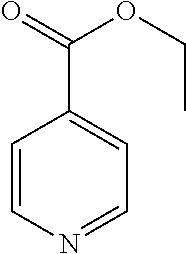 |
MeCN/TBABF4 | −2.20 | 1.03 | 1.28 |
| 3c |
 |
MeCN/TBABF4 | −2.20 | 1.02 | 1.10 |
| 3d |
 |
MeCN/TBABF4 | −2.24 | 1.01 | 1.09 |
| 3e |
 |
MeCN/TBABF4 | −2.52 | 1.18 | >5 |
| 3f |
 |
MeCN/TBABF4 | —e | >5 | >5 |
| 3g |
 |
MeCN/TBABF4 | −2.03 | 1.91 | >5 |
| 3h |
 |
MeCN/TBABF4 | —e | >5 | >5 |
| 3a |
 |
PC/TBABF4 | −2.62 | 1.35 | 2.02 |
| 3a |
 |
MeCN/LiBF4 | —e | >5 | >5 |
| 3a |
 |
PC/LiBF4 | —e | >5 | >5 |
| a0.01M substrate. | |||||
| b0.10M TBABF4 or LiBF4 support. | |||||
| cE1 0 is calculated as (E1c + E1a)/2. | |||||
| dRatios were calculated for the 2nd cycle following deconvolution of the voltammogram. | |||||
| eNo anodic current was observed. | |||||
| TABLE 2 |
| Ratios of Current Peak Heights from CV for N-Oxides and BF3-Adducts of |
| Isonicotinates |
| ipc1/ipa1 d | ipc1/ipa1 d | ||||
| Compounda | Structure | Solvent/supportb | E1 0(V)c | (100 mV/s) | (10 mV/s) |
| 4a |
 |
MeCN/TBABF4 | −1.96 | 1.05 | 1.41 |
| 4d |
 |
MeCN/TBABF4 | −2.01 | 1.00 | 1.17 |
| 4a |
 |
MeCN/LIBF4 | —e | >5 | >5 |
| 4b |
 |
MeCN/LIBF4 | —e | >5 | >5 |
| 4c |
 |
MeCN/LIBF4 | —e | >5 | >5 |
| 4d |
 |
MeCN/LIBF4 | —e | >5 | >5 |
| 5a |
 |
MeCN/TBABF4 | −1.42 | 1.03 | 1.10 |
| 5d |
 |
MeCN/TBABF4 | −1.45 | 1.03 | 1.05 |
| 5a |
 |
MeCN/LIBF4 | −1.83 | 1.02 | 1.06 |
| 5b |
 |
MeCN/LIBF4 | −1.80 | 1.06 | 1.08 |
| 5c |
 |
MeCN/LIBF4 | −1.80 | 1.06 | 1.09 |
| 5d |
 |
MeCN/LIBF4 | −1.84 | 1.06 | 1.11 |
| a0.01M substrate. | |||||
| b0.10M TBABF4 or LiBF4 support. | |||||
| cE1 0 is calculated as (E1c + E1a)/2. | |||||
| dRatios were calculated for the 2nd cycle following deconvolution of the voltammogram. | |||||
| eNo anodic current was observed. | |||||
| TABLE 3 |
| Ratios of Current Peak Heights for Isonicotinates as Determined by Cyclic |
| Voltammetry |
| ipc1/ipa1 e | ipc2/ipa2 e | |||||
| Compounda | Structure | Solvent/supportb | E1 0(V)c | (10 mV/s) | E2 0(V)d | (10 mV/s) |
| 6a |
 |
MeCN/LIBF4 | −1.11 | 0.99 | −1.85 | 0.95 |
| 6b |
 |
MeCN/LIBF4 | −1.10 | 0.98 | −1.86 | 0.94 |
| 7a |
 |
MeCN/LIBF4 | −1.11 | 0.98 | −1.88 | 0.96 |
| 7b |
 |
MeCN/LIBF4 | −1.11 | 0.99 | −1.90 | 0.96 |
| 7c |
 |
MeCN/LIBF4 | −1.13 | 0.97 | −1.89 | 0.95 |
| 7d |
 |
MeCN/LIBF4 | −1.15 | 0.99 | −1.93 | 0.93 |
| 8a |
 |
MeCN/LIBF4 | −1.11 | 0.98 | −1.89 | 0.95 |
| 7af |
 |
MeCN/LIBF4 | −1.12 | 1.02f | −1.91 | 1.08f |
| 7df |
 |
MeCN/LIBF4 | −1.14 | 1.09f | −1.92 | 1.38f |
| a0.01M substrate. | ||||||
| b0.10M LiBF4 support. | ||||||
| cE1 0 is calculated as (E1c + E1a)/2. | ||||||
| dE2 0 is calculated as (E2c + E2a)/2. | ||||||
| eRatios were calculated for the 2nd cycle following deconvolution of the voltammogram. | ||||||
| fCV measured at 200 mV/s scan rate. | ||||||
Claims (19)


Priority Applications (1)
| Application Number | Priority Date | Filing Date | Title |
|---|---|---|---|
| US15/580,048 US11056705B2 (en) | 2015-06-08 | 2016-06-08 | Organic anolyte materials for flow batteries |
Applications Claiming Priority (4)
| Application Number | Priority Date | Filing Date | Title |
|---|---|---|---|
| US201562172508P | 2015-06-08 | 2015-06-08 | |
| US201562221796P | 2015-09-22 | 2015-09-22 | |
| PCT/US2016/036336 WO2016200870A1 (en) | 2015-06-08 | 2016-06-08 | Organic anolyte materials for flow batteries |
| US15/580,048 US11056705B2 (en) | 2015-06-08 | 2016-06-08 | Organic anolyte materials for flow batteries |
Publications (2)
| Publication Number | Publication Date |
|---|---|
| US20180138539A1 US20180138539A1 (en) | 2018-05-17 |
| US11056705B2 true US11056705B2 (en) | 2021-07-06 |
Family
ID=57504109
Family Applications (1)
| Application Number | Title | Priority Date | Filing Date |
|---|---|---|---|
| US15/580,048 Active 2037-09-08 US11056705B2 (en) | 2015-06-08 | 2016-06-08 | Organic anolyte materials for flow batteries |
Country Status (2)
| Country | Link |
|---|---|
| US (1) | US11056705B2 (en) |
| WO (1) | WO2016200870A1 (en) |
Families Citing this family (6)
| Publication number | Priority date | Publication date | Assignee | Title |
|---|---|---|---|---|
| AU2021258291A1 (en) * | 2020-04-24 | 2022-11-10 | Arizona Board Of Regents On Behalf Of The University Of Arizona | Carbenium based organic redox flow batteries |
| CN112062715B (en) * | 2020-08-27 | 2021-10-29 | 珠海理文新材料有限公司 | Novel lithium trifluoromethanesulfonamide salt and preparation method and application thereof |
| US20250034092A1 (en) * | 2021-11-17 | 2025-01-30 | Board Of Trustees Of Michigan State University | Pyridinium Compounds With Low Reduction Potentials And Persistent Radical States |
| WO2023102793A1 (en) * | 2021-12-08 | 2023-06-15 | 宁德时代新能源科技股份有限公司 | Secondary battery and electrical apparatus comprising same |
| KR102910659B1 (en) * | 2022-10-13 | 2026-01-08 | 삼성에스디아이 주식회사 | Rechargeable lithium battery |
| US20260066324A1 (en) * | 2024-08-31 | 2026-03-05 | Microsoft Technology Licensing, Llc | Redox cyclable molecules for energy storage |
Citations (5)
| Publication number | Priority date | Publication date | Assignee | Title |
|---|---|---|---|---|
| US20020025477A1 (en) | 2000-07-14 | 2002-02-28 | Mitsubishi Chemical Corporation | Non-aqueous electrolytic solution and secondary battery containing same |
| EP1385182A1 (en) * | 1998-08-11 | 2004-01-28 | Fuji Photo Film Co., Ltd. | Pyridinium Compounds and their use in a photoelctrochemical cell |
| US20050075894A1 (en) | 2003-10-03 | 2005-04-07 | Sbc Knowledge Ventures, L.P. | System, method & software for a user responsive call center customer service delivery solution |
| US20130224538A1 (en) | 2012-02-28 | 2013-08-29 | Uchicago Argonne Llc | Organic non-aqueous cation-based redox flow batteries |
| US20150125729A1 (en) * | 2013-11-01 | 2015-05-07 | Samsung Electronics Co., Ltd. | Ion exchange membrane, method of preparing the same, and redox flow battery comprising the same |
Family Cites Families (1)
| Publication number | Priority date | Publication date | Assignee | Title |
|---|---|---|---|---|
| US7282295B2 (en) * | 2004-02-06 | 2007-10-16 | Polyplus Battery Company | Protected active metal electrode and battery cell structures with non-aqueous interlayer architecture |
-
2016
- 2016-06-08 WO PCT/US2016/036336 patent/WO2016200870A1/en not_active Ceased
- 2016-06-08 US US15/580,048 patent/US11056705B2/en active Active
Patent Citations (5)
| Publication number | Priority date | Publication date | Assignee | Title |
|---|---|---|---|---|
| EP1385182A1 (en) * | 1998-08-11 | 2004-01-28 | Fuji Photo Film Co., Ltd. | Pyridinium Compounds and their use in a photoelctrochemical cell |
| US20020025477A1 (en) | 2000-07-14 | 2002-02-28 | Mitsubishi Chemical Corporation | Non-aqueous electrolytic solution and secondary battery containing same |
| US20050075894A1 (en) | 2003-10-03 | 2005-04-07 | Sbc Knowledge Ventures, L.P. | System, method & software for a user responsive call center customer service delivery solution |
| US20130224538A1 (en) | 2012-02-28 | 2013-08-29 | Uchicago Argonne Llc | Organic non-aqueous cation-based redox flow batteries |
| US20150125729A1 (en) * | 2013-11-01 | 2015-05-07 | Samsung Electronics Co., Ltd. | Ion exchange membrane, method of preparing the same, and redox flow battery comprising the same |
Non-Patent Citations (1)
| Title |
|---|
| International Search Report in PCT/US2010/036336, dated Oct. 26, 2016. |
Also Published As
| Publication number | Publication date |
|---|---|
| US20180138539A1 (en) | 2018-05-17 |
| WO2016200870A1 (en) | 2016-12-15 |
Similar Documents
| Publication | Publication Date | Title |
|---|---|---|
| Zhang et al. | Emerging chemistries and molecular designs for flow batteries | |
| US11056705B2 (en) | Organic anolyte materials for flow batteries | |
| Yang et al. | Organic electroactive materials for aqueous redox flow batteries | |
| US20230130406A1 (en) | Redox Flow Battery Electrolytes | |
| Chang et al. | Shifting redox potential of nitroxyl radical by introducing an imidazolium substituent and its use in aqueous flow batteries | |
| Janoschka et al. | An approach toward replacing vanadium: a single organic molecule for the anode and cathode of an aqueous redox‐flow battery | |
| EP3332438B1 (en) | Redox flow cell for the storage of electrical energy and use thereof | |
| Miroshnikov et al. | Made from henna! a fast-charging, high-capacity, and recyclable tetrakislawsone cathode material for lithium ion batteries | |
| JP6759233B2 (en) | Organic electrolyte compounds for redox flow batteries | |
| CN114342133A (en) | redox flow battery | |
| KR102391441B1 (en) | Non-Aqueous Redox Flow Battery | |
| Attanayake et al. | Comparative study of organic radical cation stability and coulombic efficiency for nonaqueous redox flow battery applications | |
| Ahn et al. | Stabilization of Naphthalene Diimide Anions by Ion Pair Formation in Nonaqueous Organic Redox Flow Batteries | |
| Jang et al. | Methyl viologen anolyte introducing nitrate as counter-anion for an aqueous redox flow battery | |
| Kunz et al. | Unraveling the electrochemistry of verdazyl species in acidic electrolytes for the application in redox flow batteries | |
| Geysens et al. | Enhancing the solubility of 1, 4-diaminoanthraquinones in electrolytes for organic redox flow batteries through molecular modification | |
| Liu et al. | Meta-substituted thienoviologen with enhanced radical stability via π-π interaction modulation for neutral aqueous organic flow batteries | |
| Rai et al. | Effectual electrocatalytic proton and water reduction by CuII terpyridine scaffolds | |
| Alkhayri et al. | Evaluation of two-electron bispyridinylidene anolytes and a TEMPO catholyte for non-aqueous redox flow batteries | |
| Qu et al. | A highly soluble and readily accessible viologen negolyte for pH-neutral aqueous organic redox flow batteries | |
| KR101456249B1 (en) | Organic Electrolyte for Redox Flow Battery, Method for Producing Thereof and Redox Flow Battery Consisting Thereof | |
| Dong et al. | Exploring the electrochemical properties of mixed ligand Fe (II) complexes as redox couples | |
| Schatz et al. | Amino‐Substituted Azoxybenzenes as Potential Redox‐Active Catholyte Materials | |
| Marti et al. | Synthesis, properties, and x-ray structure of 6-aza-5, 7, 12, 14-tetrathiapentacene as a novel polyheterocyclic electron donor, and related compounds | |
| JP7291165B2 (en) | Carbon dioxide reduction catalyst, carbon dioxide reducer, and artificial photosynthesis device |
Legal Events
| Date | Code | Title | Description |
|---|---|---|---|
| FEPP | Fee payment procedure |
Free format text: ENTITY STATUS SET TO UNDISCOUNTED (ORIGINAL EVENT CODE: BIG.); ENTITY STATUS OF PATENT OWNER: SMALL ENTITY |
|
| FEPP | Fee payment procedure |
Free format text: ENTITY STATUS SET TO SMALL (ORIGINAL EVENT CODE: SMAL); ENTITY STATUS OF PATENT OWNER: SMALL ENTITY |
|
| STPP | Information on status: patent application and granting procedure in general |
Free format text: DOCKETED NEW CASE - READY FOR EXAMINATION |
|
| STPP | Information on status: patent application and granting procedure in general |
Free format text: NON FINAL ACTION MAILED |
|
| AS | Assignment |
Owner name: THE REGENTS OF THE UNIVERSITY OF MICHIGAN, MICHIGAN Free format text: ASSIGNMENT OF ASSIGNORS INTEREST;ASSIGNORS:SANFORD, MELANIE S.;SEVOV, CHRISTO SLAVOV;BROONER, RACHEL;SIGNING DATES FROM 20150921 TO 20151007;REEL/FRAME:051831/0101 Owner name: THE BOARD OF TRUSTEES OF THE UNIVERSITY OF ILLINOIS, ILLINOIS Free format text: ASSIGNMENT OF ASSIGNORS INTEREST;ASSIGNOR:CHENARD, ETIENNE;REEL/FRAME:051831/0133 Effective date: 20160822 |
|
| STPP | Information on status: patent application and granting procedure in general |
Free format text: RESPONSE TO NON-FINAL OFFICE ACTION ENTERED AND FORWARDED TO EXAMINER |
|
| STPP | Information on status: patent application and granting procedure in general |
Free format text: NOTICE OF ALLOWANCE MAILED -- APPLICATION RECEIVED IN OFFICE OF PUBLICATIONS |
|
| STPP | Information on status: patent application and granting procedure in general |
Free format text: PUBLICATIONS -- ISSUE FEE PAYMENT RECEIVED |
|
| STPP | Information on status: patent application and granting procedure in general |
Free format text: PUBLICATIONS -- ISSUE FEE PAYMENT VERIFIED |
|
| STCF | Information on status: patent grant |
Free format text: PATENTED CASE |
|
| MAFP | Maintenance fee payment |
Free format text: PAYMENT OF MAINTENANCE FEE, 4TH YR, SMALL ENTITY (ORIGINAL EVENT CODE: M2551); ENTITY STATUS OF PATENT OWNER: SMALL ENTITY Year of fee payment: 4 |