US11055516B2 - Behavior prediction method, behavior prediction system, and non-transitory recording medium - Google Patents
Behavior prediction method, behavior prediction system, and non-transitory recording medium Download PDFInfo
- Publication number
- US11055516B2 US11055516B2 US16/175,320 US201816175320A US11055516B2 US 11055516 B2 US11055516 B2 US 11055516B2 US 201816175320 A US201816175320 A US 201816175320A US 11055516 B2 US11055516 B2 US 11055516B2
- Authority
- US
- United States
- Prior art keywords
- key information
- behavior
- optical flow
- classification score
- stacked
- Prior art date
- Legal status (The legal status is an assumption and is not a legal conclusion. Google has not performed a legal analysis and makes no representation as to the accuracy of the status listed.)
- Expired - Fee Related, expires
Links
Images




Classifications
-
- G06K9/00335—
-
- G—PHYSICS
- G06—COMPUTING OR CALCULATING; COUNTING
- G06V—IMAGE OR VIDEO RECOGNITION OR UNDERSTANDING
- G06V40/00—Recognition of biometric, human-related or animal-related patterns in image or video data
- G06V40/20—Movements or behaviour, e.g. gesture recognition
-
- G—PHYSICS
- G06—COMPUTING OR CALCULATING; COUNTING
- G06F—ELECTRIC DIGITAL DATA PROCESSING
- G06F16/00—Information retrieval; Database structures therefor; File system structures therefor
- G06F16/50—Information retrieval; Database structures therefor; File system structures therefor of still image data
- G06F16/51—Indexing; Data structures therefor; Storage structures
-
- G06K9/00718—
-
- G06K9/00724—
-
- G06K9/00744—
-
- G—PHYSICS
- G06—COMPUTING OR CALCULATING; COUNTING
- G06T—IMAGE DATA PROCESSING OR GENERATION, IN GENERAL
- G06T7/00—Image analysis
- G06T7/20—Analysis of motion
- G06T7/246—Analysis of motion using feature-based methods, e.g. the tracking of corners or segments
- G06T7/248—Analysis of motion using feature-based methods, e.g. the tracking of corners or segments involving reference images or patches
-
- G—PHYSICS
- G06—COMPUTING OR CALCULATING; COUNTING
- G06V—IMAGE OR VIDEO RECOGNITION OR UNDERSTANDING
- G06V20/00—Scenes; Scene-specific elements
- G06V20/40—Scenes; Scene-specific elements in video content
- G06V20/41—Higher-level, semantic clustering, classification or understanding of video scenes, e.g. detection, labelling or Markovian modelling of sport events or news items
-
- G—PHYSICS
- G06—COMPUTING OR CALCULATING; COUNTING
- G06V—IMAGE OR VIDEO RECOGNITION OR UNDERSTANDING
- G06V20/00—Scenes; Scene-specific elements
- G06V20/40—Scenes; Scene-specific elements in video content
- G06V20/41—Higher-level, semantic clustering, classification or understanding of video scenes, e.g. detection, labelling or Markovian modelling of sport events or news items
- G06V20/42—Higher-level, semantic clustering, classification or understanding of video scenes, e.g. detection, labelling or Markovian modelling of sport events or news items of sport video content
-
- G—PHYSICS
- G06—COMPUTING OR CALCULATING; COUNTING
- G06V—IMAGE OR VIDEO RECOGNITION OR UNDERSTANDING
- G06V20/00—Scenes; Scene-specific elements
- G06V20/40—Scenes; Scene-specific elements in video content
- G06V20/46—Extracting features or characteristics from the video content, e.g. video fingerprints, representative shots or key frames
-
- G—PHYSICS
- G06—COMPUTING OR CALCULATING; COUNTING
- G06T—IMAGE DATA PROCESSING OR GENERATION, IN GENERAL
- G06T2207/00—Indexing scheme for image analysis or image enhancement
- G06T2207/20—Special algorithmic details
- G06T2207/20084—Artificial neural networks [ANN]
-
- G—PHYSICS
- G06—COMPUTING OR CALCULATING; COUNTING
- G06T—IMAGE DATA PROCESSING OR GENERATION, IN GENERAL
- G06T2207/00—Indexing scheme for image analysis or image enhancement
- G06T2207/30—Subject of image; Context of image processing
- G06T2207/30196—Human being; Person
-
- G—PHYSICS
- G06—COMPUTING OR CALCULATING; COUNTING
- G06T—IMAGE DATA PROCESSING OR GENERATION, IN GENERAL
- G06T2207/00—Indexing scheme for image analysis or image enhancement
- G06T2207/30—Subject of image; Context of image processing
- G06T2207/30221—Sports video; Sports image
Definitions
- the present disclosure relates to a technical field of image and video recognition, in particular to a behavior prediction method, a behavior prediction system and a non-transitory recording medium.
- a qualified behavior recognition intelligent system it needs to have a capability of taking preventive measures, i.e., recognizing it accurately before a behavior occurs in complete, so as to avoid unnecessary loss.
- preventive measures i.e., recognizing it accurately before a behavior occurs in complete.
- a behavior prediction method comprising: obtaining a part of behavior action video frame sequence, which only reflects a part of behavior actions but does not reflect all of the behavior actions; selecting a key information frame from the part of behavior action video frame sequence, wherein the key information frame has a significant differentiation in the part of behavior action video frame sequence; and predicting a type of the behavior action based on the key information frame.
- a behavior prediction apparatus comprising: an obtaining module, configured to obtain a part of behavior action video frame sequence, which only reflects a part of behavior actions but does not reflect all of the behavior actions; a selecting module, configured to select a key information frame from the part of behavior action video frame sequence, wherein the key information frame has a significant differentiation in the part of behavior action video frame sequence; and a predicting module, configured to predict a type of the behavior action based on the key information frame.
- a behavior prediction system comprising a storage device and a processor, wherein a computer program executed by a processor is stored on the storage device, and the computer program performs the behavior prediction method as described above when being executed by the processor.
- a non-transitory recording medium upon which computer program instructions are stored, wherein the behavior prediction method is performed as described above when the computer program instructions being executed.
- the behavior prediction method, apparatus, system and storage medium can predict the type of the behavior action by extracting the key information frame when only a part of videos of the behavior actions is observed, which greatly enhances the accuracy in prediction of the behavior action when the observed video has a very low occupation in the entire behavior action.
- FIG. 1 shows a schematic block diagram of an exemplary electronic device used to implement a behavior prediction method, an apparatus, a system and a storage medium according to an embodiment of the present disclosure
- FIG. 2 shows a schematic flow diagram of a behavior prediction method according to an embodiment of the present disclosure
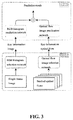
- FIG. 3 shows an exemplary schematic diagram of a network structure adopted by a behavior prediction method according to an embodiment of the present disclosure
- FIG. 4 shows an exemplary schematic diagram of a behavior prediction method for performing behavior prediction according to an embodiment of the present disclosure
- FIG. 5 shows a schematic block diagram of a behavior prediction apparatus according to an embodiment of the present disclosure.
- FIG. 6 shows a schematic block diagram of a behavior prediction system according to an embodiment of the present disclosure
- FIG. 7 shows a schematic diagram of a non-transitory recording medium according to an embodiment of the present disclosure.
- FIG. 1 An exemplary electronic device 100 used for realizing a behavior prediction method, apparatus, system and storage medium according to an embodiment of the present disclosure will be described by referring to FIG. 1
- the electronic device 100 comprises one or more processors 102 , one or more storage devices 104 , an input device 106 , an output device 108 and an image acquisition device 110 . These components are connected to each other via a bus system 112 and/or a connection mechanism (not shown) in other forms. It shall be noted that components and structures of the electronic device 100 as shown in FIG. 1 are just for illustration but not for limitation. According to the requirements, the electronic device may have other components and structures.
- the processor 102 can be a central processing unit (CPU) or other forms of processing units having data processing capability and/or instruction executing capability, and can control other components in the electronic device 100 to execute desired functions.
- CPU central processing unit
- the storage device 104 can comprise one or more computer program products, which can comprise various forms of computer readable storage medium, such as a volatile memory and/or a non-volatile memory.
- the volatile memory can comprise for example a random access memory (RAM) and/or a cache memory, etc.
- the non-volatile memory can comprise for example a read-only memory (ROM), a hardware, a flash memory, etc.
- One or more computer program instructions can be stored upon the computer readable storage medium, and the processor 102 can execute the program instructions, to realize functions of a client and/or other desired functions (realized by the processor) in the embodiment of the present disclosure described below.
- Various application programs and various data can be stored in the computer readable medium, for example various data used and/or produced by the application programs and so on and so forth.
- the input device 106 can be a device used by a user to input instructions, and can comprise one or more of a keyboard, a cursor mouse, a microphone and a touch screen or the like.
- the output device 108 can output various information (for example, image or sound) to the outside (for example, a user), and can comprise one or more of a display, a speaker, or the like.
- the image acquisition device 110 can acquire an image (for example, a picture, a video, etc.) desired by the user, and store the acquired image in the storage device 104 so as to be used by other components.
- the image acquisition device 110 can be a camera. It shall be understood that the image acquisition device 110 is just an example, and the electronic device 100 may not comprise the image acquisition device 110 . In this scenario, images to be processed can be acquired by utilizing a means having the capability of image acquisition, and transmit the acquired image to be processed to the electronic device 100 .
- the exemplary electronic device used for realizing the behavior prediction method and apparatus according to the embodiment of the present disclosure can be realized as a mobile terminal such as an intelligent phone, a tablet computer, etc.
- a behavior prediction method 200 according to an embodiment of the present disclosure will be described by referring to FIG. 2 .
- the behavior prediction method 200 can comprise following steps:
- step S 210 obtain a part of behavior action video frame sequence, which only reflects a part of behavior actions but does not reflect all of the behavior actions;
- a complete behavior action would persist for some time from the start of occurrence to the end.
- a traditional behavior recognition method needs to analyze all the frames within the duration of the entire action. In this way, the algorithm would have a delay, and thus it is hard to be applied in a scenario which requires stronger real-time capability.
- the behavior prediction solution in the embodiment of the present disclosure it is unnecessary to wait for the end of the entire behavior, and prediction of the behavior action can be realized when the part of behavior action video frame sequence is obtained.
- the part of behavior action video frame sequence can be a part of video at the very beginning of the behavior action.
- the part of behavior action video frame sequence can be first 10%, first 15% and so on of all the frames included the entire behavior action.
- the part of behavior action video frame sequence obtained in step S 210 reflects only a part of behavior actions but does not reflect all the behavior actions.
- the part of behavior action video frame sequence can be a video frame observed currently in real time.
- the part of behavior action video frame sequence can be a video frame from any source.
- step S 220 selecting a key information frame from the part of behavior action video frame sequence, wherein the key information frame has a significant differentiation in the part of behavior action video frame sequence.
- the key information frame selected from the video frames obtained in step S 210 is an information frame being capable of representing this segment of video, and it has significant differentiation in the obtained video framed compared with other frames, so that recognition and prediction of behavior actions in this segment of video can be implemented based on this key information frame.
- the selected key information frame can comprise a key information image, i.e., key information of a spatial domain.
- the information of the spatial domain can reflect appearance characteristics, focused targets and scenarios of behaviors.
- the selected key information frame can comprise key information optical flow, i.e., key information of a time domain.
- the information of the time domain can be reflected as behavior action characteristics, to capture differences of actions.
- the selected key information frame can comprise both the key information image and the key information optical flow, i.e., selecting the key information of the spatial domain and the time domain simultaneously, so that the subsequent behavior prediction would become more accurate.
- selecting of the key information image can comprise: calculating a classification score value of each frame in the part of behavior action video frame sequence, the classification score value being a value of a type having a highest score value in a classification score vector of the each frame or being a variance between score values of respective types in the classification score vector of the each frame; and sorting an order of the part of behavior action video frame sequence according to the classification score value from high to low, and taking first m frame images obtained by sorting an order as the key information image, where m is a natural number.
- selecting of the key information image can be implemented based on a first neural network (for example, RGB histogram selection network).
- the first neutral network can implement simple classified recognition on each frame of the video frames obtained in step S 210 , to output the classification score vector.
- Each element in the classification score vector is a score value of respective types which can be classified by the first neutral network.
- a type having a higher score value is likely to be a type of the behavior action in the frame.
- the type can comprise a type of the behavior action to be predicted.
- a value of a type having a highest score in the classification score vector output by the first neural network can be taken as a classification score value of the frame, then an order of video frames obtained in step S 210 is sorted in an order of the classification score values from high to low, and the first m frame images are taken as the key information image.
- the variance between score values of respective types in the classification score vector output by the first neural network can be taken as the classification score value of the frame.
- the order of the video frames obtained in step S 210 are sorted in an order of the classification score values from high to low.
- the value of m can depend on the actual requirements.
- the value of m can be 10% of the total number of video frames obtained in step S 210 .
- selecting of the key information optical flow comprises: calculating optical flows between all of consecutive two frames in the part of behavior action video frame sequence to form a plurality of stacked optical flows; calculating a classification score value of each stacked optical flow in the plurality of stacked optical flows, the classification score value being a value of a type having a highest score value in a classification score vector of each stacked optical flow or being a variance between score values of respective types in the classification score vector of each stacked optical flow; and sorting an order of the plurality of stacked optical flows according to the classification score value from high to low, and taking first n stacked optical flows obtained by sorting an order as the key information optical flow, where n is a natural number.
- selecting of the key information optical flow can be implemented based on a second neutral network (optical flow image selection network).
- optical flow can represent a playground between two consecutive frames, which can be decomposed into horizontal (x) and vertical (y) directions.
- the numerical values in the two directions can be reserved as two gray scales respectively, which can be taken as two channels of a picture, that is, optical flow between per consecutive two frames can be decomposed into horizontal and vertical directions as an optical flow image of two channels.
- Optical flow images of several consecutive frames are stacked together in a channel augmented manner as one stacked optical flows.
- optical flow images of consecutive p frames are stacked together to than a stacked optical flow image of a 2p channel as one stacked optical flow.
- Optical flow images of a plurality of consecutive p frames are stacked together to form a plurality of stacked optical flows, where p is a natural number, for example, p may be equal to 0.
- a plurality of stacked optical flows can be constituted as an input of the second neutral network.
- Simple classified recognition is implemented on each stacked optical flow by the second neutral network, to output the classification score vector, and each element in the classification score vector is a score value of respective types which can be classified by the second neutral network.
- the type having a higher score value is likely to be a type of a behavior action in the stacked optical flow.
- the type can comprise the type of the behavior action to be predicted.
- a value of a type having the highest score value in the classification score vector output by the second neutral network can be taken as the classification score value of the stacked optical flow, then an order of the plurality of stacked optical flows are sorted in an order of the classification score value from high to low, and the first n stacked optical flows are taken as the key information optical flow.
- a variance between score values of respective types in the classification score vector output by the second neutral network output can be taken as the classification score value of the stacked optical flows, then an order of the plurality of stacked optical flows can be sorted in an order of the classification score value from high to low, and the first n stacked optical flows are taken as the key information optical flow.
- the value of n may depend on the actual requirements.
- both the first neutral network for example, RGB histogram selection network
- the second neutral network for example, optical flow image selection network
- the first neutral network and the second neutral network can form a convolutional neutral network (for example, called as S-net).
- the convolutional neutral network is a two-channel convolutional neutral network. One channel is input video frames which are processed via the first neutral network to obtain the key information image, and another channel is input stacked optical flows which are processed by the second neutral network to obtain the key information optical flow, as shown in FIG. 3 .
- Behavior prediction can be performed based on the key information frame selected in step S 220 , as described in the steps given below.
- step S 230 predicting a type of the behavior action based on the key information frame.
- a prediction result of the behavior action can be obtained by analyzing and recognizing the key information image. For example, analysis and recognition can be implemented on the key information image based on the third neutral network (for example, RGB histogram prediction network).
- the third neutral network can implement accurate classified recognition on the key information image selected in step S 220 , to output the classification score vector.
- Each element in the classification score vector is a score value of respective types which can be classified by the third neutral network, and the type having the highest score value can be taken as a prediction result of the type of the behavior action finally obtained.
- a prediction result of the behavior action can be obtained by analyzing and recognizing the key information optical flow. For example, analysis and recognition can be implemented on the key information optical flow based on the fourth neutral network (for example, optical flow image prediction network).
- the fourth neutral network can implement accurate classified recognition on the key information optical flow selected in step S 220 , to output the classification score vector.
- Each element in the classification score vector is a score value of respective types which can be classified by the fourth neutral network, and the type having the highest score value can be taken as a prediction result of the type of the behavior action finally obtained.
- analysis and recognition can be performed based on the key information image, to obtain a first prediction result; and analysis and recognition can be performed based on the key information optical flow, to obtain a second prediction result; then, the first prediction result and the second prediction result are merged, to obtain a final prediction result of the type of the behavior action.
- merging the first prediction result and the second prediction result can comprise: performing weighted averaging on the first prediction result and the second prediction result according to a predetermined weighted ratio.
- the weighted ratio of the first prediction result and the second prediction result can be 1:1 or 1:1.5. Their weighted ratios can be set according to the actual requirements. Based on merging of the two-channel prediction results of the time and spatial domain, accuracy of the behavior prediction can be further enhanced.
- the third neutral network for example, RGB histogram prediction network
- the fourth neutral network for example, optical flow prediction network
- the third neutral network and the fourth neutral network can form a convolutional neutral network (for example, called as R-net).
- the convolutional neutral network is a two-channel convolutional neutral network. One channel is the key information images which are processed via the third neutral network to obtain the first prediction result, and another channel is input the key information optical flow which are processed by the fourth neutral network to obtain the second prediction result. After the first prediction result and the second prediction result are merged, the final prediction result of the behavior action is obtained, as shown in FIG. 3 .
- FIG. 4 it should be the complete action video as shown in the bottom left of FIG. 4 that realizes the complete set of behavior action of golf ball.
- the action of playing the golf ball can be predicted without obtaining all of the complete set of action video. For example, by obtaining only the first 10% of video frames, i.e., a part of video frames as shown in the upper left of FIG.
- key information frames can be selected through the S-net, then the key information frames are taken as an input of R-net, and after recognition by the R-net, it can be obtained that the prediction result is playing the golf ball. Obviously, this prediction result is accurate.
- the behavior prediction method can predict the type of the behavior action by extracting key information frames when only a part of video of the behavior action is observed, which greatly enhances the accuracy in prediction of the behavior action when the observed video has a low occupation in the entire behavior action.
- the behavior prediction method according to the embodiment of the present disclosure is illustratively described above.
- the behavior prediction method according to the embodiment of the present disclosure can be realized in a device, an apparatus or a system having a memory or a processor.
- the behavior prediction method according to the embodiment of the present disclosure can be disposed conveniently in a mobile device such as a smart phone, a tablet computer, a personal computer, etc.
- the behavior prediction method according to the embodiment of the present disclosure can be disposed at a server (or over a cloud) and a personal terminal.
- FIG. 5 shows a schematic diagram of a behavior prediction apparatus 500 according to an embodiment of the present disclosure.
- the behavior prediction apparatus 500 comprises an obtaining module 510 , a selecting module 520 and a predicting module 530 .
- the respective modules can perform respective steps/functions of the behavior prediction method as described in combination with FIG. 2 . Only major functions of respective modules of the behavior prediction apparatus 500 are described below, while the detailed content having described above are omitted.
- the obtaining module 510 is configured to obtain a part of behavior action video frame sequence, which reflects only a part of the behavior action but does not reflect all of the behavior action.
- the selecting module 520 is configured to select a key information frame from the part of behavior action video frame sequence, wherein the key information frame has significant differentiation in the part of behavior action video frame sequence.
- the predicting module 530 is configure to predict a type of the behavior action based on the key information frame.
- the obtaining module 510 , the selecting module 520 and the predicting module 530 can be realized in a way that the processor 103 in the electronic device as shown in FIG. 1 runs the program instruction stored in the storage device 104 .
- a complete behavior action would persist for some time from the start of occurrence to the end.
- a traditional behavior recognition method needs to analyze all the frames within the duration of the entire action. In this way, the algorithm would have a delay, and thus it is hard to be applied in a scenario which requires stronger real-time capability.
- the behavior prediction solution in the embodiment of the present disclosure it is unnecessary to wait for the end of the entire behavior, and prediction of the behavior action can be realized when the part of behavior action video frame sequence is acquired.
- the part of behavior action video frame sequence can be a part of video at the very beginning of the behavior action.
- the part of behavior action video frame sequence can be first 10%, first 15% and so on of all the frames included the entire behavior action.
- the part of behavior action video frame sequence obtained by the obtaining module 510 reflects only a part of behavior actions but does not reflect all the behavior actions.
- the part of behavior action video frame sequence can be a video frame observed currently in real time.
- the part of behavior action video frame sequence can be a video frame from any source.
- the key information frame selected by the selecting module 520 from the video frames obtained by the obtaining module 510 is the information frame being capable of representing this segment of video, and it has significant differentiation in the obtained video frames compared with other frames, so that the prediction module 530 is capable of implementing recognition and prediction of the behavior action in this segment of video based on the key information frame.
- the key information frame selected by the selecting module 520 can comprise a key information image, i.e., key information of a spatial domain.
- the information of the spatial domain can reflect appearance characteristics, focused target and scenario of the behavior.
- the key information frame selected by the selecting module 520 can comprise a key information optical flow, i.e., key information of a time domain.
- the information of the time domain can reflect behavior motion characteristics, to capture differences of motion.
- the key information frame selected by the selecting module 520 can comprise both the key information image and the key information optical flow, i.e., selecting the key information of the time and spatial domain simultaneously, so that the subsequent of behavior prediction of the predicting module 530 would become more accurate.
- selecting of the key information image by the selecting module 520 can comprise: calculating a classification score value of each frame in the part of behavior action video frame sequence, the classification score value being a value of a type having a highest score value in a classification score vector of the each frame or being a variance between score values of respective types in the classification score vector of the each frame; and sorting an order of the part of behavior action video frame sequence according to the classification score value from high to low, and taking first m frame images obtained by sorting an order as the key information image, where m is a natural number.
- selecting of the key information image by the selecting module 520 can be implemented based on a first neural network (for example, RGB histogram selection network).
- the first neutral network can implement simple classified recognition on each frame of the video frames obtained by the obtaining module 510 , to output the classification score vector.
- Each element in the classification score vector is a score value of respective types which can be classified by the first neutral network.
- a type with a higher score value is likely to be a type of the behavior action in the frame.
- the type can comprise a type of the behavior action to be predicted.
- the selecting module 520 can take a value of a type having a highest score in the classification score vector output by the first neural network can be taken as a classification score value of the frame, then an order of video frames obtained by the obtaining module 510 is sorted in an order of the classification score values from high to low, and the first m frame images are taken as the key information image.
- the selecting module 520 can take the variance between score values of respective types in the classification score vector output by the first neural network can be taken as the classification score value of the frame. Then, the order of the video frames obtained by the obtaining module 510 are sorted in an order of the classification score values from high to low, and the first m frame images are taken as the key information images.
- the value of m can be determined depending on the actual requirements.
- the value of m can be 10% of the total number of video frames obtained by the obtaining module 510 .
- selecting of the key information optical flow by the selecting module 520 comprises: calculating optical flows between all of consecutive two frames in the part of behavior action video frame sequence to form a plurality of stacked optical flows; calculating a classification score value of each stacked optical flow in the plurality of stacked optical flows, the classification score value being a value of a type having a highest score value in a classification score vector of each stacked optical flow or being a variance between score values of respective types in the classification score vector of each stacked optical flow; and sorting an order of the plurality of stacked optical flows according to the classification score value from high to low, and taking first n stacked optical flows obtained by sorting an order as the key information optical flow, where n is a natural number.
- selecting of the key information optical flow by the selecting module 520 can be implemented based on a second neutral network (optical flow image selection network).
- optical flow between per consecutive two frames of the video frames obtained by the obtaining module 510 can be calculated firstly.
- optical flow can represent a playground between two consecutive frames, which can be decomposed into horizontal (x) and vertical (y) directions.
- the numerical values in the two directions can be reserved as two gray scales respectively, which can be taken as two channels of a picture, that is, optical flow between per consecutive two frames can be decomposed into horizontal and vertical directions as a optical flow image of two channels.
- Optical flow images of several consecutive frames are stacked together in a channel augmented manner as one stacked optical flows.
- optical flow images of consecutive p frames are stacked together to form a stacked optical flow image of a 2p channel as one stacked optical flow.
- Optical flow images of a plurality of consecutive p frames are stacked together to form a plurality of stacked optical flows, where p is a natural number, for example, p may be equal to 0.
- a plurality of stacked optical flows can be constituted as an input of the second neutral network.
- Simple classified recognition is implemented on each stacked optical flow by the second neutral network, to output the classification score vector, and each element in the classification score vector is a score value of respective types which can be classified by the second neutral network.
- the type having a higher score value is likely to be a type of a behavior action in the stacked optical flow.
- the type can comprise the type of the behavior action to be predicted.
- the selecting module 520 can take a value of a type having the highest score value in the classification score vector output by the second neutral network as the classification score value of the stacked optical flow, then an order of the plurality of stacked optical flows are sorted in an order of the classification score value from high to low, and the first n stacked optical flows are taken as the key information optical flow.
- the selecting module 520 can take a variance between score values of respective types in the classification score vector output by the second neutral network output as the classification score value of the stacked optical flows, then an order of the plurality of stacked optical flows can be sorted in an order of the classification score value from high to low, and the first n stacked optical flows are taken as the key information optical flow.
- the value of n may depend on the actual requirements.
- both the first neutral network for example, RGB histogram selection network
- the second neutral network for example, optical flow image selection network
- the first neutral network and the second neutral network can form a convolutional neutral network (for example, called as S-net).
- the convolutional neutral network is a two-channel convolutional neutral network. One channel is input video frames which are processed via the first neutral network to obtain the key information image, and another channel is input stacked optical flows which are processed by the second neutral network to obtain the key information optical flow, as shown in FIG. 3 .
- the predicting module 530 can obtain a prediction result of the behavior action by analyzing and recognizing the key information image. For example, the predicting module 530 can implement analysis and recognition on the key information image based on the third neutral network (for example, RGB histogram prediction network). For example, the third neutral network can implement accurate classified recognition on the key information image selected by the selecting module 520 , to output the classification score vector.
- the third neutral network can implement accurate classified recognition on the key information image selected by the selecting module 520 , to output the classification score vector.
- Each element in the classification score vector is a score value of respective types which can be classified by the third neutral network, and the type having the highest score value can be taken as a prediction result of the type of the behavior action finally obtained.
- the predicting module 530 can obtain a prediction result of the behavior action by analyzing and recognizing the key information optical flow. For example, the predicting module 530 can implement analysis and recognition on the key information optical flow based on the fourth neutral network (for example, optical flow image prediction network). For example, the fourth neutral network can implement accurate classified recognition on the key information optical flow selected by the selecting module, to output the classification score vector.
- the fourth neutral network can implement accurate classified recognition on the key information optical flow selected by the selecting module, to output the classification score vector.
- Each element in the classification score vector is a score value of respective types which can be classified by the fourth neutral network, and the type having the highest score value can be taken as a prediction result of the type of the behavior action finally obtained.
- the predicting module 530 can perform analysis and recognition based on the key information image, to obtain a first prediction result; and perform analysis and recognition based on the key information optical flow, to obtain a second prediction result; and then merge the first prediction result and the second prediction result, to obtain a final prediction result of the type of the behavior action.
- merging the first prediction result and the second prediction result by the predicting module 530 can comprise: performing weighted averaging on the first prediction result and the second prediction result according to a predetermined weighted ratio.
- the weighted ratio of the first prediction result and the second prediction result can be 1:1 or 1:1.5. Their weighted ratios can be set according to the actual requirements. Based on merging of the two-channel prediction results of the time and spatial domain, accuracy of the behavior prediction can be further enhanced.
- the third neutral network for example, RGB histogram prediction network
- the fourth neutral network for example, optical flow prediction network
- the third neutral network and the fourth neutral network can form a convolutional neutral network (for example, called as R-net).
- the convolutional neutral network is a two-channel convolutional neutral network. One channel is the key information images which are processed via the third neutral network to obtain the first prediction result, and another channel is input the key information optical flow which are processed by the fourth neutral network to obtain the second prediction result. After the first prediction result and the second prediction result are merged, the final prediction result of the behavior action is obtained, as shown in FIG. 3 .
- the behavior prediction method can predict the type of the behavior action by extracting key information frames when only a part of video of the behavior action is observed, which greatly enhances the accuracy in prediction of the behavior action when the observed video has a low occupation in the entire behavior action.
- FIG. 6 shows a schematic block diagram of a behavior prediction system 600 according to an embodiment of the present disclosure.
- the behavior prediction system 600 comprises a storage device 610 and a processor 620 .
- the storage device 610 is used to store program codes of corresponding steps in the behavior prediction method according to an embodiment of the present disclosure.
- the processor 620 is used to run the program codes stored in the storage device, to execute corresponding steps of the behavior prediction method according to an embodiment of the present disclosure, and is used to realize corresponding modules in the behavior prediction apparatus according to an embodiment of the present disclosure.
- the behavior prediction system 600 can further comprise an image acquisition device (not shown in FIG. 6 ), which can be configured to acquire behavior action video frames.
- the image acquisition device is not necessary, and can directly receive input of the behavior action frame video frame from other sources.
- the behavior prediction system 600 when the program codes are ran by the processor 620 , the behavior prediction system 600 performs following steps: obtaining a part of behavior action video frame sequence, which only reflects a part of behavior actions but does not reflect all of the behavior actions; selecting a key information frame from the part of behavior action video frame sequence, wherein the key information frame has a significant differentiation in the part of behavior action video frame sequence; and predicting a type of the behavior action based on the key information frame.
- the key information frame comprises a key information image and/or a key information optical flow.
- selecting of the key information image executed by the behavior prediction system 600 comprises: calculating a classification score value of each frame in the part of behavior action video frame sequence, the classification score value being a value of a type having a highest score value in a classification score vector of the each frame or being a variance between score values of respective types in the classification score vector of the each frame; and sorting an order of the part of behavior action video frame sequence according to the classification score value from high to low, and taking first m frame images obtained by sorting an order as the key information image, where m is a natural number.
- selecting of the key information optical flow performed by the behavior prediction system 600 comprises: calculating optical flows between all of consecutive two frames in the part of behavior action video frame sequence to form a plurality of stacked optical flows; calculating a classification score value of each stacked optical flow in the plurality of stacked optical flows, the classification score value being a value of a type having a highest score value in a classification score vector of each stacked optical flow or being a variance between score values of respective types in the classification score vector of each stacked optical flow; and sorting an order of the plurality of stacked optical flows according to the classification score value from high to low, and taking first n stacked optical flows obtained by sorting an order as the key information optical flow, where n is a natural number.
- the classification includes a classification of a behavior action to be predicted.
- forming a plurality of stacked optical flows comprises: decomposing optical flows between all consecutive two frames in the part of behavior action video frame sequence into horizontal and vertical directions as a optical flow image of two channels; and stacking optical flows of random consecutive p frames together to constitute a stacked optical flow image of 2p channels as one stacked optical flow, optical flow images of a plurality of consecutive p frames being stacked together to form the plurality of stacked optical flows, where p is a natural number.
- selecting of the key information image executed by the behavior prediction system 600 is implemented based on a first neural network; when the program codes are ran by the processor 620 , selecting of the key information optical flow executed by the behavior prediction system 600 is implemented based on a second neural network, and the first neural network and the second neural networks have a same network structure and both are small neural networks.
- predicting a type of the behavior action based on the key information frame executed by the behavior action system 600 comprises: performing analysis and recognition based on the key information image, to obtain a first prediction result; performing analysis and recognition based on the key information optical flow, to obtain a second prediction result; and merging the first prediction result and the second prediction result, to obtain a final prediction result of the type of the behavior action.
- the merging the first prediction result and the second prediction result executed by the behavior prediction system 600 comprises: performing weighted averaging on the first prediction result and the second prediction result according to a predetermined weighted ratio.
- the predetermined weighted ratio is 1:1 or 1:1.5.
- the performing analysis and recognition based on the key information image executed by the behavior prediction system 600 is implemented by a third neural network; when the program codes are ran by the processor 620 , the performing analysis and recognition based on the key information optical flow executed by the behavior prediction system 600 is implemented by a fourth neural network, and the third neural network and the fourth neural networks have a same network structure and both are large neural networks.
- FIG. 7 shows a schematic diagram of a non-transitory recording medium according to an embodiment of the present disclosure.
- the non-transitory recording medium 700 stores computer program instructions 701 , steps of the behavior prediction method illustrated in the above are carried out when the computer program instructions 701 are executed by a computer.
- the non-transitory recording medium can comprise for example a memory card of a smart phone, a storage means of a tablet computer, a hardware of a personal computer, a read-only-memory (ROM), an erasable programmable read-only-memory (EPROM), a portable compact disk read-only-memory (CD-ROM), a USB memory, or any combination of the storage medium.
- the computer readable storage medium can be any random combination of one or more computer readable storage medium.
- the computer program instructions when being executed by a computer, can realize respective functional modules of the behavior prediction apparatus according to a embodiment of the present disclosure, and/or can perform the behavior prediction method according to an embodiment of the present disclosure.
- the computer or the processor when the computer program instructions are executed by a computer or a processor, can perform following steps: obtaining a part of behavior action video frame sequence, which only reflects a part of behavior actions but does not reflect all of the behavior actions; selecting a key information frame from the part of behavior action video frame sequence, wherein the key information frame has a significant differentiation in the part of behavior action video frame sequence; and predicting a type of the behavior action based on the key information frame.
- the key information frame comprises a key information image and/or a key information optical flow.
- selecting of the key information image performed by the computer or the processor comprises: calculating a classification score value of each frame in the part of behavior action video frame sequence, the classification score value being a value of a type having a highest score value in a classification score vector of the each frame or being a variance between score values of respective types in the classification score vector of the each frame; and sorting an order of the part of behavior action video frame sequence according to the classification score value from high to low, and taking first m frame images obtained by sorting an order as the key information image, where m is a natural number.
- selecting of the key information optical flow performed by the computer or the processor comprises: calculating optical flows between all of consecutive two frames in the part of behavior action video frame sequence to form a plurality of stacked optical flows; calculating a classification score value of each stacked optical flow in the plurality of stacked optical flows, the classification score value being a value of a type having a highest score value in a classification score vector of each stacked optical flow or being a variance between score values of respective types in the classification score vector of each stacked optical flow; and sorting an order of the plurality of stacked optical flows according to the classification score value from high to low, and taking first n stacked optical flows obtained by sorting an order as the key information optical flow, where n is a natural number.
- the classification includes a classification of a behavior action to be predicted.
- forming a plurality of stacked optical flows comprises: decomposing optical flows between all consecutive two frames in the part of behavior action video frame sequence into horizontal and vertical directions as a optical flow image of two channels; and stacking optical flows of random consecutive p frames together to constitute a stacked optical flow image of 2p channels as one stacked optical flow, optical flow images of a plurality of consecutive p frames being stacked together to form the plurality of stacked optical flows, where p is a natural number.
- selecting of the key information image executed by the computer or the processor is implemented based on a first neural network
- selecting of the key information optical flow performed by the computer or the processor is implemented based on a second neural network
- the first neural network and the second neural networks have a same network structure and both are small neural networks having.
- predicting a type of the behavior action based on the key information frame executed by the computer or the processor comprises: performing analysis and recognition based on the key information image, to obtain a first prediction result; performing analysis and recognition based on the key information optical flow, to obtain a second prediction result; and merging the first prediction result and the second prediction result, to obtain a final prediction result of the type of the behavior action.
- the merging the first prediction result and the second prediction result executed by the computer or the processor comprises: performing weighted averaging on the first prediction result and the second prediction result according to a predetermined weighted ratio.
- the predetermined weighted ratio is 1:1 or 1:1.5.
- the performing analysis and recognition based on the key information image executed by the computer or the processor is implemented by a third neural network
- the performing analysis and recognition based on the key information optical flow is implemented by a fourth neural network
- the third neural network and the fourth neural networks are large neural networks having a same network structure.
- Respective modules in the behavior prediction apparatus can be realized in a way that the processor f the electronic device of the behavior prediction according to the embodiment of the present disclosure runs the computer program instructions stored in the memory, or can be realized when the computer instructions stored in the computer readable storage medium of the computer program product according to the embodiment of the present disclosure.
- the behavior prediction method, apparatus, system and storage medium can predict the type of the behavior action by extracting the key information frame when only t of videos of the behavior actions is observed, which greatly enhances the accuracy of prediction of the behavior action when the observed video has a very low occupation in the entire behavior action.
- the disclosed device and method can be realized by other means.
- the device embodiments described above are just for illustration; for example, division of the user is just a logical function division, and there may be additional manners of division in the actual implementation, for example, a plurality of units or components can be combined or can be integrated into another device, or some features can be omitted, or not performed.
- Respective component embodiments of the present disclosure can be realized by a hardware, or can be realized by a software module ran on one or more processors, or can be realized by a combination of the above.
- Those skilled in the art shall understand that some or all functions of some modules of the embodiments of the present disclosure can be realized in practice by using a microprocessor or a digital signal processor (DSP).
- DSP digital signal processor
- the present disclosure can be further realized as a part or all of apparatus programs (for example, computer program and computer program product) used for performing the method herein.
- Such program for realizing the present disclosure can be stored on a computer readable medium, or can have a form of one or more signals. Such signal can be downloaded from Internet website, or provided on a carrier signal, or provided in any other forms.
- any reference marks inside the parentheses shall not form a limitation to the claims.
- the word “include” and “comprise” does not exclude that there are elements or steps not listed in the claims.
- the word “a” or “one” before an element does not exclude that there are a plurality of these elements.
- the present disclosure can be realized by means of a hardware including several different elements and by means of appropriate programmable computer. In the unit claims having recited several devices, several of these devices can be specifically reflected by a same hardware. The user of first, second and second do not indicate any sequence. These words can be explained as names.
Landscapes
- Engineering & Computer Science (AREA)
- Theoretical Computer Science (AREA)
- General Physics & Mathematics (AREA)
- Physics & Mathematics (AREA)
- Multimedia (AREA)
- Computer Vision & Pattern Recognition (AREA)
- Software Systems (AREA)
- General Health & Medical Sciences (AREA)
- Psychiatry (AREA)
- Social Psychology (AREA)
- Human Computer Interaction (AREA)
- Computational Linguistics (AREA)
- Health & Medical Sciences (AREA)
- Data Mining & Analysis (AREA)
- Databases & Information Systems (AREA)
- General Engineering & Computer Science (AREA)
- Image Analysis (AREA)
- Information Retrieval, Db Structures And Fs Structures Therefor (AREA)
Abstract
Description
Claims (12)
Applications Claiming Priority (2)
| Application Number | Priority Date | Filing Date | Title |
|---|---|---|---|
| CN201810008835.X | 2018-01-04 | ||
| CN201810008835.XA CN108875525A (en) | 2018-01-04 | 2018-01-04 | Behavior prediction method, apparatus, system and storage medium |
Publications (2)
| Publication Number | Publication Date |
|---|---|
| US20190205629A1 US20190205629A1 (en) | 2019-07-04 |
| US11055516B2 true US11055516B2 (en) | 2021-07-06 |
Family
ID=64325942
Family Applications (1)
| Application Number | Title | Priority Date | Filing Date |
|---|---|---|---|
| US16/175,320 Expired - Fee Related US11055516B2 (en) | 2018-01-04 | 2018-10-30 | Behavior prediction method, behavior prediction system, and non-transitory recording medium |
Country Status (2)
| Country | Link |
|---|---|
| US (1) | US11055516B2 (en) |
| CN (1) | CN108875525A (en) |
Cited By (2)
| Publication number | Priority date | Publication date | Assignee | Title |
|---|---|---|---|---|
| US20240371166A1 (en) * | 2023-04-27 | 2024-11-07 | Honda Motor Co., Ltd. | Weakly supervised action segmentation |
| US12170786B2 (en) | 2021-09-17 | 2024-12-17 | Samsung Electronics Co., Ltd. | Device and method for encoding and decoding image using AI |
Families Citing this family (17)
| Publication number | Priority date | Publication date | Assignee | Title |
|---|---|---|---|---|
| US11636681B2 (en) * | 2018-11-21 | 2023-04-25 | Meta Platforms, Inc. | Anticipating future video based on present video |
| CN109685115B (en) * | 2018-11-30 | 2022-10-14 | 西北大学 | A fine-grained conceptual model and learning method for bilinear feature fusion |
| CN111382605B (en) * | 2018-12-28 | 2023-08-18 | 广州市百果园信息技术有限公司 | Video content auditing method, device, storage medium and computer equipment |
| US10665268B1 (en) * | 2019-02-27 | 2020-05-26 | Sony Corporation | Audio-video analytics for simulation-based training |
| CN110059761A (en) * | 2019-04-25 | 2019-07-26 | 成都睿沿科技有限公司 | A kind of human body behavior prediction method and device |
| CN112308885B (en) * | 2019-07-29 | 2024-09-27 | 顺丰科技有限公司 | Optical flow-based violent throwing detection method, device, equipment and storage medium |
| CN110472573A (en) * | 2019-08-14 | 2019-11-19 | 北京思图场景数据科技服务有限公司 | A kind of human body behavior analysis method, equipment and computer storage medium based on body key point |
| CN112668364B (en) * | 2019-10-15 | 2023-08-08 | 杭州海康威视数字技术股份有限公司 | Behavior prediction method and device based on video |
| CN110889375B (en) * | 2019-11-28 | 2022-12-20 | 长沙理工大学 | Implicit double-flow collaborative learning network and method for action recognition |
| CN112805730A (en) * | 2019-12-30 | 2021-05-14 | 华为技术有限公司 | Trajectory prediction method and related equipment |
| US10911775B1 (en) | 2020-03-11 | 2021-02-02 | Fuji Xerox Co., Ltd. | System and method for vision-based joint action and pose motion forecasting |
| CN111444788B (en) * | 2020-03-12 | 2024-03-15 | 成都旷视金智科技有限公司 | Behavior recognition method, device and computer storage medium |
| CN111611886B (en) * | 2020-04-24 | 2023-11-10 | 智慧互通科技股份有限公司 | Parking information verification method and device based on vehicle behavior analysis |
| CN111814588B (en) * | 2020-06-18 | 2023-08-01 | 浙江大华技术股份有限公司 | Behavior detection method, related equipment and device |
| CN112766207A (en) * | 2021-01-28 | 2021-05-07 | 珠海格力电器股份有限公司 | Behavior recognition model construction method, behavior recognition method and smart home |
| CN115689830A (en) * | 2022-11-09 | 2023-02-03 | 陕西师范大学 | An educational technology management system |
| CN118247696B (en) * | 2024-02-02 | 2024-08-30 | 山东环球软件股份有限公司 | Target abnormal behavior identification method for multichannel video stream analysis |
Citations (12)
| Publication number | Priority date | Publication date | Assignee | Title |
|---|---|---|---|---|
| US20070074266A1 (en) * | 2005-09-27 | 2007-03-29 | Raveendran Vijayalakshmi R | Methods and device for data alignment with time domain boundary |
| US20080031741A1 (en) | 2006-08-02 | 2008-02-07 | Torres Martin R | Jet pump slip joint with axial grooves |
| US20090210090A1 (en) * | 2008-02-18 | 2009-08-20 | Toyota Motor Engineering & Manufacturing North America, Inc. | Robotic system and method for observing, learning, and supporting human activities |
| US20100329574A1 (en) * | 2009-06-24 | 2010-12-30 | Jorge Moraleda | Mixed media reality indexing and retrieval for repeated content |
| US20140029666A1 (en) * | 2012-07-30 | 2014-01-30 | Oki Electric Industry Co., Ltd. | Video image decoding apparatus and video image encoding system |
| CN104239852A (en) | 2014-08-25 | 2014-12-24 | 中国人民解放军第二炮兵工程大学 | Infrared pedestrian detecting method based on motion platform |
| CN104463174A (en) | 2014-12-16 | 2015-03-25 | 广州南方电力集团科技发展有限公司 | Multi-angle dynamic people recognition and behavior prediction system |
| US20160092727A1 (en) * | 2014-09-30 | 2016-03-31 | Alcatel-Lucent Usa Inc. | Tracking humans in video images |
| CN106407889A (en) | 2016-08-26 | 2017-02-15 | 上海交通大学 | Video human body interaction motion identification method based on optical flow graph depth learning model |
| CN107292247A (en) | 2017-06-05 | 2017-10-24 | 浙江理工大学 | A kind of Human bodys' response method and device based on residual error network |
| US20180260665A1 (en) * | 2017-03-07 | 2018-09-13 | Board Of Trustees Of Michigan State University | Deep learning system for recognizing pills in images |
| US20190095745A1 (en) * | 2017-09-28 | 2019-03-28 | Baidu Usa Llc | Systems and methods to improve visual feature detection using motion-related data |
-
2018
- 2018-01-04 CN CN201810008835.XA patent/CN108875525A/en active Pending
- 2018-10-30 US US16/175,320 patent/US11055516B2/en not_active Expired - Fee Related
Patent Citations (12)
| Publication number | Priority date | Publication date | Assignee | Title |
|---|---|---|---|---|
| US20070074266A1 (en) * | 2005-09-27 | 2007-03-29 | Raveendran Vijayalakshmi R | Methods and device for data alignment with time domain boundary |
| US20080031741A1 (en) | 2006-08-02 | 2008-02-07 | Torres Martin R | Jet pump slip joint with axial grooves |
| US20090210090A1 (en) * | 2008-02-18 | 2009-08-20 | Toyota Motor Engineering & Manufacturing North America, Inc. | Robotic system and method for observing, learning, and supporting human activities |
| US20100329574A1 (en) * | 2009-06-24 | 2010-12-30 | Jorge Moraleda | Mixed media reality indexing and retrieval for repeated content |
| US20140029666A1 (en) * | 2012-07-30 | 2014-01-30 | Oki Electric Industry Co., Ltd. | Video image decoding apparatus and video image encoding system |
| CN104239852A (en) | 2014-08-25 | 2014-12-24 | 中国人民解放军第二炮兵工程大学 | Infrared pedestrian detecting method based on motion platform |
| US20160092727A1 (en) * | 2014-09-30 | 2016-03-31 | Alcatel-Lucent Usa Inc. | Tracking humans in video images |
| CN104463174A (en) | 2014-12-16 | 2015-03-25 | 广州南方电力集团科技发展有限公司 | Multi-angle dynamic people recognition and behavior prediction system |
| CN106407889A (en) | 2016-08-26 | 2017-02-15 | 上海交通大学 | Video human body interaction motion identification method based on optical flow graph depth learning model |
| US20180260665A1 (en) * | 2017-03-07 | 2018-09-13 | Board Of Trustees Of Michigan State University | Deep learning system for recognizing pills in images |
| CN107292247A (en) | 2017-06-05 | 2017-10-24 | 浙江理工大学 | A kind of Human bodys' response method and device based on residual error network |
| US20190095745A1 (en) * | 2017-09-28 | 2019-03-28 | Baidu Usa Llc | Systems and methods to improve visual feature detection using motion-related data |
Non-Patent Citations (1)
| Title |
|---|
| First Chinese Office Action, issued in the corresponding Chinese patent application No. 201810008835.X, dated Apr. 26, 2020, 21 pages. |
Cited By (3)
| Publication number | Priority date | Publication date | Assignee | Title |
|---|---|---|---|---|
| US12170786B2 (en) | 2021-09-17 | 2024-12-17 | Samsung Electronics Co., Ltd. | Device and method for encoding and decoding image using AI |
| US20240371166A1 (en) * | 2023-04-27 | 2024-11-07 | Honda Motor Co., Ltd. | Weakly supervised action segmentation |
| US12548335B2 (en) * | 2023-04-27 | 2026-02-10 | Honda Motor Co., Ltd. | Weakly supervised action segmentation |
Also Published As
| Publication number | Publication date |
|---|---|
| US20190205629A1 (en) | 2019-07-04 |
| CN108875525A (en) | 2018-11-23 |
Similar Documents
| Publication | Publication Date | Title |
|---|---|---|
| US20190205629A1 (en) | Behavior predicton method, behavior predicton system, and non-transitory recording medium | |
| US11727577B2 (en) | Video background subtraction using depth | |
| US10832069B2 (en) | Living body detection method, electronic device and computer readable medium | |
| US10885660B2 (en) | Object detection method, device, system and storage medium | |
| US11443438B2 (en) | Network module and distribution method and apparatus, electronic device, and storage medium | |
| CN111935479B (en) | Target image determination method and device, computer equipment and storage medium | |
| CN110619423A (en) | Multitask prediction method and device, electronic equipment and storage medium | |
| KR20200145827A (en) | Facial feature extraction model learning method, facial feature extraction method, apparatus, device, and storage medium | |
| CN109862323A (en) | Playback method, device and the processing equipment of multi-channel video | |
| CN108875517B (en) | Video processing method, device and system and storage medium | |
| CN110263733B (en) | Image processing method, nomination evaluation method and related device | |
| WO2023138549A1 (en) | Image processing method and apparatus, and electronic device and storage medium | |
| CN108875519B (en) | Object detection method, device and system and storage medium | |
| CN111079507A (en) | Behavior recognition method and device, computer device and readable storage medium | |
| CN113762041B (en) | Video classification method, device, computer equipment and storage medium | |
| CN112084959B (en) | Crowd image processing method and device | |
| US11600068B2 (en) | Systems, methods, and storage media for processing digital video | |
| WO2022141094A1 (en) | Model generation method and apparatus, image processing method and apparatus, and readable storage medium | |
| CN110705513A (en) | Video feature extraction method and device, readable storage medium and computer equipment | |
| WO2022141092A1 (en) | Model generation method and apparatus, image processing method and apparatus, and readable storage medium | |
| CN113518217B (en) | Object identification method, device, server and medium | |
| CN112418271B (en) | Target detection method, device, system and storage medium | |
| CN120569726A (en) | Font generation method and device, and training method and device of font generation model | |
| CN118675222A (en) | Data processing method, device, electronic device and storage medium | |
| CN117688998A (en) | Data processing methods, devices, computing equipment and storage media |
Legal Events
| Date | Code | Title | Description |
|---|---|---|---|
| FEPP | Fee payment procedure |
Free format text: ENTITY STATUS SET TO UNDISCOUNTED (ORIGINAL EVENT CODE: BIG.); ENTITY STATUS OF PATENT OWNER: LARGE ENTITY |
|
| AS | Assignment |
Owner name: BEIJING KUANGSHI TECHNOLOGY CO., LTD., CHINA Free format text: ASSIGNMENT OF ASSIGNORS INTEREST;ASSIGNORS:ZHU, YANJUN;YU, GANG;REEL/FRAME:047377/0578 Effective date: 20181029 |
|
| STPP | Information on status: patent application and granting procedure in general |
Free format text: RESPONSE TO NON-FINAL OFFICE ACTION ENTERED AND FORWARDED TO EXAMINER |
|
| STPP | Information on status: patent application and granting procedure in general |
Free format text: FINAL REJECTION MAILED |
|
| STPP | Information on status: patent application and granting procedure in general |
Free format text: RESPONSE AFTER FINAL ACTION FORWARDED TO EXAMINER |
|
| STPP | Information on status: patent application and granting procedure in general |
Free format text: ADVISORY ACTION MAILED |
|
| STPP | Information on status: patent application and granting procedure in general |
Free format text: RESPONSE AFTER FINAL ACTION FORWARDED TO EXAMINER |
|
| STPP | Information on status: patent application and granting procedure in general |
Free format text: NOTICE OF ALLOWANCE MAILED -- APPLICATION RECEIVED IN OFFICE OF PUBLICATIONS |
|
| STPP | Information on status: patent application and granting procedure in general |
Free format text: PUBLICATIONS -- ISSUE FEE PAYMENT RECEIVED |
|
| STPP | Information on status: patent application and granting procedure in general |
Free format text: PUBLICATIONS -- ISSUE FEE PAYMENT VERIFIED |
|
| STCF | Information on status: patent grant |
Free format text: PATENTED CASE |
|
| FEPP | Fee payment procedure |
Free format text: MAINTENANCE FEE REMINDER MAILED (ORIGINAL EVENT CODE: REM.); ENTITY STATUS OF PATENT OWNER: LARGE ENTITY |
|
| LAPS | Lapse for failure to pay maintenance fees |
Free format text: PATENT EXPIRED FOR FAILURE TO PAY MAINTENANCE FEES (ORIGINAL EVENT CODE: EXP.); ENTITY STATUS OF PATENT OWNER: LARGE ENTITY |
|
| STCH | Information on status: patent discontinuation |
Free format text: PATENT EXPIRED DUE TO NONPAYMENT OF MAINTENANCE FEES UNDER 37 CFR 1.362 |
|
| FP | Lapsed due to failure to pay maintenance fee |
Effective date: 20250706 |