US11050937B2 - Image stabilizing apparatus, optical apparatus having the same, and image stabilizing method - Google Patents

Image stabilizing apparatus, optical apparatus having the same, and image stabilizing method Download PDF

Info

Publication number
US11050937B2
US11050937B2 US17/001,830 US202017001830A US11050937B2 US 11050937 B2 US11050937 B2 US 11050937B2 US 202017001830 A US202017001830 A US 202017001830A US 11050937 B2 US11050937 B2 US 11050937B2
Authority
US
United States
Prior art keywords
shake
low
pass filter
calculation task
calculation
Prior art date
Legal status (The legal status is an assumption and is not a legal conclusion. Google has not performed a legal analysis and makes no representation as to the accuracy of the status listed.)
Active
Application number
US17/001,830
Other versions
US20210067698A1 (en
Inventor
Go Naito
Koichi Washisu
Kenji Takeuchi
Current Assignee (The listed assignees may be inaccurate. Google has not performed a legal analysis and makes no representation or warranty as to the accuracy of the list.)
Canon Inc
Original Assignee
Canon Inc
Priority date (The priority date is an assumption and is not a legal conclusion. Google has not performed a legal analysis and makes no representation as to the accuracy of the date listed.)
Filing date
Publication date
Application filed by Canon Inc filed Critical Canon Inc
Assigned to CANON KABUSHIKI KAISHA reassignment CANON KABUSHIKI KAISHA ASSIGNMENT OF ASSIGNORS INTEREST (SEE DOCUMENT FOR DETAILS). Assignors: WASHISU, KOICHI, NAITO, GO, TAKEUCHI, KENJI
Publication of US20210067698A1 publication Critical patent/US20210067698A1/en
Application granted granted Critical
Publication of US11050937B2 publication Critical patent/US11050937B2/en
Active legal-status Critical Current
Anticipated expiration legal-status Critical

Links

Images

Classifications

    • H04N5/23267
    • HELECTRICITY
    • H04ELECTRIC COMMUNICATION TECHNIQUE
    • H04NPICTORIAL COMMUNICATION, e.g. TELEVISION
    • H04N23/00Cameras or camera modules comprising electronic image sensors; Control thereof
    • H04N23/60Control of cameras or camera modules
    • H04N23/68Control of cameras or camera modules for stable pick-up of the scene, e.g. compensating for camera body vibrations
    • H04N23/682Vibration or motion blur correction
    • H04N23/683Vibration or motion blur correction performed by a processor, e.g. controlling the readout of an image memory
    • HELECTRICITY
    • H04ELECTRIC COMMUNICATION TECHNIQUE
    • H04NPICTORIAL COMMUNICATION, e.g. TELEVISION
    • H04N23/00Cameras or camera modules comprising electronic image sensors; Control thereof
    • H04N23/60Control of cameras or camera modules
    • HELECTRICITY
    • H04ELECTRIC COMMUNICATION TECHNIQUE
    • H04NPICTORIAL COMMUNICATION, e.g. TELEVISION
    • H04N23/00Cameras or camera modules comprising electronic image sensors; Control thereof
    • H04N23/60Control of cameras or camera modules
    • H04N23/68Control of cameras or camera modules for stable pick-up of the scene, e.g. compensating for camera body vibrations
    • H04N23/681Motion detection
    • H04N23/6812Motion detection based on additional sensors, e.g. acceleration sensors
    • HELECTRICITY
    • H04ELECTRIC COMMUNICATION TECHNIQUE
    • H04NPICTORIAL COMMUNICATION, e.g. TELEVISION
    • H04N23/00Cameras or camera modules comprising electronic image sensors; Control thereof
    • H04N23/60Control of cameras or camera modules
    • H04N23/68Control of cameras or camera modules for stable pick-up of the scene, e.g. compensating for camera body vibrations
    • H04N23/682Vibration or motion blur correction
    • H04N23/685Vibration or motion blur correction performed by mechanical compensation
    • H04N23/687Vibration or motion blur correction performed by mechanical compensation by shifting the lens or sensor position
    • H04N5/23258

Definitions

  • the present invention relates to an image stabilizing apparatus, an optical apparatus having the same, and an image stabilizing method.
  • JP 2010-112974 discloses an image stabilizing apparatus that changes a characteristic of a filter that filters a specific frequency component of the output signal of the shake detector in accordance with a temperature changing rate of the shake detector or its peripherals in order to reduce the offset variation in the output signal from the shake detector.
  • the image stabilizing apparatus disclosed in JP 2010-112974 changes the processing characteristic for the output signal from the shake detector, and thus may not sufficiently correct image blurs, for example, where the frequency component of the shake is included in the frequency component filtered by the filter.
  • the present invention provides an image stabilizing apparatus, an optical apparatus having the same, and an image stabilizing method, each of which can correct image blurs with high accuracy and reduce offset variation in an output signal from a shake detector,.
  • An image stabilizing apparatus includes at least one processor or circuit configured to execute a plurality of tasks including a first calculation task configured to make a calculation using an output signal from a shake detector configured to detect a shake, a second calculation task configured to estimate an estimated value corresponding to an offset variation value included in the output signal from the shake detector by using a signal processed by a low-pass filter having a high-frequency attenuation characteristic steeper than a high-frequency attenuation characteristic of the first calculation task, and a correction task configured to drive a corrector configured to correct an image blur caused by the shake using a calculation result of the first calculation task and the estimated value.
  • An optical apparatus having the above image stabilizing apparatus and an image stabilizing method corresponding to the image stabilizing apparatus also constitute another aspect of the present invention.
  • FIG. 1 is a block diagram of an optical apparatus according to a first embodiment.
  • FIG. 2 is a Bode diagram of an integral characteristic in a first calculator according to the first embodiment.
  • FIG. 3 is a block diagram of a second calculator according to the first embodiment.
  • FIG. 4 is a Bode diagram of an offset extraction characteristic in a low-pass filter according to the first embodiment.
  • FIG. 5 illustrates a blur angle signal when the offset varies in the first embodiment.
  • FIG. 6 illustrates a value obtained by converting the offset variation value into a blur angle according to the first embodiment.
  • FIG. 7 is an operation explanatory diagram of a waveform estimator according to the first embodiment.
  • FIG. 8 is a flowchart showing processing of estimating an estimated value corresponding to the offset variation value according to the first embodiment.
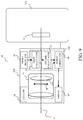
  • FIG. 9 is a block diagram of an optical apparatus according to a second embodiment.
  • FIG. 10 explains the order of the low-pass filter according to the second embodiment.
  • FIG. 11 explains a characteristic of the low-pass filter according to the second embodiment.
  • FIG. 12 illustrates a value corresponding to an extracted offset variation value according to the second embodiment.
  • FIG. 13 illustrates an estimated value corresponding to an estimated offset variation value according to the second embodiment.
  • FIG. 14 is a flowchart showing processing of estimating an estimated value corresponding to an offset variation value according to the second embodiment.
  • FIG. 15 is a block diagram of an optical apparatus according to a third embodiment.
  • FIG. 16 illustrates changes in a break (or corner) frequency of the low-pass filter according to the third embodiment.
  • FIG. 17 explains a characteristic of a low-pass filter according to the third embodiment.
  • FIG. 18 illustrates a value corresponding to an extracted offset variation value according to the third embodiment.
  • FIG. 19 illustrates an estimated value corresponding to the estimated offset variation value according to the third embodiment.
  • FIG. 20 is a flowchart illustrating processing of estimating an estimated value corresponding to an offset variation value according to the third embodiment.
  • FIG. 21 explains the order of the low-pass filter according to a fourth embodiment.
  • FIG. 22 explains a characteristic of the low-pass filter according to the fourth embodiment.
  • FIG. 23 is a flowchart showing processing of estimating an estimated value corresponding to an offset variation value according to the fourth embodiment.
  • FIG. 1 is a block diagram of a digital camera 11 which is an example of an optical apparatus according to this embodiment.
  • the digital camera 11 includes a camera body 11 a, and an interchangeable lens 11 b that can be attached to and detached from the camera body 11 a.
  • the camera body 11 a includes a camera CPU 12 , an image sensor (corrector) 14 , a shake detector 15 , a first calculator (first calculation task) 16 , a second calculator (second calculation task) 17 , a signal corrector (correction task) 18 , and a driver 19 .
  • the image stabilizing apparatus 20 includes the first calculator 16 , the second calculator 17 , and the signal corrector 18 .
  • the interchangeable lens 11 b has an imaging optical system 13 .
  • This embodiment describes a digital camera as an example of an optical apparatus equipped with an image stabilizing apparatus, but the present invention is not limited to this embodiment.
  • the image stabilizing apparatus may be mounted on another optical apparatus, such as the digital video camera or the interchangeable lens.
  • the camera CPU 12 controls the entire camera body 11 a in response to an imaging instruction operation from the photographer, etc.
  • the image sensor 14 When an object light flux along an optical axis 10 enters the image sensor 14 through the imaging optical system 13 , the image sensor 14 outputs a signal in response to the object light flux.
  • the signal output from the image sensor 14 undergoes image processing by an unillustrated image processor, and the obtained image information is recorded in an unillustrated memory.
  • the image sensor 14 is driven in an arrow A direction orthogonal to the optical axis 10 and configured to correct image blurs caused on the imaging surface of the image sensor 14 due to the blurs (shakes) applied to the digital camera 11 .
  • the shake detector 15 is an angular velocity sensor, and detects the blur or shake applied to the digital camera 11 .
  • the first calculator 16 converts the blur angular velocity signal output from the shake detector 15 into a blur angle signal through the first-order integral.
  • FIG. 2 is a Bode diagram of the integral characteristic in the first calculator 16 .
  • the abscissa axis represents the frequency and the ordinate axis represents an output gain in the first calculator 16 .
  • the output gain uses the angle signal calculated from the angular velocity signal from the shake detector 15 by the first calculator 16 , and is inversely proportional to the frequency.
  • the break frequency f 0 is set sufficiently far from the signal in the frequency band to be actually integrated. For example, when the frequency band 23 of the blurs to be detected distributes between a frequency f 1 and a frequency f 2 (such as 1 Hz to 10 Hz), a break frequency f 0 (such as 0.01 Hz) much lower than the frequency (lower limit frequency) f 1 on the low-frequency side of the frequency band 23 of the blurs is set.
  • FIG. 3 is a block diagram of the second calculator 17 .
  • the second calculator 17 includes a low-pass filter 17 a having a high-frequency attenuation characteristic that is steeper than that of the integral characteristic 21 , and a waveform estimator 17 b.
  • FIG. 4 a description will be given of an offset extraction characteristic of the low-pass filter 17 a.
  • FIG. 4 is a Bode diagram of the offset extraction characteristic of the low-pass filter 17 a.
  • the abscissa axis represents the frequency
  • the ordinate axis represents the output gain in the second calculator 17 .
  • the offset extraction characteristic 41 is a high-frequency attenuation characteristic (such as a fourth-order integral characteristic) that is steeper than the integral characteristic 21 of the first calculator 16 on the high-frequency side of a break frequency f 3 that is the offset extraction frequency.
  • the low-pass filter 17 a representing a steep high-frequency attenuation characteristic is expressed as a low-pass filter having an order higher than that of the first calculator 16 .
  • the signal on the high-frequency side of the output signal from the first calculator 16 is attenuated by the second calculator 17 , and only the signal on the low-frequency side which is an offset variation value of the shake detector 15 is extracted.
  • the break frequency f 3 is set between the break frequency f 0 and the frequency f 1 on the low-frequency side of the frequency band of the blurs.
  • the break frequency f 3 is lower than the frequency f 1 on the low-frequency side of the frequency band 23 of the blurs, and a high order, so that the blurred signal is sufficiently attenuated.
  • FIG. 5 illustrates a blur angle signal when the offset varies.
  • the abscissa axis represents time
  • the ordinate axis represents a blur angle calculated by the first calculator 16 using the blur angular velocity signal output from the shake detector 15 .
  • FIG. 6 illustrates a value obtained by converting the offset variation value into a blur angle.
  • the abscissa axis represents time
  • the ordinate axis represents a value obtained by converting the offset variation value into the blur angle.
  • a signal 61 represents a value corresponding to the actual offset variation value included in the blur angle signal in FIG. 5 .
  • a signal 62 represents a signal after the blur angle signal in FIG. 5 is processed by the low-pass filter 17 a.
  • a signal 63 represents an estimated value corresponding to the offset variation value estimated by the waveform estimator 17 b using the signal 62 .
  • the waveform estimator 17 b estimates and updates the estimated value corresponding to the offset variation value of the signal 62 at a timing when the same time as the exposure time passes.
  • this operation by the waveform estimator 17 b will be referred to as offset estimation, and the time (timing) for making the offset estimation will be referred to as offset estimation time.
  • offset estimation time For example, when the exposure time in still image capturing is 1/15 seconds, the slope of the signal 62 is calculated every 1/15 seconds. In other words, the offset estimation estimated offset time is set according to the exposure time.
  • the offset variation value included in the output signal of the shake detector 15 is large when the shake detector 15 starts or runs, and becomes small over time.
  • the waveform estimator 17 b gives the largest gain to the slope of the signal 62 when the offset estimation starts, and reduces the gain given to the slope of the signal 62 over time. In other words, the waveform estimator 17 b changes the offset estimating method.
  • FIG. 7 is an operation explanatory diagram of the waveform estimator 17 b when the exposure time is set to 1/15 seconds.
  • the abscissa axis represents time
  • the ordinate axis represents the value obtained by converting the offset variation value into the blur angle.
  • a signal 72 represents a signal obtained by continuously connecting the slope of a signal 71 (the signal 62 in FIG. 6 ) after the blur angle signal is processed by the low-pass filter 17 a every 1/15 seconds from time t 1 to time t 6 .
  • a signal 73 represents a signal obtained by continuously connecting a signal calculated using the slope of the signal 71 every 15 seconds, when the gain given to the slope of the signal 71 is made smaller over time (so that the largest gain is given to the slope at the time t 1 ).
  • the signal 73 is closer to the signal 71 than the signal 72 .
  • the estimated value corresponding to the offset variation value included in the output signal from the shake detector 15 can be estimated with high accuracy.
  • the signal corrector 18 subtracts the estimated value indicated by the signal 63 in FIG. 6 from the output signal from the first calculator 16 , and drives the image sensor 14 via the driver 19 by setting the result to the target value for the image stabilization.
  • the signal 62 which is the signal after the blur angle signal is processed by the low-pass filter 17 a, includes a phase shift caused by the low-pass filter 17 a .
  • the signal 62 is directly used to correct the output signal of the first calculator 16 , the output signal from the first calculator 16 deteriorates. Accordingly, this embodiment does not correct the output signal from the first calculator 16 directly using the signal 62 .
  • FIG. 8 is a flowchart showing processing of estimating the estimated value corresponding to the offset variation value. This flow starts with imaging preparation processing such as half-pressing a release switch provided on the camera body 11 a.
  • step S 801 the camera CPU 12 starts the first calculator 16 and the second calculator 17 .
  • the camera CPU 12 sets the exposure time used for imaging according to the input of the photographer, etc.
  • the waveform estimator 17 b estimates an estimated value corresponding to the offset variation value using the signal processed by the low-pass filter 17 a and the offset estimation time determined from the exposure time.
  • the signal corrector 18 drives the image sensor 14 via the driver 19 using the result of subtracting the estimated value estimated in the step S 802 from the output signal (calculation result) from the first calculator 16 , and starts the image blur correction.
  • step S 805 the camera CPU determines whether or not the start of the still image exposure has been instructed.
  • the flow proceeds to the step S 806 , and when the exposure start has not yet been instructed, the flow proceeds to the step S 807 .
  • the camera CPU 12 performs an operation such as opening a shutter provided on the camera body 11 a to expose a still image.
  • the camera CPU 12 determines whether or not the exposure time (such as 1/15 seconds) set in the step S 801 has elapsed. If the exposure time has elapsed, the flow returns to the step S 803 . In other words, the offset is estimated for each exposure time. If the exposure time has not yet elapsed, the processing of this step is repeated. The image stabilization continues regardless of the processing of this step.
  • the exposure time such as 1/15 seconds
  • step S 808 the camera CPU 12 determines whether or not the exposure has been completed. If the exposure has been completed, the flow returns to the step S 801 . If the exposure has not yet been completed, the processing of this step is repeated.
  • the second calculator 17 extracts only the value corresponding to the offset variation value in which the blurs are sufficiently removed from the output signal of the first calculator 16 by the low-pass filter 17 a .
  • the waveform estimator 17 b discards the phase information included in the extracted value, and changes the offset estimating method over time to estimate an accurate estimated value corresponding to the offset variation value.
  • the signal corrector 18 removes the estimated value corresponding to the offset variation value included in the output signal from the first calculator 16 without changing the characteristic of the output signal of the first calculator 16 .
  • the configuration according to this embodiment can correct the image blur with high accuracy, and reduce the offset variation in the output signal from the shake detector.
  • This embodiment reduces the order of the low-pass filter when the elapsed time after the second calculator starts is short and increases the order of the low-pass filter over time, in order to reproduce the time change in the offset variation in the output signal from the shake detector.
  • FIG. 9 is a block diagram of a digital camera 91 which is an example of the optical apparatus according to this embodiment.
  • the digital camera 91 includes a camera body 91 a, and an interchangeable lens 91 b that can be attached to and detached from the camera body 91 a.
  • the camera body 91 a includes the image sensor 14 .
  • the interchangeable lens 91 b includes the imaging optical system 13 , a lens CPU 92 , a shake detector 95 , a first calculator (first calculation task) 96 , a second calculator (second calculation task) 97 , a signal corrector (correction task) 98 , and a driver 99 .
  • the image stabilizing apparatus 100 includes the first calculator 96 , the second calculator 97 , and the signal corrector 98 .
  • the second calculator 97 has a low-pass filter 97 a and a waveform estimator 97 b.
  • the lens CPU 92 controls the entire interchangeable lens 11 b in response to the imaging instruction operation from the photographer.
  • Part of the lens of the imaging optical system 13 serves as a corrector driven in an arrow B direction orthogonal to the optical axis 10 and configured to correct image blurs caused on the imaging plane of the image sensor 14 by a blur (shake) applied to the digital camera 91 .
  • the shake detector 95 directly transmits the blur angular velocity signal to the second calculator 97 without intervening the first calculator 96 , and the first calculator 96 does not transmit the blur angle signal to the second calculator 97 .
  • the second calculator 97 has a low-pass filter 97 a having an order higher than that of the integral characteristic of the first calculator 96 .
  • the break frequency which is the offset extraction frequency, is f 3 , similar to the first embodiment.
  • the order of the low-pass filter 97 a is fixed in the first embodiment, it increases over time after the second calculator 97 starts in this embodiment.
  • FIG. 10 explains the order of the low-pass filter 97 a, and illustrates that the order of the low-pass filter 97 a changes over time after the second calculator 97 starts.
  • the abscissa axis represents time and the ordinate axis represents the order. From start time t 0 of the second calculator 97 to first time ta (such as 2 seconds), the order is set to 3 (corresponding to the third-order integral). From the first time ta to second time tb (such as 4 seconds), the order is set to 4 (corresponding to fourth-order integral). After the second time tb, the order is set to 5 (corresponding to fifth-order integral).
  • FIG. 11 explains the characteristic of the low-pass filter 97 a for each order.
  • the abscissa axis represents the frequency and the ordinate axis represents the output gain in the second calculator 17 .
  • a characteristic 1101 with the order of 3 and a characteristic 1102 with the order of 5 are different in blur attenuation amount distributed in the frequency band 23 of the blurs (slopes of the characteristics 1101 and 1102 in the frequency band 23 of the blurs).
  • the blur attenuation amount in the characteristic 1102 is larger than the blur attenuation amount in the characteristic 1101 .
  • the slope of the characteristic 1102 is larger than the slope of the characteristic 1102 .
  • the estimated value corresponding to the offset variation value when the frequency is high cannot be extracted well. In other words, the extraction accuracy of the estimated value corresponding to the offset variation value in a short time is low. On the other hand, the estimated value corresponding to the offset variation value can be extracted well when the frequency is low. In other words, the extraction accuracy of the estimated value corresponding to the offset variation value for a long time is high.
  • the offset variation value included in the output signal from the shake detector 95 changes to the low frequency side over time after the shake detector 95 starts.
  • This embodiment increases over time, after the shake detector 95 starts, the order of the low-pass filter 97 a in the second calculator 97 that starts substantially as soon as the shake detector 95 starts, in order to improve the extraction accuracy of the estimated value corresponding to the offset variation value.
  • FIG. 12 illustrates a value corresponding to the offset variation value included in the output signal from the shake detector 95 , which is extracted by changing the order of the low-pass filter 97 a over time and by performing processing for maintaining the continuity before and after the change.
  • An extracted value 1201 has a shape close to a value 1202 corresponding to the offset variation value included in the actual output signal from the shake detector 95 .
  • the waveform estimator 97 b estimates an estimated value 1301 corresponding to the offset variation value during exposure using the extracted estimated value 1201 .
  • the signal corrector 98 subtracts the estimated value 1301 from the output signal from the first calculator 96 , and drives the corrector 13 a via the driver 99 using the result as a target value for the image stabilization.
  • FIG. 14 is a flowchart showing processing of estimating an estimated value corresponding to the offset variation value. This flow starts with the imaging preparation processing such as half-pressing the release switch provided on the camera body 11 a .
  • the steps for performing the same processing as those in the flow in FIG. 8 will be designated by the same reference numerals, and a detailed description thereof will be omitted.
  • the waveform estimator 97 b estimates an estimated value corresponding to the offset variation value using the signal processed by the low-pass filter 97 a.
  • the signal corrector 98 drives the corrector 13 a (to start the image stabilization) via the driver 99 using the result of subtracting the estimated value estimated in the step S 1401 from the output signal from the first calculator 96 .
  • step S 1403 the lens CPU 92 determines whether or not the digital camera 91 has been instructed to start exposing a still image.
  • the flow proceeds to the step S 806 , and when the exposure start has not yet been instructed, the flow proceeds to step S 1404 .
  • the lens CPU 92 determines whether a predetermined time (such as the times ta and tb in FIG. 10 ) has elapsed. If the predetermined time has elapsed, the flow proceeds to the step S 1405 , and if the predetermined time has not yet elapsed, the processing of this step is repeated.
  • a predetermined time such as the times ta and tb in FIG. 10
  • the second calculator 97 changes (increases) the order of the low-pass filter 97 a.
  • the lens CPU 92 determines whether a predetermined time (such as the times ta and tb in FIG. 10 ) has elapsed. When the predetermined time has elapsed, the flow proceeds to the step S 1406 , and when the predetermined time has not yet elapsed, the flow returns to the step S 808 .
  • a predetermined time such as the times ta and tb in FIG. 10
  • the second calculator 97 changes (increases) the order of the low-pass filter 97 a.
  • This embodiment can improve the estimation accuracy of the estimated value corresponding to the offset variation value included in the output signal of the shake detector 95 by changing the order of the low-pass filter 97 a over time after the second calculator 97 starts.
  • the configuration according to this embodiment can correct the image blurs with high accuracy, and reduce the offset variation in the output signal from the shake detector.
  • the interchangeable lens 91 b includes the shake detector 95 , the first calculator 96 , the second calculator 97 , the signal corrector 98 , and the driver 99 , but the camera body 91 a may include them.
  • This embodiment changes, over time after the second calculator starts (increases the time constant), the break frequency of the low-pass filter to the low-frequency side, in order to reproduce the time change of the offset variation in the output signal from the shake detector.
  • FIG. 15 is a block diagram of a digital camera 151 which is an example of the optical apparatus according to this embodiment.
  • the digital camera 151 includes a camera body 151 a, and an interchangeable lens 151 b that can be attached to and detached from the camera body 151 a.
  • the camera body 151 a includes the image sensor 14 , a camera CPU 152 , a shake detector 155 , a first calculator (first calculation task) 156 , a second calculator (second calculation task) 157 , a signal corrector (correction task) 158 , and a driver 159 .
  • the interchangeable lens 151 b includes the imaging optical system 13 , a lens CPU 252 , a shake detector 255 , a first calculator (first calculation task) 256 , a second calculator (second calculation task) 257 , a signal corrector (correction task) 258 , and a driver 259 .
  • the image stabilizing apparatus 160 includes the first calculator 156 , the second calculator 157 , and the signal corrector 158 .
  • the image stabilizing apparatus 260 includes the first calculator 256 , the second calculator 257 , and the signal corrector 258 .
  • the digital camera 151 performs the image stabilization using the corrector 13 a and the image sensor 14 .
  • the second calculator 157 has a low-pass filter 157 a and a waveform estimator 157 b
  • the second calculator 257 has a low-pass filter 257 a and a waveform estimator 257 b.
  • the orders of the low-pass filters 157 a and 257 a may be fixed similar to the first embodiment, or may be increased over time after the respective second calculators start similar to the second embodiment.
  • FIG. 16 illustrates a change of the break frequency (time constant) of the low-pass filter 157 a ( 257 a ) over time after the shake detector 155 ( 255 ) starts.
  • the abscissa axis represents time and the ordinate axis represents the break frequency.
  • the break frequency which is the offset extraction frequency is set to fa (such as 0.1 Hz).
  • the break frequency is set to fb (such as 0.05 Hz).
  • FIG. 17 explains the characteristic of the low-pass filter 157 a ( 257 a ).
  • the abscissa axis represents the frequency and the ordinate axis represents the output gain in the second calculator 157 ( 257 ).
  • a characteristic 1701 has a high-frequency attenuation amount larger than that of a characteristic 1703 .
  • the offset variation value included in the output signal from the shake detector 155 ( 255 ) changes to the low-frequency side over time after the shake detector 155 ( 255 ) starts.
  • This embodiment increases the time constant of the low-pass filter 157 a ( 257 a ) in the second calculator 157 ( 257 ) (shifts the break frequency to the low-frequency side) over time after the shake detector 155 ( 255 ) starts, in order to extract the estimated value corresponding to the offset variation value with high accuracy.
  • FIG. 18 illustrates a value corresponding to the offset variation value included in the output signal from the shake detector 155 ( 255 ), which is obtained by changing and extracting over time the time constant (break frequency) of the low-pass filter 157 a ( 257 a ).
  • An extracted value 1801 has a shape close to a value corresponding to an offset variation value 1202 included in the actual output signal from the shake detector 155 ( 255 ).
  • the waveform estimator 157 b estimates an estimated value 1901 corresponding to the offset variation value during exposure using the extracted value 1801 .
  • the signal corrector 158 subtracts an estimated value 1901 from the output signal of the first calculator 156 ( 256 ), and drives the image sensor 14 (corrector 13 ) via the driver 159 ( 259 ) using the result as a target value for the image stabilization.
  • FIG. 20 is a flowchart showing processing of estimating an estimated value corresponding to the offset variation value. This flow starts with the imaging preparation processing such as half-pressing a release switch provided on the camera body 151 a.
  • the steps for performing the same processing as those of the flows in FIGS. 8 and 14 are designated by the same reference numbers, and a detailed description thereof will be omitted.
  • the waveform estimator 157 b ( 257 b ) estimates the estimated value corresponding to the offset variation value using the signal processed by the low-pass filter 157 a ( 257 a ).
  • the time constant (break frequency) of the low-pass filter 157 a ( 257 a ) is set small (high).
  • the signal corrector 158 ( 258 ) first subtracts the estimated value estimated in the step S 2001 from the output signal from the first calculator 156 ( 256 ).
  • the signal corrector 158 ( 258 ) drives the image sensor 14 (corrector 13 a ) via the driver 159 ( 259 ) using the subtraction result (to start the image stabilization).
  • the second calculator 157 ( 257 ) increases (decreases) the time constant (break frequency) of the low-pass filter 157 a ( 257 a ).
  • the second calculator 157 ( 257 ) increases (decreases) the time constant (break frequency) of the low-pass filter 157 a ( 257 a ).
  • This embodiment changes the break frequency of the low-pass filter 157 a over time after the second calculator 157 starts, and improves the estimation accuracy of the estimated value corresponding to the offset variation value included in the output signal from the shake detector 155 .
  • this embodiment changes the break frequency of the low-pass filter 257 a over time after the second calculator 257 starts, and thereby improves the estimation accuracy of the estimated value corresponding to the offset variation value included in the output signal from the shake detector 255 .
  • the configuration of this embodiment can correct the image blurs with high accuracy, and reduce the offset variation in the output signal from the shake detector.
  • This embodiment provides the camera body 151 a and the interchangeable lens 151 b with the shake detectors 155 and 255 , the first calculators 156 and 256 , the second calculators 157 and 257 , the signal correctors 158 and 258 , and the drivers 159 and 259 , respectively.
  • the present invention is not limited to this embodiment, and the above units may be provided in either the camera body 151 a or the interchangeable lens 151 b similar to the first or second embodiment.
  • the blurs distributed in the frequency band 23 of the blurs are sufficiently attenuated by the low-pass filter having a high order, and only the value corresponding to the offset variation value included in the output signal from the shake detector is extracted.
  • the blur component may be extracted as a value corresponding to the offset variation value. Accordingly, this embodiment sets the order of the low-pass filter 17 a higher than that in each of the first to third embodiments.
  • the digital camera which is an example of the image pickup apparatus according to this embodiment, has the same configuration as that of the digital camera 151 according to the third embodiment.
  • FIG. 21 explains the order of the low-pass filter 157 ( 257 ) according to this embodiment.
  • the abscissa axis represents the blur size and the ordinate axis represents the order. If the blur size is equal to or smaller than the predetermined amount A, the order is set to 4. If the magnitude of blur is equal to or larger than the predetermined amount A, the degree is set to 6.
  • FIG. 22 explains the characteristic of the low-pass filter 157 ( 257 ) according to this embodiment.
  • the abscissa axis represents the frequency and the ordinate axis represents an output gain in the second calculator 157 ( 257 ).
  • the blur attenuation amount in the frequency band 23 of the blurs in the characteristic 2202 when the order is 6 is larger than that in the characteristic 2201 when the order is 4.
  • FIG. 23 is a flowchart showing processing of estimating the estimated value corresponding to the offset variation value where the order is set based on the blur size.
  • the processing of the steps S 2301 and S 2302 is added to the flowchart in FIG. 20 .
  • the camera CPU 152 determines whether or not the blur amount is equal to or larger than a predetermined amount.
  • the blur size can be determined by measuring the peak or bottom of the blur every predetermined time or by rectifying the blur waveform. If the blur size is equal to or larger than the predetermined amount (for example, if panning is made or framing is changed), the flow proceeds to the step S 2302 , and if the blur size is equal to or smaller than the predetermined amount, the flow proceeds to the step S 2001 .
  • the second calculator 157 increases the order of the low-pass filter 157 a ( 257 a ).
  • the second calculator 157 changes the order of the low-pass filter 157 a ( 257 a ) according to the blur size, and can reduce errors in extracting the value corresponding to the offset variation value caused by large blurs.
  • the second and third embodiments change the orders and time constants of the low-pass filters 97 a, 157 a, and 257 a over time after the second calculators 97 , 157 , and 257 start, but may change them over time after the shake detectors 95 , 155 , and 255 start. Even when the first and second calculator are restarted due to panning or framing change, the shake detector starts before the panning or framing change. Therefore, in the panning or framing change, it is unnecessary to change the order of the low-pass filter or the time constant over time, and the calculation load can be saved.
  • the above embodiments can provide an image stabilizing apparatus and an optical apparatus having the same, each of which can correct image blurs with high accuracy and reduce an offset variation in an output signal from a shake detector.
  • Embodiment(s) of the present invention can also be realized by a computer of a system or apparatus that reads out and executes computer executable instructions (e.g., one or more programs) recorded on a storage medium (which may also be referred to more fully as a ‘non-transitory computer-readable storage medium’) to perform the functions of one or more of the above-described embodiment(s) and/or that includes one or more circuits (e.g., application specific integrated circuit (ASIC)) for performing the functions of one or more of the above-described embodiment(s), and by a method performed by the computer of the system or apparatus by, for example, reading out and executing the computer executable instructions from the storage medium to perform the functions of one or more of the above-described embodiment(s) and/or controlling the one or more circuits to perform the functions of one or more of the above-described embodiment(s).
  • computer executable instructions e.g., one or more programs
  • a storage medium which may also be referred to more fully as a
  • the computer may comprise one or more processors (e.g., central processor (CPU), microprocessor (MPU)) and may include a network of separate computers or separate processors to read out and execute the computer executable instructions.
  • the computer executable instructions may be provided to the computer, for example, from a network or the storage medium.
  • the storage medium may include, for example, one or more of a hard disk, a random-access memory (RAM), a read only memory (ROM), a storage of distributed computing systems, an optical disk (such as a compact disc (CD), digital versatile disc (DVD), or Blu-ray Disc (BD)®), a flash memory device, a memory card, and the like.

Landscapes

  • Engineering & Computer Science (AREA)
  • Multimedia (AREA)
  • Signal Processing (AREA)
  • Adjustment Of Camera Lenses (AREA)
  • Studio Devices (AREA)

Abstract

An image stabilizing apparatus includes at least one processor or circuit configured to execute a plurality of tasks including a first calculation task configured to make a calculation using an output signal from a shake detector configured to detect a shake, a second calculation task configured to estimate an estimated value corresponding to an offset variation value included in the output signal from the shake detector by using a signal processed by a low-pass filter having a high-frequency attenuation characteristic steeper than a high-frequency attenuation characteristic of the first calculation task, and a correction task configured to drive a corrector configured to correct an image blur caused by the shake using a calculation result of the first calculation task and the estimated value.

Description

BACKGROUND OF THE INVENTION Field of the Invention
The present invention relates to an image stabilizing apparatus, an optical apparatus having the same, and an image stabilizing method.
Description of the Related Art
In an image pickup apparatus that performs an image stabilization using an output signal of a shake (or vibration) detector that detects vibrations (camera shakes), the output signal from the shake detector suffers from an offset variation (or fluctuation) when the temperature rises after the power is turned on, and the image stabilization performance may deteriorate. Japanese Patent Laid-Open No. (“JP”) 2010-112974 discloses an image stabilizing apparatus that changes a characteristic of a filter that filters a specific frequency component of the output signal of the shake detector in accordance with a temperature changing rate of the shake detector or its peripherals in order to reduce the offset variation in the output signal from the shake detector.
However, the image stabilizing apparatus disclosed in JP 2010-112974 changes the processing characteristic for the output signal from the shake detector, and thus may not sufficiently correct image blurs, for example, where the frequency component of the shake is included in the frequency component filtered by the filter.
SUMMARY OF THE INVENTION
The present invention provides an image stabilizing apparatus, an optical apparatus having the same, and an image stabilizing method, each of which can correct image blurs with high accuracy and reduce offset variation in an output signal from a shake detector,.
An image stabilizing apparatus according to one aspect of the present invention includes at least one processor or circuit configured to execute a plurality of tasks including a first calculation task configured to make a calculation using an output signal from a shake detector configured to detect a shake, a second calculation task configured to estimate an estimated value corresponding to an offset variation value included in the output signal from the shake detector by using a signal processed by a low-pass filter having a high-frequency attenuation characteristic steeper than a high-frequency attenuation characteristic of the first calculation task, and a correction task configured to drive a corrector configured to correct an image blur caused by the shake using a calculation result of the first calculation task and the estimated value.
An optical apparatus having the above image stabilizing apparatus and an image stabilizing method corresponding to the image stabilizing apparatus also constitute another aspect of the present invention.
Further features of the present invention will become apparent from the following description of exemplary embodiments with reference to the attached drawings.
BRIEF DESCRIPTION OF THE DRAWINGS
FIG. 1 is a block diagram of an optical apparatus according to a first embodiment.
FIG. 2 is a Bode diagram of an integral characteristic in a first calculator according to the first embodiment.
FIG. 3 is a block diagram of a second calculator according to the first embodiment.
FIG. 4 is a Bode diagram of an offset extraction characteristic in a low-pass filter according to the first embodiment.
FIG. 5 illustrates a blur angle signal when the offset varies in the first embodiment.
FIG. 6 illustrates a value obtained by converting the offset variation value into a blur angle according to the first embodiment.
FIG. 7 is an operation explanatory diagram of a waveform estimator according to the first embodiment.
FIG. 8 is a flowchart showing processing of estimating an estimated value corresponding to the offset variation value according to the first embodiment.
FIG. 9 is a block diagram of an optical apparatus according to a second embodiment.
FIG. 10 explains the order of the low-pass filter according to the second embodiment.
FIG. 11 explains a characteristic of the low-pass filter according to the second embodiment.
FIG. 12 illustrates a value corresponding to an extracted offset variation value according to the second embodiment.
FIG. 13 illustrates an estimated value corresponding to an estimated offset variation value according to the second embodiment.
FIG. 14 is a flowchart showing processing of estimating an estimated value corresponding to an offset variation value according to the second embodiment.
FIG. 15 is a block diagram of an optical apparatus according to a third embodiment.
FIG. 16 illustrates changes in a break (or corner) frequency of the low-pass filter according to the third embodiment.
FIG. 17 explains a characteristic of a low-pass filter according to the third embodiment.
FIG. 18 illustrates a value corresponding to an extracted offset variation value according to the third embodiment.
FIG. 19 illustrates an estimated value corresponding to the estimated offset variation value according to the third embodiment.
FIG. 20 is a flowchart illustrating processing of estimating an estimated value corresponding to an offset variation value according to the third embodiment.
FIG. 21 explains the order of the low-pass filter according to a fourth embodiment.
FIG. 22 explains a characteristic of the low-pass filter according to the fourth embodiment.
FIG. 23 is a flowchart showing processing of estimating an estimated value corresponding to an offset variation value according to the fourth embodiment.
DESCRIPTION OF THE EMBODIMENTS
Referring now to the accompanying drawings, a detailed description will be given of embodiments according to the present invention. Corresponding elements in respective figures will be designated by the same reference numerals, and a duplicate description thereof will be omitted.
First Embodiment
FIG. 1 is a block diagram of a digital camera 11 which is an example of an optical apparatus according to this embodiment. The digital camera 11 includes a camera body 11 a, and an interchangeable lens 11 b that can be attached to and detached from the camera body 11 a. The camera body 11 a includes a camera CPU 12, an image sensor (corrector) 14, a shake detector 15, a first calculator (first calculation task) 16, a second calculator (second calculation task) 17, a signal corrector (correction task) 18, and a driver 19. In this embodiment, the image stabilizing apparatus 20 includes the first calculator 16, the second calculator 17, and the signal corrector 18. The interchangeable lens 11 b has an imaging optical system 13. This embodiment describes a digital camera as an example of an optical apparatus equipped with an image stabilizing apparatus, but the present invention is not limited to this embodiment. The image stabilizing apparatus may be mounted on another optical apparatus, such as the digital video camera or the interchangeable lens.
The camera CPU 12 controls the entire camera body 11 a in response to an imaging instruction operation from the photographer, etc.
When an object light flux along an optical axis 10 enters the image sensor 14 through the imaging optical system 13, the image sensor 14 outputs a signal in response to the object light flux. The signal output from the image sensor 14 undergoes image processing by an unillustrated image processor, and the obtained image information is recorded in an unillustrated memory.
The image sensor 14 is driven in an arrow A direction orthogonal to the optical axis 10 and configured to correct image blurs caused on the imaging surface of the image sensor 14 due to the blurs (shakes) applied to the digital camera 11.
The shake detector 15 is an angular velocity sensor, and detects the blur or shake applied to the digital camera 11. The first calculator 16 converts the blur angular velocity signal output from the shake detector 15 into a blur angle signal through the first-order integral. Referring now to FIG. 2, a description will be given of an integral characteristic in the first calculator 16. FIG. 2 is a Bode diagram of the integral characteristic in the first calculator 16. In FIG. 2, the abscissa axis represents the frequency and the ordinate axis represents an output gain in the first calculator 16.
On the high-frequency side of a break frequency f0 which is an integral start frequency in the integral characteristic 21, the output gain uses the angle signal calculated from the angular velocity signal from the shake detector 15 by the first calculator 16, and is inversely proportional to the frequency.
Due to the low calculation accuracy using a signal near the break frequency f0, the break frequency f0 is set sufficiently far from the signal in the frequency band to be actually integrated. For example, when the frequency band 23 of the blurs to be detected distributes between a frequency f1 and a frequency f2 (such as 1 Hz to 10 Hz), a break frequency f0 (such as 0.01 Hz) much lower than the frequency (lower limit frequency) f1 on the low-frequency side of the frequency band 23 of the blurs is set.
FIG. 3 is a block diagram of the second calculator 17. The second calculator 17 includes a low-pass filter 17 a having a high-frequency attenuation characteristic that is steeper than that of the integral characteristic 21, and a waveform estimator 17 b. Referring now to FIG. 4, a description will be given of an offset extraction characteristic of the low-pass filter 17 a. FIG. 4 is a Bode diagram of the offset extraction characteristic of the low-pass filter 17 a. In FIG. 4, the abscissa axis represents the frequency, and the ordinate axis represents the output gain in the second calculator 17.
The offset extraction characteristic 41 is a high-frequency attenuation characteristic (such as a fourth-order integral characteristic) that is steeper than the integral characteristic 21 of the first calculator 16 on the high-frequency side of a break frequency f3 that is the offset extraction frequency. In this embodiment, the low-pass filter 17 a representing a steep high-frequency attenuation characteristic is expressed as a low-pass filter having an order higher than that of the first calculator 16.
In this embodiment, the signal on the high-frequency side of the output signal from the first calculator 16 is attenuated by the second calculator 17, and only the signal on the low-frequency side which is an offset variation value of the shake detector 15 is extracted.
The break frequency f3 is set between the break frequency f0 and the frequency f1 on the low-frequency side of the frequency band of the blurs. By setting the break frequency f3 to a frequency higher than the break frequency f0, the low-frequency offset variation value included in the output signal of the shake detector 15 is not attenuated. The break frequency f3 is lower than the frequency f1 on the low-frequency side of the frequency band 23 of the blurs, and a high order, so that the blurred signal is sufficiently attenuated.
FIG. 5 illustrates a blur angle signal when the offset varies. In FIG. 5, the abscissa axis represents time, and the ordinate axis represents a blur angle calculated by the first calculator 16 using the blur angular velocity signal output from the shake detector 15.
FIG. 6 illustrates a value obtained by converting the offset variation value into a blur angle. In FIG. 6, the abscissa axis represents time, and the ordinate axis represents a value obtained by converting the offset variation value into the blur angle. A signal 61 represents a value corresponding to the actual offset variation value included in the blur angle signal in FIG. 5. A signal 62 represents a signal after the blur angle signal in FIG. 5 is processed by the low-pass filter 17 a. A signal 63 represents an estimated value corresponding to the offset variation value estimated by the waveform estimator 17 b using the signal 62.
The waveform estimator 17 b estimates and updates the estimated value corresponding to the offset variation value of the signal 62 at a timing when the same time as the exposure time passes. In this embodiment, this operation by the waveform estimator 17 b will be referred to as offset estimation, and the time (timing) for making the offset estimation will be referred to as offset estimation time. For example, when the exposure time in still image capturing is 1/15 seconds, the slope of the signal 62 is calculated every 1/15 seconds. In other words, the offset estimation estimated offset time is set according to the exposure time.
The offset variation value included in the output signal of the shake detector 15 is large when the shake detector 15 starts or runs, and becomes small over time. Thus, the waveform estimator 17 b gives the largest gain to the slope of the signal 62 when the offset estimation starts, and reduces the gain given to the slope of the signal 62 over time. In other words, the waveform estimator 17 b changes the offset estimating method.
FIG. 7 is an operation explanatory diagram of the waveform estimator 17 b when the exposure time is set to 1/15 seconds. In FIG. 7, the abscissa axis represents time, and the ordinate axis represents the value obtained by converting the offset variation value into the blur angle. A signal 72 represents a signal obtained by continuously connecting the slope of a signal 71 (the signal 62 in FIG. 6) after the blur angle signal is processed by the low-pass filter 17 a every 1/15 seconds from time t1 to time t6. A signal 73 represents a signal obtained by continuously connecting a signal calculated using the slope of the signal 71 every 15 seconds, when the gain given to the slope of the signal 71 is made smaller over time (so that the largest gain is given to the slope at the time t1). The signal 73 is closer to the signal 71 than the signal 72. In other words, by changing (decreasing) the gain over time, the estimated value corresponding to the offset variation value included in the output signal from the shake detector 15 can be estimated with high accuracy.
The signal corrector 18 subtracts the estimated value indicated by the signal 63 in FIG. 6 from the output signal from the first calculator 16, and drives the image sensor 14 via the driver 19 by setting the result to the target value for the image stabilization.
The signal 62, which is the signal after the blur angle signal is processed by the low-pass filter 17 a, includes a phase shift caused by the low-pass filter 17 a. When the signal 62 is directly used to correct the output signal of the first calculator 16, the output signal from the first calculator 16 deteriorates. Accordingly, this embodiment does not correct the output signal from the first calculator 16 directly using the signal 62.
FIG. 8 is a flowchart showing processing of estimating the estimated value corresponding to the offset variation value. This flow starts with imaging preparation processing such as half-pressing a release switch provided on the camera body 11 a.
In the step S801, the camera CPU 12 starts the first calculator 16 and the second calculator 17.
In the step S802, the camera CPU 12 sets the exposure time used for imaging according to the input of the photographer, etc.
In the step S803, the waveform estimator 17 b estimates an estimated value corresponding to the offset variation value using the signal processed by the low-pass filter 17 a and the offset estimation time determined from the exposure time.
In the step S804, the signal corrector 18 drives the image sensor 14 via the driver 19 using the result of subtracting the estimated value estimated in the step S802 from the output signal (calculation result) from the first calculator 16, and starts the image blur correction.
In the step S805, the camera CPU determines whether or not the start of the still image exposure has been instructed. When the exposure start is instructed, the flow proceeds to the step S806, and when the exposure start has not yet been instructed, the flow proceeds to the step S807.
In the step S806, the camera CPU 12 performs an operation such as opening a shutter provided on the camera body 11 a to expose a still image.
In the step S807, the camera CPU 12 determines whether or not the exposure time (such as 1/15 seconds) set in the step S801 has elapsed. If the exposure time has elapsed, the flow returns to the step S803. In other words, the offset is estimated for each exposure time. If the exposure time has not yet elapsed, the processing of this step is repeated. The image stabilization continues regardless of the processing of this step.
In the step S808, the camera CPU 12 determines whether or not the exposure has been completed. If the exposure has been completed, the flow returns to the step S801. If the exposure has not yet been completed, the processing of this step is repeated.
In this embodiment, the second calculator 17 extracts only the value corresponding to the offset variation value in which the blurs are sufficiently removed from the output signal of the first calculator 16 by the low-pass filter 17 a. In addition, the waveform estimator 17 b discards the phase information included in the extracted value, and changes the offset estimating method over time to estimate an accurate estimated value corresponding to the offset variation value. The signal corrector 18 removes the estimated value corresponding to the offset variation value included in the output signal from the first calculator 16 without changing the characteristic of the output signal of the first calculator 16.
As described above, the configuration according to this embodiment can correct the image blur with high accuracy, and reduce the offset variation in the output signal from the shake detector.
Second Embodiment
This embodiment reduces the order of the low-pass filter when the elapsed time after the second calculator starts is short and increases the order of the low-pass filter over time, in order to reproduce the time change in the offset variation in the output signal from the shake detector.
FIG. 9 is a block diagram of a digital camera 91 which is an example of the optical apparatus according to this embodiment. The digital camera 91 includes a camera body 91 a, and an interchangeable lens 91 b that can be attached to and detached from the camera body 91 a. The camera body 91 a includes the image sensor 14. The interchangeable lens 91 b includes the imaging optical system 13, a lens CPU 92, a shake detector 95, a first calculator (first calculation task) 96, a second calculator (second calculation task) 97, a signal corrector (correction task) 98, and a driver 99. In this embodiment, the image stabilizing apparatus 100 includes the first calculator 96, the second calculator 97, and the signal corrector 98. The second calculator 97 has a low-pass filter 97 a and a waveform estimator 97 b.
The lens CPU 92 controls the entire interchangeable lens 11 b in response to the imaging instruction operation from the photographer.
Part of the lens of the imaging optical system 13 serves as a corrector driven in an arrow B direction orthogonal to the optical axis 10 and configured to correct image blurs caused on the imaging plane of the image sensor 14 by a blur (shake) applied to the digital camera 91.
In this embodiment, the shake detector 95 directly transmits the blur angular velocity signal to the second calculator 97 without intervening the first calculator 96, and the first calculator 96 does not transmit the blur angle signal to the second calculator 97.
The second calculator 97 has a low-pass filter 97 a having an order higher than that of the integral characteristic of the first calculator 96. The break frequency, which is the offset extraction frequency, is f3, similar to the first embodiment. Although the order of the low-pass filter 97 a is fixed in the first embodiment, it increases over time after the second calculator 97 starts in this embodiment.
FIG. 10 explains the order of the low-pass filter 97 a, and illustrates that the order of the low-pass filter 97 a changes over time after the second calculator 97 starts. In FIG. 10, the abscissa axis represents time and the ordinate axis represents the order. From start time t0 of the second calculator 97 to first time ta (such as 2 seconds), the order is set to 3 (corresponding to the third-order integral). From the first time ta to second time tb (such as 4 seconds), the order is set to 4 (corresponding to fourth-order integral). After the second time tb, the order is set to 5 (corresponding to fifth-order integral).
FIG. 11 explains the characteristic of the low-pass filter 97 a for each order. In FIG. 11, the abscissa axis represents the frequency and the ordinate axis represents the output gain in the second calculator 17. A characteristic 1101 with the order of 3 and a characteristic 1102 with the order of 5 are different in blur attenuation amount distributed in the frequency band 23 of the blurs (slopes of the characteristics 1101 and 1102 in the frequency band 23 of the blurs). The blur attenuation amount in the characteristic 1102 is larger than the blur attenuation amount in the characteristic 1101. In other words, the slope of the characteristic 1102 is larger than the slope of the characteristic 1102. Hence, the estimated value corresponding to the offset variation value when the frequency is high cannot be extracted well. In other words, the extraction accuracy of the estimated value corresponding to the offset variation value in a short time is low. On the other hand, the estimated value corresponding to the offset variation value can be extracted well when the frequency is low. In other words, the extraction accuracy of the estimated value corresponding to the offset variation value for a long time is high.
The offset variation value included in the output signal from the shake detector 95 changes to the low frequency side over time after the shake detector 95 starts. This embodiment increases over time, after the shake detector 95 starts, the order of the low-pass filter 97 a in the second calculator 97 that starts substantially as soon as the shake detector 95 starts, in order to improve the extraction accuracy of the estimated value corresponding to the offset variation value.
FIG. 12 illustrates a value corresponding to the offset variation value included in the output signal from the shake detector 95, which is extracted by changing the order of the low-pass filter 97 a over time and by performing processing for maintaining the continuity before and after the change. An extracted value 1201 has a shape close to a value 1202 corresponding to the offset variation value included in the actual output signal from the shake detector 95. As illustrated in FIG. 13, the waveform estimator 97 b estimates an estimated value 1301 corresponding to the offset variation value during exposure using the extracted estimated value 1201.
The signal corrector 98 subtracts the estimated value 1301 from the output signal from the first calculator 96, and drives the corrector 13 a via the driver 99 using the result as a target value for the image stabilization.
FIG. 14 is a flowchart showing processing of estimating an estimated value corresponding to the offset variation value. This flow starts with the imaging preparation processing such as half-pressing the release switch provided on the camera body 11 a. In FIG. 14, the steps for performing the same processing as those in the flow in FIG. 8 will be designated by the same reference numerals, and a detailed description thereof will be omitted.
In the step S1401, the waveform estimator 97 b estimates an estimated value corresponding to the offset variation value using the signal processed by the low-pass filter 97 a.
In the step S1402, the signal corrector 98 drives the corrector 13 a (to start the image stabilization) via the driver 99 using the result of subtracting the estimated value estimated in the step S1401 from the output signal from the first calculator 96.
In the step S1403, the lens CPU 92 determines whether or not the digital camera 91 has been instructed to start exposing a still image. When the exposure start is instructed, the flow proceeds to the step S806, and when the exposure start has not yet been instructed, the flow proceeds to step S1404.
In the step S1404, the lens CPU 92 determines whether a predetermined time (such as the times ta and tb in FIG. 10) has elapsed. If the predetermined time has elapsed, the flow proceeds to the step S1405, and if the predetermined time has not yet elapsed, the processing of this step is repeated.
In the step S1405, the second calculator 97 changes (increases) the order of the low-pass filter 97 a.
In the step S1406, the lens CPU 92 determines whether a predetermined time (such as the times ta and tb in FIG. 10) has elapsed. When the predetermined time has elapsed, the flow proceeds to the step S1406, and when the predetermined time has not yet elapsed, the flow returns to the step S808.
In the step S1407, the second calculator 97 changes (increases) the order of the low-pass filter 97 a.
This embodiment can improve the estimation accuracy of the estimated value corresponding to the offset variation value included in the output signal of the shake detector 95 by changing the order of the low-pass filter 97 a over time after the second calculator 97 starts.
As described above, the configuration according to this embodiment can correct the image blurs with high accuracy, and reduce the offset variation in the output signal from the shake detector.
In this embodiment, the interchangeable lens 91 b includes the shake detector 95, the first calculator 96, the second calculator 97, the signal corrector 98, and the driver 99, but the camera body 91 a may include them.
Third Embodiment
This embodiment changes, over time after the second calculator starts (increases the time constant), the break frequency of the low-pass filter to the low-frequency side, in order to reproduce the time change of the offset variation in the output signal from the shake detector.
FIG. 15 is a block diagram of a digital camera 151 which is an example of the optical apparatus according to this embodiment. The digital camera 151 includes a camera body 151 a, and an interchangeable lens 151 b that can be attached to and detached from the camera body 151 a. The camera body 151 a includes the image sensor 14, a camera CPU 152, a shake detector 155, a first calculator (first calculation task) 156, a second calculator (second calculation task) 157, a signal corrector (correction task) 158, and a driver 159. The interchangeable lens 151 b includes the imaging optical system 13, a lens CPU 252, a shake detector 255, a first calculator (first calculation task) 256, a second calculator (second calculation task) 257, a signal corrector (correction task) 258, and a driver 259. In this embodiment, the image stabilizing apparatus 160 includes the first calculator 156, the second calculator 157, and the signal corrector 158. The image stabilizing apparatus 260 includes the first calculator 256, the second calculator 257, and the signal corrector 258. The digital camera 151 performs the image stabilization using the corrector 13 a and the image sensor 14. The second calculator 157 has a low-pass filter 157 a and a waveform estimator 157 b, and the second calculator 257 has a low-pass filter 257 a and a waveform estimator 257 b. The orders of the low-pass filters 157 a and 257 a may be fixed similar to the first embodiment, or may be increased over time after the respective second calculators start similar to the second embodiment.
FIG. 16 illustrates a change of the break frequency (time constant) of the low-pass filter 157 a (257 a) over time after the shake detector 155 (255) starts. In FIG. 16, the abscissa axis represents time and the ordinate axis represents the break frequency. From the start time t0 of the second calculator 157 (257) to the first time ta (such as 2 seconds), the break frequency which is the offset extraction frequency is set to fa (such as 0.1 Hz). After the first time ta, the break frequency is set to fb (such as 0.05 Hz).
FIG. 17 explains the characteristic of the low-pass filter 157 a (257 a). In FIG. 17, the abscissa axis represents the frequency and the ordinate axis represents the output gain in the second calculator 157 (257). A characteristic 1701 has a high-frequency attenuation amount larger than that of a characteristic 1703. The offset variation value included in the output signal from the shake detector 155 (255) changes to the low-frequency side over time after the shake detector 155 (255) starts. This embodiment increases the time constant of the low-pass filter 157 a (257 a) in the second calculator 157 (257) (shifts the break frequency to the low-frequency side) over time after the shake detector 155 (255) starts, in order to extract the estimated value corresponding to the offset variation value with high accuracy.
FIG. 18 illustrates a value corresponding to the offset variation value included in the output signal from the shake detector 155 (255), which is obtained by changing and extracting over time the time constant (break frequency) of the low-pass filter 157 a (257 a). An extracted value 1801 has a shape close to a value corresponding to an offset variation value 1202 included in the actual output signal from the shake detector 155 (255). As illustrated in FIG. 19, the waveform estimator 157 b (257 b) estimates an estimated value 1901 corresponding to the offset variation value during exposure using the extracted value 1801.
The signal corrector 158 (258) subtracts an estimated value 1901 from the output signal of the first calculator 156 (256), and drives the image sensor 14 (corrector 13) via the driver 159 (259) using the result as a target value for the image stabilization.
FIG. 20 is a flowchart showing processing of estimating an estimated value corresponding to the offset variation value. This flow starts with the imaging preparation processing such as half-pressing a release switch provided on the camera body 151 a. In FIG. 20, the steps for performing the same processing as those of the flows in FIGS. 8 and 14 are designated by the same reference numbers, and a detailed description thereof will be omitted.
In the step S2001, the waveform estimator 157 b (257 b) estimates the estimated value corresponding to the offset variation value using the signal processed by the low-pass filter 157 a (257 a). In the initial setting, the time constant (break frequency) of the low-pass filter 157 a (257 a) is set small (high).
In the step S2002, the signal corrector 158 (258) first subtracts the estimated value estimated in the step S2001 from the output signal from the first calculator 156 (256). Next, the signal corrector 158 (258) drives the image sensor 14 (corrector 13 a) via the driver 159 (259) using the subtraction result (to start the image stabilization).
In the step S2003, the second calculator 157 (257) increases (decreases) the time constant (break frequency) of the low-pass filter 157 a (257 a).
In the step S2004, the second calculator 157 (257) increases (decreases) the time constant (break frequency) of the low-pass filter 157 a (257 a).
This embodiment changes the break frequency of the low-pass filter 157 a over time after the second calculator 157 starts, and improves the estimation accuracy of the estimated value corresponding to the offset variation value included in the output signal from the shake detector 155. Similarly, this embodiment changes the break frequency of the low-pass filter 257 a over time after the second calculator 257 starts, and thereby improves the estimation accuracy of the estimated value corresponding to the offset variation value included in the output signal from the shake detector 255.
As described above, the configuration of this embodiment can correct the image blurs with high accuracy, and reduce the offset variation in the output signal from the shake detector.
This embodiment provides the camera body 151 a and the interchangeable lens 151 b with the shake detectors 155 and 255, the first calculators 156 and 256, the second calculators 157 and 257, the signal correctors 158 and 258, and the drivers 159 and 259, respectively. However, the present invention is not limited to this embodiment, and the above units may be provided in either the camera body 151 a or the interchangeable lens 151 b similar to the first or second embodiment.
Fourth Embodiment
In the first to third embodiments, the blurs distributed in the frequency band 23 of the blurs are sufficiently attenuated by the low-pass filter having a high order, and only the value corresponding to the offset variation value included in the output signal from the shake detector is extracted. However, when the blur is very large, the blur component may be extracted as a value corresponding to the offset variation value. Accordingly, this embodiment sets the order of the low-pass filter 17 a higher than that in each of the first to third embodiments.
The digital camera, which is an example of the image pickup apparatus according to this embodiment, has the same configuration as that of the digital camera 151 according to the third embodiment.
FIG. 21 explains the order of the low-pass filter 157 (257) according to this embodiment. In FIG. 21, the abscissa axis represents the blur size and the ordinate axis represents the order. If the blur size is equal to or smaller than the predetermined amount A, the order is set to 4. If the magnitude of blur is equal to or larger than the predetermined amount A, the degree is set to 6.
FIG. 22 explains the characteristic of the low-pass filter 157 (257) according to this embodiment. In FIG. 22, the abscissa axis represents the frequency and the ordinate axis represents an output gain in the second calculator 157 (257). The blur attenuation amount in the frequency band 23 of the blurs in the characteristic 2202 when the order is 6 is larger than that in the characteristic 2201 when the order is 4.
FIG. 23 is a flowchart showing processing of estimating the estimated value corresponding to the offset variation value where the order is set based on the blur size. In the flowchart in FIG. 23, the processing of the steps S2301 and S2302 is added to the flowchart in FIG. 20.
In the step S2301, the camera CPU 152 (lens CPU 252) determines whether or not the blur amount is equal to or larger than a predetermined amount. The blur size can be determined by measuring the peak or bottom of the blur every predetermined time or by rectifying the blur waveform. If the blur size is equal to or larger than the predetermined amount (for example, if panning is made or framing is changed), the flow proceeds to the step S2302, and if the blur size is equal to or smaller than the predetermined amount, the flow proceeds to the step S2001.
In the step S2302, the second calculator 157 (257) increases the order of the low-pass filter 157 a (257 a).
As described above, in this embodiment, the second calculator 157 (257) changes the order of the low-pass filter 157 a (257 a) according to the blur size, and can reduce errors in extracting the value corresponding to the offset variation value caused by large blurs.
The second and third embodiments change the orders and time constants of the low-pass filters 97 a, 157 a, and 257 a over time after the second calculators 97, 157, and 257 start, but may change them over time after the shake detectors 95, 155, and 255 start. Even when the first and second calculator are restarted due to panning or framing change, the shake detector starts before the panning or framing change. Therefore, in the panning or framing change, it is unnecessary to change the order of the low-pass filter or the time constant over time, and the calculation load can be saved.
The above embodiments can provide an image stabilizing apparatus and an optical apparatus having the same, each of which can correct image blurs with high accuracy and reduce an offset variation in an output signal from a shake detector.
Other Embodiments
Embodiment(s) of the present invention can also be realized by a computer of a system or apparatus that reads out and executes computer executable instructions (e.g., one or more programs) recorded on a storage medium (which may also be referred to more fully as a ‘non-transitory computer-readable storage medium’) to perform the functions of one or more of the above-described embodiment(s) and/or that includes one or more circuits (e.g., application specific integrated circuit (ASIC)) for performing the functions of one or more of the above-described embodiment(s), and by a method performed by the computer of the system or apparatus by, for example, reading out and executing the computer executable instructions from the storage medium to perform the functions of one or more of the above-described embodiment(s) and/or controlling the one or more circuits to perform the functions of one or more of the above-described embodiment(s). The computer may comprise one or more processors (e.g., central processor (CPU), microprocessor (MPU)) and may include a network of separate computers or separate processors to read out and execute the computer executable instructions. The computer executable instructions may be provided to the computer, for example, from a network or the storage medium. The storage medium may include, for example, one or more of a hard disk, a random-access memory (RAM), a read only memory (ROM), a storage of distributed computing systems, an optical disk (such as a compact disc (CD), digital versatile disc (DVD), or Blu-ray Disc (BD)®), a flash memory device, a memory card, and the like.
While the present invention has been described with reference to exemplary embodiments, it is to be understood that the invention is not limited to the disclosed exemplary embodiments. The scope of the following claims is to be accorded the broadest interpretation so as to encompass all such modifications and equivalent structures and functions.
This application claims the benefit of Japanese Patent Application No. 2019-154583, filed on Aug. 27, 2019, which is hereby incorporated by reference herein in its entirety.

Claims (11)

What is claimed is:
1. An image stabilizing apparatus comprising:
at least one processor or circuit configured to execute a plurality of tasks including:
a first calculation task configured to make a calculation using an output signal from a shake detector configured to detect a shake;
a second calculation task configured to estimate an estimated value corresponding to an offset variation value included in the output signal from the shake detector by using a signal processed by a low-pass filter having a high-frequency attenuation characteristic steeper than a high-frequency attenuation characteristic of the first calculation task; and
a correction task configured to drive a corrector configured to correct an image blur caused by the shake using a calculation result of the first calculation task and the estimated value.
2. The image stabilizing apparatus according to claim 1, wherein a break frequency of the low-pass filter is set between the break frequency of the first calculation task and a lower limit frequency in a frequency band of the shake.
3. The image stabilizing apparatus according to claim 1, wherein the second calculation task sets a timing for estimating the estimated value according to an exposure time.
4. The image stabilizing apparatus according to claim 1, wherein the second calculation task changes a method for estimating the estimated value with over time after the shake detector starts.
5. The image stabilizing apparatus according to claim 1, wherein the second calculation task changes a method for estimating the estimated value over time after the second calculation task starts.
6. The image stabilizing apparatus according to claim 4, wherein the second calculation task changes a gain given to a slope in a signal processed by the low-pass filter over time.
7. The image stabilizing apparatus according to claim 4, wherein the second calculation task changes an order of the low-pass filter over time.
8. The image stabilizing apparatus according to claim 4, wherein the second calculation task changes a break frequency of the low-pass filter over time.
9. The image stabilizing apparatus according to claim 1, wherein the second calculation task changes an order of the low-pass filter according to a magnitude of the shake.
10. An optical apparatus comprising:
an image stabilizing apparatus; and
a corrector configured to correct an image blur caused by a shake,
wherein the image stabilizing apparatus includes at least one processor or circuit configured to execute a plurality of tasks including:
a first calculation task configured to make a calculation using an output signal from a shake detector configured to detect the shake;
a second calculation task configured to estimate an estimated value corresponding to an offset variation value included in the output signal from the shake detector by using a signal processed by a low-pass filter having a high-frequency attenuation characteristic steeper than a high-frequency attenuation characteristic of the first calculation task; and
a correction task configured to drive a corrector configured to correct an image blur caused by the shake using a calculation result of the first calculation task and the estimated value.
11. An image stabilizing method comprising the steps of:
making a calculation using an output signal from a shake detector configured to detect a shake;
estimating an estimated value corresponding to an offset variation value included in the output signal from the shake detector by using a signal processed by a low-pass filter having a high-frequency attenuation characteristic steeper than a high-frequency attenuation characteristic of the making step; and
driving a corrector configured to correct an image blur caused by the shake using a calculation result of the making step and the estimated value.
US17/001,830 2019-08-27 2020-08-25 Image stabilizing apparatus, optical apparatus having the same, and image stabilizing method Active US11050937B2 (en)

Applications Claiming Priority (3)

Application Number Priority Date Filing Date Title
JPJP2019-154583 2019-08-27
JP2019154583A JP7321837B2 (en) 2019-08-27 2019-08-27 Image stabilization device and optical device provided with the same
JP2019-154583 2019-08-27

Publications (2)

Publication Number Publication Date
US20210067698A1 US20210067698A1 (en) 2021-03-04
US11050937B2 true US11050937B2 (en) 2021-06-29

Family

ID=74678262

Family Applications (1)

Application Number Title Priority Date Filing Date
US17/001,830 Active US11050937B2 (en) 2019-08-27 2020-08-25 Image stabilizing apparatus, optical apparatus having the same, and image stabilizing method

Country Status (2)

Country Link
US (1) US11050937B2 (en)
JP (1) JP7321837B2 (en)

Citations (6)

* Cited by examiner, † Cited by third party
Publication number Priority date Publication date Assignee Title
JP2010112974A (en) 2008-11-04 2010-05-20 Canon Inc Image-shake correction apparatus and imaging apparatus
US20150036007A1 (en) * 2013-08-01 2015-02-05 Canon Kabushiki Kaisha Image shake correcting apparatus and control method for same, lens barrel, optical apparatus, and imaging apparatus
US20150062358A1 (en) * 2013-09-02 2015-03-05 Canon Kabushiki Kaisha Image capturing apparatus and control method thereof
US9031396B2 (en) * 2013-08-01 2015-05-12 Canon Kabushiki Kaisha Image shake correcting apparatus and control method for same, lens barrel, optical apparatus, and imaging apparatus
US20170134659A1 (en) * 2015-11-05 2017-05-11 Canon Kabushiki Kaisha Image stabilization apparatus and image stabilization method
US20180213155A1 (en) * 2017-01-20 2018-07-26 Canon Kabushiki Kaisha Image stabilization apparatus and control method therefor, image capturing apparatus, and storage medium

Family Cites Families (4)

* Cited by examiner, † Cited by third party
Publication number Priority date Publication date Assignee Title
JP2004102044A (en) 2002-09-11 2004-04-02 Canon Inc Camera with image stabilization function
JP4507548B2 (en) 2003-10-10 2010-07-21 株式会社ニコン Blur correction device
JP4817849B2 (en) 2006-01-13 2011-11-16 キヤノン株式会社 Vibration correction apparatus and optical apparatus
KR20160093257A (en) 2015-01-29 2016-08-08 삼성전기주식회사 Optical image stabilizer and camera module including the same

Patent Citations (6)

* Cited by examiner, † Cited by third party
Publication number Priority date Publication date Assignee Title
JP2010112974A (en) 2008-11-04 2010-05-20 Canon Inc Image-shake correction apparatus and imaging apparatus
US20150036007A1 (en) * 2013-08-01 2015-02-05 Canon Kabushiki Kaisha Image shake correcting apparatus and control method for same, lens barrel, optical apparatus, and imaging apparatus
US9031396B2 (en) * 2013-08-01 2015-05-12 Canon Kabushiki Kaisha Image shake correcting apparatus and control method for same, lens barrel, optical apparatus, and imaging apparatus
US20150062358A1 (en) * 2013-09-02 2015-03-05 Canon Kabushiki Kaisha Image capturing apparatus and control method thereof
US20170134659A1 (en) * 2015-11-05 2017-05-11 Canon Kabushiki Kaisha Image stabilization apparatus and image stabilization method
US20180213155A1 (en) * 2017-01-20 2018-07-26 Canon Kabushiki Kaisha Image stabilization apparatus and control method therefor, image capturing apparatus, and storage medium

Also Published As

Publication number Publication date
JP7321837B2 (en) 2023-08-07
JP2021033119A (en) 2021-03-01
US20210067698A1 (en) 2021-03-04

Similar Documents

Publication Publication Date Title
US9883104B2 (en) Control apparatus, image pickup apparatus, control method, and non-transitory computer-readable storage medium which are capable of performing tilt correction
US11290650B2 (en) Image blur information acquisition apparatus and method, and storage medium
US9031396B2 (en) Image shake correcting apparatus and control method for same, lens barrel, optical apparatus, and imaging apparatus
US9626743B2 (en) Image stabilization apparatus, method of controlling the same, image capturing apparatus, lens apparatus, and storage medium
US9635258B2 (en) Image pickup apparatus, method of controlling image pickup apparatus, image processing apparatus, and image processing method
US11570361B2 (en) Lens unit, imaging device, control methods thereof, and storage medium
US10230897B2 (en) Control apparatus, image capturing apparatus, lens apparatus, control method, and non-transitory computer-readable storage medium
US10212348B2 (en) Image processing apparatus, its control method, image capturing apparatus, and storage medium
US10101593B2 (en) Optical apparatus, control method thereof and storage medium
US10623645B2 (en) Image blur correction device, method of controlling thereof, and imaging apparatus
US20160301871A1 (en) Image capture apparatus and control method thereof
US11405556B2 (en) Processing device for processing shake detection signal and control method therefor
EP3567843B1 (en) Image stabilization apparatus, image capturing system, and method for controlling the same
US10551634B2 (en) Blur correction device, imaging apparatus, and blur correction method that correct an image blur of an object in a target image region
US11050937B2 (en) Image stabilizing apparatus, optical apparatus having the same, and image stabilizing method
US11405553B2 (en) Optical device and its control method
US10200612B2 (en) Image stabilization apparatus and control method thereof, and storage medium
US20250056120A1 (en) Control apparatus, image pickup apparatus, lens apparatus, control method, and storage medium, that determine correction ratios between multiple image stabilizers
US20220385800A1 (en) Control apparatus, imaging apparatus, and lens apparatus
US11678052B2 (en) Control apparatus, image pickup apparatus, control method, and storage medium
JP7275176B2 (en) IMAGING DEVICE, IMAGING METHOD, AND PROGRAM
US11190688B2 (en) Image blur correction device, method for controlling same, and imaging apparatus
US11789337B2 (en) Image stabilization control apparatus, image pickup apparatus, lens apparatus, imaging system, control method, and storage medium with calculation overflow prevention
US11265468B2 (en) Image stabilization apparatus, method of controlling the same, image capturing apparatus, and storage medium
US11956538B2 (en) Image capturing apparatus that performs blur correction and method of controlling same

Legal Events

Date Code Title Description
FEPP Fee payment procedure

Free format text: ENTITY STATUS SET TO UNDISCOUNTED (ORIGINAL EVENT CODE: BIG.); ENTITY STATUS OF PATENT OWNER: LARGE ENTITY

AS Assignment

Owner name: CANON KABUSHIKI KAISHA, JAPAN

Free format text: ASSIGNMENT OF ASSIGNORS INTEREST;ASSIGNORS:NAITO, GO;WASHISU, KOICHI;TAKEUCHI, KENJI;SIGNING DATES FROM 20201107 TO 20201116;REEL/FRAME:054587/0160

STPP Information on status: patent application and granting procedure in general

Free format text: NOTICE OF ALLOWANCE MAILED -- APPLICATION RECEIVED IN OFFICE OF PUBLICATIONS

STPP Information on status: patent application and granting procedure in general

Free format text: PUBLICATIONS -- ISSUE FEE PAYMENT RECEIVED

STPP Information on status: patent application and granting procedure in general

Free format text: PUBLICATIONS -- ISSUE FEE PAYMENT VERIFIED

STCF Information on status: patent grant

Free format text: PATENTED CASE

MAFP Maintenance fee payment

Free format text: PAYMENT OF MAINTENANCE FEE, 4TH YEAR, LARGE ENTITY (ORIGINAL EVENT CODE: M1551); ENTITY STATUS OF PATENT OWNER: LARGE ENTITY

Year of fee payment: 4