US11049183B1 - Wireless device to enable data collection for insurance rating purposes - Google Patents
Wireless device to enable data collection for insurance rating purposes Download PDFInfo
- Publication number
- US11049183B1 US11049183B1 US15/418,408 US201715418408A US11049183B1 US 11049183 B1 US11049183 B1 US 11049183B1 US 201715418408 A US201715418408 A US 201715418408A US 11049183 B1 US11049183 B1 US 11049183B1
- Authority
- US
- United States
- Prior art keywords
- computing device
- mobile computing
- short range
- range wireless
- wireless transceiver
- Prior art date
- Legal status (The legal status is an assumption and is not a legal conclusion. Google has not performed a legal analysis and makes no representation as to the accuracy of the status listed.)
- Active, expires
Links
Images




Classifications
-
- G—PHYSICS
- G06—COMPUTING OR CALCULATING; COUNTING
- G06Q—INFORMATION AND COMMUNICATION TECHNOLOGY [ICT] SPECIALLY ADAPTED FOR ADMINISTRATIVE, COMMERCIAL, FINANCIAL, MANAGERIAL OR SUPERVISORY PURPOSES; SYSTEMS OR METHODS SPECIALLY ADAPTED FOR ADMINISTRATIVE, COMMERCIAL, FINANCIAL, MANAGERIAL OR SUPERVISORY PURPOSES, NOT OTHERWISE PROVIDED FOR
- G06Q40/00—Finance; Insurance; Tax strategies; Processing of corporate or income taxes
- G06Q40/08—Insurance
-
- H—ELECTRICITY
- H04—ELECTRIC COMMUNICATION TECHNIQUE
- H04M—TELEPHONIC COMMUNICATION
- H04M1/00—Substation equipment, e.g. for use by subscribers
- H04M1/72—Mobile telephones; Cordless telephones, i.e. devices for establishing wireless links to base stations without route selection
- H04M1/724—User interfaces specially adapted for cordless or mobile telephones
-
- H—ELECTRICITY
- H04—ELECTRIC COMMUNICATION TECHNIQUE
- H04W—WIRELESS COMMUNICATION NETWORKS
- H04W4/00—Services specially adapted for wireless communication networks; Facilities therefor
- H04W4/80—Services using short range communication, e.g. near-field communication [NFC], radio-frequency identification [RFID] or low energy communication
-
- H—ELECTRICITY
- H04—ELECTRIC COMMUNICATION TECHNIQUE
- H04W—WIRELESS COMMUNICATION NETWORKS
- H04W8/00—Network data management
- H04W8/02—Processing of mobility data, e.g. registration information at HLR [Home Location Register] or VLR [Visitor Location Register]; Transfer of mobility data, e.g. between HLR, VLR or external networks
- H04W8/08—Mobility data transfer
Definitions
- the present disclosure generally relates to systems and methods for collecting data that may be used for determining insurance ratings. More particularly, the present disclosure relates to a battery powered Bluetooth device that automatically triggers a mobile computing device to store data, such as a series of locations and a time stamp associated with each location, when the mobile computing device is proximate the Bluetooth device.
- Mobile computing devices such as “smart phones,” are becoming common place.
- Most mobile telephones include a short range wireless transceiver (e.g., a Bluetooth transceiver) in addition to a local area network transceiver (e.g., a WiFi transceiver) and a cellular telephone network transceiver.
- a short range wireless transceiver e.g., a Bluetooth transceiver
- a local area network transceiver e.g., a WiFi transceiver
- cellular telephone network transceiver e.g., a Global positioning device, a calendar, a clock and other situational sensors.
- a typical mobile telephone includes a memory for storing data and various applications that, when executed by a processor within the mobile telephone, enable various functionality, such as receiving, storing and transmitting data.
- Bluetooth devices are becoming equally common place. Bluetooth devices for use with mobile telephones are available. For example, headsets, microphones, speakers, etc. are often wirelessly connected to a mobile telephone via a Bluetooth interface.
- Mobile telephones are often considered a necessity when traveling in airplanes, trains, buses, etc. Furthermore, mobile telephones are regularly carried when individuals walk, run, ride bicycles, ski and perform other physical activities.
- a computerized method for automatically collecting and storing insurance risk rating related data may include receiving, at a processor of a mobile computing device, an indication that the mobile computing device is proximate a wireless transceiver device. The method may also include receiving, at the processor of the mobile computing device, data representative of an identification of the wireless transceiver device. The method may further include causing the processor to automatically store insurance rating related data in a memory in response to receiving the indication that the wireless transceiver device is proximate the mobile computing device and receiving the data representative of the identification of the wireless transceiver device. The method may also include receiving, at the processor of the computing device, an indication that the mobile computing device is no longer proximate the wireless transceiver device. The method may further include causing the processor to automatically cease storing insurance rating related data in the memory in response to receiving the indication that the mobile computing device is no longer proximate the wireless transceiver device.
- a system for automatically collecting and storing insurance risk rating related data may include a wireless transceiver device for providing an indication that a mobile computing device insurance application is proximate the wireless transceiver device and for providing data representative of an identification of the wireless transceiver device.
- the system may further include a wireless transceiver device and mobile computing device synchronization module stored on a computer-readable medium that, when executed by a processor, receives the indication that the wireless transceiver is proximate the mobile computing device insurance application and that receives the data representative of the identification of the wireless transceiver device and provides an indication that the wireless transceiver device is proximate the mobile computing device insurance application.
- the system may also include an insurance rating related data logging module stored on a computer-readable medium that, when executed by a processor, automatically stores insurance rating related data on a memory in response to receiving the indication that the wireless transceiver device is proximate the mobile computing device insurance application.
- an insurance rating related data logging module stored on a computer-readable medium that, when executed by a processor, automatically stores insurance rating related data on a memory in response to receiving the indication that the wireless transceiver device is proximate the mobile computing device insurance application.
- a computer-readable storage medium comprising non-transitory computer-readable instructions stored thereon, to be executed on a processor of a system for automatically collecting and storing insurance rating related data
- the instructions may further include an insurance data logging module that, when executed by a processor, automatically stores insurance rating related data on a memory in response to receiving the indication that the wireless transceiver device is proximate the mobile computing device.
- FIGS. 1A-1C depict various views of an example wireless transceiver device capable of triggering a mobile device to log data
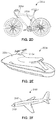
- FIGS. 2A-2H and 2J illustrate various personal use items including a wireless transceiver device of FIGS. 1A-1C ;
- FIG. 3 depicts a high-level block diagram of an example system for logging insurance ranking data including a wireless transceiver device, a mobile device and a remote server;
- FIG. 4 depicts a block diagram of an example wireless transceiver device
- FIG. 5 depict a flow diagram of an example method of associating a Bluetooth device with a mobile telephone
- FIG. 6 depicts a flow diagram of an example method of synchronizing a Bluetooth device with a mobile telephone
- FIG. 7 depicts a block diagram of an example mobile telephone with an application for logging data
- FIG. 8 depicts a flow diagram of an example method of associating a mobile telephone with Bluetooth device.
- FIG. 9 depicts a flow diagram of an example method of automatically triggering a mobile telephone to log data.
- Insurance rates are often based on various personal characteristics. For example, the cost of automobile insurance may, at least in part, be based on the distance an individual drives to work, where the individual lives, where the individual drives, etc. Generally, this information is provided to the insurance company by an insurance purchaser at the time an insurance policy is underwritten. Insurance companies count on the insurance purchaser to provide new information when changes occur.
- a Bluetooth device may be attached to a personal item (e.g., an automobile) belonging to an insured person and an application may be installed on the insured person's mobile telephone.
- a personal item e.g., an automobile
- an application may be installed on the insured person's mobile telephone.
- Each Bluetooth device may be identified with a particular media access control (MAC) address and the MAC address may be associated with a particular personal item.
- MAC media access control
- the mobile telephone When the mobile telephone is proximate the Bluetooth device, indicative of, for example, that the insured person is driving her automobile, the mobile telephone may automatically begin to store data that may be used for insurance rating purposes.
- the mobile telephone when the mobile telephone includes a global positioning device, a calendar and a clock, the mobile telephone may periodically store a location of the mobile telephone along with a day and a time stamp associated with each location.
- the mobile telephone and the Bluetooth device may be configured such that no action is required on the part of a user, aside from bringing the mobile telephone proximate the Bluetooth device, in order for the mobile telephone to automatically store data. Similarly, no interaction is required on behave of the user in respect to the personal item (e.g., no ignition activation is required).
- the mobile telephone may periodically transmit the stored insurance rating related data to a remote server.
- the mobile telephone may detect the presence of a wireless fidelity (WiFi) access point.
- WiFi wireless fidelity
- the mobile telephone may transmit the stored insurance rating related data to the remote server.
- the mobile telephone may transmit the insurance rating related data to a remote server via a cellular telephone network.
- the Bluetooth device 100 a , 100 b , 100 c may include a replaceable battery 115 a , 115 b , 115 c which may be retained within the Bluetooth device 100 a , 100 b , 100 c , at least in part, by the battery access cover 110 a , 110 b , 110 c .
- the Bluetooth device 100 a , 100 b , 100 c may further include a memory 120 a , 120 b , 120 c , a processor 125 a , 125 b , 125 c and a transceiver 130 a , 130 b , 130 c.
- the Bluetooth device 100 a may include a top side 105 a .
- FIG. 1B represents a side 105 b view of a cross section 1 B- 1 B of the Bluetooth device 100 a .
- the Bluetooth device 100 b may include a double-sided adhesive 140 b that may facilitate attachment of the Bluetooth device 100 b to a personal item (e.g., a vehicle, motorcycle, boat, bicycle, etc.) belonging to an insured person.
- the Bluetooth device 100 c may include a tamperproof mechanism 135 c that may be incorporated between a bottom side 105 c of the Bluetooth device 100 c and the double-sided adhesive 140 c .
- the double-sided adhesive 140 c and the tamperproof device 135 c may be configured such that, once the Bluetooth device 100 c is attached to a personal item belonging to an insured person, removal of the Bluetooth device 100 c will cause the double-sided adhesive 140 c to break the tamperproof mechanism 135 c . As a result, the double-sided adhesive 140 c in combination with the tamperproof mechanism 135 c prevents tampering with the Bluetooth device 100 c.
- the memory 120 a , 120 b , 120 c may include data representative of a Bluetooth device media access control (MAC) address along with computer-readable instructions that, when executed by the processor 125 a , 125 b , 125 c cause the Bluetooth device 100 a , 100 b , 100 c to measure a remaining charge of the replaceable battery 115 a , 115 b , 115 c and transmit the data representative of the MAC address and data representative of the remaining charge to a mobile telephone (e.g., mobile telephone 305 of FIG. 3 ) when the mobile telephone 305 is proximate the Bluetooth device 100 a , 100 b , 100 c .
- transmission of the data representative of the MAC address may cause the mobile telephone 305 to begin logging data.
- the device 100 a , 100 b , 100 c may employ other radio frequency identification (RFID) technologies.
- RFID radio frequency identification
- a Bluetooth device (similar to Bluetooth device 100 a , 100 b , 100 c ) may be attached to various personal items 200 a - 200 h and 200 j .
- a Bluetooth device 210 a may be attached to an insured person's car 205 a .
- a Bluetooth device 210 b may be attached to an insured person's motorcycle 205 b .
- a Bluetooth device 210 c may be attached to an insured person's boat 205 c .
- FIG. 2A a Bluetooth device 210 a may be attached to an insured person's car 205 a .
- a Bluetooth device 210 b may be attached to an insured person's motorcycle 205 b .
- a Bluetooth device 210 c may be attached to an insured person's boat 205 c .
- a Bluetooth device 210 d may be attached to an insured person's bicycle 205 d .
- a Bluetooth device 210 e may be attached to an insured person's jet ski 205 e .
- a Bluetooth device 210 f may be attached to an airplane 205 f in which an insured person is traveling or a Bluetooth device 210 h may be attached to a train 205 h in which an insured person is traveling.
- a Bluetooth device 210 g may be attached to an insured person's luggage 205 g . While FIG.
- FIG. 2G depicts the Bluetooth device 210 g as being attached to an insured person's luggage 205 g , it should be understood that the Bluetooth device 210 g may be attached to a briefcase, a book bag, a backpack, a tennis racket bag, a golf club bag, etc. As depicted in FIG. 2J , a Bluetooth device 210 j may be attached to an insured person's ski boot 205 j . While FIG.
- Bluetooth device 210 j depicts the Bluetooth device 210 j as being attached to an insured person's ski boot 205 j
- the Bluetooth device 210 j may be attached to a running shoe, a tennis shoe, a golf shoe, a hiking boot, a work boot, a snowboard boot, sports apparel, a coat, etc.
- a Bluetooth device 100 a may be attached to any personal item 205 a or attached to a lanyard and worn around the insured person's neck.
- any given Bluetooth device 100 a may be associated with an insured person's mobile telephone 305 such that the mobile telephone 305 will automatically log data associated with a particular activity that is related to the particular personal item 205 a - 205 h and 205 j .
- data may be logged that is representative of how far, when and where an insured person went driving, riding, boating, biking, jet skiing, flying, traveling, skiing, etc.
- data representative of how fast the insured person was moving may be determined based on the logged position and time data.
- FIG. 3 depicts a high-level block diagram of a computer system 300 that implements communications between a client device 305 (e.g., a mobile telephone), a Bluetooth device 310 and a remote computing device 315 to provide data to an insurance related database 390 .
- the client device 305 may be communicatively coupled to the Bluetooth device 310 via the Bluetooth wireless link 320 and to the remote computing device 315 via a network 325 .
- the client device 305 may include a memory 330 and a processor 335 for storing and executing, respectively, a module 331 .
- the module 331 stored in the memory 330 as a set of computer-readable instructions, may be related to an insurance rating related data logging application that, when executed on a processor 335 , causes insurance rating related data to be stored in the memory 330 .
- the module 331 may facilitate interaction between the client device 305 , the Bluetooth device 310 and the remote computing device 315 .
- the processor 335 may facilitate communications between the computing device 315 and the client device 305 via a network interface 355 , a client device network connection 326 and the network 325 .
- the client device 305 may include a display device 350 which may be any type of electronic display device such as a liquid crystal display (LCD), a light emitting diode (LED) display, a plasma display, a cathode ray tube (CRT) display, or any other type of known or suitable electronic display.
- the display device 350 may exhibit a display which depicts a user interface for configuring the client device 305 to communicate with the Bluetooth device 310 via the client device Bluetooth interface 360 , the Bluetooth wireless link 320 and the Bluetooth device Bluetooth interface 375 .
- the client device 305 may include a user input device 345 , such as a touch input/keyboard/pointing device (e.g., a mouse) that provides a mechanism for a user of the client device 305 to launch a data logging application, to enter related information and to manually enter insurance rating related data, such as an odometer reading of a vehicle.
- the user input device 345 may be configured as an integral part of a display device 350 , such as a touch screen display device.
- the network interface 355 may be configured to facilitate communications between the client device 305 and the remote computing device 315 via any hardwired or wireless communication network 325 , including for example a hardwired Ethernet connection or a wireless LAN, MAN or WAN, WiFi, the Internet, or any combination thereof.
- the client device 305 may be communicatively connected to the remote computing device 315 via any suitable communication system, such as via any publicly available or privately owned communication network, including those that use wireless communication structures, such as wireless communication networks, including for example, wireless LANs and WANs, satellite and cellular telephone communication systems, etc.
- any suitable communication system such as via any publicly available or privately owned communication network, including those that use wireless communication structures, such as wireless communication networks, including for example, wireless LANs and WANs, satellite and cellular telephone communication systems, etc.
- the Bluetooth device 310 may include a memory 365 storing a module 366 that, when executed by a processor 370 , may transmit a Bluetooth device 310 MAC address to a client device 305 . As described elsewhere herein, transmission of the Bluetooth device 310 MAC address to the client device 305 may cause the client device 305 to begin storing insurance rating related data in the memory 330 . Alternatively, the client device 305 may cause insurance related data to be stored in a remote server 315 memory 380 and/or a remote insurance related database 390 .
- the computing device 315 may include a memory 380 and a processor 385 for storing and executing, respectively, a module 381 .
- the module 381 stored in the memory 380 as a set of computer-readable instructions, facilitates applications related to logging insurance rating related data.
- the module 381 may also facilitate communications between the computing device 315 and the client device 305 via a network interface 395 , a remote computing device network connection 327 and the network 325 and other functions and instructions.
- the computing device 315 may be communicatively coupled to an insurance related database 390 . While the insurance related database 390 is shown in FIG. 3 as being communicatively coupled to the remote computing device 315 , it should be understood that the insurance related database 390 may be located within separate remote servers (or any other suitable computing devices) communicatively coupled to the remote computing device 315 . Optionally, portions of insurance related database 390 may be associated with memory modules that are separate from one another, such as a memory 330 of the client device 305 .
- the Bluetooth device 405 may be similar to the Bluetooth devices 100 a , 100 b , 100 c of FIGS. 1A-1C , respectively, or Bluetooth device 310 of FIG. 3 .
- the Bluetooth device 405 may include modules 415 - 435 stored in a memory 410 that, when executed on a processor (e.g., processor 370 of FIG. 3 ), may cause a mobile device (e.g., mobile device 305 of FIG. 3 ) to log insurance rating related data.
- the modules 415 - 435 may be included within the module 366 of FIG. 3 , for example.
- the Bluetooth device 405 may include a Bluetooth device identification module 415 , a mobile telephone synchronization module 420 , a battery life module 425 , a tamperproof module 430 and a communications module 435 .
- a flow diagram is depicted for an example method 500 of associating a Bluetooth device with a mobile telephone.
- the processor 370 executing the Bluetooth device identification module 415 , may cause the Bluetooth device 310 to acquire a Bluetooth device media access control (MAC) address identification (block 505 ).
- the processor 370 executing the mobile telephone synchronization module 420 , may cause the Bluetooth device 310 to synchronize with the mobile telephone 305 (block 510 ).
- the processor 370 executing the communications module 435 , may cause the Bluetooth device 310 to transmit the Bluetooth device MAC address identification to the mobile telephone 305 (block 515 ).
- the mobile telephone 305 may establish a data file on the memory 330 for logging insurance rating related data corresponding to a personal item (e.g., personal item 210 a - 210 h and 210 j of FIG. 2 ) and associated with the given Bluetooth device MAC address identification.
- the method 500 may be coordinated with the method 800 of FIG. 8 to provide an association between a Bluetooth device 310 and a mobile telephone 305 .
- a flow diagram of an example method 600 for synchronizing a Bluetooth device 310 with a mobile telephone 305 is depicted.
- the processor 370 executing the mobile telephone synchronization module 420 , may cause the Bluetooth device 310 to synchronize with the mobile telephone 305 (block 605 ).
- the processor 370 executing the battery life module 425 , may measure a charge remaining in the battery (e.g., battery 115 a of FIG. 1 ) (block 610 ).
- the processor 370 , executing the Bluetooth device identification module 415 may cause the Bluetooth device 310 to acquire a Bluetooth device media access control (MAC) address identification (block 615 ).
- MAC Bluetooth device media access control
- the processor 370 may cause the Bluetooth device 310 to transmit data, representative of the remaining charge in the battery 115 a and data representative of the Bluetooth device MAC address identification, to the mobile telephone 305 (block 620 ).
- the mobile telephone 305 may log insurance rating data in response to receiving the Bluetooth device MAC address identification data.
- the method 600 may be coordinated with the method 900 of FIG. 9 to synchronize a Bluetooth device 310 and a mobile telephone 305 and to automatically store insurance rating related data.
- a block diagram 700 of an example client device 705 is depicted to include modules 715 - 740 , stored on a memory 710 , that, when executed on a processor (e.g., processor 335 of FIG. 3 ), may cause the client device 705 to log insurance rating related data.
- the client device 705 may be similar to the mobile telephone 305 of FIG. 3 .
- the modules 715 - 740 may be included within module 331 of FIG. 3 .
- the client device 705 may include a Bluetooth device identification and customization module 715 , a MAC address receiving module 720 , a mobile telephone and Bluetooth device synchronization module 725 , a battery life data receiving module 730 , an insurance data logging module 735 and insurance data transmission module 740 .
- a processor e.g., processor 335 of FIG. 3
- executing the Bluetooth device identification and customization module 715 may, in response to a user of a mobile telephone 305 initiating an insurance application, identify a Bluetooth device 310 (block 805 ).
- a user may bring a mobile telephone 305 , that is to be associated with a given Bluetooth device 310 , within proximity of the Bluetooth 310 , that is to be associated with the given mobile telephone 305 , and the processor 335 may automatically associate the mobile telephone 305 with the Bluetooth device 310 (block 810 ).
- a user of a mobile telephone 305 may, via a user interface of an insurance application, enter information that the processor 335 uses to associate the mobile telephone 305 with the Bluetooth device 310 (block 810 ).
- the processor 335 further executing the Bluetooth device identification and customization module 715 , may create an insurance data file within the mobile telephone 305 associated with the Bluetooth device 310 (block 815 ).
- the method 800 may be coordinated with the method 500 of FIG. 5 to provide an association between a Bluetooth device 310 and a mobile telephone 305 .
- a processor e.g., processor 335 of FIG. 3
- executing the mobile telephone and Bluetooth device synchronization module 725 may detect the presence of a Bluetooth device 310 in proximity to a mobile telephone 305 (block 905 ).
- the processor 335 When the processor 335 detects the presence of a Bluetooth device 310 in proximity of the mobile telephone 305 , the processor 335 , executing the MAC address receiving module 720 and the batter life data receiving module 730 , may retrieve data representative of a MAC address and data representative of battery life (e.g., data representative of a remaining charge in a battery 115 a ) from the Bluetooth device 310 (block 910 ). For example, when an insured person brings her mobile telephone 305 in close proximity to a Bluetooth device 310 , the processor 335 may automatically retrieve data representative of a MAC address and data representative of battery life from the Bluetooth device 310 .
- data representative of a MAC address and data representative of battery life e.g., data representative of a remaining charge in a battery 115 a
- the processor 335 may store data representative of insurance rating related information in a memory (e.g., memory 330 of FIG. 3 ) (block 915 ). For example, when an insured person brings his mobile telephone 305 in close proximity to a Bluetooth device 310 , the processor 335 may automatically cause the mobile telephone to begin storing insurance rating related data in the memory 330 .
- the processor 335 executing the insurance data transmission module 740 , may transmit data representative of insurance rating related information to a remote server (e.g., remote server 315 of FIG. 3 ) (block 920 ).
- the processor 335 may detect that the Bluetooth device 310 is no longer proximate the mobile telephone 305 (block 925 ). In response to detecting that the Bluetooth device 310 is no longer proximate the mobile telephone 305 (block 925 ), the processor 335 may automatically cause the mobile telephone 305 to discontinue storing insurance rating related data (block 930 ).
- the method 900 may be coordinated with the method 600 of FIG. 6 to synchronize a Bluetooth device 310 and a mobile telephone 305 and to automatically store insurance rating related data.
- a processor may determine various characteristics related to an insured individual using the insurance rating related data. For example, the processor 385 may determine a total number of miles an insured person has driven an automobile in any given time period, a geographic area that the insured person travels in, the types of physical activities an insured person participates in, how fast the insured person has driven, etc.
- the insurance rating related data and the characteristics may be used to determine an insurance risk.
Landscapes
- Engineering & Computer Science (AREA)
- Business, Economics & Management (AREA)
- Accounting & Taxation (AREA)
- Finance (AREA)
- Signal Processing (AREA)
- Computer Networks & Wireless Communication (AREA)
- General Business, Economics & Management (AREA)
- Economics (AREA)
- Technology Law (AREA)
- Physics & Mathematics (AREA)
- Marketing (AREA)
- General Physics & Mathematics (AREA)
- Theoretical Computer Science (AREA)
- Strategic Management (AREA)
- Development Economics (AREA)
- Databases & Information Systems (AREA)
- Human Computer Interaction (AREA)
- Financial Or Insurance-Related Operations Such As Payment And Settlement (AREA)
- Telephone Function (AREA)
- Telephonic Communication Services (AREA)
Abstract
The devices, methods, systems and computer-readable mediums of the present disclosure provide automatic data collection for insurance rating purposes. In particular, a wireless transceiver device may be attached to a personal item of an insured individual. The wireless transceiver device may automatically trigger a mobile computing device to begin storing data related to use of the personal item when the mobile telephone is proximate the wireless transceiver device. The mobile telephone may periodically transmit the stored data to a remote server.
Description
This application is a continuation of U.S. patent application Ser. No. 14/521,708, filed Oct. 23, 2014, which is a continuation of U.S. patent application Ser. No. 14/156,958, filed on Jan. 16, 2014; which is a continuation of U.S. patent application Ser. No. 13/958,131, filed on Aug. 2, 2013, now U.S. Pat. No. 8,666,789, issued Mar. 4, 2014, the entire disclosure of which is incorporated herein by reference.
The present disclosure generally relates to systems and methods for collecting data that may be used for determining insurance ratings. More particularly, the present disclosure relates to a battery powered Bluetooth device that automatically triggers a mobile computing device to store data, such as a series of locations and a time stamp associated with each location, when the mobile computing device is proximate the Bluetooth device.
Mobile computing devices, such as “smart phones,” are becoming common place. Most mobile telephones include a short range wireless transceiver (e.g., a Bluetooth transceiver) in addition to a local area network transceiver (e.g., a WiFi transceiver) and a cellular telephone network transceiver. Many mobile telephones now include a global positioning device, a calendar, a clock and other situational sensors. Additionally, a typical mobile telephone includes a memory for storing data and various applications that, when executed by a processor within the mobile telephone, enable various functionality, such as receiving, storing and transmitting data.
Bluetooth devices are becoming equally common place. Bluetooth devices for use with mobile telephones are available. For example, headsets, microphones, speakers, etc. are often wirelessly connected to a mobile telephone via a Bluetooth interface.
Owners of mobile telephones rarely travel far without their phone. For example, people frequently have their mobile telephones with them when driving cars, boats, jet skis, motorcycles, ATVs and the like. Mobile telephones are often considered a necessity when traveling in airplanes, trains, buses, etc. Furthermore, mobile telephones are regularly carried when individuals walk, run, ride bicycles, ski and perform other physical activities.
A computerized method for automatically collecting and storing insurance risk rating related data may include receiving, at a processor of a mobile computing device, an indication that the mobile computing device is proximate a wireless transceiver device. The method may also include receiving, at the processor of the mobile computing device, data representative of an identification of the wireless transceiver device. The method may further include causing the processor to automatically store insurance rating related data in a memory in response to receiving the indication that the wireless transceiver device is proximate the mobile computing device and receiving the data representative of the identification of the wireless transceiver device. The method may also include receiving, at the processor of the computing device, an indication that the mobile computing device is no longer proximate the wireless transceiver device. The method may further include causing the processor to automatically cease storing insurance rating related data in the memory in response to receiving the indication that the mobile computing device is no longer proximate the wireless transceiver device.
In another embodiment, a system for automatically collecting and storing insurance risk rating related data may include a wireless transceiver device for providing an indication that a mobile computing device insurance application is proximate the wireless transceiver device and for providing data representative of an identification of the wireless transceiver device. The system may further include a wireless transceiver device and mobile computing device synchronization module stored on a computer-readable medium that, when executed by a processor, receives the indication that the wireless transceiver is proximate the mobile computing device insurance application and that receives the data representative of the identification of the wireless transceiver device and provides an indication that the wireless transceiver device is proximate the mobile computing device insurance application. The system may also include an insurance rating related data logging module stored on a computer-readable medium that, when executed by a processor, automatically stores insurance rating related data on a memory in response to receiving the indication that the wireless transceiver device is proximate the mobile computing device insurance application.
In yet another embodiment, a computer-readable storage medium comprising non-transitory computer-readable instructions stored thereon, to be executed on a processor of a system for automatically collecting and storing insurance rating related data, may include a wireless transceiver device and mobile computing device synchronization module that, when executed by a processor, receives an indication that a wireless transceiver is proximate a mobile computing device and receives data representative of an identification of the wireless transceiver device, and that provides an indication that the wireless transceiver device is proximate the mobile computing device. The instructions may further include an insurance data logging module that, when executed by a processor, automatically stores insurance rating related data on a memory in response to receiving the indication that the wireless transceiver device is proximate the mobile computing device.
The figures described below depict various aspects of the systems and methods disclosed herein. It should be understood that each figure depicts an embodiment of a particular aspect of the disclosed systems and methods, and that each of the figures is intended to accord with a possible embodiment thereof. Furthermore, wherever possible, the following description refers to the reference numerals included in the following figures, in which features depicted in multiple figures are designated with consistent reference numerals.
Insurance rates are often based on various personal characteristics. For example, the cost of automobile insurance may, at least in part, be based on the distance an individual drives to work, where the individual lives, where the individual drives, etc. Generally, this information is provided to the insurance company by an insurance purchaser at the time an insurance policy is underwritten. Insurance companies count on the insurance purchaser to provide new information when changes occur.
With recent advancements in technology, such as mobile telephone technology, more people are acquiring the means to automate various aspects of sharing personal information. The devices, methods and systems of the present disclosure provide automatic collection of various data that may be used for insurance rating purposes. In particular, a Bluetooth device may be attached to a personal item (e.g., an automobile) belonging to an insured person and an application may be installed on the insured person's mobile telephone. Each Bluetooth device may be identified with a particular media access control (MAC) address and the MAC address may be associated with a particular personal item.
When the mobile telephone is proximate the Bluetooth device, indicative of, for example, that the insured person is driving her automobile, the mobile telephone may automatically begin to store data that may be used for insurance rating purposes. For example, when the mobile telephone includes a global positioning device, a calendar and a clock, the mobile telephone may periodically store a location of the mobile telephone along with a day and a time stamp associated with each location. The mobile telephone and the Bluetooth device may be configured such that no action is required on the part of a user, aside from bringing the mobile telephone proximate the Bluetooth device, in order for the mobile telephone to automatically store data. Similarly, no interaction is required on behave of the user in respect to the personal item (e.g., no ignition activation is required).
The mobile telephone may periodically transmit the stored insurance rating related data to a remote server. For example, the mobile telephone may detect the presence of a wireless fidelity (WiFi) access point. In response to detecting the presence of a WiFi access point, the mobile telephone may transmit the stored insurance rating related data to the remote server. Alternatively, the mobile telephone may transmit the insurance rating related data to a remote server via a cellular telephone network.
Turning to FIGS. 1A-1C , an example Bluetooth device 100 a, 100 b, 100 c is depicted. The Bluetooth device 100 a, 100 b, 100 c may include a replaceable battery 115 a, 115 b, 115 c which may be retained within the Bluetooth device 100 a, 100 b, 100 c, at least in part, by the battery access cover 110 a, 110 b, 110 c. The Bluetooth device 100 a, 100 b, 100 c may further include a memory 120 a, 120 b, 120 c, a processor 125 a, 125 b, 125 c and a transceiver 130 a, 130 b, 130 c.
As depicted in FIG. 1A , the Bluetooth device 100 a may include a top side 105 a. FIG. 1B represents a side 105 b view of a cross section 1B-1B of the Bluetooth device 100 a. As can be seen in FIG. 1B , the Bluetooth device 100 b may include a double-sided adhesive 140 b that may facilitate attachment of the Bluetooth device 100 b to a personal item (e.g., a vehicle, motorcycle, boat, bicycle, etc.) belonging to an insured person. With additional reference to FIG. 1C , the Bluetooth device 100 c may include a tamperproof mechanism 135 c that may be incorporated between a bottom side 105 c of the Bluetooth device 100 c and the double-sided adhesive 140 c. The double-sided adhesive 140 c and the tamperproof device 135 c may be configured such that, once the Bluetooth device 100 c is attached to a personal item belonging to an insured person, removal of the Bluetooth device 100 c will cause the double-sided adhesive 140 c to break the tamperproof mechanism 135 c. As a result, the double-sided adhesive 140 c in combination with the tamperproof mechanism 135 c prevents tampering with the Bluetooth device 100 c.
The memory 120 a, 120 b, 120 c may include data representative of a Bluetooth device media access control (MAC) address along with computer-readable instructions that, when executed by the processor 125 a, 125 b, 125 c cause the Bluetooth device 100 a, 100 b, 100 c to measure a remaining charge of the replaceable battery 115 a, 115 b, 115 c and transmit the data representative of the MAC address and data representative of the remaining charge to a mobile telephone (e.g., mobile telephone 305 of FIG. 3 ) when the mobile telephone 305 is proximate the Bluetooth device 100 a, 100 b, 100 c. As described elsewhere herein, transmission of the data representative of the MAC address may cause the mobile telephone 305 to begin logging data.
It should be understood that other wireless communications protocols, aside from the Bluetooth communications protocol, may be used. For example, the device 100 a, 100 b, 100 c may employ other radio frequency identification (RFID) technologies.
With reference now to FIGS. 2A-2H and 2J , a Bluetooth device (similar to Bluetooth device 100 a, 100 b, 100 c) may be attached to various personal items 200 a-200 h and 200 j. For example, as depicted in FIG. 2A , a Bluetooth device 210 a may be attached to an insured person's car 205 a. As depicted in FIG. 2B , a Bluetooth device 210 b may be attached to an insured person's motorcycle 205 b. As depicted in FIG. 2C , a Bluetooth device 210 c may be attached to an insured person's boat 205 c. As depicted in FIG. 2C , a Bluetooth device 210 d may be attached to an insured person's bicycle 205 d. As depicted in FIG. 2E , a Bluetooth device 210 e may be attached to an insured person's jet ski 205 e. Alternatively, as depicted in FIGS. 2F and 2H , a Bluetooth device 210 f may be attached to an airplane 205 f in which an insured person is traveling or a Bluetooth device 210 h may be attached to a train 205 h in which an insured person is traveling. As depicted in FIG. 2G , a Bluetooth device 210 g may be attached to an insured person's luggage 205 g. While FIG. 2G depicts the Bluetooth device 210 g as being attached to an insured person's luggage 205 g, it should be understood that the Bluetooth device 210 g may be attached to a briefcase, a book bag, a backpack, a tennis racket bag, a golf club bag, etc. As depicted in FIG. 2J , a Bluetooth device 210 j may be attached to an insured person's ski boot 205 j. While FIG. 2J depicts the Bluetooth device 210 j as being attached to an insured person's ski boot 205 j, it should be understood that the Bluetooth device 210 j may be attached to a running shoe, a tennis shoe, a golf shoe, a hiking boot, a work boot, a snowboard boot, sports apparel, a coat, etc. It should be understood that a Bluetooth device 100 a may be attached to any personal item 205 a or attached to a lanyard and worn around the insured person's neck. As described elsewhere herein, any given Bluetooth device 100 a may be associated with an insured person's mobile telephone 305 such that the mobile telephone 305 will automatically log data associated with a particular activity that is related to the particular personal item 205 a-205 h and 205 j. For example, data may be logged that is representative of how far, when and where an insured person went driving, riding, boating, biking, jet skiing, flying, traveling, skiing, etc. As further described herein, data representative of how fast the insured person was moving may be determined based on the logged position and time data.
The details associated with a computer system 300 for logging data for use in determining insurance ratings are now described beginning with reference to FIG. 3 . FIG. 3 depicts a high-level block diagram of a computer system 300 that implements communications between a client device 305 (e.g., a mobile telephone), a Bluetooth device 310 and a remote computing device 315 to provide data to an insurance related database 390. The client device 305 may be communicatively coupled to the Bluetooth device 310 via the Bluetooth wireless link 320 and to the remote computing device 315 via a network 325.
For clarity, only one client device 305 is depicted in FIG. 3 . While FIG. 3 depicts only one client device 305, it should be understood that any number of client devices 305 may be supported and that each client device 305 may be any appropriate computing device, such as a mobile telephone, a personal data assistant, a tablet or a lap-top computer. The client device 305 may include a memory 330 and a processor 335 for storing and executing, respectively, a module 331. The module 331, stored in the memory 330 as a set of computer-readable instructions, may be related to an insurance rating related data logging application that, when executed on a processor 335, causes insurance rating related data to be stored in the memory 330. As described in detail herein, the module 331 may facilitate interaction between the client device 305, the Bluetooth device 310 and the remote computing device 315.
The processor 335, further executing the module 331, may facilitate communications between the computing device 315 and the client device 305 via a network interface 355, a client device network connection 326 and the network 325. The client device 305 may include a display device 350 which may be any type of electronic display device such as a liquid crystal display (LCD), a light emitting diode (LED) display, a plasma display, a cathode ray tube (CRT) display, or any other type of known or suitable electronic display. The display device 350 may exhibit a display which depicts a user interface for configuring the client device 305 to communicate with the Bluetooth device 310 via the client device Bluetooth interface 360, the Bluetooth wireless link 320 and the Bluetooth device Bluetooth interface 375. The client device 305 may include a user input device 345, such as a touch input/keyboard/pointing device (e.g., a mouse) that provides a mechanism for a user of the client device 305 to launch a data logging application, to enter related information and to manually enter insurance rating related data, such as an odometer reading of a vehicle. The user input device 345 may be configured as an integral part of a display device 350, such as a touch screen display device. The network interface 355 may be configured to facilitate communications between the client device 305 and the remote computing device 315 via any hardwired or wireless communication network 325, including for example a hardwired Ethernet connection or a wireless LAN, MAN or WAN, WiFi, the Internet, or any combination thereof. Moreover, the client device 305 may be communicatively connected to the remote computing device 315 via any suitable communication system, such as via any publicly available or privately owned communication network, including those that use wireless communication structures, such as wireless communication networks, including for example, wireless LANs and WANs, satellite and cellular telephone communication systems, etc.
The Bluetooth device 310 may include a memory 365 storing a module 366 that, when executed by a processor 370, may transmit a Bluetooth device 310 MAC address to a client device 305. As described elsewhere herein, transmission of the Bluetooth device 310 MAC address to the client device 305 may cause the client device 305 to begin storing insurance rating related data in the memory 330. Alternatively, the client device 305 may cause insurance related data to be stored in a remote server 315 memory 380 and/or a remote insurance related database 390.
The computing device 315 may include a memory 380 and a processor 385 for storing and executing, respectively, a module 381. The module 381, stored in the memory 380 as a set of computer-readable instructions, facilitates applications related to logging insurance rating related data. The module 381 may also facilitate communications between the computing device 315 and the client device 305 via a network interface 395, a remote computing device network connection 327 and the network 325 and other functions and instructions.
The computing device 315 may be communicatively coupled to an insurance related database 390. While the insurance related database 390 is shown in FIG. 3 as being communicatively coupled to the remote computing device 315, it should be understood that the insurance related database 390 may be located within separate remote servers (or any other suitable computing devices) communicatively coupled to the remote computing device 315. Optionally, portions of insurance related database 390 may be associated with memory modules that are separate from one another, such as a memory 330 of the client device 305.
Turning to FIG. 4 , a block diagram 400 of an example Bluetooth device 405 is depicted. The Bluetooth device 405 may be similar to the Bluetooth devices 100 a, 100 b, 100 c of FIGS. 1A-1C , respectively, or Bluetooth device 310 of FIG. 3 . In any event, the Bluetooth device 405 may include modules 415-435 stored in a memory 410 that, when executed on a processor (e.g., processor 370 of FIG. 3 ), may cause a mobile device (e.g., mobile device 305 of FIG. 3 ) to log insurance rating related data. The modules 415-435 may be included within the module 366 of FIG. 3 , for example. In particular, the Bluetooth device 405 may include a Bluetooth device identification module 415, a mobile telephone synchronization module 420, a battery life module 425, a tamperproof module 430 and a communications module 435.
With additional reference to FIG. 5 , a flow diagram is depicted for an example method 500 of associating a Bluetooth device with a mobile telephone. The processor 370, executing the Bluetooth device identification module 415, may cause the Bluetooth device 310 to acquire a Bluetooth device media access control (MAC) address identification (block 505). The processor 370, executing the mobile telephone synchronization module 420, may cause the Bluetooth device 310 to synchronize with the mobile telephone 305 (block 510). The processor 370, executing the communications module 435, may cause the Bluetooth device 310 to transmit the Bluetooth device MAC address identification to the mobile telephone 305 (block 515). As described elsewhere herein, once the mobile telephone 305 receives the Bluetooth device MAC address identification, the mobile telephone 305 may establish a data file on the memory 330 for logging insurance rating related data corresponding to a personal item (e.g., personal item 210 a-210 h and 210 j of FIG. 2 ) and associated with the given Bluetooth device MAC address identification. The method 500 may be coordinated with the method 800 of FIG. 8 to provide an association between a Bluetooth device 310 and a mobile telephone 305.
With reference to FIG. 6 , a flow diagram of an example method 600 for synchronizing a Bluetooth device 310 with a mobile telephone 305 is depicted. The processor 370, executing the mobile telephone synchronization module 420, may cause the Bluetooth device 310 to synchronize with the mobile telephone 305 (block 605). The processor 370, executing the battery life module 425, may measure a charge remaining in the battery (e.g., battery 115 a of FIG. 1 ) (block 610). The processor 370, executing the Bluetooth device identification module 415, may cause the Bluetooth device 310 to acquire a Bluetooth device media access control (MAC) address identification (block 615). The processor 370, executing the communication module 435, may cause the Bluetooth device 310 to transmit data, representative of the remaining charge in the battery 115 a and data representative of the Bluetooth device MAC address identification, to the mobile telephone 305 (block 620). The mobile telephone 305 may log insurance rating data in response to receiving the Bluetooth device MAC address identification data. The method 600 may be coordinated with the method 900 of FIG. 9 to synchronize a Bluetooth device 310 and a mobile telephone 305 and to automatically store insurance rating related data.
Turning to FIG. 7 , a block diagram 700 of an example client device 705 is depicted to include modules 715-740, stored on a memory 710, that, when executed on a processor (e.g., processor 335 of FIG. 3 ), may cause the client device 705 to log insurance rating related data. The client device 705 may be similar to the mobile telephone 305 of FIG. 3 . The modules 715-740 may be included within module 331 of FIG. 3 . In any event, the client device 705 may include a Bluetooth device identification and customization module 715, a MAC address receiving module 720, a mobile telephone and Bluetooth device synchronization module 725, a battery life data receiving module 730, an insurance data logging module 735 and insurance data transmission module 740.
With additional reference to FIG. 8 , a flow diagram of an example method 800 of associating a mobile telephone 305 with Bluetooth device 310 is illustrated. A processor (e.g., processor 335 of FIG. 3 ), executing the Bluetooth device identification and customization module 715, may, in response to a user of a mobile telephone 305 initiating an insurance application, identify a Bluetooth device 310 (block 805). For example, a user may bring a mobile telephone 305, that is to be associated with a given Bluetooth device 310, within proximity of the Bluetooth 310, that is to be associated with the given mobile telephone 305, and the processor 335 may automatically associate the mobile telephone 305 with the Bluetooth device 310 (block 810). Alternatively, a user of a mobile telephone 305 may, via a user interface of an insurance application, enter information that the processor 335 uses to associate the mobile telephone 305 with the Bluetooth device 310 (block 810). The processor 335, further executing the Bluetooth device identification and customization module 715, may create an insurance data file within the mobile telephone 305 associated with the Bluetooth device 310 (block 815). The method 800 may be coordinated with the method 500 of FIG. 5 to provide an association between a Bluetooth device 310 and a mobile telephone 305.
With additional reference to FIG. 9 , a flow diagram of an example method 900 of automatically triggering a mobile telephone 305 to log insurance rating related data is illustrated. A processor (e.g., processor 335 of FIG. 3 ), executing the mobile telephone and Bluetooth device synchronization module 725, may detect the presence of a Bluetooth device 310 in proximity to a mobile telephone 305 (block 905). When the processor 335 detects the presence of a Bluetooth device 310 in proximity of the mobile telephone 305, the processor 335, executing the MAC address receiving module 720 and the batter life data receiving module 730, may retrieve data representative of a MAC address and data representative of battery life (e.g., data representative of a remaining charge in a battery 115 a) from the Bluetooth device 310 (block 910). For example, when an insured person brings her mobile telephone 305 in close proximity to a Bluetooth device 310, the processor 335 may automatically retrieve data representative of a MAC address and data representative of battery life from the Bluetooth device 310. The processor 335, executing the insurance data logging module 735, may store data representative of insurance rating related information in a memory (e.g., memory 330 of FIG. 3 ) (block 915). For example, when an insured person brings his mobile telephone 305 in close proximity to a Bluetooth device 310, the processor 335 may automatically cause the mobile telephone to begin storing insurance rating related data in the memory 330. The processor 335, executing the insurance data transmission module 740, may transmit data representative of insurance rating related information to a remote server (e.g., remote server 315 of FIG. 3 ) (block 920). The processor 335, further executing the mobile telephone and Bluetooth device synchronization module 725, may detect that the Bluetooth device 310 is no longer proximate the mobile telephone 305 (block 925). In response to detecting that the Bluetooth device 310 is no longer proximate the mobile telephone 305 (block 925), the processor 335 may automatically cause the mobile telephone 305 to discontinue storing insurance rating related data (block 930). The method 900 may be coordinated with the method 600 of FIG. 6 to synchronize a Bluetooth device 310 and a mobile telephone 305 and to automatically store insurance rating related data.
Once the insurance rating related data, such as data representative of a series of locations and associated day and time associated with each location, is stored in an insurance related database, a processor (e.g., processor 385 of FIG. 3 ) may determine various characteristics related to an insured individual using the insurance rating related data. For example, the processor 385 may determine a total number of miles an insured person has driven an automobile in any given time period, a geographic area that the insured person travels in, the types of physical activities an insured person participates in, how fast the insured person has driven, etc. The insurance rating related data and the characteristics may be used to determine an insurance risk.
This detailed description is to be construed as exemplary only and does not describe every possible embodiment, as describing every possible embodiment would be impractical, if not impossible. One could implement numerous alternate embodiments, using either current technology or technology developed after the filing date of this application.
Claims (13)
1. A computerized method, the method comprising:
receiving, at a mobile computing device associated with an individual, via a short range wireless communication link between the mobile computing device and a short range wireless transceiver device attached to a personal item belonging to the individual, data representative of a media access control (MAC) address identifying the short range wireless transceiver device, the MAC address being associated with the personal item to which the short range wireless transceiver device is attached;
automatically triggering logging by a processor of the mobile computing device, a series of locations of the mobile computing device, in a memory coupled to the processor in the mobile computing device in response to receiving the data representative of the MAC address identifying the short range wireless transceiver device via the short range wireless communication link; and
determining, by a processor, characteristics of the individual's performance of a physical activity associated with the personal item based on both identification of the personal item to which the short range wireless transceiver device is attached and the series of locations of the mobile computing device stored by the processor of the mobile computing device, wherein the physical activity is one of walking, running, riding a bicycle, or skiing.
2. The method of claim 1 , wherein the personal item is one of a vehicle, luggage, athletic apparel or athletic equipment.
3. The method of claim 1 , further comprising:
transmitting the series of locations of the mobile computing device that is stored in the memory to a remote server in response to the mobile computing device detecting an availability of a wireless communication network.
4. The method of claim 1 , further comprising:
determining, at the processor of the mobile computing device, an indication of a failure to receive data representative of the identification of the personal item to which the short range wireless transceiver device is attached via the short range wireless communication link between the mobile computing device and the short range wireless transceiver device; and
causing the processor to automatically cease storing the series of locations of the mobile computing device in the memory in response to determining the indication of the failure to receive data representative of the identification of the personal item to which the short range wireless transceiver device is attached via the short range wireless communication link between the mobile computing device and the short range wireless transceiver device.
5. A system, the system comprising:
a short range wireless transceiver device attached to a personal item belonging to an individual and configured to provide, via a short range wireless communication link, data representative of a media access control (MAC) address identifying the short range wireless transceiver device, the MAC address being associated with the personal item to which the short range wireless transceiver device is attached;
a mobile computing device associated with the individual, the mobile computing device storing instructions that, when executed by a processor of the mobile computing device, cause the processor to:
receive, via the short range wireless communication link between the mobile computing device and the short range wireless transceiver device attached to the personal item, the data representative of identification of the personal item;
automatically triggering logging a series of locations of the mobile computing device on a memory in response to receiving the data representative of the MAC address identifying the short range wireless transceiver device via the short range wireless communication link; and
determine characteristics associated with the individual's performance of a physical activity associated with the personal item based on both the identification of the personal item to which the short range wireless transceiver device is attached and the series of locations of the mobile computing device stored by the mobile computing device, wherein the physical activity is one of walking, running, riding a bicycle, or skiing.
6. The system of claim 5 , further comprising:
wherein the instructions further cause the processor to transmit the series of locations of the mobile computing device from the mobile computing device to a remote server.
7. The system of claim 5 , wherein the short range wireless transceiver device is a wireless device capable of utilizing a wireless technology and wherein the instructions further cause the processor to provide a user interface that enables a user to associate the mobile computing device with the individual.
8. The system of claim 5 , wherein the short range wireless transceiver device is a device capable of utilizing a radio frequency identification (RFD).
9. A non-transitory computer-readable storage medium comprising computer-readable instructions, wherein the stored instructions, when executed by a processor of a mobile computing device associated with an individual, cause the processor to:
receive, via a short range wireless communication link between the mobile computing device and a short range wireless transceiver device attached to a personal item belonging to the individual, data representative of a media access control (MAC) address identifying the short range wireless transceiver device, the MAC address being associated with the personal item belonging to the individual to which the short range wireless transceiver device is attached;
automatically triggering logging a series of locations of the mobile computing device on a memory in response to receiving the data representative of the MAC address identifying the short range wireless transceiver device via the short range wireless communication link; and
determine characteristics associated with the individual's performance of a physical activity associated with the personal item based on both the identification of the personal item to which the short range wireless transceiver device is attached and the series of locations of the mobile computing device stored by the mobile computing device, wherein the physical activity is one of walking, running, riding a bicycle, or skiing.
10. The computer-readable storage medium of claim 9 , wherein the instructions further cause the processor to:
transmit the series of locations of the mobile computing device data to a remote server when a wireless communication network is available.
11. The computer-readable storage medium of claim 9 , wherein the instructions further cause the processor to:
associate the short range wireless transceiver device with a data file, within a mobile computing device, that is associated with the personal item to which the short range wireless transceiver device is attached.
12. The computer-readable storage medium of claim 9 , wherein the instructions causing the processor to automatically begin to store the series of locations of the mobile computing device cause the processor to access a mobile computing device location and a mobile computing device calendar and clock and to store data representative of a sequence of locations and a day and a time associated with each location.
13. The computer-readable storage medium of claim 12 , wherein the instructions further cause the processor to transmit the data representative of the sequence of locations and the day and time associated with each location to a remote server.
Priority Applications (1)
| Application Number | Priority Date | Filing Date | Title |
|---|---|---|---|
| US15/418,408 US11049183B1 (en) | 2013-08-02 | 2017-01-27 | Wireless device to enable data collection for insurance rating purposes |
Applications Claiming Priority (4)
| Application Number | Priority Date | Filing Date | Title |
|---|---|---|---|
| US13/958,131 US8666789B1 (en) | 2013-08-02 | 2013-08-02 | Bluetooth device to enable data collection for insurance rating purposes |
| US14/156,958 US9646346B2 (en) | 2013-08-02 | 2014-01-16 | Methods, devices and systems for automatically triggering data collection events and collecting insurance rating data |
| US14/521,708 US9626723B2 (en) | 2013-08-02 | 2014-10-23 | Wireless device to enable data collection for insurance rating purposes |
| US15/418,408 US11049183B1 (en) | 2013-08-02 | 2017-01-27 | Wireless device to enable data collection for insurance rating purposes |
Related Parent Applications (1)
| Application Number | Title | Priority Date | Filing Date |
|---|---|---|---|
| US14/521,708 Continuation US9626723B2 (en) | 2013-08-02 | 2014-10-23 | Wireless device to enable data collection for insurance rating purposes |
Publications (1)
| Publication Number | Publication Date |
|---|---|
| US11049183B1 true US11049183B1 (en) | 2021-06-29 |
Family
ID=50158852
Family Applications (4)
| Application Number | Title | Priority Date | Filing Date |
|---|---|---|---|
| US13/958,131 Active US8666789B1 (en) | 2013-08-02 | 2013-08-02 | Bluetooth device to enable data collection for insurance rating purposes |
| US14/156,958 Active US9646346B2 (en) | 2013-08-02 | 2014-01-16 | Methods, devices and systems for automatically triggering data collection events and collecting insurance rating data |
| US14/521,708 Active US9626723B2 (en) | 2013-08-02 | 2014-10-23 | Wireless device to enable data collection for insurance rating purposes |
| US15/418,408 Active 2034-08-31 US11049183B1 (en) | 2013-08-02 | 2017-01-27 | Wireless device to enable data collection for insurance rating purposes |
Family Applications Before (3)
| Application Number | Title | Priority Date | Filing Date |
|---|---|---|---|
| US13/958,131 Active US8666789B1 (en) | 2013-08-02 | 2013-08-02 | Bluetooth device to enable data collection for insurance rating purposes |
| US14/156,958 Active US9646346B2 (en) | 2013-08-02 | 2014-01-16 | Methods, devices and systems for automatically triggering data collection events and collecting insurance rating data |
| US14/521,708 Active US9626723B2 (en) | 2013-08-02 | 2014-10-23 | Wireless device to enable data collection for insurance rating purposes |
Country Status (1)
| Country | Link |
|---|---|
| US (4) | US8666789B1 (en) |
Cited By (1)
| Publication number | Priority date | Publication date | Assignee | Title |
|---|---|---|---|---|
| US20230139851A1 (en) * | 2021-11-02 | 2023-05-04 | Li-Ho Yao | Batteryless electric bicycle based operation method, computer program, and system |
Families Citing this family (3)
| Publication number | Priority date | Publication date | Assignee | Title |
|---|---|---|---|---|
| US9483880B2 (en) | 2006-06-13 | 2016-11-01 | Cellassist, Llc | Automotive ECU mobile phone interface |
| US11361379B1 (en) | 2014-05-12 | 2022-06-14 | Esurance Insurance Services, Inc. | Transmitting driving data to an insurance platform |
| US11861715B1 (en) * | 2016-04-22 | 2024-01-02 | State Farm Mutual Automobile Insurance Company | System and method for indicating whether a vehicle crash has occurred |
Citations (78)
| Publication number | Priority date | Publication date | Assignee | Title |
|---|---|---|---|---|
| US5550551A (en) * | 1994-07-25 | 1996-08-27 | At&T Corp. | Position monitoring system and method |
| US5650770A (en) * | 1994-10-27 | 1997-07-22 | Schlager; Dan | Self-locating remote monitoring systems |
| US5825283A (en) * | 1996-07-03 | 1998-10-20 | Camhi; Elie | System for the security and auditing of persons and property |
| US6198390B1 (en) * | 1994-10-27 | 2001-03-06 | Dan Schlager | Self-locating remote monitoring systems |
| US20020040305A1 (en) * | 2000-07-19 | 2002-04-04 | Kazutaka Nakatsuchi | Apparatus, system and method for managing diagnostic information |
| US20020077784A1 (en) * | 2000-05-03 | 2002-06-20 | Vock Curtis A. | Sensor and event system, and associated methods |
| US20030093187A1 (en) * | 2001-10-01 | 2003-05-15 | Kline & Walker, Llc | PFN/TRAC systemTM FAA upgrades for accountable remote and robotics control to stop the unauthorized use of aircraft and to improve equipment management and public safety in transportation |
| US20030097878A1 (en) * | 2001-11-29 | 2003-05-29 | Koninklijke Philips Electronics | Shoe based force sensor and equipment for use with the same |
| US6631271B1 (en) * | 2000-08-29 | 2003-10-07 | James D. Logan | Rules based methods and apparatus |
| US20040082296A1 (en) * | 2000-12-22 | 2004-04-29 | Seekernet Incorporated | Network Formation in Asset-Tracking System Based on Asset Class |
| US20040102931A1 (en) * | 2001-02-20 | 2004-05-27 | Ellis Michael D. | Modular personal network systems and methods |
| US20040203379A1 (en) * | 2002-04-23 | 2004-10-14 | Johnson Controls Technology Company | Bluetooth transmission of vehicle diagnostic information |
| US20050073389A1 (en) * | 2003-10-01 | 2005-04-07 | Chandley Adrian Mark | Systems and methods for deterring theft of electronic devices |
| US20050096084A1 (en) * | 2003-11-04 | 2005-05-05 | Seppo Pohja | System and method for registering attendance of entities associated with content creation |
| US20050172311A1 (en) * | 2004-01-31 | 2005-08-04 | Nokia Corporation | Terminal and associated method and computer program product for monitoring at least one activity of a user |
| US20050222933A1 (en) * | 2002-05-21 | 2005-10-06 | Wesby Philip B | System and method for monitoring and control of wireless modules linked to assets |
| US20050250458A1 (en) * | 2004-01-16 | 2005-11-10 | Bones In Motion, Inc. | Wireless device, program products and methods of using a wireless device to deliver services |
| US6967577B2 (en) * | 2003-08-11 | 2005-11-22 | Accenture Global Services Gmbh | Manufactured article recovery system |
| US20060009240A1 (en) * | 2004-07-06 | 2006-01-12 | Mr. Daniel Katz | A wireless location determining device |
| US7053822B2 (en) * | 2002-08-02 | 2006-05-30 | Rickerson Jr Donald | Wearable satellite tracker |
| US7062225B2 (en) * | 2004-03-05 | 2006-06-13 | Affinity Labs, Llc | Pedometer system and method of use |
| US20060159048A1 (en) * | 2003-07-02 | 2006-07-20 | Han Sang-Woo | Method and software for controlling seamless vertical roaming |
| US20060238347A1 (en) * | 2005-04-22 | 2006-10-26 | W.R. Parkinson, Co., Inc. | Object tracking system |
| US7171331B2 (en) * | 2001-12-17 | 2007-01-30 | Phatrat Technology, Llc | Shoes employing monitoring devices, and associated methods |
| US7245254B1 (en) * | 2004-04-27 | 2007-07-17 | Garmin Ltd | Electronic exercise monitor and method using a location determining component and a pedometer |
| US7278966B2 (en) * | 2004-01-31 | 2007-10-09 | Nokia Corporation | System, method and computer program product for managing physiological information relating to a terminal user |
| US7292867B2 (en) * | 2003-01-16 | 2007-11-06 | Bones In Motion, Inc. | Location-aware fitness training device, methods, and program products that support real-time interactive communication and automated route generation |
| US7319378B1 (en) * | 2004-04-12 | 2008-01-15 | Bobbie Thompson | Anti-theft system for a vehicle with real-time notification feature |
| US7327229B1 (en) * | 2006-01-11 | 2008-02-05 | Nichols Gerald H | Proactive anti-theft system and method |
| US20080076447A1 (en) * | 2006-09-22 | 2008-03-27 | Nortel Networks Limited | Method and apparatus for determining the location of a wireless client device on a wireless network |
| US20080084334A1 (en) * | 2006-10-05 | 2008-04-10 | Paul Ballew | Method for providing status information pertaining to an asset |
| US20080114538A1 (en) * | 2006-11-09 | 2008-05-15 | Sanna Lindroos | Apparatus and method for enhancing the utilization of distance measuring devices |
| US20080143484A1 (en) * | 2000-12-22 | 2008-06-19 | Terahop Networks, Inc. | Method in a wireless sensor reader for obtaining sensor data from a radio frequency addressable sensor |
| US20080174484A1 (en) * | 2007-01-23 | 2008-07-24 | Katz Daniel A | Location Recording System |
| US7440847B2 (en) * | 2005-06-22 | 2008-10-21 | Hitachi, Ltd. | Navigation system for moving object and method for path guidance for moving object |
| US20080319665A1 (en) * | 2007-05-31 | 2008-12-25 | Eric Berkobin | Methods, systems, and apparatuses for consumer telematics |
| US20090115609A1 (en) * | 2007-07-28 | 2009-05-07 | Frederick Michael Weaver | Transaction originating proximate position unattended tracking of asset movements with or without wireless communications coverage |
| US20090150178A1 (en) * | 2007-12-05 | 2009-06-11 | Rick Douglas Sutton | Method And System For Tracking Physical Metrics In A Social Commerce System |
| US7618345B2 (en) * | 2002-07-26 | 2009-11-17 | Unisen, Inc. | Exercise equipment with universal PDA cradle |
| US7627423B2 (en) * | 2005-03-10 | 2009-12-01 | Wright Ventures, Llc | Route based on distance |
| US20100037296A1 (en) * | 2006-10-13 | 2010-02-11 | Ariel Silverstone | Client Authentication And Data Management System |
| US20100112536A1 (en) * | 2007-04-20 | 2010-05-06 | Koninklijke Philips Electronics N.V. | Group coaching system and method |
| US20100131305A1 (en) * | 2008-11-26 | 2010-05-27 | Fred Collopy | Insurance visibility |
| US20100145865A1 (en) * | 2008-05-16 | 2010-06-10 | Berger Thomas R | Managing and securing construction and rental equipment |
| US20100174564A1 (en) * | 2009-01-06 | 2010-07-08 | Mark Stender | Method and system for connecting an insured to an insurer using a mobile device |
| US20100198453A1 (en) * | 2009-02-02 | 2010-08-05 | Apple Inc. | Systems and Methods for Integrating a Portable Electronic Device with a Bicycle |
| US20100229220A1 (en) * | 2009-03-03 | 2010-09-09 | Grasstell Networks Llc | System and method for theft and data recovery from lost portable devices |
| US7825794B2 (en) * | 2007-08-10 | 2010-11-02 | Integrity Tracking, Llc | Alzheimer's patient tracking system |
| US20110012720A1 (en) * | 2009-07-15 | 2011-01-20 | Hirschfeld Robert A | Integration of Vehicle On-Board Diagnostics and Smart Phone Sensors |
| US20110106372A1 (en) * | 2009-10-30 | 2011-05-05 | Walwer Gregory F | Mobile Advertising and Compensation-Verification System |
| US20110161116A1 (en) * | 2009-12-31 | 2011-06-30 | Peak David F | System and method for geocoded insurance processing using mobile devices |
| US20110244798A1 (en) * | 2010-02-24 | 2011-10-06 | Wherepro, Llc | Data Packet Generator and Implementations of Same |
| US20110276330A1 (en) * | 2010-05-06 | 2011-11-10 | Motorola, Inc. | Methods and Devices for Appending an Address List and Determining a Communication Profile |
| US20120019365A1 (en) * | 2009-02-20 | 2012-01-26 | Solocem Systems Oy | Short-range communication-enabled mobile device, method and related server arrangement |
| US8160548B2 (en) * | 2006-12-15 | 2012-04-17 | At&T Intellectual Property I, Lp | Distributed access control and authentication |
| US20120191481A1 (en) * | 2011-01-24 | 2012-07-26 | Lexisnexis Risk Solutions Inc. | Telematics smart pinging systems and methods |
| US8275640B2 (en) | 2010-07-22 | 2012-09-25 | Webcetera, L.P. | Insurance quoting application for handheld device |
| US20120268239A1 (en) * | 2011-04-20 | 2012-10-25 | Peter Ljung | Methods, systems and computer program products for registration of and anonymous communications related to tagged objects |
| US20120286950A1 (en) * | 2011-05-10 | 2012-11-15 | General Motors Llc | Methods and systems for detecting theft of an item |
| US20120316737A1 (en) | 2010-02-21 | 2012-12-13 | Cnh America Llc | Method for directing an unloading apparatus of a harvesting machine to a container |
| US20130096943A1 (en) * | 2011-10-17 | 2013-04-18 | Intertrust Technologies Corporation | Systems and methods for protecting and governing genomic and other information |
| US20130150028A1 (en) * | 2011-12-12 | 2013-06-13 | Biketrak, Inc. | Bicycle theft monitoring and recovery devices |
| US20130150004A1 (en) * | 2006-08-11 | 2013-06-13 | Michael Rosen | Method and apparatus for reducing mobile phone usage while driving |
| US20130190967A1 (en) * | 2011-01-24 | 2013-07-25 | Lexisnexis Risk Solutions Inc. | Systems and methods for telematics montoring and communications |
| US20130210461A1 (en) * | 2011-08-15 | 2013-08-15 | Connectquest | Close proximity notification system |
| US20130289819A1 (en) * | 2011-01-24 | 2013-10-31 | Lexisnexis Risk Solutions Inc. | Systems and methods for telematics montoring and communications |
| US20130302758A1 (en) | 2010-12-15 | 2013-11-14 | Andrew William Wright | Method and system for logging vehicle behavior |
| US20140221003A1 (en) * | 2012-02-23 | 2014-08-07 | Stanley Mo | Peer-based collaborative discovery and signaling of another device in limited-signal areas |
| US20140269363A1 (en) * | 2013-03-15 | 2014-09-18 | Qualcomm Incorporated | In-transit detection using low complexity algorithm fusion and phone state heuristics |
| US20140278220A1 (en) * | 2012-06-22 | 2014-09-18 | Fitbit, Inc. | Fitness monitoring device with altimeter |
| US20140265237A1 (en) * | 2013-03-15 | 2014-09-18 | Ansgar Varick Strother | System and method for bicycle sharing and rental |
| US20140292564A1 (en) * | 2013-04-01 | 2014-10-02 | Fitbit, Inc. | Portable biometric monitoring devices having location sensors |
| US8899366B2 (en) * | 2013-01-25 | 2014-12-02 | Li-Ho Yao | Electromechanical control system of electric bicycle integrating smart mobile device and cloud services |
| US8983637B2 (en) * | 2012-07-30 | 2015-03-17 | Mapmyfitness, Inc. | Determining authenticity of reported fitness-related activities |
| US20150149084A1 (en) * | 2013-11-26 | 2015-05-28 | Institute For Information Industry | Positioning control method |
| US9250097B2 (en) * | 2009-07-23 | 2016-02-02 | Broadcom Corporation | Coupled GPS phone and navigation system |
| US20160221627A1 (en) * | 2013-06-20 | 2016-08-04 | Product Development Technologies Llc | Bicycle System |
| US10591015B2 (en) * | 2009-03-19 | 2020-03-17 | Fox Factory, Inc. | Methods and apparatus for suspension adjustment |
Family Cites Families (1)
| Publication number | Priority date | Publication date | Assignee | Title |
|---|---|---|---|---|
| KR20120020164A (en) * | 2009-05-08 | 2012-03-07 | 오브에지, 엘엘씨 | Systems, methods, and devices for policy-based control and monitoring of use of mobile devices by vehicle operators |
-
2013
- 2013-08-02 US US13/958,131 patent/US8666789B1/en active Active
-
2014
- 2014-01-16 US US14/156,958 patent/US9646346B2/en active Active
- 2014-10-23 US US14/521,708 patent/US9626723B2/en active Active
-
2017
- 2017-01-27 US US15/418,408 patent/US11049183B1/en active Active
Patent Citations (93)
| Publication number | Priority date | Publication date | Assignee | Title |
|---|---|---|---|---|
| US5550551A (en) * | 1994-07-25 | 1996-08-27 | At&T Corp. | Position monitoring system and method |
| US5650770A (en) * | 1994-10-27 | 1997-07-22 | Schlager; Dan | Self-locating remote monitoring systems |
| US6198390B1 (en) * | 1994-10-27 | 2001-03-06 | Dan Schlager | Self-locating remote monitoring systems |
| US5825283A (en) * | 1996-07-03 | 1998-10-20 | Camhi; Elie | System for the security and auditing of persons and property |
| US20020077784A1 (en) * | 2000-05-03 | 2002-06-20 | Vock Curtis A. | Sensor and event system, and associated methods |
| US20020040305A1 (en) * | 2000-07-19 | 2002-04-04 | Kazutaka Nakatsuchi | Apparatus, system and method for managing diagnostic information |
| US6631271B1 (en) * | 2000-08-29 | 2003-10-07 | James D. Logan | Rules based methods and apparatus |
| US20040082296A1 (en) * | 2000-12-22 | 2004-04-29 | Seekernet Incorporated | Network Formation in Asset-Tracking System Based on Asset Class |
| US20080143484A1 (en) * | 2000-12-22 | 2008-06-19 | Terahop Networks, Inc. | Method in a wireless sensor reader for obtaining sensor data from a radio frequency addressable sensor |
| US20040102931A1 (en) * | 2001-02-20 | 2004-05-27 | Ellis Michael D. | Modular personal network systems and methods |
| US7670263B2 (en) * | 2001-02-20 | 2010-03-02 | Michael Ellis | Modular personal network systems and methods |
| US20030093187A1 (en) * | 2001-10-01 | 2003-05-15 | Kline & Walker, Llc | PFN/TRAC systemTM FAA upgrades for accountable remote and robotics control to stop the unauthorized use of aircraft and to improve equipment management and public safety in transportation |
| US20030097878A1 (en) * | 2001-11-29 | 2003-05-29 | Koninklijke Philips Electronics | Shoe based force sensor and equipment for use with the same |
| US7171331B2 (en) * | 2001-12-17 | 2007-01-30 | Phatrat Technology, Llc | Shoes employing monitoring devices, and associated methods |
| US20040203379A1 (en) * | 2002-04-23 | 2004-10-14 | Johnson Controls Technology Company | Bluetooth transmission of vehicle diagnostic information |
| US20050222933A1 (en) * | 2002-05-21 | 2005-10-06 | Wesby Philip B | System and method for monitoring and control of wireless modules linked to assets |
| US7618345B2 (en) * | 2002-07-26 | 2009-11-17 | Unisen, Inc. | Exercise equipment with universal PDA cradle |
| US7053822B2 (en) * | 2002-08-02 | 2006-05-30 | Rickerson Jr Donald | Wearable satellite tracker |
| US7292867B2 (en) * | 2003-01-16 | 2007-11-06 | Bones In Motion, Inc. | Location-aware fitness training device, methods, and program products that support real-time interactive communication and automated route generation |
| US20060159048A1 (en) * | 2003-07-02 | 2006-07-20 | Han Sang-Woo | Method and software for controlling seamless vertical roaming |
| US6967577B2 (en) * | 2003-08-11 | 2005-11-22 | Accenture Global Services Gmbh | Manufactured article recovery system |
| US20050073389A1 (en) * | 2003-10-01 | 2005-04-07 | Chandley Adrian Mark | Systems and methods for deterring theft of electronic devices |
| US20050096084A1 (en) * | 2003-11-04 | 2005-05-05 | Seppo Pohja | System and method for registering attendance of entities associated with content creation |
| US20050250458A1 (en) * | 2004-01-16 | 2005-11-10 | Bones In Motion, Inc. | Wireless device, program products and methods of using a wireless device to deliver services |
| US20050172311A1 (en) * | 2004-01-31 | 2005-08-04 | Nokia Corporation | Terminal and associated method and computer program product for monitoring at least one activity of a user |
| US7278966B2 (en) * | 2004-01-31 | 2007-10-09 | Nokia Corporation | System, method and computer program product for managing physiological information relating to a terminal user |
| US7062225B2 (en) * | 2004-03-05 | 2006-06-13 | Affinity Labs, Llc | Pedometer system and method of use |
| US7519327B2 (en) * | 2004-03-05 | 2009-04-14 | Affinity Labs Of Texas, Llc | Athletic monitoring system and method |
| US7251454B2 (en) * | 2004-03-05 | 2007-07-31 | Silicon Laboratories, Inc. | Athletic performance monitoring system and method |
| US7319378B1 (en) * | 2004-04-12 | 2008-01-15 | Bobbie Thompson | Anti-theft system for a vehicle with real-time notification feature |
| US7245254B1 (en) * | 2004-04-27 | 2007-07-17 | Garmin Ltd | Electronic exercise monitor and method using a location determining component and a pedometer |
| US20060009240A1 (en) * | 2004-07-06 | 2006-01-12 | Mr. Daniel Katz | A wireless location determining device |
| US7155238B2 (en) * | 2004-07-06 | 2006-12-26 | Katz Daniel A | Wireless location determining device |
| US7627423B2 (en) * | 2005-03-10 | 2009-12-01 | Wright Ventures, Llc | Route based on distance |
| US20060238347A1 (en) * | 2005-04-22 | 2006-10-26 | W.R. Parkinson, Co., Inc. | Object tracking system |
| US7440847B2 (en) * | 2005-06-22 | 2008-10-21 | Hitachi, Ltd. | Navigation system for moving object and method for path guidance for moving object |
| US7327229B1 (en) * | 2006-01-11 | 2008-02-05 | Nichols Gerald H | Proactive anti-theft system and method |
| US20130150004A1 (en) * | 2006-08-11 | 2013-06-13 | Michael Rosen | Method and apparatus for reducing mobile phone usage while driving |
| US20080076447A1 (en) * | 2006-09-22 | 2008-03-27 | Nortel Networks Limited | Method and apparatus for determining the location of a wireless client device on a wireless network |
| US20080084334A1 (en) * | 2006-10-05 | 2008-04-10 | Paul Ballew | Method for providing status information pertaining to an asset |
| US20100037296A1 (en) * | 2006-10-13 | 2010-02-11 | Ariel Silverstone | Client Authentication And Data Management System |
| US7822547B2 (en) * | 2006-11-09 | 2010-10-26 | Nokia Corporation | Apparatus and method for enhancing the utilization of distance measuring devices |
| US20080114538A1 (en) * | 2006-11-09 | 2008-05-15 | Sanna Lindroos | Apparatus and method for enhancing the utilization of distance measuring devices |
| US8160548B2 (en) * | 2006-12-15 | 2012-04-17 | At&T Intellectual Property I, Lp | Distributed access control and authentication |
| US20080174484A1 (en) * | 2007-01-23 | 2008-07-24 | Katz Daniel A | Location Recording System |
| US20100112536A1 (en) * | 2007-04-20 | 2010-05-06 | Koninklijke Philips Electronics N.V. | Group coaching system and method |
| US20080319665A1 (en) * | 2007-05-31 | 2008-12-25 | Eric Berkobin | Methods, systems, and apparatuses for consumer telematics |
| US20090115609A1 (en) * | 2007-07-28 | 2009-05-07 | Frederick Michael Weaver | Transaction originating proximate position unattended tracking of asset movements with or without wireless communications coverage |
| US7825794B2 (en) * | 2007-08-10 | 2010-11-02 | Integrity Tracking, Llc | Alzheimer's patient tracking system |
| US20090150178A1 (en) * | 2007-12-05 | 2009-06-11 | Rick Douglas Sutton | Method And System For Tracking Physical Metrics In A Social Commerce System |
| US20100145865A1 (en) * | 2008-05-16 | 2010-06-10 | Berger Thomas R | Managing and securing construction and rental equipment |
| US20100131305A1 (en) * | 2008-11-26 | 2010-05-27 | Fred Collopy | Insurance visibility |
| US20100131304A1 (en) | 2008-11-26 | 2010-05-27 | Fred Collopy | Real time insurance generation |
| US20100174564A1 (en) * | 2009-01-06 | 2010-07-08 | Mark Stender | Method and system for connecting an insured to an insurer using a mobile device |
| US20100198453A1 (en) * | 2009-02-02 | 2010-08-05 | Apple Inc. | Systems and Methods for Integrating a Portable Electronic Device with a Bicycle |
| US8364389B2 (en) * | 2009-02-02 | 2013-01-29 | Apple Inc. | Systems and methods for integrating a portable electronic device with a bicycle |
| US20120019365A1 (en) * | 2009-02-20 | 2012-01-26 | Solocem Systems Oy | Short-range communication-enabled mobile device, method and related server arrangement |
| US20100229220A1 (en) * | 2009-03-03 | 2010-09-09 | Grasstell Networks Llc | System and method for theft and data recovery from lost portable devices |
| US10591015B2 (en) * | 2009-03-19 | 2020-03-17 | Fox Factory, Inc. | Methods and apparatus for suspension adjustment |
| US20110012720A1 (en) * | 2009-07-15 | 2011-01-20 | Hirschfeld Robert A | Integration of Vehicle On-Board Diagnostics and Smart Phone Sensors |
| US9250097B2 (en) * | 2009-07-23 | 2016-02-02 | Broadcom Corporation | Coupled GPS phone and navigation system |
| US20110106372A1 (en) * | 2009-10-30 | 2011-05-05 | Walwer Gregory F | Mobile Advertising and Compensation-Verification System |
| US20110161116A1 (en) * | 2009-12-31 | 2011-06-30 | Peak David F | System and method for geocoded insurance processing using mobile devices |
| US20120316737A1 (en) | 2010-02-21 | 2012-12-13 | Cnh America Llc | Method for directing an unloading apparatus of a harvesting machine to a container |
| US20110244798A1 (en) * | 2010-02-24 | 2011-10-06 | Wherepro, Llc | Data Packet Generator and Implementations of Same |
| US20110276330A1 (en) * | 2010-05-06 | 2011-11-10 | Motorola, Inc. | Methods and Devices for Appending an Address List and Determining a Communication Profile |
| US8275640B2 (en) | 2010-07-22 | 2012-09-25 | Webcetera, L.P. | Insurance quoting application for handheld device |
| US20130302758A1 (en) | 2010-12-15 | 2013-11-14 | Andrew William Wright | Method and system for logging vehicle behavior |
| US20130289819A1 (en) * | 2011-01-24 | 2013-10-31 | Lexisnexis Risk Solutions Inc. | Systems and methods for telematics montoring and communications |
| US8928495B2 (en) * | 2011-01-24 | 2015-01-06 | Lexisnexis Risk Solutions Inc. | Systems and methods for telematics monitoring and communications |
| US20130190967A1 (en) * | 2011-01-24 | 2013-07-25 | Lexisnexis Risk Solutions Inc. | Systems and methods for telematics montoring and communications |
| US20150379789A1 (en) * | 2011-01-24 | 2015-12-31 | Lexisnexis Risk Solutions Inc. | Systems and methods for telematics montoring and communications |
| US9164957B2 (en) * | 2011-01-24 | 2015-10-20 | Lexisnexis Risk Solutions Inc. | Systems and methods for telematics monitoring and communications |
| US20120191481A1 (en) * | 2011-01-24 | 2012-07-26 | Lexisnexis Risk Solutions Inc. | Telematics smart pinging systems and methods |
| US20120268239A1 (en) * | 2011-04-20 | 2012-10-25 | Peter Ljung | Methods, systems and computer program products for registration of and anonymous communications related to tagged objects |
| US20120286950A1 (en) * | 2011-05-10 | 2012-11-15 | General Motors Llc | Methods and systems for detecting theft of an item |
| US20130210461A1 (en) * | 2011-08-15 | 2013-08-15 | Connectquest | Close proximity notification system |
| US20200242557A1 (en) * | 2011-10-17 | 2020-07-30 | Intertrust Technologies Corporation | Systems and methods for protecting and governing genomic and other information |
| US10621550B2 (en) * | 2011-10-17 | 2020-04-14 | Intertrust Technologies Corporation | Systems and methods for protecting and governing genomic and other information |
| US20130096943A1 (en) * | 2011-10-17 | 2013-04-18 | Intertrust Technologies Corporation | Systems and methods for protecting and governing genomic and other information |
| US20130150028A1 (en) * | 2011-12-12 | 2013-06-13 | Biketrak, Inc. | Bicycle theft monitoring and recovery devices |
| US9351121B2 (en) * | 2012-02-23 | 2016-05-24 | Intel Corporation | Peer-based collaborative discovery and signaling of another device in limited-signal areas |
| US20140221003A1 (en) * | 2012-02-23 | 2014-08-07 | Stanley Mo | Peer-based collaborative discovery and signaling of another device in limited-signal areas |
| US20140278220A1 (en) * | 2012-06-22 | 2014-09-18 | Fitbit, Inc. | Fitness monitoring device with altimeter |
| US8983637B2 (en) * | 2012-07-30 | 2015-03-17 | Mapmyfitness, Inc. | Determining authenticity of reported fitness-related activities |
| US8899366B2 (en) * | 2013-01-25 | 2014-12-02 | Li-Ho Yao | Electromechanical control system of electric bicycle integrating smart mobile device and cloud services |
| US20140269363A1 (en) * | 2013-03-15 | 2014-09-18 | Qualcomm Incorporated | In-transit detection using low complexity algorithm fusion and phone state heuristics |
| US20140265237A1 (en) * | 2013-03-15 | 2014-09-18 | Ansgar Varick Strother | System and method for bicycle sharing and rental |
| US20140292564A1 (en) * | 2013-04-01 | 2014-10-02 | Fitbit, Inc. | Portable biometric monitoring devices having location sensors |
| US20160221627A1 (en) * | 2013-06-20 | 2016-08-04 | Product Development Technologies Llc | Bicycle System |
| US20180194421A1 (en) * | 2013-06-20 | 2018-07-12 | Product Development Technologies, Llc | Bicycle System |
| US10093379B2 (en) * | 2013-06-20 | 2018-10-09 | Konnectronix, Inc. | Bicycle system |
| US20150149084A1 (en) * | 2013-11-26 | 2015-05-28 | Institute For Information Industry | Positioning control method |
Non-Patent Citations (3)
| Title |
|---|
| A. J. Salazar, et al. "An initial experience in Wearable Monitoring Sport Systems," 2010, IEEE, pp. 1-4 (Year: 2010). * |
| Marketing Weekly News; "PSST Mobile Equipment; Patent Issued for Personal Safety Utilizing Tiem Variable Frequencies" Sep. 8, 2012. |
| Targeted News Service; "U.S. Patents Awarded to Inventors in Texas" Apr. 30, 2013. |
Cited By (2)
| Publication number | Priority date | Publication date | Assignee | Title |
|---|---|---|---|---|
| US20230139851A1 (en) * | 2021-11-02 | 2023-05-04 | Li-Ho Yao | Batteryless electric bicycle based operation method, computer program, and system |
| US12409906B2 (en) * | 2021-11-02 | 2025-09-09 | Li-Ho Yao | Batteryless electric bicycle based operation method, computer program, and system |
Also Published As
| Publication number | Publication date |
|---|---|
| US9626723B2 (en) | 2017-04-18 |
| US8666789B1 (en) | 2014-03-04 |
| US20150039353A1 (en) | 2015-02-05 |
| US9646346B2 (en) | 2017-05-09 |
| US20150039349A1 (en) | 2015-02-05 |
Similar Documents
| Publication | Publication Date | Title |
|---|---|---|
| US12403914B2 (en) | System for monitoring and classifying vehicle operator behavior | |
| US11049183B1 (en) | Wireless device to enable data collection for insurance rating purposes | |
| KR102417156B1 (en) | Secure method for health record transmission to emergency service personnel | |
| US9998864B2 (en) | Vehicle geofence in a tracking device environment | |
| CA3066612C (en) | Method, device, and system for electronic digital assistant for natural language detection of a user status change and corresponding modification of a user interface | |
| US9053516B2 (en) | Risk assessment using portable devices | |
| US10440174B2 (en) | Management of movement states of an electronic device using communications circuitry data | |
| JP7334241B2 (en) | solar radio collector beacon | |
| US20220255650A1 (en) | Radiobeacon Data Sharing by Forwarding Low Energy Transmissions to a Cloud Host | |
| US10824615B2 (en) | Methods and systems for updating information in a timeline of a public safety incident | |
| US20140006164A1 (en) | Methods and systems for targeting ads based on risk behavior metadata | |
| US20240356771A1 (en) | Scheduling computing device and method for scheduling | |
| CA2912906A1 (en) | System for monitoring and classifying vehicle operator behavior | |
| KR20170006028A (en) | Smart traveling bag and traveling bag information system | |
| US10241127B2 (en) | Method, apparatus and computer program product for collecting activity data via a removable apparatus |
Legal Events
| Date | Code | Title | Description |
|---|---|---|---|
| STCF | Information on status: patent grant |
Free format text: PATENTED CASE |
|
| MAFP | Maintenance fee payment |
Free format text: PAYMENT OF MAINTENANCE FEE, 4TH YEAR, LARGE ENTITY (ORIGINAL EVENT CODE: M1551); ENTITY STATUS OF PATENT OWNER: LARGE ENTITY Year of fee payment: 4 |