US11046796B2 - Films made from polyethylene compositions and processes for making same - Google Patents
Films made from polyethylene compositions and processes for making same Download PDFInfo
- Publication number
- US11046796B2 US11046796B2 US16/632,240 US201816632240A US11046796B2 US 11046796 B2 US11046796 B2 US 11046796B2 US 201816632240 A US201816632240 A US 201816632240A US 11046796 B2 US11046796 B2 US 11046796B2
- Authority
- US
- United States
- Prior art keywords
- film
- mil
- catalyst
- polymer
- psi
- Prior art date
- Legal status (The legal status is an assumption and is not a legal conclusion. Google has not performed a legal analysis and makes no representation as to the accuracy of the status listed.)
- Active
Links
- 239000000203 mixture Substances 0.000 title claims abstract description 178
- -1 polyethylene Polymers 0.000 title claims abstract description 135
- 238000000034 method Methods 0.000 title claims abstract description 96
- 229920000573 polyethylene Polymers 0.000 title claims abstract description 91
- 239000004698 Polyethylene Substances 0.000 title claims abstract description 67
- 230000008569 process Effects 0.000 title claims abstract description 61
- 125000004432 carbon atom Chemical group C* 0.000 claims abstract description 50
- VGGSQFUCUMXWEO-UHFFFAOYSA-N Ethene Chemical compound C=C VGGSQFUCUMXWEO-UHFFFAOYSA-N 0.000 claims abstract description 28
- 239000005977 Ethylene Substances 0.000 claims abstract description 28
- JRZJOMJEPLMPRA-UHFFFAOYSA-N olefin Natural products CCCCCCCC=C JRZJOMJEPLMPRA-UHFFFAOYSA-N 0.000 claims abstract description 23
- 150000001336 alkenes Chemical class 0.000 claims abstract description 20
- 229920002554 vinyl polymer Polymers 0.000 claims description 9
- 239000000155 melt Substances 0.000 claims description 7
- 125000000391 vinyl group Chemical group [H]C([*])=C([H])[H] 0.000 claims description 7
- 125000004836 hexamethylene group Chemical group [H]C([H])([*:2])C([H])([H])C([H])([H])C([H])([H])C([H])([H])C([H])([H])[*:1] 0.000 claims description 3
- 239000003054 catalyst Substances 0.000 description 229
- 229920000642 polymer Polymers 0.000 description 174
- 150000001875 compounds Chemical class 0.000 description 115
- 239000000463 material Substances 0.000 description 72
- 229910052751 metal Inorganic materials 0.000 description 59
- 239000002184 metal Substances 0.000 description 57
- 238000006116 polymerization reaction Methods 0.000 description 53
- 125000002496 methyl group Chemical group [H]C([H])([H])* 0.000 description 52
- 229910052739 hydrogen Inorganic materials 0.000 description 51
- 239000001257 hydrogen Substances 0.000 description 51
- 238000009826 distribution Methods 0.000 description 50
- 239000012190 activator Substances 0.000 description 48
- 239000000178 monomer Substances 0.000 description 46
- VYPSYNLAJGMNEJ-UHFFFAOYSA-N Silicium dioxide Chemical compound O=[Si]=O VYPSYNLAJGMNEJ-UHFFFAOYSA-N 0.000 description 45
- 125000003118 aryl group Chemical group 0.000 description 43
- 239000010410 layer Substances 0.000 description 43
- 239000002002 slurry Substances 0.000 description 40
- 125000004435 hydrogen atom Chemical group [H]* 0.000 description 35
- LIKMAJRDDDTEIG-UHFFFAOYSA-N 1-hexene Chemical compound CCCCC=C LIKMAJRDDDTEIG-UHFFFAOYSA-N 0.000 description 34
- PNEYBMLMFCGWSK-UHFFFAOYSA-N aluminium oxide Inorganic materials [O-2].[O-2].[O-2].[Al+3].[Al+3] PNEYBMLMFCGWSK-UHFFFAOYSA-N 0.000 description 33
- 125000001495 ethyl group Chemical group [H]C([H])([H])C([H])([H])* 0.000 description 31
- 125000001183 hydrocarbyl group Chemical group 0.000 description 31
- 150000001450 anions Chemical class 0.000 description 30
- 229920001577 copolymer Polymers 0.000 description 30
- 239000003085 diluting agent Substances 0.000 description 30
- 239000000047 product Substances 0.000 description 30
- 239000000243 solution Substances 0.000 description 29
- VLKZOEOYAKHREP-UHFFFAOYSA-N n-Hexane Chemical compound CCCCCC VLKZOEOYAKHREP-UHFFFAOYSA-N 0.000 description 28
- 125000000217 alkyl group Chemical group 0.000 description 27
- 239000002904 solvent Substances 0.000 description 27
- YXFVVABEGXRONW-UHFFFAOYSA-N Toluene Chemical compound CC1=CC=CC=C1 YXFVVABEGXRONW-UHFFFAOYSA-N 0.000 description 24
- OFBQJSOFQDEBGM-UHFFFAOYSA-N n-pentane Natural products CCCCC OFBQJSOFQDEBGM-UHFFFAOYSA-N 0.000 description 24
- RFFLAFLAYFXFSW-UHFFFAOYSA-N 1,2-dichlorobenzene Chemical compound ClC1=CC=CC=C1Cl RFFLAFLAYFXFSW-UHFFFAOYSA-N 0.000 description 22
- 229920000098 polyolefin Polymers 0.000 description 22
- 239000000523 sample Substances 0.000 description 22
- 125000003710 aryl alkyl group Chemical group 0.000 description 20
- 229910052799 carbon Inorganic materials 0.000 description 20
- 238000005227 gel permeation chromatography Methods 0.000 description 20
- 239000007787 solid Substances 0.000 description 20
- RTZKZFJDLAIYFH-UHFFFAOYSA-N Diethyl ether Chemical compound CCOCC RTZKZFJDLAIYFH-UHFFFAOYSA-N 0.000 description 19
- 238000004806 packaging method and process Methods 0.000 description 19
- 239000000377 silicon dioxide Substances 0.000 description 19
- IJGRMHOSHXDMSA-UHFFFAOYSA-N Atomic nitrogen Chemical compound N#N IJGRMHOSHXDMSA-UHFFFAOYSA-N 0.000 description 18
- 229910052757 nitrogen Inorganic materials 0.000 description 18
- 229910052760 oxygen Inorganic materials 0.000 description 18
- UFHFLCQGNIYNRP-UHFFFAOYSA-N Hydrogen Chemical compound [H][H] UFHFLCQGNIYNRP-UHFFFAOYSA-N 0.000 description 17
- 238000001125 extrusion Methods 0.000 description 16
- 229910052736 halogen Inorganic materials 0.000 description 16
- 150000002367 halogens Chemical group 0.000 description 16
- 239000003446 ligand Substances 0.000 description 16
- KWKAKUADMBZCLK-UHFFFAOYSA-N 1-octene Chemical compound CCCCCCC=C KWKAKUADMBZCLK-UHFFFAOYSA-N 0.000 description 15
- 238000004458 analytical method Methods 0.000 description 15
- 238000000149 argon plasma sintering Methods 0.000 description 15
- ZUOUZKKEUPVFJK-UHFFFAOYSA-N diphenyl Chemical compound C1=CC=CC=C1C1=CC=CC=C1 ZUOUZKKEUPVFJK-UHFFFAOYSA-N 0.000 description 15
- VXNZUUAINFGPBY-UHFFFAOYSA-N 1-Butene Chemical compound CCC=C VXNZUUAINFGPBY-UHFFFAOYSA-N 0.000 description 14
- 238000005160 1H NMR spectroscopy Methods 0.000 description 14
- AQZWEFBJYQSQEH-UHFFFAOYSA-N 2-methyloxaluminane Chemical compound C[Al]1CCCCO1 AQZWEFBJYQSQEH-UHFFFAOYSA-N 0.000 description 14
- WYURNTSHIVDZCO-UHFFFAOYSA-N Tetrahydrofuran Chemical compound C1CCOC1 WYURNTSHIVDZCO-UHFFFAOYSA-N 0.000 description 14
- 238000010828 elution Methods 0.000 description 14
- 125000000623 heterocyclic group Chemical group 0.000 description 14
- 150000002430 hydrocarbons Chemical class 0.000 description 14
- 229920005989 resin Polymers 0.000 description 14
- 239000011347 resin Substances 0.000 description 14
- OKTJSMMVPCPJKN-UHFFFAOYSA-N Carbon Chemical group [C] OKTJSMMVPCPJKN-UHFFFAOYSA-N 0.000 description 13
- 239000004793 Polystyrene Substances 0.000 description 13
- 125000004429 atom Chemical group 0.000 description 13
- 238000006243 chemical reaction Methods 0.000 description 13
- 125000004122 cyclic group Chemical group 0.000 description 13
- 239000007788 liquid Substances 0.000 description 13
- 229910052698 phosphorus Inorganic materials 0.000 description 13
- 239000004711 α-olefin Substances 0.000 description 13
- 125000003837 (C1-C20) alkyl group Chemical group 0.000 description 12
- MCMNRKCIXSYSNV-UHFFFAOYSA-N Zirconium dioxide Chemical compound O=[Zr]=O MCMNRKCIXSYSNV-UHFFFAOYSA-N 0.000 description 12
- 150000001993 dienes Chemical class 0.000 description 12
- 238000005194 fractionation Methods 0.000 description 12
- 229930195733 hydrocarbon Natural products 0.000 description 12
- 239000007924 injection Substances 0.000 description 12
- 230000007935 neutral effect Effects 0.000 description 12
- 238000007789 sealing Methods 0.000 description 12
- 230000000694 effects Effects 0.000 description 11
- 125000005842 heteroatom Chemical group 0.000 description 11
- 238000002347 injection Methods 0.000 description 11
- 239000002480 mineral oil Substances 0.000 description 11
- 235000010446 mineral oil Nutrition 0.000 description 11
- 229910052717 sulfur Inorganic materials 0.000 description 11
- 230000015572 biosynthetic process Effects 0.000 description 10
- 229910052796 boron Inorganic materials 0.000 description 10
- 238000004519 manufacturing process Methods 0.000 description 10
- 239000012968 metallocene catalyst Substances 0.000 description 10
- 239000003921 oil Substances 0.000 description 10
- 229920006300 shrink film Polymers 0.000 description 10
- SNRUBQQJIBEYMU-UHFFFAOYSA-N Dodecane Natural products CCCCCCCCCCCC SNRUBQQJIBEYMU-UHFFFAOYSA-N 0.000 description 9
- 150000004703 alkoxides Chemical class 0.000 description 9
- 229910052782 aluminium Inorganic materials 0.000 description 9
- 239000004305 biphenyl Substances 0.000 description 9
- 235000010290 biphenyl Nutrition 0.000 description 9
- 125000000484 butyl group Chemical group [H]C([*])([H])C([H])([H])C([H])([H])C([H])([H])[H] 0.000 description 9
- 229920002521 macromolecule Polymers 0.000 description 9
- 239000002245 particle Substances 0.000 description 9
- 125000001997 phenyl group Chemical group [H]C1=C([H])C([H])=C(*)C([H])=C1[H] 0.000 description 9
- 125000001436 propyl group Chemical group [H]C([*])([H])C([H])([H])C([H])([H])[H] 0.000 description 9
- 150000003254 radicals Chemical class 0.000 description 9
- 238000003786 synthesis reaction Methods 0.000 description 9
- 229910052723 transition metal Inorganic materials 0.000 description 9
- PBKONEOXTCPAFI-UHFFFAOYSA-N 1,2,4-trichlorobenzene Chemical compound ClC1=CC=C(Cl)C(Cl)=C1 PBKONEOXTCPAFI-UHFFFAOYSA-N 0.000 description 8
- MZRVEZGGRBJDDB-UHFFFAOYSA-N N-Butyllithium Chemical compound [Li]CCCC MZRVEZGGRBJDDB-UHFFFAOYSA-N 0.000 description 8
- GWEVSGVZZGPLCZ-UHFFFAOYSA-N Titan oxide Chemical compound O=[Ti]=O GWEVSGVZZGPLCZ-UHFFFAOYSA-N 0.000 description 8
- IAQRGUVFOMOMEM-UHFFFAOYSA-N butene Natural products CC=CC IAQRGUVFOMOMEM-UHFFFAOYSA-N 0.000 description 8
- 239000000460 chlorine Substances 0.000 description 8
- 229910052801 chlorine Inorganic materials 0.000 description 8
- 230000003750 conditioning effect Effects 0.000 description 8
- 229920001038 ethylene copolymer Polymers 0.000 description 8
- 239000007789 gas Substances 0.000 description 8
- 238000011065 in-situ storage Methods 0.000 description 8
- AFFLGGQVNFXPEV-UHFFFAOYSA-N n-decene Natural products CCCCCCCCC=C AFFLGGQVNFXPEV-UHFFFAOYSA-N 0.000 description 8
- NFHFRUOZVGFOOS-UHFFFAOYSA-N palladium;triphenylphosphane Chemical compound [Pd].C1=CC=CC=C1P(C=1C=CC=CC=1)C1=CC=CC=C1.C1=CC=CC=C1P(C=1C=CC=CC=1)C1=CC=CC=C1.C1=CC=CC=C1P(C=1C=CC=CC=1)C1=CC=CC=C1.C1=CC=CC=C1P(C=1C=CC=CC=1)C1=CC=CC=C1 NFHFRUOZVGFOOS-UHFFFAOYSA-N 0.000 description 8
- 125000001147 pentyl group Chemical group C(CCCC)* 0.000 description 8
- 229920002223 polystyrene Polymers 0.000 description 8
- QQONPFPTGQHPMA-UHFFFAOYSA-N propylene Natural products CC=C QQONPFPTGQHPMA-UHFFFAOYSA-N 0.000 description 8
- 230000004044 response Effects 0.000 description 8
- 229910052710 silicon Inorganic materials 0.000 description 8
- 229920006302 stretch film Polymers 0.000 description 8
- 238000012360 testing method Methods 0.000 description 8
- 150000003624 transition metals Chemical group 0.000 description 8
- NLZUEZXRPGMBCV-UHFFFAOYSA-N Butylhydroxytoluene Chemical compound CC1=CC(C(C)(C)C)=C(O)C(C(C)(C)C)=C1 NLZUEZXRPGMBCV-UHFFFAOYSA-N 0.000 description 7
- XUIMIQQOPSSXEZ-UHFFFAOYSA-N Silicon Chemical compound [Si] XUIMIQQOPSSXEZ-UHFFFAOYSA-N 0.000 description 7
- 239000000654 additive Substances 0.000 description 7
- 150000001335 aliphatic alkanes Chemical class 0.000 description 7
- XAGFODPZIPBFFR-UHFFFAOYSA-N aluminium Chemical compound [Al] XAGFODPZIPBFFR-UHFFFAOYSA-N 0.000 description 7
- QVGXLLKOCUKJST-UHFFFAOYSA-N atomic oxygen Chemical compound [O] QVGXLLKOCUKJST-UHFFFAOYSA-N 0.000 description 7
- GDTBXPJZTBHREO-UHFFFAOYSA-N bromine Substances BrBr GDTBXPJZTBHREO-UHFFFAOYSA-N 0.000 description 7
- 229910052794 bromium Inorganic materials 0.000 description 7
- 150000001721 carbon Chemical group 0.000 description 7
- 238000002474 experimental method Methods 0.000 description 7
- 229910052735 hafnium Inorganic materials 0.000 description 7
- 150000004820 halides Chemical class 0.000 description 7
- 125000004051 hexyl group Chemical group [H]C([H])([H])C([H])([H])C([H])([H])C([H])([H])C([H])([H])C([H])([H])* 0.000 description 7
- 238000001746 injection moulding Methods 0.000 description 7
- 229910052500 inorganic mineral Inorganic materials 0.000 description 7
- 230000010354 integration Effects 0.000 description 7
- 229920000092 linear low density polyethylene Polymers 0.000 description 7
- 239000004707 linear low-density polyethylene Substances 0.000 description 7
- 239000011707 mineral Substances 0.000 description 7
- 230000003287 optical effect Effects 0.000 description 7
- 239000001301 oxygen Substances 0.000 description 7
- 125000004805 propylene group Chemical group [H]C([H])([H])C([H])([*:1])C([H])([H])[*:2] 0.000 description 7
- 239000010703 silicon Substances 0.000 description 7
- 238000010998 test method Methods 0.000 description 7
- 125000006736 (C6-C20) aryl group Chemical group 0.000 description 6
- WSSSPWUEQFSQQG-UHFFFAOYSA-N 4-methyl-1-pentene Chemical compound CC(C)CC=C WSSSPWUEQFSQQG-UHFFFAOYSA-N 0.000 description 6
- BTBUEUYNUDRHOZ-UHFFFAOYSA-N Borate Chemical compound [O-]B([O-])[O-] BTBUEUYNUDRHOZ-UHFFFAOYSA-N 0.000 description 6
- WKBOTKDWSSQWDR-UHFFFAOYSA-N Bromine atom Chemical compound [Br] WKBOTKDWSSQWDR-UHFFFAOYSA-N 0.000 description 6
- CPLXHLVBOLITMK-UHFFFAOYSA-N Magnesium oxide Chemical compound [Mg]=O CPLXHLVBOLITMK-UHFFFAOYSA-N 0.000 description 6
- OKKJLVBELUTLKV-UHFFFAOYSA-N Methanol Chemical compound OC OKKJLVBELUTLKV-UHFFFAOYSA-N 0.000 description 6
- IMNFDUFMRHMDMM-UHFFFAOYSA-N N-Heptane Chemical compound CCCCCCC IMNFDUFMRHMDMM-UHFFFAOYSA-N 0.000 description 6
- UHOVQNZJYSORNB-MZWXYZOWSA-N benzene-d6 Chemical compound [2H]C1=C([2H])C([2H])=C([2H])C([2H])=C1[2H] UHOVQNZJYSORNB-MZWXYZOWSA-N 0.000 description 6
- 230000002902 bimodal effect Effects 0.000 description 6
- AFABGHUZZDYHJO-UHFFFAOYSA-N dimethyl butane Natural products CCCC(C)C AFABGHUZZDYHJO-UHFFFAOYSA-N 0.000 description 6
- 238000007765 extrusion coating Methods 0.000 description 6
- 229910052731 fluorine Inorganic materials 0.000 description 6
- 235000013305 food Nutrition 0.000 description 6
- 238000012685 gas phase polymerization Methods 0.000 description 6
- NNPPMTNAJDCUHE-UHFFFAOYSA-N isobutane Chemical compound CC(C)C NNPPMTNAJDCUHE-UHFFFAOYSA-N 0.000 description 6
- GYNNXHKOJHMOHS-UHFFFAOYSA-N methyl-cycloheptane Natural products CC1CCCCCC1 GYNNXHKOJHMOHS-UHFFFAOYSA-N 0.000 description 6
- ZGEGCLOFRBLKSE-UHFFFAOYSA-N methylene hexane Natural products CCCCCC=C ZGEGCLOFRBLKSE-UHFFFAOYSA-N 0.000 description 6
- TVMXDCGIABBOFY-UHFFFAOYSA-N n-Octanol Natural products CCCCCCCC TVMXDCGIABBOFY-UHFFFAOYSA-N 0.000 description 6
- YWAKXRMUMFPDSH-UHFFFAOYSA-N pentene Chemical compound CCCC=C YWAKXRMUMFPDSH-UHFFFAOYSA-N 0.000 description 6
- 239000011148 porous material Substances 0.000 description 6
- 239000000126 substance Substances 0.000 description 6
- 125000005208 trialkylammonium group Chemical group 0.000 description 6
- 239000003039 volatile agent Substances 0.000 description 6
- CPELXLSAUQHCOX-UHFFFAOYSA-M Bromide Chemical compound [Br-] CPELXLSAUQHCOX-UHFFFAOYSA-M 0.000 description 5
- 239000004322 Butylated hydroxytoluene Substances 0.000 description 5
- 238000000071 blow moulding Methods 0.000 description 5
- 235000010354 butylated hydroxytoluene Nutrition 0.000 description 5
- 229940095259 butylated hydroxytoluene Drugs 0.000 description 5
- 150000001768 cations Chemical class 0.000 description 5
- 238000002425 crystallisation Methods 0.000 description 5
- 230000008025 crystallization Effects 0.000 description 5
- 230000007547 defect Effects 0.000 description 5
- ZSWFCLXCOIISFI-UHFFFAOYSA-N endo-cyclopentadiene Natural products C1C=CC=C1 ZSWFCLXCOIISFI-UHFFFAOYSA-N 0.000 description 5
- 125000000816 ethylene group Chemical group [H]C([H])([*:1])C([H])([H])[*:2] 0.000 description 5
- 238000010348 incorporation Methods 0.000 description 5
- 229910052809 inorganic oxide Inorganic materials 0.000 description 5
- 238000002156 mixing Methods 0.000 description 5
- 239000000123 paper Substances 0.000 description 5
- 239000011541 reaction mixture Substances 0.000 description 5
- 230000002000 scavenging effect Effects 0.000 description 5
- 239000000758 substrate Substances 0.000 description 5
- CRSBERNSMYQZNG-UHFFFAOYSA-N 1 -dodecene Natural products CCCCCCCCCCC=C CRSBERNSMYQZNG-UHFFFAOYSA-N 0.000 description 4
- DCTOHCCUXLBQMS-UHFFFAOYSA-N 1-undecene Chemical compound CCCCCCCCCC=C DCTOHCCUXLBQMS-UHFFFAOYSA-N 0.000 description 4
- YBYIRNPNPLQARY-UHFFFAOYSA-N 1H-indene Natural products C1=CC=C2CC=CC2=C1 YBYIRNPNPLQARY-UHFFFAOYSA-N 0.000 description 4
- 125000003358 C2-C20 alkenyl group Chemical group 0.000 description 4
- 239000004215 Carbon black (E152) Substances 0.000 description 4
- CURLTUGMZLYLDI-UHFFFAOYSA-N Carbon dioxide Chemical compound O=C=O CURLTUGMZLYLDI-UHFFFAOYSA-N 0.000 description 4
- VEXZGXHMUGYJMC-UHFFFAOYSA-M Chloride anion Chemical compound [Cl-] VEXZGXHMUGYJMC-UHFFFAOYSA-M 0.000 description 4
- ZAMOUSCENKQFHK-UHFFFAOYSA-N Chlorine atom Chemical compound [Cl] ZAMOUSCENKQFHK-UHFFFAOYSA-N 0.000 description 4
- 229920000089 Cyclic olefin copolymer Polymers 0.000 description 4
- KRHYYFGTRYWZRS-UHFFFAOYSA-M Fluoride anion Chemical compound [F-] KRHYYFGTRYWZRS-UHFFFAOYSA-M 0.000 description 4
- 229910019142 PO4 Inorganic materials 0.000 description 4
- OAICVXFJPJFONN-UHFFFAOYSA-N Phosphorus Chemical compound [P] OAICVXFJPJFONN-UHFFFAOYSA-N 0.000 description 4
- ATUOYWHBWRKTHZ-UHFFFAOYSA-N Propane Chemical compound CCC ATUOYWHBWRKTHZ-UHFFFAOYSA-N 0.000 description 4
- QAOWNCQODCNURD-UHFFFAOYSA-L Sulfate Chemical compound [O-]S([O-])(=O)=O QAOWNCQODCNURD-UHFFFAOYSA-L 0.000 description 4
- 239000002253 acid Substances 0.000 description 4
- 230000008901 benefit Effects 0.000 description 4
- 238000001354 calcination Methods 0.000 description 4
- 125000001309 chloro group Chemical group Cl* 0.000 description 4
- 238000004587 chromatography analysis Methods 0.000 description 4
- 238000001816 cooling Methods 0.000 description 4
- DMEGYFMYUHOHGS-UHFFFAOYSA-N cycloheptane Chemical compound C1CCCCCC1 DMEGYFMYUHOHGS-UHFFFAOYSA-N 0.000 description 4
- 125000000058 cyclopentadienyl group Chemical group C1(=CC=CC1)* 0.000 description 4
- LPIQUOYDBNQMRZ-UHFFFAOYSA-N cyclopentene Chemical compound C1CC=CC1 LPIQUOYDBNQMRZ-UHFFFAOYSA-N 0.000 description 4
- 229940069096 dodecene Drugs 0.000 description 4
- 239000011737 fluorine Substances 0.000 description 4
- 229920001519 homopolymer Polymers 0.000 description 4
- QAOWNCQODCNURD-UHFFFAOYSA-M hydrogensulfate Chemical compound OS([O-])(=O)=O QAOWNCQODCNURD-UHFFFAOYSA-M 0.000 description 4
- 239000012535 impurity Substances 0.000 description 4
- 239000012442 inert solvent Substances 0.000 description 4
- QWTDNUCVQCZILF-UHFFFAOYSA-N isopentane Chemical compound CCC(C)C QWTDNUCVQCZILF-UHFFFAOYSA-N 0.000 description 4
- 238000005259 measurement Methods 0.000 description 4
- UAEPNZWRGJTJPN-UHFFFAOYSA-N methylcyclohexane Chemical compound CC1CCCCC1 UAEPNZWRGJTJPN-UHFFFAOYSA-N 0.000 description 4
- NBIIXXVUZAFLBC-UHFFFAOYSA-K phosphate Chemical compound [O-]P([O-])([O-])=O NBIIXXVUZAFLBC-UHFFFAOYSA-K 0.000 description 4
- 239000010452 phosphate Substances 0.000 description 4
- 239000011574 phosphorus Substances 0.000 description 4
- 229920003023 plastic Polymers 0.000 description 4
- 239000004033 plastic Substances 0.000 description 4
- 239000002685 polymerization catalyst Substances 0.000 description 4
- 229920001155 polypropylene Polymers 0.000 description 4
- 239000002243 precursor Substances 0.000 description 4
- 239000002516 radical scavenger Substances 0.000 description 4
- 125000006413 ring segment Chemical group 0.000 description 4
- 229920006395 saturated elastomer Polymers 0.000 description 4
- 125000001424 substituent group Chemical group 0.000 description 4
- 239000000725 suspension Substances 0.000 description 4
- YLQBMQCUIZJEEH-UHFFFAOYSA-N tetrahydrofuran Natural products C=1C=COC=1 YLQBMQCUIZJEEH-UHFFFAOYSA-N 0.000 description 4
- ITMCEJHCFYSIIV-UHFFFAOYSA-M triflate Chemical compound [O-]S(=O)(=O)C(F)(F)F ITMCEJHCFYSIIV-UHFFFAOYSA-M 0.000 description 4
- ZAHDAQAOIYHMSA-UHFFFAOYSA-N trimethyl-(2-methylcyclopenta-1,3-dien-1-yl)silane Chemical compound C[Si](C)(C)C=1[C-](C=CC=1)C ZAHDAQAOIYHMSA-UHFFFAOYSA-N 0.000 description 4
- HECLRDQVFMWTQS-RGOKHQFPSA-N 1755-01-7 Chemical compound C1[C@H]2[C@@H]3CC=C[C@@H]3[C@@H]1C=C2 HECLRDQVFMWTQS-RGOKHQFPSA-N 0.000 description 3
- LDTAOIUHUHHCMU-UHFFFAOYSA-N 3-methylpent-1-ene Chemical compound CCC(C)C=C LDTAOIUHUHHCMU-UHFFFAOYSA-N 0.000 description 3
- 125000006201 3-phenylpropyl group Chemical group [H]C1=C([H])C([H])=C(C([H])=C1[H])C([H])([H])C([H])([H])C([H])([H])* 0.000 description 3
- QGZKDVFQNNGYKY-UHFFFAOYSA-N Ammonia Chemical compound N QGZKDVFQNNGYKY-UHFFFAOYSA-N 0.000 description 3
- UHOVQNZJYSORNB-UHFFFAOYSA-N Benzene Chemical compound C1=CC=CC=C1 UHOVQNZJYSORNB-UHFFFAOYSA-N 0.000 description 3
- YMWUJEATGCHHMB-UHFFFAOYSA-N Dichloromethane Chemical compound ClCCl YMWUJEATGCHHMB-UHFFFAOYSA-N 0.000 description 3
- XTHFKEDIFFGKHM-UHFFFAOYSA-N Dimethoxyethane Chemical compound COCCOC XTHFKEDIFFGKHM-UHFFFAOYSA-N 0.000 description 3
- 241000282326 Felis catus Species 0.000 description 3
- XEEYBQQBJWHFJM-UHFFFAOYSA-N Iron Chemical compound [Fe] XEEYBQQBJWHFJM-UHFFFAOYSA-N 0.000 description 3
- 239000004743 Polypropylene Substances 0.000 description 3
- 230000004913 activation Effects 0.000 description 3
- 125000000129 anionic group Chemical group 0.000 description 3
- 125000001797 benzyl group Chemical group [H]C1=C([H])C([H])=C(C([H])=C1[H])C([H])([H])* 0.000 description 3
- 238000004364 calculation method Methods 0.000 description 3
- 125000002837 carbocyclic group Chemical group 0.000 description 3
- 239000007795 chemical reaction product Substances 0.000 description 3
- 239000011651 chromium Substances 0.000 description 3
- 229910052804 chromium Inorganic materials 0.000 description 3
- 238000000576 coating method Methods 0.000 description 3
- 229910052681 coesite Inorganic materials 0.000 description 3
- 229910052593 corundum Inorganic materials 0.000 description 3
- 229910052906 cristobalite Inorganic materials 0.000 description 3
- 229920001971 elastomer Polymers 0.000 description 3
- 238000005516 engineering process Methods 0.000 description 3
- 239000000835 fiber Substances 0.000 description 3
- 125000001153 fluoro group Chemical group F* 0.000 description 3
- 238000010528 free radical solution polymerization reaction Methods 0.000 description 3
- PDPJQWYGJJBYLF-UHFFFAOYSA-J hafnium tetrachloride Chemical compound Cl[Hf](Cl)(Cl)Cl PDPJQWYGJJBYLF-UHFFFAOYSA-J 0.000 description 3
- 229920001903 high density polyethylene Polymers 0.000 description 3
- 239000004700 high-density polyethylene Substances 0.000 description 3
- 230000000977 initiatory effect Effects 0.000 description 3
- 238000010102 injection blow moulding Methods 0.000 description 3
- 150000002506 iron compounds Chemical class 0.000 description 3
- 239000001282 iso-butane Substances 0.000 description 3
- 125000001449 isopropyl group Chemical group [H]C([H])([H])C([H])(*)C([H])([H])[H] 0.000 description 3
- 239000000395 magnesium oxide Substances 0.000 description 3
- 238000002844 melting Methods 0.000 description 3
- 230000008018 melting Effects 0.000 description 3
- 229910052752 metalloid Inorganic materials 0.000 description 3
- NFWSQSCIDYBUOU-UHFFFAOYSA-N methylcyclopentadiene Chemical compound CC1=CC=CC1 NFWSQSCIDYBUOU-UHFFFAOYSA-N 0.000 description 3
- 239000002365 multiple layer Substances 0.000 description 3
- XLCHHQQRYVOHKU-UHFFFAOYSA-N n-(2-chloro-4,6-dimethylphenyl)ethanimine Chemical compound CC=NC1=C(C)C=C(C)C=C1Cl XLCHHQQRYVOHKU-UHFFFAOYSA-N 0.000 description 3
- BEZDDPMMPIDMGJ-UHFFFAOYSA-N pentamethylbenzene Chemical group CC1=CC(C)=C(C)C(C)=C1C BEZDDPMMPIDMGJ-UHFFFAOYSA-N 0.000 description 3
- ISWSIDIOOBJBQZ-UHFFFAOYSA-N phenol group Chemical group C1(=CC=CC=C1)O ISWSIDIOOBJBQZ-UHFFFAOYSA-N 0.000 description 3
- 239000000843 powder Substances 0.000 description 3
- 238000000425 proton nuclear magnetic resonance spectrum Methods 0.000 description 3
- 238000010926 purge Methods 0.000 description 3
- 230000000630 rising effect Effects 0.000 description 3
- 150000003839 salts Chemical class 0.000 description 3
- 239000012488 sample solution Substances 0.000 description 3
- 241000894007 species Species 0.000 description 3
- 229910001220 stainless steel Inorganic materials 0.000 description 3
- 239000010935 stainless steel Substances 0.000 description 3
- 238000003756 stirring Methods 0.000 description 3
- 229910052682 stishovite Inorganic materials 0.000 description 3
- 125000000999 tert-butyl group Chemical group [H]C([H])([H])C(*)(C([H])([H])[H])C([H])([H])[H] 0.000 description 3
- 125000003944 tolyl group Chemical group 0.000 description 3
- 238000012546 transfer Methods 0.000 description 3
- 229910052905 tridymite Inorganic materials 0.000 description 3
- VOITXYVAKOUIBA-UHFFFAOYSA-N triethylaluminium Chemical compound CC[Al](CC)CC VOITXYVAKOUIBA-UHFFFAOYSA-N 0.000 description 3
- MCULRUJILOGHCJ-UHFFFAOYSA-N triisobutylaluminium Chemical compound CC(C)C[Al](CC(C)C)CC(C)C MCULRUJILOGHCJ-UHFFFAOYSA-N 0.000 description 3
- LFXVBWRMVZPLFK-UHFFFAOYSA-N trioctylalumane Chemical compound CCCCCCCC[Al](CCCCCCCC)CCCCCCCC LFXVBWRMVZPLFK-UHFFFAOYSA-N 0.000 description 3
- 229910001845 yogo sapphire Inorganic materials 0.000 description 3
- 0 *c1c(*)c(*)c([3H]c2c(*)c(*)c(*)c2*)c1*.CC(C)(C)C Chemical compound *c1c(*)c(*)c([3H]c2c(*)c(*)c(*)c2*)c1*.CC(C)(C)C 0.000 description 2
- MYRTYDVEIRVNKP-UHFFFAOYSA-N 1,2-Divinylbenzene Chemical compound C=CC1=CC=CC=C1C=C MYRTYDVEIRVNKP-UHFFFAOYSA-N 0.000 description 2
- XWJBRBSPAODJER-UHFFFAOYSA-N 1,7-octadiene Chemical compound C=CCCCCC=C XWJBRBSPAODJER-UHFFFAOYSA-N 0.000 description 2
- FAVZTHXOOBZCOB-UHFFFAOYSA-N 2,6-Bis(1,1-dimethylethyl)-4-methyl phenol Natural products CC(C)CC1=CC(C)=CC(CC(C)C)=C1O FAVZTHXOOBZCOB-UHFFFAOYSA-N 0.000 description 2
- NMXLXQGHBSPIDR-UHFFFAOYSA-N 2-(2-methylpropyl)oxaluminane Chemical compound CC(C)C[Al]1CCCCO1 NMXLXQGHBSPIDR-UHFFFAOYSA-N 0.000 description 2
- 238000012935 Averaging Methods 0.000 description 2
- 239000004604 Blowing Agent Substances 0.000 description 2
- KAKZBPTYRLMSJV-UHFFFAOYSA-N Butadiene Chemical compound C=CC=C KAKZBPTYRLMSJV-UHFFFAOYSA-N 0.000 description 2
- 125000006374 C2-C10 alkenyl group Chemical group 0.000 description 2
- 101150116295 CAT2 gene Proteins 0.000 description 2
- UWJFFOHIANAXSO-UOSOPFLXSA-N C\C(=N/C1=C(C)C=C(C)C=C1Cl)C1=CC=CC(=N1)C(\C)=N\C1=C(Cl)C=C(C)C=C1C Chemical compound C\C(=N/C1=C(C)C=C(C)C=C1Cl)C1=CC=CC(=N1)C(\C)=N\C1=C(Cl)C=C(C)C=C1C UWJFFOHIANAXSO-UOSOPFLXSA-N 0.000 description 2
- 101100326920 Caenorhabditis elegans ctl-1 gene Proteins 0.000 description 2
- VYZAMTAEIAYCRO-UHFFFAOYSA-N Chromium Chemical compound [Cr] VYZAMTAEIAYCRO-UHFFFAOYSA-N 0.000 description 2
- XDTMQSROBMDMFD-UHFFFAOYSA-N Cyclohexane Chemical compound C1CCCCC1 XDTMQSROBMDMFD-UHFFFAOYSA-N 0.000 description 2
- YCKRFDGAMUMZLT-UHFFFAOYSA-N Fluorine atom Chemical compound [F] YCKRFDGAMUMZLT-UHFFFAOYSA-N 0.000 description 2
- 238000005033 Fourier transform infrared spectroscopy Methods 0.000 description 2
- 229910021577 Iron(II) chloride Inorganic materials 0.000 description 2
- 239000002879 Lewis base Substances 0.000 description 2
- WHXSMMKQMYFTQS-UHFFFAOYSA-N Lithium Chemical compound [Li] WHXSMMKQMYFTQS-UHFFFAOYSA-N 0.000 description 2
- 101100126846 Neurospora crassa (strain ATCC 24698 / 74-OR23-1A / CBS 708.71 / DSM 1257 / FGSC 987) katG gene Proteins 0.000 description 2
- CTQNGGLPUBDAKN-UHFFFAOYSA-N O-Xylene Chemical compound CC1=CC=CC=C1C CTQNGGLPUBDAKN-UHFFFAOYSA-N 0.000 description 2
- 229920000034 Plastomer Polymers 0.000 description 2
- 239000004809 Teflon Substances 0.000 description 2
- 229920006362 Teflon® Polymers 0.000 description 2
- DTQVDTLACAAQTR-UHFFFAOYSA-M Trifluoroacetate Chemical compound [O-]C(=O)C(F)(F)F DTQVDTLACAAQTR-UHFFFAOYSA-M 0.000 description 2
- DTQVDTLACAAQTR-UHFFFAOYSA-N Trifluoroacetic acid Chemical compound OC(=O)C(F)(F)F DTQVDTLACAAQTR-UHFFFAOYSA-N 0.000 description 2
- 239000007983 Tris buffer Substances 0.000 description 2
- XLOMVQKBTHCTTD-UHFFFAOYSA-N Zinc monoxide Chemical compound [Zn]=O XLOMVQKBTHCTTD-UHFFFAOYSA-N 0.000 description 2
- AFPFDEHWVWOLHF-UHFFFAOYSA-N [Fe]C1C=CC(=N)NC1=N Chemical compound [Fe]C1C=CC(=N)NC1=N AFPFDEHWVWOLHF-UHFFFAOYSA-N 0.000 description 2
- 238000002835 absorbance Methods 0.000 description 2
- 238000010521 absorption reaction Methods 0.000 description 2
- 230000002411 adverse Effects 0.000 description 2
- 125000001118 alkylidene group Chemical group 0.000 description 2
- 150000004645 aluminates Chemical class 0.000 description 2
- 150000001408 amides Chemical class 0.000 description 2
- 150000001412 amines Chemical class 0.000 description 2
- 238000012662 bulk polymerization Methods 0.000 description 2
- 239000001273 butane Substances 0.000 description 2
- 239000001569 carbon dioxide Substances 0.000 description 2
- 229910002092 carbon dioxide Inorganic materials 0.000 description 2
- 239000003795 chemical substances by application Substances 0.000 description 2
- MVPPADPHJFYWMZ-UHFFFAOYSA-N chlorobenzene Chemical compound ClC1=CC=CC=C1 MVPPADPHJFYWMZ-UHFFFAOYSA-N 0.000 description 2
- 230000001143 conditioned effect Effects 0.000 description 2
- 238000010276 construction Methods 0.000 description 2
- 238000012937 correction Methods 0.000 description 2
- URYYVOIYTNXXBN-UPHRSURJSA-N cyclooctene Chemical compound C1CCC\C=C/CC1 URYYVOIYTNXXBN-UPHRSURJSA-N 0.000 description 2
- 239000004913 cyclooctene Substances 0.000 description 2
- 230000007423 decrease Effects 0.000 description 2
- 238000011161 development Methods 0.000 description 2
- YMWUJEATGCHHMB-DICFDUPASA-N dichloromethane-d2 Chemical compound [2H]C([2H])(Cl)Cl YMWUJEATGCHHMB-DICFDUPASA-N 0.000 description 2
- JLTDJTHDQAWBAV-UHFFFAOYSA-O dimethyl(phenyl)azanium Chemical compound C[NH+](C)C1=CC=CC=C1 JLTDJTHDQAWBAV-UHFFFAOYSA-O 0.000 description 2
- 230000009977 dual effect Effects 0.000 description 2
- 239000000806 elastomer Substances 0.000 description 2
- 150000002170 ethers Chemical class 0.000 description 2
- 238000011066 ex-situ storage Methods 0.000 description 2
- 238000010101 extrusion blow moulding Methods 0.000 description 2
- 239000000706 filtrate Substances 0.000 description 2
- DWYMPOCYEZONEA-UHFFFAOYSA-L fluoridophosphate Chemical compound [O-]P([O-])(F)=O DWYMPOCYEZONEA-UHFFFAOYSA-L 0.000 description 2
- 150000002222 fluorine compounds Chemical class 0.000 description 2
- UQSQSQZYBQSBJZ-UHFFFAOYSA-M fluorosulfonate Chemical compound [O-]S(F)(=O)=O UQSQSQZYBQSBJZ-UHFFFAOYSA-M 0.000 description 2
- 238000005187 foaming Methods 0.000 description 2
- 235000013611 frozen food Nutrition 0.000 description 2
- 125000000524 functional group Chemical group 0.000 description 2
- 239000011521 glass Substances 0.000 description 2
- 238000010438 heat treatment Methods 0.000 description 2
- 150000004678 hydrides Chemical class 0.000 description 2
- XMBWDFGMSWQBCA-UHFFFAOYSA-N hydrogen iodide Chemical compound I XMBWDFGMSWQBCA-UHFFFAOYSA-N 0.000 description 2
- 125000002887 hydroxy group Chemical group [H]O* 0.000 description 2
- 125000003454 indenyl group Chemical group C1(C=CC2=CC=CC=C12)* 0.000 description 2
- 239000003701 inert diluent Substances 0.000 description 2
- 238000001990 intravenous administration Methods 0.000 description 2
- 229910052742 iron Inorganic materials 0.000 description 2
- 150000004698 iron complex Chemical class 0.000 description 2
- 150000007527 lewis bases Chemical class 0.000 description 2
- 229910052744 lithium Inorganic materials 0.000 description 2
- 238000011068 loading method Methods 0.000 description 2
- 229910021645 metal ion Inorganic materials 0.000 description 2
- BDAGIHXWWSANSR-UHFFFAOYSA-N methanoic acid Natural products OC=O BDAGIHXWWSANSR-UHFFFAOYSA-N 0.000 description 2
- 239000002808 molecular sieve Substances 0.000 description 2
- 238000000465 moulding Methods 0.000 description 2
- IJDNQMDRQITEOD-UHFFFAOYSA-N n-butane Chemical compound CCCC IJDNQMDRQITEOD-UHFFFAOYSA-N 0.000 description 2
- 125000004108 n-butyl group Chemical group [H]C([H])([H])C([H])([H])C([H])([H])C([H])([H])* 0.000 description 2
- QJGQUHMNIGDVPM-UHFFFAOYSA-N nitrogen(.) Chemical group [N] QJGQUHMNIGDVPM-UHFFFAOYSA-N 0.000 description 2
- VJHGSLHHMIELQD-UHFFFAOYSA-N nona-1,8-diene Chemical compound C=CCCCCCC=C VJHGSLHHMIELQD-UHFFFAOYSA-N 0.000 description 2
- YOYLLRBMGQRFTN-SMCOLXIQSA-N norbuprenorphine Chemical compound C([C@@H](NCC1)[C@]23CC[C@]4([C@H](C3)C(C)(O)C(C)(C)C)OC)C3=CC=C(O)C5=C3[C@@]21[C@H]4O5 YOYLLRBMGQRFTN-SMCOLXIQSA-N 0.000 description 2
- 150000002902 organometallic compounds Chemical class 0.000 description 2
- 125000002524 organometallic group Chemical group 0.000 description 2
- LXPCOISGJFXEJE-UHFFFAOYSA-N oxifentorex Chemical compound C=1C=CC=CC=1C[N+](C)([O-])C(C)CC1=CC=CC=C1 LXPCOISGJFXEJE-UHFFFAOYSA-N 0.000 description 2
- 239000012188 paraffin wax Substances 0.000 description 2
- RGSFGYAAUTVSQA-UHFFFAOYSA-N pentamethylene Natural products C1CCCC1 RGSFGYAAUTVSQA-UHFFFAOYSA-N 0.000 description 2
- 230000000737 periodic effect Effects 0.000 description 2
- 150000003003 phosphines Chemical class 0.000 description 2
- 239000002244 precipitate Substances 0.000 description 2
- 238000002360 preparation method Methods 0.000 description 2
- 239000001294 propane Substances 0.000 description 2
- 239000000376 reactant Substances 0.000 description 2
- 239000012429 reaction media Substances 0.000 description 2
- 230000035484 reaction time Effects 0.000 description 2
- 238000011084 recovery Methods 0.000 description 2
- 239000013557 residual solvent Substances 0.000 description 2
- 238000000926 separation method Methods 0.000 description 2
- 239000002356 single layer Substances 0.000 description 2
- URGAHOPLAPQHLN-UHFFFAOYSA-N sodium aluminosilicate Chemical compound [Na+].[Al+3].[O-][Si]([O-])=O.[O-][Si]([O-])=O URGAHOPLAPQHLN-UHFFFAOYSA-N 0.000 description 2
- 238000001228 spectrum Methods 0.000 description 2
- 230000000707 stereoselective effect Effects 0.000 description 2
- 239000000454 talc Substances 0.000 description 2
- 229910052623 talc Inorganic materials 0.000 description 2
- 150000003568 thioethers Chemical class 0.000 description 2
- 150000003623 transition metal compounds Chemical class 0.000 description 2
- ORYGRKHDLWYTKX-UHFFFAOYSA-N trihexylalumane Chemical compound CCCCCC[Al](CCCCCC)CCCCCC ORYGRKHDLWYTKX-UHFFFAOYSA-N 0.000 description 2
- MHOGUOMHWWVIQC-UHFFFAOYSA-N trimethyl-(2-methylcyclopenta-1,4-dien-1-yl)silane Chemical compound CC1=C([Si](C)(C)C)C=CC1 MHOGUOMHWWVIQC-UHFFFAOYSA-N 0.000 description 2
- VMDMAAJZSXXCQV-UHFFFAOYSA-N trimethylsilylmethyl trifluoromethanesulfonate Chemical compound C[Si](C)(C)COS(=O)(=O)C(F)(F)F VMDMAAJZSXXCQV-UHFFFAOYSA-N 0.000 description 2
- OLFPYUPGPBITMH-UHFFFAOYSA-N tritylium Chemical compound C1=CC=CC=C1[C+](C=1C=CC=CC=1)C1=CC=CC=C1 OLFPYUPGPBITMH-UHFFFAOYSA-N 0.000 description 2
- 238000003828 vacuum filtration Methods 0.000 description 2
- 229910052720 vanadium Inorganic materials 0.000 description 2
- LEONUFNNVUYDNQ-UHFFFAOYSA-N vanadium atom Chemical compound [V] LEONUFNNVUYDNQ-UHFFFAOYSA-N 0.000 description 2
- 239000008096 xylene Substances 0.000 description 2
- 239000010457 zeolite Substances 0.000 description 2
- 229910052726 zirconium Inorganic materials 0.000 description 2
- VPGLGRNSAYHXPY-UHFFFAOYSA-L zirconium(2+);dichloride Chemical compound Cl[Zr]Cl VPGLGRNSAYHXPY-UHFFFAOYSA-L 0.000 description 2
- RRKODOZNUZCUBN-CCAGOZQPSA-N (1z,3z)-cycloocta-1,3-diene Chemical compound C1CC\C=C/C=C\C1 RRKODOZNUZCUBN-CCAGOZQPSA-N 0.000 description 1
- LWNGJAHMBMVCJR-UHFFFAOYSA-N (2,3,4,5,6-pentafluorophenoxy)boronic acid Chemical compound OB(O)OC1=C(F)C(F)=C(F)C(F)=C1F LWNGJAHMBMVCJR-UHFFFAOYSA-N 0.000 description 1
- LLWKIYGBECGCKZ-FNORWQNLSA-N (3E)-docosa-1,3-diene Chemical compound CCCCCCCCCCCCCCCCCC\C=C\C=C LLWKIYGBECGCKZ-FNORWQNLSA-N 0.000 description 1
- JDQDKSFVTRSLMA-FNORWQNLSA-N (3E)-hexacosa-1,3-diene Chemical compound CCCCCCCCCCCCCCCCCCCCCC\C=C\C=C JDQDKSFVTRSLMA-FNORWQNLSA-N 0.000 description 1
- OGBLSRZNQXYNEF-FNORWQNLSA-N (3E)-octacosa-1,3-diene Chemical compound CCCCCCCCCCCCCCCCCCCCCCCC\C=C\C=C OGBLSRZNQXYNEF-FNORWQNLSA-N 0.000 description 1
- YKTJTYUXGJIHKT-FNORWQNLSA-N (3E)-pentacosa-1,3-diene Chemical compound CCCCCCCCCCCCCCCCCCCCC\C=C\C=C YKTJTYUXGJIHKT-FNORWQNLSA-N 0.000 description 1
- HRZMCADYEQRDQZ-FNORWQNLSA-N (3E)-tetracosa-1,3-diene Chemical compound CCCCCCCCCCCCCCCCCCCC\C=C\C=C HRZMCADYEQRDQZ-FNORWQNLSA-N 0.000 description 1
- MPTCWBZQGJMVAJ-FNORWQNLSA-N (3E)-triaconta-1,3-diene Chemical compound CCCCCCCCCCCCCCCCCCCCCCCCCC\C=C\C=C MPTCWBZQGJMVAJ-FNORWQNLSA-N 0.000 description 1
- VSDCOAJFNDHAFC-FNORWQNLSA-N (3E)-tricosa-1,3-diene Chemical compound CCCCCCCCCCCCCCCCCCC\C=C\C=C VSDCOAJFNDHAFC-FNORWQNLSA-N 0.000 description 1
- YHHHHJCAVQSFMJ-FNORWQNLSA-N (3e)-deca-1,3-diene Chemical compound CCCCCC\C=C\C=C YHHHHJCAVQSFMJ-FNORWQNLSA-N 0.000 description 1
- VUIFFVOKIWOJBA-FNORWQNLSA-N (3e)-dodeca-1,3-diene Chemical compound CCCCCCCC\C=C\C=C VUIFFVOKIWOJBA-FNORWQNLSA-N 0.000 description 1
- OGQVROWWFUXRST-FNORWQNLSA-N (3e)-hepta-1,3-diene Chemical compound CCC\C=C\C=C OGQVROWWFUXRST-FNORWQNLSA-N 0.000 description 1
- PEUHBSAKNWEJHZ-FNORWQNLSA-N (3e)-heptadeca-1,3-diene Chemical compound CCCCCCCCCCCCC\C=C\C=C PEUHBSAKNWEJHZ-FNORWQNLSA-N 0.000 description 1
- FNJOJJWNIKUCMT-FNORWQNLSA-N (3e)-hexadeca-1,3-diene Chemical compound CCCCCCCCCCCC\C=C\C=C FNJOJJWNIKUCMT-FNORWQNLSA-N 0.000 description 1
- CLNYHERYALISIR-FNORWQNLSA-N (3e)-nona-1,3-diene Chemical compound CCCCC\C=C\C=C CLNYHERYALISIR-FNORWQNLSA-N 0.000 description 1
- MADVOIRSGZGVDR-FNORWQNLSA-N (3e)-nonadeca-1,3-diene Chemical compound CCCCCCCCCCCCCCC\C=C\C=C MADVOIRSGZGVDR-FNORWQNLSA-N 0.000 description 1
- WHUHTCSYMDOIGU-FNORWQNLSA-N (3e)-octadeca-1,3-diene Chemical compound CCCCCCCCCCCCCC\C=C\C=C WHUHTCSYMDOIGU-FNORWQNLSA-N 0.000 description 1
- SHWRGPMBBKBLKB-FNORWQNLSA-N (3e)-pentadeca-1,3-diene Chemical compound CCCCCCCCCCC\C=C\C=C SHWRGPMBBKBLKB-FNORWQNLSA-N 0.000 description 1
- LRIUTQPZISVIHK-FNORWQNLSA-N (3e)-tetradeca-1,3-diene Chemical compound CCCCCCCCCC\C=C\C=C LRIUTQPZISVIHK-FNORWQNLSA-N 0.000 description 1
- IRVGWDJFZXOKDK-FNORWQNLSA-N (3e)-trideca-1,3-diene Chemical compound CCCCCCCCC\C=C\C=C IRVGWDJFZXOKDK-FNORWQNLSA-N 0.000 description 1
- RSLLXTJELTWVHR-FNORWQNLSA-N (3e)-undeca-1,3-diene Chemical compound CCCCCCC\C=C\C=C RSLLXTJELTWVHR-FNORWQNLSA-N 0.000 description 1
- UCPDHOTYYDHPEN-UPHRSURJSA-N (4z)-cyclooct-4-en-1-ol Chemical compound OC1CCC\C=C/CC1 UCPDHOTYYDHPEN-UPHRSURJSA-N 0.000 description 1
- OJOWICOBYCXEKR-KRXBUXKQSA-N (5e)-5-ethylidenebicyclo[2.2.1]hept-2-ene Chemical compound C1C2C(=C/C)/CC1C=C2 OJOWICOBYCXEKR-KRXBUXKQSA-N 0.000 description 1
- KWUWRILZYFCPRI-ADYYPQGGSA-N (7Z,11Z)-nonacosa-7,11-diene Chemical compound CCCCCCCCCCCCCCCCC\C=C/CC\C=C/CCCCCC KWUWRILZYFCPRI-ADYYPQGGSA-N 0.000 description 1
- 125000006273 (C1-C3) alkyl group Chemical group 0.000 description 1
- PMJHHCWVYXUKFD-SNAWJCMRSA-N (E)-1,3-pentadiene Chemical compound C\C=C\C=C PMJHHCWVYXUKFD-SNAWJCMRSA-N 0.000 description 1
- 229910019975 (NH4)2SiF6 Inorganic materials 0.000 description 1
- 229910019985 (NH4)2TiF6 Inorganic materials 0.000 description 1
- 229910019979 (NH4)2ZrF6 Inorganic materials 0.000 description 1
- VOSLXTGMYNYCPW-UHFFFAOYSA-N 1,10-Undecadiene Chemical compound C=CCCCCCCCC=C VOSLXTGMYNYCPW-UHFFFAOYSA-N 0.000 description 1
- BPHFKBMQSYYNGQ-UHFFFAOYSA-N 1,12-Tridecadiene Chemical compound C=CCCCCCCCCCC=C BPHFKBMQSYYNGQ-UHFFFAOYSA-N 0.000 description 1
- FOKGVHRHBBEPPI-UHFFFAOYSA-K 1,2,3,4,5-pentamethylcyclopentane;trichlorozirconium Chemical compound Cl[Zr](Cl)Cl.C[C]1[C](C)[C](C)[C](C)[C]1C FOKGVHRHBBEPPI-UHFFFAOYSA-K 0.000 description 1
- QTYUSOHYEPOHLV-FNORWQNLSA-N 1,3-Octadiene Chemical compound CCCC\C=C\C=C QTYUSOHYEPOHLV-FNORWQNLSA-N 0.000 description 1
- VYXHVRARDIDEHS-UHFFFAOYSA-N 1,5-cyclooctadiene Chemical compound C1CC=CCCC=C1 VYXHVRARDIDEHS-UHFFFAOYSA-N 0.000 description 1
- 239000004912 1,5-cyclooctadiene Substances 0.000 description 1
- LRTOHSLOFCWHRF-UHFFFAOYSA-N 1-methyl-1h-indene Chemical compound C1=CC=C2C(C)C=CC2=C1 LRTOHSLOFCWHRF-UHFFFAOYSA-N 0.000 description 1
- BEZVGIHGZPLGBL-UHFFFAOYSA-N 2,6-diacetylpyridine Chemical compound CC(=O)C1=CC=CC(C(C)=O)=N1 BEZVGIHGZPLGBL-UHFFFAOYSA-N 0.000 description 1
- LKAQFOKMMXWRRQ-UHFFFAOYSA-N 2-chloro-4,6-dimethylaniline Chemical compound CC1=CC(C)=C(N)C(Cl)=C1 LKAQFOKMMXWRRQ-UHFFFAOYSA-N 0.000 description 1
- YVSMQHYREUQGRX-UHFFFAOYSA-N 2-ethyloxaluminane Chemical compound CC[Al]1CCCCO1 YVSMQHYREUQGRX-UHFFFAOYSA-N 0.000 description 1
- CXOZQHPXKPDQGT-UHFFFAOYSA-N 3-Methylcyclopentene Chemical compound CC1CCC=C1 CXOZQHPXKPDQGT-UHFFFAOYSA-N 0.000 description 1
- OSWFIVFLDKOXQC-UHFFFAOYSA-N 4-(3-methoxyphenyl)aniline Chemical compound COC1=CC=CC(C=2C=CC(N)=CC=2)=C1 OSWFIVFLDKOXQC-UHFFFAOYSA-N 0.000 description 1
- JLBJTVDPSNHSKJ-UHFFFAOYSA-N 4-Methylstyrene Chemical compound CC1=CC=C(C=C)C=C1 JLBJTVDPSNHSKJ-UHFFFAOYSA-N 0.000 description 1
- CJRJTCMSQLEPFQ-UHFFFAOYSA-N 6-cat Chemical compound ClC1=CC=C2CC(N)CCC2=C1 CJRJTCMSQLEPFQ-UHFFFAOYSA-N 0.000 description 1
- 241000722946 Acanthocybium solandri Species 0.000 description 1
- QGZKDVFQNNGYKY-UHFFFAOYSA-O Ammonium Chemical compound [NH4+] QGZKDVFQNNGYKY-UHFFFAOYSA-O 0.000 description 1
- ZOXJGFHDIHLPTG-UHFFFAOYSA-N Boron Chemical compound [B] ZOXJGFHDIHLPTG-UHFFFAOYSA-N 0.000 description 1
- GMSIBMCNFZYIIG-UFSMNOQVSA-J C.C.CC(=O)C1=CC=CC(C(C)=O)=N1.CC1=CC(Cl)=C(/N2=C(\C)C3=CC=CC(=N3)/C(C)=N(/C3=C(Cl)C=C(C)C=C3C)[Fe]2(Cl)Cl)C(C)=C1.CC1=CC(Cl)=C(/N=C(\C)C2=CC=CC(/C(C)=N/C3=C(Cl)C=C(C)C=C3C)=N2)C(C)=C1.CC1=CC(Cl)=C(N)C(C)=C1.Cl[Fe]Cl.O=CO Chemical compound C.C.CC(=O)C1=CC=CC(C(C)=O)=N1.CC1=CC(Cl)=C(/N2=C(\C)C3=CC=CC(=N3)/C(C)=N(/C3=C(Cl)C=C(C)C=C3C)[Fe]2(Cl)Cl)C(C)=C1.CC1=CC(Cl)=C(/N=C(\C)C2=CC=CC(/C(C)=N/C3=C(Cl)C=C(C)C=C3C)=N2)C(C)=C1.CC1=CC(Cl)=C(N)C(C)=C1.Cl[Fe]Cl.O=CO GMSIBMCNFZYIIG-UFSMNOQVSA-J 0.000 description 1
- 101100494773 Caenorhabditis elegans ctl-2 gene Proteins 0.000 description 1
- KZBUYRJDOAKODT-UHFFFAOYSA-N Chlorine Chemical compound ClCl KZBUYRJDOAKODT-UHFFFAOYSA-N 0.000 description 1
- 229910020323 ClF3 Inorganic materials 0.000 description 1
- 101100112369 Fasciola hepatica Cat-1 gene Proteins 0.000 description 1
- 229910005270 GaF3 Inorganic materials 0.000 description 1
- 229920006257 Heat-shrinkable film Polymers 0.000 description 1
- 101000620359 Homo sapiens Melanocyte protein PMEL Proteins 0.000 description 1
- DGAQECJNVWCQMB-PUAWFVPOSA-M Ilexoside XXIX Chemical compound C[C@@H]1CC[C@@]2(CC[C@@]3(C(=CC[C@H]4[C@]3(CC[C@@H]5[C@@]4(CC[C@@H](C5(C)C)OS(=O)(=O)[O-])C)C)[C@@H]2[C@]1(C)O)C)C(=O)O[C@H]6[C@@H]([C@H]([C@@H]([C@H](O6)CO)O)O)O.[Na+] DGAQECJNVWCQMB-PUAWFVPOSA-M 0.000 description 1
- 239000002841 Lewis acid Substances 0.000 description 1
- 102100022430 Melanocyte protein PMEL Human genes 0.000 description 1
- 229910015255 MoF6 Inorganic materials 0.000 description 1
- 229910017971 NH4BF4 Inorganic materials 0.000 description 1
- 229910017665 NH4HF2 Inorganic materials 0.000 description 1
- 229910017673 NH4PF6 Inorganic materials 0.000 description 1
- 238000005481 NMR spectroscopy Methods 0.000 description 1
- 101100005271 Neurospora crassa (strain ATCC 24698 / 74-OR23-1A / CBS 708.71 / DSM 1257 / FGSC 987) cat-1 gene Proteins 0.000 description 1
- 108010001267 Protein Subunits Proteins 0.000 description 1
- RWRDLPDLKQPQOW-UHFFFAOYSA-O Pyrrolidinium ion Chemical compound C1CC[NH2+]C1 RWRDLPDLKQPQOW-UHFFFAOYSA-O 0.000 description 1
- 229910019593 ReF6 Inorganic materials 0.000 description 1
- 229910018503 SF6 Inorganic materials 0.000 description 1
- 229910004014 SiF4 Inorganic materials 0.000 description 1
- 229910000831 Steel Inorganic materials 0.000 description 1
- OKJPEAGHQZHRQV-UHFFFAOYSA-N Triiodomethane Natural products IC(I)I OKJPEAGHQZHRQV-UHFFFAOYSA-N 0.000 description 1
- 239000011954 Ziegler–Natta catalyst Substances 0.000 description 1
- 229910007930 ZrCl3 Inorganic materials 0.000 description 1
- QWGXPNSOYZOCHH-IHWYPQMZSA-N [(4z)-cyclooct-4-en-1-yl] acetate Chemical compound CC(=O)OC1CCC\C=C/CC1 QWGXPNSOYZOCHH-IHWYPQMZSA-N 0.000 description 1
- KUNZSLJMPCDOGI-UHFFFAOYSA-L [Cl-].[Cl-].[Hf+2] Chemical compound [Cl-].[Cl-].[Hf+2] KUNZSLJMPCDOGI-UHFFFAOYSA-L 0.000 description 1
- CRQCDBGUBUAJJG-UHFFFAOYSA-N [Fe].NC1=CC=CC=N1 Chemical compound [Fe].NC1=CC=CC=N1 CRQCDBGUBUAJJG-UHFFFAOYSA-N 0.000 description 1
- GPWHDDKQSYOYBF-UHFFFAOYSA-N ac1l2u0q Chemical compound Br[Br-]Br GPWHDDKQSYOYBF-UHFFFAOYSA-N 0.000 description 1
- 230000000996 additive effect Effects 0.000 description 1
- 150000001298 alcohols Chemical class 0.000 description 1
- 150000001299 aldehydes Chemical class 0.000 description 1
- 125000001931 aliphatic group Chemical group 0.000 description 1
- 150000001338 aliphatic hydrocarbons Chemical class 0.000 description 1
- 125000003342 alkenyl group Chemical group 0.000 description 1
- 125000005234 alkyl aluminium group Chemical group 0.000 description 1
- AZDRQVAHHNSJOQ-UHFFFAOYSA-N alumane Chemical class [AlH3] AZDRQVAHHNSJOQ-UHFFFAOYSA-N 0.000 description 1
- ILRRQNADMUWWFW-UHFFFAOYSA-K aluminium phosphate Chemical compound O1[Al]2OP1(=O)O2 ILRRQNADMUWWFW-UHFFFAOYSA-K 0.000 description 1
- LDDQLRUQCUTJBB-UHFFFAOYSA-N ammonium fluoride Chemical compound [NH4+].[F-] LDDQLRUQCUTJBB-UHFFFAOYSA-N 0.000 description 1
- 239000003963 antioxidant agent Substances 0.000 description 1
- 230000003078 antioxidant effect Effects 0.000 description 1
- 150000001491 aromatic compounds Chemical class 0.000 description 1
- 125000006615 aromatic heterocyclic group Chemical group 0.000 description 1
- 239000012298 atmosphere Substances 0.000 description 1
- 239000011805 ball Substances 0.000 description 1
- 230000004888 barrier function Effects 0.000 description 1
- 239000011324 bead Substances 0.000 description 1
- 230000005540 biological transmission Effects 0.000 description 1
- CTNFGBKAHAEKFE-UHFFFAOYSA-N bis(2-methylpropyl)alumanyloxy-bis(2-methylpropyl)alumane Chemical compound CC(C)C[Al](CC(C)C)O[Al](CC(C)C)CC(C)C CTNFGBKAHAEKFE-UHFFFAOYSA-N 0.000 description 1
- SIPUZPBQZHNSDW-UHFFFAOYSA-N bis(2-methylpropyl)aluminum Chemical compound CC(C)C[Al]CC(C)C SIPUZPBQZHNSDW-UHFFFAOYSA-N 0.000 description 1
- 229920001400 block copolymer Polymers 0.000 description 1
- 238000009835 boiling Methods 0.000 description 1
- KGBXLFKZBHKPEV-UHFFFAOYSA-N boric acid Chemical compound OB(O)O KGBXLFKZBHKPEV-UHFFFAOYSA-N 0.000 description 1
- 239000004327 boric acid Substances 0.000 description 1
- 239000006227 byproduct Substances 0.000 description 1
- 238000011088 calibration curve Methods 0.000 description 1
- 125000003178 carboxy group Chemical group [H]OC(*)=O 0.000 description 1
- 238000005266 casting Methods 0.000 description 1
- 239000012018 catalyst precursor Substances 0.000 description 1
- 230000003197 catalytic effect Effects 0.000 description 1
- 230000008859 change Effects 0.000 description 1
- 239000003153 chemical reaction reagent Substances 0.000 description 1
- 239000011248 coating agent Substances 0.000 description 1
- 239000008199 coating composition Substances 0.000 description 1
- 230000000052 comparative effect Effects 0.000 description 1
- 239000000306 component Substances 0.000 description 1
- 238000013329 compounding Methods 0.000 description 1
- 238000010924 continuous production Methods 0.000 description 1
- 238000007796 conventional method Methods 0.000 description 1
- 150000004696 coordination complex Chemical class 0.000 description 1
- 238000012718 coordination polymerization Methods 0.000 description 1
- 239000002537 cosmetic Substances 0.000 description 1
- 239000013058 crude material Substances 0.000 description 1
- 150000001923 cyclic compounds Chemical class 0.000 description 1
- HYPABJGVBDSCIT-UPHRSURJSA-N cyclododecene Chemical compound C1CCCCC\C=C/CCCC1 HYPABJGVBDSCIT-UPHRSURJSA-N 0.000 description 1
- ZXIJMRYMVAMXQP-UHFFFAOYSA-N cycloheptene Chemical compound C1CCC=CCC1 ZXIJMRYMVAMXQP-UHFFFAOYSA-N 0.000 description 1
- DVPQVNAMMNLFRE-UHFFFAOYSA-N cyclopenta-1,3-dien-1-ylmethyl(trimethyl)silane Chemical compound C[Si](C)(C)CC1=CC=CC1 DVPQVNAMMNLFRE-UHFFFAOYSA-N 0.000 description 1
- QKZBDPCURVINQZ-UHFFFAOYSA-N cyclopenta-1,3-diene;potassium Chemical compound [K].C1C=CC=C1 QKZBDPCURVINQZ-UHFFFAOYSA-N 0.000 description 1
- VVZUMYLPIVRFQN-UHFFFAOYSA-N cyclopenta-2,4-dien-1-ylidenemethyl(trimethyl)silane Chemical compound C[Si](C)(C)C=C1C=CC=[C-]1 VVZUMYLPIVRFQN-UHFFFAOYSA-N 0.000 description 1
- NLDGJRWPPOSWLC-UHFFFAOYSA-N deca-1,9-diene Chemical compound C=CCCCCCCC=C NLDGJRWPPOSWLC-UHFFFAOYSA-N 0.000 description 1
- 125000002704 decyl group Chemical group [H]C([H])([H])C([H])([H])C([H])([H])C([H])([H])C([H])([H])C([H])([H])C([H])([H])C([H])([H])C([H])([H])C([H])([H])* 0.000 description 1
- 230000018044 dehydration Effects 0.000 description 1
- 238000006297 dehydration reaction Methods 0.000 description 1
- 238000013461 design Methods 0.000 description 1
- GUJOJGAPFQRJSV-UHFFFAOYSA-N dialuminum;dioxosilane;oxygen(2-);hydrate Chemical compound O.[O-2].[O-2].[O-2].[Al+3].[Al+3].O=[Si]=O.O=[Si]=O.O=[Si]=O.O=[Si]=O GUJOJGAPFQRJSV-UHFFFAOYSA-N 0.000 description 1
- NMGYKLMMQCTUGI-UHFFFAOYSA-J diazanium;titanium(4+);hexafluoride Chemical compound [NH4+].[NH4+].[F-].[F-].[F-].[F-].[F-].[F-].[Ti+4] NMGYKLMMQCTUGI-UHFFFAOYSA-J 0.000 description 1
- HQWPLXHWEZZGKY-UHFFFAOYSA-N diethylzinc Chemical compound CC[Zn]CC HQWPLXHWEZZGKY-UHFFFAOYSA-N 0.000 description 1
- IPZJQDSFZGZEOY-UHFFFAOYSA-N dimethylmethylene Chemical group C[C]C IPZJQDSFZGZEOY-UHFFFAOYSA-N 0.000 description 1
- 125000005982 diphenylmethyl group Chemical group [H]C1=C([H])C([H])=C(C([H])=C1[H])C([H])(*)C1=C([H])C([H])=C([H])C([H])=C1[H] 0.000 description 1
- 238000006073 displacement reaction Methods 0.000 description 1
- 238000004821 distillation Methods 0.000 description 1
- IYPLTVKTLDQUGG-UHFFFAOYSA-N dodeca-1,11-diene Chemical compound C=CCCCCCCCCC=C IYPLTVKTLDQUGG-UHFFFAOYSA-N 0.000 description 1
- 125000003438 dodecyl group Chemical group [H]C([H])([H])C([H])([H])C([H])([H])C([H])([H])C([H])([H])C([H])([H])C([H])([H])C([H])([H])C([H])([H])C([H])([H])C([H])([H])C([H])([H])* 0.000 description 1
- 238000001035 drying Methods 0.000 description 1
- 239000011982 enantioselective catalyst Substances 0.000 description 1
- 230000006353 environmental stress Effects 0.000 description 1
- 150000002148 esters Chemical class 0.000 description 1
- ALSOCDGAZNNNME-UHFFFAOYSA-N ethene;hex-1-ene Chemical compound C=C.CCCCC=C ALSOCDGAZNNNME-UHFFFAOYSA-N 0.000 description 1
- 125000002573 ethenylidene group Chemical group [*]=C=C([H])[H] 0.000 description 1
- 238000011156 evaluation Methods 0.000 description 1
- 238000001704 evaporation Methods 0.000 description 1
- 239000012632 extractable Substances 0.000 description 1
- 238000000605 extraction Methods 0.000 description 1
- 239000004744 fabric Substances 0.000 description 1
- 238000011049 filling Methods 0.000 description 1
- 238000010096 film blowing Methods 0.000 description 1
- 238000001914 filtration Methods 0.000 description 1
- 238000009459 flexible packaging Methods 0.000 description 1
- 125000003983 fluorenyl group Chemical group C1(=CC=CC=2C3=CC=CC=C3CC12)* 0.000 description 1
- 235000019253 formic acid Nutrition 0.000 description 1
- 238000009472 formulation Methods 0.000 description 1
- 239000012634 fragment Substances 0.000 description 1
- 238000007306 functionalization reaction Methods 0.000 description 1
- 238000004817 gas chromatography Methods 0.000 description 1
- 239000004746 geotextile Substances 0.000 description 1
- VBJZVLUMGGDVMO-UHFFFAOYSA-N hafnium atom Chemical compound [Hf] VBJZVLUMGGDVMO-UHFFFAOYSA-N 0.000 description 1
- 238000009998 heat setting Methods 0.000 description 1
- GOKPIBCXWRJXAX-UHFFFAOYSA-N henicosa-1,3-diene Chemical compound CCCCCCCCCCCCCCCCCC=CC=C GOKPIBCXWRJXAX-UHFFFAOYSA-N 0.000 description 1
- GEAWFZNTIFJMHR-UHFFFAOYSA-N hepta-1,6-diene Chemical compound C=CCCCC=C GEAWFZNTIFJMHR-UHFFFAOYSA-N 0.000 description 1
- YLQFLHWATWECNM-UHFFFAOYSA-N heptacosa-1,3-diene Chemical compound CCCCCCCCCCCCCCCCCCCCCCCC=CC=C YLQFLHWATWECNM-UHFFFAOYSA-N 0.000 description 1
- 125000003187 heptyl group Chemical group [H]C([*])([H])C([H])([H])C([H])([H])C([H])([H])C([H])([H])C([H])([H])C([H])([H])[H] 0.000 description 1
- 125000001072 heteroaryl group Chemical group 0.000 description 1
- AHAREKHAZNPPMI-UHFFFAOYSA-N hexa-1,3-diene Chemical compound CCC=CC=C AHAREKHAZNPPMI-UHFFFAOYSA-N 0.000 description 1
- 229920006158 high molecular weight polymer Polymers 0.000 description 1
- ICNCZDBBEZBDRO-UHFFFAOYSA-N icosa-1,3-diene Chemical compound CCCCCCCCCCCCCCCCC=CC=C ICNCZDBBEZBDRO-UHFFFAOYSA-N 0.000 description 1
- 238000005470 impregnation Methods 0.000 description 1
- 230000006872 improvement Effects 0.000 description 1
- 239000004615 ingredient Substances 0.000 description 1
- 239000002198 insoluble material Substances 0.000 description 1
- 238000009413 insulation Methods 0.000 description 1
- 230000003993 interaction Effects 0.000 description 1
- 229910052740 iodine Inorganic materials 0.000 description 1
- INQOMBQAUSQDDS-UHFFFAOYSA-N iodomethane Chemical compound IC INQOMBQAUSQDDS-UHFFFAOYSA-N 0.000 description 1
- 150000002505 iron Chemical class 0.000 description 1
- NMCUIPGRVMDVDB-UHFFFAOYSA-L iron dichloride Chemical compound Cl[Fe]Cl NMCUIPGRVMDVDB-UHFFFAOYSA-L 0.000 description 1
- 150000002576 ketones Chemical class 0.000 description 1
- 239000005001 laminate film Substances 0.000 description 1
- 238000003475 lamination Methods 0.000 description 1
- 150000007517 lewis acids Chemical class 0.000 description 1
- 230000000670 limiting effect Effects 0.000 description 1
- VHBYUCUGQGXITI-UHFFFAOYSA-N lithium trimethyl-(5-methylcyclopenta-1,3-dien-1-yl)silane Chemical compound C[Si](C)(C)C=1[C-](C=CC=1)C.[Li+] VHBYUCUGQGXITI-UHFFFAOYSA-N 0.000 description 1
- SRXATQUTJUCBDO-UHFFFAOYSA-N lithium;1-methyl-1h-indene Chemical compound [Li].C1=CC=C2C(C)C=CC2=C1 SRXATQUTJUCBDO-UHFFFAOYSA-N 0.000 description 1
- 229920001684 low density polyethylene Polymers 0.000 description 1
- 239000004702 low-density polyethylene Substances 0.000 description 1
- NXPHGHWWQRMDIA-UHFFFAOYSA-M magnesium;carbanide;bromide Chemical compound [CH3-].[Mg+2].[Br-] NXPHGHWWQRMDIA-UHFFFAOYSA-M 0.000 description 1
- 239000003550 marker Substances 0.000 description 1
- 238000012067 mathematical method Methods 0.000 description 1
- 229940127554 medical product Drugs 0.000 description 1
- 238000002074 melt spinning Methods 0.000 description 1
- 239000012528 membrane Substances 0.000 description 1
- AUHZEENZYGFFBQ-UHFFFAOYSA-N mesitylene Substances CC1=CC(C)=CC(C)=C1 AUHZEENZYGFFBQ-UHFFFAOYSA-N 0.000 description 1
- 125000001827 mesitylenyl group Chemical group [H]C1=C(C(*)=C(C([H])=C1C([H])([H])[H])C([H])([H])[H])C([H])([H])[H] 0.000 description 1
- 150000002736 metal compounds Chemical class 0.000 description 1
- 229910044991 metal oxide Inorganic materials 0.000 description 1
- 150000004706 metal oxides Chemical class 0.000 description 1
- 125000000956 methoxy group Chemical group [H]C([H])([H])O* 0.000 description 1
- CPOFMOWDMVWCLF-UHFFFAOYSA-N methyl(oxo)alumane Chemical compound C[Al]=O CPOFMOWDMVWCLF-UHFFFAOYSA-N 0.000 description 1
- 125000000325 methylidene group Chemical group [H]C([H])=* 0.000 description 1
- DVSDBMFJEQPWNO-UHFFFAOYSA-N methyllithium Chemical compound C[Li] DVSDBMFJEQPWNO-UHFFFAOYSA-N 0.000 description 1
- 108091028606 miR-1 stem-loop Proteins 0.000 description 1
- 239000011806 microball Substances 0.000 description 1
- 238000012986 modification Methods 0.000 description 1
- 230000004048 modification Effects 0.000 description 1
- 239000003607 modifier Substances 0.000 description 1
- 238000013008 moisture curing Methods 0.000 description 1
- RLCOZMCCEKDUPY-UHFFFAOYSA-H molybdenum hexafluoride Chemical compound F[Mo](F)(F)(F)(F)F RLCOZMCCEKDUPY-UHFFFAOYSA-H 0.000 description 1
- 125000002950 monocyclic group Chemical group 0.000 description 1
- 229910052901 montmorillonite Inorganic materials 0.000 description 1
- 239000010813 municipal solid waste Substances 0.000 description 1
- LJJVCEXDIWIUEI-UHFFFAOYSA-L n-(2-chloro-4,6-dimethylphenyl)-1-[6-[n-(2-chloro-4,6-dimethylphenyl)-c-methylcarbonimidoyl]pyridin-2-yl]ethanimine;dichloroiron Chemical compound Cl[Fe]Cl.C=1C=CC(C(C)=NC=2C(=CC(C)=CC=2C)Cl)=NC=1C(C)=NC1=C(C)C=C(C)C=C1Cl LJJVCEXDIWIUEI-UHFFFAOYSA-L 0.000 description 1
- SYSQUGFVNFXIIT-UHFFFAOYSA-N n-[4-(1,3-benzoxazol-2-yl)phenyl]-4-nitrobenzenesulfonamide Chemical class C1=CC([N+](=O)[O-])=CC=C1S(=O)(=O)NC1=CC=C(C=2OC3=CC=CC=C3N=2)C=C1 SYSQUGFVNFXIIT-UHFFFAOYSA-N 0.000 description 1
- 125000001280 n-hexyl group Chemical group C(CCCCC)* 0.000 description 1
- 125000000740 n-pentyl group Chemical group [H]C([H])([H])C([H])([H])C([H])([H])C([H])([H])C([H])([H])* 0.000 description 1
- 125000004123 n-propyl group Chemical group [H]C([H])([H])C([H])([H])C([H])([H])* 0.000 description 1
- 125000001400 nonyl group Chemical group [H]C([*])([H])C([H])([H])C([H])([H])C([H])([H])C([H])([H])C([H])([H])C([H])([H])C([H])([H])C([H])([H])[H] 0.000 description 1
- 125000003261 o-tolyl group Chemical group [H]C1=C([H])C(*)=C(C([H])=C1[H])C([H])([H])[H] 0.000 description 1
- 125000002347 octyl group Chemical group [H]C([*])([H])C([H])([H])C([H])([H])C([H])([H])C([H])([H])C([H])([H])C([H])([H])C([H])([H])[H] 0.000 description 1
- 238000012856 packing Methods 0.000 description 1
- 230000036961 partial effect Effects 0.000 description 1
- 239000008188 pellet Substances 0.000 description 1
- 125000002097 pentamethylcyclopentadienyl group Chemical group 0.000 description 1
- 125000005062 perfluorophenyl group Chemical group FC1=C(C(=C(C(=C1F)F)F)F)* 0.000 description 1
- 239000003208 petroleum Substances 0.000 description 1
- 238000009512 pharmaceutical packaging Methods 0.000 description 1
- 125000000286 phenylethyl group Chemical group [H]C1=C([H])C([H])=C(C([H])=C1[H])C([H])([H])C([H])([H])* 0.000 description 1
- 229910052615 phyllosilicate Inorganic materials 0.000 description 1
- 230000000704 physical effect Effects 0.000 description 1
- 229920002857 polybutadiene Polymers 0.000 description 1
- 229920001083 polybutene Polymers 0.000 description 1
- 125000003367 polycyclic group Chemical group 0.000 description 1
- 229920005638 polyethylene monopolymer Polymers 0.000 description 1
- 229920002959 polymer blend Polymers 0.000 description 1
- 229920000307 polymer substrate Polymers 0.000 description 1
- 229920005672 polyolefin resin Polymers 0.000 description 1
- MOYNVQNMNRRNET-UHFFFAOYSA-N potassium;cyclopenta-1,3-diene Chemical compound [K+].C=1C=C[CH-]C=1 MOYNVQNMNRRNET-UHFFFAOYSA-N 0.000 description 1
- 239000012041 precatalyst Substances 0.000 description 1
- 238000012545 processing Methods 0.000 description 1
- 238000000746 purification Methods 0.000 description 1
- 238000010526 radical polymerization reaction Methods 0.000 description 1
- 229920005604 random copolymer Polymers 0.000 description 1
- 230000009257 reactivity Effects 0.000 description 1
- 230000002829 reductive effect Effects 0.000 description 1
- YUCDNKHFHNORTO-UHFFFAOYSA-H rhenium hexafluoride Chemical compound F[Re](F)(F)(F)(F)F YUCDNKHFHNORTO-UHFFFAOYSA-H 0.000 description 1
- 229930195734 saturated hydrocarbon Natural products 0.000 description 1
- 125000002914 sec-butyl group Chemical group [H]C([H])([H])C([H])([H])C([H])(*)C([H])([H])[H] 0.000 description 1
- 229910052711 selenium Inorganic materials 0.000 description 1
- 238000007873 sieving Methods 0.000 description 1
- 235000012239 silicon dioxide Nutrition 0.000 description 1
- ABTOQLMXBSRXSM-UHFFFAOYSA-N silicon tetrafluoride Chemical compound F[Si](F)(F)F ABTOQLMXBSRXSM-UHFFFAOYSA-N 0.000 description 1
- 238000001542 size-exclusion chromatography Methods 0.000 description 1
- 235000011888 snacks Nutrition 0.000 description 1
- 239000011734 sodium Substances 0.000 description 1
- 229910052708 sodium Inorganic materials 0.000 description 1
- PNGLEYLFMHGIQO-UHFFFAOYSA-M sodium;3-(n-ethyl-3-methoxyanilino)-2-hydroxypropane-1-sulfonate;dihydrate Chemical compound O.O.[Na+].[O-]S(=O)(=O)CC(O)CN(CC)C1=CC=CC(OC)=C1 PNGLEYLFMHGIQO-UHFFFAOYSA-M 0.000 description 1
- 238000009987 spinning Methods 0.000 description 1
- 238000001694 spray drying Methods 0.000 description 1
- 238000001370 static light scattering Methods 0.000 description 1
- 229920006301 statistical copolymer Polymers 0.000 description 1
- 239000010959 steel Substances 0.000 description 1
- 238000003860 storage Methods 0.000 description 1
- 238000005728 strengthening Methods 0.000 description 1
- 230000035882 stress Effects 0.000 description 1
- SFZCNBIFKDRMGX-UHFFFAOYSA-N sulfur hexafluoride Chemical compound FS(F)(F)(F)(F)F SFZCNBIFKDRMGX-UHFFFAOYSA-N 0.000 description 1
- IXPAAHZTOUOJJM-UHFFFAOYSA-N sulfuryl chloride fluoride Chemical compound FS(Cl)(=O)=O IXPAAHZTOUOJJM-UHFFFAOYSA-N 0.000 description 1
- 229910052714 tellurium Inorganic materials 0.000 description 1
- 229920001897 terpolymer Polymers 0.000 description 1
- 238000012956 testing procedure Methods 0.000 description 1
- 125000005207 tetraalkylammonium group Chemical group 0.000 description 1
- 125000005497 tetraalkylphosphonium group Chemical group 0.000 description 1
- XMRSTLBCBDIKFI-UHFFFAOYSA-N tetradeca-1,13-diene Chemical compound C=CCCCCCCCCCCC=C XMRSTLBCBDIKFI-UHFFFAOYSA-N 0.000 description 1
- DXIGZHYPWYIZLM-UHFFFAOYSA-J tetrafluorozirconium;dihydrofluoride Chemical compound F.F.F[Zr](F)(F)F DXIGZHYPWYIZLM-UHFFFAOYSA-J 0.000 description 1
- 229920001169 thermoplastic Polymers 0.000 description 1
- 239000004416 thermosoftening plastic Substances 0.000 description 1
- 125000005627 triarylcarbonium group Chemical group 0.000 description 1
- SQBBHCOIQXKPHL-UHFFFAOYSA-N tributylalumane Chemical compound CCCC[Al](CCCC)CCCC SQBBHCOIQXKPHL-UHFFFAOYSA-N 0.000 description 1
- IMFACGCPASFAPR-UHFFFAOYSA-N tributylamine Chemical compound CCCCN(CCCC)CCCC IMFACGCPASFAPR-UHFFFAOYSA-N 0.000 description 1
- XBEXIHMRFRFRAM-UHFFFAOYSA-N tridodecylalumane Chemical compound CCCCCCCCCCCC[Al](CCCCCCCCCCCC)CCCCCCCCCCCC XBEXIHMRFRFRAM-UHFFFAOYSA-N 0.000 description 1
- LALRXNPLTWZJIJ-UHFFFAOYSA-N triethylborane Chemical compound CCB(CC)CC LALRXNPLTWZJIJ-UHFFFAOYSA-N 0.000 description 1
- JOHWNGGYGAVMGU-UHFFFAOYSA-N trifluorochlorine Chemical compound FCl(F)F JOHWNGGYGAVMGU-UHFFFAOYSA-N 0.000 description 1
- ZSDSQXJSNMTJDA-UHFFFAOYSA-N trifluralin Chemical compound CCCN(CCC)C1=C([N+]([O-])=O)C=C(C(F)(F)F)C=C1[N+]([O-])=O ZSDSQXJSNMTJDA-UHFFFAOYSA-N 0.000 description 1
- JLTRXTDYQLMHGR-UHFFFAOYSA-N trimethylaluminium Chemical compound C[Al](C)C JLTRXTDYQLMHGR-UHFFFAOYSA-N 0.000 description 1
- 125000000026 trimethylsilyl group Chemical group [H]C([H])([H])[Si]([*])(C([H])([H])[H])C([H])([H])[H] 0.000 description 1
- 125000002221 trityl group Chemical group [H]C1=C([H])C([H])=C([H])C([H])=C1C([*])(C1=C(C(=C(C(=C1[H])[H])[H])[H])[H])C1=C([H])C([H])=C([H])C([H])=C1[H] 0.000 description 1
- 229910052721 tungsten Inorganic materials 0.000 description 1
- 125000002948 undecyl group Chemical group [H]C([*])([H])C([H])([H])C([H])([H])C([H])([H])C([H])([H])C([H])([H])C([H])([H])C([H])([H])C([H])([H])C([H])([H])C([H])([H])[H] 0.000 description 1
- 229930195735 unsaturated hydrocarbon Natural products 0.000 description 1
- 239000012855 volatile organic compound Substances 0.000 description 1
- 239000002699 waste material Substances 0.000 description 1
- XLYOFNOQVPJJNP-UHFFFAOYSA-N water Substances O XLYOFNOQVPJJNP-UHFFFAOYSA-N 0.000 description 1
- 238000005303 weighing Methods 0.000 description 1
- 238000004804 winding Methods 0.000 description 1
- 125000005023 xylyl group Chemical group 0.000 description 1
- 239000011787 zinc oxide Substances 0.000 description 1
Images


Classifications
-
- C—CHEMISTRY; METALLURGY
- C08—ORGANIC MACROMOLECULAR COMPOUNDS; THEIR PREPARATION OR CHEMICAL WORKING-UP; COMPOSITIONS BASED THEREON
- C08F—MACROMOLECULAR COMPOUNDS OBTAINED BY REACTIONS ONLY INVOLVING CARBON-TO-CARBON UNSATURATED BONDS
- C08F210/00—Copolymers of unsaturated aliphatic hydrocarbons having only one carbon-to-carbon double bond
- C08F210/16—Copolymers of ethene with alpha-alkenes, e.g. EP rubbers
-
- C—CHEMISTRY; METALLURGY
- C08—ORGANIC MACROMOLECULAR COMPOUNDS; THEIR PREPARATION OR CHEMICAL WORKING-UP; COMPOSITIONS BASED THEREON
- C08J—WORKING-UP; GENERAL PROCESSES OF COMPOUNDING; AFTER-TREATMENT NOT COVERED BY SUBCLASSES C08B, C08C, C08F, C08G or C08H
- C08J5/00—Manufacture of articles or shaped materials containing macromolecular substances
- C08J5/18—Manufacture of films or sheets
-
- B—PERFORMING OPERATIONS; TRANSPORTING
- B29—WORKING OF PLASTICS; WORKING OF SUBSTANCES IN A PLASTIC STATE IN GENERAL
- B29C—SHAPING OR JOINING OF PLASTICS; SHAPING OF MATERIAL IN A PLASTIC STATE, NOT OTHERWISE PROVIDED FOR; AFTER-TREATMENT OF THE SHAPED PRODUCTS, e.g. REPAIRING
- B29C48/00—Extrusion moulding, i.e. expressing the moulding material through a die or nozzle which imparts the desired form; Apparatus therefor
- B29C48/022—Extrusion moulding, i.e. expressing the moulding material through a die or nozzle which imparts the desired form; Apparatus therefor characterised by the choice of material
-
- B—PERFORMING OPERATIONS; TRANSPORTING
- B29—WORKING OF PLASTICS; WORKING OF SUBSTANCES IN A PLASTIC STATE IN GENERAL
- B29D—PRODUCING PARTICULAR ARTICLES FROM PLASTICS OR FROM SUBSTANCES IN A PLASTIC STATE
- B29D7/00—Producing flat articles, e.g. films or sheets
- B29D7/01—Films or sheets
-
- B—PERFORMING OPERATIONS; TRANSPORTING
- B29—WORKING OF PLASTICS; WORKING OF SUBSTANCES IN A PLASTIC STATE IN GENERAL
- B29K—INDEXING SCHEME ASSOCIATED WITH SUBCLASSES B29B, B29C OR B29D, RELATING TO MOULDING MATERIALS OR TO MATERIALS FOR MOULDS, REINFORCEMENTS, FILLERS OR PREFORMED PARTS, e.g. INSERTS
- B29K2023/00—Use of polyalkenes or derivatives thereof as moulding material
- B29K2023/04—Polymers of ethylene
- B29K2023/08—Copolymers of ethylene
-
- C—CHEMISTRY; METALLURGY
- C08—ORGANIC MACROMOLECULAR COMPOUNDS; THEIR PREPARATION OR CHEMICAL WORKING-UP; COMPOSITIONS BASED THEREON
- C08F—MACROMOLECULAR COMPOUNDS OBTAINED BY REACTIONS ONLY INVOLVING CARBON-TO-CARBON UNSATURATED BONDS
- C08F10/00—Homopolymers and copolymers of unsaturated aliphatic hydrocarbons having only one carbon-to-carbon double bond
- C08F10/02—Ethene
-
- C—CHEMISTRY; METALLURGY
- C08—ORGANIC MACROMOLECULAR COMPOUNDS; THEIR PREPARATION OR CHEMICAL WORKING-UP; COMPOSITIONS BASED THEREON
- C08F—MACROMOLECULAR COMPOUNDS OBTAINED BY REACTIONS ONLY INVOLVING CARBON-TO-CARBON UNSATURATED BONDS
- C08F2500/00—Characteristics or properties of obtained polyolefins; Use thereof
-
- C—CHEMISTRY; METALLURGY
- C08—ORGANIC MACROMOLECULAR COMPOUNDS; THEIR PREPARATION OR CHEMICAL WORKING-UP; COMPOSITIONS BASED THEREON
- C08J—WORKING-UP; GENERAL PROCESSES OF COMPOUNDING; AFTER-TREATMENT NOT COVERED BY SUBCLASSES C08B, C08C, C08F, C08G or C08H
- C08J2323/00—Characterised by the use of homopolymers or copolymers of unsaturated aliphatic hydrocarbons having only one carbon-to-carbon double bond; Derivatives of such polymers
- C08J2323/02—Characterised by the use of homopolymers or copolymers of unsaturated aliphatic hydrocarbons having only one carbon-to-carbon double bond; Derivatives of such polymers not modified by chemical after treatment
- C08J2323/04—Homopolymers or copolymers of ethene
- C08J2323/06—Polyethene
-
- C—CHEMISTRY; METALLURGY
- C08—ORGANIC MACROMOLECULAR COMPOUNDS; THEIR PREPARATION OR CHEMICAL WORKING-UP; COMPOSITIONS BASED THEREON
- C08J—WORKING-UP; GENERAL PROCESSES OF COMPOUNDING; AFTER-TREATMENT NOT COVERED BY SUBCLASSES C08B, C08C, C08F, C08G or C08H
- C08J2323/00—Characterised by the use of homopolymers or copolymers of unsaturated aliphatic hydrocarbons having only one carbon-to-carbon double bond; Derivatives of such polymers
- C08J2323/02—Characterised by the use of homopolymers or copolymers of unsaturated aliphatic hydrocarbons having only one carbon-to-carbon double bond; Derivatives of such polymers not modified by chemical after treatment
- C08J2323/04—Homopolymers or copolymers of ethene
- C08J2323/08—Copolymers of ethene
Definitions
- the disclosure relates to films comprising a polyethylene (PE) composition and processes for forming films.
- PE polyethylene
- Olefin polymerization catalysts are of great use in industry to produce polyolefin polymers. Hence, there is interest in finding new catalyst systems to use in polymerization processes that increase the commercial usefulness of the catalyst systems and allow the production of polyolefin polymers having improved properties or a new combination of properties.
- the composition distribution of an ethylene alpha-olefin copolymer refers to the distribution of comonomer (short chain branches) among the molecules that comprise the polyethylene polymer.
- BCD Broad Composition Distribution
- NCD Narrow Composition Distribution
- composition distribution influences the properties of copolymers, for example, extractables content, environmental stress crack resistance, heat sealing, dart drop impact resistance, and tear resistance or strength.
- the composition distribution of a polyolefin may be readily measured by suitable methods, for example, Temperature Rising Elution Fractionation (TREF) or Crystallization Analysis Fractionation (CRYSTAF). See, for example, U.S. Pat. No. 8,378,043, Col. 3 and Col. 4.
- Ethylene alpha-olefin copolymers may be produced in a low pressure reactor, utilizing, for example, solution, slurry, and/or gas phase polymerization processes. Polymerization takes place in the presence of activated catalyst systems such as those employing a Ziegler-Natta catalyst, a chromium based catalyst, a vanadium catalyst, a metallocene catalyst, a mixed catalyst (i.e., two or more different catalysts co-supported on the same carrier such as a bimodal catalyst), other advanced catalysts, or combinations thereof. In general, these catalysts when used in a catalyst system all produce a variety of polymer chains in a polyolefin polymer composition that vary in molecular weight and comonomer incorporation. In some cases, this variation becomes a “signature” to the catalyst itself.
- activated catalyst systems such as those employing a Ziegler-Natta catalyst, a chromium based catalyst, a vanadium catalyst, a metallocene catalyst,
- a polyolefin's composition distribution is largely dictated by the type of catalyst used.
- Broad Composition Distribution or BCD refers to polymers in which the length of the molecules would be substantially the same but the amount of the comonomer would vary along the length, for example, for an ethylene-hexene copolymer, hexene distribution varies from low to high while the molecular weight is roughly the same or the Polydispersity Index (PDI) is narrow.
- BCD Broad Composition Distribution
- PDI Polydispersity Index
- Polymers made with Zeigler Natta catalysts are considered to be “conventional” in which the composition distribution is broad but the high molecular weight fractions are higher density (i.e., less comonomer) than the lower molecular weight fraction (high comonomer).
- metallocene catalysts can produce a polyolefin polymer composition with an NCD.
- a metallocene catalyst is generally a metal complex of a transitional metal, such as a Group 4 metal, and one or more cyclopentadienyl (Cp) ligands or rings.
- Cp cyclopentadienyl
- NCD generally refers to the comonomer being evenly distributed or not vary much along the polymer chain. An illustration is provided below.
- a third distribution is used to describe a polyolefin polymer composition which is Broad Orthogonal Composition Distribution (BOCD).
- BOCD Broad Orthogonal Composition Distribution
- This is a polyolefin polymer composition in which the comonomer is incorporated predominantly in the high molecular weight chains.
- a substituted hafnocene catalyst has been noted to produce this type of distribution. See, for example, U.S. Pat. Nos. 6,242,545, 6,248,845, 6,528,597, 6,936,675, 6,956,088, 7,172,816, 7,179,876, 7,381,783, 8,247,065, 8,378,043, 8,476,392; U.S. Publication No. 2015/0291748; and Ser. No. 62/461,104, filed Feb.
- BOCD refers to incorporating the comonomer predominantly in the high molecular weight chains.
- the distribution of the short chain branches can be measured, for example, using Temperature Raising Elution Fractionation (TREF) in connection with a Light Scattering (LS) detector to determine the weight average molecular weight of the molecules eluted from the TREF column at a given temperature.
- the combination of TREF and LS yields information about the breadth of the composition distribution and whether the comonomer content increases, decreases, or is uniform across the chains of different molecular weights.
- BOCD structure means a structure in which the content of the comonomer such as alpha olefins is mainly high at a high molecular weight main chain, that is, a novel structure in which the content of a short chain branching (SCB) is increased as moving toward the high molecular weight.
- SCB short chain branching
- the BOCD Index defined by the equation above may be in the range of 1 to 5, such as 2 to 4, more such as 2 to 3.5. See, also, FIG. 1 and FIG. 2 of the '593 Patent (characterizing BOCD polymer structures using GPC-FTIR data).
- BOCD behavior in a polymer composition has been associated with a good balance of mechanical and optical properties and has been an important goal in the development of new polymer products.
- a change in polymer stiffness will not affect processability, and vice versa.
- stiffness and processability are inversely related with toughness.
- to improve stiffness and toughness while maintaining good processability remains a challenge.
- a film comprises a polyethylene composition, comprising: an ethylene content and from 0 to 25 mol % of a C 3 -C 40 olefin comonomer content, based upon the total weight of the polyethylene composition, the polyethylene composition having a total internal plus terminal unsaturation greater than 0.7 unsaturations per 1000 carbon atoms, wherein the film has: an Elmendorf Tear value in the machine direction of from 10 g/mil to 300 g/mil, and a Dart Drop Impact of from 100 g/mil to 800 g/mil.
- the present disclosure provides for a process to form a film as disclosed herein.
- FIG. 1 is a graph illustrating a gel permeation chromatography spectrum and cross fractionation chromatography spectrum of a polymer composition of the present disclosure, according to one embodiment.
- FIG. 2 is a graph illustrating stiffness versus density of polyethylene films, according to one embodiment.
- the present disclosure provides films comprising polyethylene (PE) composition(s).
- Catalyst systems and their use in polymerization processes to produce polyolefin polymers (for use in films), such as polyethylene polymers and polypropylene polymers include a bridged group 4 metallocene compound, a 2,6-bis(imino)pyridyl iron complex, an optional support material and an optional activator.
- Catalyst systems of the present disclosure can provide increased activity or enhanced polymer properties, to increase conversion or comonomer incorporation, or to alter comonomer distribution.
- Catalyst systems and processes of the present disclosure can provide ethylene polymers having the unique properties of high stiffness, high toughness and good processability.
- the present disclosure is directed to films comprising polyolefins prepared in gas phase, slurry phase, or solution polymerizations and utilizing catalyst systems of the present disclosure.
- the present disclosure provides films comprising ethylene polymers (and PE compositions) that can exhibit, for example, BOCD characteristics to produce films or other useful articles with a good balance of one or more of high stiffness, toughness, and processability.
- a film has a polyethylene composition, comprising: a polyethylene composition, comprising ethylene content and from 0 to 25 mol % of C 3 -C 40 olefin comonomer content, based upon the total weight of the polyethylene composition, the polyethylene composition having a total internal plus terminal unsaturation greater than 0.7 unsaturations per 1000 carbon atoms, the film having: an Elmendorf Tear value in the machine direction of from 10 g/mil to 300 g/mil, and a Dart Drop Impact of from 100 g/mil to 800 g/mil.
- the polyethylene composition of the film can have one or more of: (i) a density from 0.900 to 0.940 g/cc, (ii) a g′vis of 0.97 or greater, (iii) a g′vis of 0.99 or greater, (iv) a T 75 -T 25 greater than 20° C., (v) a vinyl content of greater than 50% of the total unsaturation, (vi) a terminal unsaturation:internal saturation ratio of from 1 to 4, (vii) an RCI,m of from 50 to 100, (viii) from 6 mol % to 10 mol % of comonomer content, (ix) wherein the C 3 -C 40 olefin comonomer is hexene, (x) an Mw/Mn value of from 6 to 9, and/or (xi) a melt index ratio (I 21 /I 2 ) of from 20 to 40.
- the film can have one or more of: (i) an average of the MD and TD 1% secant modulus of from 35,000 psi to 60,000 psi, such as from 40,000 psi to 50,000 psi, (ii) a Dart Drop Impact of from 400 g/mil to 1,000 g/mil, such as from 900 g/mil to 1,000 g/mil or from 400 g/mil to 650 g/mil or from 650 g/mil to 725 g/mil, (iii) an Elmendorf Tear value in the machine direction of from 50 g/mil to 250 g/mil, such as from 125 g/mil to 175 g/mil, (iv) an Elmendorf Tear value in the transverse direction of from 400 g/mil to 1,000 g/mil, such as from 600 g/mil to 700 g/mil, (v) a Tensile Strength in the machine direction of from 3,000
- the present disclosure further provides for processes of forming films, comprising: extruding the polyethylene composition through a die at a die rate of from 0.3 kg/mm-hr to 2 kg/mm-hr, such as 0.73 kg/mm-hr to 1.69 kg/mm-hr; and obtaining the film.
- organic polymerization catalyst(s) refers to any catalyst, such as an organometallic complex or compound that is capable of coordination polymerization addition where successive monomers are added in a monomer chain at the organometallic active center.
- Melt index ratio is High Load Melt Index (HLMI) divided by Melt Index (MI) as determined by ASTM D1238.
- MI Melt index
- MI Melt index
- MI Melt index
- MI High load melt index
- HLMI High load melt index
- 121 reported in g/10 min is determined according to ASTM D1238, 190° C., 21.6 kg load.
- C n means hydrocarbon(s) having n carbon atom(s) per molecule, wherein n is a positive integer.
- hydrocarbon means a class of compounds containing hydrogen bound to carbon, and encompasses (i) saturated hydrocarbon compounds, (ii) unsaturated hydrocarbon compounds, and (iii) mixtures of hydrocarbon compounds (saturated and/or unsaturated), including mixtures of hydrocarbon compounds having different values of n.
- a “catalyst system” is a combination of at least two catalyst compounds, an activator, and a support material.
- the catalyst systems may further comprise one or more additional catalyst compounds.
- the terms “mixed catalyst system,” “dual catalyst system,” “mixed catalyst,” and “supported catalyst system” may be used interchangeably herein with “catalyst system.”
- catalyst systems are described as comprising neutral stable forms of the components, it is well understood by one of ordinary skill in the art, that the ionic form of the component is the form that reacts with the monomers to produce polymers.
- metalocene compound includes compounds having two or three Cp ligands (cyclopentadienyl and ligands isolobal to cyclopentadienyl) bound to at least one Zr or Hf metal atom, and one or more leaving group(s) bound to the at least one metal atom.
- substituted means that a hydrogen group has been replaced with a hydrocarbyl group, a heteroatom, or a heteroatom containing group.
- methyl cyclopentadiene (Cp) is a Cp group substituted with a methyl group.
- alkoxides include those where the alkyl group is a C 1 to C 10 hydrocarbyl.
- the alkyl group may be straight chain, branched, or cyclic.
- the alkyl group may be saturated or unsaturated.
- the alkyl group may comprise at least one aromatic group.
- complex is used to describe molecules in which an ancillary ligand is coordinated to a central transition metal atom.
- the ligand is bulky and stably bonded to the transition metal so as to maintain its influence during use of the catalyst, such as polymerization.
- the ligand may be coordinated to the transition metal by covalent bond and/or electron donation coordination or intermediate bonds.
- the transition metal complexes are generally subjected to activation to perform their polymerization function using an activator which is believed to create a cation as a result of the removal of an anionic group, often referred to as a leaving group, from the transition metal.
- Catalyst precursor is also often referred to as “catalyst precursor,” “pre-catalyst,” “catalyst,” “catalyst compound,” “metal compound,” “metal catalyst compound”, “transition metal compound,” or “transition metal complex.” These words are used interchangeably. “Activator” and “cocatalyst” are also used interchangeably.
- hydrocarbyl radical is defined to be C 1 -C 10 radicals, that may be linear, branched, or cyclic, and when cyclic, aromatic or non-aromatic.
- contact product or “the product of the combination of” is used herein to describe compositions wherein the components are contacted together in any order, in any manner, and for any length of time.
- the components can be contacted by blending or mixing.
- contacting of any component can occur in the presence or absence of any other component of the compositions described herein. Combining additional materials or components can be done by any suitable method.
- the term “contact product” includes mixtures, blends, solutions, slurries, reaction products, and the like, or combinations thereof.
- contact product can include reaction products, it is not required for the respective components to react with one another or react in the manner as theorized.
- the term “contacting” is used herein to refer to materials which may be blended, mixed, slurried, dissolved, reacted, treated, or otherwise contacted in some other manner.
- BOCD refers to a Broad Orthogonal Composition Distribution in which the comonomer of a copolymer is incorporated predominantly in the high molecular weight chains or species of a polyolefin polymer or composition.
- the distribution of the short chain branches can be measured, for example, using Temperature Raising Elution Fractionation (TREF) in connection with a Light Scattering (LS) detector to determine the weight average molecular weight of the molecules eluted from the TREF column at a given temperature.
- the combination of TREF and LS (TREF-LS) yields information about the breadth of the composition distribution and whether the comonomer content increases, decreases, or is uniform across the chains of different molecular weights of polymer chains.
- BOCD has been described, for example, in U.S. Pat. No. 8,378,043, Col. 3, line 34, bridging Col. 4, line 19, and U.S. Pat. No. 8,476,392, line 43, bridging Col. 16, line 54.
- the breadth of the composition distribution is characterized by the T 75 -T 25 value, wherein T 25 is the temperature at which 25% of the eluted polymer is obtained and T 75 is the temperature at which 75% of the eluted polymer is obtained in a TREF experiment as described herein.
- the composition distribution is further characterized by the F 80 value, which is the fraction of polymer that elutes below 80° C. in a TREF-LS experiment as described herein. A higher F 80 value indicates a higher fraction of comonomer in the polymer molecule.
- An orthogonal composition distribution is defined by a M 60 /M 90 value that is greater than 1, wherein M 60 is the molecular weight of the polymer fraction that elutes at 60° C. in a TREF-LS experiment and M 90 is the molecular weight of the polymer fraction that elutes at 90° C. in a TREF-LS experiment as described herein.
- the polymers as described herein may have a BOCD characterized in that the T 75 -T 25 value is 1 or greater, 2.0 or greater, 2.5 or greater, 4.0 or greater, 5.0 or greater, 7.0 or greater, 10.0 or greater, 11.5 or greater, 15.0 or greater, 17.5 or greater, 20.0 or greater, 25.0 or greater, 30.0 or greater, 35.0 or greater, 40.0 or greater, or 45.0 or greater, wherein T 25 is the temperature at which 25% of the eluted polymer is obtained and T 75 is the temperature at which 75% of the eluted polymer is obtained in a TREF experiment as described herein.
- the polymers as described herein may further have a BOCD characterized in that M 60 /M 90 value is 1.5 or greater, 2.0 or greater, 2.25 or greater, 2.50 or greater, 3.0 or greater, 3.5 or greater, 4.0 or greater, 4.5 or greater, or 5.0 or greater, wherein M 60 is the molecular weight of the polymer fraction that elutes at 60° C. in a TREF-LS experiment and M 90 is the molecular weight of the polymer fraction that elutes at 90° C. in a TREF-LS experiment as described herein.
- the polymers as described herein may further have a BOCD characterized in that F 80 value is 1% or greater, 2% or greater, 3% or greater, 4% or greater, 5% or greater, 6% or greater, 7% or greater, 10% or greater, 11% or greater, 12% or greater, or 15% or greater, wherein F 80 is the fraction of polymer that elutes below 80° C.
- substituted hydrocarbyl radicals are radicals in which at least one hydrogen atom of the hydrocarbyl radical has been substituted with at least one functional group such as Cl, Br, F, I, NR* 2 , OR*, SeR*, TeR*, PR* 2 , AsR* 2 , SbR* 2 , SR*, BR* 2 , SiR* 3 , GeR* 3 , SnR* 3 , PbR* 3 , and the like (where R* is H or a C 1 to C 20 hydrocarbyl group), or where at least one heteroatom has been inserted within a hydrocarbyl ring.
- R* is H or a C 1 to C 20 hydrocarbyl group
- ring atom means an atom that is part of a cyclic ring structure.
- a benzyl group has six ring atoms and tetrahydrofuran has 5 ring atoms.
- a “ring carbon atom” is a carbon atom that is part of a cyclic ring structure.
- a benzyl group has six ring carbon atoms and para-methylstyrene also has six ring carbon atoms.
- aryl or “aryl group” means a six carbon aromatic ring and the substituted variants thereof, including but not limited to, phenyl, 2-methyl-phenyl, xylyl, 4-bromo-xylyl.
- heteroaryl means an aryl group where a ring carbon atom (or two or three ring carbon atoms) has been replaced with a heteroatom, such as N, O, or S.
- arylalky is an aryl-substituted alkyl radical and may be used interchangeably with the term “aralkyl.”
- aralkyl include benzyl, diphenylmethyl, triphenylmethyl, phenylethyl, and diphenylethyl.
- a “heterocyclic ring” is a ring having a heteroatom in the ring structure as opposed to a heteroatom substituted ring where a hydrogen on a ring atom is replaced with a heteroatom.
- tetrahydrofuran is a heterocyclic ring and 4-N,N-dimethylamino-phenyl is a heteroatom substituted ring.
- aromatic also refers to pseudoaromatic heterocycles which are heterocyclic substituents that have similar properties and structures (nearly planar) to aromatic heterocyclic ligands, but are not by definition aromatic; likewise, the term aromatic also refers to substituted aromatics.
- continuous means a system that operates without interruption or cessation.
- a continuous process to produce a polymer would be one where the reactants are continually introduced into one or more reactors and polymer product is continually withdrawn.
- a “solution polymerization” means a polymerization process in which the polymerization is conducted in a liquid polymerization medium, such as an inert solvent or monomer(s) or their blends.
- a solution polymerization is typically homogeneous.
- a homogeneous polymerization is one where the polymer product is dissolved in the polymerization medium.
- Such systems are preferably not turbid as described in J. Vladimir Oliveira, C. Dariva and J. C. Pinto, Ind. Eng. Chem. Res., 2000, 29, 4627.
- a bulk polymerization means a polymerization process in which the monomers and/or comonomers being polymerized are used as a solvent or diluent using little or no inert solvent or diluent.
- a small fraction of inert solvent might be used as a carrier for catalyst and scavenger.
- a bulk polymerization system contains less than about 25 wt % of inert solvent or diluent, such as less than about 10 wt %, such as less than about 1 wt %, such as 0 wt %.
- Catalyst productivity is a measure of how many grams of polymer (P) are produced using a polymerization catalyst comprising W g of catalyst (cat), over a period of time of T hours; and may be expressed by the following formula: P/(T ⁇ W) and expressed in units of gPgcat ⁇ 1 hr ⁇ 1 .
- Conversion is the amount of monomer that is converted to polymer product, and is reported as mol % and is calculated based on the polymer yield and the amount of monomer fed into the reactor.
- Catalyst activity is a measure of the level of activity of the catalyst and is reported as the mass of product polymer (P) produced per mole (or mmol) of catalyst (cat) used (kgP/molcat or gP/mmolCat), and catalyst activity can also be expressed per unit of time, for example, per hour (hr).
- an “olefin,” is a linear, branched, or cyclic compound of carbon and hydrogen having at least one double bond.
- olefin is a linear, branched, or cyclic compound of carbon and hydrogen having at least one double bond.
- a copolymer when a copolymer is said to have an “ethylene” content of 35 wt % to 55 wt %, it is understood that the mer unit in the copolymer is derived from ethylene in the polymerization reaction and said derived units are present at 35 wt % to 55 wt %, based upon the weight of the copolymer.
- a “polymer” has two or more of the same or different mer units.
- a “homopolymer” is a polymer having mer units that are the same.
- a “copolymer” is a polymer having two or more mer units that are different from each other.
- “Different” as used to refer to mer units indicates that the mer units differ from each other by at least one atom or are different isomerically. Accordingly, the definition of copolymer, as used herein, includes terpolymers and the like.
- An “ethylene polymer” or “ethylene copolymer” is a polymer or copolymer comprising at least 50 mol % ethylene derived units
- a “propylene polymer” or “propylene copolymer” is a polymer or copolymer comprising at least 50 mol % propylene derived units, and so on.
- an ethylene polymer having a density of 0.86 g/cm 3 or less is referred to as an ethylene elastomer or elastomer; an ethylene polymer having a density of more than 0.86 to less than 0.910 g/cm 3 is referred to as an ethylene plastomer or plastomer; an ethylene polymer having a density of 0.910 to 0.940 g/cm 3 is referred to as a low density polyethylene; and an ethylene polymer having a density of more than 0.940 g/cm 3 is referred to as a high density polyethylene (HDPE).
- HDPE high density polyethylene
- Density is determined according to ASTM D 1505 using a density-gradient column on a compression-molded specimen that has been slowly cooled to room temperature (i.e., over a period of 10 minutes or more) and allowed to age for a sufficient time that the density is constant within +/ ⁇ 0.001 g/cm 3 ).
- Linear low density polyethylene (LLDPE) and has been produced with conventional Ziegler-Natta catalysts, vanadium catalysts, or with metallocene catalysts in gas phase reactors and/or in slurry reactors and/or in solution reactors.
- Linear means that the polyethylene has no long chain branches, which can be referred to as a branching index (g′vis) of 0.97 or above, such as 0.98 or above. Branching index, g′ vis , is measured by GPC-4D as described below.
- ethylene shall be considered an alpha-olefin ( ⁇ -olefin).
- M n is number average molecular weight
- M w is weight average molecular weight
- M z is z average molecular weight
- wt % is weight percent
- mol % is mole percent.
- Mw, Mn, Mz all average molecular weights (e.g., Mw, Mn, Mz) are reported in units of g/mol.
- Molecular weight distribution (MWD) also referred to as polydispersity index (PDI), is defined to be Mw divided by Mn.
- Me is methyl
- Et is ethyl
- t-Bu and t Bu are tertiary butyl
- iPr and i Pr are isopropyl
- Cy is cyclohexyl
- THF also referred to as thf
- Bn is benzyl
- Ph is phenyl
- Cp is cyclopentadienyl
- Cp* is pentamethyl cyclopentadienyl
- Ind is indenyl
- Flu is fluorenyl
- MAO is methylalumoxane.
- the present disclosure provides a supported catalyst system comprising: a bridged group 4 metallocene compound, an iron compound, specifically a 2,6-bis(imino)pyridyl iron complex, a support material and an activator.
- the bridged group 4 metallocene compound is represented by the formula (A):
- M* is a group 4 metal; each of R 1a , R 2a and R 4a is independently hydrogen, alkoxide or C 1 to C 40 substituted or unsubstituted hydrocarbyl; R 3a is independently hydrogen, alkoxide, C 1 to C 40 substituted or unsubstituted hydrocarbyl, or —R 9a —SiR′ 3 or —R 9a —CR′ 3 where R 9a is C 1 to C 4 hydrocarbyl, and each R′ is independently C 1 to C 20 substituted or unsubstituted hydrocarbyl and at least one R′ is C 1 to C 20 substituted or unsubstituted hydrocarbyl; each of R 5a , R 6a , and R 8a is independently hydrogen, halide, alkoxide or C 1 to C 40 substituted or unsubstituted hydrocarbyl; R 7a is —R 9a —SiR′ 3 or —R 9a —CR′ 3 where R 9a is C
- the iron complex is represented by formula (B):
- A is chlorine, bromine, iodine, —CF 3 or —OR 11 ; each of R 1 and R 2 is independently hydrogen, C 1 -C 22 -alkyl, C 2 -C 22 -alkenyl, C 6 -C 22 -aryl, arylalkyl where alkyl has from 1 to 10 carbon atoms and aryl has from 6 to 20 carbon atoms, or five-, six- or seven-membered heterocyclyl comprising at least one atom selected from the group consisting of N, P, O and S; wherein each of R 1 and R 2 is optionally substituted by halogen, —NR 11 2 , —OR 11 or —SiR 12 3 ; wherein R 1 optionally bonds with R 3 , and R 2 optionally bonds with R 5 , in each case to independently form a five-, six- or seven-membered ring; R 7 is a C 1 -C 20 alkyl; each of R 3 u , R 4
- the present disclosure further provides a process for polymerization of olefin monomers which comprises contacting one or more monomers with the above supported catalyst systems.
- the above two catalyst components can have different hydrogen responses (each having a different reactivity toward hydrogen) during the polymerization process. Hydrogen is often used in olefin polymerization to control the final properties of the polyolefin.
- the first catalyst component can show a more negative response to changes of hydrogen concentration in reactor than the second catalyst component. Owing to, inter alia, the differing hydrogen response of the catalyst components in the supported catalyst systems, the properties of resulting polymer are controllable. Changes of hydrogen concentration in reactor may affect molecular weight, molecular weight distributions, and other properties of the resulting polyolefin when using a combination of such two catalyst components.
- the present disclosure further provides a multi-modal polyolefin obtained from polymerizations using the above supported catalyst systems.
- catalyst A is a good comonomer (such as hexene) incorporator and yields polyethylene with higher molecular weight than catalyst B which under similar conditions yields lower molecular weight than catalyst A.
- Catalyst B can also incorporate less comonomer (such as hexene) under similar reaction conditions.
- an in-reactor blend of polyethylene is produced with a mix of low and high density resins in which the higher density resin (higher melting) is combined with lower density higher molecular weight resin.
- Catalyst A may be a single isomer or a combination of isomers, e.g., 2, 3, 4, 5, or 6 isomers, such as 1 or 2 isomers.
- the two transition metal catalyst compounds may be used in any ratio.
- Preferred molar ratios of (A) a bridged group 4 metallocene compound to (B) iron compound fall within the range of (A:B) 1:1000 to 1000:1, alternatively 1:100 to 500:1, alternatively 1:10 to 200:1, alternatively 1:1 to 100:1, and alternatively 1:1 to 75:1, and alternatively 5:1 to 50:1.
- the particular ratio chosen will depend on the exact catalyst compounds chosen, the method of activation, and the end product desired.
- useful mole percents are 10 to 99.9% A to 0.1 to 90% B, alternatively 25 to 99% A to 0.5 to 50% B, alternatively 50 to 99% A to 1 to 25% B, and alternatively 75 to 99% A to 1 to 10% B.
- one metallocene catalyst compound is considered different from another if they differ by at least one atom.
- bisindenyl zirconium dichloride is different from “(indenyl)(2-methylindenyl) zirconium dichloride” which is different from “(indenyl)(2-methylindenyl) hafnium dichloride.”
- Catalyst compounds that differ only by isomer are considered the same for purposes of the present disclosure, e.g., rac-bis(1-methylindenyl)hafnium dimethyl is considered to be the same as meso-bis(1-methyl-indenyl)hafnium dimethyl.
- a single metallocene catalyst component having a racemic and/or meso isomer does not, itself, constitute two different metallocene catalyst components.
- the present disclosure further provides a process to produce ethylene polymer compositions comprising: i) contacting in a single reaction zone, in the gas phase or slurry phase, ethylene and C 3 to C 20 comonomer with a catalyst system comprising a support, an activator, and the catalysts described above, and obtaining an ethylene polymer having: a) an RCI,m greater than 30 and an Mw/Mn of greater than 3; or b) an RCI,m greater than 50 and an Mw/Mn of greater than 5.
- the ethylene polymer produced herein i.e., an in-situ ethylene polymer composition
- the first component is derived from the catalyst represented by formula A and has more comonomer (such as hexene) and higher Mw as compared to the second component derived from the catalyst represented by formula B which has less comonomer (such as hexene) and lower Mw as compared to the first component as determined by 4D GPC.
- the supported catalyst systems comprise a first catalyst compound which is a transition metal complex represented by the formula (A):
- each R 1a , R 2a , and R 4a is independently hydrogen, or a substituted C 1 to C 12 hydrocarbyl group or an unsubstituted C 1 to C 12 hydrocarbyl group, such as each R 1a , R 2a , and R 4a is independently a C 1 to C 20 alkyl group, such as hydrogen, methyl, ethyl, propyl, butyl, pentyl, hexyl, or an isomer thereof, such as hydrogen or methyl.
- M* of formula (A) is Hf or Zr
- each R 1a , R 2a , R 3a and R 5a is a C 1 to C 20 alkyl group
- R 4a is —CH 2 SiR′ 3 or —CH 2 CR′ 3 where R′ is C 1 to C 20 alkyl or aryl.
- R 3a is hydrogen, or a substituted C 1 to C 12 hydrocarbyl group or an unsubstituted C 1 to C 12 hydrocarbyl group, such as R 3a is a C 1 to C 20 alkyl group, such as hydrogen, methyl, ethyl, propyl, butyl, pentyl, hexyl, or an isomer thereof, such as hydrogen or methyl, or R 3a is —R 20 —SiR′ 3 or is —R 20 —CR′ 3 where R 20 is hydrogen or a C 1 to C 4 hydrocarbyl (such as CH 2 ; CH 2 CH 2 , (Me)CHCH 2 , (Me)CH), and each R′ is independently hydrogen or a C 1 to C 20 substituted or unsubstituted hydrocarbyl, such as a substituted C 1 to C 12 hydrocarbyl group or an unsubstituted C 1 to C 12 hydrocarbyl group, such as methyl, ethy
- R 3a is —CH 2 —SiMe 3 , —CH 2 —SiEt 3 , —CH 2 —SiPr 3 , —CH 2 —SiBu 3 , —CH 2 —SiCy 3 , —CH 2 —C(CH 3 ) 3 , —CH 2 —CH(CH 3 ) 2 , —CH 2 CPh 3 , —CH 2 (C 6 Me 5 ), —CH 2 —C(CH 3 ) 2 Ph, —CH 2 —C(Cy)Ph 2 .
- each of R 1a , R 2a , R 3a , and R 4a is not H.
- each of R 5a , R 6a and R 8a is independently hydrogen, or a substituted C 1 to C 12 hydrocarbyl group or an unsubstituted C 1 to C 12 hydrocarbyl group, such as a C 1 to C 20 alkyl group, such as hydrogen, methyl, ethyl, propyl, butyl, pentyl, hexyl, or an isomer thereof, such as a hydrogen or methyl.
- R 7a is —R 20 —SiR′ 3 or is —R 20 —CR′ 3 where R 20 is hydrogen or a C 1 to C 4 hydrocarbyl (such as CH 2 , CH 2 CH 2 , (Me)CHCH 2 , (Me)CH), and each R′ is independently hydrogen or a C 1 to C 20 substituted or unsubstituted hydrocarbyl, such as a substituted C 1 to C 12 hydrocarbyl group or an unsubstituted C 1 to C 12 hydrocarbyl group, such as methyl, ethyl, propyl, butyl, pentyl, hexyl, phenyl, biphenyl, or an isomer thereof, R′ is a C 1 to C 20 alkyl or aryl, such as methyl, methyl phenyl, phenyl, biphenyl, pentamethylphenyl, tetramethylphenyl, or di-t-butylpheny
- R 7a is —CH 2 —SiMe 3 , —CH 2 —SiEt 3 , —CH 2 —SiPr 3 , —CH 2 —SiBu 3 , —CH 2 —SiCy 3 , —CH 2 —C(CH 3 ) 3 , —CH 2 —CH(CH 3 ) 2 , —CH 2 CPh 3 , —CH 2 (C 6 Me 5 ), —CH 2 —C(CH 3 ) 2 Ph, —CH 2 —C(Cy)Ph 2 , —CH 2 —SiH(CH 3 ) 2 , —CH 2 SiPh 3 , —CH 2 —Si(CH 3 ) 2 Ph, —CH 2 —Si(CH 3 )Ph 2 , —CH 2 —Si(Et) 2 Ph, —CH 2 —Si(Et)Ph 2 , —CH 2 —Si(Et
- R 7a is n-propyl, n-butyl, n-pentyl or n-hexyl.
- R 3a and R 7a are independently —R 20 —SiR′ 3 or is —R 20 —CR′ 3 where R 20 is a C 1 to C 4 hydrocarbyl (such as CH 2 , CH 2 CH 2 , (Me)CHCH 2 , (Me)CH), and each R′ is independently hydrogen, or a C 1 to C 20 substituted or unsubstituted hydrocarbyl, such as a substituted C 1 to C 12 hydrocarbyl group or an unsubstituted C 1 to C 12 hydrocarbyl group, such as methyl, ethyl, propyl, butyl, pentyl, hexyl, phenyl, biphenyl, or an isomer thereof, R′ is a C 1 to C 20 alkyl or aryl, such as methyl, methyl phenyl, phenyl, biphenyl, pentamethylphenyl, tetramethylphenyl, or di-t-butylphen
- each X may be, independently, a halide, a hydride, an alkyl group, an alkenyl group or an arylalkyl group.
- each X is, independently, selected from the group consisting of hydrocarbyl radicals having from 1 to 20 carbon atoms, aryls, hydrides, amides, alkoxides, sulfides, phosphides, halides, dienes, amines, phosphines, ethers, and a combination thereof, (two X's may form a part of a fused ring or a ring system), such as each X is independently selected from halides, aryls and C 1 to C 5 alkyl groups, such as each X is a phenyl, methyl, ethyl, propyl, butyl, pentyl, or chloro group.
- T is a bridging group containing at least one Group 13, 14, 15, or 16 element, in particular boron or a Group 14, 15, or 16 element.
- suitable bridging groups include P( ⁇ S)R*, P( ⁇ Se)R*, P( ⁇ O)R*, R* 2 C, R* 2 Si, R* 2 Ge, R* 2 CCR* 2 , R* 2 CCR* 2 CR* 2 , R* 2 CCR* 2 CR* 2 CR* 2 , R*C ⁇ CR*, R*C ⁇ CR*CR* 2 , R* 2 CCR* ⁇ CR*CR* 2 , R*C ⁇ CR*CR* ⁇ CR*, R*C ⁇ CR*CR* 2 CR* 2 , R* 2 CSiR* 2 , R* 2 SiSiR* 2 , R* 2 SiOSiR* 2 , R* 2 CSiR* 2 CR* 2 , R* 2 SiCR* 2 SiR* 2 , R*C ⁇ CR*
- Exemplary examples for the bridging group T include CH 2 , CH 2 CH 2 , SiMe 2 , SiPh 2 , SiMePh, Si(CH 2 ) 3 , Si(CH 2 ) 4 , O, S, NPh, PPh, NMe, PMe, NEt, NPr, NBu, PEt, PPr, Me 2 SiOSiMe 2 , and PBu.
- T is represented by the formula ER d 2 or (ER d 2 ) 2 , where E is C, Si, or Ge, and each R d is, independently, hydrogen, halogen, C 1 to C 20 hydrocarbyl (such as methyl, ethyl, propyl, butyl, pentyl, hexyl, heptyl, octyl, nonyl, decyl, undecyl, or dodecyl) or a C 1 to C 20 substituted hydrocarbyl, and two R d can form a cyclic structure including aromatic, partially saturated, or saturated cyclic or fused ring system.
- C 1 to C 20 hydrocarbyl such as methyl, ethyl, propyl, butyl, pentyl, hexyl, heptyl, octyl, nonyl, decyl, undecyl, or dodecyl
- two R d can form a cyclic
- T is a bridging group comprising carbon or silica, such as dialkylsilyl, such as T is selected from CH 2 , CH 2 CH 2 , C(CH 3 ) 2 , SiMe 2 , cyclotrimethylenesilylene (Si(CH 2 ) 3 ), cyclopentamethylenesilylene (Si(CH 2 ) 5 ) and cyclotetramethylenesilylene (Si(CH 2 ) 4 ).
- dialkylsilyl such as T is selected from CH 2 , CH 2 CH 2 , C(CH 3 ) 2 , SiMe 2 , cyclotrimethylenesilylene (Si(CH 2 ) 3 ), cyclopentamethylenesilylene (Si(CH 2 ) 5 ) and cyclotetramethylenesilylene (Si(CH 2 ) 4 ).
- Useful asymmetric catalysts can be such that a mirror plane cannot be drawn through the metal center and the cyclopentadienyl moieties bridged to the metal center are structurally different.
- Catalyst compounds represented by formula (A) that are particularly useful in at least one embodiment of the present disclosure include one or more of: Rac/meso-Me 2 Si(3-Me 3 Si—CH 2 -Cp) 2 HfMe 2 ; rac-Me 2 Si(3-Me 3 Si—CH 2 -Cp) 2 HfMe 2 ; rac/meso-Ph 2 Si(3-Me 3 Si—CH 2 -Cp) 2 HfMe 2 ; rac/meso-PhMeSi(3-Me 3 Si—CH 2 -Cp) 2 HfMe 2 ; rac/meso-(CH 2 ) 4 Si(3-Me 3 Si—CH 2 -Cp) 2 HfMe 2 ; rac/meso-(CH 2 ) 3 Si(3-Me 3 Si—CH 2 -Cp) 2 HfMe 2 ; Me(H)Si(3-Me 3 Si—CH 2 -Cp)
- the second catalyst compound of catalyst systems of the present disclosure is an iron complex represented by formula (B):
- A is chlorine, bromine, iodine, —CF 3 or —OR 11 ; each of R 1 and R 2 is independently hydrogen, C 1 -C 22 -alkyl, C 2 -C 22 -alkenyl, C 6 -C 22 -aryl, arylalkyl where alkyl has from 1 to 10 carbon atoms and aryl has from 6 to 20 carbon atoms, or five-, six- or seven-membered heterocyclyl comprising at least one atom selected from the group consisting of N, P, O and S; wherein each of R 1 and R 2 is optionally substituted by halogen, —NR 11 2 , —OR 11 or —SiR 12 3 ; wherein R 1 optionally bonds with R 3 , and R 2 optionally bonds with R 5 , in each case to independently form a five-, six- or seven-membered ring; R 7 is a C 1 -C 20 alkyl; each of R 3 u , R 4
- each of A and R 14 is chlorine; each of R 1 and R 2 is methyl; each of R 3 -R 5 is hydrogen; each of R 7 and R 9 is methyl; each of R 8 and R 10 , and R 15 -R 17 is independently hydrogen, C 1 -C 22 -alkyl, C 2 -C 22 -alkenyl, C 6 -C 22 -aryl, arylalkyl where alkyl has from 1 to 10 carbon atoms and aryl has from 6 to 20 carbon atoms, —NR 11 2 , —OR 11 , halogen, —SiR 12 3 or five-, six- or seven-membered heterocyclyl comprising at least one atom selected from the group consisting of N, P, O and S; R 7 -R 10 and R 15 -R 17 are optionally substituted by halogen, —NR 11 2 , —OR 11 or —SiR 12 3 ; and wherein R 7 optionally bonds with R 10
- D is a neutral donor such as a neutral Lewis base or Lewis acid, such as, for example, amines, alcohols, ethers, ketones, aldehydes, esters, sulfides or phosphines, which can be bonded with the iron center or can still be contained in the complex as residual solvent from the preparation of the iron complexes.
- a neutral donor such as a neutral Lewis base or Lewis acid, such as, for example, amines, alcohols, ethers, ketones, aldehydes, esters, sulfides or phosphines
- Catalyst compounds represented by formula (B) that are particularly useful in at least one embodiment of the present disclosure include one or more of: bis(2,6-[1-(2,6-dimethylphenylimino)ethyl])pyridineiron dichloride, bis(2,6-[1-(2,4,6-trimethylphenylimino)ethyl)])pyridineiron dichloride, bis(2,6-[1-(2,6-dimethylphenylimino)ethyl]-ethyl])pyridineiron dichloride, 2-[1-(2,4,6-trimethylphenylimino)ethyl]-6-[1-(2,4-dichloro-6-methylphenylimino)ethyl]pyridineiron dichloride, 2-[1-(2,6-dimethylphenylimino)ethyl]-6-[1-(2-chloro-6-methylphenylimino)ethyl]pyridineiron dichloride, 2-[1-(
- the support material is an inorganic oxide in a finely divided form.
- Suitable inorganic oxide materials for use in the supported catalyst systems herein include Groups 2, 4, 13, and 14 metal oxides such as silica, alumina, and mixtures thereof.
- Other inorganic oxides that may be employed, either alone or in combination, with the silica or alumina are magnesia, titania, zirconia, and the like.
- Other suitable support materials can be employed, for example, finely divided functionalized polyolefins such as finely divided polyethylene.
- Particularly useful supports include magnesia, titania, zirconia, montmorillonite, phyllosilicate, zeolites, talc, clays, and the like.
- support materials may be used, for example, silica-chromium, silica-alumina, silica-titania, and the like.
- exemplary support materials include Al 2 O 3 , ZrO 2 , SiO 2 , and combinations thereof, such as SiO 2 , Al 2 O 3 , or SiO 2 /Al 2 O 3 .
- the support material such as an inorganic oxide, can have a surface area in the range of from about 10 m 2 /g to about 700 m 2 /g, pore volume in the range of from about 0.1 cc/g to about 4.0 cc/g, and average particle size in the range of from about 5 m to about 500 ⁇ m.
- the surface area of the support material is in the range of from about 50 m 2 /g to about 500 m 2 /g, pore volume of from about 0.5 cc/g to about 3.5 cc/g, and average particle size of from about 10 m to about 200 m.
- the surface area of the support material is in the range of from about 100 m 2 /g to about 400 m 2 /g, pore volume from about 0.8 cc/g to about 3.0 cc/g, and average particle size is from about 5 m to about 100 m.
- the average pore size of the support material useful in at least one embodiment of the present disclosure is in the range of from 10 to 1,000 ⁇ , such as 50 to about 500 ⁇ , and such as 75 to about 350 ⁇ .
- the support material is a high surface area, amorphous silica (surface area ⁇ 300 m 2 /gm, pore volume ⁇ 1.65 cm 3 /gm), and is marketed under the trade names of DAVISON 952 or DAVISON 955 by the Davison Chemical Division of W. R. Grace and Company, are particularly useful. In other embodiments, DAVIDSON 948 is used.
- the support material may be dry, that is, free of absorbed water. Drying of the support material can be achieved by heating or calcining at about 100° C. to about 1000° C., such as at least about 600° C.
- the support material is silica, it can be heated to at least 200° C., such as about 200° C. to about 850° C., and such as at about 600° C.; and for a time of about 1 minute to about 100 hours, from about 12 hours to about 72 hours, or from about 24 hours to about 60 hours.
- the calcined support material for example, has at least some reactive hydroxyl (OH) groups.
- the support material is fluorided.
- Fluoriding agent containing compounds may be any compound containing a fluorine atom.
- Particularly desirable are inorganic fluorine containing compounds are selected from the group consisting of NH 4 BF 4 , (NH 4 ) 2 SiF 6 , NH 4 PF 6 , NH 4 F, (NH 4 ) 2 TaF 7 , NH 4 NbF 4 , (NH 4 ) 2 GeF 6 , (NH 4 ) 2 SmF 6 , (NH 4 ) 2 TiF 6 , (NH 4 ) 2 ZrF 6 , MoF 6 , ReF 6 , GaF 3 , SO 2 ClF, F 2 , SiF 4 , SF 6 , ClF 3 , CIF 5 , BrFs, IF 7 , NF 3 , HF, BF 3 , NHF 2 and NH 4 HF 2 .
- Ammonium hexafluorosilicate and ammonium tetrafluoroborate fluorine compounds can be solid particulates as are the silicon dioxide supports.
- a desirable method of treating the support with the fluorine compound is to dry mix the two components by simply blending at a concentration of from 0.01 to 10.0 millimole F/g of support, desirably in the range of from 0.05 to 6.0 millimole F/g of support, and most desirably in the range of from 0.1 to 3.0 millimole F/g of support.
- the fluorine compound can be dry mixed with the support either before or after charging to a vessel for dehydration or calcining the support.
- the fluorine concentration present on the support is in the range of from 0.1 to 25 wt %, alternatively from 0.19 to 19 wt %, alternatively from 0.6 to 3.5 wt %, based upon the weight of the support.
- the above two metal catalyst components described herein are generally deposited on the support material at a loading level of 10-100 micromoles of metal per gram of solid support; alternatively 20-80 micromoles of metal per gram of solid support; or 40-60 micromoles of metal per gram of support. But greater or lesser values may be used provided that the total amount of solid complex does not exceed the support's pore volume.
- the support material comprises a support material treated with an electron-withdrawing anion.
- the support material can be silica, alumina, silica-alumina, silica-zirconia, alumina-zirconia, aluminum phosphate, heteropolytungstates, titania, magnesia, boria, zinc oxide, mixed oxides thereof, or mixtures thereof; and the electron-withdrawing anion is selected from fluoride, chloride, bromide, phosphate, triflate, bisulfate, sulfate, or any combination thereof.
- the electron-withdrawing component used to treat the support material can be any component that increases the Lewis or Br ⁇ nsted acidity of the support material upon treatment (as compared to the support material that is not treated with at least one electron-withdrawing anion).
- the electron-withdrawing component is an electron-withdrawing anion derived from a salt, an acid, or other compound, such as a volatile organic compound, that serves as a source or precursor for that anion.
- Electron-withdrawing anions can be sulfate, bisulfate, fluoride, chloride, bromide, iodide, fluorosulfate, fluoroborate, phosphate, fluorophosphate, trifluoroacetate, triflate, fluorozirconate, fluorotitanate, phospho-tungstate, or mixtures thereof, or combinations thereof.
- An electron-withdrawing anion can be fluoride, chloride, bromide, phosphate, triflate, bisulfate, or sulfate, and the like, or any combination thereof, at least one embodiment.
- the electron-withdrawing anion is sulfate, bisulfate, fluoride, chloride, bromide, iodide, fluorosulfate, fluoroborate, phosphate, fluorophosphate, trifluoroacetate, triflate, fluorozirconate, fluorotitanate, or combinations thereof.
- the support material suitable for use in the catalyst systems of the present disclosure can be one or more of fluorided alumina, chlorided alumina, bromided alumina, sulfated alumina, fluorided silica-alumina, chlorided silica-alumina, bromided silica-alumina, sulfated silica-alumina, fluorided silica-zirconia, chlorided silica-zirconia, bromided silica-zirconia, sulfated silica-zirconia, fluorided silica-titania, fluorided silica-coated alumina, sulfated silica-coated alumina, phosphated silica-coated alumina, and the like, or combinations thereof.
- the activator-support can be, or can comprise, fluorided alumina, sulfated alumina, fluorided silica-alumina, sulfated silica-alumina, fluorided silica-coated alumina, sulfated silica-coated alumina, phosphated silica-coated alumina, or combinations thereof.
- the support material includes alumina treated with hexafluorotitanic acid, silica-coated alumina treated with hexafluorotitanic acid, silica-alumina treated with hexafluorozirconic acid, silica-alumina treated with trifluoroacetic acid, fluorided boria-alumina, silica treated with tetrafluoroboric acid, alumina treated with tetrafluoroboric acid, alumina treated with hexafluorophosphoric acid, or combinations thereof.
- any of these activator-supports optionally can be treated with a metal ion.
- Non-limiting examples of cations suitable for use in the present disclosure in the salt of the electron-withdrawing anion include ammonium, trialkyl ammonium, tetraalkyl ammonium, tetraalkyl phosphonium, H+, [H(OEt 2 ) 2 ]+, or combinations thereof.
- combinations of one or more different electron-withdrawing anions can be used to tailor the specific acidity of the support material to a desired level.
- Combinations of electron-withdrawing components can be contacted with the support material simultaneously or individually, and in any order that provides a desired chemically-treated support material acidity.
- two or more electron-withdrawing anion source compounds in two or more separate contacting steps.
- one example of a process by which a chemically-treated support material is prepared is as follows: a selected support material, or combination of support materials, can be contacted with a first electron-withdrawing anion source compound to form a first mixture; such first mixture can be calcined and then contacted with a second electron-withdrawing anion source compound to form a second mixture; the second mixture can then be calcined to form a treated support material.
- the first and second electron-withdrawing anion source compounds can be either the same or different compounds.
- the method by which the oxide is contacted with the electron-withdrawing component, such as a salt or an acid of an electron-withdrawing anion can include, but is not limited to, gelling, co-gelling, impregnation of one compound onto another, and the like, or combinations thereof.
- the contacted mixture of the support material, electron-withdrawing anion, and optional metal ion can be calcined.
- the support material can be treated by a process comprising: (i) contacting a support material with a first electron-withdrawing anion source compound to form a first mixture; (ii) calcining the first mixture to produce a calcined first mixture; (iii) contacting the calcined first mixture with a second electron-withdrawing anion source compound to form a second mixture; and (iv) calcining the second mixture to form the treated support material.
- the supported catalyst systems may be formed by combining the above two metal catalyst components with activators in any suitable manner including by supporting them for use in slurry or gas phase polymerization.
- Activators are defined to be any compound which can activate any one of the catalyst compounds described above by converting the neutral metal catalyst compound to a catalytically active metal catalyst compound cation.
- Non-limiting activators include alumoxanes, aluminum alkyls, ionizing activators, which may be neutral or ionic, and conventional-type cocatalysts.
- Exemplary activators include alumoxane compounds, modified alumoxane compounds, and ionizing anion precursor compounds that abstract a reactive, ⁇ -bound, metal ligand making the metal catalyst compound cationic and providing a charge-balancing non-coordinating or weakly coordinating anion.
- Alumoxane activators are utilized as activators in the catalyst systems described herein.
- Alumoxanes are generally oligomeric compounds containing —Al(R 1 )—O— sub-units, where R 1 is an alkyl group.
- Examples of alumoxanes include methylalumoxane (MAO), modified methylalumoxane (MMAO), ethylalumoxane and isobutylalumoxane.
- Alkylalumoxanes and modified alkylalumoxanes are suitable as catalyst activators, particularly when the abstractable ligand is an alkyl, halide, alkoxide or amide.
- alumoxanes Mixtures of different alumoxanes and modified alumoxanes may also be used. It may be desired to use a visually clear methylalumoxane.
- a cloudy or gelled alumoxane can be filtered to produce a clear solution or clear alumoxane can be decanted from the cloudy solution.
- a useful alumoxane is a modified methyl alumoxane (MMAO) cocatalyst type 3A (commercially available from Akzo Chemicals, Inc. under the trade name Modified Methylalumoxane type 3A, covered under patent number U.S. Pat. No. 5,041,584).
- MMAO modified methyl alumoxane
- the activator is an alumoxane (modified or unmodified)
- some embodiments select the maximum amount of activator such as at up to a 5000-fold molar excess Al/M over the catalyst compound (per metal catalytic site).
- the minimum activator-to-catalyst-compound is a 1:1 molar ratio. Alternate ranges include from 1:1 to 500:1, alternatively from 1:1 to 200:1, alternatively from 1:1 to 100:1, or alternatively from 1:1 to 50:1.
- alumoxane is present at zero mol %, alternatively the alumoxane is present at a molar ratio of aluminum to catalyst compound transition metal less than 500:1, such as less than 300:1, such as less than 100:1, such as less than 1:1.
- non-coordinating anion means an anion which either does not coordinate to a cation or which is only weakly coordinated to a cation thereby remaining sufficiently labile to be displaced by a neutral Lewis base.
- “Compatible” non-coordinating anions are those which are not degraded to neutrality when the initially formed complex decomposes. Further, the anion will not transfer an anionic substituent or fragment to the cation so as to cause it to form a neutral transition metal compound and a neutral by-product from the anion.
- Non-coordinating anions can include those that are compatible, stabilize the transition metal cation in the sense of balancing its ionic charge at +1, and yet retain sufficient lability to permit displacement during polymerization.
- an ionizing activator such as tri (n-butyl) ammonium tetrakis (pentafluorophenyl) borate, a tris perfluorophenyl boron metalloid precursor or a tris perfluoronaphthyl boron metalloid precursor, polyhalogenated heteroborane anions (WO 98/43983), boric acid (U.S. Pat. No. 5,942,459), or combination thereof. It is also within the scope of the present disclosure to use neutral or ionic activators alone or in combination with alumoxane or modified alumoxane activators.
- Exemplary activators include N,N-dimethylanilinium tetrakis(perfluoronaphthyl)borate, N,N-dimethylanilinium tetrakis(perfluorobiphenyl)borate, N,N-dimethylanilinium tetrakis(perfluorophenyl)borate, N,N-dimethylanilinium tetrakis(3,5-bis(trifluoromethyl)phenyl)borate, triphenylcarbenium tetrakis(perfluoronaphthyl)borate, triphenylcarbenium tetrakis(perfluorobiphenyl)borate, triphenylcarbenium tetrakis(3,5-bis(trifluoromethyl)phenyl)borate, triphenylcarbenium tetrakis(perfluorophenyl)borate, [Me 3 NH + ][B(C 6 F 5
- the activator comprises a triaryl carbonium (such as triphenylcarbenium tetraphenylborate, triphenylcarbenium tetrakis(pentafluorophenyl)borate, triphenylcarbenium tetrakis-(2,3,4,6-tetrafluorophenyl)borate, triphenylcarbenium tetrakis(perfluoronaphthyl)borate, triphenylcarbenium tetrakis(perfluorobiphenyl)borate, triphenylcarbenium tetrakis(3,5-bis(trifluoromethyl)phenyl)borate).
- a triaryl carbonium such as triphenylcarbenium tetraphenylborate, triphenylcarbenium tetrakis(pentafluorophenyl)borate, triphenylcarbenium tetrakis-(2,3,4,6-tetra
- the activator comprises one or more of trialkylammonium tetrakis(pentafluorophenyl)borate, N,N-dialkylanilinium tetrakis(pentafluorophenyl)borate, N,N-dimethyl-(2,4,6-trimethylanilinium) tetrakis (pentafluorophenyl)borate, trialkylammonium tetrakis-(2,3,4,6-tetrafluorophenyl) borate, N,N-dialkylanilinium tetrakis-(2,3,4,6-tetrafluorophenyl)borate, trialkylammonium tetrakis(perfluoronaphthyl)borate, N,N-dialkylanilinium tetrakis(perfluoronaphthyl)borate, trialkylammonium tetrakis(perfluorobiphenyl)borate,
- the typical activator-to-catalyst ratio e.g., all NCA activators-to-catalyst ratio is about a 1:1 molar ratio.
- Alternate ranges include from 0.1:1 to 100:1, alternatively from 0.5:1 to 200:1, alternatively from 1:1 to 500:1 alternatively from 1:1 to 1000:1.
- a particularly useful range is from 0.5:1 to 10:1, such as 1:1 to 5:1.
- Aluminum alkyl or organoaluminum compounds which may be utilized as co-activators include, for example, trimethylaluminum, triethylaluminum, triisobutylaluminum, tri-n-hexylaluminum, tri-n-octylaluminum, diethyl zinc, tri-n-butylaluminum, diisobutylaluminum hydride, or combinations thereof.
- the catalyst systems will additionally comprise one or more scavenging compounds.
- the term “scavenger” means a compound that removes polar impurities from the reaction environment. These impurities adversely affect catalyst activity and stability.
- the scavenging compound will be an organometallic compound such as the Group-13 organometallic compounds of U.S. Pat. Nos. 5,153,157; 5,241,025; and PCT Publication Nos. WO 91/09882; WO 94/03506; WO 93/14132; and WO 95/07941.
- Exemplary compounds include triethyl aluminum, triethyl borane, tri-iso-butyl aluminum, methyl alumoxane, iso-butyl alumoxane, and tri-n-octyl aluminum.
- Those scavenging compounds having bulky or C 6 -C 20 linear hydrocarbyl substituents connected to the metal or metalloid center usually minimize adverse interaction with the active catalyst.
- Examples include triethyl aluminum, such as bulky compounds such as tri-iso-butyl aluminum, tri-iso-prenyl aluminum, and long-chain linear alkyl-substituted aluminum compounds, such as tri-n-hexyl aluminum, tri-n-octyl aluminum, or tri-n-dodecyl aluminum.
- triethyl aluminum such as bulky compounds such as tri-iso-butyl aluminum, tri-iso-prenyl aluminum, and long-chain linear alkyl-substituted aluminum compounds, such as tri-n-hexyl aluminum, tri-n-octyl aluminum, or tri-n-dodecyl aluminum.
- Exemplary aluminum scavengers include those where there is oxygen present. That is, the material per se or the aluminum mixture used as a scavenger, includes an aluminum/oxygen species, such as an alumoxane or alkylaluminum oxides, e.g., dialkyaluminum oxides, such as bis(diisobutylaluminum) oxide.
- aluminum containing scavengers can be represented by the formula ((R z —Al—) y O—) x , wherein z is 1-2, y is 1-2, x is 1-100, and R is a C 1 -C 12 hydrocarbyl group.
- the scavenger has an oxygen to aluminum (O/Al) molar ratio of from about 0.25 to about 1.5, more particularly from about 0.5 to about 1.
- the above two metal catalysts can be combined to form a mixed catalyst system.
- the two or more metal catalyst compounds can be added together in a desired ratio when combined, contacted with an activator, or contacted with a support material or a supported activator.
- the metal catalyst compounds may be added to the mixture sequentially or at the same time.
- the ratio of catalyst (A):(B) can vary depending on the balance of processability versus physical characteristics of the desired polymer. For example, the ratio (A):(B) can range from 1:10 to 10:1, such as 5:1 to 1:5 or 1:1.
- the first metal catalyst compound may be supported via contact with a support material for a reaction time.
- the resulting supported catalyst composition may then be mixed with mineral oil (or a paraffin wax) to form a slurry, which may or may not include an activator.
- the slurry may then be admixed with a second metal catalyst compound prior to introduction of the resulting mixed catalyst system to a polymerization reactor.
- the second metal catalyst compounds may be admixed at any point prior to introduction to the reactor, such as in a polymerization feed vessel or in-line in a catalyst delivery system.
- the mixed catalyst system may be formed by combining a first metal catalyst compound (for example a metal catalyst compound useful for producing a first polymer attribute, such as a high molecular weight polymer fraction or high comonomer content) with a support and activator, desirably in a first diluent such as an alkane or toluene, to produce a supported, activated catalyst compound.
- a first metal catalyst compound for example a metal catalyst compound useful for producing a first polymer attribute, such as a high molecular weight polymer fraction or high comonomer content
- a support and activator desirably in a first diluent such as an alkane or toluene
- the supported activated catalyst compound is then combined in one embodiment with a high viscosity diluent such as mineral or silicon oil, or an alkane diluent comprising from 5 to 99 wt % mineral or silicon oil to form a slurry of the supported metal catalyst compound, followed by, or simultaneous to combining with a second metal catalyst compound (for example, a metal catalyst compound useful for producing a second polymer attribute, such as a low molecular weight polymer fraction or low comonomer content), either in a diluent or as the dry solid compound, to form a supported activated mixed catalyst system (“mixed catalyst system”).
- a high viscosity diluent such as mineral or silicon oil, or an alkane diluent comprising from 5 to 99 wt % mineral or silicon oil
- a second metal catalyst compound for example, a metal catalyst compound useful for producing a second polymer attribute, such as a low molecular weight polymer fraction or low comonomer content
- the mixed catalyst system thus produced may be a supported and activated first metal catalyst compound in a slurry, the slurry comprising mineral or silicon oil, with a second metal catalyst compound that is not supported and not combined with additional activator, where the second metal catalyst compound may or may not be partially or completely soluble in the slurry.
- the diluent consists of mineral oil.
- Mineral oil or “high viscosity diluents,” as used herein refers to petroleum hydrocarbons and mixtures of hydrocarbons that may include aliphatic, aromatic, and/or paraffinic components that are liquids at 23° C. and above, and can have a molecular weight of at least 300 amu to 500 amu or more, and a viscosity at 40° C. of from 40 to 300 cSt or greater, or from 50 to 200 cSt in a particular embodiment.
- mineral oil includes synthetic oils or liquid polymers, polybutenes, refined naphthenic hydrocarbons, and refined paraffins, such as disclosed in BLUE BOOK 2001, MATERIALS, COMPOUNDING INGREDIENTS, MACHINERY AND SERVICES FOR RUBBER 189 247 (J. H. Lippincott, D. R. Smith, K. Kish & B. Gordon eds. Lippincott & Peto Inc. 2001).
- Exemplary mineral and silicon oils are those that exclude moieties that are reactive with metallocene catalysts, examples of which include hydroxyl and carboxyl groups.
- the diluent may comprise a blend of a mineral, silicon oil, and/or and a hydrocarbon selected from the group consisting of C 1 to C 10 alkanes, C 6 to C 20 aromatic hydrocarbons, C 7 to C 21 alkyl-substituted hydrocarbons, and mixtures thereof.
- the diluent may comprise from 5 to 99 wt % mineral oil.
- the diluent may consist essentially of mineral oil.
- the first metal catalyst compound is combined with an activator and a first diluent to form a catalyst slurry that is then combined with a support material. Until such contact is made, the support particles are not previously activated.
- the first metal catalyst compound can be in any desirable form such as a dry powder, suspension in a diluent, solution in a diluent, liquid, etc.
- the catalyst slurry and support particles are then mixed thoroughly, in one embodiment at an elevated temperature, so that both the first metal catalyst compound and the activator are deposited on the support particles to form a support slurry.
- a second metal catalyst compound may then be combined with the supported first metal catalyst compound, wherein the second is combined with a diluent comprising mineral or silicon oil by any suitable means either before, simultaneous to, or after contacting the second metal catalyst compound with the supported first metal catalyst compound.
- the first metal catalyst compound is isolated form the first diluent to a dry state before combining with the second metal catalyst compound.
- the second metal catalyst compound is not activated, that is, not combined with any activator, before being combined with the supported first metal catalyst compound.
- the resulting solids slurry (including both the supported first and second metal catalyst compounds) is then mixed thoroughly at an elevated temperature.
- a wide range of mixing temperatures may be used at various stages of making the mixed catalyst system.
- the first metal catalyst compound and at least one activator, such as methylalumoxane are combined with a first diluent to form a mixture
- the mixture is heated to a first temperature of from 25° C. to 150° C., such as from 50° C. to 125° C., such as from 75° C. to 100° C., such as from 80° C. to 100° C. and stirred for a period of time from 30 seconds to 12 hours, such as from 1 minute to 6 hours, such as from 10 minutes to 4 hours, and such as from 30 minutes to 3 hours.
- the first support slurry is mixed at a temperature greater than 50° C., such as greater than 70° C., such as greater than 80° C. and such as greater than 85° C., for a period of time from 30 seconds to 12 hours, such as from 1 minute to 6 hours, such as from 10 minutes to 4 hours, and such as from 30 minutes to 3 hours.
- the support slurry is mixed for a time sufficient to provide a collection of activated support particles that have the first metal catalyst compound deposited thereto.
- the first diluent can then be removed from the first support slurry to provide a dried supported first catalyst compound.
- the first diluent can be removed under vacuum or by nitrogen purge.
- the second metal catalyst compound is combined with the activated first metal catalyst compound in the presence of a diluent comprising mineral or silicon oil in one embodiment.
- the second metal catalyst compound is added in a molar ratio to the first metal catalyst compound in the range from 1:1 to 3:1.
- the molar ratio is approximately 1:1.
- the resultant slurry (or first support slurry) is heated to a first temperature from 25° C. to 150° C., such as from 50° C. to 125° C., such as from 75° C. to 100° C., such as from 80° C. to 100° C. and stirred for a period of time from 30 seconds to 12 hours, such as from 1 minute to 6 hours, such as from 10 minutes to 4 hours, and such as from 30 minutes to 3 hours.
- the first diluent is an aromatic or alkane, such as hydrocarbon diluent having a boiling point of less than 200° C. such as toluene, xylene, hexane, etc., may be removed from the supported first metal catalyst compound under vacuum or by nitrogen purge to provide a supported mixed catalyst system. Even after addition of the oil and/or the second (or other) catalyst compound, it may be desirable to treat the slurry to further remove any remaining solvents such as toluene. This can be accomplished by an N 2 purge or vacuum, for example. Depending upon the level of mineral oil added, the resultant mixed catalyst system may still be a slurry or may be a free flowing powder that comprises an amount of mineral oil.
- the mixed catalyst system while a slurry of solids in mineral oil in one embodiment, may take any physical form such as a free flowing solid.
- the mixed catalyst system may range from 1 to 99 wt % solids content by weight of the mixed catalyst system (mineral oil, support, all catalyst compounds and activator(s)) in one embodiment.
- the metallocene compound may be the first or second compound, such as the second compound.
- the present disclosure provides polymerization processes where monomer (such as ethylene), and, optionally, comonomer (such as hexene), are contacted with a supported catalyst system comprising a catalyst compound represented by formula (A), a catalyst compound represented by formula (B), an activator, and a support material as described above.
- monomer such as ethylene
- comonomer such as hexene
- a supported catalyst system comprising a catalyst compound represented by formula (A), a catalyst compound represented by formula (B), an activator, and a support material as described above.
- Monomers can include substituted or unsubstituted C 2 to C 40 alpha olefins, such as C 2 to C 20 alpha olefins, such as C 2 to C 12 alpha olefins, such as ethylene, propylene, butene, pentene, hexene, heptene, octene, nonene, decene, undecene, dodecene and isomers thereof.
- the monomers comprise ethylene and, optional, comonomers comprising one or more C 3 to C 40 olefins, such as C 4 to C 20 olefins, or such as C 6 to C 12 olefins.
- the C 3 to C 40 olefin monomers may be linear, branched, or cyclic.
- the C 3 to C 40 cyclic olefins may be strained or unstrained, monocyclic or polycyclic, and may, optionally, include heteroatoms and/or one or more functional groups.
- Exemplary C 3 to C 40 comonomers include propylene, butene, pentene, hexene, heptene, octene, nonene, decene, undecene, dodecene, norbomene, norbomadiene, dicyclopentadiene, cyclopentene, cycloheptene, cyclooctene, cyclooctadiene, cyclododecene, 7-oxanorbomene, 7-oxanorbomadiene, substituted derivatives thereof, and isomers thereof, such as hexene, heptene, octene, nonene, decene, dodecene, cyclooctene, 1,5-cyclooctadiene, 1-hydroxy-4-cyclooctene, 1-acetoxy-4-cyclooctene, 5-methylcyclopentene, cyclopentene, dicyclopent
- one or more dienes are present in the polymer produced herein at up to 10 wt %, such as at 0.00001 to 1.0 wt %, such as 0.002 to 0.5 wt %, even such as 0.003 to 0.2 wt %, based upon the total weight of the composition.
- 500 ppm or less of diene is added to the polymerization, such as 400 ppm or less, such as or 300 ppm or less.
- at least 50 ppm of diene is added to the polymerization, or 100 ppm or more, or 150 ppm or more.
- Diolefin monomers include any hydrocarbon structure, such as C 4 to C 30 , having at least two unsaturated bonds, wherein at least two of the unsaturated bonds are readily incorporated into a polymer by either a stereospecific or a non-stereospecific catalyst(s).
- the diolefin monomers can be selected from alpha, omega-diene monomers (i.e., di-vinyl monomers).
- the diolefin monomers are linear di-vinyl monomers, such as those containing from 4 to 30 carbon atoms.
- dienes examples include butadiene, pentadiene, hexadiene, heptadiene, octadiene, nonadiene, decadiene, undecadiene, dodecadiene, tridecadiene, tetradecadiene, pentadecadiene, hexadecadiene, heptadecadiene, octadecadiene, nonadecadiene, icosadiene, heneicosadiene, docosadiene, tricosadiene, tetracosadiene, pentacosadiene, hexacosadiene, heptacosadiene, octacosadiene, nonacosadiene, triacontadiene, such as dienes include 1,6-heptadiene, 1,7-octadiene, 1,8-nonadiene, 1,9-decadiene, 1,
- Exemplary cyclic dienes include cyclopentadiene, vinylnorbomene, norbomadiene, ethylidene norbornene, divinylbenzene, dicyclopentadiene or higher ring containing diolefins with or without substituents at various ring positions.
- a process provides polymerization of ethylene and at least one comonomer having from 3 to 8 carbon atoms, such as 4 to 8 carbon atoms.
- the comonomers are propylene, 1-butene, 4-methyl-1-pentene, 3-methyl-1-pentene, 1-hexene and 1-octene, such as 1-hexene, 1-butene and 1-octene.
- a process provides polymerization of one or more monomers selected from the group consisting of propylene, 1-butene, 1-pentene, 3-methyl-1-pentene, 4-methyl-1-pentene, 1-hexene, 1-octene, 1-decene, and combinations thereof.
- Polymerization processes of the present disclosure can be carried out in any suitable manner. Any suitable suspension, homogeneous, bulk, solution, slurry, or gas phase polymerization process can be used. Such processes can be run in a batch, semi-batch, or continuous mode. Gas phase polymerization processes and slurry processes can be used. (A homogeneous polymerization process can be a process where at least 90 wt % of the product is soluble in the reaction media.) A bulk homogeneous process can be used.
- a bulk process can be a process where monomer concentration in all feeds to the reactor is 70 volume % or more.
- no solvent or diluent is present or added in the reaction medium (except for the small amounts used as the carrier for the catalyst system or other additives, or amounts typically found with the monomer; e.g., propane in propylene).
- the process is a slurry process.
- slurry polymerization process can mean a polymerization process where a supported catalyst is employed and monomers are polymerized on the supported catalyst particles. At least 95 wt % of polymer products derived from the supported catalyst are in granular form as solid particles (not dissolved in the diluent).
- Suitable diluents/solvents for polymerization include non-coordinating, inert liquids.
- Examples include straight and branched-chain hydrocarbons, such as isobutane, butane, pentane, isopentane, hexanes, isohexane, heptane, octane, dodecane, and mixtures thereof; cyclic and alicyclic hydrocarbons, such as cyclohexane, cycloheptane, methylcyclohexane, methylcycloheptane, and mixtures thereof, such as can be found commercially (IsoparTM); perhalogenated hydrocarbons, such as perfluorided C 4-10 alkanes, chlorobenzene, and aromatic and alkylsubstituted aromatic compounds, such as benzene, toluene, mesitylene, and xylene.
- straight and branched-chain hydrocarbons such as isobutane
- Suitable solvents also include liquid olefins, which may act as monomers or comonomers, including ethylene, propylene, 1-butene, 1-hexene, 1-pentene, 3-methyl-1-pentene, 4-methyl-1-pentene, 1-octene, 1-decene, and mixtures thereof.
- liquid olefins which may act as monomers or comonomers, including ethylene, propylene, 1-butene, 1-hexene, 1-pentene, 3-methyl-1-pentene, 4-methyl-1-pentene, 1-octene, 1-decene, and mixtures thereof.
- aliphatic hydrocarbon solvents are used as the solvent, such as isobutane, butane, pentane, isopentane, hexanes, isohexane, heptane, octane, dodecane, and mixtures thereof; cyclic and alicyclic hydrocarbons, such as cyclohexane, cycloheptane, methylcyclohexane, methylcycloheptane, and mixtures thereof.
- the solvent is not aromatic, such as aromatics are present in the solvent at less than 1 wt %, such as less than 0.5 wt %, such as less than 0 wt % based upon the weight of the solvents.
- the feed concentration of the monomers and comonomers for the polymerization is 60 vol % solvent or less, such as 40 vol % or less, or such as 20 vol % or less, based on the total volume of the feedstream.
- the polymerization is run in a bulk process.
- Exemplary polymerizations can be run at any temperature and/or pressure suitable to obtain the desired ethylene polymers and as described above.
- Typical pressures include pressures in the range of from about 0.35 MPa to about 10 MPa, such as from about 0.45 MPa to about 6 MPa, or such as from about 0.5 MPa to about 4 MPa in some embodiments.
- hydrogen is present in the polymerization reactor at a partial pressure of 0.001 to 50 psig (0.007 to 345 kPa), such as from 0.01 to 25 psig (0.07 to 172 kPa), more such as 0.1 to 10 psig (0.7 to 70 kPa).
- a gaseous stream containing one or more monomers is continuously cycled through a fluidized bed in the presence of a catalyst under reactive conditions.
- the gaseous stream is withdrawn from the fluidized bed and recycled back into the reactor.
- polymer product is withdrawn from the reactor and fresh monomer is added to replace the polymerized monomer.
- a slurry polymerization process generally operates between 1 to about 50 atmosphere pressure range (15 psi to 735 psi, 103 kPa to 5068 kPa) or even greater and temperatures in the range of 0° C. to about 120° C.
- a suspension of solid, particulate polymer is formed in a liquid polymerization diluent medium to which monomer and comonomers, along with catalysts, are added.
- the suspension including diluent is intermittently or continuously removed from the reactor where the volatile components are separated from the polymer and recycled, optionally after a distillation, to the reactor.
- the liquid diluent employed in the polymerization medium can be an alkane having from 3 to 7 carbon atoms, such as a branched alkane.
- the medium employed should be liquid under the conditions of polymerization and relatively inert. When a propane medium is used, the process must be operated above the reaction diluent critical temperature and pressure. For example, a hexane or an isobutane medium is employed.
- compositions of matter produced by the methods described herein further provides compositions of matter produced by the methods described herein.
- a process described herein produces ethylene homopolymers or ethylene copolymers, such as ethylene-alpha-olefin (such as C 3 to C 20 ) copolymers (such as ethylene-butene copolymers, ethylene-hexene and/or ethylene-octene copolymers).
- ethylene-alpha-olefin such as C 3 to C 20
- copolymers such as ethylene-butene copolymers, ethylene-hexene and/or ethylene-octene copolymers.
- the copolymers produced herein have from 0 to 25 mol % (alternatively from 0.5 to 20 mol %, alternatively from 1 to 15 mol %, such as from 3 to 10 mol %, such as from 6 to 10 mol %) of one or more C 3 to C 20 olefin comonomer, such as a C 3 -C 20 alpha-olefin, (such as C 3 to C 12 alpha-olefin, such as propylene, butene, hexene, octene, decene, dodecene, such as propylene, butene, hexene, octene).
- C 3 to C 20 olefin comonomer such as a C 3 -C 20 alpha-olefin, (such as C 3 to C 12 alpha-olefin, such as propylene, butene, hexene, octene).
- the monomer is ethylene and the comonomer is hexene, such as from 1 to 15 mol % hexene, alternatively 1 to 10 mol %.
- a method of the present disclosure provides an in-situ ethylene polymer composition having: 1) at least 50 mol % ethylene; and 2) a density of 0.91 g/cc or more, such as 0.935 g/cc or more (ASTM 1505).
- the copolymer has higher comonomer (e.g., hexene) content in the higher molecular weight component of the resin as compared to the lower molecular weight component, such as at least 10% higher, such as at least 20% higher, such as at least 30% higher as determined by GPC-4D.
- the dividing line between higher and lower molecular weight is the midpoint between the Mw's of two polymers each made using the same polymerization conditions as the product made using the two catalysts on a support, except that the first polymer is made without the catalyst represented by formula (A) and the second polymer is made without the catalyst represented by formula (B). In the event such a midpoint cannot be determined because one or both single catalysts will not produce polymer at the required conditions then an Mw of 150,000 g/mol shall be used.
- the copolymer produced herein typically has a composition distribution breadth T 75 -T 25 , as measured by TREF that is greater than 20° C., such as greater than 30° C., such as greater than 40° C.
- the T 75 -T 25 value represents the homogeneity of the composition distribution as determined by temperature rising elution fractionation.
- a TREF curve is produced as described below. Then the temperature at which 75% of the polymer is eluted is subtracted from the temperature at which 25% of the polymer is eluted, as determined by the integration of the area under the TREF curve.
- the T 75 -T 25 value represents the difference. The closer these temperatures comes together, the narrower the composition distribution.
- the polymers produced herein have molecular weight of 5,000 to 1,000,000 g/mol (such as 25,000 to 750,000 g/mol, such as 50,000 to 500,000 g/mol), and/or an Mw/Mn of greater than 1 to 40 (alternatively 1.2 to 20, alternatively 1.3 to 10, alternatively 1.4 to 5, 1.5 to 4, alternatively 1.5 to 3) as determined by GPC-4D.
- Polymers produced herein typically have an Mz/Mw from about 1 to about 10, such as from about 2 to about 6, such as from about 3 to about 5.
- the ratio of other average molecular weight ratios can also been calculated to highlight how the distribution is affected.
- a trace amount of very high MW species in a polymer product can preferentially raise Mz more than Mw and, therefore, result in a significantly higher ratio of Mz/Mw.
- Such difference in the effect on molecular weight distribution has been discovered to have profound effects on film toughness, such as tear property, through molecular orientation during the fabrication process.
- the polymer produced herein has a unimodal or multimodal molecular weight distribution as determined by Gel Permeation Chromatography (GPC).
- GPC Gel Permeation Chromatography
- unimodal is meant that the GPC trace has one peak or two inflection points.
- multimodal is meant that the GPC trace has at least two peaks or more than 2 inflection points.
- An inflection point is that point where the second derivative of the curve changes in sign (e.g., from negative to positive or vice versa).
- the polymer produced herein has a bimodal molecular weight distribution as determined by Gel Permeation Chromatography (GPC).
- GPC Gel Permeation Chromatography
- the polymer produced herein has two peaks in the TREF measurement (see below).
- Two peaks in the TREF measurement as used in this specification and the appended claims means the presence of two distinct normalized IR response peaks in a graph of normalized IR response (vertical or y axis) versus elution temperature (horizontal or x axis with temperature increasing from left to right) using the TREF method below.
- a “peak” in this context means where the general slope of the graph changes from positive to negative with increasing temperature. Between the two peaks is a local minimum in which the general slope of the graph changes from negative to positive with increasing temperature. “General trend” of the graph is intended to exclude the multiple local minimums and maximums that can occur in intervals of 2° C. or less.
- the two distinct peaks are at least 3° C. apart, more such as at least 4° C. apart, such as at least 5° C. apart.
- both of the distinct peaks occur at a temperature on the graph above 20° C. and below 120° C. where the elution temperature is run to 0° C. or lower. This limitation avoids confusion with the apparent peak on the graph at low temperature caused by material that remains soluble at the lowest elution temperature.
- Two peaks on such a graph indicates a bi-modal composition distribution (CD).
- An alternate method for TREF measurement can be used if the method below does not show two peaks, i.e., see B. Monrabal, “Crystallization Analysis Fractionation: A New Technique for the Analysis of Branching Distribution in Polyolefins,” Journal of Applied Polymer Science, Vol. 52, 491-499 (1994).
- Temperature Rising Elution Fractionation (TREF) analysis is done using a Crystallization Elution Fractionation (CEF) instrument from Polymer Char, S. A., Valencia, Spain.
- CEF Crystallization Elution Fractionation
- the principles of CEF analysis and a general description of the particular apparatus used are given in the article Monrabal, B. et al. Crystallization Elution Fractionation. A New Separation Process for Polyolefin Resins. Macromol. Symp. 2007, 257, 71. Pertinent details of the analysis method and features of the apparatus used are as follows.
- the solvent used for preparing the sample solution and for elution was 1,2-Dichlorobenzene (ODCB) which was stabilized by dissolving 1.6 g of 2,6-bis(1,1-dimethylethyl)-4-methylphenol (butylated hydroxytoluene) in a 4-L bottle of fresh solvent at ambient temperature. The stabilized solvent was then filtered using a 0.1- ⁇ m Teflon filter (Millipore). The sample (6-10 mg) to be analyzed was dissolved in 8 ml of ODCB metered at ambient temperature by stirring (Medium setting) at 150° C. for 90 min.
- ODCB 1,2-Dichlorobenzene
- a small volume of the polymer solution was first filtered by an inline filter (stainless steel, 10 m), which is back-flushed after every filtration. The filtrate was then used to completely fill a 200-jl injection-valve loop. The volume in the loop was then introduced near the center of the CEF column (15-cm long SS tubing, 3 ⁇ 8′′ o.d., 7.8 mm i.d.) packed with an inert support (SS balls) at 140° C., and the column temperature was stabilized at 125° C. for 20 min. The sample volume was then allowed to crystallize in the column by reducing the temperature to 0° C. at a cooling rate of 1° C./min. The column was kept at 0° C.
- the distributions and the moments of molecular weight (Mw, Mn, Mw/Mn, etc.), the comonomer content (C 2 , C 3 , C 6 , etc.) and the branching index (g′vis) are determined by using a high temperature Gel Permeation Chromatography (Polymer Char GPC-IR) equipped with a multiple-channel band-filter based Infrared detector IR5, an 18-angle light scattering detector and a viscometer. Three Agilent PLgel 10- ⁇ m Mixed-B LS columns are used to provide polymer separation.
- TCB Aldrich reagent grade 1,2,4-trichlorobenzene
- BHT butylated hydroxytoluene
- the TCB mixture is filtered through a 0.1- ⁇ m Teflon filter and degassed with an online degasser before entering the GPC instrument.
- the nominal flow rate is 1.0 ml/min and the nominal injection volume is 200 ⁇ L.
- the whole system including transfer lines, columns, and detectors are contained in an oven maintained at 145° C.
- the polymer sample is weighed and sealed in a standard vial with 80- ⁇ L flow marker (Heptane) added to it.
- polymer After loading the vial in the autosampler, polymer is automatically dissolved in the instrument with 8 ml added TCB solvent. The polymer is dissolved at 160° C. with continuous shaking for about 1 hour for most PE samples or 2 hour for PP samples.
- the TCB densities used in concentration calculation are 1.463 g/ml at room temperature and 1.284 g/ml at 145° C.
- the sample solution concentration is from 0.2 to 2.0 mg/ml, with lower concentrations being used for higher molecular weight samples.
- the mass recovery is calculated from the ratio of the integrated area of the concentration chromatography over elution volume and the injection mass which is equal to the pre-determined concentration multiplied by injection loop volume.
- the conventional molecular weight (IR MW) is determined by combining universal calibration relationship with the column calibration which is performed with a series of monodispersed polystyrene (PS) standards ranging from 700 to 10M gm/mole.
- PS monodispersed polystyrene
- log ⁇ ⁇ M log ⁇ ( K PS ⁇ / ⁇ K ) a + 1 + a PS + 1 a + 1 ⁇ log ⁇ ⁇ M PS , where the variables with subscript “PS” stand for polystyrene while those without a subscript are for the test samples.
- a is 0.695 and K is 0.000579*(1 ⁇ 0.0087*w2b+0.000018*(w2b) ⁇ circumflex over ( ) ⁇ 2) for ethylene-butene copolymer
- w2b is a bulk weight percent of butene comonomer
- a is 0.695 and K is 0.000579*(1 ⁇ 0.0075*w2b) for ethylene-hexene copolymer where w2b is a bulk weight percent of hexene comonomer
- a is 0.695 and K is 0.000579*(1 ⁇ 0.0077*w2b) for ethylene-octene copolymer where w2b is
- the comonomer composition is determined by the ratio of the IR5 detector intensity corresponding to CH 2 and CH 3 channel calibrated with a series of PE and PP homo/copolymer standards whose nominal value are predetermined by NMR or FTIR. In particular, this provides the methyls per 1000 total carbons (CH 3 /1000TC) as a function of molecular weight.
- the short-chain branch (SCB) content per 1000TC (SCB/1000TC) is then computed as a function of molecular weight by applying a chain-end correction to the CH 3 /1000TC function, assuming each chain to be linear and terminated by a methyl group at each end.
- the bulk composition of the polymer from the GPC-IR and GPC-4D analyses is obtained by considering the entire signals of the CH 3 and CH 2 channels between the integration limits of the concentration chromatogram. First, the following ratio is obtained
- the LS detector is the 18-angle Wyatt Technology High Temperature DAWN HELEOSII.
- the LS molecular weight (M) at each point in the chromatogram is determined by analyzing the LS output using the Zimm model for static light scattering ( Light Scattering from Polymer Solutions ; Huglin, M. B., Ed.; Academic Press, 1972.):
- ⁇ R( ⁇ ) is the measured excess Rayleigh scattering intensity at scattering angle ⁇
- c is the polymer concentration determined from the IR5 analysis
- a 2 is the second virial coefficient
- P( ⁇ ) is the form factor for a monodisperse random coil
- K O is the optical constant for the system:
- K o 4 ⁇ ⁇ ⁇ 2 ⁇ n 2 ⁇ ( dn ⁇ / ⁇ dc ) 2 ⁇ 4 ⁇ N A , where N A is Avogadro's number, and (dn/dc) is the refractive index increment for the system.
- a high temperature Agilent (or Viscotek Corporation) viscometer which has four capillaries arranged in a Wheatstone bridge configuration with two pressure transducers, is used to determine specific viscosity.
- One transducer measures the total pressure drop across the detector, and the other, positioned between the two sides of the bridge, measures a differential pressure.
- the specific viscosity, ⁇ S for the solution flowing through the viscometer is calculated from their outputs.
- the branching index (g′vis) is calculated using the output of the GPC-IR5-LS-VIS method as follows.
- the average intrinsic viscosity, [ ⁇ ] avg , of the sample is calculated by:
- the reversed-co-monomer index (RCI,m) is computed from x2 (mol % co-monomer C 3 , C 4 , C 6 , C 8 , etc.), as a function of molecular weight, where x2 is obtained from the following expression in which n is the number of carbon atoms in the comonomer (3 for C 3 , 4 for C 4 , 6 for C 6 , etc.):
- x ⁇ ⁇ 2 - 200 ⁇ ⁇ w ⁇ ⁇ 2 - 100 ⁇ ⁇ n - 2 ⁇ ⁇ w ⁇ ⁇ 2 + n ⁇ ⁇ w ⁇ ⁇ 2 .
- points of W′ for molecular weights below 2000 gm/mole are set to 0.
- a reversed-co-monomer index (RCI,w) is also defined on the basis of the weight fraction co-monomer signal (w2/100) and is computed as follows:
- RCI , w ⁇ - ⁇ ⁇ ⁇ w ⁇ ⁇ 2 100 ⁇ ⁇ ( 10 z - M w ′ ) ⁇ W ′ ⁇ dz .
- CDR-1,w, CDR-2,w, and CDR-3,w Three co-monomer distribution ratios are also defined on the basis of the % weight (w2) comonomer signal, denoted as CDR-1,w, CDR-2,w, and CDR-3,w, as follows:
- the co-monomer distribution ratios can be also defined utilizing the % mole co-monomer signal, CDR-1,m, CDR-2,m, CDR-3,m, as:
- a polymer formed by a polymerization process of the present disclosure has a melt index ratio of from 15 to 140, such as from 15 to 100, such as from 20 to 40 or from 80 to 110.
- an “in-situ polymer composition” (also referred to as an “in-situ blend” or a “reactor blend”) is the composition which is the product of a polymerization with two catalyst compounds in the same reactor described herein. Without wishing to be bound by theory it is thought that the two catalyst compounds produce a reactor blend (i.e., an interpenetrating network) of two (or more) components made in the same reactors (or reactions zones) with the two catalysts. These sorts of compositions may be referred to as reactor blends, although the term may not be strictly accurate since there may be polymer species comprising components produced by each catalyst compound that are not technically a blend.
- ex-situ blend is a blend which is a physical blend of two or more polymers synthesized independently and then subsequently blended together typically using a melt-mixing process, such as an extruder.
- An ex-situ blend is distinguished by the fact that the polymer components are collected in solid form after exiting their respective synthesis processes, and then combined to form the blend; whereas for an in-situ polymer composition, the polymer components are prepared within a common synthesis process and only the combination is collected in solid form.
- the polymer composition produced is an in-situ polymer composition.
- the polymer produced is an in-situ polymer composition having an ethylene content of 70 wt % or more, such as 80 wt % or more, such as 90 wt % or more and/or a density of 0.910 or more, alternatively 0.93 g/cc or more; alternatively 0.935 g/cc or more, alternatively 0.938 g/cc or more.
- the polymer produced is an in-situ polymer composition having a density of 0.910 g/cc or more, alternatively from 0.935 to 0.960 g/cc.
- the polymer produced by the processes described herein comprises ethylene and one or more comonomers and the polymer has: 1) an RCI,m greater than 30 (alternatively greater than 30 to 50), an Mw/Mn of greater than 3, and optionally a T 75 -T 25 of 15 to 20° C.; or 2) an RCI,m greater than 50 (alternatively greater than 80), an Mw/Mn of greater than 5 (alternatively from 5 to 10), and optionally a T 75 -T 25 of from 25 to 75° C., such as from 45 to 75° C., such as from 25 to 45° C.
- step 1) the compound represented by formula (A) is run under the same polymerization conditions as a supported two catalyst composition described herein, except that the compound represented by formula (B) is absent, a polymer having an RCI,m of 20 or more is produced; and 2) the compound represented by formula (B) is run under the same polymerization conditions as step 1), except that the compound represented by formula (A) is absent, a polymer having an RCI,m of less than zero is produced.
- a linear low density polyethylene may be produced by using the supported catalyst systems (C) described herein (e.g., having activator and two catalysts (A) and (B) supported on the same support) where the LLDPE has: a) an RCI,m greater than 30 (alternatively greater than 30 to 50), an Mw/Mn of greater than 3 to less than 5, and optionally a T 75 -T 25 of 15-20° C.; or b) an RCI,m greater than 50 (alternatively greater than 80) and an Mw/Mn of greater than 5 (optionally of greater than 5 to 10), and optionally a T 75 -T 25 of from 25 to 75° C., such as from 45 to 75° C., such as from 25 to 45° C., provided that:
- a polymer of the present disclosure has a PDI of from 1 to about 12, such as from 1 to 5, such as from 3 to 11, such as from 6 to 9.
- a polymer of the present disclosure has a high degree of internal unsaturation.
- a polymer has an internal unsaturation of less than 50% of the total unsaturations, such as less than 40% such as less than 30%.
- Internal unsaturation can be promoted by increasing the amount of the catalyst represented by formula (A) (as compared the amount of the catalyst represented by formula (B)) in a catalyst system of the present disclosure.
- Polymers having a high degree of internal unsaturation can provide a g′vis of 0.95 or more. Internal unsaturation can disrupt the crystallization of ethylene chains and contribute to the amorphous phase of the PE resin which may contribute to increased impact strength of the polymer.
- Polymers of the present disclosure can also have a high degree of terminal unsaturation, e.g., vinylogous end groups.
- a polymer has a terminal unsaturation of 50% or more of the total unsaturations, such as 60% or more, such as 70% or more, alternately from 50 to 90%, from 60 to 85%, from 60 to 80%.
- Terminal unsaturation can be promoted by increasing the amount of the catalyst represented by formula (B) (as compared the amount of the catalyst represented by formula (A)) in a catalyst system of the present disclosure.
- Terminal unsaturation can provide reactive end groups of polymers for functionalization.
- a polymer of the present disclosure has a combination of internal and terminal unsaturation of greater than 0.7 unsaturations per 1000 carbon atoms, such as greater than 0.8, such as greater than 0.9.
- a polymer of the present disclosure has a ratio of terminal unsaturation to internal unsaturation of from 1:5 to 20:1, such as from 1:1 to 20:1, such as from 5:1 to 15:1, such as from 8:1 to 12:1, such as about 9:1.
- Unsaturation (internal and terminal) in a polymer can be determined by 1 H NMR with reference to Macromolecules 2014, 47, 3782 and Macromolecules, 2005, 38, 6988, but in event of conflict Macromolecules, 2014, 47, 3782 shall control. Peak assignments are determined referencing the solvent of tetrachloroethane-1,2 d 2 at 5.98 ppm. Specifically, percent internal unsaturation is determined by adding Vy1+Vy2+trisubstituted olefins then dividing by total unsaturation.
- a polymer of the present disclosure has a g′vis of greater than 0.9, such as greater than 0.92, such as greater than 0.95.
- a polymer of the present disclosure has a RCI,m greater than 50, such as greater than 55, such as greater than 60.
- End uses include polymer products and products having specific end-uses.
- Exemplary end uses are films, film-based products, diaper backsheets, housewrap, wire and cable coating compositions, articles formed by molding techniques, e.g., injection or blow molding, extrusion coating, foaming, casting, and combinations thereof.
- End uses also include products made from films, e.g., bags, packaging, and personal care films, pouches, medical products, such as for example, medical films and intravenous (IV) bags.
- Films include monolayer or multilayer films. Films include those suitable film structures and film applications. Specific end use films include, for example, blown films, cast films, stretch films, stretch/cast films, stretch cling films, stretch hand wrap films, machine stretch wrap, shrink films, shrink wrap films, green house films, laminates, and laminate films. Exemplary films are prepared by any conventional technique, such as for example, techniques utilized to prepare blown, extruded, and/or cast stretch and/or shrink films (including shrink-on-shrink applications).
- multilayer films or multiple-layer films may be formed by any suitable method.
- the total thickness of multilayer films may vary based upon the application desired. A total film thickness of about 5-100 ⁇ m, more typically about 10-50 ⁇ m, is suitable for most applications. Those skilled in the art will appreciate that the thickness of individual layers for multilayer films may be adjusted based on desired end-use performance, resin or copolymer employed, equipment capability, and other factors.
- the materials forming each layer may be coextruded through a coextrusion feedblock and die assembly to yield a film with two or more layers adhered together but differing in composition. Coextrusion can be adapted for use in both cast film or blown film processes.
- Exemplary multilayer films have at least two, at least three, or at least four layers. In one embodiment the multilayer films are composed of five to ten layers.
- Each layer of a film is denoted “A” or “B”.
- a layer or B includes more than one A layer or more than one B layer
- one or more prime symbols (′, ′′, ′′′, etc.) are appended to the A or B symbol to indicate layers of the same type that can be the same or can differ in one or more properties, such as chemical composition, density, melt index, thickness, etc.
- the symbols for adjacent layers are separated by a slash (/). Using this notation, a three-layer film having an inner layer positioned between two outer layers would be denoted A/B/A′.
- A/B/A′/B′/A′′ a five-layer film of alternating layers
- A/B/A′/B′/A′′ a five-layer film of alternating layers
- the left-to-right or right-to-left order of layers does not matter, nor does the order of prime symbols; e.g., an A/B film is equivalent to a B/A film, and an A/A′/B/A′′ film is equivalent to an A/B/A′/A′′ film, for purposes described herein.
- each film layer is similarly denoted, with the thickness of each layer relative to a total film thickness of 100 (dimensionless) indicated numerically and separated by slashes; e.g., the relative thickness of an A/B/A′ film having A and A′ layers of 10 ⁇ m each and a B layer of 30 ⁇ m is denoted as 20/60/20.
- each layer of the film, and of the overall film is not particularly limited, but is determined according to the desired properties of the film.
- Suitable film layers can have a thickness of from about 1 to about 1000 ⁇ m, more typically from about 5 to about 100 ⁇ m, and typical films have an overall thickness of from about 10 to about 100 ⁇ m.
- the present disclosure provides for multilayer films with any of the following exemplary structures: (a) two-layer films, such as A/B and B/B′; (b) three-layer films, such as A/B/A′, A/A′/B, B/A/B′ and B/B′/B′′; (c) four-layer films, such as A/A′/A′′/B, A/A′/B/A′′, A/A′/B/B′, A/B/A′/B′, A/B/B′/A′, B/A/A′/B′, A/B/B′/B′′, B/A/B′/B′′ and B/B′/B′′/B′′′; (d) five-layer films, such as A/A′/A′′/A′′′/B, A/A′/A′′/B/A′′′, A/A′/B/A′′/A′′′, A/A′/A′′/B/B/B
- one or more A layers can be replaced with a substrate layer, such as glass, plastic, paper, metal, etc., or the entire film can be coated or laminated onto a substrate.
- a substrate layer such as glass, plastic, paper, metal, etc.
- the films may also be used as coatings for substrates such as paper, metal, glass, plastic, and other materials capable of accepting a coating.
- the films can further be embossed, or produced or processed according to other suitable film processes.
- the films can be tailored to specific applications by adjusting the thickness, materials and order of the various layers, as well as the additives in or modifiers applied to each layer.
- a film made from the polyethylene composition as described above, may a have:
- MD and TD modulus and densities may be as follows: Average Modulus ⁇ 1.2*(2,065,292*Density ⁇ 1,872,345).
- the seal initiation temperature (see below for the test method) at 1 N may be ⁇ 99.0° C., ⁇ 98.0° C., ⁇ 97.0° C., ⁇ 96.0° C., ⁇ 95.0° C., or ⁇ 94.0° C.
- the seal initiation temperature (see below for the test method) at 5 N is ⁇ 103.0° C., ⁇ 102.0° C., ⁇ 101.0° C., ⁇ 100.0° C., ⁇ 99.0° C., or ⁇ 98.0° C.
- the film may exhibit an average of the MD and TD 1% secant modulus (see below for the test method) of 30,000 psi or greater, such as 35,000 psi or greater, such as 40,000 psi or greater, such as 45,000 psi or greater, such as 50,000 psi or greater, such as from 30,000 psi to 120,000 psi, such as from 35,000 psi to 60,000 psi, such as from 40,000 psi to 50,000 psi.
- 30,000 psi or greater such as 35,000 psi or greater, such as 40,000 psi or greater, such as 45,000 psi or greater, such as 50,000 psi or greater
- from 30,000 psi to 120,000 psi such as from 35,000 psi to 60,000 psi, such as from 40,000 psi to 50,000 psi.
- a film of the present disclosure also has a Dart Drop Impact (or Dart F50 or Dart Drop Impact Strength (DIS), reported in grams (g) or grams per mil (g/mil), in accordance with ASTM D-1709, method A, using a phenolic probe.
- a film has a Dart Drop Impact of at least 100 g/mil, such as at least 200 g/mil, such as at least 300 g/mil, such as at least 400 g/mil, such as at least 500 g/mil, such as at least 600 g/mil, such as at least 650 g/mil, and such as at least 700 g/mil.
- the Dart Drop Impact can be from 100 g/mil to 1,100 g/mil, such as 400 g/mil to 1,000 g/mil, such as from 900 g/mil to 1,000 g/mil, or from 650 g/mil to 725 g/mil.
- a film of the present disclosure also has a Tensile Strength (according to ASTM D-882, 25.4 mm width strip), reported in pounds per square inch (psi).
- a film has a tensile strength in the machine direction (MD) of from 3,000 psi to 12,000 psi, such as from 5,000 psi to 11,000 psi, such as from 6,000 psi to 9,000 psi, such as from 7,000 psi to 8,500 psi, such as from 7,500 psi to 8,500 psi.
- MD machine direction
- a film has a tensile strength in the transverse direction (TD) of from 3,000 psi to 12,000 psi, such as from 5,000 psi to 11,000 psi, such as from 7,000 psi to 10,000 psi, such as from 7,500 psi to 9,000 psi.
- TD transverse direction
- a film of the present disclosure also has a Tensile Strength at Yield (according to ASTM D-882 with a crosshead speed of 50 mm/min), reported in pounds per square inch (psi).
- a film has a Tensile Strength at Yield in the machine direction (MD) of from 500 psi to 4,000 psi, such as 500 psi to 3,000 psi, such as 1,000 psi to 2,000 psi, such as 1,250 psi to 1,750 psi.
- a film has a Tensile Strength at Yield in the transverse direction (TD) of from 500 psi to 4,000 psi, such as 1,000 psi to 3,000 psi, such as 1,500 psi to 2,500 psi, such as 1,750 psi to 2,250 psi.
- TD Transverse direction
- a film of the present disclosure also has an Elongation at Break (according to ASTM D-882, 25.4 mm width strip), reported in percent (%).
- a film has an Elongation at Break in the machine direction (MD) of from 200% to 600%, such as from 250% to 500%, such as from 300% to 450%, such as from 350% to 425%.
- a film has an Elongation at Break in the transverse direction (TD) of from 400% to 800%, such as from 450% to 750%, such as from 500% to 700%, such as from 550% to 650%.
- a film of the present disclosure also has an Elmendorf Tear value, in accordance with ASTM D-1922.
- a film has an Elmendorf Tear value in the machine direction (MD) of from 10 g/mil to 300 g/mil, such as from 50 g/mil to 250 g/mil, such as from 100 g/mil to 250 g/mil, such as from 125 g/mil to 250 g/mil or from 125 g/mil to 175 g/mil.
- MD machine direction
- a film has an Elmendorf Tear value in the transverse direction (TD) of from 300 g/mil to 1200 g/mil, such as from 400 g/mil to 1,000 g/mil, such as from 400 g/mil to 900 g/mil, such as from 500 g/mil to 800 g/mil or from 600 g/mil to 700 g/mil.
- TD transverse direction
- the performance of the polymer composition being formed into a film can be characterized as a Maximum Die Rate.
- the “Maximum Die Rate” is a normalized extrusion rate by die size which is commonly used in the blown film industry.
- the Maximum Die Rate at which the film is formed can be greater than 8 lb/in-hr or 13 lb/in-hr (0.73 kg/mm-hr) or 16 lb/in-hr (0.90 kg/mm-hr) or 24 lb/in-hr (1.34 kg/mm-hr), or within a range from 13 lb/in-hr (0.73 kg/mm-hr), or 16 lb/in-hr (0.90 kg/mm-hr), or 24 lb/in-hr (1.34 kg/mm-hr) to 30 (1.69 kg/mm-hr), or 40 lb/in-hr (2.25 kg/mm-hr); and the Maximum Rate of extrusion can be within a range from 350 lb/hr (159 kg/hr) to about 500 lb/hr (227 kg/hr).
- the die dimension is the die circumference
- the die dimension is the die diameter
- the full expression is lb/die circumference (in unit of inch)/hr
- the full expression is kg/die diameter (in unit of mm)/hr.
- a film of the present disclosure has a haze, according to ASTM D-1003, of 20% or less, such as 15% or less, such as 10% or less, such as from about 1% to about 12%, such as from about 6% to about 12%, such as from about 7% to about 11%.
- Stretch films are widely used in a variety of bundling and packaging applications.
- the term “stretch film” indicates films capable of stretching and applying a bundling force, and includes films stretched at the time of application as well as “pre-stretched” films, i.e., films which are provided in a pre-stretched form for use without additional stretching.
- Stretch films can be monolayer films or multilayer films, and can include conventional additives, such as cling-enhancing additives such as tackifiers, and non-cling or slip additives, to tailor the slip/cling properties of the film.
- shrink films also referred to as heat-shrinkable films
- Such films are widely used in both industrial and retail bundling and packaging applications. Such films are capable of shrinking upon application of heat to release stress imparted to the film during or subsequent to extrusion.
- the shrinkage can occur in one direction or in both longitudinal and transverse directions.
- Conventional shrink films are described, for example, in WO 2004/022646.
- Industrial shrink films are commonly used for bundling articles on pallets. Typical industrial shrink films are formed in a single bubble blown extrusion process to a thickness of about 80 ⁇ m to 200 ⁇ m, and provide shrinkage in two directions, typically at a machine direction (MD) to transverse direction (TD) ratio of about 60:40.
- MD machine direction
- TD transverse direction
- Retail films are commonly used for packaging and/or bundling articles for consumer use, such as, for example, in supermarket goods. Such films are typically formed in a single bubble blown extrusion process to a thickness of about 35 ⁇ m to 80, ⁇ m, with a typical MD:TD shrink ratio of about 80:20.
- Films may be used in “shrink-on-shrink” applications.
- “Shrink-on-shrink,” as used herein, refers to the process of applying an outer shrink wrap layer around one or more items that have already been individually shrink wrapped (herein, the “inner layer” of wrapping). In these processes, it is desired that the films used for wrapping the individual items have a higher melting (or shrinking) point than the film used for the outside layer. When such a configuration is used, it is possible to achieve the desired level of shrinking in the outer layer, while preventing the inner layer from melting, further shrinking, or otherwise distorting during shrinking of the outer layer.
- Some films described herein have been observed to have a sharp shrinking point when subjected to heat from a heat gun at a high heat setting, which indicates that they may be especially suited for use as the inner layer in a variety of shrink-on-shrink applications.
- the polymers and compositions as described above may be utilized to prepare stretch to prepare greenhouse films.
- Greenhouse films are generally heat retention films that, depending on climate requirements, retain different amounts of heat. Less demanding heat retention films are used in warmer regions or for spring time applications. More demanding heat retention films are used in the winter months and in colder regions.
- Bags include suitable bag structures and bag applications. Exemplary bags include shipping sacks, trash bags and liners, industrial liners, produce bags, and heavy duty bags.
- Packaging includes suitable packaging structures and packaging applications.
- Exemplary packaging includes flexible packaging, food packaging, e.g., fresh cut produce packaging, frozen food packaging, bundling, packaging and unitizing a variety of products.
- Applications for such packaging include various foodstuffs, rolls of carpet, liquid containers, and various like goods normally containerized and/or palletized for shipping, storage, and/or display.
- the polymers and compositions described above may also be used in blow molding processes and applications. Such processes involve a process of inflating a hot, hollow thermoplastic preform (or parison) inside a closed mold. In this manner, the shape of the parison conforms to that of the mold cavity, enabling the production of a wide variety of hollow parts and containers.
- a parison is formed between mold halves and the mold is closed around the parison, sealing one end of the parison and closing the parison around a mandrel at the other end. Air is then blown through the mandrel (or through a needle) to inflate the parison inside the mold. The mold is then cooled and the part formed inside the mold is solidified. Finally, the mold is opened and the molded part is ejected.
- the process lends itself to any design having a hollow shape, including but not limited to bottles, tanks, toys, household goods, automobile parts, and other hollow containers and/or parts.
- Blow molding processes may include extrusion and/or injection blow molding.
- Suitable extrusion blow molding can be suited for the formation of items having a comparatively heavy weight, such as greater than about 12 ounces, including but not limited to food, laundry, or waste containers.
- Suitable injection blow molding can be typically used to achieve accurate and uniform wall thickness, high quality neck finish, and to process polymers that cannot be extruded.
- Suitable injection blow molding applications include, but are not limited to, pharmaceutical, cosmetic, and single serving containers, such as weighing less than 12 ounces.
- Injection molding is a process that usually occurs in a cyclical fashion. Cycle times generally range from 10 to 100 seconds and are controlled by the cooling time of the polymer or polymer blend used.
- polymer pellets or powder are fed from a hopper and melted in a reciprocating screw type injection molding machine.
- the screw in the machine rotates forward, filling a mold with melt and holding the melt under high pressure.
- the melt cools in the mold and contracts, the machine adds more melt to the mold to compensate.
- the mold is isolated from the injection unit and the melt cools and solidifies.
- the solidified part is ejected from the mold and the mold is then closed to prepare for the next injection of melt from the injection unit.
- Injection molding processes offer high production rates, good repeatability, minimum scrap losses, and little to no need for finishing of parts. Injection molding is suitable for a wide variety of applications, including containers, household goods, automobile components, electronic parts, and many other solid articles.
- Extrusion coating is a plastic fabrication process in which molten polymer is extruded and applied onto a non-plastic support or substrate, such as paper or aluminum in order to obtain a multi-material complex structure.
- This complex structure can combine toughness, sealing and resistance properties of the polymer formulation with barrier, stiffness or aesthetics attributes of the non-polymer substrate.
- the substrate can be fed from a roll into a molten polymer as the polymer is extruded from a slot die, which is similar to a cast film process.
- the resultant structure is cooled, such as with a chill roll or rolls, and wound into finished rolls.
- Extrusion coating materials can be used in food and non-food packaging, pharmaceutical packaging, and manufacturing of goods for the construction (insulation elements) and photographic industries (paper).
- the polymers and compositions described above may be foamed articles.
- a blowing agent such as, for example, carbon dioxide, nitrogen, or a compound that decomposes to form carbon dioxide or nitrogen
- a blowing agent is injected into a polymer melt by means of a metering unit.
- the blowing agent is then dissolved in the polymer in an extruder, and pressure is maintained throughout the extruder.
- a rapid pressure drop rate upon exiting the extruder creates a foamed polymer having a homogenous cell structure.
- the resulting foamed product can be light, strong, and suitable for use in a wide range of applications in industries such as packaging, automotive, aerospace, transportation, electric and electronics, and manufacturing.
- Such devices include, for example, electronic cables, computer and computer-related equipment, marine cables, power cables, telecommunications cables or data transmission cables, and combined power/telecommunications cables.
- Electrical devices described herein can be formed by suitable methods, such as by one or more extrusion coating steps in a reactor/extruder equipped with a cable die.
- a cable extrusion apparatus and processes are well known.
- an optionally heated conducting core is pulled through a heated extrusion die, typically a cross-head die, in which a layer of melted polymer composition is applied.
- Multiple layers can be applied by consecutive extrusion steps in which additional layers are added, or, with the proper type of die, multiple layers can be added simultaneously.
- the cable can be placed in a moisture curing environment, or allowed to cure under ambient conditions.
- the multi-modal polyolefin produced by the processes of the present disclosure and blends thereof are useful in such forming operations as film, sheet, and fiber extrusion and co-extrusion as well as blow molding, injection molding, and rotary molding.
- Films include blown or cast films formed by co-extrusion or by lamination useful as shrink film, cling film, stretch film, sealing films, oriented films, snack packaging, heavy duty bags, grocery sacks, baked and frozen food packaging, medical packaging, industrial liners, membranes, etc., in food-contact and non-food contact applications.
- Fibers include melt spinning, solution spinning and melt blown fiber operations for use in woven or non-woven form to make filters, diaper fabrics, medical garments, geotextiles, etc.
- Extruded articles include medical tubing, wire and cable coatings, pipe, geomembranes, and pond liners. Molded articles include single and multi-layered constructions in the form of bottles, tanks, large hollow articles, rigid food containers and toys, etc.
- any of the foregoing polymers such as the foregoing ethylene copolymers or blends thereof, may be used in mono- or multi-layer blown, extruded, and/or shrink films.
- These films may be formed by any number of suitable extrusion or coextrusion techniques, such as a blown bubble film processing technique, wherein the composition can be extruded in a molten state through an annular die and then expanded to form a uni-axial or biaxial orientation melt prior to being cooled to form a tubular, blown film, which can then be axially slit and unfolded to form a flat film. Films may be subsequently unoriented, uniaxially oriented, or biaxially oriented to the same or different extents.
- the polymers produced herein may be further blended with additional ethylene polymers (referred to as “second ethylene polymers” or “second ethylene copolymers”) and use in film, molded part and other typical polyethylene applications.
- second ethylene polymers or “second ethylene copolymers”
- the second ethylene polymer is selected from ethylene homopolymer, ethylene copolymers, and blends thereof.
- Useful second ethylene copolymers can comprise one or more comonomers in addition to ethylene and can be a random copolymer, a statistical copolymer, a block copolymer, and/or blends thereof.
- the method of making the second ethylene polymer is not critical, as it can be made by slurry, solution, gas phase, high pressure or other suitable processes, and by using catalyst systems appropriate for the polymerization of polyethylenes, such as Ziegler-Natta-type catalysts, chromium catalysts, metallocene-type catalysts, other appropriate catalyst systems or combinations thereof, or by free-radical polymerization.
- the second ethylene polymers are made by the catalysts, activators and processes described in U.S. Pat. Nos. 6,342,566; 6,384,142; 5,741,563; PCT Publication Nos. WO 03/040201; and WO 97/19991.
- Such catalysts are described in, for example, Z IEGLER C ATALYSTS (Gerhard Fink, Rolf Mülhaupt and Hans H. Brintzinger, eds., Springer-Verlag 1995); Resconi et al.; and I, II M ETALLOCENE -B ASED P OLYOLEFINS (Wiley & Sons 2000). Additional useful second ethylene polymers and copolymers are described at paragraph [00118] to [00126] at pages 30 to 34 of PCT/US2016/028271, filed Apr. 19, 2016.
- TREF-LS data reported herein were measured using an analytical size TREF instrument (Polymerchar, Spain), with a column of the following dimension: inner diameter (ID) 7.8 mm and outer diameter (OD) 9.53 mm and a column length of 150 mm.
- the column was filled with steel beads.
- 0.5 mL of a 6.4% (w/v) polymer solution in orthodichlorobenzene (ODCB) containing 6 g BHT/4 L were charged onto the column and cooled from 140° C. to 25° C. at a constant cooling rate of 1.0° C./min.
- the ODCB was pumped through the column at a flow rate of 1.0 ml/min and the column temperature was increased at a constant heating rate of 2° C./min to elute the polymer.
- the polymer concentration in the eluted liquid was detected by means of measuring the absorption at a wavenumber of 2857 cm 1 using an infrared detector.
- the concentration of the ethylene- ⁇ -olefin copolymer in the eluted liquid was calculated from the absorption and plotted as a function of temperature.
- the molecular weight of the ethylene- ⁇ -olefin copolymer in the eluted liquid was measured by light scattering using a Minidawn Tristar light scattering detector (Wyatt, Calif., USA). The molecular weight was also plotted as a function of temperature.
- CFC Cross-fractionation chromatography
- the solvent used for preparing the sample solution and for elution was 1,2-Dichlorobenzene (ODCB) which was stabilized by dissolving 2 g of 2,6-bis(1,1-dimethylethyl)-4-methylphenol (butylated hydroxytoluene) in a 4-L bottle of fresh solvent at ambient temperature.
- ODCB 1,2-Dichlorobenzene
- the sample to be analyzed 25-125 mg
- a small volume (0.5 ml) of the solution was introduced into a TREF column (stainless steel; o.d., 3 ⁇ 8′′; length, 15 cm; packing, non-porous stainless steel micro-balls) at 150° C., and the column temperature was stabilized for 30 min at a temperature (120-125° C.) approximately 20° C. higher than the highest-temperature fraction for which the GPC analysis was included in obtaining the final bivariate distribution.
- the sample volume was then allowed to crystallize in the column by reducing the temperature to an appropriate low temperature (30, 0, or ⁇ 15° C.) at a cooling rate of 0.2° C./min.
- the low temperature was held for 10 min before injecting the solvent flow (1 ml/min) into the TREF column to elute the soluble fraction (SF) into the GPC columns (3 ⁇ PLgel 10 ⁇ m Mixed-B 300 ⁇ 7.5 mm, Agilent Technologies, Inc.); the GPC oven was held at high temperature (140° C.).
- the SF was eluted for 5 min from the TREF column and then the injection valve was put in the “load” position for 40 min to completely elute all of the SF through the GPC columns (standard GPC injections).
- the universal calibration method was used for determining the molecular weight distribution (MWD) and molecular-weight averages (M n , M w , etc.) of eluting polymer fractions. Thirteen narrow molecular-weight distribution polystyrene standards (obtained from Agilent Technologies, Inc.) within the range of 1.5-8200 kg/mol were used to generate a universal calibration curve. Mark-Houwink parameters were obtained from Appendix I of Mori, S.; Barth, H. G. Size Exclusion Chromatography; Springer, 1999.
- a polymer fraction, which eluted at a temperature step, that has a weight fraction (wt % recovery) of less than 0.5% the MWD and the molecular-weight averages were not computed; additionally, such polymer fractions were not included in computing the MWD and the molecular-weight averages of aggregates of fractions.
- Additional test methods include the following.
- MI Melt Index
- ASTM D-1238 2.16 kg 190° C.
- I 2 or (I 2.16 ) High Load Melt Index
- ASTM D-1238 21.6 kg 190° C.
- I 21 or (I 21.6 )
- HLMI Melt Index Ratio
- Tensile strength refers to the maximum strength reached, most often occurs at sample break. Yield occurs early in the testing where the load reaches a local maximum. For PE, most times yield strength will be surpassed by tensile strength later in deformation, but sometimes sample breaks soon after yield without any strengthening, then yield strength and the tensile strength are the same.
- Hafnium tetrachloride (HfCl 4 ) 99+% and (trimethylsilyl)methyl trifluoromethanesulfonate were procured from Strem Chemicals and TCI America, respectively, and used as received.
- Potassium cyclopentadiene (KCp) was prepared according to literature methods. n-Butyl lithium (2.5 M solution in hexane), iodomethane, indene and methyllithium (1.6 M solution in diethyl ether) were purchased from Sigma-Aldrich, and pentamethylcyclopentadienylzirconium trichloride (Cp*ZrCl 3 ) was purchased from Strem Chemicals and used as received.
- 1-Methylindene and lithium-1-methylindene were prepared according to the literature methods. The 1 H NMR measurements were recorded on a 400 MHz Bruker spectrometer.
- SMAO is methylalumoxane supported on silica ES-70 (PQ Corporation, Conshohocken, Pa.) that has been calcined at 875° C. and was prepared as follows: In a 4 L stirred vessel in the drybox methylaluminoxane (MAO) (30 wt % in toluene) is added along with 2400 g of toluene. This solution is then stirred at 60 RPM for 5 minutes. ES-70 silica that has been calcined at 875° C. was then added to the vessel. This slurry is heated at 100° C. and stirred at 120 RPM for 3 hours. The temperature was then lowered and the mixture was allowed to cool to ambient temperature over 2 hours. The stirrer was then set to 8 RPM and placed under vacuum for 72 hours. After emptying the vessel and sieving the supported MAO, 1014 g was obtained.
- MAO drybox methylaluminoxane
- the iron catalyst shows little hexene response, while the hafnocene has a strong hexene response.
- Over 90 lbs of PE was collected for film analysis. At this temperature and these conditions, the overall composition and molecular weight distribution resulted in an MIR of 24.3.
- the relative molecular weight capability and comonomer incorporation of these two catalysts create a polymer product that can be tuned by adjusting catalyst ratio and reactor conditions. Details regarding the process and product are shown in Table 2, Table 3, Table 4, and Table 5. The process conditions were varied to obtain and demonstrate a balance of properties, for example, high stiffness and toughness, good sealing performance, and good optical properties such as haze and gloss.
- the catalyst 1 is capable of producing a BOCD polymer product displaying improvements in certain properties such as stiffness.
- the hydrogen and ethylene ratios were measured by on-line GC analysis (Table 2). Results are shown in Table 3.
- the data illustrate that the mixed catalyst system of Catalyst 1: catalyst 2 provides a bimodal polyethylene composition as illustrated by the TREF curve and Mw/Mn value of 8.14.
- the polyethylene composition has high linearity as indicated by g′(vis) of 0.993.
- hexene incorporation is greater than 9 wt % and productivity is greater than 3,000 gP/gsup.
- Cat. Compositionally, the high vinyl selectivity can prove unique for BOCD PE compositions, Table 5.
- FIG. 1 illustrates representative bimodal molecular weight distribution curves. As shown in FIG. 1 , there is a valley between peaks, and the peaks can be separated or deconvoluted.
- the PE composition of FIG. 1 has a bimodal molecular weight distribution characterized as having a high molecular weight component (or distribution) and a low molecular weight component (or distribution).
- TDA is the total defect area. It is a measure of defects in a film specimen, and reported as the accumulated area of defects in square millimeters (mm 2 ) normalized by the area of film in square meters (m 2 ) examined, thus having a unit of (mm 2 /m 2 ) or “ppm”. In Table 6, only defects with a dimension above 200 microns are reported.
- TDA is obtained by an Optical Control System (OCS).
- OCS Optical Control System
- ME20 2800 small extruder
- blown film die blown film die
- chill roll unit Model CR-9
- winding system with good film tension control a winding system with good film tension control
- model FSA-100 on-line camera system
- the system generates a cast film of about 4-5 inches in width and a nominal gauge of 1 mil. Melt temperature varies with materials, and can be around 215° C.
- the PE resin was pelletized and film was blown at 4 different film gauges. It is particularly noteworthy that the rates for film blowing were maxed out (winder speed) on the equipment with no signs of bubble instability. This observation indicates a promising processability.
- Cat 1 Cat 2 (80:20) Catalyst Density (g/cm 3 ) 0.9207 I 2 (g/10 min) 1.0 I 21 (g/10 min) 24.5 MIR 25.5 TDA (ppm) > 200 micron Films made and testing 3 mil Film 1 1.04 mil Film 2 0.77 mil Film 3 0.6 mil Film 4 0.56 mil Film 5 0.47 mil Film 6 1 mil Film Barcode # Film 2 Gauge Mic (mils) Average 1.04 Low 0.85 High 1.19 1% Secant (psi) MD 40620.0 TD 52677.0 AVG 46648.5 Tensile Yield Strength (psi) MD 1608.00 TD 1934.00 Elongation @ Yield (%) MD 5.7 TD 5.1 Tensile Strength (psi) MD 8905 TD 8499 Elongation @ Break (%) MD 389 TD 587 Elmendorf Tear MD (g) 160 TD (g) 671.4 MD (g/mil) 153.8 TD (g/mil) 645.6 Haze- internal (%)
- FIG. 2 is a graph illustrating stiffness versus density of PE films of the present disclosure.
- the following equation shows the film modulus dependence of comparative examples on its resin density. All the inventive examples exhibited a substantial advantage in film stiffness at a given resin density.
- Average Modulus Constant 1( C 1)*Density ⁇ Constant 2( C 2)
- the film exhibits a relationship between average of the MD and TD 1% secant modulus and density satisfying the following equation: Avg.Modulus ⁇ 1.2*( C 1*Density ⁇ C 2); and, in particular as an example, Average Modulus ⁇ 1.2*(2,065,292*Density ⁇ 1,872,345).
- a good balance of various performance attributes has been an important goal in the development of new polyethylene compositions.
- key performance attributes include one or more of stiffness, toughness, optical properties, and processability.
- sealing performance is also important. Sealing performance is affected mainly by density. Sealing performance generally improves as density gets lower but density typically has the opposite effect on stiffness. Therefore, to achieve a balanced performance, there is usually a trade-off between stiffness and sealing performance.
- the molecular weight and distribution and comonomer distribution interdependence e.g., MWD ⁇ CD
- MWD ⁇ CD molecular weight and distribution and comonomer distribution interdependence
- catalyst systems of the present disclosure can provide increased activity or enhanced polymer properties, to increase conversion or comonomer incorporation, or to alter comonomer distribution.
- Catalyst systems and processes of the present disclosure can provide ethylene polymers having the unique properties of high stiffness, high toughness and good processability.
- compositions, an element or a group of elements are preceded with the transitional phrase “comprising,” it is understood that we also contemplate the same composition or group of elements with transitional phrases “consisting essentially of,” “consisting of,” “selected from the group of consisting of,” or “I”” preceding the recitation of the composition, element, or elements and vice versa, e.g., the terms “comprising,” “consisting essentially of,” “consisting of” also include the product of the combinations of elements listed after the term. While the disclosure has been described with respect to a number of embodiments and examples, those skilled in the art, having benefit of this disclosure, will appreciate that other embodiments can be devised which do not depart from the scope and spirit of the disclosure as disclosed herein.
Landscapes
- Chemical & Material Sciences (AREA)
- Engineering & Computer Science (AREA)
- Organic Chemistry (AREA)
- Manufacturing & Machinery (AREA)
- Health & Medical Sciences (AREA)
- Chemical Kinetics & Catalysis (AREA)
- Medicinal Chemistry (AREA)
- Polymers & Plastics (AREA)
- Materials Engineering (AREA)
- Mechanical Engineering (AREA)
- Addition Polymer Or Copolymer, Post-Treatments, Or Chemical Modifications (AREA)
- Manufacture Of Macromolecular Shaped Articles (AREA)
- Transition And Organic Metals Composition Catalysts For Addition Polymerization (AREA)
Abstract
Description


BOCD Index=(Content of SCB at the high molecular weight side Content of SCB at the low molecular weight side)/(Content of SCB at the low molecular weight side),
wherein the “Content of SCB at the high molecular weight side” means the content of the SCB (the number of branches/1000 carbon atoms) included in a polymer chain having a molecular weight of Mw of the polyolefin or more and 1.3×Mw or less, and the “Content of SCB at the low molecular weight side” means the content of the SCB (the number of branches/1000 carbon atoms) included in a polymer chain having a molecular weight of 0.7×Mw of the polyolefin or more and less than Mw. The BOCD Index defined by the equation above may be in the range of 1 to 5, such as 2 to 4, more such as 2 to 3.5. See, also, FIG. 1 and FIG. 2 of the '593 Patent (characterizing BOCD polymer structures using GPC-FTIR data).
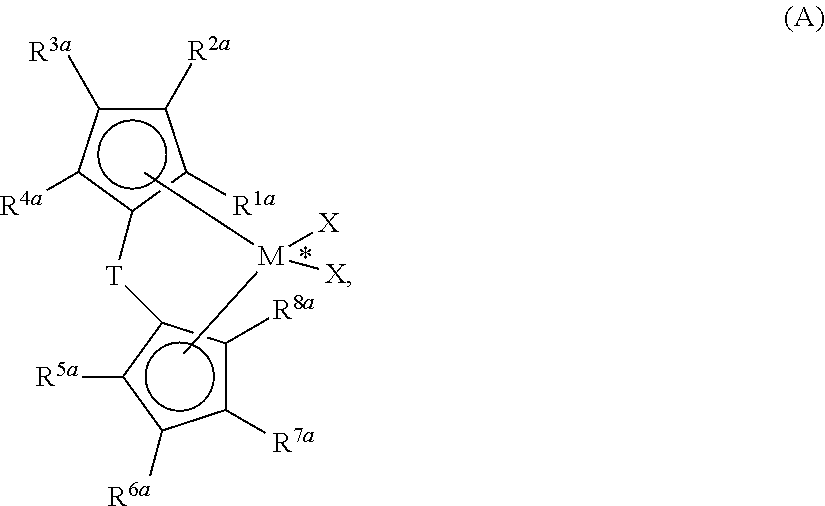
wherein:
M* is a
each of R1a, R2a and R4a is independently hydrogen, alkoxide or C1 to C40 substituted or unsubstituted hydrocarbyl;
R3a is independently hydrogen, alkoxide, C1 to C40 substituted or unsubstituted hydrocarbyl, or —R9a—SiR′3 or —R9a—CR′3 where R9a is C1 to C4 hydrocarbyl, and each R′ is independently C1 to C20 substituted or unsubstituted hydrocarbyl and at least one R′ is C1 to C20 substituted or unsubstituted hydrocarbyl;
each of R5a, R6a, and R8a is independently hydrogen, halide, alkoxide or C1 to C40 substituted or unsubstituted hydrocarbyl;
R7a is —R9a—SiR′3 or —R9a—CR′3 where R9a is C1 to C4 hydrocarbyl, and each R′ is independently C1 to C20 substituted or unsubstituted hydrocarbyl, and at least one R′ is H;
T is a bridging group; and
each X is independently a univalent anionic ligand, a diene ligand, an alkylidene ligand, or two Xs are joined to form a metallocyclic ring.

wherein:
A is chlorine, bromine, iodine, —CF3 or —OR11;
each of R1 and R2 is independently hydrogen, C1-C22-alkyl, C2-C22-alkenyl, C6-C22-aryl, arylalkyl where alkyl has from 1 to 10 carbon atoms and aryl has from 6 to 20 carbon atoms, or five-, six- or seven-membered heterocyclyl comprising at least one atom selected from the group consisting of N, P, O and S;
wherein each of R1 and R2 is optionally substituted by halogen, —NR11 2, —OR11 or —SiR12 3;
wherein R1 optionally bonds with R3, and R2 optionally bonds with R5, in each case to independently form a five-, six- or seven-membered ring;
R7 is a C1-C20 alkyl;
each of R3 u, R4 u, R5 u, R8, R9, R10, R15, R16, and R17 is independently hydrogen, C1-C22-alkyl, C2-C22-alkenyl, C6-C22-aryl, arylalkyl where alkyl has from 1 to 10 carbon atoms and aryl has from 6 to 20 carbon atoms, —NR11 2, —OR11, halogen, —SiR12 3 or five-, six- or seven-membered heterocyclyl comprising at least one atom selected from the group consisting of N, P, O, and S;
wherein R3, R4, R5, R7, R8, R9, R10, R15, R16, and R17 are optionally substituted by halogen, —NR11 2, —OR11 or —SiR12 3;
wherein R3 optionally bonds with R4, R4 optionally bonds with R5, R7 optionally bonds with R10, R10 optionally bonds with R9, R9 optionally bonds with R8, R17 optionally bonds with R16, and R16 optionally bonds with R15, in each case to independently form a five-, six- or seven-membered carbocyclic or heterocyclic ring, the heterocyclic ring comprising at least one atom from the group consisting of N, P, O and S;
R13 is C1-C20-alkyl bonded with the aryl ring via a primary or secondary carbon atom;
R14 is chlorine, bromine, iodine, —CF3 or —OR11, or C1-C20-alkyl bonded with the aryl ring; each R11 is independently hydrogen, C1-C22-alkyl, C2-C22-alkenyl, C6-C22-aryl, arylalkyl where alkyl has from 1 to 10 carbon atoms and aryl has from 6 to 20 carbon atoms, or —SiR12 3, wherein R11 is optionally substituted by halogen, or two R11 radicals optionally bond to form a five- or six-membered ring;
each R12 is independently hydrogen, C1-C22-alkyl, C2-C22-alkenyl, C6-C22-aryl, arylalkyl where alkyl has from 1 to 10 carbon atoms and aryl has from 6 to 20 carbon atoms, or two R12 radicals optionally bond to form a five- or six-membered ring;
each of E1, E2, and E3 is independently carbon, nitrogen or phosphorus;
each u is independently 0 if E1, E2, and/or E3 is nitrogen or phosphorus and is 1 if E1, E2, and/or E3 is carbon;
each X is independently fluorine, chlorine, bromine, iodine, hydrogen, C1-C20-alkyl, C2-C10-alkenyl, C6-C20-aryl, arylalkyl where alkyl has from 1 to 10 carbon atoms and aryl has from 6 to 20 carbon atoms, —NR18 2, —OR18, —SR18, —SO3R18, —OC(O)R18, —CN, —SCN, β-diketonate, —CO, —BF4 −, —PF6 − or bulky non-coordinating anions, and the radicals X can be bonded with one another;
each R18 is independently hydrogen, C1-C20-alkyl, C2-C20-alkenyl, C6-C20-aryl, arylalkyl where alkyl has from 1 to 10 carbon atoms and aryl has from 6 to 20 carbon atoms, or —SiR19 3, wherein R18 can be substituted by halogen or nitrogen- or oxygen-containing groups and two R18 radicals optionally bond to form a five- or six-membered ring;
each R19 is independently hydrogen, C1-C20-alkyl, C2-C20-alkenyl, C6-C20-aryl or arylalkyl where alkyl has from 1 to 10 carbon atoms and aryl has from 6 to 20 carbon atoms, wherein R19 can be substituted by halogen or nitrogen- or oxygen-containing groups or two R19 radicals optionally bond to form a five- or six-membered ring;
s is 1, 2, or 3;
D is a neutral donor; and
t is 0 to 2, such as 0, 1, or 2.

wherein:
M* is a
each of R1a, R2a, and R4a is independently hydrogen, alkoxide or C1 to C40 substituted or unsubstituted hydrocarbyl;
R3a is independently hydrogen, alkoxide, C1 to C40 substituted or unsubstituted hydrocarbyl, or —R9a—SiR′3 or —R9a—CR′3 where R9a is C1 to C4 hydrocarbyl, and each R′ is independently C1 to C20 substituted or unsubstituted hydrocarbyl and at least one R′ is C1 to C20 substituted or unsubstituted hydrocarbyl;
each of R5a, R6a, and R8a is independently hydrogen, halide, alkoxide or C1 to C40 substituted or unsubstituted hydrocarbyl;
R7a is —R9a—SiR′3 or —R9a—CR′3 where R9a is a C1 to C4 hydrocarbyl, and each R′ is independently C1 to C20 substituted or unsubstituted hydrocarbyl, T is a bridging group; and each X is independently a univalent anionic ligand, a diene ligand, an alkylidene ligand, or two Xs are joined to form a metallocyclic ring.

wherein:
A is chlorine, bromine, iodine, —CF3 or —OR11;
each of R1 and R2 is independently hydrogen, C1-C22-alkyl, C2-C22-alkenyl, C6-C22-aryl, arylalkyl where alkyl has from 1 to 10 carbon atoms and aryl has from 6 to 20 carbon atoms, or five-, six- or seven-membered heterocyclyl comprising at least one atom selected from the group consisting of N, P, O and S;
wherein each of R1 and R2 is optionally substituted by halogen, —NR11 2, —OR11 or —SiR12 3;
wherein R1 optionally bonds with R3, and R2 optionally bonds with R5, in each case to independently form a five-, six- or seven-membered ring; R7 is a C1-C20 alkyl;
each of R3 u, R4 u, R5 u, R8, R9, R10, R15, R16, and R17 is independently hydrogen, C1-C22-alkyl, C2-C22-alkenyl, C6-C22-aryl, arylalkyl where alkyl has from 1 to 10 carbon atoms and aryl has from 6 to 20 carbon atoms, —NR11 2, —OR11, halogen, —SiR12 3 or five-, six- or seven-membered heterocyclyl comprising at least one atom selected from the group consisting of N, P, O, and S;
wherein R3 u, R4 u, R5 u, R7, R8, R9, R10, R15, R16, and R17 are optionally substituted by halogen, —NR11 2, —OR11 or —SiR12 3;
wherein R3 optionally bonds with R4, R4 optionally bonds with R5, R7 optionally bonds with R10, R10 optionally bonds with R9, R9 optionally bonds with R8, R17 optionally bonds with R16, and R16 optionally bonds with R15, in each case to independently form a five-, six- or seven-membered carbocyclic or heterocyclic ring, the heterocyclic ring comprising at least one atom from the group consisting of N, P, O and S;
R13 is C1-C20-alkyl bonded with the aryl ring via a primary or secondary carbon atom;
R14 is chlorine, bromine, iodine, —CF3 or —OR11, or C1-C20-alkyl bonded with the aryl ring; each R11 is independently hydrogen, C1-C22-alkyl, C2-C22-alkenyl, C6-C22-aryl, arylalkyl where alkyl has from 1 to 10 carbon atoms and aryl has from 6 to 20 carbon atoms, or —SiR12 3, wherein R11 is optionally substituted by halogen, or two R11 radicals optionally bond to form a five- or six-membered ring;
each R12 is independently hydrogen, C1-C22-alkyl, C2-C22-alkenyl, C6-C22-aryl, arylalkyl where alkyl has from 1 to 10 carbon atoms and aryl has from 6 to 20 carbon atoms, or two R12 radicals optionally bond to form a five- or six-membered ring;
each of E1, E2, and E3 is independently carbon, nitrogen or phosphorus;
each u is independently 0 if E1, E2, and/or E3 is nitrogen or phosphorus and is 1 if E1, E2, and/or E3 is carbon;
each X is independently fluorine, chlorine, bromine, iodine, hydrogen, C1-C20-alkyl, C2-C10-alkenyl, C6-C20-aryl, arylalkyl where alkyl has from 1 to 10 carbon atoms and aryl has from 6 to 20 carbon atoms, —NR18 2, —OR18, —SR18, —SO3R18, —OC(O)R18, —CN, —SCN, β-diketonate, —CO, —BF4 −, —PF6 − or bulky non-coordinating anions, and the radicals X can be bonded with one another;
each R18 is independently hydrogen, C1-C20-alkyl, C2-C20-alkenyl, C6-C20-aryl, arylalkyl where alkyl has from 1 to 10 carbon atoms and aryl has from 6 to 20 carbon atoms, or —SiR19 3, wherein R18 can be substituted by halogen or nitrogen- or oxygen-containing groups and two R18 radicals optionally bond to form a five- or six-membered ring;
each R19 is independently hydrogen, C1-C20-alkyl, C2-C20-alkenyl, C6-C20-aryl or arylalkyl where alkyl has from 1 to 10 carbon atoms and aryl has from 6 to 20 carbon atoms, wherein R19 can be substituted by halogen or nitrogen- or oxygen-containing groups or two R19 radicals optionally bond to form a five- or six-membered ring;
s is 1, 2, or 3;
D is a neutral donor;
t is 0 to 2, such as 0, 1, or 2;
u is 1 or 0 depending on whether the E group is N, P, or C. For example, if E1 is carbon, then u for R3 is 1; if E2 is nitrogen, then u for R4 is 0; if E3 is carbon, then u for R5 is 1; and if E1, E2, and E3 are carbon, all u are 1.
where the variables with subscript “PS” stand for polystyrene while those without a subscript are for the test samples. In this method, αPS=0.67 and KPS=0.000175 while a and K are for other materials as calculated and published in literature (Sun, T. et al. Macromolecules, 2001, 34, 6812), except that for purposes of the present disclosure, α=0.695 and K=0.000579 for linear ethylene polymers, α=0.705 and K=0.0002288 for linear propylene polymers, α=0.695 and K=0.000181 for linear butene polymers, a is 0.695 and K is 0.000579*(1−0.0087*w2b+0.000018*(w2b){circumflex over ( )}2) for ethylene-butene copolymer where w2b is a bulk weight percent of butene comonomer, a is 0.695 and K is 0.000579*(1−0.0075*w2b) for ethylene-hexene copolymer where w2b is a bulk weight percent of hexene comonomer, and a is 0.695 and K is 0.000579*(1−0.0077*w2b) for ethylene-octene copolymer where w2b is a bulk weight percent of octene comonomer. Concentrations are expressed in g/cm3, molecular weight is expressed in g/mole, and intrinsic viscosity (hence K in the Mark-Houwink equation) is expressed in dL/g unless otherwise noted.
w2=f*SCB/1000TC.
w2b=f*bulk CH3/1000TC
bulk SCB/1000TC=bulk CH3/1000TC−bulk CH3 end/1000TC
and bulk SCB/1000TC is converted to bulk w2 in the same manner as described above.
where NA is Avogadro's number, and (dn/dc) is the refractive index increment for the system. The refractive index, n=1.500 for TCB at 145° C. and λ=665 nm. For analyzing polyethylene homopolymers, ethylene-hexene copolymers, and ethylene-octene copolymers, dn/dc=0.1048 ml/mg and A2=0.0015; for analyzing ethylene-butene copolymers, dn/dc=0.1048*(1−0.00126*w2) ml/mg and A2=0.0015 where w2 is weight percent butene comonomer.
where the summations are over the chromatographic slices, i, between the integration limits. The branching index g′vis is defined as
where MV is the viscosity-average molecular weight based on molecular weights determined by LS analysis and the K and a are for the reference linear polymer, which are, for purposes of the present disclosure, α=0.695 and K=0.000579 for linear ethylene polymers, α=0.705 and K=0.0002288 for linear propylene polymers, α=0.695 and K=0.000181 for linear butene polymers, α is 0.695 and K is 0.000579*(1−0.0087*w2b+0.000018*(w2b)A2) for ethylene-butene copolymer where w2b is a bulk weight percent of butene comonomer, α is 0.695 and K is 0.000579*(1−0.0075*w2b) for ethylene-hexene copolymer where w2b is a bulk weight percent of hexene comonomer, and α is 0.695 and K is 0.000579*(1−0.0077*w2b) for ethylene-octene copolymer where w2b is a bulk weight percent of octene comonomer. Concentrations are expressed in g/cm3, molecular weight is expressed in g/mole, and intrinsic viscosity (hence K in the Mark-Houwink equation) is expressed in dL/g unless otherwise noted. Calculation of the w2b values is as discussed above.
1=∫−∞ ∞ W′dz,
and a modified weight-average molecular weight (Mw′) is calculated over the effectively reduced range of molecular weights as follows:
M w′=∫−∞ ∞10z *W′dz.
RCI,m=∫ −∞ ∞×2(10z −M w′)W′dz.
where w2(Mw) is the % weight co-monomer signal corresponding to a molecular weight of Mw, w2(Mz) is the % weight co-monomer signal corresponding to a molecular weight of Mz, w2[(Mw+Mn)/2)] is the % weight co-monomer signal corresponding to a molecular weight of (Mw+Mn)/2, and w2[(Mz+Mw)/2] is the % weight co-monomer signal corresponding to a molecular weight of Mz+Mw/2, where Mw is the weight-average molecular weight, Mn is the number-average molecular weight, and Mz is the z-average molecular weight.
where x2(Mw) is the % mole co-monomer signal corresponding to a molecular weight of Mw, x2(Mz) is the % mole co-monomer signal corresponding to a molecular weight of Mz, x2[(Mw+Mn)/2)] is the % mole co-monomer signal corresponding to a molecular weight of (Mw+Mn)/2, and x2[(Mz+Mw)/2] is the % mole co-monomer signal corresponding to a molecular weight of Mz+Mw/2, where Mw is the weight-average molecular weight, Mn is the number-average molecular weight, and Mz is the z-average molecular weight.
-
- Melt index (MI) also referred to as I2, reported in g/10 min, is determined according to ASTM D1238, 190° C., 2.16 kg load.
- High load melt index (HLMI) also referred to as I21, reported in g/10 min, is determined according to ASTM D1238, 190° C., 21.6 kg load.
- Melt index ratio (MIR) is HLMI divided by MI as determined by ASTM D1238.
2) the compound represented by formula (B) is run under the same polymerization conditions as step 1), except that the compound represented by formula (A) is absent, a polymer having an RCI,m of less than zero is produced.
2) when the supported compound represented by formula (B) is run under the same conditions as step 1) except that the compound (A) is absent, an ethylene polymer is produced having a negative RCI,m.
-
- 1) a relationship between MD and TD modulus (in accordance with the test method described below) and density that satisfies the following equation:
Avg. Modulus ≥1.2*(Constant 1(C1)*Density−Constant 2(C2); and
- 1) a relationship between MD and TD modulus (in accordance with the test method described below) and density that satisfies the following equation:
Average Modulus≥1.2*(2,065,292*Density−1,872,345).
| TABLE 1 | |
| Test Name | Method |
| Melt Index (MI) | ASTM D-1238 2.16 kg (190° C.) (I2) or (I2.16) |
| High Load Melt Index | ASTM D-1238 21.6 kg (190° C.) (I21) or (I21.6) |
| (HLMI) | |
| Melt Index Ratio (MIR) | I21/I2 |
| Density | ASTM D1505, column density. Samples were molded under |
| ASTM D4703-10a, Procedure C, then conditioned under ASTM | |
| D618-08 (23° ± 2° C. and 50 ± 10% Relative Humidity) for 40 | |
| Hours before testing | |
| 1% Secant Modulus | Modified ASTM D-882, sample conditioning*, 1″ strip, 4″ length |
| Yield Strength | Modified ASTM D-882, sample conditioning*, 1″ strip, 4″ |
| sample length | |
| Tensile Strength | Modified ASTM D-882, sample conditioning*, 1″ strip, 4″ |
| sample length | |
| Elongation at Break | Modified ASTM D-882, sample conditioning*, 1″ strip, 4″ |
| sample length | |
| Elongation at Yield | Modified ASTM D-882, sample conditioning*, 1″ strip, 4″ |
| sample length | |
| Dart Drop | Modified ASTM D-1709, Phenolic, Method A. Sample |
| conditioning in the lab, calculation uses last 10 passes and 10 | |
| fails | |
| Haze | ASTM D-1003 |
| Gloss, 45° | ASTM D-2457 |
| Elmendorf Tear | ASTM D1922 with ASTM Conditioning for 40 Hours at 23° ± |
| 2° C. and 50 ± 10% Relative Humidity | |
| Puncture | Modified ASTM D5748. EXXONMOBIL probe was used with |
| two 0.25 mil HDPE slip sheets. Machine Model: United SFM-1. | |
| Testing speed: 10 in/min. | |
| 1HNMR | Unsaturations in a polymer and specifically percent internal |
| unsaturation are determined by 1H NMR with reference to 38 | |
| MACROMOLECULES 6988 (2005), and 47 MACROMOLECULES | |
| 3782 (2014). (see 1H NMR section) | |
| |
1 inch film strip of 1 mil gauge, sealed at various temperatures |
| under 73 psi (0.5N/mm2) for 1 second. Following ASTM | |
| Conditioning for 40 Hours at 23° ± 2° C. and 50 ± 10% Relative | |
| Humidity, the sealed specimen were tested in T-joint peel mode | |
| at 20 inch/min pulling speed. | |
| |
1 inch film strip of 1 mil gauge, sealed at various temperatures |
| under 73 psi (0.5N/mm2) for 0.5 second. After a 0.4 second | |
| delay, the sealed specimen were pulled at 200 mm/speed in T- | |
| joint peel mode. | |
| *the samples are cut from the rolls, placed between sheets of paper, and then placed on the counter before testing. Samples conditioned according to ASTM for 40 hours at 23° ± 2° C. and 50 ± 10% Relative Humidity. | |
| ** Tensile strength refers to the maximum strength reached, most often occurs at sample break. Yield occurs early in the testing where the load reaches a local maximum. For PE, most times yield strength will be surpassed by tensile strength later in deformation, but sometimes sample breaks soon after yield without any strengthening, then yield strength and the tensile strength are the same. | |

| TABLE 2 | |||
| Catalyst # | Cat. 1:Cat 2 (80:20) | ||
| PROCESS DATA | |||
| H2 conc. (molppm) | 392 | ||
| C6/C2 Gas Ratio (mol %/mol %) | 0.014 | ||
| Comonomer conc. (mol %) | 0.95 | ||
| C2 conc. (mol %) | 69.9 | ||
| Comonomer/C2 Flow Ratio (g/g) | 0.055 | ||
| H2/C2 Ratio | 5.6 | ||
| Rx. Pressure (psig) | 300 | ||
| Reactor Temp (F.) | 185 | ||
| Residence Time (hr) | 5.0 | ||
| Cat Productivity (g poly/g cat) | 3103 | ||
| PRODUCT DATA | |||
| Melt Index (MI) | 0.94 | ||
| HLMI | 23.84 | ||
| HLMI/MI Ratio | 25.30 | ||
| Gradient Density | 0.9207 | ||
| Bulk Density | 0.33 | ||
| TABLE 3 |
| Slurry Phase Polymerization of Ethylene and 1-Hexene |
| Supported | MI | Mw | Mn | Productivity | Hexene | ||||
| Example | Catalyst | dg/min | MIR | g/mol | g/mol | Mw/Mn | gP/gsup. Cat. | wt % | g′(vis) |
| 1 | Catalyst 1: |
0.94 | 24.30 | 123577 | 15182 | 8.14 | 3103 | 9.90 | 0.993 |
| TABLE 4 |
| Gas Phase Polymerization of Ethylene and 1-Hexene |
| Example | Supported Catalyst | MI dg/ | MIR | |
| 1 | Catalyst 1: |
0.94 | 24.30 | |
| TABLE 5 |
| Level of Unsaturation (Internal (I) |
| and Terminal (T)) for Polyethylenes |
| Unsaturations per 1000 C | Catalyst 1:2 | ||
| Vy1 and Vy2 (I) | 0.10 | ||
| Vy5 (T) | 0.05 | ||
| Tri-substituted olefins (I) | 0.07 | ||
| Vinyls (T) | 0.46 | ||
| Vinylidenes (T) | 0.02 | ||
| total internal unsaturations | 0.17 | ||
| Total unsaturations | 0.7 | ||
| % vinyl of total unsaturations | 65.7 | ||
| % internal of total unsaturations | 24.3 | ||
| Ratio of vinyls/internals | 2.7 | ||
Film Production
-
- Extruder temperature setting (° C.): Feed throat/
Zone 1/Zone 2/Zone 3/Zone4/Die: 70/190/200/210/215/215 - Extruder speed: 50 rpm
- Chill roll temperature: 30° C.
- Chill roll speed: 3.5 m/min
- Extruder temperature setting (° C.): Feed throat/
| TABLE 6 | ||
| Cat 1:Cat 2 (80:20) | ||
| Catalyst | |||
| Density (g/cm3) | 0.9207 | ||
| I2 (g/10 min) | 1.0 | ||
| I21 (g/10 min) | 24.5 | ||
| MIR | 25.5 | ||
| TDA (ppm) > 200 micron | |||
| Films made and |
|||
| 3 | Film | 1 | |
| 1.04 | Film | 2 | |
| 0.77 | Film | 3 | |
| 0.6 | Film | 4 | |
| 0.56 | Film | 5 | |
| 0.47 | Film | 6 | |
| 1 mil Film | Film | 2 | |
| Gauge Mic (mils) | |||
| Average | 1.04 | ||
| Low | 0.85 | ||
| High | 1.19 | ||
| 1% Secant (psi) | |||
| MD | 40620.0 | ||
| TD | 52677.0 | ||
| AVG | 46648.5 | ||
| Tensile Yield Strength (psi) | |||
| MD | 1608.00 | ||
| TD | 1934.00 | ||
| Elongation @ Yield (%) | |||
| MD | 5.7 | ||
| TD | 5.1 | ||
| Tensile Strength (psi) | |||
| MD | 8905 | ||
| TD | 8499 | ||
| Elongation @ Break (%) | |||
| MD | 389 | ||
| TD | 587 | ||
| Elmendorf Tear | |||
| MD (g) | 160 | ||
| TD (g) | 671.4 | ||
| MD (g/mil) | 153.8 | ||
| TD (g/mil) | 645.6 | ||
| Haze- internal (%) | 3.7 | ||
| Haze (%) | 8.19 | ||
| Gloss | |||
| MD | 67.0 | ||
| TD | 68.5 | ||
| Dart Drop | |||
| Phenolic | |||
| Method A | |||
| (g) | 734 | ||
| (g/mil) | 706.0 | ||
| Puncture (ExxonMobil probe) | |||
| Peak Force (lbs) | 11.6 | ||
| Peak Force (lbs/mil) | 11.1 | ||
| Break Energy (in-lbs) | 31.8 | ||
| Break Energy (in-lbs/mil) | 30.6 | ||
| TABLE 7 |
| MD Tear and Dart (A) as a function of film gauge |
| D 0.9207 g/cm3 |
| Film 4 |
| Film BCT# | Gauge, mil | MD Tear, g/mil | Dart, g/ | ||
| Film |
| 1 | ||||
| |
1.04 | 153.8 | 706 | |
| |
0.77 | 214.3 | 984 | |
| |
0.6 | 137.2 | 221 | |
| |
0.56 | 223.2 | 245 | |
| |
0.47 | 423.4 | 221 | |
Average Modulus=Constant 1(C1)*Density−Constant 2(C2)
Avg.Modulus≥1.2*(C1*Density−C2);
and, in particular as an example,
Average Modulus≥1.2*(2,065,292*Density−1,872,345).
Claims (16)
Priority Applications (1)
| Application Number | Priority Date | Filing Date | Title |
|---|---|---|---|
| US16/632,240 US11046796B2 (en) | 2017-08-04 | 2018-06-29 | Films made from polyethylene compositions and processes for making same |
Applications Claiming Priority (4)
| Application Number | Priority Date | Filing Date | Title |
|---|---|---|---|
| US201762541360P | 2017-08-04 | 2017-08-04 | |
| US201862674871P | 2018-05-22 | 2018-05-22 | |
| US16/632,240 US11046796B2 (en) | 2017-08-04 | 2018-06-29 | Films made from polyethylene compositions and processes for making same |
| PCT/US2018/040454 WO2019027605A1 (en) | 2017-08-04 | 2018-06-29 | Films made from polyethylene compositions and processes for making the same |
Publications (2)
| Publication Number | Publication Date |
|---|---|
| US20200165366A1 US20200165366A1 (en) | 2020-05-28 |
| US11046796B2 true US11046796B2 (en) | 2021-06-29 |
Family
ID=63036336
Family Applications (1)
| Application Number | Title | Priority Date | Filing Date |
|---|---|---|---|
| US16/632,240 Active US11046796B2 (en) | 2017-08-04 | 2018-06-29 | Films made from polyethylene compositions and processes for making same |
Country Status (4)
| Country | Link |
|---|---|
| US (1) | US11046796B2 (en) |
| EP (1) | EP3661984B1 (en) |
| CN (1) | CN111491959B (en) |
| WO (1) | WO2019027605A1 (en) |
Cited By (2)
| Publication number | Priority date | Publication date | Assignee | Title |
|---|---|---|---|---|
| US20230022904A1 (en) * | 2019-12-17 | 2023-01-26 | ExxonMobil Chemical Company - Law Technology | Broad Orthogonal Distribution Polyethylenes for Films |
| US12577334B2 (en) | 2019-12-17 | 2026-03-17 | Exxonmobil Chemical Patents Inc. | Broad orthogonal distribution polyethylenes for films |
Families Citing this family (18)
| Publication number | Priority date | Publication date | Assignee | Title |
|---|---|---|---|---|
| US11046796B2 (en) | 2017-08-04 | 2021-06-29 | Exxonmobil Chemical Patents Inc. | Films made from polyethylene compositions and processes for making same |
| EP3717527B1 (en) | 2017-11-28 | 2024-12-18 | ExxonMobil Chemical Patents Inc. | Polyethylene compositions and films made therefrom |
| ES2908893T3 (en) | 2017-12-26 | 2022-05-04 | Dow Global Technologies Llc | Multimodal ethylene-based polymeric compositions with improved toughness |
| CN111683979B (en) | 2017-12-26 | 2024-08-23 | 陶氏环球技术有限责任公司 | Process for producing multimodal ethylene polymers |
| BR112020012842B1 (en) | 2017-12-26 | 2024-01-02 | Dow Global Technologies Llc | METHOD FOR PRODUCING A TRIMODAL POLYMER IN A SOLUTION POLYMERIZATION PROCESS |
| KR102605947B1 (en) | 2017-12-26 | 2023-11-28 | 다우 글로벌 테크놀로지스 엘엘씨 | Dual reactor solution process for the production of multimodal ethylene-based polymers |
| EP3732214B1 (en) * | 2017-12-26 | 2023-11-01 | Dow Global Technologies LLC | Compositions with multimodal ethylene-based polymers having improved toughness at low temperatures |
| CA3011041A1 (en) | 2018-07-11 | 2020-01-11 | Nova Chemicals Corporation | Polyethylene composition and film |
| CA3011030A1 (en) | 2018-07-11 | 2020-01-11 | Nova Chemicals Corporation | Polyethylene composition and film having retained dart impact |
| CA3011031A1 (en) | 2018-07-11 | 2020-01-11 | Nova Chemicals Corporation | Polyethylene composition and film having outstanding properties |
| CA3011050A1 (en) | 2018-07-11 | 2020-01-11 | Nova Chemicals Corporation | Polyethylene composition and film having high stiffness, outstanding sealability and high permeability |
| CA3011038A1 (en) * | 2018-07-11 | 2020-01-11 | Nova Chemicals Corporation | Polyethylene composition and film having a good permeability, stiffness and sealability |
| WO2021119152A1 (en) * | 2019-12-09 | 2021-06-17 | Exxonmobil Chemical Patents Inc. | Machine direction oriented polyethylene films |
| CN114787249A (en) * | 2019-12-09 | 2022-07-22 | 埃克森美孚化学专利公司 | Biaxially oriented polyethylene film |
| US12534582B2 (en) * | 2020-05-01 | 2026-01-27 | Exxonmobil Chemical Patents Inc. | Linear low density polyethylene for film applications |
| WO2021222280A2 (en) * | 2020-05-01 | 2021-11-04 | Exxonmobil Chemical Patents Inc. | Linear low density polyethylene for film applications |
| EP4413063A1 (en) | 2021-10-04 | 2024-08-14 | ExxonMobil Chemical Patents Inc. | Polyethylene blends, films thereof, and methods thereof |
| CN115742517B (en) * | 2022-12-06 | 2024-12-17 | 河南达新源新材料有限公司 | Microporous adjustable low-density PETG heat-shrinkable film and preparation method thereof |
Citations (10)
| Publication number | Priority date | Publication date | Assignee | Title |
|---|---|---|---|---|
| US6242545B1 (en) | 1997-12-08 | 2001-06-05 | Univation Technologies | Polymerization catalyst systems comprising substituted hafinocenes |
| US6936675B2 (en) | 2001-07-19 | 2005-08-30 | Univation Technologies, Llc | High tear films from hafnocene catalyzed polyethylenes |
| US6956088B2 (en) | 2001-07-19 | 2005-10-18 | Univation Technologies, Llc | Polyethylene films with improved physical properties |
| US8247065B2 (en) | 2006-05-31 | 2012-08-21 | Exxonmobil Chemical Patents Inc. | Linear polymers, polymer blends, and articles made therefrom |
| US20130029125A1 (en) | 2008-12-15 | 2013-01-31 | Exxonmobil Chemical Patents Inc. | Thermoplastic Polyolefin Blends and Films Therefrom |
| US8378043B2 (en) | 2006-06-27 | 2013-02-19 | Univation Technologies, Llc | Ethylene alpha olefin copolymers and polymerization processes for making the same |
| US8476392B2 (en) | 2006-06-27 | 2013-07-02 | Univation Technologies, Llc | Polymerization processes using metallocene catalysts, their polymer products and end uses |
| US20150291748A1 (en) | 2012-11-21 | 2015-10-15 | Exxonmobil Chemical Patents Inc. | Films Comprising Ethylene-Based Polymers and Methods of Making Same |
| US20180155474A1 (en) | 2016-12-05 | 2018-06-07 | Exxonmobil Chemical Patents Inc. | Broad Orthogonal Distribution Metallocene Polyethylenes for Films |
| US20200165366A1 (en) | 2017-08-04 | 2020-05-28 | Exxonmobil Chemical Patents Inc. | Films Made from Polyethylene Compositions and Processes for Making Same |
Family Cites Families (32)
| Publication number | Priority date | Publication date | Assignee | Title |
|---|---|---|---|---|
| US4543399A (en) | 1982-03-24 | 1985-09-24 | Union Carbide Corporation | Fluidized bed reaction systems |
| US4588790A (en) | 1982-03-24 | 1986-05-13 | Union Carbide Corporation | Method for fluidized bed polymerization |
| US5153157A (en) | 1987-01-30 | 1992-10-06 | Exxon Chemical Patents Inc. | Catalyst system of enhanced productivity |
| US5241025A (en) | 1987-01-30 | 1993-08-31 | Exxon Chemical Patents Inc. | Catalyst system of enhanced productivity |
| FR2634212B1 (en) | 1988-07-15 | 1991-04-19 | Bp Chimie Sa | APPARATUS AND METHOD FOR POLYMERIZATION OF GASEOUS OLEFINS IN A FLUIDIZED BED REACTOR |
| US5041584A (en) | 1988-12-02 | 1991-08-20 | Texas Alkyls, Inc. | Modified methylaluminoxane |
| DE69033368T3 (en) | 1990-01-02 | 2008-07-03 | Exxon Chemical Patents, Inc. | Ionized metallocene catalysts supported on olefin polymerization |
| CA2105555C (en) | 1992-01-06 | 2003-12-30 | Brian W. S. Kolthammer | Improved catalyst composition |
| US5352749A (en) | 1992-03-19 | 1994-10-04 | Exxon Chemical Patents, Inc. | Process for polymerizing monomers in fluidized beds |
| US5436304A (en) | 1992-03-19 | 1995-07-25 | Exxon Chemical Patents Inc. | Process for polymerizing monomers in fluidized beds |
| EP1110974B1 (en) | 1992-08-05 | 2007-11-28 | ExxonMobil Chemical Patents Inc. | Method for preparing a supported activator component |
| US5317036A (en) | 1992-10-16 | 1994-05-31 | Union Carbide Chemicals & Plastics Technology Corporation | Gas phase polymerization reactions utilizing soluble unsupported catalysts |
| US5462999A (en) | 1993-04-26 | 1995-10-31 | Exxon Chemical Patents Inc. | Process for polymerizing monomers in fluidized beds |
| JP3077940B2 (en) | 1993-04-26 | 2000-08-21 | エクソン・ケミカル・パテンツ・インク | A method for determining stable operating conditions for fluidized bed polymerization. |
| ZA943399B (en) | 1993-05-20 | 1995-11-17 | Bp Chem Int Ltd | Polymerisation process |
| GB9319340D0 (en) | 1993-09-17 | 1993-11-03 | Exxon Chemical Patents Inc | Olefin polymersisation process |
| US5453471B1 (en) | 1994-08-02 | 1999-02-09 | Carbide Chemicals & Plastics T | Gas phase polymerization process |
| EP0728773B1 (en) | 1995-02-21 | 1998-11-04 | Mitsubishi Chemical Corporation | Catalysts for olefin polymerization and a process for preparing olefin polymers therewith |
| US5616661A (en) | 1995-03-31 | 1997-04-01 | Union Carbide Chemicals & Plastics Technology Corporation | Process for controlling particle growth during production of sticky polymers |
| US5741563A (en) | 1995-09-18 | 1998-04-21 | Exxon Chemical Patents Inc. | Shrink films from propylene polymers |
| EP0863943A1 (en) | 1995-11-30 | 1998-09-16 | Exxon Chemical Patents Inc. | Articles made from polypropylene, higher alpha-olefin copolymers |
| WO1998043983A1 (en) | 1997-04-03 | 1998-10-08 | Colorado State University Research Foundation | Polyhalogenated monoheteroborane anion compositions |
| US6147173A (en) | 1998-11-13 | 2000-11-14 | Univation Technologies, Llc | Nitrogen-containing group 13 anionic complexes for olefin polymerization |
| US6384142B1 (en) | 2000-02-08 | 2002-05-07 | Exxonmobil Chemical Patents Inc. | Propylene impact copolymers |
| WO2003040201A1 (en) | 2001-11-06 | 2003-05-15 | Dow Global Technologies Inc. | Isotactic propylene copolymers, their preparation and use |
| ATE395379T1 (en) | 2002-09-05 | 2008-05-15 | Exxonmobil Chem Patents Inc | SHRINK FILM |
| US8618228B2 (en) * | 2010-01-21 | 2013-12-31 | Basell Polyolefine Gmbh | Process for the preparation of ethylene copolymer compositions in the presence of an oligomerization catalyst |
| US8658556B2 (en) | 2011-06-08 | 2014-02-25 | Exxonmobil Chemical Patents Inc. | Catalyst systems comprising multiple non-coordinating anion activators and methods for polymerization therewith |
| US20160060430A1 (en) | 2015-11-06 | 2016-03-03 | ExxonMobil Chemical Company - Law Technology | Polyolefin Compositions And Processes For Making The Same |
| US10913831B2 (en) | 2016-01-29 | 2021-02-09 | Univation Technologies, Llc | Polyolefin film with improved toughness |
| BR112019011558B1 (en) * | 2016-12-05 | 2023-01-17 | Exxonmobil Chemical Patents Inc | METALLOCENE POLYETHYLENES, COMPRISING ETHYLENE DERIVATIVE UNITS, THEIR FORMATION PROCESS AND FILMS |
| WO2019083716A1 (en) | 2017-10-27 | 2019-05-02 | Univation Technologies, Llc | Polyethylene copolymer resins and films |
-
2018
- 2018-06-29 US US16/632,240 patent/US11046796B2/en active Active
- 2018-06-29 EP EP18746361.7A patent/EP3661984B1/en active Active
- 2018-06-29 WO PCT/US2018/040454 patent/WO2019027605A1/en not_active Ceased
- 2018-06-29 CN CN201880058543.5A patent/CN111491959B/en active Active
Patent Citations (17)
| Publication number | Priority date | Publication date | Assignee | Title |
|---|---|---|---|---|
| US6242545B1 (en) | 1997-12-08 | 2001-06-05 | Univation Technologies | Polymerization catalyst systems comprising substituted hafinocenes |
| US6248845B1 (en) | 1997-12-08 | 2001-06-19 | Univation Technologies | Polymerization catalyst systems comprising substituted hafnocenes |
| US6528597B2 (en) | 1997-12-08 | 2003-03-04 | Univation Technologies, Llc | Polymerization catalyst systems, their use, their products and articles thereof |
| US7381783B2 (en) | 1997-12-08 | 2008-06-03 | Univation Technologies, Llc | Polymerization catalyst systems, their use, their products and articles thereof |
| US6936675B2 (en) | 2001-07-19 | 2005-08-30 | Univation Technologies, Llc | High tear films from hafnocene catalyzed polyethylenes |
| US6956088B2 (en) | 2001-07-19 | 2005-10-18 | Univation Technologies, Llc | Polyethylene films with improved physical properties |
| US7172816B2 (en) | 2001-07-19 | 2007-02-06 | Univation Technologies, Llc | High tear films from hafnocene catalyzed polyethylenes |
| US7179876B2 (en) | 2001-07-19 | 2007-02-20 | Univation Technologies, Llc | High tear films from hafnocene catalyzed polyethylenes |
| US8247065B2 (en) | 2006-05-31 | 2012-08-21 | Exxonmobil Chemical Patents Inc. | Linear polymers, polymer blends, and articles made therefrom |
| US8378043B2 (en) | 2006-06-27 | 2013-02-19 | Univation Technologies, Llc | Ethylene alpha olefin copolymers and polymerization processes for making the same |
| US8476392B2 (en) | 2006-06-27 | 2013-07-02 | Univation Technologies, Llc | Polymerization processes using metallocene catalysts, their polymer products and end uses |
| US20130029125A1 (en) | 2008-12-15 | 2013-01-31 | Exxonmobil Chemical Patents Inc. | Thermoplastic Polyolefin Blends and Films Therefrom |
| US20150291748A1 (en) | 2012-11-21 | 2015-10-15 | Exxonmobil Chemical Patents Inc. | Films Comprising Ethylene-Based Polymers and Methods of Making Same |
| US20180155474A1 (en) | 2016-12-05 | 2018-06-07 | Exxonmobil Chemical Patents Inc. | Broad Orthogonal Distribution Metallocene Polyethylenes for Films |
| WO2018106388A1 (en) | 2016-12-05 | 2018-06-14 | Exxonmobil Chemical Patents Inc. | Broad orthogonal distribution metallocene polyethylenes for films |
| US10611867B2 (en) * | 2016-12-05 | 2020-04-07 | Exxonmobil Chemical Patents Inc. | Broad orthogonal distribution metallocene polyethylenes for films |
| US20200165366A1 (en) | 2017-08-04 | 2020-05-28 | Exxonmobil Chemical Patents Inc. | Films Made from Polyethylene Compositions and Processes for Making Same |
Non-Patent Citations (1)
| Title |
|---|
| Yiyong He, et al. (2014), "Terminal and Internal Unsaturations in Poly(ethylene-co-1-octene)", Macromolecules vol. 47, No. 12, Jun. 24, 2014, pp. 3782-3790. |
Cited By (3)
| Publication number | Priority date | Publication date | Assignee | Title |
|---|---|---|---|---|
| US20230022904A1 (en) * | 2019-12-17 | 2023-01-26 | ExxonMobil Chemical Company - Law Technology | Broad Orthogonal Distribution Polyethylenes for Films |
| US12344686B2 (en) * | 2019-12-17 | 2025-07-01 | Exxonmobil Chemical Patents Inc. | Broad orthogonal distribution polyethylenes for films |
| US12577334B2 (en) | 2019-12-17 | 2026-03-17 | Exxonmobil Chemical Patents Inc. | Broad orthogonal distribution polyethylenes for films |
Also Published As
| Publication number | Publication date |
|---|---|
| CN111491959A (en) | 2020-08-04 |
| WO2019027605A1 (en) | 2019-02-07 |
| EP3661984B1 (en) | 2022-01-19 |
| EP3661984A1 (en) | 2020-06-10 |
| CN111491959B (en) | 2023-08-25 |
| US20200165366A1 (en) | 2020-05-28 |
Similar Documents
| Publication | Publication Date | Title |
|---|---|---|
| EP3661984B1 (en) | Films made from polyethylene compositions and processes for making the same | |
| US10808053B2 (en) | Polyethylene compositions and articles made therefrom | |
| US11787881B2 (en) | Polyethylene compositions and films prepared therefrom | |
| US10927205B2 (en) | Polymerization processes and polymers made therefrom | |
| US10913808B2 (en) | Mixed catalysts with unbridged hafnocenes with -CH2-SiMe3 moieties | |
| US10927203B2 (en) | Polyethylene compositions and articles made therefrom | |
| US11274196B2 (en) | Polyethylene compositions and films prepared therefrom | |
| US10927202B2 (en) | Polyethylene compositions and articles made therefrom | |
| US11130827B2 (en) | Polyethylene compositions and articles made therefrom | |
| US10703838B2 (en) | Mixed catalyst systems with four metallocenes on a single support | |
| US11712687B2 (en) | Catalyst systems and polymerization processes for using the same | |
| US10844150B2 (en) | Mixed catalysts with 2,6-bis(imino)pyridyl iron complexes and bridged hafnocenes | |
| US10899860B2 (en) | Polymerization processes and polymers made therefrom | |
| US10926250B2 (en) | Catalyst systems and polymerization processes for using the same | |
| WO2019108327A1 (en) | Films comprising polyethylene composition | |
| US20190161559A1 (en) | Catalyst Systems and Polymerization Processes for Using the Same | |
| US11198747B2 (en) | Catalyst systems including two hafnocene catalyst compounds | |
| EP3661975B1 (en) | Mixed catalysts with 2, 6-bis(imino)pyridyl iron complexes and bridged hafnocenes | |
| US20230322972A1 (en) | Supported Catalyst Systems and Processes for Use Thereof |
Legal Events
| Date | Code | Title | Description |
|---|---|---|---|
| FEPP | Fee payment procedure |
Free format text: ENTITY STATUS SET TO UNDISCOUNTED (ORIGINAL EVENT CODE: BIG.); ENTITY STATUS OF PATENT OWNER: LARGE ENTITY |
|
| STPP | Information on status: patent application and granting procedure in general |
Free format text: RESPONSE TO NON-FINAL OFFICE ACTION ENTERED AND FORWARDED TO EXAMINER |
|
| STPP | Information on status: patent application and granting procedure in general |
Free format text: NOTICE OF ALLOWANCE MAILED -- APPLICATION RECEIVED IN OFFICE OF PUBLICATIONS |
|
| STPP | Information on status: patent application and granting procedure in general |
Free format text: PUBLICATIONS -- ISSUE FEE PAYMENT VERIFIED |
|
| STCF | Information on status: patent grant |
Free format text: PATENTED CASE |
|
| MAFP | Maintenance fee payment |
Free format text: PAYMENT OF MAINTENANCE FEE, 4TH YEAR, LARGE ENTITY (ORIGINAL EVENT CODE: M1551); ENTITY STATUS OF PATENT OWNER: LARGE ENTITY Year of fee payment: 4 |