US11046678B2 - Substituted phenazines and methods of treating cancer and bacterial diseases - Google Patents
Substituted phenazines and methods of treating cancer and bacterial diseases Download PDFInfo
- Publication number
- US11046678B2 US11046678B2 US16/469,948 US201716469948A US11046678B2 US 11046678 B2 US11046678 B2 US 11046678B2 US 201716469948 A US201716469948 A US 201716469948A US 11046678 B2 US11046678 B2 US 11046678B2
- Authority
- US
- United States
- Prior art keywords
- cancer
- streptococcus
- compound
- nmr
- alkyl
- Prior art date
- Legal status (The legal status is an assumption and is not a legal conclusion. Google has not performed a legal analysis and makes no representation as to the accuracy of the status listed.)
- Active
Links
- 0 *C1=C(C)C2=[N+]([O-])C3=C([1*])C([2*])=C([3*])C([W])=C3[N+]([O-])=C2C([4*])=C1[5*].[1*]C1=C2C(=C([W])C([3*])=C1[2*])[N+]([O-])=C1C([4*])=C([5*])C(C)=C([6*])C1=[N+]2[O-] Chemical compound *C1=C(C)C2=[N+]([O-])C3=C([1*])C([2*])=C([3*])C([W])=C3[N+]([O-])=C2C([4*])=C1[5*].[1*]C1=C2C(=C([W])C([3*])=C1[2*])[N+]([O-])=C1C([4*])=C([5*])C(C)=C([6*])C1=[N+]2[O-] 0.000 description 42
- OIBOJEYFFWWCRH-UHFFFAOYSA-N CC(=O)COC1=C2C(=CC=C1)[N+]([O-])=C(C)C(C)=[N+]2[O-].CC1=[N+]([O-])C2=CC=CC(OC(=O)N3CCN(C)CC3)=C2[N+]([O-])=C1C.COC1=C2C(=CC=C1)[N+]([O-])=C(C)C(C)=[N+]2[O-] Chemical compound CC(=O)COC1=C2C(=CC=C1)[N+]([O-])=C(C)C(C)=[N+]2[O-].CC1=[N+]([O-])C2=CC=CC(OC(=O)N3CCN(C)CC3)=C2[N+]([O-])=C1C.COC1=C2C(=CC=C1)[N+]([O-])=C(C)C(C)=[N+]2[O-] OIBOJEYFFWWCRH-UHFFFAOYSA-N 0.000 description 2
- UYRXIZLGANMUME-UHFFFAOYSA-N CC(=O)OC1=CC=CC2=[N+]([O-])C3=C(O)C=CC=C3[N+]([O-])=C12.CC(C)(C)OC(=O)COC1=CC=CC2=[N+]([O-])C3=C(O)C=CC=C3[N+]([O-])=C12.CCN(CC)C(=O)OC1=CC=CC2=[N+]([O-])C3=C(O)C=CC=C3[N+]([O-])=C12.CCOC(=O)COC1=CC=CC2=[N+]([O-])C3=C(O)C=CC=C3[N+]([O-])=C12.CCOC(=O)OC1=CC=CC2=[N+]([O-])C3=C(O)C=CC=C3[N+]([O-])=C12.CN(C)C(=O)OC1=CC=CC2=[N+]([O-])C3=C(O)C=CC=C3[N+]([O-])=C12.O=C(O)COC1=CC=CC2=[N+]([O-])C3=C(O)C=CC=C3[N+]([O-])=C12 Chemical compound CC(=O)OC1=CC=CC2=[N+]([O-])C3=C(O)C=CC=C3[N+]([O-])=C12.CC(C)(C)OC(=O)COC1=CC=CC2=[N+]([O-])C3=C(O)C=CC=C3[N+]([O-])=C12.CCN(CC)C(=O)OC1=CC=CC2=[N+]([O-])C3=C(O)C=CC=C3[N+]([O-])=C12.CCOC(=O)COC1=CC=CC2=[N+]([O-])C3=C(O)C=CC=C3[N+]([O-])=C12.CCOC(=O)OC1=CC=CC2=[N+]([O-])C3=C(O)C=CC=C3[N+]([O-])=C12.CN(C)C(=O)OC1=CC=CC2=[N+]([O-])C3=C(O)C=CC=C3[N+]([O-])=C12.O=C(O)COC1=CC=CC2=[N+]([O-])C3=C(O)C=CC=C3[N+]([O-])=C12 UYRXIZLGANMUME-UHFFFAOYSA-N 0.000 description 2
- ODTVMMUAWOBZFD-UHFFFAOYSA-N CC(C)(C)C(=O)OC1=CC=CC2=[N+]([O-])C3=C(OC(=O)C(C)(C)C)C=CC=C3[N+]([O-])=C12.CCCCC(=O)OC1=CC=CC2=[N+]([O-])C3=C(OC(=O)CCCC)C=CC=C3[N+]([O-])=C12.CCOC(=O)OC1=CC=CC2=[N+]([O-])C3=C(OC(=O)OCC)C=CC=C3[N+]([O-])=C12.CN1CCN(C(=O)OC2=CC=CC3=[N+]([O-])C4=C(O)C=CC=C4[N+]([O-])=C23)CC1.O=C(OC1=CC=CC2=[N+]([O-])C3=C(O)C=CC=C3[N+]([O-])=C12)N1CCCC1.O=C(OC1=CC=CC2=[N+]([O-])C3=C(OC(=O)N4CCCC4)C=CC=C3[N+]([O-])=C12)N1CCCC1 Chemical compound CC(C)(C)C(=O)OC1=CC=CC2=[N+]([O-])C3=C(OC(=O)C(C)(C)C)C=CC=C3[N+]([O-])=C12.CCCCC(=O)OC1=CC=CC2=[N+]([O-])C3=C(OC(=O)CCCC)C=CC=C3[N+]([O-])=C12.CCOC(=O)OC1=CC=CC2=[N+]([O-])C3=C(OC(=O)OCC)C=CC=C3[N+]([O-])=C12.CN1CCN(C(=O)OC2=CC=CC3=[N+]([O-])C4=C(O)C=CC=C4[N+]([O-])=C23)CC1.O=C(OC1=CC=CC2=[N+]([O-])C3=C(O)C=CC=C3[N+]([O-])=C12)N1CCCC1.O=C(OC1=CC=CC2=[N+]([O-])C3=C(OC(=O)N4CCCC4)C=CC=C3[N+]([O-])=C12)N1CCCC1 ODTVMMUAWOBZFD-UHFFFAOYSA-N 0.000 description 2
- BGNYYXAGPFASHL-UHFFFAOYSA-N CC1=C(C)C=C2C(=C1)[N+]([O-])=C1C=CC=C(O)C1=[N+]2[O-] Chemical compound CC1=C(C)C=C2C(=C1)[N+]([O-])=C1C=CC=C(O)C1=[N+]2[O-] BGNYYXAGPFASHL-UHFFFAOYSA-N 0.000 description 2
- WDXVTLHSBBCWPX-UHFFFAOYSA-N CC1=C(C)C=C2C(=C1)[N+]([O-])=C1C=CC=C(OC(=O)N3CCN(C)CC3)C1=[N+]2[O-].CCOC(=O)COC1=CC=CC2=[N+]([O-])C3=CC(Br)=C(Br)C=C3[N+]([O-])=C12.CCOC(=O)COC1=CC=CC2=[N+]([O-])C3=CC(C)=C(C)C=C3[N+]([O-])=C12.CCOC(=O)COC1=CC=CC2=[N+]([O-])C3=CC(Cl)=C(Cl)C=C3[N+]([O-])=C12.CCOC(=O)COC1=CC=CC2=[N+]([O-])C3=CC=CC=C3[N+]([O-])=C12.CN1CCN(C(=O)OC2=CC=CC3=[N+]([O-])C4=CC5=C(C=CC=C5)C=C4[N+]([O-])=C23)CC1.CN1CCN(C(=O)OC2=CC=CC3=[N+]([O-])C4=CC=CC=C4[N+]([O-])=C23)CC1 Chemical compound CC1=C(C)C=C2C(=C1)[N+]([O-])=C1C=CC=C(OC(=O)N3CCN(C)CC3)C1=[N+]2[O-].CCOC(=O)COC1=CC=CC2=[N+]([O-])C3=CC(Br)=C(Br)C=C3[N+]([O-])=C12.CCOC(=O)COC1=CC=CC2=[N+]([O-])C3=CC(C)=C(C)C=C3[N+]([O-])=C12.CCOC(=O)COC1=CC=CC2=[N+]([O-])C3=CC(Cl)=C(Cl)C=C3[N+]([O-])=C12.CCOC(=O)COC1=CC=CC2=[N+]([O-])C3=CC=CC=C3[N+]([O-])=C12.CN1CCN(C(=O)OC2=CC=CC3=[N+]([O-])C4=CC5=C(C=CC=C5)C=C4[N+]([O-])=C23)CC1.CN1CCN(C(=O)OC2=CC=CC3=[N+]([O-])C4=CC=CC=C4[N+]([O-])=C23)CC1 WDXVTLHSBBCWPX-UHFFFAOYSA-N 0.000 description 2
- LCYRWUTYIRCUPY-UHFFFAOYSA-N CCOC(=O)COC1=CC=CC2=[N+]([O-])C3=C(OCC(=O)OCC)C=CC=C3[N+]([O-])=C12.COC1=C2C(=CC=C1)[N+]([O-])=C1C(OC(=O)N(C)C)=CC=CC1=[N+]2[O-].COC1=C2C(=CC=C1)[N+]([O-])=C1C(OC(=O)N3CCCC3)=CC=CC1=[N+]2[O-].COC1=C2C(=CC=C1)[N+]([O-])=C1C(OC(=O)N3CCN(C)CC3)=CC=CC1=[N+]2[O-].COC1=C2C(=CC=C1)[N+]([O-])=C1C(OC(C)=O)=CC=CC1=[N+]2[O-] Chemical compound CCOC(=O)COC1=CC=CC2=[N+]([O-])C3=C(OCC(=O)OCC)C=CC=C3[N+]([O-])=C12.COC1=C2C(=CC=C1)[N+]([O-])=C1C(OC(=O)N(C)C)=CC=CC1=[N+]2[O-].COC1=C2C(=CC=C1)[N+]([O-])=C1C(OC(=O)N3CCCC3)=CC=CC1=[N+]2[O-].COC1=C2C(=CC=C1)[N+]([O-])=C1C(OC(=O)N3CCN(C)CC3)=CC=CC1=[N+]2[O-].COC1=C2C(=CC=C1)[N+]([O-])=C1C(OC(C)=O)=CC=CC1=[N+]2[O-] LCYRWUTYIRCUPY-UHFFFAOYSA-N 0.000 description 2
- RLYROCFKRTUBOV-UHFFFAOYSA-N CCOC(=O)COC1=CC=CC2=[N+]([O-])C3=CC(C)=C(C)C=C3[N+]([O-])=C12 Chemical compound CCOC(=O)COC1=CC=CC2=[N+]([O-])C3=CC(C)=C(C)C=C3[N+]([O-])=C12 RLYROCFKRTUBOV-UHFFFAOYSA-N 0.000 description 2
- VORQZSPYGHODKT-UHFFFAOYSA-N CN1CCN(C(=O)OC2=CC=CC3=[N+]([O-])C4=CC(Br)=C(Br)C=C4[N+]([O-])=C23)CC1 Chemical compound CN1CCN(C(=O)OC2=CC=CC3=[N+]([O-])C4=CC(Br)=C(Br)C=C4[N+]([O-])=C23)CC1 VORQZSPYGHODKT-UHFFFAOYSA-N 0.000 description 2
- DMVKJBJUYUGEFT-UHFFFAOYSA-N CN1CCN(C(=O)OC2=CC=CC3=[N+]([O-])C4=CC(Cl)=C(Cl)C=C4[N+]([O-])=C23)CC1 Chemical compound CN1CCN(C(=O)OC2=CC=CC3=[N+]([O-])C4=CC(Cl)=C(Cl)C=C4[N+]([O-])=C23)CC1 DMVKJBJUYUGEFT-UHFFFAOYSA-N 0.000 description 2
- FAYSIKJNTSASMQ-UHFFFAOYSA-N CN1CCN(C(=O)OC2=CC=CC3=[N+]([O-])C4=CC5=C(C=CC=C5)C=C4[N+]([O-])=C23)CC1 Chemical compound CN1CCN(C(=O)OC2=CC=CC3=[N+]([O-])C4=CC5=C(C=CC=C5)C=C4[N+]([O-])=C23)CC1 FAYSIKJNTSASMQ-UHFFFAOYSA-N 0.000 description 2
- XQUPUMNCOFNQON-UHFFFAOYSA-N OC1=CC=CC2=NC3=CC4=C(C=CC=C4)C=C3N=C12 Chemical compound OC1=CC=CC2=NC3=CC4=C(C=CC=C4)C=C3N=C12 XQUPUMNCOFNQON-UHFFFAOYSA-N 0.000 description 2
- LKLSEHDAPYWUJD-UHFFFAOYSA-N [O-][N+]1=C2C=CC=C(O)C2=[N+]([O-])C2=CC(Br)=C(Br)C=C21 Chemical compound [O-][N+]1=C2C=CC=C(O)C2=[N+]([O-])C2=CC(Br)=C(Br)C=C21 LKLSEHDAPYWUJD-UHFFFAOYSA-N 0.000 description 2
- TXYQXZJGXIWVPR-UHFFFAOYSA-N [O-][N+]1=C2C=CC=C(O)C2=[N+]([O-])C2=CC(Cl)=C(Cl)C=C21 Chemical compound [O-][N+]1=C2C=CC=C(O)C2=[N+]([O-])C2=CC(Cl)=C(Cl)C=C21 TXYQXZJGXIWVPR-UHFFFAOYSA-N 0.000 description 2
- YGRBOGDNUCZASW-UHFFFAOYSA-N [O-][N+]1=C2C=CC=C(O)C2=[N+]([O-])C2=CC3=C(C=CC=C3)C=C21 Chemical compound [O-][N+]1=C2C=CC=C(O)C2=[N+]([O-])C2=CC3=C(C=CC=C3)C=C21 YGRBOGDNUCZASW-UHFFFAOYSA-N 0.000 description 2
- CMLJICZKVQSCIY-UHFFFAOYSA-N BrB(Br)Br.C.COC1=CC=CC(N)=C1Br.COC1=CC=CC2=NC3=C(OC)C=CC=C3N=C12.OC1=CC=CC2=N(O)C3=C(O)C=CC=C3N(O)=C12.OC1=CC=CC2=NC3=C(O)C=CC=C3N=C12 Chemical compound BrB(Br)Br.C.COC1=CC=CC(N)=C1Br.COC1=CC=CC2=NC3=C(OC)C=CC=C3N=C12.OC1=CC=CC2=N(O)C3=C(O)C=CC=C3N(O)=C12.OC1=CC=CC2=NC3=C(O)C=CC=C3N=C12 CMLJICZKVQSCIY-UHFFFAOYSA-N 0.000 description 1
- YKHYEWLNKMDGHX-OKELFHOLSA-N C#CCOC(=O)OC1=CC2=[N+]([O-])C3=CC=CC=C3[N+]([O-])=C2C=C1.CC(=O)N1CCN(C2=CC3=[N+]([O-])C4=CC=CC=C4[N+]([O-])=C3C=C2)CC1.CC1=C(C)C=C2C(=C1)[N+]([O-])=C1C=CC(CC(=O)OCCN)=CC1=[N+]2[O-].CC1=C(C)C=C2C(=C1)[N+]([O-])=C1C=CC(CC(=O)OCCN3CCN(C)CC3)=CC1=[N+]2[O-].CCCC(=O)COC1=CC=CC2=[N+]([O-])C3=CC=CC=C3[N+]([O-])=C12.CCOC(=O)COC1=C(O)C(O)=CC2=[N+]([O-])C3=CC=CC=C3[N+]([O-])=C12.CN(C)/C=N/C1=CC2=[N+]([O-])C3=CC=CC=C3[N+]([O-])=C2C=C1.O=C(CC1=CC2=[N+]([O-])C3=CC=CC=C3[N+]([O-])=C2C=C1)C(F)(F)F Chemical compound C#CCOC(=O)OC1=CC2=[N+]([O-])C3=CC=CC=C3[N+]([O-])=C2C=C1.CC(=O)N1CCN(C2=CC3=[N+]([O-])C4=CC=CC=C4[N+]([O-])=C3C=C2)CC1.CC1=C(C)C=C2C(=C1)[N+]([O-])=C1C=CC(CC(=O)OCCN)=CC1=[N+]2[O-].CC1=C(C)C=C2C(=C1)[N+]([O-])=C1C=CC(CC(=O)OCCN3CCN(C)CC3)=CC1=[N+]2[O-].CCCC(=O)COC1=CC=CC2=[N+]([O-])C3=CC=CC=C3[N+]([O-])=C12.CCOC(=O)COC1=C(O)C(O)=CC2=[N+]([O-])C3=CC=CC=C3[N+]([O-])=C12.CN(C)/C=N/C1=CC2=[N+]([O-])C3=CC=CC=C3[N+]([O-])=C2C=C1.O=C(CC1=CC2=[N+]([O-])C3=CC=CC=C3[N+]([O-])=C2C=C1)C(F)(F)F YKHYEWLNKMDGHX-OKELFHOLSA-N 0.000 description 1
- CASASGJOGBHOCE-UHFFFAOYSA-N C.C.C.CCN(CC)C(=O)OC1=CC=CC2=[N+]([O-])C3=C(O)C=CC=C3[N+]([O-])=C12.CN1CCN(C(=O)OC2=CC=CC3=[N+]([O-])C4=C(O)C=CC=C4[N+]([O-])=C23)CC1.COC1=C2C(=CC=C1)[N+]([O-])=C1C(OC(=O)N(C)C)=CC=CC1=[N+]2[O-].COC1=C2C(=CC=C1)[N+]([O-])=C1C(OC(=O)N3CCCC3)=CC=CC1=[N+]2[O-].COC1=C2C(=CC=C1)[N+]([O-])=C1C(OC(=O)N3CCN(C)CC3)=CC=CC1=[N+]2[O-].O=C(OC1=CC=CC2=[N+]([O-])C3=C(O)C=CC=C3[N+]([O-])=C12)N1CCCC1 Chemical compound C.C.C.CCN(CC)C(=O)OC1=CC=CC2=[N+]([O-])C3=C(O)C=CC=C3[N+]([O-])=C12.CN1CCN(C(=O)OC2=CC=CC3=[N+]([O-])C4=C(O)C=CC=C4[N+]([O-])=C23)CC1.COC1=C2C(=CC=C1)[N+]([O-])=C1C(OC(=O)N(C)C)=CC=CC1=[N+]2[O-].COC1=C2C(=CC=C1)[N+]([O-])=C1C(OC(=O)N3CCCC3)=CC=CC1=[N+]2[O-].COC1=C2C(=CC=C1)[N+]([O-])=C1C(OC(=O)N3CCN(C)CC3)=CC=CC1=[N+]2[O-].O=C(OC1=CC=CC2=[N+]([O-])C3=C(O)C=CC=C3[N+]([O-])=C12)N1CCCC1 CASASGJOGBHOCE-UHFFFAOYSA-N 0.000 description 1
- VOOKNNSIRRTSMQ-UHFFFAOYSA-N C.C.CC(C)C(=O)OC1=CC=CC2=[N+]([O-])C3=CC=CC=C3[N+]([O-])=C12.CC(C)C(=O)OC1=CC=CC2=[N+]([O-])C3=CC=CC=C3[N+]([O-])=C12.CN1CCN(C(=O)OC2=CC=CC3=[N+]([O-])C4=CC=CC=C4[N+]([O-])=C23)CC1 Chemical compound C.C.CC(C)C(=O)OC1=CC=CC2=[N+]([O-])C3=CC=CC=C3[N+]([O-])=C12.CC(C)C(=O)OC1=CC=CC2=[N+]([O-])C3=CC=CC=C3[N+]([O-])=C12.CN1CCN(C(=O)OC2=CC=CC3=[N+]([O-])C4=CC=CC=C4[N+]([O-])=C23)CC1 VOOKNNSIRRTSMQ-UHFFFAOYSA-N 0.000 description 1
- RWVAIUOZQHEZJQ-UHFFFAOYSA-N C.C.CC(C)C(=O)OC1=CC=CC2=[N+]([O-])C3=CC=CC=C3[N+]([O-])=C12.CC1=C(C)C=C2C(=C1)[N+]([O-])=C1C=CC=C(OC(=O)N3CCN(C)CC3)C1=[N+]2[O-].CN1CCN(C(=O)OC2=CC=CC3=[N+]([O-])C4=CC(Br)=C(Br)C=C4[N+]([O-])=C23)CC1.CN1CCN(C(=O)OC2=CC=CC3=[N+]([O-])C4=CC(Cl)=C(Cl)C=C4[N+]([O-])=C23)CC1.CN1CCN(C(=O)OC2=CC=CC3=[N+]([O-])C4=CC=CC=C4[N+]([O-])=C23)CC1 Chemical compound C.C.CC(C)C(=O)OC1=CC=CC2=[N+]([O-])C3=CC=CC=C3[N+]([O-])=C12.CC1=C(C)C=C2C(=C1)[N+]([O-])=C1C=CC=C(OC(=O)N3CCN(C)CC3)C1=[N+]2[O-].CN1CCN(C(=O)OC2=CC=CC3=[N+]([O-])C4=CC(Br)=C(Br)C=C4[N+]([O-])=C23)CC1.CN1CCN(C(=O)OC2=CC=CC3=[N+]([O-])C4=CC(Cl)=C(Cl)C=C4[N+]([O-])=C23)CC1.CN1CCN(C(=O)OC2=CC=CC3=[N+]([O-])C4=CC=CC=C4[N+]([O-])=C23)CC1 RWVAIUOZQHEZJQ-UHFFFAOYSA-N 0.000 description 1
- NZFMBNOBASYTLU-UHFFFAOYSA-N C.C.CC1=C(C)C=C2C(=C1)[N+]([O-])=C1C=CC=C(OC(=O)C(C)C)C1=[N+]2[O-].CC1=C(C)C=C2C(=C1)[N+]([O-])=C1C=CC=C(OC(=O)C(C)C)C1=[N+]2[O-].CC1=C(C)C=C2C(=C1)[N+]([O-])=C1C=CC=C(OC(=O)N3CCN(C)CC3)C1=[N+]2[O-] Chemical compound C.C.CC1=C(C)C=C2C(=C1)[N+]([O-])=C1C=CC=C(OC(=O)C(C)C)C1=[N+]2[O-].CC1=C(C)C=C2C(=C1)[N+]([O-])=C1C=CC=C(OC(=O)C(C)C)C1=[N+]2[O-].CC1=C(C)C=C2C(=C1)[N+]([O-])=C1C=CC=C(OC(=O)N3CCN(C)CC3)C1=[N+]2[O-] NZFMBNOBASYTLU-UHFFFAOYSA-N 0.000 description 1
- DCHHKMYLYWAHPH-CNSZFBLDSA-N C1=CC2=C3C(=C1)N1=C4C(=CC=CC4=N3OCO2)OCO1.C1=CC2=CC=CN3=C2C(=C1)O[C@@]31O/C2=C/C=C\C3=CC=CN1=C32.C1=CN2=C3C(=C1)/C=C\C=C/3OC2.CN1C2=CC=CC=C2N2=C3/C1=C\C=C/C3C(=O)CC2.CN1C2=CC=CC=C2N2=C3/C1=C\C=C/C3C(=O)OC2.CN1C2=CC=CC=C2N2=C3C(=OC2)/C=C\C=C/31 Chemical compound C1=CC2=C3C(=C1)N1=C4C(=CC=CC4=N3OCO2)OCO1.C1=CC2=CC=CN3=C2C(=C1)O[C@@]31O/C2=C/C=C\C3=CC=CN1=C32.C1=CN2=C3C(=C1)/C=C\C=C/3OC2.CN1C2=CC=CC=C2N2=C3/C1=C\C=C/C3C(=O)CC2.CN1C2=CC=CC=C2N2=C3/C1=C\C=C/C3C(=O)OC2.CN1C2=CC=CC=C2N2=C3C(=OC2)/C=C\C=C/31 DCHHKMYLYWAHPH-CNSZFBLDSA-N 0.000 description 1
- QPFAGGYHDZXKBU-UHFFFAOYSA-N CC(=O)COC1=C2C(=CC=C1)[N+]([O-])=C(C)C(C)=[N+]2[O-] Chemical compound CC(=O)COC1=C2C(=CC=C1)[N+]([O-])=C(C)C(C)=[N+]2[O-] QPFAGGYHDZXKBU-UHFFFAOYSA-N 0.000 description 1
- XCPLQQGFFYUOOV-UHFFFAOYSA-N CC(=O)OC1=CC=CC2=[N+]([O-])C3=C(O)C=CC=C3[N+]([O-])=C12 Chemical compound CC(=O)OC1=CC=CC2=[N+]([O-])C3=C(O)C=CC=C3[N+]([O-])=C12 XCPLQQGFFYUOOV-UHFFFAOYSA-N 0.000 description 1
- PLGYEKQQHRAJPS-UHFFFAOYSA-N CC(C)(C)C(=O)OC1=CC=CC2=[N+]([O-])C3=C(OC(=O)C(C)(C)C)C=CC=C3[N+]([O-])=C12 Chemical compound CC(C)(C)C(=O)OC1=CC=CC2=[N+]([O-])C3=C(OC(=O)C(C)(C)C)C=CC=C3[N+]([O-])=C12 PLGYEKQQHRAJPS-UHFFFAOYSA-N 0.000 description 1
- HORNVKLIFLZILL-UHFFFAOYSA-N CC(C)(C)OC(=O)COC1=CC=CC2=[N+]([O-])C3=C(O)C=CC=C3[N+]([O-])=C12 Chemical compound CC(C)(C)OC(=O)COC1=CC=CC2=[N+]([O-])C3=C(O)C=CC=C3[N+]([O-])=C12 HORNVKLIFLZILL-UHFFFAOYSA-N 0.000 description 1
- WBEJSFYTAOJJGH-UHFFFAOYSA-N CC(C)(C)OC(=O)COC1=CC=CC2=[N+]([O-])C3=C(OCC(=O)OC(C)(C)C)C=CC=C3[N+]([O-])=C12 Chemical compound CC(C)(C)OC(=O)COC1=CC=CC2=[N+]([O-])C3=C(OCC(=O)OC(C)(C)C)C=CC=C3[N+]([O-])=C12 WBEJSFYTAOJJGH-UHFFFAOYSA-N 0.000 description 1
- ZAPFTQLHFFXKOZ-UHFFFAOYSA-N CC(C)(C)OC(=O)COC1=CC=CC2=[N+]([O-])C3=CC=CC=C3[N+]([O-])=C12 Chemical compound CC(C)(C)OC(=O)COC1=CC=CC2=[N+]([O-])C3=CC=CC=C3[N+]([O-])=C12 ZAPFTQLHFFXKOZ-UHFFFAOYSA-N 0.000 description 1
- ZLVUTMBNWATTCV-UHFFFAOYSA-N CC(C)COC(=O)OC1=CC=CC2=[N+]([O-])C3=C(OC(=O)OCC(C)C)C=CC=C3[N+]([O-])=C12 Chemical compound CC(C)COC(=O)OC1=CC=CC2=[N+]([O-])C3=C(OC(=O)OCC(C)C)C=CC=C3[N+]([O-])=C12 ZLVUTMBNWATTCV-UHFFFAOYSA-N 0.000 description 1
- CXQKVVDNFMJXAR-UHFFFAOYSA-N CC(C)N(C(=O)OC1=CC=CC2=N(O)C3=C(O)C=CC=C3N(O)=C12)C(C)C Chemical compound CC(C)N(C(=O)OC1=CC=CC2=N(O)C3=C(O)C=CC=C3N(O)=C12)C(C)C CXQKVVDNFMJXAR-UHFFFAOYSA-N 0.000 description 1
- OKRXXPDJQPSWFU-UHFFFAOYSA-N CC1=C(C)C=C2C(=C1)[N+]([O-])=C1C=CC(CC(=O)OCCN3CCOCC3)=CC1=[N+]2[O-] Chemical compound CC1=C(C)C=C2C(=C1)[N+]([O-])=C1C=CC(CC(=O)OCCN3CCOCC3)=CC1=[N+]2[O-] OKRXXPDJQPSWFU-UHFFFAOYSA-N 0.000 description 1
- PTOJKLHIGDFJLD-UHFFFAOYSA-N CC1=C(C)C=C2C(=C1)[N+]([O-])=C1C=CC(N)=CC1=[N+]2[O-] Chemical compound CC1=C(C)C=C2C(=C1)[N+]([O-])=C1C=CC(N)=CC1=[N+]2[O-] PTOJKLHIGDFJLD-UHFFFAOYSA-N 0.000 description 1
- OVAAGZGXXCCNMF-UHFFFAOYSA-N CC1=C(C)C=C2C(=C1)[N+]([O-])=C1C=CC(O)=CC1=[N+]2[O-] Chemical compound CC1=C(C)C=C2C(=C1)[N+]([O-])=C1C=CC(O)=CC1=[N+]2[O-] OVAAGZGXXCCNMF-UHFFFAOYSA-N 0.000 description 1
- PAIYWSJJTQZHSL-UHFFFAOYSA-N CC1=C(C)C=C2C(=C1)[N+]([O-])=C1C=CC(OC(=O)N3CCN(C)CC3)=CC1=[N+]2[O-] Chemical compound CC1=C(C)C=C2C(=C1)[N+]([O-])=C1C=CC(OC(=O)N3CCN(C)CC3)=CC1=[N+]2[O-] PAIYWSJJTQZHSL-UHFFFAOYSA-N 0.000 description 1
- KAFDJQYNEHCRGS-UHFFFAOYSA-N CC1=C(C)C=C2C(=C1)[N+]([O-])=C1C=CC(OC(=O)N3CCN(C)CC3)=CC1=[N+]2[O-].CCCC(=O)COC1=CC=CC2=[N+]([O-])C3=CC=CC=C3[N+]([O-])=C12.CCOC(=O)COC1=CC2=[N+]([O-])C3=CC=CC=C3[N+]([O-])=C2C=C1.CN(C)C(=O)OC1=CC=CC2=[N+]([O-])C3=CC=CC=C3[N+]([O-])=C12.CN1CCN(C(=O)OC2=CC3=[N+]([O-])C4=CC=CC=C4[N+]([O-])=C3C=C2)CC1.CN1CCN(C(=O)OC2=CC=CC3=[N+]([O-])C4=CC(Br)=C(Br)C=C4[N+]([O-])=C23)CC1.CN1CCN(C(=O)OC2=CC=CC3=[N+]([O-])C4=CC(Cl)=C(Cl)C=C4[N+]([O-])=C23)CC1 Chemical compound CC1=C(C)C=C2C(=C1)[N+]([O-])=C1C=CC(OC(=O)N3CCN(C)CC3)=CC1=[N+]2[O-].CCCC(=O)COC1=CC=CC2=[N+]([O-])C3=CC=CC=C3[N+]([O-])=C12.CCOC(=O)COC1=CC2=[N+]([O-])C3=CC=CC=C3[N+]([O-])=C2C=C1.CN(C)C(=O)OC1=CC=CC2=[N+]([O-])C3=CC=CC=C3[N+]([O-])=C12.CN1CCN(C(=O)OC2=CC3=[N+]([O-])C4=CC=CC=C4[N+]([O-])=C3C=C2)CC1.CN1CCN(C(=O)OC2=CC=CC3=[N+]([O-])C4=CC(Br)=C(Br)C=C4[N+]([O-])=C23)CC1.CN1CCN(C(=O)OC2=CC=CC3=[N+]([O-])C4=CC(Cl)=C(Cl)C=C4[N+]([O-])=C23)CC1 KAFDJQYNEHCRGS-UHFFFAOYSA-N 0.000 description 1
- KVOKNXGMLFOGFY-UHFFFAOYSA-N CC1=C(C)C=C2C(=C1)[N+]([O-])=C1C=CC=C(OC(=O)N(C)C)C1=[N+]2[O-] Chemical compound CC1=C(C)C=C2C(=C1)[N+]([O-])=C1C=CC=C(OC(=O)N(C)C)C1=[N+]2[O-] KVOKNXGMLFOGFY-UHFFFAOYSA-N 0.000 description 1
- OXVJIQFEQGIBBH-UHFFFAOYSA-N CC1=C(C)C=C2C(=C1)[N+]([O-])=C1C=CC=C(OC(=O)N3CCCC3)C1=[N+]2[O-] Chemical compound CC1=C(C)C=C2C(=C1)[N+]([O-])=C1C=CC=C(OC(=O)N3CCCC3)C1=[N+]2[O-] OXVJIQFEQGIBBH-UHFFFAOYSA-N 0.000 description 1
- AGHWTJWSGXTWEL-UHFFFAOYSA-N CC1=C(C)C=C2C(=C1)[N+]([O-])=C1C=CC=C(OC(=O)N3CCN(C)CC3)C1=[N+]2[O-] Chemical compound CC1=C(C)C=C2C(=C1)[N+]([O-])=C1C=CC=C(OC(=O)N3CCN(C)CC3)C1=[N+]2[O-] AGHWTJWSGXTWEL-UHFFFAOYSA-N 0.000 description 1
- JOWSTKJWRSJMFH-UHFFFAOYSA-N CC1=C(C)C=C2N=C3C(O)=CC=CC3=NC2=C1 Chemical compound CC1=C(C)C=C2N=C3C(O)=CC=CC3=NC2=C1 JOWSTKJWRSJMFH-UHFFFAOYSA-N 0.000 description 1
- NHUNVOXWVPUSBS-UHFFFAOYSA-N CC1=NC2=CC=CC(O)=C2N=C1C Chemical compound CC1=NC2=CC=CC(O)=C2N=C1C NHUNVOXWVPUSBS-UHFFFAOYSA-N 0.000 description 1
- JYGWETSEFAJYOT-UHFFFAOYSA-N CC1=[N+]([O-])C2=CC=CC(O)=C2[N+]([O-])=C1C Chemical compound CC1=[N+]([O-])C2=CC=CC(O)=C2[N+]([O-])=C1C JYGWETSEFAJYOT-UHFFFAOYSA-N 0.000 description 1
- FYRAQXCEEHTGIQ-UHFFFAOYSA-N CC1=[N+]([O-])C2=CC=CC(OC(=O)N3CCN(C)CC3)=C2[N+]([O-])=C1C Chemical compound CC1=[N+]([O-])C2=CC=CC(OC(=O)N3CCN(C)CC3)=C2[N+]([O-])=C1C FYRAQXCEEHTGIQ-UHFFFAOYSA-N 0.000 description 1
- DPNTZLOUVRSVQU-UHFFFAOYSA-N CC1=[N+]([O-])C2=CC=CC(OC(=O)N3CCOCC3)=C2[N+]([O-])=C1C Chemical compound CC1=[N+]([O-])C2=CC=CC(OC(=O)N3CCOCC3)=C2[N+]([O-])=C1C DPNTZLOUVRSVQU-UHFFFAOYSA-N 0.000 description 1
- VJUOPDDRIYTQMH-UHFFFAOYSA-N CCCCC(=O)OC1=CC=CC2=[N+]([O-])C3=C(OC(=O)CCCC)C=CC=C3[N+]([O-])=C12 Chemical compound CCCCC(=O)OC1=CC=CC2=[N+]([O-])C3=C(OC(=O)CCCC)C=CC=C3[N+]([O-])=C12 VJUOPDDRIYTQMH-UHFFFAOYSA-N 0.000 description 1
- KPCNDSRBAXFELB-UHFFFAOYSA-N CCCCC(Oc(c1s(c2c3c(OC(CCCC)=O)ccc2)O)cccc1s3O)=O Chemical compound CCCCC(Oc(c1s(c2c3c(OC(CCCC)=O)ccc2)O)cccc1s3O)=O KPCNDSRBAXFELB-UHFFFAOYSA-N 0.000 description 1
- OHOTZIORJOKTCH-UHFFFAOYSA-N CCN(C)C(=O)OC1=CC=CC2=[N+]([O-])C3=C(O)C=CC=C3[N+]([O-])=C12.CN1CCN(C(=O)OC2=CC=CC3=[N+]([O-])C4=C(O)C=CC=C4[N+]([O-])=C23)CC1.COC1=C2C(=CC=C1)[N+]([O-])=C1C(OC(=O)N(C)C)=CC=CC1=[N+]2[O-].COC1=C2C(=CC=C1)[N+]([O-])=C1C(OC(=O)N3CCCC3)=CC=CC1=[N+]2[O-].O=C(OC1=CC=CC2=[N+]([O-])C3=C(O)C=CC=C3[N+]([O-])=C12)N1CCCC1 Chemical compound CCN(C)C(=O)OC1=CC=CC2=[N+]([O-])C3=C(O)C=CC=C3[N+]([O-])=C12.CN1CCN(C(=O)OC2=CC=CC3=[N+]([O-])C4=C(O)C=CC=C4[N+]([O-])=C23)CC1.COC1=C2C(=CC=C1)[N+]([O-])=C1C(OC(=O)N(C)C)=CC=CC1=[N+]2[O-].COC1=C2C(=CC=C1)[N+]([O-])=C1C(OC(=O)N3CCCC3)=CC=CC1=[N+]2[O-].O=C(OC1=CC=CC2=[N+]([O-])C3=C(O)C=CC=C3[N+]([O-])=C12)N1CCCC1 OHOTZIORJOKTCH-UHFFFAOYSA-N 0.000 description 1
- SKCONBQNEXRCOK-UHFFFAOYSA-N CCN(CC)C(=O)COC1=CC=CC2=N(O)C3=C(O)C=CC=C3N(O)=C12 Chemical compound CCN(CC)C(=O)COC1=CC=CC2=N(O)C3=C(O)C=CC=C3N(O)=C12 SKCONBQNEXRCOK-UHFFFAOYSA-N 0.000 description 1
- ZJWUKQFOCRZRPD-UHFFFAOYSA-N CCN(CC)C(=O)COC1=CC=CC2=[N+]([O-])C3=CC(C)=C(C)C=C3[N+]([O-])=C12 Chemical compound CCN(CC)C(=O)COC1=CC=CC2=[N+]([O-])C3=CC(C)=C(C)C=C3[N+]([O-])=C12 ZJWUKQFOCRZRPD-UHFFFAOYSA-N 0.000 description 1
- WCMDAUDCNLCNHT-UHFFFAOYSA-N CCN(CC)C(=O)COC1=CC=CC2=[N+]([O-])C3=CC=CC=C3[N+]([O-])=C12 Chemical compound CCN(CC)C(=O)COC1=CC=CC2=[N+]([O-])C3=CC=CC=C3[N+]([O-])=C12 WCMDAUDCNLCNHT-UHFFFAOYSA-N 0.000 description 1
- PYRLWUJYEDJLRD-UHFFFAOYSA-N CCN(CC)C(=O)OC1=CC=CC2=[N+]([O-])C3=C(O)C=CC=C3[N+]([O-])=C12 Chemical compound CCN(CC)C(=O)OC1=CC=CC2=[N+]([O-])C3=C(O)C=CC=C3[N+]([O-])=C12 PYRLWUJYEDJLRD-UHFFFAOYSA-N 0.000 description 1
- CTBRPABGSRAWKF-UHFFFAOYSA-N CCOC(=O)COC1=CC2=[N+]([O-])C3=CC=CC=C3[N+]([O-])=C2C=C1 Chemical compound CCOC(=O)COC1=CC2=[N+]([O-])C3=CC=CC=C3[N+]([O-])=C2C=C1 CTBRPABGSRAWKF-UHFFFAOYSA-N 0.000 description 1
- VQSJAXCAIRCQQI-UHFFFAOYSA-N CCOC(=O)COC1=CC=CC2=[N+]([O-])C3=C(O)C=CC=C3[N+]([O-])=C12 Chemical compound CCOC(=O)COC1=CC=CC2=[N+]([O-])C3=C(O)C=CC=C3[N+]([O-])=C12 VQSJAXCAIRCQQI-UHFFFAOYSA-N 0.000 description 1
- RGQMJBFZZHKBTH-UHFFFAOYSA-N CCOC(=O)COC1=CC=CC2=[N+]([O-])C3=C(OCC(=O)OCC)C=CC=C3[N+]([O-])=C12 Chemical compound CCOC(=O)COC1=CC=CC2=[N+]([O-])C3=C(OCC(=O)OCC)C=CC=C3[N+]([O-])=C12 RGQMJBFZZHKBTH-UHFFFAOYSA-N 0.000 description 1
- PUUPBVJSULDVAT-UHFFFAOYSA-N CCOC(=O)COC1=CC=CC2=[N+]([O-])C3=CC(Br)=C(Br)C=C3[N+]([O-])=C12 Chemical compound CCOC(=O)COC1=CC=CC2=[N+]([O-])C3=CC(Br)=C(Br)C=C3[N+]([O-])=C12 PUUPBVJSULDVAT-UHFFFAOYSA-N 0.000 description 1
- QNMGLSLMDMGTID-UHFFFAOYSA-N CCOC(=O)COC1=CC=CC2=[N+]([O-])C3=CC(Cl)=C(Cl)C=C3[N+]([O-])=C12 Chemical compound CCOC(=O)COC1=CC=CC2=[N+]([O-])C3=CC(Cl)=C(Cl)C=C3[N+]([O-])=C12 QNMGLSLMDMGTID-UHFFFAOYSA-N 0.000 description 1
- UKCXFJRJSPOSBN-UHFFFAOYSA-N CCOC(=O)COC1=CC=CC2=[N+]([O-])C3=CC=CC=C3[N+]([O-])=C12 Chemical compound CCOC(=O)COC1=CC=CC2=[N+]([O-])C3=CC=CC=C3[N+]([O-])=C12 UKCXFJRJSPOSBN-UHFFFAOYSA-N 0.000 description 1
- HFKMCFZPLOIJSZ-UHFFFAOYSA-N CCOC(=O)N1CCN(C(=O)COC2=CC=CC3=[N+]([O-])C4=CC=CC=C4[N+]([O-])=C23)CC1 Chemical compound CCOC(=O)N1CCN(C(=O)COC2=CC=CC3=[N+]([O-])C4=CC=CC=C4[N+]([O-])=C23)CC1 HFKMCFZPLOIJSZ-UHFFFAOYSA-N 0.000 description 1
- KVTATTAAKCPDEL-UHFFFAOYSA-N CCOC(=O)OC1=CC=CC2=[N+]([O-])C3=C(OC(=O)OCC)C=CC=C3[N+]([O-])=C12 Chemical compound CCOC(=O)OC1=CC=CC2=[N+]([O-])C3=C(OC(=O)OCC)C=CC=C3[N+]([O-])=C12 KVTATTAAKCPDEL-UHFFFAOYSA-N 0.000 description 1
- OVEVGLIOGKGECA-UHFFFAOYSA-N CCOCCOCCOCOCC(=O)COC1=CC=CC2=[N+]([O-])C3=C(O)C=CC=C3[N+]([O-])=C12 Chemical compound CCOCCOCCOCOCC(=O)COC1=CC=CC2=[N+]([O-])C3=C(O)C=CC=C3[N+]([O-])=C12 OVEVGLIOGKGECA-UHFFFAOYSA-N 0.000 description 1
- KPNFMRPBHOBAGG-UHFFFAOYSA-N CN(C)C(=O)OC1=CC=CC2=[N+]([O-])C3=C(O)C=CC=C3[N+]([O-])=C12 Chemical compound CN(C)C(=O)OC1=CC=CC2=[N+]([O-])C3=C(O)C=CC=C3[N+]([O-])=C12 KPNFMRPBHOBAGG-UHFFFAOYSA-N 0.000 description 1
- XPGRHOFJTPFEOL-UHFFFAOYSA-N CN(C)C(=O)OC1=CC=CC2=[N+]([O-])C3=C(OC(=O)N(C)C)C=CC=C3[N+]([O-])=C12 Chemical compound CN(C)C(=O)OC1=CC=CC2=[N+]([O-])C3=C(OC(=O)N(C)C)C=CC=C3[N+]([O-])=C12 XPGRHOFJTPFEOL-UHFFFAOYSA-N 0.000 description 1
- GNUYDOZEBGICCU-UHFFFAOYSA-N CN(C)C(=O)OC1=CC=CC2=[N+]([O-])C3=CC(Br)=C(Br)C=C3[N+]([O-])=C12 Chemical compound CN(C)C(=O)OC1=CC=CC2=[N+]([O-])C3=CC(Br)=C(Br)C=C3[N+]([O-])=C12 GNUYDOZEBGICCU-UHFFFAOYSA-N 0.000 description 1
- DCGZOPBYRUCTLT-UHFFFAOYSA-N CN(C)C(=O)OC1=CC=CC2=[N+]([O-])C3=CC=CC=C3[N+]([O-])=C12 Chemical compound CN(C)C(=O)OC1=CC=CC2=[N+]([O-])C3=CC=CC=C3[N+]([O-])=C12 DCGZOPBYRUCTLT-UHFFFAOYSA-N 0.000 description 1
- IHZAOCOHKOVRPN-UHFFFAOYSA-N CN(C)C(=O)OC1=CC=CC2=[N+]([O-])C3=CC=CC=C3[N+]([O-])=C12.CN1CCN(C(=O)OC2=CC=CC3=[N+]([O-])C4=CC(Br)=C(Br)C=C4[N+]([O-])=C23)CC1.CN1CCN(C(=O)OC2=CC=CC3=[N+]([O-])C4=CC(Cl)=C(Cl)C=C4[N+]([O-])=C23)CC1 Chemical compound CN(C)C(=O)OC1=CC=CC2=[N+]([O-])C3=CC=CC=C3[N+]([O-])=C12.CN1CCN(C(=O)OC2=CC=CC3=[N+]([O-])C4=CC(Br)=C(Br)C=C4[N+]([O-])=C23)CC1.CN1CCN(C(=O)OC2=CC=CC3=[N+]([O-])C4=CC(Cl)=C(Cl)C=C4[N+]([O-])=C23)CC1 IHZAOCOHKOVRPN-UHFFFAOYSA-N 0.000 description 1
- NKPANUDIVCHKFN-UHFFFAOYSA-N CN(C)C(=S)OC1=CC=CC2=N(O)C3=C(O)C=CC=C3N(O)=C12 Chemical compound CN(C)C(=S)OC1=CC=CC2=N(O)C3=C(O)C=CC=C3N(O)=C12 NKPANUDIVCHKFN-UHFFFAOYSA-N 0.000 description 1
- ROJABXRTGVJCOQ-UHFFFAOYSA-N CN(C)C(=S)OC1=CC=CC2=[N+]([O-])C3=CC=CC=C3[N+]([O-])=C12 Chemical compound CN(C)C(=S)OC1=CC=CC2=[N+]([O-])C3=CC=CC=C3[N+]([O-])=C12 ROJABXRTGVJCOQ-UHFFFAOYSA-N 0.000 description 1
- MKUPPYCWHMROGO-UHFFFAOYSA-N CN1C2=CC=CC=C2N=C2C(=O)C=CC=C21.COC1=C2C(=CC=C1)[N+]([O-])=C1C(O)=CC=CC1=[N+]2[O-].OC1=C2N=CC=NC2=CC=C1.OC1=CC=CC2=CC3=CC=CC=C3N=C12.OC1=CC=CC2=CC=CN=C12.OC1=CC=CC2=NC3=CC=CC=C3N=C12.[O-][N+]1=C2C=CC=C(O)C2=[N+]([O-])C2=CC=CC(O)=C21 Chemical compound CN1C2=CC=CC=C2N=C2C(=O)C=CC=C21.COC1=C2C(=CC=C1)[N+]([O-])=C1C(O)=CC=CC1=[N+]2[O-].OC1=C2N=CC=NC2=CC=C1.OC1=CC=CC2=CC3=CC=CC=C3N=C12.OC1=CC=CC2=CC=CN=C12.OC1=CC=CC2=NC3=CC=CC=C3N=C12.[O-][N+]1=C2C=CC=C(O)C2=[N+]([O-])C2=CC=CC(O)=C21 MKUPPYCWHMROGO-UHFFFAOYSA-N 0.000 description 1
- YPNCTANJUBAVFT-UHFFFAOYSA-N CN1CCN(C(=O)OC2=C(Br)C=CC3=[N+]([O-])C4=CC=CC=C4[N+]([O-])=C23)CC1 Chemical compound CN1CCN(C(=O)OC2=C(Br)C=CC3=[N+]([O-])C4=CC=CC=C4[N+]([O-])=C23)CC1 YPNCTANJUBAVFT-UHFFFAOYSA-N 0.000 description 1
- KARKPLBUOBCIPF-UHFFFAOYSA-N CN1CCN(C(=O)OC2=C(I)C=CC3=[N+]([O-])C4=CC=CC=C4[N+]([O-])=C23)CC1 Chemical compound CN1CCN(C(=O)OC2=C(I)C=CC3=[N+]([O-])C4=CC=CC=C4[N+]([O-])=C23)CC1 KARKPLBUOBCIPF-UHFFFAOYSA-N 0.000 description 1
- NZINHVZHNYZBTK-UHFFFAOYSA-N CN1CCN(C(=O)OC2=CC3=[N+]([O-])C4=CC=CC=C4[N+]([O-])=C3C=C2)CC1 Chemical compound CN1CCN(C(=O)OC2=CC3=[N+]([O-])C4=CC=CC=C4[N+]([O-])=C3C=C2)CC1 NZINHVZHNYZBTK-UHFFFAOYSA-N 0.000 description 1
- HWEKJZLSWDZYRZ-UHFFFAOYSA-N CN1CCN(C(=O)OC2=CC=CC3=[N+]([O-])C4=C(O)C=CC=C4[N+]([O-])=C23)CC1 Chemical compound CN1CCN(C(=O)OC2=CC=CC3=[N+]([O-])C4=C(O)C=CC=C4[N+]([O-])=C23)CC1 HWEKJZLSWDZYRZ-UHFFFAOYSA-N 0.000 description 1
- IVITVDSVOFPJEP-UHFFFAOYSA-N CN1CCN(C(=O)OC2=CC=CC3=[N+]([O-])C4=CC=CC=C4[N+]([O-])=C23)CC1 Chemical compound CN1CCN(C(=O)OC2=CC=CC3=[N+]([O-])C4=CC=CC=C4[N+]([O-])=C23)CC1 IVITVDSVOFPJEP-UHFFFAOYSA-N 0.000 description 1
- DBHIDFPJNHLILE-UONOGXRCSA-N COC(=O)[C@@H](C)CC(=O)[C@@H](C)NC(=O)COC1=CC=CC2=[N+]([O-])C3=C(OC)C=CC=C3[N+]([O-])=C12 Chemical compound COC(=O)[C@@H](C)CC(=O)[C@@H](C)NC(=O)COC1=CC=CC2=[N+]([O-])C3=C(OC)C=CC=C3[N+]([O-])=C12 DBHIDFPJNHLILE-UONOGXRCSA-N 0.000 description 1
- MEIRWDBHSOTVEL-UHFFFAOYSA-N COC1=C(Br)C=CC2=[N+]([O-])C3=CC=CC=C3[N+]([O-])=C12 Chemical compound COC1=C(Br)C=CC2=[N+]([O-])C3=CC=CC=C3[N+]([O-])=C12 MEIRWDBHSOTVEL-UHFFFAOYSA-N 0.000 description 1
- QKOFPZZFUUGPCX-UHFFFAOYSA-N COC1=C(I)C=CC2=[N+]([O-])C3=CC=CC=C3[N+]([O-])=C12 Chemical compound COC1=C(I)C=CC2=[N+]([O-])C3=CC=CC=C3[N+]([O-])=C12 QKOFPZZFUUGPCX-UHFFFAOYSA-N 0.000 description 1
- SVCWUJHHIMPWOA-UHFFFAOYSA-N COC1=C(O)C(O)=CC2=[N+]([O-])C3=CC=CC=C3[N+]([O-])=C12 Chemical compound COC1=C(O)C(O)=CC2=[N+]([O-])C3=CC=CC=C3[N+]([O-])=C12 SVCWUJHHIMPWOA-UHFFFAOYSA-N 0.000 description 1
- KHWIVNHEUDJSAW-UHFFFAOYSA-N COC1=C2C(=CC=C1)[N+]([O-])=C(C)C(C)=[N+]2[O-] Chemical compound COC1=C2C(=CC=C1)[N+]([O-])=C(C)C(C)=[N+]2[O-] KHWIVNHEUDJSAW-UHFFFAOYSA-N 0.000 description 1
- JIDVGUQUQSOHOL-UHFFFAOYSA-N COC1=C2C(=CC=C1)[N+]([O-])=C1C(O)=CC=CC1=[N+]2[O-] Chemical compound COC1=C2C(=CC=C1)[N+]([O-])=C1C(O)=CC=CC1=[N+]2[O-] JIDVGUQUQSOHOL-UHFFFAOYSA-N 0.000 description 1
- WHMKVRXUAXKFJA-UHFFFAOYSA-N COC1=C2C(=CC=C1)[N+]([O-])=C1C(OC(=O)N(C)C)=CC=CC1=[N+]2[O-] Chemical compound COC1=C2C(=CC=C1)[N+]([O-])=C1C(OC(=O)N(C)C)=CC=CC1=[N+]2[O-] WHMKVRXUAXKFJA-UHFFFAOYSA-N 0.000 description 1
- UJDLQULJDLHLOV-UHFFFAOYSA-N COC1=C2C(=CC=C1)[N+]([O-])=C1C(OC(=O)N3CCCC3)=CC=CC1=[N+]2[O-] Chemical compound COC1=C2C(=CC=C1)[N+]([O-])=C1C(OC(=O)N3CCCC3)=CC=CC1=[N+]2[O-] UJDLQULJDLHLOV-UHFFFAOYSA-N 0.000 description 1
- FAKJFZDDFOBXLP-UHFFFAOYSA-N COC1=C2C(=CC=C1)[N+]([O-])=C1C(OC(=O)N3CCN(C)CC3)=CC=CC1=[N+]2[O-] Chemical compound COC1=C2C(=CC=C1)[N+]([O-])=C1C(OC(=O)N3CCN(C)CC3)=CC=CC1=[N+]2[O-] FAKJFZDDFOBXLP-UHFFFAOYSA-N 0.000 description 1
- SBLOOLOKHKUQKU-UHFFFAOYSA-N COC1=C2C(=CC=C1)[N+]([O-])=C1C(OC(=O)N3CCN(C)CC3)=CC=CC1=[N+]2[O-].O=C(OC1=CC=CC2=[N+]([O-])C3=C(OC(=O)N4CCCC4)C=CC=C3[N+]([O-])=C12)N1CCCC1 Chemical compound COC1=C2C(=CC=C1)[N+]([O-])=C1C(OC(=O)N3CCN(C)CC3)=CC=CC1=[N+]2[O-].O=C(OC1=CC=CC2=[N+]([O-])C3=C(OC(=O)N4CCCC4)C=CC=C3[N+]([O-])=C12)N1CCCC1 SBLOOLOKHKUQKU-UHFFFAOYSA-N 0.000 description 1
- ZCRCBPJMORWKKG-UHFFFAOYSA-N COC1=C2C(=CC=C1)[N+]([O-])=C1C(OC(C)=O)=CC=CC1=[N+]2[O-] Chemical compound COC1=C2C(=CC=C1)[N+]([O-])=C1C(OC(C)=O)=CC=CC1=[N+]2[O-] ZCRCBPJMORWKKG-UHFFFAOYSA-N 0.000 description 1
- JLHHWSMEMKDVRL-UHFFFAOYSA-N COC1=C2C(=CC=C1)[N+]([O-])=C1C(OCC(=O)OC(C)(C)C)=CC=CC1=[N+]2[O-] Chemical compound COC1=C2C(=CC=C1)[N+]([O-])=C1C(OCC(=O)OC(C)(C)C)=CC=CC1=[N+]2[O-] JLHHWSMEMKDVRL-UHFFFAOYSA-N 0.000 description 1
- KEQNUKOWWOSBSJ-UHFFFAOYSA-N COC1=CC2=[N+]([O-])C3=CC=CC=C3[N+]([O-])=C2C=C1 Chemical compound COC1=CC2=[N+]([O-])C3=CC=CC=C3[N+]([O-])=C2C=C1 KEQNUKOWWOSBSJ-UHFFFAOYSA-N 0.000 description 1
- YQHYMXBGMQOODL-UHFFFAOYSA-N COC1=CC=CC2=C1[N+]([O-])=C1C=C(Br)C(Br)=CC1=[N+]2[O-] Chemical compound COC1=CC=CC2=C1[N+]([O-])=C1C=C(Br)C(Br)=CC1=[N+]2[O-] YQHYMXBGMQOODL-UHFFFAOYSA-N 0.000 description 1
- WIKLGDRFDQZQBK-UHFFFAOYSA-N COC1=CC=CC2=C1[N+]([O-])=C1C=C(C)C(C)=CC1=[N+]2[O-] Chemical compound COC1=CC=CC2=C1[N+]([O-])=C1C=C(C)C(C)=CC1=[N+]2[O-] WIKLGDRFDQZQBK-UHFFFAOYSA-N 0.000 description 1
- ZVCUJRXYXRCMRI-UHFFFAOYSA-N COC1=CC=CC2=C1[N+]([O-])=C1C=C(Cl)C(Cl)=CC1=[N+]2[O-] Chemical compound COC1=CC=CC2=C1[N+]([O-])=C1C=C(Cl)C(Cl)=CC1=[N+]2[O-] ZVCUJRXYXRCMRI-UHFFFAOYSA-N 0.000 description 1
- SFNYAHCOEPIPGO-UHFFFAOYSA-N COC1=CC=CC2=NC3=C(OC)C=CC=C3N=C12 Chemical compound COC1=CC=CC2=NC3=C(OC)C=CC=C3N=C12 SFNYAHCOEPIPGO-UHFFFAOYSA-N 0.000 description 1
- IDCFZXGWWUSLTH-UHFFFAOYSA-N COC1=CC=CC2=NC3=CC(Br)=C(Br)C=C3N=C12 Chemical compound COC1=CC=CC2=NC3=CC(Br)=C(Br)C=C3N=C12 IDCFZXGWWUSLTH-UHFFFAOYSA-N 0.000 description 1
- APDKMOCVRREHQC-UHFFFAOYSA-N COC1=CC=CC2=NC3=CC(C)=C(C)C=C3N=C12 Chemical compound COC1=CC=CC2=NC3=CC(C)=C(C)C=C3N=C12 APDKMOCVRREHQC-UHFFFAOYSA-N 0.000 description 1
- BVFHCBPUTZGVIY-UHFFFAOYSA-N COC1=CC=CC2=NC3=CC(Cl)=C(Cl)C=C3N=C12 Chemical compound COC1=CC=CC2=NC3=CC(Cl)=C(Cl)C=C3N=C12 BVFHCBPUTZGVIY-UHFFFAOYSA-N 0.000 description 1
- KRFXVKZYAKMTKX-UHFFFAOYSA-N COC1=CC=CC2=NC3=CC4=C(C=CC=C4)C=C3N=C12 Chemical compound COC1=CC=CC2=NC3=CC4=C(C=CC=C4)C=C3N=C12 KRFXVKZYAKMTKX-UHFFFAOYSA-N 0.000 description 1
- ZYDGCYWJDWIJCS-UHFFFAOYSA-N COC1=CC=CC2=NC3=CC=CC=C3N=C12 Chemical compound COC1=CC=CC2=NC3=CC=CC=C3N=C12 ZYDGCYWJDWIJCS-UHFFFAOYSA-N 0.000 description 1
- OGNXLFBCXQYFDB-UHFFFAOYSA-N COC1=CC=CC2=[N+]([O-])C3=C(OC)C=CC=C3[N+]([O-])=C12 Chemical compound COC1=CC=CC2=[N+]([O-])C3=C(OC)C=CC=C3[N+]([O-])=C12 OGNXLFBCXQYFDB-UHFFFAOYSA-N 0.000 description 1
- OBVSQWGCTQFJQZ-UHFFFAOYSA-N COC1=CC=CC2=[N+]([O-])C3=CC=CC=C3[N+]([O-])=C12 Chemical compound COC1=CC=CC2=[N+]([O-])C3=CC=CC=C3[N+]([O-])=C12 OBVSQWGCTQFJQZ-UHFFFAOYSA-N 0.000 description 1
- IYRCZXYRZOWTGG-UHFFFAOYSA-N CON(C)C(=O)OC1=CC=CC2=N(O)C3=C(O)C=CC=C3N(O)=C12 Chemical compound CON(C)C(=O)OC1=CC=CC2=N(O)C3=C(O)C=CC=C3N(O)=C12 IYRCZXYRZOWTGG-UHFFFAOYSA-N 0.000 description 1
- HYHPKQPCDHXZEX-UHFFFAOYSA-N NC(=O)C1=CC=CC2=NC3=CC=CC=C3N=C12.O=C(O)C1=CC=CC2=NC3=CC=CC=C3N=C12.O=C(O)COC1=CC=CC2=[N+]([O-])C3=C(O)C=CC=C3[N+]([O-])=C12.OC1=C(I)C=C(Cl)C2=CC=CN=C21 Chemical compound NC(=O)C1=CC=CC2=NC3=CC=CC=C3N=C12.O=C(O)C1=CC=CC2=NC3=CC=CC=C3N=C12.O=C(O)COC1=CC=CC2=[N+]([O-])C3=C(O)C=CC=C3[N+]([O-])=C12.OC1=C(I)C=C(Cl)C2=CC=CN=C21 HYHPKQPCDHXZEX-UHFFFAOYSA-N 0.000 description 1
- LEMMUGAREOZFFY-UHFFFAOYSA-N NC1=CC2=[N+]([O-])C3=CC=CC=C3[N+]([O-])=C2C=C1 Chemical compound NC1=CC2=[N+]([O-])C3=CC=CC=C3[N+]([O-])=C2C=C1 LEMMUGAREOZFFY-UHFFFAOYSA-N 0.000 description 1
- MOOGTCWGMBYZTK-UHFFFAOYSA-N O=C(O)COC1=CC=CC2=[N+]([O-])C3=C(O)C=CC=C3[N+]([O-])=C12 Chemical compound O=C(O)COC1=CC=CC2=[N+]([O-])C3=C(O)C=CC=C3[N+]([O-])=C12 MOOGTCWGMBYZTK-UHFFFAOYSA-N 0.000 description 1
- SDXFWCIZOPDVKL-UHFFFAOYSA-N O=C(O)COC1=CC=CC2=[N+]([O-])C3=C(OCC(=O)O)C=CC=C3[N+]([O-])=C12 Chemical compound O=C(O)COC1=CC=CC2=[N+]([O-])C3=C(OCC(=O)O)C=CC=C3[N+]([O-])=C12 SDXFWCIZOPDVKL-UHFFFAOYSA-N 0.000 description 1
- LFXUGGAZYMHCAP-UHFFFAOYSA-N O=C(O)COC1=CC=CC2=[N+]([O-])C3=CC=CC=C3[N+]([O-])=C12 Chemical compound O=C(O)COC1=CC=CC2=[N+]([O-])C3=CC=CC=C3[N+]([O-])=C12 LFXUGGAZYMHCAP-UHFFFAOYSA-N 0.000 description 1
- PPFYRZHTIKNSDQ-UHFFFAOYSA-N O=C(OC1=C(I)C=CC2=[N+]([O-])C3=CC=CC=C3[N+]([O-])=C12)N1CCCC1 Chemical compound O=C(OC1=C(I)C=CC2=[N+]([O-])C3=CC=CC=C3[N+]([O-])=C12)N1CCCC1 PPFYRZHTIKNSDQ-UHFFFAOYSA-N 0.000 description 1
- DVUDLLURVGEHHR-UHFFFAOYSA-N O=C(OC1=CC=CC2=C1[N+]([O-])=C1C=CC=CC1=[N+]2[O-])N1CCCC1 Chemical compound O=C(OC1=CC=CC2=C1[N+]([O-])=C1C=CC=CC1=[N+]2[O-])N1CCCC1 DVUDLLURVGEHHR-UHFFFAOYSA-N 0.000 description 1
- FTJAXMDSVPIQIB-UHFFFAOYSA-N O=C(OC1=CC=CC2=[N+]([O-])C3=C(O)C=CC=C3[N+]([O-])=C12)N1CCCC1 Chemical compound O=C(OC1=CC=CC2=[N+]([O-])C3=C(O)C=CC=C3[N+]([O-])=C12)N1CCCC1 FTJAXMDSVPIQIB-UHFFFAOYSA-N 0.000 description 1
- IIVQHPMXYDZBOR-UHFFFAOYSA-N O=C(OC1=CC=CC2=[N+]([O-])C3=C(OC(=O)N4CCCC4)C=CC=C3[N+]([O-])=C12)N1CCCC1 Chemical compound O=C(OC1=CC=CC2=[N+]([O-])C3=C(OC(=O)N4CCCC4)C=CC=C3[N+]([O-])=C12)N1CCCC1 IIVQHPMXYDZBOR-UHFFFAOYSA-N 0.000 description 1
- KMUMCBZBQOZDCF-UHFFFAOYSA-N O=C(OC1=CC=CC2=[N+]([O-])C3=CC=CC=C3[N+]([O-])=C12)N1CCOCC1 Chemical compound O=C(OC1=CC=CC2=[N+]([O-])C3=CC=CC=C3[N+]([O-])=C12)N1CCOCC1 KMUMCBZBQOZDCF-UHFFFAOYSA-N 0.000 description 1
- WJIARLQHHRFTPG-UHFFFAOYSA-N OC1=CC=CC2=N(O)C3=C(O)C=CC=C3N(O)=C12 Chemical compound OC1=CC=CC2=N(O)C3=C(O)C=CC=C3N(O)=C12 WJIARLQHHRFTPG-UHFFFAOYSA-N 0.000 description 1
- JOXNFMAXWAPITK-UHFFFAOYSA-N OC1=CC=CC2=NC3=C(O)C=CC=C3N=C12 Chemical compound OC1=CC=CC2=NC3=C(O)C=CC=C3N=C12 JOXNFMAXWAPITK-UHFFFAOYSA-N 0.000 description 1
- YTVWKIIEZQOSQU-UHFFFAOYSA-N OC1=CC=CC2=NC3=CC(Br)=C(Br)C=C3N=C12 Chemical compound OC1=CC=CC2=NC3=CC(Br)=C(Br)C=C3N=C12 YTVWKIIEZQOSQU-UHFFFAOYSA-N 0.000 description 1
- CCHVJTHNRIENCA-UHFFFAOYSA-N OC1=CC=CC2=NC3=CC(Cl)=C(Cl)C=C3N=C12 Chemical compound OC1=CC=CC2=NC3=CC(Cl)=C(Cl)C=C3N=C12 CCHVJTHNRIENCA-UHFFFAOYSA-N 0.000 description 1
- SVRNCBGWUMMBQB-UHFFFAOYSA-N OC1=CC=CC2=NC3=CC=CC=C3N=C12 Chemical compound OC1=CC=CC2=NC3=CC=CC=C3N=C12 SVRNCBGWUMMBQB-UHFFFAOYSA-N 0.000 description 1
- GRWJTFXZSIBARH-UHFFFAOYSA-N Oc(c1s(c2c3c(O)ccc2)O)cccc1s3O Chemical compound Oc(c1s(c2c3c(O)ccc2)O)cccc1s3O GRWJTFXZSIBARH-UHFFFAOYSA-N 0.000 description 1
- NLEPJTYHHSXYCO-UHFFFAOYSA-N Oc(ccc1s(c2c3cccc2)O)cc1s3O Chemical compound Oc(ccc1s(c2c3cccc2)O)cc1s3O NLEPJTYHHSXYCO-UHFFFAOYSA-N 0.000 description 1
- HWEKJZLSWDZYRZ-UHFFFAOYSA-O [Cl-].[H][N+]1(C)CCN(C(=O)OC2=CC=CC3=[N+]([O-])C4=C(O)C=CC=C4[N+]([O-])=C23)CC1 Chemical compound [Cl-].[H][N+]1(C)CCN(C(=O)OC2=CC=CC3=[N+]([O-])C4=C(O)C=CC=C4[N+]([O-])=C23)CC1 HWEKJZLSWDZYRZ-UHFFFAOYSA-O 0.000 description 1
- IVITVDSVOFPJEP-UHFFFAOYSA-O [Cl-].[H][N+]1(C)CCN(C(=O)OC2=CC=CC3=[N+]([O-])C4=CC=CC=C4[N+]([O-])=C23)CC1 Chemical compound [Cl-].[H][N+]1(C)CCN(C(=O)OC2=CC=CC3=[N+]([O-])C4=CC=CC=C4[N+]([O-])=C23)CC1 IVITVDSVOFPJEP-UHFFFAOYSA-O 0.000 description 1
- WCLSPSJIERFICS-UHFFFAOYSA-N [O-][N+]1=C2C=CC(Br)=C(O)C2=[N+]([O-])C2=CC=CC=C21 Chemical compound [O-][N+]1=C2C=CC(Br)=C(O)C2=[N+]([O-])C2=CC=CC=C21 WCLSPSJIERFICS-UHFFFAOYSA-N 0.000 description 1
- DYJPAENXQFPBKI-UHFFFAOYSA-N [O-][N+]1=C2C=CC(I)=C(O)C2=[N+]([O-])C2=CC=CC=C21 Chemical compound [O-][N+]1=C2C=CC(I)=C(O)C2=[N+]([O-])C2=CC=CC=C21 DYJPAENXQFPBKI-UHFFFAOYSA-N 0.000 description 1
- BMYLMFASUBJXBU-UHFFFAOYSA-N [O-][N+]1=C2C=CC(O)=CC2=[N+]([O-])C2=CC=CC=C21 Chemical compound [O-][N+]1=C2C=CC(O)=CC2=[N+]([O-])C2=CC=CC=C21 BMYLMFASUBJXBU-UHFFFAOYSA-N 0.000 description 1
- PSKNAVYZFQCMQE-UHFFFAOYSA-N [O-][N+]1=C2C=CC=C(O)C2=[N+]([O-])C2=CC=CC=C21 Chemical compound [O-][N+]1=C2C=CC=C(O)C2=[N+]([O-])C2=CC=CC=C21 PSKNAVYZFQCMQE-UHFFFAOYSA-N 0.000 description 1
- DOSKEAVUIFHZNE-UHFFFAOYSA-N [O-][N+]1=C2C=CC=CC2=[N+]([O-])C2C(O)=CC=CC21 Chemical compound [O-][N+]1=C2C=CC=CC2=[N+]([O-])C2C(O)=CC=CC21 DOSKEAVUIFHZNE-UHFFFAOYSA-N 0.000 description 1
Classifications
-
- C—CHEMISTRY; METALLURGY
- C07—ORGANIC CHEMISTRY
- C07D—HETEROCYCLIC COMPOUNDS
- C07D413/00—Heterocyclic compounds containing two or more hetero rings, at least one ring having nitrogen and oxygen atoms as the only ring hetero atoms
- C07D413/02—Heterocyclic compounds containing two or more hetero rings, at least one ring having nitrogen and oxygen atoms as the only ring hetero atoms containing two hetero rings
- C07D413/12—Heterocyclic compounds containing two or more hetero rings, at least one ring having nitrogen and oxygen atoms as the only ring hetero atoms containing two hetero rings linked by a chain containing hetero atoms as chain links
-
- C—CHEMISTRY; METALLURGY
- C07—ORGANIC CHEMISTRY
- C07D—HETEROCYCLIC COMPOUNDS
- C07D241/00—Heterocyclic compounds containing 1,4-diazine or hydrogenated 1,4-diazine rings
- C07D241/36—Heterocyclic compounds containing 1,4-diazine or hydrogenated 1,4-diazine rings condensed with carbocyclic rings or ring systems
- C07D241/38—Heterocyclic compounds containing 1,4-diazine or hydrogenated 1,4-diazine rings condensed with carbocyclic rings or ring systems with only hydrogen or carbon atoms directly attached to the ring nitrogen atoms
- C07D241/40—Benzopyrazines
- C07D241/42—Benzopyrazines with only hydrogen atoms, hydrocarbon or substituted hydrocarbon radicals, directly attached to carbon atoms of the hetero ring
-
- A—HUMAN NECESSITIES
- A61—MEDICAL OR VETERINARY SCIENCE; HYGIENE
- A61K—PREPARATIONS FOR MEDICAL, DENTAL OR TOILETRY PURPOSES
- A61K31/00—Medicinal preparations containing organic active ingredients
- A61K31/33—Heterocyclic compounds
- A61K31/395—Heterocyclic compounds having nitrogen as a ring hetero atom, e.g. guanethidine or rifamycins
- A61K31/40—Heterocyclic compounds having nitrogen as a ring hetero atom, e.g. guanethidine or rifamycins having five-membered rings with one nitrogen as the only ring hetero atom, e.g. sulpiride, succinimide, tolmetin, buflomedil
- A61K31/407—Heterocyclic compounds having nitrogen as a ring hetero atom, e.g. guanethidine or rifamycins having five-membered rings with one nitrogen as the only ring hetero atom, e.g. sulpiride, succinimide, tolmetin, buflomedil condensed with other heterocyclic ring systems, e.g. ketorolac, physostigmine
-
- A—HUMAN NECESSITIES
- A61—MEDICAL OR VETERINARY SCIENCE; HYGIENE
- A61K—PREPARATIONS FOR MEDICAL, DENTAL OR TOILETRY PURPOSES
- A61K31/00—Medicinal preparations containing organic active ingredients
- A61K31/33—Heterocyclic compounds
- A61K31/395—Heterocyclic compounds having nitrogen as a ring hetero atom, e.g. guanethidine or rifamycins
- A61K31/495—Heterocyclic compounds having nitrogen as a ring hetero atom, e.g. guanethidine or rifamycins having six-membered rings with two or more nitrogen atoms as the only ring heteroatoms, e.g. piperazine or tetrazines
- A61K31/498—Pyrazines or piperazines ortho- and peri-condensed with carbocyclic ring systems, e.g. quinoxaline, phenazine
-
- A—HUMAN NECESSITIES
- A61—MEDICAL OR VETERINARY SCIENCE; HYGIENE
- A61K—PREPARATIONS FOR MEDICAL, DENTAL OR TOILETRY PURPOSES
- A61K45/00—Medicinal preparations containing active ingredients not provided for in groups A61K31/00 - A61K41/00
- A61K45/06—Mixtures of active ingredients without chemical characterisation, e.g. antiphlogistics and cardiaca
-
- A—HUMAN NECESSITIES
- A61—MEDICAL OR VETERINARY SCIENCE; HYGIENE
- A61K—PREPARATIONS FOR MEDICAL, DENTAL OR TOILETRY PURPOSES
- A61K47/00—Medicinal preparations characterised by the non-active ingredients used, e.g. carriers or inert additives; Targeting or modifying agents chemically bound to the active ingredient
- A61K47/50—Medicinal preparations characterised by the non-active ingredients used, e.g. carriers or inert additives; Targeting or modifying agents chemically bound to the active ingredient the non-active ingredient being chemically bound to the active ingredient, e.g. polymer-drug conjugates
- A61K47/51—Medicinal preparations characterised by the non-active ingredients used, e.g. carriers or inert additives; Targeting or modifying agents chemically bound to the active ingredient the non-active ingredient being chemically bound to the active ingredient, e.g. polymer-drug conjugates the non-active ingredient being a modifying agent
- A61K47/68—Medicinal preparations characterised by the non-active ingredients used, e.g. carriers or inert additives; Targeting or modifying agents chemically bound to the active ingredient the non-active ingredient being chemically bound to the active ingredient, e.g. polymer-drug conjugates the non-active ingredient being a modifying agent the modifying agent being an antibody, an immunoglobulin or a fragment thereof, e.g. an Fc-fragment
-
- A—HUMAN NECESSITIES
- A61—MEDICAL OR VETERINARY SCIENCE; HYGIENE
- A61P—SPECIFIC THERAPEUTIC ACTIVITY OF CHEMICAL COMPOUNDS OR MEDICINAL PREPARATIONS
- A61P31/00—Antiinfectives, i.e. antibiotics, antiseptics, chemotherapeutics
-
- A—HUMAN NECESSITIES
- A61—MEDICAL OR VETERINARY SCIENCE; HYGIENE
- A61P—SPECIFIC THERAPEUTIC ACTIVITY OF CHEMICAL COMPOUNDS OR MEDICINAL PREPARATIONS
- A61P31/00—Antiinfectives, i.e. antibiotics, antiseptics, chemotherapeutics
- A61P31/04—Antibacterial agents
-
- A—HUMAN NECESSITIES
- A61—MEDICAL OR VETERINARY SCIENCE; HYGIENE
- A61P—SPECIFIC THERAPEUTIC ACTIVITY OF CHEMICAL COMPOUNDS OR MEDICINAL PREPARATIONS
- A61P35/00—Antineoplastic agents
-
- C—CHEMISTRY; METALLURGY
- C07—ORGANIC CHEMISTRY
- C07D—HETEROCYCLIC COMPOUNDS
- C07D241/00—Heterocyclic compounds containing 1,4-diazine or hydrogenated 1,4-diazine rings
- C07D241/36—Heterocyclic compounds containing 1,4-diazine or hydrogenated 1,4-diazine rings condensed with carbocyclic rings or ring systems
- C07D241/50—Heterocyclic compounds containing 1,4-diazine or hydrogenated 1,4-diazine rings condensed with carbocyclic rings or ring systems with hetero atoms directly attached to ring nitrogen atoms
- C07D241/52—Oxygen atoms
-
- C—CHEMISTRY; METALLURGY
- C07—ORGANIC CHEMISTRY
- C07D—HETEROCYCLIC COMPOUNDS
- C07D403/00—Heterocyclic compounds containing two or more hetero rings, having nitrogen atoms as the only ring hetero atoms, not provided for by group C07D401/00
- C07D403/02—Heterocyclic compounds containing two or more hetero rings, having nitrogen atoms as the only ring hetero atoms, not provided for by group C07D401/00 containing two hetero rings
- C07D403/12—Heterocyclic compounds containing two or more hetero rings, having nitrogen atoms as the only ring hetero atoms, not provided for by group C07D401/00 containing two hetero rings linked by a chain containing hetero atoms as chain links
-
- C—CHEMISTRY; METALLURGY
- C07—ORGANIC CHEMISTRY
- C07D—HETEROCYCLIC COMPOUNDS
- C07D403/00—Heterocyclic compounds containing two or more hetero rings, having nitrogen atoms as the only ring hetero atoms, not provided for by group C07D401/00
- C07D403/14—Heterocyclic compounds containing two or more hetero rings, having nitrogen atoms as the only ring hetero atoms, not provided for by group C07D401/00 containing three or more hetero rings
-
- Y—GENERAL TAGGING OF NEW TECHNOLOGICAL DEVELOPMENTS; GENERAL TAGGING OF CROSS-SECTIONAL TECHNOLOGIES SPANNING OVER SEVERAL SECTIONS OF THE IPC; TECHNICAL SUBJECTS COVERED BY FORMER USPC CROSS-REFERENCE ART COLLECTIONS [XRACs] AND DIGESTS
- Y02—TECHNOLOGIES OR APPLICATIONS FOR MITIGATION OR ADAPTATION AGAINST CLIMATE CHANGE
- Y02A—TECHNOLOGIES FOR ADAPTATION TO CLIMATE CHANGE
- Y02A50/00—TECHNOLOGIES FOR ADAPTATION TO CLIMATE CHANGE in human health protection, e.g. against extreme weather
- Y02A50/30—Against vector-borne diseases, e.g. mosquito-borne, fly-borne, tick-borne or waterborne diseases whose impact is exacerbated by climate change
Definitions
- the present invention relates to novel ionophores comprising N-oxide functionalized heterocycles, methods for their preparation and their medical use, in particular as anti-neoplastic and anti-infective agents. In particular, it relates to such compounds having enhanced membrane penetration.
- AML Acute myeloid leukaemia
- PML pro-myelocytic leukaemia
- retinoic acid based differentiation therapy in combination with an anthracycline drug, and sometimes the differentiation enhancer arsenic trioxide, has proven successful (Fenaux et al, Blood 94 (4), 1192 (1999).
- Intensive chemotherapy is often severe with lethal side-effects, such as lesions in hematopoietic tissue, particularly the bone marrow, as well as the intestine and the heart (Joel et al, A. Rohatiner, in Leukaemia , edited by E. D. Henderson, T. A. Lister, and M. F. Greaves (Saunders, Philadelphia, 2002), pp. 394).
- lethal side-effects such as lesions in hematopoietic tissue, particularly the bone marrow, as well as the intestine and the heart.
- Infectious diseases are a leading cause of death worldwide and account for more than 13 million deaths annually including nearly two-thirds of all childhood mortality at less than 5 years of age. There is serious concern regarding new and re-emerging infectious diseases, in which effective therapies are lacking (World Health Organization reports 1999, 2012 and 2014).
- Antimicrobial resistance is escalating and affects a very broad range of human diseases including pneumoniae , sepsis, tuberculosis, cholera, malaria, and AIDS.
- Of particular concern is the number of human pathogens developing multidrug resistance to conventional antibiotics and it is estimated that the burden of resistance will surpass that of e.g. cervical cancer (de Kraker M E A. et al, PLoS Med. 2011; e1001104).
- MDR bacteria multidrug resistant bacteria
- AB agents antibiotic agents
- ⁇ -lactamases are enzymes that hydrolyse ⁇ -lactam antibiotics compromising the efficacies of ß-lactams our largest group and mainstay of antimicrobial chemotherapy for >70 years.
- inhibitors directed against these classes of enzymes that will restore the activity of their substrates—antibiotics that are cheap, non-toxic and normally effective.
- N-heterocyclic aromatic compounds are rarely found in nature, although often these exert potent biological abilities to inhibit growth of tumours, and to inhibit bacterial and fungal growth (Org. Lett. 2016, 18, 2495-2498).
- Scheme 1 exemplifies certain heterocyclic compounds known in the prior art as anti-neoplastic and anti-infective agents.
- Iodinin (1) has been known for almost a centennial, and is a member of the phenazine family. It is a planar nitrogen-containing heterocyclic compound produced by a variety of bacteria. Iodinin is an oxidized phenazine, namely 1,6-dihydroxyphenazine 5,10-dioxide.
- myxin (2) was discovered in 1966 by isolation from myxobacteria of the type Sorangium cellulosum which is a Gram-negative bacterium, as described by Peterson et al in Canadian Journal of Microbiology (1966), 12(2), 221-30.
- the bacteria were shown to produce myxin as a potent antibiotic capable of inhibiting growth of a wide variety of microorganisms including gram-positive and and gram-negative bacteria, fungi, actinomycetes, and yeasts. As described by e.g.
- Streptococcus agalactiae Streptococcus pyogenes, Diplococcus pneumoniae, Staphylococcus aureus, Escherichia coli, Klebsiella pneumoniae, Proteus vilgaris, Pseudomonas aeruginosa, Salmonella typhi, Salmonella schottmuelleri, Pasteurella multocida, Erysiphelothrix indisiosa, Mycobacterium tuberculosis, Candida albicans, Trichophyton mentagrophytes, Microsporum audouini, Ustilago zeac, Fusarium oxysporum, Bortrytis paeoniae, Aspergillus flavus, Aspergillys niger, Trichomonas vaginalis, Trichomonas foetus, Hymenolepis nana (adults), Mycobacterium bovis, Microsporum can
- 1-Hydroxyphenazine, or hemi-pyocyanine (3) and pyocyanine (5) were discovered in 1864 and the structures elucidated in the years 1920-1928 as described by Wrede et al in Z. physiol. Chem . (1928), 177, 177-86. They are produced by Pseudomonas pyocyaneus and Pseudomonas aeruginosa as described later by Ikura et al in Hakko Kogaku Zasshi, (1973), 51(11), 840-2.
- Pseudomonas aeruginosa also produces phenazine-1-carboxylic acid (8) and phenazine-1-carboxamide (9) as described by Jimenez et al in Microbiol. Mol. Biol. Rev. 76, 46-65.
- 4-Hydroxyacridine (6) was isolated in 1914 as a synthetic by-product as described by Kliegl et al in Berichte der Deutschen Chemischenmaschine (1914), 47, 1629-40.
- Oxine (10) was described as a potent antibicrobial agent, especially as its cupric complex, as described by Leimgruber et al in Ger. Offen. (1970), DE 1931466 A 19700102.
- Metal binders have a long history of a number of biological and therapeutic uses, e.g. against micro-organisms or cancer.
- Heterocyclic amino-hydroxy derivatives or amino-keto derivatives as exemplified in scheme 1 have metal binding properties (scheme 2), and this is shown in the prior art to be related to their biological activity.
- the common binding moiety in the examples in Scheme 1 is related to the ability of the heterocyclic N-atom or its N-oxide functionality to bind metal ions together with the neighbouring functional group, as e.g. an O-atom, as shown in Scheme 2.
- oxine or 8-hydroxy-quinoline (4) is a binder of Zn 2+ and Cu 2+ as described by Prachayasittikul et al, Drug design, development and therapy (2013), 7, 1157-78.
- 1-Hydroxy-phenazine (3) has a binding ability for Zn 2+ and Cu 2+ as described by Inagaki et al, Chemical & Pharmaceutical Bulletin (1976), 24(5), 839-44.
- Myxin (2) has been used in the form of a myxin-copper (II) complex (Cuprimyxin) as an antibacterial drug as described by Leimgruber et al in Ger. Offen. (1970), DE 1931466 A 19700102.
- II myxin-copper
- a metal binding compound may be classified as a metal chelator, metal shuttle, or metal ionophore dependent on the behavior of the compound in a biological system when the concentration of a given metal ion is increased, as described by Ding and Lind in IUBMB Life (2009) 61, 1013-1018.
- a given compound may have a specific biological effect. If increasing metal concentrations reverse the biological effect of the compound, it is classified as a “metal chelator”. If the compound complexed with the metal ions enters the cell without changes in biological activity, the compound may be classified as a “metal shuttle”.
- the metal shuttle may exhibit biological activity because the metal dissociates from the complex, or because the compound itself is biochemically active.
- the biological effect of the compound is amplified by increasing the metal concentration, it is classified as a “metal ionophore” having the ability to transport metal ions between intracellular and extracellular spaces.
- the moiety comprising the aromatic hydroxy group combined with the aromatic nitrogen atom in clioquinol (11) is shown by Ding and Lind in IUBMB Life (2009) 61(11): 1013-1018 to have ionophore activity.
- the biological properties of the phenazine class of natural products include antibiotic, antitumor, antimalaria, antiparasitic and anti-Alzheimer activities.
- the physiological function leading to these activities can be inhibition/control of DNA, RNA, and protein synthesis as well as disruption of energy requiring membrane-associated metabolic processes.
- the planar, aromatic iodinin core has structural similarities to known intercalators, e.g. anthracyclines like daunorubicin, and thus it is anticipated that the phenazines acts as DNA intercalating agents.
- the anthracyclines have a serious disadvantage: they are cardiotoxic at clinical doses, and it is well documented in the prior art that patients experience irreversible cardiac side effects after therapy with anthracyclines.
- daunorubicin is still the golden standard in the treatment of AML in the clinic. This is a major problem, especially when treating children and adolescents with AML.
- the heart failure manifests itself by impairment of cardiac output and contractility.
- Tan et al. in Cancer 20(3): 333-53 and by Ichikawa et al. in PLoS ONE, 2017, Vol. 12(5): 1-18 it has been documented that changes in the heart can be observed after treatment with daunorubicin at doses as low as 3 mg/kg. In Norway, for example, daunorubicin is used at single doses of 0.5-3 mg/kg in the treatment of AML. This means that the therapeutic window (TW) is very narrow or non-existent. This is an unsolved medical challenge.
- iodinin (1) has much lower cardiac toxicity than the anthracyclines, e.g. as described by Myhren et al in Marine drugs 11 (2), 332 (2013).
- the interaction between phenazines and DNA was shown by differences in the comparison between the UV/visible spectrum of a phenazine in the presence of GC and AT-rich double-stranded oligonucleotides, and the spectrum of pure phenazine. Although no binding to single-stranded DNA was observed, the binding with double-stranded DNA occurred with strong association constants, in the 10 ⁇ 4 -10 ⁇ 6 M ⁇ 1 range, comparable to those of ethidium bromide (Hollstein U et al.
- the compounds exemplified in Scheme 1 can be obtained in different ways, the first and the most widespread is by bacterial production.
- the first iodinin-producing bacterium a terrestrial bacteria
- Chromobacterium iodinum (later re-classified as Brevibacterium iodinum ) was named owing to the purple, bronze-glinting pigment which covers its colonies on suitable solid media (McIlwain H, Biochem. J. 1943).
- This pigment, the iodinin was found to inhibit the growth of certain other bacteria.
- Iodinin is also produced by Pseudomonas phenazinium (Byng G S et al, J. Gen. Microbiol.
- Iodinin can also be obtained through fungal production. Iodinin was isolated from a soil sample, Nocardiopsis rougei (N. syringae, N. mutabilis and N. atra ), an alkalophilic actinomycete, strain OPC-15, that produced different phenazine antibiotics under different culture conditions, including iodinin (Tsujibo H et al. Agric. Biol. Chem. 52(2): 1982; 301-306). Other Actinomycetes, e.g.
- Microbispora amethystogenes and parva, Streptosporangium album and amethystogenes realize extracellular production of characteristic iodinin violet crystal (pigment) in oat-meal agar medium (Tanabe I et al. J. Ferment. Bioeng. 79 (4): 1995; 384-386).
- An efficient method could be fungal metabolite screening, showing the production of many mycotoxins and fungal metabolites, possibly containing iodinin (Nielsen K F. Journal of Chromatography A 1002: 2003; 111-136).
- Iodinin (1) is also found as a bioactive metabolite in marine biological resources. As the bioprospecting for marine compounds is expanding, it has been discovered that some marine Actinomycetes bacterium and marine Actinomadura sp. are proven to be the best, offering a great biological diversity and therefore a great chemical diversity. Other microorganisms like Microbispora aerata, Pseudomonas iodina , and Streptomyces thioluteus are capable of synthesizing 1,6-dihydroxyphenazine-5-oxide, an intermediate of the iodinin biosynthesis (Gerber N N et al. Biochem 4 (1): 1965; 176-180).
- GB 1285314 A, GB 1325142 A and GB 1285010 A (Hoffman La Roche) and WO 2008/089283 (J. Pharma Inc.) describe derivatives of iodinin for treating bacterial infections.
- the resulting compounds are not soluble in injection media, and therefore do not solve the basic solubility problem.
- these documents use as the starting material iodinin from natural sources. As such, these methods would be a tedious procedure for large scale preparation of material for drug development.
- the problem relating to solubility in fluids suitable for biological testing, e.g. for intravenous injection, may be related to the lack of functional groups increasing their solubility, and at the same time maintaining their biological activities.
- This problem can be addressed by introducing suitable functionalities at the —OH, —COOH, —CONH 2 or —OCH 2 COOH groups in the structures exemplified in Scheme 1. This has been found to regulate their physico-chemical properties whilst also regenerating the original functional groups by biotransformation. Surprisingly, this has led to the finding that the molecules have enhanced membrane penetration.
- ionophores described herein which have enhanced membrane penetration are particularly attractive since they through their biodistribution can be adapted with respect to physicochemical properties such as solubility, lipophilicity and stability, and biological properties such as membrane permeability and toxicity, residence time in the blood and selectivity through targeting using peptides or proteins such as monoclonal antibodies.
- Starting materials for the preparation of the compounds such as iodinin (1), myxin (2) and carboxymethyl-iodinin (10), can be conveniently prepared in large scale as described earlier by D ⁇ skeland et al in WO 2015/063516.
- phenazine derivatives with improved physico-chemical properties and pharmacokinetics, possessing both anti-cancer and anti-bacterial activity, can meet this medical need.
- the phenazine derivatives also have broader application as anti-neoplastic and/or anti-infective agents.
- the invention provides a compound of general formula (I′), or a pharmaceutically acceptable salt thereof:
- X is an N-oxide functionality (N + —O ⁇ ), or CH;
- Z is a group susceptible to hydrolytic and/or enzymatic cleavage in vivo to form a group selected from —OH, —COOH, —CONH 2 , —O-Q-COOH and —O-Q-CONH 2 (where Q is a straight chained or branched alkylene group, preferably C 1-3 alkylene, e.g. methylene), and Z is optionally linked to one or more targeting groups;
- R 1 and R 2 are independently selected from hydrogen, lower alkyl (e.g. C 1-6 alkyl), halogen (e.g.
- each W is independently selected from lower alkyl (e.g. C 1-6 alkyl), halogen (e.g. F, Cl, Br, I), OH, and an acidic group which is —COOH, —SO 3 H, —PO 3 H 2 or —B(OH) 2 ; and p is an integer from 0 to 3, preferably 0 or 1, e.g. 0.
- the invention provides a compound of general formula (I), or a pharmaceutically acceptable salt thereof:
- X is an N-oxide functionality (N + —O ⁇ ), or CH;
- Z is a group susceptible to hydrolytic and/or enzymatic cleavage in vivo to form a group selected from —OH, —COOH, —CONH 2 , —O-Q-COOH and —O-Q-CONH 2 (where Q is a straight chained or branched alkylene group, preferably C 1-3 alkylene, e.g. methylene), and Z is optionally linked to one or more targeting groups;
- R 1 and R 2 are independently selected from hydrogen, lower alkyl (e.g. C 1-6 alkyl), halogen (e.g.
- R 3 , R 4 and R 5 are independently selected from hydrogen, lower alkyl (e.g. C 1-6 alkyl), halogen (e.g. F, Cl, Br, I), and an acidic group which is —COOH, —SO 3 H, —PO 3 H 2 or —B(OH) 2 .
- X is an N-oxide functionality
- Z is an organic group containing one or more ester, carbonate ester, or carbamate groups (including sterically hindered ester groups), which is optionally linked to one or more targeting groups.
- Z may be an organic group containing 1 to 50 atoms, e.g. up to 30 atoms, e.g. up to 10 atoms.
- Suitable Z groups include those having the formula: -T-A-Y in which:
- Y is a group —NR 11 R 12 in which R 11 and R 12 are independently selected from —H, lower alkyl (preferably C 1-6 alkyl, e.g. methyl or ethyl) and aryl, or R 11 and R 12 together form a 5- or 6-membered heterocyclic ring which may further comprise one or more (preferably one) —O—, —S—, or —NH— ring atoms, and wherein the heterocyclic ring may optionally be substituted by one or more lower alkyl (e.g. C 1-6 alkyl) or aryl (e.g. phenyl) groups.
- R 11 and R 12 are independently selected from —H, lower alkyl (preferably C 1-6 alkyl, e.g. methyl or ethyl) and aryl, or R 11 and R 12 together form a 5- or 6-membered heterocyclic ring which may further comprise one or more (preferably one) —O—, —S—, or
- Y is a group —(CHR 13 )—O—(C ⁇ O)—R 14 where R 13 is —H or C 1-3 alkyl, and R 14 is an aliphatic, aromatic or alicyclic group comprising 1-50 carbon atoms, for example lower alkyl (e.g. C 1-6 alkyl) or aryl.
- Y is a group —(CHR 15 )—NR 16 —COOR 17 where R 15 is —H or C 1-3 alkyl, and R 16 and R 17 are independently —H, lower alkyl (e.g. C 1-6 alkyl) or aryl.
- A is preferably —(C ⁇ O)—.
- Z groups which may be present in any of the compounds herein described include the following:
- Compounds in accordance with the invention may include the structural units shown in the top panel in Scheme 3 in the case where the group Z is positioned in the 1-position of the phenazine scaffold.
- the same scheme is valid for any of the regioisomers herein disclosed where the Z group is positioned in the 2- or 3-position.
- the lower panel of this Scheme illustrates the products produced following hydrolytic or enzymatic cleavage in vivo:
- R 1 and R 2 together with the intervening carbon atoms, form an optionally substituted aromatic group.
- the aromatic group may comprise one or more aromatic rings. Where more than one ring is present these will typically be fused. Examples of aromatic rings which may be formed include optionally substituted phenyl and naphthyl rings. Where any substituents are present these may be selected from lower alkyl (e.g. C 1-6 alkyl), halogen (e.g. F, Cl, Br, I), and an acidic group which is —COOH, —SO 3 H, —PO 3 H 2 or —B(OH) 2 .
- R 6 , R 7 and R 8 are independently selected from hydrogen, lower alkyl (e.g. C 1-6 alkyl), halogen (e.g. F, Cl, Br, I), and an acidic group which is —COOH, —SO 3 H, —PO 3 H 2 or —B(OH) 2 ;
- R 7 and R 8 may also independently represent an aryl group (e.g. phenyl);
- B is either a group Z as herein defined, or may be selected from —H, —OH, —SH, —OR or —SR (wherein R is C 1-6 alkyl, preferably C 1-3 alkyl, e.g. methyl), and halogen (e.g. F, Cl, Br, I).
- compounds in which R 1 and R 2 together form an optionally substituted phenyl ring include the following compounds of general formula (II), and their pharmaceutically acceptable salts:
- R 6 , R 7 and R 8 are independently selected from hydrogen, lower alkyl (e.g. C 1-6 alkyl), halogen (e.g. F, Cl, Br, I), and an acidic group which is —COOH, —SO 3 H, —PO 3 H 2 or —B(OH) 2 ; R 7 and R 8 may also independently represent an aryl group (e.g. phenyl); and B is either a group Z as herein defined, or may be selected from —H, —OH, —SH, —OR or —SR (wherein R is C 1-6 alkyl, preferably C 1-3 alkyl, e.g. methyl), and halogen (e.g. F, Cl, Br, I).
- R is C 1-6 alkyl, preferably C 1-3 alkyl, e.g. methyl
- halogen e.g. F, Cl, Br, I
- B is preferably selected from —H, —OH, —SH, —OR or —SR (wherein R is C 1-6 alkyl, preferably C 1-3 alkyl, e.g. methyl), and halogen (e.g. F, Cl, Br, I).
- the invention relates to compounds of general formulae (IIIa) or (IIIb), or pharmaceutically acceptable salts thereof:
- R is selected from any of the following groups: —(CH 2 ) n —CO—OR′′ (where n is an integer from 1 to 3, e.g. 1, and R′′ is either —H or C 1-6 alkyl); —CO—OR′′ (where R′′ is either —H or C 1-6 alkyl); —CO—(C 1-6 alkyl); and —CO—NR 11 R 12 in which R 11 and R 12 are as hereinbefore defined; R′ either corresponds to group R or is selected from —H and C 1-6 alkyl (preferably C 1-3 alkyl, e.g. methyl); and R 7 and R 8 are as hereinbefore defined.
- R′ is preferably —H or methyl.
- R 11 and R 12 may independently be selected from —H and lower alkyl (e.g. C 1-6 alkyl), or R 11 and R 12 together may form a 5- or 6-membered heterocyclic ring which may further comprise an additional —NH— group, and wherein the heterocyclic ring may optionally be substituted by one or more lower alkyl groups (e.g. C 1-6 alkyl, preferably methyl).
- suitable heterocyclic rings include piperazine, N-methyl piperazine and pyrrolidine.
- R 11 and R 12 may both be —H.
- R 7 and R 8 are preferably independently selected from H, F, Cl, Br, C 1-3 alkyl and phenyl, more preferably from H, F, Cl, Br, and C 1-3 alkyl.
- Preferred examples of compounds of formula (IIIa) include the following:
- A is either —OR or —NR 18 R 19 ;
- R is selected from any of the following groups:
- the invention relates to compounds of general formula IV, and their pharmaceutically acceptable salts:
- R is selected from any of the following groups: —(CH 2 ) n —CO—OR′′ (where n is an integer from 1 to 3, e.g. 1, and R′′ is either —H or C 1-6 alkyl); —CO—OR′′ (where R′′ is either —H or C 1-6 alkyl); —CO—(C 1-6 alkyl); and —CO—NR 11 R 12 in which R 11 and R 12 are as hereinbefore defined; and R 7 and R 8 are as hereinbefore defined.
- R 11 and R 12 may independently be selected from —H and lower alkyl (e.g. C 1-6 alkyl), or R 11 and R 12 together may form a 5- or 6-membered heterocyclic ring which may further comprise an additional —NH— group, and wherein the heterocyclic ring may optionally be substituted by one or more lower alkyl groups (e.g. C 1-6 alkyl, preferably methyl).
- suitable heterocyclic rings include piperazine, N-methyl piperazine and pyrrolidine.
- R 11 and R 12 may both be —H.
- R 7 and R 8 are preferably independently selected from H, F, Cl, Br, C 1-3 alkyl, and phenyl, more preferably from H, F, Cl, Br, and C 1-3 alkyl. Preferably both R 7 and R 8 are hydrogen.
- the invention relates to compounds of general formula (Va) and (Vb), and their pharmaceutically acceptable salts:
- R is selected from any of the following groups: —(CH 2 ) n —CO—OR′′ (where n is an integer from 1 to 3, e.g. 1, and R′′ is either —H or C 1-6 alkyl); —CO—OR′′ (where R′′ is either —H or C 1-6 alkyl); —CO—(C 1-6 alkyl); —CO—NR 11 R 12 in which R 11 and R 12 are as hereinbefore defined; and —C 1-6 alkyl (preferably C 1-3 alkyl, e.g. methyl); and R 1 and R 2 are as hereinbefore defined.
- R 11 and R 12 may independently be selected from —H and lower alkyl (e.g. C 1-6 alkyl), or R 11 and R 12 together may form a 5- or 6-membered heterocyclic ring which may further comprise an additional —NH— group, and wherein the heterocyclic ring may optionally be substituted by one or more lower alkyl groups (e.g. C 1-6 alkyl, preferably methyl).
- suitable heterocyclic rings include piperazine, N-methyl piperazine and pyrrolidine.
- R 11 and R 12 may both be —H.
- R 1 and R 2 are preferably independently selected from hydrogen, lower alkyl (e.g. C 1-6 alkyl), halogen (e.g. F, Cl, Br, I), and an acidic group which is —COOH, —SO 3 H, —PO 3 H 2 or —B(OH) 2 . More preferably, R 1 and R 2 are independently selected from hydrogen, lower alkyl (e.g. C 1-6 alkyl), and halogen (e.g. F, Cl, Br, I). In one embodiment Ru and R 2 are both —H, or both methyl.
- R 1 and R 2 are preferably lower alkyl (e.g. methyl).
- Examples of compounds of formula (Va) include the following:
- the compounds may be linked to one or more targeting groups, either via a bond (e.g. a covalent bond) or via a suitable linking group.
- Suitable linking groups may readily be determined by those skilled in the art.
- the targeting groups include vectors capable of targeting the compound to a specific tissue. Suitable vectors may readily be selected by those skilled in the art, but include in particular proteins, peptides, carbohydrates, lipids, or any combination thereof. In one embodiment the vector is a monoclonal antibody (mab) or a drug.
- mab monoclonal antibody
- groups on the surface of the target cells of interest include the folate receptor 2 which has been evaluated as a drug carrier target.
- Antigens such as CD33 (Gasiorowski et al., 2014), CD123, CD47 and IL1RAP (IL1R3) also represent potential targets for antibody-based AML therapy strategies in the present invention.
- the compounds of the present invention may have increased specificity by conjugation to proteins such as monoclonal antibodies (mab).
- Emtuzumab ozogamicin GO is a humanized anti-CD33 antibody conjugated to the cytotoxic natural product calicheamicin. It was withdrawn from market in June 2010 after a clinical trial showing the drug increased patient mortality and added no benefit over conventional cancer therapies because of limitations related to toxicity of the drug.
- a novel anti-CD33 conjugate (SGN-CD33A) by replacing calicheamicin with another cytotoxic agent, pyrrolobenzodiazepine is now in clinical trials (NCT02326584, NCT01902329).
- BiTE bispecific T-cell engager
- BiKE bispecific killer cell engagers
- Any of these antibody strategies may be employed as suitable examples of the targeting groups (vectors) as mentioned herein.
- cytotoxic drugs attached to a monocolonal antibody is the use of non-selective, highly toxic compounds like calicheamicin, pyrrolobenzodiazepine, colcichin and other compounds that generate substantial side effects in patients suffering from AML.
- calicheamicin pyrrolobenzodiazepine, colcichin and other compounds in the prior art
- iodinin (1) has been shown to have a selective cytotoxic effect towards AML cells, and less toxicity towards healthy cells such as cardiomyocytes.
- iodinin extracted for a bioprospecting screen of marine actinomycetes bacteria, had a pronounced effect on AML cells (Myhren et al, Marine drugs 11 (2), 332 (2013) and was found to be particularly potent against leukaemia cell lines and AML-patient blasts. It was less toxic towards peripheral blood leukocytes (PBL), rat cardiomyoblasts and blood platelets than the gold standard drug presently used in the clinic, daunorubicin (DNR), at comparable anti-AML activity.
- PBL peripheral blood leukocytes
- DNR daunorubicin
- any of the compounds herein described may be provided in the form of a pharmaceutically acceptable salt.
- the compounds according to the invention may be converted into a salt thereof, particularly into a pharmaceutically acceptable salt thereof with an inorganic or organic acid or base.
- Acids which may be used for this purpose include hydrochloric acid, hydrobromic acid, sulphuric acid, sulphonic acid, methanesulphonic acid, phosphoric acid, fumaric acid, succinic acid, lactic acid, citric acid, tartaric acid, maleic acid, acetic acid, trifluoroacetic acid and ascorbic acid.
- Bases which may be suitable for this purpose include alkali and alkaline earth metal hydroxides, e.g.
- Procedures for salt formation are conventional in the art.
- the compounds herein described are useful in methods of therapy, in particular as anti-neoplastic and anti-infective agents.
- the invention provides a compound as herein described for use in therapy or for use as a medicament.
- the invention provides a pharmaceutical composition
- a pharmaceutical composition comprising a compound as herein described together with at least one pharmaceutically acceptable carrier or excipient.
- compositions according to the present invention may be formulated according to techniques and procedures well known in the art and widely described in the literature and may comprise any of the known carriers, diluents or excipients. Other ingredients may of course also be included, according to techniques well known in the art, e.g. stabilisers, preservatives, etc.
- the compounds and pharmaceutical compositions may be used in treating or preventing cancer.
- these may be used in preventing and/or retarding proliferation of tumor cells, for example in the treatment and/or prevention of any of the following cancers: acute lymphocytic leukemia (ALL), acute myeloid leukemia (AML), chronic lymphocytic leukemia (CLL), chronic myeloid leukemia (CML), breast cancer, prostate cancer, osteosarcoma, ovarian cancer, pancreatic cancer, adrenal cancer, liver cancer, bile duct cancer, bladder cancer, stomach cancer, bone cancer, neurobastoma, glioblastoma, melanoma, kidney cancer, Non-Hodgkin lymphoma, testicular cancer, multiple myeloma, brain/CNS tumors, cervical cancer, colon/rectum cancer, endometrial cancer, esophagus cancer, gallbladder cancer, gastrointestinal tumors, hodgkin disease, kaposi sarcoma, laryngeal and hypopha
- the compounds and pharmaceutical compositions herein described may be used in treating an infection, preferably a bacterial or fungal infection, e.g. infections caused by Pseudomonas aeruginosa, Bacteriocides fragilis, Escherichia coli, Aeromonas hydrophila, Klebsiella pneumoniae, Pseudomonas aeruginosa, Serratia marcescens, Stenotrophomonas maltophilia, Shigella flexneri, Alcaligenes, Aylosoxidans, Legionella gormanii, Chryseobacterium meningosepticum, Chhryseobaclerium indologenes, Acinelobacler baumannii, Citrobacter freundii , and Enterobacter cloacae.
- infections caused by Pseudomonas aeruginosa Bacteriocides fragilis, Escherichia coli, Aeromonas hydrophila, Klebs
- the compounds of the invention and the pharmaceutical compositions herein described are useful against the bacteria: Acetobacter aurantius, Acinetobacter bitumen, Actinomyces israeli, Agrobacterium radiobacter, Agrobacterium tumefaciens, Anaplasma phagocytophilum, Azorhizobium caulinodans, Azotobacter vinelandii, viridans streptococci, Bacillus Bacillus anthracis, Bacillus brevis Bacillus cereus, Bacillus fusiformis, Bacillus licheniformis, Bacillus megaterium, Bacillus mycoides, Bacillus stearothermophilus, Bacillus subtilis, Bacillus Thuringiensis, Bacteroides Bacteroides, fragilis Bacteroides, gingivalis Bacteroides, melaninogenicus (now known as Prevotella melaninogenica ), Bartonella henselae, Bartonella quintana, Bord
- cancer patients often suffer from life-threatening infections due to an impaired immune system. Therefore, cancer patients often receive antibiotic therapy in combination with anti-cancer therapy.
- many of the compounds according to the present invention have both anti-cancer and antibacterial effects and are thus particularly suitable for the treatment of cancer patients who are suffering from an infection or who may be susceptible to such an infection, e.g. a bacterial or fungal infection such as any of those described herein.
- compositions according to the invention may also comprise combinations of two or more active compounds to provide the broadest possible therapy, e.g. two or more compounds according to the invention.
- Therapy using the compounds according to the invention may also be combined with conventional antibiotics used in the cancer clinic, e.g. ⁇ -lactams such as penicillins, carbapenems and cephalosporins, fluoroquinolones, polymyxins, macrolides, sulphonamides, aminoglycosides, tetracyclines and oxazolidinones.
- Compositions which contain one or more of such antibiotics, in addition to one or more compounds according to the invention form a further aspect of the invention.
- Combination therapies in which one or more of the compounds of the invention are administered, either separately or simultaneously, with one or more conventional antibiotics also form part of the invention.
- compositions comprising the compounds are preferably formulated prior to administration.
- the active ingredients in such compositions may comprise from 0.05% to 99% by weight of the formulation.
- Appropriate dosages may depend on the modulator to be used, precise condition to be treated, age and weight of the patient etc. and may be routinely determined by the skilled practitioner according to principles well known in the art.
- representative dosages may include 1 to 200 or 1-100 mg/kg, e.g. 5 to 70, 5-50, or 10 to 70 or 10 to 50 mg/kg.
- the formulations may be in the form of sterile aqueous solutions and/or suspensions of the pharmaceutically active ingredients, aerosols, ointments and the like.
- a sustained release form e.g. microparticles, nanoparticles, emulsions, nano-suspensions, lipid particles or oils.
- the administration may be by any suitable method known in the medicinal arts, including oral, parenteral, topical, rectal or subcutaneous administration or by inhalation.
- the compounds or formulations comprising the compounds may be administered in a single dose to be taken at regular intervals e.g. once or twice a day, once every 48 hours or once every 72 hours, or as an infusion during several hours or days, e.g. in the case of use of ArC or DNR. Sustained formulations may be given at longer intervals e.g. 1 to 2 times a month or every three months.
- the precise dosage of the active compounds to be administered, the number of daily or monthly doses and the length of the course of treatment will depend on a number of factors, including the age of the patient and their weight.
- compositions may be formulated according to techniques and procedures well known in the literature and may comprise any of the known carriers, diluents or excipients.
- the compositions or formulations which can be used in the present invention which are suitable for parenteral administration conveniently may comprise sterile aqueous solutions and/or suspensions of pharmaceutically active ingredients preferably made isotonic with the blood of the recipient generally using sodium chloride, glycerin, glucose, mannitol, sorbitol and the like.
- the composition may contain any of a number of adjuvants, such as buffers, preservatives, dispersing agents, agents that promote rapid onset of action or prolonged duration of action.
- compositions/formulations suitable for oral administration may be in sterile purified stock powder form, preferably covered by an envelope or envelopes which may contain any of a number or adjuvants such as buffers, preservative agents, or agents that promote prolonged or rapid release.
- Compositions/formulations for use in the present invention suitable for local or topical administration may comprise the compound mixed with known suitable ingredients such as paraffin, vaseline, cetanol, glycerol and the like, to form suitable ointments or creams.
- compositions and formulations herein described may be combined with one or more conventional antioxidants, e.g. ascorbic acid, ascorbyl palmitate, ascorbyl stearate, BHA, BHT, citric acid, gum guaiac, lecithin, lecithin citrate, monoglyceride citrate, onoisopropyl citrate, propyl gallate, EDTA, tartaric acid, or any combination thereof.
- antioxidants e.g. ascorbic acid, ascorbyl palmitate, ascorbyl stearate, BHA, BHT, citric acid, gum guaiac, lecithin, lecithin citrate, monoglyceride citrate, onoisopropyl citrate, propyl gallate, EDTA, tartaric acid, or any combination thereof.
- X is an N-oxide functionality (N + —O ⁇ ), or CH;
- Z is a group susceptible to hydrolytic and/or enzymatic cleavage in vivo to form a group selected from —OH, —COOH, —CONH 2 , —O-Q-COOH and —O-Q-CONH 2 (where Q is a straight chained or branched alkylene group, preferably C 1-3 alkylene, e.g. methylene), and Z is optionally linked to one or more targeting groups;
- R 1 and R 2 are independently selected from hydrogen, lower alkyl (e.g. C 1-6 alkyl), halogen (e.g.
- each W is independently selected from lower alkyl (e.g. C 1-6 alkyl), halogen (e.g. F, Cl, Br, I), OH, and an acidic group which is —COOH, —SO 3 H, —PO 3 H 2 or —B(OH) 2 ; and p is an integer from 0 to 3.
- ii A compound as defined in embodiment i, of general formula (I), or a pharmaceutically acceptable salt thereof:
- X is an N-oxide functionality (N + —O ⁇ ), or CH;
- Z is a group susceptible to hydrolytic and/or enzymatic cleavage in vivo to form a group selected from —OH, —COOH, —CONH 2 , —O-Q-COOH and —O-Q-CONH 2 (where Q is a straight chained or branched alkylene group, preferably C 1-3 alkylene, e.g. methylene), and Z is optionally linked to one or more targeting groups;
- R 1 and R 2 are independently selected from hydrogen, lower alkyl (e.g. C 1-6 alkyl), halogen (e.g.
- R 3 , R 4 and R 5 are independently selected from hydrogen, lower alkyl (e.g. C 1-6 alkyl), halogen (e.g. F, Cl, Br, I), and an acidic group which is —COOH, —SO 3 H, —PO 3 H 2 or —B(OH) 2 . iii.
- R 6 , R 7 and R 8 are independently selected from hydrogen, lower alkyl (e.g. C 1-6 alkyl), halogen (e.g. F, Cl, Br, I), and an acidic group which is —COOH, —SO 3 H, —PO 3 H 2 or —B(OH) 2 ; R 7 and R 8 may also independently represent an aryl group (e.g.
- phenyl is either a group Z as defined in any one of embodiments i to ix, or may be selected from —H, —OH, —SH, —OR or —SR (wherein R is C 1-6 alkyl, preferably C 1-3 alkyl, e.g. methyl), and halogen (e.g. F, Cl, Br, I).
- R is C 1-6 alkyl, preferably C 1-3 alkyl, e.g. methyl
- halogen e.g. F, Cl, Br, I.
- R 6 , R 7 and R 8 are independently selected from hydrogen, lower alkyl (e.g. C 1-6 alkyl), halogen (e.g. F, Cl, Br, I), and an acidic group which is —COOH, —SO 3 H, —PO 3 H 2 or —B(OH) 2 ; R 7 and R 8 may also independently represent an aryl group (e.g.
- B is either a group Z as defined in any one of embodiments i to ix, or may be selected from —H, —OH, —SH, —OR or —SR (wherein R is C 1-6 alkyl, preferably C 1-3 alkyl, e.g. methyl), and halogen (e.g. F, Cl, Br, I).
- xii A compound as defined in embodiment x or embodiment xi, wherein B is selected from —H, —OH, —SH, —OR or —SR (wherein R is C 1-6 alkyl, preferably C 1-3 alkyl, e.g. methyl), and halogen (e.g. F, Cl, Br, I).
- xiii A compound as defined in embodiment i which is a compound of general formula (IIIa) or (IIIb), or a pharmaceutically acceptable salt thereof:
- R is selected from any of the following groups: —(CH 2 ) n —CO—OR′′ (where n is an integer from 1 to 3, e.g. 1, and R′′ is either —H or C 1-6 alkyl); —CO—OR′′ (where R′′ is either —H or C 1-6 alkyl); —CO—(C 1-6 alkyl); and —CO—NR 11 R 12 in which R 11 and R 12 are as defined in embodiment vi; R′ either corresponds to group R or is selected from —H and C 1-6 alkyl (preferably C 1-3 alkyl, e.g. methyl); and R 7 and R 8 are as defined in embodiment x. xiv.
- a compound as defined in embodiment i which is a compound of general formula (IIIa), or a pharmaceutically acceptable salt thereof:
- R is selected from any of the following groups: —(CH 2 ) n —CO—OR′′ (where n is an integer from 1 to 3, e.g. 1, and R′′ is either —H or C 1-6 alkyl); —CO—OR′′ (where R′′ is either —H or C 1-6 alkyl); —CO—(C 1-6 alkyl); and —CO—NR 11 R 12 in which R 11 and R 12 are as defined in embodiment vi; R′ either corresponds to group R or is selected from —H and C 1-6 alkyl (preferably C 1-3 alkyl, e.g. methyl); and R 7 and R 8 are as defined in embodiment x. xv.
- xvi. A compound as defined in any one of embodiments xiii to xv, wherein R and/or R′ in formula (IIIa) or formula (IIIb) is a group —CO—NR 11 R 12 , in which R 11 and R 12 may independently be selected from —H and lower alkyl (e.g. C 1-6 alkyl), or R 11 and R 12 together may form a 5- or 6-membered heterocyclic ring which may further comprise an additional —NH— group, and wherein the heterocyclic ring may optionally be substituted by one or more lower alkyl groups (e.g.
- xvii. A compound as defined in embodiment xvi, wherein R 11 and R 12 are both —H.
- xviii A compound as defined in any one of embodiments xiii to xvii, wherein R 7 and R 8 are independently selected from H, F, Cl, Br, C 1-3 alkyl and phenyl, more preferably from H, F, Cl, Br, and C 1-3 alkyl.
- xix A compound as defined in embodiment xiii or embodiment xiv which is selected from the following:
- A is either —OR or —NR 18 R 19 ;
- R is selected from any of the following groups:
- R is selected from any of the following groups: —(CH 2 ) n —CO—OR′′ (where n is an integer from 1 to 3, e.g. 1, and R′′ is either —H or C 1-6 alkyl); —CO—OR′′ (where R′′ is either —H or C 1-6 alkyl); —CO—(C 1-6 alkyl); and —CO—NR 11 R 12 in which R 11 and R 12 are as defined in embodiment vi; and R 7 and R 8 are as defined in embodiment x. xxii.
- R 11 and R 12 are both —H. xxiv.
- R 7 and R 8 are both hydrogen.
- xxvi A compound as defined in embodiment xx or embodiment xxi which is selected from the following:
- a compound as defined in embodiment i which is a compound of general formula (Va) or (Vb), or a pharmaceutically acceptable salt thereof:
- R is selected from any of the following groups: —(CH 2 ) n —CO—OR′′ (where n is an integer from 1 to 3, e.g. 1, and R′′ is either —H or C 1-6 alkyl); —CO—OR′′ (where R′′ is either —H or C 1-6 alkyl); —CO—(C 1-6 alkyl); —CO—NR 11 R 12 in which R 11 and R 12 are as defined in embodiment vi; and —C 1-6 alkyl (preferably C 1-3 alkyl, e.g. methyl); and R 1 and R 2 are as defined in embodiment i or embodiment 2.
- xxviii A compound as defined in embodiment i which is a compound of general formula (Va), or a pharmaceutically acceptable salt thereof:
- R is selected from any of the following groups: —(CH 2 ) n —CO—OR′′ (where n is an integer from 1 to 3, e.g. 1, and R′′ is either —H or C 1-6 alkyl); —CO—OR′′ (where R′′ is either —H or C 1-6 alkyl); —CO—(C 1-6 alkyl); —CO—NR 11 R 12 in which R 11 and R 12 are as defined in embodiment vi; and —C 1-6 alkyl (preferably C 1-3 alkyl, e.g. methyl); and R 1 and R 2 are as defined in embodiment i or embodiment 2. xxix.
- R in formula (Va) or formula (Vb) is a group —CO—NR 11 R 12 in which Ru and Ru may independently be selected from —H and lower alkyl (e.g. C 1-6 alkyl), or R 11 and R 12 together may form a 5- or 6-membered heterocyclic ring which may further comprise an additional —NH— group, and wherein the heterocyclic ring may optionally be substituted by one or more lower alkyl groups (e.g. C 1-6 alkyl, preferably methyl).
- xxx. A compound as defined in embodiment xxix, wherein R 11 and R 12 are both —H. xxxi.
- xxxii A compound as defined in any one of embodiments xxvii to xxx, wherein R 1 and R 2 are both —H, or both methyl.
- xxxiii A compound as defined in embodiment xxvii or embodiment xxviii which is selected from the following:
- xxxiv A compound as defined in any one of the preceding embodiments which is linked to one or more targeting groups.
- xxxv. A compound as defined in embodiment xxxiv, wherein said targeting groups are selected from proteins, peptides, carbohydrates, lipids, or any combination thereof
- xxxvi. A compound as defined in embodiment xxxiv, wherein said targeting groups are selected from a monoclonal antibody (mab) and a drug.
- xxxvii A compound as defined in embodiment i which is selected from any of the following:
- xxxviii A pharmaceutical composition comprising a compound as defined in any one of embodiments i to xxxvii together with at least one pharmaceutically acceptable carrier or excipient.
- xxxix A compound as defined in any one of embodiments i to xxxvii, or a pharmaceutical composition as defined in embodiment xxxviii for use in therapy or for use as a medicament.
- xl A compound as defined in any one of embodiments i to xxxvii, or a pharmaceutical composition as defined in embodiment xxxviii for use as an anti-neoplastic or anti-infective agent.
- xli A compound as defined in any one of embodiments i to xxxvii, or a pharmaceutical composition as defined in embodiment xxxviii for use in treating or preventing cancer.
- a compound for use as defined in embodiment xli in preventing and/or retarding proliferation of tumor cells for example in the treatment and/or prevention of any of the following cancers: acute lymphocytic leukemia (ALL), acute myeloid leukemia (AML), chronic lymphocytic leukemia (CLL), chronic myeloid leukemia (CML), breast cancer, prostate cancer, osteosarcoma, ovarian cancer, pancreatic cancer, adrenal cancer, liver cancer, bile duct cancer, bladder cancer, stomach cancer, bone cancer, neurobastoma, glioblastoma, melanoma, kidney cancer, Non-Hodgkin lymphoma, testicular cancer, multiple myeloma, brain/CNS tumors, cervical cancer, colon/rectum cancer, endometrial cancer, esophagus cancer, gallbladder cancer, gastrointestinal tumors, hodgkin disease, kaposi sarcoma, laryngeal and hypopharyngeal cancer
- ALL acute lympho
- a compound as defined in any one of embodiments i to xxxvii, or a pharmaceutical composition as defined in embodiment xxxviii for use in treating a bacterial or fungal infection e.g. an infection caused by Acetobacter aurantius, Acinetobacter bitumen, Actinomyces israelii, Agrobacterium radiobacter, Agrobacterium tumefaciens, Anaplasma phagocytophilum, Azorhizobium caulinodans, Azotobacter vinelandii, viridans streptococci, Bacillus Bacillus anthracis, Bacillus brevis Bacillus cereus, Bacillus fusiformis, Bacillus licheniformis, Bacillus megaterium, Bacillus mycoides, Bacillus stearothermophilus, Bacillus subtilis, Bacillus Thuringiensis, Bacteroides Bacteroides, fragilis Bacteroides, gingivalis Bacteroides, me
- the compounds according to the invention find particular use as anti-neoplastic and anti-infective agents.
- the invention will now be further described with reference to the following non-limiting examples:
- the reaction mixture was cooled down on ice bath before it was concentrated in vacuo to a dark and slurry crude material.
- the resulting crude product was dispersed in MeOH/Et 2 O (1:1) and filtered on a filter paper in relatively small portions. Each portion was roughly washed by 20 mL NaHCO 3 (saturated aqueous sol.), 20 mL MeOH and 20 mL Et 2 O. These portions were collected and combined and washed again by saturated sol. of NaHCO 3 (200 mL), H 2 O (50 mL), MeOH (200 mL) and Et 2 O (200 mL) or until a homogenous dark-purple color was obtained and clear transparent solvent runs through the filter paper.
- 7,8-substituted phenazines were synthesized according to procedures published in the prior art by Cushman et al in J. Med. Chem. 2010, 53, 8688-8699 and Huigens III in Angew. Chem. Int. Ed. 2015, 54, 14819-14823.
- a dry round bottomed flask with a reflux condenser is loaded with appropriate 1-hydroxyphenazine described in example 3a-3e (0.2-5 mmol, 1 equiv) and dissolved in Toluene 20-200 mL under argon atm at room temperature.
- mCPBA ⁇ 77% purity; Sigma-Aldrich (2 molar equivalents) was added and before the mixture is shielded from light and gradually warmed to 80° C. After 60 min from first addition, mCPBA was added (1 molar equivalent). The addition of mCPBA was repeated every hour for the next 2 following hours. After 4 h reaction time, mCPBA (1.5 molar equivalents) was added for the last time and the reaction mixture stirred for 1 additional hour.
- a dry round-bottom flask is charged with 1-hydroxy-6-methoxyphenazine 5.10-dioxide (iodinin, 0.1-1 mmol, 1.0 eq), K 2 CO 3 (0.15-1.15 mmol, 1.5 eq) and 18-Crown-6 (0.15-1.5 mmol, 1.5 eq).
- the solids were dispersed in anhydrous DMF or THF (5-50 mL) under argon atm and shielded from light.
- the compound was prepared according to the procedure in Example 5e.
- Example 6 General Procedure for the alkylation of 1-hydroxyphenazine 5,10-dioxide, 7,8-disubstituted 1-hydroxyphenazine 5,10-dioxide Derivatives, and Myxin Derivatives
- the red aqueous phase was washed with DCM (3 ⁇ 20 mL, or until no color was observed within the organic phase).
- the resulting aqueous phase was collected and pH adjusted to 1 by HCl (37% w/w aqueous sol.)
- the red precipitate was filtered, washed with H 2 O (50 mL), MeOH (20 mL) and Et 2 O (40 mL).
- the filtered product was collected affording 67 mg (92%) of the dark-red solid. No further purification was necessary. R f : not determined.
- a dry round bottomed flask was charged with a hydroxyphenazine 5,10-dioxide of choice (0.5-5 mmol, 1 equiv.), DABCO (3-30 mmol, 6 equiv.) and dissolved/dispersed in anhydrous THF under argon atm at 0° C.
- a carbamoyl chloride 1.5-15 mmol, 3 eq was added and the reaction allowed to stir for 30 min before ice bath was removed and the reaction mixture gradually allowed to reach room temperature. The reaction mixture was stirred for 2-3 h.
- Piperazine phenazine 5,10 dioxide (0.1-5 mmol derivative from Examples 8a-8f) is placed in a dry round bottom flask at 0° C. Then, HCl, (0.1-50 mmol) using HCl (2.0 M in ether or 4.0 M in Dioxane) is added drop wise. The resulting dispersion is left stirring for 1-24 hours. The crude mixture is then concentrated in vacuo and if necessary, purified by chromatography on silica, C18 gel or recrystallization from appropriate solvent mixture.
- Iodinin 160 mg, 0.66 mmol, 1 eq
- ethyl chloroformate 88 ⁇ L, 0.92 mmol, 1.4 eq
- DMAP 16 mg, 0.13 mmol, 0.2 eq
- Diacetyl (1.16 mL, 12.17 mmol) was added to the dispersion and the mixture allowed to rotate at room temperature overnight.
- the reaction mixture was concentrated to a paste in vacuo before it was dispersed in NaHCO 3 (350 mL saturated aqueous solution).
- the aqueous phase was extracted using DCM (4 ⁇ 50 mL) and the combined organic phases were washed with (200 mL saturated aqueous solution), dried over MgSO 4 and filtered. Recrystallization of the crude material from hot ethanol afforded 693 mg of the purified product.
- the remaining material after recrystallization was concentrated and filtered through a plug of silica under vacuum. This purification step gave 641 mg of the purified product as well.
- Example 12 Synthesized according to the general procedure in Example 8 from 5-hydroxy-2,3-dimethylquinoxaline 1,4-dioxide (Example 12). The product is purified by flash column chromatography on silica using appropriate mixture of solvents as eluent or is recrystallized from appropriate solvent or mixture of solvents.
- the compound was synthesized according to the general procedure in Example 5 from 5-hydroxy-2,3-dimethylquinoxaline 1,4-dioxide using methyl iodide as the alkylating agent.
- the product is purified by flash column chromatography on silica using appropriate mixture of solvents as eluent or is recrystallized from appropriate solvent or mixture of solvents.
- Example 16a 1,6-bis((pyrrolidine-1-carbonyl)oxy)phenazine 5,10-dioxide
- Example 8j The compound was isolated from the crude mixture described in Example 8j. After flash column chromatography on silica (0-5% MeOH/DCM) and evaporation of solvents in vacuo, the crude compound was dispersed in boiling EtOH. Then, CHCl 3 was added drop wise until a clear solution was obtained. The resulting solution was allowed to cool down slowly to rt where orange crystals precipitated. Filtration and drying in vacuo afforded 74 mg (22%) of the orange crystalline solid. R f : 0.23 (3% MeOH/DCM).
- Iodinin 50 mg, 0.20 mmol was weighed in a dry round bottom flask under an argon atmosphere. Toluene (4 mL) was added and the dispersion cooled down to ⁇ 40° C. Pivalyl chloride was added drop wise (0.15 mL, 1.23 mmol) followed by Et 3 N (0.17 mL, 1.23 mmol) and the resulting mixture stirred for 1 hour. DMAP (10 mg, 0.08 mmol) was added upon which the color of the mixture started immediately to turn from from dark purple towards brown/yellow. The mixture was stirred for 30 min or until no starting material observed by TLC and then quenched with H 2 O (50 mL).
- the precipitated red crude compound was filtered and the retained filter cake washed with cold H 2 O and dried.
- the red crude material was placed in a 250 mL round bottomed flask and dispersed in toluene (150 mL).
- mCPBA 2.5 g, Sigma Aldrich, ⁇ 77%) was added and the mixture gradually warmed up to 80° C.
- mCPBA 1.5 g, Sigma Aldrich, ⁇ 77%) was added again 1 h from start, 2 h from start and 3 h from start. The resulting mixture was left stirring for 60 min after addition of the last portion before cooled down on ice bath.
- the resulting aqueous phase is collected and the pH adjusted to 1 by HCl (1 M aqueous sol.)
- the resulting precipitate is filtered filtered on a Buchner funnel and washed with H 2 O (20 mL), MeOH (20 mL) and Et 2 O (30 mL) and dried. If needed, further purification is undertaken using recrystallization from appropriate solvent, C18 chromatography or flash column chromatography on silica.
- the compound is prepared using the general procedure in Example 9, and adding 1 equivalent of HCl.
- the compound is prepared as described in Example 6, general procedure.
- the compound is prepared using the general procedure in Example 19.
- the compound is prepared using the general procedure in Example 9, and adding 1 equivalent of HCl.
- reaction mixture was diluted by 15 mL of DCM and dry loaded directly on silica. Flash column chromatography (50-100% EtOAc in Heptane) afforded 45 mg (87%) of bright-orange-red solid. R f : 0.1 (100% EtOAc).
- a dry roundbottom flask was loaded with iodinin (71 mg, 0.29 mmol, 1 eq), K 2 CO 3 (60 mg, 0.44 mmol, 1.5 eq) and 18-crown-6-ether (114 mg, 0.44 mmol, 1.5 eq).
- the sealed flask was shielded from light and flushed thoroughly with argon before anhydrous THF (4 mL) was added to disperse the ingredients. After 15 minutes of rotation at rt, tert-butyl bromoacetate (0.15 mL, 1.02 mmol) was added dropwise. The resulting mixture was allowed to rotate until no starting material observed by TLC (16 h).
- 1,6-bis(2-(tert-butoxy)-2-oxoethoxy)phenazine 5,10-dioxide (113 mg, 0.24 mmol) from example 36 was dissolved in DCM (4 mL) and pipetted dropwise to stirring aqueous solution of H 3 PO 4 (3 mL; ⁇ 85 wt. % in H 2 O). The resulting mixture was stirred for 5 h at room temperature before the mixture was diluted by 50 mL of sat. NaHCO 3 aqueous solution and placed in a separatory funnel. The aqueous phase (orange colored) was washed with 2 ⁇ 20 mL of DCM in order to wash out unreacted starting material.
- the compound is prepared in 1 gram scale using the procedure in Example 4b.
- the compound is synthesized according to the general procedure in Example 8 from Example 48 using dimethyl-carbamoyl chloride as the alkylating agent.
- the product is purified by flash column chromatography on silica using appropriate mixture of solvents as eluent or is recrystallized from appropriate solvent or mixture of solvents.
- the compound is prepared in 1 gram scale using the procedure in Example 4d.
- the compound is synthesized according to the general procedure in Example 5 from Example 53 using methyl iodide as the alkylating agent.
- the product is purified by flash column chromatography on silica using appropriate mixture of solvents as eluent or is recrystallized from appropriate solvent or mixture of solvents.
- the compound is prepared in 1 gram scale using the procedure in Example 8f.
- the compound is prepared in 1 gram scale using the procedure in Example 4e.
- the compound is synthesized according to the general procedure in Example 5 from Example 56 using methyl iodide as the alkylating agent.
- the product is purified by flash column chromatography on silica using appropriate mixture of solvents as eluent or is recrystallized from appropriate solvent or mixture of solvents.
- the compound is synthesized according to the general procedure in Example 8 from Example 56 using dimethyl-carbamoyl chloride as the alkylating agent.
- the product is purified by flash column chromatography on silica using appropriate mixture of solvents as eluent or is recrystallized from appropriate solvent or mixture of solvents.
- the compound is prepared in 1 gram scale using the procedure in Example 8g.
- the title compound was prepared by treatment of 2-hydroxyphenazine 5,10-dioxide (600 mg, 2.62 mmol) with potassium carbonate (545 mg, 3.94 mmol), 18-crown-6-ether (1.04 g, 3.94 mmol) and dimethylsulfate (0.62 mL, 6.6 mmol) in DMF (20 mL) solution under argon atmosphere. The resulting mixture was quenched using HCl (0.1 M aqueous sol, 200 mL). The aqueous layer was extracted with DCM (4 ⁇ 40 mL). The pooled organic phases were washed with brine, dried over MgSO 4 , filtered and concentrated in vacuo.
- the title compound was prepared by treatment of 2-hydroxyphenazine 5,10-dioxide (500 mg, 2.19 mmol) with potassium carbonate (454.7 mg, 3.29 mmol), 18-crown-6-ether (869.6 mg, 3.29 mmol) and ethyl bromoacetate (0.5 mL, 4.4 mmol) in 10 mL dimethylformamide. After quench with water, the product was extracted four times with 40 mL dichloromethane. The crude product was purified on a silica column, eluted with 1:1 ethyl acetate/n-hexane. Subsequent removal of the solvent under reduced pressure gave the product as an orange solid, 130 mg (19%).
- the title compound may be prepared as described in the literature (El-Haj, Dominy, Johnston, Haddadin and Isidores, J. Org. Chem. 1972, 37, 589-593), or by treatment of a 100 mL water suspension of benzofuroxan (2.04 g, 15 mmol) and 4-aminophenol (1.82 g, 17 mmol) with a catalytic amount of sodium hydroxide (38 mg, 1 mmol).
- the compound is prepared in 1 gram scale using the procedure in Example 4d.
- Example 72 Anti-AML activity for analogs of iodinin
- IPC-18 rat AML cells (Lacaze, N. et al. Leuk. Res. 1983, 7, 145.) were cultured in DMEM medium (Sigma-Aldrich, St. Louis, Mo., USA) supplemented with 10% horse serum (Invitrogen, Carlsbad, Calif., USA), and antibiotics (50 U/mL of penicillin and 0.05 mg/mL streptomycin).
- DMEM medium Sigma-Aldrich, St. Louis, Mo., USA
- horse serum Invitrogen, Carlsbad, Calif., USA
- antibiotics 50 U/mL of penicillin and 0.05 mg/mL streptomycin.
- Molm13 (Matsuo, Y. et al.
- Leukemia 1997, 11, 1469. cells were cultured in RPMI supplemented with antibiotics (50 U/mL of penicillin and 0.05 mg/mL streptomycin) and 10% fetal bovine serum (FBS, Invitrogen, Carlsbad, Calif.) and kept in exponential growth before the experiments. Dilution series of iodinin analogs were added to medium and cell suspension added to reach a final cell concentration of 150 000 cells/ml in 0.1 mL in a 96 well tissue culture plate. The maximum concentration of DMSO in the cell suspension was 1%, which resulted in 5% cell death.
- antibiotics 50 U/mL of penicillin and 0.05 mg/mL streptomycin
- FBS fetal bovine serum
- the cells were incubated with the iodinin analogs for 22 h before WST-1 was added according to the manufacturers protocol, and the cells incubated further in 2 h. Mitochondrial conversion of WST-1 to its colored metabolite was measured by a plate reader at 450 nm, with 620 nm as the reference wavelength.
- the cells were next fixed by adding 4% buffered formaldehyde (PBS, pH 7.4, supplemented with 0.01 mg/mL Hoechst 33342 for nuclear visualization) to the cell suspension at 1:1 (v/v) ratio (final concentration of formaldehyde: 2%).
- the cells' nuclear and surface morphology were examined microscopically and results compared with the WST-1 viability assay. The results given in Table I are based on WST-1 data.
- Example 1b IM1 1,6-Dihydroxy-phenazine
- Example 1c IM5 Iodinin 0.27 0.30 0.51 1.3 1,6-Dihydroxy-phenazine-1,5- dioxide
- Example 5a IM7 Myxin 1.1 1.4 3.2 2.4 1-Hydroxy-6-methyl-10-( ⁇ 1 - oxidanyl)-10 ⁇ 4 -phenazine 5- oxide
- Example 5b IM15 1-(2-(tert-butoxy)-2-oxoethoxy)- 1.65 1.77 6-hydroxyphenazine 5,10-dioxide
- Example 7 IM18 1-(carboxymethoxy)-6- hydroxyphenazine 5,10-dioxide
- Example 5c IM20 1-(2-(tert-butoxy)-2-oxoethoxy)- 0.65 0.85 6-methoxyphenazine 5,10-dioxide
- Example 8a IM32 1-hydroxy-6-((4- methylpiperazine-1- carbonyl
- Example 16a IM34 0.95
- Example 16b IM27 ⁇ 40
- Example 16c IM21 3.98 4.11
- Example 16d IM22 5.59 4.05
- Example 16e IM24 3.50 2.23
- Example 5d IM26 5.61 5.62
- Example 5e IM10 1.45 1.5 1.7 1.8
- Example 73 Activity of Compounds in AMLcells (MOLM-13), Normal Rat Kidney Epithelial Cells (NRK) and Rat Cardiomyoblast (H9c2) Cells
- the human acute myeloid leukemia cell line MOLM-13 was cultured in RPMI medium (R5886) enriched with 10% fetal bovine serum (F7524) and 0.2 mM L-glutamine (G7513).
- the normal rat kidney epithelial (NRK) and the rat cardiomyoblast (H9c2) cells were cultured in DMEM medium (D6429) enriched with 10% fetal bovine serum (F7524). All cell lines were additionally supplemented with 100 IU/mL penicillin and 100 mg/mL streptomycin (P0781). The cells were cultured in a humidified atmosphere either under 2% or 20% O 2 at 37° C.
- the cells were next fixed in 2% buffered formaldehyde (pH 7.4) with the DNA-specific dye Hoechst 33342 (Polysciences Inc.) and assessed for cell death by UV-microscopy based on nuclear morphology.
- the highest concentration of analogue corresponded to 1% of DMSO, which alone gave less than 7% cell death as judged by nuclear morphology.
- EC 50 values were determined by analyses of WST-1 signal results as well as microscopic evaluation of cell death by four-parameter regression analyses using the SigmaPlot software (Systat Software inc. San Jose, Calif.):
- Y min + ( max - min ) 1 + ( X EC ⁇ ⁇ 50 ) h
- Y is the response (WST-1 signal or percent apoptosis)
- min and max are minimum and maximum response
- X concentration of analogue
- EC 50 equals the point of inflection, i.e. the point that gives half of maximum response
- h is the Hill's slope of the curve. The two methods gave consistent response curves for each analogue.
- Tirapazamine where its colour interfered with the WST-1 signal, only microscopic evaluation of Hoechst stained cells was used in order to calculate its EC 50 values. The collective results are given in Table 2.
- the Corning GentestTM pre-Coated parallel artificial membrane permeability assay PAMPA Plate System was from Cording Discovery Labware (Bedford, USA). The compounds were tested in room temperature at 50 ⁇ M using PBS as buffer. A total of 300 ⁇ l of the compound solution was added to each well of the donor plate, and 200 ⁇ l of PBS was added to the receiver filter plate. After incubation for five hours, 50 ⁇ l of the donor or acceptor well were injected into a reversed phase HPLC column (Kromasil 100-5 C18 150-4.6 mm, Akzo Nobel, Sweden) connected to a Merck-Hitachi LaChrome HPLC-system (VWR, WestChester, USA) with a L-7455 diode array detector.
- a reversed phase HPLC column Kerasil 100-5 C18 150-4.6 mm, Akzo Nobel, Sweden
- Merck-Hitachi LaChrome HPLC-system VWR, WestChester, USA
- Mobile phase A was 0.05% aqueous TFA, and mobile phase B was acetonitrile.
- the flow rate was 1.6 ml/min and compounds eluted between 1 and 4.5 minutes was eluted during a 6.5 min gradient from 90:10% mobile phase A:B to 0:100% mobile phase A:B.
- the ratio of the compound concentrations in the donor and acceptor compartment was calculated after integration of the peaks at 285 nm.
- P eff was calculated as described in [Bennion B J, Be N A, McNerney M W, Lao V, Carlson E M, Valdez C A, et al. Predicting a Drug's Membrane Permeability: A Computational Model Validated With in Vitro Permeability Assay Data.
- Membrane permeability were classified by the range defined by Bennion et al., allowing for us to divide the compounds into four groups, compounds with high permeability (LogPeff > ⁇ 5.33), intermediate permeability (LogPeff > ⁇ 5.66 and ⁇ 5.33), low permeability (LogPeff > ⁇ 6.14 and ⁇ 5.66) impermeable (LogPeff ⁇ 6.14). Table 3 shows the permeability of analogs.
- Example 6a TABLE 4 MIC values of Example 6a alone and in combination with the carbapenem meropenem (MEM) MIC with MEM and Example 6a alone in the respective strains Conc. of compound S1 S2 S3 S4 S5 S6 S7 MIC Ex. 6a alone n.t. n.t.
Landscapes
- Chemical & Material Sciences (AREA)
- Organic Chemistry (AREA)
- Health & Medical Sciences (AREA)
- General Health & Medical Sciences (AREA)
- Veterinary Medicine (AREA)
- Public Health (AREA)
- Medicinal Chemistry (AREA)
- Pharmacology & Pharmacy (AREA)
- Life Sciences & Earth Sciences (AREA)
- Animal Behavior & Ethology (AREA)
- Nuclear Medicine, Radiotherapy & Molecular Imaging (AREA)
- General Chemical & Material Sciences (AREA)
- Chemical Kinetics & Catalysis (AREA)
- Epidemiology (AREA)
- Communicable Diseases (AREA)
- Oncology (AREA)
- Immunology (AREA)
- Engineering & Computer Science (AREA)
- Bioinformatics & Cheminformatics (AREA)
- Pharmaceuticals Containing Other Organic And Inorganic Compounds (AREA)
- Medicines That Contain Protein Lipid Enzymes And Other Medicines (AREA)
Abstract

pharmaceutical compositions comprising the compounds, and methods of treatment using the compounds.
Description


-
- a) As for iodinin (1), they often have low solubility in fluids suitable for biological testing, e.g. for intravenous injection. For example, iodinin (1) is practically insoluble in all solvents.
- b) Some of them can only be obtained by bioprospecting, which is laborious and expensive yielding only milligram quantities of the substance at a high cost and the process is time-consuming.
- c) They often have a non-selective biodistribution in vivo and lack the chemical functionality required to attach functional groups for regulating their biodistribution, e.g. through vectors like peptides or monoclonal antibodies, and physiological properties such as lipophilicity and solubility.
- d) Many of them lack the N-oxide functionality seen for iodinin (1), myxin (2), 8-hydroxy-quinoxaline (7) and carboxymethyl iodinin (10) that according to the cited literature herein lead to their strong anti-cancer activity.
-
- a) one or more functional groups that render the compounds more soluble in injection media and keep the toxicity at an acceptable level, but at the same time have general lipophilicity rendering them more penetrable over cell membranes,
- b) the compounds can be obtained in larger amounts via synthesis,
- c) the chemical modification of the respective ionophore depicted above allows for attachment of targeting vectors giving more selective effects on the targets for therapy, and
- d) in light of the strong biological effect of N-oxidized poly-heterocyclic compounds, the proposed compounds are ionophores with enhanced membrane penetration that regenerate the parent compounds to exert their toxic effects on the cells or microorganisms of interest after administration to the organism of interest.

wherein:
X is an N-oxide functionality (N+—O−), or CH;
Z is a group susceptible to hydrolytic and/or enzymatic cleavage in vivo to form a group selected from —OH, —COOH, —CONH2, —O-Q-COOH and —O-Q-CONH2 (where Q is a straight chained or branched alkylene group, preferably C1-3 alkylene, e.g. methylene), and
Z is optionally linked to one or more targeting groups;
R1 and R2 are independently selected from hydrogen, lower alkyl (e.g. C1-6 alkyl), halogen (e.g. F, Cl, Br, I), an acidic group which is —COOH, —SO3H, —PO3H2 or —B(OH)2; and an aryl group (e.g. phenyl); or
R1 and R2, together with the intervening carbon atoms, form an optionally substituted aromatic group;
each W is independently selected from lower alkyl (e.g. C1-6 alkyl), halogen (e.g. F, Cl, Br, I), OH, and an acidic group which is —COOH, —SO3H, —PO3H2 or —B(OH)2; and
p is an integer from 0 to 3, preferably 0 or 1, e.g. 0.

wherein:
X is an N-oxide functionality (N+—O−), or CH;
Z is a group susceptible to hydrolytic and/or enzymatic cleavage in vivo to form a group selected from —OH, —COOH, —CONH2, —O-Q-COOH and —O-Q-CONH2 (where Q is a straight chained or branched alkylene group, preferably C1-3 alkylene, e.g. methylene), and
Z is optionally linked to one or more targeting groups;
R1 and R2 are independently selected from hydrogen, lower alkyl (e.g. C1-6 alkyl), halogen (e.g. F, Cl, Br, I), an acidic group which is —COOH, —SO3H, —PO3H2 or —B(OH)2; and an aryl group (e.g. phenyl); or
R1 and R2, together with the intervening carbon atoms, form an optionally substituted aromatic group; and
R3, R4 and R5 are independently selected from hydrogen, lower alkyl (e.g. C1-6 alkyl), halogen (e.g. F, Cl, Br, I), and an acidic group which is —COOH, —SO3H, —PO3H2 or —B(OH)2.
-
- T is a group selected from —O—, —NR9—, —S—, —(C═O)—, —(CHR9)— (where R9 is —H or C1-3 alkyl), —COU— and —SO2U— (where U is —O—, —S—, —NR10— or —CHR10— in which R10 is —H or C1-3 alkyl);
- A is —(C═O)—, lower alkylene (e.g. straight chained or branched C1-6 alkylene), or an arylene group optionally substituted with one or more alkylamino (e.g. C1-6 alkylamino) or alkoxy (e.g. C1-6 alkoxy) groups; and
- Y is a hydrophilic monomeric, oligomeric or polymeric group comprising hydrogen bond donor and/or hydrogen bond acceptor atoms, for example selected from H, N, O, S and P, e.g. a hydrophilic group comprising one or more functional groups selected from —OH, —SH, —CO2H, —SO3H, —PO3H2, —B(OH)2, and aliphatic or aromatic nitrogen-containing groups; or
- Y is any of the groups mentioned above linked to one or more targeting groups.


-
- In which * denotes the point of attachment to the remainder of the molecule; and R is either —H or C1-3 alkyl


wherein X, Z, W and p are as defined herein;
R6, R7 and R8 are independently selected from hydrogen, lower alkyl (e.g. C1-6 alkyl), halogen (e.g. F, Cl, Br, I), and an acidic group which is —COOH, —SO3H, —PO3H2 or —B(OH)2;
R7 and R8 may also independently represent an aryl group (e.g. phenyl); and
B is either a group Z as herein defined, or may be selected from —H, —OH, —SH, —OR or —SR (wherein R is C1-6 alkyl, preferably C1-3 alkyl, e.g. methyl), and halogen (e.g. F, Cl, Br, I).

wherein X, Z, R3, R4 and R5 are as defined herein;
R6, R7 and R8 are independently selected from hydrogen, lower alkyl (e.g. C1-6 alkyl), halogen (e.g. F, Cl, Br, I), and an acidic group which is —COOH, —SO3H, —PO3H2 or —B(OH)2;
R7 and R8 may also independently represent an aryl group (e.g. phenyl); and
B is either a group Z as herein defined, or may be selected from —H, —OH, —SH, —OR or —SR (wherein R is C1-6 alkyl, preferably C1-3 alkyl, e.g. methyl), and halogen (e.g. F, Cl, Br, I).

wherein:
R is selected from any of the following groups:
—(CH2)n—CO—OR″ (where n is an integer from 1 to 3, e.g. 1, and R″ is either —H or C1-6 alkyl);
—CO—OR″ (where R″ is either —H or C1-6 alkyl);
—CO—(C1-6 alkyl); and
—CO—NR11R12 in which R11 and R12 are as hereinbefore defined;
R′ either corresponds to group R or is selected from —H and C1-6 alkyl (preferably C1-3 alkyl, e.g. methyl); and
R7 and R8 are as hereinbefore defined.


wherein:
A is either —OR or —NR18R19;
R is selected from any of the following groups:
-
- —(CH2)n—CO—OR″ (where n is an integer from 1 to 3, e.g. 1, and R″ is either —H or C1-6 alkyl);
- —CO—OR″ (where R″ is either —H or C1-6 alkyl);
- —CO—(C1-6 alkyl);
- —CO—NR11R12 in which R11 and R12 are as hereinbefore defined;
- —(CH2)n—CO—NR11R12 in which R11 and R12 are as hereinbefore defined; —CO—O—CH2—C≡CH;
- —CS—NR″2 (where each R″ is either —H or C1-6 alkyl);
R18 is H or C1-3 alkyl;
R19 is selected from any of the following groups: - —COCF3;
- —CO—O—(CH2)n—NR11R12 (where n is an integer from 1 to 3, e.g. 1 or 2, and R11 and R12 are as hereinbefore defined);
or R18 and R19 together may form a 5- or 6-membered heterocyclic ring which may further comprise one or more (preferably one) —O—, —S—, or —NH— ring atoms, and wherein the heterocyclic ring may optionally be substituted by one or more lower alkyl (e.g. C1-6 alkyl) or —CO—C1-6 alkyl groups;
or —NR18R19 represents a group —N═CH—NR″2 (where each R″ is either —H or C1-6 alkyl);
each W is independently selected from lower alkyl (e.g. C1-6 alkyl), halogen (e.g. F, Cl, Br, I), OH, and an acidic group which is —COOH, —SO3H, —PO3H2 or —B(OH)2;
p is an integer from 0 to 3, preferably 0 or 1, e.g. 0; and
R7 and R8 are as hereinbefore defined.

wherein:
R is selected from any of the following groups:
—(CH2)n—CO—OR″ (where n is an integer from 1 to 3, e.g. 1, and R″ is either —H or C1-6 alkyl);
—CO—OR″ (where R″ is either —H or C1-6 alkyl);
—CO—(C1-6 alkyl); and
—CO—NR11R12 in which R11 and R12 are as hereinbefore defined; and
R7 and R8 are as hereinbefore defined.


wherein:
R is selected from any of the following groups:
—(CH2)n—CO—OR″ (where n is an integer from 1 to 3, e.g. 1, and R″ is either —H or C1-6 alkyl);
—CO—OR″ (where R″ is either —H or C1-6 alkyl);
—CO—(C1-6 alkyl);
—CO—NR11R12 in which R11 and R12 are as hereinbefore defined; and
—C1-6 alkyl (preferably C1-3 alkyl, e.g. methyl); and
R1 and R2 are as hereinbefore defined.


wherein:
X is an N-oxide functionality (N+—O−), or CH;
Z is a group susceptible to hydrolytic and/or enzymatic cleavage in vivo to form a group selected from —OH, —COOH, —CONH2, —O-Q-COOH and —O-Q-CONH2 (where Q is a straight chained or branched alkylene group, preferably C1-3 alkylene, e.g. methylene), and
Z is optionally linked to one or more targeting groups;
R1 and R2 are independently selected from hydrogen, lower alkyl (e.g. C1-6 alkyl), halogen (e.g. F, Cl, Br, I), an acidic group which is —COOH, —SO3H, —PO3H2 or —B(OH)2; and an aryl group (e.g. phenyl); or
R1 and R2, together with the intervening carbon atoms, form an optionally substituted aromatic group;
each W is independently selected from lower alkyl (e.g. C1-6 alkyl), halogen (e.g. F, Cl, Br, I), OH, and an acidic group which is —COOH, —SO3H, —PO3H2 or —B(OH)2; and
p is an integer from 0 to 3.
ii. A compound as defined in embodiment i, of general formula (I), or a pharmaceutically acceptable salt thereof:

wherein:
X is an N-oxide functionality (N+—O−), or CH;
Z is a group susceptible to hydrolytic and/or enzymatic cleavage in vivo to form a group selected from —OH, —COOH, —CONH2, —O-Q-COOH and —O-Q-CONH2 (where Q is a straight chained or branched alkylene group, preferably C1-3 alkylene, e.g. methylene), and Z is optionally linked to one or more targeting groups;
R1 and R2 are independently selected from hydrogen, lower alkyl (e.g. C1-6 alkyl), halogen (e.g. F, Cl, Br, I), an acidic group which is —COOH, —SO3H, —PO3H2 or —B(OH)2; and an aryl group (e.g. phenyl); or
R1 and R2, together with the intervening carbon atoms, form an optionally substituted aromatic group;
R3, R4 and R5 are independently selected from hydrogen, lower alkyl (e.g. C1-6 alkyl), halogen (e.g. F, Cl, Br, I), and an acidic group which is —COOH, —SO3H, —PO3H2 or —B(OH)2.
iii. A compound as defined in embodiments i or ii, wherein X is an N-oxide functionality.
4iv. A compound as defined in any one of embodiments i-iii, wherein Z is an organic group containing one or more ester, carbonate ester, or carbamate groups (including sterically hindered ester groups), which is optionally linked to one or more targeting groups.
v. A compound as defined in any one of the preceding embodiments, wherein Z is a group having the formula: -T-A-Y in which:
-
- T is a group selected from —O—, —NR9—, —S—, —(C═O)—, —(CHR9)— (where R9 is —H or C1-3 alkyl), —COU— and —SO2U— (where U is —O—, —S—, —NR10— or —CHR10— in which R10 is —H or C1-3 alkyl);
- A is —(C═O)—, lower alkylene (e.g. straight chained or branched C1-6 alkylene), or an arylene group optionally substituted with one or more alkylamino (e.g. C1-6 alkylamino) or alkoxy (e.g. C1-6 alkoxy) groups; and
- Y is a hydrophilic monomeric, oligomeric or polymeric group comprising hydrogen bond donor and/or hydrogen bond acceptor atoms, for example selected from H, N, O, S and P, e.g. a hydrophilic group comprising one or more functional groups selected from —OH, —SH, —CO2H, —SO3H, —PO3H2, —B(OH)2, and aliphatic or aromatic nitrogen-containing groups; or
- Y is any of the groups mentioned above linked to one or more targeting groups.
vi. A compound as defined in embodiment 5, wherein Y is a group —NR11R12 in which R11 and R12 are independently selected from —H, lower alkyl (preferably C1-6 alkyl, e.g. methyl or ethyl) and aryl, or R11 and R12 together form a 5- or 6-membered heterocyclic ring which may further comprise one or more (preferably one) —O—, —S—, or —NH— ring atoms, and wherein the heterocyclic ring may optionally be substituted by one or more lower alkyl (e.g. C1-6 alkyl) or aryl (e.g. phenyl) groups.
vii. A compound as defined in embodiment v, wherein Y is a group —(CHR13)—O—(C═O)—R14 where R13 is —H or C1-3 alkyl, and R14 is an aliphatic, aromatic or alicyclic group comprising 1-50 carbon atoms, for example a lower alkyl group (e.g. C1-6 alkyl) or aryl group.
viii. A compound as defined in embodiment v, wherein Y is a group —(CHR15)—NR16—COOR17 where R15 is —H or C1-3 alkyl, and R16 and R17 are independently —H, lower alkyl (e.g. C1-6 alkyl) or aryl.
ix. A compound as defined in any one of embodiments i to 4, wherein Z is a group selected from the following:


-
- In which * denotes the point of attachment to the remainder of the molecule; and R is either —H or C1-3 alkyl
x. A compound as defined in embodiment i which is a compound of general formula (II′), or a pharmaceutically acceptable salt thereof:
- In which * denotes the point of attachment to the remainder of the molecule; and R is either —H or C1-3 alkyl

wherein X, Z, W and p are as defined in any one of embodiments i to ix;
R6, R7 and R8 are independently selected from hydrogen, lower alkyl (e.g. C1-6 alkyl), halogen (e.g. F, Cl, Br, I), and an acidic group which is —COOH, —SO3H, —PO3H2 or —B(OH)2;
R7 and R8 may also independently represent an aryl group (e.g. phenyl); and
B is either a group Z as defined in any one of embodiments i to ix, or may be selected from —H, —OH, —SH, —OR or —SR (wherein R is C1-6 alkyl, preferably C1-3 alkyl, e.g. methyl), and halogen (e.g. F, Cl, Br, I).
xi. A compound as defined in embodiment i which is a compound of general formula (II), or a pharmaceutically acceptable salt thereof:

wherein X, Z, R3, R4 and R5 are as defined in any one of embodiments i to ix;
R6, R7 and R8 are independently selected from hydrogen, lower alkyl (e.g. C1-6 alkyl), halogen (e.g. F, Cl, Br, I), and an acidic group which is —COOH, —SO3H, —PO3H2 or —B(OH)2;
R7 and R8 may also independently represent an aryl group (e.g. phenyl); and
B is either a group Z as defined in any one of embodiments i to ix, or may be selected from —H, —OH, —SH, —OR or —SR (wherein R is C1-6 alkyl, preferably C1-3 alkyl, e.g. methyl), and halogen (e.g. F, Cl, Br, I).
xii. A compound as defined in embodiment x or embodiment xi, wherein B is selected from —H, —OH, —SH, —OR or —SR (wherein R is C1-6 alkyl, preferably C1-3 alkyl, e.g. methyl), and halogen (e.g. F, Cl, Br, I).
xiii. A compound as defined in embodiment i which is a compound of general formula (IIIa) or (IIIb), or a pharmaceutically acceptable salt thereof:

wherein:
R is selected from any of the following groups:
—(CH2)n—CO—OR″ (where n is an integer from 1 to 3, e.g. 1, and R″ is either —H or C1-6 alkyl);
—CO—OR″ (where R″ is either —H or C1-6 alkyl);
—CO—(C1-6 alkyl); and
—CO—NR11R12 in which R11 and R12 are as defined in embodiment vi;
R′ either corresponds to group R or is selected from —H and C1-6 alkyl (preferably C1-3 alkyl, e.g. methyl); and
R7 and R8 are as defined in embodiment x.
xiv. A compound as defined in embodiment i which is a compound of general formula (IIIa), or a pharmaceutically acceptable salt thereof:

wherein:
R is selected from any of the following groups:
—(CH2)n—CO—OR″ (where n is an integer from 1 to 3, e.g. 1, and R″ is either —H or C1-6 alkyl);
—CO—OR″ (where R″ is either —H or C1-6 alkyl);
—CO—(C1-6 alkyl); and
—CO—NR11R12 in which R11 and R12 are as defined in embodiment vi;
R′ either corresponds to group R or is selected from —H and C1-6 alkyl (preferably C1-3 alkyl, e.g. methyl); and
R7 and R8 are as defined in embodiment x.
xv. A compound as defined in embodiment xiii or embodiment xiv, wherein R′ is —H or methyl.
xvi. A compound as defined in any one of embodiments xiii to xv, wherein R and/or R′ in formula (IIIa) or formula (IIIb) is a group —CO—NR11R12, in which R11 and R12 may independently be selected from —H and lower alkyl (e.g. C1-6 alkyl), or R11 and R12 together may form a 5- or 6-membered heterocyclic ring which may further comprise an additional —NH— group, and wherein the heterocyclic ring may optionally be substituted by one or more lower alkyl groups (e.g. C1-6 alkyl, preferably methyl).
xvii. A compound as defined in embodiment xvi, wherein R11 and R12 are both —H.
xviii. A compound as defined in any one of embodiments xiii to xvii, wherein R7 and R8 are independently selected from H, F, Cl, Br, C1-3 alkyl and phenyl, more preferably from H, F, Cl, Br, and C1-3 alkyl.
xix. A compound as defined in embodiment xiii or embodiment xiv which is selected from the following:


xx. A compound as defined in embodiment i which is a compound of general formula (IV′), or a pharmaceutically acceptable salt thereof:

wherein:
A is either —OR or —NR18R19;
R is selected from any of the following groups:
-
- —(CH2)n—CO—OR″ (where n is an integer from 1 to 3, e.g. 1, and R″ is either —H or C1-6 alkyl);
- —CO—OR″ (where R″ is either —H or C1-6 alkyl);
- —CO—(C1-6 alkyl);
- —CO—NR11R12 in which R11 and R12 are as defined in embodiment vi;
- (CH2)n—CO—NR11R12 in which R11 and R12 are as defined in embodiment vi;
- —CO—O—CH2—C≡CH;
- CS—NR″2 (where each R″ is either —H or C1-6 alkyl);
R18 is H or C1-3 alkyl;
R19 is selected from any of the following groups: - —COCF3;
- —CO—O—(CH2), —NR11R12 (where n is an integer from 1 to 3, e.g. 1 or 2, and R11 and R12 are as defined in embodiment vi);
or R18 and R19 together may form a 5- or 6-membered heterocyclic ring which may further comprise one or more (preferably one) —O—, —S—, or —NH— ring atoms, and wherein the heterocyclic ring may optionally be substituted by one or more lower alkyl (e.g. C1-6 alkyl) or —CO—C1-6 alkyl groups;
or —NR18R19 represents a group —N═CH—NR″2 (where each R″ is either —H or C1-6 alkyl);
each W is independently selected from lower alkyl (e.g. C1-6 alkyl), halogen (e.g. F, Cl, Br, I), OH, and an acidic group which is —COOH, —SO3H, —PO3H2 or —B(OH)2;
p is an integer from 0 to 3, preferably 0 or 1, e.g. 0; and
R7 and R8 are as defined in embodiment x.
xxi. A compound as defined in embodiment i which is a compound of general formula (IV), or a pharmaceutically acceptable salt thereof:

wherein:
R is selected from any of the following groups:
—(CH2)n—CO—OR″ (where n is an integer from 1 to 3, e.g. 1, and R″ is either —H or C1-6 alkyl);
—CO—OR″ (where R″ is either —H or C1-6 alkyl);
—CO—(C1-6 alkyl); and
—CO—NR11R12 in which R11 and R12 are as defined in embodiment vi; and
R7 and R8 are as defined in embodiment x.
xxii. A compound as defined in embodiment xx or embodiment xxi, wherein R and/or R′ is a group —CO—NR11R12 in which R11 and R12 may independently be selected from —H and lower alkyl (e.g. C1-6 alkyl), or R11 and R12 together may form a 5- or 6-membered heterocyclic ring which may further comprise an additional —NH— group, and wherein the heterocyclic ring may optionally be substituted by one or more lower alkyl groups (e.g. C1-6 alkyl, preferably methyl).
xxiii. A compound as defined in embodiment xxii, wherein R11 and R12 are both —H.
xxiv. A compound as defined in any one of embodiments xx to xxiii, wherein R7 and R8 are independently selected from H, F, Cl, Br, C1-3 alkyl, and phenyl, more preferably from H, F, Cl, Br, and C1-3 alkyl.
xxv. A compound as defined in embodiment xxiv, wherein R7 and R8 are both hydrogen.
xxvi. A compound as defined in embodiment xx or embodiment xxi which is selected from the following:


xxvii. A compound as defined in embodiment i which is a compound of general formula (Va) or (Vb), or a pharmaceutically acceptable salt thereof:

wherein:
R is selected from any of the following groups:
—(CH2)n—CO—OR″ (where n is an integer from 1 to 3, e.g. 1, and R″ is either —H or C1-6 alkyl);
—CO—OR″ (where R″ is either —H or C1-6 alkyl);
—CO—(C1-6 alkyl);
—CO—NR11R12 in which R11 and R12 are as defined in embodiment vi; and
—C1-6 alkyl (preferably C1-3 alkyl, e.g. methyl); and
R1 and R2 are as defined in embodiment i or embodiment 2.
xxviii. A compound as defined in embodiment i which is a compound of general formula (Va), or a pharmaceutically acceptable salt thereof:

wherein:
R is selected from any of the following groups:
—(CH2)n—CO—OR″ (where n is an integer from 1 to 3, e.g. 1, and R″ is either —H or C1-6 alkyl);
—CO—OR″ (where R″ is either —H or C1-6 alkyl);
—CO—(C1-6 alkyl);
—CO—NR11R12 in which R11 and R12 are as defined in embodiment vi; and
—C1-6 alkyl (preferably C1-3 alkyl, e.g. methyl); and
R1 and R2 are as defined in embodiment i or embodiment 2.
xxix. A compound as defined in embodiment xxvii or embodiment xxviii, wherein R in formula (Va) or formula (Vb) is a group —CO—NR11R12 in which Ru and Ru may independently be selected from —H and lower alkyl (e.g. C1-6 alkyl), or R11 and R12 together may form a 5- or 6-membered heterocyclic ring which may further comprise an additional —NH— group, and wherein the heterocyclic ring may optionally be substituted by one or more lower alkyl groups (e.g. C1-6 alkyl, preferably methyl).
xxx. A compound as defined in embodiment xxix, wherein R11 and R12 are both —H.
xxxi. A compound as defined in any one of embodiments xxvii to xxx, wherein Ru and R2 are independently selected from hydrogen, lower alkyl (e.g. C1-6 alkyl), halogen (e.g. F, Cl, Br, I), and an acidic group which is —COOH, —SO3H, —PO3H2 or —B(OH)2.
xxxii. A compound as defined in any one of embodiments xxvii to xxx, wherein R1 and R2 are both —H, or both methyl.
xxxiii. A compound as defined in embodiment xxvii or embodiment xxviii which is selected from the following:

xxxiv. A compound as defined in any one of the preceding embodiments which is linked to one or more targeting groups.
xxxv. A compound as defined in embodiment xxxiv, wherein said targeting groups are selected from proteins, peptides, carbohydrates, lipids, or any combination thereof xxxvi. A compound as defined in embodiment xxxiv, wherein said targeting groups are selected from a monoclonal antibody (mab) and a drug.
xxxvii. A compound as defined in embodiment i which is selected from any of the following:


xxxviii. A pharmaceutical composition comprising a compound as defined in any one of embodiments i to xxxvii together with at least one pharmaceutically acceptable carrier or excipient.
xxxix. A compound as defined in any one of embodiments i to xxxvii, or a pharmaceutical composition as defined in embodiment xxxviii for use in therapy or for use as a medicament.
xl. A compound as defined in any one of embodiments i to xxxvii, or a pharmaceutical composition as defined in embodiment xxxviii for use as an anti-neoplastic or anti-infective agent.
xli. A compound as defined in any one of embodiments i to xxxvii, or a pharmaceutical composition as defined in embodiment xxxviii for use in treating or preventing cancer.
xlii. A compound for use as defined in embodiment xli in preventing and/or retarding proliferation of tumor cells, for example in the treatment and/or prevention of any of the following cancers: acute lymphocytic leukemia (ALL), acute myeloid leukemia (AML), chronic lymphocytic leukemia (CLL), chronic myeloid leukemia (CML), breast cancer, prostate cancer, osteosarcoma, ovarian cancer, pancreatic cancer, adrenal cancer, liver cancer, bile duct cancer, bladder cancer, stomach cancer, bone cancer, neurobastoma, glioblastoma, melanoma, kidney cancer, Non-Hodgkin lymphoma, testicular cancer, multiple myeloma, brain/CNS tumors, cervical cancer, colon/rectum cancer, endometrial cancer, esophagus cancer, gallbladder cancer, gastrointestinal tumors, hodgkin disease, kaposi sarcoma, laryngeal and hypopharyngeal cancer, lung cancer, lymphoma, malignant mesothelioma, nasopharyngeal cancer, pituitary tumors, retinoblastoma, small intestine cancer, thymus cancer, thyroid cancer, or uterine sarcoma.
xliii. A compound as defined in any one of embodiments i to xxxvii, or a pharmaceutical composition as defined in embodiment xxxviii for use in treating a bacterial or fungal infection, e.g. an infection caused by Acetobacter aurantius, Acinetobacter bitumen, Actinomyces israelii, Agrobacterium radiobacter, Agrobacterium tumefaciens, Anaplasma phagocytophilum, Azorhizobium caulinodans, Azotobacter vinelandii, viridans streptococci, Bacillus Bacillus anthracis, Bacillus brevis Bacillus cereus, Bacillus fusiformis, Bacillus licheniformis, Bacillus megaterium, Bacillus mycoides, Bacillus stearothermophilus, Bacillus subtilis, Bacillus Thuringiensis, Bacteroides Bacteroides, fragilis Bacteroides, gingivalis Bacteroides, melaninogenicus (now known as Prevotella melaninogenica), Bartonella henselae, Bartonella quintana, Bordetella bronchiseptica, Bordetella pertussis, Borrelia burgdorferi, Brucella abortus, Brucella melitensis, Brucella suis, Burkholderia mallei, Burkholderia pseudomallei, Burkholderia cepacia, Calymmatobacterium granulomatis, Campylobacter coli, Campylobacter fetus, Campylobacter jejuni, Campylobacter pylori, Chlamydia trachomatis, Chlamydophila pneumoniae (previously called Chlamydia pneumoniae), Chlamydophila psittaci (previously called Chlamydia psittaci), Clostridium botulinum, Clostridium difficile, Clostridium perfringens (previously called Clostridium welchii), Clostridium tetani, Corynebacterium diphtheriae, Corynebacterium fusiforme, Coxiella burnetii, Diplococcus pneumoniae, Ehrlichia chaffeensis, Enterobacter cloacae, Enterococcus avium, Enterococcus durans, Enterococcus faecalis, Enterococcus faecium, Enterococcus galllinarum, Enterococcus maloratus, Escherichia coli, Francisella tularensis, Fusobacterium nucleatum,
Gardnerella vaginalis, Haemophilus ducreyi, Haemophilus influenzae,
Haemophilus parainfluenzae, Haemophilus pertussis, Haemophilus vaginalis, Klebsiella pneumoniae, Legionella pneumophila, Listeria monocytogenes, Methanobacterium extroquens, Microbacterium multiforme, Micrococcus luteus, Moraxella catarrhalis, Mycobacterium avium, Mycobacterium bovis, Mycobacterium diphtheriae, Mycobacterium intracellulare, Mycobacterium leprae, Mycobacterium lepraemurium, Mycobacterium phlei, Mycobacterium smegmatis, Mycobacterium tuberculosis, Mycoplasma fermentans, Mycoplasma gallinarum, Mycoplasma genitalium, Mycoplasma hominis, Mycoplasma penetrans, Mycoplasma pneumoniae, Neisseria gonorrhoeae, Neisseria meningitidis, Pasteurella multocida, Pasteurella tularensis, Porphyromonas gingivalis, Prevotella melaninogenica (previously called Bacteroides melaninogenicus), Pseudomonas aeruginosa, Rhizobium radiobacter, Rickettsia Rickettsia prowazekii, Rickettsia psittaci, Rickettsia quintana, Rickettsia rickettsii, Rickettsia trachomas, Rochalimaea, Rochalimaea henselae, Rochalimaea quintana, Rothia dentocariosa, Salmonella enteritidis, Salmonella schottmuelleri, Salmonella typhi, Salmonella typhimurium, Serratia marcescens, Shigella dysenteriae, Spirillium Volutans, Staphylococcus aureus, Staphylococcus epidermidis, Stenotrophomonas maltophilia, Streptococcus agalactiae, Streptococcus avium Streptococcus bovis, Streptococcus cricetus, Streptococcus faceium, Streptococcus faecalis Streptococcus ferus, Streptococcus gallinarum, Streptococcus lactis, Streptococcus mitior, Streptococcus mitis, Streptococcus mutans, Streptococcus oralis, Streptococcus pneumoniae, Streptococcus pyogenes, Streptococcus rattus, Streptococcus salivarius, Streptococcus sanguis, Streptococcus sobrinus, Treponema pallidum, Treponema denticola, Vibrio cholerae, Vibrio comma, Vibrio parahaemolyticus, Vibrio vulnificus, Wolbachia, Yersinia enterocolitica, Yersinia pestis, or Yersinia pseudotuberculosis.
xliv. Use of a compound as defined in any one of embodiments i to xxxvii in the manufacture of a medicament for use as defined in any one of embodiments xl to xliii.xlv.
-
- A method of treatment of a human or non-human animal body to combat or prevent cancer or to treat an infection (preferably a cancer or infection as defined in embodiment xlii or embodiment xliii), said method comprising the step of administering to said body an effective amount of a compound as defined in any one of embodiments a to xxxvii, or a pharmaceutical composition as defined in embodiment xxxviii.


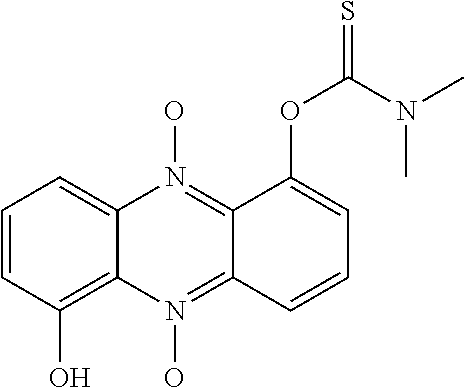


| TABLE 1 |
| IC50 data for iodinin analogs on two different AML cell lines. n.a. = not active at the |
| highest concentration tested (10 microMolar). The data are after 24 h of incubation. |
| Int. | Molm 13 IC50 | IPC-81 IC50 |
| Example no. | name | Name | 2% O2 | 20% O2 | 2% O2 | 20% O2 |
| Example 1a | IM3 | 1,6-Dimethoxy- phenazine | n.a. | n.a. | n.a | n.a |
| Example 1b | IM1 | 1,6-Dihydroxy-phenazine | ||||
| Example 1c | IM5 | Iodinin | 0.27 | 0.30 | 0.51 | 1.3 |
| 1,6-Dihydroxy-phenazine-1,5- | ||||||
| dioxide | ||||||
| Example 5a | IM7 | Myxin | 1.1 | 1.4 | 3.2 | 2.4 |
| 1-Hydroxy-6-methyl-10-(λ1- | ||||||
| oxidanyl)-10 λ4-phenazine 5- | ||||||
| oxide | ||||||
| Example 5b | IM15 | 1-(2-(tert-butoxy)-2-oxoethoxy)- | 1.65 | 1.77 | ||
| 6-hydroxyphenazine 5,10-dioxide | ||||||
| Example 7 | IM18 | 1-(carboxymethoxy)-6- | ||||
| hydroxyphenazine 5,10-dioxide | ||||||
| Example 5c | IM20 | 1-(2-(tert-butoxy)-2-oxoethoxy)- | 0.65 | 0.85 | ||
| 6-methoxyphenazine 5,10-dioxide | ||||||
| Example 8a | IM32 | 1-hydroxy-6-((4- | ||||
| methylpiperazine-1- | ||||||
| carbonyl)oxy)phenazine 5,10- | ||||||
| dioxide | ||||||
| Example 8h | IM30 | 1-((dimethylcarbamoyl)oxy)-6- | ||||
| hydroxyphenazine 5,10-dioxide | ||||||
| Example 8i | IM25 | 1-((diethylcarbamoyl)oxy)-6- | 0.74 | 0.76 | ||
| hydroxyphenazine 5,10-dioxide | ||||||
| Example 8j | IM33 | 1-hydroxy-6-((pyrrolidine-1- | ||||
| carbonyl)oxy)phenazine 5,10- | ||||||
| dioxide | ||||||
| Example 4a | IM35 | 1-hydroxyphenazine 5.10-dioxide | 4.5 | |||
| Example 6a | IM37 | 1-(2-ethoxy-2- | 0.11 | |||
| oxoethoxy)phenazine 5,10- | ||||||
| dioxide | ||||||
| Example 8k | IM36 | 1-((dimethylcarbamoyl)oxy) | 0.32 | |||
| phenazine 5,10-dioxide | ||||||
| Example 8c | IM38 | 1-((4-methylpiperazine-1- | 0.35 | |||
| carbonyl)oxy)phenazine 5,10- | ||||||
| dioxide | ||||||
| Example 10 | IM23 | 1-((ethoxycarbonyl)oxy)-6- | n.a. | |||
| hydroxyphenazine 5,10-dioxide | ||||||
| Example 16a | IM34 | 0.95 | ||||
| Example 16b | IM27 | ~40 | ||||
| Example 16c | IM21 | 3.98 | 4.11 | |||
| Example 16d | IM22 | 5.59 | 4.05 | |||
| Example 16e | IM24 | 3.50 | 2.23 | |||
| Example 5d | IM26 | 5.61 | 5.62 | |||
| Example 5e | IM10 | 1.45 | 1.5 | 1.7 | 1.8 | |
where Y is the response (WST-1 signal or percent apoptosis), min and max are minimum and maximum response, X is concentration of analogue, EC50 equals the point of inflection, i.e. the point that gives half of maximum response, and h is the Hill's slope of the curve. The two methods gave consistent response curves for each analogue. In the case of Tirapazamine, where its colour interfered with the WST-1 signal, only microscopic evaluation of Hoechst stained cells was used in order to calculate its EC50 values. The collective results are given in Table 2.
| TABLE 2 |
| IC50 data for iodinin analogs on two different AML cell lines. n.d. = not done. |
| The data are after 24 hours of incubation. |
| Core Table structures: |
| A | |
 |
|
| B | |
 |
|
| C | |
 |
|
| D | |
 |
|
| Patient | EC50 (μM) | EC50 | |||
| Example | EC50 (μM) MOLM-13 | EC50 (μM) NRK | H9c2 | (μM) |
| no. | Core | 19% O2 | 2% O2 | 19% O2 | 2% O2 | 19% O2 | hepG2 |
| 1a | A | 72 ± 14 | 84 ± 6 | n.d. | n.d. | n.d. | n.d. |
| 1b | A | 100-120 | 110-140 | n.d. | n.d. | n.d. | n.d. |
| 1c | A | 2.0 ± 0.07 | 0.79 ± 0.10 | >50 | >50 | >50 | >250 |
| (n = 3) | (n = 3) | (n = 3) | |||||
| 5a | A | 1.4 ± 0.30 | 0.77 ± 0.13 | 77 ± 11 | 76 ± 14 | 46 ± 4.1 | 70 |
| (n = 2) | (n = 2) | (n = 3) | |||||
| 5b | A | 2.9 ± 0.34 | 2.4 ± 0.16 | 53 ± 1.5 | 53 ± 0.0 | 42 ± 5.8 | n.d. |
| (n = 2) | (n = 2) | (n = 3) | |||||
| 5c | A | 0.57 ± 0.06 | 0.49 ± 0.12 | 11 ± 1.6 | 18 ± 1.5 | 15 ± 0.9 | n.d. |
| (n = 3) | (n = 3) | (n = 3) | |||||
| 6a | A | 1.5 ± 0.14 | 1.7 ± 0.29 | 26 ± 0.8 | 25 ± 0.2 | 20 ± 2.9 | 75 |
| (n = 6) | (n = 6) | (n = 3) | (n = 3) | (n = 2) | |||
| 6b | A | 8.3 ± 0.78 | 6.3 ± 0.25 | 140 ± 2 | >100 | >100 | n.d. |
| (n = 6) | (n = 4) | (n = 2) | (n = 2) | (n = 2) | |||
| 6c | A | 0.41 ± 0.05 | 0.38 ± 0.04 | 3.1 ± 0.02 | 4.7 ± 0.09 | 1.3 ± 0.2 | 12 |
| (n = 4) | (n = 4) | (n = 2) | (n = 2) | (n = 3) | |||
| 6d | A | 2.4 ± 0.03 | 1.6 ± 0.09 | 10 ± 0.7 | 9.7 ± 2.40 | 3.3 ± 0.50 | 65 |
| (n = 4) | (n = 4) | (n = 2) | (n = 2) | (n = 2) | |||
| 7 | A | 54 ± 7 | 61 ± 4 | n.d. | n.d. | n.d. | n.d. |
| 8a | A | 1.5 ± 0.16 | 1.4 ± 0.06 | 53 ± 2.0 | 59 ± 1.1 | 100 ± 13 | 30 |
| (n = 4) | (n = 4) | (n = 2) | (n = 2) | (n = 3) | |||
| 8b | A | 1.0 ± 0.06 | 0.98 ± 0.08 | 26 ± 2.1 | 39 ± 4.2 | 26 ± 0.9 | 90 |
| (n = 4) | (n = 4) | (n = 3) | (n = 3) | (n = 3) | |||
| 8c | A | 1.5 ± 0.18 | 1.9 ± 0.05 | 25 ± 0.2 | 37 ± 1.9 | 36 ± 11 | n.a. |
| (n = 6) | (n = 4) | (n = 3) | (n = 3) | (n = 3) | |||
| 8d | A | 0.63 ± 0.05 | 0.54 ± 0.06 | 11 ± 1.5 | 13 ± 0.7 | 9.4 ± 0.55 | 105 |
| (n = 6) | (n = 4) | (n = 3) | (n = 2) | ||||
| 8e | A | 0.34 ± 0.04 | 0.32 ± 0.06 | 10 ± 0.9 | 15 ± 1.8 | 3.2 ± 0.10 | 45 |
| (n = 4) | (n = 4) | (n = 3) | (n = 3) | (n = 3) | |||
| 8g | A | 0.89 ± 0.03 | 0.70 ± 0.04 | 49 ± 1.8 | 62 ± 1.3 | 64 ± 9.2 | n.a. |
| (n = 4) | (n = 4) | (n = 2) | (n = 2) | (n = 2) | |||
| 8j | A | 0.86 ± 0.05 | 0.79 ± 0.09 | 9.6 ± 0.38 | 15 ± 1.0 | 12 ± 0.7 | n.a. |
| (n = 6) | (n = 4) | (n = 3) | (n = 3) | (n = 2) | |||
| 8k | A | 1.3 ± 0.15 | 2.1 ± 0.16 | 19 ± 1.3 | 25 ± 0.6 | 16 ± 2.6 | n.a. |
| (n = 6) | (n = 4) | (n = 3) | (n = 3) | (n = 2) | |||
| 8l | A | 2.0 ± 0.11 | 1.8 ± 0.17 | 32 ± 2.5 | 35 ± 1.5 | 35 ± 3.3 | 110 |
| (n = 4) | (n = 6) | (n = 2) | (n = 2) | (n = 3) | |||
| 8m | A | 1.9 ± 0.07 | 1.7 ± 0.09 | 22 ± 1.7 | 29 ± 0.7 | 35 ± 1.8 | n.a. |
| (n = 4) | (n = 4) | (n = 2) | (n = 2) | (n = 3) | |||
| 10 | A | 50 ± 0.4 | 66 ± 2.2 | n.a. | n.a. | >100 | n.a. |
| (n = 4) | (n = 4) | (n = 2) | |||||
| 12 | B | >200 | >200 | n.a. | n.a. | n.a. | n.a. |
| (n = 4) | (n = 4) | ||||||
| 13 | B | >200 | >200 | n.a. | n.a. | n.a. | n.a. |
| (n = 4) | (n = 4) | ||||||
| 16b | A | 36 ± 0.1 | 22 ± 2.8 | n.d. | n.d. | >200 | n.a. |
| (n = 5) | (n = 4) | (n = 2) | |||||
| 16c | A | 2.0 ± 0.47 | 0.79 ± 0.06 | >20 | >20 | >20 | n.a. |
| (n = 3) | (n = 3) | (n = 3) | |||||
| 16d | A | 11 ± 0.7 | 8.9 ± 1.71 | n.a. | n.a. | >50 | n.a. |
| (n = 4) | (n = 4) | (n = 2) | |||||
| 16e | A | 6.1 ± 0.05 | 4.0 ± 0.33 | >25 | >25 | >25 | n.a. |
| (n = 4) | (n = 4) | (n = 2) | (n = 2) | (n = 2) | |||
| 17 | A | 11 ± 1.8 | 12 ± 0.04 | 79 ± 4.2 | >100 | >100 | n.a. |
| (n = 6) | (n = 4) | (n = 3) | (n = 3) | (n = 2) | |||
| 19 | A | 2.2 ± 0.09 | 1.9 ± 0.11 | 26 ± 0.7 | 25 ± 1.9 | 20 ± 2.1 | n.a. |
| (n = 6) | (n = 4) | (n = 3) | (n = 3) | (n = 2) | |||
| 20 | A | n.a. | |||||
| 21 | A | 1.2 ± 0.08 | 1.4 ± 0.15 | 13 ± 0.01 | 16 ± 1.0 | 23 ± 0.1 | n.a. |
| (n = 4) | (n = 6) | (n = 2) | (n = 2) | (n = 2) | |||
| 24 | A | 1.5 ± 0.18 | 1.2 ± 0.15 | 18 ± 0.6 | 21 ± 2.4 | 13 ± 0.5 | n.a. |
| (n = 6) | (n = 4) | (n = 3) | (n = 3) | (n = 2) | |||
| 33 | A | 4.0 ± 0.48 | 3.1 ± 0.83 | n.a. | n.a. | ||
| 36 | A | 4.2 ± 0.20 | 3.3 ± 0.22 | 27 ± 1.2 | 27 ± 1.8 | n.a. | n.a. |
| (n = 2) | (n = 2) | ||||||
| 37 | A | 18 ± 3 | 39 ± 9 | >200 | >200 | n.d. | n.a. |
| (n = 2) | (n = 2) | ||||||
| 48 | A | 2.8 ± 0.25 | 2.3 ± 0.10 | >50 | >50 | >50 | n.a. |
| (n = 6) | (n = 4) | (n = 2) | (n = 2) | (n = 2) | |||
| 50 | A | 1.8 ± 0.24 | 3.4 ± 0.78 | 21 ± 0.3 | 52 ± 1.2 | 41 ± 5.7 | n.a. |
| (n = 6) | (n = 4) | (n = 2) | (n = 2) | ||||
| 51 | A | n.a. | |||||
| 52 | A | 1.5 ± 0.02 | 0.78 ± 0.11 | 6.6 ± 0.04 | 8.9 ± 0.0 | 8.7 ± 1.2 | n.a. |
| (n = 4) | (n = 4) | (n = 2) | (n = 2) | (n = 2) | |||
| 59 | A | 0.41 ± 0.04 | 0.23 ± 0.03 | 6.2 ± 0.02 | 7.6 ± 0.60 | 2.2 ± 0.53 | 40 |
| (n = 4) | (n = 4) | (n = 2) | (n = 2) | (n = 3) | |||
| 60 | D | 128 ± 3.0 | 45 ± 3.5 | n.a. | n.a. | >200 | n.a. |
| (n = 2) | (n = 3) | (n = 2) | n.a. | ||||
| 61 | D | n.a. | n.a. | n.a. | |||
| 62 | D | 32 ± 5.0 | 15 ± 0.7 | n.a. | n.a. | 45 ± 4.8 | n.a. |
| (n = 2) | (n = 3) | (n = 2) | |||||
| 63 | D | 14 ± 0.4 | 3.5 ± 0.19 | n.a. | n.a. | 53 ± 0.3 | n.a. |
| (n = 2) | (n = 2) | (n = 2) | |||||
| 64 | D | 117 ± 1.0 | 50 ± 3.8 | n.a. | n.a. | >200 | n.a. |
| (n = 2) | (n = 3) | (n = 2) | |||||
| 65 | D | 17 ± 0.0 | 2.5 ± 0.24 | n.a. | n.a. | 20 ± 2.4 | n.a. |
| (n = 2) | (n = 3) | (n = 2) | |||||
| 66 | D | n.a. | n.a. | n.a. | |||
| 67 | D | 31 ± 1.4 | 7.6 ± 0.89 | n.a. | n.a. | 80 ± 8.9 | n.a. |
| (n = 2) | (n = 3) | (n = 2) | |||||
| 69 | B | >200 | >200 | n.a. | n.a. | — | n.a. |
| (n = 4) | (n = 4) | ||||||
| 71 | C | 2.8 ± 0.18 | 1.8 ± 0.10 | 2.0 ± 0.06 | 7.5 ± 0.38 | 2.3 ± 0.05 | n.a. |
| (n = 4) | (n = 4) | (n = 2) | (n = 2) | (n = 2) | |||
| n.a.: not analysed. | |||||||
| TABLE 3 |
| Permeability of analogs |
| Example | LogPeff 1 | Deviation2 | Permeability3 |
| 1c (Iodinin) | −5.46* | 0.43 | Intermediate |
| 1b | −5.42 | −0.08 | Intermediate/high |
| 5a | −5.29 | 0.00 | High |
| 5b | −5.33 | 0.02 | High |
| 7 | −7.53 | −0.60 | Impermeable |
| 5c | −4.70 | −0.09 | High |
| 16d | −5.86* | 0.97 | Low |
| 10 | −7.38* | 0.15 | Impermeable |
| 16b | −8.66 | 0.03 | Impermeable |
| 6c | −5.42 | 0.02 | Intermediate/high |
| 8e | −5.38 | 0.01 | Intermediate/high |
| 8b | −5.77 | −0.02 | Low |
| 70 | −8.04 | −0.08 | Impermeable |
| 71 | −5.43 | −0.02 | Intermediate/high |
| 52 | −5.32 | 0.01 | High |
| 50 | −5.42 | −0.01 | Intermediate/high |
| Tirapazamine | −5.79 | −0.09 | Low |
| 1:Asterisks denote that n = 3. For all other samples, n = 2. | |||
| 2:Deviation is calculated either as SDT (n = 3) or high value minus average (n = 2) | |||
| 3:As defined in: Bennion BJ, Be NA, McNerney MW, Lao V, Carlson EM, Valdez CA, et al. | |||
| Predicting a Drug's Membrane Permeability: A Computational Model Validated With in Vitro Permeability Assay Data. The Journal of Physical Chemistry B. 2017;121(20): 5228-37 | |||
-
- Plate bacterial strain(s) on appropriate media:
- Gram-negative bacteria with ESBLs or carbapenemases: green agar plates with 100 mg/L ampicillin
- Gram-negative bacteria without β-lactamases: green agar plates
- Gram-positive bacteria (Staphylococci and Enterococci): blood agar plates
- Incubate o.n. at 37° C.
Day 2:
Prepare the Bacterial Inoculum: - Prepare a 0.5 McFarland suspension of bacteria in 0.85% NaCl. (Should be used within 15 min of preparation).
- Dilute the 0.5 McFarland suspension 1:100 into MH broth.
-
- Add 50 μl of the prepared bacterial suspension to each well in the microtiter plate except negative growth control.
Preparation of Compounds/Antibiotics - Calculate the desired concentration-range and volume of the compounds/antibiotics in the assay. For antibiotics this will depend on the MIC to meropenem of the bacterial strains to be tested. Dilute the stock solution in MH broth. Make subsequent 2-fold dilutions in MH broth of the desired concentrations if a concentration range is to be tested (remember the extra dilution factor in the assay plate). Always include extra volume for pipetting. Take into consideration stock solutions that are made in buffers that have an effect on bacterial growth (e.g. DMSO).
Assay: - Determining the MIC of compounds/antibiotics alone:
- Add 25 μl of each concentration of compound/antibiotic to row 2-11 (highest concentration in row 2)
- Add 25 μl MH broth to row 2-11
- Add 50 μl MH broth to row 12 (positive control)
- Add 100 μl MH broth to row 1
- Add 50 μl bacterial suspension to row 2-12.
- Determining the MIC of antibiotics+compounds:
- Add 25 μl of each concentration of antibiotic to row 2-11 (highest concentration in row 2)
- Add 25 μl of compound to row 2-11
- Add 50 μl MH broth to row 12 (positive control)
- Add 100 μl MH broth to row 1
- Add 50 μl bacterial suspension to row 2-12.
- Incubate the plate for 20 hrs at 37° C. and determine the MIC in the presence and absence of inhibitor.
- Add 50 μl of the prepared bacterial suspension to each well in the microtiter plate except negative growth control.
| TABLE 4 |
| MIC values of Example 6a alone and in combination with the carbapenem |
| meropenem (MEM) |
| MIC with MEM and Example 6a alone in the respective | |
| strains |
| Conc. of compound | S1 | S2 | S3 | S4 | S5 | S6 | S7 |
| MIC Ex. 6a alone | n.t. | n.t. | 39.3 | 19.6 | 2.5 | 9.7 | 5 |
| MIC MEM alone | >64 | 8 | 32 | 64 | 1 | >64 | >64 |
| MEM + | |
| Example 6a: | MIC with MEM + Example 6a in the respective strains |
| Conc of 6a | 15.7 | ≤0.03 | ≤0.03 | ≤0.03 | ≤0.03 | ≤0.03 | ≤0.03 | ≤0.03 |
| 7.9 | ≤0.03 | 8 | 32 | ≤0.03 | ≤0.03 | ≤0.03 | ≤0.03 | |
| 3.9 | >64 | 8 | 32 | 8 | ≤0.03 | >64 | ≤0.03 | |
| 1.3 | >64 | 8 | 32 | 64 | 1 | >64 | >64 | |
| MEM: meropenem. | ||||||||
| N.t.: not tested. | ||||||||
| All MIC values given in mg/L. | ||||||||
| Strains used in the Table: | ||||||||
| Strains lacking metallo-β-lactamase: strain 1 (S1): P. aeruginosa (16H5), strain 2 (S2): K. pneumoniae (17A2). | ||||||||
| Strains harboring metallo-β-lactamase: strain 3 (S3): P. aeruginosa/VIM-2, strain 4 (S4): K. pneumoniae/NDM-1. | ||||||||
| Strains harboring serine--β-lactamase: strain 5 (S5): E. coli/OXA-48, strain 6 (S6): K. pneumoniae/KPC-2, strain 7 (S7): A. baumannii/OXA-23 | ||||||||
| TABLE 5 |
| MIC values of different examples alone |
| against vancomycin-resistant E. faecium |
| and methicillin-resistant S. aureus |
| Gram-positive | |
| strains |
| A1-22 | A4-37 | |
| E. faecium | S. aureus | |
| Compound | vanA | MRSA |
| Inactive cpd. | >125 | >125 |
| 5b | 8 | <0.5 |
| 8i | 8 | <4 |
| 6a | 4 | <0.5 |
| 8c | 8 | <4 |
| 8m | 63 | <4 |
| 8l | 63 | <4 |
| 18 | 32 | <2 |
| 6d | 8 | 16 |
| 5a | <8 | <0.5 |
Claims (28)


Applications Claiming Priority (4)
| Application Number | Priority Date | Filing Date | Title |
|---|---|---|---|
| GB1621520.4 | 2016-12-16 | ||
| GBGB1621520.4A GB201621520D0 (en) | 2016-12-16 | 2016-12-16 | Compounds |
| GB1621520 | 2016-12-16 | ||
| PCT/GB2017/053787 WO2018109504A1 (en) | 2016-12-16 | 2017-12-18 | N-oxide heterocycles for use in the treatment of cancer and bacterial diseases |
Related Parent Applications (1)
| Application Number | Title | Priority Date | Filing Date |
|---|---|---|---|
| PCT/GB2017/053787 A-371-Of-International WO2018109504A1 (en) | 2016-12-16 | 2017-12-18 | N-oxide heterocycles for use in the treatment of cancer and bacterial diseases |
Related Child Applications (1)
| Application Number | Title | Priority Date | Filing Date |
|---|---|---|---|
| US17/239,976 Continuation US11958842B2 (en) | 2016-12-16 | 2021-04-26 | Substituted phenazines and methods of treating cancer and bacterial diseases |
Publications (2)
| Publication Number | Publication Date |
|---|---|
| US20200095237A1 US20200095237A1 (en) | 2020-03-26 |
| US11046678B2 true US11046678B2 (en) | 2021-06-29 |
Family
ID=58284568
Family Applications (2)
| Application Number | Title | Priority Date | Filing Date |
|---|---|---|---|
| US16/469,948 Active US11046678B2 (en) | 2016-12-16 | 2017-12-18 | Substituted phenazines and methods of treating cancer and bacterial diseases |
| US17/239,976 Active 2038-04-14 US11958842B2 (en) | 2016-12-16 | 2021-04-26 | Substituted phenazines and methods of treating cancer and bacterial diseases |
Family Applications After (1)
| Application Number | Title | Priority Date | Filing Date |
|---|---|---|---|
| US17/239,976 Active 2038-04-14 US11958842B2 (en) | 2016-12-16 | 2021-04-26 | Substituted phenazines and methods of treating cancer and bacterial diseases |
Country Status (4)
| Country | Link |
|---|---|
| US (2) | US11046678B2 (en) |
| EP (1) | EP3555052A1 (en) |
| GB (1) | GB201621520D0 (en) |
| WO (1) | WO2018109504A1 (en) |
Families Citing this family (3)
| Publication number | Priority date | Publication date | Assignee | Title |
|---|---|---|---|---|
| CN115368312B (en) * | 2021-05-17 | 2023-11-10 | 浙江大学 | Method for directly synthesizing quinoxaline from biomass carbohydrate by one-pot method |
| US12611425B2 (en) | 2022-10-10 | 2026-04-28 | Wiab Water Innovation Ab | Compositions and methods for treatment and prevention of pathogens |
| CN118750487B (en) * | 2024-09-06 | 2024-11-19 | 深圳市利云德生物技术有限公司 | Anti-gastric cancer pharmaceutical composition and application thereof |
Citations (8)
| Publication number | Priority date | Publication date | Assignee | Title |
|---|---|---|---|---|
| US3530130A (en) * | 1967-09-14 | 1970-09-22 | Hoffmann La Roche | 1-acylated-6-methoxyphenazine 5,10-dioxides |
| GB1215815A (en) | 1967-12-20 | 1970-12-16 | Research Corp | Production of quinoxaline-di-n-oxides and benzimidazole mono- and di-n-oxides |
| US3678051A (en) | 1970-04-02 | 1972-07-18 | Hoffmann La Roche | Derivatives of 1,6-phenazinediol 5,10-dioxide |
| DE2144884A1 (en) | 1971-09-08 | 1973-03-15 | Boehringer Mannheim Gmbh | Amino-subst phenazine 5,10-dioxides - with antimicrobial activity |
| WO2004113323A1 (en) | 2003-06-13 | 2004-12-29 | Schering Aktiengesellschaft | Quinolyl amide derivatives as ccr-5 antagonists |
| CN1951923A (en) | 2006-11-07 | 2007-04-25 | 浙江大学 | Sulfur-containing quinoxaline dioxide, method for producing same and their application |
| WO2015063516A2 (en) | 2013-11-01 | 2015-05-07 | Universitetet I Oslo | Compounds |
| CN104974100A (en) | 2015-07-07 | 2015-10-14 | 江苏省农业科学院 | Phenazine compounds originated from lysobacter antibioticus OH13 and preparation method and application thereof |
Family Cites Families (2)
| Publication number | Priority date | Publication date | Assignee | Title |
|---|---|---|---|---|
| US20090131342A1 (en) * | 2004-01-22 | 2009-05-21 | Nitromed, Inc. | Nitrosated and/or nitrosylated compounds, compositions and methods of use |
| US20080269231A1 (en) | 2007-01-16 | 2008-10-30 | Jj Pharma, Inc. | Phenazine Compounds and Use Thereof in Autoimmune and Inflammatory Disease |
-
2016
- 2016-12-16 GB GBGB1621520.4A patent/GB201621520D0/en not_active Ceased
-
2017
- 2017-12-18 WO PCT/GB2017/053787 patent/WO2018109504A1/en not_active Ceased
- 2017-12-18 EP EP17817848.9A patent/EP3555052A1/en active Pending
- 2017-12-18 US US16/469,948 patent/US11046678B2/en active Active
-
2021
- 2021-04-26 US US17/239,976 patent/US11958842B2/en active Active
Patent Citations (8)
| Publication number | Priority date | Publication date | Assignee | Title |
|---|---|---|---|---|
| US3530130A (en) * | 1967-09-14 | 1970-09-22 | Hoffmann La Roche | 1-acylated-6-methoxyphenazine 5,10-dioxides |
| GB1215815A (en) | 1967-12-20 | 1970-12-16 | Research Corp | Production of quinoxaline-di-n-oxides and benzimidazole mono- and di-n-oxides |
| US3678051A (en) | 1970-04-02 | 1972-07-18 | Hoffmann La Roche | Derivatives of 1,6-phenazinediol 5,10-dioxide |
| DE2144884A1 (en) | 1971-09-08 | 1973-03-15 | Boehringer Mannheim Gmbh | Amino-subst phenazine 5,10-dioxides - with antimicrobial activity |
| WO2004113323A1 (en) | 2003-06-13 | 2004-12-29 | Schering Aktiengesellschaft | Quinolyl amide derivatives as ccr-5 antagonists |
| CN1951923A (en) | 2006-11-07 | 2007-04-25 | 浙江大学 | Sulfur-containing quinoxaline dioxide, method for producing same and their application |
| WO2015063516A2 (en) | 2013-11-01 | 2015-05-07 | Universitetet I Oslo | Compounds |
| CN104974100A (en) | 2015-07-07 | 2015-10-14 | 江苏省农业科学院 | Phenazine compounds originated from lysobacter antibioticus OH13 and preparation method and application thereof |
Non-Patent Citations (5)
| Title |
|---|
| Endo Hideo et al. "Studies on Antitumor Activity of Phenazine Derivatives Against S 180 and C 63 in Mice (III)", Science Reports of the Research Institutes, Jan. 1, 1966, vol. 13, No. 3, pp. 197-199. |
| Hurst et al., "The Therapy of Experimental Psittacosis and Lymphogranuloma Vereum (Inguinale)", Brit. J. Pharmacol., vol. 8, No. 1: pp. 297-308 (1953). |
| International Search Report in corresponding PCT/GB2017/053787 dated Feb. 22, 2018. |
| Shchukina I N V Savitskaya M. N. et at. "On Derivatives of 8-Oxyninoline and their Antibacterial Action. I. 8-Aryloxy and 8-Alcohoxyinolines", Zhurnal Obshchei Khimii, Jan. 1, 1952, vol. 22, pp. 1218-1224. |
| Viktorsson et al., "Total synthesis and antileukemic evaluations of the phenazine 5,10-dioxide natural products iodinin, myxin and their derivatives", Bioorganic & Medicinal Chemistry, vol. 25, No. 7: pp. 2285-2293 (2017). |
Also Published As
| Publication number | Publication date |
|---|---|
| EP3555052A1 (en) | 2019-10-23 |
| WO2018109504A1 (en) | 2018-06-21 |
| US20200095237A1 (en) | 2020-03-26 |
| WO2018109504A8 (en) | 2019-05-02 |
| GB201621520D0 (en) | 2017-02-01 |
| US11958842B2 (en) | 2024-04-16 |
| US20210292313A1 (en) | 2021-09-23 |
Similar Documents
| Publication | Publication Date | Title |
|---|---|---|
| US11958842B2 (en) | Substituted phenazines and methods of treating cancer and bacterial diseases | |
| Huczyński et al. | Synthesis and biological activity of salinomycin conjugates with floxuridine | |
| US11649222B2 (en) | Compounds | |
| US11014902B2 (en) | MYC G-quadruplex stabilizing small molecules and their use | |
| AU2015319834A1 (en) | Non-beta lactam antibiotics | |
| US12297201B2 (en) | Substituted pyrrolo[2,3-d]pyrimidines as antimicrobials | |
| US10815237B2 (en) | Antimicrobials and methods of making and using same | |
| US12234238B2 (en) | Antimicrobial compounds and methods of making and using the same | |
| US10961196B2 (en) | Compounds for use as an anti-bacterial or anti-fungal agent and as a zinc sensor | |
| KR20020059341A (en) | Methods for treating therapy-resistant tumors | |
| US12152031B2 (en) | Biodefense agents | |
| WO2024230104A1 (en) | Polycyclic compound and use thereof | |
| CN107245050B (en) | Vanillin Hydroxamic Acid Derivatives and Their Applications | |
| US9862680B2 (en) | Peripherally substituted monocyclic beta-lactams | |
| CN110981888B (en) | N-aryldithiopyrrolidone urea and aminoester derivatives and their preparation and application | |
| US11351151B2 (en) | Compound having anticancer activity and preparation method and application | |
| EP3126333A1 (en) | Pqsr modulators | |
| Noori et al. | Synthesis of a New Conjugates of Imidazole with Beta Lactam Moiety and Evaluation of its Expanded Antibacterial Activity | |
| Abdullah et al. | Synthesis and In-Vitro Evaluation of Fluoroquinolone-N-hydroxyurea Derivatives as Dual Urease Inhibiting Antibacterial Agents | |
| CN117534658A (en) | Compound for targeted degradation of CK1 alpha protein and activation of P53 protein and application thereof | |
| US20240239800A1 (en) | Pyrrolo[2,3-d]pyrimidin-2-one antimicrobial compounds | |
| ABASS | PREPARATION OF A NEW PYRIMIDONE DERIVATIVE AND STUDY OF ITS ABILITY AS ANTIMICROBIAL AGENT AGAINST GRAM NEGATIVE AND GRAM POSITIVE BACTERIA | |
| Karki et al. | Synthesis, characterization and antimicrobial activity of novel thiazolidin-4-one derivatives |
Legal Events
| Date | Code | Title | Description |
|---|---|---|---|
| FEPP | Fee payment procedure |
Free format text: ENTITY STATUS SET TO UNDISCOUNTED (ORIGINAL EVENT CODE: BIG.); ENTITY STATUS OF PATENT OWNER: SMALL ENTITY |
|
| FEPP | Fee payment procedure |
Free format text: ENTITY STATUS SET TO SMALL (ORIGINAL EVENT CODE: SMAL); ENTITY STATUS OF PATENT OWNER: SMALL ENTITY |
|
| AS | Assignment |
Owner name: ASTRAND, OVE ALEXANDER HOEGMOEN, NORWAY Free format text: ASSIGNMENT OF ASSIGNORS INTEREST;ASSIGNORS:RONGVED, PAL;ASTRAND, OVE ALEXANDER HOEGMOEN;VIKTORSSON, ELVAR OERN;AND OTHERS;SIGNING DATES FROM 20190628 TO 20191122;REEL/FRAME:051157/0351 Owner name: RONGVED, PAL, NORWAY Free format text: ASSIGNMENT OF ASSIGNORS INTEREST;ASSIGNORS:RONGVED, PAL;ASTRAND, OVE ALEXANDER HOEGMOEN;VIKTORSSON, ELVAR OERN;AND OTHERS;SIGNING DATES FROM 20190628 TO 20191122;REEL/FRAME:051157/0351 Owner name: HEIKAL, ADAM, NORWAY Free format text: ASSIGNMENT OF ASSIGNORS INTEREST;ASSIGNORS:RONGVED, PAL;ASTRAND, OVE ALEXANDER HOEGMOEN;VIKTORSSON, ELVAR OERN;AND OTHERS;SIGNING DATES FROM 20190628 TO 20191122;REEL/FRAME:051157/0351 Owner name: VIKTORSSON, ELVAR OERN, NORWAY Free format text: ASSIGNMENT OF ASSIGNORS INTEREST;ASSIGNORS:RONGVED, PAL;ASTRAND, OVE ALEXANDER HOEGMOEN;VIKTORSSON, ELVAR OERN;AND OTHERS;SIGNING DATES FROM 20190628 TO 20191122;REEL/FRAME:051157/0351 |
|
| STPP | Information on status: patent application and granting procedure in general |
Free format text: DOCKETED NEW CASE - READY FOR EXAMINATION |
|
| STPP | Information on status: patent application and granting procedure in general |
Free format text: NON FINAL ACTION MAILED |
|
| STPP | Information on status: patent application and granting procedure in general |
Free format text: RESPONSE TO NON-FINAL OFFICE ACTION ENTERED AND FORWARDED TO EXAMINER |
|
| STPP | Information on status: patent application and granting procedure in general |
Free format text: NOTICE OF ALLOWANCE MAILED -- APPLICATION RECEIVED IN OFFICE OF PUBLICATIONS |
|
| STPP | Information on status: patent application and granting procedure in general |
Free format text: PUBLICATIONS -- ISSUE FEE PAYMENT RECEIVED |
|
| STPP | Information on status: patent application and granting procedure in general |
Free format text: PUBLICATIONS -- ISSUE FEE PAYMENT VERIFIED Free format text: AWAITING TC RESP, ISSUE FEE PAYMENT VERIFIED |
|
| STPP | Information on status: patent application and granting procedure in general |
Free format text: PUBLICATIONS -- ISSUE FEE PAYMENT VERIFIED |
|
| STPP | Information on status: patent application and granting procedure in general |
Free format text: AWAITING TC RESP, ISSUE FEE PAYMENT VERIFIED |
|
| STPP | Information on status: patent application and granting procedure in general |
Free format text: PUBLICATIONS -- ISSUE FEE PAYMENT VERIFIED |
|
| STCF | Information on status: patent grant |
Free format text: PATENTED CASE |
|
| AS | Assignment |
Owner name: ADJUTEC PHARMA AS, NORWAY Free format text: ASSIGNMENT OF ASSIGNORS INTEREST;ASSIGNORS:RONGVED, PAL;ASTRAND, OVE ALEXANDER HOEGMOEN;HEIKAL, ADAM;AND OTHERS;SIGNING DATES FROM 20210527 TO 20210607;REEL/FRAME:056800/0616 |
|
| MAFP | Maintenance fee payment |
Free format text: PAYMENT OF MAINTENANCE FEE, 4TH YR, SMALL ENTITY (ORIGINAL EVENT CODE: M2551); ENTITY STATUS OF PATENT OWNER: SMALL ENTITY Year of fee payment: 4 |