US11045381B2 - Augmenting human motion - Google Patents
Augmenting human motion Download PDFInfo
- Publication number
- US11045381B2 US11045381B2 US16/040,283 US201816040283A US11045381B2 US 11045381 B2 US11045381 B2 US 11045381B2 US 201816040283 A US201816040283 A US 201816040283A US 11045381 B2 US11045381 B2 US 11045381B2
- Authority
- US
- United States
- Prior art keywords
- force
- person
- foot
- attachment
- actuator
- Prior art date
- Legal status (The legal status is an assumption and is not a legal conclusion. Google has not performed a legal analysis and makes no representation as to the accuracy of the status listed.)
- Expired - Fee Related
Links
Images




Classifications
-
- G—PHYSICS
- G09—EDUCATION; CRYPTOGRAPHY; DISPLAY; ADVERTISING; SEALS
- G09B—EDUCATIONAL OR DEMONSTRATION APPLIANCES; APPLIANCES FOR TEACHING, OR COMMUNICATING WITH, THE BLIND, DEAF OR MUTE; MODELS; PLANETARIA; GLOBES; MAPS; DIAGRAMS
- G09B19/00—Teaching not covered by other main groups of this subclass
-
- A—HUMAN NECESSITIES
- A61—MEDICAL OR VETERINARY SCIENCE; HYGIENE
- A61H—PHYSICAL THERAPY APPARATUS, e.g. DEVICES FOR LOCATING OR STIMULATING REFLEX POINTS IN THE BODY; ARTIFICIAL RESPIRATION; MASSAGE; BATHING DEVICES FOR SPECIAL THERAPEUTIC OR HYGIENIC PURPOSES OR SPECIFIC PARTS OF THE BODY
- A61H3/00—Appliances for aiding patients or disabled persons to walk about
-
- A—HUMAN NECESSITIES
- A61—MEDICAL OR VETERINARY SCIENCE; HYGIENE
- A61H—PHYSICAL THERAPY APPARATUS, e.g. DEVICES FOR LOCATING OR STIMULATING REFLEX POINTS IN THE BODY; ARTIFICIAL RESPIRATION; MASSAGE; BATHING DEVICES FOR SPECIAL THERAPEUTIC OR HYGIENIC PURPOSES OR SPECIFIC PARTS OF THE BODY
- A61H1/00—Apparatus for passive exercising; Vibrating apparatus; Chiropractic devices, e.g. body impacting devices, external devices for briefly extending or aligning unbroken bones
- A61H1/02—Stretching or bending or torsioning apparatus for exercising
- A61H1/0237—Stretching or bending or torsioning apparatus for exercising for the lower limbs
- A61H1/0255—Both knee and hip of a patient, e.g. in supine or sitting position, the feet being moved together in a plane substantially parallel to the body-symmetrical plane
- A61H1/0262—Walking movement; Appliances for aiding disabled persons to walk
-
- A—HUMAN NECESSITIES
- A61—MEDICAL OR VETERINARY SCIENCE; HYGIENE
- A61H—PHYSICAL THERAPY APPARATUS, e.g. DEVICES FOR LOCATING OR STIMULATING REFLEX POINTS IN THE BODY; ARTIFICIAL RESPIRATION; MASSAGE; BATHING DEVICES FOR SPECIAL THERAPEUTIC OR HYGIENIC PURPOSES OR SPECIFIC PARTS OF THE BODY
- A61H1/00—Apparatus for passive exercising; Vibrating apparatus; Chiropractic devices, e.g. body impacting devices, external devices for briefly extending or aligning unbroken bones
- A61H1/02—Stretching or bending or torsioning apparatus for exercising
- A61H1/0237—Stretching or bending or torsioning apparatus for exercising for the lower limbs
- A61H1/0266—Foot
-
- G—PHYSICS
- G09—EDUCATION; CRYPTOGRAPHY; DISPLAY; ADVERTISING; SEALS
- G09B—EDUCATIONAL OR DEMONSTRATION APPLIANCES; APPLIANCES FOR TEACHING, OR COMMUNICATING WITH, THE BLIND, DEAF OR MUTE; MODELS; PLANETARIA; GLOBES; MAPS; DIAGRAMS
- G09B19/00—Teaching not covered by other main groups of this subclass
- G09B19/003—Repetitive work cycles; Sequence of movements
-
- G—PHYSICS
- G09—EDUCATION; CRYPTOGRAPHY; DISPLAY; ADVERTISING; SEALS
- G09B—EDUCATIONAL OR DEMONSTRATION APPLIANCES; APPLIANCES FOR TEACHING, OR COMMUNICATING WITH, THE BLIND, DEAF OR MUTE; MODELS; PLANETARIA; GLOBES; MAPS; DIAGRAMS
- G09B23/00—Models for scientific, medical, or mathematical purposes, e.g. full-sized devices for demonstration purposes
- G09B23/28—Models for scientific, medical, or mathematical purposes, e.g. full-sized devices for demonstration purposes for medicine
-
- G—PHYSICS
- G09—EDUCATION; CRYPTOGRAPHY; DISPLAY; ADVERTISING; SEALS
- G09B—EDUCATIONAL OR DEMONSTRATION APPLIANCES; APPLIANCES FOR TEACHING, OR COMMUNICATING WITH, THE BLIND, DEAF OR MUTE; MODELS; PLANETARIA; GLOBES; MAPS; DIAGRAMS
- G09B5/00—Electrically-operated educational appliances
-
- A—HUMAN NECESSITIES
- A61—MEDICAL OR VETERINARY SCIENCE; HYGIENE
- A61H—PHYSICAL THERAPY APPARATUS, e.g. DEVICES FOR LOCATING OR STIMULATING REFLEX POINTS IN THE BODY; ARTIFICIAL RESPIRATION; MASSAGE; BATHING DEVICES FOR SPECIAL THERAPEUTIC OR HYGIENIC PURPOSES OR SPECIFIC PARTS OF THE BODY
- A61H1/00—Apparatus for passive exercising; Vibrating apparatus; Chiropractic devices, e.g. body impacting devices, external devices for briefly extending or aligning unbroken bones
- A61H1/02—Stretching or bending or torsioning apparatus for exercising
- A61H1/0237—Stretching or bending or torsioning apparatus for exercising for the lower limbs
- A61H1/0266—Foot
- A61H2001/027—Toes
-
- A—HUMAN NECESSITIES
- A61—MEDICAL OR VETERINARY SCIENCE; HYGIENE
- A61H—PHYSICAL THERAPY APPARATUS, e.g. DEVICES FOR LOCATING OR STIMULATING REFLEX POINTS IN THE BODY; ARTIFICIAL RESPIRATION; MASSAGE; BATHING DEVICES FOR SPECIAL THERAPEUTIC OR HYGIENIC PURPOSES OR SPECIFIC PARTS OF THE BODY
- A61H3/00—Appliances for aiding patients or disabled persons to walk about
- A61H2003/007—Appliances for aiding patients or disabled persons to walk about secured to the patient, e.g. with belts
-
- A—HUMAN NECESSITIES
- A61—MEDICAL OR VETERINARY SCIENCE; HYGIENE
- A61H—PHYSICAL THERAPY APPARATUS, e.g. DEVICES FOR LOCATING OR STIMULATING REFLEX POINTS IN THE BODY; ARTIFICIAL RESPIRATION; MASSAGE; BATHING DEVICES FOR SPECIAL THERAPEUTIC OR HYGIENIC PURPOSES OR SPECIFIC PARTS OF THE BODY
- A61H2201/00—Characteristics of apparatus not provided for in the preceding codes
- A61H2201/01—Constructive details
- A61H2201/0157—Constructive details portable
-
- A—HUMAN NECESSITIES
- A61—MEDICAL OR VETERINARY SCIENCE; HYGIENE
- A61H—PHYSICAL THERAPY APPARATUS, e.g. DEVICES FOR LOCATING OR STIMULATING REFLEX POINTS IN THE BODY; ARTIFICIAL RESPIRATION; MASSAGE; BATHING DEVICES FOR SPECIAL THERAPEUTIC OR HYGIENIC PURPOSES OR SPECIFIC PARTS OF THE BODY
- A61H2201/00—Characteristics of apparatus not provided for in the preceding codes
- A61H2201/12—Driving means
- A61H2201/1207—Driving means with electric or magnetic drive
- A61H2201/1215—Rotary drive
-
- A—HUMAN NECESSITIES
- A61—MEDICAL OR VETERINARY SCIENCE; HYGIENE
- A61H—PHYSICAL THERAPY APPARATUS, e.g. DEVICES FOR LOCATING OR STIMULATING REFLEX POINTS IN THE BODY; ARTIFICIAL RESPIRATION; MASSAGE; BATHING DEVICES FOR SPECIAL THERAPEUTIC OR HYGIENIC PURPOSES OR SPECIFIC PARTS OF THE BODY
- A61H2201/00—Characteristics of apparatus not provided for in the preceding codes
- A61H2201/14—Special force transmission means, i.e. between the driving means and the interface with the user
-
- A—HUMAN NECESSITIES
- A61—MEDICAL OR VETERINARY SCIENCE; HYGIENE
- A61H—PHYSICAL THERAPY APPARATUS, e.g. DEVICES FOR LOCATING OR STIMULATING REFLEX POINTS IN THE BODY; ARTIFICIAL RESPIRATION; MASSAGE; BATHING DEVICES FOR SPECIAL THERAPEUTIC OR HYGIENIC PURPOSES OR SPECIFIC PARTS OF THE BODY
- A61H2201/00—Characteristics of apparatus not provided for in the preceding codes
- A61H2201/16—Physical interface with patient
- A61H2201/1602—Physical interface with patient kind of interface, e.g. head rest, knee support or lumbar support
- A61H2201/164—Feet or leg, e.g. pedal
- A61H2201/1642—Holding means therefor
-
- A—HUMAN NECESSITIES
- A61—MEDICAL OR VETERINARY SCIENCE; HYGIENE
- A61H—PHYSICAL THERAPY APPARATUS, e.g. DEVICES FOR LOCATING OR STIMULATING REFLEX POINTS IN THE BODY; ARTIFICIAL RESPIRATION; MASSAGE; BATHING DEVICES FOR SPECIAL THERAPEUTIC OR HYGIENIC PURPOSES OR SPECIFIC PARTS OF THE BODY
- A61H2201/00—Characteristics of apparatus not provided for in the preceding codes
- A61H2201/16—Physical interface with patient
- A61H2201/1657—Movement of interface, i.e. force application means
-
- A—HUMAN NECESSITIES
- A61—MEDICAL OR VETERINARY SCIENCE; HYGIENE
- A61H—PHYSICAL THERAPY APPARATUS, e.g. DEVICES FOR LOCATING OR STIMULATING REFLEX POINTS IN THE BODY; ARTIFICIAL RESPIRATION; MASSAGE; BATHING DEVICES FOR SPECIAL THERAPEUTIC OR HYGIENIC PURPOSES OR SPECIFIC PARTS OF THE BODY
- A61H2201/00—Characteristics of apparatus not provided for in the preceding codes
- A61H2201/16—Physical interface with patient
- A61H2201/1657—Movement of interface, i.e. force application means
- A61H2201/1664—Movement of interface, i.e. force application means linear
- A61H2201/1669—Movement of interface, i.e. force application means linear moving along the body in a reciprocating manner
-
- A—HUMAN NECESSITIES
- A61—MEDICAL OR VETERINARY SCIENCE; HYGIENE
- A61H—PHYSICAL THERAPY APPARATUS, e.g. DEVICES FOR LOCATING OR STIMULATING REFLEX POINTS IN THE BODY; ARTIFICIAL RESPIRATION; MASSAGE; BATHING DEVICES FOR SPECIAL THERAPEUTIC OR HYGIENIC PURPOSES OR SPECIFIC PARTS OF THE BODY
- A61H2201/00—Characteristics of apparatus not provided for in the preceding codes
- A61H2201/50—Control means thereof
- A61H2201/5007—Control means thereof computer controlled
-
- A—HUMAN NECESSITIES
- A61—MEDICAL OR VETERINARY SCIENCE; HYGIENE
- A61H—PHYSICAL THERAPY APPARATUS, e.g. DEVICES FOR LOCATING OR STIMULATING REFLEX POINTS IN THE BODY; ARTIFICIAL RESPIRATION; MASSAGE; BATHING DEVICES FOR SPECIAL THERAPEUTIC OR HYGIENIC PURPOSES OR SPECIFIC PARTS OF THE BODY
- A61H2201/00—Characteristics of apparatus not provided for in the preceding codes
- A61H2201/50—Control means thereof
- A61H2201/5058—Sensors or detectors
- A61H2201/5061—Force sensors
-
- A—HUMAN NECESSITIES
- A61—MEDICAL OR VETERINARY SCIENCE; HYGIENE
- A61H—PHYSICAL THERAPY APPARATUS, e.g. DEVICES FOR LOCATING OR STIMULATING REFLEX POINTS IN THE BODY; ARTIFICIAL RESPIRATION; MASSAGE; BATHING DEVICES FOR SPECIAL THERAPEUTIC OR HYGIENIC PURPOSES OR SPECIFIC PARTS OF THE BODY
- A61H2205/00—Devices for specific parts of the body
- A61H2205/12—Feet
Definitions
- This disclosure relates to augmenting the motion of a person, such as stride, to decrease the effort of such motion.
- a system for augmenting the stride of a person includes a first assistance apparatus with a first attachment for connecting the first assistance apparatus to the person's first leg below the knee and above the ankle of the first leg, a second attachment for connecting the apparatus to the person's first foot, an actuator for applying force between the first and second attachment points, the force augmenting motion of the ankle, and a set of sensors detecting force between the plantar surface of the user's first foot and the ground.
- the set includes at least a first sensor under the outer edge of the foot, a second sensor under the ball of the foot, and a third sensor under the big toe.
- a control system implements a negative feedback loop, in which the force applied by the actuator is based on a weighted sum of measurements from the sensors, and is updated continuously based on the sensor measurements.
- the second attachment may connect to the person's foot near the location of the distal end of the metatarsal bones.
- the second attachment may include an attachment to a shoe.
- the force applied by the actuator may apply downward torque at the ankle while the user's foot is applying force to the ground at the ball of the foot and the toes.
- the force applied by the actuator may apply upward torque at the ankle when the user's foot stops applying force to the ground, assisting lifting of the toes off the ground.
- the control system may compute the weighted sum of the measurements from the sensors by determining weights for each of the sensors that result in the sum of the weighted sensor measurements approximating a target profile for the torque applied by the ankle during a normal stride. The weights may be re-computed repeatedly while the user is walking.
- a second assistance apparatus may include a first attachment for connecting the second assistance apparatus to the person's second leg below the knee and above the ankle, a second attachment for connecting the apparatus to the person's second foot, an actuator for applying force between the first and second attachment points, the force augmenting motion of the ankle, and a set of sensors detecting force between the plantar surface of the user's second foot and the ground.
- the control system may implement a second negative feedback loop, in which the force applied by the second actuator is based on a second weighted sum of measurements from the sensors of the second assistance apparatus, and is updated continuously based on the sensor measurements.
- the first and second weighted sums may be independent of each other.
- a system for training a learner includes an instructor apparatus with a first set of sensors detecting motion of an instructor's body when moving in a particular manner, and a student apparatus, which includes a first attachment for connecting the student apparatus to a first point on the student's body, a second attachment for connecting the student apparatus to a second point on the student's body, an actuator for applying force between the first and second attachment points, the force augmenting motion of the type detected by the instructor apparatus's sensors, and a second set of sensors detecting reaction force on the student's body when moving in the manner that the actuator augments.
- a control and communication system communicates differences between the instructor's motion and the student's motion to at least one of the instructor and the student.
- a method for augmenting the motion of a person includes receiving data from a set of sensors detecting reaction force on the person's body when moving in the manner to be augmented, computing a weighted sum of measurements from the sensors, applying force between a first attachment connecting an assistance apparatus to a first point on the person's body and a second attachment connecting the apparatus to a second point on the person's body the force augmenting motion of a part of the body, the amount of force being based on the weighted sum, and repeatedly updating the force based on the sensor measurements.
- Advantages include decreasing walking effort while feeling natural, extending the distance a user can walk or decreasing their fatigue after walking a given distance, increasing the speed they can walk, and decreasing the mechanical load on certain joints. Similar advantages are provided for other types of human motion.
- FIG. 1 shows an external view of a stride augmentation device.
- FIGS. 2A and 2B show a cross-sectional view of the device of FIG. 1 , in retracted and extended positions, respectively.
- FIGS. 3A, 3B, and 3C show the device of FIG. 1 as worn by a person, at three different foot positions and from different angles.
- FIG. 4 shows a block diagram of the device of FIG. 1 in use and its control loop.
- FIG. 5 is an illustration of the various stages of a human stride.
- FIG. 6 is a graph of the torque at the ankle over the source of one stride.
- FIG. 7 is an illustration of the location of the force on the plantar surface of the foot over the course of one stride.
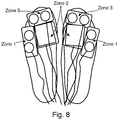
- FIG. 8 shows instrumented shoe inserts for detecting the force between a user's feet and the ground.
- FIGS. 9A and 9B show the scaled readings of the sensors of FIG. 8 when used by two different people.
- FIG. 10 shows a graph of the output of the sensors of FIG. 8 over the course of two strides.
- FIG. 11 shows a graph of the force applied by the device of FIG. 1 over the course of two strides.
- FIGS. 12A, 12B, and 12C and 13A, 13B, and 13C show the sensor readings, force applied, and motor position, respectively, for the sensors of FIG. 8 and the device of FIG. 1 , over several strides.
- the shaft of the actuator moves, it applies a force between the top of the user's shin and the end of their foot, thus applying a torque to the ankle.
- the amount of applied force is measured by the load cell 108 , which may be a strain gauge or any other appropriate force sensor.
- the actuator 100 is driven by a rotary motor 110 located at the side of the base housing, and driving a screw 112 in the base housing to extend and retract the shaft.
- Other drive mechanisms could be used, such as a direct screw drive, a linear motor, a cable drive, or smart or active textiles, to give a few examples.
- the actuator applies force between the shin and the shoe below the region of the foot where the toes begin, i.e., around the distal end of the metatarsal bones of the foot.
- the shin guard distributes the force over the leg, so that the applied force is not confined to the points of attachment.
- FIGS. 3A, 3B, and 3C show the actuator in use at three different positions, and from slightly different angles.
- FIG. 3A views the apparatus from the front, with the leg extended towards the viewer.
- FIG. 3B views the apparatus from the side, with the foot nearly flat and the leg leaning slightly forward.
- FIG. 3C views the apparatus from the side and rear, with the heel raised as if about to lift off.
- FIG. 4 shows a block diagram of the apparatus in use, i.e., attached to a leg and foot, and the control loop that is implemented to control it.
- the anatomy is on the right side, with the leg 302 , ankle 304 , and foot 306 , ending in the shoe 202 and ground 308 .
- There are force sensors 310 discussed below, below the foot and above the bottom surface of the shoe.
- the actuator 104 (labelled “motor”) connects the leg to the shoe, through a load cell 108 that measures the force applied by the actuator.
- the thick arrows identify forces: the motor and ankle both apply force upward against the leg. The motor applies force downward through the load cell and to the shoe; the ankle applies force downward through the foot and force sensors.
- the shoe applies force downward against the ground. During toe-lift, the forces are reversed to lift the toe off the ground. Only applied forces are shown—the opposite reaction forces are of course also present.
- the control loop 312 considers the output of the force sensors 310 and sends a force command to the actuator 104 .
- a feedback loop between the load cell 108 and the actuator 104 is used to implement the force called for based on the sensor output. The derivation of the force command from the sensor output is detailed below.
- FIG. 5 shows the various stages of a normal human walking gait; the dashed line is the left leg, farther from the viewer.
- the stages of the gait or stride are:
- FIG. 6 shows the torque at the ankle, in a typical person, at points (a) through (e), over the course of one stride, no torque being applied during (f) swing.
- the torque dips below zero (indicating lifting the foot) at (b), then rises (pressing the foot down) through (c) to (d), then drops rapidly back to near zero at (e) as the foot is lifted.
- FIG. 7 shows where, on the plantar surface of the foot, the force between foot and ground is highest during a typical stride. The force begins at the heel, sweeps from the outer (lateral) side of the rear of the foot to the inner (medial) side of the ball of the foot (first metatarsophalangeal joint), and through the large toe.
- the applicants have determined that to properly synchronize the force applied by the actuator with the user's natural gait, it is the later stages of the stride that need to be detected, and that this can be accomplished using sensors in three regions, as shown in FIG. 8 .
- the sensors are arranged in three zones: zone 1 , at the lateral side of the front of the foot, approximately detects the mid-stance transition from the back of the foot to the front.
- Zone 2 under the medial metatarsophalangeal joints, approximately detects the forefoot loading.
- Zone 3 under the toes (and, in particular, the large and second or third toes), approximately detects toe-off, the end of the stride cycle.
- Other arrangements of sensors will work, as long as multiple points are used to detect the continuous motion through the relevant portion of the stride.
- FIGS. 9A and 9B show the scaled output of these three sensor zones across three strides of two different users. These graphs show that while a given user has a similar force profile across strides, different users have very different force profiles from each other.
- the three sensor zones are each weighted, according to a user-specific weighting, so that their sum approximates the shape of the torque profile shown in FIG. 6 .
- the weighting is a simple matter of curve-fitting, that is, finding the weights for each of the three curves that causes their sum to fit the target profile of FIG. 6 .
- the output of the weighting is shown in FIG. 10 , with the upper curve showing the raw values and the weighted sum of the three zone sensor outputs. This weighted sum is used to provide the force command to the actuator, which then results in the torque shown in FIG. 11 being applied to the foot. As this torque matches the torque naturally applied by the ankle, the result is that the foot puts out less fore, and the ankle experiences less torque, as shown in the remaining figures.
- the actuator applies a negative force, helping lift the toe. This addresses a common problem, where a fatigued person does not sufficiently lift their toe, and is more prone to tripping.
- FIGS. 12A, 12B, and 12C show the raw sensor readings and weighted sum, applied force, and motor position across ten strides, when the actuator is switched on after five strides (see FIG. 12B ). It can be clearly observed that the forces applied to the foot decreases once the actuator is activated. It can also be observed that the range of the motor position—the amount of total flexion of the foot—also decreases when the actuator is in use.
- FIGS. 13A, 13B, and 13C show the opposite effects when the actuator is turned off—force and travel both increase. This shows that applying torque to the ankle based on the weighted sum of the three sensor zones results in less force and less extension of the ankle than when the system is not aiding the user.
- the control loop is able to accommodate variations in user's gait, such as varying speed or changing inclines.
- Another benefit of using the weighted sum of the sensor outputs is that because it is proportional only to the foot reaction force, it is able to provide assistance to other ankle-based activities, such as standing on tip toes, jumping, or running. Test subjects report that walking with the actuator engaged feels natural and is less fatiguing than normal walking, and the effect is particularly felt when walking up inclines. As a result, a given user is potentially able to walk farther, or faster, or to be less fatigued after a given walk, than without the apparatus.
- a control loop can control one or more actuators that apply external force complementing that motion and properly timed application of force to assist, in a manner that feels natural to the user.
- the benefits are similar—allowing the user to perform given motions longer or with less fatigue, or to enhance their ability, such as how much they can lift without injury.
- Another application of this technology is in physical education.
- An instructor can wear the sensors alone, while a student wears both the sensors and the actuator. As the student attempts to mimic the instructor, the weighted sums of the sensor readings are compared, and the student's actuator is used to guide the student to matching the motion of the instructor.
- Embodiments of the systems and methods described above comprise computer components and computer-implemented steps that will be apparent to those skilled in the art.
- the computer-implemented steps may be stored as computer-executable instructions on a computer-readable medium such as, for example, hard disks, optical disks, solid-state disks, flash ROMS, nonvolatile ROM, and RAM.
- the computer-executable instructions may be executed on a variety of processors such as, for example, microprocessors, digital signal processors, gate arrays, etc.
Landscapes
- Engineering & Computer Science (AREA)
- Health & Medical Sciences (AREA)
- Business, Economics & Management (AREA)
- Physics & Mathematics (AREA)
- General Physics & Mathematics (AREA)
- General Health & Medical Sciences (AREA)
- Educational Administration (AREA)
- Educational Technology (AREA)
- Theoretical Computer Science (AREA)
- Animal Behavior & Ethology (AREA)
- Pain & Pain Management (AREA)
- Physical Education & Sports Medicine (AREA)
- Rehabilitation Therapy (AREA)
- Life Sciences & Earth Sciences (AREA)
- Epidemiology (AREA)
- Public Health (AREA)
- Veterinary Medicine (AREA)
- Entrepreneurship & Innovation (AREA)
- Chemical & Material Sciences (AREA)
- Medical Informatics (AREA)
- Medicinal Chemistry (AREA)
- Algebra (AREA)
- Computational Mathematics (AREA)
- Mathematical Analysis (AREA)
- Mathematical Optimization (AREA)
- Mathematical Physics (AREA)
- Pure & Applied Mathematics (AREA)
- Orthopedic Medicine & Surgery (AREA)
- Rehabilitation Tools (AREA)
Abstract
Description
Claims (12)
Priority Applications (1)
| Application Number | Priority Date | Filing Date | Title |
|---|---|---|---|
| US16/040,283 US11045381B2 (en) | 2017-07-20 | 2018-07-19 | Augmenting human motion |
Applications Claiming Priority (2)
| Application Number | Priority Date | Filing Date | Title |
|---|---|---|---|
| US201762535202P | 2017-07-20 | 2017-07-20 | |
| US16/040,283 US11045381B2 (en) | 2017-07-20 | 2018-07-19 | Augmenting human motion |
Publications (2)
| Publication Number | Publication Date |
|---|---|
| US20190021934A1 US20190021934A1 (en) | 2019-01-24 |
| US11045381B2 true US11045381B2 (en) | 2021-06-29 |
Family
ID=65014602
Family Applications (1)
| Application Number | Title | Priority Date | Filing Date |
|---|---|---|---|
| US16/040,283 Expired - Fee Related US11045381B2 (en) | 2017-07-20 | 2018-07-19 | Augmenting human motion |
Country Status (1)
| Country | Link |
|---|---|
| US (1) | US11045381B2 (en) |
Cited By (1)
| Publication number | Priority date | Publication date | Assignee | Title |
|---|---|---|---|---|
| EP3970681A1 (en) * | 2021-07-05 | 2022-03-23 | Polibrixia S.r.l. | Motor rehabilitation machine |
Families Citing this family (1)
| Publication number | Priority date | Publication date | Assignee | Title |
|---|---|---|---|---|
| CN118707845B (en) * | 2024-05-09 | 2025-09-30 | 复旦大学 | A tactile-based robot foot ground compliance control method and control system |
Citations (3)
| Publication number | Priority date | Publication date | Assignee | Title |
|---|---|---|---|---|
| US20100121232A1 (en) * | 2007-08-20 | 2010-05-13 | University Of Tsukuba | Motion-assist system of wearable motion-assist device, wearable motion-assist device, and motion-assist method of wearable motion-assist device |
| US20100262044A1 (en) * | 2006-06-30 | 2010-10-14 | Drexel University | Orthosis and method of use for treatment and rehabilitation of dropfoot |
| US20180055711A1 (en) * | 2016-08-26 | 2018-03-01 | Samsung Electronics Co., Ltd. | Motion assistance apparatus |
-
2018
- 2018-07-19 US US16/040,283 patent/US11045381B2/en not_active Expired - Fee Related
Patent Citations (3)
| Publication number | Priority date | Publication date | Assignee | Title |
|---|---|---|---|---|
| US20100262044A1 (en) * | 2006-06-30 | 2010-10-14 | Drexel University | Orthosis and method of use for treatment and rehabilitation of dropfoot |
| US20100121232A1 (en) * | 2007-08-20 | 2010-05-13 | University Of Tsukuba | Motion-assist system of wearable motion-assist device, wearable motion-assist device, and motion-assist method of wearable motion-assist device |
| US20180055711A1 (en) * | 2016-08-26 | 2018-03-01 | Samsung Electronics Co., Ltd. | Motion assistance apparatus |
Cited By (1)
| Publication number | Priority date | Publication date | Assignee | Title |
|---|---|---|---|---|
| EP3970681A1 (en) * | 2021-07-05 | 2022-03-23 | Polibrixia S.r.l. | Motor rehabilitation machine |
Also Published As
| Publication number | Publication date |
|---|---|
| US20190021934A1 (en) | 2019-01-24 |
Similar Documents
| Publication | Publication Date | Title |
|---|---|---|
| US5507106A (en) | Exercise shoe with forward and rearward angled sections | |
| CN109195565B (en) | walking motion aids | |
| CN109068796B (en) | Footwear with tapered heel, support plate and method of measuring impact point | |
| US20170056275A1 (en) | Recognition method of human walking speed intention from surface electromyogram signals of plantar flexor and walking speed control method of a lower-limb exoskeleton robot | |
| US10678209B2 (en) | Adjustable height sole | |
| US9364383B2 (en) | Swing walker | |
| KR20200072880A (en) | Method and device for assisting walking | |
| WO2017045018A1 (en) | Item of footwear | |
| Prochazkova et al. | Analysis of foot load during ballet dancers’ gait | |
| CN102123622B (en) | Shoe sole for a diet and shoe comprising the same | |
| KR20110083782A (en) | Walking Assist Clan | |
| US20190021934A1 (en) | Augmenting Human Motion | |
| Lu et al. | Comparison of body’s center of mass motion relative to center of pressure between treadmill and over-ground walking | |
| KR102330974B1 (en) | Metatarsophalangeal Joint Assistance Apparatus. | |
| CN117396100A (en) | Posture Correction and Kegel Exercise Devices | |
| JP6595965B2 (en) | Walking support orthosis | |
| JP7789382B2 (en) | Insole presentation system and insole presentation method | |
| KR101991667B1 (en) | Cuff for rehabilitation robots and rehabilitation apparatus | |
| US4674201A (en) | Foot support | |
| KR101032640B1 (en) | Leg alignment and diet shoes with eccentric weight sole | |
| CN110215011A (en) | Correcting function is splayfooted to imitate barefoot shoes | |
| KR102919106B1 (en) | Method for generating walking practice pattern and apparatus for walking practice | |
| JP2015136378A (en) | Walking aid and shoes equipped with the same | |
| US20250228688A1 (en) | Tuning kit and related method for tuning ankle foot orthosis | |
| KR101138716B1 (en) | Soles for Increasing Energy Consumption and Shoes Therefor |
Legal Events
| Date | Code | Title | Description |
|---|---|---|---|
| FEPP | Fee payment procedure |
Free format text: ENTITY STATUS SET TO UNDISCOUNTED (ORIGINAL EVENT CODE: BIG.); ENTITY STATUS OF PATENT OWNER: LARGE ENTITY |
|
| STPP | Information on status: patent application and granting procedure in general |
Free format text: APPLICATION DISPATCHED FROM PREEXAM, NOT YET DOCKETED |
|
| AS | Assignment |
Owner name: BOSE CORPORATION, MASSACHUSETTS Free format text: ASSIGNMENT OF ASSIGNORS INTEREST;ASSIGNORS:DALEY, MICHAEL J.;SUN, ZHEN;KUUSISTO, ANDREW J.;SIGNING DATES FROM 20170719 TO 20181205;REEL/FRAME:048791/0164 |
|
| STPP | Information on status: patent application and granting procedure in general |
Free format text: DOCKETED NEW CASE - READY FOR EXAMINATION |
|
| STPP | Information on status: patent application and granting procedure in general |
Free format text: RESPONSE TO NON-FINAL OFFICE ACTION ENTERED AND FORWARDED TO EXAMINER |
|
| STPP | Information on status: patent application and granting procedure in general |
Free format text: NOTICE OF ALLOWANCE MAILED -- APPLICATION RECEIVED IN OFFICE OF PUBLICATIONS |
|
| STPP | Information on status: patent application and granting procedure in general |
Free format text: PUBLICATIONS -- ISSUE FEE PAYMENT RECEIVED |
|
| STPP | Information on status: patent application and granting procedure in general |
Free format text: PUBLICATIONS -- ISSUE FEE PAYMENT VERIFIED |
|
| STCF | Information on status: patent grant |
Free format text: PATENTED CASE |
|
| FEPP | Fee payment procedure |
Free format text: MAINTENANCE FEE REMINDER MAILED (ORIGINAL EVENT CODE: REM.); ENTITY STATUS OF PATENT OWNER: LARGE ENTITY |
|
| LAPS | Lapse for failure to pay maintenance fees |
Free format text: PATENT EXPIRED FOR FAILURE TO PAY MAINTENANCE FEES (ORIGINAL EVENT CODE: EXP.); ENTITY STATUS OF PATENT OWNER: LARGE ENTITY |
|
| STCH | Information on status: patent discontinuation |
Free format text: PATENT EXPIRED DUE TO NONPAYMENT OF MAINTENANCE FEES UNDER 37 CFR 1.362 |
|
| FP | Lapsed due to failure to pay maintenance fee |
Effective date: 20250629 |