US11042467B2 - Automated searching and identification of software patches - Google Patents
Automated searching and identification of software patches Download PDFInfo
- Publication number
- US11042467B2 US11042467B2 US16/550,069 US201916550069A US11042467B2 US 11042467 B2 US11042467 B2 US 11042467B2 US 201916550069 A US201916550069 A US 201916550069A US 11042467 B2 US11042467 B2 US 11042467B2
- Authority
- US
- United States
- Prior art keywords
- abstract
- tree
- node
- violation
- tree representation
- Prior art date
- Legal status (The legal status is an assumption and is not a legal conclusion. Google has not performed a legal analysis and makes no representation as to the accuracy of the status listed.)
- Expired - Fee Related, expires
Links
Images




Classifications
-
- G—PHYSICS
- G06—COMPUTING OR CALCULATING; COUNTING
- G06F—ELECTRIC DIGITAL DATA PROCESSING
- G06F11/00—Error detection; Error correction; Monitoring
- G06F11/36—Prevention of errors by analysis, debugging or testing of software
- G06F11/362—Debugging of software
-
- G—PHYSICS
- G06—COMPUTING OR CALCULATING; COUNTING
- G06F—ELECTRIC DIGITAL DATA PROCESSING
- G06F16/00—Information retrieval; Database structures therefor; File system structures therefor
- G06F16/90—Details of database functions independent of the retrieved data types
- G06F16/95—Retrieval from the web
- G06F16/953—Querying, e.g. by the use of web search engines
-
- G—PHYSICS
- G06—COMPUTING OR CALCULATING; COUNTING
- G06F—ELECTRIC DIGITAL DATA PROCESSING
- G06F21/00—Security arrangements for protecting computers, components thereof, programs or data against unauthorised activity
- G06F21/50—Monitoring users, programs or devices to maintain the integrity of platforms, e.g. of processors, firmware or operating systems
- G06F21/57—Certifying or maintaining trusted computer platforms, e.g. secure boots or power-downs, version controls, system software checks, secure updates or assessing vulnerabilities
-
- G—PHYSICS
- G06—COMPUTING OR CALCULATING; COUNTING
- G06F—ELECTRIC DIGITAL DATA PROCESSING
- G06F8/00—Arrangements for software engineering
- G06F8/40—Transformation of program code
- G06F8/41—Compilation
- G06F8/42—Syntactic analysis
- G06F8/427—Parsing
Definitions
- the embodiments discussed in the present disclosure are related to automated searching and identification of software patches.
- a method may include obtaining a first violation in a first software program.
- the method may include identifying one or more characteristics of the first violation.
- the method may further include searching at least one website to identify a set of posts on the at least one website. Each post of the set of posts may be identified based on each post including content with respect to one or more other violations of other software programs that have at least one of the one or more characteristics of the first violation.
- the method may also include obtaining, as a first context, a first portion of the first software program that includes the first violation.
- the method may further include obtaining a set of second contexts, each second context of the set of second contexts corresponding to a different post of the set of posts.
- Each second context may include a respective portion of a corresponding one or the other software program that includes a corresponding other violation.
- the method may also include obtaining a first abstract syntax tree of the first context, the method may further include obtaining a set of second abstract syntax trees. Each second abstract syntax tree of the set of second abstract syntax trees may correspond to a different second context of the set of second contexts.
- the method may also include modifying the first abstract syntax tree to obtain a first abstract tree representation of the first context by simplifying and abstracting the first abstract syntax tree.
- the method may further include modifying each second abstract syntax tree of the set of second abstract syntax trees to obtain a set of second abstract tree representations by simplifying and abstracting each second abstract syntax tree.
- the method may also include determining a set of similarity scores.
- Each similarity score of the set of similarity scores may be determined by comparing the first abstract tree representation with a corresponding one of the second abstract tree representation of the set of second abstract tree representations.
- the method may also include selecting a particular post of the set of posts based on the similarity score between the first abstract tree representation and a particular second abstract tree representation of the set of second abstract tree representations associated with a particular second context, the particular second context associated with a particular portion of a particular software program and a particular violation of the particular post.
- FIG. 1 is a diagram representing an example environment related to automated searching and identification of software patches
- FIG. 2 is a flowchart of an example method of automated searching and identification of software patches
- FIGS. 3A-3F illustrate a comparison of the similarity of software programs
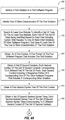
- FIGS. 4A and 4B are a flowchart of an example method of automated searching and identification of software patches
- FIG. 5 is a flowchart of an example method of a coarse search
- FIG. 6 is a flowchart of an example method of a fine search
- FIG. 7 is a flowchart of an example method of determining a similarity score.
- FIG. 8 illustrates an example computing system that may be configured to automatically search and identify software patches.
- Some embodiments described in the present disclosure relate to methods and systems of automatic searching and identification of software patches.
- Software programs often include errors (also commonly referred to as “bugs” or “violations”) that may cause the software program to behave in an unintended manner. Additionally, various systems and techniques are often used to search and identify software patches to repair software programs.
- a user may encounter one or more violations when writing the software program.
- the user may consult programming books, may look at guides on the internet, and may search online discussion forums for related discussions or posts that might provide assistance in resolving the violation.
- the user's attempt to rectify the violation may be inefficient. For example, the user may not entirely grasp what the violation is and/or why the violation is showing up in the user's code. So, the user may seek to find solutions to a different problem than what the user is actually facing.
- the user may be unable to determine whether potential solutions to the violation that the user may find are relevant to the user's problem, i.e., the user may be unable to determine whether the potential patches the user finds are solutions to a violation that is similar to the violation the user has encountered.
- the user may then wade through these potential solutions without fully understanding which may be the most beneficial. This task may be made more difficult by the user's difficulty in particularly articulating the exact source of the violation and in identifying a suitable solution from the myriad possible solutions that result from the search.
- the technological field of software development may be improved by configuring a computer system in a manner in which the computing system is able to identify violations in a software program and identify other software programs as similar to the software program.
- the computer system may automatically perform repair operations after identifying a patch for the violations.
- the computer system may display an identified software program and a user may perform repair operations based on the identified software program and/or a patch associated with the identified software program.
- the computing system may be configured to identify a violation in a software program. The computing system may then identify characteristics of the violation and perform a search of one or more websites to generate a set of posts on the websites that are related to the violation and its characteristics.
- the computing system may then determine the similarity between code snippets in each post of the set of posts and the software program that has the violation and may select the post that has the code snippet with the highest similarity to the software program.
- the computing system may then present the post that has the highest similarity on a display so that a user may perform repair operations on the software program based on the selected post.
- the system may facilitate the development of software programming by finding particular patches for violations in a software program in a particular manner.
- the system may find particular patches that may be more suitable for and more relevant to a user's code than a user could find on his or her own. Additionally, the system may find patches more quickly than a user. The improved relevancy of the patches may help remediate software violations. Speed of identification of potential patches to remediate a software violation may help facilitate the development and testing of source code.
- a user may more efficiently develop code by focusing on writing the code instead of bug-fixing, which may often occupy a large fraction of a user's time.
- the system may identify more accurate and/or more relevant patches for the software program than a user may identify.
- the identification of more accurate and/or more relevant patches may help a user write more efficient code or code that operates in a manner intended by a user.
- the improved identification of patches for a software program may thus facilitate the correction of the violation and consequently may help improve the particular source code.
- FIG. 1 is a diagram representing an example environment 100 related to automated searching and identification of software patches, arranged in accordance with at least one embodiment described in the present disclosure.
- the environment 100 may include a network 110 , a device 120 , and a website 130 .
- the network 110 may include any communication network configured for communication of signals between any of the components (e.g., the device 120 and the website 130 ) of the environment 100 .
- the network 110 may be wired or wireless.
- the network 110 may have numerous configurations including a star configuration, a token ring configuration, or another suitable configuration.
- the network 110 may include a local area network (LAN), a wide area network (WAN) (e.g., the Internet), and/or other interconnected data paths across which multiple devices may communicate.
- the network 110 may include a peer-to-peer network.
- the network 110 may also be coupled to or include portions of a telecommunications network that may enable communication of data in a variety of different communication protocols.
- the network 110 includes or is configured to include a BLUETOOTH® communication network, a Z-Wave® communication network, an Insteon® communication network, an EnOcean® communication network, a wireless fidelity (Wi-Fi) communication network, a ZigBee communication network, a HomePlug communication network, a Power-line Communication network, a message queue telemetry transport (MQTT) communication network, a MQTT-sensor (MQTT-S) communication network, a constrained application protocol (CoAP) communication network, a representative state transfer application protocol interface (REST API) communication network, an extensible messaging and presence protocol (XMPP) communication network, a cellular communications network, any similar communication networks, or any combination thereof for sending and receiving data.
- a BLUETOOTH® communication network a Z-Wave® communication network, an Insteon® communication network, an EnOcean® communication network, a wireless fidelity (Wi-Fi) communication network, a ZigBee communication network, a HomePlug
- the data communicated in the network 110 may include data communicated via short messaging service (SMS), multimedia messaging service (MMS), hypertext transfer protocol (HTTP), direct data connection, wireless application protocol (WAP), e-mail, smart energy profile (SEP), ECHONET Lite, OpenADR, or any other protocol that may be implemented with the device 120 , the website 130 , a cloud server communication, or a gateway.
- SMS short messaging service
- MMS multimedia messaging service
- HTTP hypertext transfer protocol
- WAP wireless application protocol
- SEP smart energy profile
- OpenADR OpenADR
- the device 120 may include a computer-based hardware device that includes a processor, memory, and communication capabilities.
- the device 120 may be coupled to the network 110 to communicate data with any of the other components of the environment 100 .
- Some examples of the device 120 may include a mobile phone, a smartphone, a tablet computer, a laptop computer, a desktop computer, a set-top box, a virtual-reality device, or a connected device, etc.
- the device 120 may include a processor-based computing device.
- the device 120 may include a hardware server or another processor-based computing device configured to function as a server.
- the device 120 may include memory and network communication capabilities.
- the device 120 may include a computing system such as described below with respect to FIG. 8 .
- the device 120 may include a software program 122 .
- the software program 122 may include source code written in any programming language such as, for example, C++, C, assembly, C#, Java, BASIC, JavaScript, Python, and SQL, among others.
- the software program 122 may include multiple methods.
- a method may be a discrete sub-program inside the software program 122 which may be independently executable and/or distinct.
- a method may be a sub-unit of the software program 122 .
- the software program 122 may be designed for a particular purpose and/or to achieve a particular goal.
- the software program 122 may include a violation 124 . While a single violation 124 is depicted in FIG. 1 , the software program 122 may include any number of violations 124 .
- the violations 124 may include compilation errors, run-time errors, logic errors, and/or other errors that may be identified by any suitable methodology.
- the violation 124 may include a syntax error that may be detected by a compiler prior to execution of a program based on the software program 122 . For example, punctuation marks may be missing in the software program 122 and/or a variable may be used without being declared.
- the violation 124 may include a run-time error.
- the software program 122 may compile without any errors but errors may be encountered when attempting to execute the compiled software program 122 .
- the software program 122 may include division by zero or an attempt to access an element of an array that does not exist.
- the violation 124 may include a logic errors.
- the software program 122 may compile without any errors and no errors may be encountered when attempting to execute the compiled software program 122 .
- the software program 122 may not function as anticipated by an author or designer of the software program 122 .
- the violation 124 may include different characteristics.
- the violation 124 may include a name of the violation 124 .
- the violation 124 may include a description of the violation 124 .
- the description of the violation 124 may include a type of the violation 124 .
- the violation 124 may include a programming language.
- the programming language may of the violation 124 may be the same as the programming language of the software program 122 .
- the violation 124 may include a run-time exception.
- the name of the run-time exception may be “java.lang.ArraylndexOutOfBoundsException.”
- the description of the exception may be “Index 10 out of bounds for length 10.”
- the type for the exception may be an out-of-bounds exception.
- the programming language for the exception may be the Java programming language.
- the website 130 may include any applicable website on the Internet. Alternatively or additionally, in some embodiments the website 130 may include an internal repository or resource, such as a collection of documents on an internal intranet site. For example, in some embodiments, the website 130 may include a discussion forum where users may post questions and other users may post answers. For example, one user may post a question in the form of a software program that includes a violation and another user may post an answer or patch to the question in the form of a corrected software program that no longer includes the violation. In these and other embodiments, multiple users may post answers to the question and/or one user may post multiple answers. In some embodiments, the user who posted the question may select one answer as resolving the violation the user experienced.
- an internal repository or resource such as a collection of documents on an internal intranet site.
- the website 130 may include a discussion forum where users may post questions and other users may post answers. For example, one user may post a question in the form of a software program that includes a violation and another user may post an answer or patch to
- users of the website 130 may vote on different answers posted by users. While FIG. 1 depicts a single website 130 , in some embodiments there may be multiple websites 130 . In some embodiments, the website 130 may include multiple pages or multiple posts, such as the post 140 A, the post 140 B, the post 140 C, and the post 140 D (collectively the posts 140 ). While the website 130 is depicted with four posts 140 , in some embodiments, the website 130 may include hundreds of posts 140 , thousands of posts 140 , hundreds of thousands of posts 140 , or any number of posts 140 .
- the posts 140 are depicted as being associated with a single website 130 , in some embodiments, some of the posts 140 may be associated with a first website and other posts 140 may be associated with a second website.
- the post 140 A and the post 140 B may be associated with the website 130 while the post 140 C and the post 140 D may be associated with a different website.
- the posts 140 may each be associated with different software programs.
- the post 140 A may relate to a software program 142 A
- the post 140 B may relate to a software program 142 B
- the post 140 C may relate to a software program 142 C
- the post 140 D may relate to a software program 142 D (collectively, the software programs 142 ).
- reference to the software programs 142 may include references to lines of code of software programs.
- the software program 142 A may include multiple lines of a larger software program and may not include every line in the larger software program.
- the software programs 142 may be the lines of code in larger software programs that include violations.
- references to the software programs 142 is not limited to entire programs.
- the software programs 142 may each differ from each other and may differ from the software program 122 .
- the software programs 142 may each have a different purpose, have a different author, be written in a different programming language, or include different violations than the software program 122 .
- the software programs 142 may be associated with different questions.
- a user of the website 130 may create the post 140 A on the website 130 .
- the user may add a software program 142 A and may ask a question associated with the software program 142 A.
- the user may have experienced a violation while writing the software program 142 A.
- the user may post the software program 142 A to the website 130 as part of the post 140 A.
- the user may write a question to ask other users of the website 130 how the user may remediate the violation and/or ask other users what is causing the violation in the software program 142 A.
- the software program 142 A may include a violation 144 A
- the software program 142 B may include a violation 144 B
- the software program 142 C may include a violation 144 C
- the software program 142 D may include a violation 144 D (collectively the violations 144 ).
- each of the violations 144 may be different violations from each other.
- the violation 144 A may be a run-time error
- the violation 144 B may be a logic error
- the violation 144 C may be a compilation error
- the violation 144 D may be a run-time error distinct from the violation 144 A.
- one or more of the violations 144 may be the same violation, may be related violations, and/or may be similar violations.
- the violation 144 A may be an index out of bounds violation in the C++ programming language while the violation 144 C may be an index out of bounds violation in the Java programming language.
- the violation 144 A and the violation 144 C may be similar violations.
- violations 144 may be determined to be similar violations even if the violations are manifested and/or handled differently in different environments. For example, an array index out of bounds access may be manifested and handled differently during runtime in a C++ environment verses a Java environment, even though the root cause of the behavior may be the same, i.e. attempting to access an array out of its prescribed bound of indices.
- one or more of the posts 140 may include a patch.
- the post 140 A may include a patch 146 A
- the post 140 B may include a patch 146 B
- the post 140 C may include a patch 146 C (collectively the patches 146 ).
- one or more posts 140 may not include an associated patch 146 .
- the post 140 D may not include a patch.
- the patches 146 may represent a method to remediate the corresponding violations 144 , i.e. the patch 146 A may remediate the violation 144 A such that, after applying the patch 146 A to the software program 142 A, the software program 142 A no longer has the violation 144 A.
- the patches 146 may include source code that may be applied to a source of the violations 144 in the software programs 142 .
- one or more of the posts 140 may include multiple patches 146 .
- the post 140 B may include multiple patches 146 B.
- different users of the website 130 may rank or vote for different patches 146 B, such that one patch 146 B may receive the most positive votes.
- one of the patches 146 B may be selected as the chosen patch 146 B by the user who created the post 140 B based on the chosen patch solving that user's problem.
- the posts 140 may include questions.
- the software programs 142 may be integrated into a question posted by a user of the website 130 .
- a first user may have written the software program 142 A and have encountered the violation 144 A.
- the first user may then create a post 140 A on the website 130 including the software program 142 A, the violation 144 A and details of the violation 144 A, and a request for others to help resolve the violation 144 A.
- the patch 146 A may represent an answer to the first user's question.
- a second user may add a patch 146 A as an answer to the question in the post 140 A.
- a description of the operation of environment 100 follows.
- a user may write a software program 122 using the device 120 . While writing the software program 122 or while testing the software program 122 , the user may receive a notification of a violation 122 .
- the device 120 may then perform a search of a website 130 using a search query based on characteristics of the violation 124 such as a name of the violation 124 , a type of the violation 124 , and/or a programming language associated with the software program 122 and/or the violation 124 .
- the search query may include tags to indicate whether the search should include unanswered posts 140 , answered posts 140 , or both unanswered and answered posts 140 .
- the search of the website 130 using the search query may return a set of posts 140 .
- the search of the website 130 may be based on characteristics of the violation 124 and may return posts 140 that include violations 144 that are similar to the violation 124 .
- the website 130 may include four posts 140 .
- the search of the website 130 using the search query may return the post 140 A and the post 140 C because the violation 144 A and the violation 144 C are similar to the violation 124 .
- the search of the website 130 may not return the post 140 B because the violation 144 B may not be similar to the violation 124 .
- the search of the website 130 may not return the post 140 D because the post 140 D does not include a patch.
- the device 120 may be configured to determine which violations are similar and which are not similar according to one or more operations described below with respect to FIGS. 2 and 5 .
- the device 120 may then determine a similarity between the software program 122 and the software program 142 A and a similarity between the software program 122 and the software program 142 C.
- the device 120 may extract a method from the software program 122 .
- the method may include the source code that is associated with the violation 124 .
- the software program 122 may include hundreds of lines of code, thousands of lines of code, millions of lines of code, or any number of lines of code.
- the violation 124 may be associated with a method in the software program 122 and the method may include fewer lines of code than the entirety of the software program 122 .
- the device may determine a similarity between the method of the software program 122 and the software program 142 A and a similarity between the software program 122 and the software program 142 C.
- the device 120 may determine the similarity between the software program 122 and one or more software programs 142 by comparing abstract tree representations of the software program 122 and/or a portion of the software program 122 with an abstract tree representation based on the software programs 142 and the patches 146 . For example, as discussed below with reference to FIG. 7 , a pattern may be extracted based on the software program 142 A and one or more patches 146 A. For example, the device 120 may select one or more nodes in an abstract tree representation of the software program 142 A based on corresponding nodes in abstract tree representations in one or more patches 146 A.
- the device 120 may determine the similarity between the software program 122 and one or more software programs 142 using semantic and/or syntactic code clone detection. For example, the device 120 may compare the software program 122 with one or more of the software programs 142 using a different semantic code clone detection algorithm that that described above to determine the degree to which the software program 122 and one or more of the software programs 142 perform the same function or are doing the same or similar things. In this regard, the device 120 may compare the constructs and structure of the source code for the software program 122 and the one or more of the software programs 142 .
- the device 120 may compare the software program 122 with one or more of the software programs 142 to determine a similarity using syntactic code clone detection.
- the device 120 may obtain a syntax tree for the software program 122 and may obtain syntax trees for the software programs 142 and may compare the syntax trees to determine a similarity.
- the device 120 may then select the post 140 associated with the software program 142 with the highest similarity to the software program 122 .
- the software program 142 C may be determined to be the most similar to the software program 122 .
- the device 120 may be configured to determine the similarity between the software programs 142 and the software program 122 according to one or more operations described below with respect to FIG. 7 .
- the device 120 may select the post 140 C.
- the device 120 may then display a patch based on the patch 146 C to a user of the device 120 to allow the user of the device 120 to implement the patch 146 C on the software program 122 .
- the device 120 and/or the user may perform repair operations on the software program 122 based on the post 140 C, such as, for example, repair operations based on the patch 146 C.
- the environment 100 may include more or fewer elements than those illustrated and described in the present disclosure.
- the software program 122 may be created and edited using a device different from the device 120 .
- the user may use one device to create and/or edit the software program 122 and the device 120 may perform a search of the website 130 and identify posts 140 based on the violation 124 .
- the device 120 and the operations discussed relative to the device 120 may be distributed across different systems.
- the environment 100 may include the network 110 and one or more devices including the device 120 and the website 130 , which may be communicatively coupled via the network 110 .
- FIG. 2 is a flowchart of an example method 200 of automated searching and identification of software patches.
- one or more operations of the method 200 may be performed by a computing system or a device.
- a device such as the device 120 of FIG. 1 , may obtain violation characteristics 210 .
- the violation characteristics 210 may include a name of a violation, a type of a violation, a programming language of a violation, a location in source code of a violation, among other characteristics.
- a website with posts 220 may include posts associated with programming, with source code, with identifying and resolving violations in source code, etc.
- a device may search the website based on the characteristics 230 to obtain a set of posts 240 .
- the website may be selected based on the website including a repository of software programs and/or software programs with violations and patches.
- the website may include a variety of posts that include a software program with a violation. Some of the posts may also include patches which may be designed to remediate the violation in the software program.
- the website may include an internal code repository, an internet site with questions and answers, a message board, etc.
- the device may perform the search 230 by forming a search query using one or more characteristics of the violation characteristics 210 .
- the search query may include the name of the violation and the type of the violation.
- the search query may also include one or more tags such as a tag for answered questions and/or a tag for a programming language associated with the violation.
- a set of posts 240 may be identified.
- the set of posts may be identified based on each post in the set of posts including an answer to a question, the question in the posts including a code snippet with a violation with the same type and/or the same name as the violation characteristics 210 , and the code snippet in the post being written in the same programming language as the violation.
- the search 230 may be considered a coarse search.
- the device may then perform a similarity analysis 260 on the set of posts 240 and the software program with the violation 250 .
- the device may compare the software program with the violation 250 with code snippets from each post in the set of posts 240 .
- the similarity analysis may be performed by comparing abstract tree representations of the software program with the violation 250 with abstract tree representations based on each post of the set of posts as described below with respect to FIG. 7 .
- the similarity analysis may be performed using other forms of semantic and/or syntactic code clone detection.
- the device may generate a similarity score for each post of the set of posts 240 , the similarity score measuring a similarity between the code snippet of the post and the software program with the violation 250 .
- the device may generate a similarity score for a post of the set of posts 240 and a method in the software program, the method including the violation.
- a greater similarity score may be associated with a greater similarity between the code snippet of a post and the software program with the violation 250 .
- a lesser similarity score may be associated with a greater similarity between the code snippet of a post and the software program with the violation 250 .
- the device may select one post of the set of posts 240 based on the similarity score of the post.
- each post may have a numerical similarity score. For example, a first post may have a similarity score of 5.4. A second post may have a similarity score of 7.6. The second post may be selected because it has a higher similarity score than the first post.
- the selected post 270 may then be used to perform repair operations 280 with respect to repairing the violation using the selected post 270 .
- the repair operations 280 may include presenting the selected post 270 on a display such as, for example, a computer screen connected to the device. A developer of the software program 250 may then repair the software program 250 based on the selected post 270 .
- the repair operations 280 may include the device repairing the software program 250 based on the selected post 270 .
- the selected post 270 may include a patch for the violation.
- a user may have placed a question with the post on the website 220 .
- Another user may have posted an answer to the question to the post.
- the device may perform repair operations including presenting the answer in the selected post 270 as a guide for creating a patch for the violation in the software program 250 .
- FIGS. 3A-3F illustrate a comparison of the similarity of software programs.
- FIG. 3A includes a software program 310 .
- the software program 310 may represent the software program with a violation, such as the software program 122 of FIG. 1 and/or the software program with violation 250 of FIG. 2 .
- a device such as the device 120 of FIG. 1 , may compare different code snippets with the software program 310 .
- Each code snippet may be associated with a different post of a website, such as the website 130 of FIG. 1 and/or the website with posts 220 of FIG. 2 .
- the code snippet 320 of FIG. 3B may represent the software program 142 A and the code snippet 330 of FIG. 3C may represent the software program 142 B.
- the code snippet 320 of FIG. 3B and/or the code snippet 330 of FIG. 3C may include a portion of a software program 142 A and/or 142 B.
- the code snippet 320 of FIG. 3B and/or the code snippet 330 of FIG. 3C may be a selection of a corresponding software program 142 A and/or 142 B that may be obtained using a method similar to that described below with reference to blocks 710 through 745 of FIG. 7 .
- an abstract tree representation of the software program 142 A may be aligned with one or more abstract tree representations of patches 146 A and relevancy scores at overlapping nodes may be summed.
- Nodes of the abstract tree representation of the software program 142 A may be arranged in descending relevancy score order and a subset of the nodes may be extracted to generate the code snippet 320 of FIG. 3B .
- the device may use semantic and/or syntactic code clone detection. For example, the device may compare the variable declarations, loop constructs, variable names, variable types, branch construction, conditional statements, input and output statements, programming language, and other factors to determine whether the software program 310 of FIG. 3A is similar to the code snippet 320 of FIG. 3B and the code snippet 330 of FIG. 3C . Alternatively or additionally, in some embodiments, the device may perform the comparison to generate a similarity score. In some embodiments, the similarity scores may be determined according to one or more operations described below with respect to FIG. 7 .
- the device may determine a similarity score between the software program 310 of FIG. 3A and the code snippet 320 of FIG. 3B . In these and other embodiments, the device may also determine a similarity score between the software program 310 of FIG. 3A and the code snippet 330 of FIG. 3C . In some embodiments, the device may determine the similarity score between the software program 310 of FIG. 3A and the code snippet 320 of FIG. 3B and the similarity score between the software program 310 of FIG. 3A and the code snippet 330 of FIG. 3C by comparing abstract tree representations of the software program 310 , the code snippet 320 , and the code snippet 330 .
- FIG. 3D illustrates an abstract tree representation 350 of the software program 310 of FIG. 3A .
- the abstract tree representation 350 may be obtained from the software program 310 as described below relative to block 710 of FIG. 7 .
- the abstract tree representation 350 may include multiple nodes such as the node 355 A, the node 355 B, the node 355 C, the node 355 D, the node 355 E, the node 355 F, the node 355 G, and the node 355 H (collectively the nodes 355 ).
- the abstract tree representation of the software program 350 is depicted with eight nodes 355 , it may include any number of nodes 355 .
- the nodes 355 may be associated with one or more lines of code in the corresponding software program 310 . In some embodiments, multiple nodes 355 may be associated with a single line of code in the corresponding software program.
- Each of the nodes 355 in the abstract tree representation 350 may include a construct, a type, a variable, etc.
- the node 355 C may include the construct “loop” and may include the variable “$t1”).
- the node 355 B may include the construct “declare”, may include the type “Table”, and may include the variable “$v1”.
- FIG. 3E illustrates an abstract tree representation 360 of the code snippet 320 of FIG. 3B .
- the abstract tree representation 360 may be obtained as a pattern as described below relative to block 745 of FIG. 7 .
- the abstract tree representation 360 may include multiple nodes such as the node 365 A, the node 365 B, the node 365 C, the node 365 D, the node 365 E, the node 365 F, and the node 365 G (collectively the nodes 365 ).
- the abstract tree representation 360 is depicted with seven nodes 365 , it may include any number of nodes 365 .
- the nodes 365 may be associated with one or more lines of code in a corresponding software program.
- multiple nodes 365 may be associated with a single line of code in the corresponding software program. Similar to nodes 355 of the abstract tree representation 350 of FIG. 3D , each of the nodes 365 in the abstract tree representation 360 may include a construct, a type, a variable, etc.
- the abstract tree representation 360 may be compared to the abstract tree representation 350 of FIG. 3D .
- the abstract tree representation 350 of FIG. 3D and the abstract tree representation 360 of FIG. 3E may be aligned to determine an overlap.
- the alignment may be performed similar to that discussed below relative to block 725 of FIG. 7 .
- corresponding nodes of the two abstract tree representations may be determined. For example, node 355 A of FIG. 3D may correspond with node 365 A of FIG. 3E , node 355 B of FIG. 3D may correspond with node 365 B of FIG. 3E , node 355 C of FIG.
- node 3D may correspond with node 365 C of FIG. 3E
- node 355 D of FIG. 3D may correspond with node 365 F of FIG. 3E
- node 355 E of FIG. 3D may correspond with node 365 D of FIG. 3E
- node 355 F of FIG. 3D may correspond with node 365 E of FIG. 3E
- node 355 G of FIG. 3D may correspond with node 365 G of FIG. 3E .
- Node 355 H of FIG. 3D may not have a corresponding node in FIG. 3E .
- a similarity score may be computed based on multiple factors. For example, the similarity score may be based on construct similarity, type similarity, and variable-use relationship similarity. In some embodiments, the similarity score may be computed according to one or more operations described below with respect to FIG. 7 .
- the node 355 B of FIG. 3D and the node 365 B of FIG. 3E may exhibit construct similarity because both nodes include the construct “declare”, the node 355 C of FIG. 3D and the node 365 C of FIG.
- the node 355 D of FIG. 3D and the node 365 F of FIG. 3E may exhibit construct similarity because both nodes include the construct “declare”, the node 355 E of FIG. 3D and the node 365 D of FIG. 3E may exhibit construct similarity because both nodes include the construct “constructor”, the node 355 F of FIG. 3D and the node 365 E of FIG. 3E may exhibit construct similarity because both nodes include the construct “if”, and the node 355 G of FIG. 3D and the node 365 G of FIG.
- the abstract tree representation 350 of FIG. 3D and the abstract tree representation 360 of FIG. 3E may be determined to have a relatively high similarity or have a relatively high similarity score.
- FIG. 3F illustrates an abstract tree representation 370 of the code snippet 330 of FIG. 3C .
- the abstract tree representation 370 may be obtained as a pattern as described below relative to block 745 of FIG. 7 .
- the abstract tree representation 370 may include multiple nodes such as the node 375 A, the node 375 B, the node 375 C, the node 375 D, the node 375 E, the node 375 F, the node 375 G, and the node 375 H (collectively the nodes 375 ).
- the abstract tree representation 370 is depicted with eight nodes 375 , it may include any number of nodes 375 .
- the nodes 375 may be associated with one or more lines of code in a corresponding software program. In some embodiments, multiple nodes 375 may be associated with a single line of code in the corresponding software program. Similar to nodes 355 of the abstract tree representation 350 of FIG. 3D , each of the nodes 375 in the abstract tree representation 370 may include a construct, a type, a variable, etc.
- the abstract tree representation 370 may be compared to the abstract tree representation 350 of FIG. 3D in a manner similar to that discussed above with reference to the abstract tree representation 360 of FIG. 3E .
- a similarity score may be computed based on similar factors as those discussed above with reference to the abstract tree representation 360 of FIG. 3E .
- the node 355 B of FIG. 3D and the node 375 B of FIG. 3F may exhibit construct similarity because both nodes include the construct “declare”, the node 355 C of FIG. 3D and the node 375 C of FIG.
- the abstract tree representation 350 of FIG. 3D and the abstract tree representation 370 of FIG. 3F may be determined to have a relatively low similarity and/or a relatively low similarity score compared to the abstract tree representation 350 of FIG. 3D and the abstract tree representation 360 of FIG. 3E . This may be evident by a reduced number of type similarities and/or construct similarities.
- the software program 310 of FIG. 3A and the code snippets 320 and 330 of FIGS. 3B and 3C , respectively, are provided as examples.
- the abstract tree representations 350 , 360 , and 370 of FIGS. 3D, 3E, and 3F , respectively are provided as examples.
- FIGS. 4A and 4B are a flowchart of an example method of automated searching and identification of software patches.
- the method 400 may be arranged in accordance with at least one embodiment described in the present disclosure.
- the method 400 may be performed, in whole or in part, in some embodiments, by a system and/or environment, such as the environment 100 and/or the computer system 802 of FIGS. 1 and 8 , respectively.
- the method 400 may be performed based on the execution of instructions stored on one or more non-transitory computer-readable media.
- various blocks may be divided into additional blocks, combined into fewer blocks, or eliminated, depending on the desired implementation.
- the method 400 may begin at block 410 , where a first violation in a first software program may be identified using any suitable methodology.
- the first violation may include a run-time violation.
- one or more characteristics of the first violation may be identified.
- the one or more characteristics of the first violation may include an exception name, an exception type, or a source code language.
- a website may be searched to identify a set of posts on the website.
- the website may be searched based on the website including a repository of software programs, violations, and patches to remediate the violations in the software programs.
- the website may be searched based on the website including questions and answers, including an internal repository of software violations and patches, and/or including multiple posts.
- the set of posts may be a set of posts spread across different websites. For example, a first post of the set of posts may be from a first website, a second post and third post of the set of posts may be from a second website, and a fourth post of the set of posts may be from a third website.
- Each post of the set of posts may be identified based on each post including content with respect to one or more other violations of other software programs that have at least one of the one or more characteristics of the first violation.
- searching the website to identify the set of posts may include generating a search query based on the one or more characteristics of the first violation and based on one or more tags.
- the one or more tags may indicate whether a post includes an answer or a source code language for the post.
- searching the website may further include ranking multiple posts on the website based on the search query and identifying the highest ten ranked posts as the set of posts. Additional details regarding the search of the website are discussed below with reference to FIG. 5 .
- a first portion of the first software program that includes the first violation may be obtained as a first context.
- the first portion of the first software program that includes the first violation may include a method in the first software program that includes the first violation.
- a set of second contexts may be obtained. Each second context of the set of second contexts may correspond to a different post of the set of posts. Each second context may include a respective portion of a corresponding other software program that includes a corresponding other violation.
- a first abstract syntax tree of the first context may be obtained.
- a set of second abstract syntax trees may be obtained.
- Each second abstract syntax tree of the set of second abstract syntax trees may correspond to a different second context of the set of second contexts.
- the first abstract syntax tree may be modified to obtain a first abstract tree representation of the first context.
- the first abstract syntax tree may be modified by simplifying and abstracting the first abstract syntax tree.
- modifying the first abstract syntax tree may include combining a first node and a second node of the first abstract syntax tree to generate a third node of the first abstract tree representation.
- a data type of a variable of the third node of the abstract tree representation may be inferred to generate a fourth node of the first abstract tree representation.
- a construct of the third node of the first abstract tree representation may be generalized.
- each second abstract syntax tree of the set of second abstract syntax trees may be modified to obtain a set of second abstract tree representations by simplifying and abstracting each second abstract syntax tree.
- modifying each second abstract syntax tree of the set of second abstract syntax trees to obtain the set of second abstract tree representations may include obtaining a third abstract syntax tree of a first patch associated with a particular post of the set of posts.
- the third abstract syntax tree may be modified to obtain a third abstract tree representation of the first patch by simplifying and abstracting the third abstract syntax tree.
- the second abstract tree representation associated with the particular post and the third abstract tree representation may be aligned to obtain a first plurality of overlap nodes.
- Each node of the first plurality of overlap nodes may correspond with a node in the second abstract tree representation.
- a first plurality of relevancy scores may be determined.
- Each relevancy score of the first plurality of relevancy scores may correspond with an overlap node of the first plurality of overlap nodes.
- a subset of the second abstract tree representation may be selected as the second abstract tree representation based on the first plurality of relevancy scores.
- block 470 may further include obtaining a fourth abstract syntax tree of a second patch associated with the particular post of the set of posts.
- the fourth abstract syntax tree may be modified to obtain a fourth abstract tree representation of the second patch by simplifying and abstracting the fourth abstract syntax tree.
- the second abstract tree representation associated with the particular post and the fourth abstract tree representation may be aligned to obtain a second plurality of overlap nodes. Each node of the second plurality of overlap nodes may correspond with a node in the second abstract tree representation.
- a second plurality of relevancy scores may be determined. Each relevancy score of the second plurality of relevancy scores may correspond with an overlap node of the second plurality of overlap nodes.
- the subset of the second abstract tree representation may be selected as the second abstract tree representation further based on the second plurality of relevancy scores.
- the first patch may be associated with a first number of answer votes and a first accepted answer flag and the second patch may be associated with a second number of answer votes and a second accepted answer flag.
- the first plurality of relevancy scores may be determined based on the first number of answer votes and the first accepted answer flag and the second plurality of relevancy scores may be determined based on the second number of answer votes and the second accepted answer flag.
- a set of similarity scores may be determined. Each similarity score of the set of similarity scores may be determined by comparing the first abstract tree representation with a corresponding one of the second abstract tree representations of the set of second abstract tree representations.
- a particular post of the set of posts may be selected based on the similarity score between the first abstract tree representation and a particular second abstract tree representation of the set of second abstract tree representations associated with a particular second context, the particular second context associated with a particular portion of a particular software program and a particular violation of the particular post. Additional details related to selecting the particular post are discussed below relative to FIG. 6 .
- the functions and/or operations performed may be implemented in differing order.
- the outlined functions and operations are only provided as examples, and some of the functions and operations may be optional, combined into fewer functions and operations, or expanded into additional functions and operations without detracting from the essence of the disclosed embodiments.
- the method 400 may include additional blocks or fewer blocks.
- the method 400 may include performing repair operations with respect to repairing the violation using the particular post.
- the repair operations may include presenting the particular post.
- the particular post may be presented on a display such as a computer monitor, television, smartphone display, laptop screen, etc. A user may then perform repair operations on the software program based on the presentation of the particular post.
- FIG. 5 is a flowchart of an example method 500 of a coarse search.
- the coarse search may include a search of a website as discussed above relative to block 430 of FIG. 4 .
- an exception name may be obtained from a stack trace.
- run-time exceptions may be presented as a stack trace.
- a device such as the device 120 of FIG. 1 , may examine the stack trace to obtain the exception name for the run-time exception.
- an exception type may be obtained from the stack trace.
- a filter may be added for answered questions.
- searches of particular websites may be associated with “question-answer” type posts, where each post may include a question. Some posts may also include an answer to the question. Alternatively or additionally, some posts may also include many different answers, potential answers, and/or suggested answers.
- a search of a website may include an option to search only posts that include answers.
- tags such as a programming language tag may be added.
- tags may include additional search criteria.
- tags may include a recency option, such as requiring search results to have been posted, answered, updated, etc., within a recency period such as, for example, the most recent week, year, two years, etc.
- tags may include an author tag, which may result in searches returning only posts where a particular author posted the question and/or posted the answer.
- tags may include a programming language tag, which may result in searches returning only posts with code snippets written in a particular programming language.
- tags may include a desired number of results from a search. For example, a tag may specify that ten search results be returned.
- a query may be constructed using the exception name, the exception type, the filter, and the tags.
- the query may be order dependent.
- the results from a search may be dependent on the order of the terms in the search query. For example, placing the exception name first in the search query may return different results upon performance of a search than placing the exception name last.
- the query may be communicated to a web service application programming interface (API) associated with a website.
- the API may perform the search according to the search query and may return the results of the search.
- the results may be retrieved from the application programming interface.
- the results may be arranged in descending order of relevancy. For example, an algorithm used by the application programming interface may rank results of the search using the query.
- the results may be extracted in a structured format. For example, in some embodiments, the posts on the website may include questions and answers. In these and other embodiments, the results of the search performed using the query may be structured to preserve the distinction between the question of the post and the answer to the question.
- FIG. 5 Modifications, additions, or omissions may be made to FIG. 5 without departing from the scope of the present disclosure.
- the method 500 may include more or fewer elements than those illustrated and described in the present disclosure.
- FIG. 6 is a flowchart of an example method 600 of a fine search.
- the fine search may include selecting a particular post of a website as discussed above relative to block 460 of FIG. 4 .
- a method may be obtained from a software program. The method may have thrown an exception in the software program and may be obtained accordingly.
- a software program such as the software program 122 of FIG. 1 may include many methods.
- the software program may include ten methods, one hundred methods, one thousand methods, or more methods.
- an unvisited post may be selected from the coarse superset.
- the coarse superset may include the results retrieved at block 570 of FIG. 5 , discussed above.
- the coarse superset may include a set of posts obtained via a search performed using a query.
- every post in the coarse superset may be flagged as unvisited.
- the post may be flagged as visited.
- a code snippet may be extracted from the post.
- a post may include a code snippet, which may represent a software program with a violation; a question associated with the code snippet; and one or more answers to the question.
- code similarity matching may be performed between the code snippet and the method to determine a code similarity score.
- the code similarity may be determined using a method such as the method 700 of FIG. 7 discussed below. Alternatively or additionally, in some embodiments, the code similarity may be determined using other methods for semantic and/or syntactic code clone detection.
- the degree of similarity between functions, variables, constructs, values, and/or classes may be determined between the code snippet and the method.
- a higher degree of similarity between the method and the code snippet may correspond with a higher code similarity score.
- the method may return to block 620 and may select another unvisited post from the coarse superset.
- the method may proceed to block 660 .
- the post associated with the code snippet with the highest code similarity score to the method may be selected. This post may be determined to be the most similar to the method.
- FIG. 6 Modifications, additions, or omissions may be made to FIG. 6 without departing from the scope of the present disclosure.
- the method 600 may include more or fewer elements than those illustrated and described in the present disclosure.
- FIG. 7 is a flowchart of an example method 700 of determining a similarity score.
- a code snippet may be obtained from a question section of a post of a website (a “question code snippet”).
- an abstract tree representation of the question code snippet may be obtained.
- the abstract tree representation of the question code snippet may be referred to as QT.
- the abstract tree representation may be obtained by a process of simplification, type inference, and abstraction of an abstract syntax tree.
- an abstract syntax tree of the question code snippet may be obtained.
- the abstract syntax tree may be parsed and compressed to make the tree compact and readable.
- parsing and compressing the abstract syntax tree may include combining multiple nodes of the abstract syntax tree into a single node in a resulting abstract tree representation.
- an abstract syntax tree may include a node for every token in a software program.
- the statement in the source “int a;” may be represented in an abstract syntax tree as a series of nodes including statement nodes, expression nodes, variable nodes, etc.
- the nodes in the abstract syntax tree associated with the statement in source code “int a;” may be parsed and compressed into a single node in the abstract tree representation, a “declare (int, a)” node.
- Parsing the source code may include dividing a statement in a source code into a construct, a type (i.e., a variable type), and a variable name.
- constructs may include functions of statements in source code. For the “declare (int, a)” node above, the construct may be “declare”, the type may be “int”, and the variable name may be “a”.
- Constructs may include loops such as “for”, “for-each”, “while”, conditions such as “if”, declarations and constructors, methods such as “delete” and “insert”, etc.
- Types may include “integers” (“int”), floating point numbers (“float”), strings, Booleans, collections, etc.
- Type inference may include determining an inferred type of a variable based on the usage of the variable in the source code. For example, variables used in loops such as “for” loops may be inferred to be integers even if the variable is not explicitly defined as such in the software program, abstract syntax tree, and/or compressed abstract syntax tree. As an additional example, a statement in the source code may include “if (flag)”. The data type of the variable “flag” may not be identified in the source code; however, based on the usage of the variable “flag” in the “if” statement, it may be inferred that “flag” is a variable of the “Boolean” type.
- type inference may involve inferring a method scope or caller and inferring variable values.
- nodes may be added to the abstract tree representation that may not be present in the abstract syntax tree.
- differing data types and/or constructs may be generalized to a single data type and/or construct.
- data types of variables may be abstracted.
- data types may be modified to a super-type of the variable.
- primitive data types such as integers, floating point numbers, characters, strings, and Booleans, may remain without abstraction.
- Other data types may be a part of a super-type.
- a “Collection” data type may include as a sub-type an “Array” data type.
- nodes that include variables that are of the “Array” data type may be abstracted to include variables that are of the “Collection” data type.
- Some data types may include application specific and/or user defined types.
- a variable type may be abstracted into a supertype of the variable type.
- “Collection” may be a supertype for a “List.”
- a “List” variable may be abstracted to be a “Collection” variable.
- identifier names may be abstracted.
- a first variable name “list” may be abstracted to a name “$v1” and a second variable name “s” may be abstracted to “$v2.”
- constructs may be generalized. For example, “for”, “for-each”, and “while” may each be abstracted to a “loop” construct. Additionally or alternatively, during abstraction, duplicate subtrees may be abstracted and refactored.
- the software program may include two lines of source code:
- an abstract syntax tree of the source code may be modified to generate an abstract tree representation.
- the “List” variable type may be abstracted to a “Collection” variable type.
- the “list” variable name may be abstracted to a “$v1” variable name.
- the “for” loop construct may be abstracted to a “loop” construct.
- the variable name “s” may be abstracted to the variable name “$v2”.
- the resulting abstract tree representation of the code may include a root node, a “declare (Collection, $v1)” node under the root node, a “constructor (Collection)” node under the “declare (Collection, $v1)” node, a “loop ($v1)” node under the root node, and a “declare (String, $v2)” node under the “loop ($v1)” node.
- an unvisited answer in the post may be selected.
- the answer may include a code snippet (the “answer code snippet”).
- the answer code snippet may be a patch or corrected version of a portion of the code snippet of the question.
- the answer code snippet may not include each line of code included in the question code snippet.
- a user may only include lines of code that are related to the violation in the answer.
- an abstract tree representation of the answer code snippet may be obtained.
- the abstract tree representation of the answer code snippet may be referred to as A T .
- the abstract tree representation of the answer code snippet may be obtained in an analogous manner as the abstract tree representation of the question code snippet.
- the abstract tree representation of the question code snippet and the abstract tree representation of the answer code snippet may be aligned to determine an overlap.
- the alignment of the abstract tree representation of the question code snippet and the abstract tree representation of the answer code snippet may be determined using tree edit distance.
- tree edit distance may be a representation of the degree of similarity and/or dissimilarity of different trees. For example, the tree edit distance may be computed.
- the alignment between the abstract tree representation of the question code snippet and the abstract tree representation of the answer code snippet may be determined, i.e., it may be determined which nodes of the abstract tree representation of the question code snippet correspond with which nodes of the abstract tree representation of the answer code snippet.
- the tree edit distance may be determined based on the minimum number of operations needed to convert one of the two trees into the other tree.
- the operations may include deletion operation (e.g., where a first tree includes a node the second tree lacks), an addition operation (e.g., where the first tree lacks a node the second tree includes), and a match operation (where a node on the first tree matches a node on the second tree in terms of content but the contexts of the two nodes may not necessarily match completely), among other operations.
- deletion operation e.g., where a first tree includes a node the second tree lacks
- an addition operation e.g., where the first tree lacks a node the second tree includes
- a match operation where a node on the first tree matches a node on the second tree in terms of content but the contexts of the two nodes may not necessarily match completely
- relevancy scores at each overlap node may be determined.
- the relevance scores may be weighted.
- each answer may be associated with an answer vote. Users of the website may vote for a particular answer as being a solution to the question. A total number of votes associated with an answer may be associated with a relevance of the answer.
- a user who asked the question in the post on the website may also select an answer as a best answer.
- an answer selected as a best answer may be more relevant than other answers associated with the best.
- answer votes may be a total number of votes on the website in favor of the answer and if-accepted-answer may be 1 if the answer has been marked as the best answer by an author of the question in the post and 0 otherwise.
- weight 1 and weight 2 may be any number. For example, weight 1 may be 0.001 and weight 2 may be 2.
- decision block 735 it may be determined whether there are any remaining unvisited answers associated with the question. In response to there being remaining unvisited answers (“Yes” at decision block 735 ), the method 700 may return to the block 715 . In response to there being no remaining unvisited answers (“No” at decision block 735 ), the method 700 may proceed to block 740 .
- the nodes from the abstract tree representation of the question code snippet may be arranged in descending relevancy score order and a portion of the nodes may be selected.
- a particular number of nodes may be selected, the selected nodes being the nodes with the highest relevancy scores.
- the particular number may be five, ten, twenty, one hundred, or any number.
- the particular number may be ten and the nodes with the top ten highest relevancy scores may be selected.
- every node with a relevancy score above a threshold relevancy score may be selected.
- the threshold relevancy may be two, ten, fifteen, or any number.
- the threshold relevancy may be ten.
- Each node in the abstract tree representation of the question code snippet with a weighted relevancy score greater than or equal to ten may be selected.
- the threshold relevancy may be determined based on a number of answers associated with the question.
- a pattern may be extracted based on the question and the selected nodes.
- the pattern may be an abstract tree representation, similar to the abstract tree representations associated with the question code snippet and the answer code snippets.
- the pattern may be a sub-tree of the abstract tree representation of the question code snippet obtained by only including the selected nodes.
- a code snippet of a software program (the “software program code snippet”) may be obtained.
- the software program code snippet may be a method of the software program.
- an abstract tree representation of the software program code snippet may be obtained.
- the abstract tree representation of the software program code snippet may be obtained in an analogous manner as the abstract tree representation of the question code snippet and the abstract tree representation of the answer code snippets.
- the pattern and the abstract tree representation of the software program code snippet may be aligned to find overlapping nodes.
- the alignment may be analogous to the alignment of the abstract tree representation of the question code snippet and the abstract tree representations of the answer code snippets.
- a similarity score may be computed based on the overlapping nodes.
- the similarity score may be weighted.
- the similarity score may be computed based on multiple factors. For example, the similarity score may be based on construct similarity, type similarity, and variable-use relationship similarity, among other factors.
- construct similarity may be present when overlapping nodes in abstract tree representation include the same construct. For example, when both overlapping nodes are “declare” constructs, there may be construct similarity. As discussed above, constructs may include “declare”, “constructor”, “loop”, “method”, “if”, among others.
- type similarity may be determined in response to determining there is construct similarity.
- type similarity may be present when overlapping nodes in abstract tree representation include the same construct and the same type. For example, when both overlapping nodes are “declare” constructs and include “integer” types, there may be type similarity. As discussed above, types may include “Boolean”, “collection”, “string”, “integer”, “float”, among others.
- variable-use similarity may be determined in response to determining there is construct similarity and type similarity. In these and other embodiments, variable-use similarity may be present when a variable is used in similar manners in both overlapping nodes.
- variable-use similarity may be determined using the Jaccard index.
- the construct similarity may be a number of overlapping nodes with matching constructs.
- the type similarity may be a number of overlapping nodes with both matching constructs and matching types.
- the variable-use relationship similarity may be a number of instances in which variables are used in the same or similar situations.
- variable-use relationship similarity may be measured as the Jaccard index, J, which, as discussed above, may be determined as the size of the intersection of the number of places a variable is used in the code snippet of the software program, V SP and number of places the corresponding variable appearing in a matching node in the pattern is used in the pattern, V P , divided by the size of the union.
- J Jaccard index
- weight A associated with construct similarity may be 0.5
- weight B associated with type similarity may be 2.0
- weight C associated with variable-relationship use similarity may be 1.0.
- the method 700 may include more or fewer elements than those illustrated and described in the present disclosure.
- the elements may be placed in a differing order.
- block 750 may be placed before block 705 .
- FIG. 8 illustrates a block diagram of an example computing system 802 , according to at least one embodiment of the present disclosure.
- the computing system 802 may be configured to implement or direct one or more operations associated with automated searching and identification of software patches.
- the computing system 802 may include a processor 850 , a memory 852 , and a data storage 854 .
- the processor 850 , the memory 852 , and the data storage 854 may be communicatively coupled.
- the processor 850 may include any suitable special-purpose or general-purpose computer, computing entity, or processing device including various computer hardware or software modules and may be configured to execute instructions stored on any applicable computer-readable storage media.
- the processor 850 may include a microprocessor, a microcontroller, a digital signal processor (DSP), an application-specific integrated circuit (ASIC), a Field-Programmable Gate Array (FPGA), or any other digital or analog circuitry configured to interpret and/or to execute program instructions and/or to process data.
- DSP digital signal processor
- ASIC application-specific integrated circuit
- FPGA Field-Programmable Gate Array
- the processor 850 may include any number of processors configured to, individually or collectively, perform or direct performance of any number of operations described in the present disclosure. Additionally, one or more of the processors may be present on one or more different electronic devices, such as different servers.
- the processor 850 may be configured to interpret and/or execute program instructions and/or process data stored in the memory 852 , the data storage 854 , or the memory 852 and the data storage 854 . In some embodiments, the processor 850 may fetch program instructions from the data storage 854 and load the program instructions in the memory 852 . After the program instructions are loaded into memory 852 , the processor 850 may execute the program instructions.
- the methods 400 of FIG. 4, 500 of FIG. 5 , and/or 600 of FIG. 6 may be included in the data storage 854 as program instructions.
- the processor 850 may fetch the program instructions of the methods from the data storage 854 and may load the program instructions of the methods in the memory 852 . After the program instructions of the methods are loaded into memory 852 , the processor 850 may execute the program instructions such that the computing system may implement the operations associated with the methods as directed by the instructions.
- the memory 852 and the data storage 854 may include computer-readable storage media for carrying or having computer-executable instructions or data structures stored thereon.
- Such computer-readable storage media may include any available media that may be accessed by a general-purpose or special-purpose computer, such as the processor 850 .
- Such computer-readable storage media may include tangible or non-transitory computer-readable storage media including Random Access Memory (RAM), Read-Only Memory (ROM), Electrically Erasable Programmable Read-Only Memory (EEPROM), Compact Disc Read-Only Memory (CD-ROM) or other optical disk storage, magnetic disk storage or other magnetic storage devices, flash memory devices (e.g., solid state memory devices), or any other storage medium which may be used to carry or store particular program code in the form of computer-executable instructions or data structures and which may be accessed by a general-purpose or special-purpose computer. Combinations of the above may also be included within the scope of computer-readable storage media.
- Computer-executable instructions may include, for example, instructions and data configured to cause the processor 850 to perform a certain operation or group of operations.
- the computing system 802 may include any number of other components that may not be explicitly illustrated or described.
- automated searching and identification of software patches through a two-step search process as discussed above may be used as a means for improving software programming and/or reducing the time to develop software programs.
- the systems and methods described herein provide the ability to correct violations in software programs and, in some instances, reduce the development time for developing software programs.
- embodiments described in the present disclosure may include the use of a special-purpose or general-purpose computer (e.g., the processor 850 of FIG. 8 ) including various computer hardware or software modules, as discussed in greater detail below. Further, as indicated above, embodiments described in the present disclosure may be implemented using computer-readable media (e.g., the memory 852 or data storage 854 of FIG. 8 ) for carrying or having computer-executable instructions or data structures stored thereon.
- computer-readable media e.g., the memory 852 or data storage 854 of FIG. 8
- module or “component” may refer to specific hardware implementations configured to perform the actions of the module or component and/or software objects or software routines that may be stored on and/or executed by general purpose hardware (e.g., computer-readable media, processing devices, etc.) of the computing system.
- general purpose hardware e.g., computer-readable media, processing devices, etc.
- the different components, modules, engines, and services described in the present disclosure may be implemented as objects or processes that execute on the computing system (e.g., as separate threads). While some of the systems and methods described in the present disclosure are generally described as being implemented in software (stored on and/or executed by general purpose hardware), specific hardware implementations or a combination of software and specific hardware implementations are also possible and contemplated.
- a “computing entity” may be any computing system as previously defined in the present disclosure, or any module or combination of modulates running on a computing system.
- any disjunctive word or phrase presenting two or more alternative terms, whether in the description, claims, or drawings, should be understood to contemplate the possibilities of including one of the terms, either of the terms, or both terms.
- the phrase “A or B” should be understood to include the possibilities of “A” or “B” or “A and B.”
Landscapes
- Engineering & Computer Science (AREA)
- Theoretical Computer Science (AREA)
- General Engineering & Computer Science (AREA)
- Databases & Information Systems (AREA)
- Physics & Mathematics (AREA)
- General Physics & Mathematics (AREA)
- Computer Hardware Design (AREA)
- Software Systems (AREA)
- Data Mining & Analysis (AREA)
- Computer Security & Cryptography (AREA)
- Quality & Reliability (AREA)
- Stored Programmes (AREA)
- Debugging And Monitoring (AREA)
Abstract
Description
In some embodiments, different factors may have different weights. For example, weightA associated with construct similarity may be 0.5, weightB associated with type similarity may be 2.0, and weightC associated with variable-relationship use similarity may be 1.0.
Claims (17)
Priority Applications (2)
| Application Number | Priority Date | Filing Date | Title |
|---|---|---|---|
| US16/550,069 US11042467B2 (en) | 2019-08-23 | 2019-08-23 | Automated searching and identification of software patches |
| JP2020047853A JP2021034007A (en) | 2019-08-23 | 2020-03-18 | Automatic search and identification of software patches |
Applications Claiming Priority (1)
| Application Number | Priority Date | Filing Date | Title |
|---|---|---|---|
| US16/550,069 US11042467B2 (en) | 2019-08-23 | 2019-08-23 | Automated searching and identification of software patches |
Publications (2)
| Publication Number | Publication Date |
|---|---|
| US20210056006A1 US20210056006A1 (en) | 2021-02-25 |
| US11042467B2 true US11042467B2 (en) | 2021-06-22 |
Family
ID=74646975
Family Applications (1)
| Application Number | Title | Priority Date | Filing Date |
|---|---|---|---|
| US16/550,069 Expired - Fee Related US11042467B2 (en) | 2019-08-23 | 2019-08-23 | Automated searching and identification of software patches |
Country Status (2)
| Country | Link |
|---|---|
| US (1) | US11042467B2 (en) |
| JP (1) | JP2021034007A (en) |
Cited By (1)
| Publication number | Priority date | Publication date | Assignee | Title |
|---|---|---|---|---|
| US11822915B2 (en) | 2021-10-22 | 2023-11-21 | Suresoft Technologies Inc. | Method for selecting the last patch from among a plurality patches for same location and the last patch selection module |
Families Citing this family (10)
| Publication number | Priority date | Publication date | Assignee | Title |
|---|---|---|---|---|
| US10594773B2 (en) | 2018-01-22 | 2020-03-17 | Spredfast, Inc. | Temporal optimization of data operations using distributed search and server management |
| US11061900B2 (en) | 2018-01-22 | 2021-07-13 | Spredfast, Inc. | Temporal optimization of data operations using distributed search and server management |
| US11438289B2 (en) | 2020-09-18 | 2022-09-06 | Khoros, Llc | Gesture-based community moderation |
| US11714629B2 (en) * | 2020-11-19 | 2023-08-01 | Khoros, Llc | Software dependency management |
| JP2021079258A (en) * | 2021-03-04 | 2021-05-27 | 株式会社三洋物産 | Game machine |
| CN113282572B (en) * | 2021-07-20 | 2021-10-29 | 湖南省第二测绘院 | Gridding division method and system for farmland and terminal equipment |
| CN114386048B (en) * | 2022-01-17 | 2025-09-26 | 浙大城市学院 | Sorting-based open source software security vulnerability patch location method |
| US12164406B2 (en) * | 2022-01-21 | 2024-12-10 | Capital One Services, Llc | Error handling recommendation engine |
| US12367291B2 (en) * | 2023-04-05 | 2025-07-22 | Capital One Services, Llc | Systems and methods for a net worth algorithm for vulnerabilities |
| CN121169427A (en) * | 2025-09-16 | 2025-12-19 | 福州米奇微影网络科技有限公司 | Intelligent movie ticket monitoring system and method based on data analysis |
Citations (6)
| Publication number | Priority date | Publication date | Assignee | Title |
|---|---|---|---|---|
| US20080282104A1 (en) * | 2007-05-11 | 2008-11-13 | Microsoft Corporation | Self Healing Software |
| US20150363294A1 (en) * | 2014-06-13 | 2015-12-17 | The Charles Stark Draper Laboratory Inc. | Systems And Methods For Software Analysis |
| US9965633B2 (en) * | 2015-12-29 | 2018-05-08 | Sap Se | Using code similarities for improving auditing and fixing of SAST-discovered code vulnerabilities |
| US20190278572A1 (en) | 2018-03-08 | 2019-09-12 | Fujitsu Limited | Representing software with an abstract code graph |
| US20190391904A1 (en) * | 2018-06-20 | 2019-12-26 | Hcl Technologies Limited | Automated bug fixing |
| US20200210158A1 (en) * | 2017-05-30 | 2020-07-02 | Phase Change Software Llc | Automated or machine-enhanced source code debugging |
-
2019
- 2019-08-23 US US16/550,069 patent/US11042467B2/en not_active Expired - Fee Related
-
2020
- 2020-03-18 JP JP2020047853A patent/JP2021034007A/en not_active Withdrawn
Patent Citations (6)
| Publication number | Priority date | Publication date | Assignee | Title |
|---|---|---|---|---|
| US20080282104A1 (en) * | 2007-05-11 | 2008-11-13 | Microsoft Corporation | Self Healing Software |
| US20150363294A1 (en) * | 2014-06-13 | 2015-12-17 | The Charles Stark Draper Laboratory Inc. | Systems And Methods For Software Analysis |
| US9965633B2 (en) * | 2015-12-29 | 2018-05-08 | Sap Se | Using code similarities for improving auditing and fixing of SAST-discovered code vulnerabilities |
| US20200210158A1 (en) * | 2017-05-30 | 2020-07-02 | Phase Change Software Llc | Automated or machine-enhanced source code debugging |
| US20190278572A1 (en) | 2018-03-08 | 2019-09-12 | Fujitsu Limited | Representing software with an abstract code graph |
| US20190391904A1 (en) * | 2018-06-20 | 2019-12-26 | Hcl Technologies Limited | Automated bug fixing |
Non-Patent Citations (13)
| Title |
|---|
| Elixir (Saha et al., ASE'17): Generate-and-validate technique that leverages program context to synthesize method invocations for repair (2017). |
| ExampleStack (Zhang et al., ICSE'19): Uses code clone detection to find adaptation examples from Big Code (GitHub) for discussions on StackOverflow (May 25, 2019). |
| Genesis (Long et al., FSE'17): Repairs a small set of errors by defining search space based on inferred transformations from previous successful patches (2017). |
| GenProg (Weimer et al., ICSE'09, Le Goues et al., ICSE'12): Genetic programming based search with repair templates are identified from existing program structure (2012). |
| Kali (Long et al., ISSTA'15): GenProg successor; improves efficiency by limiting repair templates to only functional deletions (2015). |
| Koschke, "Clone Detection Using Abstract Syntax Suffix Trees",Jan. 2006,IEEE,pp. 1-10 (Year: 2006). * |
| Libra (Ponzanelli et al., ICSE'17): Provides guidance in selecting discussions by tracking developer's activity in the IDE and web browser (2017). |
| NPEfix (Durieux et al., SANER'17): Fixes NullPointerExceptions by creating a metaprogram with mutations of the buggy lines and executing each mutation against a failing test case. (2017). |
| PAR (Kim et al., ICSE'13): Rule-based method where repair templates are manually predefined based on human patch analysis (2013). |
| Prompter (Ponzanelli et al., MSR'14): Retrieves code context and recommends useful StackOverflow discussions ranked heuristically (2014). |
| Prophet (Long et al., POPL'16): Learns a model from a set of successful human patches and uses the model to rank candidate patches in order of likely correctness (2016). |
| Refazer (Rolim et al., ICSE'17): Learns program transformations from examples, and uses transformations to perform repetitive code edits to correct errors in student programs. (2017). |
| Thiselton, "Enhancing Python Compiler Error Messages via Stack Overflow",Jun. 2019,IEEE,pp. 1-12 (Year: 2019). * |
Cited By (1)
| Publication number | Priority date | Publication date | Assignee | Title |
|---|---|---|---|---|
| US11822915B2 (en) | 2021-10-22 | 2023-11-21 | Suresoft Technologies Inc. | Method for selecting the last patch from among a plurality patches for same location and the last patch selection module |
Also Published As
| Publication number | Publication date |
|---|---|
| JP2021034007A (en) | 2021-03-01 |
| US20210056006A1 (en) | 2021-02-25 |
Similar Documents
| Publication | Publication Date | Title |
|---|---|---|
| US11042467B2 (en) | Automated searching and identification of software patches | |
| US11797298B2 (en) | Automating identification of code snippets for library suggestion models | |
| US12056487B2 (en) | Automating generation of library suggestion engine models | |
| US11354225B2 (en) | Automating identification of test cases for library suggestion models | |
| US12474924B2 (en) | Library model addition | |
| Little et al. | Keyword programming in Java | |
| CN110688307B (en) | JavaScript code detection method, device, equipment and storage medium | |
| US11650901B2 (en) | Automated generation of software patches | |
| US20180081881A1 (en) | Source Code Search Engine | |
| US11556455B2 (en) | Automated identification of posts related to software patches | |
| US12423068B1 (en) | System and method of repository-level semantic graph for code completion | |
| EP4080372A1 (en) | Semi-supervised bug pattern revision | |
| CN120029604A (en) | Training data generation method, device, equipment and medium | |
| CN120011199A (en) | Static call graph construction system and method based on large language model enhancement | |
| US10997056B1 (en) | Generation of explanatory and executable repair examples | |
| Bharmal | Assessing Large Language Models for Type Inference in python on real-world dataset | |
| Aladics | Machine Learning Based Bug and Vulnerability Prediction | |
| CN121979509A (en) | Intelligent coding method, device and equipment for calling private domain component based on large model | |
| CN121858094A (en) | Low-code application logic generation method and system based on large language model | |
| CN117473957A (en) | Device and method capable of supporting multi-language text analysis |
Legal Events
| Date | Code | Title | Description |
|---|---|---|---|
| FEPP | Fee payment procedure |
Free format text: ENTITY STATUS SET TO UNDISCOUNTED (ORIGINAL EVENT CODE: BIG.); ENTITY STATUS OF PATENT OWNER: LARGE ENTITY |
|
| AS | Assignment |
Owner name: FUJITSU LIMITED, JAPAN Free format text: ASSIGNMENT OF ASSIGNORS INTEREST;ASSIGNORS:MAHAJAN, SONAL;PRASAD, MUKUL R.;REEL/FRAME:050170/0897 Effective date: 20190822 |
|
| STPP | Information on status: patent application and granting procedure in general |
Free format text: RESPONSE TO NON-FINAL OFFICE ACTION ENTERED AND FORWARDED TO EXAMINER |
|
| STPP | Information on status: patent application and granting procedure in general |
Free format text: NOTICE OF ALLOWANCE MAILED -- APPLICATION RECEIVED IN OFFICE OF PUBLICATIONS |
|
| STPP | Information on status: patent application and granting procedure in general |
Free format text: NOTICE OF ALLOWANCE MAILED -- APPLICATION RECEIVED IN OFFICE OF PUBLICATIONS |
|
| STPP | Information on status: patent application and granting procedure in general |
Free format text: PUBLICATIONS -- ISSUE FEE PAYMENT RECEIVED |
|
| STPP | Information on status: patent application and granting procedure in general |
Free format text: PUBLICATIONS -- ISSUE FEE PAYMENT VERIFIED |
|
| STCF | Information on status: patent grant |
Free format text: PATENTED CASE |
|
| FEPP | Fee payment procedure |
Free format text: MAINTENANCE FEE REMINDER MAILED (ORIGINAL EVENT CODE: REM.); ENTITY STATUS OF PATENT OWNER: LARGE ENTITY |
|
| LAPS | Lapse for failure to pay maintenance fees |
Free format text: PATENT EXPIRED FOR FAILURE TO PAY MAINTENANCE FEES (ORIGINAL EVENT CODE: EXP.); ENTITY STATUS OF PATENT OWNER: LARGE ENTITY |
|
| STCH | Information on status: patent discontinuation |
Free format text: PATENT EXPIRED DUE TO NONPAYMENT OF MAINTENANCE FEES UNDER 37 CFR 1.362 |
|
| FP | Lapsed due to failure to pay maintenance fee |
Effective date: 20250622 |