US11040182B2 - Microneedle device and methods - Google Patents
Microneedle device and methods Download PDFInfo
- Publication number
- US11040182B2 US11040182B2 US14/827,735 US201514827735A US11040182B2 US 11040182 B2 US11040182 B2 US 11040182B2 US 201514827735 A US201514827735 A US 201514827735A US 11040182 B2 US11040182 B2 US 11040182B2
- Authority
- US
- United States
- Prior art keywords
- hours
- drug
- microneedles
- microneedle
- polymer material
- Prior art date
- Legal status (The legal status is an assumption and is not a legal conclusion. Google has not performed a legal analysis and makes no representation as to the accuracy of the status listed.)
- Active
Links
- 238000000034 method Methods 0.000 title claims abstract description 42
- 239000002861 polymer material Substances 0.000 claims abstract description 63
- 238000010894 electron beam technology Methods 0.000 claims abstract description 53
- 238000005070 sampling Methods 0.000 claims abstract description 10
- 239000013060 biological fluid Substances 0.000 claims abstract description 8
- 229940079593 drug Drugs 0.000 claims description 89
- 239000003814 drug Substances 0.000 claims description 89
- 239000000203 mixture Substances 0.000 claims description 83
- -1 polyvinylalchol Polymers 0.000 claims description 40
- 239000000463 material Substances 0.000 claims description 37
- 229920000036 polyvinylpyrrolidone Polymers 0.000 claims description 26
- 239000001267 polyvinylpyrrolidone Substances 0.000 claims description 26
- 235000013855 polyvinylpyrrolidone Nutrition 0.000 claims description 26
- 229920000642 polymer Polymers 0.000 claims description 24
- 238000013271 transdermal drug delivery Methods 0.000 claims description 24
- XLYOFNOQVPJJNP-UHFFFAOYSA-N water Substances O XLYOFNOQVPJJNP-UHFFFAOYSA-N 0.000 claims description 24
- 230000005855 radiation Effects 0.000 claims description 21
- 239000000853 adhesive Substances 0.000 claims description 18
- 230000001070 adhesive effect Effects 0.000 claims description 18
- 239000000499 gel Substances 0.000 claims description 18
- 238000004132 cross linking Methods 0.000 claims description 16
- 230000002459 sustained effect Effects 0.000 claims description 16
- 239000004014 plasticizer Substances 0.000 claims description 12
- 229920002153 Hydroxypropyl cellulose Polymers 0.000 claims description 10
- 239000001863 hydroxypropyl cellulose Substances 0.000 claims description 10
- 235000010977 hydroxypropyl cellulose Nutrition 0.000 claims description 10
- 230000001678 irradiating effect Effects 0.000 claims description 10
- 239000007787 solid Substances 0.000 claims description 10
- 229920001577 copolymer Polymers 0.000 claims description 9
- KIUKXJAPPMFGSW-DNGZLQJQSA-N (2S,3S,4S,5R,6R)-6-[(2S,3R,4R,5S,6R)-3-Acetamido-2-[(2S,3S,4R,5R,6R)-6-[(2R,3R,4R,5S,6R)-3-acetamido-2,5-dihydroxy-6-(hydroxymethyl)oxan-4-yl]oxy-2-carboxy-4,5-dihydroxyoxan-3-yl]oxy-5-hydroxy-6-(hydroxymethyl)oxan-4-yl]oxy-3,4,5-trihydroxyoxane-2-carboxylic acid Chemical compound CC(=O)N[C@H]1[C@H](O)O[C@H](CO)[C@@H](O)[C@@H]1O[C@H]1[C@H](O)[C@@H](O)[C@H](O[C@H]2[C@@H]([C@@H](O[C@H]3[C@@H]([C@@H](O)[C@H](O)[C@H](O3)C(O)=O)O)[C@H](O)[C@@H](CO)O2)NC(C)=O)[C@@H](C(O)=O)O1 KIUKXJAPPMFGSW-DNGZLQJQSA-N 0.000 claims description 8
- IXPNQXFRVYWDDI-UHFFFAOYSA-N 1-methyl-2,4-dioxo-1,3-diazinane-5-carboximidamide Chemical compound CN1CC(C(N)=N)C(=O)NC1=O IXPNQXFRVYWDDI-UHFFFAOYSA-N 0.000 claims description 8
- SQDAZGGFXASXDW-UHFFFAOYSA-N 5-bromo-2-(trifluoromethoxy)pyridine Chemical compound FC(F)(F)OC1=CC=C(Br)C=N1 SQDAZGGFXASXDW-UHFFFAOYSA-N 0.000 claims description 8
- 229920000945 Amylopectin Polymers 0.000 claims description 8
- 229920002134 Carboxymethyl cellulose Polymers 0.000 claims description 8
- 229920001661 Chitosan Polymers 0.000 claims description 8
- 229920001287 Chondroitin sulfate Polymers 0.000 claims description 8
- 102000008186 Collagen Human genes 0.000 claims description 8
- 108010035532 Collagen Proteins 0.000 claims description 8
- 229920002307 Dextran Polymers 0.000 claims description 8
- 102000016942 Elastin Human genes 0.000 claims description 8
- 108010014258 Elastin Proteins 0.000 claims description 8
- 102000009123 Fibrin Human genes 0.000 claims description 8
- 108010073385 Fibrin Proteins 0.000 claims description 8
- BWGVNKXGVNDBDI-UHFFFAOYSA-N Fibrin monomer Chemical compound CNC(=O)CNC(=O)CN BWGVNKXGVNDBDI-UHFFFAOYSA-N 0.000 claims description 8
- 108010010803 Gelatin Proteins 0.000 claims description 8
- 229920000663 Hydroxyethyl cellulose Polymers 0.000 claims description 8
- 239000004354 Hydroxyethyl cellulose Substances 0.000 claims description 8
- 229920001218 Pullulan Polymers 0.000 claims description 8
- 239000004373 Pullulan Substances 0.000 claims description 8
- 239000001768 carboxy methyl cellulose Substances 0.000 claims description 8
- 235000010948 carboxy methyl cellulose Nutrition 0.000 claims description 8
- 239000008112 carboxymethyl-cellulose Substances 0.000 claims description 8
- 229920002678 cellulose Polymers 0.000 claims description 8
- 239000001913 cellulose Substances 0.000 claims description 8
- 235000010980 cellulose Nutrition 0.000 claims description 8
- 229940059329 chondroitin sulfate Drugs 0.000 claims description 8
- 229920001436 collagen Polymers 0.000 claims description 8
- DOIRQSBPFJWKBE-UHFFFAOYSA-N dibutyl phthalate Chemical compound CCCCOC(=O)C1=CC=CC=C1C(=O)OCCCC DOIRQSBPFJWKBE-UHFFFAOYSA-N 0.000 claims description 8
- 229920002549 elastin Polymers 0.000 claims description 8
- 229950003499 fibrin Drugs 0.000 claims description 8
- 239000008273 gelatin Substances 0.000 claims description 8
- 229920000159 gelatin Polymers 0.000 claims description 8
- 235000019322 gelatine Nutrition 0.000 claims description 8
- 235000011852 gelatine desserts Nutrition 0.000 claims description 8
- 229920002674 hyaluronan Polymers 0.000 claims description 8
- 229960003160 hyaluronic acid Drugs 0.000 claims description 8
- 235000019447 hydroxyethyl cellulose Nutrition 0.000 claims description 8
- 239000001866 hydroxypropyl methyl cellulose Substances 0.000 claims description 8
- 229920003088 hydroxypropyl methyl cellulose Polymers 0.000 claims description 8
- 235000010979 hydroxypropyl methyl cellulose Nutrition 0.000 claims description 8
- UFVKGYZPFZQRLF-UHFFFAOYSA-N hydroxypropyl methyl cellulose Chemical compound OC1C(O)C(OC)OC(CO)C1OC1C(O)C(O)C(OC2C(C(O)C(OC3C(C(O)C(O)C(CO)O3)O)C(CO)O2)O)C(CO)O1 UFVKGYZPFZQRLF-UHFFFAOYSA-N 0.000 claims description 8
- 239000012528 membrane Substances 0.000 claims description 8
- 229920003213 poly(N-isopropyl acrylamide) Polymers 0.000 claims description 8
- 229920001606 poly(lactic acid-co-glycolic acid) Polymers 0.000 claims description 8
- 229920002401 polyacrylamide Polymers 0.000 claims description 8
- 235000019423 pullulan Nutrition 0.000 claims description 8
- 239000000661 sodium alginate Substances 0.000 claims description 8
- 235000010413 sodium alginate Nutrition 0.000 claims description 8
- 229940005550 sodium alginate Drugs 0.000 claims description 8
- 238000012384 transportation and delivery Methods 0.000 claims description 8
- 239000004677 Nylon Substances 0.000 claims description 6
- 238000004049 embossing Methods 0.000 claims description 6
- 239000000839 emulsion Substances 0.000 claims description 6
- 239000000017 hydrogel Substances 0.000 claims description 6
- 239000007788 liquid Substances 0.000 claims description 6
- 238000004519 manufacturing process Methods 0.000 claims description 6
- 229920001778 nylon Polymers 0.000 claims description 6
- 239000002674 ointment Substances 0.000 claims description 6
- 229920003171 Poly (ethylene oxide) Polymers 0.000 claims description 5
- 239000002202 Polyethylene glycol Substances 0.000 claims description 5
- DQXBYHZEEUGOBF-UHFFFAOYSA-N but-3-enoic acid;ethene Chemical compound C=C.OC(=O)CC=C DQXBYHZEEUGOBF-UHFFFAOYSA-N 0.000 claims description 5
- 238000005266 casting Methods 0.000 claims description 5
- 239000005038 ethylene vinyl acetate Substances 0.000 claims description 5
- 230000002093 peripheral effect Effects 0.000 claims description 5
- 229920001200 poly(ethylene-vinyl acetate) Polymers 0.000 claims description 5
- 229920001223 polyethylene glycol Polymers 0.000 claims description 5
- 230000008569 process Effects 0.000 claims description 5
- GPZYYYGYCRFPBU-UHFFFAOYSA-N 6-Hydroxyflavone Chemical compound C=1C(=O)C2=CC(O)=CC=C2OC=1C1=CC=CC=C1 GPZYYYGYCRFPBU-UHFFFAOYSA-N 0.000 claims description 4
- QZCLKYGREBVARF-UHFFFAOYSA-N Acetyl tributyl citrate Chemical compound CCCCOC(=O)CC(C(=O)OCCCC)(OC(C)=O)CC(=O)OCCCC QZCLKYGREBVARF-UHFFFAOYSA-N 0.000 claims description 4
- MQIUGAXCHLFZKX-UHFFFAOYSA-N Di-n-octyl phthalate Natural products CCCCCCCCOC(=O)C1=CC=CC=C1C(=O)OCCCCCCCC MQIUGAXCHLFZKX-UHFFFAOYSA-N 0.000 claims description 4
- ZVFDTKUVRCTHQE-UHFFFAOYSA-N Diisodecyl phthalate Chemical compound CC(C)CCCCCCCOC(=O)C1=CC=CC=C1C(=O)OCCCCCCCC(C)C ZVFDTKUVRCTHQE-UHFFFAOYSA-N 0.000 claims description 4
- 239000004743 Polypropylene Substances 0.000 claims description 4
- YSMRWXYRXBRSND-UHFFFAOYSA-N TOTP Chemical compound CC1=CC=CC=C1OP(=O)(OC=1C(=CC=CC=1)C)OC1=CC=CC=C1C YSMRWXYRXBRSND-UHFFFAOYSA-N 0.000 claims description 4
- BJQHLKABXJIVAM-UHFFFAOYSA-N bis(2-ethylhexyl) phthalate Chemical compound CCCCC(CC)COC(=O)C1=CC=CC=C1C(=O)OCC(CC)CCCC BJQHLKABXJIVAM-UHFFFAOYSA-N 0.000 claims description 4
- ZFMQKOWCDKKBIF-UHFFFAOYSA-N bis(3,5-difluorophenyl)phosphane Chemical compound FC1=CC(F)=CC(PC=2C=C(F)C=C(F)C=2)=C1 ZFMQKOWCDKKBIF-UHFFFAOYSA-N 0.000 claims description 4
- 239000011248 coating agent Substances 0.000 claims description 4
- 238000000576 coating method Methods 0.000 claims description 4
- HBGGXOJOCNVPFY-UHFFFAOYSA-N diisononyl phthalate Chemical compound CC(C)CCCCCCOC(=O)C1=CC=CC=C1C(=O)OCCCCCCC(C)C HBGGXOJOCNVPFY-UHFFFAOYSA-N 0.000 claims description 4
- 238000001035 drying Methods 0.000 claims description 4
- 239000000944 linseed oil Substances 0.000 claims description 4
- 235000021388 linseed oil Nutrition 0.000 claims description 4
- 229940057995 liquid paraffin Drugs 0.000 claims description 4
- 229920001155 polypropylene Polymers 0.000 claims description 4
- 229940116351 sebacate Drugs 0.000 claims description 4
- CXMXRPHRNRROMY-UHFFFAOYSA-L sebacate(2-) Chemical compound [O-]C(=O)CCCCCCCCC([O-])=O CXMXRPHRNRROMY-UHFFFAOYSA-L 0.000 claims description 4
- 239000003549 soybean oil Substances 0.000 claims description 4
- 235000012424 soybean oil Nutrition 0.000 claims description 4
- 229910001220 stainless steel Inorganic materials 0.000 claims description 4
- 239000010935 stainless steel Substances 0.000 claims description 4
- JNXDCMUUZNIWPQ-UHFFFAOYSA-N trioctyl benzene-1,2,4-tricarboxylate Chemical compound CCCCCCCCOC(=O)C1=CC=C(C(=O)OCCCCCCCC)C(C(=O)OCCCCCCCC)=C1 JNXDCMUUZNIWPQ-UHFFFAOYSA-N 0.000 claims description 4
- 238000010146 3D printing Methods 0.000 claims description 3
- 239000004745 nonwoven fabric Substances 0.000 claims description 3
- 229920000139 polyethylene terephthalate Polymers 0.000 claims description 3
- 239000005020 polyethylene terephthalate Substances 0.000 claims description 3
- 229920002635 polyurethane Polymers 0.000 claims description 3
- 239000004814 polyurethane Substances 0.000 claims description 3
- 239000002759 woven fabric Substances 0.000 claims description 3
- 238000012377 drug delivery Methods 0.000 abstract description 36
- 210000003491 skin Anatomy 0.000 description 35
- 239000000243 solution Substances 0.000 description 21
- XSVMFMHYUFZWBK-NSHDSACASA-N Rivastigmine Chemical compound CCN(C)C(=O)OC1=CC=CC([C@H](C)N(C)C)=C1 XSVMFMHYUFZWBK-NSHDSACASA-N 0.000 description 16
- 229960004136 rivastigmine Drugs 0.000 description 15
- DUGOZIWVEXMGBE-UHFFFAOYSA-N Methylphenidate Chemical compound C=1C=CC=CC=1C(C(=O)OC)C1CCCCN1 DUGOZIWVEXMGBE-UHFFFAOYSA-N 0.000 description 13
- 239000000306 component Substances 0.000 description 13
- 229960001344 methylphenidate Drugs 0.000 description 13
- KRKNYBCHXYNGOX-UHFFFAOYSA-N citric acid Chemical compound OC(=O)CC(O)(C(O)=O)CC(O)=O KRKNYBCHXYNGOX-UHFFFAOYSA-N 0.000 description 9
- 210000004027 cell Anatomy 0.000 description 8
- 230000036470 plasma concentration Effects 0.000 description 8
- 238000004090 dissolution Methods 0.000 description 7
- 239000010410 layer Substances 0.000 description 7
- 239000004820 Pressure-sensitive adhesive Substances 0.000 description 5
- 239000002585 base Substances 0.000 description 5
- 238000003780 insertion Methods 0.000 description 5
- 230000037431 insertion Effects 0.000 description 5
- 230000008961 swelling Effects 0.000 description 5
- 230000001225 therapeutic effect Effects 0.000 description 5
- 241000282898 Sus scrofa Species 0.000 description 4
- 150000001875 compounds Chemical class 0.000 description 4
- 239000003431 cross linking reagent Substances 0.000 description 4
- 238000009792 diffusion process Methods 0.000 description 4
- 238000001727 in vivo Methods 0.000 description 4
- 239000002245 particle Substances 0.000 description 4
- 239000000126 substance Substances 0.000 description 4
- PEDCQBHIVMGVHV-UHFFFAOYSA-N Glycerine Chemical compound OCC(O)CO PEDCQBHIVMGVHV-UHFFFAOYSA-N 0.000 description 3
- 241001465754 Metazoa Species 0.000 description 3
- HEMHJVSKTPXQMS-UHFFFAOYSA-M Sodium hydroxide Chemical compound [OH-].[Na+] HEMHJVSKTPXQMS-UHFFFAOYSA-M 0.000 description 3
- 239000002253 acid Substances 0.000 description 3
- 239000008280 blood Substances 0.000 description 3
- 210000004369 blood Anatomy 0.000 description 3
- KPHWPUGNDIVLNH-UHFFFAOYSA-M diclofenac sodium Chemical compound [Na+].[O-]C(=O)CC1=CC=CC=C1NC1=C(Cl)C=CC=C1Cl KPHWPUGNDIVLNH-UHFFFAOYSA-M 0.000 description 3
- 238000005516 engineering process Methods 0.000 description 3
- 230000004907 flux Effects 0.000 description 3
- 239000006260 foam Substances 0.000 description 3
- 238000000338 in vitro Methods 0.000 description 3
- 229920000098 polyolefin Polymers 0.000 description 3
- 239000002904 solvent Substances 0.000 description 3
- 238000011282 treatment Methods 0.000 description 3
- KAKZBPTYRLMSJV-UHFFFAOYSA-N Butadiene Chemical group C=CC=C KAKZBPTYRLMSJV-UHFFFAOYSA-N 0.000 description 2
- PTHCMJGKKRQCBF-UHFFFAOYSA-N Cellulose, microcrystalline Chemical compound OC1C(O)C(OC)OC(CO)C1OC1C(O)C(O)C(OC)C(CO)O1 PTHCMJGKKRQCBF-UHFFFAOYSA-N 0.000 description 2
- BRLQWZUYTZBJKN-UHFFFAOYSA-N Epichlorohydrin Chemical compound ClCC1CO1 BRLQWZUYTZBJKN-UHFFFAOYSA-N 0.000 description 2
- 239000004593 Epoxy Chemical class 0.000 description 2
- UEZVMMHDMIWARA-UHFFFAOYSA-N Metaphosphoric acid Chemical class OP(=O)=O UEZVMMHDMIWARA-UHFFFAOYSA-N 0.000 description 2
- GSEJCLTVZPLZKY-UHFFFAOYSA-N Triethanolamine Chemical compound OCCN(CCO)CCO GSEJCLTVZPLZKY-UHFFFAOYSA-N 0.000 description 2
- 150000007513 acids Chemical class 0.000 description 2
- WNROFYMDJYEPJX-UHFFFAOYSA-K aluminium hydroxide Chemical class [OH-].[OH-].[OH-].[Al+3] WNROFYMDJYEPJX-UHFFFAOYSA-K 0.000 description 2
- 229940024545 aluminum hydroxide Drugs 0.000 description 2
- 150000008064 anhydrides Chemical class 0.000 description 2
- 239000000090 biomarker Substances 0.000 description 2
- 229920006037 cross link polymer Polymers 0.000 description 2
- 150000001991 dicarboxylic acids Chemical class 0.000 description 2
- 201000010099 disease Diseases 0.000 description 2
- 208000037265 diseases, disorders, signs and symptoms Diseases 0.000 description 2
- 238000009472 formulation Methods 0.000 description 2
- 239000012458 free base Substances 0.000 description 2
- 230000036541 health Effects 0.000 description 2
- 239000012948 isocyanate Substances 0.000 description 2
- 238000012423 maintenance Methods 0.000 description 2
- 150000007974 melamines Chemical class 0.000 description 2
- VPKDCDLSJZCGKE-UHFFFAOYSA-N methanediimine Chemical class N=C=N VPKDCDLSJZCGKE-UHFFFAOYSA-N 0.000 description 2
- ZIUHHBKFKCYYJD-UHFFFAOYSA-N n,n'-methylenebisacrylamide Chemical compound C=CC(=O)NCNC(=O)C=C ZIUHHBKFKCYYJD-UHFFFAOYSA-N 0.000 description 2
- 239000003960 organic solvent Substances 0.000 description 2
- 230000035515 penetration Effects 0.000 description 2
- 150000002978 peroxides Chemical class 0.000 description 2
- 238000012545 processing Methods 0.000 description 2
- 102000004169 proteins and genes Human genes 0.000 description 2
- 108090000623 proteins and genes Proteins 0.000 description 2
- 229960004323 rivastigmine tartrate Drugs 0.000 description 2
- 150000004819 silanols Chemical class 0.000 description 2
- 241000894007 species Species 0.000 description 2
- 230000001954 sterilising effect Effects 0.000 description 2
- 238000004659 sterilization and disinfection Methods 0.000 description 2
- 210000000434 stratum corneum Anatomy 0.000 description 2
- 238000010254 subcutaneous injection Methods 0.000 description 2
- 239000007929 subcutaneous injection Substances 0.000 description 2
- 238000012360 testing method Methods 0.000 description 2
- YONPGGFAJWQGJC-UHFFFAOYSA-K titanium(iii) chloride Chemical compound Cl[Ti](Cl)Cl YONPGGFAJWQGJC-UHFFFAOYSA-K 0.000 description 2
- UKRDPEFKFJNXQM-UHFFFAOYSA-N vinylsilane Chemical class [SiH3]C=C UKRDPEFKFJNXQM-UHFFFAOYSA-N 0.000 description 2
- 102000004190 Enzymes Human genes 0.000 description 1
- 108090000790 Enzymes Proteins 0.000 description 1
- 206010015946 Eye irritation Diseases 0.000 description 1
- WQZGKKKJIJFFOK-GASJEMHNSA-N Glucose Natural products OC[C@H]1OC(O)[C@H](O)[C@@H](O)[C@@H]1O WQZGKKKJIJFFOK-GASJEMHNSA-N 0.000 description 1
- 241000282412 Homo Species 0.000 description 1
- 235000010627 Phaseolus vulgaris Nutrition 0.000 description 1
- 244000046052 Phaseolus vulgaris Species 0.000 description 1
- XUIMIQQOPSSXEZ-UHFFFAOYSA-N Silicon Chemical compound [Si] XUIMIQQOPSSXEZ-UHFFFAOYSA-N 0.000 description 1
- 206010040880 Skin irritation Diseases 0.000 description 1
- 238000010521 absorption reaction Methods 0.000 description 1
- 239000000654 additive Substances 0.000 description 1
- 239000012790 adhesive layer Substances 0.000 description 1
- 239000002671 adjuvant Substances 0.000 description 1
- 239000013566 allergen Substances 0.000 description 1
- 229940024546 aluminum hydroxide gel Drugs 0.000 description 1
- SMYKVLBUSSNXMV-UHFFFAOYSA-K aluminum;trihydroxide;hydrate Chemical compound O.[OH-].[OH-].[OH-].[Al+3] SMYKVLBUSSNXMV-UHFFFAOYSA-K 0.000 description 1
- 239000012491 analyte Substances 0.000 description 1
- 239000000427 antigen Substances 0.000 description 1
- 102000036639 antigens Human genes 0.000 description 1
- 108091007433 antigens Proteins 0.000 description 1
- 238000013459 approach Methods 0.000 description 1
- 238000003491 array Methods 0.000 description 1
- 230000008901 benefit Effects 0.000 description 1
- 239000006227 byproduct Substances 0.000 description 1
- 230000000711 cancerogenic effect Effects 0.000 description 1
- 150000001720 carbohydrates Chemical class 0.000 description 1
- 231100000315 carcinogenic Toxicity 0.000 description 1
- 239000003054 catalyst Substances 0.000 description 1
- 238000010382 chemical cross-linking Methods 0.000 description 1
- 239000003153 chemical reaction reagent Substances 0.000 description 1
- 238000004891 communication Methods 0.000 description 1
- 239000000356 contaminant Substances 0.000 description 1
- 239000006071 cream Substances 0.000 description 1
- 239000008367 deionised water Substances 0.000 description 1
- 229910021641 deionized water Inorganic materials 0.000 description 1
- 238000002651 drug therapy Methods 0.000 description 1
- 230000000694 effects Effects 0.000 description 1
- 239000003623 enhancer Substances 0.000 description 1
- 238000005886 esterification reaction Methods 0.000 description 1
- 238000002474 experimental method Methods 0.000 description 1
- 210000003722 extracellular fluid Anatomy 0.000 description 1
- 238000001125 extrusion Methods 0.000 description 1
- 210000001508 eye Anatomy 0.000 description 1
- 231100000013 eye irritation Toxicity 0.000 description 1
- 239000012467 final product Substances 0.000 description 1
- 239000008103 glucose Substances 0.000 description 1
- 238000010438 heat treatment Methods 0.000 description 1
- JUMYIBMBTDDLNG-OJERSXHUSA-N hydron;methyl (2r)-2-phenyl-2-[(2r)-piperidin-2-yl]acetate;chloride Chemical compound Cl.C([C@@H]1[C@H](C(=O)OC)C=2C=CC=CC=2)CCCN1 JUMYIBMBTDDLNG-OJERSXHUSA-N 0.000 description 1
- 238000002649 immunization Methods 0.000 description 1
- 230000003053 immunization Effects 0.000 description 1
- 230000003116 impacting effect Effects 0.000 description 1
- 239000002085 irritant Substances 0.000 description 1
- 231100000021 irritant Toxicity 0.000 description 1
- 239000002502 liposome Substances 0.000 description 1
- 239000008204 material by function Substances 0.000 description 1
- CXKWCBBOMKCUKX-UHFFFAOYSA-M methylene blue Chemical compound [Cl-].C1=CC(N(C)C)=CC2=[S+]C3=CC(N(C)C)=CC=C3N=C21 CXKWCBBOMKCUKX-UHFFFAOYSA-M 0.000 description 1
- 229960001033 methylphenidate hydrochloride Drugs 0.000 description 1
- 229960000907 methylthioninium chloride Drugs 0.000 description 1
- 238000002156 mixing Methods 0.000 description 1
- RQAKESSLMFZVMC-UHFFFAOYSA-N n-ethenylacetamide Chemical compound CC(=O)NC=C RQAKESSLMFZVMC-UHFFFAOYSA-N 0.000 description 1
- 239000002105 nanoparticle Substances 0.000 description 1
- 231100000252 nontoxic Toxicity 0.000 description 1
- 230000003000 nontoxic effect Effects 0.000 description 1
- 239000000546 pharmaceutical excipient Substances 0.000 description 1
- 230000000144 pharmacologic effect Effects 0.000 description 1
- 230000000704 physical effect Effects 0.000 description 1
- 239000003058 plasma substitute Substances 0.000 description 1
- 229920001432 poly(L-lactide) Polymers 0.000 description 1
- 229920000191 poly(N-vinyl pyrrolidone) Polymers 0.000 description 1
- 239000000843 powder Substances 0.000 description 1
- 229940071643 prefilled syringe Drugs 0.000 description 1
- 230000001737 promoting effect Effects 0.000 description 1
- 238000011321 prophylaxis Methods 0.000 description 1
- 210000002345 respiratory system Anatomy 0.000 description 1
- 230000004044 response Effects 0.000 description 1
- 238000012216 screening Methods 0.000 description 1
- 238000007789 sealing Methods 0.000 description 1
- 229910052710 silicon Inorganic materials 0.000 description 1
- 239000010703 silicon Substances 0.000 description 1
- 231100000475 skin irritation Toxicity 0.000 description 1
- 229940047670 sodium acrylate Drugs 0.000 description 1
- 238000002174 soft lithography Methods 0.000 description 1
- 238000003860 storage Methods 0.000 description 1
- 239000000758 substrate Substances 0.000 description 1
- 238000012385 systemic delivery Methods 0.000 description 1
- 210000003813 thumb Anatomy 0.000 description 1
- 210000001519 tissue Anatomy 0.000 description 1
- 231100000331 toxic Toxicity 0.000 description 1
- 230000002588 toxic effect Effects 0.000 description 1
- 230000002110 toxicologic effect Effects 0.000 description 1
- 231100000027 toxicology Toxicity 0.000 description 1
- 229960005486 vaccine Drugs 0.000 description 1
- 239000003190 viscoelastic substance Substances 0.000 description 1
- 238000005406 washing Methods 0.000 description 1
Images


Classifications
-
- A—HUMAN NECESSITIES
- A61—MEDICAL OR VETERINARY SCIENCE; HYGIENE
- A61M—DEVICES FOR INTRODUCING MEDIA INTO, OR ONTO, THE BODY; DEVICES FOR TRANSDUCING BODY MEDIA OR FOR TAKING MEDIA FROM THE BODY; DEVICES FOR PRODUCING OR ENDING SLEEP OR STUPOR
- A61M37/00—Other apparatus for introducing media into the body; Percutany, i.e. introducing medicines into the body by diffusion through the skin
- A61M37/0015—Other apparatus for introducing media into the body; Percutany, i.e. introducing medicines into the body by diffusion through the skin by using microneedles
-
- A—HUMAN NECESSITIES
- A61—MEDICAL OR VETERINARY SCIENCE; HYGIENE
- A61M—DEVICES FOR INTRODUCING MEDIA INTO, OR ONTO, THE BODY; DEVICES FOR TRANSDUCING BODY MEDIA OR FOR TAKING MEDIA FROM THE BODY; DEVICES FOR PRODUCING OR ENDING SLEEP OR STUPOR
- A61M37/00—Other apparatus for introducing media into the body; Percutany, i.e. introducing medicines into the body by diffusion through the skin
- A61M37/0015—Other apparatus for introducing media into the body; Percutany, i.e. introducing medicines into the body by diffusion through the skin by using microneedles
- A61M2037/0046—Solid microneedles
-
- A—HUMAN NECESSITIES
- A61—MEDICAL OR VETERINARY SCIENCE; HYGIENE
- A61M—DEVICES FOR INTRODUCING MEDIA INTO, OR ONTO, THE BODY; DEVICES FOR TRANSDUCING BODY MEDIA OR FOR TAKING MEDIA FROM THE BODY; DEVICES FOR PRODUCING OR ENDING SLEEP OR STUPOR
- A61M37/00—Other apparatus for introducing media into the body; Percutany, i.e. introducing medicines into the body by diffusion through the skin
- A61M37/0015—Other apparatus for introducing media into the body; Percutany, i.e. introducing medicines into the body by diffusion through the skin by using microneedles
- A61M2037/0053—Methods for producing microneedles
-
- A—HUMAN NECESSITIES
- A61—MEDICAL OR VETERINARY SCIENCE; HYGIENE
- A61M—DEVICES FOR INTRODUCING MEDIA INTO, OR ONTO, THE BODY; DEVICES FOR TRANSDUCING BODY MEDIA OR FOR TAKING MEDIA FROM THE BODY; DEVICES FOR PRODUCING OR ENDING SLEEP OR STUPOR
- A61M37/00—Other apparatus for introducing media into the body; Percutany, i.e. introducing medicines into the body by diffusion through the skin
- A61M37/0015—Other apparatus for introducing media into the body; Percutany, i.e. introducing medicines into the body by diffusion through the skin by using microneedles
- A61M2037/0061—Methods for using microneedles
-
- A—HUMAN NECESSITIES
- A61—MEDICAL OR VETERINARY SCIENCE; HYGIENE
- A61M—DEVICES FOR INTRODUCING MEDIA INTO, OR ONTO, THE BODY; DEVICES FOR TRANSDUCING BODY MEDIA OR FOR TAKING MEDIA FROM THE BODY; DEVICES FOR PRODUCING OR ENDING SLEEP OR STUPOR
- A61M2205/00—General characteristics of the apparatus
- A61M2205/02—General characteristics of the apparatus characterised by a particular materials
-
- A—HUMAN NECESSITIES
- A61—MEDICAL OR VETERINARY SCIENCE; HYGIENE
- A61M—DEVICES FOR INTRODUCING MEDIA INTO, OR ONTO, THE BODY; DEVICES FOR TRANSDUCING BODY MEDIA OR FOR TAKING MEDIA FROM THE BODY; DEVICES FOR PRODUCING OR ENDING SLEEP OR STUPOR
- A61M2205/00—General characteristics of the apparatus
- A61M2205/02—General characteristics of the apparatus characterised by a particular materials
- A61M2205/0238—General characteristics of the apparatus characterised by a particular materials the material being a coating or protective layer
-
- A—HUMAN NECESSITIES
- A61—MEDICAL OR VETERINARY SCIENCE; HYGIENE
- A61M—DEVICES FOR INTRODUCING MEDIA INTO, OR ONTO, THE BODY; DEVICES FOR TRANSDUCING BODY MEDIA OR FOR TAKING MEDIA FROM THE BODY; DEVICES FOR PRODUCING OR ENDING SLEEP OR STUPOR
- A61M2205/00—General characteristics of the apparatus
- A61M2205/02—General characteristics of the apparatus characterised by a particular materials
- A61M2205/0244—Micromachined materials, e.g. made from silicon wafers, microelectromechanical systems [MEMS] or comprising nanotechnology
-
- A—HUMAN NECESSITIES
- A61—MEDICAL OR VETERINARY SCIENCE; HYGIENE
- A61M—DEVICES FOR INTRODUCING MEDIA INTO, OR ONTO, THE BODY; DEVICES FOR TRANSDUCING BODY MEDIA OR FOR TAKING MEDIA FROM THE BODY; DEVICES FOR PRODUCING OR ENDING SLEEP OR STUPOR
- A61M2205/00—General characteristics of the apparatus
- A61M2205/02—General characteristics of the apparatus characterised by a particular materials
- A61M2205/0272—Electro-active or magneto-active materials
- A61M2205/0283—Electro-active polymers [EAP]
-
- B—PERFORMING OPERATIONS; TRANSPORTING
- B29—WORKING OF PLASTICS; WORKING OF SUBSTANCES IN A PLASTIC STATE IN GENERAL
- B29C—SHAPING OR JOINING OF PLASTICS; SHAPING OF MATERIAL IN A PLASTIC STATE, NOT OTHERWISE PROVIDED FOR; AFTER-TREATMENT OF THE SHAPED PRODUCTS, e.g. REPAIRING
- B29C35/00—Heating, cooling or curing, e.g. crosslinking or vulcanising; Apparatus therefor
- B29C35/02—Heating or curing, e.g. crosslinking or vulcanizing during moulding, e.g. in a mould
- B29C35/08—Heating or curing, e.g. crosslinking or vulcanizing during moulding, e.g. in a mould by wave energy or particle radiation
- B29C35/0805—Heating or curing, e.g. crosslinking or vulcanizing during moulding, e.g. in a mould by wave energy or particle radiation using electromagnetic radiation
- B29C2035/0822—Heating or curing, e.g. crosslinking or vulcanizing during moulding, e.g. in a mould by wave energy or particle radiation using electromagnetic radiation using IR radiation
-
- B—PERFORMING OPERATIONS; TRANSPORTING
- B29—WORKING OF PLASTICS; WORKING OF SUBSTANCES IN A PLASTIC STATE IN GENERAL
- B29C—SHAPING OR JOINING OF PLASTICS; SHAPING OF MATERIAL IN A PLASTIC STATE, NOT OTHERWISE PROVIDED FOR; AFTER-TREATMENT OF THE SHAPED PRODUCTS, e.g. REPAIRING
- B29C35/00—Heating, cooling or curing, e.g. crosslinking or vulcanising; Apparatus therefor
- B29C35/02—Heating or curing, e.g. crosslinking or vulcanizing during moulding, e.g. in a mould
- B29C35/08—Heating or curing, e.g. crosslinking or vulcanizing during moulding, e.g. in a mould by wave energy or particle radiation
- B29C35/0805—Heating or curing, e.g. crosslinking or vulcanizing during moulding, e.g. in a mould by wave energy or particle radiation using electromagnetic radiation
- B29C2035/0827—Heating or curing, e.g. crosslinking or vulcanizing during moulding, e.g. in a mould by wave energy or particle radiation using electromagnetic radiation using UV radiation
-
- B—PERFORMING OPERATIONS; TRANSPORTING
- B29—WORKING OF PLASTICS; WORKING OF SUBSTANCES IN A PLASTIC STATE IN GENERAL
- B29C—SHAPING OR JOINING OF PLASTICS; SHAPING OF MATERIAL IN A PLASTIC STATE, NOT OTHERWISE PROVIDED FOR; AFTER-TREATMENT OF THE SHAPED PRODUCTS, e.g. REPAIRING
- B29C35/00—Heating, cooling or curing, e.g. crosslinking or vulcanising; Apparatus therefor
- B29C35/02—Heating or curing, e.g. crosslinking or vulcanizing during moulding, e.g. in a mould
- B29C35/08—Heating or curing, e.g. crosslinking or vulcanizing during moulding, e.g. in a mould by wave energy or particle radiation
- B29C35/0805—Heating or curing, e.g. crosslinking or vulcanizing during moulding, e.g. in a mould by wave energy or particle radiation using electromagnetic radiation
- B29C2035/0855—Heating or curing, e.g. crosslinking or vulcanizing during moulding, e.g. in a mould by wave energy or particle radiation using electromagnetic radiation using microwave
-
- B—PERFORMING OPERATIONS; TRANSPORTING
- B29—WORKING OF PLASTICS; WORKING OF SUBSTANCES IN A PLASTIC STATE IN GENERAL
- B29C—SHAPING OR JOINING OF PLASTICS; SHAPING OF MATERIAL IN A PLASTIC STATE, NOT OTHERWISE PROVIDED FOR; AFTER-TREATMENT OF THE SHAPED PRODUCTS, e.g. REPAIRING
- B29C35/00—Heating, cooling or curing, e.g. crosslinking or vulcanising; Apparatus therefor
- B29C35/02—Heating or curing, e.g. crosslinking or vulcanizing during moulding, e.g. in a mould
- B29C35/08—Heating or curing, e.g. crosslinking or vulcanizing during moulding, e.g. in a mould by wave energy or particle radiation
- B29C35/0866—Heating or curing, e.g. crosslinking or vulcanizing during moulding, e.g. in a mould by wave energy or particle radiation using particle radiation
- B29C2035/0877—Heating or curing, e.g. crosslinking or vulcanizing during moulding, e.g. in a mould by wave energy or particle radiation using particle radiation using electron radiation, e.g. beta-rays
-
- B—PERFORMING OPERATIONS; TRANSPORTING
- B29—WORKING OF PLASTICS; WORKING OF SUBSTANCES IN A PLASTIC STATE IN GENERAL
- B29K—INDEXING SCHEME ASSOCIATED WITH SUBCLASSES B29B, B29C OR B29D, RELATING TO MOULDING MATERIALS OR TO MATERIALS FOR MOULDS, REINFORCEMENTS, FILLERS OR PREFORMED PARTS, e.g. INSERTS
- B29K2039/00—Use of polymers with unsaturated aliphatic radicals and with a nitrogen or a heterocyclic ring containing nitrogen in a side chain or derivatives thereof as moulding material
- B29K2039/06—Polymers of N-vinyl-pyrrolidones
-
- B—PERFORMING OPERATIONS; TRANSPORTING
- B29—WORKING OF PLASTICS; WORKING OF SUBSTANCES IN A PLASTIC STATE IN GENERAL
- B29K—INDEXING SCHEME ASSOCIATED WITH SUBCLASSES B29B, B29C OR B29D, RELATING TO MOULDING MATERIALS OR TO MATERIALS FOR MOULDS, REINFORCEMENTS, FILLERS OR PREFORMED PARTS, e.g. INSERTS
- B29K2105/00—Condition, form or state of moulded material or of the material to be shaped
- B29K2105/0005—Condition, form or state of moulded material or of the material to be shaped containing compounding ingredients
- B29K2105/0035—Medical or pharmaceutical agents
-
- B—PERFORMING OPERATIONS; TRANSPORTING
- B29—WORKING OF PLASTICS; WORKING OF SUBSTANCES IN A PLASTIC STATE IN GENERAL
- B29K—INDEXING SCHEME ASSOCIATED WITH SUBCLASSES B29B, B29C OR B29D, RELATING TO MOULDING MATERIALS OR TO MATERIALS FOR MOULDS, REINFORCEMENTS, FILLERS OR PREFORMED PARTS, e.g. INSERTS
- B29K2105/00—Condition, form or state of moulded material or of the material to be shaped
- B29K2105/0005—Condition, form or state of moulded material or of the material to be shaped containing compounding ingredients
- B29K2105/0038—Plasticisers
-
- B—PERFORMING OPERATIONS; TRANSPORTING
- B29—WORKING OF PLASTICS; WORKING OF SUBSTANCES IN A PLASTIC STATE IN GENERAL
- B29L—INDEXING SCHEME ASSOCIATED WITH SUBCLASS B29C, RELATING TO PARTICULAR ARTICLES
- B29L2031/00—Other particular articles
- B29L2031/753—Medical equipment; Accessories therefor
Definitions
- the present disclosure generally relates to microneedle devices, more specifically to microneedle devices comprising an electron beam crosslinked or photocrosslinked polymer material, and methods of making and using them.
- Microneedle devices have been used for transdermal drug delivery, and for sampling analytes or biomarkers.
- microneedle devices are placed on the skin surface such that the microneedles pierce the stratum corneum (the outermost layer of the skin) facilitating drug delivery or sampling of biological fluids (e.g., blood).
- biological fluids e.g., blood
- current microneedle technologies typically provide bolus dosing with pharmacokinetic profiles similar to that observed with subcutaneous injection.
- PVP polyvinylpyrrolidone
- Microneedles comprised of blends of polymethylvinylether/maelic acid and polyethyleneglycol crosslinked via esterification reactions with heating at 80° C. for 24 hours also have been reported. See R. F. Donnelly et al, “Hydrogel-Forming Microneedle Arrays for Enhanced Transdermal Drug Delivery,” Adv. Functional Materials 22: 4879-90 (2012). Microneedles formed using organic solvent as polymer catalysts also have been reported, wherein the organic solvent is removed by washing after fabrication. See S. Y. Yang, “A bio-inspired swellable microneedle adhesive for mechanical interlocking with tissue,” Nature Communications 4: 1702 (Apr. 16, 2013).
- chemical and physical crosslinking requires the use of chemical and physical crosslinking agents, such as peroxides, vinylsilanes, triethanolamine, bisacrylamide, polycarboxylic acids, halogenated dicarboxylic acids, polycarboxylic anhydrides, aldehyde compounds, N-methylol compounds, metaphosphoric acid salts, divinyl compounds, bis-aziridine, ethylene-vinyl acetate, isocyanate compounds, aluminum hydroxide, silanol compounds, epoxy compounds, melamine compounds, carbodimide compounds, hydrazide compounds, ester compounds, and epichlorohydrin, or the like.
- chemical and physical crosslinking agents such as peroxides, vinylsilanes, triethanolamine, bisacrylamide, polycarboxylic acids, halogenated dicarboxylic acids, polycarboxylic anhydrides, aldehyde compounds, N-methylol compounds, metaphosphoric acid salts, divinyl compounds, bis-aziridine,
- microneedle devices that can be formed without the use of chemical and physical crosslinking agents and that can provide sustained drug delivery.
- a microneedle device comprising an array of a plurality of microneedles, wherein the microneedles comprise an electron beam crosslinked or photocrosslinked polymer material.
- the electron beam crosslinked or photocrosslinked polymer material is a hydrogel material.
- the electron beam crosslinked or photocrosslinked polymer material comprises one or more materials selected from the group consisting of polyvinylpyrrolidone (PVP), polyethylene oxide, polyvinylalchol, polyacrylamide, poly(N-isopropylacrylamide) or its copolymers, dextran, pullulan, chitosan, gelatin, sodium alginate, cellulose, hydroxypropylcellulose, hydroxypropylmethylcellulose, hydroxyethylcellulose, carboxymethylcellulose, silk polymer, amylopectin, chondroitin sulfate, poly(lactic-co-glycolic acid), fibrin, elastin, collagen, hyaluronic acid, functionalized or modified above polymers, and mixtures and blends of two or more thereof.
- PVP polyvinylpyrrolidone
- polyethylene oxide polyvinylalchol
- polyacrylamide poly(N-isopropylacrylamide) or its copolymers
- dextran pullulan
- the electron beam crosslinked or photocrosslinked polymer material comprises PVP.
- the electron beam crosslinked or photocrosslinked polymer material further comprises a plasticizer, such as one or more plasticizers selected from the group consisting of polyethyleneglycol, liquid paraffin, dioctyl phthalate, diisononyl phthalate, diisodecyl phthalate, dibutyl phthalate, dioctyl adipate, diisononyl adipate, trioctyl trimellitate, tricresyl phosphate, acetyl tributyl citrate, epoxidized soybean-oil, epoxidized linseed-oil, sebacate.
- a plasticizer such as one or more plasticizers selected from the group consisting of polyethyleneglycol, liquid paraffin, dioctyl phthalate, diisononyl phthalate, diisodecyl phthalate, dibutyl phthalate, di
- the array may be disposed on a backing member, such as a backing member in the form of a sheet comprising one or more materials selected from the group consisting of PVP, polyvinylalchol, pullulan, chitosan, gelatin, sodium alginate, cellulose, polyacrylamide, poly(N-isopropylacrylamide) or its copolymers, hydroxypropylcellulose, hydroxypropylmethylcellulose, hydroxyethylcellulose, carboxymethylcellulose, silk polymer, amylopectin, chondroitin sulfate, poly(lactic-co-glycolic acid), fibrin, elastin, collagen, hyaluronic acid, dextran, functionalized or modified above polymers, and mixtures or blends of two or more thereof.
- a backing member in the form of a sheet comprising one or more materials selected from the group consisting of PVP, polyvinylalchol, pullulan, chitosan, gelatin, sodium alginate, cellulose, polyacryl
- the backing member is in the form of a flexible mesh membrane comprising one or more materials selected from the group consisting of nylon, polypropylene, stainless steel, ethylene-vinyl acetate, polyethylene terephthalate, polyurethane, woven or non-woven fabric.
- the array may be disposed on the backing member such that the backing member comprises a peripheral border region that does not comprise microneedles.
- at least a portion of the peripheral border region is provided with an adhesive, which optionally may be provided with a release liner overlaying the adhesive.
- the microneedles may dissolve in water or may swell in water.
- the electron beam crosslinked or photocrosslinked polymer material may further comprise a drug.
- the electron beam crosslinked or photocrosslinked polymer material further comprises a drug and a drug-containing composition is applied to one or more of an exterior or interior surface of the microneedles and/or on a face of the device.
- the drug included in the electron beam crosslinked or photocrosslinked polymer material may be the same or different from the drug in the drug-containing composition.
- Also provided are methods of making a microneedle device comprising forming an intermediate microneedle array structure from a solution comprising an electron beam crosslinkable or photocrosslinkable polymer material and irradiating the intermediate microneedle array structure with electron beam, ultraviolet, infrared, or microwave radiation to induce crosslinking of the electron beam crosslinkable or photocrosslinkable polymer material.
- the electron beam crosslinkable or photocrosslinkable polymer material comprises one or more materials selected from the group consisting of polyvinylpyrrolidone (PVP), polyethylene oxide, polyvinylalchol, polyacrylamide, poly(N-isopropylacrylamide) or its copolymers, dextran, pullulan, chitosan, gelatin, sodium alginate, cellulose, hydroxypropylcellulose, hydroxypropylmethylcellulose, hydroxyethylcellulose, carboxymethylcellulose, silk polymer, amylopectin, chondroitin sulfate, poly(lactic-co-glycolic acid), fibrin, elastin, collagen, hyaluronic acid, functionalized or modified above polymers, and mixtures and blends of two or more thereof.
- PVP polyvinylpyrrolidone
- polyethylene oxide polyvinylalchol
- polyacrylamide poly(N-isopropylacrylamide) or its copolymers
- dextran pullulan
- the electron beam crosslinked or photocrosslinked polymer material comprises PVP.
- the electron beam crosslinked or photocrosslinked polymer material further comprises a plasticizer, such as one or more plasticizers selected from the group consisting of polyethyleneglycol, liquid paraffin, dioctyl phthalate, diisononyl phthalate, diisodecyl phthalate, dibutyl phthalate, dioctyl adipate, diisononyl adipate, trioctyl trimellitate, tricresyl phosphate, acetyl tributyl citrate, epoxidized soybean-oil, epoxidized linseed-oil, sebacate.
- a plasticizer such as one or more plasticizers selected from the group consisting of polyethyleneglycol, liquid paraffin, dioctyl phthalate, diisononyl phthalate, diisodecyl phthalate, dibutyl phthalate, di
- the intermediate microneedle array structure is formed by a process selected from the group consisting of coating the solution into a mold, casting the solution in a mold, casting the solution into a sheet followed by embossing, extruding the solution into a sheet followed by embossing, and 3D printing.
- the method may further comprise a drying step before or after the irradiating step, and or may method further comprise, before or after the irradiating step, applying the microneedle array structure to a backing member.
- the irradiating step provides an absorbed radiation dose of from 10 to 600 kilograys, or at least 100 kilograys, or about 300 kilograys.
- the electron beam crosslinkable or photocrosslinkable polymer material may further comprise a drug.
- the device has a front face from which the microneedles protrude and a back face opposite the front face, and the method further comprises applying a flexible, finite transdermal drug delivery system or a semi-solid, liquid, gel, ointment or emulsion drug-containing composition to the back face.
- FIG. 1 is a front, top perspective view of a microneedle device according to a first embodiment described herein.
- FIG. 2A is a side view of a microneedle device according to a second embodiment described herein.
- FIG. 2B is a top view of the microneedle device depicted in FIG. 2A .
- FIG. 3 is a side, cross-sectional view of a microneedle device according to a third embodiment described herein, shown after placement in the skin of a patient.
- FIG. 4A illustrates the in vitro drug flux through the skin of methylphenidate through a microneedle device as described herein, when tested using a modified Franz-diffusion type cell set-up.
- FIG. 4B illustrates the in vitro drug flux through the skin of sodium diclofenac through a microneedle device as described herein, when tested using a modified Franz-diffusion type cell set-up.
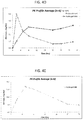
- FIG. 4D illustrates the pharmacokinetics (plasma concentration) of rivastigmine (i) through a microneedle device using a gel-based composition as described herein and (ii) using a gel-based composition after pretreatment with a prior art microneedle device, when tested in vivo in swine.
- FIG. 4E illustrates the pharmacokinetics (plasma concentration) of rivastigmine through a microneedle device as described herein using a water-based composition as described herein.
- substantially free as used herein generally means that the described material (e.g., transdermal drug delivery system, polymer, microneedle, etc.) comprises less than about 5%, less than about 3%, or less than about 1% by weight, based on the total weight of the material at issue, of the excluded component.
- free of as used herein means that the described material (e.g., polymer, microneedle, etc.) is formed without adding the excluded component(s) as an intended component, although trace amounts may be present, such as being a by-product or contaminant, such that the material comprises at most only trace amounts of the excluded component(s).
- subject denotes any animal in need of drug therapy or biological fluid sampling, including humans.
- a subject may be suffering from or at risk of developing a condition that can be treated or prevented with a drug, or may be taking a drug for health maintenance purposes, or may be having a biological fluid sample taken for diagnostic, therapeutic or health maintenance purposes.
- the phrases “therapeutically effective amount” and “therapeutic level” mean that drug dosage or plasma concentration in a subject, respectively, that provides the specific pharmacological response for which the drug is administered to a subject in need of such treatment, for whatever reason. It is emphasized that a therapeutically effective amount or therapeutic level of a drug will not always be effective in treating the target conditions/diseases, even though such dosage is deemed to be a therapeutically effective amount by those of skill in the art. For illustration only, exemplary dosages, drug delivery amounts, therapeutically effective amounts and therapeutic levels are provided below with reference to adult human subjects. Those skilled in the art can adjust such amounts in accordance with standard practices as needed to treat a specific subject and/or condition/disease.
- microneedle devices comprising an array of a plurality of microneedles, wherein the microneedles are formed from an electron beam crosslinked or photocrosslinked (e.g., ultraviolet, infrared, or microwave crosslinked) polymer material.
- the microneedle devices can be designed to dissolve or swell in water and provide sustained transdermal drug delivery.
- the polymer material use to form the microneedles may be any polymer material suitable for such use, such as any polymer material that can be crosslinked by electron beam or photo-irradiation, such as ultraviolet, infrared, or microwave irradiation, and that is suitable for use as a microneedle (e.g., that is non-toxic or otherwise acceptable for insertion into the skin).
- the polymer material comprises a hydrogel material.
- the polymer material comprises polyvinylpyrrolidone (PVP).
- PVP has an established safety profile and is used in many pharmaceutical contexts, including as a drug excipient, as a plasma substitute, and in wound dressings.
- the plasticizer may be any plasticizer suitable for such use, such as polyethyleneglycol, liquid paraffin, dioctyl phthalate, diisononyl phthalate, diisodecyl phthalate, dibutyl phthalate, dioctyl adipate, diisononyl adipate, trioctyl trimellitate, tricresyl phosphate, acetyl tributyl citrate, epoxidized soybean-oil, epoxidized linseed-oil, sebacate, or mixtures or blends of two or more thereof.
- plasticizer suitable for such use such as polyethyleneglycol, liquid paraffin, dioctyl phthalate, diisononyl phthalate, diisodecyl phthalate, dibutyl phthalate, dioctyl adipate, diisononyl adipate, trioctyl trimellitate, tricresyl
- the methods include forming an intermediate microneedle array structure from the polymer material and treating the formed intermediate microneedle array structure with electron beam or photo-irradiation, such as ultraviolet, infrared, or microwave irradiation. As discussed in more detail below, such irradiation crosslinks the polymer material and also may serve to sterilize the microneedles.
- electron beam or photo-irradiation such as ultraviolet, infrared, or microwave irradiation.
- the extent of polymer crosslinking is selected and controlled to select and control of whether the microneedles dissolve or swell, and to impact the strength and hardness of the microneedles.
- moisture e.g., water
- any drug-containing composition used in conjunction with the microneedles may lead to swelling or dissolution of the microneedles, depending on the characteristics of the microneedles.
- the extent of crosslinking and dissolvability vs. swellability also may impact drug delivery, e.g., the rate at which drug diffuses from the device.
- the backing member is in the form of a solid sheet or platform, such as a sheet (e.g., layer) comprising a suitable material, such as PVP, polyvinylalchol, pullulan, chitosan, gelatin, sodium alginate, cellulose, polyacrylamide, poly(N-isopropylacrylamide) or its copolymers, hydroxypropylcellulose, hydroxypropylmethylcellulose, hydroxyethylcellulose, carboxymethylcellulose, silk polymer, amylopectin, chondroitin sulfate, poly(lactic-co-glycolic acid), fibrin, elastin, collagen, hyaluronic acid, dextran, functionalized or modified species of the above, or mixtures or blends of two or more of the above.
- a suitable material such as PVP, polyvinylalchol, pullulan, chitosan, gelatin, sodium alginate, cellulose, polyacrylamide, poly(N-isopropylacrylamide) or its
- the backing member is in the form of a membrane, such as a flexible mesh membrane comprised of any suitable material, such as a flexible mesh membrane comprising nylon, polypropylene, stainless steel, ethylene-vinyl acetate, polyethylene terephthalate, polyurethane, woven or non-woven fabric, or combinations, mixtures or blends of two or more thereof.
- a membrane such as a flexible mesh membrane comprised of any suitable material, such as a flexible mesh membrane comprising nylon, polypropylene, stainless steel, ethylene-vinyl acetate, polyethylene terephthalate, polyurethane, woven or non-woven fabric, or combinations, mixtures or blends of two or more thereof.
- the microneedle array may be applied to the backing member by any means known in the art, such as by using an adhesive material to adhere the microneedle array to the backing member or by heat-sealing the microneedle array to the backing member
- the array of microneedles may be disposed on the backing member such that there is a peripheral border region on the backing member that does not comprise microneedles.
- the border may extend along the entire circumference of the backing member, or may be only on one or more portions thereof, such as one or more sides (or portions thereof) of a polygon-shaped backing member or one or more arcs of a round (e.g., circular or oval) backing member.
- a polymer is a pressure-sensitive adhesive within the meaning of the term as used herein if it has the properties of a pressure-sensitive adhesive per se or functions as a pressure-sensitive adhesive by admixture with tackifiers, plasticizers or other additives.
- the microneedle device may further comprise a removable release layer over the adhesive.
- the release liner is removed from the device prior to use to expose the adhesive prior to application of the device.
- Materials suitable for use as release liners are well-known known in the art.
- FIG. 1 is a front, top perspective view of a microneedle device according to a first embodiment of the invention.
- the microneedle device includes an array of a plurality of microneedles disposed on a backing member (also referred to as a “basement”).
- the backing member could be formed integrally with the microneedle array or could be made of a different material, such as a material that is more flexible than the microneedle array.
- the backing member is in the form of a flexible membrane, such as a flexible mesh membrane, such as a membrane made of, for example, nylon, polypropylene, or stainless steel.
- the backing member of the microneedle device includes a border extending peripherally around the microneedle array.
- the border is provided with an adhesive to adhere the microneedle device to the skin surface during use, and a release liner covering the adhesive prior to use.
- the adhesive and release liner may be applied before or after irradiation of the microneedles.
- the microneedle array may include from tens to several hundred microneedle projections per square centimeter.
- the microneedle array may include 10 or more microneedles, 100 or more, or 1000 or more microneedles, including from about 50 to about 1000 per square centimeter, such as 200, 400, 500 or 900 microneedles per square centimeter.
- the dimensions of the microneedle can be selected and adjusted depending on the intended use (e.g., drug delivery or sampling).
- microneedles have a cone or square pyramid shape.
- microneedles have a length of from about 100 to about 1000 ⁇ m, including a length of about 200, 400 or 600 ⁇ m.
- microneedles typically have a base diameter of from about 100 to about 00 ⁇ m, including a base diameter of from about 120 to about 300 ⁇ m, such as a base diameter of about 120 ⁇ m or about 300 ⁇ m.
- a typical tip angle may be, for example, in a range of 10° to 45°, for example 34°.
- the needle-to-needle spacing per square centimeter can be selected and adjusted depending on the intended use (e.g., drug delivery or sampling, and specific drug(s) being delivered or material(s) being sampled).
- a microneedle array may have a needle-to-needle spacing per square centimeter of from about 50 to about 1000 ⁇ m, including from about 200 ⁇ m to about 400 ⁇ m.
- a microneedle may have an aspect ratio (ratio of microneedle length to base diameter) of from 0.5 to 3, including an aspect ratio of about 1.67.
- a typical device may have a needle density of 30%.
- the microneedle device may be free of, or substantially free of, chemical and physical crosslinking agents, such as being free of, or substantially free of, any one or more or all of the following: peroxides, vinylsilanes, triethanolamine, bisacrylamide, polycarboxylic acids, halogenated dicarboxylic acids, polycarboxylic anhydrides, aldehyde compounds, N-methylol compounds, metaphosphoric acid salts, divinyl compounds, bis-aziridine, ethylene-vinyl acetate, isocyanate compounds, aluminum hydroxide, silanol compounds, epoxy compounds, melamine compounds, carbodimide compounds, hydrazide compounds, ester compounds, and epichlorohydrin, or the like.
- chemical and physical crosslinking agents such as being free of, or substantially free of, any one or more or all of the following: peroxides, vinylsilanes, triethanolamine, bisacrylamide, polycarboxylic acids, halogenated dicarboxylic acids
- one or more drugs may be incorporated in the polymer material of the microneedles, or may be provided separately.
- the drug When the drug is incorporated in the polymer material of the microneedles, it may be formulated in the solution of polymer material that is used to form the intermediate microneedle array structure, as discussed in more detail below.
- the drug When the drug is provided separately, it may be provided in a component, composition, coating, or layer provided on one or more of an exterior or interior surface of the microneedles and/or on at least one face of the device (e.g., the “front” face from which the microneedles protrude into the skin and/or the opposite “back” face), such as any composition described in more detail below.
- the drug is applied to the microneedle device during the manufacturing process, such that the final product is a drug-containing microneedle device. In other embodiments, the drug is applied to the device at the time of use. In accordance with the latter embodiments, the microneedle device and drug-containing component or composition may be provided in separate packages (optionally packaged together) with instructions to apply the drug-containing component or composition to the microneedle device prior to use. In some embodiments, the drug may be provided in a separate drug delivery device, such as an iontophoresis device, a sonophoresis device, a magnetphoresis device, etc.
- the microneedle device may be employed prior to the drug delivery device, or they may be used together, such as by applying or attaching the drug delivery device to the microneedle device.
- a drug may be both incorporated in the polymer material of the microneedles and provided separately, such as applied to one or more of an exterior or interior surface of the microneedles and/or on a face of the device, and/or as a separate component.
- the same or different drug(s) may be used in the microneedle polymer material and elsewhere, and the drug(s) may be formulated in the same or different compositions, in the same or different form, and any permutation or combination thereof.
- the drug is provided in a flexible, finite transdermal drug delivery system (e.g., in a transdermal drug delivery patch) disposed on a face of the device, such as patch disposed on the back face of the device, such as on the back face of the backing member.
- the microneedle device is configured to support the patch, such as by having dimensions suitable for supporting the patch.
- the microneedle device and patch may be provided in separate packages (optionally packaged together) with instructions to remove the release liner from the patch and apply it to the back face of the microneedle device.
- the drug is provided in a drug-containing composition (e.g., in a transdermal drug delivery composition) that is provided on one or more of an exterior or interior surface of the microneedles and/or on applied to a face of the device, such as composition applied to the back face of the device, such as on the back face of the backing member.
- the composition is a solid (including powder), semi-solid, liquid, gel, ointment, cream, emulsion, or polymeric composition that is applied to one or more of an exterior or interior surface of the microneedles and/or on at least one face of the backing member.
- the drug may be formulated in any suitable form, including being dissolved, dispersed or suspended in a composition.
- the drug may be in any solid form, including any crystalline or amorphous form, and/or provided as a particles (e.g., drug-encapsulated particles, coated drug particle, drug nanoparticles, etc.).
- FIG. 3 illustrates a microneedle device that includes a patch-type transdermal drug delivery system disposed on the back face of the device.
- the patch may include a cavity that holds a drug-containing composition, such as a semi-solid, liquid, gel, ointment or emulsion formulation of the drug.
- the microneedles In use, the microneedles pierce the skin, facilitating transdermal drug delivery from the device into the skin.
- the microneedle devices can be prepared such that they have a tendency to dissolve or swell, which impacts drug delivery.
- the properties of the drug-containing composition e.g., the nature of the composition, the concentration of drug, the presence of enhancers, etc.
- drug-containing compositions that include one or more component(s) that interact(s) with the microneedles, such as water or another solvent or other component may impact drug delivery, such as by impacting physical or physicochemical properties of the microneedles, such as by promoting dissolution and/or swelling of the microneedles.
- drug-containing compositions may include one or more component(s) that interact(s) with the material of the microneedle backing member, such as water or another solvent or other component, that may impact the physical properties of the device.
- compositions may be formulated so as not to promote swelling of the devices during storage, such as by using pH-sensitive hydrogels that are resistant to swelling due to humidity, temperature-responsive hydrogels that respond to physiological temperature, or bio-responsive hydrogels that respond to a molecule present in the skin, such as an enzyme or other protein, glucose or other carbohydrate, etc.
- methods of manufacturing the microneedle devices described herein generally include a first step of forming an intermediate microneedle array structure and a second step of treating the intermediate microneedle array structure with electron beam or photo-irradiation (such as ultraviolet, infrared, or microwave irradiation) to crosslink the polymer material and, optionally, sterilize the device.
- electron beam or photo-irradiation such as ultraviolet, infrared, or microwave irradiation
- the intermediate microneedle array structure is formed by a mold process.
- a solution comprising electron beam crosslinkable or photocrosslinkable polymer material is coated or cast into a mold that comprises a plurality of microneedle-shaped recesses to form an intermediate microneedle array structure.
- a squeegee or centrifuge may be used to fill the mold.
- the intermediate microneedle array structure is formed by a casting process.
- a solution comprising electron beam crosslinkable or photocrosslinkable polymer material is cast into a sheet (typically having a thickness of several millimeters) which is then hot-embossed with an embossing member to form an intermediate microneedle array structure.
- the intermediate microneedle array structure is formed by an extrusion process.
- a solution comprising electron beam crosslinkable or photocrosslinkable polymer material is extruded to form a sheet (typically having a thickness of several millimeters) which is then hot-embossed with an embossing member to form an intermediate microneedle array structure.
- the intermediate microneedle array structure is formed using 3D printing technology.
- the solution comprising electron beam crosslinkable or photocrosslinkable polymer material may comprise, for example, 0.1-75% w/v of the polymer material in water or evaporable solvent.
- the microneedle array structure may be subject to a drying step before or after the irradiation step described below.
- the microneedle array structure may be applied to a backing member before or after the irradiation step described below.
- the intermediate microneedle array structure After the intermediate microneedle array structure is formed, it is irradiated with electron beam or photo-irradiation, such as ultraviolet, infrared, or microwave radiation, to induce crosslinking of the polymer material, e.g., to induce crosslinking between polymer chains of the polymer material, and thereby produce microneedles as described herein.
- the absorbed radiation dose may be between about 10 and about 600 kilograys, including from about 10 to about 300 kilograys
- the irradiation sterilizes the microneedles. This is in contrast to microneedle devices made using chemical crosslinking processes, which require a separate sterilization step.
- the extent of polymer crosslinking can be readily and consistently selected and controlled by selecting and controlling the radiation dose, which in turn allows for the selection and control of whether the device dissolves (generally at lower radiation doses/less crosslinking) or swells (generally at higher radiation doses/more crosslinking).
- the extent of crosslinking also impacts the strength and hardness of the microneedles.
- the extent of crosslinking and dissolvability vs. swellability also impact drug delivery, e.g., the rate at which drug diffuses from the device.
- microneedle devices can be prepared that provide sustained drug delivery over an extended period of time.
- one or more drugs may be incorporated in the polymer material of the microneedles, or may be provided separately.
- the drug may be provided in the solution that comprises the polymer material.
- the drug may be provided in a component, composition, coating or layer on one or more of an exterior or interior surface of the microneedles and/or on at least one face of the device, such as being formulated in a composition as discussed above, that is applied to one or more of an exterior or interior surface of the microneedles and/or at least one face of the backing member.
- one or more drugs is formulated in a composition that is coated onto an exterior surface of the microneedles, coated onto an interior surface of the microneedles (or otherwise provided inside the microneedles), or applied to at least one face of a backing member of the device.
- the device may be dried before further processing.
- the drug is provided in a flexible, finite transdermal drug delivery system (e.g., in a transdermal drug delivery patch) that is applied to or disposed on a face of the device, such as patch that is applied to or disposed on the back face of the backing member.
- a transdermal drug delivery system may be used in accordance with these embodiments.
- the dimensions of the microneedle device are configured to support the transdermal drug delivery system.
- the transdermal drug delivery system is prepared and/or packaged separately from the microneedle device and applied to the microneedle device by the user just prior to use. In other embodiments, the transdermal drug delivery system is packaged together with the microneedle device.
- the finished microneedle device may be packaged in a humidity controlled package material, such as a laminated pouch.
- the microneedle devices described herein can be used, for example, for transdermal drug delivery or for sampling biological fluids from a subject.
- the microneedle devices described herein are applied to the skin surface of the subject.
- light pressure is applied to facilitate the microneedles' piercing of the skin.
- the device includes a release liner, it is removed prior to use.
- the microneedles described herein In a dry state, such as just prior to use, the microneedles described herein have sufficient strength to pierce the stratum corneum.
- the polymer material of the microneedles When inserted into the skin, the polymer material of the microneedles absorbs moisture (e.g., water) from the skin.
- moisture e.g., water
- this absorption of water may cause the microneedles to slowly dissolve or swell. In general, dissolving microneedles yield faster drug delivery, while swellable microneedles yield sustained delivery.
- the manufacturing process can be selected and controlled to select and control drug delivery from the device, such as by selecting and controlling the extent of crosslinking to provide sustained drug delivery.
- the polymer material can be electron beam crosslinked or photocrosslinked to such an extent that the microneedle device is adapted to provide drug delivery over an extended period of time, such as ranging from a few minutes, up to an hour, a few hours, or longer, including providing drug delivery over at least 1 hour, at least 2 hours, at least 3 hours, at least 4 hours, at least 6 hours, at least 8 hours, at least 12 hours, at least 24 hours, at least 30 hours, at least 36 hours, at least 72 hours, or longer.
- such an extended period of drug delivery can result in desired pharmacokinetic profiles, such as relatively constant plasma levels of drug, gradually increasing plasma levels of drug, etc.
- a solution of electron beam crosslinkable polymer material is made by preparing a polyvinylpyrollidone (PVP)/water solution at 250 mg of PVP/ml of water, using Kollidon K-90 as the PVP.
- a silicon mold is used, having conical holes with a depth of 500 ⁇ m, a density of 400 holes/cm 2 , and a base diameter of 300 ⁇ m. After mixing to a clear solution, the solution and mold are centrifuged at 5000 rpm for 15 minutes. The solution is fried under ambient conditions for three hours. After drying, additional solution is added to the mold to form a backing member (also referred to as a “basement”).
- the polymer-filled mold is dried overnight at room temperature, after which the formed intermediate microneedle array structures are removed and packaged and stored in a controlled humidity environment until electron beam irradiation.
- the backing member is formed by adding additional solution to the mold and covering with a nylon mesh, for example. This results in a more flexible device.
- Dry intermediate microneedle array structures are irradiated with electron beam irradiation, such as by placing them in an electron beam accelerator (Electron Technologies Corp, CT) to achieve an absorbed radiation dose in the range of from about 10 to about 300 kilograys.
- an electron beam accelerator Electron Technologies Corp, CT
- Adhesive layers and release liners are attached around the microneedles.
- the microneedles have a height of about 500 ⁇ m, and a tip angle of about 34°.
- the needle density is about 400 needles/cm 2 .
- the effective area covered by the microneedles is about 30% (0.3 cm 2 out of 1.0 cm 2 of microneedle array area).
- the total area of skin treated with microneedles is about 0.045 cm 2 per cm 2 of apparent total microneedle array area, with an insertion depth of 200 ⁇ m.
- Electron beam crosslinked microneedle devices prepared as described above were subjected to penetration testing by inserting the microneedle devices into cadaver skin with thumb pressure for about 30 seconds and then removing them. Treated skin sites were dyed with methylene blue to image penetration. It was expected that electron beam irradiation would make the PVP fragile, causing breakage upon insertion into the skin. However, surprisingly, the results showed that 100% of the microneedles penetrated into the skin without breakage.
- tips of the microneedles dissolve within one hour of insertion into skin. Treating the microneedles with electron beam irradiation diminishes this dissolution property, and promotes swellability of the microneedles.
- Microneedle devices were manufactured using varying radiation doses in the range of 10 to 300 kilograys, exposed to water and then monitored for dissolution and/or swelling. At the low end of the radiation dose range, the microneedles slowly dissolved in water, with the dissolution time increasing with radiation dose. At the high end of the radiation dose range, the microneedles became swollen with water. Results are summarized in Table 1.
- a methylphenidate gel composition is prepared by dissolving 8.0 g methylphenidate hydrochloride into 38 g glycerol. After complete dissolution, 0.4 g aluminum hydroxide gel and 5.0 g N-vinylacetamide/sodium acrylate copolymer (GE-167) is added.
- a citric acid solution is made by adding 0.4 g of citric acid into 48.2 g of deionized water. The citric acid solution is gradually added to the methylphenidate mixture to form the methylphenidate gel composition.
- a methylphenidate gel composition prepared as described above is applied to the back face of a microneedle device prepared as described in Example 1 (using an absorbed radiation dose of 300 kGy) at an amount of 1 g/cm 2 (70 mg/cm 2 , based on the amount of methylphenidate free base), and provided with a covering layer of closed cell polyolefin foam tape (3M. St. Paul, Minn.).
- Drug delivery through human cadaver skin was assessed using a modified Franz-diffusion type cell. The Franz cell receiver compartment was periodically assayed for methylphenidate. Results are shown in FIG. 4A . As shown in the figure, the device achieved sustained delivery of methylphenidate over the 72 hour test period, with a sustained drug flux.
- a microneedle device prepared as described in Example 1 using an absorbed radiation dose of 300 kGy was inserted into human cadaver skin and a transdermal drug delivery patch comprising sodium diclofenac was applied to the back face of the microneedle device.
- Drug delivery through human cadaver skin was assessed using a modified Franz-diffusion type cell.
- the Franz cell receiver compartment was assayed periodically for sodium diclofenac. Results are shown in FIG. 4B . As seen in the figure, significant, sustained drug delivery through the microneedle device and skin was achieved over a period of time of at least 24 hours.
- a methylphenidate gel composition prepared as described above was applied to the back face of a microneedle device prepared as described in Example 1 (using an absorbed radiation dose of 300 kGy) at an amount of 1 g/cm 2 (70 mg/cm 2 , based on the amount of methylphenidate free base), and provided with a covering layer of closed cell polyolefin foam tape (3M. St. Paul, Minn.). Blood samples were taken periodically and assayed for methylphenidate. Results are shown in FIG. 4C . As seen in the figure, plasma methylphenidate concentration increased to over 30 ng/mL in six hours and was sustained at a substantially constant level (i.e., varying by 30% or less) for 24 hours.
- Example 2 A similar experiment was performed using a rivastigmine gel composition or a rivastigmine water-based composition, using a microneedle device prepared as described in Example 1 (subject to an absorbed radiation dose of 300 kGy), using nylon mesh to form the backing member.
- a rivastigmine gel-based composition is prepared by dissolving 3.4 g rivastigmine tartrate into 84 g dispersed particle gel, followed by adding 12.6 g of hydroxypropyl cellulose gel.
- a rivastigmine water-based composition is prepared by dissolving 3.4 g rivastigmine tartrate into 37 g water and 7 g 1N NaOH solution, followed by adding 32.6 g hydroxypropyl cellulose gel.
- microneedle devices are inserted into the skin of a swine by hand and then a closed-cell polyolefin foam tape is used to make a cavity for holding the rivastigmine compositions that are applied to the back face of the microneedle devices. Every animal was treated with two devices on both flank sides, for a total of eight microneedle treatments per animal (covering a total area of 2 ⁇ 4 cm 2 ). Blood samples were taken periodically and assayed for rivastigmine.
- FIG. 4D shows results for the rivastigmine gel-based composition along with results achieved using microneedle pretreatment with a microneedle device that is not made of electron beam crosslinked polymer material.
- a microneedle device is used to pierce the skin and is removed before the drug-containing composition is applied to the skin.
- the microneedle devices used for pretreatment were made of poly-L-lactide and shaped as square pyramids with a height of about 500 ⁇ m, a tip angle of about 20°, and a needle density of about 640 needles/cm 2 .
- the effective area covered by the microneedles was about 20% (0.2 cm 2 out of 1.0 cm 2 of microneedle array area).
- the total area of skin pretreated with microneedles was about 0.03 cm 2 per cm 2 of apparent total microneedle array area, with an insertion depth of 200 ⁇ m.
- a spring-powered applicator delivering an energy of approximately 0.4 J/cm 2 is used for applying the pretreatment microneedles to the skin.
- the microneedle device as described herein with the rivastigmine gel-based composition achieved a drug delivery that resulted in a plasma rivastigmine concentrations that increased to about 3 ng/mL in eight hours and was sustained at a substantially constant level (i.e., varying by 30% or less) for 30 hours.
- pretreatment with a conventional microneedle device followed by application of a rivastigmine gel-based composition resulted in plasma rivastigmine concentrations that peaked at about 5 ng/mL at two hours and then dropped about 50% to about 2.5 ng/mL at four hours, and fell to less than 1 ng/mL by 20 hours.
- FIG. 4E shows results for the rivastigmine water-based composition. As seen in the figure, this composition achieved a drug delivery that resulted in a plasma rivastigmine concentrations that peaked at about 17 ng/mL at about 5 hours and then declined at a relatively constant rate over about 15 hours. While not wanting to be bound by theory, it is believed that the water-based formulation promoted dissolution of the microneedles, resulting in faster drug delivery.
- microneedle devices described herein can be designed to achieve different drug delivery and pharmacokinetic profiles, such as sustained drug delivery and relatively constant plasma levels over an extended period of time, or more rapid drug delivery and relatively rapid attainment of high drug plasma concentrations.
Landscapes
- Health & Medical Sciences (AREA)
- Engineering & Computer Science (AREA)
- Life Sciences & Earth Sciences (AREA)
- Public Health (AREA)
- Anesthesiology (AREA)
- Biomedical Technology (AREA)
- Heart & Thoracic Surgery (AREA)
- Hematology (AREA)
- Dermatology (AREA)
- Animal Behavior & Ethology (AREA)
- General Health & Medical Sciences (AREA)
- Medical Informatics (AREA)
- Veterinary Medicine (AREA)
- Toxicology (AREA)
- Medicinal Preparation (AREA)
- Physics & Mathematics (AREA)
- Oral & Maxillofacial Surgery (AREA)
- Thermal Sciences (AREA)
- Media Introduction/Drainage Providing Device (AREA)
Abstract
Description
| TABLE 1 | ||||||
| |
0 kGy | 10 kGy | 50 kGy | 100 kGy | 200 kGy | 300 kGy |
| MNs property | dissolvable | slowly | slowly | swellable | swellable | swellable |
| dissolvable | dissolvable | |||||
Claims (37)
Priority Applications (1)
| Application Number | Priority Date | Filing Date | Title |
|---|---|---|---|
| US14/827,735 US11040182B2 (en) | 2014-08-18 | 2015-08-17 | Microneedle device and methods |
Applications Claiming Priority (2)
| Application Number | Priority Date | Filing Date | Title |
|---|---|---|---|
| US201462038538P | 2014-08-18 | 2014-08-18 | |
| US14/827,735 US11040182B2 (en) | 2014-08-18 | 2015-08-17 | Microneedle device and methods |
Publications (2)
| Publication Number | Publication Date |
|---|---|
| US20160045720A1 US20160045720A1 (en) | 2016-02-18 |
| US11040182B2 true US11040182B2 (en) | 2021-06-22 |
Family
ID=55301367
Family Applications (1)
| Application Number | Title | Priority Date | Filing Date |
|---|---|---|---|
| US14/827,735 Active US11040182B2 (en) | 2014-08-18 | 2015-08-17 | Microneedle device and methods |
Country Status (1)
| Country | Link |
|---|---|
| US (1) | US11040182B2 (en) |
Cited By (1)
| Publication number | Priority date | Publication date | Assignee | Title |
|---|---|---|---|---|
| US12186515B2 (en) | 2020-04-28 | 2025-01-07 | Ticona Llc | Microneedle assembly |
Families Citing this family (19)
| Publication number | Priority date | Publication date | Assignee | Title |
|---|---|---|---|---|
| KR101785930B1 (en) * | 2015-12-30 | 2017-10-16 | 주식회사 쿼드메디슨 | Manufacturing of microneedle systems for inhibition of deformation in moisture environment |
| CN105771082A (en) * | 2016-04-07 | 2016-07-20 | 南通纺织丝绸产业技术研究院 | Blank pipe fibroin microneedle drug administration system and preparation method thereof |
| KR102631435B1 (en) * | 2016-06-10 | 2024-01-29 | 주식회사 엘지생활건강 | Soluble microneedle patch for delivery of drug for contusion |
| CN109475333B (en) * | 2016-07-18 | 2022-05-31 | 西门子医疗保健诊断公司 | Wearable sensor biofouling prevention and methods of use and calibration related thereto |
| JP6691025B2 (en) * | 2016-09-06 | 2020-04-28 | 富士フイルム株式会社 | Method for manufacturing needle-shaped array sheet |
| US11241563B2 (en) * | 2016-12-22 | 2022-02-08 | Johnson & Johnson Consumer Inc. | Microneedle arrays and methods for making and using |
| US12121687B2 (en) * | 2017-09-18 | 2024-10-22 | North Carolina State University | Nanocellulose and nanocellulose composite arrays and devices and methods of making and using the same |
| EP3763415B1 (en) | 2018-03-07 | 2022-03-30 | FUJIFILM Corporation | Method of manufacturing percutaneous absorption sheet |
| CN108742718B (en) * | 2018-03-23 | 2021-04-16 | 苏州德锐特成像技术有限公司 | Self-adhesive microneedle patch capable of swelling rapidly and preparation method thereof |
| JP2020002084A (en) * | 2018-06-29 | 2020-01-09 | ロレアル | Cosmetic process using microneedle sheet |
| JP7335061B2 (en) * | 2018-06-29 | 2023-08-29 | ロレアル | Beauty method using microneedle sheet |
| CN109171699B (en) * | 2018-08-27 | 2020-06-23 | 厦门大学 | A kind of silk microneedle electrode and preparation method thereof |
| US11246997B2 (en) * | 2018-09-25 | 2022-02-15 | Palo Alto Research Center Incorporated | Handheld filament extension atomizer for precision delivery of drugs and therapeutics |
| CN110947085A (en) * | 2018-09-27 | 2020-04-03 | 中科微针(北京)科技有限公司 | Method for accelerating forming and instant drug delivery of polyvinyl alcohol soluble microneedle and prepared microneedle |
| CN112494639B (en) * | 2021-01-13 | 2024-03-01 | 中国药科大学 | A temperature-sensitive microneedle array patch and its preparation method |
| CN113877055B (en) * | 2021-08-10 | 2024-08-09 | 中国人民解放军军事科学院军事医学研究院 | Radiation-sensitive wearable controlled drug delivery system |
| CN114113024B (en) * | 2021-12-20 | 2023-07-07 | 深圳大学 | A microneedle for detecting markers in interstitial fluid of breast cancer and preparation method thereof |
| CN114272374B (en) * | 2021-12-29 | 2022-08-02 | 广州纳丽生物科技有限公司 | Photosensitive controlled-release microneedle and preparation method thereof |
| CN115025384A (en) * | 2022-05-24 | 2022-09-09 | 华中科技大学 | Intelligent microneedle patch with mathematical simulation optimized shading and preparation method thereof |
Citations (7)
| Publication number | Priority date | Publication date | Assignee | Title |
|---|---|---|---|---|
| US20070083147A1 (en) * | 2005-09-30 | 2007-04-12 | Transcutaneous Technologies Inc. | Iontophoresis apparatus and method to deliver antibiotics to biological interfaces |
| US20080153795A1 (en) * | 2006-12-23 | 2008-06-26 | Renovo Limited | Medicaments and methods for wound healing |
| US20090131905A1 (en) * | 1998-06-10 | 2009-05-21 | Allen Mark G | Microneedle devices and methods of manufacture and use thereof |
| US20100256064A1 (en) * | 2007-09-28 | 2010-10-07 | Woolfson David A | Delivery device and method |
| US20110112509A1 (en) * | 2008-06-30 | 2011-05-12 | Hisamitsu Pharmaceutical Co., Inc. | Microneedle device, and method for enhancing the efficacy of influenza vaccine by using microneedle device |
| US20110195124A1 (en) * | 2008-10-07 | 2011-08-11 | Tuo Jin | Phase-transition polymeric microneedles |
| US20150080802A1 (en) * | 2012-03-16 | 2015-03-19 | National University Of Singapore | Novel Method To Fabricate Polymeric Microneedles |
-
2015
- 2015-08-17 US US14/827,735 patent/US11040182B2/en active Active
Patent Citations (7)
| Publication number | Priority date | Publication date | Assignee | Title |
|---|---|---|---|---|
| US20090131905A1 (en) * | 1998-06-10 | 2009-05-21 | Allen Mark G | Microneedle devices and methods of manufacture and use thereof |
| US20070083147A1 (en) * | 2005-09-30 | 2007-04-12 | Transcutaneous Technologies Inc. | Iontophoresis apparatus and method to deliver antibiotics to biological interfaces |
| US20080153795A1 (en) * | 2006-12-23 | 2008-06-26 | Renovo Limited | Medicaments and methods for wound healing |
| US20100256064A1 (en) * | 2007-09-28 | 2010-10-07 | Woolfson David A | Delivery device and method |
| US20110112509A1 (en) * | 2008-06-30 | 2011-05-12 | Hisamitsu Pharmaceutical Co., Inc. | Microneedle device, and method for enhancing the efficacy of influenza vaccine by using microneedle device |
| US20110195124A1 (en) * | 2008-10-07 | 2011-08-11 | Tuo Jin | Phase-transition polymeric microneedles |
| US20150080802A1 (en) * | 2012-03-16 | 2015-03-19 | National University Of Singapore | Novel Method To Fabricate Polymeric Microneedles |
Cited By (1)
| Publication number | Priority date | Publication date | Assignee | Title |
|---|---|---|---|---|
| US12186515B2 (en) | 2020-04-28 | 2025-01-07 | Ticona Llc | Microneedle assembly |
Also Published As
| Publication number | Publication date |
|---|---|
| US20160045720A1 (en) | 2016-02-18 |
Similar Documents
| Publication | Publication Date | Title |
|---|---|---|
| US11040182B2 (en) | Microneedle device and methods | |
| Ullah et al. | Microneedle array with a pH-responsive polymer coating and its application in smart drug delivery for wound healing | |
| Ronnander et al. | Dissolving polyvinylpyrrolidone-based microneedle systems for in-vitro delivery of sumatriptan succinate | |
| TWI554289B (en) | Embeddable patch for transdermal drug delivery and method of manufacturing the same | |
| US10376615B2 (en) | Micro-needle and micro-needle patch | |
| KR102341601B1 (en) | Microarray for delivery of therapeutic agent and methods of use | |
| Ronnander et al. | Transdermal delivery of sumatriptan succinate using iontophoresis and dissolving microneedles | |
| CN106806354B (en) | Polyacrylate flexible swelling microneedle | |
| US8911427B2 (en) | Therapeutic agent reservoir delivery system | |
| KR102033686B1 (en) | Microneedle transdermal patch comprising donepezil | |
| CN110870846A (en) | Rapidly implantable sustained-release microneedle patch and preparation method thereof | |
| CN1678367A (en) | Transdermal drug delivery devices having coated microprotrusions | |
| US10231879B2 (en) | Manufacturing method of microstructure | |
| US9789060B2 (en) | Carrier for oromucosal administration of physiologically active substances | |
| US9987361B1 (en) | Compositions and method for sustained drug delivery by active transdermal technology | |
| KR102610991B1 (en) | Microneedle patch system for transdermal drug delivery | |
| Kulkarni et al. | Transdermal Patches: Design, Evaluation, and Potential Applications in Modern Therapeutics | |
| KR102751131B1 (en) | Temperature sensitive polymer composition, polymer gel composite, medical articles and cosmetic articles using the same | |
| WO2017191457A1 (en) | Drug delivery device | |
| KR20250098480A (en) | Flubiprofen loaded microneedle and manufacturing method thereof | |
| CN114269330B (en) | Transdermal drug delivery patch, drug delivery system, and drug delivery method | |
| KR20200018983A (en) | Composition for preparation of micro-needle type hydrogel and method for preparation of micro-needle type hydrogel | |
| Banu et al. | Formulation and evaluation of transdermal drug delivery systems of ivabradine hydrochloride | |
| KR20190085643A (en) | Manufacturing method for micro-structure | |
| Ali et al. | Effect of Polysorbate 80 through rabbit's skin using transdermal patch loaded with bisoprolol fumarate as model drug |
Legal Events
| Date | Code | Title | Description |
|---|---|---|---|
| AS | Assignment |
Owner name: NOVEN PHARMACEUTICALS, INC., FLORIDA Free format text: ASSIGNMENT OF ASSIGNORS INTEREST;ASSIGNOR:SUZUKI, MASAYUKI;REEL/FRAME:036801/0164 Effective date: 20150806 |
|
| STPP | Information on status: patent application and granting procedure in general |
Free format text: FINAL REJECTION MAILED |
|
| STPP | Information on status: patent application and granting procedure in general |
Free format text: RESPONSE AFTER FINAL ACTION FORWARDED TO EXAMINER |
|
| STPP | Information on status: patent application and granting procedure in general |
Free format text: ADVISORY ACTION MAILED |
|
| STCV | Information on status: appeal procedure |
Free format text: NOTICE OF APPEAL FILED |
|
| AS | Assignment |
Owner name: NOVEN PHARMACEUTICALS, INC., FLORIDA Free format text: ASSIGNMENT OF ASSIGNORS INTEREST;ASSIGNOR:LYONS, CORMAC H.;REEL/FRAME:051231/0914 Effective date: 20120126 |
|
| STCV | Information on status: appeal procedure |
Free format text: NOTICE OF APPEAL FILED |
|
| STCV | Information on status: appeal procedure |
Free format text: APPEAL BRIEF (OR SUPPLEMENTAL BRIEF) ENTERED AND FORWARDED TO EXAMINER |
|
| STPP | Information on status: patent application and granting procedure in general |
Free format text: NON FINAL ACTION MAILED |
|
| STPP | Information on status: patent application and granting procedure in general |
Free format text: RESPONSE TO NON-FINAL OFFICE ACTION ENTERED AND FORWARDED TO EXAMINER |
|
| STPP | Information on status: patent application and granting procedure in general |
Free format text: NOTICE OF ALLOWANCE MAILED -- APPLICATION RECEIVED IN OFFICE OF PUBLICATIONS |
|
| STPP | Information on status: patent application and granting procedure in general |
Free format text: PUBLICATIONS -- ISSUE FEE PAYMENT RECEIVED |
|
| STPP | Information on status: patent application and granting procedure in general |
Free format text: PUBLICATIONS -- ISSUE FEE PAYMENT VERIFIED |
|
| STCF | Information on status: patent grant |
Free format text: PATENTED CASE |
|
| MAFP | Maintenance fee payment |
Free format text: PAYMENT OF MAINTENANCE FEE, 4TH YEAR, LARGE ENTITY (ORIGINAL EVENT CODE: M1551); ENTITY STATUS OF PATENT OWNER: LARGE ENTITY Year of fee payment: 4 |