US11040048B2 - Medicament for treating influenza characterized by combining a Cap-dependent endonuclease inhibitor and an anti-influenza drug - Google Patents
Medicament for treating influenza characterized by combining a Cap-dependent endonuclease inhibitor and an anti-influenza drug Download PDFInfo
- Publication number
- US11040048B2 US11040048B2 US16/061,495 US201616061495A US11040048B2 US 11040048 B2 US11040048 B2 US 11040048B2 US 201616061495 A US201616061495 A US 201616061495A US 11040048 B2 US11040048 B2 US 11040048B2
- Authority
- US
- United States
- Prior art keywords
- optionally substituted
- substituent group
- group
- alkyl
- compound
- Prior art date
- Legal status (The legal status is an assumption and is not a legal conclusion. Google has not performed a legal analysis and makes no representation as to the accuracy of the status listed.)
- Active, expires
Links
- 0 [1*]N1[C@@H]2CCCCN2C(=O)C2=C(OP)C(=O)C=CN21 Chemical compound [1*]N1[C@@H]2CCCCN2C(=O)C2=C(OP)C(=O)C=CN21 0.000 description 26
- JBTWLSYIZRCDFO-UHFFFAOYSA-N CCOC(=O)OC Chemical compound CCOC(=O)OC JBTWLSYIZRCDFO-UHFFFAOYSA-N 0.000 description 8
- LOVALBFFYVDMGS-IRLDBZIGSA-N O=C1C=CN2C(=C1OP)C(=O)N1CCCC[C@H]1N2[C@@H]1C2=C(C=CC=C2)SCC2=C1C=CC(F)=C2F Chemical compound O=C1C=CN2C(=C1OP)C(=O)N1CCCC[C@H]1N2[C@@H]1C2=C(C=CC=C2)SCC2=C1C=CC(F)=C2F LOVALBFFYVDMGS-IRLDBZIGSA-N 0.000 description 5
- XEKOWRVHYACXOJ-UHFFFAOYSA-N CCOC(C)=O Chemical compound CCOC(C)=O XEKOWRVHYACXOJ-UHFFFAOYSA-N 0.000 description 4
- OXISUNUIPOYNPW-WOOQGGFJSA-N C.C.CC(C)[C@@H]1C2=C(C=CC=C2)SCC2=C1/C(F)=C\C=C/2.CC(C)[C@@H]1C2=C(C=CC=C2)SCC2=C1/C=C(F)\C(F)=C/2.CC(C)[C@@H]1C2=C(C=CC=C2)SCC2=C1/C=C\C(F)=C/2.CC(C)[C@@H]1C2=C(C=CC=C2)SCC2=C1/C=C\C(F)=C/2F.CC(C)[C@@H]1C2=C(C=CC=C2)SCC2=C1/C=C\C=C/2F.CC(C)[C@@H]1C2=C(SCC3=C1/C(F)=C\C=C/3)C(F)=CC=C2 Chemical compound C.C.CC(C)[C@@H]1C2=C(C=CC=C2)SCC2=C1/C(F)=C\C=C/2.CC(C)[C@@H]1C2=C(C=CC=C2)SCC2=C1/C=C(F)\C(F)=C/2.CC(C)[C@@H]1C2=C(C=CC=C2)SCC2=C1/C=C\C(F)=C/2.CC(C)[C@@H]1C2=C(C=CC=C2)SCC2=C1/C=C\C(F)=C/2F.CC(C)[C@@H]1C2=C(C=CC=C2)SCC2=C1/C=C\C=C/2F.CC(C)[C@@H]1C2=C(SCC3=C1/C(F)=C\C=C/3)C(F)=CC=C2 OXISUNUIPOYNPW-WOOQGGFJSA-N 0.000 description 3
- LJPCNSSTRWGCMZ-UHFFFAOYSA-N CC1CCOC1 Chemical compound CC1CCOC1 LJPCNSSTRWGCMZ-UHFFFAOYSA-N 0.000 description 3
- YRKRGYRYEQYTOH-UHFFFAOYSA-N CC1CNC(=O)C1 Chemical compound CC1CNC(=O)C1 YRKRGYRYEQYTOH-UHFFFAOYSA-N 0.000 description 3
- VEGHPSPMDZZFMB-UHFFFAOYSA-N CCOC(=O)OCCOC Chemical compound CCOC(=O)OCCOC VEGHPSPMDZZFMB-UHFFFAOYSA-N 0.000 description 3
- MDKLFRDCEGAYHZ-VWNXMTODSA-N COC(=O)OCOC1=C2C(=O)N3CCCC[C@H]3N([C@@H]3C4=C(C=CC=C4)SCC4=C3C=CC(F)=C4F)N2C=CC1=O Chemical compound COC(=O)OCOC1=C2C(=O)N3CCCC[C@H]3N([C@@H]3C4=C(C=CC=C4)SCC4=C3C=CC(F)=C4F)N2C=CC1=O MDKLFRDCEGAYHZ-VWNXMTODSA-N 0.000 description 3
- YFNREYYDAJXKFK-VQCQRNETSA-N [H][C@@]12CCCN1C(=O)C1=C(O)C(=O)C=CN1N2C1C2=C(C=CC=C2)CSC2=C1C=CC=C2 Chemical compound [H][C@@]12CCCN1C(=O)C1=C(O)C(=O)C=CN1N2C1C2=C(C=CC=C2)CSC2=C1C=CC=C2 YFNREYYDAJXKFK-VQCQRNETSA-N 0.000 description 3
- SYBYTAAJFKOIEJ-UHFFFAOYSA-N CC(=O)C(C)C Chemical compound CC(=O)C(C)C SYBYTAAJFKOIEJ-UHFFFAOYSA-N 0.000 description 2
- KWBQKUZVJVKXHI-UHFFFAOYSA-N CC(=O)C1CCCO1 Chemical compound CC(=O)C1CCCO1 KWBQKUZVJVKXHI-UHFFFAOYSA-N 0.000 description 2
- CSCPPACGZOOCGX-UHFFFAOYSA-N CC(C)=O Chemical compound CC(C)=O CSCPPACGZOOCGX-UHFFFAOYSA-N 0.000 description 2
- RWGFKTVRMDUZSP-UHFFFAOYSA-N CC(C)C1=CC=CC=C1 Chemical compound CC(C)C1=CC=CC=C1 RWGFKTVRMDUZSP-UHFFFAOYSA-N 0.000 description 2
- PTUPCBYIMDMXTM-LLVKDONJSA-N CC(C)N1[C@@H]2CCCCN2C(=O)C2=C(OP)C(=O)C=CN21 Chemical compound CC(C)N1[C@@H]2CCCCN2C(=O)C2=C(OP)C(=O)C=CN21 PTUPCBYIMDMXTM-LLVKDONJSA-N 0.000 description 2
- BTSIZIIPFNVMHF-ONEGZZNKSA-N CC/C=C/CO Chemical compound CC/C=C/CO BTSIZIIPFNVMHF-ONEGZZNKSA-N 0.000 description 2
- BTSIZIIPFNVMHF-ARJAWSKDSA-N CC/C=C\CO Chemical compound CC/C=C\CO BTSIZIIPFNVMHF-ARJAWSKDSA-N 0.000 description 2
- XCACHNRWVCDUFV-GGAORHGYSA-N CC1(C)CCN2C(=O)C3=C(O)C(=O)C=CN3N([C@@H]3C4=C(C=CC=C4)SCC4=C3C=CC(F)=C4F)[C@@H]2C1 Chemical compound CC1(C)CCN2C(=O)C3=C(O)C(=O)C=CN3N([C@@H]3C4=C(C=CC=C4)SCC4=C3C=CC(F)=C4F)[C@@H]2C1 XCACHNRWVCDUFV-GGAORHGYSA-N 0.000 description 2
- NSRPFJGOCZUUHE-UHFFFAOYSA-N CC1CCC(=O)NC1 Chemical compound CC1CCC(=O)NC1 NSRPFJGOCZUUHE-UHFFFAOYSA-N 0.000 description 2
- MQWCXKGKQLNYQG-UHFFFAOYSA-N CC1CCC(O)CC1 Chemical compound CC1CCC(O)CC1 MQWCXKGKQLNYQG-UHFFFAOYSA-N 0.000 description 2
- TZYRSLHNPKPEFV-UHFFFAOYSA-N CCC(CC)CO Chemical compound CCC(CC)CO TZYRSLHNPKPEFV-UHFFFAOYSA-N 0.000 description 2
- CXYYVOJURSDSRL-UHFFFAOYSA-N CCC1=CC=C(OP(=O)(O)O)C=C1 Chemical compound CCC1=CC=C(OP(=O)(O)O)C=C1 CXYYVOJURSDSRL-UHFFFAOYSA-N 0.000 description 2
- YNQLUTRBYVCPMQ-UHFFFAOYSA-N CCC1=CC=CC=C1 Chemical compound CCC1=CC=CC=C1 YNQLUTRBYVCPMQ-UHFFFAOYSA-N 0.000 description 2
- GDHROTCPZLVPJT-UHFFFAOYSA-N CCC1CCO1 Chemical compound CCC1CCO1 GDHROTCPZLVPJT-UHFFFAOYSA-N 0.000 description 2
- CXBDYQVECUFKRK-UHFFFAOYSA-N CCCCOC Chemical compound CCCCOC CXBDYQVECUFKRK-UHFFFAOYSA-N 0.000 description 2
- ZGSIFBMGULVUBT-UHFFFAOYSA-N CCOC(=O)OC1CCC(=O)CC1 Chemical compound CCOC(=O)OC1CCC(=O)CC1 ZGSIFBMGULVUBT-UHFFFAOYSA-N 0.000 description 2
- QMXPTUUFGSTIKK-RXMQYKEDSA-N CC[C@@H]1CCC(=O)N1 Chemical compound CC[C@@H]1CCC(=O)N1 QMXPTUUFGSTIKK-RXMQYKEDSA-N 0.000 description 2
- QMXPTUUFGSTIKK-YFKPBYRVSA-N CC[C@H]1CCC(=O)N1 Chemical compound CC[C@H]1CCC(=O)N1 QMXPTUUFGSTIKK-YFKPBYRVSA-N 0.000 description 2
- ZSIFASRPEVGACI-BYPYZUCNSA-N CC[C@H]1CNC(=O)O1 Chemical compound CC[C@H]1CNC(=O)O1 ZSIFASRPEVGACI-BYPYZUCNSA-N 0.000 description 2
- UKAJDOBPPOAZSS-UHFFFAOYSA-N CC[Si](C)(C)C Chemical compound CC[Si](C)(C)C UKAJDOBPPOAZSS-UHFFFAOYSA-N 0.000 description 2
- MXCPSXRYZIOGTK-NOZRDPDXSA-N COC(=O)OCOC1=C2C(=O)N3CCC4(CC4)C[C@H]3N([C@@H]3C4=C(C=CC=C4)SCC4=C3C=CC(F)=C4F)N2C=CC1=O Chemical compound COC(=O)OCOC1=C2C(=O)N3CCC4(CC4)C[C@H]3N([C@@H]3C4=C(C=CC=C4)SCC4=C3C=CC(F)=C4F)N2C=CC1=O MXCPSXRYZIOGTK-NOZRDPDXSA-N 0.000 description 2
- WYSPJNQKENBKPQ-BIDKLJANSA-N COC(=O)OCOC1=C2C(=O)N3CCCC[C@H]3N([C@@H]3C4=C(C=CC=C4)SCC4=C3C=CC(F)=C4F)N2C=CC1=O.O=C1C=CN2C(=C1O)C(=O)N1CCOC[C@H]1N2[C@@H]1C2=C(C=CC=C2)SCC2=C1C=CC(F)=C2F Chemical compound COC(=O)OCOC1=C2C(=O)N3CCCC[C@H]3N([C@@H]3C4=C(C=CC=C4)SCC4=C3C=CC(F)=C4F)N2C=CC1=O.O=C1C=CN2C(=C1O)C(=O)N1CCOC[C@H]1N2[C@@H]1C2=C(C=CC=C2)SCC2=C1C=CC(F)=C2F WYSPJNQKENBKPQ-BIDKLJANSA-N 0.000 description 2
- ZQAYBCWERYRAMF-UHFFFAOYSA-N COCCC(C)C Chemical compound COCCC(C)C ZQAYBCWERYRAMF-UHFFFAOYSA-N 0.000 description 2
- ITEJPOBJOGKYGD-IEKZBVHVSA-N C[C@@H]1CCN2C(=O)C3=C(O)C(=O)C=CN3N([C@H]3C4=C(C=C(F)C=C4)CSC4=C3C=CC=C4)[C@@H]2C1 Chemical compound C[C@@H]1CCN2C(=O)C3=C(O)C(=O)C=CN3N([C@H]3C4=C(C=C(F)C=C4)CSC4=C3C=CC=C4)[C@@H]2C1 ITEJPOBJOGKYGD-IEKZBVHVSA-N 0.000 description 2
- LDJQBLLTGYLPLM-UPNLOYSTSA-N C[C@H]1COC[C@@H]2N1C(=O)C1=C(O)C(=O)C=CN1N2[C@@H]1C2=C(C=CC=C2)SCC2=C1C(F)=CC=C2 Chemical compound C[C@H]1COC[C@@H]2N1C(=O)C1=C(O)C(=O)C=CN1N2[C@@H]1C2=C(C=CC=C2)SCC2=C1C(F)=CC=C2 LDJQBLLTGYLPLM-UPNLOYSTSA-N 0.000 description 2
- LGKRKQSMHWXIIA-CTNGQTDRSA-N O=C1C=CN2C(=C1O)C(=O)N1CC(F)(F)CC[C@H]1N2[C@@H]1C2=C(C=CC=C2)SCC2=C1C=CC(F)=C2F Chemical compound O=C1C=CN2C(=C1O)C(=O)N1CC(F)(F)CC[C@H]1N2[C@@H]1C2=C(C=CC=C2)SCC2=C1C=CC(F)=C2F LGKRKQSMHWXIIA-CTNGQTDRSA-N 0.000 description 2
- ASBBVBGAGCOORA-CTNGQTDRSA-N O=C1C=CN2C(=C1O)C(=O)N1CCC(F)(F)C[C@H]1N2[C@@H]1C2=C(C=CC=C2)SCC2=C1C=CC(F)=C2F Chemical compound O=C1C=CN2C(=C1O)C(=O)N1CCC(F)(F)C[C@H]1N2[C@@H]1C2=C(C=CC=C2)SCC2=C1C=CC(F)=C2F ASBBVBGAGCOORA-CTNGQTDRSA-N 0.000 description 2
- DNSWUUGXCMYPPE-RTWAWAEBSA-N O=C1C=CN2C(=C1O)C(=O)N1CCC(F)(F)C[C@H]1N2[C@H]1C2=C(C=C(F)C=C2)CSC2=C1C=CC=C2 Chemical compound O=C1C=CN2C(=C1O)C(=O)N1CCC(F)(F)C[C@H]1N2[C@H]1C2=C(C=C(F)C=C2)CSC2=C1C=CC=C2 DNSWUUGXCMYPPE-RTWAWAEBSA-N 0.000 description 2
- IOVRGJKXJNWJSU-BGERDNNASA-N O=C1C=CN2C(=C1O)C(=O)N1CCOC[C@@H]1N2C1C2=C(C=CC=C2)CSC2=C1C=CC=C2 Chemical compound O=C1C=CN2C(=C1O)C(=O)N1CCOC[C@@H]1N2C1C2=C(C=CC=C2)CSC2=C1C=CC=C2 IOVRGJKXJNWJSU-BGERDNNASA-N 0.000 description 2
- YSTZELFIVOPQJZ-NHCUHLMSSA-N O=C1C=CN2C(=C1O)C(=O)N1CCOC[C@H]1N2[C@H]1C2=C(C=C(F)C(F)=C2)CSC2=C1C=CC=C2 Chemical compound O=C1C=CN2C(=C1O)C(=O)N1CCOC[C@H]1N2[C@H]1C2=C(C=C(F)C(F)=C2)CSC2=C1C=CC=C2 YSTZELFIVOPQJZ-NHCUHLMSSA-N 0.000 description 2
- KDKYADYSIPSCCQ-UHFFFAOYSA-N C#CCC Chemical compound C#CCC KDKYADYSIPSCCQ-UHFFFAOYSA-N 0.000 description 1
- QVSMLORHAMFBIA-HYAUOLKWSA-N C.C.CC(=O)OCOC1=C2C(=O)N3CCOC[C@H]3N([C@@H]3C4=C(C=CC=C4)SCC4=C3C=CC(F)=C4F)N2C=CC1=O.O=C1C=CN2C(=C1O)C(=O)N1CCOC[C@H]1N2[C@@H]1C2=C(C=CC=C2)SCC2=C1C=CC(F)=C2F Chemical compound C.C.CC(=O)OCOC1=C2C(=O)N3CCOC[C@H]3N([C@@H]3C4=C(C=CC=C4)SCC4=C3C=CC(F)=C4F)N2C=CC1=O.O=C1C=CN2C(=C1O)C(=O)N1CCOC[C@H]1N2[C@@H]1C2=C(C=CC=C2)SCC2=C1C=CC(F)=C2F QVSMLORHAMFBIA-HYAUOLKWSA-N 0.000 description 1
- MMTQUMXPYDSTTB-XQMPCRMWSA-N C.CC(C)(C)[Si](C)(C)OCCOC(=O)OC1=C2C(=O)N3CCOC[C@H]3N([C@@H]3C4=C(C=CC=C4)SCC4=C3C=CC(F)=C4F)N2C=CC1=O.I[I-91].O=C(OCCO)OC1=C2C(=O)N3CCOC[C@H]3N([C@@H]3C4=C(C=CC=C4)SCC4=C3C=CC(F)=C4F)N2C=CC1=O Chemical compound C.CC(C)(C)[Si](C)(C)OCCOC(=O)OC1=C2C(=O)N3CCOC[C@H]3N([C@@H]3C4=C(C=CC=C4)SCC4=C3C=CC(F)=C4F)N2C=CC1=O.I[I-91].O=C(OCCO)OC1=C2C(=O)N3CCOC[C@H]3N([C@@H]3C4=C(C=CC=C4)SCC4=C3C=CC(F)=C4F)N2C=CC1=O MMTQUMXPYDSTTB-XQMPCRMWSA-N 0.000 description 1
- YJMMGTHOHADYQO-LNNNTDPKSA-N C.CC(C)N1[C@@H]2CC3(CCN2C(=O)C2=C(OP)C(=O)C=CN21)CC3.CC(C)N1[C@@H]2CCCCN2C(=O)C2=C(OP)C(=O)C=CN21.CC(C)N1[C@@H]2CC[C@@H](C)CN2C(=O)C2=C(OP)C(=O)C=CN21.CC(C)N1[C@@H]2COCCN2C(=O)C2=C(OP)C(=O)C=CN21.CC(C)N1[C@@H]2C[C@@H](C(F)(F)F)CCN2C(=O)C2=C(OP)C(=O)C=CN21 Chemical compound C.CC(C)N1[C@@H]2CC3(CCN2C(=O)C2=C(OP)C(=O)C=CN21)CC3.CC(C)N1[C@@H]2CCCCN2C(=O)C2=C(OP)C(=O)C=CN21.CC(C)N1[C@@H]2CC[C@@H](C)CN2C(=O)C2=C(OP)C(=O)C=CN21.CC(C)N1[C@@H]2COCCN2C(=O)C2=C(OP)C(=O)C=CN21.CC(C)N1[C@@H]2C[C@@H](C(F)(F)F)CCN2C(=O)C2=C(OP)C(=O)C=CN21 YJMMGTHOHADYQO-LNNNTDPKSA-N 0.000 description 1
- LWTCEYKSOIVMIN-MDQYIAPGSA-N C.I[IH][IH-].O=C1C=CN2C(=C1O)C(=O)N1CCOC[C@H]1N2[C@@H]1C2=C(C=CC=C2)SCC2=C1C=CC(F)=C2F.O=C1C=CN2C(=C1OCC1=CC=NC=C1)C(=O)N1CCOC[C@H]1N2[C@@H]1C2=C(C=CC=C2)SCC2=C1C=CC(F)=C2F Chemical compound C.I[IH][IH-].O=C1C=CN2C(=C1O)C(=O)N1CCOC[C@H]1N2[C@@H]1C2=C(C=CC=C2)SCC2=C1C=CC(F)=C2F.O=C1C=CN2C(=C1OCC1=CC=NC=C1)C(=O)N1CCOC[C@H]1N2[C@@H]1C2=C(C=CC=C2)SCC2=C1C=CC(F)=C2F LWTCEYKSOIVMIN-MDQYIAPGSA-N 0.000 description 1
- KMVJFQJPMHLTFL-DGXMUYMBSA-N C.O=C1C=CN2C(=C1OP)C(=O)N1CCOC[C@H]1N2[C@@H]1C2=C(C=CC=C2)SCC2=C1C=CC(F)=C2F Chemical compound C.O=C1C=CN2C(=C1OP)C(=O)N1CCOC[C@H]1N2[C@@H]1C2=C(C=CC=C2)SCC2=C1C=CC(F)=C2F KMVJFQJPMHLTFL-DGXMUYMBSA-N 0.000 description 1
- DGXJPNKZOJTOGS-UHFFFAOYSA-N C1C2CC3CC1CC(C2)C3.C1CC2CCC1CC2.C1CCC2(CC1)CC2 Chemical compound C1C2CC3CC1CC(C2)C3.C1CC2CCC1CC2.C1CCC2(CC1)CC2 DGXJPNKZOJTOGS-UHFFFAOYSA-N 0.000 description 1
- RXNBGERFQONCEW-UHFFFAOYSA-N C1CCC2(CC1)COC2.C1CN2CCC1CC2 Chemical compound C1CCC2(CC1)COC2.C1CN2CCC1CC2 RXNBGERFQONCEW-UHFFFAOYSA-N 0.000 description 1
- JKJJSJJGBZXUQV-UHFFFAOYSA-N C=C(CC)C(=O)OC Chemical compound C=C(CC)C(=O)OC JKJJSJJGBZXUQV-UHFFFAOYSA-N 0.000 description 1
- KZKJVWSJXIDNAT-UHFFFAOYSA-N C=CC1(OC(=O)OCC)COC1 Chemical compound C=CC1(OC(=O)OCC)COC1 KZKJVWSJXIDNAT-UHFFFAOYSA-N 0.000 description 1
- VXNZUUAINFGPBY-UHFFFAOYSA-N C=CCC Chemical compound C=CCC VXNZUUAINFGPBY-UHFFFAOYSA-N 0.000 description 1
- QSMIKCMVEFJNPK-UUYKZKPPSA-N C=CCOC(=O)N1C(NN2C=CC(=O)C(OCC3=CC=CC=C3)=C2C(=O)OCC(F)(F)F)COC[C@@H]1C.C=CCOC(=O)N1C(OC)COC[C@@H]1C.CC(C)(C)OC(=O)NN1C=CC(=O)C(OCC2=CC=CC=C2)=C1C(=O)OCC(F)(F)F.C[C@H]1COCC2NN3C=CC(=O)C(OCC4=CC=CC=C4)=C3C(=O)N21.C[C@H]1COC[C@@H]2N1C(=O)C1=C(OCC3=CC=CC=C3)C(=O)C=CN1N2C(=O)OC(C)(C)C.C[C@H]1COC[C@H]2NN3C=CC(=O)C(OCC4=CC=CC=C4)=C3C(=O)N12.NN1C=CC(=O)C(OCC2=CC=CC=C2)=C1C(=O)OCC(F)(F)F.O=C(O)C1=C(OCC2=CC=CC=C2)C(=O)C=CO1.O=C1C=COC(C(=O)OCC(F)(F)F)=C1OCC1=CC=CC=C1 Chemical compound C=CCOC(=O)N1C(NN2C=CC(=O)C(OCC3=CC=CC=C3)=C2C(=O)OCC(F)(F)F)COC[C@@H]1C.C=CCOC(=O)N1C(OC)COC[C@@H]1C.CC(C)(C)OC(=O)NN1C=CC(=O)C(OCC2=CC=CC=C2)=C1C(=O)OCC(F)(F)F.C[C@H]1COCC2NN3C=CC(=O)C(OCC4=CC=CC=C4)=C3C(=O)N21.C[C@H]1COC[C@@H]2N1C(=O)C1=C(OCC3=CC=CC=C3)C(=O)C=CN1N2C(=O)OC(C)(C)C.C[C@H]1COC[C@H]2NN3C=CC(=O)C(OCC4=CC=CC=C4)=C3C(=O)N12.NN1C=CC(=O)C(OCC2=CC=CC=C2)=C1C(=O)OCC(F)(F)F.O=C(O)C1=C(OCC2=CC=CC=C2)C(=O)C=CO1.O=C1C=COC(C(=O)OCC(F)(F)F)=C1OCC1=CC=CC=C1 QSMIKCMVEFJNPK-UUYKZKPPSA-N 0.000 description 1
- ZHYZCLMORRDCGD-XCYGSCDUSA-N C=CCOC(=O)N1CCC(F)(F)CC1.C=CCOC(=O)N1CCC(F)(F)CC1OC.Cl.FC1(F)CCCCC1.O=C1C=CN2NC3CC(F)(F)CCN3C(=O)C2=C1OCC1=CC=CC=C1.O=C1C=CN2N[C@@H]3CC(F)(F)CCN3C(=O)C2=C1OCC1=CC=CC=C1 Chemical compound C=CCOC(=O)N1CCC(F)(F)CC1.C=CCOC(=O)N1CCC(F)(F)CC1OC.Cl.FC1(F)CCCCC1.O=C1C=CN2NC3CC(F)(F)CCN3C(=O)C2=C1OCC1=CC=CC=C1.O=C1C=CN2N[C@@H]3CC(F)(F)CCN3C(=O)C2=C1OCC1=CC=CC=C1 ZHYZCLMORRDCGD-XCYGSCDUSA-N 0.000 description 1
- QDBWEFKMRWJAHO-UHFFFAOYSA-N C=CCOC(=O)N1CCOCC1=O.C=CCOC(=O)N1CCOCC1NN1C=CC(=O)C(OCC2=CC=CC=C2)=C1C(=O)OCC.C=CCOC(=O)N1CCOCC1O.C=CCOC(=O)N1CCOCC1OC.CCOC(=O)C1=C(OCC2=CC=CC=C2)C(=O)C=CN1N.CCOC(=O)C1=C(OCC2=CC=CC=C2)C(=O)C=CN1NC(=O)OC(C)(C)C.CCOC(=O)C1=C(OCC2=CC=CC=C2)C(=O)C=CO1.O=C(O)C1=C(OCC2=CC=CC=C2)C(=O)C=CO1.O=C1/C=C\N2NC3COCCN3C(=O)/C2=C/1OCC1=CC=CC=C1.O=C1CCCOC1 Chemical compound C=CCOC(=O)N1CCOCC1=O.C=CCOC(=O)N1CCOCC1NN1C=CC(=O)C(OCC2=CC=CC=C2)=C1C(=O)OCC.C=CCOC(=O)N1CCOCC1O.C=CCOC(=O)N1CCOCC1OC.CCOC(=O)C1=C(OCC2=CC=CC=C2)C(=O)C=CN1N.CCOC(=O)C1=C(OCC2=CC=CC=C2)C(=O)C=CN1NC(=O)OC(C)(C)C.CCOC(=O)C1=C(OCC2=CC=CC=C2)C(=O)C=CO1.O=C(O)C1=C(OCC2=CC=CC=C2)C(=O)C=CO1.O=C1/C=C\N2NC3COCCN3C(=O)/C2=C/1OCC1=CC=CC=C1.O=C1CCCOC1 QDBWEFKMRWJAHO-UHFFFAOYSA-N 0.000 description 1
- IBTLFDCPAJLATQ-UHFFFAOYSA-N C=CCOCCCC Chemical compound C=CCOCCCC IBTLFDCPAJLATQ-UHFFFAOYSA-N 0.000 description 1
- OTMSDBZUPAUEDD-UHFFFAOYSA-N CC Chemical compound CC OTMSDBZUPAUEDD-UHFFFAOYSA-N 0.000 description 1
- PJGSXYOJTGTZAV-UHFFFAOYSA-N CC(=O)C(C)(C)C Chemical compound CC(=O)C(C)(C)C PJGSXYOJTGTZAV-UHFFFAOYSA-N 0.000 description 1
- OXCXLOAEGPLGMC-UHFFFAOYSA-N CC(=O)C12CCC(C)(C(=O)O1)C2(C)C Chemical compound CC(=O)C12CCC(C)(C(=O)O1)C2(C)C OXCXLOAEGPLGMC-UHFFFAOYSA-N 0.000 description 1
- QVUOUGMOYJKOPL-UHFFFAOYSA-N CC(=O)C1=CC=C(CN(C)C)C=C1 Chemical compound CC(=O)C1=CC=C(CN(C)C)C=C1 QVUOUGMOYJKOPL-UHFFFAOYSA-N 0.000 description 1
- HUDYANRNMZDQGA-UHFFFAOYSA-N CC(=O)C1=CC=C(N(C)C)C=C1 Chemical compound CC(=O)C1=CC=C(N(C)C)C=C1 HUDYANRNMZDQGA-UHFFFAOYSA-N 0.000 description 1
- VJHQSLSGLIVQJE-UHFFFAOYSA-N CC(=O)CC1=CC=C(OC(C)=O)C=C1 Chemical compound CC(=O)CC1=CC=C(OC(C)=O)C=C1 VJHQSLSGLIVQJE-UHFFFAOYSA-N 0.000 description 1
- DBERHVIZRVGDFO-UHFFFAOYSA-N CC(=O)COC(C)=O Chemical compound CC(=O)COC(C)=O DBERHVIZRVGDFO-UHFFFAOYSA-N 0.000 description 1
- LMTGCJANOQOGPI-UHFFFAOYSA-N CC(=O)N(C)C1=CC=CC=C1 Chemical compound CC(=O)N(C)C1=CC=CC=C1 LMTGCJANOQOGPI-UHFFFAOYSA-N 0.000 description 1
- AMURWJIROHHQSN-AVDPBFOKSA-N CC(=O)N1CC(OC(=O)C(C)C)C1.CC(=O)OC1=CC=C(CC(C)C)C=C1.CC(C)C(=O)OC1CCOCC1.CC(C)C(=O)O[C@H]1CCOC1.CC(C)C1COC(=O)O1.CC(C)C1OC(=O)C2=C1C=CC=C2.CC(C)CC1=CC=CC=C1.CC(C)OC(=O)C(C)C.CC(C)[C@H](C)C1=CC=CC=C1.CC1=C(CC(C)C)OC(=O)O1.CC1=CC(C(C)C)OC1=O.CCOC(=O)C(C)C.CCOC(=O)OCC(C)C.CCOP(=O)(NC1(C(=O)OC)CC1)C(C)C.CCOP(=O)(N[C@@H](C(=O)OC)C(C)(C)C)C(C)C.COC(=O)C(C)C.COC(=O)OCC(C)C.COC1=CC=C(CC(C)C)C=C1.COCCOC(=O)C(C)C.COCCOC(=O)OCC(C)C.COC[C@@H](C)OC(=O)C(C)C Chemical compound CC(=O)N1CC(OC(=O)C(C)C)C1.CC(=O)OC1=CC=C(CC(C)C)C=C1.CC(C)C(=O)OC1CCOCC1.CC(C)C(=O)O[C@H]1CCOC1.CC(C)C1COC(=O)O1.CC(C)C1OC(=O)C2=C1C=CC=C2.CC(C)CC1=CC=CC=C1.CC(C)OC(=O)C(C)C.CC(C)[C@H](C)C1=CC=CC=C1.CC1=C(CC(C)C)OC(=O)O1.CC1=CC(C(C)C)OC1=O.CCOC(=O)C(C)C.CCOC(=O)OCC(C)C.CCOP(=O)(NC1(C(=O)OC)CC1)C(C)C.CCOP(=O)(N[C@@H](C(=O)OC)C(C)(C)C)C(C)C.COC(=O)C(C)C.COC(=O)OCC(C)C.COC1=CC=C(CC(C)C)C=C1.COCCOC(=O)C(C)C.COCCOC(=O)OCC(C)C.COC[C@@H](C)OC(=O)C(C)C AMURWJIROHHQSN-AVDPBFOKSA-N 0.000 description 1
- QQFDVJXNIXQJGW-UHFFFAOYSA-N CC(=O)N1CCN(C(=O)OC(C)(C)C)CC1 Chemical compound CC(=O)N1CCN(C(=O)OC(C)(C)C)CC1 QQFDVJXNIXQJGW-UHFFFAOYSA-N 0.000 description 1
- YSDBJKNOEWSFGA-UHFFFAOYSA-N CC(=O)N1CCN(C)CC1 Chemical compound CC(=O)N1CCN(C)CC1 YSDBJKNOEWSFGA-UHFFFAOYSA-N 0.000 description 1
- PKDPUENCROCRCH-UHFFFAOYSA-N CC(=O)N1CCNCC1 Chemical compound CC(=O)N1CCNCC1 PKDPUENCROCRCH-UHFFFAOYSA-N 0.000 description 1
- KYWXRBNOYGGPIZ-UHFFFAOYSA-N CC(=O)N1CCOCC1 Chemical compound CC(=O)N1CCOCC1 KYWXRBNOYGGPIZ-UHFFFAOYSA-N 0.000 description 1
- PXIUTOAZRUQZKK-UHFFFAOYSA-N CC(=O)NCC1(OC(C)=O)CCCC1 Chemical compound CC(=O)NCC1(OC(C)=O)CCCC1 PXIUTOAZRUQZKK-UHFFFAOYSA-N 0.000 description 1
- OXCWHEWLKNJJET-UHFFFAOYSA-N CC(=O)OC(C(C)C)C(C)C Chemical compound CC(=O)OC(C(C)C)C(C)C OXCWHEWLKNJJET-UHFFFAOYSA-N 0.000 description 1
- MEICJNPWBNXGEF-UHFFFAOYSA-N CC(=O)OC(C)(C)C(=O)OC(C)(C)C Chemical compound CC(=O)OC(C)(C)C(=O)OC(C)(C)C MEICJNPWBNXGEF-UHFFFAOYSA-N 0.000 description 1
- JMMWKPVZQRWMSS-UHFFFAOYSA-N CC(=O)OC(C)C Chemical compound CC(=O)OC(C)C JMMWKPVZQRWMSS-UHFFFAOYSA-N 0.000 description 1
- RMNOPKKNMWGBCO-AVJOMLGHSA-N CC(=O)OC1=C2C(=O)N3CCOC[C@H]3N([C@@H]3C4=C(C=CC=C4)SCC4=C3C=CC(F)=C4F)N2C=CC1=O.I[I-2].I[IH][IH-].O=C1C=CN2C(=C1O)C(=O)N1CCOC[C@H]1N2[C@@H]1C2=C(C=CC=C2)SCC2=C1C=CC(F)=C2F Chemical compound CC(=O)OC1=C2C(=O)N3CCOC[C@H]3N([C@@H]3C4=C(C=CC=C4)SCC4=C3C=CC(F)=C4F)N2C=CC1=O.I[I-2].I[IH][IH-].O=C1C=CN2C(=C1O)C(=O)N1CCOC[C@H]1N2[C@@H]1C2=C(C=CC=C2)SCC2=C1C=CC(F)=C2F RMNOPKKNMWGBCO-AVJOMLGHSA-N 0.000 description 1
- QPYYGUKSFCJKAY-NIDKETBXSA-N CC(=O)OC1=CC=C(COC2=C3C(=O)N4CCOC[C@H]4N([C@@H]4C5=C(C=CC=C5)SCC5=C4C=CC(F)=C5F)N3C=CC2=O)C=C1.I[I-77].I[IH][IH-].O=C1C=CN2C(=C1O)C(=O)N1CCOC[C@H]1N2[C@@H]1C2=C(C=CC=C2)SCC2=C1C=CC(F)=C2F Chemical compound CC(=O)OC1=CC=C(COC2=C3C(=O)N4CCOC[C@H]4N([C@@H]4C5=C(C=CC=C5)SCC5=C4C=CC(F)=C5F)N3C=CC2=O)C=C1.I[I-77].I[IH][IH-].O=C1C=CN2C(=C1O)C(=O)N1CCOC[C@H]1N2[C@@H]1C2=C(C=CC=C2)SCC2=C1C=CC(F)=C2F QPYYGUKSFCJKAY-NIDKETBXSA-N 0.000 description 1
- WWEDAIJJBDFOOK-UHFFFAOYSA-N CC(=O)OC1=CC=CC=C1C(C)=O Chemical compound CC(=O)OC1=CC=CC=C1C(C)=O WWEDAIJJBDFOOK-UHFFFAOYSA-N 0.000 description 1
- LEWUBPMRVABOOC-UHFFFAOYSA-N CC(=O)OC1CCN(C(C)=O)CC1 Chemical compound CC(=O)OC1CCN(C(C)=O)CC1 LEWUBPMRVABOOC-UHFFFAOYSA-N 0.000 description 1
- RWPYOAUYOSFJQV-UHFFFAOYSA-N CC(=O)OC1CCN(C)CC1 Chemical compound CC(=O)OC1CCN(C)CC1 RWPYOAUYOSFJQV-UHFFFAOYSA-N 0.000 description 1
- JAROKJKPBZZIQN-UHFFFAOYSA-N CC(=O)OC1CCOCC1 Chemical compound CC(=O)OC1CCOCC1 JAROKJKPBZZIQN-UHFFFAOYSA-N 0.000 description 1
- PGKVFVRMFNJADI-UHFFFAOYSA-N CC(=O)OC1CN(C(C)=O)C1 Chemical compound CC(=O)OC1CN(C(C)=O)C1 PGKVFVRMFNJADI-UHFFFAOYSA-N 0.000 description 1
- VDNPHBFPAAKQSJ-UHFFFAOYSA-N CC(=O)OCC(=O)OC(C)(C)C Chemical compound CC(=O)OCC(=O)OC(C)(C)C VDNPHBFPAAKQSJ-UHFFFAOYSA-N 0.000 description 1
- QLNYTCSELYEEPV-UHFFFAOYSA-N CC(=O)OCC(C)(C)C Chemical compound CC(=O)OCC(C)(C)C QLNYTCSELYEEPV-UHFFFAOYSA-N 0.000 description 1
- UHZFGTXFKBGFMX-UHFFFAOYSA-N CC(=O)OCC1=C(C)OC(=O)O1 Chemical compound CC(=O)OCC1=C(C)OC(=O)O1 UHZFGTXFKBGFMX-UHFFFAOYSA-N 0.000 description 1
- XFCRFAICBSCRLN-UHFFFAOYSA-N CC(=O)OCC1=CC=C(N=[N+]=[N-])C=C1 Chemical compound CC(=O)OCC1=CC=C(N=[N+]=[N-])C=C1 XFCRFAICBSCRLN-UHFFFAOYSA-N 0.000 description 1
- QUKGYYKBILRGFE-UHFFFAOYSA-N CC(=O)OCC1=CC=CC=C1 Chemical compound CC(=O)OCC1=CC=CC=C1 QUKGYYKBILRGFE-UHFFFAOYSA-N 0.000 description 1
- FPXVLCLVAIUGPW-UHFFFAOYSA-N CC(=O)OCC1=CC=CN=C1 Chemical compound CC(=O)OCC1=CC=CN=C1 FPXVLCLVAIUGPW-UHFFFAOYSA-N 0.000 description 1
- ZGXKOLGDFWQRMM-UHFFFAOYSA-N CC(=O)OCC1=CC=NC=C1 Chemical compound CC(=O)OCC1=CC=NC=C1 ZGXKOLGDFWQRMM-UHFFFAOYSA-N 0.000 description 1
- NCJPHKVZTIRFLC-UHFFFAOYSA-N CC(=O)OCC1=CN=CN=C1 Chemical compound CC(=O)OCC1=CN=CN=C1 NCJPHKVZTIRFLC-UHFFFAOYSA-N 0.000 description 1
- MQHVKKZVSDDIPX-UHFFFAOYSA-N CC(=O)OCC1CCOCC1 Chemical compound CC(=O)OCC1CCOCC1 MQHVKKZVSDDIPX-UHFFFAOYSA-N 0.000 description 1
- XEEZLGZJXJUDTA-UHFFFAOYSA-N CC(=O)OCCO[Si](C)(C)C(C)(C)C Chemical compound CC(=O)OCCO[Si](C)(C)C(C)(C)C XEEZLGZJXJUDTA-UHFFFAOYSA-N 0.000 description 1
- RGCIACOELZRWMQ-UHFFFAOYSA-N CC(=O)OCCS(C)(=O)=O Chemical compound CC(=O)OCCS(C)(=O)=O RGCIACOELZRWMQ-UHFFFAOYSA-N 0.000 description 1
- GNWICBQFOBRBLL-NGFFLXOISA-N CC(=O)OCOC1=C2C(=O)N3CCCC[C@H]3N([C@@H]3C4=C(C=CC=C4)SCC4=C3C=CC(F)=C4F)N2C=CC1=O.O=C1C=CN2C(=C1O)C(=O)N1CCOC[C@H]1N2[C@@H]1C2=C(C=CC=C2)SCC2=C1C=CC(F)=C2F Chemical compound CC(=O)OCOC1=C2C(=O)N3CCCC[C@H]3N([C@@H]3C4=C(C=CC=C4)SCC4=C3C=CC(F)=C4F)N2C=CC1=O.O=C1C=CN2C(=C1O)C(=O)N1CCOC[C@H]1N2[C@@H]1C2=C(C=CC=C2)SCC2=C1C=CC(F)=C2F GNWICBQFOBRBLL-NGFFLXOISA-N 0.000 description 1
- WIYKDRUTGZWHTO-HYAUOLKWSA-N CC(=O)OCOC1=C2C(=O)N3CCOC[C@H]3N([C@@H]3C4=C(C=CC=C4)SCC4=C3C=CC(F)=C4F)N2C=CC1=O.I[I-4].I[IH][IH-].O=C1C=CN2C(=C1O)C(=O)N1CCOC[C@H]1N2[C@@H]1C2=C(C=CC=C2)SCC2=C1C=CC(F)=C2F Chemical compound CC(=O)OCOC1=C2C(=O)N3CCOC[C@H]3N([C@@H]3C4=C(C=CC=C4)SCC4=C3C=CC(F)=C4F)N2C=CC1=O.I[I-4].I[IH][IH-].O=C1C=CN2C(=C1O)C(=O)N1CCOC[C@H]1N2[C@@H]1C2=C(C=CC=C2)SCC2=C1C=CC(F)=C2F WIYKDRUTGZWHTO-HYAUOLKWSA-N 0.000 description 1
- CKCWECNJFXXSQU-SSDOTTSWSA-N CC(=O)OC[C@@H]1COC(C)(C)O1 Chemical compound CC(=O)OC[C@@H]1COC(C)(C)O1 CKCWECNJFXXSQU-SSDOTTSWSA-N 0.000 description 1
- CKCWECNJFXXSQU-ZETCQYMHSA-N CC(=O)OC[C@H]1COC(C)(C)O1 Chemical compound CC(=O)OC[C@H]1COC(C)(C)O1 CKCWECNJFXXSQU-ZETCQYMHSA-N 0.000 description 1
- SREJAFLAMHECEQ-ZCFIWIBFSA-N CC(=O)O[C@@H]1C(=O)OCC1(C)C Chemical compound CC(=O)O[C@@H]1C(=O)OCC1(C)C SREJAFLAMHECEQ-ZCFIWIBFSA-N 0.000 description 1
- DIRLDPKYOATBIA-ZCFIWIBFSA-N CC(=O)O[C@@H]1CCOC1 Chemical compound CC(=O)O[C@@H]1CCOC1 DIRLDPKYOATBIA-ZCFIWIBFSA-N 0.000 description 1
- ASUQMWUAFHPXOG-JAFIHTMFSA-N CC(=O)O[C@@H]1COC2C1OC[C@@H]2O Chemical compound CC(=O)O[C@@H]1COC2C1OC[C@@H]2O ASUQMWUAFHPXOG-JAFIHTMFSA-N 0.000 description 1
- ZKPTYCJWRHHBOW-RXMQYKEDSA-N CC(=O)O[C@H](C)C(C)=O Chemical compound CC(=O)O[C@H](C)C(C)=O ZKPTYCJWRHHBOW-RXMQYKEDSA-N 0.000 description 1
- SREJAFLAMHECEQ-LURJTMIESA-N CC(=O)O[C@H]1C(=O)OCC1(C)C Chemical compound CC(=O)O[C@H]1C(=O)OCC1(C)C SREJAFLAMHECEQ-LURJTMIESA-N 0.000 description 1
- DIRLDPKYOATBIA-LURJTMIESA-N CC(=O)O[C@H]1CCOC1 Chemical compound CC(=O)O[C@H]1CCOC1 DIRLDPKYOATBIA-LURJTMIESA-N 0.000 description 1
- RCXLRBOCGWECNI-WTIBDHCWSA-N CC(=O)O[C@H]1COC2OCCC21 Chemical compound CC(=O)O[C@H]1COC2OCCC21 RCXLRBOCGWECNI-WTIBDHCWSA-N 0.000 description 1
- NNPPMTNAJDCUHE-UHFFFAOYSA-N CC(C)C Chemical compound CC(C)C NNPPMTNAJDCUHE-UHFFFAOYSA-N 0.000 description 1
- QXCNYSRJPNASGH-UHFFFAOYSA-N CC(C)C12CC3CC(CC(C3)C1)C2.CC(C)C12CCC(CC1)CC2.CC(C)C1CCCCC12CC2 Chemical compound CC(C)C12CC3CC(CC(C3)C1)C2.CC(C)C12CCC(CC1)CC2.CC(C)C1CCCCC12CC2 QXCNYSRJPNASGH-UHFFFAOYSA-N 0.000 description 1
- UZMXSJALHVRXEC-UHFFFAOYSA-N CC(C)C12CCN(CC1)CC2.CC(C)C1CCCCC12COC2 Chemical compound CC(C)C12CCN(CC1)CC2.CC(C)C1CCCCC12COC2 UZMXSJALHVRXEC-UHFFFAOYSA-N 0.000 description 1
- GHPMBRPAJZHOGF-MJTRFDEASA-N CC(C)N1[C@@H]2CC3(CCN2C(=O)C2=C(OP)C(=O)C=CN21)CC3.CC(C)N1[C@@H]2CCCCN2C(=O)C2=C(OP)C(=O)C=CN21.CC(C)N1[C@@H]2CC[C@@H](C)CN2C(=O)C2=C(OP)C(=O)C=CN21.CC(C)N1[C@@H]2COCCN2C(=O)C2=C(OP)C(=O)C=CN21.CC(C)N1[C@@H]2C[C@@H](C(F)(F)F)CCN2C(=O)C2=C(OP)C(=O)C=CN21 Chemical compound CC(C)N1[C@@H]2CC3(CCN2C(=O)C2=C(OP)C(=O)C=CN21)CC3.CC(C)N1[C@@H]2CCCCN2C(=O)C2=C(OP)C(=O)C=CN21.CC(C)N1[C@@H]2CC[C@@H](C)CN2C(=O)C2=C(OP)C(=O)C=CN21.CC(C)N1[C@@H]2COCCN2C(=O)C2=C(OP)C(=O)C=CN21.CC(C)N1[C@@H]2C[C@@H](C(F)(F)F)CCN2C(=O)C2=C(OP)C(=O)C=CN21 GHPMBRPAJZHOGF-MJTRFDEASA-N 0.000 description 1
- CRFCOCKBTNEUGN-CTLVOOGXSA-N CC(C)N1[C@@H]2CCCCN2C(=O)C2=C(OP)C(=O)C=CN21.CC(C)N1[C@@H]2CC[C@@H](C)CN2C(=O)C2=C(OP)C(=O)C=CN21.CC(C)N1[C@@H]2COCCN2C(=O)C2=C(OP)C(=O)C=CN21 Chemical compound CC(C)N1[C@@H]2CCCCN2C(=O)C2=C(OP)C(=O)C=CN21.CC(C)N1[C@@H]2CC[C@@H](C)CN2C(=O)C2=C(OP)C(=O)C=CN21.CC(C)N1[C@@H]2COCCN2C(=O)C2=C(OP)C(=O)C=CN21 CRFCOCKBTNEUGN-CTLVOOGXSA-N 0.000 description 1
- DVKAKIUXBMFTOL-SNVBAGLBSA-N CC(C)N1[C@@H]2COCCN2C(=O)C2=C(OP)C(=O)C=CN21 Chemical compound CC(C)N1[C@@H]2COCCN2C(=O)C2=C(OP)C(=O)C=CN21 DVKAKIUXBMFTOL-SNVBAGLBSA-N 0.000 description 1
- VTDCYOLLYVAJSY-UHFFFAOYSA-N CC(C)OC(=O)OC1CCCCC1 Chemical compound CC(C)OC(=O)OC1CCCCC1 VTDCYOLLYVAJSY-UHFFFAOYSA-N 0.000 description 1
- ACPFAGPZURUGDU-MRXNPFEDSA-N CC(C)[C@@H]1C2=C(C=CC=C2)SCC2=C1/C(F)=C\C=C/2 Chemical compound CC(C)[C@@H]1C2=C(C=CC=C2)SCC2=C1/C(F)=C\C=C/2 ACPFAGPZURUGDU-MRXNPFEDSA-N 0.000 description 1
- JBQPMSRLYZEOLX-JOKJIKKCSA-N CC(C)[C@@H]1C2=C(C=CC=C2)SCC2=C1C(F)=CC=C2.CC(C)[C@@H]1C2=C(C=CC=C2)SCC2=C1C=CC(F)=C2F.CC(C)[C@@H]1C2=C(C=CC=C2)SCC2=C1C=CC=C2F.CC(C)[C@@H]1C2=C(SCC3=C1C(F)=CC=C3)C(F)=CC=C2.CC(C)[C@H]1C2=C(C=C(F)C(F)=C2)CSC2=C1C=CC=C2.CC(C)[C@H]1C2=C(C=C(F)C=C2)CSC2=C1C=CC=C2 Chemical compound CC(C)[C@@H]1C2=C(C=CC=C2)SCC2=C1C(F)=CC=C2.CC(C)[C@@H]1C2=C(C=CC=C2)SCC2=C1C=CC(F)=C2F.CC(C)[C@@H]1C2=C(C=CC=C2)SCC2=C1C=CC=C2F.CC(C)[C@@H]1C2=C(SCC3=C1C(F)=CC=C3)C(F)=CC=C2.CC(C)[C@H]1C2=C(C=C(F)C(F)=C2)CSC2=C1C=CC=C2.CC(C)[C@H]1C2=C(C=C(F)C=C2)CSC2=C1C=CC=C2 JBQPMSRLYZEOLX-JOKJIKKCSA-N 0.000 description 1
- UBTKVEFMAINOME-INIZCTEOSA-N CC(C)[C@@H]1C2=C(C=CC=C2)SCC2=C1C=CC(F)=C2F Chemical compound CC(C)[C@@H]1C2=C(C=CC=C2)SCC2=C1C=CC(F)=C2F UBTKVEFMAINOME-INIZCTEOSA-N 0.000 description 1
- KTIJXXXZNHKJGR-KIIVKVTMSA-N CC(C)[C@@H]1C2=C(C=CC=C2)SCC2=C1C=CC(F)=C2F.CC(C)[C@H]1C2=C(C=C(F)C=C2)CSC2=C1C=CC=C2 Chemical compound CC(C)[C@@H]1C2=C(C=CC=C2)SCC2=C1C=CC(F)=C2F.CC(C)[C@H]1C2=C(C=C(F)C=C2)CSC2=C1C=CC=C2 KTIJXXXZNHKJGR-KIIVKVTMSA-N 0.000 description 1
- XURASLOFZSACMI-QRPNPIFTSA-N CC(CC[S@](C)(=N)=[U])=O Chemical compound CC(CC[S@](C)(=N)=[U])=O XURASLOFZSACMI-QRPNPIFTSA-N 0.000 description 1
- WVTRKRRGDYXSLQ-VZYDHVRKSA-N CC.O=C1C=CN2C(=C1OP)C(=O)N1CCCC[C@H]1N2C1C2=C(C=CC=C2)CCC2=C1C=CC=C2 Chemical compound CC.O=C1C=CN2C(=C1OP)C(=O)N1CCCC[C@H]1N2C1C2=C(C=CC=C2)CCC2=C1C=CC=C2 WVTRKRRGDYXSLQ-VZYDHVRKSA-N 0.000 description 1
- NCFPRPNCTVMDGB-FYYLOGMGSA-N CC1(C)CCN2C(=O)C3=C(O)C(=O)C=CN3N([C@@H]3C4=C(C=CC=C4)SCC4=C3C(F)=CC=C4)[C@@H]2C1 Chemical compound CC1(C)CCN2C(=O)C3=C(O)C(=O)C=CN3N([C@@H]3C4=C(C=CC=C4)SCC4=C3C(F)=CC=C4)[C@@H]2C1 NCFPRPNCTVMDGB-FYYLOGMGSA-N 0.000 description 1
- FBDVNGLFCICUQJ-PKTZIBPZSA-N CC1(C)CCN2C(=O)C3=C(O)C(=O)C=CN3N([C@H]3C4=C(C=C(F)C=C4)CSC4=C3C=CC=C4)[C@@H]2C1 Chemical compound CC1(C)CCN2C(=O)C3=C(O)C(=O)C=CN3N([C@H]3C4=C(C=C(F)C=C4)CSC4=C3C=CC=C4)[C@@H]2C1 FBDVNGLFCICUQJ-PKTZIBPZSA-N 0.000 description 1
- YUFXBBAZUFVOQI-GGAORHGYSA-N CC1(C)CC[C@@H]2N(C1)C(=O)C1=C(O)C(=O)C=CN1N2[C@@H]1C2=C(C=CC=C2)SCC2=C1C=CC(F)=C2F Chemical compound CC1(C)CC[C@@H]2N(C1)C(=O)C1=C(O)C(=O)C=CN1N2[C@@H]1C2=C(C=CC=C2)SCC2=C1C=CC(F)=C2F YUFXBBAZUFVOQI-GGAORHGYSA-N 0.000 description 1
- NPHDRVWOHGSRKS-VHROOOJLSA-N CC1(C)C[C@H](COC2=C3C(=O)N4CCOC[C@H]4N([C@@H]4C5=C(C=CC=C5)SCC5=C4C=CC(F)=C5F)N3C=CC2=O)CO1.I[IH][IH-].O=C1C=CN2C(=C1OC[C@@H](O)CO)C(=O)N1CCOC[C@H]1N2[C@@H]1C2=C(C=CC=C2)SCC2=C1C=CC(F)=C2F Chemical compound CC1(C)C[C@H](COC2=C3C(=O)N4CCOC[C@H]4N([C@@H]4C5=C(C=CC=C5)SCC5=C4C=CC(F)=C5F)N3C=CC2=O)CO1.I[IH][IH-].O=C1C=CN2C(=C1OC[C@@H](O)CO)C(=O)N1CCOC[C@H]1N2[C@@H]1C2=C(C=CC=C2)SCC2=C1C=CC(F)=C2F NPHDRVWOHGSRKS-VHROOOJLSA-N 0.000 description 1
- SAXRUMLUKZBSTO-UHFFFAOYSA-N CC1=CC(C)OC1=O Chemical compound CC1=CC(C)OC1=O SAXRUMLUKZBSTO-UHFFFAOYSA-N 0.000 description 1
- PGPCNVJDIQPQPR-UHFFFAOYSA-N CC1CC2(COC2)C1 Chemical compound CC1CC2(COC2)C1 PGPCNVJDIQPQPR-UHFFFAOYSA-N 0.000 description 1
- GDOPTJXRTPNYNR-UHFFFAOYSA-N CC1CCCC1 Chemical compound CC1CCCC1 GDOPTJXRTPNYNR-UHFFFAOYSA-N 0.000 description 1
- OVRKATYHWPCGPZ-UHFFFAOYSA-N CC1CCOCC1 Chemical compound CC1CCOCC1 OVRKATYHWPCGPZ-UHFFFAOYSA-N 0.000 description 1
- RUOJZAUFBMNUDX-UHFFFAOYSA-N CC1COC(=O)O1 Chemical compound CC1COC(=O)O1 RUOJZAUFBMNUDX-UHFFFAOYSA-N 0.000 description 1
- XJVDIMLQFRPIMP-UHFFFAOYSA-N CC1OC(=O)C2=C1C=CC=C2 Chemical compound CC1OC(=O)C2=C1C=CC=C2 XJVDIMLQFRPIMP-UHFFFAOYSA-N 0.000 description 1
- ATUOYWHBWRKTHZ-UHFFFAOYSA-N CCC Chemical compound CCC ATUOYWHBWRKTHZ-UHFFFAOYSA-N 0.000 description 1
- WLPYSOCRPHTIDZ-UHFFFAOYSA-N CCC#CCO Chemical compound CCC#CCO WLPYSOCRPHTIDZ-UHFFFAOYSA-N 0.000 description 1
- FVSKHRXBFJPNKK-UHFFFAOYSA-N CCC#N Chemical compound CCC#N FVSKHRXBFJPNKK-UHFFFAOYSA-N 0.000 description 1
- MBHINSULENHCMF-UHFFFAOYSA-N CCC(=O)N(C)C Chemical compound CCC(=O)N(C)C MBHINSULENHCMF-UHFFFAOYSA-N 0.000 description 1
- DLEWDCPFCNLJEY-UHFFFAOYSA-N CCC(=O)N1CCOCC1 Chemical compound CCC(=O)N1CCOCC1 DLEWDCPFCNLJEY-UHFFFAOYSA-N 0.000 description 1
- RJUFJBKOKNCXHH-UHFFFAOYSA-N CCC(=O)OC Chemical compound CCC(=O)OC RJUFJBKOKNCXHH-UHFFFAOYSA-N 0.000 description 1
- XRMVWAKMXZNZIL-UHFFFAOYSA-N CCC(C)(C)CO Chemical compound CCC(C)(C)CO XRMVWAKMXZNZIL-UHFFFAOYSA-N 0.000 description 1
- ZWEHNKRNPOVVGH-UHFFFAOYSA-N CCC(C)=O Chemical compound CCC(C)=O ZWEHNKRNPOVVGH-UHFFFAOYSA-N 0.000 description 1
- QWTDNUCVQCZILF-UHFFFAOYSA-N CCC(C)C Chemical compound CCC(C)C QWTDNUCVQCZILF-UHFFFAOYSA-N 0.000 description 1
- AORMDLNPRGXHHL-UHFFFAOYSA-N CCC(CC)CC Chemical compound CCC(CC)CC AORMDLNPRGXHHL-UHFFFAOYSA-N 0.000 description 1
- CTJAKAQLCQKBTC-UHFFFAOYSA-N CCC(F)F Chemical compound CCC(F)F CTJAKAQLCQKBTC-UHFFFAOYSA-N 0.000 description 1
- XILWSOFBSTVRQL-UHFFFAOYSA-N CCC1(C#N)CC1 Chemical compound CCC1(C#N)CC1 XILWSOFBSTVRQL-UHFFFAOYSA-N 0.000 description 1
- NUTBYHRPIPXDAH-UHFFFAOYSA-N CCC1(CO)CC1 Chemical compound CCC1(CO)CC1 NUTBYHRPIPXDAH-UHFFFAOYSA-N 0.000 description 1
- UNMJLQGKEDTEKJ-UHFFFAOYSA-N CCC1(CO)COC1 Chemical compound CCC1(CO)COC1 UNMJLQGKEDTEKJ-UHFFFAOYSA-N 0.000 description 1
- CGMMPMYKMDITEA-UHFFFAOYSA-N CCC1=C(C(=O)O)C=CC=C1 Chemical compound CCC1=C(C(=O)O)C=CC=C1 CGMMPMYKMDITEA-UHFFFAOYSA-N 0.000 description 1
- KQQKFHNRMJHXLR-UHFFFAOYSA-N CCC1=C(C(=O)OC)C=CC=C1 Chemical compound CCC1=C(C(=O)OC)C=CC=C1 KQQKFHNRMJHXLR-UHFFFAOYSA-N 0.000 description 1
- OPTCHSMAUQAOEX-UHFFFAOYSA-N CCC1=C(C)OC(=O)O1 Chemical compound CCC1=C(C)OC(=O)O1 OPTCHSMAUQAOEX-UHFFFAOYSA-N 0.000 description 1
- FPACBOKYJFBLBT-UHFFFAOYSA-N CCC1=C(C2=CC=CC=C2)OC(=O)O1 Chemical compound CCC1=C(C2=CC=CC=C2)OC(=O)O1 FPACBOKYJFBLBT-UHFFFAOYSA-N 0.000 description 1
- NIEHEMAZEULEKB-UHFFFAOYSA-N CCC1=C(OC)C=CC=C1 Chemical compound CCC1=C(OC)C=CC=C1 NIEHEMAZEULEKB-UHFFFAOYSA-N 0.000 description 1
- HXUSUAKIRZZMGP-UHFFFAOYSA-N CCC1=CC(C(=O)O)=CC=C1 Chemical compound CCC1=CC(C(=O)O)=CC=C1 HXUSUAKIRZZMGP-UHFFFAOYSA-N 0.000 description 1
- YMVGYYSDIIIVKV-UHFFFAOYSA-N CCC1=CC(C(=O)OC)=CC=C1 Chemical compound CCC1=CC(C(=O)OC)=CC=C1 YMVGYYSDIIIVKV-UHFFFAOYSA-N 0.000 description 1
- ZQVKTHRQIXSMGY-UHFFFAOYSA-N CCC1=CC=C(C(=O)O)C=C1 Chemical compound CCC1=CC=C(C(=O)O)C=C1 ZQVKTHRQIXSMGY-UHFFFAOYSA-N 0.000 description 1
- CAABRJFUDNBRJZ-UHFFFAOYSA-N CCC1=CC=C(C(=O)OC)C=C1 Chemical compound CCC1=CC=C(C(=O)OC)C=C1 CAABRJFUDNBRJZ-UHFFFAOYSA-N 0.000 description 1
- GPOFSFLJOIAMSA-UHFFFAOYSA-N CCC1=CC=C(Cl)C=C1 Chemical compound CCC1=CC=C(Cl)C=C1 GPOFSFLJOIAMSA-UHFFFAOYSA-N 0.000 description 1
- FKNVPEYWUNMHOR-UHFFFAOYSA-N CCC1=CC=C(N=[N+]=[N-])C=C1 Chemical compound CCC1=CC=C(N=[N+]=[N-])C=C1 FKNVPEYWUNMHOR-UHFFFAOYSA-N 0.000 description 1
- VQYWMDBJNDGFDJ-UHFFFAOYSA-N CCC1=CC=C(OC(=O)N(C)C)C=C1 Chemical compound CCC1=CC=C(OC(=O)N(C)C)C=C1 VQYWMDBJNDGFDJ-UHFFFAOYSA-N 0.000 description 1
- ZMXBVNOUTVGLIR-UHFFFAOYSA-N CCC1=CC=C(OC(=O)OC)C=C1 Chemical compound CCC1=CC=C(OC(=O)OC)C=C1 ZMXBVNOUTVGLIR-UHFFFAOYSA-N 0.000 description 1
- HDNRAPAFJLXKBV-UHFFFAOYSA-N CCC1=CC=C(OC)C=C1 Chemical compound CCC1=CC=C(OC)C=C1 HDNRAPAFJLXKBV-UHFFFAOYSA-N 0.000 description 1
- NRGGMCIBEHEAIL-UHFFFAOYSA-N CCC1=CC=CC=N1 Chemical compound CCC1=CC=CC=N1 NRGGMCIBEHEAIL-UHFFFAOYSA-N 0.000 description 1
- MFEIKQPHQINPRI-UHFFFAOYSA-N CCC1=CC=CN=C1 Chemical compound CCC1=CC=CN=C1 MFEIKQPHQINPRI-UHFFFAOYSA-N 0.000 description 1
- HLPIHRDZBHXTFJ-UHFFFAOYSA-N CCC1=CC=CO1 Chemical compound CCC1=CC=CO1 HLPIHRDZBHXTFJ-UHFFFAOYSA-N 0.000 description 1
- JCCCMAAJYSNBPR-UHFFFAOYSA-N CCC1=CC=CS1 Chemical compound CCC1=CC=CS1 JCCCMAAJYSNBPR-UHFFFAOYSA-N 0.000 description 1
- FFBLUNUXPHVDKY-UHFFFAOYSA-N CCC1=CN(C(=O)OC)C2=CC=CC=C12 Chemical compound CCC1=CN(C(=O)OC)C2=CC=CC=C12 FFBLUNUXPHVDKY-UHFFFAOYSA-N 0.000 description 1
- ZWPBRBFCZFWKNC-UHFFFAOYSA-N CCC1=CN=C(OC)S1 Chemical compound CCC1=CN=C(OC)S1 ZWPBRBFCZFWKNC-UHFFFAOYSA-N 0.000 description 1
- NNUKGGJBMPLKIW-UHFFFAOYSA-N CCC1=CN=CN1C Chemical compound CCC1=CN=CN1C NNUKGGJBMPLKIW-UHFFFAOYSA-N 0.000 description 1
- GQPBBURQQRLAKF-UHFFFAOYSA-N CCC1=COC=N1 Chemical compound CCC1=COC=N1 GQPBBURQQRLAKF-UHFFFAOYSA-N 0.000 description 1
- UUDFJRNNVALHDT-UHFFFAOYSA-N CCC1=CON=C1 Chemical compound CCC1=CON=C1 UUDFJRNNVALHDT-UHFFFAOYSA-N 0.000 description 1
- SLDBAXYJAIRQMX-UHFFFAOYSA-N CCC1=CSC=C1 Chemical compound CCC1=CSC=C1 SLDBAXYJAIRQMX-UHFFFAOYSA-N 0.000 description 1
- SUCDHPJUXCCMDN-UHFFFAOYSA-N CCC1=NC=CO1 Chemical compound CCC1=NC=CO1 SUCDHPJUXCCMDN-UHFFFAOYSA-N 0.000 description 1
- CGZDWVZMOMDGBN-UHFFFAOYSA-N CCC1=NC=CS1 Chemical compound CCC1=NC=CS1 CGZDWVZMOMDGBN-UHFFFAOYSA-N 0.000 description 1
- LBETWQFXCZVMFP-UHFFFAOYSA-N CCC1=NOC(C)=C1 Chemical compound CCC1=NOC(C)=C1 LBETWQFXCZVMFP-UHFFFAOYSA-N 0.000 description 1
- WUDHHVGMVKKKLL-UHFFFAOYSA-N CCC1=NON=C1C Chemical compound CCC1=NON=C1C WUDHHVGMVKKKLL-UHFFFAOYSA-N 0.000 description 1
- FOTXAJDDGPYIFU-UHFFFAOYSA-N CCC1CC1 Chemical compound CCC1CC1 FOTXAJDDGPYIFU-UHFFFAOYSA-N 0.000 description 1
- NEZRFXZYPAIZAD-UHFFFAOYSA-N CCC1CCC1 Chemical compound CCC1CCC1 NEZRFXZYPAIZAD-UHFFFAOYSA-N 0.000 description 1
- IHMXVSZXHFTOFN-UHFFFAOYSA-N CCC1CCCO1 Chemical compound CCC1CCCO1 IHMXVSZXHFTOFN-UHFFFAOYSA-N 0.000 description 1
- AIUUAKHKOQFCKF-UHFFFAOYSA-N CCC1CCOC1 Chemical compound CCC1CCOC1 AIUUAKHKOQFCKF-UHFFFAOYSA-N 0.000 description 1
- CAARDVKATXZGKP-UHFFFAOYSA-N CCC1CCOCC1 Chemical compound CCC1CCOCC1 CAARDVKATXZGKP-UHFFFAOYSA-N 0.000 description 1
- ZZXUZKXVROWEIF-UHFFFAOYSA-N CCC1COC(=O)O1 Chemical compound CCC1COC(=O)O1 ZZXUZKXVROWEIF-UHFFFAOYSA-N 0.000 description 1
- CGRJJOYCFCCGPX-UHFFFAOYSA-N CCC1COC1 Chemical compound CCC1COC1 CGRJJOYCFCCGPX-UHFFFAOYSA-N 0.000 description 1
- WFRBDWRZVBPBDO-UHFFFAOYSA-N CCCC(C)(C)O Chemical compound CCCC(C)(C)O WFRBDWRZVBPBDO-UHFFFAOYSA-N 0.000 description 1
- WYLQOLGJMFRRLX-UHFFFAOYSA-N CCCC(C)(C)OC Chemical compound CCCC(C)(C)OC WYLQOLGJMFRRLX-UHFFFAOYSA-N 0.000 description 1
- XNLICIUVMPYHGG-UHFFFAOYSA-N CCCC(C)=O Chemical compound CCCC(C)=O XNLICIUVMPYHGG-UHFFFAOYSA-N 0.000 description 1
- LDRPULCXZDDSGE-UHFFFAOYSA-N CCCC(F)(F)F Chemical compound CCCC(F)(F)F LDRPULCXZDDSGE-UHFFFAOYSA-N 0.000 description 1
- QZNFRMXKQCIPQY-UHFFFAOYSA-N CCCC1=CSC=C1 Chemical compound CCCC1=CSC=C1 QZNFRMXKQCIPQY-UHFFFAOYSA-N 0.000 description 1
- OFBQJSOFQDEBGM-UHFFFAOYSA-N CCCCC Chemical compound CCCCC OFBQJSOFQDEBGM-UHFFFAOYSA-N 0.000 description 1
- AOGQPLXWSUTHQB-UHFFFAOYSA-N CCCCCCOC(C)=O Chemical compound CCCCCCOC(C)=O AOGQPLXWSUTHQB-UHFFFAOYSA-N 0.000 description 1
- AKVITZDRJGIFAS-UHFFFAOYSA-N CCCNS(C)(=O)=O Chemical compound CCCNS(C)(=O)=O AKVITZDRJGIFAS-UHFFFAOYSA-N 0.000 description 1
- VNKYTQGIUYNRMY-UHFFFAOYSA-N CCCOC Chemical compound CCCOC VNKYTQGIUYNRMY-UHFFFAOYSA-N 0.000 description 1
- JIEJJGMNDWIGBJ-UHFFFAOYSA-N CCCOC(C)C Chemical compound CCCOC(C)C JIEJJGMNDWIGBJ-UHFFFAOYSA-N 0.000 description 1
- NVJUHMXYKCUMQA-UHFFFAOYSA-N CCCOCC Chemical compound CCCOCC NVJUHMXYKCUMQA-UHFFFAOYSA-N 0.000 description 1
- ZQTROQKELIVMCG-UHFFFAOYSA-N CCCOCC(F)(F)F Chemical compound CCCOCC(F)(F)F ZQTROQKELIVMCG-UHFFFAOYSA-N 0.000 description 1
- ILLHRDFIVGEPIU-UHFFFAOYSA-N CCCOCCOC Chemical compound CCCOCCOC ILLHRDFIVGEPIU-UHFFFAOYSA-N 0.000 description 1
- XDEBEEKYERBCBM-UHFFFAOYSA-N CCCOCOC Chemical compound CCCOCOC XDEBEEKYERBCBM-UHFFFAOYSA-N 0.000 description 1
- XOBKSJJDNFUZPF-UHFFFAOYSA-N CCOC Chemical compound CCOC XOBKSJJDNFUZPF-UHFFFAOYSA-N 0.000 description 1
- HHEIMYAXCOIQCJ-UHFFFAOYSA-N CCOC(=O)C(C)(C)C Chemical compound CCOC(=O)C(C)(C)C HHEIMYAXCOIQCJ-UHFFFAOYSA-N 0.000 description 1
- DSOHHBRLXNSWOA-UHFFFAOYSA-N CCOC(=O)C(C)(C)CC(=O)OC Chemical compound CCOC(=O)C(C)(C)CC(=O)OC DSOHHBRLXNSWOA-UHFFFAOYSA-N 0.000 description 1
- WDWFBYSNQIKPPY-UHFFFAOYSA-N CCOC(=O)C(C)(C)OC(C)=O Chemical compound CCOC(=O)C(C)(C)OC(C)=O WDWFBYSNQIKPPY-UHFFFAOYSA-N 0.000 description 1
- OYOKCTUYBSVMSU-UHFFFAOYSA-N CCOC(=O)C1(CC(=O)OC)CCCC1 Chemical compound CCOC(=O)C1(CC(=O)OC)CCCC1 OYOKCTUYBSVMSU-UHFFFAOYSA-N 0.000 description 1
- PHWSCBWNPZDYRI-UHFFFAOYSA-N CCOC(=O)C1=CC=C([N+](=O)[O-])C=C1 Chemical compound CCOC(=O)C1=CC=C([N+](=O)[O-])C=C1 PHWSCBWNPZDYRI-UHFFFAOYSA-N 0.000 description 1
- HDKVSEUEUWKMFS-UHFFFAOYSA-N CCOC(=O)C1=CCCCC1 Chemical compound CCOC(=O)C1=CCCCC1 HDKVSEUEUWKMFS-UHFFFAOYSA-N 0.000 description 1
- LDDOSDVZPSGLFZ-UHFFFAOYSA-N CCOC(=O)C1CC1 Chemical compound CCOC(=O)C1CC1 LDDOSDVZPSGLFZ-UHFFFAOYSA-N 0.000 description 1
- JJOYCHKVKWDMEA-UHFFFAOYSA-N CCOC(=O)C1CCCCC1 Chemical compound CCOC(=O)C1CCCCC1 JJOYCHKVKWDMEA-UHFFFAOYSA-N 0.000 description 1
- BCXINTIRMSZYKA-UHFFFAOYSA-N CCOC(=O)C1CCOCC1 Chemical compound CCOC(=O)C1CCOCC1 BCXINTIRMSZYKA-UHFFFAOYSA-N 0.000 description 1
- JWMNHAMYTBAUPI-UHFFFAOYSA-N CCOC(=O)CC(C)(C)C Chemical compound CCOC(=O)CC(C)(C)C JWMNHAMYTBAUPI-UHFFFAOYSA-N 0.000 description 1
- IPUWBMUUFKUAHW-UHFFFAOYSA-N CCOC(=O)CC(C)(C)OC(=O)OCC Chemical compound CCOC(=O)CC(C)(C)OC(=O)OCC IPUWBMUUFKUAHW-UHFFFAOYSA-N 0.000 description 1
- YDHVUPLDULRBGH-UHFFFAOYSA-N CCOC(=O)CC(C)(C)OC(C)=O Chemical compound CCOC(=O)CC(C)(C)OC(C)=O YDHVUPLDULRBGH-UHFFFAOYSA-N 0.000 description 1
- PPXUHEORWJQRHJ-UHFFFAOYSA-N CCOC(=O)CC(C)C Chemical compound CCOC(=O)CC(C)C PPXUHEORWJQRHJ-UHFFFAOYSA-N 0.000 description 1
- UQRZMVLNVQEHFI-UHFFFAOYSA-N CCOC(=O)CCCS(C)(=O)=O Chemical compound CCOC(=O)CCCS(C)(=O)=O UQRZMVLNVQEHFI-UHFFFAOYSA-N 0.000 description 1
- JLEKJZUYWFJPMB-UHFFFAOYSA-N CCOC(=O)COC Chemical compound CCOC(=O)COC JLEKJZUYWFJPMB-UHFFFAOYSA-N 0.000 description 1
- AIBSSDFCJQYBCY-UHFFFAOYSA-N CCOC(=O)COC(=O)OCC Chemical compound CCOC(=O)COC(=O)OCC AIBSSDFCJQYBCY-UHFFFAOYSA-N 0.000 description 1
- ZWCRLFIZIYVXMG-UHFFFAOYSA-N CCOC(=O)COC(C)=O Chemical compound CCOC(=O)COC(C)=O ZWCRLFIZIYVXMG-UHFFFAOYSA-N 0.000 description 1
- XLPFLCTZNRMTQB-UHFFFAOYSA-N CCOC(=O)N(C)CC Chemical compound CCOC(=O)N(C)CC XLPFLCTZNRMTQB-UHFFFAOYSA-N 0.000 description 1
- YCWGTZNCRJOYQK-ZETCQYMHSA-N CCOC(=O)N1CCC[C@H]1C(=O)OC Chemical compound CCOC(=O)N1CCC[C@H]1C(=O)OC YCWGTZNCRJOYQK-ZETCQYMHSA-N 0.000 description 1
- FSZKWHBYBSGMJD-UHFFFAOYSA-N CCOC(=O)OC(C)(C)C Chemical compound CCOC(=O)OC(C)(C)C FSZKWHBYBSGMJD-UHFFFAOYSA-N 0.000 description 1
- OPZGDCGXMCDNJO-UHFFFAOYSA-N CCOC(=O)OC(C)(C)C(=O)OC(C)(C)C Chemical compound CCOC(=O)OC(C)(C)C(=O)OC(C)(C)C OPZGDCGXMCDNJO-UHFFFAOYSA-N 0.000 description 1
- OQEZCUOAAOGLPD-UHFFFAOYSA-N CCOC(=O)OC(C)(C)C(=O)OCC Chemical compound CCOC(=O)OC(C)(C)C(=O)OCC OQEZCUOAAOGLPD-UHFFFAOYSA-N 0.000 description 1
- DTTHWFUTRPJIFD-UHFFFAOYSA-N CCOC(=O)OC(C)(C)CN(C)C(C)=O Chemical compound CCOC(=O)OC(C)(C)CN(C)C(C)=O DTTHWFUTRPJIFD-UHFFFAOYSA-N 0.000 description 1
- AEHVMUMGWLAZNV-UHFFFAOYSA-N CCOC(=O)OC(C)C Chemical compound CCOC(=O)OC(C)C AEHVMUMGWLAZNV-UHFFFAOYSA-N 0.000 description 1
- AUFFXBAFCOJTAE-UHFFFAOYSA-N CCOC(=O)OC(CF)CF Chemical compound CCOC(=O)OC(CF)CF AUFFXBAFCOJTAE-UHFFFAOYSA-N 0.000 description 1
- QGDMMFRNXKRVNV-UHFFFAOYSA-N CCOC(=O)OC1(C)COC1 Chemical compound CCOC(=O)OC1(C)COC1 QGDMMFRNXKRVNV-UHFFFAOYSA-N 0.000 description 1
- LNIQMQWPDOIPKG-UHFFFAOYSA-N CCOC(=O)OC1(CC(=O)OC)CCCC1 Chemical compound CCOC(=O)OC1(CC(=O)OC)CCCC1 LNIQMQWPDOIPKG-UHFFFAOYSA-N 0.000 description 1
- JCDFKMKOLAKELL-UHFFFAOYSA-N CCOC(=O)OC1=C(C(=O)OC)C=CC=C1 Chemical compound CCOC(=O)OC1=C(C(=O)OC)C=CC=C1 JCDFKMKOLAKELL-UHFFFAOYSA-N 0.000 description 1
- MSWKLAKIDOABPZ-UHFFFAOYSA-N CCOC(=O)OC1CC2(COC2)C1 Chemical compound CCOC(=O)OC1CC2(COC2)C1 MSWKLAKIDOABPZ-UHFFFAOYSA-N 0.000 description 1
- LJUWETGMBFDGFW-UHFFFAOYSA-N CCOC(=O)OC1CCCOC1 Chemical compound CCOC(=O)OC1CCCOC1 LJUWETGMBFDGFW-UHFFFAOYSA-N 0.000 description 1
- ZPXDHKNXOPXNJR-UHFFFAOYSA-N CCOC(=O)OC1CCN(C(C)=O)CC1 Chemical compound CCOC(=O)OC1CCN(C(C)=O)CC1 ZPXDHKNXOPXNJR-UHFFFAOYSA-N 0.000 description 1
- OFDYBQITRLNQAR-UHFFFAOYSA-N CCOC(=O)OC1CCNC1=O Chemical compound CCOC(=O)OC1CCNC1=O OFDYBQITRLNQAR-UHFFFAOYSA-N 0.000 description 1
- LZSSHEPAMWJKCG-UHFFFAOYSA-N CCOC(=O)OC1CCOCC1 Chemical compound CCOC(=O)OC1CCOCC1 LZSSHEPAMWJKCG-UHFFFAOYSA-N 0.000 description 1
- GARCSDVMABHFAC-UHFFFAOYSA-N CCOC(=O)OC1CN(C(C)=O)C1 Chemical compound CCOC(=O)OC1CN(C(C)=O)C1 GARCSDVMABHFAC-UHFFFAOYSA-N 0.000 description 1
- OIFBSDVPJOWBCH-UHFFFAOYSA-N CCOC(=O)OCC Chemical compound CCOC(=O)OCC OIFBSDVPJOWBCH-UHFFFAOYSA-N 0.000 description 1
- RTXFVYWTOCFFHK-UHFFFAOYSA-N CCOC(=O)OCC(=O)OC Chemical compound CCOC(=O)OCC(=O)OC RTXFVYWTOCFFHK-UHFFFAOYSA-N 0.000 description 1
- PNKJCNOAJMZLKC-UHFFFAOYSA-N CCOC(=O)OCC(C)(C)C(=O)OC Chemical compound CCOC(=O)OCC(C)(C)C(=O)OC PNKJCNOAJMZLKC-UHFFFAOYSA-N 0.000 description 1
- MKGMVWQJVYOMEZ-UHFFFAOYSA-N CCOC(=O)OCC(C)(C)C(=O)OCC Chemical compound CCOC(=O)OCC(C)(C)C(=O)OCC MKGMVWQJVYOMEZ-UHFFFAOYSA-N 0.000 description 1
- RVGOEOKAQSUOFU-UHFFFAOYSA-N CCOC(=O)OCCC(=O)OC Chemical compound CCOC(=O)OCCC(=O)OC RVGOEOKAQSUOFU-UHFFFAOYSA-N 0.000 description 1
- CBPBBJDRLNKIIG-SNVBAGLBSA-N CCOC(=O)O[C@@H](C(=O)OC)C1=CC=CC=C1 Chemical compound CCOC(=O)O[C@@H](C(=O)OC)C1=CC=CC=C1 CBPBBJDRLNKIIG-SNVBAGLBSA-N 0.000 description 1
- QTFNQMFEHUAHPP-YFKPBYRVSA-N CCOC(=O)O[C@@H](C)C(=O)OC Chemical compound CCOC(=O)O[C@@H](C)C(=O)OC QTFNQMFEHUAHPP-YFKPBYRVSA-N 0.000 description 1
- OLRUZANIWVYBQX-ZCFIWIBFSA-N CCOC(=O)O[C@@H]1C(=O)OCC1(C)C Chemical compound CCOC(=O)O[C@@H]1C(=O)OCC1(C)C OLRUZANIWVYBQX-ZCFIWIBFSA-N 0.000 description 1
- CBPBBJDRLNKIIG-JTQLQIEISA-N CCOC(=O)O[C@H](C(=O)OC)C1=CC=CC=C1 Chemical compound CCOC(=O)O[C@H](C(=O)OC)C1=CC=CC=C1 CBPBBJDRLNKIIG-JTQLQIEISA-N 0.000 description 1
- QTFNQMFEHUAHPP-RXMQYKEDSA-N CCOC(=O)O[C@H](C)C(=O)OC Chemical compound CCOC(=O)O[C@H](C)C(=O)OC QTFNQMFEHUAHPP-RXMQYKEDSA-N 0.000 description 1
- OLRUZANIWVYBQX-LURJTMIESA-N CCOC(=O)O[C@H]1C(=O)OCC1(C)C Chemical compound CCOC(=O)O[C@H]1C(=O)OCC1(C)C OLRUZANIWVYBQX-LURJTMIESA-N 0.000 description 1
- OFDYBQITRLNQAR-YFKPBYRVSA-N CCOC(=O)O[C@H]1CCNC1=O Chemical compound CCOC(=O)O[C@H]1CCNC1=O OFDYBQITRLNQAR-YFKPBYRVSA-N 0.000 description 1
- ZPAYRLPZPOEWQB-RXMQYKEDSA-N CCOC(=O)O[C@H]1CNC(=O)C1 Chemical compound CCOC(=O)O[C@H]1CNC(=O)C1 ZPAYRLPZPOEWQB-RXMQYKEDSA-N 0.000 description 1
- YCJZJRINOGOWMU-WTIBDHCWSA-N CCOC(=O)O[C@H]1COC2OCCC21 Chemical compound CCOC(=O)O[C@H]1COC2OCCC21 YCJZJRINOGOWMU-WTIBDHCWSA-N 0.000 description 1
- GQQLWKZRORYGHY-LURJTMIESA-N CCOC(=O)[C@@H]1CCCO1 Chemical compound CCOC(=O)[C@@H]1CCCO1 GQQLWKZRORYGHY-LURJTMIESA-N 0.000 description 1
- KMADWBKVGYMGTJ-ZCFIWIBFSA-N CCOC(=O)[C@H](C)CC(=O)OC Chemical compound CCOC(=O)[C@H](C)CC(=O)OC KMADWBKVGYMGTJ-ZCFIWIBFSA-N 0.000 description 1
- VNHULVMGVZXQPE-WXMRUQJCSA-N CCOC(=O)[C@H](C)CP(C)(=O)OC(C)C Chemical compound CCOC(=O)[C@H](C)CP(C)(=O)OC(C)C VNHULVMGVZXQPE-WXMRUQJCSA-N 0.000 description 1
- PCGSOIBNRLNFQF-ZSYIFEHUSA-N CCOC(=O)[C@H](C)CP(C)(=O)OCC Chemical compound CCOC(=O)[C@H](C)CP(C)(=O)OCC PCGSOIBNRLNFQF-ZSYIFEHUSA-N 0.000 description 1
- GQQLWKZRORYGHY-ZCFIWIBFSA-N CCOC(=O)[C@H]1CCCO1 Chemical compound CCOC(=O)[C@H]1CCCO1 GQQLWKZRORYGHY-ZCFIWIBFSA-N 0.000 description 1
- NLHFCNDDYZSDCQ-SEFXWVCISA-N CCOP(=O)(N[C@H](C(=O)OC)C(C)C)OC1=C2C(=O)N3CCOC[C@H]3N([C@@H]3C4=C(C=CC=C4)SCC4=C3C=CC(F)=C4F)N2C=CC1=O.I[I-18].I[IH][IH-].O=C1C=CN2C(=C1O)C(=O)N1CCOC[C@H]1N2[C@@H]1C2=C(C=CC=C2)SCC2=C1C=CC(F)=C2F Chemical compound CCOP(=O)(N[C@H](C(=O)OC)C(C)C)OC1=C2C(=O)N3CCOC[C@H]3N([C@@H]3C4=C(C=CC=C4)SCC4=C3C=CC(F)=C4F)N2C=CC1=O.I[I-18].I[IH][IH-].O=C1C=CN2C(=C1O)C(=O)N1CCOC[C@H]1N2[C@@H]1C2=C(C=CC=C2)SCC2=C1C=CC(F)=C2F NLHFCNDDYZSDCQ-SEFXWVCISA-N 0.000 description 1
- DLMROPBMIHOBDM-ZBLXKYITSA-N CCOP(=O)(OCC(=O)OC)OC1=C2C(=O)N3CCOC[C@H]3N([C@@H]3C4=C(C=CC=C4)SCC4=C3C=CC(F)=C4F)N2C=CC1=O.I[I-20].I[IH][IH-].O=C1C=CN2C(=C1O)C(=O)N1CCOC[C@H]1N2[C@@H]1C2=C(C=CC=C2)SCC2=C1C=CC(F)=C2F Chemical compound CCOP(=O)(OCC(=O)OC)OC1=C2C(=O)N3CCOC[C@H]3N([C@@H]3C4=C(C=CC=C4)SCC4=C3C=CC(F)=C4F)N2C=CC1=O.I[I-20].I[IH][IH-].O=C1C=CN2C(=C1O)C(=O)N1CCOC[C@H]1N2[C@@H]1C2=C(C=CC=C2)SCC2=C1C=CC(F)=C2F DLMROPBMIHOBDM-ZBLXKYITSA-N 0.000 description 1
- GAJBZLHHZVDOLF-UHFFFAOYSA-N CCOP(C)(=O)NC(C)(C)C(=O)OC Chemical compound CCOP(C)(=O)NC(C)(C)C(=O)OC GAJBZLHHZVDOLF-UHFFFAOYSA-N 0.000 description 1
- KHKZDRLMZLTFTH-UHFFFAOYSA-N CCOP(C)(=O)NC1(C(=O)OC)CC1 Chemical compound CCOP(C)(=O)NC1(C(=O)OC)CC1 KHKZDRLMZLTFTH-UHFFFAOYSA-N 0.000 description 1
- LRMJYUJVXIGGKS-UHFFFAOYSA-N CCOP(C)(=O)NC1(C(=O)OC)CCCCC1 Chemical compound CCOP(C)(=O)NC1(C(=O)OC)CCCCC1 LRMJYUJVXIGGKS-UHFFFAOYSA-N 0.000 description 1
- XQLDCORINYNFAE-XUOZKRPMSA-N CCOP(C)(=O)N[C@@H](CC(C)C)C(=O)OC Chemical compound CCOP(C)(=O)N[C@@H](CC(C)C)C(=O)OC XQLDCORINYNFAE-XUOZKRPMSA-N 0.000 description 1
- JYJBLKNMXPCPPY-HSLMYDHPSA-N CCOP(C)(=O)N[C@@H](CC1CCCCC1)C(=O)OC Chemical compound CCOP(C)(=O)N[C@@H](CC1CCCCC1)C(=O)OC JYJBLKNMXPCPPY-HSLMYDHPSA-N 0.000 description 1
- KLJAIKJHMDGTNR-YRFRWJCTSA-N CCOP(C)(=O)N[C@H](C(=O)OC)C(C)(C)C Chemical compound CCOP(C)(=O)N[C@H](C(=O)OC)C(C)(C)C KLJAIKJHMDGTNR-YRFRWJCTSA-N 0.000 description 1
- LBULDXAMPJLNRR-UHFFFAOYSA-N CCOP(C)(=O)OC(C)(C)C(=O)OC Chemical compound CCOP(C)(=O)OC(C)(C)C(=O)OC LBULDXAMPJLNRR-UHFFFAOYSA-N 0.000 description 1
- NYYLZXREFNYPKB-UHFFFAOYSA-N CCOP(C)(=O)OCC Chemical compound CCOP(C)(=O)OCC NYYLZXREFNYPKB-UHFFFAOYSA-N 0.000 description 1
- GBABIUHDFNPTND-CIFJEQONSA-N CCOP(C)(=O)O[C@H]1C(=O)OCC1(C)C Chemical compound CCOP(C)(=O)O[C@H]1C(=O)OCC1(C)C GBABIUHDFNPTND-CIFJEQONSA-N 0.000 description 1
- LMERDWJSLPPMRK-ZCFIWIBFSA-N CC[C@@H]1COC(C)(C)O1 Chemical compound CC[C@@H]1COC(C)(C)O1 LMERDWJSLPPMRK-ZCFIWIBFSA-N 0.000 description 1
- XVYQENHCLRJFIW-AVJOMLGHSA-N CN(C)C(=O)OC1=C2C(=O)N3CCOC[C@H]3N([C@@H]3C4=C(C=CC=C4)SCC4=C3C=CC(F)=C4F)N2C=CC1=O.I[I-9].I[IH][IH-].O=C1C=CN2C(=C1O)C(=O)N1CCOC[C@H]1N2[C@@H]1C2=C(C=CC=C2)SCC2=C1C=CC(F)=C2F Chemical compound CN(C)C(=O)OC1=C2C(=O)N3CCOC[C@H]3N([C@@H]3C4=C(C=CC=C4)SCC4=C3C=CC(F)=C4F)N2C=CC1=O.I[I-9].I[IH][IH-].O=C1C=CN2C(=C1O)C(=O)N1CCOC[C@H]1N2[C@@H]1C2=C(C=CC=C2)SCC2=C1C=CC(F)=C2F XVYQENHCLRJFIW-AVJOMLGHSA-N 0.000 description 1
- ZBLQEXIZXXIQGX-UHFFFAOYSA-N COC(=O)C(C)(C)COC(C)=O Chemical compound COC(=O)C(C)(C)COC(C)=O ZBLQEXIZXXIQGX-UHFFFAOYSA-N 0.000 description 1
- VDALJDXCWFWJRB-UHFFFAOYSA-N COC(=O)C(C)(C)CS(C)(=O)=O Chemical compound COC(=O)C(C)(C)CS(C)(=O)=O VDALJDXCWFWJRB-UHFFFAOYSA-N 0.000 description 1
- FIYOLEBNKREAHV-FASGUDEJSA-N COC(=O)C(C)(C)O.COC(=O)C(C)(C)OC(=O)OCCl.COC(=O)C(C)(C)OC(=O)OCOC1=C2C(=O)N3CCOC[C@H]3N([C@@H]3C4=C(C=CC=C4)SCC4=C3C=CC(F)=C4F)N2C=CC1=O.I[I-24].I[IH][IH-].O=C(Cl)OCCl.O=C1C=CN2C(=C1O)C(=O)N1CCOC[C@H]1N2[C@@H]1C2=C(C=CC=C2)SCC2=C1C=CC(F)=C2F Chemical compound COC(=O)C(C)(C)O.COC(=O)C(C)(C)OC(=O)OCCl.COC(=O)C(C)(C)OC(=O)OCOC1=C2C(=O)N3CCOC[C@H]3N([C@@H]3C4=C(C=CC=C4)SCC4=C3C=CC(F)=C4F)N2C=CC1=O.I[I-24].I[IH][IH-].O=C(Cl)OCCl.O=C1C=CN2C(=C1O)C(=O)N1CCOC[C@H]1N2[C@@H]1C2=C(C=CC=C2)SCC2=C1C=CC(F)=C2F FIYOLEBNKREAHV-FASGUDEJSA-N 0.000 description 1
- YGHMMQAZAMWUPD-SYTOWBIOSA-N COC(=O)C(C)(C)OC(=O)Cl.COC(=O)C(C)(C)OC(=O)OC1=C2C(=O)N3CCOC[C@H]3N([C@@H]3C4=C(C=CC=C4)SCC4=C3C=CC(F)=C4F)N2C=CC1=O.I[IH-] Chemical compound COC(=O)C(C)(C)OC(=O)Cl.COC(=O)C(C)(C)OC(=O)OC1=C2C(=O)N3CCOC[C@H]3N([C@@H]3C4=C(C=CC=C4)SCC4=C3C=CC(F)=C4F)N2C=CC1=O.I[IH-] YGHMMQAZAMWUPD-SYTOWBIOSA-N 0.000 description 1
- SCGZGNIJQBBREX-UHFFFAOYSA-N COC(=O)C1(COC(C)=O)CCCC1 Chemical compound COC(=O)C1(COC(C)=O)CCCC1 SCGZGNIJQBBREX-UHFFFAOYSA-N 0.000 description 1
- ONWPLBKWMAUFGZ-UHFFFAOYSA-N COC(=O)C1=C(OC(C)=O)C=CC=C1 Chemical compound COC(=O)C1=C(OC(C)=O)C=CC=C1 ONWPLBKWMAUFGZ-UHFFFAOYSA-N 0.000 description 1
- KEKAHVIIKMDUGV-UHFFFAOYSA-N COC(=O)CC(C)(C)C(C)=O Chemical compound COC(=O)CC(C)(C)C(C)=O KEKAHVIIKMDUGV-UHFFFAOYSA-N 0.000 description 1
- GFLHBSQZHKGKST-UHFFFAOYSA-N COC(=O)CC1(CS(C)(=O)=O)CC1 Chemical compound COC(=O)CC1(CS(C)(=O)=O)CC1 GFLHBSQZHKGKST-UHFFFAOYSA-N 0.000 description 1
- UAGJVSRUFNSIHR-UHFFFAOYSA-N COC(=O)CCC(C)=O Chemical compound COC(=O)CCC(C)=O UAGJVSRUFNSIHR-UHFFFAOYSA-N 0.000 description 1
- AXBHSQJTKHWHLX-UHFFFAOYSA-N COC(=O)CCCS(C)(=O)=O Chemical compound COC(=O)CCCS(C)(=O)=O AXBHSQJTKHWHLX-UHFFFAOYSA-N 0.000 description 1
- CPDOLGIPPJEISQ-UHFFFAOYSA-N COC(=O)CCOC(C)=O Chemical compound COC(=O)CCOC(C)=O CPDOLGIPPJEISQ-UHFFFAOYSA-N 0.000 description 1
- GQHBXCVAMSARRD-UHFFFAOYSA-N COC(=O)CCS(C)(=O)=O Chemical compound COC(=O)CCS(C)(=O)=O GQHBXCVAMSARRD-UHFFFAOYSA-N 0.000 description 1
- JPWICNKWKSPKIF-XZOOKGPPSA-N COC(=O)COP(=O)(OCC(=O)OC)OC1=C2C(=O)N3CCOC[C@H]3N([C@@H]3C4=C(C=CC=C4)SCC4=C3C=CC(F)=C4F)N2C=CC1=O.I[I-21].I[IH][IH-].O=C1C=CN2C(=C1O)C(=O)N1CCOC[C@H]1N2[C@@H]1C2=C(C=CC=C2)SCC2=C1C=CC(F)=C2F Chemical compound COC(=O)COP(=O)(OCC(=O)OC)OC1=C2C(=O)N3CCOC[C@H]3N([C@@H]3C4=C(C=CC=C4)SCC4=C3C=CC(F)=C4F)N2C=CC1=O.I[I-21].I[IH][IH-].O=C1C=CN2C(=C1O)C(=O)N1CCOC[C@H]1N2[C@@H]1C2=C(C=CC=C2)SCC2=C1C=CC(F)=C2F JPWICNKWKSPKIF-XZOOKGPPSA-N 0.000 description 1
- CPGLABYZBYQEQH-CHVDNLQBSA-N COC(=O)OCOC1=C2C(=O)N3CC[C@@H](C(F)(F)F)C[C@H]3N([C@@H]3C4=C(C=CC=C4)SCC4=C3C=CC(F)=C4F)N2C=CC1=O Chemical compound COC(=O)OCOC1=C2C(=O)N3CC[C@@H](C(F)(F)F)C[C@H]3N([C@@H]3C4=C(C=CC=C4)SCC4=C3C=CC(F)=C4F)N2C=CC1=O CPGLABYZBYQEQH-CHVDNLQBSA-N 0.000 description 1
- QLMLHNORKJRKHI-WQWSHVPRSA-N COC(=O)OCOC1=C2C(=O)N3CC[C@@H](C)C[C@H]3N([C@@H]3C4=C(C=CC=C4)SCC4=C3C(F)=CC=C4)N2C=CC1=O Chemical compound COC(=O)OCOC1=C2C(=O)N3CC[C@@H](C)C[C@H]3N([C@@H]3C4=C(C=CC=C4)SCC4=C3C(F)=CC=C4)N2C=CC1=O QLMLHNORKJRKHI-WQWSHVPRSA-N 0.000 description 1
- IBBOFSKMVHZRHA-JHTITAFHSA-N COC(=O)OCOC1=C2C(=O)N3CC[C@@H](C)C[C@H]3N([C@H]3C4=C(C=C(F)C=C4)CSC4=C3C=CC=C4)N2C=CC1=O Chemical compound COC(=O)OCOC1=C2C(=O)N3CC[C@@H](C)C[C@H]3N([C@H]3C4=C(C=C(F)C=C4)CSC4=C3C=CC=C4)N2C=CC1=O IBBOFSKMVHZRHA-JHTITAFHSA-N 0.000 description 1
- FFUMHHJDNCXYDJ-KITIHOALSA-N COC(=O)OCOC1=C2C(=O)N3C[C@H](C)CC[C@H]3N([C@@H]3C4=C(C=CC=C4)SCC4=C3C=CC(F)=C4F)N2C=CC1=O Chemical compound COC(=O)OCOC1=C2C(=O)N3C[C@H](C)CC[C@H]3N([C@@H]3C4=C(C=CC=C4)SCC4=C3C=CC(F)=C4F)N2C=CC1=O FFUMHHJDNCXYDJ-KITIHOALSA-N 0.000 description 1
- VTQWHTDGYXZCJA-AMOXOZGRSA-N COC(=O)OCOC1=C2C(=O)N3C[C@H](C)OC[C@H]3N([C@@H]3C4=C(C=CC=C4)SCC4=C3C=CC(F)=C4F)N2C=CC1=O Chemical compound COC(=O)OCOC1=C2C(=O)N3C[C@H](C)OC[C@H]3N([C@@H]3C4=C(C=CC=C4)SCC4=C3C=CC(F)=C4F)N2C=CC1=O VTQWHTDGYXZCJA-AMOXOZGRSA-N 0.000 description 1
- QNBWXORQTGBPRM-GHEQTVGYSA-N COC(=O)OCOC1=C2C(=O)N3C[C@H](C)OC[C@H]3N([C@H]3C4=C(C=C(F)C=C4)CSC4=C3C=CC=C4)N2C=CC1=O Chemical compound COC(=O)OCOC1=C2C(=O)N3C[C@H](C)OC[C@H]3N([C@H]3C4=C(C=C(F)C=C4)CSC4=C3C=CC=C4)N2C=CC1=O QNBWXORQTGBPRM-GHEQTVGYSA-N 0.000 description 1
- NUQPYISUUUHUPD-GHEQTVGYSA-N COC(=O)OCOC1=C2C(=O)N3[C@@H](C)COC[C@H]3N([C@H]3C4=C(C=C(F)C=C4)CSC4=C3C=CC=C4)N2C=CC1=O Chemical compound COC(=O)OCOC1=C2C(=O)N3[C@@H](C)COC[C@H]3N([C@H]3C4=C(C=C(F)C=C4)CSC4=C3C=CC=C4)N2C=CC1=O NUQPYISUUUHUPD-GHEQTVGYSA-N 0.000 description 1
- QTFFGYLLUHQSAS-SCSAIBSYSA-N COC(=O)[C@@H](C)OC(C)=O Chemical compound COC(=O)[C@@H](C)OC(C)=O QTFFGYLLUHQSAS-SCSAIBSYSA-N 0.000 description 1
- SFGOUECCROBXPW-JTQLQIEISA-N COC(=O)[C@@H](OC(C)=O)C1=CC=CC=C1 Chemical compound COC(=O)[C@@H](OC(C)=O)C1=CC=CC=C1 SFGOUECCROBXPW-JTQLQIEISA-N 0.000 description 1
- WCIXKWOJEMZXMK-ZETCQYMHSA-N COC(=O)[C@@H]1CCCN1C(C)=O Chemical compound COC(=O)[C@@H]1CCCN1C(C)=O WCIXKWOJEMZXMK-ZETCQYMHSA-N 0.000 description 1
- QTFFGYLLUHQSAS-BYPYZUCNSA-N COC(=O)[C@H](C)OC(C)=O Chemical compound COC(=O)[C@H](C)OC(C)=O QTFFGYLLUHQSAS-BYPYZUCNSA-N 0.000 description 1
- SFGOUECCROBXPW-SNVBAGLBSA-N COC(=O)[C@H](OC(C)=O)C1=CC=CC=C1 Chemical compound COC(=O)[C@H](OC(C)=O)C1=CC=CC=C1 SFGOUECCROBXPW-SNVBAGLBSA-N 0.000 description 1
- RYNQKSJRFHJZTK-UHFFFAOYSA-N COC(C)(C)CCOC(C)=O Chemical compound COC(C)(C)CCOC(C)=O RYNQKSJRFHJZTK-UHFFFAOYSA-N 0.000 description 1
- KXKVLQRXCPHEJC-UHFFFAOYSA-N COC(C)=O Chemical compound COC(C)=O KXKVLQRXCPHEJC-UHFFFAOYSA-N 0.000 description 1
- CVFNMMJJZBWXQP-UHFFFAOYSA-N COC(COC(C)=O)OC Chemical compound COC(COC(C)=O)OC CVFNMMJJZBWXQP-UHFFFAOYSA-N 0.000 description 1
- CUZLJOLBIRPEFB-UHFFFAOYSA-N COCC(C)=O Chemical compound COCC(C)=O CUZLJOLBIRPEFB-UHFFFAOYSA-N 0.000 description 1
- MKWVPMYQDGYVCT-UHFFFAOYSA-N COCC(COC)OC(C)=O Chemical compound COCC(COC)OC(C)=O MKWVPMYQDGYVCT-UHFFFAOYSA-N 0.000 description 1
- CCTFMNIEFHGTDU-UHFFFAOYSA-N COCCCOC(C)=O Chemical compound COCCCOC(C)=O CCTFMNIEFHGTDU-UHFFFAOYSA-N 0.000 description 1
- XLLIQLLCWZCATF-UHFFFAOYSA-N COCCOC(C)=O Chemical compound COCCOC(C)=O XLLIQLLCWZCATF-UHFFFAOYSA-N 0.000 description 1
- BJINVQNEBGOMCR-UHFFFAOYSA-N COCCOCCOC(C)=O Chemical compound COCCOCCOC(C)=O BJINVQNEBGOMCR-UHFFFAOYSA-N 0.000 description 1
- LLHKCFNBLRBOGN-RXMQYKEDSA-N COC[C@@H](C)OC(C)=O Chemical compound COC[C@@H](C)OC(C)=O LLHKCFNBLRBOGN-RXMQYKEDSA-N 0.000 description 1
- GOZOHTOYCDGKBQ-NZCIYTFRSA-N CO[C@@H]1CCN2C(=O)C3=C(O)C(=O)C=CN3N([C@@H]3C4=C(C=CC=C4)SCC4=C3C=CC(F)=C4F)[C@@H]2C1 Chemical compound CO[C@@H]1CCN2C(=O)C3=C(O)C(=O)C=CN3N([C@@H]3C4=C(C=CC=C4)SCC4=C3C=CC(F)=C4F)[C@@H]2C1 GOZOHTOYCDGKBQ-NZCIYTFRSA-N 0.000 description 1
- OUIFLKVXGFQKIF-UHFFFAOYSA-O CS(=O)(=O)CC1=CC=CC=C1[NH+]=O.[OH-] Chemical compound CS(=O)(=O)CC1=CC=CC=C1[NH+]=O.[OH-] OUIFLKVXGFQKIF-UHFFFAOYSA-O 0.000 description 1
- YPHVDLTUTVRTBC-YCASGBEESA-N C[C@@H]1CCN2C(=O)C3=C(O)C(=O)C=CN3N([C@@H]3C4=C(C=CC=C4)SCC4=C3C(F)=CC=C4)[C@@H]2C1 Chemical compound C[C@@H]1CCN2C(=O)C3=C(O)C(=O)C=CN3N([C@@H]3C4=C(C=CC=C4)SCC4=C3C(F)=CC=C4)[C@@H]2C1 YPHVDLTUTVRTBC-YCASGBEESA-N 0.000 description 1
- NFOGGEGDWJEUCP-NZCIYTFRSA-N C[C@@H]1CCN2C(=O)C3=C(O)C(=O)C=CN3N([C@@H]3C4=C(C=CC=C4)SCC4=C3C=CC(F)=C4F)[C@@H]2C1 Chemical compound C[C@@H]1CCN2C(=O)C3=C(O)C(=O)C=CN3N([C@@H]3C4=C(C=CC=C4)SCC4=C3C=CC(F)=C4F)[C@@H]2C1 NFOGGEGDWJEUCP-NZCIYTFRSA-N 0.000 description 1
- OJWJRKMNOHJHHS-NZCIYTFRSA-N C[C@@H]1CC[C@@H]2N(C1)C(=O)C1=C(O)C(=O)C=CN1N2[C@@H]1C2=C(C=CC=C2)SCC2=C1C=CC(F)=C2F Chemical compound C[C@@H]1CC[C@@H]2N(C1)C(=O)C1=C(O)C(=O)C=CN1N2[C@@H]1C2=C(C=CC=C2)SCC2=C1C=CC(F)=C2F OJWJRKMNOHJHHS-NZCIYTFRSA-N 0.000 description 1
- WDEKMHWKTFVZKB-YIKPVDIZSA-N C[C@@H]1COC[C@@H]2N1C(=O)C1=C(O)C(=O)C=CN1N2[C@@H]1C2=C(C=CC=C2)SCC2=C1C=CC(F)=C2F Chemical compound C[C@@H]1COC[C@@H]2N1C(=O)C1=C(O)C(=O)C=CN1N2[C@@H]1C2=C(C=CC=C2)SCC2=C1C=CC(F)=C2F WDEKMHWKTFVZKB-YIKPVDIZSA-N 0.000 description 1
- OJWJRKMNOHJHHS-RUGFAHKUSA-N C[C@H]1CC[C@@H]2N(C1)C(=O)C1=C(O)C(=O)C=CN1N2[C@@H]1C2=C(C=CC=C2)SCC2=C1C=CC(F)=C2F Chemical compound C[C@H]1CC[C@@H]2N(C1)C(=O)C1=C(O)C(=O)C=CN1N2[C@@H]1C2=C(C=CC=C2)SCC2=C1C=CC(F)=C2F OJWJRKMNOHJHHS-RUGFAHKUSA-N 0.000 description 1
- VQWLVQGWBUBPHN-NJDIQBRYSA-N C[C@H]1CN2C(=O)C3=C(O)C(=O)C=CN3N([C@@H]3C4=C(C=CC=C4)SCC4=C3C=CC(F)=C4F)[C@@H]2CO1 Chemical compound C[C@H]1CN2C(=O)C3=C(O)C(=O)C=CN3N([C@@H]3C4=C(C=CC=C4)SCC4=C3C=CC(F)=C4F)[C@@H]2CO1 VQWLVQGWBUBPHN-NJDIQBRYSA-N 0.000 description 1
- MRIWFGMOXUJKGJ-CUJSYCCXSA-N C[C@H]1CN2C(=O)C3=C(O)C(=O)C=CN3N([C@H]3C4=C(C=C(F)C=C4)CSC4=C3C=CC=C4)[C@@H]2CO1 Chemical compound C[C@H]1CN2C(=O)C3=C(O)C(=O)C=CN3N([C@H]3C4=C(C=C(F)C=C4)CSC4=C3C=CC=C4)[C@@H]2CO1 MRIWFGMOXUJKGJ-CUJSYCCXSA-N 0.000 description 1
- KKZSZHJMTVOFEY-DRWCTHJISA-N C[C@H]1COC[C@@H]2N1C(=O)C1=C(O)C(=O)C=CN1N2[C@@H]1C2=C(SCC3=C1C(F)=CC=C3)C(F)=CC=C2 Chemical compound C[C@H]1COC[C@@H]2N1C(=O)C1=C(O)C(=O)C=CN1N2[C@@H]1C2=C(SCC3=C1C(F)=CC=C3)C(F)=CC=C2 KKZSZHJMTVOFEY-DRWCTHJISA-N 0.000 description 1
- SZVMKELHQQKXDC-CUJSYCCXSA-N C[C@H]1COC[C@@H]2N1C(=O)C1=C(O)C(=O)C=CN1N2[C@H]1C2=C(C=C(F)C=C2)CSC2=C1C=CC=C2 Chemical compound C[C@H]1COC[C@@H]2N1C(=O)C1=C(O)C(=O)C=CN1N2[C@H]1C2=C(C=C(F)C=C2)CSC2=C1C=CC=C2 SZVMKELHQQKXDC-CUJSYCCXSA-N 0.000 description 1
- NQDIYYAGTNBAPL-XBJNMZPXSA-N I[IH][IH-].O=C1C=CN2C(=C1O)C(=O)N1CCOC[C@H]1N2[C@@H]1C2=C(C=CC=C2)SCC2=C1C=CC(F)=C2F.O=C1C=CN2C(=C1OCC1=CC=CC=C1)C(=O)N1CCOC[C@H]1N2[C@@H]1C2=C(C=CC=C2)SCC2=C1C=CC(F)=C2F Chemical compound I[IH][IH-].O=C1C=CN2C(=C1O)C(=O)N1CCOC[C@H]1N2[C@@H]1C2=C(C=CC=C2)SCC2=C1C=CC(F)=C2F.O=C1C=CN2C(=C1OCC1=CC=CC=C1)C(=O)N1CCOC[C@H]1N2[C@@H]1C2=C(C=CC=C2)SCC2=C1C=CC(F)=C2F NQDIYYAGTNBAPL-XBJNMZPXSA-N 0.000 description 1
- SPWRUVBDQUHIEJ-TZIWHRDSSA-N O=C1C=CN2C(=C1O)C(=O)N1CCC(F)(F)C[C@H]1N2[C@@H]1C2=C(C=CC=C2)SCC2=C1C(F)=CC=C2 Chemical compound O=C1C=CN2C(=C1O)C(=O)N1CCC(F)(F)C[C@H]1N2[C@@H]1C2=C(C=CC=C2)SCC2=C1C(F)=CC=C2 SPWRUVBDQUHIEJ-TZIWHRDSSA-N 0.000 description 1
- RCPWRMSJNDEYEF-FYYLOGMGSA-N O=C1C=CN2C(=C1O)C(=O)N1CCC3(CC3)C[C@H]1N2[C@@H]1C2=C(C=CC=C2)SCC2=C1C(F)=CC=C2 Chemical compound O=C1C=CN2C(=C1O)C(=O)N1CCC3(CC3)C[C@H]1N2[C@@H]1C2=C(C=CC=C2)SCC2=C1C(F)=CC=C2 RCPWRMSJNDEYEF-FYYLOGMGSA-N 0.000 description 1
- UMWHFOLWCGLTSB-GGAORHGYSA-N O=C1C=CN2C(=C1O)C(=O)N1CCC3(CC3)C[C@H]1N2[C@@H]1C2=C(C=CC=C2)SCC2=C1C=CC(F)=C2F Chemical compound O=C1C=CN2C(=C1O)C(=O)N1CCC3(CC3)C[C@H]1N2[C@@H]1C2=C(C=CC=C2)SCC2=C1C=CC(F)=C2F UMWHFOLWCGLTSB-GGAORHGYSA-N 0.000 description 1
- XITMGROTIKNIPQ-NOZRDPDXSA-N O=C1C=CN2C(=C1O)C(=O)N1CCC3(CCOCC3)C[C@H]1N2[C@@H]1C2=C(C=CC=C2)SCC2=C1C=CC(F)=C2F Chemical compound O=C1C=CN2C(=C1O)C(=O)N1CCC3(CCOCC3)C[C@H]1N2[C@@H]1C2=C(C=CC=C2)SCC2=C1C=CC(F)=C2F XITMGROTIKNIPQ-NOZRDPDXSA-N 0.000 description 1
- CAEINPNBLDAMBX-GGAORHGYSA-N O=C1C=CN2C(=C1O)C(=O)N1CCC3(COC3)C[C@H]1N2[C@@H]1C2=C(C=CC=C2)SCC2=C1C=CC(F)=C2F Chemical compound O=C1C=CN2C(=C1O)C(=O)N1CCC3(COC3)C[C@H]1N2[C@@H]1C2=C(C=CC=C2)SCC2=C1C=CC(F)=C2F CAEINPNBLDAMBX-GGAORHGYSA-N 0.000 description 1
- BGILDGMFIVAGHL-ZQRQZVKFSA-N O=C1C=CN2C(=C1O)C(=O)N1CCOC[C@@H]1N2C1C2=C(C=CC=C2)SCC2=C1C(Cl)=CC=C2 Chemical compound O=C1C=CN2C(=C1O)C(=O)N1CCOC[C@@H]1N2C1C2=C(C=CC=C2)SCC2=C1C(Cl)=CC=C2 BGILDGMFIVAGHL-ZQRQZVKFSA-N 0.000 description 1
- BGILDGMFIVAGHL-YMBRHYMPSA-N O=C1C=CN2C(=C1O)C(=O)N1CCOC[C@H]1N2C1C2=C(C=CC=C2)SCC2=C1C(Cl)=CC=C2 Chemical compound O=C1C=CN2C(=C1O)C(=O)N1CCOC[C@H]1N2C1C2=C(C=CC=C2)SCC2=C1C(Cl)=CC=C2 BGILDGMFIVAGHL-YMBRHYMPSA-N 0.000 description 1
- LEQYOJZXHSOSPF-RTWAWAEBSA-N O=C1C=CN2C(=C1O)C(=O)N1CCOC[C@H]1N2[C@@H]1C2=C(C=CC=C2)SCC2=C1C=CC=C2F Chemical compound O=C1C=CN2C(=C1O)C(=O)N1CCOC[C@H]1N2[C@@H]1C2=C(C=CC=C2)SCC2=C1C=CC=C2F LEQYOJZXHSOSPF-RTWAWAEBSA-N 0.000 description 1
- MNUMLLSOCDJTCK-UYAOXDASSA-N O=C1C=CN2C(=C1O)C(=O)N1CCOC[C@H]1N2[C@@H]1C2=C(SCC3=C1C(F)=CC=C3)C(F)=CC=C2 Chemical compound O=C1C=CN2C(=C1O)C(=O)N1CCOC[C@H]1N2[C@@H]1C2=C(SCC3=C1C(F)=CC=C3)C(F)=CC=C2 MNUMLLSOCDJTCK-UYAOXDASSA-N 0.000 description 1
- XYMFWSVWUKHXBM-RTWAWAEBSA-N O=C1C=CN2C(=C1O)C(=O)N1CCOC[C@H]1N2[C@H]1C2=C(C=C(F)C=C2)CSC2=C1C=CC=C2 Chemical compound O=C1C=CN2C(=C1O)C(=O)N1CCOC[C@H]1N2[C@H]1C2=C(C=C(F)C=C2)CSC2=C1C=CC=C2 XYMFWSVWUKHXBM-RTWAWAEBSA-N 0.000 description 1
- YZDMUFDTFIAMFE-CTNGQTDRSA-N O=C1C=CN2C(=C1O)C(=O)N1CCSC[C@H]1N2[C@@H]1C2=C(C=CC=C2)SCC2=C1C=CC(F)=C2F Chemical compound O=C1C=CN2C(=C1O)C(=O)N1CCSC[C@H]1N2[C@@H]1C2=C(C=CC=C2)SCC2=C1C=CC(F)=C2F YZDMUFDTFIAMFE-CTNGQTDRSA-N 0.000 description 1
- SOTMDRPUKGYQBM-YIKPVDIZSA-N O=C1C=CN2C(=C1O)C(=O)N1CC[C@@H](C(F)(F)F)C[C@H]1N2[C@@H]1C2=C(C=CC=C2)SCC2=C1C=CC(F)=C2F Chemical compound O=C1C=CN2C(=C1O)C(=O)N1CC[C@@H](C(F)(F)F)C[C@H]1N2[C@@H]1C2=C(C=CC=C2)SCC2=C1C=CC(F)=C2F SOTMDRPUKGYQBM-YIKPVDIZSA-N 0.000 description 1
- PZIXYRGWQWPFLS-RTOPAQNCSA-N O=C1C=CN2C(=C1O)C(=O)N1CC[C@@H](C(F)(F)F)C[C@H]1N2[C@H]1C2=C(C=C(F)C=C2)CSC2=C1C=CC=C2 Chemical compound O=C1C=CN2C(=C1O)C(=O)N1CC[C@@H](C(F)(F)F)C[C@H]1N2[C@H]1C2=C(C=C(F)C=C2)CSC2=C1C=CC=C2 PZIXYRGWQWPFLS-RTOPAQNCSA-N 0.000 description 1
- SOTMDRPUKGYQBM-NJDIQBRYSA-N O=C1C=CN2C(=C1O)C(=O)N1CC[C@H](C(F)(F)F)C[C@H]1N2[C@@H]1C2=C(C=CC=C2)SCC2=C1C=CC(F)=C2F Chemical compound O=C1C=CN2C(=C1O)C(=O)N1CC[C@H](C(F)(F)F)C[C@H]1N2[C@@H]1C2=C(C=CC=C2)SCC2=C1C=CC(F)=C2F SOTMDRPUKGYQBM-NJDIQBRYSA-N 0.000 description 1
- IAEOCEAAPNOJEK-ZVDOUQERSA-N O=C1C=CN2C(=C1O)C(=O)N1C[C@@H](C(F)(F)F)OC[C@H]1N2[C@@H]1C2=C(C=CC=C2)SCC2=C1C=CC(F)=C2F Chemical compound O=C1C=CN2C(=C1O)C(=O)N1C[C@@H](C(F)(F)F)OC[C@H]1N2[C@@H]1C2=C(C=CC=C2)SCC2=C1C=CC(F)=C2F IAEOCEAAPNOJEK-ZVDOUQERSA-N 0.000 description 1
- NVUGCIHHODDOKN-AWRWPTSQSA-N O=C1C=CN2C(=C1OCC1=CC=CC=C1)C(=O)N1CCOC[C@@H]1N2C(=O)[C@H]1CCCO1.O=C1C=CN2C(=C1OCC1=CC=CC=C1)C(=O)N1CCOC[C@H]1N2C(=O)[C@H]1CCCO1.O=C1C=CN2N[C@@H]3COCCN3C(=O)C2=C1OCC1=CC=CC=C1 Chemical compound O=C1C=CN2C(=C1OCC1=CC=CC=C1)C(=O)N1CCOC[C@@H]1N2C(=O)[C@H]1CCCO1.O=C1C=CN2C(=C1OCC1=CC=CC=C1)C(=O)N1CCOC[C@H]1N2C(=O)[C@H]1CCCO1.O=C1C=CN2N[C@@H]3COCCN3C(=O)C2=C1OCC1=CC=CC=C1 NVUGCIHHODDOKN-AWRWPTSQSA-N 0.000 description 1
- YLIWBMPATRZZGV-CTNGQTDRSA-N O=C1C=CN2C(=C1OP)C(=O)N1CCOC[C@H]1N2[C@@H]1C2=C(C=CC=C2)SCC2=C1C=CC(F)=C2F Chemical compound O=C1C=CN2C(=C1OP)C(=O)N1CCOC[C@H]1N2[C@@H]1C2=C(C=CC=C2)SCC2=C1C=CC(F)=C2F YLIWBMPATRZZGV-CTNGQTDRSA-N 0.000 description 1
Images

Classifications
-
- A—HUMAN NECESSITIES
- A61—MEDICAL OR VETERINARY SCIENCE; HYGIENE
- A61K—PREPARATIONS FOR MEDICAL, DENTAL OR TOILETRY PURPOSES
- A61K45/00—Medicinal preparations containing active ingredients not provided for in groups A61K31/00 - A61K41/00
- A61K45/06—Mixtures of active ingredients without chemical characterisation, e.g. antiphlogistics and cardiaca
-
- A—HUMAN NECESSITIES
- A61—MEDICAL OR VETERINARY SCIENCE; HYGIENE
- A61K—PREPARATIONS FOR MEDICAL, DENTAL OR TOILETRY PURPOSES
- A61K31/00—Medicinal preparations containing organic active ingredients
- A61K31/66—Phosphorus compounds
- A61K31/683—Diesters of a phosphorus acid with two hydroxy compounds, e.g. phosphatidylinositols
- A61K31/685—Diesters of a phosphorus acid with two hydroxy compounds, e.g. phosphatidylinositols one of the hydroxy compounds having nitrogen atoms, e.g. phosphatidylserine, lecithin
-
- A—HUMAN NECESSITIES
- A61—MEDICAL OR VETERINARY SCIENCE; HYGIENE
- A61K—PREPARATIONS FOR MEDICAL, DENTAL OR TOILETRY PURPOSES
- A61K31/00—Medicinal preparations containing organic active ingredients
- A61K31/33—Heterocyclic compounds
- A61K31/395—Heterocyclic compounds having nitrogen as a ring hetero atom, e.g. guanethidine or rifamycins
- A61K31/53—Heterocyclic compounds having nitrogen as a ring hetero atom, e.g. guanethidine or rifamycins having six-membered rings with three nitrogens as the only ring hetero atoms, e.g. chlorazanil, melamine
-
- A—HUMAN NECESSITIES
- A61—MEDICAL OR VETERINARY SCIENCE; HYGIENE
- A61K—PREPARATIONS FOR MEDICAL, DENTAL OR TOILETRY PURPOSES
- A61K31/00—Medicinal preparations containing organic active ingredients
- A61K31/13—Amines
-
- A—HUMAN NECESSITIES
- A61—MEDICAL OR VETERINARY SCIENCE; HYGIENE
- A61K—PREPARATIONS FOR MEDICAL, DENTAL OR TOILETRY PURPOSES
- A61K31/00—Medicinal preparations containing organic active ingredients
- A61K31/16—Amides, e.g. hydroxamic acids
-
- A—HUMAN NECESSITIES
- A61—MEDICAL OR VETERINARY SCIENCE; HYGIENE
- A61K—PREPARATIONS FOR MEDICAL, DENTAL OR TOILETRY PURPOSES
- A61K31/00—Medicinal preparations containing organic active ingredients
- A61K31/185—Acids; Anhydrides, halides or salts thereof, e.g. sulfur acids, imidic, hydrazonic or hydroximic acids
- A61K31/19—Carboxylic acids, e.g. valproic acid
- A61K31/195—Carboxylic acids, e.g. valproic acid having an amino group
- A61K31/196—Carboxylic acids, e.g. valproic acid having an amino group the amino group being directly attached to a ring, e.g. anthranilic acid, mefenamic acid, diclofenac, chlorambucil
-
- A—HUMAN NECESSITIES
- A61—MEDICAL OR VETERINARY SCIENCE; HYGIENE
- A61K—PREPARATIONS FOR MEDICAL, DENTAL OR TOILETRY PURPOSES
- A61K31/00—Medicinal preparations containing organic active ingredients
- A61K31/21—Esters, e.g. nitroglycerine, selenocyanates
- A61K31/215—Esters, e.g. nitroglycerine, selenocyanates of carboxylic acids
-
- A—HUMAN NECESSITIES
- A61—MEDICAL OR VETERINARY SCIENCE; HYGIENE
- A61K—PREPARATIONS FOR MEDICAL, DENTAL OR TOILETRY PURPOSES
- A61K31/00—Medicinal preparations containing organic active ingredients
- A61K31/33—Heterocyclic compounds
- A61K31/335—Heterocyclic compounds having oxygen as the only ring hetero atom, e.g. fungichromin
- A61K31/35—Heterocyclic compounds having oxygen as the only ring hetero atom, e.g. fungichromin having six-membered rings with one oxygen as the only ring hetero atom
- A61K31/351—Heterocyclic compounds having oxygen as the only ring hetero atom, e.g. fungichromin having six-membered rings with one oxygen as the only ring hetero atom not condensed with another ring
-
- A—HUMAN NECESSITIES
- A61—MEDICAL OR VETERINARY SCIENCE; HYGIENE
- A61K—PREPARATIONS FOR MEDICAL, DENTAL OR TOILETRY PURPOSES
- A61K31/00—Medicinal preparations containing organic active ingredients
- A61K31/33—Heterocyclic compounds
- A61K31/395—Heterocyclic compounds having nitrogen as a ring hetero atom, e.g. guanethidine or rifamycins
- A61K31/41—Heterocyclic compounds having nitrogen as a ring hetero atom, e.g. guanethidine or rifamycins having five-membered rings with two or more ring hetero atoms, at least one of which being nitrogen, e.g. tetrazole
- A61K31/425—Thiazoles
- A61K31/426—1,3-Thiazoles
-
- A—HUMAN NECESSITIES
- A61—MEDICAL OR VETERINARY SCIENCE; HYGIENE
- A61K—PREPARATIONS FOR MEDICAL, DENTAL OR TOILETRY PURPOSES
- A61K31/00—Medicinal preparations containing organic active ingredients
- A61K31/33—Heterocyclic compounds
- A61K31/395—Heterocyclic compounds having nitrogen as a ring hetero atom, e.g. guanethidine or rifamycins
- A61K31/495—Heterocyclic compounds having nitrogen as a ring hetero atom, e.g. guanethidine or rifamycins having six-membered rings with two or more nitrogen atoms as the only ring heteroatoms, e.g. piperazine or tetrazines
- A61K31/4965—Non-condensed pyrazines
-
- A—HUMAN NECESSITIES
- A61—MEDICAL OR VETERINARY SCIENCE; HYGIENE
- A61K—PREPARATIONS FOR MEDICAL, DENTAL OR TOILETRY PURPOSES
- A61K31/00—Medicinal preparations containing organic active ingredients
- A61K31/33—Heterocyclic compounds
- A61K31/395—Heterocyclic compounds having nitrogen as a ring hetero atom, e.g. guanethidine or rifamycins
- A61K31/495—Heterocyclic compounds having nitrogen as a ring hetero atom, e.g. guanethidine or rifamycins having six-membered rings with two or more nitrogen atoms as the only ring heteroatoms, e.g. piperazine or tetrazines
- A61K31/505—Pyrimidines; Hydrogenated pyrimidines, e.g. trimethoprim
- A61K31/506—Pyrimidines; Hydrogenated pyrimidines, e.g. trimethoprim not condensed and containing further heterocyclic rings
-
- A—HUMAN NECESSITIES
- A61—MEDICAL OR VETERINARY SCIENCE; HYGIENE
- A61K—PREPARATIONS FOR MEDICAL, DENTAL OR TOILETRY PURPOSES
- A61K31/00—Medicinal preparations containing organic active ingredients
- A61K31/33—Heterocyclic compounds
- A61K31/395—Heterocyclic compounds having nitrogen as a ring hetero atom, e.g. guanethidine or rifamycins
- A61K31/535—Heterocyclic compounds having nitrogen as a ring hetero atom, e.g. guanethidine or rifamycins having six-membered rings with at least one nitrogen and one oxygen as the ring hetero atoms, e.g. 1,2-oxazines
- A61K31/5375—1,4-Oxazines, e.g. morpholine
- A61K31/5383—1,4-Oxazines, e.g. morpholine ortho- or peri-condensed with heterocyclic ring systems
-
- A—HUMAN NECESSITIES
- A61—MEDICAL OR VETERINARY SCIENCE; HYGIENE
- A61K—PREPARATIONS FOR MEDICAL, DENTAL OR TOILETRY PURPOSES
- A61K31/00—Medicinal preparations containing organic active ingredients
- A61K31/33—Heterocyclic compounds
- A61K31/395—Heterocyclic compounds having nitrogen as a ring hetero atom, e.g. guanethidine or rifamycins
- A61K31/54—Heterocyclic compounds having nitrogen as a ring hetero atom, e.g. guanethidine or rifamycins having six-membered rings with at least one nitrogen and one sulfur as the ring hetero atoms, e.g. sulthiame
- A61K31/542—Heterocyclic compounds having nitrogen as a ring hetero atom, e.g. guanethidine or rifamycins having six-membered rings with at least one nitrogen and one sulfur as the ring hetero atoms, e.g. sulthiame ortho- or peri-condensed with heterocyclic ring systems
-
- A—HUMAN NECESSITIES
- A61—MEDICAL OR VETERINARY SCIENCE; HYGIENE
- A61K—PREPARATIONS FOR MEDICAL, DENTAL OR TOILETRY PURPOSES
- A61K31/00—Medicinal preparations containing organic active ingredients
- A61K31/66—Phosphorus compounds
- A61K31/661—Phosphorus acids or esters thereof not having P—C bonds, e.g. fosfosal, dichlorvos, malathion or mevinphos
-
- A—HUMAN NECESSITIES
- A61—MEDICAL OR VETERINARY SCIENCE; HYGIENE
- A61K—PREPARATIONS FOR MEDICAL, DENTAL OR TOILETRY PURPOSES
- A61K31/00—Medicinal preparations containing organic active ingredients
- A61K31/66—Phosphorus compounds
- A61K31/661—Phosphorus acids or esters thereof not having P—C bonds, e.g. fosfosal, dichlorvos, malathion or mevinphos
- A61K31/6615—Compounds having two or more esterified phosphorus acid groups, e.g. inositol triphosphate, phytic acid
-
- A—HUMAN NECESSITIES
- A61—MEDICAL OR VETERINARY SCIENCE; HYGIENE
- A61K—PREPARATIONS FOR MEDICAL, DENTAL OR TOILETRY PURPOSES
- A61K31/00—Medicinal preparations containing organic active ingredients
- A61K31/66—Phosphorus compounds
- A61K31/664—Amides of phosphorus acids
-
- A—HUMAN NECESSITIES
- A61—MEDICAL OR VETERINARY SCIENCE; HYGIENE
- A61K—PREPARATIONS FOR MEDICAL, DENTAL OR TOILETRY PURPOSES
- A61K31/00—Medicinal preparations containing organic active ingredients
- A61K31/70—Carbohydrates; Sugars; Derivatives thereof
- A61K31/7012—Compounds having a free or esterified carboxyl group attached, directly or through a carbon chain, to a carbon atom of the saccharide radical, e.g. glucuronic acid, neuraminic acid
-
- A—HUMAN NECESSITIES
- A61—MEDICAL OR VETERINARY SCIENCE; HYGIENE
- A61K—PREPARATIONS FOR MEDICAL, DENTAL OR TOILETRY PURPOSES
- A61K39/00—Medicinal preparations containing antigens or antibodies
- A61K39/395—Antibodies; Immunoglobulins; Immune serum, e.g. antilymphocytic serum
-
- A—HUMAN NECESSITIES
- A61—MEDICAL OR VETERINARY SCIENCE; HYGIENE
- A61K—PREPARATIONS FOR MEDICAL, DENTAL OR TOILETRY PURPOSES
- A61K39/00—Medicinal preparations containing antigens or antibodies
- A61K39/395—Antibodies; Immunoglobulins; Immune serum, e.g. antilymphocytic serum
- A61K39/39533—Antibodies; Immunoglobulins; Immune serum, e.g. antilymphocytic serum against materials from animals
- A61K39/3955—Antibodies; Immunoglobulins; Immune serum, e.g. antilymphocytic serum against materials from animals against proteinaceous materials, e.g. enzymes, hormones, lymphokines
-
- A—HUMAN NECESSITIES
- A61—MEDICAL OR VETERINARY SCIENCE; HYGIENE
- A61K—PREPARATIONS FOR MEDICAL, DENTAL OR TOILETRY PURPOSES
- A61K39/00—Medicinal preparations containing antigens or antibodies
- A61K39/395—Antibodies; Immunoglobulins; Immune serum, e.g. antilymphocytic serum
- A61K39/42—Antibodies; Immunoglobulins; Immune serum, e.g. antilymphocytic serum viral
-
- A—HUMAN NECESSITIES
- A61—MEDICAL OR VETERINARY SCIENCE; HYGIENE
- A61K—PREPARATIONS FOR MEDICAL, DENTAL OR TOILETRY PURPOSES
- A61K9/00—Medicinal preparations characterised by special physical form
- A61K9/0012—Galenical forms characterised by the site of application
- A61K9/0014—Skin, i.e. galenical aspects of topical compositions
-
- A—HUMAN NECESSITIES
- A61—MEDICAL OR VETERINARY SCIENCE; HYGIENE
- A61K—PREPARATIONS FOR MEDICAL, DENTAL OR TOILETRY PURPOSES
- A61K9/00—Medicinal preparations characterised by special physical form
- A61K9/0012—Galenical forms characterised by the site of application
- A61K9/0019—Injectable compositions; Intramuscular, intravenous, arterial, subcutaneous administration; Compositions to be administered through the skin in an invasive manner
-
- A—HUMAN NECESSITIES
- A61—MEDICAL OR VETERINARY SCIENCE; HYGIENE
- A61K—PREPARATIONS FOR MEDICAL, DENTAL OR TOILETRY PURPOSES
- A61K9/00—Medicinal preparations characterised by special physical form
- A61K9/0012—Galenical forms characterised by the site of application
- A61K9/0053—Mouth and digestive tract, i.e. intraoral and peroral administration
- A61K9/0056—Mouth soluble or dispersible forms; Suckable, eatable, chewable coherent forms; Forms rapidly disintegrating in the mouth; Lozenges; Lollipops; Bite capsules; Baked products; Baits or other oral forms for animals
-
- A—HUMAN NECESSITIES
- A61—MEDICAL OR VETERINARY SCIENCE; HYGIENE
- A61K—PREPARATIONS FOR MEDICAL, DENTAL OR TOILETRY PURPOSES
- A61K9/00—Medicinal preparations characterised by special physical form
- A61K9/0012—Galenical forms characterised by the site of application
- A61K9/007—Pulmonary tract; Aromatherapy
- A61K9/0073—Sprays or powders for inhalation; Aerolised or nebulised preparations generated by other means than thermal energy
- A61K9/0075—Sprays or powders for inhalation; Aerolised or nebulised preparations generated by other means than thermal energy for inhalation via a dry powder inhaler [DPI], e.g. comprising micronized drug mixed with lactose carrier particles
-
- A—HUMAN NECESSITIES
- A61—MEDICAL OR VETERINARY SCIENCE; HYGIENE
- A61K—PREPARATIONS FOR MEDICAL, DENTAL OR TOILETRY PURPOSES
- A61K9/00—Medicinal preparations characterised by special physical form
- A61K9/0087—Galenical forms not covered by A61K9/02 - A61K9/7023
- A61K9/0095—Drinks; Beverages; Syrups; Compositions for reconstitution thereof, e.g. powders or tablets to be dispersed in a glass of water; Veterinary drenches
-
- A—HUMAN NECESSITIES
- A61—MEDICAL OR VETERINARY SCIENCE; HYGIENE
- A61K—PREPARATIONS FOR MEDICAL, DENTAL OR TOILETRY PURPOSES
- A61K9/00—Medicinal preparations characterised by special physical form
- A61K9/06—Ointments; Bases therefor; Other semi-solid forms, e.g. creams, sticks, gels
-
- A—HUMAN NECESSITIES
- A61—MEDICAL OR VETERINARY SCIENCE; HYGIENE
- A61K—PREPARATIONS FOR MEDICAL, DENTAL OR TOILETRY PURPOSES
- A61K9/00—Medicinal preparations characterised by special physical form
- A61K9/14—Particulate form, e.g. powders, Processes for size reducing of pure drugs or the resulting products, Pure drug nanoparticles
- A61K9/16—Agglomerates; Granulates; Microbeadlets ; Microspheres; Pellets; Solid products obtained by spray drying, spray freeze drying, spray congealing,(multiple) emulsion solvent evaporation or extraction
- A61K9/1605—Excipients; Inactive ingredients
- A61K9/1617—Organic compounds, e.g. phospholipids, fats
- A61K9/1623—Sugars or sugar alcohols, e.g. lactose; Derivatives thereof; Homeopathic globules
-
- A—HUMAN NECESSITIES
- A61—MEDICAL OR VETERINARY SCIENCE; HYGIENE
- A61K—PREPARATIONS FOR MEDICAL, DENTAL OR TOILETRY PURPOSES
- A61K9/00—Medicinal preparations characterised by special physical form
- A61K9/20—Pills, tablets, discs, rods
- A61K9/2004—Excipients; Inactive ingredients
- A61K9/2013—Organic compounds, e.g. phospholipids, fats
- A61K9/2018—Sugars, or sugar alcohols, e.g. lactose, mannitol; Derivatives thereof, e.g. polysorbates
-
- A—HUMAN NECESSITIES
- A61—MEDICAL OR VETERINARY SCIENCE; HYGIENE
- A61K—PREPARATIONS FOR MEDICAL, DENTAL OR TOILETRY PURPOSES
- A61K9/00—Medicinal preparations characterised by special physical form
- A61K9/48—Preparations in capsules, e.g. of gelatin, of chocolate
- A61K9/4841—Filling excipients; Inactive ingredients
- A61K9/4858—Organic compounds
-
- A—HUMAN NECESSITIES
- A61—MEDICAL OR VETERINARY SCIENCE; HYGIENE
- A61K—PREPARATIONS FOR MEDICAL, DENTAL OR TOILETRY PURPOSES
- A61K9/00—Medicinal preparations characterised by special physical form
- A61K9/70—Web, sheet or filament bases ; Films; Fibres of the matrix type containing drug
- A61K9/7023—Transdermal patches and similar drug-containing composite devices, e.g. cataplasms
- A61K9/703—Transdermal patches and similar drug-containing composite devices, e.g. cataplasms characterised by shape or structure; Details concerning release liner or backing; Refillable patches; User-activated patches
- A61K9/7038—Transdermal patches of the drug-in-adhesive type, i.e. comprising drug in the skin-adhesive layer
-
- A—HUMAN NECESSITIES
- A61—MEDICAL OR VETERINARY SCIENCE; HYGIENE
- A61P—SPECIFIC THERAPEUTIC ACTIVITY OF CHEMICAL COMPOUNDS OR MEDICINAL PREPARATIONS
- A61P31/00—Antiinfectives, i.e. antibiotics, antiseptics, chemotherapeutics
- A61P31/12—Antivirals
- A61P31/14—Antivirals for RNA viruses
- A61P31/16—Antivirals for RNA viruses for influenza or rhinoviruses
-
- A—HUMAN NECESSITIES
- A61—MEDICAL OR VETERINARY SCIENCE; HYGIENE
- A61P—SPECIFIC THERAPEUTIC ACTIVITY OF CHEMICAL COMPOUNDS OR MEDICINAL PREPARATIONS
- A61P43/00—Drugs for specific purposes, not provided for in groups A61P1/00-A61P41/00
-
- C—CHEMISTRY; METALLURGY
- C07—ORGANIC CHEMISTRY
- C07K—PEPTIDES
- C07K16/00—Immunoglobulins [IG], e.g. monoclonal or polyclonal antibodies
- C07K16/08—Immunoglobulins [IG], e.g. monoclonal or polyclonal antibodies against material from viruses
- C07K16/10—RNA viruses
- C07K16/108—Orthomyxoviridae (F), e.g. influenza virus
-
- A—HUMAN NECESSITIES
- A61—MEDICAL OR VETERINARY SCIENCE; HYGIENE
- A61K—PREPARATIONS FOR MEDICAL, DENTAL OR TOILETRY PURPOSES
- A61K2300/00—Mixtures or combinations of active ingredients, wherein at least one active ingredient is fully defined in groups A61K31/00 - A61K41/00
-
- C—CHEMISTRY; METALLURGY
- C07—ORGANIC CHEMISTRY
- C07K—PEPTIDES
- C07K2317/00—Immunoglobulins specific features
- C07K2317/70—Immunoglobulins specific features characterized by effect upon binding to a cell or to an antigen
- C07K2317/76—Antagonist effect on antigen, e.g. neutralization or inhibition of binding
Definitions
- the present invention relates to a medicament for treating influenza, characterized in that a compound having a cap-dependent endonuclease inhibitory activity, its pharmaceutically acceptable salt or a solvate thereof, is combined with at least one compound having an anti-influenza activity, its pharmaceutically acceptable salt and/or an antibody having an anti-influenza activity.
- Influenza is an acute respiratory infectious disease caused by infection with an influenza virus. In Japan, millions of influenza-like patients are reported every winter, and influenza is accompanied with high morbidity and mortality. Influenza is a particularly important disease in a high risk population such as baby and elderly, a complication rate with pneumonia is high in elderly, and death with influenza is occupied with elderly in many cases.
- Amantadine (trade name: Symmetrel) and Rimantadine (trade name: Flumadine) which inhibit the denucleation process of a virus
- Oseltamivir (trade name: Tamiflu)
- Zanamivir (trade name: Relenza)
- Peramivir (trade name: Rapiacta)
- Laninamivir (trade name: Inavir) which are neuraminidase inhibitors suppressing virus budding and release from a cell
- Favipiravir (trade name: Avigan) which inhibits RNA polymerase are known.
- Examples includes compounds having a neuraminidase inhibitory activity, compounds having a RNA-dependent RNA polymerase inhibitory activity, compounds having a M2 protein inhibitory activity, compounds having a PB2 Cap binding inhibitory activity, compounds having a HA maturation inhibitory activity, recombinant sialidases, compounds having a re-assemble inhibitory activity, compounds having a RNA interference activity, compounds having a receptor of hemagglutinin binding inhibitory activity, compounds having a membrane of HA fusion inhibitory activity, compounds having a NP nuclear translocation inhibitory activity, compounds having a cap-dependent endonuclease (CEN) inhibitory activity, compounds having a CXCR inhibitory activity, compounds having a CRM 1 inhibitory activity and an anti-HA antibody.
- CEN cap-dependent endonuclease
- Patent Document 1 and 2 describe compounds represented by formula:
- Patent Document 1 WO2010/147068
- Patent Document 2 WO2012/039414
- An object of the present invention is to provide a medicament useful for treating or preventing influenza which has strong anti-influenza virus activity and few side effects.
- Anti-influenza agents of six mechanisms are enumerated as drugs that can be used together with the above compounds. But no specific combinations are described, and it neither discloses nor suggests any combination effects.
- the present invention provides inventions shown below.
- a medicament characterized in that (A) a compound represented by the formula (I):
- a 1 is CR 1A R 1B , S or O
- a 2 is CR 2A R 2B , S or O
- a 3 is CR 3A R 3B , S or O
- a 4 is each independently CR 4A R 4B , S or O; the number of hetero atoms among atoms constituting the ring which consists of A 1 , A 2 , A 3 , A 4 , nitrogen atom adjacent to A 1 and carbon atom adjacent to A 4 is 1 or 2
- R 1A and R 1B are each independently hydrogen, halogen, alkyl, haloalkyl, alkyloxy or phenyl
- R 2A and R 2B are each independently hydrogen, halogen, alkyl, haloalkyl, alkyloxy or phenyl
- R 3A and R 3B are each independently hydrogen, halogen, alkyl, haloalkyl, alkyl, alkyl, alkyl, alkyloxy or phenyl
- (B) is at least one compound selected from the group consisting of a compound having a neuraminidase inhibitory activity, a compound having a RNA-dependent RNA polymerase inhibitory activity, a compound having a M2 protein inhibitory activity, a compound having a PB2 Cap binding inhibitory activity, a compound having a HA maturation inhibitory activity, a recombinant sialidase, a compound having a re-assemble inhibitory activity, a compound having a RNA interference activity, a compound having a receptor of hemagglutinin binding inhibitory activity, a compound having a membrane of HA fusion inhibitory activity, a compound having a NP nuclear translocation inhibitory activity, a compound having a CXCR inhibitory activity and a compound having a CRM1 inhibitory activity, its pharmaceutically acceptable salt or a solvate thereof and/or an anti-HA antibody
- (B) is at least one compound selected from the group consisting of Oseltamivir, Zanamivir, Peramivir, Laninamivir, Fabipiravir, Amantazine, Flumazine, VX-787, MHAA4549A, TCN-032, VIS-410, CR-8020, CR-6261, CT-P27 and MEDI-8852.
- the enhancer of the anti-influenza activity or medicament according to any one of (12) to (15), wherein a compound having an anti-influenza activity, its pharmaceutically acceptable salt or a solvate thereof, and/or an antibody having an anti-influenza activity is at least one compound selected from the group consisting of Oseltamivir, Zanamivir, Perramivir, Laninamivir, Favipiravir, Amantazine, Flumazine, VX-787 and MHAA4549A.
- a medicament characterized in that (A) a compound having a cap-dependent endonuclease inhibitory activity, its pharmaceutically acceptable salt or a solvate thereof, is combined with (B-1) a compound having a neuraminidase inhibitory activity, its pharmaceutically acceptable salt or a solvate thereof, or (B-2) a compound having a PB2 Cap binding inhibitory activity, its pharmaceutically acceptable salt or a solvate thereof.
- An enhancer of the anti-influenza activity of a compound having a cap-dependent endonuclease inhibitory activity, its pharmaceutically acceptable salt or a solvate thereof comprising (B-1) a compound having a neuraminidase inhibitory activity, its pharmaceutically acceptable salt or a solvate thereof, or (B-2) a compound having a PB2 Cap binding inhibitory activity, its pharmaceutically acceptable salt or a solvate thereof.
- a medicament for simultaneously or sequentially administering (B-1) a compound having a neuraminidase inhibitory activity, its pharmaceutically acceptable salt or a solvate thereof, or (B-2) a compound having a PB2 Cap binding inhibitory activity, its pharmaceutically acceptable salt or a solvate thereof comprising a therapeutically effective amount of a compound having a cap-dependent endonuclease inhibitory activity, its pharmaceutically acceptable salt or a solvate thereof.
- a medicament for simultaneously or sequentially administering a compound having a cap-dependent endonuclease inhibitory activity, its pharmaceutically acceptable salt or a solvate thereof comprising a therapeutically effective amount of (B-1) a compound having a neuraminidase inhibitory activity, its pharmaceutically acceptable salt or a solvate thereof, or (B-2) a compound having a PB2 Cap binding inhibitory activity, its pharmaceutically acceptable salt or a solvate thereof.
- a method of treating influenza comprising the steps of administering in combination (A) a compound represented by the formula (I);
- a 1 is CR 1A R 1B , S or O
- a 2 is CR 2A R 2B , S or O
- a 3 is CR 3A R 3B , S or O
- a 4 is each independently CR 4A R 4B , S or O; the number of hetero atoms among atoms constituting the ring which consists of A 1 , A 2 , A 3 , A 4 , nitrogen atom adjacent to A 1 and carbon atom adjacent to A 4 is 1 or 2
- R 1A and R 1B are each independently hydrogen, halogen, alkyl, haloalkyl, alkyloxy or phenyl
- R 2A and R 2B are each independently hydrogen, halogen, alkyl, haloalkyl, alkyloxy or phenyl
- R 3A and R 3B are each independently hydrogen, halogen, alkyl, haloalkyl, alkyloxy or phenyl
- R 4A are each independently hydrogen, halogen, alky
- a medicament for use in the treatment of influenza characterized in that (A) a compound represented by the formula (I):
- a 1 is CR 1A R 1B , S or O
- a 2 is CR 2A R 2B , S or O
- a 3 is CR 3A R 3B , S or O
- a 4 is each independently CR 4A R 4B , S or O; the number of hetero atoms among atoms constituting the ring which consists of A 1 , A 2 , A 3 , A 4 , nitrogen atom adjacent to A 1 and carbon atom adjacent to A 4 is 1 or 2
- R 1A and R 1B are each independently hydrogen, halogen, alkyl, haloalkyl, alkyloxy or phenyl
- R 2A and R 2B are each independently hydrogen, halogen, alkyl, haloalkyl, alkyloxy or phenyl
- R 3A and R 3B are each independently hydrogen, halogen, alkyl, haloalkyl, alkyloxy or phenyl
- R 4A are each independently hydrogen, halogen, alky
- the medicament of the present invention is useful as a treatment and/or prevention of influenza infection.
- FIG. 1 is a result of measuring the plasma concentration of Compound III-1, after oral administration of prodrug Compound II-4, the parent compound of which is Compound III-1, to rat under non-fasting conditions.
- FIG. 2 is a result of measuring the plasma concentration of Compound II-4, after oral administration of prodrug Compound II-4, the parent compound of which is Compound III-1, to rat under non-fasting conditions.
- the present invention is a medicament, characterized in that (A) a compound represented by the formula (I):
- a 1 is CR 1A R 1B , S or O
- a 2 is CR 2A R 2B , S or O
- a 3 is CR 3A R 3B , S or O
- a 4 is each independently CR 4A R 4B , S or O; the number of hetero atoms among atoms constituting the ring which consists of A 1 , A 2 , A 3 , A 4 , nitrogen atom adjacent to A 1 and carbon atom adjacent to A 4 is 1 or 2
- R 1A and R 1B are each independently hydrogen, halogen, alkyl, haloalkyl, alkyloxy or phenyl
- R 2A and R 2B are each independently hydrogen, halogen, alkyl, haloalkyl, alkyloxy or phenyl
- R 3A and R 3B are each independently hydrogen, halogen, alkyl, haloalkyl, alkyloxy or phenyl
- R 4A are each independently hydrogen, halogen, alky
- each definition has the same meanings as described (1), its pharmaceutically acceptable salt or a solvate thereof is preferable.
- P is hydrogen or a group to form a prodrug, and as a group of P to form a prodrug, it is preferably the group to form the prodrug according to the above (4), furthermore preferably the group for forming the prodrug according to the above (5); its pharmaceutically acceptable salt or a solvate thereof is preferable, and furthermore the compound represented by the formula:
- the compound or antibody of which the EC 50 value which is measured according to the method described in Test Example 6 of Patent Document 1 is less than 100 ⁇ M, preferably less than 100 nM, can be used.
- the “compound having an anti-influenza activity, its pharmaceutically acceptable salt or a solvate thereof, and/or an antibody having an anti-influenza activity” used in (B) is different from a compound of formula (I), its pharmaceutically acceptable salt or a solvate thereof used as (A).
- compound having an anti-influenza activity includes a compound having a neuraminidase inhibitory activity, a compound having a RNA-dependent RNA polymerase inhibitory activity, a compound having a M2 protein inhibitory activity, a compound having a PB2 Cap binding inhibitory activity, a HA maturation inhibitory activity, a recombinant sialidase, a compound having a re-assemble inhibitory activity, a compound having a RNA interference activity, a compound having a receptor of hemagglutinin binding inhibitory activity, a compound having a membrane of HA fusion inhibitory activity, a compound having a NP nuclear translocation inhibitory activity, a compound having a cap-dependent endonuclease (CEN) inhibitory activity, a compound having a CXCR inhibitory activity and a compound having a CRM1 inhibitory activity and the like.
- CEN cap-dependent endonuclease
- Compound(s) having an anti-influenza activity are not limited to ones that are commercially available or under development, but commercially available or under development include Oseltamivir, Zanamivir, Peramivir, Laninamivir, Favipiravir, Amantazine, Flumazine, VX-787, MHAA4549A, TCN-032, VIS-410, CR-8020, CR-6261, CT-P27, MEDI-8852 and the like.
- Oseltamivir, Zanamivir, Peramivir, Laninamivir, Fabipiravir, Amantazine, Flumadin and VX-787 are preferred.
- Oseltamivir, Zanamivir, Peramivir, Laninamivir and VX-787 are preferred.
- the “compound having anti-influenza activity” includes a compound having a mechanism of action different from that of the compound of the formula (I), its pharmaceutically acceptable salt or a solvate thereof used as (A). That is a compound other than a compound having a cap-dependent endonuclease (CEN) inhibitory activity is preferred.
- CEN cap-dependent endonuclease
- the “compound having anti-influenza activity” is preferably a compound having a neuraminidase inhibitory activity, a compound having a RNA-dependent RNA polymerase inhibitory activity, a compound having a M2 protein inhibitory activity, a compound having a PB2 Cap binding inhibitory activity or a compound having a re-assemble inhibitory activity, more preferably, a compound having a neuraminidase inhibitory activity or a compound having a PB2 Cap binding inhibiting activity, particularly preferably Oseltamivir, Zanamivir, Peramivir, Laninamivir or VX-787.
- An antibody having an anti-influenza activity includes an HA antibody and the like.
- a compound having a neuraminidase inhibitory activity means the compound has a neuraminidase inhibitory activity and may be any compound which as long as falls into the scope of the above “compound(s) having an anti-influenza activity”. Also, it may be prodrug forms thereof.
- a compound having a neuraminidase inhibitory activity includes, for example, the compound(s) described below, but it is not limited to them:
- a compound having a neuraminidase inhibitory activity, its pharmaceutically acceptable salt or a solvate thereof includes preferably Oseltamivir, Oseltamivir phosphate (trade name: Tamiflu), Zanamivir, Zanamivir hydrate (trade name: Relenza), Peramivir (trade name: Rapiacta), Luninamivir, Laninamibyl octanoate ester hydrate (trade name: Innavir) and the like.
- a compound having a RNA-dependent RNA polymerase inhibitory activity means the compound has a RNA-dependent RNA polymerase inhibitory activity and may be any compound which as long as falls into the scope of the above “compound(s) having an anti-influenza activity”. Also, it may be prodrug forms thereof.
- a compound having a RNA-dependent RNA polymerase inhibitory activity include, for example, the compound described below, but it is not limited to them:
- a compound having a RNA-dependent RNA polymerase inhibitory activity, its pharmaceutically acceptable salt or a solvate thereof includes preferably Fabipiravir (trade name: Abigan) and the like.
- a compound having a M2 protein inhibitory activity means the compound has an activity of inhibiting the enucleation process of the virus and may be any compound which as long as falls into the scope of the above “compound(s) having an anti-influenza activity”. Also, it may be prodrug forms thereof. “A compound having a M2 protein inhibitory activity” also includes a compound having a M2 ion-channel inhibitory activity.
- a compound having a M2 protein inhibitory activity includes, for example, the compound described below, but it is not limited to them:
- a compound having a M2 protein inhibitory activity, its pharmaceutically acceptable salt or a solvate thereof includes preferably Amantadine, Amantadine hydrochloride (trade name: Symmetrel) or Rimantadine (trade name: Flumazine) and the like.
- a compound having a PB2 Cap binding inhibitory activity means the compound has the activity of inhibiting the cap-snatching reaction of the PB2 subunit of the influenza A polymerase complex and may be any compound which as long as falls into the scope of the above “compound(s) having an anti-influenza activity”. Also, it may be prodrug forms thereof.
- a compound having a PB2 Cap binding inhibitory activity includes, for example, the compound described below, but it is not limited thereto:
- a compound having a PB2 Cap binding inhibitory activity, its pharmaceutically acceptable salt or a solvate thereof includes preferably VX-787(JNJ-872) and the like, but it is not limited to them.
- a compound having a HA maturation inhibitory activity means the compound has a HA maturation inhibitory activity and may be any compound which as long as falls into the scope of the above “compound(s) having an anti-influenza activity”. Also, it may be prodrug forms thereof.
- a compound having a HA maturation inhibitory activity, its pharmaceutically acceptable salt or a solvate thereof includes Tizoxanide and the like, but it is not limited to them.
- a recombinant sialidase means a recombinant fusion protein consisting of a sialidase and a domain anchoring to the cell follicle and may be any compound which as long as falls into the scope of the above “compound(s) having an anti-influenza activity”. Also, it may be prodrug forms thereof.
- a recombinant sialidase, its pharmaceutically acceptable salt or a solvate thereof preferably includes DAS-181 and the like.
- a compound having a re-assemble inhibitory activity means the compound has a re-assemble inhibitory activity and may be any compound which as long as falls into the scope of the above “compound(s) having an anti-influenza activity”. Also, it may be prodrug forms thereof.
- a compound having a re-assemble inhibitory activity, its pharmaceutically acceptable salt or a solvate thereof preferably includes BTL-TML-001 and the like.
- a compound having a RNA interference inhibitory activity means the compound has a RNA interference inhibitory activity and may be any compound which as long as falls into the scope of the above “compound(s) having an anti-influenza activity”. Also, it may be prodrug forms thereof.
- a compound having a RNA interference inhibitory activity, its pharmaceutically acceptable salt or a solvate thereof preferably includes Radavirsen and the like.
- a compound having a receptor of hemagglutinin binding inhibitory activity means the compound has a receptor of hemagglutinin binding inhibitory activity and may be any compound which as long as falls into the scope of the above “compound(s) having an anti-influenza activity”.
- a compound having a membrane of HA fusion inhibitory activity means the compound has a membrane of HA fusion inhibitory activity and may be any compound which as long as falls into the scope of the above “compound(s) having an anti-influenza activity”.
- HA means hemagglutinin.
- a compound having a NP nuclear translocation inhibitory activity means the compound has a NP nuclear translocation inhibitory activity and may be any compound which as long as falls into the scope of the above “compound(s) having an anti-influenza activity”.
- NP means nucleoprotein.
- a compound having a CXCR inhibitory activity means the compound has a CXCR inhibitory activity and may be any compound which as long as falls into the scope of the above “compound(s) having an anti-influenza activity”. Also, it may be prodrug forms thereof.
- a compound having a CXCR inhibitory activity, its pharmaceutically acceptable salt or a solvate thereof preferably includes Danirixin (GSK-1325756) and the like.
- a compound having a CRM1 inhibitory activity means the compound has a CRM1 inhibitory activity and may be any compound which as long as falls into the scope of the above “compound(s) having an anti-influenza activity”. Also, it may be prodrug forms thereof.
- a compound having a CRM1 inhibitory activity, its pharmaceutically acceptable salt or a solvate thereof preferably includes Verdinexor (KPT-335) and the like,
- a compound having a cap-dependent endonuclease inhibitory activity may be any compound as long as it has a CEN inhibitory activity.
- the compound of which the IC 50 value which is measured according to the method described in Test Example 1 of Patent Document 1 is less than 1 ⁇ M, preferably less than 10 nM, can be used.
- an anti-HA antibody includes MHAA4549A, TCN-032, VIS-410, CR-8020, CR-6261, CT-P27 or MEDI-8852 but are not limited to them.
- Compound(s) having an anti-influenza activity, its pharmaceutically acceptable salt or a solvate thereof and/or an antibody having an anti-influenza activity may be one or more agents, but not limited to one agent.
- halogen includes a fluorine atom, a chlorine atom, a bromine atom and an iodine atom.
- a fluorine atom and a chlorine atom are especially preferable.
- alkyl includes a C1 to C15, preferably C1 to C10, more preferably C1 to C6 and further preferably C1 to C4 linear or branched hydrocarbon group. Examples include methyl, ethyl, n-propyl, isopropyl, n-butyl, isobutyl, sec-butyl, tert-butyl, n-pentyl, isopentyl, neopentyl, n-hexyl, isohexyl, n-heptyl, isoheptyl, n-octyl, isooctyl, n-nonyl, and n-decyl.
- alkyl is methyl, ethyl, n-propyl, isopropyl, n-butyl, isobutyl, sec-butyl, tert-butyl or n-pentyl.
- a more preferred embodiment is methyl, ethyl, n-propyl, isopropyl or tert-butyl.
- alkenyl includes a C2 to C15, preferably a C2 to C10, more preferably a C2 to C6 and further preferably a C2 to C4 linear or branched hydrocarbon group having one or more double bond(s) at any position(s).
- Examples include vinyl, allyl, propenyl, isopropenyl, butenyl, isobutenyl, prenyl, butadienyl, pentenyl, isopentenyl, pentadienyl, hexenyl, isohexenyl, hexadienyl, heptenyl, octenyl, nonenyl, decenyl, undecenyl, dodecenyl, tridecenyl, tetradecenyl, and pentadecenyl.
- alkenyl is vinyl, allyl, propenyl, isopropenyl or butenyl.
- alkylene includes a C1 to C15, preferably a C1 to C10, more preferably a C1 to C6 and further preferably a C1 to C4 liner or branched bivalent hydrocarbon group. Examples include methylene, ethylene, trimethylene, propylene, tetramethylene, pentamethylene, and hexamethylene.
- alkenylene includes a C2 to C15, preferably a C2 to C10, more preferably a C2 to C6 and further preferably a C2 to C4 liner or branched bivalent hydrocarbon group having one or more double bond(s) at any position(s). Examples include vinylene, prenylene, butenylene, and pentenylene.
- hydroxyalkyl means a group wherein one or more hydroxyl group(s) is replaced with hydrogen atom(s) attached to a carbon atom(s) of the above “alkyl”. Examples include hydroxymethyl, 1-hydroxyethyl, 2-hydroxyethyl, 1-hydroxypropyl, 2-hydroxypropyl, and 1,2-hydroxyethyl.
- hydroxyalkyl is hydroxymethyl
- alkyloxy means a group wherein the above “alkyl” is bonded to an oxygen atom. Examples include methyloxy, ethyloxy, n-propyloxy, isopropyloxy, n-butyloxy, tert-butyloxy, isobutyloxy, sec-butyloxy, pentyloxy, isopentyloxy, and hexyloxy.
- alkyloxy is methyloxy, ethyloxy, n-propyloxy, isopropyloxy or tert-butyloxy.
- haloalkyl means a group wherein one or more “halogen” described above is bonded to the above “alkyl”. Examples include monofluoromethyl, monofluoroethyl, monofluoropropyl, 2,2,3,3,3-pentafluoropropyl, monochloromethyl, trifluoromethyl, trichloromethyl, 2,2,2-trifluoroethyl, 2,2,2-trichloroethyl, 1,2-dibromoethyl, and 1,1,1-trifluoropropan-2-yl.
- haloalkyl is trifluoromethyl or trichloromethyl.
- alkylcarbonyl means a group wherein the above “alkyl” is bonded to a carbonyl group. Examples include methylcarbonyl, ethylcarbonyl, propylcarbonyl, isopropylcarbonyl, tert-butylcarbonyl, isobutylcarbonyl, sec-butylcarbonyl, penthylcarbonyl, isopenthylcarbonyl, and hexylcarbonyl.
- alkylcarbonyl is methylcarbonyl, ethylcarbonyl or n-propylcarbonyl.
- alkylamino means a group wherein one or two hydrogen atom(s) attached to a nitrogen atom of an amino group is replaced with the above “alkyl”. Two alkyl groups may be the same or different. Examples include methylamino, ethylamino, isopropylamino, dimethylamino, diethylamino, N,N-diisopropylamino, N-methyl-N-ethylamino, and N-isopropyl-N-ethylamino.
- alkylamino is methylamino, ethylamino, dimethylamino or diethylamino.
- alkylaminoalkyl means a group wherein the above “alkylamino” is bonded to the above “alkyl”.
- alkylaminocarbonyl means a group wherein the above “alkylamino” is bonded to a carbonyl group.
- alkylaminocarbonyloxy means a group wherein the above “alkylaminocarbonyl” is bonded to an oxygen atom.
- alkylcarbonylamino means a group wherein the above “alkylcarbonyl” is replaced with a hydrogen atom bonded to a nitrogen atom of an amino group. Examples include methylcarbonylamino, ethylcarbonylamino, propylcarbonylamino, isopropylcarbonylamino, tert-butylcarbonylamino, isobutylcarbonylamino, and sec-butylcarbonylamino.
- alkylcarbonylamino is methylcarbonylamino or ethylcarbonylamino.
- alkylcarbonyloxy means a group wherein the above “alkylcarbonyl” is bonded to an oxygen atom. Examples include methylcarbonyloxy, ethylcarbonyloxy, propylcarbonyloxy, isopropylcarbonyloxy, tert-butylcarbonyloxy, isobutylcarbonyloxy, and sec-butylcarbonyloxy.
- alkylcarbonyloxy is methylcarbonyloxy or ethylcarbonyloxy.
- alkylcarbonylaminoalkyl means a group wherein the above “alkylcarbonylamino” is bonded to the above “alkyl”.
- alkyloxycarbonyl means a group wherein the above “alkyloxy” is bonded to a carbonyl group. Examples include methyloxycarbonyl, ethyloxycarbonyl, propyloxycarbonyl, isopropyloxycarbonyl, tert-butyloxycarbonyl, isobutyloxycarbonyl, sec-butyloxycarbonyl, penthyloxycarbonyl, isopenthyloxycarbonyl, and hexyloxycarbonyl.
- alkyloxycarbonyl is methyloxycarbonyl, ethyloxycarbonyl or propyloxycarbonyl.
- alkyloxycarbonylalkyl means a group wherein the above “alkyloxycarbonyl” is bonded to the above “alkyl”.
- alkyloxycarbonyloxy means a group wherein the above “alkyloxycarbonyl” is bonded to an oxygen atom.
- alkylsulfanyl means a group wherein the above “alkyl” is replaced with a hydrogen atom bonded to a sulfur atom of a sulfanyl group. Examples include methylsulfanyl, ethylsulfanyl, n-propylsulfanyl, and isopropylsulfanyl.
- alkylsulfonyl means a group wherein the above “alkyl” is bonded to a sulfonyl group. Examples include methylsulfonyl, ethylsulfonyl, propylsulfonyl, isopropylsulfonyl, tert-butylsulfonyl, isobutylsulfonyl, and sec-butylsulfonyl.
- alkylsulfonyl is methylsulfonyl or ethylsulfonyl.
- titanium alkylsilyl means a group wherein three of the above “alkyl” are bonded to a silicon atom. Three alkyl groups may be the same or different. Examples include trimethylsilyl, triethylsilyl, and tert-butyldimethylsilyl.
- Carbocyclyl group means C3 to C20 preferably C3 to C16, more preferably C4 to C12 cyclic hydrocarbon group and includes aromatic carbocyclyl and non-aromatic carbocyclyl.
- aromatic carbocyclyl means a cyclic aromatic hydrocarbon group which is monocyclic or polycyclic having two or more rings. Examples include phenyl, naphthyl, anthryl, and phenanthryl.
- aromatic carbocyclyl is phenyl, 1-naphthyl or 2-naphthyl. Another embodiment of “aromatic carbocyclyl” is phenyl,
- non-aromatic carbocyclyl means a cyclic saturated hydrocarbon group or a cyclic unsaturated non-aromatic hydrocarbon group, which is monocyclic or polycyclic having two or more rings.
- non-aromatic carbocyclyl which is polycyclic having two or more rings, include a fused ring group wherein a non-aromatic carbocyclyl, which is monocyclic or polycyclic having two or more rings, is fused with a ring of the above “aromatic carbocyclyl”.
- non-aromatic carbocyclyl also include a group having a bridge or a group to form a spiro ring as follows:
- the non-aromatic carbocyclyl which is monocyclic is preferably C3 to C16, more preferably C3 to C12 and further preferably C3 to C8 carbocyclyl.
- Examples include cyclopropyl, cyclobutyl, cyclopentyl, cyclohexyl, cycloheptyl, cyclooctyl, cyclononyl, cyclodecyl, cyclopropenyl, cyclobutenyl, cyclopentenyl, cyclohexenyl, cycloheptenyl, and cyclohexadienyl.
- the non-aromatic carbocyclyl which is polycyclic having two or more rings is preferably C8 to C13, more preferably C9 to C10 carbocyclyl.
- Examples include indanyl, indenyl, acenaphthyl, tetrahydronaphthyl, and fluorenyl.
- carrier means C3 to C20 preferably C3 to C16, more preferably C4 to C12 cyclic hydrocarbon and includes aromatic carbocycle and non-aromatic carbocycle.
- aromatic carbocycle means a cyclic aromatic hydrocarbon which is monocyclic or polycyclic having two or more rings. Examples include benzene ring, naphthalene ring, anthracene ring, and phenanthrene ring.
- aromatic carbocycle A preferred embodiment of “aromatic carbocycle” is benzene ring and naphthalene ring are exemplified. Another embodiment of “aromatic carbocycle” is benzene ring.
- non-aromatic carbocycle means a saturated carbocycle or an unsaturated non-aromatic carbocycle which is monocyclic or polycyclic having two or more rings.
- non-aromatic carbocycle which is polycyclic having two or more rings, include a fused ring wherein a non-aromatic carbocycle, which is monocyclic or polycyclic having two or more rings, is fused with a ring of the above “aromatic carbocycle”.
- non-aromatic carbocycle also include a cycle having a bridge or a cycle to form a spiro ring as follows:
- the non-aromatic carbocycle which is monocyclic is preferably C3 to C16, more preferably C3 to C12 and further preferably C3 to C8 carbocycle.
- Examples include cyclopropane, cyclobutane, cyclopentane, cyclohexane, cycloheptane, cyclooctane, cyclononane, cyclodecane, cyclopropene, cyclobutene, cyclopentene, cyclohexene, cycloheptene, and cyclohexadiene.
- the non-aromatic carbocycle which is polycyclic having two or more rings is preferably C8 to C13, more preferably C9 to C10 carbocycle.
- Examples include indane, indene, acenaphthalene, tetrahydronaphthalene, and fluorine.
- heterocyclyl group includes an aromatic cyclyl and a non-aromatic heterocyclyl, which is containing one or more of heteroatom(s) selected independently from O, S and N.
- aromatic heterocyclyl means an aromatic cyclyl, which is monocyclic or polycyclic having two or more rings, containing one or more of heteroatom(s) selected independently from O, S and N.
- aromatic heterocyclyl which is polycyclic having two or more rings, include a fused ring group wherein an aromatic heterocyclyl, which is monocyclic or polycyclic having two or more rings, is fused with a ring of the above “aromatic carbocyclyl”.
- the aromatic heterocyclyl which is monocyclic, is preferably a 5- to 8-membered and more preferably 5- to 6-membered ring.
- Examples include pyrrolyl, imidazolyl, pyrazolyl, pyridyl, pyridazinyl, pyrimidinyl, pyrazinyl, triazolyl, triazinyl, tetrazolyl, furyl, thienyl, isoxazolyl, oxazolyl, oxadiazolyl, isothiazolyl, thiazolyl, and thiadiazolyl.
- the aromatic heterocyclyl which is bicyclic, is preferably a 8- to 18-membered and more preferably 9- or 10-membered ring.
- Examples include indolyl, isoindolyl, indazolyl, indolizinyl, quinolinyl, isoquinolinyl, cinnolinyl, phthalazinyl, quinazolinyl, naphthyridinyl, quinoxalinyl, purinyl, pteridinyl, benzimidazolyl, benzisoxazolyl, benzoxazolyl, benzoxadiazolyl, benzisothiazolyl, benzothiazolyl, benzothiadiazolyl, benzofuryl, isobenzofuryl, benzothienyl, benzotriazolyl, imidazopyridyl, triazolopyridyl, imidazothiazolyl, pyrazinopyridazin
- the aromatic heterocyclyl which is polycyclic having three or more rings, is preferably a 11- to 26-membered and more preferably 13- or 14-membered ring.
- Examples include carbazolyl, acridinyl, xanthenyl, phenothiazinyl, phenoxathiinyl, phenoxazinyl, and dibenzofuryl.
- non-aromatic heterocyclyl means a non-aromatic cyclyl, which is monocyclic or polycyclic having two or more rings, containing one or more heteroatom(s) selected independently from O, S and N.
- non-aromatic heterocyclyl which is polycyclic having two or more rings, include a fused ring group wherein a non-aromatic heterocycle, which is monocyclic or polycyclic having two or more ring(s), is fused with a ring of the above “aromatic carbocyclyl”, “non-aromatic carbocyclyl” and/or “aromatic heterocyclyl”.
- non-aromatic heterocyclyl also include a group having a bridge or a group to form a spiro ring as follows:
- the non-aromatic heterocyclyl which is monocyclic, is preferably a 3- to 8-membered and more preferably 5- to 6-membered ring.
- Examples include dioxanyl, thiiranyl, oxiranyl, oxetanyl, oxathiolanyl, azetidinyl, thianyl, thiazolidinyl, pyrrolidinyl, pyrrolinyl, imidazolidinyl, imidazolinyl, pyrazolidinyl, pyrazolinyl, piperidinyl, piperazinyl, morpholinyl, morpholino, thiomorpholinyl, thiomorpholino, dihydropyridinyl, tetrahydropyridinyl, tetrahydrofuryl, tetrahydropyranyl, dihydrothiazolinyl, tetrahydrothiazolinyl, t
- the non-aromatic heterocyclyl which is polycyclic having two or more rings, is preferably a 8- to 20-membered and more preferably 8- to 16-membered ring.
- Examples include indolinyl, isoindolinyl, chromanyl, and isochromanyl.
- heterocycle includes an aromatic cycle and a non-aromatic heterocycle, which is containing one or more of heteroatom(s) selected independently from O, S and N.
- aromatic heterocycle means an aromatic cycle which is monocyclic or polycyclic having two or more rings, containing one or more of heteroatom(s) selected independently from O, S and N.
- aromatic heterocycle which is polycyclic having two or more rings
- aromatic heterocycle which is monocyclic or polycyclic having two or more rings, is fused with a ring of the above “aromatic carbocycle”.
- the aromatic heterocycle which is monocyclic, is preferably a 5- to 8-membered and more preferably 5- to 6-membered ring.
- Examples include pyrrole, imidazole, pyrazole, pyridine, pyridazine, pyrimidine, pyrazine, triazole, triazine, tetrazole, furan, thiophene, isoxazole, oxazole, oxadiazole, isothiazole, thiazole, and thiadiazole.
- the aromatic heterocycle which is bicyclic, is preferably a 8- to 18-membered and more preferably 9- to 10-membered ring.
- Examples include indoline, isoindoline, indazorin, indolizine, quinoline, isoquinoline, cinnoline, phthalazine, quinazoline, naphthyridine, quinoxaline, purine, pteridine, benzimidazole, benzisoxazole, benzoxazole, benzoxadiazole, benzisothiazole, benzothiazole, benzothiadiazole, benzofuran, isobenzofuran, benzothiophene, benzotriazole, imidazopyridine, triazolopyridine, imidazothiazole, pyrazinopyridazine, oxazolopyridine, and thiazolopyridine.
- the aromatic heterocycle which is polycyclic having three or more rings, is preferably a 11- to 26-membered and more preferably 13- to 14-membered ring.
- Examples include carbazole, acridine, xanthene, phenothiazine, phenoxathiin, phenoxazine, and dibenzofuran.
- non-aromatic heterocycle means a non-aromatic cycle, which is monocyclic or polycyclic having two or more rings, containing one or more of heteroatom(s) selected independently from O, S and N.
- non-aromatic heterocycle which is polycyclic having two or more rings
- examples of “non-aromatic heterocycle”, which is polycyclic having two or more rings, include a fused ling wherein a non-aromatic heterocycle, which is monocyclic or polycyclic having two or more ring(s), is fused with a ring of the above “aromatic carbocycle”, “non-aromatic carbocycle” and/or “aromatic heterocycle”.
- non-aromatic heterocycle also include a cycle having a bridge or a cycle to form a spiro ring as follows:
- the non-aromatic heterocycle which is monocyclic, is preferably a 3- to 8-membered and more preferably 5- to 6-membered ring.
- Examples include dioxane, thiirane, oxirane, oxetane, oxathiolane, azetidine, thiane, thiazolidine, pyrrolidine, pyrroline, imidazolidine, imidazoline, pyrazolidine, pyrazoline, piperidine, piperazine, morpholine, thiomorpholine, dihydropyridine, tetrahydropyridine, tetrahydrofuran, tetrahydropyran, dihydrothiazoline, tetrahydrothiazoline, tetrahydroisothiazoline, dihydrooxazine, hexahydroazepine, tetrahydrodiazepine, tetrahydropyridazine, hexa
- non-aromatic heterocycle which is polycyclic having two or more rings
- examples of non-aromatic heterocycle include indoline, isoindoline, chroman, and isochroman.
- spiro ring includes the above non-aromatic carbocyclic ring and the above non-aromatic heterocyclic ring bonded to one atom.
- heterocycle part of “heterocyclylalkyl”, “heterocyclyloxy” or “heterocyclylamino” is same as the above “heterocycle”.
- Optionally substituted by substituent group A means that an arbitrary position may be substituted by one, two or more same or different substituents selected from substituent group A.
- Optionally substituted by substituent group B means that an arbitrary position may be substituted by one, two or more same or different substituents selected from substituent group B.
- Prodrug in the present description refers to a compound represented by formula (II) in the following reaction formula:
- P R is a group to form a prodrug; each symbol is same as the above, or its pharmaceutically acceptable salt, and means a compound showing cap-dependant endonuclease (CEN) inhibitory activity and/or CPE inhibitory effect by being converted into a compound represented by formula (III) by a decomposition reaction caused by drug-metabolizing enzymes, hydrolases, gastric acids, enterobacteria, etc. under physiological conditions in vivo.
- CEN cap-dependant endonuclease
- the prodrug more preferably means a compound in which bioavailability and/or AUC (area under the blood concentration curve) in in vivo administration is improved more than those of the compound represented by formula (III).
- the prodrug is efficiently absorbed into the body in the stomach and/or intestines after in vivo administration (for example, oral administration), then converted into the compound represented by formula (III).
- the prodrug preferably shows an effect of treating and/or preventing influenza higher than the compound represented by formula (III).
- the “group to form a prodrug” more preferably means a group that improves bioavailability and/or AUC (area under the blood concentration curve) of the compound represented by formula (III) by being added to the compound represented by formula (III).
- the group to form a prodrug includes the groups described in Prog. Med. 5: 2157-2161 (1985) and Supplied by The British Library—“The world's Knowledge”, and the groups to form a prodrug as described below.
- the “P R ” in —OP R group in the formula (I) or (II) may be a group converted into —OH group in vivo, and examples preferably include a group selected from the following formulas.
- L is straight or branched alkylene optionally substituted by substituent group B, or straight or branched alkenylene optionally substituted by substituent group B;
- K is hydrogen, or alkyl optionally substituted by substituent group A;
- P R0 is alkyl optionally substituted by substituent group A, or alkenyl optionally substituted by substituent group A;
- P R1 is carbocyclyl group optionally substituted by substituent group A, heterocyclyl group optionally substituted by substituent group A, alkylamino optionally substituted by substituent group A, or alkylsulfanyl optionally substituted by substituent group A;
- P R2 is alkyl optionally substituted by substituent group A, carbocyclyl group optionally substituted by substituent group A, heterocyclyl group optionally substituted by substituent group A, carbocyclylalkyl optionally substituted by substituent group A, heterocyclylalkyl optionally substituted by substituent group A or trialkylsilyl;
- P R3 is each independently hydrogen, alkyl or hydroxy; two P R3 on adjacent carbon atom may be taken together to form alkenylene or alkylene;
- P R4 is each independently alkyl optionally substituted by substituent group A, carbocyclyl group optionally substituted by substituent group A, heterocyclyl group optionally substituted by substituent group A,
- examples preferably include a group selected from the following formulas.
- L is straight or branched alkylene, or straight or branched alkenylene
- K is hydrogen, or alkyl optionally substituted by substituent group A;
- P R0 is alkyl optionally substituted by substituent group A, or alkenyl optionally substituted by substituent group A;
- P R1 is carbocyclyl group optionally substituted by substituent group A, heterocyclyl group optionally substituted by substituent group A, alkylamino optionally substituted by substituent group A, or alkylsulfanyl optionally substituted by substituent group A;
- P R2 is alkyl optionally substituted by substituent group A, carbocyclyl group optionally substituted by substituent group A, heterocyclyl group optionally substituted by substituent group A, carbocyclylalkyl optionally substituted by substituent group A, heterocyclylalkyl optionally substituted by substituent group A or trialkylsilyl;
- P R3 is each independently hydrogen or alkyl;
- P R4 is each independently alkyl optionally substituted by substituent group A, carbocyclyl group optionally substituted by substituent group A, heterocyclyl group optionally substituted by substituent group A, alkyl amino optionally substituted by substituent group A, carbocyclylalkyl optionally substituted by
- the group to form a prodrug is preferably a group selected from the following formulas.
- L is straight or branched alkylene optionally substituted by substituent group B;
- K is hydrogen, or alkyl optionally substituted by substituent group A;
- P R0 is alkyl optionally substituted by substituent group A;
- P R1 is carbocyclyl group optionally substituted by substituent group A, or heterocyclyl group optionally substituted by substituent group A;
- P R2 is alkyl optionally substituted by substituent group A, carbocyclyl group optionally substituted by substituent group A, heterocyclyl group optionally substituted by substituent group A, carbocyclylalkyl optionally substituted by substituent group A, or heterocyclylalkyl optionally substituted by substituent group A;
- P R3 is each independently hydrogen, alkyl or hydroxy; two P R3 on adjacent carbon atom may be taken together to form alkenylene or alkylene;
- P R4 is alkyl optionally substituted by substituent group A, carbocyclyl group optionally substituted by substituent group A, or heterocyclyl group optionally substituted by substituent group A;
- P R5 is each independently hydroxy or OBn;
- P R6 is carbocyclyl group optionally substituted by substituent group A, or heterocyclyl group optionally substituted by substituent group A;
- P R8 is alkyloxy optionally substituted by substituent group A;
- P R9
- the group to form a prodrug is more preferably a group selected from the following formulas.
- L is straight or branched alkylene
- K is hydrogen, or alkyl optionally substituted by substituent group A;
- P R0 is alkyl optionally substituted by substituent group A;
- P R1 is carbocyclyl group optionally substituted by substituent group A, or heterocyclyl group optionally substituted by substituent group A;
- P R2 is alkyl optionally substituted by substituent group A, carbocyclyl group optionally substituted by substituent group A, heterocyclyl group optionally substituted by substituent group A, carbocyclylalkyl optionally substituted by substituent group A, or heterocyclylalkyl optionally substituted by substituent group A;
- P R3 is each independently hydrogen or alkyl;
- P R4 is alkyl optionally substituted by substituent group A, carbocyclyl group optionally substituted by substituent group A, or heterocyclyl group optionally substituted by substituent group A;
- P R6 is carbocyclyl group optionally substituted by substituent group A, or heterocyclyl group optionally substituted by substituent group A;
- P R8 is alkyloxy optionally substituted by substituent group A; and
- P R9 is alkyloxy optionally substituted by substituent group A, alkylamino optionally substituted by substituent group A, carbocyclyloxy optionally substituted by
- Parenter compound in the present description means a compound to be a source before synthesizing the “prodrug” and/or a compound released from the “prodrug” by the reaction by enzymes, a gastric acid, and the like under physiological conditions in vivo, and specifically means a compound shown by the formula (III) or its pharmaceutically acceptable salt, or a solvate thereof.
- the pharmaceutically acceptable salts of the compounds of the present invention include, for example, salts with alkaline metal (e.g., lithium, sodium or potassium), alkaline earth metal (e.g., calcium or barium), magnesium, transition metal (e.g., zinc or iron), ammonia, organic bases (e.g., trimethylamine, triethylamine, dicyclohexylamine, ethanolamine, diethanolamine, triethanolamine, meglumine, ethylenediamine, pyridine, picoline or quinoline) or amino acids, or salts with inorganic acids (e.g., hydrochloric acid, sulfuric acid, nitric acid, carbonic acid, hydrobromic acid, phosphoric acid, or hydroiodic acid) or organic acids (e.g., formic acid, acetic acid, propionic acid, trifluoroacetic acid, citric acid, lactic acid, tartaric acid, oxalic acid, maleic acid, fumaric acid, mandelic acid, glut
- the solvate of the compound according to the present invention may be coordinated with an arbitrary number of solvent molecules (for example, water molecules) to the compound of the present invention or its salt.
- solvent molecules for example, water molecules
- examples of the solvate include a hydrate and a alcoholic compound.
- the compound according to the present invention contains the following isomers:
- P R is preferably a group converted into OH group by action of drug-metabolizing enzymes, hydrolases, gastric acids, and/or enterobacteria, after in vivo administration (for example, oral administration).
- Examples of more preferred embodiment of PR include a group selected from the following formulae a) to ac).
- L is straight or branched alkylene, or straight or branched alkenylene
- K is hydrogen, or alkyl optionally substituted by substituent group A;
- P R0 is alkyl optionally substituted by substituent group A, or alkenyl optionally substituted by substituent group A;
- P R1 is carbocyclyl group optionally substituted by substituent group A, heterocyclyl group optionally substituted by substituent group A, alkylamino optionally substituted by substituent group A, or alkylsulfanyl optionally substituted by substituent group A;
- P R2 is alkyl optionally substituted by substituent group A, carbocyclyl group optionally substituted by substituent group A, heterocyclyl group optionally substituted by substituent group A, carbocyclylalkyl optionally substituted by substituent group A, heterocyclylalkyl optionally substituted by substituent group A or trialkylsilyl;
- P R3 is each independently hydrogen or alkyl;
- P R4 is each independently alkyl optionally substituted by substituent group A, carbocyclyl group optionally substituted by substituent group A, heterocyclyl group optionally substituted by substituent group A, alkyl amino optionally substituted by substituent group A, carbocyclylalkyl optionally substituted by
- Examples of further preferred embodiment of PR include following groups.
- L is straight or branched alkylene
- K is hydrogen, or alkyl optionally substituted by substituent group A;
- P R0 is alkyl optionally substituted by substituent group A;
- P R1 is carbocyclyl group optionally substituted by substituent group A, or heterocyclyl group optionally substituted by substituent group A;
- P R2 is alkyl optionally substituted by substituent group A, carbocyclyl group optionally substituted by substituent group A, heterocyclyl group optionally substituted by substituent group A, carbocyclylalkyl optionally substituted by substituent group A, or heterocyclylalkyl optionally substituted by substituent group A;
- P R3 is each independently hydrogen or alkyl;
- P R4 is alkyl optionally substituted by substituent group A, carbocyclyl group optionally substituted by substituent group A, or heterocyclyl group optionally substituted by substituent group A;
- P R6 is carbocyclyl group optionally substituted by substituent group A, or heterocyclyl group optionally substituted by substituent group A;
- P R8 is alkyloxy optionally substituted by substituent group A;
- P R9 is alkyloxy optionally substituted by substituent group A, alkylamino optionally substituted by substituent group A, carbocyclyloxy optionally substituted by substitu
- PR is the following group.
- P R3 is each independently hydrogen or alkyl
- P R4 is alkyl optionally substituted by substituent group A, carbocyclyl group optionally substituted by substituent group A, or heterocyclyl group optionally substituted by substituent group A;
- Substituent group A oxo, alkyl, alkylamino, carbocyclyl group, heterocyclyl group, alkylcarbonyl, halogen, hydroxy, alkylcarbonylamino, alkylcarbonyloxy, alkyloxycarbonyl, alkyloxycarbonylalkyl, alkylaminocarbonyloxy, alkyloxy, nitro, azido, alkylsulfonyl and trialkylsilyl.
- Examples of another embodiment of a preferable substituent of PR include following groups.
- the compound represented by formula (I) used in the present invention (A) can be prepared, for example, by the method described below.
- DIAD diisopropyl azodicarboxylate
- T3P propyl phosphonic anhydride
- Compound A3 can be obtained by adding Compound A2 to Compound A1 in the presence of a dehydration-condensation agent such as dicyclohexylcarbodiimide, carbonyldiimidazole, dicyclohexylcarbodiimido-N-hydroxybenzotriazole, 4-(4,6-dimethoxy-1,3,5-triazin-2-yl)-4-methylmorpholinium chloride, hexafluorophosphoric acid 2-(7-aza-1H-benzotriazol-1-yl)-1,1,3,3-tetramethyluronium, WSC.HCl, HATU, etc. in a solvent such as DMF, THF, dichloromethane, acetonitrile etc. or in a mixed solvent thereof, and performing a reaction at ⁇ 20° C. to 60° C., preferably ⁇ 10° C. to 40° C. for 0.1 hours to 24 hours, preferably 1 hour to 12 hours.
- Compound A3 can be obtained by adding an acylating reagent such as diphenylchlorophosphate, thionyl chloride, oxalyl chloride etc. to Compound A1 in the presence or absence of a base such as pyridine, triethylamine, diisopropylethylamine, 1-methylimidazole, etc. in the presence of a solvent such as THF, dioxane, dichloromethane, DMF etc., thereby, generating acid chloride, and adding Compound A2 having a substituent corresponding to an objective compound, and performing a reaction at ⁇ 20° C. to 60° C., preferably ⁇ 10° C. to 40° C. for 0.1 hours to 24 hours, preferably 0.5 hours to 12 hours.
- an acylating reagent such as diphenylchlorophosphate, thionyl chloride, oxalyl chloride etc.
- a base such as pyridine, triethyl
- Compound A4 can be obtained by adding potassium carbonate, sodium carbonate, and O-(2,4-dinitrophenyl)hydroxylamine to Compound A3 in the presence of a solvent such as DMF, DMA, NMP, THF, etc., and performing a reaction at 10° C. to 60° C., preferably 20° C. to 40° C. for 0.1 hours to 48 hours, preferably 1 hour to 24 hours.
- a solvent such as DMF, DMA, NMP, THF, etc.
- a deprotecting reaction of an acetal protective group of Compound A4 can be performed by the general method described in Protective Groups in Organic Synthesis, Theodora W Green (John Wiley & Sons) etc. Thereafter, a generated aldehyde group is subjected to an intramolecular reaction, thereby, Compound A5 can be obtained.
- racemate of Compound A5 can be obtained by adding acetic acid and/or paratoluenesulfonic acid, metanesulfonic acid etc., to Compound A4 in the presence of a solvent such as DMF, toluene, THF, etc., and performing a reaction at 10° C. to 80° C., preferably 30° C. to 60° C. for 0.5 hours to 12 hours, preferably 1 hour to 6 hours.
- Compound A5 can be obtained by optical resolution of the racemate of Compound A5 by SFC or HPLC (chiral column).
- Compound A7 can be obtained by adding Compound A6, and a base such as sodium carbonate, potassium carbonate, cesium carbonate, etc. to Compound A5 in the presence of a solvent such as DMF, DMA, NMP, THF, etc. or in a mixed solvent thereof, and performing a reaction at 0° C. to 60° C., preferably 10° C. to 40° C. for 0.1 hours to 48 hours, preferably 1 hour to 24 hours.
- a solvent such as DMF, DMA, NMP, THF, etc.
- Compound A7 can be obtained by adding Compound A6, and T3P, methane sulfonic acid or para-toluene sulfonic acid to Compound A5 in the presence of a solvent such as DMF, ethyl acetate, butyl acetate, 1,4-dioxane etc. or in a mixed solvent thereof, and performing a reaction at 40° C. to 150° C., preferably 60° C. to 120° C. for 0.1 hours to 48 hours, preferably 1 hour to 24 hours.
- a solvent such as DMF, ethyl acetate, butyl acetate, 1,4-dioxane etc. or in a mixed solvent thereof
- a deprotecting reaction of hydroxyl protective group of Compound A7 can be performed by the general method described in Protective Groups in Organic Synthesis, Theodora W Green (John Wiley & Sons) etc.
- Compound (II) can be obtained by the general method including converting a hydroxyl group of Compound (III) into an ester group or ether group.
- Compound B2 can be obtained by adding Compound A2 and halogenated alkyl such as methyl iodide to Compound B1 in the presence of a base such as diazabicycloundecene in a solvent such as DMF, THF, dichloromethane, acetonitrile, etc. or in a mixed solvent thereof, and performing a reaction at ⁇ 20° C. to 60° C., preferably ⁇ 10° C. to 40° C. for 0.1 hours to 24 hours, preferably 1 hour to 24 hours.
- a base such as diazabicycloundecene
- a solvent such as DMF, THF, dichloromethane, acetonitrile, etc. or in a mixed solvent thereof
- Compound B2 can be obtained by adding acylating reagent such as diphenylchlorophosphate, thionyl chloride, oxalyl chloride, etc. to Compound B1 in a solvent such as THF, dioxane, dichloromethane, DMF, etc. or in a mixed solvent thereof, and adding alcohol in the presence of a base such as pyridine, triethylamine, diisopropylethylamine, 1-methylimidazole, etc., and performing a reaction at ⁇ 20° C. to 60° C., preferably ⁇ 10° C. to 40° C. for 0.1 hours to 24 hours, preferably 0.5 hours to 12 hours.
- acylating reagent such as diphenylchlorophosphate, thionyl chloride, oxalyl chloride, etc.
- Compound B3 can be obtained by adding para-toluene sulfonic acid pyridinium and hydrazine protected by Boc etc. to Compound B2 in a solvent such as THF, dioxane, dichloromethane, DMF etc., or in a mixed solvent thereof, and performing a reaction at 10° C. to 150° C., preferably 40° C. to 100° C. for 1 hour to 48 hours, preferably 1 hour to 24 hours.
- a solvent such as THF, dioxane, dichloromethane, DMF etc.
- a deprotecting reaction of amino protective group Compound B3 can be performed by the general method described in Protective Groups in Organic Synthesis, Theodora W Green (John Wiley & Sons) etc.
- Compound B6 can be obtained by adding a base such as n-butyl lithium, etc. to Compound B5 in a solvent such as THF, dioxane, dichloromethane, DMF etc., or in a mixed solvent thereof, and then adding haloformic acid alkyl and performing a reaction for 0.1 hours to 48 hours, preferably 1 hour to 24 hours.
- a base such as n-butyl lithium, etc.
- a solvent such as THF, dioxane, dichloromethane, DMF etc.
- Compound B7 can be obtained by adding reducing agent such as Lithium diisobutylaluminum hydride, etc. to Compound B6 in a solvent such as THF, dioxane, dichloromethane, DMF etc., or in a mixed solvent thereof, and performing a reaction for 0.1 hours to 48 hours, preferably 1 hour to 24 hours.
- reducing agent such as Lithium diisobutylaluminum hydride, etc.
- Compound B8 can be obtained by adding para-toluene sulfonic acid or methane sulfonic acid to Compound B7 in alcohol, and performing a reaction at 0° C. to 100° C. for 0.1 hours to 48 hours, preferably 1 hour to 24 hours.
- Compound B10 can be obtained by adding haloformic acid alkyl to Compound B9 in the presence or absence of a base such as pyridine, triethylamine, diisopropylethylamine, 1-methylimidazole, etc., in a solvent such as THF, dioxane, dichloromethane, DMF etc., or in a mixed solvent thereof, and performing a reaction at ⁇ 40° C. to 40° C. for 0.1 hours to 48 hours, preferably 1 hour to 24 hours.
- a base such as pyridine, triethylamine, diisopropylethylamine, 1-methylimidazole, etc.
- a solvent such as THF, dioxane, dichloromethane, DMF etc.
- Compound B8 can be obtained by immersing carbon electrode (anode) and platinum electrode (cathode) to Compound B10 in a solvent such as alcohol in the presence of a base such as potassium carbonate and tetraethylaminium perchlorate, and flushing with a constant current of 0.1 ⁇ 1.0 A with stirring for 0.1 hours to 48 hours, preferably 1 hour to 24 hours.
- a base such as potassium carbonate and tetraethylaminium perchlorate
- Compound (I) can be obtained from Compound B4 and B8 in the same manner as in the third to sixth steps in preparation 1.
- the present invention is a medicament, characterized in that (A) a compound represented by the formula (I):
- P is hydrogen or a group to form a prodrug, its pharmaceutically acceptable salt or a solvate thereof, is combined with (B) compound(s) having an anti-influenza activity, its pharmaceutically acceptable salt or a solvate thereof, and/or an antibody having an anti-influenza activity.
- the term “medicament characterized by combination” includes an embodiment in which each compound is used as a compounding agent, an embodiment in which each compound is used as a kit, an embodiment in which it is administered simultaneously, an embodiment in which it is administered at intervals and an embodiment in which they are used in combination with other drugs.
- the compound represented by the formula (I), its pharmaceutically acceptable salt or a solvate thereof can be used in combination with a compound having an anti-influenza activity, its pharmaceutically acceptable salt or a solvate thereof, and/or an antibody having an anti-influenza activity, and it can enhance anti-influenza effect of a compound having an anti-influenza activity, its pharmaceutically acceptable salt or a solvate thereof, and/or an antibody having an anti-influenza.
- a compound having an anti-influenza activity, its pharmaceutically acceptable salt or a solvate thereof, and/or an antibody having an anti-influenza activity can be used in combination with the compound represented by the formula (I), its pharmaceutically acceptable salt or a solvate thereof, and it can enhance anti-influenza effect of the compound represented by the formula (I), its pharmaceutically acceptable salt or a solvate thereof.
- a combination of (B-1) a compound having a neuraminidase inhibitory activity, its pharmaceutically acceptable salt or a solvate thereof, or (B-2) a compound having a PB 2 Cap binding inhibitory activity, its pharmaceutically acceptable salt or a solvate thereof and (A) a compound having a cap-dependent endonuclease inhibitory activity, its pharmaceutically acceptable salt or a solvate thereof is particularly desirable, among the combination of (A) a compound having a cap-dependent endonuclease inhibitory activity, its pharmaceutically acceptable salt or a solvate thereof, and “a compound having an anti-influenza activity, its pharmaceutically acceptable salt or a solvate thereof and/or an antibody having an anti-influenza activity” described in (7).
- the present invention includes the following invention: A medicament, characterized in that (A) a compound having a cap-dependent endonuclease inhibitory activity, its pharmaceutically acceptable salt or a solvate thereof, is combined with
- (B-1) a compound having a neuraminidase inhibitory activity, its pharmaceutically acceptable salt or a solvate thereof, or
- (B-2) a compound having a PB 2 Cap binding inhibitory activity, its pharmaceutically acceptable salt or a solvate thereof.
- a compound having a cap-dependent endonuclease inhibitory activity, its pharmaceutically acceptable salt or a solvate thereof can be used in combination with “a compound having an anti-influenza activity, its pharmaceutically acceptable salt or a solvate thereof and/or an antibody having an anti-influenza activity” described in (7), preferably (B-1) a compound having a neuraminidase inhibitory activity, its pharmaceutically acceptable salt or a solvate thereof, or (B-2) a compound having PB2 Cap binding inhibitory activity, its pharmaceutically acceptable salt or a solvate thereof, and it can enhance anti-influenza effect of “a compound having an anti-influenza activity, its pharmaceutically acceptable salt or a solvate thereof, and/or an antibody having an anti-influenza activity” described in (7).
- a compound having an anti-influenza activity, its pharmaceutically acceptable salt or a solvate thereof and/or an antibody having an anti-influenza activity described in (7), preferably (B-1) a compound having a neuraminidase inhibitory activity, its pharmaceutically acceptable salt or a solvate thereof, or (B-2) a compound having PB2 Cap binding inhibitory activity, its pharmaceutically acceptable salt or a solvate thereof can be used in combination with a compound having a cap-dependent endonuclease inhibitory activity, its pharmaceutically acceptable salt or a solvate thereof, and it can enhance anti-influenza effect of a compound having a cap-dependent endonuclease inhibitory activity, its pharmaceutically acceptable salt or a solvate thereof.
- the route of administration of the medicament of the present invention can be administered by either oral or parenteral methods and is not particularly limited to them.
- oral administration it can be administered by the usual manner in the form of solid preparations for internal use (e.g., tablets, powders, granules, capsules, pills, films), internal solutions (e.g., suspensions, emulsions, elixirs, syrups, limonade agents, alcoholic agents, fragrance solutions, extracts, decoctions, tinctures), and the like.
- the tablet may be sugar-coated tablets, film-coated tablets, enteric coated tablets, extended release tablets, troches, sublingual tablets, buccal tablets, chewable tablets or orally disintegrating tablets.
- the powders and granules may be dry syrups.
- the capsule may be soft capsule, microcapsules or sustained release capsules.
- any forms of injections, drops, external preparations e.g., eye drops, nasal drops, ear drops, aerosols, inhalants, lotions, infusions, coating agents, gargles, enemas, ointments, plasters, jellies, creams, patches, cataplasms, external powders, suppositories
- the injection may be emulsions such as O/W, W/O, O/W/O or W/O/W type.
- the effective amount of the compound used in the medicament of the present invention are mixed as necessary with various pharmaceutical additives such as excipients, binders, disintegrants, and/or lubricants suitable for the dosage form to give the pharmaceutical composition.
- the pharmaceutical composition can be used for children, the elderly, serious patients or surgery, by appropriately changing the effective amount of the compound used in the medicament of the present invention, the dosage form and/or various pharmaceutical additives.
- the pediatric pharmaceutical composition is preferably administered to patients aged under 12 years old or 15 years old.
- the pediatric pharmaceutical composition can also be administered to patients less than 27 days after birth, 28 days to 23 months after birth, 2 years old to 11 years old, 12 years old to 16 or 18 years old.
- the pharmaceutical composition for the elderly is preferably administered to patients over 65 years old.
- the dose of the medicament of the present invention can be appropriately selected on the basis of the clinically used dosage.
- the mixing ratio of (A) the compound represented by the formula (I) and (B) the combination drug can be appropriately selected depending on the administration subject, administration route, target disease, symptom, combination, and the like. For example, when the subject to be administered is a human, 0.01 to 400 parts by weight of (B) the combination drug may be used per 1 part by weight of (A) the compound represented by the formula (I).
- the medicament of the present invention is useful for symptoms and/or diseases induced by influenza virus. It is effective for the treatment, prevention and/or improvement of symptoms such as cold-like symptoms accompanied by fever, chills, headache, muscle pain, and/or general malaise, airway inflammation symptoms such as sore throat, nasal discharge, nasal congestion, cough, and/or sputum, gastrointestinal symptoms such as abdominal pain, vomiting, and/or diarrhea, and secondary infection such as acute encephalopathy and/or pneumonia.
- symptoms such as cold-like symptoms accompanied by fever, chills, headache, muscle pain, and/or general malaise
- airway inflammation symptoms such as sore throat, nasal discharge, nasal congestion, cough, and/or sputum
- gastrointestinal symptoms such as abdominal pain, vomiting, and/or diarrhea
- secondary infection such as acute encephalopathy and/or pneumonia.
- RT represents a retention time at LC/MS: liquid chromatography/mass spectrometry, and was measured under the following conditions.
- UV detection wavelength 254 nm
- UV detection wavelength 254 nm
- UV detection wavelength 254 nm
- Compound 16 was obtained in the same manner as in the seventh and eighth steps in reference example 1.
- Compound 23 was obtained in the same manner as in the seventh step in reference example 1.
- the obtained organic layer was washed with water and 8% aqueous solution of sodium hydrogen carbonate, dried over anhydrous sodium sulfate, and concentrated under reduced pressure.
- the obtained residue was dissolved in THF (5.5 L) and potassium carbonate (790 g, 5713 mmol) was added thereto.
- the mixture was warmed up to 50° C., benzyl bromide (240 ml, 2016 mmol) was added dropwise thereto, and the mixture was stirred at 60° C. for 8.5 hours.
- To the mixture was added dropwise 2 mol/L aqueous solution of hydrochloric acid under ice-water bath, and the mixture was stirred at room temperature for 10 minutes and extracted with ethyl acetate.
- Test Example 1 Measurement of Cap-Dependant Endonuclease (CEN) Inhibitory Activity
- RNP was prepared from a virus particle using standard method (Reference Document: VIROLOGY(1976) 73, p 327-338 OLGA M. ROCHOVANSKY). Specifically, A/WSN/33 virus (1 ⁇ 10 3 PFU/mL, 200 ⁇ L) was inoculated in a 10 days old embryonated chicken egg. After incubation at 37° C. for 2 days, the allantoic fluid of the chicken egg was recovered.
- a virus particle was purified by ultracentrifugation using 20% sucrose, solubilized using TritonX-100 and lysolecithin, and an RNP fraction (50-70% glycerol fraction) was collected by ultracentrifugation using a 30-70% glycerol density gradient, and was used as an enzyme solution (containing approximately 1 nM PB1-PB2-PA complex).
- An enzymatic reaction solution (2.5 ⁇ L) (composition: 53 mM Tris-hydrochloride (pH 7.8), 1 mM MgCl 2 , 1.25 mM dithiothreitol, 80 mM NaCl, 12.5% glycerol, enzyme solution 0.15 ⁇ L) was dispensed into a 384-well plate made of polypropylene. Then, 0.5 ⁇ L of a test compound solution which had been serially diluted with dimethyl sulfoxide (DMSO) was added to the plate. As a positive control (PC) or a negative control (NC), 0.5 ⁇ L of DMSO was added to the plate respectively. Each plate was mixed well.
- DMSO dimethyl sulfoxide
- PC positive control
- NC negative control
- a substrate solution (1.4 nM substrate RNA, 0.05% Tween20) was added to initiate a reaction. After room temperature incubation for 60 minutes, 1 ⁇ L of the reaction solution was collected and added to 10 ⁇ L of a Hi-Di formamide solution (containing GeneScan 120 Liz Size Standard as a sizing marker: manufactured by Applied Biosystems (ABI)) in order to stop the reaction.
- a Hi-Di formamide solution containing GeneScan 120 Liz Size Standard as a sizing marker: manufactured by Applied Biosystems (ABI)
- the reaction was stopped in advance by adding EDTA (4.5 mM) before initiation of the reaction (all concentrations described above are final concentrations).
- the solution for which the reaction was stopped was heated at 85° C. for 5 minutes, rapidly cooled on ice for 2 minutes, and analyzed with an ABI PRIZM 3730 genetic analyzer.
- a peak of the cap-dependent endonuclease product was quantitated by analysis software ABI Genemapper, a CEN reaction inhibition ratio (%) of a test compound was obtained by setting fluorescent intensities of PC and NC to be 0% inhibition and 100% inhibition, respectively, an IC 50 value was obtained using curve fitting software (XLfit2.0: Model 205 (manufactured by IDBS) etc.).
- FCS E-MEM prepared by adding kanamycin and FCS to MEM (Minimum Essential Medium) (Invitrogen)
- BSA E-MEM prepared by adding kanamycin and BSA to MEM (Minimum Essential Medium) (Invitrogen)
- FCS E-MEM 2% FCS E-MEM was used at the use of MDBK cells, and 0.5% BSA E-MEM was used at the use of MDCK cells.
- BSA E-MEM 0.5% BSA E-MEM was used at the use of MDCK cells.
- test sample was diluted with a culture medium to an appropriate concentration in advance, and then 2 to 5-fold serial dilution on a 96 well plate (50 ⁇ L/well) was prepared. Two plates, one for measuring anti-Flu activity and the another for measuring cytotoxity, were prepared. Each assay was performed triplicate for each drug.
- Trypsin was added to the cells to be a final concentration of 3 ⁇ g/mL only for measuring anti-Flu activity.
- An influenza virus was diluted with a culture medium to an appropriate concentration in advance, and each 50 ⁇ L/well was dispensed on a 96-well plate containing a test substance. Each 50 ⁇ L/well of a culture medium was dispensed on a plate containing a test substance for measuring cytotoxity.
- Each 100 ⁇ L/well of cells which had been adjusted to the appropriate cell number was dispensed on a 96 well plate containing a test sample.
- the cells in the 96-well plate which had been incubated for 3 days was observed visually under a microscope, and appearance of the cells, the presence or absence of a crystal of test substance were checked. The supernatant was removed so that the cells were not absorbed from the plate.
- WST-8 Kit was diluted 10-fold with a culture medium, and each 100 ⁇ L was dispensed into each well. After mixing with a plate mixer, cells were incubated in a CO2 incubator for 1 to 3 hours.
- each 10 ⁇ L/well of a 10% SDS solution was dispensed in order to inactivate a virus.
- the value was calculated using Microsoft Excel or a program having the equivalent calculation and processing ability, based on the following calculation equation.
- the parent compound of the compound represented by the formula (I) in (A) (a compound wherein P is hydrogen) has high cap-dependent endonuclease (CEN) inhibitory activity and/or high CPE inhibitory effect, and can be a useful medicine as a therapeutic and/or prophylactic agent for symptoms and/or diseases induced by infection with influenza virus.
- CEN cap-dependent endonuclease
- BSA MEM prepared by adding kanamycin and BSA to MEM (Minimum Essential Medium) (Invitrogen)
- a test sample was diluted with 0.5% BSA MEM containing 6 ⁇ g/mL trypsin to an appropriate concentration, and serial dilutions were prepared. After the viral attachment, the supernatants were removed and the cells were washed once to remove uninfected viruses. Fifty ⁇ L of 0.5% BSA MEM was added to each well on the plates. For each substance alone, 50 ⁇ L of the substance solutions were added to each well on the plates. For use in combination, 25 ⁇ L of the each substance solutions were added to each well on the plates. These plates were incubated at 37° C. in a CO 2 incubator for 2 or 3 days.
- the cells in the plates which had been incubated for 2 or 3 days were observed visually under a microscope, and appearance of the cells, the presence or absence of a crystal of test substance were checked. The supernatant was removed so that the cells were not absorbed from the plate. Hundred ⁇ L of MEM and 10 ⁇ L of WST-8 reagent were added to each well on the plates. After mixing with a plate mixer, the plates were incubated in a CO 2 incubator for 1 to 3 hours. After incubation, 10 ⁇ L of 10% SDS solution was dispensed to each well on the plates in order to inactivate the viral infectivity.
- X the average of O.D. (O.D. at 450 nm O.D. at 620 nm) of substance
- y the average of O.D. (O.D. at 450 nm O.D. at 620 nm) of cell control
- Z the average of O.D. (O.D. at 450 nm O.D. at 620 nm) of virus control
- the EC 50 of each substance was calculated by using software XLfit 5.3.1.3.
- CIs under the condition that both substances were added at the closest ratio of each EC 50 value were calculated by the following formula.
- CI ( D A/A+B )/ D A +( D B/A+B )/ D B +( D A/A+B ⁇ D B/A+B )/( D A ⁇ D B )
- D A the EC 50 of substance A alone
- D B the EC 50 of substance B alone
- D A/A+B the concentration of substance A giving 50% inhibition in combination with substance B
- D B/A+B the concentration of substance B giving 50% inhibition in combination with substance A
- Combination effects were analyzed according to the report from Naruto Taira (Ac to Med. Okayama, 2006 vol. 60, p 25-34).
- the EC 50 values of each single agent are shown in Table 29. Also, the CI values are shown in Table 30 in cases where the compound III-1 and the compound or antibody having an anti-influenza activity are used in combination at a ratio corresponding to the ratio of the EC50 values for each single agent.
- mice or SD rats were allowed free access to solid feed and sterilized tap water.
- Oral administration was performed mandatory into the stomach by oral sonde.
- Intravenous administration was performed from caudal vein by syringes with needle.
- the prodrug had improved bioavailability other than the parent compound.
- the compound of the present invention has excellent oral absorbability and can be a useful agent for treatment and/or prevention of symptom and/or disease induced by infection with influenza virus.
- FIG. 1 shows a result of measuring the plasma concentration of Compound III-1 after oral administration of prodrug Compound II-4, the parent compound of which is Compound III-1 in (A), to rat under non-fasting conditions.
- FIG. 2 shows a result of measuring the plasma concentration of Compound II-4 after oral administration of prodrug Compound II-4, the parent compound of which is Compound III-1 in (A), to rat under non-fasting conditions.
- prodrug Compound II-4 the parent compound of which is Compound III-1, is found to have changed promptly to Compound III-1 in vivo after administration (see FIG. 2 ).
- each Compound II-2, II-260 and II-139 in all plasma samples was a determination limit or less after oral administration of each prodrug compound, the parent compound of which is Compound III-1, to monkey under non-fasting conditions.
- the prodrug compound of the compound represented by the formula (I) in (A) was absorbed into the body after oral administration, and rapidly converted into a parent compound in the blood. Therefore, the prodrug compound of the compound represented by the formula (I) in (A) can be a useful agent for treatment and/or prevention of symptom and/or disease induced by infection with influenza virus.
- the medicament of the present invention can be a useful agent for treatment and/or prevention of symptom and/or disease induced by infection with influenza virus.
- the compound represented by the formula (I), a compound having an anti-influenza activity and/or an antibody with anti-influenza activity, lactose and calcium stearate are mixed.
- the mixture is crushed, granulated and dried to give a suitable size of granules.
- calcium stearate is added to the granules, and the mixture is compressed and molded to give tablets.
- the compound represented by the formula (I), a compound having an anti-influenza activity and/or an antibody with anti-influenza activity, lactose and calcium stearate are mixed uniformly to obtain powder medicines in the form of powders or fine granules.
- the powder medicines are filled into capsule containers to give capsules.
- the compound represented by the formula (I), a compound having an anti-influenza activity and/or an antibody with anti-influenza activity, lactose and calcium stearate are mixed uniformly and the mixture is compressed and molded. Then, it is crushed, granulated and sieved to give suitable sizes of granules.
- the compound represented by the formula (I), a compound having an anti-influenza activity and/or an antibody with anti-influenza activity and crystalline cellulose are mixed, granulated and tablets are made to give orally disintegrated tablets.
- the compound represented by the formula (I) a compound having an anti-influenza activity and/or an antibody with anti-influenza activity and lactose are mixed, crushed, granulated and sieved to give suitable sizes of dry syrups.
- the compound represented by the formula (I), a compound having an anti-influenza activity and/or an antibody with anti-influenza activity and phosphate buffer are mixed to give injection.
- the compound represented by the formula (I), a compound having an anti-influenza activity and/or an antibody with anti-influenza activity and phosphate buffer are mixed to give injection.
- the compound represented by the formula (I), a compound having an anti-influenza activity and/or an antibody with anti-influenza activity and lactose are mixed and crushed finely to give inhalations.
- the compound represented by the formula (I), a compound having an anti-influenza activity and/or an antibody with anti-influenza activity and petrolatum are mixed to give ointments.
- the compound represented by the formula (I), a compound having an anti-influenza activity and/or an antibody with anti-influenza activity and base such as adhesive plaster or the like are mixed to give patches.
- the medicament of the present invention can be a medicine useful as a therapeutic and/or prophylactic agent for symptoms and/or diseases induced by infection with influenza virus.
Landscapes
- Health & Medical Sciences (AREA)
- Life Sciences & Earth Sciences (AREA)
- Chemical & Material Sciences (AREA)
- Medicinal Chemistry (AREA)
- Veterinary Medicine (AREA)
- General Health & Medical Sciences (AREA)
- Pharmacology & Pharmacy (AREA)
- Public Health (AREA)
- Animal Behavior & Ethology (AREA)
- Epidemiology (AREA)
- Virology (AREA)
- Engineering & Computer Science (AREA)
- Bioinformatics & Cheminformatics (AREA)
- Molecular Biology (AREA)
- Organic Chemistry (AREA)
- Pulmonology (AREA)
- Chemical Kinetics & Catalysis (AREA)
- General Chemical & Material Sciences (AREA)
- Nuclear Medicine, Radiotherapy & Molecular Imaging (AREA)
- Immunology (AREA)
- Oncology (AREA)
- Mycology (AREA)
- Communicable Diseases (AREA)
- Microbiology (AREA)
- Dermatology (AREA)
- Biophysics (AREA)
- Endocrinology (AREA)
- Genetics & Genomics (AREA)
- Zoology (AREA)
- Physiology (AREA)
- Proteomics, Peptides & Aminoacids (AREA)
- Otolaryngology (AREA)
- Nutrition Science (AREA)
- Biochemistry (AREA)
- Emergency Medicine (AREA)
- Pharmaceuticals Containing Other Organic And Inorganic Compounds (AREA)
- Medicines Containing Antibodies Or Antigens For Use As Internal Diagnostic Agents (AREA)
- Nitrogen Condensed Heterocyclic Rings (AREA)
- Medicines That Contain Protein Lipid Enzymes And Other Medicines (AREA)
- Acyclic And Carbocyclic Compounds In Medicinal Compositions (AREA)
Abstract
Description

which have CEN inhibitory activity, and prodrugs thereof. But they neither disclose nor suggest any combination with other drugs.

which have CEN inhibitory activity. Anti-influenza agents of six mechanisms are enumerated as drugs that can be used together with the above compounds. But no specific combinations are described, and it neither discloses nor suggests any combination effects.

its pharmaceutically acceptable salt, or a solvate thereof,
wherein
P is hydrogen or a group to form a prodrug;
A1 is CR1AR1B, S or O;
A2 is CR2AR2B, S or O;
A3 is CR3AR3B, S or O;
A4 is each independently CR4AR4B, S or O;
the number of hetero atoms among atoms constituting the ring which consists of A1, A2, A3, A4, nitrogen atom adjacent to A1 and carbon atom adjacent to A4 is 1 or 2;
R1A and R1B are each independently hydrogen, halogen, alkyl, haloalkyl, alkyloxy or phenyl;
R2A and R2B are each independently hydrogen, halogen, alkyl, haloalkyl, alkyloxy or phenyl;
R3A and R3B are each independently hydrogen, halogen, alkyl, haloalkyl, alkyloxy or phenyl;
R4A are each independently hydrogen, halogen, alkyl, haloalkyl, alkyloxy or phenyl;
R4B are each independently hydrogen, halogen, alkyl, haloalkyl, alkyloxy or phenyl;
R3A and R3B may be taken together with an adjacent carbon atom to form non-aromatic carbocycle or non-aromatic heterocycle;
n is any integer of 1 to 2; and
R1 is

is combined with (B) compound(s) having an anti-influenza activity, its pharmaceutically acceptable salt or a solvate thereof and/or an antibody having anti-influenza activity.
(2) The medicament according to (1), wherein the group represented by the formula:

is the group represented by the formula:

wherein each definition has the same meaning as described (1).
(3) The medicament according to (1) or (2), wherein (A) is the compound represented by the formula:

its pharmaceutically acceptable salt, or a solvate thereof.
(4) The medicament according to any one of (1) to (3), wherein P is hydrogen or a group selected from the following formula:
a) —C(═O)—PR0,
b) —C(═O)—PR1,
c) —C(═O)-L-PR1,
d) —C(═O)-L-O—PR1,
e) —C(═O)-L-O-L-O—PR1,
f) —C(═O)-L-O—C(═O)—PR1,
g) —C(═O)—O—PR2,
h) —C(═O)—N(—K)(PR2),
i) —C(═O)—O-L-O—PR2,
i′) —C(═O)—O-L-N(—K)(PR2),
j) —C(PR3)2—O—PR4,
k) —C(PR3)2—O-L-O—PR4,
l) —C(PR3)2—O—C(═O)—PR4,
m) —C(PR3)2—O—C(═O)—O—PR4,
n) —C(PR3)2—O—C(═O)—N(—K)—PR4,
o) —C(PR3)2—O—C(═O)—O-L-O—PR4,
p) —C(PR3)2—O—C(═O)—O-L-N(PR4)2,
q) —C(PR3)2—O—C(═O)—N(—K)-L-O—PR4,
r) —C(PR3)2—O—C(═O)—N(—K)-L-N(PR4)2,
s) —C(PR3)2—O—C(═O)—O-L-O-L-O—PR4,
t) —C(PR3)2—O—C(═O)—O-L-N(—K)—C(═O)—PR4,
u) —C(PR3)2—O—P(═O)(—PR5)2,
v) —(C(PR3)2)p—PR6,
w) —C(═N+(PR7)2)(—N(PR7)2),
x) —(C(PR3)2)q—C(═O)—O—PR2,
x′) —(C(PR3)2)q—C(═O)—N(—K)—PR4,
x″) —(C(PR3)2)q—C(═O)—PR1,
y) —C(PR3)2—N(—K)—C(═O)—O—PR2,
z) —P(═O)(—PR8)(—PR9),
aa) —S(═O)2PR10,
ab) —PR11,
ac) —(C(PR3)2)r—O—PR12, and
ad) —(C(PR3)2)t—N(—K)—PR13,
wherein L is straight or branched alkylene optionally substituted by substituent group B, or straight or branched alkenylene optionally substituted by substituent group B;
K is hydrogen, or alkyl optionally substituted by substituent group A;
PR0 is alkyl optionally substituted by substituent group A, or alkenyl optionally substituted by substituent group A;
PR1 is carbocyclyl group optionally substituted by substituent group A, heterocyclyl group optionally substituted by substituent group A, alkylamino optionally substituted by substituent group A, or alkylsulfanyl optionally substituted by substituent group A;
PR2 is alkyl optionally substituted by substituent group A, carbocyclyl group optionally substituted by substituent group A, heterocyclyl group optionally substituted by substituent group A, carbocyclylalkyl optionally substituted by substituent group A, heterocyclylalkyl optionally substituted by substituent group A or trialkylsilyl;
PR3 is each independently hydrogen, alkyl or hydroxy;
two PR3 on adjacent carbon atom may be taken together to form alkenylene or alkylene;
PR4 is each independently alkyl optionally substituted by substituent group A, carbocyclyl group optionally substituted by substituent group A, heterocyclyl group optionally substituted by substituent group A, alkylamino optionally substituted by substituent group A, carbocyclylalkyl optionally substituted by substituent group A, heterocyclylalkyl optionally substituted by substituent group A, or trialkylsilyl;
PR5 is each independently hydroxy or OBn;
PR6 is carbocyclyl group optionally substituted by substituent group A, or heterocyclyl group optionally substituted by substituent group A;
PR7 is each independently alkyl optionally substituted by substituent group A;
PR8 is alkyloxy optionally substituted by substituent group A;
PR9 is alkyloxy optionally substituted by substituent group A, alkylamino optionally substituted by substituent group A, carbocyclyloxy optionally substituted by substituent group A, heterocyclyloxy optionally substituted by substituent group A, carbocyclylamino optionally substituted by substituent group A or heterocyclylamino optionally substituted by substituent group A; or
PR8 and PR9 may be taken together with an adjacent phosphorus atom to form heterocycle optionally substituted by substituent group A;
PR10 is alkyl optionally substituted by substituent group A, carbocyclyl group optionally substituted by substituent group A, heterocyclyl group optionally substituted by substituent group A, carbocyclylalkyl optionally substituted by substituent group A or heterocyclylalkyl optionally substituted by substituent group A;
PR11 is alkyl optionally substituted by substituent group A, alkenyl optionally substituted by substituent group A, alkynyl optionally substituted by substituent group A, carbocyclyl group optionally substituted by substituent group A, or heterocyclyl group optionally substituted by substituent group A; PR12 is each independently hydrogen or alkyl optionally substituted by substituent group A;
PR13 is alkylsulfonyl optionally substituted by substituent group A;
p is any integer of 2 to 3;
q is any integer of 1 to 2;
r is any integer of 2 to 4; and
t is any integer of 2 to 4;
Substituent group A: oxo, alkyl, alkenyl, haloalkyl, hydroxyalkyl, amino, alkylamino, carbocyclyl group, heterocyclyl group, carbocyclylalkyl, spiro ring, alkylcarbonyl, halogen, hydroxy, carboxy, alkylcarbonylamino, alkylcarbonylaminoalkyl, alkylcarbonyloxy, alkyloxycarbonyl, alkyloxycarbonylalkyl, alkyloxycarbonyloxy, alkylaminocarbonyloxy, alkylaminoalkyl, alkyloxy, cyano, nitro, azido, alkylsulfonyl, trialkylsilyl and phospho;
Substituent group B: spiro ring and halogen.
(5) The medicament according to any one of (1) to (3), wherein P is hydrogen or a group selected from the following formula:
a) —C(═O)—PR0,
b) —C(═O)—PR1,
c) —C(═O)-L-PR1,
d) —C(═O)-L-O—PR1,
e) —C(═O)-L-O-L-O—PR1,
f) —C(═O)-L-O—C(═O)—PR1,
g) —C(═O)—O—PR2,
h) —C(═O)—N(—K)(PR2),
i) —C(═O)—O-L-O—PR2,
i′) —C(═O)—O-L-N(—K)(PR2),
j) —C(PR3)2—O—PR4,
k) —C(PR3)2—O-L-O—PR4,
l) —C(PR3)2—O—C(═O)—PR4,
m) —C(PR3)2—O—C(═O)—O—PR4,
n) —C(PR3)2—O—C(═O)—N(—K)—PR4,
o) —C(PR3)2—O—C(═O)—O-L-O—PR4,
p) —C(PR3)2—O—C(═O)—O-L-N(PR4)2,
q) —C(PR3)2—O—C(═O)—N(—K)-L-O—PR4,
r) —C(PR3)2—O—C(═O)—N(—K)-L-N(PR4)2,
s) —C(PR3)2—O—C(═O)—O-L-O-L-O—PR4,
t) —C(PR3)2—O—C(═O)—O-L-N(—K)—C(═O)—PR4,
u) —C(PR3)2—O—P(═O)(—PR5)2,
v) —(C(PR3)2)p—PR6,
w) —C(═N+(PR7)2)(—N(PR7)2),
x) —(C(PR3)2)q—C(═O)—O—PR2,
x′) —(C(PR3)2)q—C(═O)—N(—K)—PR4,
x″) —(C(PR3)2)q—C(═O)—PR1,
y) —C(PR3)2—N(—K)—C(═O)—O—PR2,
z) —P(═O)(—PR8)(—PR9),
aa) —S(═O)2PR10,
ab) —PR11,
ac) —(C(PR3)2)r—O—PR12, and
ad) —(C(PR3)2)t—N(—K)—PR13,
wherein L is straight or branched alkylene optionally substituted by substituent group B;
K is hydrogen, or alkyl optionally substituted by substituent group A;
PR0 is alkyl optionally substituted by substituent group A;
PR1 is carbocyclyl group optionally substituted by substituent group A or heterocyclyl group optionally substituted by substituent group A;
PR2 is alkyl optionally substituted by substituent group A, carbocyclyl group optionally substituted by substituent group A, heterocyclyl group optionally substituted by substituent group A, carbocyclylalkyl optionally substituted by substituent group A, heterocyclylalkyl optionally substituted by substituent group A or trialkylsilyl;
PR3 is each independently hydrogen, alkyl or hydroxy;
two PR3 on adjacent carbon atom may be taken together to form alkenylene or alkylene;
PR4 is alkyl optionally substituted by substituent group A, carbocyclyl group optionally substituted by substituent group A or heterocyclyl group optionally substituted by substituent group A;
PR6 is carbocyclyl group optionally substituted by substituent group A or heterocyclyl group optionally substituted by substituent group A;
PR8 is alkyloxy optionally substituted by substituent group A;
PR9 is alkyloxy optionally substituted by substituent group A, alkylamino optionally substituted by substituent group A, carbocyclyloxy optionally substituted by substituent group A, heterocyclyloxy optionally substituted by substituent group A, carbocyclylamino optionally substituted by substituent group A or heterocyclylamino optionally substituted by substituent group A; and
PR8 and PR9 may be taken together with an adjacent phosphorus atom to form heterocycle optionally substituted by substituent group A;
PR10 is alkyl optionally substituted by substituent group A, carbocyclyl group optionally substituted by substituent group A or carbocyclylalkyl optionally substituted by substituent group A;
PR11 is alkyl optionally substituted by substituent group A, alkenyl optionally substituted by substituent group A, alkynyl optionally substituted by substituent group A, carbocyclyl group optionally substituted by substituent group A, or heterocyclyl group optionally substituted by substituent group A;
PR12 is each independently hydrogen or alkyl optionally substituted by substituent group A;
PR13 is alkylsulfonyl optionally substituted by substituent group A;
p is any integer of 2 to 3;
q is any integer of 1 to 2;
r is any integer of 2 to 4; and
t is any integer of 2 to 4;
Substituent group A: oxo, alkyl, alkenyl, haloalkyl, alkylamino, carbocyclyl group, heterocyclyl group, spiro ring, alkylcarbonyl, halogen, hydroxy, carboxy, alkylcarbonylamino, alkylcarbonylaminoalkyl, alkylcarbonyloxy, alkyloxycarbonyl, alkyloxycarbonylalkyl, alkyloxycarbonyloxy, alkylaminocarbonyloxy, alkyl amino alkyl, alkyloxy, cyano, nitro, azido, alkylsulfonyl, trialkylsilyl and phospho; Substituent group B: spiro ring.
(6) The medicament according to any one of (1) to (5), wherein (A) is the compound represented by the formula:

its pharmaceutically acceptable salt or a solvate thereof.
(7) The medicament according to any one of (1) to (6), wherein (B) is at least one compound selected from the group consisting of a compound having a neuraminidase inhibitory activity, a compound having a RNA-dependent RNA polymerase inhibitory activity, a compound having a M2 protein inhibitory activity, a compound having a PB2 Cap binding inhibitory activity, a compound having a HA maturation inhibitory activity, a recombinant sialidase, a compound having a re-assemble inhibitory activity, a compound having a RNA interference activity, a compound having a receptor of hemagglutinin binding inhibitory activity, a compound having a membrane of HA fusion inhibitory activity, a compound having a NP nuclear translocation inhibitory activity, a compound having a CXCR inhibitory activity and a compound having a CRM1 inhibitory activity, its pharmaceutically acceptable salt or a solvate thereof and/or an anti-HA antibody.
(14) The medicament for simultaneously or sequentially administering a compound having an anti-influenza activity, its pharmaceutically acceptable salt or a solvate thereof, and/or an antibody having an anti-influenza activity comprising a therapeutically effective amount of the compound represented by the formula (I) in (1), its pharmaceutically acceptable salt or a solvate thereof.
(15) The medicament for simultaneously or sequentially administering the compound represented by the formula (I) in (1), its pharmaceutically acceptable salt or a solvate thereof comprising a therapeutically effective amount of a compound having an anti-influenza activity, its pharmaceutically acceptable salt or a solvate thereof, and/or an antibody having an anti-influenza activity.
(16) The enhancer of the anti-influenza activity or medicament according to any one of (12) to (15), wherein a compound having an anti-influenza activity, its pharmaceutically acceptable salt or a solvate thereof, and/or an antibody having an anti-influenza activity is at least one compound selected from the group consisting of Oseltamivir, Zanamivir, Perramivir, Laninamivir, Favipiravir, Amantazine, Flumazine, VX-787 and MHAA4549A.
(17) A medicament characterized in that (A) a compound having a cap-dependent endonuclease inhibitory activity, its pharmaceutically acceptable salt or a solvate thereof, is combined with
(B-1) a compound having a neuraminidase inhibitory activity, its pharmaceutically acceptable salt or a solvate thereof, or
(B-2) a compound having a PB2 Cap binding inhibitory activity, its pharmaceutically acceptable salt or a solvate thereof.
(18) An enhancer of the anti-influenza activity of (B-1) a compound having a neuraminidase inhibitory activity, its pharmaceutically acceptable salt or a solvate thereof, or
(B-2) a compound having a PB2 Cap binding inhibitory activity, its pharmaceutically acceptable salt or a solvate thereof comprising a compound having a cap-dependent endonuclease inhibitory activity, its pharmaceutically acceptable salt or a solvate thereof.
(19) An enhancer of the anti-influenza activity of a compound having a cap-dependent endonuclease inhibitory activity, its pharmaceutically acceptable salt or a solvate thereof comprising (B-1) a compound having a neuraminidase inhibitory activity, its pharmaceutically acceptable salt or a solvate thereof, or
(B-2) a compound having a PB2 Cap binding inhibitory activity, its pharmaceutically acceptable salt or a solvate thereof.
(20) A medicament for simultaneously or sequentially administering (B-1) a compound having a neuraminidase inhibitory activity, its pharmaceutically acceptable salt or a solvate thereof, or
(B-2) a compound having a PB2 Cap binding inhibitory activity, its pharmaceutically acceptable salt or a solvate thereof comprising a therapeutically effective amount of a compound having a cap-dependent endonuclease inhibitory activity, its pharmaceutically acceptable salt or a solvate thereof.
(21) A medicament for simultaneously or sequentially administering a compound having a cap-dependent endonuclease inhibitory activity, its pharmaceutically acceptable salt or a solvate thereof comprising a therapeutically effective amount of (B-1) a compound having a neuraminidase inhibitory activity, its pharmaceutically acceptable salt or a solvate thereof, or
(B-2) a compound having a PB2 Cap binding inhibitory activity, its pharmaceutically acceptable salt or a solvate thereof.
(22) A method of treating influenza comprising the steps of administering in combination (A) a compound represented by the formula (I);

wherein
P is hydrogen or a group to form a prodrug;
A1 is CR1AR1B, S or O;
A2 is CR2AR2B, S or O;
A3 is CR3AR3B, S or O;
A4 is each independently CR4AR4B, S or O;
the number of hetero atoms among atoms constituting the ring which consists of A1, A2, A3, A4, nitrogen atom adjacent to A1 and carbon atom adjacent to A4 is 1 or 2;
R1A and R1B are each independently hydrogen, halogen, alkyl, haloalkyl, alkyloxy or phenyl;
R2A and R2B are each independently hydrogen, halogen, alkyl, haloalkyl, alkyloxy or phenyl;
R3A and R3B are each independently hydrogen, halogen, alkyl, haloalkyl, alkyloxy or phenyl;
R4A are each independently hydrogen, halogen, alkyl, haloalkyl, alkyloxy or phenyl;
R4B are each independently hydrogen, halogen, alkyl, haloalkyl, alkyloxy or phenyl;
R3A and R3B may be taken together with an adjacent carbon atom to form non-aromatic carbocycle or non-aromatic heterocycle;
n is any integer of 1 to 2; and
R1 is

its pharmaceutically acceptable salt or a solvate thereof, and
(B) compound(s) having an anti-influenza activity or its pharmaceutically acceptable salt or a solvate thereof, and/or an antibody having an anti-influenza activity, in a therapeutically effective amount thereof to an individual in need of treatment for influenza.
(23) A medicament for use in the treatment of influenza, characterized in that (A) a compound represented by the formula (I):

wherein P is hydrogen or a group to form a prodrug;
A1 is CR1AR1B, S or O;
A2 is CR2AR2B, S or O;
A3 is CR3AR3B, S or O;
A4 is each independently CR4AR4B, S or O;
the number of hetero atoms among atoms constituting the ring which consists of A1, A2, A3, A4, nitrogen atom adjacent to A1 and carbon atom adjacent to A4 is 1 or 2;
R1A and R1B are each independently hydrogen, halogen, alkyl, haloalkyl, alkyloxy or phenyl;
R2A and R2B are each independently hydrogen, halogen, alkyl, haloalkyl, alkyloxy or phenyl;
R3A and R3B are each independently hydrogen, halogen, alkyl, haloalkyl, alkyloxy or phenyl;
R4A are each independently hydrogen, halogen, alkyl, haloalkyl, alkyloxy or phenyl;
R4B are each independently hydrogen, halogen, alkyl, haloalkyl, alkyloxy or phenyl;
R3A and R3B may be taken together with an adjacent carbon atom to form non-aromatic carbocycle or non-aromatic heterocycle;
n is any integer of 1 to 2; and
R1 is

its pharmaceutically acceptable salt or a solvate thereof, is combined with (B) compound(s) having anti-influenza activity, or its pharmaceutically acceptable salt or a solvate thereof, and/or an antibody having an anti-influenza activity.

wherein
P is hydrogen or a group to form a prodrug;
A1 is CR1AR1B, S or O;
A2 is CR2AR2B, S or O;
A3 is CR3AR3B, S or O;
A4 is each independently CR4AR4B, S or O;
the number of hetero atoms among atoms constituting the ring which consists of A1, A2, A3, A4, nitrogen atom adjacent to A1 and carbon atom adjacent to A4 is 1 or 2;
R1A and R1B are each independently hydrogen, halogen, alkyl, haloalkyl, alkyloxy or phenyl;
R2A and R2B are each independently hydrogen, halogen, alkyl, haloalkyl, alkyloxy or phenyl;
R3A and R3B are each independently hydrogen, halogen, alkyl, haloalkyl, alkyloxy or phenyl;
R4A are each independently hydrogen, halogen, alkyl, haloalkyl, alkyloxy or phenyl;
R4B are each independently hydrogen, halogen, alkyl, haloalkyl, alkyloxy or phenyl;
R3A and R3B may be taken together with an adjacent carbon atom to form non-aromatic carbocycle or non-aromatic heterocycle;
n is any integer of 1 to 2; and
R1 is

its pharmaceutically acceptable salt or a solvate thereof, is combined with (B) compound(s) having an anti-influenza activity, its pharmaceutically acceptable salt or a solvate thereof, and/or an antibody having an anti-influenza activity.

is

wherein each definition has the same meanings as described (1), its pharmaceutically acceptable salt or a solvate thereof is preferable.

is preferable, and furthermore the compound wherein it is a group represented by formula:

is preferable.

is also preferable, and furthermore the compound wherein it is

is preferable.

wherein P is hydrogen or a group to form a prodrug, and as a group of P to form a prodrug, it is preferably the group to form the prodrug according to the above (4), furthermore preferably the group for forming the prodrug according to the above (5); its pharmaceutically acceptable salt or a solvate thereof is preferable, and furthermore the compound represented by the formula:

its pharmaceutically acceptable salt or a solvate thereof is preferable.
- (−)-Ethyl(3R,4R,5S)-4-Acetamido-5-amino-3-(1-ethylpropoxy)cyclohex-1-ene-1-carboxylate,
- (+)-(4S,5R,6R)-5-Acetylamino-4-guanidino-6-[(1R,2R)-1,2,3-trihydroxypropyl]-5,6-dihydro-4H-pyran-2-carboxylic acid,
- (1S,2S,3R,4R)-3-[(1S)-1-(Acetylamino)-2-ethylbutyl]-4-guanidino-2-hydroxycyclopentanecarboxylic acid,
- (2R,3R,4S)-3-Acetamido-4-guanidino-2-[(1R,2R)-2-hydroxy-1-methoxy-3-(octanoyloxy)propyl]-3,4-dihydro-2H-pyran-6-carboxylic acid, or
- (2R,3R,4S)-3-Acetamido-4-guanidino-2-[(1S,2R)-3-hydroxy-1-methoxy-2-(octanoyloxy)propyl]-3,4-dihydro-2H-pyran-6-carboxylic acid.
- 6-Fluoro-3-hydroxypyrazine-2-carboxamide.
- Tricyclo[3.3.1.13,7]dec-1-ylamine, or
- α-methyl-1-adamantanemethylamine.
- (2S,3S)-3-((5-Fluoro-2-(5-fluoro-1H-pyrrolo[2,3-b]pyridin-3-yl)pyrimidin-4-yl)amino)bicyclo[2.2.2]octane-2-carboxylic Acid.


wherein PR is a group to form a prodrug; each symbol is same as the above, or its pharmaceutically acceptable salt, and means a compound showing cap-dependant endonuclease (CEN) inhibitory activity and/or CPE inhibitory effect by being converted into a compound represented by formula (III) by a decomposition reaction caused by drug-metabolizing enzymes, hydrolases, gastric acids, enterobacteria, etc. under physiological conditions in vivo.

wherein each symbol is same as the above,
and —OPR group is converted into —OH group in the formula (III) by a decomposition reaction caused by drug-metabolizing enzymes, hydrolases, gastric acids, enterobacteria, etc. under physiological conditions in vivo.
PR2 is alkyl optionally substituted by substituent group A, carbocyclyl group optionally substituted by substituent group A, heterocyclyl group optionally substituted by substituent group A, carbocyclylalkyl optionally substituted by substituent group A, heterocyclylalkyl optionally substituted by substituent group A or trialkylsilyl;
PR3 is each independently hydrogen, alkyl or hydroxy;
two PR3 on adjacent carbon atom may be taken together to form alkenylene or alkylene;
PR4 is each independently alkyl optionally substituted by substituent group A, carbocyclyl group optionally substituted by substituent group A, heterocyclyl group optionally substituted by substituent group A, alkylamino optionally substituted by substituent group A, carbocyclylalkyl optionally substituted by substituent group A, heterocyclylalkyl optionally substituted by substituent group A, or trialkylsilyl;
PR5 is each independently hydroxy or OBn;
PR6 is carbocyclyl group optionally substituted by substituent group A, or heterocyclyl group optionally substituted by substituent group A;
PR7 is each independently alkyl optionally substituted by substituent group A;
PR8 is alkyloxy optionally substituted by substituent group A;
PR9 is alkyloxy optionally substituted by substituent group A, alkylamino optionally substituted by substituent group A, carbocyclyloxy optionally substituted by substituent group A, heterocyclyloxy optionally substituted by substituent group A, carbocyclylamino optionally substituted by substituent group A or heterocyclylamino optionally substituted by substituent group A; or
PR8 and PR9 may be taken together with an adjacent phosphorus atom to form heterocycle optionally substituted by substituent group A;
PR10 is alkyl optionally substituted by substituent group A, carbocyclyl group optionally substituted by substituent group A, heterocyclyl group optionally substituted by substituent group A, carbocyclylalkyl optionally substituted by substituent group A or heterocyclylalkyl optionally substituted by substituent group A;
PR11 is alkyl optionally substituted by substituent group A, alkenyl optionally substituted by substituent group A, alkynyl optionally substituted by substituent group A, carbocyclyl group optionally substituted by substituent group A, or heterocyclyl group optionally substituted by substituent group A;
PR12 is each independently hydrogen or alkyl optionally substituted by substituent group A;
PR13 is alkylsulfonyl optionally substituted by substituent group A;
p is any integer of 2 to 3;
q is any integer of 1 to 2;
r is any integer of 2 to 4; and
t is any integer of 2 to 4;
Substituent group A: oxo, alkyl, alkenyl, haloalkyl, hydroxyalkyl, amino, alkylamino, carbocyclyl group, heterocyclyl group, carbocyclylalkyl, Spiro ring, alkylcarbonyl, halogen, hydroxy, carboxy, alkylcarbonylamino, alkylcarbonylaminoalkyl, alkylcarbonyloxy, alkyloxycarbonyl, alkyloxycarbonylalkyl, alkyloxycarbonyloxy, alkylaminocarbonyloxy, alkylaminoalkyl, alkyloxy, cyano, nitro, azido, alkylsulfonyl, trialkylsilyl and phospho; Substituent group B: Spiro ring and halogen.
PR2 is alkyl optionally substituted by substituent group A, carbocyclyl group optionally substituted by substituent group A, heterocyclyl group optionally substituted by substituent group A, carbocyclylalkyl optionally substituted by substituent group A, heterocyclylalkyl optionally substituted by substituent group A or trialkylsilyl;
PR3 is each independently hydrogen or alkyl;
PR4 is each independently alkyl optionally substituted by substituent group A, carbocyclyl group optionally substituted by substituent group A, heterocyclyl group optionally substituted by substituent group A, alkyl amino optionally substituted by substituent group A, carbocyclylalkyl optionally substituted by substituent group A, heterocyclylalkyl optionally substituted by substituent group A, or trialkylsilyl;
PR5 is each independently hydroxy or OBn;
PR6 is carbocyclyl group optionally substituted by substituent group A, or heterocyclyl group optionally substituted by substituent group A;
PR7 is each independently alkyl optionally substituted by substituent group A;
PR8 is alkyloxy optionally substituted by substituent group A;
PR9 is alkyloxy optionally substituted by substituent group A, alkylamino optionally substituted by substituent group A, carbocyclyloxy optionally substituted by substituent group A, heterocyclyloxy optionally substituted by substituent group A, carbocyclylamino optionally substituted by substituent group A or heterocyclylamino optionally substituted by substituent group A; or
PR8 and PR9 may be taken together with an adjacent phosphorus atom to form heterocycle optionally substituted by substituent group A;
PR10 is alkyl optionally substituted by substituent group A, carbocyclyl group optionally substituted by substituent group A, heterocyclyl group optionally substituted by substituent group A, carbocyclylalkyl optionally substituted by substituent group A or heterocyclylalkyl optionally substituted by substituent group A; and
PR11 is alkyl optionally substituted by substituent group A, alkenyl optionally substituted by substituent group A, carbocyclyl group optionally substituted by substituent group A, or heterocyclyl group optionally substituted by substituent group A;
Substituent group A; oxo, alkyl, hydroxyalkyl, amino, alkylamino, carbocyclyl group, heterocyclyl group, carbocyclylalkyl, alkylcarbonyl, halogen, hydroxy, carboxy, alkylcarbonylamino, alkylcarbonylaminoalkyl, alkylcarbonyloxy, alkyloxycarbonyl, alkyloxycarbonylalkyl, alkyloxycarbonyloxy, alkylaminocarbonyloxy, alkyl amino alkyl, alkyloxy, cyano, nitro, azido, alkylsulfonyl, trialkylsilyl and phospho.
PR3 is each independently hydrogen, alkyl or hydroxy;
two PR3 on adjacent carbon atom may be taken together to form alkenylene or alkylene;
PR4 is alkyl optionally substituted by substituent group A, carbocyclyl group optionally substituted by substituent group A, or heterocyclyl group optionally substituted by substituent group A;
PR5 is each independently hydroxy or OBn;
PR6 is carbocyclyl group optionally substituted by substituent group A, or heterocyclyl group optionally substituted by substituent group A;
PR8 is alkyloxy optionally substituted by substituent group A;
PR9 is alkyloxy optionally substituted by substituent group A, alkylamino optionally substituted by substituent group A, carbocyclyloxy optionally substituted by substituent group A, heterocyclyloxy optionally substituted by substituent group A, carbocyclylamino optionally substituted by substituent group A or heterocyclylamino optionally substituted by substituent group A; or
PR8 and PR9 may be taken together with an adjacent phosphorus atom to form heterocycle optionally substituted by substituent group A;
PR19 is alkyl optionally substituted by substituent group A, carbocyclyl group optionally substituted by substituent group A, or carbocyclylalkyl optionally substituted by substituent group A;
PR11 is alkyl optionally substituted by substituent group A, alkenyl optionally substituted by substituent group A, alkynyl optionally substituted by substituent group A, carbocyclyl group optionally substituted by substituent group A, or heterocyclyl group optionally substituted by substituent group A;
PR12 is each independently hydrogen or alkyl optionally substituted by substituent group A;
PR13 is alkylsulfonyl optionally substituted by substituent group A;
p is any integer of 2 to 3;
q is any integer of 1 to 2;
r is any integer of 2 to 4; and
t is any integer of 2 to 4;
Substituent group A: oxo, alkyl, alkenyl, alkylamino, carbocyclyl group, heterocyclyl group, spiro ring, alkylcarbonyl, halogen, hydroxy, carboxy, alkylcarbonylamino, alkylcarbonylaminoalkyl, alkylcarbonyloxy, alkyloxycarbonyl, alkyloxycarbonylalkyl, alkyloxycarbonyloxy, alkyl aminocarbonyloxy, alkylamino alkyl, alkyloxy, cyano, nitro, azido, alkylsulfonyl, trialkylsilyl and phospho;
Substituent group B: spiro ring.
PR3 is each independently hydrogen or alkyl;
PR4 is alkyl optionally substituted by substituent group A, carbocyclyl group optionally substituted by substituent group A, or heterocyclyl group optionally substituted by substituent group A;
PR6 is carbocyclyl group optionally substituted by substituent group A, or heterocyclyl group optionally substituted by substituent group A;
PR8 is alkyloxy optionally substituted by substituent group A; and
PR9 is alkyloxy optionally substituted by substituent group A, alkylamino optionally substituted by substituent group A, carbocyclyloxy optionally substituted by substituent group A, heterocyclyloxy optionally substituted by substituent group A, carbocyclylamino optionally substituted by substituent group A or heterocyclylamino optionally substituted by substituent group A; or
PR8 and PR9 may be taken together with an adjacent phosphorus atom to form heterocycle optionally substituted by substituent group A; Substituent group A: oxo, alkyl, alkylamino, carbocyclyl group, heterocyclyl group, alkylcarbonyl, halogen, hydroxy, alkylcarbonylamino, alkylcarbonyloxy, alkyloxycarbonyl, alkyloxycarbonylalkyl, alkylaminocarbonyloxy, alkyloxy, nitro, azido, alkylsulfonyl, and trialkylsilyl.

wherein each symbol is same as the above,
a hydroxy group in the formula (III), its pharmaceutically acceptable salt or solvate thereof is converted into —OPR group.

wherein each symbol is same as the above.
PR2 is alkyl optionally substituted by substituent group A, carbocyclyl group optionally substituted by substituent group A, heterocyclyl group optionally substituted by substituent group A, carbocyclylalkyl optionally substituted by substituent group A, heterocyclylalkyl optionally substituted by substituent group A or trialkylsilyl;
PR3 is each independently hydrogen or alkyl;
PR4 is each independently alkyl optionally substituted by substituent group A, carbocyclyl group optionally substituted by substituent group A, heterocyclyl group optionally substituted by substituent group A, alkyl amino optionally substituted by substituent group A, carbocyclylalkyl optionally substituted by substituent group A, heterocyclylalkyl optionally substituted by substituent group A, or trialkylsilyl;
PR5 is each independently hydroxy or OBn;
PR6 is carbocyclyl group optionally substituted by substituent group A, or heterocyclyl group optionally substituted by substituent group A;
PR7 is each independently alkyl optionally substituted by substituent group A;
PR8 is alkyloxy optionally substituted by substituent group A;
PR9 is alkyloxy optionally substituted by substituent group A, alkylamino optionally substituted by substituent group A, carbocyclyloxy optionally substituted by substituent group A, heterocyclyloxy optionally substituted by substituent group A, carbocyclylamino optionally substituted by substituent group A or heterocyclylamino optionally substituted by substituent group A;
PR8 and PR9 may be taken together with an adjacent phosphorus atom to form heterocycle optionally substituted by substituent group A;
PR10 is alkyl optionally substituted by substituent group A, carbocyclyl group optionally substituted by substituent group A, heterocyclyl group optionally substituted by substituent group A, carbocyclylalkyl optionally substituted by substituent group A or heterocyclylalkyl optionally substituted by substituent group A; and
PR11 is alkyl optionally substituted by substituent group A, alkenyl optionally substituted by substituent group A, carbocyclyl group optionally substituted by substituent group A, or heterocyclyl group optionally substituted by substituent group A;
Substituent group A; oxo, alkyl, haloalkyl, hydroxyalkyl, amino, alkylamino, carbocyclyl group, heterocyclyl group, carbocyclylalkyl, alkylcarbonyl, halogen, hydroxy, carboxy, alkylcarbonylamino, alkylcarbonylaminoalkyl, alkylcarbonyloxy, alkyloxycarbonyl, alkyloxycarbonylalkyl, alkyloxycarbonyloxy, alkylaminocarbonyloxy, alkylaminoalkyl, alkyloxy, cyano, nitro, azido, alkylsulfonyl, trialkylsilyl and phospho.
PR3 is each independently hydrogen or alkyl;
PR4 is alkyl optionally substituted by substituent group A, carbocyclyl group optionally substituted by substituent group A, or heterocyclyl group optionally substituted by substituent group A;
PR6 is carbocyclyl group optionally substituted by substituent group A, or heterocyclyl group optionally substituted by substituent group A;
PR8 is alkyloxy optionally substituted by substituent group A;
PR9 is alkyloxy optionally substituted by substituent group A, alkylamino optionally substituted by substituent group A, carbocyclyloxy optionally substituted by substituent group A, heterocyclyloxy optionally substituted by substituent group A, carbocyclylamino optionally substituted by substituent group A or heterocyclylamino optionally substituted by substituent group A; and
PR8 and PR9 may be taken together with an adjacent phosphorus atom to form heterocycle optionally substituted by substituent group A;
Substituent group A; oxo, alkyl, alkylamino, carbocyclyl group, heterocyclyl group, alkylcarbonyl, halogen, hydroxy, alkylcarbonylamino, alkylcarbonyloxy, alkyloxycarbonyl, alkyloxycarbonylalkyl, alkylaminocarbonyloxy, alkyloxy, nitro, azido, alkylsulfonyl and trialkylsilyl.


wherein P1 is hydroxyl protective group; RP is acetal protective group; L is leaving group; Other each symbol is same as above.
First Step

wherein P2 is NH protective group; L1 and L2 is leaving group; Other each symbol is same as above.
First Step

wherein P is hydrogen or a group to form a prodrug, its pharmaceutically acceptable salt or a solvate thereof, is combined with (B) compound(s) having an anti-influenza activity, its pharmaceutically acceptable salt or a solvate thereof, and/or an antibody having an anti-influenza activity.


First Step

First Step

First Step

First Step
| TABLE 1 | ||
| No. | Structure | H-NMR or LC/MS |
| III-2 |
 |
1H-NMR (CDCl3) δ: 2.99 (t, J = 12.4 Hz, 1H), 3.43-3.61 (m, 3H), 3.81 (d, J = 12.0 Hz, 1H), 3.96 (d, J = 11.0 Hz, 1H), 4.59 (d, J = 9.8 Hz, 1H), 4.66 (d, J = 13.2 Hz, 1H), 5.26 (s, 1H), 5.54 (d, J = 13.4 Hz, 1H), 5.75 (d, J = 8.2 Hz, 1H), 6.69 (d, J = 7.7 Hz, 1H), 6.84 (t, J = 7.0 Hz, 1H), 6.98-7.05 (m, 2H), 7.07-7.12 (m, 3H), 7.22 (t, J = 7.0 Hz, 1H). |
| III-3 |
 |
1H-NMR(CDCl3)δ: 2.37 (d, J = 13.2 Hz, 1H), 2.57 (d, J = 12.4 Hz, 1H), 2.79-2.87 (m, 1H), 2.90-3.03 (m, 2H), 4.08 (d, J = 13.6 Hz, 1H), 4.64 (d, J = 10.8 Hz, 1H), 5.05 (d, J = 12.0 Hz, 1H), 5.19 (s, 1H), 5.25-5.32 (m, 1H), 5.78 (d, J = 7.6 Hz, 1H), 6.66 (d, J = 7.6 Hz, 1H), 6.84 (t, J = 7.6 Hz, 1H), 6.90-7.20 (m, 5H). |
| III-4 |
 |
1H-NMR(CDCl3)δ: 3.04 (t, J = 12.8 Hz, 1H), 3.40-3.62 (m, 3H), 3.82 (d, J = 12.0 Hz, 1H), 3.96 (d, J = 11.2 Hz, 1H), 4.58 (d, J = 9.6 Hz, 1H), 4.68 (d, J = 13.6 Hz, 1H), 5.19 (s, 1H), 5.49 (d, J = 13.6 Hz, 1H), 5.74 (d, J = 7.6 Hz, 1H), 6.68 (d, J = 7.2 Hz, 1H), 6.85 (t, J = 7.6 Hz, 1H), 7.03 (d, J = 7.6 Hz, 1H), 7.06-7.16 (m, 3H), 7.21 (t, J = 8.8 Hz, 1H). |
| III-5 |
 |
1H-NMR(CDCl3)δ: 3.04 (t, J = 12.0 Hz, 1H), 3.47 (t, J = 12.0 Hz, 1H), 3.58 (t, J = 10.8 Hz, 1H), 3.69 (d, J = 13.6 Hz, 1H), 3.81 (d, J = 12.0 Hz, 1H), 3.94 (d, J = 11.2 Hz, 1H), 4.57 (d, J = 13.6 Hz, 1H), 4.69 (d, J = 14.0 Hz, 1H), 5.59 (d, J = 13.6 Hz, 1H), 5.79 (d, J = 7.6 Hz, 1H), 5.96 (s, 1H), 6.63 (d, J = 7.6 Hz, 1H), 6.81-6.88 (m, 1H), 6.96 (t, J = 9.6 Hz, 1H), 7.04-7.13 (m, 2H), 7.17 (d, J = 7.6 Hz, 1H), 7.38- 7.45 (m, 1H). |
| III-6 |
 |
1H-NMR(CDCl3) δ: 2.95-3.03 (m, 1H), 3.43-3.49 (m, 2H), 3.59 (t, J = 10.6 Hz, 1H), 3.81 (dd, J = 12.0, 3.2 Hz, 1H), 3.97 (dd, J = 11.2, 3.0 Hz, 1H), 4.08 (d, J = 13.7 Hz, 1H), 4.60 (dd, J = 10.0, 3.0 Hz, 1H), 4.67 (dd, J = 13.6, 2.3 Hz, 1H), 5.23 (dd, J = 13.7, 2.1 Hz, 1H), 5.31 (s, 1H), 5.76 (d, J = 7.7 Hz, 1H), 6.70 (d, J = 7.5 Hz, 1H), 6.81- 6.86 (m, 1H), 7.02-7.14 (m, 4H), 7.20-7.30 (m, 1H). |
| III-7 |
 |
1H-NMR(CDCl3)δ: 1.85-1.98 (m, 1H), 2.10-2.23 (m, 2H), 2.31- 2.43 (m, 1H), 2.69 (t, J = 10.8 Hz, 1H), 4.09 (d, J = 13.2 Hz, 1H), 4.51 (d, J = 12.4 Hz, 1H), 4.77 (d, J = 13.6 Hz, 1H), 5.20-5.30 (m, 1H), 5.78 (d, J = 7.2 Hz, 1H), 5.77 (d, J = 7.6 Hz, 1H), 6.68 (d, J = 7.2 Hz, 1H), 6.81-6.88 (m, 1H), 6.96-7.02 (m, 1H), 7.05-7.17 (m, 4H). |
| III-8 |
 |
1H-NMR(CDCl3) δ: 1.22 (d, J = 7.2 Hz, 3H), 3.49-3.58 (m, 4H), 3.95 (dd, J = 10.8, 2.8 Hz, 1H), 4.08 (d, J = 13.8 Hz, 1H), 4.74 (dd, J = 10.0, 2.8 Hz, 1H), 4.99-5.05 (m, 1H), 5.22 (s, 1H), 5.30 (dd, J = 13.8, 2.3 Hz, 1H), 5.75 (d, J = 7.8 Hz, 1H), 6.69 (d, J = 7.7 Hz, 1H), 6.84 (t, J = 7.0 Hz, 1H), 6.97-7.02 (m, 2H), 7.08-7.14 (m, 3H). |
| TABLE 2 | ||
| No. | Structure | H-NMR or LC/MS |
| III-9 |
 |
1H-NMR (CDCl3) δ: 1.29-1.87 (m, 8H), 2.67 (td, J = 13.5, 2.6 Hz, 1H), 3.54-3.66 (m, 5H), 4.08 (d, J = 13.7 Hz, 1H), 4.47 (dd, J = 12.0, 2.3 Hz, 1H), 4.61 (dd, J = 13.8, 3.1 Hz, 1H), 5.24-5.33 (m, 2H), 5.79 (d, J = 7.8 Hz, 1H), 6.68 (d, J = 7.5 Hz, 1H), 6.83-6.87 (m, 1H), 6.98-7.15 (m, 5H). |
| III-10 |
 |
1H-NMR (CDCl3) δ: 1.82-2.17 (5H, m), 2.59-2.76 (1H, m), 2.84 (1H, t, J = 11.5 Hz) 4.09 (1H, d, J = 13.8 Hz), 4.63-4.69 (2H, m), 5.22 (1H, s), 5.27 (1H, dd, J = 13.9, 2.4 Hz), 5.79 (1H, d, J = 7.7 Hz), 6.68 (1H, d, J = 7.7 Hz), 6.83-6.87 (1H, m), 7.15-6.96 (5H, m). |
| III-11 |
 |
1H-NMR (CDCl3) δ: 1.79 (d, J = 7.2 Hz, 3H), 3.33-3.40 (m, 1H), 3.46-3.75 (m, 5H), 3.94 (dd, J = 11.0, 2.9 Hz, 1H), 4.43 (dd, J = 9.7, 2.7 Hz, 1H), 5.58 (d, J = 13.6 Hz, 1H), 5.81 (d, J = 7.7 Hz, 1H), 6.00 (s, 1H), 6.65 (d, J = 7.7 Hz, 1H), 6.82-6.88 (m, 1H), 6.94-7.01 (m, 2H), 7.11 (t, J = 9.2 Hz, 1H), 7.17 (d, J = 7.5 Hz, 1H), 7.39-7.44 (m, 1H). |
| III-12 |
 |
1H-NMR (CDCl3) δ: 1.62-1.69 (m, 1H), 1.90 (t, J = 12.4 Hz, 1H), 2.13 (d, J = 13.7 Hz, 1H), 2.38-2.46 (m, 2H), 4.09-4.20 (m, 3H), 4.32 (d, J = 6.3 Hz, 1H), 4.37-4.41 (m, 2H), 4.71 (dd, J = 13.7, 3.4 Hz, 1H), 5.23 (s, 1H), 5.36 (dd, J = 13.7, 2.6 Hz, 1H), 5.79 (d, J = 7.8 Hz, 1H), 6.68 (d, J = 7.8 Hz, 1H), 6.82-6.87 (m, 1H), 6.94-6.99 (m, 1H), 7.05-7.15 (m, 4H). |
| III-13 |
 |
1H-NMR (CDCl3) δ: 1.78 (d, J = 7.2 Hz, 3H), 3.26-3.32 (m, 1H), 3.44-3.60 (m, 3H), 3.72 (dd, J = 11.7, 2.6 Hz, 1H), 3.94 (dd, J = 11.2, 2.9 Hz, 1H), 4.42 (dd, J = 9.9, 2.8 Hz, 1H), 5.29 (s, 1H), 5.54 (d, J = 13.6 Hz, 1H), 5.76 (d, J = 7.8 Hz, 1H), 6.71 (d, J = 7.7 Hz, 1H), 6.81-6.86 (m, 1H), 6.96-7.04 (m, 2H), 7.07-7.11 (m, 3H), 7.23- 7.25 (m, 1H). |
| III-14 |
 |
LC/MS (ESI): m/z = 480 [M + H]+, RT = 1.81 min, method (1) |
| III-15 |
 |
1H-NMR (CDCl3) δ: 0.85(s, 3H), 0.97(s, 3H), 1.34-2.00(m, 4H), 2.62-2.66(m, 1H), 4.05(d, J = 13.6 Hz, 1H), 4.40-4.48(m, 1H), 4.56- 4.63(m, 1H), 5.24(s, 1H), 5.30-5.35(s, 1H), 5.80(d, J = 7.6 Hz, 1H), 6.68(d, J = 7.6 Hz, 1H), 6.78-6.90(m, 1H), 6.95-7.15(m, 4H), 7.16- 7.22(m, 1H) |
| TABLE 3 | ||
| No. | Structure | H-NMR or LC/MS |
| III-16 |
 |
1H-NMR (CDCl3) δ: 1.86-2.18 (4H, m), 2.30-2.46 (1H, m), 2.90 (1H, dd, J = 30.0, 13.9 Hz), 4.07 (1H, d, J = 13.7 Hz), 4.41-4.48 (1H, m), 4.99-5.06 (1H, m), 5.20 (1H, s), 5.30 (1H, dd, J = 13.7, 2.4 Hz), 5.78 (1H, d, J = 7.8 Hz), 6.68 (1H, d, J = 7.8 Hz), 6.83-6.87 (1H, m), 7.00 (1H, dd, J = 8.3, 4.1 Hz), 7.06-7.17 (4H, m). |
| III-17 |
 |
1H-NMR(CDCl3)δ: 0.89(s, 3H), 0.95(s, 3H), 1.25-2.20(m, 4H), 2.39(d, J = 12.4 Hz, 1H), 4.05(d, J = 12.4 Hz, 1H), 4.20-4.28(m, 1H), 4.39-4.44(m, 1H), 5.20(m, 1H), 5.33-5.38(m, 1H), 5.78(d, J = 7.6 Hz, 1H), 6.68(d, J = 7.6 Hz, 1H), 6.80-6.83(m, 1H), 6.88-7.18(m, 5H) |
| III-18 |
 |
1H-NMR(CDCl3)δ: 0.18-0.25(m, 1H), 0.26-0.35(m, 1H), 0.36- 0.50(m, 2H), 0.76-0.83(m, 1H), 0.98-1.40(m, 1H), 1.60-2.24(m, 4H), 2.60-2.70(m, 1H), 4.04(d, J = 13.6 Hz, 1H), 4.32-4.48(m, 1H), 4.69- 4.75(m, 1H), 5.26(s, 1H), 5.77(d, J = 8.0 Hz, 1H), 6.69(d, J = 8.0 Hz, 1H), 6.80-6.90(m, 1H), 7.00-7.18(m, 5H) |
| III-19 |
 |
1H-NMR(CDCl3) δ: 3.26 (dd, J = 14.6, 5.7 Hz, 1H), 3.85-4.11 (m, 4H), 4.68 (dd, J = 10.4, 3.6 Hz, 1H), 5.07 (d, J = 14.7 Hz, 1H), 5.22- 5.27 (m, 2H), 5.74 (d, J = 7.7 Hz, 1H), 6.69 (d, J = 7.5 Hz, 1H), 6.85 (t, J = 6.9 Hz, 1H), 6.97-7.15 (m, 5H). |
| III-20 |
 |
1H-NMR (CDCl3) δ: 1.49-1.79 (m, 2H), 1.91 (d, J = 11.9 Hz, 1H), 2.08-2.13 (m, 1H), 2.47-2.62 (m, 2H), 4.07-4.10 (m, 1H), 4.35 (dd, J = 11.9, 2.3 Hz, 1H), 4.84 (dd, J = 13.4, 4.0 Hz, 1H), 5.25 (s, 1H), 5.31 (dd, J = 13.9, 2.4 Hz, 1H), 5.79 (d, J = 7.7 Hz, 1H), 6.69 (d, J = 7.9 Hz, 1H), 6.83-6.87 (m, 1H), 6.97-7.00 (m, 1H), 7.06-7.15 (m, 4H). |
| III-21 |
 |
1H-NMR(CDCl3) δ: 1.31-1.44(m, 1H), 1.58 (q, J = 11.6 Hz, 1H), 2.05 (d, J = 10.8 Hz, 1H), 2.26 (d, J = 11.6 Hz, 1H), 2.47 (t, J = 11.2 Hz, 1H), 3.31 (s, 3H), 3.40-3.48 (m, 1H), 4.06 (d, J = 13.6 Hz, 1H), 4.24 (d, J = 10.0 Hz, 1H), 4.68-4.76 (m, 1H), 5.23 (s, 1H), 5.34 (d, J = 13.6 Hz, 1H), 5.78 (d, J = 7.6 Hz, 1H), 6.68 (d, J = 7.6 Hz, 1H), 6.84 (t, J = 7.6 Hz, 1H), 6.95-7.00 (m, 1H), 7.03-7.15 (m, 4H). |
| III-22 |
 |
1H-NMR (CDCl3) δ: 0.94 (3H, d, J = 7.2 Hz), 1.45-1.86 (5H, m), 1.86-2.12 (1H, m), 2.79 (1H, dd, J = 13.3, 3.5 Hz), 4.05 (1H, d, J = 13.7 Hz), 4.27 (1H, dd, J = 11.6, 2.4 Hz), 4.56 (1H, d, J = 13.2 Hz), 5.36 (1H, dd, J = 13.6, 2.4 Hz), 5.20 (1H, s), 5.79 (1H, d, J = 7.7 Hz), 6.69 (1H, d, J = 7.4 Hz), 6.81-6.87 (1H, m), 6.95-7.01 (1H, m), 7.05-7.14 (4H, m). |
| TABLE 4 | ||
| No. | Structure | H-NMR or LC/MS |
| III-23 |
 |
1H-NMR (CDCl3) δ: 0.96 (3H, d, J = 6.5 Hz), 1.16-1.20 (1H, m), 1.34-1.40 (1H, m), 1.64-1.79 (3H, m),. 1.85-1.89 (1H, m), 2.52 (1H, td, J = 13.1, 2.6 Hz), 4.05 (1H, d, J = 13.8 Hz), 4.28 (1H, dd, J = 11.5, 2.2 Hz), 4.70 (1H, dd, J = 13.3, 3.6 Hz), 5.23 (1H, s), 5.36 (1H, dd, J = 13.7, 2.4 Hz), 5.79 (1H, d, J = 7.8 Hz), 6.68 (1H, d, J = 7.5 Hz), 6.82-6.86 (1H, m), 6.98 (1H, dd, J = 8.3, 5.3 Hz),7.02-7.15 (4H, m). |
| III-24 |
 |
1H-NMR (CDCl3) δ: 0.91 (3H, d, J = 6.6 Hz), 1.22-1.29 (2H, m), 1.57-1.87 (5H, m), 1.96 (1H, d, J = 13.6 Hz), 2.18 (1H, t, J = 12.4 Hz), 4.05 (1H, d, J = 13.9 Hz), 4.25 (1H, dd, J = 11.4, 2.5 Hz), 4.57- 4.65 (1H, m), 5.22 (1H, s), 5.35 (1H, dd, J = 13.8, 2.4 Hz), 5.78 (1H, d, J = 7.6 Hz), 6.68 (1H, d, J = 7.8 Hz), 6.82-6.86 (1H, m), 6.94- 7.01 (1H, m), 7.03-7.15 (4H, m). |
| III-25 |
 |
1H-NMR (CDCl3) δ: 1.55 (1H, ddd, J = 26.3, 13.0, 4.6 Hz), 1.74 (1H, q, J = 12.3 Hz), 1.89 (1H, d, J = 13.1 Hz), 2.09 (1H, d, J = 12.7 Hz), 2.58 (1H, td, J = 13.2, 2.6 Hz), 2.40-2.52 (1H, m), 3.54 (1H, d, J = 13.4 Hz), 4.35 (1H, dd, J = 11.7, 2.3 Hz), 4.84 (1H, dd, J = 13.4, 3.8 Hz), 5.23 (1H, s), 5.57 (1H, d, J = 13.4 Hz), 5.80 (1H, d, J = 7.7 Hz), 6.69 (1H, d, J = 7.7 Hz), 6.82-6.86 (1H, m), 6.98 (1H, td, J = 8.2, 2.6 Hz), 7.07-7.14 (4H, m), 7.20 (1H, dd, J = 8.3, 5.5 Hz). |
| III-26 |
 |
1H-NMR(CDCl3)δ: 1.83-2.00 (m, 1H), 2.08-2.23 (m, 2H), 2.37 (t, J = 13.6 Hz, 1H), 2.74 (t, J = 13.2 Hz, 1H), 3.63 (d, J = 13.6 Hz, 1H) 4.51 (d, J = 11.6 Hz, 1H), 4.76-4.84 (m, 1H), 5.54 (d, J = 13.2 Hz, 1H), 5.79 (d, J = 8.0 Hz, 1H), 5.87 (s, 1H), 6.77 (d, J = 7.2 Hz, 1H), 6.85 (t, J = 7.2 Hz, 1H), 7.04-7.18 (m, 5H), 7.35-7.43 (m, 1H). |
| III-27 |
 |
1H-NMR(CDCl3)δ: 0.82 (s, 3H), 0.96 (s, 3H), 1.30-1.61 (m, 4H), 2.71 (t, J = 13.2 Hz, 1H), 1.99 (d, J = 12.8 Hz, 1H), 2.54 (t, J = 12.8 Hz, 1H), 4.04 (d, J = 13.6 Hz, 1H), 4.27 (dd, J = 2.0 Hz, 11.2 Hz, 1H), 4.69-4.74 (m, 1H), 5.23 (s, 1H), 5.35 (dd, J = 2.4 Hz, 13.6 Hz, 1H), 5.77 (d, J = 7.6 Hz, 1H), 6.68 (d, J = 7.6 Hz, 1H), 6.80-6.86 (m, 1H), 6.95-7.00 (m, 1H), 7.03-7.14 (m, 4H). |
| III-28 |
 |
1H-NMR(CDCl3)δ: 1.83-2.00 (m, 1H), 2.07-2.27 (m, 2H), 2.37 (t, J = 13.2 Hz, 1H), 2.67 (t, J = 13.2 Hz, 1H), 3.54 (d, J = 13.2 Hz, 1H), 4.51 (d, J = 11.2 Hz, 1H), 4.75-4.82 (m, 1H), 5.24 (s, 1H), 5.50 (d, J = 13.2 Hz, 1H), 5.77 (d, J = 7.2 Hz, 1H), 6.68 (d, J = 7.6 Hz, 1H), 6.80-6.86 (m, 1H), 6.95-7.02 (m, 1H), 7.05-7.14 (m, 4H), 7.16-7.23 (m, 1H) |
| III-29 |
 |
1H-NMR(CDCl3)δ: 0.82 (s, 3H), 0.97 (s, 3H), 1.24-1.44 (m, 2H), 1.46-1.60 (m, 2H), 2.58-2.68 (m, 1H), 3.50 (d, J = 13.2 Hz, 1H), 4.44 (dd, J = 2.8 Hz, 11.6 Hz, 1H), 4.57 (dd, J = 2.8 Hz, 13.2 Hz, 1H), 5.23 (s, 1H), 5.58 (d, J = 13.6 Hz, 1H), 5.78 (d, J = 7.6 Hz, 1H), 6.68 (d, J = 7.6 Hz, 1H), 6.80-6.86 (m, 1H), 6.95-7.03 (m, 2H), 7.05-7.13 (m, 3H), 7.18-7.24 (m, 1H). |
| TABLE 5 | ||
| No. | Structure | H-NMR or LC/MS |
| III-30 |
 |
1H-NMR(CDCl3)δ: 0.10-0.16 (m, 1H), 0.25-0.31 (m, 1H), 0.36- 0.49 (m, 2H), 0.79 (d, J = 14.0 Hz, 1H), 0.99 (d, J = 12.8 Hz, 1H), 1.92-2.03 (m, 1H), 2.18 (t, J = 12.0 Hz, 1H), 2.65-2.77 (m, 1H), 3.58 (d, J = 13.6 Hz, 1H), 4.45 (dd, J = 2.4 Hz, 11.6 Hz, 1H), 4.73 (dd, J = 3.6 Hz, 13.2 Hz, 1H), 5.58 (d, J = 13.6 Hz, 1H), 5.81 (d, J = 7.6 Hz, 1H), 5.88 (s, 1H), 6.78 (d, J = 7.2 Hz, 1H), 6.81-6.88 (m, 1H), 7.05- 7.16 (m, 5H), 7.34-7.43 (m, 1H). |
| III-31 |
 |
1H-NMR(CDCl3) δ: 0.95 (d, J = 6.5 Hz, 3H), 1.12-1.24 (m, 1H), 1.36 (dd, J = 24.1, 11.7 Hz, 1H), 1.48-1.75 (m, 2H), 1.86 (d, J = 12.7 Hz, 1H), 2.59 (td, J = 13.1, 2.8 Hz, 1H), 3.59 (d, J = 13.3 Hz, 1H), 4.28 (dd, J = 11.5, 2.4 Hz, 1H), 4.73 (dd, J = 13.6, 3.0 Hz, 1H), 5.66 (d, J = 13.3 Hz, 1H), 5.79 (d, J = 7.7 Hz, 1H), 5.85 (s, 1H), 6.77-6.79 (m, 1H), 6.82-6.86 (m, 1H), 7.03-7.11 (m, 3H), 7.14 (d, J = 7.7 Hz, 2H), 7.36 (td, J = 8.0, 5.5 Hz, 1H). |
| III-32 |
 |
1H-NMR(CDCl3) δ: 0.95 (d, J = 6.5 Hz, 3H), 1.12-1.28 (m, 1H), 1.36 (q, J = 12.0 Hz, 1H), 1.63-1.78 (m, 3H), 1.86 (d, J = 12.8 Hz, 1H), 2.52 (td, J = 13.1, 2.8 Hz, 1H), 3.51 (d, J = 13.4 Hz, 1H), 4.28 (dd, J = 11.6, 2.3 Hz, 1H), 4.69 (dd, J = 13.5, 3.3 Hz, 1H), 5.22 (s, 1H), 5.62 (d, J = 13.4 Hz, 1H), 5.78 (d, J = 7.7 Hz, 1H), 6.68 (d, J = 7.7 Hz, 1H), 6.81-6.85 (m, 1H), 6.97 (td, J = 8.3, 2.6 Hz, 1H), 7.05- 7.10 (m, 4H), 7.20 (dd, J = 8.4, 5.4 Hz, 1H). |
| III-33 |
 |
1H-NMR(CDCl3) δ: 1.17 (d, J = 6.1 Hz, 3H), 2.61 (dd, J = 13.3, 10.7 Hz, 1H), 3.54-3.59 (m, 1H), 3.64 (t, J = 10.6 Hz, 1H), 3.96 (dd, J = 11.1, 2.9 Hz, 1H), 4.07 (d, J = 13.8 Hz, 1H), 4.54 (dd, J = 10.0, 2.9 Hz, 1H), 4.64 (dd, J = 13.4, 2.3 Hz, 1H), 5.26-5.30 (m, 2H), 5.75 (d, J = 7.7 Hz, 1H), 6.68 (d, J = 7.7 Hz, 1H), 6.85 (t, J = 7.2 Hz, 1H), 6.98-7.03 (m, 2H), 7.07-7.15 (m, 3H). |
| III-34 |
 |
1H-NMR(CDCl3)δ: 1.16 (d, J = 6.0 Hz, 3H), 2.55-2.65 (m, 1H), 3.48-3.60 (m, 2H), 3.64 (t, J = 10.4 Hz, 1H), 3.94 (dd, J = 2.8 Hz, 11.2 Hz, 1H), 4.54 (dd, J = 2.8 Hz, 10.0 Hz, 1H), 4.62 (dd, J = 2.0 Hz, 13.6 Hz, 1H), 5.25 (s, 1H), 5.54 (d, J = 13.2 Hz, 1H), 5.74 (d, J = 7.2 Hz, 1H), 6.68 (d, J = 7.2 Hz, 1H), 6.79-6.86 (m, 1H), 6.96-7.05 (m, 2H), 7.05-7.15 (m, 3H), 7.17-7.24 (m, 1H). |


First Step


First Step


First Step
| TABLE 6 |
 |
| No. | PR | data | comment |
| II-3 |
 |
1H-NMR(DMSO-d6)δ: 2.04(s, 3H), 2.90-3.00(m, 1H), 3.44-3.50(m, 3.64 -3.72(m, 1H), 3.95-4.00(m, 1H), 4.11-4.10(m, 1H), 4.20- 4.30(m, 2H), 5,40-5.5.46(m, 1H), 6.62-5.75(m, 4H), 6.80-6.90(m, 1H), 6.98-7.10(m, 1H), 7.11-7.20(m, 2H), 7.21-7.30(m, 1H), 7.45-7.50(m, 2H) | |
| II-5 |
 |
1H-NMR(CDCl3)δ: 2.85-2.97 (m, 1H), 3.38 (s, 3H), 3.39-3.48 (m, 1H), 3.54 (t, J = 10.4 Hz, 1H), 3.68 (t, J = 4.4 Hz, 2H), 3.74 (dd, J = 2.8 Hz, 12.0 Hz, 1H), 3.92 (dd, J = 2.8 Hz, 10.8 Hz, 1H), 4.05 (d, J = 13.6 Hz, 1H), 4.36 (q, J = 4.4 Hz, 2H), 4.51 (dd, J = 2.8 Hz, 9.6 Hz, 1H), 4.66 (d, J = 12.0 Hz, 1H), 5.27 (dd, J = 2.0 Hz, 13.6 Hz, 1H), 5.34 (s, 1H), 5.86 (d, J = 8.0 Hz, 1H), 5.93 (s, 2H), 6.81-6.89 (m, 2H), 6.98-7.15 (m, 5H). | |
| II-6 |
 |
1H-NMR (CDCl3)δ: 1.33 (3H, t, J = 7.0 Hz), 2.82 (2H, d, J = 6.1 Hz), 2.93 (1H, t, J = 11.2 Hz), 3.42 (1H, t, J = 11.4 Hz), 3.59 (1H, t, J = 10.2 Hz), 3.78 (1H, d, J = 11.2 Hz). 3.96 (1H. d. J = 10.3 Hz), 4.06 (1H, d, J = 13.8 Hz), 4.55 (1H, d, J = 8.9 Hz), 4.63 (1H, d, J = 13.6 Hz), 5.29 (1H, d, J = 13.9 Hz), 5.36 (1H, s), 5.88 (1H, d, J = 7.4 Hz), 6.90 (1H, s), 7.03-7.12 (6H, m). | |
| II-7 |
 |
1H-NMR (CDCl3)δ: 1.42 (d, J = 6.8 Hz, 6H), 2.85-3.05 (m, 2H), 3.40-3.49 (m, 1H), 3.69 (t, J = 10.4 Hz, 1H), 3.76 (d, J = 11.4 Hz, 1H), 3.94 (d, J = 10.4 Hz, 1H), 4.06 (d, J = 14.1 Hz. 1H), 4.51-4.57 (m, 1H), 4.59-4.70 (m, 1H), 5.25-5.32 (m, 1H), 5.35-5.39 (m, 1H), 5.80-5.89 (m, 1H), 6.85-7.15 (m, 7H). | |
| II-8 |
 |
LC/MS (ESI): m/z = 542 [M + H]+, RT = 1.92 min, method (1) | |
| II-10 |
 |
LC/MS (ESI): m/z = 610 [M + H]+, RT = 1.57 min, method (1) | |
| II-11 |
 |
LC/MS (ESI): m/z = 554 [M + H]+, RT = 2.10 min, method (1) | |
| II-12 |
 |
1H-NMR (CDCl3)δ: 2.88 (1H, t, J = 11.2 Hz), 3.28-3.39 (2H, m), 3.72 (1H, d, J = 12.6 Hz), 3.86 (1H, d, J = 9.6 Hz), 4.03 (1H, d, J = 13.9 Hz), 4.45 (1H, d, J = 8.6 Hz), 4.67 (1H, d, J = 13.1 Hz), 5.19- 5.26 (2H, m), 5.45 (1H, d, J = 10.9 Hz), 5.63 (1H, d, J = 10.9 Hz), 5.77 (1H, d, J = 7.6 Hz), 6.40 (1H, d, J = 7.8 Hz), 6.68 (1H, t, J = 6.9 Hz), 6.94-7.01 (2H, m), 7.03-7.12 (3H, m), 7.29-7.38 (3H, m), 7.61 (2H, d, J = 7.1 Hz). | |
| II-13 |
 |
1H-NMR (CDCl3)δ: 1.46 (t, J = 7.2 Hz, 3H), 2.95 (m, 1H), 3.42 (td, J = 12.0. 2.4 Hz, 1H), 3.68 (t, J = 10.4Hz, 1H), 3.78 (dd, J = 12.0, 2.8 Hz, 1H), 3.95 (dd, J = 11.2, 2.8 Hz, 1H), 4.07 (d, J = 13.6 Hz, 1H), 4.41 (m, 2H), 4.56 (dd, J = 10.0, 2.8 Hz, 1H), 4.67 (dd, J = 10.0, 2.4 Hz, 1H), 5.29 (dd, J = 13.6, 2.0 Hz, 1H), 5.36 (s, 1H), 5.91 (d, J = 8.0 Hz, 1H), 6.88-7.15 (m, 7H). | |
| TABLE 7 | |||
| No. | PR | data | comment |
| II-14 |
 |
1H-NMR (CDCl3)δ: 1.46 (m, 6H), 2.95 (m, 1H), 3.41 (td, J = 12.0, 2.0 Hz, 1H), 3.58 (t, J = 10.8 Hz, 1H), 3.77 (dd, J = 12.0, 3.2 Hz, 1H), 3.95 (dd, J = 10.8, 2.4Hz, 1H), 4.06 (d, J = 14.0 Hz, 1H), 4,55 (dd, J = 9.6, 2.8 Hz, 1H), 4.67 (d, J = 13.6 Hz, 1H), 5.04 (m, 1H), 5.29 (d, J = 13.6 Hz, 1H), 5.36 (s, 1H), 5.90 (d, J = 8.0 Hz, 1H), 6.90-7.13 (m, 7H). | |
| II-15 |
 |
LC/MS (ESI): m/z = 663 [M + H]+, RT = 2.29 min, method (1) | |
| II-16 |
 |
LC/MS (ESI): m/z = 626 [M + H]+, RT = 2.18 min, method (1) | |
| II-17 |
 |
LC/MS (ESI): m/z = 598 [M + H]+, RT = 1.96 min, method (2) | |
| II-19 |
 |
LC/MS (ESI): m/z = 596 [M + H]+, RT = 1.93 min, method (2) | |
| II-22 |
 |
LC/MS (ESI): m/z = 705 [M + H]+, RT = 2.16 min, method (2) | |
| II-23 |
 |
LC/MS (ESI): m/z = 691 [M + H]+, RT = 2.08 min, method (2) | |
| II-25 |
 |
LC/MS (ESI): m/z = 616 [M + H]+, RT = 2.07 min, method (2) | |
| II-26 |
 |
LC/MS (ESI): m/z = 580 [M + H]+, RT = 1.92 min, method (2) | |
| II-27 |
 |
LC/MS (ESI): m/z = 642 [M + H]+, RT = 2.05 min, method (2) | |
| II-28 |
 |
LC/MS (ESI): m/z = 654 [M + H]+, RT = 2.43, 2.51 min, method (2) | |
| II-29 |
 |
LC/MS (ESI): m/z = 600 [M + H]+, RT = 2.05, 2.11 min, method (2) | |
| II-30 |
 |
LC/MS (ESI): m/z = 570 [M + H]+, RT = 1.84 min, method (2) | |
| II-31 |
 |
LC/MS (ESI): m/z = 568 [M + H]+, RT = 2.17 min, method (2) | |
| TABLE 8 | |||
| No. | PR | data | comment |
| II-32 |
 |
LC/MS (ESI): m/z = 598 [M + H]+, RT = 2.23 min, method (2) | |
| II-33 |
 |
LC/MS (ESI): m/z = 599 [M + H]+, RT = 1.99 min, method (2) | |
| II-34 |
 |
LC/MS (ESI): m/z = 656 [M + H]+, RT = 2.13 min, method (2) | |
| II-35 |
 |
LC/MS (ESI): m/z = 719 [M + H]+, RT = 2.28 min, method (2) | |
| II-36 |
 |
LC/MS (ESI): m/z = 639 [M + H]+, RT = 1.89 min, method (2) | |
| II-37 |
 |
LC/MS (ESI): m/z = 669 [M + H]+, RT = 1.97 min, method (2) | |
| II-38 |
 |
LC/MS (ESI): m/z = 671 [M + H]+, RT = 2.24 min, method (2) | |
| II-39 |
 |
LC/MS (ESI): m/z = 612 [M + H]+, RT = 2.45 min, method (2) | |
| II-40 |
 |
LC/MS (ESI): m/z = 598 [M + H]+, RT = 2.29 min, method (2) | |
| II-41 |
 |
LC/MS (ESI): m/z = 672 [M + H]+, RT = 2.27 min, method (1) | |
| II-42 |
 |
LC/MS (ESI): m/z = 706 [M + H]+, RT = 2.39 min, method (1) | |
| II-43 |
 |
LC/MS (ESI): m/z = 644 [M + H]+, RT = 2.13 min, method (1) | |
| TABLE 9 | |||
| No. | PR | data | comment |
| II-44 |
 |
LC/MS (ESI): m/z = 630 [M + H]+, RT = 2.03 min, method (1) | |
| II-45 |
 |
LC/MS (ESI): m/z = 644 [M + H]+, RT = 2.06 min, method (1) | |
| II-46 |
 |
LC/MS (ESI): m/z = 644 [M + H]+, RT = 2.15 min, method (1) | |
| II-47 |
 |
LC/MS (ESI): m/z = 692 [M + H]+, RT = 2.31 min, method (1) | |
| II-48 |
 |
LC/MS (ESI): m/z = 670 [M + H]+, RT = 2.20 min, method (1) | |
| II-49 |
 |
LC/MS (ESI): m/z = 700 [M + H]+, RT = 2.45 min, method (1) | |
| II-50 |
 |
LC/MS (ESI): m/z = 672 [M + H]+, RT = 2.31 min, method (1) | |
| II-51 |
 |
LC/MS (ESI): m/z = 706 [M + H]+, RT = 2.37 min, method (1) | |
| II-52 |
 |
LC/MS (ESI): m/z = 644 [M + H]+, RT = 2.13 min, method (1) | |
| II-53 |
 |
LC/MS (ESI): m/z = 670 [M + H]+, RT = 2.16 min, method (1) | |
| II-54 |
 |
LC/MS (ESI): m/z = 61 [M + H]+, RT = 2.09 min, method (2) | |
| II-55 |
 |
LC/MS (ESI): m/z = 586 [M + H]+, RT = 1.91 min, method (2) | |
| II-56 |
 |
LC/MS (ESI): m/z = 598 [M + H]+, RT = 1.89 min, method (2) | |
| II-57 |
 |
LC/MS (ESI): m/z = 598 [M + H]+, RT = 1.89 min, method (2) | |
| TABLE 10 | |||
| No. | PR | data | comment |
| II-58 |
 |
LC/MS (ESI): m/z = 600 [M + H]+, RT = 2.01 min, method (2) | |
| II-59 |
 |
LC/MS (ESI): m/z = 626 [M + H]+, RT = 1.98 min, method (2) | |
| II-60 |
 |
LC/MS (ESI): m/z = 612 [M + H]+, RT = 1.93 min, method (2) | |
| II-61 |
 |
LC/MS (ESI): m/z = 626 [M + H]+, RT = 2.46 min, method (2) | |
| II-62 |
 |
LC/MS (ESI): m/z = 682 [M + H]+, RT = 2.27 min, method (2) | |
| II-63 |
 |
LC/MS (ESI): m/z = 719 [M + H]+, RT = 2.26 min, method (2) | |
| II-64 |
 |
LC/MS (ESI): m/z = 731 [M + H]+, RT = 2.29 min, method (2) | |
| II-65 |
 |
LC/MS (ESI): m/z = 691 [M + H]+, RT = 2.05 min, method (2) | |
| II-66 |
 |
LC/MS (ESI): m/z = 689 [M + H]+, RT = 1.98 min, method (2) | |
| II-67 |
 |
LC/MS (ESI): m/z = 759 [M + H]+, RT = 2.53 min, method (2) | |
| II-68 |
 |
LC/MS (ESI): m/z = 640 [M + H]+, RT = 2.01 min, method (2) | |
| II-69 |
 |
LC/MS (ESI): m/z = 684 [M + H]+, RT = 1.87 min, method (2) | |
| II-70 |
 |
LC/MS (ESI): m/z = 625 [M + H]+, RT = 1.75 min, method (2) | |
| TABLE 11 | |||
| No. | PR | data | comment |
| II-71 |
 |
LC/MS (ESI): m/z = 640 [M + H]+, RT = 1.90 min, method (2) | |
| II-72 |
 |
LC/MS (ESI): m/z = 634 [M + H]+, RT = 1.82 min, method (2) | |
| II-73 |
 |
LC/MS (ESI): m/z = 661 [M + H]+, RT = 1.90 min, method (2) | |
| II-74 |
 |
LC/MS (ESI): m/z = 625 [M + H]+, RT = 1.38 min, method (2) | |
| II-75 |
 |
LC/MS (ESI): m/z = 692 [M + H]+, RT = 2.00 min, method (2) | |
| II-76 |
 |
LC/MS (ESI): m/z = 604 [M + H]+, RT = 2.09 min, method (2) | |
| II-78 |
 |
LC/MS (ESI): m/z = 631 [M + H]+, RT = 2.18 min, method (2) | |
| II-79 |
 |
LC/MS (ESI): m/z = 620 [M + H]+, RT = 1.93 min, method (2) | |
| II-80 |
 |
LC/MS (ESI): m/z = 620 [M + H]+, RT = 1.93 min, method (2) | |
| II-81 |
 |
LC/MS (ESI): m/z = 614 [M + H]+, RT = 2.31 min, method (1) | |
| II-82 |
 |
LC/MS (ESI): m/z = 614 [M + H]+, RT = 2.24 min, method (1) | |
| II-83 |
 |
LC/MS (ESI): m/z = 686 [M + H]+, RT = 2.27 min, method (1) | |
| II-84 |
 |
LC/MS (ESI): m/z = 642 [M + H]+, RT = 2.19 min, method (1) | |
| II-85 |
 |
LC/MS (ESI): m/z = 642 [M + H]+, RT = 2.17 min, method (1) | |
| II-86 |
 |
LC/MS (ESI): m/z = 662 [M + H]+, RT = 2.22 min, method (1) | |
| TABLE 12 | |||
| No. | PR | data | comment |
| II-87 |
 |
LC/MS (ESI): m/z = 668 [M + H]+, RT = 2.32 min, method (1) | |
| II-88 |
 |
LC/MS (ESI): m/z = 588 [M + H]+, RT = 2.24 min, method (2) | |
| II-89 |
 |
LC/MS (ESI): m/z = 588 [M + H]+, RT = 2.17 min, method (2) | |
| II-90 |
 |
LC/MS (ESI): m/z = 686 [M + H]+, RT = 2.67 min, method (2) | |
| II-92 |
 |
LC/MS (ESI): m/z = 646 [M + H]+, RT = 2.12 min, method (2) | |
| II-93 |
 |
LC/MS (ESI): m/z = 615 [M + H]+, RT = 2.24 min, method (2) | |
| II-94 |
 |
LC/MS (ESI): m/z = 659 [M + H]+, RT = 2.31 min, method (2) | |
| II-95 |
 |
LC/MS (ESI): m/z = 661 [M + H]+, RT = 2.06 min, method (2) | |
| II-96 |
 |
LC/MS (ESI): m/z = 656 [M + H]+, RT = 2.24 min, method (1) | |
| II-97 |
 |
1H-NMR (CDCl3)δ: 1.24 (s, 3H), 1.38 (s, 3H), 2.94 (td, J = 11.8, 3.5 Hz, 1H), 3.44 (dd, J = 12.0, 10.9 Hz, 1H), 3.57 (t, J = 10.9 Hz, 1H), 3.78 (dd, J = 12.0, 3.5 Hz, 1H), 3.96 (dd, J = 10.9, 2.9 Hz, 1H), 4.05-4.12 (m, 3H), 4.58 (dd, J = 10.0, 2.9 Hz, 1H), 4.66 (d, J = 13.5 Hz, 1H) 5.24 (d, J = 13.5 Hz, 1H), 5.32 (s, 1H), 5.58 (s, 1H), 5.91 (d, J = 7.8 Hz, 1H), 6.81 (s, 2H), 7.06-7.20 (m, 5H). | |
| II-98 |
 |
1H-NMR (CDCl3)δ: 1.26 (s, 3H), 1.33 (s, 3H), 2.96 (t, J = 11.9 Hz, 1H), 3.46 (t, J = 10.6 Hz, 1H), 3.59 (t, J = 10.6 Hz, 1H), 3.77 (dd, J = 11.9, 2.9 Hz, 1H), 3.95 (dd, J = 11.0, 2.9 Hz, 1H), 4.04-4.13 (m, 3H), 4.56 (dd, J = 10.0, 2.9 Hz, 1H), 4.72 (d, J = 13.4 Hz, 1H), 5.27- 5.31 (m, 2H). 5.37 (s, 1H), 5.91 (d, J = 8.0 Hz, 1H), 6.87-6.91 (m, 2H), 7.00-7.06 (m, 1H), 7.07-7.15 (m, 4H). | |
| II-99 |
 |
1H-NMR (CDCl3)δ: 2.92 (t, J = 11.0 Hz, 1H), 3.38 (t, J = 11.0 Hz, 1H), 3.56 (t, J = 10.4 Hz, 1H), 3.75 (d, J = 9.3 Hz, 1H), 3.81 (s, 3H), 3.95 (d, J = 9.3 Hz. 1H), 4.06 (d, J = 13.9 Hz, 1H), 4.55 (d, J = 8.1 Hz, 1H), 4.63 (d, J = 13.0 Hz, 1H), 5.27 (d, J = 13.9 Hz, 1H), 5.43 (br s, 1H), 5.91 (d, J = 8.1 Hz, 1H), 6.09 (s, 1H), 6.82-6.86 (m, 1H), 6.93 (d, J = 8.1 Hz, 1H), 7.04-7.13 (m, 5H), 7.39-7.43 (m, 3H), 7.56 7.59 (m, 2H). | |
| TABLE 13 | |||
| No. | PR | data | comment |
| II-100 |
 |
1H-NMR (CDCl3)δ: 2.94 (t, J = 11.3 Hz, 1H), 3.41 (t, J = 11.3 Hz, 1H), 3.5 (t, J = 10.5 Hz, 1H), 3.76 (d, J = 11.0 Hz, 1H), 3.83 (s, 3H), 3.94 (dd, J = 10.5, 2.7 Hz, 1H), 4.06 (d, J = 14.0 Hz, 1H), 4.55 (dd, J = 9.5, 2.7 Hz, 1H), 4.58 (d, J = 12.6 Hz, 1H), 5.28 (d, J = 14.0 Hz, 1H), 5.35 (s, 1H), 5.90 (d, J = 8.0 Hz, 1H), 6.05 (s, 1H), 6.84-6.90 (m. 2H), 7.00-7.15 (m, 5H), 7.38-7.42 (m, 3H), 7.56-7.60 (m, 2H). | |
| II-101 |
 |
LC/MS (ESI): m/z = 614 [M + H]+, RT = 2.10 min, method (1) | |
| II-102 |
 |
LC/MS (ESI): m/z = 614 [M + H]+, RT = 2..04 min, method (1) | |
| II-103 |
 |
LC/MS (ESI): m/z = 614 [M + H]+, RT = 2.02 min, method (1) | |
| II-104 |
 |
LC/MS (ESI): m/z = 670 [M + H]+, RT = 2.41 min, method (l) | |
| II-106 |
 |
LC/MS (ESI): m/z = 575 [M + H]+, RT = 1.49 min, method (2) | |
| II-107 |
 |
LC/MS (ESI): m/z = 575 [M + H]+, RT = 1.52 min, method (2) | |
| II-108 |
 |
LC/MS (ESI): m/z = 658 [M + H]+, RT = 2.23 min, method (2) | |
| II-109 |
 |
LC/MS(ESI): m/z = 643 [M + H]+, RT = 2.28 min, method (1) | |
| II-110 |
 |
LC/MS(ESI): m/z = 614 [M + H]+, RT = 1.97 min, method (1) | |
| II-111 |
 |
LC/MS(ESI): m/z = 667 [M + H]+, RT = 1.99 min, method (1) | |
| II-112 |
 |
LC/MS(ESI): m/z = 569 [M + H]+, RT = 2.42 min, method (1) | |
| II-113 |
 |
LC/MS(ESI): m/z = 556 [M + H]+, RT = 1.91 min, method (1) | |
| II-114 |
 |
LC/MS(ESI): m/z = 528 [M + H]+, RT = 1.89 min, method (1) | |
| II-115 |
 |
LC/MS(ESI): m/z = 605 [M + H]+, RT = 2.19 min, method (1) | |
| TABLE 14 | |||
| No. | PR | data | comment |
| II-116 |
 |
LC/MS(ESI): m/z = 526 [M + H]+, RT = 1.98 min, method (1) | |
| II-117 |
 |
LC/MS(ESI): m/z = 609 [M + H]+, RT = 2.36 min, method (1) | |
| II-118 |
 |
LC/MS(ESI): m/z = 552 [M + H]+, RT = 2.16 min, method (1) | |
| II-119 |
 |
LC/MS(ESI): m/z = 556 [M + H]+, RT = 1.96 min, method (1) | |
| II-120 |
 |
LC/MS(ESI): m/z = 512 [M + H]+, RT = 1.88 min, method (1) | |
| II-121 |
 |
LC/MS(ESI): m/z = 586 [M + H]+, RT = 1.88 min, method (1) | |
| II-122 |
 |
LC/MS(ESI): m/z = 583 [M + H]+, RT = 1.94 min, method (1) | |
| II-123 |
 |
LC/MS(ESI): m/z = 542 [M + H]+, RT = 1.87 min, method (1) | |
| II-124 |
 |
LC/MS(ESI): m/z = 540 [M + H]+, RT = 2.15 min, method (1) | |
| II-125 |
 |
LC/MS(ESI): m/z = 498 [M + H]+, RT = 1.81 min, method (1) | |
| II-126 |
 |
LC/MS(ESI): m/z = 524 [M + H]+, RT = 1.97 min, method (1) | |
| II-127 |
 |
LC/MS(ESI): m/z = 540 [M + H]+, RT = 2.14 min, method (1) | |
| II-128 |
 |
LC/MS(ESI): m/z = 572 [M + H]+, RT = 2.04 min, method (1) | |
| II-129 |
 |
LC/MS(ESI): m/z = 580 [M + H]+, RT = 2.16 min, method (1) | |
| II-130 |
 |
LC/MS(ESI): m/z = 570 [M + H]+, RT = 2.05 min, method (1) | |
| II-131 |
 |
LC/MS(ESI): m/z = 610 [M + H]+, RT = 2.18 min, method (1) | |
| II-132 |
 |
LC/MS(ESI): m/z = 568 [M + H]+, RT = 1.90 min, method (1) | |
| II-133 |
 |
LC/MS(ESI): m/z = 582 [M + H]+, RT = 1.99 min, method (1) | |
| II-134 |
 |
LC/MS(ESI): m/z = 645 [M + H]+, RT = 1.45 min, method (2) | |
| II-135 |
 |
LC/MS(ESI): m/z = 686 [M + H]+, RT = 2.27 min, method (1) | |
| II-136 |
 |
LC/MS(ESI): m/z = 600 [M + H]+, RT = 1.97 min, method (2) | |
| II-137 |
 |
LC/MS(ESI): m/z = 628 [M + H]+, RT = 2.11 min, method (2) | |
| TABLE 15 | |||
| No. | PR | data | comment |
| II-138 |
 |
LC/MS(ESI): m/z = 630 [M + H]+, RT = 1.92 min, method (2) | |
| II-139 |
 |
LC/MS(ESI): m/z = 630 [M + H]+, RT = 2.11 min, method (2) | |
| II-140 |
 |
LC/MS(ESI): m/z = 616 [M + H]+, RT = 1.99 min, method (2) | |
| II-141 |
 |
LC/MS(ESI): m/z = 642 [M + H]+, RT = 2.06 min, method (2) | |
| II-142 |
 |
LC/MS(ESI): m/z = 642 [M + H]+, RT = 2.06 min, method (2) | |
| II-143 |
 |
LC/MS(ESI): m/z = 619 [M + H]+, RT = 1.52 min, method (2) | |
| II-144 |
 |
LC/MS(ESI): m/z = 619 [M + H]+, RT = 1.63 min, method (2) | |
| II-145 |
 |
LC/MS(ESI): m/z = 620 [M + H]+, RT = 1.80 min, method (2) | |
| II-146 |
 |
LC/MS(ESI): m/z = 648 [M + H]+, RT = 2.10 min, method (2) | |
| II-147 |
 |
LC/MS(ESI): m/z = 618 [M + H]+, RT = 2.25 min, method (1) | |
| II-148 |
 |
LC/MS(ESI): m/z = 696 [M + H]+, RT = 2.14 min, method (1) | |
| II-149 |
 |
LC/MS(ESI): m/z = 612 [M + H]+, RT = 1.92 min, method (2) | |
| II-150 |
 |
LC/MS(ESI): m/z = 612 [M + H]+, RT = 1.92 min, method (2) | |
| II-151 |
 |
LC/MS(ESI): m/z = 586 [M + H]+, RT = 1.87 min, method (2) | |
| TABLE 16 | |||
| No. | PR | data | comment |
| II-152 |
 |
LC/MS(ESI): m/z = 612 [M + H]+, RT = 2.34 min, method (2) | |
| II-153 |
 |
LC/MS(ESI): m/z = 598 [M + H]+, RT = 2.23 min, method (2) | |
| II-154 |
 |
LC/MS(ESI): m/z = 582 [M + HK RT = 1.99 min, method (2) | |
| II-155 |
 |
LC/MS(ESI): m/z = 624 [M + H]+, RT = 2.37 min, method (2) | |
| II-156 |
 |
LC/MS(ESI): m/z = 622 [M + H]+, RT = 2.27 min, method (2) | |
| II-157 |
 |
LC/MS(ESI): m/z = 626 [M + H]+, RT = 2.00 min, method (2) | |
| II-158 |
 |
LC/MS(ESI): m/z = 636 [M + H]+, RT = 2.15 min, method (1) | |
| II-159 |
 |
LC/MS(ESI): m/z = 642 [M + H]+, RT = 2.09, 2.13 min, method (1) | diastereomer mixture |
| II-160 |
 |
LC/MS(ESI): m/z = 655 [M + H]+, RT = 1.76 min, method (1) | |
| II-161 |
 |
LC/MS(ESI): m/z = 670 [M + H]+, RT = 2.00 min, method (1) | |
| II-162 |
 |
LC/MS(ESI): m/z = 655 [M + H]+, RT = 1.81 min, method (1) | |
| II-163 |
 |
LC/MS(ESI): m/z = 640 [M + H]+, RT = 2.11 min, method (1) | |
| II-164 |
 |
LC/MS(ESI): m/z = 641 [M + H]+, RT = 1.79 min, method (1) | |
| II-165 |
 |
LC/MS(ESI): m/z = 628 [M + H]+, RT = 2.03 min, method (1) | |
| TABLE 17 | |||
| No. | PR | data | comment |
| II-166 |
 |
LC/MS(ESI): m/z = 655 [M + H]+, RT = 1.76 min, method (1) | |
| II-167 |
 |
LC/MS(ESI): m/z = 641 [M + H]+, RT - 1.79 min, method (1) | |
| II-168 |
 |
LC/MS(ESI): m/z = 596 [M + H]+, RT = 1.55 min, method (1) | HCl salt |
| II-169 |
 |
LC/MS(ESI): m/z = 556 [M + H]+, RT = 1.85 min, method (2) | |
| II-170 |
 |
LC/MS(ESI): m/z = 598 [M + H]+, RT = 1.99 min, method (2) | |
| II-171 |
 |
LC/MS(ESI): m/z = 664 [M + H]+, RT = 2.19 min, method (2) | |
| II-172 |
 |
LC/MS(ESI): m/z = 632 [M + H]+, RT = 2.11 min, method (2) | |
| II-173 |
 |
LC/MS(ESI): m/z = 632 [M + H]+, RT = 2.12 min, method (2) | |
| II-174 |
 |
LC/MS(ESI): m/z = 642 [M + H]+, RT = 2.05 min, method (1) | |
| II-175 |
 |
LC/MS(ESI): m/z = 683 [M + H]+, RT = 1.88 min, method (1) | |
| II-176 |
 |
LC/MS(ESI): m/z = 641 [M + H]+, RT = 1.75 min, method (1) | |
| II-177 |
 |
LC/MS(ESI): m/z = 654 [M + H]+, RT = 2.00 min, method (1) | |
| II-178 |
 |
LC/MS(ESI): m/z = 605 [M + H]+, RT = 1.88 min, method (1) | |
| II-179 |
 |
LC/MS(ESI): m/z = 523 [M + H]+, RT = 1.93 min, method (1) | |
| II-180 |
 |
LC/MS(ESI): m/z = 538 [M + H]+, RT = 2.01 min, method (1) | |
| TABLE 18 | |||
| No. | PR | data | comment |
| II-181 |
 |
LC/MS(ESI): m/z = 522 [M + H]+, RT = 1.91 min, method (1) | |
| II-182 |
 |
LC/MS(ESI): m/z = 569 [M + H]+, RT = 1.77 min, method (1) | |
| II-183 |
 |
LC/MS(ESI): m/z = 552 [M + H]+, RT = 2.17 min, method (1) | |
| II-184 |
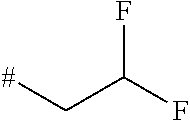 |
LC/MS(ESI): m/z = 548 [M + H]+, RT = 2.05 min, method (1) | |
| II-185 |
 |
LC/MS(ESI): m/z = 598 [M + H]+, RT = 2.05 min, method (1) | |
| II-186 |
 |
LC/MS(ESI): m/z = 611 [M + H]+, RT = 1.78 min, method (1) | |
| II-187 |
 |
LC/MS(ESI): m/z = 554 [M + H]+, RT = 1.82 min, method (1) | |
| II-188 |
 |
LC/MS(ESI): m/z = 563 [M + H]+, RT = 1.98 min, method (1) | |
| II-189 |
 |
LC/MS(ESI): m/z = 618 [M + H]+, RT = 1.85 min, method (2) | |
| II-190 |
 |
LC/MS(ES!): m/z = 618 [M + H]+, RT = 1.86 min, method (2) | |
| II-191 |
 |
LC/MS(ESI): m/z = 670 [M + H]+, RT = 1.84 min, method (2) | |
| II-192 |
 |
LC/MS(ESI): m/z = 670 [M + H]+, RT = 1.84 min, method (2) | Na salt |
| II-193 |
 |
LC/MS(ESI): m/z = 685 [M + H]+, RT = 1.89 min, method (1) | |
| II-194 |
 |
LC/MS(ESI): m/z = 582 [M + H]+, RT = 1.91 min, method (2) | |
| II-195 |
 |
LC/MS(ESI): m/z = 582 [M + H]+, RT = 1.91 min, method (2) | |
| II-196 |
 |
LC/MS(ESI): m/z = 578 [M + H]+, RT = 1.33 min, method (2) | |
| TABLE 19 | |||
| No. | PR | data | comment |
| II-197 |
 |
LC/MS(ESI): m/z = 565 [M + H]+, RT = 1.79 min, method (2) | |
| II-198 |
 |
LC/MS(ESI): m/z = 564 [M + H]+, RT = 1.95 min, method (2) | |
| II-199 |
 |
LC/MS(ESI): m/z = 580 [M + H]+, RT = 2.04 min, method (2) | |
| II-200 |
 |
LC/MS(ESI): m/z = 565 [M + H]+, RT = 1.78 min, method (2) | |
| II-201 |
 |
LC/MS(ESI): m/z = 611 [M + H]+, RT = 1.95 min, method (2) | |
| II-202 |
 |
LC/MS(ESI): m/z = 594 [M + H]+, RT = 2.16 min, method (2) | |
| II-203 |
 |
LC/MS(ESI): m/z = 565 [M + H]+, RT = 1.86 min, method (2) | |
| II-204 |
 |
LC/MS(ESI): m/z = 581 [M + H]+, RT = 1.87 min, method (2) | |
| II-205 |
 |
LC/MS(ESI): m/z = 579 [M + H]+, RT = 1.95 min, method (2) | |
| II-206 |
 |
LC/MS(ESI): m/z = 580 [M + H]+, RT = 2.03 min, method (2) | |
| II-207 |
 |
LC/MS(ESI): m/z = 580 [M + H]+, RT = 2.07 min, method (2) | |
| II-208 |
 |
LC/MS(ESI): m/z = 632 [M + H]+, RT = 2.15 min, method (2) | |
| II-209 |
 |
LC/MS(ESI): m/z = 632 [M + H]+, RT = 2.15 min, method (2) | |
| II-210 |
 |
LC/MS(ESI): m/z = 653 [M + H]+, RT = 1.81 min, method (2) | |
| II-211 |
 |
LC/MS(ESI): m/z = 597 [M + H]+, RT = 1.75 min, method (2) | |
| II-212 |
 |
LC/MS(ESI): m/z = 580 [M + H]+, RT = 1.86 min, method (1) | |
| II-213 |
 |
LC/MS(ESI): m/z = 568 [M + H]+, RT = 1.89 min, method (1) | |
| II-214 |
 |
LC/MS(ESI): m/z = 556 [M + H]+, RT = 1.94 min, method (1) | |
| TABLE 20 | |||
| No. | PR | data | comment |
| II-215 |
 |
LC/MS(ESI): m/z = 554 [M + H]+, RT = 1.85 min, method (3) | |
| II-216 |
 |
LC/MS(ESI): m/z = 568 [M + H]+, RT = 1.94 min, method (3) | |
| II-217 |
 |
LC/MS(ESI): m/z = 554 [M + H]+, RT = 1.88 min, method (1) | |
| II-218 |
 |
LC/MS(ESI): m/z = 568 [M + H]+, RT = 1.82 min, method (2) | |
| II-219 |
 |
LC/MS(ESI): m/z = 597 [M + H]+, RT = 1.75 min, method (2) | |
| II-220 |
 |
LC/MS(ESI): m/z = 584 [M + H]+, RT = 2.05 min, method (1) | |
| II-221 |
 |
LC/MS(ESI): m/z = 582 [M + H]+, RT = 2.12 min, method (1) | |
| II-222 |
 |
LC/MS(ESI): m/z = 583 [M + H]+, RT = 1.76 min, method (1) | |
| II-223 |
 |
LC/MS(ESI): m/z = 567 [M + H]+, RT = 1.70 min, method (1) | |
| II-224 |
 |
LC/MS(ESI): m/z = 570 [M + H]+, RT = 2.09 min, method (1) | |
| II-225 |
 |
LC/MS(ESI): m/z = 552 [M + H]+, RT = 1.81 min, method (1) | |
| II-226 |
 |
LC/MS(ESI): m/z = 554 [M + H]+, RT = 1.79 min, method (1) | |
| II-227 |
 |
LC/MS(ESI): m/z = 570 [M + H]+, RT = 2.39 min, method (1) | |
| II-228 |
 |
LC/MS(ESI): m/z = 581 [M + H]+, RT = 1.80 min, method (1) | |
| II-229 |
 |
LC/MS(ESI): m/z = 570 [M + H]+, RT = 1.96 min, method (1) | |
| II-230 |
 |
LC/MS(ESI): m/z = 584 [M + H]+, RT = 1.94 min, method (1) | |
| II-231 |
 |
LC/MS(ESI): m/z = 582 [M + H]+, RT = 1.86 min, method (1) | |
| II-232 |
 |
LC/MS(ESI): m/z = 570 [M + H]+, RT = 2.01 min, method (1) | |
| II-233 |
 |
LC/MS(ESI): m/z = 581 [M + H]+, RT = 1.73 min, method (1) | |
| II-234 |
 |
LC/MS(ESI): m/z = 584 [M + H]+, RT = 1.83 min, method (1) | |
| TABLE 21 | |||
| No. | PR | data | comment |
| II-235 |
 |
LC/MS(ESI): m/z = 570 [M + H]+, RT = 2.06 min, method (1) | |
| II-236 |
 |
LC/MS(ESI): m/z = 567 [M + H]+, RT = 1.70 min, method (1) | |
| II-237 |
 |
LC/MS(ESI): m/z = 581 [M + H]+, RT = 1.80 min, method (1) | |
| II-238 |
 |
LC/MS(ESI): m/z = 554 [M + H]+, RT = 1.80 min, method (1) | |
| II-241 |
 |
LC/MS(ESI): m/z = 554 [M + H]+, RT = 1.88 min, method (1) | |
| TABLE 22 |
 |
| No. | PR | R1 | R2 | R3 | R4 | data |
| II-242 |
 |
F | H | F | F | LC/MS (ESI): m/z = 606 [M + H]+, RT = 2.12 min, method (2) |
| II-243 |
 |
F | F | H | H | LC/MS (ESI): m/z = 588 [M + H]+, RT = 2.00 min, method (2) |
| II-244 |
 |
F | H | F | H | LC/MS (ESI): m/z = 588 [M + H]+, RT = 2.04 min, method (2) |
| II-245 |
 |
Me | H | F | F | LC/MS (ESI): m/z = 598 [M + H]+, RT = 2.27 min, method (2) |
| II-246 |
 |
Me | F | H | H | LC/MS (ESI): m/z = 580 [M + H]+, RT = 2.14 min, method (2) |
| II-247 |
 |
Me | H | F | H | LC/MS (ESI): m/z = 580 [M + H]+, RT = 2.17 min, method (2) |
| TABLE 23 |
 |
| No. | PR | R2 | R3 | data | |
| II-248 |
 |
F | H | LC/MS (ESI): m/z = 508 [M + H]+, RT = 1.76 min, method (2) |
| II-249 |
 |
F | H | LC/MS (ESI): m/z = 568 [M + H]+, RT = 1.91 min, method (1) |
| II-250 |
 |
F | H | 1H-NMR(CDCL3)δ: 2.05(s, 3H), 2.92-3.02(m, 1H), 3.40-3.48 (m, 1H), 3.51-3.62(m, 2H), 3.72-3.80(m, 1H), 3.88-3.92(m, 1H), 4 50-4.56(m, 1H), 4.64-4.72(m, 1H), 5.55(d, J = 13.6 Hz, 1H), 5.78-5.82(m, 1H), 5.84-5.88(m, 1H), 5.90-5.98(m, 2H), 6.82- 7.00(m, 2H), 7.00-7.20(m, 5H), 7.35-7.42(m, 1H) |
| II-251 |
 |
F | H | LC/MS (ESI): m/z = 554 [M + H]+, RT = 1.76 min, method (1) |
| II-252 |
 |
F | H | LC/MS (ESI): m/z = 598 [M + H]+, RT = 1.80 min, method (2) |
| II-253 |
 |
H | F | LC/MS (ESI): m/z = 508 [M + H]+, RT = 1.76 min, method (2) |
| II-254 |
 |
H | F | LC/MS (ESI): m/z = 538 [M + H]+, RT = 1.78 min, method (2) |
| II-255 |
 |
H | F | LC/MS (ESI): m/z = 554 [M + H]+, RT = 1.81 min, method (2) |
| II-256 |
 |
H | F | LC/MS (ESI): m/z = 598 [M + H]+, RT = 1.85 min, method (2) |
| II-257 |
 |
F | H | 1H-NMR (CDCl3)δ: 1.42 (d, J = 6.8 Hz, 6H), 2.90-3.07 (m, 2H), 3.44 (t, J = 10.8 Hz, 1H), 3.60 (d, J = 12.8 Hz, 2H), 3.77 (d, J = 10.8 Hz, 1H), 3.93 (dd, J = 10.8, 2.8 Hz, 1H), 4.56 (dd, J = 9.6, 2.8 Hz, 1H), 4.67 (m, 1H), 5.59 (m, 1H), 5.87 (m, 1H), 5.59 (s, 1H), 6.91-7.21 (m. 7H), 7.38 (m, 1H). |
| II-258 |
 |
F | H | 1H-NMR (CDCl3)δ: 2.89-2.93 (m, 1H), 3.30-3.43 (m, 2H), 3.57 (d, J = 13.4 Hz, 1H), 3.73 (dd, J = 11.6, 2.8 Hz, 1H), 3.87 (dd, J = 10.7, 2.4 Hz, 1H), 4.49 (dd, J = 9.9, 2.5 Hz, 1H), 4.72 (d, J = 12.9 Hz, 1H), 5.43 (d, J = 10.8 Hz, 1H), 5.51 (d, J = 13.4 Hz, 1H), 5.64 (d, J = 10.9 Hz, 1H), 5.78 (d, J = 7.7 Hz, 1H), 5.84 (s, 1H), 6.44 (d, J = 7.8 Hz, 1H), 6.67 (t, J = 7.0 Hz, 1H), 7.02-7.13 (m, 5H), 7.29-7.40 (m, 4H), 7.64 (d, J = 7.7 Hz, 2H). |
| TABLE 24 |
 |
| No. | PR | LC/MS |
| II-259 |
 |
LC/MS(ESI): m/z = 683 [M + H]+, RT = 2.33 min, method (1) |
| II-260 |
 |
LC/MS(ESI): m/z = 662 [M + H]+, RT = 2.22 min, method (1) |
| II-261 |
 |
LC/MS(ESI): m/z = 648 [M + H]+, RT = 2.09 min, method (1) |
| II-262 |
 |
LC/MS(ESI): m/z = 674 [M + H]+, RT = 2.20 min, method (1) |
| II-263 |
 |
LC/MS(ESI): m/z = 634 [M + H]+, RT = 2.07 min, method (1) |
| II-264 |
 |
LC/MS(ESI): m/z = 662 [M + H]+, RT = 2.22 min, method (1) |
| II-265 |
 |
LC/MS(ESI): m/z = 556 [M + H]+, RT = 1.79 min, method (1) |
| II-266 |
 |
LC/MS(ESI): m/z = 583 [M + H]+, RT = 1.59 min, method (1) |
| II-267 |
 |
LC/MS(ESI): m/z = 554 [M + H]+, RT = 1.65 min, method (1) |
| II-268 |
 |
LC/MS(ESI): m/z = 554 [M + H]+, RT = 1.71 min, method (1) |
| II-269 |
 |
LC/MS(ESI): m/z = 567 [M + H]+, RT = 1.51 min, method (1) |
| II-270 |
 |
LC/MS(ESI): m/z = 570 [M + H]+, RT = 2.16 min, method (1) |
| II-271 |
 |
LC/MS(ESI): m/z = 581 [M + H]+, RT = 1.57 min, method (1) |
| II-272 |
 |
LC/MS(ESI): m/z = 554 [M + H]+, RT = 1.70 min, method (1) |
| II-273 |
 |
LC/MS(ESI): m/z = 582 [M + H]+, RT = 1.70 min, method (1) |
| II-274 |
 |
LC/MS(ESI): m/z = 570 [M + H]+, RT = 1.89 min, method (1) |
| TABLE 25 | ||
| No. | PR | LC/MS |
| II-275 |
 |
LC/MS(ESI): m/z = 581 [M + H]+, RT = 1.55 min, method (1) |
| II-276 |
 |
LC/MS(ESI): m/z = 570 [M + H]+, RT = 1.81 min, method (1) |
| II-277 |
 |
LC/MS(ESI): m/z = 581 [M + HJ+, RT = 1.58 min, method (1) |
| II-278 |
 |
LC/MS(ESI): m/z = 554 [M + H]+, RT = 1.65 min, method (1) |
| TABLE 26 | ||
| No. | Structure | data |
| II-279 |
 |
LC/MS (ESI): m/z = 568 [M + H]+, RT = 1.92 min, method (2) |
| II-280 |
 |
LC/MS (ESI): m/z = 638 [M + H]+, RT = 2.17 min, method (2) |
| II-281 |
 |
LC/MS (ESI): m/z = 584 [M + H]+, RT = 2.18 min, method (2) |
| II-282 |
 |
LC/MS (ESI): m/z = 586 [M + H]+, RT = 2.03 min, method (2) |
| II-283 |
 |
LC/MS (ESI): m/z = 596 [M + H]+, RT = 2.18 min, method (2) |
| II-284 |
 |
LC/MS (ESI): m/z = 566 [M + H]+, RT = 2.02 min, method (2) |
| II-285 |
 |
LC/MS (ESI): m/z = 566 [M + H]+, RT = 2.08 min, method (2) |
| II-286 |
 |
LC/MS (ESI): m/z = 568 [M + H]+, RT = 1.93 min, method (2) |
| TABLE 27 | ||
| CEN_IC50 | CPE_EC50 | |
| No. | nM | nM |
| III-1 | 1.93 | 1.13 |
| III-2 | 2.22 | 3.39 |
| III-3 | 2.17 | 10.9 |
| III-4 | 2.18 | 3.38 |
| III-5 | 3.94 | 4 |
| III-6 | 2.37 | 1.43 |
| III-7 | 4.06 | 2.7 |
| III-8 | 3.46 | 3.07 |
| III-9 | 1.48 | 0.864 |
| III-10 | 1.63 | 3 |
| III-11 | 10.7 | 5.67 |
| III-12 | 0.87 | 0.656 |
| III-13 | 5.68 | 3.01 |
| III-14 | 18.5 | 3.17 |
| III-15 | 2.08 | 2.36 |
| III-16 | 4.69 | 2.85 |
| III-17 | 3.86 | 3 |
| III-18 | 2.37 | 2.45 |
| III-19 | 4.24 | 3.43 |
| III-20 | 8.26 | 4.04 |
| III-21 | 2.75 | 2.81 |
| III-22 | 2.99 | 2.95 |
| III-23 | 2.1 | 2.17 |
| III-24 | 3.93 | 2.64 |
| III-25 | 3.9 | 3.18 |
| III-26 | 3.81 | 3.68 |
| III-27 | 1.63 | 3.07 |
| III-28 | 2.91 | 3.18 |
| III-29 | 2.25 | 2.53 |
| III-30 | 3.49 | 3.57 |
| III-31 | 6.79 | 4.17 |
| III-32 | 2.55 | 4.36 |
| III-33 | 2.22 | 2.58 |
| III-34 | 3.62 | 3.28 |
| TABLE 28 | |||
| CEN_IC50 | |||
| Structure | nM | ||
 |
25.5 | ||
 |
19.7 | ||
 |
28.1 | ||
 |
95.0 | ||
 |
104 | ||
 |
43.4 | ||
Hundred μL of MEM and 10 μL of WST-8 reagent were added to each well on the plates. After mixing with a plate mixer, the plates were incubated in a CO2 incubator for 1 to 3 hours. After incubation, 10 μL of 10% SDS solution was dispensed to each well on the plates in order to inactivate the viral infectivity.
% of inhibition=(X−Z)/(Y−Z)×100
X: the average of O.D. (O.D. at 450 nm O.D. at 620 nm) of substance
y: the average of O.D. (O.D. at 450 nm O.D. at 620 nm) of cell control
Z: the average of O.D. (O.D. at 450 nm O.D. at 620 nm) of virus control
The EC50 of each substance was calculated by using software XLfit 5.3.1.3.
CI=(D A/A+B)/D A+(D B/A+B)/D B+(D A/A+B ×D B/A+B)/(D A ×D B)
DA: the EC50 of substance A alone
DB: the EC50 of substance B alone
DA/A+B: the concentration of substance A giving 50% inhibition in combination with substance B
DB/A+B: the concentration of substance B giving 50% inhibition in combination with substance A
<Determination of Combination Effect>
Combination effects were analyzed according to the report from Naruto Taira (Ac to Med. Okayama, 2006 vol. 60, p 25-34).
| TABLE 29 | |
| EC50 (nM) | |
| Virus | III-1 | Oseltamivir | Peramivir | Laninamivir | Zanamivir | Favipiravir |
| A/WSN/33 (H1N1) | 2.85 | 59314.51 | ||||
| A/PR/8/34 (H1N1) | 4.95 | 1829.67 | 213.77 | 212.74 | 1565.38 | 26919.33 |
| A/Victoria/3/75 (H3N2) | 3.48 | 244.62 | ||||
| A/HongKong/8/68 (H3N2) | 2.08 | 71.19 | ||||
| B/Maryland/1/59 | 14.70 | 863.72 | 353.88 | 109.81 | 162.60 | |
| EC50 (nM) | EC50 (μg/mL) |
| Virus | VX-787 | Amantadine | Rimantadine | Tizoxanide | anti HA antibody |
| A/WSN/33 (H1N1) | |||||
| A/PR/8/34 (H1N1) | 9.38 | 2.00 | |||
| A/Victoria/3/75 (H3N2) | 2511.43 | 158.44 | 8314.73 | ||
| A/HongKong/8/68 (H3N2) | |||||
| B/Maryland/1/59 | |||||
| TABLE 30 | |
| CI value | |
| Virus | III-1 + Oseltamivir | III-1 + Peramivir | III-1 + Laninamivir | III-1 + Zanamivir | III-1 + Favipiravir |
| A/WSN/33 (H1N1) | 0.38 | ||||
| A/PR/8/34 (H1N1) | 0.53 | 0.59 | 0.58 | 0.52 | 0.99 |
| A/Victoria/3/75 (H3N2) | 0.31 | ||||
| A/HongKong/8/68 (H3N2) | 0.45 | ||||
| B/Maryland/1/59 | 0.86 | 0.94 | 1.06 | 0.91 | |
| CI value |
| Virus | III-1 + VX-787 | III-1 + Amantadine | III-1 + Rimantadine | III-1 + Tizoxanide | III-1 + anti HA antibody |
| A/WSN/33 (H1N1) | |||||
| A/PR/8/34 (H1N1) | 0.61 | 0.84 | |||
| A/Victoria/3/75 (H3N2) | 0.82 | 0.80 | 0.87 | ||
| A/HongKong/8/68 (H3N2) | |||||
| B/Maryland/1/59 | |||||
(Result)
Compound II-6: 14.9%
Compound III-2: 4.2%
Claims (15)


Applications Claiming Priority (4)
| Application Number | Priority Date | Filing Date | Title |
|---|---|---|---|
| JP2015-244492 | 2015-12-15 | ||
| JP2015244492 | 2015-12-15 | ||
| JPJP2015-244492 | 2015-12-15 | ||
| PCT/JP2016/087170 WO2017104691A1 (en) | 2015-12-15 | 2016-12-14 | Medicine for treating influenza characterized by comprising combination of cap-dependent endonuclease inhibitor with anti-influenza drug |
Publications (2)
| Publication Number | Publication Date |
|---|---|
| US20200261481A1 US20200261481A1 (en) | 2020-08-20 |
| US11040048B2 true US11040048B2 (en) | 2021-06-22 |
Family
ID=59057323
Family Applications (1)
| Application Number | Title | Priority Date | Filing Date |
|---|---|---|---|
| US16/061,495 Active 2037-10-15 US11040048B2 (en) | 2015-12-15 | 2016-12-14 | Medicament for treating influenza characterized by combining a Cap-dependent endonuclease inhibitor and an anti-influenza drug |
Country Status (19)
| Country | Link |
|---|---|
| US (1) | US11040048B2 (en) |
| EP (1) | EP3391888B1 (en) |
| JP (1) | JP6323860B2 (en) |
| KR (1) | KR102084109B1 (en) |
| CN (1) | CN108697715A (en) |
| AU (1) | AU2016374416A1 (en) |
| BR (1) | BR112018011103A2 (en) |
| CA (1) | CA3008607A1 (en) |
| CL (1) | CL2018001618A1 (en) |
| CR (1) | CR20180356A (en) |
| HK (1) | HK1254961A1 (en) |
| IL (1) | IL260025A (en) |
| MA (1) | MA44080A (en) |
| MX (1) | MX2018006966A (en) |
| PE (1) | PE20181516A1 (en) |
| RU (1) | RU2745071C2 (en) |
| SG (2) | SG10201911957QA (en) |
| WO (1) | WO2017104691A1 (en) |
| ZA (1) | ZA201803246B (en) |
Cited By (5)
| Publication number | Priority date | Publication date | Assignee | Title |
|---|---|---|---|---|
| US20210069204A1 (en) * | 2019-08-13 | 2021-03-11 | F. Hoffmann-La Roche Ag | Dosage of baloxavir marboxil for pediatric patients |
| US11306106B2 (en) | 2016-08-10 | 2022-04-19 | Shionogi & Co., Ltd. | Pharmaceutical compositions containing substituted polycyclic pyridone derivatives and prodrug thereof |
| US11389457B2 (en) | 2019-03-29 | 2022-07-19 | Hoffmann-La Roche Inc. | Compound and method for the prevention of transmission of influenza virus |
| US20230210860A1 (en) * | 2019-03-22 | 2023-07-06 | Shionogi & Co., Ltd. | Treating influenza using substituted polycyclic pyridone derivatives and prodrugs thereof in a subject having influenza and a severe influenza condition |
| US12233066B2 (en) | 2018-10-17 | 2025-02-25 | Cocrystal Pharma, Inc. | Combinations of inhibitors of influenza virus replication |
Families Citing this family (42)
| Publication number | Priority date | Publication date | Assignee | Title |
|---|---|---|---|---|
| US9969794B2 (en) | 2012-05-10 | 2018-05-15 | Visterra, Inc. | HA binding agents |
| JP6358639B2 (en) | 2015-04-24 | 2018-07-18 | 塩野義製薬株式会社 | 6-membered heterocyclic derivatives and pharmaceutical compositions containing them |
| CN107709321A (en) | 2015-04-28 | 2018-02-16 | 盐野义制药株式会社 | Substituted polycyclic pyridone derivatives and prodrugs thereof |
| CA3015347A1 (en) | 2016-02-24 | 2017-08-31 | Visterra, Inc. | Formulations of antibody molecules to influenza virus |
| US11261198B2 (en) | 2016-06-20 | 2022-03-01 | Shionogi & Co., Ltd. | Process for preparing substituted polycyclic pyridone derivative and crystal thereof |
| EP3686201A4 (en) * | 2017-09-18 | 2021-04-28 | Sunshine Lake Pharma Co., Ltd. | INHIBITOR OF INFLUENZA VIRUS REPLICATION AND ITS USE |
| US11286262B2 (en) * | 2017-10-06 | 2022-03-29 | Shionogi & Co., Ltd. | Stereoselective process for preparing substituted polycyclic pyridone derivatives |
| TWI795462B (en) | 2017-11-17 | 2023-03-11 | 日商鹽野義製藥股份有限公司 | Pharmaceutical preparation excellent in light stability and dissolution property |
| CN111848615B (en) * | 2018-01-17 | 2022-05-17 | 江西彩石医药科技有限公司 | Pyridone derivatives and anti-influenza virus pharmaceutical compositions containing the same |
| CN110041327B (en) * | 2018-01-17 | 2022-01-21 | 江西彩石医药科技有限公司 | Pyridone derivative, composition thereof and application of pyridone derivative as anti-influenza virus medicament |
| BR112020021059B1 (en) | 2018-04-24 | 2022-08-30 | Shionogi & Co., Ltd | SOLID DOSAGE FORM |
| WO2020058745A1 (en) * | 2018-09-18 | 2020-03-26 | Shionogi & Co., Ltd. | Treating influenza using substituted polycyclic pyridone derivatives and prodrugs thereof |
| AU2019380421B2 (en) * | 2018-11-13 | 2025-07-24 | Cocrystal Pharma, Inc. | Formulations of influenza therapeutics |
| CN118791481A (en) * | 2018-12-12 | 2024-10-18 | 江西彩石医药科技有限公司 | Pyridone derivatives, compositions thereof and use thereof as anti-influenza virus drugs |
| CN111377944A (en) * | 2018-12-25 | 2020-07-07 | 广东东阳光药业有限公司 | Baloxavir marboxil crystal form and preparation method thereof |
| CN111410661B (en) * | 2019-01-04 | 2023-05-05 | 周雨恬 | Cap-dependent endonuclease inhibitors and uses thereof |
| CN113614085B (en) * | 2019-03-05 | 2022-12-23 | 广东东阳光药业有限公司 | Inhibitors of influenza virus replication and uses thereof |
| AU2019433734B2 (en) | 2019-03-12 | 2025-08-28 | Shionogi & Co., Ltd. | Treating influenza using substituted polycyclic pyridone derivatives and prodrugs thereof in a subject having influenza and a complication risk factor |
| TWI830882B (en) * | 2019-03-13 | 2024-02-01 | 日商塩野義製藥股份有限公司 | Treating influenza using substituted polycyclic pyridone derivatives and prodrugs thereof in a subject having influenza and a complication risk factor |
| WO2020194024A1 (en) * | 2019-03-22 | 2020-10-01 | Shionogi & Co., Ltd. | Treating influenza using substituted polycyclic pyridone derivatives and prodrugs thereof in a subject having influenza and a severe influenza condition |
| EP3946613A1 (en) * | 2019-03-25 | 2022-02-09 | Visterra, Inc. | Compositions and methods for treating and preventing influenza |
| CN111825699B (en) * | 2019-04-15 | 2023-02-21 | 上海复星星泰医药科技有限公司 | Sulfur-containing heterocyclic compounds and process for producing the same |
| CN111909174B (en) | 2019-05-08 | 2022-01-21 | 江西彩石医药科技有限公司 | Crystal form of pyridone derivative, preparation method and application |
| BR112022000503A2 (en) * | 2019-07-11 | 2022-06-07 | Nanjing Zhegxiang Pharmaceuticals Co Ltd | Compounds Useful for Treating Influenza Virus Infections |
| WO2021038480A1 (en) * | 2019-08-27 | 2021-03-04 | Janssen Pharmaceuticals, Inc. | Combinations for treating influenza virus |
| CN115175913B (en) * | 2019-11-13 | 2023-11-28 | 南京知和医药科技有限公司 | Substituted bistricycles and pharmaceutical compositions and uses thereof |
| CN112920202B (en) * | 2019-12-05 | 2024-08-09 | 北京凯因科技股份有限公司 | Cap-dependent protease inhibitor |
| CN113045589B (en) * | 2019-12-27 | 2024-08-23 | 广东东阳光药业股份有限公司 | Influenza virus replication inhibitors and uses thereof |
| CN112898346B (en) * | 2020-01-23 | 2023-11-10 | 南京知和医药科技有限公司 | Water-soluble polycyclic compounds, pharmaceutical compositions and uses thereof |
| MX2022008901A (en) * | 2020-01-24 | 2022-08-16 | Regeneron Pharma | Protein-antiviral compound conjugates. |
| CN112940009A (en) * | 2020-02-03 | 2021-06-11 | 南京知和医药科技有限公司 | Sulfonic acid polycyclic compound, pharmaceutical composition and application thereof |
| CN111233891B (en) * | 2020-03-04 | 2021-05-04 | 江苏柯菲平医药股份有限公司 | Fused ring pyridone derivative and preparation method and application thereof |
| CN113116899B (en) * | 2020-03-06 | 2022-12-20 | 广东众生睿创生物科技有限公司 | Pharmaceutical composition for treating influenza and preparation containing pharmaceutical composition |
| CN112578034B (en) * | 2020-11-04 | 2022-02-11 | 广东众生睿创生物科技有限公司 | Quality control method of chiral amine micromolecules and salts thereof |
| WO2022107755A1 (en) | 2020-11-17 | 2022-05-27 | 塩野義製薬株式会社 | Novel acridinium salt and method for producing same |
| JP2024054430A (en) * | 2020-12-28 | 2024-04-17 | 塩野義製薬株式会社 | Drug for treating viral respiratory tract infections comprising DP1 antagonist and cap-dependent endonuclease inhibitor |
| CN114315827A (en) * | 2020-12-28 | 2022-04-12 | 维眸生物科技(上海)有限公司 | Polycyclic pyridopyridazine amide oxime-containing carbocyclic derivatives and uses thereof |
| JP2024054429A (en) * | 2020-12-28 | 2024-04-17 | 塩野義製薬株式会社 | Drug for treating viral respiratory tract infections comprising DP1 antagonist and neuraminidase inhibitor |
| TW202308646A (en) * | 2021-05-10 | 2023-03-01 | 大陸商南京征祥醫藥有限公司 | Crystal form of a compound for treating influenza and use thereof |
| CN117343079B (en) * | 2022-07-05 | 2024-08-20 | 山东如至生物医药科技有限公司 | Novel anti-influenza virus compound, and pharmaceutical composition and application thereof |
| WO2024109707A1 (en) * | 2022-11-21 | 2024-05-30 | 合肥医工医药股份有限公司 | Fused ring pyridone derivatives, preparation method therefor, and use thereof |
| CN118561867B (en) * | 2024-05-27 | 2025-04-18 | 安徽贝克制药股份有限公司 | Cap-dependent endonuclease inhibitor, preparation method thereof and application thereof |
Citations (38)
| Publication number | Priority date | Publication date | Assignee | Title |
|---|---|---|---|---|
| GB2280435A (en) | 1993-07-29 | 1995-02-01 | Merck & Co Inc | Anti-viral agent |
| US5475109A (en) | 1994-10-17 | 1995-12-12 | Merck & Co., Inc. | Dioxobutanoic acid derivatives as inhibitors of influenza endonuclease |
| EP1544199A1 (en) | 2003-08-13 | 2005-06-22 | Japan Tobacco Inc. | Nitrogenous condensed-ring compound and use thereof as hiv integrase inhibitor |
| WO2006066414A1 (en) | 2004-12-23 | 2006-06-29 | Virochem Pharma Inc. | Hydroxydihydropyridopy razine-1,8-diones and methods for inhibiting hiv integrase |
| EP1950212A1 (en) | 2005-10-27 | 2008-07-30 | Shionogi Co., Ltd. | Polycyclic carbamoylpyridone derivative having inhibitory activity on hiv integrase |
| EP2444400A1 (en) | 2009-06-15 | 2012-04-25 | Shionogi&Co., Ltd. | Substituted polycyclic carbamoylpyridone derivative |
| US20130090300A1 (en) | 2011-07-22 | 2013-04-11 | Joseph D. Bauman | Inhibitors of influenza endonuclease activity and tools for their discovery |
| US20130096109A1 (en) | 2010-04-12 | 2013-04-18 | Shionogi & Co., Ltd. | Pyridone derivative having integrase inhibitory activity |
| WO2013057253A1 (en) | 2011-10-21 | 2013-04-25 | F. Hoffmann-La Roche Ag | Pyrimidin-4-one derivatives and their use in the treatment, amelioration or prevention of a viral disease |
| WO2013057251A2 (en) | 2011-10-21 | 2013-04-25 | F. Hoffmann-La Roche Ag | Heteroaryl hydroxamic acid derivatives and their use in the treatment, amelioration or prevention of a viral disease |
| EP2620436A1 (en) | 2010-09-24 | 2013-07-31 | Shionogi&Co., Ltd. | Substituted polycyclic carbamoyl pyridone derivative prodrug |
| WO2013174930A2 (en) | 2012-05-23 | 2013-11-28 | Savira Pharmaceuticals Gmbh | 7-oxo-thiazolopyridine carbonic acid derivatives and their use in the treatment, amelioration or prevention of a viral disease |
| WO2013174931A1 (en) | 2012-05-23 | 2013-11-28 | Savira Pharmaceuticals Gmbh | 7-oxo-4,7 -dihydro- pyrazolo [1, 5 -a] pyrimidine derivatives which are useful in the treatment, amelioration or prevention of a viral disease |
| WO2014023691A1 (en) | 2012-08-06 | 2014-02-13 | Savira Pharmaceuticals Gmbh | Dihydroxypyrimidine carbonic acid derivatives and their use in the treatment, amelioration or prevention of a viral disease |
| WO2014043252A2 (en) | 2012-09-11 | 2014-03-20 | Rutgers, The State University Of New Jersey | Therapeutic hydroxypyridinones, hydroxypyrimidinones and hydroxypyridazinones |
| WO2014074926A1 (en) | 2012-11-09 | 2014-05-15 | Rutgers, The State University Of New Jersey | Therapeutic hydroxyquinolones |
| WO2014108407A1 (en) | 2013-01-08 | 2014-07-17 | Savira Pharmaceuticals Gmbh | Pyridone derivatives and their use in the treatment, amelioration or prevention of a viral disease |
| WO2014108406A1 (en) | 2013-01-08 | 2014-07-17 | Savira Pharmaceuticals Gmbh | Pyrimidone derivatives and their use in the treatment, amelioration or prevention of a viral disease |
| WO2014108408A1 (en) | 2013-01-08 | 2014-07-17 | Savira Pharmaceuticals Gmbh | Naphthyridinone derivatives and their use in the treatment, amelioration or prevention of a viral disease |
| WO2015038660A1 (en) | 2013-09-12 | 2015-03-19 | Alios Biopharma, Inc. | Pyridazinone compounds and uses thereof |
| WO2015038655A1 (en) | 2013-09-12 | 2015-03-19 | Alios Biopharma, Inc. | Aza-pyridone compounds and uses thereof |
| WO2016005330A1 (en) | 2014-07-07 | 2016-01-14 | F. Hoffmann-La Roche Ag | Dihydropyridopyrazine-1,8-diones and their use in the treatment, amelioration or prevention of viral diseases |
| WO2016005331A1 (en) | 2014-07-07 | 2016-01-14 | F. Hoffmann-La Roche Ag | Pyridopyrazine compounds and their use in the treatment, amelioration or prevention of influenza |
| WO2017046362A1 (en) | 2015-09-18 | 2017-03-23 | F. Hoffmann-La Roche Ag | Pyrazolopyrazines and their use in the treatment, amelioration or prevention of a viral disease |
| WO2017072341A1 (en) | 2015-10-30 | 2017-05-04 | F. Hoffmann-La Roche Ag | Pyrimidone derivatives and their use in the treatment, amelioration or prevention of a viral disease |
| WO2017109088A1 (en) | 2015-12-23 | 2017-06-29 | Savira Pharmaceuticals Gmbh | Pyrimidone derivatives and their use in the treatment, amelioration or prevention of a viral disease |
| JP2017137291A (en) | 2016-02-03 | 2017-08-10 | 塩野義製薬株式会社 | Polycyclic pyridone derivative and prodrug thereof |
| WO2017153919A1 (en) | 2016-03-08 | 2017-09-14 | Novartis Ag | Tricyclic compounds useful to treat orthomyxovirus infections |
| WO2017158147A1 (en) | 2016-03-18 | 2017-09-21 | Savira Pharmaceuticals Gmbh | Pyrimidone derivatives and their use in the treatment, amelioration or prevention of a viral disease |
| WO2017158151A1 (en) | 2016-03-18 | 2017-09-21 | Savira Pharmaceuticals Gmbh | Pyrimidone derivatives and their use in the treatment, amelioration or prevention of a viral disease |
| WO2017223231A1 (en) | 2016-06-21 | 2017-12-28 | Alios Biopharma, Inc. | (s)-8-(benzhydryl )-6-isopropyl-3,5-dioxo- 5, 6,7,8,-tetrahydro-3h-pyrazino-[1,2-b]pyridazin-yl-isobutyrate antiviral agent for use in treating influenza |
| WO2018030463A1 (en) | 2016-08-10 | 2018-02-15 | 塩野義製薬株式会社 | Substituted polycyclic pyridone derivative and pharmaceutical composition containing prodrug thereof |
| EP3290424A1 (en) | 2015-04-28 | 2018-03-07 | Shionogi & Co., Ltd | Substituted polycyclic pyridone derivative and prodrug thereof |
| WO2018042303A1 (en) | 2016-08-29 | 2018-03-08 | Novartis Ag | Fused tricyclic pyridazinone compounds useful to treat orthomyxovirus infections |
| WO2018108125A1 (en) | 2016-12-15 | 2018-06-21 | Sunshine Lake Pharma Co., Ltd. | Inhibitors of influenza virus replication and uses thereof |
| CN108440564A (en) | 2018-04-11 | 2018-08-24 | 朱孝云 | Substituted polycyclic carbamoylpyridone derivative and its prodrug |
| CN108727369A (en) | 2017-04-25 | 2018-11-02 | 广东东阳光药业有限公司 | Inhibitors of influenza viruses replication and application thereof |
| EP3473629A1 (en) | 2016-06-20 | 2019-04-24 | Shionogi & Co., Ltd. | Method for producing substituted polycyclic pyridone derivative and crystal of same |
Family Cites Families (1)
| Publication number | Priority date | Publication date | Assignee | Title |
|---|---|---|---|---|
| DK2123276T3 (en) * | 2007-02-16 | 2013-01-02 | Toyama Chemical Co Ltd | PHARMACEUTICAL COMPOSITION COMPREHENSIVE PYRAZINE DERIVATIVE AND PROCEDURE FOR USING A PYRAZIDE DERIVATIVE IN COMBINATION |
-
2016
- 2016-12-14 HK HK18114068.8A patent/HK1254961A1/en unknown
- 2016-12-14 US US16/061,495 patent/US11040048B2/en active Active
- 2016-12-14 WO PCT/JP2016/087170 patent/WO2017104691A1/en not_active Ceased
- 2016-12-14 CN CN201680081836.6A patent/CN108697715A/en active Pending
- 2016-12-14 CA CA3008607A patent/CA3008607A1/en not_active Abandoned
- 2016-12-14 EP EP16875668.2A patent/EP3391888B1/en active Active
- 2016-12-14 RU RU2018121145A patent/RU2745071C2/en active
- 2016-12-14 KR KR1020187016821A patent/KR102084109B1/en not_active Expired - Fee Related
- 2016-12-14 SG SG10201911957QA patent/SG10201911957QA/en unknown
- 2016-12-14 JP JP2017556086A patent/JP6323860B2/en active Active
- 2016-12-14 MA MA044080A patent/MA44080A/en unknown
- 2016-12-14 MX MX2018006966A patent/MX2018006966A/en unknown
- 2016-12-14 BR BR112018011103-1A patent/BR112018011103A2/en not_active IP Right Cessation
- 2016-12-14 CR CR20180356A patent/CR20180356A/en unknown
- 2016-12-14 SG SG11201804348SA patent/SG11201804348SA/en unknown
- 2016-12-14 AU AU2016374416A patent/AU2016374416A1/en not_active Abandoned
- 2016-12-14 PE PE2018001110A patent/PE20181516A1/en unknown
-
2018
- 2018-05-16 ZA ZA2018/03246A patent/ZA201803246B/en unknown
- 2018-06-14 IL IL260025A patent/IL260025A/en unknown
- 2018-06-15 CL CL2018001618A patent/CL2018001618A1/en unknown
Patent Citations (43)
| Publication number | Priority date | Publication date | Assignee | Title |
|---|---|---|---|---|
| GB2280435A (en) | 1993-07-29 | 1995-02-01 | Merck & Co Inc | Anti-viral agent |
| US5475109A (en) | 1994-10-17 | 1995-12-12 | Merck & Co., Inc. | Dioxobutanoic acid derivatives as inhibitors of influenza endonuclease |
| EP1544199A1 (en) | 2003-08-13 | 2005-06-22 | Japan Tobacco Inc. | Nitrogenous condensed-ring compound and use thereof as hiv integrase inhibitor |
| EP2042502A1 (en) | 2003-08-13 | 2009-04-01 | Japan Tobacco Inc. | Nitrogen-containing fused ring compound and use thereof as HIV integrase inhibitor |
| WO2006066414A1 (en) | 2004-12-23 | 2006-06-29 | Virochem Pharma Inc. | Hydroxydihydropyridopy razine-1,8-diones and methods for inhibiting hiv integrase |
| EP1950212A1 (en) | 2005-10-27 | 2008-07-30 | Shionogi Co., Ltd. | Polycyclic carbamoylpyridone derivative having inhibitory activity on hiv integrase |
| EP2444400A1 (en) | 2009-06-15 | 2012-04-25 | Shionogi&Co., Ltd. | Substituted polycyclic carbamoylpyridone derivative |
| US20130096109A1 (en) | 2010-04-12 | 2013-04-18 | Shionogi & Co., Ltd. | Pyridone derivative having integrase inhibitory activity |
| EP2620436A1 (en) | 2010-09-24 | 2013-07-31 | Shionogi&Co., Ltd. | Substituted polycyclic carbamoyl pyridone derivative prodrug |
| US20130197219A1 (en) * | 2010-09-24 | 2013-08-01 | Chika Takahashi | Substituted polycyclic carbamoyl pyridone derivative prodrug |
| US20130090300A1 (en) | 2011-07-22 | 2013-04-11 | Joseph D. Bauman | Inhibitors of influenza endonuclease activity and tools for their discovery |
| WO2013057253A1 (en) | 2011-10-21 | 2013-04-25 | F. Hoffmann-La Roche Ag | Pyrimidin-4-one derivatives and their use in the treatment, amelioration or prevention of a viral disease |
| WO2013057251A2 (en) | 2011-10-21 | 2013-04-25 | F. Hoffmann-La Roche Ag | Heteroaryl hydroxamic acid derivatives and their use in the treatment, amelioration or prevention of a viral disease |
| WO2013174930A2 (en) | 2012-05-23 | 2013-11-28 | Savira Pharmaceuticals Gmbh | 7-oxo-thiazolopyridine carbonic acid derivatives and their use in the treatment, amelioration or prevention of a viral disease |
| WO2013174931A1 (en) | 2012-05-23 | 2013-11-28 | Savira Pharmaceuticals Gmbh | 7-oxo-4,7 -dihydro- pyrazolo [1, 5 -a] pyrimidine derivatives which are useful in the treatment, amelioration or prevention of a viral disease |
| WO2014023691A1 (en) | 2012-08-06 | 2014-02-13 | Savira Pharmaceuticals Gmbh | Dihydroxypyrimidine carbonic acid derivatives and their use in the treatment, amelioration or prevention of a viral disease |
| WO2014043252A2 (en) | 2012-09-11 | 2014-03-20 | Rutgers, The State University Of New Jersey | Therapeutic hydroxypyridinones, hydroxypyrimidinones and hydroxypyridazinones |
| WO2014074926A1 (en) | 2012-11-09 | 2014-05-15 | Rutgers, The State University Of New Jersey | Therapeutic hydroxyquinolones |
| WO2014108408A1 (en) | 2013-01-08 | 2014-07-17 | Savira Pharmaceuticals Gmbh | Naphthyridinone derivatives and their use in the treatment, amelioration or prevention of a viral disease |
| WO2014108407A1 (en) | 2013-01-08 | 2014-07-17 | Savira Pharmaceuticals Gmbh | Pyridone derivatives and their use in the treatment, amelioration or prevention of a viral disease |
| WO2014108406A1 (en) | 2013-01-08 | 2014-07-17 | Savira Pharmaceuticals Gmbh | Pyrimidone derivatives and their use in the treatment, amelioration or prevention of a viral disease |
| WO2015038660A1 (en) | 2013-09-12 | 2015-03-19 | Alios Biopharma, Inc. | Pyridazinone compounds and uses thereof |
| WO2015038655A1 (en) | 2013-09-12 | 2015-03-19 | Alios Biopharma, Inc. | Aza-pyridone compounds and uses thereof |
| WO2016005330A1 (en) | 2014-07-07 | 2016-01-14 | F. Hoffmann-La Roche Ag | Dihydropyridopyrazine-1,8-diones and their use in the treatment, amelioration or prevention of viral diseases |
| WO2016005331A1 (en) | 2014-07-07 | 2016-01-14 | F. Hoffmann-La Roche Ag | Pyridopyrazine compounds and their use in the treatment, amelioration or prevention of influenza |
| US10633397B2 (en) * | 2015-04-28 | 2020-04-28 | Shionogi & Co., Ltd. | Substituted polycyclic pyridone derivatives and prodrugs thereof |
| EP3290424A1 (en) | 2015-04-28 | 2018-03-07 | Shionogi & Co., Ltd | Substituted polycyclic pyridone derivative and prodrug thereof |
| US10392406B2 (en) * | 2015-04-28 | 2019-08-27 | Shionogi & Co., Ltd. | Substituted polycyclic pyridone derivatives and prodrugs thereof |
| WO2017046362A1 (en) | 2015-09-18 | 2017-03-23 | F. Hoffmann-La Roche Ag | Pyrazolopyrazines and their use in the treatment, amelioration or prevention of a viral disease |
| WO2017072341A1 (en) | 2015-10-30 | 2017-05-04 | F. Hoffmann-La Roche Ag | Pyrimidone derivatives and their use in the treatment, amelioration or prevention of a viral disease |
| WO2017109088A1 (en) | 2015-12-23 | 2017-06-29 | Savira Pharmaceuticals Gmbh | Pyrimidone derivatives and their use in the treatment, amelioration or prevention of a viral disease |
| JP2017137291A (en) | 2016-02-03 | 2017-08-10 | 塩野義製薬株式会社 | Polycyclic pyridone derivative and prodrug thereof |
| WO2017153919A1 (en) | 2016-03-08 | 2017-09-14 | Novartis Ag | Tricyclic compounds useful to treat orthomyxovirus infections |
| WO2017158151A1 (en) | 2016-03-18 | 2017-09-21 | Savira Pharmaceuticals Gmbh | Pyrimidone derivatives and their use in the treatment, amelioration or prevention of a viral disease |
| WO2017158147A1 (en) | 2016-03-18 | 2017-09-21 | Savira Pharmaceuticals Gmbh | Pyrimidone derivatives and their use in the treatment, amelioration or prevention of a viral disease |
| EP3473629A1 (en) | 2016-06-20 | 2019-04-24 | Shionogi & Co., Ltd. | Method for producing substituted polycyclic pyridone derivative and crystal of same |
| WO2017223231A1 (en) | 2016-06-21 | 2017-12-28 | Alios Biopharma, Inc. | (s)-8-(benzhydryl )-6-isopropyl-3,5-dioxo- 5, 6,7,8,-tetrahydro-3h-pyrazino-[1,2-b]pyridazin-yl-isobutyrate antiviral agent for use in treating influenza |
| WO2018030463A1 (en) | 2016-08-10 | 2018-02-15 | 塩野義製薬株式会社 | Substituted polycyclic pyridone derivative and pharmaceutical composition containing prodrug thereof |
| US10759814B2 (en) * | 2016-08-10 | 2020-09-01 | Shionogi & Co., Ltd. | Pharmaceutical compositions containing substituted polycyclic pyridone derivatives and prodrug thereof |
| WO2018042303A1 (en) | 2016-08-29 | 2018-03-08 | Novartis Ag | Fused tricyclic pyridazinone compounds useful to treat orthomyxovirus infections |
| WO2018108125A1 (en) | 2016-12-15 | 2018-06-21 | Sunshine Lake Pharma Co., Ltd. | Inhibitors of influenza virus replication and uses thereof |
| CN108727369A (en) | 2017-04-25 | 2018-11-02 | 广东东阳光药业有限公司 | Inhibitors of influenza viruses replication and application thereof |
| CN108440564A (en) | 2018-04-11 | 2018-08-24 | 朱孝云 | Substituted polycyclic carbamoylpyridone derivative and its prodrug |
Non-Patent Citations (35)
| Title |
|---|
| Baughman, B. M. et al., "Identification of Influenza Endonuclease Inhibitors Using a Novel Fluorescence Polarization Assay", ACS Chem. Biol., vol. 7, 2012, pp. 526-534. |
| Bauman J. D. et al., "Crystallographic Fragment Screening and Structure-Based Optimization Yields a New Class of Influenza Endonuclease Inhibitors", ACS Chem. Biol., 2013, vol. 8, pp. 2501-2508. |
| Bundgaard (ed.) Design of Prodrugs, Elsevier Science Publishers B.V., The Netherlands, 1985, Hans Bundgaard, ed., 1 page (Year: 1985). * |
| Chen, E. et al., "Computation-Guided Discovery of Influenza Endonuclease Inhibitors", ACS Med. Chem. Lett., vol. 5, 2014, pp. 61-64. |
| E. Bart Tarbet et al., "In vitro activity of favipiravir and neuraminidase inhibitor combinations against oseltamivir-sensitive and oseltamivir-resistant pandemic influenza A (H1N1) virus", Arch Virol (2014) 159:1279-1291, DOI 10.1007/s00705-013-1922-1. |
| Giuseppe Belardo et al., "Synergistic Effect of Nitazoxanide with Neuraminidase Inhibitors against Influenza A Viruses In Vitro", Antimicrobial Agents and Chemotherapy, Feb. 2015 vol. 59 No. 2, p. 1061-1069. |
| Hastings J. C., et al., "Anti-Influenza Virus Activities of 4-Substituted 2,4-Dioxobutanoic Acid Inhibitors", Antimicrobial Agents and Chemotherapy, May 1996, vol. 40, No. 5, pp. 1304-1307. |
| Hensens, O.D. et al., "Isolation and Structure of Flutimide, a Novel Endonuclease Inhibitor of Influenza Virus", Tetrahedron Letters, 1995, vol. 36, No. 12, pp. 2005-2008. |
| International Preliminary Report on Patentability dated Jun. 19, 2018 in International (PCT) Application No. PCT/JP2016/087170. |
| International Search Report dated Feb. 14, 2017 in International Application No. PCT/JP2016/087170. |
| Iwai, Y. et al., "Anti-Influenza Activity of Marchantins, Macrocyclic Bisbibenzyls Contained in Liverworts", PLoS One, May 2011, vol. 6, No. 5, e19825. |
| Iwai, Y. et al., "Anti-influenza activity of phenethylphenylphthalimide analogs derived from thalidomide", Bioorganic & Medicinal Chemistry, vol. 18, 2010, pp. 5379-5390. |
| Iwai, Y. et al., "Green tea catechins inhibit the endonuclease activity of influenza A virus RNA polymerase", PLoS Curr. 2009, RRN1052. |
| Jake Dunning et al., "Antiviral combinations for severe influenza", The Lancer Infectious Diseases, 2014, vol. 14, p. 1259-1270. |
| Ju, H. et al., "Inhibitors of Influenza Virus Polymerase Acidic (PA) Endonuclease: Contemporary Developments and Perspectives", J. Med. Chem., 2017, vol. 60 (9), pp. 3533-3551. |
| Kojima, T., "Pursuing efficiency of crystal selection in drug development",Yakuzaigaku (Pharmaceutics), 2008, vol. 68, No. 5, pp. 344-349, with English machine translation. |
| Michael P. Clark, et al., "Discovery of a Novel, First-in-Class, Orally Bioavailable Azaindole Inhibitor (VX-787) of Influenza PB2", Journal of Medicinal Chemistry, 2014, vol. 57, p. 6668-6678. |
| Muthuri, S. G. et al.,"Effectiveness of neuraminidase inhibitors in reducing mortality in patients admitted to hospital with influenza a H1N1pdm09 virus infection: a meta-analysis of individual participant data", Lancet Respir Med., May 2014, vol. 2(5), pp. 395-404. |
| Pala, N. et al., "Virtual Screening and Biological Validation of Novel Influenza Virus PA Endonuclease Inhibitors", ACS Med. Chem. Lett., 2015, vol. 6, pp. 866-871. |
| Parhi, a. K. et al., "Phenyl substituted 3-hydroxypyridin-2(1H)-ones: Inhibitors of influenza A endonuclease", Bioorganic & Medicinal Chemistry, 2013, vol. 21, pp. 6435-6446. |
| Parkes K. E. et al., "Use of a Pharmacophore Model to Discover a New Class of Influenza Endonuclease Inhibitors", J. Med. Chem., 2003, vol. 46, pp. 1153-1164. |
| Randal A. Byrn et al., "Preclinical Activity of VX-787, a First-in-Class, Orally Bioavailable Inhibitor of the Influenza Virus Polymerase PB2 Subunit", Antimicrobial Agents and Chemotherapy, Mar. 2015 vol. 59 No. 3, p. 1569-1582. |
| Sagong H. Y. et al., "3-Hydroxyquinolin-2(1H)-ones as Inhibitors of Influenza a Endonuclease", ACS Med. Chem. Lett., 2013, vol. 4, pp. 547-550. |
| Sagong, H. Y. et al., "Phenyl Substituted 4-Hydroxypyridazin-3(2H)-ones and 5-Hydroxypyrimidin-4(3H)-ones: Inhibitors of Influenza A Endonuclease", J. Med. Chem., 2014, vol. 57, pp. 8086-8098. |
| Sehee Park et al., "Combination Effects of Peramivir and Favipiravir against Oseltamivir-Resistant 2009 Pandemic Influenza A(H1N1) Infection in Mice", PLOS ONE, 2014, vol. 9, Issue 7, p. 101325. |
| Shanta Banita et al., "Combination of peramivir rimantadine demonstrate synergistic antiviral effects in sub-lethal influenza A (H3N2) virus mouse model", Antiviral Research 2010, vol. 88 p. 276-280. |
| Shoji, M. et al., "Anti-Influenza Activity of C60 Fullerene Derivatives", PLoS One, Jun. 2013, vol. 8, No. 6, e66337. |
| Silverman (ed.) The Organic Chemistry of Drug Design and Drug Action, Academic Press, Inc., San Diego, CA., 1992, Richard B. Silverman, ed., Chapter 8, "Prodrugs and Drug Delivery Systems", pp. 352-400 (Year: 1992). * |
| Singh and Tomassini, "Synthesis of Natural Flutimide and Analogous Fully Substituted Pyrazine-2,6-diones, Endonuclease Inhibitors of Influenza Virus", J. Org. Chem., 2001, vol. 66, pp. 5504-5516. |
| Singh, S. B., "Total Synthesis of Flutimide, a Novel Endonuclease Inhibitor of Influenza Virus", Tetrahedron Letters, 1995, vol. 36, No. 12, pp. 2009-2012. |
| Tomassini, J. et al., "Inhibition of Cap (m7GpppXm)-Dependent Endonuclease of Influenza Virus by 4-Substituted 2,4-Dioxobutanoic Acid Compounds", Antimicrobial Agents and Chemotherapy, Dec. 1994, vol. 38, No. 12, pp. 2827-2837. |
| Torsten Steinmetzer et al., "Strategies for the Development of Influenza Drugs: Basis for New Efficient Combination Therapies", Topics in Medicinal Chemistry, 2015.02, vol. 15, p. 143-182. |
| Wolff (ed.) Burger's Medicinal Chemistry and Drug Discovery, John Wiley & Sons, Inc., New York, 1995, 5th Ed., vol. 1: Principles and Practice, pp. 975-977 (Year: 1995). * |
| Xie, Y. et al., "Caffeic acid derivatives: A new type of influenza neuraminidase inhibitors", Bioorganic & Medicinal Chemistry Letters, 2013, vol. 23, pp. 3556-3560. |
| Yan, Z. et al., "Design of the influenza virus inhibitors targeting the PA endonuclease using 3D-QSAR modeling, side-chain hopping, and docking", Bioorganic & Medicinal Chemistry Letters, 2014, vol. 24, pp. 539-547. |
Cited By (5)
| Publication number | Priority date | Publication date | Assignee | Title |
|---|---|---|---|---|
| US11306106B2 (en) | 2016-08-10 | 2022-04-19 | Shionogi & Co., Ltd. | Pharmaceutical compositions containing substituted polycyclic pyridone derivatives and prodrug thereof |
| US12233066B2 (en) | 2018-10-17 | 2025-02-25 | Cocrystal Pharma, Inc. | Combinations of inhibitors of influenza virus replication |
| US20230210860A1 (en) * | 2019-03-22 | 2023-07-06 | Shionogi & Co., Ltd. | Treating influenza using substituted polycyclic pyridone derivatives and prodrugs thereof in a subject having influenza and a severe influenza condition |
| US11389457B2 (en) | 2019-03-29 | 2022-07-19 | Hoffmann-La Roche Inc. | Compound and method for the prevention of transmission of influenza virus |
| US20210069204A1 (en) * | 2019-08-13 | 2021-03-11 | F. Hoffmann-La Roche Ag | Dosage of baloxavir marboxil for pediatric patients |
Also Published As
| Publication number | Publication date |
|---|---|
| ZA201803246B (en) | 2019-07-31 |
| RU2018121145A3 (en) | 2020-03-06 |
| EP3391888A4 (en) | 2019-07-03 |
| SG11201804348SA (en) | 2018-06-28 |
| AU2016374416A1 (en) | 2018-06-14 |
| EP3391888A1 (en) | 2018-10-24 |
| EP3391888B1 (en) | 2023-09-27 |
| EP3391888C0 (en) | 2023-09-27 |
| CA3008607A1 (en) | 2017-06-22 |
| RU2745071C2 (en) | 2021-03-18 |
| JP6323860B2 (en) | 2018-05-16 |
| IL260025A (en) | 2018-07-31 |
| KR102084109B1 (en) | 2020-03-03 |
| BR112018011103A2 (en) | 2018-11-21 |
| CR20180356A (en) | 2018-08-22 |
| RU2018121145A (en) | 2020-01-17 |
| WO2017104691A1 (en) | 2017-06-22 |
| CN108697715A (en) | 2018-10-23 |
| HK1254961A1 (en) | 2019-08-02 |
| CL2018001618A1 (en) | 2018-12-21 |
| KR20180080320A (en) | 2018-07-11 |
| SG10201911957QA (en) | 2020-02-27 |
| MX2018006966A (en) | 2018-09-21 |
| US20200261481A1 (en) | 2020-08-20 |
| JPWO2017104691A1 (en) | 2018-04-05 |
| PE20181516A1 (en) | 2018-09-21 |
| MA44080A (en) | 2018-10-24 |
Similar Documents
| Publication | Publication Date | Title |
|---|---|---|
| US20200261481A1 (en) | A medicament for treating influenza characterized by combining a cap-dependent endonuclease inhibitor and an anti-influenza drug | |
| US20240327424A1 (en) | Substituted polycyclic pyridone derivatives and prodrugs thereof | |
| US20250257072A1 (en) | Pharmaceutical compositions containing substituted polycyclic pyridone derivatives and prodrug thereof | |
| US11345712B2 (en) | Protein-targeting compounds and pharmaceutical compositions thereof, and their therapeutic applications | |
| US11649236B2 (en) | Polycyclic carbamoylpyridone derivative | |
| US12564595B2 (en) | Prophylactic and therapeutic pharmaceutical agent for HIV infectious diseases characterized by comprising combination of integrase inhibitor and anti-HIV agent | |
| US20150344404A1 (en) | Pdk4 inhibitor and use thereof | |
| HK40003033A (en) | Substituted polycyclic pyridone derivative and pharmaceutical composition containing prodrug thereof | |
| JP2025529992A (en) | Benzimidazole compounds, their preparation and use | |
| BR112019001911B1 (en) | Pharmaceutical composition of substituted polycyclic pyridone derivative, crystal and use thereof | |
| NZ757062B2 (en) | Substituted polycyclic pyridone derivatives and prodrugs thereof |
Legal Events
| Date | Code | Title | Description |
|---|---|---|---|
| AS | Assignment |
Owner name: SHIONOGI & CO., LTD., JAPAN Free format text: ASSIGNMENT OF ASSIGNORS INTEREST;ASSIGNORS:SHISHIDO, TAKAO;NOSHI, TAKESHI;YAMAMOTO, ATSUKO;AND OTHERS;SIGNING DATES FROM 20180516 TO 20180517;REEL/FRAME:046057/0016 |
|
| FEPP | Fee payment procedure |
Free format text: ENTITY STATUS SET TO UNDISCOUNTED (ORIGINAL EVENT CODE: BIG.); ENTITY STATUS OF PATENT OWNER: LARGE ENTITY |
|
| STPP | Information on status: patent application and granting procedure in general |
Free format text: NON FINAL ACTION MAILED |
|
| STPP | Information on status: patent application and granting procedure in general |
Free format text: RESPONSE TO NON-FINAL OFFICE ACTION ENTERED AND FORWARDED TO EXAMINER |
|
| STPP | Information on status: patent application and granting procedure in general |
Free format text: NOTICE OF ALLOWANCE MAILED -- APPLICATION RECEIVED IN OFFICE OF PUBLICATIONS |
|
| STPP | Information on status: patent application and granting procedure in general |
Free format text: PUBLICATIONS -- ISSUE FEE PAYMENT RECEIVED |
|
| STPP | Information on status: patent application and granting procedure in general |
Free format text: PUBLICATIONS -- ISSUE FEE PAYMENT VERIFIED |
|
| STCF | Information on status: patent grant |
Free format text: PATENTED CASE |
|
| CC | Certificate of correction | ||
| CC | Certificate of correction | ||
| MAFP | Maintenance fee payment |
Free format text: PAYMENT OF MAINTENANCE FEE, 4TH YEAR, LARGE ENTITY (ORIGINAL EVENT CODE: M1551); ENTITY STATUS OF PATENT OWNER: LARGE ENTITY Year of fee payment: 4 |