US11039000B2 - User terminal device and control method therefor - Google Patents
User terminal device and control method therefor Download PDFInfo
- Publication number
- US11039000B2 US11039000B2 US15/778,862 US201615778862A US11039000B2 US 11039000 B2 US11039000 B2 US 11039000B2 US 201615778862 A US201615778862 A US 201615778862A US 11039000 B2 US11039000 B2 US 11039000B2
- Authority
- US
- United States
- Prior art keywords
- user terminal
- terminal apparatus
- voice
- user
- order
- Prior art date
- Legal status (The legal status is an assumption and is not a legal conclusion. Google has not performed a legal analysis and makes no representation as to the accuracy of the status listed.)
- Active, expires
Links
Images




Classifications
-
- H—ELECTRICITY
- H04—ELECTRIC COMMUNICATION TECHNIQUE
- H04M—TELEPHONIC COMMUNICATION
- H04M1/00—Substation equipment, e.g. for use by subscribers
- H04M1/72—Mobile telephones; Cordless telephones, i.e. devices for establishing wireless links to base stations without route selection
- H04M1/724—User interfaces specially adapted for cordless or mobile telephones
- H04M1/72403—User interfaces specially adapted for cordless or mobile telephones with means for local support of applications that increase the functionality
- H04M1/7243—User interfaces specially adapted for cordless or mobile telephones with means for local support of applications that increase the functionality with interactive means for internal management of messages
- H04M1/72433—User interfaces specially adapted for cordless or mobile telephones with means for local support of applications that increase the functionality with interactive means for internal management of messages for voice messaging, e.g. dictaphones
-
- G—PHYSICS
- G06—COMPUTING OR CALCULATING; COUNTING
- G06F—ELECTRIC DIGITAL DATA PROCESSING
- G06F3/00—Input arrangements for transferring data to be processed into a form capable of being handled by the computer; Output arrangements for transferring data from processing unit to output unit, e.g. interface arrangements
- G06F3/01—Input arrangements or combined input and output arrangements for interaction between user and computer
- G06F3/016—Input arrangements with force or tactile feedback as computer generated output to the user
-
- G—PHYSICS
- G06—COMPUTING OR CALCULATING; COUNTING
- G06F—ELECTRIC DIGITAL DATA PROCESSING
- G06F3/00—Input arrangements for transferring data to be processed into a form capable of being handled by the computer; Output arrangements for transferring data from processing unit to output unit, e.g. interface arrangements
- G06F3/01—Input arrangements or combined input and output arrangements for interaction between user and computer
- G06F3/048—Interaction techniques based on graphical user interfaces [GUI]
- G06F3/0481—Interaction techniques based on graphical user interfaces [GUI] based on specific properties of the displayed interaction object or a metaphor-based environment, e.g. interaction with desktop elements like windows or icons, or assisted by a cursor's changing behaviour or appearance
- G06F3/04817—Interaction techniques based on graphical user interfaces [GUI] based on specific properties of the displayed interaction object or a metaphor-based environment, e.g. interaction with desktop elements like windows or icons, or assisted by a cursor's changing behaviour or appearance using icons
-
- G—PHYSICS
- G06—COMPUTING OR CALCULATING; COUNTING
- G06F—ELECTRIC DIGITAL DATA PROCESSING
- G06F3/00—Input arrangements for transferring data to be processed into a form capable of being handled by the computer; Output arrangements for transferring data from processing unit to output unit, e.g. interface arrangements
- G06F3/01—Input arrangements or combined input and output arrangements for interaction between user and computer
- G06F3/048—Interaction techniques based on graphical user interfaces [GUI]
- G06F3/0487—Interaction techniques based on graphical user interfaces [GUI] using specific features provided by the input device, e.g. functions controlled by the rotation of a mouse with dual sensing arrangements, or of the nature of the input device, e.g. tap gestures based on pressure sensed by a digitiser
- G06F3/0488—Interaction techniques based on graphical user interfaces [GUI] using specific features provided by the input device, e.g. functions controlled by the rotation of a mouse with dual sensing arrangements, or of the nature of the input device, e.g. tap gestures based on pressure sensed by a digitiser using a touch-screen or digitiser, e.g. input of commands through traced gestures
-
- G—PHYSICS
- G10—MUSICAL INSTRUMENTS; ACOUSTICS
- G10L—SPEECH ANALYSIS TECHNIQUES OR SPEECH SYNTHESIS; SPEECH RECOGNITION; SPEECH OR VOICE PROCESSING TECHNIQUES; SPEECH OR AUDIO CODING OR DECODING
- G10L15/00—Speech recognition
-
- H—ELECTRICITY
- H04—ELECTRIC COMMUNICATION TECHNIQUE
- H04M—TELEPHONIC COMMUNICATION
- H04M2201/00—Electronic components, circuits, software, systems or apparatus used in telephone systems
- H04M2201/42—Graphical user interfaces
Definitions
- the present disclosure relates to a user terminal apparatus and a controlling method thereof, and more particularly to a user terminal apparatus capable of performing a group communication, and a controlling method thereof.
- a manager who manages a building such as a hotel orders business or requests a present status to a person in charge of each section of corresponding building using a communication apparatus such as a wireless set.
- a person in charge of each section may make a business report according to the order of the manager using a possessing communication apparatus.
- a frequency channel should not be used between the communication apparatuses. That is, if a communication related to a business is being processed between a manager and a person in charge A by using a communication apparatus, a person in charge B could not perform a communication related to a business until the communication between the manager and the person in charge A is finished.
- the present disclosure has been made to solve the above problem and to respond to the above described technology development request, and provided for ease of performing a communication for each group.
- the embodiment is provided so that a communication for each group is performed easily by using a user terminal apparatus without using an additional communication apparatus such as a wireless set used for a business-related communication between employees in a building.
- a communicator configured to perform data communication with a plurality of other user terminal apparatuses set as a group, a controller configured to, in response to a user voice being received from the plurality of other user terminal apparatuses, determine an output order of a voice message corresponding to the user voice according to a predetermined condition, and an output unit configured to output the voice message in the determined output order.
- the controller in response to a user voice being received from the plurality of other user terminal apparatuses, may determine an output order of a voice message corresponding to the user voice based on an order of receipt of the user voice.
- the controller may determine an output order of a voice message corresponding to a user voice received from the plurality of other user terminal apparatuses based on an order that an utterance request message is received from the plurality of other user terminal apparatuses.
- the controller may analyze similarity of a voice message corresponding to a user voice received from the plurality of other user terminal apparatuses, and determine an output order in an order of a voice message of which similarity is different.
- the output unit may comprise a display unit and an audio output unit, and the controller may control the display unit to display an output UI which includes an execution icon regarding the voice message, and in response to a selection command on an execution icon included in the output UI being input, control at least one of the display unit and the audio output unit to output a voice message corresponding to the selection command.
- the output unit may comprise a display unit which displays a channel list UI for each group, and the controller, in response to one of objects for each group included in the channel list UI being selected, may select a group corresponding to the selected object as a conversation partner group and transmit an order voice to a plurality of user terminal apparatuses included in the conversation partner group.
- the controller may control the display unit to display reception status information on a user voice received from other user terminal apparatuses for each group on an object of each group included in the channel list UI.
- the controller when an order voice is received from a first user terminal apparatus among the plurality of other user terminal apparatuses, may transmit an utterance request message to the first user terminal apparatus according to a request of a user for an utterance request, and in response to an utterance authority being set from the first user terminal apparatus, may transmit a user voice with regard to the order voice to the first user terminal apparatus.
- the controller in response to an informing message according to the utterance authority being received, may provide a service informing of utterance possible status with regard to the order voice based on at least one of a vibration feedback and an event notification feedback.
- a controlling method of a user terminal apparatus includes receiving a user voice from a plurality of other user terminal apparatuses set as a group, determining an output order of a voice message corresponding to the user voice according to a predetermined condition, and outputting the voice message in the determined output order.
- the determining may comprise, in response to a user voice being received from the plurality of other user terminal apparatuses, determining an output order of a voice message corresponding to the user voice based on an order of receipt of the user voice.
- the determining may comprise determining an output order of a voice message corresponding to a user voice received from the plurality of other user terminal apparatuses based on an order that an utterance request message is received from the plurality of other user terminal apparatuses.
- the determining may comprise analyzing similarity of a voice message corresponding to a user voice received from the plurality of other user terminal apparatuses, and determining an output order in an order of a voice message of which similarity is different.
- the outputting may comprise displaying an output UI which includes an execution icon regarding the voice message and in response to a selection command on an execution icon included in the output UI, outputting a voice message corresponding to the selection command as at least one of a text and an audio signal.
- the controlling method may further include displaying a channel list UI for each group, in response to one of an object for each group included in the channel list UI being selected, setting a group corresponding to the selected object as a conversation partner group, and transmitting an order voice to a plurality of other user terminal apparatuses included in the conversation partner group.
- the displaying may comprise displaying reception status information on a user voice received from other user terminal apparatuses for each group on an object of each group included in the channel list UI.
- the controlling method may further include receiving an order voice from a first user terminal apparatus among the plurality of other user terminal apparatuses, transmitting an utterance request message to the first user terminal apparatus according to a request of a user for an utterance request, and in response to an utterance authority being set from the first user terminal apparatus, transmitting a user voice with regard to the order voice to the first user terminal apparatus.
- the transmitting the user voice comprises, in response to an informing message according to the utterance authority being received, providing a service informing of utterance possible status with regard to the order voice based on at least one of a vibration feedback and an event notification feedback.
- a user terminal apparatus may provide a service in which a group communication with a plurality of other user apparatuses is performed easily.
- FIG. 1 is a first exemplary diagram illustrating a system which provides a group communication according to an embodiment
- FIG. 2 is a second exemplary diagram illustrating a system which provides a group communication according to another embodiment
- FIG. 3 is a block diagram illustrating a user terminal apparatus according to an embodiment
- FIG. 4 is a detailed block diagram illustrating a user terminal apparatus according to an embodiment
- FIG. 5 is an exemplary diagram illustrating a determination of an output order of a voice message in a user terminal apparatus according to an embodiment
- FIG. 6 is an exemplary diagram illustrating a display of a channel list UI in a user terminal apparatus according to an embodiment
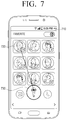
- FIG. 7 is an exemplary diagram illustrating a selection of a conversation partner group in a user terminal apparatus according to an embodiment
- FIG. 8 is an exemplary diagram illustrating a selection of a conversation partner in a user terminal apparatus according to an embodiment
- FIG. 9 is a first exemplary diagram providing a service informing of utterance possible status with regard to an order voice in a user terminal apparatus according to an embodiment
- FIG. 10 is a second exemplary diagram providing a service informing of utterance possible status with regard to an order voice in a user terminal apparatus according to an embodiment
- FIG. 11 is a third exemplary diagram providing a service informing of utterance possible status with regard to an order voice in a user terminal apparatus according to an embodiment
- FIG. 12 is an exemplary diagram illustrating a display of an output UI in a user terminal apparatus according to an embodiment
- FIG. 13 is a flow chart illustrating a controlling method of a group communication in a user terminal apparatus with another user terminal apparatus according to an embodiment
- FIG. 14 is a flow chart illustrating a method that in a user terminal apparatus, the same group as the user terminal apparatus transmits a user voice to another user terminal apparatus according to an embodiment.
- a module’ or ‘a unit’ performs at least one function or operation, and may be hardware, such as a processor or integrated circuit, software that is executed by a processor, or a combination thereof.
- a plurality of ‘modules’ or ‘units’ may be integrated into at least one module and may be realized as at least one process or processor (not shown) except for ‘modules’ or ‘units’ that should be realized in specific hardware.
- FIG. 1 is a first exemplary diagram illustrating a system which provides a group communication according to an embodiment
- FIG. 2 is a second exemplary diagram illustrating a system which provides a group communication according to another embodiment.
- a system which provides a group communication includes a plurality of user terminal apparatuses 100 - 1 to 100 - 4 .
- the plurality of user terminal apparatuses 100 - 1 to 100 - 4 may be terminal apparatuses which are set as a group so as to perform a group communication.
- the plurality of user terminal apparatuses 100 - 1 to 100 - 4 set as a group may execute an application for a Push to Talk (PTT).
- the application for the PTT is an application in which the plurality of user terminal apparatuses 100 - 1 to 100 - 4 set as a group do not perform a voice call through a wireless communication network, but use a voice call service through a specific frequency in a one to one or one to N method, like a wireless set.
- At least one of the plurality of user terminal apparatuses 100 - 1 to 100 - 4 in which an application for the PTT talk is executed may receive and transmit voice data of a user with a remaining user terminal apparatus 100 .
- a manager who manages entire hotel may request a confirmation on whether there is any problem in the area managed by each person in charge, to a second to fourth user terminal apparatuses 100 - 2 to 100 - 4 of a person in charge A to a person in charge C which are set as a group with a manager, by using the first user terminal apparatus 100 - 1 in which the application for the PTT is executed.
- the people in charge, A to C may be people in charge of each floor of the hotel by being set as a group with the manager.
- a manager may give an order that “Please confirm whether there is any problem in each floor” to the person in charge of each floor by using the first user terminal apparatus 100 - 1 .
- the first user terminal apparatus 100 - 1 may transmit voice data with regard to the order voice of the manager that “Please confirm whether there is any problem in each floor” to the second to fourth user terminal apparatuses 100 - 2 to 100 - 4 which are set as a group with the first user terminal apparatus 100 - 1 .
- the second to fourth user terminal apparatuses 100 - 2 to 100 - 4 output a voice message with regard to an order voice received from the first user terminal apparatus 100 - 1 . Accordingly, the people in charge A to C may confirm the order of the manager from the voice message output through the possessing second to fourth user terminal apparatuses 100 - 2 to 100 - 4 .
- the people in charge A to C who confirmed the order of the manager may report the current status of each floor they are managing by using the second to fourth user terminal apparatuses 100 - 2 to 100 - 4 .
- the second to fourth user terminal apparatuses 100 - 2 to 100 - 4 transmit a user voice reported by the people in charge A to C to the first user terminal apparatus 100 - 1 .
- the first user terminal apparatus 100 - 1 may output a voice message with regard to the user voice received from the second to fourth user terminal apparatuses 100 - 2 to 100 - 4 , and the manager may grasp the current status of each floor through the voice message output by the first user terminal apparatus 100 - 1 .
- the first user terminal apparatus 100 - 1 may output the voice message with regard to the received user voice form the second to fourth user terminal apparatuses 100 - 2 to 100 - 4 through the following embodiment.
- the first user terminal apparatus 100 - 1 may output a voice message with regard to the user voice received from the second to fourth user terminal apparatuses 100 - 2 to 100 - 4 based on the time order that a user voice is received from the second to fourth user terminal apparatuses 100 - 2 to 100 - 4 .
- the first user terminal apparatus 100 - 1 analyzes a similarity of the voice message with regard to the received user voice and outputs the voice message of which similarity is different, firstly.
- A may transmit a user voice that “A problem occurred in the first floor” through the second user terminal apparatus 100 - 2 to the first user terminal apparatus 100 - 1
- B and C may transmit a user voice that “There is no problem” to the first user terminal apparatus 100 - 1 through the third and fourth user terminal apparatuses 100 - 3 and 100 - 4 .
- the first user terminal apparatus 100 - 1 determines that the user voice received from the second user terminal apparatus 100 - 2 is different from other user voices, and may output the voice message with regard to the user voice received from the second user terminal apparatus 100 - 2 firstly.
- the manager may confirm the voice message firstly output and grasp the status of the floor managed by A quickly.
- the first user terminal apparatus 100 - 1 may output the voice message with regard to the user voice received from the second to fourth user terminal apparatuses 100 - 2 ⁇ 100 - 4 based on the order that an utterance request message is received from the second to fourth user terminal apparatuses 100 - 2 ⁇ 100 - 4 with regard to the order instructed by the manager.
- the people in charge A to C may request an utterance authority for reporting the current status of each floor.
- the second to fourth user terminal apparatuses 100 - 2 to 100 - 4 transmits the utterance request message to the first user terminal apparatus 100 - 1 , and the first user terminal apparatus 100 - 1 set the utterance authority with regard to the second to fourth user terminal apparatuses 100 - 2 ⁇ 100 - 4 based on the order that the utterance request message is received.
- the utterance request message transmitted from the second user terminal apparatus 100 - 2 may be received firstly, and the utterance request message transmitted from the fourth user terminal apparatus 100 - 4 may be received lastly.
- the first user terminal apparatus 100 - 1 set the utterance authority of the second user terminal apparatus 100 - 2 which transmitted the utterance request message firstly as a first priority, set the utterance authority of the third user terminal apparatus 100 - 3 as a second priority, and set the utterance authority of the fourth user terminal apparatus 100 - 4 as a third priority.
- the first user terminal apparatus 100 - 1 transmits an informing message according to the setting of the utterance authority to the second user terminal apparatus 100 - 2 set as the first priority. Accordingly, the second user terminal apparatus 100 - 2 of which utterance authority is set as the first priority transmits the user voice of the user A to the first user terminal apparatus 100 - 1 .
- the first user terminal apparatus 100 - 1 If a user voice is received from the second user terminal apparatus 100 - 2 of which utterance authority is set as the first priority, the first user terminal apparatus 100 - 1 transmits an informing message according to the setting of the utterance authority to the third user terminal apparatus 100 - 3 of which utterance authority is set as the second priority, and the third user terminal apparatus 100 - 3 transmits the user voice of user B to the first user terminal apparatus 100 - 1 .
- the first user terminal apparatus 100 - 1 transmits an informing message according to the setting of the utterance authority to the fourth user terminal apparatus 100 - 4 of which utterance authority is set as the third priority, and the fourth user terminal apparatus 100 - 4 transmits the user voice of user C to the first user terminal apparatus 100 - 1 .
- each person in charge may resolve an inconvenience of confirming whether a communication is being proceeded between a manager and a person in charge in real time when the utterance authority is given to the person in charge, by reporting the current status to the manager through their own user terminal apparatus 100 .
- the system providing a group communication may further include a management server 200 in addition to the above described plurality of user terminal apparatuses 100 - 1 ⁇ 100 - 4 .
- the management server 200 may be a repeating installation which transmits a user voice received and transmitted between the plurality of user terminal apparatuses 100 - 1 ⁇ 100 - 4 set as a group.
- the management server 200 transmits the order voice of the manager received from the first user terminal apparatus 100 - 1 to the second to fourth user terminal apparatuses 100 - 2 ⁇ 100 - 4 set as a group with the first user terminal apparatus 100 - 1 , and transmits the user voice received from the second to fourth user terminal apparatuses 100 - 2 ⁇ 100 - 4 to the first user terminal apparatus 100 - 1 based on the order of reception.
- FIG. 3 is a block diagram illustrating a user terminal apparatus according to an embodiment
- FIG. 4 is a detailed block diagram illustrating a user terminal apparatus according to an embodiment.
- the user terminal apparatus 100 includes a communicator 110 , a controller 120 , and an output unit 130 .
- the communicator 110 performs a data communication with the plurality of user terminal apparatuses 100 (hereinafter referred to as other user terminal apparatuses).
- the communicator 110 may include a connector 115 which includes at least one of a wireless communication module 113 such as a near field communication (NFC) module 111 and a wireless local access network (LAN) module, and wired communication modules such as a high-definition multimedia interface (HDMI), a universal serial bus (USB), Institute of Electrical and Electronics Engineers (IEEE) 1394.
- a wireless communication module 113 such as a near field communication (NFC) module 111 and a wireless local access network (LAN) module
- wired communication modules such as a high-definition multimedia interface (HDMI), a universal serial bus (USB), Institute of Electrical and Electronics Engineers (IEEE) 1394.
- HDMI high-definition multimedia interface
- USB universal serial bus
- IEEE 1394 Institute of Electrical and Electronics Engineers
- the NFC module 111 is configured to wirelessly perform NFC between the plurality of other user terminal apparatuses 100 set as the same group with the user terminal apparatus 100 .
- the NFC module 111 may include at least one of a Bluetooth module, an infrared data association (IrDA) module, an NFC module, a WIFI module, and a Zigbee module.
- the wireless communication module 113 is a module which is connected to an external network according to a wireless communication protocol such as the IEEE and performs a communication.
- the user terminal apparatus 100 may perform a data communication with the plurality of user terminal apparatuses 100 set as the same group through the above-mentioned management server 200 .
- the wireless communication module may further include a mobile communication module which is connected to a mobile communication network according to various mobile communication standards such as 3rd generation (3G), 3rd generation partnership project (3GPP), and long term evolution (LTE) to perform communications.
- 3G 3rd generation
- 3GPP 3rd generation partnership project
- LTE long term evolution
- the communicator 110 may be implemented by the above-mentioned various short range communication schemes and may adopt other communication technologies not mentioned in the present embodiment as needed.
- the connector 115 is configured to provide an interface with various source devices such as USB 2.0, USB 3.0, HDMI, and IEEE 1394.
- the connector 115 may receive content data transmitted from an external server (not illustrated) through a wired cable connected to the connector 115 according to the control command of the controller 120 to be described later or may transmit pre-stored content data to an external recording medium.
- the connector 115 may receive a power from a power source through a wired cable physically connected with the connector 115 .
- the controller 120 may determine the output order of the voice message corresponding to the user voice received from the plurality of other user terminal apparatuses 100 according to a predetermined condition.
- the output unit 130 outputs a voice message corresponding to the user voice received from the plurality of other user terminal apparatuses 100 based on the output order determined through the controller 120 .
- the controller 120 may determine an output order of a voice message corresponding to the user voice received from the plurality of other user terminal apparatuses 100 through the embodiment as follows.
- the controller 120 may output the voice message corresponding to a user voice received from the plurality of other user apparatuses 100 based on the order that the user voice is received.
- the user voice transmitted from the second user terminal apparatus 100 - 2 among the second to fourth user terminal apparatuses 100 - 2 ⁇ 100 - 4 is received firstly, and the user voice transmitted from the fourth user terminal apparatus 100 - 4 may be received the latest.
- the controller 120 may determine an output order so that the voice message with regard to the user voice received from the second user terminal apparatus 100 - 2 is output for the first time, the voice message with regard to the user voice received from the third user terminal apparatus 100 - 3 is output next, and the voice message with regard to the user voice received from the fourth user terminal apparatus 100 - 4 is output the latest.
- the controller 120 may determine the output order of the voice message corresponding to the user voice received from the plurality of other user terminal apparatuses 100 based on the order that an utterance request message is received from the plurality of other user terminal apparatuses 100 .
- an utterance request message transmitted from the second user terminal apparatus 100 - 2 among the plurality of user terminal apparatuses 100 is received firstly, and the utterance request message transmitted from the fourth user terminal apparatus 100 - 4 may be received the latest.
- a user voice may be received from the second to fourth user terminal apparatuses 100 - 2 ⁇ 100 - 4 . That is, the user voice of the fourth user terminal apparatus 100 - 4 which transmitted the utterance request message the latest may be received firstly, and the user voice of the second user terminal apparatus 100 - 2 which transmitted the utterance request message firstly may be received the latest.
- the controller 120 may determine the output order so that the user voice of the second user terminal apparatus 100 - 2 is output firstly, thereafter, the user voice of the third user terminal apparatus 100 - 3 is output, and the user voice of the fourth user terminal apparatus 100 - 4 is output the latest, based on the order that the utterance request messages are received from the second to fourth user terminal apparatuses 100 - 2 ⁇ 100 - 4 .
- the utterance request message transmitted from the second user terminal apparatus 100 - 2 among the plurality of other user terminal apparatuses 100 may be received firstly, and the utterance request message transmitted from the fourth user terminal apparatus 100 - 4 may be received the latest.
- the controller 120 may set an utterance authority based on the order that the utterance request messages are received from the second to fourth user terminal apparatuses 100 - 2 ⁇ 100 - 4 . Thereafter, the controller 120 may control the communicator 110 so that a user voice is received from the second to fourth user terminal apparatuses 100 - 2 ⁇ 100 - 4 based on the set utterance authority order.
- the communicator 110 may receive a user voice from the second to fourth user terminal apparatuses 100 - 2 ⁇ 100 - 4 based on the set utterance authority order.
- the controller 120 may analyze the similarity of the voice messages corresponding to the user voices received from the plurality of other user terminal apparatuses 100 and determine the output order according to the order of the voice messages of which similarity is different.
- the manager who manages an entire hotel may order the person in charge of each floor to report the current status of each floor.
- the person in charge of each floor may report the current status of the floor managed by himself/herself.
- a who manages the first floor may transmit a user voice “A problem occurred on the first floor” through the second user terminal apparatus 100 - 2 to the user terminal apparatus 100 - 1
- B and C who manage the remaining floors may transmit a user voice “There is no problem” to the user terminal apparatus 100 - 1 through the third and fourth user terminal apparatuses 100 - 3 and 100 - 4 .
- the controller 120 analyzes a similarity of voice messages corresponding to the user voices received from the second to fourth user terminal apparatuses 100 - 2 ⁇ 100 - 4 . As a result of the analyzation, if it is determined that the user voice received from the second user terminal apparatus 100 - 2 is different from the voice of other users, the controller 120 may determine the output order to output the voice message regarding the user voice received from the second user terminal apparatus 100 - 2 firstly.
- the output unit 130 may output the voice messages corresponding to the user voices received from the plurality of other user terminal apparatuses 100 based on the determined output order.
- the output unit 130 may output the voice messages corresponding to the user voices through at least one of a display unit 131 and an audio output unit 133 .
- the display unit 131 may display the voice message corresponding to a user voice on a screen in a form of text, and the audio output unit 133 may output the voices corresponding to the user voices as an audio signal in a form of an audible sound.
- the display unit 131 may display a content received from an external server such as a content server (not illustrated) or data related to a pre-stored content, or display various UI screens for controlling the operation of the user terminal 100 .
- an external server such as a content server (not illustrated) or data related to a pre-stored content
- the display unit 131 may be implemented as a liquid crystal display (LCD), an organic light emitting display (OLED), a plasma display panel (PDP), or the like.
- the display unit 131 may be implemented in a form of a touch screen forming a mutual layer structure with a touch input unit 145 receiving a touch command of a user to be described below.
- the controller 120 controls the display unit 131 to display an output UI including an execution icon regarding a voice message corresponding to a user voice received from the plurality of user terminal apparatuses 100 .
- the display unit 131 displays an output UI including an execution icon regarding the voice message.
- the execution icon included in the output UI may be arranged in the order of a voice message corresponding to a predetermined output order.
- the controller 120 may control at least one of the display unit 131 and the audio output unit 133 so as to output a voice message regarding the icon corresponding to the selection command.
- At least one of the display unit 131 and the audio output unit 133 may output the voice message regarding the icon corresponding to the selection command in a form of a text or an audible sound.
- the display unit 131 may display a channel list UI for each group.
- the channel list may be list information in which an object for identifying the group in which a user belongs to is listed.
- the controller 120 may select the group corresponding to the selected object as a conversation partner group, and control the communicator 110 to transmit order voice of a user to the plurality of other user terminal apparatuses 100 included in the conversation partner group. Accordingly, the communicator 110 may transmit voice data regarding the order voice of the user to at least one of the plurality of other user terminal apparatuses 100 included in the conversation partner group.
- the controller 120 may control the display unit 131 to display reception status information on the received user voice. Accordingly, the display unit 131 may display, on the object selected as a conversation partner group, the reception status information on the user voice received from at least one of the other user terminal apparatuses 100 included in the corresponding conversation partner group. Accordingly, a user may confirm whether a user voice is received from other user terminal apparatuses 100 included in the conversation partner group based on the reception status information displayed on the object, and also confirm how many user voices have been received currently.
- the controller 120 may control the communicator 110 to transmit an utterance request message to the first user terminal apparatus 100 - 1 which transmitted an order voice, according to a user request for an utterance request in the status in which an order voice is received from the first user terminal apparatus 100 - 1 among the plurality of other user terminal apparatuses 100 set as a group. Accordingly, the communicator 110 may transmit an utterance request message to the first user terminal apparatus 100 - 1 which transmitted the order voice.
- the controller 120 may control the communicator 110 to transmit the user voice with regard to an order voice to the first user terminal apparatus 100 - 1 . Accordingly, the communicator 110 may transmit the user voice with regard to the order voice to the first user terminal apparatus 100 - 1 .
- the first user terminal apparatus 100 - 1 may set an utterance authority of a user based on the utterance request message received from the user terminal apparatus 100 . If an utterance authority is set, the first user terminal apparatus 100 - 1 transmits an informing message according to an utterance authority setting to the user terminal apparatus 100 based on the order that the utterance authority is set.
- the first user terminal apparatus 100 - 1 may transmit an informing message according to the utterance authority setting to the user terminal apparatus 100 .
- the first user terminal apparatus 100 - 1 may transmit an informing message according to the utterance authority setting to the user terminal apparatus 100 after a user voice is received from the other user terminal apparatus 100 corresponding to a previous order.
- the controller 120 may provide a service which informs an utterance possible status with regard to an order voice based on at least one of a vibration feedback and a notification feedback. If a user voice is received when the utterance authority is assigned, the controller 120 controls the communicator 110 to transmit a user voice with regard to an order voice to the first user terminal apparatus 100 - 1 . Accordingly, the communicator 110 may transmit a user voice with regard to the order voice to the first user terminal apparatus 100 - 1 .
- the user terminal apparatus 100 may further include an inputter 140 , a signal processor 150 , a photographer 160 , a sensor 170 , and a memory 180 .
- the inputter 140 is an input mean for receiving various user commands and transmit the commands to the controller 120 , which may include a microphone 141 , a manipulator 143 , a touch input unit 145 , and a user input unit 147 , as illustrated in FIG. 4 .
- the microphone 141 receives a voice input from a user
- the manipulator 143 may be implemented by a key pad including various function keys, a numeric key, a special key, a character key, or the like.
- the touch input unit 145 may be implemented as a touch pad which organizes a layer form with the display unit 131 . In this case, the touch input unit 145 may receive a selection command with regard to an icon related to various applications displayed through the display unit 131 .
- the user input unit 147 may receive an infrared (IR) signal or a radio frequency (RF) signal for controlling the operation of the user terminal apparatus 100 from at least one peripheral device (not illustrated) like a remote control device.
- IR infrared
- RF radio frequency
- the signal processor 150 may be an element for processing image data and audio data of the content stored in the content received through the communicator 110 or the content stored in the memory 180 according to a control command of the controller 120 . Specifically, the signal processor 150 may perform various image processes, such as decoding, scaling, noise filtering, frame rate conversion, and resolution conversion, on the image data included in the content. In addition, the signal processor 150 may perform various audio signal processing, such as decoding, amplification, and noise filtering on the audio data included in the content.
- the photographer 160 is to photograph still images or moving images according to the user command and may be implemented in plural like a front camera and a rear camera.
- the sensor 170 is a sensing sensor that senses the motion of the user terminal 100 and referring to an embodiment, may include an accelerometer sensor, a magnetic sensor, a gravity sensor, and a gyroscope sensor.
- the accelerometer sensor is a sensor which measures an intensity of an acceleration or an impact of a moving user terminal apparatus 100
- the magnetic sensor is a sensor which may detect an azimuth by using an earth's magnetic field.
- the gravity sensor is a sensor which detect a moving direction of gravity which detects a direction by rotating automatically according to the direction that a user is holding the user terminal apparatus 100 .
- the gyroscope sensor adds a rotation to each of an existing acceleration sensor to help to recognize a 6-axis direction so as to recognize more specific and precise operation.
- the memory 180 stores an execution program and content with regard to various application which include an application with regard to the above described PTT.
- the memory 180 may store a user voice and an utterance request message received from the plurality of other user terminal apparatuses 100 set as a group.
- the memory 180 may further store an operation program for controlling the operation of the user terminal apparatus 100 .
- the operation program is read and complied in the memory 180 so as to move each configuration of the user terminal apparatus 100 .
- controller 120 may further include a central processing unit (CPU) 121 , a graphic processing unit (GPU) 123 , read-only memory (ROM) 125 , and random access memory (RAM) 127 , and the CPU 121 , GPU 123 , ROM 125 and the RAM 127 may be connected to each other through a bus 129 .
- CPU central processing unit
- GPU graphic processing unit
- RAM random access memory
- the CPU 121 access the memory 180 and perform booting by using an Operating System (OS) stored in the memory 180 .
- OS Operating System
- the CPU 121 may perform various operations using various programs, contents, data, and so on, which are stored in the storage 180 .
- the GPU 123 generates a display screen which includes various objects such as an icon, image, text, etc. Specifically, GPU 123 calculates attribute values of objects to be displayed according to a layout of the screen, such as a coordinate value, a shape, a size, a color, etc., based on a received control command, and generates a display screen in various layouts including the objects based on the calculated attribute value.
- a layout of the screen such as a coordinate value, a shape, a size, a color, etc.
- the ROM 125 stores a command set for booting a system. If a turn-on command is input and a power is supplied, the CPU 121 copies the O/S stored in the memory 180 into the RAM 127 according to the command stored in the ROM 125 , and boots the system by executing the O/S. When the booting is completed, the CPU 121 may copy the various programs stored in the memory 180 to the RAM 127 , and perform various operations by implementing the programs copied to the RAM 127 .
- the controller 120 may be implemented as a system-on-a-chip (SOC) or a system on chip (SoC) by being combined with various components described above.
- SOC system-on-a-chip
- SoC system on chip
- the above-described operations of the processor 120 may be performed through the programs stored in the storage unit 180 .
- the memory 180 may be implemented as at least one of a memory card (e.g., an SD card and a memory stick) which can be mounted in or dismounted from a ROM 125 , a RAM 127 , or the user terminal apparatus 100 , a non-volatile memory, a volatile memory, a hard disk drive (HDD), and a solid state drive (SSD).
- a memory card e.g., an SD card and a memory stick
- a non-volatile memory e.g., a volatile memory
- HDD hard disk drive
- SSD solid state drive
- FIG. 5 is an exemplary diagram illustrating a determination of an output order of a voice message in a user terminal apparatus according to an embodiment.
- the user terminal apparatus 100 transmits voice data with regard to an order voice of a user to the plurality of other user terminal apparatuses 100 set as a group. Accordingly, the plurality of other user terminal apparatuses 100 set as a group transmit the user voice to the user terminal apparatuses 100 which transmitted the voice data with regard to the order voice.
- the user who requests an order voice transmission may be a manager who manages an entire hotel, and the user who requests a user voice transmission with regard to the order voice may be a person in charge of each floor of the hotel.
- the manager may give an order “Please confirm whether there is any problem in each floor” to the person in charge of each floor by using the user terminal apparatus 100 . Accordingly, the user terminal apparatus 100 may transmit the voice data with regard to the order voice of the manager, “Please confirm whether there is any problem in each floor” to the plurality of other user terminal apparatuses 100 set as a group with the user terminal apparatus 100 .
- the plurality of other user terminal apparatuses 100 output a voice message on the order voice received from the user terminal apparatus 100 . Accordingly, the people in charge A to D may confirm the order given by the manager from the voice message output through the user terminal apparatus 100 they are possessing.
- the people in charge A to D who confirmed the order of the manager may report the current status of each floor managed by A to D by using the possessing user terminal apparatus 100 . Accordingly, each of the user terminal apparatus 100 of A to D transmits the user voice reported by A to D to the user terminal apparatus 100 .
- the user terminal apparatus 100 determines an output order based on the order that the user voice is received.
- the user voices of A, B, C, and D are received in the order of A, B, C, and D
- the user terminal apparatus 100 may determine the output order so that the user voices are output in the order of A voice message 510 corresponding to the user voice of A, B voice message 520 corresponding to the user voice of B, C voice message 530 corresponding to the user voice of C, and D voice message 540 corresponding to the user voice of D, as illustrated in (a) of FIG. 5 .
- the user terminal apparatus 100 may analyze a similarity of the voice messages corresponding to the user voices and determine the output order so as to output the voice message of which similarity is different firstly.
- the user terminal apparatus 100 may receive a user voice “A problem has occurred in the first floor” from the user terminal apparatus 100 of D, and receive the user voices “There is no problem”, “No problem”, and “All clear” from each user terminal apparatus 100 of remaining A to C.
- the user terminal apparatus 100 determines that the voice message with regard to the user voice received from the user terminal apparatus 100 of D is different from the other voice messages.
- the user terminal apparatus 100 may determine the similarity of the voice message corresponding to the user voice by using a similarity algorithm, or determine whether there is a voice message in which an event occurred among the received voice messages by comparing with a pre-registered sentence.
- the user terminal apparatus 100 may determine the output order so as to firstly output D voice message 540 ′ corresponding to the user voice of the user terminal apparatus 100 of D which has been received the latest, and then output the voice messages A to C 510 ′ ⁇ 530 ′ corresponding to user voices received from the user terminal apparatuses 100 of the remaining A to C, based on the order of reception.
- the D voice message of which similarity is different may be output firstly, and after the D message is output, the A to C voice messages may be output sequentially.
- FIG. 6 is an exemplary diagram illustrating a display of a channel list UI in a user terminal apparatus according to an embodiment.
- the user terminal apparatus 100 may display a channel list 610 with regard to all groups in which a user is included.
- the user terminal apparatus 100 may provide a channel list UI 610 in various forms according to a user setting.
- the user terminal apparatus 100 may provide the channel list UI 610 which includes an object for each group with regard to entire groups in which a user is included.
- the user may easily confirm in which group the user is registered, through the channel list UI 610 displayed on the screen of the user terminal apparatus 100 .
- the user terminal apparatus 100 may display the channel list UI 610 with regard to the group in which the user often participates and the group in which the user participated lately among entire groups in which the user is included, according to the second user setting. That is, the user terminal apparatus 100 may display the channel list UI 610 which includes the first category menu 620 which includes an object of the group in which the user often participates and the second category menu 630 which includes the object of the group participated lately.
- the user may easily select the group in which the user often participates through the first and second category menus 620 and 630 included in the channel list UI 610 displayed on the screen of the user terminal apparatus 100 , and also easily confirm in which group the user participated lately.
- FIG. 7 is an exemplary diagram illustrating a selection of a conversation partner group in a user terminal apparatus according to an embodiment.
- the user terminal apparatus 100 may set one group among the groups included in the channel list UI 610 displayed on the screen of the user terminal apparatus 100 , as a conversation partner group according to a user command.
- the user may select one of the first and the second category menus 620 and 630 from the channel list UI 610 displayed on the screen of the user terminal apparatus 100 .
- the first category menu 620 is the menu which includes the objects of the group in which the user often participates among the entire groups in which the user is included
- the second category menu 630 may be the menu which includes the object of the group in which the user participated lately.
- the user terminal apparatus 100 may display the UI 710 which includes an object of the group included in the first category menu 620 , as illustrated in FIG. 7 .
- the user may select the first object 720 among the plurality of objects included in the UI 710 , and drag the selected first object 720 to the execution object 730 for setting a conversation partner group.
- the user terminal apparatus 100 sets the group corresponding to the first object 720 as the conversation partner group.
- the user terminal apparatus 100 may transmit the user voice to the plurality of other user terminal apparatuses 100 included in the group set as the conversation partner group, and output a voice message regarding the user voice received regarding the corresponding user voice received from the plurality of other user terminal apparatuses 100 .
- FIG. 8 is an exemplary diagram illustrating a selection of a conversation partner in a user terminal apparatus according to an embodiment.
- the user terminal apparatus 100 may display a map UI 810 with regard to a pre-registered building.
- the user terminal apparatus 100 may display the point in which the user of the other user terminal apparatuses 100 is located, on the map UI 810 displayed based on the received location information.
- the manager who manages an entire building may grasp the location of the person in charge of each area through the map UI 810 displayed on the screen of the user terminal apparatus 100 .
- the manager may give an order to the person in charge of each area through the map UI 810 displayed on the screen of the user terminal apparatus 100 .
- the manager may select an object 820 with regard to the person to whom an order will be given among the people in charge of areas, through the map UI 810 displayed on the screen of the user terminal apparatus 100 , and drag or select the UI 830 for adding a conversation partner displayed on one side of the map UI 810 to the object 820 .
- the user terminal apparatus 100 may add the person in charge with regard to the selected object as a conversation partner.
- the user terminal apparatus 100 may transmit an order voice of the manager to the user terminal apparatus 100 of the person in charge added as the conversation partner.
- the user terminal apparatus 100 provides an event environment in which an utterance authority for transmitting a user voice to other user terminal apparatuses 100 that belongs to the same group with the user terminal apparatus 100 will be described in detail.
- FIG. 9 is a first exemplary diagram providing a service informing of utterance possible status with regard to an order voice in a user terminal apparatus according to an embodiment.
- the user terminal apparatus 100 may receive voice data with regard to an order voice from another user terminal apparatus 100 set as the same group with the user terminal apparatus 100 .
- the voice data with regard to the order voice is received, the user terminal apparatus 100 may output a voice message with regard to the order voice.
- the user may confirm the voice message output through the user terminal apparatus 100 and select an utterance authority request UI 910 displayed on the user terminal apparatus 100 in order to transmit a response message with regard to the corresponding voice message to another user terminal apparatus 100 .
- the user terminal apparatus 100 When a selection command with regard to the utterance authority request UI 910 is input, the user terminal apparatus 100 transmits an utterance authority request message to the other user terminal apparatus 100 that transmitted the order voice. Accordingly, the other user terminal apparatus 100 determines an order to grant the utterance authority based on the order that the utterance authority request message is received from the user terminal apparatus 100 set as the same group with the other user terminal apparatus 100 .
- the other user terminal apparatus 100 may transmit a notification message according to the utterance authority setting to the user terminal apparatus 100 set as the same group with the other user terminal apparatus 100 based on the determined utterance authority order.
- the user terminal apparatus 100 may transmit the user voice related to the response message regarding the order voice to the other user terminal apparatus 100 .
- the user terminal apparatus 100 may inform that the utterance authority has been assigned to the user through a vibration feedback as illustrated in (b) of FIG. 9 . Accordingly, the user may confirm that the utterance authority has been assigned through the vibration feedback, select the utterance authority request UI 910 ′ displayed on the screen of the user terminal apparatus 100 , and then input the user voice regarding the response message with regard to the order voice.
- the user terminal apparatus 100 may transmit input user voice to the other user terminal apparatus 100 .
- FIG. 10 is a second exemplary diagram providing a service informing of utterance possible status with regard to an order voice in a user terminal apparatus according to an embodiment.
- the user terminal apparatus 100 transmits an utterance authority request message to the other user terminal apparatus 100 that transmitted the order voice.
- a notification which informs that the utterance authority has been assigned to the user may be provided through an even informing feedback. That is, if the notification message according to the utterance authority setting is received from the other user terminal apparatus 100 , the user terminal apparatus 100 may inform that the utterance authority has been assigned to the user by providing an event informing feedback in a voice through a speaker 1020 .
- the user may confirm that the utterance authority has been assigned through the event notification feedback, select the utterance authority request UI 1010 ′ displayed on the screen of the user terminal apparatus 100 , and input a user voice related to a response message regarding the order message.
- the user terminal apparatus 100 may transmit the input user voice to the other user terminal apparatus 100 .
- FIG. 11 is a third exemplary diagram providing a service informing of utterance possible status with regard to an order voice in a user terminal apparatus according to another embodiment.
- the user terminal apparatus 100 transmits an utterance authority request message to the user terminal apparatus 100 that transmitted the order voice.
- a notification which informs that the utterance authority has been assigned may be provided through an event notification feedback. That is, if the notification message according to an utterance authority setting is received from the other user terminal apparatus 100 , the user terminal apparatus 100 may inform that the utterance authority has been assigned by providing an event notification feedback 120 in a form of text such as ‘Please input a message’, as illustrated in (b) of FIG. 11 .
- the user may confirm that the utterance authority has been assigned through the event notification feedback, select the utterance authority request UI 1110 ′ displayed on the screen of the user terminal apparatus 100 , and input a user voice related to a response message regarding the order message.
- the user terminal apparatus 100 may transmit the input user voice to the other user terminal apparatus 100 .
- FIG. 12 is an exemplary diagram illustrating a display of an output UI in a user terminal apparatus according to an embodiment.
- the manager who manages an entire building may transmit an order voice ‘Please report the status of each floor’ to the person in charge of each floor through the user terminal apparatus 100 . Accordingly, the people in charge of each floor may transmit the user voice regarding the current status of each floor to the user terminal apparatus 100 of the manager who transmitted the order voice through their own user terminal apparatus 100 . In addition, the people in charge of each floor may photograph a video image of each floor they are managing through their own user terminal apparatus 100 , and transmit the photographed video image and the user voice to the user terminal apparatus 100 of the manager who transmitted the order voice.
- the user terminal apparatus 100 may display an output UI 1210 which includes execution icons 1220 and 1230 for executing the voice message corresponding to the user voice of each person in charge, as illustrated in FIG. 12 .
- the execution icons 1220 and 1230 of the voice message may be arranged in the order that the user voices are received.
- the user terminal apparatus 100 may display the voice message 1240 with regard to the order voice ‘Please report the status of each floor’ on the output UI 1210 .
- the user terminal apparatus 100 may display the output UI 1210 which includes an execution icon 1230 with includes a thumbnail image regarding the video image and a voice message corresponding to the user voice.
- the manager may select at least one of the plurality of execution icons 1220 and 1230 included in the output UI 1210 displayed on the screen of the user terminal apparatus 100 , and confirm at least one of a user voice and a video image corresponding to the selected execution icon so as to confirm the current status of each floor.
- FIG. 13 is a flow chart illustrating a control method for performing a group communication with another user terminal apparatus in a user terminal apparatus according to an embodiment.
- the user terminal apparatus 100 sets a conversation partner group for performing a group communication with the user terminal apparatus 100 in S 1310 .
- the user terminal apparatus 100 may display a channel list UI for each group set as a group with the user terminal apparatus 100 , and when one of the object for each group included in the displayed channel list UI is selected, set the group corresponding to the selected object as a conversation partner group.
- the user terminal apparatus 100 transmits an order voice of a user to a plurality of user terminal apparatuses 100 (hereinafter referred to as other user terminal apparatuses) included in the conversation partner group in S 1320 .
- the user voice related to a response message regarding the order voice is received from the other user terminal apparatuses 100 which receives an order voice
- the user terminal apparatus 100 determines an output order of the voice message corresponding to the received user voice in S 1330 and S 1340 .
- the user terminal apparatus 100 may determine an output order of the voice message corresponding to the user voice based on the order that a user voice is received.
- the user terminal apparatus 100 may determine an output order of a voice message corresponding to the user voice received from the plurality of other user terminal apparatuses 100 based on the order that an utterance request message is received from the plurality of other user terminal apparatuses 100 .
- the user terminal apparatus 100 may analyze the similarity of a voice message corresponding to a user voice received from the plurality of other user terminal apparatuses 100 , and determine an output order in the order of a voice message of which similarity is different.
- the user terminal apparatus 100 may output a response message corresponding to a user voice according to an output order.
- the user terminal apparatus 100 may display reception status information regarding the user voice received from the other user terminal apparatuses 100 on the object of the group set as a conversation partner group among the objects for each group included in the channel list UI.
- the user terminal apparatus 100 may grasp the reception status of the response message regarding an order voice from the user of the other user terminal apparatuses 100 based on the reception status information displayed on the object for each group included in the channel list UI.
- FIG. 14 is a flow chart illustrating a method that in a user terminal apparatus, the same group as the user terminal apparatus transmits a user voice to another user terminal apparatus according to an embodiment.
- the user terminal apparatus 100 transmits an utterance request message to the first user terminal apparatus 100 - 1 in S 1410 and S 1420 .
- the user terminal apparatus 100 transmits a user voice with regard to an order voice to the first user terminal apparatus 100 - 1 in S 1430 .
- the user terminal apparatus 100 when an order voice is received from the first user terminal apparatus 100 - 1 , the user terminal apparatus 100 outputs a voice message regarding the received order voice. If a user command for an utterance request is input from a user after the voice message regarding the order voice is output, the user terminal apparatus 100 transmits an utterance request message to the first user terminal apparatus 100 - 1 .
- the first user terminal apparatus 100 - 1 sets an utterance authority based on the utterance request message received from a plurality of other user terminal apparatuses 100 belong to the same group as the first user terminal apparatus 100 - 1 .
- the first user terminal apparatus 100 - 1 transmits a notification message according to the utterance authority setting to the other user terminal apparatus 100 which belong to the same group as the first user terminal apparatus 100 - 1 based on the order according to the set utterance authority.
- the user terminal apparatus 100 when the notification message according to the utterance authority setting is received from the first user terminal apparatus 100 - 1 , the user terminal apparatus 100 provides a service informing an utterance possible status regarding the order voice based on at least one of a vibration feedback and an event notification feedback. Accordingly, a user confirms that the utterance authority has been assigned through the above notification service, and transmit a response message regarding the order voice to the user of the first user terminal apparatus 100 through the user terminal apparatus 100 .
- the method for controlling the user terminal apparatus may be coded into the software and stored in non-transitory readable recording medium.
- the non-transitory readable medium may be installed and used in various devices.
- the non-transitory computer readable medium is not a medium that stores data for a short moment such as a register, a cash and a memory and the like, but a medium that stores data semi-permanently and which is readable by an apparatus.
- the non-transitory apparatus-readable medium may include a compact disc (CD), a digital versatile disc (DVD), a hard disc, a Blu-ray disc, a memory card, or a read only memory (ROM).
Landscapes
- Engineering & Computer Science (AREA)
- General Engineering & Computer Science (AREA)
- Human Computer Interaction (AREA)
- Theoretical Computer Science (AREA)
- Signal Processing (AREA)
- Computer Networks & Wireless Communication (AREA)
- General Business, Economics & Management (AREA)
- Business, Economics & Management (AREA)
- Physics & Mathematics (AREA)
- General Physics & Mathematics (AREA)
- Telephonic Communication Services (AREA)
- Audiology, Speech & Language Pathology (AREA)
- Computational Linguistics (AREA)
- Multimedia (AREA)
- Acoustics & Sound (AREA)
- Health & Medical Sciences (AREA)
Abstract
Description
Claims (17)
Applications Claiming Priority (5)
| Application Number | Priority Date | Filing Date | Title |
|---|---|---|---|
| KR20150174109 | 2015-12-08 | ||
| KR10-2015-0174109 | 2015-12-08 | ||
| KR10-2016-0121375 | 2016-09-22 | ||
| KR1020160121375A KR102540311B1 (en) | 2015-12-08 | 2016-09-22 | User terminal device and control method thereof |
| PCT/KR2016/010794 WO2017099338A1 (en) | 2015-12-08 | 2016-09-27 | User terminal device and control method therefor |
Publications (2)
| Publication Number | Publication Date |
|---|---|
| US20180352067A1 US20180352067A1 (en) | 2018-12-06 |
| US11039000B2 true US11039000B2 (en) | 2021-06-15 |
Family
ID=59278368
Family Applications (1)
| Application Number | Title | Priority Date | Filing Date |
|---|---|---|---|
| US15/778,862 Active 2037-04-23 US11039000B2 (en) | 2015-12-08 | 2016-09-27 | User terminal device and control method therefor |
Country Status (2)
| Country | Link |
|---|---|
| US (1) | US11039000B2 (en) |
| KR (1) | KR102540311B1 (en) |
Citations (30)
| Publication number | Priority date | Publication date | Assignee | Title |
|---|---|---|---|---|
| US5309517A (en) * | 1991-05-17 | 1994-05-03 | Crown International, Inc. | Audio multiplexer |
| US6295284B1 (en) | 1998-12-23 | 2001-09-25 | Qualcomm. Inc. | Method and apparatus for providing fair access in a group communication system |
| US20040001090A1 (en) | 2002-06-27 | 2004-01-01 | International Business Machines Corporation | Indicating the context of a communication |
| US6757531B1 (en) * | 1998-11-18 | 2004-06-29 | Nokia Corporation | Group communication device and method |
| KR20050015638A (en) | 2003-08-07 | 2005-02-21 | 주식회사 팬택앤큐리텔 | Method of automatic responsing using short messaging service in wireless terminal |
| US20060046762A1 (en) | 2004-08-27 | 2006-03-02 | Samsung Electronics Co., Ltd. | System and method for controlling congestion between response messages responsive to a group call page in a mobile communication system |
| US20060215584A1 (en) * | 2004-02-26 | 2006-09-28 | Matsushita Electric Industrial Co., Ltd. | Exchange and conference communication method therefor |
| US20070239885A1 (en) * | 2006-04-07 | 2007-10-11 | Cisco Technology, Inc. | System and method for dynamically upgrading / downgrading a conference session |
| WO2008116047A1 (en) | 2007-03-21 | 2008-09-25 | Qualcomm Incorporated | Pre-programmed subscriber response |
| US7478129B1 (en) * | 2000-04-18 | 2009-01-13 | Helen Jeanne Chemtob | Method and apparatus for providing group interaction via communications networks |
| US7532607B1 (en) * | 2004-11-04 | 2009-05-12 | At&T Intellectual Property Ii, L.P. | Ad-hoc IP closed user group networks |
| US20090220064A1 (en) * | 2008-02-28 | 2009-09-03 | Sreenivasa Gorti | Methods and apparatus to manage conference calls |
| US20100020745A1 (en) * | 2008-07-22 | 2010-01-28 | Motorola, Inc. | Method for distributing media in an infrastructure based communication system |
| WO2010148349A1 (en) | 2009-06-18 | 2010-12-23 | Qualcomm Incorporated | System and method for permitting recording of voice transmissions among group members of a communication group of wireless communication devices |
| US20110004650A1 (en) * | 2007-12-20 | 2011-01-06 | Fabrice Poussiere | Method and agent for processing messages exchanged between terminals |
| EP1638354B1 (en) | 2004-09-16 | 2011-11-09 | Research In Motion Limited | Apparatuses and method for queueing and moderating group talk |
| US8335532B2 (en) | 2010-01-19 | 2012-12-18 | Qualcomm Incorporated | Session-triggered pushing of group communication data |
| US8676243B2 (en) | 2008-12-03 | 2014-03-18 | Motorola Solutions, Inc. | Method and apparatus for dual/multi-watch for group PTT services |
| KR20140089225A (en) | 2013-01-04 | 2014-07-14 | 엘에스산전 주식회사 | Apparatus for Serial Communication Based on Priority Control |
| US20150089674A1 (en) | 2013-09-24 | 2015-03-26 | Absolute Software Corporation | Device lock and automatic publication in lost and found database |
| US20150304493A1 (en) * | 2012-04-11 | 2015-10-22 | International Business Machines Corporation | Voice input state identification |
| KR20150124644A (en) | 2014-04-29 | 2015-11-06 | 주식회사 비티비솔루션 | Method for transmitting message of terminal using ptt communication |
| US20150341498A1 (en) * | 2012-12-21 | 2015-11-26 | Dolby Laboratories Licensing Corporation | Audio Burst Collision Resolution |
| US20160094475A1 (en) * | 2014-09-29 | 2016-03-31 | Avaya Inc. | Audio power based media bandwidth management |
| US20160381720A1 (en) * | 2015-06-29 | 2016-12-29 | Samsung Electronics Co., Ltd. | Method and apparatus for generating packet data network connection of user equipment |
| US20170086033A1 (en) * | 2015-09-22 | 2017-03-23 | Telefonaktiebolaget Lm Ericsson (Publ) | Mbms bearer setup in a group communications system |
| US20170245122A1 (en) * | 2014-08-12 | 2017-08-24 | Nec Corporation | Method and system for communication between groups in wireless communication network |
| US20170324788A1 (en) * | 2016-05-03 | 2017-11-09 | Samsung Sds Co., Ltd. | Method for providing conference service and apparatus thereof |
| US20180176384A1 (en) * | 2016-12-16 | 2018-06-21 | Red Hat, Inc. | Speaker priority for conference calls |
| US20210021318A1 (en) * | 2018-02-12 | 2021-01-21 | Zte Corporation | Precoding determining method and device, electronic device, and storage medium |
-
2016
- 2016-09-22 KR KR1020160121375A patent/KR102540311B1/en active Active
- 2016-09-27 US US15/778,862 patent/US11039000B2/en active Active
Patent Citations (33)
| Publication number | Priority date | Publication date | Assignee | Title |
|---|---|---|---|---|
| US5309517A (en) * | 1991-05-17 | 1994-05-03 | Crown International, Inc. | Audio multiplexer |
| US6757531B1 (en) * | 1998-11-18 | 2004-06-29 | Nokia Corporation | Group communication device and method |
| US6295284B1 (en) | 1998-12-23 | 2001-09-25 | Qualcomm. Inc. | Method and apparatus for providing fair access in a group communication system |
| US7478129B1 (en) * | 2000-04-18 | 2009-01-13 | Helen Jeanne Chemtob | Method and apparatus for providing group interaction via communications networks |
| US20040001090A1 (en) | 2002-06-27 | 2004-01-01 | International Business Machines Corporation | Indicating the context of a communication |
| KR20050015638A (en) | 2003-08-07 | 2005-02-21 | 주식회사 팬택앤큐리텔 | Method of automatic responsing using short messaging service in wireless terminal |
| US20060215584A1 (en) * | 2004-02-26 | 2006-09-28 | Matsushita Electric Industrial Co., Ltd. | Exchange and conference communication method therefor |
| US20060046762A1 (en) | 2004-08-27 | 2006-03-02 | Samsung Electronics Co., Ltd. | System and method for controlling congestion between response messages responsive to a group call page in a mobile communication system |
| KR100890060B1 (en) | 2004-08-27 | 2009-03-25 | 삼성전자주식회사 | Method and system for preventing access collision of response message for group call in mobile communication system |
| EP1638354B1 (en) | 2004-09-16 | 2011-11-09 | Research In Motion Limited | Apparatuses and method for queueing and moderating group talk |
| US7532607B1 (en) * | 2004-11-04 | 2009-05-12 | At&T Intellectual Property Ii, L.P. | Ad-hoc IP closed user group networks |
| US20070239885A1 (en) * | 2006-04-07 | 2007-10-11 | Cisco Technology, Inc. | System and method for dynamically upgrading / downgrading a conference session |
| WO2008116047A1 (en) | 2007-03-21 | 2008-09-25 | Qualcomm Incorporated | Pre-programmed subscriber response |
| JP2010522508A (en) | 2007-03-21 | 2010-07-01 | クゥアルコム・インコーポレイテッド | Pre-programmed subscriber response |
| US20110004650A1 (en) * | 2007-12-20 | 2011-01-06 | Fabrice Poussiere | Method and agent for processing messages exchanged between terminals |
| US20090220064A1 (en) * | 2008-02-28 | 2009-09-03 | Sreenivasa Gorti | Methods and apparatus to manage conference calls |
| US20100020745A1 (en) * | 2008-07-22 | 2010-01-28 | Motorola, Inc. | Method for distributing media in an infrastructure based communication system |
| US8676243B2 (en) | 2008-12-03 | 2014-03-18 | Motorola Solutions, Inc. | Method and apparatus for dual/multi-watch for group PTT services |
| WO2010148349A1 (en) | 2009-06-18 | 2010-12-23 | Qualcomm Incorporated | System and method for permitting recording of voice transmissions among group members of a communication group of wireless communication devices |
| KR20120035190A (en) | 2009-06-18 | 2012-04-13 | 퀄컴 인코포레이티드 | System and method for permitting recording of voice transmissions among group members of a communication group of wireless communication devices |
| US8335532B2 (en) | 2010-01-19 | 2012-12-18 | Qualcomm Incorporated | Session-triggered pushing of group communication data |
| US20150304493A1 (en) * | 2012-04-11 | 2015-10-22 | International Business Machines Corporation | Voice input state identification |
| US20150341498A1 (en) * | 2012-12-21 | 2015-11-26 | Dolby Laboratories Licensing Corporation | Audio Burst Collision Resolution |
| KR20140089225A (en) | 2013-01-04 | 2014-07-14 | 엘에스산전 주식회사 | Apparatus for Serial Communication Based on Priority Control |
| US20150089674A1 (en) | 2013-09-24 | 2015-03-26 | Absolute Software Corporation | Device lock and automatic publication in lost and found database |
| KR20150124644A (en) | 2014-04-29 | 2015-11-06 | 주식회사 비티비솔루션 | Method for transmitting message of terminal using ptt communication |
| US20170245122A1 (en) * | 2014-08-12 | 2017-08-24 | Nec Corporation | Method and system for communication between groups in wireless communication network |
| US20160094475A1 (en) * | 2014-09-29 | 2016-03-31 | Avaya Inc. | Audio power based media bandwidth management |
| US20160381720A1 (en) * | 2015-06-29 | 2016-12-29 | Samsung Electronics Co., Ltd. | Method and apparatus for generating packet data network connection of user equipment |
| US20170086033A1 (en) * | 2015-09-22 | 2017-03-23 | Telefonaktiebolaget Lm Ericsson (Publ) | Mbms bearer setup in a group communications system |
| US20170324788A1 (en) * | 2016-05-03 | 2017-11-09 | Samsung Sds Co., Ltd. | Method for providing conference service and apparatus thereof |
| US20180176384A1 (en) * | 2016-12-16 | 2018-06-21 | Red Hat, Inc. | Speaker priority for conference calls |
| US20210021318A1 (en) * | 2018-02-12 | 2021-01-21 | Zte Corporation | Precoding determining method and device, electronic device, and storage medium |
Also Published As
| Publication number | Publication date |
|---|---|
| US20180352067A1 (en) | 2018-12-06 |
| KR20170067641A (en) | 2017-06-16 |
| KR102540311B1 (en) | 2023-06-07 |
Similar Documents
| Publication | Publication Date | Title |
|---|---|---|
| US10880425B2 (en) | User terminal device and control method therefor | |
| US10129044B2 (en) | Method and apparatus for controlling smart device | |
| US10242168B2 (en) | Methods and apparatuses for controlling smart device | |
| US10462829B2 (en) | Method and apparatus for accessing wireless access point | |
| EP3089402B1 (en) | Method and apparatus for grouping smart device in smart home system | |
| EP3035738B1 (en) | Method for connecting appliance to network and corresponding device | |
| EP3136698B1 (en) | Connection status prompting method and device | |
| US20150256957A1 (en) | User terminal device, audio system, and method for controlling speaker thereof | |
| EP3068154A1 (en) | Method and apparatus for setting smart device management account | |
| CN108632448A (en) | Electronic equipment for controlling audio output and its operating method | |
| US9749454B2 (en) | Method and device for controlling smart device | |
| US10045163B2 (en) | Methods and apparatuses for controlling a wireless access point | |
| US9807219B2 (en) | Method and terminal for executing user instructions | |
| US20140223321A1 (en) | Portable device and method for controlling external device thereof | |
| EP3015965A1 (en) | Method and apparatus for prompting device connection | |
| US20170083280A1 (en) | Display apparatus and method for controlling display apparatus thereof | |
| US20150288533A1 (en) | Method and device for remote intelligent control | |
| CN108702306B (en) | Electronic device and sensor arrangement method thereof | |
| CN107924296A (en) | Display device and its control method | |
| KR101374208B1 (en) | A management system for an elevator and the method thereof | |
| US11368739B2 (en) | Method and apparatus for inputting information on display interface, and storage medium | |
| JP2015162040A (en) | Electronics | |
| US9674768B2 (en) | Method and device for accessing wireless network | |
| US11039000B2 (en) | User terminal device and control method therefor | |
| US20140380172A1 (en) | Terminal apparatus and controlling method thereof |
Legal Events
| Date | Code | Title | Description |
|---|---|---|---|
| AS | Assignment |
Owner name: SAMSUNG ELECTRONICS CO., LTD., KOREA, DEMOCRATIC PEOPLE'S REPUBLIC OF Free format text: ASSIGNMENT OF ASSIGNORS INTEREST;ASSIGNORS:WON, SEOL-HYE;RA, JIN;OH, SEOK-MIN;AND OTHERS;SIGNING DATES FROM 20180418 TO 20180524;REEL/FRAME:045895/0396 Owner name: SAMSUNG ELECTRONICS CO., LTD., KOREA, DEMOCRATIC P Free format text: ASSIGNMENT OF ASSIGNORS INTEREST;ASSIGNORS:WON, SEOL-HYE;RA, JIN;OH, SEOK-MIN;AND OTHERS;SIGNING DATES FROM 20180418 TO 20180524;REEL/FRAME:045895/0396 |
|
| FEPP | Fee payment procedure |
Free format text: ENTITY STATUS SET TO UNDISCOUNTED (ORIGINAL EVENT CODE: BIG.); ENTITY STATUS OF PATENT OWNER: LARGE ENTITY |
|
| AS | Assignment |
Owner name: SAMSUNG ELECTRONICS CO., LTD., KOREA, REPUBLIC OF Free format text: CORRECTIVE ASSIGNMENT TO CORRECT THE COUNTRY NAME OF ASSIGNEE PREVIOUSLY RECORDED ON REEL 045895 FRAME 0396. ASSIGNOR(S) HEREBY CONFIRMS THE COUNTRY NAME IS REPUBLIC OF KOREA;ASSIGNORS:WON, SEOL-HYE;RA, JIN;OH, SEOK-MIN;AND OTHERS;SIGNING DATES FROM 20180418 TO 20180524;REEL/FRAME:047230/0023 |
|
| STPP | Information on status: patent application and granting procedure in general |
Free format text: NON FINAL ACTION MAILED |
|
| STPP | Information on status: patent application and granting procedure in general |
Free format text: RESPONSE TO NON-FINAL OFFICE ACTION ENTERED AND FORWARDED TO EXAMINER |
|
| STPP | Information on status: patent application and granting procedure in general |
Free format text: FINAL REJECTION MAILED |
|
| STPP | Information on status: patent application and granting procedure in general |
Free format text: ADVISORY ACTION MAILED |
|
| STPP | Information on status: patent application and granting procedure in general |
Free format text: DOCKETED NEW CASE - READY FOR EXAMINATION |
|
| STPP | Information on status: patent application and granting procedure in general |
Free format text: NON FINAL ACTION MAILED |
|
| STPP | Information on status: patent application and granting procedure in general |
Free format text: FINAL REJECTION MAILED |
|
| STPP | Information on status: patent application and granting procedure in general |
Free format text: RESPONSE AFTER FINAL ACTION FORWARDED TO EXAMINER |
|
| STPP | Information on status: patent application and granting procedure in general |
Free format text: NOTICE OF ALLOWANCE MAILED -- APPLICATION RECEIVED IN OFFICE OF PUBLICATIONS |
|
| STPP | Information on status: patent application and granting procedure in general |
Free format text: PUBLICATIONS -- ISSUE FEE PAYMENT RECEIVED |
|
| STPP | Information on status: patent application and granting procedure in general |
Free format text: PUBLICATIONS -- ISSUE FEE PAYMENT VERIFIED |
|
| STCF | Information on status: patent grant |
Free format text: PATENTED CASE |
|
| MAFP | Maintenance fee payment |
Free format text: PAYMENT OF MAINTENANCE FEE, 4TH YEAR, LARGE ENTITY (ORIGINAL EVENT CODE: M1551); ENTITY STATUS OF PATENT OWNER: LARGE ENTITY Year of fee payment: 4 |