US11035536B2 - Illumination device for emitting illumination light - Google Patents
Illumination device for emitting illumination light Download PDFInfo
- Publication number
- US11035536B2 US11035536B2 US16/074,444 US201616074444A US11035536B2 US 11035536 B2 US11035536 B2 US 11035536B2 US 201616074444 A US201616074444 A US 201616074444A US 11035536 B2 US11035536 B2 US 11035536B2
- Authority
- US
- United States
- Prior art keywords
- led
- laser
- radiation
- irradiation area
- illumination device
- Prior art date
- Legal status (The legal status is an assumption and is not a legal conclusion. Google has not performed a legal analysis and makes no representation as to the accuracy of the status listed.)
- Expired - Fee Related, expires
Links
Images



Classifications
-
- F—MECHANICAL ENGINEERING; LIGHTING; HEATING; WEAPONS; BLASTING
- F21—LIGHTING
- F21S—NON-PORTABLE LIGHTING DEVICES; SYSTEMS THEREOF; VEHICLE LIGHTING DEVICES SPECIALLY ADAPTED FOR VEHICLE EXTERIORS
- F21S41/00—Illuminating devices specially adapted for vehicle exteriors, e.g. headlamps
- F21S41/10—Illuminating devices specially adapted for vehicle exteriors, e.g. headlamps characterised by the light source
- F21S41/14—Illuminating devices specially adapted for vehicle exteriors, e.g. headlamps characterised by the light source characterised by the type of light source
- F21S41/141—Light emitting diodes [LED]
-
- B—PERFORMING OPERATIONS; TRANSPORTING
- B60—VEHICLES IN GENERAL
- B60Q—ARRANGEMENT OF SIGNALLING OR LIGHTING DEVICES, THE MOUNTING OR SUPPORTING THEREOF OR CIRCUITS THEREFOR, FOR VEHICLES IN GENERAL
- B60Q1/00—Arrangement of optical signalling or lighting devices, the mounting or supporting thereof or circuits therefor
- B60Q1/02—Arrangement of optical signalling or lighting devices, the mounting or supporting thereof or circuits therefor the devices being primarily intended to illuminate the way ahead or to illuminate other areas of way or environments
- B60Q1/04—Arrangement of optical signalling or lighting devices, the mounting or supporting thereof or circuits therefor the devices being primarily intended to illuminate the way ahead or to illuminate other areas of way or environments the devices being headlights
-
- F—MECHANICAL ENGINEERING; LIGHTING; HEATING; WEAPONS; BLASTING
- F21—LIGHTING
- F21S—NON-PORTABLE LIGHTING DEVICES; SYSTEMS THEREOF; VEHICLE LIGHTING DEVICES SPECIALLY ADAPTED FOR VEHICLE EXTERIORS
- F21S41/00—Illuminating devices specially adapted for vehicle exteriors, e.g. headlamps
- F21S41/10—Illuminating devices specially adapted for vehicle exteriors, e.g. headlamps characterised by the light source
- F21S41/14—Illuminating devices specially adapted for vehicle exteriors, e.g. headlamps characterised by the light source characterised by the type of light source
- F21S41/16—Laser light sources
-
- F—MECHANICAL ENGINEERING; LIGHTING; HEATING; WEAPONS; BLASTING
- F21—LIGHTING
- F21S—NON-PORTABLE LIGHTING DEVICES; SYSTEMS THEREOF; VEHICLE LIGHTING DEVICES SPECIALLY ADAPTED FOR VEHICLE EXTERIORS
- F21S41/00—Illuminating devices specially adapted for vehicle exteriors, e.g. headlamps
- F21S41/10—Illuminating devices specially adapted for vehicle exteriors, e.g. headlamps characterised by the light source
- F21S41/14—Illuminating devices specially adapted for vehicle exteriors, e.g. headlamps characterised by the light source characterised by the type of light source
- F21S41/176—Light sources where the light is generated by photoluminescent material spaced from a primary light generating element
-
- F—MECHANICAL ENGINEERING; LIGHTING; HEATING; WEAPONS; BLASTING
- F21—LIGHTING
- F21S—NON-PORTABLE LIGHTING DEVICES; SYSTEMS THEREOF; VEHICLE LIGHTING DEVICES SPECIALLY ADAPTED FOR VEHICLE EXTERIORS
- F21S41/00—Illuminating devices specially adapted for vehicle exteriors, e.g. headlamps
- F21S41/10—Illuminating devices specially adapted for vehicle exteriors, e.g. headlamps characterised by the light source
- F21S41/14—Illuminating devices specially adapted for vehicle exteriors, e.g. headlamps characterised by the light source characterised by the type of light source
- F21S41/18—Combination of light sources of different types or shapes
-
- F—MECHANICAL ENGINEERING; LIGHTING; HEATING; WEAPONS; BLASTING
- F21—LIGHTING
- F21Y—INDEXING SCHEME ASSOCIATED WITH SUBCLASSES F21K, F21L, F21S and F21V, RELATING TO THE FORM OR THE KIND OF THE LIGHT SOURCES OR OF THE COLOUR OF THE LIGHT EMITTED
- F21Y2113/00—Combination of light sources
-
- F—MECHANICAL ENGINEERING; LIGHTING; HEATING; WEAPONS; BLASTING
- F21—LIGHTING
- F21Y—INDEXING SCHEME ASSOCIATED WITH SUBCLASSES F21K, F21L, F21S and F21V, RELATING TO THE FORM OR THE KIND OF THE LIGHT SOURCES OR OF THE COLOUR OF THE LIGHT EMITTED
- F21Y2113/00—Combination of light sources
- F21Y2113/10—Combination of light sources of different colours
-
- F—MECHANICAL ENGINEERING; LIGHTING; HEATING; WEAPONS; BLASTING
- F21—LIGHTING
- F21Y—INDEXING SCHEME ASSOCIATED WITH SUBCLASSES F21K, F21L, F21S and F21V, RELATING TO THE FORM OR THE KIND OF THE LIGHT SOURCES OR OF THE COLOUR OF THE LIGHT EMITTED
- F21Y2113/00—Combination of light sources
- F21Y2113/20—Combination of light sources of different form
-
- F—MECHANICAL ENGINEERING; LIGHTING; HEATING; WEAPONS; BLASTING
- F21—LIGHTING
- F21Y—INDEXING SCHEME ASSOCIATED WITH SUBCLASSES F21K, F21L, F21S and F21V, RELATING TO THE FORM OR THE KIND OF THE LIGHT SOURCES OR OF THE COLOUR OF THE LIGHT EMITTED
- F21Y2115/00—Light-generating elements of semiconductor light sources
- F21Y2115/10—Light-emitting diodes [LED]
-
- F—MECHANICAL ENGINEERING; LIGHTING; HEATING; WEAPONS; BLASTING
- F21—LIGHTING
- F21Y—INDEXING SCHEME ASSOCIATED WITH SUBCLASSES F21K, F21L, F21S and F21V, RELATING TO THE FORM OR THE KIND OF THE LIGHT SOURCES OR OF THE COLOUR OF THE LIGHT EMITTED
- F21Y2115/00—Light-generating elements of semiconductor light sources
- F21Y2115/30—Semiconductor lasers
Definitions
- the present description relates to an illumination device for emitting illumination light, which includes a luminescent element.
- a luminescent element is irradiated with pump radiation.
- the luminescent element converts the pump radiation into conversion light, which then forms at least part of the illumination light emitted by the illumination device.
- the conversion light together with an unconverted fraction of pump radiation may form the illumination light, in which case, for example, blue pump light may then be advantageous as pump radiation.
- the conversion light alone may also form the illumination light (full conversion).
- the present description is based on the technical problem of providing a particularly advantageous illumination device.
- an illumination device for emitting illumination light having an LED for emitting LED radiation, a laser for emitting laser radiation, and a luminescent element for at least partial conversion of the LED radiation and the laser radiation into conversion light, which forms at least part of the illumination light, wherein the LED, the laser and the luminescent element are arranged relative to one another in such a way that during operation of the illumination device, on an incidence face of the luminescent element, respectively in a time integral, the LED irradiates an LED irradiation area with the LED radiation and the laser irradiates a laser irradiation area with the laser radiation, wherein the laser irradiation area has at least one intersection with the LED irradiation area.
- Non-limiting embodiments may be found in the dependent claims and the disclosure overall, distinction not always being made in the description in detail between method and device or use aspects; in any event, the disclosure is to be interpreted implicitly in respect of all claim categories.
- a basic idea in the present case is to provide not just one but at least two pump radiation sources, and specifically, with the LED and the laser, two pump radiation sources of different types.
- the LED radiation is typically emitted by the LED Lambertianally, i.e. entirely filling a half-space, but in any event with a wide angle; in contrast, the laser radiation is tightly collimated, and the ray bundle is sharply delimited.
- the LED may then, for example, be used for large-area basic illumination of the incidence face, onto which a local increase may be modulated with the laser.
- the amount of conversion light emitted by the luminescent element from a respective surface region correlates with the amount of the amount of pump radiation (LED radiation and/or laser radiation) incident in a corresponding surface region (an incidence face), i.e. a corresponding emission pattern is generated with an incidence pattern.
- the emission face of the luminescent element may be assigned illumination optics (imaging or non-imaging), which then deviate the illumination light emitted at different positions of the emission face into different spatial directions.
- a large angle range may thus be provided with illumination light, and with the local increase a super-proportional amount of light may be delivered to a narrow angle range;
- one application area of interest may, for example, be in the field of road illumination with a motor vehicle front headlamp, see below in detail.
- illumination devices as a non-limiting example floodlights for architectural illumination, effect illumination, underwater illumination, signal lights, ship searchlights, and studio illumination.
- the laser irradiation area and the LED irradiation area have at least one intersection, i.e. they overlap. Since a laser irradiation region, i.e. the entire region of the incidence face irradiated with the laser radiation at a respective instant (snapshot), may be varied during operation of the illumination device (for example the incidence face may be scanned with the laser radiation) and/or an LED irradiation region, i.e. the entire region irradiated with the LED radiation at a respective instant (snapshot), may be variable, the respective irradiation area is considered as a time integral.
- the LED irradiation area is thus given as the union of all LED irradiation regions irradiated over operation of the illumination device; likewise, the laser irradiation area is given as the union of all laser irradiation regions.
- a respective irradiation area is the area irradiated in total with the respective radiation over operation.
- the LED radiation and the laser radiation thus need not necessarily in fact overlap on the incidence face at an instant, but rather the overlap occurs at least as a time integral.
- a corresponding time offset may in this case, for example, lie below the limit of human perception, so that in perception-related averaging, for example, the wide and the comparatively narrow angle range are nevertheless provided “simultaneously” with illumination light according to the comments above.
- the irradiation of the incidence face with LED radiation and laser radiation may, for example, also be carried out alternately during operation of the illumination device, for instance entirely separately in terms of time (not simultaneously at any instant); however, a partial but not full overlap (in the course of time) is for example also possible, so that there are instants at which irradiation is carried out simultaneously with LED radiation and laser radiation, and other instants at which radiation is respectively carried out with only one of the two.
- the LED radiation and/or laser radiation may strike the incidence face in a pulsed fashion, so that for example the respective average power may also be adjusted. If both are pulsed, they may for example differ in their frequency (of the pulses) and/or their duty factor.
- a respective irradiation region/a respective irradiation area may be determined according to the full width at half maximum, and the region/the face on the incidence face thus extends to where the radiation power (of the respective radiation) has fallen to one half (in general, the edge may for example also be placed where the radiation power has fallen to 1/e or 1/e 2 ).
- LED and laser irradiation areas may also lie next to one another on the incidence face, and may touch or not touch; such a variant is explicitly intended to be disclosed as an alternative to the subject-matter of the main claim.
- the laser radiation may be distinguished in particular by a high intensity or a long coherence length; both the laser radiation and the LED radiation may lie respectively in a narrow frequency range, and the radiation is thus respectively monochromatic.
- the terms “LED” and “laser” may respectively also be interpreted in terms of an arrangement (an array) having a plurality of individual LEDs/individual laser sources; “a plurality” means at least two, at least three or at least four being further lower limits (and at most 100, 80, 60, 40, 20 or 10 may be upper limits independently thereof).
- the luminescent element is operated in transmission, i.e. the incidence face and the emission face lie opposite one another (although the emission pattern on the emission face and the incidence pattern on the incidence face are essentially congruent). In general, however, operation in reflection would also be possible, i.e. the incidence face and the emission face may also coincide (and the opposite side face of the luminescent element may then, for example, be mirrored). In general, dichroic mirroring may be provided on the incidence face and/or the emission face, for example for operation in transmission a coating which is reflective for the conversion light/transmissive for the pump radiation on the incidence face and/or a coating which is transmissive for the conversion light/reflective for the pump radiation on the emission face.
- the conversion may be down-conversion, i.e. the conversion light has a longer wavelength (lower energy) compared with the laser radiation/LED radiation.
- the laser irradiation area is a subset of the LED irradiation area, i.e. it lies fully on the latter.
- the laser irradiation area may be a proper subset of the LED irradiation area, i.e. the two are not congruent, but instead the laser irradiation area is smaller.
- the size of an irradiation area/of an irradiation region is referred to in general, this is based on its area actually occupied on the incidence face, taking into account a possible topography of the incidence face; the incidence face may be planar, and the irradiation areas/irradiation regions are therefore also planar.
- the laser irradiation area has an area which constitutes at most 40%, in this order increasingly may be at most 35%, 30%, 25%, 20%, 15%, 10% or 5%, of the area of the LED irradiation area.
- Possible lower limits may, for example, be at least 0.5% or at least 1% (and may in general also be of interest independently of an upper limit).
- the LED irradiation area has an area which constitutes at least 40%, may be at least 45%, particularly may be at least 50%, of an area of the LED irradiation area. At least half of the incidence face is thus irradiated with LED radiation.
- the “incidence face” is that side face of the luminescent element which contains the irradiation areas, but is itself not necessarily irradiated in its entirety; at an edge (for example cylindrical luminescent element) or at edges (for example cuboid luminescent element), it adjoins the edge face (cylinder lateral face) or edge faces (side faces of the cuboid) of the luminescent element.
- the incidence face may be planar.
- the illumination device is configured in such a way that, during operation, the incidence face is at least temporarily irradiated simultaneously by the LED and the laser. In another operating state, the incidence face may in this case also be irradiated only with either the LED radiation or the laser radiation, although there should be at least one operating state with simultaneous irradiation.
- the illumination device When in general the illumination device is referred to as being “configured” for particular operation, this means, if there is only a single operating state, that the relative arrangement of the LED, laser and luminescent element (and any means for beam guiding, for example lenses/mirrors) is such that, when the illumination device is switched on, corresponding irradiation takes place; if there are a plurality of operating states, a corresponding control unit may for example be provided, which correspondingly changes the irradiation from one operating state to the other, for example by adapting the output power of the LED and/or of the laser.
- An “operating state” is referred to when at least one of the sources (LED and laser) is emitting radiation.
- the illumination device is configured in such a way that the incidence face is not only irradiated simultaneously by LED and laser, but there is in fact also an overlap of LED and laser radiation on the incidence face at a respective instant.
- the laser and LED irradiation regions may be respectively static at least during the simultaneous irradiation of the incidence face, i.e. during this none of the irradiation regions moves over the incidence face and/or changes in its shape/size.
- the illumination device is configured for operation in at least two operating states, the laser irradiation region having a first area (which is not equal to zero) in a first of the operating states, and in a second of the operating states has a second area which is greater than the first area.
- “irradiation region” refers to the area irradiated at an instant, i.e. to a snapshot; the “irradiation area” is given, integrated over the operation, as the union of the irradiation regions (in the case of a static arrangement, the irradiation region and the irradiation area coincide, i.e. they are congruent).
- the area of the laser irradiation region may, in the second operating state, for example be at least 20%, in the order mentioned may be at least 50%, 75%, 100%, 150%, 200%, 250%, 300%, 350%, 400%, 450%, or 500%, greater than in the first operating state; possible upper limits may (independently thereof) for example be at most 5000%, 3000% or 1000%.
- a high-beam mode of the motor vehicle headlamp may be at least assisted
- a daytime running mode may be at least assisted, see below in detail.
- the first and the second operating states are adjusted, i.e. the size of the laser irradiation region is varied, by varying the relative distance of the laser and the luminescent element.
- the size of the laser irradiation region is also changed with the distance change.
- the laser radiation may strike the incidence face divergently, and is thus smaller in the first operating state (smaller region) than in the second operating state, according to the relative distance.
- the changing of the relative distance may generally be carried out with, as a non-limiting example, a linear motor.
- a surface centroid of the laser irradiation region is positionally invariant, specifically over operation of the illumination device, i.e. for example even in different operating states.
- the purely geometrical area is used as a basis for determining the surface centroid, i.e. this is for example, not weighted with the irradiation strength.
- a size and/or shape change of the laser irradiation region is still possible, i.e. for example a change as just described between a first and a second operating state.
- the laser radiation is guided onto the incidence face of the luminescent element in such a way that it is incident with a centroid direction which is tilted relative to a perpendicular to the incidence face.
- “Tilted” may for example mean tilted by at least 5°, 15°, 25°, 35° or 45° (increasingly may be in the order mentioned), and independently thereof for instance tilted by not more than 80°, 70° or 60°.
- the incidence is thus oblique, which may for example offer arrangement-related advantages; then, for example, the LED for the relatively large-area LED irradiation may face toward the incidence face, and be placed relatively close thereto, and the laser radiation may be guided past the LED onto the incidence face.
- centroid direction is taken as the average value of all direction vectors of the ray bundle of the radiation respectively considered (laser radiation or LED radiation), each direction vector being weighted with the beam strength associated with it for this averaging.
- the perpendicular is generally taken as the perpendicular onto a planar compensation face placed in the incidence face; the incidence face may be planar and the perpendicular is placed at a right angle on the entire incidence face.
- LED radiation guided obliquely onto the incidence face may also be advantageous, either in combination with the obliquely delivered laser radiation or independently.
- the centroid direction, with which the LED radiation strikes the incidence face, is thus then tilted relative to the perpendicular on the incidence face, cf. the definitions and angle specifications above.
- a mechanically mobile shutter which partially masks, i.e. reduces, the LED irradiation region in a closed position of the shutter.
- the area of the LED irradiation region is greater in an open position of the shutter than in the closed position.
- a shutter is provided which limits the LED irradiation region in the closed position and increases it in the open position. The LED radiation may be no longer limited at all by the shutter in the open position, but rather the shutter is removed fully from the beam path.
- a configuration may be such that the shutter additionally blocks the path of the laser radiation to the incidence face in the closed position. This may also be of interest even when the laser is not being operated at all in the closed position, for example as an additional safety device.
- the shutter In the open position, the shutter may then not only transmit a previously blocked part of the LED radiation, but specifically may also open the path for the laser radiation.
- the incidence face of the luminescent element is subdivided into a multiplicity of regions arranged next to one another, with different conversion properties.
- the regions may, when looking perpendicularly onto the incidence face, for example be arranged next to one another (in a row or column) or in the form of a matrix, i.e. in rows and columns.
- the different conversion properties could, for example, also be achieved by a different thickness of the regions, measured perpendicularly to the incidence face; however, the luminescent material may differ, i.e.
- the luminescent element may, for example, also be constructed from a plurality of layers placed on one another in the thickness direction (see below), and in the case of subdivision into regions arranged next to one another these then need not necessarily differ in all layers, but in at least one layer of the layer stack.
- the nearest-neighbor regions may respectively also adjoin one another directly.
- the regions may, however, also in fact be physically separated from one another, for example by a wall arranged between them or a metal plate, for instance a thin steel plate.
- the regions may thus be separated from one another by means of a non-converting boundary material between them.
- the subdivision into regions, in particular into regions physically separated from one another may for example be of interest insofar as sharply delimited illumination light emission may be possible; it may therefore be of interest in general even independently of different conversion properties in the regions.
- the “multiplicity” of regions means at least two, advantageously at least three regions, and possible wherein upper limits may for example be at most ten or five regions.
- the subdivision of the luminescent element extends in a thickness direction (which is parallel to the perpendicular discussed above) through the entire luminescent element, particularly advantageously exclusively in the thickness direction (not obliquely).
- a luminescent element operated in transmission for example the opposite emission face is then thus subdivided congruently to the incidence face.
- the luminescent element may thus be subdivided into volume regions by the subdivision of the incidence face into regions, it nevertheless may be in one piece overall, and the individual regions thus cannot be separated from one another nondestructively.
- a one-piece luminescent element is advantageous; in the case of configurations other than those just described, it may advantageously be monolithic (apart from statistically distributed constituents, it is free of material boundaries in its interior).
- the description also relates to a motor vehicle headlamp (MV headlamp) having an illumination device as described here, advantageously a front headlamp and/or an automobile headlamp.
- MV headlamp motor vehicle headlamp
- the motor vehicle headlamp is configured in such a way that the LED irradiation area is irradiated with the LED radiation both in a low-beam mode and in a high-beam mode.
- the size and/or shape of the LED irradiation region may differ in the low-beam and high-beam modes, and the LED irradiation region may thus, for example, be greater in the high-beam mode.
- the size and/or shape of the LED irradiation region may, however, also be identical in the low-beam and high-beam modes.
- irradiation may in any event be carried out additionally with the laser radiation.
- a relatively narrowly limited range may be excited with a comparatively high intensity with the laser radiation, and correspondingly a large amount of illumination light may then also (with illumination optics) be guided in a relatively small solid angle range. With a correspondingly narrow light cone, the road in the distance may then be illuminated well.
- the motor vehicle headlamp has an illumination device as described here with a first and a second operating state (different size of the laser irradiation region), in the first operating state (small laser irradiation region), a high-beam mode of the headlamp being at least assisted and/or in the second operating state (large laser irradiation region), a daytime running mode of the headlamp being at least assisted.
- a further illumination component of the motor vehicle headlamp may then also be activated, for example an LED strip, i.e. LEDs arranged next to one another, optionally in conjunction with non-imaging optics for beam guiding.
- the motor vehicle headlamp has an illumination device as described here with a mechanical shutter, the headlamp being switched into a low-beam mode in the closed position (shutter masks LED irradiation region) and being switched into a high-beam mode in the open position.
- the laser radiation may then additionally strike the incidence face, cf. the description above.
- the description also relates to the use of an illumination device as described here for a corresponding motor vehicle headlamp.
- the at least one “LED” may include at least one light-emitting diode.
- a color may be monochromatic (for example red, green, blue, etc.) or polychromatic (for example white).
- a plurality of light-emitting diodes may generate mixed light; for example blue mixed light.
- the at least one light-emitting diode may contain at least one light wavelength-converting luminescent material (conversion LED).
- the at least one light-emitting diode may be in the form of at least one individually packaged light-emitting diode or in the form of at least one LED chip.
- a plurality of LED chips may be mounted on a common substrate (“submount”).
- substrate instead of or in addition to inorganic light-emitting diodes, for example based on InGaN or AlInGaP, it is generally also possible to use organic LEDs (OLEDs, for example polymer OLEDs).
- OLEDs organic LEDs
- FIG. 1 shows a first illumination device according to the description having an LED, laser and luminescent element
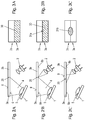
- FIGS. 2A-C show a second illumination device according to the description in different operating states
- FIGS. 3A-C show the irradiation of the incidence face of the luminescent element according to FIGS. 2A-C in plan view;
- FIGS. 4A ,B show a third illumination device according to the description in two different operating states
- FIG. 5A ,B shows the irradiation of the incidence face of the luminescent element according to FIGS. 4A and B in plan view.
- FIG. 1 shows a first illumination device according to the description with an LED 1 (cf. the definition in the introduction to the description), a laser 2 , namely a laser diode, and a luminescent element 3 .
- the LED 1 emits LED radiation 4 , which passes through primary optics 5 for ray bundle shaping and then strikes an incidence face 6 of the luminescent element 3 .
- the primary optics 5 By the primary optics 5 , the aperture angle of the original Lambertianally emitted LED radiation 4 is reduced somewhat.
- the laser 2 emits laser radiation 7 , which passes through a collimation lens and then strikes the incidence face 6 of the luminescent element 3 while being essentially collimated, and irradiates a substantially smaller region of this face than the LED radiation 4 .
- Both the laser radiation and the LED radiation are blue light, a fraction of which is converted into yellow conversion light by the luminescent element 3 , in the present case made of yttrium aluminum garnet (YAG:Ce). However, not all of the blue light is converted, so that a mixture of yellow conversion light and partially unconverted blue light is emitted as illumination light 10 at an emission face 9 , opposite the incidence face 6 , of the luminescent element 3 .
- YAG:Ce yttrium aluminum garnet
- two ray bundles of this illumination light 10 are represented which emerge from different positions of the emission face 9 and are deviated by illumination optics 11 into different spatial directions. If the illumination device is then installed in a motor vehicle headlamp, how much illumination light 10 is emitted from which position of the emission face 9 determines how much illumination light 10 reaches which spatial direction, and correspondingly which region on or at the road.
- wide-angle basic illumination may be carried out, on which a local increase is superimposed with the spatially concentrated laser radiation 7 .
- a relatively narrow central solid angle range is correspondingly provided with a particularly large amount of illumination light 10 .
- FIGS. 2A-C show a second illumination device, which is for the most part constructed in a comparable way to that according to FIG. 1 , specifically in three different operating states.
- references which are the same refer to parts which have the same function, and to this extent reference is always made to the description regarding the other figures.
- illumination optics for extracting the illumination light emitted at different positions of the emission face 9 of the luminescent element 3 are provided, although these optics are not represented for the sake of clarity.
- the luminescent element 3 according to FIGS. 2A to C is subdivided by a thin steel plate 20 into two regions 3 a,b , which differ in their conversion properties (although this is not necessary in general), and correspondingly the incidence face 6 is also segmented into two regions 6 a,b.
- the LED irradiation region 30 corresponds to the LED irradiation area irradiated as a time integral.
- FIGS. 3A-C show the incidence face 6 of the illumination device according to FIGS. 2A-C respectively in plan view, the same letters A, B, C respectively referencing the same operating state.
- FIG. 3B illustrates the small laser irradiation region 31 a , which is superimposed on the LED irradiation region 30 .
- the radiation intensity put in is relatively high, for which reason a correspondingly large amount of conversion light is generated.
- the operating state according to FIGS. 2A / 3 A corresponds to a low-beam mode
- the operating state according to FIGS. 2B / 3 B corresponds to a high-beam mode.
- the LED radiation 4 is switched off, i.e. the LED 1 is inactive.
- the incidence face 6 is irradiated only by the laser radiation 7 , wherein in contrast to FIG. 2B the laser irradiation region 31 b is significantly larger, cf. FIG. 3C for illustration. This is achieved by an increased relative distance between the incidence face 6 and the laser 2 , which because of the laser radiation 7 striking the incidence face 6 divergently leads to a laser irradiation region 31 b which is modified in size.
- the illumination device may assist a daytime running mode of the motor vehicle headlamp (in which it emits light in total from an area of at least 25 cm 2 ).
- the laser radiation 7 strikes the incidence face 6 not only more widely, but also obliquely. Consequently, the effective optical path to the opposite emission face 9 in the region 3 b of the luminescent element is shorter than in the region 3 a . This may be taken into account by the slightly different conversion properties, so that as a result the ratio of unconverted laser radiation to conversion light in the two regions 3 a,b is approximately the same despite the different optical path, i.e. comparable white illumination light is emitted.
- FIG. 4A shows the shutter 40 in a closed position
- FIG. 4B in an open position.
- the shutter 40 masks the LED radiation 4 , i.e. blocks a part thereof, so that LED radiation 4 strikes only the region 6 a of the incidence face 6 , cf.
- FIG. 5A for illustration.
- the LED irradiation region 30 a and the region 6 a of the incidence face 6 are congruent in this operating state.
- the shutter 40 In the operating state according to FIG. 4B , the shutter 40 is tilted into an open position and correspondingly all of the LED radiation 4 strikes the incidence face 6 , and specifically partly also in its region 6 b (cf. FIG. 5B for illustration).
- the LED irradiation region 30 is thus variable in this embodiment, and in the operating state according to FIG. 4B / 5 B it corresponds to the LED irradiation area given as a time integral.
- the laser 2 is also activated in the open position, i.e. a locally increased intensity is superimposed (see the description regarding FIGS. 1 and 2 ).
- the shutter 40 In the open position, the shutter 40 also opens the path for the laser radiation 7 , while in the closed position it blocks it ( FIG. 4A ). This may, for example, offer additional security and help to avoid unintended emergence of laser radiation 7 with a high power density.
- the operating state according to FIGS. 4A / 5 A corresponds to a low-beam mode
- that according to FIGS. 4B / 5 B open position
Landscapes
- Engineering & Computer Science (AREA)
- General Engineering & Computer Science (AREA)
- Physics & Mathematics (AREA)
- Optics & Photonics (AREA)
- Microelectronics & Electronic Packaging (AREA)
- Mechanical Engineering (AREA)
- Non-Portable Lighting Devices Or Systems Thereof (AREA)
- Lighting Device Outwards From Vehicle And Optical Signal (AREA)
Abstract
Description
-
LED 1 -
laser 2 -
luminescent element 3 - regions of the
luminescent element 3 a,b -
LED radiation 4 -
primary optics 5 -
incidence face 6 - regions of the
incidence face 6 a,b -
laser radiation 7 -
collimation lens 8 -
emission face 9 -
illumination light 10 -
illumination optics 11 -
steel plate 20 -
LED irradiation regions 30 a,b -
laser irradiation regions 31 a,b -
shutter 40
Claims (25)
Applications Claiming Priority (3)
| Application Number | Priority Date | Filing Date | Title |
|---|---|---|---|
| DE102016201606.7 | 2016-02-03 | ||
| DE102016201606.7A DE102016201606A1 (en) | 2016-02-03 | 2016-02-03 | LIGHTING DEVICE FOR THE EMISSION OF LIGHTING LIGHT |
| PCT/EP2016/079558 WO2017133809A1 (en) | 2016-02-03 | 2016-12-02 | Illumination device for emitting illumination light |
Publications (2)
| Publication Number | Publication Date |
|---|---|
| US20190032878A1 US20190032878A1 (en) | 2019-01-31 |
| US11035536B2 true US11035536B2 (en) | 2021-06-15 |
Family
ID=57485472
Family Applications (1)
| Application Number | Title | Priority Date | Filing Date |
|---|---|---|---|
| US16/074,444 Expired - Fee Related US11035536B2 (en) | 2016-02-03 | 2016-12-02 | Illumination device for emitting illumination light |
Country Status (4)
| Country | Link |
|---|---|
| US (1) | US11035536B2 (en) |
| CN (1) | CN108474533B (en) |
| DE (1) | DE102016201606A1 (en) |
| WO (1) | WO2017133809A1 (en) |
Families Citing this family (13)
| Publication number | Priority date | Publication date | Assignee | Title |
|---|---|---|---|---|
| CN107228301B (en) * | 2017-06-08 | 2021-05-07 | 广州市浩洋电子股份有限公司 | A stage lighting optical system and light projection device including beam and pattern effects |
| DE102018127831A1 (en) | 2018-11-07 | 2020-05-07 | Schott Ag | Illumination device, preferably with an adjustable or set color location, and their use and method for setting the color location of an illumination device |
| JP7212315B2 (en) * | 2019-05-09 | 2023-01-25 | トヨタ自動車株式会社 | vehicle headlight controller |
| CN112240533A (en) * | 2019-07-19 | 2021-01-19 | 深圳市绎立锐光科技开发有限公司 | Lighting device and automobile headlamp |
| DE102019121508A1 (en) | 2019-08-09 | 2021-02-11 | Schott Ag | Base body for a light conversion or lighting device |
| DE102019121511A1 (en) | 2019-08-09 | 2021-02-11 | Schott Ag | Light conversion and lighting device |
| DE102019121518A1 (en) | 2019-08-09 | 2021-02-11 | Schott Ag | Light conversion and lighting device |
| US12044800B2 (en) | 2021-01-14 | 2024-07-23 | Magna Electronics, Llc | Scanning LiDAR system and method with compensation for transmit laser pulse effects |
| EP4363771B1 (en) | 2021-07-01 | 2025-03-26 | Signify Holding B.V. | Integrated solid state light source and phosphor module |
| US12228653B2 (en) | 2022-10-07 | 2025-02-18 | Magna Electronics, Llc | Integrating a sensing system into headlight optics |
| US12092278B2 (en) * | 2022-10-07 | 2024-09-17 | Magna Electronics, Llc | Generating a spotlight |
| WO2025059793A1 (en) * | 2023-09-18 | 2025-03-27 | 江苏零境光子科技有限公司 | Vehicle lamp |
| US12202396B1 (en) | 2023-12-19 | 2025-01-21 | Magna Electronics, Llc | Line-scan-gated imaging for LiDAR headlight |
Citations (12)
| Publication number | Priority date | Publication date | Assignee | Title |
|---|---|---|---|---|
| US20110249460A1 (en) | 2010-04-08 | 2011-10-13 | Takuya Kushimoto | Vehicle headlight |
| US20120106178A1 (en) * | 2010-10-29 | 2012-05-03 | Sharp Kabushiki Kaisha | Light emitting device, vehicle headlamp, illumination device, and laser element |
| EP2487407A2 (en) | 2011-02-10 | 2012-08-15 | Stanley Electric Co., Ltd. | Vehicle lighting device |
| US20120236536A1 (en) * | 2011-03-18 | 2012-09-20 | Mitsunori Harada | Light-emitting device |
| EP2525140A2 (en) | 2011-05-19 | 2012-11-21 | Stanley Electric Co., Ltd. | Vehicle lighting unit |
| US20140185307A1 (en) * | 2012-12-27 | 2014-07-03 | Hyundai Mobis Co., Ltd. | Headlamp for vehicle |
| US20140321151A1 (en) | 2011-11-18 | 2014-10-30 | Sharp Kabushiki Kaisha | Illumination apparatus, vehicle headlamp, and downlight |
| WO2014205466A1 (en) | 2013-06-25 | 2014-12-31 | Zizala Lichtsysteme Gmbh | Headlights for motor vehicles |
| EP2829790A2 (en) | 2013-07-23 | 2015-01-28 | Valeo Vision | Lighting system associating white light and light of a different colour |
| DE102014213179A1 (en) | 2013-07-10 | 2015-01-29 | Koito Manufacturing Co., Ltd. | vehicle lamp |
| US20160201880A1 (en) * | 2015-01-14 | 2016-07-14 | Lg Innotek Co., Ltd. | Light Emitting Apparatus |
| DE102015222188B3 (en) | 2015-11-11 | 2016-11-17 | Automotive Lighting Reutlingen Gmbh | Light module for a vehicle headlight and motor vehicle headlight with such a light module |
Family Cites Families (4)
| Publication number | Priority date | Publication date | Assignee | Title |
|---|---|---|---|---|
| JP4812543B2 (en) * | 2006-06-28 | 2011-11-09 | 株式会社小糸製作所 | Vehicle lighting |
| US9638397B2 (en) * | 2012-06-06 | 2017-05-02 | Philips Lighting Holding B.V. | Lighting apparatus and method for emitting light having different color temperatures |
| KR101998765B1 (en) * | 2013-03-25 | 2019-07-10 | 엘지이노텍 주식회사 | Light emittng device package |
| JP6654560B2 (en) * | 2014-05-07 | 2020-02-26 | 株式会社小糸製作所 | Light source module and vehicle lamp |
-
2016
- 2016-02-03 DE DE102016201606.7A patent/DE102016201606A1/en not_active Withdrawn
- 2016-12-02 CN CN201680079570.1A patent/CN108474533B/en not_active Expired - Fee Related
- 2016-12-02 WO PCT/EP2016/079558 patent/WO2017133809A1/en not_active Ceased
- 2016-12-02 US US16/074,444 patent/US11035536B2/en not_active Expired - Fee Related
Patent Citations (13)
| Publication number | Priority date | Publication date | Assignee | Title |
|---|---|---|---|---|
| US20110249460A1 (en) | 2010-04-08 | 2011-10-13 | Takuya Kushimoto | Vehicle headlight |
| US20120106178A1 (en) * | 2010-10-29 | 2012-05-03 | Sharp Kabushiki Kaisha | Light emitting device, vehicle headlamp, illumination device, and laser element |
| EP2487407A2 (en) | 2011-02-10 | 2012-08-15 | Stanley Electric Co., Ltd. | Vehicle lighting device |
| US20120236536A1 (en) * | 2011-03-18 | 2012-09-20 | Mitsunori Harada | Light-emitting device |
| EP2525140A2 (en) | 2011-05-19 | 2012-11-21 | Stanley Electric Co., Ltd. | Vehicle lighting unit |
| US20140321151A1 (en) | 2011-11-18 | 2014-10-30 | Sharp Kabushiki Kaisha | Illumination apparatus, vehicle headlamp, and downlight |
| US20140185307A1 (en) * | 2012-12-27 | 2014-07-03 | Hyundai Mobis Co., Ltd. | Headlamp for vehicle |
| WO2014205466A1 (en) | 2013-06-25 | 2014-12-31 | Zizala Lichtsysteme Gmbh | Headlights for motor vehicles |
| US20160146419A1 (en) * | 2013-06-25 | 2016-05-26 | Zizala Lichtsysteme Gmbh | Headlights for motor vehicles |
| DE102014213179A1 (en) | 2013-07-10 | 2015-01-29 | Koito Manufacturing Co., Ltd. | vehicle lamp |
| EP2829790A2 (en) | 2013-07-23 | 2015-01-28 | Valeo Vision | Lighting system associating white light and light of a different colour |
| US20160201880A1 (en) * | 2015-01-14 | 2016-07-14 | Lg Innotek Co., Ltd. | Light Emitting Apparatus |
| DE102015222188B3 (en) | 2015-11-11 | 2016-11-17 | Automotive Lighting Reutlingen Gmbh | Light module for a vehicle headlight and motor vehicle headlight with such a light module |
Non-Patent Citations (2)
| Title |
|---|
| German Search Report based on application No. 102016201606.7 (7 pages) dated Sep. 20, 2016 (Reference Purpose Only). |
| International Search Report based on application No. PCT/EP2016/079558 (12 pages) dated Feb. 6, 2017 (Reference Purpose Only). |
Also Published As
| Publication number | Publication date |
|---|---|
| WO2017133809A1 (en) | 2017-08-10 |
| CN108474533B (en) | 2021-02-02 |
| DE102016201606A1 (en) | 2017-08-03 |
| CN108474533A (en) | 2018-08-31 |
| US20190032878A1 (en) | 2019-01-31 |
Similar Documents
| Publication | Publication Date | Title |
|---|---|---|
| US20190032878A1 (en) | Illumination device for emitting illumination light | |
| JP6953631B2 (en) | Headlights and how they work | |
| US9803820B2 (en) | Generating a light emission pattern in a far field | |
| US9903550B2 (en) | Lighting device with light mixing element and luminescent volume | |
| KR101563378B1 (en) | Optical component and lighting apparatus | |
| US9945530B2 (en) | Generating a light emission pattern in a far field | |
| US8672523B2 (en) | Light emitter with predefined angular color point distribution | |
| US7168837B2 (en) | Vehicular headlamp and semiconductor light emitting element | |
| WO2013094221A1 (en) | Laser and phosphor based light source for improved safety | |
| US9341335B2 (en) | Vehicle lighting device | |
| US10378711B2 (en) | Light generation with light emitting diode and laser | |
| US10330273B2 (en) | Lighting apparatus | |
| KR20100084468A (en) | Light source | |
| JP2011527093A (en) | Light radiation device | |
| US20170314753A1 (en) | Lighting device for emitting illumination light | |
| US20140028982A1 (en) | Projection with semiconductor light sources, deflection mirror and transmitted-light regions | |
| US9611995B2 (en) | Lighting apparatus with light generating device and luminescent body | |
| EP3002621B1 (en) | Optical devices for led light mixing | |
| US9103509B2 (en) | Lighting device and method for operating a lighting device | |
| TWI487864B (en) | Radiation-emitting device and use of such device | |
| CN108954228B (en) | Light emitting module and luminaire for generating mixed light | |
| CA2944470C (en) | Remote phosphor lighting devices and methods |
Legal Events
| Date | Code | Title | Description |
|---|---|---|---|
| FEPP | Fee payment procedure |
Free format text: ENTITY STATUS SET TO UNDISCOUNTED (ORIGINAL EVENT CODE: BIG.); ENTITY STATUS OF PATENT OWNER: LARGE ENTITY |
|
| AS | Assignment |
Owner name: OSRAM GMBH, GERMANY Free format text: ASSIGNMENT OF ASSIGNORS INTEREST;ASSIGNORS:MUSTER, JASMIN;TROMMER, JENNY;SCHOEMER, RICARDA;AND OTHERS;SIGNING DATES FROM 20180503 TO 20180511;REEL/FRAME:046809/0571 |
|
| STPP | Information on status: patent application and granting procedure in general |
Free format text: DOCKETED NEW CASE - READY FOR EXAMINATION |
|
| AS | Assignment |
Owner name: OSRAM BETEILIGUNGSVERWALTUNG GMBH, GERMANY Free format text: ASSIGNMENT OF ASSIGNORS INTEREST;ASSIGNOR:OSRAM GMBH;REEL/FRAME:051339/0468 Effective date: 20191219 |
|
| STPP | Information on status: patent application and granting procedure in general |
Free format text: NON FINAL ACTION MAILED |
|
| STPP | Information on status: patent application and granting procedure in general |
Free format text: RESPONSE TO NON-FINAL OFFICE ACTION ENTERED AND FORWARDED TO EXAMINER |
|
| STPP | Information on status: patent application and granting procedure in general |
Free format text: RESPONSE TO NON-FINAL OFFICE ACTION ENTERED AND FORWARDED TO EXAMINER |
|
| STPP | Information on status: patent application and granting procedure in general |
Free format text: NOTICE OF ALLOWANCE MAILED -- APPLICATION RECEIVED IN OFFICE OF PUBLICATIONS |
|
| STPP | Information on status: patent application and granting procedure in general |
Free format text: PUBLICATIONS -- ISSUE FEE PAYMENT RECEIVED |
|
| STPP | Information on status: patent application and granting procedure in general |
Free format text: PUBLICATIONS -- ISSUE FEE PAYMENT VERIFIED |
|
| STCF | Information on status: patent grant |
Free format text: PATENTED CASE |
|
| FEPP | Fee payment procedure |
Free format text: MAINTENANCE FEE REMINDER MAILED (ORIGINAL EVENT CODE: REM.); ENTITY STATUS OF PATENT OWNER: LARGE ENTITY |
|
| LAPS | Lapse for failure to pay maintenance fees |
Free format text: PATENT EXPIRED FOR FAILURE TO PAY MAINTENANCE FEES (ORIGINAL EVENT CODE: EXP.); ENTITY STATUS OF PATENT OWNER: LARGE ENTITY |
|
| STCH | Information on status: patent discontinuation |
Free format text: PATENT EXPIRED DUE TO NONPAYMENT OF MAINTENANCE FEES UNDER 37 CFR 1.362 |
|
| FP | Lapsed due to failure to pay maintenance fee |
Effective date: 20250615 |