US11032793B2 - Processing paging requests messages in a wireless communication system - Google Patents
Processing paging requests messages in a wireless communication system Download PDFInfo
- Publication number
- US11032793B2 US11032793B2 US16/689,973 US201916689973A US11032793B2 US 11032793 B2 US11032793 B2 US 11032793B2 US 201916689973 A US201916689973 A US 201916689973A US 11032793 B2 US11032793 B2 US 11032793B2
- Authority
- US
- United States
- Prior art keywords
- paging message
- memory
- determined
- received
- packet
- Prior art date
- Legal status (The legal status is an assumption and is not a legal conclusion. Google has not performed a legal analysis and makes no representation as to the accuracy of the status listed.)
- Active, expires
Links
Images




Classifications
-
- H—ELECTRICITY
- H04—ELECTRIC COMMUNICATION TECHNIQUE
- H04W—WIRELESS COMMUNICATION NETWORKS
- H04W68/00—User notification, e.g. alerting and paging, for incoming communication, change of service or the like
- H04W68/005—Transmission of information for alerting of incoming communication
-
- H—ELECTRICITY
- H04—ELECTRIC COMMUNICATION TECHNIQUE
- H04W—WIRELESS COMMUNICATION NETWORKS
- H04W24/00—Supervisory, monitoring or testing arrangements
- H04W24/08—Testing, supervising or monitoring using real traffic
-
- H—ELECTRICITY
- H04—ELECTRIC COMMUNICATION TECHNIQUE
- H04W—WIRELESS COMMUNICATION NETWORKS
- H04W76/00—Connection management
- H04W76/10—Connection setup
- H04W76/11—Allocation or use of connection identifiers
-
- H—ELECTRICITY
- H04—ELECTRIC COMMUNICATION TECHNIQUE
- H04W—WIRELESS COMMUNICATION NETWORKS
- H04W8/00—Network data management
- H04W8/02—Processing of mobility data, e.g. registration information at HLR [Home Location Register] or VLR [Visitor Location Register]; Transfer of mobility data, e.g. between HLR, VLR or external networks
- H04W8/08—Mobility data transfer
Definitions
- the disclosed embodiments generally relate to wireless communication systems and, in particular, to a method and apparatus for processing Paging Request messages in a wireless communication system.
- Paging in a wireless communication system is to be understood to be a mechanism to initiate services for User Equipment devices (UEs) (e.g., a smart phone) that are in idle mode. Idle mode transition is important to conserve battery of the UEs. If a UE is in connected mode and it has no data to send or receive, then an eNodeB (eNB) waits for a specific timer (UE Inactivity Timer) and once that timer expires, the eNB sends the UE to idle mode. This is typically accomplished by sending a Radio Resource Control (RRC) Release message to the UE.
- RRC Radio Resource Control
- paging is mostly a RRC procedure that wakes up the UE which is Idle, if there is some data for it.
- Reasons for waking up a UE include the presence of downlink data, change of system information or even providing dangerous weather or other impending dangerous information—thus the UE needs to be woken up in case it has entered a RRC IDLE state.
- a page request message is sent to the network to locate the UE.
- the page request message may be sent to the last known last tracking area in a network (e.g., an eNodeB) or to all tracking areas in a network (e.g., all eNodeBs).
- a Service Request message responsive to a Paging Request message is not sent back from a UE from a last known tracking network tracking area (e.g., a eNodeb)
- the Paging Request message is then broadcast to all tracking areas in the network (e.g., all eNodeBs).
- all tracking areas in the network e.g., all eNodeBs.
- a number of certain network disadvantages arise, including (but not limited to): the storage (memory) of the network monitoring devices receiving the broadcast Paging Request messages become flooded thus causing data packets to be dropped; the overall system performance of the network monitoring device is degraded due to the additional processing burden placed upon it by the broadcast Paging Request messages.
- a network device in a communication system in which a data packet stream is received in the network device having a Paging Message packet that is sent from a network node device.
- the identity of a User Equipment (UE) associated with the received Paging Message packet is then determined.
- a determination is then made if Paging Message information associated with the determined UE is stored in memory associated with the network monitoring device, whereupon the received Paging Message packet is filtered from the received data packet stream in the event previous Paging Message information was determined to be associated with the determined UE device in the memory.
- Paging Message information is stored in the memory in the event there are no Paging Message packets stored in the memory associated with the determined UE device.
- FIG. 1 is a diagram illustrating a LTE mobile communication system, components of which are used in the illustrated embodiments;
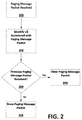
- FIGS. 2-4 are flow charts depicting certain operational steps of a network device in the communication system of FIG. 1 in accordance with the illustrated embodiments.
- FIG. 5 illustrates an example network node device components of which are used in a network device of FIG. 1 in accordance with the illustrated embodiments.
- the illustrated embodiments discussed below are preferably a software algorithm, program or code residing on computer useable medium having control logic for enabling execution on a machine having a computer processor.
- the machine typically includes memory storage configured to provide output from execution of the computer algorithm or program.
- the term “software” is meant to be synonymous with any code or program that can be in a processor of a host computer, regardless of whether the implementation is in hardware, firmware or as a software computer product available on a disc, a memory storage device, or for download from a remote machine.
- the embodiments described herein include such software to implement the equations, relationships and algorithms described above.
- One skilled in the art will appreciate further features and advantages of the illustrated embodiments based on the above-described embodiments. Accordingly, the illustrated embodiments are not to be limited by what has been particularly shown and described, except as indicated by the appended claims.
- the radio access network of the LTE mobile communication system includes a next generation base station (hereinafter, referred to interchangeably as Evolved Node B (eNB), E-UTRAN, and Node B) 110 , a Mobility Management Entity (MME) 120 , and aServing Gateway (SGW) 130 .
- the User Equipment (UE) 100 connects to an external network via the eNB, the SGW, and a PDN-Gateway (PGW).
- PGW PDN-Gateway
- a network monitoring device 135 is shown coupled to the S1-MME interface for receiving packets transmitted from the MME 150 .
- the network monitoring device 135 is preferably a standalone network device configured and operable to provide passive and non-disruptive monitoring of network packets over the S1-MME interface, a non-limiting example being the nGeniusONETM commercially available from NETSCOUTTM.
- a non-limiting example of such a network nodal device 135 may include an nGeniusTM packet flow switch (PFS) also commercially available from NETSCOUTTM
- the eNB 110 is a Radio Access Network (RAN) node and corresponds to the BSC of the UTRAN system and the BSC of the GERAN system.
- the eNB 110 is connected with the UE 100 through a radio channel and performs operations similar to those of the legacy RNC/BSC.
- the eNB may use a plurality of cells simultaneously.
- the MME 120 is typically responsible for various control functions, and a plurality of eNBs may connect to one MME.
- the SGW 130 is an entity for providing data bearer which is established or released under the control of the MME 120 .
- the Application Function (AF) 140 is an entity for exchanging application information with the user at the application level.
- the Policy Charging and Rules Function is an entity for controlling policy related to Quality of Service (QoS) of the user and transfers Policy and Charging Control (PCC) rule corresponding to the policy to the PGW 160 .
- the PCRF 150 is an entity of controlling the QoS and billing for traffic.
- the term “UP” denotes the paths connecting between the UE 100 and the RAN node 110 , between the RAN node and the SGW 130 , and the SGW 130 and the PGW 160 for data transmission.
- the path between the UE 100 and the RAN node 110 is a radio channel which is most resource-restrictive.
- EPS Evolved Packet System
- An EPS bearer is used to transmit the IP flows requiring the same QoS.
- the EPS bearer may be designated parameters related to QoS such as QoS Class Identifier (QCI) and Allocation and Retention Priority (ARP).
- QCI QoS Class Identifier
- ARP Allocation and Retention Priority
- the QCI is a parameter defined as an integer indicating QoS priority
- ARP is a parameter for use in determining whether to accept or reject new EPS bearer establishment.
- the EPS bearer corresponds to the Packet Data Protocol (PDP) context of the General Packet Radio Service (GPRS).
- An EPS bearer belongs to a PDN connection which has the Access Point Name) as an attribute.
- IMS IP multimedia Subsystem
- VoIP Voice over LTE
- the corresponding PDN connection is established using the well-known IMS APN.
- VoLTE is the term which can be used in the same concept as Voice over IMS (VoIMS).
- a paging message is transmitted to notify the UE of the presence of data (or call setup) to receive. Since the paging resource available in one cell is limited, paging messages for plural UEs are crowded, it may occur to transmit the paging messages for part of the UEs due to the restricted paging resource.
- the voice telephony is a service very sensitive to delay and thus, if the paging signal transmission delay or drop occurs due to the paging channel congestion, the sensible service quality degrades significantly.
- S1AP S1 Application Protocol
- EPC evolved packet core
- S1-MME S1-MME which is located between eNB and MME.
- the services provided by the S1AP are divided to UE associated and non UE associated.
- Such a nodal device that may provide the functionality in accordance with the illustrated embodiment is to be referred to as network monitoring nodal device implemented in the communication network of FIG. 1 .
- network monitoring nodal device may consist of one or more of the following: network switches, packet flow switches (PFS) and taps, probes and any other device that requires paging messages or paging like messages removed from a S1AP paging packet data stream, but while allowing passage of other key messages for preserving in a network monitoring device the intended functionality that is required for the user.
- PFS packet flow switches
- KPI Key Performance Indicator
- network monitoring device 135 shown coupled to S1-MME interface between eNodeB 110 and MME 150 in FIG. 1 , but as mentioned above, is not to be understood to be limited thereto.
- the removal of the Paging Message or Paging-like message (paging messages) in a network monitoring device 135 is preferably accomplished using a filtering device/mechanism operative and configured to filter out paging messages for a specific UE device 100 subsequent to receipt of an initial paging message for that UE device 100 if no responsive Service Request message was sent from the UE device 100 .
- the aforesaid subsequent paging messages received in the network monitoring device 135 are filtered out (e.g., dropped) preferably until a predetermined period of time or until a Service Request message is sent from the UE device 100 , preferably whichever occurs first.
- the process for filtering paging messages in a network monitoring device 135 implemented in the communications network of FIG. 1 is now described.
- the network monitoring device 135 Upon receipt of a paging message in a network monitoring 135 (step 200 ), the network monitoring device 135 is configured and functional to identify the UE device 100 associated with the received paging message (preferably in a frontend processing portion of the network monitoring 135 ) (step 202 ). Preferably, this is accomplished in the network monitoring device 135 by extracting unique keys present the paging massage (such as MME Mobile Subscriber Identity and MME codes), which unique keys specifically identifies the UE device 100 .
- unique keys present the paging massage such as MME Mobile Subscriber Identity and MME codes
- the received paging message (along with the determined identity of the associated UE device 100 ) is preferably stored in the storage device 132 associated with network monitoring device 135 , which storage device 132 may have a lookup table format (step 208 ).
- the network monitoring device 135 is preferably configured and functional to identify the UE device 100 associated with the received Service Request message (preferably in a frontend processing portion of the network monitoring device) (step 304 ). As mentioned above in regards to a received paging message (step 202 ), preferably this is accomplished in the network monitoring device 135 by extracting unique keys present the Service Request message (such as MME Mobile Subscriber Identity and MME codes), which specifically identifies the UE device 100 .
- KPI Key Performance Indicator
- the network monitoring device 135 is further configured and operational to determine if a predetermined time period has elapsed for a paging message stored in the storage device 132 of the network monitoring 135 (which predetermined time period commenced once the paging message for an identified UE device 100 is stored in the storage device 132 of network monitoring device 135 (step 208 )). If yes, then the stored paging message for an identified UE device 100 is parsed (removed) from the storage device 132 of network monitoring 135 (step 402 ). The network monitoring device 135 may then be configured to generate a KPI for the UE device 100 (step 404 ).
- a paging message for a given UE device 100 is parsed (removed) from the storage device 132 of network monitoring device 135 if: 1) a Service Request message (responsive to a paging message) from the given UE device 100 is received in the network monitoring device 135 ; or 2) upon expiration of the predetermined time period for a paging message stored in the storage device 132 of network monitoring device 135 , as mentioned above.
- a network monitoring device 135 preserves its optimal operating efficiency by avoiding unnecessary usage of its processing entities and/or storage constraints by filtering Paging Message packets received subsequent to an initial active session Paging Message for a given UE device.
- FIG. 5 shown is a schematic block diagram of an example network computing device 500 that may be used (or components thereof) with one or more embodiments described herein, including network monitoring device 135 .
- these various devices are configured to communicate with each other in any suitable way, such as, for example, via a communication network.
- Device 500 is intended to represent any type of computer system capable of carrying out the teachings of various embodiments of the present invention.
- Device 500 is only one example of a suitable system and is not intended to suggest any limitation as to the scope of use or functionality of embodiments of the invention described herein. Regardless, computing device 500 is capable of being implemented and/or performing any of the functionality set forth herein.
- Computing device 500 is operational with numerous computing system environments or configurations. Examples of well-known computing systems, environments, and/or configurations that may be suitable for use with computing device 500 include, but are not limited to, personal computer systems, server computer systems, thin clients, thick clients, hand-held or laptop devices, multiprocessor systems, microprocessor-based systems, set top boxes, programmable consumer electronics, network PCs, minicomputer systems, and distributed data processing environments that include any of the above systems or devices, and the like.
- Computing device 500 may be described in the general context of a special purpose computer system having executable instructions, such as program modules, being executed by a computer system.
- program modules may include routines, programs, objects, components, logic, data structures, and so on that perform particular tasks or implement particular abstract data types.
- Computing device 500 may be practiced in distributed data processing environments where tasks are performed by remote processing devices that are linked through a communications network.
- program modules may be located in both local and remote computer system storage media including memory storage devices.
- Device 500 is shown in FIG. 2 in the form of a special purpose computing device for providing the functionality of network monitoring device 135 as described herein.
- the components of device 500 may include, but are not limited to, one or more processors or processing units 516 , a system memory 528 , and a bus 518 that couples various system components including system memory 528 to processor 516 .
- Bus 518 represents one or more of any of several types of bus structures, including a memory bus or memory controller, a peripheral bus, an accelerated graphics port, and a processor or local bus using any of a variety of bus architectures.
- bus architectures include Industry Standard Architecture (ISA) bus, Micro Channel Architecture (MCA) bus, Enhanced ISA (EISA) bus, Video Electronics Standards Association (VESA) local bus, and Peripheral Component Interconnect (PCI) bus.
- Computing device 500 typically includes a variety of computer system readable media. Such media may be any available media that is accessible by device 500 , and it includes both volatile and non-volatile media, removable and non-removable media.
- System memory 528 can include computer system readable media in the form of volatile memory, such as random access memory (RAM) 530 and/or cache memory 532 .
- Computing device 500 may further include other removable/non-removable, volatile/non-volatile computer system storage media.
- storage system 534 can be provided for reading from and writing to a non-removable, non-volatile magnetic media and/or Solid State Drives (SSD) (not shown and typically called a “hard drive”).
- SSD Solid State Drives
- a magnetic disk drive for reading from and writing to a removable, non-volatile magnetic disk (e.g., a “floppy disk”)
- an optical disk drive for reading from or writing to a removable, non-volatile optical disk such as a CD-ROM, DVD-ROM or other optical media
- each can be connected to bus 518 by one or more data media interfaces.
- memory 528 may include at least one program product having a set (e.g., at least one) of program modules that are configured to carry out the functions of embodiments of the invention.
- Program/utility 540 having a set (at least one) of program modules 515 , such as underwriting module, may be stored in memory 528 by way of example, and not limitation, as well as an operating system, one or more application programs, other program modules, and program data. Each of the operating system, one or more application programs, other program modules, and program data or some combination thereof, may include an implementation of a networking environment.
- Program modules 515 generally carry out the functions and/or methodologies of embodiments of the invention as described herein.
- Device 500 may also communicate with one or more external devices 514 such as a keyboard, a pointing device, a display 524 , etc.; one or more devices that enable a user to interact with computing device 500 ; and/or any devices (e.g., network card, modem, etc.) that enable computing device 500 to communicate with one or more other computing devices. Such communication can occur via Input/Output (I/O) interfaces 522 . Still yet, device 500 can communicate with one or more networks such as a local area network (LAN), a general wide area network (WAN), and/or a public network (e.g., the Internet) via network adapter 520 . As depicted, network adapter 520 communicates with the other components of computing device 500 via bus 518 .
- LAN local area network
- WAN wide area network
- public network e.g., the Internet
- device 500 includes, but are not limited to: microcode, device drivers, redundant processing units, external disk drive arrays, RAID systems, tape drives, and data archival storage systems, etc.
Landscapes
- Engineering & Computer Science (AREA)
- Computer Networks & Wireless Communication (AREA)
- Signal Processing (AREA)
- Databases & Information Systems (AREA)
- Mobile Radio Communication Systems (AREA)
Abstract
Description
Claims (20)
Priority Applications (1)
| Application Number | Priority Date | Filing Date | Title |
|---|---|---|---|
| US16/689,973 US11032793B2 (en) | 2019-10-10 | 2019-11-20 | Processing paging requests messages in a wireless communication system |
Applications Claiming Priority (2)
| Application Number | Priority Date | Filing Date | Title |
|---|---|---|---|
| US201962913507P | 2019-10-10 | 2019-10-10 | |
| US16/689,973 US11032793B2 (en) | 2019-10-10 | 2019-11-20 | Processing paging requests messages in a wireless communication system |
Publications (2)
| Publication Number | Publication Date |
|---|---|
| US20210112523A1 US20210112523A1 (en) | 2021-04-15 |
| US11032793B2 true US11032793B2 (en) | 2021-06-08 |
Family
ID=75383657
Family Applications (1)
| Application Number | Title | Priority Date | Filing Date |
|---|---|---|---|
| US16/689,973 Active 2040-01-30 US11032793B2 (en) | 2019-10-10 | 2019-11-20 | Processing paging requests messages in a wireless communication system |
Country Status (1)
| Country | Link |
|---|---|
| US (1) | US11032793B2 (en) |
Families Citing this family (1)
| Publication number | Priority date | Publication date | Assignee | Title |
|---|---|---|---|---|
| CN111194080B (en) * | 2018-11-14 | 2021-07-09 | 大唐移动通信设备有限公司 | Paging method, positioning information sending method, core network node and base station |
Citations (6)
| Publication number | Priority date | Publication date | Assignee | Title |
|---|---|---|---|---|
| US5519780A (en) * | 1993-12-03 | 1996-05-21 | Scientific-Atlanta, Inc. | System and method for providing compressed digital teletext services and teletext support services |
| US20100150049A1 (en) * | 2007-12-14 | 2010-06-17 | Electronics And Telecommunications Research Institute | bearer control and management method in the ip-based evolved mobile communication network |
| US20140194111A1 (en) * | 2011-06-30 | 2014-07-10 | Panasonic Corporation | Communication system, user terminal, and communication device |
| US20180077682A1 (en) * | 2016-09-15 | 2018-03-15 | Huawei Technologies Co., Ltd. | Method and apparatus for application aware notifications in a wireless communication network |
| US20200107293A1 (en) * | 2018-09-29 | 2020-04-02 | Beijing Xiaomi Mobile Software Co., Ltd. | Method and apparatus for processing paging message |
| EP3478007B1 (en) * | 2016-08-31 | 2020-07-29 | Huawei Technologies Co., Ltd. | Small data transmission in a paging message |
-
2019
- 2019-11-20 US US16/689,973 patent/US11032793B2/en active Active
Patent Citations (6)
| Publication number | Priority date | Publication date | Assignee | Title |
|---|---|---|---|---|
| US5519780A (en) * | 1993-12-03 | 1996-05-21 | Scientific-Atlanta, Inc. | System and method for providing compressed digital teletext services and teletext support services |
| US20100150049A1 (en) * | 2007-12-14 | 2010-06-17 | Electronics And Telecommunications Research Institute | bearer control and management method in the ip-based evolved mobile communication network |
| US20140194111A1 (en) * | 2011-06-30 | 2014-07-10 | Panasonic Corporation | Communication system, user terminal, and communication device |
| EP3478007B1 (en) * | 2016-08-31 | 2020-07-29 | Huawei Technologies Co., Ltd. | Small data transmission in a paging message |
| US20180077682A1 (en) * | 2016-09-15 | 2018-03-15 | Huawei Technologies Co., Ltd. | Method and apparatus for application aware notifications in a wireless communication network |
| US20200107293A1 (en) * | 2018-09-29 | 2020-04-02 | Beijing Xiaomi Mobile Software Co., Ltd. | Method and apparatus for processing paging message |
Non-Patent Citations (1)
| Title |
|---|
| 802.15.1-2005—IEEE Standard for Information technology—Local and metropolitan area networks—Specific requirements—Part 15.1a: Wireless Medium Access Control (MAC) and Physical Layer (PHY) specifications for Wireless Personal Area Networks (WPAN) Jun. 2005 (Year: 2005). * |
Also Published As
| Publication number | Publication date |
|---|---|
| US20210112523A1 (en) | 2021-04-15 |
Similar Documents
| Publication | Publication Date | Title |
|---|---|---|
| US9655159B2 (en) | Managing guaranteed bit rate quality of service resource allocation based on guaranteed bit rate data activity on a link | |
| US9554366B2 (en) | Optimized always-on wireless service using network assistance and keep-alives | |
| CN104619023B (en) | Intelligent paging method and intelligent paging equipment | |
| CN105850176B (en) | Method and apparatus for controlling congestion in mobile communication system | |
| US10045388B2 (en) | Method and apparatus of improving quality of calls in mobile communication system | |
| CN104010324B (en) | Control method, mobile management entity and the mobile switching centre of service | |
| US9357359B2 (en) | Dynamic quality of service (QoS) for services over cellular | |
| CN103650573B (en) | Congestion state reporting method and access network equipment | |
| US20140221023A1 (en) | Server-initiated paging cycles | |
| US10412618B2 (en) | Optimistic quality of service set up | |
| US20140211619A1 (en) | Probabilistic retention of the quality of service (qos) bearer for voice over internet protocol (voip) service as voice over long term evolution (volte) | |
| CN102769932B (en) | Method and device used for data transmission in circuit domain backspace | |
| US11856413B2 (en) | Coverage enhancement CE function implementation method and device | |
| US20140068098A1 (en) | Reducing network latency resulting from non-access stratum (nas) authentication for high performance content applications | |
| WO2012083789A1 (en) | Resource allocation method and device and network service system | |
| US9204342B2 (en) | Method, apparatus, and system for processing eMPS in a CSFB mechanism | |
| US20170150549A1 (en) | Node and method for establishing an inactivity timer in a wireless network | |
| CN104919873B (en) | Apparatus and method for paging in wireless communication system | |
| CN103609168A (en) | Access method for circuit switched fallback (CSFB), mobility management entity and mobile switch center | |
| US9591689B2 (en) | System and method for detachment in wireless communication system | |
| CN103731919A (en) | Paging method and device based on priorities | |
| US11032793B2 (en) | Processing paging requests messages in a wireless communication system | |
| CN104735798B (en) | A kind of method and apparatus obtaining configuration resource | |
| CN111903180A (en) | Predictive bearer in a wireless communication network | |
| US11297595B2 (en) | Methods circuits devices systems and functionally associated computer executable code for paging user equipment (UE) connected to an enterprise network |
Legal Events
| Date | Code | Title | Description |
|---|---|---|---|
| FEPP | Fee payment procedure |
Free format text: ENTITY STATUS SET TO UNDISCOUNTED (ORIGINAL EVENT CODE: BIG.); ENTITY STATUS OF PATENT OWNER: LARGE ENTITY |
|
| AS | Assignment |
Owner name: NETSCOUT SYSTEMS, INC, MASSACHUSETTS Free format text: ASSIGNMENT OF ASSIGNORS INTEREST;ASSIGNORS:LIUBINSKAS, TAURAS;BASS, BRANDON WAYNE, MR.;SARASWATI, ABHISHEK;REEL/FRAME:051257/0956 Effective date: 20191119 |
|
| STPP | Information on status: patent application and granting procedure in general |
Free format text: PUBLICATIONS -- ISSUE FEE PAYMENT RECEIVED |
|
| STPP | Information on status: patent application and granting procedure in general |
Free format text: PUBLICATIONS -- ISSUE FEE PAYMENT VERIFIED |
|
| STCF | Information on status: patent grant |
Free format text: PATENTED CASE |
|
| AS | Assignment |
Owner name: JPMORGAN CHASE BANK, N.A., AS ADMINISTRATIVE AGENT, ILLINOIS Free format text: SECURITY INTEREST;ASSIGNORS:NETSCOUT SYSTEMS, INC.;ARBOR NETWORKS, INC.;AIRMAGNET, INC.;AND OTHERS;REEL/FRAME:056997/0847 Effective date: 20210727 |
|
| RF | Reissue application filed |
Effective date: 20220808 |
|
| MAFP | Maintenance fee payment |
Free format text: PAYMENT OF MAINTENANCE FEE, 4TH YEAR, LARGE ENTITY (ORIGINAL EVENT CODE: M1551); ENTITY STATUS OF PATENT OWNER: LARGE ENTITY Year of fee payment: 4 |