US11032645B2 - Content output device that assigns a plurality of channels, audio system that assigns a plurality of channels, and content output method for the same - Google Patents

Content output device that assigns a plurality of channels, audio system that assigns a plurality of channels, and content output method for the same Download PDF

Info

Publication number
US11032645B2
US11032645B2 US16/576,884 US201916576884A US11032645B2 US 11032645 B2 US11032645 B2 US 11032645B2 US 201916576884 A US201916576884 A US 201916576884A US 11032645 B2 US11032645 B2 US 11032645B2
Authority
US
United States
Prior art keywords
channel
audio devices
channels
audio
task
Prior art date
Legal status (The legal status is an assumption and is not a legal conclusion. Google has not performed a legal analysis and makes no representation as to the accuracy of the status listed.)
Active
Application number
US16/576,884
Other versions
US20200015014A1 (en
Inventor
Susumu Takumai
Current Assignee (The listed assignees may be inaccurate. Google has not performed a legal analysis and makes no representation or warranty as to the accuracy of the list.)
Yamaha Corp
Original Assignee
Yamaha Corp
Priority date (The priority date is an assumption and is not a legal conclusion. Google has not performed a legal analysis and makes no representation as to the accuracy of the date listed.)
Filing date
Publication date
Application filed by Yamaha Corp filed Critical Yamaha Corp
Publication of US20200015014A1 publication Critical patent/US20200015014A1/en
Assigned to YAMAHA CORPORATION reassignment YAMAHA CORPORATION ASSIGNMENT OF ASSIGNORS INTEREST (SEE DOCUMENT FOR DETAILS). Assignors: TAKUMAI, SUSUMU
Priority to US17/308,132 priority Critical patent/US11696076B2/en
Application granted granted Critical
Publication of US11032645B2 publication Critical patent/US11032645B2/en
Priority to US18/199,793 priority patent/US20230292049A1/en
Active legal-status Critical Current
Anticipated expiration legal-status Critical

Links

Images

Classifications

    • HELECTRICITY
    • H04ELECTRIC COMMUNICATION TECHNIQUE
    • H04RLOUDSPEAKERS, MICROPHONES, GRAMOPHONE PICK-UPS OR LIKE ACOUSTIC ELECTROMECHANICAL TRANSDUCERS; DEAF-AID SETS; PUBLIC ADDRESS SYSTEMS
    • H04R5/00Stereophonic arrangements
    • H04R5/04Circuit arrangements, e.g. for selective connection of amplifier inputs/outputs to loudspeakers, for loudspeaker detection, or for adaptation of settings to personal preferences or hearing impairments
    • HELECTRICITY
    • H04ELECTRIC COMMUNICATION TECHNIQUE
    • H04SSTEREOPHONIC SYSTEMS 
    • H04S7/00Indicating arrangements; Control arrangements, e.g. balance control
    • H04S7/30Control circuits for electronic adaptation of the sound field
    • H04S7/301Automatic calibration of stereophonic sound system, e.g. with test microphone
    • HELECTRICITY
    • H04ELECTRIC COMMUNICATION TECHNIQUE
    • H04RLOUDSPEAKERS, MICROPHONES, GRAMOPHONE PICK-UPS OR LIKE ACOUSTIC ELECTROMECHANICAL TRANSDUCERS; DEAF-AID SETS; PUBLIC ADDRESS SYSTEMS
    • H04R5/00Stereophonic arrangements
    • H04R5/02Spatial or constructional arrangements of loudspeakers
    • HELECTRICITY
    • H04ELECTRIC COMMUNICATION TECHNIQUE
    • H04SSTEREOPHONIC SYSTEMS 
    • H04S3/00Systems employing more than two channels, e.g. quadraphonic
    • H04S3/008Systems employing more than two channels, e.g. quadraphonic in which the audio signals are in digital form, i.e. employing more than two discrete digital channels
    • HELECTRICITY
    • H04ELECTRIC COMMUNICATION TECHNIQUE
    • H04RLOUDSPEAKERS, MICROPHONES, GRAMOPHONE PICK-UPS OR LIKE ACOUSTIC ELECTROMECHANICAL TRANSDUCERS; DEAF-AID SETS; PUBLIC ADDRESS SYSTEMS
    • H04R2420/00Details of connection covered by H04R, not provided for in its groups
    • H04R2420/03Connection circuits to selectively connect loudspeakers or headphones to amplifiers
    • HELECTRICITY
    • H04ELECTRIC COMMUNICATION TECHNIQUE
    • H04RLOUDSPEAKERS, MICROPHONES, GRAMOPHONE PICK-UPS OR LIKE ACOUSTIC ELECTROMECHANICAL TRANSDUCERS; DEAF-AID SETS; PUBLIC ADDRESS SYSTEMS
    • H04R2420/00Details of connection covered by H04R, not provided for in its groups
    • H04R2420/05Detection of connection of loudspeakers or headphones to amplifiers
    • HELECTRICITY
    • H04ELECTRIC COMMUNICATION TECHNIQUE
    • H04RLOUDSPEAKERS, MICROPHONES, GRAMOPHONE PICK-UPS OR LIKE ACOUSTIC ELECTROMECHANICAL TRANSDUCERS; DEAF-AID SETS; PUBLIC ADDRESS SYSTEMS
    • H04R2420/00Details of connection covered by H04R, not provided for in its groups
    • H04R2420/07Applications of wireless loudspeakers or wireless microphones
    • HELECTRICITY
    • H04ELECTRIC COMMUNICATION TECHNIQUE
    • H04SSTEREOPHONIC SYSTEMS 
    • H04S2400/00Details of stereophonic systems covered by H04S but not provided for in its groups
    • H04S2400/01Multi-channel, i.e. more than two input channels, sound reproduction with two speakers wherein the multi-channel information is substantially preserved

Definitions

  • a preferred embodiment relates to a content output device, an audio system, and a content output method that output content of a plurality of channels.
  • the number of speakers may be increased and decreased according to a use state of a user.
  • a user may carry one speaker among a plurality of speakers used in a living room to a bedroom, and may use the speaker in the bedroom.
  • sound of a channel that has been taken charge of by a speaker that has been reduced is not able to be reproduced.
  • a problem related to increase and decrease of the number of such speakers is not recognized.
  • an object of a preferred embodiment is to provide a content output device, an audio system, and a content output method that are capable of appropriately outputting sound of content even when the number of speakers is changed.
  • a content output device includes at least one processor configured to implement stored instructions and execute a plurality of tasks.
  • the plurality of tasks include a connecting task, an outputting task, and an assigning task.
  • the connecting task connects a plurality of audio devices.
  • the outputting task outputs a content signal of a plurality of channels to the plurality of audio devices through the connecting task.
  • the assigning task when the number of the plurality of audio devices has been changed, assigns the plurality of channels to the plurality of audio devices, based on the number of audio devices that are connected at present, a channel to be outputted, and a channel corresponding to an audio device that has been changed.
  • the sound of content is able to be appropriately outputted even when the number of speakers is changed.
  • FIG. 1 is a conceptual diagram for illustrating a configuration of an audio system.
  • FIG. 2 is a block diagram showing a configuration of a wireless speaker.
  • FIG. 3 is a block diagram showing a configuration of an AV receiver.
  • FIG. 4 is a view showing a correspondence between an audio device and channel information.
  • FIG. 5 is a flow chart showing an operation of the wireless speaker and the AV receiver.
  • FIG. 6 is a flow chart showing an operation of a wireless speaker and an AV receiver according to a modification.
  • FIG. 7 is a flow chart showing an operation of the AV receiver.
  • FIG. 8A is a view showing an aspect of channel assignment in a case in which the number of wireless speakers is changed
  • FIG. 8B differently from FIG. 8A
  • FIG. 8C is a view showing an aspect of channel assignment in a case in which the number of wireless speakers is changed
  • FIG. 8A and FIG. 8B is a view showing an aspect of channel assignment in a case in which the number of wireless speakers is changed.
  • FIG. 9A is a view showing an aspect of channel assignment in a case in which the number of wireless speakers is changed
  • FIG. 9B differently from FIG. 9A
  • FIG. 9C is a view showing an aspect of channel assignment in a case in which the number of wireless speakers is changed
  • FIG. 9A and FIG. 9B is a view showing an aspect of channel assignment in a case in which the number of wireless speakers is changed.
  • FIG. 10A is a view showing an aspect of channel assignment in a case in which the number of wireless speakers is increased
  • FIG. 10B is a view showing an aspect of channel assignment in a case in which the number of wireless speakers is increased.
  • FIG. 1 is a conceptual diagram for illustrating a configuration of an audio system 10 according to a preferred embodiment of the present invention.
  • FIG. 2 is a block diagram showing a configuration of a wireless speaker 11 .
  • FIG. 3 is a block diagram showing a configuration of an AV receiver 3 .
  • the audio system 10 includes a BD (Blu-ray Disc) player 1 , an AV receiver 3 , and a plurality of audio devices (a wireless speaker 11 , a wireless speaker 12 , a wireless speaker 13 , a wireless speaker 14 , and a wireless speaker 15 ).
  • BD Blu-ray Disc
  • the BD player 1 is a device that reproduces content.
  • the BD player 1 transmits the reproduced content to the AV receiver 3 .
  • the AV receiver 3 is not limited to an example of obtaining the content from the BD player 1 , and may download content from a content server through the internet for example.
  • the BD player 1 and the AV receiver 3 may be connected by wire or may be connected by wireless.
  • the AV receiver 3 may incorporate the function of the BD player 1 .
  • the plurality of audio devices are respectively arranged in different positions.
  • the wireless speaker 11 is arranged in the front of a listening position
  • the wireless speaker 12 is arranged in the right front of the listening position
  • the wireless speaker 13 is arranged in the right rear of the listening position
  • the wireless speaker 14 is arranged in the left rear of the listening position
  • the wireless speaker 15 is arranged in the left front of the listening position.
  • the AV receiver 3 constructs a wireless LAN through a router with a wireless access point function, a router function of the own device, or the like.
  • the AV receiver 3 through the wireless LAN, connects to the wireless speaker 11 , the wireless speaker 12 , the wireless speaker 13 , the wireless speaker 14 , and the wireless speaker 15 . It is to be noted that the number of audio devices and the arrangement of the audio devices are able to be properly changed according to the use state of a user.
  • the AV receiver 3 corresponds to the content output device of the present invention.
  • the AV receiver 3 outputs content of a plurality of channels.
  • examples of the content include multi-channel audio data.
  • the content output device of the present invention may be a speaker provided with a CPU or a DSP, for example, other than the AV receiver 3 .
  • the content output device of the present invention is able to be achieved by an information processing apparatus such as a personal computer.
  • FIG. 2 is a block diagram showing a configuration of the wireless speaker 11 .
  • the wireless speaker 11 , the wireless speaker 12 , the wireless speaker 13 , the wireless speaker 14 , and the wireless speaker 15 have the same configuration and function. Therefore, in FIG. 2 , the wireless speaker 11 will be described as an example.
  • the wireless speaker 11 includes a CPU 21 , a communicator 24 , a RAM 25 , a DSP 26 , a ROM 27 , and a speaker 28 .
  • the communicator 24 is a wireless communicator according to the Wi-Fi (a registered trademark) standard, for example.
  • the communicator 24 communicates with the AV receiver 3 through a not-shown router with a wireless access point function. Alternatively, the communicator 24 directly communicates with the AV receiver 3 .
  • the ROM 27 is a storage medium and stores a program for operating the CPU 21 .
  • the CPU 21 by reading the program stored in the ROM 27 to the RAM 25 and executing the program, performs various types of processing.
  • the CPU 21 inputs a signal of content received from the AV receiver 3 through the communicator 24 , to the DSP 26 .
  • the DSP 26 performs various types of signal processing on an inputted signal.
  • the DSP 26 in a case of having received encoded data as a signal of content, decodes the encoded data, and extracts an audio signal.
  • the CPU 21 inputs the signal that has been processed by the DSP 26 , into the speaker 28 .
  • the speaker 28 includes a D/A converter that converts a digital audio signal into an analog audio signal, and an amplifier that amplifies an audio signal.
  • the speaker 28 outputs sound on the basis of the inputted signal.
  • FIG. 3 is a block diagram showing a configuration of the AV receiver 3 .
  • the AV receiver 3 includes a CPU 31 , a content inputter 32 , a RAM 33 , a communicator 34 , a ROM 35 , and a DSP 36 .
  • the communicator 34 is a wireless communicator according to the Wi-Fi (a registered trademark) standard, for example.
  • the communicator 34 communicates with the wireless speaker 11 , the wireless speaker 12 , the wireless speaker 13 , the wireless speaker 14 , and the wireless speaker 15 through a not-shown router with a wireless access point.
  • the communicator 24 directly communicates with the wireless speaker 11 , the wireless speaker 12 , the wireless speaker 13 , the wireless speaker 14 , and the wireless speaker 15 .
  • the ROM 35 is a storage medium and stores a program for operating the CPU 31 .
  • the CPU 31 by reading the program stored in the ROM 35 to the RAM 33 and executing the program, performs various types of processing.
  • the CPU 31 inputs a signal of content inputted from the content inputter 32 , to the DSP 36 .
  • the DSP 36 performs various types of signal processing on an inputted signal.
  • the DSP 36 in a case of having received encoded data as a signal of content, decodes the encoded data, and extracts an audio signal.
  • the CPU 31 executes the program to achieve an assigner 311 of the present invention. In addition, the CPU 31 achieves a detector that detects that the number of speakers that are connected has been changed.
  • FIG. 4 is a table showing an example of channels of content assigned to the wireless speaker 11 , the wireless speaker 12 , the wireless speaker 13 , the wireless speaker 14 , and the wireless speaker 15 that are stored in a memory (the RAM 33 or the ROM 35 ) of the AV receiver 3 .
  • the CPU 31 assigns a channel to each of the wireless speaker 11 , the wireless speaker 12 , the wireless speaker 13 , the wireless speaker 14 , and the wireless speaker 15 .
  • the assigner 311 of the CPU 31 has the function of assigning a channel.
  • an IP address (a local IP address) is assigned to each of the wireless speaker 11 , the wireless speaker 12 , the wireless speaker 13 , the wireless speaker 14 , and the wireless speaker 15 .
  • the router assigns an IP address the AV receiver 3 may assign the IP address. In a case in which the router assigns an IP address, the AV receiver 3 obtains information on the IP address from the router.
  • Each of the wireless speaker 11 , the wireless speaker 12 , the wireless speaker 13 , the wireless speaker 14 , and the wireless speaker 15 has a MAC address being individual identification information that is unique to each wireless speaker. It is to be noted that the individual identification information may be any other number as long as the number includes the individual identification information that is unique to a wireless speaker, such as a serial number or an ID number.
  • the IP address and the MAC address are previously associated with each other, and are stored in the memory of the AV receiver 3 .
  • the MAC address is stored in the AV receiver 3 , in a case in which the wireless speaker (the wireless speaker 11 , for example) has been once removed from a network and is then connected to the network again, the MAC address is received from the connected wireless speaker, so that the connected wireless speaker is identified, and the channel that has been assigned to the wireless speaker is able to be known.
  • the MAC address is not an indispensable element in the present invention.
  • the assigner 311 assigns a C channel to the wireless speaker 11 , an FR channel to the wireless speaker 12 , an SR channel to the wireless speaker 13 , an SL channel to the wireless speaker 14 , and an FL channel to the wireless speaker 15 .
  • a user may operate the AV receiver 3 and sets instructions of these assignments.
  • the user may set instructions of these assignments using an information processing apparatus such as a smartphone that is connected to the AV receiver 3 through the network.
  • the CPU 31 transmits a signal of the assigned channel to each of the wireless speaker 11 , the wireless speaker 12 , the wireless speaker 13 , the wireless speaker 14 , and the wireless speaker 15 .
  • each wireless speaker reproduces sound related to the content corresponding to the distributed channel.
  • the AV receiver 3 in a case in which the number of wireless speakers has been changed, assigns a channel to an audio device, based on the number of audio devices (the wireless speakers) that are connected at present, a channel to be outputted, and a channel corresponding to an audio device that has been changed.
  • FIG. 5 and FIG. 6 are flow charts showing an operation of the wireless speaker and the AV receiver 3 .
  • FIG. 7 is a flow chart showing an assignment operation of the AV receiver 3 .
  • FIG. 8A , FIG. 8B , and FIG. 8C are each a view showing an aspect of channel assignment in a case in which the number of wireless speakers is changed.
  • each of the wireless speakers and the AV receiver 3 are connected to each other through the wireless LAN (S 11 , S 21 ).
  • the AV receiver 3 assigns a channel to each wireless speaker that is connected (S 22 ).
  • the AV receiver 3 distributes content to each wireless speaker (S 23 ).
  • Each wireless speaker receives content (S 12 ) and reproduces the content (S 13 ).
  • the wireless speaker 11 receives and reproduces the content of the C channel
  • the wireless speaker 12 receives and reproduces the content of the FR channel
  • the wireless speaker 13 receives and reproduces the content of the SR channel
  • the wireless speaker 14 receives and reproduces the content of the SL channel
  • the wireless speaker 15 receives and reproduces the content of the FL channel.
  • the AV receiver 3 after setting a channel in S 22 , may transmit channel information to the wireless speaker 11 (S 103 ).
  • the wireless speaker 11 receives the channel information (S 102 ).
  • the AV receiver 3 in S 23 , distributes the content of all the channels by broadcasting.
  • the wireless speaker 11 based on content information received in S 102 , in S 13 , extracts and reproduces a corresponding channel.
  • the AV receiver 3 determines whether or not the number of speakers that are connected has been changed (S 24 ).
  • the AV receiver 3 is able to determine whether or not the number of speakers that are connected has been changed, by periodically checking connection with a wireless speaker, for example.
  • the AV receiver 3 in a case of connecting with a wireless speaker through a router, is also able to determine whether or not the number of speakers that are connected has been changed, by receiving information (a list of IP addresses or the like, for example) on the devices that are connected at present, from the router. In addition, for example, the user may manually input information that the number of speakers has been changed, to the AV receiver 3 .
  • the AV receiver 3 when the number of speakers has been changed, assigns a channel to an audio device, based on the number of audio devices that are connected at present, a channel to be outputted, and a channel corresponding to an audio device that has been changed (S 25 ).
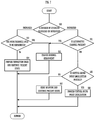
  • FIG. 7 is a detailed flow chart of an assigning operation in S 25 .
  • the AV receiver 3 determines whether the number of speakers has been increased or decreased (S 50 ).
  • the AV receiver 3 determines whether or not the channel of which a decreased speaker has been taken charge is able to be replaced with another speaker (S 51 ).
  • the AV receiver 3 in a case of having determined that an alternative is possible, changes channel assignment (S 52 ).
  • the channel to be outputted includes five channels of the C channel, the FL channel, the FR channel, the SL channel, and the SR channel.
  • the AV receiver 3 distributes the content of the C channel to the wireless speaker 12 and the wireless speaker 15 .
  • the AV receiver 3 also assigns the C channel in addition to the FR channel, to the wireless speaker 12 .
  • the AV receiver 3 also assigns the C channel in addition to the FL channel, to the wireless speaker 15 .
  • the user does not need to manually reset assignment even when the configuration of the wireless speakers that are connected to the AV receiver 3 is changed.
  • the AV receiver 3 is able to reproduce the channel that is taken charge of by the wireless speaker of which the connection has been interrupted, by using remaining wireless speakers, and does not lack a specific channel.
  • the configuration of a wireless speaker may be frequently changed.
  • a certain user watches movie content (content including an audio signal of five channels) in a living room
  • a family member of the user may take a wireless speaker that has been taken charge of the C channel.
  • the AV receiver 3 by using the remaining wireless speakers, is able to reproduce the C channel and does not lack the C channel.
  • the audio device of the present invention is not limited to the wireless speaker.
  • a wired speaker is also an example of the audio device of the present invention.
  • a receiver other than the AV receiver 3 or an information processing apparatus such as a smartphone is also an example of the audio device of the present invention.
  • the AV receiver 3 determines whether or not more channels are able to be reproduced (S 53 ).
  • the AV receiver 3 in a case of having determined that the more channels are able to be reproduced, changes channel assignment (S 52 ).
  • the AV receiver 3 for example, in a case of having assigned any one of the channels in the past to an increased speaker, is able to achieve reproduction of the more channels than at present by reassigning a channel to the speaker.
  • a family member may bring the wireless speaker 11 back to the living room again from another room, and may connect the speaker to the AV receiver 3 .
  • the AV receiver 3 when being connected to the wireless speaker 11 , reads out a correspondence table (see FIG. 4 ) stored in the memory.
  • the AV receiver 3 assigns the C channel to the wireless speaker 11 , assigns the FR channel to the wireless speaker 12 , and assigns the FL channel to the wireless speaker 15 .
  • the AV receiver 3 is able to reproduce the more channels by transmitting the content of the C channel that has been assigned in the past, to the wireless speaker 11 . It is to be noted that the AV receiver 3 is able to identify connected wireless speakers by receiving a MAC address of each of the connected wireless speakers. In addition, the AV receiver 3 is able to determine the channel that has been assigned by reading out the correspondence table as shown in FIG. 4 in the past from a memory.
  • the AV receiver 3 in a case of having determined that the more channels are not able to be reproduced (for example, in a case in which unique identification information of a connected wireless speaker is not able to be obtained, or in a case in which a channel assigned in the past does not exist), provides a connection guide and continues the present state (S 54 ).
  • the AV receiver 3 as the connection guide, for example, on a display (not shown), displays an indication such that “please set a channel since a new speaker has been connected.”
  • the AV receiver 3 provides such a connection guide on the display by using a program executed in the information processing apparatus such as a smartphone.
  • the AV receiver 3 in the processing of S 53 , may determine that the more channels are able to be reproduced, and may change channel assignment.
  • the AV receiver 3 determines whether or not sound of a decreased channel is able to be reproduced by virtual sound image localization processing (S 55 ).
  • the AV receiver 3 in a case of having determined that the virtual sound image localization processing, performs the virtual sound image localization processing (S 56 ).
  • the channel to be outputted includes five channels of the C channel, the FL channel, the FR channel, the SL channel, and the SR channel.
  • FIG. 9B when the connection of the wireless speaker 13 and the wireless speaker 14 is released, the number of wireless speakers connected at present becomes three.
  • the AV receiver 3 determines that alternative reproduction is impossible since all the three wireless speakers connected at present are speakers to be installed on the front side. Then, the AV receiver 3 , by using the wireless speaker 15 of the FL channel and the wireless speaker 12 of the FR channel, determines that the virtual sound image localization of the SL channel and the SR channel is possible, and performs the virtual sound image localization processing.
  • the virtual sound image localization uses a head-related transfer function (hereinafter referred to as HRTF) that indicates a transfer function between a sound source position and an ear of a listener.
  • HRTF head-related transfer function
  • the HRTF corresponds to an impulse response that expresses the loudness, arrival time, frequency characteristics, and the like of a sound emitted from a virtual speaker installed in a certain position to right and left ears of the listener.
  • the AV receiver 3 adds an audio signal of the SR channel and the SL channel to an audio signal of the FR channel and the FL channel. Then, the AV receiver 3 applies the HRTF from each sound source position to the right and left ears of the listener to the audio signal of the SR channel and the SL channel.
  • FIG. 9C the content of the SR channel and the SL channel is able to be localized in a virtual sound image.
  • the AV receiver 3 in the determination of S 55 in FIG. 7 , in a case of having determined that the virtual sound image localization processing is also impossible due to a case in which an HRTF to be applied is not prepared or similar cases, issues an warning and continues the present state (S 57 ).
  • the AV receiver 3 displays an indication such that “a specific channel is unable to be reproduced” on a display (not shown).
  • the AV receiver 3 may issue such a warning by using a program executed in the information processing apparatus such as a smartphone.
  • the AV receiver 3 in a case in which the number of speakers is increased as shown in FIG. 10A and FIG. 10B , may reassign the channel that has been assigned to the previous audio device to another channel.
  • the AV receiver 3 in a case of being connected to a wireless speaker 16 of a front top R (FTR) channel and a wireless speaker 17 of a front top L (FTL) channel as shown in FIG. 10A and then being newly connected to two wireless speakers 18 and 19 as shown in FIG. 10B , may reassign the channel that has been assigned to the previous audio device, to another channel.
  • the AV receiver 3 receives from a user a setting to newly assign a rear height L (RHL) channel and a rear height R (RHR) channel to the wireless speaker 18 and the wireless speaker 19 .
  • the AV receiver 3 changes the channels that has been assigned to the wireless speaker 16 and the wireless speaker 17 from the FTR channel to a front height R (FHR) channel and from the FTL channel to a front height L (FHL) channel.

Landscapes

  • Engineering & Computer Science (AREA)
  • Physics & Mathematics (AREA)
  • Acoustics & Sound (AREA)
  • Signal Processing (AREA)
  • Multimedia (AREA)
  • Stereophonic System (AREA)
  • Circuit For Audible Band Transducer (AREA)

Abstract

A content output device includes a connector, an outputter, and an assigner. The connector connects the content output device with a plurality of audio devices. The assigner assigns a plurality of channels to the plurality of audio devices. The outputter outputs the plurality of channels to the at least one communicator for output to the plurality of audio devices in accordance with the assignment of the plurality of channels in the assigning task.

Description

CROSS REFERENCE TO RELATED APPLICATIONS
The present application is a continuation of International Application No. PCT/JP2017/011719, filed on Mar. 23, 2017, the entire contents of which are incorporated herein by reference.
BACKGROUND 1. Technical Field
A preferred embodiment relates to a content output device, an audio system, and a content output method that output content of a plurality of channels.
2. Description of the Related Art
In recent years, in an audio system, as the number of channels of content is increased, the number of speakers has been increased.
Accordingly, International Publication No. 2008/126161 discloses a channel assigning device that automatically assigns a channel to a plurality of speakers.
The number of speakers may be increased and decreased according to a use state of a user. For example, a user may carry one speaker among a plurality of speakers used in a living room to a bedroom, and may use the speaker in the bedroom. In this manner, for example, when the number of speakers is reduced, sound of a channel that has been taken charge of by a speaker that has been reduced is not able to be reproduced. In the device disclosed in International Publication No. 2008/126161, a problem related to increase and decrease of the number of such speakers is not recognized.
SUMMARY
In view of the foregoing, an object of a preferred embodiment is to provide a content output device, an audio system, and a content output method that are capable of appropriately outputting sound of content even when the number of speakers is changed.
A content output device according to a preferred embodiment includes at least one processor configured to implement stored instructions and execute a plurality of tasks. The plurality of tasks include a connecting task, an outputting task, and an assigning task. The connecting task connects a plurality of audio devices. The outputting task outputs a content signal of a plurality of channels to the plurality of audio devices through the connecting task. The assigning task, when the number of the plurality of audio devices has been changed, assigns the plurality of channels to the plurality of audio devices, based on the number of audio devices that are connected at present, a channel to be outputted, and a channel corresponding to an audio device that has been changed.
According to a preferred embodiment, the sound of content is able to be appropriately outputted even when the number of speakers is changed.
The above and other elements, features, steps, characteristics and advantages will become more apparent from the following detailed description of the preferred embodiments with reference to the attached drawings.
BRIEF DESCRIPTION OF THE DRAWINGS
FIG. 1 is a conceptual diagram for illustrating a configuration of an audio system.
FIG. 2 is a block diagram showing a configuration of a wireless speaker.
FIG. 3 is a block diagram showing a configuration of an AV receiver.
FIG. 4 is a view showing a correspondence between an audio device and channel information.
FIG. 5 is a flow chart showing an operation of the wireless speaker and the AV receiver.
FIG. 6 is a flow chart showing an operation of a wireless speaker and an AV receiver according to a modification.
FIG. 7 is a flow chart showing an operation of the AV receiver.
FIG. 8A is a view showing an aspect of channel assignment in a case in which the number of wireless speakers is changed, FIG. 8B, differently from FIG. 8A, is a view showing an aspect of channel assignment in a case in which the number of wireless speakers is changed, and FIG. 8C, differently from FIG. 8A and FIG. 8B, is a view showing an aspect of channel assignment in a case in which the number of wireless speakers is changed.
FIG. 9A is a view showing an aspect of channel assignment in a case in which the number of wireless speakers is changed, FIG. 9B, differently from FIG. 9A, is a view showing an aspect of channel assignment in a case in which the number of wireless speakers is changed, and FIG. 9C, differently from FIG. 9A and FIG. 9B, is a view showing an aspect of channel assignment in a case in which the number of wireless speakers is changed.
FIG. 10A is a view showing an aspect of channel assignment in a case in which the number of wireless speakers is increased, and FIG. 10B, differently from FIG. 10A, is a view showing an aspect of channel assignment in a case in which the number of wireless speakers is increased.
DETAILED DESCRIPTION OF THE PREFERRED EMBODIMENTS
FIG. 1 is a conceptual diagram for illustrating a configuration of an audio system 10 according to a preferred embodiment of the present invention. FIG. 2 is a block diagram showing a configuration of a wireless speaker 11. FIG. 3 is a block diagram showing a configuration of an AV receiver 3.
As shown in FIG. 1, the audio system 10 includes a BD (Blu-ray Disc) player 1, an AV receiver 3, and a plurality of audio devices (a wireless speaker 11, a wireless speaker 12, a wireless speaker 13, a wireless speaker 14, and a wireless speaker 15).
The BD player 1 is a device that reproduces content. The BD player 1 transmits the reproduced content to the AV receiver 3. It is to be noted that the AV receiver 3 is not limited to an example of obtaining the content from the BD player 1, and may download content from a content server through the internet for example. It is to be noted that the BD player 1 and the AV receiver 3 may be connected by wire or may be connected by wireless. In addition, the AV receiver 3 may incorporate the function of the BD player 1.
The plurality of audio devices (the wireless speaker 11, the wireless speaker 12, the wireless speaker 13, the wireless speaker 14, and the wireless speaker 15) are respectively arranged in different positions. In this example, the wireless speaker 11 is arranged in the front of a listening position, the wireless speaker 12 is arranged in the right front of the listening position, the wireless speaker 13 is arranged in the right rear of the listening position, the wireless speaker 14 is arranged in the left rear of the listening position, and the wireless speaker 15 is arranged in the left front of the listening position.
The AV receiver 3 constructs a wireless LAN through a router with a wireless access point function, a router function of the own device, or the like. The AV receiver 3, through the wireless LAN, connects to the wireless speaker 11, the wireless speaker 12, the wireless speaker 13, the wireless speaker 14, and the wireless speaker 15. It is to be noted that the number of audio devices and the arrangement of the audio devices are able to be properly changed according to the use state of a user.
The AV receiver 3 corresponds to the content output device of the present invention. The AV receiver 3 outputs content of a plurality of channels. In the present preferred embodiment, examples of the content include multi-channel audio data. The content output device of the present invention may be a speaker provided with a CPU or a DSP, for example, other than the AV receiver 3. Alternatively, the content output device of the present invention is able to be achieved by an information processing apparatus such as a personal computer.
FIG. 2 is a block diagram showing a configuration of the wireless speaker 11. The wireless speaker 11, the wireless speaker 12, the wireless speaker 13, the wireless speaker 14, and the wireless speaker 15 have the same configuration and function. Therefore, in FIG. 2, the wireless speaker 11 will be described as an example.
The wireless speaker 11 includes a CPU 21, a communicator 24, a RAM 25, a DSP 26, a ROM 27, and a speaker 28.
The communicator 24 is a wireless communicator according to the Wi-Fi (a registered trademark) standard, for example. The communicator 24 communicates with the AV receiver 3 through a not-shown router with a wireless access point function. Alternatively, the communicator 24 directly communicates with the AV receiver 3.
The ROM 27 is a storage medium and stores a program for operating the CPU 21. The CPU 21, by reading the program stored in the ROM 27 to the RAM 25 and executing the program, performs various types of processing. For example, the CPU 21 inputs a signal of content received from the AV receiver 3 through the communicator 24, to the DSP 26. The DSP 26 performs various types of signal processing on an inputted signal. In addition, the DSP 26, in a case of having received encoded data as a signal of content, decodes the encoded data, and extracts an audio signal.
The CPU 21 inputs the signal that has been processed by the DSP 26, into the speaker 28. It is to be noted, although illustration is omitted, the speaker 28 includes a D/A converter that converts a digital audio signal into an analog audio signal, and an amplifier that amplifies an audio signal. The speaker 28 outputs sound on the basis of the inputted signal.
FIG. 3 is a block diagram showing a configuration of the AV receiver 3. The AV receiver 3 includes a CPU 31, a content inputter 32, a RAM 33, a communicator 34, a ROM 35, and a DSP 36.
The communicator 34 is a wireless communicator according to the Wi-Fi (a registered trademark) standard, for example. The communicator 34 communicates with the wireless speaker 11, the wireless speaker 12, the wireless speaker 13, the wireless speaker 14, and the wireless speaker 15 through a not-shown router with a wireless access point. Alternatively, the communicator 24 directly communicates with the wireless speaker 11, the wireless speaker 12, the wireless speaker 13, the wireless speaker 14, and the wireless speaker 15.
The ROM 35 is a storage medium and stores a program for operating the CPU 31. The CPU 31, by reading the program stored in the ROM 35 to the RAM 33 and executing the program, performs various types of processing.
For example, the CPU 31 inputs a signal of content inputted from the content inputter 32, to the DSP 36. The DSP 36 performs various types of signal processing on an inputted signal. In addition, the DSP 36, in a case of having received encoded data as a signal of content, decodes the encoded data, and extracts an audio signal.
The CPU 31 executes the program to achieve an assigner 311 of the present invention. In addition, the CPU 31 achieves a detector that detects that the number of speakers that are connected has been changed.
FIG. 4 is a table showing an example of channels of content assigned to the wireless speaker 11, the wireless speaker 12, the wireless speaker 13, the wireless speaker 14, and the wireless speaker 15 that are stored in a memory (the RAM 33 or the ROM 35) of the AV receiver 3.
The CPU 31 assigns a channel to each of the wireless speaker 11, the wireless speaker 12, the wireless speaker 13, the wireless speaker 14, and the wireless speaker 15. The assigner 311 of the CPU 31 has the function of assigning a channel.
As shown in FIG. 4, an IP address (a local IP address) is assigned to each of the wireless speaker 11, the wireless speaker 12, the wireless speaker 13, the wireless speaker 14, and the wireless speaker 15. Although the router assigns an IP address, the AV receiver 3 may assign the IP address. In a case in which the router assigns an IP address, the AV receiver 3 obtains information on the IP address from the router.
Each of the wireless speaker 11, the wireless speaker 12, the wireless speaker 13, the wireless speaker 14, and the wireless speaker 15 has a MAC address being individual identification information that is unique to each wireless speaker. It is to be noted that the individual identification information may be any other number as long as the number includes the individual identification information that is unique to a wireless speaker, such as a serial number or an ID number. The IP address and the MAC address are previously associated with each other, and are stored in the memory of the AV receiver 3. When the MAC address is stored in the AV receiver 3, in a case in which the wireless speaker (the wireless speaker 11, for example) has been once removed from a network and is then connected to the network again, the MAC address is received from the connected wireless speaker, so that the connected wireless speaker is identified, and the channel that has been assigned to the wireless speaker is able to be known. However, the MAC address is not an indispensable element in the present invention.
In this example, the assigner 311 assigns a C channel to the wireless speaker 11, an FR channel to the wireless speaker 12, an SR channel to the wireless speaker 13, an SL channel to the wireless speaker 14, and an FL channel to the wireless speaker 15.
For example, a user may operate the AV receiver 3 and sets instructions of these assignments. Alternatively, the user may set instructions of these assignments using an information processing apparatus such as a smartphone that is connected to the AV receiver 3 through the network.
The CPU 31 transmits a signal of the assigned channel to each of the wireless speaker 11, the wireless speaker 12, the wireless speaker 13, the wireless speaker 14, and the wireless speaker 15.
As a result, the content of the channel assigned to each wireless speaker is distributed. Each wireless speaker reproduces sound related to the content corresponding to the distributed channel.
The AV receiver 3, in a case in which the number of wireless speakers has been changed, assigns a channel to an audio device, based on the number of audio devices (the wireless speakers) that are connected at present, a channel to be outputted, and a channel corresponding to an audio device that has been changed.
FIG. 5 and FIG. 6 are flow charts showing an operation of the wireless speaker and the AV receiver 3. FIG. 7 is a flow chart showing an assignment operation of the AV receiver 3. FIG. 8A, FIG. 8B, and FIG. 8C are each a view showing an aspect of channel assignment in a case in which the number of wireless speakers is changed.
First, each of the wireless speakers and the AV receiver 3 are connected to each other through the wireless LAN (S11, S21). The AV receiver 3, as shown in FIG. 4, assigns a channel to each wireless speaker that is connected (S22). The AV receiver 3 distributes content to each wireless speaker (S23).
Each wireless speaker receives content (S12) and reproduces the content (S13). For example, as shown in FIG. 8A, the wireless speaker 11 receives and reproduces the content of the C channel, the wireless speaker 12 receives and reproduces the content of the FR channel, the wireless speaker 13 receives and reproduces the content of the SR channel, the wireless speaker 14 receives and reproduces the content of the SL channel, and the wireless speaker 15 receives and reproduces the content of the FL channel. It is to be noted that, for example, as shown in FIG. 6, the AV receiver 3, after setting a channel in S22, may transmit channel information to the wireless speaker 11 (S103). In such a case, the wireless speaker 11 receives the channel information (S102). Then, the AV receiver 3, in S23, distributes the content of all the channels by broadcasting. The wireless speaker 11, based on content information received in S102, in S13, extracts and reproduces a corresponding channel.
The AV receiver 3, as a function of the detector, determines whether or not the number of speakers that are connected has been changed (S24). The AV receiver 3 is able to determine whether or not the number of speakers that are connected has been changed, by periodically checking connection with a wireless speaker, for example.
Alternatively, the AV receiver 3, in a case of connecting with a wireless speaker through a router, is also able to determine whether or not the number of speakers that are connected has been changed, by receiving information (a list of IP addresses or the like, for example) on the devices that are connected at present, from the router. In addition, for example, the user may manually input information that the number of speakers has been changed, to the AV receiver 3.
The AV receiver 3, when the number of speakers has been changed, assigns a channel to an audio device, based on the number of audio devices that are connected at present, a channel to be outputted, and a channel corresponding to an audio device that has been changed (S25).
FIG. 7 is a detailed flow chart of an assigning operation in S25. First, the AV receiver 3 determines whether the number of speakers has been increased or decreased (S50). The AV receiver 3, in a case in which the number of speakers has been decreased, determines whether or not the channel of which a decreased speaker has been taken charge is able to be replaced with another speaker (S51). The AV receiver 3, in a case of having determined that an alternative is possible, changes channel assignment (S52).
For example, in the example of FIG. 8A, the channel to be outputted includes five channels of the C channel, the FL channel, the FR channel, the SL channel, and the SR channel. As shown in FIG. 8B, when the connection with the wireless speaker 11 is released, the number of wireless speakers that are connected at present becomes four, and the connection with the wireless speaker 11 associated with the C channel is interrupted. Then, the AV receiver 3, as shown in FIG. 8C, distributes the content of the C channel to the wireless speaker 12 and the wireless speaker 15. In other words, the AV receiver 3 also assigns the C channel in addition to the FR channel, to the wireless speaker 12. In addition, the AV receiver 3 also assigns the C channel in addition to the FL channel, to the wireless speaker 15.
As a result, the user does not need to manually reset assignment even when the configuration of the wireless speakers that are connected to the AV receiver 3 is changed. For example, in a case in which a problem occurs in a wireless speaker or even in a case in which some wireless speakers are not able to continue reproduction due to a network failure, the AV receiver 3 is able to reproduce the channel that is taken charge of by the wireless speaker of which the connection has been interrupted, by using remaining wireless speakers, and does not lack a specific channel.
In addition, in a case in which a speaker has high portability as with a wireless speaker, or in a case in which a user carries a wireless speaker to another room or other places and uses the speaker alone (in a case of using the speaker that is not connected to a network or in a case of making the speaker reproduce different content), the configuration of a wireless speaker may be frequently changed. For example, in a case in which a certain user watches movie content (content including an audio signal of five channels) in a living room, a family member of the user may take a wireless speaker that has been taken charge of the C channel. However, the AV receiver 3, by using the remaining wireless speakers, is able to reproduce the C channel and does not lack the C channel.
However, the audio device of the present invention is not limited to the wireless speaker. A wired speaker is also an example of the audio device of the present invention. Further, a receiver other than the AV receiver 3 or an information processing apparatus such as a smartphone is also an example of the audio device of the present invention.
In addition, the AV receiver 3, in a case of having determined that the number of speakers is increased in determination of S50 in FIG. 7, determines whether or not more channels are able to be reproduced (S53). The AV receiver 3, in a case of having determined that the more channels are able to be reproduced, changes channel assignment (S52). The AV receiver 3, for example, in a case of having assigned any one of the channels in the past to an increased speaker, is able to achieve reproduction of the more channels than at present by reassigning a channel to the speaker.
For example, a family member may bring the wireless speaker 11 back to the living room again from another room, and may connect the speaker to the AV receiver 3. The AV receiver 3, when being connected to the wireless speaker 11, reads out a correspondence table (see FIG. 4) stored in the memory. The AV receiver 3, according to the correspondence table, assigns the C channel to the wireless speaker 11, assigns the FR channel to the wireless speaker 12, and assigns the FL channel to the wireless speaker 15.
In this manner, the AV receiver 3 is able to reproduce the more channels by transmitting the content of the C channel that has been assigned in the past, to the wireless speaker 11. It is to be noted that the AV receiver 3 is able to identify connected wireless speakers by receiving a MAC address of each of the connected wireless speakers. In addition, the AV receiver 3 is able to determine the channel that has been assigned by reading out the correspondence table as shown in FIG. 4 in the past from a memory.
The AV receiver 3, in a case of having determined that the more channels are not able to be reproduced (for example, in a case in which unique identification information of a connected wireless speaker is not able to be obtained, or in a case in which a channel assigned in the past does not exist), provides a connection guide and continues the present state (S54). The AV receiver 3, as the connection guide, for example, on a display (not shown), displays an indication such that “please set a channel since a new speaker has been connected.” Alternatively, the AV receiver 3 provides such a connection guide on the display by using a program executed in the information processing apparatus such as a smartphone.
It is to be noted that, in a case in which a channel of a speaker is previously set to a newly connected speaker or in a case in which a user sets a channel with a physical button provided in the speaker or sets a channel from the outside by using an application program of an information processing apparatus such as a smartphone or a similar case, it is also possible to set channel information to a speaker to be newly connected before being connected. In such a case, the AV receiver 3, in the processing of S53, may determine that the more channels are able to be reproduced, and may change channel assignment.
On the other hand, the AV receiver 3, in a case of having determined that the number of speakers is decreased and also having determined that no alternative channels are present in S51 in the determination of S50 in FIG. 7, determines whether or not sound of a decreased channel is able to be reproduced by virtual sound image localization processing (S55). The AV receiver 3, in a case of having determined that the virtual sound image localization processing, performs the virtual sound image localization processing (S56).
For example, in the example of FIG. 9A, the channel to be outputted includes five channels of the C channel, the FL channel, the FR channel, the SL channel, and the SR channel. As shown in FIG. 9B, when the connection of the wireless speaker 13 and the wireless speaker 14 is released, the number of wireless speakers connected at present becomes three. The AV receiver 3 determines that alternative reproduction is impossible since all the three wireless speakers connected at present are speakers to be installed on the front side. Then, the AV receiver 3, by using the wireless speaker 15 of the FL channel and the wireless speaker 12 of the FR channel, determines that the virtual sound image localization of the SL channel and the SR channel is possible, and performs the virtual sound image localization processing.
The virtual sound image localization uses a head-related transfer function (hereinafter referred to as HRTF) that indicates a transfer function between a sound source position and an ear of a listener. The HRTF corresponds to an impulse response that expresses the loudness, arrival time, frequency characteristics, and the like of a sound emitted from a virtual speaker installed in a certain position to right and left ears of the listener. The AV receiver 3 adds an audio signal of the SR channel and the SL channel to an audio signal of the FR channel and the FL channel. Then, the AV receiver 3 applies the HRTF from each sound source position to the right and left ears of the listener to the audio signal of the SR channel and the SL channel. As a result, as shown in FIG. 9C, the content of the SR channel and the SL channel is able to be localized in a virtual sound image.
On the other hand, the AV receiver 3, in the determination of S55 in FIG. 7, in a case of having determined that the virtual sound image localization processing is also impossible due to a case in which an HRTF to be applied is not prepared or similar cases, issues an warning and continues the present state (S57). For example, the AV receiver 3 displays an indication such that “a specific channel is unable to be reproduced” on a display (not shown). Alternatively, the AV receiver 3 may issue such a warning by using a program executed in the information processing apparatus such as a smartphone.
It is to be noted that the AV receiver 3, in a case in which the number of speakers is increased as shown in FIG. 10A and FIG. 10B, may reassign the channel that has been assigned to the previous audio device to another channel.
For example, the AV receiver 3, in a case of being connected to a wireless speaker 16 of a front top R (FTR) channel and a wireless speaker 17 of a front top L (FTL) channel as shown in FIG. 10A and then being newly connected to two wireless speakers 18 and 19 as shown in FIG. 10B, may reassign the channel that has been assigned to the previous audio device, to another channel. For example, the AV receiver 3 receives from a user a setting to newly assign a rear height L (RHL) channel and a rear height R (RHR) channel to the wireless speaker 18 and the wireless speaker 19. In addition, the AV receiver 3 changes the channels that has been assigned to the wireless speaker 16 and the wireless speaker 17 from the FTR channel to a front height R (FHR) channel and from the FTL channel to a front height L (FHL) channel.
Finally, the foregoing preferred embodiments are illustrative in all points and should not be construed to limit the present invention. The scope of the present invention is defined not by the foregoing preferred embodiments but by the following claims. Further, the scope of the present invention is intended to include all modifications within the scopes of the claims and within the meanings and scopes of equivalents.

Claims (14)

What is claimed is:
1. A content output device comprising: at least one processor; at least one communicator configured to output a plurality of channels from the at least one processor to a plurality of audio device signals; and a memory that stores channel assignments for each of a plurality of audio devices,
wherein
the at least one processor configured to implement stored instructions and execute a plurality of tasks including:
a connecting task that connects the content output device with the plurality of audio devices;
an assigning task that assigns the plurality of channels to the plurality of audio devices; and
an outputting task that outputs the plurality of channels to the at least one communicator for output to the plurality of audio devices in accordance with the assignment of the plurality of channels in the assigning task;
when a number of the plurality of audio devices changes, the assigning task assigns the plurality of channels to the changed number of the plurality of audio devices, and the outputting task outputs the content signal in accordance with the changed assignment of the plurality of channels;
when the number of audio devices decreases, the assigning task determines whether or not to assign a channel of the decreased audio device to a different audio device is possible, and
the assigning task, in a case of determining that to assigned the channel of the decreased audio device to the different audio device is possible, assigns the channel of the decreased audio device to the different audio device.
2. The content output device according to claim 1, wherein the at least one processor is configured such that if the one of the plurality of audio devices that is no longer connected was a center channel, the outputting task outputs a content signal of the center channel to a one of the plurality of audio devices assigned a left channel of the plurality of channels and to a one of the plurality of audio devices assigned a right channel of the plurality of channels.
3. The content output device according to claim 1, wherein the at least one processor is configured such that if the one of the plurality of audio devices that is no longer connected was a surround channel, the outputting task performs virtual sound image localization processing of the surround channel and outputs a virtual sound image of the surround channel to a one of the plurality of audio devices assigned to a front channel of the plurality of channels.
4. The content output device according to claim 1, wherein the at least one processor is configured such that when the number of audio devices increases and at least one additional channel is available to be reproduced, the assigning task assigns the at least one additional channel to the increased number of audio devices and the outputting task outputs the at least one additional channel in accordance with the changed assignment of the plurality of channels.
5. The content output device according to claim 1, wherein the at least one processor is configured such that when the number of audio devices increases the assigning task reassigns at least one of the plurality of channels previously assigned to a previous one of the plurality of audio devices, to a different one of the plurality of audio devices.
6. The content output device according to claim 1, wherein the plurality of tasks includes a detecting task that detects that the number of the plurality of audio devices has changed.
7. An audio system comprising:
a plurality of audio devices;
a memory that stores channel assignments for each of a plurality of audio devices; and
a content output device having at least one processor configured to implement stored instructions and execute a plurality of tasks including:
a connecting task that connects a plurality of audio devices;
an outputting task that outputs a content signal of a plurality of channels to the plurality of audio devices through the connecting task; and
an assigning task that when the number of audio devices decreases, the assigning task determines whether or not to assign a channel of the decreased audio device to a different audio device is possible, wherein
the assigning task, in a case of determining that to assign the channel of the decreased audio device to the different audio device is possible, assigns the channel of the decreased audio device to the different audio device.
8. The audio system according to claim 7, wherein the plurality of audio devices includes a wireless speaker to be connected to the content output device through wireless communication.
9. A content output method comprising the acts of:
connecting a content output device to a plurality of audio devices;
assigning a plurality of channels to the plurality of audio devices; and
outputting the plurality of channels to the plurality of audio devices;
storing channel assignments for each of the plurality of audio devices;
when a number of the plurality of audio devices changes, reassigning the plurality of channels to the changed number of the plurality of audio devices; and
when the number of audio devices decreases, the act of reassigning the plurality of channels determines whether or not assigning a channel of the decreased audio device to a different audio device; and
the act of reassigning the plurality of channels, in a case of determining that assigning the channel of the decreased audio device to the different audio device is possible, assigns the channel of the decreased audio device to the different audio device.
10. The content output method according to claim 9, wherein if the one of the plurality of audio devices that is no longer connected was a center channel outputting the center channel a one of the plurality of audio devices assigned a left channel of the plurality of channels and to a one of the plurality of audio devices assigned a right channel of the plurality of channels.
11. The content output method according to claim 9, wherein if the one of the plurality of audio devices that is no longer connected was a surround channel performing, virtual sound image localization processing of the surround channel and outputting virtual sound image of the surround channel to a one of the plurality of audio devices assigned to a front channel of the plurality of channels.
12. The content output method according to claim 9, wherein when the number of audio devices increases and at least one additional channel is available to be reproduced, the act of reassigning the plurality of channels includes assigning the at least one additional channel to the increased number of audio devices and outputting the at least one additional channel in accordance with the changed assignment of the plurality of channels.
13. The content output method according to claim 9, wherein when the number of audio devices increases, the reassigning act includes reassigning at least one of the plurality of channels previously assigned to a previous one of the plurality of audio devices to a different one of the plurality of audio devices.
14. The content output method according to claim 9, further comprising the act of:
detecting that the number of the plurality of audio devices has changed.
US16/576,884 2017-03-23 2019-09-20 Content output device that assigns a plurality of channels, audio system that assigns a plurality of channels, and content output method for the same Active US11032645B2 (en)

Priority Applications (2)

Application Number Priority Date Filing Date Title
US17/308,132 US11696076B2 (en) 2017-03-23 2021-05-05 Content output device, audio system, and content output method
US18/199,793 US20230292049A1 (en) 2017-03-23 2023-05-19 Method for Reproducing Content

Applications Claiming Priority (1)

Application Number Priority Date Filing Date Title
PCT/JP2017/011719 WO2018173195A1 (en) 2017-03-23 2017-03-23 Content output device, acoustic system, and content output method

Related Parent Applications (1)

Application Number Title Priority Date Filing Date
PCT/JP2017/011719 Continuation WO2018173195A1 (en) 2017-03-23 2017-03-23 Content output device, acoustic system, and content output method

Related Child Applications (1)

Application Number Title Priority Date Filing Date
US17/308,132 Continuation US11696076B2 (en) 2017-03-23 2021-05-05 Content output device, audio system, and content output method

Publications (2)

Publication Number Publication Date
US20200015014A1 US20200015014A1 (en) 2020-01-09
US11032645B2 true US11032645B2 (en) 2021-06-08

Family

ID=63585123

Family Applications (3)

Application Number Title Priority Date Filing Date
US16/576,884 Active US11032645B2 (en) 2017-03-23 2019-09-20 Content output device that assigns a plurality of channels, audio system that assigns a plurality of channels, and content output method for the same
US17/308,132 Active US11696076B2 (en) 2017-03-23 2021-05-05 Content output device, audio system, and content output method
US18/199,793 Abandoned US20230292049A1 (en) 2017-03-23 2023-05-19 Method for Reproducing Content

Family Applications After (2)

Application Number Title Priority Date Filing Date
US17/308,132 Active US11696076B2 (en) 2017-03-23 2021-05-05 Content output device, audio system, and content output method
US18/199,793 Abandoned US20230292049A1 (en) 2017-03-23 2023-05-19 Method for Reproducing Content

Country Status (3)

Country Link
US (3) US11032645B2 (en)
JP (3) JP6984650B2 (en)
WO (1) WO2018173195A1 (en)

Cited By (1)

* Cited by examiner, † Cited by third party
Publication number Priority date Publication date Assignee Title
US11696076B2 (en) * 2017-03-23 2023-07-04 Yamaha Corporation Content output device, audio system, and content output method

Families Citing this family (2)

* Cited by examiner, † Cited by third party
Publication number Priority date Publication date Assignee Title
JP7711744B2 (en) * 2021-02-16 2025-07-23 ヤマハ株式会社 Sound signal distribution method, sound signal distribution device, and sound signal distribution system
CN121399972A (en) * 2023-04-12 2026-01-23 哈曼国际工业有限公司 Distribution of audio channels in a multi-channel audio system

Citations (3)

* Cited by examiner, † Cited by third party
Publication number Priority date Publication date Assignee Title
JP2003134591A (en) 2001-10-22 2003-05-09 Alpine Electronics Inc Audio system
JP2006129147A (en) 2004-10-29 2006-05-18 Yamaha Corp Multi-channel speaker system
WO2008126161A1 (en) 2007-03-06 2008-10-23 Pioneer Corporation Channel assigning device and method for multichannel reproduction system

Family Cites Families (5)

* Cited by examiner, † Cited by third party
Publication number Priority date Publication date Assignee Title
JP2005117361A (en) * 2003-10-08 2005-04-28 Sanyo Electric Co Ltd Acoustic device,and acoustic characteristic setting method for acoustic device
KR20050060789A (en) 2003-12-17 2005-06-22 삼성전자주식회사 Apparatus and method for controlling virtual sound
JP2005197842A (en) * 2003-12-26 2005-07-21 Toshiba Corp Audio processing device
JP5304557B2 (en) * 2009-09-11 2013-10-02 ヤマハ株式会社 Audio system
WO2018173195A1 (en) * 2017-03-23 2018-09-27 ヤマハ株式会社 Content output device, acoustic system, and content output method

Patent Citations (3)

* Cited by examiner, † Cited by third party
Publication number Priority date Publication date Assignee Title
JP2003134591A (en) 2001-10-22 2003-05-09 Alpine Electronics Inc Audio system
JP2006129147A (en) 2004-10-29 2006-05-18 Yamaha Corp Multi-channel speaker system
WO2008126161A1 (en) 2007-03-06 2008-10-23 Pioneer Corporation Channel assigning device and method for multichannel reproduction system

Non-Patent Citations (6)

* Cited by examiner, † Cited by third party
Title
Ando, Akio; Conversion of Multichannel Sound Signal Maintaining Physical Properties of Sound in Reproduced Sound Field; IEEE Transactions on Audio, Speech, and Language Processing, vol. 19, No. 6, Aug. 2011; pp. 1467-1475 (Year: 2011). *
English machine translation of JP 2003-134591 A (Takahashi, laso; Audio System; published May 2003) (Year: 2003). *
English machine translation of JP 2006-129147 A (Nitta, Naoki; Multi-Channel Speaker System; published May 2006) (Year : 2006). *
International Search Report (PCT/ISA/210) issued in PCT Application No. PCT/JP2017/011719 dated Jun. 13, 2017 with English translation (two (2) pages).
Japanese-language Office Action issued in Japanese Application No. 2019-506831 dated Oct. 20, 2020 with English translation (six (6) pages).
Japanese-language Written Opinion (PCT/ISA/237) issued in PCT Application No. PCT/JP2017/011719 dated Jun. 13, 2017 (four (4) pages).

Cited By (1)

* Cited by examiner, † Cited by third party
Publication number Priority date Publication date Assignee Title
US11696076B2 (en) * 2017-03-23 2023-07-04 Yamaha Corporation Content output device, audio system, and content output method

Also Published As

Publication number Publication date
US20230292049A1 (en) 2023-09-14
JP2023093626A (en) 2023-07-04
US11696076B2 (en) 2023-07-04
WO2018173195A1 (en) 2018-09-27
JP2021192537A (en) 2021-12-16
JP7533673B2 (en) 2024-08-14
JP6984650B2 (en) 2021-12-22
JPWO2018173195A1 (en) 2019-12-12
US20200015014A1 (en) 2020-01-09
JP7268705B2 (en) 2023-05-08
US20210258691A1 (en) 2021-08-19

Similar Documents

Publication Publication Date Title
US20230292049A1 (en) Method for Reproducing Content
JP4522462B2 (en) Audio channel assignment method and management apparatus
EP2461607B1 (en) Audio device
JP6337066B2 (en) Position-dependent wireless speaker configuration technology
KR102081336B1 (en) Audio System, Audio Device and Method for Channel Mapping Thereof
EP3610366B1 (en) Display apparatus and controlling method thereof
US20250088160A1 (en) Data processing and electronics management in multi-zone audio amplifiers
US11297432B2 (en) Audio signal processing method
JP2016178422A (en) Audio wireless transmission system, speaker device, and source device
US10728665B2 (en) Audio device, audio system, and channel distribution method
KR20240049018A (en) Multi channel audio apparatus for detecting channel shift
KR100677632B1 (en) Multichannel Setting Device and Method
JP7412091B2 (en) Audio equipment and audio systems
US20230370776A1 (en) Audio Signal Distribution Method, Audio Signal Distribution Apparatus, and Audio Signal Distribution System
WO2017104593A1 (en) Information processing device, wireless network communication system, wireless communication relay device, program and information processing method
US11609783B2 (en) Signal processor and signal processing method
JP2016208285A (en) Audio wireless transmission system and source device
JP2016178396A (en) Voice radio transmission system, speaker apparatus, and source apparatus
US20200128326A1 (en) Information processing device, information processing system, and information processing method
EP3537728A1 (en) Connection state determination system for speakers, acoustic device, and connection state determination method for speakers
CN121399972A (en) Distribution of audio channels in a multi-channel audio system

Legal Events

Date Code Title Description
FEPP Fee payment procedure

Free format text: ENTITY STATUS SET TO UNDISCOUNTED (ORIGINAL EVENT CODE: BIG.); ENTITY STATUS OF PATENT OWNER: LARGE ENTITY

STPP Information on status: patent application and granting procedure in general

Free format text: DOCKETED NEW CASE - READY FOR EXAMINATION

AS Assignment

Owner name: YAMAHA CORPORATION, JAPAN

Free format text: ASSIGNMENT OF ASSIGNORS INTEREST;ASSIGNOR:TAKUMAI, SUSUMU;REEL/FRAME:051461/0612

Effective date: 20191226

STPP Information on status: patent application and granting procedure in general

Free format text: NON FINAL ACTION MAILED

STPP Information on status: patent application and granting procedure in general

Free format text: NOTICE OF ALLOWANCE MAILED -- APPLICATION RECEIVED IN OFFICE OF PUBLICATIONS

STPP Information on status: patent application and granting procedure in general

Free format text: PUBLICATIONS -- ISSUE FEE PAYMENT RECEIVED

STPP Information on status: patent application and granting procedure in general

Free format text: PUBLICATIONS -- ISSUE FEE PAYMENT VERIFIED

STCF Information on status: patent grant

Free format text: PATENTED CASE

MAFP Maintenance fee payment

Free format text: PAYMENT OF MAINTENANCE FEE, 4TH YEAR, LARGE ENTITY (ORIGINAL EVENT CODE: M1551); ENTITY STATUS OF PATENT OWNER: LARGE ENTITY

Year of fee payment: 4