US11031502B2 - Semiconductor devices - Google Patents

Semiconductor devices Download PDF

Info

Publication number
US11031502B2
US11031502B2 US16/708,717 US201916708717A US11031502B2 US 11031502 B2 US11031502 B2 US 11031502B2 US 201916708717 A US201916708717 A US 201916708717A US 11031502 B2 US11031502 B2 US 11031502B2
Authority
US
United States
Prior art keywords
layers
epitaxial
semiconductor device
epitaxial layer
channel
Prior art date
Legal status (The legal status is an assumption and is not a legal conclusion. Google has not performed a legal analysis and makes no representation as to the accuracy of the status listed.)
Active
Application number
US16/708,717
Other versions
US20200220018A1 (en
Inventor
Sung Uk JANG
Young Dae Cho
Ki Hwan Kim
Su Jin Jung
Current Assignee (The listed assignees may be inaccurate. Google has not performed a legal analysis and makes no representation or warranty as to the accuracy of the list.)
Samsung Electronics Co Ltd
Original Assignee
Samsung Electronics Co Ltd
Priority date (The priority date is an assumption and is not a legal conclusion. Google has not performed a legal analysis and makes no representation as to the accuracy of the date listed.)
Filing date
Publication date
Priority claimed from KR1020190068893A external-priority patent/KR102903831B1/en
Application filed by Samsung Electronics Co Ltd filed Critical Samsung Electronics Co Ltd
Assigned to SAMSUNG ELECTRONICS CO., LTD. reassignment SAMSUNG ELECTRONICS CO., LTD. ASSIGNMENT OF ASSIGNORS INTEREST (SEE DOCUMENT FOR DETAILS). Assignors: CHO, YOUNG DAE, JANG, SUNG UK, JUNG, SU JIN, KIM, KI HWAN
Publication of US20200220018A1 publication Critical patent/US20200220018A1/en
Priority to US17/337,759 priority Critical patent/US11670716B2/en
Application granted granted Critical
Publication of US11031502B2 publication Critical patent/US11031502B2/en
Priority to US18/204,469 priority patent/US12132113B2/en
Priority to US18/901,222 priority patent/US20250022959A1/en
Active legal-status Critical Current
Anticipated expiration legal-status Critical

Links

Images

Classifications

    • HELECTRICITY
    • H10SEMICONDUCTOR DEVICES; ELECTRIC SOLID-STATE DEVICES NOT OTHERWISE PROVIDED FOR
    • H10DINORGANIC ELECTRIC SEMICONDUCTOR DEVICES
    • H10D30/00Field-effect transistors [FET]
    • H10D30/60Insulated-gate field-effect transistors [IGFET]
    • H10D30/62Fin field-effect transistors [FinFET]
    • H01L29/7851
    • HELECTRICITY
    • H10SEMICONDUCTOR DEVICES; ELECTRIC SOLID-STATE DEVICES NOT OTHERWISE PROVIDED FOR
    • H10DINORGANIC ELECTRIC SEMICONDUCTOR DEVICES
    • H10D30/00Field-effect transistors [FET]
    • H10D30/60Insulated-gate field-effect transistors [IGFET]
    • H10D30/62Fin field-effect transistors [FinFET]
    • H10D30/6211Fin field-effect transistors [FinFET] having fin-shaped semiconductor bodies integral with the bulk semiconductor substrates
    • BPERFORMING OPERATIONS; TRANSPORTING
    • B82NANOTECHNOLOGY
    • B82YSPECIFIC USES OR APPLICATIONS OF NANOSTRUCTURES; MEASUREMENT OR ANALYSIS OF NANOSTRUCTURES; MANUFACTURE OR TREATMENT OF NANOSTRUCTURES
    • B82Y10/00Nanotechnology for information processing, storage or transmission, e.g. quantum computing or single electron logic
    • H01L29/0847
    • H01L29/42392
    • H01L29/78696
    • HELECTRICITY
    • H10SEMICONDUCTOR DEVICES; ELECTRIC SOLID-STATE DEVICES NOT OTHERWISE PROVIDED FOR
    • H10DINORGANIC ELECTRIC SEMICONDUCTOR DEVICES
    • H10D30/00Field-effect transistors [FET]
    • H10D30/01Manufacture or treatment
    • H10D30/014Manufacture or treatment of FETs having zero-dimensional [0D] or one-dimensional [1D] channels, e.g. quantum wire FETs, single-electron transistors [SET] or Coulomb blockade transistors
    • HELECTRICITY
    • H10SEMICONDUCTOR DEVICES; ELECTRIC SOLID-STATE DEVICES NOT OTHERWISE PROVIDED FOR
    • H10DINORGANIC ELECTRIC SEMICONDUCTOR DEVICES
    • H10D30/00Field-effect transistors [FET]
    • H10D30/40FETs having zero-dimensional [0D], one-dimensional [1D] or two-dimensional [2D] charge carrier gas channels
    • H10D30/43FETs having zero-dimensional [0D], one-dimensional [1D] or two-dimensional [2D] charge carrier gas channels having 1D charge carrier gas channels, e.g. quantum wire FETs or transistors having 1D quantum-confined channels
    • HELECTRICITY
    • H10SEMICONDUCTOR DEVICES; ELECTRIC SOLID-STATE DEVICES NOT OTHERWISE PROVIDED FOR
    • H10DINORGANIC ELECTRIC SEMICONDUCTOR DEVICES
    • H10D30/00Field-effect transistors [FET]
    • H10D30/60Insulated-gate field-effect transistors [IGFET]
    • H10D30/67Thin-film transistors [TFT]
    • H10D30/6729Thin-film transistors [TFT] characterised by the electrodes
    • H10D30/673Thin-film transistors [TFT] characterised by the electrodes characterised by the shapes, relative sizes or dispositions of the gate electrodes
    • H10D30/6735Thin-film transistors [TFT] characterised by the electrodes characterised by the shapes, relative sizes or dispositions of the gate electrodes having gates fully surrounding the channels, e.g. gate-all-around
    • HELECTRICITY
    • H10SEMICONDUCTOR DEVICES; ELECTRIC SOLID-STATE DEVICES NOT OTHERWISE PROVIDED FOR
    • H10DINORGANIC ELECTRIC SEMICONDUCTOR DEVICES
    • H10D30/00Field-effect transistors [FET]
    • H10D30/60Insulated-gate field-effect transistors [IGFET]
    • H10D30/67Thin-film transistors [TFT]
    • H10D30/6757Thin-film transistors [TFT] characterised by the structure of the channel, e.g. transverse or longitudinal shape or doping profile
    • HELECTRICITY
    • H10SEMICONDUCTOR DEVICES; ELECTRIC SOLID-STATE DEVICES NOT OTHERWISE PROVIDED FOR
    • H10DINORGANIC ELECTRIC SEMICONDUCTOR DEVICES
    • H10D62/00Semiconductor bodies, or regions thereof, of devices having potential barriers
    • H10D62/10Shapes, relative sizes or dispositions of the regions of the semiconductor bodies; Shapes of the semiconductor bodies
    • H10D62/117Shapes of semiconductor bodies
    • H10D62/118Nanostructure semiconductor bodies
    • H10D62/119Nanowire, nanosheet or nanotube semiconductor bodies
    • H10D62/121Nanowire, nanosheet or nanotube semiconductor bodies oriented parallel to substrates
    • HELECTRICITY
    • H10SEMICONDUCTOR DEVICES; ELECTRIC SOLID-STATE DEVICES NOT OTHERWISE PROVIDED FOR
    • H10DINORGANIC ELECTRIC SEMICONDUCTOR DEVICES
    • H10D62/00Semiconductor bodies, or regions thereof, of devices having potential barriers
    • H10D62/10Shapes, relative sizes or dispositions of the regions of the semiconductor bodies; Shapes of the semiconductor bodies
    • H10D62/13Semiconductor regions connected to electrodes carrying current to be rectified, amplified or switched, e.g. source or drain regions
    • H10D62/149Source or drain regions of field-effect devices
    • H10D62/151Source or drain regions of field-effect devices of IGFETs 
    • HELECTRICITY
    • H10SEMICONDUCTOR DEVICES; ELECTRIC SOLID-STATE DEVICES NOT OTHERWISE PROVIDED FOR
    • H10DINORGANIC ELECTRIC SEMICONDUCTOR DEVICES
    • H10D62/00Semiconductor bodies, or regions thereof, of devices having potential barriers
    • H10D62/10Shapes, relative sizes or dispositions of the regions of the semiconductor bodies; Shapes of the semiconductor bodies
    • H10D62/17Semiconductor regions connected to electrodes not carrying current to be rectified, amplified or switched, e.g. channel regions
    • H10D62/213Channel regions of field-effect devices
    • H10D62/221Channel regions of field-effect devices of FETs
    • H10D62/235Channel regions of field-effect devices of FETs of IGFETs
    • HELECTRICITY
    • H10SEMICONDUCTOR DEVICES; ELECTRIC SOLID-STATE DEVICES NOT OTHERWISE PROVIDED FOR
    • H10DINORGANIC ELECTRIC SEMICONDUCTOR DEVICES
    • H10D62/00Semiconductor bodies, or regions thereof, of devices having potential barriers
    • H10D62/60Impurity distributions or concentrations

Definitions

  • Example embodiments relate to a semiconductor device.
  • MOSFET planar metal oxide semiconductor FET
  • Embodiments are directed a semiconductor device, including an active region extending in a first direction on a substrate, a plurality of channel layers on the active region and spaced apart from each other vertically, a gate structure intersecting the active region and the plurality of channel layers, the gate structure extending in a second direction on the substrate and surrounding the plurality of channel layers, and a source/drain region on the active region at at least one side of the gate structure, the source/drain region being in contact with the plurality of channel layers, the source/drain region including first epitaxial layers having a first composition and including first layers on side surfaces of the plurality of channel layers taken in the first direction and a second layer on the active region at a lower end of the source/drain region, and a second epitaxial layer having a second composition different from the first composition, the second epitaxial layer being interposed between the first epitaxial layers in the first direction and being interposed between the first epitaxial layers vertically in a third direction, wherein the third direction is perpendicular to the
  • Embodiments are also directed to a semiconductor device, including an active region, a plurality of channel layers on the active region and spaced apart from each other vertically, a gate structure surrounding side surfaces taken in a first direction, upper surfaces, and lower surfaces of the plurality of channel layers, and a source/drain region on the active region at at least one side of the gate structure, the source/drain region being in contact with the plurality of channel layers, the source/drain region including at least one first epitaxial layer having a first composition, and covering side surfaces of the plurality of channel layers taken in a second direction and covering at least a portion of an upper surface of the active region at a lower end of the source/drain region, and a second epitaxial layer having a second composition different from the first composition, the second epitaxial layer being layered on the first epitaxial layer, and extending more upwardly than an uppermost surface of the plurality of channel layers.
  • Embodiments are also directed to a semiconductor device, including an active region extending in a first direction on a substrate, a plurality of channel layers on the active region and spaced apart from each other vertically, a gate structure intersecting the active region and the plurality of channel layers, the gate structure extending in a second direction on the substrate and surrounding the plurality of channel layers, internal spacer layers at opposite sides of the gate structure taken in the first direction, the internal spacer layers being disposed in a lower portion of each of the plurality of channel layers, and a source/drain region on the active region at at least one side of the gate structure, the source/drain region being contact with the plurality of channel layers and including a plurality of epitaxial layers, and having concentration gradients of impurities corresponding to a vertical arrangement of the internal spacer layers and the plurality of channel layers in a third direction, wherein the third direction is perpendicular to the first and second directions.
  • FIG. 1 illustrates a plan diagram of a semiconductor device according to an example embodiment
  • FIG. 2 illustrates a cross-sectional diagram of a semiconductor device according to an example embodiment
  • FIG. 3 illustrates an enlarged diagram of a portion of a semiconductor device according to an example embodiment
  • FIGS. 4A to 5B illustrate diagrams of a distribution of a concentration of impurities included in a source/drain region in a semiconductor device according to an example embodiment
  • FIG. 6 illustrates an enlarged diagram of a portion of a semiconductor device according to an example embodiment
  • FIG. 7 illustrates a cross-sectional diagram of a semiconductor device according to an example embodiment
  • FIG. 8 illustrates an enlarged diagram of a portion of a semiconductor device according to an example embodiment
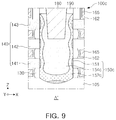
  • FIG. 9 illustrates an enlarged diagram of a portion of a semiconductor device according to an example embodiment
  • FIGS. 10A to 10C illustrate cross-sectional diagrams of semiconductor devices according to example embodiments
  • FIGS. 11A to 11K illustrate diagrams of processes of a method of manufacturing a semiconductor device in order according to an example embodiment
  • FIG. 12 illustrates a block diagram of an electronic device including a semiconductor device according to an example embodiment
  • FIG. 13 illustrates a diagram of a system including a semiconductor device according to an example embodiment.
  • FIG. 1 is a plan diagram illustrating a semiconductor device according to an example embodiment.
  • FIG. 2 illustrates cross-sectional surfaces of the semiconductor device illustrated in FIG. 1 taken along lines and For ease of description, only main elements of the semiconductor device are illustrated in FIGS. 1 and 2 .
  • a semiconductor device 100 may include a substrate 101 , an active region 105 on the substrate 101 , channel structures 140 including a plurality of channel layers 141 , 142 , and 143 on the active region 105 and spaced apart from each other vertically, source/drain regions 150 in contact with the plurality of channel layers 141 , 142 , and 143 , gate structures 160 intersecting the active region 105 and extending, and contact plugs 180 connected to the source/drain regions 150 .
  • the semiconductor device 100 may further include device isolating layers 110 , internal spacer layers 130 , and interlayer insulating layers 190 .
  • the gate structure 160 may include a gate dielectric layer 162 , a gate electrode 165 , spacer layers 164 , and a gate capping layer 166 .
  • the active region 105 may have a fin structure
  • the gate electrode 165 may be disposed between the active region 105 and the channel structure 140 , among the plurality of channel layers 141 , 142 , and 143 of the channel structure 140 , and in an upper portion of the channel structure 140 .
  • the semiconductor device 100 may include a gate-all-around type field effect transistor (FET) formed by the channel structures 140 , the source/drain regions 150 , and the gate structures 160 .
  • the transistor may be, for example, an NMOS transistor.
  • the substrate 101 may have an upper surface extending in an x direction and a y direction.
  • the substrate 101 may include a semiconductor material, such as a IV group semiconductor, a III-V group compound semiconductor, or a II-VI group compound semiconductor.
  • the IV group semiconductor may include silicon, germanium, or silicon-germanium.
  • the substrate 101 may be provided as, for example, a bulk wafer, an epitaxial layer, a silicon-on-insulator (SOI) layer, a semiconductor-on-insulator (SeOI) layer, or the like.
  • the device isolating layers 110 may define the active region 105 on the substrate 101 .
  • the device isolating layers 110 may be formed through a shallow trench isolation (STI) process, for example.
  • the device isolating layer 110 may further include a region having stepped portions and extending towards a lower portion of the substrate 101 .
  • the device isolating layer 110 may partially expose an upper portion of the active region 105 .
  • the device isolating layers 110 may have a curved upper surface, a level of which may increase towards the active region 105 .
  • the device isolating layers 110 may be formed of an insulating material.
  • the device isolating layer 110 may be an oxide, a nitride, or a combination thereof, for example.
  • the active region 105 may be defined by the device isolating layer 110 and may extend in a first direction, for example, the x direction, in the substrate 101 .
  • the active region 105 may be configured to protrude from the substrate 101 .
  • An upper end of the active region 105 may be configured to protrude from an upper surface of the device isolating layer 110 to a certain height.
  • the active region 105 may be a portion of the substrate 101 , or may include an epitaxial layer grown from the substrate 101 .
  • a portion of the active region 105 on the substrate 101 may be recessed, and the source/drain regions 150 may be disposed in the recessed active region 105 .
  • the active region 105 may include impurities (for example, dopants), or may include doping regions including impurities.
  • the channel structure 140 may include two or more channel layers (for example, the first to third channel layers 141 , 142 , and 143 ) spaced apart from each other vertically in a direction perpendicular to an upper surface of the active region 105 (for example, the z direction) on the active region 105 .
  • the first to third channel layers 141 , 142 , and 143 may be connected to the source/drain region 150 , and may be spaced apart from an upper surface of the active region 105 .
  • the first to third channel layers 141 , 142 , and 143 may have a width the same as or similar to a width of the active region 105 in the y direction, and may have a width the same as or similar to a width of the gate structure 160 in the x direction.
  • the first to third channel layers 141 , 142 , and 143 may also have a reduced width such that side surfaces of the first to third channel layers 141 , 142 , and 143 may be disposed in a lower portion of the gate structure 160 in the x direction.
  • the first to third channel layers 141 , 142 , and 143 may be formed of a semiconductor material.
  • the first to third channel layers 141 , 142 , and 143 may include at least one of silicon (Si), germanium (SiGe), and silicon-germanium (Ge).
  • the first to third channel layers 141 , 142 , and 143 may be formed of a material that is the same as a material of the substrate 101 , for example.
  • the first to third channel layers 141 , 142 , and 143 may include an impurity region disposed in a region adjacent to the source/drain region 150 .
  • the channel structure 140 may further include a channel layer on an upper surface of the active region 105 .
  • the source/drain regions 150 may be on the active region 105 on both side regions of the channel structure 140 .
  • the source/drain region 150 may include first epitaxial layers 152 on each of side surfaces of the first to third channel layers 141 , 142 , and 143 of the channel structure 140 and on the active region 105 in a lower end of the source/drain region 150 .
  • the source/drain region may further include a second epitaxial layer 154 filling spaces between the first epitaxial layers 152 .
  • the first epitaxial layers 152 and the second epitaxial layer 154 may be semiconductor layers including silicon (Si), and may include different types and/or different concentrations of impurities from each other.
  • the first epitaxial layers 152 may include first layers 152 A on side surfaces of the first to third channel layers 141 , 142 , and 143 and second layers 152 B on an upper surface of the active region 105 .
  • the first layers 152 A may be on both side surfaces of the channel structure 140 in the x direction. With the first layers 152 A are on both side surfaces of the channel structure 140 , a short channel effect caused by diffusion of impurities included in the second epitaxial layer 154 may be reduced or prevented.
  • the first layers 152 A may be separated from each other among the first to third channel layers 141 , 142 , and 143 disposed perpendicularly in the z direction.
  • the first layers 152 A may be separated from the second layer 152 B as well.
  • first layers 152 A may protrude towards the second epitaxial layer 154 from coplanar side surfaces formed by the internal spacer layers 130 and the first to third channel layers 141 , 142 , and 143 .
  • the second epitaxial layer 154 may be interposed between the first layers 152 A spaced apart from each other in the z direction.
  • the second epitaxial layer 154 may also be interposed between the first layers 152 A spaced apart from each other in a single source/drain region 150 in the x direction. At least a portion of the first epitaxial layers 152 may overlap the second epitaxial layer 154 and may be configured to not overlap the internal spacer layers 130 , on a plane.
  • the second layer 152 B may be on at least a portion of an upper surface of the active region 105 in a lower portion.
  • the second layer 152 B may be disposed in a central region taken in the x direction, for example.
  • the second layer 152 B may have a maximum thickness greater than thicknesses of the first layers 152 A.
  • a width of an upper portion of the second layer 152 B may be less than a width of a lower portion of the second layer 152 B, and the second layer 152 B may have an upwardly curved shape.
  • a shape of a lower surface of the source/drain region 150 may be varied in example embodiments.
  • the lower surface of the source/drain region 150 may be curved in different depth, or may have a planar shape. Accordingly, a shape of the second layer 152 B may also be varied in example embodiments.
  • the first epitaxial layer 152 may be a region including a higher concentration of impurities than a concentration of impurities included in the active region 105 .
  • the first epitaxial layers 152 may be epitaxially grown from the first to third channel layers 141 , 142 , and 143 and the active region 105 .
  • the first epitaxial layer 152 may include n-type impurities such as arsenic (As) and/or phosphorus (P).
  • the first epitaxial layer 152 may be, for example, a SiAs layer, a SiP layer, a SiPC layer, a SiC layer, a SiPAs layer, or a SiGeP layer.
  • a concentration of impurities included in the first epitaxial layer 152 may be within a range of approximately 2 ⁇ 10 20 /cm 3 to 8 ⁇ 10 20 /cm 3 .
  • a thickness of each of the first layers 152 A may be within a range of approximately 4 nm to 8 nm, and the second layer 152 B may have a thickness greater than the thicknesses of the first layers 152 A, for example.
  • the second epitaxial layer 154 may be configured to fill a region between adjacent channel structures 140 .
  • the second epitaxial layer 154 may surround a surface of the first epitaxial layer 152 on which the first epitaxial layer 152 is not in contact with the channel structure 140 or the active region 105 .
  • the second epitaxial layer 154 may cover side surfaces of the internal spacer layers 130 .
  • the second epitaxial layer 154 may be configured to fill a space between the first layers 152 A of the first epitaxial layers 152 spaced apart from each other upwardly and downwardly. Accordingly, at least a portion of the second epitaxial layer 154 may overlap each of the first layers 152 A and the second layer 152 B of the first epitaxial layer 152 on a plane.
  • the second epitaxial layer 154 may extend more upwardly than an uppermost surface of the channel structure 140 .
  • the second epitaxial layer 154 may have a composition different from a composition of the first epitaxial layers 152 .
  • the second epitaxial layer 154 may be a region including a higher concentration of impurities than a concentration of impurities included in the first epitaxial layer 152 .
  • the second epitaxial layer 154 may be epitaxially grown from the first epitaxial layers 152 .
  • the impurities may be the same as or different from the impurities included in the first epitaxial layer 152 .
  • the first epitaxial layer 152 may include first impurities of a first conductivity type in a first concentration
  • the second epitaxial layer 154 may include first or second impurities of the same first conductivity type in a second concentration higher than the first concentration.
  • the second concentration may be within a range of 10 times to 20 times the first concentration.
  • a concentration of impurities included in the second epitaxial layer 154 may be within a range of approximately 3.1 ⁇ 10 21 /cm 3 to 3.9 ⁇ 10 21 /cm 3 .
  • the second epitaxial layer 154 may be a SiP layer including phosphorus (P).
  • the first epitaxial layer 152 may be a SiP or SiAs epitaxial layer
  • the second epitaxial layer 154 may be a SiP epitaxial layer.
  • the impurities of the second epitaxial layer 154 may be partially diffused into an adjacent first epitaxial layer 152 , and the impurities may be partially included in the first epitaxial layer 152 in a lower concentration than in the second epitaxial layer 154 . Also, the impurities of the first epitaxial layer 152 may be partially diffused into an adjacent second epitaxial layer 154 , and the impurities may be partially included in the second epitaxial layer 154 in a lower concentration than in the first epitaxial layer 152 .
  • the first epitaxial layer 152 and the second epitaxial layer 154 may be formed as epitaxial layers. Thus, damage to a film caused by an ion implantation process when the first epitaxial layer 152 and the second epitaxial layer 154 are formed as doping regions may be avoided, which may help improve electrical properties of the semiconductor device 100 .
  • the gate structure 160 may intersect the active region 105 and the channel structure 140 , and may extend in one direction (for example, a y direction) in the active region 105 and upper portions of the channel structures 140 . Channel regions of transistors may be formed in the active region 105 and the channel structure 140 intersecting the gate structure 160 .
  • the gate structure 160 may include a gate electrode 165 , a gate dielectric layer 162 disposed between the gate electrode 165 and the first to third channel layers 141 , 142 , and 143 , gate spacer layers 164 on side surfaces of the gate electrode 165 , and a gate capping layer 166 on an upper surface of the gate electrode 165 .
  • the gate dielectric layer 162 may be disposed between the active region 105 and the gate electrode 165 , and between the channel structure 140 and the gate electrode 165 .
  • the gate dielectric layer 162 may be configured to cover at least portions of surfaces of the gate electrode 165 .
  • the gate dielectric layer 162 may surround overall surfaces of the gate electrode 165 other than an uppermost surface.
  • the gate dielectric layer 162 may extend to a space between the gate electrode 165 and the spacer layers 164 , for example.
  • the gate dielectric layer 162 may include an oxide, a nitride, or a high-k material, for example.
  • the high-k material may refer to a dielectric material having a dielectric constant higher than a dielectric constant of a silicon oxide (SiO 2 ) film.
  • the high-k material may be one of aluminum oxide (Al 2 O 3 ), tantalum oxide (Ta 2 O 3 ), titanium oxide (TiO 2 ), yttrium oxide (Y 2 O 3 ), zirconium oxide (ZrO 2 ), zirconium silicon oxide (ZrSi x O y ), hafnium oxide (HfO 2 ), hafnium silicon oxide (HfSi x O y ), lanthanum oxide (La 2 O 3 ), lanthanum aluminum oxide (LaAl x O y ), lanthanum hafnium oxide (LaHf x O y ), hafnium aluminum oxide (HfAl x O y ), and praseodymium oxide (Pr 2 O 3 ), for example.
  • the gate electrode 165 may fill a space between the first to third channel layers 141 , 142 , and 143 in an upper portion of the active region 105 and may extend to an upper portion of the channel structure 140 .
  • the gate electrode 165 may be spaced apart from the plurality of channel layers 141 , 142 , and 143 by the gate dielectric layer 162 .
  • the gate electrode 165 may include a conductive material.
  • the gate electrode 165 may include a metal nitride material such as a titanium nitride film (TiN), a tantalum nitride film (TaN), or a tungsten nitride film (WN), and/or a metal material such as aluminum (Al), tungsten (W), molybdenum (Mo), or the like, or a semiconductor material such as a doped polysilicon.
  • the gate electrode 165 may include multiple layers, for example, two or more layers.
  • the gate electrodes 165 may be separated from each other by a separating portion between at least portions of adjacent transistors, depending on a configuration of the semiconductor device 100 .
  • the gate spacer layers 164 may be on both side surfaces of the gate electrode 165 .
  • the gate spacer layers 164 may insulate the source/drain regions 150 from the gate electrode 165 .
  • the gate spacer layers 164 may have a multilayer structure.
  • the gate spacer layers 164 may be formed of an oxide, a nitride, or an oxynitride, for example, and may be formed of a low-k material film.
  • the gate capping layer 166 may be disposed at an upper portion of the gate electrode 165 , and each of a lower surface and side surfaces of the gate capping layer 166 may be surrounded by the gate electrode 165 and the gate spacer layers 164 .
  • the internal spacer layers 130 may be disposed side by side with the gate electrode 165 between the channel structures 140 .
  • the gate electrode 165 may be spaced apart from and electrically isolated from the source/drain regions 150 by the internal spacer layers 130 in a lower portion of the third channel layer 143 .
  • Side surfaces of the internal spacer layers 130 facing the gate electrode 165 may be recessed and curved towards the gate electrode 165 , for example.
  • the internal spacer layers 130 may be formed of an oxide, a nitride, or oxynitride, for example, and may be formed of a low-k material film.
  • the contact plug 180 may penetrate the interlayer insulating layer 190 and may be connected to the source/drain region 150 .
  • the contact plug 180 may apply an electrical signal to the source/drain region 150 .
  • the contact plug 180 may be on the source/drain region 150 as illustrated in FIG. 1 , and may have a length longer than a length of the source/drain region 150 in the y direction.
  • the contact plug 180 may have a sloped side surface in which a width of a lower portion is less than a width of an upper portion in accordance with an aspect ratio, for example.
  • the contact plug 180 may extend further downwardly than the third channel layer 143 from an upper portion, for example.
  • the contact plugs 180 may be recessed by a height corresponding to an upper surface of the second channel layer 142 , for example. In an example embodiment, the contact plug 180 may not be recessed into the source/drain region 150 and may be configured to be in contact with and disposed along an upper surface of the source/drain region 150 .
  • the contact plug 180 may include, for example, a metal nitride material such as a titanium nitride film (TiN), a tantalum nitride film (TaN), or a tungsten nitride film (WN), and/or a metal material such as aluminum (Al), tungsten (W), molybdenum (Mo), or the like.
  • the interlayer insulating layer 190 may cover the source/drain regions 150 and the gate structures 160 , and may be configured to cover the device isolating layer 110 in a region not illustrated in the diagram.
  • the interlayer insulating layer 190 may include an oxide, a nitride, or an oxynitride, for example, and may include a low-k material.
  • FIG. 3 is a diagram illustrating an enlarged region A of a semiconductor device according to an example embodiment illustrated in FIG. 2 .
  • first layers 152 A of first epitaxial layers 152 may be on side surfaces of first to third channel layers 141 , 142 , and 143 , respectively, and may be spaced vertically apart from each other by a first spacing distance D 1 in the z direction.
  • the first layers 152 A may be spaced apart from a second layer 152 B on an active region 105 by a second spacing distance D 2 , a shortest distance.
  • the first spacing distance D 1 may be different from the second spacing distance D 2 .
  • Portions of the first layers 152 A may extend onto side surfaces of internal spacer layers 130 .
  • the first layers 152 A may be configured to be only on side surfaces of the first to third channel layers 141 , 142 , and 143 .
  • Each of the first layers 152 A may have a first maximum thickness T 1 from side surfaces of the first to third channel layers 141 , 142 , and 143
  • the second layer 152 B may have a second maximum thickness T 2 from an upper surface of the active region 105 .
  • the second maximum thickness T 2 may be greater than the first maximum thickness T 1 , for example.
  • FIGS. 4A and 4B illustrate a distribution profile of concentration of impurities included in the source/drain region 150 taken along B-B′ illustrated in FIG. 3 .
  • FIG. 4A illustrates a profile of when the first epitaxial layers 152 and the second epitaxial layer 154 include the same impurities
  • FIG. 4B illustrates a profile of when the first epitaxial layer 152 includes first impurities
  • the second epitaxial layer 154 includes second impurities different from the first impurities.
  • a first section L 1 may be a region corresponding to the first epitaxial layers 152 of the source/drain region 150
  • a second section L 2 may be a region corresponding to the second epitaxial layer 154
  • the first section L 1 may be a region corresponding to at least portions of external regions of the first to third channel layers 141 , 142 , and 143
  • the second section L 2 may include a region corresponding to external regions of the internal spacer layers 130 .
  • the first epitaxial layer 152 may include impurities in a first concentration C 1
  • the second epitaxial layer 154 may include impurities in a second concentration C 2 higher than the first concentration C 1 .
  • the first and second concentrations C 1 and C 2 may be maximum concentrations of the first and second sections L 1 and L 2 .
  • the second concentration C 2 may be within a range of approximately 10 times to 20 times the first concentration C 1 , for example.
  • the source/drain region 150 may have concentration gradients corresponding to the internal spacer layers 130 and the first to third channel layers 141 , 142 , and 143 in external regions of the internal spacer layers 130 and the first to third channel layers 141 , 142 , and 143 in the z direction. Also, as the profiles having different concentrations alternately appear, the first and second sections L 1 and L 2 may appear to be distinguished from each other.
  • changes in concentration of impurities on a boundary between the first and second sections L 1 and L 2 may be steeper or gentler than in the example illustrated in the diagrams.
  • a section in which a concentration of impurities is constant or uniform may appear in each of the sections L 1 and L 2 .
  • a peak of a concentration of impurities may appear in each of the sections L 1 and L 2 .
  • a maximum concentration of impurities in the second layer 152 B may be the first concentration C 1 .
  • first epitaxial layers 152 and the second epitaxial layer 154 include different impurities
  • profiles having different concentrations may alternately appear in the first and second sections L 1 and L 2 .
  • the first epitaxial layer 152 may further include second impurities in at least a region adjacent to the second epitaxial layer 154
  • the second epitaxial layer 154 may further include the first impurities in a region adjacent to the first epitaxial layers 152 .
  • FIGS. 5A and 5B illustrate profiles of impurities included in the source/drain region 150 taken along C-C′ illustrated in FIG. 3 .
  • FIG. 5A illustrates a profile of when the first epitaxial layers 152 and the second epitaxial layer 154 include the same impurities
  • FIG. 5B illustrates a profile of when the first epitaxial layer 152 includes first impurities
  • the second epitaxial layer 154 includes second impurities different from the first impurities.
  • a first section L 1 may be a region corresponding to the first epitaxial layers 152 of the source/drain region 150
  • a second section L 2 may be a region corresponding to the second epitaxial layer 154 .
  • the source/drain region 150 may include impurities in a second concentration C 2 in the second epitaxial layer 154 including a center taken in the x direction, and the first epitaxial layers 152 on both ends may include impurities in a first concentration C 1 lower than the second concentration C 2 .
  • the source/drain region 150 may have a section in which a concentration of impurities is substantially constant or uniform in a central region including the center, the region of the second epitaxial layer 154 .
  • changes in concentration of impurities on a boundary between the first and second sections L 1 and L 2 may be steeper or gentler than in the example illustrated in the diagram.
  • first epitaxial layers 152 and the second epitaxial layer 154 include different impurities, profiles having different concentrations (for example, different maximum concentrations) may appear in a corresponding manner in the first and second sections L 1 and L 2 .
  • the first epitaxial layers 152 may further include second impurities in at least a region adjacent to the second epitaxial layer 154
  • the second epitaxial layer 154 may further include the first impurities in a region adjacent to the first epitaxial layers 152 .
  • FIG. 6 is a diagram illustrating an enlarged portion of a semiconductor device according to an example embodiment.
  • FIG. 6 illustrates a region corresponding to region A illustrated in FIG. 2 .
  • a source/drain region 150 a may include first epitaxial layers 152 and second epitaxial layers 154 filling a space between the first epitaxial layers 152 , and may further include third epitaxial layers 151 configured to be in contact with the first epitaxial layers 152 .
  • the third epitaxial layers 151 may be on side surfaces of the first to third channel layers 141 , 142 , and 143 , respectively, and may be on at least a portion of an upper surface of the active region 105 at a lower end of the source/drain region 150 .
  • the third epitaxial layers 151 may be a layer configured to facilitate a growth of the first epitaxial layers 152 or to reduce a lattice mismatch of the first epitaxial layers 152 .
  • the third epitaxial layers 151 may be a SiAs layer, a SiP layer, a SiPC layer, a SiC layer, a SiPAs layer, or a SiGeP layer, for example.
  • the third epitaxial layers 151 may include impurities in a concentration lower than a concentration of impurities included in the first epitaxial layers 152 or may not include impurities. In an example embodiment, the third epitaxial layers 151 may be only on portions of side surfaces of the first to third channel layers 141 , 142 , and 143 . In an example embodiment, a size of a region in which the third epitaxial layer 151 is in contact with an upper surface of the active region 105 may be varied.
  • FIG. 7 is a cross-sectional diagram illustrating a semiconductor device according to an example embodiment.
  • FIG. 7 illustrates regions corresponding to cross-sectional surfaces taken along lines I-I′ and II-II′ in FIG. 1 .
  • FIG. 8 is a diagram illustrating an enlarged portion of a semiconductor device according to an example embodiment.
  • FIG. 8 illustrates region A′ illustrated in FIG. 7 in magnified form.
  • a first epitaxial layer 152 b may be disposed as a single layer extending along side surfaces of first to third channel layers 141 , 142 , and 143 of a channel structure 140 and side surfaces of internal spacer layers 130 and forming a lower surface of the source/drain region 150 b at a lower end. Accordingly, the first epitaxial layer 152 b may be configured to completely surround a lower surface and side surfaces of a second epitaxial layer 154 b in the x direction. Thus, the second epitaxial layer 154 b may not be directly in contact with the active region 105 .
  • the first epitaxial layer 152 b may be in contact with gate spacer layers 164 at an upper end of the first epitaxial layer 152 b .
  • a length D 3 of the first epitaxial layer 152 b in contact with the gate spacer layers 164 may be varied in example embodiments or, in another implementation, the first epitaxial layer 152 b may not be in contact with the gate spacer layers 164 .
  • a thickness of the first epitaxial layer 152 b may not be uniform.
  • the first epitaxial layer 152 b may have a third maximum thickness T 3 on side walls of the first to third channel layers 141 , 142 , and 143 , and may have a fourth maximum thickness T 4 greater than the third maximum thickness T 3 at a lower portion.
  • the fourth maximum thickness T 4 may be two or more times the third maximum thickness T 3 .
  • the first epitaxial layer 152 b may have a fifth maximum thickness T 5 less than the third maximum thickness T 3 on side walls of the internal spacer layers 130 , and may have flexures formed by the thicknesses.
  • the structure of the first epitaxial layer 152 b may be controlled in accordance with a growth direction, a growth thickness, and the like.
  • a depth of the downward flexure of a lower surface of the source/drain region 150 b may be varied in example embodiments, and accordingly, a shape of the first epitaxial layer 152 b may also be varied on a lower surface of the source/drain region 150 .
  • FIG. 9 is an enlarged diagram illustrating a portion of a semiconductor device according to an example embodiment.
  • FIG. 9 illustrates a region corresponding to region A′ illustrated in FIG. 7 .
  • a source/drain region 150 c may include a first epitaxial layer 152 c .
  • the source/drain region 150 c may also include a second epitaxial layer 154 c filling a space between the first epitaxial layers 152 c , and may further include third epitaxial layers 151 in contact with the first epitaxial layers 152 c and, for example, at a bottom of the first epitaxial layer 152 c.
  • the third epitaxial layers 151 may be on side surfaces of the first to third channel layers 141 , 142 , and 143 , respectively, and may be on at least a portion of an upper surface of the active region 105 at a lower end of a source/drain regions 150 c .
  • the first epitaxial layer 152 c may be disposed as a single layer covering a surface on which the third epitaxial layers 151 are not in contact with the first to third channel layers 141 , 142 , and 143 .
  • the second epitaxial layer 154 c may be disposed as a single layer filling a space between the first epitaxial layers 152 c.
  • FIGS. 10A to 10C are cross-sectional diagrams illustrating semiconductor devices according to example embodiments.
  • FIGS. 10A and 10B illustrate regions corresponding to cross-sectional surfaces taken long lines I-I′ and II-II′ in FIG. 1
  • FIG. 10C illustrates a region corresponding to a cross-sectional surface taken along line II-II′ in FIG. 1 .
  • a semiconductor device 100 d may not include an internal spacer layer 130 (differently from the example embodiment described with reference to FIG. 2 ).
  • the gate electrode 165 may extend in the x direction among the first to third channel layers 141 , 142 , and 143 of the channel structure 140 . Accordingly, both side surfaces of a gate electrode 165 taken in the x direction may be disposed side by side with both side surfaces of the channel structure 140 upwardly and downwardly, and may be coplanar with the both side surfaces of the channel structure 140 .
  • both side surfaces of the channel structures 140 and the internal spacer layers 130 taken in the x direction may be disposed in a lower portion of the gate structures 160 (differently from the example embodiment described with reference to FIG. 2 ).
  • the channel structure 140 may have a smaller width relative to a width of the gate structure 160 .
  • at least portions of first layers 152 A of first epitaxial layers 152 may overlap the gate structures 160 on a plane.
  • both side surfaces of the channel structures 140 and the internal spacer layers 130 taken in the x direction may be disposed in lower portions of the gate spacer layers 164 , for example.
  • the side surfaces may be disposed in a lower portion of the gate electrode 165 .
  • widths of an active region 105 a and a channel structure 140 a may be different from the examples illustrated in FIG. 2 .
  • the active region 105 a and the channel structure 140 a may have relatively narrow widths, and accordingly, each of a plurality of channel layers 141 a , 142 a and 143 a of the channel structure 140 a may have a circular shape, an oval shape (in which a difference between lengths of a major axis and a minor axis is relatively small on a cross-sectional surface taken in the y direction), etc.
  • FIG. 10C widths of an active region 105 a and a channel structure 140 a may be different from the examples illustrated in FIG. 2 .
  • the active region 105 a and the channel structure 140 a may have relatively narrow widths, and accordingly, each of a plurality of channel layers 141 a , 142 a and 143 a of the channel structure 140 a may have a circular shape, an oval shape (in which a difference between lengths
  • each of the plurality of channel layers 141 , 142 , and 143 may have a width of approximately 20 nm to 50 nm in the y direction, and each of the plurality of channel layers 141 a , 142 a and 143 a in the example embodiment may have a width of approximately 3 nm to 12 nm in the y direction.
  • widths of the active region 105 a and the channel structure 140 a and shapes of the active region 105 a and the channel structure 140 a formed along the widths may be varied.
  • FIGS. 11A to 11K are diagrams illustrating sequential processes of a method of manufacturing a semiconductor device according to an example embodiment.
  • FIGS. 11A to 11K illustrate example embodiments of a method for manufacturing the semiconductor device illustrated in FIG. 6 , and illustrate cross-sectional surfaces corresponding to that illustrated in FIG. 2 .
  • sacrificial layers 120 may be alternately layered between respective ones of channel layers 141 , 142 , and 143 on a substrate 101 (the sacrificial layers 120 may be replaced with the gate dielectric layer 162 and the gate electrode 165 as illustrated in FIG. 2 through a subsequent process).
  • the sacrificial layers 120 may be formed of a material having etch selectivity with respect to the plurality of channel layers 141 , 142 , and 143 .
  • the plurality of channel layers 141 , 142 , and 143 may include a material different from a material of the sacrificial layers 120 .
  • the sacrificial layers 120 and the plurality of channel layers 141 , 142 , and 143 may include a semiconductor material including at least one of silicon (Si), germanium (SiGe), and silicon-germanium (Ge) and may include different materials, and the sacrificial layers 120 and the plurality of channel layers 141 , 142 , and 143 may or may not include impurities.
  • the sacrificial layers 120 may include silicon-germanium (Ge), and the plurality of channel layers 141 , 142 , and 143 may include silicon (Si).
  • the sacrificial layers 120 and the plurality of channel layers 141 , 142 , and 143 may be formed by performing an epitaxial growth process using the substrate 101 as a seed.
  • Each of the sacrificial layers 120 and the plurality of channel layers 141 , 142 , and 143 may have a thickness of approximately 1 ⁇ to 100 nm.
  • the number of layers of the plurality of channel layers 141 , 142 , and 143 alternately layered with the sacrificial layers 120 may be varied in example embodiments.
  • an active structure may be formed by removing a stack structure of the sacrificial layers 120 and the plurality of channel layers 141 , 142 , and 143 and a portion of the substrate 101 .
  • the active structure may include the sacrificial layers 120 and the plurality of channel layers 141 , 142 , and 143 , alternately layered, and may further include an active region 105 configured to protrude from an upper surface of the substrate 101 by removing a portion of the substrate 101 .
  • the active structures may be configured to have a line form extending in one direction, the x direction, for example, and may be spaced apart from each other in the y direction.
  • device isolating layers 110 may be formed by filling the region with an insulating material and configuring the insulating material to be recessed to allow the active region 105 to protrude. Upper surfaces of the device isolating layers 110 may be formed to be positioned lower than an upper, surface of the active region 105 .
  • sacrificial gate structures 170 and gate spacer layers 164 may be formed on the active structures.
  • the sacrificial gate structures 170 may be sacrificial structures formed in a region in which the gate dielectric layer 162 and the gate electrode 165 are disposed in upper portions of the channel structures 140 .
  • the sacrificial gate structures 170 may include first and second sacrificial gate layers 172 and 175 , sequentially layered, and a mask pattern layer 176 .
  • the first and second sacrificial gate layers 172 and 175 may be patterned using the mask pattern layer 176 .
  • the first and second sacrificial gate layers 172 and 175 may be an insulating layer and a conductive layer, respectively, for example.
  • the first and second sacrificial gate layers 172 and 175 may be configured to be integrated as a single layer.
  • the first sacrificial gate layer 172 may include a silicon oxide
  • the second sacrificial gate layer 175 may include a poly silicon
  • the mask pattern layer 176 may include a silicon oxide and/or a silicon nitride.
  • the sacrificial gate structures 170 may have a line form intersecting the active structures and extending in one direction.
  • the sacrificial gate structures 170 may extend in the y direction, and may be spaced apart from each other in the x direction.
  • the gate spacer layers 164 may be on both side walls of the sacrificial gate structures 170 .
  • the gate spacer layers 164 may be formed by forming a film having a uniform thickness along upper surfaces and side surfaces of the sacrificial gate structures 170 and the active structures and performing an anisotropic etching process.
  • the gate spacer layers 164 may be formed of a low-k material, and may include at least one of SiO, SiN, SiCN, SiOC, SiON, and SiOCN.
  • a recess region RC may be formed by removing exposed sacrificial layers 120 and a plurality of channel layers 141 , 142 , and 143 between the sacrificial gate structures 170 , thereby forming channel structures 140 .
  • the exposed sacrificial layers 120 and the plurality of channel layers 141 , 142 , and 143 may be removed using the sacrificial gate structures 170 and the gate spacer layers 164 as masks. Accordingly, each of the plurality of channel layers 141 , 142 , and 143 may have a defined length in the x direction and may form the channel structure 140 . As illustrated in FIG. 10B , the sacrificial layers 120 and the channel structure 140 may be partially removed from side surfaces of the sacrificial gate structures 170 in lower portions of the sacrificial gate structures 170 , and both side surfaces taken in the x direction may be disposed in lower portions of the sacrificial gate structures 170 or the gate spacer layers 164 .
  • the exposed sacrificial layers 120 may be partially removed from a side surface.
  • the sacrificial layers 120 may be selectively etched with reference to the channel structures 140 by a wet etching process and may be removed to a certain depth from the side surface taken in the x direction.
  • the sacrificial layers 120 may have, for example, inwardly recessed side surfaces by the side surface etching process as described above.
  • internal spacer layers 130 may be formed in the region from which the sacrificial layers 120 are removed.
  • the internal spacer layers 130 may be formed by filling the region from which the sacrificial layers 120 are removed with an insulating material, and removing the insulating material deposited in external regions of the channel structures 140 .
  • the internal spacer layers 130 may be formed of a material the same as a material of the gate spacer layers 164 , for example.
  • the internal spacer layers 130 may include at least one of SiN, SiCN, SiOCN, SiBCN, and SiBN.
  • third epitaxial layers 151 for forming source/drain regions 150 a may be disposed in the recess region RC on both side regions of the sacrificial gate structures 170 .
  • the third epitaxial layers 151 may be formed on side surfaces of the first to third channel layers 141 , 142 , and 143 by an SEG process, and may also be formed in the active region 105 on a bottom surface of the recess region RC.
  • the third epitaxial layers 151 may include impurities in a concentration lower than a concentration of impurities included in the first and second epitaxial layers 152 and 154 formed in a subsequent process. As in the example embodiment illustrated in FIG. 2 , however, the process for forming the third epitaxial layers 151 may not be performed in example embodiments.
  • the first epitaxial layers 152 of the source/drain regions 150 a may be formed in the recess region RC.
  • the first epitaxial layers 152 may be formed by an epitaxial growth from the third epitaxial layers 151 , and may include impurities by an in-situ doping process.
  • the first epitaxial layers 152 may be an SiAs layer, an SiP layer, an SiPC layer, an SiC layer, an SiPAs layer, or an SiGeP layer.
  • First layers 152 A of the first epitaxial layers 152 may be formed on side surfaces of the first to third channel layers 141 . 142 , and 143 , and a second layer 152 B may be formed on the third epitaxial layers 151 on a bottom surface of the recess region RC.
  • the first layers 152 A may be formed to have externally curved surfaces, curved from side surfaces of the first to third channel layers 141 , 142 , and 143 , for example.
  • the second layer 152 B may be configured to have an upwardly curved surface on a surface of the active region 105 on a bottom surface of the recess region RC, for example.
  • the manufacturing process may be performed while controlling a growth speed and a growth thickness of the first epitaxial layer 152 in the above-described process.
  • the second epitaxial layer 154 of the source/drain region 150 a may be formed to fill the recess region RC.
  • the second epitaxial layer 154 may be grown from the first epitaxial layers 152 and the active region 105 using, for example, an SEG process, and may be configured as an in-situ doped semiconductor layer, for example, an SiP layer, for example.
  • a concentration of phosphorus (P) included in the second epitaxial layer 154 may be higher than a concentration of arsenic (As) or phosphorus (P) included in the first epitaxial layers 152 .
  • the second epitaxial layer 154 may have a form similar to an oval along with the first epitaxial layer 152 , and an upper surface of the second epitaxial layer 154 may be formed to be planar.
  • the second epitaxial layer 154 may be formed to fill a space between the first epitaxial layers 152 disposed upwardly and downwardly in the z direction, and may be formed to fill a space between the first epitaxial layers 152 on both side surfaces of the recess region RC in the x direction.
  • the first to third epitaxial layers 151 , 152 , and 154 may be epitaxially grown.
  • boundaries among the first to third epitaxial layers 151 , 152 , and 154 may not be distinct in a microscope image.
  • the first to third epitaxial layers 151 , 152 , and 154 may be substantially distinguished from one another through an analysis such as a transmission electron microscopy energy-dispersive X-ray spectroscopy (TEM-EDX) analysis, and the like.
  • TEM-EDX transmission electron microscopy energy-dispersive X-ray spectroscopy
  • an interlayer insulating layer 190 may be formed, and the sacrificial layers 120 and the sacrificial gate structures 170 may be removed.
  • the interlayer insulating layer 190 may be formed by forming an insulating film covering the sacrificial gate structures 170 and the source/drain regions 150 a and performing a planarization process.
  • the sacrificial layers 120 and the sacrificial gate structures 170 may be selectively removed with respect to the gate spacer layers 164 , the interlayer insulating layer 190 , and the channel structures 140 .
  • Upper gap regions UR may be formed by removing the sacrificial gate structures 170
  • lower gap regions LR may be formed by removing the sacrificial layers 120 exposed through the upper gap regions UR.
  • the sacrificial layers 120 include silicon-germanium (Ge)
  • the channel structure 140 includes silicon (Si)
  • the sacrificial layers 120 may be selectively removed by performing a wet etching process using peracetic acid as an etchant.
  • the source/drain regions 150 s may be protected by the interlayer insulating layers 190 and the internal spacer layers 130 .
  • the gate structures 160 may be disposed in the upper gap regions UR and the lower gap regions LR.
  • the gate dielectric layers 162 may be formed to conformally cover internal surfaces of the upper gap regions UR and the lower gap regions LR.
  • the gate electrodes 165 may be formed to completely fill the upper gap regions UR and the lower gap regions LR, and may be removed to a certain depth from upper portions of the upper gap regions UR.
  • a gate capping layer 166 may be formed in the region from which the gate electrodes 165 are removed in the upper gap regions UR. Accordingly, the gate structures 160 including the gate dielectric layer 162 , the gate electrode 165 , the gate spacer layers 164 , and the gate capping layer 166 may be formed.
  • a contact plug 180 may be formed.
  • a contact hole may be formed by patterning the interlayer insulating layer 190 , and the contact plug 180 may be formed by filling the contact hole with a conductive material.
  • a lower surface of the contact hole may be recessed into the source/drain regions 150 a or may have flexures formed along upper surfaces of the source/drain regions 150 a .
  • a shape and a position of the contact plug 180 may be varied.
  • FIG. 12 is a block diagram illustrating an electronic device including a semiconductor device according to an example embodiment.
  • an electronic device 1000 in an example embodiment may include a communicator 1010 , an input portion 1020 , an output portion 1030 , a memory 1040 , and a processor 1050 .
  • the communicator 1010 may include a wired/wireless communication module, and may include a wireless internet module, a near field communication module, a GPS module, a mobile communication module, and the like.
  • a wired/wireless communication module included in the communicator 1010 may be connected to an external communication network based on various communication standards and may transmit and receive data.
  • the input portion 1020 may be a module provided for a user to control operations of the electronic device 1000 , and may include a mechanical switch, a touch screen, a voice recognition module, and the like.
  • the input portion 1020 may also include a mouse operating using a track ball or a laser pointer method, or a finger mouse device, and may further include various sensor modules through which a user may input data.
  • the output portion 1030 may output information processed in the electronic device 1000 in a form of voice or an image, and the memory 1040 may store a program for a processing operation and a control operation of the processor 1050 , data, or the like.
  • the processor 1050 may transfer a command word to the memory 1040 in accordance with a required operation and may store or read out data.
  • the memory 1040 may be embedded in the electronic device 1000 or may communicate with the processor 1050 using a separate interface.
  • the processor 1050 may store data in the memory 1040 or may read out data from the memory 1040 through various interface standards such as SD, SDHC, SDXC, MICRO SD, USB, and the like.
  • the processor 1050 may control an operation of each component included in the electronic device 1000 .
  • the processor 1050 may perform a control operation or a processing operation in relation to a voice call, a video call, data communications, and the like, or may perform a control operation or a processing operation in relation to reproduction and management of multimedia.
  • the processor 1050 may also process an input transferred from a user through the input portion 1020 , and may output the result through the output portion 1030 .
  • the processor 1050 may store data required for controlling operations of the electronic device 1000 in the memory 1040 or may read out the data from the memory 1040 .
  • At least one of the processor 1050 and the memory 1040 may include a semiconductor device described in the aforementioned example embodiments described with reference to FIGS. 1 to 10C .
  • FIG. 13 is a diagram illustrating a system including a semiconductor device according to an example embodiment.
  • a system 2000 may include a controller 2100 , an input/output device 2200 , a memory 2300 , and an interface 2400 .
  • the system 2000 may be a mobile system or may be a system transmitting or receiving information.
  • the mobile system may be implemented as a PDA, a portable computer, a web tablet, a wireless phone, a mobile phone, a digital music player, or a memory card.
  • the controller 2100 may execute a program, and may control the system 2000 .
  • the controller 2100 may be implemented as a microprocessor, a digital signal processor, a microcontroller, or another similar device.
  • the input/output device 2200 may be used to input and output data of the system 2000 .
  • the system 2000 may be connected to an external device, such as a personal computer or a network, using the input/output device 2200 , and may exchange data with the external device.
  • the input/output device 2200 may be implemented as a keypad, a keyboard, or a display.
  • the memory 2300 may store a code and/or data for operating the controller 2100 , and/or may store data processed in the controller 2100 .
  • the interface 2400 may be a data transmission path between the system 2000 and an external device.
  • the controller 2100 , the input/output device 2200 , the memory 2300 , and the interface 2400 may communicate with one another through a bus 2500 .
  • At least one of the controller 2100 and the memory 2300 may include a semiconductor device described in the aforementioned example embodiments described with reference to FIGS. 1 to 10C .
  • a semiconductor device having improved electrical properties may be provided.
  • example embodiments may provide a semiconductor device having improved electrical properties.

Landscapes

  • Engineering & Computer Science (AREA)
  • Chemical & Material Sciences (AREA)
  • Nanotechnology (AREA)
  • Physics & Mathematics (AREA)
  • Mathematical Physics (AREA)
  • Theoretical Computer Science (AREA)
  • Crystallography & Structural Chemistry (AREA)
  • Insulated Gate Type Field-Effect Transistor (AREA)

Abstract

A semiconductor device includes an active region extending in a first direction on a substrate, channel layers on the active region and spaced apart vertically, a gate structure intersecting the active region and the channel layers, the gate structure extending in a second direction and surrounding the channel layers, and a source/drain region on the active region at a side of the gate structure, the source/drain region contacting the channel layers, the source/drain region including first epitaxial layers having a first composition and including first layers on side surfaces of the channel layers and a second layer on the active region at a lower end of the source/drain region, and a second epitaxial layer having a second composition different from the first composition, the second epitaxial layer being between the first epitaxial layers in the first direction and being between the first epitaxial layers vertically in a third direction.

Description

CROSS-REFERENCE TO RELATED APPLICATION
Korean Patent Application No. 10-2019-0002425 filed on Jan. 8, 2019, Korean Patent Application No. 10-2019-0009967 filed on Jan. 25, 2019, and Korean Patent Application No. 10-2019-0068893 filed on Jun. 11, 2019, in the Korean Intellectual Property Office, and entitled: “Semiconductor Devices,” are incorporated by reference herein in their entirety.
BACKGROUND 1. Field
Example embodiments relate to a semiconductor device.
2. Description of the Related Art
With increasing demand for high performance, high speed, multifunctionality, and the like, of a semiconductor device, integration density of a semiconductor device has been increased. To meet the demand for high integration density of a semiconductor device, a semiconductor device having fine patterns has been developed, and it has become important to implement patterns having fine widths or fine spacing distances therebetween. Also, to overcome limitations in operational properties for a reduced size of a planar metal oxide semiconductor FET (MOSFET), the development of a semiconductor device including a FinFET having a three-dimensional channel has been undertaken.
SUMMARY
Embodiments are directed a semiconductor device, including an active region extending in a first direction on a substrate, a plurality of channel layers on the active region and spaced apart from each other vertically, a gate structure intersecting the active region and the plurality of channel layers, the gate structure extending in a second direction on the substrate and surrounding the plurality of channel layers, and a source/drain region on the active region at at least one side of the gate structure, the source/drain region being in contact with the plurality of channel layers, the source/drain region including first epitaxial layers having a first composition and including first layers on side surfaces of the plurality of channel layers taken in the first direction and a second layer on the active region at a lower end of the source/drain region, and a second epitaxial layer having a second composition different from the first composition, the second epitaxial layer being interposed between the first epitaxial layers in the first direction and being interposed between the first epitaxial layers vertically in a third direction, wherein the third direction is perpendicular to the first direction and the second direction.
Embodiments are also directed to a semiconductor device, including an active region, a plurality of channel layers on the active region and spaced apart from each other vertically, a gate structure surrounding side surfaces taken in a first direction, upper surfaces, and lower surfaces of the plurality of channel layers, and a source/drain region on the active region at at least one side of the gate structure, the source/drain region being in contact with the plurality of channel layers, the source/drain region including at least one first epitaxial layer having a first composition, and covering side surfaces of the plurality of channel layers taken in a second direction and covering at least a portion of an upper surface of the active region at a lower end of the source/drain region, and a second epitaxial layer having a second composition different from the first composition, the second epitaxial layer being layered on the first epitaxial layer, and extending more upwardly than an uppermost surface of the plurality of channel layers.
Embodiments are also directed to a semiconductor device, including an active region extending in a first direction on a substrate, a plurality of channel layers on the active region and spaced apart from each other vertically, a gate structure intersecting the active region and the plurality of channel layers, the gate structure extending in a second direction on the substrate and surrounding the plurality of channel layers, internal spacer layers at opposite sides of the gate structure taken in the first direction, the internal spacer layers being disposed in a lower portion of each of the plurality of channel layers, and a source/drain region on the active region at at least one side of the gate structure, the source/drain region being contact with the plurality of channel layers and including a plurality of epitaxial layers, and having concentration gradients of impurities corresponding to a vertical arrangement of the internal spacer layers and the plurality of channel layers in a third direction, wherein the third direction is perpendicular to the first and second directions.
BRIEF DESCRIPTION OF THE DRAWINGS
Features will become apparent to those of skill in the art by describing in detail example embodiments with reference to the attached drawings in which:
FIG. 1 illustrates a plan diagram of a semiconductor device according to an example embodiment;
FIG. 2 illustrates a cross-sectional diagram of a semiconductor device according to an example embodiment;
FIG. 3 illustrates an enlarged diagram of a portion of a semiconductor device according to an example embodiment;
FIGS. 4A to 5B illustrate diagrams of a distribution of a concentration of impurities included in a source/drain region in a semiconductor device according to an example embodiment;
FIG. 6 illustrates an enlarged diagram of a portion of a semiconductor device according to an example embodiment;
FIG. 7 illustrates a cross-sectional diagram of a semiconductor device according to an example embodiment;
FIG. 8 illustrates an enlarged diagram of a portion of a semiconductor device according to an example embodiment;
FIG. 9 illustrates an enlarged diagram of a portion of a semiconductor device according to an example embodiment;
FIGS. 10A to 10C illustrate cross-sectional diagrams of semiconductor devices according to example embodiments;
FIGS. 11A to 11K illustrate diagrams of processes of a method of manufacturing a semiconductor device in order according to an example embodiment;
FIG. 12 illustrates a block diagram of an electronic device including a semiconductor device according to an example embodiment; and
FIG. 13 illustrates a diagram of a system including a semiconductor device according to an example embodiment.
DETAILED DESCRIPTION
Hereinafter, embodiments will be described as follows with reference to the accompanying drawings.
FIG. 1 is a plan diagram illustrating a semiconductor device according to an example embodiment. FIG. 2 illustrates cross-sectional surfaces of the semiconductor device illustrated in FIG. 1 taken along lines and For ease of description, only main elements of the semiconductor device are illustrated in FIGS. 1 and 2.
Referring to FIGS. 1 and 2, a semiconductor device 100 may include a substrate 101, an active region 105 on the substrate 101, channel structures 140 including a plurality of channel layers 141, 142, and 143 on the active region 105 and spaced apart from each other vertically, source/drain regions 150 in contact with the plurality of channel layers 141, 142, and 143, gate structures 160 intersecting the active region 105 and extending, and contact plugs 180 connected to the source/drain regions 150. The semiconductor device 100 may further include device isolating layers 110, internal spacer layers 130, and interlayer insulating layers 190. The gate structure 160 may include a gate dielectric layer 162, a gate electrode 165, spacer layers 164, and a gate capping layer 166.
In the semiconductor device 100, the active region 105 may have a fin structure, and the gate electrode 165 may be disposed between the active region 105 and the channel structure 140, among the plurality of channel layers 141, 142, and 143 of the channel structure 140, and in an upper portion of the channel structure 140. Accordingly, the semiconductor device 100 may include a gate-all-around type field effect transistor (FET) formed by the channel structures 140, the source/drain regions 150, and the gate structures 160. The transistor may be, for example, an NMOS transistor.
The substrate 101 may have an upper surface extending in an x direction and a y direction. The substrate 101 may include a semiconductor material, such as a IV group semiconductor, a III-V group compound semiconductor, or a II-VI group compound semiconductor. For example, the IV group semiconductor may include silicon, germanium, or silicon-germanium. The substrate 101 may be provided as, for example, a bulk wafer, an epitaxial layer, a silicon-on-insulator (SOI) layer, a semiconductor-on-insulator (SeOI) layer, or the like.
The device isolating layers 110 may define the active region 105 on the substrate 101. The device isolating layers 110 may be formed through a shallow trench isolation (STI) process, for example. In an example embodiment, the device isolating layer 110 may further include a region having stepped portions and extending towards a lower portion of the substrate 101. The device isolating layer 110 may partially expose an upper portion of the active region 105. In an example embodiment, the device isolating layers 110 may have a curved upper surface, a level of which may increase towards the active region 105. The device isolating layers 110 may be formed of an insulating material. The device isolating layer 110 may be an oxide, a nitride, or a combination thereof, for example.
The active region 105 may be defined by the device isolating layer 110 and may extend in a first direction, for example, the x direction, in the substrate 101. The active region 105 may be configured to protrude from the substrate 101. An upper end of the active region 105 may be configured to protrude from an upper surface of the device isolating layer 110 to a certain height. The active region 105 may be a portion of the substrate 101, or may include an epitaxial layer grown from the substrate 101. In both side regions of the gate structures 160, a portion of the active region 105 on the substrate 101 may be recessed, and the source/drain regions 150 may be disposed in the recessed active region 105. The active region 105 may include impurities (for example, dopants), or may include doping regions including impurities.
The channel structure 140 may include two or more channel layers (for example, the first to third channel layers 141, 142, and 143) spaced apart from each other vertically in a direction perpendicular to an upper surface of the active region 105 (for example, the z direction) on the active region 105. The first to third channel layers 141, 142, and 143 may be connected to the source/drain region 150, and may be spaced apart from an upper surface of the active region 105. The first to third channel layers 141, 142, and 143 may have a width the same as or similar to a width of the active region 105 in the y direction, and may have a width the same as or similar to a width of the gate structure 160 in the x direction. In an example embodiment, the first to third channel layers 141, 142, and 143 may also have a reduced width such that side surfaces of the first to third channel layers 141, 142, and 143 may be disposed in a lower portion of the gate structure 160 in the x direction.
The first to third channel layers 141, 142, and 143 may be formed of a semiconductor material. For example, the first to third channel layers 141, 142, and 143 may include at least one of silicon (Si), germanium (SiGe), and silicon-germanium (Ge). The first to third channel layers 141, 142, and 143 may be formed of a material that is the same as a material of the substrate 101, for example. In example embodiment, the first to third channel layers 141, 142, and 143 may include an impurity region disposed in a region adjacent to the source/drain region 150. The numbers and shapes of the channel layers 141, 142, and 143 included in a single channel structure 140 may be varied in example embodiments. For example, in an example embodiment, the channel structure 140 may further include a channel layer on an upper surface of the active region 105.
The source/drain regions 150 may be on the active region 105 on both side regions of the channel structure 140. The source/drain region 150 may include first epitaxial layers 152 on each of side surfaces of the first to third channel layers 141, 142, and 143 of the channel structure 140 and on the active region 105 in a lower end of the source/drain region 150. The source/drain region may further include a second epitaxial layer 154 filling spaces between the first epitaxial layers 152. The first epitaxial layers 152 and the second epitaxial layer 154 may be semiconductor layers including silicon (Si), and may include different types and/or different concentrations of impurities from each other.
The first epitaxial layers 152 may include first layers 152A on side surfaces of the first to third channel layers 141, 142, and 143 and second layers 152B on an upper surface of the active region 105. The first layers 152A may be on both side surfaces of the channel structure 140 in the x direction. With the first layers 152A are on both side surfaces of the channel structure 140, a short channel effect caused by diffusion of impurities included in the second epitaxial layer 154 may be reduced or prevented. The first layers 152A may be separated from each other among the first to third channel layers 141, 142, and 143 disposed perpendicularly in the z direction. The first layers 152A may be separated from the second layer 152B as well. Also, the first layers 152A may protrude towards the second epitaxial layer 154 from coplanar side surfaces formed by the internal spacer layers 130 and the first to third channel layers 141, 142, and 143. Accordingly, the second epitaxial layer 154 may be interposed between the first layers 152A spaced apart from each other in the z direction. The second epitaxial layer 154 may also be interposed between the first layers 152A spaced apart from each other in a single source/drain region 150 in the x direction. At least a portion of the first epitaxial layers 152 may overlap the second epitaxial layer 154 and may be configured to not overlap the internal spacer layers 130, on a plane.
The second layer 152B may be on at least a portion of an upper surface of the active region 105 in a lower portion. For example, the second layer 152B may be disposed in a central region taken in the x direction, for example. The second layer 152B may have a maximum thickness greater than thicknesses of the first layers 152A. A width of an upper portion of the second layer 152B may be less than a width of a lower portion of the second layer 152B, and the second layer 152B may have an upwardly curved shape. A shape of a lower surface of the source/drain region 150 may be varied in example embodiments. For example, the lower surface of the source/drain region 150 may be curved in different depth, or may have a planar shape. Accordingly, a shape of the second layer 152B may also be varied in example embodiments.
The first epitaxial layer 152 may be a region including a higher concentration of impurities than a concentration of impurities included in the active region 105. The first epitaxial layers 152 may be epitaxially grown from the first to third channel layers 141, 142, and 143 and the active region 105. For example, the first epitaxial layer 152 may include n-type impurities such as arsenic (As) and/or phosphorus (P). The first epitaxial layer 152 may be, for example, a SiAs layer, a SiP layer, a SiPC layer, a SiC layer, a SiPAs layer, or a SiGeP layer. A concentration of impurities included in the first epitaxial layer 152 may be within a range of approximately 2×10²⁰/cm3 to 8×10²⁰/cm3. A thickness of each of the first layers 152A may be within a range of approximately 4 nm to 8 nm, and the second layer 152B may have a thickness greater than the thicknesses of the first layers 152A, for example.
The second epitaxial layer 154 may be configured to fill a region between adjacent channel structures 140. The second epitaxial layer 154 may surround a surface of the first epitaxial layer 152 on which the first epitaxial layer 152 is not in contact with the channel structure 140 or the active region 105. The second epitaxial layer 154 may cover side surfaces of the internal spacer layers 130. The second epitaxial layer 154 may be configured to fill a space between the first layers 152A of the first epitaxial layers 152 spaced apart from each other upwardly and downwardly. Accordingly, at least a portion of the second epitaxial layer 154 may overlap each of the first layers 152A and the second layer 152B of the first epitaxial layer 152 on a plane. The second epitaxial layer 154 may extend more upwardly than an uppermost surface of the channel structure 140.
The second epitaxial layer 154 may have a composition different from a composition of the first epitaxial layers 152. For example, the second epitaxial layer 154 may be a region including a higher concentration of impurities than a concentration of impurities included in the first epitaxial layer 152. The second epitaxial layer 154 may be epitaxially grown from the first epitaxial layers 152. The impurities may be the same as or different from the impurities included in the first epitaxial layer 152. For example, the first epitaxial layer 152 may include first impurities of a first conductivity type in a first concentration, and the second epitaxial layer 154 may include first or second impurities of the same first conductivity type in a second concentration higher than the first concentration. The second concentration may be within a range of 10 times to 20 times the first concentration. A concentration of impurities included in the second epitaxial layer 154 may be within a range of approximately 3.1×10²¹/cm3 to 3.9×10²¹/cm3. For example, the second epitaxial layer 154 may be a SiP layer including phosphorus (P). In an example embedment, the first epitaxial layer 152 may be a SiP or SiAs epitaxial layer, and the second epitaxial layer 154 may be a SiP epitaxial layer.
The impurities of the second epitaxial layer 154 may be partially diffused into an adjacent first epitaxial layer 152, and the impurities may be partially included in the first epitaxial layer 152 in a lower concentration than in the second epitaxial layer 154. Also, the impurities of the first epitaxial layer 152 may be partially diffused into an adjacent second epitaxial layer 154, and the impurities may be partially included in the second epitaxial layer 154 in a lower concentration than in the first epitaxial layer 152. The first epitaxial layer 152 and the second epitaxial layer 154 may be formed as epitaxial layers. Thus, damage to a film caused by an ion implantation process when the first epitaxial layer 152 and the second epitaxial layer 154 are formed as doping regions may be avoided, which may help improve electrical properties of the semiconductor device 100.
The gate structure 160 may intersect the active region 105 and the channel structure 140, and may extend in one direction (for example, a y direction) in the active region 105 and upper portions of the channel structures 140. Channel regions of transistors may be formed in the active region 105 and the channel structure 140 intersecting the gate structure 160. The gate structure 160 may include a gate electrode 165, a gate dielectric layer 162 disposed between the gate electrode 165 and the first to third channel layers 141, 142, and 143, gate spacer layers 164 on side surfaces of the gate electrode 165, and a gate capping layer 166 on an upper surface of the gate electrode 165.
The gate dielectric layer 162 may be disposed between the active region 105 and the gate electrode 165, and between the channel structure 140 and the gate electrode 165. The gate dielectric layer 162 may be configured to cover at least portions of surfaces of the gate electrode 165. For example, the gate dielectric layer 162 may surround overall surfaces of the gate electrode 165 other than an uppermost surface. The gate dielectric layer 162 may extend to a space between the gate electrode 165 and the spacer layers 164, for example. The gate dielectric layer 162 may include an oxide, a nitride, or a high-k material, for example. The high-k material may refer to a dielectric material having a dielectric constant higher than a dielectric constant of a silicon oxide (SiO2) film. The high-k material may be one of aluminum oxide (Al2O3), tantalum oxide (Ta2O3), titanium oxide (TiO2), yttrium oxide (Y2O3), zirconium oxide (ZrO2), zirconium silicon oxide (ZrSixOy), hafnium oxide (HfO2), hafnium silicon oxide (HfSixOy), lanthanum oxide (La2O3), lanthanum aluminum oxide (LaAlxOy), lanthanum hafnium oxide (LaHfxOy), hafnium aluminum oxide (HfAlxOy), and praseodymium oxide (Pr2O3), for example.
The gate electrode 165 may fill a space between the first to third channel layers 141, 142, and 143 in an upper portion of the active region 105 and may extend to an upper portion of the channel structure 140. The gate electrode 165 may be spaced apart from the plurality of channel layers 141, 142, and 143 by the gate dielectric layer 162. The gate electrode 165 may include a conductive material. For example, the gate electrode 165 may include a metal nitride material such as a titanium nitride film (TiN), a tantalum nitride film (TaN), or a tungsten nitride film (WN), and/or a metal material such as aluminum (Al), tungsten (W), molybdenum (Mo), or the like, or a semiconductor material such as a doped polysilicon. The gate electrode 165 may include multiple layers, for example, two or more layers. The gate electrodes 165 may be separated from each other by a separating portion between at least portions of adjacent transistors, depending on a configuration of the semiconductor device 100.
The gate spacer layers 164 may be on both side surfaces of the gate electrode 165. The gate spacer layers 164 may insulate the source/drain regions 150 from the gate electrode 165. In an example embodiment, the gate spacer layers 164 may have a multilayer structure. The gate spacer layers 164 may be formed of an oxide, a nitride, or an oxynitride, for example, and may be formed of a low-k material film.
The gate capping layer 166 may be disposed at an upper portion of the gate electrode 165, and each of a lower surface and side surfaces of the gate capping layer 166 may be surrounded by the gate electrode 165 and the gate spacer layers 164.
The internal spacer layers 130 may be disposed side by side with the gate electrode 165 between the channel structures 140. The gate electrode 165 may be spaced apart from and electrically isolated from the source/drain regions 150 by the internal spacer layers 130 in a lower portion of the third channel layer 143. Side surfaces of the internal spacer layers 130 facing the gate electrode 165 may be recessed and curved towards the gate electrode 165, for example. The internal spacer layers 130 may be formed of an oxide, a nitride, or oxynitride, for example, and may be formed of a low-k material film.
The contact plug 180 may penetrate the interlayer insulating layer 190 and may be connected to the source/drain region 150. The contact plug 180 may apply an electrical signal to the source/drain region 150. The contact plug 180 may be on the source/drain region 150 as illustrated in FIG. 1, and may have a length longer than a length of the source/drain region 150 in the y direction. The contact plug 180 may have a sloped side surface in which a width of a lower portion is less than a width of an upper portion in accordance with an aspect ratio, for example. The contact plug 180 may extend further downwardly than the third channel layer 143 from an upper portion, for example. In an example embodiment, the contact plugs 180 may be recessed by a height corresponding to an upper surface of the second channel layer 142, for example. In an example embodiment, the contact plug 180 may not be recessed into the source/drain region 150 and may be configured to be in contact with and disposed along an upper surface of the source/drain region 150. The contact plug 180 may include, for example, a metal nitride material such as a titanium nitride film (TiN), a tantalum nitride film (TaN), or a tungsten nitride film (WN), and/or a metal material such as aluminum (Al), tungsten (W), molybdenum (Mo), or the like.
The interlayer insulating layer 190 may cover the source/drain regions 150 and the gate structures 160, and may be configured to cover the device isolating layer 110 in a region not illustrated in the diagram. The interlayer insulating layer 190 may include an oxide, a nitride, or an oxynitride, for example, and may include a low-k material.
FIG. 3 is a diagram illustrating an enlarged region A of a semiconductor device according to an example embodiment illustrated in FIG. 2.
Referring to FIG. 3, first layers 152A of first epitaxial layers 152 may be on side surfaces of first to third channel layers 141, 142, and 143, respectively, and may be spaced vertically apart from each other by a first spacing distance D1 in the z direction. The first layers 152A may be spaced apart from a second layer 152B on an active region 105 by a second spacing distance D2, a shortest distance. The first spacing distance D1 may be different from the second spacing distance D2.
Portions of the first layers 152A may extend onto side surfaces of internal spacer layers 130. In another implementation, the first layers 152A may be configured to be only on side surfaces of the first to third channel layers 141, 142, and 143. Each of the first layers 152A may have a first maximum thickness T1 from side surfaces of the first to third channel layers 141, 142, and 143, and the second layer 152B may have a second maximum thickness T2 from an upper surface of the active region 105. The second maximum thickness T2 may be greater than the first maximum thickness T1, for example.
FIGS. 4A and 4B illustrate a distribution profile of concentration of impurities included in the source/drain region 150 taken along B-B′ illustrated in FIG. 3. FIG. 4A illustrates a profile of when the first epitaxial layers 152 and the second epitaxial layer 154 include the same impurities, and FIG. 4B illustrates a profile of when the first epitaxial layer 152 includes first impurities, and the second epitaxial layer 154 includes second impurities different from the first impurities.
In FIGS. 4A and 4B, a first section L1 may be a region corresponding to the first epitaxial layers 152 of the source/drain region 150, and a second section L2 may be a region corresponding to the second epitaxial layer 154. Also, the first section L1 may be a region corresponding to at least portions of external regions of the first to third channel layers 141, 142, and 143, and the second section L2 may include a region corresponding to external regions of the internal spacer layers 130.
As illustrated in FIG. 4A, the first epitaxial layer 152 may include impurities in a first concentration C1, and the second epitaxial layer 154 may include impurities in a second concentration C2 higher than the first concentration C1. The first and second concentrations C1 and C2 may be maximum concentrations of the first and second sections L1 and L2. The second concentration C2 may be within a range of approximately 10 times to 20 times the first concentration C1, for example. As described above, the source/drain region 150 may have concentration gradients corresponding to the internal spacer layers 130 and the first to third channel layers 141, 142, and 143 in external regions of the internal spacer layers 130 and the first to third channel layers 141, 142, and 143 in the z direction. Also, as the profiles having different concentrations alternately appear, the first and second sections L1 and L2 may appear to be distinguished from each other.
In an example embodiment, changes in concentration of impurities on a boundary between the first and second sections L1 and L2 may be steeper or gentler than in the example illustrated in the diagrams. Also, a section in which a concentration of impurities is constant or uniform may appear in each of the sections L1 and L2. However, in example embodiments, a peak of a concentration of impurities may appear in each of the sections L1 and L2. In another implementation, a maximum concentration of impurities in the second layer 152B may be the first concentration C1.
As in the example illustrated in FIG. 4B, even when the first epitaxial layers 152 and the second epitaxial layer 154 include different impurities, profiles having different concentrations may alternately appear in the first and second sections L1 and L2. The first epitaxial layer 152 may further include second impurities in at least a region adjacent to the second epitaxial layer 154, and the second epitaxial layer 154 may further include the first impurities in a region adjacent to the first epitaxial layers 152.
FIGS. 5A and 5B illustrate profiles of impurities included in the source/drain region 150 taken along C-C′ illustrated in FIG. 3. FIG. 5A illustrates a profile of when the first epitaxial layers 152 and the second epitaxial layer 154 include the same impurities, and FIG. 5B illustrates a profile of when the first epitaxial layer 152 includes first impurities, and the second epitaxial layer 154 includes second impurities different from the first impurities.
In FIGS. 5A and 5B, a first section L1 may be a region corresponding to the first epitaxial layers 152 of the source/drain region 150, and a second section L2 may be a region corresponding to the second epitaxial layer 154.
As illustrated in FIG. 5A, the source/drain region 150 may include impurities in a second concentration C2 in the second epitaxial layer 154 including a center taken in the x direction, and the first epitaxial layers 152 on both ends may include impurities in a first concentration C1 lower than the second concentration C2. The source/drain region 150 may have a section in which a concentration of impurities is substantially constant or uniform in a central region including the center, the region of the second epitaxial layer 154. In an example embodiment, changes in concentration of impurities on a boundary between the first and second sections L1 and L2 may be steeper or gentler than in the example illustrated in the diagram.
As illustrated in FIG. 5B, even when the first epitaxial layers 152 and the second epitaxial layer 154 include different impurities, profiles having different concentrations (for example, different maximum concentrations) may appear in a corresponding manner in the first and second sections L1 and L2. The first epitaxial layers 152 may further include second impurities in at least a region adjacent to the second epitaxial layer 154, and the second epitaxial layer 154 may further include the first impurities in a region adjacent to the first epitaxial layers 152.
FIG. 6 is a diagram illustrating an enlarged portion of a semiconductor device according to an example embodiment. FIG. 6 illustrates a region corresponding to region A illustrated in FIG. 2.
Referring to FIG. 6, in a semiconductor device 100 a, a source/drain region 150 a may include first epitaxial layers 152 and second epitaxial layers 154 filling a space between the first epitaxial layers 152, and may further include third epitaxial layers 151 configured to be in contact with the first epitaxial layers 152.
The third epitaxial layers 151 may be on side surfaces of the first to third channel layers 141, 142, and 143, respectively, and may be on at least a portion of an upper surface of the active region 105 at a lower end of the source/drain region 150. The third epitaxial layers 151 may be a layer configured to facilitate a growth of the first epitaxial layers 152 or to reduce a lattice mismatch of the first epitaxial layers 152. The third epitaxial layers 151 may be a SiAs layer, a SiP layer, a SiPC layer, a SiC layer, a SiPAs layer, or a SiGeP layer, for example. The third epitaxial layers 151 may include impurities in a concentration lower than a concentration of impurities included in the first epitaxial layers 152 or may not include impurities. In an example embodiment, the third epitaxial layers 151 may be only on portions of side surfaces of the first to third channel layers 141, 142, and 143. In an example embodiment, a size of a region in which the third epitaxial layer 151 is in contact with an upper surface of the active region 105 may be varied.
FIG. 7 is a cross-sectional diagram illustrating a semiconductor device according to an example embodiment. FIG. 7 illustrates regions corresponding to cross-sectional surfaces taken along lines I-I′ and II-II′ in FIG. 1. FIG. 8 is a diagram illustrating an enlarged portion of a semiconductor device according to an example embodiment. FIG. 8 illustrates region A′ illustrated in FIG. 7 in magnified form.
Referring to FIGS. 7 and 8, in a source/drain region 150 b in a semiconductor device 100 b, a first epitaxial layer 152 b may be disposed as a single layer extending along side surfaces of first to third channel layers 141, 142, and 143 of a channel structure 140 and side surfaces of internal spacer layers 130 and forming a lower surface of the source/drain region 150 b at a lower end. Accordingly, the first epitaxial layer 152 b may be configured to completely surround a lower surface and side surfaces of a second epitaxial layer 154 b in the x direction. Thus, the second epitaxial layer 154 b may not be directly in contact with the active region 105.
The first epitaxial layer 152 b may be in contact with gate spacer layers 164 at an upper end of the first epitaxial layer 152 b. A length D3 of the first epitaxial layer 152 b in contact with the gate spacer layers 164 may be varied in example embodiments or, in another implementation, the first epitaxial layer 152 b may not be in contact with the gate spacer layers 164.
In an example embodiment, a thickness of the first epitaxial layer 152 b may not be uniform. The first epitaxial layer 152 b may have a third maximum thickness T3 on side walls of the first to third channel layers 141, 142, and 143, and may have a fourth maximum thickness T4 greater than the third maximum thickness T3 at a lower portion. In an example embodiment, the fourth maximum thickness T4 may be two or more times the third maximum thickness T3. The first epitaxial layer 152 b may have a fifth maximum thickness T5 less than the third maximum thickness T3 on side walls of the internal spacer layers 130, and may have flexures formed by the thicknesses. The structure of the first epitaxial layer 152 b may be controlled in accordance with a growth direction, a growth thickness, and the like. A depth of the downward flexure of a lower surface of the source/drain region 150 b may be varied in example embodiments, and accordingly, a shape of the first epitaxial layer 152 b may also be varied on a lower surface of the source/drain region 150.
FIG. 9 is an enlarged diagram illustrating a portion of a semiconductor device according to an example embodiment. FIG. 9 illustrates a region corresponding to region A′ illustrated in FIG. 7.
Referring to FIG. 9, in a semiconductor device 100 c. a source/drain region 150 c may include a first epitaxial layer 152 c. The source/drain region 150 c may also include a second epitaxial layer 154 c filling a space between the first epitaxial layers 152 c, and may further include third epitaxial layers 151 in contact with the first epitaxial layers 152 c and, for example, at a bottom of the first epitaxial layer 152 c.
As described with reference to FIG. 6, the third epitaxial layers 151 may be on side surfaces of the first to third channel layers 141, 142, and 143, respectively, and may be on at least a portion of an upper surface of the active region 105 at a lower end of a source/drain regions 150 c. The first epitaxial layer 152 c may be disposed as a single layer covering a surface on which the third epitaxial layers 151 are not in contact with the first to third channel layers 141, 142, and 143. The second epitaxial layer 154 c may be disposed as a single layer filling a space between the first epitaxial layers 152 c.
FIGS. 10A to 10C are cross-sectional diagrams illustrating semiconductor devices according to example embodiments. FIGS. 10A and 10B illustrate regions corresponding to cross-sectional surfaces taken long lines I-I′ and II-II′ in FIG. 1, and FIG. 10C illustrates a region corresponding to a cross-sectional surface taken along line II-II′ in FIG. 1.
Referring to FIG. 10A, a semiconductor device 100 d may not include an internal spacer layer 130 (differently from the example embodiment described with reference to FIG. 2). The gate electrode 165 may extend in the x direction among the first to third channel layers 141, 142, and 143 of the channel structure 140. Accordingly, both side surfaces of a gate electrode 165 taken in the x direction may be disposed side by side with both side surfaces of the channel structure 140 upwardly and downwardly, and may be coplanar with the both side surfaces of the channel structure 140.
Referring to FIG. 10B, in a semiconductor device 100 e, both side surfaces of the channel structures 140 and the internal spacer layers 130 taken in the x direction may be disposed in a lower portion of the gate structures 160 (differently from the example embodiment described with reference to FIG. 2). Thus, the channel structure 140 may have a smaller width relative to a width of the gate structure 160. Accordingly, at least portions of first layers 152A of first epitaxial layers 152 may overlap the gate structures 160 on a plane. In FIG. 10B, both side surfaces of the channel structures 140 and the internal spacer layers 130 taken in the x direction may be disposed in lower portions of the gate spacer layers 164, for example. For example, in an example embodiment, the side surfaces may be disposed in a lower portion of the gate electrode 165.
Referring to FIG. 10C, in a semiconductor device 100 f, widths of an active region 105 a and a channel structure 140 a may be different from the examples illustrated in FIG. 2. The active region 105 a and the channel structure 140 a may have relatively narrow widths, and accordingly, each of a plurality of channel layers 141 a, 142 a and 143 a of the channel structure 140 a may have a circular shape, an oval shape (in which a difference between lengths of a major axis and a minor axis is relatively small on a cross-sectional surface taken in the y direction), etc. For example, in the example embodiment illustrated in FIG. 2, each of the plurality of channel layers 141, 142, and 143 may have a width of approximately 20 nm to 50 nm in the y direction, and each of the plurality of channel layers 141 a, 142 a and 143 a in the example embodiment may have a width of approximately 3 nm to 12 nm in the y direction. In example embodiments, widths of the active region 105 a and the channel structure 140 a and shapes of the active region 105 a and the channel structure 140 a formed along the widths may be varied.
FIGS. 11A to 11K are diagrams illustrating sequential processes of a method of manufacturing a semiconductor device according to an example embodiment. FIGS. 11A to 11K illustrate example embodiments of a method for manufacturing the semiconductor device illustrated in FIG. 6, and illustrate cross-sectional surfaces corresponding to that illustrated in FIG. 2.
Referring to FIG. 11A, sacrificial layers 120 may be alternately layered between respective ones of channel layers 141, 142, and 143 on a substrate 101 (the sacrificial layers 120 may be replaced with the gate dielectric layer 162 and the gate electrode 165 as illustrated in FIG. 2 through a subsequent process). The sacrificial layers 120 may be formed of a material having etch selectivity with respect to the plurality of channel layers 141, 142, and 143. The plurality of channel layers 141, 142, and 143 may include a material different from a material of the sacrificial layers 120. For example, the sacrificial layers 120 and the plurality of channel layers 141, 142, and 143 may include a semiconductor material including at least one of silicon (Si), germanium (SiGe), and silicon-germanium (Ge) and may include different materials, and the sacrificial layers 120 and the plurality of channel layers 141, 142, and 143 may or may not include impurities. For example, the sacrificial layers 120 may include silicon-germanium (Ge), and the plurality of channel layers 141, 142, and 143 may include silicon (Si).
The sacrificial layers 120 and the plurality of channel layers 141, 142, and 143 may be formed by performing an epitaxial growth process using the substrate 101 as a seed. Each of the sacrificial layers 120 and the plurality of channel layers 141, 142, and 143 may have a thickness of approximately 1 Å to 100 nm. The number of layers of the plurality of channel layers 141, 142, and 143 alternately layered with the sacrificial layers 120 may be varied in example embodiments.
Referring to FIG. 11B, an active structure may be formed by removing a stack structure of the sacrificial layers 120 and the plurality of channel layers 141, 142, and 143 and a portion of the substrate 101. The active structure may include the sacrificial layers 120 and the plurality of channel layers 141, 142, and 143, alternately layered, and may further include an active region 105 configured to protrude from an upper surface of the substrate 101 by removing a portion of the substrate 101. The active structures may be configured to have a line form extending in one direction, the x direction, for example, and may be spaced apart from each other in the y direction.
In the region from which the portion of the substrate 101 is removed, device isolating layers 110 may be formed by filling the region with an insulating material and configuring the insulating material to be recessed to allow the active region 105 to protrude. Upper surfaces of the device isolating layers 110 may be formed to be positioned lower than an upper, surface of the active region 105.
Referring to FIG. 11C, sacrificial gate structures 170 and gate spacer layers 164 may be formed on the active structures.
The sacrificial gate structures 170 may be sacrificial structures formed in a region in which the gate dielectric layer 162 and the gate electrode 165 are disposed in upper portions of the channel structures 140. The sacrificial gate structures 170 may include first and second sacrificial gate layers 172 and 175, sequentially layered, and a mask pattern layer 176. The first and second sacrificial gate layers 172 and 175 may be patterned using the mask pattern layer 176. The first and second sacrificial gate layers 172 and 175 may be an insulating layer and a conductive layer, respectively, for example. The first and second sacrificial gate layers 172 and 175 may be configured to be integrated as a single layer. For example, the first sacrificial gate layer 172 may include a silicon oxide, and the second sacrificial gate layer 175 may include a poly silicon. The mask pattern layer 176 may include a silicon oxide and/or a silicon nitride. The sacrificial gate structures 170 may have a line form intersecting the active structures and extending in one direction. For example, the sacrificial gate structures 170 may extend in the y direction, and may be spaced apart from each other in the x direction.
The gate spacer layers 164 may be on both side walls of the sacrificial gate structures 170. The gate spacer layers 164 may be formed by forming a film having a uniform thickness along upper surfaces and side surfaces of the sacrificial gate structures 170 and the active structures and performing an anisotropic etching process. The gate spacer layers 164 may be formed of a low-k material, and may include at least one of SiO, SiN, SiCN, SiOC, SiON, and SiOCN.
Referring to FIG. 11D, a recess region RC may be formed by removing exposed sacrificial layers 120 and a plurality of channel layers 141, 142, and 143 between the sacrificial gate structures 170, thereby forming channel structures 140.
The exposed sacrificial layers 120 and the plurality of channel layers 141, 142, and 143 may be removed using the sacrificial gate structures 170 and the gate spacer layers 164 as masks. Accordingly, each of the plurality of channel layers 141, 142, and 143 may have a defined length in the x direction and may form the channel structure 140. As illustrated in FIG. 10B, the sacrificial layers 120 and the channel structure 140 may be partially removed from side surfaces of the sacrificial gate structures 170 in lower portions of the sacrificial gate structures 170, and both side surfaces taken in the x direction may be disposed in lower portions of the sacrificial gate structures 170 or the gate spacer layers 164.
Referring to FIG. 11E, the exposed sacrificial layers 120 may be partially removed from a side surface.
The sacrificial layers 120 may be selectively etched with reference to the channel structures 140 by a wet etching process and may be removed to a certain depth from the side surface taken in the x direction. The sacrificial layers 120 may have, for example, inwardly recessed side surfaces by the side surface etching process as described above.
Referring to FIG. 11F, internal spacer layers 130 may be formed in the region from which the sacrificial layers 120 are removed.
The internal spacer layers 130 may be formed by filling the region from which the sacrificial layers 120 are removed with an insulating material, and removing the insulating material deposited in external regions of the channel structures 140. The internal spacer layers 130 may be formed of a material the same as a material of the gate spacer layers 164, for example. For example, the internal spacer layers 130 may include at least one of SiN, SiCN, SiOCN, SiBCN, and SiBN.
Referring to FIG. 11G, third epitaxial layers 151 for forming source/drain regions 150 a may be disposed in the recess region RC on both side regions of the sacrificial gate structures 170.
The third epitaxial layers 151 may be formed on side surfaces of the first to third channel layers 141, 142, and 143 by an SEG process, and may also be formed in the active region 105 on a bottom surface of the recess region RC. The third epitaxial layers 151 may include impurities in a concentration lower than a concentration of impurities included in the first and second epitaxial layers 152 and 154 formed in a subsequent process. As in the example embodiment illustrated in FIG. 2, however, the process for forming the third epitaxial layers 151 may not be performed in example embodiments.
Referring to FIG. 11H, the first epitaxial layers 152 of the source/drain regions 150 a may be formed in the recess region RC.
The first epitaxial layers 152 may be formed by an epitaxial growth from the third epitaxial layers 151, and may include impurities by an in-situ doping process. The first epitaxial layers 152 may be an SiAs layer, an SiP layer, an SiPC layer, an SiC layer, an SiPAs layer, or an SiGeP layer. First layers 152A of the first epitaxial layers 152 may be formed on side surfaces of the first to third channel layers 141. 142, and 143, and a second layer 152B may be formed on the third epitaxial layers 151 on a bottom surface of the recess region RC. The first layers 152A may be formed to have externally curved surfaces, curved from side surfaces of the first to third channel layers 141, 142, and 143, for example. The second layer 152B may be configured to have an upwardly curved surface on a surface of the active region 105 on a bottom surface of the recess region RC, for example. In an example embodiment illustrated in FIGS. 7 and 9, the manufacturing process may be performed while controlling a growth speed and a growth thickness of the first epitaxial layer 152 in the above-described process.
Referring to FIG. 11I, the second epitaxial layer 154 of the source/drain region 150 a may be formed to fill the recess region RC.
The second epitaxial layer 154 may be grown from the first epitaxial layers 152 and the active region 105 using, for example, an SEG process, and may be configured as an in-situ doped semiconductor layer, for example, an SiP layer, for example. A concentration of phosphorus (P) included in the second epitaxial layer 154 may be higher than a concentration of arsenic (As) or phosphorus (P) included in the first epitaxial layers 152.
The second epitaxial layer 154 may have a form similar to an oval along with the first epitaxial layer 152, and an upper surface of the second epitaxial layer 154 may be formed to be planar. The second epitaxial layer 154 may be formed to fill a space between the first epitaxial layers 152 disposed upwardly and downwardly in the z direction, and may be formed to fill a space between the first epitaxial layers 152 on both side surfaces of the recess region RC in the x direction.
In the source/drain region 150 a, the first to third epitaxial layers 151, 152, and 154 may be epitaxially grown. Thus, in the source/drain region 150 a formed through the processes described above, boundaries among the first to third epitaxial layers 151, 152, and 154 may not be distinct in a microscope image. However, as compositions of the first to third epitaxial layers 151, 152, and 154 are different from one another, the first to third epitaxial layers 151, 152, and 154 may be substantially distinguished from one another through an analysis such as a transmission electron microscopy energy-dispersive X-ray spectroscopy (TEM-EDX) analysis, and the like.
Referring to FIG. 11J, an interlayer insulating layer 190 may be formed, and the sacrificial layers 120 and the sacrificial gate structures 170 may be removed.
The interlayer insulating layer 190 may be formed by forming an insulating film covering the sacrificial gate structures 170 and the source/drain regions 150 a and performing a planarization process.
The sacrificial layers 120 and the sacrificial gate structures 170 may be selectively removed with respect to the gate spacer layers 164, the interlayer insulating layer 190, and the channel structures 140. Upper gap regions UR may be formed by removing the sacrificial gate structures 170, and lower gap regions LR may be formed by removing the sacrificial layers 120 exposed through the upper gap regions UR. For example, when the sacrificial layers 120 include silicon-germanium (Ge), and the channel structure 140 includes silicon (Si), the sacrificial layers 120 may be selectively removed by performing a wet etching process using peracetic acid as an etchant. During the removing process, the source/drain regions 150 s may be protected by the interlayer insulating layers 190 and the internal spacer layers 130.
Referring to FIG. 11K, the gate structures 160 may be disposed in the upper gap regions UR and the lower gap regions LR.
The gate dielectric layers 162 may be formed to conformally cover internal surfaces of the upper gap regions UR and the lower gap regions LR. The gate electrodes 165 may be formed to completely fill the upper gap regions UR and the lower gap regions LR, and may be removed to a certain depth from upper portions of the upper gap regions UR. A gate capping layer 166 may be formed in the region from which the gate electrodes 165 are removed in the upper gap regions UR. Accordingly, the gate structures 160 including the gate dielectric layer 162, the gate electrode 165, the gate spacer layers 164, and the gate capping layer 166 may be formed.
Referring back to FIG. 2, a contact plug 180 may be formed.
A contact hole may be formed by patterning the interlayer insulating layer 190, and the contact plug 180 may be formed by filling the contact hole with a conductive material. A lower surface of the contact hole may be recessed into the source/drain regions 150 a or may have flexures formed along upper surfaces of the source/drain regions 150 a. In an example embodiment, a shape and a position of the contact plug 180 may be varied.
FIG. 12 is a block diagram illustrating an electronic device including a semiconductor device according to an example embodiment.
Referring to FIG. 12, an electronic device 1000 in an example embodiment may include a communicator 1010, an input portion 1020, an output portion 1030, a memory 1040, and a processor 1050.
The communicator 1010 may include a wired/wireless communication module, and may include a wireless internet module, a near field communication module, a GPS module, a mobile communication module, and the like. A wired/wireless communication module included in the communicator 1010 may be connected to an external communication network based on various communication standards and may transmit and receive data.
The input portion 1020 may be a module provided for a user to control operations of the electronic device 1000, and may include a mechanical switch, a touch screen, a voice recognition module, and the like. The input portion 1020 may also include a mouse operating using a track ball or a laser pointer method, or a finger mouse device, and may further include various sensor modules through which a user may input data.
The output portion 1030 may output information processed in the electronic device 1000 in a form of voice or an image, and the memory 1040 may store a program for a processing operation and a control operation of the processor 1050, data, or the like. The processor 1050 may transfer a command word to the memory 1040 in accordance with a required operation and may store or read out data.
The memory 1040 may be embedded in the electronic device 1000 or may communicate with the processor 1050 using a separate interface. When the memory 1040 communicates with the processor 1050 using a separate interface, the processor 1050 may store data in the memory 1040 or may read out data from the memory 1040 through various interface standards such as SD, SDHC, SDXC, MICRO SD, USB, and the like.
The processor 1050 may control an operation of each component included in the electronic device 1000. The processor 1050 may perform a control operation or a processing operation in relation to a voice call, a video call, data communications, and the like, or may perform a control operation or a processing operation in relation to reproduction and management of multimedia. The processor 1050 may also process an input transferred from a user through the input portion 1020, and may output the result through the output portion 1030. Also, the processor 1050 may store data required for controlling operations of the electronic device 1000 in the memory 1040 or may read out the data from the memory 1040. At least one of the processor 1050 and the memory 1040 may include a semiconductor device described in the aforementioned example embodiments described with reference to FIGS. 1 to 10C.
FIG. 13 is a diagram illustrating a system including a semiconductor device according to an example embodiment.
Referring to FIG. 13, a system 2000 may include a controller 2100, an input/output device 2200, a memory 2300, and an interface 2400. The system 2000 may be a mobile system or may be a system transmitting or receiving information. The mobile system may be implemented as a PDA, a portable computer, a web tablet, a wireless phone, a mobile phone, a digital music player, or a memory card.
The controller 2100 may execute a program, and may control the system 2000. The controller 2100 may be implemented as a microprocessor, a digital signal processor, a microcontroller, or another similar device.
The input/output device 2200 may be used to input and output data of the system 2000. The system 2000 may be connected to an external device, such as a personal computer or a network, using the input/output device 2200, and may exchange data with the external device. The input/output device 2200 may be implemented as a keypad, a keyboard, or a display.
The memory 2300 may store a code and/or data for operating the controller 2100, and/or may store data processed in the controller 2100.
The interface 2400 may be a data transmission path between the system 2000 and an external device. The controller 2100, the input/output device 2200, the memory 2300, and the interface 2400 may communicate with one another through a bus 2500.
At least one of the controller 2100 and the memory 2300 may include a semiconductor device described in the aforementioned example embodiments described with reference to FIGS. 1 to 10C.
According to the aforementioned example embodiments, by controlling the structure of the source/drain region, a semiconductor device having improved electrical properties may be provided.
As described above, example embodiments may provide a semiconductor device having improved electrical properties.
Example embodiments have been disclosed herein, and although specific terms are employed, they are used and are to be interpreted in a generic and descriptive sense only and not for purpose of limitation. In some instances, as would be apparent to one of ordinary skill in the art as of the filing of the present application, features, characteristics, and/or elements described in connection with a particular embodiment may be used singly or in combination with features, characteristics, and/or elements described in connection with other embodiments unless otherwise specifically indicated. Accordingly, it will be understood by those of skill in the art that various changes in form and details may be made without departing from the spirit and scope of the present invention as set forth in the following claims.

Claims (20)

What is claimed is:
1. A semiconductor device, comprising:
an active region extending in a first direction on a substrate;
a plurality of channel layers on the active region and spaced apart from each other vertically;
a gate structure intersecting the active region and the plurality of channel layers, the gate structure extending in a second direction on the substrate and surrounding the plurality of channel layers; and
a source/drain region on the active region at at least one side of the gate structure, the source/drain region being in contact with the plurality of channel layers, the source/drain region including:
first epitaxial layers having a first composition and including first layers on side surfaces of the plurality of channel layers taken in the first direction and a second layer on the active region at a lower end of the source/drain region; and
a second epitaxial layer having a second composition different from the first composition, the second epitaxial layer being interposed between the first epitaxial layers in the first direction and being interposed between the first epitaxial layers in a third direction, wherein the third direction is a vertical direction perpendicular to the first direction and the second direction.
2. The semiconductor device as claimed in claim 1, wherein the first layers are separated from each other between the plurality of channel layers disposed in the third direction upwardly and downwardly and are separated from the second layer.
3. The semiconductor device as claimed in claim 1, wherein at least portions of the first epitaxial layers overlap the second epitaxial layer on a plane.
4. The semiconductor device as claimed in claim 1, further comprising:
internal spacer layers disposed at opposite sides of the gate structure taken in the first direction on a lower surface of each of the plurality of channel layers, and having external side surfaces substantially coplanar with the side surfaces of the plurality of channel layers.
5. The semiconductor device as claimed in claim 4, wherein the first layers protrude towards the second epitaxial layer from a side surface formed by the internal spacer layers and the plurality of channel layers.
6. The semiconductor device as claimed in claim 4, wherein side surfaces of the first layers taken in the first direction are surrounded by the second epitaxial layer, the plurality of channel layers, and the internal spacer layers.
7. The semiconductor device as claimed in claim 1, wherein the first epitaxial layers include first impurities, and the second epitaxial layer includes second impurities different from the first impurities.
8. The semiconductor device as claimed in claim 7, wherein each of the first epitaxial layers includes the first impurities in a first concentration, and the second epitaxial layer includes the second impurities in a second concentration higher than the first concentration.
9. The semiconductor device as claimed in claim 8, wherein the second concentration is within a range of 10 times to 20 times the first concentration.
10. The semiconductor device as claimed in claim 1,
wherein the first epitaxial layers and the second epitaxial layer include first impurities, and
wherein each of the first epitaxial layers includes the first impurities in a first concentration, and the second epitaxial layer includes the first impurities in a second concentration higher than the first concentration.
11. The semiconductor device as claimed in claim 10, wherein the first impurities include at least one of arsenic (As) and phosphorus (P).
12. The semiconductor device as claimed in claim 1, wherein each of the first epitaxial layers and the second epitaxial layer is one of SiAs, SiP, SiPC, SiC, SiPAs, and SiGeP.
13. The semiconductor device as claimed in claim 1, wherein the source/drain region further includes third epitaxial layers disposed between the first layers and the plurality of channel layers and between the second layer and the active region.
14. The semiconductor device as claimed in claim 13, wherein the third epitaxial layers include impurities in a lower concentration than a concentration of impurities included in the first epitaxial layers.
15. The semiconductor device as claimed in claim 1,
wherein the first layers have a first maximum thickness at the side surfaces of the plurality of channel layers, and
wherein the second layer has a second maximum thickness, greater than the first maximum thickness, at an upper surface of the active region.
16. The semiconductor device as claimed in claim 1, wherein at least portions of the first epitaxial layers overlap the gate structure on a plane.
17. A semiconductor device, comprising:
an active region;
a plurality of channel layers on the active region and spaced apart from each other vertically;
a gate structure surrounding side surfaces taken in a first direction, upper surfaces, and lower surfaces of the plurality of channel layers;
a source/drain region on the active region at at least one side of the gate structure, the source/drain region being in contact with the plurality of channel layers; and
a contact plug connected to the source/drain region,
wherein the source/drain region includes:
at least one first epitaxial layer having a first composition, and covering side surfaces of the plurality of channel layers taken in a second direction and covering at least a portion of an upper surface of the active region at a lower end of the source/drain region; and
a second epitaxial layer having a second composition different from the first composition, the second epitaxial layer being layered on the first epitaxial layer, and extending more upwardly than an uppermost surface of the plurality of channel layers,
wherein the at least one first epitaxial layer covers the side surfaces of the plurality of channel layers taken in the second direction and the at least one first epitaxial layer is spaced apart from the contact plug.
18. The semiconductor device as claimed in claim 17, wherein the first epitaxial layer has flexures corresponding to the plurality of channel layers, and
the semiconductor device further comprises:
internal spacer layers disposed at opposite sides of the gate structure taken in the second direction at a lower portion of each of the plurality of channel layers,
wherein the first epitaxial layer has a first maximum thickness on the side surfaces of the plurality of channel layers and has a second maximum thickness less than the first maximum thickness on side surfaces of the internal spacer layers.
19. The semiconductor device as claimed in claim 17, wherein the first epitaxial layer includes first layers on the side surfaces of the plurality of channel layers in the second direction, respectively, and a second layer on the active region at the lower end of the source/drain region.
20. A semiconductor device, comprising:
an active region extending in a first direction on a substrate;
a plurality of channel layers on the active region and spaced apart from each other vertically;
a gate structure intersecting the active region and the plurality of channel layers, the gate structure extending in a second direction on the substrate and surrounding the plurality of channel layers;
internal spacer layers at opposite sides of the gate structure taken in the first direction, the internal spacer layers being disposed in a lower portion of each of the plurality of channel layers; and
a source/drain region on the active region at at least one side of the gate structure, the source/drain region being contact with the plurality of channel layers and including a plurality of epitaxial layers, and having concentration gradients of impurities corresponding to a vertical arrangement of the internal spacer layers and the plurality of channel layers in a third direction, wherein the third direction is perpendicular to the first and second directions.
US16/708,717 2019-01-08 2019-12-10 Semiconductor devices Active US11031502B2 (en)

Priority Applications (3)

Application Number Priority Date Filing Date Title
US17/337,759 US11670716B2 (en) 2019-01-08 2021-06-03 Semiconductor devices
US18/204,469 US12132113B2 (en) 2019-01-08 2023-06-01 Multi-bridge channel transistors with stacked source/drain structure and method of forming the same
US18/901,222 US20250022959A1 (en) 2019-01-08 2024-09-30 Method of manufacturing semiconductor devices

Applications Claiming Priority (6)

Application Number Priority Date Filing Date Title
KR20190002425 2019-01-08
KR10-2019-0002425 2019-01-08
KR10-2019-0009967 2019-01-25
KR20190009967 2019-01-25
KR10-2019-0068893 2019-06-11
KR1020190068893A KR102903831B1 (en) 2019-01-08 2019-06-11 Semiconductor devices

Related Child Applications (1)

Application Number Title Priority Date Filing Date
US17/337,759 Continuation US11670716B2 (en) 2019-01-08 2021-06-03 Semiconductor devices

Publications (2)

Publication Number Publication Date
US20200220018A1 US20200220018A1 (en) 2020-07-09
US11031502B2 true US11031502B2 (en) 2021-06-08

Family

ID=71404855

Family Applications (4)

Application Number Title Priority Date Filing Date
US16/708,717 Active US11031502B2 (en) 2019-01-08 2019-12-10 Semiconductor devices
US17/337,759 Active 2039-12-28 US11670716B2 (en) 2019-01-08 2021-06-03 Semiconductor devices
US18/204,469 Active US12132113B2 (en) 2019-01-08 2023-06-01 Multi-bridge channel transistors with stacked source/drain structure and method of forming the same
US18/901,222 Pending US20250022959A1 (en) 2019-01-08 2024-09-30 Method of manufacturing semiconductor devices

Family Applications After (3)

Application Number Title Priority Date Filing Date
US17/337,759 Active 2039-12-28 US11670716B2 (en) 2019-01-08 2021-06-03 Semiconductor devices
US18/204,469 Active US12132113B2 (en) 2019-01-08 2023-06-01 Multi-bridge channel transistors with stacked source/drain structure and method of forming the same
US18/901,222 Pending US20250022959A1 (en) 2019-01-08 2024-09-30 Method of manufacturing semiconductor devices

Country Status (2)

Country Link
US (4) US11031502B2 (en)
CN (2) CN111415990B (en)

Cited By (4)

* Cited by examiner, † Cited by third party
Publication number Priority date Publication date Assignee Title
US20210296499A1 (en) * 2019-01-08 2021-09-23 Samsung Electronics Co., Ltd. Semiconductor devices
US11251313B2 (en) * 2019-05-28 2022-02-15 Samsung Electronics Co., Ltd. Semiconductor device and method of fabricating the same
US11901453B2 (en) 2019-01-08 2024-02-13 Samsung Electronics Co., Ltd. Semiconductor devices
US12453148B2 (en) 2022-06-03 2025-10-21 Samsung Electronics Co., Ltd. Integrated circuit device including field-effect transistor with controlled sizes and configurations

Families Citing this family (24)

* Cited by examiner, † Cited by third party
Publication number Priority date Publication date Assignee Title
US11264508B2 (en) * 2020-01-24 2022-03-01 Taiwan Semiconductor Manufacturing Co., Ltd. Leakage prevention structure and method
US11316046B2 (en) * 2020-02-27 2022-04-26 Taiwan Semiconductor Manufacturing Co., Ltd. Method of manufacturing a semiconductor device and a semiconductor device
KR102890787B1 (en) * 2020-04-07 2025-11-26 삼성전자주식회사 Semiconductor devices including gate spacer
US11594638B2 (en) * 2020-08-14 2023-02-28 Taiwan Semiconductor Manufacturing Co., Ltd. Epitaxial structures for semiconductor devices
US12279451B2 (en) * 2020-08-31 2025-04-15 Taiwan Semiconductor Manufacturing Co., Ltd. Semiconductor device including source/drain feature with multiple epitaxial layers
US11489078B2 (en) * 2020-10-27 2022-11-01 Taiwan Semiconductor Manufacturing Company, Ltd. Lightly-doped channel extensions
US12336266B2 (en) * 2020-11-12 2025-06-17 Taiwan Semiconductor Manufacturing Co., Ltd. Methods of forming gate structures with uniform gate length
KR102827570B1 (en) 2020-12-08 2025-06-30 삼성전자주식회사 Semiconductor device
KR102840435B1 (en) 2020-12-16 2025-07-29 삼성전자주식회사 Semiconductor device
KR102877765B1 (en) 2020-12-23 2025-10-28 삼성전자주식회사 Integrated circuit device
KR102883713B1 (en) * 2020-12-24 2025-11-12 삼성전자주식회사 Semiconductor devices and manufacturing method thereof
US20220336587A1 (en) * 2021-04-16 2022-10-20 Taiwan Semiconductor Manufacturing Co., Ltd. Semiconductor devices having counter-doped structures
US12336237B2 (en) * 2021-05-05 2025-06-17 Taiwan Semiconductor Manufacturing Co., Ltd. Source/drain regions of semiconductor device and method of forming the same
US11996484B2 (en) 2021-05-13 2024-05-28 Taiwan Semiconductor Manufacturing Company, Ltd. Nano-sheet-based complementary metal-oxide-semiconductor devices with asymmetric inner spacers
US12040405B2 (en) 2021-05-13 2024-07-16 Taiwan Semiconductor Manufacturing Company, Ltd. Multi-gate device and related methods
US12327761B2 (en) * 2021-05-28 2025-06-10 Applied Materials, Inc. Void-free contact trench fill in gate-all-around FET architecture
US20220392894A1 (en) * 2021-06-04 2022-12-08 Taiwan Semiconductor Manufacturing Company, Ltd. Epitaxial Source/Drain Structures for Multigate Devices and Methods of Fabricating Thereof
KR102905269B1 (en) 2021-06-16 2025-12-26 삼성전자주식회사 Semiconductor device
US20230012054A1 (en) * 2021-07-09 2023-01-12 Taiwan Semiconductor Manufacturing Company Limited Semiconductor device and methods of formation
US12300717B2 (en) * 2021-08-06 2025-05-13 Taiwan Semiconductor Manufacturing Co., Ltd. Semiconductor device and method of manufacture
KR20240059198A (en) 2022-10-27 2024-05-07 삼성전자주식회사 Semiconductor device
CN115863172A (en) * 2022-12-08 2023-03-28 中国科学院微电子研究所 Preparation method of semiconductor structure and semiconductor structure
KR20240086277A (en) * 2022-12-09 2024-06-18 삼성전자주식회사 Semiconductor device
US20240421205A1 (en) * 2023-06-16 2024-12-19 Taiwan Semiconductor Manufacturing Company, Ltd. Semiconductor devices and methods of manufacturing thereof

Citations (24)

* Cited by examiner, † Cited by third party
Publication number Priority date Publication date Assignee Title
US20020045317A1 (en) 2000-10-12 2002-04-18 Mitsubishi Denki Kabushiki Kaisha Semiconductor device and manufacturing method thereof
US20050280098A1 (en) 2004-06-22 2005-12-22 Samsung Electronics Co., Ltd. Method of fabricating CMOS transistor and CMOS transistor fabricated thereby
US7687337B2 (en) 2007-07-18 2010-03-30 Freescale Semiconductor, Inc. Transistor with differently doped strained current electrode region
US7718500B2 (en) 2005-12-16 2010-05-18 Chartered Semiconductor Manufacturing, Ltd Formation of raised source/drain structures in NFET with embedded SiGe in PFET
US8299453B2 (en) 2009-03-03 2012-10-30 International Business Machines Corporation CMOS transistors with silicon germanium channel and dual embedded stressors
US20130234203A1 (en) 2012-03-08 2013-09-12 Taiwan Semiconductor Manufacturing Company, Ltd. Semiconductor Devices and Methods of Manufacture Thereof
US9034741B2 (en) 2013-05-31 2015-05-19 International Business Machines Corporation Halo region formation by epitaxial growth
US9595597B1 (en) 2015-08-25 2017-03-14 International Business Machines Corporation Semiconductor device including dual spacer and uniform epitaxial buffer interface of embedded SiGe source/drain
US20170110554A1 (en) * 2015-10-15 2017-04-20 Samsung Electronics Co., Ltd. Integrated circuit device and method of manufacturing the same
US9673324B1 (en) 2016-07-05 2017-06-06 United Microelectronics Corp. MOS device with epitaxial structure associated with source/drain region and method of forming the same
US20170317169A1 (en) 2016-02-29 2017-11-02 Globalfoundries Inc. Methods, apparatus, and system for improved nanowire/nanosheet spacers
US9853129B2 (en) 2016-05-11 2017-12-26 Applied Materials, Inc. Forming non-line-of-sight source drain extension in an nMOS finFET using n-doped selective epitaxial growth
US20180040696A1 (en) 2016-08-03 2018-02-08 Globalfoundries Inc. Multiple-step epitaxial growth s/d regions for nmos finfet
US9923081B1 (en) 2017-04-04 2018-03-20 Applied Materials, Inc. Selective process for source and drain formation
US9941405B2 (en) 2016-03-21 2018-04-10 Samsung Electronics Co., Ltd. Nanosheet and nanowire devices having source/drain stressors and methods of manufacturing the same
US20180114834A1 (en) 2016-10-24 2018-04-26 International Business Machines Corporation Nanosheet transistors with sharp junctions
US9997613B2 (en) 2016-03-17 2018-06-12 International Business Machines Corporation Integrated etch stop for capped gate and method for manufacturing the same
US20180175167A1 (en) 2016-12-15 2018-06-21 Commissariat A L'energie Atomique Et Aux Energies Alternatives Method for making a semiconductor device with self-aligned inner spacers
US10090147B2 (en) 2016-09-16 2018-10-02 Applied Materials, Inc. Integrated system and method for source/drain engineering
US20180294331A1 (en) 2017-04-05 2018-10-11 Samsung Electronics Co., Ltd. Semiconductor device
US10109533B1 (en) 2017-06-29 2018-10-23 Globalfoundries Inc. Nanosheet devices with CMOS epitaxy and method of forming
US20180331232A1 (en) 2017-05-09 2018-11-15 Globalfoundries Inc. Stacked nanosheet field-effect transistor with airgap spacers
US20180366544A1 (en) 2016-01-27 2018-12-20 International Business Machines Corporation Sacrificial layer for channel surface retention and inner spacer formation in stacked-channel fets
US10177227B1 (en) 2017-08-28 2019-01-08 Applied Materials, Inc. Method for fabricating junctions and spacers for horizontal gate all around devices

Family Cites Families (18)

* Cited by examiner, † Cited by third party
Publication number Priority date Publication date Assignee Title
US7391087B2 (en) 1999-12-30 2008-06-24 Intel Corporation MOS transistor structure and method of fabrication
KR100625177B1 (en) 2004-05-25 2006-09-20 삼성전자주식회사 Manufacturing method of multi-bridge channel type MOS transistor
JP4867176B2 (en) 2005-02-25 2012-02-01 ソニー株式会社 Manufacturing method of semiconductor device
KR20130045716A (en) 2011-10-26 2013-05-06 삼성전자주식회사 Semiconductor device and method of fabricating the device
US8754448B2 (en) 2011-11-01 2014-06-17 United Microelectronics Corp. Semiconductor device having epitaxial layer
KR102059526B1 (en) 2012-11-22 2019-12-26 삼성전자주식회사 Method of forming semiconductor device having embedded stressor and related device
TWI605592B (en) 2012-11-22 2017-11-11 三星電子股份有限公司 Semiconductor device including a stress member in a recess and a method of forming the same (2)
US9293534B2 (en) 2014-03-21 2016-03-22 Taiwan Semiconductor Manufacturing Company, Ltd. Formation of dislocations in source and drain regions of FinFET devices
KR102219295B1 (en) 2014-07-25 2021-02-23 삼성전자 주식회사 Semiconductor device and method for manufacturing the same
KR102259080B1 (en) 2014-09-23 2021-06-03 삼성전자주식회사 Semiconductor device and method of manufacturing the same
US10032873B2 (en) 2015-09-15 2018-07-24 Taiwan Semiconductor Manufacturing Company, Ltd. Semiconductor device and method of forming the same
US10269646B2 (en) 2016-12-15 2019-04-23 Taiwan Semiconductor Manufacturing Company, Ltd. Semiconductor device and method
KR102574454B1 (en) 2016-12-16 2023-09-04 삼성전자 주식회사 Semiconductor devices and method of manufacturing the same
CN108807386B (en) * 2017-04-28 2023-04-07 三星电子株式会社 Semiconductor device with a plurality of transistors
KR20190041645A (en) 2017-10-13 2019-04-23 삼성전자주식회사 Memory modules, methods of operating memory modules and test systems of memory modules
US10847373B2 (en) * 2018-10-23 2020-11-24 Taiwan Semiconductor Manufacturing Co., Ltd. Methods of forming silicide contact in field-effect transistors
US11031502B2 (en) * 2019-01-08 2021-06-08 Samsung Electronics Co., Ltd. Semiconductor devices
US11239363B2 (en) 2019-01-08 2022-02-01 Samsung Electronics Co., Ltd. Semiconductor devices

Patent Citations (25)

* Cited by examiner, † Cited by third party
Publication number Priority date Publication date Assignee Title
US20020045317A1 (en) 2000-10-12 2002-04-18 Mitsubishi Denki Kabushiki Kaisha Semiconductor device and manufacturing method thereof
US20050280098A1 (en) 2004-06-22 2005-12-22 Samsung Electronics Co., Ltd. Method of fabricating CMOS transistor and CMOS transistor fabricated thereby
US7718500B2 (en) 2005-12-16 2010-05-18 Chartered Semiconductor Manufacturing, Ltd Formation of raised source/drain structures in NFET with embedded SiGe in PFET
US7687337B2 (en) 2007-07-18 2010-03-30 Freescale Semiconductor, Inc. Transistor with differently doped strained current electrode region
US8299453B2 (en) 2009-03-03 2012-10-30 International Business Machines Corporation CMOS transistors with silicon germanium channel and dual embedded stressors
US8785285B2 (en) 2012-03-08 2014-07-22 Taiwan Semiconductor Manufacturing Company, Ltd. Semiconductor devices and methods of manufacture thereof
US20130234203A1 (en) 2012-03-08 2013-09-12 Taiwan Semiconductor Manufacturing Company, Ltd. Semiconductor Devices and Methods of Manufacture Thereof
US9034741B2 (en) 2013-05-31 2015-05-19 International Business Machines Corporation Halo region formation by epitaxial growth
US9595597B1 (en) 2015-08-25 2017-03-14 International Business Machines Corporation Semiconductor device including dual spacer and uniform epitaxial buffer interface of embedded SiGe source/drain
US20170110554A1 (en) * 2015-10-15 2017-04-20 Samsung Electronics Co., Ltd. Integrated circuit device and method of manufacturing the same
US20180366544A1 (en) 2016-01-27 2018-12-20 International Business Machines Corporation Sacrificial layer for channel surface retention and inner spacer formation in stacked-channel fets
US20170317169A1 (en) 2016-02-29 2017-11-02 Globalfoundries Inc. Methods, apparatus, and system for improved nanowire/nanosheet spacers
US9997613B2 (en) 2016-03-17 2018-06-12 International Business Machines Corporation Integrated etch stop for capped gate and method for manufacturing the same
US9941405B2 (en) 2016-03-21 2018-04-10 Samsung Electronics Co., Ltd. Nanosheet and nanowire devices having source/drain stressors and methods of manufacturing the same
US9853129B2 (en) 2016-05-11 2017-12-26 Applied Materials, Inc. Forming non-line-of-sight source drain extension in an nMOS finFET using n-doped selective epitaxial growth
US9673324B1 (en) 2016-07-05 2017-06-06 United Microelectronics Corp. MOS device with epitaxial structure associated with source/drain region and method of forming the same
US20180040696A1 (en) 2016-08-03 2018-02-08 Globalfoundries Inc. Multiple-step epitaxial growth s/d regions for nmos finfet
US10090147B2 (en) 2016-09-16 2018-10-02 Applied Materials, Inc. Integrated system and method for source/drain engineering
US20180114834A1 (en) 2016-10-24 2018-04-26 International Business Machines Corporation Nanosheet transistors with sharp junctions
US20180175167A1 (en) 2016-12-15 2018-06-21 Commissariat A L'energie Atomique Et Aux Energies Alternatives Method for making a semiconductor device with self-aligned inner spacers
US9923081B1 (en) 2017-04-04 2018-03-20 Applied Materials, Inc. Selective process for source and drain formation
US20180294331A1 (en) 2017-04-05 2018-10-11 Samsung Electronics Co., Ltd. Semiconductor device
US20180331232A1 (en) 2017-05-09 2018-11-15 Globalfoundries Inc. Stacked nanosheet field-effect transistor with airgap spacers
US10109533B1 (en) 2017-06-29 2018-10-23 Globalfoundries Inc. Nanosheet devices with CMOS epitaxy and method of forming
US10177227B1 (en) 2017-08-28 2019-01-08 Applied Materials, Inc. Method for fabricating junctions and spacers for horizontal gate all around devices

Non-Patent Citations (1)

* Cited by examiner, † Cited by third party
Title
U.S. Office action received in co pending application U.S. Appl. No. 16/598,012 dated Mar. 18, 2021.

Cited By (6)

* Cited by examiner, † Cited by third party
Publication number Priority date Publication date Assignee Title
US20210296499A1 (en) * 2019-01-08 2021-09-23 Samsung Electronics Co., Ltd. Semiconductor devices
US11670716B2 (en) * 2019-01-08 2023-06-06 Samsung Electronics Co., Ltd. Semiconductor devices
US11901453B2 (en) 2019-01-08 2024-02-13 Samsung Electronics Co., Ltd. Semiconductor devices
US11251313B2 (en) * 2019-05-28 2022-02-15 Samsung Electronics Co., Ltd. Semiconductor device and method of fabricating the same
US11688813B2 (en) 2019-05-28 2023-06-27 Samsung Electronics Co., Ltd. Method of fabricating semiconductor device
US12453148B2 (en) 2022-06-03 2025-10-21 Samsung Electronics Co., Ltd. Integrated circuit device including field-effect transistor with controlled sizes and configurations

Also Published As

Publication number Publication date
CN111415990A (en) 2020-07-14
US20230307545A1 (en) 2023-09-28
US20200220018A1 (en) 2020-07-09
CN119815876A (en) 2025-04-11
US20210296499A1 (en) 2021-09-23
US20250022959A1 (en) 2025-01-16
US11670716B2 (en) 2023-06-06
US12132113B2 (en) 2024-10-29
CN111415990B (en) 2025-01-14

Similar Documents

Publication Publication Date Title
US11670716B2 (en) Semiconductor devices
US12100735B2 (en) Semiconductor devices
KR102903831B1 (en) Semiconductor devices
US11901359B2 (en) Method of manufacturing a semiconductor device
US11508751B2 (en) Semiconductor device
US10847630B2 (en) Semiconductor device and method of manufacturing the same
US11171224B2 (en) Semiconductor device
CN110649020B (en) Semiconductor device
TWI749363B (en) Finfet having insulating layers between gate and source/drain contacts
US12520514B2 (en) Nanowire/nanosheet device having self-aligned isolation portion and method of manufacturing the same, and electronic apparatus
US20220209013A1 (en) Semiconductor devices and manufacturing method thereof
CN115692413B (en) Semiconductor structure and its formation method
US20230420535A1 (en) Semiconductor devices
US20250107150A1 (en) Semiconductor devices
TW202404096A (en) Semiconductor device

Legal Events

Date Code Title Description
AS Assignment

Owner name: SAMSUNG ELECTRONICS CO., LTD., KOREA, REPUBLIC OF

Free format text: ASSIGNMENT OF ASSIGNORS INTEREST;ASSIGNORS:JANG, SUNG UK;CHO, YOUNG DAE;KIM, KI HWAN;AND OTHERS;REEL/FRAME:051227/0856

Effective date: 20190925

FEPP Fee payment procedure

Free format text: ENTITY STATUS SET TO UNDISCOUNTED (ORIGINAL EVENT CODE: BIG.); ENTITY STATUS OF PATENT OWNER: LARGE ENTITY

STPP Information on status: patent application and granting procedure in general

Free format text: NOTICE OF ALLOWANCE MAILED -- APPLICATION RECEIVED IN OFFICE OF PUBLICATIONS

STPP Information on status: patent application and granting procedure in general

Free format text: AWAITING TC RESP., ISSUE FEE NOT PAID

STPP Information on status: patent application and granting procedure in general

Free format text: NOTICE OF ALLOWANCE MAILED -- APPLICATION RECEIVED IN OFFICE OF PUBLICATIONS

STPP Information on status: patent application and granting procedure in general

Free format text: PUBLICATIONS -- ISSUE FEE PAYMENT RECEIVED

STPP Information on status: patent application and granting procedure in general

Free format text: PUBLICATIONS -- ISSUE FEE PAYMENT VERIFIED

STCF Information on status: patent grant

Free format text: PATENTED CASE

MAFP Maintenance fee payment

Free format text: PAYMENT OF MAINTENANCE FEE, 4TH YEAR, LARGE ENTITY (ORIGINAL EVENT CODE: M1551); ENTITY STATUS OF PATENT OWNER: LARGE ENTITY

Year of fee payment: 4