US11030282B2 - Method and device for securing a document, method and device for control corresponding thereto and secure document - Google Patents
Method and device for securing a document, method and device for control corresponding thereto and secure document Download PDFInfo
- Publication number
- US11030282B2 US11030282B2 US15/770,204 US201615770204A US11030282B2 US 11030282 B2 US11030282 B2 US 11030282B2 US 201615770204 A US201615770204 A US 201615770204A US 11030282 B2 US11030282 B2 US 11030282B2
- Authority
- US
- United States
- Prior art keywords
- document
- image
- characteristic elements
- matrix code
- data processor
- Prior art date
- Legal status (The legal status is an assumption and is not a legal conclusion. Google has not performed a legal analysis and makes no representation as to the accuracy of the status listed.)
- Expired - Fee Related, expires
Links
Images




Classifications
-
- G—PHYSICS
- G06—COMPUTING OR CALCULATING; COUNTING
- G06F—ELECTRIC DIGITAL DATA PROCESSING
- G06F21/00—Security arrangements for protecting computers, components thereof, programs or data against unauthorised activity
- G06F21/10—Protecting distributed programs or content, e.g. vending or licensing of copyrighted material ; Digital rights management [DRM]
- G06F21/16—Program or content traceability, e.g. by watermarking
-
- G—PHYSICS
- G06—COMPUTING OR CALCULATING; COUNTING
- G06F—ELECTRIC DIGITAL DATA PROCESSING
- G06F21/00—Security arrangements for protecting computers, components thereof, programs or data against unauthorised activity
- G06F21/60—Protecting data
- G06F21/602—Providing cryptographic facilities or services
-
- G—PHYSICS
- G06—COMPUTING OR CALCULATING; COUNTING
- G06F—ELECTRIC DIGITAL DATA PROCESSING
- G06F21/00—Security arrangements for protecting computers, components thereof, programs or data against unauthorised activity
- G06F21/60—Protecting data
- G06F21/64—Protecting data integrity, e.g. using checksums, certificates or signatures
-
- G—PHYSICS
- G06—COMPUTING OR CALCULATING; COUNTING
- G06K—GRAPHICAL DATA READING; PRESENTATION OF DATA; RECORD CARRIERS; HANDLING RECORD CARRIERS
- G06K7/00—Methods or arrangements for sensing record carriers, e.g. for reading patterns
- G06K7/10—Methods or arrangements for sensing record carriers, e.g. for reading patterns by electromagnetic radiation, e.g. optical sensing; by corpuscular radiation
- G06K7/14—Methods or arrangements for sensing record carriers, e.g. for reading patterns by electromagnetic radiation, e.g. optical sensing; by corpuscular radiation using light without selection of wavelength, e.g. sensing reflected white light
- G06K7/1404—Methods for optical code recognition
- G06K7/1408—Methods for optical code recognition the method being specifically adapted for the type of code
- G06K7/1417—2D bar codes
-
- G06K9/00456—
-
- G—PHYSICS
- G06—COMPUTING OR CALCULATING; COUNTING
- G06V—IMAGE OR VIDEO RECOGNITION OR UNDERSTANDING
- G06V30/00—Character recognition; Recognising digital ink; Document-oriented image-based pattern recognition
- G06V30/40—Document-oriented image-based pattern recognition
- G06V30/41—Analysis of document content
- G06V30/413—Classification of content, e.g. text, photographs or tables
Definitions
- the present invention concerns a method and device for protecting a document, a method and device for control corresponding thereto, and a protected document. It applies, in particular, to protecting documents against content changes (integrity) and counterfeits (copies), and to the authentication and electronic management of documents.
- the purpose of a “faithful digitization” method is to produce a “faithful copy”.
- the technical solutions provide formal faithfulness. With regard to the field of application, it consists of defining all the digitization procedures (dematerialization) leading to the production of faithful copies, first in the formal sense.
- the procedures to be specified cover all operations, from delivering documents to be digitized through to making digital documents available that are faithful copies of the documents of origin. To enable their management and safekeeping, metadata must be added to these digital objects.
- the procedures also comprise verification operations aimed at guaranteeing the result obtained.
- Complete digitization comprises:
- the present invention aims to remedy all or part of these drawbacks.
- the present invention envisages a device for protecting a document, which comprises:
- the device comprises a means for determining a location of the document that bears no information, the printing means printing the matrix code at said location.
- the matrix code is automatically positioned outside portions of the document that bear information.
- the means for determining an available location determines a plurality of areas of the document that bear no information.
- the matrix code if the matrix code cannot fit into a single portion without being superimposed on information of the document, the matrix code is split into elements positioned in different areas of the document that bear no information.
- the device comprises a means for determining the shape of the matrix code corresponding to the document location that bears no information, the printing means printing the matrix code according to the determined shape.
- the shape of the matrix code best suited to the distribution of information in the document is automatically determined.
- the means for determining a shape determines a plurality of shapes corresponding to a plurality of areas of the document that bear no information.
- the matrix code is automatically split into portions representing shapes suited to the distribution of information in the document.
- the means for inputting a digital file is configured such that the image is:
- the characteristic elements of the image are, for example, a compression of the image, biometric measurements, measurements taken of the document represented by the image and/or fingerprint minutiae.
- the encoding means is configured such that the matrix code comprises a plurality of areas representing the characteristic elements of the image.
- the device comprises a means for encoding a message in an anti-copy mark, the matrix code printed by the printing means comprising a zone representative of the anti-copy mark.
- the means for encoding a message encodes the message utilizing characteristic elements.
- the means for encoding a message scrambles the message, during the encoding, according to the characteristic elements.
- the means for encoding characteristic elements encodes the characteristic elements utilizing characteristic elements.
- the encoding means comprises a means for compressing the image.
- the compression means performs a compression in JPEG (acronym for Joint Picture Expert Group) format.
- the means for inputting a digital file representative of an image comprises an image sensor configured to take an image of the document on which the matrix code is printed.
- the means for inputting a digital file representative of an image comprises an image sensor for capturing a fingerprint.
- the encoding means comprises a means for extracting fingerprint minutiae.
- the encoding means utilizes a public key for encoding the content of the matrix code.
- the present invention envisages a method for protecting a document, which comprises:
- the present invention envisages a control device for a candidate document, which comprises:
- the present invention envisages a control method for a document, which comprises:
- this invention envisages a document carrying a matrix code encoding
- FIG. 1 represents, schematically, a particular embodiment of the protection device that is the subject of the present invention
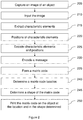
- FIG. 2 represents, as a logical diagram, steps in a first particular embodiment of the protection method that is the subject of the present invention
- FIG. 3 represents, schematically, a particular embodiment of the control device that is the subject of the present invention.
- FIG. 4 represents, as a logical diagram, steps in a particular embodiment of the control method that is the subject of the present invention
- FIG. 5 represents, schematically, a first document to be protected, a protection mark and the document carrying the printed protection mark
- FIG. 6 represents portions of an anti-copy mark, respectively digital and analog (printed).
- FIG. 1 shows a device 100 for protecting a document 125 , which comprises:
- the means 110 and 120 for capturing digital images are electronic image sensors, for example electronic video cameras, electronic still cameras or smartphone image sensors.
- the means 120 for capturing a digital image of at least one portion of the document 125 can also be a scanner.
- the capture means 110 is configured to capture biometric data of a person, for example fingerprints, the face or the shape of a hand.
- the capture means 110 is, in a variant, replaced by a memory holding a digital file representative of these biometric data.
- the means 120 for capturing a digital image of at least one portion of the document 125 takes an image of the complete document 125 , or at least one of its portions, for example of an identity photo or a photo of fingerprints or of a signature if the document is an identification document, of data carried by a document, if the document is an accounting or contractual document.
- only the means 120 for capturing digital images is provided in the device that is the subject of the invention.
- the means 135 for extracting characteristic elements of one, at least, of the images made by the capture means 120 utilizes an image processing program to extract measurements, for example biometric, of at least one captured image.
- an image processing program to extract measurements, for example biometric, of at least one captured image.
- a known type of content recognition algorithm makes it possible to extract names, dates, amounts, signatures, images, fingerprints, ratios of lengths of printed lines, numbers of printed lines, etc.
- the means 135 for extracting characteristic information utilizes a parser or a template associated to the document or areas selected manually by an operator, for example with a pointing device such as a mouse.
- ratios of lengths between outlines of the eyes, nose, mouth, ears, hair roots can characterize a face, according to known techniques.
- a fingerprint or dactylogram is the result of placing a finger on a medium.
- the design formed on the medium consists of dermatoglyphs. Fingerprints are unique and characteristic of each individual.
- a “digital trace”, a broader term, is the result of a contact between a finger and a medium, fingerprints being an example of a digital trace.
- Papillary traces (or their imprints) group digital traces (or their imprints, in which automatic identification software reference 150 to 200 characteristic points) and palm prints (traces of the palms of the hand, referenced by 1,500 to 2,000 characteristic points).
- the digital trace can be:
- the lines of the fingerprints can be broken down into three major design types: arches (including tented arches), left-handed/right-handed loops, and whorls (including coils and swirls). These three types of print fit 95% of human fingers: 60% for loops, 30% for whorls and 5% for arches. “Singularities” on the loops, arches or whorls are used to differentiate the patterns from one another:
- Extracting characteristic elements can be a simple image compression, for example according to the JPEG (registered trademark) standard.
- the means 160 for extracting positions of characteristic elements extracted from one, at least, of the images made by the capture means 120 identifies the position of each characteristic element, for example starting from a corner where, in relation to the larger side of the document joining this corner, the smallest side of this document joining this corner is at approximately 90°, and according to an orthogonal reference space oriented according to these side of the documents normalized in proportion to the length of these sides of the document. In this way, the position can be found automatically regardless of the magnification factor and regardless of the rotation (within a range of rotation angles of up to 180°).
- the message generation means 150 supplies a message about where the document was produced, the production date, the name of the owner of the intellectual property rights on the document, etc.
- this message is a decoding key for the matrix code 130 or an identifier of a decoding key.
- the means 140 for encoding the message, positions and characteristics of images performs a known type of encoding, for example encoding with the addition of an error detection and correction code (CRC, for Cyclic Redundancy Check) and an RSA (name formed from the initials of its three inventors, an asymmetric cryptography algorithm) type of encryption and scrambling, to supply a series of numbers representing the message, the positions and the extracted image characteristics.
- CRC error detection and correction code
- RSA name formed from the initials of its three inventors, an asymmetric cryptography algorithm
- the means 145 for incorporating the encoded message, encoded positions and encoded characteristics in a digital matrix code defines a dot matrix representing the series of numbers of the code supplied by the encoding means 140 .
- the message is incorporated into a central square, the resolution of which forms an anti-copy mark (ie the degradation of which by the print noise, ie the generation of individually unpredictable ad-hoc errors, leading a dot to be interpreted with an incorrect value, then copy noise can be measured to distinguish an original from a copy).
- the means 155 for printing, on or in the document 125 , the analog matrix code 130 is, for example, a printer or a marking means utilizing a laser ray.
- the storage means 105 is local and/or remote, for example an online server memory, remote from the rest of the device, in which items of information are stored about the production and marking of the document 125 and, possibly, keys for deciphering information represented by the analog matrix code 130 .
- the first step 205 consists of capturing an image of a document to be protected against forgery and against modifications.
- the captured image is input into a software system for extracting characteristic elements (measurements, ratios, outlines or dots, for example) or for compression, which, during step 215 , supplies these characteristic elements.
- the positions of extracted characteristic elements are identified in the document.
- the characteristic elements and their positions are encoded.
- a message is encoded.
- a digital matrix code is formed by incorporating encodings of the characteristic elements, of their positions and of the message.
- a step 240 available locations in the document for receiving the matrix code print are determined. For example, during the step 240 , for each dot of the image of the document, outside predefined margins, one determines the distance from this dot to the nearest dot bearing information. Then one selects the largest area comprising dots for which this distance is greater than a predefined distance. For example, this predefined distance is equal to one twentieth of the length of the smallest side of the document. Then one determines whether this largest area can receive all the elements of the matrix code (for example 17 elements for the matrix code illustrated in FIG. 5 ).
- the predefined distance is reduced, for example to one fortieth of the length of the smallest side of the document, and the search for the largest area is repeated.
- step 240 is repeated by determining, for each dot of the image of the document, outside predefined margins, the distance from this dot to the nearest area of the document bearing the characteristic information processed during step 215 .
- a shape of the matrix code to be printed For example, during the step 245 , in the largest area determined during the step 240 , one tests successively the matrix code shapes in which the largest number of edges shared by two elements of the matrix code in descending order (for example, in the shape illustrated in FIG. 5 , there are 26 common edges between the 17 elements of the matrix code). One determines whether the largest area can contain the shape considered. If not, one proceeds to the next shape. If yes, this shape is selected for printing the matrix code.
- the digital matrix code is printed on the document an image of which was taken during step 205 , at the location determined during step 240 and according to the shape determined during step 245 .
- step 240 one determines a plurality of locations (areas having the greatest distance to the information) and, during step 245 , a plurality of shapes of portions of codes (shapes that fit into these locations).
- step 250 one prints the code in portions using the locations determined during step 240 and the shapes determined during step 245 .
- the shape(s) selected and the location(s) selected can be described in a message carried by an anti-copy mark incorporated in the matrix code (see below).
- the control device 300 that is the subject of the present invention illustrated in FIG. 3 comprises:
- the means 320 for capturing digital images is similar to the means 120 except that it is configured to capture an image of sufficient resolution of the matrix code 330 so that it can be read.
- the means 335 for extracting characteristic elements is similar to the means 135 .
- the decoding means 345 performs inverse functions from the encoding means 140 . However, the decoding means 345 only decodes the characteristic image elements and their positions encoded in the matrix code 330 .
- the means 340 for verifying the match between the content and positions of the characteristic elements of the image captured by the capture means 320 and the characteristic elements encoded in the matrix code 330 determines a degree of similarity between these characteristic elements and these positions, and, if this degree of similarity is greater than a predefined limit value, it supplies an integrity confirmation piece of information for the candidate document 325 .
- the decoding means 350 performs inverse functions from the encoding means 140 . However, the decoding means 350 only decodes the message carried by the matrix code 330 , and only performs this decoding if an integrity confirmation piece of information is supplied by the match verification means 340 . In addition, the decoding means 350 measures the noise carried by the anti-copy code representing the message, for example by counting the error correction rate required to read this message. The decoding means 350 determines the authenticity of the document as a function of the noise measured:
- FIG. 4 shows, for verifying a document, ie verifying its integrity and its authenticity, a step 405 of capturing an image of at least one portion of the document, a step 410 of extracting characteristic elements of the captured image and their positions, a step 415 of capturing an image of a matrix code representing characteristic elements of an image and an additional message, a step 420 of decoding encoded characteristic elements and their positions in the matrix code, and a step 425 for verifying the match between the content and positions of the characteristic elements extracted during step 410 and the content and positions of the characteristic elements decoded during step 420 .
- step 425 If the match is verified during step 425 , then during a step 430 the message encoded in the matrix code is decoded and supplied, for example displayed.
- the noise carried by the anti-copy code representing the message is measured, for example by counting the error correction rate required to read this message. Then the authenticity of the document is determined: If this noise exceeds a predefined value, which depends upon the resolution of the anti-copy code, the document is reported as being a copy. Otherwise, the document is reported to be authentic.
- the message represented by the anti-copy code represents or identifies a decoding key required to decode the characteristic image elements encoded in the digital matrix code 330 .
- the digital matrix code 330 represents or identifies a decoding key required to decode the message carried by the anti-copy code.
- FIG. 5 shows a printed document, 500 , and, more specifically, a signed invoice, before protection, above, and after protection, below.
- the document 500 comprises in a portion 505 , an image of which is captured, characteristic indications, here the supplier name, the invoice date, the invoice number, the document invoiced, the invoice amount, and the signature.
- characteristic indications here the supplier name, the invoice date, the invoice number, the document invoiced, the invoice amount, and the signature.
- OCR optical character recognition
- these characteristic elements 530 of the image and their positions 535 in the document 500 are encoded, in sixteen portions 520 of a digital matrix code 515 .
- Such a matrix code has a data storage capacity of at least 4 kilobytes, which makes it possible to store, in asymmetrically encrypted form:
- a message for example representing an encoding key or a decoding key, or data relating to the encoding place and time, is encoded in a digital anti-copy code 510 .
- the anti-copy code 510 is incorporated into the digital matrix code 515 .
- the digital matrix code 515 is printed on the document 500 to protect it. Printing the digital matrix code 515 forms an analog matrix code.
- the match can, in this case, be verified visually by a user, for example after displaying decoded characteristic elements on a screen.
- the noise carried by the anti-copy code representing the message is measured and compared to a predefined limit value.
- This limit value is, for example, learned in a learning step (not shown) from original documents 500 and copies made from these documents. In this way, two clouds of noise values are obtained, and a limit value is chosen between these value clouds.
- decoding the anti-copy code 510 incorporated in the matrix code 515 makes it possible, firstly, to determine whether the document 500 is a copy and, secondly, to obtain an additional message representing for example indications (timestamp, name of the signatory, biometric data of the signatory, etc) relating to the document 500 or to its signatory, originator, recipient or owner.
- FIG. 6 shows a top left portion 605 of a digital anti-copy code 510 and the corresponding portion of the printed analog code.
- the digital anti-copy code consists of a matrix of rectangles 610 occupying cells arranged in rows and columns. Here, these rectangles only have two colors, black and white.
- the printed analog code 615 significant noise due to the code being printed has deformed black rectangles, making some appear and making some disappear, in an unpredictable ad-hoc (ie cell by cell) way.
- a biometric key ie determined from biometric data of the user, enables the content of the matrix code 130 to be accessed, to access either the characteristic elements of an image or the message stored by the anti-copy code.
- the results of the hash function serve, in variants, as a filter to give access to the reading of the message stored by the anti-copy code.
- the hash of the print of an index finger is used to descramble the anti-copy code or the matrix code.
- characteristic points of the image of the fingerprint are used, hashed, to scramble the content of the anti-copy code, which is then printed on the original document.
- characteristic points of the new image of the fingerprint are used, hashed, to descramble the content of the anti-copy code, an image of which has been captured.
- the hash function is, therefore, preferably symmetrical.
Landscapes
- Engineering & Computer Science (AREA)
- Theoretical Computer Science (AREA)
- Physics & Mathematics (AREA)
- General Physics & Mathematics (AREA)
- Computer Security & Cryptography (AREA)
- Software Systems (AREA)
- Computer Hardware Design (AREA)
- General Engineering & Computer Science (AREA)
- Health & Medical Sciences (AREA)
- General Health & Medical Sciences (AREA)
- Bioethics (AREA)
- Multimedia (AREA)
- Computer Vision & Pattern Recognition (AREA)
- Technology Law (AREA)
- Artificial Intelligence (AREA)
- Electromagnetism (AREA)
- Toxicology (AREA)
- Editing Of Facsimile Originals (AREA)
- Image Processing (AREA)
Abstract
Description
-
- “format” faithfulness: it is an “identical” reproduction (visually speaking) of the document of origin;
- “informational” faithfulness, which guarantees the identity of the content, and therefore the meaning, between the document of origin and the copy.
-
- guarantee of integrity for the processing of the document flow (nothing lost, nothing added);
- faithfulness of the images obtained, which consequently leads to guaranteeing legibility and intelligibility;
- guarantee of authenticity;
- guarantee of integrity for the digital documents obtained;
- guarantee of durability for the documents; and
- traceability of the operations and retention of “proofs” (in the technical sense).
-
- deposit, identification and content
- preparation, structuring:
- the question of the number of documents and the possible solutions, and
- logging the operations
-
- selecting the level of faithful digitization
- an “absolute” type of faithful digitization, in color and coded on 24 bits, for example,
- an “intermediate” type of faithful digitization based on 8-bit coding (256 levels of grey), for example,
- a “basic” type of faithful digitization in black and white,
- choosing a format for the digital document, and
- logging the operations
- selecting the level of faithful digitization
-
- adding metadata (technical and application),
- removing blank pages,
- straightening pages,
- cleaning images,
- trimming,
- affixing a visible mark (2D DOC type of stamp) guaranteeing this is a faithful copy,
- sealing the files, and
- logging the operations.
-
- a means for inputting a digital file representing an image of at least one portion of the document;
- a means for extracting characteristic elements of the image and positions of said characteristic elements on the document;
- a means for encoding characteristic elements of the image and data representative of the position of said characteristic elements on the document, and to a matrix code; and
- a means for printing the matrix code on or in said document.
-
- representative of biometric data of a person, for example his fingerprints or his face, which data items are also carried by the document; or
- an image of a portion of the document, for example an accounting or contractual document.
-
- a step of inputting a digital file representing an image representative of at least one portion of the document;
- a step of extracting characteristic elements of the image and positions of said characteristic elements on the document;
- a step of encoding characteristic elements of the image and data representative of the position of said characteristic elements on the document, and to a matrix code; and
- a step of printing the matrix code on or in said document.
-
- a means for capturing an image of at least one portion of the document;
- a means for capturing an image of a matrix code carried by said document;
- a means for decoding the matrix code in order to decode:
- characteristic elements of an image of an authentic document; and
- positions of said characteristic elements in said authentic document;
- a means for verifying the content and position match between:
- the image of at least one portion of the document and
- the characteristic elements of the decoded authentic document.
-
- a step of capturing an image of at least one portion of the document;
- a step of capturing an image of a matrix code carried by said document;
- a step of decoding the matrix code in order to decode:
- characteristic elements of an image of an authentic document; and
- positions of said characteristic elements in said authentic document;
- a step of verifying the content and position match between:
- the image of at least one portion of the document and
- the characteristic elements of the decoded authentic document.
-
- characteristic elements of an image representative of at least one portion of the document; and
- positions of said characteristic elements in the document.
-
- a
means 110 for capturing a digital image of aperson 115, generally a carrier of thedocument 125 and/or a signatory of a message carried by thedocument 125; - a means for inputting a digital file, in the form of a
means 120 for capturing a digital image of at least one portion of thedocument 125; - a
means 135 for extracting characteristic elements of one, at least, of the images made by the capture means 120; - a
means 160 for extracting positions of the characteristic elements extracted from one, at least, of the images made by the capture means 120; - a
means 150 for generating a message; - a
means 140 for encoding the message and characteristics of images; - a
means 145 for incorporating the encoded message and encoded characteristics in a digital matrix code; - a
means 165 for determining locations and shapes of matrix codes or portions of matrix codes (see the description ofsteps 240 and 245); - a
means 155 for printing, on or in thedocument 125, theanalog matrix code 130 representative of the digital matrix code; and - a storage means 105.
- a
-
- visible (or direct): it is called positive when material is affixed, and it is called negative when material is removed;
- latent (invisible to the naked eye): the trace comes from deposited sweat (secretions from the sweat glands: 99% water that by evaporating leaves behind salts and amino-acids) and/or sebum deposits (sebaceous glands); and/or
- molded: the trace comes from a finger coming in contact with a malleable surface (wax, putty, etc).
-
- global singularities: core or center: where the ridges converge;
- delta: where the ridges diverge;
- local singularities (AKA minutiae): irregular areas at the locations of capillary lines (ending ridges, bifurcations, short ridges assimilated to two ending ridges, enclosures).
-
- a means for inputting a digital file, in the form of a
means 320 for capturing a digital image of at least one portion of acandidate document 325 and of thematrix code 330 carried by this candidate document; - a
means 335 for extracting characteristic elements of one, at least, of the images made by the capture means 320; - a
means 345 for decoding characteristic image elements encoded in thematrix code 330, possibly according to data supplied by thememory 105; - a
means 315 for decoding positions of characteristic image elements encoded in thematrix code 330, possibly according to data supplied by thememory 105; - a
means 340 for verifying the match between, firstly, the content of the characteristic elements of the image captured by the capture means 320 and the content of the characteristic elements encoded in thematrix code 330, and, secondly, between the positions of the characteristic elements of the image captured by the capture means 320 and the positions of the characteristic elements encoded in thematrix code 330; - a
means 350 for decoding the message encoded in thematrix code 330, and for verifying the authenticity of the document, in the event of a match between the characteristic elements and their positions.
- a means for inputting a digital file, in the form of a
-
- if this noise exceeds a predefined value, which depends upon the resolution of the anti-copy code, the document is reported as being a copy;
- otherwise, the document is reported to be authentic.
-
- the data read;
- an identity photo;
- minutiae; and
- other identity information.
Claims (17)
Applications Claiming Priority (3)
| Application Number | Priority Date | Filing Date | Title |
|---|---|---|---|
| FR1560311A FR3043230B1 (en) | 2015-10-28 | 2015-10-28 | METHOD AND DEVICE FOR SECURING A DOCUMENT, METHOD AND DEVICE FOR CONTROLLING THEIR CORRESPONDENT AND SECURED DOCUMENT |
| FR1560311 | 2015-10-28 | ||
| PCT/FR2016/052823 WO2017072470A1 (en) | 2015-10-28 | 2016-10-28 | Method and device for securing a document, method and device for control corresponding thereto and secure document |
Publications (2)
| Publication Number | Publication Date |
|---|---|
| US20180307814A1 US20180307814A1 (en) | 2018-10-25 |
| US11030282B2 true US11030282B2 (en) | 2021-06-08 |
Family
ID=55542765
Family Applications (1)
| Application Number | Title | Priority Date | Filing Date |
|---|---|---|---|
| US15/770,204 Expired - Fee Related US11030282B2 (en) | 2015-10-28 | 2016-10-28 | Method and device for securing a document, method and device for control corresponding thereto and secure document |
Country Status (4)
| Country | Link |
|---|---|
| US (1) | US11030282B2 (en) |
| EP (1) | EP3369025A1 (en) |
| FR (1) | FR3043230B1 (en) |
| WO (1) | WO2017072470A1 (en) |
Families Citing this family (7)
| Publication number | Priority date | Publication date | Assignee | Title |
|---|---|---|---|---|
| EP3673397B1 (en) | 2019-05-20 | 2022-11-09 | Advanced New Technologies Co., Ltd. | Identifying copyrighted material using copyright information embedded in electronic files |
| WO2019141297A2 (en) | 2019-05-20 | 2019-07-25 | Alibaba Group Holding Limited | Copyright protection based on hidden copyright information |
| CN110914820A (en) | 2019-05-20 | 2020-03-24 | 阿里巴巴集团控股有限公司 | Identify copyrighted material using embedded copyright information |
| SG11202002708TA (en) | 2019-05-20 | 2020-04-29 | Alibaba Group Holding Ltd | Identifying copyrighted material using embedded copyright information |
| EP3673455B1 (en) | 2019-05-20 | 2021-08-11 | Advanced New Technologies Co., Ltd. | Identifying copyrighted material using embedded copyright information |
| US11973753B2 (en) * | 2021-06-16 | 2024-04-30 | Meta Platforms, Inc. | Systems and methods for client-side identity verification |
| JP7799430B2 (en) * | 2021-10-25 | 2026-01-15 | キヤノン株式会社 | Image processing device, control method and program |
Citations (14)
| Publication number | Priority date | Publication date | Assignee | Title |
|---|---|---|---|---|
| US5974150A (en) * | 1997-09-30 | 1999-10-26 | Tracer Detection Technology Corp. | System and method for authentication of goods |
| US20030159046A1 (en) * | 2001-01-12 | 2003-08-21 | Choi Jong Uk | Apparatus and method for issuing and authenticating securities, etc. using digital watermarking |
| US20040052400A1 (en) * | 2002-09-13 | 2004-03-18 | Hitachi, Ltd. | Electronic document, genuineness management method for print medium thereof, genuineness management system, program, and program recording medium |
| US20050067487A1 (en) * | 2002-02-12 | 2005-03-31 | Brundage Trent J. | Identification document including embedded data |
| US20050077346A1 (en) * | 2003-09-12 | 2005-04-14 | Rana Dutta | Permit mail, payment system and postal infrastructure thereof |
| US20070204164A1 (en) * | 2006-02-28 | 2007-08-30 | Konica Minolta Systems Laboratory, Inc. | Method and apparatus for authenticating printed documents |
| US20070228166A1 (en) * | 2006-04-04 | 2007-10-04 | Ho Chung Lui | System for detecting couterfeiting products using camera |
| US20080080009A1 (en) * | 2006-09-28 | 2008-04-03 | Fujitsu Limited | Electronic watermark embedding apparatus and electronic watermark detection apparatus |
| US20080110995A1 (en) * | 2006-10-31 | 2008-05-15 | Xerox Corporation | Method for embedding machine-readable information with fluorescent materials |
| US20080130746A1 (en) * | 2006-11-30 | 2008-06-05 | Kourosh Soroushian | Decoding a progressive JPEG bitstream as a sequentially-predicted hybrid video bitstream |
| US20080292129A1 (en) * | 2007-05-22 | 2008-11-27 | Xerox Corporation | Embedding information in document blank space |
| US20090175491A1 (en) * | 2005-10-24 | 2009-07-09 | Itesoft S.A. | Device and method for interaction with a user |
| US20100014122A1 (en) * | 2006-06-01 | 2010-01-21 | Advanced Track And Trace | Method and device for making documents secure |
| US20120063647A1 (en) * | 2002-05-14 | 2012-03-15 | Schreiner Group Gmbh & Co. Kg | Visible authentication patterns for printed document |
Family Cites Families (2)
| Publication number | Priority date | Publication date | Assignee | Title |
|---|---|---|---|---|
| US9268969B2 (en) * | 2013-08-14 | 2016-02-23 | Guardtime Ip Holdings Limited | System and method for field-verifiable record authentication |
| CN104636642B (en) * | 2015-02-10 | 2017-10-31 | 雨果·巴勃罗·阿尔伯特·加西亚-科特 | File protection and verification method |
-
2015
- 2015-10-28 FR FR1560311A patent/FR3043230B1/en not_active Expired - Fee Related
-
2016
- 2016-10-28 US US15/770,204 patent/US11030282B2/en not_active Expired - Fee Related
- 2016-10-28 EP EP16809473.8A patent/EP3369025A1/en not_active Withdrawn
- 2016-10-28 WO PCT/FR2016/052823 patent/WO2017072470A1/en not_active Ceased
Patent Citations (15)
| Publication number | Priority date | Publication date | Assignee | Title |
|---|---|---|---|---|
| US5974150A (en) * | 1997-09-30 | 1999-10-26 | Tracer Detection Technology Corp. | System and method for authentication of goods |
| US20030159046A1 (en) * | 2001-01-12 | 2003-08-21 | Choi Jong Uk | Apparatus and method for issuing and authenticating securities, etc. using digital watermarking |
| US20050067487A1 (en) * | 2002-02-12 | 2005-03-31 | Brundage Trent J. | Identification document including embedded data |
| US20120063647A1 (en) * | 2002-05-14 | 2012-03-15 | Schreiner Group Gmbh & Co. Kg | Visible authentication patterns for printed document |
| US20040052400A1 (en) * | 2002-09-13 | 2004-03-18 | Hitachi, Ltd. | Electronic document, genuineness management method for print medium thereof, genuineness management system, program, and program recording medium |
| US20050077346A1 (en) * | 2003-09-12 | 2005-04-14 | Rana Dutta | Permit mail, payment system and postal infrastructure thereof |
| US20090175491A1 (en) * | 2005-10-24 | 2009-07-09 | Itesoft S.A. | Device and method for interaction with a user |
| US20070204164A1 (en) * | 2006-02-28 | 2007-08-30 | Konica Minolta Systems Laboratory, Inc. | Method and apparatus for authenticating printed documents |
| US20070228166A1 (en) * | 2006-04-04 | 2007-10-04 | Ho Chung Lui | System for detecting couterfeiting products using camera |
| US20100014122A1 (en) * | 2006-06-01 | 2010-01-21 | Advanced Track And Trace | Method and device for making documents secure |
| US20130094064A1 (en) * | 2006-06-01 | 2013-04-18 | Advanced Track And Trace | Process and device for securing documents |
| US20080080009A1 (en) * | 2006-09-28 | 2008-04-03 | Fujitsu Limited | Electronic watermark embedding apparatus and electronic watermark detection apparatus |
| US20080110995A1 (en) * | 2006-10-31 | 2008-05-15 | Xerox Corporation | Method for embedding machine-readable information with fluorescent materials |
| US20080130746A1 (en) * | 2006-11-30 | 2008-06-05 | Kourosh Soroushian | Decoding a progressive JPEG bitstream as a sequentially-predicted hybrid video bitstream |
| US20080292129A1 (en) * | 2007-05-22 | 2008-11-27 | Xerox Corporation | Embedding information in document blank space |
Non-Patent Citations (1)
| Title |
|---|
| Zheng et al., A Hybrid Watermarking Technique to Resist Tampering and Copy Attacks, Oct. 2011, 2nd International Symposium on Intelligence Information Processing and Trusted Computing, pp. 111-114 (Year: 2011). * |
Also Published As
| Publication number | Publication date |
|---|---|
| FR3043230B1 (en) | 2022-03-25 |
| EP3369025A1 (en) | 2018-09-05 |
| US20180307814A1 (en) | 2018-10-25 |
| WO2017072470A1 (en) | 2017-05-04 |
| FR3043230A1 (en) | 2017-05-05 |
Similar Documents
| Publication | Publication Date | Title |
|---|---|---|
| US20180307814A1 (en) | Method and device for securing a document, method and device for control corresponding thereto and secure document | |
| JP7093352B2 (en) | Composite 2D barcodes, digital certificate media, generators, readers and methods | |
| US7028902B2 (en) | Barcode having enhanced visual quality and systems and methods thereof | |
| EP1520369B1 (en) | Biometric authentication system | |
| US11055589B2 (en) | Method for authenticating an illustration | |
| US8738922B2 (en) | Method and device for electronically capturing a handwritten signature and safeguarding biometric data | |
| US20030012374A1 (en) | Electronic signing of documents | |
| US6886863B1 (en) | Secure document with self-authenticating, encryptable font | |
| EP2237546B1 (en) | Device and process for protecting a digital document, and corresponding process for verifying the authenticity of a printed hardcopy | |
| WO2014098136A1 (en) | Information code, method for generating information code, device for reading information code, and system for using information code | |
| ES2910352T3 (en) | Strong authentication procedure of an individual | |
| ES2899599T3 (en) | Procedures for data registration of an identity document of an individual and authentication of an identity document | |
| US6636614B1 (en) | Method for preventing the falsification of documents comprising a photograph, preferably a facial-view photograph | |
| RU2005105948A (en) | Cryptographic Protected Personality Identification | |
| JP6201706B2 (en) | Information code usage system | |
| RU2647642C1 (en) | Method of the document certification with an irreversible digital signature | |
| EP1280098A1 (en) | Electronic signing of documents | |
| JP7620974B2 (en) | Signature method, system, and/or device | |
| CN105960649B (en) | Method and apparatus for securing access to messages | |
| CN109409466B (en) | Method and system for generating and checking dynamic anti-counterfeiting physical signature | |
| US10248780B2 (en) | Method and device for securing an object, corresponding control method and device secured object | |
| US20040123100A1 (en) | Certificate issuing method and certificate verifying method | |
| Teraura et al. | A qr symbol with ecdsa for both public and secret areas using rhombic sub-cells | |
| WO2010046864A1 (en) | Document verification | |
| Pic et al. | Photometrix™: a Digital Seal for Offline Identity Picture Authentication |
Legal Events
| Date | Code | Title | Description |
|---|---|---|---|
| FEPP | Fee payment procedure |
Free format text: ENTITY STATUS SET TO UNDISCOUNTED (ORIGINAL EVENT CODE: BIG.); ENTITY STATUS OF PATENT OWNER: LARGE ENTITY |
|
| AS | Assignment |
Owner name: ADVANCED TRACK & TRACE, FRANCE Free format text: ASSIGNMENT OF ASSIGNORS INTEREST;ASSIGNORS:SAGAN, ZBIGNIEW;RENARD, ISABELLE;FOUCOU, ALAIN;AND OTHERS;REEL/FRAME:045615/0799 Effective date: 20180413 |
|
| STPP | Information on status: patent application and granting procedure in general |
Free format text: DOCKETED NEW CASE - READY FOR EXAMINATION |
|
| STPP | Information on status: patent application and granting procedure in general |
Free format text: NON FINAL ACTION MAILED |
|
| STPP | Information on status: patent application and granting procedure in general |
Free format text: RESPONSE TO NON-FINAL OFFICE ACTION ENTERED AND FORWARDED TO EXAMINER |
|
| STPP | Information on status: patent application and granting procedure in general |
Free format text: NOTICE OF ALLOWANCE MAILED -- APPLICATION RECEIVED IN OFFICE OF PUBLICATIONS |
|
| STPP | Information on status: patent application and granting procedure in general |
Free format text: PUBLICATIONS -- ISSUE FEE PAYMENT RECEIVED |
|
| STPP | Information on status: patent application and granting procedure in general |
Free format text: PUBLICATIONS -- ISSUE FEE PAYMENT VERIFIED |
|
| STCF | Information on status: patent grant |
Free format text: PATENTED CASE |
|
| FEPP | Fee payment procedure |
Free format text: MAINTENANCE FEE REMINDER MAILED (ORIGINAL EVENT CODE: REM.); ENTITY STATUS OF PATENT OWNER: LARGE ENTITY |
|
| LAPS | Lapse for failure to pay maintenance fees |
Free format text: PATENT EXPIRED FOR FAILURE TO PAY MAINTENANCE FEES (ORIGINAL EVENT CODE: EXP.); ENTITY STATUS OF PATENT OWNER: LARGE ENTITY |
|
| STCH | Information on status: patent discontinuation |
Free format text: PATENT EXPIRED DUE TO NONPAYMENT OF MAINTENANCE FEES UNDER 37 CFR 1.362 |
|
| FP | Lapsed due to failure to pay maintenance fee |
Effective date: 20250608 |