US11028320B2 - Aluminate fluorescent material, light emitting device using the same, and method of producing aluminate fluorescent material - Google Patents
Aluminate fluorescent material, light emitting device using the same, and method of producing aluminate fluorescent material Download PDFInfo
- Publication number
- US11028320B2 US11028320B2 US16/233,545 US201816233545A US11028320B2 US 11028320 B2 US11028320 B2 US 11028320B2 US 201816233545 A US201816233545 A US 201816233545A US 11028320 B2 US11028320 B2 US 11028320B2
- Authority
- US
- United States
- Prior art keywords
- fluorescent material
- aluminate fluorescent
- parameter
- value
- producing
- Prior art date
- Legal status (The legal status is an assumption and is not a legal conclusion. Google has not performed a legal analysis and makes no representation as to the accuracy of the status listed.)
- Active, expires
Links
Images


Classifications
-
- C—CHEMISTRY; METALLURGY
- C09—DYES; PAINTS; POLISHES; NATURAL RESINS; ADHESIVES; COMPOSITIONS NOT OTHERWISE PROVIDED FOR; APPLICATIONS OF MATERIALS NOT OTHERWISE PROVIDED FOR
- C09K—MATERIALS FOR MISCELLANEOUS APPLICATIONS, NOT PROVIDED FOR ELSEWHERE
- C09K11/00—Luminescent materials, e.g. electroluminescent or chemiluminescent
- C09K11/08—Luminescent materials, e.g. electroluminescent or chemiluminescent containing inorganic luminescent materials
- C09K11/64—Luminescent materials, e.g. electroluminescent or chemiluminescent containing inorganic luminescent materials containing aluminium
- C09K11/641—Chalcogenides
- C09K11/643—Chalcogenides with alkaline earth metals
-
- C—CHEMISTRY; METALLURGY
- C09—DYES; PAINTS; POLISHES; NATURAL RESINS; ADHESIVES; COMPOSITIONS NOT OTHERWISE PROVIDED FOR; APPLICATIONS OF MATERIALS NOT OTHERWISE PROVIDED FOR
- C09K—MATERIALS FOR MISCELLANEOUS APPLICATIONS, NOT PROVIDED FOR ELSEWHERE
- C09K11/00—Luminescent materials, e.g. electroluminescent or chemiluminescent
- C09K11/08—Luminescent materials, e.g. electroluminescent or chemiluminescent containing inorganic luminescent materials
- C09K11/0838—Aluminates; Silicates
-
- C—CHEMISTRY; METALLURGY
- C09—DYES; PAINTS; POLISHES; NATURAL RESINS; ADHESIVES; COMPOSITIONS NOT OTHERWISE PROVIDED FOR; APPLICATIONS OF MATERIALS NOT OTHERWISE PROVIDED FOR
- C09K—MATERIALS FOR MISCELLANEOUS APPLICATIONS, NOT PROVIDED FOR ELSEWHERE
- C09K11/00—Luminescent materials, e.g. electroluminescent or chemiluminescent
- C09K11/08—Luminescent materials, e.g. electroluminescent or chemiluminescent containing inorganic luminescent materials
- C09K11/57—Luminescent materials, e.g. electroluminescent or chemiluminescent containing inorganic luminescent materials containing manganese or rhenium
-
- C—CHEMISTRY; METALLURGY
- C09—DYES; PAINTS; POLISHES; NATURAL RESINS; ADHESIVES; COMPOSITIONS NOT OTHERWISE PROVIDED FOR; APPLICATIONS OF MATERIALS NOT OTHERWISE PROVIDED FOR
- C09K—MATERIALS FOR MISCELLANEOUS APPLICATIONS, NOT PROVIDED FOR ELSEWHERE
- C09K11/00—Luminescent materials, e.g. electroluminescent or chemiluminescent
- C09K11/08—Luminescent materials, e.g. electroluminescent or chemiluminescent containing inorganic luminescent materials
- C09K11/57—Luminescent materials, e.g. electroluminescent or chemiluminescent containing inorganic luminescent materials containing manganese or rhenium
- C09K11/572—Chalcogenides
- C09K11/576—Chalcogenides with alkaline earth metals
-
- H01L33/502—
-
- H—ELECTRICITY
- H10—SEMICONDUCTOR DEVICES; ELECTRIC SOLID-STATE DEVICES NOT OTHERWISE PROVIDED FOR
- H10H—INORGANIC LIGHT-EMITTING SEMICONDUCTOR DEVICES HAVING POTENTIAL BARRIERS
- H10H20/00—Individual inorganic light-emitting semiconductor devices having potential barriers, e.g. light-emitting diodes [LED]
- H10H20/80—Constructional details
- H10H20/85—Packages
- H10H20/851—Wavelength conversion means
- H10H20/8511—Wavelength conversion means characterised by their material, e.g. binder
- H10H20/8512—Wavelength conversion materials
-
- H01L2224/48247—
-
- H01L2224/48257—
-
- H01L2224/73265—
-
- H—ELECTRICITY
- H10—SEMICONDUCTOR DEVICES; ELECTRIC SOLID-STATE DEVICES NOT OTHERWISE PROVIDED FOR
- H10W—GENERIC PACKAGES, INTERCONNECTIONS, CONNECTORS OR OTHER CONSTRUCTIONAL DETAILS OF DEVICES COVERED BY CLASS H10
- H10W72/00—Interconnections or connectors in packages
- H10W72/851—Dispositions of multiple connectors or interconnections
- H10W72/874—On different surfaces
- H10W72/884—Die-attach connectors and bond wires
-
- H—ELECTRICITY
- H10—SEMICONDUCTOR DEVICES; ELECTRIC SOLID-STATE DEVICES NOT OTHERWISE PROVIDED FOR
- H10W—GENERIC PACKAGES, INTERCONNECTIONS, CONNECTORS OR OTHER CONSTRUCTIONAL DETAILS OF DEVICES COVERED BY CLASS H10
- H10W90/00—Package configurations
- H10W90/701—Package configurations characterised by the relative positions of pads or connectors relative to package parts
- H10W90/751—Package configurations characterised by the relative positions of pads or connectors relative to package parts of bond wires
- H10W90/756—Package configurations characterised by the relative positions of pads or connectors relative to package parts of bond wires between a chip and a stacked lead frame, conducting package substrate or heat sink
Definitions
- the present invention relates to an aluminate fluorescent material, a light emitting device using the same, and a method of producing an aluminate fluorescent material.
- the fluorescent material for use in a light emitting device for backlights for liquid crystals is required to have a high color purity in addition to a high emission efficiency for reproducing colors in a broad range on the chromaticity coordinate system.
- the fluorescent material for use in a light emitting device for backlights for liquid crystals is desired to have a narrow full width at a half maximum (FWHM—hereinafter this is referred to as “half value width”) of the emission peak in the emission spectrum thereof and to have a high color purity, from the viewpoint of realizing a broad color reproducibility range.
- an object of the present invention is to provide an aluminate fluorescent material capable of having a high emission intensity through photoexcitation in a near-UV to blue region, a light emitting device, and a method for producing an aluminate fluorescent material.
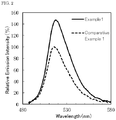
- FIG. 2 is a diagram showing light emission spectra of the aluminate fluorescent materials according to an example of an embodiment of the present disclosure and a comparative example.
- the aluminate fluorescent material, the light emitting device, and the production method for an aluminate fluorescent material of the present invention are described on a basis of the embodiments and examples.
- the embodiments shown below are exemplifications for exemplifying the technical idea of the present invention, and the present invention is not limited to the aluminate material, the light emitting device and the production method for an aluminate fluorescent material described below.
- the crystal structure of the aluminate fluorescent material can be stabilized more and the emission intensity of the aluminate fluorescent material can be higher.
- the value of the parameter m indicates the molar ratio of Sr when the total molar ratio of Ba and Sr of the first element is 1, and the first element may be all Ba or may be all Sr.
- the value of the parameter n is preferably a value satisfying a requirement of 0.4 ⁇ n ⁇ 0.6.
- the emission intensity when the value of the parameter n is the value satisfying the requirement of 0.4 ⁇ n ⁇ 0.6, the emission intensity may be increased more and the emission intensity of the aluminate fluorescent material through photoexcitation in a near UV to blue region can be higher.
- the reason why the emission intensity through photoexcitation in a near-UV to blue region of the manganese-activated aluminate fluorescent material disclosed in Japanese Unexamined Patent Publication No. 2004-155907 is low would be because, as the emission characteristics of the fluorescent material, the absorbance of light in a near-UV to blue region is lower than the absorbance of vacuum UV rays.
- the aluminate fluorescent material of the first embodiment of the present disclosure is, when excited with light in a near-UV to blue region, able to absorb a larger amount of light in a near-UV to blue region and therefore can have an increased emission intensity since the activation amount by Mn is larger than the above-mentioned predetermined value.
- concentration quenching to be caused by too much activation could be prevented and therefore the emission intensity can be thereby increased.
- the half value width of the emission peak in the emission spectrum of the ⁇ -sialon fluorescent material when irradiated with light having an excitation wavelength of 450 nm, is 50 nm or so, that is, the half value width of the aluminate fluorescent material of the first embodiment of the present disclosure is narrower.
- the aluminate fluorescent material has a narrow half value width of the emission peak in the emission spectrum, and therefore has a high color purity. For example, when the light emitting device including the aluminate fluorescent material is used as a backlight for liquid crystals, the color reproducibility range can be broadened.
- the aluminate fluorescent material of the first embodiment of the present disclosure is activated by manganese (Mn) and emits green light through photoexcitation in a near-UV to blue region.
- Mn manganese
- the aluminate fluorescent material absorbs light falling within a wavelength range of 380 nm to 485 nm, and the emission peak wavelength in the emission spectrum thereof falls preferably in a range of 485 nm or more and 570 nm or less, more preferably in a range of 495 nm or more and 560 nm or less, even more preferably in a range of 505 nm or more and 550 nm or less.
- the light emitting element 10 is used as an excitation light source, and preferably has an emission peak wavelength within a range of 380 nm or more and 485 nm or less.
- the range of the emission peak wavelength of the light emitting element 10 is preferably in a range of 390 nm or more and 480 nm or less, more preferably in a range of 420 nm or more and 470 nm or less.
- the aluminate fluorescent material of the first embodiment of the present disclosure is efficiently excited by the excitation light source having an emission spectrum within a range of 380 nm or more and 485 nm or less.
- the optical reflectance thereof from an excitation light source having an emission peak wavelength within a range of 420 nm or more and 470 nm or less is low, that is, the light absorptivity thereof is high and the aluminate fluorescent material can be efficiently excited by the light.
- the aluminate fluorescent material of the first embodiment of the present disclosure can be efficiently excited by the light from the excitation light source having an emission peak wavelength within the above-mentioned wavelength range, and using the aluminate fluorescent material having such a high emission intensity of the type, the light emitting device 100 that can emit mixed light of the light from the light emitting element 10 and the fluorescence from the fluorescent material 70 can be constructed.
- the half value width of the emission spectrum of the light emitting element 10 is, for example, 30 nm or less.
- Examples of the semiconductor light emitting element include a semiconductor light emitting element using a nitride semiconductor (In X Al Y Ga 1 ⁇ X ⁇ Y N, 0 ⁇ X, 0 ⁇ Y, X+Y ⁇ 1).
- the light emitting element 10 that emits light having an emission spectrum within a wavelength in a range of 380 nm or more and 485 nm or less, especially emitting light having an emission spectrum within a wavelength in a range of 420 nm or more and 470 nm or less, the emitted light can be more effectively utilized. Accordingly, a light emitting device having a high emission efficiency can be provided.
- the content of the first fluorescent material 71 is, for example, in a range of 1 part by mass or more and 50 parts by mass or less relative to the resin (100 parts by mass) and is preferably in a range of 2 parts by mass or more and 40 parts by mass or less.
- the first fluorescent material 71 and the second fluorescent material 72 (the two may be simply referred to as “fluorescent material 70 ” as combined), along with a sealant material, constitute the fluorescent member 50 that covers the light emitting element 10 .
- the sealant material to constitute the fluorescent member 50 includes a silicone resin, an epoxy resin, etc.
- the total content of the fluorescent material 70 in the fluorescent member 50 may be, for example, in a range of 5 parts by mass or more and 300 parts by mass or less, relative to the resin (100 parts by mass), and is preferably in a range of 10 parts by mass or more and 250 parts by mass or less, even more preferably in a range of 15 parts by mass or more and 230 parts by mass or less, still more preferably in a range of 15 parts by mass or more and 200 parts by mass or less.
- the total content of the fluorescent material 70 in the fluorescent member 50 falls within the range, the light emitted by the light emitting element 10 can be efficiently processed for wavelength conversion by the fluorescent material 70 .
- the fluorescent member 50 may further contain a filler, a light diffuser and the like in addition to the sealant material and the fluorescent material 70 .
- a filler for example, containing a light diffuser, the member can relieve the directionality from the light emitting element 10 and can therefore enlarge the viewing angle.
- the filler include silica, titanium oxide, zinc oxide, zirconium oxide, alumina, etc.
- the filler content may be, for example, in a range of 1 part by mass or more and 20 parts by mass or less relative to the resin (100 parts by mass).
- the aluminate fluorescent material can be produced using compounds containing elements that constitute the composition of the aluminate fluorescent material.
- the compounds containing elements to constitute the composition of the aluminate fluorescent material include compounds containing aluminum (Al), compounds containing barium (Ba), optionally compounds containing strontium (Sr), compounds containing magnesium (Mg), and compounds containing manganese (Mn).
- a Ba-containing carbonate (BaCO 3 ) is more preferred as it is stable in air, it can readily decompose by heating, any other element than those of the intended composition hardly remain, and it is easy to prevent emission intensity reduction owing to residual impurity elements.
- Sr-containing compounds may be used either singly or as combined.
- carbonates and oxides are preferred.
- a Sr-containing carbonate (SrCO 3 ) is more preferred as it is stable in air, it can readily decompose by heating, any other element than those of the intended composition hardly remain, and it is easy to prevent emission intensity reduction owing to residual impurity elements.
- the magnesium-containing compounds include Mg-containing oxides, hydroxides, carbonates, nitrates, sulfates, carboxylates, halides, nitrides, etc. These magnesium-containing compounds may be in the form of hydrates. Specific examples thereof include MgO, Mg(OH) 2 , 3MgCO 3 .Mg(OH) 2 .3H 2 O, MgCO 3 .Mg(OH) 2 .2H 2 O, Mg(NO 3 ) 2 .6H 2 O, MgSO 4 , Mg(OCOH) 2 .H 2 O, Mg(OCOCH 3 ) 2 .4H 2 O, MgCl 2 , Mg 3 N 2 , MgNH, etc.
- Mg-containing compounds may be used either singly or as combined.
- carbonates and oxides are preferred.
- a Mg-containing oxide (MgO) is more preferred as it is stable in air, it can readily decompose by heating, any other element than those of the intended composition hardly remain, and it is easy to prevent emission intensity reduction owing to residual impurity elements.
- a Mn-containing carbonate (MnCO 3 ) is more preferred as it is stable in air, it can readily decompose by heating, any other element than those of the intended composition hardly remain, and it is easy to prevent emission intensity reduction owing to residual impurity elements.
- the crystal structure of the aluminate fluorescent material can be stable and the emitting intensity of the resultant aluminate fluorescent material can be high.
- the Mn activation amount can fall within an optimum range, and light absorption in a near-UV to blue region contained in the excitation light source can be promoted, and consequently, concentration quenching to be caused by too much Mn activation can be prevented, the emission intensity can be increased, and the emission intensity through photoexcitation in a near UV to blue region can be further increased.
- the halides includes fluorides, chlorides and others of rare earth metals, alkaline earth metals, alkali metals, etc.
- the flux may be added as the compound to provide the composition of the intended aluminate fluorescent material.
- Specific examples of the flux include barium fluoride (BaF 2 ), strontium fluoride (SrF 2 ), magnesium fluoride (MgF 2 ), aluminum fluoride (AlF 3 ), manganese fluoride (MnF 2 ), calcium fluoride (CaF 2 ), etc.
- Magnesium fluoride (MgF 2 ) is preferred. This is because, by using magnesium fluoride as the flux, the crystal structure is stabilized.
- the flux content is preferably 10% by mass or less, based on the raw material mixture (100% by mass), more preferably 5% by mass or less, and is preferably 0.1% by mass or more.
- the flux content falls within the range, difficulty in formation of crystal structure owing to shortage of the flux to cause grain growth failure could be evaded, and difficulty in formation of crystal structure owing to excessive flux could also be evaded.
- the compounds each containing the intended element are weighed to be in a desired blending ratio, and then ground and mixed using, for example, a dry-process grinding machine such as a ball mill, a shaking mill, a hammer mill, a roll mill, a jet mill, or may be ground and mixed using a mortar and a pestle, etc.
- a dry-process grinding machine such as a ball mill, a shaking mill, a hammer mill, a roll mill, a jet mill, or may be ground and mixed using a mortar and a pestle, etc.
- the compounds may be mixed using a mixing machine such as a ribbon blender, a Henschel mixer, a V-shaped blender, or may be ground and mixed using both the dry-process grind machine and the mixing machine.
- the mixing may be dry-process mixing, or may also be wet-process mixing with a solvent added to the system. Dry-process mixing is preferred. This is because the processing time may be shortened more in dry-process mixing than in wet-process mixing,
- the heat treatment time differs depending on the heating speed, the heat treatment atmosphere and others. After the system has reached the heat treatment temperature, it is kept as such preferably for 1 hour or more, more preferably 2 hours or more, even more preferably 3 hours or more, and preferably 20 hours or less, more preferably 18 hours or less, even more preferably 15 hours or less.
- the atmosphere for heat treatment for the raw material mixture may be an inert atmosphere of argon, nitrogen, a reductive atmosphere containing hydrogen, or an oxidative atmosphere such as air, etc.
- the raw material mixture is heat-treated in a reductive nitrogen atmosphere to give a fluorescent material.
- the atmosphere for heat treatment for the raw material mixture is a nitrogen atmosphere containing a reductive hydrogen gas.
- the raw material mixture can be more reactive in an atmosphere having a high reductive power such as a reductive atmosphere containing hydrogen and nitrogen, and can be heat-treated therein under an atmospheric pressure without pressurization.
- a high reductive power such as a reductive atmosphere containing hydrogen and nitrogen
- the heat treatment for example, an electric furnace, a gas furnace or the like may be used.
- An aluminate fluorescent material was obtained in the same manner as in Example 1 except that, as raw material, 37.8 g of BaCO 3 , 28.4 g of SrCO 3 , 205.6 g of Al 2 O 3 , 7.6 g of MgO and 18.1 g of MnCO 3 were weighed so that the blending molar ratio could have a composition represented by (Ba 0.5 Sr 0.5 ) 0.95 (Mg 0.6 Mn 0.4 ) 0.93 Al 10 O 16.88 , and as a flux, 2.5 g of MgF 2 was added.
- An aluminate fluorescent material was obtained in the same manner as in Example 1 except that, as raw material, 37.1 g of BaCO 3 , 27.8 g of SrCO 3 , 201.6 g of Al 2 O 3 , 4.4 g of MgO and 26.6 g of MnCO 3 were weighed so that the blending molar ratio could have a composition represented by (Ba 0.5 Sr 0.5 ) 0.95 (Mg 0.4 Mn 0.6 ) 0.93 Al 10 O 16.88 , and as a flux, 2.5 g of MgF 2 was added.
- An aluminate fluorescent material was obtained in the same manner as in Example 1 except that, as raw material, 38.6 g of BaCO 3 , 29.0 g of SrCO 3 , 209.8 g of Al 2 O 3 , 10.9 g of MgO and 9.2 g of MnCO 3 were weighed so that the blending molar ratio could have a composition represented by (Ba 0.5 Sr 0.5 ) 0.95 (Mg 0.8 Mn 0.2 ) 0.93 Al 10 O 16.88 , and as a flux, 2.5 g of MgF 2 was added.
- An aluminate fluorescent material was obtained in the same manner as in Example 1 except that, as raw material, 36.4 g of BaCO 3 , 27.3 g of SrCO 3 , 197.8 g of Al 2 O 3 , 1.4 g of MgO and 34.8 g of MnCO 3 were weighed so that the blending molar ratio could have a composition represented by (Ba 0.5 Sr 0.5 ) 0.95 (Mg 0.2 Mn 0.8 ) 0.93 Al 10 O 16.88 , and as a flux, 2.4 g of MgF 2 was added.
- a sample of the fluorescent material of Examples and Comparative Examples was irradiated with light from an excitation light source, halogen lamp at room temperature (25° C. ⁇ 5° C.), and the wavelength of the spectroscope on the excitation side and the fluorescence side was scanned as combined to measure the reflected light.
- the proportion of the reflected light relative to the light having an excitation wavelength of 450 nm is shown in Table 1 as a reflectance (%) based on the reflectance of CaHPO 4 .
- the reflectance to wavelength of the fluorescent material of Example 1 and the fluorescent material of Comparative Example 1 is shown in FIG. 3 as a reflection spectrum thereof.
Landscapes
- Chemical & Material Sciences (AREA)
- Inorganic Chemistry (AREA)
- Engineering & Computer Science (AREA)
- Materials Engineering (AREA)
- Organic Chemistry (AREA)
- Luminescent Compositions (AREA)
Abstract
Description
0.5<b<a≤0.5b+0.5<1.0 (1),
0≤m≤1.0 (2), and
0.4≤n≤0.7 (3).
0.5<b<a≤0.5b+0.5<1.0 (1),
0≤m≤1.0 (2), and
0.4≤n≤0.7 (3).
0.5<b<a≤0.5b+0.5<1.0 (1),
0≤m≤1.0 (2), and
0.4≤n≤0.7 (3).
0.7<b<a≤0.5b+0.5<1.0 (4)
(Ba1−m,Srm)a(Mg1−n,Mnn)bAl10O15+a+b (I)
wherein, a, b, m and n each are a number satisfying 0.5<b<a≤0.5b+0.5<1.0, 0≤m≤1.0, and 0.4≤n≤0.7.
0.5<b<a≤0.5b+0.5<1.0 (1)
0≤m≤1.0 (2)
0.4≤n≤0.7 (3)
0.7<b<a≤0.5b+0.5<1.0 (4)
| TABLE 1 | |||
| Optical Characteristics | |||
| Relative | Emission | ||||||||||
| Emission | Peak | 450 nm | |||||||||
| Intensity | Wavelength | FWHM | Reflectance | ||||||||
| Compositional Ratio | a | b | m | n | b × n | (%) | (nm) | (nm) | (%) | ||
| Example 1 | (Ba0.5Sr0.5)0.92(Mg0.4Mn0.6)0.85Al10O16.77 | 0.92 | 0.85 | 0.5 | 0.6 | 0.510 | 152 | 518 | 29 | 78.3 |
| Example 2 | (Ba0.5Sr0.5)0.95(Mg0.6Mn0.4)0.93Al10O16.88 | 0.95 | 0.93 | 0.5 | 0.4 | 0.372 | 141 | 517 | 28 | 79.9 |
| Example 3 | (Ba0.5Sr0.5)0.95(Mg0.4Mn0.6)0.93Al10O16.88 | 0.95 | 0.93 | 0.5 | 0.6 | 0.558 | 135 | 518 | 29 | 76.6 |
| Example 4 | (Ba0.5Sr0.5)0.92(Mg0.6Mn0.4)0.85Al10O16.77 | 0.92 | 0.85 | 0.5 | 0.4 | 0.340 | 135 | 517 | 29 | 79.8 |
| Example 5 | (Ba0.5Sr0.5)0.92(Mg0.3Mn0.7)0.85Al10O16.77 | 0.92 | 0.85 | 0.5 | 0.7 | 0.595 | 111 | 517 | 29 | 76.9 |
| Comparative | (Ba0.5Sr0.5)0.95(Mg0.8Mn0.2)0.93Al10O16.88 | 0.95 | 0.93 | 0.5 | 0.2 | 0.186 | 100 | 516 | 28 | 86.9 |
| Example 1 | ||||||||||
| Comparative | (Ba0.5Sr0.5)1.00(Mg0.4Mn0.6)1.00Al10O17.00 | 1.00 | 1.00 | 0.5 | 0.6 | 0.600 | 84 | 517 | 29 | 75.6 |
| Example 2 | ||||||||||
| Comparative | (Ba0.5Sr0.5)0.95(Mg0.2Mn0.8)0.93Al10O16.88 | 0.95 | 0.93 | 0.5 | 0.8 | 0.744 | 13 | 518 | 29 | 75.2 |
| Example 3 | ||||||||||
Claims (17)
0.7<b<a≤0.5b+0.5<1.0 (1), and
0≤m≤1.0 (2)
Priority Applications (1)
| Application Number | Priority Date | Filing Date | Title |
|---|---|---|---|
| US16/233,545 US11028320B2 (en) | 2016-06-09 | 2018-12-27 | Aluminate fluorescent material, light emitting device using the same, and method of producing aluminate fluorescent material |
Applications Claiming Priority (6)
| Application Number | Priority Date | Filing Date | Title |
|---|---|---|---|
| JP2016115062 | 2016-06-09 | ||
| JP2016-115062 | 2016-06-09 | ||
| JP2017-054756 | 2017-03-21 | ||
| JP2017054756A JP6460141B2 (en) | 2016-06-09 | 2017-03-21 | Aluminate phosphor, light emitting device, and method for producing aluminate phosphor |
| US15/615,896 US10208247B2 (en) | 2016-06-09 | 2017-06-07 | Aluminate fluorescent material, light emitting device using the same, and method of producing aluminate fluorescent material |
| US16/233,545 US11028320B2 (en) | 2016-06-09 | 2018-12-27 | Aluminate fluorescent material, light emitting device using the same, and method of producing aluminate fluorescent material |
Related Parent Applications (1)
| Application Number | Title | Priority Date | Filing Date |
|---|---|---|---|
| US15/615,896 Division US10208247B2 (en) | 2016-06-09 | 2017-06-07 | Aluminate fluorescent material, light emitting device using the same, and method of producing aluminate fluorescent material |
Publications (2)
| Publication Number | Publication Date |
|---|---|
| US20190153311A1 US20190153311A1 (en) | 2019-05-23 |
| US11028320B2 true US11028320B2 (en) | 2021-06-08 |
Family
ID=59030809
Family Applications (2)
| Application Number | Title | Priority Date | Filing Date |
|---|---|---|---|
| US15/615,896 Active US10208247B2 (en) | 2016-06-09 | 2017-06-07 | Aluminate fluorescent material, light emitting device using the same, and method of producing aluminate fluorescent material |
| US16/233,545 Active 2037-11-25 US11028320B2 (en) | 2016-06-09 | 2018-12-27 | Aluminate fluorescent material, light emitting device using the same, and method of producing aluminate fluorescent material |
Family Applications Before (1)
| Application Number | Title | Priority Date | Filing Date |
|---|---|---|---|
| US15/615,896 Active US10208247B2 (en) | 2016-06-09 | 2017-06-07 | Aluminate fluorescent material, light emitting device using the same, and method of producing aluminate fluorescent material |
Country Status (3)
| Country | Link |
|---|---|
| US (2) | US10208247B2 (en) |
| EP (1) | EP3260517B1 (en) |
| CN (1) | CN107488450A (en) |
Families Citing this family (1)
| Publication number | Priority date | Publication date | Assignee | Title |
|---|---|---|---|---|
| CN108484168B (en) * | 2018-03-27 | 2021-02-12 | 中国科学院上海硅酸盐研究所 | Red transparent fluorescent ceramic and preparation method thereof |
Citations (10)
| Publication number | Priority date | Publication date | Assignee | Title |
|---|---|---|---|---|
| EP0908502A1 (en) | 1996-06-13 | 1999-04-14 | Kasei Optonix, Ltd. | Aluminate phosphor, process for preparing the same, and vacuum ultraviolet-excited light emitting device |
| US6380669B1 (en) | 1997-12-23 | 2002-04-30 | Patent-Treuhand-Gesellschaft Fuer Elektrische Gluehlampen Mbh | Signaling lamp with phosphor excitation in the VUV range and having specified phosphor mixtures |
| JP2004155907A (en) * | 2002-11-06 | 2004-06-03 | Nichia Chem Ind Ltd | Manganese-activated aluminate phosphor, method for producing the same, and vacuum ultraviolet ray excited light emitting device |
| EP1480247A1 (en) | 2002-09-27 | 2004-11-24 | Matsushita Electric Industrial Co., Ltd. | Plasma display |
| WO2007037339A1 (en) | 2005-09-29 | 2007-04-05 | Kabushiki Kaisha Toshiba | White light-emitting device, method for manufacturing same, backlight using same, and liquid crystal display |
| CN101029229A (en) | 2007-03-12 | 2007-09-05 | 中国科学院长春应用化学研究所 | Vacuum-ultraviolet-excited aluminate green luminophore andits production |
| JP2008527151A (en) | 2005-01-14 | 2008-07-24 | インテマティックス・コーポレーション | A novel green phosphor based on aluminate |
| JP2008195807A (en) | 2007-02-13 | 2008-08-28 | Nichia Chem Ind Ltd | Vacuum ultraviolet excited aluminate phosphor and vacuum ultraviolet excited light emitting device using the same |
| US20100132789A1 (en) | 2008-12-02 | 2010-06-03 | Industrial Technology Research Institute | Phosphor, white light illumiantion device and solar cell utilizing the same |
| CN103849386A (en) | 2014-02-24 | 2014-06-11 | 中国计量学院 | Method for preparing blue aluminate fluorescence powder via sol self-combustion method |
-
2017
- 2017-06-06 CN CN201710417145.5A patent/CN107488450A/en active Pending
- 2017-06-07 US US15/615,896 patent/US10208247B2/en active Active
- 2017-06-07 EP EP17174766.0A patent/EP3260517B1/en active Active
-
2018
- 2018-12-27 US US16/233,545 patent/US11028320B2/en active Active
Patent Citations (10)
| Publication number | Priority date | Publication date | Assignee | Title |
|---|---|---|---|---|
| EP0908502A1 (en) | 1996-06-13 | 1999-04-14 | Kasei Optonix, Ltd. | Aluminate phosphor, process for preparing the same, and vacuum ultraviolet-excited light emitting device |
| US6380669B1 (en) | 1997-12-23 | 2002-04-30 | Patent-Treuhand-Gesellschaft Fuer Elektrische Gluehlampen Mbh | Signaling lamp with phosphor excitation in the VUV range and having specified phosphor mixtures |
| EP1480247A1 (en) | 2002-09-27 | 2004-11-24 | Matsushita Electric Industrial Co., Ltd. | Plasma display |
| JP2004155907A (en) * | 2002-11-06 | 2004-06-03 | Nichia Chem Ind Ltd | Manganese-activated aluminate phosphor, method for producing the same, and vacuum ultraviolet ray excited light emitting device |
| JP2008527151A (en) | 2005-01-14 | 2008-07-24 | インテマティックス・コーポレーション | A novel green phosphor based on aluminate |
| WO2007037339A1 (en) | 2005-09-29 | 2007-04-05 | Kabushiki Kaisha Toshiba | White light-emitting device, method for manufacturing same, backlight using same, and liquid crystal display |
| JP2008195807A (en) | 2007-02-13 | 2008-08-28 | Nichia Chem Ind Ltd | Vacuum ultraviolet excited aluminate phosphor and vacuum ultraviolet excited light emitting device using the same |
| CN101029229A (en) | 2007-03-12 | 2007-09-05 | 中国科学院长春应用化学研究所 | Vacuum-ultraviolet-excited aluminate green luminophore andits production |
| US20100132789A1 (en) | 2008-12-02 | 2010-06-03 | Industrial Technology Research Institute | Phosphor, white light illumiantion device and solar cell utilizing the same |
| CN103849386A (en) | 2014-02-24 | 2014-06-11 | 中国计量学院 | Method for preparing blue aluminate fluorescence powder via sol self-combustion method |
Non-Patent Citations (3)
| Title |
|---|
| Extended European Search Report in EP application No. 17174766.0, dated Nov. 28, 2017. 6 pages. |
| Shinji Okamoto et al., "Photoluminescence Properties of BaMgAl0017 Dopes with High Concentration of Mn2+ for Blue-LED-Based Solid-State Lighting", Journal of the Electrochemical Society, 158(11), Jan. 1, 2011, pp. J363-J367. |
| Translation for JP 2004-155907, Jun. 3, 2004. * |
Also Published As
| Publication number | Publication date |
|---|---|
| US20190153311A1 (en) | 2019-05-23 |
| US10208247B2 (en) | 2019-02-19 |
| CN107488450A (en) | 2017-12-19 |
| EP3260517B1 (en) | 2018-11-14 |
| EP3260517A1 (en) | 2017-12-27 |
| US20170355904A1 (en) | 2017-12-14 |
Similar Documents
| Publication | Publication Date | Title |
|---|---|---|
| US20060231851A1 (en) | Red phosphor for LED based lighting | |
| US7442326B2 (en) | Red garnet phosphors for use in LEDs | |
| US11008511B2 (en) | Method of producing aluminate fluorescent material, aluminate fluorescent material, and light emitting device | |
| US8308982B2 (en) | Alkaline and alkaline earth metal phosphate halides and phosphors | |
| WO2020261691A1 (en) | Fluorescent body, method for manufacturing same, and light-emitting device using same | |
| JPWO2016063965A1 (en) | Phosphor, light emitting device, lighting device, and image display device | |
| WO2016076380A1 (en) | Phosphor, light-emitting device, illumination device, and image display device | |
| US11142686B2 (en) | Method of producing aluminate fluorescent material, aluminate fluorescent material and light emitting device | |
| US11034888B2 (en) | Aluminate fluorescent material, light emitting device, and method for producing aluminate fluorescent material | |
| US11028320B2 (en) | Aluminate fluorescent material, light emitting device using the same, and method of producing aluminate fluorescent material | |
| JP2010196049A (en) | Phosphor and method for producing the same, phosphor-containing composition, and light-emitting device, image display device and lighting device using the phosphor | |
| JP6460141B2 (en) | Aluminate phosphor, light emitting device, and method for producing aluminate phosphor | |
| JP7007594B2 (en) | Alminate phosphor and light emitting device | |
| US10829688B2 (en) | Aluminate fluorescent material and light emitting device | |
| JP6617659B2 (en) | Aluminate phosphor and light emitting device | |
| JP7086786B2 (en) | Alminate phosphor and light emitting device | |
| US10214689B2 (en) | Fluorescent material and light emitting device |
Legal Events
| Date | Code | Title | Description |
|---|---|---|---|
| FEPP | Fee payment procedure |
Free format text: ENTITY STATUS SET TO UNDISCOUNTED (ORIGINAL EVENT CODE: BIG.); ENTITY STATUS OF PATENT OWNER: LARGE ENTITY |
|
| STPP | Information on status: patent application and granting procedure in general |
Free format text: DOCKETED NEW CASE - READY FOR EXAMINATION |
|
| STPP | Information on status: patent application and granting procedure in general |
Free format text: NON FINAL ACTION MAILED |
|
| STPP | Information on status: patent application and granting procedure in general |
Free format text: RESPONSE TO NON-FINAL OFFICE ACTION ENTERED AND FORWARDED TO EXAMINER |
|
| STPP | Information on status: patent application and granting procedure in general |
Free format text: NOTICE OF ALLOWANCE MAILED -- APPLICATION RECEIVED IN OFFICE OF PUBLICATIONS |
|
| STPP | Information on status: patent application and granting procedure in general |
Free format text: AWAITING TC RESP., ISSUE FEE NOT PAID |
|
| STPP | Information on status: patent application and granting procedure in general |
Free format text: NOTICE OF ALLOWANCE MAILED -- APPLICATION RECEIVED IN OFFICE OF PUBLICATIONS |
|
| STPP | Information on status: patent application and granting procedure in general |
Free format text: PUBLICATIONS -- ISSUE FEE PAYMENT RECEIVED |
|
| STPP | Information on status: patent application and granting procedure in general |
Free format text: PUBLICATIONS -- ISSUE FEE PAYMENT VERIFIED |
|
| STCF | Information on status: patent grant |
Free format text: PATENTED CASE |
|
| MAFP | Maintenance fee payment |
Free format text: PAYMENT OF MAINTENANCE FEE, 4TH YEAR, LARGE ENTITY (ORIGINAL EVENT CODE: M1551); ENTITY STATUS OF PATENT OWNER: LARGE ENTITY Year of fee payment: 4 |