US11026150B2 - Handover process - Google Patents

Handover process Download PDF

Info

Publication number
US11026150B2
US11026150B2 US16/606,688 US201816606688A US11026150B2 US 11026150 B2 US11026150 B2 US 11026150B2 US 201816606688 A US201816606688 A US 201816606688A US 11026150 B2 US11026150 B2 US 11026150B2
Authority
US
United States
Prior art keywords
node
communication
ring system
token ring
handover
Prior art date
Legal status (The legal status is an assumption and is not a legal conclusion. Google has not performed a legal analysis and makes no representation as to the accuracy of the status listed.)
Active, expires
Application number
US16/606,688
Other versions
US20210120474A1 (en
Inventor
Mathias BOHGE
Florian BONANATI
James Gross
Current Assignee (The listed assignees may be inaccurate. Google has not performed a legal analysis and makes no representation or warranty as to the accuracy of the list.)
R3 Solutions GmbH
Original Assignee
R3 Reliable Realtime Radio Communications GmbH
Priority date (The priority date is an assumption and is not a legal conclusion. Google has not performed a legal analysis and makes no representation as to the accuracy of the date listed.)
Filing date
Publication date
Application filed by R3 Reliable Realtime Radio Communications GmbH filed Critical R3 Reliable Realtime Radio Communications GmbH
Assigned to R3 - RELIABLE REALTIME RADIO COMMUNICATIONS GMBH reassignment R3 - RELIABLE REALTIME RADIO COMMUNICATIONS GMBH ASSIGNMENT OF ASSIGNORS INTEREST (SEE DOCUMENT FOR DETAILS). Assignors: BOHGE, Mathias, BONANATI, Florian, GROSS, JAMES
Publication of US20210120474A1 publication Critical patent/US20210120474A1/en
Application granted granted Critical
Publication of US11026150B2 publication Critical patent/US11026150B2/en
Assigned to R3 SOLUTIONS GMBH reassignment R3 SOLUTIONS GMBH ASSIGNMENT OF ASSIGNORS INTEREST (SEE DOCUMENT FOR DETAILS). Assignors: RELIABLE REALTIME RADIO COMMUNICATIONS GMBH
Assigned to R3 SOLUTIONS GMBH reassignment R3 SOLUTIONS GMBH ASSIGNMENT OF ASSIGNORS INTEREST (SEE DOCUMENT FOR DETAILS). Assignors: R3 - RELIABLE REALTIME RADIO COMMUNICATIONS GMBH
Active legal-status Critical Current
Adjusted expiration legal-status Critical

Links

Images

Classifications

    • HELECTRICITY
    • H04ELECTRIC COMMUNICATION TECHNIQUE
    • H04WWIRELESS COMMUNICATION NETWORKS
    • H04W36/00Hand-off or reselection arrangements
    • H04W36/24Reselection being triggered by specific parameters
    • H04W36/32Reselection being triggered by specific parameters by location or mobility data, e.g. speed data
    • HELECTRICITY
    • H04ELECTRIC COMMUNICATION TECHNIQUE
    • H04WWIRELESS COMMUNICATION NETWORKS
    • H04W74/00Wireless channel access
    • H04W74/04Scheduled access
    • HELECTRICITY
    • H04ELECTRIC COMMUNICATION TECHNIQUE
    • H04WWIRELESS COMMUNICATION NETWORKS
    • H04W36/00Hand-off or reselection arrangements
    • H04W36/0005Control or signalling for completing the hand-off
    • H04W36/0083Determination of parameters used for hand-off, e.g. generation or modification of neighbour cell lists
    • HELECTRICITY
    • H04ELECTRIC COMMUNICATION TECHNIQUE
    • H04WWIRELESS COMMUNICATION NETWORKS
    • H04W84/00Network topologies
    • H04W84/18Self-organising networks, e.g. ad-hoc networks or sensor networks

Definitions

  • the invention relates to a method of carrying out a handover process between communication systems.
  • the invention also relates to arrangements comprising communication systems, wireless token ring systems and communication nodes for wireless token ring systems.
  • German Patent Application DE 10 2012 206 529 A1 discloses a method of operating a token-ring system where communication nodes send signals to allocated upstream communication nodes and receive signals from allocated downstream communication nodes.
  • An objective of the present invention is to provide a method for handling a handover process between a wireless token ring system and another communication system with minimal impact on the ongoing communication between nodes that are not directly involved in the handover process.
  • a further objective of the present invention is to provide arrangements comprising communication systems, wireless token ring systems and communication nodes for wireless token ring systems that can handle handover processes with minimal impact on the ongoing communication between nodes that are not directly involved in the handover process.
  • An embodiment of the invention relates to a method of carrying out a handover process between a first communication system and a second communication system, wherein the second communication system is a wireless token ring system and at least one communication node of the wireless token ring system operates as a handover control node, and wherein a communication node, hereinafter referred to as the moving node, of the first communication system leaves the first communication system and is integrated into the wireless token ring system thereby transforming the original wireless token ring system into an enlarged wireless token ring system.
  • the handover control node After receiving a handover message that indicates the initiation of the handover process with respect to the moving node, the handover control node addresses its next token to the moving node and not to its formerly allocated downstream communication node in the original wireless token ring system, and
  • the handover control node in case that the handover control node does not receive the acknowledgement in a given period of time, the handover control node sends a replacement token to the allocated downstream node of the moving node, the replacement token replacing the presumably missing token of the moving node and allowing the token ring communication to proceed.
  • Steps (a) and (b) are repeated until the handover control node receives the acknowledgement from the moving node or until the handover process is deemed to have failed and is aborted.
  • An advantage of this embodiment of the invention is that the token-based communication between the nodes in the wireless token ring system may proceed without disruption during the handover phase even if the handover process is delayed or finally fails completely.
  • the handover process is deemed to have failed and is aborted after the handover control node of the wireless token ring system has sent a predefined number of replacement messages.
  • step (a) the acknowledgement and the moving node's token that is sent to its allocated downstream node in the enlarged wireless token ring system, may be separate signals that are sent simultaneously or consecutively by the moving node.
  • the moving node's token itself may form the acknowledgement, and the handover control node may accept the receipt of the moving node's token that is addressed to its allocated downstream node in the enlarged wireless token ring system, as the receipt of the acknowledgement.
  • said next token of the handover control node may indicate to the moving node which node of the wireless token ring system will be its allocated downstream node in the enlarged wireless token ring system.
  • each of the two communication systems preferably at least one node operates as a handover control node.
  • the handover control node of the first communication system is hereinafter referred to as first handover control node and the handover control node of the wireless token ring system is hereinafter referred to as second handover control node.
  • the handover message that indicates the initiation of the handover process with respect to the moving node is preferably sent by the first handover control node to the second handover control node.
  • the second handover control node may send a configuration message to the first handover control node which forwards the configuration message to the moving node.
  • the configuration message preferably indicates to the moving node which node of the wireless token ring system will be its allocated downstream node in the enlarged wireless token ring system.
  • the handover control node of the wireless token ring system Upon receipt of the handover message, the handover control node of the wireless token ring system preferably sends an enlargement information that indicates the enlargement of the wireless token ring system to the communication nodes of the wireless token ring system.
  • the enlargement information may be forwarded by a token from communication node to communication node inside the wireless token ring system.
  • the enlargement information may be simultaneously sent via a broadcast signal from the handover control node of the wireless token ring system to all other communication nodes of the wireless token ring system.
  • the handover control node of the wireless token ring system preferably sets a new timing schedule and sends the new timing schedule to the communication nodes of the wireless token ring system.
  • the new timing schedule preferably defines the timing demands that have to be met by the communication nodes in the enlarged wireless token ring system.
  • the new timing schedule may be forwarded by a token from communication node to communication node inside the wireless token ring system.
  • the new timing schedule may be simultaneously sent via a broadcast signal from the handover control node of the wireless token ring system to all other communication nodes of the wireless token ring system.
  • the new timing schedule may be defined by or may at least also define the token holding times of the communication nodes of the wireless token ring system.
  • each communication node of the wireless token ring system may directly or indirectly—i.e. via one or more other communication nodes that function as relay nodes—send a token to an allocated downstream communication node of the wireless token ring system and may receive a token from an allocated upstream communication node of the wireless token ring system.
  • the first communication system may also be a wireless token ring system.
  • each communication node of the first communication system may directly or indirectly—i.e. via one or more other communication nodes that function as relay nodes—send a token to an allocated downstream communication node of the first communication system and may receive a token from an allocated upstream communication node of the first communication system.
  • a further embodiment of the invention relates to an arrangement comprising at least two communication systems. At least one of the communication systems is a wireless token ring system, and at least one of the communication nodes of the wireless token ring system is configured to act as a handover control node according to the handover method described above.
  • a further embodiment of the invention relates to a wireless token ring system.
  • a handover control node of the wireless token ring system is preferably configured to address its next token to a moving node and not to its formerly allocated downstream communication node in its original wireless token ring system, after receiving a handover message that indicates the initiation of the handover process with respect to the moving node, and to send a replacement token to the allocated downstream node of the moving node, in case that the handover control node did not receive an acknowledgement from the moving node in a given period of time.
  • the replacement token allows the token ring communication to proceed.
  • a further embodiment of the invention relates to a communication node for a wireless token ring system.
  • the communication node is configured to act as a handover control node according to the handover method described above.
  • the handover control node is preferably configured to address its next token to a moving node and not to its formerly allocated downstream communication node in its original wireless token ring system, after receiving a handover message that indicates the initiation of the handover process with respect to the moving node, and to send a replacement token to the allocated downstream node of the moving node in case that the handover control node did not receive an acknowledgement from the moving node in a given period of time.
  • the replacement token allows the token ring communication to proceed.
  • the communication node preferably comprises a transceiver, a processor and a memory that stores a handover control software module which—after activation—programs the processor such that the communication node acts as the handover control node.
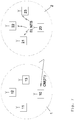
  • FIG. 1-5 illustrates an exemplary embodiment of a handover process in an arrangement that comprises two communication systems
  • FIG. 6 illustrates a modification of the handover process shown in FIGS. 1-5 .
  • FIG. 7-9 illustrates a further modification of the handover process shown in FIGS. 1-5 .
  • FIG. 10 illustrates an exemplary embodiment of a communication node that can be operated as a handover control node in the arrangement shown in FIGS. 1-9 .
  • FIG. 1 illustrates an arrangement comprising a first communication system 1 and a second communication system.
  • the second communication system is a wireless token ring system 2 .
  • each communication node 20 - 23 of the wireless token ring system directly or indirectly—i.e. via one or more other communication nodes that function as relay nodes—sends a token T to an allocated downstream communication node of the wireless token ring system and receives a token from an allocated upstream communication node of the wireless token ring system.
  • an arrow visualizes the assignment of upstream and downstream nodes with respect to one another.
  • the communication node 20 is configured to act as a handover control node in case that a communication node of another communication system intends to join the wireless token ring system 2 .
  • the first communication system 1 may be based on any communication standard known in the art.
  • the first communication system 1 may also be a wireless token ring system.
  • each communication node 10 - 13 of the first communication system 1 sends a token to an allocated downstream communication node and receives a token from an allocated upstream communication node.
  • the communication node 13 of the first communication system 1 intends to leave the first communication system 1 and join the wireless token ring system 2 .
  • the communication node 13 will be referred to as the moving node 13 .
  • the initiation of the handover process will be communicated to the handover control node 20 of the wireless token ring system 2 by a handover message HOM( 13 ).
  • the handover message HOM( 13 ) indicates the moving node 13 (see FIG. 2 ).
  • the handover message HOM( 13 ) can be sent by any of the communication nodes 10 - 13 of the first communication system 1 , for instance by the moving node 13 itself.
  • the handover message HOM( 13 ) is preferably sent by the handover control node.
  • FIG. 1 it is assumed that the communication node 10 is a handover control node of the communication system 1 and therefore sends the handover message HOM( 13 ) to the handover control node 20 of the wireless token ring system 2 (see FIG. 2 ).
  • the handover control node 20 of the wireless token ring system 2 After receiving the handover message HOM( 13 ) the handover control node 20 of the wireless token ring system 2 addresses its next token T( 21 ) to the moving node 13 and not to its formerly allocated downstream communication node 21 in the original wireless token ring system 2 (see FIG. 3 ).
  • This next token T( 21 ) contains the information that the communication node 21 is the downstream node allocated to the moving node 13 in the enlarged wireless token ring system 2 .
  • the moving node 13 receives the token T( 21 ) and sends thereafter an acknowledgement signal A to the handover control node and an own token T to its allocated downstream node 21 in the enlarged second token ring system 2 , the handover process is deemed to be completed and the moving node 13 forms the newly allocated downstream node of the handover control node 10 in the enlarged wireless token ring system 2 (see FIG. 4 ).
  • the handover control node 20 In case that the handover control node 20 does not receive the acknowledgement signal A in a given period of time, the handover control node 20 assumes that the moving node 13 has not received the token T( 21 ) and therefore has not sent an own token T to the allocated downstream node 21 of the moving node 13 (see FIG. 5 ). In order to allow the token ring communication in the wireless token ring system 2 to proceed, the handover control node 20 sends a replacement token RT to the allocated downstream node 21 of the moving node 13 . The replacement token RT replaces the presumably missing token T of the moving node 13 and allows the other communication nodes 21 - 23 of the wireless token ring system 2 to uphold the token-based communication.
  • the handover control node 20 repeats the above described steps of sending the token T( 21 ) to the moving node 13 and awaiting the acknowledgement signal A until the handover control node 20 receives the acknowledgement signal A from the moving node 13 or until the handover process is deemed to have failed and is aborted.
  • the handover process is deemed to have failed and is aborted after the handover control node 20 of the wireless token ring system 2 has sent a predefined number (e.g. 100) of replacement tokens RT without success.
  • the handover control node 20 of the wireless token ring system 20 may send an enlargement information EI to the communication nodes 21 - 23 of the wireless token ring system 2 .
  • the enlargement information EI indicates the imminent or already implemented enlargement of the wireless token ring system 2 .
  • the enlargement information EI may be transmitted upon receipt of the handover message HOM( 13 ).
  • the enlargement information EI may be forwarded by a token from communication node to communication node inside the wireless token ring system 2 (see FIG. 1 ). Alternatively or additionally, the enlargement information EI may be simultaneously sent via a broadcast signal from the handover control node 20 of the wireless token ring system 2 to all other communication nodes 21 - 23 of the wireless token ring system 2 . The enlargement information EI is preferably sent before the token T( 21 ) is transmitted to the moving node 13 .
  • the handover control node 20 of the wireless token ring system 2 may set a new timing schedule NTS and send the new timing schedule NTS to the communication nodes 21 - 23 of the wireless token ring system 2 as well as to the moving node 13 .
  • the new timing schedule preferably defines the timing demands that have to be met by the communication nodes 13 , 21 - 23 in the enlarged wireless token ring system 2 .
  • the new timing schedule NTS may be forwarded by a token from communication node to communication node inside the enlarged wireless token ring system 2 .
  • the new timing schedule NTS may be simultaneously sent via a broadcast signal from the handover control node 20 to the communication nodes 13 and 21 - 23 .
  • the new timing schedule NTS may be defined by or may at least also define the token holding times of the communication nodes in the wireless token ring system 2 .
  • FIG. 6 illustrates a modification of the handover process described above.
  • the moving node 13 After receiving the token T( 21 ), the moving node 13 only sends an own token T to its allocated downstream node 21 in the enlarged second token ring system 2 , but no additional acknowledgement signal A. Since the token T is transmitted wirelessly, is can also be received by the handover control node 20 which accepts the receipt of the moving node's token T as the required acknowledgement. In other words, in the embodiment of FIG. 6 , the moving node's token T that is addressed to the communication node 21 , also forms the acknowledgement for the handover control node 20 .
  • the handover control node 20 In case that the handover control node 20 does not receive the token T from the moving node 13 in a given period of time, the handover control node 20 assumes that the moving node 13 has not received the token T( 21 ) (see FIG. 3 ). In order to allow the token ring communication in the wireless token ring system 2 to proceed, the handover control node 20 sends a replacement token RT to the allocated downstream node 21 of the moving node 13 as shown in FIG. 5 .
  • the handover control node 20 repeats the above described steps of sending a token T( 21 ) to the moving node 13 and awaiting the implicit acknowledgement that is conveyed by the moving node's 13 token T, until the handover control node 20 receives this token T from the moving node 13 or until the handover process is deemed to have failed and is aborted.
  • FIGS. 7-9 illustrate a further modification of the handover process described above with reference to FIG. 1-5 .
  • the handover control node 20 of the wireless token ring system 2 After receiving the handover message HOM( 13 ) from the handover control node 10 of the communication system 1 , the handover control node 20 of the wireless token ring system 2 responds with a configuration message CM( 21 ) (see FIG. 7 ).
  • the handover control node 10 of the communication system 1 forwards the configuration message CM( 21 ) to the moving node 13 (see FIG. 8 ).
  • the configuration message C( 21 ) indicates to the moving node 13 that the communication node 21 of the wireless token ring system 2 will be its allocated downstream node in the enlarged wireless token ring system 2 .
  • the token T′ (see FIG. 9 ) that is sent by the handover control node 20 of the wireless token ring system 2 to the moving node 13 , does not have to comprise any indication as to the allocation of nodes in the enlarged wireless token ring system 2 .
  • FIG. 10 illustrates an exemplary embodiment of a communication node 100 that can form any of the communication nodes 10 - 13 and 20 - 21 in the communication systems 1 and 2 of FIGS. 1-9 .
  • the communication node 100 comprises a transceiver 110 capable of transmitting and receiving electromagnetic radiation, a processor unit 120 and a memory 130 .
  • the memory 130 stores a control program CP that allows the processor unit 120 to operate as explained above.
  • the control program CP comprises a handover control software module HCS which—after activation—programs the processor such that the communication node may act as a handover control node 20 as described above.
  • the handover control node 100 may address its next token to a moving node 13 and not to its formerly allocated downstream communication node 21 after receiving a handover message HOM that indicates the initiation of the handover process with respect to the moving node 13 .
  • the handover control node 100 may send a replacement token RT to the allocated downstream node 21 of the moving node 13 in case that the handover control node 20 does not receive an acknowledgement (e. g. an acknowledgment signal A or a token T) from the moving node 13 in a given period of time.
  • an acknowledgement e. g. an acknowledgment signal A or a token T
  • the embodiments described above with reference to FIGS. 1 to 10 differ from the method described in the above mentioned thesis “WTRP—Wireless Token Ring Protocol” at least with regard to the handover message.
  • the handover message according to the exemplary embodiments of FIGS. 1 to 10 is sent from the first communication system to the second communication system in order to notify the second communication system about the intended handover process and announce the moving node.
  • the handover message enables the handover control node of the second communication system to allow the announced moving node to move seamlessly and interruption-free from the first communication system to the second communication system.
  • the handover control node of the second communication system awaits the arrival of the moving node and seamlessly executes the integration of the moving node upon arrival.
  • This seamless integration which is the basis for session continuity on higher communication layers—referred to as “handover” with respect to FIGS. 1 to 10 —is possible because of the prior transmission of handover information (handover message) from the first communication system towards to the second communication system.
  • the “solicit successor token” of the thesis is sent within the second system, only.
  • the “solicit successor token” is meant for any node that can hear it, and therefore allows any arbitrary node to join the network.
  • the “solicit successor token” potentially enables any node to enter the network and is not limited to a pre-defined moving node that has been and announced earlier by the first communication system.

Landscapes

  • Engineering & Computer Science (AREA)
  • Computer Networks & Wireless Communication (AREA)
  • Signal Processing (AREA)
  • Mobile Radio Communication Systems (AREA)
  • Small-Scale Networks (AREA)

Abstract

An embodiment of the invention relates to a method of carrying out a handover process. After receiving a handover message (HOM(13)) that indicates the initiation of the handover process with respect to a moving node (13), a handover control node (20) addresses its next token (T(21)) to the moving node (13) and not to its formerly allocated downstream node (21) in its original wireless token ring system (2). In case that the moving node (13) receives said token (T(21)) and sends thereafter an acknowledgement to the handover control node (20) and an own token (T) to its allocated downstream node (21) in the enlarged wireless token ring system (2), the handover process is deemed to be completed and the moving node (13) forms the newly allocated downstream node to the handover control node (20) in the enlarged wireless token ring system (2). In case that the handover control node (20) does not receive the acknowledgement in a given period of time, the handover control node (20) sends a replacement token (RT) to the allocated downstream node (21) of the moving node (13), the replacement token (RT) replacing the presumably missing token of the moving node (13) and allowing the token ring communication to proceed.

Description

The invention relates to a method of carrying out a handover process between communication systems. The invention also relates to arrangements comprising communication systems, wireless token ring systems and communication nodes for wireless token ring systems.
BACKGROUND OF THE INVENTION
German Patent Application DE 10 2012 206 529 A1 discloses a method of operating a token-ring system where communication nodes send signals to allocated upstream communication nodes and receive signals from allocated downstream communication nodes.
The thesis “WTRP—Wireless Token Ring Protocol” (M. Ergen, Berkeley, Calif., 2002) discloses a method allowing a communication node to join an existing communication system.
OBJECTIVE OF THE PRESENT INVENTION
An objective of the present invention is to provide a method for handling a handover process between a wireless token ring system and another communication system with minimal impact on the ongoing communication between nodes that are not directly involved in the handover process.
A further objective of the present invention is to provide arrangements comprising communication systems, wireless token ring systems and communication nodes for wireless token ring systems that can handle handover processes with minimal impact on the ongoing communication between nodes that are not directly involved in the handover process.
BRIEF SUMMARY OF THE INVENTION
An embodiment of the invention relates to a method of carrying out a handover process between a first communication system and a second communication system, wherein the second communication system is a wireless token ring system and at least one communication node of the wireless token ring system operates as a handover control node, and wherein a communication node, hereinafter referred to as the moving node, of the first communication system leaves the first communication system and is integrated into the wireless token ring system thereby transforming the original wireless token ring system into an enlarged wireless token ring system. After receiving a handover message that indicates the initiation of the handover process with respect to the moving node, the handover control node addresses its next token to the moving node and not to its formerly allocated downstream communication node in the original wireless token ring system, and
(a) in case that the moving node receives said token and sends thereafter an acknowledgement to the handover control node and an own token to its allocated downstream node in the enlarged wireless token ring system, the handover process is deemed to be completed and the moving node forms the newly allocated downstream node to the handover control node in the enlarged wireless token ring system, and
(b) in case that the handover control node does not receive the acknowledgement in a given period of time, the handover control node sends a replacement token to the allocated downstream node of the moving node, the replacement token replacing the presumably missing token of the moving node and allowing the token ring communication to proceed.
Steps (a) and (b) are repeated until the handover control node receives the acknowledgement from the moving node or until the handover process is deemed to have failed and is aborted.
An advantage of this embodiment of the invention is that the token-based communication between the nodes in the wireless token ring system may proceed without disruption during the handover phase even if the handover process is delayed or finally fails completely.
Preferably, the handover process is deemed to have failed and is aborted after the handover control node of the wireless token ring system has sent a predefined number of replacement messages.
In step (a) the acknowledgement and the moving node's token that is sent to its allocated downstream node in the enlarged wireless token ring system, may be separate signals that are sent simultaneously or consecutively by the moving node.
Alternatively or additionally, the moving node's token itself may form the acknowledgement, and the handover control node may accept the receipt of the moving node's token that is addressed to its allocated downstream node in the enlarged wireless token ring system, as the receipt of the acknowledgement.
According to a preferred embodiment, said next token of the handover control node may indicate to the moving node which node of the wireless token ring system will be its allocated downstream node in the enlarged wireless token ring system.
In each of the two communication systems, preferably at least one node operates as a handover control node. The handover control node of the first communication system is hereinafter referred to as first handover control node and the handover control node of the wireless token ring system is hereinafter referred to as second handover control node.
The handover message that indicates the initiation of the handover process with respect to the moving node, is preferably sent by the first handover control node to the second handover control node.
According to a further embodiment, the second handover control node may send a configuration message to the first handover control node which forwards the configuration message to the moving node. The configuration message preferably indicates to the moving node which node of the wireless token ring system will be its allocated downstream node in the enlarged wireless token ring system.
Upon receipt of the handover message, the handover control node of the wireless token ring system preferably sends an enlargement information that indicates the enlargement of the wireless token ring system to the communication nodes of the wireless token ring system.
The enlargement information may be forwarded by a token from communication node to communication node inside the wireless token ring system. Alternatively or additionally, the enlargement information may be simultaneously sent via a broadcast signal from the handover control node of the wireless token ring system to all other communication nodes of the wireless token ring system.
Further, upon receipt of the handover message, the handover control node of the wireless token ring system preferably sets a new timing schedule and sends the new timing schedule to the communication nodes of the wireless token ring system. The new timing schedule preferably defines the timing demands that have to be met by the communication nodes in the enlarged wireless token ring system.
The new timing schedule may be forwarded by a token from communication node to communication node inside the wireless token ring system. Alternatively or additionally, the new timing schedule may be simultaneously sent via a broadcast signal from the handover control node of the wireless token ring system to all other communication nodes of the wireless token ring system.
The new timing schedule may be defined by or may at least also define the token holding times of the communication nodes of the wireless token ring system.
In each rotation period or rotation cycle of the token ring, each communication node of the wireless token ring system may directly or indirectly—i.e. via one or more other communication nodes that function as relay nodes—send a token to an allocated downstream communication node of the wireless token ring system and may receive a token from an allocated upstream communication node of the wireless token ring system.
The first communication system may also be a wireless token ring system. In each rotation period, each communication node of the first communication system may directly or indirectly—i.e. via one or more other communication nodes that function as relay nodes—send a token to an allocated downstream communication node of the first communication system and may receive a token from an allocated upstream communication node of the first communication system.
A further embodiment of the invention relates to an arrangement comprising at least two communication systems. At least one of the communication systems is a wireless token ring system, and at least one of the communication nodes of the wireless token ring system is configured to act as a handover control node according to the handover method described above.
A further embodiment of the invention relates to a wireless token ring system. A handover control node of the wireless token ring system is preferably configured to address its next token to a moving node and not to its formerly allocated downstream communication node in its original wireless token ring system, after receiving a handover message that indicates the initiation of the handover process with respect to the moving node, and to send a replacement token to the allocated downstream node of the moving node, in case that the handover control node did not receive an acknowledgement from the moving node in a given period of time. The replacement token allows the token ring communication to proceed.
A further embodiment of the invention relates to a communication node for a wireless token ring system. The communication node is configured to act as a handover control node according to the handover method described above.
The handover control node is preferably configured to address its next token to a moving node and not to its formerly allocated downstream communication node in its original wireless token ring system, after receiving a handover message that indicates the initiation of the handover process with respect to the moving node, and to send a replacement token to the allocated downstream node of the moving node in case that the handover control node did not receive an acknowledgement from the moving node in a given period of time. The replacement token allows the token ring communication to proceed.
The communication node preferably comprises a transceiver, a processor and a memory that stores a handover control software module which—after activation—programs the processor such that the communication node acts as the handover control node.
BRIEF DESCRIPTION OF THE DRAWINGS
In order that the manner in which the above-recited and other advantages of the invention are obtained will be readily understood, a more particular description of the invention briefly described above will be rendered by reference to specific embodiments thereof which are illustrated in the appended drawings. Understanding that these drawings depict only typical embodiments of the invention and are therefore not to be considered to be limiting of its scope, the invention will be described and explained with additional specificity and detail by the use of the accompanying drawings in which
FIG. 1-5 illustrates an exemplary embodiment of a handover process in an arrangement that comprises two communication systems,
FIG. 6 illustrates a modification of the handover process shown in FIGS. 1-5,
FIG. 7-9 illustrates a further modification of the handover process shown in FIGS. 1-5, and
FIG. 10 illustrates an exemplary embodiment of a communication node that can be operated as a handover control node in the arrangement shown in FIGS. 1-9.
DETAILED DESCRIPTION OF THE PREFERRED EMBODIMENTS
The preferred embodiments of the present invention will be best understood by reference to the drawings. It will be readily understood that the present invention, as generally described and illustrated in the figures herein, could vary in a wide range. Thus, the following more detailed description of the exemplary embodiments of the present invention, as represented in the figures, is not intended to limit the scope of the invention, as claimed, but is merely representative of presently preferred embodiments of the invention.
FIG. 1 illustrates an arrangement comprising a first communication system 1 and a second communication system.
The second communication system is a wireless token ring system 2. In each rotation period of the wireless token ring system, each communication node 20-23 of the wireless token ring system directly or indirectly—i.e. via one or more other communication nodes that function as relay nodes—sends a token T to an allocated downstream communication node of the wireless token ring system and receives a token from an allocated upstream communication node of the wireless token ring system. In FIG. 1, an arrow visualizes the assignment of upstream and downstream nodes with respect to one another.
Hereinafter it is assumed that the communication node 20 is configured to act as a handover control node in case that a communication node of another communication system intends to join the wireless token ring system 2.
The first communication system 1 may be based on any communication standard known in the art. For instance, the first communication system 1 may also be a wireless token ring system. In this case, in each rotation period, each communication node 10-13 of the first communication system 1 sends a token to an allocated downstream communication node and receives a token from an allocated upstream communication node.
Hereinafter, a preferred embodiment of a handover process between both communication systems 1 and 2 will be described in further detail. It is assumed that the communication node 13 of the first communication system 1 intends to leave the first communication system 1 and join the wireless token ring system 2. The communication node 13 will be referred to as the moving node 13.
The initiation of the handover process will be communicated to the handover control node 20 of the wireless token ring system 2 by a handover message HOM(13). The handover message HOM(13) indicates the moving node 13 (see FIG. 2).
The handover message HOM(13) can be sent by any of the communication nodes 10-13 of the first communication system 1, for instance by the moving node 13 itself. In case that the first communication system 1 comprises a handover control node, the handover message HOM(13) is preferably sent by the handover control node. In FIG. 1, it is assumed that the communication node 10 is a handover control node of the communication system 1 and therefore sends the handover message HOM(13) to the handover control node 20 of the wireless token ring system 2 (see FIG. 2).
After receiving the handover message HOM(13) the handover control node 20 of the wireless token ring system 2 addresses its next token T(21) to the moving node 13 and not to its formerly allocated downstream communication node 21 in the original wireless token ring system 2 (see FIG. 3). This next token T(21) contains the information that the communication node 21 is the downstream node allocated to the moving node 13 in the enlarged wireless token ring system 2.
In case that the moving node 13 receives the token T(21) and sends thereafter an acknowledgement signal A to the handover control node and an own token T to its allocated downstream node 21 in the enlarged second token ring system 2, the handover process is deemed to be completed and the moving node 13 forms the newly allocated downstream node of the handover control node 10 in the enlarged wireless token ring system 2 (see FIG. 4).
In case that the handover control node 20 does not receive the acknowledgement signal A in a given period of time, the handover control node 20 assumes that the moving node 13 has not received the token T(21) and therefore has not sent an own token T to the allocated downstream node 21 of the moving node 13 (see FIG. 5). In order to allow the token ring communication in the wireless token ring system 2 to proceed, the handover control node 20 sends a replacement token RT to the allocated downstream node 21 of the moving node 13. The replacement token RT replaces the presumably missing token T of the moving node 13 and allows the other communication nodes 21-23 of the wireless token ring system 2 to uphold the token-based communication.
The handover control node 20 repeats the above described steps of sending the token T(21) to the moving node 13 and awaiting the acknowledgement signal A until the handover control node 20 receives the acknowledgement signal A from the moving node 13 or until the handover process is deemed to have failed and is aborted. Preferably, the handover process is deemed to have failed and is aborted after the handover control node 20 of the wireless token ring system 2 has sent a predefined number (e.g. 100) of replacement tokens RT without success.
Referring again to FIG. 3, it can be seen that the handover control node 20 of the wireless token ring system 20 may send an enlargement information EI to the communication nodes 21-23 of the wireless token ring system 2. The enlargement information EI indicates the imminent or already implemented enlargement of the wireless token ring system 2. The enlargement information EI may be transmitted upon receipt of the handover message HOM(13).
The enlargement information EI may be forwarded by a token from communication node to communication node inside the wireless token ring system 2 (see FIG. 1). Alternatively or additionally, the enlargement information EI may be simultaneously sent via a broadcast signal from the handover control node 20 of the wireless token ring system 2 to all other communication nodes 21-23 of the wireless token ring system 2. The enlargement information EI is preferably sent before the token T(21) is transmitted to the moving node 13.
Further, upon receipt of the handover message HOM(13) the handover control node 20 of the wireless token ring system 2 may set a new timing schedule NTS and send the new timing schedule NTS to the communication nodes 21-23 of the wireless token ring system 2 as well as to the moving node 13. The new timing schedule preferably defines the timing demands that have to be met by the communication nodes 13, 21-23 in the enlarged wireless token ring system 2.
The new timing schedule NTS may be forwarded by a token from communication node to communication node inside the enlarged wireless token ring system 2. Alternatively or additionally, the new timing schedule NTS may be simultaneously sent via a broadcast signal from the handover control node 20 to the communication nodes 13 and 21-23.
The new timing schedule NTS may be defined by or may at least also define the token holding times of the communication nodes in the wireless token ring system 2.
FIG. 6 illustrates a modification of the handover process described above. After receiving the token T(21), the moving node 13 only sends an own token T to its allocated downstream node 21 in the enlarged second token ring system 2, but no additional acknowledgement signal A. Since the token T is transmitted wirelessly, is can also be received by the handover control node 20 which accepts the receipt of the moving node's token T as the required acknowledgement. In other words, in the embodiment of FIG. 6, the moving node's token T that is addressed to the communication node 21, also forms the acknowledgement for the handover control node 20.
In case that the handover control node 20 does not receive the token T from the moving node 13 in a given period of time, the handover control node 20 assumes that the moving node 13 has not received the token T(21) (see FIG. 3). In order to allow the token ring communication in the wireless token ring system 2 to proceed, the handover control node 20 sends a replacement token RT to the allocated downstream node 21 of the moving node 13 as shown in FIG. 5.
The handover control node 20 repeats the above described steps of sending a token T(21) to the moving node 13 and awaiting the implicit acknowledgement that is conveyed by the moving node's 13 token T, until the handover control node 20 receives this token T from the moving node 13 or until the handover process is deemed to have failed and is aborted.
FIGS. 7-9 illustrate a further modification of the handover process described above with reference to FIG. 1-5. After receiving the handover message HOM(13) from the handover control node 10 of the communication system 1, the handover control node 20 of the wireless token ring system 2 responds with a configuration message CM(21) (see FIG. 7).
The handover control node 10 of the communication system 1 forwards the configuration message CM(21) to the moving node 13 (see FIG. 8). The configuration message C(21) indicates to the moving node 13 that the communication node 21 of the wireless token ring system 2 will be its allocated downstream node in the enlarged wireless token ring system 2.
Since the moving node 13 is now aware of its allocated downstream node 21, the token T′ (see FIG. 9) that is sent by the handover control node 20 of the wireless token ring system 2 to the moving node 13, does not have to comprise any indication as to the allocation of nodes in the enlarged wireless token ring system 2.
FIG. 10 illustrates an exemplary embodiment of a communication node 100 that can form any of the communication nodes 10-13 and 20-21 in the communication systems 1 and 2 of FIGS. 1-9.
The communication node 100 comprises a transceiver 110 capable of transmitting and receiving electromagnetic radiation, a processor unit 120 and a memory 130. The memory 130 stores a control program CP that allows the processor unit 120 to operate as explained above.
The control program CP comprises a handover control software module HCS which—after activation—programs the processor such that the communication node may act as a handover control node 20 as described above. For instance, the handover control node 100 may address its next token to a moving node 13 and not to its formerly allocated downstream communication node 21 after receiving a handover message HOM that indicates the initiation of the handover process with respect to the moving node 13. Further, the handover control node 100 may send a replacement token RT to the allocated downstream node 21 of the moving node 13 in case that the handover control node 20 does not receive an acknowledgement (e. g. an acknowledgment signal A or a token T) from the moving node 13 in a given period of time.
The embodiments described above with reference to FIGS. 1 to 10 differ from the method described in the above mentioned thesis “WTRP—Wireless Token Ring Protocol” at least with regard to the handover message. The handover message according to the exemplary embodiments of FIGS. 1 to 10 is sent from the first communication system to the second communication system in order to notify the second communication system about the intended handover process and announce the moving node. The handover message enables the handover control node of the second communication system to allow the announced moving node to move seamlessly and interruption-free from the first communication system to the second communication system.
In other words, the handover control node of the second communication system awaits the arrival of the moving node and seamlessly executes the integration of the moving node upon arrival. This seamless integration which is the basis for session continuity on higher communication layers—referred to as “handover” with respect to FIGS. 1 to 10—is possible because of the prior transmission of handover information (handover message) from the first communication system towards to the second communication system.
In contrast, the “solicit successor token” of the thesis is sent within the second system, only. The “solicit successor token” is meant for any node that can hear it, and therefore allows any arbitrary node to join the network. In other words, the “solicit successor token” potentially enables any node to enter the network and is not limited to a pre-defined moving node that has been and announced earlier by the first communication system.
The various embodiments and aspects of embodiments of the invention disclosed herein are to be understood not only in the order and context specifically described in this specification, but to include any order and any combination thereof. Whenever the context requires, all words used in the singular number shall be deemed to include the plural and vice versa. Whenever the context requires, all options that are listed with the word “and” shall be deemed to include the word “or” and vice versa, and any combination thereof.
In the drawings and specification, there have been disclosed a plurality of embodiments of the present invention. The applicant would like to emphasize that each feature of each embodiment may be combined with or added to any other of the embodiments in order to modify the respective embodiment and create additional embodiments. These additional embodiments form a part of the present disclosure and, therefore, the applicant may file further patent claims regarding these additional embodiments at a later stage of the prosecution.
Further, the applicant would like to emphasize that each feature of each of the following dependent claims may be combined with any of the present independent claims as well as with any other (one ore more) of the present dependent claims (regardless of the present claim structure). Therefore, the applicant may direct further patent claims towards other claim combinations at a later stage of the prosecution.

Claims (17)

The invention claimed is:
1. A method of carrying out a handover process between a first communication system and a second communication system,
wherein the second communication system is a wireless token ring system and at least one communication node of the wireless token ring system operates as a handover control node,
wherein a communication node, hereinafter referred to as the moving node, of the first communication system leaves the first communication system and is integrated into the wireless token ring system thereby transforming the original wireless token ring system into an enlarged wireless token ring system,
wherein after receiving a handover message that indicates the initiation of the handover process with respect to the moving node, the handover control node addresses its next token to the moving node and not to its formerly allocated downstream node in the original wireless token ring system, and
wherein the method further comprises the following steps:
Step (a) in case that the moving node receives said token and sends thereafter an acknowledgement to the handover control node and an own token to its allocated downstream node in the enlarged wireless token ring system, the handover process is deemed to be completed and the moving node forms the newly allocated downstream node to the handover control node in the enlarged wireless token ring system, and
Step (b) in case that the handover control node does not receive the acknowledgement in a given period of time, the handover control node sends a replacement token to the allocated downstream node of the moving node, the replacement token replacing the presumably missing token of the moving node and allowing the token ring communication to proceed, and
wherein steps (a) and (b) are repeated until the handover control node receives the acknowledgement from the moving node or until the handover process is deemed to have failed and is aborted.
2. An arrangement comprising at least two communication systems, characterized in that
at least one of the communication systems is a wireless token ring system, and
at least one of the communication nodes of the wireless token ring system is configured to act as a handover control node according to the method defined in claim 1.
3. A wireless token ring system according to the arrangement of claim 2, wherein a handover control node is configured
to address its next token to a moving node and not to its formerly allocated downstream communication node in the original wireless token ring system, after receiving a handover message that indicates the initiation of the handover process with respect to the moving node, and
to send a replacement token to the allocated downstream node of the moving node, in case that the handover control node did not receive an acknowledgement from the moving node in a given period of time,
wherein the replacement token allows the token ring communication to proceed.
4. A communication node for a wireless token ring system, wherein said the communication node is configured to act as a handover control node according to the method defined in claim 1.
5. A communication node for a wireless token ring system, wherein the communication node is a handover control node configured
to address its next token to a moving node and not to its formerly allocated downstream communication node in the original wireless token ring system, after receiving a handover message that indicates the initiation of the handover process with respect to the moving node, and
to send a replacement token to the allocated downstream node of the moving node in case that the handover control node did not receive an acknowledgement from the moving node in a given period of time,
wherein the replacement token allows the token ring communication to proceed; wherein the communication node is configured to act as a handover control node according to the method defined in claim 1.
6. A communication node according to claim 5, wherein the communication node comprises
a transceiver,
a processor and
a memory that stores a handover control software module which—after activation—programs the processor such that the communication node acts as the handover control node.
7. A method of carrying out a handover process between a first communication system and a second communication system,
wherein the second communication system is a wireless token ring system where each communication node is configured to send signals to an allocated upstream communication node and receive signals from an allocated downstream communication node and where at least one communication node of the wireless token ring system operates as a handover control node,
wherein in order to initiate an integration of a moving node of the first communication system into the wireless token ring system and thereby transform the original wireless token ring system into an enlarged wireless token ring system, a handover message is sent from the first communication system to the wireless token ring system,
wherein after receiving the handover message that indicates the initiation of the handover process with respect to the moving node, the handover control node of the wireless token ring system addresses its next token to the moving node and not to its formerly allocated downstream node in the original wireless token ring system, and
wherein the method further comprises the following steps:
Step (a) in case that the moving node receives said token and sends thereafter an acknowledgement to the handover control node and an own token to its allocated downstream node in the enlarged wireless token ring system, the handover process is deemed to be completed and the moving node forms the newly allocated downstream node to the handover control node in the enlarged wireless token ring system, and
Step (b) in case that the handover control node does not receive the acknowledgement in a given period of time, the handover control node sends a replacement token to the allocated downstream node of the moving node, the replacement token allowing the token ring communication to proceed, and
wherein steps (a) and (b) are repeated until the handover control node receives the acknowledgement from the moving node or until the handover process is deemed to have failed and is aborted.
8. The method of claim 7 wherein, in step (a) the acknowledgement and the moving node's own token are separate signals that are sent simultaneously or consecutively by the moving node.
9. The method of claim 7 wherein, in step (a), the moving node's own token itself forms the acknowledgement, and
wherein the handover control node accepts the receipt of the moving node's own token as the receipt of the acknowledgement.
10. The method according to claim 7, wherein said next token of the handover control node indicates to the moving node which node of the wireless token ring system will be its allocated downstream node in the enlarged wireless token ring system.
11. The method according to claim 7, wherein in each of the two communication systems, at least one node operates as a handover control node, the handover control node of the first communication system is hereinafter referred to as first handover control node and the handover control node of the wireless token ring system is hereinafter referred to as second handover control node.
12. The method of claim 11, wherein the first handover control node sends the handover message that indicates the initiation of the handover process with respect to the moving node, to the second handover control node.
13. The method according to claim 11, wherein after receiving the handover message, the second handover control node sends a configuration message to the first handover control node which forwards the configuration message to the moving node, and
wherein said configuration message indicates to the moving node which node of the wireless token ring system will be its allocated downstream node in the enlarged wireless token ring system.
14. The method according to claim 7, wherein upon receipt of the handover message the handover control node of the wireless token ring system sends an enlargement information that indicates the enlargement of the wireless token ring system to the communication nodes of the wireless token ring system.
15. The method according to claim 7, wherein upon receipt of the handover message the handover control node of the wireless token ring system sets a new timing schedule and sends the new timing schedule to the communication nodes of the wireless token ring system, and
wherein the new timing schedule defines the timing demands that have to be met by the communication nodes in the enlarged wireless token ring system.
16. The method according to claim 7, wherein in each rotation period, each communication node of the first communication system directly or indirectly—for example, via one or more other communication nodes that function as relay nodes—sends a token to an allocated downstream communication node of the first communication system and receives a token from an allocated upstream communication node of the first communication system, and
wherein in each rotation period, each communication node of the wireless token ring system directly or indirectly—for example, via one or more other communication nodes that function as relay nodes—sends a token to an allocated downstream communication node of the wireless token ring system and receives a token from an allocated upstream communication node of the wireless token ring system.
17. A communication node for a wireless token ring system, wherein the communication node is a handover control node configured
to address its next token to a moving node and not to its formerly allocated downstream communication node in the original wireless token ring system, after receiving a handover message that indicates the initiation of the handover process with respect to the moving node, and
to send a replacement token to the allocated downstream node of the moving node in case that the handover control node did not receive an acknowledgement from the moving node in a given period of time,
wherein the replacement token allows the token ring communication to proceed.
US16/606,688 2017-05-12 2018-05-03 Handover process Active 2038-06-25 US11026150B2 (en)

Applications Claiming Priority (4)

Application Number Priority Date Filing Date Title
EP17170773.0 2017-05-12
EP17170773.0A EP3402293A1 (en) 2017-05-12 2017-05-12 Wireless token ring system mobility
EP17170773 2017-05-12
PCT/EP2018/061392 WO2018206402A1 (en) 2017-05-12 2018-05-03 Handover process

Publications (2)

Publication Number Publication Date
US20210120474A1 US20210120474A1 (en) 2021-04-22
US11026150B2 true US11026150B2 (en) 2021-06-01

Family

ID=58709288

Family Applications (1)

Application Number Title Priority Date Filing Date
US16/606,688 Active 2038-06-25 US11026150B2 (en) 2017-05-12 2018-05-03 Handover process

Country Status (5)

Country Link
US (1) US11026150B2 (en)
EP (2) EP3402293A1 (en)
JP (1) JP7177972B2 (en)
CN (1) CN110547032A (en)
WO (1) WO2018206402A1 (en)

Families Citing this family (1)

* Cited by examiner, † Cited by third party
Publication number Priority date Publication date Assignee Title
CN113824796B (en) * 2021-10-22 2023-06-30 杭州宏杉科技股份有限公司 Token passing method and device

Citations (6)

* Cited by examiner, † Cited by third party
Publication number Priority date Publication date Assignee Title
US5490139A (en) * 1994-09-28 1996-02-06 International Business Machines Corporation Mobility enabling access point architecture for wireless attachment to source routing networks
US6775255B1 (en) * 1999-09-16 2004-08-10 At&T Corp. H.323 mobility architecture for terminal, user and service mobility
JP2004312665A (en) 2003-03-24 2004-11-04 Alpha Systems:Kk Access control method in radio transmission line, radio transmission apparatus, radio transmission system and access control program in radio transmission line
US6859448B1 (en) * 1999-09-16 2005-02-22 At&T Corp. H.323 mobility protocol for terminal, user and service mobility
US20090055909A1 (en) * 2007-08-20 2009-02-26 National Taiwan University Of Science And Technology Data transmitting method with multiple token mechanism in wireless token ring protocol
DE102012206529A1 (en) 2012-04-20 2013-10-24 Rwth Aachen Method for operating broadcast-type wireless real-time transmission system, involves giving logical subsequent to one node if data transmission is possible with preset probability, and finding relay node if transmission is not possible

Family Cites Families (7)

* Cited by examiner, † Cited by third party
Publication number Priority date Publication date Assignee Title
JPH088573B2 (en) * 1989-04-03 1996-01-29 株式会社東芝 Data communication method of control system
EP0594197B1 (en) * 1992-10-23 1999-05-06 Cabletron Systems, Inc. Improved negotiation protocol for establishment of full duplex communication on a token ring network
KR100212468B1 (en) * 1996-12-09 1999-08-02 정선종 Group communication device and control method using the same
KR100881743B1 (en) 2001-05-01 2009-02-06 코닌클리케 필립스 일렉트로닉스 엔.브이. A method and wireless communication device and a communication unit for performing a handoff of a slave unit currently wirelessly connected
KR101024472B1 (en) * 2006-06-26 2011-03-23 미쓰비시덴키 가부시키가이샤 Token Issuing Method and Token Ring Communication Method in Communication Node and Ring-shaped Communication System
CN101820374B (en) * 2006-06-26 2016-05-04 三菱电机株式会社 The method for issuing token of communication node and annular communication system, token-ring communication method
CN102647323B (en) * 2012-03-28 2015-01-07 华为技术有限公司 Flow control method and device as well as clustering system

Patent Citations (6)

* Cited by examiner, † Cited by third party
Publication number Priority date Publication date Assignee Title
US5490139A (en) * 1994-09-28 1996-02-06 International Business Machines Corporation Mobility enabling access point architecture for wireless attachment to source routing networks
US6775255B1 (en) * 1999-09-16 2004-08-10 At&T Corp. H.323 mobility architecture for terminal, user and service mobility
US6859448B1 (en) * 1999-09-16 2005-02-22 At&T Corp. H.323 mobility protocol for terminal, user and service mobility
JP2004312665A (en) 2003-03-24 2004-11-04 Alpha Systems:Kk Access control method in radio transmission line, radio transmission apparatus, radio transmission system and access control program in radio transmission line
US20090055909A1 (en) * 2007-08-20 2009-02-26 National Taiwan University Of Science And Technology Data transmitting method with multiple token mechanism in wireless token ring protocol
DE102012206529A1 (en) 2012-04-20 2013-10-24 Rwth Aachen Method for operating broadcast-type wireless real-time transmission system, involves giving logical subsequent to one node if data transmission is possible with preset probability, and finding relay node if transmission is not possible

Non-Patent Citations (4)

* Cited by examiner, † Cited by third party
Title
European Search Report dated Oct. 26, 2017 issued in related EP Application No. 17170773.0; filed May 12, 2017.
International Search Report dated Jul. 17, 2018 issued in related PCT/EP2018/061392; filed May 3, 2018.
Mustafa Ergen; "WTRP-Wireless Token Ring Protocol"; B.S. Middle East Technical University; A thesis submitted in partial satisfaction of the Master of Science in the Electric Engineering and Computer Science in the Graduate Division of the University of California, Berkeley; Jan. 1, 2002; 127 pages.
Yuanguo Bi et al; "A Multi-Channel Token Ring Protocol for QoS Provisioning in Inter-Vehicle Communications"; IEEE Transactions of Wireless Communications; vol. 8; No. 11; Nov. 2009; pp. 5261-5631.

Also Published As

Publication number Publication date
JP7177972B2 (en) 2022-11-25
JP2020522910A (en) 2020-07-30
EP3622770C0 (en) 2024-01-24
WO2018206402A1 (en) 2018-11-15
EP3622770A1 (en) 2020-03-18
CN110547032A (en) 2019-12-06
US20210120474A1 (en) 2021-04-22
EP3622770B1 (en) 2024-01-24
EP3402293A1 (en) 2018-11-14

Similar Documents

Publication Publication Date Title
US9414105B2 (en) Mobile source device media playback over rendering devices at lifestyle-determined locations
EP2992727B1 (en) Multicast group reuse in cellular network multicast transport
TW201010469A (en) Mac protocol for multi-channel wireless networks
EP3132647A1 (en) Method and apparatus for reducing the length of a packet storm in a wireless mesh network
KR101739680B1 (en) Enhancements to resource allocation for mbsfn transmission in an mbsfn area
WO2020064840A1 (en) Mobile device and method
US10715617B2 (en) Stream reservation class converter
US20250374313A1 (en) Systems, devices, and methods related to configuring multi-stream network with stream-aware scheduling
CN106341483A (en) Local area network multicast group-based distributed dispatching system communication method
CN101207439A (en) Communication method between at least one subscriber station and at least two base stations
US11026150B2 (en) Handover process
CN114047689A (en) Lighting equipment control method and device, lighting equipment and storage medium
US10284605B2 (en) Method and terminal for providing MCPTT service
CN110463135B (en) Full duplex transmission method and device
US10405149B2 (en) Enhanced MBMS-based signal transmission/reception method
CN104285424B (en) Method for transmitting data in a packet-oriented communication network and correspondingly arranged user equipment on the communication network
CN107027166A (en) A kind of sending method, device and the node of the synchronizing information of node
CN105144629A (en) Multi-cast optimized medium access method for wireless network
JP2011114779A (en) Terminal and communication method
US11540053B2 (en) Method of synchronizing pieces of audio equipment
US12219662B2 (en) Multimedia service providing device and multimedia service providing method
CN112154618B (en) Communication systems, control systems and communication devices
EP3373524B1 (en) Audio stream network with network components and method for running and/or configuring the network with network components
JP2020522910A5 (en)
JP2010279011A (en) Mobile communication method and fixed station

Legal Events

Date Code Title Description
AS Assignment

Owner name: R3 - RELIABLE REALTIME RADIO COMMUNICATIONS GMBH, GERMANY

Free format text: ASSIGNMENT OF ASSIGNORS INTEREST;ASSIGNORS:BOHGE, MATHIAS;BONANATI, FLORIAN;GROSS, JAMES;REEL/FRAME:050764/0962

Effective date: 20190927

FEPP Fee payment procedure

Free format text: ENTITY STATUS SET TO UNDISCOUNTED (ORIGINAL EVENT CODE: BIG.); ENTITY STATUS OF PATENT OWNER: SMALL ENTITY

FEPP Fee payment procedure

Free format text: ENTITY STATUS SET TO SMALL (ORIGINAL EVENT CODE: SMAL); ENTITY STATUS OF PATENT OWNER: SMALL ENTITY

STPP Information on status: patent application and granting procedure in general

Free format text: PUBLICATIONS -- ISSUE FEE PAYMENT RECEIVED

STPP Information on status: patent application and granting procedure in general

Free format text: PUBLICATIONS -- ISSUE FEE PAYMENT VERIFIED

STCF Information on status: patent grant

Free format text: PATENTED CASE

AS Assignment

Owner name: R3 SOLUTIONS GMBH, GERMANY

Free format text: ASSIGNMENT OF ASSIGNORS INTEREST;ASSIGNOR:RELIABLE REALTIME RADIO COMMUNICATIONS GMBH;REEL/FRAME:061127/0385

Effective date: 20220822

Owner name: R3 SOLUTIONS GMBH, GERMANY

Free format text: ASSIGNMENT OF ASSIGNOR'S INTEREST;ASSIGNOR:RELIABLE REALTIME RADIO COMMUNICATIONS GMBH;REEL/FRAME:061127/0385

Effective date: 20220822

AS Assignment

Owner name: R3 SOLUTIONS GMBH, GERMANY

Free format text: ASSIGNMENT OF ASSIGNORS INTEREST;ASSIGNOR:R3 - RELIABLE REALTIME RADIO COMMUNICATIONS GMBH;REEL/FRAME:061128/0030

Effective date: 20220822

Owner name: R3 SOLUTIONS GMBH, GERMANY

Free format text: ASSIGNMENT OF ASSIGNOR'S INTEREST;ASSIGNOR:R3 - RELIABLE REALTIME RADIO COMMUNICATIONS GMBH;REEL/FRAME:061128/0030

Effective date: 20220822

MAFP Maintenance fee payment

Free format text: PAYMENT OF MAINTENANCE FEE, 4TH YR, SMALL ENTITY (ORIGINAL EVENT CODE: M2551); ENTITY STATUS OF PATENT OWNER: SMALL ENTITY

Year of fee payment: 4