US11025864B2 - Video conference communication - Google Patents
Video conference communication Download PDFInfo
- Publication number
- US11025864B2 US11025864B2 US16/766,249 US201816766249A US11025864B2 US 11025864 B2 US11025864 B2 US 11025864B2 US 201816766249 A US201816766249 A US 201816766249A US 11025864 B2 US11025864 B2 US 11025864B2
- Authority
- US
- United States
- Prior art keywords
- users
- value
- received
- audiovisual stream
- displayed
- Prior art date
- Legal status (The legal status is an assumption and is not a legal conclusion. Google has not performed a legal analysis and makes no representation as to the accuracy of the status listed.)
- Active
Links
- 238000004891 communication Methods 0.000 title claims abstract description 82
- 230000000694 effects Effects 0.000 claims abstract description 58
- 238000000034 method Methods 0.000 claims abstract description 33
- 238000012545 processing Methods 0.000 claims abstract description 31
- 206010002953 Aphonia Diseases 0.000 claims abstract description 11
- 238000004590 computer program Methods 0.000 claims description 6
- 238000001514 detection method Methods 0.000 description 14
- 230000004044 response Effects 0.000 description 6
- 230000006870 function Effects 0.000 description 5
- 230000007246 mechanism Effects 0.000 description 3
- 206010011224 Cough Diseases 0.000 description 2
- 230000008901 benefit Effects 0.000 description 2
- 239000000284 extract Substances 0.000 description 2
- 230000003287 optical effect Effects 0.000 description 2
- 239000000835 fiber Substances 0.000 description 1
- 230000003993 interaction Effects 0.000 description 1
- 238000004377 microelectronic Methods 0.000 description 1
- 238000012986 modification Methods 0.000 description 1
- 230000004048 modification Effects 0.000 description 1
- 238000012546 transfer Methods 0.000 description 1
Images




Classifications
-
- H—ELECTRICITY
- H04—ELECTRIC COMMUNICATION TECHNIQUE
- H04N—PICTORIAL COMMUNICATION, e.g. TELEVISION
- H04N7/00—Television systems
- H04N7/14—Systems for two-way working
- H04N7/15—Conference systems
- H04N7/152—Multipoint control units therefor
-
- H—ELECTRICITY
- H04—ELECTRIC COMMUNICATION TECHNIQUE
- H04N—PICTORIAL COMMUNICATION, e.g. TELEVISION
- H04N7/00—Television systems
- H04N7/14—Systems for two-way working
- H04N7/15—Conference systems
- H04N7/155—Conference systems involving storage of or access to video conference sessions
-
- G—PHYSICS
- G10—MUSICAL INSTRUMENTS; ACOUSTICS
- G10L—SPEECH ANALYSIS TECHNIQUES OR SPEECH SYNTHESIS; SPEECH RECOGNITION; SPEECH OR VOICE PROCESSING TECHNIQUES; SPEECH OR AUDIO CODING OR DECODING
- G10L25/00—Speech or voice analysis techniques not restricted to a single one of groups G10L15/00 - G10L21/00
- G10L25/78—Detection of presence or absence of voice signals
-
- H—ELECTRICITY
- H04—ELECTRIC COMMUNICATION TECHNIQUE
- H04L—TRANSMISSION OF DIGITAL INFORMATION, e.g. TELEGRAPHIC COMMUNICATION
- H04L65/00—Network arrangements, protocols or services for supporting real-time applications in data packet communication
- H04L65/1066—Session management
- H04L65/1083—In-session procedures
- H04L65/1089—In-session procedures by adding media; by removing media
-
- H—ELECTRICITY
- H04—ELECTRIC COMMUNICATION TECHNIQUE
- H04L—TRANSMISSION OF DIGITAL INFORMATION, e.g. TELEGRAPHIC COMMUNICATION
- H04L65/00—Network arrangements, protocols or services for supporting real-time applications in data packet communication
- H04L65/40—Support for services or applications
- H04L65/403—Arrangements for multi-party communication, e.g. for conferences
-
- H—ELECTRICITY
- H04—ELECTRIC COMMUNICATION TECHNIQUE
- H04L—TRANSMISSION OF DIGITAL INFORMATION, e.g. TELEGRAPHIC COMMUNICATION
- H04L65/00—Network arrangements, protocols or services for supporting real-time applications in data packet communication
- H04L65/60—Network streaming of media packets
- H04L65/75—Media network packet handling
- H04L65/765—Media network packet handling intermediate
-
- H—ELECTRICITY
- H04—ELECTRIC COMMUNICATION TECHNIQUE
- H04N—PICTORIAL COMMUNICATION, e.g. TELEVISION
- H04N5/00—Details of television systems
- H04N5/44—Receiver circuitry for the reception of television signals according to analogue transmission standards
- H04N5/445—Receiver circuitry for the reception of television signals according to analogue transmission standards for displaying additional information
- H04N5/45—Picture in picture, e.g. displaying simultaneously another television channel in a region of the screen
-
- H—ELECTRICITY
- H04—ELECTRIC COMMUNICATION TECHNIQUE
- H04N—PICTORIAL COMMUNICATION, e.g. TELEVISION
- H04N7/00—Television systems
- H04N7/14—Systems for two-way working
- H04N7/141—Systems for two-way working between two video terminals, e.g. videophone
- H04N7/147—Communication arrangements, e.g. identifying the communication as a video-communication, intermediate storage of the signals
Definitions
- the general field of the invention is that of telecommunications.
- the invention relates more particularly to the implementation of communications by video conference and/or videophone between N terminals, such that N ⁇ 2.
- multipoint video conference communication systems use a video conference management bridge to which N terminals, which are associated respectively with N users invited to a video conference, connect via a communication network.
- the video conference management bridge receives, at a current instant, N audio video streams emitted respectively by the N terminals. It implements an analysis of these streams so as to detect which user is the one who is speaking predominantly or who is the most active as regards taking turns to speak.
- the bridge returns to this user's terminal the whole set of audio video streams received, optionally with the exception of the audio video stream which was received from the given user's terminal, in such a way that the audio video stream associated with the user who is speaking predominantly at the current instant is displayed on the screen of the given user's terminal in a manner which distinguishes it from the other streams which are displayed.
- the audio video stream associated with the user who is speaking predominantly can be displayed in a larger window than those in which the other streams are displayed or else can be displayed highlighted, at the center of the screen, etc. . . . .
- Such an operation is implemented by the video conference management bridge for each of the N users.
- the detection of the user who is speaking predominantly uses mechanisms for detecting voice activity on the basis of the audio data packets extracted from each audio video stream received by the bridge at the current instant.
- a drawback of such a video conference system resides in the fact that the implementation of the voice activity detection is not always sufficiently precise, thereby giving rise to poor-quality display of the audio video stream of the user who is speaking, either because another user begins to speak at the same time at the current instant, or because the user who has been detected as being the one who speaks the most pauses their voice or else coughs while taking their turn to speak, etc. . . . .
- the display of the audio video stream of the user who speaks the most may exhibit undesired overoscillations or artifacts, which prevent the users from always following the video conference correctly and under good operating conditions.
- the mechanisms for detecting voice activity and for retransmitting the audio video streams to be displayed, taking account of the result of the voice activity detection are specific to the video conference management bridge, each of the N terminals involved in the video conference implementing audio video stream display in a uniform manner. Thus, it is not possible for a given terminal to individually handle the management of the display of the audio video streams associated with the other users as a function of the result of the voice activity detection.
- One of the aims of the invention is therefore to remedy inadequacies/drawbacks of the prior art and/or to afford improvements thereto.
- a subject of the present invention relates to a method of communication by video conference between N communication terminals, such that N ⁇ 2, associated respectively with N users.
- Such a method is noteworthy in that it implements the following, at the level of a given communication terminal from among the N terminals, at a current instant:
- any terminal which is communicating by video conference it is possible to continue to display the audio video stream associated with the user who is speaking, even if the latter has stopped speaking for a few seconds or has for example begun to cough, thus avoiding any phenomenon of overoscillation or artifacts during the display of this audio video stream.
- the fact that the information item relating to the voice activity is processed at the level of a communication terminal participating in the video conference, rather than at the level of the video conference management bridge, makes it possible to personalize the content of the request, which is dispatched to the video conference bridge, for display of the audio video streams of each of the N users, as well as the display of the audio video streams received from the bridge.
- one terminal will be able for example to request the N audio video streams associated respectively with the N users, while another terminal will be able to request only the audio video stream of the user who is speaking predominantly.
- a terminal At the display level, a terminal will be able for example to choose to display only the user who is speaking predominantly in full screen, while another terminal will be able to choose to display the user who is speaking predominantly, for example in full shot, at the center of the screen, and the N ⁇ 1 other users at the periphery of the screen, in smaller windows.
- the corresponding voice activity information item received has been at the first value since the predetermined instant
- any terminal is thus able to individually implement a priority management mechanism in order, at the current instant, to precisely select at the current instant the user who is considered to be speaking predominantly, when at least two users are speaking at the same time.
- the communication method furthermore comprises the following:
- the invention makes it possible to display on the given communication terminal the main audio video stream requested by the latter, simultaneously with the N ⁇ 1 other audio video streams associated respectively with the N ⁇ 1 other users participating in the conference.
- the N ⁇ 1 audio video streams are considered to be secondary in the sense that they are displayed in a less visible manner than the main audio video stream requested by the given communication terminal.
- only the main audio video stream is received and displayed by the given communication terminal.
- Such an embodiment makes it possible to achieve a non-negligible economy of resources in terms of bandwidth, since a given terminal requests from the video conference bridge only the main audio video stream associated with the user who is speaking predominantly.
- the main audio video stream displayed at the instant which immediately precedes the current instant continues to be displayed.
- the invention also relates to a communication terminal for communicating by video conference with at least one other communication terminal, the two terminals belonging to a set of N communication terminals, such that N ⁇ 2, associated respectively with N users.
- Such a terminal comprises a processing module which is designed to, at a current instant:
- the processing module implements the following:
- the processing module implements the following:
- only the main audio video stream is received and displayed.
- the processing module determines that the information item received relating to the voice activity of each of the N users has been at the second value representative of the absence of voice activity, since a predetermined instant preceding the current instant, the main audio video stream displayed at the instant which immediately precedes the current instant continues to be displayed.
- the invention also relates to a computer program for implementing program code instructions for the execution of the steps of the method of communication by video conference according to the invention, when the program is executed in a communication terminal.
- Such a program can use any programming language and be in the form of source code, object code, or of code intermediate between source code and object code, such as in a partially compiled form, or in any other desirable form.
- the invention also relates to a recording medium readable by a computer on which is recorded a computer program, this program comprising instructions adapted to the implementation of the steps of the method of communication by video conference according to the invention, when the program is executed in a communication terminal such as mentioned hereinabove.
- the recording media can be any entity or device capable of storing the program.
- the medium can comprise a storage means, such as a ROM, for example a CD ROM or a microelectronic circuit ROM, a USB key or else a magnetic recording means, for example a hard disk.
- the recording medium can be a transmissible medium such as an electrical or optical signal, which can be conveyed via an electrical or optical cable, by radio or by other means.
- the program according to the invention can be in particular downloaded over a network of Internet type.
- the recording medium can be an integrated circuit in which the program is incorporated, the circuit being adapted to execute or to be used in the execution of the aforementioned method of establishing communication.
- FIG. 1 is a schematic and general view of an architecture in which the method of communication by video conference is implemented in a particular embodiment of the invention
- FIG. 2 represents a video conference communication terminal in a particular embodiment of the invention
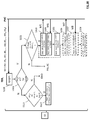
- FIGS. 3A to 3C represent the main steps of a method of communication by video conference in a particular embodiment of the invention
- FIGS. 4A to 4C represent respectively three modes of display implemented in the method of communication by video conference of FIGS. 3A to 3C .
- FIG. 1 represents an environment in which the method of communication by video conference according to the invention is implemented.
- FIG. 1 For the sake of clarity in FIG. 1 , certain well-known elements of this environment are not represented. Such elements are for example servers, nodes, base stations, gateways or else other entities of the telecommunications network which is used in this environment.
- FIG. 1 In FIG. 1 are represented:
- Each communication terminal comprises a connection interface for connecting to the communication network RC, via for example a local network (not represented), for example wireless, in particular of the WiFi or PLC type (abbreviation of “power-line communication”).
- the connection interface is for example, of x-DSL, fiber or else 3G, 4G, 5G, etc type.
- An exemplary connection interface is a web browser.
- a given communication terminal TER i is for example non-exhaustively:
- the communication terminal TER i comprises:
- the communication terminal TER i comprises physical and/or software resources, in particular a processing module MT for implementing the method of communication by video conference according to the invention, which will be described hereinbelow.
- the processing module MT contains a processor PROC driven by a computer program PG.
- the code instructions of the computer program PG are for example loaded into a RAM memory, denoted MR, before being executed by the processing module MT.
- the communication terminal TER i also comprises a voice activity detection module DAC driven by the processor PROC of the processing module MT.
- module used in the present patent application can correspond either to a software component or to a hardware component or a set of hardware components and software components, a software component itself corresponding to one or more computer programs or subprograms or more generally to any element of a program able to implement a function or a set of functions such as are described for the modules concerned.
- a hardware component corresponds to any element of a hardware set (or assembly) able to implement a function or a set of functions for the module concerned (integrated circuit, chip card, memory card, etc.).
- FIGS. 3A and 3B the progression of a method of communication by video conference according to the invention is now described, implementing voice activity detection deployed in at least one of the communication terminals TER 1 , TER 2 , . . . , TER i , . . . , TER j , . . . , TER k , . . . , TER N of FIG. 1 , such as for example the communication terminal TER i represented in FIG. 2 .
- the method of communication by video conference firstly implements an initialization S 1 of the video conference.
- one of the communication terminals TER 1 , TER 2 , . . . , TER i , . . . , TER j , . . . , TER k , . . . , TER N of FIG. 1 dispatches, at S 100 , to the video conference management bridge PCV, via the network RC, a message M 1 requesting creation of a video conference, said message M 1 conventionally comprising an identifier associated with the terminal which dispatches the message and an identifier associated with each terminal of a user invited to the video conference.
- such an identifier can be:
- the N terminals TER 1 , TER 2 , . . . , TER i , . . . , TER j , . . . , TER k , . . . , TER N are associated respectively with N identifiers ID 1 , ID 2 , . . . , ID i , . . . , ID j , . . . , ID k , . . . , ID N of the aforementioned type. It is for example assumed that the N communication terminals participate in the video conference requested by the requesting terminal.
- the video conference management bridge PVC receives the message M 1 .
- the video conference management bridge PVC extracts the identifiers ID 1 , ID 2 , . . . , ID i , . . . , ID N from the message M 1 .
- the video conference management bridge PVC dispatches a message M 2 of invitation to the video conference proposed by the requesting communication terminal to each communication terminal associated with a corresponding identifier extracted at S 102 .
- the message M 2 contains an Internet link (LI) to the video conference to be established.
- LI Internet link
- each of the N terminals receives the message M 2 .
- each of the N terminals connects to the video conference bridge PVC with the aid of the Internet link contained in the message M 2 .
- the N terminals dispatch respectively, destined for the video conference management bridge PCV, N audio video streams F 1 , F 2 , . . . , F i , . . . , F j , . . . , F k , . . . , F N representing respectively the N users U 1 , U 2 , . . . , U i , . . . , U j , . . . , U k , . . . , U N of these terminals.
- the video conference management bridge PVC receives the N audio video streams F 1 , F 2 , . . . , F i , . . . , F j , . . . , F k , . . . , F N .
- the video conference management bridge PVC generates a mosaic video VM 1 containing the N audio video streams received at S 106 .
- the mosaic video VM 1 is configured in such a way that, at the start of a video conference, the N audio video streams are displayed on the screen EC ( FIG. 2 ) of a given communication terminal TER i , in respectively N windows of equal size.
- the video conference management bridge PVC transmits a message M 3 to each of the N invited terminals, the message M 3 containing the mosaic video VM 1 .
- each of the N communication terminals receives the message M 3 .
- the decoder DEC of each of the N communication terminals decodes the mosaic video VM 1 contained in the received message M 3 .
- the N audio video streams are displayed on the screen EC of each of the N terminals, respectively in N windows of equal size.
- each of the N terminals undertakes, at S 2 , a downloading from the video conference management bridge PVC, of a procedure for detecting voice activity of each of the N users.
- Such a downloading is transparent to the users U 1 to U N .
- the voice activity detection procedure is downloaded into the voice activity detection module DAC such as represented in FIG. 2 .
- the voice activity detection procedure is for example encapsulated in the invitation message M 2 dispatched at S 103 to each of the N terminals or else in the message M 3 dispatched at S 108 .
- the voice activity detection procedure is downloaded automatically by each of the N terminals upon their connection S 105 to the video conference management bridge PVC.
- a detection of voice activity S 3 of at the least one of the N users is implemented at a current instant, individually, in each of the N communication terminals participating in the video conference.
- the voice activity detection S 3 progresses as follows at a current instant t.
- the terminal TER i receives, from the video conference management bridge PCV, via the network RC, a message M 4 which contains:
- the information item IAV i of a given user U i takes a first value V 1 representative of the presence of voice activity of this user or a second value V 2 representative of the absence of voice activity of this user.
- such an information item is determined at the current instant by the video conference management bridge PVC, by analyzing the audio packets contained in the N audio video streams received respectively from the N terminals.
- such an information item is determined individually at the current instant by each of the N communication terminals and then dispatched by each terminal to the video conference management bridge PVC which then concatenates each information item received in the message M 4 in association with each corresponding identifier.
- the module DAC ( FIG. 2 ) of the terminal TER i extracts the first information item IAV 1 from the message M 4 received and determines whether the first information item IAV 1 is at the first value V 1 or at the second value V 2 , and then recommences these operations for the second information item IAV 2 and so on and so forth until the information item IAV N .
- the terminal TER i determines at S 302 whether the information item IVA j has been at the value V 1 since a predetermined instant t P .
- the terminal TER i dispatches, at S 303 , to the video conference management bridge PVC, via the network RC, a message M 5 requesting the audio video stream F j associated with the user U j who has been detected as speaking since the predetermined instant t P , as main audio video stream to be displayed.
- the message M 5 contains the identifier ID j of the user U j .
- the video conference management bridge PVC dispatches to the terminal TER i , via the network RC, a message M 6 containing the main audio video stream F j .
- the main audio video stream F j is received by the reception module REC ( FIG. 2 ) of the terminal TER i .
- the main audio video stream F j is displayed on the screen EC of the terminal TER i .
- only the main audio video stream F j is requested on completion of the determination operation S 302 .
- the audio video stream F j is then displayed in full screen on the screen EC of the terminal TER i .
- the terminal TER i furthermore dispatches, at S 306 , to the video conference management bridge PVC, via the network RC, a message M 7 requesting the N ⁇ 1 other audio video streams associated with the N ⁇ 1 other users who have not been detected as speaking since the predetermined instant t P , as respectively N ⁇ 1 secondary audio video streams to be displayed.
- the message M 7 contains the N ⁇ 1 other identifiers associated respectively with the N ⁇ 1 other users.
- the terminal TER i could dispense with requesting, as secondary audio video stream, the audio video stream relating to the user U i , and this would make it possible to reduce the resources in terms of bandwidth of the communication network RC.
- the video conference management bridge PVC dispatches to the terminal TER i , via the network RC, a message M 8 containing the N ⁇ 1 secondary audio video streams.
- the N ⁇ 1 secondary audio video streams are received by the reception module REC ( FIG. 2 ) of the terminal TER i .
- the N ⁇ 1 secondary audio video streams are displayed on the screen EC of the terminal TER i , in a less visible manner than the main audio video stream F j .
- the operations S 306 to S 308 are implemented simultaneously with the operations S 303 to S 305 or else subsequent to them.
- the main audio video stream F j is then displayed in a window disposed for example at the center of the screen EC of the terminal TER i , the N ⁇ 1 secondary audio video streams being displayed around this window, in windows of equal size but smaller than the center window.
- the terminal TER i can dispense with requesting at S 306 the N ⁇ 1 secondary audio video streams.
- the message M 5 dispatched at S 303 could for example comprise an information item which indicates to the video conference management bridge PVC whether it returns to the terminal TER i only the main audio video stream F j or else the main audio video stream F j and the N ⁇ 1 secondary audio video streams.
- Such an information item could be a bit set for example to 1 to request only the main audio video stream or to 0 to request the main audio video stream F j and the N ⁇ 1 secondary audio video streams.
- the terminal TER i implements the operations illustrated in FIG. 3C .
- the module DAC of the terminal TER i compares the instant t 1 , preceding the current instant t, from which the information item IVA j passed from the second value V 2 to the first value V 1 , with the instant t 2 preceding the current instant t, from which the information item IVA k passed from the second value V 2 to the first value V 1 .
- the module DAC ( FIG. 2 ) of the terminal TER i selects from among the instants t 1 and t 2 , the one which is closer to the current instant t.
- the terminal TER i dispatches, at S 311 , to the video conference management bridge PVC, via the network RC, a message M 9 requesting the audio video stream F k associated with the user U k who has been detected as speaking since the instant t 2 closer to the current instant t, as main audio video stream to be displayed.
- the message M 9 contains the identifier ID k of the user U k .
- the video conference management bridge PVC dispatches to the terminal TER i , via the network RC, a message M 10 containing the main audio video stream F k .
- the main audio video stream F k is received by the reception module REC ( FIG. 2 ) of the terminal TER i .
- the main audio video stream F k is displayed on the screen EC of the terminal TER i .
- the audio video stream F k is for example displayed in full screen on the screen EC of the terminal TER i , in the same way as in the example of FIG. 4B .
- the terminal TER i furthermore dispatches, at S 314 , to the video conference management bridge PVC, via the network RC, a message M 11 requesting the N ⁇ k other audio video streams associated with the N ⁇ k other users, as respectively N ⁇ k secondary audio video streams to be displayed.
- the message M 11 contains the N ⁇ k other identifiers associated respectively with the N ⁇ k other users.
- the terminal TER i could dispense with requesting, as secondary audio video stream, the audio video stream relating to the user U i , and this would make it possible to reduce the resources in terms of bandwidth of the communication network RC.
- the operation S 314 could furthermore be optional.
- the video conference management bridge PVC dispatches to the terminal TER i , via the network RC, a message M 12 containing the N ⁇ k secondary audio video streams.
- the N ⁇ k secondary audio video streams are received by the reception module REC ( FIG. 2 ) of the terminal TER i .
- the N ⁇ k secondary audio video streams are displayed on the screen EC of the terminal TER i , in a less visible manner than the main audio video stream F k .
- the operations S 314 to S 316 are implemented simultaneously with the operations S 311 to S 313 or else subsequent to them.
- the N ⁇ k secondary audio video streams are for example displayed on the screen EC of the terminal TER i , around the central window in which the main audio video stream F k is displayed, in the same way as in the example of FIG. 4C .
- the terminal TER i dispatches, at S 317 , to the video conference management bridge PVC, via the network RC, a message M 13 requesting the audio video stream F j associated with the user U j who has been detected as speaking since the instant t 1 closer to the current instant t, as main audio video stream to be displayed.
- the message M 13 contains the identifier ID j of the user U j .
- the video conference management bridge PVC dispatches to the terminal TER i , via the network RC, a message M 14 containing the main audio video stream F j .
- the main audio video stream F j is received by the reception module REC ( FIG. 2 ) of the terminal TER i .
- the main audio video stream F j is displayed on the screen EC of the terminal TER i .
- the audio video stream F j is for example displayed in full screen on the screen EC of the terminal TER i , in the same way as in the example of FIG. 4B .
- the terminal TER i furthermore dispatches, at S 320 , to the video conference management bridge PVC, via the network RC, a message M 15 requesting the N ⁇ j other audio video streams associated with the N ⁇ j other users, as respectively N ⁇ j secondary audio video streams to be displayed.
- the message M 15 contains the N ⁇ j other identifiers associated respectively with the N ⁇ j other users.
- the terminal TER i could dispense with requesting, as secondary audio video stream, the audio video stream relating to the user U i , and this would make it possible to reduce the resources in terms of bandwidth of the communication network RC.
- the operation S 320 could furthermore be optional.
- the video conference management bridge PVC dispatches to the terminal TER i , via the network RC, a message M 16 containing the N ⁇ j secondary audio video streams.
- the N ⁇ j secondary audio video streams are received by the reception module REC ( FIG. 2 ) of the terminal TER i .
- the N ⁇ j secondary audio video streams are displayed on the screen EC of the terminal TER i , in a less visible manner than the main audio video stream F j .
- the operations S 320 to S 322 are implemented simultaneously with the operations S 317 to S 319 or else subsequent to them.
- the N ⁇ j secondary audio video streams are for example displayed on the screen EC of the terminal TER i , around the central window in which the main audio video stream F j is displayed, in the same way as in the example of FIG. 4C .
- the module DAC ( FIG. 2 ) of the terminal TER i determines that none of the information items IAV 1 , IAV 2 , . . . , IAV i , . . . , IAV N of the message M 4 received have been at the first value V 1 since the predetermined instant t P , the module DAC determines at S 323 whether the information items IAV 1 , IAV 2 , . . . , IAV i , . . . , IAV N of the message M 4 received have been at the second value V 2 since the predetermined instant t P .
- the terminal TER i does not request any audio video stream to be displayed from the video conference management bridge PVC.
- the stream F j continues to be displayed in the same manner at the current instant t, as represented in FIG. 4B .
- the audio video stream F j was displayed as main stream, with the N ⁇ j secondary audio video streams displayed around the audio video stream F j , as represented in FIG. 4C , these N audio video streams continue, at S 324 , to be displayed in the same manner at the current instant t.
- the module DAC of the terminal TER i determines that all the information items IAV 1 , IAV 2 , IAV i , . . . , IAV N of the message M 4 received have not been at the second value V 2 since the predetermined instant t P , the voice activity detection method is ended and the terminal TER i places itself on standby awaiting receipt at the following instant t+1 of a new message, from the video conference management bridge PVC, which contains new voice activity information items IAV 1 , IAV 2 , . . . , IAV i , . . . , IAV N relating respectively to the N users.
Landscapes
- Engineering & Computer Science (AREA)
- Multimedia (AREA)
- Signal Processing (AREA)
- Computer Networks & Wireless Communication (AREA)
- Audiology, Speech & Language Pathology (AREA)
- Health & Medical Sciences (AREA)
- Computational Linguistics (AREA)
- Human Computer Interaction (AREA)
- Physics & Mathematics (AREA)
- Acoustics & Sound (AREA)
- Business, Economics & Management (AREA)
- General Business, Economics & Management (AREA)
- Two-Way Televisions, Distribution Of Moving Picture Or The Like (AREA)
- Telephonic Communication Services (AREA)
Abstract
Description
-
- receive, from a device for processing N audio video streams emitted respectively by the N terminals, N information items relating respectively to the voice activity of the N users and associated respectively with N identifiers relating to said N corresponding users, each of the N information items taking a first value representative of the presence of voice activity or a second value representative of the absence of voice activity,
- for at least one of the N users, determine whether the received information item has or has not been at the same value since a predetermined instant preceding the current instant,
- only if the received information item has been at the first value since the predetermined instant, request from the processing device, by using the user identifier corresponding to said at least one of the N users, an audio video stream associated with said at least one of the N users, as main audio video stream to be displayed,
- receive the main audio video stream requested,
- display the audio video stream received as main audio video stream.
-
- compare the instant from which the information item received for the first user passed from the second value to the first value and the instant from which the information item received for the second user passed from the second value to the first value,
- request from the processing device, as main audio video stream to be displayed, an audio video stream associated with that of the first and second users for which the information item passed from the second value to the first value at the instant closest to the current instant, by using the corresponding user identifier,
- receive the main audio video stream requested,
- display the audio video stream received as main audio video stream.
-
- receive, from the audio video stream processing device, N−1 audio video streams associated respectively with the N−1 remaining users, as N−1 secondary audio video streams to be displayed,
- display said N−1 secondary audio video streams simultaneously with the main audio video stream.
-
- receive, from a device for processing N audio video streams emitted respectively by the N terminals, N information items relating respectively to the voice activity of the N users and associated respectively with N identifiers relating to said N corresponding users, each of the N information items taking a first value representative of the presence of voice activity or a second value representative of the absence of voice activity,
- for at least one of the N users, determine whether the received information item has or has not been at the same value since a predetermined instant preceding the current instant,
- only if the received information item has been at the first value since the predetermined instant, request from the processing device, by using the user identifier corresponding to said at least one of the N users, an audio video stream associated with said at least one of the N users, as main audio video stream to be displayed,
- receive the main audio video stream requested,
- display the audio video stream received as main audio video stream.
-
- if for at least two first and second users from among the N users, the corresponding voice activity information item received has been at the first value since the predetermined instant,
- compare the instant from which the information item received for the first user passed from the second value to the first value and the instant from which the information item received for the second user passed from the second value to the first value,
- request from the processing device, as main audio video stream to be displayed, an audio video stream associated with that of the first and second users for which the information item passed from the second value to the first value at the instant closest to the current instant, by using the corresponding user identifier,
- receive the main audio video stream requested,
- display the audio video stream received as main audio video stream.
-
- receive, from the audio video stream processing device, N−1 audio video streams associated respectively with the N−1 remaining users, as N−1 secondary audio video streams to be displayed,
- display the N−1 secondary audio video streams simultaneously with the main audio video stream.
-
- an audio video stream processing device PVC, such as for example a video conference management bridge,
- a set of N communication terminals TER1, TER2, . . . , TERi, . . . , TERj, . . . , TERk, . . . , TERN, such that 1≤i≤j≤k≤N, associated respectively with N users U1, U2, . . . , Ui, . . . , Uj, . . . , Uk, . . . , UN and able to connect to the bridge PVC, via a communication network RC such as for example of IP type (abbreviation of “Internet Protocol”).
-
- a mobile telephone, and/or
- a smartphone (“intelligent telephone”), and/or
- a tablet, and/or
- a laptop computer, and/or
- a personal computer of PC type, and/or
- a connected television,
- etc. . . .
-
- a connection interface IC which is adapted to communicate, via the communication network RC, according for example to the http protocol (abbreviation of “HyperText Transfer Protocol”), with the video conference management bridge PVC of
FIG. 1 , - a reception module REC for receiving audio video streams emitted from the video conference management bridge,
- an interface IT for processing the user interactions,
- a viewing screen EC,
- a loudspeaker HP,
- a camera CAM,
- an interface DEC for audio/video decoding of the contents of text, audio, video or audiovisual type, said interface being adapted to transmit the decoded signals to the screen EC or in the loudspeaker HP.
- a connection interface IC which is adapted to communicate, via the communication network RC, according for example to the http protocol (abbreviation of “HyperText Transfer Protocol”), with the video conference management bridge PVC of
-
- the call identifier MSISDN corresponding in a unique manner to the SIM (“Subscriber Identity Module”) card which is provided by the operator of the communication network with which the user of one of the N communication terminals is registered,
- a URI identifier (abbreviation of “Uniform Resource Identifier”),
- an electronic messaging address,
- etc. . . .
-
- an information item IAV1 relating to the voice activity of the user U1 in association with the identifier ID1;
- an information item IAV2 relating to the voice activity of the user U2 in association with the identifier ID2,
- . . . ,
- an information item IAVi relating to the voice activity of the user Ui in association with the identifier IDi,
- . . . ,
- an information item IAVj relating to the voice activity of the user Uj in association with the identifier IDj,
- . . . ,
- an information item IAVk relating to the voice activity of the user Uk in association with the identifier IDk,
- . . . ,
- an information item IAVN relating to the voice activity of the user UN in association with the identifier IDN.
Claims (12)
Applications Claiming Priority (3)
| Application Number | Priority Date | Filing Date | Title |
|---|---|---|---|
| FR1761217A FR3074392A1 (en) | 2017-11-27 | 2017-11-27 | COMMUNICATION BY VIDEO CONFERENCE |
| FR1761217 | 2017-11-27 | ||
| PCT/FR2018/052822 WO2019102105A1 (en) | 2017-11-27 | 2018-11-13 | Video conference communication |
Publications (2)
| Publication Number | Publication Date |
|---|---|
| US20210037211A1 US20210037211A1 (en) | 2021-02-04 |
| US11025864B2 true US11025864B2 (en) | 2021-06-01 |
Family
ID=61187461
Family Applications (1)
| Application Number | Title | Priority Date | Filing Date |
|---|---|---|---|
| US16/766,249 Active US11025864B2 (en) | 2017-11-27 | 2018-11-13 | Video conference communication |
Country Status (4)
| Country | Link |
|---|---|
| US (1) | US11025864B2 (en) |
| EP (1) | EP3718301B1 (en) |
| FR (1) | FR3074392A1 (en) |
| WO (1) | WO2019102105A1 (en) |
Families Citing this family (1)
| Publication number | Priority date | Publication date | Assignee | Title |
|---|---|---|---|---|
| US12361963B2 (en) * | 2021-03-30 | 2025-07-15 | Avaya Management L.P. | Detection of audio issues on a communication session from video analysis |
Citations (5)
| Publication number | Priority date | Publication date | Assignee | Title |
|---|---|---|---|---|
| US20050099492A1 (en) | 2003-10-30 | 2005-05-12 | Ati Technologies Inc. | Activity controlled multimedia conferencing |
| US20070211141A1 (en) | 2006-03-09 | 2007-09-13 | Bernd Christiansen | System and method for dynamically altering videoconference bit rates and layout based on participant activity |
| US20120182381A1 (en) * | 2010-10-14 | 2012-07-19 | Umberto Abate | Auto Focus |
| US20140114664A1 (en) | 2012-10-20 | 2014-04-24 | Microsoft Corporation | Active Participant History in a Video Conferencing System |
| US20140218464A1 (en) * | 2011-09-19 | 2014-08-07 | Telefonaktiebolaget L M Ericsson (Publ) | User interface control in a multimedia conference system |
-
2017
- 2017-11-27 FR FR1761217A patent/FR3074392A1/en not_active Withdrawn
-
2018
- 2018-11-13 US US16/766,249 patent/US11025864B2/en active Active
- 2018-11-13 WO PCT/FR2018/052822 patent/WO2019102105A1/en not_active Ceased
- 2018-11-13 EP EP18816182.2A patent/EP3718301B1/en active Active
Patent Citations (5)
| Publication number | Priority date | Publication date | Assignee | Title |
|---|---|---|---|---|
| US20050099492A1 (en) | 2003-10-30 | 2005-05-12 | Ati Technologies Inc. | Activity controlled multimedia conferencing |
| US20070211141A1 (en) | 2006-03-09 | 2007-09-13 | Bernd Christiansen | System and method for dynamically altering videoconference bit rates and layout based on participant activity |
| US20120182381A1 (en) * | 2010-10-14 | 2012-07-19 | Umberto Abate | Auto Focus |
| US20140218464A1 (en) * | 2011-09-19 | 2014-08-07 | Telefonaktiebolaget L M Ericsson (Publ) | User interface control in a multimedia conference system |
| US20140114664A1 (en) | 2012-10-20 | 2014-04-24 | Microsoft Corporation | Active Participant History in a Video Conferencing System |
Non-Patent Citations (1)
| Title |
|---|
| International Search Report and Written Opinion dated Mar. 8, 2019 for Application No. PCT/FR2018/052822. |
Also Published As
| Publication number | Publication date |
|---|---|
| FR3074392A1 (en) | 2019-05-31 |
| EP3718301A1 (en) | 2020-10-07 |
| US20210037211A1 (en) | 2021-02-04 |
| WO2019102105A1 (en) | 2019-05-31 |
| EP3718301B1 (en) | 2023-08-23 |
Similar Documents
| Publication | Publication Date | Title |
|---|---|---|
| CN103716709B (en) | Method and device for same screen interaction | |
| US10311877B2 (en) | Performing tasks and returning audio and visual answers based on voice command | |
| US9591261B2 (en) | Video telephone device and video telephone processing method | |
| US8842153B2 (en) | Automatically customizing a conferencing system based on proximity of a participant | |
| US8717400B2 (en) | Automatically moving a conferencing based on proximity of a participant | |
| US20130080525A1 (en) | Systems and methods for transferring application state between devices based on gestural input | |
| EP2854342A1 (en) | Multi-screen interaction method, apparatus, and terminal device | |
| US20090089882A1 (en) | Methods and Apparatus for Restricting End-User Access to Content | |
| CN102769783A (en) | Method and device for processing multimedia information | |
| US20090296906A1 (en) | Image sharing system | |
| WO2009087457A2 (en) | Unified communications systems and methods | |
| CN110557672B (en) | Television program sharing method, television and storage medium | |
| CN102571964A (en) | Multi-screen interaction method and multi-screen interaction system | |
| CN106610835A (en) | Identification code processing method, device and computer equipment | |
| US20210037209A1 (en) | Video call mediating apparatus, method and computer readable recording medium thereof | |
| US10609272B2 (en) | Method, device and computer readable medium for communication using smart video cameras | |
| US10235698B2 (en) | Sound code recognition for broadcast media | |
| CN105979397A (en) | Cross-equipment group chatting method and system | |
| CN108235111A (en) | Information sharing method and Intelligent set top box | |
| US20210037211A1 (en) | Video conference communication | |
| US10491681B2 (en) | Method and a device for enriching a call | |
| US9059860B2 (en) | Techniques for announcing conference attendance changes in multiple languages | |
| US10104422B2 (en) | Multimedia playing control method, apparatus for the same and system | |
| WO2014194319A1 (en) | Systems and methods for room system pairing in video conferencing | |
| CN109561081B (en) | Mobile terminal video conference method and device, storage medium and server |
Legal Events
| Date | Code | Title | Description |
|---|---|---|---|
| FEPP | Fee payment procedure |
Free format text: ENTITY STATUS SET TO UNDISCOUNTED (ORIGINAL EVENT CODE: BIG.); ENTITY STATUS OF PATENT OWNER: LARGE ENTITY |
|
| STPP | Information on status: patent application and granting procedure in general |
Free format text: NOTICE OF ALLOWANCE MAILED -- APPLICATION RECEIVED IN OFFICE OF PUBLICATIONS |
|
| AS | Assignment |
Owner name: ORANGE, FRANCE Free format text: ASSIGNMENT OF ASSIGNORS INTEREST;ASSIGNORS:GODIER, JULIEN;FERRIEUX, ALEXANDRE;HAMEL, MATTHIAS;SIGNING DATES FROM 20201029 TO 20201124;REEL/FRAME:055118/0909 |
|
| STPP | Information on status: patent application and granting procedure in general |
Free format text: PUBLICATIONS -- ISSUE FEE PAYMENT RECEIVED |
|
| STPP | Information on status: patent application and granting procedure in general |
Free format text: PUBLICATIONS -- ISSUE FEE PAYMENT VERIFIED |
|
| STPP | Information on status: patent application and granting procedure in general |
Free format text: AWAITING TC RESP, ISSUE FEE PAYMENT VERIFIED |
|
| STPP | Information on status: patent application and granting procedure in general |
Free format text: PUBLICATIONS -- ISSUE FEE PAYMENT VERIFIED |
|
| STCF | Information on status: patent grant |
Free format text: PATENTED CASE |
|
| MAFP | Maintenance fee payment |
Free format text: PAYMENT OF MAINTENANCE FEE, 4TH YEAR, LARGE ENTITY (ORIGINAL EVENT CODE: M1551); ENTITY STATUS OF PATENT OWNER: LARGE ENTITY Year of fee payment: 4 |