US11024697B2 - Display apparatus and method of manufacturing the same - Google Patents

Display apparatus and method of manufacturing the same Download PDF

Info

Publication number
US11024697B2
US11024697B2 US16/717,171 US201916717171A US11024697B2 US 11024697 B2 US11024697 B2 US 11024697B2 US 201916717171 A US201916717171 A US 201916717171A US 11024697 B2 US11024697 B2 US 11024697B2
Authority
US
United States
Prior art keywords
conductive pattern
layer
clk
disposed
clock signal
Prior art date
Legal status (The legal status is an assumption and is not a legal conclusion. Google has not performed a legal analysis and makes no representation as to the accuracy of the status listed.)
Active
Application number
US16/717,171
Other versions
US20200219960A1 (en
Inventor
Junhyun Park
Dongwoo Kim
Sungjae Moon
Kangmoon Jo
Current Assignee (The listed assignees may be inaccurate. Google has not performed a legal analysis and makes no representation or warranty as to the accuracy of the list.)
Samsung Display Co Ltd
Original Assignee
Samsung Display Co Ltd
Priority date (The priority date is an assumption and is not a legal conclusion. Google has not performed a legal analysis and makes no representation as to the accuracy of the date listed.)
Filing date
Publication date
Application filed by Samsung Display Co Ltd filed Critical Samsung Display Co Ltd
Assigned to SAMSUNG DISPLAY CO., LTD. reassignment SAMSUNG DISPLAY CO., LTD. ASSIGNMENT OF ASSIGNORS INTEREST (SEE DOCUMENT FOR DETAILS). Assignors: JO, KANGMOON, KIM, DONGWOO, Moon, Sungjae, PARK, JUNHYUN
Publication of US20200219960A1 publication Critical patent/US20200219960A1/en
Application granted granted Critical
Publication of US11024697B2 publication Critical patent/US11024697B2/en
Active legal-status Critical Current
Anticipated expiration legal-status Critical

Links

Images

Classifications

    • H01L27/3276
    • GPHYSICS
    • G09EDUCATION; CRYPTOGRAPHY; DISPLAY; ADVERTISING; SEALS
    • G09GARRANGEMENTS OR CIRCUITS FOR CONTROL OF INDICATING DEVICES USING STATIC MEANS TO PRESENT VARIABLE INFORMATION
    • G09G3/00Control arrangements or circuits, of interest only in connection with visual indicators other than cathode-ray tubes
    • G09G3/20Control arrangements or circuits, of interest only in connection with visual indicators other than cathode-ray tubes for presentation of an assembly of a number of characters, e.g. a page, by composing the assembly by combination of individual elements arranged in a matrix no fixed position being assigned to or needed to be assigned to the individual characters or partial characters
    • H01L27/3258
    • H01L27/3262
    • H01L51/5237
    • HELECTRICITY
    • H10SEMICONDUCTOR DEVICES; ELECTRIC SOLID-STATE DEVICES NOT OTHERWISE PROVIDED FOR
    • H10DINORGANIC ELECTRIC SEMICONDUCTOR DEVICES
    • H10D86/00Integrated devices formed in or on insulating or conducting substrates, e.g. formed in silicon-on-insulator [SOI] substrates or on stainless steel or glass substrates
    • H10D86/40Integrated devices formed in or on insulating or conducting substrates, e.g. formed in silicon-on-insulator [SOI] substrates or on stainless steel or glass substrates characterised by multiple TFTs
    • H10D86/441Interconnections, e.g. scanning lines
    • H10D86/443Interconnections, e.g. scanning lines adapted for preventing breakage, peeling or short circuiting
    • HELECTRICITY
    • H10SEMICONDUCTOR DEVICES; ELECTRIC SOLID-STATE DEVICES NOT OTHERWISE PROVIDED FOR
    • H10DINORGANIC ELECTRIC SEMICONDUCTOR DEVICES
    • H10D86/00Integrated devices formed in or on insulating or conducting substrates, e.g. formed in silicon-on-insulator [SOI] substrates or on stainless steel or glass substrates
    • H10D86/40Integrated devices formed in or on insulating or conducting substrates, e.g. formed in silicon-on-insulator [SOI] substrates or on stainless steel or glass substrates characterised by multiple TFTs
    • H10D86/60Integrated devices formed in or on insulating or conducting substrates, e.g. formed in silicon-on-insulator [SOI] substrates or on stainless steel or glass substrates characterised by multiple TFTs wherein the TFTs are in active matrices
    • HELECTRICITY
    • H10SEMICONDUCTOR DEVICES; ELECTRIC SOLID-STATE DEVICES NOT OTHERWISE PROVIDED FOR
    • H10KORGANIC ELECTRIC SOLID-STATE DEVICES
    • H10K50/00Organic light-emitting devices
    • H10K50/80Constructional details
    • H10K50/84Passivation; Containers; Encapsulations
    • HELECTRICITY
    • H10SEMICONDUCTOR DEVICES; ELECTRIC SOLID-STATE DEVICES NOT OTHERWISE PROVIDED FOR
    • H10KORGANIC ELECTRIC SOLID-STATE DEVICES
    • H10K59/00Integrated devices, or assemblies of multiple devices, comprising at least one organic light-emitting element covered by group H10K50/00
    • H10K59/10OLED displays
    • H10K59/12Active-matrix OLED [AMOLED] displays
    • H10K59/121Active-matrix OLED [AMOLED] displays characterised by the geometry or disposition of pixel elements
    • H10K59/1213Active-matrix OLED [AMOLED] displays characterised by the geometry or disposition of pixel elements the pixel elements being TFTs
    • HELECTRICITY
    • H10SEMICONDUCTOR DEVICES; ELECTRIC SOLID-STATE DEVICES NOT OTHERWISE PROVIDED FOR
    • H10KORGANIC ELECTRIC SOLID-STATE DEVICES
    • H10K59/00Integrated devices, or assemblies of multiple devices, comprising at least one organic light-emitting element covered by group H10K50/00
    • H10K59/10OLED displays
    • H10K59/12Active-matrix OLED [AMOLED] displays
    • H10K59/121Active-matrix OLED [AMOLED] displays characterised by the geometry or disposition of pixel elements
    • H10K59/1216Active-matrix OLED [AMOLED] displays characterised by the geometry or disposition of pixel elements the pixel elements being capacitors
    • HELECTRICITY
    • H10SEMICONDUCTOR DEVICES; ELECTRIC SOLID-STATE DEVICES NOT OTHERWISE PROVIDED FOR
    • H10KORGANIC ELECTRIC SOLID-STATE DEVICES
    • H10K59/00Integrated devices, or assemblies of multiple devices, comprising at least one organic light-emitting element covered by group H10K50/00
    • H10K59/10OLED displays
    • H10K59/12Active-matrix OLED [AMOLED] displays
    • H10K59/123Connection of the pixel electrodes to the thin film transistors [TFT]
    • HELECTRICITY
    • H10SEMICONDUCTOR DEVICES; ELECTRIC SOLID-STATE DEVICES NOT OTHERWISE PROVIDED FOR
    • H10KORGANIC ELECTRIC SOLID-STATE DEVICES
    • H10K59/00Integrated devices, or assemblies of multiple devices, comprising at least one organic light-emitting element covered by group H10K50/00
    • H10K59/10OLED displays
    • H10K59/12Active-matrix OLED [AMOLED] displays
    • H10K59/124Insulating layers formed between TFT elements and OLED elements
    • HELECTRICITY
    • H10SEMICONDUCTOR DEVICES; ELECTRIC SOLID-STATE DEVICES NOT OTHERWISE PROVIDED FOR
    • H10KORGANIC ELECTRIC SOLID-STATE DEVICES
    • H10K59/00Integrated devices, or assemblies of multiple devices, comprising at least one organic light-emitting element covered by group H10K50/00
    • H10K59/10OLED displays
    • H10K59/12Active-matrix OLED [AMOLED] displays
    • H10K59/131Interconnections, e.g. wiring lines or terminals
    • HELECTRICITY
    • H10SEMICONDUCTOR DEVICES; ELECTRIC SOLID-STATE DEVICES NOT OTHERWISE PROVIDED FOR
    • H10KORGANIC ELECTRIC SOLID-STATE DEVICES
    • H10K59/00Integrated devices, or assemblies of multiple devices, comprising at least one organic light-emitting element covered by group H10K50/00
    • H10K59/30Devices specially adapted for multicolour light emission
    • H10K59/35Devices specially adapted for multicolour light emission comprising red-green-blue [RGB] subpixels
    • GPHYSICS
    • G09EDUCATION; CRYPTOGRAPHY; DISPLAY; ADVERTISING; SEALS
    • G09GARRANGEMENTS OR CIRCUITS FOR CONTROL OF INDICATING DEVICES USING STATIC MEANS TO PRESENT VARIABLE INFORMATION
    • G09G2300/00Aspects of the constitution of display devices
    • G09G2300/04Structural and physical details of display devices
    • G09G2300/0404Matrix technologies
    • GPHYSICS
    • G09EDUCATION; CRYPTOGRAPHY; DISPLAY; ADVERTISING; SEALS
    • G09GARRANGEMENTS OR CIRCUITS FOR CONTROL OF INDICATING DEVICES USING STATIC MEANS TO PRESENT VARIABLE INFORMATION
    • G09G2300/00Aspects of the constitution of display devices
    • G09G2300/04Structural and physical details of display devices
    • G09G2300/0421Structural details of the set of electrodes
    • G09G2300/0426Layout of electrodes and connections
    • GPHYSICS
    • G09EDUCATION; CRYPTOGRAPHY; DISPLAY; ADVERTISING; SEALS
    • G09GARRANGEMENTS OR CIRCUITS FOR CONTROL OF INDICATING DEVICES USING STATIC MEANS TO PRESENT VARIABLE INFORMATION
    • G09G2310/00Command of the display device
    • G09G2310/02Addressing, scanning or driving the display screen or processing steps related thereto
    • G09G2310/0264Details of driving circuits
    • G09G2310/0286Details of a shift registers arranged for use in a driving circuit
    • GPHYSICS
    • G09EDUCATION; CRYPTOGRAPHY; DISPLAY; ADVERTISING; SEALS
    • G09GARRANGEMENTS OR CIRCUITS FOR CONTROL OF INDICATING DEVICES USING STATIC MEANS TO PRESENT VARIABLE INFORMATION
    • G09G2320/00Control of display operating conditions
    • G09G2320/02Improving the quality of display appearance
    • G09G2320/0223Compensation for problems related to R-C delay and attenuation in electrodes of matrix panels, e.g. in gate electrodes or on-substrate video signal electrodes
    • GPHYSICS
    • G09EDUCATION; CRYPTOGRAPHY; DISPLAY; ADVERTISING; SEALS
    • G09GARRANGEMENTS OR CIRCUITS FOR CONTROL OF INDICATING DEVICES USING STATIC MEANS TO PRESENT VARIABLE INFORMATION
    • G09G2330/00Aspects of power supply; Aspects of display protection and defect management
    • G09G2330/04Display protection
    • HELECTRICITY
    • H10SEMICONDUCTOR DEVICES; ELECTRIC SOLID-STATE DEVICES NOT OTHERWISE PROVIDED FOR
    • H10KORGANIC ELECTRIC SOLID-STATE DEVICES
    • H10K59/00Integrated devices, or assemblies of multiple devices, comprising at least one organic light-emitting element covered by group H10K50/00
    • H10K59/10OLED displays
    • H10K59/12Active-matrix OLED [AMOLED] displays
    • H10K59/131Interconnections, e.g. wiring lines or terminals
    • H10K59/1315Interconnections, e.g. wiring lines or terminals comprising structures specially adapted for lowering the resistance
    • HELECTRICITY
    • H10SEMICONDUCTOR DEVICES; ELECTRIC SOLID-STATE DEVICES NOT OTHERWISE PROVIDED FOR
    • H10KORGANIC ELECTRIC SOLID-STATE DEVICES
    • H10K59/00Integrated devices, or assemblies of multiple devices, comprising at least one organic light-emitting element covered by group H10K50/00
    • H10K59/80Constructional details
    • H10K59/87Passivation; Containers; Encapsulations

Definitions

  • Exemplary embodiments of the inventive concept are directed to a display apparatus. More particularly, exemplary embodiments of the inventive concept are directed to a display apparatus with improved display quality.
  • a cathode ray tube (CRT) display apparatus has been used in the past due to its performance and competitive price.
  • CRT display apparatus is large and lacks portability. Therefore display apparatuses such as a plasma display apparatus, a liquid crystal display apparatus or an organic light emitting display apparatus have become favored due to their small size, light weight and low-power-consumption.
  • a display apparatus includes a display area and a peripheral area that is a non-display area that surrounds the display area.
  • Various circuits and wirings that drive the display apparatus are disposed in the peripheral area.
  • Various efforts have been made to reduce the size of the peripheral area.
  • One or more exemplary embodiment of the inventive concept provides a display apparatus with a reduced peripheral area and improved display quality by reducing resistance of signal lines and parasitic capacitance.
  • a display apparatus includes a base substrate that includes a display area in which pixels are formed and a peripheral area that is a non-display area that surrounds the display area, where the peripheral area includes a first wiring area and a circuit area, a first conductive pattern layer disposed on the base substrate, a first insulating layer disposed on the first conductive pattern layer, a second conductive pattern layer disposed on the first insulating layer, a second insulating layer disposed on the second conductive pattern layer, and a third conductive pattern layer disposed on the second insulating layer.
  • a plurality of signal lines are disposed in the first wiring area and are spaced apart in a first direction and extend in a second direction substantially perpendicular to the first direction.
  • a gate signal generator is disposed in the circuit area and generates a gate signal and transmits the gate signal to the pixels.
  • a plurality of connecting lines are disposed in the peripheral area and extend in the first direction and respectively connect the signal lines to the gate signal generator.
  • the connecting lines are formed of a lowermost layer or an uppermost layer of the conductive pattern layers.
  • the signal lines are formed of at least two layers of the conductive pattern layers that overlap each other.
  • the display apparatus may further include a thin film transistor disposed in the display area.
  • the thin film transistor may include a lower conductive pattern disposed on the base substrate, an active pattern that overlaps the lower conductive pattern, a gate electrode disposed on the active pattern, and source and drain electrodes electrically connected to the active pattern.
  • the lower conductive pattern and the connecting lines may be formed of the first conductive pattern layer.
  • the gate electrode may be formed of the second conductive pattern layer.
  • the source and drain electrodes may be formed of the third conductive pattern layer.
  • Each of the signal lines may be formed of the second conductive pattern layer and the third conductive pattern layer.
  • the display apparatus may further include a lower conductive pattern disposed in the display area of the base substrate, and a thin film transistor disposed in the display area and that overlaps the lower conductive pattern.
  • the thin film transistor may include an active pattern that overlaps the lower conductive pattern, a gate electrode disposed on the active pattern, and source and drain electrodes electrically connected to the active pattern.
  • the lower conductive pattern may be formed of the first conductive pattern layer.
  • the gate electrode may be formed of the second conductive pattern layer.
  • the source and drain electrodes and the connecting lines may be formed of the third conductive pattern layer.
  • Each of the signal lines may be formed of the first and second conductive pattern layers.
  • the display apparatus may further include a third insulating layer disposed on the third conductive pattern layer, and a fourth conductive pattern layer disposed on the third insulating layer.
  • the signal lines may be formed of the first, second and third conductive pattern layers.
  • the connecting lines may be formed of the fourth conductive pattern layer.
  • the signal lines may be formed of the second, third and fourth conductive layers.
  • the connecting lines may be formed of the first conductive pattern layer.
  • the display apparatus may further include an insulating pattern having the same planar shape as the second conductive pattern layer disposed between the first insulating layer and the second conductive pattern layer.
  • a portion of the third conductive pattern layer may be electrically connected to a portion of the first conductive pattern layer through a contact hole that penetrates the second and first insulating layers.
  • a portion of the fourth conductive pattern layer may be electrically connected to a portion of the third conductive pattern layer through a contact hole that penetrates the third insulating layer.
  • the signal lines may be formed of the first and second conductive pattern layers.
  • the connecting lines may include two layers which are formed of the third and fourth conductive pattern layers and that overlap each other.
  • the signal lines may be formed of the third and fourth conductive pattern layers.
  • the connecting lines may include two layers which are formed of the first and second conductive patient layers and that overlap each other.
  • the display apparatus may further include an insulating pattern having the same planar shape as the second conductive pattern layer disposed between the first insulating layer and the second conductive pattern layer.
  • a portion of the third conductive pattern layer may be electrically connected to a portion of the first conductive pattern layer through a contact hole that penetrates the second and first insulating layers.
  • the peripheral area may further include a second wiring area disposed between the circuit area and the display area.
  • the display apparatus may further include a plurality of power supply lines disposed in the second wiring area and that are spaced apart in the first direction and that extend in the first direction, and a plurality of power supply connecting lines disposed in the peripheral area that connect the power supply lines to the gate signal generator and extend in the first direction.
  • the power supply connecting lines may be formed of the lowermost layer or the uppermost layer of the conductive pattern layers.
  • the power supply lines may be formed of at least two or more layers of the conductive pattern layers.
  • the display apparatus may further a third insulation layer disposed on the third conductive pattern layer, and a fourth conductive pattern layer disposed on the third insulation layer.
  • the power supply connecting line may be formed of the first conductive pattern layer or the fourth conductive pattern layer, and each of the power supply lines may be formed of the second to fourth conductive pattern layers or the first to third conductive pattern layers.
  • the display apparatus may further include a via insulating layer disposed on the second insulating layer, a first electrode disposed on the via insulating layer in the display area, a light emitting layer disposed on the first electrode, a second electrode disposed on the light emitting layer, and an ELVSS line in the second wiring area that overlaps at least two of the power supply lines.
  • the ELVSS line may be electrically connected to the second electrode.
  • the display apparatus may further include a shield wiring disposed on the base substrate adjacent to the signal lines.
  • the shield wiring may be formed of one or more of the first to third conductive pattern layers, and the signal lines are disposed between the shield wiring and the gate signal generator.
  • the display apparatus may further include a gate connecting line that connects the gate signal generator and the pixel.
  • the gate connecting line may be formed of a lowermost layer or an uppermost layer of the conductive pattern layers.
  • the signal lines may include a first portion and a second portion that overlaps the first portion.
  • the first portion and the second portion may be connected through a contact hole that penetrates an insulation layer between the first portion and the second portion.
  • a display apparatus includes a base substrate that includes a display area in which pixels are formed and a peripheral area that is a non-display area that surrounds the display area, where the peripheral area includes a first wiring area and a circuit area, an active pattern disposed on the base substrate, a gate insulating layer disposed on the active pattern, a gate conductive pattern layer disposed on the gate insulating layer, an interlayer insulating layer disposed on the gate conductive pattern layer, a data conductive pattern layer disposed on the interlayer insulating layer, a plurality of signal lines disposed in the first wiring area, spaced apart in a first direction and that extend in a second direction substantially perpendicular to the first direction, a gate signal generator disposed in the circuit area and that transmits a gate signal to the pixels, and a plurality of connecting lines disposed in the peripheral area and that connect the signal lines to the gate signal generator and that extend in the first direction.
  • the connecting lines are formed of the active pattern.
  • the signal lines are
  • the connecting lines may be a portion of the active pattern doped with impurities.
  • a display apparatus includes a base substrate that includes a display area in which pixels are formed and a peripheral area that is a non-display area that surrounds the display area, where the peripheral area includes a first wiring area and a circuit area; a first conductive pattern layer disposed on the base substrate; a first insulating layer disposed on the first conductive pattern layer; a second conductive pattern layer disposed on the first insulating layer; a second insulating layer disposed on the second conductive pattern layer; a third conductive pattern layer disposed on the second insulating layer, a third insulating layer disposed on the third conductive pattern layer; a fourth conductive pattern layer disposed on the third insulating layer; a plurality of signal lines disposed in the first wiring area and that are spaced apart in a first direction and that extend in a second direction substantially perpendicular to the first direction; and a plurality of connecting lines disposed in the peripheral area and that extend in the first direction and are respectively connected to the signal
  • clock signal lines are formed of a plurality of conductive pattern layers, and the connecting lines that connect the clock signal lines and a gate signal generator are formed as the uppermost layer or the lowermost layer of the conductive pattern layers.
  • the resistance of the clock signal lines is reduced and parasitic capacitance between the clock signal lines and the connecting lines can be minimized.
  • FIG. 1 is a plan view of a display apparatus according to an exemplary embodiment of the inventive concept.
  • FIG. 2 illustrates circuits and wirings in an area A of a display apparatus of FIG. 1 .
  • FIG. 3 is a detailed plan view of a portion of a first wiring area LA 1 of FIG. 2 .
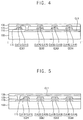
  • FIG. 4 is a cross-sectional view taken along a line I-I′ of FIG. 3 .
  • FIG. 5 is a cross-sectional view of a portion of a first wiring area of a display apparatus according to an exemplary embodiment of the inventive concept.
  • FIG. 6 is a detailed plan view of a portion of a first wiring area of a display apparatus according to an exemplary embodiment of the inventive concept.
  • FIG. 7 is a cross-sectional view taken along a line I-I′ of FIG. 6 .
  • FIG. 8 is a cross-sectional view of a portion of a first wiring area of a display apparatus according to an exemplary embodiment of the inventive concept.
  • FIG. 9 is a cross-sectional view of a portion of a first wiring area of a display apparatus according to an exemplary embodiment of the inventive concept.
  • FIG. 10 is a cross-sectional view of a portion of a first wiring area of a display apparatus according to an exemplary embodiment of the inventive concept.
  • FIG. 11 is a cross-sectional view of a portion of a first wiring area of a display apparatus according to an exemplary embodiment of the inventive concept.
  • FIG. 12 is a cross-sectional view of a portion of a first wiring area of a display apparatus according to an exemplary embodiment of the inventive concept.
  • FIG. 13 is a cross-sectional view of a portion of a first wiring area of a display apparatus according to an exemplary embodiment of the inventive concept.
  • FIG. 14 is a cross-sectional view of a portion of a first wiring area of a display apparatus according to an exemplary embodiment of the inventive concept.
  • FIG. 15 is a cross-sectional view of a portion of a first wiring area of a display apparatus according to an exemplary embodiment of the inventive concept.
  • FIG. 16 is a cross-sectional view taken along a line I-I′ of FIG. 15 .
  • FIG. 17 is a cross-sectional view of a stacked pixel structure in a display area of a display apparatus according to an exemplary embodiment of the inventive concept.
  • FIG. 18 is a cross-sectional view of a portion of a second wiring area LA 2 of a display apparatus according to an exemplary embodiment of the inventive concept;
  • FIG. 19 is a plan view of a display apparatus according to an exemplary embodiment of the inventive concept.
  • FIG. 20 illustrates circuits and wirings in an area A of a display apparatus of FIG. 19 .
  • FIG. 21 is a plan view of a display apparatus according to an exemplary embodiment of the inventive concept.
  • FIG. 22 is a block diagram of an electronic device according to exemplary embodiments.
  • FIG. 23A illustrates an example in which an electronic device of FIG. 22 is implemented as a television.
  • FIG. 23B illustrates an example in which an electronic device of FIG. 22 is implemented as a smart phone.
  • FIG. 1 is a plan view of a display apparatus according to an exemplary embodiment of the inventive concept.
  • a display apparatus includes a display area DA in which an image is displayed and a peripheral area PA that is a non-display area that surrounds the display area DA.
  • the display apparatus includes a plurality of gate lines, a plurality of data lines, and a plurality of pixels electrically connected to the gate lines and the data lines, respectively.
  • the gate lines extend in a first direction D 1 and the data lines extend in a second direction D 2 that crosses the first direction D 1 .
  • each pixel includes a switching element, a liquid crystal capacitor electrically connected to the switching element, and a storage capacitor.
  • the pixels are arranged in a matrix.
  • driving circuits are disposed that generate signals that drive the pixels.
  • a gate driver that generates a gate driving signal such as a clock signal and a gate signal generator (ASG in FIG. 2 ) that generates a gate signal using the gate driving signal are disposed in the peripheral area PA.
  • ASG gate signal generator
  • FIG. 2 illustrates circuits and wirings in an area A of a display apparatus of FIG. 1 .
  • the peripheral area PA of the display apparatus includes a first wiring area LA 1 , a circuit area CA, and a second wiring area LA 2 .
  • the circuit area CA is disposed between the first wiring area LA 1 and the second wiring area LA 2 .
  • the second wiring area LA 2 is disposed between the circuit area CA and the display area DA.
  • a line PN indicates an end of a base substrate of the display apparatus.
  • a plurality of gate driving signal lines are disposed in the first wiring area LA 1 . That is, a first clock signal line CLK 1 , a second clock signal line CLK 2 , a third clock signal line CLK 3 , and a fourth clock signal line CLK 4 are disposed in the first wiring area LA 1 .
  • the first clock signal line CLK 1 , the second clock signal line CLK 2 , the third clock signal line CLK 3 and the fourth clock signal line CLK 4 extend in the second direction D 2 , respectively, and are spaced apart in the first direction D 1 .
  • a plurality of power supply lines are disposed in the second wiring area LA 2 .
  • the power supply lines include a first power supply line VSS 1 , a second power supply line VSS 2 , and a third power supply line VSS 3 .
  • First to third power sources are applied to the first to third power source lines VSS 1 to VSS 3 , respectively, and the first to third power sources have different voltage levels.
  • an ELVSS line is further disposed in the second wiring area LA 2 , and the ELVSS line is electrically connected to a second electrode ( 183 in FIG. 17 ) which will be described below, and is spaced apart from the first to third power source lines VSS 1 to VSS 3 .
  • the ELVSS line may be disposed to overlap the first to third power supply lines VSS 1 to VSS 3 , as shown in FIG. 18 .
  • the first to fourth clock signal lines CLK 1 to CLK 4 are respectively connected to the gate signal generator ASG by first to fourth connecting lines CL to CL 4 .
  • Each of the first to fourth connecting lines CL to CL 4 extends in the first direction D 1 and the first to fourth connecting lines CL to CL 4 are spaced apart along the second direction D 2 .
  • the first connecting line CL 1 is electrically connected to the first clock signal line CLK 1 .
  • the second connecting line CL 2 is electrically connected to the second clock signal line CLK 2 .
  • the third connecting line CL 3 is electrically connected to the third clock signal line CLK 3 .
  • the fourth connecting line CL 4 is electrically connected to the fourth clock signal line CLK 4 .
  • the first to third power supply lines VSS 1 to VSS 3 are respectively connected to the gate signal generator ASG by first to third power supply connecting lines CL 5 to CL 7 .
  • Each of the first to third power supply connecting lines CL 5 to CL 7 extends in the first direction D 1 and the first to third power supply connecting lines CL 5 to CL 7 are spaced apart in the second direction D 2 .
  • the first power supply connecting line CL 5 is electrically connected to the first power supply line VSS 1 .
  • the second power supply connecting line CL 6 is electrically connected to the second power supply VSS 2 .
  • the third power supply connecting line CL 7 is electrically connected to the third power supply line VSS 3 .
  • a plurality of gate signal generators ASG are disposed in the circuit area CA.
  • the gate signal generator ASG receives a clock signal from the first to fourth clock signal lines CLK 1 to CLK 4 and first to third power sources from the first to third power lines VSS 1 to VSS 3 , and generates a gate signal.
  • a plurality of pixels PX are disposed in the display area DA and a gate signal is transmitted to each pixel PX through a gate connecting line SL.
  • the gate connecting line SL electrically connects the gate line in the display area DA to the gate signal generator ASG.
  • the layer of the gate line differs from the layer of gate connecting line SL, they have a structure in which the gate line and the gate connecting line SL area connected to each other through a contact hole that penetrates an insulating layer.
  • clock signal lines CLK
  • VSS power source voltage
  • embodiments of the present inventive concept are not limited thereto.
  • the number and configuration of the clock signal lines and the power supply voltage lines may vary according to a driving method of the display apparatus.
  • FIG. 3 is a detailed plan view showing a portion of a first wiring area LA 1 of FIG. 2 .
  • FIG. 4 is a cross-sectional view taken along a line I-I′ of FIG. 3 .
  • a display apparatus includes a base substrate 100 , a first conductive pattern layer, a first insulating layer 110 , a second conductive pattern layer, an insulating pattern 115 , a second insulating layer 120 , a third conductive pattern layer, and a third insulating layer 130 .
  • the base substrate 100 may include transparent or opaque insulation materials.
  • the base substrate 100 may be a quartz substrate, a synthetic quartz substrate, a calcium fluoride substrate, a fluoride-doped quartz substrate, a sodalime glass substrate, a non-alkali glass substrate, etc.
  • the base substrate 100 includes a flexible transparent material such as a flexible transparent resin substrate, such as a polyimide substrate.
  • the first conductive pattern layer is disposed on the base substrate 100 .
  • the first conductive pattern layer includes the first connecting line CL 1 .
  • the first conductive pattern layer further includes a lower conductive pattern, BML in FIG. 17 , in the display area DA.
  • the first insulating layer 110 is disposed on the base substrate 100 on which the first conductive pattern layer is disposed.
  • the first insulating layer 110 is a buffer layer and can prevent metal atoms or impurities from diffusing from the base substrate 100 into an active pattern, ACT of FIG. 17 .
  • the first insulating layer 110 controls a rate of heat transfer in a crystallization process that forms the active pattern, thereby obtaining a substantially uniform active pattern.
  • the first insulating layer 110 can improve the flatness of a surface of the base substrate 100 when the surface of the base substrate 100 is not uniform.
  • the second conductive pattern layer is disposed on the first insulating layer 110 .
  • the second conductive pattern layer includes a first layer CLK 1 G of the first clock signal line CLK 1 , a first layer CLK 2 G of the second clock signal line CLK 2 , a first layer CLK 3 G of the third clock signal line CLK 3 , and a first layer CLK 4 G of the fourth clock signal line CLK 4 .
  • the second conductive pattern layer further includes a gate electrode, GE in FIG. 17 , of a thin film transistor in the display area DA.
  • the insulating pattern 115 is disposed between the second conductive pattern layer and the first insulating layer 110 and has a same planar shape as the second conductive pattern layer.
  • the second insulating layer 120 is disposed on the first insulating layer 110 on which the second conductive pattern layer is disposed.
  • the third conductive pattern layer is disposed on the second insulating layer 120 .
  • the third conductive pattern layer includes a second layer CLK 1 D of the first clock signal line CLK 1 , a second layer CLK 2 D of the second clock signal line CLK 2 , a second layer CLK 3 D of the third clock signal line CLK 3 , and a second layer CLK 4 D of the fourth clock signal line CLK 4 .
  • the third conductive pattern layer further includes a source electrode and a drain electrode, SE and DE of FIG. 17 , of a thin film transistor in the display area DA.
  • the third insulating layer 130 is disposed on the third conductive pattern layer.
  • the first layer CLK 1 G of the first clock signal line CLK 1 is connected to the second layer CLK 2 D of the first clock signal line CLK 1 through a contact hole that penetrates the second insulating layer 120 .
  • the second layer CLK 1 D of the first clock signal line CLK 1 is connected to the connecting line CL 1 through a contact hole that penetrates the second insulating layer 120 and the first insulating layer 110 .
  • the first layer CLK 2 G of the second clock signal line CLK 2 is connected to the second layer CLK 2 D of the second clock signal line CLK 2 through a contact hole that penetrates the second insulating layer 120 .
  • the first layer CLK 3 G of the third clock signal line CLK 3 is connected to the second layer CLK 3 D of the third clock signal line CLK 3 through a contact hole that penetrates the second insulating layer 120 .
  • the first layer CLK 4 G of the fourth clock signal line CLK 4 may be connected to the second layer CLK 4 D of the fourth clock signal line CLK 4 through a contact hole that penetrates the second insulating layer 120 .
  • the second clock signal line CLK 2 and the second connecting line CL 2 are similarly configured.
  • the third clock signal line CLK 3 and the third connecting line CL 3 and the fourth clock signal line CLK 4 and the fourth connecting line CL 4 are similarly configured.
  • FIG. 5 is a cross-sectional view of a portion of a first wiring area of a display apparatus according to an exemplary embodiment of the inventive concept
  • a display apparatus is substantially the same as a display apparatus of FIGS. 1 to 4 , except for configurations of conductive pattern layers of the first to fourth clock signal lines CLK 1 , CLK 2 , CLK 3 and CLK 4 , and first to fourth connecting lines CL 1 , CL 2 , CL 3 and CL 4 . Therefore, a repeated explanation is omitted.
  • a display apparatus includes a base substrate 100 , a first conductive pattern layer disposed on the base substrate 100 , a first insulating layer 110 disposed on the first conductive pattern layer, a second conductive pattern layer disposed on the first insulating layer 110 , an insulating pattern 115 disposed between the second conductive pattern layer and the first insulating layer 110 , a second insulating layer 120 disposed on the second conductive pattern layer, a third conductive pattern layer disposed on the second insulating layer 120 , and a third insulating layer 130 disposed on the third conductive pattern layer.
  • the first to fourth clock signal lines CLK 1 , CLK 2 , CLK 3 and CLK 4 are formed of the first conductive pattern layer and the second conductive pattern layer, and the first to fourth connecting lines CL 1 , CL 2 , CL 3 , and CL 4 are formed of the third conductive pattern layer.
  • the first conductive pattern layer includes a first layer CLK 1 B of the first clock signal line CLK 1 , a first layer CLK 2 B of the second clock signal line CLK 2 , a first layer CLK 3 B of the third clock signal line CLK 3 , and a first layer CLK 4 B of the fourth clock signal line CLK 4 .
  • the second conductive pattern layer includes a second layer CLK 1 G of the first clock signal line CLK 1 , a second layer CLK 2 G of the second clock signal line CLK 2 a second layer CLK 3 G of the third clock signal line CLK 3 , and a second layer CLK 4 G of the fourth clock signal line CLK 4 .
  • the third conductive pattern layer includes the first connecting line CL 1 .
  • the first layer CLK 1 B of the first clock signal line CLK 1 is connected to the first connecting line CL 1 through a contact hole that penetrates the first insulating layer 110 and the second insulating layer 120 .
  • the second layer CLK 1 G of the first clock signal line CLK 1 is connected to the first connecting line CL 1 through a contact hole that penetrates the second insulating layer 120 .
  • the second clock signal line CLK 2 and the second connecting CL 2 are similarly configured.
  • the third clock signal line CLK 3 and the third connecting line CL 3 are similarly configured.
  • FIG. 6 is a detailed plan view of a portion of a first wiring area of a display apparatus according to an exemplary embodiment of the inventive concept.
  • FIG. 7 is a cross-sectional view taken along a line I-I′ of FIG. 6 .
  • a display apparatus is substantially the same as a display apparatus of FIGS. 1 to 4 , except for configurations of conductive pattern layers of the first to fourth clock signal lines CLK 1 to CLK 4 and the first to fourth connecting lines CL 1 to CL 4 . Thus, a repeated explanation will be omitted.
  • a display apparatus includes a base substrate 100 , a first conductive pattern layer disposed on the base substrate 100 , a first insulating layer 110 disposed on the first conductive pattern layer, a second conductive pattern layer disposed on the first insulating layer 110 , an insulating pattern 115 disposed between the second conductive pattern layer and the first insulating layer 110 , a second insulating layer 120 disposed on the second conductive pattern layer, a third conductive pattern layer disposed on the second insulating layer 120 , an interlayer insulating layer 125 disposed on the third conductive pattern layer, a fourth conductive pattern layer disposed on the interlayer insulating layer 125 and a third insulating layer 130 disposed on the fourth conductive pattern layer.
  • the first to fourth clock signal lines CLK 1 , CLK 2 , CLK 3 and CLK 4 are formed of the second to fourth conductive pattern layers, and the first to fourth connecting lines CL 1 , CL 2 , CL 3 , and CL 4 are formed of the first conductive pattern layer.
  • the first conductive pattern layer includes the first connecting line CL 1 .
  • the second conductive pattern layer includes a first layer CLK 1 G of the first clock signal line CLK 1 , a first layer CLK 2 G of the second clock signal line CLK 2 , a first layer CLK 3 G of the third clock signal line CLK 3 , and a first layer CLK 4 G of the fourth clock signal line CLK 4 .
  • the third conductive pattern layer includes a second layer CLK 1 D 1 of the first clock signal line CLK 1 , a second layer CLK 2 D 1 of the second clock signal line CLK 2 , a second layer CLK 3 D 1 of the third clock signal line CLK 3 , and a second layer CLK 4 D 1 of the fourth clock signal line CLK 4 .
  • the fourth conductive pattern layer includes a third layer CLK 1 D 2 of the first clock signal line CLK 1 , a third layer CLK 2 D 2 of the second clock signal line CLK 2 , a third layer CLK 3 D 2 of the third clock signal line CLK 3 , and a third layer CLK 4 D 2 of the fourth clock signal line CLK 4 .
  • the first connecting line CL 1 is connected to the second layer CLK 2 D 1 of the first clock signal line CLK 1 through a contact hole that penetrates the first insulating layer 110 and the second insulating layer 120 .
  • the first layer CLK 1 G of the first clock signal line CLK 1 is connected to the second layer CLK 2 D 1 of the first clock signal line CLK 1 through a contact hole that penetrates the second insulating layer 120 .
  • the second layer CLK 2 D 1 of the first clock signal line CLK 1 is connected to the third layer CLK 2 D 2 of the first clock signal line CLK 1 through a contact hole that penetrates the interlayer insulating layer 125 .
  • the first layer CLK 2 G of the second clock signal line CLK 2 is connected to the second layer CLK 2 D 1 of the second clock signal line CLK 2 through a contact hole that penetrates the second insulating layer 120 .
  • the second layer CLK 2 D 1 of the second clock signal line CLK 2 is connected to the third layer CLK 2 D 2 of the second clock signal line CLK 2 through a contact hole that penetrates the interlayer insulating layer 125 .
  • the first layer CLK 3 G of the third clock signal line CLK 3 is connected to the second layer CLK 3 D 1 of the third clock signal line CLK 3 through a contact hole that penetrates the second insulating layer 120 .
  • the second layer CLK 3 D 1 of the third clock signal line CLK 3 is connected to the third layer CLK 3 D 2 of the third clock signal line CLK 3 through a contact hole that penetrates the interlayer insulating layer 125 .
  • the first layer CLK 4 G of the fourth clock signal line CLK 4 is connected to the second layer CLK 4 D 1 of the fourth clock signal line CLK 4 through a contact hole that penetrates the second insulating layer 120 .
  • the second layer CLK 4 D 1 of the fourth clock signal line CLK 4 is connected to the third layer CLK 4 D 2 of the fourth clock signal line CLK 4 through a contact hole that penetrates the interlayer insulating layer 125 .
  • the connection relationship between the first clock signal line CLK 1 and the first connecting line CL 1 has been described in detail above, the second clock signal line CLK 2 and the second connecting line CL 2 , the third clock signal line CLK 3 and the third the connecting line CL 3 , and the fourth clock signal line CLK 4 and the fourth connecting line CL 4 are similarly configured.
  • FIG. 8 is a cross-sectional view of a portion of a first wiring area of a display apparatus according to an exemplary embodiment of the inventive concept.
  • a display apparatus is substantially the same as a display apparatus of FIGS. 6 and 7 , except for the configurations of conductive pattern layers of the first to fourth clock signal lines CLK 1 to CLK 4 and the first to fourth connecting lines CL 1 to CL 4 . Thus, a repeated explanation will be omitted.
  • the first to fourth clock signal lines CLK 1 , CLK 2 , CLK 3 , and CLK 4 are formed of a first conductive pattern layer, a second conductive pattern layer, and a third conductive pattern layer.
  • the first to fourth connecting lines CL 1 , CL 2 , CL 3 , and CL 4 are formed of a fourth conductive pattern layer.
  • the first conductive pattern layer includes a first layer CLK 1 B of the first clock signal line CLK 1 , a first layer CLK 2 B of the second clock signal line CLK 2 , a first layer CLK 3 B of the third clock signal line CLK 3 , and a first layer CLK 4 B of the fourth clock signal line CLK 4 .
  • the second conductive pattern layer includes a second layer CLK 1 G of the first clock signal line CLK 1 , a second layer CLK 2 G of the second clock signal line CLK 2 , a second layer CLK 3 G of the third clock signal line CLK 3 , and a second layer CLK 4 G of the fourth clock signal line CLK 4 .
  • the third conductive pattern layer includes a third layer CLK 1 D 1 of the first clock signal line CLK 1 , a third layer CLK 2 D 1 of the second clock signal line CLK 2 , a third layer CLK 3 D 1 of the third clock signal line CLK 3 , and a third layer CLK 4 D 1 of the fourth clock signal line CLK 4 .
  • the fourth conductive pattern layer includes the first connecting line CL 1 .
  • a connection relationship between the first clock signal line CLK 1 and the first connecting line CL 1 is as shown in the figure.
  • Connection relationships between the second clock signal line CLK 2 and the second connecting line CL 2 , between the third clock signal line CLK 3 and the third connecting line CL 3 , and between the fourth clock signal line CLK 4 and the fourth connecting line CL 4 are similarly configured. A detailed description thereof will be omitted.
  • FIG. 9 is a cross-sectional view of a portion of a first wiring area of a display apparatus according to an exemplary embodiment of the inventive concept.
  • a display apparatus is substantially the same as a display apparatus of FIGS. 6 and 7 , except for configurations of conductive pattern layers of the first to fourth clock signal lines CLK 1 to CLK 4 and the first to fourth connecting lines CL 1 to CL 4 . Thus, a repeated explanation will be omitted.
  • a display apparatus includes a base substrate 100 , a first conductive pattern layer disposed on the base substrate 100 , a first insulating layer 110 disposed on the first conductive pattern layer, a second conductive pattern layer disposed on the first insulating layer 110 , an insulating pattern 115 disposed between the second conductive pattern layer and the first insulating layer 110 , a second insulating layer 120 disposed on the second conductive pattern layer, a third conductive pattern layer disposed on the second insulating layer 120 , an interlayer insulating layer 125 disposed on the third conductive pattern layer, a fourth conductive pattern layer disposed on the interlayer insulating layer 125 , and a third insulating layer 130 disposed on the fourth conductive pattern layer.
  • the first to fourth clock signal lines CLK 1 , CLK 2 , CLK 3 and CLK 4 are formed of the first and second conductive pattern layers, and the first to fourth connecting lines CL 1 and CL 2 , CL 3 and CL 4 are formed of the third and fourth conductive pattern layers. That is, each of the first to fourth clock signal lines CLK 1 , CLK 2 , CLK 3 , CLK 4 and the first to fourth connection lines CL 1 , CL 2 , CL 3 and CL 4 has a double layer structure.
  • the first conductive pattern layer includes a first layer CLK 1 B of the first clock signal line CLK 1 , a first layer CLK 2 B of the second clock signal line CLK 2 , a first layer CLK 3 B of the third clock signal line CLK 3 , and a first layer CLK 4 B of the fourth clock signal line CLK 4 .
  • the second conductive pattern layer includes a second layer CLK 1 G of the first clock signal line CLK 1 , a second layer CLK 2 G of the second clock signal line CLK 2 , a second layer CLK 3 G of the third clock signal line CLK 3 , and a second layer CLK 4 G of the fourth clock signal line CLK 4 .
  • the third conductive pattern layer includes a first layer CL 1 D 1 of the first connecting line CL 1 .
  • the fourth conductive pattern layer includes a second layer CL 1 D 2 of the first connecting line CL 1 .
  • the first layer CL 1 D 1 of the first connecting line CL 1 is connected to the first layer CLK 1 B of the first clock signal line CLK 1 through a contact hole that penetrates the second insulating layer 120 and the first insulating layer 110 .
  • the first layer CLD 1 D 1 of the first connecting line CL 1 is connected to the second layer CLK 1 G of the first clock signal line CLK 1 through a contact hole that penetrates the second insulating layer 120 .
  • the second layer CL 1 D 2 of the first connecting line CL 1 is connected to the first layer CL 1 D 1 of the first connecting line CL 1 through a contact hole that penetrates the interlayer insulating layer 125 .
  • the connection relationship between the first clock signal line CLK 1 and the first connecting line CL 1 has been described in detail above, the second clock signal line CLK 2 and the second connecting line CL 2 , the third clock signal line CLK 3 and the third the connecting line CL 3 , and the fourth clock signal line CLK 4 and the fourth connecting line CL 4 are similarly configured.
  • FIG. 10 is a cross-sectional view of a portion of a first wiring area of a display apparatus according to an exemplary embodiment of the inventive concept.
  • a display apparatus is substantially the same as a display apparatus of FIG. 9 , except that first to fourth clock signal lines CLK 1 , CLK 2 , CLK 3 , and CLK 4 are formed of a third conductive pattern layer and a fourth conductive pattern layer, and first through fourth connecting lines CL 1 , CL 2 , CL 3 and CL 4 are formed of a first conductive pattern layer and a second conductive pattern layer.
  • first to fourth clock signal lines CLK 1 , CLK 2 , CLK 3 , and CLK 4 are formed of a third conductive pattern layer and a fourth conductive pattern layer
  • first through fourth connecting lines CL 1 , CL 2 , CL 3 and CL 4 are formed of a first conductive pattern layer and a second conductive pattern layer.
  • a display apparatus includes a base substrate 100 , a first conductive pattern layer disposed on the base substrate 100 , a first insulating layer 110 disposed on the first conductive pattern layer, a second conductive pattern layer disposed on the first insulating layer 110 , an insulating pattern 115 disposed between the second conductive pattern layer and the first insulating layer 110 , a second insulating layer 120 disposed on the second conductive pattern layer, a third conductive pattern layer disposed on the second insulating layer 120 , an interlayer insulating layer 125 disposed on the third conductive pattern layer, a fourth conductive pattern layer disposed on the interlayer insulating layer 125 , and a third insulating layer 130 disposed on the fourth conductive pattern layer.
  • the first to fourth clock signal lines CLK 1 , CLK 2 , CLK 3 and CLK 4 are formed of the third and fourth conductive pattern layers, and the first to fourth connecting lines CL 1 and CL 2 , CL 3 and CL 4 are formed of the first and second conductive pattern layers. That is, each of the first to fourth clock signal lines CLK 1 , CLK 2 , CLK 3 , CLK 4 and the first to fourth connection lines CL 1 , CL 2 , CL 3 and CL 4 has a double layer structure.
  • the first conductive pattern layer includes a first layer CL 1 B of the first connecting line CL 1 .
  • the fourth conductive pattern layer includes a second layer CL 1 G of the first connecting line CL 1 .
  • the third conductive pattern layer includes a first layer CLK 1 D 1 of the first clock signal line CLK 1 , a first layer CLK 2 D 1 of the second clock signal line CLK 2 , a first layer CLK 3 D 1 of the third clock signal line CLK 3 , and a first layer CLK 4 D 1 of the fourth clock signal line CLK 4 .
  • the fourth conductive pattern layer includes a second layer CLK 1 D 2 of the first clock signal line CLK 1 , a second layer CLK 2 D 2 of the second clock signal line CLK 2 , a second layer CLK 3 D 2 of the third clock signal line CLK 3 , and a second layer CLK 4 D 2 of the fourth clock signal line CLK 4 .
  • the first layer CL 1 B of the first connecting line CL 1 is connected to the first layer CLK 1 D 1 of the first clock signal line CLK 1 through a contact hole that penetrates the second insulating layer 120 and the first insulating layer 110 .
  • the second layer CLD 1 G of the first connecting line CL 1 is connected to the first layer CLK 1 D 1 of the first clock signal line CLK 1 through a contact hole formed that penetrates the second insulating layer 120 .
  • the second layer CL 1 D 2 of the first clock signal line CLK 1 is connected to the first layer CL 1 D 1 of the first clock signal line CLK 1 through a contact hole that penetrates the interlayer insulating layer 125 .
  • the connection relationship between the first clock signal line CLK 1 and the first connecting line CL 1 has been described in detail above, the second clock signal line CLK 2 and the second connecting line CL 2 , the third clock signal line CLK 3 and the third the connecting line CL 3 , and the fourth clock signal line CLK 4 and the fourth connecting line CL 4 are similarly configured.
  • FIG. 11 is a cross-sectional view of a portion of a first wiring area of a display apparatus according to an exemplary embodiment of the inventive concept.
  • a display apparatus is substantially the same as a display apparatus of FIG. 7 , except that a third conductive pattern layer is disposed between a gate insulating layer 117 and a second insulating layer 120 . Therefore, a repeated explanation will be omitted.
  • a display apparatus includes a base substrate 100 , a first conductive pattern layer disposed on the base substrate 100 , a first insulating layer 110 disposed on the first conductive pattern layer, a second conductive pattern layer disposed on the first insulating layer 110 , an insulating pattern 115 disposed between the second conductive pattern layer and the first insulating layer 110 , a gate insulating layer 117 disposed on the second conductive pattern layer, a third conductive pattern layer disposed on the gate insulating layer 117 , a second insulating layer 120 disposed on the third conductive pattern, a fourth conductive pattern layer disposed on the second insulating layer 120 , and a third insulating layer 130 disposed on the fourth conductive pattern layer.
  • the first to fourth clock signal lines CLK 1 , CLK 2 , CL 3 and CLK 4 are formed of the second to fourth conductive pattern layers, and the first to fourth connecting lines CL 1 and CL 2 , CL 3 and CL 4 are formed of the first conductive pattern layer.
  • the first conductive pattern includes the first connecting line CL 1 .
  • the second conductive pattern layer includes a first layer CLK 1 G 1 of the first clock signal line CLK 1 , a first layer CLK 2 G 1 of the second clock signal line CLK 2 , a first layer CLK 3 G 1 of the third clock signal line CLK 3 , and a first layer CLK 4 G 1 of the fourth clock signal line CLK 4 .
  • the third conductive pattern layer includes a second layer CLK 1 G 2 of the first clock signal line CLK 1 , a second layer CLK 2 G 2 of the second clock signal line CLK 2 , a second layer CLK 3 G 2 of the third clock signal line CLK 3 , and a second layer CLK 4 G 2 of the fourth clock signal line CLK 4 .
  • the fourth conductive pattern layer includes a third layer CLK 1 D of the first clock signal line CLK 1 , a third layer CLK 2 D of the second clock signal line CLK 2 , a third layer CLK 3 D of the third clock signal line CLK 3 , and a third layer CLK 4 D of the fourth clock signal line CLK 4 .
  • the first connecting line CL 1 is connected to the second layer CLK 1 G 2 of the first clock signal line CLK 1 through a contact hole that penetrates the gate insulating layer 117 and the first insulating layer 110 .
  • the second layer CLD 1 G 2 of the first clock signal line CLK 1 is connected to the third layer CLK 1 D of the first clock signal line CLK 1 through a contact hole formed that penetrates the second insulating layer 120 .
  • a connection relationship between the first clock signal line CLK 1 and the first connecting line CL 1 is as shown in the figure and described above.
  • Connection relationships between the second clock signal line CLK 2 and the second connecting line CL 2 , between the third clock signal line CLK 3 and the third connecting line CL 3 and between the fourth clock signal line CLK 4 and the fourth connecting line CL 4 are similarly configured. A detailed description thereof will be omitted.
  • FIG. 12 is a cross-sectional view of a portion of a first wiring area of a display apparatus according to an exemplary embodiment of the inventive concept.
  • a display apparatus may be substantially the same as the display apparatus of FIG. 11 , except for configurations of conductive pattern layers constituting first to fourth clock signal lines CLK 1 to CLK 4 and the first to fourth connecting lines CL 1 to CL 4 . Thus, a repeated explanation will be omitted.
  • the first to fourth clock signal lines CLK 1 , CLK 2 , CLK 3 , and CLK 4 are formed of a first conductive pattern layer, a second conductive pattern layer, and a third conductive pattern layer.
  • the connection wirings CL 1 , CL 2 , CL 3 , and CL 4 may be formed of a fourth conductive pattern layer.
  • the first conductive pattern layer includes a first layer CLK 1 B of the first clock signal line CLK 1 , a first layer CLK 2 B of the second clock signal line CLK 2 , a first layer CLK 3 B of the third clock signal line CLK 3 , and a first layer CLK 4 B of the fourth clock signal line CLK 4 .
  • the second conductive pattern layer includes a second layer CLK 1 G 1 of the first clock signal line CLK 1 , a second layer CLK 2 G 1 of the second clock signal line CLK 2 , a second layer CLK 3 G 1 of the third clock signal line CLK 3 , and a second layer CLK 4 G 1 of the fourth clock signal line CLK 4 .
  • the third conductive pattern layer includes a third layer CLK 1 G 2 of the first clock signal line CLK 1 , a third layer CLK 2 G 2 of the second clock signal line CLK 2 , a third layer CLK 3 G 2 of the third clock signal line CLK 3 , and a third layer CLK 4 G 2 of the fourth clock signal line CLK 4 .
  • the fourth conductive pattern includes the first connecting line CL 1 .
  • the first connecting line CL 1 is connected to the third layer CLK 1 G 2 of the first clock signal line CLK 1 through a contact hole that penetrates the second insulating layer 120 .
  • the third layer CLD 1 G 2 of the first clock signal line CLK 1 is connected to the second layer CLK 1 G 1 of the first clock signal line CLK 1 through a contact hole formed that penetrates the gate insulating layer 117
  • the third layer CLD 1 G 2 of the first clock signal line CLK 1 is connected to the first layer CLK 1 B of the first clock signal line CLK 1 through a contact hole formed that penetrates the gate insulating layer 117 and the first insulating layer 110 .
  • a connection relationship between the first clock signal line CLK 1 and the first connecting line CL 1 is as shown in the figure and described above.
  • the second clock signal line CLK 2 and the second connecting line CL 2 , the third clock signal line CLK 3 , and the third the connecting line CL 3 and the fourth clock signal line CLK 4 and the fourth connecting line CL 4 may be similarly configured. A detailed description thereof will be omitted.
  • FIG. 13 is a cross-sectional view of a portion of a first wiring area of a display apparatus according to an exemplary embodiment of the inventive concept.
  • a display apparatus is substantially the same as a display apparatus of FIG. 12 , except for configurations of conductive pattern layers constituting first to fourth clock signal lines CLK 1 to CLK 4 and the first to fourth connecting lines CL 1 to CL 4 . Thus, a repeated explanation will be omitted.
  • first to fourth clock signal lines CLK 1 , CLK 2 , CLK 3 and CLK 4 include the first and second conductive pattern layers
  • first to fourth connecting lines CL 1 and CL 2 , CL 3 and CL 4 include the third and fourth conductive pattern layers. That is, each of the first to fourth clock signal lines CLK 1 , CLK 2 , CLK 3 and CLK 4 and the first to fourth connecting lines CL 1 , CL 2 , CL 3 and CL 4 has a double layer structure.
  • the first conductive pattern layer includes a first layer CL 1 B of the first connecting line CL 1 .
  • the second conductive pattern layer includes a second layer CL 1 G 1 of the first connecting line CL 1 .
  • the third conductive pattern layer includes a first layer CLK 1 G 2 of the first clock signal line CLK 1 a first layer CLK 2 G 2 of the second clock signal line CLK 2 , a first layer CLK 3 G 2 of the third clock signal line CLK 3 , and a first layer CLK 4 G 2 of the fourth clock signal line CLK 4 .
  • the fourth conductive pattern layer includes a second layer CLK 1 D of the first clock signal line CLK 1 , a second layer CLK 2 D of the second clock signal line CLK 2 , a second layer CLK 3 D of the third clock signal line CLK 3 , and a second layer CLK 4 D of the fourth clock signal CLK 4 .
  • the first layer CL 1 B of the first connecting line CL 1 is connected to the first layer CLK 1 G 2 of the first clock signal line CLK 1 through a contact hole that penetrates the gate insulating layer 117 and the first insulating layer 110 .
  • the second layer CLK 1 D of the first clock signal line CLK 1 is connected to the first layer CLK 1 G 2 of the first clock signal line CLK 1 through a contact hole that penetrates the second insulating layer 120 .
  • a connection relationship between the first clock signal line CLK 1 and the first connecting line CL 1 is as shown in the figure and as described above.
  • the second clock signal line CLK 2 and the second connecting line CL 2 , the third clock signal line CLK 3 , and the third the connecting line CL 3 and the fourth clock signal line CLK 4 and the fourth connecting line CL 4 are similarly configured. A detailed description thereof will be omitted.
  • FIG. 14 is a cross-sectional view of a portion of a first wiring area of a display apparatus according to an exemplary embodiment of the inventive concept.
  • a display apparatus is substantially the same as a display apparatus of FIG. 13 , except that first to fourth clock signal lines CLK 1 , CLK 2 , CLK 3 and CLK 4 are formed of first and second conductive pattern layers, and the first to fourth connecting lines CL 1 , CL 2 , CL 3 and CL 4 are formed of third and fourth conductive pattern layers.
  • first to fourth clock signal lines CLK 1 , CLK 2 , CLK 3 and CLK 4 are formed of first and second conductive pattern layers
  • the first to fourth connecting lines CL 1 , CL 2 , CL 3 and CL 4 are formed of third and fourth conductive pattern layers.
  • the third conductive pattern layer includes a first layer CL 1 G 2 of the first connecting line CL 1 .
  • the fourth conductive pattern layer includes a second layer CL 1 D of the first connecting line CL 1 .
  • the first conductive pattern layer includes a first layer CLK 1 B of the first clock signal line CLK 1 , a first layer CLK 2 B of the second clock signal line CLK 2 , a first layer CLK 3 B of the third clock signal line CLK 3 , and a first layer CLK 4 B of the fourth clock signal line CLK 4 .
  • the second conductive pattern layer includes a second layer CLK 1 G 1 of the first clock signal line CLK 1 , a second layer CLK 2 G 1 of the second clock signal line CLK 2 , a second layer CLK 3 G 1 of the third clock signal line CLK 3 , and a second layer CLK 4 G 1 of the fourth clock signal line CLK 4 .
  • the first layer CL 1 G 2 of the first connecting line CL 1 is connected to the second layer CLK 1 G 1 of the first clock signal line CLK 1 through a contact hole that penetrates the gate insulating layer 117 , and is connected to the first layer CLK 1 B of the first clock signal line CLK 1 through a contact hole that penetrates the gate insulating layer 117 and the first insulating layer 110 .
  • the second layer CL 1 D of the first connecting line CL 1 is connected to the first layer CL 1 G 2 of the first connecting line CL 1 through a contact hole that penetrates the second insulating layer 120 .
  • a connection relationship between the first clock signal line CLK 1 and the first connecting line CL 1 is as shown in the figure and as described above.
  • the second clock signal line CLK 2 and the second connecting line CL 2 , the third clock signal line CLK 3 , and the third the connecting line CL 3 and the fourth clock signal line CLK 4 and the fourth connecting line CL 4 are similarly configured. A detailed description thereof will be omitted.
  • FIG. 15 is a cross-sectional view of a portion of a first wiring area of a display apparatus according to an exemplary embodiment of the inventive concept.
  • FIG. 16 is a cross-sectional view taken along a line I-I′ of FIG. 15 .
  • a display apparatus includes a base substrate 100 , an active pattern layer disposed on the first insulating layer 110 , a first conductive pattern layer disposed on the active pattern layer, an insulating pattern 115 disposed between the first conductive pattern layer and the first insulating layer 110 , a second insulating layer 120 disposed on the first conductive pattern layer, a second conductive pattern layer disposed on the second insulating layer 120 , and a third insulating layer 130 disposed on the second conductive pattern layer.
  • the active pattern layer includes an active pattern, ACT in FIG. 17 , of a thin film transistor in a display area DA of FIG. 1 and the connecting line CL 1 . Since the connecting line CL 1 is used as an electrical wiring, the connecting line CL 1 has a portion doped with impurities and improved conductivity.
  • the connecting line CL 1 does not overlap the first conductive pattern layer. Therefore, in a plan view, in a portion where the first connecting line CL 1 is located, the wiring may be broken (cut) so that the first conductive pattern layer is not formed, as shown in FIG. 15
  • the first conductive pattern layer includes a first layer CLK 1 G of a first clock signal line CLK 1 , a first layer CLK 2 G of a second clock signal line CLK 2 , a first layer CLK 3 G of a third clock signal line CLK 3 , and a first layer CLK 4 G of the fourth clock signal line CLK 4 .
  • the second conductive pattern layer includes a second layer CLK 1 D of the first clock signal line CLK 1 , a second layer CLK 2 D of the second clock signal line CLK 2 , a second layer CLK 2 D of the third clock signal line CLK 3 , and a second layer CLK 2 D of the fourth clock signal line CLK 4 .
  • the connecting line CL 1 is connected to the second layer CLK 1 D of the first clock signal line CLK 1 through a contact hole that penetrates the second insulation layer 120 .
  • the second layer CLK 1 D of the first clock signal line CLK 1 is connected to the first layer of the first clock signal line CLK 1 through a contact hole that penetrates the second insulating layer 120 .
  • the connection relationship between the first clock signal line CLK 1 and the first connecting line CL 1 has been described in detail above, the second clock signal line CLK 2 and the second connecting line CL 2 , the third clock signal line CLK 3 and the third the connecting line CL 3 , and the fourth clock signal line CLK 4 and the fourth connecting line CL 4 are similarly configured.
  • FIG. 17 is a cross-sectional view of a stacked pixel structure in a display area of a display apparatus according to an exemplary embodiment of the inventive concept.
  • a display apparatus may include a base substrate 100 , a lower conductive pattern BML, a first insulating layer 110 , an active pattern ACT, a gate electrode GE, an insulating pattern 115 , a second insulating layer 120 , a source electrode SE and a drain electrode DE, a third insulating layer 130 , a pixel defining layer PDL, a light emitting structure 180 , and a thin film encapsulation layer TFE.
  • the base substrate 100 may be made of a transparent or opaque material.
  • the lower conductive pattern BML is disposed on the base substrate 100 .
  • the lower conductive pattern BML is formed of a first conductive pattern layer.
  • the first insulating layer 110 is disposed on the base substrate 100 on which the lower conductive pattern BML is disposed.
  • the active pattern ACT is disposed on the first insulating layer 110 and overlaps the bottom conductive pattern BML.
  • the active pattern ACT may include amorphous silicon or poly crystal silicon.
  • the active pattern ACT includes a drain region and a source region doped with an impurity and a channel region between the drain region and the source region.
  • the gate electrode GE is disposed on a channel region of the active pattern ACT.
  • the gate electrode GE is formed of a second conductive pattern layer.
  • the insulating pattern 115 is disposed between the gate electrode GE and the first insulating layer 110 .
  • the second insulating layer 120 is disposed on the first insulating layer 110 on which the gate electrode GE is disposed.
  • the source electrode SE and the drain electrode DE are disposed on the second insulating layer 120 .
  • the source electrode SE and the drain electrode DE are electrically connected to the active pattern ACT through contact holes that penetrate the second insulating layer 120 .
  • the drain electrode DE is electrically connected to the lower conductive pattern BML through a contact hole that penetrates the first and second insulating layers 110 and 120 .
  • the source electrode SE and the drain electrode DE are formed of a third conductive pattern layer.
  • the third insulating layer 130 is disposed on the source electrode SE and the drain electrode DE.
  • the third insulating layer 130 is a via insulating layer.
  • the via insulating layer may be formed as a single layer structure or in a multi-layer structure that includes at least two insulating layers.
  • the via insulating layer may be formed using an organic material such as a photoresist, an acrylic resin, a polyimide resin, a polyamide resin, or a siloxane-based resin.
  • the light emitting structure 180 includes a first electrode 181 , a light emitting layer 182 , and a second electrode 183 .
  • the first electrode 181 is disposed on the third insulating layer 130 .
  • the first electrode 181 may include a reflective material or a transmissive material in accordance with the emission type of the display apparatus.
  • the first electrode 181 may have a single layer structure or a multi layer structure, which can include a metal film, an alloy film, a metal nitride film, a conductive metal oxide film, or a transparent conductive film.
  • the pixel defining layer PDL is disposed on the third insulating layer 130 on which the first electrode 181 is disposed.
  • the pixel defining layer PDL is formed using an organic material.
  • the pixel defining layer PDL may include photoresist, an acryl-based resin, a polyimide-based resin, a polyimide-based resin, a siloxane-based resin, etc.
  • an opening which exposes the first electrode 181 is formed by etching the pixel defining layer PDL.
  • An emitting area and a non-emitting area of the display apparatus are defined by the opening of the pixel defining layer PDL. For example, a portion where the opening of the pixel defining layer PDL is located corresponds to an emitting area, and a non-emitting area corresponds to a portion adjacent to the opening of the pixel defining layer PDL.
  • the light emitting layer 182 is disposed on the first electrode 181 exposed through the opening of the pixel defining layer PDL. In addition, the light emitting layer 182 extends on a sidewall of the opening of the pixel defining layer PDL.
  • the light emitting layer 182 includes an organic light emitting layer (EL), a hole injection layer (HIL), a hole transfer layer (HTL), an electron transfer layer (ETL), an electron injection layer (EIL), etc.
  • EL organic light emitting layer
  • HIL hole injection layer
  • HTL hole transfer layer
  • ETL electron transfer layer
  • EIL electron injection layer
  • the hole injection layer, the hole transport layer, the electron transport layer, and the electron injection layer are formed in common to correspond to a plurality of pixels.
  • a plurality of organic light emitting layers are formed using light emitting materials that generate different colors of light, such as red light, green light or blue light, in accordance with color pixels of the display device.
  • the organic light emitting layer of the of the light emitting layer 18 includes a plurality of stacked light emitting materials that generate red light, green light or blue light to thereby emit white light.
  • elements of the light emitting layer 182 are commonly formed so as to correspond to a plurality of pixels, and each pixel can be divided by a color filter layer.
  • the second electrode 183 is disposed on the pixel defining layer PDL and the light emitting layer 182 .
  • the second electrode 183 may include a transmissive material or a reflective material in accordance with the emission type of the display device.
  • the second electrode 183 may also have a single layer structure or a multi layer structure, which can include a metal film, an alloy film, a metal nitride film, a conductive metal oxide film or a transparent conductive film.
  • the thin film encapsulation layer TFE is disposed on the second electrode 183 .
  • the thin film encapsulation layer TFE prevents penetration of external moisture and oxygen.
  • the thin film encapsulation layer TFE includes at least one organic layer and at least one inorganic layer.
  • the at least one organic layer and the at least one inorganic layer are alternately stacked with each other.
  • the thin film encapsulation layer TFE may include two inorganic layers and one organic layer therebetween, but embodiments are not limited thereto.
  • a sealing substrate is provided that shields outside air and moisture from penetrating into the display apparatus, instead of the thin film encapsulation layer TFE.
  • FIG. 18 is a cross-sectional view of a portion of a second wiring area LA 2 of a display apparatus according to an exemplary embodiment of the inventive concept.
  • a display apparatus in the second wiring area LA 2 , includes a first conductive pattern layer, a first insulating layer 110 , a second conductive pattern layer, an insulating pattern 115 , a second insulating layer 120 , a third conductive pattern layer, an interlayer insulating layer 125 , a fourth conductive pattern layer and a third insulating layer 130 .
  • the first conductive pattern layer includes a gate connecting line SL.
  • the second conductive pattern layer includes a first layer VSS 1 G of a first power supply line VSS 1 , a first layer VSS 2 G of a second power supply line VSS 2 , a first layer VSS 3 G of a third power supply line VSS 3 .
  • the third conductive pattern layer includes a second layer VSS 1 D 1 of the first power supply line VSS 1 , a second layer VSS 2 D 1 of the second power supply line VSS 2 , a second layer VSS 3 D 1 of the third power supply line VSS 3 .
  • the first layer VSS 1 G of the first power source line VSS 1 is connected to the second layer VSS 1 D 1 of the first power source line VSS 1 through a contact hole formed through the second insulating layer 120 .
  • the first power supply line VSS 1 , the second power supply line VSS 2 , and the third power supply line VSS 3 have a double layer structure of the second conductive pattern layer and the third conductive pattern layer.
  • the fourth conductive pattern layer includes an ELVSS lines (ELVSS).
  • ELVSS line ELVSS is electrically connected to a second electrode 183 in FIG. 17 of a light emitting structure in a display area.
  • the ELVSS line ELVSS overlaps the first to third power supply lines VSS 1 , VSS 2 and VSS 3 to reduce a width of the second wiring area LA 2 .
  • the first to third power supply lines VSS 1 , VSS 2 and VSS 3 are electrically connected to the gate signal generator ASG by the first to third power supply connecting lines CL 5 , CL 6 and CL 7 .
  • These have a structure similar to a connecting structure of the connecting lines and the clock signal lines described above. Therefore a detailed description thereof will be omitted.
  • FIG. 19 is a plan view of a display apparatus according to an exemplary embodiment of the inventive concept.
  • FIG. 20 illustrates circuits and wirings in an area A of a display apparatus of FIG. 19 .
  • a display apparatus is substantially the same as a display apparatus of FIGS. 1 to 4 , except that it further includes a shield wiring SHL disposed at the outermost portion of a peripheral area PA. Therefore, a repeated explanation will be omitted.
  • a display apparatus further includes the shield wiring SHL disposed in the peripheral area PA. That is, the shield line SHL is disposed adjacent to first to fourth signal clock signal lines CLK 1 to CLK 4 , and is disposed between the first to fourth signal clock signal lines CLK 1 to CLK 4 and an end of the base substrate PN.
  • the shield wiring SHL is formed of any one of the first to third conductive pattern layers or a plurality of layers or more, and may be in a floating state or a constant voltage state, such as the ELVSS voltage.
  • the shield wiring SHL can prevent static electricity from flowing at the outermost portions of the clock signal lines, and thus the display quality can be improved.
  • FIG. 21 is a plan view of a display apparatus according to an exemplary embodiment of the inventive concept.
  • a display apparatus is substantially the same as a display apparatus of FIGS. 19 and 20 except that a shield wiring SHL completely surrounds a display area PA. Therefore, a repeated explanation is omitted.
  • clock signal lines are formed of a plurality of conductive pattern layers, and the connecting lines which connect the clock signal lines to the gate signal generator are formed as an uppermost layer or a lowermost layer of the conductive pattern layer.
  • a resistance of the clock signal lines is reduced and a parasitic capacitance between the clock signal lines and the connecting lines can be minimized.
  • FIG. 22 is a block diagram of an electronic device according to exemplary embodiments.
  • FIG. 23A illustrates an example in which an electronic device of FIG. 22 is implemented as a television.
  • FIG. 23B illustrates an example in which an electronic device of FIG. 22 is implemented as a smart phone.
  • the electronic device 500 includes a processor 510 , a memory device 520 , a storage device 530 , an input/output (I/O) device 540 , a power supply 550 , and a display device 560 .
  • the display device 560 corresponds to a display apparatus of FIG. 1 .
  • the electronic device 500 further includes a plurality of ports for communicating with a video card, a sound card, a memory card, a universal serial bus (USB) device, other electronic devices, etc.
  • the electronic device 500 is implemented as a television. In another exemplary embodiment, as illustrated in FIG.
  • the electronic device 500 is implemented as a smart phone.
  • the electronic device 500 can be implemented as a cellular phone, a video phone, a smart pad, a smart watch, a tablet PC, a car navigation system, a computer monitor, a laptop, a head mounted display (HMD), etc.
  • HMD head mounted display
  • the processor 510 performs various computing functions.
  • the processor 510 may be a micro processor, a central processing unit (CPU), an application processor (AP), etc.
  • the processor 510 is coupled to other components via an address bus, a control bus, a data bus, etc. Further, the processor 510 can be coupled to an extended bus such as a peripheral component interconnection (PCI) bus.
  • the memory device 520 stores data for operating the electronic device 500 .
  • the memory device 520 includes at least one non-volatile memory device such as an erasable programmable read-only memory (EPROM) device, an electrically erasable programmable read-only memory (EEPROM) device, a flash memory device, a phase change random access memory (PRAM) device, a resistance random access memory (RRAM) device, a nano floating gate memory (NFGM) device, a polymer random access memory (PoRAM) device, a magnetic random access memory (MRAM) device, a ferroelectric random access memory (FRAM) device, etc, or at least one volatile memory device such as a dynamic random access memory (DRAM) device, a static random access memory (SRAM) device, a mobile DRAM device, etc.
  • EPROM erasable programmable read-only memory
  • EEPROM electrically erasable programmable read-only memory
  • flash memory device a phase change random access memory (PRAM) device, a resistance random access memory (RRAM) device, a nano floating gate memory (NF
  • the storage device 530 may be a solid state drive (SSD) device, a hard disk drive (HDD) device, a CD-ROM device, etc.
  • the I/O device 540 includes an input device such as a keyboard, a keypad, a mouse device, a touchpad, a touch-screen, etc., and an output device such as a printer, a speaker, etc.
  • the power supply 550 provides power for operating the electronic device 500 .
  • the display device 560 can be coupled to other components via the buses or other communication links.
  • the display device 560 is included in the I/O device 540 .
  • the clock signal lines of the display apparatus 560 are formed of a plurality of conductive pattern layers and the connecting lines that connect the clock signal lines and the gate signal generator are formed as the uppermost layer or the lowermost layer of the conductive pattern layer, resistance of the clock signal lines decreases and parasitic capacitance between the clock signal line and the connecting line can be minimized.
  • Embodiments of present inventive concept can be incorporated into organic light emitting display devices and various electronic devices including the same.
  • embodiments of the present inventive concept can be incorporated into a mobile phone, a smart phone, a video phone, a smart pad, a smart watch, a tablet PC, a car navigation system, a television, a computer monitor, a notebook, etc.

Landscapes

  • Engineering & Computer Science (AREA)
  • Microelectronics & Electronic Packaging (AREA)
  • Physics & Mathematics (AREA)
  • Geometry (AREA)
  • Computer Hardware Design (AREA)
  • General Physics & Mathematics (AREA)
  • Theoretical Computer Science (AREA)
  • Optics & Photonics (AREA)
  • Devices For Indicating Variable Information By Combining Individual Elements (AREA)
  • Electroluminescent Light Sources (AREA)

Abstract

A display apparatus includes a base substrate that includes a display area in which pixels are formed and a peripheral area that is a non-display area that surrounds the display area, a first conductive pattern layer disposed on the base substrate, a first insulating layer disposed on the first conductive pattern layer, a second conductive pattern layer disposed on the first insulating layer, a second insulating layer disposed on the second conductive pattern layer, and a third conductive pattern layer disposed on the second insulating layer. The peripheral area includes a first wiring area and a circuit area.

Description

This application claims priority under 35 U.S.C. § 119 from, and the benefit of, Korean Patent Application No. 10-2019-0000572, filed on Jan. 3, 2019 in the Korean Intellectual Property Office, the contents of which are herein incorporated by reference in their entirety.
BACKGROUND 1. Technical Field
Exemplary embodiments of the inventive concept are directed to a display apparatus. More particularly, exemplary embodiments of the inventive concept are directed to a display apparatus with improved display quality.
2. Discussion of the Related Art
Recently, a light weight and small display apparatus has been manufactured. A cathode ray tube (CRT) display apparatus has been used in the past due to its performance and competitive price. However, a CRT display apparatus is large and lacks portability. Therefore display apparatuses such as a plasma display apparatus, a liquid crystal display apparatus or an organic light emitting display apparatus have become favored due to their small size, light weight and low-power-consumption.
A display apparatus includes a display area and a peripheral area that is a non-display area that surrounds the display area. Various circuits and wirings that drive the display apparatus are disposed in the peripheral area. Various efforts have been made to reduce the size of the peripheral area.
SUMMARY
One or more exemplary embodiment of the inventive concept provides a display apparatus with a reduced peripheral area and improved display quality by reducing resistance of signal lines and parasitic capacitance.
According to an exemplary embodiment of the inventive concept, a display apparatus includes a base substrate that includes a display area in which pixels are formed and a peripheral area that is a non-display area that surrounds the display area, where the peripheral area includes a first wiring area and a circuit area, a first conductive pattern layer disposed on the base substrate, a first insulating layer disposed on the first conductive pattern layer, a second conductive pattern layer disposed on the first insulating layer, a second insulating layer disposed on the second conductive pattern layer, and a third conductive pattern layer disposed on the second insulating layer. A plurality of signal lines are disposed in the first wiring area and are spaced apart in a first direction and extend in a second direction substantially perpendicular to the first direction. A gate signal generator is disposed in the circuit area and generates a gate signal and transmits the gate signal to the pixels. A plurality of connecting lines are disposed in the peripheral area and extend in the first direction and respectively connect the signal lines to the gate signal generator. The connecting lines are formed of a lowermost layer or an uppermost layer of the conductive pattern layers. The signal lines are formed of at least two layers of the conductive pattern layers that overlap each other.
In an exemplary embodiment, the display apparatus may further include a thin film transistor disposed in the display area. The thin film transistor may include a lower conductive pattern disposed on the base substrate, an active pattern that overlaps the lower conductive pattern, a gate electrode disposed on the active pattern, and source and drain electrodes electrically connected to the active pattern. The lower conductive pattern and the connecting lines may be formed of the first conductive pattern layer. The gate electrode may be formed of the second conductive pattern layer. The source and drain electrodes may be formed of the third conductive pattern layer. Each of the signal lines may be formed of the second conductive pattern layer and the third conductive pattern layer.
In an exemplary embodiment, the display apparatus may further include a lower conductive pattern disposed in the display area of the base substrate, and a thin film transistor disposed in the display area and that overlaps the lower conductive pattern. The thin film transistor may include an active pattern that overlaps the lower conductive pattern, a gate electrode disposed on the active pattern, and source and drain electrodes electrically connected to the active pattern. The lower conductive pattern may be formed of the first conductive pattern layer. The gate electrode may be formed of the second conductive pattern layer. The source and drain electrodes and the connecting lines may be formed of the third conductive pattern layer. Each of the signal lines may be formed of the first and second conductive pattern layers.
In an exemplary embodiment, the display apparatus may further include a third insulating layer disposed on the third conductive pattern layer, and a fourth conductive pattern layer disposed on the third insulating layer.
In an exemplary embodiment, the signal lines may be formed of the first, second and third conductive pattern layers. The connecting lines may be formed of the fourth conductive pattern layer.
In an exemplary embodiment, the signal lines may be formed of the second, third and fourth conductive layers. The connecting lines may be formed of the first conductive pattern layer.
In an exemplary embodiment, the display apparatus may further include an insulating pattern having the same planar shape as the second conductive pattern layer disposed between the first insulating layer and the second conductive pattern layer. A portion of the third conductive pattern layer may be electrically connected to a portion of the first conductive pattern layer through a contact hole that penetrates the second and first insulating layers. A portion of the fourth conductive pattern layer may be electrically connected to a portion of the third conductive pattern layer through a contact hole that penetrates the third insulating layer.
In an exemplary embodiment, the signal lines may be formed of the first and second conductive pattern layers. The connecting lines may include two layers which are formed of the third and fourth conductive pattern layers and that overlap each other.
In an exemplary embodiment, the signal lines may be formed of the third and fourth conductive pattern layers. The connecting lines may include two layers which are formed of the first and second conductive patient layers and that overlap each other.
In an exemplary embodiment, the display apparatus may further include an insulating pattern having the same planar shape as the second conductive pattern layer disposed between the first insulating layer and the second conductive pattern layer. A portion of the third conductive pattern layer may be electrically connected to a portion of the first conductive pattern layer through a contact hole that penetrates the second and first insulating layers.
In an exemplary embodiment, the peripheral area may further include a second wiring area disposed between the circuit area and the display area. The display apparatus may further include a plurality of power supply lines disposed in the second wiring area and that are spaced apart in the first direction and that extend in the first direction, and a plurality of power supply connecting lines disposed in the peripheral area that connect the power supply lines to the gate signal generator and extend in the first direction. The power supply connecting lines may be formed of the lowermost layer or the uppermost layer of the conductive pattern layers. The power supply lines may be formed of at least two or more layers of the conductive pattern layers.
In an exemplary embodiment, the display apparatus may further a third insulation layer disposed on the third conductive pattern layer, and a fourth conductive pattern layer disposed on the third insulation layer. The power supply connecting line may be formed of the first conductive pattern layer or the fourth conductive pattern layer, and each of the power supply lines may be formed of the second to fourth conductive pattern layers or the first to third conductive pattern layers.
In an exemplary embodiment, the display apparatus may further include a via insulating layer disposed on the second insulating layer, a first electrode disposed on the via insulating layer in the display area, a light emitting layer disposed on the first electrode, a second electrode disposed on the light emitting layer, and an ELVSS line in the second wiring area that overlaps at least two of the power supply lines. The ELVSS line may be electrically connected to the second electrode.
In an exemplary embodiment, the display apparatus may further include a shield wiring disposed on the base substrate adjacent to the signal lines. The shield wiring may be formed of one or more of the first to third conductive pattern layers, and the signal lines are disposed between the shield wiring and the gate signal generator.
In an exemplary embodiment, the display apparatus may further include a gate connecting line that connects the gate signal generator and the pixel. The gate connecting line may be formed of a lowermost layer or an uppermost layer of the conductive pattern layers.
In an exemplary embodiment, the signal lines may include a first portion and a second portion that overlaps the first portion. The first portion and the second portion may be connected through a contact hole that penetrates an insulation layer between the first portion and the second portion.
According to an exemplary embodiment of the inventive concept, a display apparatus includes a base substrate that includes a display area in which pixels are formed and a peripheral area that is a non-display area that surrounds the display area, where the peripheral area includes a first wiring area and a circuit area, an active pattern disposed on the base substrate, a gate insulating layer disposed on the active pattern, a gate conductive pattern layer disposed on the gate insulating layer, an interlayer insulating layer disposed on the gate conductive pattern layer, a data conductive pattern layer disposed on the interlayer insulating layer, a plurality of signal lines disposed in the first wiring area, spaced apart in a first direction and that extend in a second direction substantially perpendicular to the first direction, a gate signal generator disposed in the circuit area and that transmits a gate signal to the pixels, and a plurality of connecting lines disposed in the peripheral area and that connect the signal lines to the gate signal generator and that extend in the first direction. The connecting lines are formed of the active pattern. The signal lines are formed of the gate conductive pattern and the data conductive pattern that overlap each other.
In an exemplary embodiment, the connecting lines do not overlap the gate conductive pattern layer.
In an exemplary embodiment, the connecting lines may be a portion of the active pattern doped with impurities.
According to an exemplary embodiment of the inventive concept, a display apparatus includes a base substrate that includes a display area in which pixels are formed and a peripheral area that is a non-display area that surrounds the display area, where the peripheral area includes a first wiring area and a circuit area; a first conductive pattern layer disposed on the base substrate; a first insulating layer disposed on the first conductive pattern layer; a second conductive pattern layer disposed on the first insulating layer; a second insulating layer disposed on the second conductive pattern layer; a third conductive pattern layer disposed on the second insulating layer, a third insulating layer disposed on the third conductive pattern layer; a fourth conductive pattern layer disposed on the third insulating layer; a plurality of signal lines disposed in the first wiring area and that are spaced apart in a first direction and that extend in a second direction substantially perpendicular to the first direction; and a plurality of connecting lines disposed in the peripheral area and that extend in the first direction and are respectively connected to the signal lines. The connecting lines are formed of a lowermost layer or an uppermost layer of the conductive pattern layers, and the signal lines are formed of at least two layers of conductive pattern layers other than the conductive pattern layers of the connecting lines.
According to the exemplary embodiments of the present inventive concept, clock signal lines are formed of a plurality of conductive pattern layers, and the connecting lines that connect the clock signal lines and a gate signal generator are formed as the uppermost layer or the lowermost layer of the conductive pattern layers. The resistance of the clock signal lines is reduced and parasitic capacitance between the clock signal lines and the connecting lines can be minimized.
BRIEF DESCRIPTION OF THE DRAWINGS
FIG. 1 is a plan view of a display apparatus according to an exemplary embodiment of the inventive concept.
FIG. 2 illustrates circuits and wirings in an area A of a display apparatus of FIG. 1.
FIG. 3 is a detailed plan view of a portion of a first wiring area LA1 of FIG. 2.
FIG. 4 is a cross-sectional view taken along a line I-I′ of FIG. 3.
FIG. 5 is a cross-sectional view of a portion of a first wiring area of a display apparatus according to an exemplary embodiment of the inventive concept.
FIG. 6 is a detailed plan view of a portion of a first wiring area of a display apparatus according to an exemplary embodiment of the inventive concept.
FIG. 7 is a cross-sectional view taken along a line I-I′ of FIG. 6.
FIG. 8 is a cross-sectional view of a portion of a first wiring area of a display apparatus according to an exemplary embodiment of the inventive concept.
FIG. 9 is a cross-sectional view of a portion of a first wiring area of a display apparatus according to an exemplary embodiment of the inventive concept.
FIG. 10 is a cross-sectional view of a portion of a first wiring area of a display apparatus according to an exemplary embodiment of the inventive concept.
FIG. 11 is a cross-sectional view of a portion of a first wiring area of a display apparatus according to an exemplary embodiment of the inventive concept.
FIG. 12 is a cross-sectional view of a portion of a first wiring area of a display apparatus according to an exemplary embodiment of the inventive concept.
FIG. 13 is a cross-sectional view of a portion of a first wiring area of a display apparatus according to an exemplary embodiment of the inventive concept.
FIG. 14 is a cross-sectional view of a portion of a first wiring area of a display apparatus according to an exemplary embodiment of the inventive concept.
FIG. 15 is a cross-sectional view of a portion of a first wiring area of a display apparatus according to an exemplary embodiment of the inventive concept.
FIG. 16 is a cross-sectional view taken along a line I-I′ of FIG. 15.
FIG. 17 is a cross-sectional view of a stacked pixel structure in a display area of a display apparatus according to an exemplary embodiment of the inventive concept.
FIG. 18 is a cross-sectional view of a portion of a second wiring area LA2 of a display apparatus according to an exemplary embodiment of the inventive concept;
FIG. 19 is a plan view of a display apparatus according to an exemplary embodiment of the inventive concept.
FIG. 20 illustrates circuits and wirings in an area A of a display apparatus of FIG. 19.
FIG. 21 is a plan view of a display apparatus according to an exemplary embodiment of the inventive concept.
FIG. 22 is a block diagram of an electronic device according to exemplary embodiments.
FIG. 23A illustrates an example in which an electronic device of FIG. 22 is implemented as a television.
FIG. 23B illustrates an example in which an electronic device of FIG. 22 is implemented as a smart phone.
DETAILED DESCRIPTION
Hereinafter, exemplary embodiments of the inventive concept will be explained in detail with reference to the accompanying drawings.
FIG. 1 is a plan view of a display apparatus according to an exemplary embodiment of the inventive concept.
Referring to FIG. 1, a display apparatus according to an embodiment includes a display area DA in which an image is displayed and a peripheral area PA that is a non-display area that surrounds the display area DA.
In the display area DA, according to an embodiment, the display apparatus includes a plurality of gate lines, a plurality of data lines, and a plurality of pixels electrically connected to the gate lines and the data lines, respectively. The gate lines extend in a first direction D1 and the data lines extend in a second direction D2 that crosses the first direction D1.
According to an embodiment, each pixel includes a switching element, a liquid crystal capacitor electrically connected to the switching element, and a storage capacitor. The pixels are arranged in a matrix.
According to an embodiment, in the peripheral area PA, driving circuits are disposed that generate signals that drive the pixels. For example, a gate driver that generates a gate driving signal such as a clock signal and a gate signal generator (ASG in FIG. 2) that generates a gate signal using the gate driving signal are disposed in the peripheral area PA.
FIG. 2 illustrates circuits and wirings in an area A of a display apparatus of FIG. 1.
Referring to FIGS. 1 and 2, according to an embodiment, the peripheral area PA of the display apparatus includes a first wiring area LA1, a circuit area CA, and a second wiring area LA2. The circuit area CA is disposed between the first wiring area LA1 and the second wiring area LA2. The second wiring area LA2 is disposed between the circuit area CA and the display area DA. In the drawing, a line PN indicates an end of a base substrate of the display apparatus.
According to an embodiment, a plurality of gate driving signal lines, such as a clock signal line, are disposed in the first wiring area LA1. That is, a first clock signal line CLK1, a second clock signal line CLK2, a third clock signal line CLK3, and a fourth clock signal line CLK4 are disposed in the first wiring area LA1.
According to an embodiment, the first clock signal line CLK1, the second clock signal line CLK2, the third clock signal line CLK3 and the fourth clock signal line CLK4 extend in the second direction D2, respectively, and are spaced apart in the first direction D1.
According to an embodiment, a plurality of power supply lines are disposed in the second wiring area LA2. The power supply lines include a first power supply line VSS1, a second power supply line VSS2, and a third power supply line VSS3. First to third power sources are applied to the first to third power source lines VSS1 to VSS3, respectively, and the first to third power sources have different voltage levels. In addition, an ELVSS line is further disposed in the second wiring area LA2, and the ELVSS line is electrically connected to a second electrode (183 in FIG. 17) which will be described below, and is spaced apart from the first to third power source lines VSS1 to VSS3. However, embodiments are not limited thereto, and in other embodiments, the ELVSS line may be disposed to overlap the first to third power supply lines VSS1 to VSS3, as shown in FIG. 18.
According to an embodiment, the first to fourth clock signal lines CLK1 to CLK4 are respectively connected to the gate signal generator ASG by first to fourth connecting lines CL to CL4. Each of the first to fourth connecting lines CL to CL4 extends in the first direction D1 and the first to fourth connecting lines CL to CL4 are spaced apart along the second direction D2. The first connecting line CL1 is electrically connected to the first clock signal line CLK1. The second connecting line CL2 is electrically connected to the second clock signal line CLK2. The third connecting line CL3 is electrically connected to the third clock signal line CLK3. The fourth connecting line CL4 is electrically connected to the fourth clock signal line CLK4.
According to an embodiment, the first to third power supply lines VSS1 to VSS3 are respectively connected to the gate signal generator ASG by first to third power supply connecting lines CL5 to CL7. Each of the first to third power supply connecting lines CL5 to CL7 extends in the first direction D1 and the first to third power supply connecting lines CL5 to CL7 are spaced apart in the second direction D2. The first power supply connecting line CL5 is electrically connected to the first power supply line VSS1. The second power supply connecting line CL6 is electrically connected to the second power supply VSS2. The third power supply connecting line CL7 is electrically connected to the third power supply line VSS3.
According to an embodiment, a plurality of gate signal generators ASG are disposed in the circuit area CA. The gate signal generator ASG receives a clock signal from the first to fourth clock signal lines CLK1 to CLK4 and first to third power sources from the first to third power lines VSS1 to VSS3, and generates a gate signal.
In addition, according to an embodiment, a plurality of pixels PX are disposed in the display area DA and a gate signal is transmitted to each pixel PX through a gate connecting line SL. The gate connecting line SL electrically connects the gate line in the display area DA to the gate signal generator ASG. In addition, when the layer of the gate line differs from the layer of gate connecting line SL, they have a structure in which the gate line and the gate connecting line SL area connected to each other through a contact hole that penetrates an insulating layer.
In this embodiment, four clock signal (CLK) lines and three power source voltage (VSS) lines are shown. However, embodiments of the present inventive concept are not limited thereto. In other embodiments, the number and configuration of the clock signal lines and the power supply voltage lines may vary according to a driving method of the display apparatus.
FIG. 3 is a detailed plan view showing a portion of a first wiring area LA1 of FIG. 2. FIG. 4 is a cross-sectional view taken along a line I-I′ of FIG. 3.
Referring to FIGS. 1 to 4, according to an embodiment, a display apparatus includes a base substrate 100, a first conductive pattern layer, a first insulating layer 110, a second conductive pattern layer, an insulating pattern 115, a second insulating layer 120, a third conductive pattern layer, and a third insulating layer 130.
According to an embodiment, the base substrate 100 may include transparent or opaque insulation materials. For example, the base substrate 100 may be a quartz substrate, a synthetic quartz substrate, a calcium fluoride substrate, a fluoride-doped quartz substrate, a sodalime glass substrate, a non-alkali glass substrate, etc. Alternatively, in other embodiments, the base substrate 100 includes a flexible transparent material such as a flexible transparent resin substrate, such as a polyimide substrate.
According to an embodiment, the first conductive pattern layer is disposed on the base substrate 100. The first conductive pattern layer includes the first connecting line CL1. In addition, the first conductive pattern layer further includes a lower conductive pattern, BML in FIG. 17, in the display area DA.
According to an embodiment, the first insulating layer 110 is disposed on the base substrate 100 on which the first conductive pattern layer is disposed. The first insulating layer 110 is a buffer layer and can prevent metal atoms or impurities from diffusing from the base substrate 100 into an active pattern, ACT of FIG. 17. In addition, the first insulating layer 110 controls a rate of heat transfer in a crystallization process that forms the active pattern, thereby obtaining a substantially uniform active pattern. In addition, the first insulating layer 110 can improve the flatness of a surface of the base substrate 100 when the surface of the base substrate 100 is not uniform.
According to an embodiment, the second conductive pattern layer is disposed on the first insulating layer 110. The second conductive pattern layer includes a first layer CLK1G of the first clock signal line CLK1, a first layer CLK2G of the second clock signal line CLK2, a first layer CLK3G of the third clock signal line CLK3, and a first layer CLK4G of the fourth clock signal line CLK4.
In addition, according to an embodiment, the second conductive pattern layer further includes a gate electrode, GE in FIG. 17, of a thin film transistor in the display area DA.
According to an embodiment, the insulating pattern 115 is disposed between the second conductive pattern layer and the first insulating layer 110 and has a same planar shape as the second conductive pattern layer.
According to an embodiment, the second insulating layer 120 is disposed on the first insulating layer 110 on which the second conductive pattern layer is disposed.
According to an embodiment, the third conductive pattern layer is disposed on the second insulating layer 120. The third conductive pattern layer includes a second layer CLK1D of the first clock signal line CLK1, a second layer CLK2D of the second clock signal line CLK2, a second layer CLK3D of the third clock signal line CLK3, and a second layer CLK4D of the fourth clock signal line CLK4.
In addition, according to an embodiment, the third conductive pattern layer further includes a source electrode and a drain electrode, SE and DE of FIG. 17, of a thin film transistor in the display area DA.
According to an embodiment, the third insulating layer 130 is disposed on the third conductive pattern layer.
According to an embodiment, the first layer CLK1G of the first clock signal line CLK1 is connected to the second layer CLK2D of the first clock signal line CLK1 through a contact hole that penetrates the second insulating layer 120. The second layer CLK1D of the first clock signal line CLK1 is connected to the connecting line CL1 through a contact hole that penetrates the second insulating layer 120 and the first insulating layer 110.
According to an embodiment, the first layer CLK2G of the second clock signal line CLK2 is connected to the second layer CLK2D of the second clock signal line CLK2 through a contact hole that penetrates the second insulating layer 120.
According to an embodiment, the first layer CLK3G of the third clock signal line CLK3 is connected to the second layer CLK3D of the third clock signal line CLK3 through a contact hole that penetrates the second insulating layer 120.
According to an embodiment, the first layer CLK4G of the fourth clock signal line CLK4 may be connected to the second layer CLK4D of the fourth clock signal line CLK4 through a contact hole that penetrates the second insulating layer 120.
According to an embodiment, although a connection relationship between the first clock signal line CLK1 and the first connecting line CL1 has been described in detail above, the second clock signal line CLK2 and the second connecting line CL2, the third clock signal line CLK3 and the third connecting line CL3 and the fourth clock signal line CLK4 and the fourth connecting line CL4 are similarly configured.
FIG. 5 is a cross-sectional view of a portion of a first wiring area of a display apparatus according to an exemplary embodiment of the inventive concept;
Referring to FIGS. 2 and 5, according to an embodiment, a display apparatus is substantially the same as a display apparatus of FIGS. 1 to 4, except for configurations of conductive pattern layers of the first to fourth clock signal lines CLK1, CLK2, CLK3 and CLK4, and first to fourth connecting lines CL1, CL2, CL3 and CL4. Therefore, a repeated explanation is omitted.
According to an embodiment, a display apparatus includes a base substrate 100, a first conductive pattern layer disposed on the base substrate 100, a first insulating layer 110 disposed on the first conductive pattern layer, a second conductive pattern layer disposed on the first insulating layer 110, an insulating pattern 115 disposed between the second conductive pattern layer and the first insulating layer 110, a second insulating layer 120 disposed on the second conductive pattern layer, a third conductive pattern layer disposed on the second insulating layer 120, and a third insulating layer 130 disposed on the third conductive pattern layer.
According to an embodiment, the first to fourth clock signal lines CLK1, CLK2, CLK3 and CLK4 are formed of the first conductive pattern layer and the second conductive pattern layer, and the first to fourth connecting lines CL1, CL2, CL3, and CL4 are formed of the third conductive pattern layer.
Specifically, according to an embodiment, the first conductive pattern layer includes a first layer CLK1B of the first clock signal line CLK1, a first layer CLK2B of the second clock signal line CLK2, a first layer CLK3B of the third clock signal line CLK3, and a first layer CLK4B of the fourth clock signal line CLK4. The second conductive pattern layer includes a second layer CLK1G of the first clock signal line CLK1, a second layer CLK2G of the second clock signal line CLK2 a second layer CLK3G of the third clock signal line CLK3, and a second layer CLK4G of the fourth clock signal line CLK4. The third conductive pattern layer includes the first connecting line CL1.
According to an embodiment, the first layer CLK1B of the first clock signal line CLK1 is connected to the first connecting line CL1 through a contact hole that penetrates the first insulating layer 110 and the second insulating layer 120. The second layer CLK1G of the first clock signal line CLK1 is connected to the first connecting line CL1 through a contact hole that penetrates the second insulating layer 120.
According to an embodiment, although a connection relationship between the first clock signal line CLK1 and the first connecting line CL1 has been described in detail above, the second clock signal line CLK2 and the second connecting CL2, the third clock signal line CLK3 and the third connecting line CL3, and the fourth clock signal line CLK4 and the fourth connecting line CL4 are similarly configured.
FIG. 6 is a detailed plan view of a portion of a first wiring area of a display apparatus according to an exemplary embodiment of the inventive concept. FIG. 7 is a cross-sectional view taken along a line I-I′ of FIG. 6.
Referring to FIGS. 2, 6 and 7, according to an embodiment, a display apparatus is substantially the same as a display apparatus of FIGS. 1 to 4, except for configurations of conductive pattern layers of the first to fourth clock signal lines CLK1 to CLK4 and the first to fourth connecting lines CL1 to CL4. Thus, a repeated explanation will be omitted.
According to an embodiment, a display apparatus includes a base substrate 100, a first conductive pattern layer disposed on the base substrate 100, a first insulating layer 110 disposed on the first conductive pattern layer, a second conductive pattern layer disposed on the first insulating layer 110, an insulating pattern 115 disposed between the second conductive pattern layer and the first insulating layer 110, a second insulating layer 120 disposed on the second conductive pattern layer, a third conductive pattern layer disposed on the second insulating layer 120, an interlayer insulating layer 125 disposed on the third conductive pattern layer, a fourth conductive pattern layer disposed on the interlayer insulating layer 125 and a third insulating layer 130 disposed on the fourth conductive pattern layer.
According to an embodiment, the first to fourth clock signal lines CLK1, CLK2, CLK3 and CLK4 are formed of the second to fourth conductive pattern layers, and the first to fourth connecting lines CL1, CL2, CL3, and CL4 are formed of the first conductive pattern layer.
Specifically, according to an embodiment, the first conductive pattern layer includes the first connecting line CL1. The second conductive pattern layer includes a first layer CLK1G of the first clock signal line CLK1, a first layer CLK2G of the second clock signal line CLK2, a first layer CLK3G of the third clock signal line CLK3, and a first layer CLK4G of the fourth clock signal line CLK4. The third conductive pattern layer includes a second layer CLK1D1 of the first clock signal line CLK1, a second layer CLK2D1 of the second clock signal line CLK2, a second layer CLK3D1 of the third clock signal line CLK3, and a second layer CLK4D1 of the fourth clock signal line CLK4. The fourth conductive pattern layer includes a third layer CLK1D2 of the first clock signal line CLK1, a third layer CLK2D2 of the second clock signal line CLK2, a third layer CLK3D2 of the third clock signal line CLK3, and a third layer CLK4D2 of the fourth clock signal line CLK4.
According to an embodiment, the first connecting line CL1 is connected to the second layer CLK2D1 of the first clock signal line CLK1 through a contact hole that penetrates the first insulating layer 110 and the second insulating layer 120. The first layer CLK1G of the first clock signal line CLK1 is connected to the second layer CLK2D1 of the first clock signal line CLK1 through a contact hole that penetrates the second insulating layer 120. The second layer CLK2D1 of the first clock signal line CLK1 is connected to the third layer CLK2D2 of the first clock signal line CLK1 through a contact hole that penetrates the interlayer insulating layer 125.
According to an embodiment, the first layer CLK2G of the second clock signal line CLK2 is connected to the second layer CLK2D1 of the second clock signal line CLK2 through a contact hole that penetrates the second insulating layer 120. The second layer CLK2D1 of the second clock signal line CLK2 is connected to the third layer CLK2D2 of the second clock signal line CLK2 through a contact hole that penetrates the interlayer insulating layer 125.
According to an embodiment, the first layer CLK3G of the third clock signal line CLK3 is connected to the second layer CLK3D1 of the third clock signal line CLK3 through a contact hole that penetrates the second insulating layer 120. The second layer CLK3D1 of the third clock signal line CLK3 is connected to the third layer CLK3D2 of the third clock signal line CLK3 through a contact hole that penetrates the interlayer insulating layer 125.
According to an embodiment, the first layer CLK4G of the fourth clock signal line CLK4 is connected to the second layer CLK4D1 of the fourth clock signal line CLK4 through a contact hole that penetrates the second insulating layer 120. The second layer CLK4D1 of the fourth clock signal line CLK4 is connected to the third layer CLK4D2 of the fourth clock signal line CLK4 through a contact hole that penetrates the interlayer insulating layer 125.
According to an embodiment, although the connection relationship between the first clock signal line CLK1 and the first connecting line CL1 has been described in detail above, the second clock signal line CLK2 and the second connecting line CL2, the third clock signal line CLK3 and the third the connecting line CL3, and the fourth clock signal line CLK4 and the fourth connecting line CL4 are similarly configured.
FIG. 8 is a cross-sectional view of a portion of a first wiring area of a display apparatus according to an exemplary embodiment of the inventive concept.
Referring to FIGS. 2 and 8, a display apparatus is substantially the same as a display apparatus of FIGS. 6 and 7, except for the configurations of conductive pattern layers of the first to fourth clock signal lines CLK1 to CLK4 and the first to fourth connecting lines CL1 to CL4. Thus, a repeated explanation will be omitted.
According to an embodiment, the first to fourth clock signal lines CLK1, CLK2, CLK3, and CLK4 are formed of a first conductive pattern layer, a second conductive pattern layer, and a third conductive pattern layer. The first to fourth connecting lines CL1, CL2, CL3, and CL4 are formed of a fourth conductive pattern layer.
Specifically, according to an embodiment, the first conductive pattern layer includes a first layer CLK1B of the first clock signal line CLK1, a first layer CLK2B of the second clock signal line CLK2, a first layer CLK3B of the third clock signal line CLK3, and a first layer CLK4B of the fourth clock signal line CLK4. The second conductive pattern layer includes a second layer CLK1G of the first clock signal line CLK1, a second layer CLK2G of the second clock signal line CLK2, a second layer CLK3G of the third clock signal line CLK3, and a second layer CLK4G of the fourth clock signal line CLK4. The third conductive pattern layer includes a third layer CLK1D1 of the first clock signal line CLK1, a third layer CLK2D1 of the second clock signal line CLK2, a third layer CLK3D1 of the third clock signal line CLK3, and a third layer CLK4D1 of the fourth clock signal line CLK4. The fourth conductive pattern layer includes the first connecting line CL1.
According to an embodiment, a connection relationship between the first clock signal line CLK1 and the first connecting line CL1 is as shown in the figure. Connection relationships between the second clock signal line CLK2 and the second connecting line CL2, between the third clock signal line CLK3 and the third connecting line CL3, and between the fourth clock signal line CLK4 and the fourth connecting line CL4 are similarly configured. A detailed description thereof will be omitted.
FIG. 9 is a cross-sectional view of a portion of a first wiring area of a display apparatus according to an exemplary embodiment of the inventive concept.
Referring to FIG. 9, According to an embodiment, a display apparatus is substantially the same as a display apparatus of FIGS. 6 and 7, except for configurations of conductive pattern layers of the first to fourth clock signal lines CLK1 to CLK4 and the first to fourth connecting lines CL1 to CL4. Thus, a repeated explanation will be omitted.
According to an embodiment, a display apparatus includes a base substrate 100, a first conductive pattern layer disposed on the base substrate 100, a first insulating layer 110 disposed on the first conductive pattern layer, a second conductive pattern layer disposed on the first insulating layer 110, an insulating pattern 115 disposed between the second conductive pattern layer and the first insulating layer 110, a second insulating layer 120 disposed on the second conductive pattern layer, a third conductive pattern layer disposed on the second insulating layer 120, an interlayer insulating layer 125 disposed on the third conductive pattern layer, a fourth conductive pattern layer disposed on the interlayer insulating layer 125, and a third insulating layer 130 disposed on the fourth conductive pattern layer.
According to an embodiment, the first to fourth clock signal lines CLK1, CLK2, CLK3 and CLK4 are formed of the first and second conductive pattern layers, and the first to fourth connecting lines CL1 and CL2, CL3 and CL4 are formed of the third and fourth conductive pattern layers. That is, each of the first to fourth clock signal lines CLK1, CLK2, CLK3, CLK4 and the first to fourth connection lines CL1, CL2, CL3 and CL4 has a double layer structure.
Specifically, according to an embodiment, the first conductive pattern layer includes a first layer CLK1B of the first clock signal line CLK1, a first layer CLK2B of the second clock signal line CLK2, a first layer CLK3B of the third clock signal line CLK3, and a first layer CLK4B of the fourth clock signal line CLK4. The second conductive pattern layer includes a second layer CLK1G of the first clock signal line CLK1, a second layer CLK2G of the second clock signal line CLK2, a second layer CLK3G of the third clock signal line CLK3, and a second layer CLK4G of the fourth clock signal line CLK4.
According to an embodiment, the third conductive pattern layer includes a first layer CL1D1 of the first connecting line CL1. The fourth conductive pattern layer includes a second layer CL1D2 of the first connecting line CL1.
According to an embodiment, the first layer CL1D1 of the first connecting line CL1 is connected to the first layer CLK1B of the first clock signal line CLK1 through a contact hole that penetrates the second insulating layer 120 and the first insulating layer 110. The first layer CLD1D1 of the first connecting line CL1 is connected to the second layer CLK1G of the first clock signal line CLK1 through a contact hole that penetrates the second insulating layer 120.
According to an embodiment, the second layer CL1D2 of the first connecting line CL1 is connected to the first layer CL1D1 of the first connecting line CL1 through a contact hole that penetrates the interlayer insulating layer 125.
According to an embodiment, although the connection relationship between the first clock signal line CLK1 and the first connecting line CL1 has been described in detail above, the second clock signal line CLK2 and the second connecting line CL2, the third clock signal line CLK3 and the third the connecting line CL3, and the fourth clock signal line CLK4 and the fourth connecting line CL4 are similarly configured.
FIG. 10 is a cross-sectional view of a portion of a first wiring area of a display apparatus according to an exemplary embodiment of the inventive concept.
Referring to FIG. 10, according to an embodiment, a display apparatus is substantially the same as a display apparatus of FIG. 9, except that first to fourth clock signal lines CLK1, CLK2, CLK3, and CLK4 are formed of a third conductive pattern layer and a fourth conductive pattern layer, and first through fourth connecting lines CL1, CL2, CL3 and CL4 are formed of a first conductive pattern layer and a second conductive pattern layer. Thus, a repeated explanation will be omitted.
According to an embodiment, a display apparatus includes a base substrate 100, a first conductive pattern layer disposed on the base substrate 100, a first insulating layer 110 disposed on the first conductive pattern layer, a second conductive pattern layer disposed on the first insulating layer 110, an insulating pattern 115 disposed between the second conductive pattern layer and the first insulating layer 110, a second insulating layer 120 disposed on the second conductive pattern layer, a third conductive pattern layer disposed on the second insulating layer 120, an interlayer insulating layer 125 disposed on the third conductive pattern layer, a fourth conductive pattern layer disposed on the interlayer insulating layer 125, and a third insulating layer 130 disposed on the fourth conductive pattern layer.
According to an embodiment, the first to fourth clock signal lines CLK1, CLK2, CLK3 and CLK4 are formed of the third and fourth conductive pattern layers, and the first to fourth connecting lines CL1 and CL2, CL3 and CL4 are formed of the first and second conductive pattern layers. That is, each of the first to fourth clock signal lines CLK1, CLK2, CLK3, CLK4 and the first to fourth connection lines CL1, CL2, CL3 and CL4 has a double layer structure.
Specifically, according to an embodiment, the first conductive pattern layer includes a first layer CL1B of the first connecting line CL1. The fourth conductive pattern layer includes a second layer CL1G of the first connecting line CL1.
According to an embodiment, the third conductive pattern layer includes a first layer CLK1D1 of the first clock signal line CLK1, a first layer CLK2D1 of the second clock signal line CLK2, a first layer CLK3D1 of the third clock signal line CLK3, and a first layer CLK4D1 of the fourth clock signal line CLK4. The fourth conductive pattern layer includes a second layer CLK1D2 of the first clock signal line CLK1, a second layer CLK2D2 of the second clock signal line CLK2, a second layer CLK3D2 of the third clock signal line CLK3, and a second layer CLK4D2 of the fourth clock signal line CLK4.
According to an embodiment, the first layer CL1B of the first connecting line CL1 is connected to the first layer CLK1D1 of the first clock signal line CLK1 through a contact hole that penetrates the second insulating layer 120 and the first insulating layer 110. The second layer CLD1G of the first connecting line CL1 is connected to the first layer CLK1D1 of the first clock signal line CLK1 through a contact hole formed that penetrates the second insulating layer 120.
According to an embodiment, the second layer CL1D2 of the first clock signal line CLK1 is connected to the first layer CL1D1 of the first clock signal line CLK1 through a contact hole that penetrates the interlayer insulating layer 125.
According to an embodiment, although the connection relationship between the first clock signal line CLK1 and the first connecting line CL1 has been described in detail above, the second clock signal line CLK2 and the second connecting line CL2, the third clock signal line CLK3 and the third the connecting line CL3, and the fourth clock signal line CLK4 and the fourth connecting line CL4 are similarly configured.
FIG. 11 is a cross-sectional view of a portion of a first wiring area of a display apparatus according to an exemplary embodiment of the inventive concept.
Referring to FIG. 11, according to an embodiment, a display apparatus is substantially the same as a display apparatus of FIG. 7, except that a third conductive pattern layer is disposed between a gate insulating layer 117 and a second insulating layer 120. Therefore, a repeated explanation will be omitted.
According to an embodiment, a display apparatus includes a base substrate 100, a first conductive pattern layer disposed on the base substrate 100, a first insulating layer 110 disposed on the first conductive pattern layer, a second conductive pattern layer disposed on the first insulating layer 110, an insulating pattern 115 disposed between the second conductive pattern layer and the first insulating layer 110, a gate insulating layer 117 disposed on the second conductive pattern layer, a third conductive pattern layer disposed on the gate insulating layer 117, a second insulating layer 120 disposed on the third conductive pattern, a fourth conductive pattern layer disposed on the second insulating layer 120, and a third insulating layer 130 disposed on the fourth conductive pattern layer.
According to an embodiment, the first to fourth clock signal lines CLK1, CLK2, CL3 and CLK4 are formed of the second to fourth conductive pattern layers, and the first to fourth connecting lines CL1 and CL2, CL3 and CL4 are formed of the first conductive pattern layer.
Specifically, according to an embodiment, the first conductive pattern includes the first connecting line CL1. The second conductive pattern layer includes a first layer CLK1G1 of the first clock signal line CLK1, a first layer CLK2G1 of the second clock signal line CLK2, a first layer CLK3G1 of the third clock signal line CLK3, and a first layer CLK4G1 of the fourth clock signal line CLK4. The third conductive pattern layer includes a second layer CLK1G2 of the first clock signal line CLK1, a second layer CLK2G2 of the second clock signal line CLK2, a second layer CLK3G2 of the third clock signal line CLK3, and a second layer CLK4G2 of the fourth clock signal line CLK4. The fourth conductive pattern layer includes a third layer CLK1D of the first clock signal line CLK1, a third layer CLK2D of the second clock signal line CLK2, a third layer CLK3D of the third clock signal line CLK3, and a third layer CLK4D of the fourth clock signal line CLK4.
According to an embodiment, the first connecting line CL1 is connected to the second layer CLK1G2 of the first clock signal line CLK1 through a contact hole that penetrates the gate insulating layer 117 and the first insulating layer 110. The second layer CLD1G2 of the first clock signal line CLK1 is connected to the third layer CLK1D of the first clock signal line CLK1 through a contact hole formed that penetrates the second insulating layer 120.
According to an embodiment, a connection relationship between the first clock signal line CLK1 and the first connecting line CL1 is as shown in the figure and described above. Connection relationships between the second clock signal line CLK2 and the second connecting line CL2, between the third clock signal line CLK3 and the third connecting line CL3 and between the fourth clock signal line CLK4 and the fourth connecting line CL4 are similarly configured. A detailed description thereof will be omitted.
FIG. 12 is a cross-sectional view of a portion of a first wiring area of a display apparatus according to an exemplary embodiment of the inventive concept.
Referring to FIG. 12, according to an embodiment, a display apparatus may be substantially the same as the display apparatus of FIG. 11, except for configurations of conductive pattern layers constituting first to fourth clock signal lines CLK1 to CLK4 and the first to fourth connecting lines CL1 to CL4. Thus, a repeated explanation will be omitted.
The first to fourth clock signal lines CLK1, CLK2, CLK3, and CLK4 are formed of a first conductive pattern layer, a second conductive pattern layer, and a third conductive pattern layer. The connection wirings CL1, CL2, CL3, and CL4 may be formed of a fourth conductive pattern layer.
Specifically, according to an embodiment, the first conductive pattern layer includes a first layer CLK1B of the first clock signal line CLK1, a first layer CLK2B of the second clock signal line CLK2, a first layer CLK3B of the third clock signal line CLK3, and a first layer CLK4B of the fourth clock signal line CLK4. The second conductive pattern layer includes a second layer CLK1G1 of the first clock signal line CLK1, a second layer CLK2G1 of the second clock signal line CLK2, a second layer CLK3G1 of the third clock signal line CLK3, and a second layer CLK4G1 of the fourth clock signal line CLK4. The third conductive pattern layer includes a third layer CLK1G2 of the first clock signal line CLK1, a third layer CLK2G2 of the second clock signal line CLK2, a third layer CLK3G2 of the third clock signal line CLK3, and a third layer CLK4G2 of the fourth clock signal line CLK4. The fourth conductive pattern includes the first connecting line CL1.
According to an embodiment, the first connecting line CL1 is connected to the third layer CLK1G2 of the first clock signal line CLK1 through a contact hole that penetrates the second insulating layer 120. The third layer CLD1G2 of the first clock signal line CLK1 is connected to the second layer CLK1G1 of the first clock signal line CLK1 through a contact hole formed that penetrates the gate insulating layer 117, and the third layer CLD1G2 of the first clock signal line CLK1 is connected to the first layer CLK1B of the first clock signal line CLK1 through a contact hole formed that penetrates the gate insulating layer 117 and the first insulating layer 110.
According to an embodiment, a connection relationship between the first clock signal line CLK1 and the first connecting line CL1 is as shown in the figure and described above. The second clock signal line CLK2 and the second connecting line CL2, the third clock signal line CLK3, and the third the connecting line CL3 and the fourth clock signal line CLK4 and the fourth connecting line CL4 may be similarly configured. A detailed description thereof will be omitted.
FIG. 13 is a cross-sectional view of a portion of a first wiring area of a display apparatus according to an exemplary embodiment of the inventive concept.
Referring to FIG. 13, according to an embodiment, a display apparatus is substantially the same as a display apparatus of FIG. 12, except for configurations of conductive pattern layers constituting first to fourth clock signal lines CLK1 to CLK4 and the first to fourth connecting lines CL1 to CL4. Thus, a repeated explanation will be omitted.
According to an embodiment, first to fourth clock signal lines CLK1, CLK2, CLK3 and CLK4 include the first and second conductive pattern layers, and the first to fourth connecting lines CL1 and CL2, CL3 and CL4 include the third and fourth conductive pattern layers. That is, each of the first to fourth clock signal lines CLK1, CLK2, CLK3 and CLK4 and the first to fourth connecting lines CL1, CL2, CL3 and CL4 has a double layer structure.
Specifically, according to an embodiment, the first conductive pattern layer includes a first layer CL1B of the first connecting line CL1. The second conductive pattern layer includes a second layer CL1G1 of the first connecting line CL1.
According to an embodiment, the third conductive pattern layer includes a first layer CLK1G2 of the first clock signal line CLK1 a first layer CLK2G2 of the second clock signal line CLK2, a first layer CLK3G2 of the third clock signal line CLK3, and a first layer CLK4G2 of the fourth clock signal line CLK4. The fourth conductive pattern layer includes a second layer CLK1D of the first clock signal line CLK1, a second layer CLK2D of the second clock signal line CLK2, a second layer CLK3D of the third clock signal line CLK3, and a second layer CLK4D of the fourth clock signal CLK4.
According to an embodiment, the first layer CL1B of the first connecting line CL1 is connected to the first layer CLK1G2 of the first clock signal line CLK1 through a contact hole that penetrates the gate insulating layer 117 and the first insulating layer 110.
According to an embodiment, the second layer CLK1D of the first clock signal line CLK1 is connected to the first layer CLK1G2 of the first clock signal line CLK1 through a contact hole that penetrates the second insulating layer 120.
According to an embodiment, a connection relationship between the first clock signal line CLK1 and the first connecting line CL1 is as shown in the figure and as described above. The second clock signal line CLK2 and the second connecting line CL2, the third clock signal line CLK3, and the third the connecting line CL3 and the fourth clock signal line CLK4 and the fourth connecting line CL4 are similarly configured. A detailed description thereof will be omitted.
FIG. 14 is a cross-sectional view of a portion of a first wiring area of a display apparatus according to an exemplary embodiment of the inventive concept.
Referring to FIG. 14, according to an embodiment, a display apparatus is substantially the same as a display apparatus of FIG. 13, except that first to fourth clock signal lines CLK1, CLK2, CLK3 and CLK4 are formed of first and second conductive pattern layers, and the first to fourth connecting lines CL1, CL2, CL3 and CL4 are formed of third and fourth conductive pattern layers. Thus, a repeated explanation will be omitted.
Specifically, according to an embodiment, the third conductive pattern layer includes a first layer CL1G2 of the first connecting line CL1. The fourth conductive pattern layer includes a second layer CL1D of the first connecting line CL1.
According to an embodiment, the first conductive pattern layer includes a first layer CLK1B of the first clock signal line CLK1, a first layer CLK2B of the second clock signal line CLK2, a first layer CLK3B of the third clock signal line CLK3, and a first layer CLK4B of the fourth clock signal line CLK4. The second conductive pattern layer includes a second layer CLK1G1 of the first clock signal line CLK1, a second layer CLK2G1 of the second clock signal line CLK2, a second layer CLK3G1 of the third clock signal line CLK3, and a second layer CLK4G1 of the fourth clock signal line CLK4.
According to an embodiment, the first layer CL1G2 of the first connecting line CL1 is connected to the second layer CLK1G1 of the first clock signal line CLK1 through a contact hole that penetrates the gate insulating layer 117, and is connected to the first layer CLK1B of the first clock signal line CLK1 through a contact hole that penetrates the gate insulating layer 117 and the first insulating layer 110. The second layer CL1D of the first connecting line CL1 is connected to the first layer CL1G2 of the first connecting line CL1 through a contact hole that penetrates the second insulating layer 120.
According to an embodiment, a connection relationship between the first clock signal line CLK1 and the first connecting line CL1 is as shown in the figure and as described above. The second clock signal line CLK2 and the second connecting line CL2, the third clock signal line CLK3, and the third the connecting line CL3 and the fourth clock signal line CLK4 and the fourth connecting line CL4 are similarly configured. A detailed description thereof will be omitted.
FIG. 15 is a cross-sectional view of a portion of a first wiring area of a display apparatus according to an exemplary embodiment of the inventive concept. FIG. 16 is a cross-sectional view taken along a line I-I′ of FIG. 15.
Referring to FIGS. 15 and 16, according to an embodiment, a display apparatus includes a base substrate 100, an active pattern layer disposed on the first insulating layer 110, a first conductive pattern layer disposed on the active pattern layer, an insulating pattern 115 disposed between the first conductive pattern layer and the first insulating layer 110, a second insulating layer 120 disposed on the first conductive pattern layer, a second conductive pattern layer disposed on the second insulating layer 120, and a third insulating layer 130 disposed on the second conductive pattern layer.
According to an embodiment, the active pattern layer includes an active pattern, ACT in FIG. 17, of a thin film transistor in a display area DA of FIG. 1 and the connecting line CL1. Since the connecting line CL1 is used as an electrical wiring, the connecting line CL1 has a portion doped with impurities and improved conductivity.
At this time, according to an embodiment, for doping the impurity, the connecting line CL1 does not overlap the first conductive pattern layer. Therefore, in a plan view, in a portion where the first connecting line CL1 is located, the wiring may be broken (cut) so that the first conductive pattern layer is not formed, as shown in FIG. 15
According to an embodiment, the first conductive pattern layer includes a first layer CLK1G of a first clock signal line CLK1, a first layer CLK2G of a second clock signal line CLK2, a first layer CLK3G of a third clock signal line CLK3, and a first layer CLK4G of the fourth clock signal line CLK4.
According to an embodiment, the second conductive pattern layer includes a second layer CLK1D of the first clock signal line CLK1, a second layer CLK2D of the second clock signal line CLK2, a second layer CLK2D of the third clock signal line CLK3, and a second layer CLK2D of the fourth clock signal line CLK4.
According to an embodiment, the connecting line CL1 is connected to the second layer CLK1D of the first clock signal line CLK1 through a contact hole that penetrates the second insulation layer 120. The second layer CLK1D of the first clock signal line CLK1 is connected to the first layer of the first clock signal line CLK1 through a contact hole that penetrates the second insulating layer 120.
According to an embodiment, although the connection relationship between the first clock signal line CLK1 and the first connecting line CL1 has been described in detail above, the second clock signal line CLK2 and the second connecting line CL2, the third clock signal line CLK3 and the third the connecting line CL3, and the fourth clock signal line CLK4 and the fourth connecting line CL4 are similarly configured.
FIG. 17 is a cross-sectional view of a stacked pixel structure in a display area of a display apparatus according to an exemplary embodiment of the inventive concept.
Referring to FIG. 17, according to an embodiment, in a display area DA of FIG. 1, a display apparatus may include a base substrate 100, a lower conductive pattern BML, a first insulating layer 110, an active pattern ACT, a gate electrode GE, an insulating pattern 115, a second insulating layer 120, a source electrode SE and a drain electrode DE, a third insulating layer 130, a pixel defining layer PDL, a light emitting structure 180, and a thin film encapsulation layer TFE.
According to an embodiment, the base substrate 100 may be made of a transparent or opaque material.
According to an embodiment, the lower conductive pattern BML is disposed on the base substrate 100. The lower conductive pattern BML is formed of a first conductive pattern layer.
According to an embodiment, the first insulating layer 110 is disposed on the base substrate 100 on which the lower conductive pattern BML is disposed.
According to an embodiment, the active pattern ACT is disposed on the first insulating layer 110 and overlaps the bottom conductive pattern BML. The active pattern ACT may include amorphous silicon or poly crystal silicon. The active pattern ACT includes a drain region and a source region doped with an impurity and a channel region between the drain region and the source region.
According to an embodiment, the gate electrode GE is disposed on a channel region of the active pattern ACT. The gate electrode GE is formed of a second conductive pattern layer.
According to an embodiment, the insulating pattern 115 is disposed between the gate electrode GE and the first insulating layer 110.
According to an embodiment, the second insulating layer 120 is disposed on the first insulating layer 110 on which the gate electrode GE is disposed.
According to an embodiment, the source electrode SE and the drain electrode DE are disposed on the second insulating layer 120. The source electrode SE and the drain electrode DE are electrically connected to the active pattern ACT through contact holes that penetrate the second insulating layer 120. The drain electrode DE is electrically connected to the lower conductive pattern BML through a contact hole that penetrates the first and second insulating layers 110 and 120. The source electrode SE and the drain electrode DE are formed of a third conductive pattern layer.
According to an embodiment, the third insulating layer 130 is disposed on the source electrode SE and the drain electrode DE. The third insulating layer 130 is a via insulating layer. The via insulating layer may be formed as a single layer structure or in a multi-layer structure that includes at least two insulating layers. The via insulating layer may be formed using an organic material such as a photoresist, an acrylic resin, a polyimide resin, a polyamide resin, or a siloxane-based resin.
According to an embodiment, the light emitting structure 180 includes a first electrode 181, a light emitting layer 182, and a second electrode 183.
According to an embodiment, the first electrode 181 is disposed on the third insulating layer 130. The first electrode 181 may include a reflective material or a transmissive material in accordance with the emission type of the display apparatus. In exemplary embodiments, the first electrode 181 may have a single layer structure or a multi layer structure, which can include a metal film, an alloy film, a metal nitride film, a conductive metal oxide film, or a transparent conductive film.
According to an embodiment, the pixel defining layer PDL is disposed on the third insulating layer 130 on which the first electrode 181 is disposed. The pixel defining layer PDL is formed using an organic material. For example, the pixel defining layer PDL may include photoresist, an acryl-based resin, a polyimide-based resin, a polyimide-based resin, a siloxane-based resin, etc. In some exemplary embodiments, an opening which exposes the first electrode 181 is formed by etching the pixel defining layer PDL. An emitting area and a non-emitting area of the display apparatus are defined by the opening of the pixel defining layer PDL. For example, a portion where the opening of the pixel defining layer PDL is located corresponds to an emitting area, and a non-emitting area corresponds to a portion adjacent to the opening of the pixel defining layer PDL.
According to an embodiment, the light emitting layer 182 is disposed on the first electrode 181 exposed through the opening of the pixel defining layer PDL. In addition, the light emitting layer 182 extends on a sidewall of the opening of the pixel defining layer PDL. In some exemplary embodiments, the light emitting layer 182 includes an organic light emitting layer (EL), a hole injection layer (HIL), a hole transfer layer (HTL), an electron transfer layer (ETL), an electron injection layer (EIL), etc. In some exemplary embodiments, except for the organic emission layer, the hole injection layer, the hole transport layer, the electron transport layer, and the electron injection layer are formed in common to correspond to a plurality of pixels. In some exemplary embodiments, a plurality of organic light emitting layers are formed using light emitting materials that generate different colors of light, such as red light, green light or blue light, in accordance with color pixels of the display device. In some exemplary embodiments, the organic light emitting layer of the of the light emitting layer 18 includes a plurality of stacked light emitting materials that generate red light, green light or blue light to thereby emit white light. Here, elements of the light emitting layer 182 are commonly formed so as to correspond to a plurality of pixels, and each pixel can be divided by a color filter layer.
According to an embodiment, the second electrode 183 is disposed on the pixel defining layer PDL and the light emitting layer 182. The second electrode 183 may include a transmissive material or a reflective material in accordance with the emission type of the display device. In exemplary embodiments, the second electrode 183 may also have a single layer structure or a multi layer structure, which can include a metal film, an alloy film, a metal nitride film, a conductive metal oxide film or a transparent conductive film.
According to an embodiment, the thin film encapsulation layer TFE is disposed on the second electrode 183. The thin film encapsulation layer TFE prevents penetration of external moisture and oxygen. The thin film encapsulation layer TFE includes at least one organic layer and at least one inorganic layer. The at least one organic layer and the at least one inorganic layer are alternately stacked with each other. For example, the thin film encapsulation layer TFE may include two inorganic layers and one organic layer therebetween, but embodiments are not limited thereto. In some embodiments, a sealing substrate is provided that shields outside air and moisture from penetrating into the display apparatus, instead of the thin film encapsulation layer TFE.
FIG. 18 is a cross-sectional view of a portion of a second wiring area LA2 of a display apparatus according to an exemplary embodiment of the inventive concept.
Referring to FIGS. 2 and 18, according to an embodiment, in the second wiring area LA2, a display apparatus includes a first conductive pattern layer, a first insulating layer 110, a second conductive pattern layer, an insulating pattern 115, a second insulating layer 120, a third conductive pattern layer, an interlayer insulating layer 125, a fourth conductive pattern layer and a third insulating layer 130.
According to an embodiment, the first conductive pattern layer includes a gate connecting line SL. The second conductive pattern layer includes a first layer VSS1G of a first power supply line VSS1, a first layer VSS2G of a second power supply line VSS2, a first layer VSS3G of a third power supply line VSS3. The third conductive pattern layer includes a second layer VSS1D1 of the first power supply line VSS1, a second layer VSS2D1 of the second power supply line VSS2, a second layer VSS3D1 of the third power supply line VSS3. The first layer VSS1G of the first power source line VSS1 is connected to the second layer VSS1D1 of the first power source line VSS1 through a contact hole formed through the second insulating layer 120.
That is, according to an embodiment, the first power supply line VSS1, the second power supply line VSS2, and the third power supply line VSS3 have a double layer structure of the second conductive pattern layer and the third conductive pattern layer.
According to an embodiment, the fourth conductive pattern layer includes an ELVSS lines (ELVSS). The ELVSS line ELVSS is electrically connected to a second electrode 183 in FIG. 17 of a light emitting structure in a display area. The ELVSS line ELVSS overlaps the first to third power supply lines VSS1, VSS2 and VSS3 to reduce a width of the second wiring area LA2.
According to an embodiment, the first to third power supply lines VSS1, VSS2 and VSS3 are electrically connected to the gate signal generator ASG by the first to third power supply connecting lines CL5, CL6 and CL7. These have a structure similar to a connecting structure of the connecting lines and the clock signal lines described above. Therefore a detailed description thereof will be omitted.
FIG. 19 is a plan view of a display apparatus according to an exemplary embodiment of the inventive concept. FIG. 20 illustrates circuits and wirings in an area A of a display apparatus of FIG. 19.
Referring to FIGS. 19 and 20, according to an embodiment, a display apparatus is substantially the same as a display apparatus of FIGS. 1 to 4, except that it further includes a shield wiring SHL disposed at the outermost portion of a peripheral area PA. Therefore, a repeated explanation will be omitted.
According to an embodiment, a display apparatus further includes the shield wiring SHL disposed in the peripheral area PA. That is, the shield line SHL is disposed adjacent to first to fourth signal clock signal lines CLK1 to CLK4, and is disposed between the first to fourth signal clock signal lines CLK1 to CLK4 and an end of the base substrate PN. The shield wiring SHL is formed of any one of the first to third conductive pattern layers or a plurality of layers or more, and may be in a floating state or a constant voltage state, such as the ELVSS voltage. The shield wiring SHL can prevent static electricity from flowing at the outermost portions of the clock signal lines, and thus the display quality can be improved.
FIG. 21 is a plan view of a display apparatus according to an exemplary embodiment of the inventive concept.
Referring to FIG. 21, according to an embodiment, a display apparatus is substantially the same as a display apparatus of FIGS. 19 and 20 except that a shield wiring SHL completely surrounds a display area PA. Therefore, a repeated explanation is omitted.
According to embodiments of the present inventive concept, clock signal lines are formed of a plurality of conductive pattern layers, and the connecting lines which connect the clock signal lines to the gate signal generator are formed as an uppermost layer or a lowermost layer of the conductive pattern layer. A resistance of the clock signal lines is reduced and a parasitic capacitance between the clock signal lines and the connecting lines can be minimized.
FIG. 22 is a block diagram of an electronic device according to exemplary embodiments. FIG. 23A illustrates an example in which an electronic device of FIG. 22 is implemented as a television. FIG. 23B illustrates an example in which an electronic device of FIG. 22 is implemented as a smart phone.
Referring to FIGS. 22 through 23B, according to an embodiment, the electronic device 500 includes a processor 510, a memory device 520, a storage device 530, an input/output (I/O) device 540, a power supply 550, and a display device 560. Here, the display device 560 corresponds to a display apparatus of FIG. 1. In addition, the electronic device 500 further includes a plurality of ports for communicating with a video card, a sound card, a memory card, a universal serial bus (USB) device, other electronic devices, etc. In an exemplary embodiment, as illustrated in FIG. 23A, the electronic device 500 is implemented as a television. In another exemplary embodiment, as illustrated in FIG. 23B, the electronic device 500 is implemented as a smart phone. However, embodiments of the electronic device 500 are not limited thereto. For example, the electronic device 500 can be implemented as a cellular phone, a video phone, a smart pad, a smart watch, a tablet PC, a car navigation system, a computer monitor, a laptop, a head mounted display (HMD), etc.
According to an embodiment, the processor 510 performs various computing functions. The processor 510 may be a micro processor, a central processing unit (CPU), an application processor (AP), etc. The processor 510 is coupled to other components via an address bus, a control bus, a data bus, etc. Further, the processor 510 can be coupled to an extended bus such as a peripheral component interconnection (PCI) bus. The memory device 520 stores data for operating the electronic device 500. For example, the memory device 520 includes at least one non-volatile memory device such as an erasable programmable read-only memory (EPROM) device, an electrically erasable programmable read-only memory (EEPROM) device, a flash memory device, a phase change random access memory (PRAM) device, a resistance random access memory (RRAM) device, a nano floating gate memory (NFGM) device, a polymer random access memory (PoRAM) device, a magnetic random access memory (MRAM) device, a ferroelectric random access memory (FRAM) device, etc, or at least one volatile memory device such as a dynamic random access memory (DRAM) device, a static random access memory (SRAM) device, a mobile DRAM device, etc. The storage device 530 may be a solid state drive (SSD) device, a hard disk drive (HDD) device, a CD-ROM device, etc. The I/O device 540 includes an input device such as a keyboard, a keypad, a mouse device, a touchpad, a touch-screen, etc., and an output device such as a printer, a speaker, etc. The power supply 550 provides power for operating the electronic device 500.
According to an embodiment, the display device 560 can be coupled to other components via the buses or other communication links. In some exemplary embodiments, the display device 560 is included in the I/O device 540. As described above, since the clock signal lines of the display apparatus 560 are formed of a plurality of conductive pattern layers and the connecting lines that connect the clock signal lines and the gate signal generator are formed as the uppermost layer or the lowermost layer of the conductive pattern layer, resistance of the clock signal lines decreases and parasitic capacitance between the clock signal line and the connecting line can be minimized.
Embodiments of present inventive concept can be incorporated into organic light emitting display devices and various electronic devices including the same. For example, embodiments of the present inventive concept can be incorporated into a mobile phone, a smart phone, a video phone, a smart pad, a smart watch, a tablet PC, a car navigation system, a television, a computer monitor, a notebook, etc.
The foregoing is illustrative of embodiments of the inventive concept and is not to be construed as limiting thereof. Although a few exemplary embodiments of the inventive concept have been described, those skilled in the art will readily appreciate that many modifications are possible in the exemplary embodiments without materially departing from the novel teachings and advantages of the inventive concept. Accordingly, all such modifications are intended to be included within the scope of the inventive concept as defined in the claims. Therefore, it is to be understood that the foregoing is illustrative of embodiments of the inventive concept and is not to be construed as limited to the specific exemplary embodiments disclosed, and that modifications to the disclosed exemplary embodiments, as well as other exemplary embodiments, are intended to be included within the scope of the appended claims. The inventive concept is defined by the following claims, with equivalents of the claims to be included therein.

Claims (16)

What is claimed is:
1. A display apparatus, comprising:
a base substrate that includes a display area in which pixels are formed and a peripheral area that is a non-display area that surrounds the display area, wherein the peripheral area includes a first wiring area and a circuit area;
a first conductive pattern layer disposed on the base substrate;
a first insulating layer disposed on the first conductive pattern layer;
a second conductive pattern layer disposed on the first insulating layer;
a second insulating layer disposed on the second conductive pattern layer;
a third conductive pattern layer disposed on the second insulating layer,
a plurality of signal lines disposed in the first wiring area, wherein the plurality of signal lines are spaced apart in a first direction and extends in a second direction substantially perpendicular to the first direction;
a gate signal generator disposed in the circuit area, wherein the gate signal generator generates a gate signal and transmits the gate signal to the pixels; and
a plurality of connecting lines disposed in the peripheral area, wherein the plurality of connecting lines extends in the first direction and respectively connects the signal lines to the gate signal generator,
wherein the connecting lines are formed of a lowermost layer or an uppermost layer of the conductive pattern layers, and
the signal lines are formed of at least two layers of conductive pattern layers that overlap each other.
2. The display apparatus of claim 1, further comprising a thin film transistor disposed in the display area,
wherein the thin film transistor comprises:
a lower conductive pattern disposed on the base substrate;
an active pattern that overlaps the lower conductive pattern;
a gate electrode disposed on the active pattern; and
source and drain electrodes electrically connected to the active pattern,
wherein the lower conductive pattern and the connecting lines are formed of the first conductive pattern layer,
the gate electrode is formed of the second conductive pattern layer,
the source and drain electrodes are formed of the third conductive pattern layer, and
each of the signal lines is formed of the second conductive pattern layer and the third conductive pattern layer.
3. The display apparatus of claim 1, further comprising:
a lower conductive pattern disposed in the display area of the base substrate; and
a thin film transistor disposed in the display area and that overlaps the lower conductive pattern,
wherein the thin film transistor comprises:
an active pattern that overlaps the lower conductive pattern;
a gate electrode disposed on the active pattern; and
source and drain electrodes electrically connected to the active pattern,
wherein the lower conductive pattern is formed of the first conductive pattern laver,
the gate electrode is formed of the second conductive pattern layer,
the source and drain electrodes and the connecting lines are formed of the third conductive pattern layer, and
each of the signal lines are formed of the first and second conductive pattern layers.
4. The display apparatus of claim 1, further comprising:
a third insulating layer disposed on the third conductive pattern layer; and
a fourth conductive pattern layer disposed on the third insulating layer.
5. The display apparatus of claim 4, wherein the signal lines are formed of the first, second and third conductive pattern layers, and
the connecting lines are formed of the fourth conductive pattern layer.
6. The display apparatus of claim 4, wherein the signal lines are formed of the second, third and fourth conductive layers, and
the connecting lines are formed of the first conductive pattern layer.
7. The display apparatus of claim 6, further comprising an insulating pattern having the same planar shape as the second conductive pattern layer disposed between the first insulating layer and the second conductive pattern layer, wherein
a portion of the third conductive pattern layer is electrically connected to a portion of the first conductive pattern layer through a contact hole that penetrates the second and first insulating layers,
a portion of the fourth conductive pattern layer is electrically connected to a portion of the third conductive pattern layer through a contact hole that penetrates the third insulating layer.
8. The display apparatus of claim 4, wherein the signal lines are formed of the first and second conductive pattern layers, and
the connecting lines include two layers formed of the third and fourth conductive pattern layers that overlap each other.
9. The display apparatus of claim 4, wherein the signal lines are formed of the third and fourth conductive pattern layers, and
the connecting lines include two layers formed of the first and second conductive pattern layers that overlap each other.
10. The display apparatus of claim 1, further comprising an insulating pattern having the same planar shape as the second conductive pattern layer disposed between the first insulating layer and the second conductive pattern layer, wherein
a portion of the third conductive pattern layer is electrically connected to a portion of the first conductive pattern layer through a contact hole that penetrates the second and first insulating layers.
11. The display apparatus of claim 1, wherein the peripheral area further includes a second wiring area disposed between the circuit area and the display area,
wherein the display apparatus further comprises a plurality of power supply lines disposed in the second wiring area, wherein the plurality of power supply lines are spaced apart in the first direction and extend in the second direction, and
a plurality of power supply connecting lines disposed in the peripheral area, wherein the plurality of power supply connecting lines connect the power supply lines to the gate signal generator and extend in the first direction,
wherein the power supply connecting lines are formed of the lowermost layer or the uppermost layer of the conductive pattern layers, and
the power supply lines are formed of at least two or more layers of the conductive pattern layers.
12. The display apparatus of claim 11, further comprising:
a third insulation layer disposed on the third conductive pattern layer; and
a fourth conductive pattern layer disposed on the third insulation layer,
wherein the power supply connecting lines are formed of the first conductive pattern layer or the fourth conductive pattern layer, and each of the power supply lines is formed of either the second to fourth conductive pattern layers or the first to third conductive pattern layers.
13. The display apparatus of claim 11, further comprising:
a via insulating layer disposed on the second insulating layer;
a first electrode disposed on the via insulating layer in the display area;
a light emitting layer disposed on the first electrode;
a second electrode disposed on the light emitting layer; and
an ELVSS line in the second wiring area that overlaps at least two of the power supply lines,
wherein the ELVSS line is electrically connected to the second electrode.
14. The display apparatus of claim 1, further comprising:
a shield wiring disposed on the base substrate adjacent to the signal lines,
wherein the shield wiring is formed of one or more of the first to third conductive pattern layers, and the signal lines are disposed between the shield wiring and the gate signal generator.
15. The display apparatus of claim 1, further comprising:
a gate connecting line that connects the gate signal generator and the pixel,
wherein the gate connecting line is formed of a lowermost layer or an uppermost layer of the conductive pattern layers.
16. The display apparatus of claim 1, wherein the signal lines comprises a first portion and a second portion that overlaps the first portion, and
the first portion and the second portion are connected through a contact hole that penetrates an insulation layer between the first portion and the second portion.
US16/717,171 2019-01-03 2019-12-17 Display apparatus and method of manufacturing the same Active US11024697B2 (en)

Applications Claiming Priority (2)

Application Number Priority Date Filing Date Title
KR1020190000572A KR102768108B1 (en) 2019-01-03 2019-01-03 Display apparatus and method of manufacturing the same
KR10-2019-0000572 2019-01-03

Publications (2)

Publication Number Publication Date
US20200219960A1 US20200219960A1 (en) 2020-07-09
US11024697B2 true US11024697B2 (en) 2021-06-01

Family

ID=71403985

Family Applications (1)

Application Number Title Priority Date Filing Date
US16/717,171 Active US11024697B2 (en) 2019-01-03 2019-12-17 Display apparatus and method of manufacturing the same

Country Status (3)

Country Link
US (1) US11024697B2 (en)
KR (1) KR102768108B1 (en)
CN (1) CN111509003B (en)

Families Citing this family (2)

* Cited by examiner, † Cited by third party
Publication number Priority date Publication date Assignee Title
KR102752455B1 (en) * 2019-09-09 2025-01-09 삼성디스플레이 주식회사 Emission signal driver and display device including the same
KR102901368B1 (en) * 2021-09-17 2025-12-19 삼성디스플레이 주식회사 Display device

Citations (10)

* Cited by examiner, † Cited by third party
Publication number Priority date Publication date Assignee Title
US6433767B1 (en) * 1998-01-30 2002-08-13 Seiko Epson Corporation Electrooptical apparatus, method of producing the same and electronic apparatus
US20140327008A1 (en) * 2001-05-11 2014-11-06 Semiconductor Energy Laboratory Co., Ltd. Pulse Output Circuit, Shift Register and Display Device
US20150187279A1 (en) * 2013-12-31 2015-07-02 Lg Display Co., Ltd. Flexible display device and method for fabricating the same
US20150255171A1 (en) * 2012-10-05 2015-09-10 Sharp Kabushiki Kaisha Display device
US20160041442A1 (en) * 2014-01-29 2016-02-11 Boe Technology Group Co., Ltd. Array substrate and display device
US20170124972A1 (en) * 2015-10-30 2017-05-04 Lg Display Co., Ltd. Array substrate
KR20180036855A (en) 2016-09-30 2018-04-10 엘지디스플레이 주식회사 Organic light emitting display panel, organic light emitting display device, source driver ic, operating method of the source driver ic, and driving method of the organic light emitting display device
US20180166037A1 (en) * 2016-12-08 2018-06-14 Samsung Display Co., Ltd. Display apparatus having a small bezel
US20190073069A1 (en) * 2017-09-05 2019-03-07 Au Optronics Corporation Non in-cell touch display apparatus and touch detection method thereof
US20190197937A1 (en) * 2017-12-27 2019-06-27 Samsung Display Co., Ltd. Display apparatus

Family Cites Families (7)

* Cited by examiner, † Cited by third party
Publication number Priority date Publication date Assignee Title
EP1081739B1 (en) 1999-03-05 2010-06-02 Canon Kabushiki Kaisha Image forming device
KR100923056B1 (en) * 2002-09-16 2009-10-22 삼성전자주식회사 Display device and manufacturing method thereof
KR101006439B1 (en) * 2003-11-12 2011-01-06 삼성전자주식회사 Method of manufacturing thin film transistor array panel
JP2008112170A (en) 2006-10-30 2008-05-15 Samsung Electronics Co Ltd Liquid crystal display device and manufacturing method thereof
US9081237B2 (en) 2010-04-02 2015-07-14 Samsung Display Co., Ltd. Pixel electrode panel, a liquid crystal display panel assembly and methods for manufacturing the same
KR102261760B1 (en) * 2014-07-29 2021-06-07 삼성디스플레이 주식회사 Thin film transistor array panel and manufacturing method thereof
KR102825974B1 (en) * 2016-09-13 2025-06-30 삼성디스플레이 주식회사 Display device

Patent Citations (12)

* Cited by examiner, † Cited by third party
Publication number Priority date Publication date Assignee Title
US6433767B1 (en) * 1998-01-30 2002-08-13 Seiko Epson Corporation Electrooptical apparatus, method of producing the same and electronic apparatus
US20140327008A1 (en) * 2001-05-11 2014-11-06 Semiconductor Energy Laboratory Co., Ltd. Pulse Output Circuit, Shift Register and Display Device
US20150255171A1 (en) * 2012-10-05 2015-09-10 Sharp Kabushiki Kaisha Display device
US20150187279A1 (en) * 2013-12-31 2015-07-02 Lg Display Co., Ltd. Flexible display device and method for fabricating the same
US20160041442A1 (en) * 2014-01-29 2016-02-11 Boe Technology Group Co., Ltd. Array substrate and display device
US20170124972A1 (en) * 2015-10-30 2017-05-04 Lg Display Co., Ltd. Array substrate
US10878764B2 (en) * 2015-10-30 2020-12-29 Lg Display Co., Ltd. Array substrate
KR20180036855A (en) 2016-09-30 2018-04-10 엘지디스플레이 주식회사 Organic light emitting display panel, organic light emitting display device, source driver ic, operating method of the source driver ic, and driving method of the organic light emitting display device
US20180166037A1 (en) * 2016-12-08 2018-06-14 Samsung Display Co., Ltd. Display apparatus having a small bezel
US20190073069A1 (en) * 2017-09-05 2019-03-07 Au Optronics Corporation Non in-cell touch display apparatus and touch detection method thereof
US20190197937A1 (en) * 2017-12-27 2019-06-27 Samsung Display Co., Ltd. Display apparatus
US10720090B2 (en) * 2017-12-27 2020-07-21 Samsung Display Co., Ltd. Display apparatus

Also Published As

Publication number Publication date
CN111509003B (en) 2025-01-07
KR102768108B1 (en) 2025-02-18
KR20200084964A (en) 2020-07-14
CN111509003A (en) 2020-08-07
US20200219960A1 (en) 2020-07-09

Similar Documents

Publication Publication Date Title
CN112840475B (en) Display Devices
US20240260441A1 (en) Display apparatus having reduced non-display region
US11158267B2 (en) Display device
US12238991B2 (en) Display substrate comprising sub-pixels in fan-out wiring region and preparation method therefor
US12408519B2 (en) Display apparatus and method of manufacturing the same
CN110783345B (en) Display Devices
US20250351699A1 (en) Display apparatus
CN115132763A (en) TFT substrate, display module and electronic equipment
US11024697B2 (en) Display apparatus and method of manufacturing the same
CN113169273B (en) Display Devices
CN115249717B (en) TFT substrate, display module and electronic equipment
US11264444B2 (en) Display apparatus including an amorphous silicon conductive layer and method of manufacturing the same
WO2023231691A1 (en) Display panel and display apparatus
WO2023230898A1 (en) Touch-control display panel and touch-control display apparatus
CN115548063A (en) Display device
US10950679B1 (en) Display having vertically driven gate and data paths
US20250393414A1 (en) Display device and manufacturing method thereof
US12501791B2 (en) Array substrate and display apparatus
CN121171123A (en) Pixel circuit, display device including the same, and electronic device including the same

Legal Events

Date Code Title Description
AS Assignment

Owner name: SAMSUNG DISPLAY CO., LTD., KOREA, REPUBLIC OF

Free format text: ASSIGNMENT OF ASSIGNORS INTEREST;ASSIGNORS:PARK, JUNHYUN;KIM, DONGWOO;MOON, SUNGJAE;AND OTHERS;REEL/FRAME:051307/0102

Effective date: 20190906

FEPP Fee payment procedure

Free format text: ENTITY STATUS SET TO UNDISCOUNTED (ORIGINAL EVENT CODE: BIG.); ENTITY STATUS OF PATENT OWNER: LARGE ENTITY

STPP Information on status: patent application and granting procedure in general

Free format text: NOTICE OF ALLOWANCE MAILED -- APPLICATION RECEIVED IN OFFICE OF PUBLICATIONS

STPP Information on status: patent application and granting procedure in general

Free format text: PUBLICATIONS -- ISSUE FEE PAYMENT RECEIVED

STPP Information on status: patent application and granting procedure in general

Free format text: PUBLICATIONS -- ISSUE FEE PAYMENT VERIFIED

STCF Information on status: patent grant

Free format text: PATENTED CASE

MAFP Maintenance fee payment

Free format text: PAYMENT OF MAINTENANCE FEE, 4TH YEAR, LARGE ENTITY (ORIGINAL EVENT CODE: M1551); ENTITY STATUS OF PATENT OWNER: LARGE ENTITY

Year of fee payment: 4